Immersive Technologies for Occupational Safety in Horizontal Transportation Construction: A Systematic Review



Abstract
1. Introduction
- 1.
- What types of immersive technologies are being deployed for occupational safety and for which phase or task in the construction process?
- 2.
- What capabilities and benefits of immersive technologies for occupational safety have been demonstrated in research-based implementations
- 3.
- What technical or methodological limitations constrain the widespread adoption of immersive technologies for occupational safety?
2. Methodology
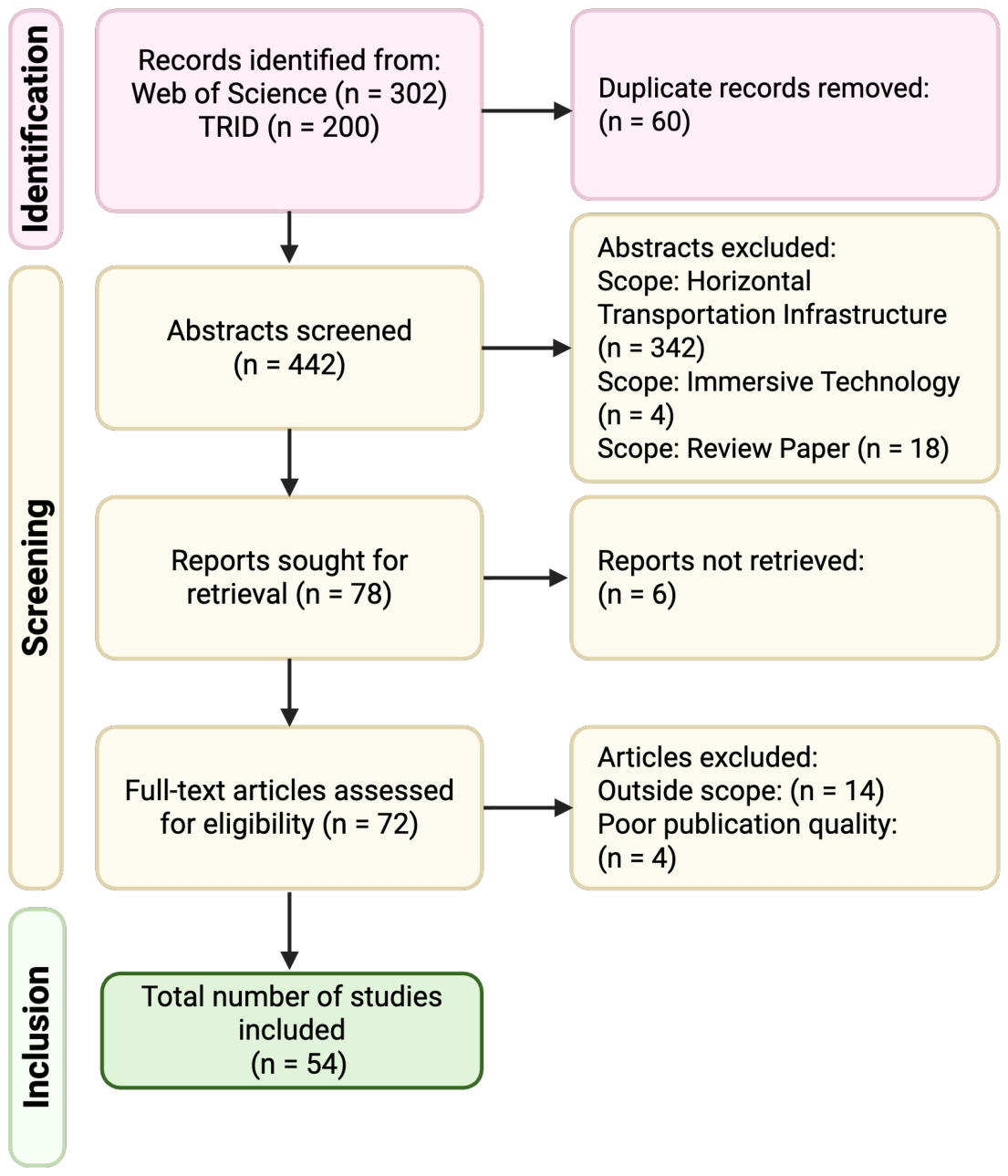
- (“augmented reality” OR “virtual reality” OR “extended reality” OR “mixed reality” OR “immersive technolog*”) AND (“horizontal construction” OR “horizontal infrastructure” OR “transportation infrastructure” OR “transportation project*” OR “highway” OR “roadway” OR “heavy civil” OR “civil infrastructure” OR “work zone” OR “bridge construction” OR “pavement design” OR “pavement installation” OR “pavement construction” OR “pavement maintenance” OR “pavement management” OR “paving” OR “asphalt paving” OR “concrete paving” OR “road surface”)
- (“augmented reality” OR “virtual reality” OR “extended reality” OR “mixed reality” OR “immersive technolog*”) AND (“bridge inspection” OR “Road inspection” OR “flagger” OR “road construction” OR “pavement inspection”)
3. Literature Review
3.1. Bibliometric Overview
3.2. Detailed Review of Articles
3.2.1. Onsite Tools
3.2.2. Offsite Viewers
3.2.3. Simulation
3.2.4. Education
4. Discussion
5. Conclusions
Supplementary Materials
Author Contributions
Funding
Institutional Review Board Statement
Informed Consent Statement
Data Availability Statement
Conflicts of Interest
Abbreviations
| VR | Virtual Reality |
| AR | Augmented Reality |
| HMD | Head-Mounted Display |
| DOT | Department of Transportation |
| EEG | Electroencephalography |
| UAV | Unmanned Aerial Vehicle |
References
- Kolmar, C. 25 Essential US Construction Industry Statistics [2023]: Data, Trends And More-Zippia—Zippia.com. 2023. Available online: https://www.zippia.com/advice/us-construction-industry-statistics/ (accessed on 12 March 2024).
- American Society of Civil Engineers. 2021 Report Card for America’s Infrastructure. Report, American Society of Civil Engineers, 2021. Available online: https://2021.infrastructurereportcard.org/ (accessed on 16 December 2024).
- Wang, L.; Xue, X.; Zhao, Z.; Wang, Z. The impacts of transportation infrastructure on sustainable development: Emerging trends and challenges. Int. J. Environ. Res. Public Health 2018, 15, 1172. [Google Scholar] [CrossRef]
- Work Zone Safety Information Clearinghouse. National & State Traffic Data: Work Zone Fatal Crashes and Fatalities. 2025. Available online: https://workzonesafety.org/work-zone-data/work-zone-fatal-crashes-and-fatalities/ (accessed on 24 November 2025).
- Li, Y.; Bai, Y. Comparison of characteristics between fatal and injury accidents in the highway construction zones. Saf. Sci. 2008, 46, 646–660. [Google Scholar] [CrossRef]
- Nnaji, C.; Gambatese, J.; Lee, H.W.; Zhang, F. Improving construction work zone safety using technology: A systematic review of applicable technologies. J. Traffic Transp. Eng. (Engl. Ed.) 2020, 7, 61–75. [Google Scholar] [CrossRef]
- Opoku, D.G.J.; Perera, S.; Osei-Kyei, R.; Rashidi, M.; Famakinwa, T.; Bamdad, K. Drivers for digital twin adoption in the construction industry: A systematic literature review. Buildings 2022, 12, 113. [Google Scholar] [CrossRef]
- Zhu, Y.; Brigham, J.C.; Fascetti, A. LiDAR-RGB Data Fusion for Four-Dimensional UAV-Based Monitoring of Reinforced Concrete Bridge Construction: Case Study of the Fern Hollow Bridge Reconstruction. J. Constr. Eng. Manag. 2025, 151, 05024016. [Google Scholar] [CrossRef]
- Chang, X.; Zhang, R.; Mao, J.; Fu, Y. Digital twins in transportation infrastructure: An investigation of the key enabling technologies, applications, and challenges. IEEE Trans. Intell. Transp. Syst. 2024, 25, 6449–6471. [Google Scholar] [CrossRef]
- Ghimire, P.; Kim, K.; Acharya, M. Generative ai in the construction industry: Opportunities & challenges. arXiv 2023, arXiv:2310.04427. [Google Scholar]
- Akhavan, M.; Alivirdi, M.; Jamalpour, A.; Kheradranjbar, M.; Mafi, A.; Jamalpour, R.; Ravanshadnia, M. Impact of Industry 5.0 on the Construction Industry (Construction 5.0): Systematic Literature Review and Bibliometric Analysis. Buildings 2025, 15, 1491. [Google Scholar] [CrossRef]
- Neece, T.; Fascetti, A. Towards Remote Construction Site Analysis: From Laser Point Clouds to Virtual Reality Applications. In Proceedings of the ISARC, International Symposium on Automation and Robotics in Construction, Montreal, QC, Canada, 28–31 July 2025; IAARC Publications: Vienna, Austria, 2025; Volume 42, pp. 1379–1386. [Google Scholar]
- Sacks, R.; Perlman, A.; Barak, R. Construction safety training using immersive virtual reality. Constr. Manag. Econ. 2013, 31, 1005–1017. [Google Scholar] [CrossRef]
- Hilfert, T.; König, M. Low-cost virtual reality environment for engineering and construction. Vis. Eng. 2016, 4, 2. [Google Scholar] [CrossRef]
- Rashidi, A.; Yong, W.Y.; Maxwell, D.; Fang, Y. Construction planning through 4D BIM-based virtual reality for light steel framing building projects. Smart Sustain. Built Environ. 2023, 12, 1153–1173. [Google Scholar] [CrossRef]
- Jeelani, I.; Albert, A.; Azevedo, R.; Jaselskis, E.J. Development and testing of a personalized hazard-recognition training intervention. J. Constr. Eng. Manag. 2017, 143, 04016120. [Google Scholar] [CrossRef]
- Kong, X.; Pettijohn, T.F.; Torikyan, H. From photogrammetry to virtual reality: A framework for assessing visual fidelity in structural inspections. Sensors 2025, 25, 4296. [Google Scholar]
- Park, J.; Lee, J.K.; Son, M.J.; Yu, C.; Lee, J.; Kim, S. Unlocking the potential of digital twins in construction: A systematic and quantitative review using text mining. Buildings 2024, 14, 702. [Google Scholar] [CrossRef]
- Babalola, A.; Manu, P.; Cheung, C.; Yunusa-Kaltungo, A.; Bartolo, P. A systematic review of the application of immersive technologies for safety and health management in the construction sector. J. Saf. Res. 2023, 85, 66–85. [Google Scholar] [CrossRef] [PubMed]
- Weng, J.; Meng, Q. Analysis of driver casualty risk for different work zone types. Accid. Anal. Prev. 2011, 43, 1811–1817. [Google Scholar] [CrossRef]
- Piras, G.; Agostinelli, S.; Muzi, F. Digital twin framework for built environment: A review of key enablers. Energies 2024, 17, 436. [Google Scholar]
- Abbasnejad, B.; Soltani, S.; Karamoozian, A.; Gu, N. A systematic literature review on the integration of Industry 4.0 technologies in sustainability improvement of transportation construction projects: State-of-the-art and future directions. Smart Sustain. Built Environ. 2024, 15, 533–569. [Google Scholar] [CrossRef]
- Federal Highway Administration. National Bridge Inspection Standards. 23 C.F.R. Part 650, Subpart C, 2026. Electronic Code of Federal Regulations. Available online: https://www.ecfr.gov/current/title-23/chapter-I/subchapter-G/part-650/subpart-C (accessed on 17 February 2026).
- Hubbard, B.; Hubbard, S. Unmanned aircraft systems (UAS) for bridge inspection safety. Drones 2020, 4, 40. [Google Scholar] [CrossRef]
- Omer, M.; Margetts, L.; Hadi Mosleh, M.; Hewitt, S.; Parwaiz, M. Use of gaming technology to bring bridge inspection to the office. Struct. Infrastruct. Eng. 2019, 15, 1292–1307. [Google Scholar] [CrossRef]
- Omer, M.; Margetts, L.; Mosleh, M.H.; Cunningham, L.S. Inspection of concrete bridge structures: Case study comparing conventional techniques with a virtual reality approach. J. Bridge Eng. 2021, 26, 05021010. [Google Scholar] [CrossRef]
- Li, X.; Yi, W.; Chi, H.L.; Wang, X.; Chan, A.P. A critical review of virtual and augmented reality (VR/AR) applications in construction safety. Autom. Constr. 2018, 86, 150–162. [Google Scholar] [CrossRef]
- Pentury, C.; Karsaman, R.H.; Rahman, H.; Rosmansyah, Y. Application of digitalization and computerization technology in road construction. Autom. Constr. 2025, 171, 106018. [Google Scholar] [CrossRef]
- Assaf, M.; Al-Hussein, M.; Li, X. Critical review of virtual reality applications in offsite construction research. J. Constr. Eng. Manag. 2024, 150, 03124007. [Google Scholar] [CrossRef]
- Sudhakaran, G.; Prabhakaran, A.; Booth, C.; Abbey, S.; Mahamadu, A.M.; Georgakis, P.; Pohle, M. Stepping into safety: A systematic review of extended reality technology applications in enhancing vulnerable road user safety. Smart Sustain. Built Environ. 2025, 14, 1664–1700. [Google Scholar] [CrossRef]
- Wang, P.; Wu, P.; Wang, J.; Chi, H.L.; Wang, X. A critical review of the use of virtual reality in construction engineering education and training. Int. J. Environ. Res. Public Health 2018, 15, 1204. [Google Scholar] [CrossRef]
- Page, M.J.; McKenzie, J.E.; Bossuyt, P.M.; Boutron, I.; Hoffmann, T.C.; Mulrow, C.D.; Shamseer, L.; Tetzlaff, J.M.; Akl, E.A.; Brennan, S.E.; et al. The PRISMA 2020 statement: An updated guideline for reporting systematic reviews. BMJ 2021, 372, n71. [Google Scholar] [CrossRef]
- Transportation Research Board. Transport Research International Documentation (TRID), 2025. Available online: https://trid.trb.org/ (accessed on 2 December 2025).
- Clarivate. Web of Science Core Collection, 2025. Available online: https://clarivate.com/academia-government/scientific-and-academic-research/research-discovery-and-referencing/web-of-science/web-of-science-core-collection/ (accessed on 2 December 2025).
- Azofeifa, J.D.; Rueda-Castro, V.; Gonzalez-Gomez, L.J.; Noguez, J.; Caratozzolo, P. Revolutionizing training in continuing engineering education: An experimental proposal using the multi-sensory virtual decision-making center. IEEE Access 2024, 12, 192440–192448. [Google Scholar] [CrossRef]
- Jung, J.; Olsen, M.J.; Hurwitz, D.S.; Kashani, A.G.; Buker, K. 3D virtual intersection sight distance analysis using lidar data. Transp. Res. Part C Emerg. Technol. 2018, 86, 563–579. [Google Scholar] [CrossRef]
- Landis, J.R.; Koch, G.G. The measurement of observer agreement for categorical data. Biometrics 1977, 33, 159–174. [Google Scholar] [CrossRef]
- Ball, C.; Huang, K.T.; Francis, J. Virtual reality adoption during the COVID-19 pandemic: A uses and gratifications perspective. Telemat. Inform. 2021, 65, 101728. [Google Scholar] [CrossRef] [PubMed]
- Elmasry, T.; Hazan, E.; Khan, H.; Kelly, G.; Srivastava, S.; Yee, L.; Zemmel, R.W. Value Creation in the Metaverse; Technical Report; McKinsey & Company: Chicago, IL, USA, 2022. [Google Scholar]
- Sabeti, S.; Ardecani, F.B.; Shoghli, O. Augmented reality safety warnings in roadway work zones: Evaluating the effect of modality on worker reaction times. Transp. Res. Part C Emerg. Technol. 2024, 169, 104867. [Google Scholar] [CrossRef]
- Arvikar, S.; Aung, P.P.W.; Cha, G.; Park, S. Augmented Reality-based construction site management using optimized BIM and project schedule integration. Autom. Constr. 2025, 175, 106204. [Google Scholar] [CrossRef]
- Awadallah, O.; Sadhu, A. Automated multiclass structural damage detection and quantification using augmented reality. J. Infrastruct. Intell. Resil. 2023, 2, 100024. [Google Scholar] [CrossRef]
- Binni, L.; Vaccarini, M.; Spegni, F.; Messi, L.; Naticchia, B. An Automatic Registration System Based on Augmented Reality to Enhance Civil Infrastructure Inspections. Buildings 2025, 15, 1146. [Google Scholar] [CrossRef]
- John Samuel, I.; Salem, O.; He, S. Defect-oriented supportive bridge inspection system featuring building information modeling and augmented reality. Innov. Infrastruct. Solut. 2022, 7, 247. [Google Scholar] [CrossRef]
- Kassis, R.E.; Ayer, S.K.; Asmar, M.E.; Tang, P. Discovering factors that influence the use of augmented reality for communication on active highway construction sites. Transp. Res. Rec. 2023, 2677, 376–389. [Google Scholar] [CrossRef]
- Martins, A.C.P.; Castellano, I.R.; Júnior, K.M.L.C.; de Carvalho, J.M.F.; Bellon, F.G.; de Oliveira, D.S.; Ribeiro, J.C.L. BIM-based mixed reality application for bridge inspection. Autom. Constr. 2024, 168, 105775. [Google Scholar] [CrossRef]
- Mohamed, M.; Tran, D. Exploring the use of mobile technologies for highway construction inspection. In Proceedings of the Construction Research Congress 2022, Arlington, VA, USA, 9–12 March 2022; pp. 689–697. [Google Scholar]
- Mohammadkhorasani, A.; Malek, K.; Mojidra, R.; Li, J.; Bennett, C.; Collins, W.; Moreu, F. Augmented reality-computer vision combination for automatic fatigue crack detection and localization. Comput. Ind. 2023, 149, 103936. [Google Scholar] [CrossRef]
- Mojidra, R.; Li, J.; Mohammadkhorasani, A.; Moreu, F.; Bennett, C.; Collins, W. Computer vision and augmented reality for human-centered fatigue crack inspection. Sensors 2024, 24, 3685. [Google Scholar] [CrossRef]
- Nguyen, D.C.; Nguyen, T.Q.; Jin, R.; Jeon, C.H.; Shim, C.S. BIM-based mixed-reality application for bridge inspection and maintenance. Constr. Innov. 2022, 22, 487–503. [Google Scholar] [CrossRef]
- Nilnoree, S.; Mizutani, T. An innovative framework for incorporating iPhone LiDAR point cloud in digitized documentation of road operations. Results Eng. 2025, 25, 103953. [Google Scholar] [CrossRef]
- Pantoja-Rosero, B.; Salamone, S. Integrating extended reality and AI-based damage segmentation for near real-time, traceable bridge inspections. Autom. Constr. 2025, 180, 106567. [Google Scholar] [CrossRef]
- Sabeti, S.; Shoghli, O.; Baharani, M.; Tabkhi, H. Toward AI-enabled augmented reality to enhance the safety of highway work zones: Feasibility, requirements, and challenges. Adv. Eng. Inform. 2021, 50, 101429. [Google Scholar] [CrossRef]
- Sabeti, S.; Shoghli, O.; Tabkhi, H. Toward wi-fi-enabled real-time communication for proactive safety systems in highway work zones: A case study. In Proceedings of the Construction Research Congress 2022, Arlington, VA, USA, 9–12 March 2022; pp. 1166–1173. [Google Scholar]
- Sabeti, S.; Morris, N.; Shoghli, O. Mixed-method usability investigation of ARROWS: Augmented reality for roadway work zone safety. Int. J. Occup. Saf. Ergon. 2024, 30, 292–303. [Google Scholar] [CrossRef]
- Tschulik, M.; Kernbauer, T.; Fleck, P.; Arth, C. Spatial augmented reality for heavy machinery using laser projections. Comput. Graph. 2025, 126, 104161. [Google Scholar] [CrossRef]
- Xu, J.; Doyle, D.; Moreu, F. State of the art of augmented reality capabilities for civil infrastructure applications. Eng. Rep. 2022, 5, e12602. [Google Scholar] [CrossRef]
- Yu, Y.; Jeon, H.; Koo, B. Enhancing the stability and placement accuracy of BIM model projections for augmented reality-based site management of infrastructure projects. Appl. Sci. 2022, 12, 10798. [Google Scholar] [CrossRef]
- Alhady, A.; Alanany, M.; Khodair, Y.; Salem, S.; El Maghraby, Y. Integrating building information modelling (BIM) and extended reality (XR) in the transportation infrastructure industry. Adv. Bridge Eng. 2024, 5, 22. [Google Scholar] [CrossRef]
- Carter, E.; Sakr, M.; Sadhu, A. Augmented reality-based real-time visualization for structural modal identification. Sensors 2024, 24, 1609. [Google Scholar] [CrossRef]
- Choi, Y.; Choi, Y.; Cho, J.s.; Kim, D.; Kong, J. Utilization and verification of imaging technology in smart bridge inspection system: An application study. Sustainability 2023, 15, 1509. [Google Scholar] [CrossRef]
- d’Avigneau, A.M.; Potseluyko, L.; Anvo, N.R.; Taha, H.M.; Reja, V.K.; Davletshina, D.; Lam, P.; de Silva, L.; Al-Tabbaa, A.; Brilakis, I. CAMHighways: The Cambridge Highways dataset. Adv. Eng. Inform. 2025, 64, 103036. [Google Scholar] [CrossRef]
- Fawad, M.; Salamak, M.; Hanif, M.U.; Koris, K.; Ahsan, M.; Rahman, H.; Gerges, M.; Salah, M.M. Integration of bridge health monitoring system with augmented reality application developed using 3D game engine–Case Study. IEEE Access 2024, 12, 16963–16974. [Google Scholar] [CrossRef]
- Moradi, M.; Assaf, G.J. Building an augmented reality experience on top of a smart pavement management system. Buildings 2022, 12, 1915. [Google Scholar] [CrossRef]
- Wang, Z.; Wu, Y.; González, V.A.; Zou, Y.; del Rey Castillo, E.; Arashpour, M.; Cabrera-Guerrero, G. User-centric immersive virtual reality development framework for data visualization and decision-making in infrastructure remote inspections. Adv. Eng. Inform. 2023, 57, 102078. [Google Scholar] [CrossRef]
- Wilson Simao, A.; Wyndham, J.; Vargas Lopez, C. Augmented Reality in Transportation: Demonstration of AR Visualizations at Public Meetings Using a Combination of VISSIM Traffic Models, 3Ds Max Technology, and Roll Plots. In Proceedings of the International Conference on Transportation and Development 2023, Austin, TX, USA, 14–17 June 2023; pp. 119–126. [Google Scholar]
- Yiğit, A.Y.; Uysal, M. Virtual reality visualisation of automatic crack detection for bridge inspection from 3D digital twin generated by UAV photogrammetry. Measurement 2025, 242, 115931. [Google Scholar] [CrossRef]
- Aati, K.; Chang, D.; Edara, P.; Sun, C. Immersive work zone inspection training using virtual reality. Transp. Res. Rec. 2020, 2674, 224–232. [Google Scholar] [CrossRef]
- Ardecani, F.B.; Shoghli, O. Assessing Workers Neuro-physiological Stress Responses to Augmented Reality Safety Warnings in Immersive Virtual Roadway Work Zones. arXiv 2025, arXiv:2506.03113. [Google Scholar] [CrossRef]
- Ardecani, F.B.; Kumar, A.; Sabeti, S.; Shoghli, O. Neural correlates of augmented reality safety warnings: EEG analysis of situational awareness and cognitive performance in roadway work zones. Saf. Sci. 2025, 185, 106802. [Google Scholar] [CrossRef]
- Ergan, S.; Zou, Z.; Bernardes, S.D.; Zuo, F.; Ozbay, K. Developing an integrated platform to enable hardware-in-the-loop for synchronous VR, traffic simulation and sensor interactions. Adv. Eng. Inform. 2022, 51, 101476. [Google Scholar] [CrossRef]
- Hao, Z.; Zhang, W.; Zhao, Y. Integrated BIM and VR to implement IPD mode in transportation infrastructure projects: System design and case application. PLoS ONE 2021, 16, e0259046. [Google Scholar] [CrossRef]
- Kim, N.; Anderson, B.A.; Ahn, C.R. Reducing risk habituation to struck-by hazards in a road construction environment using virtual reality behavioral intervention. J. Constr. Eng. Manag. 2021, 147, 04021157. [Google Scholar] [CrossRef]
- Kim, N.; Kim, J.; Ahn, C.R. Predicting workers’ inattentiveness to struck-by hazards by monitoring biosignals during a construction task: A virtual reality experiment. Adv. Eng. Inform. 2021, 49, 101359. [Google Scholar] [CrossRef]
- Lu, D.B.; Ergan, S. Principal attributes of wearable warning alarms to promote roadway worker safety. Adv. Eng. Inform. 2025, 67, 103481. [Google Scholar] [CrossRef]
- Lu, D.; Ergan, S.; Ozbay, K. Reinforcement learning-based optimal control of wearable alarms for consistent roadway workers’ reactions to traffic hazards. J. Transp. Saf. Secur. 2025, 17, 757–781. [Google Scholar] [CrossRef]
- Marzouk, M.; Elsayed, A. Framework for assessing bridges construction impact on work zone traffic using BrIM. Sci. Rep. 2024, 14, 83. [Google Scholar] [CrossRef]
- Saeidi, S.; Zhu, Y.; Lifkooee, M.Z.; Mollazadeh, M.; Li, X. Co-presence in a shared virtual environment (SVE): A case study of highway work zone construction. In Proceedings of the International Conference on Construction and Real Estate Management, Banff, AB, Canada, 21–24 May 2019; American Society of Civil Engineers: Reston, VA, USA, 2019; pp. 490–497. [Google Scholar]
- Shen, Y.; Ling, J.; Li, X.; Li, H.; Feng, S.; Zhu, H. Holistic digital-twin-based framework to improve tunnel lighting environment: From methodology to application. Build. Environ. 2022, 224, 109562. [Google Scholar] [CrossRef]
- Zhang, S.; Zuo, F.; Ergan, S.; Ozbay, K. Improving work zone safety: Integrating VR-CARLA co-simulation and eye tracking for behavior analysis of drivers around work zones. J. Transp. Saf. Secur. 2025, 17, 826–849. [Google Scholar] [CrossRef]
- Zou, Z.; Bernardes, S.D.; Kurkcu, A.; Ergan, S.; Ozbay, K. An Integrated Approach to Capture Construction Workers’ Response Towards Safety Alarms Using Wearable Sensors and Virtual Reality; New York University: New York, NY, USA, 2020. [Google Scholar]
- Arif, F. Application of virtual reality for infrastructure management education in civil engineering. Educ. Inf. Technol. 2021, 26, 3607–3627. [Google Scholar] [CrossRef]
- Eiris, R.; Sun, Y.; Gheisari, M.; Marsh, B.; Lautala, P. VR-OnSite—online site visits using web-based virtual environments. In Proceedings of the Construction Research Congress 2022, Arlington, VA, USA, 9–12 March 2022; pp. 100–109. [Google Scholar]
- Li, Y.; Karim, M.M.; Qin, R. A virtual-reality-based training and assessment system for bridge inspectors with an assistant drone. IEEE Trans. Hum.-Mach. Syst. 2022, 52, 591–601. [Google Scholar] [CrossRef]
- Li, W.; Zhu, J.; Dang, P.; Wu, J.; Zhang, J.; Fu, L.; Zhu, Q. Immersive virtual reality as a tool to improve bridge teaching communication. Expert Syst. Appl. 2023, 217, 119502. [Google Scholar] [CrossRef]
- Luleci, F.; Chi, J.; Cruz-Neira, C.; Reiners, D.; Catbas, F.N. Fusing infrastructure health monitoring data in point cloud. Autom. Constr. 2024, 165, 105546. [Google Scholar]
- Qing, Z.; Edara, P. Integrating virtual reality into work zone flagger training: Usability analysis and behavioral assessment. Transp. Res. Rec. 2024, 2678, 1057–1067. [Google Scholar] [CrossRef]
- Sakib, M.N.; Chaspari, T.; Behzadan, A.H. Physiological data models to understand the effectiveness of drone operation training in immersive virtual reality. J. Comput. Civ. Eng. 2021, 35, 04020053. [Google Scholar]
- Tanbour, E.; Korkmaz, K.; Ashur, S.; Almousa, O.F. Virtual reality simulation of highway bridges as a teaching tool in engineering. J. Constr. Eng. Manag. Innov. 2024, 7, 01–09. [Google Scholar] [CrossRef]
- Yu, X.; Yu, P.; Wan, C.; Wang, D.; Shi, W.; Shou, W.; Wang, J.; Wang, X. Integrating virtual reality and building information modeling for improving highway tunnel emergency response training. Buildings 2022, 12, 1523. [Google Scholar] [CrossRef]



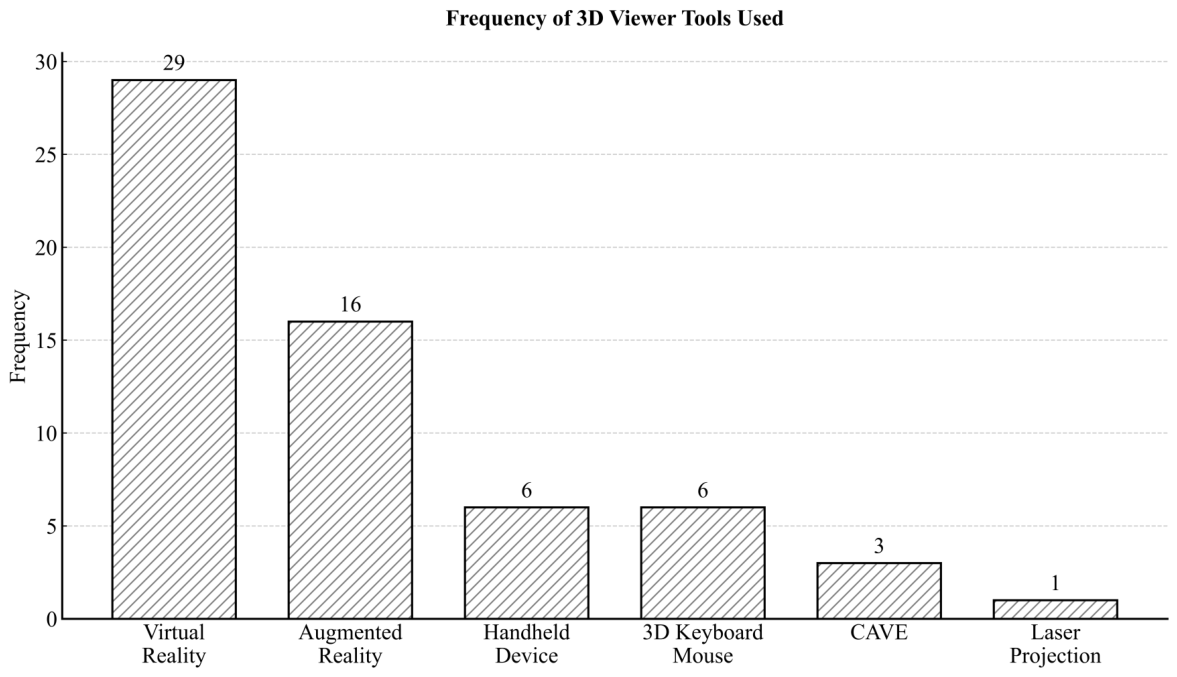
| Classification | Definition |
|---|---|
| Virtual Reality | A fully immersive environment in which the user is utilizing a head-mounted display (HMD) for visualization. |
| Augmented Reality | A technology that superimposes digital content over the user’s view of the physical world using a see-through HMD or smart glasses. |
| Handheld Device | Superimposed digital content over the user’s view of the physical world using a handheld device such as a tablet or smartphone. |
| 3D Keyboard Mouse | A non-immersive virtual environment displayed on a standard 2D monitor, where the user navigates and interacts using traditional input devices like a keyboard and mouse. |
| CAVE | A room-sized, immersive virtual reality space where 3D imagery is projected onto the walls (and occasionally the floor and ceiling) to surround the user in real-life space. |
| Laser Projection | Superimposed digital content onto the real-world environment by means of lasers. |
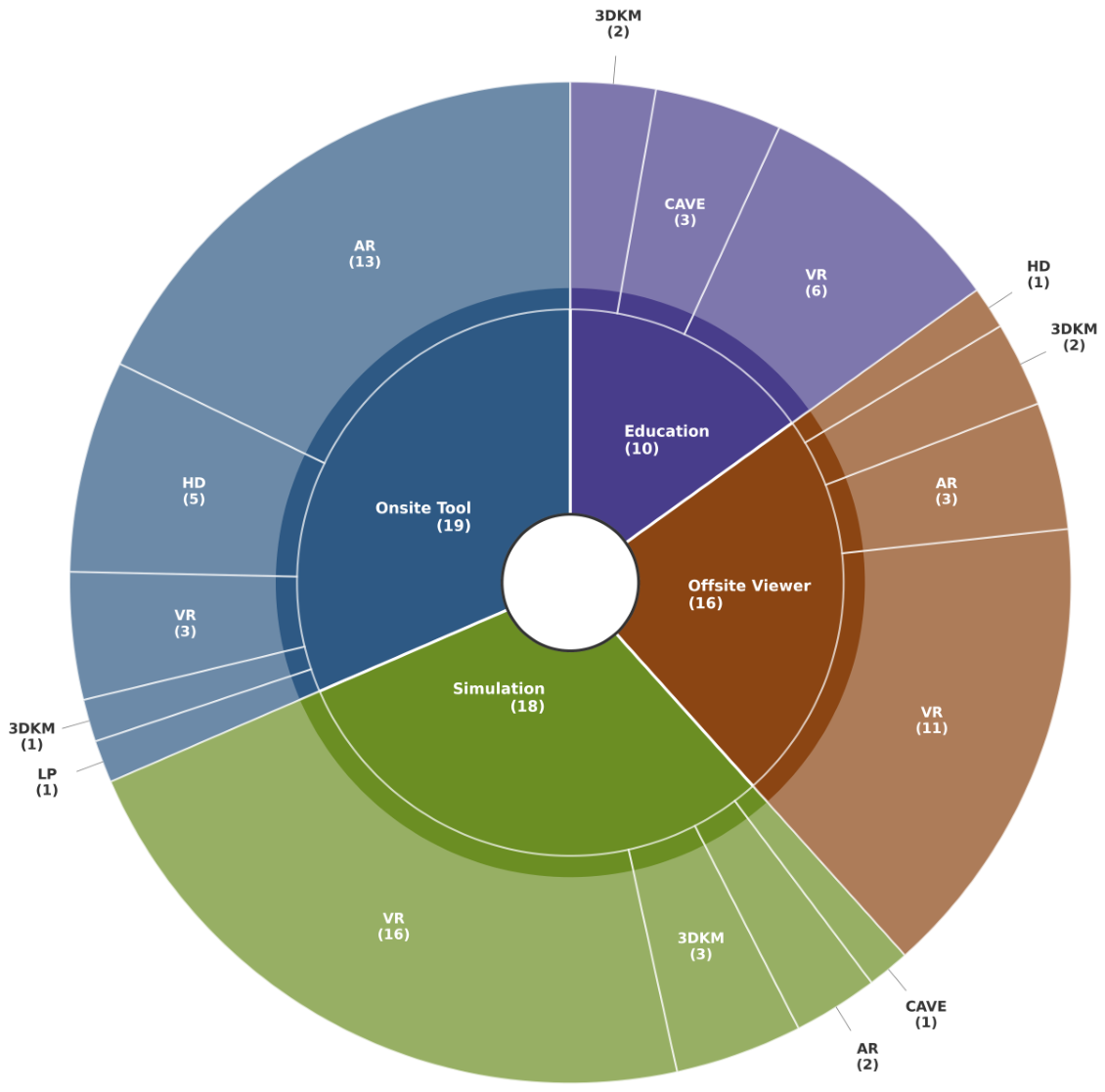
| Classification | Definition |
|---|---|
| Onsite Tool | Field-based applications deployed directly at the physical job site to enhance labor productivity and safety. |
| Offsite Viewer | Platforms used to visualize or monitor project data remotely without being physically present. |
| Simulation | Virtual environments that extend a base “truth” model by adding specific calculations or features to investigate performance and derive design insights. |
| Education | Applications designed to facilitate learning and training for students or professionals. |
| Tool Class | Articles | VR | AR | HD | 3DKM | CAVE | LP | Classifications |
|---|---|---|---|---|---|---|---|---|
| Onsite Tool | 19 | 3 | 13 | 5 | 1 | 0 | 1 | 23 |
| Offsite Viewer | 16 | 11 | 3 | 1 | 2 | 0 | 0 | 17 |
| Simulation | 18 | 16 | 2 | 0 | 3 | 1 | 0 | 22 |
| Education | 10 | 6 | 0 | 0 | 2 | 3 | 0 | 11 |
| Total | 54 | 29 | 16 | 6 | 6 | 3 | 1 | 73 |
| Author (Year) | Immersive Medium(s) |
|---|---|
| Onsite Tool | |
| Arvikar et al., 2025 [41] | Handheld Device |
| Awadallah and Sadhu, 2023 [42] | Augmented Reality |
| Binni et al., 2025 [43] | Augmented Reality |
| John Samuel et al., 2022 [44] | Handheld Device |
| El Kassis et al., 2023 [45] | Augmented Reality |
| Martins et al., 2024 [46] | Handheld Device |
| Mohamed and Tran, 2022 [47] | Augmented Reality, Virtual Reality |
| Mohammadkhorasani et al., 2023 [48] | Augmented Reality |
| Mojidra et al., 2024 [49] | Augmented Reality |
| Nguyen et al., 2022 [50] | Augmented Reality |
| Nilnoree and Mizutani 2025 [51] | Handheld Device |
| Pantoja-Rosero and Salamone, 2025 [52] | Augmented Reality |
| Sabeti et al., 2021 [53] | Augmented Reality |
| Sabeti et al., 2022 [54] | Augmented Reality |
| Sabeti et al. 2024 [55] | Augmented Reality |
| Sabeti et al., 2024 [40] [Also: Simulation] | Augmented Reality, Virtual Reality |
| Tschulik et al., 2025 [56] | Laser Projection |
| Xu et al., 2022 [57] | Augmented Reality, Virtual Reality |
| Yu et al., 2022 [58] | Handheld Device |
| Offsite Viewer | |
| Alhady et al., 2024 [59] | Augmented Reality, Virtual Reality |
| Carter et al., 2024 [60] | Augmented Reality |
| Choi et al., 2023 [61] | Virtual Reality |
| d’Avigneau et al., 2025 [62] | Virtual Reality |
| Offsite Viewer | |
| Fawad et al., 2024 [63] [Also: Simulation] | Augmented Reality |
| Kong et al., 2025 [17] | Virtual Reality |
| Moradi and Assaf, 2022 [64] [Also: Simulation] | 3D Keyboard Mouse |
| Omer et al., 2019 [25] | Virtual Reality |
| Omer et al., 2021 [26] | Virtual Reality |
| Wang et al., 2023 [65] | Virtual Reality |
| Wilson Simao et al., 2023 [66] | Handheld Device |
| Yiǧit and Uysal, 2025 [67] | Virtual Reality |
| Simulation | |
| Aati et al., 2020 [68] [Also: Education] | Virtual Reality |
| Ardecani and Shoghli, 2025 [69] | Virtual Reality |
| Ardecani et al., 2025 [70] | Virtual Reality |
| Ergan et al., 2022 [71] | Virtual Reality |
| Hao et al., 2021 [72] [Also: Offsite] | Virtual Reality |
| Kim et al., 2021 [73] | Virtual Reality |
| Kim et al., 2021 [74] | Virtual Reality |
| Lu and Ergan, 2025 [75] | Virtual Reality |
| Lu et al., 2025 [76] | Virtual Reality |
| Marzouk and Elsayed, 2024 [77] [Also: Offsite] | Virtual Reality |
| Saeidi et al., 2019 [78] | 3D Keyboard Mouse, Virtual Reality |
| Shen et al., 2022 [79] [Also: Offsite] | Virtual Reality |
| Zhang et al., 2025 [80] | 3D Keyboard Mouse |
| Zou et al., 2020 [81] | Virtual Reality |
| Education | |
| Arif, 2021 [82] | CAVE |
| Eiris et al., 2022 [83] [Also: Offsite] | 3D Keyboard Mouse |
| Li et al., 2022 [84] | 3D Keyboard Mouse |
| Li et al., 2023 [85] | Virtual Reality |
| Luleci et al., 2024 [86] [Also: Simulation] | CAVE, Virtual Reality |
| Qing and Edara, 2024 [87] | Virtual Reality |
| Sakib et al., 2021 [88] | Virtual Reality |
| Tanbour et al., 2024 [89] | CAVE |
| Yu et al., 2022 [90] [Also: Simulation] | Virtual Reality |
| Key Technology/Algorithm | Representative Articles |
|---|---|
| Computer Vision & Defect Detection | |
| Deep Learning Detection | Sabeti et al. [53]; Awadallah and Sadhu [42]; Pantoja-Rosero and Salamone [52] |
| Feature-Point Tracking | Mohammadkhorasani et al. [48]; Mojidra et al. [49] |
| UAV Photogrammetry | Kong et al. [17]; Yiǧit and Uysal [67] |
| LiDAR/Point Cloud Processing | Nilnoree and Mizutani [51]; Nguyen et al. [50]; Luleci et al. [86]; Omer et al. [25]; Omer et al. [26] |
| Spatial Registration | |
| BIM Registration | Binni et al. [43]; Nguyen et al. [50]; Martins et al. [46]; John Samuel et al. [44]; Arvikar et al. [41] |
| SLAM-based Tracking | Martins et al. [46]; John Samuel et al. [44] |
| Physiological Signal Processing | |
| EEG Analysis | Ardecani and Shoghli [69]; Ardecani et al. [70]; Kim et al. [74] |
| Biosignal Monitoring | Kim et al. [74]; Sakib et al. [88]; Zou et al. [81]; Kim et al. [73] |
| Simulation & Modeling | |
| Hardware-in-the-Loop | Ergan et al. [71]; Lu et al. [76]; Zhang et al. [80] |
| Traffic Simulation | Marzouk and Elsayed [77]; Wilson Simao et al. [66]; Saeidi et al. [78] |
| Digital Twin Integration | Alhady et al. [59]; Fawad et al. [63]; d’Avigneau et al. [62]; Shen et al. [79]; Carter et al. [60] |
| Sensor Integration & Alerting | |
| Real-Time Sensor Streaming | Carter et al. [60]; Fawad et al. [63]; Sabeti et al. [54] |
| Multimodal Alert Systems | Sabeti et al. [55]; Sabeti et al. [40]; Lu and Ergan [75]; Zou et al. [81] |
Disclaimer/Publisher’s Note: The statements, opinions and data contained in all publications are solely those of the individual author(s) and contributor(s) and not of MDPI and/or the editor(s). MDPI and/or the editor(s) disclaim responsibility for any injury to people or property resulting from any ideas, methods, instructions or products referred to in the content. |
© 2026 by the authors. Licensee MDPI, Basel, Switzerland. This article is an open access article distributed under the terms and conditions of the Creative Commons Attribution (CC BY) license.
Share and Cite
Neece, T.; Smetana, M.; Khazanovich, L. Immersive Technologies for Occupational Safety in Horizontal Transportation Construction: A Systematic Review. Appl. Sci. 2026, 16, 4349. https://doi.org/10.3390/app16094349
Neece T, Smetana M, Khazanovich L. Immersive Technologies for Occupational Safety in Horizontal Transportation Construction: A Systematic Review. Applied Sciences. 2026; 16(9):4349. https://doi.org/10.3390/app16094349
Chicago/Turabian StyleNeece, Trevor, Mason Smetana, and Lev Khazanovich. 2026. "Immersive Technologies for Occupational Safety in Horizontal Transportation Construction: A Systematic Review" Applied Sciences 16, no. 9: 4349. https://doi.org/10.3390/app16094349
APA StyleNeece, T., Smetana, M., & Khazanovich, L. (2026). Immersive Technologies for Occupational Safety in Horizontal Transportation Construction: A Systematic Review. Applied Sciences, 16(9), 4349. https://doi.org/10.3390/app16094349