Article

Characterization of Tenderness-Related SNPs in Culled Holstein Cows: CAPN1 and CAST Genotypes Show Neutral Effects on Postmortem Meat Quality Parameters—A Pilot Study


by
Maria de los Angeles Robles-Mota
1,
Manuel Andrés González Toimil
1,
María Salud Rubio-Lozano
2,
Henry Alberto Grajales-Lombana
3,
Jorge Alfredo Cuéllar-Ordaz
1,
José Francisco Montiel-Sosa
4,
Jonathan Josué Balderas Correa
1,
Crisóforo Mercado-Márquez
1,
Rosa Isabel Higuera-Piedrahita
1,
Daniel Hernandez-Patlan
5,6,* and
Ana Elvia Sánchez-Mendoza
4,*
1
Laboratory 3: Multidisciplinary Research Unit, Superior Studies Faculty at Cuautitlán (FESC), National Autonomous University of Mexico (UNAM), Cuautitlán Izcalli 54714, Mexico
2
Facultad de Medicina Veterinaria y Zootecnia, Universidad Nacional Autónoma de México, Ciudad de México 04510, Mexico
3
Facultad de Medicina Veterinaria y de Zootecnia, Universidad Nacional de Colombia, Ciudad Universitaria de Bogotá, Bogota 111321, Colombia
4
Laboratory 18: Multidisciplinary Research Unit, Superior Studies Faculty at Cuautitlán (FESC), National Autonomous University of Mexico (UNAM), Cuautitlán Izcalli 54714, Mexico
5
Laboratory 5: Laboratorio de Ensayos de Desarrollo Farmaceutico (LEDEFAR), Multidisciplinary Research Unit, Superior Studies Faculty at Cuautitlan (FESC), National Autonomous University of Mexico (UNAM), Cuautitlan Izcalli 54714, Mexico
6
Nanotechnology Engineering Division, Polytechnic University of the Valley of Mexico, Tultitlan 54910, Mexico
*
Authors to whom correspondence should be addressed.
Appl. Sci. 2026, 16(9), 4313; https://doi.org/10.3390/app16094313
Submission received: 31 March 2026 / Revised: 23 April 2026 / Accepted: 25 April 2026 / Published: 28 April 2026

Abstract

Meat from cull dairy cows is often used for human consumption; it is well known that tenderness adds value to the market, and dairy cattle meat is usually undervalued. In Mexico, most meat production comes from young bulls, mainly Bos indicus and commercial crossbreeds, whose meat tends to be tough rather than tender. The present study evaluated the association of G530A (CAPN1) and C357G (CAST) polymorphisms (PCR-RFLP) with meat tenderness using the Warner–Bratzler shear force (WBSF) method. Additionally, the color, pH, and marbling of meat cuts from culled Holstein cows were determined at 72 h postmortem. CAPN1 G530A genotype frequencies were GG (50%), AG (46%), and AA (4%), and for CAST C357G, they were CC (36%), CG (42%), and GG (22%); for both SNPs, the Hardy–Weinberg equilibrium was observed. Genotypes for CAPN1G530A and CAST C357G did not have a significant effect on WBSF (p > 0.05). Shear force (kg) for CAPN1 G530A genotypes was 4.02 ± 0.14 (GG), 3.99 ± 0.13 (AG) and 4.43 ± 0 (AA); and for CAST C357G genotypes, it was 4.0 ± 0.17 (CC), 4.09 ± 0.13 (CG) and 3.98 ± 0.11 (GG); the polymorphisms did not affect significantly WBSF, suggesting the limited applicability of these SNPs for meat tenderness in dairy cattle. However, due to the small sample size (n = 50) and especially the low number of CAPN1 AA homozygotes (n = 2), this study should be regarded as a proof-of-concept pilot investigation. The results warrant validation in larger cohorts.

1. Introduction

In dairy production, animals that are replaced due to reproductive problems, mastitis, low productivity, or injuries (Piazza et al., 2023; Latta et al., 2024) [1,2] are destined for human consumption. Globally, culled dairy cows account for a significant share of beef production, contributing approximately 15–20% of the total beef supply in some countries. Yet, their meat is often undervalued due to perceived inferior quality [3,4]. However, despite their contribution to the meat industry, there has been little research on meat quality in these animals [1,2,3,4,5,6,7] and on the identification of genetic markers associated with meat tenderness [8,9,10,11,12].
The quality of meat depends not only on environmental factors, such as animal feed, production systems, welfare, and pre- and post-slaughter conditions, but also on intrinsic factors, including breed, sex, age, and genetics [12]. Meat tenderness has been determined as an important issue because of the impact on consumer satisfaction; nevertheless, this is not usually measured [13], and many previous works have identified the primary process, factors, genes, and molecular markers like single-nucleotide polymorphisms associated with tenderness [14,15,16,17,18,19,20]. Tenderness is particularly critical in meat from older animals, such as culled cows, because the accumulation of cross-linked collagen and reduced proteolytic potential can exacerbate toughness [21].
The calpain/calpastatin system is the principal proteolytic system in muscle and is responsible for postmortem tenderization [18]. Calpains are encoded by the CAPN1 gene on bovine chromosome 29, with μ-calpain being the primary enzyme involved in muscle structure degradation during postmortem aging due to its low calcium concentration requirements for activation; and calpastatin, encoded by the CAST gene on bovine chromosome 5, acts as a competitive inhibitor of both μ-calpain and m-calpain [14,15,21]. CAPN1 degrades desmin, the main structural protein of Z-disks in myofibrillar sarcomeres, and can also degrade titin, nebulin, and troponin T. This proteolysis produces myofibril weakening and tenderization [15]. In older animals, higher calpastatin activity relative to calpain has been reported, which may reduce postmortem proteolysis and partially explain why culled cows often produce tougher meat unless adequately aged [22].
Various single-nucleotide polymorphisms (SNPs) in the CAPN1 and CAST genes have been identified and associated with meat tenderness. A study by Casas et al. [18] determined the effect of CAPN1 and CAST SNPs on tenderness in meat from animals of three different populations. Both markers had a significant impact on two of the studied populations, with animals carrying the TT genotype for CAST and the CC genotype for CAPN1 showing greater tenderness in two groups. In another study, the CAPN1 c.947C > G and CAST c.2959A > G SNPs were identified in Jersey × Limousin, Hereford, and Angus crosses. Animals carrying the CC genotype (CAPN1) exhibited meat with 20% lower shear force than those with the GG genotype; for CAST, the AA and AG genotypes showed reduced shear force, though comparisons with the GG genotype were not possible, as no individuals carried the GG genotype [23]. Among the numerous SNPs described in the literature, CAPN1 G530A and CAST C357G were selected for this pilot study because they have been repeatedly associated with tenderness variation in Bos taurus breeds, are relatively easy to genotype via PCR-RFLP, and have been validated in independent cattle populations [16,18,24]. However, most previous association studies have focused on young beef breeds, leaving a knowledge gap regarding their relevance in dairy cull cows.
Regarding Holstein dairy cattle, several studies have identified SNPs associated with milk quality, reproductive performance, and health phenotypes [25]. Some researchers have associated SNPs with specific productive traits, such as fattening performance, final weight, daily live weight, and carcass yield, in Holstein bulls; these SNPs can also be indirectly related to meat quality [9,10,11]. Nevertheless, direct evidence linking CAPN1 and CAST polymorphisms to meat tenderness in culled Holstein cows remains scarce, and breed-specific differences in allele effects have been suggested [13].
In Mexico, research on meat quality associated with SNPs has focused on beef cattle, commercial retail meat, and commercial Bos indicus x Bos taurus crossbreeding [24,26]. It has addressed the quality of dairy cattle meat [27,28] to a limited extent. The Comarca Lagunera region is one of Mexico’s most important dairy basins, yet the meat from its culled cows has not been genetically characterized for tenderness markers. This pilot study aimed to characterize meat quality in culled Holstein cows and to explore the association of CAPN1 (G530A) and CAST (C357G) polymorphisms with tenderness-related traits, with the understanding that the limited sample size (n = 50) precludes definitive conclusions. The results are intended to generate hypotheses and to assess the feasibility of such genetic analyses in this production system.

2. Materials and Methods

2.1. Biological Material

Samples of longissimus thoracis (1 inch thick) were obtained from 50 culled Holstein cows (5–7 years old) from various dairy farms in the Comarca Lagunera region (Coahuila and Durango). Animal transport, slaughter, and processing were conducted in a federally inspected abattoir in compliance with official regulations (NOM-033-SAG/ZOO-2014 [29] and NOM-051-ZOO-1995 [30]). All carcasses were refrigerated for 48 h after slaughter. The carcasses were further fabricated under controlled temperature conditions (4 °C). Samples were collected from the 12th rib section of the loin and transported by commercial airplane under refrigeration (4 °C) in high-vacuum (HV) packaging with polyethylene coating.
This investigation was designed as a proof-of-concept pilot study. A convenience sample of 50 culled Holstein cows was used, which is adequate for descriptive purposes and for estimating genotypic frequencies, but is underpowered for detecting small-to-moderate genotype effects on shear force. The sample size was not calculated a priori for association testing; therefore, all statistical comparisons are exploratory [24].

2.2. Analytical Methods for Meat Quality Parameter Assessment

2.2.1. Marbling

The marbling score of each loin cut was evaluated according to the standardized USDA-AMS classification scale [31], which includes the following grades: Practically Devoid, Traces (Slight), Small, Modest, Moderate, Slightly Abundant, Moderately Abundant, Abundant, Very Abundant, and Kobe-style.

2.2.2. pH Determination

pH measurements were performed using a HANNA HI99163® (Woonsocket, RI, USA) meat pH meter with penetration electrode, calibrated with pH 4 and pH 7 buffer solutions according to NMX-F-317-S-1978 standards [32]. Triplicate measurements were taken directly from the longissimus thoracis muscle, and the values were averaged for analysis [24].

2.2.3. Color Measurement (Lab*)

Samples were oxygenated by exposure to air for 30 min before color analysis. Color parameters were determined using a HunterLab MiniScan 4500 L® colorimeter (Reston, VA, USA) following the American Meat Science Association guidelines [33]. The instrument was calibrated using white and black reference tiles, with the following settings: 2.5 cm aperture size, D65 illuminant, 10° standard observer. Triplicate measurements were obtained by placing the shutter directly on the sample surface. The following CIELAB color space parameters were recorded and averaged: L\* (lightness: 0–100 scale), a\* (red/green component: 0–60 scale), b\* (yellow/blue component: 0–60 scale).

2.2.4. Evaluation of Meat Tenderness Using the Warner–Bratzler Shear Force Method

Meat tenderness was assessed using the Warner–Bratzler shear force technique according to the American Meat Science Association standards [34]. Longissimus thoracis samples were cooked on a George Foreman grill preheated to 200 °C, with internal temperature monitored using a HANNA® penetration probe thermometer. Samples were turned when reaching 35 °C and cooked until the geometric center reached 70 °C. After cooking, samples were cooled at room temperature for at least 15 min. From each sample, 5 to 8 cylindrical cores (1 cm diameter × 2–3 cm length) were extracted parallel to the muscle fiber orientation using an automated coring device. Shear force measurements were performed perpendicular to fiber direction using a Salter® (Salter, Tonbridge, UK) Warner–Bratzler shear apparatus, with values from 5 to 8 replicates averaged for each sample to determine final tenderness values.

2.3. Identification of CAPN1 and CAST Polymorphisms

Single-nucleotide polymorphism (SNP) identification was performed by extracting, purifying, amplifying, and analyzing restriction fragment length polymorphism (RFLP) products, following the techniques reported by Sánchez-Mendoza et al. [24] and modifications described below.

2.3.1. DNA Extraction

To 150 mg of meat tissue, 1250 μL of lysis buffer, and 7 μL of proteinase K were added, followed by incubation at 50 °C for two hours (enzyme activation) and an additional hour at 60 °C (enzyme deactivation). Next, 250 μL of phenol–chloroform–isoamyl alcohol were added, and the mixture was centrifuged at 10,000 rpm for 10 min. The upper aqueous phase containing DNA was transferred to a new tube, mixed with 1500 μL of cold ethanol, and centrifuged again at 10,000 rpm for 10 min. The ethanol was decanted, and the pellet was air-dried at 37 °C. Finally, 100 μL of nuclease-free water was added to resuspend the DNA [24,35].

2.3.2. DNA Purification

DNA concentration and quality were assessed using a NanoDrop ND-100 UV–Vis spectrophotometer (Thermo Fisher Scientific, Wilmington, DE, USA). The instrument was calibrated with 2 μL of nuclease-free water, and the nucleic acid quantification program was selected. A 2 μL blank (nuclease-free water) was used for baseline correction. Subsequently, 2 μL of the DNA sample was loaded, and the concentration was determined based on the 260/280 nm absorbance ratio. Samples were diluted in nuclease-free water to a final concentration of 100 ng/μL (50 μL per tube) and stored at −20 °C until further analysis [24].

2.3.3. Molecular Genotyping

SNP genotyping was performed using PCR-RFLP, involving polymerase chain reaction (PCR) amplification followed by restriction enzyme digestion.
Fragment Amplification
PCRs were prepared in a 12 μL total volume, using Master Mix (Promega Corporation, Fitchburg, WI, USA). PCR products were visualized on a 1.5% agarose gel at 80 V.
SNP Genotyping
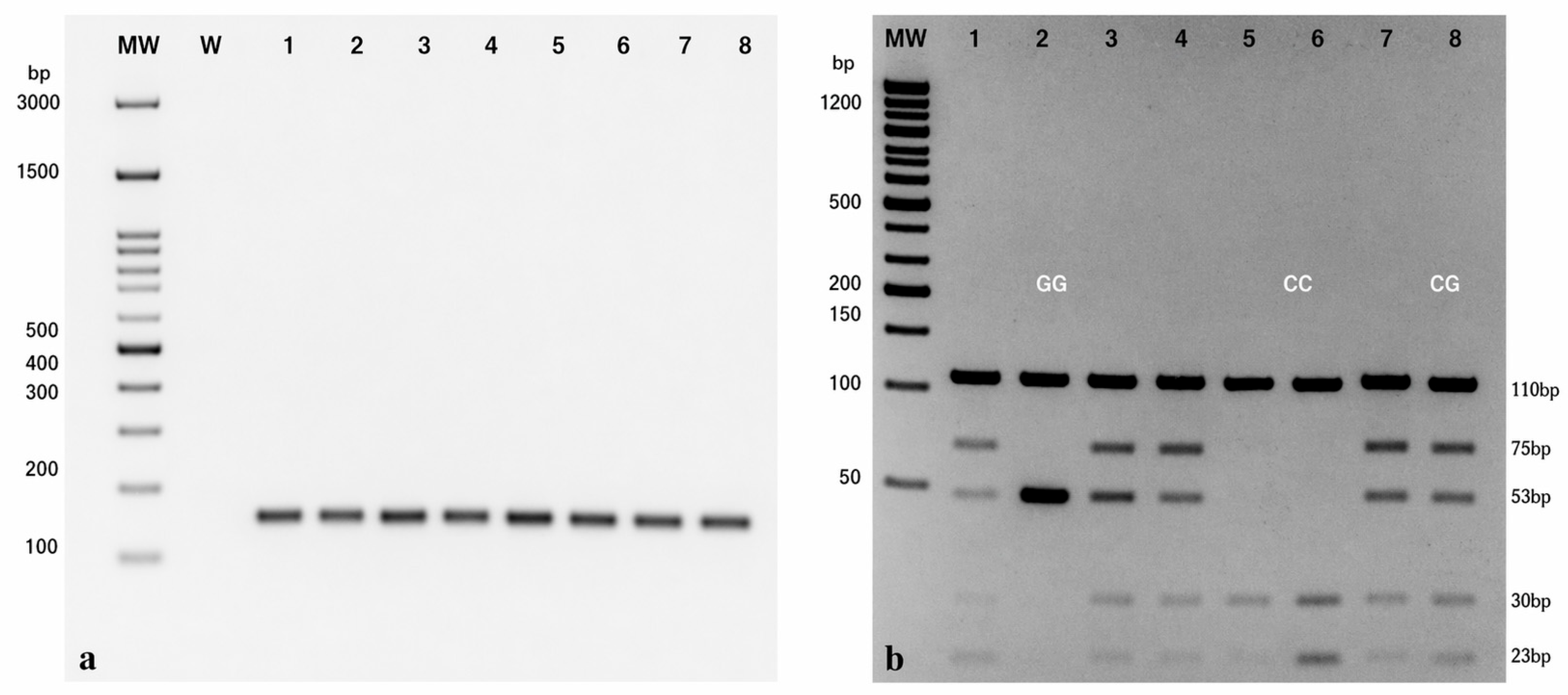
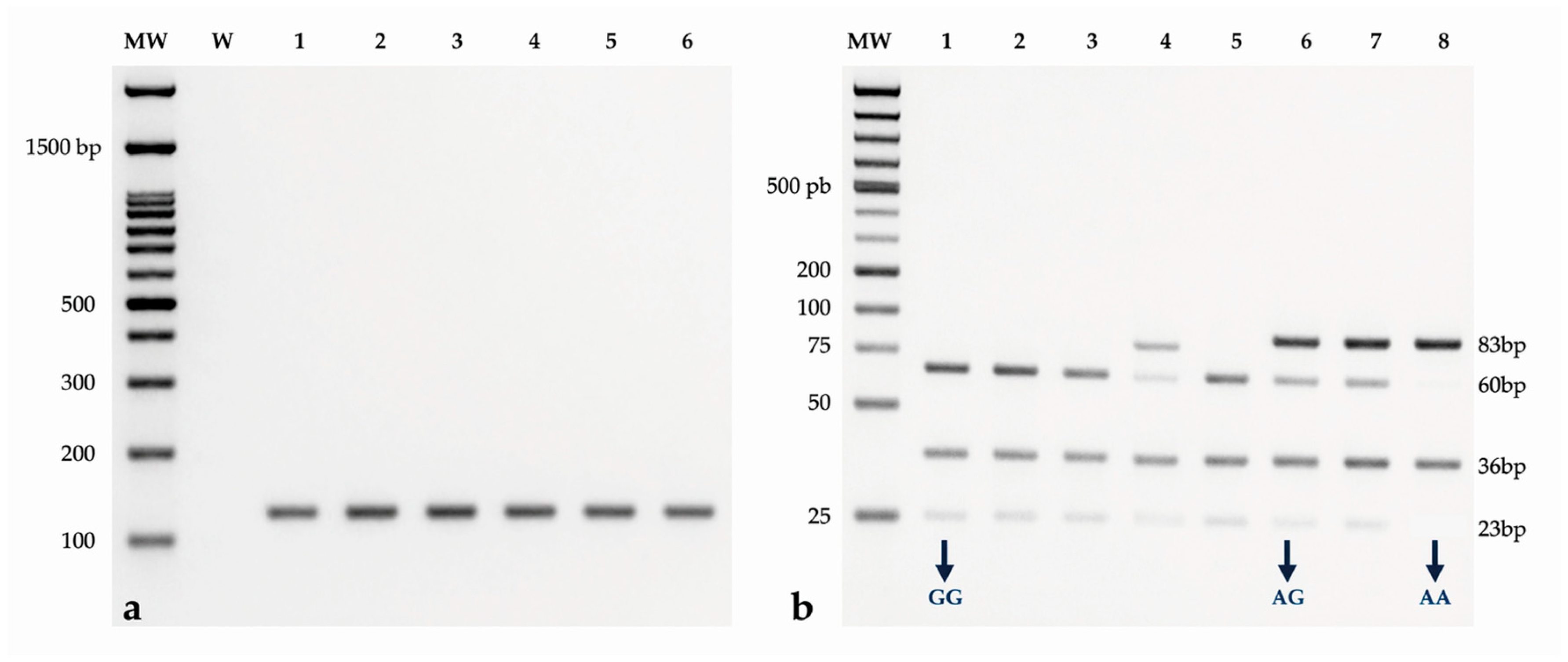
The PCR amplicons were genotyped using a modified PCR-RFLP technique [24]. Digestion reactions used a restriction enzyme (Ava II for CAPN1 G530A; Hae III for CAST C357G) and were incubated at 37 °C for 1 h. Digestion products were resolved on 8% bis-acrylamide gels (29:1, Sigma-Aldrich, St. Louis, MO, USA) stained with ethidium bromide (10 mg/mL). For CAPN1 G530A, the genotyping fragments were the genetic variant AA (83 + 36 bp), the ancestral GG (60 + 36 + 23 bp), and the heterozygous AG (83 + 60 + 36 + 23 bp). CAST C357G displayed: the genetic variant GG (110 + 53 bp), the ancestral CC (110 + 30 + 23 bp), and the heterozygous CG (110 + 53 + 30 + 23 bp) patterns, following manufacturer protocols (NIPPON Genetics and NEB, respectively).

2.4. Statistical Analysis

The shear force, pH, color (L, a, b*), and marbling data were analyzed using ANOVA followed by Tukey’s mean separation test (p < 0.05) in Statgraphics Centurion XV (StatPoint Technologies, Warrenton, VA, USA). Normality (Shapiro–Wilk) and homoscedasticity (Levene’s test) were verified at the 95% confidence level. For SNP analysis, the Hardy–Weinberg equilibrium (HWE) was assessed using allele frequencies (Iniesta et al., 2005, [36]). Genotypic frequencies were calculated as (# genotypes)/N × 100, where N = sample size, and genotypes were categorized as ancestral homozygous, heterozygous, or variant homozygous. Allelic frequencies were computed as: p = [# dominant homozygotes + (0.5 × heterozygotes)]/N and q = [# recessive homozygotes + (0.5 × heterozygotes)]/N. HWE was verified via χ2 test in IBM SPSS Statistics 29.0.2.0 (SPSS Inc., Chicago, IL, USA) using the equation p2 + 2 pq + q2.

Association Models

The GLM procedure (IBM SPSS) evaluated genotype–trait associations using the following model: Yij = μ + G1i + G2j + εij, where Yij = WBSF, μ = overall mean, G1/G2 = fixed SNP genotype effects (G530A/C357G), and εij = random error. Significant fixed effects were subjected to Tukey’s post hoc testing. Allelic substitution effects were analyzed by converting genotypes to quantitative values (0 = ancestral, 1 = heterozygous, 2 = variant) for linear regression: Y = β0 + β1Xi, where β1 = regression coefficient for allelic substitution [24,26].
Effect sizes for the genotype effect on WBSF were calculated as partial eta squared (η2) using the GLM procedure. Ninety-five percent confidence intervals for mean values were calculated using the formula mean ± (t_{0.05, df} × SE). Due to the pilot nature of the study and small sample size, these estimates should be interpreted with caution (Tables are in the Supplementary Materials). The chi-square test for Hardy–Weinberg equilibrium has low statistical power with small sample sizes (n < 100), especially for rare alleles. Therefore, the non-significant results reported here should be considered exploratory.

3. Results

3.1. Physicochemical Meat Quality Parameters

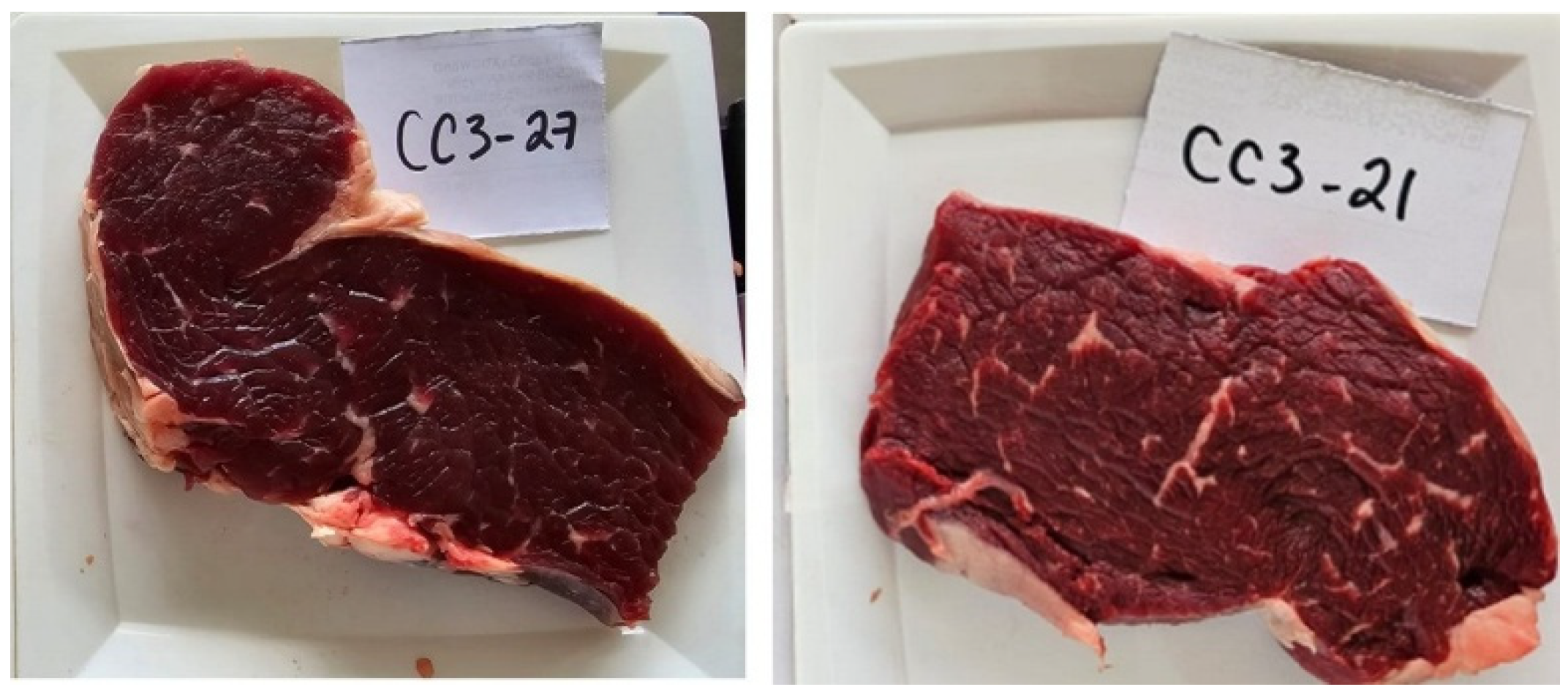
The physicochemical characteristics of longissimus thoracis muscle from culled Holstein cows are summarized in Table 1 (detailed statistical indicators, including confidence intervals and effect sizes, are available in Supplementary Table S1). The mean pH measured at 72 h postmortem was 5.76 ± 0.04, falling within the normal range for adequate muscle acidification [37,38]. Color parameters indicated a dark red hue with low lightness (L* = 33.10 ± 0.42), consistent with meat from older cattle due to increased myoglobin content [39,40]. The mean Warner–Bratzler shear force (WBSF) value at 72 h postmortem was 3.98 ± 0.18 kg. According to the early postmortem tenderness classification system proposed by Shackelford et al., which categorizes beef longissimus shear force at 1–2 days postmortem as “tender” (<6 kg), “intermediate” (6–9 kg), or “tough” (>9 kg), the meat from the culled Holstein cows in the present study would be classified as tender. This value is also below the 4.4 kg threshold for the USDA Certified Tender program, further supporting this classification. Marbling scores were predominantly “Small” (Mo), reflecting limited intramuscular fat deposition (Figure 1).

3.2. Genotypic and Allelic Frequencies of CAPN1 G530A and CAST C357G

Genotype distributions for the CAPN1 G530A polymorphism were as follows: GG (50%), AG (46%), and AA (4%). For CAST C357G, frequencies were CC (36%), CG (42%), and GG (22%). The PCR amplifications for both SNPs were performed using the following primer pairs: for CAPN1 G530A, forward 5′-GGCTGGCTTCCTCTCTGTCT-3′ and reverse 5′-CCCACGGACAGGTCCTCT-3′ (amplifying a 119 bp fragment) (Figure 2); for CAST C357G, forward 5′-GTGAGGCTGTGCCTGAGTTG-3′ and reverse 5′-GGCCTTCAGGGTGTTGATGT-3′ (amplifying a 163 bp fragment) (Figure 3). Amplification conditions were as described by Sánchez-Mendoza et al. (2020) [24]. GenBank references for the reference sequences are AH009246.3 (CAPN1) and AH014526.2 (CAST). Both polymorphisms were in Hardy–Weinberg equilibrium (Table 2). Detailed statistical indicators, including confidence intervals and effect sizes, are available in Supplementary Table S2. Both SNPs were in Hardy–Weinberg equilibrium (p > 0.05) according to the chi-square test. However, given the small sample size (n = 50), the HWE test has low power, and these results should be interpreted as preliminary. Larger cohorts are needed to confirm the equilibrium status in this population [41,42]. Allelic frequencies are detailed in Table 2. For CAPN1 G530A, the mean WBSF values were 4.02 ± 0.14 kg (GG, n = 25), 3.99 ± 0.13 kg (AG, n = 23), and 4.43 ± 0 kg (AA, n = 2). Given the pilot nature of the study and the very small number of AA individuals (n = 2), no meaningful statistical comparison involving this genotype is possible. The numerical difference should not be interpreted as a trend. ANOVA showed no overall significant effect of CAPN1 G530A genotype on WBSF (p > 0.05) (Figure 3).

3.3. Association of SNPs with Meat Tenderness

No significant differences (p > 0.05) in WBSF were observed among genotypes for either CAPN1 G530A or CAST C357G (Table 2). Similarly, linear regression analysis revealed no significant effect of allelic substitution on shear force (p > 0.05; Table 3). These results suggest that neither polymorphism significantly influences meat tenderness in this population of culled Holstein cows.

4. Discussion

4.1. Meat Quality Traits in Culled Dairy Cows

The observed pH values are consistent with previous reports in culled dairy cattle, indicating proper glycogen metabolism and the absence of pre-slaughter stress [3,43]. The dark color (low L* value) aligns with expectations for older animals, where myoglobin accumulation increases with age [44,45]. Intermediate tenderness (WBSF ~4.0 kg) suggests that meat from culled Holstein cows may have acceptable palatability despite advanced age and lack of dedicated fattening. This is comparable to values reported in young Holstein bulls [27] and contrasts with tougher meat often associated with Bos indicus breeds [46].
This study was designed as a proof-of-concept pilot investigation. The sample size (n = 50) and the low frequency of the CAPN1 AA genotype (n = 2) mean that the study lacks statistical power to detect genotype–phenotype associations. Therefore, the non-significant findings for both SNPs should be interpreted as exploratory and hypothesis-generating rather than as definitive evidence of neutrality. In addition, future studies should consider measuring other meat quality parameters, such as water-holding capacity and collagen content, which are known to influence tenderness and may interact with the calpain–calpastatin system, potentially providing a more comprehensive understanding of genotype–phenotype relationships in culled dairy cows.

4.2. Genetic Variability and Hardy–Weinberg Equilibrium

The low frequency of the AA genotype for CAPN1 G530A (4%) and the GG genotype for CAST C357G (22%) are consistent with earlier studies in Holstein and other dairy-derived populations [24,47]. The Hardy–Weinberg equilibrium indicates that these SNPs have not been subject to selective pressure for meat tenderness in Mexican Holstein cows, which are primarily selected for milk production [25]. This genetic stability suggests that these markers have not been inadvertently fixed or eliminated through dairy-oriented breeding programs.

4.3. Neutral Effect of CAPN1 and CAST Polymorphisms on Tenderness

The absence of a significant association between CAPN1 G530A or CAST C357G and WBSF contrasts with several studies in beef cattle, in which these SNPs were reported as tenderness markers [16,18,23]. This discrepancy may be attributed to breed-specific genetic backgrounds, differences in the regulation of the calpain–calpastatin system, or interactions with other genomic regions in dairy cattle [13]. In Holsteins, the influence of these SNPs may be overshadowed by other factors such as age, connective tissue properties, and postmortem proteolytic activity [22,29]. Additionally, the limited intramuscular fat (marbling) observed may reduce the potential moderating effect of fat on tenderness expression associated with these genotypes.

4.4. Implications for Dairy Beef Production and Marker-Assisted Selection

These findings suggest that CAPN1 G530A and CAST C357G are not suitable as standalone tenderness markers in Mexican Holstein cull cows. Dairy cattle may require breed-specific SNP panels or the inclusion of additional markers related to fat deposition, collagen metabolism, and proteolytic potential to support effective genomic selection for meat quality [11,12]. Nevertheless, the intermediate tenderness observed indicates that cull Holstein meat holds commercial potential, especially with optimized post-slaughter aging and handling practices [4,6].

4.5. Limitations and Future Research

The primary limitation is the small sample size (n = 50), which is typical for pilot studies but insufficient for robust association testing. Specifically, the CAPN1 AA genotype was present in only two animals (4% frequency). This extremely low count precludes meaningful statistical inference for this genotype, and the reported WBSF mean for AA (4.43 kg) is presented solely for completeness. Furthermore, although the Hardy–Weinberg equilibrium analysis is statistically non-significant, it is underpowered due to the small sample size; therefore, the absence of deviation should not be taken as definitive evidence of equilibrium.
Additionally, although CAPN1 and CAST are located on different chromosomes (BTA29 and BTA5) and are therefore inherited independently, formal linkage tests between the selected SNPs were not performed. Linkage disequilibrium analyses within each gene have been reported in other populations [2], but such analyses were beyond the scope of this pilot study due to the limited sample size. Future studies with larger cohorts should evaluate the potential epistatic interactions and, if warranted, linkage relationships with other markers in the calpain–calpastatin pathway.
Future studies with larger sample sizes (e.g., n > 200) are required to estimate allele frequencies and test for Hardy–Weinberg proportions accurately.

5. Conclusions

As a pilot study with a limited sample size, our data do not provide evidence for a significant effect of CAPN1 G530A or CAST C357G polymorphisms on shear force in culled Holstein cows. The observed meat quality traits (intermediate tenderness) and genotypic frequencies (in Hardy–Weinberg equilibrium) are descriptively reported. However, due to low statistical power, especially for the rare CAPN1 AA genotype, these results should be considered exploratory and hypothesis-generating. Larger, adequately powered studies are required to determine whether these SNPs have any practical utility as tenderness markers in dairy beef production. Moreover, future studies should include a broader panel of SNPs (e.g., CAPN1 4751, CAST 2959) as well as other genes involved in collagen metabolism or intramuscular fat deposition, which may interact with the calpain–calpastatin system and influence tenderness in dairy cattle.

Supplementary Materials

The following supporting information can be downloaded at: https://www.mdpi.com/article/10.3390/app16094313/s1. Table S1. Quality parameters in cull Holstein cows’ meat in the Longissimus dorsi muscle 72 h postmortem. Table S2. Genotypic and allelic frequencies of the G530A SNP of CAPN1 and shear force in Holstein cull cows’ meat.

Author Contributions

Conceptualization: A.E.S.-M., R.I.H.-P., M.d.l.A.R.-M.; methodology: M.d.l.A.R.-M., J.J.B.C.; statistical analysis: D.H.-P., A.E.S.-M.; data curation: M.A.G.T.; writing—original draft preparation, J.A.C.-O., M.S.R.-L., H.A.G.-L.; review and editing, J.F.M.-S., C.M.-M. All authors have read and agreed to the published version of the manuscript.

Funding

This research received financial support from two projects: (1) Cátedra FESC: Caracterización molecular de recursos genéticos animales y ADN mitocondrial humano: aplicaciones agropecuarias, alimentarias y biomédicas (Cátedra C12407); and (2) PAPIME PE206024: Innovación de herramientas de apoyo para el Fortalecimiento e integración del conocimiento en la Producción sostenible de forrajes y bovinos para carne en la FES Cuautitlán. Also for the felowship (EESP2025-0031) of Marìa de los Àngeles Robles Mota from the State of Mexico Council of Science and Technology—COMECYT.

Institutional Review Board Statement

Not applicable.

Informed Consent Statement

Not applicable.

Data Availability Statement

All data generated or analyzed during this study are included in this published article.

Acknowledgments

The authors gratefully acknowledge the technical support provided by Laboratories 3 and 18 of the Multidisciplinary Research Unit at the Faculty of Higher Studies Cuautitlán, National Autonomous University of Mexico (UNAM). We are also grateful to the State of Mexico Council of Science and Technology—COMECYT for the fellowship support that enabled the development of this research project (EESP2025-0031). The authors gratefully acknowledge the technical support from María Fernanda Anguiano Pérez, Ximena Lara Martínez, and César Cuenca Verde.

Conflicts of Interest

The authors declare no conflicts of interest.

Abbreviations

The following abbreviations are used in this manuscript:
CAPNCalpain gene
CASTCalpastatine
SNPSingle-nucleotide polymorphism
WFSFWarner–Bratzler shear force
RFLPRestriction fragment length polymorphism
PCRPolymerase chain reaction
HWHardy–Weinberg equilibrium

References

  1. Piazza, M.; Berton, M.; Amalfitano, N.; Bittante, G.; Gallo, L. Cull cow carcass traits and risk of culling of Holstein cows and 3-breed rotational crossbred cows from Viking Red, Montbéliarde, and Holstein bulls. J. Dairy Sci. 2023, 106, 312–322. [Google Scholar] [CrossRef]
  2. Latta, K.I.; Ítavo, L.C.V.; da Costa Gomes, R.; de Nadai Bonin Gomes, M.; Ferreira, J.R.; Neves, A.P.; de Araujo, T.A.C.; Feijó, G.L.D.; de Oliveira Menezes, G.R. Carcass characteristics and meat quality of cull cows from different genetic groups. Livest. Sci. 2024, 282, 105439. [Google Scholar] [CrossRef]
  3. Franco, D.; Bispo, E.; González, L.; Vázquez, J.A.; Moreno, T. Effect of finishing and aging time on quality attributes of loin from the meat of Holstein-Fresian cull cows. Meat Sci. 2009, 83, 484–491. [Google Scholar] [CrossRef]
  4. Alvarenga, T.I.R.C.; Palendeng, M.; Thennadil, S.; McGilchrist, P.; Cafe, L.M.; Almeida, A.K.; Hopkins, D.L. Is meat from cull cows tougher? Meat Sci. 2021, 177, 108498. [Google Scholar] [CrossRef]
  5. Moreira, L.C.; Rosa, G.J.M.; Schaefer, D.M. Beef production from cull dairy cows: A review from culling to consumption. J. Anim. Sci. 2021, 99, skab192. [Google Scholar] [CrossRef] [PubMed]
  6. Berdusco, N.; Kelton, D.; Haley, D.; Wood, K.M.; Duffield, T.F. Improving market (cull) dairy cows’ carcass traits and meat quality. J. Dairy Sci. 2024, 107, 11415–11424. [Google Scholar] [CrossRef] [PubMed]
  7. Jurie, C.; Picard, B.; Hocquette, J.F.; Dransfield, E.; Micol, D.; Listrat, A. Muscle and meat quality characteristics of Holstein and Salers cull cows. Meat Sci. 2007, 77, 459–466. [Google Scholar] [CrossRef]
  8. Narukami, T.; Sasazaki, S.; Oyama, K.; Nogi, T.; Taniguchi, M.; Mannen, H. Effect of DNA polymorphisms related to fatty acid composition in adipose tissue of Holstein cattle. Anim. Sci. J. 2011, 82, 406–411. [Google Scholar] [CrossRef]
  9. Ardicli, S.; Samli, H.; Vatansever, B.; Soyudal, B.; Dincel, D.; Balci, F. Comprehensive assessment of candidate genes associated with fattening performance in Holstein-Friesian bulls. Arch. Anim. Breed. 2019, 62, 9–32. [Google Scholar] [CrossRef]
  10. Fadhil, M.; Zülkadir, U. Association between polymorphisms of Myf5, MSTN and CAST genes and fattening performance in Brown Swiss and Holstein cattle breeds. Anim. Biotechnol. 2021, 32, 121–129. [Google Scholar] [CrossRef] [PubMed]
  11. Kostusiak, P.; Bagnicka, E.; Żelazowska, B.; Zalewska, M.; Sakowski, T.; Slósarz, J.; Gołębiewski, M.; Puppel, K. Genetic Markers Related to Meat Quality Properties in Fattened HF and HF x Charolaise Steers. Genes 2024, 15, 843. [Google Scholar] [CrossRef]
  12. Kostusiak, P.; Slósarz, J.; Gołębiewski, M.; Grodkowski, G.; Puppel, K. Polymorphism of Genes and Their Impact on Beef Quality. Curr. Issues Mol. Biol. 2023, 45, 4749–4762. [Google Scholar] [CrossRef]
  13. Allais, S.; Journaux, L.; Levéziel, H.; Payet-Duprat, N.; Raynaud, P.; Hocquette, J.F.; Lepetit, J.; Rousset, S.; Denoyelle, C.; Bernard-Capel, C.; et al. Effects of polymorphisms in the calpastatin and μ-calpain genes on meat tenderness in 3 French beef breeds. J. Anim. Sci. 2011, 89, 1–11. [Google Scholar] [CrossRef]
  14. Koohmaraie, M. Role of the Neutral Proteinases in Postmortem Muscle Protein Degradation and Meat Tenderness. Recipr. Meat Conf. Proc. Am. Meat Sci. Assoc. 1992, 45, 63–74. [Google Scholar]
  15. Koohmaraie, M. Biochemical Factors Regulating the Toughening Tenderization Processes of Meat. Meat Sci. 1996, 43, 193–201. [Google Scholar] [CrossRef] [PubMed]
  16. Page, B.T.; Casas, E.; Heaton, M.P.; Cullen, N.G.; Hyndman, D.L.; Morris, C.A.; Crawford, A.M.; Wheeler, T.L.; Koohmaraie, M.; Keele, J.W.; et al. Evaluation of single-nucleotide polymorphisms in CAPN1 for association with meat tenderness in cattle. J. Anim. Sci. 2002, 80, 3077–3085. [Google Scholar] [CrossRef]
  17. Page, B.T.; Casas, E.; Quaas, R.L.; Thallman, R.M.; Wheeler, T.L.; Shackelford, S.D.; Koohmaraie, M.; White, S.N.; Bennett, G.L.; Keele, J.W.; et al. Association of Markers in the Bovine CAPN1 Gene with Meat Tenderness in Large Crossbred Populations That Sample Influential Industry Sires. 2004. Available online: https://academic.oup.com/jas/article/82/12/3474/4790167 (accessed on 23 April 2026).
  18. Casas, E.; White, S.N.; Wheeler, T.L.; Shackelford, S.D.; Koohmaraie, M.; Riley, D.G.; Chase, C.C.; Johnson, D.D.; Smith, T.P.L. Effects of calpastatin and-calpain markers in beef cattle on tenderness traits. J. Anim. Sci. 2006, 84, 520–525. [Google Scholar] [CrossRef]
  19. Andujar, G.; Perez, D.; Venegas, O. Química y Bioquímica de la Carne y los Productos Cárnicos, 1st ed.; Editorial Universitaria, Ed.; Instituto de Investigaciones para la Industria Alimenticia: Havana, Cuba, 2009. [Google Scholar]
  20. Calvo, J.H.; Iguácel, L.P.; Kirinus, J.K.; Serrano, M.; Ripoll, G.; Casasús, I.; Joy, M.; Pérez-Velasco, L.; Sarto, P.; Albertí, P.; et al. A new single nucleotide polymorphism in the calpastatin (CAST) gene associated with beef tenderness. Meat Sci. 2014, 96, 775–782. [Google Scholar] [CrossRef] [PubMed]
  21. Motter, M.M.; Corva, P.; Krause, M.; Perez Cenci, M.; Soria, L.A. Rol de la calpastatina en la variabilidad de la terneza de la carne bovina. J. Basic Appl. Genet. 2009, 20, 15–24. [Google Scholar]
  22. Nishimura, T. The role of intramuscular connective tissue in meat texture. Anim. Sci. J. 2010, 81, 21–27. [Google Scholar] [CrossRef]
  23. Morris, C.A.; Cullen, N.G.; Hickey, S.M.; Dobbie, P.M.; Veenvliet, B.A.; Manley, T.R.; Pitchford, W.S.; Kruk, Z.A.; Bottema, C.D.K.; Wilson, T. Genotypic effects of calpain 1 and calpastatin on the tenderness of cooked M. longissimus dorsi steaks from Jersey x Limousin Angus and Hereford-cross cattle. Anim. Genet. 2006, 37, 411–414. [Google Scholar] [CrossRef]
  24. Sánchez-Mendoza, A.E.; Fonseca-Coronado, S.; Soto-Zárate, C.I.; López-Hernández, L.H.; Meléndez-Pérez, R.; Montiel-Sosa, J.F. Evaluación del efecto de los SNPs G530A (calpaína), C357G (calpastatina), G1795A (miopaladina) y G1181A (PPARGC1A) sobre la terneza de carne bovina de una región del Estado de Veracruz, México. In Biotecnia Revista de Ciencias Biológicas y de La Salud; Universidad de Sonora: Hermosillo, Mexico, 2020; pp. 13–20. Available online: https://www.scielo.org.mx/scielo.php?script=sci_arttext&pid=S1665-14562021000100013 (accessed on 23 April 2026).
  25. Valdez-Torres, J.M.; Ahuir, J.A.G.; Castro-Valenzuela, B.E.; Eduviges Burrola-Barraza, M. QTL analysis associated to single nucleotide polymorphisms (SNP) involved in the dairy phenotype of Holstein cattle. Rev. Mex. Cienc. Pecu. 2021, 11, 1192–1207. [Google Scholar] [CrossRef]
  26. Bonilla, C.A.; Rubio, M.S.; Sifuentes, A.M.; Parra-Bracamonte, G.M.; Arellano, V.W.; Méndez, M.R.; Berruecos, J.M.; Ortiz, R. Association of CAPN1 316, CAPN1 4751 and TG5 markers with bovine meat quality traits in Mexico. Genet. Mol. Res. GMR 2010, 9, 2395–2405. [Google Scholar] [CrossRef] [PubMed]
  27. Díaz-Vargas, N.T. Efecto de Distintos Tiempos de Maduración Húmeda Sobre pH, Color y Fuerza de Corte en Carne de Bovinos Holstein. Ph.D. Thesis, Universidad Nacional Autónoma de México, Mexico City, Mexico, 2025. [Google Scholar]
  28. Rubio, R.R. Caracterización de la Calidad de Carne de Bovino Holstein en Sistema de Engorda Estabulado. Master’s Thesis, Universidad Autónoma de Chapingo, Texcoco, Mexico, 2025. [Google Scholar]
  29. NOM-033-SAG/ZOO-2014; Métodos Para dar Muerte a Los Animales Domésticos y Silvestres. Diario Oficial de la Federación: Ciudad de México, Mexico, 2015.
  30. NOM-051-ZOO-1995; Trato Humanitario en la Movilización de Animales. Diario Oficial de la Federación: Ciudad de México, Mexico, 1998.
  31. United States Department of Agriculture, Agricultural Marketing Service. United States Standards for Grades of Carcass Beef. 2017. Available online: https://www.ams.usda.gov/sites/default/files/media/CarcassBeefStandard.pdf (accessed on 23 April 2026).
  32. NMX-F-317-NORMEX-2013; Alimentos-Determinación de pH en Alimentos y Bebidas no Alcohólicas—Método Potenciómetro—Método de Prueba. Dirección General de Normas: Ciudad de México, Mexico, 2013.
  33. American Meat Science Association. Meat Color Measurement Guidelines. 2012. Available online: https://meatscience.org/docs/default-source/publications-resources/hot-topics/2012_12_meat_clr_guide.pdf (accessed on 23 April 2026).
  34. American Meat Science Association. Research Guidelines for Cookery Sensory, Evaluation, and Instrumental Tenderness Measurements of Meat (Second). 2015. Available online: https://meatscience.org/docs/default-source/publications-resources/research-guide/2015-amsa-sensory-guidelines-1-0.pdf?sfvrsn=42d380b3_6 (accessed on 23 April 2026).
  35. Green, M.R.; Sambrook, J. Polymerase chain reaction. Cold Spring Harb. Protoc. 2019, 2019, 436–456. [Google Scholar] [CrossRef] [PubMed]
  36. Iniesta, R.; Guinó, E.; Moreno, V. Análisis estadístico de polimorfismos genéticos en estudios epidemiológicos. Gac. Sanit. 2005, 19, 333–341. [Google Scholar] [CrossRef]
  37. Geesink, G.H.; Ouali, A.; Smuldersl, F.; Talmant, A.; Tassy, C.; Guignot, F.; Van Laack, H. The role of ultimate pH in proteolysis and calpain/calpastatin activity in bovine muscle. Biochimie 1992, 74, 283–289. [Google Scholar] [CrossRef]
  38. Lawrie, R.A. Lawrie’s Meat Science. Chapter 5 The conversion of muscle to meat. In Woodhead Publishing Series in Food Science, Technology and Nutrition, Lawrie’s Meat Science, 7th ed.; Woodhead Publishing: New Delhi, India, 2006. [Google Scholar] [CrossRef]
  39. Onega-Pagador, M.E. Evaluación de la Calidad de Carnes Frescas: Aplicación de Técnicas Analíticas, Instrumentales y Sensoriales. Doctoral Thesis, Universidad Complutense de Madrid, Madrid, Spain, 2003. [Google Scholar]
  40. Oyagüe, J.M. Estabilidad del color de la carne fresca. Nacameh 2007, 1, 67–74. Available online: https://dialnet.unirioja.es/servlet/articulo?codigo=3987229 (accessed on 23 April 2026).
  41. Lachance, J. Hardy-Weinberg Equilibrium and Random Mating. In Encyclopedia of Evolutionary Biology; Elsevier Inc.: Amsterdam, The Netherlands, 2016; pp. 208–211. [Google Scholar] [CrossRef]
  42. Pogorzelska-Przybyłek, P.; Nogalski, Z.; Sobczuk-Szul, M.; Momot, M. The effect of gender status on the growth performance, carcass and meat quality traits of young crossbred Holstein-Friesian×Limousin cattle. Anim. Biosci. 2021, 34, 914–921. [Google Scholar] [CrossRef]
  43. Kopuzlu, S.; Esenbuga, N.; Onenc, A.; Macit, M.; Yanar, M.; Yuksel, S.; Ozluturk, A.; Unlu, N. Effects of slaughter age and muscle type on meat quality characteristics of Eastern Anatolian Red bulls. Arch. Anim. Breed. 2018, 61, 497–504. [Google Scholar] [CrossRef]
  44. Coria-Hernández, J.; Meléndez-Pérez, R.; Méndez-Albores, A.; Arjona-Román, J.L. Changes in myoglobin content in pork Longissimus thoracis muscle during freezing storage. Rev. Mex. Cienc. Pecu. 2020, 11, 651–668. [Google Scholar] [CrossRef]
  45. Shackelford, S.D.; Wheeler, T.L.; Koohmaraie, M. Tenderness Classification of Beef: I. Evaluation of Beef Longissimus Shear Force at 1 or 2 Days Postmortem as a Predictor of Aged Beef Tenderness. J. Anim. Sci. 1997, 75, 2417–2422. [Google Scholar] [CrossRef]
  46. Ardicli, S.; Dincel, D.; Samli, H.; Balci, F. Effects of polymorphisms at LEP, CAST, CAPN1, GHR, FABP4 and DGAT1 genes on fattening performance and carcass traits in Simmental bulls. Arch. Anim. Breed. 2017, 60, 61–70. [Google Scholar] [CrossRef]
  47. Purslow, P.P. Intramuscular connective tissue and its role in meat quality. Meat Sci. 2005, 70, 435–447. [Google Scholar] [CrossRef]
Figure 1. Photographs of small marbling are presented in the samples.
Applsci 16 04313 g001
Figure 2. Photographs of PCR and PCR-RFLP electrophoresis gels of CAPN1 G530A. (a) 1.5% agarose gel for amplification of the CAPN1 G530A SNP, MW—molecular weight, W—witness, (1 to 5) DNA from samples 1 to 5. (b) A total of 8% acrylamide: bis gel for RFLP evaluation of SNP CAPN1 G530A. MW—molecular weight, (1–3 and 5) samples show ancestral genotype (GG); (4, 6, and 7) samples with heterozygous genotype (AG/GA); (8) sample positive for genetic variant (AA). AA, AG and GG represent the identified genotypes.
Applsci 16 04313 g002
Figure 3. Photographs of PCR and PCR-RFLP electrophoresis gels for CAST C357G. (a) A total of 1.5% agarose gel for amplification of CAST C357G SNP. MW—molecular weight, W—witness, (1 to 8) DNA from samples 1 to 8. (b) A total of 8% acrylamide: bis gel for RFLP evaluation for CAST C357 SNP. MW—molecular weight, (5 and 6) samples show ancestral genotype (CC); (1, 3, 4, 7, and 8) samples with heterozygous genotype (CG/GC); (2) sample positive for genetic variant (GG). GG, CC and CG white represent the genotypes identified.
Applsci 16 04313 g003
Table 1. Quality parameters in cull Holstein cows’ meat in the longissimus thoracis muscle 72 h postmortem.
ParameterMean ± SE *Reference Value
WBSF (kg)3.98 ± 0.18Intermediate tenderness
3.9 kg < WBSF < 4.6 kg according to
Shackelford et al.
pH5.76 ± 0.04Standard values at 24 h 5.5–5.8
According to the American Meat Science Association (2012) [33]
L* (Lightness)33.10 ± 0.42Very dark red, according to
American Meat Science Association (2012) [33]
a* (red-blue)16.40 ± 0.29
b* (yellow-green)11.89 ± 0.26
MarblingSmall (Mo)According to the Marbling degrees
(United States Department of Agriculture, 2017) [31]
* SE: standard error.
Table 2. Genotypic and allelic frequencies of the G530A SNP of CAPN1 and shear force in Holstein cull cows’ meat.
SNPGenotypenGenotype FrequencyWBSF (kg) Mean ± SEAlleleAllelic FrequencyHW
G530AGG25504.02 ± 0.14G
A
0.73
0.27
>0.05
AG/GA23463.99 ± 0.13
AA2044.43 ± 0.00
C357GCC18364.00 ± 0.17C
G
0.57
0.43
>0.05
CG/GC21424.09 ± 0.13
GG11223.98 ± 0.11
SNP notation: the first letter indicates the ancestral allele, the number indicates the position, and the second letter indicates the variant allele. WBSF (Warner–Bratzler shear force). HW (Hardy–Weinberg equilibrium law).
Table 3. Effect of allelic substitution of CAPN1 G530A and CAST C357G on Holstein cull cows’ meat WBSF.
SNPβ0β1p
CAPN1 G530A4.0130.034>0.05
CAST C357G4.034−0.003>0.05
WBSF kg, β0 (intercept), β1 (SNP regression coefficient and shear force).
Disclaimer/Publisher’s Note: The statements, opinions and data contained in all publications are solely those of the individual author(s) and contributor(s) and not of MDPI and/or the editor(s). MDPI and/or the editor(s) disclaim responsibility for any injury to people or property resulting from any ideas, methods, instructions or products referred to in the content.