Article

Investigation of the Use of In Situ Material by Geopolymerization Method in Stabilization of Ordinary Clay Soils


1
Department of Civil Engineering, Afyon Kocatepe University, 03200 Afyonkarahisar, Türkiye
2
Department of Civil Engineering, Faculty of Civil Engineering, Transportation Engineering and Architecture, University of Maribor, 2000 Maribor, Slovenia
*
Author to whom correspondence should be addressed.
Appl. Sci. 2026, 16(9), 4290; https://doi.org/10.3390/app16094290
Submission received: 6 April 2026 / Revised: 18 April 2026 / Accepted: 21 April 2026 / Published: 28 April 2026
(This article belongs to the Special Issue Recent Advancements in Soil Mechanics and Geotechnical Engineering)

Abstract

Certain clayey soils are susceptible to swelling and shrinkage due to moisture variations, which can lead to ground deformation and structural damage. Although traditional stabilization methods using lime and cement are effective, they involve high energy consumption and significant CO2 emissions. In response to sustainability concerns, this study investigates the potential of in situ geopolymer stabilization of clay soils using industrial by-products as eco-friendly binders. Experimental studies were conducted on clay specimens stabilized with geopolymer binders produced from fly ash and waste brick powder activated by alkaline solutions. The selected clay exhibited stiff to very stiff behavior and was used as a reference material to ensure reliable evaluation without the influence of severe initial degradation. Reference samples with identical water content but without alkaline activation were also prepared. The primary objective was to assess geopolymers as a sustainable alternative to conventional binders, focusing on moisture sensitivity and long-term mechanical performance. Laboratory strength tests demonstrated that geopolymer-treated specimens exhibited significantly higher strength compared to untreated samples, indicating substantial improvement in engineering properties. Furthermore, Scanning Electron Microscopy (SEM) analyses revealed that the combination of dual activators (NS+NH) and thermal curing at 85 °C transformed the weak clay matrix into a dense, fibrous geopolymer network. However, the high curing temperature was primarily used to study the reaction mechanisms; the practical applicability of the method should be evaluated based on results obtained at ambient temperature. This structure enhanced particle bonding and mechanical interlocking by filling voids within the matrix. Overall, the findings confirm that geopolymer stabilization using industrial waste materials is an effective and environmentally sustainable alternative to conventional soil stabilization techniques, contributing to reduced carbon emissions in geotechnical engineering.

1. Introduction

Current and future urbanization and parallel population growth are putting more pressure on natural non-renewable resources, requiring a new economic strategy that promotes sustainable use of the Earth’s resources and prevents waste generation [1]. Every year, 55 billion tons of biomass, fossil energy, metals and minerals are extracted from the Earth’s crust, while 2.1 billion tons of waste are disposed of worldwide [2]. Cities account for approximately 80% of total carbon dioxide emissions and energy consumption [3]. To meet societal needs, the construction sector is responsible for a large part of this consumption and needs to increase resource efficiency and encourage the reuse of materials [4].
Strong messages from the United Nations (UN) and the World Health Organization (WHO) have brought sustainable land management to the forefront. Smarter methods are needed to reduce land waste and ensure that reuse does not pose a risk to public health or the environment. The reuse of soil provides the following benefits: (1) reduced transportation distance, (2) reduced disposal costs, (3) protected landfills, (4) prevented mining of natural resources, and (5) reduced environmental and ecological impacts [5]. Excess excavated soil can be reused on-site or off-site, considering its properties and ensuring that these properties are compatible with the new use. In this context, there are several basic geotechnical (e.g., grain size, plasticity, hydraulic conductivity, compressibility, shear strength) and environmental parameters (e.g., pH, total and leachable pollutant concentrations, organic carbon content) that determine the reusability of soil in certain situations [6]. In some cases, the geotechnical properties of excavated soil may need to be improved and environmentally treated. The reuse of excavated soil is one of the cornerstones of sustainable geotechnical engineering, and there is a growing consensus that achieving a sustainable built environment is possible by incorporating sustainability ideas into the planning and design stages of infrastructure projects [2]. Increasing land reuse is an important step towards achieving UN Sustainable Development Goal 11. Costs and climate impacts can be reduced by reducing transport, storage and virgin material use. Increasing on-site reuse can save significant amounts of CO2 by reducing fuel consumption [7].
Climate change and global warming have created a growing challenge for building and infrastructure engineers worldwide. A phenomenon called “shrinkage–expansion” in clay soils is a situation that needs to be considered more in asset life management due to climate change. Soft soil is found in many parts of the world and is widespread in large areas. These soft soils have been used for agricultural, industrial, commercial and residential purposes for centuries [8]. The main problems encountered during construction on soft soils are insufficient bearing capacity, excessive settlement after construction and instability during excavation or filling. Settlement problems can be defined experimentally as the deformation of the soil due to applied stresses. In addition, settlement causes changes in the geometry of the load-carrying system [9]. Therefore, in many cases, it is necessary to improve compressive strength, resistance to deformation and hydraulic properties of soft soils by using various ground improvement techniques [10].
Stabilization is a technology used to improve the geotechnical properties of soil, which increases the strength of the soil, reduces its permeability and improves its compressibility. Stabilization means that chemical reactions occur because of mixing cement or binders such as fly ash and lime with the soil and stabilize the soil. In cities where there are high construction activity and limited reusable areas, soil stabilization is of great importance [11]. Soft or highly compressible soils, which are frequently encountered in engineering projects, lack sufficient strength to support loading both during construction and during service life. Chemical stabilization is widely applied to increase the strength and rigidity of such inadequate soils. Cement, fly ash and lime are among the stabilizers commonly used for this purpose and their stabilization mechanisms are well understood [12]. However, although soil stabilization improves mechanical properties and structural durability, its environmental effects can be negative and increase energy consumption. The increase in energy demand leads to an increase in fossil fuel consumption [13]. One of the most traditional methods used in soil stabilization is Portland cement. However, the cement production industry has negative effects on the environment due to excessive consumption of fossil fuels and high greenhouse gas emissions, especially carbon dioxide (CO2) [14]. Studies show that around one ton of cement is released during the production of one ton of CO2. This suggests that the cement industry is responsible for around 5–8% of global CO2 emissions [15]. These greenhouse gas emissions can further increase global environmental degradation. Achieving harmony between humans and nature while improving the engineering performance of natural soils has become a prominent topic in academic and engineering fields worldwide [16].
In addition, a large amount of natural minerals is used in the cement production process. Therefore, researchers are looking for environmentally friendly and alternative methods to cement. One of these alternatives is geopolymers. A temperature range of 25–80 °C is generally accepted for geopolymer compositions. Therefore, energy consumption and CO2 emissions are quite low in the geopolymerization process. Any pozzolanic material rich in silica and alumina, in an amorphous phase and soluble in an alkaline activator can be used as a basis for creating geopolymers [17]. Geopolymers belong to the category of metal-free inorganic materials formed through the reaction between aluminosilicate materials and alkaline activators activated in highly alkaline environments [18]. This feature allows the use of materials rich in Al2O3 and SiO2, such as fly ash, an industrial byproduct of coal power plants [19]. In addition, fly ash with a high calcium content eliminates the need for low-temperature curing of the geopolymer, allowing it to gain sufficient strength. This offers an environmentally friendly approach by reducing energy consumption [20]. Fly ash-based geopolymer is therefore considered an environmentally sustainable construction and soil stabilization material [21].
Brick waste is one of the most produced construction and demolition wastes after concrete. The United States reported 44 million tons of brick waste between 2012 and 2014, while China produces 400 million tons of brick waste annually. India, the second largest producer of bricks, reported that approximately 32% of its construction and demolition waste is brick waste [22]. Due to its wide availability, recycled brick waste (RBW) has been investigated as a partial substitute for cement and more recently as an aluminosilicate source material in geopolymer production [23]. However, it has been reported that RBW affects the rheological properties of the geopolymer mixture at early age. However, there is a lack of information on some less investigated properties of geopolymers containing RBW [24,25]. Recycling industrial waste is both environmentally and economically beneficial. It is economically low cost and reduces environmental pollution. Fly ash and brick waste have been used as additives in geotechnical stabilization, unstabilized roads and highway foundation structures. Since fly ash and brick wastes contain high amounts of SiO2, Al2O3 and MgO, they react with a CaO-rich activator (e.g., cement, lime, cement kiln dust, etc.) to form cementation compounds required in stabilization applications [26]. Research on geopolymer binders generally focuses on material synthesis. The hot spots of this research include the selection of raw materials (e.g., metakaolin, fly ash, slag, etc.), the creation of alkali activation medium and the ratios of geopolymer binders [27]. In this study, a different potential application of geopolymers, namely soil stabilization, is investigated. The use of recycled waste materials as additives in soil stabilization has become increasingly widespread, contributing to both waste recycling and the reduction of environmental pollution. In this context, this study examines the beneficial use of brick waste and fly ash in clay soil stabilization.
Clayey soils are often regarded as problematic geotechnical materials due to their sensitivity to moisture variations, which may lead to swelling, shrinkage, and progressive degradation of mechanical properties. Although some clays may exhibit relatively stiff behavior in their initial state, this does not necessarily ensure satisfactory long-term performance, particularly under cyclic wetting–drying conditions and increasingly extreme hydrological events.
High-temperature curing is widely used to accelerate geopolymerization reactions and enhance early strength development. However, such curing conditions are not always feasible in field applications. Recent studies have shown that geopolymer-stabilized soils can achieve significant mechanical performance under ambient curing conditions, which are considered more representative for practical engineering applications. In this context, high-temperature curing is primarily employed to investigate reaction mechanisms, whereas ambient curing provides a more realistic assessment of engineering behavior [28,29,30,31,32].
Traditional stabilization methods for clayey soils, primarily based on lime and cement, are effective but are associated with high energy consumption and considerable CO2 emissions. Consequently, in response to the growing demand for sustainable solutions in geotechnical engineering, increasing attention has been directed toward alternative binders with a reduced environmental footprint.
The objective of this study is not the remediation of mechanically deficient or soft soils, but rather the assessment of geopolymer stabilization as a sustainable alternative to conventional binders and its influence on the mechanical behavior and moisture sensitivity of clayey soils. To this end, a well-characterized clay was selected, allowing for a reliable and controlled evaluation of stabilization effects under laboratory conditions.

2. Materials and Methods

2.1. Properties of the Clay Soil

The clay soil used in this study as reference material was obtained from the area of Afyonkarahisar city center. The clay soil was collected at a depth of approximately 1–1.5 m, where the method of collection could be classified as the disturbed state.
The specific gravity of the clay is 2.64, the unit weight is 16.5 kN/m3, the shrinkage limit is 5.8%, the maximum dry density is 1.58 g/cm3, the optimum water content % is 21.9, the liquid limit is 48.6%, the plastic limit is 23% and was classified as low-plasticity clay (CL) according to the Unified Soil Classification System (USCS). The clay soil had 86.2% of particles passing the US No. 200 sieve (<0.075 mm). Laboratory tests were performed also according to the TS 1900-1 standard [33].

2.2. Physical Properties of Materials

The physical properties of clay, brick waste, and fly ash are presented in Table 1. The waste brick powder (WBP) used in this study was obtained from a brick manufacturing plant in Afyonkarahisar, Turkey, while the fly ash (FA) was collected from the Seyitömer as an industrial by-product of a thermal power plant. Table 1 summarizes the basic grain-size distribution and index properties of the three materials. All materials consist of 100% particles smaller than 2.0 mm. The fraction finer than 0.075 mm is slightly lower for waste brick powder (81%) and fly ash (82%) compared to clay (86.2%). The index properties (liquid limit and plastic limit) were determined only for the clay. The specific gravity of solids (Gs) was 2.64 for clay, 2.82 for waste brick powder, and 2.70 for fly ash.

2.3. Properties of Waste Brick Powder and Fly Ash

The specific gravity of the waste brick powder is 2.82. According to ASTM C618 [34], the fly ash is classified as Class F fly ash, while under EN 197-1 [30] it corresponds to Class W. The specific gravity of the fly ash is 2.70, and approximately 82% of its particles pass the US No. 200 sieve (0.075 mm).
The chemical compositions of the brick waste and fly ash are presented in Table 2. The compositions of both materials are comparable: the SiO2 and Fe2O3 contents are similar, whereas the fly ash exhibits higher Al2O3 and CaO contents compared to the brick waste. These characteristics indicate that both materials are suitable for use as aluminosilicate precursors in geopolymer binders.

2.4. Alkaline Activators for Geopolymers

The liquid compounds used to produce geopolymers are activators. Sodium hydroxide (NH) and sodium silicate (NS) were used as activators in this study. Sodium hydroxide was used with 99% purity. Sodium hydroxide is the most used activator because it increases the temperature because of its disintegration in water. Sodium hydroxide, supplied in pellet form, was added to pure water up to the specified molarity, allowed to dissolve, and used after one day. The modulus of sodium silicate is 3.30 and the density is 1.3 g/mL. The content of Na2O is 8.54%, SiO2 is 27.3%. In this study, sodium hydroxide solution (NH) and sodium silicate solution (NS) were used together. As stated in Table 3, the samples in which the solution was used were prepared with an NS/NH ratio of 2. The NS and NH solutions were combined and then added to the mixture. Samples were produced using the prepared solutions at 3, 6, and 9 M concentrations.

2.5. Sample Preparation and Testing Procedures

In this study, a geopolymer-based approach was adopted to improve the properties of conventional clay soil. The clay was sieved through a 250 μm sieve prior to use. Three solid mixtures were prepared: (i) 100% clay (control), (ii) clay with 20% fly ash (FA) replacement by dry mass, and (iii) clay with 20% waste brick powder (WBP) replacement by dry mass.
Specimens were prepared at their optimum moisture content using different activating solutions. Sodium hydroxide solutions with molarities of 3 M, 6 M, and 9 M were combined with sodium silicate at an NS/NH ratio of 2. The prepared specimens were cured under two different conditions: at 20 °C (ambient curing) and at 85 °C (oven curing).
Soil identification tests were conducted in accordance with ASTM and Turkish standards. Grain sizes larger than 0.075 mm were determined by sieve analysis, while particles smaller than 0.075 mm were analyzed using the hydrometer method (152 H). For sieve analysis, soil samples were washed through a 0.075 mm sieve, oven-dried, and sieved using a standard sieve set. Hydrometer analysis involved mixing up to 50 g of fine material (<0.075 mm) with a dispersing solution, followed by homogenization and dilution to 1000 mL with distilled water prior to measurement [33,34,35,36].
The liquid and plastic limits were determined using the Casagrande apparatus. The liquid limit was defined as the water content at which the groove closed over 13 mm after 25 blows. The plastic limit was determined as the water content at which a 3 mm diameter soil thread crumbled upon rolling on a flat surface [33,37].
Standard Proctor compaction tests were performed using a mold with a diameter of 105 mm and a height of 115.5 mm. The soil was compacted in three equal layers, each receiving 25 blows from a 2.5 kg hammer dropping from a height of 305 mm. The procedure was repeated with varying moisture contents to determine the maximum dry density and optimum moisture content [33,38].
The specific gravity of the materials was determined using the pycnometer method. Fine powders (<74 μm) were dried to constant mass and tested to determine volume displacement, and the specific gravity was calculated as the ratio of mass to volume [33,39].
Based on previous studies, 20% fly ash or waste brick powder (by dry mass of soil) was incorporated into the clay. Control specimens were prepared at the optimum moisture content using water only. In geopolymer-treated specimens, water was replaced by sodium hydroxide solution (3 M, 6 M, or 9 M) combined with sodium silicate at an NS/NH ratio of 2. The optimum water content of the pure clay sample used in the study was determined to be 22% by weight. Using alkaline activators at the same mass ratio as pure water in the mixture design resulted in a 32% to 35% reduction in the effective amount of water entering the system. With this method, a controlled reduction in water content was achieved during the improvement process of clay soils. However, this reduction in effective water content may have influenced the mechanical behavior of the specimens and should be considered as a limitation of the study. Ambient curing simulates in situ geopolymer stabilization conditions, whereas oven curing at 85 °C was applied to accelerate geopolymerization and evaluate the potential long-term mechanical behavior of the treated soil. The mixture compositions and molarity parameters are summarized in Table 3.

2.6. Determination of Soil Mechanical Properties

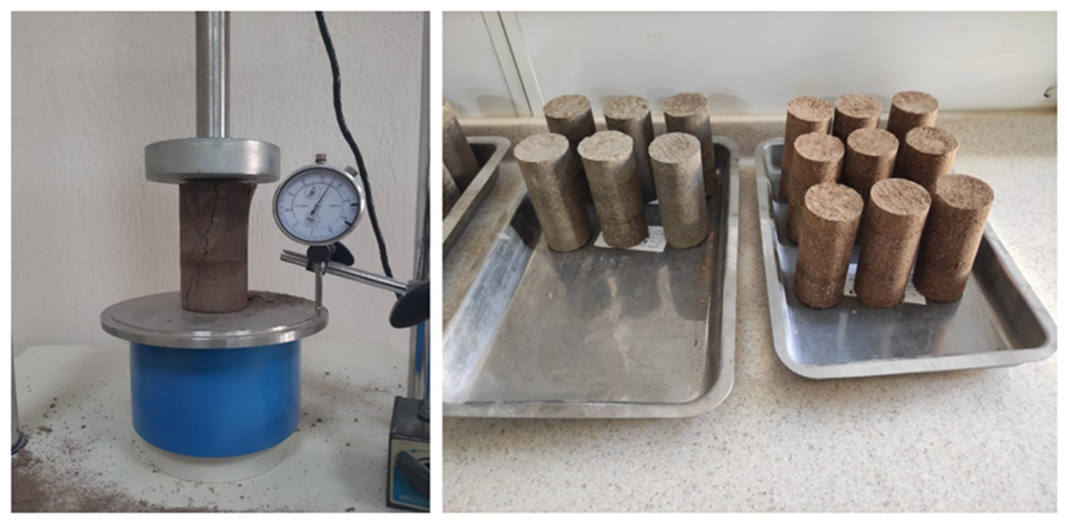
Unconfined compressive strength (qu) is a parameter used to measure the strength of mixtures in soil stabilization and shows the effects of additives on soil strength. Unconfined compressive strength test was carried out in accordance with TS 1900-2 [40] standard. The application of the unconfined compressive strength (UCS) test and representative samples are shown in Figure 1. To examine the strength development of the samples, unconfined compressive strength (UCS) tests were carried out in a 7-day curing period. UCS test samples were prepared using divided cylindrical molds made of iron with a diameter of 38 mm and a height of 76 mm and arranged in such a way that the height–diameter ratio was 2:1. Compressive strength tests were carried out for geopolymer stabilized soil samples in a 50 kN capacity universal testing machine in accordance with ASTM D1633 [41] standard. During this test, the strain rate of 1%/min was kept constant.
Test samples were prepared in a volume-controlled manner using optimum water content and dry unit weight values. Three samples were produced for each mixture ratio. The samples were covered with a plastic package to prevent the change in water content. The samples prepared were cured for 7 days. Literature indicates that geopolymer systems can achieve a significant portion of their ultimate strength at early ages. In particular, 7-day compressive strength may reach approximately 70–85% of the 28-day strength, with even higher ratios reported under elevated curing temperatures that accelerate geopolymerization reactions. Similarly, studies on geopolymer-stabilized clay soils have demonstrated that early-age strength development is pronounced. In some cases, strength gain beyond 7 days remains limited or may even decrease due to microstructural changes associated with thermal curing [42,43,44,45,46].
The samples prepared for each mixing ratio were tested in a uniaxial compression tester and the average of these three tests was reported as the result. In addition, scanning electron microscope (SEM) analysis was performed at Afyon Kocatepe University to examine microstructural bonding mechanisms in the 7-day processed samples. It should be noted that the SEM study can only examine a small and local area of the unprocessed and processed samples. The LEO 1430 VP model SEM instrument (ZEISS, Oberkochen, Germany), used in microstructure examinations and operating with a W (Tungsten) filament, features a Röntec QX2 brand and model XFlash type X-ray (EDX—Energy Dispersive X-ray Spectroscopy) detector. However, it was assumed that this area represents the reaction processes of the processed samples [47].
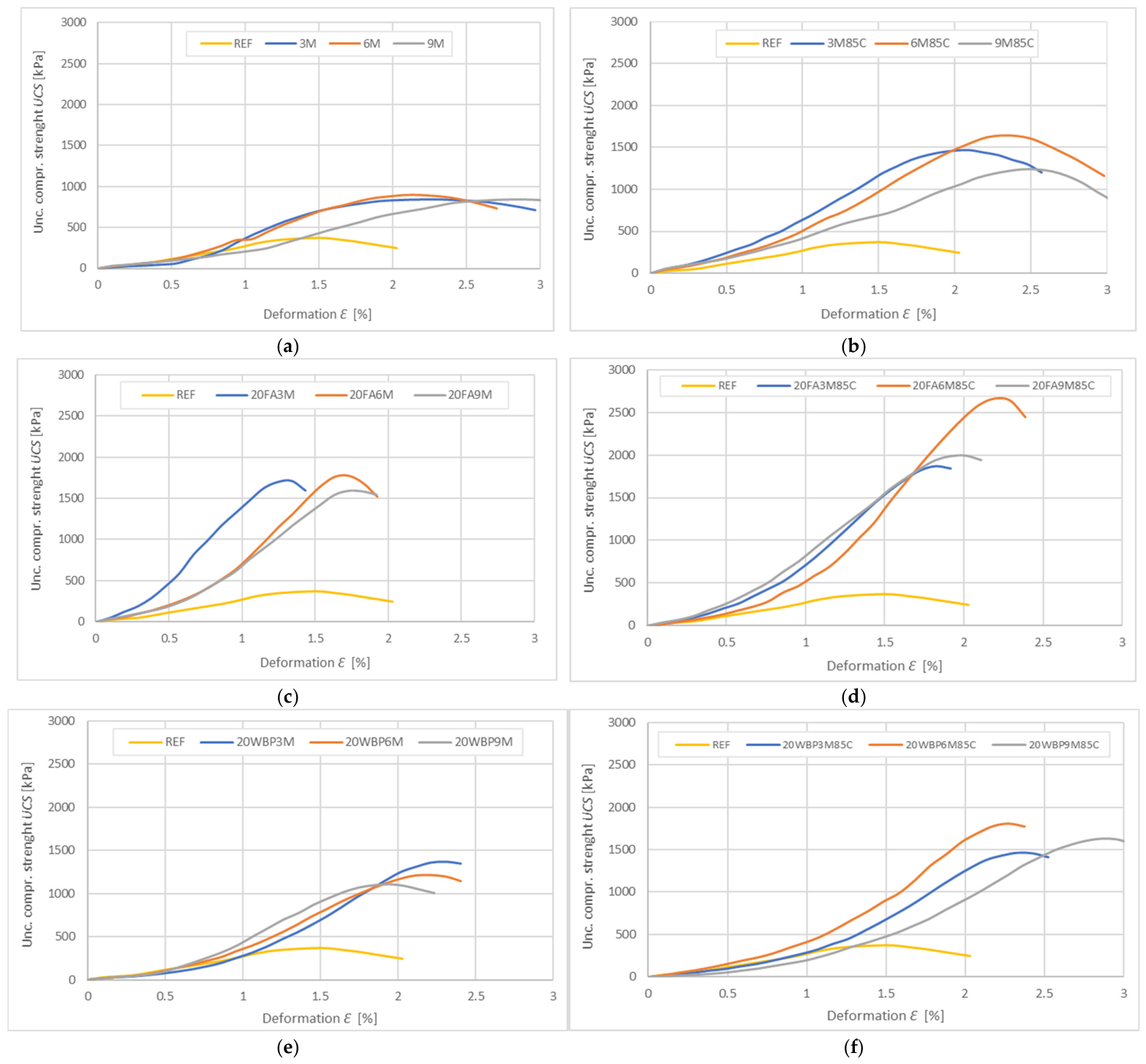
Figure 2a presents the unconfined compressive strength (UCS) results for all tested specimens. The results for clay, used as the reference material, and clay improved with sodium silicate solutions at molarities of 3 M, 6 M, and 9 M are shown in Figure 2a. Other tested specimens exhibit similar trends, although with higher peak strengths. Figure 2b–f illustrate the UCS of the clay reference (REF) compared to the following treated samples: (b) 3M85C, 6M85C, and 9M85C; (c) 20FA3M, 20FA6M, and 20FA9M; (d) 20FA3M85C, 20FA6M85C, and 20FA9M85C; (e) 20WBP3M, 20WBP6M, and 20WBP9M; and (f) 20WBP3M85C, 20WBP6M85C, and 20WBP9M85C.

3. Findings and Analysis

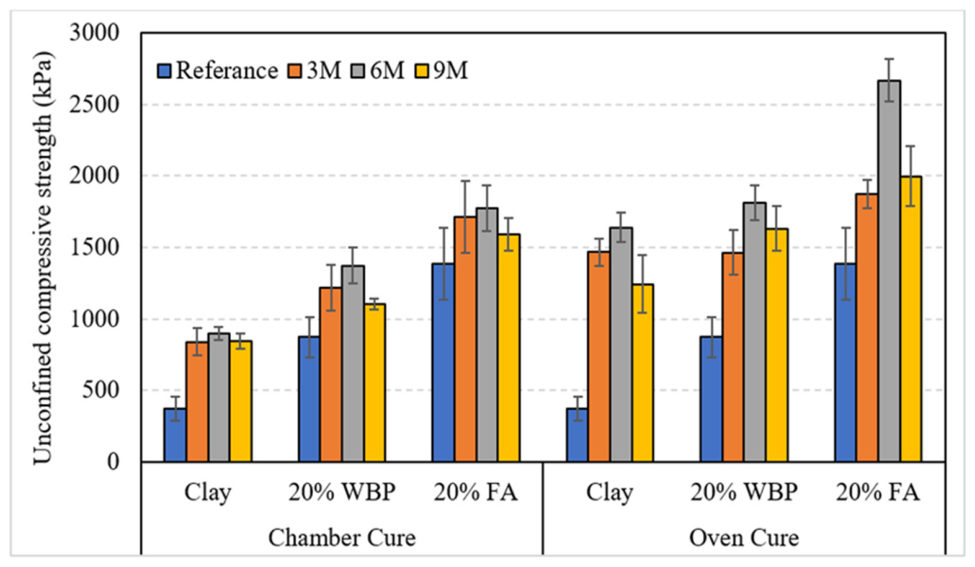
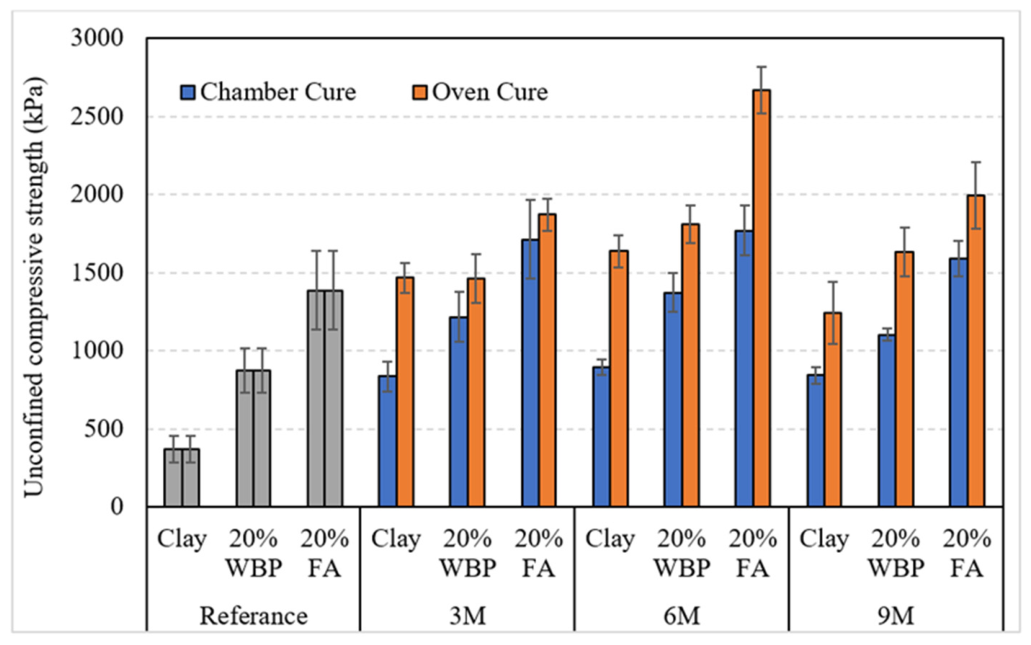
In this study, a geopolymer-based approach was employed to improve the properties of ordinary clay soil. Clay passing through a 250 µm sieve was used. The results of the unconfined compressive strength (UCS) tests for all specimens are presented in Figure 3 and Figure 4, with the untreated clay specimen serving as the reference material. Based on the experimental data, the following parameters were analyzed: UCS, stress–strain behavior within the linear range, UCS at 1% axial strain, and the empirical relationship between UCS and the California Bearing Ratio (CBR).

3.1. Unconfined Compressive Strength (UCS)

For the series containing 100% clay, replacing water with the geopolymer activating solution resulted in more than a twofold increase in compressive strength compared to the reference series, with strength gains ranging from 126% to 143%. The UCS results for all specimens after 7 days of curing are presented in Figure 3. Specimens prepared with optimum water content (reference) exhibited the lowest UCS values, indicating the limited mechanical strength of untreated clay soil.
The use of geopolymer solutions at molarities of 3 M, 6 M, and 9 M significantly enhanced the compressive strength for all series. For the 100% clay specimens, UCS increased by 126–143% compared to the reference samples. Incorporating 20% fly ash (FA) or 20% waste brick powder (WBP) further improved UCS, with specimens cured at 85 °C (oven cure) achieving the highest strength values.
Among the different solution molarities, 6 M often produced the highest UCS, whereas 9 M slightly reduced the strength in some cases, consistent with reports indicating that excessive alkalinity can adversely affect workability and strength development in geopolymer systems.
Overall, the results indicate that:
  • Geopolymer stabilization significantly enhances the strength of clay soil.
  • The addition of industrial by-products (FA or WBP) further improves mechanical properties.
  • Elevated curing temperatures accelerate the reaction process and increase UCS.
  • A moderate molarity (6 M) is optimal for mechanical performance, while very high molarity (9 M) may reduce stabilization efficiency.
As can be seen from Figure 4, it is possible to increase the strength of the reference series prepared with 100% clay and water by substituting WBP or FA. A 135% strength increase was observed with 20% WBP substitution and a 274% strength increase was observed with 20% FA substitution.
One of the most important factors that enables strength development in the production of geopolymer materials is curing at a temperature below the evaporation temperature of water. In this study, the cure temperature was 85 °C and the cure time was 24 h. Compared to room temperature, this process made a positive contribution to the strength increase in all series. When all series were evaluated together, the oven cure provided a 39% increase in strength compared to the cure at room temperature. The effect of the oven cure varies depending on the NaOH molarity and material content. Relatively, according to the material content, the biggest contribution of the oven cure was in the 100% clay material. The maximum increase in strength, ranging from 47% to 83% depending on the NaOH molarity, occurred at 6 M.
When the findings are examined in terms of material, the highest strength belongs to 20%FA, followed by 20%WBP, and the lowest to 100% clay series. The highest strength values in the series cured both at room temperature and in the oven belong to the series prepared with a 6 M NaOH solution. Considering this information, the highest strength belongs to the series prepared with 6 M NaOH solution containing 20% FA and cured in the oven and is worth 2668 kPa. In addition, considering that the oven cure creates limitations in terms of application and energy consumption, a strength value of 1771 kPa can be obtained by enduring a 34% reduction in the mixture with the same content. The supply and transportation of substitute material instead of the limitation oven cure will have a strength of 1640 kPa with a 39% decrease in the series produced with 100% clay and 6 M NaOH.

3.2. Stress–Strain Behavior in the Linear Range

Stress–strain behavior within the initial linear range was also recorded for the tested specimens to determine the mechanical response of the material in the elastic region.
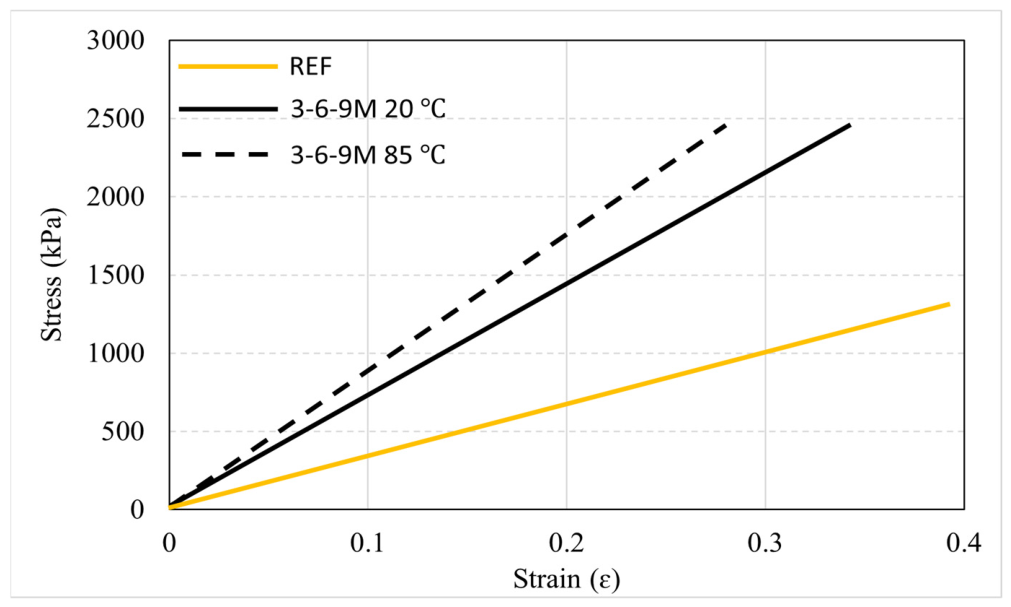
In Figure 5, the variation in the material with 100% clay content according to the curing method of the series prepared with water, called reference, and the samples prepared with solution are discussed. Accordingly, the reference series is seen as the most ductile material. While the material exhibited a more brittle behavior with the use of the solution, the material obtained by curing in the oven exhibited an even more brittle structure, the strength of the material increased and its deformation decreased.
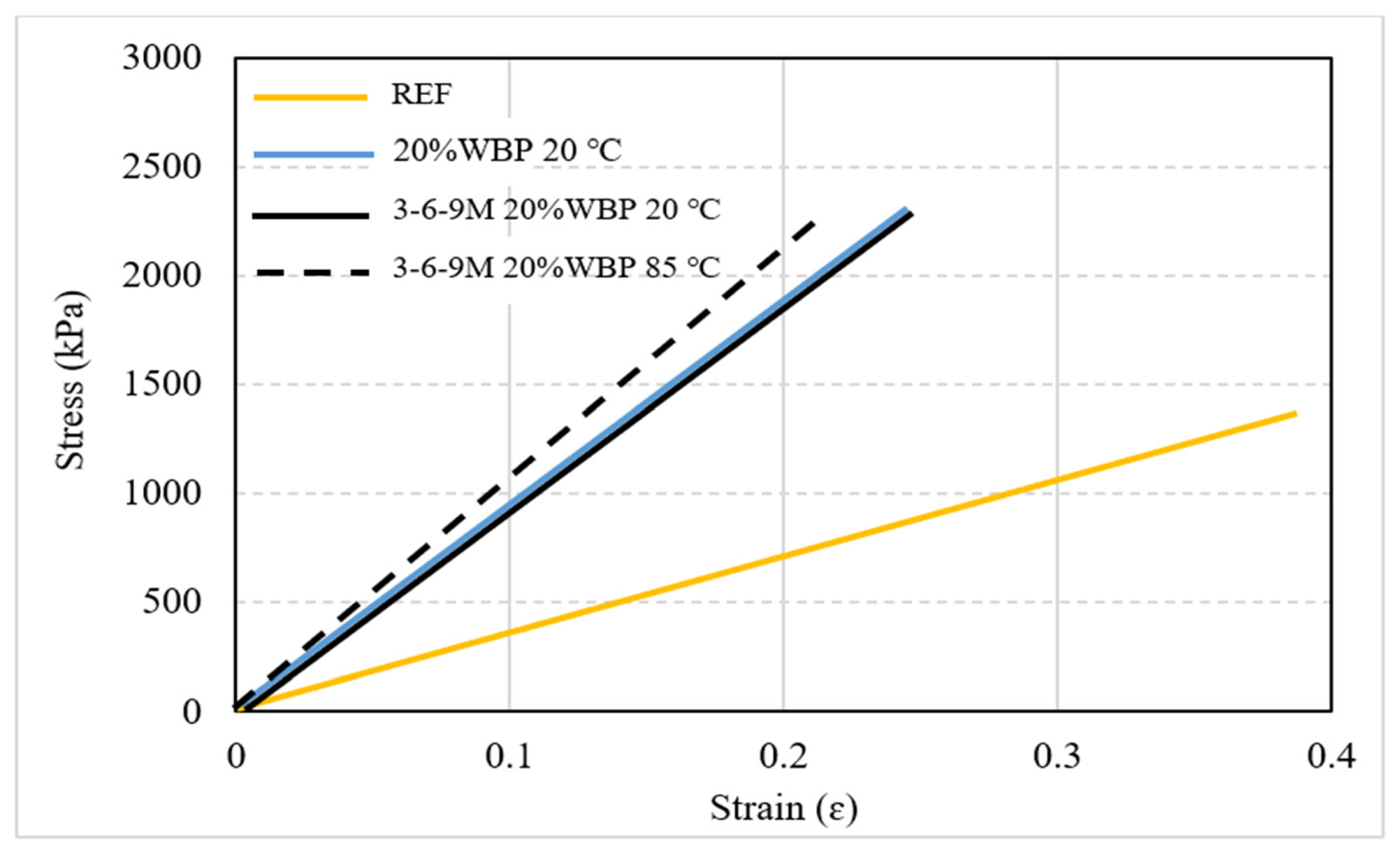
Figure 6 presents the stress–strain results for the series with 20% replacement of waste brick powder (WBP). The incorporation of WBP increased the stiffness of the material, indicating an enhanced resistance to deformation under the same loading conditions. Considering the effects of the three factors—WBP replacement, the use of the activating solution, and curing conditions—it is evident that WBP replacement is the primary contributor to the observed changes in the stress–strain response. The use of the solution alone did not produce significant changes in mechanical properties, whereas additional oven curing of the solution-treated specimens led to a reduction in material ductility. These results demonstrate that WBP replacement predominantly affects material stiffness, while curing conditions and the use of the activating solution mainly influence ductility.
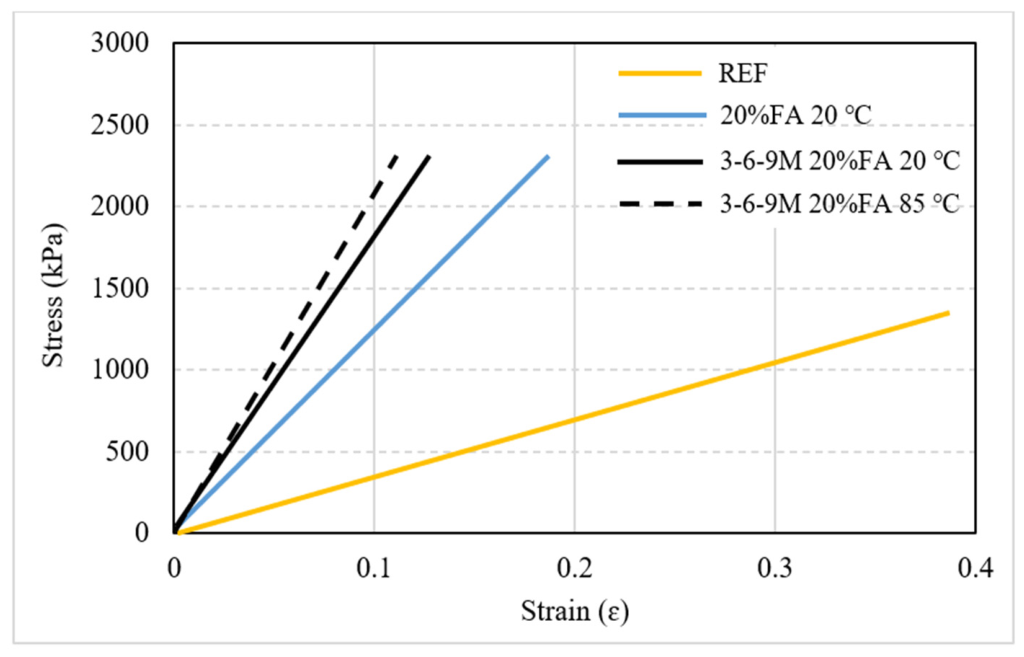
The stress–strain graph of the samples produced with 20% FA substitution is given in Figure 7. FA substitution was the factor that relatively affected the plastic properties of the material the most. The brittle behavior of the material increased with the use of solution, and the brittle behavior increased slightly with oven curing.
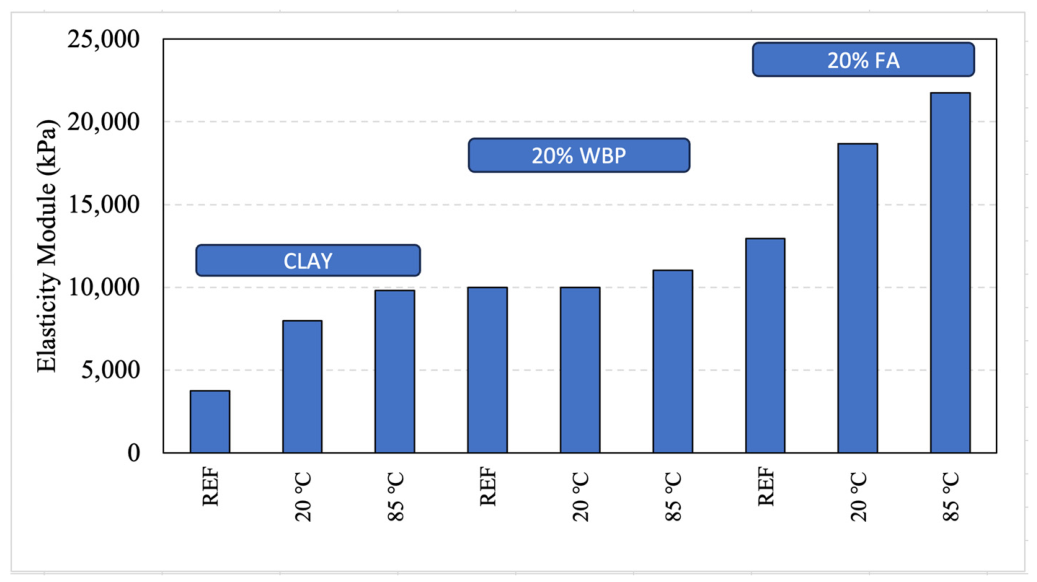
The results of the elastic modulus, determined from the stress–strain behavior of the specimens, are presented Figure 8. The reference series is that prepared with water, while the 20 °C and 85 °C series represent the averages of the series prepared with solutions cured at room temperature and in an oven, respectively. Analysis of the data reveals that the applied additives and curing conditions have a decisive, systematic effect on the material’s macroscopic strength profile. The lowest modulus of elasticity in the graph belongs to the pure reference (REF) clay sample without any chemical additives. This value indicates that natural clay has weak interparticle bonds. However, when an alkaline activator is added to the system and thermal curing is applied, the modulus reaches approximately 10,000 kPa, indicating a significant increase. This macroscopic increase suggests that the clay particles are forming a physical coating on the surface rather than dissolving in the alkaline environment to create a new binder gel structure (polymerization).
In samples with 20% WBP substitution, modulus values settled in the ~10,000–11,000 kPa range with alkali activation. The inclusion of waste brick dust in the system significantly increased the material’s rigidity compared to the reference state; this indicates that the system developed a flexible interlocking mechanism with a certain toughness, rather than a completely brittle structure in terms of mass. The most dramatic increase in the graph was observed in the fly ash (FA) series. All series with 20% FA additive showed higher performance than the WBP and clay series; in particular, the FA sample thermally activated at 85 °C showed the highest peak. This solidification demonstrates that the high pozzolanic reactivity of fly ash minimizes the material’s elastic deformation, transforming it into a rigid, compact composite. In all mixture groups (Clay, WBP, and FA), the elastic moduli increased without exception when transitioning from ambient temperature (20 °C) to oven curing (85 °C). It has been confirmed at the macroscopic level that high thermal energy accelerates reaction kinetics, increasing the cross-linking density (gel maturity) in the material’s microstructure.
The high elastic modulus values obtained from macroscopic mechanical tests clearly demonstrate that the weak substrate matrix is transformed into a highly rigid structure under the influence of alkali activation and thermal curing. In order to elucidate the chemical phase transformations, reaction product morphology, and interparticle coupling mechanisms (microstructural texture) underlying this dramatic mechanical strengthening under thermal curing, particularly in WBP and FA substituted samples, Scanning Electron Microscopy (SEM) and Energy Dispersive X-ray (EDX) analyses were performed in the next stage of the study.

3.3. Unconfined Compressive Strength at 1% Axial Strain

Empirical correlations between unconfined compressive strength (UCS) and the California Bearing Ratio (CBR) are widely applied in geotechnical engineering to estimate the bearing capacity of fine-grained soils. However, their applicability is strongly soil-specific and depends on moisture content, plasticity index, density, soil fabric, and stress history. In clayey soils, the relationship between CBR and undrained shear strength C u (or UCS) is generally non-linear, reflecting the coupled mechanical and hydro-mechanical behavior of the fine fraction.
Several authors have proposed empirical relationships linking UCS and CBR. For example, Sutariya and Varia (2018) [48] established a linear regression for a tested clay based on laboratory data:
C B R ( % ) = 1.872 q u + 2.0102
where q u is the UCS expressed in kg/cm2. The authors emphasized that this correlation is valid only for the specific clay and experimental conditions investigated. In general, published studies indicate that for soft to medium stiff clays at natural water content, UCS values in the range of approximately 20–100 kPa typically correspond to low CBR values (usually below 5%). Significantly higher UCS values are commonly associated with very stiff, desiccated, or chemically stabilized soils.
Based on extensive field and laboratory comparative testing, Paige & Green [49] proposed a non-linear empirical correlation expressed as:
U C S = 15 C B R 0.88
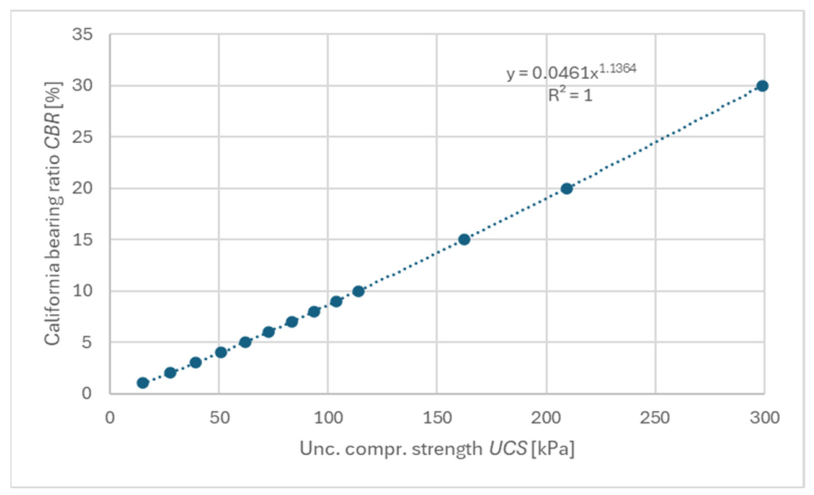
where UCS is given in kPa and CBR in percent. This relationship was derived from correlations between laboratory and in situ CBR values, as well as dynamic cone penetration (DCP) measurements, for both natural and stabilized materials. The exponent 0.88 confirms the non-linear growth of compressive strength with increasing CBR, which is characteristic of fine-grained soils. In such materials, penetration resistance does not increase proportionally with undrained shear strength (Figure 9).
The empirical relationship between the California Bearing Ratio (CBR) and undrained shear strength C u for clay and silt soils proposed by Paige & Green [49] is presented in Figure 9. Their correlation highlights the inherently non-linear nature of the interaction between penetration resistance and undrained strength in fine-grained soils.
Empirical evidence consistently demonstrates that CBR does not increase proportionally with C u . For very soft soils ( C u < 12 kPa), penetration resistance is practically negligible (CBR < 2–3%). In soft to medium consistency clays ( C u 12 40 kPa), CBR generally remains within the range of approximately 2–10%, primarily due to high natural moisture content and the pronounced sensitivity of the fine fraction to localized penetration stresses. Even in medium to stiff clays ( C u 40 80 kPa), CBR increases only moderately (approximately 10–20%). This behavior confirms that an increase in undrained shear strength does not necessarily translate into a proportional increase in penetration resistance.
According to the correlation proposed by Paige and Green [39], CBR values between 1% and 10% correspond to UCS values ranging approximately from 15 to 114 kPa, which is consistent with the typical strength interval of soft to medium stiff clays. For example, CBR = 5% corresponds to UCS ≈ 62 kPa, while CBR = 10% corresponds to UCS ≈ 114 kPa. This relatively low CBR/UCS ratio in naturally moist clays is of particular importance in pavement engineering, as it prevents overestimation of subgrade bearing capacity when design is based solely on undrained shear strength parameters.
Table 4 and Table 5 presents the unconfined compressive strength values determined at 1% axial strain (UCS1%) together with the corresponding CBR values derived from the empirical correlation. Table 4 summarizes specimens tested at 20 °C, whereas the reference clay (REF) tested at 20 °C exhibited UCS1% = 272.74 kPa, corresponding to a calculated CBR value of 27.02%. This value was adopted as the baseline condition (CBR/CBRref = 1.00). At 20 °C, moderate strength increases were observed for the 3M and 6M mixtures, while the 9M specimen showed a reduction in strength compared to the reference clay. Stabilization with fly ash resulted in a substantial enhancement of strength. The REF20FA mixture achieved 1054.47 kPa, whereas 20FA3M reached the highest value of 1395.18 kPa, corresponding to a 6.39-fold increase in relative CBR compared to the untreated clay. Similarly, BR-stabilized specimens demonstrated significant mechanical improvement, particularly the REF20WBP mixture.
It should be emphasized that CBR values were not experimentally measured but were derived using the empirical relationship (3):
C B R = U C S 15 C B R 1 0.88 =   U C S 15 C B R 1.136
Accordingly, CBR is employed herein solely as a transformed engineering indicator to illustrate relative variations in subgrade bearing capacity resulting from soil stabilization and curing conditions. The UCS at 1% axial strain remains the primary experimentally determined mechanical parameter.
Table 4 presents the unconfined compressive strength (UCS) at 1% axial strain together with the corresponding derived California Bearing Ratio (CBR) values for specimens tested at 20 °C.
Table 5 includes thermally treated specimens cured at 85 °C. Thermal treatment at 85 °C further accelerated strength development in several mixtures. For example, the 3M85C specimen reached 640.54 kPa (CBR = 2.64), indicating pronounced cementation and accelerated pozzolanic reactions. Nevertheless, the influence of elevated curing temperature was mixture-dependent, as certain combinations exhibited only moderate improvement or even a reduction in strength.

3.4. Scanning Electron Microscopy (SEM) Observations

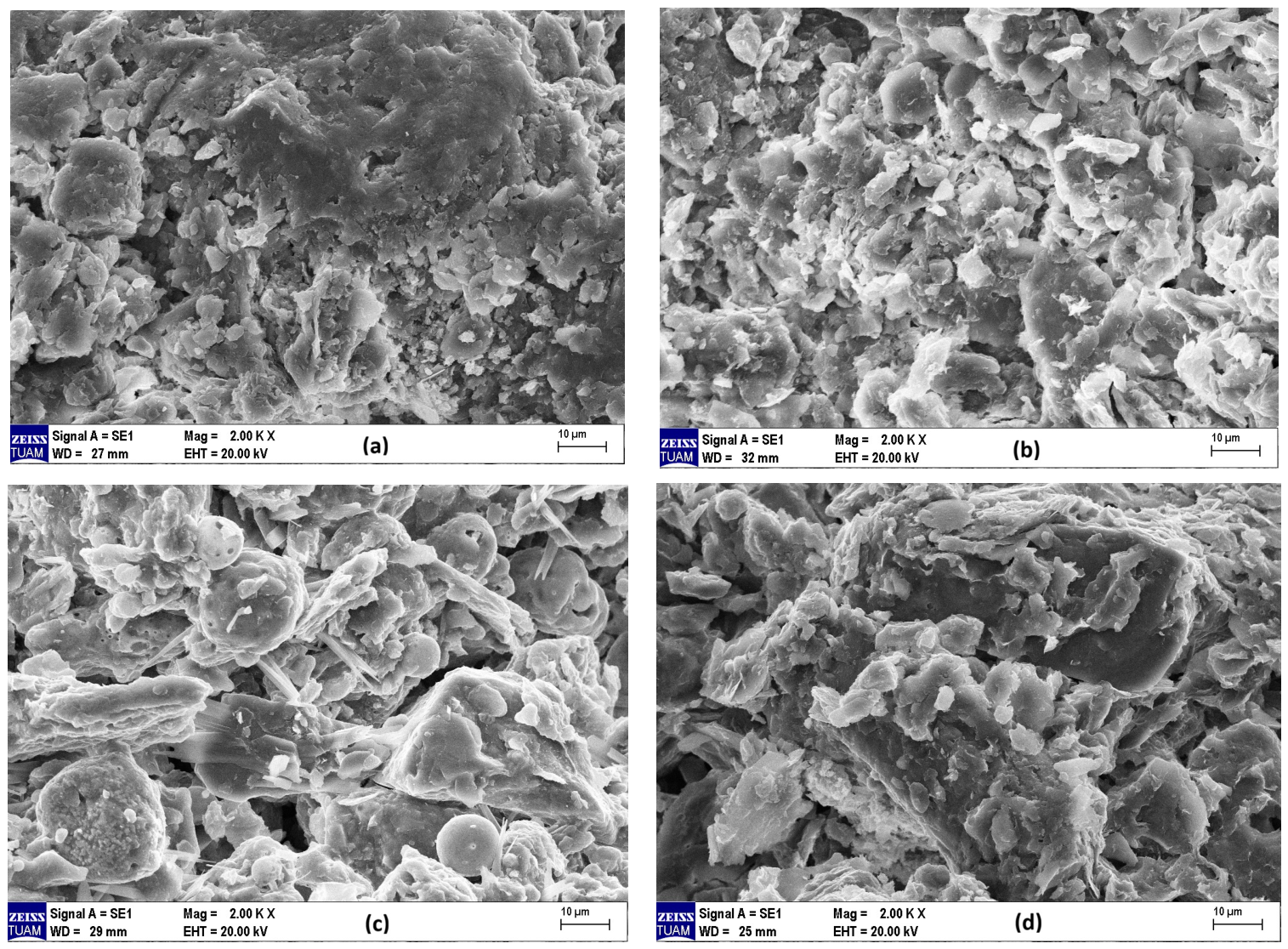
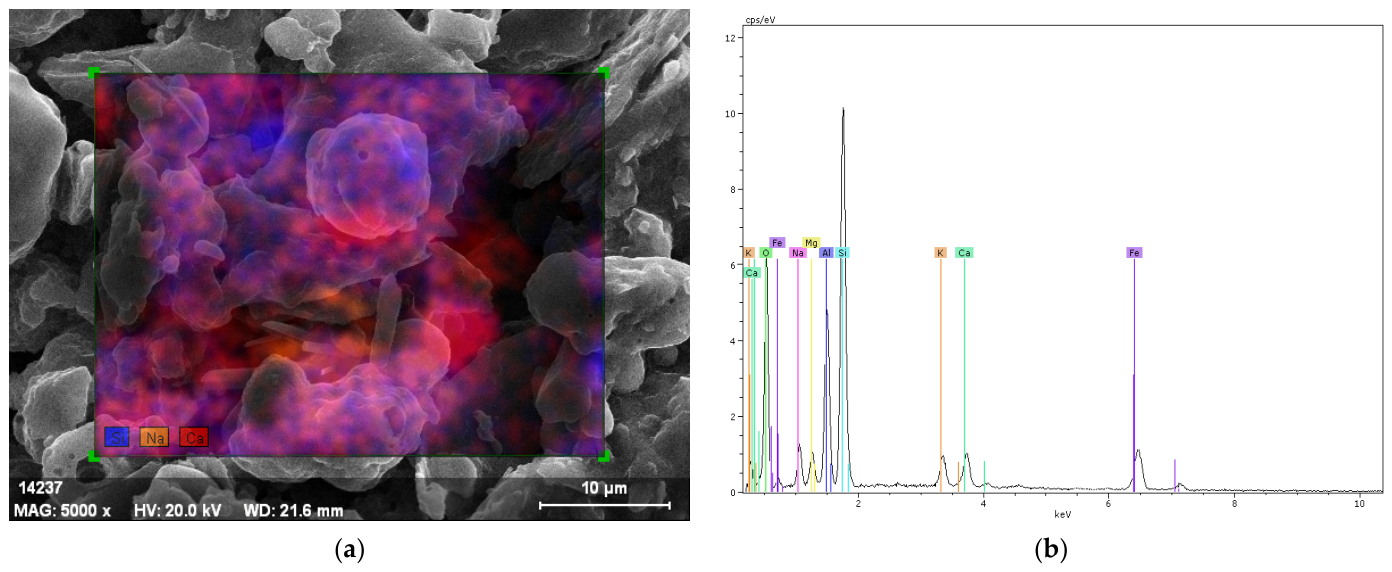
SEM images of the reference series and specimens produced with 6 M NaOH solution, which exhibited the best mechanical performance, are presented in Figure 10. In Figure 10a, corresponding to the 100% clay specimen prepared with water, large aggregates formed by the clay–water mixture and void spaces are observed. This situation morphologically demonstrates the need for chemical or physical additives to improve the engineering properties of the structure. In Figure 10b, for the series with 20% WBP and water, the large gaps between small, angular particles are reduced compared to the 100% clay series. In the 20% FA series prepared with water (Figure 10c), unreacted spherical FA particles are visible. The dense clay–FA matrix is interrupted by cracks, indicating partial separation between the components. As shown in the 100% clay series prepared with 6 M NaOH at 20 °C (Figure 10d), NaOH particles cluster on the clay surface, and the voids are filled with the solution.
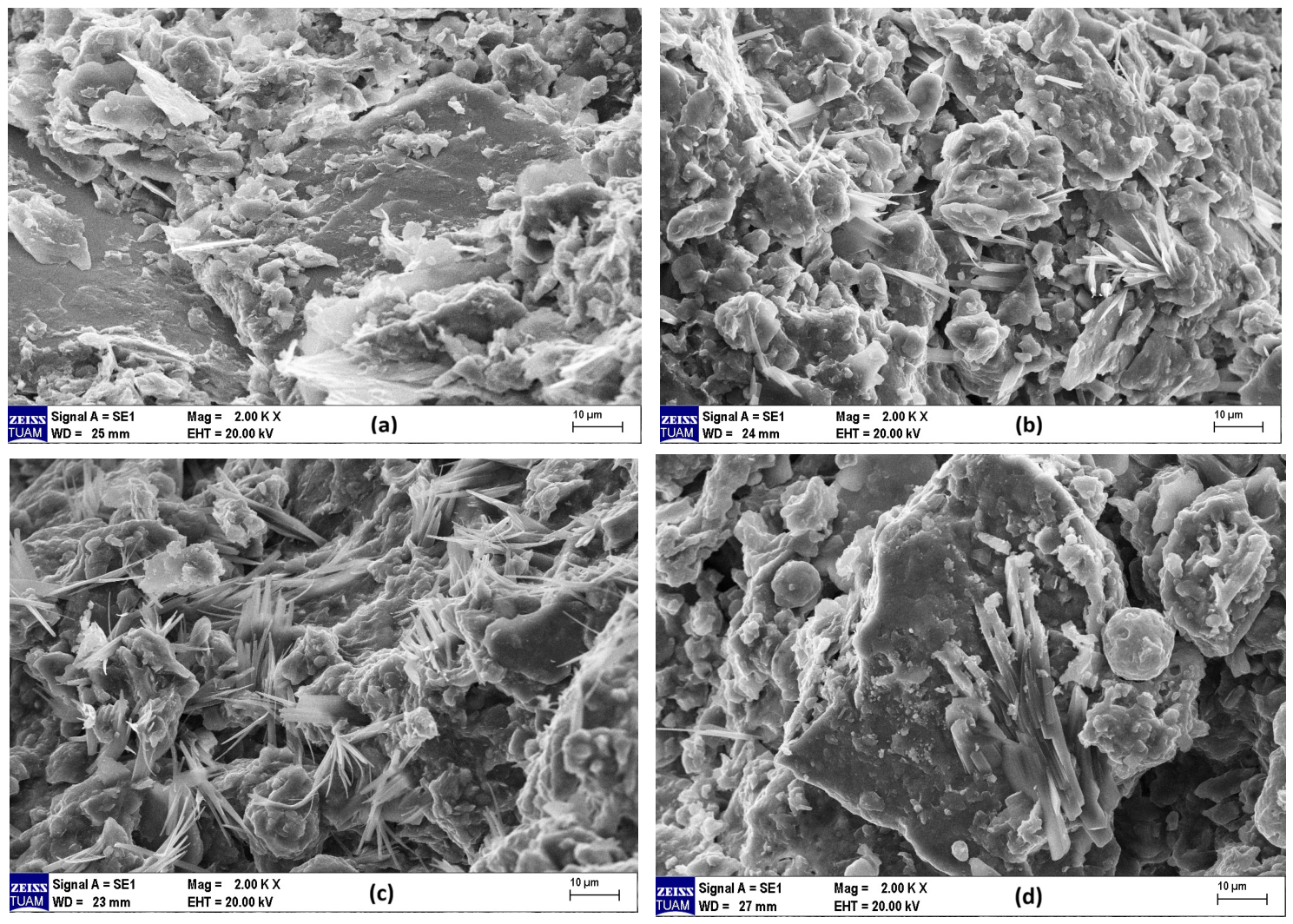
The increase in the curing temperature to prolong the polymerization process created flaky structures in the 100% clay content series (Figure 11a). The SEM image of the series produced with 6 M 20%WBP substitution and cured at ambient temperature is given in (Figure 11b). Here, the formation of ettringite crystals through the polymerization process is seen between the clay particles. It is seen that these ettringite crystals reach a denser and longer structure by applying the oven cure to the same series (Figure 11c). The SEM image of the 6 M 20%FA substitute cured at room temperature is given in image (Figure 11d). A crystal structure with a thicker structure was formed compared to the WBP substitution.
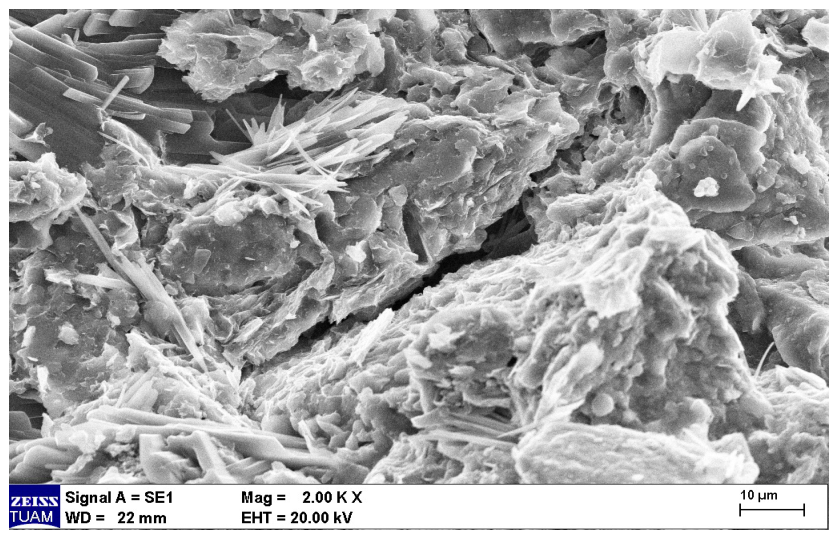
The formation of ettringite crystals along with this crystal structure can be seen in the SEM image (Figure 12) of the oven-cured series. In the FA substituted series cured at room temperature, particles that have partially reacted and whose spherical structure has begun to deteriorate are observed. In the series cured in the oven, the FA particles were completely reacted and no spherical particles were observed.
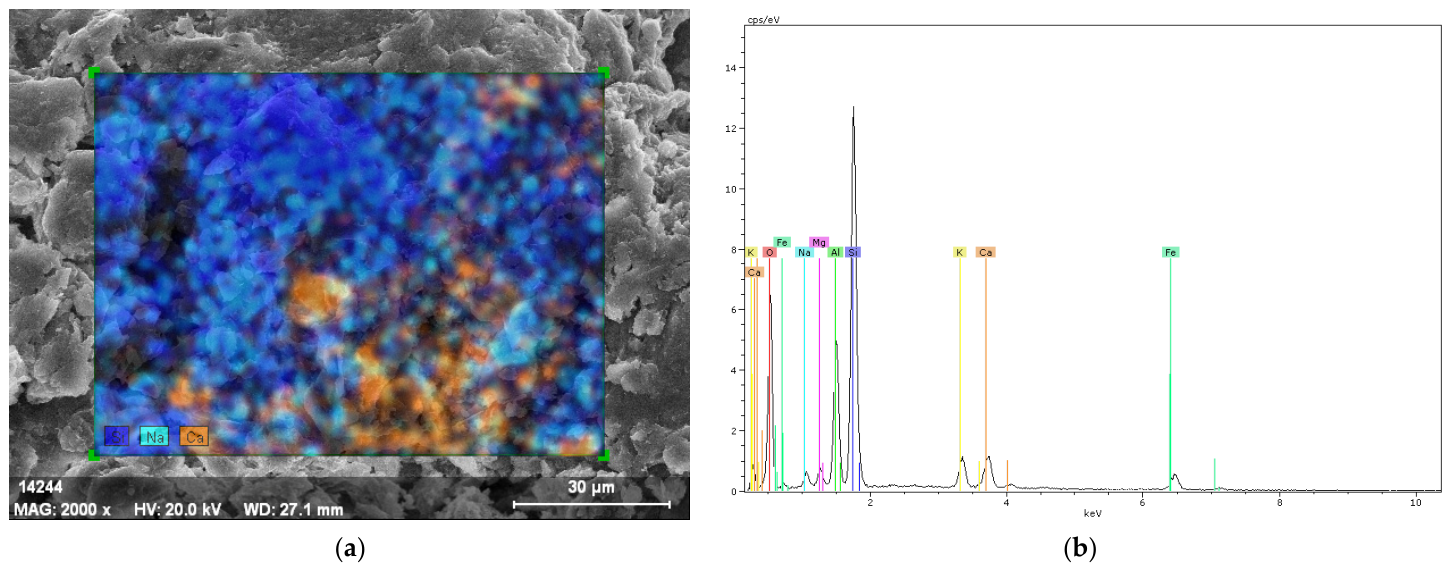
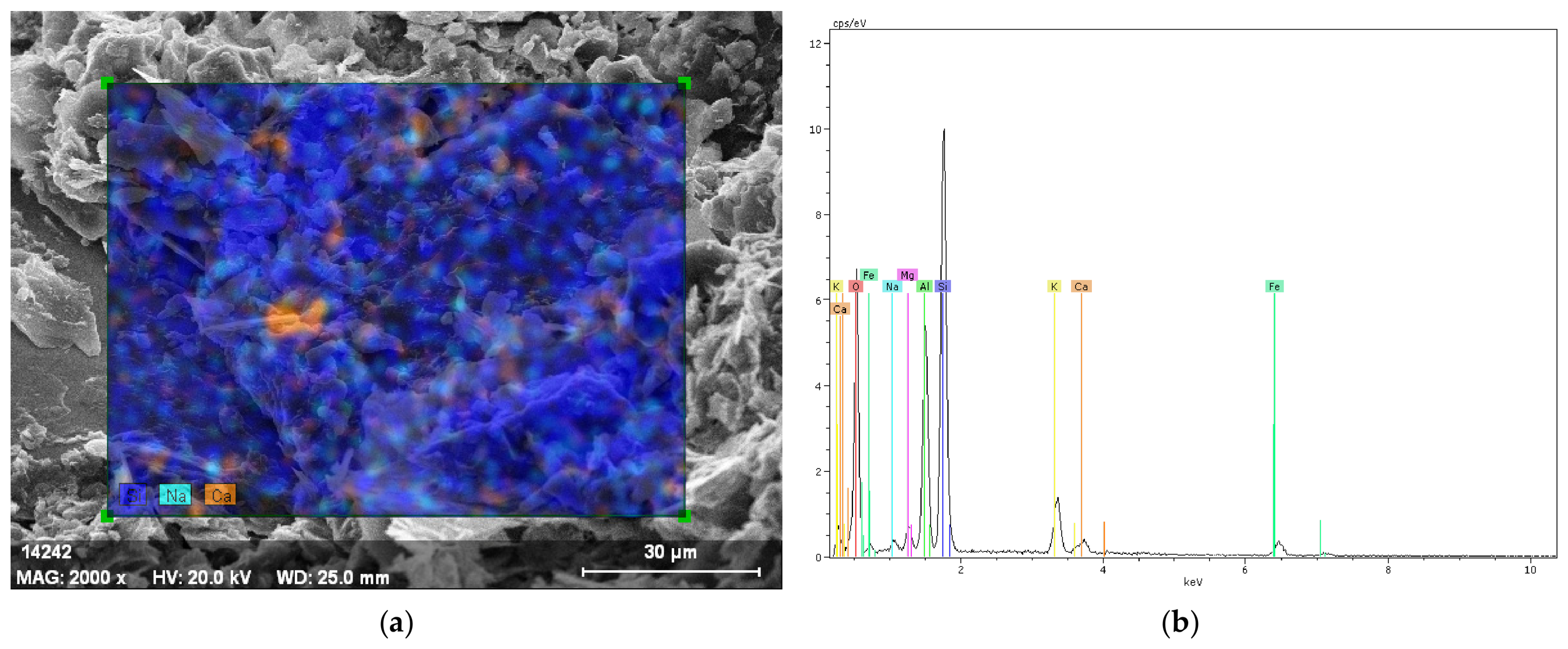
The series examined with SEM images were also measured using EDX measurements and the mapping method. To observe the geopolymerization process, the images in Figure 13 were obtained by combining the images obtained with different colors for Si, NA, and Ca with the SEM images of the relevant area. Figure 13a shows information about the sample prepared with 100% clay and water. The intense presence of “Si” is seen in a dark blue color. “Na” symbolized by light blue originates from the sparse and scattered clay content. The orange-colored “Ca” is seen collectively in certain regions. This may be due to impurities present in the clay.
Figure 13b shows that the highest peaks in the spectrum belong to the elements silicon (Si), aluminum (Al), and oxygen (O). This confirms that the material is primarily an aluminosilicate (clay) mineral, as expected. Lower intensity peaks for elements such as calcium (Ca), potassium (K), iron (Fe), and magnesium (Mg) indicate minor components or impurities commonly found in natural clay. The sodium (Na) peak is quite low. This is an important finding, expected and serving as the reference value, since the sample was prepared with only water and no alkaline activator was present in the environment. In Figure 13a, the dark blue color covers almost the entire area. This visually indicates that silicon forms the main matrix and is the basic building block of the clay plates. The orange areas are noticeable as regionally clustered points rather than being homogeneously distributed.
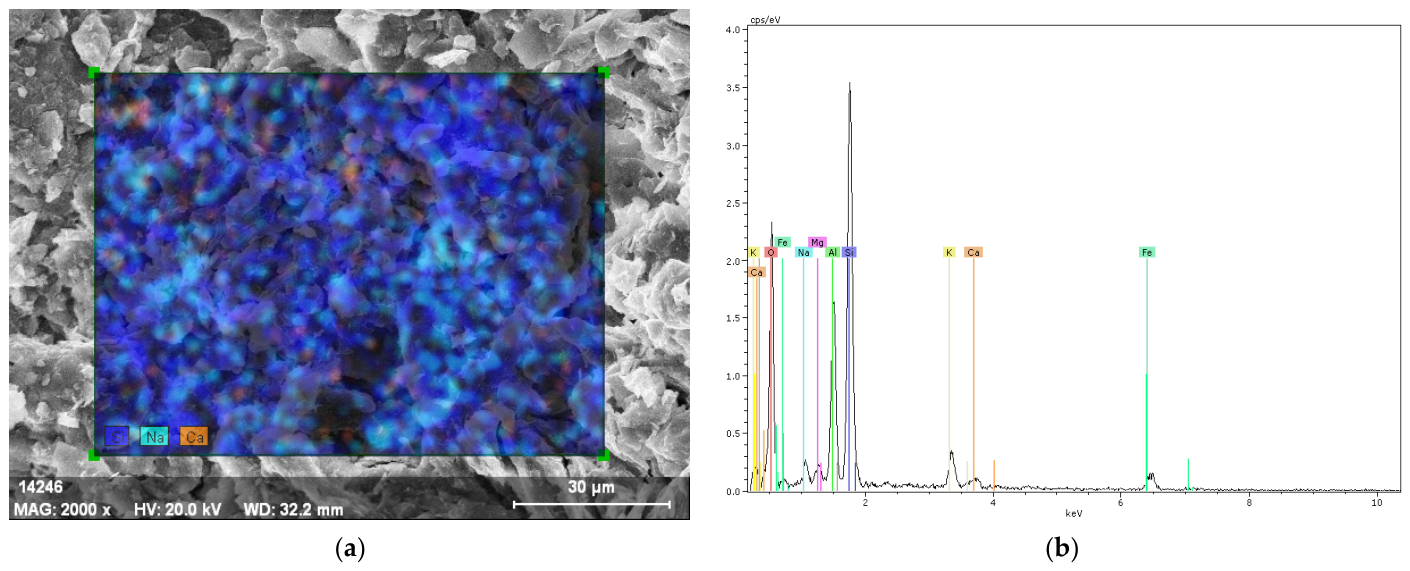
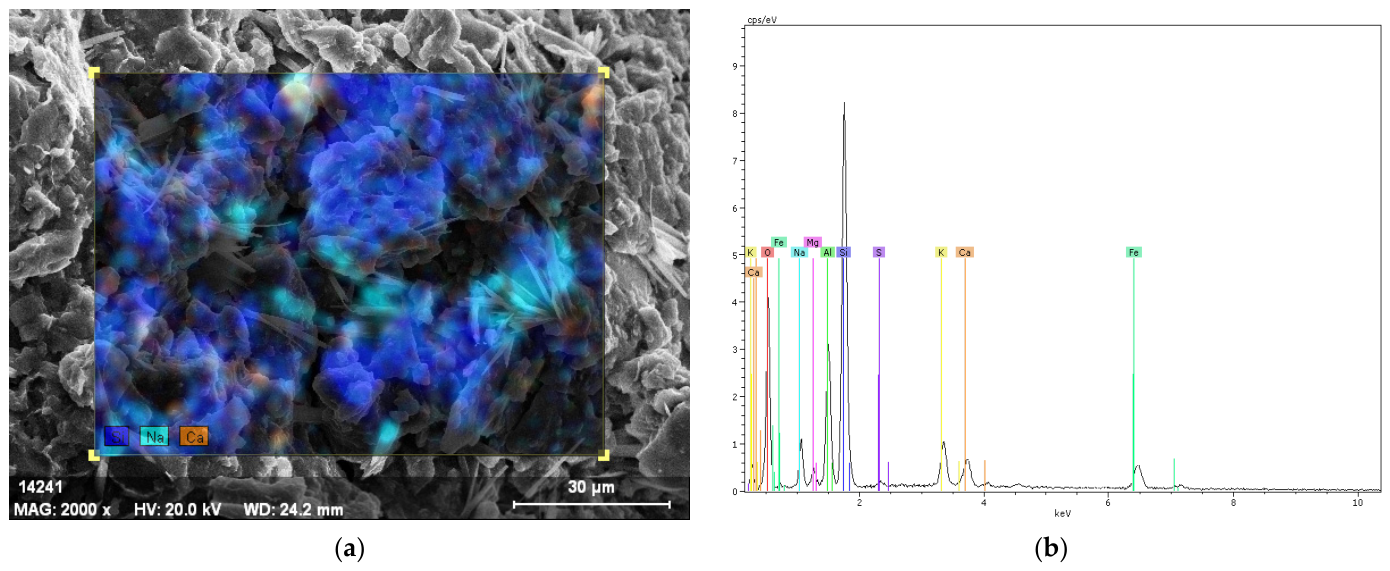
In Figure 14b, the peaks with the highest intensity in the spectrum again belong to the elements silicon (Si), aluminum (Al), and oxygen (O). Since waste brick dust (WBP) is essentially a baked clay/aluminosilicate derivative, the 20% WBP substitution did not alter the overall aluminosilicate chemistry of the material and exhibited a consistent profile. Despite minor differences arising from the brick dust’s structure, the overall mineralogical background is similar to that of clay. Since the sample was prepared with water only (no alkali activator was used), the sodium (Na) peak in the spectrum is negligible, as in the 100% clay reference sample. Figure 14a shows that EDX field mapping reveals that silicon (Si) is homogeneously distributed throughout the microstructure and forms the main skeleton. As expected, the negligible sodium (Na) peak and the absence of a distinct Na distribution in the mapping represent the chemical reference state of this sample prior to alkali activation treatment.
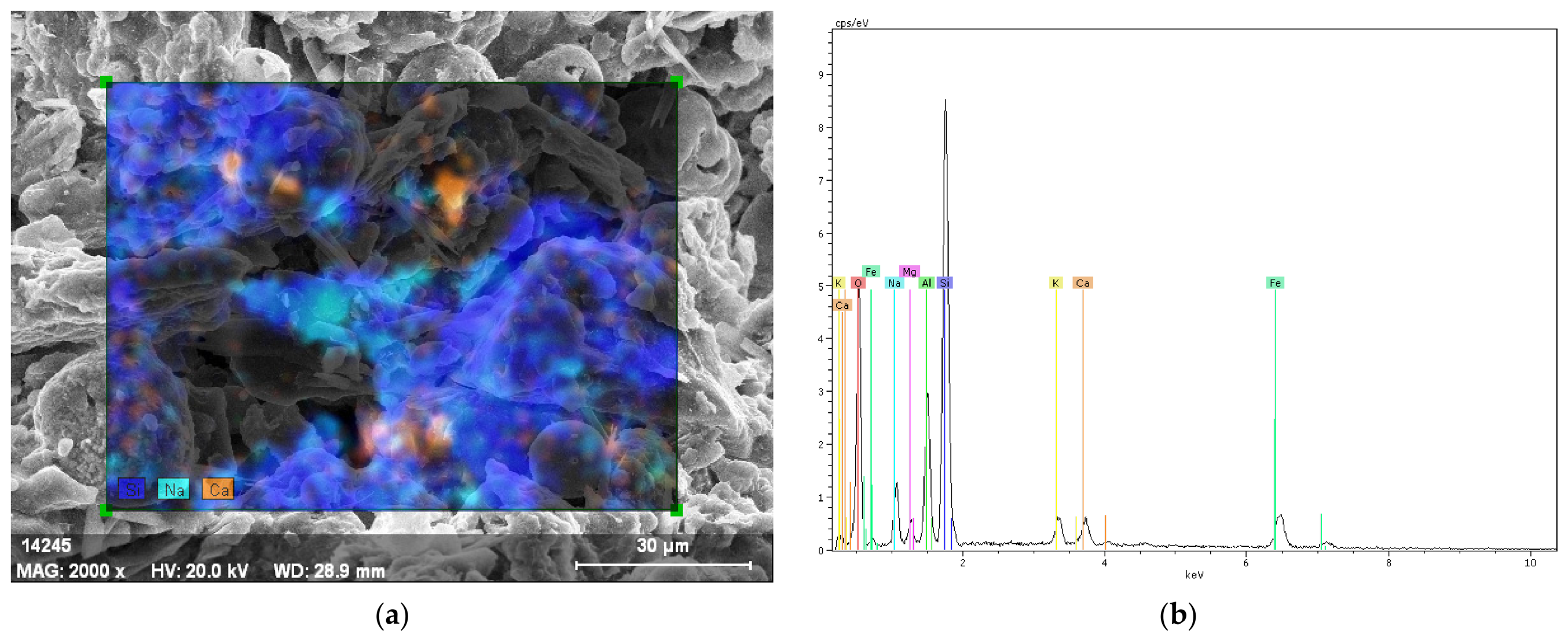
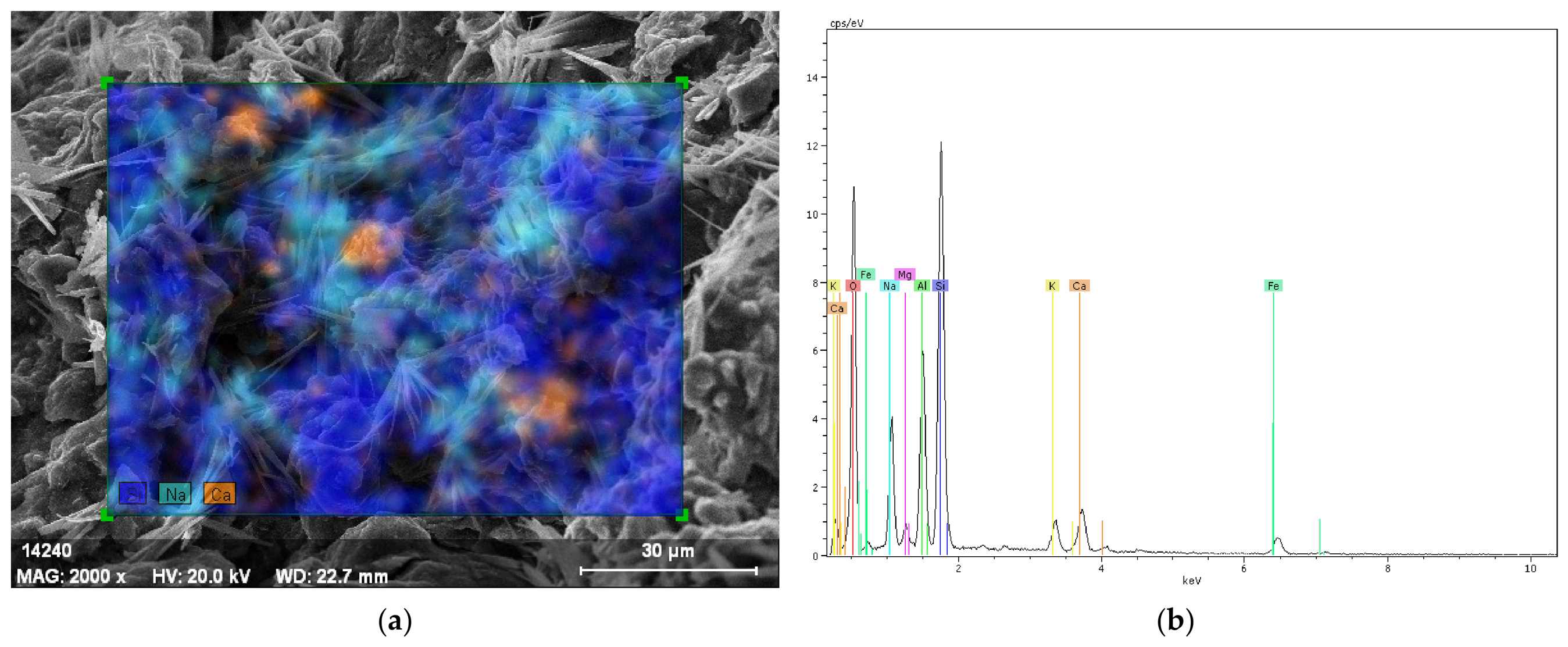
The EDX spectrum of the sample prepared with only water and 20% fly ash (FA) additive, shown in Figure 15b, indicates that the material retains its Si, Al, and O-dominant aluminosilicate nature. Examination of the EDX field mapping in Figure 15a reveals that the spherical particles, a characteristic morphological feature of fly ash, and the main clay matrix are covered by a homogeneous silicon (dark blue) network.
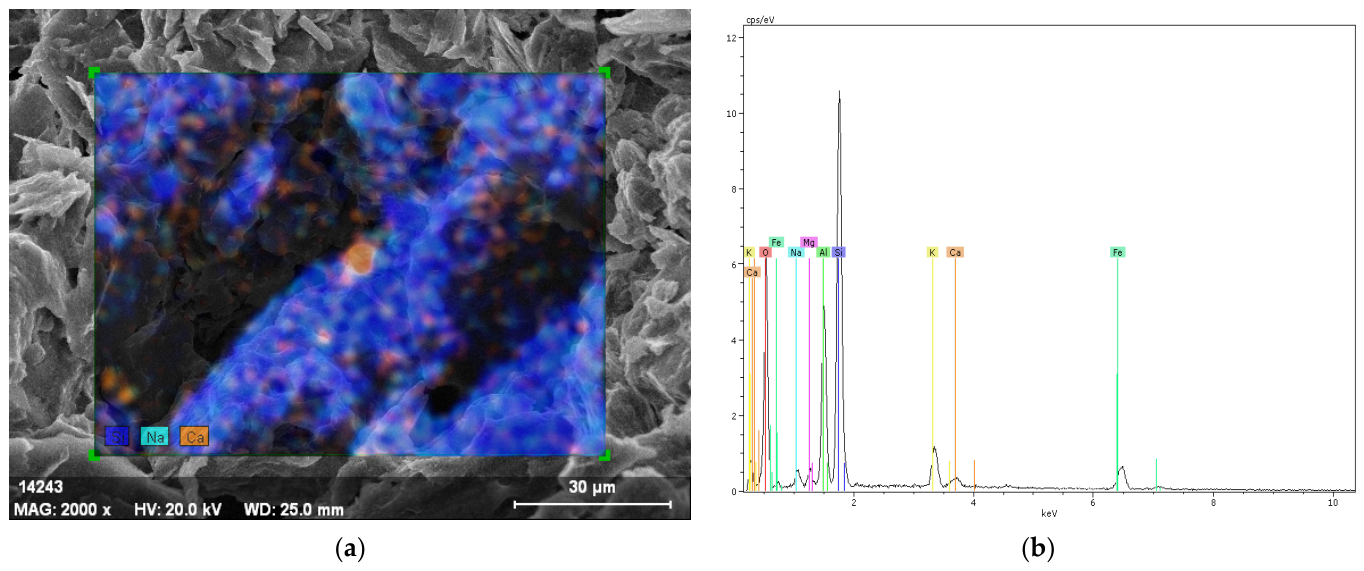
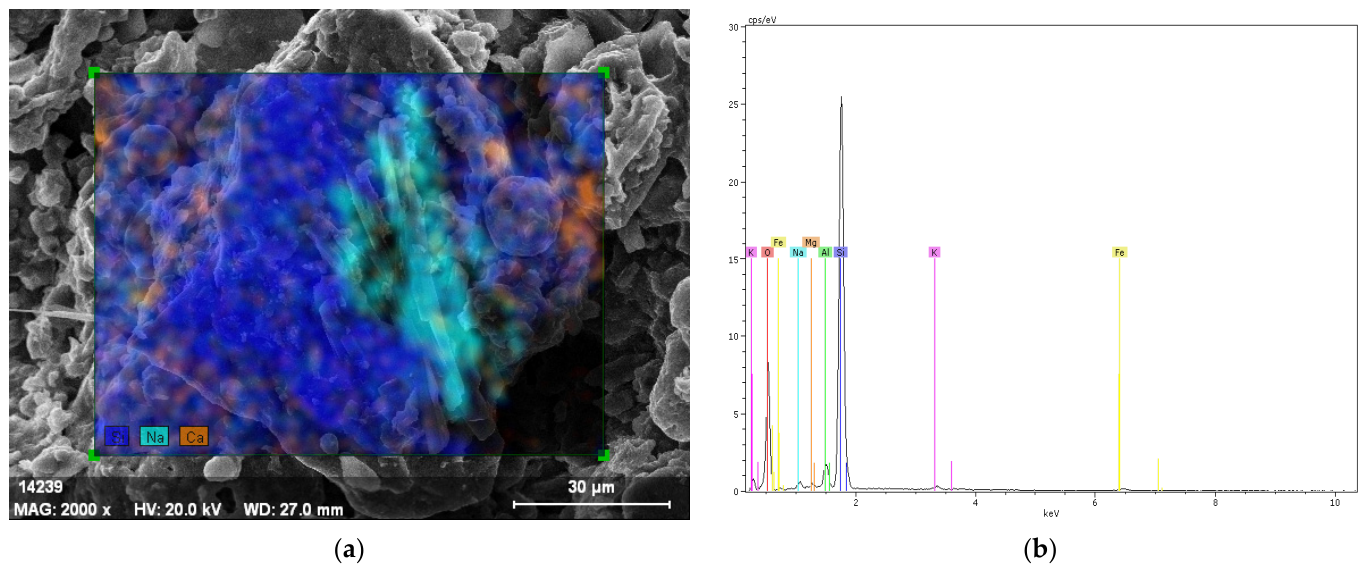
Figure 16a,b shows the EDX spectrum and field mapping of a 100% clay sample prepared with a 6 M NaOH solution and the NS dual-activator system, and cured at 20 °C. This chemical evidence demonstrates the low reactivity of pure clay minerals to alkali activation. The activator was unable to provide sufficient dissolution due to the stable crystal structure it encountered in the pure clay sample. The weak sodium (Na) peak in the EDX spectrum and the sparse distribution of sodium in the field mapping, due to the formation of dense reaction centers, suggest that the highly soluble silica derived from NS did not find sufficient aluminum (Al3+) ions to polymerize. This explains why sodium silicate forms a physical curing/coating on the surface rather than synthesizing a gel through true geopolymerization within the clay; therefore, the material lags far behind the waste-modified (WBP and FA) series.
Figure 17a,b show the EDX analysis of a 100% clay sample prepared with 6 M NaOH and NS solution and thermally activated (oven-cured) at 85 °C, revealing the positive effect of heat treatment on the distribution of the alkaline activator within the matrix. The prominent sodium (Na) peak in the EDX spectrum confirms activation. Compared to the sample cured at 20 °C, the penetration of sodium throughout the matrix suggests that heat curing more effectively promotes polymerization/activation reactions across the overall volume.
Figure 18a,b show that EDX analyses of a 20% WBP-doped sample cured at 20 °C with a dual activator of sodium silicate (NS) and sodium hydroxide (NH) reveal localized geopolymerization processes starting from the center. Unlike pure clay samples, the prominent sodium (Na) peak in this EDX spectral series indicates that the brick dust was successfully processed using a dual-activator system of reactive aluminosilicates. The concentration of sodium (Na) ions in specific areas, separated from the entire matrix, was measured in EDX field mapping without any external thermal energy. Fragments of NH ions separated from the WBP surfaces by local dissolution energy resulted in early fibrous gel formation. Although a significant increase in the macroscopic hardness of the material was achieved compared to the reference condition, additional thermal energy obtained from a curing process in an 85 °C oven is required to complete the process.
Figure 19a,b show the EDX analysis of the 20% WBP-doped sample subjected to oven curing at 85 °C, revealing the peaks associated with thermal energy and waste reactivity during geopolymerization. The highly intense sodium (Na) peak approaching the aluminum (Al) peak in the EDX spectrum visually confirms the high Na2O (18.5%) (Table 6) and Na/Al (1.46) (Table 7) ratios detected in quantitative EDS analyses. In the EDX field mapping, sodium ions (light blue), which clustered only at local reaction centers under 20 °C curing conditions, spread throughout the entire silicon (Si) matrix under the influence of the higher thermal energy at 85 °C. Aluminum silicates separated from WBP by the dissolving power of NH and thermal acceleration at 85 °C polymerized with the sodium silicate (NS) present in the medium. The sodium- and silica-rich, needle-like crystalline matrix that forms in the system fills the voids, increasing the material’s macroscopic hardness (elastic modulus).
Figure 20a,b show the EDX analysis of the sample with 20% fly ash (FA) addition, cured at 20 °C. The prominent sodium (Na) and iron (Fe) peaks in the EDX spectrum indicate the chemical interaction of fly ash with the alkali activator. Examination of the EDX field mapping shows that the dense silicon (dark blue) originating from sodium silicate (NS) surrounds the matrix, while sodium (Na) ions (light blue) are localized at the spherical particle interfaces of the fly ash and in specific thick binder phases. This specific clustering demonstrates that, without external thermal energy, sodium hydroxide (NH) locally dissolves the surface of the FA particles and, together with NS, synthesizes early-stage fibrous gels. This reaction mechanism explains the increase in macroscopic hardness of the material, combined with the filling effect of unreacted FA spheres, and notes that an additional thermal energy of 85 °C is required for the complete dissolution of the FA particles.
Figure 21a,b show the EDX spectrum and elemental mapping of a 20% fly ash (FA)-modified sample cured at 85 °C. The results show the presence of the major detected elements Si, Al, Fe, and Na within the analyzed region.
The Na signal appears relatively low in the EDX spectrum, while Si and Al are more uniformly distributed across the matrix. Iron (Fe) is also detected, originating from the fly ash particles. The elemental maps indicate a heterogeneous distribution of Na compared to Si and Al, which are more widely dispersed throughout the matrix.
This elemental distribution provides qualitative information on the spatial arrangement of the main components within the geopolymer matrix. However, detailed phase identification and interpretation of reaction mechanisms would require complementary techniques such as XRD or other crystallographic analyses.
In Table 6, the distribution of oxides obtained because of EDS of the samples produced in the study is given in percent by weight. It is thought that the Na2O in the samples containing 100% clay is due to some Na in the clay, and the increase in the other series is due to geopolymerization. Quantitative EDS analysis results are qualitative findings derived from SEM morphologies and EDX mappings. They represent only the selected areas in Figure 13, Figure 14, Figure 15, Figure 16, Figure 17, Figure 18, Figure 19, Figure 20 and Figure 21 (Table 6). The results numerically demonstrated that pure clay remained relatively inert (unresponsive) to alkali activation; however, the use of 20% reactive additives (WBP and FA) altered the reaction dynamics, especially under 85 °C thermal curing. The Na2O change in the waste brick dust (WBP) series increased from 6.4% at 20 °C to 18.5% with 85 °C thermal energy. The externally applied heat dissolved the WBP particles. The released ions reacted with the silica provided by NS, adding sodium (Na) from the activator to the gel. In the fly ash (FA) 85 °C series, the Na2O ratio decreased to 5.5%. The Al2O3 content increased from 15.6% to 20.6%, and the Fe2O3 content increased from 5.5% to 12.9%. This relative decrease in sodium content does not indicate that the reaction slowed; on the contrary, it shows that the aggressive thermal environment shattered the spherical, glassy shell of the fly ash.
Considering the solution in which sodium silicate is used in addition to NaOH, it is stated in the literature that the ideal Si:Al ratio is 1–3, and the Na:Al ratio is approximately 1 [23]. UCS values showed a significant positive correlation (0.79) with %S, while a negative correlation (−0.31) was observed with %FA. The Na/Al ratio exhibited a positive correlation with UCS [48]. The geopolymers produced in this study and the relevant ratios are given in Table 7. Accordingly, while Si:Al varies between 2 and 3.5, Na:Al varies between 0.11 and 1.46. When the change in the amount of SiO2 is examined, it is seen that it decreases with the oven cure in the series with the same content. Atomic ratios of Si/Al and Na/Al obtained from EDX data demonstrate the differences in the microstructural and elemental levels of the alkali activation process (Table 7). Analysis of the data showed that the type of additive and the curing temperature are determining factors in the material’s atomic arrangement. In all sample groups analyzed (Clay, WBP, and FA), a significant decrease in Si/Al ratios was observed with increasing curing temperature from 20 °C to 85 °C. In particular, in the series containing 20% fly ash (FA) additive, the Si/Al ratio, which was 3.59 at 20 °C, decreased to 2.21 at 85 °C. In the 100% clay reference group, the Na/Al ratio was measured as 0.16 and 0.11 under 20 °C and 85 °C curing conditions, respectively. The fact that these values are very close to zero quantitatively demonstrates that sodium could not chemically integrate into the clay matrix despite the addition of high sodium (Na) content via NS and NH. In the series containing waste brick dust (WBP), the Na/Al ratio, which was 0.48 at 20 °C, reached a maximum of 1.46 after kiln curing at 85 °C. A Na/Al ratio exceeding 1.0 is an indication that the sodium present in the activator formed a fibrous gel with the aluminosilicate pool from WBP particles and sodium silicate (NS). In samples with 20% FA additive, the Na/Al ratio, which was 0.91 at 20 °C, decreased to 0.37 at 85 °C. This decrease, when considered together with the decreasing Si/Al ratio (2.21), suggests that aluminum is released from the FA microspheres into the medium at high temperatures and that sodium ions are proportionally diluted in this new, aluminum-rich, thick, and bulky matrix.
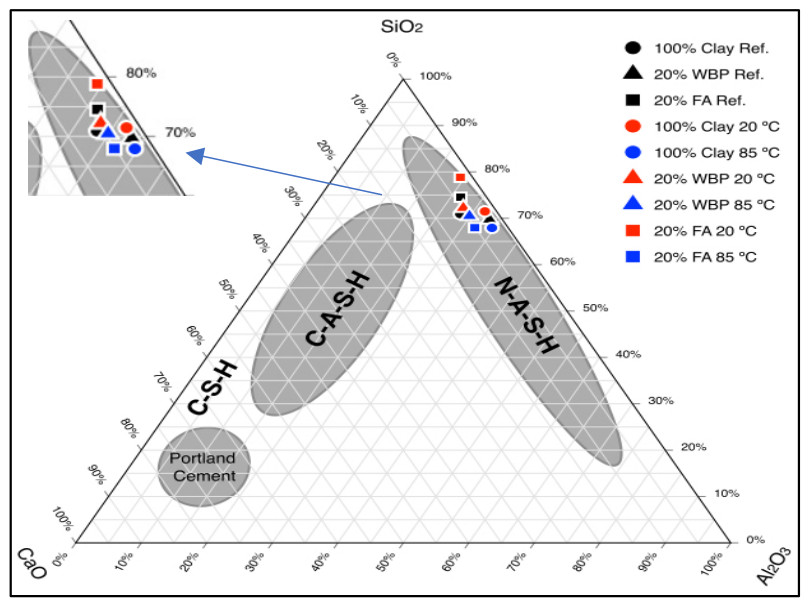
The most dominant gel reaction products in aluminosilicate waste used in geopolymer production are C-(N)A-S-H and N-A-S-H [50,51]. When the series produced in the experimental study are positioned on the triple diagram of hydrated or alkaline activation stages for the SiO2-CaO-Al2O3 system in Figure 22 [52], it is seen that it is located in the “Si”-rich region. Examining the diagram in Figure 22, it can be seen that all data points, including reference samples (black), samples cured at 20 °C (red), and samples cured at 85 °C (blue), are tightly clustered in the upper right corner in the region of silicon (SiO2) and aluminum (Al2O3) and low calcium (CaO). This region corresponds to the Sodium Aluminosilicate Hydrate gel, which is the characteristic binder product of low-calcium geopolymeric systems reported in the literature. This diagram illustrates the chemically typical properties of the inorganic polymer network with dense, needle-like, and bulky structures observed after alkali activation. Table 5 shows that the CaO content is very low, ranging from 1.5% to 5.0%. The diagram shows that this low CaO content is insufficient to form a calcium-based binder phase in the system, and that the material’s strength gain is entirely dependent on sodium (Na)-activated aluminosilicate reactions (geopolymerization). All points (clay, waste brick dust, and fly ash) remain within the same region. This indicates that substitution with waste brick dust (waste brick dust) or fly ash (FA), and aggressive heat treatments such as 85 °C, do not alter the material’s basic binder family. The significant increases in sodium (Na) content or decreases in Si/Al ratios observed in previous tables did not cause the system to shift into another phase. Careful examination of the data points reveals that the blue points (and the waste-modified series) cured at 85 °C shift towards the Al2O3 axis compared to the pure clay references. This visual shift is consistent with the finding in Table 7 that the Si/Al ratio decreases (aluminum dissolution increases) when oven curing at 85 °C is applied. This is attributed to the improvement in the clay structure resulting from the formation of artificial cementitious products within the clay due to the addition of geopolymer. As the geopolymer content increases, the amount of artificial cementitious products formed also increases [53].

4. Discussion

Climate change and global warming pose significant challenges to geotechnical engineering practice, particularly in the context of ground improvement technologies traditionally associated with high energy demand and substantial CO2 emissions. The development of alternative binders with reduced environmental impact is therefore of increasing importance. The present experimental results demonstrate the considerable potential of geopolymer stabilization as a sustainable alternative to conventional soil stabilization methods. The incorporation of waste brick powder (WBP) and fly ash (FA) into clayey soil not only enhances mechanical performance but also contributes to the valorization of industrial by-products within a circular economy framework.
A significant increase in strength compared to the reference series clearly confirms the effectiveness of NaOH activation in promoting geopolymerization. For specimens composed of 100% clay, strength increased by 126–143% when NaOH solution was used instead of water, highlighting the critical role of alkaline activation in the formation of cementitious reaction products. The comparison between oven curing and ambient curing further demonstrated the importance of curing conditions, as thermal treatment resulted in a 39% higher compressive strength. The highest strength values were achieved with the 6 M NaOH solution, indicating that activator molarity is a key parameter that must be carefully optimized. Excessively low molarity limits dissolution of aluminosilicate phases, whereas excessively high molarity may negatively affect workability and economic feasibility.
From a compositional perspective, the 20% FA substitution produced the most pronounced improvement, with a 274% increase in strength, followed by 20% WBP substitution with a 135% increase. These results suggest the existence of an optimal substitution level of around 20%, beyond which strength gain tends to plateau. Similar trends were reported by Odeh & Al-Rkaby [54], who observed substantial improvements in clay stabilized with geopolymeric binders. The positioning of the experimental mixtures in the Si-rich region confirms the dominant role of silica in the geopolymerization process and supports the suitability of RBW and FA as alternative aluminosilicate precursors.
The mechanistic interpretation of the results is further supported by the empirical relationship between UCS and CBR discussed earlier. The nonlinear nature of this correlation implies that significant increases in UCS translate into progressively smaller relative gains in penetration resistance. Consequently, high UCS values obtained in FA and RBW-stabilized mixtures correspond to significant improvements in the estimated subbase bearing capacity, but do not lead to a proportional increase in CBR. This finding is particularly important for road design, where relying solely on undrained shear strength can lead to overestimation of site performance. However, it should be considered that this relationship is based on an empirical correlation and can lead to overestimations, especially in high-strength stabilized soils. Therefore, the obtained CBR values serve as a practical engineering indicator to evaluate the effectiveness of stabilization under realistic loading conditions.
Key parameters governing strength development and long-term performance include geopolymer content, activator molarity, and curing duration and temperature. As geopolymer content increases, a larger volume of artificial cementitious products forms within the soil matrix, enhancing particle bonding and reducing deformability. Ghadir & Ranjbar [55] similarly reported that increasing geopolymer content significantly improves compressive strength, particularly under elevated curing temperatures, which accelerate dissolution and polycondensation reactions.
Compared to previous investigations employing fly ash stabilization (e.g., Ahmad et al., 2024 [56]; Renjith et al., 2021 [57]; Savaş et al., 2018 [58]; Kang et al., 2015 [59]), the present study achieved markedly higher strength gains using a 20% FA and WBP substitution (274% and 135%, respectively). This indicates that the combined effect of optimized activator molarity and controlled curing conditions can substantially enhance performance beyond conventional FA stabilization approaches.
However, some limitations need to be considered. In this study, CBR values were derived from the UCS–CBR empirical relationship instead of being directly measured. In this context, the high coefficient of determination (R2 ≈ 1) observed in Figure 9 is due to the data being obtained from the relationship proposed by Paige & Green [49] and should be considered as an indication of the mathematical consistency of the relationship, not as an independent experimental validation. In addition, it should be noted that Equation (2) is valid for fine-grained soils in the low and medium strength ranges (UCS < 150–200 kPa), but may lead to overestimations in higher strength stabilized soils. Therefore, the obtained CBR values should be evaluated as a comparative index, not as absolute engineering parameters. In addition, long-term durability effects such as wet–dry and freeze–thaw cycles were not investigated in this study, and the environmental performance assessment remained at a qualitative level and did not include a comprehensive life cycle analysis (LCA). Therefore, it is recommended that future studies focus on resilience under circular environmental loading, site-scale validation, and quantitative environmental impact assessments.
Overall, the study demonstrates that geopolymer stabilization using WBP and FA represents a technically effective and environmentally promising solution for the improvement of clayey subgrades. The combination of significant strength enhancement, utilization of waste materials, and compatibility with deep mixing techniques positions this approach as a viable alternative to conventional cement- or lime-based stabilization methods. SEM findings indicate that in 100% pure clay samples prepared with only water or subjected to only thermal processing (oven curing), no chemical binder network formation was observed due to the absence of an alkali activator and a reactive pozzolan. Instead, it was determined that the clay minerals physically dried out by losing water, forming structurally overlapping, platy, and flaky weak layers. This morphology shows that interparticle macro voids are preserved and that the material’s load-bearing capacity relies solely on weak physical friction. It demonstrates that the use of an alkali activator alone is insufficient to improve the engineering properties of weak soils. The waste type (WBP and FA) directly determines the geometry (needle-like vs. bulk prismatic) of the resulting inorganic polymer network, thereby influencing the material’s ultimate strength and toughness. Supporting the process with heat treatment at 85 °C maximizes the volumetric development of reaction products and interparticle mechanical interlocking.
It should be noted that the experimental program was conducted under controlled laboratory conditions, which may differ from actual field applications. Factors such as mixing efficiency, curing conditions, and moisture control in situ can vary significantly and may influence the engineering performance of geopolymer-stabilized soils. Therefore, the findings of this study should be considered as a preliminary assessment, and further validation through field-scale applications is recommended.
In alkali-activated materials, there is a direct causal relationship between microstructural properties and macroscopic mechanical performance. Undissolved clay aggregates and large voids observed in pure clay samples prepared only with water, or in those that do not undergo chemical reactions (reference series), result in low mechanical strength, high brittleness, and poor engineering properties. Due to the inert nature of pure clay towards alkali activators, sodium silicate forms only a physical coating on the surface at 20 °C, leading to poor interparticle adhesion (low Na/Al ratios) and consequently low load-carrying capacity. In contrast, the addition of reactive additives such as waste brick dust (WBP) and fly ash (FA) to the matrix, and especially increasing the curing temperature to 85 °C, positively alters the reaction kinetics and ensures the mechanical integrity of the system. Externally applied thermal energy dissolved the WBP particles, allowing the initially localized sodium to spread homogeneously throughout the matrix. Similarly, the 85 °C thermal energy contributes to the geopolymerization process by breaking the glassy outer shell of FA. The resulting acicular crystals and linker phases, formed by these intense chemical interactions, fill the microvoids, demonstrating that the structure contains very low CaO. This finding shows that the strength improvement occurs not with conventional calcium-based gels, but via a sodium-based geopolymeric acicular gel. Ultimately, the diffusion of Na ions throughout the matrix densifies the network and reduces voids, transforming the material into a bulky, compact, and rigid composite. This complete polymerization results in a decrease in macroscopic elastic deformation, an increase in elastic modulus, and ultimately an increase in compressive strength.

5. Conclusions

This study demonstrates that geopolymer stabilization using a 6 M NaOH solution combined with 20% substitution of fly ash (FA) or waste brick powder (WBP) significantly improves the compressive strength and stiffness of the investigated clayey soil. The optimal performance was achieved with 6 M NaOH, 20%FA additive content, and elevated-temperature curing (85 °C), indicating that activator molarity, precursor dosage, and curing conditions are the key parameters governing strength development.
The results confirm that FA and RBW provide sufficient reactive aluminosilicate phases for the formation of stable geopolymeric structures within the soil matrix. The substantial increase in UCS and the corresponding improvement in derived bearing capacity (CBR) indicate enhanced load-transfer mechanisms and reduced deformability. However, the principal contribution of this research lies not only in strength enhancement, but also in demonstrating the potential of geopolymerization to reduce moisture sensitivity and improve the durability of clayey soils while simultaneously lowering the environmental footprint compared to conventional cement- or lime-based stabilization.
From a sustainability perspective, the use of industrial by-products reduces the demand for Portland cement and promotes waste valorization, contributing to circular construction practices. Although thermal curing produced higher strength values, field implementation would likely rely on ambient curing conditions. Therefore, future optimization should focus on balancing mechanical performance with energy efficiency to ensure practical applicability.
In field applications, geopolymer stabilization would be performed in situ, where clayey soils are treated directly with alkaline activators and industrial by-products using deep mixing or soil blending techniques. Unlike laboratory conditions—where curing at 85 °C accelerates geopolymerization and simulates long-term mechanical behavior—field curing would occur at natural ground temperatures, resulting in a slower but more energy-efficient process. This approach enables ground improvement without excavation or soil transport, preserving both economic and environmental benefits.
Nevertheless, certain limitations must be acknowledged. The bearing capacity was estimated through empirical UCS–CBR correlations rather than direct CBR testing, and long-term durability under cyclic wet–dry or freeze–thaw conditions was not evaluated. Future research should therefore include pilot-scale field studies, life-cycle assessment (LCA), durability testing under environmental loading, investigation of different soil types, and evaluation of additional industrial by-products such as slag or metakaolin. Such studies would further clarify the long-term performance and broaden the practical implementation of geopolymer-based soil stabilization. SEM analyses of pure clay samples show that the material retains its natural platy and flaky morphology even under 85 °C thermal curing. Morphological confirmation shows that the NS+NH binary activator fails to dissolve the crumb-stable crystal lattice and, instead of a fibrous gel that fills the macro units, only a superficial, physical film forms. In samples with 20% waste brick dust (WBP) additive, the morphology is fully activated. While short acicular gels sprout under 20 °C curing conditions, it has been visually demonstrated that upon opening the curing at 85 °C, these structures elongate and transform into a highly dense and interlocking 3D mature crystal matrix that envelops all macro units like a network. The microstructure of fly ash (FA) additive samples exhibited a bulk development, unlike WBP. At 20 °C, the matrix acts as a filler within the unreacted spherical ashes. Consequently, SEM intervention demonstrates that for the transformation of a weak, soil-like matrix into a mechanically stable composite, reactive waste alone is insufficient; alkaline activators and 85 °C thermal energy synergistically combine to fill the interstitial macro-environments and achieve interlocking temperatures. It should be noted that high-temperature curing (85 °C) was primarily employed to investigate the reaction mechanisms. For practical engineering applications, the results obtained under ambient curing conditions are considered more representative.

6. Limitations

Despite the promising laboratory results, several limitations must be acknowledged when interpreting the findings of this study.
First, all experimental investigations were conducted under controlled laboratory conditions, including regulated temperature, moisture content, and homogeneous material mixing. Such conditions differ from real field environments, where variability in soil composition, in situ moisture fluctuations, compaction efficiency, and curing conditions may significantly influence performance. Moreover, elevated-temperature curing (85 °C) was used to accelerate geopolymerization and simulate long-term behavior; however, field applications would predominantly rely on ambient curing, potentially resulting in different strength development kinetics.
Second, the experimental program was limited to a specific activator molarity (6 M NaOH) and a single substitution ratio (20% FA or WBP). Although these parameters yielded optimal results within the investigated matrix, the outcomes may not be directly transferable to other soil types, different plasticity ranges, alternative precursor contents, or varying activator concentrations. In addition, the tested clay exhibited relatively stiff mechanical behavior under laboratory conditions and does not represent a highly problematic soft clay requiring urgent ground improvement. Consequently, the extrapolation of results to softer, highly plastic, or organic soils should be undertaken with caution.
Third, CBR values were not obtained from direct laboratory penetration tests but were derived from UCS using an empirical correlation. As a result, calculated CBR values are mathematically dependent on UCS and do not constitute independent experimental verification. Furthermore, the nonlinear exponent in the adopted UCS–CBR relationship may amplify calculated CBR values at high UCS levels. For stabilized mixtures exceeding 1000 kPa, computed CBR values may surpass 100%, which reflects a substantial increase in stiffness but does not correspond to standard measured CBR responses used in pavement design practice. Therefore, the CBR values derived should be interpreted strictly as relative indicators of stabilization efficiency rather than as design-grade subgrade parameters. The use of empirical relationships (e.g., the UCS–CBR relationship) presents an additional limitation, particularly for high-strength stabilized soils.
In this study, UCS values were evaluated at 1% axial strain, representing controlled small stress behavior. However, the post-peak behavior, brittleness–ductility properties, and sustained strength characteristics of stabilized soils were not investigated. Furthermore, long-term durability factors such as wet–dry cycling, freeze–thaw cycles, traffic-induced repeated loading, and chemical effects of groundwater were excluded from this study. Therefore, the results obtained only reflect the short-term mechanical behavior under dry conditions, and long-term performance under varying environmental conditions has not been evaluated. It is recommended that these issues be addressed in future studies.
For these reasons, future research should include pilot-scale field investigations, long-term monitoring, durability testing under environmental cycling, evaluation of softer and more plastic clayey soils, and assessment of alternative industrial by-products. Integration of life-cycle assessment (LCA) and energy-efficiency analyses of curing methods would further enable a more comprehensive evaluation of the technical and environmental performance of geopolymer-based soil stabilization in real engineering applications.

Author Contributions

Conceptualization, S.G., G.K. and B.Ž.; methodology, S.G., G.K. and B.Ž.; software, S.G. and G.K.; validation, S.G., G.K., B.Ž. and T.B.; formal analysis, S.G., G.K., B.Ž. and T.B.; investigation, S.G. and G.K.; resources, S.G., G.K., B.Ž. and T.B.; data curation, S.G., G.K., B.Ž. and T.B.; writing—original draft preparation, S.G., G.K., B.Ž. and T.B.; writing—review and editing, S.G., G.K., B.Ž. and T.B.; visualization, S.G., G.K., B.Ž. and T.B.; supervision, S.G., G.K., B.Ž. and T.B.; project administration, S.G., G.K. and B.Ž.; funding acquisition, B.Ž. and T.B. All authors have read and agreed to the published version of the manuscript.

Funding

This research received no external funding. And The APC was funded by University of Maribor.

Institutional Review Board Statement

This research complies with internationally accepted standards for research practice and reporting.

Data Availability Statement

All data generated or analyzed during this study are included in this article.

Conflicts of Interest

The authors declare that they have no known competing financial interests or personal relationships that could have appeared to influence the work reported in this paper.

References

  1. Huang, S.-L.; Yeh, C.-T.; Chang, L.-F. The transition to an urbanizing world and the demand for natural resources. Curr. Opin. Environ. Sustain. 2010, 2, 136–143. [Google Scholar] [CrossRef]
  2. Hale, S.E.; Roque, A.J.; Okkenhaug, G.; Sørmo, E.; Lenoir, T.; Carlsson, C.; Kupryianchyk, D.; Flyhammar, P.; Žlender, B. The reuse of excavated soils from construction and demolition projects: Limitations and possibilities. Sustainability 2021, 13, 6083. [Google Scholar] [CrossRef]
  3. Grubler, A.; Bai, X.; Buettner, T.; Dhakal, S.; Fisk, D.J.; Ichinose, T.; Keirstead, J.; Sammer, G.; Satterthwaite, D.; Schulz, N.B.; et al. Urban energy systems. In Global Energy Assessment—Toward a Sustainable Future; International Institute for Applied Systems Analysis: Laxenburg, Austria; Cambridge University Press: Cambridge, UK, 2012; pp. 1307–1400. [Google Scholar]
  4. Simion, I.M.; Fortuna, M.E.; Bonoli, A.; Gavrilescu, M. Comparing environmental impacts of natural inert and recycled construction and demolition waste processing using LCA. J. Environ. Eng. Landsc. Manag. 2013, 21, 273–287. [Google Scholar] [CrossRef]
  5. Walsh, D.; McRae, I.; Zirngibl, R.; Chawla, S.; Zhang, H.; Alfieri, A.; Moore, H.; Bailey, C.; Brooks, A.; Ostock, T.; et al. Generation rate and fate of surplus soil extracted in New York City. Sci. Total. Environ. 2019, 650, 3093–3100. [Google Scholar] [CrossRef]
  6. Arulrajah, A.; Piratheepan, J.; Disfani, M.M.; Bo, M.W. Geotechnical and geoenvironmental properties of recycled construction and demolition materials in pavement subbase applications. J. Mater. Civ. Eng. 2013, 25, 1077–1088. [Google Scholar] [CrossRef]
  7. Eras, J.J.C.; Gutiérrez, A.S.; Capote, D.H.; Hens, L.; Vandecasteele, C. Improving the environmental performance of an earthwork project using cleaner production strategies. J. Clean. Prod. 2013, 47, 368–376. [Google Scholar] [CrossRef]
  8. Al-Khafaji, Z.S.; Jafer, H.; Dulaimi, A.; Atherton, W.; Al Masoodi, Z. The Soft Soil Stabilisation Using Binary Blending of Ordinary Portland Cement And High Alumina Silica Waste Material. In Proceedings of the 3rd BUiD Doctoral Research Conference, The British University in Dubai, Dubai, United Arab Emirates, 13 May 2017. [Google Scholar]
  9. Mohamad, N.O.; Razali, C.E.; Hadi, A.A.A.; Som, P.P.; Eng, B.C.; Rusli, M.B.; Mohamad, F.R. Challenges in construction over soft soil—Case studies in Malaysia. IOP Conf. Ser. Mater. Sci. Eng. 2016, 136, 012002. [Google Scholar] [CrossRef]
  10. Cristelo, N.; Glendinning, S.; Fernandes, L.; Pinto, A.T. Effects of alkaline-activated fly ash and Portland cement on soft soil stabilisation. Acta Geotech. 2013, 8, 395–405. [Google Scholar] [CrossRef]
  11. Magnusson, S.; Lundberg, K.; Svedberg, B.; Knutsson, S. Sustainable management of excavated soil and rock in urban areas—A literature review. J. Clean. Prod. 2015, 93, 18–25. [Google Scholar] [CrossRef]
  12. Zhang, M.; Guo, H.; El-Korchi, T.; Zhang, G.; Tao, M. Experimental feasibility study of geopolymer as the next-generation soil stabilizer. Constr. Build. Mater. 2013, 47, 1468–1478. [Google Scholar] [CrossRef]
  13. Kianfar, E.; Toufigh, V. Reliability analysis of rammed earth structures. Constr. Build. Mater. 2016, 127, 884–895. [Google Scholar] [CrossRef]
  14. Pakand, M.; Toufigh, V. A multi-criteria study on rammed earth for low carbon buildings using a novel ANP-GA approach. Energy Build. 2017, 150, 466–476. [Google Scholar] [CrossRef]
  15. Scrivener, K.L.; Kirkpatrick, R.J. Innovation in use and research on cementitious material. Cem. Concr. Res. 2008, 38, 128–136. [Google Scholar] [CrossRef]
  16. Wang, S.; Xue, Q.; Ma, W.; Zhao, K.; Wu, Z. Experimental study on mechanical properties of fiber-reinforced and geopolymer-stabilized clay soil. Constr. Build. Mater. 2021, 272, 121914. [Google Scholar] [CrossRef]
  17. Bilondi, M.P.; Toufigh, M.M.; Toufigh, V. Experimental investigation of using a recycled glass powder-based geopolymer to improve the mechanical behavior of clay soils. Constr. Build. Mater. 2018, 170, 302–313. [Google Scholar] [CrossRef]
  18. Wong, C.L.; Yap, S.P.; Alengaram, U.J.; Yuen, C.W.; Yeo, J.S.; Mo, K.H. Properties of high calcium fly ash geopolymer incorporating recycled brick waste and borax. Hybrid Adv. 2024, 5, 100130. [Google Scholar] [CrossRef]
  19. Burduhos Nergis, D.D.; Vizureanu, P.; Sandu, A.V.; Burduhos Nergis, D.P.; Bejinariu, C. XRD and TG-DTA study of new phosphate-based geopolymers with coal ash or metakaolin as aluminosilicate source and mine tailings addition. Materials 2021, 15, 202. [Google Scholar] [CrossRef]
  20. Sothornchaiwit, K.; Dokduea, W.; Tangchirapat, W.; Keawsawasvong, S.; Thongchom, C.; Jaturapitakkul, C. Influences of silica fume on compressive strength and chemical resistances of high calcium fly ash-based alkali-activated mortar. Sustainability 2022, 14, 2652. [Google Scholar] [CrossRef]
  21. Abdila, S.R.; Abdullah, M.M.A.B.; Ahmad, R.; Burduhos Nergis, D.D.; Rahim, S.Z.A.; Omar, M.F.; Sandu, A.V.; Vizureanu, P.; Syafwandi. Potential of soil stabilization using ground granulated blast furnace slag (GGBFS) and fly ash via geopolymerization method: A Review. Materials 2022, 15, 375. [Google Scholar] [CrossRef]
  22. Maaze, M.R.; Shrivastava, S. Design development of sustainable brick-waste geopolymer brick using full factorial design methodology. Constr. Build. Mater. 2023, 370, 130655. [Google Scholar] [CrossRef]
  23. Liang, G.; Luo, L.; Yao, W. Reusing waste red brick powder as partial mineral precursor in eco-friendly binders: Reaction kinetics, microstructure and life-cycle assessment. Resour. Conserv. Recycl. 2022, 185, 106523. [Google Scholar] [CrossRef]
  24. Toprak, M.U.; Şenol, A.F.; Demiral, N.Ç.; Karakurt, C. Properties of Geopolymer Mortars Produced with Brick, Tile, and Marble Waste Powders. Bilecik Şeyh Edebali Univ. J. Sci. 2022, 9, 918–930. [Google Scholar]
  25. Pasupathy, K.; Ramakrishnan, S.; Sanjayan, J. 3D concrete printing of eco-friendly geopolymer containing brick waste. Cem. Concr. Compos. 2023, 138, 104943. [Google Scholar] [CrossRef]
  26. Cetin, B.; Aydilek, A.H.; Guney, Y. Stabilization of recycled base materials with high carbon fly ash. Resour. Conserv. Recycl. 2010, 54, 878–892. [Google Scholar] [CrossRef]
  27. Zorluer, I.; Gucek, S. The effects of marble dust and fly ash on clay soil. Sci. Eng. Compos. Mater. 2014, 21, 59–67. [Google Scholar] [CrossRef]
  28. Bui, Q.-B.; Nguyen, T.-P.; Schwede, D. Manually compressed soil blocks stabilised by fly ash based geopolymer: A promising approach for sustainable buildings. Sci. Rep. 2023, 13, 22905. [Google Scholar] [CrossRef]
  29. Yang, J.; Du, P.; Cheng, X. Advances and prospects in rapid curing technology for geopolymers. Mater. Rep. Solidwaste Ecomater. 2025, 1, 9520019. [Google Scholar] [CrossRef]
  30. Hartono, E.; Diana, W.; Muntohar, A.S.; Azhar, M.; Indriani, L. Effect of Curing Temperature on the Soil Physical and Mechanical Properties on Clay Shale Geopolymer Fly Ash Stabilization. Sinergi 2024, 29, 43–50. [Google Scholar] [CrossRef]
  31. Karaaslan, C.; Şek, Ş.; Turan, C. Utilising High-Ambient-Temperature Curing in the Development of Low-Calcium Geopolymers. Buildings 2025, 15, 2974. [Google Scholar] [CrossRef]
  32. Bi, J.; Pan, Y.; Bai, R.; Zhang, Q.; Jiang, X.; Xu, S.; Liu, Z. Experimental study on the physical, mechanical, and microstructural properties of geopolymer-stabilized soils exposed to different curing temperature conditions. J. Environ. Chem. Eng. 2026, 14, 121426. [Google Scholar] [CrossRef]
  33. TS 1900-1 (Turkish Standard); Methods of Testing Soils for Civil Engineering Purposes in the Laboratory—Part 1: Determination of Physical Properties. TSE: Ankara, Turkey, 2006.
  34. ASTM C618-03; Standard Specification for Coal Fly Ash and Raw or Calcined Natural Pozzolan for Use in Concrete. American Society for Testing and Material (ASTM) International: West Conshohocken, PA, USA, 2003.
  35. TS EN 197-1; General Cements—Part 1: General Cements—Composition, Properties, and Conformity Criteria. Turkish Standards Institute: Ankara, Turkey, 2002.
  36. ASTM D422-63; Standard Test Method for Particle-Size Analysis of Soils. American Society for Testing and Material (ASTM) International: West Conshohocken, PA, USA, 2007.
  37. ASTM D4318-05; Standard Test Method for Liquid Limit, Plastic Limit, and Plasticity Index Soils. American Society for Testing and Material (ASTM) International: West Conshohocken, PA, USA, 2005.
  38. ASTM D698-12; Standard Test Method for Laboratory Compaction Characteristics of Soil Using Standard Effort. American Society for Testing and Material (ASTM) International: West Conshohocken, PA, USA, 2021.
  39. ASTM D854-02; Standard Test Method for Specific Gravity of Soil by Water Pycnometer. American Society for Testing and Material (ASTM) International: West Conshohocken, PA, USA, 2002.
  40. TS 1900-2 (Turkish Standard); Methods of Testing Soils for Civil Engineering Purposes in the Laboratory—Part 2: Determination of Mechanical Properties. TSE: Ankara, Turkey, 2006.
  41. ASTM D1633-00(2007); Standard Test Methods for Compressive Strength of Molded Soil-Cement Cylinders. American Society for Testing and Material (ASTM) International: West Conshohocken, PA, USA, 2007.
  42. Abdullah, H.H.; Shahin, M.A. Geomechanical behaviour of clay stabilised with fly-ash-based geopolymer for deep mixing. Geosciences 2022, 12, 207. [Google Scholar] [CrossRef]
  43. Luo, J.; Shi, X.; Wang, Q.; Dai, J.; Deng, X.; Xue, Y. Study on improving measures of mechanical properties of geopolymer materials and its effect on CO2 emission. Polymers 2023, 15, 1699. [Google Scholar] [CrossRef]
  44. Li, S.; Zhou, Z.; Hu, G.; Yao, C.; Niu, F.; Wu, J. Using one-part geopolymer in stabilizing high-water-content soft clay: Towards an eco-friendly and cost-effective solution. Buildings 2025, 15, 477. [Google Scholar] [CrossRef]
  45. Yamchelou, M.T.; Law, D.; Brkljača, R.; Gunasekara, C.; Li, J.; Patnaikuni, I. Geopolymer synthesis using low-grade clays. Constr. Build. Mater. 2021, 268, 121066. [Google Scholar] [CrossRef]
  46. Li, Q.; Chen, S.; Zhang, Y.; Hu, Y.; Wang, Q.; Zhou, Q.; Yan, Y.; Liu, Y.; Yan, D. Effect of curing temperature on high-strength metakaolin-based geopolymer composite (HMGC) with quartz powder and steel fibers. Materials 2022, 15, 3958. [Google Scholar] [CrossRef] [PubMed]
  47. Solanki, P.; Zaman, M. Microstructural and mineralogical characterization of clay stabilized using calcium-based stabilizers. In Scanning Electron Microscopy; IntechOpen: London, UK, 2012. [Google Scholar]
  48. Sutariya, S.R.; Varia, H.R. Determining correlation between CBR, UCS and Triaxial test value of different subgrade soils. Int. J. Adv. Res. Eng. Sci. Technol. 2018, 5, 37–43. [Google Scholar]
  49. Paige-Green, P.; Du Plessis, L. The Use and Interpretation of the Dynamic Cone Penetrometer (DCP) Test, Version 2; CSIR Built Environment: Pretoria, South Africa, 2009; Available online: https://rtdcp.co.za/wp-content/uploads/2019/11/The_use_and_interpretation_of_the_Dynamic_Cone_Penetrometer_01.pdf (accessed on 14 February 2026).
  50. Nagaraju, T.V.; Mantena, S.; Gobinath, R.; Bonthu, S.; Alisha, S.S. Geopolymer-stabilized soils: Influencing factors, strength development mechanism and sustainability. J. Taibah Univ. Sci. 2023, 17, 2248651. [Google Scholar] [CrossRef]
  51. Zakka, W.P.; Lim, N.H.A.S.; Khun, M.C. A scientometric review of geopolymer concrete. J. Clean. Prod. 2021, 280, 124353. [Google Scholar] [CrossRef]
  52. Santana-Carrillo, J.; Ortega-Zavala, D.; Burciaga-Díaz, O.; Escalante-Garcia, J. Modified blended limestone-Portland cement binders: Evaluation of 4 different sodium silicates. Cem. Concr. Compos. 2021, 118, 103935. [Google Scholar] [CrossRef]
  53. Abdullah, H.H.; Shahin, M.A. Geomechanical Properties of Clay Stabilised with Fly Ash-Based Geopolymer Subjected to Long-Term Sulfate Attack. Int. J. Geosynth. Ground Eng. 2023, 9, 75. [Google Scholar] [CrossRef]
  54. Odeh, N.A.; Al-Rkaby, A.H. Strength, Durability, and Microstructures characterization of sustainable geopolymer improved clayey soil. Case Stud. Constr. Mater. 2022, 16, e00988. [Google Scholar] [CrossRef]
  55. Ghadir, P.; Ranjbar, N. Clayey soil stabilization using geopolymer and Portland cement. Constr. Build. Mater. 2018, 188, 361–371. [Google Scholar] [CrossRef]
  56. Ahmad, S.; Alam Ghazi, M.S.; Syed, M.; Al-Osta, M.A. Utilization of fly ash with and without secondary additives for stabilizing expansive soils: A review. Results Eng. 2024, 22, 102079. [Google Scholar] [CrossRef]
  57. Renjith, R.; Robert, D.; Setunge, S.; Costa, S.; Mohajerani, A. Optimization of fly ash based soil stabilization using secondary admixtures for sustainable road construction. J. Clean. Prod. 2021, 294, 126264. [Google Scholar] [CrossRef]
  58. Savaş, H.; Türköz, M.; Seyrek, E.; Ünver, E. Comparison of the effect of using class C and F fly ash on the stabilization of dispersive soils. Arab. J. Geosci. 2018, 11, 612. [Google Scholar] [CrossRef]
  59. Kang, X.; Bate, B.; Chen, R.-P.; Yang, W.; Wang, F. Physicochemical and mechanical properties of polymer-amended kaolinite and fly ash–kaolinite mixtures. J. Mater. Civ. Eng. 2019, 31, 04019064. [Google Scholar] [CrossRef]
Figure 1. Unconfined compressive strength test application and some samples.
Applsci 16 04290 g001
Figure 2. Unconfined compressive strength of clay as reference sample (REF) compared to improved clay 3 M, 6 M and 9 M (a), 3M85C, 6M85C and 9M85C (b), 20FA3M, 20FA6M and 20FA9M (c), 20FA3M85C, 20FA6M85C and 20FA9M85C (d), 20WBP3M, 20WBP6M and 20WBP9M (e) and 20WBP3M85C, 20WBP6M85C and 20WBP9M85C (f).
Applsci 16 04290 g002
Figure 3. Unconfined compressive strength test results.
Applsci 16 04290 g003
Figure 4. Change in unconfined compressive strength values depending on curing temperature.
Applsci 16 04290 g004
Figure 5. Stress–strain change in the samples with 100% clay content.
Applsci 16 04290 g005
Figure 6. Stress–strain change in samples with 20%WBP content.
Applsci 16 04290 g006
Figure 7. Stress–strain change in the samples with 20%FA content.
Applsci 16 04290 g007
Figure 8. Modulus of elasticity.
Applsci 16 04290 g008
Figure 9. Empirical relationship between California Bearing Ratio CBR and undrained shear strength C u for clay and silt soils.
Applsci 16 04290 g009
Figure 10. SEM images obtained from samples (ad).
Applsci 16 04290 g010
Figure 11. SEM images were obtained from samples (ad).
Applsci 16 04290 g011
Figure 12. SEM image obtained from sample 6 M 20% FA 85 °C.
Applsci 16 04290 g012
Figure 13. EDX color mapping (a) and EDX spectrum (b) for 100% clay samples produced with water.
Applsci 16 04290 g013
Figure 14. EDX color mapping (a) and EDX spectrum (b) for 20% WBP samples produced with water.
Applsci 16 04290 g014
Figure 15. EDX color mapping (a) and EDX spectrum (b) for 20% FA samples produced with water.
Applsci 16 04290 g015
Figure 16. EDX color mapping (a) and EDX spectrum (b) for 100% clay samples produced with alkaline activator at 20 °C.
Applsci 16 04290 g016
Figure 17. EDX color mapping (a) and EDX spectrum (b) for 100% clay samples produced with alkaline activator at 85 °C.
Applsci 16 04290 g017
Figure 18. EDX color mapping (a) and EDX spectrum (b) for 20%WBP samples produced with alkaline activator at 20 °C.
Applsci 16 04290 g018
Figure 19. EDX color mapping (a) and EDX spectrum (b) for 20%WBP samples produced with alkaline activator at 85 °C.
Applsci 16 04290 g019
Figure 20. EDX color mapping (a) and EDX spectrum (b) for 20%FA samples produced with alkaline activator at 20 °C.
Applsci 16 04290 g020
Figure 21. EDX color mapping (a) and EDX spectrum (b) for 20%FA samples produced with alkaline activator at 85 °C.
Applsci 16 04290 g021
Figure 22. Ternary diagram of the hydrated or alkaline activation phases for the SiO2-CaO-Al2O3 system.
Applsci 16 04290 g022
Table 1. Physical properties of the materials used.
Physical PropertiesClay (CL)Waste Brick Powder (WBP)Fly Ash (FA)
<2.0 mm (%)100100100
<0.075 mm (%)86.28182
wL (%)48.6--
wP (%)23--
Gs2.642.822.70
Table 2. Chemical components of waste materials [%].
SiO2Fe2O3Al2O3CaOMgOSO3P2O5Ti2O2LOI
Fly Ash48.27.127.710.52.53.10.271.28-
Waste Brick Powder47.97.420.54.86.73.61.30.96.5
Table 3. Mixture compositions and curing conditions.
No.Specimen
ID
Clay
(%)
Water
Content
(%)
Solution Content
(%)
NaOH
Molarity (M)
Fly Ash
(%)
Waste Brick Powder (%)Curing
Temperature (°C)
1REF10022----20
23M100-223--20
36M100-226--20
49M100-229--20
53M85C100-223--85
66M85C100-226--85
79M85C100-229--85
8REF20FA8022--20-20
920FA3M80-22320-20
1020FA6M80-22620-20
1120FA9M80-22920-20
1220FA3M85C80-22320-85
1320FA6M85C80-22620-85
1420FA9M85C80-22920-85
15REF20WBP8022---2020
1620WBP3M80-223-2020
1720WBP6M80-226-2020
1820WBP9M80-229-2020
1920WBP3M85C80-223-2085
2020WBP6M85C80-226-2085
2120WBP9M85C80-229-2085
Table 4. UCS at 1% axial strain and derived CBR—Specimens tested at 20 °C.
No.SpecimenUCS [kPa]Derived CBR [%]CBR/CBRref
1REF272.7427.021.00
23M367.3037.901.40
36M353.2736.261.34
49M207.1119.760.73
8REF20FA1054.47125.634.65
920FA3M1395.18172.696.39
1020FA6M707.4279.812.95
1120FA9M685.4477.002.85
15REF20WBP820.5094.463.50
1620WBP3M360.0137.041.37
1720WBP6M279.3327.761.03
1820WBP9M433.7445.781.69
Table 5. UCS at 1% axial strain and derived CBR—Specimens thermally treated at 85 °C.
No.SpecimenUCS [kPa]Derived CBR [%]CBR/CBRref
53M85C640.5471.302.64
66M85C508.4954.842.03
79M85C419.0644.021.63
1220FA3M85C715.4080.842.99
1320FA6M85C521.4356.432.09
1420FA9M85C819.2294.303.49
1920WBP3M85C289.9428.961.07
2020WBP6M85C414.3143.451.61
2120WBP9M85C199.6018.950.70
Table 6. Weight ratios of oxides obtained as a result of EDS of the samples [%].
OxidClayWBPFAClay
20 °C
Clay
85 °C
WBP
20 °C
WBP
85 °C
FA
20 °C
FA
85 °C
Na2O2.44.17.92.62.06.418.510.15.5
Mg1.41.81.41.11.71.01.51.62.4
Al2O319.923.116.822.425.018.617.715.620.6
SiO260.756.958.359.957.458.350.263.752.0
K2O3.44.52.64.66.04.92.82.22.7
CaO5.01.63.11.52.13.83.31.53.9
Fe2O37.28.19.97.95.86.66.25.512.9
Table 7. Si/Al and Na/Al ratios of selected parts of geopolymer samples tested by EDX.
OxidClay
20 °C
Clay
85 °C
WBP
20 °C
WBP
85 °C
FA
20 °C
FA
85 °C
Si:Al2.362.032.752.53.592.21
Na:Al0.160.110.481.460.910.37
Disclaimer/Publisher’s Note: The statements, opinions and data contained in all publications are solely those of the individual author(s) and contributor(s) and not of MDPI and/or the editor(s). MDPI and/or the editor(s) disclaim responsibility for any injury to people or property resulting from any ideas, methods, instructions or products referred to in the content.