Article

Deep Mining of Narrow, Steeply Dipping Orebodies: Subsidence and Stability in Cut-and-Fill Mining via SBAS-InSAR and 3D Numerical Simulation


1
Key Laboratory of Ground Control Management Plan in Deep Metal Mines, National Mine Safety Administration, Northeastern University, Shenyang 110819, China
2
School of Resources and Environmental Engineering, Jiangxi University of Science and Technology, Ganzhou 341000, China
*
Author to whom correspondence should be addressed.
Appl. Sci. 2026, 16(9), 4289; https://doi.org/10.3390/app16094289
Submission received: 15 March 2026 / Revised: 23 April 2026 / Accepted: 24 April 2026 / Published: 28 April 2026

Abstract

Deep mining of geologically challenging deposits, such as narrow, steeply dipping orebodies, is increasingly pursued to meet the rising demand for mineral resources. However, the geotechnical stability of operations in such environments remains a persistent challenge. A paramount concern is the insufficiently understood mechanisms governing the surface subsidence and stability of underground excavations, which diverge significantly from those in flat or gently dipping deposits. This study bridges this gap through an integrated methodology applied to a deep cut-and-fill gold mine in China. We combined nine years (2016–2025) of SBAS-InSAR monitoring, utilizing 120 Sentinel-1 images corrected with precise orbit and atmospheric correction data, with a comprehensive three-dimensional (3D) numerical simulation. The results reveal a unique subsidence pattern: surface subsidence is highly localized, forming an elliptical basin directly above the orebodies, with a footwall movement angle exceeding 90°. Furthermore, the subsidence magnitude showed minimal progression despite increasing mining depth, with a maximum cumulative subsidence of only 9.3 mm. Numerical simulation confirmed these findings and demonstrated that underground shafts and tunnels remained stable under the sequential extraction of multiple orebody levels. This exceptional geotechnical response is attributed to a synergistic mechanism involving the intrinsic geomechanical advantages of the steeply dipping geometry, the low-disturbance nature of narrow-vein mining, and the crucial structural support provided by the backfilling. This study demonstrates the efficacy of cut-and-fill mining for ensuring operational safety and minimizing surface environmental impact in the deep mining of narrow, steeply dipping orebodies, providing critical insights for the sustainable exploitation of deep mineral resources.

1. Introduction

The increasing depletion of shallow mineral resources, coupled with the growing demand for critical minerals, is compelling the mining industry to exploit deep geologically complex deposits. Among these, narrow, steeply dipping orebodies have become particularly prominent.
Deep mining alters the in-situ stress regime, triggering stress redistribution within mining-disturbed zones, thereby promoting the progressive movement and deformation of the rock mass [1,2]. With repeated extraction across multiple horizons, deformation accumulates and systematically expands the rock mass movement zone [3,4], leading to surface subsidence and the potential instability of underground excavations. Mining-induced subsidence can damage surface water bodies, such as lakes and rivers, and create pervasive fractures that accelerate water infiltration into the strata, thereby reducing rock mass strength and endangering underground engineering stability [5,6]. In coal mining regions, such disturbances alter gas migration paths in the overburden and cause abnormal emissions of methane, radon, and other harmful gases, posing risks to mining safety and the ecological environment [7]. Moreover, long-term subsidence degrades surface soil structure and vegetation conditions, extending the impacts of mining to environmental and ecological fields [8], which underscore the significance of relevant research. Such challenges related to mining-induced subsidence and excavation stability in steeply dipping narrow orebodies are common worldwide. Relevant research has been widely reported in the United States, Canada, France, South Africa, and Ukraine, demonstrating the global universality of this research topic [9,10,11].
Conventional methodologies for predicting the rock mass movement zone and subsidence, such as empirical models and engineering analogy methods, are primarily well-suited for shallow, thick, and flat, or gently dipping deposits [12,13]. These methods, which rely on systematic analyses of an orebody’s geometry and geomechanical properties [14,15], exhibit substantial limitations when applied to the deep mining of narrow, steeply dipping orebodies. Owing to the great mining depth and narrow, steep geometry of such orebodies, field observations typically reveal neither distinct deformation nor a clearly defined rock mass movement zone. These methods often lead to an overestimated magnitude of ground movement, compromising both mine planning efficiency and economic viability [16].
Consequently, the mechanisms governing surface subsidence and the stability of underground excavations in the deep mining of narrow, steeply dipping orebodies have emerged as critical engineering challenges. These issues call for a more comprehensive understanding, as they represent fundamental constraints for achieving rational design and safe operation in deep mining.
Extensive research has focused on the mechanisms governing surface subsidence and the stability of underground excavations in deep mining, with methodologies commonly categorized into four main approaches [17,18]: field monitoring, geometric approaches, mechanical approaches, and other methodologies.
Field monitoring serves as the primary methodology for characterizing rock mass movement, associated surface subsidence, and underground deformation in deep mining operations [19,20,21]. Conventional field monitoring systems exhibit inherent constraints such as limited temporal resolution and protracted data acquisition cycles, thereby limiting their primary applications to the retrospective verification of numerical models or hazard monitoring systems [22].
Geometric approaches predict subsidence by incorporating geomechanical characteristics of the rock mass with field data. Despite their practicality, these methods oversimplify rock mass mechanics by relying on empirical geometric relationships. Consequently, while effective for flat or gently dipping deposits, they are inadequate for steeply dipping deposits with significant structural complexities, as they cannot capture the essential stress–strain dynamics [23,24].
Mechanical approaches to analyzing rock mass deformation encompass both analytical solutions and numerical simulations (e.g., FEM, DEM) [25,26]. Analytical solutions, limited by their requisite simplifications, struggle with complex geology [27]. Numerical methods, however, can integrate detailed rock mass properties and in-situ stresses to build geomechanically representative models, yielding reliable, field-validated predictions.
Other methodologies, including neural networks and fractal analysis, represent theoretical advances but have achieved limited adoption in engineering practice [28,29]. Neural networks are hindered by the interpretability limitations inherent in their “black-box” architecture [30], whereas fractal-based methods lack quantitative empirical relationships with critical geomechanical parameters, which restricts their practical applicability [31].
Consequently, despite extensive research on mining subsidence and stability, integrated studies that combine long-term monitoring with geomechanically realistic numerical simulation to elucidate the mechanisms governing surface subsidence and the stability of underground excavations in the deep mining of narrow, steeply dipping orebodies remain notably lacking.
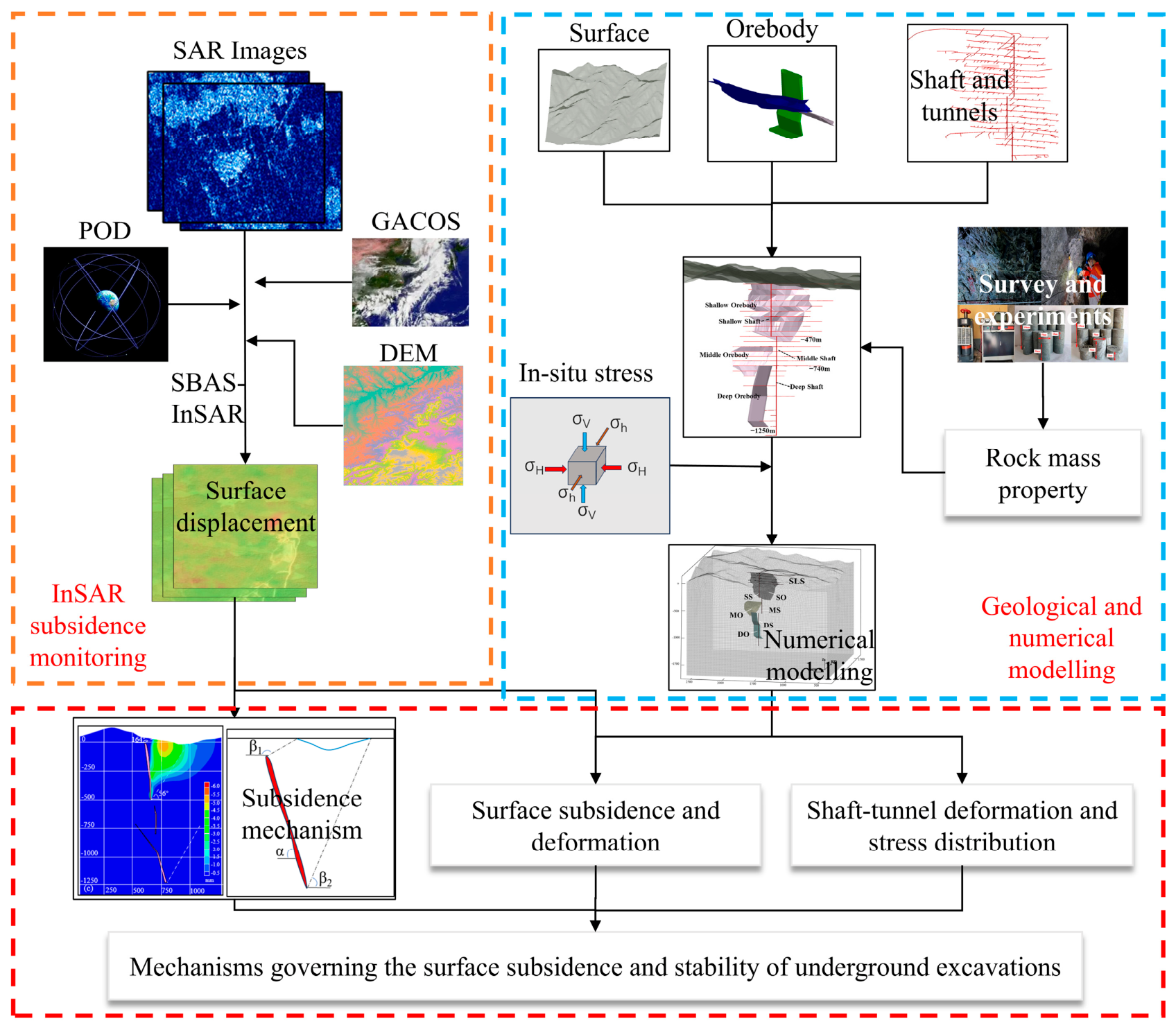
To bridge this knowledge gap, an integrated investigation was conducted at a deep cut-and-fill gold mine in China, targeting narrow, steeply dipping (85°) quartz veins. This research integrates nine years of SBAS-InSAR monitoring with a comprehensive 3D numerical model to elucidate the unique subsidence and stability mechanisms of such orebodies. The study thus provides a validated framework for predicting subsidence and stability in similar mining conditions, offering critical insights for the safe and efficient exploitation of deep mineral resources. The overall research framework is shown in Figure 1.

2. Engineering Background and Mining Methods

2.1. Mining Background and Geological Setting

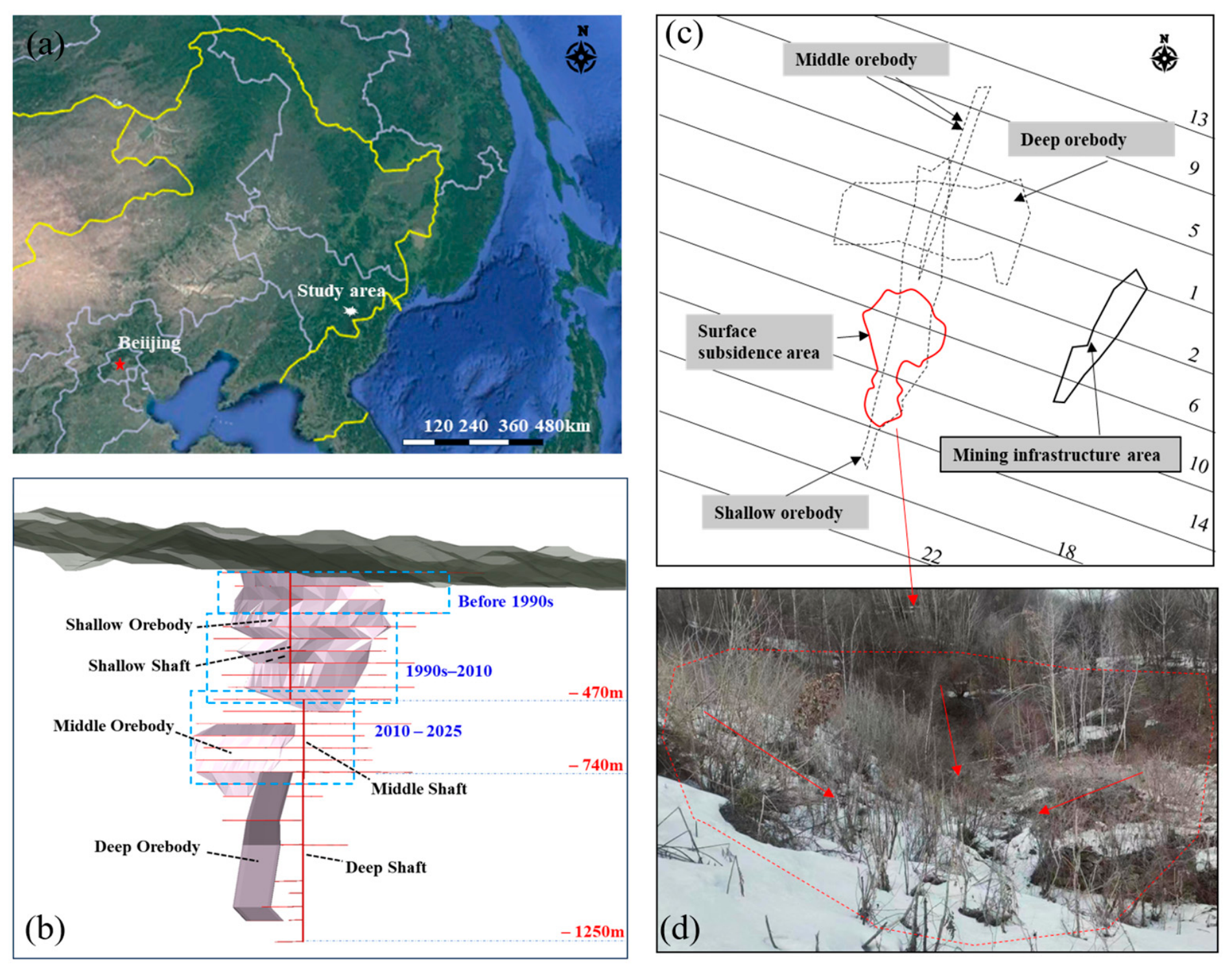
The study area is situated in the Changbai Mountains tectonic zone of southeastern Jilin Province, China, an area characterized by low-relief mountainous terrain formed by tectonic denudation (Figure 2a). Mining activities began with artisanal mining in the 1860s, with a transition to mechanized underground mining in the 1970s. The current operation achieves an annual production capacity of 30,000 t/y through an adit-shaft system that includes three shafts extending to a depth of 1250 m (Figure 2b). The study area has a temperate monsoon climate, with low annual precipitation, and the underground rock mass is dry without obvious groundwater accumulation. The hydrogeological conditions are simple, with no large-scale groundwater recharge sources. The orebodies comprise NE-striking, fault-controlled auriferous quartz vein systems that exhibit stable geometric parameters. Sharp structural contacts demarcate distinct boundaries between the orebodies and host rock (plagioclase gneiss).

2.2. Orebody Geometry and Geomechanical Characteristics

The extraction of the shallow orebodies, extending from the surface to a depth of 500 m, has been completed. Current operations target the middle and deep orebodies, located at depths between 515 m and 1250 m. These orebodies comprise a quartz vein system extending 300 m along strike, with an average thickness of 2 to 3 m and a steep dip angle of 85°. The rock mass quality is classified as ISRM Class II (good to very good quality), which is reflected in the high percentage (>95%) of underground tunnels that remain stable without artificial support.

2.3. Mining Methods and Historical Context

The mining method has evolved significantly over the life of the mine, providing a critical context for understanding the mine’s surface subsidence and underground stability behavior.

2.3.1. Historical Shrinkage Stoping and Associated Subsidence

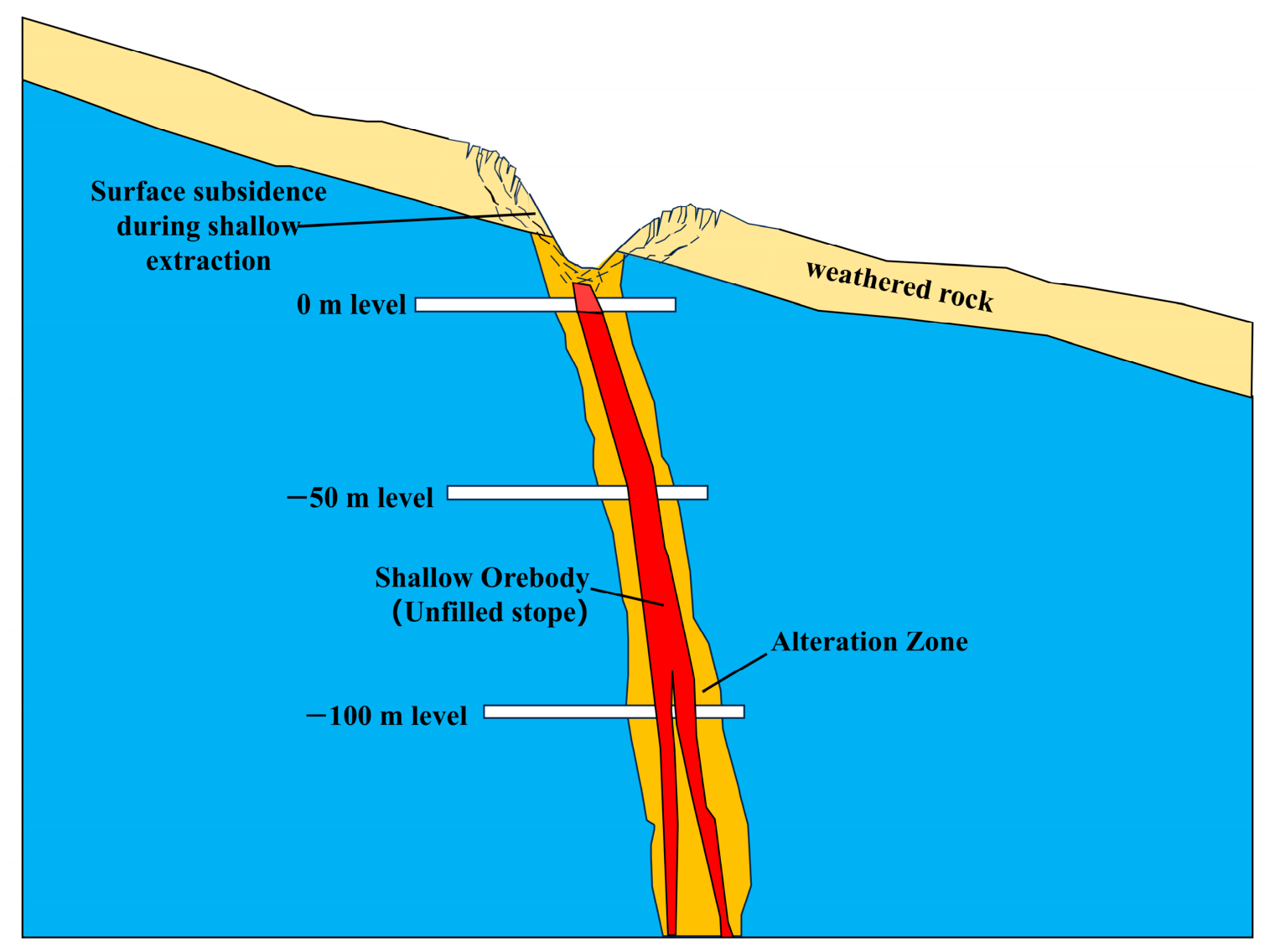
The shallow orebody was historically extracted using the shallow-hole shrinkage stoping method, leaving the stopes unfilled. The lack of support, combined with weak overburden and weathered rock strata in the shallow levels, led to progressive collapse. Prior to 2000, this collapse resulted in a significant subsidence zone, measuring 160 m in length, 80 m in width, and with a maximum vertical displacement of 30 m, as documented in Figure 2c,d. Mining of the shallow orebody ceased prior to 2010.

2.3.2. Current Cut-And-Fill Mining Method

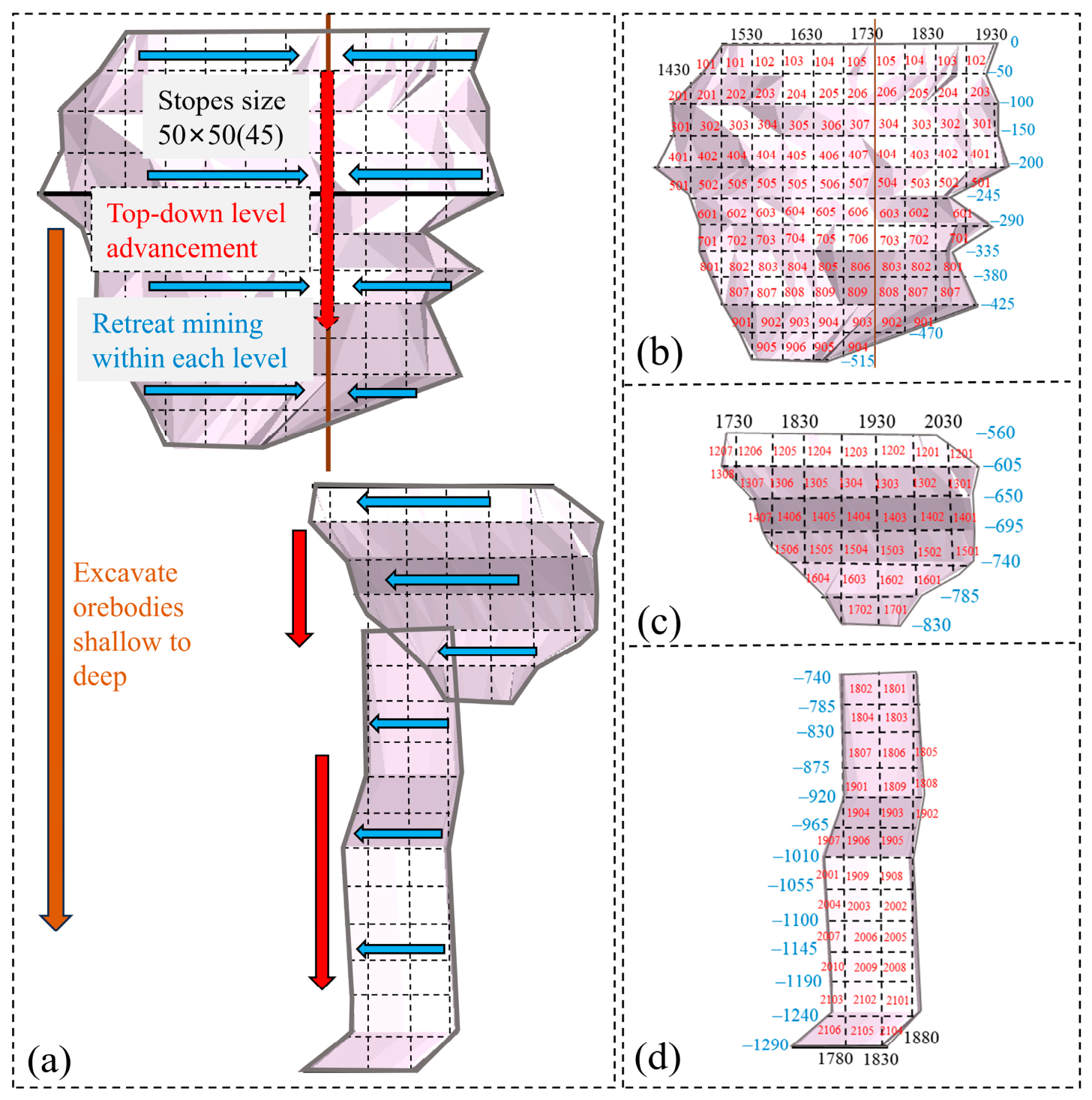
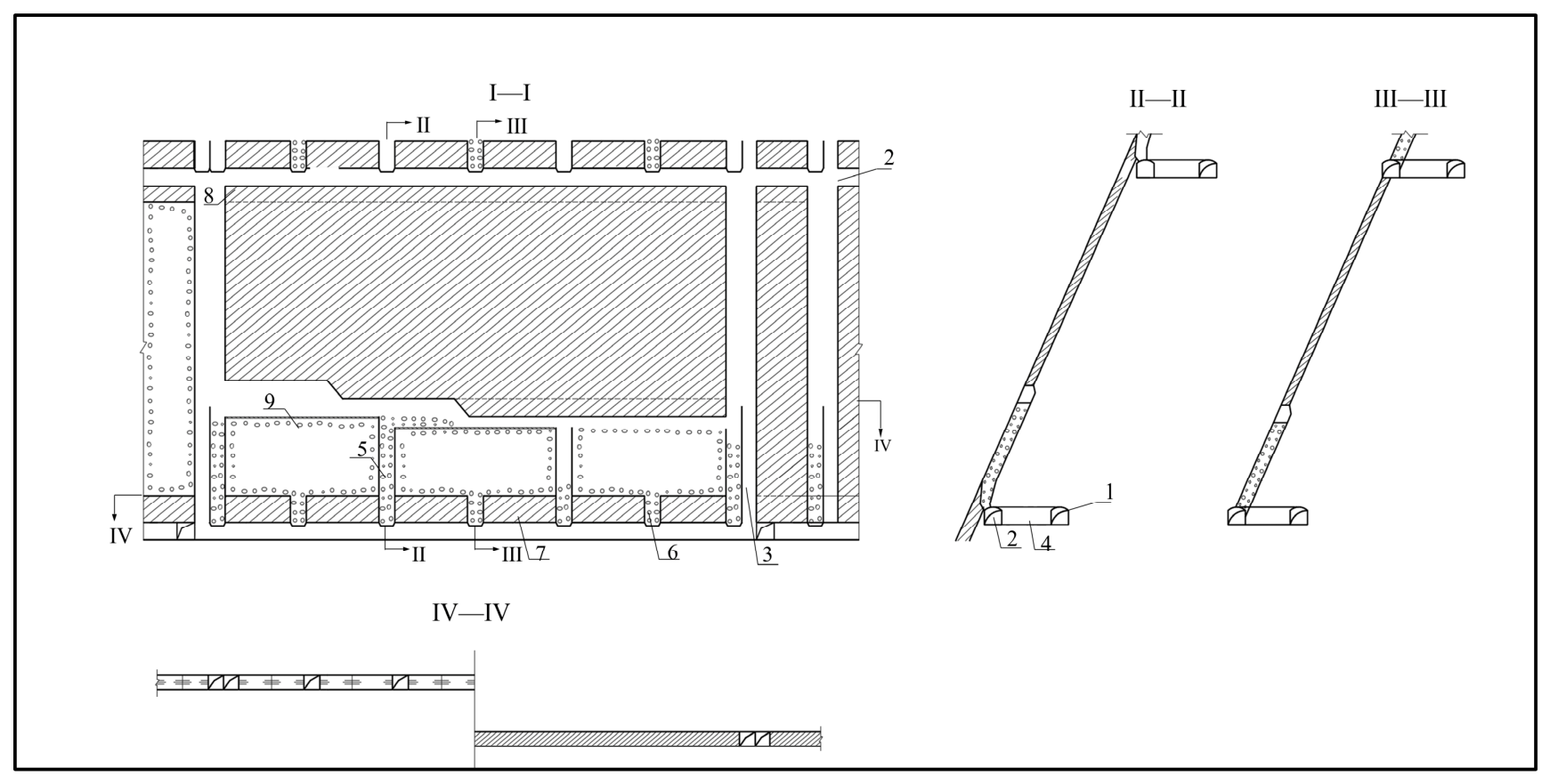
In response to the lessons learned from shallow mining, current mining of middle and deep orebodies employs the cut-and-fill mining (Figure 3) to actively control rock mass deformation and ensure the stability of underground excavations. The orebodies are divided into stopes aligned along the orebodies’ strike, with configured strike lengths of 30 to 50 m and vertical heights matching level intervals (45 or 50 m). A top-down level advancement strategy is adopted mine-wide, with retreat mining within each level, advancing from the distal ends of the orebodies toward the shafts. Extraction in each stope is conducted in slices of 2.0 to 2.5 m in height. Following the extraction of each individual stope, the resulting mining void is immediately backfilled.

3. Nine-Year Surface Subsidence Monitoring Using SBAS-InSAR

Historically, the mine relied primarily on visual inspections to assess surface subsidence and excavation stability, which provided limited quantitative data for validation. To quantitatively characterize the surface subsidence of the mining area, the Small Baseline Subset Interferometric Synthetic Aperture Radar (SBAS-InSAR) technique was employed. This method is particularly effective in mitigating decorrelation noise and atmospheric artifacts, making it suitable for monitoring slow, long-term subsidence in vegetated and mountainous terrain.

3.1. SBAS-InSAR Methodology and Data Processing

3.1.1. SBAS-InSAR Methodology

The quantification of surface displacement using InSAR relies on measuring phase differences between repeat-pass SAR images. SBAS-InSAR is an advanced InSAR method that mitigates decorrelation and atmospheric artifacts by processing multiple interferograms formed from image pairs with short spatial and temporal baselines. The core principle involves the fundamental interferometric equation relating phase differences to the change in radar line-of-sight distance:
Δ φ = 4 π λ Δ D
Δ φ = φ topo + φ defo + φ flat + φ orbit + φ atm + φ noise
where Δ φ is the interferometric phase difference, λ is the radar wavelength, Δ D is the change in the radar distance, φ topo is the topographic phase, φ defo is the deformation phase, φ flat is the flat-Earth phase, φ orbit is the phase error associated with satellite orbital inaccuracies, and φ noise is the noise phase.
This study utilized 120 Sentinel-1 Single Look Complex (SLC) images in an ascending orbit, covering the monitoring period from January 2016 to March 2025. The key parameters of the SAR data are summarized in Table 1. The dataset was supplemented by Precise Orbit Determination (POD) data from ESA to correct orbital residuals, the Shuttle Radar Topography Mission (SRTM3) Digital Elevation Model (DEM) for topographic phase removal, and the Global Atmospheric Correction Online Service for InSAR (GACOS) to mitigate atmospheric phase delays during interferogram stacking.

3.1.2. SBAS-InSAR Data Processing

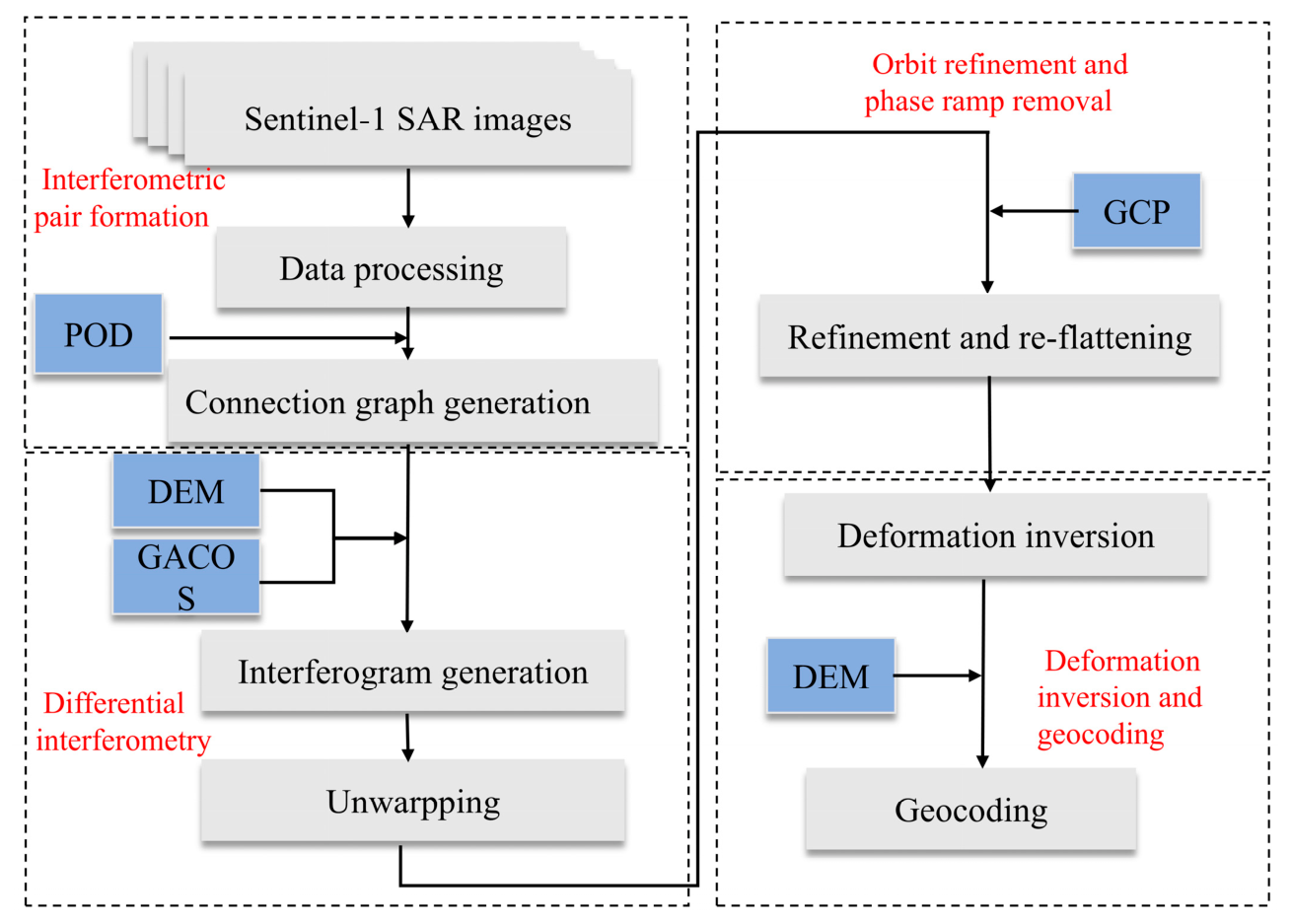
The SBAS-InSAR processing chain comprises four primary stages: interferometric pair formation, differential interferometry, orbit refinement and phase ramp removal, and deformation inversion and geocoding. The complete workflow is illustrated in Figure 4.
(1)
Interferometric pair formation
SBAS-InSAR effectively addresses decorrelation issues through strategic spatiotemporal baseline constraints. Spatial baselines were maintained below 4% of the critical baseline and temporal baselines below 240 days to optimize interferometric pair selection, balancing phase quality with temporal sampling density. Applied to a 4 km2 mining area with 120 Sentinel-1 images spanning from 2016 to 2025, the methodology generated 532 interferometric pairs. These pairs exhibit average spatial and temporal baselines of 46 m and 113 days, respectively, with a robust network connectivity of 5.2 edges per node.
(2)
Differential interferometry
Differential interferometric processing (D-InSAR) is applied to all generated pairs. This procedure includes interferogram generation; flat-Earth phase removal; topographic phase correction using the SRTM3 DEM; Goldstein filtering; coherence estimation; and phase unwrapping employing the Delaunay Minimum Cost Flow (D-MCF) algorithm with a coherence threshold of 0.2. Post-processing quality control is then implemented to reject pairs with low coherence or poor unwrapping quality, thereby minimizing errors in subsequent inversion.
(3)
Orbit refinement and phase ramp removal
Residual phase ramps are removed using ground control points (GCPs) selected from stable, high-coherence areas outside deformation zones. Additionally, precise orbit data (POD) are used to correct orbital drifts.
(4)
Deformation inversion and geocoding
Surface deformation rates and residual topographic phases are estimated after secondary phase unwrapping. Subsequent high-pass (temporal) and low-pass (spatial) filtering are applied to reduce atmospheric errors. Finally, geocoding transforms the displacement fields into WGS84 geographic coordinates for mapping and spatial analysis.

3.2. Spatiotemporal Evolution of Surface Subsidence

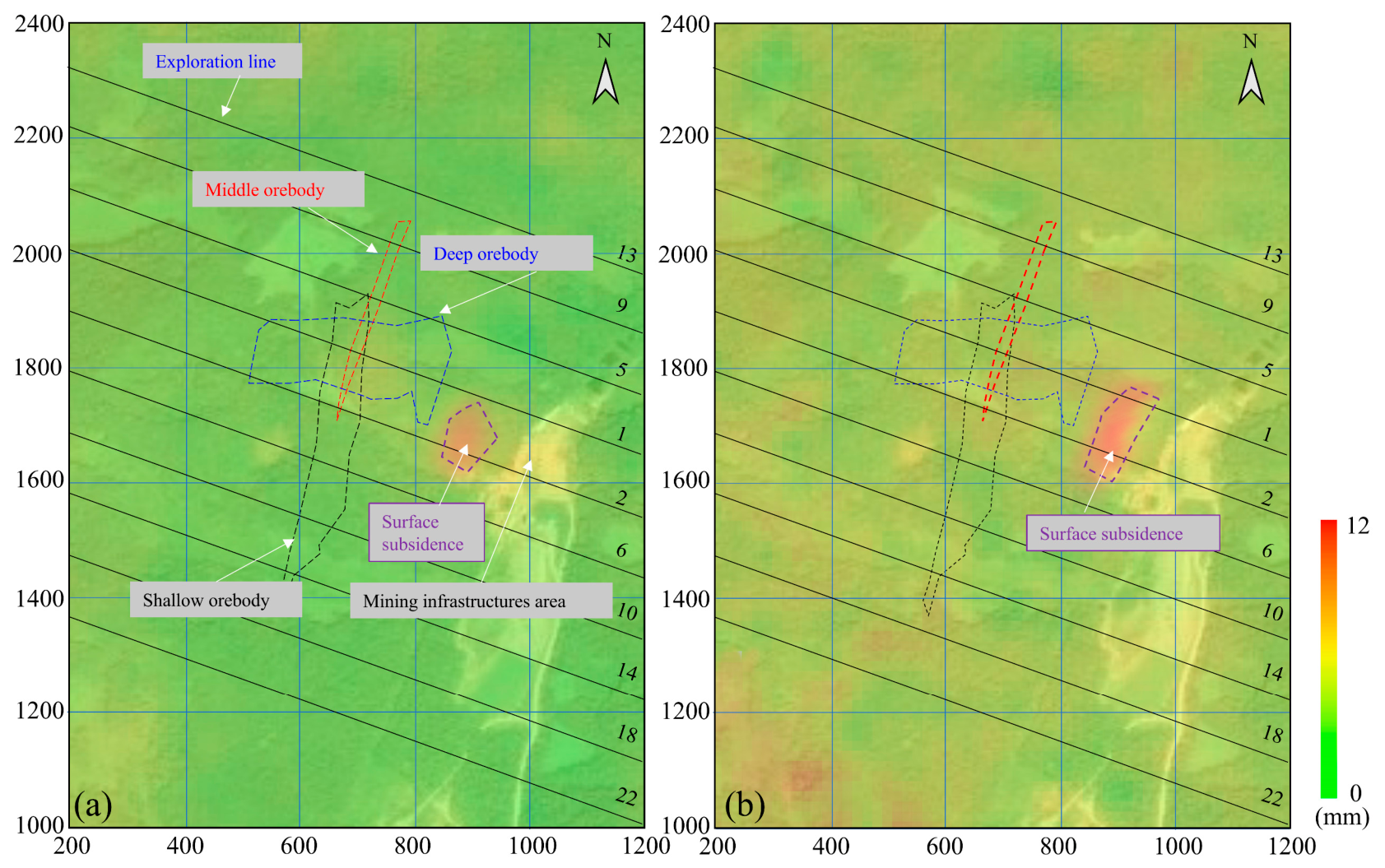
From 2016 to 2025, mining targeted the middle orebody and the residual portions of the shallow orebody. The cumulative surface displacement maps for 2016–2020 and 2016–2025 are presented in Figure 5. The most striking observation is the highly localized nature of the subsidence. Surface subsidence is predominantly localized in the hanging wall of the orebodies, forming an elliptical subsidence basin aligned with the NE–SW strike of the orebody. The basin measures 650 m in length and 180 m in width, covering 0.1 km2.
In terms of magnitude, the cumulative subsidence at the basin center increased from 5.5 mm for the 2016–2020 period to 9.3 mm for the entire monitoring period (2016–2025), corresponding to an average subsidence rate of approximately 1 mm/y, which indicates an extremely slow and steady subsidence process. The location of the subsidence zone in pristine terrain, distant from surface infrastructure, combined with the low subsidence rate, indicates a stable and controlled ground response to the mining operations.

3.3. Distinctive Subsidence Characteristics

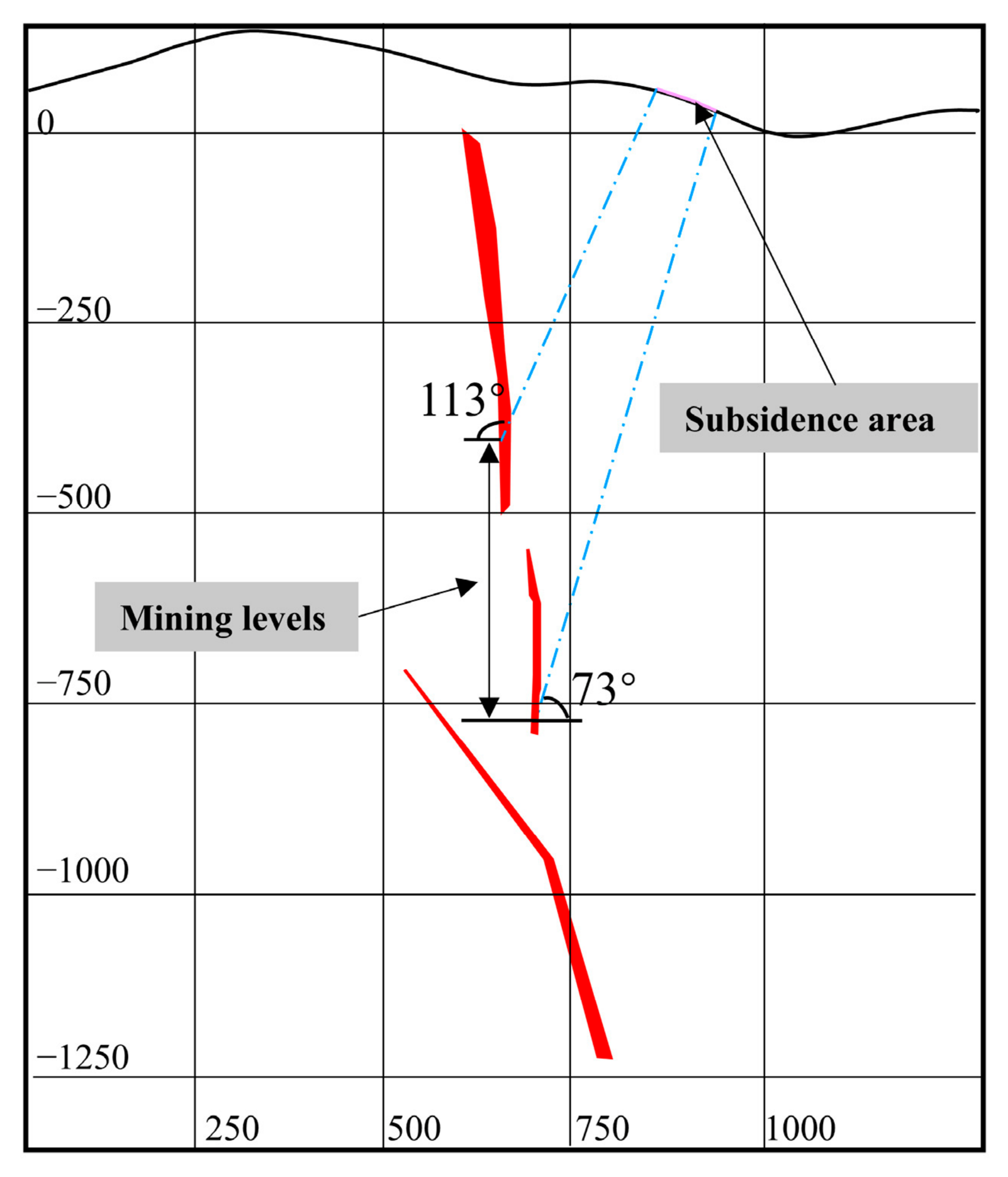
A comparative analysis of the InSAR-derived subsidence basin with the projection of the steeply dipping orebodies (Figure 6) reveals two fundamental characteristics that define the unique subsidence mechanism in this mining context.
Spatially Confined Subsidence Zone: The surface influence of the mining activity is remarkably limited, and subsidence does not propagate significantly beyond the immediate area above the orebody. This confinement suggests that the deformation mechanism effectively inhibits the lateral expansion of the subsidence basin, a phenomenon that will be explored mechanistically in the Section 5.
Anomalous Footwall Movement Angle: When the boundary of the subsidence basin is delineated based on a displacement threshold (e.g., 5 mm), the resulting movement angle exceeds 90°. This is a significant deviation from empirical norms for flat or gently dipping orebodies, where both hanging wall and footwall movement angles are typically less than 90° [32]. This anomaly is a direct consequence of the steep dip angle and the specific rock mass movement pattern, which will be further elucidated through numerical simulation.

4. Numerical Simulation of Mining-Induced Surface Subsidence and Underground Response

To mechanistically interpret the InSAR-derived subsidence patterns and assess underground stability, a comprehensive 3D numerical model was developed. This section first introduces the construction and calibration of the numerical model, followed by an analysis of the ground response, encompassing both surface subsidence and the stability of underground excavations.

4.1. Model Construction and Modelling Procedure

4.1.1. Model Construction

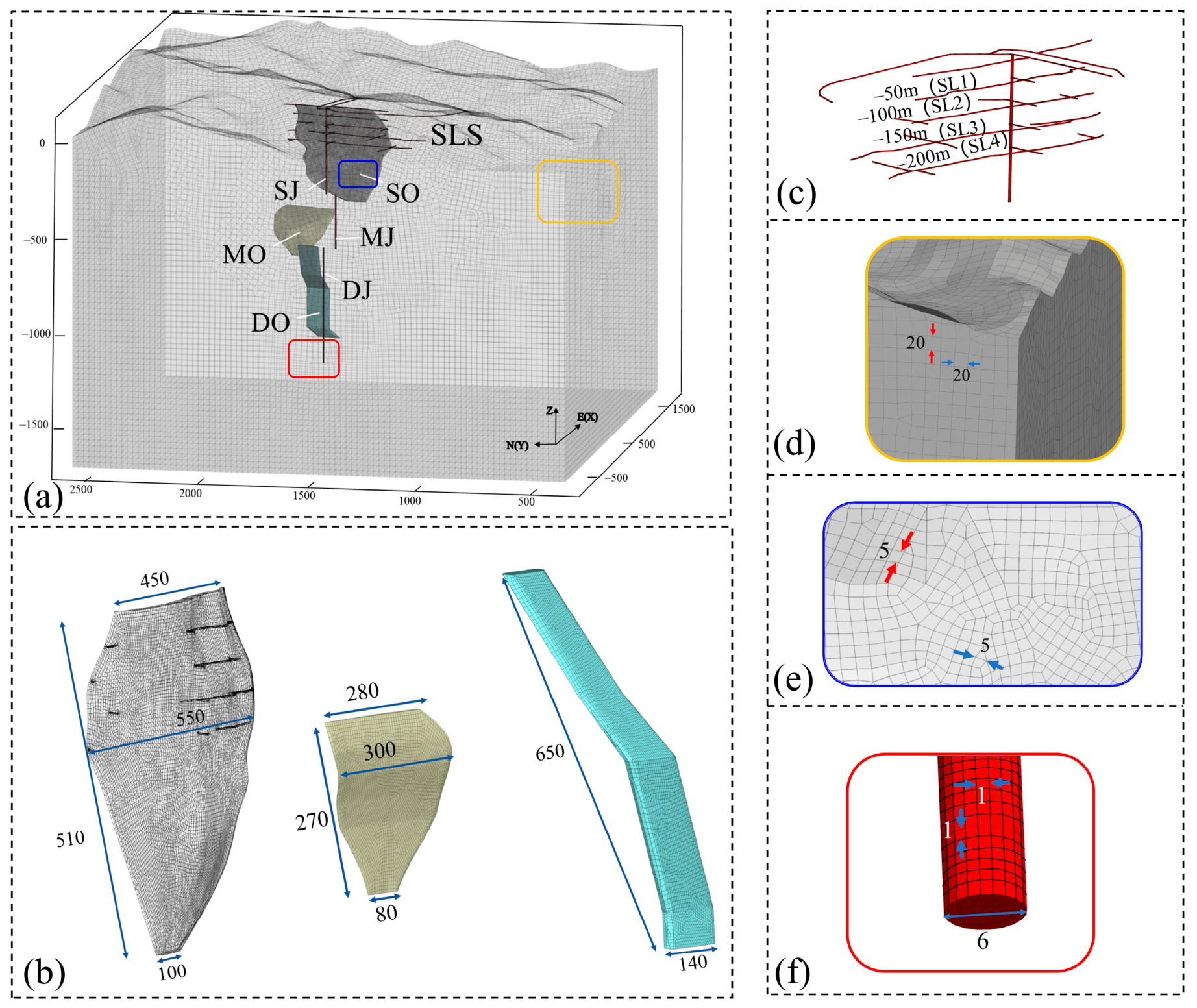
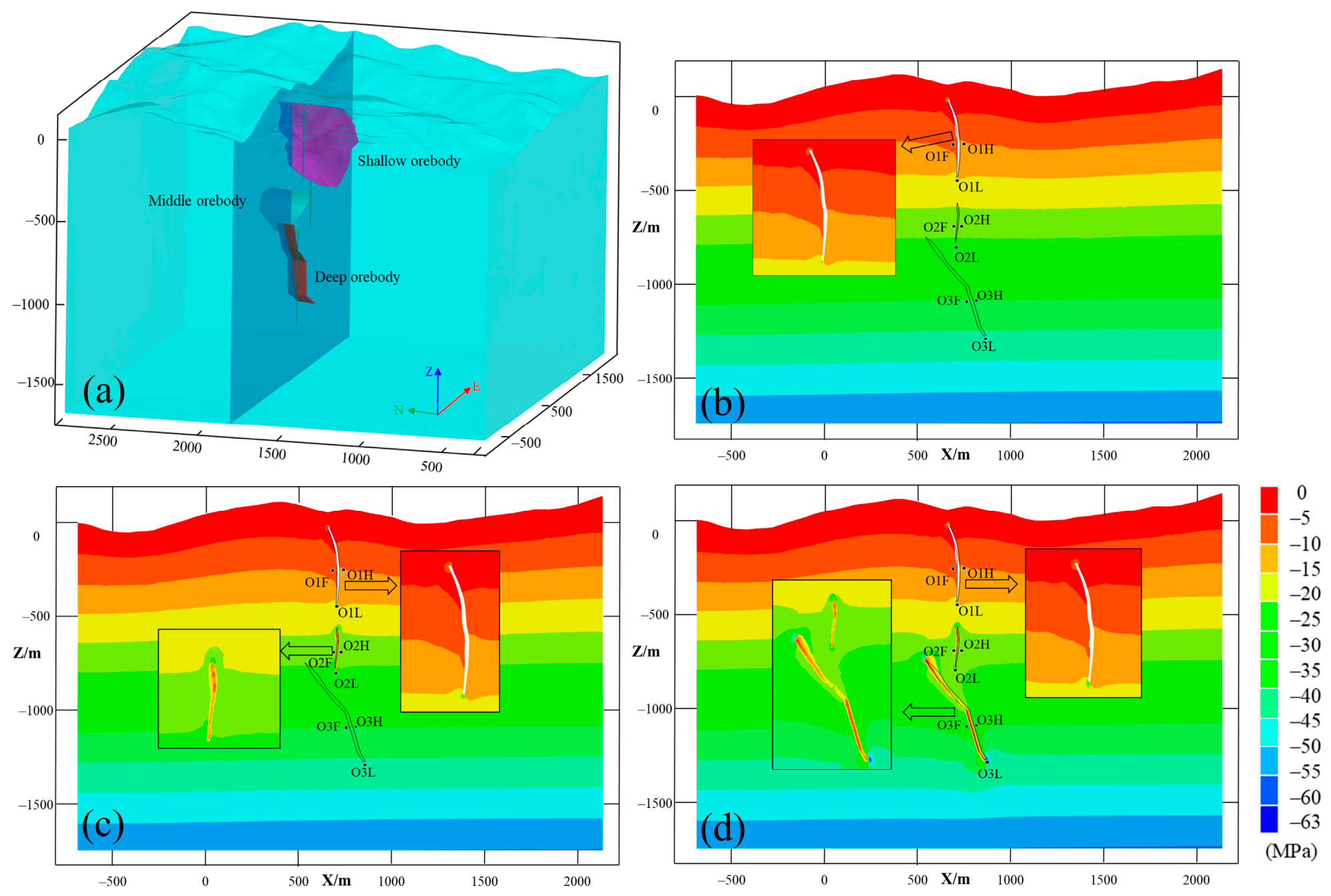
The numerical model incorporates the key geological and engineering components, including the shallow (SO), middle (MO), and deep orebody (DO), and the corresponding shafts (SJ, MJ, DJ). In addition, it considers shallow-level tunnels (SLs) and actual surface topography (Figure 7a–c). Raw data of level plans and exploration cross-sections were processed through vectorization, 3D geological modelling, meshing, grouping, and material assignment. The model spans 2800 m (X: east-west) × 2700 m (Y: north-south) × 1800 m (Z: vertical). A base mesh size of 20 m is used throughout the model (Figure 7d), with local mesh refinement around critical zones, including the orebodies, ground surface, shafts, and tunnels (Figure 7e,f). The final model comprises approximately 1.3 million zones and 0.73 million grid points, and the numerical simulation is conducted with FLAC3D 6.0 (Itasca Consulting Group, Inc., Minneapolis, MN, USA).

4.1.2. Rock Mass Parameters and Boundary Conditions

The Mohr–Coulomb elastoplastic constitutive model is adopted for its proven effectiveness in simulating shear failure of rock masses and straightforward parameter determination, making it well-suited for large-scale modelling of mining-induced stress redistribution. The Mohr–Coulomb failure criterion [33] defines the linear failure envelope in Mohr’s stress space, representing the critical combination of shear and normal stress for failure, and is expressed as follows:
τ n   =   c   + σ n   tan   φ
where τ n is the shear strength, σ n is the normal stress, c is the cohesion, and φ is the angle of internal friction.
Samples of the orebody (quartzite) and host rock (plagioclase gneiss) were tested following ISRM standards to determine the key physical and mechanical properties. Field characterization of joint conditions, groundwater, and in-situ stress states was performed and used to classify the rock mass according to the Rock Mass Rating (RMR) system [34]. The resulting RMR values are converted to the Geological Strength Index (GSI) using the empirical relationship GSI = RMR − 5 (for RMR > 23) [35]. Finally, the generalized Hoek–Brown criterion [36] is applied, incorporating the GSI value, to derive the equivalent rock mass strength parameters presented in Table 2.
σ 1 = σ 3   + σ c m b σ 3 / σ c + s a
m b = m i e ( GSI 100 ) / ( 28 14 D )
s = e ( GSI 100 ) / ( 9 3 D )
a = 0.5 + e GSI / 15     e 20 / 3 / 6
where σ 1 , σ 3 represent the major and minor principal stresses at failure (MPa), respectively; σ c denotes the uniaxial compressive strength of the intact rock (MPa); m b is the Hoek–Brown constant for the rock mass; m i is the intact rock Hoek–Brown constant; GSI is the Geological Strength Index; D is the disturbance factor; and s and a are material constants for the rock mass, all dimensionless.
The Mohr–Coulomb failure criterion parameters are derived with Hoek–Brown criterion. These parameters, along with the properties of all materials, are summarized in Table 3 and serve as critical inputs for the analysis conducted in FLAC3D.
The in-situ stress field is characterized by an approximately east–west oriented maximum horizontal stress (σH), which is perpendicular to the orebodies’ strike and consistent with regional tectonics [37]. All three principal stresses exhibit clear depth-dependent gradients, described by the following regression equations:
σ H   =   0.0315 H   +   0.81
σ h   =   0.022 H + 0.8107
σ v   =   0.030 H
where σH, σh, and σv represent the maximum horizontal principal stress, minimum horizontal principal stress, and vertical stress, respectively, all in MPa; and H represents the depth in meters.
The model is initialized with a geostatic stress field under the following boundary conditions: The east-west boundaries are fixed in the east-west direction. The north-south boundaries are fixed in the north-south direction. The bottom boundary is fully fixed in all directions. The top boundary, representing the ground surface, is a free surface. The initial in-situ stress field in the model is consistent with the measured in-situ stress distribution of the mine. Due to the hydrogeological conditions, the underground rock mass is completely dry, so groundwater is not considered in this study.

4.1.3. Numerical Simulation Schemes

The mining sequence and stope dimensions are configured to match actual field operations, as illustrated in Figure 8a. Numerical simulations are performed using an explicit finite difference solution scheme in FLAC3D, with a convergence criterion set to a maximum unbalanced force ratio less than 1 × 10⁻⁵ to ensure mechanical equilibrium. In the shallow orebody, stopes are extracted continuously without backfilling, and the model is run to equilibrium before proceeding to the next excavation step. In contrast, for the middle and deep orebodies, backfilling is applied immediately after each stope is excavated, and the model is again solved to equilibrium prior to the excavation of the subsequent stope. The spatial distribution of all simulated stopes is shown in Figure 8b–d.

4.1.4. Model Calibration Against InSAR Monitoring Result

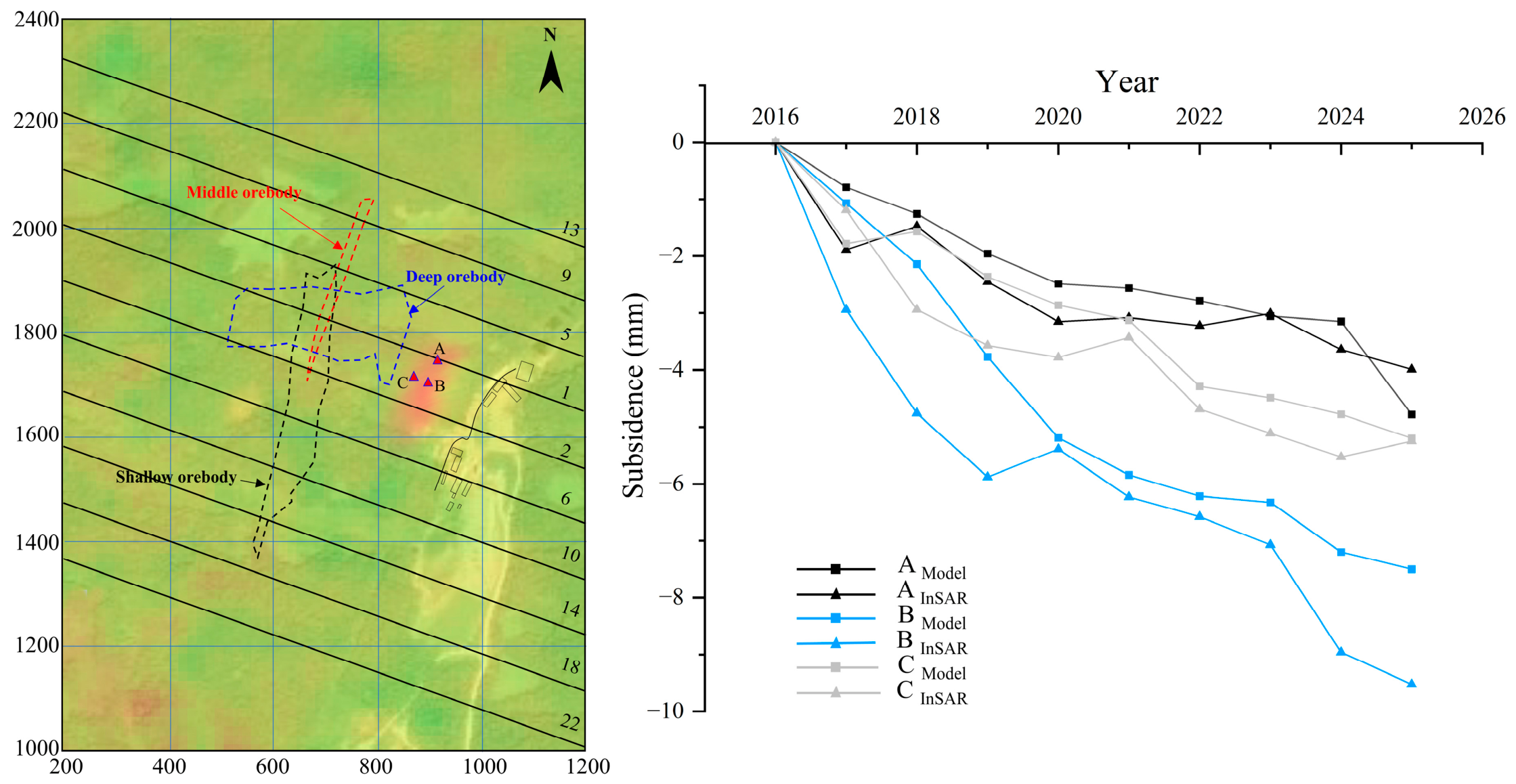
Figure 9 compares the temporal subsidence derived from numerical simulation and SBAS-InSAR monitoring data at three typical points from 2016 to 2025. The results show a strong consistency in the subsidence evolution between the simulated and monitored data. Quantitatively, the spatial correlation between the simulated and InSAR-derived subsidence fields is further evaluated, yielding a root mean square error (RMSE) of 1.59 mm and a coefficient of determination (R2) of 0.83. These values indicate a high predictive accuracy and strong consistency between numerical simulation and SBAS-InSAR in capturing subsidence trends. These results confirm the reasonableness of the model formulation and parameter selection, ensuring the credibility and reliability of the simulation results for practical engineering applications.

4.2. Simulated Surface Subsidence and Deformation

4.2.1. Overall Evolution of Simulated Surface Subsidence

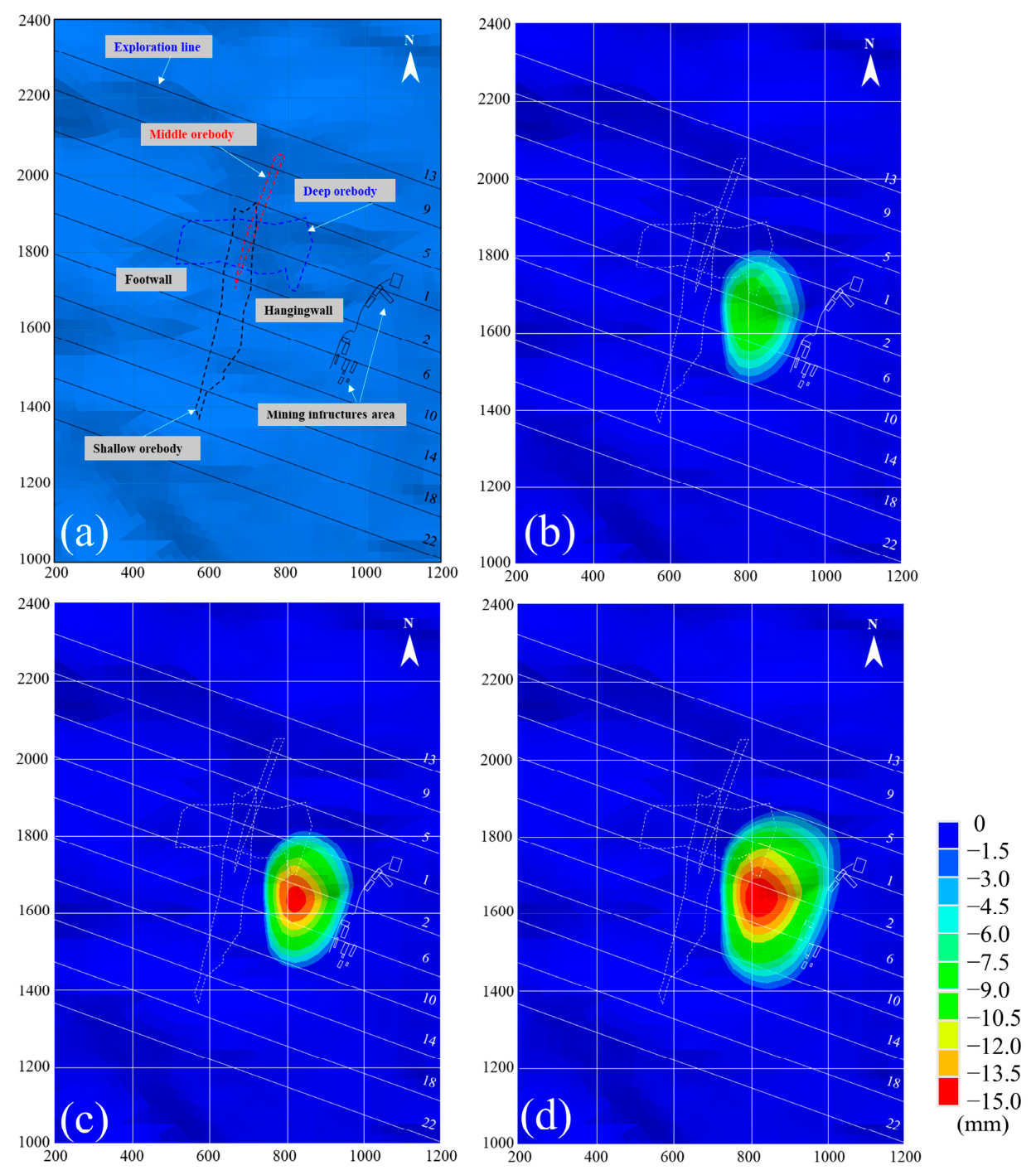
The simulated surface subsidence following the sequential extraction of the three orebodies is presented in Figure 10. The simulation results corroborate the key findings from the InSAR analysis: subsidence is highly localized, forming an elliptical basin obliquely above the orebodies on the surface. The maximum subsidence is 9.2 mm after SO extraction, increasing to 13.5 mm (MO) and 14.9 mm (DO), with the subsidence footprint expanding marginally while maintaining geometric stability. Subsidence evolution analysis indicates that approximately 60% of the total subsidence occurs during the SO extraction. This demonstrates that the propagation of mining-induced deformation to the surface is effectively constrained as mining advances to greater depths.

4.2.2. Spatial Distribution of Surface Deformation

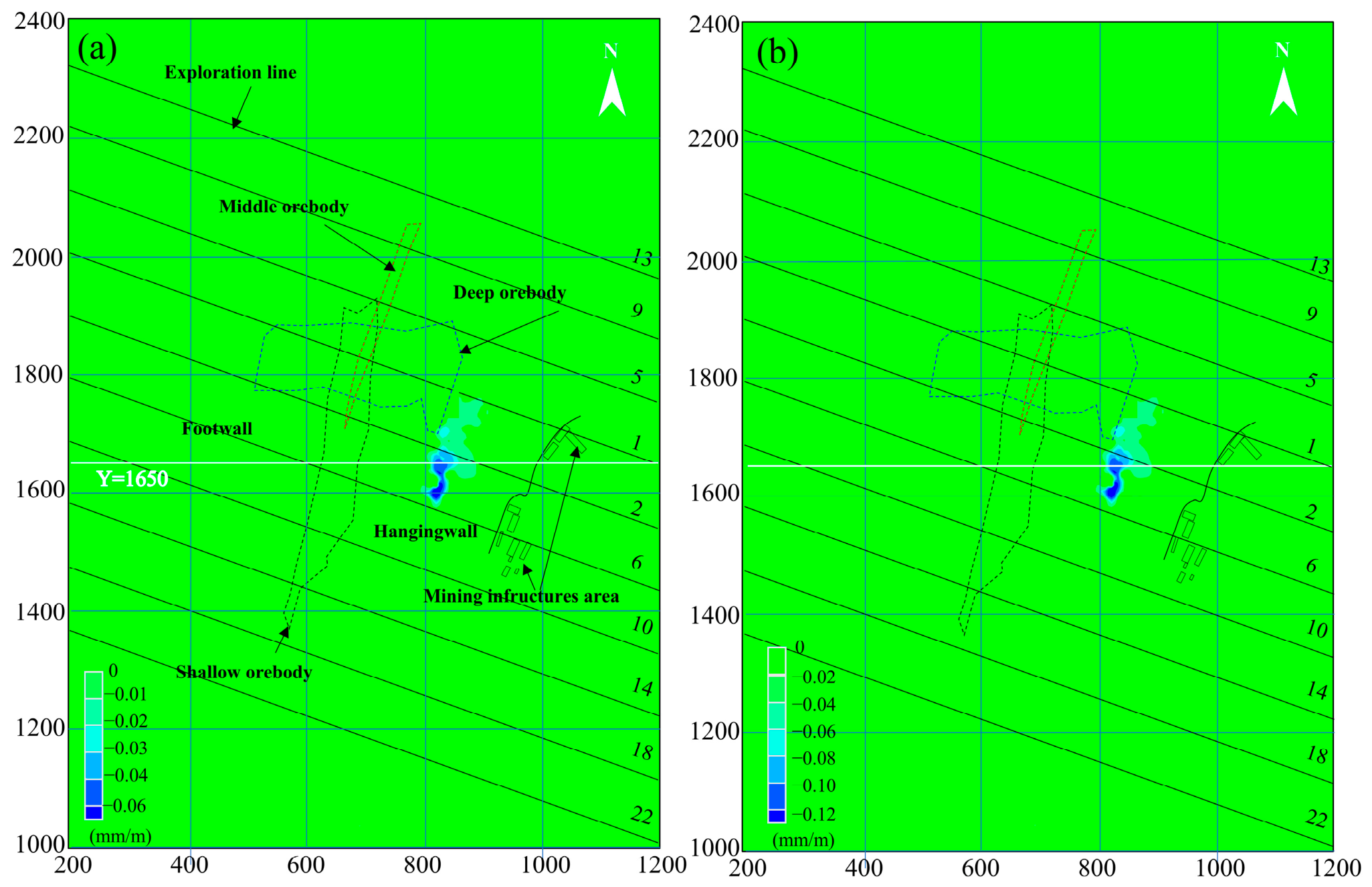
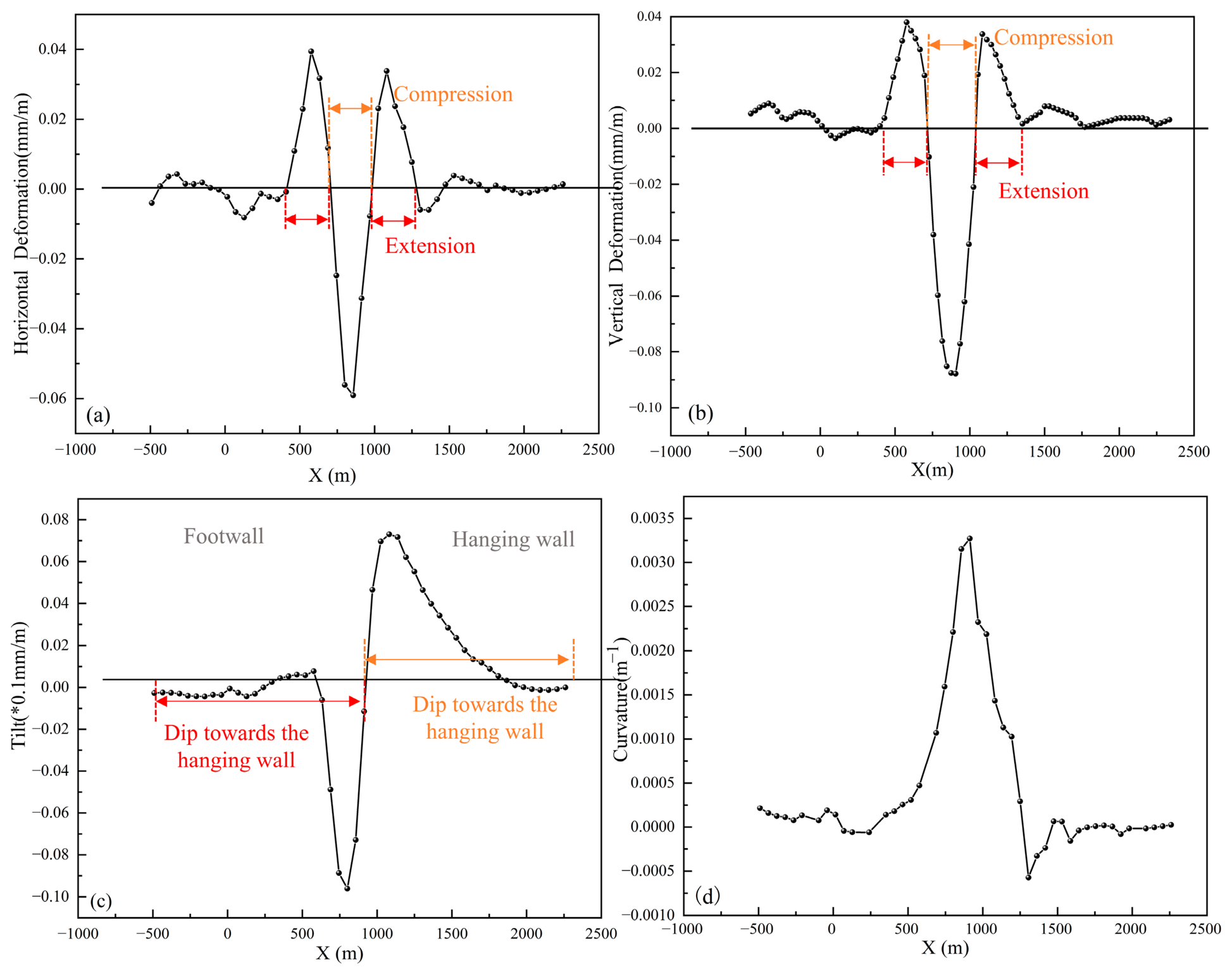
Nearest-neighbor interpolation of surface displacements yields deformation contours (Figure 11) and profiles along the dip-directed line at 650 m (Figure 12). Analysis reveals that deformation concentrations occur at the subsidence center obliquely above the orebodies (compressional strain in a 200-m zone) and adjacent extensional zones. Along this profile, horizontal (εh) and vertical (εv) deformation values show consistent distribution patterns, with tilt showing an antisymmetric pattern and curvature peaking at the subsidence center. Analysis of the deformation distribution demonstrates that the maximum deformations appear in the subsidence area (X = 800–900, Y = 1600–1700), where ε < 0.1 mm/m, θ < 0.1 mm/m, and κ < 0.0035 1/m, are far below the allowable thresholds (Table 4) specified in international standards [38], indicating an insufficient magnitude to trigger either tensile or compressive failure in the mining surface area.

4.3. Underground Response: Stress Redistribution and Excavation Stability

4.3.1. Rock Mass Stress Evolution

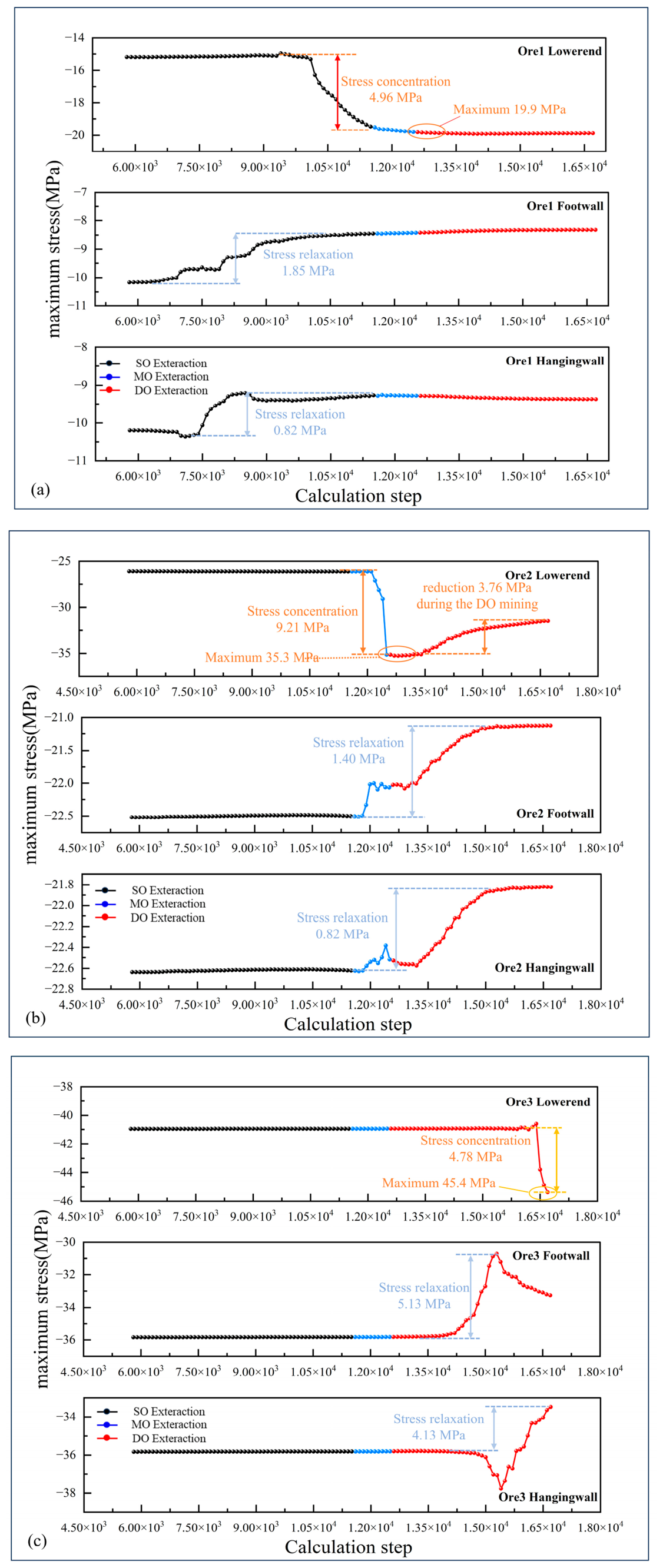
The distribution of the maximum principal stress (σ1) on the cross-section at X = 1850 m, which intersects all orebodies, illustrates the rock mass response (Figure 13). Monitoring points are established in the surrounding rock at the lower end, hanging wall, and footwall of each orebody to quantify stress variations (Figure 14). The analysis reveals a characteristic pattern: stress relaxation (σ1 decrease) occurs in the hanging wall and footwall regions adjacent to the stopes, while stress concentration (σ1 increase) occurs at the lower terminations due to stress-arching effects. After mining completion, the stress increase at these concentration points is 4.96 MPa (O1L), 9.21 MPa (O2L), and 4.78 MPa (O3L). The backfilled stopes in the MO and DO maintain residual σ1 values of 5–15 MPa (Figure 13c,d), confirming that the backfilling provides effective structural support. Importantly, the narrow geometry and substantial spacing between orebodies minimize stress interference, as evidenced by the minimal change in the stress field around the upper orebodies during the extraction of deeper orebodies (Figure 14).

4.3.2. Stability Analysis of Shallow-Level Tunnels

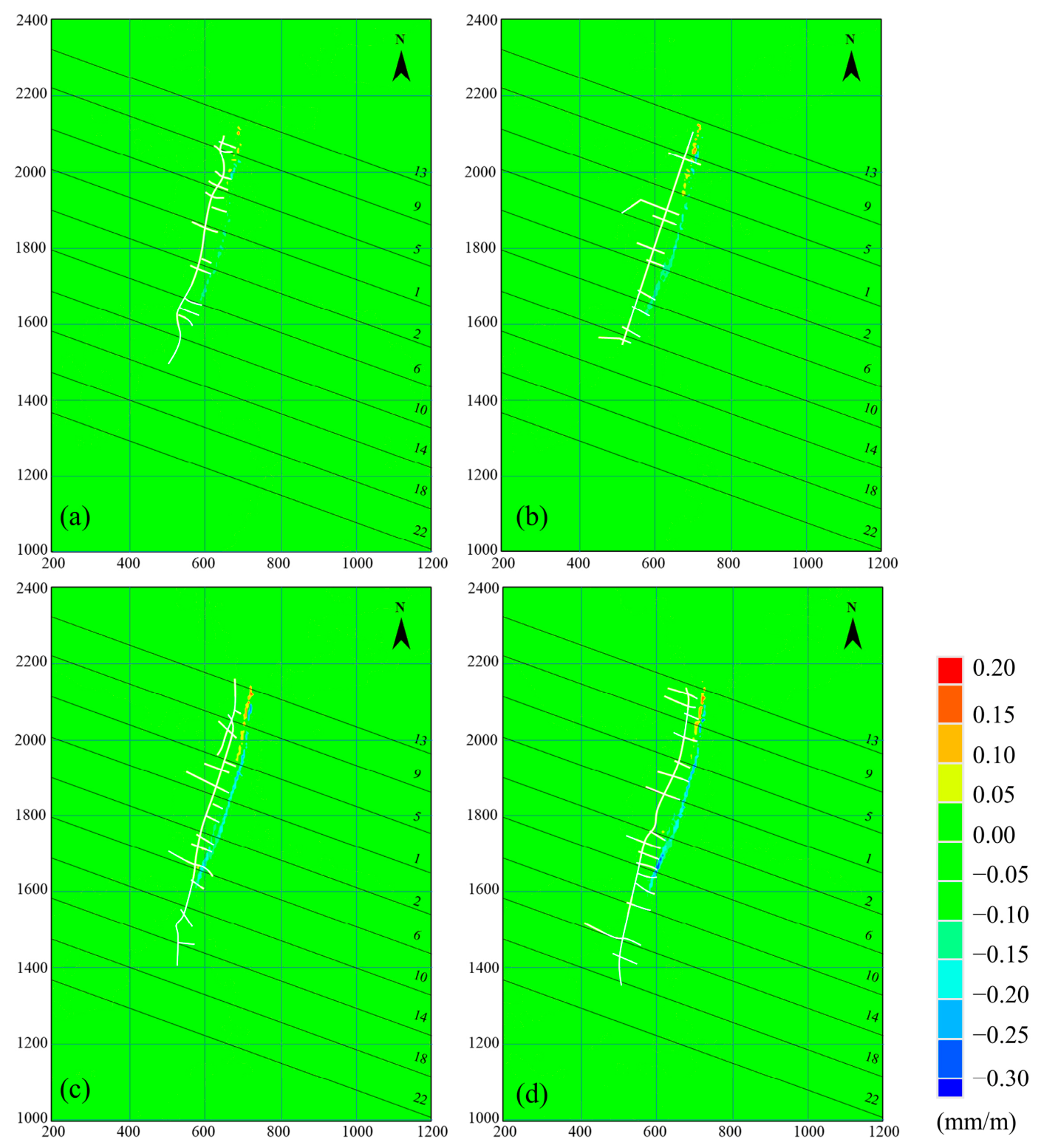
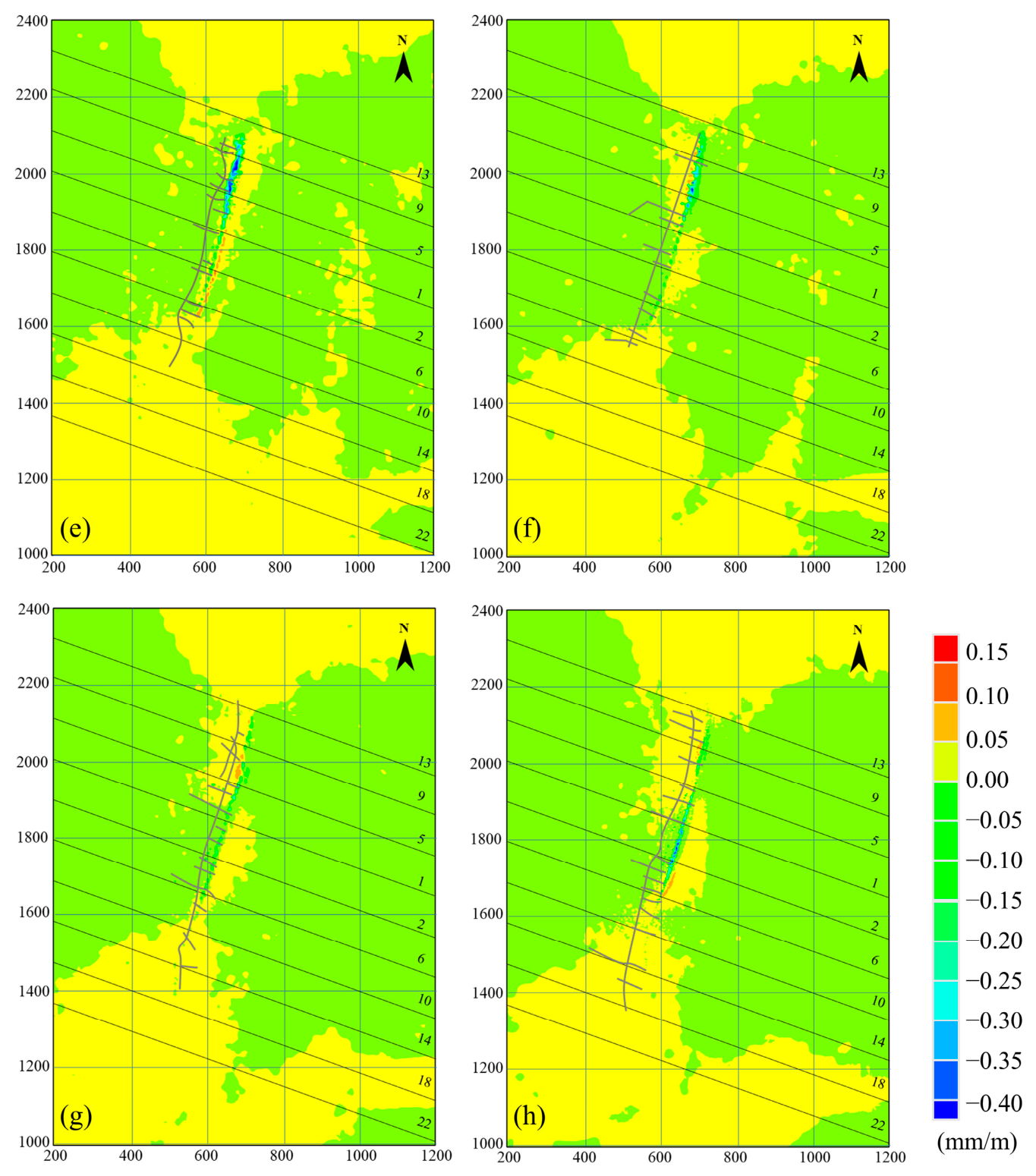
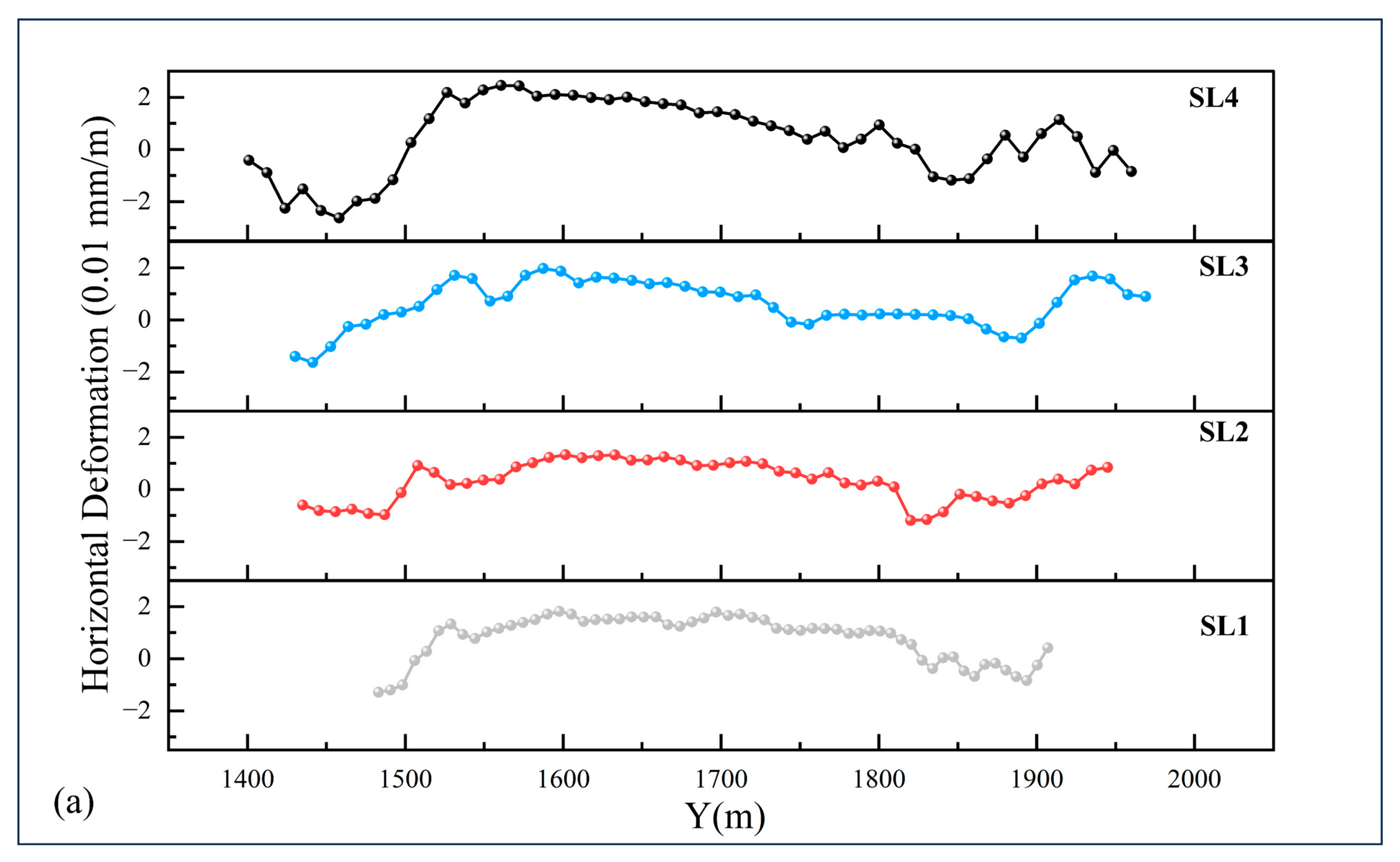
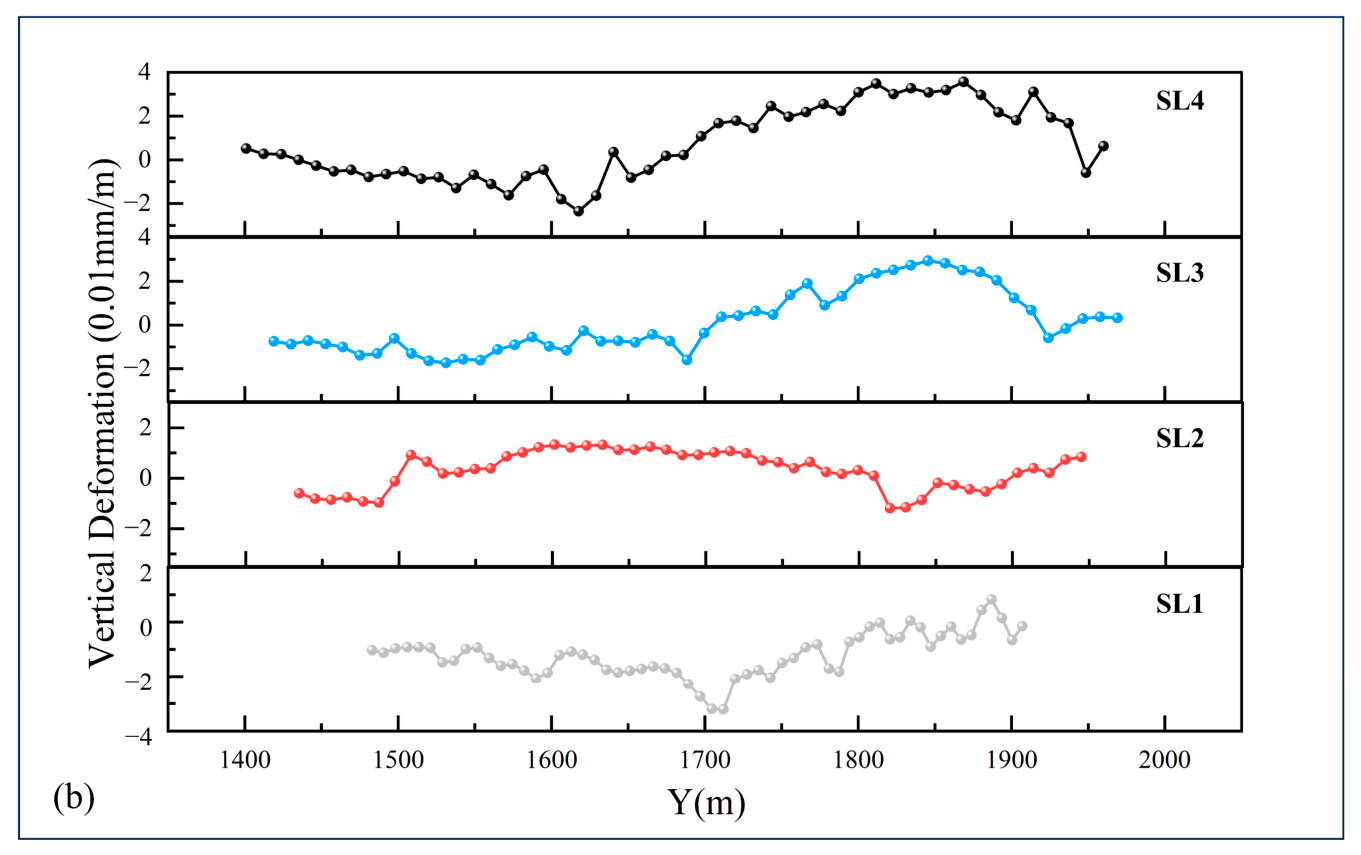
The stability of the shallow-level tunnels (SLs), which is crucial for haulage, is assessed by analyzing their deformation and the surrounding stress. Nearest neighbor interpolation of the nodal displacements induced by mining of the three orebodies yields deformation distribution maps for the shallow levels. The resulting deformations at the tunnel locations are shown in Figure 15 and Figure 16, respectively. As shown by the plotted curves, the magnitude of deformation at the tunnel locations is relatively small. The horizontal deformation (εh) ranges from −0.026 mm/m to 0.025 mm/m, and the vertical deformation (εv) ranges from −0.023 mm/m to 0.035 mm/m. The deformation generally increases with depth. However, the overall magnitude remains relatively small and is far below the allowable thresholds specified in international standards [38].
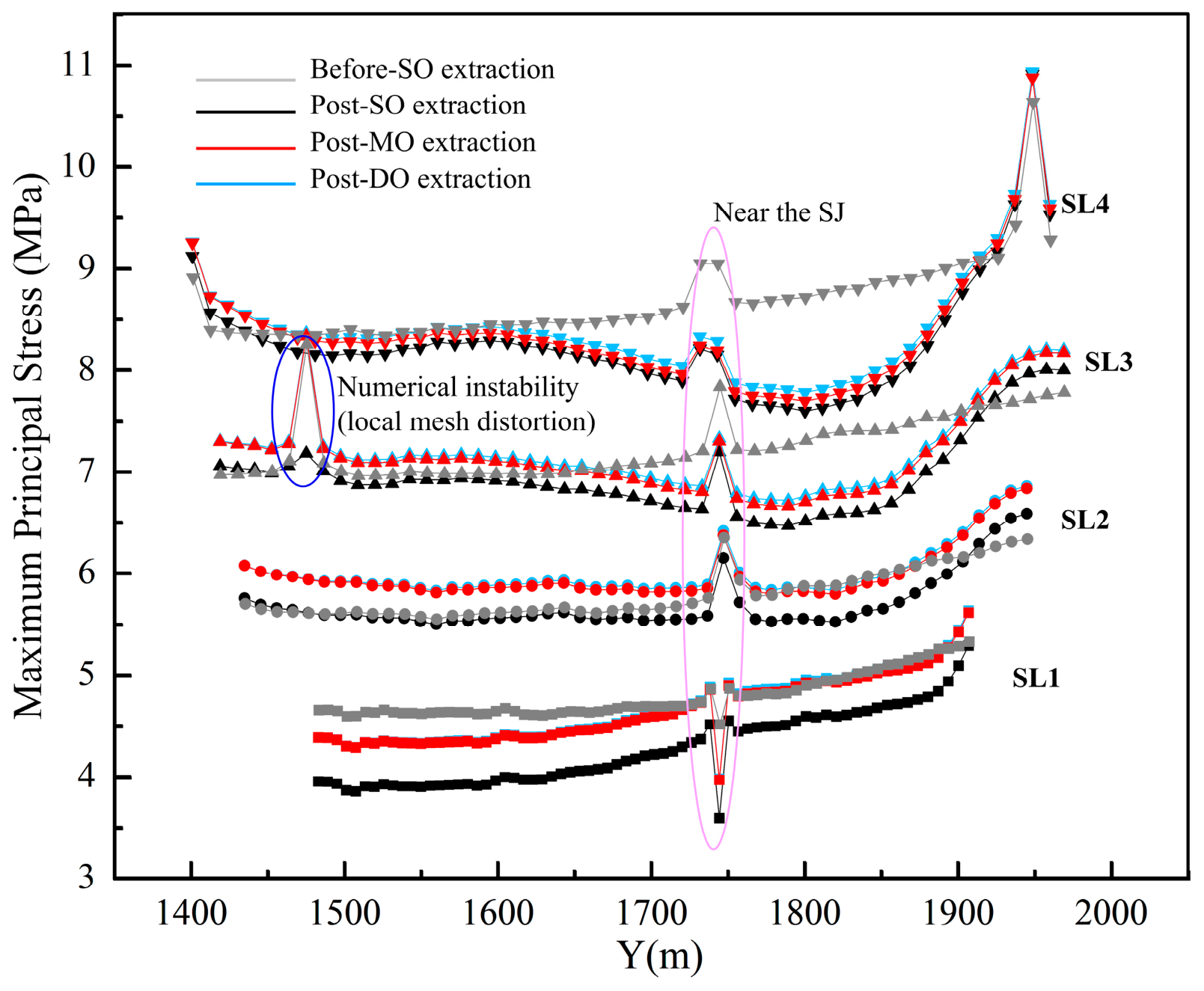
Furthermore, the maximum principal stresses (σ1) in the surrounding rocks of the shallow-level tunnels are obtained from the numerical model following the completion of mining in all three orebodies (Figure 17). The results demonstrate that, owing to the close spatial proximity between shallow-level tunnels and the shallow orebody, the excavation of the latter induces a stress reduction of approximately 0–1 MPa, and subsequent extraction of the middle and deep orebodies leads to a slight increase of 0–0.5 MPa. Owing to the distance effect, the influence of the middle orebody is more pronounced than that of the deep orebody. Moreover, a distinct stress anomaly is observed near Y = 1750, where the maximum principal stress undergoes an abrupt variation. This anomaly is attributed to the location’s proximity to the shallow shaft (SJ), which disturbs the local stress field. Additionally, the sharp stress peak at Y = 1450 m on the SL3 is a numerical instability phenomenon caused by local mesh distortion, which is acceptable and will not affect the overall reliability of simulation results.
In summary, both the deformation magnitudes and maximum principal stress variations at shallow-level tunnels remain minimal, indicating that the stability of these tunnels is not compromised under current geomechanical conditions.

4.3.3. Stability Analysis of Shafts

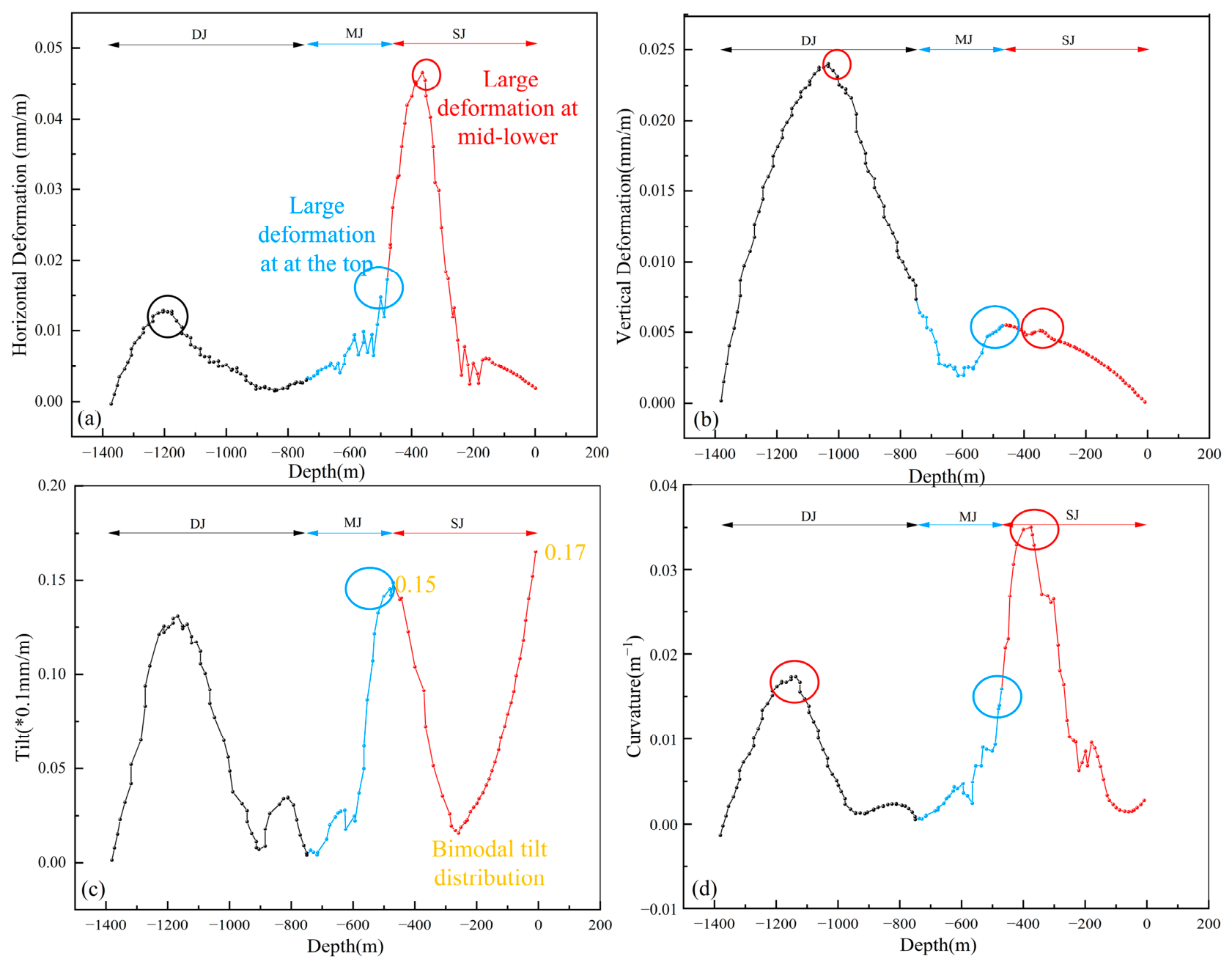
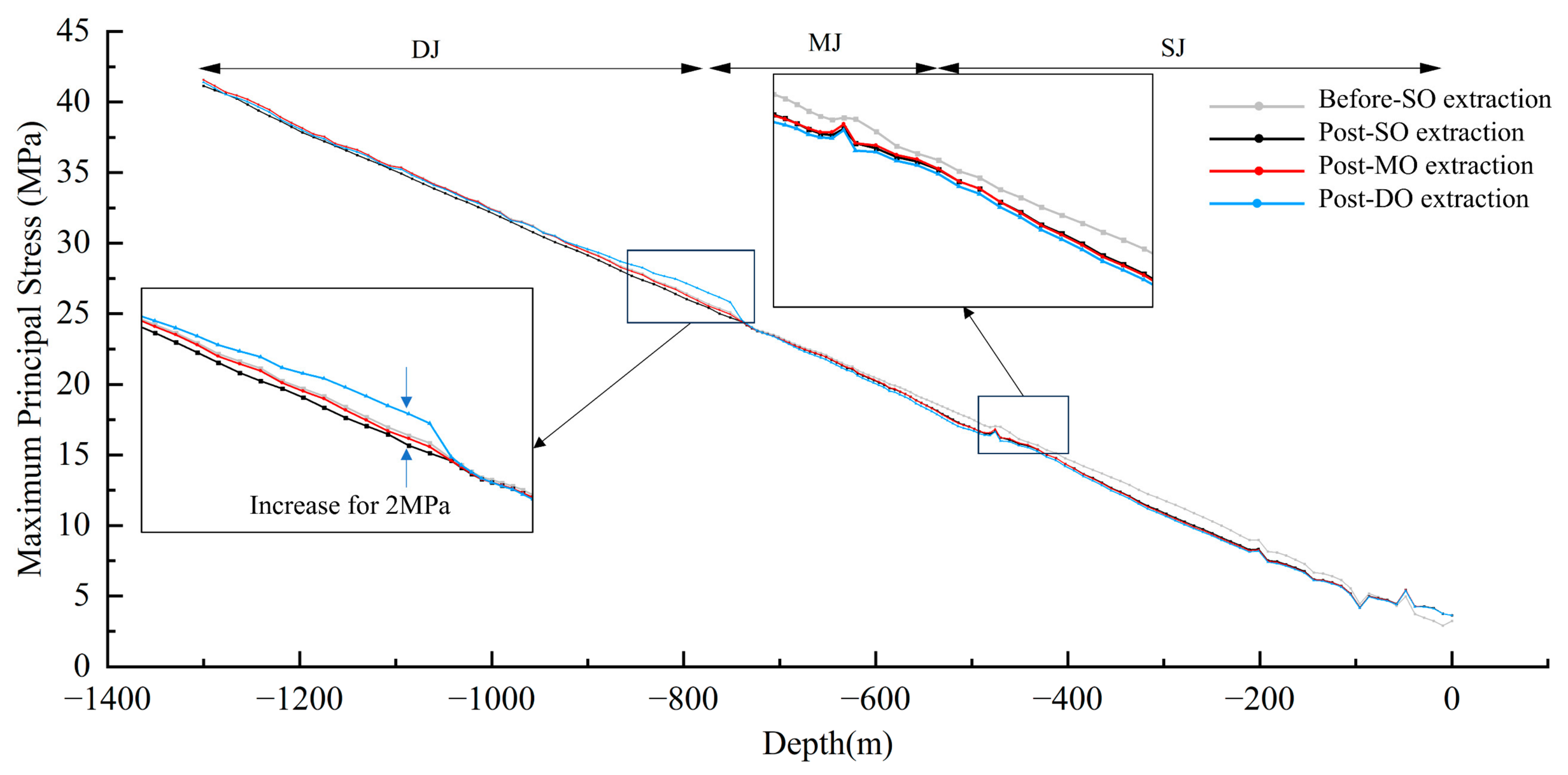
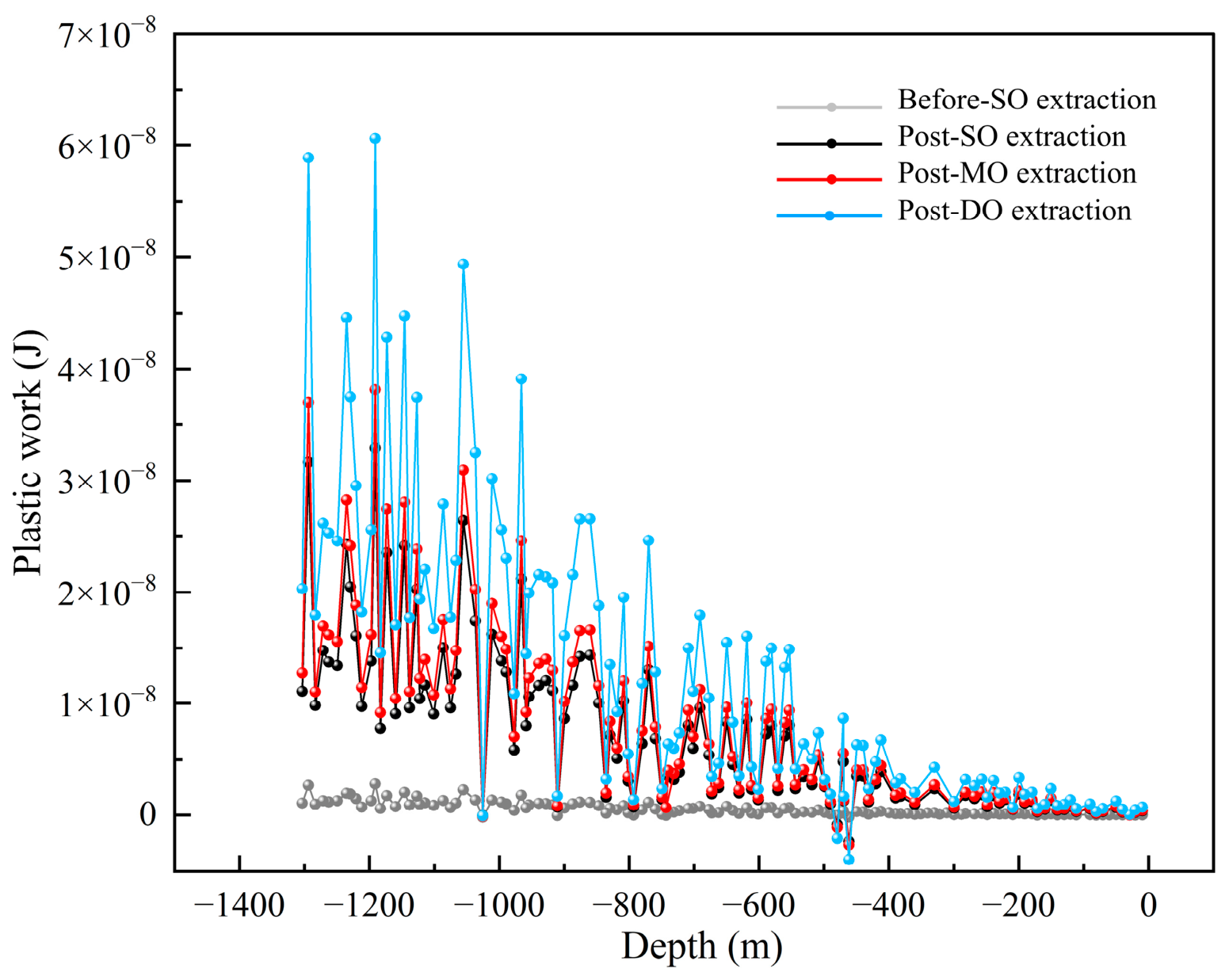
The shafts, providing critical access and material transport, are also a focus of the stability analysis. This analysis focuses on three shafts: the Shallow Adit Connection Shaft (SJ: 0 to −470 m), the Middle Hoisting Shaft (MJ: −470 to −740 m), and the Deep Hoisting Shaft (DJ: −740 to −1290 m). The stability is analyzed by quantifying the final deformation, stress evolution, and plastic work in the surrounding rock adjacent to the orebodies at each mining stage, as presented in Figure 18, Figure 19 and Figure 20, respectively. The final deformation of the surrounding rock along the shafts is extremely limited, with peak horizontal and vertical deformations not exceeding 0.045 mm/m and 0.024 mm/m, respectively. The tilt and curvature values are also well within safe limits. The stress evolution in the shaft surrounding rock (Figure 19) is characterized by gradual stress release (0–1.5 MPa) in response to the sequential extraction of the orebodies. However, a localized stress increase (0.5–2 MPa) is observed in the upper section of the DJ during the mining of the MO and deep DO orebodies. This anomaly is attributed to the proximity of this shaft section to the terminations of both the MO and DO orebodies, where stress concentration naturally occurs, as corroborated by the stress distribution shown in Figure 13. The distribution of plastic work, as shown in Figure 20, progressively increases with both depth and the advancement of orebody extraction. However, the absolute values remain very small, on the order of 10−8, which is consistent with the low stress disturbance, limited deformation, and the high integrity of the in-situ rock mass observed at the mine site.
In summary, the numerical model not only successfully captures the unique surface subsidence patterns observed by InSAR but also provides a mechanistic basis for understanding the overall geotechnical stability. The following discussion synthesizes these findings to elucidate the controlling mechanisms.

5. Discussions

This integrated study, combining long-term SBAS-InSAR monitoring with 3D numerical simulation, provides a mechanistic understanding of the surface and underground geomechanical response to deep mining of narrow, steeply dipping orebodies. The following discussion synthesizes these findings, advancing from a phenomenological description to a mechanistic analysis.

5.1. Constrained Subsidence Mechanism of Deep Narrow, Steeply Dipping Orebody Mining

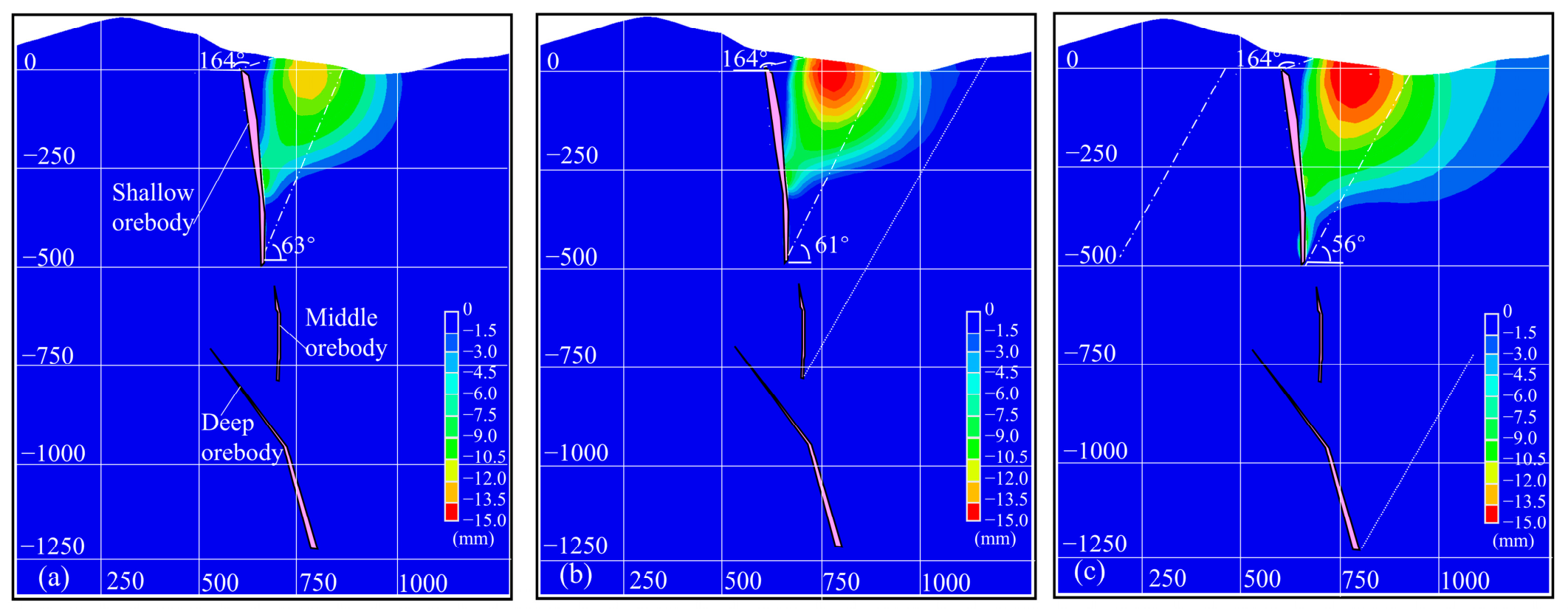
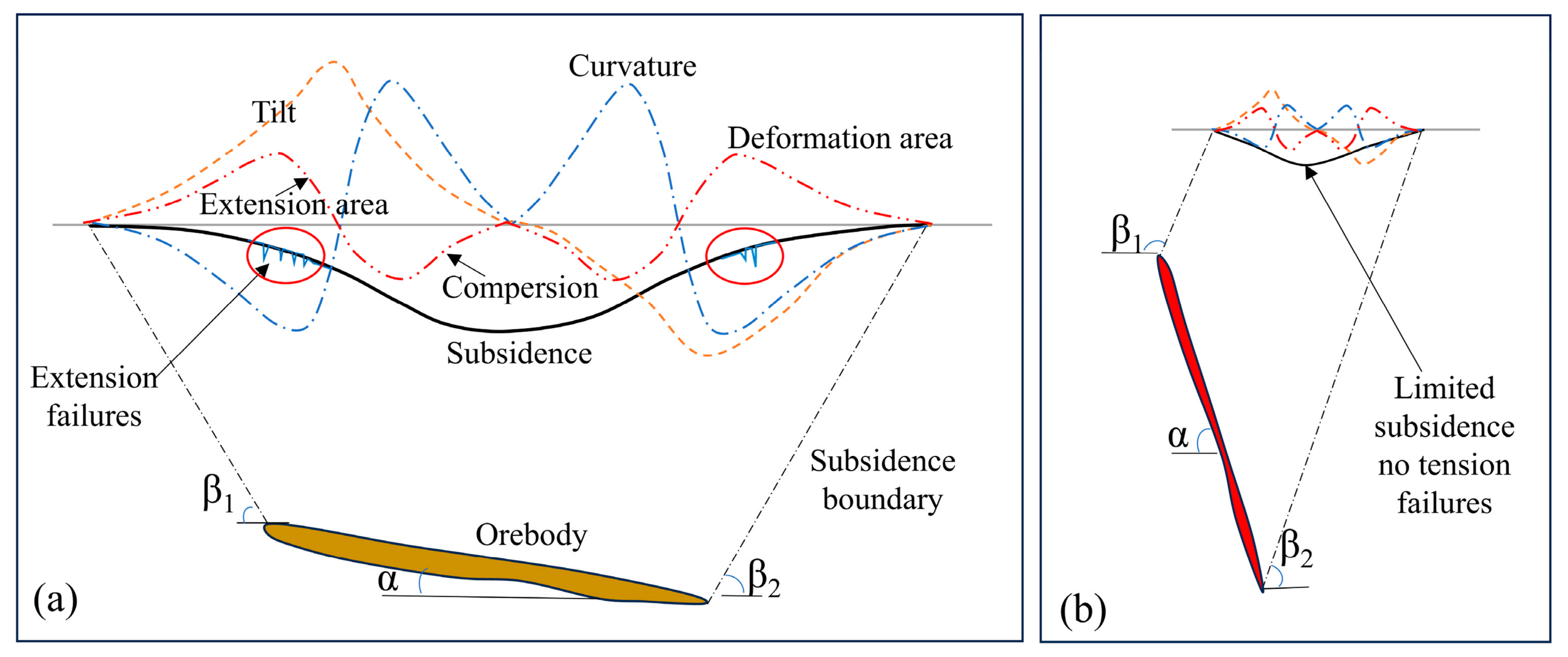
The most salient finding of this research is the fundamentally distinct subsidence pattern (Figure 6 and Figure 21) compared to that observed in flat or gently dipping deposits. Traditional subsidence basins over such deposits are typically extensive, with clear tension/compression zones and movement angles consistently less than 90° [5,19], as conceptually illustrated in Figure 22a. In stark contrast, our results revealed a highly localized subsidence zone with a footwall movement angle exceeding 90°.
The spatially confined nature of the subsidence, which shows minimal expansion with increasing mining depth (Figure 21), further supports the concept of a “constrained” deformation mechanism, where the deformation is localized within a narrow zone dictated by the orebody geometry and the backfilling, rather than propagating through a wide zone of influence as predicted by empirical methods for flat or gently dipping deposits.

5.2. Synergistic Stability Control Mechanism of Cut-And-Fill Mining for Narrow, Steeply Dipping Orebodies

The general stability of both surface and underground excavations, as confirmed by minimal deformations and controlled stress redistribution, is attributable to the key mechanisms:
Intrinsic Geometric Advantage of the Steep, Narrow Orebody: The sub-vertical dip and narrow thickness (2–3 m) create a natural geomechanical advantage. The small cross-sectional area perpendicular to the stress field results in a low extraction ratio, generating minimal mining-induced disturbance. More importantly, the geometry promotes the formation of a stable stress arch around the stopes, effectively shielding the overlying rock mass from significant deformation. This is vividly captured in the numerical model (Figure 13 and Figure 14), which shows stress concentrations localized at the orebodies’ terminations, while most of the surrounding rock experiences only minimal stress changes.
The Critical Role of Backfilling Support: The cut-and-fill mining is the cornerstone of active stability control. The backfilling does not merely fill the mining void; it acts as a structural element. Following extraction, the backfilling provides immediate confinement to the stope walls, inhibiting the progressive relaxation and failure of the surrounding rock. The numerical results demonstrate that the backfilling maintains residual load-bearing capacity (σ1 values of 5–15 MPa, Figure 13), thereby facilitating more continuous and controlled transfer of stress compared with an unfilled void. This drastically reduces the magnitude of stress redistribution and associated deformations, as seen in the minimal stress changes impacting the shafts (Figure 19) and tunnels (Figure 17).
The key factors form a mutually reinforcing synergistic system: the intrinsic geometric advantage of steep and narrow orebodies (small cross-sectional area, stress arch formation) is the fundamental premise for low mining disturbance, which reduces the initial stress redistribution and deformation induced by narrow-vein mining; the low-disturbance characteristic of narrow-vein mining is the necessary condition for the backfilling to exert its structural support effect, as it avoids large-scale rock mass failure before backfilling; and backfilling is the core guarantee that maintains the geometric advantage and low-disturbance characteristic, as it immediately confines the stope walls, inhibits rock mass relaxation, and prevents the stress arch from collapsing. Without any of these three factors, the synergistic stability control effect would be lost, as demonstrated by the historical surface collapse in shallow orebodies.
Notably, the subsidence and stability characteristics revealed in this study are consistent with the findings from similar mines with narrow, steeply dipping orebodies using cut-and-fill mining. For the Cuyu Gold Mine, with a steep and extremely narrow orebody, numerical simulation results showed that the maximum surface subsidence was only 2.58 mm when mining to the depth of −473 m, and the subsidence growth slowed down significantly with increasing mining depth [39]. For the Erdaogou Gold Mine with a mining depth over 1500 m, the surface subsidence tended to be stable after mining to the 420 m level, with a maximum subsidence of less than 8 mm, and deep mining had almost no additional impact on surface subsidence [40]. These existing studies further confirm that the low-disturbance and high-stability characteristics of deep cut-and-fill mining for narrow, steeply dipping orebodies are universal geological and engineering phenomena.

5.3. Engineering Implications for Deep Mining

The findings of this study have direct and significant implications for the planning and operation of mines in similar geotechnical settings:
Subsidence Prediction and Land Management: The identified constrained subsidence mechanism allows for a more precise prediction of the surface deformation zone. This could lead to optimized buffer zones for surface infrastructure, which would reduce unnecessary land acquisition costs and mitigate community impacts.
Mine Design and Sequencing: The demonstrated stability confirmed that the current cut-and-fill mining with the adopted sequencing is geotechnically sound, providing confidence for extending mining to greater depths.
Risk Mitigation: The understanding that deformation is channelized allows for a more focused monitoring strategy on critical zones (e.g., directly above the orebody), which improves efficiency.

5.4. Study Limitations and Future Work

While this study provides insights, certain limitations should be acknowledged. The numerical model employs a continuum approach (Mohr–Coulomb), which, while effective for simulating distributed stress and strain, has inherent limitations in simulating discontinuous phenomena such as the progressive fracturing and blocky collapse that occurred in the historical shallow mining area (Figure 23). Furthermore, the model assumes idealized, homogeneous rock mass properties and a perfectly plastic backfilling behavior, which may simplify the real-world complexity.
Future research should focus on the following:
(1)
Employing hybrid discrete-continuum numerical techniques (e.g., FEM-DEM coupling) to explicitly simulate the fracture development and rock mass degradation processes that this study could not fully capture.
(2)
Incorporating more detailed geomechanical heterogeneity and time-dependent properties of the backfilling materials to refine long-term deformation predictions.

6. Conclusions

This integrated study, combining long-term SBAS-InSAR monitoring with a 3D numerical model, successfully elucidates the unique geomechanical behavior associated with deep cut-and-fill mining of narrow, steeply dipping orebodies. The principal findings are as follows:
(1) A unique, highly localized subsidence pattern is identified. Contrary to the extensive subsidence troughs of flat or gently dipping deposits, the surface subsidence manifests as a spatially constrained elliptical basin above the orebodies, with a footwall movement angle exceeding 90°, and showing minimal progression with increasing mining depth. The magnitude of subsidence is remarkably low, with a maximum cumulative subsidence of only 9.3 mm over nine years.
(2) Overall stability of underground excavations is confirmed. Numerical simulation demonstrated that both the shafts and tunnels remained stable under the sequential extraction of multiple orebody levels, with deformations and stress changes being very small.
(3) The exceptional stability is attributed to a synergistic control mechanism, which includes the intrinsic geomechanical advantages of the steeply dipping geometry, which create kinematic constraints; the low-disturbance nature of narrow-vein mining; and the crucial structural support provided by the backfilling, which effectively controls stress redistribution and inhibits deformation propagation.
This study provides a validated framework for predicting subsidence and assessing stability in similar mining conditions. The findings demonstrate that cut-and-fill mining is highly effective in ensuring operational safety and minimizing environmental impact, offering critical insights for the sustainable exploitation of deep mineral resources.

Author Contributions

All authors contributed significantly to this research. W.Y. conceived the study, developed the FLAC3D model and drafted the manuscript. X.Z. and Y.Z. conceived the study and revised the manuscript. S.Q. processed and analyzed the data. All authors have read and agreed to the published version of the manuscript.

Funding

The research was supported by the Key Project of National Natural Science Foundation of China (Grant No. 52130403).

Institutional Review Board Statement

Not applicable.

Informed Consent Statement

Not applicable.

Data Availability Statement

The data presented in this study are available on request from the corresponding author due to the raw data required to reproduce these findings cannot be shared at this time as the data also forms part of an ongoing study.

Acknowledgments

This study was supported by Jiapigou Mining Co., Ltd (Jilin, China). through provision of raw datasets.

Conflicts of Interest

The authors declare no conflicts of interest.

Abbreviations

The following abbreviations are used in this manuscript:
SOShallow Orebody
MOMiddle Orebody
DODeep Orebody
SJShallow Shaft
MJMiddle Shaft
DJDeep Shaft
SLsshallow-level tunnels

References

  1. Xia, K.; Chen, C.; Fu, H.; Pan, Y.; Deng, Y. Mining-Induced Ground Deformation in Tectonic Stress Metal Mines: A Case Study. Eng. Geol. 2016, 210, 212–230. [Google Scholar] [CrossRef]
  2. Li, X.; Si, G.; Cao, W.; Cai, W.; Oh, J.; Canbulat, I. A Sequence of Seismic Event Triggering in Longwall Coal Mines Based on the Aftershock Cascade Theory. Int. J. Rock Mech. Min. Sci. 2024, 182, 105883. [Google Scholar] [CrossRef]
  3. Yang, Z.; Zhai, S.; Gao, Q.; Li, M. Stability Analysis of Large-Scale Stope Using Stage Subsequent Filling Mining Method in Sijiaying Iron Mine. J. Rock Mech. Geotech. Eng. 2015, 7, 87–94. [Google Scholar] [CrossRef]
  4. Li, X.; Wang, S.J.; Liu, T.Y.; Ma, F.S. Engineering Geology, Ground Surface Movement and Fissures Induced by Underground Mining in the Jinchuan Nickel Mine. Eng. Geol. 2004, 76, 93–107. [Google Scholar] [CrossRef]
  5. Booth, C.J. Strata-Movement Concepts and the Hydrogeological Impact of Underground Coal Mining. Groundwater 1986, 24, 507–515. [Google Scholar] [CrossRef]
  6. Ciszewski, D.; Sobucki, M. River Response to Mining-Induced Subsidence. CATENA 2022, 214, 106303. [Google Scholar] [CrossRef]
  7. Cheng, C.; Cheng, X.; Yu, R.; Yue, W.; Liu, C. The Law of Fracture Evolution of Overlying Strata and Gas Emission in Goaf under the Influence of Mining. Geofluids 2021, 2021, 2752582. [Google Scholar] [CrossRef]
  8. Behera, A.; Singh Rawat, K. A Brief Review Paper on Mining Subsidence and Its Geo-Environmental Impact. Mater. Today Proc. 2023, 78, 214785323020795. [Google Scholar] [CrossRef]
  9. Hall, B.E. Mining of Narrow Steeply Dipping Veins; AMC Consultants Pty Ltd.: Brisbane, Australia, 1987. [Google Scholar]
  10. Raffaldi, M.J.; Seymour, J.B.; Richardson, J.; Zahl, E.; Board, M. Cemented Paste Backfill Geomechanics at a Narrow-Vein Underhand Cut-and-Fill Mine. Rock Mech. Rock Eng. 2019, 52, 4925–4940. [Google Scholar] [CrossRef] [PubMed]
  11. Bazaluk, O.; Petlovanyi, M.; Lozynskyi, V.; Zubko, S.; Sai, K.; Saik, P. Sustainable Underground Iron Ore Mining in Ukraine with Backfilling Worked-Out Area. Sustainability 2021, 13, 834. [Google Scholar] [CrossRef]
  12. Li, J.; Zhang, J.; Huang, Y.; Zhang, Q.; Xu, J. An Investigation of Surface Deformation after Fully Mechanized, Solid Back Fill Mining. Int. J. Min. Sci. Technol. 2012, 22, 453–457. [Google Scholar] [CrossRef]
  13. Xia, K.; Chen, C.; Zheng, Y.; Zhang, H.; Liu, X.; Deng, Y.; Yang, K. Engineering Geology and Ground Collapse Mechanism in the Chengchao Iron-Ore Mine in China. Eng. Geol. 2019, 249, 129–147. [Google Scholar] [CrossRef]
  14. Feng, C.; Zhaoyuan, L.; Jianqiang, C.; Bo, C.; Yanbin, Y.; Changlu, L.; Chong, J. Research on Reducing Mining-Induced Disasters by Filling in Steeply Inclined Thick Coal Seams. Sustainability 2019, 11, 5802. [Google Scholar] [CrossRef]
  15. Peng, X.; Qi, L.; Wang, Z.; Zhou, X.; Hua, C. Study on Overburden Movement Deformation and Roof Breakage Law of Under-Protective Steeply Inclined Coal Seam Mining. Sustainability 2022, 14, 10068. [Google Scholar] [CrossRef]
  16. Yan, Y.; Li, M.; Dai, L.; Guo, J.; Dai, H.; Tang, W. Construction of “Space-Sky-Ground” Integrated Collaborative Monitoring Framework for Surface Deformation in Mining Area. Remote Sens. 2022, 14, 840. [Google Scholar] [CrossRef]
  17. Zhou, D.; Wang, L.; An, S.; Wang, X.; An, Y. Integration of Unmanned Aerial Vehicle (UAV)-Based Photogrammetry and InSAR for Mining Subsidence and Parameters Inversion: A Case Study of the Wangjiata Mine, China. Bull. Eng. Geol. Environ. 2022, 81, 343. [Google Scholar] [CrossRef]
  18. Huang, X.; Li, X.; Li, H.; Duan, S.; Yang, Y.; Du, H.; Xiao, W. Study on the Movement of Overlying Rock Strata and Surface Movement in Mine Goaf under Different Treatment Methods Based on PS-InSAR Technology. Appl. Sci. 2024, 14, 2651. [Google Scholar] [CrossRef]
  19. Qiu, X.; He, X.; Cao, R.; Qiu, H.; Shi, X.; Gou, Y.; Li, X.; Zhi, W. Study on the Surface Subsidence Trend of Fill Mining in Underground Mines with Different Mining Depths. Adv. Civ. Eng. 2024, 2024, 4407757. [Google Scholar] [CrossRef]
  20. Cao, J.; Ma, F.; Guo, J.; Lu, R.; Liu, G. Assessment of Mining-Related Seabed Subsidence Using GIS Spatial Regression Methods: A Case Study of the Sanshandao Gold Mine (Laizhou, Shandong Province, China). Environ. Earth Sci. 2019, 78, 26. [Google Scholar] [CrossRef]
  21. Modeste, G.; Doubre, C.; Masson, F. Time Evolution of Mining-Related Residual Subsidence Monitored over a 24-Year Period Using InSAR in Southern Alsace, France. Int. J. Appl. Earth Obs. Geoinf. 2021, 102, 102392. [Google Scholar] [CrossRef]
  22. Dai, S.; Zhang, Z.; Li, Z.; Liu, X.; Chen, Q. Prediction of Mining-Induced 3-D Deformation by Integrating Sin-gle-Orbit SBAS-InSAR, GNSS, and Log-Logistic Model (LL-SIG). IEEE Trans. Geosci. Remote Sens. 2023, 61, 1–13. [Google Scholar] [CrossRef]
  23. Saeidi, A.; Deck, O.; Seifaddini, M.; Heib, M.A.L.; Verdel, T. An Improved Methodology for Applying the Influence Function for Subsidence Hazard Prediction. Georisk Assess. Manag. Risk Eng. Syst. Geohazards 2022, 16, 347–359. [Google Scholar] [CrossRef]
  24. Wang, J.; Yang, K.; Wei, X.; Shi, X.; Yao, S. Prediction of Longwall Progressive Subsidence Basin Using the Gompertz Time Function. Rock Mech. Rock Eng. 2022, 55, 379–398. [Google Scholar] [CrossRef]
  25. Ye, L.; Chen, F.; Ma, H.; Shi, X.; Li, H.; Yang, C. Subsidence above Rock Salt Caverns Predicted with Elastic Plate Theory. Environ. Earth Sci. 2022, 81, 123. [Google Scholar] [CrossRef]
  26. Shen, J.; Wu, H.; Zhang, Y. Subsidence Estimation of Breakwater Built on Loosely Deposited Sandy Seabed Foundation: Elastic Model or Elasto-Plastic Model. Int. J. Nav. Archit. Ocean Eng. 2017, 9, 418–428. [Google Scholar] [CrossRef]
  27. Ju, F.; Huang, P.; Guo, S.; Xiao, M.; Lan, L. A Roof Model and Its Application in Solid Backfilling Mining. Int. J. Min. Sci. Technol. 2017, 27, 139–143. [Google Scholar] [CrossRef]
  28. Ku, C.-Y.; Liu, C.-Y. Modeling of Land Subsidence Using GIS-Based Artificial Neural Network in Yunlin County, Taiwan. Sci. Rep. 2023, 13, 4090. [Google Scholar] [CrossRef]
  29. Zhu, X.; Zhu, W.; Guo, L.; Ke, Y.; Li, X.; Zhu, L.; Sun, Y.; Liu, Y.; Chen, B.; Tian, J.; et al. Study on Land Subsidence Simulation Based on a Back-Propagation Neural Network Combined with the Sparrow Search Algorithm. Remote Sens. 2023, 15, 2978. [Google Scholar] [CrossRef]
  30. Qi, Q.; Yue, X.; Duo, X.; Xu, Z.; Li, Z. Spatial Prediction of Soil Organic Carbon in Coal Mining Subsidence Areas Based on RBF Neural Network. Int. J. Coal Sci. Technol. 2023, 10, 30. [Google Scholar] [CrossRef]
  31. Jing, Z.; Wang, J.; Wang, R.; Wang, P. Using Multi-Fractal Analysis to Characterize the Variability of Soil Physical Properties in Subsided Land in Coal-Mined Area. Geoderma 2020, 361, 114054. [Google Scholar] [CrossRef]
  32. Sun, Y.; Zuo, J.; Karakus, M.; Liu, L.; Zhou, H.; Yu, M. A New Theoretical Method to Predict Strata Movement and Surface Subsidence Due to Inclined Coal Seam Mining. Rock Mech. Rock Eng. 2021, 54, 2723–2740. [Google Scholar] [CrossRef]
  33. Labuz, J.F.; Zang, A. Mohr–Coulomb Failure Criterion. In The ISRM Suggested Methods for Rock Characterization, Testing and Monitoring: 2007–2014; Ulusay, R., Ed.; Springer International Publishing: Cham, Switzerland, 2015; pp. 227–231. [Google Scholar]
  34. Singh, B.; Goel, R.K. Engineering Rock Mass Classification: Tunneling, Foundations, and Landslides; Butterworth-Heinemann: Waltham, MA, USA, 2011. [Google Scholar]
  35. Hoek, E.; Kaiser, P.K.; Bawden, W.F. Support of Underground Excavations in Hard Rock; CRC Press: Boca Raton, FL, USA, 2000. [Google Scholar]
  36. Hoek, E.; Carranza-Torres, C.; Corkum, B. Hoek-Brown Failure Criterion-2002 Edition. Proc. NARMS-Tac 2002, 1, 267–273. [Google Scholar]
  37. Han, J.; Zhang, H.W.; Li, S.; Song, W.H. The Characteristic of in Situ Stress in Outburst Area of China. Saf. Sci. 2012, 50, 878–884. [Google Scholar] [CrossRef]
  38. Peng, S. Surface Subsidence Engineering: Theory and Practice; Csiro Publishing: Clayton, Australia, 2020. [Google Scholar]
  39. Guan, S.; Li, H.; Jin, C.; Liu, D. Numerical Simulation on Overlying Strata Movement Law in Underground Mining of Cuyu Gold Mine. J. Northeast. Univ. (Nat. Sci.) 2020, 41, 402–406. [Google Scholar]
  40. Wu, Q.; Cao, M.; Yan, P. Influence of Deep Mining on Surface Movement in Erdaogou Mine. Gold 2020, 41, 40–43. [Google Scholar]
Figure 1. Framework of InSAR subsidence monitoring and 3D numerical simulation to investigate the surface-subsidence mechanism and stability of underground excavations.
Applsci 16 04289 g001
Figure 2. Study case: (a) study area location, (b) orebody geometry and mining layout, (c) vertical projection map of the mining area, (d) surface subsidence area.
Applsci 16 04289 g002
Figure 3. Schematic layout of underground openings in the cut-and-fill mining method (1—Haulage drift; 2—Loading drift; 3—Ventilation raise; 4—Crosscut; 5—Ore pass; 6—Waste rock pass; 7—Sill pillar; 8—Crown pillar; 9—Sublevel haulage drift). Source: Provided by the mining company.
Applsci 16 04289 g003
Figure 4. Workflow of SBAS-InSAR data processing using Sentinel-1 imagery for surface subsidence monitoring.
Applsci 16 04289 g004
Figure 5. Cumulative surface subsidence derived from SBAS-InSAR during different monitoring periods: (a) 2016–2020, (b) 2016–2025.
Applsci 16 04289 g005
Figure 6. InSAR-derived subsidence basin with the projection of the orebodies.
Applsci 16 04289 g006
Figure 7. The 3D-numerical model: (a) the overall numerical model, (b) orebodies, (c) Shallow-level tunnels, (d) initial base mesh, (e) meshing of orebodies, (f) meshing of shafts and tunnels.
Applsci 16 04289 g007
Figure 8. Numerical simulation schemes: (a) the overall sequence, (b) simulated mining sequence for SO, (c) simulated mining sequence for MO, (d) simulated mining sequence for DO.
Applsci 16 04289 g008
Figure 9. Temporal variations of surface subsidence at point A, B, and C from InSAR and modelling.
Applsci 16 04289 g009
Figure 10. Contours of surface subsidence after extraction of each orebody from numerical simulation, (a) correspondence between surface and orebody locations, (b) post-SO extraction, (c) post-MO extraction, (d) post-DO extraction.
Applsci 16 04289 g010
Figure 11. Contours of final surface deformations from numerical simulation: (a) horizontal deformation, (b) vertical deformation.
Applsci 16 04289 g011
Figure 12. Distributions of deformations along the line Y = 1650 m from numerical simulation: (a) horizontal deformation, (b) vertical deformation, (c) tilt, (d) curvature.
Applsci 16 04289 g012
Figure 13. Contours of the maximum principal stress (σ1) on cross-section after extraction of each orebody from numerical simulation: (a) cross-section location, (b) post-SO extraction, (c) post-MO extraction, (d) post-DO extraction.
Applsci 16 04289 g013
Figure 14. Maximum principal stress of monitoring points from numerical simulation: (a) points near shallow orebody (O1L, O1F, O1H), (b) points near middle orebody (O2L, O2F, O2H), (c) points near deep orebody (O3L, O3F, O3H).
Applsci 16 04289 g014
Figure 15. Contours of deformation on different shallow levels from numerical simulation: (a) horizontal deformation of SL1, (b) horizontal deformation of SL2, (c) horizontal deformation of SL3, (d) horizontal deformation of SL4, (e) vertical deformation of SL1, (f) vertical deformation of SL2, (g) vertical deformation of SL3, (h) vertical deformation of SL4. White lines in (ad) and black lines in (eh) represent the layouts of shallow-level tunnels and crosscuts.
Applsci 16 04289 g015aApplsci 16 04289 g015b
Figure 16. Contours of final deformations on different shallow levels tunnels from numerical simulation: (a) horizontal deformation, (b) vertical deformation (Y-direction denotes north).
Applsci 16 04289 g016aApplsci 16 04289 g016b
Figure 17. Maximum principal stress (σ1) distribution in the surrounding rocks of shallow-level tunnels before and after the extraction of different orebodies.
Applsci 16 04289 g017
Figure 18. Final distributions of surrounding rock deformations along the shaft depth after orebody extraction: (a) horizontal deformation, (b) vertical deformation, (c) tilt, and (d) curvature.
Applsci 16 04289 g018
Figure 19. Variations of maximum principal stress (σ1) in the surrounding rock of the shafts with depth under different orebody extraction stages.
Applsci 16 04289 g019
Figure 20. Variations of plastic work with depth in the surrounding rock of the shafts before and after successive orebody extractions.
Applsci 16 04289 g020
Figure 21. Contours of vertical displacement after extraction of each orebody from numerical simulation: (a) post-SO extraction, (b) post-MO extraction, (c) post-DO extraction.
Applsci 16 04289 g021
Figure 22. Surface subsidence patterns of gently dipping orebody mining versus deep mining of narrow, steeply dipping orebody: (a) gently dipping orebody mining, (b) deep mining of narrow, steeply dipping orebody.
Applsci 16 04289 g022
Figure 23. A conceptual model of surface subsidence during shallow-levels extraction operations.
Applsci 16 04289 g023
Table 1. Parameters of Sentinel-1 Single Look Complex (SLC) data.
MissionBand TypeTime SpanScanning ModePolarization ModeIncidence AngleAzimuth Angle
Sentinel-1AC-band2016–2025IWVV/VH39.10°13.85°
Table 2. Hoek–Brown parameters based on RMR and field measurements.
ParameterDsamimbRMRGSI
Quartzite00.0160.50251.3346863
Plagioclase gneiss00.0150.502287.2076762
Table 3. Mechanical parameters of orebody, host rock, and backfilling materials.
Density (g/cm3)Compressive Strength (MPa)Tensile Strength (MPa)Elastic Modulus (GPa)Poisson’s RatioCohesion (MPa)Friction Angle (°)
Orebody3.5011.310.7811.200.163.3828.31
Host rock3.0066.600.3738.180.2214.4743.02
Backfill1.955.000.010.080.250.7025.00
Table 4. Maximum allowable structural deformations of structures in different countries.
CountryCompressive Deformation (mm/m)Tensile Deformation (mm/m)Tilt (mm/m)Curvature (1/m)
China2.02.03.00.2
France1.0–2.00.5
Germany0.60.61.0–2.0
Japan5.05.0
UK1.0
Disclaimer/Publisher’s Note: The statements, opinions and data contained in all publications are solely those of the individual author(s) and contributor(s) and not of MDPI and/or the editor(s). MDPI and/or the editor(s) disclaim responsibility for any injury to people or property resulting from any ideas, methods, instructions or products referred to in the content.