1. Introduction
Topology optimization has become a key methodology for lightweight structural design across multiple engineering disciplines. To contextualize the present study, this section reviews the theoretical foundations of topology optimization and then examines its application to automotive components, particularly suspension uprights. The discussion then identifies current limitations in existing approaches and establishes the motivation for the proposed multi-stage optimization framework. Finally, the main contributions of this work are outlined.
1.1. Background on Topology Optimization in Structural Design
Topology optimization (TO) has become a fundamental computational technique Topology optimization (TO) has emerged as a fundamental computational technique in structural design over the past three decades. It enables engineers to determine the optimal material distribution within a prescribed design domain while satisfying strength and load-bearing requirements. The foundational concept was originally introduced through homogenization methods by Bendsøe and Kikuchi [
1], establishing the theoretical basis for structural layout optimization. Subsequent developments have significantly improved their practical implementation. In particular, Sigmund [
2] proposed an efficient density-based algorithm that facilitated the application of the Solid Isotropic Material with Penalization (SIMP) method, which assigns material properties to each element to identify the most efficient structural configuration. Bendsøe and Sigmund [
3] later consolidated these theoretical and computational advances into a comprehensive framework for topology optimization.
Topology optimization differs from conventional shape and size optimization techniques in its ability to generate designs that are not restricted to predefined geometries [
2,
3]. This capability enables the discovery of innovative and highly efficient structural forms. Unlike traditional methods, which operate within fixed geometrical boundaries, topology optimization fundamentally redistributes material under prescribed loads, boundary conditions, and constraints to enhance overall system performance. Recent advancements in element technology have further improved the accuracy of TO predictions. For instance, Rozvany et al. [
4] demonstrated the advantages of hexahedral elements for stress analysis in optimized structures. Additional theoretical developments have been reviewed by Rozvany [
4], Liu and Tovar [
5], and Deaton and Grandhi [
6], highlighting the evolution and multidisciplinary applications of topology optimization as a leading approach for lightweight structural design.
1.2. Topology Optimization in Automotive Components
In the automotive industry, lightweight design represents a critical engineering objective, as reducing vehicle mass directly improves fuel efficiency, handling, and energy consumption. Consequently, topology optimization has been widely applied to enhance the stiffness-to-weight ratio of structural components. Duddeck [
7] demonstrated its successful application in industrial automotive design, emphasizing its effectiveness in achieving weight reduction while maintaining performance. Numerous studies have applied topology optimization to automotive components; for example, Suh and Song [
8] performed combined topology and shape optimization of suspension elements, achieving significant weight reductions without compromising stiffness. Kim et al. [
9] developed an optimization framework integrated with multibody dynamics to more accurately represent realistic loading conditions.
Among automotive subsystems, suspension components offer substantial potential for lightweighting due to their direct influence on unsprung mass, which affects ride comfort and vehicle handling. The steering knuckle, also referred to as the suspension upright, is a critical structural component that connects the wheel hub assembly, suspension links, and braking system [
10,
11]. Because the upright directly impacts unsprung mass and, consequently, vehicle dynamics, minimizing its weight is of considerable importance [
12].
Several studies have investigated topology optimization for steering knuckle structures. Chen et al. [
13] proposed designs that improved stress distribution while reducing mass. Srivastava et al. [
14] employed a density-based optimization approach, achieving significant weight savings while maintaining structural integrity. In motorsport applications, more aggressive lightweighting strategies are common. For example, Prabowo et al. [
15] optimized a racing upright, achieving up to a 43% reduction in mass while maintaining a safety factor of 4.956. Mesicek et al. [
16] implemented a sequential topology optimization strategy for suspension uprights, performing multiple optimization stages to enhance stiffness, albeit with a slight increase in mass, thereby illustrating typical design trade-offs.
Recent research has integrated topology optimization with fatigue analysis and advanced manufacturing techniques. Wikarta et al. [
17] conducted fatigue-based optimization of a Formula SAE upright, achieving approximately 30% mass reduction alongside improved durability. Hasan et al. [
10] applied topology optimization to a Formula Student steering knuckle, validating the results through finite element analysis. Akilan and Reddy [
18] proposed a manufacturability-aware optimization framework tailored for additive manufacturing, while Almonti et al. [
19] demonstrated that both casting and additive manufacturing can be used to produce topology-optimized suspension components.
Focusing specifically on Formula SAE applications, Vasiloglou et al. [
20] presented a complete workflow from topology optimization to laser powder bed fusion, achieving a mass reduction from 369 g to 259 g. Hossen et al. [
21] optimized steering uprights using structural design and finite element analysis, comparing Aluminum 6061-T6 and Ti-6Al-4V, with experimental validation showing less than 1% deviation. Liu et al. [
22] developed fatigue-life prediction models for optimized FSAE uprights under dynamic loading conditions. Li et al. [
11] and Hasan et al. [
10] further demonstrated lightweight designs incorporating both static and dynamic analyses using variable-density optimization approaches. Regarding material selection, several studies identify Aluminum Alloy 7075-T6 as an optimal choice for FSAE uprights due to its high strength-to-weight ratio, ductility, and corrosion resistance [
21,
23].
1.3. Research Gap and Limitations of Current Approaches
Despite significant advancements in topology optimization for suspension components, several limitations remain in the existing literature. A comparative analysis of representative studies (
Table 1) highlights critical gaps that motivate the present work.
First, many studies rely on simplified loading conditions that do not adequately represent the complex operational environments experienced by suspension components. In practice, suspension uprights are subjected to combined vertical, braking, and cornering loads, leading to complex stress distributions that must be accurately captured in the design process.
More importantly, most topology optimization approaches for uprights focus on a single objective function, which limits their ability to capture the inherent trade-offs between competing performance criteria. These limitations manifest in several ways:
Stiffness-driven optimization (e.g., compliance minimization) may lead to increased stress concentrations or, as observed by Mesicek et al. [
16], even increased mass.
Optimization focused solely on mass reduction may compromise stiffness or structural strength under critical loading conditions.
Stress-driven optimization may result in overly conservative designs with unnecessary material usage.
These trade-offs are intrinsic to single-objective formulations, which explore only a limited region of the design space and may exclude solutions that provide a balanced compromise between competing objectives. Although multi-objective optimization methods (e.g., weighted-sum approaches and Pareto-based techniques) are available, their application to complex engineering components often presents practical challenges. These include high computational cost, the generation of large solution sets that are difficult to interpret during early-stage design, and final geometries that lack transparency regarding the contribution of individual objectives.
Furthermore, there is a lack of systematic design frameworks that integrate insights from multiple independent single-objective optimizations into a unified design. Most existing studies report a single optimized configuration without exploring how complementary structural features from different optimization strategies can be combined through a structured synthesis process.
1.4. Contributions to This Work
To address the limitations identified in the literature, this study proposes a structured multi-stage topology optimization framework for the conceptual design of an automotive suspension upright. Unlike conventional approaches based on a single optimization process, the proposed methodology systematically explores multiple optimization strategies and integrates their most advantageous structural features into a unified design.
The main contributions of this work are summarized as follows:
A multi-stage topology optimization framework is proposed, combining stiffness-driven and stress-driven optimization with a hybrid synthesis stage to balance mass reduction, structural stiffness, and stress distribution.
A hybrid design synthesis methodology based on structural feature integration is developed, in which key geometric features from independent topology optimization results are systematically identified and integrated through parametric analysis using ANSYS Workbench.
A lightweight Formula SAE upright design is computationally evaluated. Finite element analysis demonstrates a 29.44% reduction in mass, a decrease in peak stress relative to the reference model, and the preservation of structural stiffness and integrity.
Although sequential topology optimization strategies have been previously applied to suspension components, such as in Mesicek et al. [
16], the framework proposed in this study differs fundamentally. In sequential approaches, the optimized density field from one stage serves as the initial condition for subsequent optimization steps, leading to progressive material redistribution. In contrast, the present methodology performs independent stiffness-driven and stress-driven optimizations, from which geometrically interpretable structural features are extracted and subsequently integrated through a constrained parametric hybrid synthesis process. This distinction establishes a clear methodological difference between sequential topology refinement and multi-stage hybrid feature synthesis.
2. Design Problem Definition
A precise delineation of the problem is fundamental to guarantee the validity of the optimization process. The subsequent section elucidates the functional role of the suspension upright, the geometric design domain, material selection, and the applied loading conditions. Collectively, these elements establish the physical and computational framework requisite for the ensuing topology optimization and hybrid design synthesis.
2.1. Automotive Upright
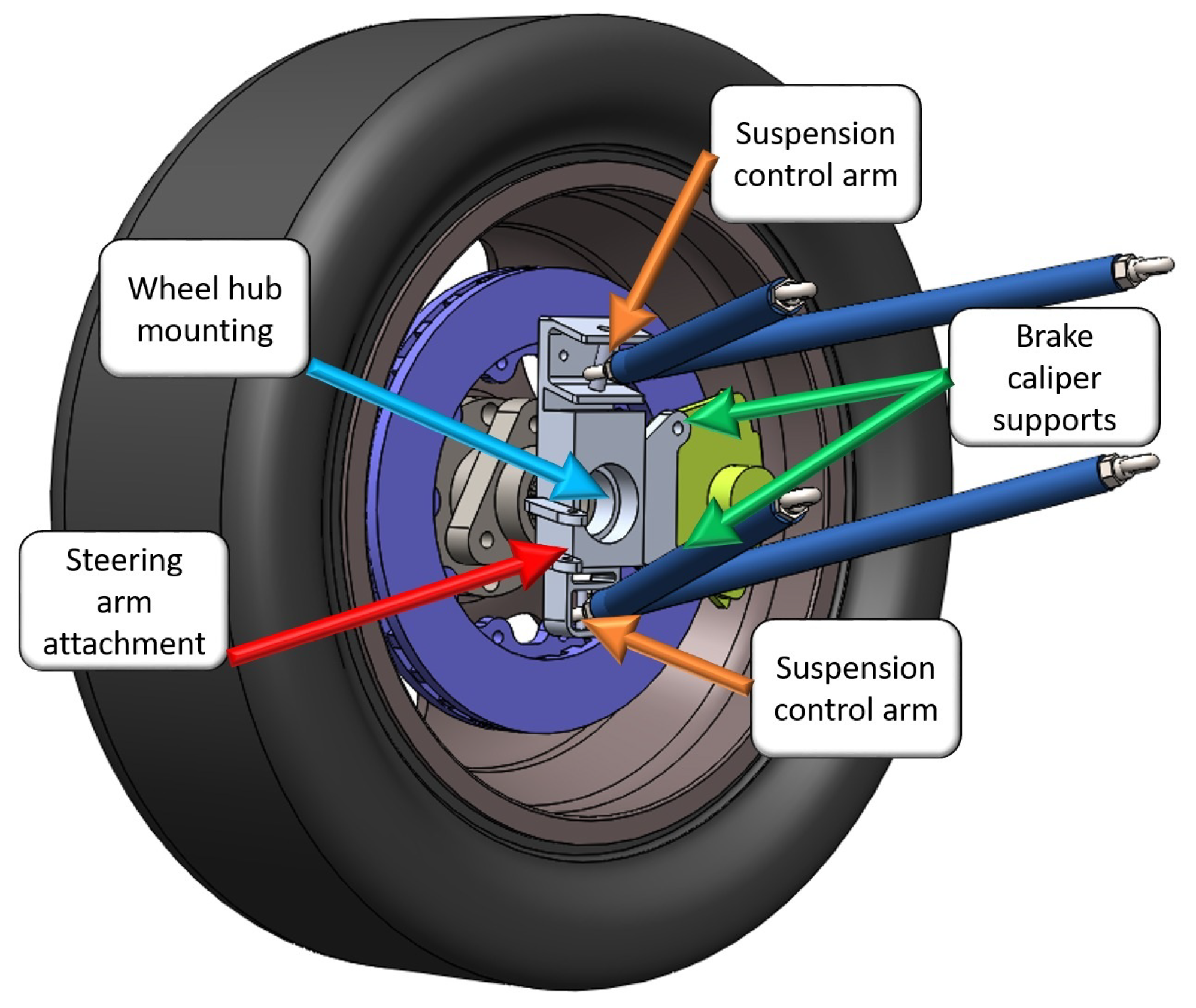
The upright performs several essential structural functions, including supporting the wheel hub and bearing assembly, enabling steering articulation, and providing mounting points for the brake calipers [
10]. Specifically, the front upright transmits forces and moments between the wheel assembly and the suspension control arms [
11]. Given its direct contribution to unsprung mass, reducing its weight is critical for improving vehicle dynamic performance [
12].
Figure 1 presents the three-dimensional model of the upright, highlighting key functional interfaces such as the wheel hub mounting, steering arm attachment, brake caliper supports, and suspension control arm connection points.
Formula SAE is an international engineering competition in which university students design and manufacture a small Formula-style race car. Vehicle designs must comply with the regulations specified in the competition rulebook, and the resulting prototypes are evaluated through a series of static and dynamic tests. Within this context, the upright represents a critical component for structural optimization due to its direct influence on vehicle dynamics.
2.2. Design Domain
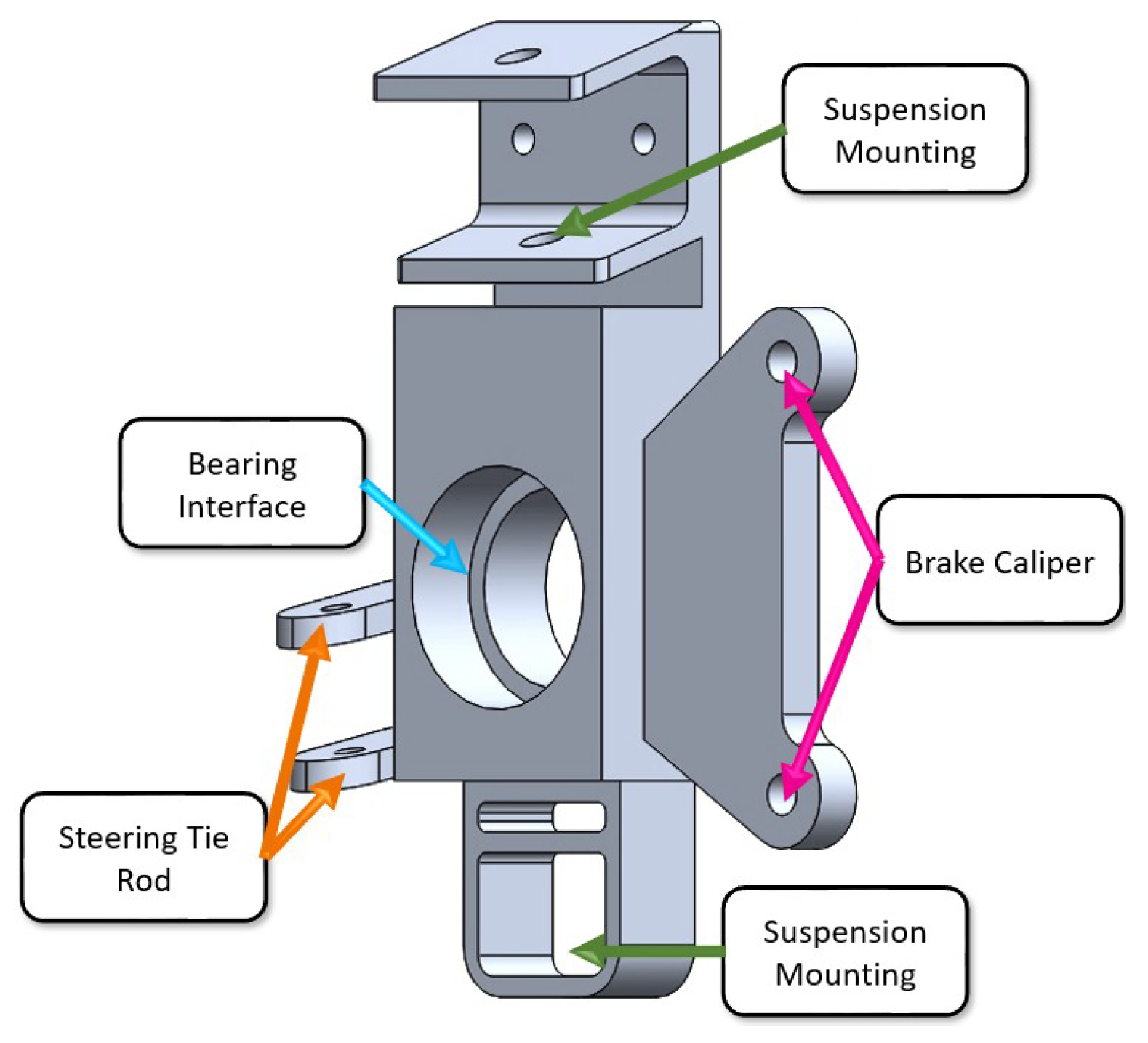
The initial design domain for topology optimization is depicted in
Figure 2, which also defines the bounding box dimensions. It represents the maximum allowable volume that the component may occupy, as constrained by packaging requirements within the wheel assembly and suspension geometry. In accordance with recommendations from the literature [
12], the design domain was defined to be as large as possible while maintaining a simple geometry to reduce computational cost. Additionally, potential geometric interferences were evaluated throughout the domain.
2.3. Material Properties
The material selected in this study is Aluminum Alloy 7075-T6 (Zicral), which is widely used in FSAE applications due to its high strength-to-weight ratio, ductility, and corrosion resistance [
23,
24,
25]. Its mechanical properties are summarized in
Table 2.
2.4. Loading Conditions
The loads applied to the upright were determined using the methodology proposed by Seward [
26], which considers two primary load cases for a racing vehicle: maximum cornering and maximum braking. A summary of the variables used in the load calculations is presented in
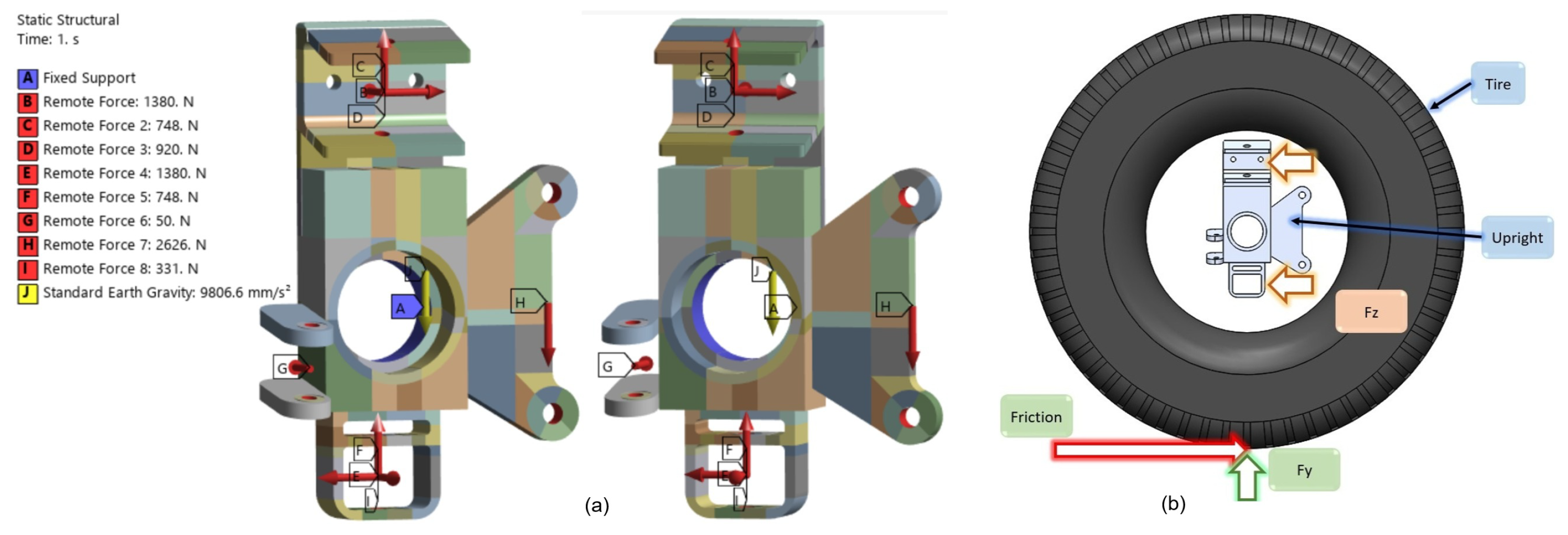
Table 3. The braking and cornering load cases were applied at the corresponding hard-point interfaces of the upright. The static loads represent peak envelope conditions derived from suspension dynamic analysis and therefore correspond to physically grounded operational extremes rather than arbitrary force assumptions.
Figure 3 illustrates the attachment locations and the corresponding load application.
2.5. Maximum Cornering
During cornering, the upright is subjected to combined lateral and vertical loads. The force acting on the outer wheel is defined as follows:
is the maximum lateral load:
is the maximum vertical load:
2.6. Maximum Braking
During braking, the upright is subjected to vertical and longitudinal loads. The corresponding reactions at the outer wheel are given by:
3. Topology Optimization Formulation
Topology optimization is employed in this study to explore alternative structural configurations for the automotive upright by determining the optimal material distribution within a prescribed design domain. The approach is based on density-based topology optimization, in which a set of continuous design variables is assigned to each finite element to represent the material distribution.
The optimization procedure employs the Solid Isotropic Material with Penalization (SIMP) method, which interpolates the material properties of each element as a function of its density.
3.1. Density-Based Optimization Model
In the adopted formulation, each finite element within the design domain is assigned a density variable
, such that, where:
The elastic modulus of each element is interpolated using the SIMP scheme:
where:
is the effective elastic modulus of element i,
is the elastic modulus of the base material,
p is the penalization factor used to promote discrete material distribution,
is the density design variable.
This formulation promotes convergence toward designs composed predominantly of solid and void regions.
3.2. Stiffness-Oriented Optimization
This optimization approach seeks structural configurations that maximize stiffness under prescribed loading conditions. This is achieved by minimizing structural compliance.
The optimization problem is formulated as:
Subject to:
where:
where:
represents the total strain energy (compliance) of the structure; minimizing J is equivalent to maximizing stiffness.
is the strain energy density.
denotes the strain field, and D is the elasticity matrix of the material.
The first constraint represents the weak form of the equilibrium equation, ensuring that internal and external virtual work are balanced. The second constraint enforces essential (Dirichlet) boundary conditions.
The third constraint limits the total material volume to a maximum value , thereby promoting material efficiency. In this study, a volume fraction of was imposed. This ensures that no more than 35% of the initial design domain volume is retained. The same volume constraint was applied consistently across stiffness-driven, stress-driven, and hybrid optimization cases to ensure comparability.
This formulation determines the optimal material distribution within the design domain that maximizes stiffness while satisfying equilibrium, boundary, and volume constraints.
3.3. Stress-Oriented Optimization Formulation
While stiffness-driven optimization minimizes deformation, it does not explicitly control stress levels within the structure. In many engineering applications, particularly those subjected to extreme loading, limiting peak stress is critical to prevent material failure.
To address this limitation, Yang and Chen [
27] proposed a stress-based topology optimization formulation:
Subject to:
where:
represents the stress-related objective function, which seeks to reduce overall stress levels in the structure.
is the material density field, varying between 0 (void) and 1 (solid).
is a local stress function, typically based on the von Mises equivalent stress.
The term ensures that only material regions contribute to the objective function, while void regions are excluded.
The volume constraint limits the total material usage to , ensuring that stress reduction is achieved within a lightweight design framework.
Unlike compliance minimization, which prioritizes stiffness, stress-based optimization redistributes material to reduce stress concentrations. The resulting designs tend to increase material in highly stressed regions while removing it from low-stress areas, thereby improving stress uniformity and structural safety.
3.4. Numerical Implementation
The topology optimization problems are solved using a finite element discretization of the design domain. The optimization procedure iteratively updates the density variables until the convergence criteria are satisfied.
Filtering techniques are applied to mitigate numerical instabilities, such as checkerboard patterns and mesh dependency. The solutions obtained from both optimization stages yield distinct structural configurations that serve as the basis for the hybrid design synthesis framework described in the subsequent section.
4. Multi-Stage Topology Optimization Approach
The proposed approach integrates the results of stiffness- and stress-oriented topology optimizations into a structured design workflow for the conceptual development of automotive uprights.
Rather than formulating a continuous multi-objective optimization problem using conventional Pareto-front generation methods, the framework redefines hybrid synthesis as a constrained, discrete, multi-objective exploration within a bounded parametric domain.
The framework comprises three principal stages:
Stiffness-oriented topology optimization
Stress-oriented topology optimization
Hybrid topology synthesis
4.1. Overview of the Proposed Approach
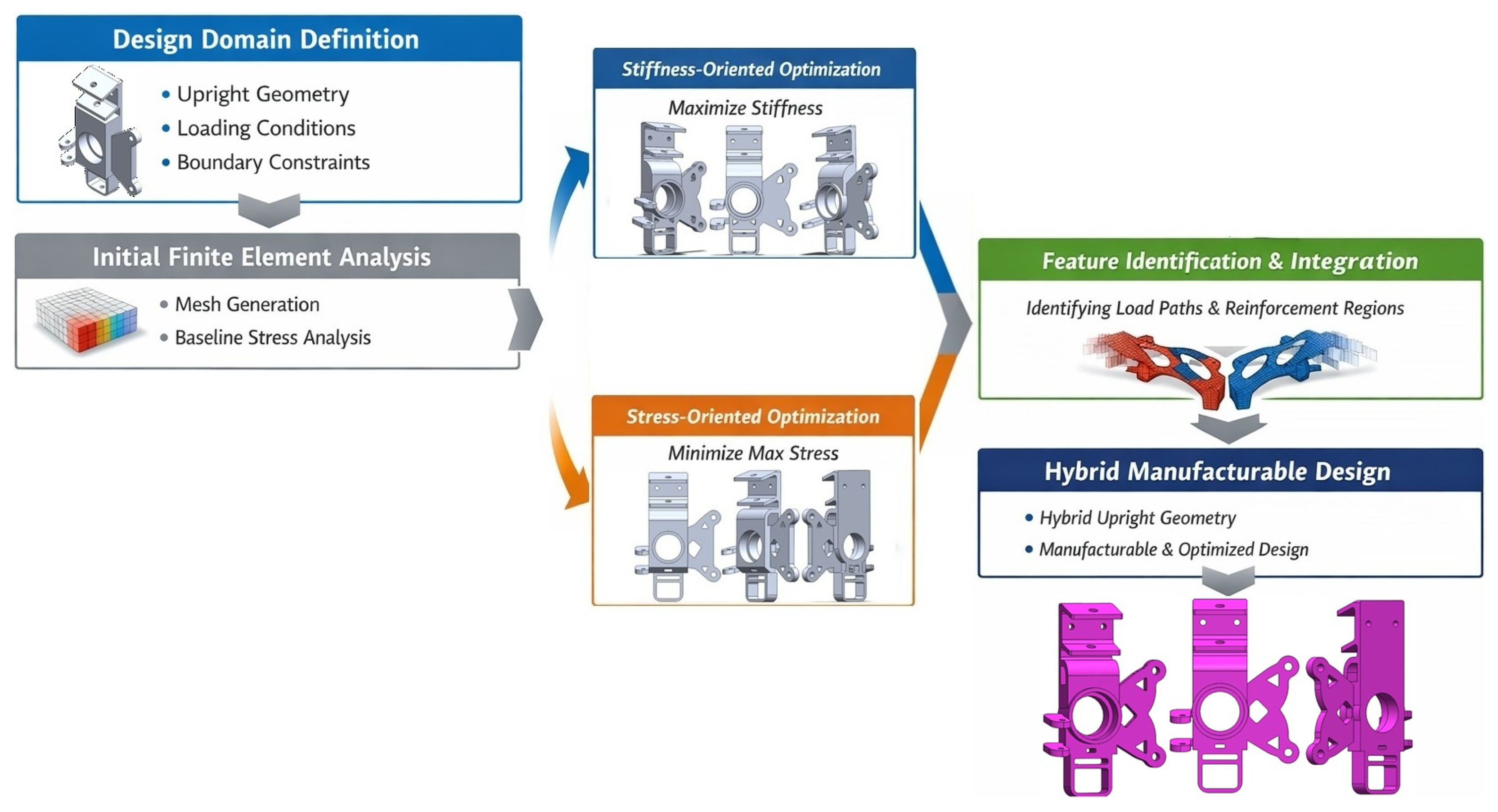
Figure 4 depicts the proposed multi-stage topology optimization approach. The process begins with the definition of the design domain, loading conditions, and boundary constraints, followed by a finite element analysis of the initial upright model.
Subsequently, two independent topology optimizations are performed to investigate structural configurations aligned with distinct performance objectives. The resultant topologies are then examined to identify common structural features and load pathways. These insights are employed to inform the synthesis of a manufacturable upright geometry.
4.2. Reference Geometry Finite Element Analysis
Based on the loading conditions defined in Equations (1)–(5), a finite element analysis (FEA) was conducted in ANSYS 2024 to evaluate the structural response of the front upright. The boundary conditions account for wheel–road interaction, braking forces, cornering loads, and gravitational effects.
According to reference [
23], a finite element analysis (FEA) was conducted to identify the upright regions with the highest stress concentrations. A mesh convergence study was performed to confirm that the results were independent of element size. Hexahedral elements were selected for their accuracy and stability, building upon McDill [
28] foundational work on tet-to-hex conversion and Kikale et al. [
29] recent comprehensive validation. Merkley et al. [
30] provides additional theoretical background regarding element performance.
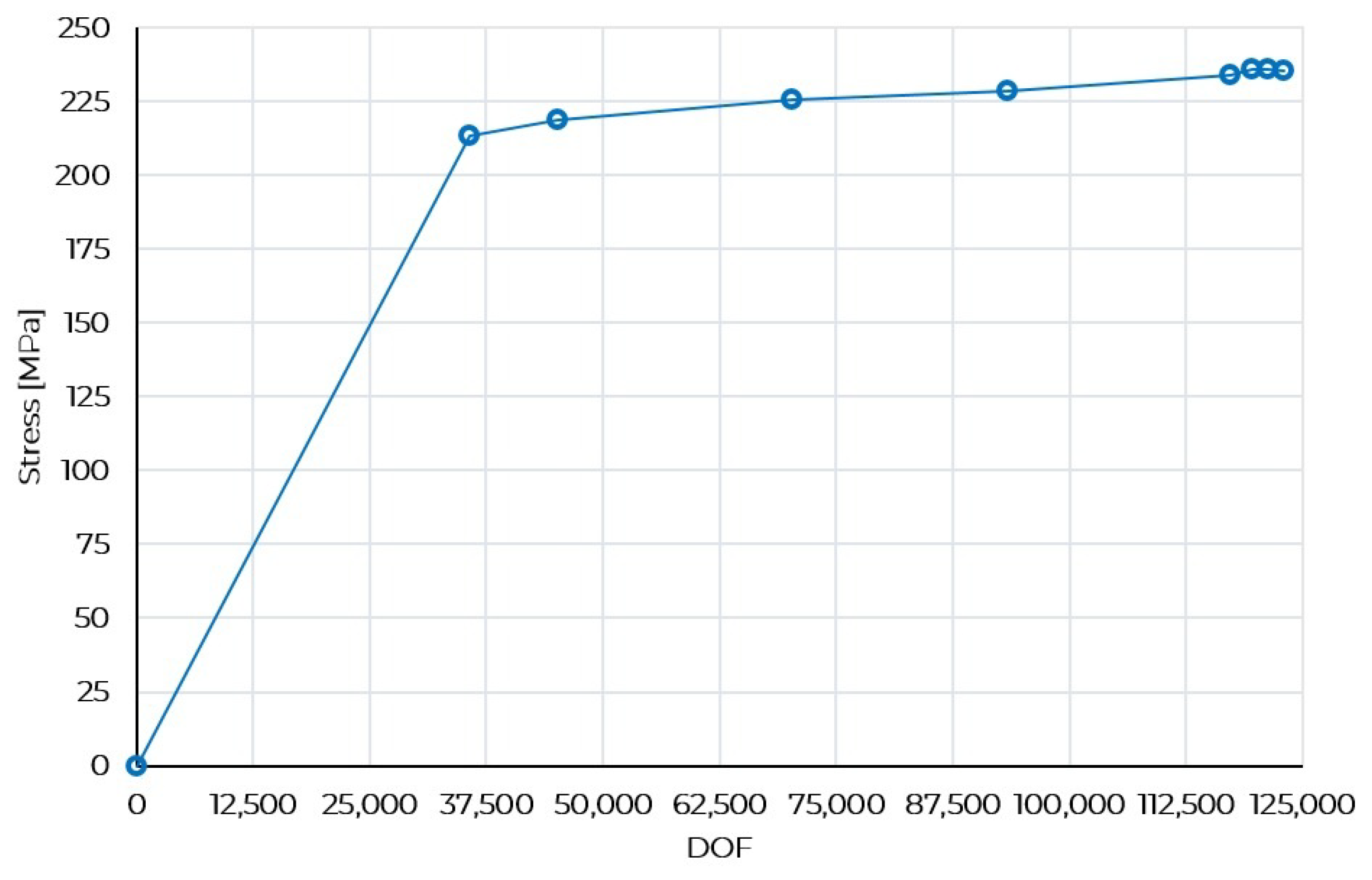
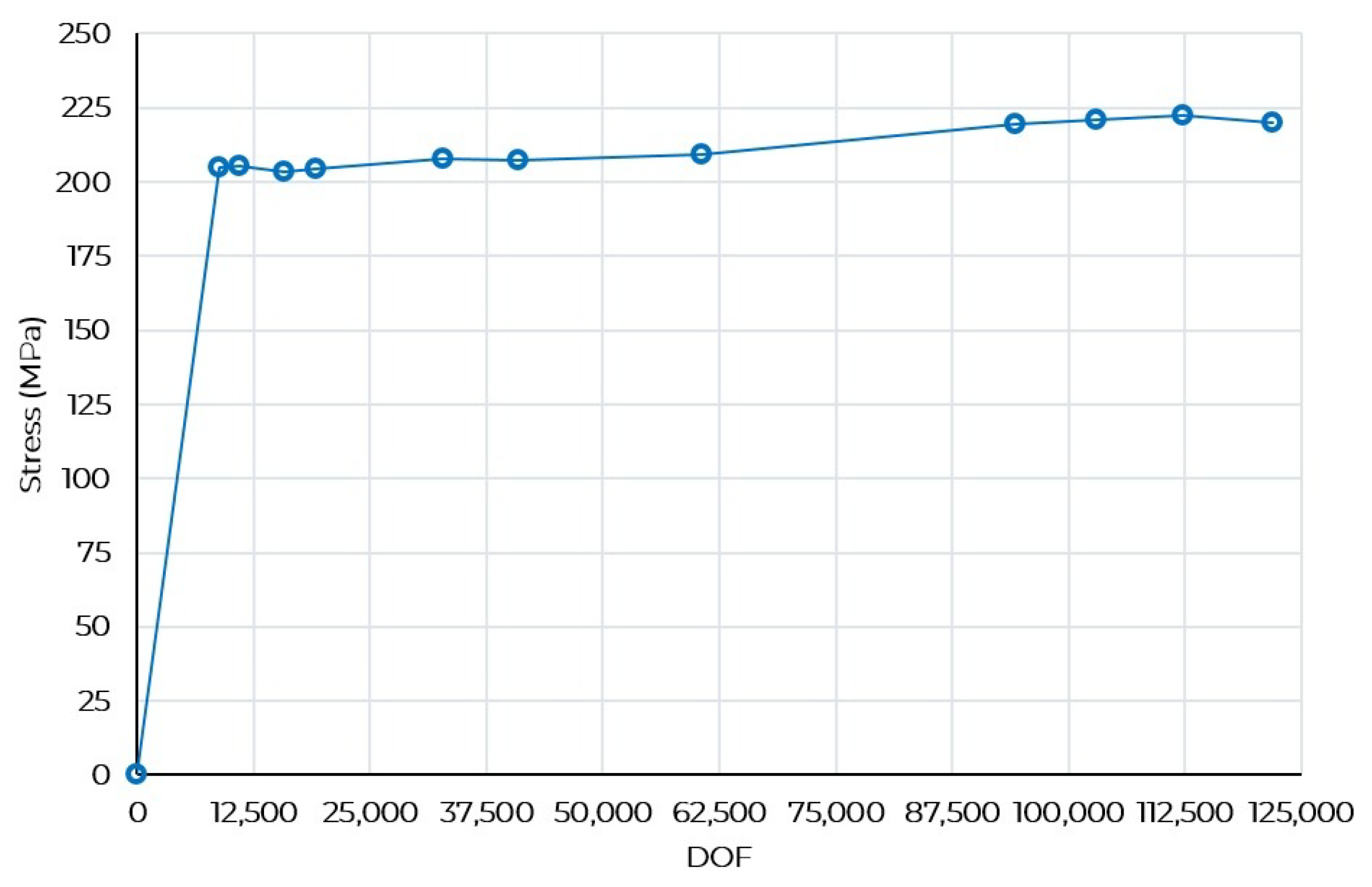
The mesh sensitivity analysis in
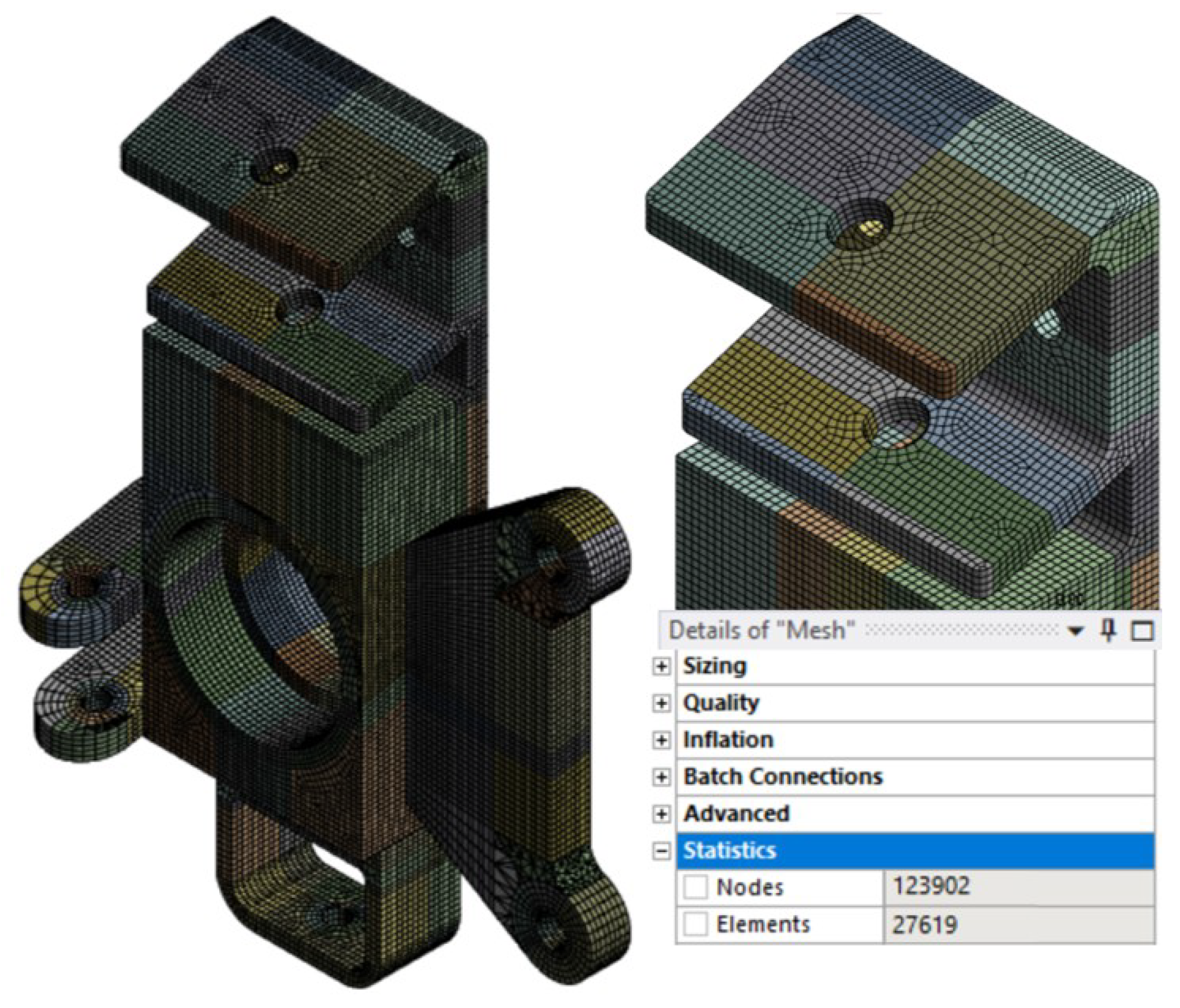
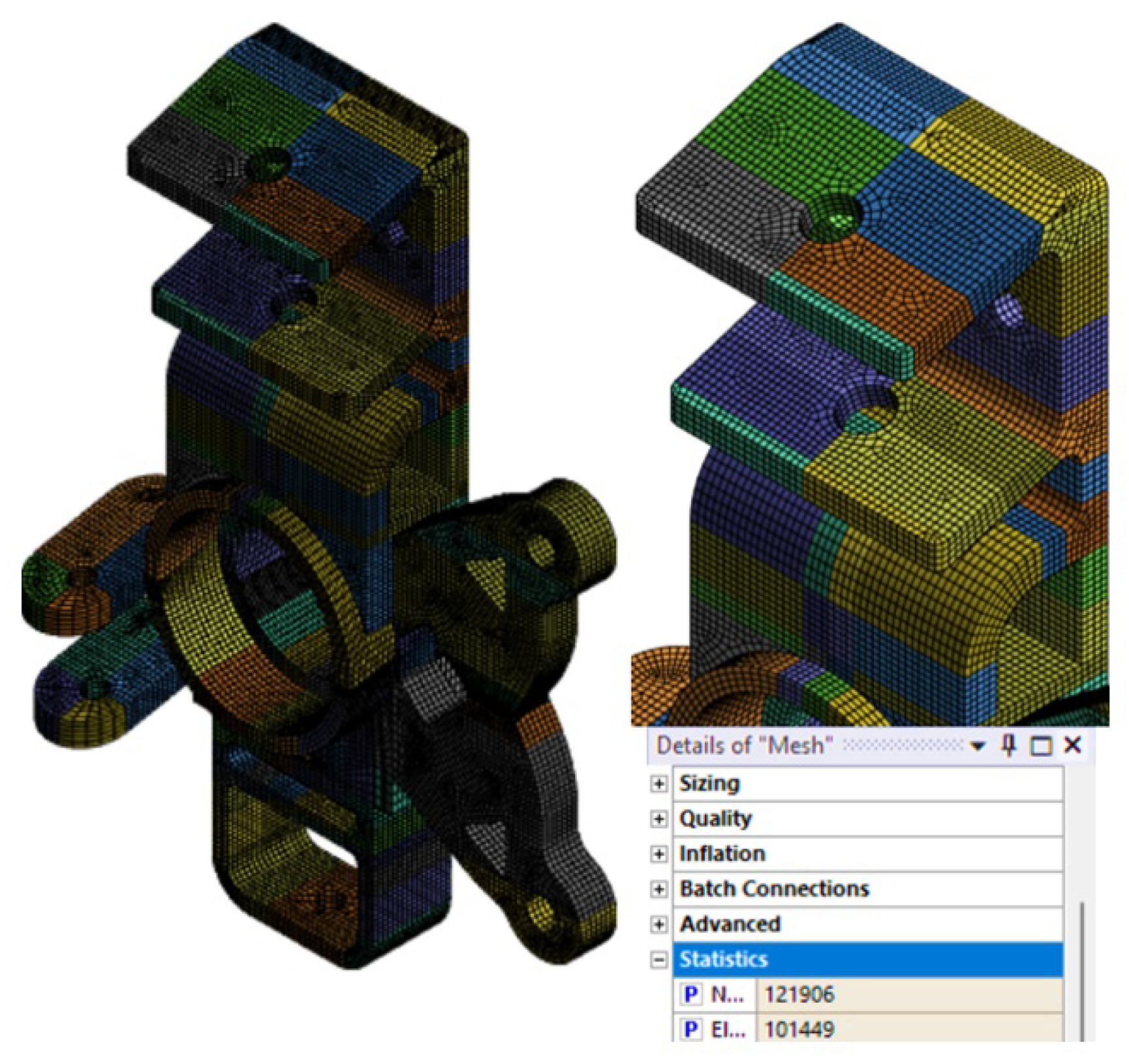
Figure 5 shows that results stabilize starting from the fifth iteration, with stress-level changes of less than 1%. The seventh iteration was chosen as the representative upright model because it displays the highest stress levels. For the mesh convergence analysis, a hexahedral mesh was used in the numerical model, as shown in
Figure 6, with 123,902 nodes.
An appropriate mesh resolution ensures accurate predictions of stress and deformation, satisfies design requirements, and preserves accuracy in critical regions of the model. While hexahedral elements can yield more accurate simulations, discretizing complex geometries often increases complexity, and their application may be limited by the inherent geometric constraints of the design. Nonetheless, their selection is justified by their ability to produce more stable, consistent results, which are essential for advancing optimized geometries that are smoother, more uniform, and structurally robust. This attribute is crucial for preserving the upright’s performance and longevity under actual loading conditions.
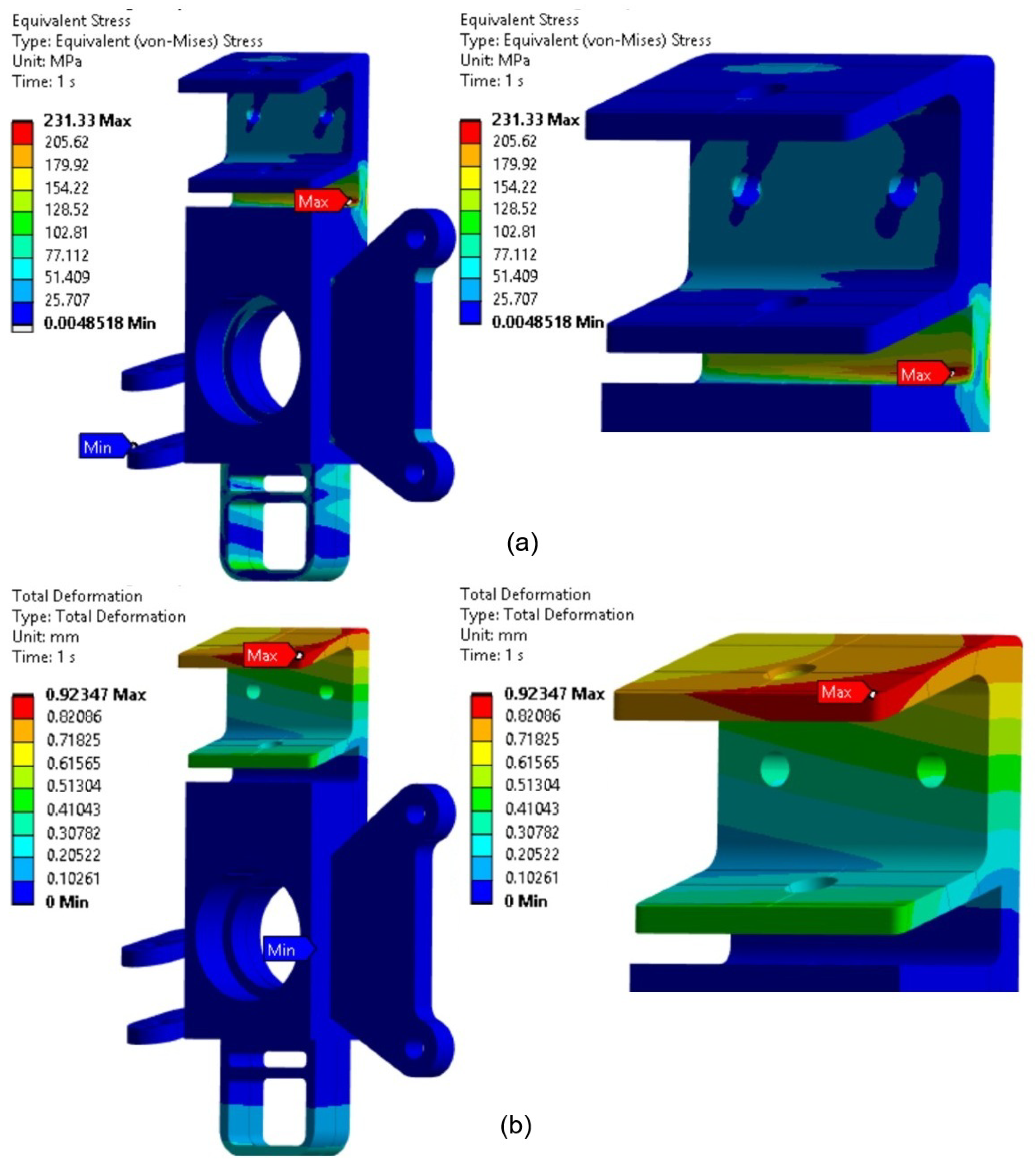
The stress and deformation contours for the front upright design were derived from the simulation model obtained through mesh sensitivity analysis, as shown in
Figure 7. These results demonstrate that the stress and deformation contours correspond to those of the reference FEM model, including their magnitude trends.
4.3. Topology Optimization Domain
To facilitate the topology optimization process, it is essential to delineate the design space, which specifies the regions eligible for optimization. Research, such as that conducted by Hunar et al. [
12], indicates that the design space should be maximized while maintaining a simple shape to reduce computation time. Furthermore, it is imperative to evaluate the entire design space for potential collisions.
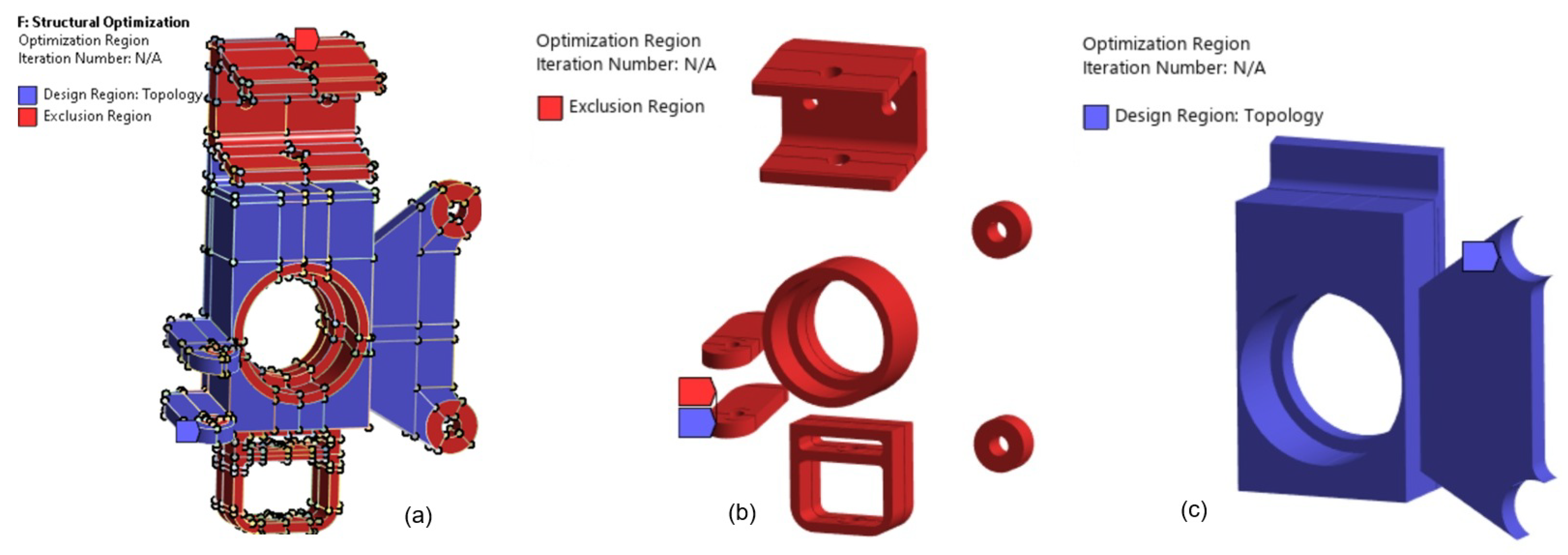
The topology optimization region is depicted in
Figure 8a. The design space used in the topology optimization process is shown in
Figure 8b; conversely, the non-design area comprises components that the optimization algorithm must leave unaltered. This region includes the mounting points for the bearings, brake discs, suspension arms, and steering system. The complete non-design domain is not illustrated in
Figure 8c.
4.4. Stage 1: Stiffness-Driven Topology Optimization
The initial optimization phase focused on maximizing the upright’s stiffness to enhance its resistance to deformation under loads. As the upright is a structural component that connects moving subsystems, its stiffness is critical to maintaining proper suspension kinematics and steering response [
31]. A 20–30% mass reduction was targeted within the design space, as documented in the reference case study [
23]. Model constraints were established by boundary conditions that excluded certain sections from the optimization process (non-design parts), as shown in
Figure 8.
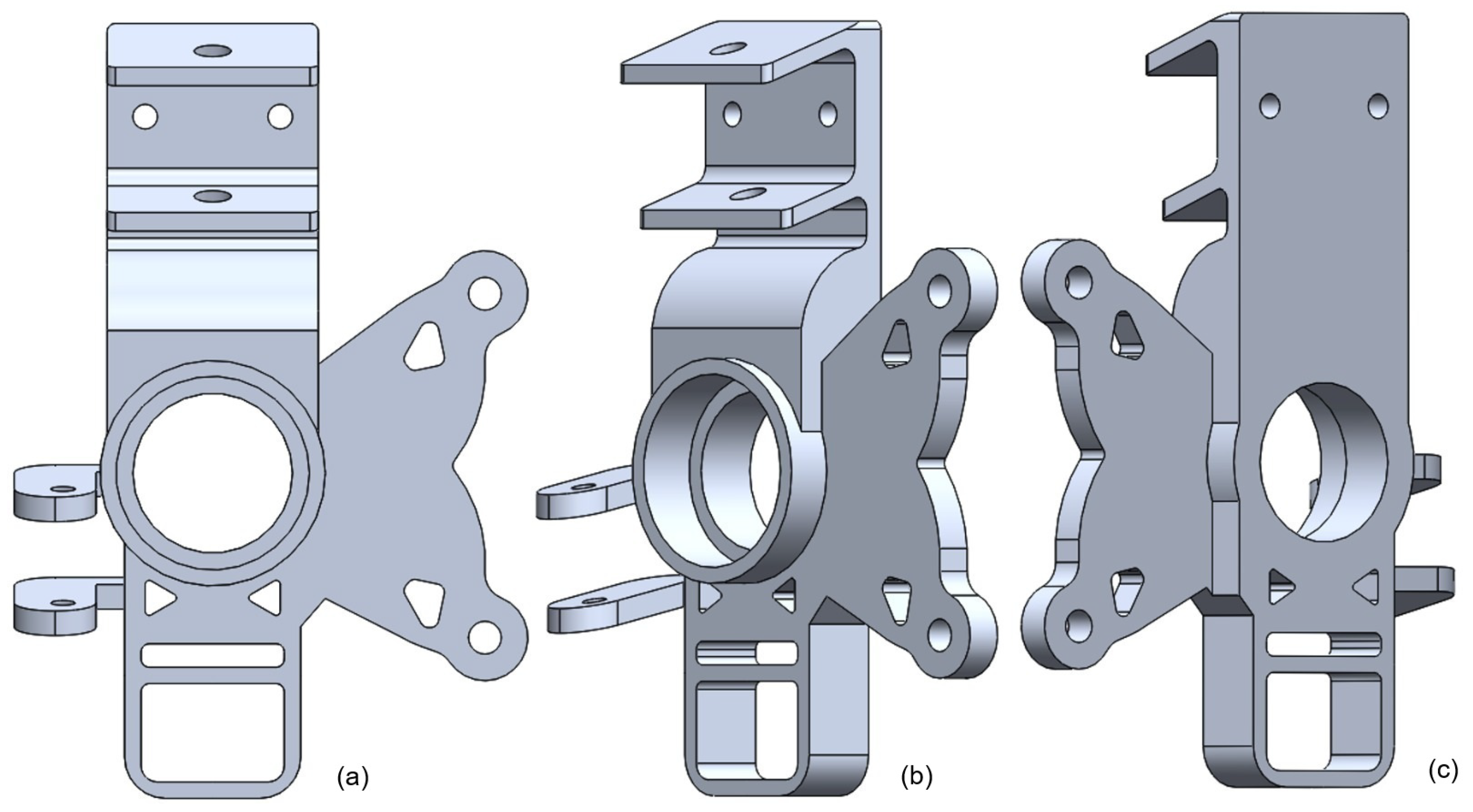
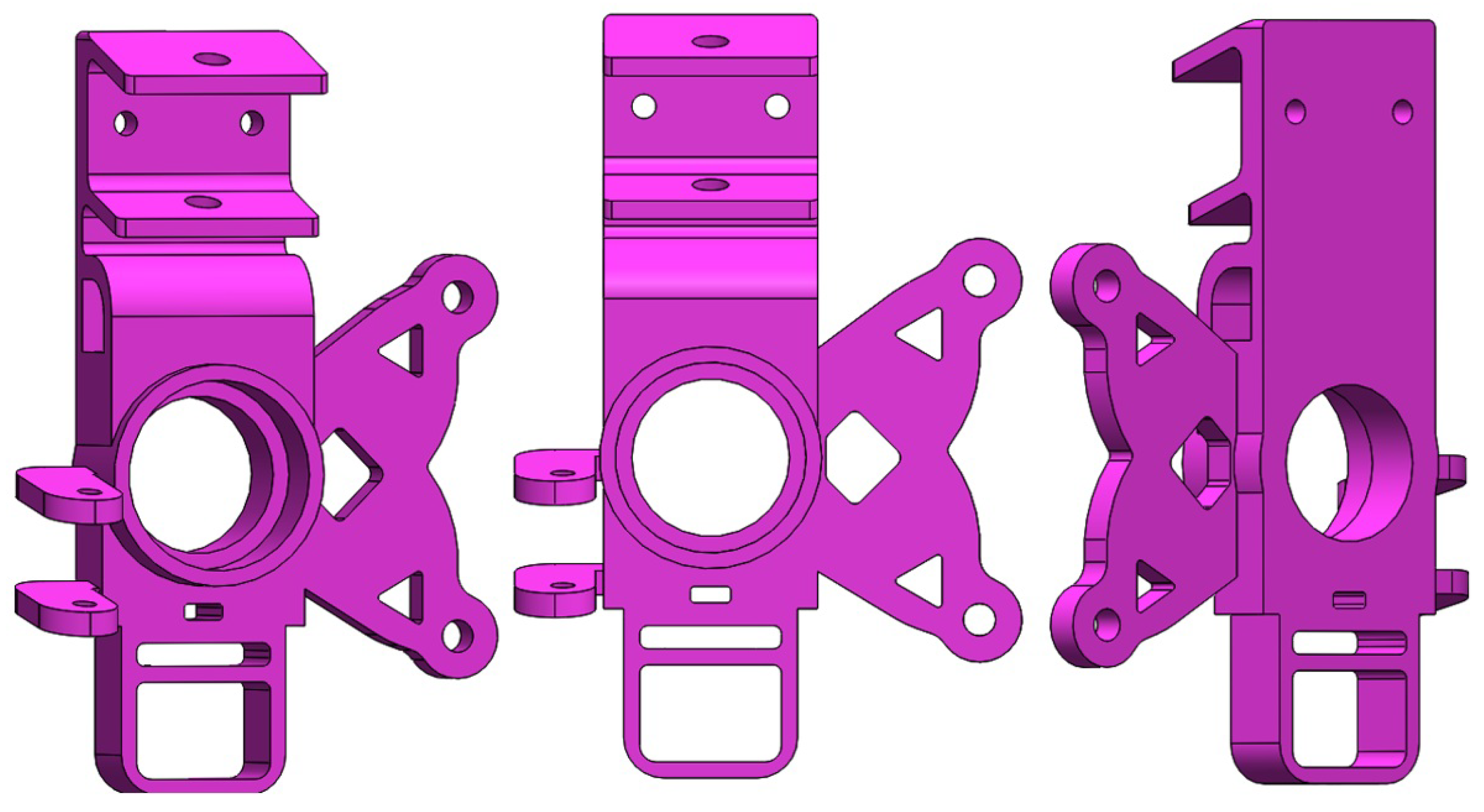
The outcome after geometric optimization and post-processing is shown in
Figure 9. This optimized design has a mass of 456.1 g, representing a 26.07% reduction over the reference model.
4.5. Stage 2: Stress-Driven Topology Optimization
The second stage of optimization focused on mitigating stress concentrations in the upright while preserving structural integrity under identical loading and boundary conditions to the reference model. In contrast to stiffness-driven optimization, this phase emphasized stress redistribution throughout the structure to reduce peak stresses in critical regions that could otherwise lead to premature failure under extreme operational loads.
To achieve this objective, topology optimization was applied to the design domain with a target mass reduction of 20–30%, enabling the removal of inefficient material while preserving critical load-transfer paths. Consistent with Stage 1, the optimization process adhered to the previously established design and non-design domains to preserve functional interfaces.
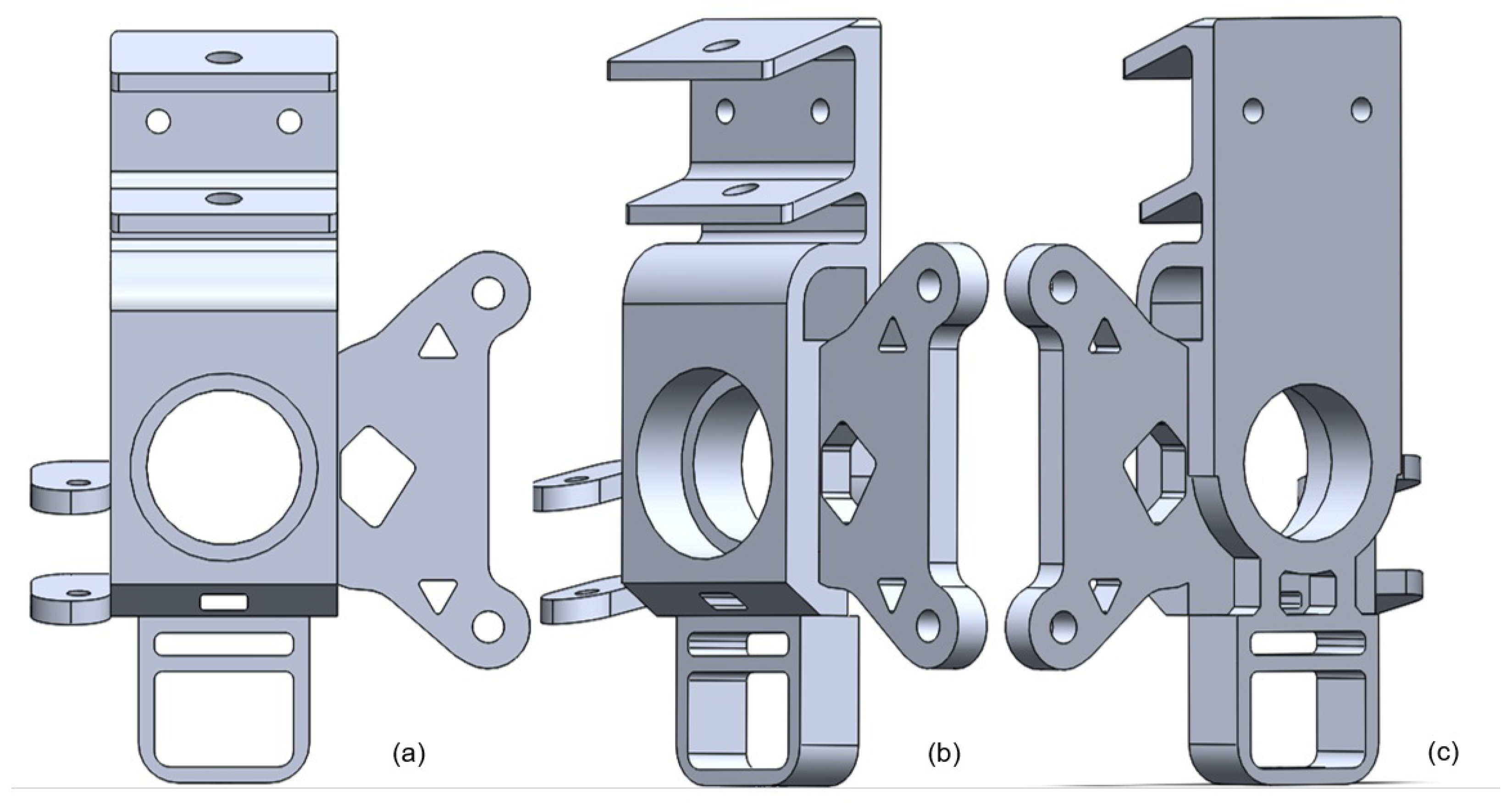
Following completion of the optimization and subsequent post-processing, the resulting geometry is shown in
Figure 10. The stress-driven optimized design achieved a final mass of 480.9 g, representing a 22.05% reduction relative to the reference model. Although the degree of mass reduction is lower than that achieved during the stiffness-driven optimization stage, this design markedly reduces peak stress concentrations, thereby enhancing the structural reliability of the component under severe loading conditions.
4.6. Stage 3: Hybrid Design Synthesis
Following the independent optimization stages driven by stiffness and stress considerations, it is essential to integrate the respective advantages of each into the design process. The hybrid synthesis approach described herein emphasizes the identification, parameterization, and systematic integration of key structural features into a unified configuration that effectively balances mass reduction, stiffness, and stress distribution.
4.6.1. Identification of Key Geometric Features
The synthesis of a hybrid geometry requires a rational basis for selecting features derived from stiffness-driven and stress-driven designs for integration. A purely qualitative selection approach would introduce subjectivity and limit reproducibility. Accordingly, this preliminary phase entailed a systematic and comparative analysis of the topology optimization density maps alongside finite element analysis (FEA), with particular attention to the stress and deformation contours obtained from Stages 1 and 2. The primary objective was to identify distinct geometric features and, critically, to understand their influence on the structural response.
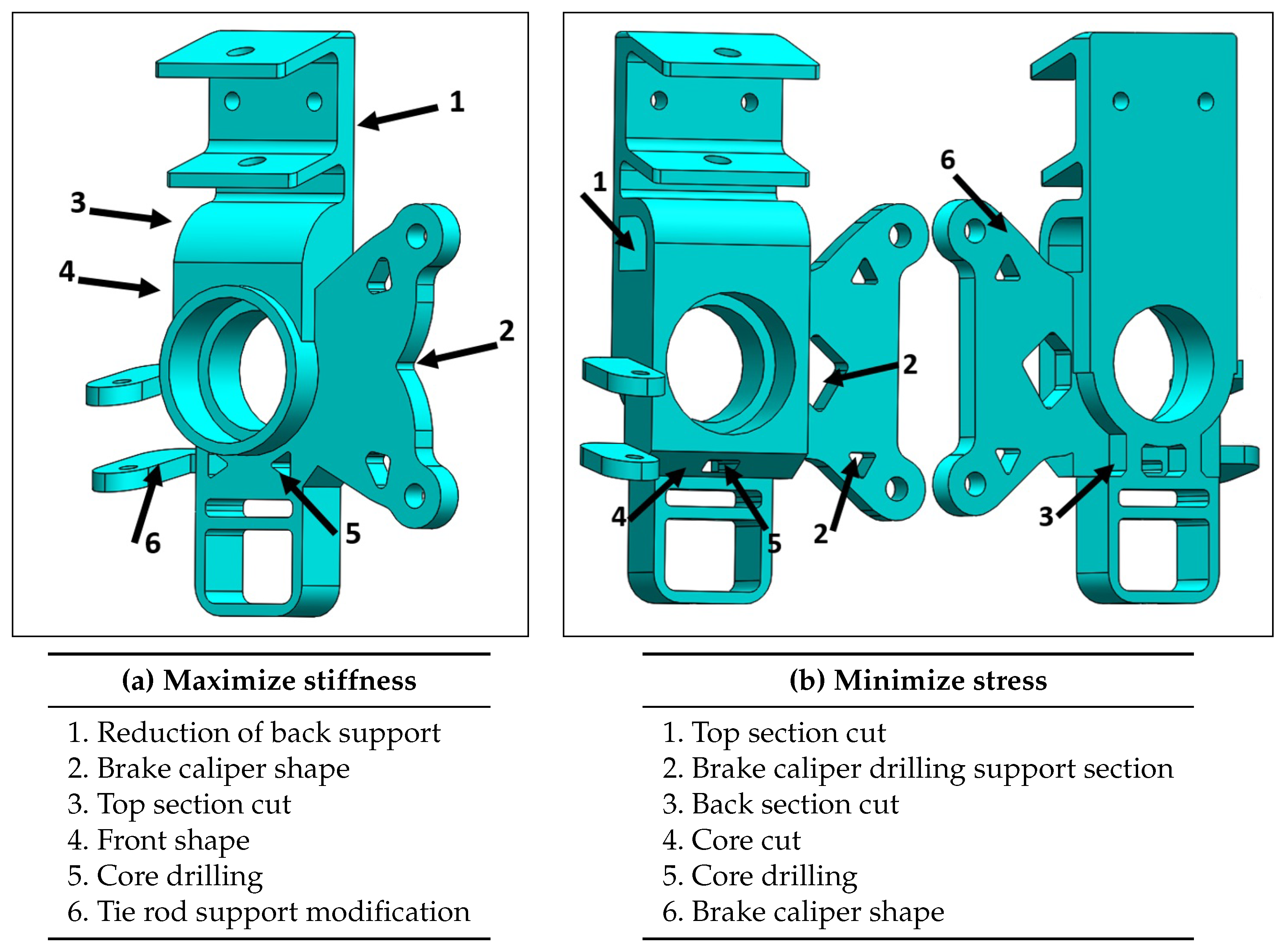
This analysis identified four primary geometric regions in which the two optimized designs exhibited significant divergence and where modifications had a direct impact on performance. These key features are depicted in
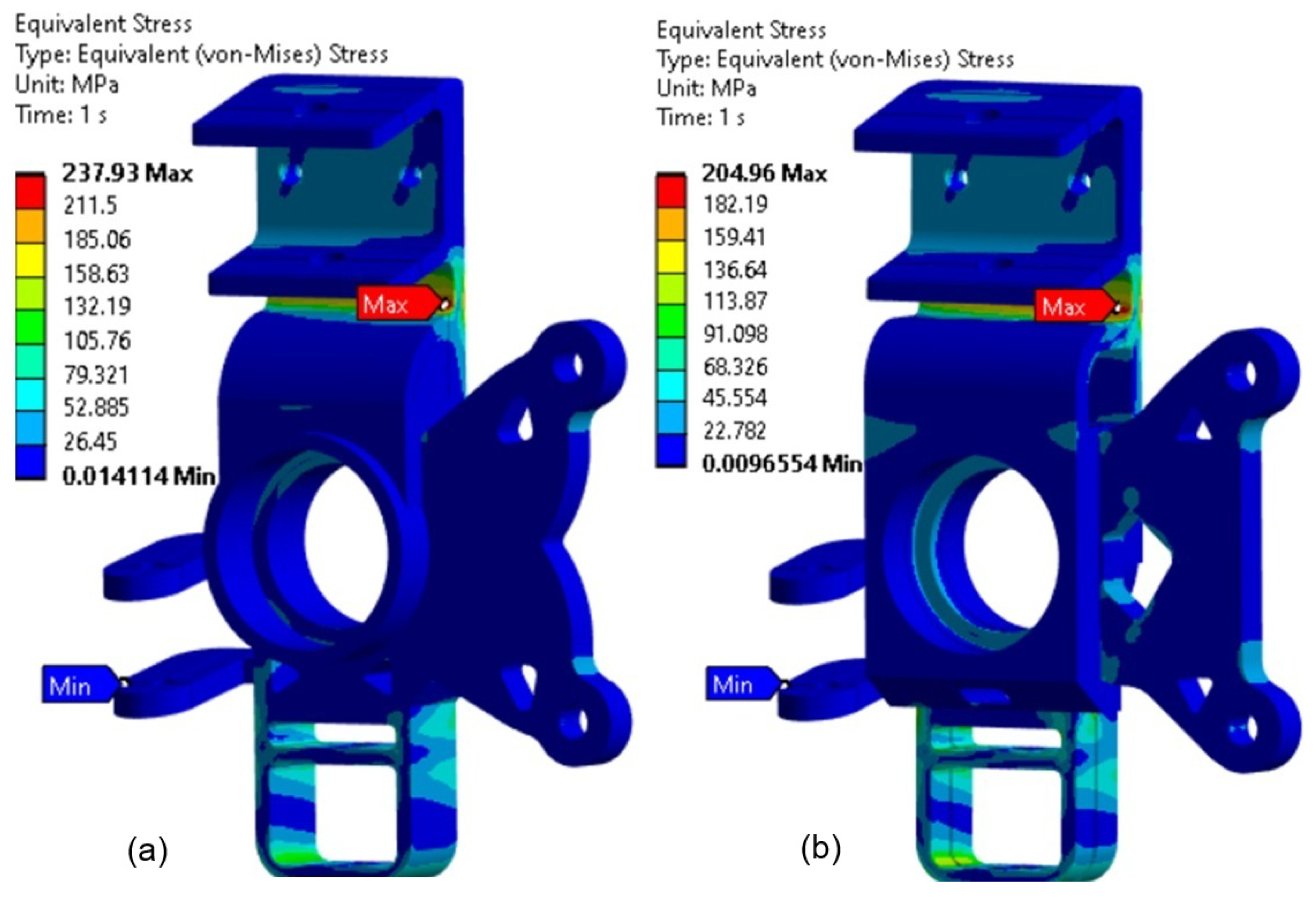
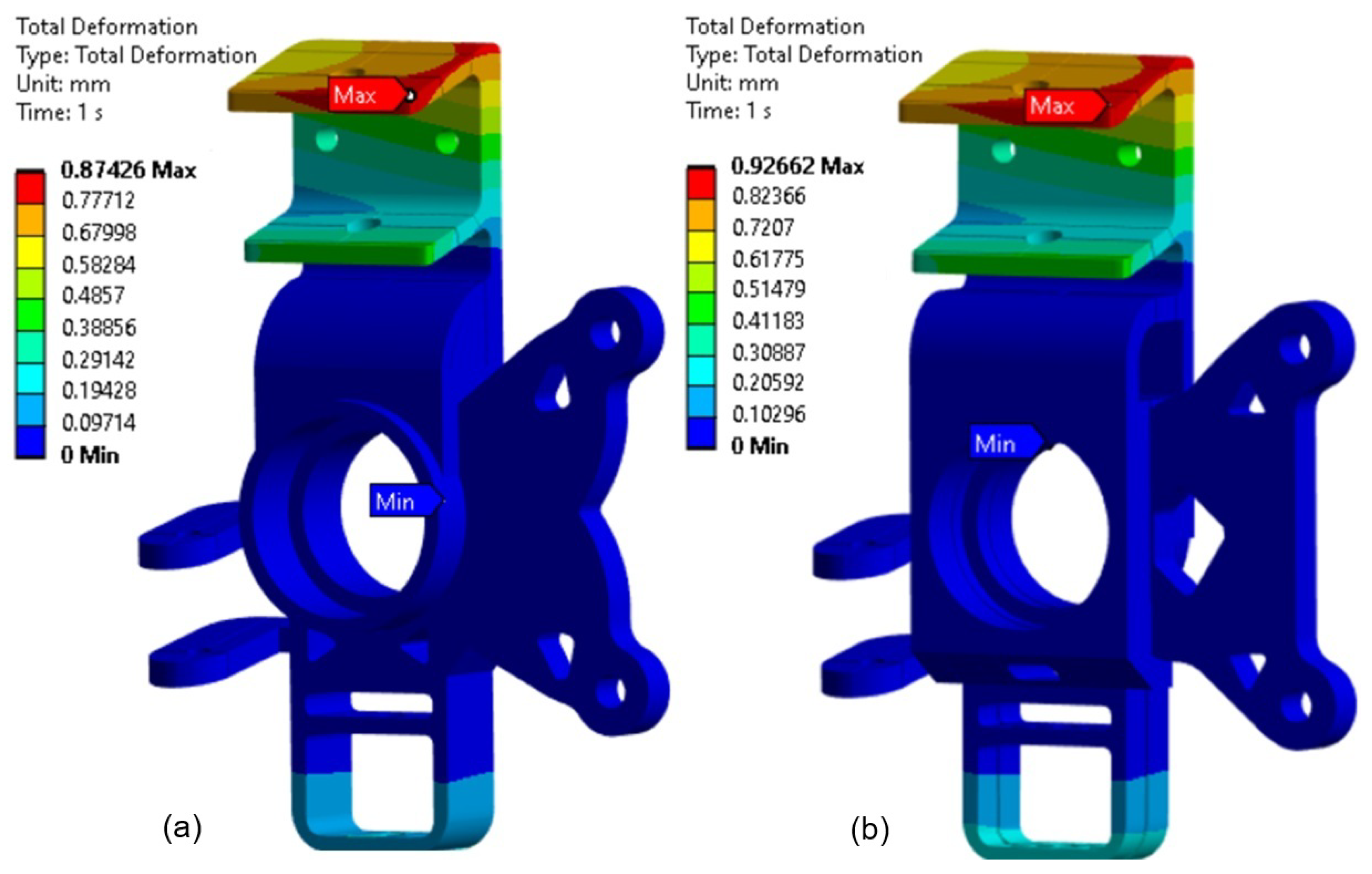
Figure 11. To establish a quantitative foundation for subsequent parametric integration, the stress and deformation contours of the two source designs were compared side by side, as illustrated in
Figure 12 and
Figure 13. The structural function of each feature, derived from this comparative analysis, is detailed in
Table 4.
To systematically incorporate the identified features and address the limitations inherent in solely qualitative design synthesis, a parametric computer-aided design (CAD) model was developed using ANSYS SpaceClaim. This approach enables a controlled and reproducible exploration of the design space defined by the identified principal geometric features.
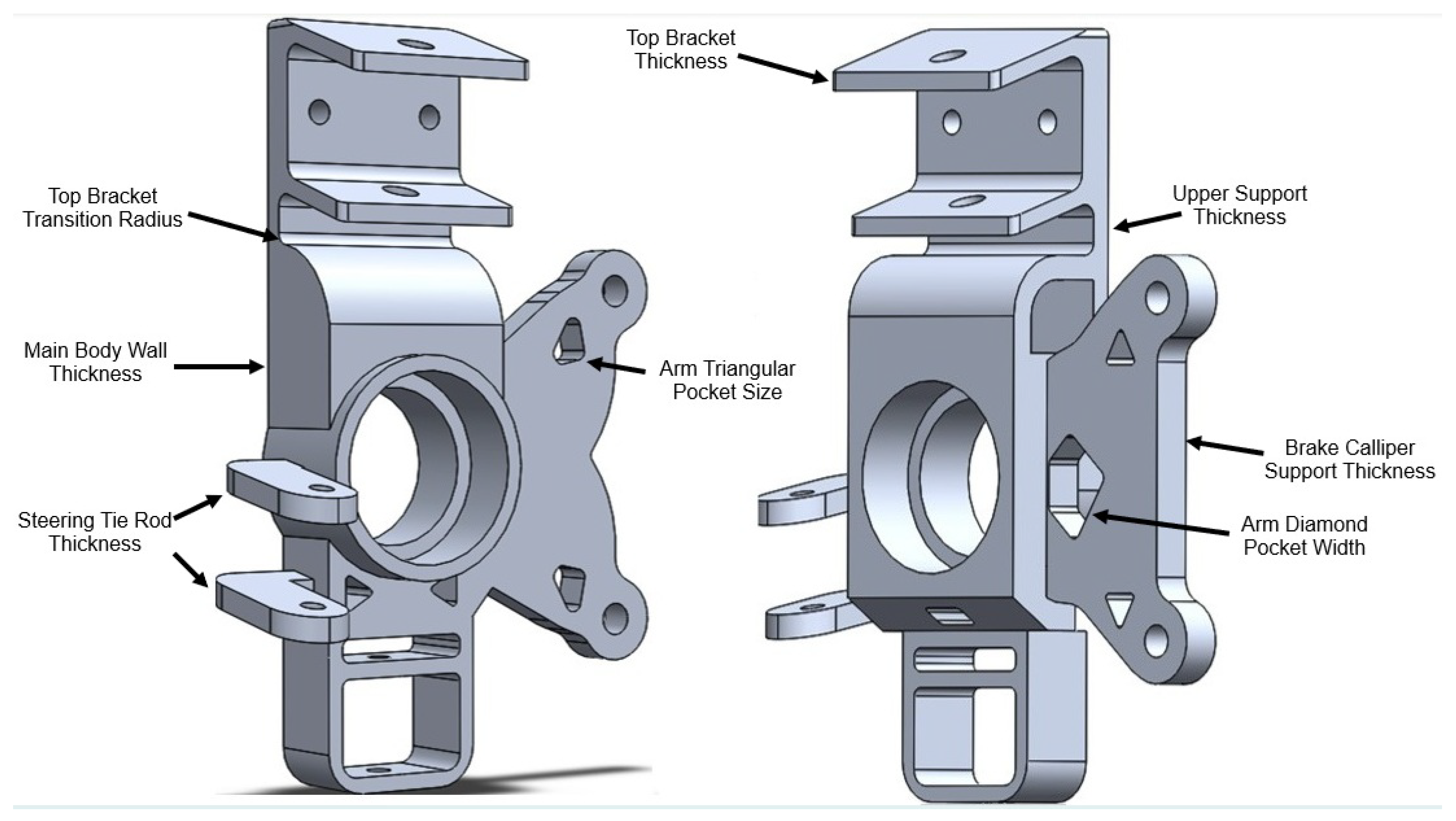
The stiffness-optimized geometry (Stage 1) was selected as the baseline for integration due to its superior mass reduction of 26.07% and its efficient thin-walled load-bearing structure (Feature F1). The parametric model was designed such that features from the stress-optimized design (Stage 2) could be incrementally “morphed” onto the baseline by adjusting a set of independent geometric variables. This approach ensures that the hybrid design retains the mass efficiency of the stiffness-driven configuration while incorporating the stress-mitigating characteristics of the stress-driven design. The eight critical geometric variables were defined to regulate hybrid geometry, as illustrated in the annotated schematic in
Figure 14.
To reduce arbitrary trial-and-error iterations, the hybrid synthesis process was structured as a bounded parametric exploration rather than an ad hoc geometric modification procedure. Each geometric variable was regarded as an independent design parameter with specified variation limits , establishing a finite and controlled design space. This structured parametrization markedly reduces randomness in geometric adjustments and renders the hybrid stage a reproducible design-of-experiments-based exploration task. Consequently, the evaluation of performance relies not on subjective adjustments but on systematic parametric variation utilizing consistent structural performance standards.
The hybrid design process is a structured workflow that reduces subjectivity and improves reproducibility. First, stiffness-driven topology optimization identifies primary load paths associated with global structural rigidity. Second, stress-driven topology optimization captures localized stress concentrations and critical reinforcement regions. Third, dominant geometric features are extracted from both optimization results using criteria of continuity, load transfer, and stress distribution. Fourth, these features are integrated into a parametric CAD model to ensure geometric compatibility and manufacturability. Finally, the reconstructed design is evaluated with finite element analysis, and minor refinements are made as needed. This structured sequence reduces reliance on purely heuristic adjustments and provides a consistent basis for hybrid synthesis.
The discrete definition of the eight geometric variables facilitated a structured exploration of the hybrid design space, ensuring reproducibility while effectively capturing the conflicting effects of stiffness enhancement, stress mitigation, and mass reduction. This parametrization was instrumental in identifying an optimal hybrid configuration that integrates the stiffness-efficient topology of Stage 1 with the stress-optimized features of Stage 2.
Each geometric variable was allowed to vary within ±20% of its nominal value, thereby defining a discrete and physically feasible design space, as shown in
Table 5. This constraint ensured manufacturability and structural integrity while enabling systematic exploration through discrete optimization techniques. Three levels (low, nominal, high) were assigned to each variable, allowing an efficient parametric study to find the optimal hybrid configuration.
4.6.2. Structured Hybrid Integration and Performance Evaluation Framework
The hybrid synthesis stage can be formally expressed as a constrained discrete multi-objective optimization problem defined over a bounded parametric design space. Let the design vector be specified as follows:
where each variable
signifies a geometric parameter governing one of the extracted structural features. The optimization problem can be articulated as follows:
subject to:
where
m denotes mass,
the maximum von Mises stress, and
the total deformation. The admissible design space
is defined by the lower and upper bounds of variables
–
, as specified in
Table 5. The tolerance parameter
was set to 3%.
Having identified the key features, the hybrid synthesis was conducted via a structured parametric exploration workflow rather than through unrestricted geometric adjustments. The eight geometric variables (V1–V8) were regarded as independent design parameters constrained within predefined variation limits , thus establishing a finite and controlled parametric design space.
From a formal perspective, the hybrid synthesis can be regarded as a constrained discrete multi-objective optimization problem within the specified bounded parametric domain. The design variables delineate the exploration space, while geometric compatibility and structural feasibility function as admissibility constraints. The concurrent evaluation of mass reduction, maximum von Mises stress, and total deformation establishes the multi-objective performance framework.
Instead of producing a continuous Pareto front, the approach conducts a structured discrete evaluation where candidate configurations are systematically examined under the same loading and boundary conditions in ANSYS Workbench. Each iteration is evaluated using three quantitative metrics: (i) mass reduction, (ii) peak von Mises stress, and (iii) total deformation.
The acceptance criteria required that the hybrid configuration achieve a mass reduction at least equal to that of the stiffness-driven design, while simultaneously reducing peak stress relative to the reference model and maintaining total deformation within a 3% tolerance. Configurations that did not satisfy these criteria were discarded early in the evaluation process, thereby minimizing unnecessary iterations and reducing dependence on trial-and-error refinement.
This CAD–FEA parametric loop was systematically repeated, exploring discrete combinations and proportional integrations of structural features derived from both stiffness-driven and stress-driven topology optimization phases. The structured parametric framework guarantees reproducibility, bounded exploration, and performance-driven decision-making while maintaining geometric flexibility.
It should be emphasized that the proposed framework does not aim to achieve global optimality in the strict mathematical sense of continuous multi-objective topology optimization. Instead, optimality is defined relative to the bounded parametric domain explored in this study. The selected hybrid configuration represents an efficient solution within this constrained design space, achieving a balanced trade-off among mass reduction, stress mitigation, and deformation control under identical loading conditions.
4.6.3. Final Hybrid Geometry
The iteration that most effectively satisfied the acceptance criterion yielded the final hybrid geometry depicted in
Figure 15. In this design, the influences of the two source optimizations are discernible through their respective features. For instance, the top-section cut and the specific profile of the brake caliper support stem from the stress-minimization approach, whereas the general thin-walled structure and the configuration of the arm connections derive from the stiffness-maximization approach.
5. Results
To evaluate the structural performance of the upright geometry obtained through the hybrid optimization process, a finite element analysis (FEA) was conducted under the same loading and boundary conditions as those applied to the reference model. A mesh sensitivity analysis was performed to ensure numerical stability, as illustrated in
Figure 16.
A hexahedral mesh was adopted, as shown in
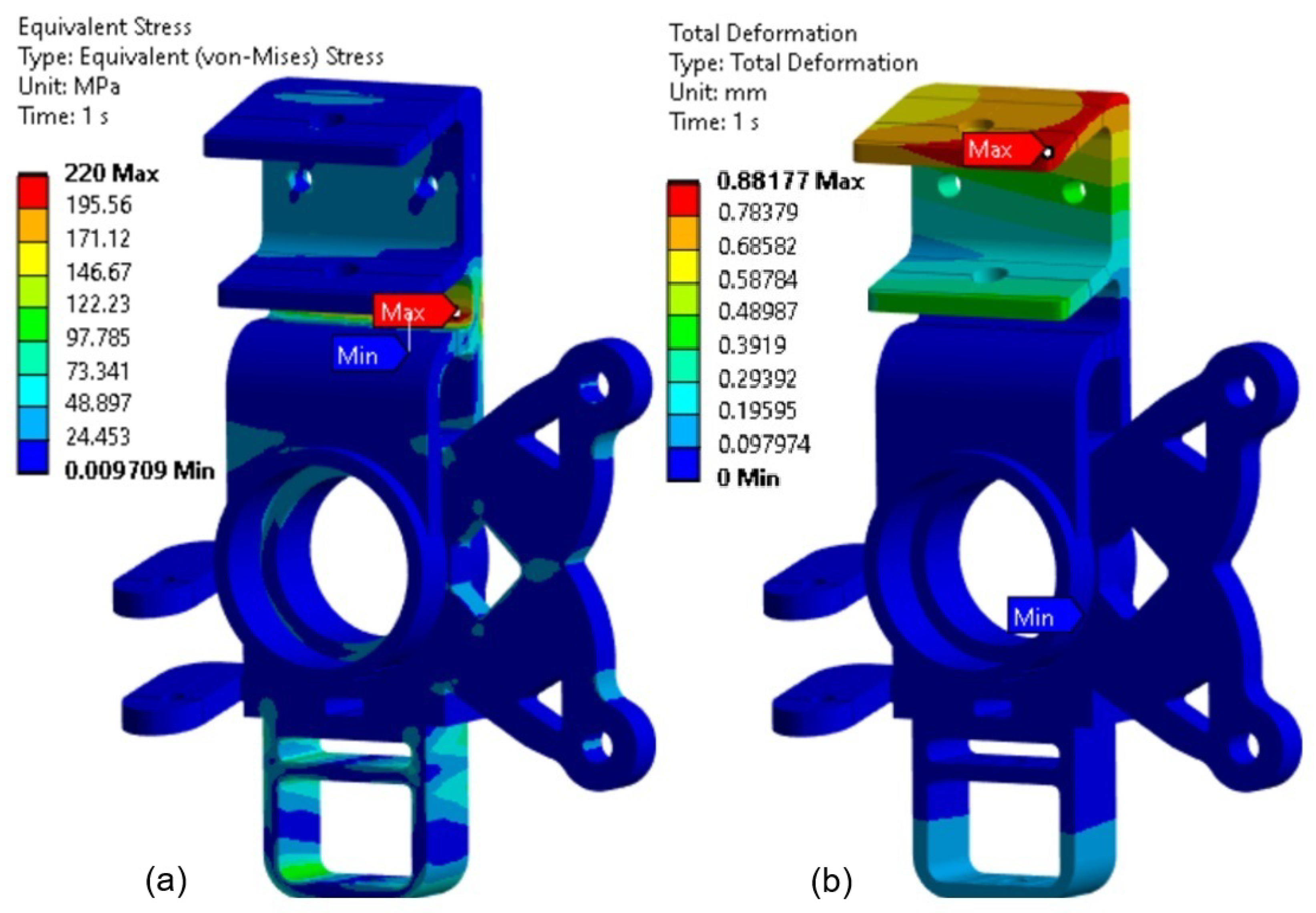
Figure 17, corresponding to the eleventh iteration of the mesh convergence study. The resulting von Mises stress and total deformation contours are presented in
Figure 18.
Following completion of the multi-stage optimization process, a comparative assessment of the structural performance of the reference, stiffness-optimized, stress-optimized, and hybrid configurations was carried out, as summarized in
Table 6. All simulations were performed using a consistent hexahedral mesh to ensure comparability.
The results indicate that the hybrid design achieves the highest mass reduction (29.44%), exceeding both the stiffness-optimized (26.07%) and stress-optimized (22.05%) configurations. Furthermore, the hybrid configuration reduces the maximum von Mises stress to 220 MPa, which is lower than that of the reference model (231.3 MPa) and the stiffness-optimized design (237.9 MPa), while remaining slightly higher than the stress-optimized solution (205 MPa).
The enhanced mass reduction observed in the hybrid design, relative to both stiffness- and stress-driven optimization results, can be attributed to the complementary nature of the extracted structural features. While stiffness-driven optimization emphasizes global load paths and stress-driven optimization targets localized critical regions, each approach independently retains material that may become redundant when both criteria are considered simultaneously.
The hybrid synthesis framework enables the identification and elimination of such redundancies by selectively integrating only the most structurally efficient features from each solution. Consequently, the resulting design is not a simple compromise between competing objectives but rather a synergistic configuration that improves load redistribution and overall material efficiency.
Regarding the structural response, the hybrid model exhibits a minimal total deformation of 0.88 mm and an appropriate safety factor of 2.28, exemplifying a balanced trade-off between lightweight construction and structural integrity.
In summary, the findings affirm that the proposed multi-stage framework effectively incorporates both stiffness- and stress-driven design criteria, thereby enhancing material efficiency while maintaining structural performance. This substantiates its application as a pragmatic and reproducible design approach for high-performance structural components.
6. Discussion
The results from the multi-stage topology optimization framework require careful interpretation to assess their structural significance and practical implications. This discussion reviews the performance of the stiffness-driven, stress-driven, and hybrid configurations, with particular focus on the trade-offs among mass reduction, stress distribution, and deformation. Additionally, the role of parametric feature integration is analyzed to provide design-oriented insights, followed by an assessment of numerical reliability and a critical review of the study’s limitations and potential directions for future research.
6.1. Interpretation of the Multi-Stage Optimization Results
The quantitative results presented in
Table 6 provide a robust basis for evaluating the effectiveness of the proposed multi-stage topology optimization framework. The reference upright, with a mass of 616.9 g and a maximum von Mises stress of 231.3 MPa, serves as the baseline for comparison with all optimized configurations.
The braking and cornering load cases considered in this study were derived from suspension load analysis and applied at the corresponding hard-point interfaces of the upright. This approach is consistent with established practices in lightweight upright design. For example, Li et al. [
11] defined boundary conditions at control arm mounts, steering tie-rod connections, and hub-bearing interfaces based on suspension system calculations. Accordingly, the load magnitudes and directions adopted in this study represent physically realistic operating conditions rather than arbitrary assumptions.
The stiffness-driven optimization (Stage 1) yielded a mass of 456.1 g, corresponding to a 26.07% reduction. However, this configuration exhibited a slight increase in peak stress to 237.9 MPa. This observation reflects a well-known trade-off in structural optimization: enhancing global stiffness through continuous load paths may introduce localized stress concentrations. This behavior is consistent with the findings of Mesicek et al. [
16], who reported that improvements in stiffness may be accompanied by stress concentrations or increased material usage.
Compared with sequential or multi-stage optimization strategies reported in the literature, including those of Mesicek et al. [
16], the proposed framework introduces an explicit feature-integration phase that combines independently optimized solutions. Rather than refining a single optimization trajectory, the hybrid strategy integrates distinct structural responses into a unified configuration, enabling a more flexible balance between stiffness and stress while improving design interpretability.
In contrast to conventional multi-objective topology optimization approaches that generate continuous Pareto fronts over unconstrained material domains, the present methodology operates within a discretized parametric design space defined by geometrically interpretable features. Consequently, the resulting hybrid configuration represents a performance-balanced solution within the explored domain, rather than a globally optimal solution. This distinction clarifies the methodological scope while maintaining analytical rigor.
This formulation embeds the hybrid synthesis within a mathematically defined parametric framework, reducing subjectivity and ensuring reproducibility.
The stress-driven optimization (Stage 2) resulted in a mass of 480.9 g, corresponding to a 22.05% reduction, while significantly decreasing peak stress to 205.0 MPa. Although stress-based approaches typically promote material redistribution, often leading to higher mass compared with stiffness-driven designs, the proposed hybrid framework selectively integrates key structural features from both stages. This eliminates redundant material and enhances overall structural efficiency, resulting in a further reduction in mass.
The hybrid design (Stage 3) constitutes the primary contribution of this study. By integrating the key geometric features identified in
Table 4 and
Figure 11 through parametric exploration (
Table 5), the hybrid configuration achieves the best overall performance balance. The mass is reduced to 435.3 g, representing the greatest reduction among all configurations, while maintaining a peak stress of 220.0 MPa.
This value is slightly higher than that of the stress-optimized configuration but remains below both the reference and stiffness-driven designs. Furthermore, total deformation (0.88 mm) and safety factor (2.28) remain within acceptable limits for high-performance motorsport applications.
Unlike sequential topology optimization strategies [
16], which rely on chained optimization passes, the proposed approach separates material redistribution from geometric synthesis. Structural features are extracted and recombined within a bound parametric domain, enabling integration at the level of geometry rather than through continuous density-field evolution.
These results support the central hypothesis that a multi-stage hybrid synthesis approach can overcome the inherent limitations of single-objective optimization by combining the most advantageous characteristics of each into a superior structural design.
6.2. Design Insights from Parametric Feature Integration
The hybrid geometry (
Figure 15) is a direct consequence of the parametric integration process delineated in
Section 4.6.1 and
Section 4.6.2. The systematic analysis of the eight geometric variables (V1–V8) enabled a controlled exploration of the admissible design space defined in
Table 5. The structural function of each integrated feature, as deduced from comparative finite element analysis (
Figure 12 and
Figure 13), provides quantitative insight into the hybridization process.
The selection of retained geometric features in the hybrid configuration was based on a quantitative comparative evaluation rather than solely on visual interpretation of topology results. Stress contours, deformation fields, and principal load-path continuity were systematically analyzed for both the stiffness-driven and stress-driven solutions (
Figure 12 and
Figure 13). Features were preserved when they demonstrated measurable contributions to either global stiffness (reducing total deformation), mitigation of localized stress concentrations, or enhanced load redistribution under braking and cornering loads. This criterion-based evaluation assured that feature integration was driven by performance considerations rather than subjective judgment.
Thin-walled body–arm connection (F1): Retained from the stiffness-driven configuration, this feature contributes to torsional and bending stiffness, as evidenced by reduced deformation in Stage 1 relative to the reference model. Parametric variation of V7 and V8 confirms that a thin-walled configuration maintains structural rigidity with high material efficiency.
Top profile with relief cut (F2): Derived from stress-driven optimization, this feature was selected due to its quantifiable reduction in localized peak von Mises stress at the upper mounting interface. Comparative finite element analyses indicated improved stress redistribution with the implementation of relief geometry. The parametric tuning of variables V1 and V2 facilitated controlled mitigation of stress concentration without compromising global stiffness.
Caliper support with tapered rib (F3): Finite element analyses under braking loads demonstrated that a ribbed and tapered geometry significantly enhances stress dissipation compared to flat-support alternatives. The parametric investigation of variables V5 and V6 identified an optimal thickness-taper combination that balances local rigidity with mass reduction, thereby improving load transfer from the caliper interface into the upright structure.
Lower arm mount transition (F4): This region, recognized as a critical multi-axial load zone, was defined through a parametric trade-off analysis between the streamlined geometry of Stage 1 and the flared reinforcement observed in Stage 2. Variables V3 and V4 were adjusted to achieve a configuration that reduces mass while maintaining controlled stress gradients, thus preventing excessive stress concentration at the lower control arm interface.
This parametric framework shows that a performance-based synthesis guided by quantitative metrics can produce designs that are both manufacturable and structurally better than those created by automated single-objective algorithms alone. The approach clearly links geometric variables to structural performance, offering a roadmap for similar design challenges.
6.3. Mesh Sensitivity and Numerical Reliability
A fundamental aspect of this study’s numerical reliability is the rigorous evaluation of mesh sensitivity. As demonstrated by the convergence analyses in
Figure 5 and
Figure 16, the numerical predictions are independent of element size, thereby ensuring the reliability of the comparative results. The conscious selection of hexahedral elements, underpinned by the foundational research of McDill [
28] and corroborated by the recent comparative analysis conducted by Zach et al. [
31], was crucial for accurately capturing the stress and deformation fields within the optimized geometries.
This study offers additional evidence supporting the cautionary notes of Merkley et al. [
30], who indicated that linear tetrahedral elements may introduce errors ranging from 10% to 70% in stress analysis. Although such elements are widespread in the literature for their automatic meshing capabilities, our findings reveal that they are fundamentally inadequate for quantitatively assessing optimized geometries, especially those featuring complex load pathways, such as the upright. Moreover, it is imperative to perform and report systematic convergence studies as an essential component of any topology optimization process. This practice is not merely advisable but is considered a prerequisite for ensuring the validity and significance of published research.
6.4. Limitations and Future Research Directions
Despite its contributions, this study has inherent limitations that also point toward future research directions:
Although the current framework already includes a structured parametric exploration strategy, further reduction in iteration cycles can be achieved by combining the parametric CAD model with multi-objective optimization algorithms. For example, genetic algorithms or gradient-based multi-objective solvers could automatically explore the discrete design space outlined in
Table 5, removing the need for manual intervention and directly identifying Pareto-efficient hybrid configurations.
The framework was demonstrated on a single component of an FSAE upright. Its applicability to other structural components with varying geometries and loading conditions (e.g., chassis parts, aerospace brackets) requires further verification across a broader range of components and loading conditions.
The study solely regarded stiffness and stress as the principal objectives within the design process. Although the parametric hybrid synthesis inherently preserves geometric continuity and circumvents non-manufacturable artifacts in the density field characteristic of raw topology outputs, explicit manufacturing constraints such as machining accessibility, casting draft angles, minimum fillet radii, or additive manufacturing overhang limits were not formally integrated into the optimization problem. Future developments of the framework shall incorporate process-aware constraints directly into the parametric design space, thereby enabling simultaneous structural optimization and manufacturability assessment to improve the practical applicability of the proposed hybrid configuration.
The present study investigates isolated braking and cornering load cases derived from suspension system analysis, applied at the corresponding hard-point interfaces. While these cases illustrate the primary longitudinal and lateral loading scenarios commonly used in upright lightweight design, actual racing conditions may involve the simultaneous superposition of loads (e.g., trail braking), leading to multiaxial stress states. Future enhancements of the framework will accordingly incorporate multi-load-case topology optimization under combined longitudinal and lateral forces to improve structural robustness and relevance to real-world operating conditions.
The present study is limited to quasi-static loading conditions. Future work will extend the framework to include dynamic effects such as vibration, impact loading, and fatigue behavior, enabling a more comprehensive assessment of structural performance.
A sensitivity analysis regarding elevated friction coefficients will be conducted in future robustness assessments of the optimized configuration.
Although the numerical simulations were conducted using verified finite element procedures, including mesh convergence studies and the consistent implementation of boundary conditions, the findings remain computational. Physical prototyping and experimental validation, such as strain-gauge measurements under controlled loading and fatigue testing under variable-amplitude conditions, are necessary to confirm the structural performance of the optimized hybrid configuration fully. Explicit manufacturing constraints (e.g., machining accessibility, casting requirements, or additive manufacturing limitations) were not directly incorporated into the optimization process. Future work will integrate process-aware constraints into the parametric framework to enhance practical applicability.
Experimental validation is beyond the scope of this study; however, the numerical framework is based on well-established finite element analysis procedures widely used in structural optimization research. The applied boundary conditions, material models, and load cases are consistent with standard engineering practice in suspension component design. Moreover, the predicted trends in stress distribution, deformation, and mass reduction are physically consistent and align with expected mechanical behavior.
7. Conclusions
This study presents a multi-stage topology optimization framework for the lightweight design of an automotive suspension upright, verified through a Formula SAE case study. By combining stiffness-driven and stress-driven optimization with a parametric synthesis stage, the framework effectively addresses the inherent trade-offs of conventional single-objective approaches.
The main conclusions are as follows:
Effectiveness of the Multi-Stage Framework: The proposed three-stage approach, comprising (i) stiffness-driven optimization, (ii) stress-driven optimization, and (iii) parametric hybrid synthesis, enables the systematic integration of complementary structural features. The resulting hybrid design achieved a 29.44% mass reduction (from 616.9 g to 435.3 g) and reduced the peak von Mises stress to 220.0 MPa (4.9% lower than the reference model), demonstrating an effective balance between lightweight design and structural performance.
Parametric Synthesis as a Reproducible Design Strategy: The introduction of a parametric CAD framework with eight geometric variables provides a structured, reproducible approach to hybrid design generation. This methodology successfully combines stiffness-efficient load paths with stress-mitigating features, yielding a final configuration with a safety factor of 2.28 and a maximum deformation of 0.88 mm, both within acceptable limits for high-performance applications.
Importance of Mesh Quality for Numerical Reliability: The mesh convergence analysis confirms that element selection is critical to the accuracy of finite element predictions. In agreement with prior studies [
28,
30,
31], linear tetrahedral elements can introduce significant stress errors (10–70%), whereas hexahedral elements, combined with systematic convergence studies, ensure reliable evaluation of optimized geometries.
Transferable Design Insights: The identification and quantitative assessment of key geometric features such as relief cuts, tapered rib reinforcements, and thin-walled connections provide practical guidelines for the design of suspension components. Although demonstrated on a single case study, the proposed framework is adaptable to other load-bearing structures, given appropriate loading conditions and design objectives.
In summary, the proposed multi-stage framework demonstrates that integrating features derived from different optimization criteria can yield structurally efficient and practically viable solutions. Rather than replacing formal multi-objective optimization techniques, the methodology provides a complementary and engineering-oriented approach that emphasizes geometric control, interpretability, and reproducibility. The results confirm its capability to improve material utilization while maintaining structural reliability, making it suitable for high-performance automotive and motorsport applications.
Future Work:
Automation of the Synthesis Process: Future work will focus on integrating the parametric CAD model with multi-objective optimization algorithms (e.g., genetic algorithms) to enable automated exploration of the design space and identification of Pareto-optimal solutions.
Multi-Criteria Optimization: The framework will be extended to incorporate additional design objectives, including fatigue performance, manufacturability constraints (for both additive and subtractive processes), and cost considerations, to develop a comprehensive design methodology.
Experimental Validation: Physical validation will be conducted through prototype manufacturing (e.g., selective laser melting), followed by experimental testing, including strain-gauge measurements under static loads and high-cycle fatigue evaluation.
Extension to Other Applications: The applicability of the proposed framework will be assessed in other structural components, such as control arms, brackets, and chassis nodes, to evaluate its robustness and generalizability across different engineering domains.
Author Contributions
Conceptualization, E.R.-T.; methodology, E.R.-T. and R.C.-A.; software, R.D.-D.-L.-P., E.R.-T. and A.C.-A.; validation, R.D.-D.-L.-P., A.C.-A. and C.D.G.-B.; formal analysis, R.D.-D.-L.-P., R.C.-A. and E.R.-T.; investigation, R.D.-D.-L.-P.; writing—original draft preparation, R.D.-D.-L.-P.; writing—review and editing, E.R.-T., A.C.-A., C.D.G.-B., J.Y.C.-C. and R.C.-A.; visualization, C.D.G.-B. and J.Y.C.-C.; supervision, E.R.-T. and R.C.-A.; project administration, E.R.-T. and R.C.-A. All authors have read and agreed to the published version of the manuscript.
Funding
This research received no external funding.
Institutional Review Board Statement
Not applicable.
Informed Consent Statement
Not applicable.
Data Availability Statement
The original contributions presented in this study are included in the article. Further inquiries can be directed to the corresponding author.
Acknowledgments
The authors gratefully acknowledge the financial support provided by SECIHTI through the fellowship granted to Rene Davila De La Peña.
Conflicts of Interest
The authors declare no conflicts of interest.
Abbreviations
| TO | Topology Optimization |
| FEA | Finite Element Analysis |
| SIMP | Solid Isotropic Material with Penalization |
| FSAE | Formula Society of Automotive Engineers |
| CAD | Computer-Aided Design |
| FEM | Finite Element Method |
| AM | Additive Manufacturing |
| FDM | Front Dynamic Mass Distribution |
| Front Dynamic Cornering Augmentation |
| AD | Anti-dive Factor |
| DC | Wheel Diameter |
| Rim Diameter |
| DF | Downforce |
References
- Bendsøe, M.P.; Kikuchi, N. Generating optimal topologies in structural design using a homogenization method. Comput. Methods Appl. Mech. Eng. 1988, 71, 197–224. [Google Scholar] [CrossRef]
- Sigmund, O. A 99 line topology optimization code written in Matlab. Struct. Multidiscip. Optim. 2001, 21, 120–127. [Google Scholar] [CrossRef]
- Bendsoe, M.P.; Sigmund, O. Topology Optimization: Theory, Methods, and Applications; Springer Science & Business Media: Berlin/Heidelberg, Germany, 2013. [Google Scholar]
- Rozvany, G.I. A critical review of established methods of structural topology optimization. Struct. Multidiscip. Optim. 2009, 37, 217–237. [Google Scholar] [CrossRef]
- Liu, K.; Tovar, A. An efficient 3D topology optimization code written in Matlab. Struct. Multidiscip. Optim. 2014, 50, 1175–1196. [Google Scholar] [CrossRef]
- Deaton, J.D.; Grandhi, R.V. A survey of structural and multidisciplinary continuum topology optimization: Post 2000. Struct. Multidiscip. Optim. 2014, 49, 1–38. [Google Scholar] [CrossRef]
- Duddeck, F. Multidisciplinary optimization of car bodies. Struct. Multidiscip. Optim. 2008, 35, 375–389. [Google Scholar] [CrossRef]
- Suh, K.; Song, B. Light-weight design of a Korean light tactical vehicle using optimization technique. Trans. Korean Soc. Automot. Eng. 2015, 23, 336–343. [Google Scholar] [CrossRef]
- Kim, G.W.; Park, Y.I.; Park, K. Topology optimization and additive manufacturing of automotive component by coupling kinetic and structural analyses. Int. J. Automot. Technol. 2020, 21, 1455–1463. [Google Scholar] [CrossRef]
- Hasan, A.; Lu, C.; Liu, W. Lightweight design and analysis of steering knuckle of formula student car using topology optimization method. World Electr. Veh. J. 2023, 14, 233. [Google Scholar] [CrossRef]
- Li, J.; Tan, J.; Dong, J. Lightweight design of front suspension upright of electric formula car based on topology optimization method. World Electr. Veh. J. 2020, 11, 15. [Google Scholar] [CrossRef]
- Hunar, M.; Jancar, L.; Krzikalla, D.; Kaprinay, D.; Srnicek, D. Comprehensive view on racing car upright design and manufacturing. Symmetry 2020, 12, 1020. [Google Scholar] [CrossRef]
- Chen, Y.C.; Huang, H.H.; Weng, C.W. Failure analysis of a re-design knuckle using topology optimization. Mech. Sci. 2019, 10, 465–473. [Google Scholar] [CrossRef]
- Srivastava, S.; Salunkhe, S.; Pande, S.; Kapadiya, B. Topology optimization of steering knuckle structure. Int. J. Simul. Multidiscip. Des. Optim. 2020, 11, 4. [Google Scholar] [CrossRef]
- Prabowo, F.B.H.; Ash-Shiddieqy, R.H.; Husodo, N.; Mursid, M.; Saputro, B.A. Optimation Front Upright Racing Car Using Finite Element Analysis. IPTEK J. Eng. 2022, 8, 14–20. [Google Scholar] [CrossRef]
- Mesicek, J.; Richtar, M.; Petru, J.; Pagac, M.; Kutiova, K. Complex view to racing car upright design and manufacturing. Manuf. Technol. 2018, 18, 449–456. [Google Scholar] [CrossRef]
- Wikarta, A.; Kaelani, Y.; Taruna, F.A.; Indwindra, B.H.A.; Trengginas, L.A. Fatigue Life and Topology Optimization of Racing Car Upright for Formula SAE Electric. Automot. Exp. 2024, 7, 333–342. [Google Scholar] [CrossRef]
- Akilan, S.; Janardhan, R.K. Design improvement of steering knuckle through topology optimization for additive manufacturing. Cogent Eng. 2024, 11, 2416487. [Google Scholar] [CrossRef]
- Almonti, D.; Baiocco, G.; Tagliaferri, V.; Ucciardello, N. Design and mechanical characterization of voronoi structures manufactured by indirect additive manufacturing. Materials 2020, 13, 1085. [Google Scholar] [CrossRef]
- Vasiloglou, P.; Vosniakos, G.C.; Chodnicki, M. Towards a Roadmap from Topological Optimization to Laser Powder Bed Fusion for Structural Machine Parts. In Proceedings of the International Conference on Flexible Automation and Intelligent Manufacturing; Springer: Cham, Switzerland, 2025; pp. 668–677. [Google Scholar]
- Samin, S.A.N.; Hossen, S.; Rahman, K.M.; Gosh, U. Lightweighting of a vehicle steering uprights via structural-based design and FEA analysis. Eng. Perspect. 2024, 3, 157–170. [Google Scholar] [CrossRef]
- Liu, L.; Li, J.; Tian, C. Steering knuckle lightweight research for additive manufacturing. Proc. J. Phys. Conf. Ser. 2023, 2459, 012126. [Google Scholar] [CrossRef]
- Babu, T.; Nair, R.; Bhadade, R.; Garg, R.; Rathod, A.; Chandel, A.; Prabha, D. Simulation and analysis of an fsae wheel upright using finite element methods. J. Pharm. Negat. Results 2022, 13, 1241–1257. [Google Scholar]
- Bin Amir, M.A.H.; Xuan, K.P. Design optimization and analysis of steering knuckle for FSAE EV racing cars. Proc. J. Phys. Conf. Ser. 2024, 2923, 012004. [Google Scholar] [CrossRef]
- Kothari, P.; Dias, E.; Chaphale, S. Design and Fatigue Analysis of Upright on FSAE Vehicle. Int. Res. J. Eng. Technol. 2021, 8, 1105–1113. [Google Scholar]
- Seward, D. Race Car Design; Bloomsbury Publishing: London, UK, 2014. [Google Scholar]
- Yang, R.J.; Chen, C.J. Stress-based topology optimization. Struct. Optim. 1996, 12, 98–105. [Google Scholar] [CrossRef]
- McDill, J.; Carmona Garcia, A. Tet-to-Hex Conversion for Finite Element Analysis. Aip Conf. Proc. 2004, 712, 2210–2215. [Google Scholar]
- Kikale, S.; Katkati, A.; Kulkarni, A.; Mache, A.; Deshpande, A.; Shinde, S. Mesh Convergence Study on Side Bracket using Hex-dominant and Tetrahedron-dominant Mesh. Int. J. Veh. Struct. Syst. 2024, 16, 837–840. [Google Scholar] [CrossRef]
- Merkley, K.; Perry, E.; Benzley, S. A Comparison of All Hexagonal and All Tetrahedral Finite Element Meshes for Elastic and Elasto-Plastic Analysis; Association for Computing Machinery: New York, NY, USA, 1995. [Google Scholar]
- Zach, T.F.; Dudescu, M.C. The topological optimization and the design for additive manufacturing of a steering knuckle for formula SAE electric vehicle. Matec Web Conf. 2021, 343, 04011. [Google Scholar] [CrossRef]
Figure 1.
Three-dimensional CAD model of the front upright highlighting the main functional interfaces: wheel hub mounting, steering arm attachment, brake caliper supports, and suspension control arm connection points.
Figure 1.
Three-dimensional CAD model of the front upright highlighting the main functional interfaces: wheel hub mounting, steering arm attachment, brake caliper supports, and suspension control arm connection points.
Figure 2.
Mounting points of the front upright and design domain (bounding box: 190 mm × 125 mm × 50 mm).
Figure 2.
Mounting points of the front upright and design domain (bounding box: 190 mm × 125 mm × 50 mm).
Figure 3.
Boundary conditions for the computational model of the upright: (a) applied loads on the model and (b) the position of the upright relative to the tire.
Figure 3.
Boundary conditions for the computational model of the upright: (a) applied loads on the model and (b) the position of the upright relative to the tire.
Figure 4.
Proposed multi-Stage topology optimization approach for automotive uprights design.
Figure 4.
Proposed multi-Stage topology optimization approach for automotive uprights design.
Figure 5.
Mesh convergence analysis of the front upright finite element model, demonstrating stabilization of results from iteration seven onward.
Figure 5.
Mesh convergence analysis of the front upright finite element model, demonstrating stabilization of results from iteration seven onward.
Figure 6.
Hexahedral mesh of the upright obtained from the mesh sensitivity analysis (seventh iteration).
Figure 6.
Hexahedral mesh of the upright obtained from the mesh sensitivity analysis (seventh iteration).
Figure 7.
Numerical results of the upright model with hexahedral elements: (a) von-Mises stress, and (b) total deformation.
Figure 7.
Numerical results of the upright model with hexahedral elements: (a) von-Mises stress, and (b) total deformation.
Figure 8.
Definition of the design and non-design domains for the topology optimization of the front upright: (a) topology optimization region, (b) design space used in the optimization process, and (c) excluded non-design domain related to functional interfaces such as bearings, brake disc, suspension arms, and steering system.
Figure 8.
Definition of the design and non-design domains for the topology optimization of the front upright: (a) topology optimization region, (b) design space used in the optimization process, and (c) excluded non-design domain related to functional interfaces such as bearings, brake disc, suspension arms, and steering system.
Figure 9.
Results of stiffness-driven topology optimization: (a) front view, (b) isometric view, (c) rear view.
Figure 9.
Results of stiffness-driven topology optimization: (a) front view, (b) isometric view, (c) rear view.
Figure 10.
Results of stress-driven topology optimization: (a) front view, (b) isometric view, (c) rear view.
Figure 10.
Results of stress-driven topology optimization: (a) front view, (b) isometric view, (c) rear view.
Figure 11.
Identification of essential geometric features for hybrid synthesis derived from both optimization methods.
Figure 11.
Identification of essential geometric features for hybrid synthesis derived from both optimization methods.
Figure 12.
Comparative von Mises stress contours for the (a) stiffness-driven and (b) stress-driven optimized designs.
Figure 12.
Comparative von Mises stress contours for the (a) stiffness-driven and (b) stress-driven optimized designs.
Figure 13.
Comparative total deformation contours for the (a) stiffness-driven and (b) stress-driven optimized designs.
Figure 13.
Comparative total deformation contours for the (a) stiffness-driven and (b) stress-driven optimized designs.
Figure 14.
Schematic representation of the eight key geometric variables that facilitate a hybrid design combining mass efficiency with stress mitigation.
Figure 14.
Schematic representation of the eight key geometric variables that facilitate a hybrid design combining mass efficiency with stress mitigation.
Figure 15.
The front upright geometry is achieved via a multi-stage optimization approach.
Figure 15.
The front upright geometry is achieved via a multi-stage optimization approach.
Figure 16.
Independence analysis of the hexahedral mesh for the geometry used in hybrid optimization.
Figure 16.
Independence analysis of the hexahedral mesh for the geometry used in hybrid optimization.
Figure 17.
Details of the hexahedral mesh for the geometry used in hybrid optimization (eleventh iteration).
Figure 17.
Details of the hexahedral mesh for the geometry used in hybrid optimization (eleventh iteration).
Figure 18.
Contours of stress (a) and deformations (b) in the optimized hybrid upright that combines both approaches.
Figure 18.
Contours of stress (a) and deformations (b) in the optimized hybrid upright that combines both approaches.
Table 1.
Comparative analysis of state-of-the-art studies in automotive suspension topology optimization components.
Table 1.
Comparative analysis of state-of-the-art studies in automotive suspension topology optimization components.
| Ref. | Year | Component | Method | Objective | Mass
Reduction | Validation or
Verification |
|---|
| [1] | 1988 | Generic
structures | Homogenization
TO | Structural layout
optimization | — | Numerical |
| [2] | 2001 | Generic
structures | SIMP density
method | Compliance
minimization | — | Numerical |
| [3] | 2013 | General
structures | SIMP
framework | Theory of TO | — | Analytical |
| [4] | 2009 | Structural
systems | TO
review | Methodology
evaluation | — | Review |
| [5] | 2014 | Generic
structures | 3D topology
code | Efficient
computation | — | Numerical |
| [6] | 2014 | Engineering
structures | Multidisciplinary
TO | Methodology
survey | — | Review |
| [7] | 2008 | Automotive
body | Industrial
TO | Lightweight
design | ∼15% | Industrial |
| [8] | 2015 | Suspension
arm | TO + shape
optimization | Weight reduction | 20–30% | FEA |
| [9] | 2020 | Automotive
component | TO + multibody
dynamics | Dynamic
performance | ∼18% | FEA |
| [10] | 2023 | Formula Student
knuckle | TO | Lightweight
design | ∼28% | FEA |
| [13] | 2019 | Steering
knuckle | Density-based
TO | Stress
reduction | ∼15% | FEA |
| [14] | 2020 | Steering
knuckle | TO | Mass
minimization | ∼25% | FEA |
| [15] | 2022 | Racing
upright | TO + FEA | Lightweight
motorsport design | ∼40% | FEA |
| [16] | 2018 | Upright | Sequential
TO | Stiffness
improvement | ∼20% | FEA |
| [17] | 2024 | FSAE
upright | TO +
fatigue | Durability
optimization | ∼30% | FEA |
| [18] | 2024 | Steering
knuckle | TO + AM
constraints | Manufacturability | ∼25% | FEA |
| [22] | 2023 | MacPherson
knuckle | TO +
casting | Sustainable
lightweighting | ∼30% | Experimental |
Table 2.
Mechanical properties of 7075-T6 (Zicral).
Table 2.
Mechanical properties of 7075-T6 (Zicral).
| Mechanical Property | Value |
|---|
| Density (kg/) | 2810 |
| Yield strength (MPa) | 503 |
| Ultimate strength (MPa) | 572 |
| Poisson ratio (–) | 0.33 |
| Modules of elasticity (GPa) | 71.7 |
Table 3.
Definition of variables employed in load calculations based on Seward [
26] (Equations (1)–(5)).
Table 3.
Definition of variables employed in load calculations based on Seward [
26] (Equations (1)–(5)).
| Variable | Description | Value |
|---|
| m | Vehicle mass | 300 kg |
| g | Gravitational acceleration | 9.81 m/ |
| Downforce | 600 N |
| Wheel diameter | 0.6 m |
| Rim diameter | 0.4 m |
| Tire–road friction coefficient | 1.4 |
| Height of center of mass | 0.3 m |
| T | Track width | 1.5 m |
| Front dynamic mass distribution | 0.5 |
| Anti-dive factor | 0.5 |
| Front dynamic cornering augmentation | 0.2 |
| Suspension geometry parameters | 0.25 m, 0.15 m |
| Tire radius | 0.3 m |
Table 4.
Analysis and structural function of key geometric features.
Table 4.
Analysis and structural function of key geometric features.
| Part I—Geometric Identification |
| Feature | Geometric Feature | Source Design (Stage) |
| F1 | Thin-walled body–arm connection | Stage 1 (Stiffness) |
| F2 | Top profile with relief cut and fillet | Stage 2 (Stress) |
| F3 | Caliper support with tapered rib | Stage 2 (Stress) |
| F4 | Lower arm mount transition | Stages 1–2 |
| Part II—Structural Interpretation from TO/FEA |
| Feature | Observation from TO/FEA Analysis | Inferred Structural Function and Design Rationale |
| F1 | Continuous load path forming a shell; lowest deformation (0.87 mm), indicating maximum global stiffness. | Provides bending and torsional rigidity with minimum mass through stressed-skin load distribution. |
| F2 | Peak stress reduced from 237.9 MPa (sharp junction) to 205 MPa after geometric smoothing. | Mitigates stress concentration by increasing curvature radius and modifying load transfer; improves fatigue resistance. |
| F3 | Ribbed and tapered geometry lowers localized braking stresses compared to flat support. | Increases local section modulus and enhances stress diffusion, preventing stress discontinuities. |
| F4 | Critical multi-axial load region; Stage 1 streamlined (lighter), Stage 2 flared (lower stress, slightly heavier). | Balances mass efficiency and durability; a hybrid solution optimizes the stiffness–stress trade-off. |
Table 5.
Discrete design space definition for geometric variables considering ±20% variation.
Table 5.
Discrete design space definition for geometric variables considering ±20% variation.
| ID | Geometric Variable | Nominal Value (mm) | Min (−20%) | Max (+20%) |
|---|
| V1 | Top bracket thickness | 4.5 | 3.60 | 5.40 |
| V2 | Top bracket transition radius | 3.0 | 2.40 | 3.60 |
| V3 | Main body wall thickness | 51.5 | 41.20 | 61.80 |
| V4 | Upper support thickness | 5.0 | 4.00 | 6.00 |
| V5 | Steering tie-rod thickness | 6.0 | 4.80 | 7.20 |
| V6 | Brake caliper support thickness | 10.0 | 8.00 | 12.00 |
| V7 | Arm triangular pocket size * | 8.0 | 6.40 | 9.60 |
| V8 | Arm diamond pocket width | 25.5 | 20.40 | 30.60 |
Table 6.
Comparison of structural performance metrics for reference and optimized upright configurations.
Table 6.
Comparison of structural performance metrics for reference and optimized upright configurations.
| Parameter | Upright Model
(Reference) | Stiffness
Optimized | Stress
Optimized | Hybrid
Optimized |
|---|
| Mass, m (g) | 616.9 | 456.10 | 480.90 | 435.29 |
| Mass Reduction, (%) | NA | 26.07 | 22.05 | 29.44 |
| von Mises stress, (MPa) | 231.3 | 237.9 | 205.0 | 220.0 |
| Total deformation, (mm) | 0.93 | 0.87 | 0.92 | 0.88 |
| Safety factor, n (–) | 2.17 | 2.11 | 2.45 | 2.28 |
| Disclaimer/Publisher’s Note: The statements, opinions and data contained in all publications are solely those of the individual author(s) and contributor(s) and not of MDPI and/or the editor(s). MDPI and/or the editor(s) disclaim responsibility for any injury to people or property resulting from any ideas, methods, instructions or products referred to in the content. |




 ,
,