Article

Spatiotemporal Evolution and Nonlinear Effects of Urban Morphology on Land Surface Temperature in the Context of Heatwaves

School of Geomatics and Urban Spatial Informatics, Beijing University of Civil Engineering and Architecture, Beijing 100044, China
*
Author to whom correspondence should be addressed.
Appl. Sci. 2026, 16(9), 4150; https://doi.org/10.3390/app16094150
Submission received: 1 April 2026 / Revised: 17 April 2026 / Accepted: 21 April 2026 / Published: 23 April 2026

Abstract

Frequent extreme heatwaves (HWs) have significantly exacerbated urban thermal risks, yet the regulatory mechanisms of urban morphology remain poorly understood. This study focuses on the core urban areas of Beijing and develops a Local Climate Zone (LCZ)-constrained spatiotemporal data fusion model (LCZ-FSDAF) to generate high-resolution Land Surface Temperature (LST) datasets from 2015 to 2024. By integrating urban–rural gradient analysis with the XGBoost-SHAP model, this study quantitatively resolves the spatiotemporal evolution of land surface temperature during heatwaves and the nonlinear threshold effects of urban morphological parameters, using a representative extreme heatwave event in July 2023 as a case study. The results indicate that the LCZ-FSDAF model achieves high precision across complex urban underlying surfaces (up to 0.946, RMSE as low as 0.762 K), effectively capturing the spatial heterogeneity of the urban thermal environment. Over the past decade, heatwave events in Beijing have exhibited a significant trend of increasing frequency, duration, and intensity. During these events, LST displays a concentric core-high, periphery-low structure; however, the peak temperature shifts toward high-density built-up areas in the sub-core, manifesting a distinct heat island core shift phenomenon. Furthermore, the impact of urban morphology on LST is characterized by significant nonlinearity, with the Normalized Difference Vegetation Index (NDVI) and Mean Building Height (MBH) identified as dominant factors. Notably, Building Coverage (BC) and Sky View Factor (SVF) exhibit pronounced threshold effects across different thermal indicators. Findings of this study are useful for guiding urban planning, optimizing spatial configurations, formulating urban heat island mitigation policies under heatwaves, and promoting the Sustainable Development Goals (SDGs) of cities and communities.

1. Introduction

Against the backdrop of intensifying global climate change, the frequency, intensity, and duration of extreme weather events have increased significantly, posing severe challenges to ecosystems, socio-economic development, and human well-being [1,2]. Among various extreme events, heatwaves (HWs) have emerged as one of the most severe and widespread climatic hazards [3]. A heatwave is typically defined as a prolonged period of abnormally high temperatures relative to the local climatological background [4,5]. In recent decades, HW events have exhibited a prominent upward trend globally. These events not only elevate the risk of heat-related morbidity and mortality but also disrupt ecosystem functions and biogeochemical cycles [5].
In China, the frequency, duration, and intensity of heatwaves have increased markedly over recent decades, particularly since the 1990s [6,7]. Multiple studies have documented accelerating trends in eastern China, the North China Plain, and major urban agglomerations, with megacities such as Beijing and Shanghai experiencing the most rapid warming [8,9]. Furthermore, compound heatwave and drought events have become more frequent, and heatwaves have been closely linked to deteriorated ozone pollution in the Beijing–Tianjin–Hebei region [10]. These long-term trends highlight escalating thermal risks in Chinese cities and underscore the urgent need to investigate how urban morphology modulates land surface temperature during extreme heatwave events.
The impacts of heatwaves are particularly pronounced in urban areas. Rapid urbanization has fundamentally altered land surface properties [11,12], replacing natural vegetation with extensive impervious surfaces characterized by high heat capacity and low evapotranspiration potential [13,14]. This transformation significantly amplifies the Urban Heat Island (UHI) effect, further exacerbating thermal stress during extreme heat events [15]. Consequently, cities have become hotspots for compound thermal risks, where the interplay between large-scale climatic warming and local urban processes substantially magnifies heat exposure levels [16]. Existing studies suggest that the urban thermal environment is largely governed by urban morphology—including building density, height, spatial configuration, road networks, and vegetation distribution [17,18,19]. These factors shape the spatial patterns of Land Surface Temperature (LST) by modulating the surface energy balance, airflow dynamics, and radiative transfer [20]. In addition, urban forests, as an important component of urban morphology, play a key role in regulating the urban thermal environment [21]. In Beijing, forest coverage generally increases from the highly urbanized inner core to the peripheral zones [22], forming a distinct urban–rural gradient that contributes to the spatial variability of LST through cooling effects such as shading and evapotranspiration.
Despite the wealth of research on the urban thermal environment, several critical gaps remain. First, the lack of high-spatiotemporal-resolution LST data hinders the refined characterization of thermal spatial heterogeneity, particularly during rapidly evolving heatwaves [23]. While various spatiotemporal fusion models have been developed to integrate multi-source remote sensing data, their performance in highly heterogeneous urban environments requires further enhancement [24,25]. Second, although urban–rural gradient analysis is widely used to reveal spatial variations in LST, inconsistencies in its definition and its limited coupling with multidimensional urban structural indicators reduce the comparability across studies [26,27]. Third, existing research often focuses on a limited set of morphological parameters, overlooking the complex nonlinear relationships and threshold effects between multidimensional urban structures and LST [28]. Finally, most studies are conducted under normal climatic conditions, with insufficient attention paid to the dynamic response of the urban thermal environment under extreme heatwave scenarios.
To address these gaps, this study establishes a comprehensive analytical framework to systematically investigate the influence of Beijing’s urban structure on LST under heatwave conditions. By integrating multi-source remote sensing data (Landsat, MODIS, FY-2F, and ASTER), we first employ advanced spatiotemporal fusion techniques to generate a high-resolution LST dataset. On this basis, we analyze the spatial variation in LST along urban–rural gradients during heatwaves and explore the underlying driving mechanisms. The specific objectives of this study are as follows:
  • To generate a high-spatiotemporal-resolution LST dataset for Beijing from 2015 to 2024 by integrating multi-source remote sensing data and the LCZ-FSDAF fusion algorithm.
  • To quantify the spatiotemporal evolution of heatwave events over the past decade (2015–2024), as well as the spatial variation trends of land surface temperature along urban–rural gradients during the July 2023 heatwave.
  • To elucidate the complex nonlinear influences and threshold effects of 2D/3D urban morphological parameters on LST, taking the severe heatwave event in July 2023 as a representative case study.

2. Study Area and Data Used

2.1. Study Area

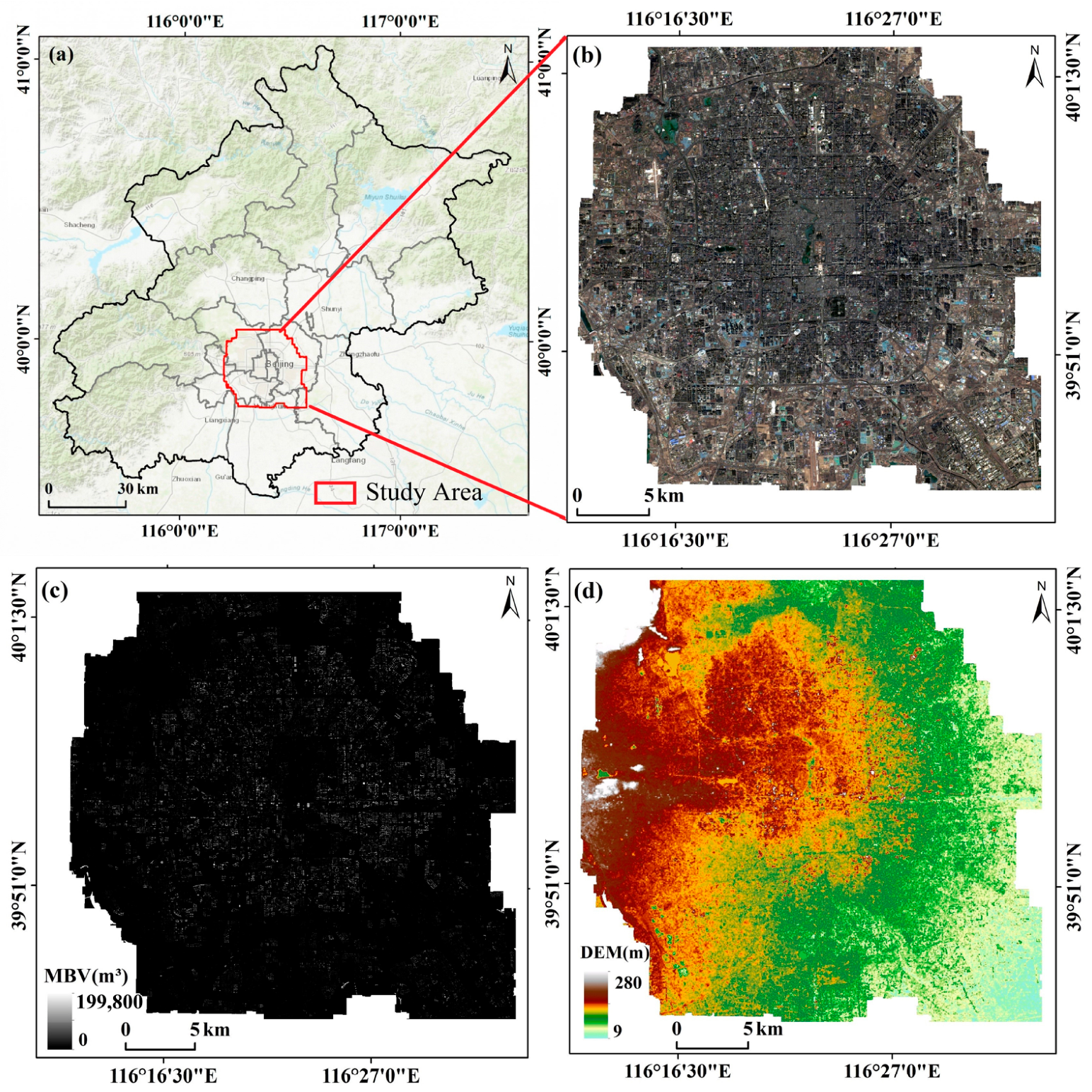
The core urban area of Beijing, encompassing the region within and immediately surrounding the Fifth Ring Road [29], was selected as the representative study site (Figure 1). Located in the northern reaches of the North China Plain ( 39 ° 5 4   N , 116 ° 2 3   E ), Beijing exhibits a topographic gradient descending from the northwest to the southeast [30]. The study area has a typical continental monsoon climate, characterized by hot, humid summers and cold, dry winters [31]. In the core urban area of Beijing, the annual mean air temperature is approximately 12.8 °C, with July being the hottest month (mean temperature of 26.9 °C) and January the coldest (mean temperature of −3.2 °C). During summer (June to August), the average relative humidity is around 68%, and the average annual precipitation is approximately 600 mm [32]. As a primary archetype of hyper-urbanization, Beijing’s permanent population reached 21.84 million by 2022, with an urbanization rate of 86.6% (Figure 1a,b). The study area is distinguished by a complex underlying surface and a dense concentration of diverse architectural typologies (Figure 1c). In this landscape, traditional Hutong districts are interspersed with modern high-rise developments [33], resulting in significant spatial heterogeneity in the configuration of impervious surfaces and natural elements. Elevations within the study area range from 9 m to 280 m (Figure 1d). Driven by intensive anthropogenic activities, high energy consumption, and rapid urban expansion, this region frequently experiences extreme heatwave events and exhibits high thermal sensitivity. Consequently, it serves as an ideal laboratory for exploring the coupling mechanisms between urban morphology and the thermal environment.

2.2. Data Used

2.2.1. Remote Sensing Data

The LST data utilized in this study were primarily derived from the Landsat 8, MODIS, FY-2F, and ASTER satellite platforms. Prior to data fusion, all remote sensing images were pre-processed to ensure consistency in spatial resolution and grid dimensions (Table 1). In this study, Landsat 8 images from 2015 to 2024 were acquired from the United States Geological Survey (USGS). A total of 20 clear-sky scenes were selected (with preference given to images with cloud cover less than 5%, and any scenes with more than 20% invalid land surface temperature pixels were excluded). The radiative transfer equation was then used to retrieve urban land surface temperature at a spatial resolution of 30 m [34]. The detailed procedure for Landsat land surface temperature retrieval is provided in Supplementary S1. Moderate Resolution Imaging Spectroradiometer (MODIS) LST products (MOD11A1 and MYD11A1) were obtained via the Google Earth Engine (GEE) platform, comprising 112 scenes at 1 km resolution, serving as an intermediate dataset to bridge high-spatial- and high-temporal-resolution observations [35]. Data from the FY-2F satellite, provided by the National Satellite Meteorological Center (NSMC), offered U-LST measurements at 5 km spatial and hourly temporal resolution [36], enabling characterization of diurnal variations in surface temperature. Additionally, ASTER imagery (90 m resolution) acquired at the same time as the predicted temperatures was obtained from the Earthdata platform [30] to validate nighttime land surface temperature retrievals and analyze diurnal temperature differences. During the fusion process, Landsat LST, MODIS LST, ASTER LST, and FY-2F LST are preprocessed to have identical spatial dimensions (rows and columns) and geographical alignment, maintaining a consistent spatial resolution.

2.2.2. Meteorological Data

Meteorological data used in this study included both reanalysis datasets and in situ observations, serving to identify extreme heatwave events and to validate the accuracy of LST retrievals. The reanalysis data were derived from the ERA5-Land Hourly dataset provided by the European Centre for Medium-Range Weather Forecasts (ECMWF) [40,41], covering the period 2015–2024 at a spatial resolution of approximately 0.1°. Two-meter air temperature was extracted and employed to identify heatwave events using a relative-threshold method, with subsequent calculation of intensity, frequency, and duration metrics. To validate the retrieval accuracy of the fused hourly LST products, hourly in situ LST observations were obtained from four national meteorological stations within the study area (Haidian, Chaoyang, Beijing, and Fengtai) via the China Meteorological Data Service Center, spanning the same temporal range as the reanalysis data [42]. The selection of station data time is shown in Table S1. These stations, located in both the urban core and adjacent suburban areas (Figure S1d), underwent rigorous quality control and homogenization procedures. The observations were used as point-scale references for independent point-to-pixel validation of the fused LST products.

2.2.3. Ancillary Data

This study employed multi-source geospatial datasets to characterize urban three-dimensional (3D) morphology and functional zones, supporting both urban thermal environment analysis and structural modeling. A digital surface model (DSM), derived from the Ziyuan-3 (ZY-3) satellite [37], was used to capture detailed 3D urban morphology at high spatial resolution (Figure S1a). Building height data were obtained from the China Multi-Attribute Building (CMAB) dataset [38], providing building-level height attributes with model accuracy exceeding 80% (Figure S1b). Road network and land use data (Figure S1c) were sourced from the multi-level vector road network of OpenStreetMap and a high-resolution dynamic urban land use mapping dataset developed by [39] (Figure S1d), which were used to calculate road density and assist in delineating urban functional zones.

3. Methods

3.1. LST Fusion Mode

3.1.1. LCZ-Enhanced Spatiotemporal Fusion Model (LCZ-FSDAF)

To capture the spatial details of land surface temperature (LST) in highly heterogeneous urban cores, this study proposes a flexible spatiotemporal data fusion model enhanced by the Local Climate Zone (LCZ) scheme, namely LCZ-FSDAF. The model replaces the traditional unsupervised classification with the LCZ framework and integrates edge-preserving filtering (EPF) with a residual-optimized allocation mechanism, thereby enabling a more accurate representation of the impacts of urban morphology on the surface thermal environment.
The LCZ-FSDAF model takes as input a triplet of high-resolution (Landsat), medium-resolution (MODIS), and coarse-resolution (FY-2F) U-LST data at time t1, along with coarse-resolution data at the prediction time t2. Through three stages, the model achieves accurate hourly LST prediction at 30 m spatial resolution. Referring to the experiment by Zhu et al. [43], the main experimental parameter settings of this study are shown in Table S9.
Stage 1: LCZ-Based Temporal Evolution Prediction
This stage aims to derive high-resolution predictions by propagating the changes observed in coarse-resolution imagery from t1 to t2:
1. LCZ endmember change estimation: LCZ classification is performed using urban morphological data. Based on the spectral linear mixture theory, the temperature change Δ T L ( z ) of each LCZ endmember from t1 to t2 is estimated as:
Δ T F ( x i , y i ) = z = 1 l f z ( x i , y i ) × Δ T L ( z )  
where Δ T L ( z ) represents the observed change at the coarse-pixel level, and fz denotes the area fraction of each LCZ class within the pixel.
2. Residual optimization and allocation: To address intra-LCZ heterogeneity, the model computes the coarse-resolution prediction residual R and introduces the LCZ-based homogeneity index (HI) to construct a weighting function CV, enabling precise allocation of residuals to each high-resolution pixel.
C V ( x i j , y i j ) = E h o H I + R ( 1 H I )  
where CV is the composite weighting factor that determines the distribution proportion of the residual R at the sub-pixel level. E h o represents the homogeneity error term. HI is the homogeneity index, which ranges from 0 to 1 and reflects the degree of consistency of LCZ classes within the local window. When the surrounding pixels all belong to the same LCZ class, HI approaches 1.
r ( k ) = m R ( x i , y i ) C V ( k ) j = 1 m C V ( j )  
HI reflects the spatial consistency of LCZ classes within the moving window, and r(k) denotes the residual term allocated to the k-th high-resolution pixel.
3. Spatial Trend Smoothing and Aggregation: Edge-preserving filtering (EPF) is applied to the TPS interpolation results to preserve building edge textures. Finally, Gaussian distance weights wk are used to eliminate boundary effects, producing the first predicted value T L ( t 2 ) .
Stage 2: Multi-Source Auxiliary Path Prediction ( T L )
To enhance the model’s capability to capture complex nonlinear variations in land surface temperature, an auxiliary time t3 (e.g., a neighboring observation after t2) is introduced as a second prediction pathway:
1. Medium-resolution auxiliary prediction: First, the medium-resolution temperature field at time t2 is predicted, denoted as T M ( t 2 ) .
T M ( t 2 ) = T M ( t 3 ) + k = 1 n 1 w k × Δ T M ( x k , y k )  
where T M ( t 2 , d 2 ) represents the predicted coarse-resolution Land Surface Temperature (LST) at the target date (t2). T M ( t 3 , d 2 ) represents the observed coarse-resolution LST (e.g., from MODIS or FY-2F) at the base date (t3). k = 1 n l   represents the summation operator for all similar pixels k within a sliding window, where nl represents the total number of similar pixels, and wk represents the weight assigned to the k-th similar pixel, typically determined by spatial distance and spectral similarity to the central pixel. Δ T M ( x k , y k ) represents the LST change for the coarse-resolution pixel at coordinates (xk, yk) between the base date (t3) and the target date (t2).
2. Second prediction pathway: Using T M ( t 2 ) as an auxiliary reference, the decomposition and allocation procedures in Stage 1 are repeated to obtain the high-resolution prediction T L ( t 2 ) .
Stage 3: Final Fusion Prediction of TL(t2,d2)
Finally, the model adopts a one-step gated sum mechanism to dynamically fuse the results from the two pathways based on temporal proximity.
T L ( t 2 , d 2 ) = μ 1 × T L ( t 2 , d 2 ) + μ 2 × T L ( t 2 , d 2 )  
where u1 + u2 = 1, and the weights are inversely proportional to the temporal distance. T L ( t 2 , d 2 )   represents the final output of the model, while u1 and u2 are the fusion weights.
μ 1 = 1 / | t 2 t 1 | 1 / | t 2 t 1 | + 1 / | t 3 t 2 | , μ 2 = 1 / | t 3 t 2 | 1 / | t 2 t 1 | + 1 / | t 3 t 2 |  
If t2 is closer to t 1 , then the weight u1 will be larger, meaning the model places greater trust in the forward prediction result.
For more detailed information, please refer to Supplementary S2.

3.1.2. Evaluation Strategies

To evaluate the reliability of the land surface temperature (LST) data generated by the model, this study validates the fusion results from two aspects, following the approach of Zhu et al. [43]: (1) accuracy validation based on actual remote sensing LST data, and (2) comparative accuracy validation based on meteorological station observations. For the first validation, synchronous Landsat LST imagery was used as a reference. The high-spatiotemporal-resolution LST generated by the model was compared pixel by pixel with the Landsat-retrieved LST on corresponding dates. Statistical metrics including the correlation coefficient (r), root mean square error (RMSE), and mean absolute error (MAE) were calculated to quantitatively evaluate the model’s simulation accuracy at the spatial scale.
For the second validation, ground air temperature data from meteorological stations within the study area were collected. The fused LST values at the corresponding locations were extracted and subjected to linear fitting and quantitative analysis. The model accuracy was assessed using RMSE, coefficient of determination (R2), and MAE. To ensure spatial representativeness and account for potential geolocation uncertainties, we extracted a 3 × 3 pixel window (90 m × 90 m) centered on each station and used the mean value of valid pixels for validation [44,45]. Regarding temporal matching, a tolerance window of ±10 min was applied to align the hourly station recordings with the nominal satellite overpass times [46]. These observational data were used to validate the accuracy of the fused land surface temperature products.

3.2. Identification of Heatwaves and Quantitative Classification of Urban–Rural Gradients

3.2.1. Identification and Evaluation Indicators of Heatwave Events

This study utilizes ERA5-Land hourly 2 m air temperature data (with a spatial resolution of approximately 9 km) to extract the daily maximum temperature ( T m a x ) series for Beijing from April to September, spanning the years 2015 to 2024.
The definition of heatwave events varies across meteorological agencies and research contexts. Although the absolute threshold method is straightforward and intuitive, it exhibits strong regional dependence and fails to account for differences in latitude and climatic background across regions, thereby limiting its ability to capture local climatic adaptability and seasonal variability.
Therefore, based on previous studies on heatwaves in China and with reference to the extreme heat identification methods recommended by the Intergovernmental Panel on Climate Change (IPCC) [47], this study adopts a relative threshold approach to identify heatwave events. Specifically, a hot day is defined based on a prescribed temperature threshold, and a heatwave event is identified when such conditions persist for three consecutive days or longer.
Considering the climatic characteristics of the study area, the daily high-temperature threshold is defined as the 90th percentile of the daily maximum temperature (Tmax) during the reference period (2015–2024). To further account for seasonal variability, a moving percentile method is applied to calculate the threshold, thereby improving the accuracy and adaptability of extreme heat detection.
For a given day d, the high-temperature threshold, Tth,d, is defined as the 90th percentile of all Tmax values within a 15-day moving window centered on day d during the reference period [48]. The mathematical expression is given in Equation (7).
A d = y = 2015 2024 i = d 15 d + 15 { T y , i }
where Ad denotes the set of temperature samples corresponding to the Julian day d (i.e., the day of the year). The symbol represents the union operator over sets, and y denotes the year, The index i refers to the day (date). The interval from d − 15 to d + 15 defines a 31-day moving window centered on day d. The term {Ty,i} represents the daily maximum temperature on the i-th day of year y. An independent heatwave event is identified when the daily maximum temperature exceeds Tth,d for 3 or more consecutive days. As shown in Equation (8):
T t h , d = P 90 ( A d )
where Tth,d denotes the high-temperature threshold for day d, P90 represents the 90th percentile function, and Ad is the input to this function, corresponding to the sample set defined in Equation (7).
To quantitatively evaluate heatwave characteristics during the study period, this research constructs an indicator system based on four dimensions: frequency, duration, cumulative exposure, and intensity. The definition and calculation formula for each indicator are as follows:
Heatwave Number (HWN) is defined as the total number of heatwave events occurring within the study period, used to characterize the frequency of heatwave events [49,50]. The calculation formula is Equation (9):
H W N = N
where N denotes the total number of heatwave events occurring during the selected study period (2015–2024).
Heatwave Duration (HWDU) is defined as the average duration (days per event) of individual heatwave events, used to describe the temporal persistence characteristics of heatwaves [51]. The calculation formula is Equation (10):
H W D U = 1 N k = 1 N D k
where N is the total number of heatwave events, and Dk denotes the duration (in days) of the k-th heatwave event from its onset to termination. The term   k = 1 N D k represents the cumulative duration (in days) of all heatwave events during the study period [52].
Heatwave Frequency (HWF) is defined as the number of heatwave events occurring per unit of time (year) within the study period. It is used to characterize the occurrence frequency of heatwave events [53]. The calculation formula is Equation (11):
H W F = k = 1 N D k
where N is the total number of heatwave events, and Dk denotes the duration (in days) of the k-th heatwave event from its onset to termination. The term   k = 1 N D k represents the cumulative duration (in days) of all heatwave events during the study period.
Heatwave Magnitude (HWM) is defined as the average excess temperature of the daily maximum temperature above the threshold during the heatwave period (°C/day/event). It is used to characterize the degree of abnormally high temperatures in heatwave events [53]. As shown in Equation (12):
H W M = 1 N k = 1 N 1 D k d = 1 D k ( T d T t h , d )
where Td is the observed daily maximum temperature on day d during the heatwave period, and Tth,d is the corresponding temperature threshold for that day. The term (TdTth,d) is defined as the daily excess temperature. The expression 1 D k d = 1 D k ( ) represents the mean daily excess temperature during the k-th heatwave event, while 1 N K = 1 N ( ) denotes the average intensity across all N heatwave events.

3.2.2. Construction of Urban–Rural Gradient Buffers and Sample Belts

To characterize the spatial differentiation patterns of LST during Beijing’s urbanization process, quantifying the urban–rural gradient is essential. Based on a comprehensive review of relevant studies, five commonly used indicators for delineating urban–rural gradients were summarized (Table S2). Drawing on the methodology of Wang et al. [54]. and considering the specific characteristics of the Beijing metropolitan area, this study adopts distance to the city center as the primary indicator for gradient classification and constructs a series of concentric buffer zones.
Given that the study area is confined to the core urban region within and near the Fifth Ring Road, where a relatively clear center–periphery gradient in urban morphology and land surface characteristics still exists, Tiananmen Square was selected as the reference center. Buffer zones were delineated at 2 km intervals, forming nine zones (Zones 1–9) (Figure S2) [55]. These zones represent a continuous transition from high-density built-up areas to suburban landscapes and are used to characterize the radial decay pattern of LST. However, it is acknowledged that as a polycentric metropolis, Beijing’s thermal environment is also influenced by secondary urban hubs (e.g., the CBD and Zhongguancun). While the concentric approach effectively captures the macro-scale radial thermal decay, it may simplify localized asymmetries caused by these sub-centers. To facilitate a focused comparison of thermal responses between the urban core and peri-urban fringe during heatwaves, the concentric buffer zones are aggregated into two spatial categories based on distance from the city center and land cover characteristics: (1) Urban Core (Zones 1–5), characterized by high-density buildings, extensive impervious surfaces, and compact morphology, and (2) Peri-urban Area (Zones 6–8), characterized by a transitional mosaic of residential areas, greenbelts, scattered water bodies, and lower building density. Zone 9 is excluded due to edge effects and insufficient sample sizes (see Section 4.2.2). However, it is acknowledged that as a polycentric metropolis, Beijing’s thermal environment is also influenced by secondary urban hubs (e.g., the CBD and Zhongguancun). While the concentric approach effectively captures the macro-scale radial thermal decay, it may simplify localized asymmetries caused by these sub-centers.
In addition, based on the Beijing Urban Master Plan (2004–2020), this study further selected transects along the main urban development axes within the study area. These transects serve as key analytical units to capture the spatial variability of LST along dominant urban expansion directions. Four fixed-width transects (East, West, South, and North) were established along the East–West Chang’an Avenue and the North–South Central Axis [56]. The lengths of these transects fall within a specific range, allowing for the identification of spatial anisotropy in the thermal environment across these cardinal directions [57]. By combining these two spatial analysis dimensions, this study systematically reveals the differentiation patterns of urban surface temperatures across both radial gradients and axial directions.

3.2.3. Classification of Urban Intensity (UI) and Threshold Identification

In this study, to overcome the limitations of geometric distance, an Urban Intensity (UI) index was introduced [58]. Impervious Surface Area (ISA) was extracted from high-resolution imagery using an object-oriented classification method [59]. The UI calculation formula is Equation (13):
U I i = I S A i T A i × 100 %
where I S A i is the impervious surface area within the i -th grid cell, and T A i is the total area of the grid cell ( 30 × 30 ).
To quantify the spatial heterogeneity of the urban thermal environment under different levels of urban intensity, this study employs piecewise linear regression to identify the threshold responses of LST heterogeneity to UI [47]. Based on the percentile range method, an LST heterogeneity indicator (HLST) is defined. Specifically, HLST is calculated as the difference between the 97.5th and 2.5th percentiles of LST within each UI interval, which effectively reduces the influence of local extreme outliers.
H L S T = β 0 + β 1 U I i + ϵ , U I i ψ β 0 + β 1 ψ + β 2 ( U I i ψ ) + ϵ , U I i > ψ
where HLST represents the spatial heterogeneity of land surface temperature. UIi denotes the UI of the i-th grid cell or sampling unit. ψ is the critical threshold identified by the piecewise regression model. β0 is the intercept, representing the baseline level of LST heterogeneity when UI equals zero. β1 denotes the slope of the first segment, while β2 represents the slope of the second segment. ε is the residual term, capturing the random error not explained by the model.
Compared with traditional dispersion metrics such as standard deviation, the percentile-based range is less sensitive to extreme outliers and provides a more robust characterization of the distributional spread of LST under highly heterogeneous urban conditions. Subsequently, piecewise linear regression is applied to model the relationship between HLST and UI, in order to identify the homogenization threshold (UI_threshold)—that is, the critical point at which the variability of LST within urban areas significantly decreases and begins to stabilize. Accordingly, the piecewise regression model is used to characterize the nonlinear response of LST heterogeneity to increasing urban intensity and to detect key thresholds at which the rate of change in thermal heterogeneity shifts significantly. These thresholds indicate transition points where the urban thermal environment evolves from a relatively heterogeneous state to a more homogeneous one.

3.3. XGBoost and SHAP Analysis

3.3.1. Extraction 2D and 3D UMPs

In this study, an Urban Morphological Parameter (UMP) system comprising 9 key indicators was constructed from two dimensions: 2D planar morphology and 3D volumetric structure [60]. This system aims to comprehensively characterize the physical complexity of urban spatial structures and their regulatory mechanisms on the U-LST. Based on multi-source geospatial data (including building vector data, DSM, high-resolution remote sensing imagery, and road network data), various indicators were extracted using a standard grid of 30 m × 30 m as the basic unit. Among these, 2D parameters primarily reflect the horizontal evolution of land cover (Figure S3), while 3D parameters focus on depicting the vertical volume of buildings and their shielding effects on the hemispherical spatial geometric structure (Figure S4). Detailed parameter definitions, calculation methods, and physical meanings are presented in Table 2.

3.3.2. Land Surface Temperature Indicators During Heatwaves

Based on the heatwave identification results, this study selected July 2023, the year with the most severe heatwave, as the analysis period to examine the land surface temperature during this period. To comprehensively analyze the complex regulatory effects of urban morphology on the urban thermal environment under the extreme climate context of high-temperature heatwaves, this study constructed a dependent variable system consisting of six types of LST response indicators. These indicators were derived from hourly high-resolution LST data generated by the LCZ-FSDAF spatio-temporal fusion algorithm. The system aims to deeply characterize the spatial variation and temporal fluctuation of the urban thermal environment during heatwave events across three dimensions: average state, extreme characteristics, and day–night dynamic evolution. Specifically, the indicators include Heatwave Mean Land Surface Temperature ( H W T m e a n ), Heatwave Maximum Temperature ( H W T m a x ), and Heatwave Minimum Temperature ( H W T m i n ), which represent average and extreme temperature conditions, respectively. Additionally, Heatwave Daytime Mean Temperature ( H W T d a y ), Heatwave Nighttime Mean Temperature ( H W T n i g h t ), and Heatwave Diurnal Temperature Range ( H W T D T R ) are used to depict day-night characteristics and temperature fluctuations. Detailed parameter definitions, calculation methods, and physical meanings are presented in Table 3.

3.3.3. XGBoost Model

XGBoost is a gradient boosted decision tree ensemble algorithm proposed by Chen and Guestrin [61]. It enhances prediction accuracy by building decision trees iteratively. Characterized by strong non-linear fitting capabilities, flexible parameter tuning, and high computational efficiency, it offers robust generalization performance. It is widely applied in tasks such as regression, classification, and ranking, and is particularly suited for large-scale, high-dimensional data analysis [62]. Its core advantage lies in the design of its objective function, which consists of a loss function L ( X ) and a regularization term Ω ( X ) . The calculation formula is Equation (15):
O b j X = L X + Ω X
where the objective function O b j ( X ) accounts for both model accuracy and complexity. Specifically, the loss function L ( X ) is used to measure the deviation between predicted and actual values, while the regularization term Ω ( X ) imposes constraints on model complexity to reduce the risk of overfitting [63]. Therefore, this objective function optimizes predictive performance while simultaneously considering model complexity, thereby achieving an effective balance between generalization capability and fitting proficiency.
This study utilizes the XGBoost model to explore the relationship between 2D and 3D UMPs as independent variables and LST parameters during heatwave periods as dependent variables. Model performance is evaluated using the Coefficient of Determination ( R 2 ) and Mean Absolute Error (MAE). The data is partitioned using an 80% training and 20% testing split, with hyperparameter tuning performed during the training process. To mitigate the risk of overfitting caused by multicollinearity, the Variance Inflation Factor (VIF) was used to filter variables. Following Wang [64], only variables with a VIF value of less than 5 were retained to ensure model robustness. The collinearity diagnostic results for 2D and 3D urban morphological parameters are presented in Table S3. As shown in Table S3, the VIF for all parameters remained below 4, indicating that the influence of multicollinearity on model attribution in this study is minimal and can be considered negligible.

3.3.4. SHAP Model

Because XGBoost models are essentially black boxes, their internal decision-making processes are difficult to interpret directly [65]. To enhance model interpretability and clarify the underlying mechanisms by which 2D and 3D UMPs influence land surface temperature parameters during high-temperature heatwaves, this study introduces the SHAP method proposed by Lundberg and Lee [65]. This method is based on the Shapley value from cooperative game theory; it achieves effective interpretation of model outputs by quantifying the marginal contribution of each feature to the model’s prediction results Lundberg. The calculation formula is Equation (16):
ϕ p ( f , x ) = S { x 1 , , x P } { x p } | S | ! ( P | S | 1 ) ! P ! [ f ( S { x p } ) f ( S ) ]
where ϕ p represents the Shapley value of feature p , used to quantify its contribution to the model’s prediction. S is a subset of the input features, and x p is the value vector corresponding to feature p . Additionally, P represents the total number of input features, and f ( S ) denotes the predicted output given the feature subset S . A positive value of ϕ p indicates that the feature makes a positive contribution to the prediction result, while a negative value indicates a negative contribution.
Another innovation of the SHAP method lies in its adoption of the Cumulative Feature Attribution strategy, which enables a more efficient, accurate, and stable quantification of each feature’s contribution. Its corresponding mathematical expression is as follows:
f ( x ) = ϕ 0 + i = 1 P ϕ i
where f ( x ) represents the predicted value of the model, ϕ 0 represents the base value (typically the average of the predicted values across all samples), P denotes the number of input features, and ϕ i refers to the SHAP value of each individual feature. The larger the absolute value of the SHAP value, the stronger the influence of that feature on the model’s prediction. By analyzing the magnitude of SHAP values and their trends as feature values change, this study is able to identify the critical thresholds of different urban morphology parameters in regulating land surface temperature during heatwaves. To verify the robustness of the identified thresholds, we employed a bootstrap resampling approach (1000 iterations) to refit the inflection points of the SHAP dependence plots for each key morphological parameter and to derive their 95% confidence intervals (CIs). In addition, spatial cross-validation was conducted to examine whether the thresholds identified across different subsets were consistent with the global results, thereby minimizing the potential influence of spatial sample distribution on threshold estimation.

4. Results

4.1. Accuracy Validation of the Fusion Model

4.1.1. Accuracy Validation Based on Actual Remote Sensing Land Surface Temperature Data

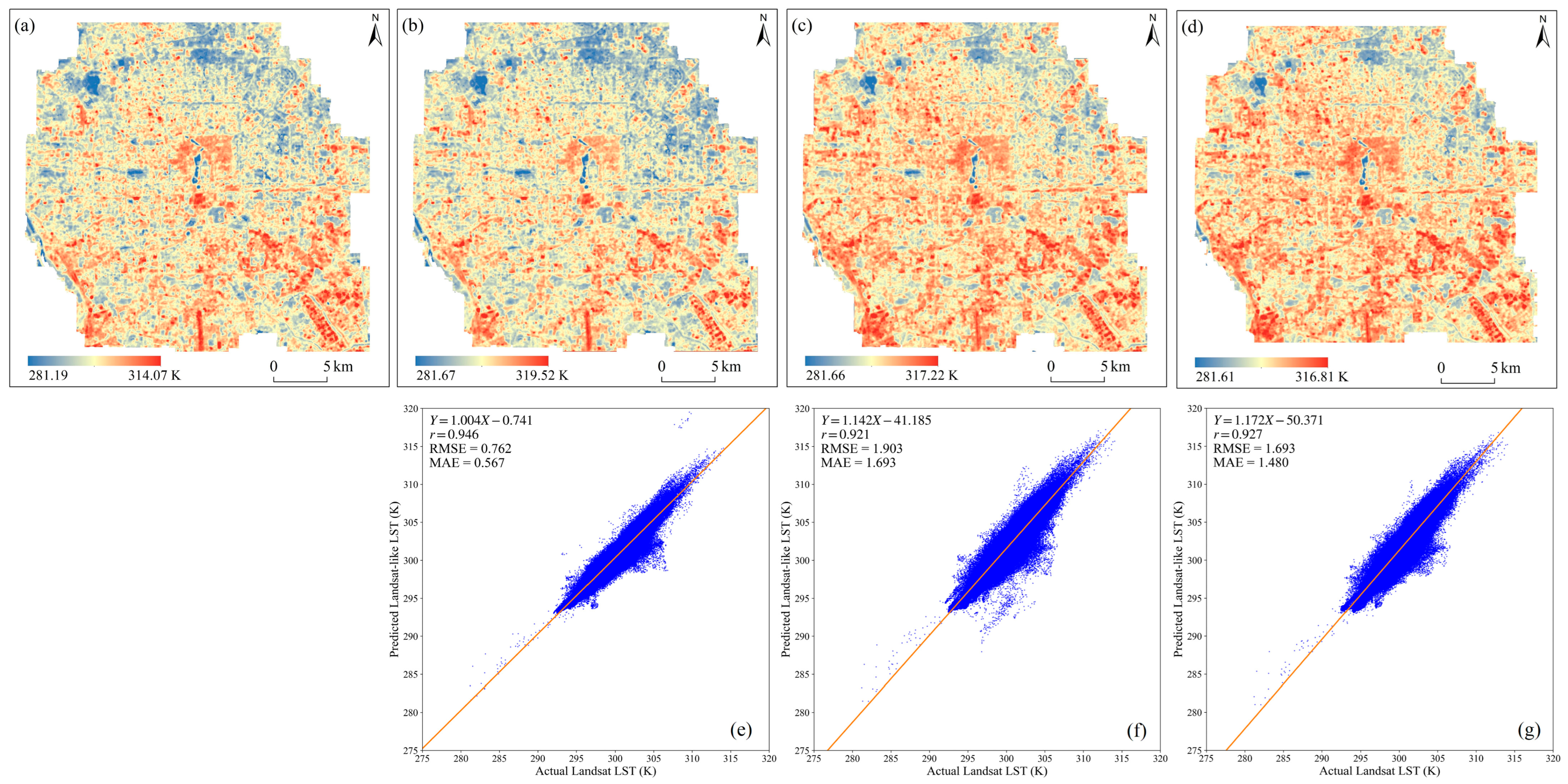
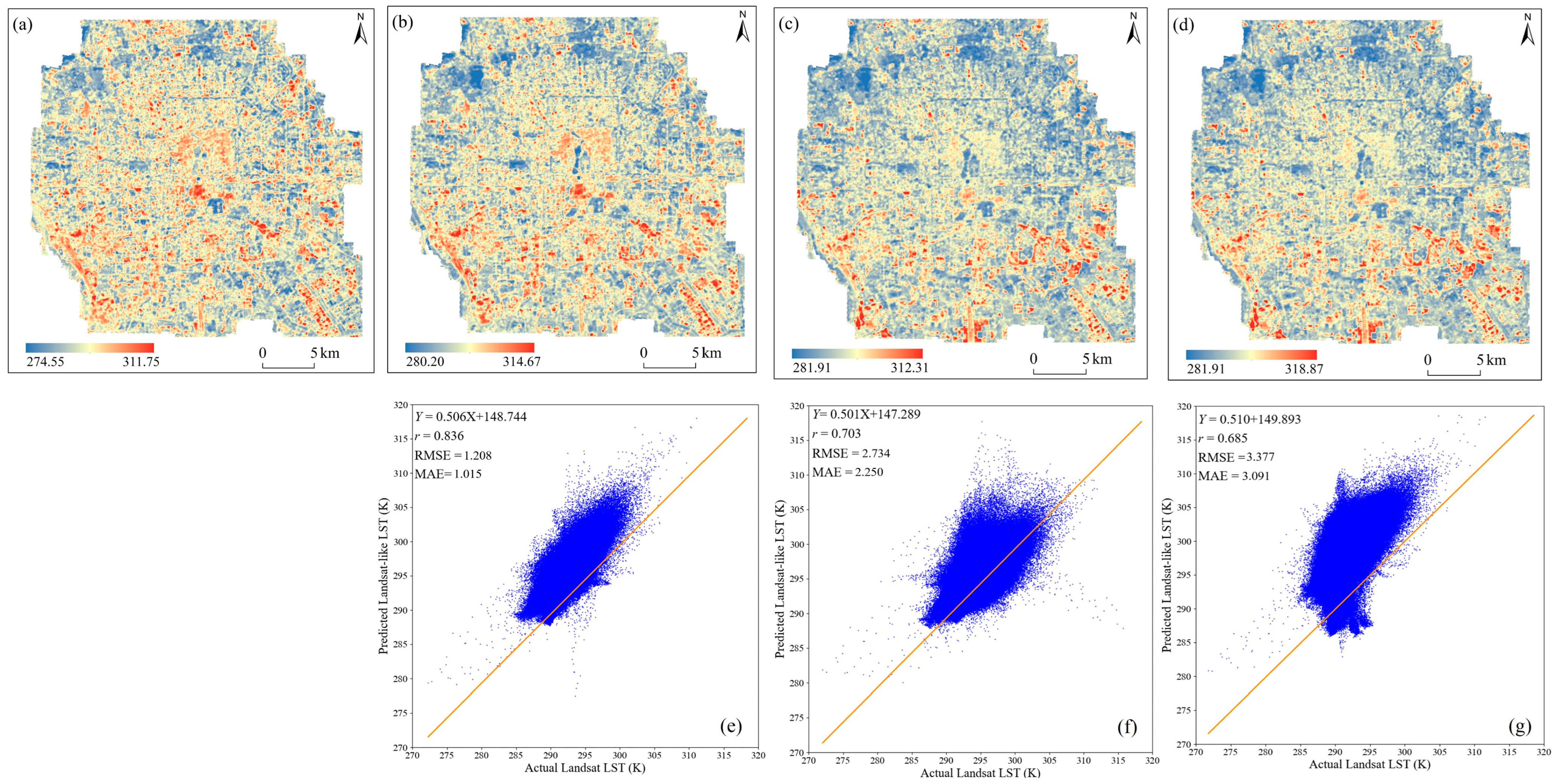
Using HWTday and HWTnight as examples (corresponding to Figure 2 and Figure 3), this study demonstrates the fusion effects and their spatiotemporal variations. Taking synchronized Landsat LST imagery as a reference, the predictive performance of three models LCZ-FSDAF, STARFM [66,67], and ESTARFM [68] was systematically evaluated. All three models are capable of effectively reconstructing the overall pattern of land surface temperature, with the distribution of cold and hot areas consistent with observed values—specifically characterized by high temperatures in built-up areas and low temperatures in water bodies and vegetated areas.
In terms of detail, STARFM exhibits significant smoothing effects and lacks detail in high-temperature regions; ESTARFM shows improvements in temperature gradients but still contains local biases. In contrast, LCZ-FSDAF provides clearer depictions of details such as building outlines, high-temperature core areas, and low-temperature patches. It shows the highest consistency with actual imagery and demonstrates superior capability in maintaining spatial heterogeneity.
For the accuracy validation of daytime land surface temperature (LST), the results for 28 September 2017 are taken as an example (Figure 2). The LCZ-FSDAF model demonstrated the highest accuracy, with a correlation coefficient of 0.946, a root mean square error (RMSE) of 0.762 K, and a mean absolute error (MAE) of only 0.567 K. In comparison, the STARFM model yielded a correlation coefficient of 0.921, with RMSE (1.903 K) and MAE (1.693 K) values substantially higher than those of LCZ-FSDAF. The ESTARFM model showed a slightly better correlation (0.927) and an RMSE of 1.693 K than STARFM, but its accuracy still fell short of LCZ-FSDAF. Further validation on 17 October 2018 (Figure S5) confirmed the leading performance of LCZ-FSDAF, achieving a correlation coefficient of 0.912. It is noteworthy that, for this temporal scenario, ESTARFM’s strong dependence on dual-date high-resolution imagery can introduce errors in change-rate estimation when the time interval is large [61], resulting in the highest RMSE (2.196 K) among the three models.
Regarding the accuracy validation of HWTnight, this study compared the evaluation results for the night of 4 October 2022 (Figure 3) and found that daytime fusion performance generally outperformed nighttime results. Taking the LCZ-FSDAF model as an example, its nighttime correlation coefficient ( R ) was 0.836, lower than the daytime value of 0.946, while the nighttime RMSE (1.208 K) and MAE (1.015 K) were both higher than those of the day. This discrepancy in accuracy primarily stems from the impact of the time interval on model stability. When the interval between the base date and the prediction date is too large, drastic fluctuations in the surface thermal landscape enhance the heterogeneity of the input data sources. This makes it difficult for the model to accurately capture the non-linear variations in LST using limited base information, thereby exacerbating nighttime prediction biases. To further enhance the validation of nighttime land surface temperature prediction accuracy, we conducted additional validation of LST prediction accuracy on other dates, which further demonstrated that the LCZ-FSDAF model achieves higher accuracy than the other two models, with nighttime accuracy being lower than daytime accuracy. The results are presented in Figure S6 in the Supplementary Materials.

4.1.2. Accuracy Validation Based on Meteorological Station Observations

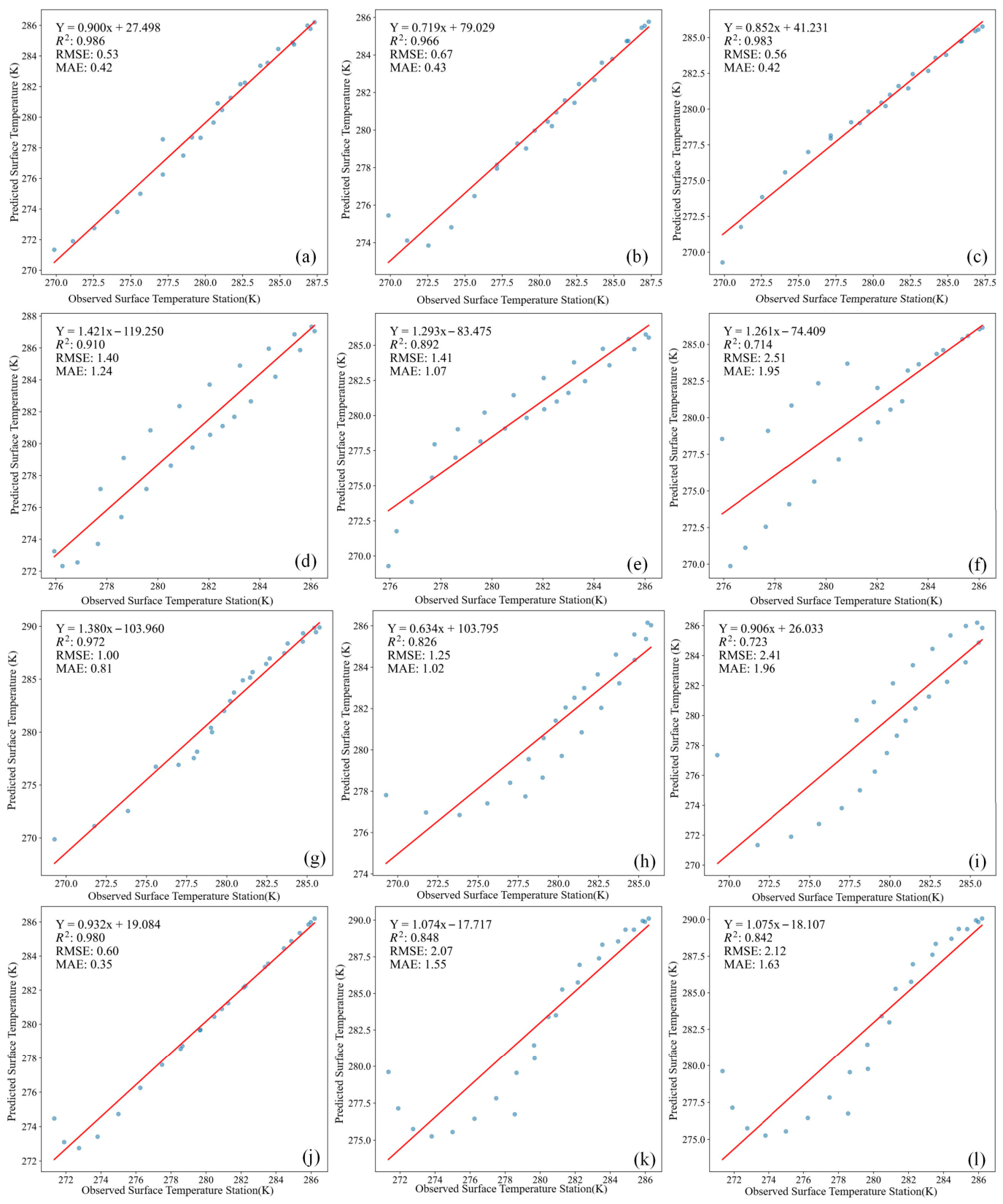
Based on hourly in situ LST measurements from four meteorological stations—Haidian, Chaoyang, Beijing, and Fengtai—this study evaluates the accuracy of hourly LST products using a station-by-station and phase-by-phase matching strategy (Figure 4). The selection of station data time is shown in Table S4. The land surface characteristics surrounding each station (ISC, NDVI, and dominant land cover) are summarized in Table S10 and visualized in Figure S8. The results indicate that the LCZ-FSDAF model consistently outperforms others across all stations. At the Chaoyang station, characterized by complex underlying surfaces with high ISC (0.6–0.8) and very low NDVI (<0.2) dominated by continuous impervious surfaces (Table S10), the model achieved an R 2 of 0.910 and an RMSE of 1.40 K, significantly surpassing STARFM and ESTARFM. At the Haidian station, which features high vegetation cover and thermal stability with low ISC (0.2–0.4) and high NDVI (0.6–0.83) dominated by trees and grassland (Figure S8), the model reached an R 2 as high as 0.986, with the lowest RMSE (0.53 K) and MAE (0.42 K) among all experimental groups. By incorporating LCZ classification as a spatial constraint, the LCZ-FSDAF model effectively constrains thermal characteristics within relatively homogeneous urban morphological units. This approach mitigates the impact of sub-pixel heterogeneity and ensures that the fused LST better reflects the local thermal environment surrounding each station, demonstrating superior reliability and precision in hourly LST prediction over complex landscapes.

4.2. Spatiotemporal Evolution of Heatwaves and Urban–Rural Gradients of Land Surface Temperature

4.2.1. Trends in Heatwave Events from 2015 to 2024

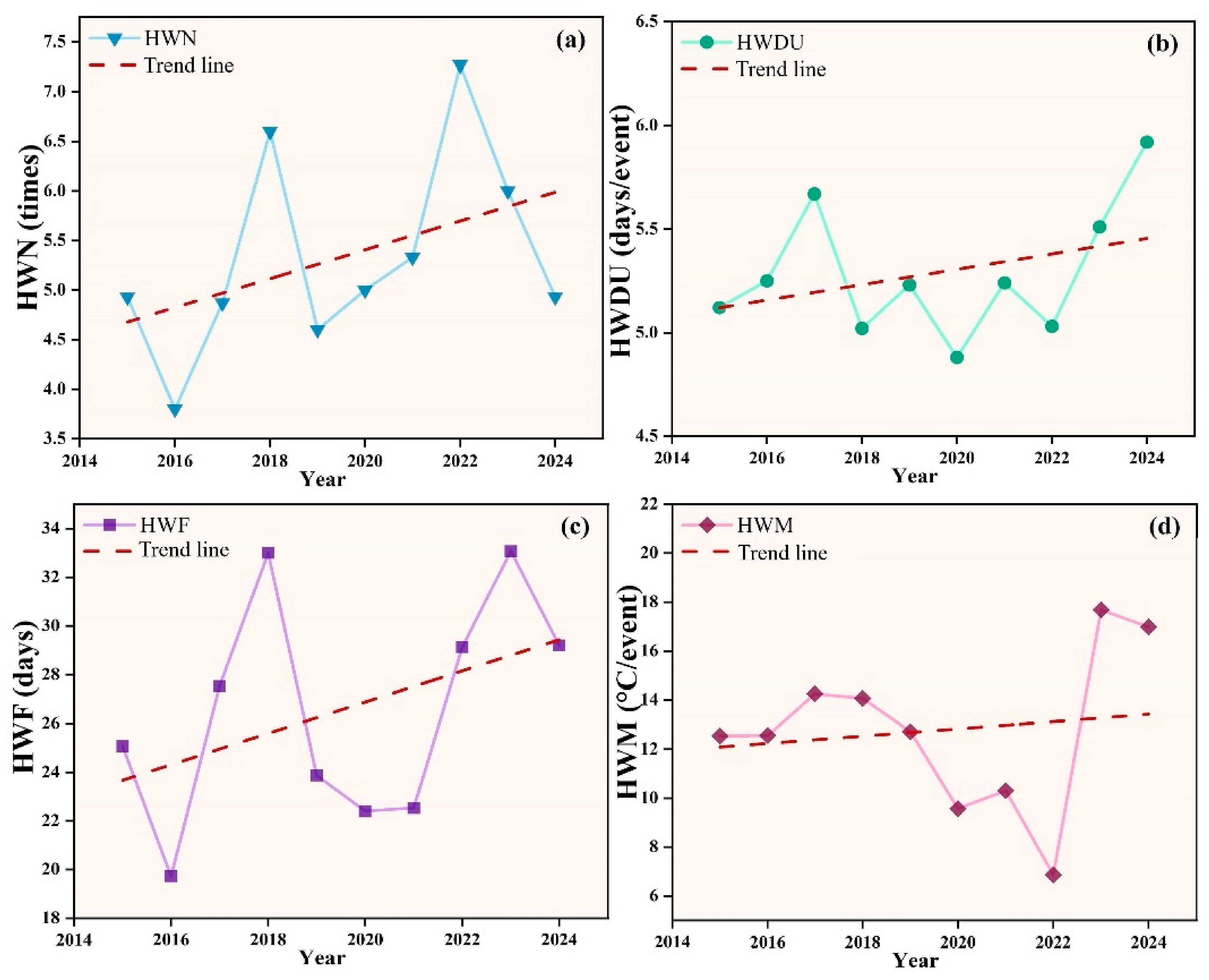
Based on the identification results of heatwaves in the Beijing area from 2015 to 2024 (Figure S7), this study characterizes the evolutionary patterns over the past decade using four indicators: HWN, HWDU, HWF, and HWM. All four dimensions exhibit a significant upward trend (Figure 5). Heatwave frequency showed fluctuating growth, peaking in 2022 at approximately 7.3 events (Figure 5a). The average duration of individual heatwaves increased from 5.1 to 5.9 days, reflecting a prolonged duration characteristic (Figure 5b). The total number of heatwave days exceeded 32 in both 2018 and 2023 (Figure 5c). The average intensity reached a decadal peak in 2023 (approximately 18 °C/day/event) (Figure 5d). These results indicate a continuous intensification of regional extreme heat impacts, consistent with the global trend of increasing extreme temperatures under the influence of global warming.

4.2.2. Analysis of Urban–Rural Gradients of Land Surface Temperature During Heatwaves

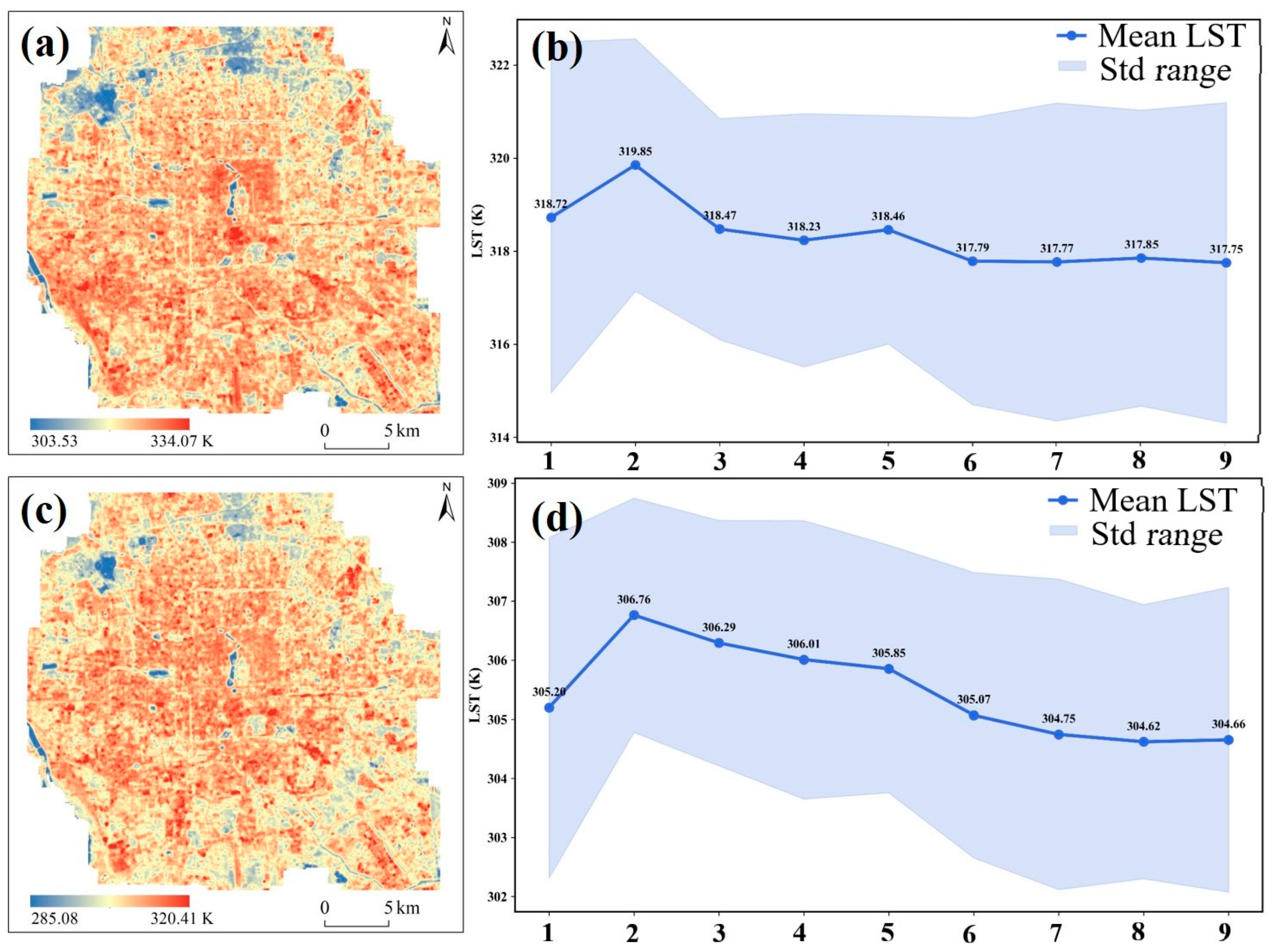
Figure 6a,c demonstrate that during the heatwave, both maximum and minimum LST exhibit significant spatial differentiation along the urban–rural gradient, characterized by a zonal structure of high in the core, low in the periphery. High-value areas are concentrated within built-up zones covered by high-density buildings and impervious surfaces, while low-value areas are distributed across surrounding water bodies and extensive vegetation. This reflects the decisive role of underlying surface composition in shaping thermal patterns.
Figure 6b,d indicate that the peak values for both maximum and minimum temperatures do not occur at the geometric center (Zone 1). Instead, they are concentrated in Zone 2 (with mean values of 319.85 K and 306.76 K, respectively), adjacent to the core. This formation of a Heat Island Core Shift may be attributed to the shading effects of high-rise buildings in the central core and the high heat storage capacity of the high-density commercial–residential mixed areas in Zone 2.
Moving outward from Zone 2, the LST shows a fluctuating decline as anthropogenic heat decreases and natural landscapes increase, resulting in an urban–rural temperature difference of approximately 2.1 K. The standard deviation of temperatures in the central urban area (Zones 1–5) is significantly higher than that in the outer suburbs (Zones 6–8). This reflects a high degree of thermal heterogeneity within the city due to diverse microclimates (shading, ventilation, and local oases) [67], whereas the suburbs exhibit greater thermal homogeneity.
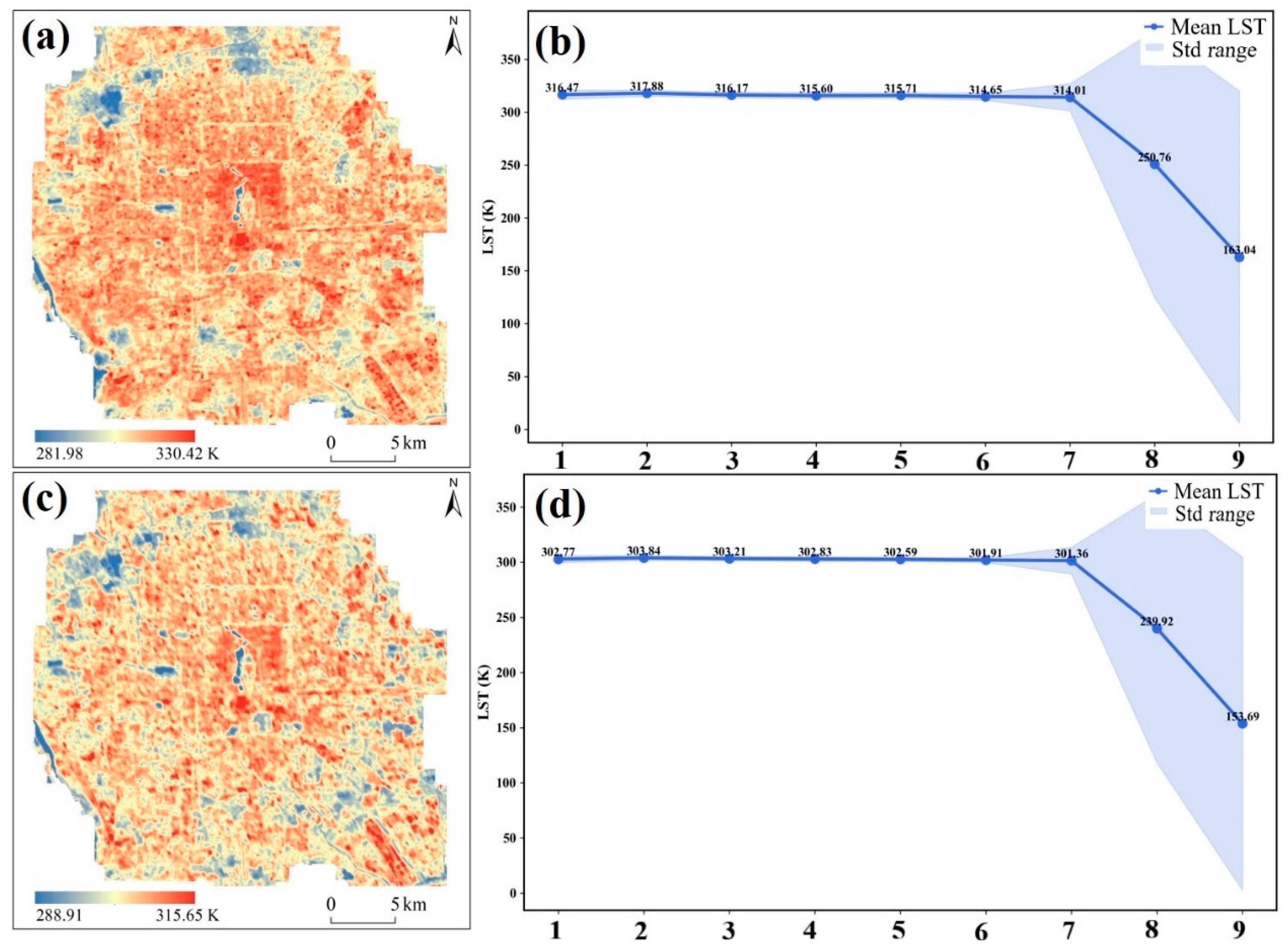
The surface thermal environment of the study area exhibits significant diurnal fluctuations and spatial mutations (Figure 7). The diurnal land surface temperatures of the urban core (Zones 1–5) and peri-urban areas (Zones 6–7) exhibit high spatial consistency (Figure 7b,d). During the day, mean temperatures range from 314.01 to 317.88 K, while nighttime temperatures range from 301.36 to 303.84 K; notably, both diurnal peaks occur in Zone 2 rather than at the geometric center.
The urban core (Zones 1–5) and the peri-urban areas (Zones 6–7) both maintain a diurnal temperature difference of approximately 14 K (Figure 7b,d), reflecting the high thermal inertia characteristic of urban underlying surfaces: they absorb substantial radiation during the day and release it slowly through long-wave radiation at night, thereby inhibiting cooling. Starting from Zone 8 in the peri-urban area, the mean land surface temperature drops significantly, accompanied by a sharp expansion in the standard deviation range. By Zone 9, the mean daytime temperature drops to 163.04 K and the nighttime mean to 153.69 K—values that are physically impossible for summer land surface temperatures in Beijing (equivalent to approximately −110 °C). These anomalously low values are not genuine physical measurements but rather data artifacts, arising from a combination of factors: (1) edge effects result in an insufficient number of valid pixel samples within the innermost annular buffer zone (Zone 9); (2) contamination from cloud cover and topographic shading in the northern mountainous fringe. Therefore, when analyzing the diurnal fluctuations of land surface temperature along the urban–rural gradient in the study area, Zone 9 was excluded from all subsequent gradient analyses to prevent misinterpretation.

4.3. Assessing the Influence of 2D and 3D Urban Morphology Parameters on the Spatial Heterogeneity of Land Surface Temperature During Heatwaves

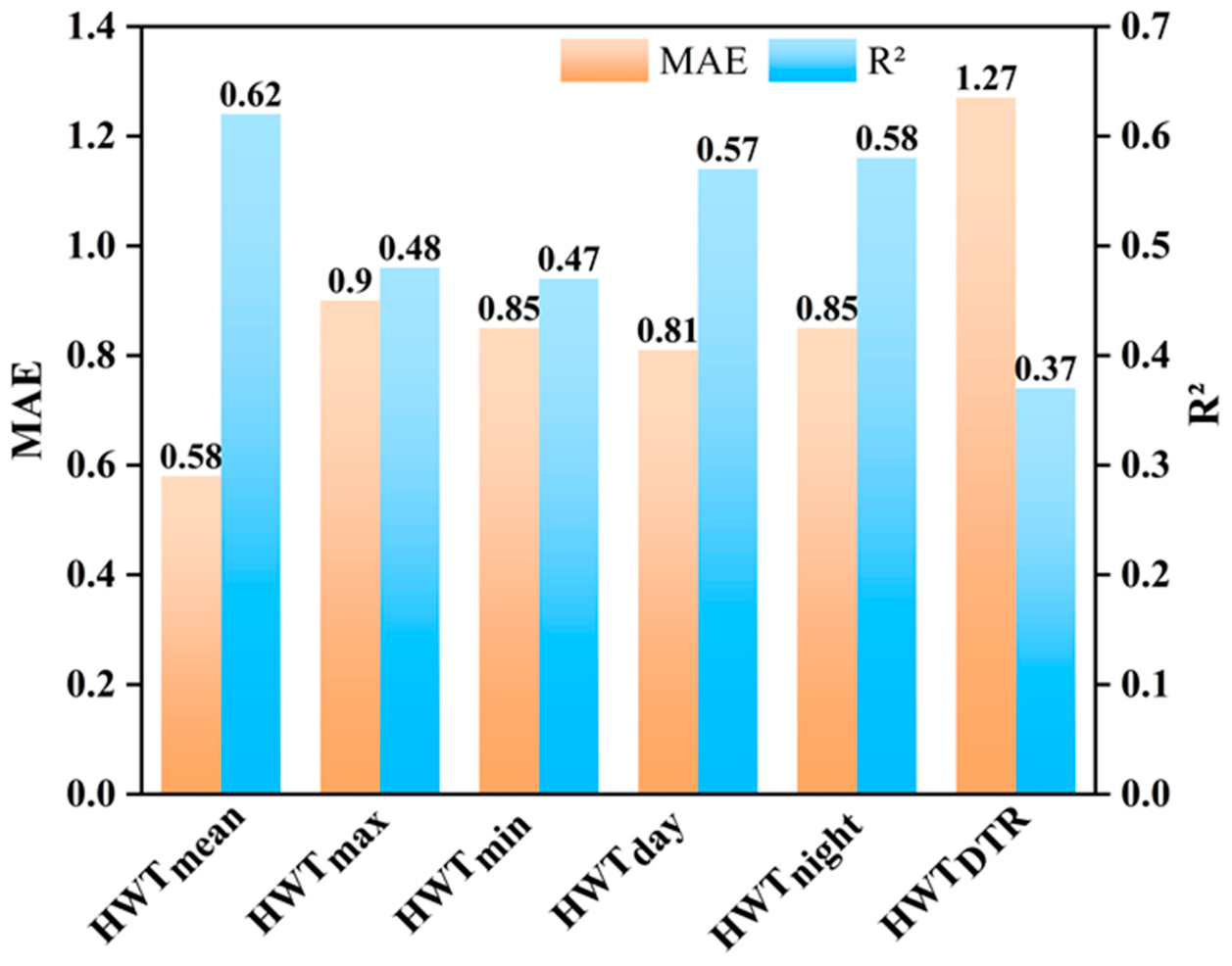
Based on the heatwave identification results, July 2023 was selected as the analytical window for examining the influence of UMPs on LST. In this study, nine 2D and 3D UMPs were used as independent variables, and various land surface temperature parameters during heatwaves were used as dependent variables to construct XGBoost regression models. Figure 8 illustrates the explained variance of the models for each temperature parameter: HWTmean ( R 2 = 0.62 , MAE = 0.58), HWTmax ( R 2 = 0.48 , MAE = 0.90), HWTmin ( R 2 = 0.47 , MAE = 0.85), HWTday ( R 2 = 0.57 , MAE = 0.81), HWTnight ( R 2 = 0.58 , MAE = 0.85), and HWTDTR ( R 2 = 0.37 , MAE = 1.27). The R 2 values of the models range from 0.37 to 0.62, while the MAE values range from 0.58 to 1.27. These results align with expectations, as heatwave indices are influenced by complex factors, including urban morphology, surface albedo, humidity, regional climate, extreme weather events, and anthropogenic heat. Among the parameters, HWTmean achieved the best predictive performance. In contrast, HWTDTR proved the most difficult to predict, as it is more sensitive to transient meteorological conditions, whereas mean values more consistently reflect the stable influence of urban morphology.

4.4. Analysis of the Importance of 2D and 3D Urban Structures for Land Surface Temperature During Extreme Heatwaves

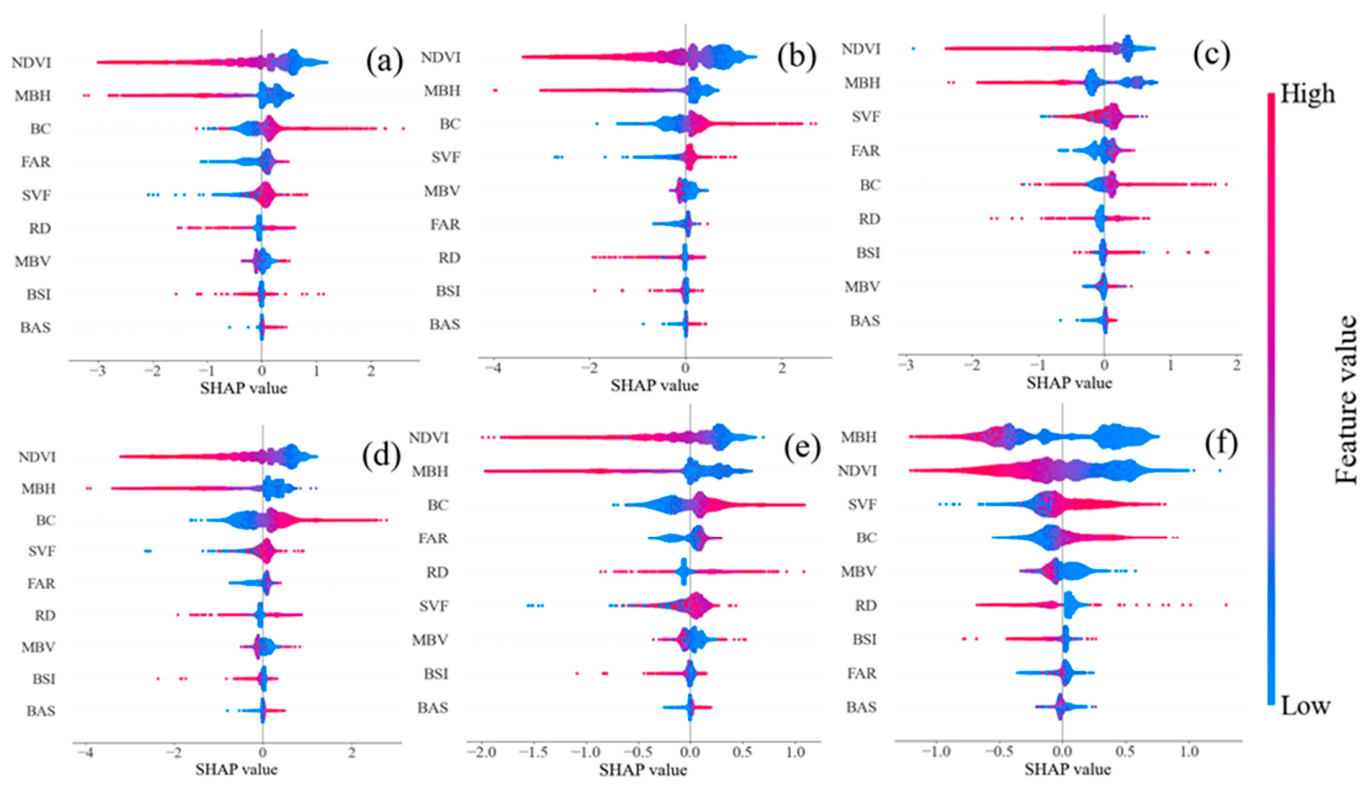
This study utilizes the SHAP attribution method to interpret the results of the XGBoost model, quantifying the marginal contributions of various UMPs to heatwave indicators and revealing the underlying mechanisms affecting land surface temperature. Figure 9 illustrates the SHAP distribution characteristics of nine categories of morphological parameters across six heatwave indicators. The three primary variables were selected based on their total contribution rankings. In the figure, colors represent feature values (red for high, blue for low), the horizontal axis denotes the distribution of SHAP values, and the width of the color bands reflects the intensity of the impact.
SHAP analysis reveals a complex non-linear relationship between various urban morphological characteristics and heatwave components. According to the global feature importance ranking (Figure 9a–f), the NDVI and MBH are the most significant factors across all six heatwave indicators, identifying them as the core morphological drivers of urban thermal responses. Additionally, BC plays a prominent role in regulating daytime temperatures (HWTday, Figure 9d), while the SVF exerts a critical influence on nighttime temperatures (HWTnight, Figure 9e) and the diurnal temperature range (HWTDTR, Figure 9f). Specifically, NDVI exhibits a stable negative contribution to surface temperatures, with SHAP values declining as vegetation increases, reflecting the cooling effects of evapotranspiration and canopy shading, as vegetation consumes heat through transpiration while tree canopies reduce incoming solar radiation at the surface, and these effects become stronger with higher NDVI values. MBH also exerts a negative impact by reducing shortwave radiation input through geometric shading [68], as increasing building height expands shadow coverage and reduces direct solar radiation received at the ground level, a cooling effect particularly evident in HWTmean and HWTday. Conversely, BC contributes positively to HWTmean, HWTmax, and HWTday, as the replacement of natural surfaces with impervious ones—characterized by low albedo and high heat capacity—enhances heat absorption and storage. At night (Figure 9c), SVF is significantly negatively correlated with surface temperature, as high-SVF areas facilitate long-wave radiation loss due to fewer architectural obstructions because the absence of surrounding buildings allows heat stored at the surface to be more easily released to the sky in the form of longwave radiation; however [69], for HWTDTR (Figure 9f), SVF shows a strong positive contribution, reflecting the drastic temperature fluctuations caused by intense daytime solar heating and rapid nighttime cooling in open spaces, as open areas experience rapid warming during the day and rapid cooling at night, which substantially amplifies the diurnal temperature range. In conclusion, while increasing SVF can mitigate nighttime heat islands, it widens the diurnal temperature range, necessitating a balance of daytime extremes through increased vegetation cover (NDVI).

5. Discussion

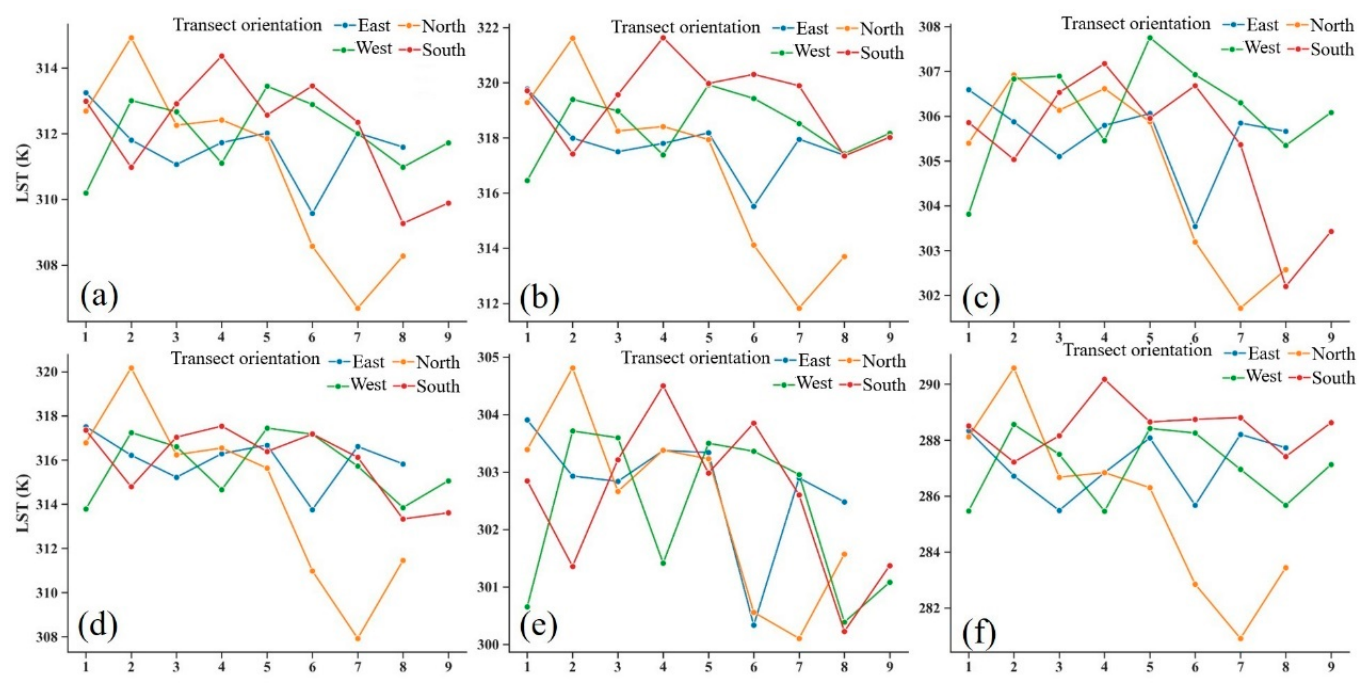
5.1. Analysis of Spatial Gradients and Directional Differences in Land Surface Temperature in Sample Transects of the Study Area

The HWTmean, HWTmax, and HWTday (Figure 10a,b,d) reveal that the northern transect experiences the most intense fluctuations. Temperatures there peak at the 2nd zone (approximately 321 K) and drop sharply from the 5th zone onward, reaching the regional minimum at the 7th zone. This cooling is likely attributed to the cold island effect produced by mountain forests or large-scale green spaces in the northern suburbs, such as the Olympic Forest Park system [70]. The spatial distribution of green spaces and forests within the study area is shown in Figure S9, with detailed information provided in Tables S5–S7. This finding aligns with previous studies. Xu et al. [71] reported that large urban parks (>10 ha) in Beijing reduce surrounding LST by 1.5–2.5 K, with cooling effects extending up to 300 m. Similarly, Bowler et al. [72] found that green spaces consistently lower ambient temperatures, especially in large, densely vegetated areas—consistent with our observed temperature drop from Zone 5 to Zone 7. Zhang et al. [73] further showed that during heatwaves, cooling efficiency can reach 3.0 K, depending on background climate and vegetation water status. In contrast, the western and southern transects show a more gradual temperature decline and maintain high temperatures over longer distances. This reflects higher urbanization connectivity and a greater density of impervious surfaces in these directions.

5.2. Response of LST to Urban Intensity (UI) and Its Threshold Effects

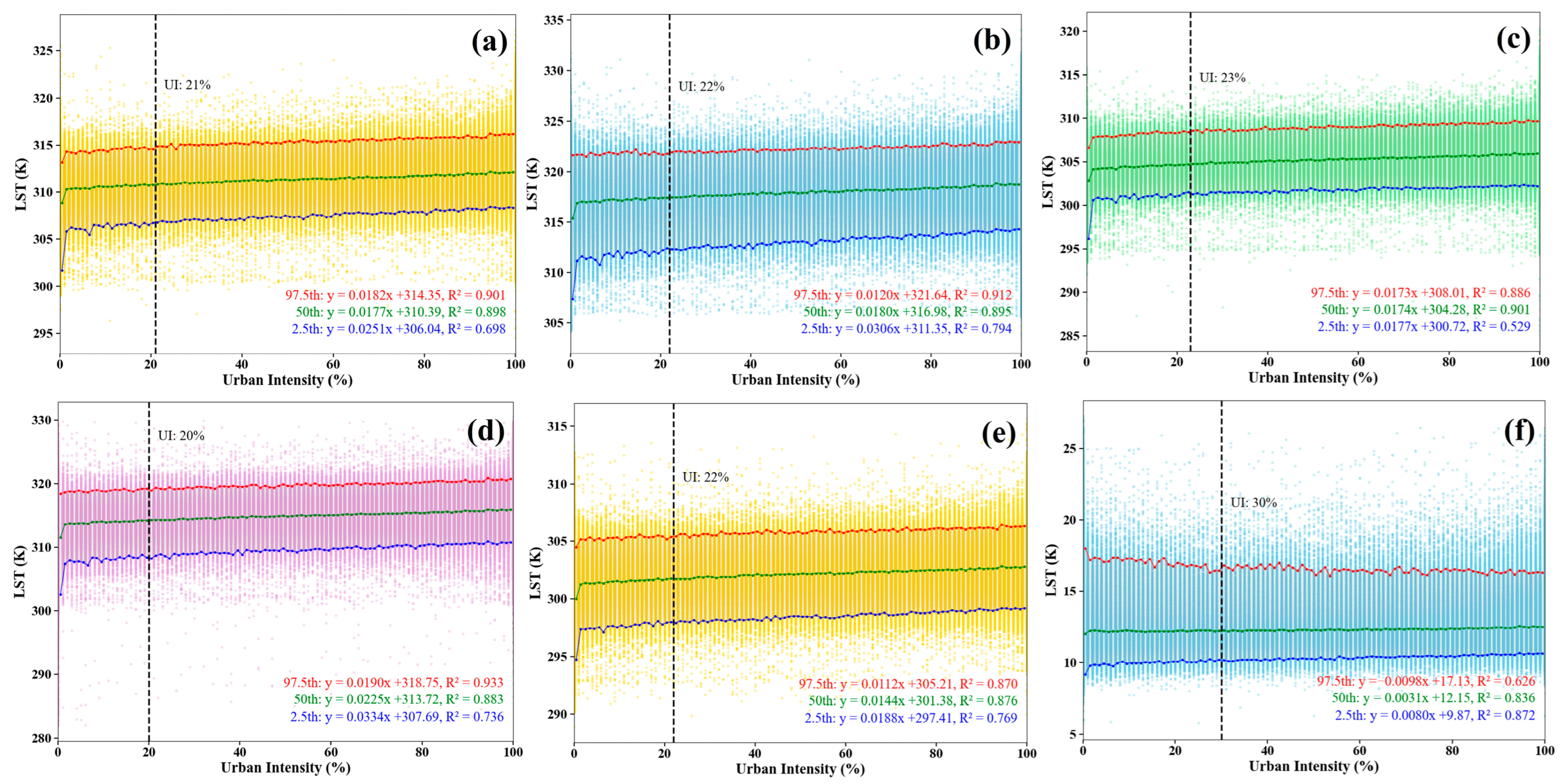
Based on the stepwise urban intensity statistics and piecewise regression analysis shown in Figure 11, all LST indicators exhibit a significant positive linear response to increasing UI. The HWTmean, HWTmax, and HWTmin (Figure 11a–c) steadily increase with UI, and the slope of the 97.5th percentile generally exceeds that of the 50th percentile, indicating that the surface heat accumulation effect progressively strengthens during the transition from suburban to core urban areas. Considering diurnal variations (Figure 11d,e), both HWTdayt and HWTnigh rise with UI, with a slightly stronger warming trend during the day, reflecting the enhanced radiation absorption and heat storage capacity of high-percentage impervious surfaces and building materials under heatwave conditions. The diurnal temperature range (Figure 11f) shows relatively minor changes overall, with the 97.5th percentile exhibiting a slight decreasing trend, suggesting that extreme high-temperature areas experience limited nighttime cooling due to dense buildings and strong thermal inertia, resulting in a reduced amplitude of day–night temperature variation. Moreover, the UI thresholds identified via piecewise regression (black dashed lines) clearly indicate inflection points in the evolution of the thermal environment along the urban–rural gradient, revealing the shaping effect of urbanization on extreme heat patterns.
This study analyzed the variation in surface temperature range (97.5th–2.5th percentile) along the UI gradient (Figure S10). The results indicate that during heatwave events, the variability of surface temperature generally decreases along the urban–rural gradient (Figure S10a–f). With increasing UI, the 95% confidence interval of LST gradually narrows, suggesting that highly urbanized areas exhibit smaller temperature fluctuations, whereas suburban and urban–rural transitional areas experience larger temperature variations.

5.3. The Key Thresholds of 2D and 3D Urban Morphology Parameters Affecting Surface Temperature During Heatwave Events

5.3.1. Building Coverage (BC)

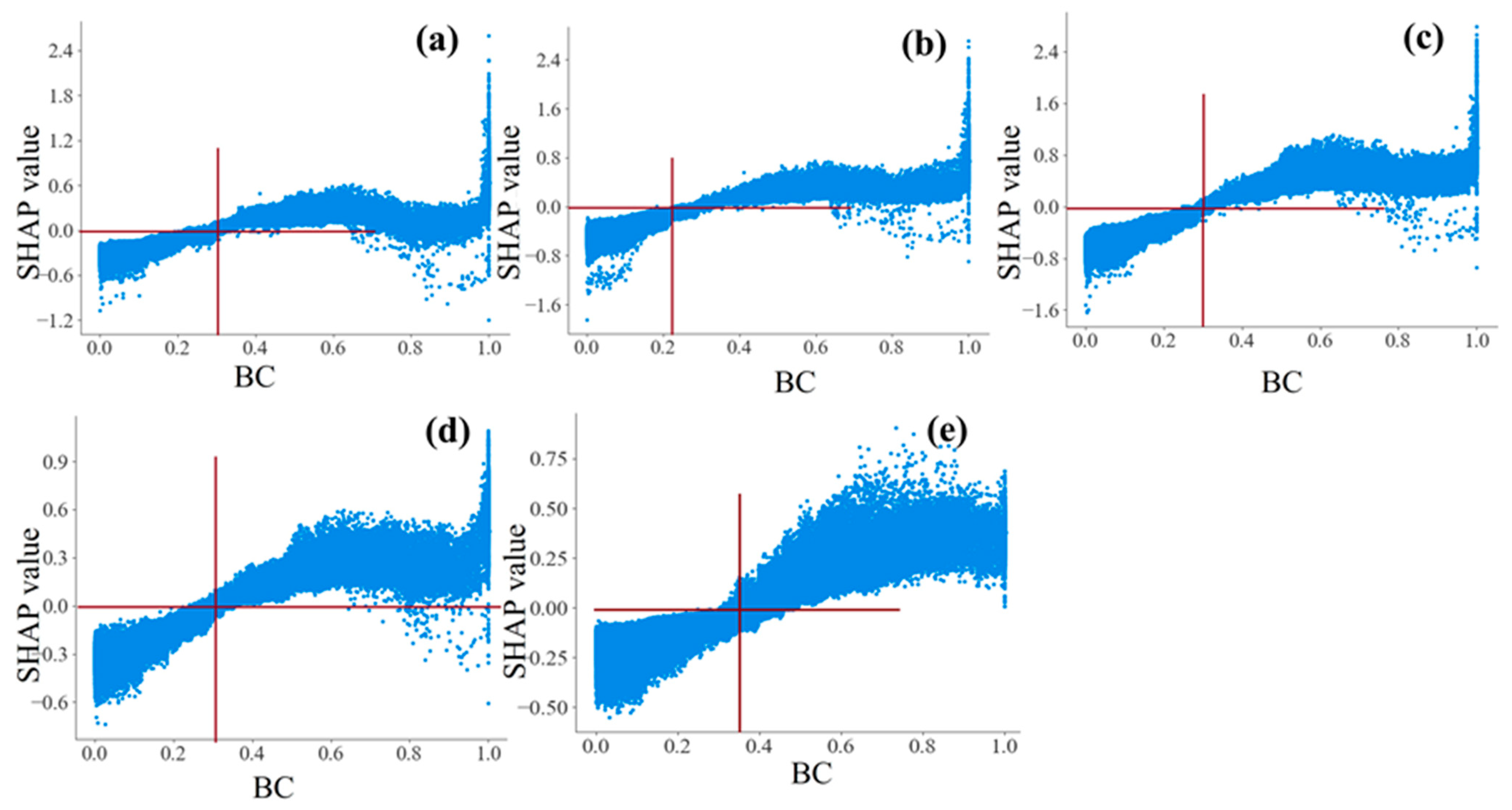
Figure 12 illustrates the trends in SHAP values for BC, where each point represents an individual sample. The horizontal axis denotes BC values, while the vertical axis reflects their contribution to land surface temperature during heatwaves, revealing the correlations between various temperature parameters. The SHAP values of BC across all temperature indices exhibit a highly consistent non-linear response with distinct threshold characteristics. As BC increases, its impact on the thermal environment shifts from inhibition to promotion: when BC < 0.3 (95% CI: 0.29–0.31), the SHAP values are negative, indicating a cooling effect. This is because low-density built-up areas are typically associated with more vegetation or bare soil, where evapotranspiration absorbs heat, thereby generating a cooling effect. Once BC exceeds 0.3, the SHAP values turn positive, and the warming rate rises significantly with building density. This is because high-density built-up surfaces (such as concrete and asphalt) have low albedo and high heat capacity, enabling them to absorb substantial solar radiation. At the same time, the compact layout impedes ventilation and heat dissipation, leading to rapid heat accumulation. When BC is in the mid-to-high range of 0.4–0.8, building coverage approaches saturation, and the surface heat storage and release reach a relative equilibrium, so the warming effect tends to stabilize. Comparing the indices, the positive contribution of BC is most pronounced in Figure 12a (HWTmean), Figure 12b (HWTmax), and Figure 12c (HWTday), reflecting the intense heating of high-density areas under strong daytime solar radiation. Under direct solar radiation, building surfaces heat up rapidly and warm the surrounding air, whereas nighttime warming depends primarily on the release of stored heat; therefore, the daytime effect is stronger. In contrast, Figure 12d (HWTnight) shows a weaker response with smaller SHAP value fluctuations because, in the absence of solar radiation, temperatures are dominated by the release of stored heat. Moreover, the heat released at night is less directly influenced by differences in building density compared to the incoming solar radiation during the day, resulting in smaller fluctuations. Consequently, the significance of BC’s influence on Figure 12e (LST Diurnal Range), which represents the integrated result of day and night warming, is also lower than that of the daytime indices. This is because the diurnal temperature range combines daytime warming and nighttime cooling, where some effects partially offset each other, leading to a reduced overall contribution of BC.

5.3.2. Normalized Difference Vegetation Index (NDVI)

The NDVI is significantly and negatively correlated with various heatwave temperature indices, with its SHAP values shifting from positive to negative as NDVI increases. When NDVI is below approximately 0.3 (95% CI: 0.29–0.32, representing impervious surfaces or sparse vegetation), it exerts a promoting effect on surface temperatures, as impervious surfaces such as concrete absorb and store more solar radiation, while sparse vegetation lacks sufficient cooling capacity. However, once it exceeds 0.3, vegetation inhibits temperature rises through evaporative cooling and shading effects [74]. Among different indicators, the SHAP values for HWTday (Figure S11d) exhibit the steepest decline, indicating that vegetation’s cooling capacity is most potent during the day, as shading and evapotranspirative cooling reach their maximum under intense solar radiation. Meanwhile the SHAP values for HWTnight (Figure S11e) show smaller fluctuations, reflecting the limited regulatory capacity of vegetation at night, as the absence of solar radiation suppresses evapotranspiration and renders shading ineffective. Furthermore, the marginal cooling contribution tends to reach a plateau after NDVI exceeds 0.6 (95% CI: 0.59–0.61), as dense canopy coverage has already saturated the cooling effect, and further increases in greenness yield only marginal additional benefits. In the HWTDTR (Figure S11f), high NDVI values provide a significant negative contribution [75], demonstrating that vegetation can effectively narrow extreme temperature gaps and serve as a hermal buffer.

5.3.3. Mean Building Height (MBH)

As shown in Figure S12, MBH exhibits a similar non-linear threshold characteristic in its impact on heatwave indices [76]. When MBH is below approximately 20 m (95% CI: 19–22 m), this is because low-rise buildings are unable to effectively block sunlight, allowing the surface to receive more solar radiation, and their shading capacity is therefore limited, permitting substantial surface radiation absorption. This, combined with the high heat capacity of construction materials, promotes heat storage and sensible heat release, leading to a significant warming effect on surface temperatures. Once MBH exceeds 20 m, as the shadow coverage of mid-to-high-rise buildings expands and the aspect ratio of street canyons increases, the amount of solar radiation received at the ground level is significantly reduced, effectively reducing solar radiation input at the surface and shifting the contribution of MBH to negative [77].

5.3.4. Sky View Factor (SVF)

Figure S8 illustrates the non-linear impacts and threshold effects of the SVF on various surface temperature indices. In areas where SVF < 0.5 (95% CI: 0.49–0.51), the SHAP values are generally negative, as low SVF corresponds to narrow street canyons formed by dense buildings, where limited sky visibility reduces the amount of solar radiation reaching the surface, reflecting the shading and cooling effects of dense built environments; however, when SVF exceeds approximately 0.5, the impact shifts from cooling to warming, as a more open sky view allows greater direct solar radiation to reach the ground, and the daytime warming effect outweighs nocturnal heat dissipation. The responses of different temperature indices vary: HWTmean (Figure S13a), HWTmax (Figure S13b), and HWTday (Figure S13d) all show significant positive correlations when SVF > 0.5, primarily driven by solar radiation, as under direct daytime sunlight, high-SVF areas absorb substantially more heat at the surface than low-SVF areas. While the HWTnight (Figure S13e) also shows a positive correlation, the curve is relatively flat, reflecting the combined effects of long-wave radiation and heat storage lag. For the HWTmin (Figure S13c), the SHAP values decrease or even approach zero at high SVF levels, as enhanced nighttime heat dissipation in open environments makes it difficult to maintain higher temperatures. The HWTDTR (Figure S13f) is most sensitive to SVF, with SHAP values rising rapidly once SVF exceeds approximately 0.8 (95% CI: 0.79–0.82), as intense daytime heating combined with enhanced nocturnal heat dissipation leads to a pronounced increase in diurnal temperature range, highlighting the critical role of SVF in regulating urban thermal stability.

5.4. Limitations and Future Research Directions

This study reveals the nonlinear effects of 2D and 3D urban morphological parameters on land surface temperature across different urban–rural gradients during heatwaves. Nevertheless, several limitations remain that warrant further investigation. First, the availability of high-quality Landsat-8 data is limited due to cloud cover and weather conditions, and unavoidable errors arising from multi-sensor registration and atmospheric correction introduce uncertainties in land surface temperature estimation. Second, although the model incorporates key physical morphological parameters (e.g., building coverage, height, and vegetation index), other influential factors such as socioeconomic and anthropogenic variables are not considered, which may partly explain the moderate explanatory power of some XGBoost models (e.g., R2 as low as 0.37 for diurnal temperature range). Third, the study area (the core urban region within and around Beijing’s Fifth Ring Road) exhibits a relatively homogeneous impervious surface pattern and limited meteorological station coverage, constraining the robustness of accuracy evaluation, particularly in peripheral and nighttime conditions. In addition, the traditional random split strategy (80% training and 20% testing) does not explicitly account for spatial autocorrelation in geospatial data, which may lead to an optimistic bias in reported model performance (R2), although it remains effective for capturing general relationships between urban morphology and LST. Future research should address these limitations by incorporating spatial block cross-validation, exploring multi-sensor differences (e.g., acquisition time and viewing geometry), integrating multi-source urban socio-environmental variables, and extending the analysis to cities with diverse heatwave intensities and heterogeneous land cover types globally.

6. Conclusions

Taking the core urban area of Beijing as a case study, this research constructed a high-spatiotemporal-resolution LST dataset using the LCZ-FSDAF algorithm. The study first systematically investigated the long-term spatiotemporal evolution characteristics of heatwave events and urban LST patterns from 2015 to 2024. Subsequently, by selecting the severe heatwave event in 2023 as a representative case study, the XGBoost-SHAP model was further employed to reveal the nonlinear influence mechanisms and threshold effects of 2D and 3D urban morphological parameters on the thermal environment. The main conclusions are as follows:
  • The LCZ-FSDAF model significantly outperforms traditional fusion methods in highly heterogeneous urban environments. By incorporating Local Climate Zone constraints, the model achieved a daytime correlation coefficient of 0.946 and an RMSE of only 0.762 K, substantially improving upon STARFM and ESTARFM. Nighttime accuracy was lower (R2 = 0.836) due to greater temporal decorrelation and reduced thermal contrast, highlighting the need for further optimization of nighttime fusion strategies.
  • Heatwave events in Beijing have intensified markedly over the past decade (2015–2024). The frequency of heatwaves peaked in 2022 (~7.3 events/year), while the average duration of individual events increased from 5.1 to 5.9 days. The year 2023 recorded the highest heatwave magnitude (~18 °C·day−1·event−1). These trends indicate a continuously escalating thermal risk in the study area, consistent with broader patterns of climate change in northern China.
  • During heatwave periods, LST exhibits a concentric spatial pattern characterized by higher temperatures in the urban core and lower temperatures in the surrounding areas. However, due to the shading effects of high-rise buildings in the core area, the peak temperature does not occur in the geometric center (Zone 1), but rather in the adjacent Zone 2, which is dominated by high-density mixed residential and commercial land use. The urban–rural temperature difference is approximately 2.1 K. In addition, the urban thermal environment shows significant directional heterogeneity: the northern transect, influenced by mountainous forest regulation, exhibits the most pronounced fluctuations, whereas the western and southern transects, characterized by higher urban connectivity, maintain elevated temperatures over longer distances.
  • The effects of urban morphological parameters on LST exhibit significant nonlinearities and threshold behaviors. As UI increases, LST shows an overall upward trend, with response turning points at specific thresholds. SHAP analysis indicates that the NDVI and MBH are the dominant factors. Vegetation reduces temperature through evapotranspiration, while building height exerts complex effects by altering radiation and ventilation conditions. Specifically, BC exhibits a cooling effect when below 0.3, but shifts to a significant warming effect beyond this threshold. NDVI contributes most to cooling within the range of 0.3–0.6, after which the effect tends to saturate. MBH shows a critical threshold of approximately 20 m, beyond which shading effects become dominant and suppress surface warming. The SVF is particularly sensitive to the diurnal temperature range: higher SVF enhances nocturnal heat dissipation but also increases daytime radiation absorption, thereby significantly amplifying the diurnal temperature range, reflecting its dual regulatory role in urban thermal stability.
From the perspective of high-temperature heatwaves, this study reveals the nonlinear relationships and response characteristics of the urban thermal environment under heatwave conditions in Beijing, and may serve as a reference for future research and urban climate adaptation strategies.

Supplementary Materials

The following supporting information can be downloaded at: https://www.mdpi.com/article/10.3390/app16094150/s1, Figure S1: Spatial distribution of geographic datasets used in the study: (a) Digital Surface Model (DSM), (b) building height, (c) transportation network, and (d) Spatial distribution of station data and land use classification; Figure S2: Gradient distribution and transect selection in the study area; Figure S3:Two-dimensional urban morphology parameters; Figure S4:Three-dimensional urban morphology parameters; Figure S5:Accuracy assessment between model-predicted temperatures (Landsat-like LST) and retrieved land surface temperatures (2018.10.17): (a) Actual Landsat LST; (b) LCZ-FSDAF prediction; (c) STARFM predicted temperature; (d) ESTARFM predicted temperature; Figure S6:Accuracy assessment of model-predicted nighttime temperature (Landsat-like LST) vs. retrieved land surface temperature (2023.09.16): (a) Observed ASTER LST; (b) LCZ-FSDAF predicted LST; (c) STARFM predicted temperature; (d) ESTARFM predicted temperature; Figure S7: Identification of high-temperature heatwaves from 2015 to 2024; Figure S8: Location of the four meteorological validation stations and surrounding land surface characteristics: (a) Land cover (LULC) types;(b) Spatial distribution of Impervious Surface Fraction (ISC); (c) NDVI spatial distribution; Figure S9: Distribution of investigated plots within sixth road area in Beijing; Figure S10: Response thresholds of LST spatial heterogeneity to urbanization intensity: (a) mean LST, (b) maximum LST, (c) minimum LST, (d) mean daytime temperature, (e) mean nighttime temperature, and (f) difference between maximum and minimum temperature; Figure S11: SHAP value trends for NDVI: (a) mean LST, (b) maximum LST, (c) minimum LST, (d) mean daytime temperature, (e) mean nighttime temperature, and (f) difference between maximum and minimum temperature; Figure S12: Influence of MBH on LST indicators based on SHAP value trends. (a) Mean LST; (b) Maximum LST; (c) Minimum LST; (d) Mean daytime LST; (e) Mean nighttime LST; and (f) Diurnal temperature range (difference between maximum and minimum LST); Figure S13: SHAP value trends for SVF: (a) mean LST, (b) maximum LST, (c) minimum LST, (d) mean daytime temperature, (e) mean nighttime temperature, and (f) difference between maximum and minimum temperature; Figure S14: Schematic diagram of LCZ-FSDAF utilizing land satellite Landsat-8, MODIS, and geostationary satellite FY-2F data. The vertical axis represents observation days, the horizontal axis to the right indicates observation hours, the left forward axis represents spatial resolution, and the right forward axis represents temporal resolution. The predicted LST (dashed box) has a spatial resolution of 30 m (Landsat-8) and a temporal resolution of 1 hour (FY-2F); Table S1: Detailed information of each measured station in the study area; Table S2: Metrics for classifying the urban-rural gradient; Table S3: Multicollinearity Test Table; Table S4: Selection Dates of In-Situ Station Data; Table S5: The patch distribution of urban forest in different rings in Beijing; Table S6: The landscape indices of urban forest within fifth ring in Beijing; Table S7: The landscape indices of urban forest in different rings in Beijing; Table S8: A summary of ZY-3 stereo image; Table S9: Parameter settings for the experiment; Table S10.: Land surface characteristics and model performance at the four validation stations (based on LUCU, ISC and NDVI data); Supplementary S1: LST retrieval; Supplementary S2: LCZ-Based Flexible Spatiotemporal Data Fusion Model for Temperature (LCZ-FSDAF).

Author Contributions

L.L.: Writing—original draft, Software, Methodology, Conceptualization. M.D.: Writing—original draft, Methodology, Conceptualization. All authors have read and agreed to the published version of the manuscript.

Funding

This work was supported by the National Natural Science Foundation of China (Remote Sensing-Based Precise Identification of Construction Waste for the Optimization Simulation of Urban Building System Metabolism) [42271478].

Institutional Review Board Statement

Not applicable.

Informed Consent Statement

Not applicable.

Data Availability Statement

The data that support the findings of this study are available from the corresponding author upon reasonable request. The data are not publicly available due to privacy.

Conflicts of Interest

The authors declare no conflict of interest.

References

  1. Yadav, A.J.C. Climate Extremes: Heatwaves, Droughts, Heavy Rainfall and Hurricanes. In A Textbook of Climatology; Wisdom Press: New Delhi, India, 2022. [Google Scholar]
  2. Hao, L.; Sun, G.; Huang, X.; Tang, R.; Jin, K.; Lai, Y.; Chen, D.; Zhang, Y.; Zhou, D.; Yang, Z.-L.; et al. Urbanization alters atmospheric dryness through land evapotranspiration. NPJ Clim. Atmos. Sci. 2023, 6, 149. [Google Scholar] [CrossRef]
  3. Tripathy, K.P.; Mukherjee, S.; Mishra, A.K.; Mann, M.E.; Williams, A.P. Climate change will accelerate the high-end risk of compound drought and heatwave events. Proc. Natl. Acad. Sci. USA 2023, 120, e2219825120. [Google Scholar] [CrossRef]
  4. Vogel, M.M.; Zscheischler, J.; Fischer, E.M.; Seneviratne, S.I. Development of future heatwaves for different hazard thresholds. J. Geophys. Res. Atmos. 2020, 125, e2019JD032070. [Google Scholar] [CrossRef]
  5. Piticar, A.; Cheval, S.; Frighenciu, M. A review of recent studies on heat wave definitions, mechanisms, changes, and impact on mortality. In Forum Geografic; Department of Geography, University of Craiova: Craiova, Romania, 2019; p. 96. [Google Scholar] [CrossRef]
  6. Liu, J.; Ren, Y.; Tao, H.; Shalamzari, M. Spatial and temporal variation characteristics of heatwaves in recent decades over China. Remote Sens. 2021, 13, 3824. [Google Scholar] [CrossRef]
  7. Wang, R.; Bei, N.; Hu, B.; Wu, J.; Liu, S.; Li, X.; Jiang, Q.; Tie, X.; Li, G. The relationship between the intensified heat waves and deteriorated summertime ozone pollution in the Beijing–Tianjin–Hebei region, China, during 2013–2017. Environ. Pollut. 2022, 314, 120256. [Google Scholar] [CrossRef]
  8. Ding, T.; Qian, W.; Yan, Z. Changes in hot days and heat waves in China during 1961–2007. Int. J. Climatol. 2010, 30, 1452–1462. [Google Scholar] [CrossRef]
  9. Li, K.; Amatus, G. Spatiotemporal changes of heat waves and extreme temperatures in the main cities of China from 1955 to 2014. Nat. Hazards Earth Syst. Sci. 2020, 20, 1889–1901. [Google Scholar] [CrossRef]
  10. Ye, L.; Shi, K.; Xin, Z.; Wang, C.; Zhang, C.J. Compound droughts and heat waves in China. Sustainability 2019, 11, 3270. [Google Scholar] [CrossRef]
  11. Xu, Z.; FitzGerald, G.; Guo, Y.; Jalaludin, B.; Tong, S. Impact of heatwave on mortality under different heatwave definitions: A systematic review and meta-analysis. Environ. Int. 2016, 89, 193–203. [Google Scholar] [CrossRef]
  12. Kenawy, A.E.; Al-Awadhi, T.; Abdullah, M.; Ostermann, F.O.; Abulibdeh, A. A multidecadal assessment of drought intensification in the middle East and North africa: The role of global warming and rainfall deficit. Earth Syst. Environ. 2026, 10, 343–362. [Google Scholar] [CrossRef]
  13. Rahmstorf, S.; Coumou, D. Increase of extreme events in a warming world. Proc. Natl. Acad. Sci. USA 2011, 108, 17905–17909. [Google Scholar] [CrossRef]
  14. Xu, J.; Wang, Q.; Anikeeva, O.; Zhu, P.; Bi, P.; Huang, C. Effects of extreme heat on physiology, morbidity, and mortality under climate change: Mechanisms and clinical implications. BMJ 2025, 391, e084675. [Google Scholar] [CrossRef]
  15. Panda, J.; Mukherjee, A.; Choudhury, A. Urban heat: UHI and heat stress threat to megacities. In Climate Crisis: Adaptive Approaches and Sustainability; Springer Nature: Cham, Switzerland, 2024; pp. 425–445. [Google Scholar] [CrossRef]
  16. Li, F.; Yigitcanlar, T.; Nepal, M.; Thanh, K.N. A novel urban heat vulnerability analysis: Integrating machine learning and remote sensing for enhanced insights. Remote Sens. 2024, 16, 3032. [Google Scholar] [CrossRef]
  17. Xu, Y.; Yang, J.; Zheng, Y.; Li, W. Impacts of two-dimensional and three-dimensional urban morphology on urban thermal environments in high-density cities: A case study of Hong Kong. Build. Environ. 2024, 252, 111249. [Google Scholar] [CrossRef]
  18. Wang, Y.; He, Z.; Zhai, W.; Wang, S.; Zhao, C. How do the 3D urban morphological characteristics spatiotemporally affect the urban thermal environment? A case study of San Antonio. Build. Environ. 2024, 261, 111738. [Google Scholar] [CrossRef]
  19. Wang, C.; Liu, Z.; Du, H.; Zhan, W. Regulation of urban morphology on thermal environment across global cities. Sustain. Cities Soc. 2023, 97, 104749. [Google Scholar] [CrossRef]
  20. Liu, J.; Hagan, D.F.T.; Liu, Y. Global land surface temperature change (2003–2017) and its relationship with climate drivers: AIRS, MODIS, and ERA5-land based analysis. Remote Sens. 2020, 13, 44. [Google Scholar] [CrossRef]
  21. Yang, J.; McBride, J.; Zhou, J.; Sun, Z. The urban forest in Beijing and its role in air pollution reduction. Urban For. Urban Green. 2005, 3, 65–78. [Google Scholar] [CrossRef]
  22. Tong, J.H. Analysis of Spatial Distribution and Structural Characteristics of Urban Forest in the Main Urban Area of Beijing. Master’s Thesis, Beijing Forestry University, Beijing, China, 2018. [Google Scholar] [CrossRef]
  23. Yao, Y.; Lu, L.; Guo, J.; Zhang, S.; Cheng, J.; Tariq, A.; Liang, D.; Hu, Y.; Li, Q. Spatially explicit assessments of heat-related health risks: A literature review. Remote Sens. 2024, 16, 4500. [Google Scholar] [CrossRef]
  24. Kim, Y.; Yoo, C.; Im, J. Nighttime satellite land surface temperature for urban applications: Achievements, challenges, and future prospects. GISci. Remote Sens. 2025, 62, 2527990. [Google Scholar] [CrossRef]
  25. Mao, Q.; Peng, J.; Wang, Y. Resolution enhancement of remotely sensed land surface temperature: Current status and perspectives. Remote Sens. 2021, 13, 1306. [Google Scholar] [CrossRef]
  26. Liang, J.; Li, W.; Zhou, Y.; Han, X.; Li, D. Long-Term Spatiotemporal Relationship of Urban–Rural Gradient Between Land Surface Temperature and Nighttime Light in Representative Cities Across China’s Climate Zones. Remote Sens. 2025, 17, 3585. [Google Scholar] [CrossRef]
  27. Yang, M.; Ren, C.; Wang, H.; Wang, J.; Feng, Z.; Kumar, P.; Haghighat, F.; Cao, S. Mitigating urban heat island through neighboring rural land cover. Nat. Cities 2024, 1, 522–532. [Google Scholar] [CrossRef]
  28. Chen, L.; Guo, G. Exploring the nonlinear interactions and threshold effects of urban building morphology and green space on land surface temperature in high-density areas: A cross-city comparative study. Sustain. Cities Soc. 2025, 136, 107069. [Google Scholar] [CrossRef]
  29. Tian, G.; Wu, J.; Yang, Z. Spatial pattern of urban functions in the Beijing metropolitan region. Habitat Int. 2010, 34, 249–255. [Google Scholar] [CrossRef]
  30. Wang, S.; Song, X.; Wang, Q.; Xiao, G.; Liu, C.; Liu, J. Shallow groundwater dynamics in North China plain. J. Geogr. Sci. 2009, 19, 175–188. [Google Scholar] [CrossRef]
  31. Xiao, X.; Sun, J.; Chen, M.; Qie, X.; Ying, Z.; Wang, Y.; Ji, L. Comparison of environmental and mesoscale characteristics of two types of mountain-to-plain precipitation systems in the Beijing region, China. J. Geophys. Res. Atmos. 2019, 124, 6856–6872. [Google Scholar] [CrossRef]
  32. Wu, L.; Zhao, X. Characteristics of precipitation diurnal variation in the rainy season of Beijing in 2009–2020. Environ. Earth Sci. 2023, 82, 111. [Google Scholar] [CrossRef]
  33. He, W.; Cao, S.; Du, M.; Meng, X.; Yang, Z.; Yang, Y. The effect of urban form parameters on annual and diurnal cycles of land surface temperature with 30-meter hourly resolution. Sustain. Cities Soc. 2024, 115, 105806. [Google Scholar] [CrossRef]
  34. Ghasempour, F.; Sekertekin, A.; Kutoglu, S.H. How Landsat 9 is superior to Landsat 8: Comparative assessment of land use land cover classification and land surface temperature. ISPRS Ann. Photogramm. Remote Sens. Spat. Inf. Sci. 2023, 10, 221–227. [Google Scholar] [CrossRef]
  35. Zhao, R.; Yu, W.; Deng, X.; Huang, Y.; Yang, W.; Zhou, W. Analysis of land surface performance differences and uncertainty in multiple versions of MODIS LST products. Remote Sens. 2024, 16, 4255. [Google Scholar] [CrossRef]
  36. Zhang, P.; Xu, Z.; Guan, M.; Xie, L.; Xian, D.; Liu, C. Progress of fengyun meteorological satellites since 2020. Chin. J. Space Sci. 2022, 42, 724–732. [Google Scholar] [CrossRef]
  37. Liang, Y.; Cao, S.; Du, M.; Lu, L.; Jiang, J.; Quan, J.; Yang, M. Local climate zone mapping using remote sensing: A synergetic use of daytime multi-view Ziyuan-3 stereo imageries and Luojia-1 nighttime light data. Int. J. Digit. Earth 2023, 16, 3456–3488. [Google Scholar] [CrossRef]
  38. Zhang, Y.; Zhao, H.; Long, Y. CMAB: A multi-attribute building dataset of China. Sci. Data 2025, 12, 430. [Google Scholar] [CrossRef] [PubMed]
  39. Xiong, S.; Zhang, X.; Wang, H.; Meng, Q.; Du, S. 40-year (1984–2024) mapping of urban land use dynamics in China. Sci. Bull. 2026, 71, 1474–1485. [Google Scholar] [CrossRef]
  40. Huang, J.; Yu, Y. Vertical Accuracy Assessment of the ASTER, SRTM, GLO-30, and ATLAS in a Forested Environment. Forests 2024, 15, 426. [Google Scholar] [CrossRef]
  41. Gomis-Cebolla, J.; Rattayova, V.; Salazar-Galán, S.; Francés, F. Evaluation of ERA5 and ERA5-Land reanalysis precipitation datasets over Spain (1951–2020). Atmos. Res. 2023, 284, 106606. [Google Scholar] [CrossRef]
  42. Yilmaz, M. Accuracy assessment of temperature trends from ERA5 and ERA5-Land. Sci. Total Environ. 2023, 856, 159182. [Google Scholar] [CrossRef]
  43. Zhu, X.; Helmer, E.H.; Gao, F.; Liu, D.; Chen, J.; Lefsky, M.A. A flexible spatiotemporal method for fusing satellite images with different resolutions. Remote Sens. Environ. 2016, 172, 165–177. [Google Scholar] [CrossRef]
  44. T Tan, K.; Liao, Z.; Du, P.; Wu, L. Land surface temperature retrieval from Landsat 8 data and validation with geosensor network. Front. Earth Sci. 2017, 11, 20–34. [Google Scholar] [CrossRef]
  45. Quan, J.; Zhan, W.; Ma, T.; Du, Y.; Guo, Z.; Qin, B. An integrated model for generating hourly Landsat-like land surface temperatures over heterogeneous landscapes. Remote Sens. Environ. 2018, 206, 403–423. [Google Scholar] [CrossRef]
  46. Espinosa, L.A.; Portela, M.M. Red-Hot Portugal: Mapping the Increasing Severity of Exceptional Maximum Temperature Events (1980–2024). Atmosphere 2025, 16, 514. [Google Scholar] [CrossRef]
  47. Zalzalah, K.; Selladurai, S.; Rossa, C. Real-Time Simulation of Ultrasound Image Deformation Using Thin Plate Spline. In Proceedings of the 2025 IEEE Sensors Applications Symposium (SAS); IEEE: New York, NY, USA, 2025; pp. 1–6. [Google Scholar] [CrossRef]
  48. You, Q.; Deng, W.; Liu, Y.; Tang, X.; Chen, J.; You, H. Extraction the Spatial Distribution of Mangroves in the Same Month Based on Images Reconstructed with the FSDAF Model. Forests 2023, 14, 2399. [Google Scholar] [CrossRef]
  49. Ren, Y.; Liu, J.; Zhang, T.; Shalamzari, M.J.; Arshad, A.; Liu, T.; Willems, P.; Gao, H.; Tao, H.; Wang, T. Identification and analysis of heatwave events considering temporal continuity and spatial dynamics. Remote Sens. 2023, 15, 1369. [Google Scholar] [CrossRef]
  50. Shan, B.; Verhoest, N.E.C.; De Baets, B. Identification of compound drought and heatwave events on a daily scale and across four seasons. Hydrol. Earth Syst. Sci. 2024, 28, 2065–2080. [Google Scholar] [CrossRef]
  51. Pan, S.; Yin, Z.; Duan, M.; Han, T.; Fan, Y.; Huang, Y.; Wang, H. Seasonal prediction of extreme high-temperature days over the Yangtze River basin. Sci. China Earth Sci. 2024, 67, 2137–2147. [Google Scholar] [CrossRef]
  52. Kumar, P.; Chakraborty, A.; Sagar, A.K.; Almazroui, M.; Dogar, M.M.; Chakrabortty, R. Investigating Heatwave Features: Creating an Intensity-Duration-Frequency Model for India’s Principal Climate Zones. Earth Syst. Environ. 2026, 25, 1–18. [Google Scholar] [CrossRef]
  53. Tatli, H.; Serkendiz, H. Heatwave dynamics in Türkiye: A long-term spatiotemporal analysis of frequency, duration, and intensity (1970–2022). Environ. Monit. Assess. 2025, 197, 752. [Google Scholar] [CrossRef] [PubMed]
  54. Wang, X.; Wang, D.; Lu, J.; Gao, W.; Jin, X. Identifying and tracking the urban–rural fringe evolution in the urban–rural transformation period: Evidence from a rapidly urbanized rust belt city in China. Ecol. Indic. 2023, 146, 109856. [Google Scholar] [CrossRef]
  55. Cui, Z.H.; Lyu, Y.J.; Yang, X.Y. Analysis of the urban-rural gradient evolution of soundscape in Nanjing metropolitan area. J. Nanjing For. Univ. (Nat. Sci. Ed.) 2023, 47, 199–206. [Google Scholar] [CrossRef]
  56. Fan, J.; Wang, Q.; Ji, M.; Sun, Y.; Feng, Y.; Yang, F.; Zhang, Z. Ecological network construction and gradient zoning optimization strategy in urban-rural fringe: A case study of Licheng District, Jinan City, China. Ecol. Indic. 2023, 150, 110251. [Google Scholar] [CrossRef]
  57. Hsu, P.H.; Sathianarayanan, M.; Gianoli, A. Maximizing cooling benefits through urban green and blue spaces in Taipei city. Discov. Cities 2025, 2, 115. [Google Scholar] [CrossRef]
  58. Chen, J.; Cao, S.; Du, M.; Du, M.; Liu, X.; Song, W.; Liang, Y.; He, W.; Li, L.; Wang, N. Investigating the role of two-dimensional and three-dimensional urban structures in seasonal surface radiation budget. Build. Environ. 2025, 267, 112148. [Google Scholar] [CrossRef]
  59. Shi, Y.; Zhao, S. Discover the desirable landscape structure for mitigating urban heat: The urban-rural gradient approach for an ancient Chinese city. Cities 2022, 127, 103737. [Google Scholar] [CrossRef]
  60. Mo, Y.; Huang, Y.; Zhong, R.; Wang, B.; Guo, Z. Investigating the Effects of 2D/3D Urban Morphology on Land Surface Temperature Using High-Resolution Remote Sensing Data. Buildings 2025, 15, 1256. [Google Scholar] [CrossRef]
  61. Wu, W.-B.; Yu, Z.-W.; Ma, J.; Zhao, B. Quantifying the influence of 2D and 3D urban morphology on the thermal environment across climatic zones. Landsc. Urban Plan. 2022, 226, 104499. [Google Scholar] [CrossRef]
  62. Chen, T.; Guestrin, C. Xgboost: A scalable tree boosting system. In Proceedings of the 22nd ACM Sigkdd International Conference on Knowledge Discovery and Data Mining, San Francisco, CA, USA, 13–17 August 2016; pp. 785–794. [Google Scholar] [CrossRef]
  63. Bentéjac, C.; Csörgő, A.; Martínez-Muñoz, G. A comparative analysis of gradient boosting algorithms. Artif. Intell. Rev. 2021, 54, 1937–1967. [Google Scholar] [CrossRef]
  64. Wang, Y.; Wang, J. A Research on Constructing a Digital Economy Evaluation System Based on VIF-GPCA. In Proceedings of the 2024 9th International Conference on Intelligent Information Processing, Bucharest, Romania, 21–23 November 2024; pp. 41–48. [Google Scholar] [CrossRef]
  65. Lundberg, S.M.; Lee, S.I. A unified approach to interpreting model predictions. arXiv 2017. [Google Scholar] [CrossRef]
  66. Zhao, Y.; Huang, B.; Song, H. A robust adaptive spatial and temporal image fusion model for complex land surface changes. Remote Sens. Environ. 2018, 208, 42–62. [Google Scholar] [CrossRef]
  67. Zhu, X.; Chen, J.; Gao, F.; Chen, X.; Masek, J.G. An enhanced spatial and temporal adaptive reflectance fusion model for complex heterogeneous regions. Remote Sens. Environ. 2010, 114, 2610–2623. [Google Scholar] [CrossRef]
  68. Ottmann, D.A. Oasis by the Sea: Design Matrix for Shaping Microclimates in Hot Coastal Cities. In Amphibious Concepts at the Edge of the Sea; Springer Nature: Singapore, 2025; pp. 163–190. [Google Scholar] [CrossRef]
  69. Wu, Z.; Shi, Y.; Ren, L.; Hang, J. Scaled outdoor experiments to assess impacts of tree evapotranspiration and shading on microclimates and energy fluxes in 2D street canyons. Sustain. Cities Soc. 2024, 108, 105486. [Google Scholar] [CrossRef]
  70. Chen, Q.; Cheng, Q.; Chen, Y.; Li, K.; Wang, D.; Cao, S. The influence of sky view factor on daytime and nighttime urban land surface temperature in different spatial-temporal scales: A case study of Beijing. Remote Sens. 2021, 13, 4117. [Google Scholar] [CrossRef]
  71. Amani-Beni, M.; Zhang, B.; Xie, G.-D.; Shi, Y. Impacts of urban green landscape patterns on land surface temperature: Evidence from the adjacent area of Olympic Forest Park of Beijing, China. Sustainability 2019, 11, 513. [Google Scholar] [CrossRef]
  72. Xu, X.; Sun, S.; Liu, W.; García, E.H.; He, L.; Cai, Q.; Xu, S.; Wang, J.; Zhu, J. The cooling and energy saving effect of landscape design parameters of urban park in summer: A case of Beijing, China. Energy Build. 2017, 149, 91–100. [Google Scholar] [CrossRef]
  73. Bowler, D.E.; Buyung-Ali, L.; Knight, T.M.; Pullin, A.S. Urban greening to cool towns and cities: A systematic review of the empirical evidence. Landsc. Urban Plan. 2010, 97, 147–155. [Google Scholar] [CrossRef]
  74. Zhang, B.; Xie, G.-d.; Gao, J.-x.; Yang, Y. The cooling effect of urban green spaces as a contribution to energy-saving and emission-reduction: A case study in Beijing, China. Build. Environ. 2014, 76, 37–43. [Google Scholar] [CrossRef]
  75. Ma, W.; Yu, Z.; Chen, J.; Yang, W.; Zhang, Y.; Hu, Y.; Shao, M.; Hu, J.; Zhang, Y.; Zhang, H. What drives the cooling dynamics of urban vegetation via evapotranspiration and shading under extreme heat? Sustain. Cities Soc. 2025, 130, 106659. [Google Scholar] [CrossRef]
  76. Cheng, X.; Peng, J.; Li, W.; Dormann, C.F.; Liu, Y.; Dong, J.; Orth, R. Cooling efficiency of trees and short vegetation in large cities across the globe. Environ. Res. Commun. 2025, 7, 105016. [Google Scholar] [CrossRef]
  77. Wang, Z.; Sun, X.; Wang, H. Threshold-driven modeling of urban heat exposure under impervious surface expansion: A decadal remote sensing assessment of Shanghai. Stoch. Environ. Res. Risk Assess. 2026, 40, 5. [Google Scholar] [CrossRef]
Figure 1. Overview of the study area: (a) Location of the study area, (b) Remote Sensing Imagery, (c) Spatial Distribution of Mapped Building Volume, and (d) Elevation (m).
Applsci 16 04150 g001
Figure 2. Accuracy assessment of model-predicted temperature (Landsat-like LST) vs. retrieved land surface temperature (28 September 2017): (a) actual Landsat LST; (b) LCZ-FSDAF-predicted LST; (c) STARFM-predicted temperature; (d) ESTARFM-predicted temperature; (eg) show the accuracy fitting curves of the three models, respectively.
Applsci 16 04150 g002
Figure 3. Accuracy assessment of model-predicted nighttime temperature (Landsat-like LST) vs. retrieved land surface temperature (4 October 2022): (a) observed ASTER LST; (b) LCZ-FSDAF-predicted LST; (c) STARFM-predicted temperature; (d) ESTARFM-predicted temperature; (eg) show the accuracy fitting curves of the three models, respectively.
Applsci 16 04150 g003
Figure 4. Comparison between hourly land surface temperature (LST) from four meteorological stations and the predicted results from LCZ-FSDAF, STARFM, and ESTARFM. (ac) Scatter plots of Haidian station; (df) scatter plots of Chaoyang station; (gi) scatter plots of Beijing station; (jl) scatter plots of Fengtai station.
Applsci 16 04150 g004
Figure 5. Assessment of extreme heatwave events in the study area: (a) heatwave number (HWN), (b) heatwave duration (HWDU), (c) heatwave frequency (HWF), and (d) heatwave magnitude (HWM).
Applsci 16 04150 g005
Figure 6. Variations in maximum and minimum land surface temperature (LST) along the urban–rural gradient buffers during the heatwave: (a) maximum LST; (b) mean maximum temperature and standard deviation range across gradients; (c) minimum LST; and (d) mean minimum temperature and standard deviation range across gradients.
Applsci 16 04150 g006
Figure 7. Variations in daytime and nighttime land surface temperature (LST) along urban–rural gradient buffers during the heatwave: (a) daytime LST; (b) mean daytime temperature and standard deviation range across gradients; (c) nighttime LST; and (d) mean nighttime temperature and standard deviation range across gradients.
Applsci 16 04150 g007
Figure 8. Explanatory power of the XGBoost model for land surface temperature (LST) parameters during the heatwave.
Applsci 16 04150 g008
Figure 9. SHAP values of different urban morphological characteristics across various heatwave indices: (a) mean LST, (b) maximum LST, (c) minimum LST, (d) mean daytime temperature, (e) mean nighttime temperature, and (f) difference between maximum and minimum temperature.
Applsci 16 04150 g009
Figure 10. Variations in land surface temperature (LST) along urban–rural transects during the heatwave: (a) mean LST, (b) maximum LST, (c) minimum LST, (d) mean daytime temperature, (e) mean nighttime temperature, and (f) difference between maximum and minimum temperature.
Applsci 16 04150 g010
Figure 11. Variations in land surface temperature (LST) along the urban–rural gradient during the heatwave: (a) mean LST, (b) maximum LST, (c) minimum LST, (d) mean daytime temperature, (e) mean nighttime temperature, and (f) difference between maximum and minimum temperature.
Applsci 16 04150 g011
Figure 12. Trends in SHAP values for BC: (a) mean LST, (b) maximum LST, (c) mean daytime temperature, (d) mean nighttime temperature, and (e) difference between maximum and minimum temperature.
Applsci 16 04150 g012
Table 1. Data used in this study.
Data TypeDataset NameSource/PlatformTime/FrequencyResolution
Remote Sensing DataLandsat 8https://earthengine.google.com/ (accessed on 1 February 2026)2015–2024/16-day30 m
MODIShttps://earthengine.google.com/ (accessed on 3 February 2026)2015–2024/Daily (10:30, 13:30, 22:30, 01:30)1 km
FY-2Fhttp://satellite.nsmc.org.cn/ (accessed on 21 February 2026)2015–2024/Hourly5 km
ASTERhttps://search.earthdata.nasa.gov/ (accessed on 21 February 2026)2015–2024 (Selected Dates)90 m
Meteorological DataERA5-Landhttps://earthengine.google.com/ (accessed on 12 January 2026)2015–2024/Hourly~9 km (0.1°)
Ground Station LSThttps://data.cma.cn/ (accessed on 12 January 2026)2015–2024/HourlyStation Scale
Geospatial DataDigital Surface Model (DSM)Dataset [37]20202 m
Building Height (CMAB)Dataset [38]2022Vector
Road Network DataOpenStreetMap (OSM) (accessed on 10 January 2026)2023Vector
Urban Land Use DataDataset [39]1984–2024/5-year10 m
Table 2. 2D and 3D UMPs considered in this study.
CategoryParameterCalculation MethodDefinition
2D UMPSBuilding Coverage (BC) B C = A b u i l d i n g A g r i d Total building area divided by grid area (30 m × 30 m)
Road Density (RD) R D = A r o a d A g r i d Total road area divided by grid area (30 m × 30 m)
Normalized Difference Vegetation Index (NDVI) NDVI = N I R R e d N I R + R e d Assess the vegetation coverage of the grid area (30 m × 30 m)
Mean Building Height (MBH) M B H = i = 1 n H i n Average building height in a grid (30 m × 30 m)
3D UMPSMean Building Volume (MBV) M B V = i = 1 n V i n Average building volume in a grid (30 m × 30 m)
Sky View Factor (SVF) S V F = 1 i = 1 n sin γ i n The proportion of the sky hemisphere that is visible from a given grid (30 m × 30 m), unobstructed by buildings.
Floor Area Ratio (FAR) F A R = i = 1 n ( H i / C F i ) A Ratio of building’s total floor area to the area in a spatial unit (30 m × 30 m)
Mean Building Surface Area (BSA) B A S = i = 1 n ( F i + P i × H i ) n The average total exterior surface area (walls and roofs) of buildings within the grid (30 m × 30 m)
Building Structure Index (BSI) B S I = i = 1 n F i H i n A composite index representing the structural density and verticality of the urban fabric (30 m × 30 m)
where Abuilding, AISC, and Agrid represent the building area, impervious surface area, and grid area (30 × 30), respectively; NIR and R denote the reflectance of the near-infrared and red bands. The variable n signifies the total number of buildings within a specific grid, while Hi, Vi, Fi and Pi represent the height (m), volume (m3), floor area (m2), and perimeter (m) of the i-th building. Furthermore, A denotes the grid area (m2), and C is a constant set at 3 m. For the characterization of sky view, γ i represents the elevation angle of the i-th obstruction (such as building facades or trees), n is the total number of sampling directions, and s i n γ i represents the sine of the elevation angle, which quantifies the degree of sky view obstruction caused by these obstacles.
Table 3. Land Surface Temperature Indicators during Heatwaves.
Metric NameAbbreviationCalculation MethodDefinition
Mean Land Surface Temperature T m e a n L S T m e a n = 1 n i = 1 n L S T i The average LST value across all pixels in the study area
Maximum Land Surface Temperature T m a x L S T m a x = max ( L S T i ) The maximum LST value recorded among all pixels
Minimum Land Surface Temperature T m i n L S T m i n = min ( L S T i ) The minimum LST value recorded among all pixels
Daytime Mean Land Surface Temperature T d a y L S T d a y = 1 n i = 1 n L S T d a y , i The average LST during daytime hours (08:00–18:00).
Nighttime Mean Land Surface Temperature T n i g h t L S T n i g h t = 1 n i = 1 n L S T n i g h t , i The average LST during nighttime hours (20:00–06:00)
Diurnal Land Surface Temperature Range T D T R L S T D T R = L S T d a y L S T n i g h t The difference between daytime LST and nighttime LST for the same pixel
Disclaimer/Publisher’s Note: The statements, opinions and data contained in all publications are solely those of the individual author(s) and contributor(s) and not of MDPI and/or the editor(s). MDPI and/or the editor(s) disclaim responsibility for any injury to people or property resulting from any ideas, methods, instructions or products referred to in the content.