Article

Combined Immune-Stimulatory Effects of HemoHIM and Hwaljingigo Treatment in RAW 264.7 Macrophages


1
Department of Food Biotechnology and Environmental Science, Kangwon National University, Chuncheon 24341, Republic of Korea
2
Agriculture and Life Science Research Institute, Kangwon National University, Chuncheon 24341, Republic of Korea
3
Atomy R&D Center, Gongju 32511, Republic of Korea
*
Authors to whom correspondence should be addressed.
Appl. Sci. 2026, 16(9), 4151; https://doi.org/10.3390/app16094151
Submission received: 1 April 2026 / Revised: 15 April 2026 / Accepted: 21 April 2026 / Published: 23 April 2026

Abstract

The immune system plays a pivotal role in the maintenance of homeostasis and protection from pathogens. With increasing public interest in immune health, functional foods and herbal formulations are gaining attention as potential immunomodulators. Therefore, we aimed to investigate the combined immune-enhancing effects of HemoHIM (HIM) and Hwaljingigo (HGG) through combination treatment based on the recommended daily intake in RAW 264.7 macrophages. Cell viability, nitric oxide (NO) production, and cytokine (tumor necrosis factor-alpha, interleukin-1 beta, and interleukin-6) expression levels were assessed using the XTT, Griess, and enzyme-linked immunosorbent assay (ELISA), respectively. Immunoblotting was conducted to confirm changes in protein expression. Neither HIM nor HGG was cytotoxic at any of the tested concentrations. Both the single and combination treatments increased NO production and cytokine expression in a concentration-dependent manner. Furthermore, the combination of HIM (one sachet) and HGG (three sachets) resulted in the highest levels of NO and cytokine production. Bliss Independence analysis revealed synergistic interactions for IL-1β and IL-6, while NO and TNF-α showed additive effects. These findings suggest that the combination of HIM and HGG enhances immune responses by stimulating macrophage activity, thereby supporting the potential application of multi-herbal formulations as functional immunomodulatory agents.

1. Introduction

The immune response is a critical defense mechanism that protects the host from infectious organisms; it comprises non-specific innate and specific acquired immunity [1]. Innate immunity acts as the first line of defense and involves physical, physiological, and chemical barriers [2]. In contrast, acquired immunity generates immune memories through antigen-specific responses [3]. Although this system plays a vital role in maintaining health, it can initiate temporary inflammatory responses when damage occurs [4]. Thus, maintaining homeostasis between innate and acquired immunity is essential for maintaining the overall immune balance. Public interest in immunity and preventive healthcare has grown substantially since the onset of the coronavirus disease pandemic [5]. In particular, the use of functional foods to support immune functions has increased [6].
HemoHIM (HIM) is an herbal complex formulated using medicinal herbs such as Angelica gigas Nakai, Cnidium officinale Makino, and Paeonia lactiflora Pall, which are known for their highly immunoprotective and repair-promoting effects on immune hematopoietic cells. These effects enhance survival by reducing radiation-induced damage to gastrointestinal tract and immune system tissues [7]. Additionally, HIM contains several functional marker compounds that may contribute to its bioactivity, including chlorogenic acid (25–60 mg/100 g), paeoniflorin (200–400 mg/100 g), and nodakenin (50–150 mg/100 g) [8]. Previous studies have also reported various biological effects of HIM, including protective activity against gastric mucosal injury in mice [9], antitumor effects in melanoma-bearing mice [10], and anti-allergic activity through the inhibition of mast cell activation [7].
The Donguibogam reports that Gyeongokgo is formulated with Rehmannia glutinosa (Gaertn.) juice, powdered Panax ginseng C.A.Mey., Poria cocos (Schw.) Wolf, and honey (Apis mellifera L.). The mixture is placed in a jar, decocted over mulberry firewood for three days, cooled in well water for one day, and subsequently simmered for an additional 24 h [11]. The main component of Gyeongokgo and Hwaljingigo (HGG) containing it, Rehmannia glutinosa (Gaertn.), contains sugars such as raffinose and manninotriose, which provide energy; amino acids such as lysine and histidine that support physiological functions; and plant sterols such as β-sitosterol and stigmasterol, which contribute to cholesterol regulation and immune function. These compounds exhibit blood sugar-lowering, immunomodulatory, and antibacterial effects [12]. In addition, ginseng contains bioactive compounds such as ginsenosides, polysaccharides, and peptides, which exhibit immunomodulatory, anticancer, and neurotransmitter regulatory activities [13]. Owing to these properties, Gyeongokgo also enhances immune function [14], alleviates menopausal symptoms [15], reduces fatigue [16], and suppresses cytokine expression associated with atopic dermatitis [17].
Traditional herbal medicine often employs polyherbal formulations to enhance efficacy, overcome treatment resistance, and improve immune responses. These combinations have been clinically shown to improve patient survival, modulate immunity, and enhance quality of life [18]. However, excessive or uncontrolled intake of herbal medicines—particularly at high doses resulting from combination therapy—may lead to adverse effects and safety concerns [19]. Therefore, identifying appropriate combination strategies and optimizing dosing is critical for maximizing efficacy and minimizing potential risks.
Although extensive evidence supports the immune-enhancing effects of HIM and HGG individually, to the best of our knowledge, no study has evaluated the combined effects of these two formulations to date. Therefore, we aimed to systematically investigate the immune-enhancing effects of HIM alone and in combination with HGG to determine whether combined administration exhibits superior immune activity compared to single treatments. We further aimed to identify the optimal intake ratio and dosage. A minimum effective intake is generally required to achieve functional efficacy, and combined intake may exert enhanced effects compared to individual administration. Thus, we also sought to determine whether co-administration allows for greater efficacy even at relatively lower individual doses. HIM is a functional ingredient approved by the Ministry of Food and Drug Safety as an individually recognized material, with a recommended daily intake of 20–40 g for immune function support. Although no specific daily intake has been established for HGG due to its classification as a processed food, previous studies on Gyeongokgo have reported typical dosages of 10 mL or 30 g twice per day [11]. Based on these findings, concentrations corresponding to one, two, and three sachets were applied for the cell treatment. The combination treatment groups were designed by simultaneously treating cells with a fixed concentration of HIM (equivalent to one sachet) and varying concentrations of HGG corresponding to one, two, and three sachets.

2. Materials and Methods

2.1. Samples and Chemical Reagents

HIM and HGG were provided by the Atomy R&D Center (Gongju, Republic of Korea). The treatment concentrations of HIM and HGG were determined based on recommended or commonly consumed human intake levels and translated to corresponding in vitro concentrations using a body surface area (BSA)–based dose conversion method [20]. HIM, a functional ingredient approved by the Ministry of Food and Drug Safety for immune function support, with a recommended daily intake of 20–40 g/day. Using a BSA normalization factor of 0.08, the human daily intake was converted to a mouse equivalent dose of approximately 4–8 g/kg, which was further translated to an estimated in vitro concentration of 4–8 mg/mL. Based on this calculation, the treatment concentrations were set to reflect relative intake levels corresponding to one and two sachets. Accordingly, HIM was applied at concentrations of 4 and 8 μL/mL. As no standardized dosage exists for HGG because it is classified as a processed food, its concentrations were set to reflect commonly consumed levels, corresponding to one to three sachets (2.4–7.2 μL/mL). For combination treatments, HIM was maintained at a fixed dose (one sachet, 4 μL/mL), whereas HGG was varied accordingly. All samples were filtered through a 0.22 μm polyvinylidene difluoride (PVDF) membrane before use. Fetal bovine serum (FBS), phosphate-buffered saline (PBS), and high-glucose Dulbecco’s modified Eagle’s medium (DMEM) were purchased from Gibco (Grand Island, NY, USA). Lipopolysaccharide (LPS), sulfanilamide, sodium nitrite, and N-(1-naphthyl) ethylenediamine dihydrochloride were obtained from Sigma-Aldrich (St. Louis, MO, USA). Antibodies for immunoblotting, cytotoxicity assay, and enzyme-linked immunosorbent assay (ELISA) kits were obtained from Cell Signaling Technology (Danvers, MA, USA), WELGENE (Gyeongsan, Republic of Korea), and R&D Systems (St. Louis, MO, USA), respectively.

2.2. Cell Culture and Cell Viability

RAW 264.7 macrophages (American Type Culture Collection, Manassas, VA, USA) at passages 5–10 were used in this study. Cells were maintained in high-glucose DMEM supplemented with 10% FBS and cultured in 100 mm dishes at 37 °C under a humidified atmosphere containing 5% CO2 until reaching approximately 70–80% confluence. Cells were subsequently seeded at a density of 1 × 10⁵ cells/well into 96-well plates for cytotoxicity and nitric oxide (NO) assays and into 12-well plates for cytokine analysis. Cell viability was assessed using a 2,3-bis(2-methoxy-4-nitro-5-sulfophenyl)-2H-tetrazolium-5-carboxanilide inner salt (XTT) assay kit (WelGene, Seoul, Republic of Korea) according to the manufacturer’s protocol. Absorbance was measured at 450 nm with a reference wavelength of 690 nm using a microplate reader (SpectraMax i3, Molecular Devices, Sunnyvale, CA, USA), and cell viability was calculated relative to the control group.

2.3. Measurements of NO Production

RAW 264.7 cells were treated with HIM, HGG, or their combination and incubated for 24 h. The culture supernatant (100 μL) from each sample was collected and mixed with an equal volume (100 μL) of Griess reagent, prepared by combining 0.1% N-(1-naphthyl)ethylenediamine dihydrochloride (in distilled water) and 0.1% sulfanilamide (in 5% H3PO4) at a 1:1 ratio. Following incubation, absorbance was measured at 550 nm using a microplate reader, and nitric oxide production was quantified based on a standard curve generated with sodium nitrite (NaNO2).

2.4. Measurements of Cytokine Production

The cytokine production capacity of the samples in RAW 264.7 cells was measured by ELISA (R&D Systems Inc., Minneapolis, MN, USA). RAW 264.7 cells were cultured in 12-well plates. TNF-α was quantified after 24 h of treatment, whereas IL-1β and IL-6 were measured after 72 h, as these cytokines were below the detection limit at 24 h and remained undetectable at 48 h in preliminary experiments. The cell culture supernatant was collected and centrifuged at 2000× g for 20 min at 4 °C to obtain the supernatant, which was used as the sample for cytokine analysis. The experiment was performed according to the manufacturer’s instructions provided for the tumor necrosis factor-alpha (TNF-α), interleukin-1 beta (IL-1β), and interleukin-6 (IL-6) ELISA kits.

2.5. Immunoblotting Analysis

RAW 264.7 macrophages were cultured in 100 mm dishes and subsequently treated with the samples. Following treatment, cells were washed with PBS and lysed using an appropriate lysis buffer. The lysates were then centrifuged at 12,000× g for 20 min at 4 °C, and the resulting supernatants were collected for further analysis. Protein concentrations were determined using a Bradford protein assay kit (Bio-Rad Laboratories, Hercules, CA, USA). Equal amounts of protein (10 μg) were separated on 10% sodium dodecyl sulfate–polyacrylamide gels and transferred onto PVDF membranes. To prevent nonspecific antibody binding, membranes were blocked with 5% bovine serum albumin for 1 h, followed by washing three times with TBST (Tris-buffered saline containing 0.1% Tween 20 (Bio-Rad, Hercules, CA, USA)) for 10 min each. The membranes were then incubated with primary antibodies against COX-2 (1:1000, Cell Signaling Technology; cat. No. 12282S), p44/42 Mitogen-activated protein kinase (MAPK) (1:1000; Cell Signaling Technology; cat. No. 4695S), p38 MAPK (1:1000; Cell Signaling Technology; cat. No. 8690S), phospho-p38 MAPK (1:1000; Cell Signaling Technology; cat. No. 4631S), SAPK/JNK (c-Jun N-terminal kinase) (1:1000; Cell Signaling Technology; cat. No. 9252S), phospho-SAPK/JNK (Thr183/Tyr185) (1:1000; Cell Signaling Technology; cat. No. 4668S), phospho-p44/42 MAPK (1:1000; Cell Signaling Technology; cat. No. 4370S), NF-κB (nuclear factor-kappa B) p65 (1:1000; Cell Signaling Technology; cat. No. 8242S), IκBα (inhibitor of nuclear factor kappa-B) (1:1000; Cell Signaling Technology; cat. No. 4812S), and β-actin (1:1000; Cell Signaling Technology; cat. No. 4967S), diluted in TBST buffer at 4 °C for 12 h. After three washes with TBST, the membranes were incubated with secondary antibody from rabbit for 1 h at room temperature (1:2000, Cell Signaling Technology, cat. no. 7074S). Phosphorylated and total proteins were detected on separate membranes loaded with equal amounts of protein from the same lysates. Protein expression levels were detected using an enhanced chemiluminescence detection reagent (Thermo Fisher Scientific, Waltham, MA, USA) and the Western blot bands were visualized using the ChemiDoc imaging system (Bio-Rad Laboratories, Inc.), and band intensities were quantified using ImageJ software (version 1.53e, National Institutes of Health, Bethesda, MD, USA). For p-JNK and p-ERK1/2, which exhibit two bands corresponding to their respective isoforms, both bands were quantified together as a combined signal. For p-p38, a single band was quantified. Each value was normalized to β-actin. The phosphorylation ratio was then calculated as (phospho-protein/β-actin)/(total protein/β-actin). For COX-2, NF-κB, and IκBα, protein expression levels were normalized to β-actin as a loading control.

2.6. Evaluation of Combination Effects

To evaluate the interaction between HIM and HGG, the Bliss Independence model was applied [21,22]. The Bliss synergy score was calculated using the following equation:
S B l i s s = E o b s e r v e d ( E A + E B E A × E B )
where Eobserved is the observed effect of the drug combination, and EA and EB are the fractional effects of HIM and HGG alone, respectively. The fractional effects were normalized to the untreated control (set as 0) and the LPS-treated positive control (set as 1.0). A positive SBliss indicates a synergistic interaction, and a negative value indicates an antagonistic interaction.

2.7. Statistical Analysis

All data are presented as mean values with their corresponding standard deviations (SD). Statistical analysis was performed using one-way analysis of variance (ANOVA), followed by Duncan’s multiple range test to determine significant differences among groups. A p-value of less than 0.05 was considered statistically significant (IBM SPSS Statistics (version 24.0; IBM Corp., Armonk, NY, USA).

3. Results

3.1. Effects of HIM and HGG on Cell Viability and NO Production in RAW 264.7 Macrophages

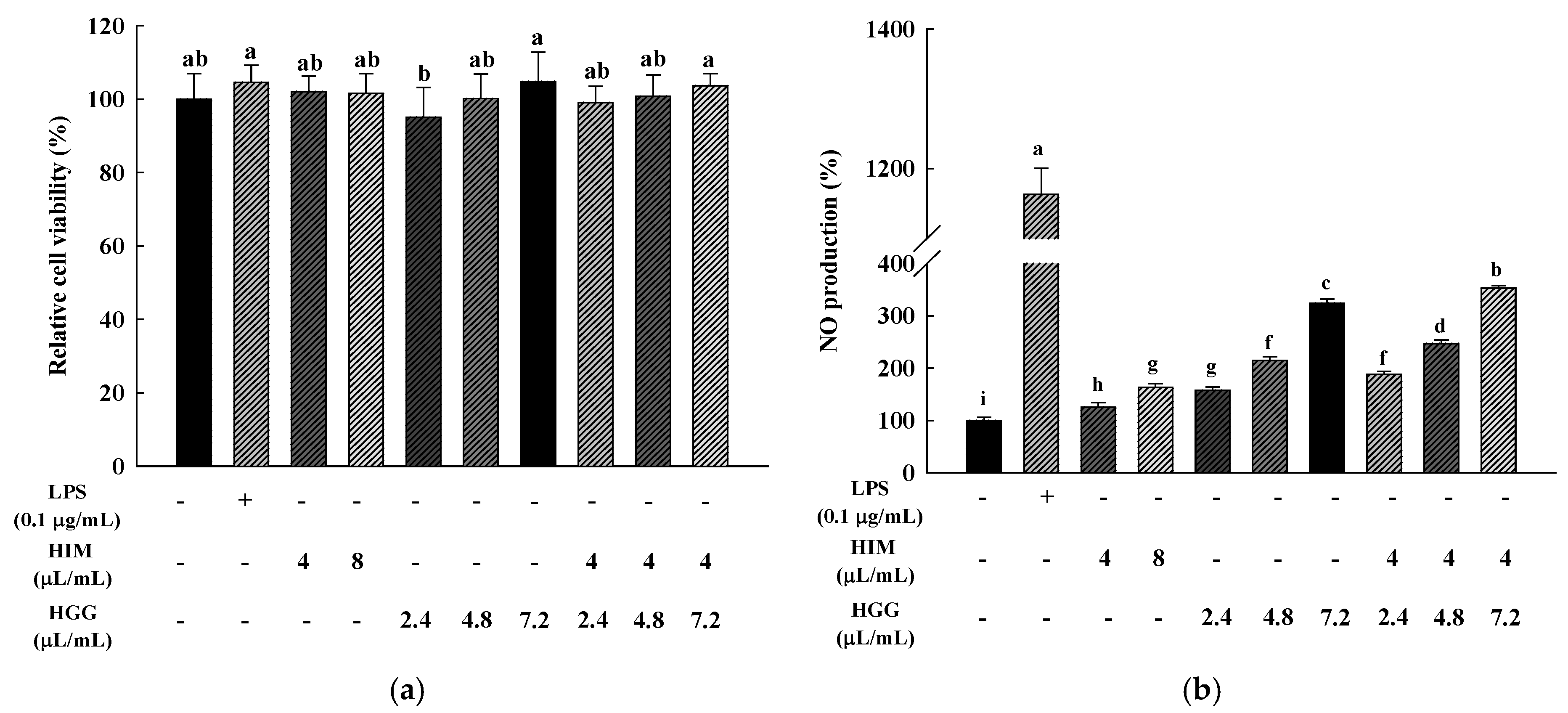
The XTT assay was performed to evaluate the cytotoxicity of HIM, HGG, and their combinations in RAW 264.7 macrophages. This assay measures mitochondrial activity in viable cells through enzymatic reduction in the tetrazolium salt XTT into a soluble formazan dye, which can be quantified by absorbance [23]. As shown in Figure 1a, all groups treated with HIM, HGG, or their combination maintained cell viability at levels comparable to or slightly above that of the untreated control, indicating no cytotoxic effects at the tested concentrations. Cell viability in all treatment groups exceeded 90%, with no statistically significant reduction observed relative to the control group (p > 0.05). In contrast, the LPS-treated group exhibited a modest but significant decrease in cell viability, suggesting mild cytotoxic stress induced by inflammatory stimulation. The combination groups showed a trend toward slightly increased viability compared to the LPS-only group, implying that co-treatment with HIM and HGG may mitigate LPS-induced cytotoxicity. These results confirm that all selected concentrations of HIM and HGG, whether used alone or in combination, are non-toxic to RAW 264.7 cells. Thus, they were suitable for use in subsequent functional assays investigating immune activation.
The effects of HIM and HGG on the production of NO, which is involved in immune cell activation, were evaluated using the Griess assay. NO production was quantified to evaluate the immunostimulatory potential of HIM, HGG, and their combinations in RAW 264.7 macrophages (Figure 1b). LPS treatment (1 μg/mL) significantly elevated NO levels by over 10-fold compared to the untreated control, confirming the successful induction of an inflammatory response. Compared to the control group, HIM at one and two sachets (4 and 8 μL/mL) increased NO production by 25.74% and 63.11%, respectively. HGG also induced a dose-dependent increase in NO production, with 57.58%, 114.36%, and 224.32% increases at concentrations of 1–3 sachets (2.4–7.2 μL/mL), respectively. Combination treatment with HIM (4 μL/mL) and HGG (2.4, 4.8, and 7.2 μL/mL) further enhanced NO production, reaching increases of 88.06%, 147.21%, and 253.22%, respectively. The HIM (4 μL/mL) + HGG (7.2 μL/mL) combination yielded the highest NO production among all treatment groups.

3.2. Effects of HIM and HGG on Cytokine Production in RAW 264.7 Cells

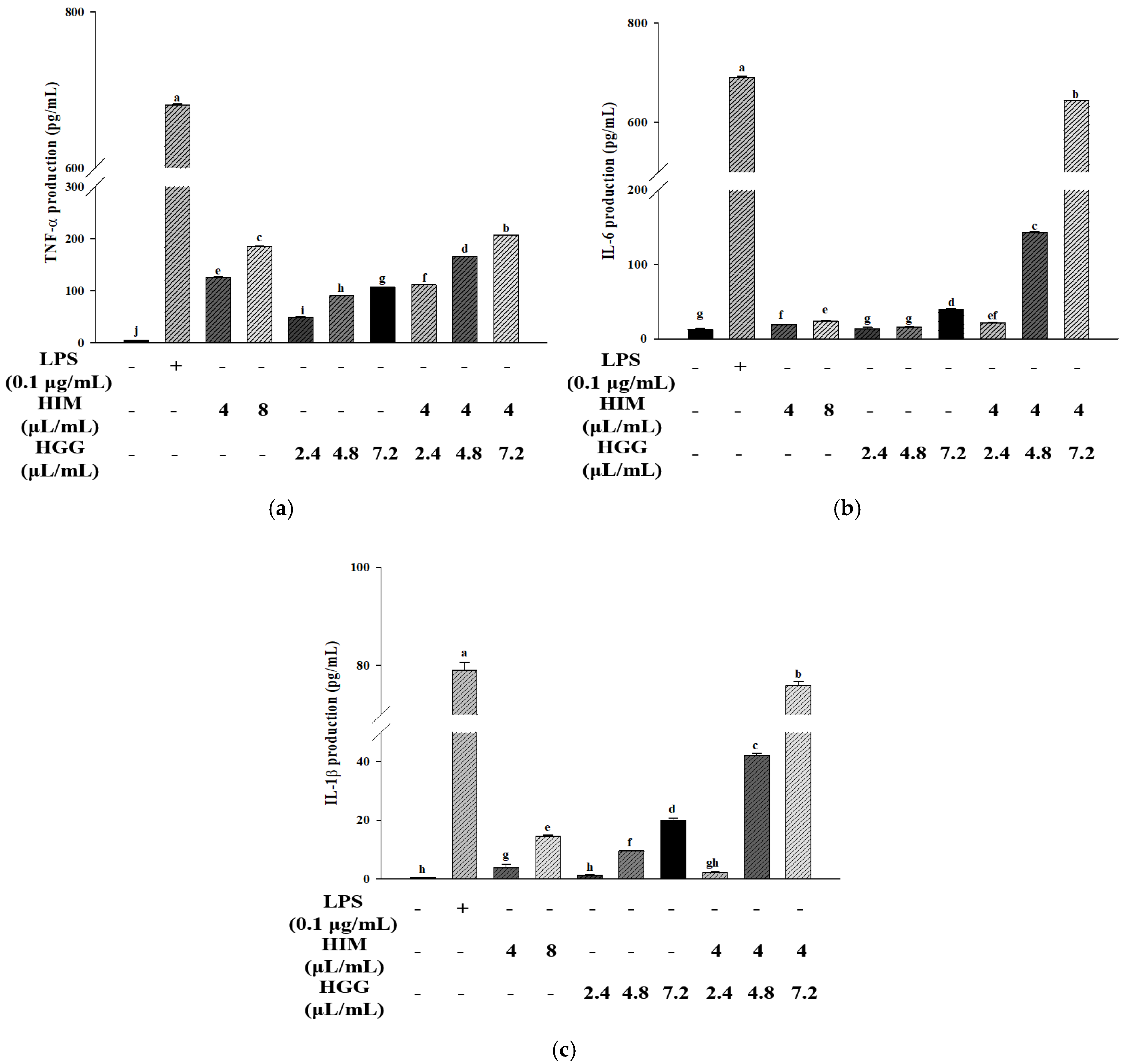
Cytokine production was evaluated in RAW 264.7 macrophages treated with HIM, HGG, or their combination for 24 h using ELISA. The key pro-inflammatory cytokines TNF-α, IL-1β, and IL-6 were measured as indicators of immune activation [24]. As expected, LPS (0.1 μg/mL) significantly increased TNF-α secretion compared to the untreated control (680.65 ± 0.97 vs. 3.75 ± 0.50 pg/mL) (Figure 2a). HIM and HGG treatments alone elevated TNF-α production in a dose-dependent manner, with maximum levels reaching 184.88 ± 0.90 pg/mL (HIM, 8 μL/mL) and 105.94 ± 0.60 pg/mL (HGG, 7.2 μL/mL). Combination treatment comprising HIM (4 μL/mL) and HGG (7.2 μL/mL) further increased TNF-α levels to 206.28 ± 0.43 pg/mL, showing a significant enhancement compared to single treatments. Similarly, IL-6 levels markedly increased from 12.29 ± 1.83 pg/mL in the control group to 690.75 ± 2.83 pg/mL with LPS treatment (Figure 2b). Combination treatment with HIM and HGG significantly enhanced IL-6 production to 643.04 ± 1.16 pg/mL, consistent with the response observed in the LPS-treated group. IL-1β expression also followed this trend (Figure 2c), with LPS increasing secretion to 79.08 ± 1.57 pg/mL from a baseline of 0.45 ± 0.05 pg/mL. Although HIM and HGG alone caused moderate increases, their combination increased IL-1β secretion to 75.92 ± 0.90 pg/mL, reaching levels comparable to those in the LPS group
These findings highlight that HIM and HGG combination treatment enhances cytokine expression, particularly IL-1β and IL-6, to levels comparable to LPS stimulation in the HIM (one sachet; 4 μL/mL) and HGG (three sachets; 7.2 μL/mL) groups. This supports the potential of the HIM and HGG formulation as potent immune-enhancing agents.

3.3. Effects of HIM and HGG on Protein Expression in RAW 264.7 Cells

To further investigate the mechanisms underlying the immune-enhancing effects of HIM and HGG, we evaluated their effects on the expression of inflammation-related proteins in RAW 264.7 macrophages. Specifically, Western blotting was performed to assess the expression of COX-2 and that of proteins associated with the MAPK and NF-κB signaling pathways.

3.3.1. Effects of HIM and HGG on COX-2 Expression in RAW 264.7 Cells

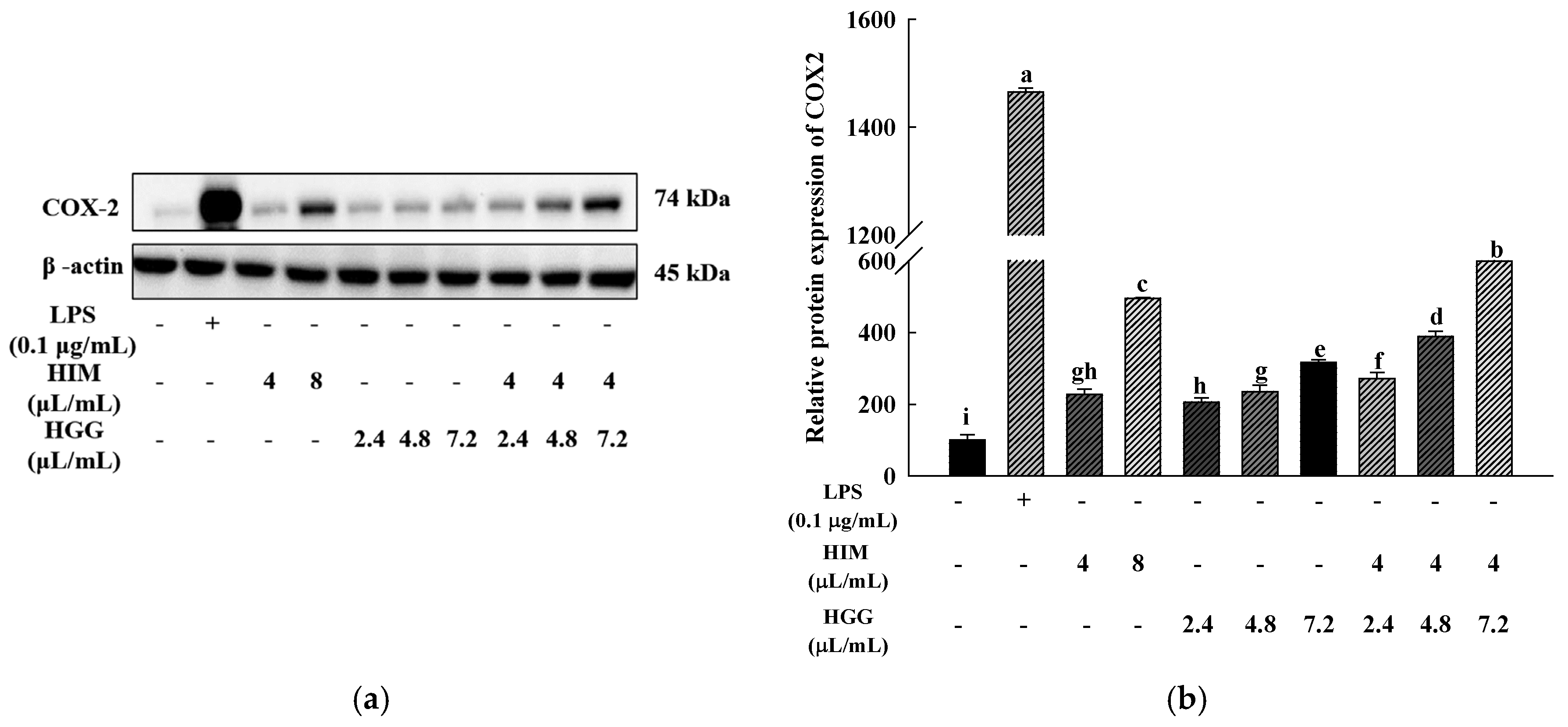
As shown in Figure 3a,b, COX-2 expression was analyzed using Western blotting to evaluate the immune-enhancing effects of HIM, HGG, and their combination. LPS treatment markedly increased COX-2 expression compared to that in the untreated control. HIM alone upregulated COX-2 expression in a concentration-dependent manner, with the highest level observed at 8 μL/mL. Similarly, HGG enhanced COX-2 expression in a dose-dependent manner, peaking at 7.2 μL/mL. Notably, co-treatment with HIM and HGG further increased COX-2 expression compared to individual treatments, with the highest expression observed in the combination group treated with 4 μL/mL HIM and 7.2 μL/mL HGG. These results suggest that the combined administration of HIM and HGG enhances immune responses by upregulating COX-2–mediated prostaglandin signaling.

3.3.2. Effects of HIM and HGG on MAPK and NF-κB Signaling in RAW 264.7 Cells

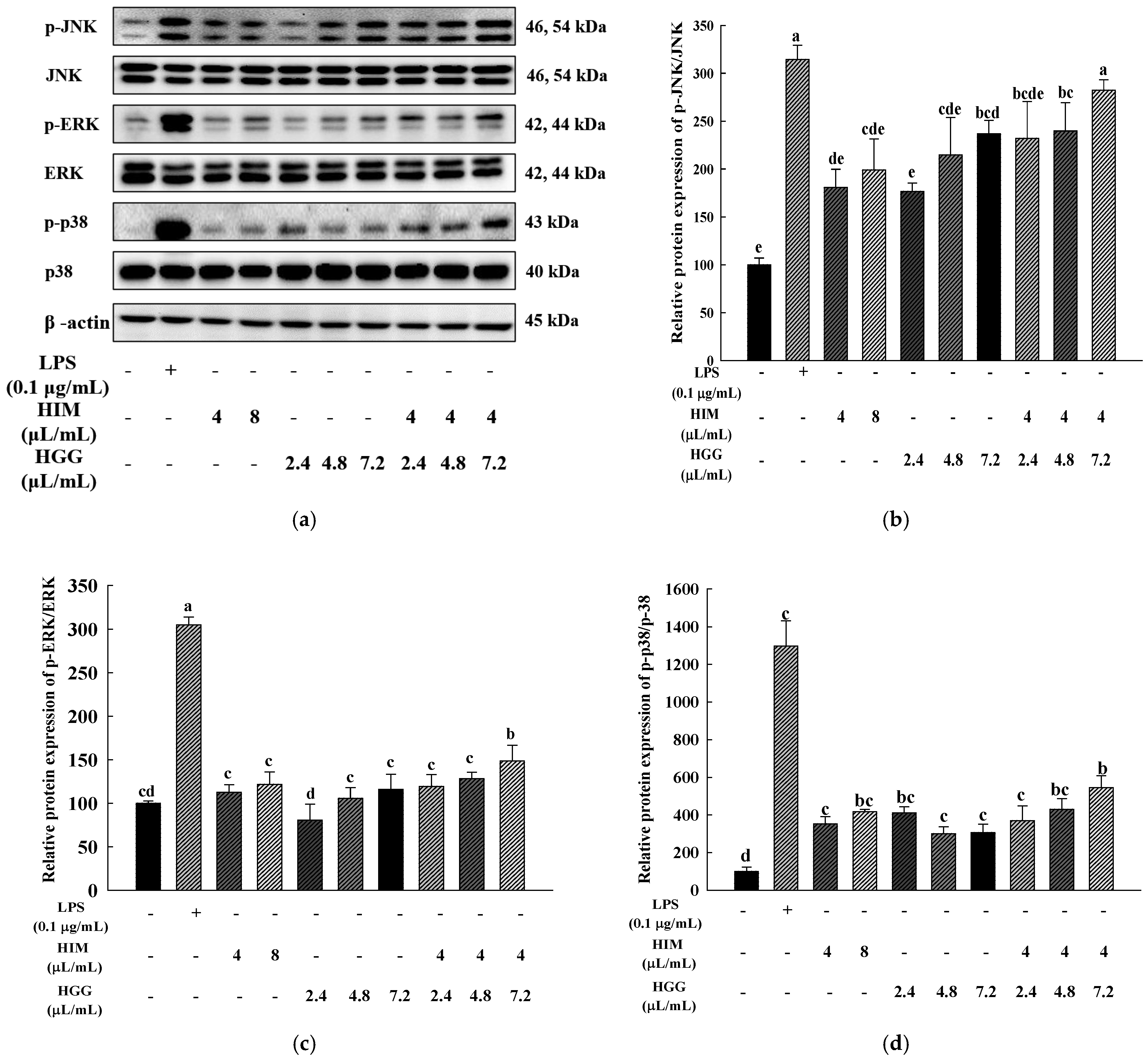
To investigate the immunomodulatory mechanisms of HIM and HGG, the activation of MAPK and NF-κB signaling pathways was assessed in RAW 264.7 macrophages following 24 h of treatment with HIM, HGG, or their combinations. LPS stimulation markedly increased the phosphorylation of JNK, ERK (Extracellular signal-regulated kinase) 1/2 and p38 compared to the untreated control (Figure 4a). Co-treatment with HIM and HGG further enhanced the phosphorylation of all three MAPKs, with the strongest activation observed in the high-dose combination group (4 μL/mL HIM + 7.2 μL/mL HGG), indicating enhanced activation by the combination treatment (Figure 4b–d). The total expression levels of JNK, ERK1/2 and p38 remained unchanged across all groups, confirming that the observed effects were specific to phosphorylation.
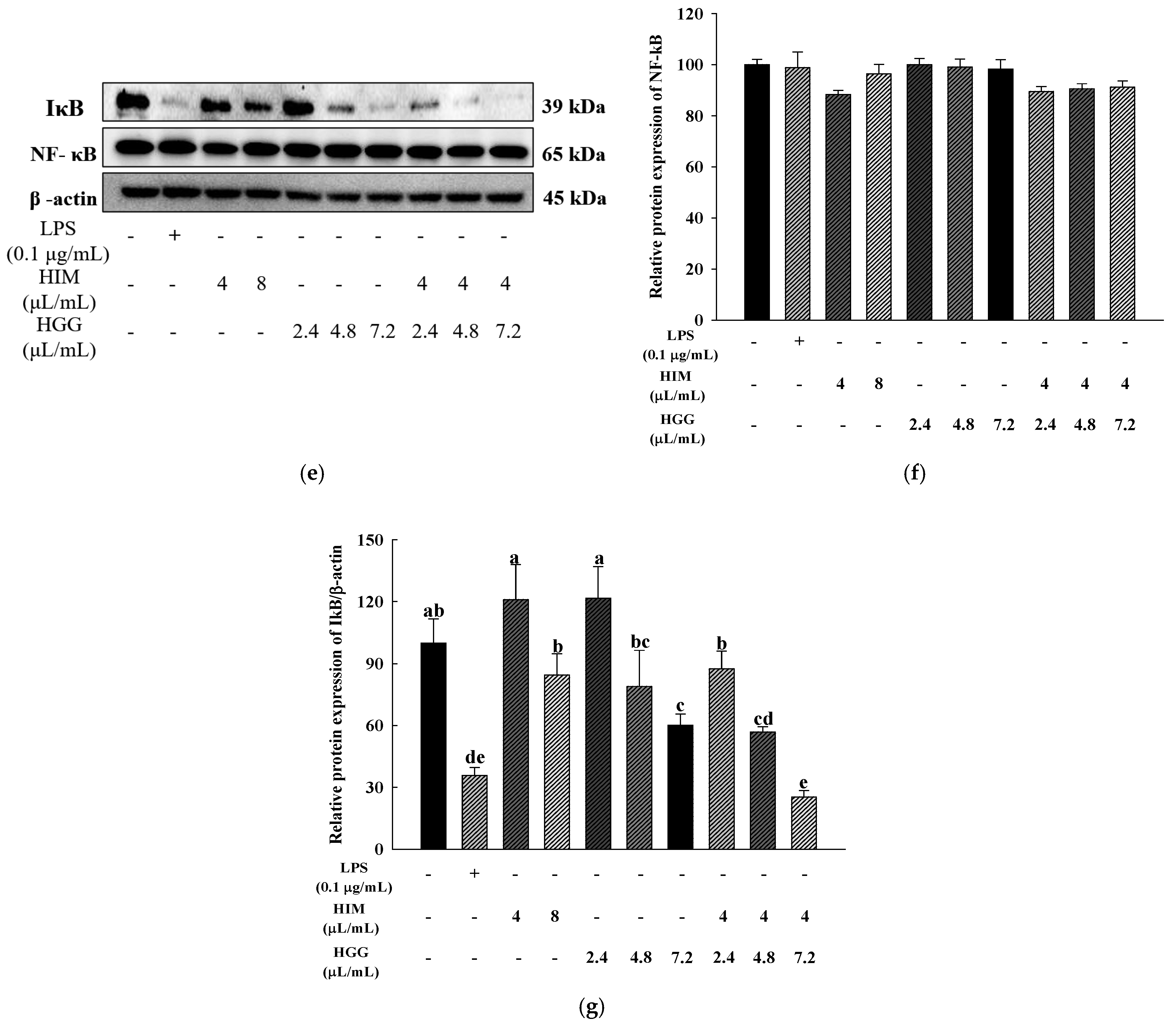
The NF-κB signaling pathway was evaluated by analyzing IκB and NF-κB expression (Figure 4e). LPS treatment markedly reduced IκB levels, indicating pathway activation. IκB expression was normalized to β-actin levels. HIM and HGG treatments alone moderately decreased IκB levels, whereas combination treatment further reduced IκB expression in a dose-dependent manner; the most pronounced degradation was observed in the high-dose combination group (4 μL/mL HIM + 7.2 μL/mL HGG) (Figure 4e). In contrast, total NF-κB expression remained consistent across groups (Figure 4f), indicating that the observed changes reflect upstream regulation through IκB degradation. These results suggest that HIM and HGG activate both MAPK and NF-κB signaling cascades, potentially contributing to their immunostimulatory properties in macrophages.

3.4. Bliss Independence Analysis of Combination Effects

To quantitatively evaluate whether the combination of HIM and HGG exerted synergistic, additive, or antagonistic effects, the Bliss Independence model was applied to the NO, TNF-α, IL-1β, and IL-6 datasets (Supplementary Table S1). For NO production, the Bliss synergy scores (SBliss) were close to zero across all combination groups (+0.006 to +0.009), indicating additive interactions. Similarly, TNF-α showed SBliss values ranging from −0.075 to −0.004, suggesting additive to slightly antagonistic effects. In contrast, IL-1β and IL-6 exhibited positive SBliss values at the HIM (4 μL/mL) + HGG (4.8 μL/mL) and HIM (4 μL/mL) + HGG (7.2 μL/mL) combinations, indicating synergistic interactions. The highest SBliss values were observed for IL-6 (+0.881) and IL-1β (+0.676) at the HIM (4 μL/mL) + HGG (7.2 μL/mL) combination, where the observed responses substantially exceeded the predicted additive responses. Collectively, these findings indicate that the interaction between HIM and HGG varies depending on the specific inflammatory mediator evaluated, with the strongest synergistic effects observed for IL-1β and IL-6 production.

4. Discussion

In the present study, HIM, HGG, and their combination enhanced NO production and cytokine expression in RAW 264.7 macrophages. These findings align with previous reports on the immune-enhancing properties of individual herbal components, such as ginsenosides from Panax ginseng, which promote macrophage activation, and polysaccharides from Poria cocos, which stimulate innate immune functions [25]. Additionally, the key constituents of HIM—including decursin, Angelica gigas Nakai, Cnidium officinale Makino, and Paeonia lactiflora Pall—exhibit known immunomodulatory effects [26], which likely contribute to the enhanced immune response observed in this study.
Focusing on HGG, its key herbal components, particularly Rehmannia glutinosa and Poria cocos, have been widely reported to exert immunomodulatory effects. Polysaccharides derived from Rehmannia glutinosa enhance immune responses by promoting dendritic cell maturation and lymphocyte proliferation through TLR4-dependent signaling pathways [27]. Similarly, Poria cocos-derived polysaccharides activate macrophages via the TLR4/MD2/NF-κB signaling pathway, resulting in increased production of pro-inflammatory cytokines and immune mediators [28]. Although direct evidence for their specific synergistic interaction remains limited, their combination may contribute to enhanced immune responses through shared or complementary signaling pathways involving TLR4-mediated regulation. This supports the notion that multi-herbal formulations can provide broader and more balanced immune regulation than single-agent approaches by modulating parallel signaling pathways [29].
Beyond their typical roles, NO and cytokines such as TNF-α, IL-1β, and IL-6 act as crucial mediators of innate and adaptive immune responses. NO functions not only as an antimicrobial effector but also as a regulator of immune cell migration and vascular tone [30] while being closely associated with TLR-mediated innate signaling [31]. TNF-α is integral to inflammation and immune surveillance [32], and IL-1β—produced via NLRP3 inflammasome activation—serves as an endogenous alarm signal [33]. Furthermore, IL-6 is essential for the acute-phase response and Th17 differentiation [34]. Western blot analysis further confirmed the immunostimulatory potential of HIM and HGG by revealing changes in key signaling proteins. The combination treatment significantly enhanced the phosphorylation of MAPK family members, including p38, ERK1/2, and JNK, which regulate the expression of immune-related genes. Activation of these kinases promotes the transcription of cytokines such as TNF-α and IL-6, thereby amplifying immune responses [35]. Moreover, the observed increase in COX-2 expression suggests activation of the arachidonic acid–prostaglandin pathway, which contributes to the initiation and maintenance of inflammatory responses [36]. Notably, treatment groups exhibited a marked reduction in IκB levels, indicating proteasomal degradation of IκB and subsequent nuclear translocation of NF-κB, the master regulator of innate immunity [37]. Given that total NF-κB levels remained unchanged, these results suggest that the observed effects are primarily mediated through post-translational regulation via IκB degradation.
Importantly, the combination treatment upregulated immune mediators to levels comparable to those induced by LPS, yet without associated cytotoxicity. This indicates that the combination elicits a potent yet controlled immune response. It also suggests that lower doses of individual herbal components may be sufficient when administered together, potentially minimizing toxicity or tolerance associated with high-dose monotherapy. These findings carry practical implications for the long-term use of functional herbal foods. Continuous administration of a single herbal agent can lead to reduced responsiveness or tolerance, occasionally necessitating treatment interruption [38]. In this context, multi-herbal combinations such as HIM and HGG may offer a strategy to mitigate such limitations by maintaining efficacy through complementary or overlapping mechanisms of action.
Bliss Independence analysis indicated that the combination effects of HIM and HGG were endpoint-dependent. The synergistic interactions observed for IL-1β and IL-6 suggest that the combination may activate shared or convergent signaling pathways that amplify cytokine production beyond the sum of individual effects, whereas the additive responses for NO and TNF-α indicate that not all immune mediators are equally enhanced by the combination. It should be noted that the Bliss Independence model has limitations when applied to complex herbal extracts containing multiple bioactive compounds, and future studies employing the Chou–Talalay Combination Index method with expanded dose–response matrices would provide more rigorous synergy evaluation. Collectively, these in vitro findings provide a scientific basis for the immunomodulatory potential of HIM and HGG; however, further in vivo and clinical validation is required to confirm their efficacy and safety in complex physiological systems. However, this study has several limitations. All experiments were performed using a single murine macrophage cell line (RAW 264.7), which, although widely employed for immunological screening, may not fully reflect the responses of primary macrophages or human immune cells. Therefore, further studies using human-derived macrophage models, such as THP-1 and U937 cells, as well as primary bone marrow-derived macrophages, would be valuable to validate the generalizability of these findings. In addition, if supported by in vivo studies, these findings may provide further insight into the physiological relevance and safety of the combined treatment.

5. Conclusions

This study demonstrated that the combination of HIM and HGG enhanced NO production and pro-inflammatory cytokine (TNF-α, IL-1β, and IL-6) expression without inducing cytotoxicity in RAW 264.7 macrophages. Among the tested groups, the combination of HIM (one sachet) and HGG (three sachets) exhibited the most pronounced immunostimulatory effects, approaching levels comparable to those induced by LPS. Bliss Independence analysis revealed that the combination effects were endpoint-dependent, with synergistic interactions observed for IL-1β and IL-6, while NO and TNF-α showed additive effects. These effects were associated, at least in part, with the activation of MAPK (JNK, ERK1/2, and p38) and NF-κB signaling pathways, as evidenced by increased phosphorylation of MAPKs, degradation of IκBα, and upregulation of COX-2 expression.
While herbal medicines are generally considered safer than synthetic compounds, excessive or prolonged use can lead to side effects. In particular, when a single herbal prescription (medicine formula) is taken continuously, the perceived efficacy may decrease over time due to factors such as drug adaptation (tolerance) and accelerated metabolism. Consequently, consuming larger amounts or taking the medicine for longer periods can exacerbate side effects. In this context, combining multiple herbal preparations can help maintain efficacy through complementary mechanisms of action and mitigate side effects associated with long-term or excessive consumption. Taken together, these findings suggest that the combination of HIM and HGG may serve as a promising multi-herbal immunomodulatory formulation for functional food applications.
However, this study has several limitations. All experiments were performed using a single murine macrophage cell line (RAW 264.7), which may not fully reflect the responses of primary macrophages or human immune cells. Therefore, these findings should be considered preliminary, and further validation in additional cell models and in vivo systems is required to confirm their physiological relevance.

Supplementary Materials

The following supporting information can be downloaded at https://www.mdpi.com/article/10.3390/app16094151/s1, Table S1: Bliss Analysis.

Author Contributions

Data curation, formal analysis, methodology, validation, writing—original draft preparation, M.-H.K.; methodology, investigation, visualization, J.-H.I.; investigation, formal analysis, X.F.; data curation, investigation, J.-S.L.; methodology, investigation, visualization, J.P.; investigation, formal analysis, M.B.; data curation, formal analysis, S.-I.C.; investigation, formal analysis, D.S.L.; investigation, formal analysis, writing—review and editing, conceptualization, I.-J.L.; writing—review and editing, conceptualization, funding acquisition, supervision, O.-H.L. All authors have read and agreed to the published version of the manuscript.

Funding

This work was supported by the 2024 Research Grant from the Atomy R&D Center (202405090001); the Basic Science Research Program through the National Research Foundation of Korea (NRF), funded by the Ministry of Education (RS-2021-NR060130); and the Regional Innovation System & Education (RISE) program through the Gangwon RISE Center, funded by the Ministry of Education (MOE) and Gangwon State (G.S.), Republic of Korea (2025-RISE-10-002).

Institutional Review Board Statement

Not applicable.

Informed Consent Statement

Not applicable.

Data Availability Statement

Data presented in this study are available within this article.

Acknowledgments

The authors express their gratitude to all supporting institutions.

Conflicts of Interest

Im-Joung La and Do Sang Lee were employed by Atomy R&D. The remaining authors declare that the research was conducted in the absence of any commercial or financial relationships that could be construed as a potential conflict of interest.

Abbreviations

The following abbreviations are used in this manuscript:
HIMHemoHIM
HGGHwaljingigo
NONitric oxide
TNF-αTumor necrosis factor-alpha
IL-1βInterleukin-1 beta
L-6Interleukin-6
ELISAEnzyme-linked immunosorbent assay
XTT2,3-bis(2-methoxy-4-nitro-5-sulfophenyl)-2H-tetrazolium-5-carboxanilide
LPSLipopolysaccharide
MAPKMitogen-activated protein kinase
NF-κBNuclear factor-kappa B
IκBInhibitor of nuclear factor kappa-B
COX-2Cyclooxygenase-2
PBSPhosphate-buffered saline
DMEMDulbecco’s modified Eagle’s medium
FBSFetal bovine serum
PVDFPolyvinylidene difluoride
TBSTTris-buffered saline with Tween 20

References

  1. Trinh, T.A.; Park, J.; Oh, J.H.; Park, J.S.; Lee, D.; Kim, C.E.; Choi, H.-S.; Kim, S.-B.; Hwang, G.S.; Koo, B.A.; et al. Effect of Herbal Formulation on Immune Response Enhancement in RAW 264.7 Macrophages. Biomolecules 2020, 10, 424. [Google Scholar] [CrossRef] [PubMed]
  2. Howell, M.; Shepherd, M. The immune system. Anaesth. Intensive Care Med. 2018, 19, 575–578. [Google Scholar] [CrossRef]
  3. Netea, M.G.; Quintin, J.; van der Meer, J.W.M. Trained immunity: A memory for innate host defense. Cell Host Microbe 2011, 9, 355–361. [Google Scholar] [CrossRef] [PubMed]
  4. Ward, A.C. Immune Factors, Immune Cells and Inflammatory Diseases. Int. J. Mol. Sci. 2024, 25, 2417. [Google Scholar] [CrossRef]
  5. Jang, S.; Kim, S.; Kim, S.J.; Yoon, S.R.; So, B.R.; Ryu, J.A.; Park, J.M.; Jung, S.K. The immune enhancement effect of Cheonggukjang Water Extract (CWE) via activation of NF-κB pathways in murine macrophage RAW 264.7 cells. J. Appl. Biol. Chem. 2023, 66, 282–288. [Google Scholar] [CrossRef]
  6. Kim, G.D.; Lee, S.Y.; Shin, H.S. COVID-19 pandemic and the immune regulatory function of foods. Food Sci. Ind. 2022, 55, 244–263. [Google Scholar] [CrossRef]
  7. Kim, J.J.; Jo, S.K.; Jung, U.H.; Park, H.R.; Yee, S.T. Inhibitory Effects of a Herbal Composition (HemoHIM) on the Activation of Human Mast Cell Line (HMC-1). J. Life Sci. 2009, 19, 1808–1814. [Google Scholar] [CrossRef]
  8. Kim, J.G.; Bak, S.-B.; Kim, G.-D.; Choi, H.-S.; Kwon, D.-A.; Kim, H.-Y.; Son, D.-W.; Jeong, J.-H.; Lee, B.-W.; An, H.-J.; et al. Evaluation of acute, repeated dose 28-day and 13-week oral toxicity and genotoxicity of a standardized fraction (HemoHIM) from Angelica gigas, Cnidium officinale, and Paeonia lactiflora. Toxicol. Res. 2024, 41, 13–26. [Google Scholar] [CrossRef]
  9. Kwon, D.-A.; Kim, Y.-S.; Baek, S.H.; Kim, S.-K.; Kim, H.-K.; Jo, S.-K.; Jung, U.; Park, H.-R.; Lee, H.-S. Protective effects of a standardized extract (HemoHIM) using indomethacin- and ethanol/HCl-induced gastric mucosal injury models. Pharm. Biol. 2019, 57, 543–549. [Google Scholar] [CrossRef]
  10. Park, H.-R.; Ju, E.-J.; Jo, S.-K.; Jung, U.; Kim, S.-H.; Yee, S.-T. Enhanced antitumor efficacy of cisplatin in combination with HemoHIM in tumor-bearing mice. BMC Cancer 2009, 9, 85. [Google Scholar] [CrossRef]
  11. Kang, H.-K.; Han, C.-W. Clinical effect of Gyeongok-go: A systematic review of randomized controlled trials. J. Intern. Korean Med. 2022, 43, 423–435. [Google Scholar] [CrossRef]
  12. Lee, S.-Y.; Shin, Y.-J.; Park, J.-H.; Kim, S.-M.; Park, C.-S. An analysis of the Gyungokgo’s ingredients and a comparison study on anti-oxidation effects according to the kinds of extract. Korea J. Herbol. 2008, 23, 123–136. [Google Scholar]
  13. Attele, A.S.; Wu, J.A.; Yuan, C.S. Ginseng pharmacology: Multiple constituents and multiple actions. Biochem. Pharmacol. 1999, 58, 1685–1693. [Google Scholar] [CrossRef] [PubMed]
  14. Lee, E.-S.; Seo, B.-I.; Lee, J.-W.; Bae, J.-S. The immunological activities of Kyungohkgo and prescription of modified Kyungohkgo. Korea J. Herbol. 2002, 17, 10–100. [Google Scholar]
  15. Cho, K.-N.; Jung, S.-Y.; Bae, H.-J.; Ryu, J.-H. The ameliorating effect of Kyung-Ok-Go on menopausal syndrome observed in ovariectomized animal model. Korean J. Pharmacogn. 2020, 51, 310–316. [Google Scholar] [CrossRef]
  16. Kim, Y.-A.; Jin, S.-W.; Kim, S.-M.; Lee, G.-H.; Kim, S.-J.; Lee, W.-L.; Na, M.-K.; Jeong, H.-G. Anti-fatigue effect of Kyung-Ok-Ko. Korean J. Pharmacogn. 2016, 47, 258–263. [Google Scholar]
  17. Jo, I.-J.; Choi, M.-O. Protective effects of Kyungohkgo on atopic dermatitis in HaCaT cells. J. Korean Soc. Cosmetol. 2021, 27, 1286–1292. [Google Scholar] [CrossRef]
  18. Ncube, B.; Finnie, J.F.; Van Staden, J. In vitro antimicrobial synergism within plant extract combinations from three South African medicinal bulbs. J. Ethnopharmacol. 2012, 139, 81–89. [Google Scholar] [CrossRef]
  19. Sharma, A.N.; Dewangan, H.K.; Upadhyay, P.K. Comprehensive review on herbal medicine: Emphasis on current therapy and role of phytoconstituents for cancer treatment. Chem. Biodivers. 2024, 21, e202301468. [Google Scholar] [CrossRef]
  20. Nair, A.B.; Jacob, S. A simple practice guide for dose conversion between animals and human. J. Basic Clin. Pharm. 2016, 7, 27–31. [Google Scholar] [CrossRef]
  21. Bliss, C.I. The toxicity of poisons applied jointly. Ann. Appl. Biol. 1939, 26, 585–615. [Google Scholar] [CrossRef]
  22. Jang, D.; Lee, M.J.; Kim, K.S.; Kim, C.-E.; Jung, J.H.; Cho, M.; Hong, B.-H.; Park, S.J.; Kang, K.S. Network pharmacological analysis on the herbal combinations for mitigating inflammation in respiratory tracts and experimental evaluation. Healthcare 2023, 11, 143. [Google Scholar] [CrossRef] [PubMed]
  23. Bharwani, H.; Kapur, S.; Palani, S.G. Rapid detection of hydrogen peroxide and nitrite in adulterated cow milk using enzymatic and nonenzymatic methods on a reusable platform. RSC Adv. 2025, 15, 1577–1589. [Google Scholar] [CrossRef] [PubMed]
  24. Bhol, N.K.; Bhanjadeo, M.M.; Singh, A.K.; Dash, U.C.; Ojha, R.R.; Majhi, S.; Duttaroy, A.K.; Jena, A.B. The interplay between cytokines, inflammation, and antioxidants: Mechanistic insights and therapeutic potentials of various antioxidants and anti-cytokine compounds. Biomed. Pharmacother. 2024, 178, 117177. [Google Scholar] [CrossRef] [PubMed]
  25. Ratan, Z.A.; Youn, S.H.; Kwak, Y.-S.; Han, C.-K.; Haidere, M.F.; Kim, J.K.; Min, H.; Jung, Y.-J.; Hosseinzadeh, H.; Hyun, S.H.; et al. Adaptogenic effects of Panax ginseng on modulation of immune functions. J. Ginseng Res. 2021, 45, 32–40. [Google Scholar] [CrossRef]
  26. Kim, S.-K.; Kwon, D.-A.; Lee, H.S.; Kim, H.K.; Kim, W.-K. Preventive effect of the herbal preparation, HemoHIM, on cisplatin-induced immune suppression. Evid. Based Complement. Altern. Med. 2019, 2019, 3494806. [Google Scholar] [CrossRef]
  27. Xu, L.; Kwak, M.; Zhang, W.; Zeng, L.; Lee, P.C.-W.; Jin, J.-O. Rehmannia glutinosa polysaccharide induces toll-like receptor 4-dependent spleen dendritic cell maturation and anti-cancer immunity. Oncoimmunology 2017, 6, e1325981. [Google Scholar] [CrossRef]
  28. Sun, M.; Yao, L.; Yu, Q.; Duan, Y.; Huang, J.; Lyu, T.; Yu, N.; Peng, D.; Chen, W.; Wang, Y.; et al. Screening of Poria cocos polysaccharide with immunomodulatory activity and its activation effects on TLR4/MD2/NF-κB pathway. Int. J. Biol. Macromol. 2024, 273, 132931. [Google Scholar] [CrossRef]
  29. Mundy, L.; Pendry, B.; Rahman, M. Antimicrobial resistance and synergy in herbal medicine. J. Herb. Med. 2016, 6, 53–58. [Google Scholar] [CrossRef]
  30. Lundberg, J.O.; Weitzberg, E. Nitric oxide signaling in health and disease. Cell 2022, 185, 2853–2878. [Google Scholar] [CrossRef]
  31. Abdul-Cader, M.S.; Amarasinghe, A.; Abdul-Careem, M.F. Activation of toll-like receptor signaling pathways leading to nitric oxide-mediated antiviral responses. Arch. Virol. 2016, 161, 2075–2086. [Google Scholar] [CrossRef] [PubMed]
  32. Mercogliano, M.F.; Bruni, S.; Mauro, F.; Elizalde, P.V.; Schillaci, R. Harnessing tumor necrosis factor alpha to achieve effective cancer immunotherapy. Cancers 2021, 13, 564. [Google Scholar] [CrossRef] [PubMed]
  33. Cassel, S.L.; Joly, S.; Sutterwala, F.S. The NLRP3 inflammasome: A sensor of immune danger signals. Semin. Immunol. 2009, 21, 194–198. [Google Scholar] [CrossRef] [PubMed]
  34. Dong, C. Cytokine regulation and function in T cells. Annu. Rev. Immunol. 2021, 39, 51–76. [Google Scholar] [CrossRef]
  35. Yang, L.; Nie, H.; Du, Y.; Liu, X.; Cai, B.; Li, J. Isoliquiritigenin exhibits anti-inflammatory responses in acute lung injury by covalently binding to the myeloid differentiation protein-2 domain. Phytother. Res. 2025, 39, 922. [Google Scholar] [CrossRef]
  36. Zaki, M.; Orban, H.A.; Shahba, M.A.; Moustafa, R.S.I.; Adel, A.; Fadel, F.I.; Selim, A.; El-Bassyouni, H.T.; Youness, E.R. The role of cyclooxygenase-2 (COX-2) and inflammatory markers in the progress of Alport syndrome in Egyptian children. BMC Pediatr. 2025, 25, 56. [Google Scholar] [CrossRef]
  37. Zinatizadeh, M.R.; Schock, B.; Chalbatani, G.M.; Zarandi, P.K.; Jalali, S.A.; Miri, S.R. The nuclear factor kappa B (NF-κB) signaling in cancer development and immune diseases. Genes Dis. 2020, 8, 287–297. [Google Scholar] [CrossRef]
  38. Shaw, D.; Ladds, G.; Duez, P.; Williamson, E.; Chan, K. Pharmacovigilance of herbal medicine. J. Ethnopharmacol. 2012, 140, 513–518. [Google Scholar] [CrossRef]
Figure 1. Effects of HIM, HGG, and their combination on cell viability and NO production in RAW 264.7 macrophages. (a) Cell viability was assessed using the XTT assay. (b) NO production was measured using the Griess assay after 24 h of treatment with HIM, HGG, or their combination. Data are expressed as the mean ± SD (n = 3). Statistical analysis was performed using one-way ANOVA followed by Duncan’s multiple range test. Groups sharing the same letter are not significantly different (p > 0.05), while groups with different letters are significantly different (p < 0.05).
Applsci 16 04151 g001
Figure 2. Combination treatment with HIM and HGG significantly enhanced cytokine production compared to single treatments in RAW 264.7 macrophages. Cytokine levels were measured by ELISA: (a) TNF-α was measured after 24 h, and (b) IL-1β and (c) IL-6 were measured after 72 h of treatment with HIM, HGG, or their combination. LPS (0.1 μg/mL) was used as a positive control. Data are expressed as the mean ± SD (n = 3). Statistical analysis was performed using one-way ANOVA followed by Duncan’s multiple range test. Groups sharing the same letter are not significantly different (p > 0.05), while groups with different letters are significantly different (p < 0.05).
Applsci 16 04151 g002
Figure 3. Combination treatment with HIM and HGG markedly enhanced COX-2 expression compared to single treatments, with the highest expression observed in the high-dose combination group. (a) Western blot analysis of COX-2 expression in RAW 264.7 cells treated with LPS (0.1 μg/mL) as a positive control, HIM (4 or 8 μL/mL), HGG (2.4, 4.8, or 7.2 μL/mL), or combinations of HIM and HGG for 24 h. (b) Quantification of COX-2 band intensities normalized to β-actin. Data are expressed as the mean ± SD (n = 3). Statistical analysis was performed using one-way ANOVA followed by Duncan’s multiple range test. Groups sharing the same letter are not significantly different (p > 0.05), while groups with different letters are significantly different (p < 0.05).
Applsci 16 04151 g003
Figure 4. Effects of HIM, HGG, and their combination on MAPK and NF-κB signaling pathways in RAW 264.7 macrophages. (a) Protein expression levels of total and phosphorylated JNK, ERK1/2, and p38 after 24 h treatment. (bd) Densitometric analysis of phospho-JNK (b), phospho-ERK1/2 (c), and phospho-p38 (d), normalized to total protein levels. (e) Protein expression levels of IκB and total NF-κB. (f,g) Quantification of IκB (f) and total NF-κB (g) levels normalized to β-actin. Data are expressed as the mean ± SD (n = 3). Statistical analysis was performed using one-way ANOVA followed by Duncan’s multiple range test. Groups sharing the same letter are not significantly different (p > 0.05), while groups with different letters are significantly different (p < 0.05).
Applsci 16 04151 g004aApplsci 16 04151 g004b
Disclaimer/Publisher’s Note: The statements, opinions and data contained in all publications are solely those of the individual author(s) and contributor(s) and not of MDPI and/or the editor(s). MDPI and/or the editor(s) disclaim responsibility for any injury to people or property resulting from any ideas, methods, instructions or products referred to in the content.