Article

Impact of Preservation Techniques on Polyphenols in Aronia melanocarpa Pomace and Their Recovery by Optimized Accelerated Solvent Extraction

Department of Analytical Chemistry, Medical University of Lublin, Chodźki 4a, 20-093 Lublin, Poland
*
Authors to whom correspondence should be addressed.
Appl. Sci. 2026, 16(9), 4116; https://doi.org/10.3390/app16094116
Submission received: 30 March 2026 / Revised: 17 April 2026 / Accepted: 20 April 2026 / Published: 23 April 2026
(This article belongs to the Special Issue Bioactive Natural Compounds: From Discovery to Applications)

Featured Application

Pomace from Aronia melanocarpa generated during juice production represents a valuable source of bioactive polyphenols with health-promoting properties. This study shows the impact of drying, freezing, and freeze-drying on the polyphenol content of Aronia pomace and presents an optimized approach for recovering these compounds using Accelerated Solvent Extraction. The valorization of pomace through the production of extracts with a high polyphenol content will help minimize waste generated by the industry and yield a valuable product that can serve as a beneficial additive for functional foods and nutraceuticals.

Abstract

The valorization of agro-industrial by-products is of increasing importance within circular economy strategies. Aronia melanocarpa pomace, a by-product of juice production, represents a valuable source of polyphenols with potential applications in food, nutraceutical, and cosmetic formulations. This study aimed to evaluate the effect of different preservation methods on the polyphenolic composition of Aronia pomace and to optimize accelerated solvent extraction (ASE). Pomace samples were subjected to drying, freeze-drying, freezing (−18 °C), and deep freezing (−80 °C). UAE was applied as a rapid screening method for polyphenol extraction, while ASE was used as an advanced technique for efficient recovery of target compounds. ASE parameters, including temperature (40–120 °C), methanol concentration (40–100%), and number of extraction cycles (1–3), were optimized using response surface methodology (RSM) based on a Box–Behnken design. Qualitative and quantitative analyses were performed using UHPLC–MS and HPLC–DAD. The developed models were statistically significant (p < 0.01) with high coefficients of determination (R2 = 0.88–0.97). Temperature had a positive effect on phenolic acid extraction but negatively affected anthocyanins due to thermal degradation. Optimal extraction conditions differed between compound groups: phenolic acids were maximized at 120 °C and 75% methanol (two cycles), while anthocyanins required milder conditions (82 °C, 92% methanol, three cycles). Moreover, our study showed that drying significantly reduced the content of several compounds, particularly anthocyanins, whereas low-temperature methods had minimal impact. The results highlight the importance of tailored extraction strategies and support the sustainable utilization of Aronia pomace as a source of bioactive compounds.

1. Introduction

The fruit and vegetable processing industry generates substantial quantities of plant-based waste each year, which are only partially recovered and utilized, for example, as low-value products such as animal feed, compost, or substrates for biogas production [1,2]. However, a considerable proportion is still treated as waste, despite the fact that these by-products constitute a valuable reservoir of bioactive compounds and can be exploited for the development of functional foods, nutraceuticals, or additives in natural formulations. Among them, fruit pomace, which is produced in large volumes during juice and concentrate manufacturing, represents an especially rich source of secondary metabolites with health-promoting properties [3].
Aronia melanocarpa L. (black chokeberry) fruits are commonly used in the food industry and are transformed into a variety of functional food products, including juices, jams, syrups, fermented beverages, and dietary supplements [4]. They are valued for their rich profile of bioactive compounds, including polyphenols such as anthocyanins, proanthocyanidins, and phenolic acids, which contribute to their high health-promoting potential [5]. It has been shown that A. melanocarpa fruits possess potent antioxidant, anti-inflammatory, immunomodulatory, antimicrobial, neuroprotective, and anticancer activities, and can help lower blood pressure and blood sugar [6,7,8,9].
Aronia pomace, a by-product of juice production, is also noteworthy, as it still contains high concentrations of valuable components. It may serve as a valuable additive to animal feed [10], a food ingredient with the potential to enhance microbiological safety, and a raw material for the development of functional foods [11,12,13]. Recovered anthocyanins may also be used as natural colorants with high antioxidant potential [14].
However, the quality—and consequently the usefulness and applicability—of by-products such as pomace is strongly influenced by the preservation methods applied immediately after juice production. Techniques such as freezing, convective drying, freeze-drying, and oven drying are routinely employed to stabilize pomace for storage and further processing. Each of these methods may alter the physicochemical properties of the plant matrix, potentially degrading or transforming sensitive polyphenols [15,16,17,18].
Another important issue is the effective recovery of biologically active compounds from the plant matrix. Appropriate selection of extraction techniques is crucial for maximizing the yield and stability of polyphenols and other bioactive molecules. Moreover, optimizing process parameters enables the recovery of high-quality fractions suitable for use in food, nutraceutical, or cosmetic applications. Several methods have been employed for the recovery of secondary metabolites from Aronia pomace, including ultrasound-assisted extraction [19,20,21,22], microwave-assisted extraction [22], enzyme-assisted extraction [23], and subcritical water extraction [24]. Each of these techniques offers distinct advantages in terms of efficiency, selectivity, and environmental impact. For example, ultrasound-assisted extraction enhances mass transfer, while microwave-assisted extraction provides rapid heating and can significantly reduce extraction time. Subcritical water extraction offers an efficient, solvent-free alternative, and enzyme-assisted extraction facilitates the release of bound polyphenols by breaking down cell wall components.
In recent years, accelerated solvent extraction (ASE) has emerged as a powerful technique for recovering polyphenols from plant materials, including anthocyanin-rich matrices. ASE is based on the use of organic or aqueous solvents at elevated temperature and pressure. Unlike ultrasound- or microwave-assisted methods, which primarily enhance cell disruption, ASE focuses on maintaining the solvent in a liquid state above its atmospheric boiling point, thereby increasing solubility, and diffusion rates. Compared to conventional techniques such as maceration or Soxhlet extraction, ASE requires substantially shorter extraction times and significantly lower solvent consumption. Moreover, its closed and automated system minimizes operator variability and exposure to solvents.
However, to date, only a few studies have reported the use of ASE in black chokeberry. Previous research has applied ASE to fresh fruits and pomace to monitor the content of ascorbic acid, malic acid, total polyphenols, monomeric anthocyanins, and overall antioxidant capacity [25,26,27,28]. Despite these efforts, no studies have systematically explored the potential of ASE for recovering specific polyphenols from Aronia with systematic optimized extraction conditions.
Therefore, this study investigates the impact of various preservation techniques on the polyphenol content of A. melanocarpa pomace and evaluates the efficiency of optimized accelerated solvent extraction in recovering these compounds. By linking preservation-induced changes in pomace properties with extraction performance, the research aims to support the sustainable utilization of chokeberry by-products and promote waste-to-value strategies within the food industry.

2. Materials and Methods

2.1. Plant-Derived Material

The research material consisted of residues from the juice pressing of A. melanocarpa. The pomace was composed of fruit skins, pulp (fibrous parts), seeds, and residual juice. The material was provided by a local fruit juice producer. The fresh pomace was blended to ensure homogeneity, accurately weighed as a 0.5 g portion, and subjected to various preservation methods, including drying, freeze-drying, deep freezing at −80 °C, and freezing at −18 °C.

2.2. Extraction Techniques

2.2.1. Ultrasound-Assisted Extraction (UAE)

Ultrasound-assisted extraction (UAE) was carried out to investigate the impact of preservation methods on polyphenol content. Prior to extraction, frozen samples were thawed at room temperature. The extraction was performed using an ultrasonic bath (RU102H, Sonorex, Bandelin, Berlin, Germany). Samples were extracted in a two-step process, each step lasting 15 min, using a methanol–water mixture of increasing polarity (80:20 followed by 60:40, v/v) prepared using HPLC-grade methanol and deionized water obtained from a Milli-Q purification system [29]. After centrifugation, the supernatants were collected, combined, and adjusted to a final volume of 30 mL with methanol–water mixture (80:20, v/v).

2.2.2. Accelerated Solvent Extraction (ASE)

The dry aronia pomace was micronized and uniformed using a mill (A 11 IKA Mills, Staufen im Breisgau, Germany). Then, approximately 200 mg of the mass was weighed using analytical balance (XA105DU Mettler Toledo, Greifensee, Switzerland) and quantitatively transferred to 5 mL stainless steel extraction cells (Dionex™). Accelerated solvent extraction (ASE) was performed using a Dionex™ ASE™ 350 system (Sunnyvale, CA, USA) operating in press solvent saver mode with a static extraction time of 5 min within a design of experiment (DOE) framework. The experimental conditions applied in the DOE are presented in Table 1. Extracts obtained at the end of each cycle were acidified with 100 µL of 99% acetic acid (Avantor Performance Materials Poland, Gliwice, Poland), then quantitatively transferred to 20 mL volumetric flasks and filled up to 20 mL with methanol (HPLC gradient grade Sigma-Aldrich, St. Louis, MO, USA). The extracts were then filtered using syringe filters and analyzed by HPLC.

2.3. Experimental Design and Optimization of Extraction Conditions Using RSM

The experimental design was based on a response surface methodology (RSM) approach using a suitable design Box–Behnken, to evaluate the influence of three independent variables: X1: extraction temperature (40–120 °C), X2: methanol concentration (40–100%), and X3: number of extraction cycles (discrete factor). The investigated ranges of variables were selected based on preliminary experiments. The experimental design matrix and corresponding responses are summarized in Table S3. Missing values indicate data points excluded from the analysis due to their outlier nature. Polynomial models were developed separately for each response, including individual phenolic acids (GA, PA), total chlorogenic acids (Sum ChlA), and total anthocyanins (Sum A). The significance of the models and their coefficients was evaluated by analysis of variance (ANOVA). Model adequacy was assessed using statistical parameters, including the coefficient of determination (R2), adjusted R2, predicted R2, and adequate precision. The optimized extraction conditions were determined using a desirability function approach based on the Derringer–Suich method, which transforms each response into an individual desirability function (di) ranging from 0 (undesirable) to 1 (fully desirable). The overall desirability (D) was calculated as the geometric mean of individual desirability values. This approach allows simultaneous optimization of multiple responses with different extraction behavior. The methodology is based on the original concept proposed by Harrington [30].
The optimized extraction conditions were determined separately for phenolic acids and anthocyanins due to their differing extraction behavior.
To validate the predictive capability of the models, confirmation experiments were carried out under the optimal conditions, and the experimental results (n = 3) were compared with the predicted values. The relative deviation (RD%) was calculated to evaluate model accuracy. The experimental design and optimization procedures were conducted using Design-Expert ver. 13 (Stat-Ease Inc., Minneapolis, MN, USA).
To validate the predictive capability of the models, confirmation experiments were carried out under the optimal conditions, and the experimental results (n = 3) were compared with the predicted values. Model accuracy was evaluated using relative deviation (RD, %), root mean square error (RMSE), and by assessing whether the experimental values fell within the 95% prediction intervals (PI) generated by the model.

2.4. Chromatographic Analysis

All solvents were of MS grade, and all standards (gallic acid ≥ 98%, protocatechuic acid ≥ 97%, neochlorogenic acid ≥ 95%, chlorogenic acid ≥ 95%, cyanidin 3-O-galactoside ≥ 95% (HPLC), and cyanidin 3-O-glucoside ≥ 95% (HPLC)) were purchased from Sigma-Aldrich (Saint Louis, MO, USA). An ultra-high performance liquid chromatograph (UHPLC) Infinity Series II with (ESI)-MS and DAD detector (Agilent Technologies, Santa Clara, CA, USA) coupled with a Kinetex C18 reversed-phase column of 150 mm × 2.1 mm and a particle size of 1.7 µm (Phenomenex, Torrance, CA, USA) was used for extract profiling. MS operating conditions were as described previously. An HPLC system consisting of a VWR Hitachi Chromaster 600 chromatograph with a DAD detector (Hitachi, Tokyo, Japan) and a Kinetex XB-C18 reversed-phase core–shell column (25 cm × 4.6 mm i.d., 5 µm particle size) (Phenomenex) was used for quantitative analysis. DAD data were recorded in the range of 210–550 nm.
Chromatographic conditions were as follows: the column thermostat was set at 30 °C, the flow rate was 0.2 mL/min. for UHPLC and 1.2 mL/min for HPLC and the mobile phase consisted of a mixture of water (A) and acetonitrile (B), both acidified with 0.05% formic acid. Elution was performed according to the following gradient program: 0–8 min from 98% A to 93% A, 8–15 min from 93% A to 88%A, 15–29 min from 88% A to 85% A, 29–40 min from 85% A to 80% A, 40–80 min from 80% A to 55%.
Quantitative determination of the analyzed compounds was performed using the external calibration method. Calibration curves were constructed based on a series of five standard solutions of known concentrations. The relationship between analyte concentration and peak area was determined, and linear regression analysis was applied to obtain calibration equations and correlation coefficients (R2). The concentrations of compounds in the samples were calculated using the calibration equations. For compounds for which analytical standards were not available, calibration curves of structurally related compounds with similar spectral properties were used. Detailed data are provided in the Supplementary Material (Table S2).

2.5. Statistical Analysis

All experiments were performed at least in triplicate (n = 3), and the results are presented as mean values ± standard deviation where applicable. The quantitative determination was performed using Statistica (version 13.3). One-way ANOVA followed by Tukey’s test was used for statistical evaluation. The experimental design, model fitting, and optimization procedures were carried out using response surface methodology (RSM) based on a Box–Behnken design implemented in Design-Expert software (version 13, Stat-Ease Inc., Minneapolis, MN, USA).

3. Results

3.1. Effect of Different Preservation Methods on Content Polyphenolic Components

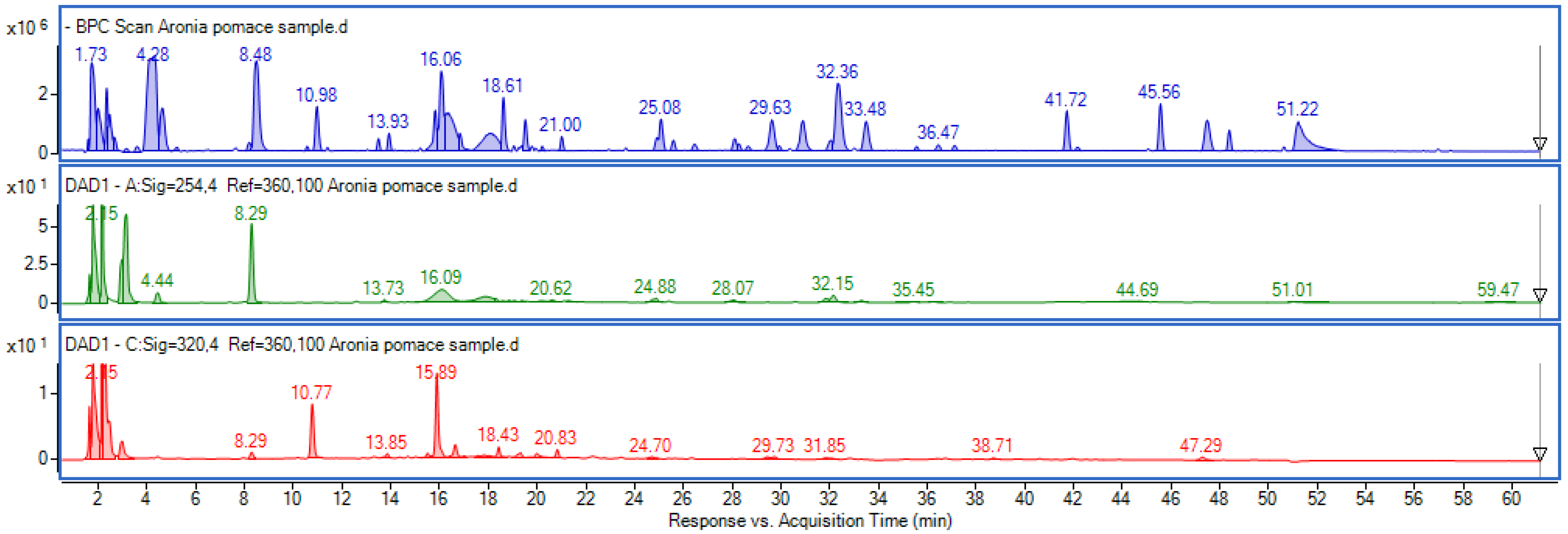
Four different preservation methods: drying, freeze-drying, deep freezing at −80 °C, and freezing at −18 °C were included in the investigation. To evaluate the effect of these preservation techniques on the polyphenol content in pomace, ultrasound-assisted extraction (UAE) was employed due to its high throughput and suitability for rapid analysis of multiple samples [31]. The phytochemical analysis of the extract showed the presence of gallic, protocatechuic, and chlorogenic acids as well as several cyanidin derivatives, including glucoside, galactoside, arabinoside, and xyloside, as the main phenolic constituents. Additionally, small amounts of flavonoids were detected, mainly quercetin derivatives, at levels of up to a few mg per 100 g. The identities of the compounds were established based on mass spectrometry data and confirmed by comparison with the literature and reference standards [32,33,34]. Representative chromatograms are presented in Figure 1. The LC-MS data used for identification are summarized in Table S1.
The main components were quantitatively analyzed in extracts obtained from raw material subjected to the respective processing methods. The results are presented in Table 2.
Drying resulted in a noticeable decrease in the content of most compounds, with the exception of gallic acid. For the remaining preservation methods, differences in phenolic acids were not significant; only protocatechuic acid showed a slight decrease during freeze-drying. In the case of anthocyanins, minor reductions were observed, generally not exceeding 10%. Among the cold-processing methods, freeze-drying showed the greatest decrease in anthocyanin content.

3.2. Multi-Response Optimization of ASE Parameters

Accelerated solvent extraction (ASE) was employed to enhance the recovery of polyphenolic compounds from Aronia pomace. Several factors were tested for their impact on extraction efficiency, including temperature, number of extraction cycles, and methanol concentration. Multi-response optimization was performed to evaluate the adequacy and predictive capability of the developed ASE models. The developed models were statistically significant for all responses, with model p-values ranging from 0.0005 to 0.0036 (Table 3).
The high coefficients of determination (R2; 0.8772–0.9663) indicate a good fit between the models and the experimental data. The adjusted R2 values (0.7852–0.9269) were reasonably consistent with the predicted R2 values (0.4978–0.7322), confirming acceptable predictive capability. However, the slightly lower predicted R2 value for Sum ChlA suggests moderate extrapolation reliability. Lack-of-fit tests were not significant (p > 0.05) for any of the models, showing that they adequately describe the experimental data within the studied range. Furthermore, the Adequate Precision values (9.02–18.19) were well above the desirable threshold of 4, indicating an adequate signal-to-noise ratio, and confirming that the models can be used to navigate the design space.
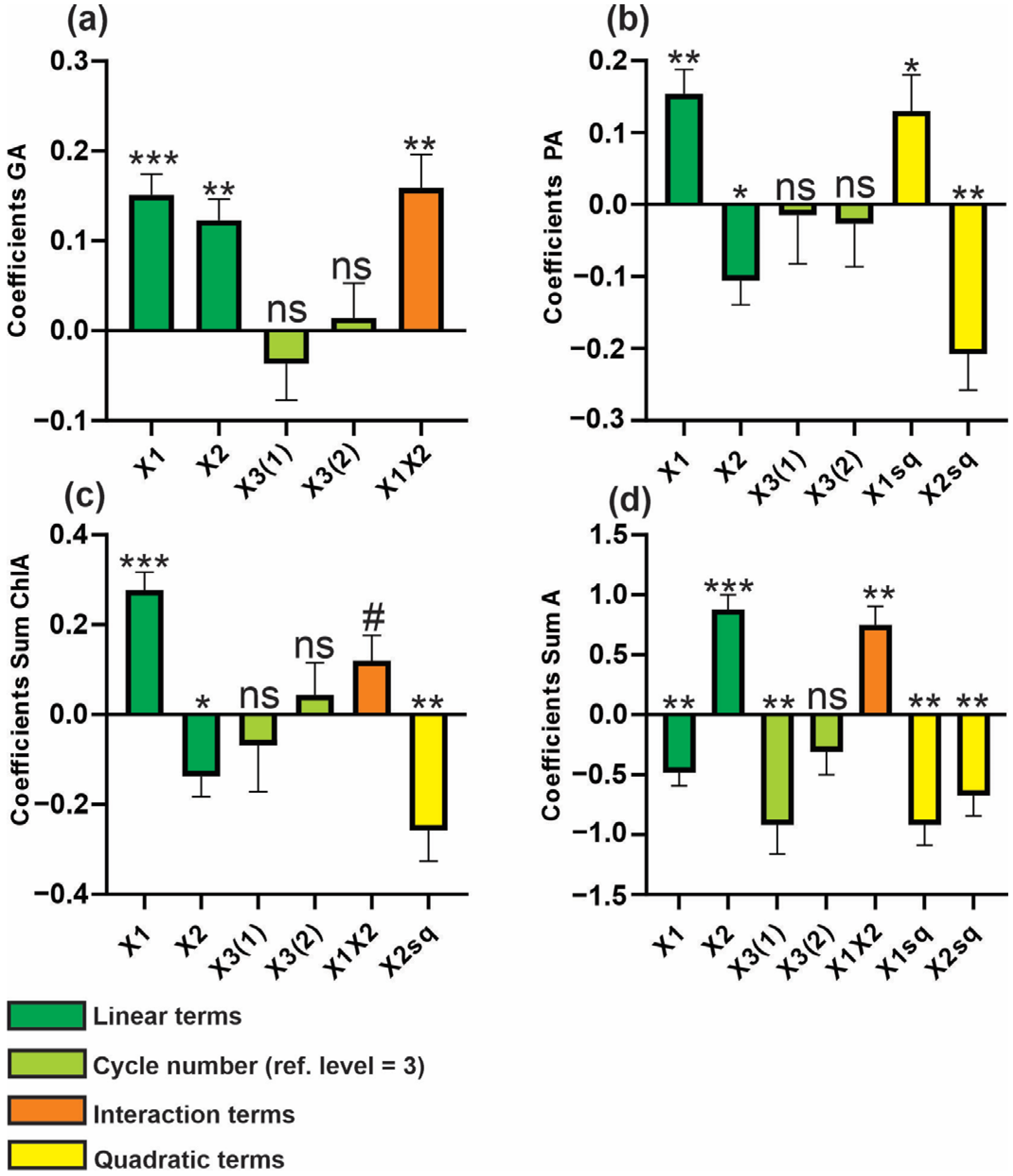
The regression coefficient plots (Figure 2) illustrate the influence of extraction parameters: temperature (X1), methanol concentration (X2), and number of cycles (X3)—on the recovery of the analyzed compounds (GA, PA, Sum ChlA, and Sum A). Additionally, the ANOVA results and more details about corresponding regression coefficients as well as for all fitted models (GA, PA, Sum ChlA, and Sum A) are provided in Tables S4–S7.
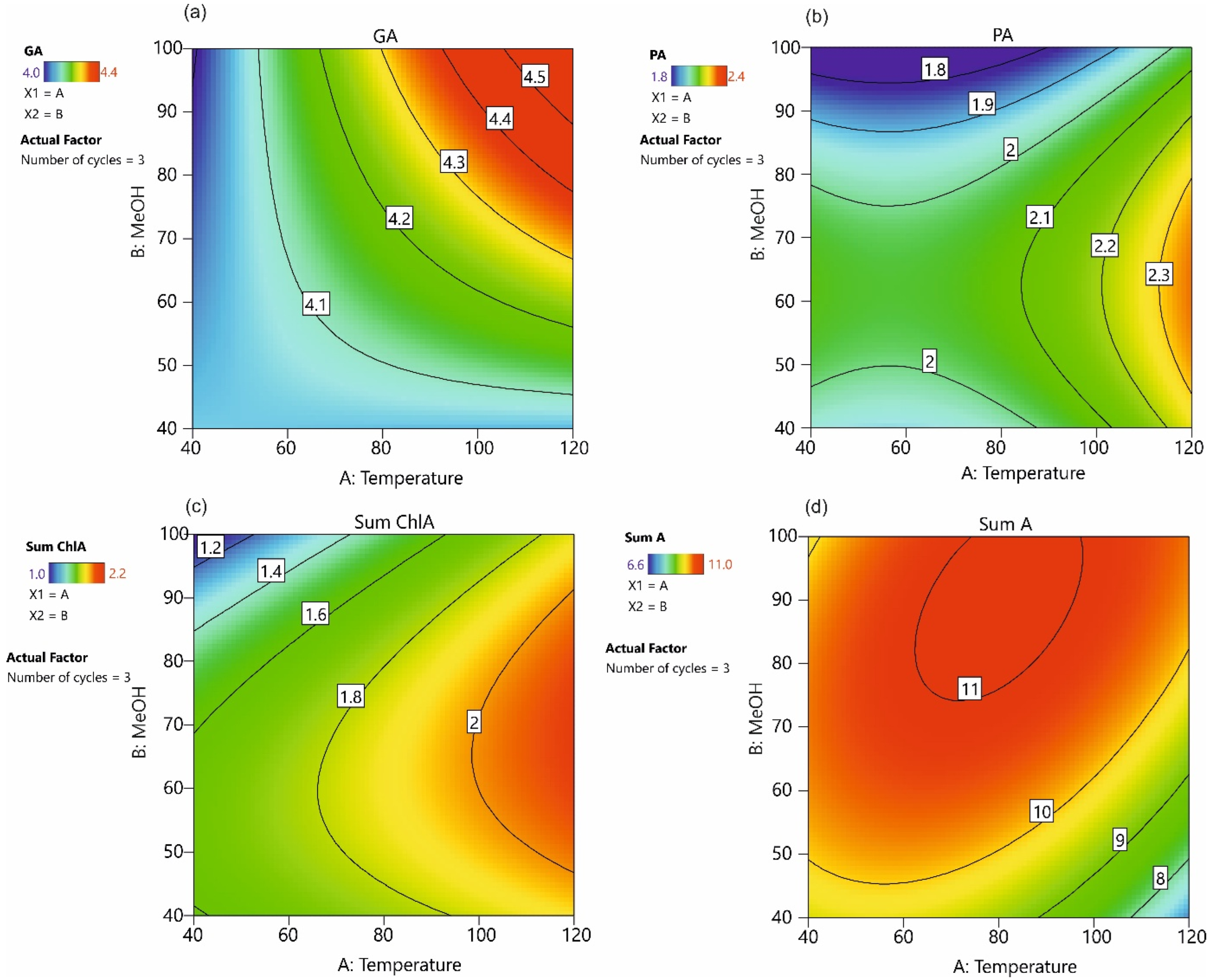
Figure 3 presents the response surface plots illustrating the effect of extraction parameters on extraction efficiency. For all phenolic acids (GA, PA, and Sum ChlA) (Figure 3a–c), temperature (X1) exerted a consistently positive and statistically significant effect, indicating that increasing temperature enhances extraction efficiency. This behavior can be attributed to improved solvent penetration, reduced viscosity, and enhanced mass transfer under elevated temperatures typical for ASE. In contrast, Sum A (anthocyanins) showed a significant negative linear effect of temperature, suggesting thermal sensitivity and possible degradation of anthocyanins at higher temperatures (Figure 3d). The effect of methanol concentration (X2) varied depending on the analyte group. For GA, methanol had a significant positive effect (Figure 3a), whereas for PA and Sum ChlA it showed a negative or less favorable influence (Figure 3b,c), indicating that more aqueous conditions may promote the extraction of certain phenolic acids. This reflects differences in polarity and solubility among phenolic compounds. For anthocyanins (Sum A) (Figure 3d), methanol concentration exhibited a strong positive effect, confirming that higher organic solvent content enhances their extraction efficiency. The number of extraction cycles (X3) played a minor role in the extraction of phenolic acids (Figure 3a–c). The lack of significant effects for X3 in GA, PA, and Sum ChlA suggests that most phenolic acids were efficiently extracted during the first cycle, and additional cycles did not substantially improve recovery. On the other hand, for anthocyanins (Sum A), the number of cycles was an important factor. Lower levels of X3 (relative to the reference level of 3 cycles) significantly decreased extraction efficiency, indicating that multiple extraction cycles are necessary to achieve exhaustive recovery of anthocyanins from the plant matrix.
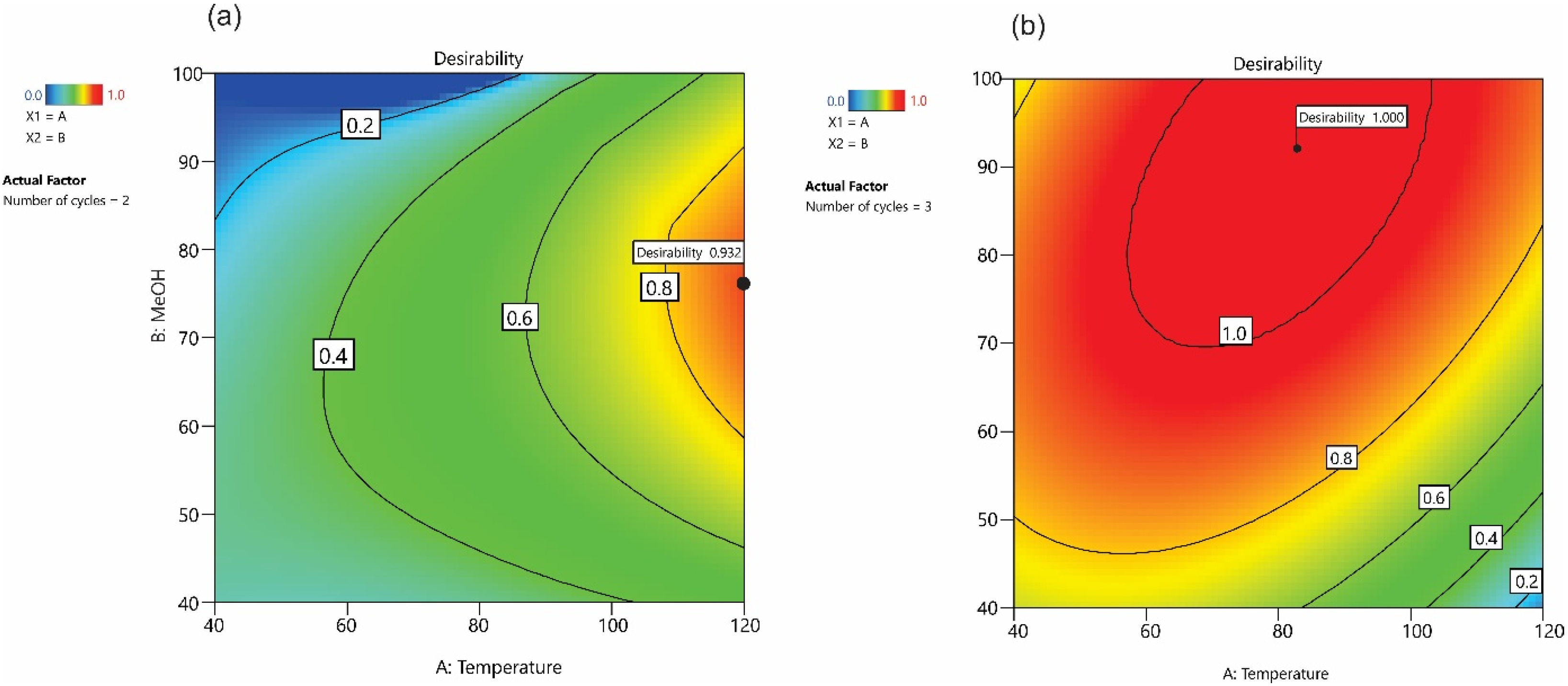
Due to the distinct and sometimes opposing effects of extraction parameters on phenolic acids and anthocyanins, two separate optimisation models were developed. The first model targeted phenolic acids (GA, PA and Sum ChlA), while the second focused exclusively on total anthocyanins (Sum A). This approach was necessary due to the different physicochemical properties and extraction behaviors of these compound classes. The desirability contour plots (Figure 4) clearly illustrate these differences. For phenolic acids (Figure 4a), the optimal conditions were a relatively high temperature (120 °C), a moderate methanol concentration (75%), and a lower number of extraction cycles (2) (Figure S1). This resulted in a desirability value of 0.931. This confirms that an elevated temperature enhances the extraction efficiency of phenolic acids, and that additional extraction cycles are unnecessary, likely because most of these compounds are recovered efficiently during the initial extraction step. Contrary, optimization of anthocyanins (Figure 4b) yielded optimal conditions at a significantly lower temperature (82 °C), a higher methanol concentration (92%) and a greater number of extraction cycles (three), with a maximum desirability value of 1.000. These results reflect the thermal sensitivity of anthocyanins and the need for repeated extraction cycles to achieve exhaustive recovery from the plant matrix.
Overall, comparing both models highlights the necessity of optimizing for each compound individually, as it is not possible to maximize the recovery of both phenolic acids and anthocyanins with a single set of extraction conditions. The desirability approach provides a robust framework for defining optimal conditions for each target group, or for identifying compromise conditions in multi-response extraction strategies. To verify the reliability of the models further, a confirmation experiment was performed under the optimal extraction conditions predicted by the desirability function for both phenolic acids and anthocyanins (Table 4).
The experimentally obtained values were then compared with the predicted responses and the relative deviation (RD%) was calculated to evaluate the accuracy of the models. For the anthocyanin-optimized conditions (temperature: 82 °C; methanol: 92%; number of cycles: 3; desirability: 1.000), there was very good agreement between the predicted and experimental values, with relative deviation (RD%) values ranging from −2.919% to 1.886%. Most of the experimental results fell within the corresponding 95% prediction intervals, confirming the model’s overall predictive capability. However, a slight deviation was observed for GA, where the experimental value was marginally outside the predicted interval. This discrepancy may be due to experimental variability or matrix-related effects, and does not significantly affect the reliability of the overall model. For the phenolic acid-optimized conditions (temperature: 120 °C; methanol: 75%; number of cycles: 2; desirability: 0.931), the experimental values were in good agreement with the model predictions. The RD% values ranged from −3.906% to 6.379%, remaining within an acceptable range for response surface methodology. In this case, all observed values were within the 95% prediction intervals, which further supports the adequacy of the model. Overall, the confirmation results demonstrate that the developed models are robust and reliable, providing accurate predictions of extraction performance under the optimized conditions, despite a minor deviation observed for GA under anthocyanin-oriented conditions.

4. Discussion

In the context of the growing interest in implementing the circular economy, the utilization of agro-industrial by-products from fruit and vegetable processing is gaining increasing importance. These materials should be regarded as valuable secondary raw materials with significant added value as they represent a cost-effective and abundant source of bioactive compounds suitable for use in nutraceutical and cosmetic formulations. Waste-to-value strategies also contribute to waste reduction and support the development of green and sustainable technologies [33,35,36]. In this regard, pomace from A. melanocarpa represents a promising matrix for the recovery of polyphenols, including anthocyanins and phenolic acids. Our study confirms that this material is rich in gallic, protocatechuic, and chlorogenic acids, as well as anthocyanins derived mostly from cyanidin. A high abundance of these compounds has also been reported previously [22,32,33,34]. These compounds are well known for their diverse biological activities, including antioxidant, anti-inflammatory, and antimicrobial effects, and therefore may represent a valuable ingredient in the development of functional foods or dietary supplements [37,38].
In the case of fruit and vegetable processing waste, the first crucial step is the proper stabilization and preservation of the material to enable its further utilization, as storage conditions significantly affect its chemical composition. Drying, freeze-drying (lyophilization), freezing, and deep freezing are widely used techniques for food preservation. Conventional freezing preserves food by lowering the temperature, typically to around −18 °C, causing the water present in the product to form ice crystals. Deep freezing (or quick freezing) is performed at lower temperatures, usually between −30 °C and −40 °C, and leads to the formation of smaller ice crystals, which helps preserve the cellular structure and sensory quality of the material more effectively than conventional freezing. Freeze-drying involves freezing the product followed by the removal of water through sublimation under vacuum conditions. Low-temperature-based techniques, although energy-intensive and costly, generally better preserve the plant matrix structure and limit polyphenol losses due to reduced processing temperatures and lower water activity. On the other hand, conventional drying involves removing water from the material by applying heat and airflow; however, elevated temperatures may lead to the degradation of thermolabile compounds. According to the literature, these preservation methods significantly affect product quality, including the retention of polyphenolic compounds [15,35,39,40]. The present findings confirm that preservation methods applied immediately after juice production play an important role in maintaining the bioactive potential of pomace. However, the observed differences between the methods were relatively small. Low-temperature techniques yielded comparable results, whereas a decrease in anthocyanin content was observed in the case of conventional drying. A reduction in the content of these compounds in Aronia pomace under elevated temperature conditions was also observed by Schmid et al. [41]. As reported, anthocyanins are highly susceptible to thermal processing, and the combination of water removal and elevated temperatures promotes multiple degradation pathways, including oxidative reactions, structural transformations (e.g., chalcone formation), and polymerization leading to the formation of brown pigments and other degradation products [42]. In contrast, low-temperature techniques such as freezing or freeze-drying better preserve the hydrated microenvironment of the plant matrix and limit the mobility of reactive species, thereby reducing degradation pathways.
An important factor in the recovery of biologically active compounds from Aronia pomace is the selection of an appropriate extraction technique. Various approaches have been reported for this purpose, including ultrasound-assisted extraction, microwave-assisted extraction, enzyme-assisted extraction, and subcritical fluid extraction [20,22,43].
In this study, particular attention was given to accelerated solvent extraction (ASE), which combines elevated temperature and pressure under controlled conditions to enhance the release metabolites from plant matrices. This technique is characterized by high efficiency and reduced extraction time and is suitable for recovery metabolites from plant materials [44,45]. However, systematic optimization of ASE parameters—including extraction temperature, static time, number of extraction cycles, and solvent composition—is essential to achieve optimal recovery [46,47]. The obtained results clearly demonstrate that the optimal parameters for accelerated solvent extraction depend strongly on the physicochemical properties of the target compounds. Elevated temperatures significantly improved the recovery of phenolic acids; however, they negatively affected anthocyanins, most likely due to their thermal instability and susceptibility to degradation. The degradation of anthocyanins at higher temperatures has been widely reported, confirming the need for milder extraction conditions for these compounds [48,49]. In contrast, the positive influence of temperature on the recovery of phenolic acids has also been documented in previous studies. Solvent composition was another important factor affecting extraction efficiency. Higher methanol concentrations favored anthocyanin extraction, whereas more aqueous conditions were beneficial for certain phenolic acids. The higher solubility of phenolic acids in solvent systems with a greater water content, compared to anthocyanins, can be attributed to differences in their molecular structure and polarity. Phenolic acids are relatively small, highly polar molecules containing carboxyl and hydroxyl groups, which readily form hydrogen bonds with water molecules. Their ionization in aqueous environments further enhances their solubility in water-rich systems. In contrast, anthocyanins, despite being polar due to their glycosidic structure, possess larger and more complex molecular structure with aromatic rings that introduce hydrophobic character. As a result, they require a balanced solvent system that can simultaneously provide sufficient polarity for solvation and organic character to interact with less polar regions of the molecule. Methanol improves the disruption of plant matrices and enhances interactions with the aromatic moieties of anthocyanins, thereby increasing their extraction efficiency. Therefore, increasing the water proportion favors the extraction of low-molecular-weight, highly polar phenolic acids, whereas anthocyanins are more efficiently recovered in mixed solvent systems with a higher proportion of organic solvent [29,50].
Interestingly, the number of extraction cycles was found to be a less critical factor for phenolic acids, suggesting that these compounds are efficiently extracted in the initial cycle. In contrast, anthocyanins showed improved recovery when the extraction process was repeated, indicating the need for multiple cycles to achieve exhaustive extraction. Furthermore, the confirmation experiments demonstrated good agreement between the predicted and experimental values, supporting the reliability of the developed models. Overall, the results indicate that a single set of extraction conditions is insufficient to maximize the recovery of chemically diverse compounds. Therefore, depending on the analytical objective, either selective optimization or compromise conditions should be applied.

5. Conclusions

The present study demonstrates that Aronia pomace is a valuable source of bioactive compounds, particularly phenolic acids and anthocyanins, supporting its potential use within circular economy strategies and waste-to-value approaches. The material was shown to be rich in gallic, protocatechuic, and chlorogenic acids, as well as cyanidin-derived anthocyanins, which are compounds widely recognized for their antioxidant, anti-inflammatory, and antimicrobial properties. The results confirm that the method of raw material stabilization plays an important role in preserving its bioactive profile. Although low-temperature preservation techniques (freezing and freeze-drying) provided comparable results, conventional drying led to a reduction in anthocyanin content, highlighting the susceptibility of these compounds to thermal degradation. The study also demonstrates that accelerated solvent extraction (ASE) is an efficient and versatile technique for recovering bioactive compounds from plant matrices. However, extraction efficiency strongly depends on the physicochemical properties of the target analytes. Elevated temperatures improved the recovery of phenolic acids, whereas anthocyanins required milder conditions due to their thermal instability. Similarly, solvent composition and extraction cycle number influenced extraction yields, further emphasizing the need for method optimization depending on the target compound class.
Overall, the findings indicate that no single universal set of extraction conditions is optimal for all bioactive compounds in Aronia pomace. The developed approach provides a useful basis for the efficient recovery of high-value phytochemicals from agro-industrial by-products.

Supplementary Materials

The following supporting information can be downloaded at: https://www.mdpi.com/article/10.3390/app16094116/s1, Table S1: Identification of phenolic compounds in Aronia melanocarpa pomace by LC–MS analysis. Retention time (RT), deprotonated molecular ions [M–H]−, mass accuracy (ppm), molecular formula, and compound identification are presented. Compounds marked as (str) were confirmed using reference standards. Table S2: Calibration curve parameters for the analyzed compounds. Table S3. Experimental design matrix and observed responses. GA—gallic acid, PA—protocatechuic acid, ChlA—chlorogenic acids, A—anthocyanins. Table S4. Regression model coefficients with statistical parameters for gallic acid (GA). Table S5. Regression model coefficients with statistical parameters for protocatechuic acid (PA). Table S6. Regression model coefficients with statistical parameters for the sum of chlorogenic acids (ChlA). Table S7. Regression model coefficients with statistical parameters for the sum of anthocyanins. Figure S1. Desirability profiles for the extraction process variables: temperature (A), ethanol concentration (B), and cycle number (C). (A) Optimal extraction conditions for phenolic acids (T = 82 °C, EtOH = 92%, cycle number = 3). (B) Optimal extraction conditions for anthocyanins (T = 120 °C, EtOH = 75%, cycle number = 2).

Author Contributions

Conceptualization, J.S. and M.W.; methodology, J.S., S.D. and M.W.; software, M.W. and S.D.; validation, J.S., M.W. and S.D., formal analysis, J.S., W.W., M.Ż., M.W. and S.D.; investigation, J.S., A.S.-K., I.S., W.W., M.Ż. and M.W.; resources, A.S.-K. and J.S.; data curation, M.W.; writing—original draft preparation, J.S., S.D., I.S. and M.W.; writing—review and editing, J.S. and M.W.; visualization, J.S., S.D. and M.W.; supervision, J.S., S.D. and M.W.; project administration, J.S. and M.W.; funding acquisition, J.S. and M.W. All authors have read and agreed to the published version of the manuscript.

Funding

The study was funded by Medical University of Lublin (DS 52).

Institutional Review Board Statement

Not applicable.

Informed Consent Statement

Not applicable.

Data Availability Statement

Data is contained within the article.

Conflicts of Interest

The authors declare no conflicts of interest.

References

  1. Jaouhari, Y.; Travaglia, F.; Giovannelli, L.; Picco, A.; Oz, E.; Oz, F.; Bordiga, M. From Industrial Food Waste to Bioactive Ingredients: A Review on the Sustainable Management and Transformation of Plant-Derived Food Waste. Foods 2023, 12, 2183. [Google Scholar] [CrossRef]
  2. Mohd Basri, M.S.; Abdul Karim Shah, N.N.; Sulaiman, A.; Mohamed Amin Tawakkal, I.S.; Mohd Nor, M.Z.; Ariffin, S.H.; Abdul Ghani, N.H.; Mohd Salleh, F.S. Progress in the Valorization of Fruit and Vegetable Wastes: Active Packaging, Biocomposites, By-Products, and Innovative Technologies Used for Bioactive Compound Extraction. Polymers 2021, 13, 3503. [Google Scholar] [CrossRef] [PubMed]
  3. Raczkowska, E.; Serek, P. Health-Promoting Properties and the Use of Fruit Pomace in the Food Industry—A Review. Nutrients 2024, 16, 2757. [Google Scholar] [CrossRef]
  4. Xu, J.; Li, F.; Zheng, M.; Sheng, L.; Shi, D.; Song, K. A Comprehensive Review of the Functional Potential and Sustainable Applications of Aronia melanocarpa in the Food Industry. Plants 2024, 13, 3557. [Google Scholar] [CrossRef]
  5. Sidor, A.; Gramza-Michałowska, A. Black Chokeberry Aronia melanocarpa L.—A Qualitative Composition, Phenolic Profile and Antioxidant Potential. Molecules 2019, 24, 3710. [Google Scholar] [CrossRef] [PubMed]
  6. Shi, D.; Xu, J.; Sheng, L.; Song, K. Comprehensive Utilization Technology of Aronia melanocarpa. Molecules 2024, 29, 1388. [Google Scholar] [CrossRef]
  7. Ho, G.; Bräunlich, M.; Austarheim, I.; Wangensteen, H.; Malterud, K.; Slimestad, R.; Barsett, H. Immunomodulating Activity of Aronia melanocarpa Polyphenols. Int. J. Mol. Sci. 2014, 15, 11626–11636. [Google Scholar] [CrossRef]
  8. Lee, H.Y.; Weon, J.B.; Ryu, G.; Yang, W.S.; Kim, N.Y.; Kim, M.K.; Ma, C.J. Neuroprotective Effect of Aronia melanocarpa Extract against Glutamate-Induced Oxidative Stress in HT22 Cells. BMC Complement. Altern. Med. 2017, 17, 207. [Google Scholar] [CrossRef]
  9. Song, D.; Fang, C. Study on the Protective Effect of Aronia melanocarpa Extract on Type 2 Diabetes by Regulating Glucose and Lipid Metabolism through Intestinal Flora. Food Sci. Nutr. 2024, 12, 7620–7629. [Google Scholar] [CrossRef]
  10. Lipińska, P.; Jóźwik, A. Hepatoprotective, Hypoglycemic, and Hypolipidemic Effect of Chokeberry Pomace on Polish Merino Lambs. Anim. Biotechnol. 2018, 29, 136–141. [Google Scholar] [CrossRef] [PubMed]
  11. Tamkutė, L.; Vaicekauskaitė, R.; Gil, B.M.; Rovira Carballido, J.; Venskutonis, P.R. Black Chokeberry (Aronia melanocarpa L.) Pomace Extracts Inhibit Food Pathogenic and Spoilage Bacteria and Increase the Microbiological Safety of Pork Products. J. Food Process. Preserv. 2021, 45, 1–11. [Google Scholar] [CrossRef]
  12. Wieloch, D.; Konopacka, D. Black Chokeberry Extracts (Aronia melanocarpa) as an Ingredient of Functional Food—Potential, Challenges and Directions of Development. Molecules 2025, 30, 4237. [Google Scholar] [CrossRef]
  13. Stanca, L.; Bilteanu, L.; Bujor, O.C.; Ion, V.A.; Petre, A.C.; Bădulescu, L.; Geicu, O.I.; Pisoschi, A.M.; Serban, A.I.; Ghimpeteanu, O.-M. Development of Functional Foods: A Comparative Study on the Polyphenols and Anthocyanins Content in Chokeberry and Blueberry Pomace Extracts and Their Antitumor Properties. Foods 2024, 13, 2552. [Google Scholar] [CrossRef]
  14. Rodríguez-Werner, M.; Winterhalter, P.; Esatbeyoglu, T. Phenolic Composition, Radical Scavenging Activity and an Approach for Authentication of Aronia melanocarpa Berries, Juice, and Pomace. J. Food Sci. 2019, 84, 1791–1798. [Google Scholar] [CrossRef] [PubMed]
  15. Górska-Horczyczak, E.; Jamróz, E.; Żbik, K.; Markowska-Radomska, A.; Zalewska, M. Effects of Preservation Methods on the Volatile Compound Profile and Physicochemical Properties of Aronia melanocarpa Berries. Appl. Sci. 2025, 15, 10470. [Google Scholar] [CrossRef]
  16. Zhang, L.; Zhang, C.; Wei, Z.; Huang, W.; Yan, Z.; Luo, Z.; Beta, T.; Xu, X. Effects of Four Drying Methods on the Quality, Antioxidant Activity and Anthocyanin Components of Blueberry Pomace. Food Prod. Process. Nutr. 2023, 5, 35. [Google Scholar] [CrossRef]
  17. Olesińska, K.; Wilczyński, K.; Kałwa, K. The Effect Method of Preservation on Selected Bioactive Compounds and Antioxidant Activity in Blackthorn Fruits (Prunus spinosa L.). Agron. Sci. 2018, 73, 45–54. [Google Scholar] [CrossRef]
  18. Pashazadeh, H.; Ali Redha, A.; Koca, I. Effect of Convective Drying on Phenolic Acid, Flavonoid and Anthocyanin Content, Texture and Microstructure of Black Rosehip Fruit. J. Food Compos. Anal. 2024, 125, 105738. [Google Scholar] [CrossRef]
  19. Galván D’Alessandro, L.; Dimitrov, K.; Vauchel, P.; Nikov, I. Kinetics of Ultrasound Assisted Extraction of Anthocyanins from Aronia melanocarpa (Black Chokeberry) Wastes. Chem. Eng. Res. Des. 2014, 92, 1818–1826. [Google Scholar] [CrossRef]
  20. Sady, S.; Matuszak, L.; Błaszczyk, A. Optimisation of Ultrasonic-Assisted Extraction of Bioactive Compounds from Chokeberry Pomace Using Response Surface Methodology. Acta Sci. Pol. Technol. Aliment. 2019, 18, 249–256. [Google Scholar] [CrossRef]
  21. Xu, Y.; Qiu, Y.; Ren, H.; Ju, D.; Jia, H. Optimization of Ultrasound-Assisted Aqueous Two-Phase System Extraction of Polyphenolic Compounds from Aronia melanocarpa Pomace by Response Surface Methodology. Prep. Biochem. Biotechnol. 2017, 47, 312–321. [Google Scholar] [CrossRef]
  22. Elez Garofulić, I.; Repajić, M.; Zorić, Z.; Jurendić, T.; Dragović-Uzelac, V. Evaluation of Microwave- and Ultrasound-Assisted Extraction Techniques for Revalorization of Black Chokeberry (Aronia melanocarpa) Fruit Pomace Anthocyanins. Sustainability 2023, 15, 7047. [Google Scholar] [CrossRef]
  23. Roda-Serrat, M.C.; Razi Parjikolaei, B.; Mohammadifakhr, M.; Martin, J.; Norddahl, B.; Errico, M. A Case Study for the Extraction, Purification, and Co-Pigmentation of Anthocyanins from Aronia melanocarpa Juice Pomace. Foods 2022, 11, 3875. [Google Scholar] [CrossRef]
  24. Kang, H.-J.; Ko, M.-J.; Chung, M.-S. Anthocyanin Structure and pH Dependent Extraction Characteristics from Blueberries (Vaccinium corymbosum) and Chokeberries (Aronia melanocarpa) in Subcritical Water State. Foods 2021, 10, 527. [Google Scholar] [CrossRef]
  25. Medveďová, K.; Nahliková, L.; Strižincová, P.; Dubaj, T.; Kreps, F. Extraction of Biologically Active Compounds from Aronia melanocarpa: Comparison of Techniques and Multiple Response Optimization. Acta Chim. Slovaca 2023, 16, 92–98. [Google Scholar] [CrossRef]
  26. Repajić, M.; Zorić, M.; Magnabosca, I.; Pedisić, S.; Dragović-Uzelac, V.; Elez Garofulić, I. Bioactive Power of Black Chokeberry Pomace as Affected by Advanced Extraction Techniques and Cryogrinding. Molecules 2025, 30, 3383. [Google Scholar] [CrossRef] [PubMed]
  27. Andrade, T.A.; Hamerski, F.; López Fetzer, D.E.; Roda-Serrat, M.C.; Corazza, M.L.; Norddahl, B.; Errico, M. Ultrasound-Assisted Pressurized Liquid Extraction of Anthocyanins from Aronia melanocarpa Pomace. Sep. Purif. Technol. 2021, 276, 119290. [Google Scholar] [CrossRef]
  28. Kim, N.-H.; Jegal, J.; Kim, Y.N.; Heo, J.-D.; Rho, J.-R.; Yang, M.H.; Jeong, E.J. The Effects of Aronia melanocarpa Extract on Testosterone-Induced Benign Prostatic Hyperplasia in Rats, and Quantitative Analysis of Major Constituents Depending on Extract Conditions. Nutrients 2020, 12, 1575. [Google Scholar] [CrossRef]
  29. Dai, J.; Mumper, R.J. Plant Phenolics: Extraction, Analysis and Their Antioxidant and Anticancer Properties. Molecules 2010, 15, 7313–7352. [Google Scholar] [CrossRef] [PubMed]
  30. Harrington, E.C. The Desirability Function. Ind. Qual. Control. 1965, 21, 494–498. [Google Scholar]
  31. Rodríguez, Ó.; Bona, S.; Stäbler, A.; Rodríguez-Turienzo, L. Ultrasound-Assisted Extraction of Polyphenols from Olive Pomace: Scale Up from Laboratory to Pilot Scenario. Processes 2022, 10, 2481. [Google Scholar] [CrossRef]
  32. Reguengo, L.M.; Salgaço, M.K.; Sivieri, K.; Maróstica Júnior, M.R. Agro-Industrial by-Products: Valuable Sources of Bioactive Compounds. Food Res. Int. 2022, 152, 110871. [Google Scholar] [CrossRef]
  33. Galanakis, C.M. Recovery of High Added-Value Components from Food Wastes: Conventional, Emerging Technologies and Commercialized Applications. Trends Food Sci. Technol. 2012, 26, 68–87. [Google Scholar] [CrossRef]
  34. Oszmiański, J.; Wojdylo, A. Aronia melanocarpa Phenolics and Their Antioxidant Activity. Eur. Food Res. Technol. 2005, 221, 809–813. [Google Scholar] [CrossRef]
  35. Zubaidi, M.A.; Hendrysiak, A.; Oziembłowski, M.; Nawirska-Olszańska, A. Effects of Drying Techniques and Carriers on Polyphenol Content, Antioxidant Capacity, and Physical Properties of Elderberry Juice Powder. Food Chem. 2025, 487, 144686. [Google Scholar] [CrossRef]
  36. Mirabella, N.; Castellani, V.; Sala, S. Current Options for the Valorization of Food Manufacturing Waste: A Review. J. Clean. Prod. 2014, 65, 28–41. [Google Scholar] [CrossRef]
  37. Sadowska-Bartosz, I.; Bartosz, G. Antioxidant Activity of Anthocyanins and Anthocyanidins: A Critical Review. Int. J. Mol. Sci. 2024, 25, 12001. [Google Scholar] [CrossRef]
  38. Trujillo, J.; Ramírez, V. Polyphenols and Health Benefits: Volume I. Foods 2024, 13, 1221. [Google Scholar] [CrossRef]
  39. Coşkun, N.; Sarıtaş, S.; Jaouhari, Y.; Bordiga, M.; Karav, S. The Impact of Freeze Drying on Bioactivity and Physical Properties of Food Products. Appl. Sci. 2024, 14, 9183. [Google Scholar] [CrossRef]
  40. Gricenko, T.; Zommere, A.; Kviesis, J.; Klavins, L. Effect of Drying Temperature on Berry Press Residue Anthocyanin Stability and Profile. Front. Sustain. Food Syst. 2026, 9, 1733151. [Google Scholar] [CrossRef]
  41. Schmid, V.; Steck, J.; Mayer-Miebach, E.; Behsnilian, D.; Briviba, K.; Bunzel, M.; Karbstein, H.P.; Emin, M.A. Impact of Defined Thermomechanical Treatment on the Structure and Content of Dietary Fiber and the Stability and Bioaccessibility of Polyphenols of Chokeberry (Aronia melanocarpa) Pomace. Food Res. Int. 2020, 134, 109232. [Google Scholar] [CrossRef] [PubMed]
  42. Enaru, B.; Drețcanu, G.; Pop, T.D.; Stǎnilǎ, A.; Diaconeasa, Z. Anthocyanins: Factors Affecting Their Stability and Degradation. Antioxidants 2021, 10, 1967. [Google Scholar] [CrossRef]
  43. Sójka, M.; Kołodziejczyk, K.; Milala, J. Polyphenolic and Basic Chemical Composition of Black Chokeberry Industrial By-Products. Ind. Crops Prod. 2013, 51, 77–86. [Google Scholar] [CrossRef]
  44. Palos-Hernández, A.; González-Paramás, A.M.; Santos-Buelga, C. Latest Advances in Green Extraction of Polyphenols from Plants, Foods and Food By-Products. Molecules 2024, 30, 55. [Google Scholar] [CrossRef]
  45. Chiriac, E.; Chiţescu, C.; Geană, E.-I.; Gird, C.; Socoteanu, R.; Boscencu, R. Advanced Analytical Approaches for the Analysis of Polyphenols in Plants Matrices—A Review. Separations 2021, 8, 65. [Google Scholar] [CrossRef]
  46. Li, J.; Zhang, S.; Zhang, M.; Sun, B. Novel Approach for Extraction of Grape Skin Antioxidants by Accelerated Solvent Extraction: Box–Behnken Design Optimization. J. Food Sci. Technol. 2019, 56, 4879–4890. [Google Scholar] [CrossRef]
  47. Wójciak, M.; Mazurek, B.; Wójciak, W.; Kostrzewa, D.; Żuk, M.; Chmiel, M.; Kubrak, T.; Sowa, I. Optimizing the Extraction of the Polyphenolic Fraction from Defatted Strawberry Seeds for Tiliroside Isolation Using Accelerated Solvent Extraction Combined with a Box–Behnken Design. Molecules 2024, 29, 3051. [Google Scholar] [CrossRef]
  48. Oancea, S. A Review of the Current Knowledge of Thermal Stability of Anthocyanins and Approaches to Their Stabilization to Heat. Antioxidants 2021, 10, 1337. [Google Scholar] [CrossRef]
  49. Patras, A.; Brunton, N.P.; O’Donnell, C.; Tiwari, B.K. Effect of Thermal Processing on Anthocyanin Stability in Foods; Mechanisms and Kinetics of Degradation. Trends Food Sci. Technol. 2010, 21, 3–11. [Google Scholar] [CrossRef]
  50. Ignat, I.; Volf, I.; Popa, V.I. A Critical Review of Methods for Characterisation of Polyphenolic Compounds in Fruits and Vegetables. Food Chem. 2011, 126, 1821–1835. [Google Scholar] [CrossRef] [PubMed]
Figure 1. Representative chromatograms of Aronia melanocarpa extract: base peak chromatogram (blue); chromatogram recorded at 254 nm (green); chromatogram recorded at 320 nm (red).
Applsci 16 04116 g001
Figure 2. Regression coefficient plots of significant effects (X1—temperature, X2—MeOH%, X3 number of cycles) for (a) gallic acid (GA), (b) protocatechuic acid (PA), (c) sum of chlorogenic acids (ChlA), (d) sum of anthocyanins (A). ns—not significant (p ≥ 0.1) # p < 0.1, * p < 0.05, ** p < 0.01, *** p < 0.001.
Applsci 16 04116 g002
Figure 3. Response surface plots showing the effect of extraction properties on the extraction efficiency: (a) gallic acid (GA), (b) protocatechuic acid (PA), (c) sum of chlorogenic acids (ChlA), (d) sum of anthocyanins (A).
Applsci 16 04116 g003
Figure 4. Desirability contour plots illustrating the optimal extraction conditions for (a) phenolic acids (desirability = 0.931; Temperature (X1): 120 °C, MeOH (X2): 75%, number of cycles: 2) and (b) anthocyanins (desirability = 1.000; Temperature (X1): 82 °C, MeOH (X2): 92%, number of cycles: 3).
Applsci 16 04116 g004
Table 1. DOE variables.
No.Temperature (°C)MeOH/Water (v/v)Number of Cycles
14040/602
212040/602
340100/02
4120100/02
54070/301
612070/301
74070/303
812070/303
98040/601
1080100/01
118040/603
1280100/03
138070/302
148070/302
158070/302
Table 2. Results of quantification of main polyphenols extracted from Aronia pomace stored at different conditions (mg/100 g of fresh material).
ComponentFreshDryingFreeze-DryingFreezingDeep Freezing
Gallic acid298.7 ± 11.4 a293.2 ± 10.8 a291.5 ± 13.7 a292.6 ± 9.8 a300.2 ± 14.2 a
Protocatechuic acid106.3 ± 8.4 a91.1 ± 7.6 b93.2 ± 7.1 b101.2 ± 6.4 a,b104.6 ± 7.1 a
Neochlorogenic acid48.76 ± 2.71 a41.52 ± 3.83 a,b46.61 ± 3.25 a45.21 ± 3.63 a47.32 ± 3.17 a
Chlorogenic acid59.60 ± 2.44 a47.21 ± 4.42 b56.21 ± 3.81 a54.31 ± 2.55 a57.43 ± 3.41 a
Cyanidin 3- galactoside380.1 ± 19.1 a304.1 ± 25.3 b362.3 ± 22.6 a372.2 ± 21.1 a366.1 ± 19.8 a
Cyanidin 3-glucoside11.52 ± 1.12 a3.24 ± 0.23 d5.21 ± 0.47 c8.91 ± 0.56 b9.23 ± 0.67 a,b
Cyanidin 3-arabinoside *150.4 ± 11.3 a132.1 ± 6.2 b138.1 ± 9.2 a,b143.4 ± 8.7 a,b144.5 ± 4.8 a
Cyanidin 3-xyloside *13.66 ± 1.2 a7.32 ± 0.67 b10.02 ± 1.61 a,b11.45 ± 1.03 a11.89 ± 0.92 a
*—compounds were calculated based on calibration curve for cyanidin 3-glucoside; different letters within the same row indicate statistically significant differences between samples (p < 0.05).
Table 3. Model fit statistics and significance tests.
Response p-ValueR2Adj. R2Pred. R2Adeq Prec.
GAModel0.00160.88030.80560.61229.0191
Lack of Fit0.5013
PAModel0.00280.87720.78520.60179.9354
Lack of Fit0.8164
Sum ChlAModel0.00360.92640.85290.497812.3327
Lack of Fit0.2047
Sum AModel0.00050.96630.92690.732218.1912
Lack of Fit0.4849
GA—gallic acid, PA—protocatechuic acid, ChlA—chlorogenic acids, A—anthocyanins.
Table 4. Predicted and experimental values at the optimal extraction conditions determined by the desirability function: anthocyanins, desirability = 1.000 (Temperature (X1): 82 °C; MeOH (X2): 92%; number of cycles: 3) and phenolic acids, desirability = 0.931 (Temperature (X1): 120 °C; MeOH (X2): 75%; number of cycles: 2). Agreement between predicted and experimental values was evaluated using relative deviation (RD, %), root mean square error (RMSE), and by comparison with the 95% prediction intervals (PI).
VariablesPredicted ValueExperimental Value (n = 3)RD (%)95% PI
Low
95% PI
High
RMSE
Optimal extraction conditions for anthocyanins
PA1.8881.843−2.3831.7012.0740.056
GA4.2834.158−2.9194.1744.3930.130
Sum ChlA1.6441.6751.8861.4171.8720.042
Sum A11.13511.019−1.04210.47711.7930.223
Optimal extraction conditions for phenolic acids
PA2.3042.4616.3792.1162.4910.161
GA4.3924.373−0.4334.2654.5190.026
Sum ChlA2.1762.091−3.9061.9412.4120.087
Sum A9.3929.7013.2908.74110.0440.334
GA—gallic acid, PA—protocatechuic acid, ChlA—chlorogenic acids, A—anthocyanins.
Disclaimer/Publisher’s Note: The statements, opinions and data contained in all publications are solely those of the individual author(s) and contributor(s) and not of MDPI and/or the editor(s). MDPI and/or the editor(s) disclaim responsibility for any injury to people or property resulting from any ideas, methods, instructions or products referred to in the content.