Immobilized Dehydrogenases for the Biosynthesis of Phenylacetic Acids
 , ,
, , 
Abstract
1. Introduction
2. Materials and Methods
2.1. Chemicals and Plasmids
2.2. Bacteria, Cultivation, Expression Conditions, and Cell Harvesting
2.3. FeaB Enrichment
2.4. Verification of the Carrier Materials for the Application
2.5. Enzyme Immobilization on Powdery Carrier Material SBA-15 and MCF
2.5.1. Synthesis of SBA-15
2.5.2. Synthesis of MCF
2.5.3. Synthesis of Silica Monoliths (MH)
2.5.4. Functionalization of MCF and SBA-15 with Amino or Epoxy Groups
2.5.5. Functionalization of MCF with Amino and C16 Groups
2.5.6. Functionalization of MCF with Ni or Co
2.5.7. Functionalization of MH with Epoxy Groups in Acidic Conditions
2.5.8. Immobilization of FeaB
2.6. Optimization of the FeaB-Kp5.2 Immobilization on MCF
2.7. Enzyme Immobilization on Monolithic Carrier MH-G-Kw
2.8. Monitoring of the Immobilization Success
2.9. Enzyme Cascade Towards PAAs
3. Results
3.1. Optimal Conditions for FeaB-K-12 Production
3.2. Interaction of Carrier Materials with Substrate or Product
3.3. FeaB-K-12 and FeaB-Kp5.2 Immobilized on Various Powder Carrier Materials
3.4. Optimization of Immobilization Conditions for MCF Carriers
3.5. FeaB-Kp5.2 Immobilized on Monolith MH-G-Kw
4. Discussion and Conclusions
Supplementary Materials
Author Contributions
Funding
Data Availability Statement
Acknowledgments
Conflicts of Interest
Abbreviations
| APTMS | 3-aminopropyltrimethoxysilane |
| CTAB | hexadecyltrimethylammonium bromide |
| cyclam | 1,4,8,11-tetraazacyclotetradecane |
| feaB/FeaB(s) | gene of/gene product(s)phenylacetaldehyde dehydrogenase(s) |
| feaB-/FeaB-K-12 | gene of/gene product phenylacetaldehyde dehydrogenase originating from Escherichia coli K-12 |
| feaB-/FeaB-Kp5.2 | gene of/gene product phenylacetaldehyde dehydrogenase originating from Sphingopyxis fribergensis Kp5.2 |
| GPTMS | 3-glicydoxypropyltrimethoxysilane |
| HDTM | hexadecyltrimethoxysilane |
| IPTG | isopropyl-β-D-thiogalactopyranoside |
| MCF | mesoporous cellular foam, type of enzyme-carrier material |
| MCF-Co | MCF, surface-modified by cobalt ions coordinated to cyclam |
| MCF-G | MCF, surface-modified by 3-glycidyloxypropyl groups (solvent during synthesis: toluene) |
| MCF-G-Kw | MCF, surface-modified by 3-glycidyloxypropyl groups (solvent during synthesis: 0.1 M HCl) |
| MCF-HDTM | MCF, surface-modified by 1/3 aminopropyl groups and 2/3 C16-groups |
| MCF-Ni | MCF, surface-modified by nickel ions coordinated to cyclam |
| MeCN | acetonitrile |
| MH-G-Kw | silica carrier in monolithic form, surface-modified with 3-glycidyloxypropyl groups (solvent during synthesis: 0.1 M HCl) |
| PA | phenylacetaldehyde |
| PAD(s) | phenylacetaldehyde dehydrogenase(s) |
| PB | phosphate buffer |
| SBA-15 | Santa Barbara Amorphous-15, highly ordered extra-large hexagonal mesoporous silica |
| SBA-15-A | SBA-15, surface-modified by aminopropyl groups |
| SBA-15-G | SBA-15, surface-modified by 3-glycidopropyl groups |
| SDS-PAGE | sodium dodecyl sulfate polyacrylamide gel electrophoresis |
| SMO(s) | styrene monooxygenase |
| SOI(s) | styrene oxide isomerase(s) |
| SOI-1CP | styrene oxide isomerase of Rhodococcus opacus 1CP |
| styD/StyD(s) | gene of/gene product(s)phenylacetaldehyde dehydrogenase(s) |
| styD-/StyD-1CP | gene of/gene product phenylacetaldehyde dehydrogenase of Rhodococcus opacus 1CP |
| styD-/StyD-CWB2 | gene of/gene product phenylacetaldehyde dehydrogenase of Gordonia rubripertincta CWB2 |
| TEOS | tetraethoxysilane |
References
- Crabo, A.G.; Singh, B.; Nguyen, T.; Emami, S.; Gassner, G.T.; Sazinsky, M.H. Structure and biochemistry of phenylacetaldehyde dehydrogenase from the Pseudomonas putida S12 styrene catabolic pathway. Arch. Biochem. Biophys. 2017, 616, 47–58. [Google Scholar] [CrossRef]
- Ferrández, A.; Prieto, M.A.; García, J.L.; Díaz, E. Molecular characterization of PadA, a phenylacetaldehyde dehydrogenase from Escherichia coli. FEBS Lett. 1997, 406, 23–27. [Google Scholar] [CrossRef]
- Mao, Z.; Liu, L.; Zhang, Y.; Yuan, J. Efficient synthesis of phenylacetate and 2-phenylethanol by modular cascade biocatalysis. ChemBioChem 2020, 21, 2676–2683. [Google Scholar] [CrossRef]
- Liu, D.M.; Dong, C. Recent advances in nano-carrier immobilized enzymes and their applications. Process Biochem. 2020, 92, 94–114. [Google Scholar] [CrossRef]
- Datta, S.; Christena, L.R.; Rajaram, Y.R.S. Enzyme immobilization: An overview on techniques and support materials. 3 Biotech 2013, 3, 1–9. [Google Scholar] [CrossRef]
- Szymańska, K.; Odrozek, K.; Zniszczoł, A.; Torrelo, G.; Resch, V.; Hanefeld, U.; Jarzębski, A. MsAcT in siliceous monolithic microreactors enables quantitative ester synthesis in water. Catal. Sci. Technol. 2016, 6, 4882–4888. [Google Scholar] [CrossRef]
- Zhou, Z.; Hartmann, M. Progress in enzyme immobilization in ordered mesoporous materials and related applications. Chem. Soc. Rev. 2013, 42, 3894–3912. [Google Scholar] [CrossRef] [PubMed]
- Gaffney, D.; Cooney, J.; Magner, E. Modification of mesoporous silicates for immobilization of enzymes. Top. Catal. 2012, 55, 1101–1106. [Google Scholar] [CrossRef]
- Zhao, D.; Huo, Q.; Feng, J.; Chmelka, B.F.; Stucky, G.D. Nonionic triblock and star diblock copolymer and oligomeric surfactant syntheses of highly ordered, hydrothermally stable, mesoporous silica structures. J. Am. Chem. Soc. 1998, 120, 6024–6036. [Google Scholar] [CrossRef]
- Schmidt-Winkel, P.; Lukens, W.W.; Zhao, D.; Yang, P.; Chmelka, B.F.; Stucky, G.D. Mesocellular siliceous foams with uniformly sized cells and windows. J. Am. Chem. Soc. 1999, 121, 254–255. [Google Scholar] [CrossRef]
- Itoh, T.; Ishii, R.; Ebina, T.; Hanaoka, T.; Fukushima, Y.; Mizukami, F. Encapsulation of myoglobin with a mesoporous silicate results in new capabilities. Bioconjug. Chem. 2006, 17, 236–240. [Google Scholar] [CrossRef]
- Qi, J.; Anke, M.K.; Szymańska, K.; Tischler, D. Immobilization of Rhodococcus opacus 1CP azoreductase to obtain azo dye degrading biocatalysts operative at acidic pH. Int. Biodeterior. Biodegrad. 2017, 121, 89–94. [Google Scholar] [CrossRef]
- Szymańska, K.; Bryjak, J.; Mrowiec-Białoń, J.; Jarzębski, A.B. Application and properties of siliceous mesostructured cellular foams as enzymes carrier to obtain efficient biocatalysts. Microporous Mesoporous Mater. 2007, 99, 167–175. [Google Scholar] [CrossRef]
- Falahati, M.; Saboury, A.A.; Shafiee, A.; Sorkhabadi, S.M.R.; Kachooei, E.; Ma’mani, L.; Haertlé, T. Highly efficient immobilization of beta-lactoglobulin in functionalized mesoporous nanoparticles: A simple and useful approach for enhancement of protein stability. Biophys. Chem. 2012, 165–166, 13–20. [Google Scholar] [CrossRef] [PubMed]
- Oelschlägel, M.; Riedel, A.; Zniszczoł, A.; Szymańska, K.; Jarzębski, A.B.; Schlömann, M.; Tischler, D. Immobilization of an integral membrane protein for biotechnological phenylacetaldehyde production. J. Biotechnol. 2014, 174, 7–13. [Google Scholar] [CrossRef]
- Shimomura, T.; Itoh, T.; Sumiya, T.; Mizukami, F.; Ono, M. Amperometric determination of choline with enzyme immobilized in a hybrid mesoporous membrane. Talanta 2009, 78, 217–220. [Google Scholar] [CrossRef] [PubMed]
- Salis, A.; Casula, M.F.; Bhattacharyya, M.S.; Pinna, M.; Solinas, V.; Monduzzi, M. Physical and chemical lipase adsorption on SBA-15: Effect of different interactions on enzyme loading and catalytic performance. ChemCatChem 2010, 2, 322–329. [Google Scholar] [CrossRef]
- Engelmann, C.; Ekambaram, N.; Johannsen, J.; Fellechner, O.; Waluga, T.; Fieg, G.; Liese, A.; Bubenheim, P. Enzyme immobilization on synthesized nanoporous silica particles and their application in a bi-enzymatic reaction. ChemCatChem 2020, 12, 2245–2252. [Google Scholar] [CrossRef]
- Asano, Y.; Togashi, S.; Tsudome, H.; Murakami, S. Microreactor technology: Innovations in production processes. Pharm. Eng. 2010, 30, 32–42. [Google Scholar]
- Drott, J.; Lindström, K.; Rosengren, L.; Laurell, T. Porous silicon as the carrier matrix in microstructured enzyme reactors yielding high enzyme activities. J. Micromech. Microeng. 1997, 7, 14–23. [Google Scholar] [CrossRef]
- Zimmerling, J.; Oelschlägel, M.; Großmann, C.; Voitel, M.; Schlömann, M.; Tischler, D. Biochemical characterization of phenylacetaldehyde dehydrogenases from styrene-degrading soil bacteria. Appl. Biochem. Biotechnol. 2020, 193, 650–667. [Google Scholar] [CrossRef]
- Rosano, G.L.; Ceccarelli, E.A. Recombinant protein expression in Escherichia coli: Advances and challenges. Front. Microbiol. 2014, 5, 172. [Google Scholar] [CrossRef]
- Bradford, M.M. A rapid and sensitive method for the quantitation of microgram quantities of protein utilizing the principle of protein-dye binding. Anal. Biochem. 1976, 72, 248–254. [Google Scholar] [CrossRef] [PubMed]
- Brickson, J.L.E.; Grammer, G.N. The spontaneous polymerization of phenylacetaldehyde. J. Am. Chem. Soc. 1958, 80, 5466–5469. [Google Scholar] [CrossRef]
- Szymańska, K.; Pudło, W.; Mrowiec-Białoń, J.; Czardybon, A.; Kocurek, J.; Jarzębski, A.B. Immobilization of invertase on silica monoliths with hierarchical pore structure to obtain continuous flow enzymatic microreactors of high performance. Microporous Mesoporous Mater. 2013, 170, 75–82. [Google Scholar] [CrossRef]
- Gaffney, D.; Abdallah, N.H.; Cooney, J.C.; Laffir, F.R.; Cassimjee, K.E.; Berglund, P.; Hanefeld, U.; Magner, E. Preparation and characterisation of a Ni2+/Co2+-cyclam modified mesoporous cellular foam for the specific immobilisation of His6-alanine racemase. J. Mol. Catal. B Enzym. 2014, 109, 154–160. [Google Scholar] [CrossRef]
- Cantone, S.; Ferrario, V.; Corici, L.; Ebert, C.; Fattor, D.; Spizzo, P.; Gardossi, L. Efficient immobilisation of industrial biocatalysts: Criteria and constraints for the selection of organic polymeric carriers and immobilisation methods. Chem. Soc. Rev. 2013, 42, 6262–6276. [Google Scholar] [CrossRef]
- Argaman, O.; Zohar Ben-Barak Zelas, Z.; Fishman, A.; Rytwo, G.; Radian, A. Immobilization of aldehyde dehydrogenase on montmorillonite using polyethyleneimine as a stabilization and bridging agent. Appl. Clay Sci. 2021, 212, 106216. [Google Scholar] [CrossRef]
- Shortall, K.; Arshi, S.; Bendl, S.; Xiao, X.; Belochapkine, S.; Demurtas, D.; Soulimane, T.; Magner, E. Coupled immobilized bi-enzymatic flow reactor employing cofactor regeneration of NAD+ using a thermophilic aldehyde dehydrogenase and lactate dehydrogenase. Green Chem. 2023, 25, 4553–4564. [Google Scholar] [CrossRef]
- Pietricola, G.; Dosa, M.; Ottone, C.; Bensaid, S.; Piumetti, M.; Galletti, C. Covalent immobilization of aldehyde and alcohol dehydrogenases on ordered mesoporous silicas. Waste Biomass Valorization 2022, 13, 4043–4055. [Google Scholar] [CrossRef]
- Dong, Z.; Jin, J.; Wei, W.; Wang, X.; Wu, G.; Wang, X.; Jin, Q. Fabrication of immobilized lipases from Candida rugosa on hierarchical mesoporous silica for enzymatic enrichment of omega-3 polyunsaturated fatty acids by selective hydrolysis. Food Chem. X 2024, 22, 101434. [Google Scholar] [CrossRef] [PubMed]
- Falahati, M.; Saboury, A.A.; Ma’mani, L.; Shafiee, A.; Rafieepour, H.A. The effect of functionalization of mesoporous silica nanoparticles on the interaction and stability of confined enzyme. Int. J. Biol. Macromol. 2012, 50, 1048–1054. [Google Scholar] [CrossRef] [PubMed]
- Moelans, D.; Cool, P.; Baeyens, J.; Vansant, E.F. Using mesoporous silica materials to immobilise biocatalysis-enzymes. Catal. Commun. 2005, 6, 307–311. [Google Scholar] [CrossRef]
- Kuo, P.C.; Lin, Z.X.; Wu, T.Y.; Hsu, C.H.; Lin, H.P.; Wu, T.S. Effects of morphology and pore size of mesoporous silicas on the efficiency of an immobilized enzyme. RSC Adv. 2021, 11, 10010–10017. [Google Scholar] [CrossRef]
- Kataoka, S.; Endo, A.; Oyama, M.; Ohmori, T. Enzymatic reactions inside a microreactor with a mesoporous silica catalyst support layer. Appl. Catal. A Gen. 2009, 359, 108–112. [Google Scholar] [CrossRef]



| Carrier Material | Recovery Rate After 24 h Incubation a [%] | |||
|---|---|---|---|---|
| 0.5 mmol L−1 PA | 0.5 mmol L−1 PAA | 1.0 mmol L−1 PA | 1.0 mmol L−1 PAA | |
| MCF-A | 94 ± 5 | 98 ± 4 | 77 ± 1 | 97 ± 2 |
| MCF-G | 100 ± 7 | 88 ± 3 | 75 ± 2 | 96 ± 2 |
| SBA-15-A | 96 ± 3 | 99 ± 2 | 76 ± 2 | 103 ± 1 |
| SBA-15-G | 101 ± 6 | 93 ± 2 | 73 ± 3 | 101 ± 7 |
| Free enzyme | 104 ± 9 | n.d. | 96 ± 2 | n.d. |
| MCF-A-FeaB-K-12 | MCF-G- FeaB-K-12 | SBA-15-A- FeaB-K-12 | SBA-15-G- FeaB-K-12 | |
|---|---|---|---|---|
| Amount of immobilized enzyme a mg (%) | 1.876 ± 0.016 (96.5 ± 0.8) | 1.926 ± 0.003 (99.0 ± 0.2) | 1.929 ± 0.004 (99.2 ± 0.2) | 1.911 ± 0.003 (98.2 ± 0.2) |
| Amount of enzyme bound to carrier support (mgprotein g−1support) | 4.69 ± 0.04 | 4.815 ± 0.008 | 4.823 ± 0.012 | 4.78 ± 0.008 |
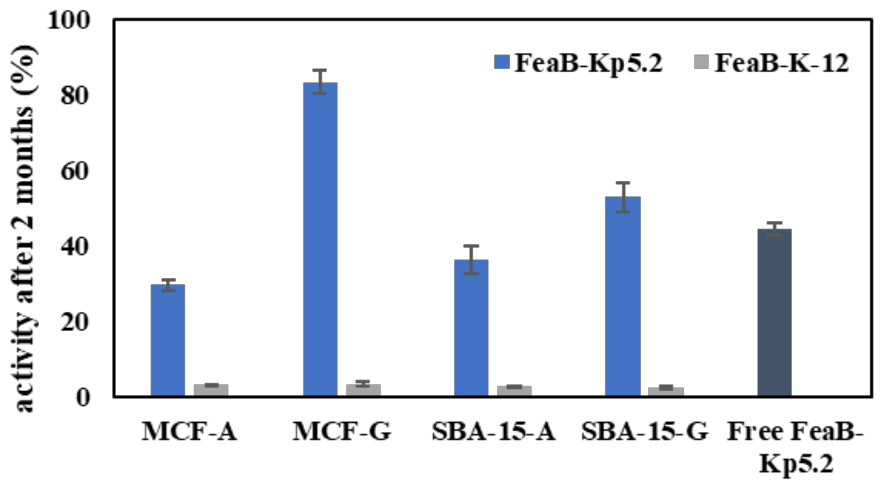
| Initial apparent activity a U mg−1 (%) * | 0.183 ± 0.026 (3.0 ± 0.4) | 0.184 ± 0.021 (3.1 ± 0.4) | 0.216 ± 0.016 (3.6 ± 0.3) | 0.293 ± 0.011 (4.9 ± 0.2) |
| Apparent activity U g−1support | 0.86 ± 0.12 | 0.89 ± 0.1 | 1.04 ± 0.08 | 1.4 ± 0.05 |
| Long-term stability a after 61 d | ||||
| Remaining activity a % (U mg−1 **) | 2.9 ± 0.3 (0.0053 ± 0.0005) | 3.2 ± 0.6 (0.0058 ± 0.0011) | 2.5 ± 0.3 (0.0053 ± 0.0006) | 2.2 ± 0.3 (0.0065 ± 0.0009) |
| MCF-A- FeaB-Kp5.2 | MCF-G- FeaB-Kp5.2 | SBA-15-A- FeaB-Kp5.2 | SBA-15-G- FeaB-Kp5.2 | |
|---|---|---|---|---|
| Amount of immobilized enzyme a mg (%) | 7.37 ± 0.04 (97.8 ± 0.5) | 7.45 ± 0.02 (98.9 ± 0.2) | 7.33 ± 0.01 (97.3 ± 0.2) | 7.47 ± 0.01 (99.1 ± 0.1) |
| Amount of enzyme bound to carrier support (mgprotein g−1support) | 18.43 ± 0.1 | 18.63 ± 0.05 | 18.34 ± 0.03 | 18.68 ± 0.03 |
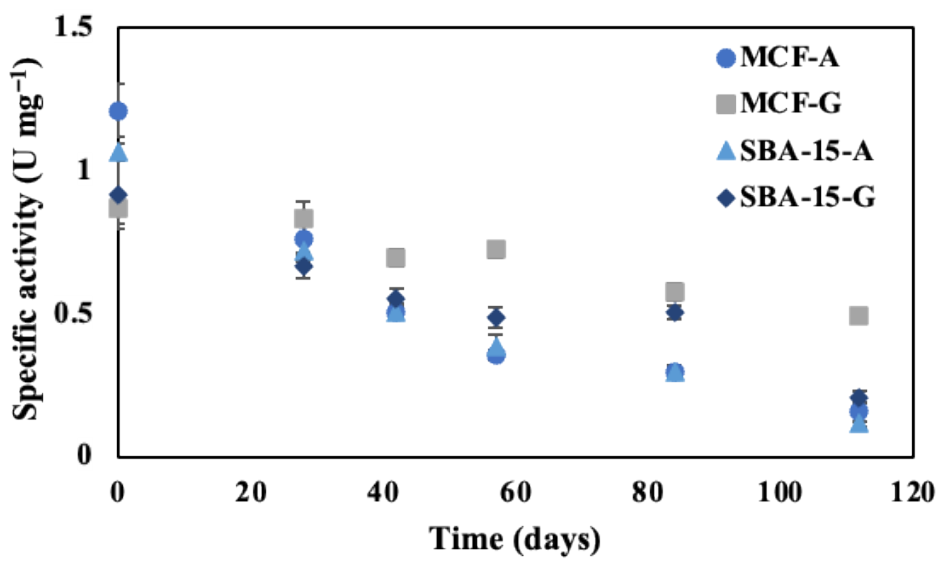
| Initial activity a U mg−1 (% *) | 1.21 ± 0.09 (11.8 ± 0.9) | 0.87 ± 0.05 (8.5 ± 0.5) | 1.07 ± 0.03 (10.4 ± 0.3) | 0.92 ± 0.11 (9.0 ± 1.2) |
| Apparent activity U g−1support | 22.3 ± 1.7 | 16.2 ± 0.9 | 19.6 ± 0.6 | 17.19 ± 2.05 |
| Substrate spectra: apparent specific and relative activity a during transformation | ||||
| PA U mg−1 | 0.76 ± 0.06 | 0.83 ± 0.06 | 0.72 ± 0.04 | 0.67 ± 0.05 |
| PA U g−1support | 14.01 ± 1.1 | 15.46 ± 1.1 | 13.2 ± 0.7 | 12.52 ± 0.9 |
| 4-Chloro-PA % | 127 ± 2 | 130 ± 6 | 147 ± 22 | 144 ± 6 |
| 4-Fluoro-PA % | 126 ± 5 | 134 ± 8 | 132 ± 6 | 137 ± 5 |
| α-Methyl-PA % | 10.9 ± 1.6 | 15.0 ± 0.2 | 10.6 ± 1.8 | 12.8 ± 1.4 |
| Temperature stability: Remaining activity a (left column) at certain temperatures [%] | ||||
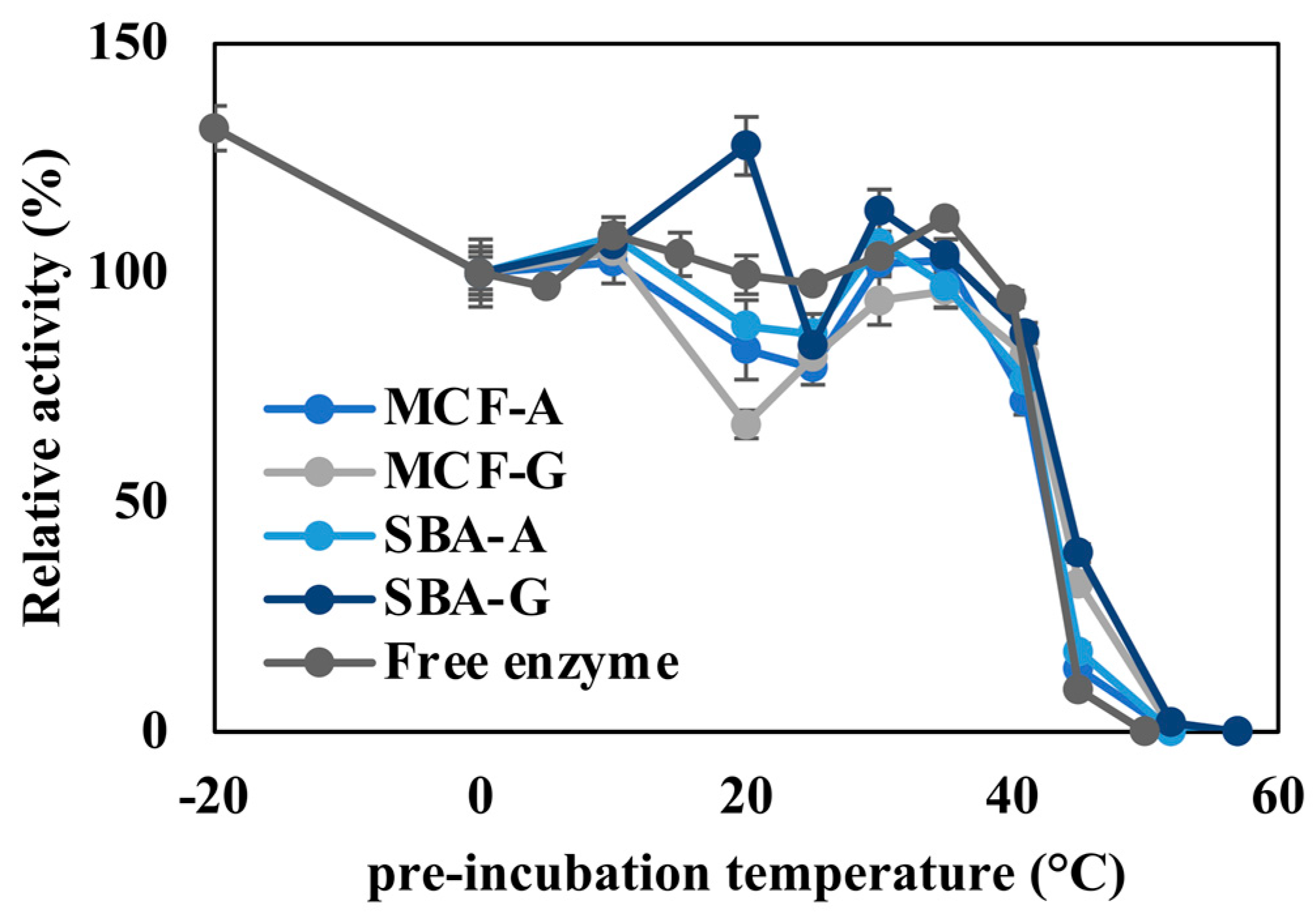
| 100 to 67% | −20 to +41 °C | −20 to +41 °C | −20 to +41 °C | −20 to +41 °C |
| 66 to 34% | ---- | ---- | ---- | 45 °C |
| 33 to 5% | 45 °C | 45 °C | 45 °C | ---- |
| 5 to 0% | above 52 °C | above 52 °C | above 52 °C | above 50 °C |
| Long-term stability a after 112 d | ||||
| Remaining activity a % (U mg−1 **) | 13.3 ± 1.0 (0.16 ± 0.01) | 56.8 ± 2.5 (0.49 ± 0.02) | 10.8 ± 0.8 (0.12 ± 0.01) | 22.7 ± 2.2 (0.21 ± 0.02) |
| Apparent activity U g−1support | 2.95 ± 0.18 | 9.13 ± 0.37 | 2.2 ± 0.18 | 3.92 ± 0.37 |
| Initial Activity a During Transformation [%] (for PA: Apparent Specific Activity [U mg−1]) | |||
|---|---|---|---|
| Substrates | Free FeaB-Kp5.2 [21] | MCF-G-FeaB-Kp5.2 | MH-G-Kw-FeaB-Kp5.2 |
| PA % | 100 ± 6 (10.7 ± 0.6) | 100 ± 7 (0.83 ± 0.06) | 100 ± 0.5 (0.0922 ± 0.0004) |
| PA (U g−1support) | - | 15.46 ± 1.1 | 2.06 ± 0.01 |
| 4-Chloro-PA % | 100 ± 11 | 130 ± 6 | 67 ± 3 |
| 4-Fluoro-PA % | 90 ± 4 | 134 ± 8 | 44 ± 2 |
| α-Methyl-PA % | 9.3 ± 0.9 | 15.0 ± 0.2 | 9.3 ± 0.3 |
| No. | FeaB-Kp5.2 Immobilizate | Initial Apparent Activity a [U mg−1] ([%t] *) | Apparent Activity [U g−1support] | Study Period [days] | Residual Apparent Activity a [U mg−1] ([%] *) | Apparent Residual Activity [U g−1support] | Total Activity Loss [U mg−1] ([%] **) | Normalized Activity Loss per Day [%] |
|---|---|---|---|---|---|---|---|---|
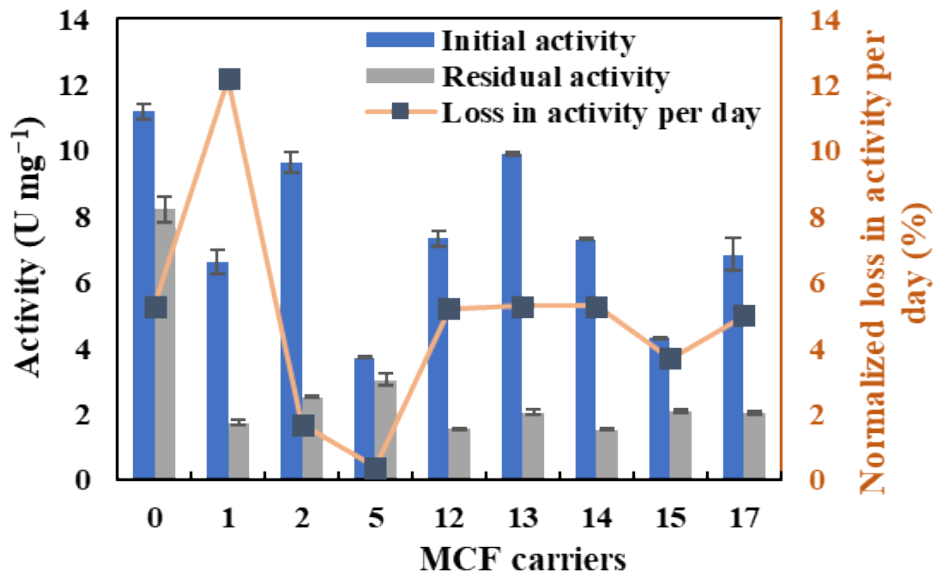
| 1 | MCF-Ni pH 7 | 6.63 ± 0.36 (85.5 ± 4.6) | 354 ± 19.2 | 6 | 1.76 ± 0.10 (22.7 ± 1.3) | 94.0 ± 5.3 | 4.86 (73) | 12.2 |
| 2 | MCF-Co pH 7 | 9.65 ± 0.33 (124.4 ± 4.3) | 515.3 ± 17.6 | 43 | 2.54 ± 0.04 (32.7 ± 0.5) | 135.6 ± 2.1 | 7.10 (74) | 1.7 |
| 3 | MCF-G pH 7 | 2.74 ± 0.12 (35.3 ± 1.5) | 146.3 ± 6.4 | 1 | n.d. | n.d. | n.d. | n.d. |
| 4 | MCF-HDTM pH 7 | 0.20 ± 0.06 (2.6 ± 0.8) | 10.7 ± 3.2 | 1 | n.d. | n.d. | n.d. | n.d. |
| 5 | MCF-G-Kw pH 8 | 3.73 ± 0.01 (48.1 ± 0.1) | 199.2 ± 0.5 | 42 | 3.05 ± 0.17 (39.3 ± 2.2) | 162.9 ± 9.1 | 0.68 (18) | 0.4 |
| 6 | MCF-G-Kw pH 7 | 3.61 ± 0.16 (46.5 ± 2.1) | 192.8 ± 8.5 | 1 | n.d. | n.d. | n.d. | n.d. |
| 7 | MCF-G-Kw pH 6 | 2.76 ± 0.13 (35.6 ± 1.7) | 147.4 ± 6.9 | 1 | n.d. | n.d. | n.d. | n.d. |
| 8 | MCF-G-Kw pH 5 | 1.80 ± 0.01 (23.2 ± 0.1) | 96.1 ± 0.5 | 1 | n.d. | n.d. | n.d. | n.d. |
| 0 | Free FeaB-Kp5.2 | 11.20 ± 0.24 | - | 5 | 8.23 ± 0.38 | 2.97 (27) | 5.3 | |
| 9 | MCF-Co pH 8 25 | 6.54 ± 0.38 (84.3 ± 4.9) | 6.5 ± 0.4 | 1 | n.d. | n.d. | n.d. | n.d. |
| 10 | MCF-Co pH 8 50 | 5.33 ± 0.11 (68.7 ± 1.4) | 284.6 ± 5.9 | 1 | n.d. | n.d. | n.d. | n.d. |
| 11 | MCF-Co pH 8 100 | 5.43 ± 0.05 (70.0 ± 0.6) | 290.0 ± 2.7 | 1 | n.d. | n.d. | n.d. | n.d. |
| 12 | MCF-Co pH 8 reference | 7.34 ± 0.24 (89.8 ± 2.9) | 290.0 ± 9.5 | 15 | 1.56 ± 0.01 (19.1 ± 0.1) | 61.6 ± 0.4 | 5.78 (79) | 5.2 |
| 13 | MCF-Co pH 8 0.1 | 9.91 ± 0.03 (121.3 ± 0.4) | 391.4 ± 1.2 | 15 | 2.07 ± 0.09 (25.3 ± 1.1) | 81.8 ± 43.5 | 7.84 (79) | 5.3 |
| 14 | MCF-Co pH 8 20/100 | 7.32 ± 0.02 (89.6 ± 0.2) | 289.1 ± 0.8 | 15 | 1.55 ± 0.01 (19.0 ± 0.1) | 61.2 ± 0.4 | 5.77 (79) | 5.3 |
| 15 | MCF-G pH 8 reference | 4.34 ± 0.01 (53.1 ± 0.1) | 171.4 ± 0.4 | 14 | 2.09 ± 0.06 (25.6 ± 0.7) | 82.6 ± 2.4 | 2.25 (52) | 3.7 |
| 16 | MCF-G pH 8 0.1 | 3.12 ± 0.18 (38.2 ± 2.6) | 86.6 ± 5.0 | 1 | n.d. | n.d. | n.d. | n.d. |
| 17 | MCF-G pH 8 20/100 | 6.86 ± 0.48 (83.9 ± 5.9) | 271.0 ± 19.0 | 14 | 2.06 ± 0.06 (25.2 ± 0.7) | 81.4 ± 2.4 | 4.80 (70) | 5.0 |
Disclaimer/Publisher’s Note: The statements, opinions and data contained in all publications are solely those of the individual author(s) and contributor(s) and not of MDPI and/or the editor(s). MDPI and/or the editor(s) disclaim responsibility for any injury to people or property resulting from any ideas, methods, instructions or products referred to in the content. |
© 2026 by the authors. Licensee MDPI, Basel, Switzerland. This article is an open access article distributed under the terms and conditions of the Creative Commons Attribution (CC BY) license.
Share and Cite
Kumaran, S.; Zimmerling, J.; Voitel, M.; Oelschlägel, M.; Szymańska, K.; Schlömann, M.; Tischler, D. Immobilized Dehydrogenases for the Biosynthesis of Phenylacetic Acids. Appl. Sci. 2026, 16, 4008. https://doi.org/10.3390/app16084008
Kumaran S, Zimmerling J, Voitel M, Oelschlägel M, Szymańska K, Schlömann M, Tischler D. Immobilized Dehydrogenases for the Biosynthesis of Phenylacetic Acids. Applied Sciences. 2026; 16(8):4008. https://doi.org/10.3390/app16084008
Chicago/Turabian StyleKumaran, Selvapravin, Juliane Zimmerling, Matthias Voitel, Michel Oelschlägel, Katarzyna Szymańska, Michael Schlömann, and Dirk Tischler. 2026. "Immobilized Dehydrogenases for the Biosynthesis of Phenylacetic Acids" Applied Sciences 16, no. 8: 4008. https://doi.org/10.3390/app16084008
APA StyleKumaran, S., Zimmerling, J., Voitel, M., Oelschlägel, M., Szymańska, K., Schlömann, M., & Tischler, D. (2026). Immobilized Dehydrogenases for the Biosynthesis of Phenylacetic Acids. Applied Sciences, 16(8), 4008. https://doi.org/10.3390/app16084008