Article

Immobilized Dehydrogenases for the Biosynthesis of Phenylacetic Acids

by
Selvapravin Kumaran
1,†,
Juliane Zimmerling
2,†,
Matthias Voitel
2,
Michel Oelschlägel
2,
Katarzyna Szymańska
3,
Michael Schlömann
2 and
Dirk Tischler
1,2,*
1
Microbial Biotechnology, Faculty of Biology and Biotechnology, Ruhr-Universität Bochum, Universitätsstr. 150, 44780 Bochum, Germany
2
Interdisciplinary Ecological Center, Environmental Microbiology Group, TU Bergakademie Freiberg, Leipziger Str. 29, 09599 Freiberg, Germany
3
Department of Chemical Engineering and Process Design, Silesian University of Technology, M. Strzody 7, 44-100 Gliwice, Poland
*
Author to whom correspondence should be addressed.
These authors contributed equally to this work.
Appl. Sci. 2026, 16(8), 4008; https://doi.org/10.3390/app16084008
Submission received: 13 March 2026 / Revised: 10 April 2026 / Accepted: 15 April 2026 / Published: 20 April 2026

Abstract

Two phenylacetaldehyde dehydrogenases, originating from Escherichia coli K-12 (FeaB-K-12) and Sphingopyxis fribergensis Kp5.2 (FeaB-Kp5.2), were immobilized on powdery silica carrier with various functionalization. First, the suitability of these carriers for application in combination with phenylacetaldehydes and phenylacetic acids was studied. Out of two carriers functionalized differently, mesoporous cellular foam, whose surface was modified with 3-glycidyloxypropyl groups (MCF-G), showed promising results. Hence, this carrier was further tested at 17 different immobilization conditions. Despite both enzymes showing high immobilization efficiency, the initial activities were relatively low compared to the free enzymes. Interestingly, the immobilized FeaB-Kp5.2 on MCF-G-Kw showed about 80% of retained activity after two months of incubation at 0 °C, indicating that the immobilization enhances the stability of this enzyme. In contrast, no changes in the temperature stability of FeaB-Kp5.2 due to immobilization could be noted. However, relative enzyme activities towards all three substituted phenylacetaldehydes could be increased by the immobilization to approximately 130%. The most active and stable powdery immobilizate was MCF-G-Kw-FeaB-Kp5.2 at pH 8. In addition, FeaB-Kp5.2 was also immobilized and tested on monolith silica carrier for continuous catalysis to produce phenylacetic acids.

1. Introduction

Aldehyde dehydrogenases (ALDHs, EC 1.2.1) are a superfamily of enzymes that catalyze the conversion of aldehydes into their corresponding carboxylic acids using NAD(P)+ as cofactor. One such member is phenylacetaldehyde dehydrogenase (PAD/FeaB) from the upper styrene degradation pathway that oxidizes phenylacetaldehyde into phenylacetic acid (PAA). PAA serves as a precursor and an additive in the pharmaceutical and fragrance industries. Despite its industrial significance, the enzyme PAD is prone to substrate or product inhibition and is thermolabile. This instability is attributed to oxidative damage occurring between the catalytic cysteine residue and the substrate phenylacetaldehyde, which ultimately limits the use of the free enzyme in biocatalysis [1,2,3].
In addition, the application of enzymes remains limited by several factors, such as short shelf life and sensitivity to sub-optimal conditions, including elevated temperature, pressure, and the presence of solvents. Moreover, challenges involved in downstream processing, particularly the separation of enzymes from products, make the enzyme application less cost-effective and more laborious. The immobilization of enzymes onto a support material offers improved structural stability and recyclability [4,5].
Silica carriers are particularly attractive for immobilization because they are inert, non-toxic, and thermally and mechanically stable. Furthermore, their pores of different sizes provide an enormous surface area for immobilization. Silica carrier material can be synthesized either in powder or as monoliths (MH). The surface of silica carriers can be functionalized with various organic molecules, including metal ions coordinating into 1,4,8,11-tetraazacyclotetradecane (cyclam), as well as amino and epoxy groups [6,7]. Enzyme binding depends on these functional groups; for example, enzymes can be covalently bound to epoxy groups on the carrier surface (Figure S1A). In the case of surface modification by aminopropyl groups, glutaraldehyde is commonly used as a crosslinker (Figure S1B). Moreover, a highly specific immobilization strategy is the use of cyclam-embedded metal ions like Ni2+ and Co2+ (Figure S1C), which enables the specific binding of His-tagged enzymes [8]. These silica carriers have already been characterized and reported to contain high surface areas of up to 1000 m2 g−1 and high pore volumes. These features make them viable for immobilizing bulkier enzymes and reducing mass transfer resistance [6,7,8,9,10].
Santa Barbara Amorphous-15 (SBA-15) is a hexagonally structured silica material with extra-large pores of up to 30 nm, and a silica wall thickness of up to 6.4 nm. The pore volumes are of 2.5 cm3 g−1, with a surface area ranging from 690 to 1040 m2 g−1. SBA-type silica was initially synthesized using triblock copolymers like Pluronic P123, a commercially available surfactant, in acidic media [7,9]. In contrast, mesoporous cellular foam (MCF) carriers consist of silicon dioxide foam with pore sizes of 20–40 nm that are homogenously interconnected [10]. The powdery MCF carrier contains only mesopores, while the MCF monolith (MH) consists of a highly branched, spongy structure with mesopores (~20 nm) and significantly larger macropores (30–50 µm) [11]. For MH silica carriers, a total pore volume of 4 cm3 g−1 and a specific surface area of 300 m2 g−1 have been reported [6].
Mesoporous silicates have recently been used as carrier materials for various enzymes and are reported to enhance protein properties, including catalytic activity, stability, and productivity [6,12,13,14,15,16,17,18]. In addition to numerous successfully immobilized enzymes [8], styrene oxide isomerase from Rhodococcus opacus 1CP (SOI-1CP) was effectively immobilized [16] using this approach. Notably, an outstanding result in the immobilization of alcohol and formate dehydrogenases was achieved [18]. Both immobilized enzymes showed 70–80% remaining activity and achieved 8–10-fold higher total turnover numbers over 12 consecutive batch cycles [18].
Monolithic microreactors are a special form of silica carrier. Although mesoporous cellular foams (MCFs) and monolithic silica (MH) share similar physical, chemical, and surface functionalization properties, their structural differences significantly influence mass transfer, field of application, and reusability. Additionally, monolithic carriers can be removed and reinserted without any loss of material or immobilized enzyme. Recently, microreactors have been shown to be more advantageous than batch setups using powdered carriers [19,20]. Immobilized enzymes in continuous-flow monolithic microreactors have been reported to show higher activity and stability for various biocatalysts, including acyltransferase MsAcT from Mycobacterium smegmatis, hydroxynitrile lyases HbHNL from Hevea brasiliensis and MeHNL from Manihot esculenta, horseradish peroxidase isoenzyme C (HRP), proteinase K (proK) from Engyodontium album, and glucose oxidase. These studies reported astonishingly higher catalytic activities, high conversion rates up to 97%, and notable enantiomeric excess up to 98%, with minimal enzyme leaching, and enhanced operational and storage stability [6,19,20].
In the current study, two exceptionally active PADs, FeaB-Kp5.2 from Sphingopyxis fribergensis and FeaB-K-12 from Escherichia coli, were immobilized. These enzymes were reported to display apparent specific activities of approximately 18 and 6.5 U mg−1, respectively, significantly higher than the typically reported range of 0.04–0.1 U mg−1 [21]. We hypothesized that carriers such as MCF and SBA-15 would provide the active diffusion of the substrate required for such highly active enzymes. The study was aimed at optimizing immobilization conditions to produce a long-term stable immobilizate. Initially, powdered silica materials were used to evaluate the general suitability of different functionalized carriers and to determine optimal immobilization conditions (pH and buffer composition) for the dehydrogenases FeaB-K-12 and FeaB-Kp5.2. The results obtained for the most active enzyme, FeaB-Kp5.2 were used to develop a continuous-flow system using a monolithic microreactor for the production of phenylacetic acids (PAAs).

2. Materials and Methods

2.1. Chemicals and Plasmids

All chemicals used in this study were purchased from AppliChem (Darmstadt, Germany), Carl Roth (Karlsruhe, Germany), Fluka (Seelze, Germany), Merck (Darmstadt, Germany), Riedel-de-Haën (Seelze, Germany), Sigma-Aldrich (Taufkirchen, Germany), and VWR International (Darmstadt, Germany). Pluronic P123, tetraethoxysilane (TEOS), 1,3,5-trimethylbenzene, 3-aminopropyltrimethoxysilane (APTMS), 3-glycidoxypropyltrimetoxysilane (GPTMS), hexadecyltrimethoxysilane (HDTM), 3-iodopropyltrimethoxysilane, cyclam, K2CO3, NiCl2 and CoCl2 were purchased from Sigma Aldrich. Hexadecyltrimethylammonium bromide (CTAB) was from Acros Organics (Geel, Belgium), while HCl, HNO3, and toluene were obtained from Avantor (Darmstadt, Germany). Acetonitrile (MeCN) was from Fisher Scientific (Waltham, MA, USA). NH4F was purchased from POCh (Gliwice, Poland). The expression vector pET16bP which provides an N-terminal His-tag was handled as previously described [21].

2.2. Bacteria, Cultivation, Expression Conditions, and Cell Harvesting

Heterologous expression of FeaB-K-12 and FeaB-Kp5.2 was performed using the previously available constructs pET16bP + feaB-K-12 and pET16bP + feaB-Kp5.2 in Escherichia coli BL21 (DE3) pLysS [21,22]. FeaB-Kp5.2 was produced as described by Zimmerling et al. [21].
To optimize the production of FeaB-K-12, different expression conditions (at room temperature, and 22 °C for 6, 12, 18, and 24 h) were tested across four different media, namely LB (10 g L−1 tryptone, 5 g L−1 yeast extract, 10g L−1 NaCl, pH 7.1), LBNB (10 g L−1 tryptone, 29.2 g L−1 NaCl, 5 g L−1 yeast extract, 2 g L−1 glucose, 1 mmol L−1 betaine, pH 7.0), DYT (16 g L−1 tryptone, 10 g L−1 yeast extract, 5 g L−1 NaCl, pH 7.0), and TB (12 g L−1 tryptone, 24 g L−1 yeast extract, 100 mmol L−1 potassium phosphate buffer pH 7.0, 0.5% v/v glycerol, 0.5 g L−1 glucose, 2 g L−1 lactose). In the case of pre-culture, LB medium was used with 100 µg mL−1 ampicillin and 35 µg mL−1 chloramphenicol, and was incubated for 16–18 h at 37 °C. Liquid cultures were incubated under constant shaking at 120 rpm in baffled flasks or tubes. The pre-culture was centrifuged (3200× g, RT, 5 min), and the pellet was washed once with an equal volume of 25 mmol L−1 potassium phosphate buffer, pH 7.3 (PPB). Then, 1% (v/v) washed pre-cultures were added to the main cultures (20 mL medium) and induced with 0.1 mmol L−1 isopropyl-β-D-thiogalactopyranoside (IPTG) at OD600 of 0.4–0.6. The cultures were incubated at RT, 120 rpm. After the above-mentioned incubation durations, 4 mL of the main cultures were harvested at 20,230× g, RT for 5 min, washed once with 1 mL of 25 mmol L−1 PPB, and stored at −20 °C.
The large-scale production of FeaB-K-12 was carried out in 400 mL DYT medium with the above-mentioned antibiotics, and 1% (v/v) of the pre-culture in LB medium was directly used as inoculum. The expression, induction, and overproduction were performed as mentioned above. The incubation was continued for 18 h at 22 °C. The cell biomass was harvested at 5000× g, 4 °C for 20 min. Afterwards, the pellets were washed once in 25 mmol L−1 PPB and centrifuged (5000× g, 4 °C, 30 min) again. The cells were resuspended in the same buffer and stored at −20 °C until cell disruption.

2.3. FeaB Enrichment

For enzyme preparation, the stored cell biomass was thawed on ice and incubated with 40 U DNase I. Cell disruption was performed with an ultrasonic probe (Sonoplus HD 2070, Bandelin, Germany) for 10 s (10 repeats with 30 s interval) at 60 to 65% output on ice. The crude extract was clarified by centrifugation (50,000× g, 4 °C, 1 h). The resulting supernatant containing soluble proteins was subjected to Ni-affinity chromatography via fast protein liquid chromatography, as described elsewhere [21]. First, the supernatant was loaded, and unspecific proteins were removed with washing buffer (WB) (500 mmol L−1 NaCl, 20 mmol L−1 NaH2PO4, pH 7.5). For eluting the bound proteins, a linear gradient of imidazole was applied from 50 to 500 mmol L−1 using an elution buffer (500 mmol L−1 NaCl, 20 mmol L−1 NaH2PO4, 500 mmol L−1 imidazole, pH 7.5). The fractions were screened for dehydrogenase activity using the assay as described in Section 2.9, and active fractions were pooled. The protein preparations were mixed with an equal volume of 99% glycerol (v/v) for storage at −20 °C. The success of all expression studies and purification procedures was monitored via sodium dodecyl sulfate polyacrylamide gel electrophoresis (SDS-PAGE) as mentioned previously [21]. The concentration of the enzyme preparation was determined by the Bradford method employing a bovine serum albumin standard as reference [23].

2.4. Verification of the Carrier Materials for the Application

At the beginning, the essential precondition for successful transformation using carrier-bound enzymes was studied. To rule out non-enzymatic substrate depletion or product adsorption, all four carrier materials, MCF-A, MCF-G, SBA-15-A, and SBA-15-G were treated with glutaraldehyde and quenched with Tris-HCl, similar to the enzyme immobilization procedure. These were assayed without enzymes, which served as negative controls. The assay was prepared as described elsewhere [21] and performed for 24 h at 4 °C under constant shaking (750 rpm) with different PA and PAA concentrations (0.5 and 1.0 mmol L−1). Samples were taken immediately at the beginning and end of the experiment and treated similarly to those of the biotransformation experiments. Moreover, reference experiments for all reaction mixtures containing PA without carrier material were also performed, allowing a comparison between the experimental conditions due to the polymerization nature of PA [24].

2.5. Enzyme Immobilization on Powdery Carrier Material SBA-15 and MCF

Both SBA-15 and MCF were synthesized according to well-established protocols, which were reported to yield reproducible surface areas and pore volumes on mesoporous structures [9]. Two different silica carriers called SBA-15 and MCF, which can be surface-modified by different functional groups (Table S1), were studied. Initially, both FeaBs were immobilized on SBA-15 and MCF modified by aminopropyl or 3-glycidopropyl (designated as SBA-15-G and MCF-A) groups, respectively.

2.5.1. Synthesis of SBA-15

First, 4 g of Pluronic P123 was dissolved in 30 mL of water and 120 mL of 2 mol L−1 HCl solution with stirring at 35 °C. Then, 9.1 mL of TEOS was added to that solution with stirring at 35 °C for 20 h. The mixture was aged at 80 °C overnight without stirring. The solid product was recovered, washed, and air-dried at RT. Calcination was carried out by slowly increasing the temperature from RT to 500 °C in 8 h and heating at 500 °C for 6 h.

2.5.2. Synthesis of MCF

In a typical procedure, 4 g Pluronic P123 was dissolved in 75 mL 1.6 mol L−1 HCl at RT. Then, 5.8 mL 1,3,5-trimethylbenzene and 0.023 g NH4F were added under vigorous stirring. The mixture was heated to 40 °C. After 1h of stirring, 4.7 mL TEOS was added, and stirred for 1 h, then stored at 40 °C for 20 h, further at 100 °C for 24 h. After cooling to RT, the precipitate was filtered, dried at RT for 4 days, and calcinated at 500 °C for 8 h.

2.5.3. Synthesis of Silica Monoliths (MH)

The synthesis of monoliths was adapted from earlier studies [6,25]. Briefly, 8.67 g PEG was dissolved in 100 mL of 1 mol L−1 nitric acid solution. Then, 82.8 mL TEOS and 3.8 g CTAB were added. The solution thus obtained was mixed, poured into the cylindrical mold, left to gel, and aged for 10 days at 40 °C. Subsequently, the silica monoliths (rods) were treated in 1 mol L−1 ammonia solution for 9 h at 90 °C, washed with distilled water, dried at RT, and calcinated for 10 h at 550 °C.

2.5.4. Functionalization of MCF and SBA-15 with Amino or Epoxy Groups

A total of 1 g of dry MCF or SBA-15 was modified with amino groups using 0.27 mL APTMS or with epoxy groups applying 0.34 mL GPTMS dissolved in 30 mL dry toluene or 100 mL of 0.1 mol L−1 HCl (for synthesis of MCF-G-Kw) and gently stirred at 85 °C or 100 °C for 24 h, respectively. Then the supports were left to dry in the air.

2.5.5. Functionalization of MCF with Amino and C16 Groups

A total of 1 g of dry MCF was modified using 0.09 mL APTMS and 0.46 mL of HDTM dissolved in 30 mL dry toluene and gently stirred at 85 °C for 24 h. Then the supports were left to dry in the air.

2.5.6. Functionalization of MCF with Ni or Co

The procedure for the functionalization was adapted from [6,8,26]. A total of 1 g of MCF was gently stirred and refluxed with 0.41 mL 3-iodopropyl trimethoxysilane in 50 mL of dry toluene for 10 h under an argon atmosphere in the dark. After 10 h, toluene was removed, and MCF materials were washed in acetonitrile. Further, 0.2 g of cyclam and 0.37 g excess potassium carbonate were added, and the mixture was refluxed in 30 mL acetonitrile for 21 h. After separating, the MCF was refluxed with an excess of 0.35 g NiCl2 or CoCl2 in 80 mL H2O for 3 h. Finally, the silica carriers were filtered off and washed with H2O to remove any unattached nickel/cobalt.

2.5.7. Functionalization of MH with Epoxy Groups in Acidic Conditions

A total of 1 g of MH was modified with epoxy groups by applying 0.34 mL GPTMS dissolved in 100 mL 0.1 mol L−1 HCl and gently stirred at 100 °C for 48 h. Then the supports were left to dry in the air.
The synthesized and functionalized carrier materials were washed before immobilization. For all washing steps, the material was incubated under constant shaking at RT and centrifuged (3100× g, 25 min, RT). Thereafter, the clear supernatants were discarded. At the beginning, 400 mg of each carrier material was washed with 15 mL ethanol (15 min), followed twice by 13 mL dH2O (15 min).
For both carrier types owning the aminopropyl functionalization, 13 mL 0.1 mol L−1 PPB (pH 7.0) with 2.5% (v/v) glutaraldehyde (45 min) was used to activate the functional groups. Afterwards, three washing steps were performed with 13 mL dH2O (15 min). The last washing step for all carriers was performed twice with 13 mL 0.1 mol L−1 PPB (pH 7.0) (15 min). The prepared carrier materials were stored at 4 °C until immobilization.

2.5.8. Immobilization of FeaB

The initial activities of the free enzymes were 6.0 ± 0.1 (FeaB-K-12) and 10.2 ± 0.3 U mg−1 (FeaB-Kp5.2). The enzyme immobilization started with the addition of 1.9 mg (10.5 mL) FeaB-K-12 and 7.5 mg (10 mL) FeaB-Kp5.2, respectively, and incubated overnight in a rotator at 20 rpm and 4 °C, and centrifuged. The carrier containing enzymes were washed consecutively with 100 mmol L−1 PPB (pH 7.0), 500 mmol L−1 NaCl in 100 mmol L−1 PPB (pH 7.0), 500 mmol L−1 NaCl in 100 mmol L−1 PPB (pH 7.0), 100 mmol L−1 sodium acetate (pH 4.5), dH2O, dH2O (incubation overnight), 500 mmol L−1 TRIS-HCl (pH 8.0), 50 mmol L−1 NaCl in 25 mmol L−1 PPB (pH 7.0), and 50 mmol L−1 NaCl in 25 mmol L−1 PPB (pH 7.0). All washing steps were followed by centrifugation at 4500× g, 25 min, 4 °C. At each step, the volume of the supernatant was determined, and 2 mL was stored at −20 °C to determine the immobilization efficiency as described in Section 2.8, and the rest of the supernatant was discarded. These prepared immobilized enzymes were stored at 4 °C until use.

2.6. Optimization of the FeaB-Kp5.2 Immobilization on MCF

Based on the free enzyme activity result, various MCF modifications were tested for the immobilization of FeaB-Kp5. A systematic screening of immobilization parameters was performed (Table S2) to identify the optimal pH and buffer composition. A total of 50 and 80 mg (carrier 1–11 and 12–17, respectively, refer to Table S2) of each powdery carrier material were weighed in a 50 mL tube. In general, the carriers were washed with 15 mL ethanol, and twice with 35 mL dH2O, followed by washing with 30 mL default SB buffer twice (SB buffer; 50 mmol L−1 PPB, 50 mmol L−1 NaCl, pH 7.3). All washing steps were performed under constant shaking for 20–25 min at RT, followed by centrifugation at 10,000× g, 20 min at RT. The supernatant was collected and stored as mentioned above for quantification. Any changes made to the buffer or carrier preparations were indicated as a subtext in Table S2.
A total of 15 mL of enzyme solution in 200 mmol L−1 PPB (refer to Table S2 for its respective pH) containing a total of 2.67 mg, 3.61 mg, and 2.01 mg of FeaB-Kp5.2 were added to the differently prepared MCF carriers (carrier 1–11, 12–15, 17, and 16, respectively). The carrier material containing the enzyme was shaken for 2.5 h, and stored overnight at 4 °C. Later, carriers 1, 2, 4, and 9–14 were washed thrice with 30 mL of 100 mmol L−1 PPB pH 7.5. While carriers 3, 5–8, 15–17 were washed consecutively with 30 mL 500 mmol L−1 NaCl in 100 mmol L−1 PPB pH 7.5, twice with 30 mL of dH2O, followed by 12.5 mL of 500 mmol L−1 TRIS-HCl pH 8 to block free binding sites, and stored overnight at 4 °C, and finally twice with 30 mL of dH2O. Later, all carriers containing enzymes were resuspended in 5 mL of SB buffer, except carrier 13 in 100 mmol L−1 PPB, pH 8.0, and carrier 14 in 100 mmol L−1 NaCl in 20 mmol L−1 PPB, pH 8.0.

2.7. Enzyme Immobilization on Monolithic Carrier MH-G-Kw

Based on the results from carrier optimization, the immobilization of FeaB-Kp5.2 was tested on a similar yet structurally different monolithic carrier to the MCF-G carrier. It is a silica carrier in monolithic form, surface-modified with 3-glycidyloxypropyl groups, and 0.1 mol L−1 HCl was used as the solvent to prepare the carrier, and functionalized under the same conditions compared to MCF-G-Kw.
The monolithic carrier (MH-G-Kw) (Figure S3A) with external dimensions of 4 cm in length, 6 mm in diameter, and 0.35 g silica with pore sizes of 20–50 µm (macro pores) and 20 nm (mesopores), and surface-modified with 3-glycidyloxypropyl groups, was used. The carrier material itself is coated by a polymer consisting of epoxy resin (type L285MGS-H285MGS). The monolithic microreactors that can be directly mounted onto a flow cell (Figure S3) were provided by Katarzyna Szymańska from the Silesian University of Technology, Gliwice (Poland).
The monolith MH-G-Kw was fixed in the flow-through cell, connected to a syringe pump LEGATO® 200 (KD Scientific, Holliston, MA, USA), and washed with 50 mL ethanol, 50 mL dH2O, and 110 mL 0.1 mol L−1 PPB pH 8 at a flow rate of 0.5–2.0 mL min−1.
Before immobilization, FeaB-Kp5.2 was expressed and purified as described earlier. The purified enzyme with a total volume of 48 mL containing 7.8 mg FeaB-Kp5.2 was mixed with 48 mL of 0.2 mol L−1 PPB (pH 8.0), and pumped twice through the monolith at a flow rate of 0.2–0.3 mL min−1 at 4 °C. Afterwards, the carrier was washed at 0.5 mL min−1 with 30 mL of 0.1 mol L−1 PPB (pH 8.0), 25 mL of 0.1 mol L−1 PPB, 0.5 mol L−1 NaCl (pH 8.0), 25 mL of dH2O, 25 mL of 0.5 mol L−1 TRIS-HCl (pH 8.0), 25 mL of dH2O, and 50 mL of 50 mmol L−1 PPB, 50 mmol L−1 NaCl (pH 7.3). The resulting monolith, labeled MH-G-Kw-FeaB-Kp5.2, was subsequently used in various experimental settings for continuous PAA synthesis.

2.8. Monitoring of the Immobilization Success

During the immobilization process, all supernatants were sampled and tested for washed-out proteins by the Bradford method [23]. In order to rule out the protein leaching, the concentrations were determined for the washing steps as well. The specific activity of the immobilized enzyme was calculated based on the amount of protein successfully bound to the carrier. The values are expressed as apparent specific activity, U mg−1bound protein. The immobilization efficiency was calculated by protein bound to the unit of carrier material and expressed as milligrams of protein per gram of support, mgprotein·g−1support. Additionally, the activity was normalized to the mass of the carrier support and expressed as apparent catalyst activity (U g−1support) for meaningful comparison of heterogeneous biocatalysts.

2.9. Enzyme Cascade Towards PAAs

The catalytic performances of free and immobilized FeaBs were measured using a two-step enzyme cascade containing SOI (styrene oxide isomerase), by monitoring the increase in NAD(P)H absorbance at 340 nm spectrophotometrically (SpectraMax M2e). A total of 25.2–28.2 ng immobilized and 1853 ng free FeaB-K-12, as well as 1.8–99.6 ng immobilized and 5.3 ng free FeaB-Kp5.2, were used.
The biotransformation studies using the monolithic bounded FeaB-Kp5.2 were performed initially with a total volume of 50 mL containing 17.5 mmol L−1 PPB (pH 7.3), 10 mmol L−1 NaCl, 2.5 mmol L−1 NAD+, 9 mg SOI-1CP, and 0.5, 1.0, and 5.0 mmol L−1 styrene oxide or 1.0 mmol L−1 4-chloro-, and 4-fluoro-styrene oxide [25]. The reaction mixture was incubated for 30 min to ensure a complete transformation of the (non)substituted styrene oxide to their corresponding PAs by the SOI-1CP. The first sample was taken (T0) for PA concentration determination. The samples were collected and treated as described in Zimmerling et al. [21]. The complete assay was transferred into a syringe and connected to the monolith via the syringe pump LEGATO® 200 (KD Scientific Inc., Holliston, MA, USA) to warrant a continuous flow. The setup of different flow rates led to different retention times in the monolith. Between the transformation experiments, the monolith was washed with 25 mL of 50 mmol L−1 PPB (pH 7.3) and 50 mmol L−1 NaCl at a flow rate of 0.5–1.0 mL min−1 and stored at 4 °C. The substrate α-methyl-PA (0.5 mmol L−1) was added directly to the assay. Thus, the application of SOI-1CP and the intermediate incubation of 30 min are omitted.
Product formation and the activity of the immobilized enzymes were verified by RP-HPLC. A total of 10 μL sample was injected into Dionex Ultimate 3000 (Waltham, MA, USA). The samples were separated using a stationary phase of Knauer C18 Eurospher sorbents (Berlin, Germany), pore size 100 Å, particle size 5 μm, column length 125 mm, and inner diameter 4 mm, and a mobile phase consisting of 50% methanol, 50% water with 2 g L−1 H3PO4 at a flow rate of 0.7 mL min−1. The separated compounds were detected using a diode array detector at 200–300 nm. The resulting retention volume and spectra corresponding to the substrate or product were analyzed against proper standards using Chromeleon 7. All activity assays and experiments were performed in triplicate (n = 3) with independent enzyme-carrier preparations to ascertain statistical significance. Error values represent the standard deviation of these independent biological triplicates.

3. Results

3.1. Optimal Conditions for FeaB-K-12 Production

SDS-PAGE analysis of the differently expressed FeaB-K-12 showed that the protein was produced in LB medium under all incubation conditions. The LBNB and TB media showed a similar pattern, with no visible protein bands after 6 and 12 h of incubation, whereas at 18 and 24 h, multiple bands were observed, including FeaB. However, the DYT medium produced a relatively intense band (corresponding to FeaB-K-12 plus the His-tag: 55.9 kDa) at 18 h of incubation compared to the other media (Figure S2), with minimal background protein. Hence, DYT medium with 18 h of expression at RT was determined to be the optimal condition for FeaB-K-12 production and enrichment.

3.2. Interaction of Carrier Materials with Substrate or Product

An interaction study between the carrier materials and the substrate or product, performed with 0.5 mmol L−1, showed almost complete recovery of PA and PAA after 24 h of incubation at 4 °C. A similar result was observed for PAA tested with 1.0 mmol L−1. In contrast, incubation with 1.0 mmol L−1 PA resulted in recovery rates of only 73–77% (Table 1). This can likely be attributed to the adsorption of the aldehyde onto the carrier materials; however, polymerization can be excluded, as the blank tested under the same conditions showed no loss in recovery (Table 1). Despite the degree of aldehyde adsorption recorded, the validity of the activity data is supported by two important factors. First, the biotransformation results were normalized against the non-enzymatic adsorption baseline, ensuring that the observed activity is purely enzymatic. Second, the KM values of the free PADs were reported to be approximately 0.02 mmol L−1. Our working concentration is ~0.7 mmol L−1, which is at least 35-fold higher than the KM. The immobilization can lead to a change in the apparent KM due to internal diffusion limitations, which usually falls within one order of magnitude; therefore, the enzyme remains saturated with the substrate PA. Hence, the measured rates reflect the maximum velocity of the immobilizates. Considering these factors, and since no significant differences were observed among the four carrier types studied, all carriers were considered suitable for the biotransformation of PA to PAA using PADs (Table 1).

3.3. FeaB-K-12 and FeaB-Kp5.2 Immobilized on Various Powder Carrier Materials

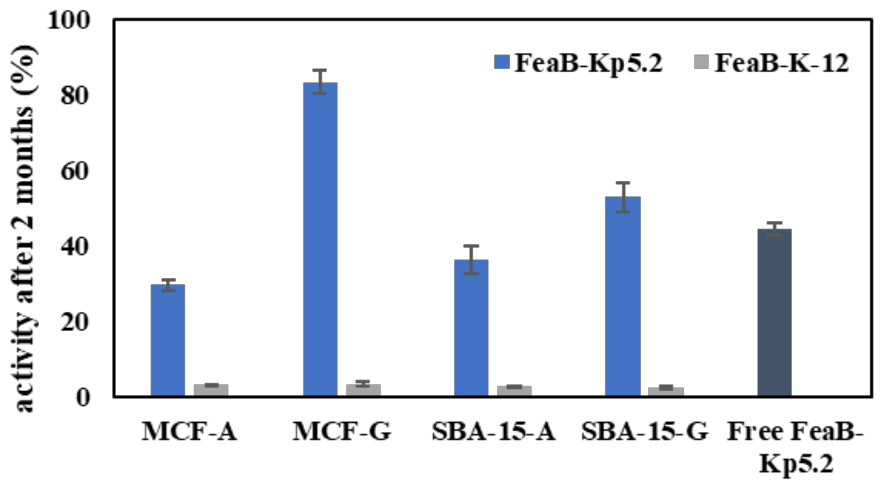
The immobilization of FeaB variants onto MCF and SBA-15 carriers functionalized with aminopropyl or 3-glycidylpropyl groups showed high efficiencies ranging from 96.5 ± 0.8 to 99.2 ± 0.2% (Table 2 and Table 3). By measuring the initial protein load and the protein recovered in the supernatant and wash steps, it was possible to determine the absolute protein loading onto the carrier. Hence, all subsequent specific activity values are reported based on the actual mass of immobilized enzyme to ascertain a direct comparison with the free enzyme. Thus, all activity values presented in this study are reported as apparent specific activities. The FeaB-K-12 variant showed a recovered activity of only 3.0 ± 0.4 to 4.9 ± 0.2% relative to the initial activity before immobilization (6.02 ± 0.14 U mg−1) (Table 2). After two months, the activity further decreased to 0.0053 ± 0.0005 to 0.0065 ± 0.0009 U mg−1 (Figure 1), representing approximately 0.1% of the initial activity. In addition, the free enzyme (FeaB-K-12) stored at 0 °C also retained only 54 ± 9% of its initial activity after 3 months. All tested carriers showed a similar activity profile for FeaB-K-12 (Figure 1, Table 2). This drastic loss in activity indicates that the covalent attachment of FeaB-K-12 onto silica carriers might enforce severe structural constraints on the enzyme, probably preventing the conformational flexibility or distorting the active site. Given the very marginal activities of these immobilizates, they were considered unsuitable for further study.
In contrast, FeaB-Kp5.2 immobilized on silica carriers (MCF and SBA-15) exhibited an immobilization efficiency comparable to that of FeaB-K-12. Almost no enzyme was detected during the washing steps, resulting in an immobilization rate of 97.3 ± 0.2% to 99.1 ± 0.1%. In total, approximately 7.5 mg of FeaB-Kp5.2 was immobilized on 400 mg of carrier material (Table 3).
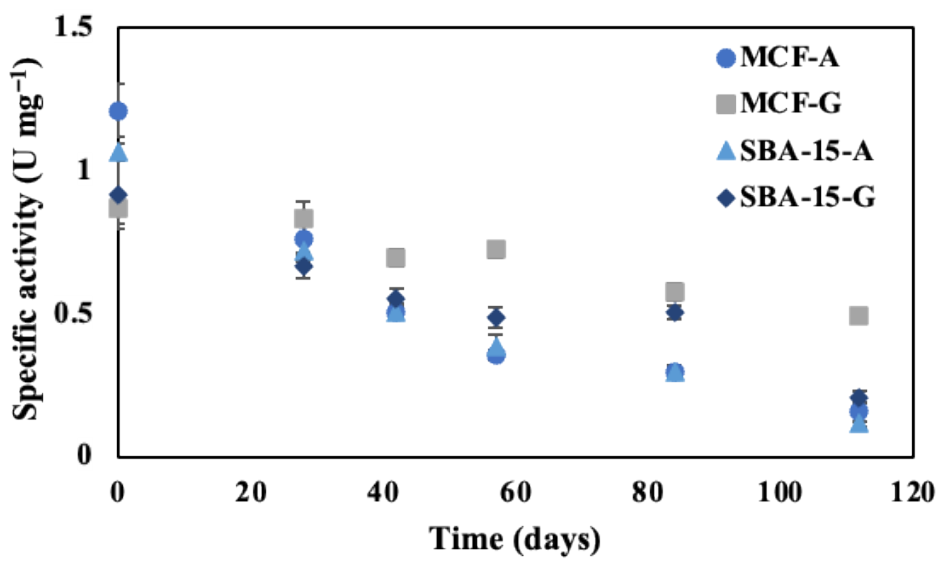
The specific enzyme activity measured immediately after immobilization ranged from 0.87 ± 0.05 to 1.21 ± 0.09 U mg−1, which corresponds to approximately one-tenth of the activity of FeaB-Kp5.2 before immobilization (10.2 ± 0.3 U mg−1) (Table 3). Nevertheless, the residual activities of all FeaB-Kp5.2 immobilizates were approximately 3.1 to 6.6 times higher than those of the immobilized FeaB-K-12 enzyme (Figure 1). Although the initial activity of MCF-G-FeaB-Kp5.2 was the lowest among the tested immobilizates, the activity decreased by only approximately 17% over two months (Figure 2). The robust performance of Kp5.2 may be attributed to its quaternary structure stability, as a stable tetramer, covalent binding onto the silica carriers likely prevents the subunit dissociation and the oxidation of active site cysteine. This demonstrates an outstanding level of long-term stability for the immobilized enzyme. Therefore, MCF-G-FeaB-Kp5.2 was identified as the best candidate for further optimization.
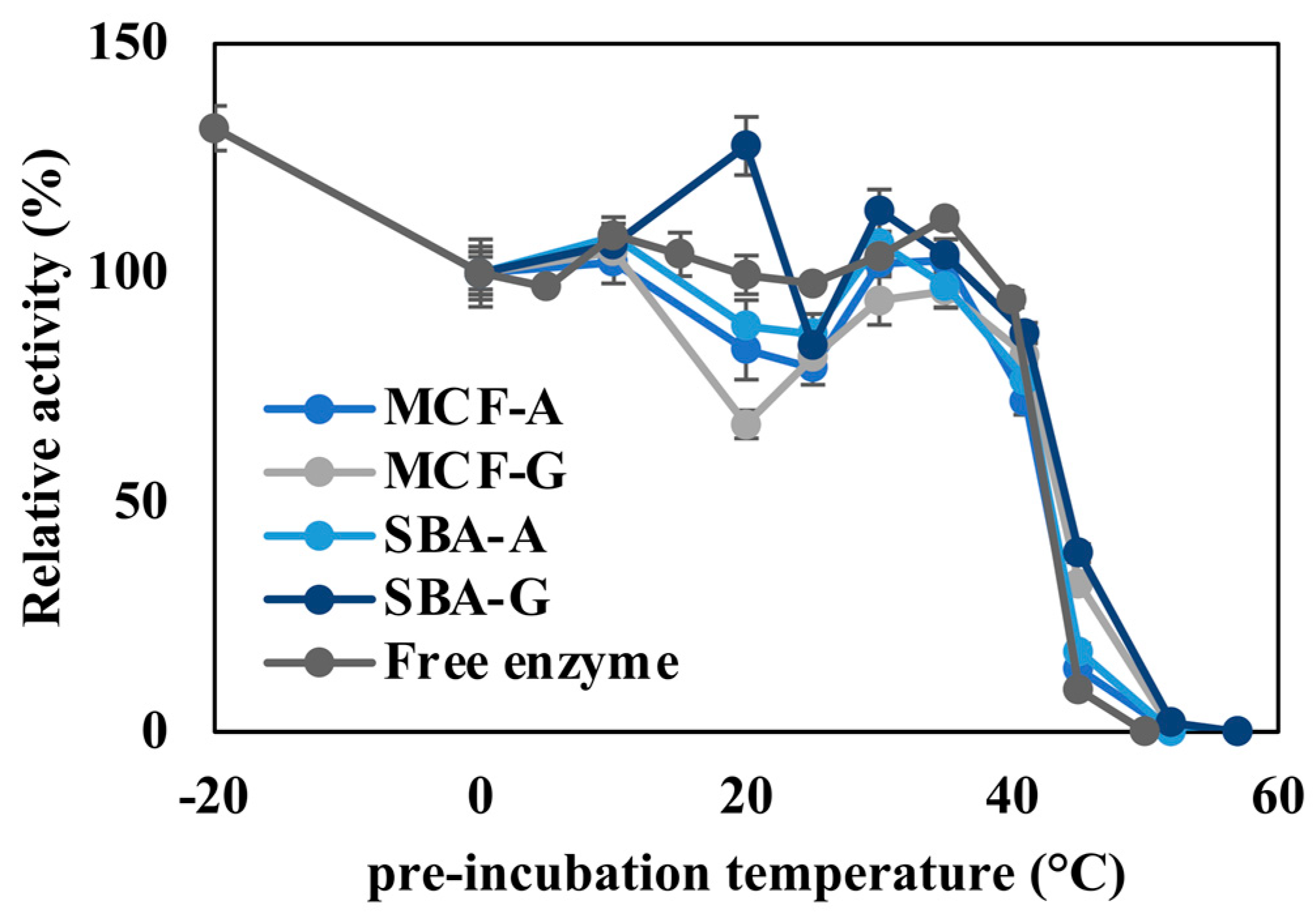
The temperature stability assay revealed that all four immobilizates were highly stable between −20 to 41 °C (Figure 3). At 45 °C, significant activity losses were detected. Above 50–52 °C, the immobilized enzymes showed no further activity (Figure 3). Hence, immobilization did not significantly influence the thermal stability of the enzyme because the free FeaB-Kp5.2 also showed a similar pattern [21]. In contrast, the long-term stability of the immobilizates after 112 days showed a different outcome. Both amino-functionalized carriers bound FeaB, SBA-15-A-FeaB-Kp5.2 and MCF-A-FeaB-Kp5.2 showed only 10.8 ± 0.8% and 13.3 ± 1.0% activity, respectively, whereas the glycidyl-functionalized carriers bound SBA-15-G-FeaB-Kp5.2 displayed 22.7 ± 2.2% of initial activity. Interestingly, MCF-G-Kp5.2 showed the highest relative activity (56.8 ± 2.5%) compared to the other three immobilizates, and hence MCF-G was chosen as the most suitable carrier type (Table 3). Moreover, the activities during the biotransformation of PA and three substituted PAs were measured for these four FeaB-Kp5.2 immobilizates (Table 3). An interesting observation was the relative activities regarding the bioconversion of both halogenated substrates, which increased to a range of 126 ± 5 to 147 ± 22% upon immobilization, compared to PA, whereas the free enzyme was reported to have a relative activity in the range of 90 ± 4 to 100 ± 11% for halogenated PA (Table 4) [21]. This again indicates that the immobilization likely changed the microenvironment of the active site. In particular, the silica carriers modified using glycidyloxypropyl groups likely produced a more hydrophobic microenvironment for halogenated substrates. This might further increase the substrate concentration near the active site, overcoming the mass transfer limitation near the porous material and resulting in enhanced relative conversion rates. However, minimal enzyme activity was measured for both free and immobilized FeaB-Kp5.2 when tested with α-methyl-PA. This suggests the steric hindrance could have been produced by the methyl group at the active site. These results indicate that the relative activity of FeaB-Kp5.2 towards halogenated PAs can be increased through immobilization.

3.4. Optimization of Immobilization Conditions for MCF Carriers

A systematic and sequential screening of conditions was examined to overcome the activity losses observed during initial immobilization. The influences of different functionalizations, pH, and buffer compositions were investigated, aiming to identify the optimal conditions for long-term stability.
Initial screening focused on metal-affinity coordination. FeaB-Kp5.2 immobilized on MCF functionalized with nickel or cobalt ions coordinated via cyclam showed noticeable differences in initial activity (Table 5). MCF-Co-FeaB-Kp5.2 at pH 7.0 showed the highest initial activity of 9.65 ± 0.33 U mg−1 immediately after immobilization, whereas the free FeaB-Kp5.2 displayed an activity of 7.76 ± 0.09 U mg−1, resulting in a 24% increase upon immobilization. However, its activity decreased significantly during storage, and after 43 days, only 26% of the initial activity of the free FeaB-Kp5.2 (32.7 ± 0.5 U mg−1) was measured. MCF-Ni-FeaB-Kp5.2 at pH 7.0 exhibited a lower initial activity (6.63 ± 0.36 U mg−1), which dropped by 73% within six days.
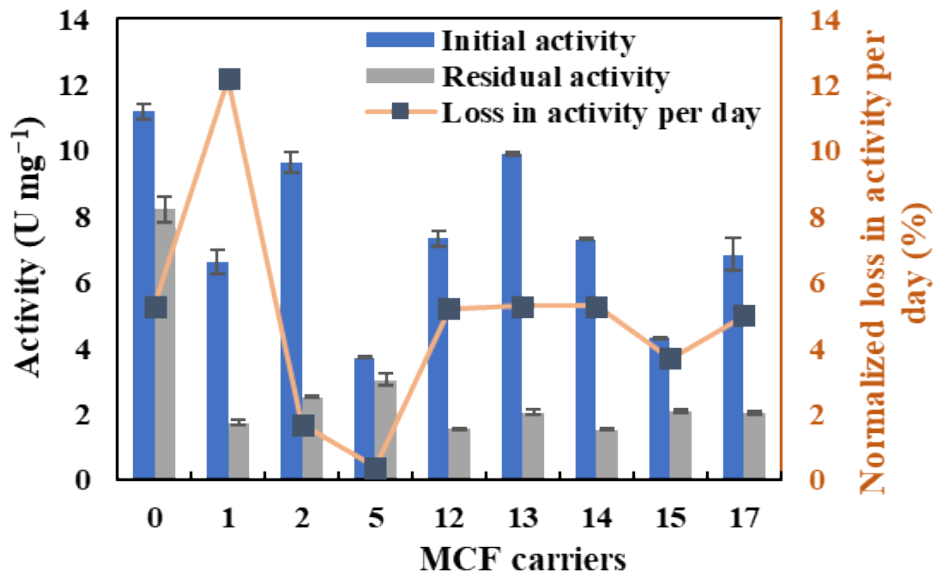
Due to the high initial activity observed for cobalt functionalized MCF carriers, MCF-Co-FeaB-Kp5.2 was further examined at different phosphate buffer concentrations, though only minor effects on activity were detected. Initial activity of 6.54 ± 0.38, 5.33 ± 0.11, and 5.43 ± 0.05 U mg−1 was observed for MCF-Co-FeaB-Kp5.2 treated with 25, 50, and 100 mmol L−1 PPB, respectively (Figure 4, Table 5).
The influence of salt concentration was also investigated. Significant changes in activity were not observed when immobilizates were stored in 50 or 100 mmol L−1 NaCl. However, MCF-Co-FeaB-Kp5.2 stored in 100 mmol L−1 PPB without NaCl showed a higher activity (9.91 ± 0.03 U mg−1) compared to storage in the default buffer (50 mmol L−1 PPB, 50 mmol L−1 NaCl, pH 8.0), which resulted in 7.34 ± 0.24 U mg−1. Nevertheless, within the following 15 days, all immobilizates lost approximately 79% of their activity (Table 5). The high normalized activity loss per day (up to 12.2%) for the metal-affinity system suggested that non-covalent coordination was insufficient for producing long-term stable immobilizate.
Consequently, the covalent immobilization was optimized for a stable immobilizate. MCF-G-FeaB-Kp5.2 was analyzed for the influence of imidazole containing buffers. The immobilizate stored in immobilization buffer at pH 8.0, which served as a reference, showed an activity of 4.34 ± 0.01 U mg−1. Slightly lower activity was observed at higher phosphate concentration (100 mmol L−1 without NaCl, glycerin, and imidazole), whereas a lower phosphate concentration (immobilizate at 21 PPB mmol L−1, 125 mmol L−1 NaCl, 125 mmol L−1 imidazole, 25% glycerin, pH 8.0) resulted in higher activity of 6.86 ± 0.48 U mg−1. However, all immobilizates lost approximately 50–70% of their activity within 14 days. In addition, FeaB-Kp5.2 immobilized on MCF-G at pH 7.0, and the novel modification MCF-HDTM, containing one-third aminopropyl and two-thirds hexadecyl groups (Table S2), showed relatively low activities of 2.74 ± 0.12 and 0.20 ± 0.06 U mg−1, respectively (Table 5). Due to these low activities, further stability studies were not conducted.
Subsequently, MCF-G functionalized using 0.1 mol L−1 HCl (MCF-G-Kw) instead of toluene as the solvent was evaluated. A clear pH-dependent trend was observed, and activity increased with an increasing pH (Table 5). The highest initial activity was observed at pH 8.0 (3.73 ± 0.01 U mg−1), which was approximately twice the activity recorded at pH 5.0. These results indicate that HCl treatment is more suitable than toluene for MCF modification.
For the long-term stability test, most of the immobilizates lost 50–80% of their initial activity after 42 days of storage. An exception was for FeaB-Kp5.2 immobilized on MCF-G-Kw at pH 8.0, which retained 81.8 ± 5.6% of its initial activity (Table 5) with a minimal normalized loss of only 0.4% per day.
In conclusion, while earlier studies on SOI and azoreductase showed immediate enhancement in activity upon immobilization [12,15], FeaB-Kp5.2 required further micro-optimization. Although MCF-CO-FeaB-Kp5.2 at pH 7.0 and 8.0 initially displayed activities approximately 20% higher than the free enzyme, these activities dropped by 74 and 79%, respectively. In contrast, MCF-G-Kw-FeaB-Kp5.2 at pH 8.0 showed an initial activity of 48.1 ± 0.1% and decreased only slightly to 39.3 ± 2.2% after 42 days compared to the free FeaB-Kp5.2. Thus, by prioritizing stability over the high initial activity of the metal coordinated immobilizate, a robust and industrially relevant immobilizate was achieved.

3.5. FeaB-Kp5.2 Immobilized on Monolith MH-G-Kw

Monolith MH-G-Kw immobilized FeaB-Kp5.2 resulted in significantly lower apparent specific activity of 0.0922 ± 0.0004 U mg−1 for the non-substituted PA, followed by 0.0616 ± 0.0030, 0.0403 ± 0.0019, and 0.0085 ± 0.0003 U mg−1 for 4-chloro-PA, 4-fluoro-PA, and α-methyl-PA, respectively. Moreover, the activity development of MH-G-Kw-FeaB-Kp5.2 towards PA, measured over seven days, showed a significant loss in activity. Only 62.8 ± 3.2% (0.0578 ± 0.0030 U mg−1) of initial activity remained after three days, and it dropped to 8.0 ± 1.7% (0.0073 ± 0.0015 U mg−1) after a week (Table S3). During immobilization, the monolith was subjected to an extensive washing procedure before biotransformation, and the measured protein concentrations at each washing step showed no loss in bound protein. This indicates that the immobilization was successful; however, the protein leaching during biocatalysis cannot be completely excluded. Therefore, the substantial decrease in apparent activity can be attributed to two factors: either the limitations of mass transfer in monolithic flow systems when employing high-velocity biocatalyst or enzyme leaching during biocatalysis, or the combination of both.

4. Discussion and Conclusions

The current study demonstrates that highly efficient immobilization can be achieved on silica-based MCF and SBA-15 carrier materials for FeaB enzymes. Although an immobilization rate of approximately 96% was observed for almost all tested materials, long-term stability and activity were highly dependent on the enzyme and the functionalization, and immobilization conditions [26,27]. On this line, the FeaB-K-12, despite showing high efficiency in immobilization similar to FeaB-Kp5.2, lost nearly complete catalytic activity after storage. And this result was consistent across all different tested carriers under various conditions. The loss in activity for FeaB-K-12 is likely due to the structural constraints induced by covalent cross-linking and changes around the active site environment during immobilization. On the other hand, significantly higher retained activity was observed for FeaB-Kp5.2 despite some reduction in initial activity after immobilization. This suggests that FeaB-Kp5.2 has better tolerance for immobilization than the closely related enzyme FeaB-K-12, under identical conditions. We hypothesize that the better performance of FeaB-Kp5.2 is linked to the robustness of its quaternary structure. The multipoint covalent attachment of a tetrameric FeaB likely prevents the subunit dissociation. Enzyme deactivation upon surface attachment has been previously reported for similar tetrameric aldehyde dehydrogenases [28,29].
The MCF carriers functionalized with 3-glycidyloxypropyl groups displayed higher long-term stability for FeaB-Kp5.2 compared to those functionalized using aminopropyl groups. In comparison to the recent studies, our results showed significant improvements in long-term stability. For instance, Pietricola et al. [30] reported that the aldehyde dehydrogenase on silica carriers was highly stable over 5 days. In contrast, our immobilizate FeaB-Kp5.2 on the MCF-G system maintained over 80% activity for 42 days, which is approximately a 10-fold increase in operational longevity. This is likely due to the architectural difference between the MCF carrier used in the current study and the MSU-type (containing narrow pores) carriers used earlier. The distinct differences in long-term stability of these carriers from aminopropyl-functionalized carriers emphasize the role of surface chemistry in the performance of immobilized enzymes. Overall, available pore size, mass transfer for enzyme and substrate mobility, and the surface chemistries are pivotal factors in successful enzyme immobilization [31,32].
The thermal stability of the immobilized FeaB-Kp5.2 has neither decreased nor increased. An identical temperature-dependent activity profile was observed for both free and immobilized FeaB-Kp5.2, which is in contrast with our previous studies on other enzymes such as SOI and azoreductase from Rhodococcus opacus 1CP where the immobilization resulted in enhanced thermal stability [12,15]. However, it is noteworthy that FeaB-Kp5.2 is the most stable phenylacetaldehyde dehydrogenase reported to date [21], which correlates with our findings that the enzyme has reached its optimum and there is only a limited possibility for further improvement.
A striking point is the increase in relative activity of immobilized FeaB-Kp5.2 towards halogenated PA derivatives compared to the free enzyme. This indicates that the immobilization of FeaB-Kp5.2 onto silica-based carriers improves the substrate scope for bioconversion. This could be due to the hydrophobic partitioning of the halogenated substrates into the mesoporous silica carriers, thereby overcoming the mass transfer limitations. The increased initial activity observed for carriers modified with metal ions, especially cobalt functionalized MCF, suggests that the coordination between the metal and the His-tagged enzyme favors the active site for more efficient catalysis. However, the swift decline in activity suggests this was not stable for long-term application, possibly due to enzyme leaching or gradual inactivation. While buffers, salt, and pH modifications only resulted in a moderate effect on activity, the usage of HCl as a solvent for MCF-G activation produced the most stable immobilizate with over 80% retained activity after longer storage.
Unfortunately, immobilization on the monolith MH-G-Kw carrier resulted in very low catalytic activity. This could be due to several reasons: Firstly, the enzyme sample used for immobilization contained glycerine, which might have disturbed the smooth flow, resulting in a 14 h immobilization process. During this time, the enzyme could not be cooled sufficiently and may have lost activity. The presence of residual glycerine might have also increased the local viscosity within the mesoporous surface. Furthermore, the high surface-to-volume ratio of the monolith may have resulted in overcrowding of the tetrameric FeaB, thereby restricting the conformational flexibility. In addition, thermal inactivation and internal mass transfer resistance cannot be excluded. The fact that only 1% activity was retained despite showing complete protein binding is the reason for this assumption, whereas few studies on silica-based microreactor, for instance Streptomyces griseus HUT 6037 enzyme, immobilized on MCF and SBA-15 microreactor, and lipases immobilized on SBA-16 retained the same activity as the free enzyme [33,34,35].
In conclusion, this study demonstrates that successful immobilization involves both strong enzyme binding and long-term stability. Although very high efficiency was achieved for immobilization, the activity varied depending on the enzyme, functionalization, and immobilization conditions. FeaB-Kp5.2 immobilized silica-based MCF functionalized with 3-glycidyloxypropyl groups using HCl as solvent turned out to be the most promising system. The successful immobilization of highly unstable FeaB-Kp5.2 to produce a stable immobilizate on MCF-G-KW represents a significant step forward. This study uncovered a specific carrier modification strategy to protect the enzyme, providing a robust starting point for the development of applied-level phenylacetic acid production systems. For biotechnological purposes, stable and highly active enzymes are essential. The reusability of biocatalysts is of prime significance for technical applications. The production of phenylacetic acids and their derivatives could be achieved from styrene oxide by co-immobilizing SOI and FeaB-Kp5.2. Future research should focus on the optimization of the most suitable storage and operational conditions. The development of coupled flow reactors using immobilized aldehyde dehydrogenases was also reported for cofactor regeneration [29]. This further supports our aim of co-immobilizing SOI and FeaB. The final step will be the combination of both immobilized enzymes for the enantioselective synthesis of highly pure phenylacetic acids, thereby increasing the total turnover number.

Supplementary Materials

The following supporting information can be downloaded at: https://www.mdpi.com/article/10.3390/app16084008/s1, Figure S1: Immobilization strategies; Figure S2: SDS-PAGE analysis of FeaB-K-12 expressed under different conditions; Figure S3: The monolith MH-G-Kw; Table S1: Labeling of the different MCF and SBA-15 carrier materials; Table S2: Overview of all 17 carrier materials and immobilization conditions used for optimization of FeaB-Kp5.2 immobilization; Table S3: Results of the transformation study using MH-G-Kw-FeaB-Kp5.2.

Author Contributions

S.K. and J.Z. contributed equally to this work. Conceptualization, D.T., M.S. and K.S.; methodology, J.Z., M.V. and M.O.; validation, S.K., J.Z. and M.V.; formal analysis, J.Z. and S.K.; investigation, J.Z.; resources, D.T., K.S. and M.S.; data curation, J.Z.; writing—original draft preparation, S.K. and J.Z.; writing—review and editing, S.K., J.Z. and D.T.; visualization, S.K. and J.Z.; supervision, D.T.; project administration, D.T.; funding acquisition, D.T. and K.S. All authors have read and agreed to the published version of the manuscript.

Funding

Juliane Zimmerling, Michel Oelschlägel and Dirk Tischler were supported by the Deutsche Bundesstiftung Umwelt (DBU) with pre-doctoral scholarships (JZ: 20013/289; MO: 20011/126; DT: 20007:939). Furthermore, Michel Oelschlägel was supported by project grants of the DBU (32149/01) as well as of the Dr. Erich-Krüger-foundation and Dirk Tischler by a grant of the European Social Fund (ESF) and the Saxonian Government (GETGEOWEB: 100101363) as well as the Federal Ministry of Education and Research (BakSolEx: 033R147). Katarzyna Szymańska was supported by the National Center for Science—Poland, project UMO-2016/23/B/ST8/00627. This Project is supported by the Federal Ministry for Economic Affairs and Climate Action (BMWE) on the basis of a decision by the German Bundestag (KK5161103KL4).

Data Availability Statement

Data are available upon request.

Acknowledgments

The authors thank Andrzej B. Jarzębski (Silesian University of Technology, Gliwice, Poland) for fruitful discussions during the manuscript drafting.

Conflicts of Interest

The authors declare no conflicts of interest.

Abbreviations

The following abbreviations are used in this manuscript:
APTMS3-aminopropyltrimethoxysilane
CTABhexadecyltrimethylammonium bromide
cyclam1,4,8,11-tetraazacyclotetradecane
feaB/FeaB(s)gene of/gene product(s)phenylacetaldehyde dehydrogenase(s)
feaB-/FeaB-K-12gene of/gene product phenylacetaldehyde dehydrogenase originating from Escherichia coli K-12
feaB-/FeaB-Kp5.2gene of/gene product phenylacetaldehyde dehydrogenase originating from Sphingopyxis fribergensis Kp5.2
GPTMS3-glicydoxypropyltrimethoxysilane
HDTMhexadecyltrimethoxysilane
IPTGisopropyl-β-D-thiogalactopyranoside
MCFmesoporous cellular foam, type of enzyme-carrier material
MCF-CoMCF, surface-modified by cobalt ions coordinated to cyclam
MCF-GMCF, surface-modified by 3-glycidyloxypropyl groups (solvent during synthesis: toluene)
MCF-G-KwMCF, surface-modified by 3-glycidyloxypropyl groups (solvent during synthesis: 0.1 M HCl)
MCF-HDTMMCF, surface-modified by 1/3 aminopropyl groups and 2/3 C16-groups
MCF-NiMCF, surface-modified by nickel ions coordinated to cyclam
MeCNacetonitrile
MH-G-Kwsilica carrier in monolithic form, surface-modified with 3-glycidyloxypropyl groups (solvent during synthesis: 0.1 M HCl)
PAphenylacetaldehyde
PAD(s)phenylacetaldehyde dehydrogenase(s)
PBphosphate buffer
SBA-15Santa Barbara Amorphous-15, highly ordered extra-large hexagonal mesoporous silica
SBA-15-ASBA-15, surface-modified by aminopropyl groups
SBA-15-GSBA-15, surface-modified by 3-glycidopropyl groups
SDS-PAGEsodium dodecyl sulfate polyacrylamide gel electrophoresis
SMO(s)styrene monooxygenase
SOI(s)styrene oxide isomerase(s)
SOI-1CPstyrene oxide isomerase of Rhodococcus opacus 1CP
styD/StyD(s)gene of/gene product(s)phenylacetaldehyde dehydrogenase(s)
styD-/StyD-1CPgene of/gene product phenylacetaldehyde dehydrogenase of Rhodococcus opacus 1CP
styD-/StyD-CWB2gene of/gene product phenylacetaldehyde dehydrogenase of Gordonia rubripertincta CWB2
TEOStetraethoxysilane

References

  1. Crabo, A.G.; Singh, B.; Nguyen, T.; Emami, S.; Gassner, G.T.; Sazinsky, M.H. Structure and biochemistry of phenylacetaldehyde dehydrogenase from the Pseudomonas putida S12 styrene catabolic pathway. Arch. Biochem. Biophys. 2017, 616, 47–58. [Google Scholar] [CrossRef]
  2. Ferrández, A.; Prieto, M.A.; García, J.L.; Díaz, E. Molecular characterization of PadA, a phenylacetaldehyde dehydrogenase from Escherichia coli. FEBS Lett. 1997, 406, 23–27. [Google Scholar] [CrossRef]
  3. Mao, Z.; Liu, L.; Zhang, Y.; Yuan, J. Efficient synthesis of phenylacetate and 2-phenylethanol by modular cascade biocatalysis. ChemBioChem 2020, 21, 2676–2683. [Google Scholar] [CrossRef]
  4. Liu, D.M.; Dong, C. Recent advances in nano-carrier immobilized enzymes and their applications. Process Biochem. 2020, 92, 94–114. [Google Scholar] [CrossRef]
  5. Datta, S.; Christena, L.R.; Rajaram, Y.R.S. Enzyme immobilization: An overview on techniques and support materials. 3 Biotech 2013, 3, 1–9. [Google Scholar] [CrossRef]
  6. Szymańska, K.; Odrozek, K.; Zniszczoł, A.; Torrelo, G.; Resch, V.; Hanefeld, U.; Jarzębski, A. MsAcT in siliceous monolithic microreactors enables quantitative ester synthesis in water. Catal. Sci. Technol. 2016, 6, 4882–4888. [Google Scholar] [CrossRef]
  7. Zhou, Z.; Hartmann, M. Progress in enzyme immobilization in ordered mesoporous materials and related applications. Chem. Soc. Rev. 2013, 42, 3894–3912. [Google Scholar] [CrossRef] [PubMed]
  8. Gaffney, D.; Cooney, J.; Magner, E. Modification of mesoporous silicates for immobilization of enzymes. Top. Catal. 2012, 55, 1101–1106. [Google Scholar] [CrossRef]
  9. Zhao, D.; Huo, Q.; Feng, J.; Chmelka, B.F.; Stucky, G.D. Nonionic triblock and star diblock copolymer and oligomeric surfactant syntheses of highly ordered, hydrothermally stable, mesoporous silica structures. J. Am. Chem. Soc. 1998, 120, 6024–6036. [Google Scholar] [CrossRef]
  10. Schmidt-Winkel, P.; Lukens, W.W.; Zhao, D.; Yang, P.; Chmelka, B.F.; Stucky, G.D. Mesocellular siliceous foams with uniformly sized cells and windows. J. Am. Chem. Soc. 1999, 121, 254–255. [Google Scholar] [CrossRef]
  11. Itoh, T.; Ishii, R.; Ebina, T.; Hanaoka, T.; Fukushima, Y.; Mizukami, F. Encapsulation of myoglobin with a mesoporous silicate results in new capabilities. Bioconjug. Chem. 2006, 17, 236–240. [Google Scholar] [CrossRef]
  12. Qi, J.; Anke, M.K.; Szymańska, K.; Tischler, D. Immobilization of Rhodococcus opacus 1CP azoreductase to obtain azo dye degrading biocatalysts operative at acidic pH. Int. Biodeterior. Biodegrad. 2017, 121, 89–94. [Google Scholar] [CrossRef]
  13. Szymańska, K.; Bryjak, J.; Mrowiec-Białoń, J.; Jarzębski, A.B. Application and properties of siliceous mesostructured cellular foams as enzymes carrier to obtain efficient biocatalysts. Microporous Mesoporous Mater. 2007, 99, 167–175. [Google Scholar] [CrossRef]
  14. Falahati, M.; Saboury, A.A.; Shafiee, A.; Sorkhabadi, S.M.R.; Kachooei, E.; Ma’mani, L.; Haertlé, T. Highly efficient immobilization of beta-lactoglobulin in functionalized mesoporous nanoparticles: A simple and useful approach for enhancement of protein stability. Biophys. Chem. 2012, 165–166, 13–20. [Google Scholar] [CrossRef] [PubMed]
  15. Oelschlägel, M.; Riedel, A.; Zniszczoł, A.; Szymańska, K.; Jarzębski, A.B.; Schlömann, M.; Tischler, D. Immobilization of an integral membrane protein for biotechnological phenylacetaldehyde production. J. Biotechnol. 2014, 174, 7–13. [Google Scholar] [CrossRef]
  16. Shimomura, T.; Itoh, T.; Sumiya, T.; Mizukami, F.; Ono, M. Amperometric determination of choline with enzyme immobilized in a hybrid mesoporous membrane. Talanta 2009, 78, 217–220. [Google Scholar] [CrossRef] [PubMed]
  17. Salis, A.; Casula, M.F.; Bhattacharyya, M.S.; Pinna, M.; Solinas, V.; Monduzzi, M. Physical and chemical lipase adsorption on SBA-15: Effect of different interactions on enzyme loading and catalytic performance. ChemCatChem 2010, 2, 322–329. [Google Scholar] [CrossRef]
  18. Engelmann, C.; Ekambaram, N.; Johannsen, J.; Fellechner, O.; Waluga, T.; Fieg, G.; Liese, A.; Bubenheim, P. Enzyme immobilization on synthesized nanoporous silica particles and their application in a bi-enzymatic reaction. ChemCatChem 2020, 12, 2245–2252. [Google Scholar] [CrossRef]
  19. Asano, Y.; Togashi, S.; Tsudome, H.; Murakami, S. Microreactor technology: Innovations in production processes. Pharm. Eng. 2010, 30, 32–42. [Google Scholar]
  20. Drott, J.; Lindström, K.; Rosengren, L.; Laurell, T. Porous silicon as the carrier matrix in microstructured enzyme reactors yielding high enzyme activities. J. Micromech. Microeng. 1997, 7, 14–23. [Google Scholar] [CrossRef]
  21. Zimmerling, J.; Oelschlägel, M.; Großmann, C.; Voitel, M.; Schlömann, M.; Tischler, D. Biochemical characterization of phenylacetaldehyde dehydrogenases from styrene-degrading soil bacteria. Appl. Biochem. Biotechnol. 2020, 193, 650–667. [Google Scholar] [CrossRef]
  22. Rosano, G.L.; Ceccarelli, E.A. Recombinant protein expression in Escherichia coli: Advances and challenges. Front. Microbiol. 2014, 5, 172. [Google Scholar] [CrossRef]
  23. Bradford, M.M. A rapid and sensitive method for the quantitation of microgram quantities of protein utilizing the principle of protein-dye binding. Anal. Biochem. 1976, 72, 248–254. [Google Scholar] [CrossRef] [PubMed]
  24. Brickson, J.L.E.; Grammer, G.N. The spontaneous polymerization of phenylacetaldehyde. J. Am. Chem. Soc. 1958, 80, 5466–5469. [Google Scholar] [CrossRef]
  25. Szymańska, K.; Pudło, W.; Mrowiec-Białoń, J.; Czardybon, A.; Kocurek, J.; Jarzębski, A.B. Immobilization of invertase on silica monoliths with hierarchical pore structure to obtain continuous flow enzymatic microreactors of high performance. Microporous Mesoporous Mater. 2013, 170, 75–82. [Google Scholar] [CrossRef]
  26. Gaffney, D.; Abdallah, N.H.; Cooney, J.C.; Laffir, F.R.; Cassimjee, K.E.; Berglund, P.; Hanefeld, U.; Magner, E. Preparation and characterisation of a Ni2+/Co2+-cyclam modified mesoporous cellular foam for the specific immobilisation of His6-alanine racemase. J. Mol. Catal. B Enzym. 2014, 109, 154–160. [Google Scholar] [CrossRef]
  27. Cantone, S.; Ferrario, V.; Corici, L.; Ebert, C.; Fattor, D.; Spizzo, P.; Gardossi, L. Efficient immobilisation of industrial biocatalysts: Criteria and constraints for the selection of organic polymeric carriers and immobilisation methods. Chem. Soc. Rev. 2013, 42, 6262–6276. [Google Scholar] [CrossRef]
  28. Argaman, O.; Zohar Ben-Barak Zelas, Z.; Fishman, A.; Rytwo, G.; Radian, A. Immobilization of aldehyde dehydrogenase on montmorillonite using polyethyleneimine as a stabilization and bridging agent. Appl. Clay Sci. 2021, 212, 106216. [Google Scholar] [CrossRef]
  29. Shortall, K.; Arshi, S.; Bendl, S.; Xiao, X.; Belochapkine, S.; Demurtas, D.; Soulimane, T.; Magner, E. Coupled immobilized bi-enzymatic flow reactor employing cofactor regeneration of NAD+ using a thermophilic aldehyde dehydrogenase and lactate dehydrogenase. Green Chem. 2023, 25, 4553–4564. [Google Scholar] [CrossRef]
  30. Pietricola, G.; Dosa, M.; Ottone, C.; Bensaid, S.; Piumetti, M.; Galletti, C. Covalent immobilization of aldehyde and alcohol dehydrogenases on ordered mesoporous silicas. Waste Biomass Valorization 2022, 13, 4043–4055. [Google Scholar] [CrossRef]
  31. Dong, Z.; Jin, J.; Wei, W.; Wang, X.; Wu, G.; Wang, X.; Jin, Q. Fabrication of immobilized lipases from Candida rugosa on hierarchical mesoporous silica for enzymatic enrichment of omega-3 polyunsaturated fatty acids by selective hydrolysis. Food Chem. X 2024, 22, 101434. [Google Scholar] [CrossRef] [PubMed]
  32. Falahati, M.; Saboury, A.A.; Ma’mani, L.; Shafiee, A.; Rafieepour, H.A. The effect of functionalization of mesoporous silica nanoparticles on the interaction and stability of confined enzyme. Int. J. Biol. Macromol. 2012, 50, 1048–1054. [Google Scholar] [CrossRef] [PubMed]
  33. Moelans, D.; Cool, P.; Baeyens, J.; Vansant, E.F. Using mesoporous silica materials to immobilise biocatalysis-enzymes. Catal. Commun. 2005, 6, 307–311. [Google Scholar] [CrossRef]
  34. Kuo, P.C.; Lin, Z.X.; Wu, T.Y.; Hsu, C.H.; Lin, H.P.; Wu, T.S. Effects of morphology and pore size of mesoporous silicas on the efficiency of an immobilized enzyme. RSC Adv. 2021, 11, 10010–10017. [Google Scholar] [CrossRef]
  35. Kataoka, S.; Endo, A.; Oyama, M.; Ohmori, T. Enzymatic reactions inside a microreactor with a mesoporous silica catalyst support layer. Appl. Catal. A Gen. 2009, 359, 108–112. [Google Scholar] [CrossRef]
Figure 1. Residual activity of immobilized FeaBs after two months. The retained activity of immobilized FeaBs on different carriers and free FeaB-Kp5.2 is shown as bars. The assay was performed at standard conditions. All the values represent the mean of three independent replicates (n = 3), and the standard deviation is shown as error bars.
Applsci 16 04008 g001
Figure 2. Long-term activity of immobilized FeaB-Kp5.2. MCF-G carrier containing FeaB-Kp5.2 showed approximately 83% retained activity after two months, indicating it as the most stable immobilizate. All the differently immobilized carriers were tested over a long term, for which their corresponding specific activity is given in y-axis. All the values represent the mean of three independent replicates (n = 3), and the standard deviation is shown as error bars.
Applsci 16 04008 g002
Figure 3. Temperature stability of differently immobilized FeaB-Kp.5.2 on MCF and SBA carriers. All the immobilizates showed stability between −20 to 41 °C, and lost activity completely at and after 50 °C. The temperature and relative activity are presented in x- and y-axes, respectively. All the values represent the mean of three independent replicates (n = 3), and the standard deviation is shown as error bars.
Applsci 16 04008 g003
Figure 4. Activity profile of immobilized FeaB-Kp5.2 on differently treated MCF carriers. The initial activity (blue bar) and residual activity (gray bar) of immobilized FeaB-Kp5.2 on MCF carriers. The activity lost after long-term storage is given in the secondary y-axis as normalized loss in activity per day. All the values represent the mean of three independent replicates (n = 3), and the standard deviation is shown as error bars.
Applsci 16 04008 g004
Table 1. Recovery rate of PA and PAA after 24 h incubation with silica carriers.
Carrier MaterialRecovery Rate After 24 h Incubation a [%]
0.5 mmol L−1 PA0.5 mmol L−1 PAA1.0 mmol L−1 PA1.0 mmol L−1 PAA
MCF-A94 ± 598 ± 477 ± 197 ± 2
MCF-G100 ± 788 ± 375 ± 296 ± 2
SBA-15-A96 ± 399 ± 276 ± 2103 ± 1
SBA-15-G101 ± 693 ± 273 ± 3101 ± 7
Free enzyme104 ± 9n.d.96 ± 2n.d.
a Data shown are averages of independently measured triplicates, n.d. not determined.
Table 2. Properties of immobilized FeaB-K-12.
MCF-A-FeaB-K-12MCF-G-
FeaB-K-12
SBA-15-A-
FeaB-K-12
SBA-15-G-
FeaB-K-12
Amount of immobilized enzyme a mg (%)1.876 ± 0.016
(96.5 ± 0.8)
1.926 ± 0.003
(99.0 ± 0.2)
1.929 ± 0.004
(99.2 ± 0.2)
1.911 ± 0.003
(98.2 ± 0.2)
Amount of enzyme bound to carrier support (mgprotein g−1support)4.69 ± 0.044.815 ± 0.0084.823 ± 0.0124.78 ± 0.008
Initial apparent activity a U mg−1 (%) *0.183 ± 0.026
(3.0 ± 0.4)
0.184 ± 0.021
(3.1 ± 0.4)
0.216 ± 0.016
(3.6 ± 0.3)
0.293 ± 0.011
(4.9 ± 0.2)
Apparent activity U g−1support0.86 ± 0.120.89 ± 0.11.04 ± 0.081.4 ± 0.05
Long-term stability a after 61 d
Remaining activity a % (U mg−1 **)2.9 ± 0.3
(0.0053 ± 0.0005)
3.2 ± 0.6
(0.0058 ± 0.0011)
2.5 ± 0.3
(0.0053 ± 0.0006)
2.2 ± 0.3
(0.0065 ± 0.0009)
a Data shown are averages of independently measured triplicates. * related to the initial activity of free FeaB-K-12 (6.02 ± 0.14 U mg−1) right before immobilization procedure. ** related to the initial activity of immobilized enzyme. All the activity data presented in the table represent apparent activity.
Table 3. Properties of immobilized FeaB-Kp5.2 before the optimization.
MCF-A-
FeaB-Kp5.2
MCF-G-
FeaB-Kp5.2
SBA-15-A-
FeaB-Kp5.2
SBA-15-G-
FeaB-Kp5.2
Amount of immobilized enzyme a mg (%)7.37 ± 0.04
(97.8 ± 0.5)
7.45 ± 0.02
(98.9 ± 0.2)
7.33 ± 0.01
(97.3 ± 0.2)
7.47 ± 0.01
(99.1 ± 0.1)
Amount of enzyme bound to carrier support (mgprotein g−1support)18.43 ± 0.118.63 ± 0.0518.34 ± 0.0318.68 ± 0.03
Initial activity a U mg−1 (% *)1.21 ± 0.09
(11.8 ± 0.9)
0.87 ± 0.05
(8.5 ± 0.5)
1.07 ± 0.03
(10.4 ± 0.3)
0.92 ± 0.11
(9.0 ± 1.2)
Apparent activity U g−1support22.3 ± 1.716.2 ± 0.919.6 ± 0.617.19 ± 2.05
Substrate spectra: apparent specific and relative activity a during transformation
PA U mg−10.76 ± 0.060.83 ± 0.060.72 ± 0.040.67 ± 0.05
PA U g−1support14.01 ± 1.115.46 ± 1.113.2 ± 0.712.52 ± 0.9
4-Chloro-PA %127 ± 2130 ± 6147 ± 22144 ± 6
4-Fluoro-PA %126 ± 5134 ± 8132 ± 6137 ± 5
α-Methyl-PA %10.9 ± 1.615.0 ± 0.210.6 ± 1.812.8 ± 1.4
Temperature stability: Remaining activity a (left column) at certain temperatures [%]
100 to 67%−20 to +41 °C−20 to +41 °C−20 to +41 °C−20 to +41 °C
66 to 34%------------45 °C
33 to 5%45 °C45 °C45 °C----
5 to 0%above 52 °Cabove 52 °Cabove 52 °Cabove 50 °C
Long-term stability a after 112 d
Remaining activity a % (U mg−1 **)13.3 ± 1.0
(0.16 ± 0.01)
56.8 ± 2.5
(0.49 ± 0.02)
10.8 ± 0.8
(0.12 ± 0.01)
22.7 ± 2.2
(0.21 ± 0.02)
Apparent activity U g−1support2.95 ± 0.189.13 ± 0.372.2 ± 0.183.92 ± 0.37
a Data shown are averages of independently measured triplicates. * related to the initial activity of free FeaB-Kp5.2 (10.2 ± 0.3 U mg−1) right before immobilization procedure. ** related to the initial activity of the immobilized enzyme.
Table 4. Comparison of the activity of free FeaB-Kp5.2, FeaB-Kp5.2 immobilized on powdery MCF-G, and on monolithic MH-G-Kw towards different PAs.
Initial Activity a During Transformation [%] (for PA: Apparent Specific Activity [U mg−1])
SubstratesFree FeaB-Kp5.2 [21]MCF-G-FeaB-Kp5.2MH-G-Kw-FeaB-Kp5.2
PA %100 ± 6 (10.7 ± 0.6)100 ± 7 (0.83 ± 0.06)100 ± 0.5 (0.0922 ± 0.0004)
PA (U g−1support)-15.46 ± 1.12.06 ± 0.01
4-Chloro-PA %100 ± 11130 ± 667 ± 3
4-Fluoro-PA %90 ± 4134 ± 844 ± 2
α-Methyl-PA %9.3 ± 0.915.0 ± 0.29.3 ± 0.3
a Data shown are averages of independently measured triplicates.
Table 5. Sequential screening and optimization of immobilization parameters for FeaB-Kp5.2 immobilizates.
No.FeaB-Kp5.2 ImmobilizateInitial Apparent Activity a
[U mg−1] ([%t] *)
Apparent Activity [U g−1support]Study Period [days]Residual Apparent Activity a
[U mg−1] ([%] *)
Apparent Residual Activity [U g−1support]Total Activity Loss
[U mg−1] ([%] **)
Normalized Activity Loss per Day [%]
1MCF-Ni pH 76.63 ± 0.36 (85.5 ± 4.6)354 ± 19.261.76 ± 0.10 (22.7 ± 1.3)94.0 ± 5.34.86 (73)12.2
2MCF-Co pH 79.65 ± 0.33 (124.4 ± 4.3)515.3 ± 17.6432.54 ± 0.04 (32.7 ± 0.5)135.6 ± 2.17.10 (74)1.7
3MCF-G pH 72.74 ± 0.12 (35.3 ± 1.5)146.3 ± 6.41n.d.n.d.n.d.n.d.
4MCF-HDTM pH 70.20 ± 0.06 (2.6 ± 0.8)10.7 ± 3.21n.d.n.d.n.d.n.d.
5MCF-G-Kw pH 83.73 ± 0.01 (48.1 ± 0.1)199.2 ± 0.5423.05 ± 0.17 (39.3 ± 2.2)162.9 ± 9.10.68 (18)0.4
6MCF-G-Kw pH 73.61 ± 0.16 (46.5 ± 2.1)192.8 ± 8.51n.d.n.d.n.d.n.d.
7MCF-G-Kw pH 62.76 ± 0.13 (35.6 ± 1.7)147.4 ± 6.91n.d.n.d.n.d.n.d.
8MCF-G-Kw pH 51.80 ± 0.01 (23.2 ± 0.1)96.1 ± 0.51n.d.n.d.n.d.n.d.
0Free FeaB-Kp5.211.20 ± 0.24 -58.23 ± 0.38 2.97 (27)5.3
9MCF-Co pH 8 256.54 ± 0.38 (84.3 ± 4.9)6.5 ± 0.41n.d.n.d.n.d.n.d.
10MCF-Co pH 8 505.33 ± 0.11 (68.7 ± 1.4)284.6 ± 5.91n.d.n.d.n.d.n.d.
11MCF-Co pH 8 1005.43 ± 0.05 (70.0 ± 0.6)290.0 ± 2.71n.d.n.d.n.d.n.d.
12MCF-Co pH 8 reference7.34 ± 0.24 (89.8 ± 2.9)290.0 ± 9.5151.56 ± 0.01 (19.1 ± 0.1)61.6 ± 0.45.78 (79)5.2
13MCF-Co pH 8 0.19.91 ± 0.03 (121.3 ± 0.4)391.4 ± 1.2152.07 ± 0.09 (25.3 ± 1.1)81.8 ± 43.57.84 (79)5.3
14MCF-Co pH 8 20/1007.32 ± 0.02 (89.6 ± 0.2)289.1 ± 0.8151.55 ± 0.01 (19.0 ± 0.1)61.2 ± 0.45.77 (79)5.3
15MCF-G pH 8 reference4.34 ± 0.01 (53.1 ± 0.1)171.4 ± 0.4142.09 ± 0.06 (25.6 ± 0.7)82.6 ± 2.42.25 (52)3.7
16MCF-G pH 8 0.13.12 ± 0.18 (38.2 ± 2.6)86.6 ± 5.01n.d.n.d.n.d.n.d.
17MCF-G pH 8 20/1006.86 ± 0.48 (83.9 ± 5.9)271.0 ± 19.0142.06 ± 0.06 (25.2 ± 0.7)81.4 ± 2.44.80 (70)5.0
a Data shown are averages of independently measured triplicates; * related to the initial activity of free FeaB-Kp5.2 (1–11: 7.76 ± 0.09; 12–15 and 17: 8.17 ± 0.63; 16: 6.94 ± 0.71 U mg−1) right before immobilization procedure; ** related to the initial activity of the immobilized enzyme right after the immobilization procedure; n.d. not determined. The number 0 represents the free enzyme.
Disclaimer/Publisher’s Note: The statements, opinions and data contained in all publications are solely those of the individual author(s) and contributor(s) and not of MDPI and/or the editor(s). MDPI and/or the editor(s) disclaim responsibility for any injury to people or property resulting from any ideas, methods, instructions or products referred to in the content.