1. Introduction
Physical activity (PA) assessment using accelerometry has become the gold standard for objectively measuring PA levels and energy expenditure in free-living populations [
1,
2]. However, the interpretation of accelerometer data relies heavily on intensity thresholds that categorize activity as sedentary, light, moderate, or vigorous. Traditional approaches utilize absolute thresholds based on metabolic equivalents (METs), where moderate activity is defined as 3–5.9 METs and vigorous activity as ≥6 METs [
3,
4].
Absolute intensity thresholds are designed to represent the metabolic cost of activities independent of individual fitness levels. However, when accelerometer-based absolute thresholds are used to infer physiological effort during exercise, they may not fully capture inter-individual differences in fitness capacity [
5]. This may be particularly relevant when assessing physical activity in highly active populations, such as military personnel, whose fitness levels often exceed those of the populations in which many commonly used thresholds were originally developed [
6,
7].
Recent research suggests that accelerometer-based absolute thresholds may not adequately reflect relative physiological effort among individuals with different fitness levels [
8,
9]. In addition, the choice of accelerometer metrics and cut-points can substantially influence estimates of physical activity patterns. Willems et al. (2024) investigated how different approaches to absolute cut-points affect estimates of PA patterns, showing that compliance with 24 h movement behavior guidelines ranged from 0% to 25% depending on the metric used, while sedentary time ranged from 35% to 59% across processing methods [
8]. These findings underscore that researchers can reach fundamentally different conclusions about PA patterns, guideline adherence, and associations with health outcomes depending on the absolute cut-point approach used. Therefore, investigating approaches that account for individual physiological capacity may provide additional insight when interpreting accelerometer-derived intensity classifications in highly active populations.
The placement of accelerometers also significantly influences measurement accuracy and the applicability of thresholds. While hip-worn devices have been extensively validated, wrist-worn accelerometers have gained popularity due to improved compliance and user acceptance [
10,
11]. However, wrist placement adds complexity to data interpretation, as arm movements during activities may not directly correlate with whole-body energy expenditure, particularly during running, where arm-swing patterns vary among individuals [
12].
The concept of absolute PA intensity thresholds originated from metabolic studies conducted primarily in laboratory settings using indirect calorimetry to measure oxygen consumption during various activities [
13]. These studies established that certain activities consistently require specific energy expenditure levels, leading to the development of MET-based classification systems. While MET values accurately reflect the metabolic cost of activities under controlled conditions, translating them into universal accelerometer cut-points is problematic because this approach assumes uniform accelerometer responses across individuals and fails to account for substantial inter-individual variation in movement patterns, body composition, and accelerometer placement effects [
14,
15].
Research examining the validity of absolute accelerometer thresholds across diverse populations has revealed limitations in how these devices capture the established MET classifications. Studies demonstrate that when accelerometer-based absolute moderate and vigorous cut-points are applied universally, they rank high-fitness participants as having more moderate and vigorous physical activity, whereas using individual relative thresholds (40% of oxygen-uptake reserve) shows the lowest-fitness individuals accumulate the most moderate and vigorous physical activity, completely reversing group classifications [
16]. This finding highlights the fundamental disconnect between absolute accelerometer thresholds and the underlying physiological effort. While the MET cost of activities remains consistent, accelerometer responses fail to capture the relative physiological effort required by individuals with different fitness capacities.
Recent evidence strongly supports the use of relative intensity measures that account for individual fitness capacity. Fridolfsson et al. (2023) investigated associations between accelerometer-measured absolute and relative physical activity intensity and cardiometabolic health in 4234 middle-aged adults [
17]. Their findings revealed that while both intensity measures were associated with health indicators, the dose–response relationship between moderate and vigorous intensity and health outcomes was stronger for relative intensity than for absolute intensity across different fitness levels. Critically, absolute and relative moderate and vigorous intensity cut-offs intersected at only the 5th fitness percentile, indicating that absolute intensity cut-offs are too low for 95% of individuals. While 99% of individuals fulfilled PA recommendations based on absolute intensity measures, only 21% fulfilled recommendations based on relative intensity measures—a dramatic difference with profound implications for public health guidelines. This evidence suggests that relative physical activity intensity better reflects health-relevant intensity across fitness levels, supporting the transition from absolute to relative intensity paradigms in accelerometer-based PA assessment [
17]. Although relative intensity measures such as %HRmax provide a practical indicator of physiological effort in field settings, heart rate-based measures are influenced by factors such as environmental conditions, cardiovascular drift, and individual variability, and therefore represent an indirect approximation of metabolic intensity [
18].
The limitations of absolute thresholds have prompted researchers to explore individualized approaches to PA assessment. Multiple methodological and applied studies propose and validate individualized or population-specific thresholds as feasible and superior alternatives to one-size-fits-all cut-points [
17,
19,
20]. Partially exponential models can fit individual activity intensity profiles with high accuracy, producing unique thresholds for each person that map to sedentary, light, moderate, and vigorous PA levels [
21]. Population-standardized age- and sex-specific cut-points have been proposed as a feasible alternative to generic moderate- and vigorous-intensity cut-points, which are often derived from small, non-representative laboratory samples [
22].
Recent evidence has further highlighted limitations of wrist-worn accelerometer cut-points across diverse populations and activity contexts. Trost et al. (2022) evaluated seven published wrist cut-points for classifying PA intensity in youth and found only moderate agreement with measured energy expenditure (κ = 0.45–0.58), with all cut-points underestimating walking intensity at error rates ranging from 35% to 100% [
23]. Similarly, Skjødt et al. (2025) found that wrist cut-points failed entirely to distinguish between moderate and vigorous intensity, although machine learning models achieved accuracy of 0.83–0.89 across all anatomical sites, including the wrist [
24]. The consistency of these findings across activity types underscores limitations in current wrist-worn accelerometer cut-point approaches and highlights the need for different calibration methods.
In occupational settings, IMU-based wearables have become the most common tool for biomechanical monitoring in industrial and sports applications, yet availability, cost, and adoption remain barriers to wider deployment in occupational populations [
25]. These findings suggest that individualized calibration approaches may be particularly valuable in specialized populations where generic cut-points are likely to perform poorly.
This study aimed to examine the differences between absolute and relative PA measurement using wrist-worn ActiGraph GT9X accelerometers in military office workers performing a maximal 2400 m running test. Specifically, we investigated: the extent to which absolute thresholds fail to capture high-intensity exercise in this population; the agreement between chest-worn accelerometry and heart rate monitoring, and between wrist-worn accelerometry, across different threshold approaches; and the feasibility of developing individualized cut-points based on a standardized maximal exercise test. The 2400 m (1.5-mile) running test was selected because it is a standardized military fitness assessment that can serve as an individual reference-intensity measure, providing an individual-specific reference point for calibrating accelerometer thresholds to physiological capacity. This approach offers a practical method for developing individualized cut-points that align absolute accelerometer measurements with relative physiological intensity. In addition, similar running tests are used internationally by other armed forces and law enforcement agencies as aerobic fitness standards, including the British Armed Forces and several European police services [
26]. The widespread use of this test across uniformed services further supports its applicability as a field-based criterion measure for calibrating accelerometer-derived intensity thresholds. This approach provides a practical field-based method for deriving individualized accelerometer cut-points using a standardized fitness test that is already widely implemented in military and other uniformed service settings.
2. Materials and Methods
2.1. Study Design and Participant Characteristics
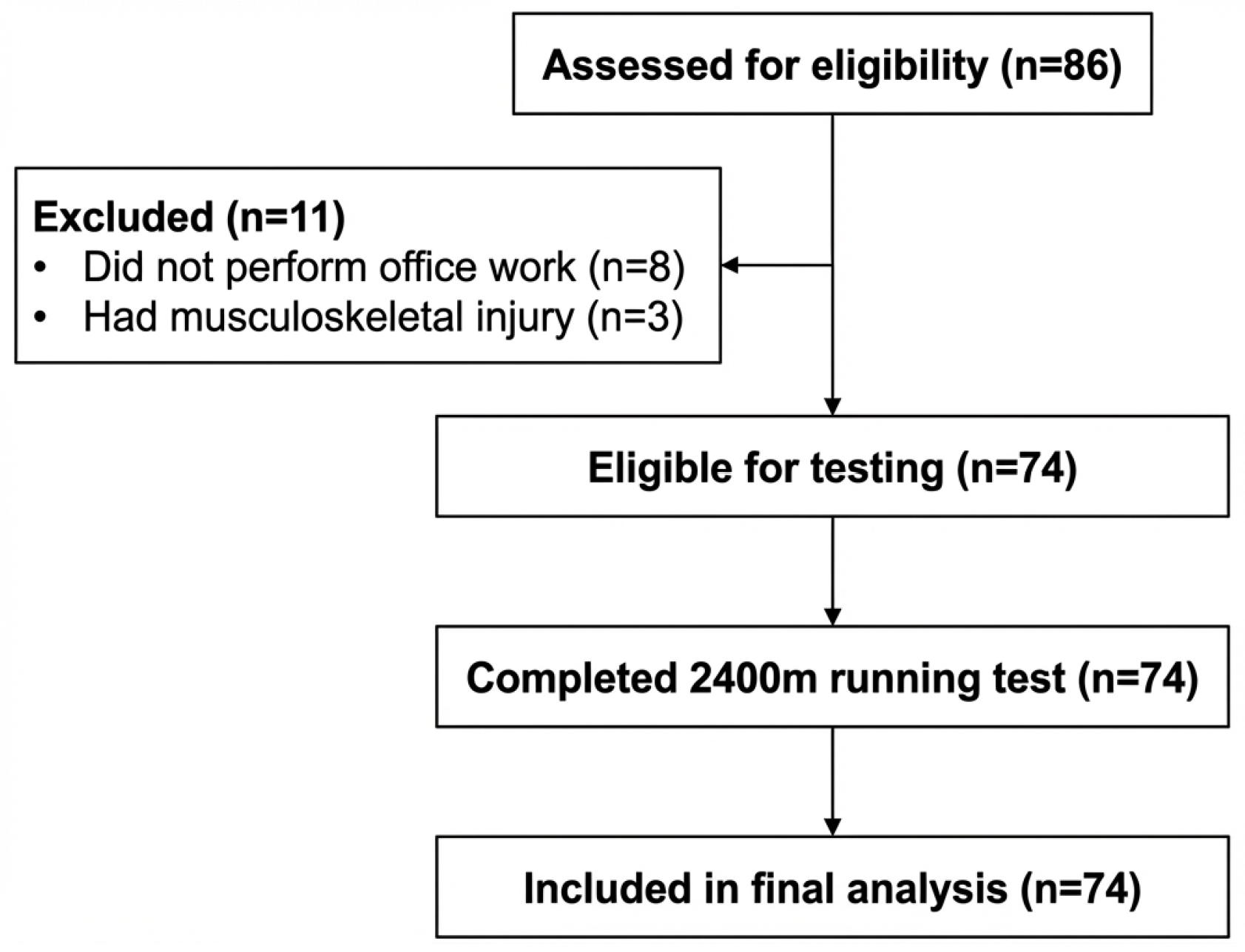
This study examined 74 military office workers recruited from the Belgian Defense. Participants were active-duty Belgian military personnel with primarily desk-based occupational duties who maintained current military fitness standards. Inclusion criteria included: active-duty military status, mainly sedentary occupational activities (>6 h/day of desk work), and absence of musculoskeletal injuries that would prevent maximal running effort. Exclusion criteria included: recent or chronic injuries or illnesses that prevented maximal exercise and inability to provide informed consent. All participants provided written informed consent. The flow of participants through the study, including recruitment, exclusion, and final analysis sample is presented in
Figure 1.
The study sample consisted of 74 military office workers (43 male, 31 female) with a mean age of 39.3 ± 9.3 years (range: 21–56 years). Participants had a mean body mass index of 24.6 ± 2.9 kg/m
2 (range: 17.9–30.5). Mean height was 174.8 ± 7.9 cm, and mean weight was 75.7 ± 11.8 kg (
Table 1).
Military rank distribution included 40.3% Officers, 32.9% Non-Commissioned Officers, and 26.8% Enlisted Ranks. Job functions were primarily administrative (71.2%) and management (15.1%) roles, confirming the office worker population. All participants provided informed consent and declared their fitness to perform maximal physical testing, and none were taking medication that could affect their heart rate.
2.2. Materials
2.2.1. ActiGraph GT9X Link Accelerometer (Wrist-Worn)
ActiGraph GT9X Link devices were initialized using ActiLife software (ActiGraph LLC, Pensacola, FL, USA) and configured to collect raw acceleration data at 60 Hz. Internal device clocks were synchronized prior to data collection. Accelerometer calibration was performed using the auto-calibration procedures implemented in the GGIR package, which correct for sensor calibration errors and gravitational offsets based on local gravity [
26,
27]. Participants wore ActiGraph GT9X Link tri-axial accelerometers (ActiGraph LLC, Pensacola, FL, USA) on their non-dominant wrist using an elastic wristband. The GT9X measures acceleration along three orthogonal axes (vertical, anteroposterior, and mediolateral). The ActiGraph GT9X Link is widely used in physical activity research and has demonstrated good inter-device agreement for movement-related acceleration metrics during free-living conditions, with intraclass correlation coefficients exceeding 0.90 for key outcomes such as intensity gradient, total steps, and light physical activity derived from vector magnitude counts [
28].
For this study, we used established non-dominant wrist-worn cut-points for PA levels: sedentary (<44.8), light (44.8–100.5), moderate (100.6–428.8), and vigorous (≥428.8). These thresholds represent absolute PA levels derived from metabolic measurements in general population samples [
27].
2.2.2. Zephyr Bio Harness (Chest-Worn)
Zephyr BioHarness devices were initialized using the manufacturer’s OmniSense software version 4.2 (Zephyr, Annapolis, MD, USA), with settings configured according to manufacturer guidelines. Internal device clocks were synchronized prior to data collection to ensure temporal alignment with accelerometer data. Heart rate signals were inspected for signal quality and potential artifacts prior to analysis to ensure reliable data.
The Zephyr BioHarness 3.0 provides continuous physiological monitoring, including heart rate, breathing rate, and chest acceleration. The device was positioned across the chest at the level of the xiphoid process using the manufacturer’s elastic strap. Heart rate data were used as a field-based proxy for relative physiological exercise intensity, rather than as a metabolic gold standard for accelerometer validation. Accelerometer data were used to compare chest-worn versus non-dominant wrist-worn accelerometry. The Zephyr BioHarness has demonstrated good to excellent validity for heart rate monitoring during exercise and recovery when compared to gold-standard electrocardiography, with correlations of ≥0.74 during activity and ≥0.99 during recovery [
29].
2.3. Testing Protocol
2.3.1. Pre-Test Procedures
Participants reported to the military facility, having avoided caffeine and vigorous exercise for 24 h before testing. Anthropometric measurements (height, weight, body composition) were recorded using a Tanita MC-780MA (Tanita Corporation, Tokyo, Japan) bioelectrical impedance analysis technology, and ActiGraph GT9X and Zephyr Bio Harness were fitted and checked for proper function. Participants completed a standardized warm-up consisting of 5 min of light jogging. Resting heart rate was not collected in this study due to logistical constraints. Therefore, relative intensity calculations were based on the percentage of maximal heart rate (%HRmax).
2.3.2. The 2400 m Running Test
The maximal 2400 m running test was selected as it represents a standardized military fitness assessment. The test was conducted on a standard 400 m outdoor track. Participants were instructed to complete the 2400 m distance in maximum effort, representing maximal effort throughout the test. Split times were provided every 400 m to maintain participant awareness of pace and distance covered. Standardized verbal encouragement was provided throughout the test to ensure maximal effort. Heart rate and accelerometer data were collected continuously throughout the test. The purpose of this protocol was not to evaluate accelerometer classification across the full spectrum of daily physical activities, but rather to establish an individualized reference intensity during a standardized maximal effort test. This reference intensity can subsequently be used to derive individualized accelerometer thresholds that may be applied to accelerometer data collected across a broader range of activities, although this requires further validation.
Following completion of the 2400 m running test, participants were monitored during a short recovery period to ensure safe return to baseline conditions. Heart rate responses were continuously recorded using the Zephyr BioHarness, allowing objective assessment of physiological recovery. Participants were observed for signs of excessive fatigue, discomfort, or adverse symptoms. The test sessions were supervised by personnel trained in conducting physical fitness assessments, and an automated external defibrillator (AED) was available on site in accordance with standard safety procedures. No adverse events were reported during or after the testing sessions.
2.4. Data Processing and Analysis
2.4.1. Accelerometer Data Processing
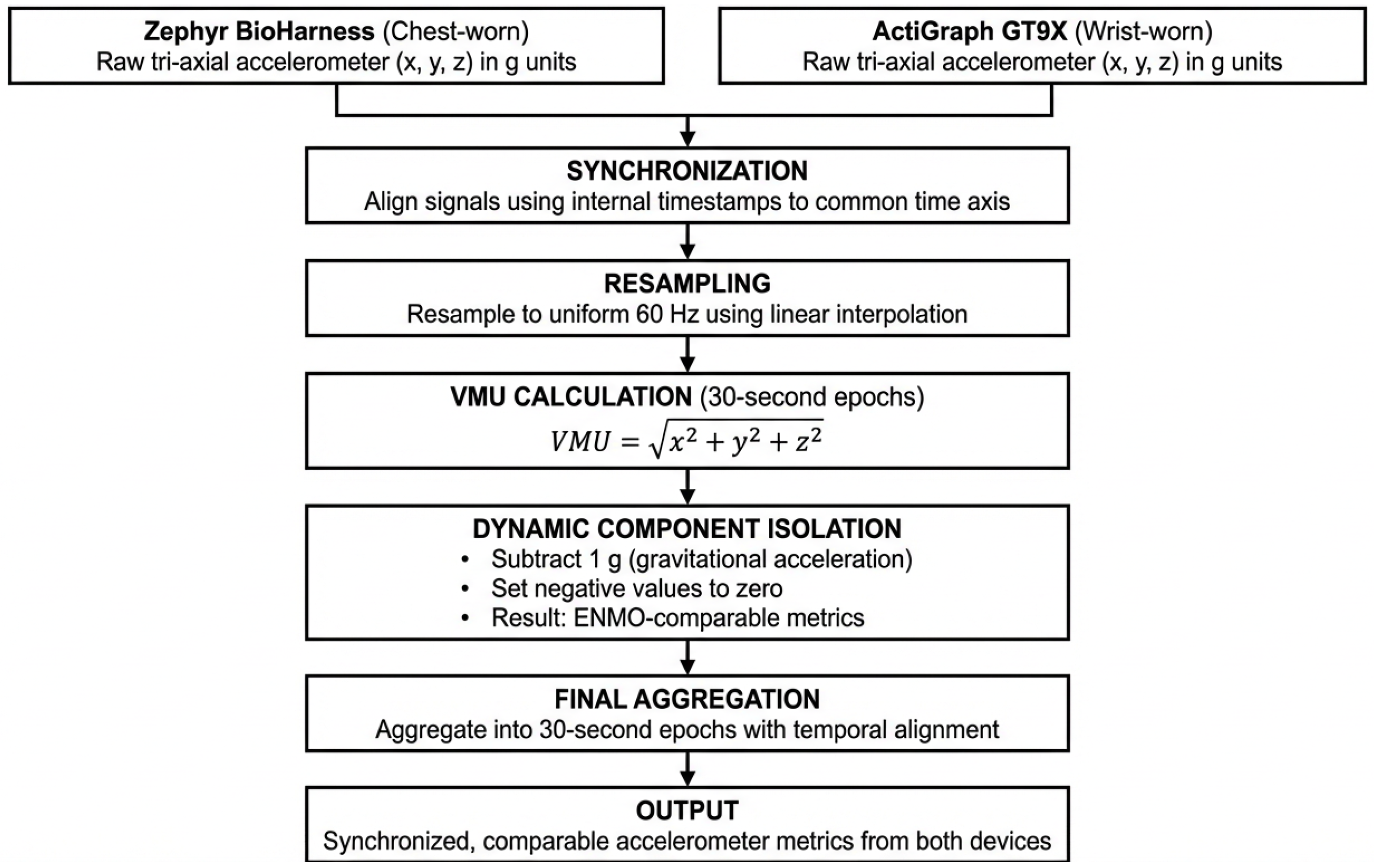
Raw tri-axial accelerometer data from Zephyr BioHarness (chest-worn) and ActiGraph GT9X (non-dominant wrist-worn) devices were exported in gravitational units (g) and processed. For each 30 s epoch, vector magnitude units (VMU) were calculated as the square root of the sum of squared accelerations across the three axes (VMU = √(x2 + y2 + z2)). Gravitational acceleration (1 g) was subtracted to isolate the dynamic component of movement, and negative values were set to zero, yielding metrics comparable to the Euclidean Norm Minus One (ENMO). To evaluate the sensitivity of the results to epoch length, an exploration analysis was conducted in a subsample using shorter epochs (5 s and 10 s) and a longer epoch (60 s). Classification outcomes obtained with 5- and 10 s epochs were comparable to those derived from the 30 s epoch, whereas the 60 s epoch resulted in noticeable differences. Therefore, the 30 s epoch was retained for the primary analyses.
To enable direct comparison between devices, the raw acceleration signals from both devices were aligned using their internal timestamps to a common time axis. Subsequently, signals were resampled to a uniform frequency of 60 Hz using linear interpolation. Following synchronization and resampling, data were aggregated into identical 30 s epochs, ensuring temporal alignment of the derived metrics across devices (
Figure 2).
All data processing and signal calibration were performed in R (version 4.3.1) using the GGIR package (version 3.0.8), which provides standardized algorithms for raw accelerometry analysis. VMU values were expressed in gravitational units and used to compare movement-intensity patterns between chest- and wrist-worn sensors.
To compare absolute with relative physical activity levels, we calculated the percentage of test time spent in each physical activity category (sedentary, light, moderate, vigorous) using absolute thresholds [
30]. Given the nature of this 2400 m maximal running test, participants typically reach vigorous relative intensity within the first 2 min, and heart rate remains above the moderate-intensity threshold (≥64% HRmax) for the remainder of the effort. Consequently, we expected that participants would operate above 77% of maximum heart rate throughout the test, resulting in negligible time spent in sedentary or light-intensity categories and almost all time classified as moderate or vigorous activity [
31].
2.4.2. Heart Rate and VO2max Data Processing
Relative physical activity was determined for each participant based on heart rate data collected during the 2400 m all-out running test. HRmax was identified as the 10 s rolling average recorded during the 2400 m running test. Heart rate reserve (HRR) was not used because resting heart rate was not collected under standardized conditions required for reliable HRR calculation. Therefore, relative intensity was calculated for each heart rate value (10 s rolling average) recorded during the test, expressed as a percentage of HRmax ((%) = (Exercise HR/HRmax) × 100) and categorized according to established physiological thresholds (light = 57–63% HRmax, moderate = 64–76%, vigorous = 77–95%, and very vigorous ≥ 95%) based on the widely used American College of Sports Medicine (ACSM) Guidelines for Exercise Testing and Prescription [
18].
VO
2max was estimated from performance on the 2400 m running test. Estimated aerobic capacity (VO
2max, mL/kg/min) was calculated using the Cooper field-test equation, which predicts maximal oxygen uptake based on run time: VO2max = 483/T + 3.5, where T stands for time to complete 2400 m in minutes. This method is used and has been validated in adult populations for predicting cardiorespiratory fitness [
32]. In addition, the 2400 m running test is commonly used as an aerobic fitness assessment in military populations and has shown strong associations with other established fitness tests in military personnel [
26].
To provide an additional descriptive indicator of exercise intensity relative to aerobic capacity, mean exercise intensity during the test was also expressed as a percentage of estimated VO2max. %VO2max was not used as a criterion measure for the primary analyses.
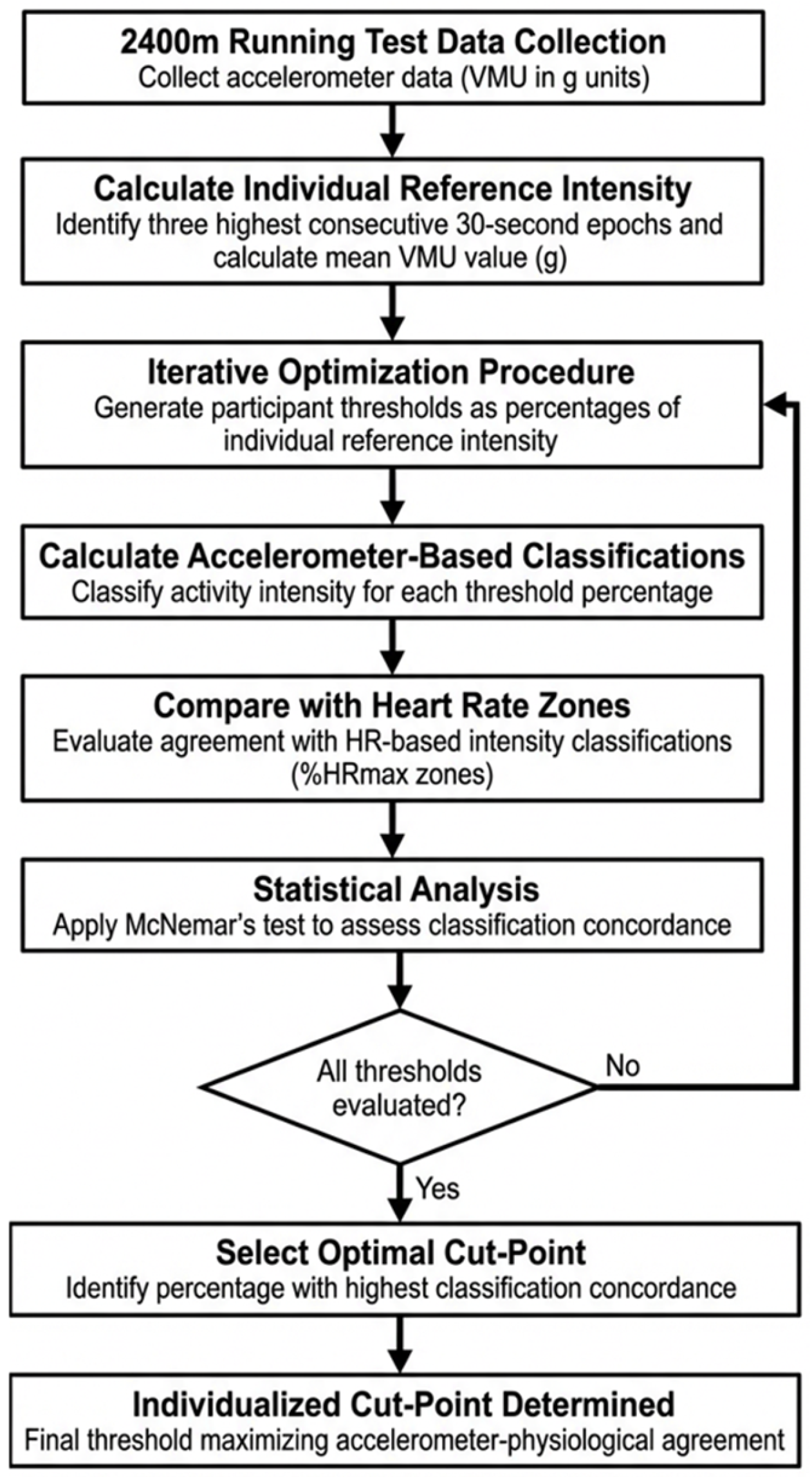
2.4.3. Individualized Cut-Point Development Method
For each participant, an individual reference intensity was defined as the mean VMU of the three highest consecutive 30 s epochs recorded during the 2400 m running test, expressed in gravitational units (g). Individualized accelerometer cut-points were then determined using an iterative optimization procedure. Participant thresholds were generated as percentages of the individual reference intensity. For each participant, a range of percentage values was systematically evaluated, and the corresponding accelerometer-based activity intensity classifications were calculated for each participant threshold. For each participant threshold, agreement between accelerometer-derived intensity classifications and heart rate-based intensity classifications (%HRmax zones) was evaluated using McNemar’s test. The percentage of the individual reference intensity that produced the highest classification concordance with the heart rate-based intensity zones was selected as the individualized cut-point for that participant. This procedure ensured that the derived thresholds maximized agreement between accelerometer-derived and physiological intensity classifications at the individual level. Because the individualized thresholds were derived and evaluated within the same dataset, this procedure represents a data-driven calibration approach rather than an independent validation of accelerometer thresholds. The iterative procedure used to derive individualized cut-points is illustrated in
Figure 3.
2.5. Statistical Analysis
Descriptive statistics were calculated for all study variables. Individualized cut-points were derived separately for each participant and subsequently applied to classify that participant’s epoch-level accelerometer data. Agreement analyses (kappa, ICC, and ROC) between heart rate-based and accelerometer-based intensity classifications (categorized as light, moderate, and vigorous) were evaluated using pooled epoch-level observations across participants, with each epoch classified using the participant-specific cut-points and the corresponding heart rate-based intensity category.
Pearson correlation coefficients were used to examine linear relationships between continuous intensity measures obtained from the Zephyr (chest-worn) and ActiGraph GT9X (wrist-worn) devices, as well as between absolute and relative measurement approaches. Bland–Altman analyses were performed to assess the agreement, systematic bias, and 95% limits of agreement between chest- and wrist-worn accelerometer measurements.
Receiver Operating Characteristics (ROC) analyses were conducted to evaluate the discriminatory ability of absolute and adapted cut-points. Area under the curve (AUC) values were calculated with 95% confidence intervals and interpreted according to established criteria (AUC 0.50–0.69 = poor to fair, 0.70–0.79 = acceptable, ≥0.80 = excellent). Statistical significance was set at p < 0.05. All analyses were conducted using R statistical software (version 4.3.1).
A post hoc power analysis indicated an achieved statistical power of 0.99. The current sample size provided 95% power to detect a moderate effect size (Cohen’s d = 0.40). Additional power calculations indicated that a minimum sample size of 58 participants would be required to achieve 80% power to detect a small-to-moderate effect size (d = 0.33), suggesting that the present sample size (n = 74) was sufficient to support the conducted statistical analyses.
3. Results
3.1. Heart Rate Responses
Maximum heart rate during the test averaged 187 ± 11.4 bpm, representing 95 ± 4.2% of age-predicted maximum heart rate (220-age). This confirms that participants achieved near-maximal physiological effort during the test. Mean heart rate during the 2400 m test was 165 ± 10.9 bpm, representing 85 ± 3.7% of the individual’s maximum heart rate achieved during the test. Using traditional relative-intensity zones based on %HRmax, 100% of participants exceeded the vigorous-intensity threshold (77% HRmax) during the test.
3.2. Device Comparison: ActiGraph Versus Zephyr
Significant differences were observed between measurement systems during the 2400 m test. The ActiGraph GT9X Link (wrist-worn) recorded higher vector magnitude values compared to the Zephyr Bio Harness chest acceleration, reflecting greater upper-limb movement during running (
Table 2). The correlation between Zephyr and ActiGraph vector magnitude measurements was moderate (r = 0.67,
p < 0.01), indicating substantial inter-device variability. Bland–Altman analysis revealed a systematic bias of +0.57 g (95% CI: +0.23 to +0.91 g) for wrist-worn measurements, with limits of agreement ranging from −0.34 to +1.48 g.
3.3. Absolute Versus Individualized Threshold Performance
Analysis of ActiGraph GT9X Link data using established absolute thresholds showed patterns of physical activity misclassification. Despite the maximal-effort nature of the 2400 m test and the confirmed high physiological demands, only 34.5% of participants (n = 26) achieved a vigorous-intensity classification for the majority (>50%) of their test time using absolute accelerometer thresholds. The distribution of time spent in each intensity category was as follows: Sedentary: 2.1 ± 4.3%; Light: 23.7 ± 18.9%; Moderate: 48.6 ± 22.1%; Vigorous: 25.6 ± 19.8%.
These results indicate that 65.5% of participants (n = 48) failed to achieve vigorous intensity classification for the majority of their maximal running effort, despite clear physiological evidence of high-intensity exercise. Furthermore, 47.3% of participants (n = 35) spent more time classified as light intensity than moderate or vigorous intensity during their maximal effort.
In contrast, individualized absolute cut-points based on the individual reference intensity showed markedly different classifications. Among the disagreeing pairs, 31 participants showed improved classification with the adapted thresholds. The odds of improved classification using adapted thresholds were over ten times higher (OR = 10.33, 95% CI: 3.12–34.21).
Receiver Operating Characteristic Analysis showed fair discrimination for absolute thresholds and excellent discrimination for adapted thresholds (
Table 3).
Intraclass correlation analysis showed moderate agreement between absolute thresholds and %HRmax (ICC = 0.52, 95% CI: 0.35–0.66), while adapted thresholds demonstrated excellent agreement with %HRmax (ICC = 0.81, 95% CI: 0.73–0.87). The improvement in agreement was significant (ΔICC = 0.29, 95% CI: 0.18–0.40, p < 0.001).
3.4. Agreement Between Measurement Approaches
Agreement between heart rate-based physical activity levels (%HRmax zones) and accelerometer-based physical activity levels improved substantially when using individualized, adapted rather than absolute cut-points. Cohen’s kappa coefficient increased from 0.31 (fair agreement) with absolute thresholds to 0.74 (good agreement) with individualized thresholds (p < 0.001).
The correlation between heart rate percentage and accelerometer-derived intensity also strengthened when using individualized cut-points (r = 0.78 vs. r = 0.45 for absolute thresholds, p < 0.01). This improvement suggests that individualized thresholds better capture the physiological reality of physical activity across individuals with varying fitness levels.
3.5. Individual Variability in Cut-Point Development
The individualized accelerometer cut-points, used as participant-specific indicators of physical activity intensity, represent individualized thresholds derived from each participant’s maximal effort during the 2400 m test. Substantial inter-individual variability was observed in individual reference intensity. Individual moderate physical activity accelerometer cut-points ranged from 0.48 to 1.12 g, with a coefficient of variation of 28.4%. Participants with faster 2400 m completion times generally demonstrated higher individual reference intensities (r = −0.58, p < 0.01). However, this relationship was not perfect, suggesting that additional factors beyond exercise performance contributed to variability in accelerometer-derived intensity metrics.
To explore the reproducibility of the individualized cut-points, participants repeated the 2400 m running test approximately three months after the initial assessment. Individualized cut-points were recalculated using the same procedure. Despite a small mean improvement in running performance, the derived thresholds remained largely stable across tests. Agreement between cut-points derived from the first and second test showed good reliability (ICC = 0.81), indicating that the individualized calibration approach produced reproducible thresholds when the test was repeated.
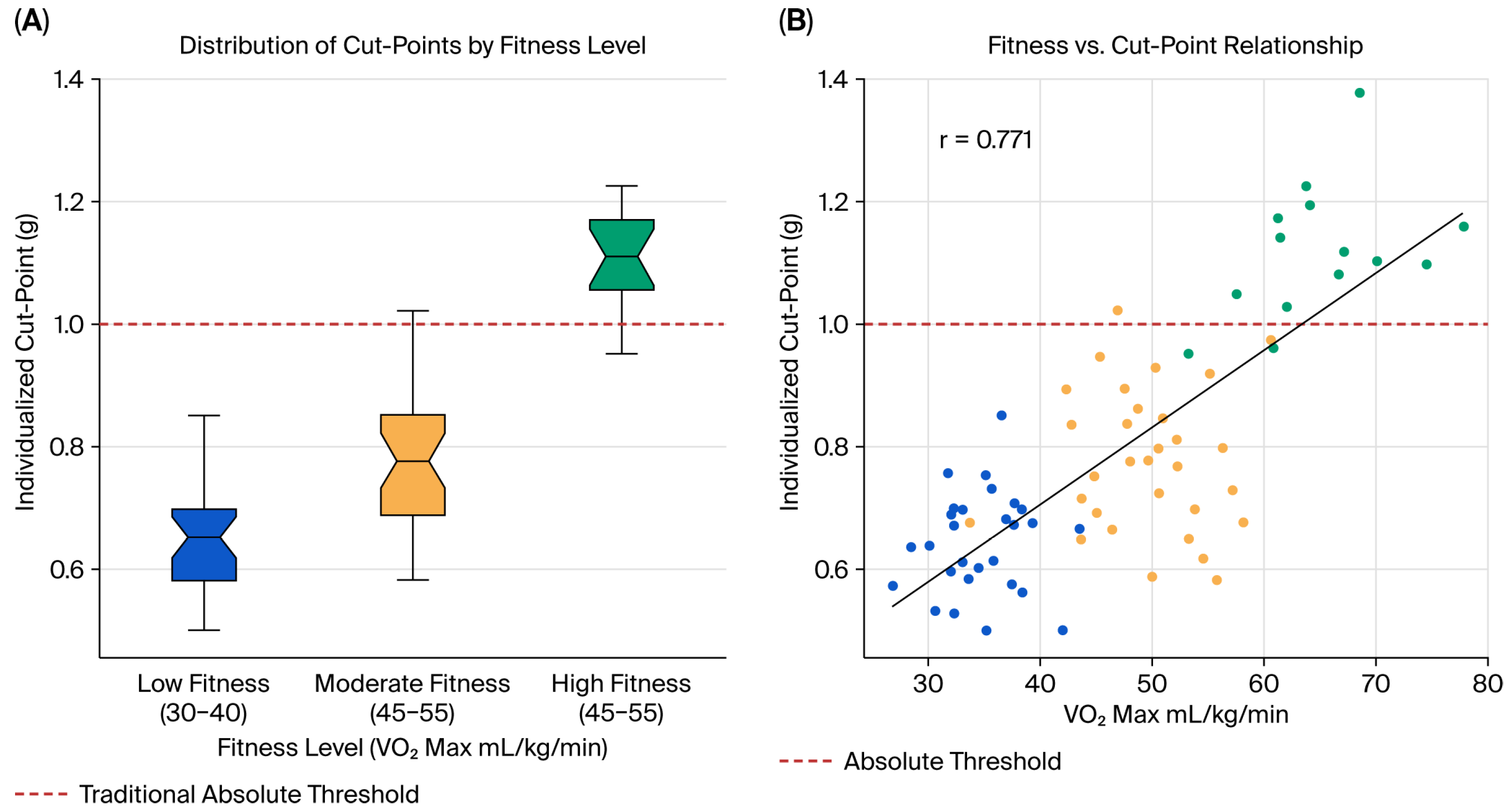
Analysis of cut-point distributions revealed systematic patterns across fitness levels (
Figure 4). Higher-fitness participants required higher cut-points for equivalent relative physical activity (r = 0.77,
p < 0.001), with cut-point values ranging from 0.48 g in low-fitness to 1.12 g in high-fitness individuals.
4. Discussion
The present study demonstrates that commonly used absolute accelerometer cut-points may underestimate exercise intensity during a maximal 2400 m running test in military office workers. Despite participants reaching near-maximal physiological effort during the 2400 m running test, as indicated by heart rate responses averaging 94.8% of maximum, only 34.5% of the participants were classified as performing vigorous activity using established absolute thresholds for non-dominant wrist-worn ActiGraph GT9X devices [
27]. In contrast, individualized cut-points, derived from each participant’s reference intensity, substantially improved agreement between accelerometer-based classification and heart rate-based intensity measures, from fair (κ = 0.31) to good (κ = 0.74). In addition, the individualized cut-points demonstrated good test–retest reliability when the 2400 m test was repeated three months later (ICC = 0.81). Together, these findings suggest that accounting for inter-individual physiological differences may improve the interpretation of accelerometer-based estimates of PA levels. However, it remains uncertain whether a field-based maximal running test represents the optimal reference for calibration, and further research comparing this approach with laboratory-based treadmill or cardiopulmonary exercise testing is warranted.
The study population consisted of Belgian military office workers, representing a specific occupational group. Therefore, the findings should be interpreted within the context of this population. Although the present study focused on military office workers, the proposed calibration approach may be applicable to other physically active populations in which standardized field-based fitness tests are routinely performed. Many occupational groups, including military personnel, police officers, and firefighters, regularly complete structured fitness assessments that could serve as practical reference tests for individualized accelerometer calibration. Because the calibration is based on a maximal field running test, this approach may also be applicable in other populations capable of completing a 2400 m run or a comparable maximal endurance test.
Our findings align closely with the study by Fridolfsson et al. (2023), which demonstrated that absolute cut-points for moderate and vigorous physical activity are too low for 95% of individuals in their large middle-aged sample [
17]. The systematic underestimation of physical activity using absolute thresholds observed in our military population mirrors their findings and extends this concern to active occupational groups. The stronger dose–response relationship between relative intensity and health indicators reported by Fridolfsson et al. provides compelling evidence that relative measures better capture physiologically meaningful activity. The substantial difference between absolute and relative threshold classifications observed in our study parallels the inequity Fridolfsson et al. found between absolute and relative adherence to PA recommendations. This consistency across different populations and measurement contexts strengthens the argument for transitioning from absolute to relative PA paradigms in accelerometer-based PA assessment. Importantly, Fridolfsson et al.’s (2023) findings regarding cardiometabolic health associations provide crucial context for interpreting our results [
17]. Their demonstration that relative intensity showed stronger and more consistent associations with components of metabolic syndrome across fitness levels suggests that our individualized approach may better capture health-relevant PA. The fact that only 9% of their participants met with recommendations for both relative PA and sufficient fitness levels underscores the inadequacy of current absolute approaches. It supports our call for individualized calibration methods.
The systematic misclassification of high-intensity activity observed in our study is consistent with recent evidence documenting widespread limitations of wrist-worn accelerometer cut-points across diverse populations and activity contexts. Vähä-Ypyä et al. (2022) demonstrated that adherence to PA guidelines varied from 20% to 99% depending on whether absolute or relative thresholds were used, highlighting the profound impact of threshold selection on public health surveillance and individual exercise prescription [
33]. Similarly, Schwendinger et al. (2025) found that absolute accelerometer metrics show a continuous decline in PA beyond age 40–45 years, whereas relative metrics increase until approximately 70 years of age, demonstrating that older adults maintain higher relative PA effort despite lower absolute PA volumes [
34]. These findings suggest that the limitations of absolute thresholds extend beyond military populations to affect PA assessment across the lifespan. The consistency of misclassification errors across age groups, fitness levels, and activity contexts strengthens the argument that individualized calibration ap-proaches are necessary to accurately capture physiologically meaningful PA intensity.
The comparison between the ActiGraph GT9X and Zephyr BioHarness systems provided additional insight into measurement system agreement and the challenges associated with non-dominant wrist-worn accelerometry. Wrist-worn accelerometers capture substantial arm movement during locomotion, which may lead to higher acceleration signals compared with chest-mounted devices. This finding is consistent with previous research demonstrating that wrist placement captures different movement patterns than trunk-based sensors [
34,
35,
36]. These differences highlight an important methodological consideration for accelerometer-based physical activity assessment. Because acceleration signals vary depending on sensor placement, thresholds developed for one device location may not be directly transferable to another. Consequently, device placement should be carefully considered when interpreting accelerometer-derived intensity classifications, and individualized or placement-specific calibration approaches may improve the validity of wrist-worn accelerometer measurements.
The 2400 m running test serves as an optimal, individualized reference intensity metric for calibrating accelerometer outputs within military populations, conferring notable methodological and practical advantages. This approach capitalizes on established military fitness assessment protocols, necessitating no supplementary equipment or training interventions, as the test is routinely incorporated into standard physical evaluations. The measurement of heart rate responses during the test provides an objective indicator of near-maximal physiological effort, thereby establishing a valid criterion for physical activity intensity calibration that inherently accounts for interindividual variability in fitness levels. Although running economy, gait mechanics, and arm movement patterns likely influence accelerometer signals, these factors were not directly measured in this study and should be explored in future research as potential contributors to individual differences in acceleration-based intensity. Furthermore, the individualized reference intensity methodology employed herein offers a pragmatic compromise between laboratory-based VO
2max testing and generic population-derived absolute intensity thresholds. By defining relative physical activity intensities as percentages of individual test performance, this method captures physiological nuances while maintaining applicability in field settings [
31]. Future work should evaluate whether similar individualized calibration approaches are effective across a wider range of military tasks and free-living activities.
Several limitations should be considered when interpreting these results. The present protocol focused on a standardized 2400 m maximal running test in order to establish an individualized calibration reference. While the experimental data primarily represents high-intensity activity, the derived individualized thresholds can subsequently be applied to accelerometer data collected during a broader range of activities and free-living conditions. However, further research is required to evaluate the performance of this calibration approach across different activity types and real-world contexts. Results are specific to the ActiGraph GT9X and Zephyr BioHarness systems. Other accelerometer models or heart rate monitors may show different agreement patterns. The military office worker population, while diverse in fitness levels, is relatively homogeneous in terms of age, health status, and physical activity background. The adapted thresholds were developed using data-driven approaches specific to this sample. Because the individualized cut-points were derived and evaluated within the same dataset, the observed improvements in agreement should be interpreted as calibration performance within the present sample rather than as independent validation of accelerometer thresholds. Independent validation in separate populations is needed to confirm their broader applicability.
Heart rate was used in the present study as a practical field-based proxy for physiological effort rather than as a metabolic gold standard. Accelerometer validation studies typically rely on indirect calorimetry or direct oxygen consumption measurements to quantify metabolic intensity. The present approach, therefore, evaluates agreement between accelerometer-derived classifications and physiological indicators of exercise intensity rather than providing a metabolic validation of accelerometer thresholds. The use of %HRmax rather than HRR for relative-intensity calculations may have influenced the development of the threshold. HRR-based intensity classification requires accurate measurement of resting heart rate under standardized conditions, which was not collected in the present field-based protocol. Therefore, %HRmax was used as a practical alternative, consistent with commonly applied field-based exercise testing approaches and ACSM guidelines [
18]. Because heart rate increases approximately linearly with oxygen uptake during exercise, %HRmax provides a reasonable proxy for relative physiological intensity, although some variability in intensity classification may remain. Previous research has also shown that variability in exercise intensity domains is present when intensity is expressed using both %HRmax and %HRR [
37]. Consequently, the individualized cut-points derived in this study may differ slightly from those obtained using HRR-based intensity zones; however, the overall pattern of improved agreement between individualized accelerometer thresholds and physiological intensity is unlikely to change. Finally, future research should explore automated approaches to deriving individualized cut-points to support integration into clinical and operational monitoring systems.