Vibration-Based Recovery Interventions Improve Perceived Fatigue, Blood Lactate Clearance, and Isokinetic Muscle Function Following Exercise-Induced Fatigue in Amateur Swimmers
Abstract
1. Introduction
2. Materials and Methods
2.1. Participants
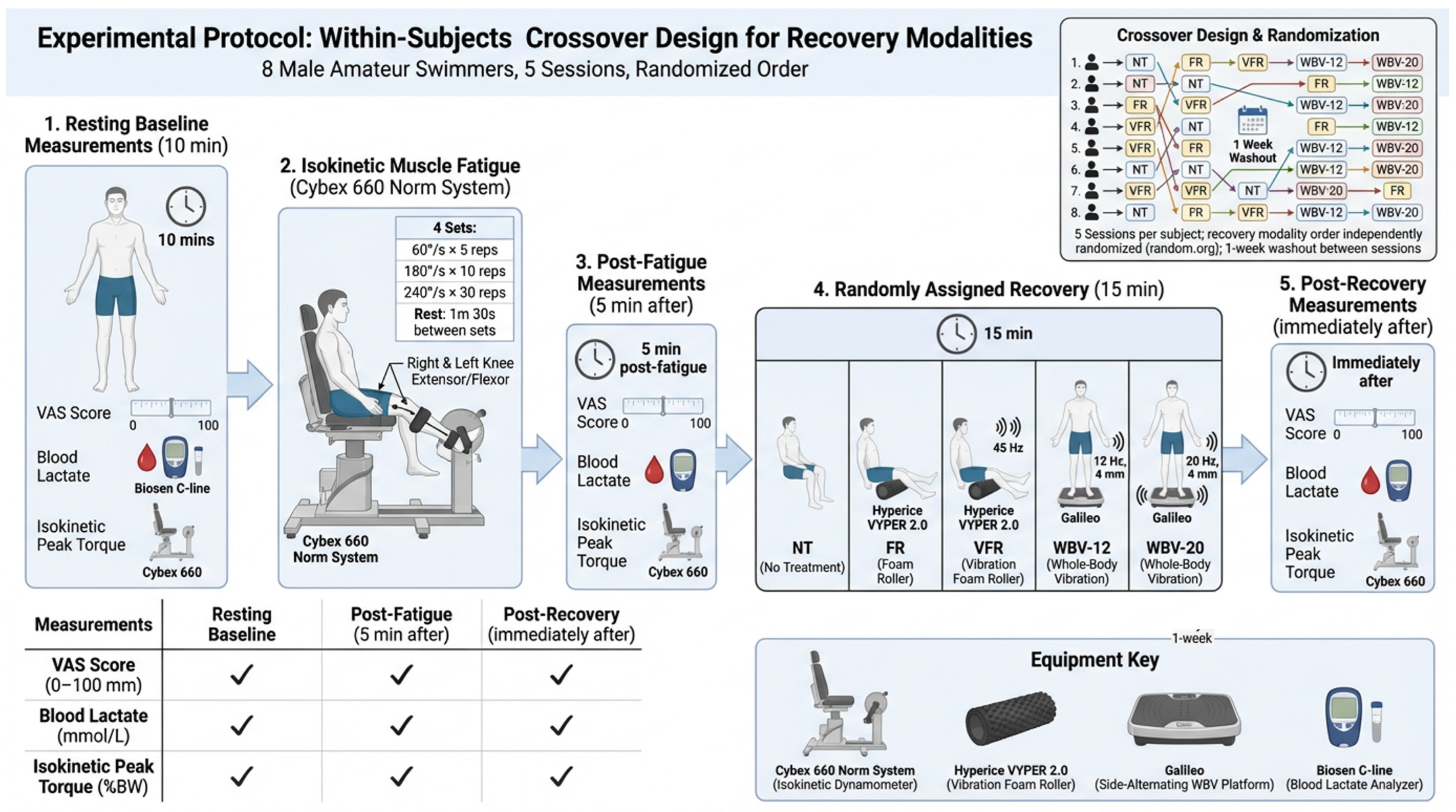
2.2. Exercise-Induced Muscle Fatigue
2.3. Recovery Interventions
2.4. Outcome Measures
2.5. Statistical Analysis
3. Results
3.1. Fatigue Protocol Verification
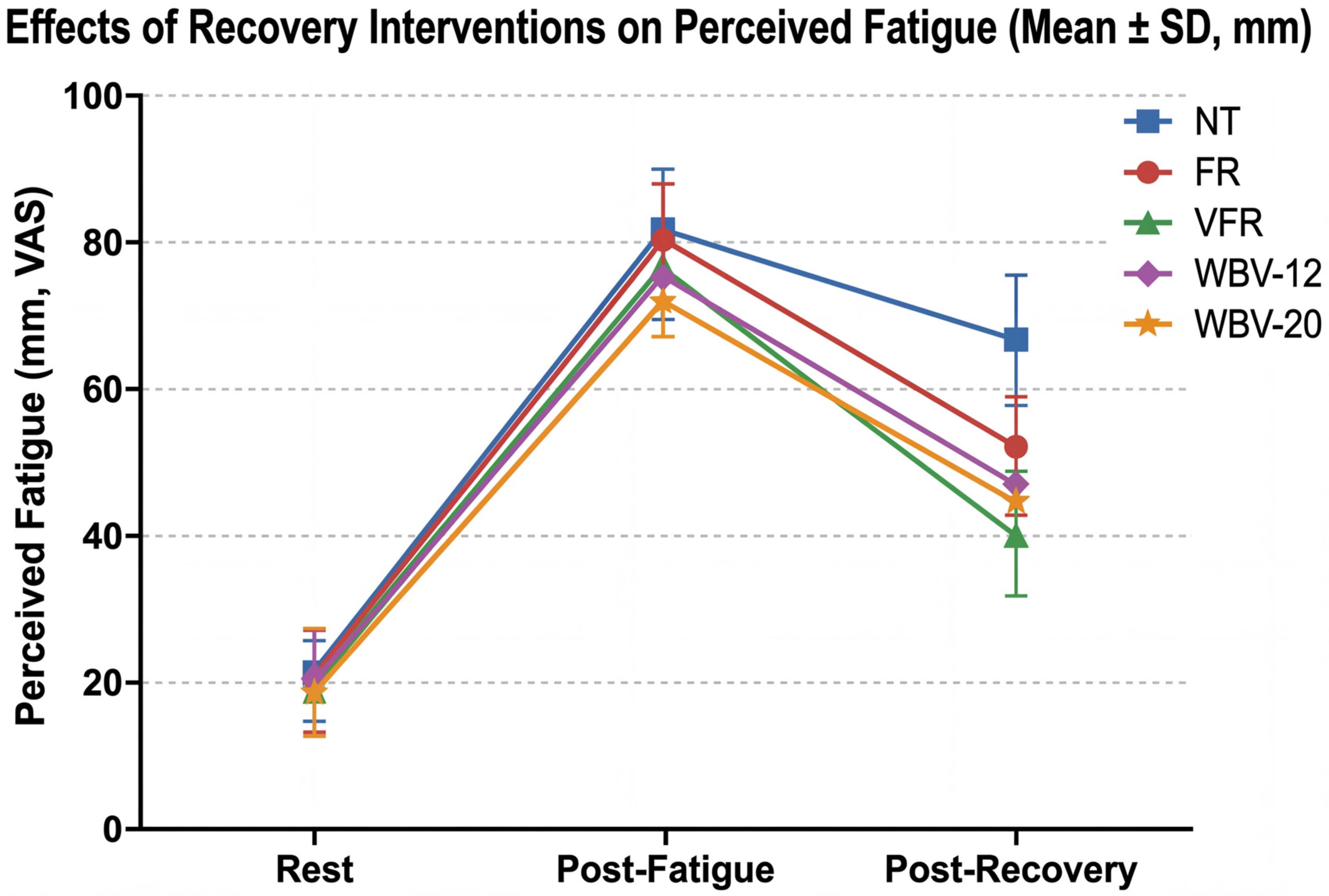
3.2. Changes in VAS Scores After Recovery Interventions
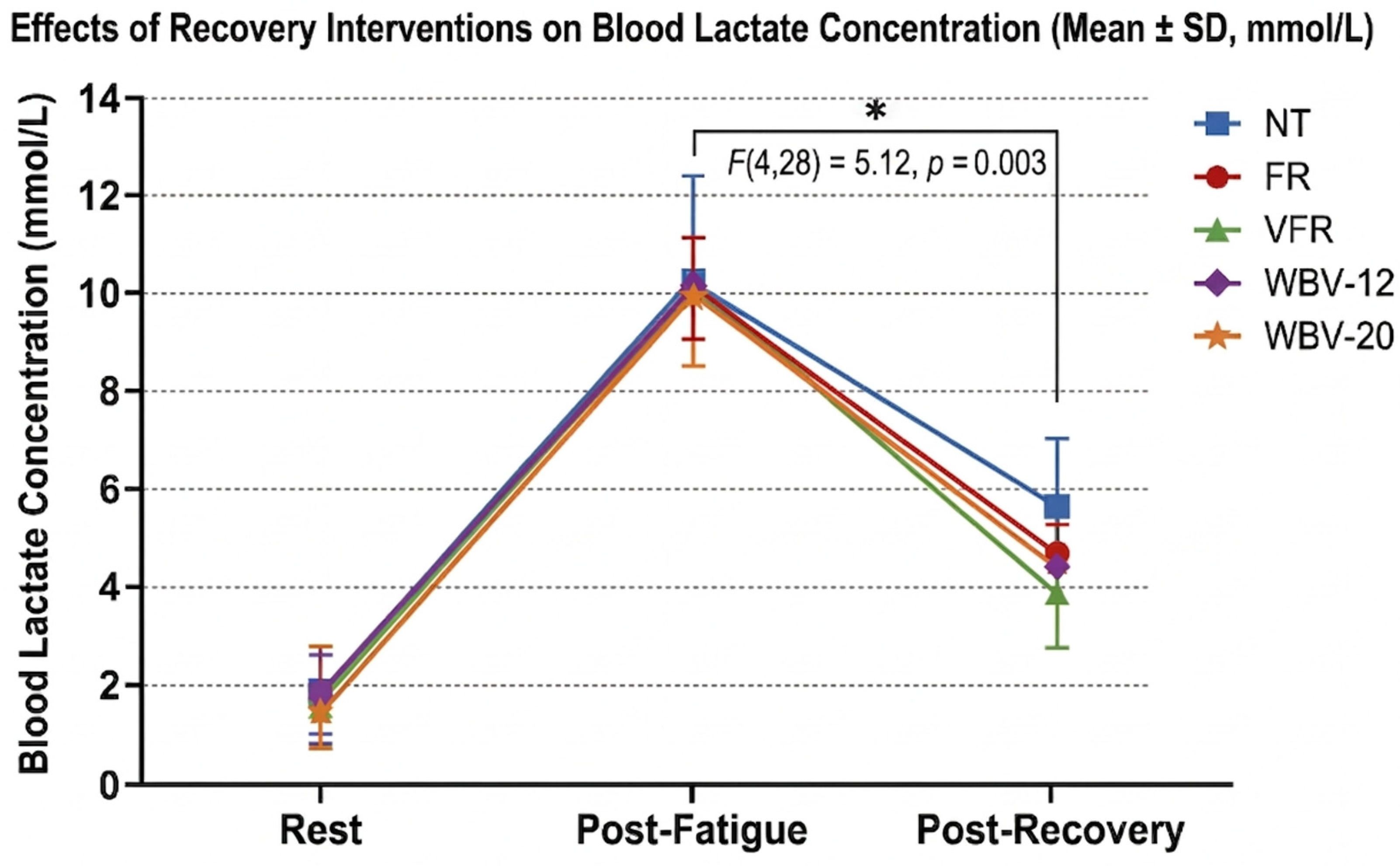
3.3. Changes in Blood Lactate Concentration After Recovery Interventions


| Time Point | a (Control) | b (FR) | c (VFR) | d (WBV-12) | e (WBV-20) | F | p | η2g | Post Hoc |
|---|---|---|---|---|---|---|---|---|---|
| Rest | 1.74 ± 0.44 | 1.80 ± 1.26 | 1.59 ± 0.36 | 1.47 ± 0.43 | 1.44 ± 0.57 | 0.69 | 0.604 | 0.046 | ns |
| PF | 10.15 ± 1.95 | 10.00 ± 1.88 | 10.07 ± 2.37 | 10.41 ± 2.18 | 9.95 ± 1.36 | 0.18 | 0.948 | 0.007 | ns |
| PR | 5.72 ± 1.79 | 4.70 ± 1.47 | 3.84 ± 1.28 | 5.16 ± 1.51 | 3.92 ± 0.95 | 5.12 | 0.003 * | 0.226 | ns (all pairs) ‡ |
| Item | a (Control) | b (FR) | c (VFR) | d (WBV-12) | e (WBV-20) | F | p | η2g | Post Hoc |
|---|---|---|---|---|---|---|---|---|---|
| PR | 52.18 ± 16.82 | 67.45 ± 15.30 | 75.10 ± 8.76 | 59.73 ± 8.02 | 70.82 ± 8.02 | 5.37 | 0.003 ** | 0.346 | a < c (p = 0.031) *; a < e (p = 0.027) * |
3.4. Changes in Blood Lactate Recovery Rate After Recovery Interventions
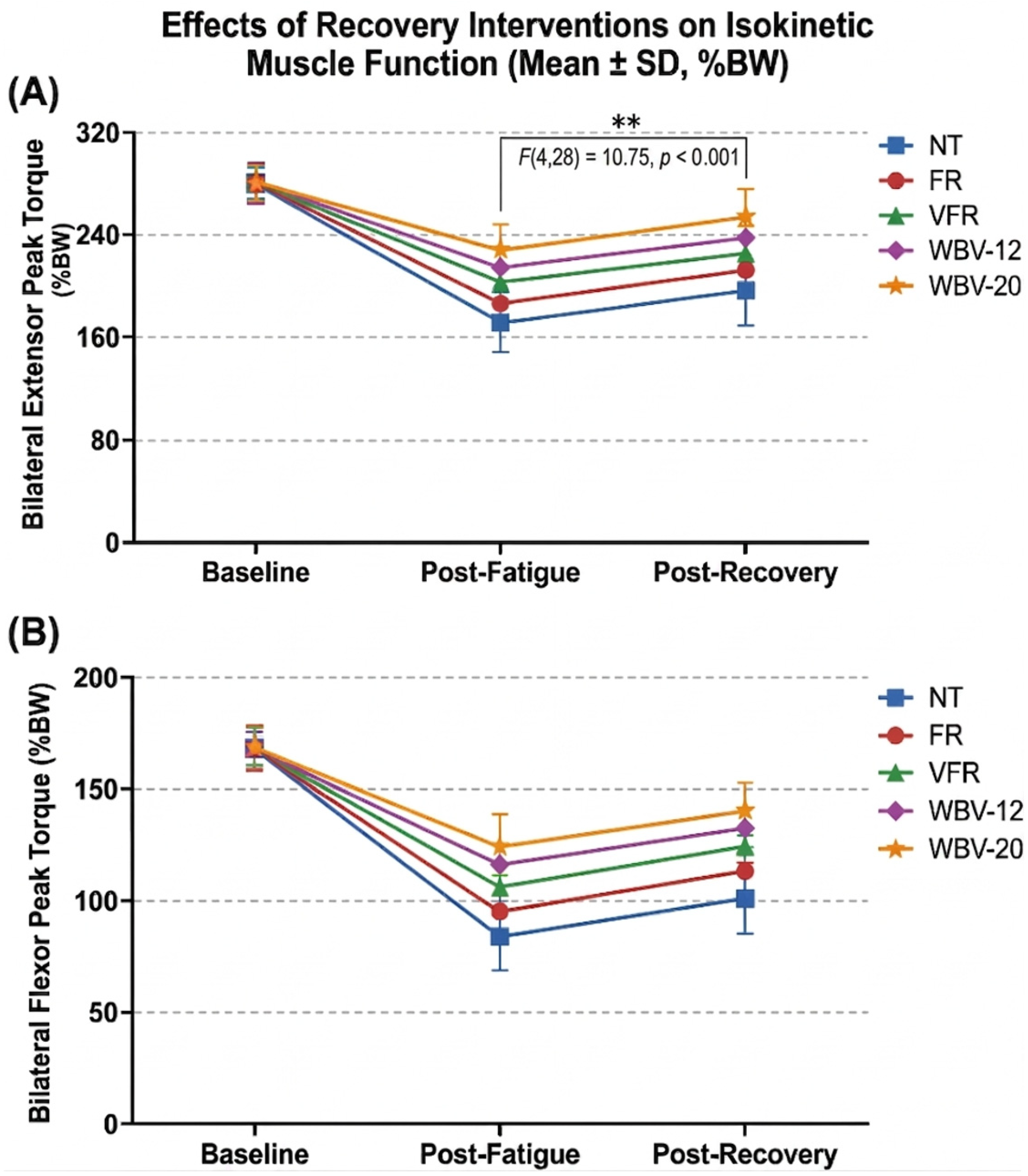
3.5. Changes in Isokinetic Muscle Function After Recovery Interventions
4. Discussion
5. Conclusions
Author Contributions
Funding
Institutional Review Board Statement
Informed Consent Statement
Data Availability Statement
Conflicts of Interest
References
- Allen, D.G.; Lamb, G.D.; Westerblad, H. Skeletal muscle fatigue: Cellular mechanisms. Physiol. Rev. 2008, 88, 287–332. [Google Scholar] [CrossRef]
- Hyldahl, R.D.; Hubal, M.J. Lengthening our perspective: Morphological, cellular, and molecular responses to eccentric exercise. Muscle Nerve 2014, 49, 155–170. [Google Scholar] [CrossRef] [PubMed]
- Takahashi, J.; Ishihara, K.; Aoki, J. Effect of aqua exercise on recovery of lower limb muscles after downhill running. J. Sports Sci. 2006, 24, 835–842. [Google Scholar] [CrossRef]
- Dupuy, O.; Douzi, W.; Theurot, D.; Bosquet, L.; Dugué, B. An evidence-based approach for choosing post-exercise recovery techniques to reduce markers of muscle damage, soreness, fatigue, and inflammation: A systematic review with meta-analysis. Front. Physiol. 2018, 9, 403. [Google Scholar] [CrossRef] [PubMed]
- Mawhinney, C.; Jones, H.; Joo, C.H.; Low, D.A.; Green, D.J.; Gregson, W. Influence of cold-water immersion on limb and cutaneous blood flow after exercise. Med. Sci. Sports Exerc. 2013, 45, 2277–2285. [Google Scholar] [CrossRef]
- Davis, H.L.; Alabed, S.; Chico, T.J.A. Effect of sports massage on performance and recovery: A systematic review and meta-analysis. BMJ Open Sport Exerc. Med. 2020, 6, e000614. [Google Scholar] [CrossRef] [PubMed]
- Poppendieck, W.; Wegmann, M.; Ferrauti, A.; Kellmann, M.; Pfeiffer, M.; Meyer, T. Massage and performance recovery: A meta-analytical review. Sports Med. 2016, 46, 183–204. [Google Scholar] [CrossRef]
- Wiewelhove, T.; Schneider, C.; Döweling, A.; Hanakam, F.; Rasche, C.; Meyer, T.; Kellmann, M.; Pfeiffer, M.; Ferrauti, A. Effects of different recovery strategies following a half-marathon on fatigue markers in recreational runners. PLoS ONE 2018, 13, e0207313. [Google Scholar] [CrossRef]
- Alghadir, A.H.; Zafar, H.; Anwer, S.; Iqbal, Z. Effect of localised vibration on muscle strength in healthy adults: A systematic review. Physiotherapy 2018, 104, 18–24. [Google Scholar] [CrossRef]
- Macdonald, G.Z.; Button, D.C.; Drinkwater, E.J.; Behm, D.G. Foam rolling as a recovery tool after an intense bout of physical activity. Med. Sci. Sports Exerc. 2014, 46, 131–142. [Google Scholar] [CrossRef]
- Wiewelhove, T.; Döweling, A.; Schneider, C.; Hottenrott, L.; Meyer, T.; Kellmann, M.; Pfeiffer, M.; Ferrauti, A. A Meta-Analysis of the Effects of Foam Rolling on Performance and Recovery. Front. Physiol. 2019, 10, 376. [Google Scholar] [CrossRef]
- Rittweger, J. Vibration as an exercise modality: How it may work, and what its potential might be. Eur. J. Appl. Physiol. 2010, 108, 877–904. [Google Scholar] [CrossRef] [PubMed]
- Cheatham, S.W.; Kolber, M.J.; Cain, M.; Lee, M. The effects of self-myofascial release using a foam roll or roller massager on joint range of motion, muscle recovery, and performance: A systematic review. Int. J. Sports Phys. Ther. 2015, 10, 827–838. [Google Scholar]
- Cheatham, S.W.; Stull, K.R.; Kolber, M.J. Roller massage: Comparison of three different surface-type pattern foam rollers on passive knee range of motion and pain perception. J. Bodyw. Mov. Ther. 2019, 23, 555–560. [Google Scholar] [CrossRef] [PubMed]
- Han, S.W.; Lee, Y.S.; Lee, D.J. The influence of the vibration foam roller exercise on the pains in the muscles around the hip joint and the joint performance. J. Phys. Ther. Sci. 2017, 29, 1844–1847. [Google Scholar] [CrossRef] [PubMed]
- Mahbub, M.H.; Hiroshige, K.; Yamaguchi, N.; Hase, R.; Harada, N.; Tanabe, T. A systematic review of studies investigating the effects of controlled whole-body vibration intervention on peripheral circulation. Clin. Physiol. Funct. Imaging 2019, 39, 363–377. [Google Scholar] [CrossRef]
- Osawa, Y.; Oguma, Y.; Ishii, N. The Effects of Whole-Body Vibration on Muscle Strength and Power: A Meta-Analysis. J. Musculoskelet. Neuronal Interact. 2013, 13, 380–390. [Google Scholar]
- Cardinale, M.; Wakeling, J. Whole Body Vibration Exercise: Are Vibrations Good for You? Br. J. Sports Med. 2005, 39, 585–589. [Google Scholar] [CrossRef]
- Ritzmann, R.; Gollhofer, A.; Kramer, A. The influence of vibration type, frequency, body position and additional load on the neuromuscular activity during whole body vibration. Eur. J. Appl. Physiol. 2013, 113, 1–11. [Google Scholar] [CrossRef]
- Nam, H.; Yin, L.; Chen, P.; Wang, L. Effects of vibration frequency and loading on lower limb muscle activation and time-varying multi-muscle coactivation in whole-body vibration training among recreational runners. J. Musculoskelet. Neuronal Interact. 2025, 25, 328–340. [Google Scholar] [CrossRef]
- Pearcey, G.E.P.; Bradbury-Squires, D.J.; Kawamoto, J.E.; Drinkwater, E.J.; Behm, D.G.; Button, D.C. Foam rolling for delayed-onset muscle soreness and recovery of dynamic performance measures. J. Athl. Train. 2015, 50, 5–13. [Google Scholar] [CrossRef]
- Kim, Y.S. Effects of Recovery Treatment Methods After Muscle Fatigue on Visual Analogue Scale, Blood Lactic Acid, and Muscle Functional Variables. Master’s Thesis, Chungnam National University, Daejeon, Republic of Korea, 2020. [Google Scholar]
- Romero-Moraleda, B.; González-García, J.; Cuéllar-Rayo, Á.; Balsalobre-Fernández, C.; Muñoz-García, D.; Morencos, E. Effects of Vibration and Non-Vibration Foam Rolling on Recovery after Exercise with Induced Muscle Damage. J. Sports Sci. Med. 2019, 18, 172–180. [Google Scholar]
- Kosar, A.C.; Candow, D.G.; Putland, J.T. Potential beneficial effects of whole-body vibration for muscle recovery after exercise. J. Strength Cond. Res. 2012, 26, 2907–2911. [Google Scholar] [CrossRef]
- Kim, J.-S.; Moon, D.-C.; Chang, K.-S. Changes of flexibility and plasma catecholamine by myofascial release approach. Korea Contents Assoc. J. 2012, 12, 214–221. [Google Scholar] [CrossRef]
- Casale, R.; Hansson, P. The analgesic effect of localized vibration: A systematic review. Part 1: The neurophysiological basis. Eur. J. Phys. Rehabil. Med. 2022, 58, 306–315. [Google Scholar] [CrossRef]
- Laimi, K.; Mäkilä, A.; Bärlund, E.; Katajapuu, N.; Oksanen, A.; Seikkula, V.; Karppinen, J.; Saltychev, M. Effectiveness of myofascial release in treatment of chronic musculoskeletal pain: A systematic review. J. Rehabil. Med. 2017, 49, 546–554. [Google Scholar] [CrossRef] [PubMed]
- Pollock, R.D.; Woledge, R.C.; Martin, F.C.; Newham, D.J. Effects of Whole Body Vibration on Motor Unit Recruitment and Threshold. J. Appl. Physiol. 2012, 112, 388–395. [Google Scholar] [CrossRef] [PubMed]
- Spencer, M.; Bishop, D.; Dawson, B.; Goodman, C.; Duffield, R. Performance and metabolism in repeated sprint exercise: Effect of recovery intensity. Eur. J. Appl. Physiol. 2008, 103, 545–552. [Google Scholar] [CrossRef]
- Kang, S.R.; Min, J.Y.; Yu, C.; Kwon, T.K. Effect of whole body vibration on lactate level recovery and heart rate recovery in rest after intense exercise. Technol. Health Care 2017, 25, 115–123. [Google Scholar] [CrossRef] [PubMed]
- Cochrane, D.J. Vibration exercise: The potential benefits. Int. J. Sports Med. 2011, 32, 75–99. [Google Scholar] [CrossRef]


| Variables | Age (Years) | Height (cm) | Weight (kg) | BMI (kg/m2) | Fat (%) | Career (Years) |
|---|---|---|---|---|---|---|
| Subjects (n = 8) | 25.1 ± 2.7 | 175.8 ± 5.8 | 75.7 ± 8.1 | 24.5 ± 2.7 | 14.4 ± 6.5 | 6.1 ± 3.0 |
| Item | Angular Velocity (°/s) | Repetitions (REP) | Recovery Time | Sets |
|---|---|---|---|---|
| Right lower extremity | 60 | 5 | 1 min 30 s | 4 |
| Right lower extremity | 180 | 10 | ||
| Right lower extremity | 240 | 30 | ||
| Left lower extremity | 60 | 5 | ||
| Left lower extremity | 180 | 10 | ||
| Left lower extremity | 240 | 30 |
| Time Point | a (Control) | b (FR) | c (VFR) | d (WBV-12) | e (WBV-20) | F | p | η2g | Post Hoc |
|---|---|---|---|---|---|---|---|---|---|
| Rest | 13.8 ± 10.6 | 16.2 ± 9.2 | 17.5 ± 13.9 | 21.2 ± 15.5 | 21.2 ± 13.6 | 1.035 | 0.407 | 0.056 | ns |
| PF | 72.5 ± 11.6 | 75.0 ± 14.1 | 70.0 ± 16.0 | 72.5 ± 15.8 | 75.0 ± 19.3 | 0.831 | 0.517 | 0.016 | ns |
| PR | 57.5 ± 8.9 | 38.8 ± 18.1 | 33.8 ± 14.1 | 38.8 ± 17.3 | 38.8 ± 16.4 | 5.984 | 0.001 ** | 0.248 | ns (all pairs) ‡ |
| Item | a (Control) | b (FR) | c (VFR) | d (WBV-12) | e (WBV-20) | F | p | η2g | Post Hoc |
|---|---|---|---|---|---|---|---|---|---|
| Baseline | 229.2 ± 37.8 | 229.2 ± 37.8 | 229.2 ± 37.8 | 229.2 ± 37.8 | 229.2 ± 37.8 | — | — | — | ns |
| PF | 189.8 ± 27.5 a | 187.1 ± 28.9 ab | 193.7 ± 24.3 a | 203.8 ± 23.2 b | 207.7 ± 29.9 ab | 4.87 | 0.004 ** | 0.091 | a, c < d (Bonferroni p < 0.05) * |
| PR | 180.2 ± 32.7 a | 193.2 ± 34.6 a | 214.1 ± 43.5 a | 222.8 ± 48.9 ab | 239.9 ± 47.6 b | 10.75 | <0.001 ** | 0.226 | a, b, c < e (p = 0.031, 0.019, 0.017) * |
| Item | a (Control) | b (FR) | c (VFR) | d (WBV-12) | e (WBV-20) | F | p | η2g | Post Hoc |
|---|---|---|---|---|---|---|---|---|---|
| Baseline | 124.4 ± 27.3 | 124.4 ± 27.3 | 124.4 ± 27.3 | 124.4 ± 27.3 | 124.4 ± 27.3 | — | — | — | ns |
| PF | 100.2 ± 25.6 | 98.4 ± 24.7 | 105.6 ± 17.5 | 104.9 ± 21.1 | 109.9 ± 18.8 | 1.025 | 0.411 | 0.039 | ns |
| PR | 96.4 ± 25.3 ab | 97.4 ± 21.5 a | 110.7 ± 23.5 ab | 114.6 ± 28.1 ab | 124.8 ± 27.9 b | 5.082 | 0.003 ** | 0.170 | b < e (Bonferroni p < 0.05, d = 1.31) * |
Disclaimer/Publisher’s Note: The statements, opinions and data contained in all publications are solely those of the individual author(s) and contributor(s) and not of MDPI and/or the editor(s). MDPI and/or the editor(s) disclaim responsibility for any injury to people or property resulting from any ideas, methods, instructions or products referred to in the content. |
© 2026 by the authors. Licensee MDPI, Basel, Switzerland. This article is an open access article distributed under the terms and conditions of the Creative Commons Attribution (CC BY) license.
Share and Cite
Kim, Y.S.; Kwak, J.-J.; Park, H.-G.; Lee, W.-L.; Lee, K.-J. Vibration-Based Recovery Interventions Improve Perceived Fatigue, Blood Lactate Clearance, and Isokinetic Muscle Function Following Exercise-Induced Fatigue in Amateur Swimmers. Appl. Sci. 2026, 16, 4245. https://doi.org/10.3390/app16094245
Kim YS, Kwak J-J, Park H-G, Lee W-L, Lee K-J. Vibration-Based Recovery Interventions Improve Perceived Fatigue, Blood Lactate Clearance, and Isokinetic Muscle Function Following Exercise-Induced Fatigue in Amateur Swimmers. Applied Sciences. 2026; 16(9):4245. https://doi.org/10.3390/app16094245
Chicago/Turabian StyleKim, Young Sam, Jae-Jun Kwak, Hee-Geun Park, Wang-Lok Lee, and Kwang-Jin Lee. 2026. "Vibration-Based Recovery Interventions Improve Perceived Fatigue, Blood Lactate Clearance, and Isokinetic Muscle Function Following Exercise-Induced Fatigue in Amateur Swimmers" Applied Sciences 16, no. 9: 4245. https://doi.org/10.3390/app16094245
APA StyleKim, Y. S., Kwak, J.-J., Park, H.-G., Lee, W.-L., & Lee, K.-J. (2026). Vibration-Based Recovery Interventions Improve Perceived Fatigue, Blood Lactate Clearance, and Isokinetic Muscle Function Following Exercise-Induced Fatigue in Amateur Swimmers. Applied Sciences, 16(9), 4245. https://doi.org/10.3390/app16094245