1. Introduction
Underwater radiated noise (URN) refers to acoustic emissions generated by ships and submarines. Growing awareness of its adverse effects on marine ecosystems—ranging from communication interference and behavioral disruption to mass strandings of dolphins and whales—has prompted the International Maritime Organization (IMO) to strengthen URN-related regulations.
Sources of underwater radiated noise (URN) can be broadly classified into structure-borne noise (SBN) and fluid-borne noise (FBN). SBN originates from hull vibrations induced by onboard machinery, whereas FBN arises from turbulent flows around the hull, appendages, and rotating propellers. Advances in low-noise machinery and vibration isolation have significantly reduced SBN contributions. In contrast, the increase in ship size and cruising speed has intensified FBN, which is now recognized as the dominant source of URN.
Among the sources of FBN, cavitation noise is known to be the strongest contributor [
1,
2,
3,
4]. Cavitation occurs when local pressure in the flow drops below the vapor pressure, causing phase change from liquid to vapor. On a propeller blade, the highest relative velocity appears at the tip region, leading to the onset of tip vortex cavitation (TVC). The small-scale nature and strong unsteadiness of the vortex core make experimental observation difficult. Moreover, since cavitation does not follow strict similarity laws, reproducing full-scale conditions from model-scale experiments often results in significant discrepancies. Therefore, numerical simulation has become an essential tool for analyzing and predicting cavitation behavior under realistic operating conditions.
Early numerical studies of tip vortex cavitation were limited by computational capability and relied on simplified steady-flow vortex models, which often resulted in discrepancies from experiments [
5,
6,
7]. With the development of computing machines, Computational Fluid Dynamics (CFD) approaches with higher-order spatial schemes have been introduced. Among them, the Reynolds-Averaged Navier–Stokes (RANS) approach has been widely adopted because of its balance between computational efficiency and accuracy in predicting tip vortex structures [
8,
9,
10].
Owing to advances in computational capability, more refined turbulence models have been employed. Among the RANS approaches, the Reynolds Stress Model (RSM) is regarded as one of the most accurate turbulence models [
11,
12]. In addition, Large Eddy Simulation (LES) and Delayed Detached Eddy Simulation (DDES) have been applied. These methods directly resolve the Navier–Stokes equations for large eddies while modeling the effects of smaller eddies using subgrid-scale (SGS) models or turbulence models originally developed for RANS. These characteristics make LES and DDES more accurate computational approaches [
13,
14]. However, such models require highly resolved grids and are, therefore, rarely used in propeller design stages with tight time constraints. To achieve improved accuracy with reduced computational cost, several RANS-based extensions have been developed. For example, the Curvature Correction (CC) model improves prediction accuracy by enhancing or suppressing turbulence effects near concave and convex surfaces [
15,
16,
17].
High-fidelity numerical schemes can reproduce the turbulent flow structures that act as sources of URN. However, simulating noise propagation is more challenging, since the computational domain must be sufficiently large to include monitoring points generally located far from the source, and the entire domain requires fine spatial resolution. To overcome this difficulty, hybrid approaches have been widely employed. These methods estimate noise sources from flow characteristics and compute sound radiation using the acoustic analogy theory. Among them, the Ffowcs Williams and Hawkings (FW-H) method has been frequently used for URN prediction [
18,
19,
20,
21]. The FW-H formulation classifies noise induced by a foreign body moving in turbulent flow into monopole, dipole, and quadrupole components. It then models the strength of each source and computes the noise level at monitoring points while accounting for the characteristics of each noise type. Because the FW-H method derives acoustic sources directly from flow-field data, accurate prediction of the flow field is essential for reliable noise estimation. Previous studies have reported that at least 25 computational nodes must be placed across the Ttiportex core to capture the pressure and velocity distributions with sufficient accuracy [
12,
22]. This highlights the importance of high-resolution flow simulations when applying the FW-H method to cavitation noise prediction.
Ducted-type propellers have been developed to improve operating performance and reduce cavitation noise by increasing the static pressure inside the duct [
23,
24,
25,
26]. However, this transition from open-type propellers to ducted propellers has led to significant changes in cavitation patterns. tip vortex cavitation (TVC) is transformed into Tip Separation Vortex Cavitation (TSVC) and Tip Leakage Vortex Cavitation (TLVC) due to the clearance at the blade tip. Although TSVC and TLVC have been investigated by many researchers, a systematic understanding of their generation mechanisms remains limited.
In particular, the interaction between TSVC and TLVC and their respective contributions to noise generation have not been clearly established. Furthermore, the mechanisms through which these cavitation structures influence tonal and broadband noise characteristics remain unclear. This limitation motivates the present study.
In this study, a hybrid approach combining high-fidelity CFD and acoustic modeling is employed to investigate the relationship between cavitation structures and their acoustic signatures. By integrating the FW-H method with a bubble noise model, both the radiated noise characteristics and the underlying noise generation mechanisms can be analyzed within a unified framework. In addition, the effect of gap size on the interaction between the Tip Leakage Vortex Cavitation (TLVC) and the Tip Separation Vortex Cavitation (TSVC), and its influence on tonal noise generation, are systematically examined, providing insight into the transition behavior of cavitation-induced noise.
To isolate the fundamental mechanisms of tip vortex cavitation, a single-wing model is employed as a simplified representation of a propeller blade. cavitation noise induced by tip vortex cavitation is investigated for both open-type and gap-type wings. First, high-fidelity CFD simulations are conducted to reproduce cavitating flow and to compare the resulting cavitation patterns. Second, an acoustic analysis based on the acoustic analogy is performed to predict cavitation noise and to identify the relationship between cavitation patterns and acoustic characteristics. Finally, the influence of gap size on cavitation behavior and the resulting URN spectra is analyzed.
The results of this study provide insight into cavitation-induced noise mechanisms and offer a useful basis for interpreting URN characteristics and supporting low-noise propeller design at the preliminary stage.
2. Numerical Methods
2.1. Governing Equations and Turbulence Modeling
The objective of this study is to investigate the relationship between cavitation patterns and underwater radiated noise (URN). As a first step, a high-fidelity numerical scheme is required to accurately resolve the vortex structures, particularly the tip vortex. In this study, the Large Eddy Simulation (LES) approach was employed as the numerical method for analyzing cavitating flow. Because cavitation involves both liquid and vapor phases, an LES-based homogeneous mixture two-phase model was adopted, which is expressed as follows:
Equations (1) and (2) represent the continuity and momentum equations, respectively, where , , , and denote the density, velocity, static pressure, and kinematic viscosity. The subscript m represents the mixture.
The homogeneous mixture model requires an additional transport equation that governs the volume fraction of each phase, which is defined as follows:
where
represents the volume fraction of the fluid, defined as the ratio of the phase volume to the total mixture volume. The subscripts
and
denote liquid and vapor, respectively. The term
on the right-hand side (RHS) of Equation (3) represents the relative velocity between phases, also referred to as the drift velocity. For tip vortex cavitation, the streamwise velocity within the vortex core region—where vapor is predominantly present—is comparable to the mean flow velocity, indicating that the relative velocity between phases is small [
27]. Therefore, the slip velocity term is neglected in the present study. The second term on the RHS corresponds to mass transfer between phases due to cavitation. In this term,
denotes the mass transfer rate from liquid to vapor, while
denotes the mass transfer rate in the opposite direction. In Equation (2), the strain-rate tensor
is defined as follows:
The term
in Equation (2) represents the subgrid-scale (SGS) stress tensor, which accounts for the effects of turbulence at length scales smaller than the computational cell size. It is computed using the following relation:
To compute
, an additional turbulence model—referred to as the subgrid-scale (SGS) model—is required. Among the available SGS models, the Wall-Adapting Local Eddy-viscosity (WALE) model is known to provide high accuracy in wall-bounded shear layers while maintaining moderate computational cost [
28,
29]. The WALE model defines
as follows:
In Equation (6),
is the rotation-rate tensor defined as
where
As viscous effects become dominant near the wall region, the local Reynolds number decreases and the flow tends to become laminar. Under laminar conditions, the rotation-rate tensor approaches zero, causing the turbulent viscosity to vanish. This feature explains why the WALE model provides higher accuracy than other SGS models in wall-bounded regions.
From Equations (1)–(8), the homogeneous model treats the mixture fluid denoted by the subscript m as a pseudo-material, while the overbar represents the filtered flow-field variable used in LES. The properties of the mixture fluid or flow-field variables are defined using the following relationship:
The subscripts v, l, and m denote the vapor, liquid, and mixture phases, respectively. The variable
represents a general flow-field quantity, such as density, velocity, or viscosity, and is used in Equations (1)–(8). The mass transfer rate in Equation (3) was computed using the Schnerr–Sauer mass transfer model, which is defined as follows:
Equations (10) and (11) represent the evaporation and condensation processes, respectively. The term
denotes the bubble radius, which the Schnerr–Sauer model assumes to be spherical. The bubble radius
is calculated using the following relation
The symbol
represents the bubble number density, defined as the number of microbubbles per cubic meter, and is assigned a value of 1.0 × 10
11. The Schnerr–Sauer model assumes that bubbles are neither created nor destroyed during the process. The material properties of the liquid and vapor phases of water used in this study are listed in
Table 1.
As the pressure–velocity coupling algorithm, the SIMPLEC method was employed. For the spatial discretization, second-order upwind schemes were applied to the momentum equations, while a first-order upwind scheme was used for the volume-fraction equation. The time step was set to 1 × 10⁻⁵ s, enabling accurate resolution of acoustic sources up to 10 kHz. The CFD analysis was implemented using commercial software ANSYS Fluent 2024 R1.
2.2. Computational Domains and Mesh Configuration
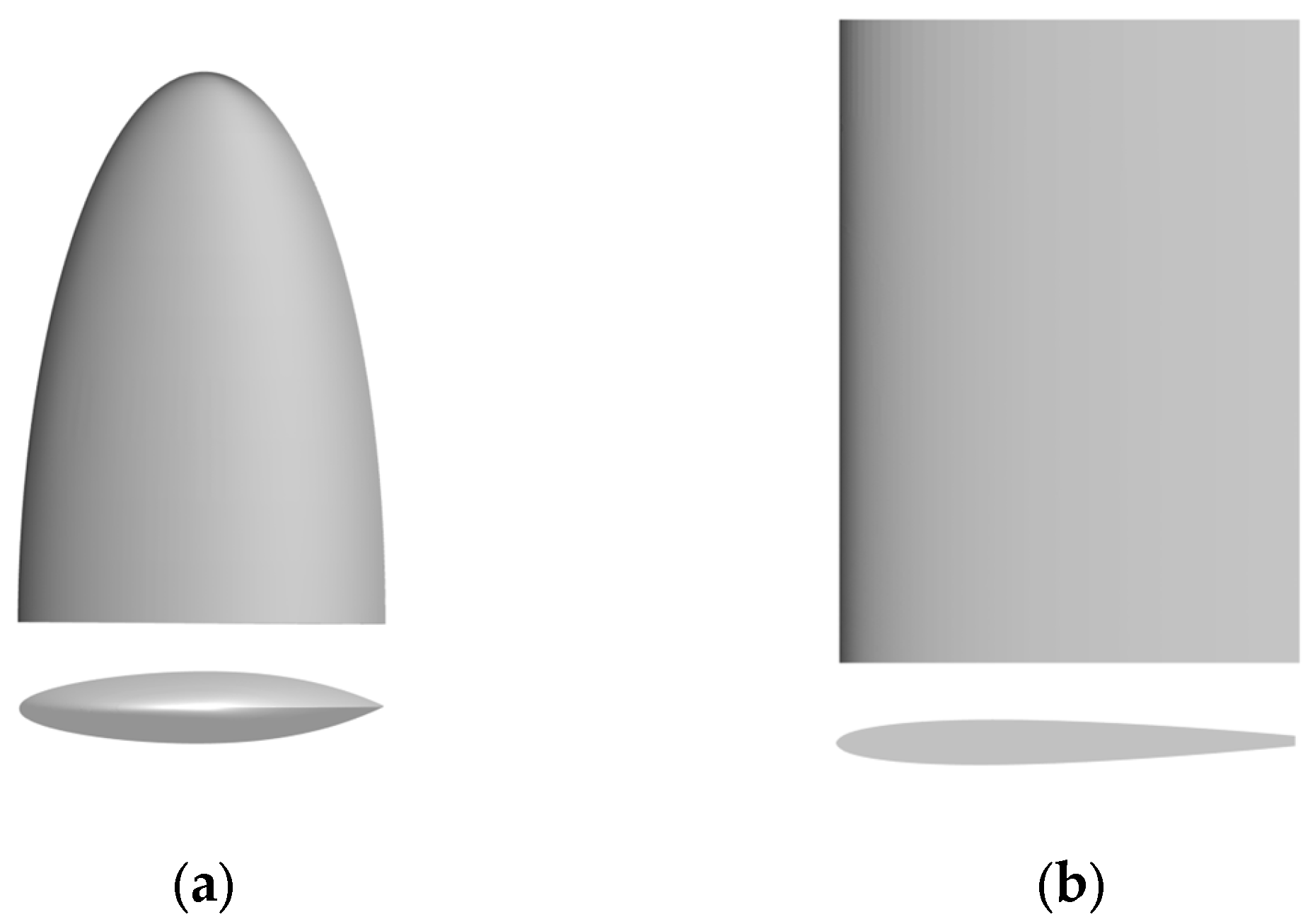
To investigate the cavitation patterns, three-dimensional wing models were employed.
Figure 1 shows the geometry of each wing.
Figure 1a illustrates an elliptic wing with a NACA 16-020 root section, while
Figure 1b presents a rectangular wing with a NACA 0009 root section. The dimensions of the wings were referenced from Dreyer’s experimental setup [
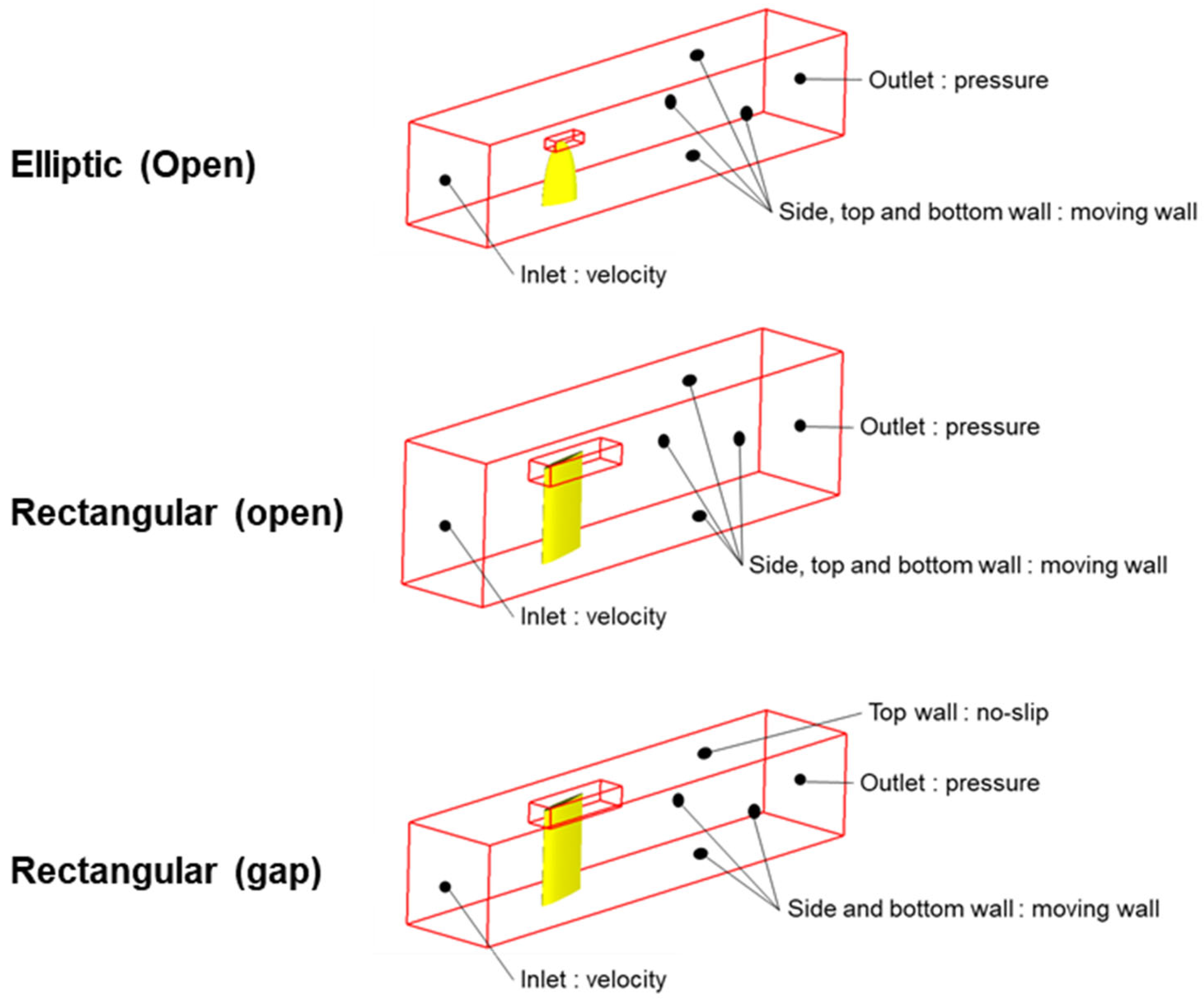
27]. The NACA 16-020 wing has an elliptic planform with a span of 90 mm and a root-chord length of 60 mm, whereas the NACA 0009 wing has a rectangular planform with a span of 1400 mm and a chord length of 100 mm. The computational domains are shown in
Figure 2. The dimensions of the domains in
Figure 2 were set to match those used in the experiment [
27], with a length of 750 mm and a height and width of 150 mm. The distance between the top wall and the wing tip is 60 mm for the open type, whereas it is 10 mm for the gap-type. Therefore, the upper two computational domains represent the open-type flow condition, and the lower computational domain represents the gap-type flow condition.
To examine the effect of the gap, the NACA 0009 wing was also placed in an extended domain, in which the height was increased by 60 mm. Since the boundary-layer thickness in the cavitation tunnel is less than 4 mm, its influence on the wing can be neglected. The Dreyer reported that, apart from the boundary layer, the streamwise velocity remains constant within 2% and fluctuations are uniform within 0.4%. Accordingly, the top and side walls were set as slip-wall boundaries. Because cavitation develops mainly around the tip region, the bottom wall was also assigned a slip condition. Although slip-wall conditions were applied to simplify the computational domain, their influence on the tip vortex dynamics and cavitation behavior is expected to be minimal due to the small boundary-layer thickness relative to the domain size. Therefore, the present boundary treatment is considered sufficient for capturing the dominant flow and cavitation features. The outlet boundary was defined as a pressure outlet with a static pressure of 1 bar. To satisfy the cavitation number corresponding to the experimental condition, the inlet velocity was specified as 10 m/s, calculated using the following expression for the cavitation number:
Here, denotes the absolute pressure at the outlet boundary, and represents the vapor pressure. The Reynolds number based on the chord length and inflow velocity is approximately 7.0 × 10⁵ for the elliptic wing and 1.2 × 10⁶ for the rectangular wing, indicating a fully turbulent flow regime. The coordinate origin was placed at the leading edge of the wing root, located 200 mm downstream from the inlet boundary. The angle of attack was set to 10°.
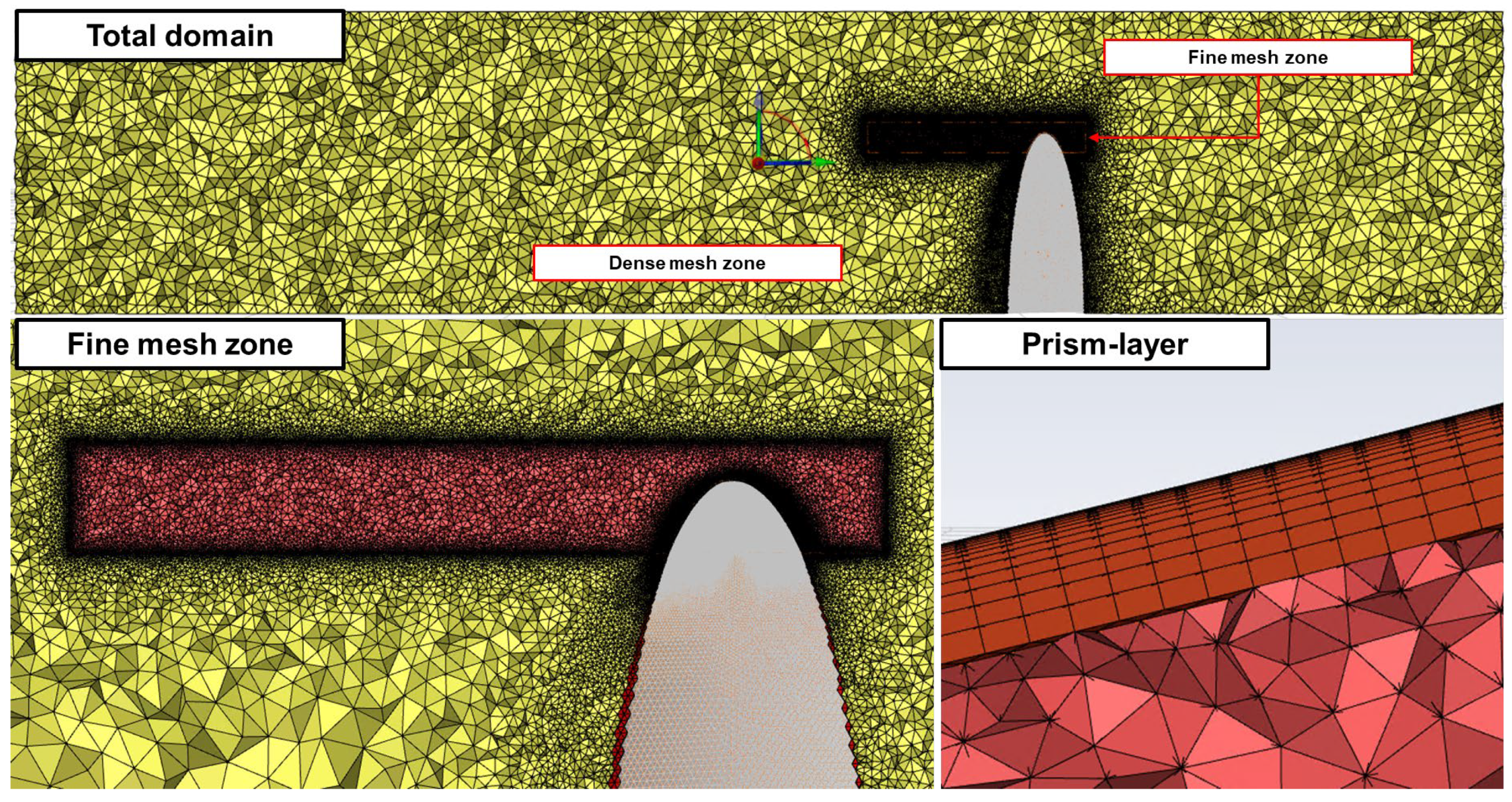
Figure 3 shows a sectional view of the computational mesh configuration. The domain is divided into two cell zones: one near the tip region, which is refined with a finer mesh, and another background zone with a coarser grid. A prismatic mesh layer was applied on the wing surface to accurately capture the boundary-layer flow. The first prism layer height was chosen to ensure a y+ value below 1, with a growth rate of 1.4. In total, 15 prism layers were generated along the wing surface. The tip vortex can be described by two radial regions. Within the inner region, the flow behaves as a forced (solid-body) vortex: pressure is lowest at the center, and the azimuthal velocity increases approximately linearly with radius. In the outer region, it behaves as a free (potential) vortex, where the tangential velocity is inversely proportional to the radial distance. The radial location separating these behaviors is defined as the vortex core radius. Because the vortex core has a very small radius, a large number of grid points are required to resolve it accurately, which makes the simulation of tip vortex cavitation computationally demanding.
To accurately predict tip vortex cavitation, it is essential to resolve the pressure distribution within the vortex core, since cavitation occurs when the local pressure in the vortex core falls below the vapor pressure. Therefore, the grid resolution in the tip vortex region was determined based on previous studies, which recommend resolving the vortex core with at least approximately 20 grid points to ensure accurate prediction of the pressure field [
11,
12]. The grid resolution in the tip vortex region was determined based on previous studies, which recommend resolving the vortex core with at least approximately 20 grid points to accurately predict the pressure distribution within the vortex core [
11,
12]. The vortex core radius of the NACA 16-020 elliptic wing was measured to be less than 1 mm, while that of the NACA 0009 gap-type wing was estimated to be less than 8 mm numerically. Resolving the vortex core with a uniform cell size of approximately 1/20 of the core radius in the fine-mesh region shown in
Figure 3 would lead to excessive computational cost. To address this issue, an Adaptive Mesh Refinement (AMR) technique was employed, enabling efficient resolution of the vortex core while maintaining sufficient accuracy for predicting cavitation-induced pressure fluctuations.
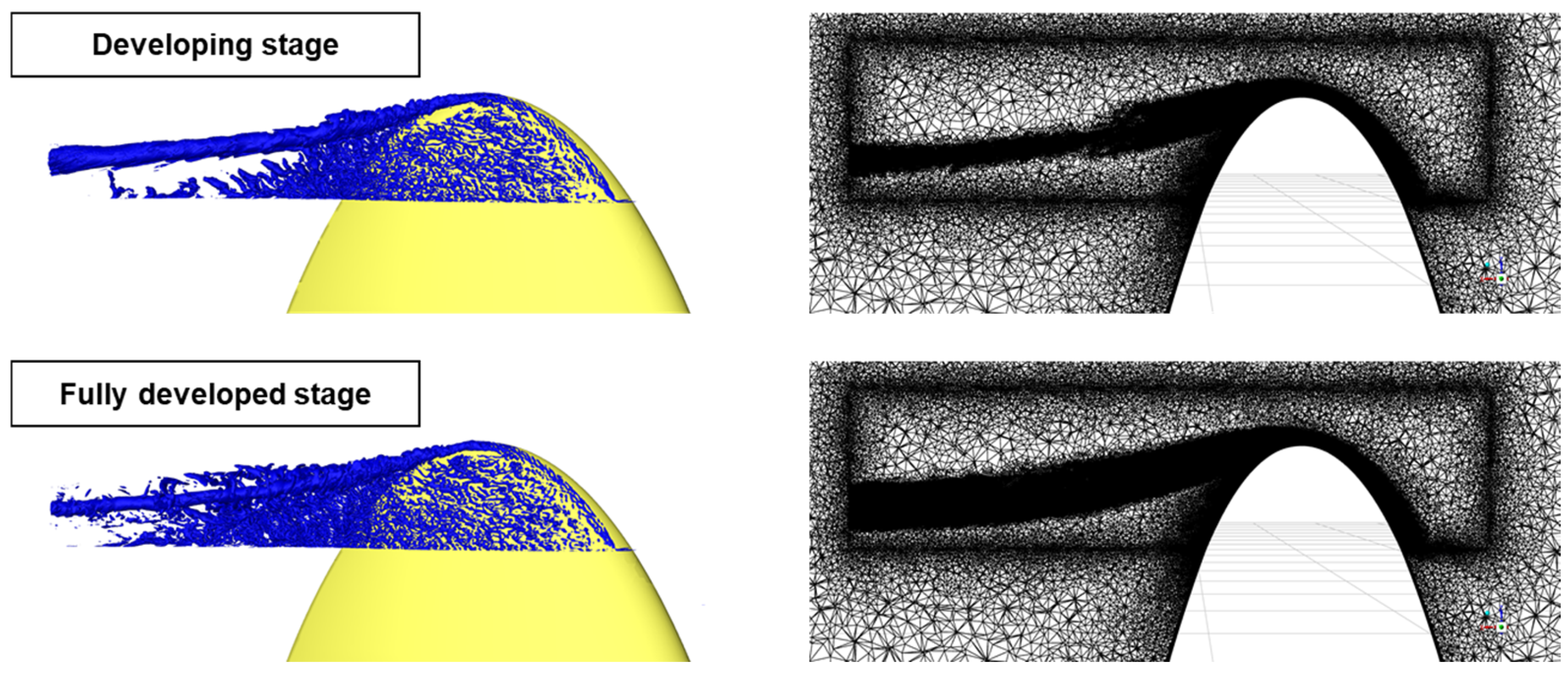
The AMR technique dynamically adjusts the local mesh resolution by refining cells based on a specified criterion, as illustrated in
Figure 4. Since tip vortex cavitation is closely related to the vortex structure, the Q-criterion or λ
2 criterion can be used to identify vortex regions [
29,
30,
31]. In this study, the Q-criterion was adopted because the λ
2 criterion typically detects a broader region, resulting in unnecessarily large refinement zones. The threshold value of the Q-criterion was set to 6.0 × 10
6 . The AMR procedure was applied only within the fine-mesh region containing the tip vortex, while the prism-layer mesh was excluded from refinement to maintain numerical stability. The maximum refinement level was set to three, resulting in a minimum cell size of 0.02 mm, corresponding to approximately 1/50 of the tip vortex core radius. The base grid size in the fine-mesh region was set to 0.25 mm (approximately 1/4 of the core radius) to ensure stable mesh quality. Therefore, AMR strategy satisfies the resolution criteria reported in previous studies and is considered sufficient to ensure mesh-independent prediction of the dominant cavitation dynamics.
Figure 5 shows the iso-contours of the Q-criterion, highlighting the refinement regions and the corresponding mesh distribution. As time progresses, the tip vortex intensifies, leading to the formation of secondary vortical structures around the main vortex. Accordingly, the region where AMR is applied expands with the evolution of the vortex structure.
2.3. Acoustic Modeling and Noise Prediction
The volume of vapor cavities oscillates owing to the complex turbulent fluctuations within the vortex core, producing broadband and intense underwater radiated noise (URN). To evaluate the resulting acoustic pressure at monitoring points, the Ffowcs Williams and Hawkings (FW-H) acoustic analogy was employed, expressed as follows:
The variables
,
and t denote the observer position, source position, and observer time, respectively. The term
represents the retarded time, defined as
, where
is the speed of sound in water and
is the distance between the noise source and observer. M
r denotes Mach number in radiation direction, defined as
. The first, second, and third terms on the right-hand side of Equation (14) correspond to the monopole, dipole, and quadrupole noise sources, respectively.
in the monopole term represents the source strength associated with volume variation,
in the dipole term denotes the unsteady pressure loading, and
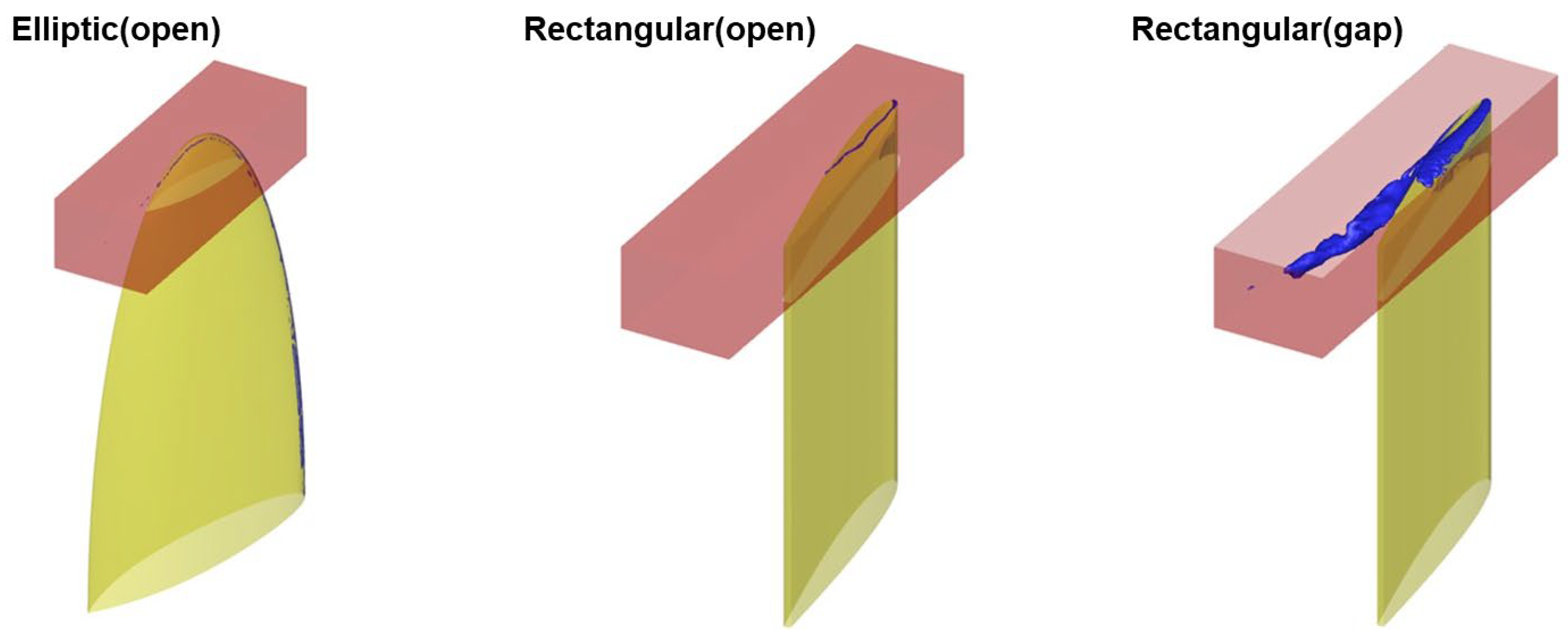
in the quadrupole term is the Lighthill stress tensor, which represents noise generated by turbulent fluctuations. The third term, corresponding to the quadrupole source, can be neglected when the Mach number (Ma) is sufficiently low. Since the sound speed in water is approximately 1500 m/s and the mean flow velocity in the present study is 10 m/s, the Mach number is about 0.01, and the acoustic analysis is carried out by considering the monopole and dipole terms. To evaluate Equation (14), surface integration must be performed over a control surface that encloses all relevant noise sources. In this study, a permeable integration surface was adopted to encompass the tip vortex cavitation (TVC) region, as shown in
Figure 6. This surface encloses the region where AMR is applied, ensuring that all cavitating structures associated with TVC, TSVC, and TLVC are fully captured. In addition, the surface is positioned as close as possible to the cavitating region to accurately represent the dominant unsteady flow features and to minimize numerical dissipation, which is inherently unphysical. This selection ensures that the primary acoustic source contributions are properly included in the FW-H integration, thereby improving the reliability of the predicted noise.
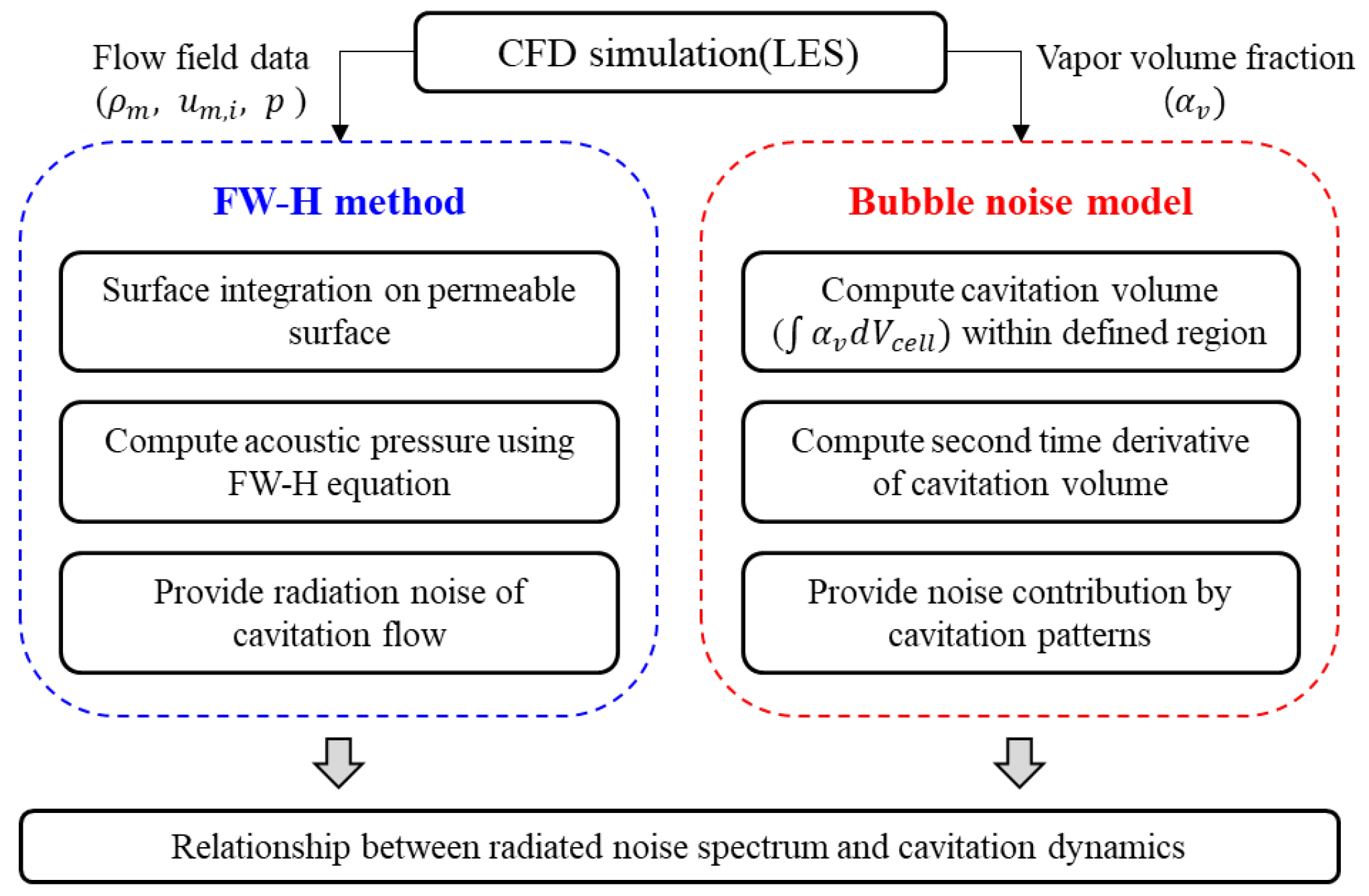
It was assumed that the dominant acoustic sources were located within this surface; therefore, the contribution of sheet cavitation outside the surface was not explicitly included in the acoustic source integration. The FW-H model computes the radiated noise based on flow variables such as density, velocity, and pressure. While it provides accurate prediction of the overall acoustic field, it does not directly relate the radiated noise to specific cavitation structures. Therefore, in the present study, both the FW-H method and the bubble noise model are applied to the same CFD dataset but serve different purposes. The FW-H method is used to predict the overall underwater radiated noise, whereas the bubble model is employed to analyze the contribution of specific cavitation structures by directly relating the acoustic emission to the temporal variation of cavitation volume.
For this reason, Fitzpatrick and Strasberg’s bubble noise model was employed. Fitzpatrick and Strasberg [
32] proposed a noise model for single-bubble oscillation, which relates the acoustic pressure to the temporal variation of bubble volume. In their formulation, the acoustic pressure is proportional to the second time derivative of the bubble volume, expressed as
Fitzpatrick and Strasberg assumed that each bubble is perfectly spherical and that its volume variation occurs only in the radial direction [
33,
34]. This model has shown good agreement with experimental data for URN generated by single, small bubbles [
12,
22]. In the present study, the cavitation noise was assumed to behave as a compact source, meaning that the monitoring points were located sufficiently far from the wing so that the cavitation region could be approximated as a single equivalent bubble. However, this model accounts only for acoustic sources associated with the temporal variation of cavitation volume and does not explicitly capture the effects of spatially distributed cavitation structures or other noise sources such as dipole and quadrupole contributions. The instantaneous bubble volume was calculated by multiplying the local cell volume by the vapor volume fraction. The integration region for computing the bubble volume was confined within the permeable surface illustrated in
Figure 6. The overall acoustic analysis procedure is summarized in
Figure 7. Both acoustic models are applied to the same CFD dataset, where the FW-H method predicts the radiated noise and the bubble model analyzes the contribution of specific cavitation structures.
Time-domain pressure signals were transformed to the frequency domain using a discrete Fourier transform (FFT). Each spectrum used 2000 samples with a time step 1/100,000 s, which sampling rate is 100 kHz, giving a frequency resolution of 50 Hz. A Hann (Hanning) window was applied prior to the transformation. Acoustic pressure at the monitoring location was corrected to a 1 m reference distance assuming spherical spreading, so the reported power spectral density corresponds to the level at 1 m. Cavitation noise was evaluated using both the Ffowcs Williams and Hawkings (FW-H) acoustic analogy and the bubble noise model. The proposed hybrid approach combining the FW-H method and the bubble noise model provides a complementary framework for cavitation noise analysis. While the FW-H method enables accurate prediction of radiated noise based on flow-field information, the bubble model allows for direct interpretation of noise generation mechanisms in relation to cavitation dynamics.
3. Numerical Results
3.1. Validation of Numerical Methods
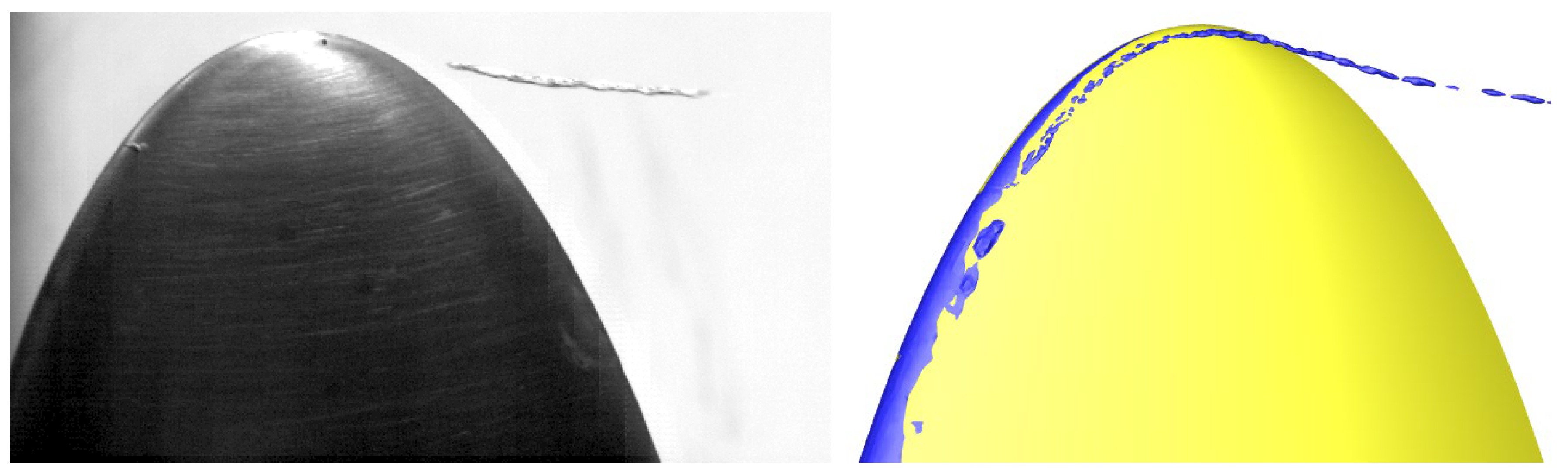
To verify the reliability of the numerical schemes for cavitation prediction, the simulated flow characteristics were compared with experimental observations.
Figure 8 compares the cavitation pattern obtained in the present simulation with that from the reference experiment. The simulation successfully reproduces the formation of tip vortex cavitation (TVC), in close agreement with the experiment [
29].
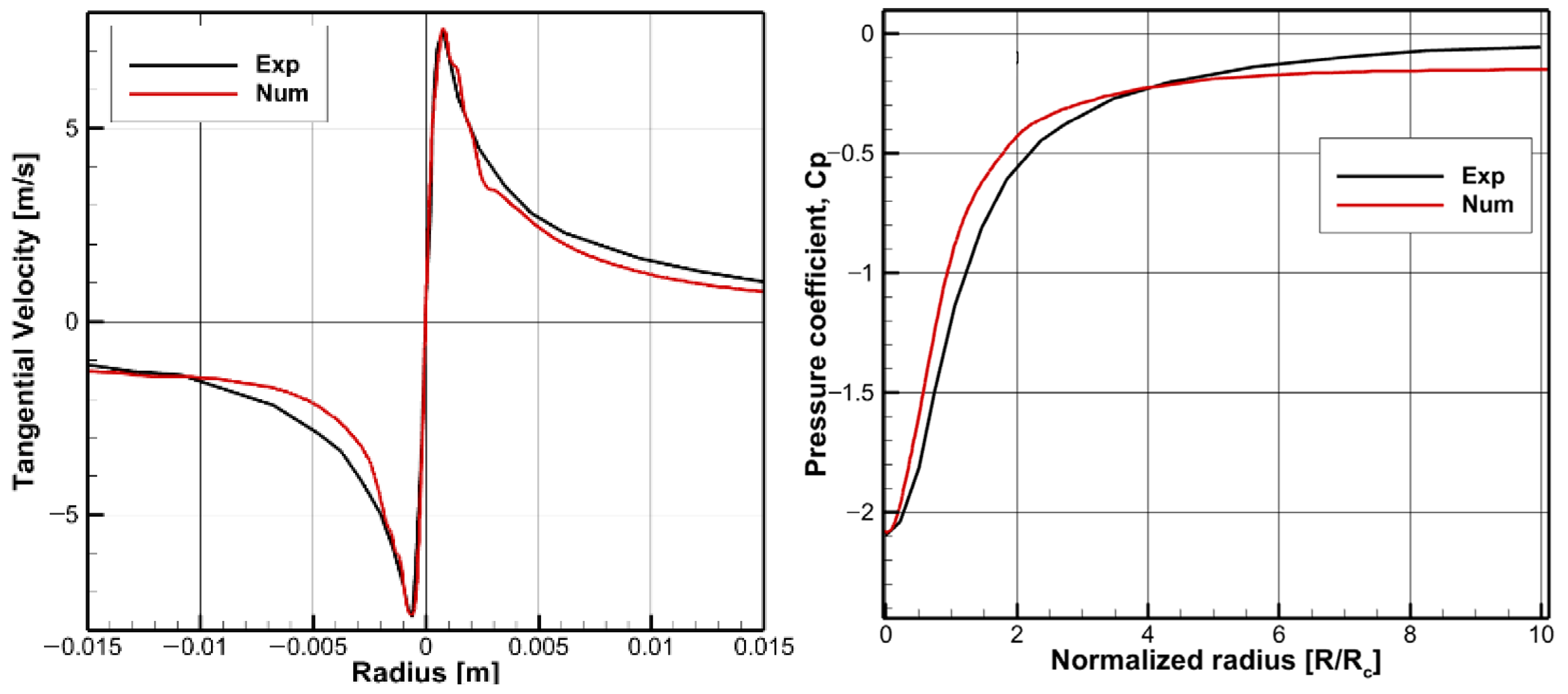
It is well known that the pressure distribution within the vortex core is strongly influenced by the circulation strength. For tip vortices, the azimuthal velocity and pressure in vortex core are key parameters. However, direct measurements of velocity and pressure within the vortex core are challenging due to its small spatial scale. Despite these difficulties, significant advances in experimental techniques have enabled detailed measurements in the tip vortex core region [
27,
35]. The experimental data obtained using such techniques are used for validation and are presented in
Figure 9.
Figure 9 compares the distributions of the computed tangential velocity and pressure coefficient along the line of x/C = 2.5 with the corresponding experimental measurements. The numerical results show good agreement with the experimental data, confirming that the present numerical approach accurately predicts the flow field for the elliptic(open) wing.
Figure 10 compares the cavitation pattern obtained from the numerical simulation for the gap-type NACA 0009 wing with the measured one. In the experiment, three distinct cavitation types were observed: sheet cavitation at the leading edge, Tip Leakage Vortex Cavitation (TLVC), and Tip Separation Vortex Cavitation (TSVC). All of these cavitation patterns were also successfully reproduced in the numerical simulation.
3.2. Cavitation Pattern and Vortex Structures
Because the lowest-pressure zones generally reside within vortex cores, cavitation patterns are intrinsically coupled to the underlying vortex structures. Hence, clarifying how these vortices form is crucial for interpreting the ensuing cavitation behavior.
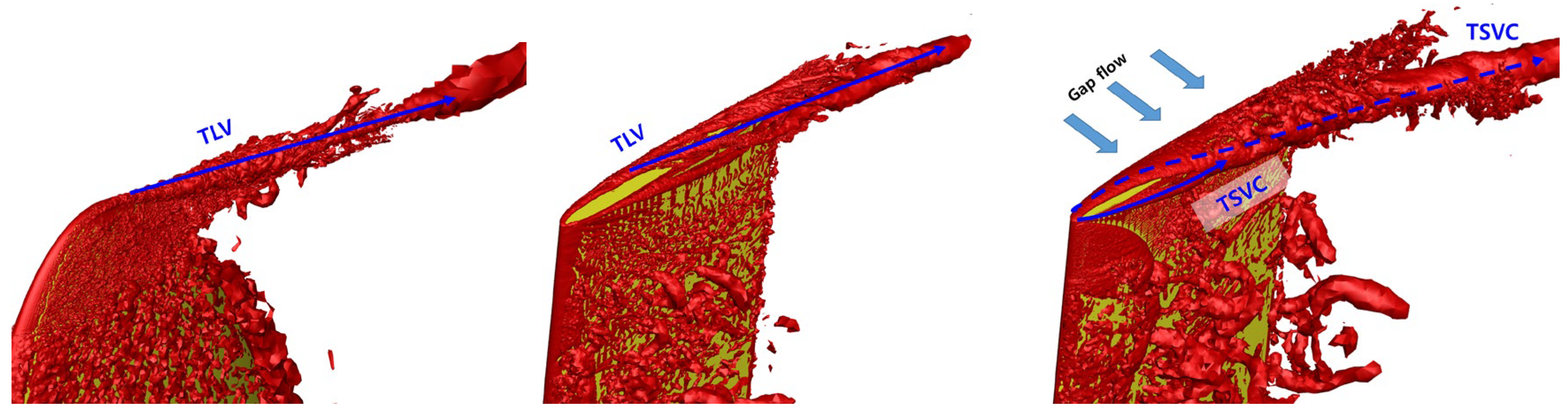
Figure 11 presents the iso-surfaces of the Q-criterion, a representative quantity used to visualize vortex structures. In
Figure 10, the elliptic wing exhibits a single tip vortex (TV) structure of which the strength is determined by the overall circulation around the foil. However, the rectangular wing—regardless of the presence of a gap—shows two distinct vortex structures. This difference arises primarily from the tip geometry. Due to the flat tip surface of the rectangular wing, a separation flow develops near the tip, generating an additional vortex that originates from the leading-edge region on the suction side.
For the rectangular(gap) wing, the overall vortex pattern appears similar to that of the rectangular(open) wing; however, the mechanisms differ because of the clearance between the tip and upper wall. In this case, the separation-induced vortex on the tip surface and the vortex induced by the clearance flow are clearly distinguishable and are referred to as the Tip Separation Vortex (TSV) and Tip Leakage Vortex (TLV), respectively. The TSV is formed by the separation flow over the tip plane, similar in origin to the tip vortex of the rectangular(open) wing. However, the presence of the upper wall prevents the flow from fully rolling up, and the fluid is instead drawn into the clearance at high velocity. When this high-speed flow exits the gap, it induces a secondary vortex on the suction-side tip—defined as the TLV.
As the flow proceeds toward the trailing edge, the TSV and TLV merge, forming a secondary wake and amplifying the overall vortex strength. Additionally, in the gap-type configuration, the clearance flow pushes the TSV toward the suction side of the wing, leading to the convergence of the two vortices around x/C = 0.3.
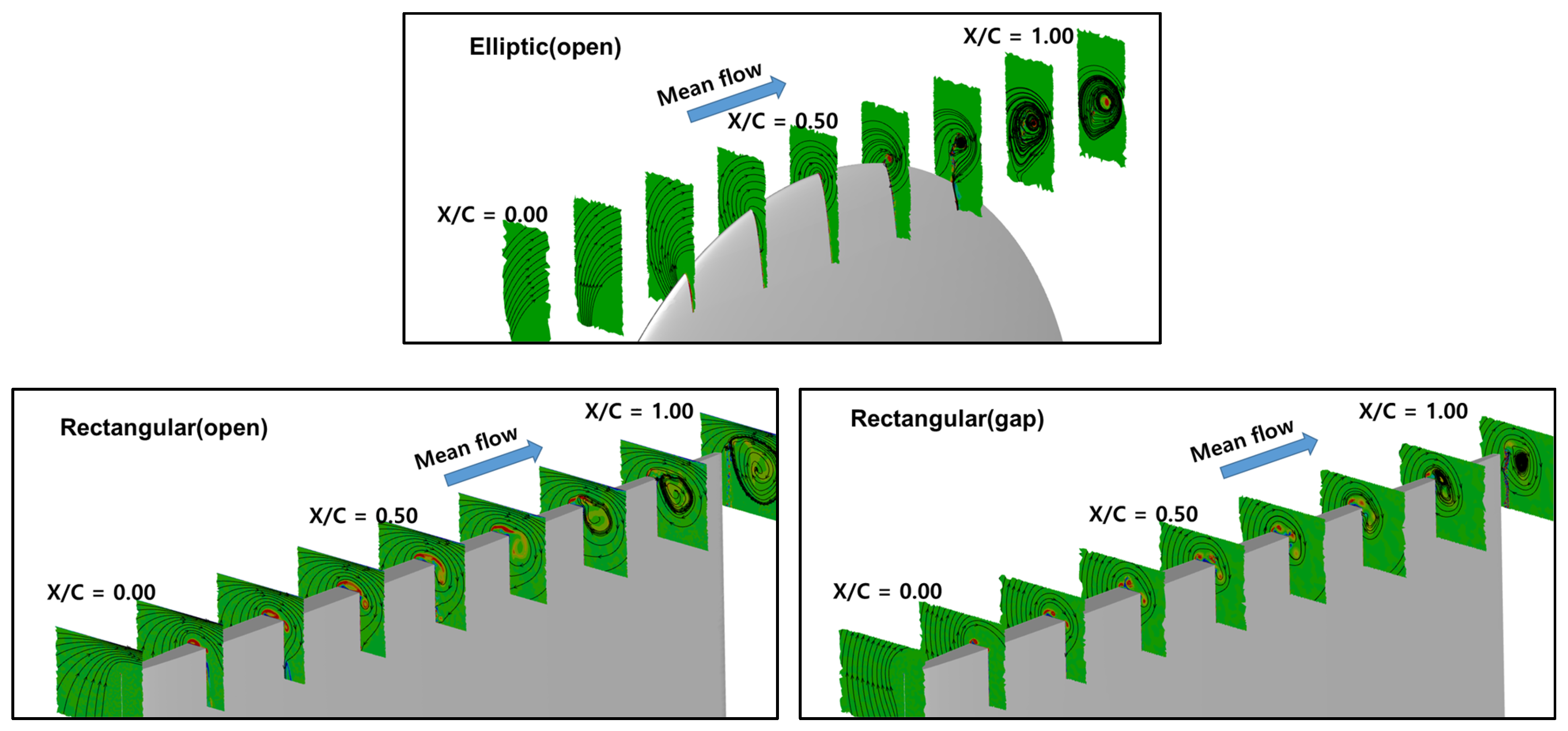
Figure 12 shows the pathlines near the foil tip together with the streamwise vorticity distribution, further clarifying the characteristics of the tip vortex flow. When the tip vortex develops, a strong rotational motion is evident for both the elliptic and rectangular(open) wings. For the rectangular(open) wing, circular pathlines appear near the tip plane, where the primary tip vortex (TV) is generated. As the rotating motion induced by the TV extends toward the suction side, a weak secondary vortex forms in its vicinity.
In contrast, for the rectangular(gap) wing, the presence of the upper wall restricts rotational motion, resulting in nearly planar pathlines. When the high-speed clearance flow exits the gap, its direction turns downward relative to the wing surface, behaving like a leakage jet emerging from the tip region. This mechanism explains why the Tip Leakage Vortex (TLV) in the gap-type configuration is stronger than the corresponding vortex in the open-type wing. Furthermore, the parallel flow within the clearance pushes the Tip Separation Vortex (TSV) toward the TLV, promoting their interaction and eventual merging around x/C ≈ 0.3.
These distinct vortex-structure characteristics directly affect the cavitation patterns observed for each wing type.
Figure 13 compares the resulting cavitation distributions. For the elliptic wing, a single tip vortex cavitation (TVC) is observed. In contrast, both Tip Separation Vortex Cavitation (TSVC) and Tip Leakage Vortex Cavitation (TLVC) appear in the rectangular(gap) wing. After the TLVC and TSVC merge, a relatively large cavitation region is formed. For the rectangular(open) wing, cavitation occurs primarily due to the TV, as the secondary vortex remains weak—consistent with the flow behavior shown in
Figure 12.
3.3. Cavitation Noise Characteristics
In marine propellers for ships and submarines, cavitation is a critical performance factor because it generates significant underwater radiated noise (URN). Duct-type propellers are widely adopted in low-noise propeller designs, as the duct helps increase static pressure and suppress cavitation. To develop the detailed low-noise design, however, it is essential to understand the cavitation noise generation mechanism for both traditional open-type and ducted configurations. The present study serves as a fundamental investigation toward this objective.
The previous section discussed the differences in cavitation patterns among the three wing configurations. To understand the noise generation mechanism due to these cavitation flows, it is necessary to quantitatively evaluate the contribution of these TVCs to the URN. The hybrid computational flow acoustic technique is employed as described in Equation (14). As depicted in
Figure 6, the permeable integration surface was positioned around the tip vortex Cavitating region to focus the acoustic analysis on the noise associated with tip vortex cavitation, while minimizing the influence of sheet cavitation.
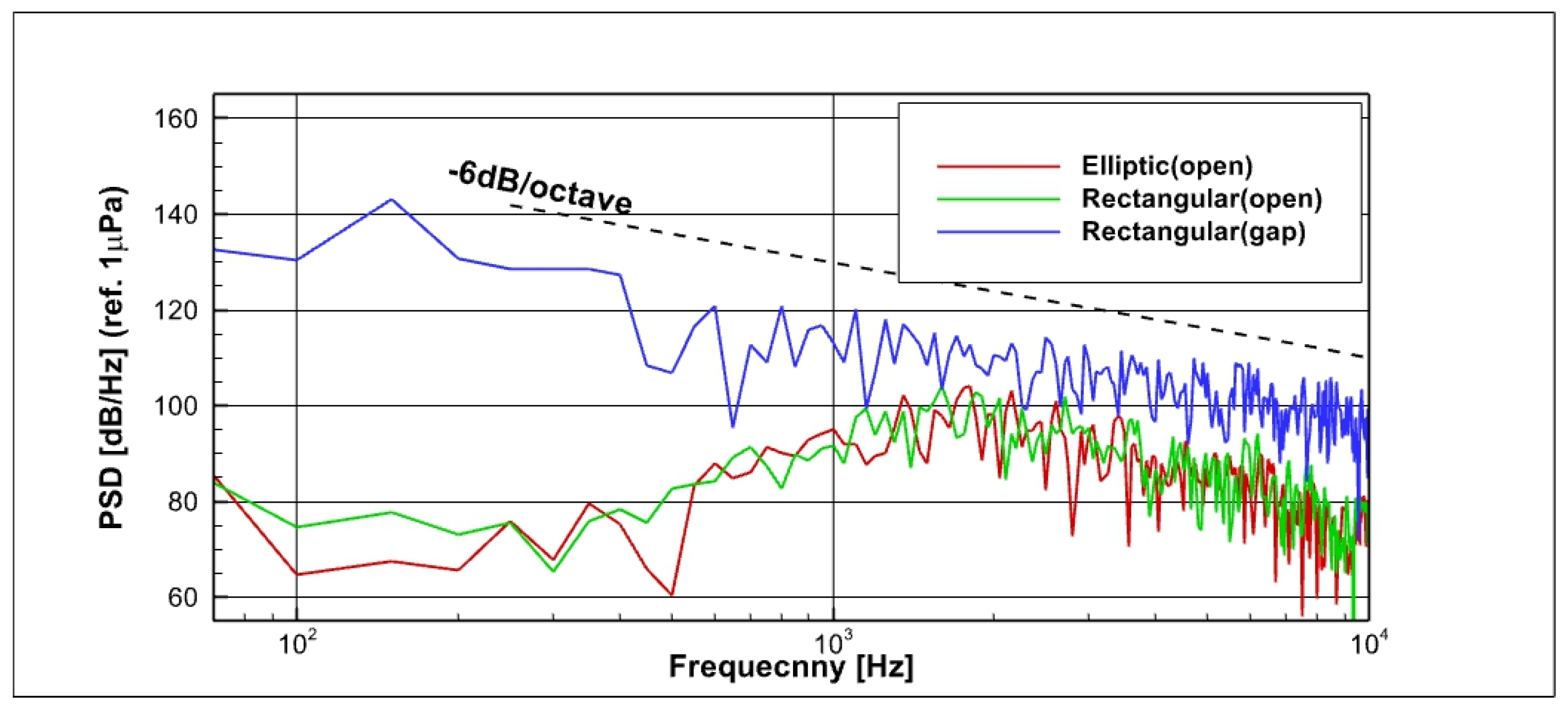
Figure 14 presents the URN spectra computed using the Ffowcs Williams and Hawkings (FW-H) integral formulation for all three wing configurations. It should be noted that direct validation of the predicted noise spectra against experimental measurements is not available in the present study. Therefore, the acoustic predictions are evaluated based on general spectral trends and consistency with previously reported numerical and experimental studies on cavitation noise. The overall noise level decreases with increasing frequency at a rate of approximately −6 dB per octave in the high-frequency region, which is consistent with the characteristic acoustic behavior of cavitating flows [
36]. The computed results follow this trend, supporting the physical consistency of the numerical acoustic predictions.
At lower frequencies, however, the rectangular(gap) wing produces a noticeably higher noise level. In particular, a distinct harmonic peak appears around 150 Hz, indicating the presence of a periodic cavitation source. This behavior is attributed to the higher lift generated by the gap-type wing, which is approximately 30% greater than that of the open-type wing, as shown in
Table 2. The increase in lift suggests that, for a given thrust requirement, the propeller may operate at a lower rotational speed.
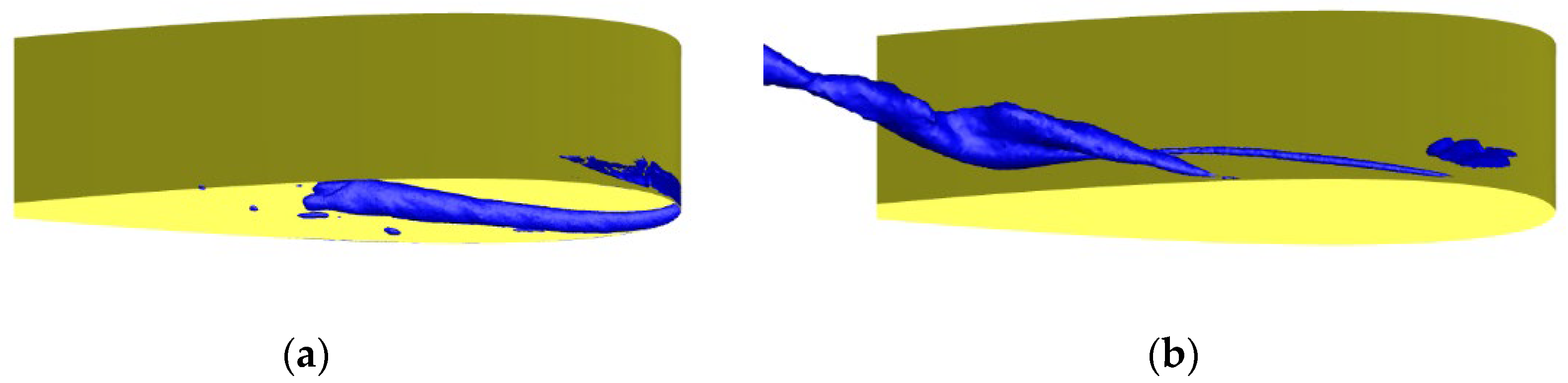
To examine the origin of this harmonic component, the Tip Separation Vortex Cavitation (TSVC) and Tip Leakage Vortex Cavitation (TLVC) regions were isolated, and the corresponding noise levels were computed separately using the bubble-based noise model described in Equation (15). Since both cavitation structures exhibit similar turbulent characteristics and are strongly coupled, it is difficult to strictly distinguish TSVC and TLVC based solely on flow properties. Therefore, the classification was performed based on their spatial origin and physical formation mechanisms. Specifically, cavitation associated with the flow separated from the pressure side and convected into the gap region was defined as TSVC, whereas cavitation induced by the leakage flow from the gap and transported toward the suction side was classified as TLVC.
Figure 15 illustrates this division, where
Figure 15a corresponds to the TSVC region, and
Figure 15b represents the TLVC region along with the merged area of both vortices.
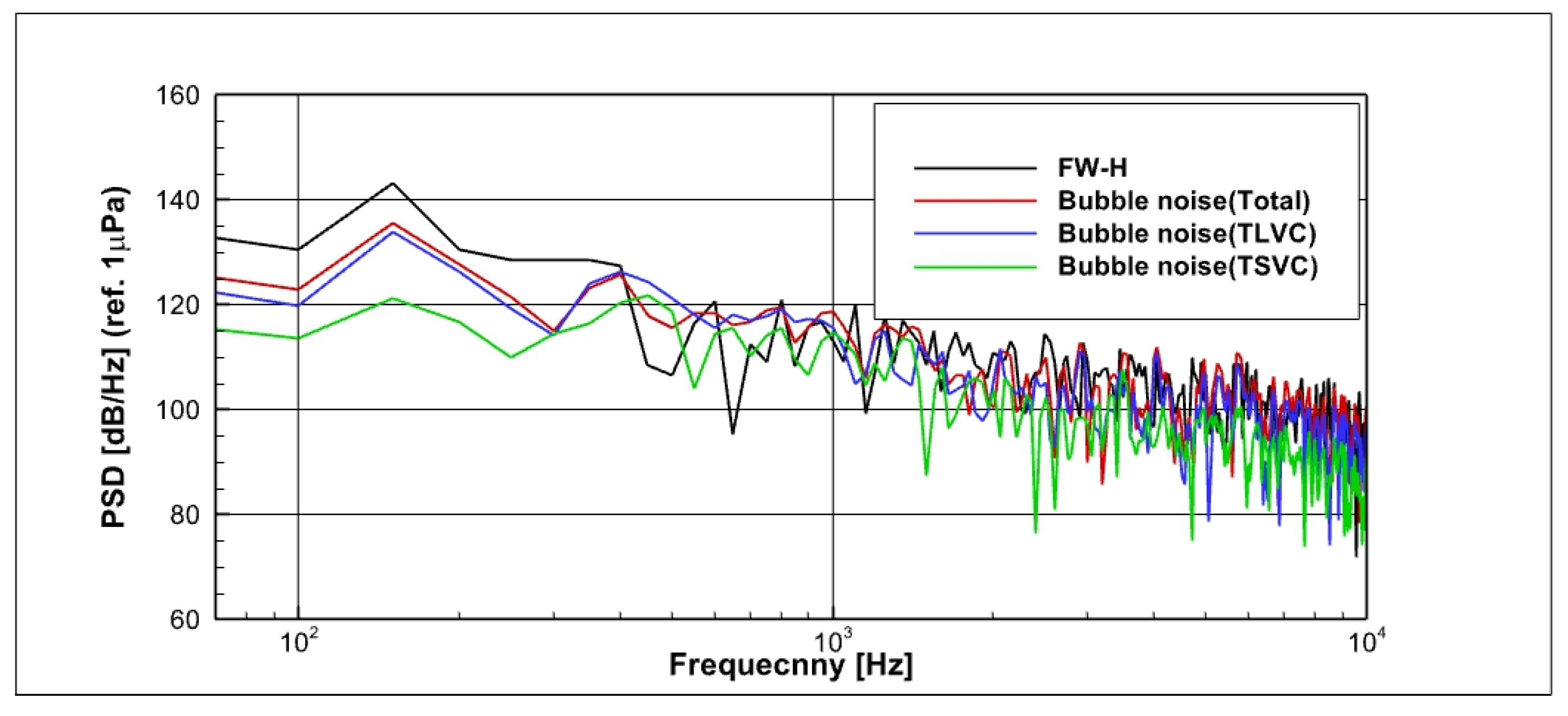
Figure 16 shows the power spectral densities of URN predicted using Equation (15). Additionally, the FW-H results were compared with those obtained using Equation (15). Good agreement between the FW-H method and the bubble noise model is observed in the high-frequency range. However, in the low-frequency range, the FW-H results exhibit higher PSD levels than those predicted by the bubble noise model. This discrepancy arises because the bubble noise model considers only the monopole source associated with the temporal variation of cavitation volume, whereas the FW-H formulation includes not only monopole sources but also dipole and quadrupole contributions. Despite this difference, the bubble noise model shows consistent trends compared to the FW-H results, indicating that it can effectively capture the fundamental mechanisms of cavitation noise generation.
Both TSVC and TLVC contribute comparably to the high-frequency broadband noise. However, at 150 Hz, the TLVC radiates significantly stronger noise, approximately 15 dB/Hz higher than the TSVC. This result indicates that the periodic interaction and collapse of TLVC structures dominate the low-frequency harmonic noise generation in the gap-type wing.
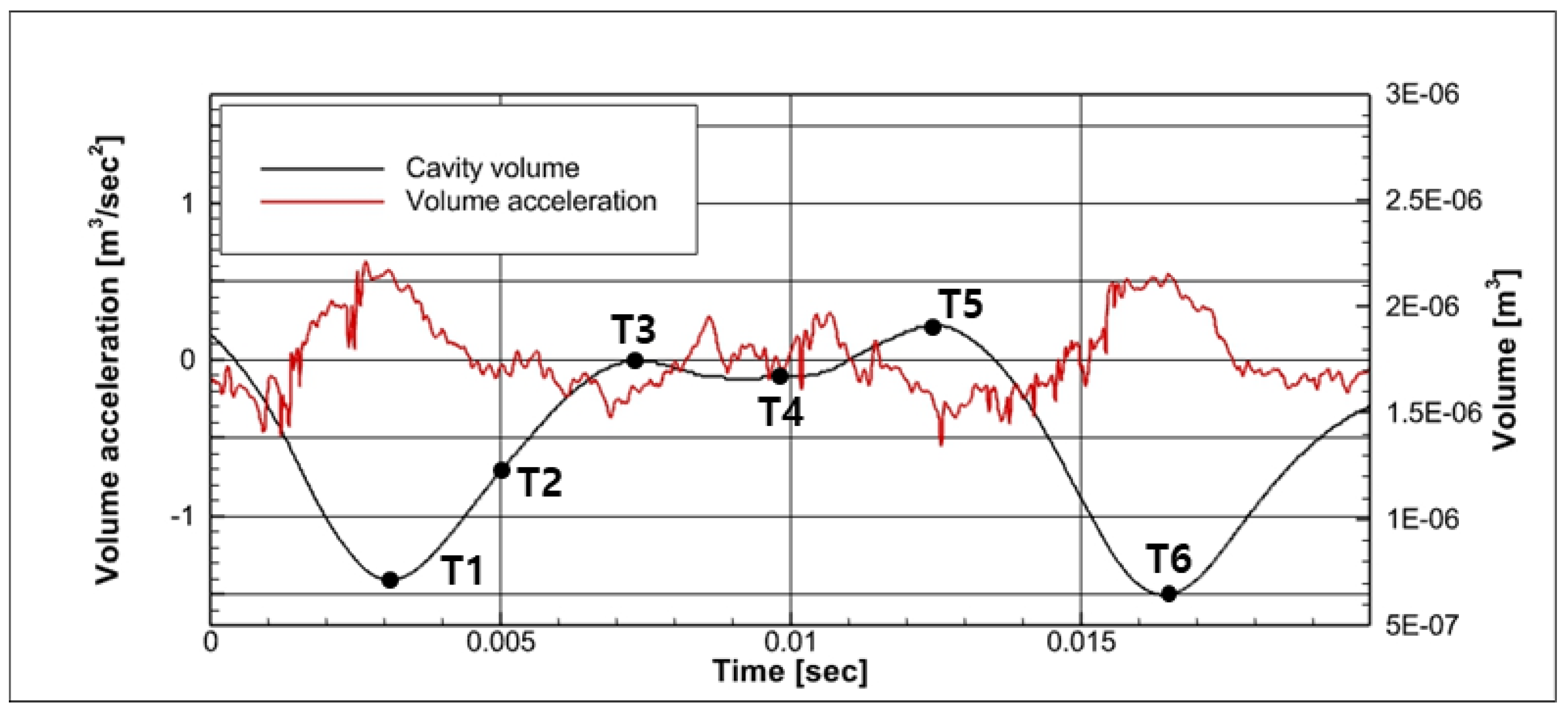
To investigate the behavior of the Tip Leakage Vortex Cavitation (TLVC) and Tip Separation Vortex Cavitation (TSVC) at 150 Hz, the time-varying cavitation signal and corresponding flow patterns are shown in
Figure 17. The black dotted line represents the total vapor volume of the TLVC and TSVC, referenced to the left vertical axis. The red line indicates the acceleration of the cavitation volume, obtained by differentiating the black-line signal, while the blue line corresponds to the harmonic component of the volume acceleration at 150 Hz. The period pattern of the time-varying tip vortex cavitation volume can be clearly identified.
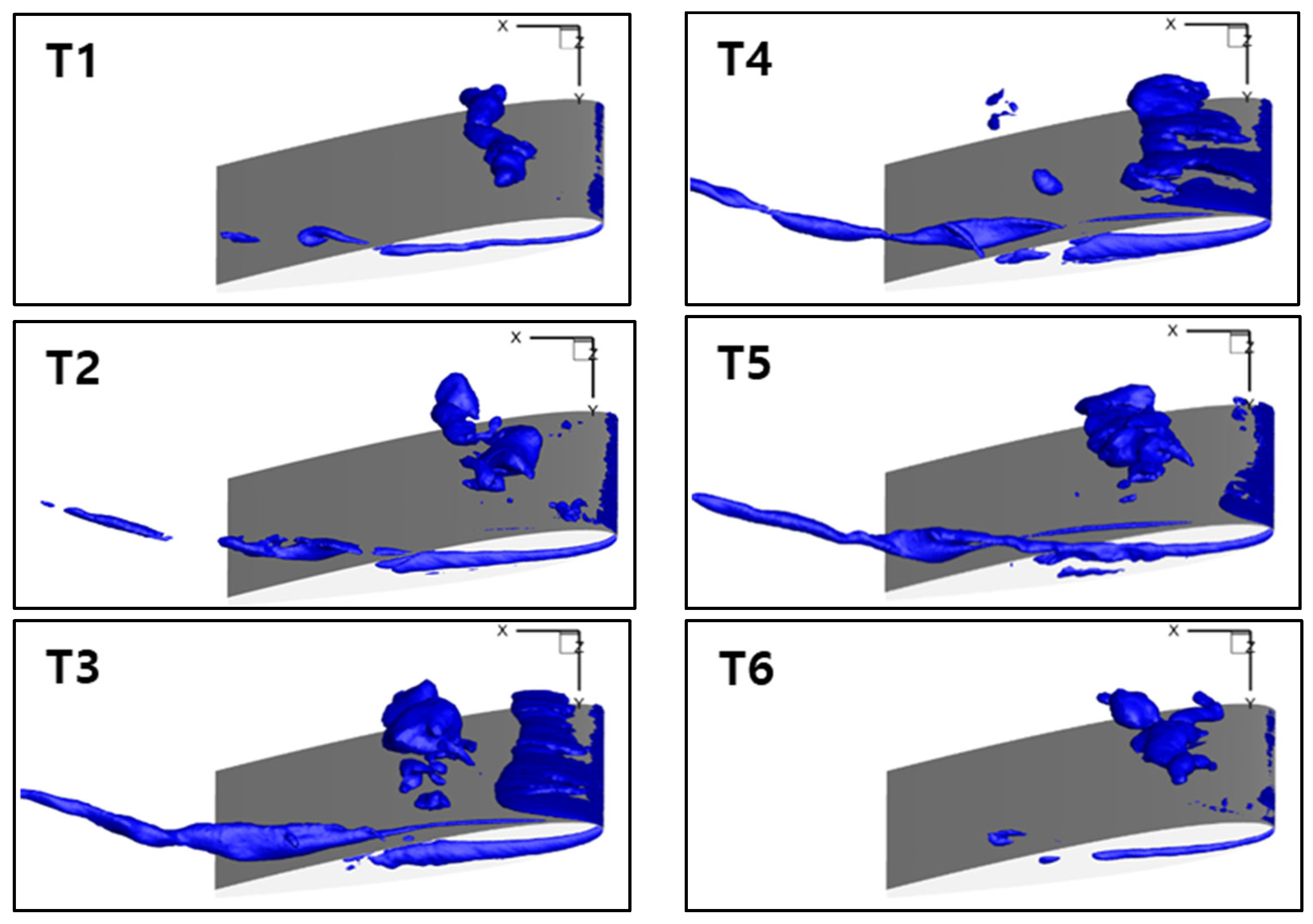
Figure 18 presents snapshots of cavitation patterns at six representative time instants (T1–T6) during one oscillation cycle. At T1, the cavitation volume reaches its minimum. As time progresses to T2, the TSVC develops and moves toward the TLVC region. At T3, the developed TSVC merges with the TLVC, resulting in a rapid increase in TLVC cavitation volume and a corresponding intensification of its strength. As time advances further, the developed TLVC convects downstream and its volume decreases, as shown at T4. At this stage, the TSVC begins to weaken, leading to a shortening of the newly generated TLVC near the leading edge. However, the rapid development and subsequent collapse induce a rebound in cavitation volume, causing it to increase again, as shown at T5 [
12,
37]. Finally, as both TLVC and TSVC diminish in strength, no additional vapor is supplied to the downstream TLVC region. Consequently, the cavitation volume continues to decrease until it reaches its minimum again at T6.
Not only the periodic growth and collapse of the cavitation volume but the rebound also repeats at a frequency of approximately 150 Hz, corresponding to the dominant harmonic component observed in the URN spectrum.
3.4. Gap Size Effects on Cavitation Noise
The effects of gap size on cavitation patterns and cavitation-induced noise are investigated in this section.
Figure 19 shows the instantaneous cavitation patterns for gap sizes of 5 mm, 10 mm, and 20 mm. The clearance at the wing tip generates a jet-like gap flow, which enhances the formation of the Tip Separation Vortex Cavitation (TSVC). For the smallest gap size of 5 mm, a strong clearance jet develops, producing a relatively large TSVC. This promotes intense interaction between the TSVC and the Tip Leakage Vortex Cavitation (TLVC), resulting in a strengthened TLVC structure around x/C ≈ 0.5.
As the gap size increases, the momentum of the clearance flow is reduced, leading to a decrease in TSVC volume and a corresponding weakening of the TLVC. When the gap size reaches 20 mm, the TSVC exhibits a morphology similar to that of the open-type wing, and no significant interaction with the TLVC is observed, as shown in right side of
Figure 19. This indicates that the gap-induced vortex interaction mechanism is largely suppressed at large gap sizes.
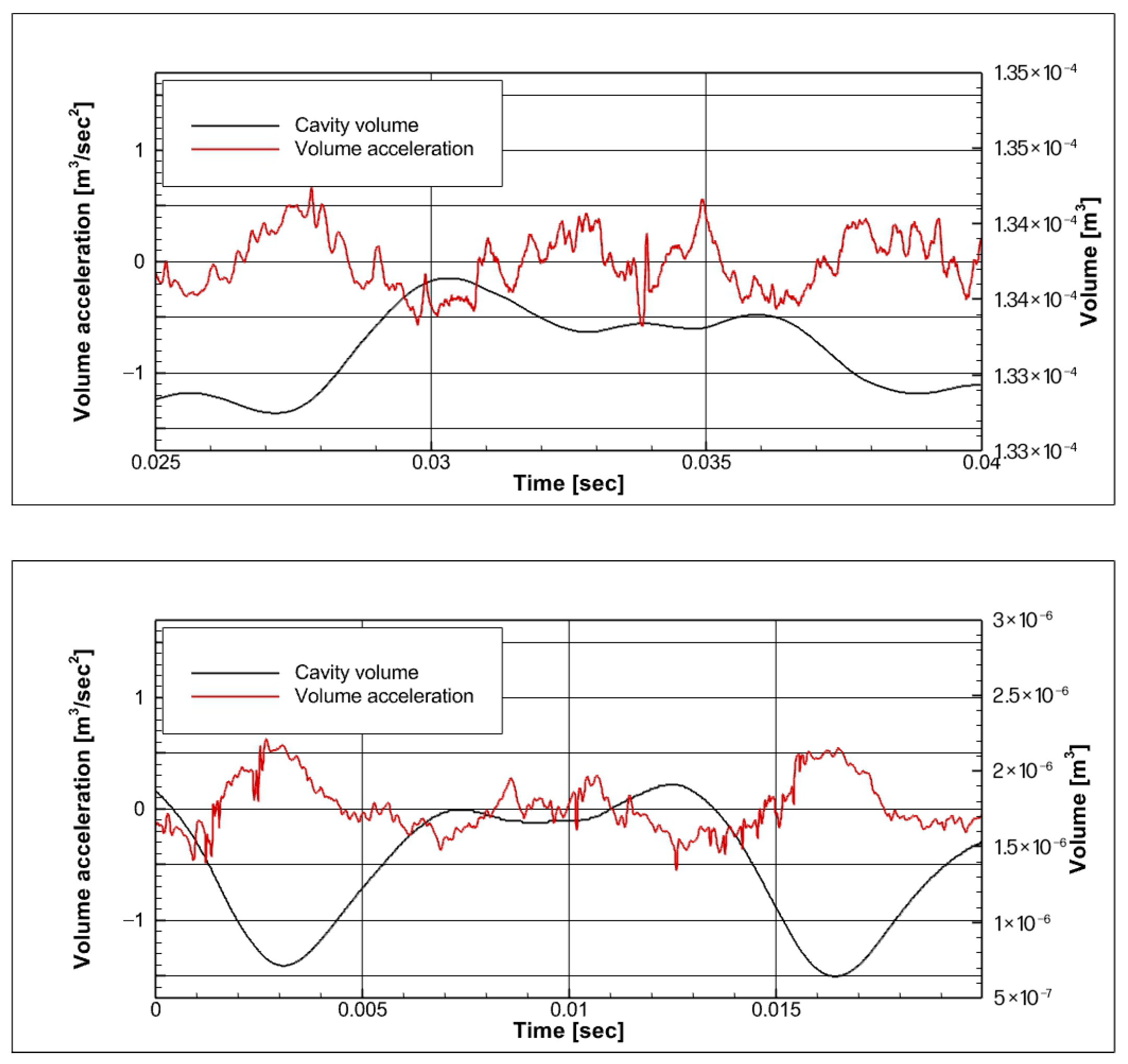
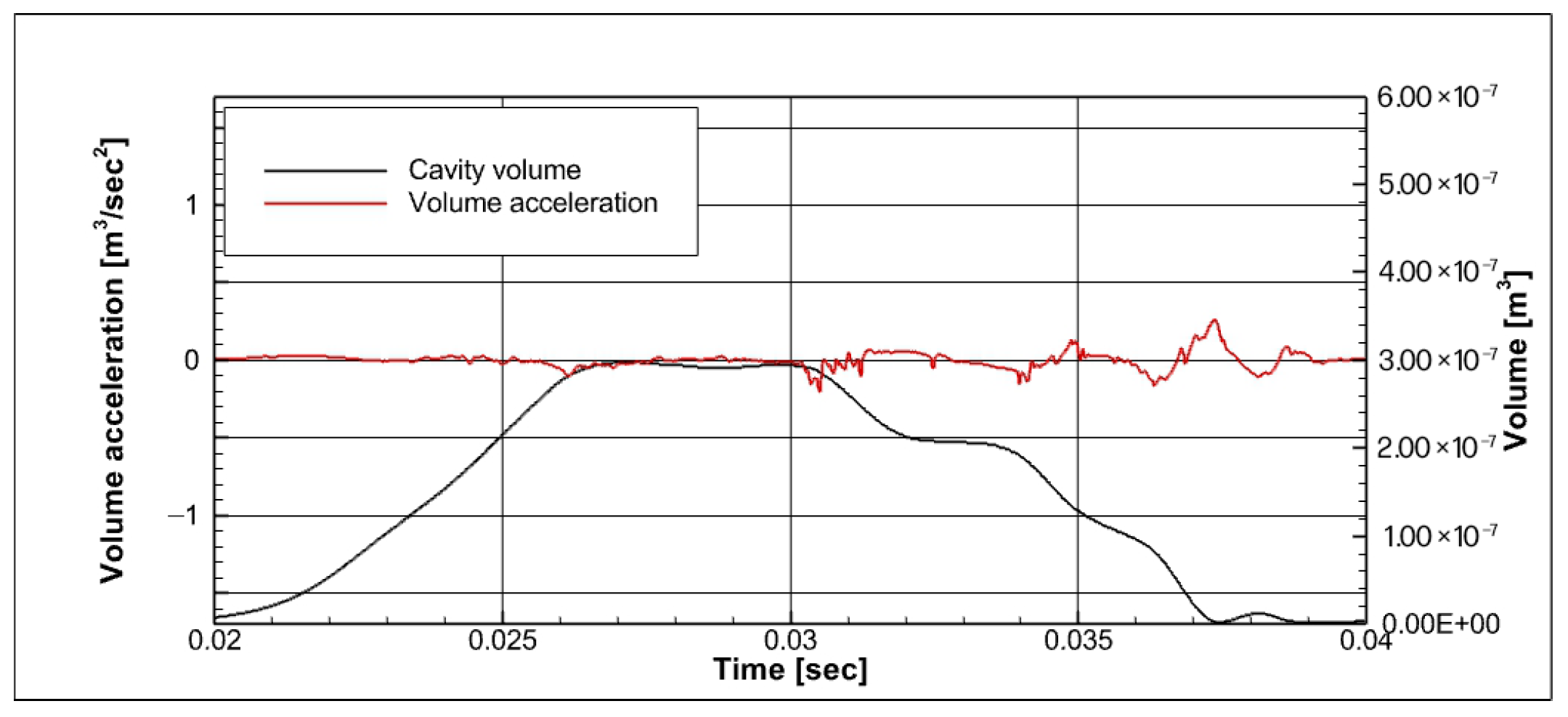
Figure 20 presents the time histories of cavitation volume and its acceleration for different gap sizes. For gap sizes of 5 mm and 10 mm, the cavitation volume undergoes a distinct sequence of development, rebound, and collapse. During this process, two pronounced peaks appear in the cavitation volume acceleration within a single cavitation cycle. These high-amplitude acceleration events correspond to impulsive volumetric changes and are associated with dominant noise radiation in the low-frequency range. As discussed in the previous section, this behavior is a characteristic feature of gap-type wings and originates from the strong interaction between the TSVC and TLVC. The acceleration signal for the 10 mm gap exhibits a similar trend to that of the 5 mm gap, although with reduced amplitude.
In contrast, when the gap size is 20 mm, the cavitation volume evolves in a nearly monotonic manner, exhibiting only growth and collapse without a rebound phase. The corresponding acceleration signal is significantly weakened and broadband in nature, indicating the absence of dominant impulsive noise sources. This behavior reflects the diminished clearance-flow strength, which suppresses vortex interaction and fundamentally alters the cavitation-noise generation mechanism. This observation also implies that cavitation dynamics, and consequently the associated noise generation, may be influenced by controlling key flow parameters. In this regard, geometric or flow modifications that weaken vortex interaction could provide a potential pathway for mitigating cavitation-induced noise, as also suggested in studies on hydrodynamic cavitation control [
38].
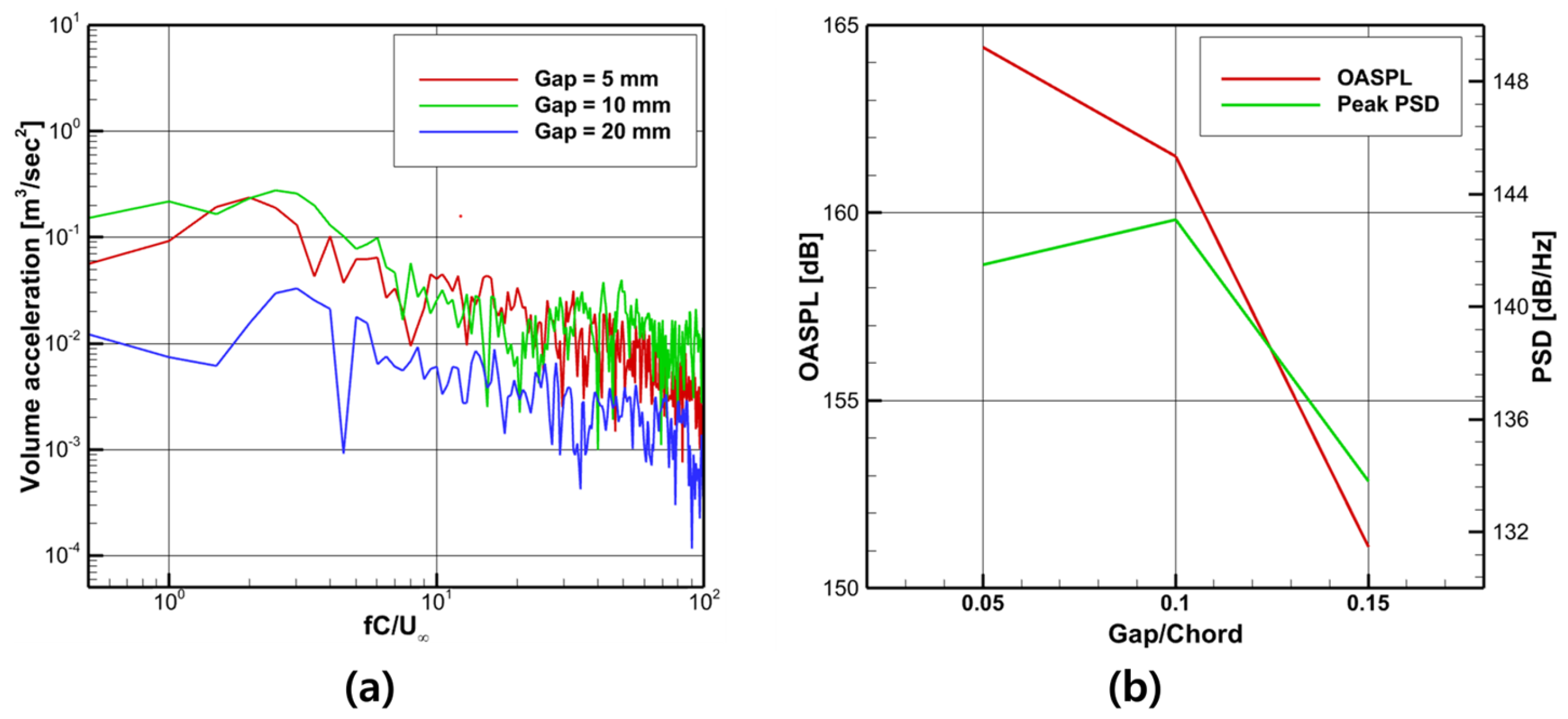
Figure 21a shows the spectra of cavitation volume acceleration as a function of the Strouhal number, where the chord length and mean inflow velocity are used as the reference length and velocity, respectively. For gap sizes of 5 mm and 10 mm, a pronounced spectral peak appears around St ≈ 2, corresponding to the dominant low-frequency cavitation noise induced by gap-related vortex interactions [
36]. However, this spectral feature disappears for the 20 mm gap, confirming the transition to a different noise generation mechanism. These results clearly demonstrate that gap size plays a critical role in determining cavitation patterns and the resulting underwater radiated noise characteristics.
Figure 21b presents the variation of OASPL and PSD at peak frequency. Since tonal peak contributes significantly to the overall sound pressure level, both quantities exhibit similar trends. As the gap size increases to 20 mm, the amplitude of peak decreases, accompanied by a reduction in OASPL. These results indicate that the transition associated with the gap effect occurs at a gap-to-chord ratio of approximately 0.1–0.15.
4. Conclusions
In this study, the effects of tip clearance on cavitation and its associated noise were investigated using CFD- and CAA-based numerical approaches. Cavitating flow fields were computed using Large Eddy Simulation (LES) with the WALE subgrid-scale model, while acoustic radiation was predicted using the Ffowcs Williams and Hawkings (FW-H) formulation. Furthermore, to investigate the correleation between noise radiation and cavitation noise patterns, a bubble noise model was employed.
The results show that high-speed flow through the gap pushes the Tip Separation Vortex cavitation (TSVC) toward the Tip Leakage Vortex Cavitation (TLVC), leading to strong vortex interaction. In contrast, the open-type wing generates a single tip vortex cavitation (TVC). The acoustic analysis reveals that both configurations exhibit similar broadband characteristics in the high-frequency range, with a decay rate of approximately −6 dB per octave, while the gap-type wing produces distinct tonal noise at low frequencies. The dominant tonal component is observed at approximately St ≈ 2, and a transition in cavitation behavior is identified at a gap-to-chord ratio of g/c ≈ 0.1–0.15. This tonal noise is attributed to the periodic interaction between TLVC and TSVC, which induces periodic behavior of cavitation volume. This resulting oscillations in cavitation volume acceleration act as the primary source of low-frequency noise.
From a design perspective, the results suggest that intermediate gap sizes (gap/chord ≈ 0.1–0.15) should be avoided, as they promote strong vortex interaction and tonal noise generation. Instead, geometric modifications of the blade or tip region that weaken TLVC-TSVC interaction may help break up large-scale cavitation structures into smaller, less coherent structures, thereby reducing peak noise levels while maintaining lift performance.
However, several limitations should be noted. The present results are obtained from stationary wing configurations, and further investigation incorporating rotational effects and realistic propeller geometries is required. In addition, the cavitation model assumes constant bulk viscosity, which may influence the prediction of pressure fluctuations. Discrepancies observed in specific frequency components also indicate the need for further validation and model refinement. Future work will focus on extending the present approach to rotating propeller configurations and validating the predicted acoustic characteristics against experimental measurements.
Despite these limitations, the present methodology provides a useful framework for linking cavitation dynamics with acoustic emission and can be applied to the analysis and preliminary design of low-noise marine propulsors.