Article

Broadband Dielectric Properties of Glycerol–Water Mixtures with Salt Additives

by
Moaz M. Altarawneh
Department of Physics, Faculty of Science, Mutah University, Alkarak 61710, Jordan
Appl. Sci. 2026, 16(8), 3661; https://doi.org/10.3390/app16083661
Submission received: 2 February 2026 / Revised: 20 March 2026 / Accepted: 1 April 2026 / Published: 9 April 2026

Abstract

In the current study, the dielectric behavior of ternary mixtures composed of glycerol and water with various salt additives is investigated over a frequency range that extends from 0.5 to 20 GHz and at temperatures between 5 and 55 °C. The investigated mixtures consisted of glycerol and water with glycerol volume ratios of 20%, 40%, and 60%. To explore the salt addition’s effect on the dielectric properties, different moderate ionic strengths of glycerol–water mixtures were prepared with NaCl concentrations of 0.10, 0.20, and 0.30 M for the same glycerol volume ratios. The ion-specific effects on the dielectric properties were investigated for prepared mixtures with a 0.10 M concentration of Na2SO3, NaNO3, and KCl for the 20% glycerol ratio to explore ions with different charge density and hydration tendencies. Using dielectric spectroscopy, the frequency dependence of the real ( ε ) and imaginary ( ε ) dielectric constants was measured, and the associated dielectric parameters were extracted using the Cole–Cole model. This study shows that increasing the salt concentration results in a slight decrease in ε while ε increases dramatically, especially at lower frequencies, due to enhanced DC conductivity. An isopermittivity behavior is observed in ε as the temperature changes across all mixtures, and it is found to be insensitive to the addition of salt, indicating that it is mainly dictated by the glycerol–water dipolar relaxation network. Among the tested mixtures is the 20% glycerol mixture with 0.10 M KCl, which exhibits the highest ε value in the low-frequency range, attributed to its relatively high DC conductivity. Additionally, the dielectric properties of mixtures with higher glycerol ratios are found to be less sensitive to the addition of salt due to their high viscosity and the higher structured solvent network, which collectively limit ionic mobility and suppress changes in dielectric response.

1. Introduction

Dielectric materials play an essential role in modern technologies, including telecommunications, energy storage, sensors, and many other applications [1,2,3]. Polar liquids, such as water and glycerol, have attracted significant interest due to their adjustable dielectric properties and broad applications in biophysics, microwave heating, and soft electronics [4,5,6,7,8]. Interestingly, as glycerol and water are mixed, the high polarity and dielectric properties of water, with the viscosity and complex hydrogen-bonding nature of glycerol, allow for precise tuning of relaxation behavior, conductivity, and permittivity through adjustments in constituent ratios [9]. As salts are added to glycerol–water (GW) mixtures, ionic conductivity is enhanced such that it alters dipolar relaxation dynamics, which in turn affects the dielectric properties [10]. The addition of salts alters the local structure, mobility, and dipole dynamics of the host medium, thereby affecting both the real and imaginary components of the complex permittivity. Controlling the GW mixtures’ conductivity level and its effect on the dielectric properties is essential for optimizing GW mixtures for high-frequency applications, such as microwave sensors, tunable capacitors, and spectroscopic probes in biological fields [11,12,13,14].
The dielectric behavior of GW mixtures with added salts reflects the competition between the dipolar relaxation processes of the solvent environment and translational ion dynamics associated with ionic conductivity. In particular, specific ion effects arise from differences in ion charge density, hydration strength, and mobility. While the dipolar relaxation is governed by the viscosity and hydrogen bond network of the GW mixture matrix, the ion-controlled translational dynamics are manifested through the DC conductivity and the low-frequency dielectric losses [10,15,16]. Glycerol is classified as a non-ionic chaotrope. When mixed with water, it weakens its hydrogen bond network, increases molecular disorder, and disrupts its ordered molecular arrangement. At high concentrations, glycerol dramatically restructures water’s hydrogen bond network and increases viscosity; therefore, changes in the glycerol ratio are expected to dominate the dielectric relaxation processes, while moderate salt additions mainly enhance conductivity, with a secondary influence on dipolar relaxation [4,9,15,16].
Many existing studies primarily focus on either pure GW mixtures or ionic aqueous systems [9,17,18], with limited exploration into the combined influence of the salt concentration and type on one hand and the glycerol ratio on broadband dielectric behavior on the other. For example, in a study by Puzenko et al. [9], the dielectric properties of GW mixtures were investigated using dielectric spectroscopy over broad frequency and temperature ranges. The study showed that the main relaxation process and DC conductivity had the same temperature dependence. In a study conducted by Charkhesht et al. [19], dielectric spectroscopy over a wide frequency range from 50 MHz to 0.5 THz uncovered multiple molecular relaxation processes in GW mixtures when investigating the hydrogen bond dynamics and the structure of the hydration shell in the mixtures. In another work by Köhler et al. [10], which investigated pure glycerol mixtures with LiCl, it was shown that as the LiCl content increased, the system dynamics changed from reorientational to translational, revealing stronger coupling between ionic and dipolar relaxation. In a recent work by Nguenouho et al. [18], the dielectric behavior of water-NaCl-sucrose mixtures showed a low-frequency conductivity effect and microwave-range dipolar relaxation combination, in which the authors used the Cole–Cole model to extract dielectric parameters which were used to design and build a microwave sensor for determining the NaCl and sucrose concentrations.
Although the dielectric behavior of binary GW mixtures and simple aqueous electrolytes has been intensively studied, systematic investigations of ternary salt GW mixtures under variations in the composition, salt concentration, salt type, temperature, and microwave frequency remain scarce. In particular, broadband studies extending into the GHz range that compare the influence of different ionic species on dielectric relaxation parameters are limited. The present work addresses this gap by providing a comprehensive dielectric dataset for GW mixtures with variable salts over the 0.5–20 GHz frequency range and 5–55 °C temperature interval. We believe that this dataset is crucial for the effective design and development of numerous technological applications, driving innovation and progress across many fields, including microwave sensing media, dielectric calibration liquids, tissue-mimicking materials, and controlled microwave heating systems that require tunable dielectric properties [12,13].
The main objective of the current study is to explore the effect of the addition of NaCl on the dielectric properties of GW mixtures with glycerol volume ratios of 20%, 40%, and 60% at temperatures ranging from 5 to 55 °C in the frequency range from 0.5 to 20 GHz. The NaCl concentrations of the investigated GW mixtures vary from 0.10 to 0.30 M, suggesting moderate ionic strengths in aqueous terms [20]. Nevertheless, these concentrations remain appropriate for addressing conductivity-driven dielectric loss contributions in the GHz range while keeping solvent-controlled relaxation dominated by the GW matrix.
Another objective of the current work is to explore the ion-specific effects on the overall dielectric characteristics of GW mixtures containing the salts NaCl, Na2SO3, NaNO3, and KCl at a fixed 20% glycerol ratio and fixed molarity of 0.10 M over the same temperature and frequency ranges above. These salts were selected as chemically simple, highly soluble electrolytes representing key ion-specific attributes that influence dielectric responses, including the cation identity (Na+ vs. K+), anion valency (monovalent vs. divalent), charge density, hydration strength, and ion pairing tendencies [15,16]. In addition to their physicochemical diversity, these salts are directly relevant to practical systems where dielectric behavior is critical. NaCl and KCl are the primary electrolytes in biological fluids and are widely used in tissue-mimicking phantoms and calibration media for microwave imaging [12,21]. Nitrate salts (e.g., NaNO3) are relevant in electrolyte engineering, electrochemical systems, and transport modeling in ionic liquids [22,23], while sulfite salts (e.g., Na2SO3) are employed in solid-state batteries, supercapacitors, electrochemical energy, and storage systems [24]. This combined physicochemical and application-driven selection enables systematic evaluation of ion-specific effects on dielectric parameters, activation energy, and temperature-dependent dielectric response in GW matrices.
These objectives will be achieved by measuring the complex permittivity components ( ε and ε ) and the DC conductivity for the prepared mixtures, and by using the Cole–Cole model, dielectric parameters of the static dielectric constant ( ε s ), high-frequency permittivity ( ε ), relaxation time ( τ ), broadening parameter ( α ), and activation energy ( E a ) will be extracted and compared for the different mixtures. Moreover, tracking the isopermittivity phenomenon (invariance in the ε value at a fixed frequency with changes in temperature [25]) for all prepared mixtures provides valuable information about the competing relaxation mechanisms within the mixture. Interpreting these parameters helps rationalize why increasing the glycerol content strongly modifies the relaxation dynamics (via viscosity and hydrogen bonding), whereas the salt identity primarily modulates DC conductivity and the low-frequency dielectric loss, with a comparatively weaker impact on the main dipolar relaxation at the studied concentrations [4,10,15,16].
The remainder of this paper is organized as follows. Section 2 presents complete details of the materials used, the mixture preparation procedure, the measurement techniques, and a brief review of the dielectric theory. Section 3 presents the study’s results and discusses the dielectric properties of the prepared mixtures, including the main trends in their dielectric behavior. Finally, the conclusions of the work will be presented in Section 4 along with suggested recommendations.

2. Materials and Methods

2.1. Materials

The glycerol used to prepare GW mixtures in the current work was supplied by AZ Chem of Chemicals Company, Inc. (Shah Alam, Selangor, Malaysia), with a purity of 99.5%. All mixtures were prepared using deionized water with a resistivity of 19 M Ω · cm at 25 °C. The used salts in this study were sodium chloride (NaCl) with a purity ≥ 99.5%, potassium chloride (KCl) with a purity ≥ 99.0%, sodium nitrate (NaNO3) with a purity ≥ 99.0%, and sodium sulfite (Na2SO3) with a purity ≥ 98.0%, all of which were purchased from Sigma-Aldrich (St. Louis, MO, USA) and used as received without further processing.

2.2. Sample Preparation

To investigate the dielectric properties of the GW mixtures and the effect of salt’s addition on the dielectric properties of such mixtures, 15 mixtures were prepared according to the volume ratios and molarities presented in Table 1.
Initially, the required volumes of water and glycerol were measured and mixed thoroughly using a bench-top magnetic stirrer with a hot plate at 25 °C for 30 min. The result of this step was the first three mixtures in Table 1, labeled G20, G40, and G60, with glycerol volume ratios of 20%, 40%, and 60%, respectively. It is worth noting that due to glycerol’s high viscosity, the desired volumes were added based on their associated masses. For the next nine mixtures, the desired amount of NaCl was gradually added while mixing with a magnetic stirrer at 500 rpm and 25 °C for 30 min. The prepared mixtures for the 0.1 M NaCl were labeled as G20-1, G40-1, and G60-1 and as G20-2, G40-2, and G60-2 for the 0.2 M mixtures and as G20-3, G40-3, and G60-3 for the 0.3 M mixtures of NaCl. The selected salt concentrations (0.10–0.30 M) represent moderate electrolyte levels commonly encountered in aqueous systems while avoiding high ionic strengths that could significantly alter the solvent structure. This range allows measurable ionic conductivity while preserving the dominant dipolar relaxation dynamics of the GW mixture’s matrix [20]. The last three salt GW mixtures were prepared with a 20% glycerol mixture and a molarity of 0.1 M for Na2SO3, NaNO3, and KCl, labeled as G20-4, G20-5, and G20-6, respectively, as summarized in Table 1. In the final step, the mixtures were sealed in air-tight containers and stored on a shelf at ambient conditions before measurement.

2.3. Dielectric and Conductivity Measurements

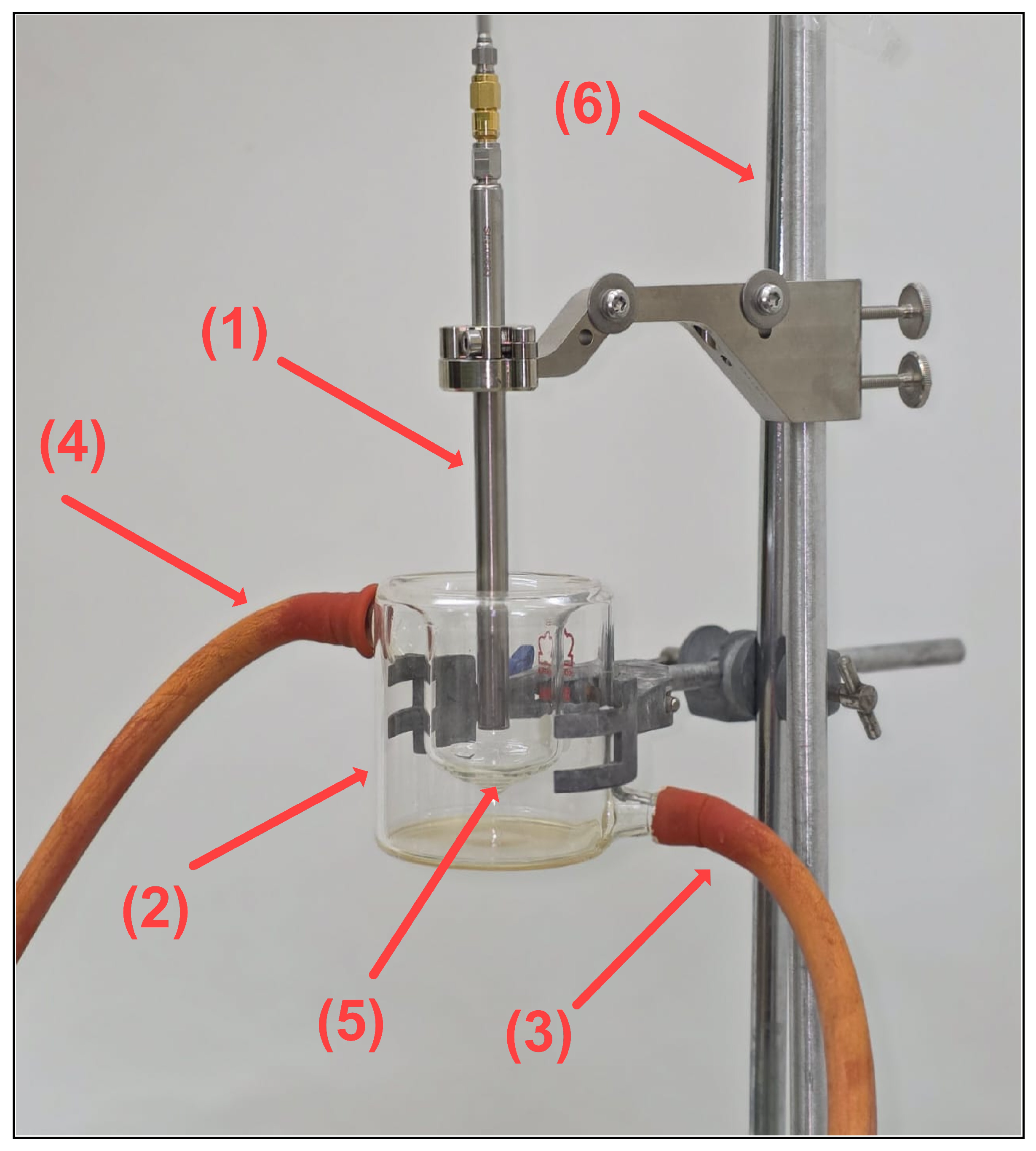
Dielectric measurements were performed using a broadband dielectric probe (open-ended coaxial probe) model 85070E, supplied by Keysight Technologies Inc. (Bayan Lepas, Malaysia). The dielectric probe was connected to port 1 of a network analyzer from the same company (model E5071C). The dielectric constants of ε and ε were recorded for frequencies extending from 0.5 to 20 GHz using software installed on the network analyzer provided by the same supplier [26]. The dielectric probe was carefully calibrated using a standard open (air), short (gold-plated conductor), and load (water at 25 °C) procedure before performing each set of measurements. The calibration accuracy was confirmed by measuring the dielectric constants of pure ethanol, ensuring the equipment performed optimally and that our measurements were reliable. The temperature of the mixtures was controlled using a 50 mL jacketed, double-walled glass vessel. Water from a fixed-temperature water bath was circulated through the vessel’s jacket using a water pump. The water entered from the lower input and exited from the top output, as shown in Figure 1. Before each dielectric measurement, the mixture was allowed to equilibrate at the target temperature for approximately 10 min to ensure thermal stability throughout the mixture. The temperature of the measurement vessel was measured using a calibrated mercury (Hg) thermometer with an accuracy of approximately ± 0.1 °C.
The mixtures’ DC conductivity was measured using the multiparameter instrument (inoLab Multi 9310 IDS, WTW, Xylem Inc., Weilheim, Germany) at the same set of temperatures at which the dielectric properties were explored.

Dielectric Theory

Several theoretical models can be employed to explain the complex permittivity ε ( ω ) as a function of the frequency ω and to determine a material’s dielectric parameters. These dielectric parameters include the dielectric constant at a DC electric field ( ε s ), the dielectric constant at the high-frequency limit ( ε ), and the average relaxation time ( τ ). In dielectric spectroscopy, the complex permittivity is commonly written as ε ( ω ) = ε ( ω ) + j ε ( ω ) , where ε is the real dielectric constant that describes the energy storage (polarization) and ε is the imaginary dielectric constant that represents the dielectric loss (dissipation).
Plotting ε versus ε in the well-known Cole–Cole plot for a material that has one single relaxation process results in a semi-circle shape curve that can be explained by the Debye model as shown in the following equation:
ε ( ω ) = ε + ε s ε 1 + j ω τ
where j = 1 and ω = 2 π f, in which f is the frequency in units of Hz. In the Debye limit, the dielectric loss peak occurs near f max ( 2 π τ ) 1 , providing a useful link between the peak position and relaxation time.
For certain materials, the plot of ε versus ε may have an asymmetric semicircle or a depressed semicircle (an arc with a center below the x axis). For such materials, the Havriliak–Negami model, as presented in Equation (2), can be used to obtain the dielectric parameters. This model introduces two mathematical parameters: α and β . The parameter α , which has values in the range 0 α < 1, accounts for the broadening of relaxation times, while β , in the range 0 < β 1, addresses the asymmetry of the semicircle, which arises from the asymmetry of the relaxation time distribution [27]. Physically, a nonzero α reflects a distribution of relaxation times that is often associated with microstructural heterogeneity and a range of local dipolar environments:
ε ( ω ) = ε + ε s ε [ 1 + ( j ω τ ) 1 α ] β + σ d c j ω ε 0
The σ d c is the direct current conductivity as a static electric field is applied to the material’s sides. The conductivity term contributes to the imaginary part as ε cond ( ω ) = σ d c / ( ε 0 ω ) and therefore becomes significant at low frequencies or in ionic samples. However, when the ε vs. ε plot has a symmetric arc shape, the β value is set to equal one. Under this condition, the model is modified to another version, called the Cole–Cole model, which can be written as shown in the following equation [27]:
ε ( ω ) = ε + ε s ε 1 + ( j ω τ ) 1 α + σ d c j ω ε 0
The complex dielectric constant ε ( ω ) in Equation (3) can be simplified to present a formula for the real dielectric constant ε ( ω ) in Equation (4) and to present a formula for the imaginary dielectric constant as in Equation (5) [28] as follows:
ε ( ω ) = ε + ( ε s ε ) 1 + ( ω τ ) 1 α sin ( α π / 2 ) 1 + 2 ( ω τ ) 1 α sin ( α π / 2 ) + ( ω τ ) 2 ( 1 α )
ε ( ω ) = σ d c ω ε 0 + ( ε s ε ) ( ω τ ) 1 α cos ( α π / 2 ) 1 + 2 ( ω τ ) 1 α sin ( α π / 2 ) + ( ω τ ) 2 ( 1 α )
An isopermittivity point (or isopermittivity frequency) refers to a frequency at which ε ( ω ) becomes nearly invariant with the temperature, producing a crossing point in the ε ( ω , T ) curves measured at different temperatures. This behavior arises from a compensation between the temperature dependence of the relaxation strength (e.g., ε s ε ) and the temperature dependence of the relaxation time τ ( T ) such that their combined effect on ε ( ω ) cancels at a specific frequency [25]. In ionic mixtures, moderate changes in σ d c primarily affect ε ( ω ) through the σ d c / ( ε 0 ω ) term and therefore may have a limited influence on the isopermittivity frequency when the crossing is governed mainly by dipolar relaxation. For ionic liquids and electrolyte mixtures, separating the conductive term from the dipolar relaxation term in ε ( ω ) is essential to avoid biasing τ and α during fitting, particularly at the low-frequency end, where σ d c / ( ε 0 ω ) may dominate [4,10,19]. In the current work, this will be handled by fitting Equation (5) to the measured values of σ d c .
The activation energy ( E a ) associated with dielectric relaxation is an essential factor that determines the thermal energy threshold that dipoles or mobile charges must overcome in order to successfully reorient or move in response to an alternating electric field. Such energy can be determined using the Arrhenius formula (Equation (6)), which relates the relaxation time τ to the temperature as follows [29]:
τ ( T ) = τ 0 exp E a k B T
where τ ( T ) is the relaxation time as a function of the temperature T in units of Kelvin, τ 0 is a factor that characterizes the relaxation time at infinitely high temperatures, and k B is the Boltzmann constant. A higher value of E a indicates that more thermal energy is required for dipole reorientation or charge-carrier hopping, suggesting stronger binding or a more viscous environment. In dielectric spectroscopy, E a offers insights into the molecular dynamics, ion-solvent interactions, and energy barriers associated with polarization processes in complex systems such as polymer blends, electrolytes, and salt GW mixtures [6,30].

3. Results and Discussion

3.1. Dielectric Properties of GW Mixtures

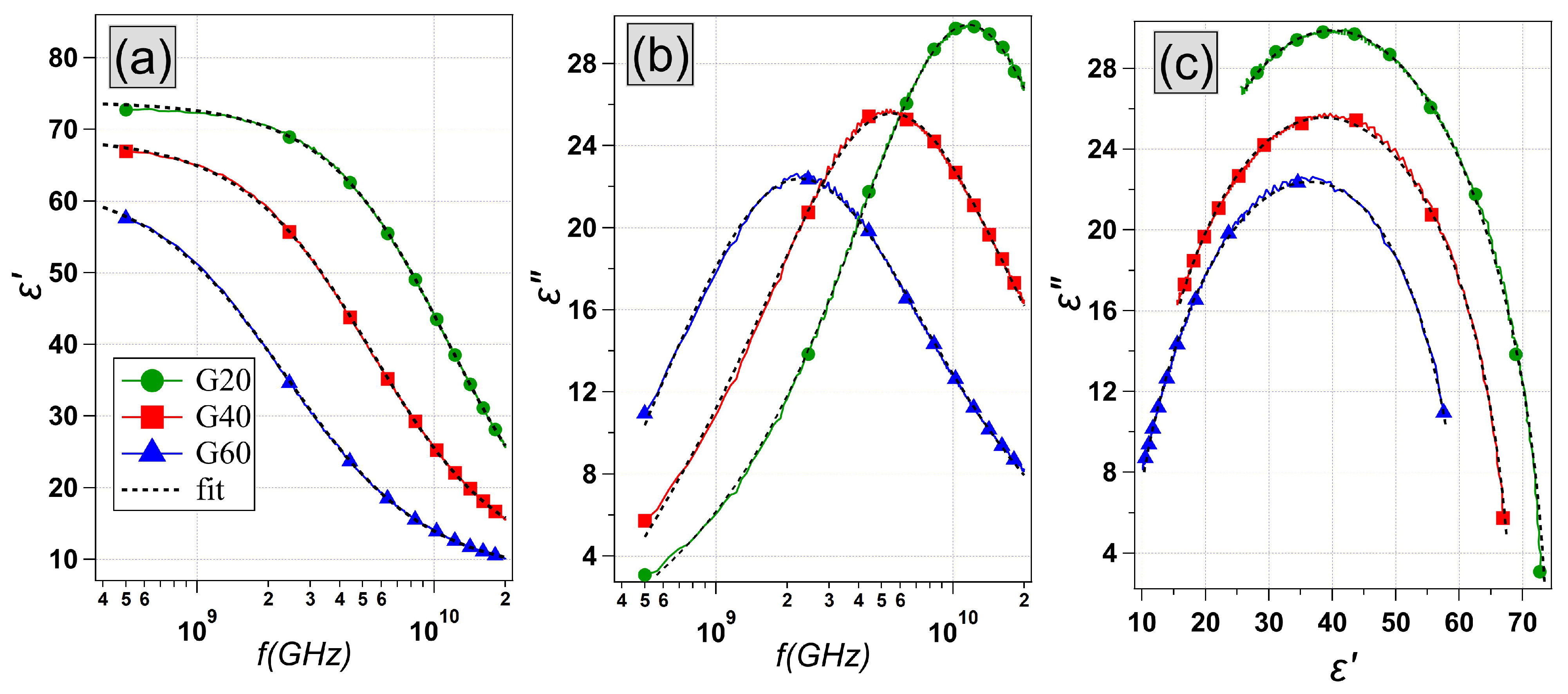
While the dielectric properties of salt GW mixtures are the primary focus of the current work, the dielectric characteristics of pure GW mixtures offer a wealth of data that can serve as the foundation for many novel technological applications, especially when a third component is added. The dielectric parameters of the prepared GW mixtures, labeled G20, G40, and G60, were investigated using the set-up introduced earlier. As shown in Figure 2a,b, the complex permittivity components of ε and ε were plotted as a function of the frequency at 25 °C. Based on these plots, it is clear that as the glycerol ratio increased from 20% to 60%, both parameters ( ε and ε ) dropped over the entire frequency range, e.g., at f = 0.5 GHz, the drop in ε was from 74 down to 57, and the drop in ε was from around 11 down to about 3 at the same frequency. The addition of glycerol to water reduced both the real and imaginary parts of the dielectric constant due to glycerol’s lower permittivity and its dilution effect on water. At the studied volume ratios, glycerol acts as a strong non-ionic chaotrope, restructuring the water’s hydrogen bond network and increasing viscosity [15,16]. The increased viscosity slows dipolar relaxation dynamics, reducing the system’s response to alternating electric fields. Additionally, replacing dynamic water–water hydrogen bonds with more rigid glycerol interactions further reduces polarizability [9,19].
Using Equations (4) and (5) for the GW mixtures in Figure 2, the static dielectric constant ( ε s ) was extracted and found to decrease from approximately 74.0 down to 63.5, while the high-frequency limit permittivity ( ε ) dropped from 4.6 to 3.9 as the glycerol fraction increased from 20% to 60% (see Table 2). This decreasing trend reflects the replacement of highly polar water molecules by less polar glycerol molecules, leading to reduced dipolar polarization at both low and high frequencies. One more prominent feature of the ε in Figure 2b is the shift in frequency at the maximum ε from 11.5 GHz down to 2.3 GHz as the glycerol ratio increased, which reflects an increase in the average relaxation time from around 14 ps to 64 ps. The rise in relaxation time observed with an increasing glycerol ratio in the mixture was due to the greater viscosity, more intense hydrogen bonding interactions, and the creation of larger dipolar clusters, all of which hindered the swift reorientation of molecular dipoles when an electric field is applied [31,32]. It is worth mentioning that the increase in relaxation time with glycerol’s addition was consistent with the well-established viscosity behavior of GW mixtures. At 25 °C, the dynamic viscosity increased from approximately 1 mPa·s for pure water to ∼1.9 mPa·s for a 20% volume ratio, ∼3.7 mPa·s for 40% volume ratio, and ∼10–12 mPa·s for 60% volume ratio of glycerol in GW mixtures [33]. Since dielectric relaxation in polar liquids is strongly coupled to rotational diffusion and viscous drag, the observed increase in τ from 14 ps to 64 ps followed the expected viscosity scaling. This behavior is consistent with the Debye–Stokes–Einstein (DSE) relation, which links the rotational relaxation time of dipolar molecules to the viscosity ( η ) of the surrounding medium through τ η / T , where T is the absolute temperature [34]. Accordingly, an increase in mixture viscosity with a higher glycerol content led to a slower dipolar rotational relaxation time and, therefore, a longer dielectric relaxation time.
When ε was plotted as a function of ε in Figure 2c, the α parameter value was obtained using Equations (4) and (5), and the parameter value was found to be increasing from around 0.078 up to 0.130. Increasing the glycerol ratio in such mixtures raised the viscosity and strengthened the hydrogen bonding network. This resulted in greater microstructural diversity and a wider range of dielectric relaxation times, indicated by a higher α parameter in the Cole–Cole model [35]. Such broadening is consistent with an increasingly heterogeneous hydrogen bond network and a wider distribution of local environments (water-rich vs. glycerol-rich microdomains), which is commonly associated with non-Debye relaxation in hydrogen-bonded liquids [4,15,16].
Using the DC conductivity set-up introduced earlier in this manuscript, the DC conductivity of the GW mixtures was measured and found to decrease with an increasing glycerol ratio (see Table 2). Such a drop in DC conductivity is related to the reduction in ion mobility due to higher viscosity, lower ion dissociation caused by glycerol’s lower dielectric constant, and the inherently low intrinsic conductivity of pure glycerol [9].
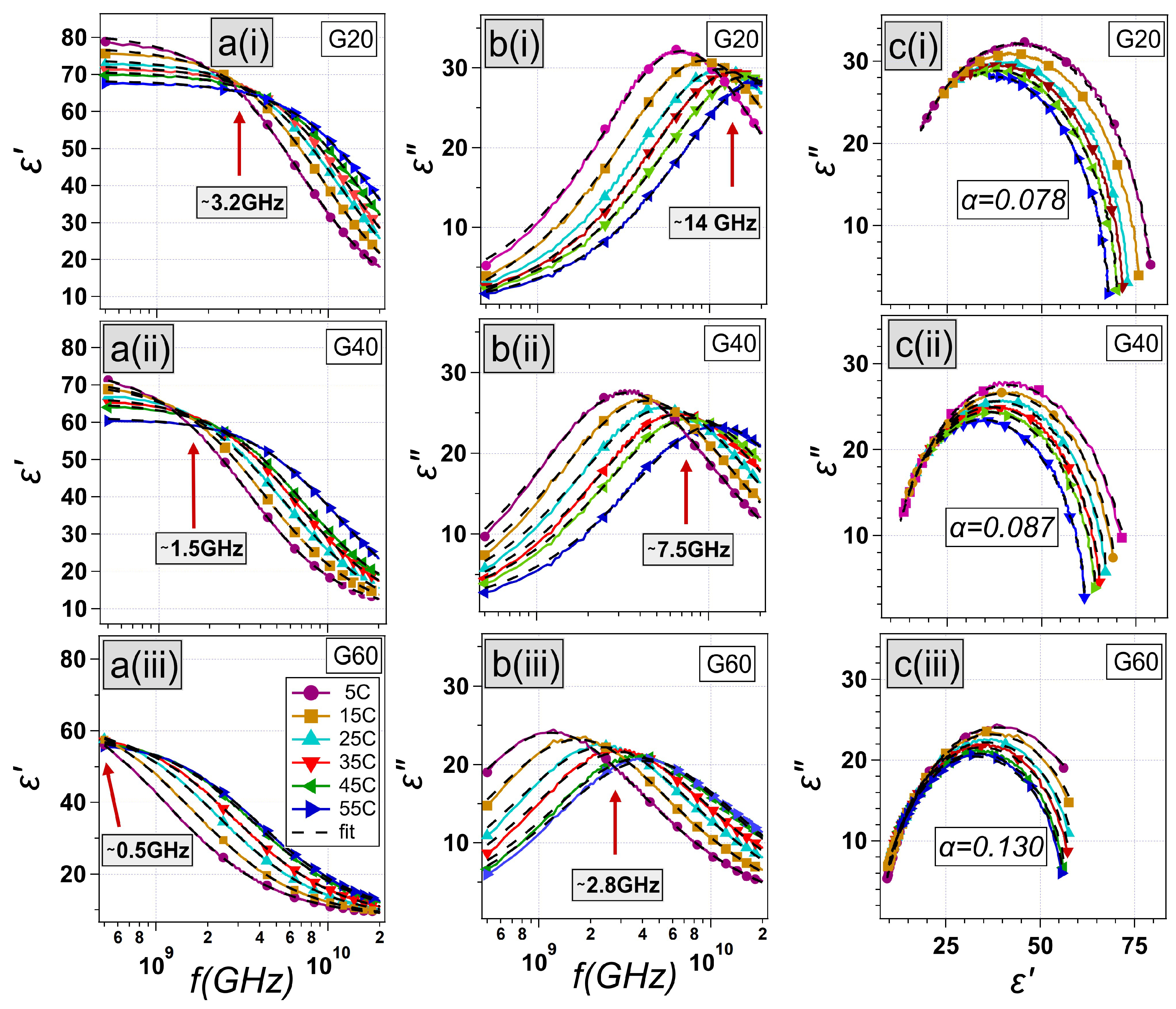
For the same set of mixtures—G20, G40, and G60—the dielectric constants of ε and ε were investigated as a function of the temperature using the special vessel introduced earlier in the temperature range from 5 to 55 °C. Figure 3a(i) shows the ε value as a function of the frequency at different temperatures, in which one can observe the point where ε remained invariant with the temperature change, indicating an isopermittivity behavior at f = 3.2 GHz.
For the 40% glycerol ratio mixture (G40) in Figure 3a(ii), the frequency with an invariant ε value was 1.5 GHz, and as the glycerol volume ratio increased to 60% in the G60 mixture, the invariance in ε shifted down to around f = 0.5 GHz, as seen in Figure 3a(iii). This result was a consequence of a balance between decreasing static permittivity ( ε s ) and shifting relaxation dynamics as the temperature increased. At this frequency, the temperature’s effects on the dipole alignment and relaxation time were effectively canceled out [25]. This behavior underlines the interplay between molecular mobility and dielectric response. It also serves as an excellent starting point for creating dielectric systems that maintain stability across a wide range of temperatures. In Figure 3b(i–iii), a similar behavior can be observed for the ε value at frequencies of about 14, 7.5, and 2.8 GHz for glycerol ratios of 20, 40, and 60%, respectively, in which the value of ε had a limited change with the temperature but not at the same invariance level of ε .
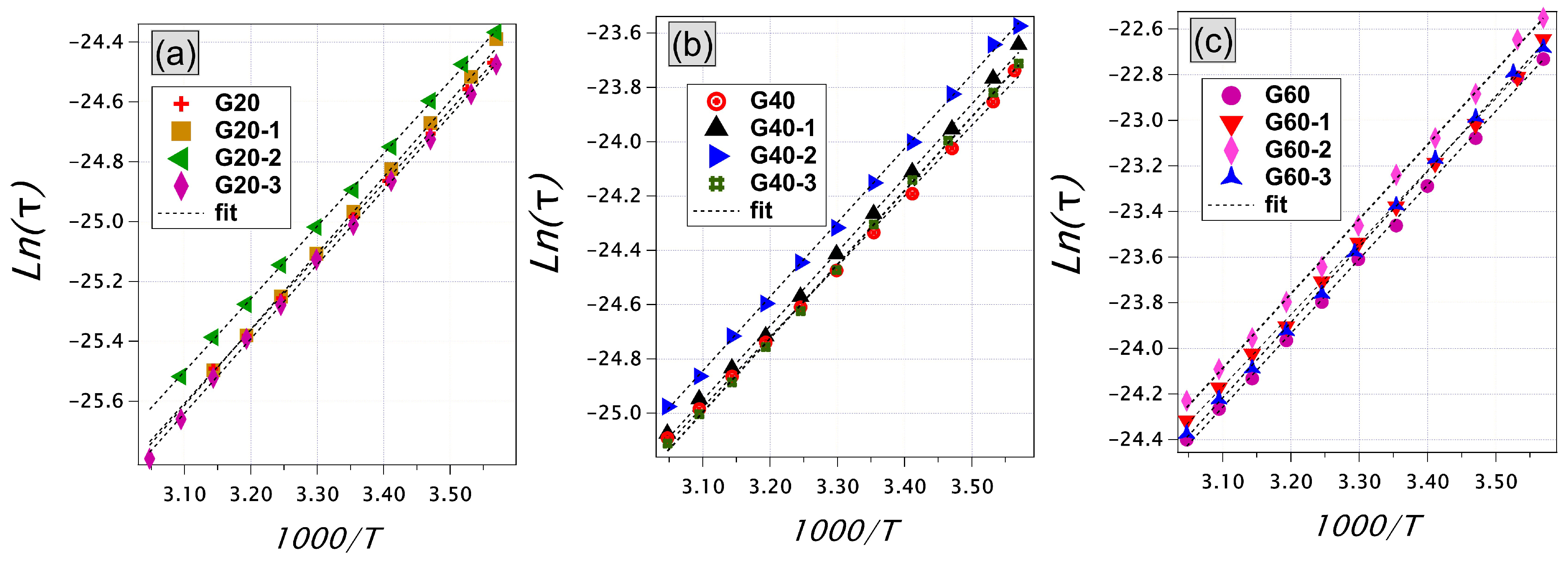
Investigation of the α parameter obtained in Figure 3c(i–iii) showed that the α value was temperature-independent and governed mainly by the mixture composition rather than thermal activation. The temperature independence of α indicates that the breadth of the relaxation time distribution was primarily structural (composition-driven), rather than controlled by thermal activation of a single molecular process. Using Equation (6), the activation energy E a was determined for the pristine GW mixtures (G20, G40, and G60) from the linear relationship between ln τ and 1000 / T , as shown in Figure 4. The results show that E a increased from 20.35 to 26.99 kJ/mol as the glycerol ratio increased from 20% to 60%, indicating that molecular relaxation processes have higher energetic barriers in the more viscous, glycerol-rich environment [36].

3.2. Dielectric Properties of Salt GW Mixtures

3.2.1. Salt Addition’s Effect

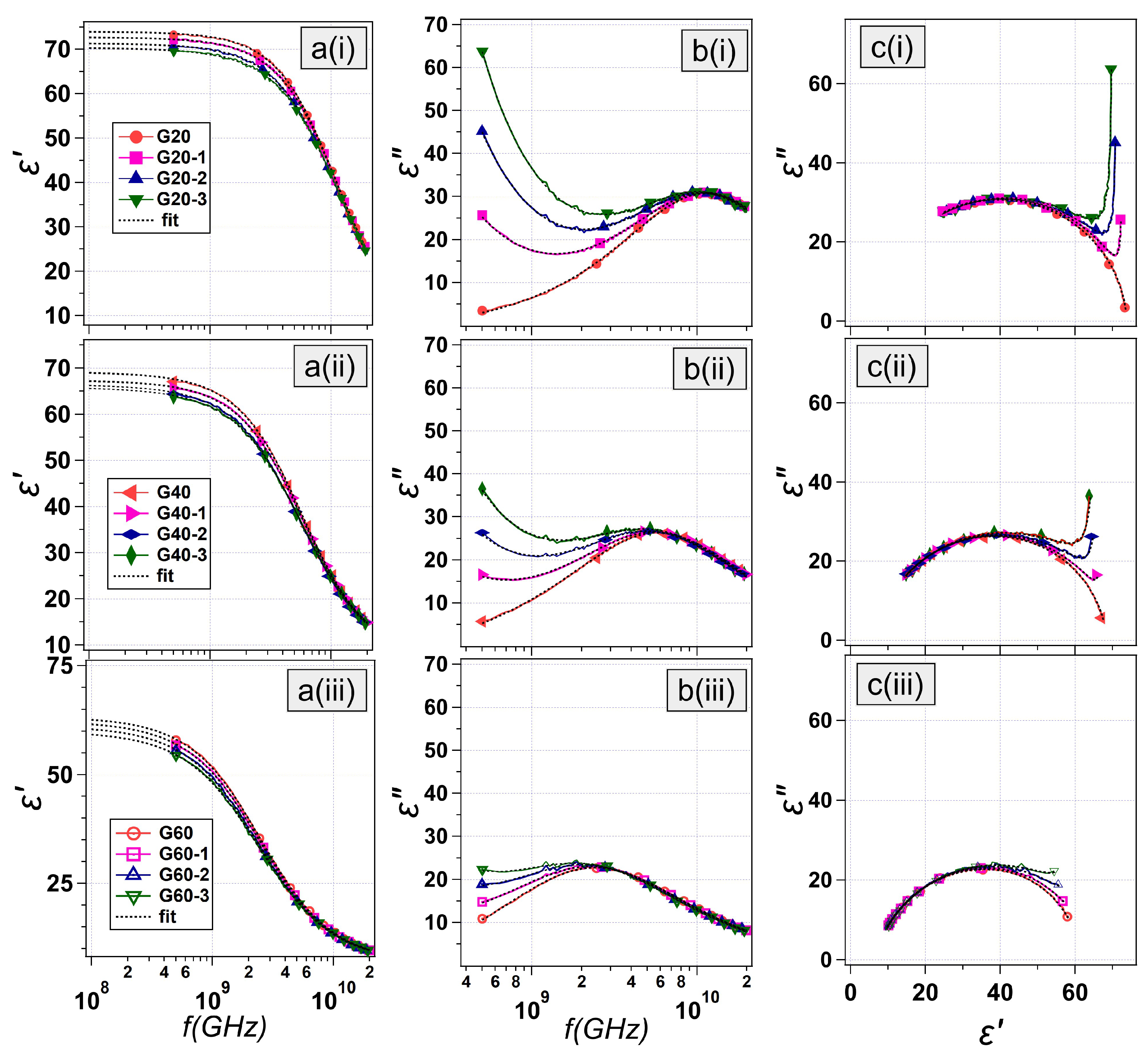
The effect of salt’s addition on the dielectric properties of the prepared GW mixtures with NaCl additives of 0.10, 0.20, and 0.30 M was investigated using the same set-up used before for the pristine GW mixtures. Note that 0.10–0.30 M corresponds to moderate ionic strength; these concentrations are high enough to produce measurable conductivity-driven losses in ε while remaining low enough that the primary structural relaxation of the GW matrix is still governed by glycerol-controlled viscosity and hydrogen bonding [20]. As shown in Figure 5a(i–iii), as the concentration of NaCl increased from 0 to 0.30 M for the 20%, 40%, and 60% glycerol ratios, the ε value decreased at the low frequency range. However, the ε value became less sensitive to salt’s addition as the frequency increased up to 20 GHz. In contrast to ε , as shown in Figure 5b(i–iii), the ε value experienced a dramatic increase at low frequencies that became weaker as the frequency and glycerol ratio increased. At the high frequency limit, salt’s addition did not affect the ε value since the conductivity contribution was inversely proportional to the frequency (i.e., ε ( ω ) σ d c ω ε 0 ). The addition of NaCl at a fixed concentration had varying effects on the dielectric parameters of the mixture, depending on the glycerol ratio. In fact, it has been confirmed that as the glycerol ratio increased, the dielectric parameters became less sensitive to salt’s addition, especially the ε values, as can be traced from insets (b-i) to (b-iii) in Figure 5.
The imaginary dielectric constant (dielectric loss) ε contains two distinct contributions: a conductive loss associated with charge transport and a dipolar relaxation loss arising from molecular reorientation. In the Cole–Cole model used in this work (Equation (5)), these two mechanisms are explicitly separated. The conductive contribution is represented by the term σ d c / ( ω ε 0 ) and dominates the low-frequency region, while the second term corresponds to dipolar relaxation of the GW network. This separation enables quantitative extraction of relaxation parameters ( τ , α , and ε s ), which reflect the underlying microstructure of the mixtures. In particular, the presence of dissolved ions modifies the local hydrogen bond network via hydration shells, while the dominant relaxation time is primarily governed by the viscosity-controlled rotational dynamics of solvent molecules [4,10]. Using the Cole–Cole model, the extracted parameters provide indirect insight into the microstructure of the mixtures. In particular, the increase in the relaxation time τ and the broadening parameter α as the glycerol ratio content increased indicates a wider distribution of relaxation environments associated with stronger hydrogen bond interactions and increased structural heterogeneity in the GW network, while the added ions mainly influence the dielectric loss through the conductivity term associated with hydrated charge carriers [4,19].
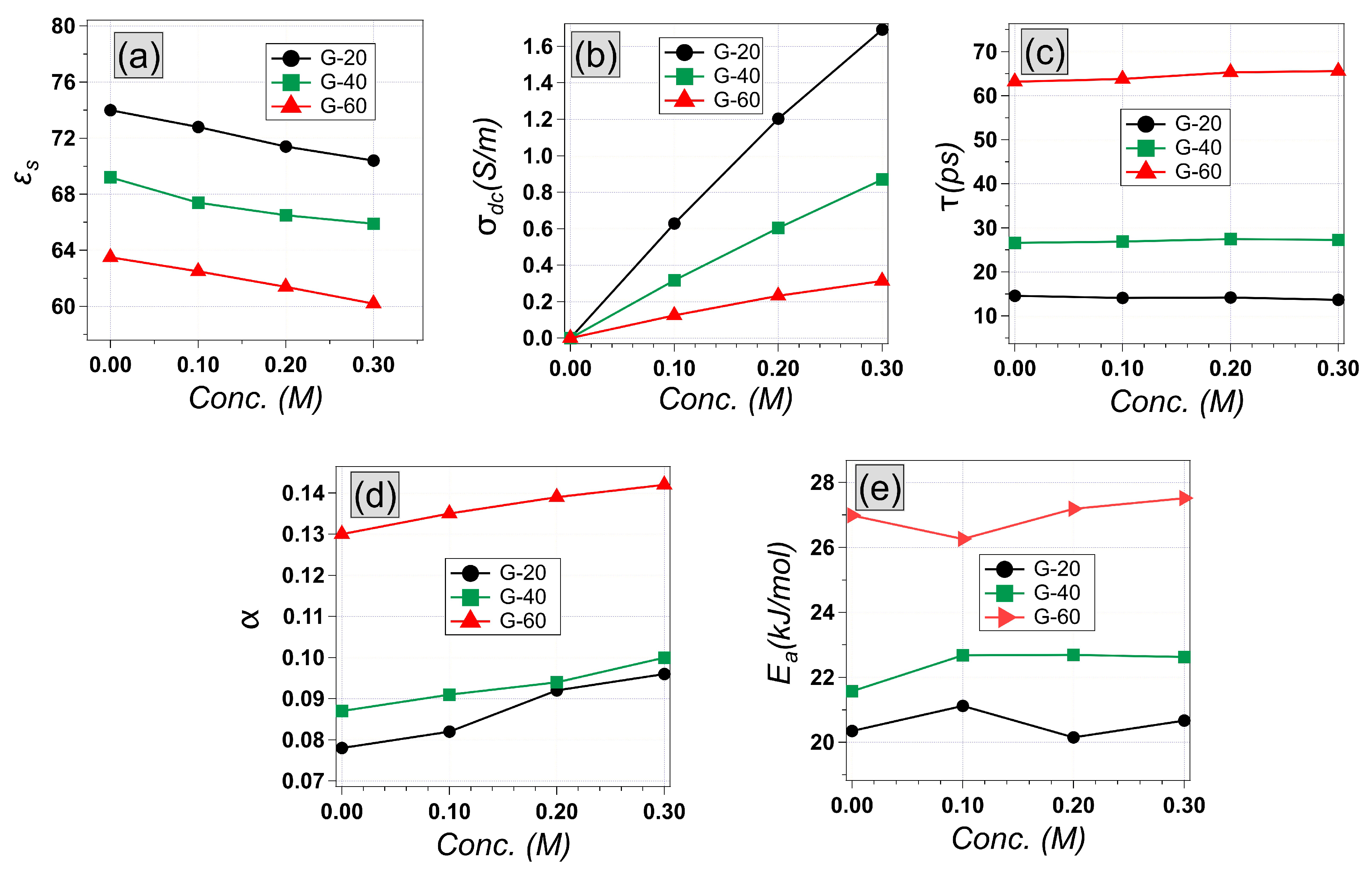
The Cole–Cole plots in Figure 5c(i–iii) illustrate a dramatic increase in ε when plotted as a function of ε at low frequencies (right side of the plots), as well as invariance in the ε values for the frequency at the high limit end for the prepared salt GW mixtures. Using Equations (4) and (5) for the Cole–Cole plot, the dielectric parameters for each variant of salt and glycerol were extracted, summarized in Table 2, and plotted in Figure 6. As can be seen in Figure 6a, the magnitude of the static dielectric constant ε s decreased linearly from 74.0 down to 70.4 (by a 3.6 drop) as the molarity of NaCl increased from 0 to 0.30 M in the 20% glycerol ratio mixture. As the glycerol ratio increased to 40% in the mixture, the decrease in ε s was from 69.2 down to 65.3 (a drop of 3.3). For the 60% mixture, as the salt concentration increased, ε s decreased from 63.5 to 60.2 (a drop of 3.3). The general observation is that the drop in ε s depends mainly on the NaCl concentration and is less sensitive to the glycerol ratio in the mixture [37]. The main reason for this drop in ε s is the restriction of the water molecules’ ability to rotate due to formation of the ion hydration shell, which binds water molecules. At the same time, the presence of glycerol in the mixture enhances the stiffness of the hydrogen bond networks. Both mechanisms reduce the dipoles’ ability to reorient themselves and increase micro-structural rigidity [19,37].
Using the conductivity meter introduced earlier in this work, the DC conductivity σ dc was measured for all the prepared salt-added GW mixtures. The obtained σ dc values are summarized in Table 2 and plotted as a function of the NaCl concentration in Figure 6b. As can be seen in Figure 6b, the σ dc value increased linearly as the NaCl concentration increased from 0 to 0.30 M. However, the increase amount in the σ dc values was inversely proportional to the glycerol ratio in the mixture. For example, when comparing the mixture with 0.30 M NaCl and a 20% glycerol ratio (labeled as G20-3) to the one with 0.30 M NaCl and a 60% glycerol ratio (labeled as G60-3), the σ dc value for the G20-3 mixture was found to be five times greater than that for the G60-3. Generally, the increase in DC conductivity is attributed to the increase in the number of free ions as the NaCl concentration increased, leading to more free charge carriers. However, increasing the glycerol ratio increased the mixture’s overall viscosity, reducing the mobility of free Na+ and Cl ions. In addition to the above, DC conductivity becomes weaker due to the formation of large and strong ion hydration shells with glycerol molecules and the disruption of water hydrogen bonding [38,39].
Figure 6c shows the average relaxation time τ extracted using the Cole–Cole model for all the prepared mixtures as a function of the NaCl concentration. The figure shows that as the glycerol ratio increased from 20% to 40% and 60% in the mixture, the relaxation time increased from around 14 ps to 27 ps and 65 ps, respectively. However, adding NaCl with concentrations from 0.10 to 0.30 M to the mixture almost did not affect the relaxation time, supporting the conclusion that the glycerol ratio is the main variable that governs τ . In fact, adding more NaCl at these concentrations to the mixtures had a smaller effect on the viscosity, which in turn had a smaller effect on the relaxation time. Thus, τ is primarily controlled by the glycerol content rather than the small amount of added salt [4,9,10]. Within a specific ion framework, this indicates that ion-specific perturbations are largely screened by the dominant chaotropic effect of glycerol and by the strong hydration shells of ions in the mixed solvent, leaving the solvent-controlled structural relaxation largely unchanged [15,16].
In Figure 6d, the α parameter that accounts for the broadening of relaxation times is investigated as a function of the NaCl concentration. The figure shows an increase in the α value from around 0.08 to 0.13 as the glycerol ratio increased from 20% to 60%. This increase in the α parameter reflects a wider distribution of relaxation times that originated from heterogeneity in the local environments of hydrogen bonding in the mixture [4,9,19]. Adding NaCl with such concentrations had a rather minimal effect on the α parameter, since ions at such moderate concentrations do not significantly alter the hydrogen bonding on the glycerol–water network or the viscosity in the mixture [10]. Accordingly, any Hofmeister-type differences are expected to be more pronounced at lower electrolyte levels (e.g., 10–50 mM), where subtle ion-specific structuring is masked less by screening and viscosity effects [15,16].
A temperature dependence study on the dielectric constants of the salt GW mixtures was conducted, and the results are presented in Figures S1–S3 in the Supplementary Materials. By tracking the relaxation time as a function of the temperature for the prepared mixtures, the activation energy E a can be calculated using Equation (6) as seen in Figure 6e. The E a value was found to be mainly dependent on the glycerol ratio in the mixture. For example, as the glycerol ratio increased from 20% to 40% and then to 60%, the E a value increased from around 20 to 22 and then to 27 kJ/mol, respectively. As NaCl was added with concentrations from 0.10 to 0.30 M, the E a value was found to be invariant over such a concentration range. This is because adding salt does not alter the structural relaxation in GW mixtures, which is governed by the hydrogen bond network and viscosity [4,10].
The isopermittivity behavior of the prepared salt GW mixtures was observed for NaCl concentrations of 0.10, 0.20, and 0.30 M, as shown in Figures S1, S2, and S3, respectively. The study shows that isopermittivity frequencies were less sensitive to salt’s addition up to 0.30 M. The isopermittivity frequencies were primarily governed by the dipolar relaxation of glycerol and water molecules and their hydrogen bond network. The addition of salt at such concentrations increased the number of free ions, which increased the DC conductivity rather than affecting the rotational dynamics of dipoles [9]. This is consistent with the interpretation that the isopermittivity condition is set by the temperature dependence of the solvent-controlled relaxation (GW matrix), whereas moderate salt additions mainly modify the conductive loss term without shifting the underlying dipolar relaxation time scale [4,15,16].

3.2.2. Salt Type Effect on Dielectric Properties

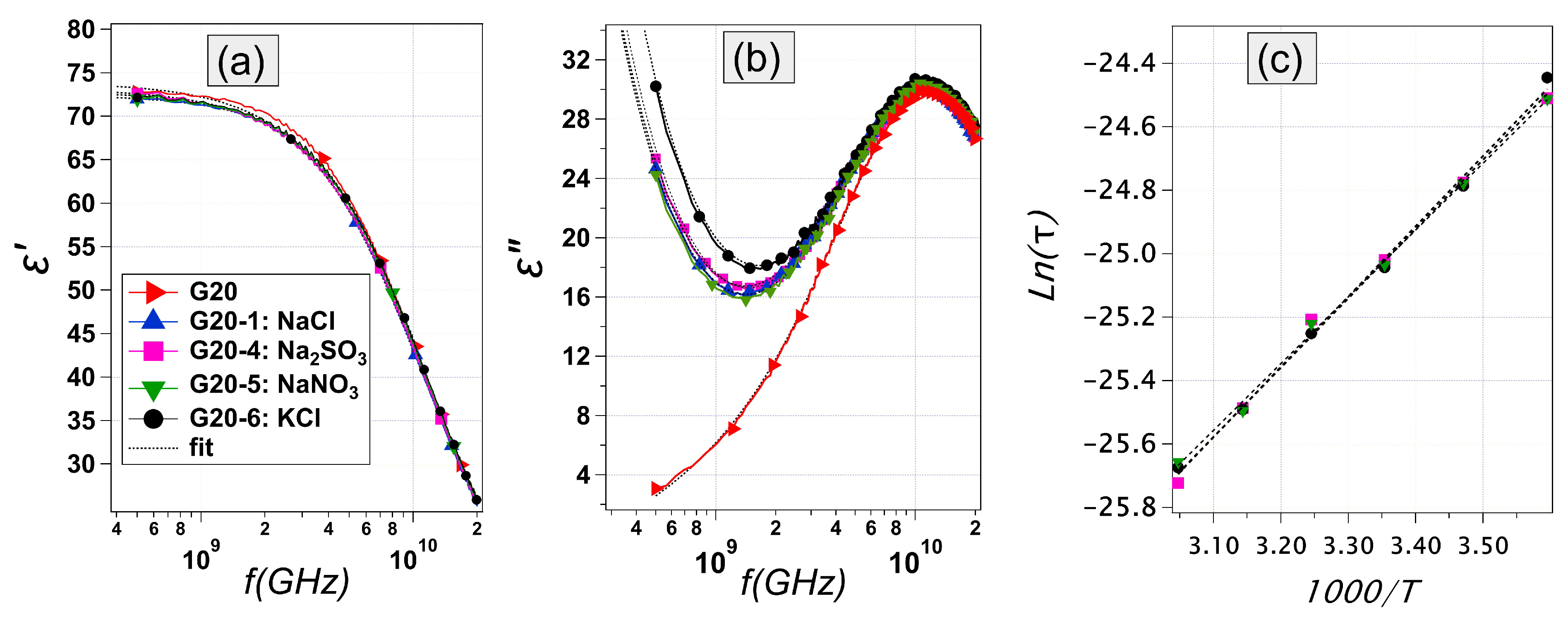
The dielectric properties of the 20% glycerol mixtures at a 0.1 M concentration of Na2SO3, NaNO3, and KCl were investigated and compared to the 0.1 M concentration of an NaCl GW mixture at the same glycerol ratio. The selected salts span key ion-specific attributes while keeping the chemistry simple in terms of (1) cation identity (Na+ vs. K+), (2) anion charge and charge density (Cl, NO 3 vs. SO 3 2 ), and (3) expected hydration strength and ion-pairing tendencies, all of which can modulate conductivity and low-frequency dielectric loss in mixed solvents [15,16]. Figure 7a,b shows the dielectric constants of ε and ε , respectively, for the GW mixtures of the selected salts. Using the Cole–Cole model as previously demonstrated in Equations (4) and (5), the dielectric parameters were obtained, and they are displayed in Table 2. Here, σ d c was measured for the same set of mixtures at 25 °C, as can be seen in the same table. Both insets a and b in Figure 7 show almost identical behavior and values for the dielectric constants ε and ε for all salts, except ε for the KCl mixture (G20-6). In particular, in Figure 7b, at a frequency of 0.5 GHz, the value of ε for the KCl mixture was around 30, which is higher than the value of the rest of the mixtures at around 25. This behavior is related to the fact that KCl produces a mixture with a higher conductivity ( σ d c = 0.757 S/m), compared with ≈0.60 S/m for the other salts. The KCl mixture had a higher conductivity when compared with the rest of the salt mixtures, since K+ ions have higher ionic mobility and weaker hydration than Na+, leading to faster charge transport in high-viscosity glycerol mixtures. The same can be said about the mobility of Cl when compared with NO 3 or SO 3 2 ions [40]. This ordering agrees with general specific ion expectations, where ions with weaker hydration and lower effective friction exhibit higher mobility in viscous mixed solvents [15,16]. The observed similarity between the NaNO3 and Na2SO3 mixtures can also be interpreted in terms of ion size and hydration effects. Although SO 3 2 is a divalent ion that could potentially exert a stronger structuring influence on the solvent network (often associated with salting out behavior), its larger size and stronger hydration shell reduce its effective mobility in a solution. Similarly, the NO 3 ion possesses a relatively large ionic radius and a delocalized charge distribution, which also leads to lower ionic mobility compared with smaller monovalent ions such as Cl. As a result, both salts produce comparable conductivity and dielectric responses, despite their different valencies [41].
As can be seen in Figure 7 and summarized in Table 2, the addition of the Na2SO3, NaNO3, and KCl salts to the G20 mixture yielded minor decreases in ε s and τ , a moderate increase in α , and a substantial increase in conductivity. Using Figure S4 in the Supplementary Materials, the average relaxation time for each salt type was obtained and tracked as the temperature varied from 5 to 55 °C. After plotting ln( τ ) as a function of 1000/T as shown in Figure 7c, the activation energy was calculated for each salt type and found to be around 18 kJ/Mol, indicating that the relaxation barriers are governed by the glycerol–water hydrogen-bond network rather than the added ion type.
The isopermittivity frequencies for the different prepared GW salt mixtures were observed at a 0.10 M concentration, as shown in Figure S4 in the Supplementary Materials. The figure shows that the isopermittivity frequencies were less sensitive to the salt type in the GW mixtures. This was consistent with the activation energy behavior as the salt concentration increased. Taken together, the weak dependence of the isopermittivity frequency and E a on the salt identity supports the conclusion that, at the investigated concentrations, the dominant relaxation barrier was set by the GW hydrogen bond network (chaotrope-controlled), while ions primarily modulated conductivity.

3.3. Overall Trends and Implications

The observed trends confirm that glycerol plays a dominant role in shaping dielectric relaxation dynamics by influencing the viscosity and hydrogen bonding. On the other hand, salts play a primary role in conductivity enhancement, with a secondary role in the dielectric constants and relaxation behavior. Such trends are vital to tune and control when targeting technological applications in high-frequency electronic components and soft ionic conductors. Moreover, controlled changes in α and E a provide insights into optimizing liquid dielectric formulations for sensing or energy storage applications. From a kosmotrope–chaotrope viewpoint, glycerol-driven restructuring of the solvent dominates the dipolar relaxation landscape, whereas salt-specific effects mainly appear through conductivity and hydration shell constraints. Recognizing this separation of roles provides a practical route to tuning losses ( ε ) via salt selection while preserving solvent-controlled relaxation stability via the glycerol ratio [15,16].

4. Conclusions

The main conclusion of our study is that the electric and dielectric properties of GW mixtures are primarily governed by the glycerol content in the mixture. Increasing the glycerol ratio in the mixtures led to a reduction in both the static dielectric constant ε s and the high-frequency permittivity ε . In contrast, the average relaxation time τ , the Cole–Cole broadening α , and activation energy E a all increased as the glycerol ratio increased. These general trends reflect the strong effect of the glycerol content on the polarization and molecular dynamics of such mixtures. In the context of specific ion and chaotrope–kosmotrope concepts, glycerol behaved as a strong non-ionic chaotrope at the investigated volume ratios, substantially restructuring the water hydrogen bond network and increasing the viscosity. Consequently, the solvent matrix dominated the relaxation landscape and the distribution of relaxation times [15,16].
Another key conclusion of this study is that the addition of salt to GW mixtures with moderate concentrations (e.g., NaCl at 0.10–0.30 M) significantly increased the DC conductivity while reducing the static dielectric constant ε s . In contrast, the addition of salt had a minimal effect on the relaxation time τ , broadening parameter α , and activation energy E a . The increase in DC conductivity directly affected ε , especially at low frequencies, where conductive losses dominated. In addition, the study showed that dielectric parameters of mixtures with higher glycerol ratios are less sensitive to the addition of salt, owing to the mixture’s high viscosity, which restricts ionic mobility and limits dielectric behavior changes. This separation of roles is consistent with a specific ion framework; at the investigated ionic strengths, added salts primarily modified the translational (conductive) dynamics, whereas the main dipolar relaxation and its activation barrier remained governed by the glycerol–water hydrogen bond network and viscosity [15,16]. Future measurements at lower electrolyte levels (e.g., 10–50 mM) may further amplify subtle Hofmeister-type trends by reducing screening and ion-pairing contributions [15,16].
Our study shows that the type of added salt has a minor effect on the dielectric properties of GW mixtures. Instead, the resulting DC conductivity is the dominant factor, directly determined by the mobility of different dissolved ions. For the investigated mixtures containing NaCl, Na2SO3, NaNO3, and KCl, it was found that KCl-based mixtures exhibited the highest DC conductivity compared with the rest of the salt mixtures. This enhanced conductivity arises from the relatively higher mobilities of K+ and Cl ions. Consequently, a stronger enhancement in ε is expected in the low frequency range due to the elevated DC conductivity. The observed conductivity ordering is consistent with ion-specific trends in hydration strength and mobility, where more weakly hydrated ions generally experience lower effective friction and therefore exhibit higher mobility in viscous mixed solvents [15,16].
For practical applications, such as in energy storage systems, GW mixtures are best implemented at the isopermittivity frequency, where ε is temperature-independent. For applications that depend on the dissipation behavior of salt-GW mixtures, it is recommended to operate at frequencies where ε exhibits minimal variation with the temperature, ensuring relatively stable energy loss behavior in changing temperature environments. In general, our results suggest a practical formulation strategy: the glycerol ratio can be used to set the solvent-controlled relaxation time scale and thermal stability, while the salt type and concentration can be used to tune conductivity-driven losses ( ε ) for targeted microwave, sensing, and soft ionic conductor applications.
Beyond fundamental dielectric characterization, the dataset reported in this study may serve as a useful reference for microwave dielectric modeling, the calibration of broadband dielectric probes, and the development of tunable liquid media for sensing and biomedical microwave applications.

Supplementary Materials

The following supporting information can be downloaded at https://www.mdpi.com/article/10.3390/app16083661/s1. Figure S1: The dielectric constants ε and ε plotted with the frequency in insets (a) and (b), respectively. The ε value is plotted as a function of ε in inset (c) (the Cole–Cole plot) for the 0.10 M NaCl GW mixtures G20-1, G40-1, and G60-1 in the temperature range from 5 °C to 55 °C. The dashed curves represent a fit for Equations (4) and (5). Figure S2: The dielectric constants ε and ε plotted with the frequency in insets (a) and (b), respectively. The ε value is plotted as a function of ε in inset (c) (the Cole–Cole plot) for the 0.20 M NaCl GW mixtures G20-2, G40-2, and G60-2 in the temperature range from 5 °C to 55 °C. The dashed curves represent a fit for Equations (4) and (5). Figure S3: The dielectric constants ε and ε plotted with the frequency in insets (a) and (b), respectively. The ε value is plotted as a function of ε in inset (c) (the Cole–Cole plot) for the 0.30 M NaCl GW mixtures G20-3, G40-3, and G60-3 in the temperature range from 5 °C to 55 °C. The dashed curves represent a fit for Equations (4) and (5). Figure S4: The dielectric constants ε and ε plotted with the frequency in insets (a) and (b), respectively. The ε value is plotted as a function of ε in inset (c) (the Cole–Cole plot) for the 0.1 M Na2SO3, NaNO3, and KCl at 25 °C.

Funding

This research received no external funding.

Data Availability Statement

Data will be made available upon request to the corresponding author.

Acknowledgments

The author thanks Muhamad O. Al-limoun from the Department of Biology at Mutah University for the fruitful scientific discussions.

Conflicts of Interest

The author declares no conflicts of interest.

References

  1. Hao, X. A review on the dielectric materials for high energy-storage application. J. Adv. Dielectr. 2013, 3, 1330001. [Google Scholar] [CrossRef]
  2. Wu, X.; Chen, X.; Zhang, Q.; Tan, D.Q. Advanced dielectric polymers for energy storage. Energy Storage Mater. 2022, 44, 29–47. [Google Scholar] [CrossRef]
  3. Hussain, M.; Zahra, H.; Abbas, S.M.; Zhu, Y. Flexible Dielectric Materials: Potential and Applications in Antennas and RF Sensors. Adv. Electron. Mater. 2024, 10, 2400240. [Google Scholar] [CrossRef]
  4. Behrends, R.; Fuchs, K.; Kaatze, U.; Hayashi, Y.; Feldman, Y. Dielectric properties of glycerol/water mixtures at temperatures between 10 and 50 °C. J. Chem. Phys. 2006, 124, 144512. [Google Scholar] [CrossRef] [PubMed]
  5. Angulo-Sherman, A.; Mercado-Uribe, H. Ionic transport in glycerol-water mixtures. Ionics 2015, 21, 743–748. [Google Scholar] [CrossRef]
  6. Agieienko, V.; Buchner, R. Dielectric relaxation of deep eutectic solvent + water mixtures: Structural implications and application to microwave heating. Phys. Chem. Chem. Phys. 2020, 22, 20466–20476. [Google Scholar] [CrossRef]
  7. Liu, Y.; Huang, K.; Zhou, Y.; Gou, D.; Shi, H. Hydrogen Bonding and the Structural Properties of Glycerol–Water Mixtures with a Microwave Field: A Molecular Dynamics Study. J. Phys. Chem. B 2021, 125, 8099–8106. [Google Scholar] [CrossRef] [PubMed]
  8. Ouaouja, Z.; Havet, M.; Rouaud, O.; Toublanc, C.; Ousegui, A. Thermal properties and performance of glycerol-water-NaCl phase change material for cold chain applications. J. Energy Storage 2025, 126, 117045. [Google Scholar] [CrossRef]
  9. Puzenko, A.; Hayashi, Y.; Ryabov, Y.E.; Balin, I.; Feldman, Y.; Kaatze, U.; Behrends, R. Relaxation Dynamics in Glycerol–Water Mixtures: I. Glycerol-Rich Mixtures. J. Phys. Chem. B 2005, 109, 6031–6035. [Google Scholar] [CrossRef] [PubMed]
  10. Köhler, M.; Lunkenheimer, P.; Loidl, A. Dielectric and conductivity relaxation in mixtures of glycerol with LiCl. Eur. Phys. J. E 2008, 27, 115–122. [Google Scholar] [CrossRef]
  11. Rodilla, H.; Kim, A.A.; Jeffries, G.D.M.; Vukusic, J.; Jesorka, A.; Stake, J. Millimeter-wave sensor based on a λ/2-line resonator for identification and dielectric characterization of non-ionic surfactants. Sci. Rep. 2016, 6, 19523. [Google Scholar] [CrossRef]
  12. Meaney, P.M.; Fox, C.J.; Geimer, S.D.; Paulsen, K.D. Electrical Characterization of Glycerin: Water Mixtures: Implications for Use as a Coupling Medium in Microwave Tomography. IEEE Trans. Microw. Theory Tech. 2017, 65, 1471–1478. [Google Scholar] [CrossRef]
  13. Monteagudo Honrubia, M.; Matanza Domingo, J.; Herraiz-Martínez, F.J.; Giannetti, R. Low-Cost Electronics for Automatic Classification and Permittivity Estimation of Glycerin Solutions Using a Dielectric Resonator Sensor and Machine Learning Techniques. Sensors 2023, 23, 3940. [Google Scholar] [CrossRef]
  14. Timofeeva, M.N.; Makova, A.S.; Bolotov, V.A.; Panchenko, V.N.; Kustov, L.M.; Parmon, V.N. The Potential of Microwave Technology for Glycerol Transformation: A Comprehensive Review. Catalysts 2024, 14, 921. [Google Scholar] [CrossRef]
  15. Collins, K. Charge density-dependent strength of hydration and biological structure. Biophys. D 1997, 72, 65–76. [Google Scholar] [CrossRef]
  16. Kunz, W.; Neueder, R. An Attempt at a General Overview. In Specific Ion Effects; Kunz, W., Ed.; World Scientific: Singapore, 2010; pp. 3–54. [Google Scholar] [CrossRef]
  17. Peyman, A.; Gabriel, C.; Grant, E. Complex permittivity of sodium chloride solutions at microwave frequencies. Bioelectromagnetics 2007, 28, 264–274. [Google Scholar] [CrossRef]
  18. Nguenouho, O.S.B.; Chevalier, A.; Potelon, B.; Benedicto, J.; Quendo, C. Dielectric characterization and modelling of aqueous solutions involving sodium chloride and sucrose and application to the design of a bi-parameter RF-sensor. Sci. Rep. 2022, 12, 7209. [Google Scholar] [CrossRef] [PubMed]
  19. Charkhesht, A.; Lou, D.; Sindle, B.; Wen, C.; Cheng, S.; Vinh, N.Q. Insights into Hydration Dynamics and Cooperative Interactions in Glycerol–Water Mixtures by Terahertz Dielectric Spectroscopy. J. Phys. Chem. B 2019, 123, 8791–8799. [Google Scholar] [CrossRef] [PubMed]
  20. Balos, V.; Imoto, S.; Netz, R.R.; Bonn, M.; Bonthuis, D.J.; Nagata, Y.; Hunger, J. Macroscopic conductivity of aqueous electrolyte solutions scales with ultrafast microscopic ion motions. Nat. Commun. 2020, 11, 1611. [Google Scholar] [CrossRef] [PubMed]
  21. Gabriel, C.; Gabriel, S.; Corthout, E. The dielectric properties of biological tissues: II. Measurements in the frequency range 10 Hz to 20 GHz. Phys. Med. Biol. 1996, 41, 2251–2269. [Google Scholar] [CrossRef]
  22. kumar, T.V.; Chary, A.S.; Bhardwaj, S.; Awasthi, A.M.; Reddy, S.N. Dielectric Relaxation, Ionic Conduction and Complex Impedance Studies on NaNo3 Fast Ion Conductor. Int. J. Mater. Sci. Appl. 2013, 2, 173–178. [Google Scholar] [CrossRef]
  23. Krienke, H. On the Influence of Molecular Structure on the Conductivity of Electrolyte Solutions—Sodium Nitrate in Water. Condens. Matter Phys. 2013, 16, 43006. [Google Scholar] [CrossRef]
  24. Pradanawati, S.A.; Turnip, A.; Hamidah, N.L.; Buys, Y.F. Na2SO3 Salt Effect on the Ionic Conductivity of Solid Polymer Electrolyte (SPE) Based on Polyvinyl Alcohol. J. Kim. Sains Dan Apl. 2024, 27, 197–204. [Google Scholar] [CrossRef]
  25. Angulo-Sherman, A.; Mercado-Uribe, H. Dielectric spectroscopy of water at low frequencies: The existence of an isopermitive point. Chem. Phys. Lett. 2011, 503, 327–330. [Google Scholar] [CrossRef]
  26. Altarawneh, M.M. Electromagnetic Shielding Effectiveness of Carbon Nanotubes Hydrogel Nanocomposites in the Frequency Range from 1.7 to 6.0 GHz. J. Compos. Sci. 2025, 9, 150. [Google Scholar] [CrossRef]
  27. Tahalyani, J.; Khanale, M.; Kandasubramanian, B. Chapter 25—Dielectric Polymeric Compositions for Improved Electrical Properties of Flexible Electronics. In Handbook of Nanomaterials for Industrial Applications; Mustansar Hussain, C., Ed.; Micro and Nano Technologies; Elsevier: Amsterdam, The Netherlands, 2018; pp. 430–467. [Google Scholar] [CrossRef]
  28. Cole, K.S.; Cole, R.H. Dispersion and Absorption in Dielectrics I. Alternating Current Characteristics. J. Chem. Phys. 1941, 9, 341–351. [Google Scholar] [CrossRef]
  29. Nass, K.A.; Seferis, J.C. Activation energy determination from dielectric thermal analysis. Thermochim. Acta 1990, 170, 19–33. [Google Scholar] [CrossRef]
  30. Li, X.; Zhang, H.; Bai, Y.; Jin, H.; Wang, H.; Li, K.; Li, X. Quantitative Dissection of Relaxation Processes in Hybrid Epoxy Composites: Combining Dielectric Spectroscopy with Activation Energy Analysis. Polymers 2025, 17, 1405. [Google Scholar] [CrossRef] [PubMed]
  31. Pozar, M.; Lovrinčević, B. Structure and dynamics in aqueous mixtures of glycerol: Insights from molecular dynamics simulations. Soft Matter 2024, 20, 8061–8067. [Google Scholar] [CrossRef] [PubMed]
  32. Noirat, D.B.; Frick, B.; Jakobsen, B.; Appel, M.; Niss, K. Density scaling and isodynes in glycerol–water mixtures. Phys. Chem. Chem. Phys. 2024, 26, 29003–29014. [Google Scholar] [CrossRef]
  33. Cheng, N.S. Formula for the Viscosity of a Glycerol−Water Mixture. Ind. Eng. Chem. Res. 2008, 47, 3285–3288. [Google Scholar] [CrossRef]
  34. Debye, P. Polar Molecules; Chemical Catalog Company: New York, NY, USA, 1929. [Google Scholar]
  35. Puzenko, A.; Ishai, P.B.; Feldman, Y. Cole–Cole Broadening in Dielectric Relaxation and Strange Kinetics. Phys. Rev. Lett. 2010, 105, 037601. [Google Scholar] [CrossRef] [PubMed]
  36. Vasan, S.; Sannaninganavar, F.; Ayachit, N.; Deshpande, D. Dielectric relaxation in relation to viscosity of some organic molecules and some of their binary mixtures. J. Mol. Liq. 2007, 135, 115–119. [Google Scholar] [CrossRef]
  37. Zhang, C.; Yue, S.; Panagiotopoulos, A.Z.; Klein, M.L.; Wu, X. Why Dissolving Salt in Water Decreases Its Dielectric Permittivity. Phys. Rev. Lett. 2023, 131, 076801. [Google Scholar] [CrossRef]
  38. Hammadi, A.; Champeney, D.C. Conductance of Solutions of Alkali-Metal Halides in Glycerol. J. Chem. Eng. Data 2000, 45, 1116–1120. [Google Scholar] [CrossRef]
  39. Chen, H.H.; Zhou, X.; Shu, Z.; Woods, E.J.; Gao, D. Electrical conductivity measurements for the ternary systems of glycerol/sodium chloride/water and ethylene glycol/sodium chloride/water and their applications in cryopreservation. Biopreserv. Biobanking 2009, 7, 13–18. [Google Scholar] [CrossRef]
  40. Nakagawa, H.; Oyama, T. Molecular Basis of Water Activity in Glycerol–Water Mixtures. Front. Chem. 2019, 7, 731. [Google Scholar] [CrossRef]
  41. Marcus, Y. Effect of Ions on the Structure of Water: Structure Making and Breaking. Chem. Rev. 2009, 109, 1346–1370. [Google Scholar] [CrossRef] [PubMed]
Figure 1. The dielectric probe (1) and the jacketed, double-walled glass vessel (2) used to control the temperature of the tested mixtures, showing the water inlet (3), water exit (4), liquid sample space (5), and lab stand (6).
Applsci 16 03661 g001
Figure 2. The dielectric constant ε and ε plotted with the frequency in insets (a) and (b), respectively. The ε value plotted as a function of ε in inset (c) (the Cole–Cole plot) for mixtures G20, G40, and G60 at T = 25 °C. The dashed curves represent a fit for Equations (4) and (5).
Applsci 16 03661 g002
Figure 3. The dielectric constants ε and ε plotted with the frequency in insets (a) and (b), respectively, and the ε value plotted as a function of ε in inset (c) (the Cole–Cole plot) for the prepared GW mixtures with 20%, 40% and 60% glycerol ratios in insets (i), (ii), and (iii), respectively, in the temperature range from 5 to 55 °C. The dashed curves represent a fit for Equations (4) and (5).
Applsci 16 03661 g003
Figure 4. Arrhenius plot for the natural logarithm of the dielectric relaxation time ( τ ) as a function of the temperature inverse of 0, 0.10, 0.20, and 0.30 M NaCl concentrations with GW mixtures at glycerol ratios of 20% in (a), 40% in (b), 60% in (c). The dashed line presents the fitting of the data to Equation (6).
Applsci 16 03661 g004
Figure 5. The value of ε , ε plotted with the frequency in (a) and (b), respectively, and the Cole–Cole plot in (c) for the prepared GW mixtures with 20%, 40% and 60% glycerol ratios in insets (i), (ii), and (iii), respectively, at concentrations of 0, 0.10, 0.20 and 0.30 M of NaCl at 25 °C. The dashed curves represent a fit for Equations (4) and (5).
Applsci 16 03661 g005
Figure 6. The value of ε s in (a), measured σ d c in (b), relaxation time τ in (c), α parameter in (d) at 25 °C, and activation energy in (e), all as a function of the NaCl concentration, where G-20, G-40, and G-60 refer to mixtures with glycerol ratios of 20, 40, and 60%, respectively.
Applsci 16 03661 g006
Figure 7. The value of ε , ε plotted with the frequency for the prepared samples with 0 and 0.1 M at 25 °C in insets (a) and (b), respectively, where the dashed curves represent a fit for Equations (4) and (5). Inset (c) shows the Arrhenius plot for the natural logarithm of the dielectric relaxation time ( τ ) as a function of the temperature’s inverse for the Na2SO3, NaNO3, and KCl salts. The dashed line presents the fitting of the data to Equation (6).
Applsci 16 03661 g007
Table 1. The component volume ratios and the molarity of the studied GW mixtures.
Mixture LabelGlycerol V%Water V%Salt(Molarity M)
G202080None0
G404060None0
G606040None0
G20-12080NaCl0.10
G40-14060NaCl0.10
G60-16040NaCl0.10
G20-22080NaCl0.20
G40-24060NaCl0.20
G60-26040NaCl0.20
G20-32080NaCl0.30
G40-34060NaCl0.30
G60-36040NaCl0.30
G20-42080Na2SO30.10
G20-52080NaNO30.10
G20-62080KCl0.10
Table 2. The dielectric parameters for the prepared mixtures at a temperature of 25 °C along with their activation energy.
Sample No. ε s ε τ   ( ps ) σ dc ( S / m ) α E a (kJ/mol)
G2074.0 ± 0.14.6 ± 0.114.6 ± 0.27.2 × 10−40.078 ± 0.00120.35 ± 0.12
G4069.2 ± 0.14.2 ± 0.126.6 ± 0.15.3 × 10−40.087 ± 0.00221.57 ± 0.28
G6063.5 ± 0.23.9 ± 0.163.2 ± 0.22.1 × 10−40.130 ± 0.00126.99 ± 0.33
G20-172.8 ± 0.14.6 ± 0.114.1 ± 0.10.6290.082 ± 0.00121.12 ± 0.1
G40-167.4 ± 0.14.2 ± 0.126.9 ± 0.10.3170.091 ± 0.00122.68 ± 0.29
G60-162.5 ± 0.13.9 ± 0.163.8 ± 0.10.1250.135 ± 0.00126.26 ± 0.30
G20-271.4 ± 0.14.6 ± 0.114.2 ± 0.11.2040.093 ± 0.00120.15 ± 0.12
G40-266.5 ± 0.14.2 ± 0.127.5 ± 0.10.6040.093 ± 0.00222.69 ± 0.18
G60-261.4 ± 0.13.9 ± 0.165.3 ± 0.10.2320.139 ± 0.00127.19 ± 0.32
G20-370.4 ± 0.14.6 ± 0.113.7 ± 0.11.6920.096 ± 0.00120.67 ± 0.18
G40-365.9 ± 0.14.2 ± 0.127.3 ± 0.10.8700.100 ± 0.00122.63 ± 0.23
G60-360.2 ± 0.13.9 ± 0.165.6 ± 0.10.3140.142 ± 0.00127.52 ± 0.24
G20-472.5 ± 0.14.6 ± 0.113.6 ± 0.20.6050.086 ± 0.00118.16 ± 0.58
G20-572.6 ± 0.14.6 ± 0.113.2 ± 0.10.5910.087 ± 0.00217.50 ± 0.41
G20-671.8 ± 0.14.6 ± 0.114.2 ± 0.10.7570.083 ± 0.00118.43 ± 0.53
Disclaimer/Publisher’s Note: The statements, opinions and data contained in all publications are solely those of the individual author(s) and contributor(s) and not of MDPI and/or the editor(s). MDPI and/or the editor(s) disclaim responsibility for any injury to people or property resulting from any ideas, methods, instructions or products referred to in the content.