Comparative Modeling and Experimental Validation of Two Four-Wheel Omnidirectional Locomotion Architectures for a Modular Mobile Robot

 ,
,  , , , , ,
Abstract
1. Introduction
2. Related Work
2.1. Energy Modeling and Power Consumption Estimation
2.2. Wheel–Ground Interaction and Loss Mechanisms in Omni and Mecanum Drives
2.3. Control, Trajectory Tracking, and Energy-Aware Motion Strategies
2.4. Simulation-Based Modeling in MATLAB/Simulink–Simscape for Reproducible Evaluation
2.5. Synthesis and Positioning of This Work
- A controlled comparative analysis is carried out under identical operating conditions, including the same supply voltage, the same test duration, and the same benchmark trajectory, which reduces the influence of external comparison bias and supports a fair evaluation of the two architectures [10,17,33].
- The simulated current demand and the corresponding 12 V-based input-power estimate are experimentally assessed through Hall-effect current sensing integrated into the drive modules, enabling a direct simulation-to-measurement comparison for both locomotion solutions [10].
- The study discusses the influence of roller geometry and wheel–ground interaction on both current demand (and the corresponding electrical input-power estimate) and on model fidelity, thereby providing practical guidance for the selection of locomotion architecture in modular omnidirectional mobile robots [7,8,14,15].
3. Materials and Methods
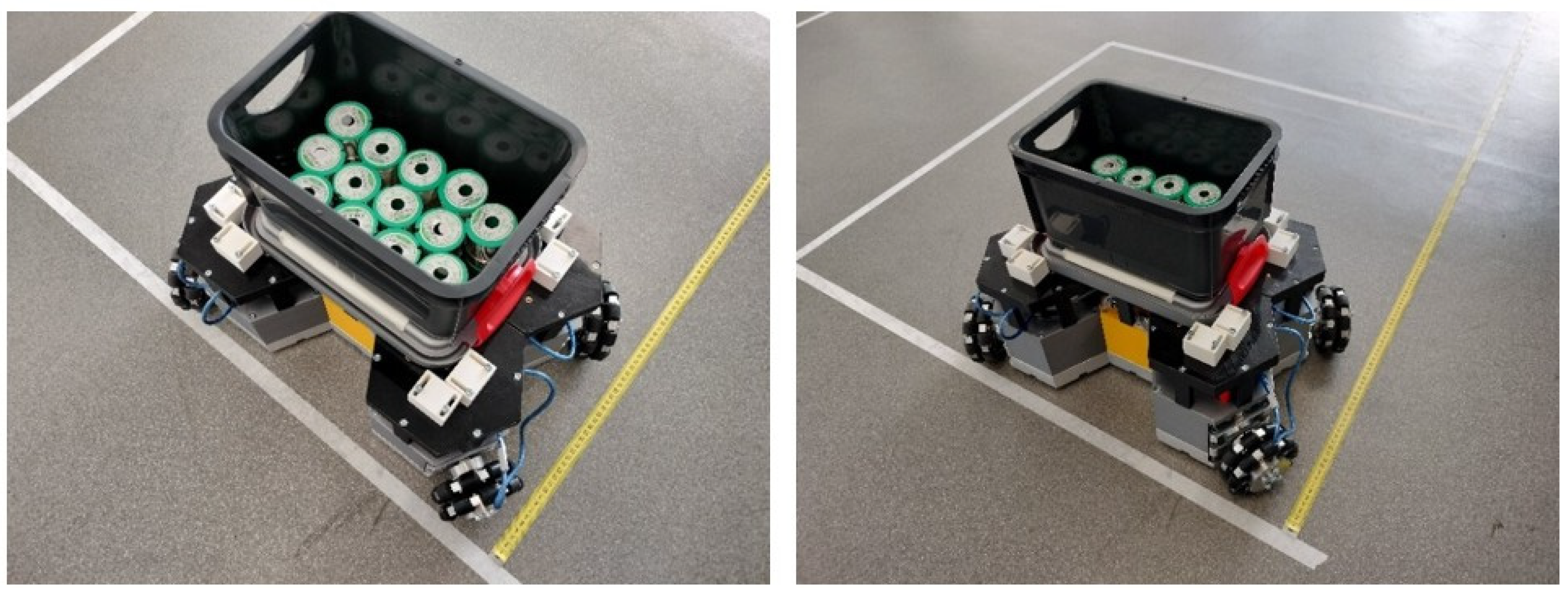
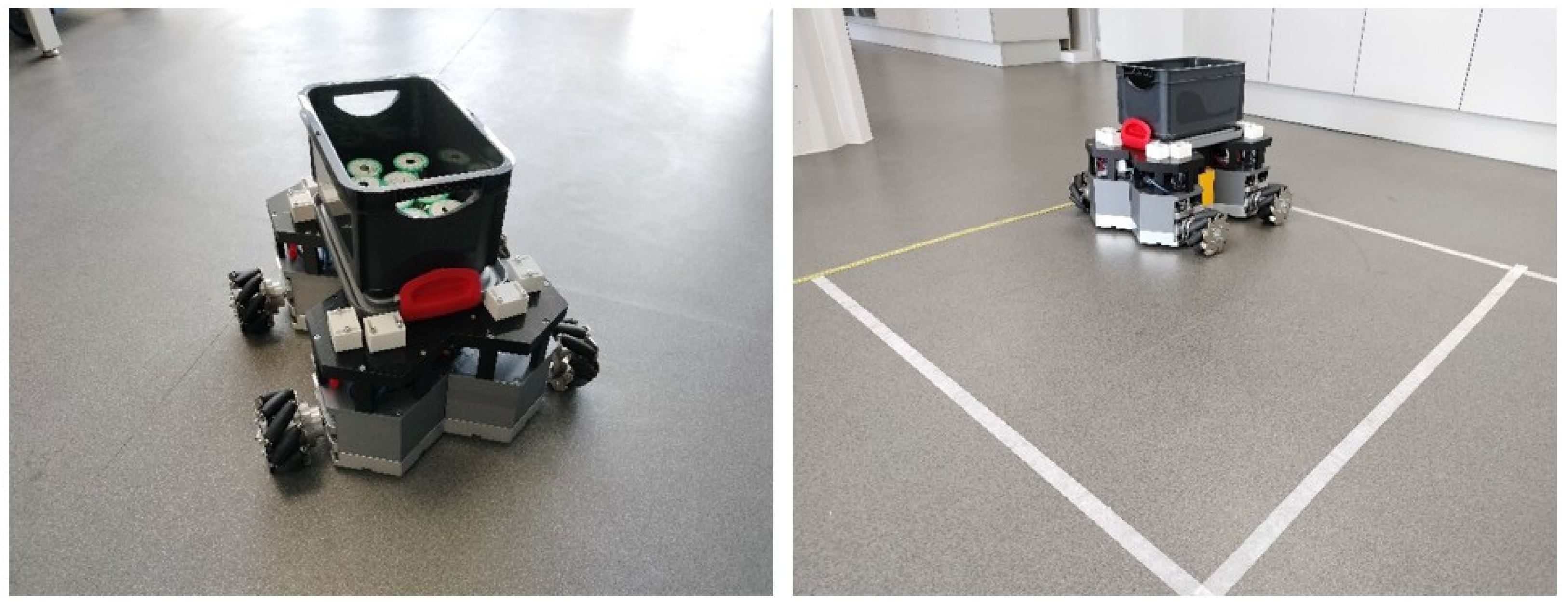
3.1. Modular Mobile Platform and Analyzed Locomotion Architectures
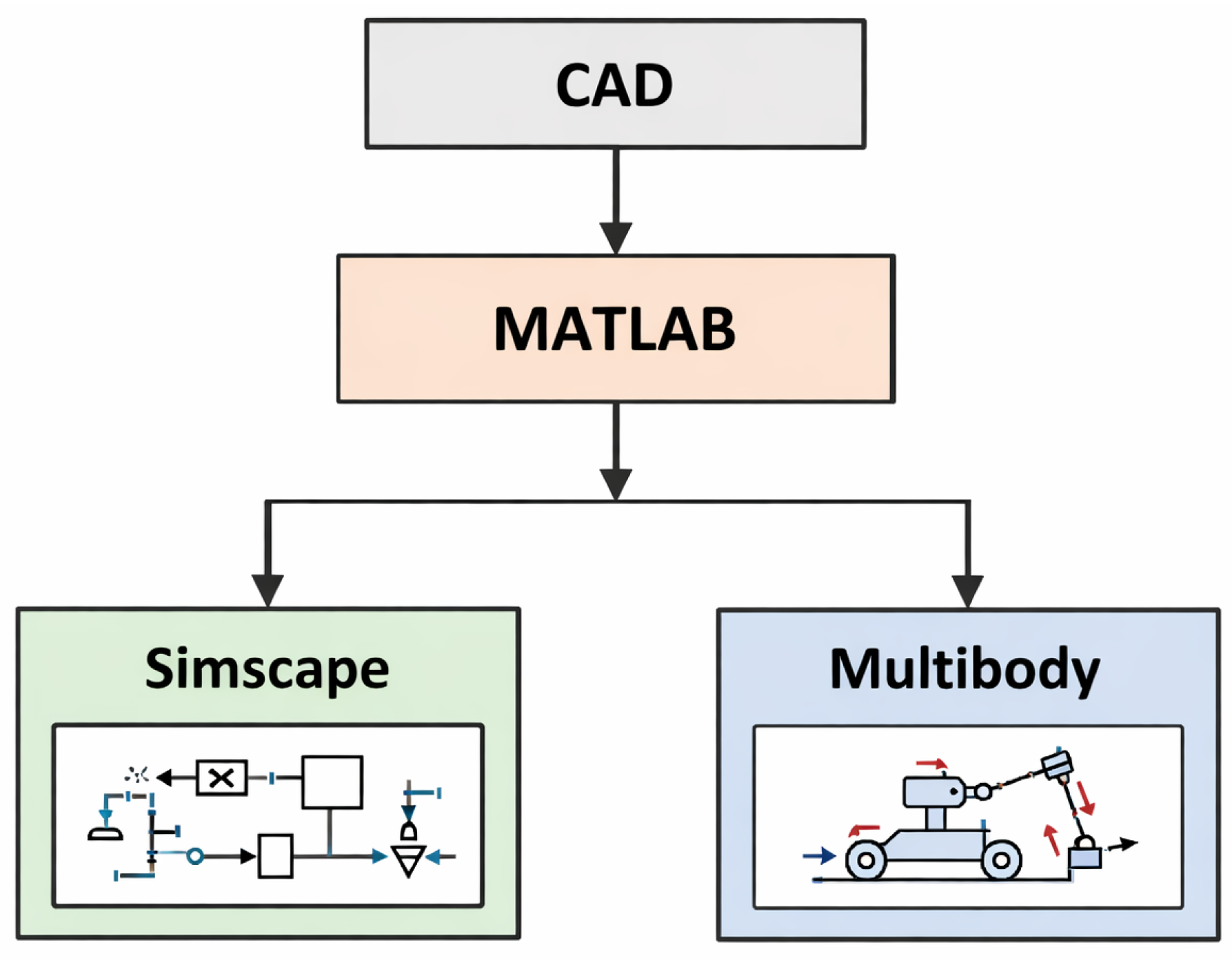
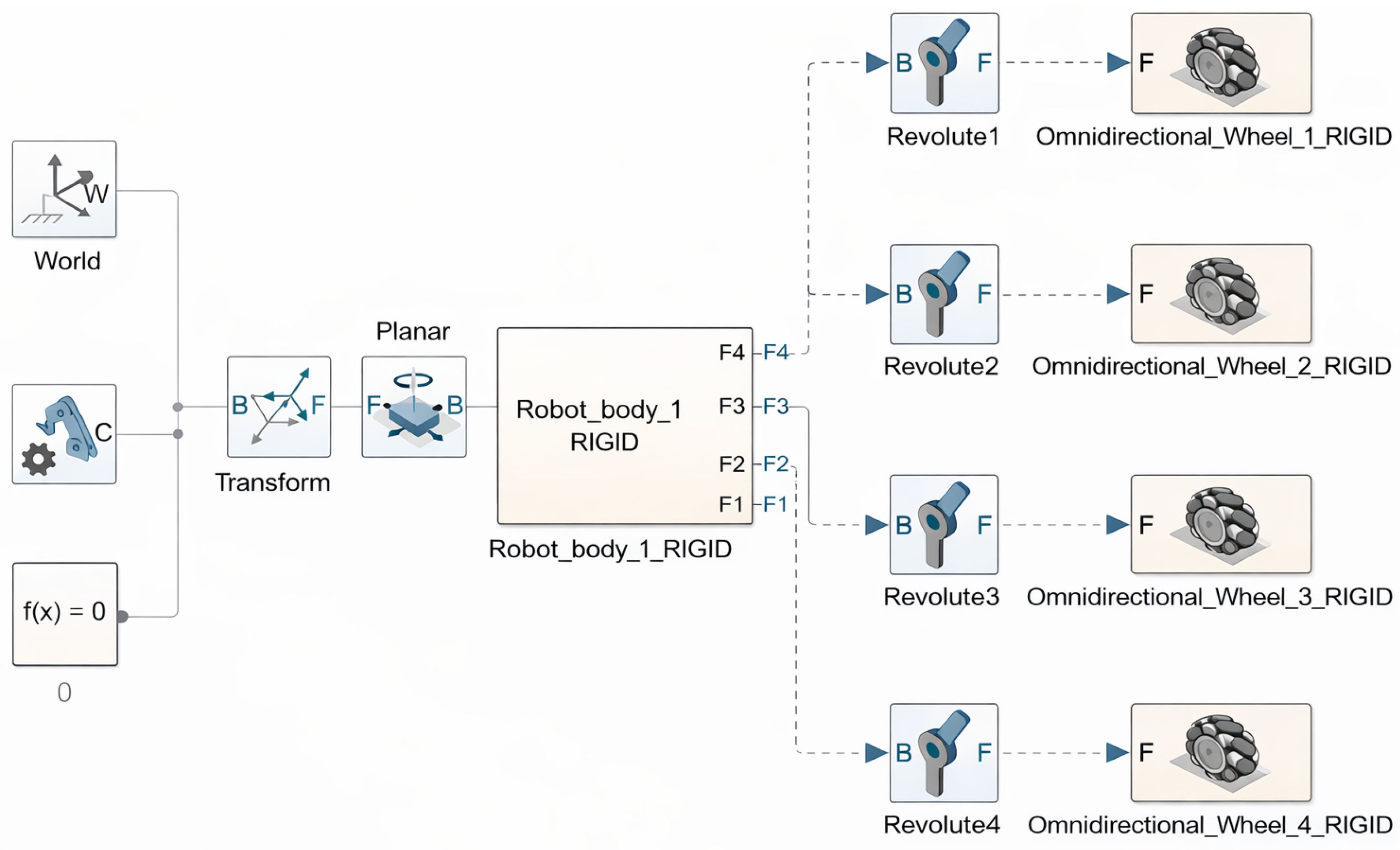
3.2. CAD-to-MATLAB/Simulink–Simscape Workflow and Multibody Model Generation
3.3. Kinematic Modeling and Jacobian Matrices
3.3.1. Four Omni Wheels (Rollers at 90°)
3.3.2. Four Mecanum Wheels (Rollers at 45°)
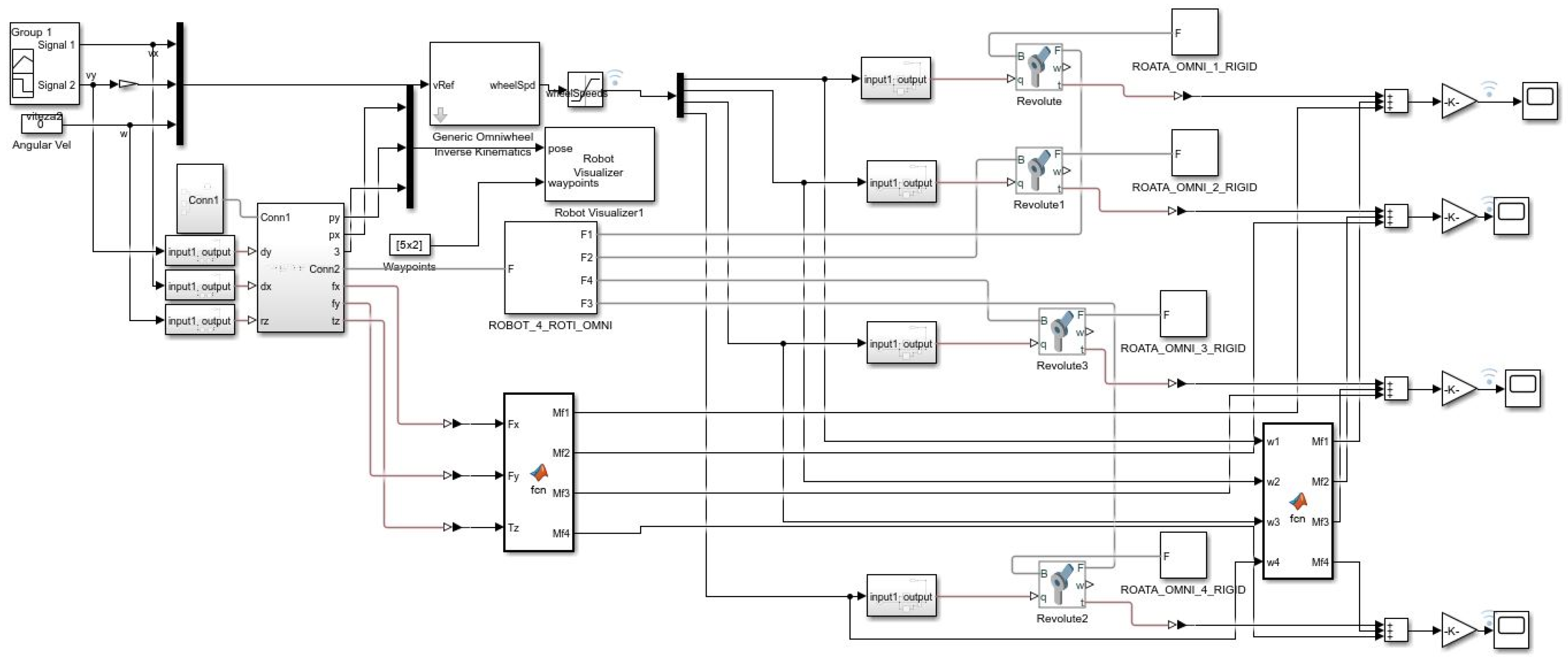
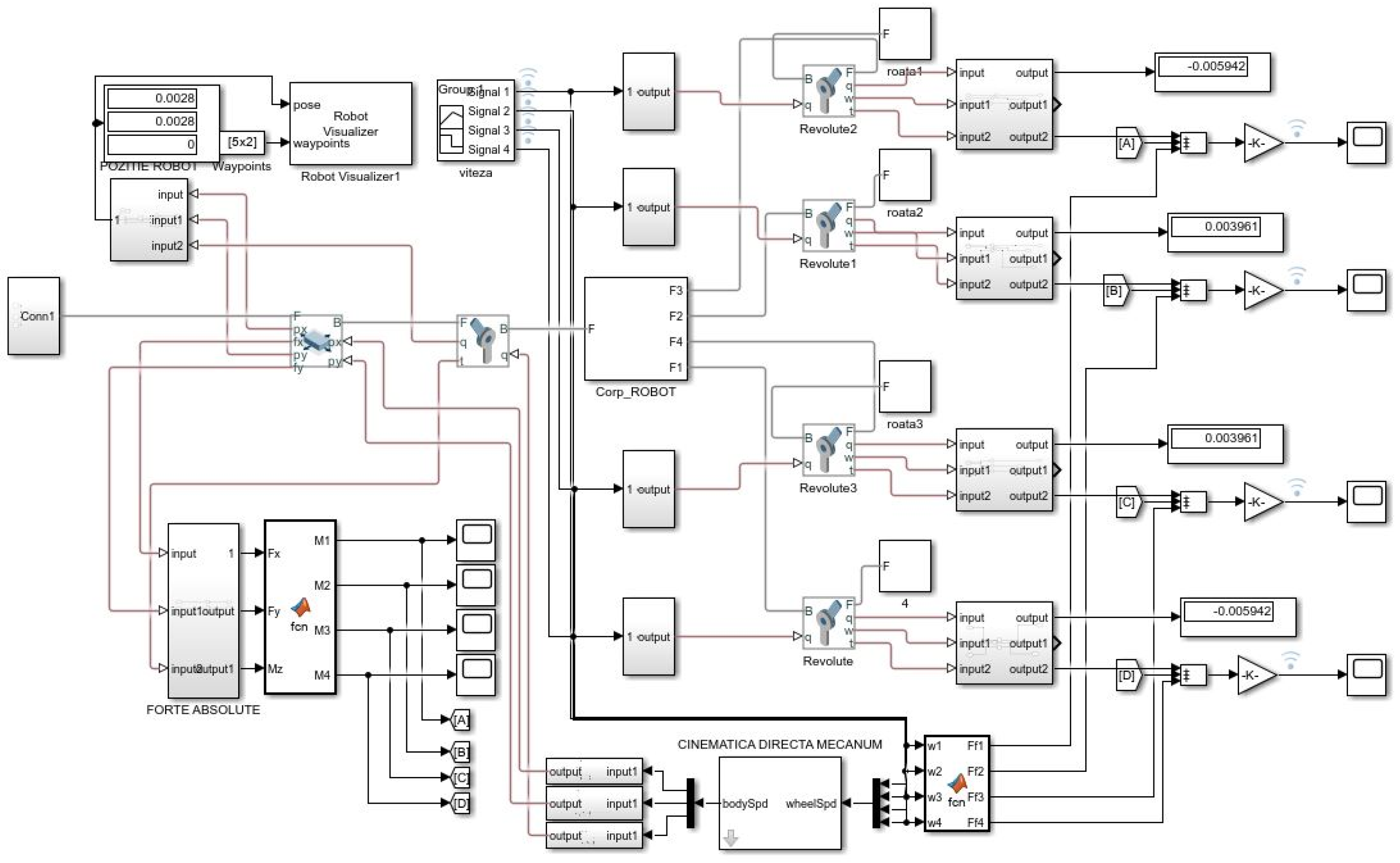
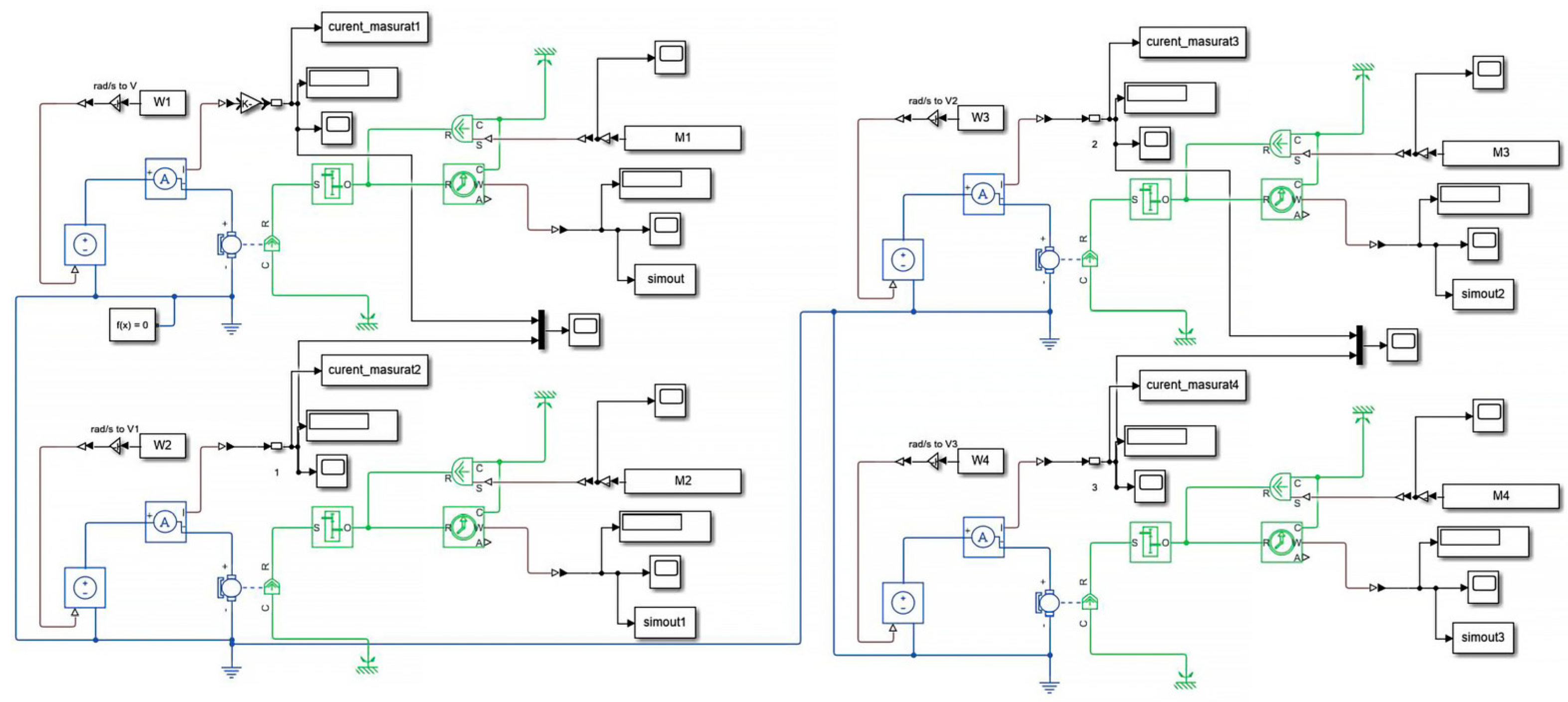
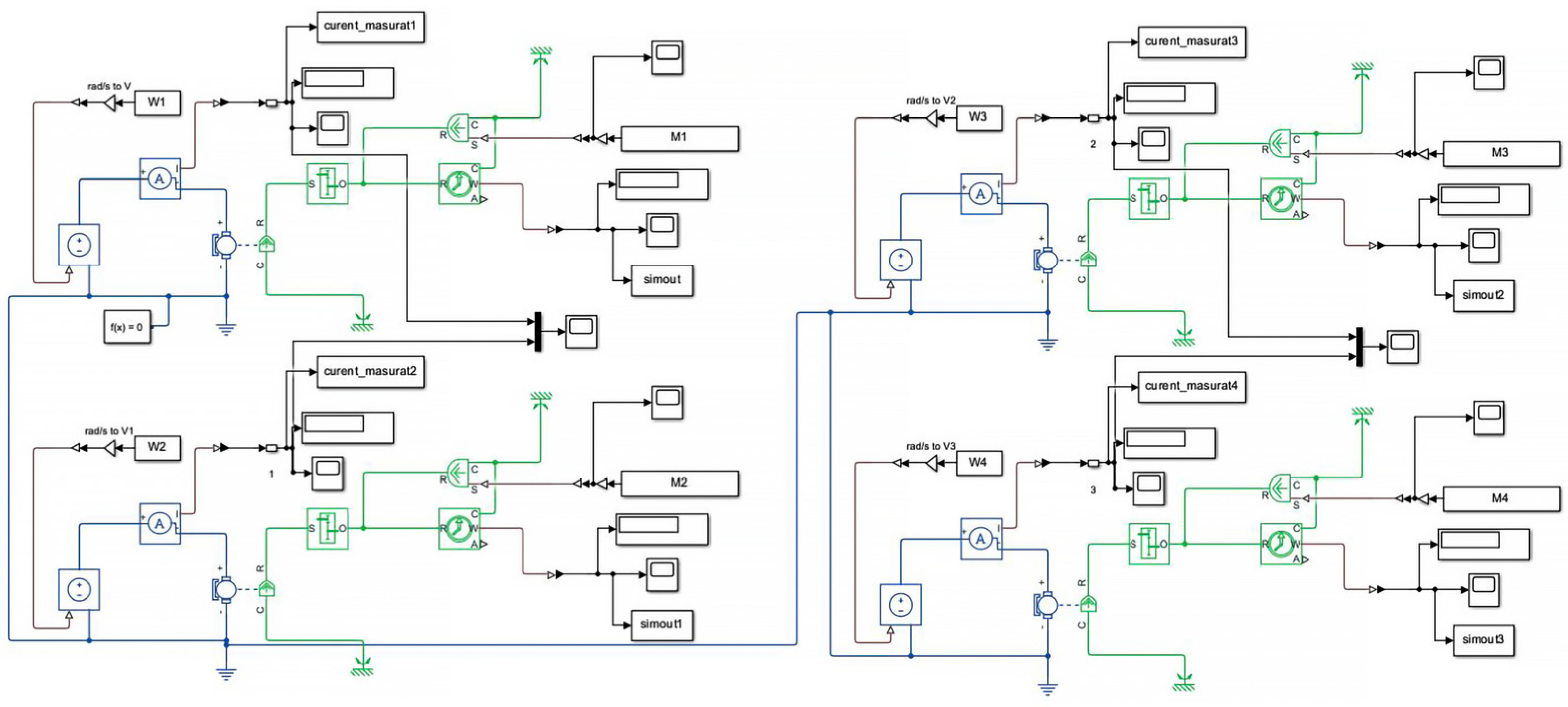
3.4. Simulink–Simscape Dynamic Models and Loss Inclusion
3.5. Relations for Power and Energy Evaluation
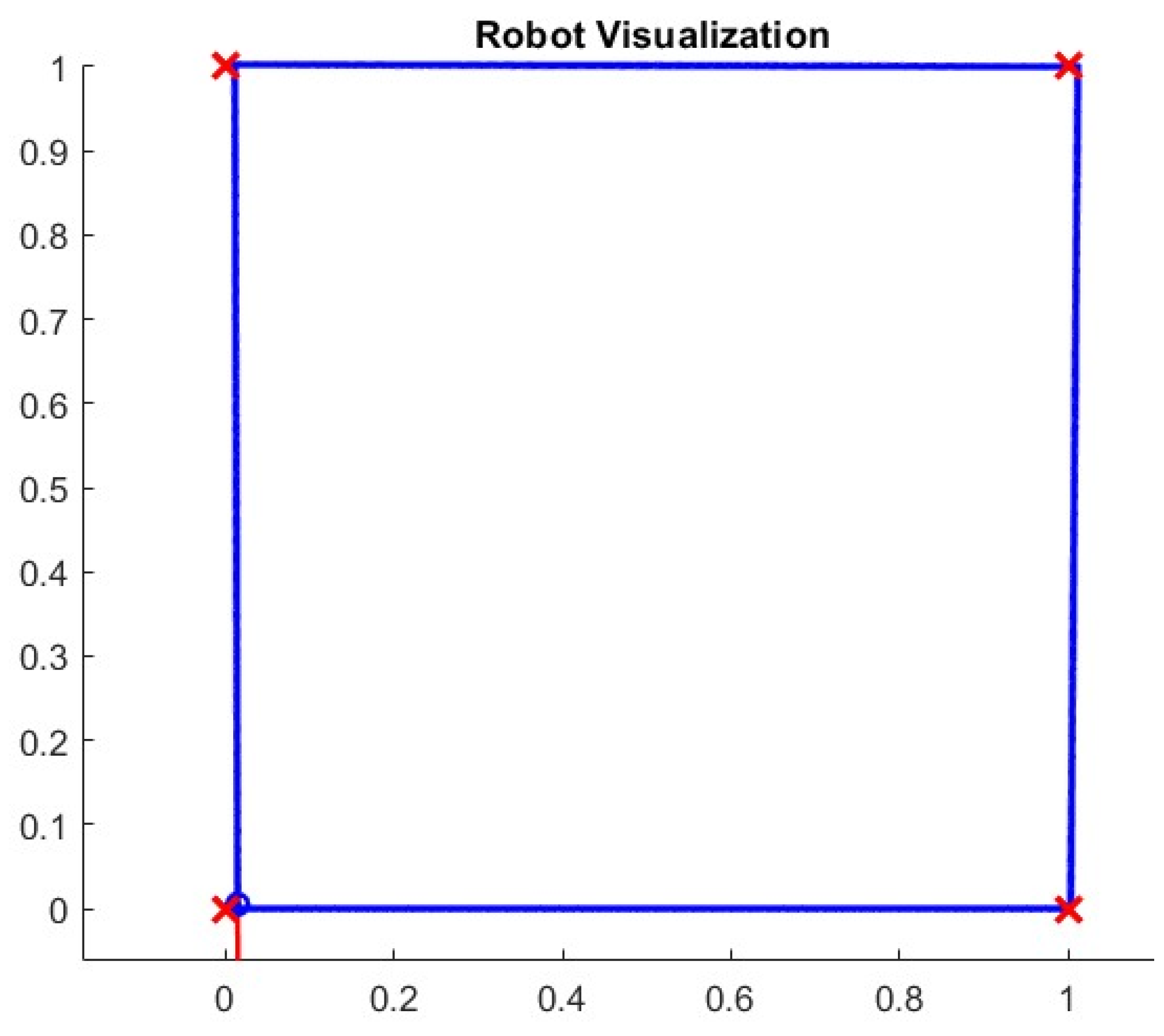
3.6. Benchmark Trajectory and 12 V-Based Input-Power Estimate Comparison
4. Results
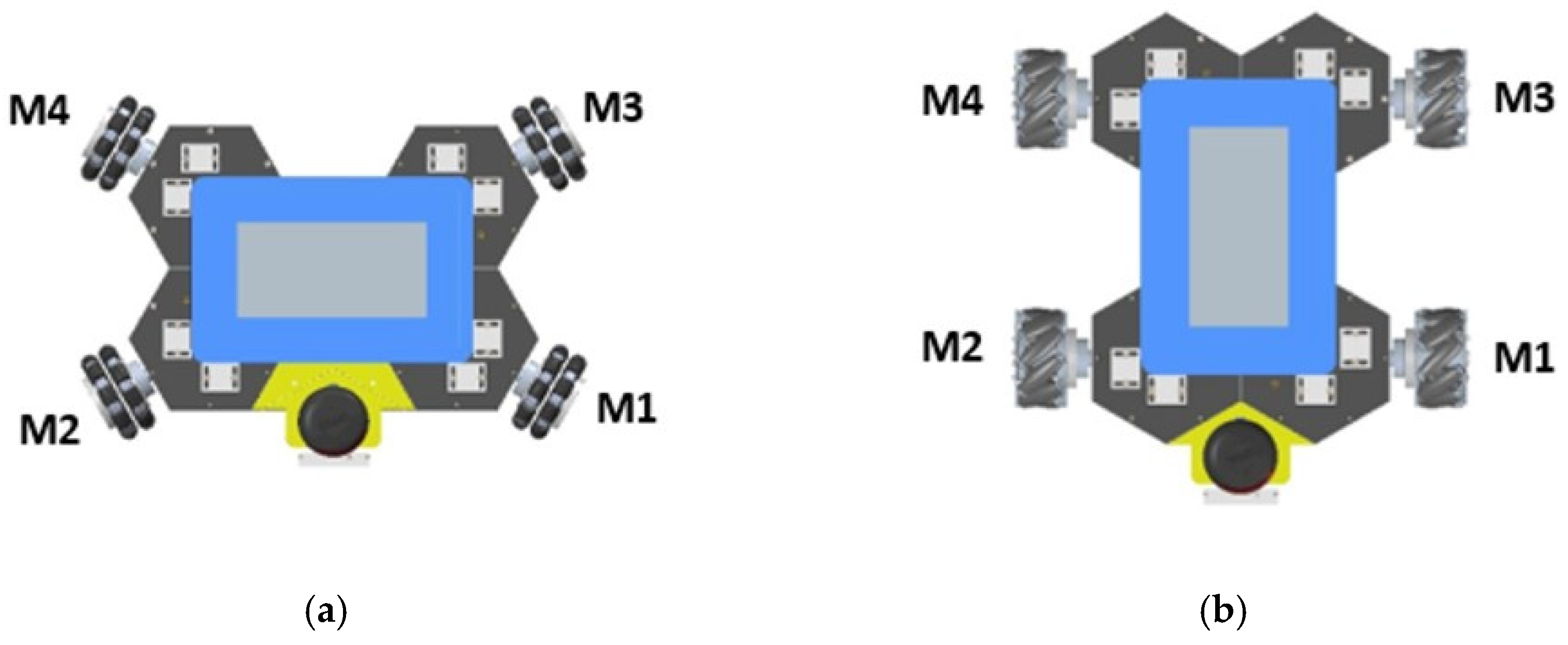
4.1. Robot Configurations and Main Characteristics
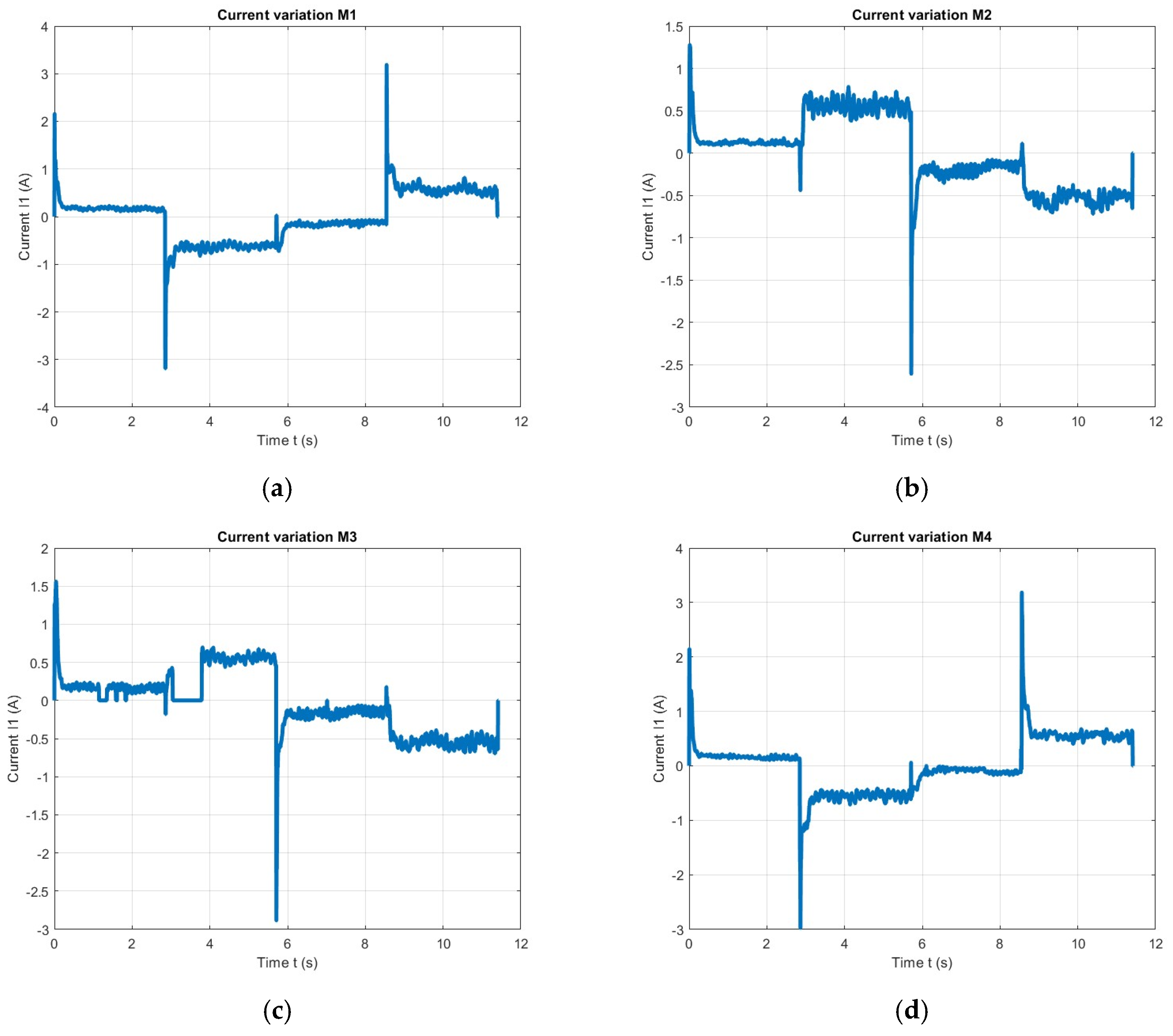
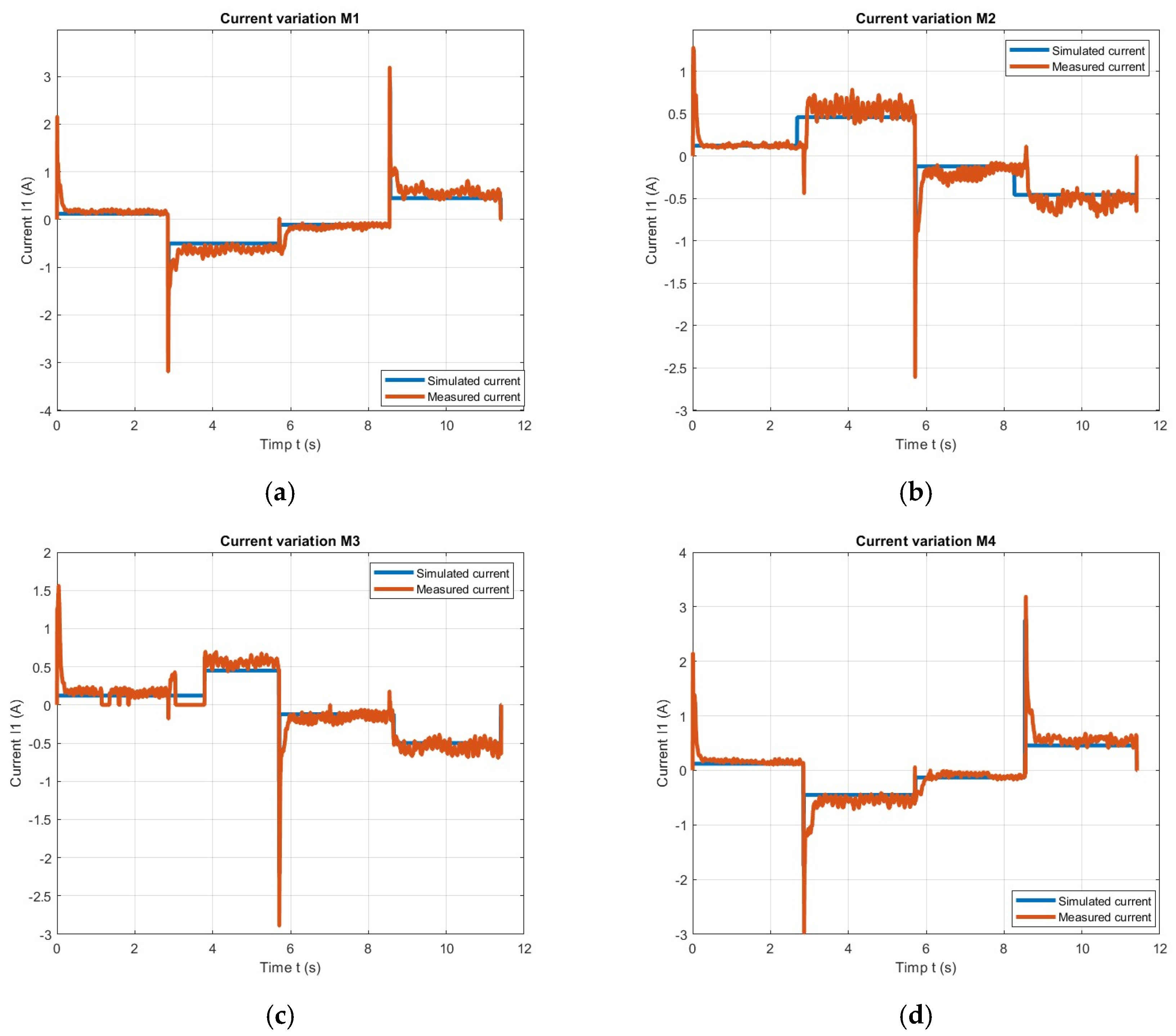
4.2. Dynamic Modeling, Simulation, and Experimental Validation
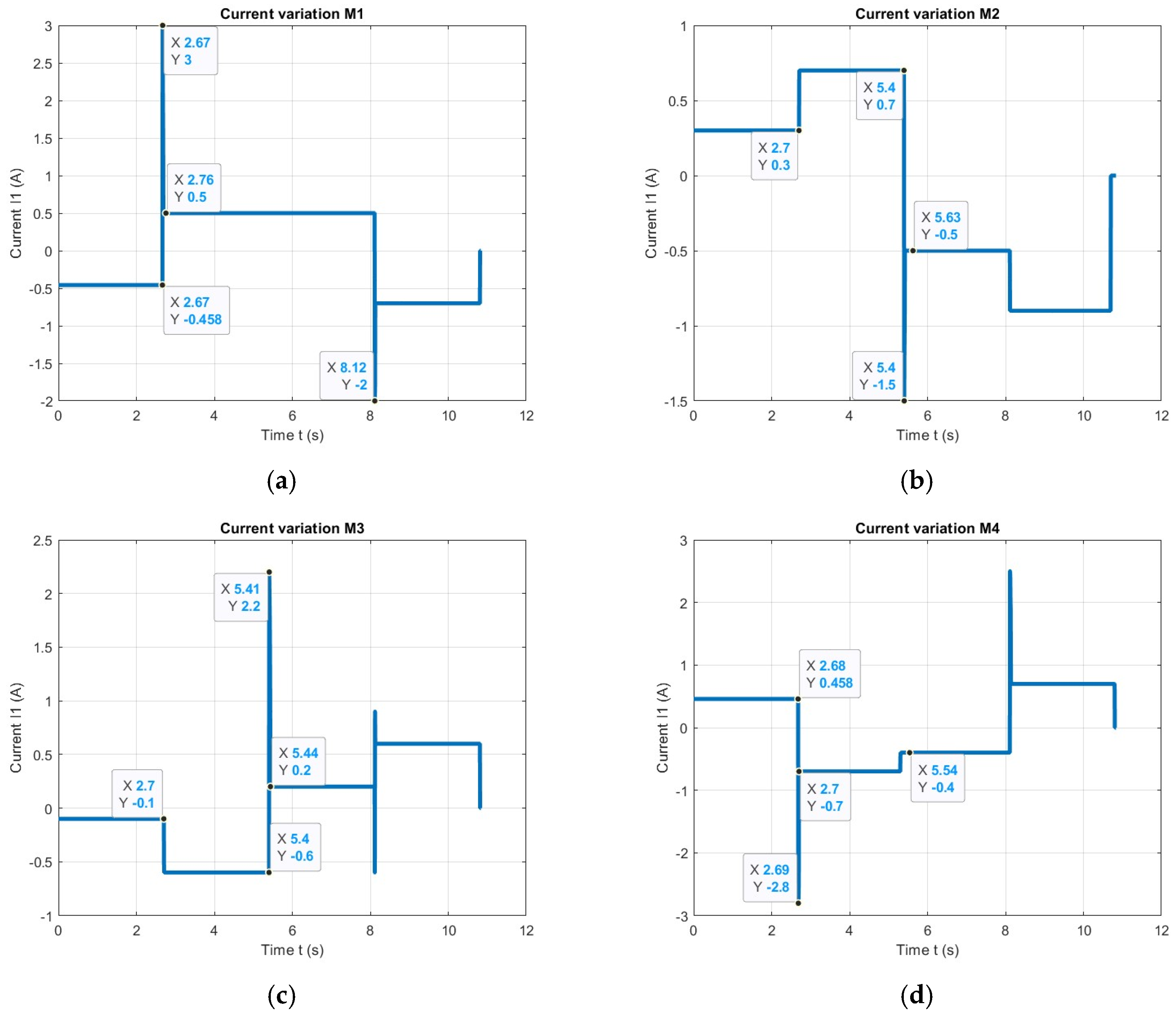
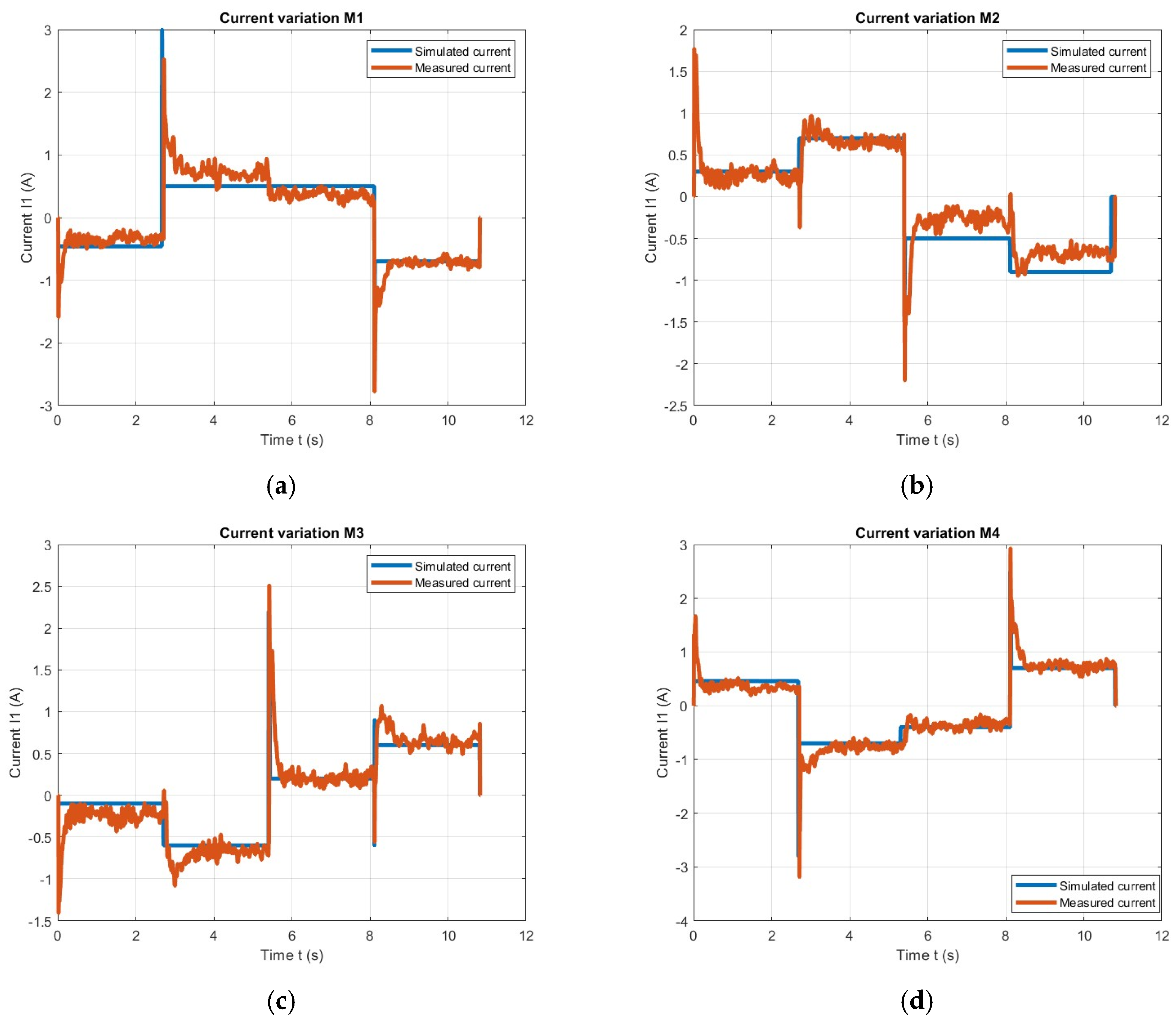
4.2.1. Four-Omni (90° Rollers): Simulation, Measurement, and Comparison
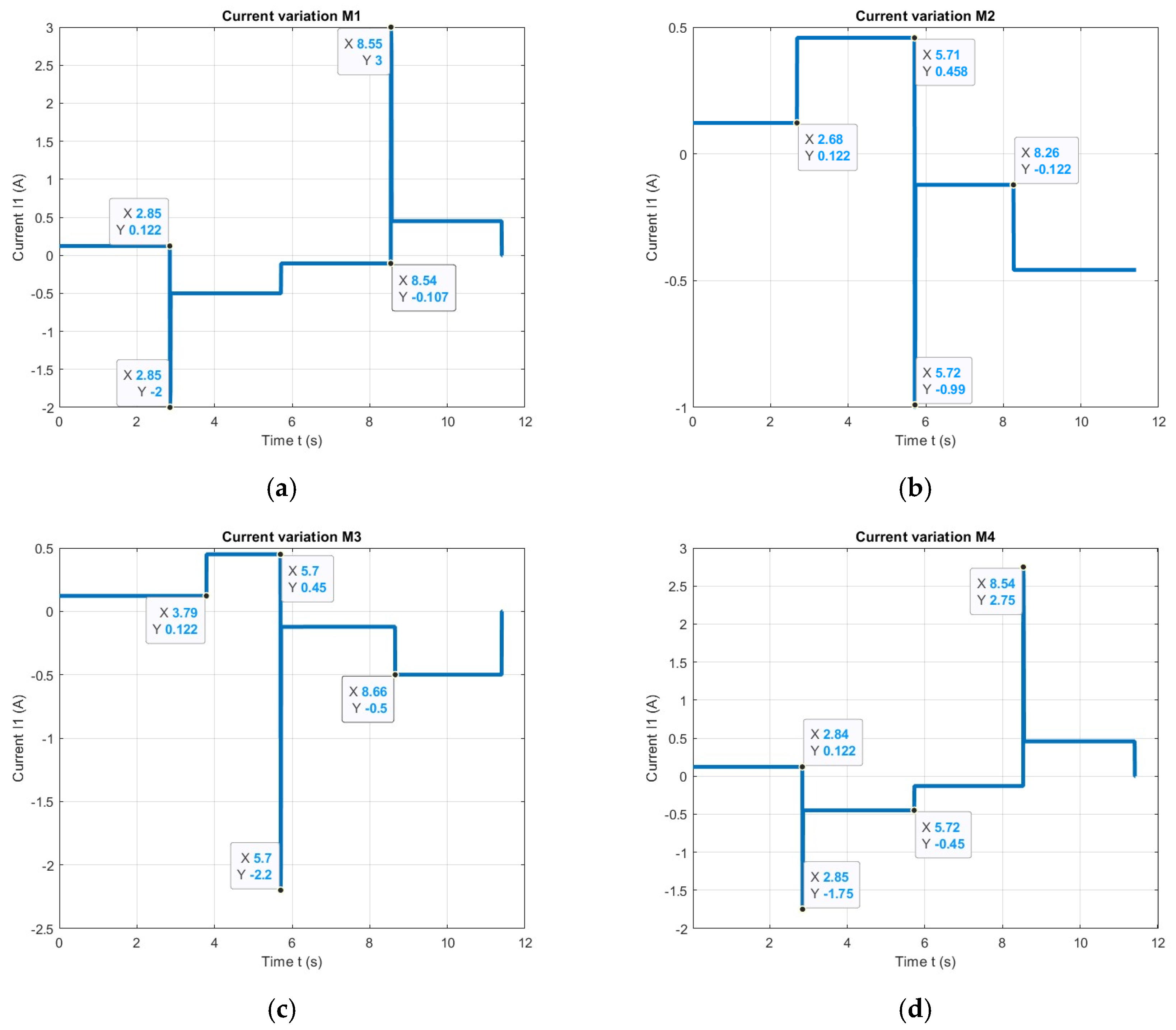
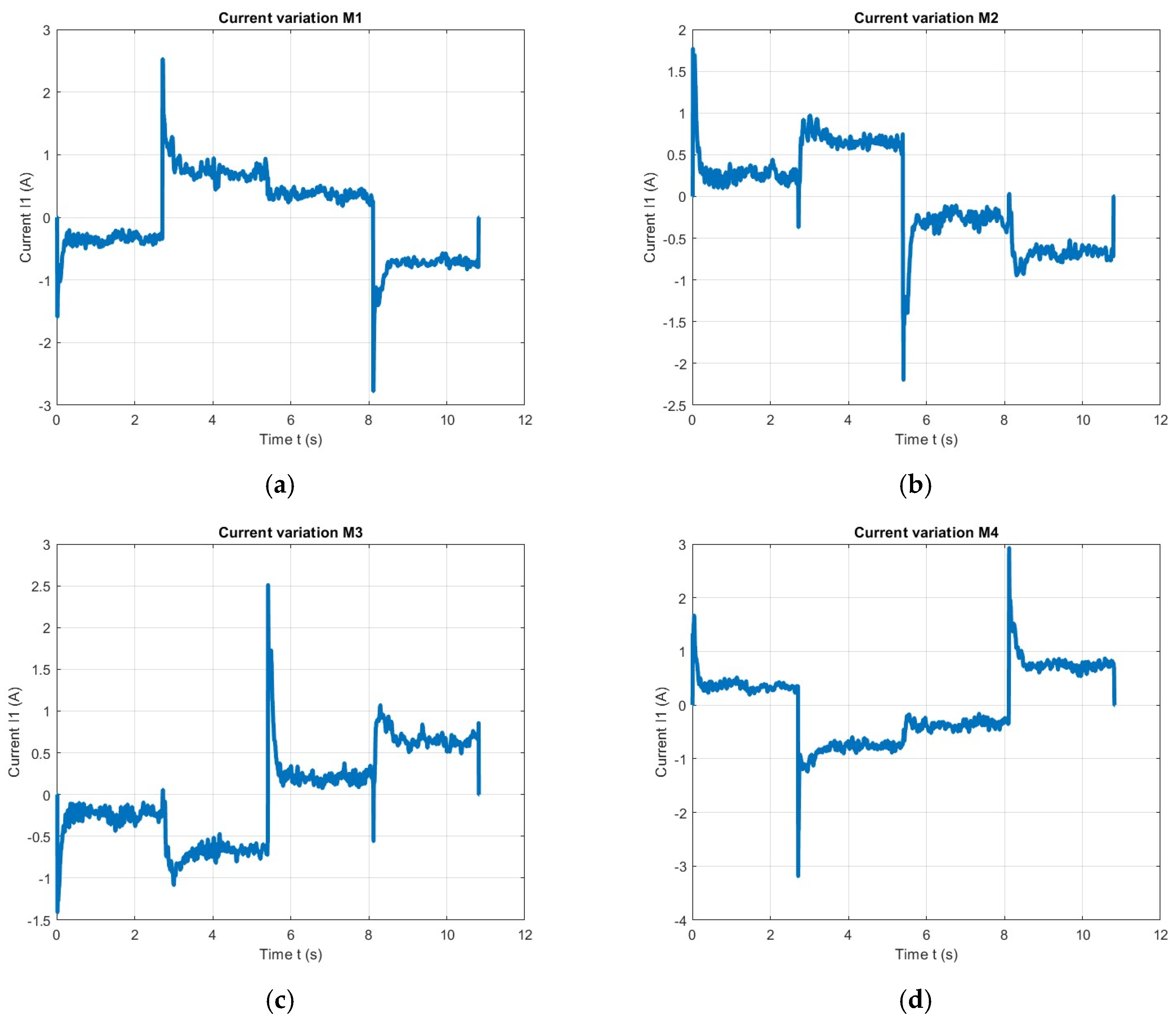
4.2.2. Four-Mecanum (45° Rollers): Simulation, Measurement, and Comparison
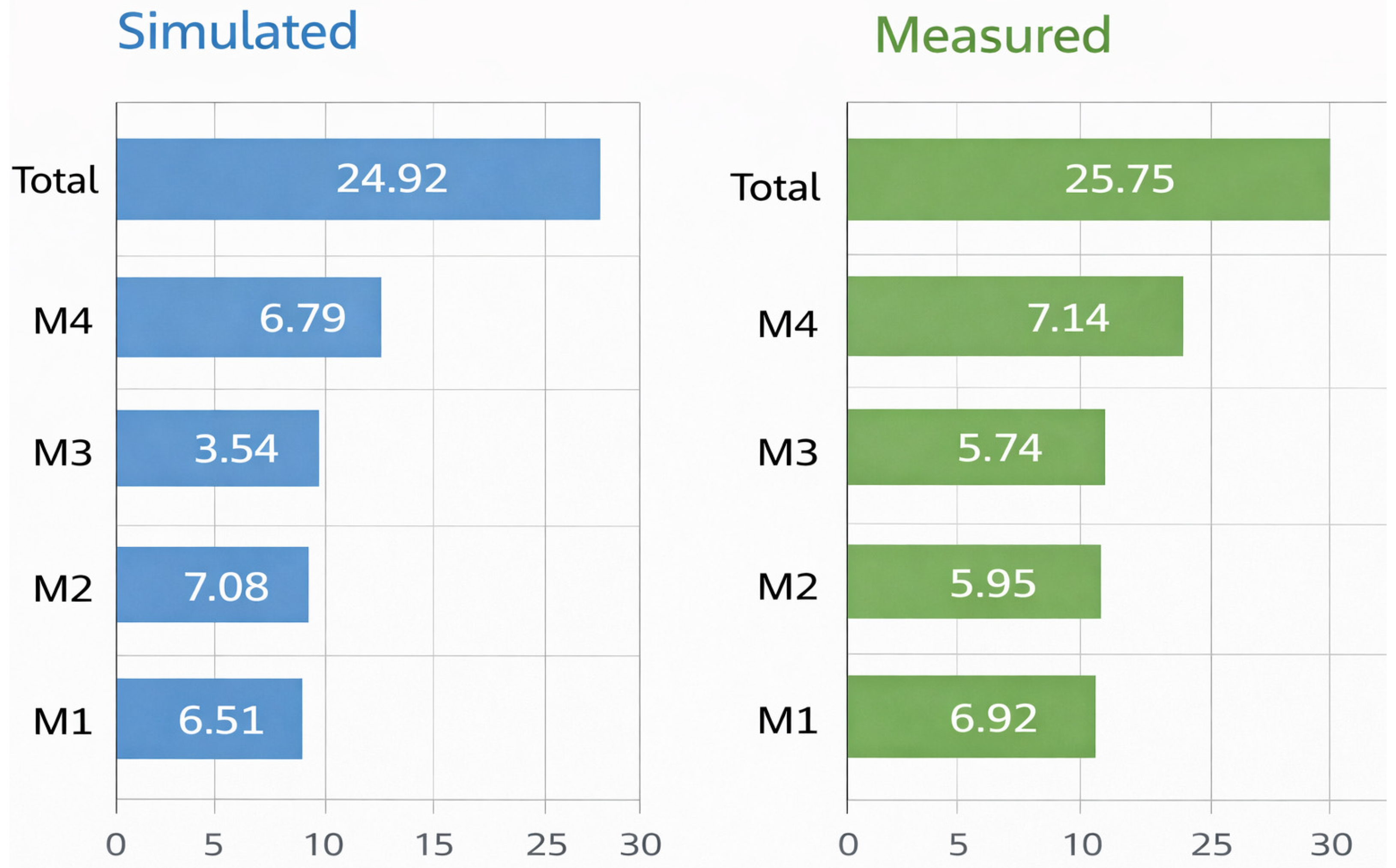
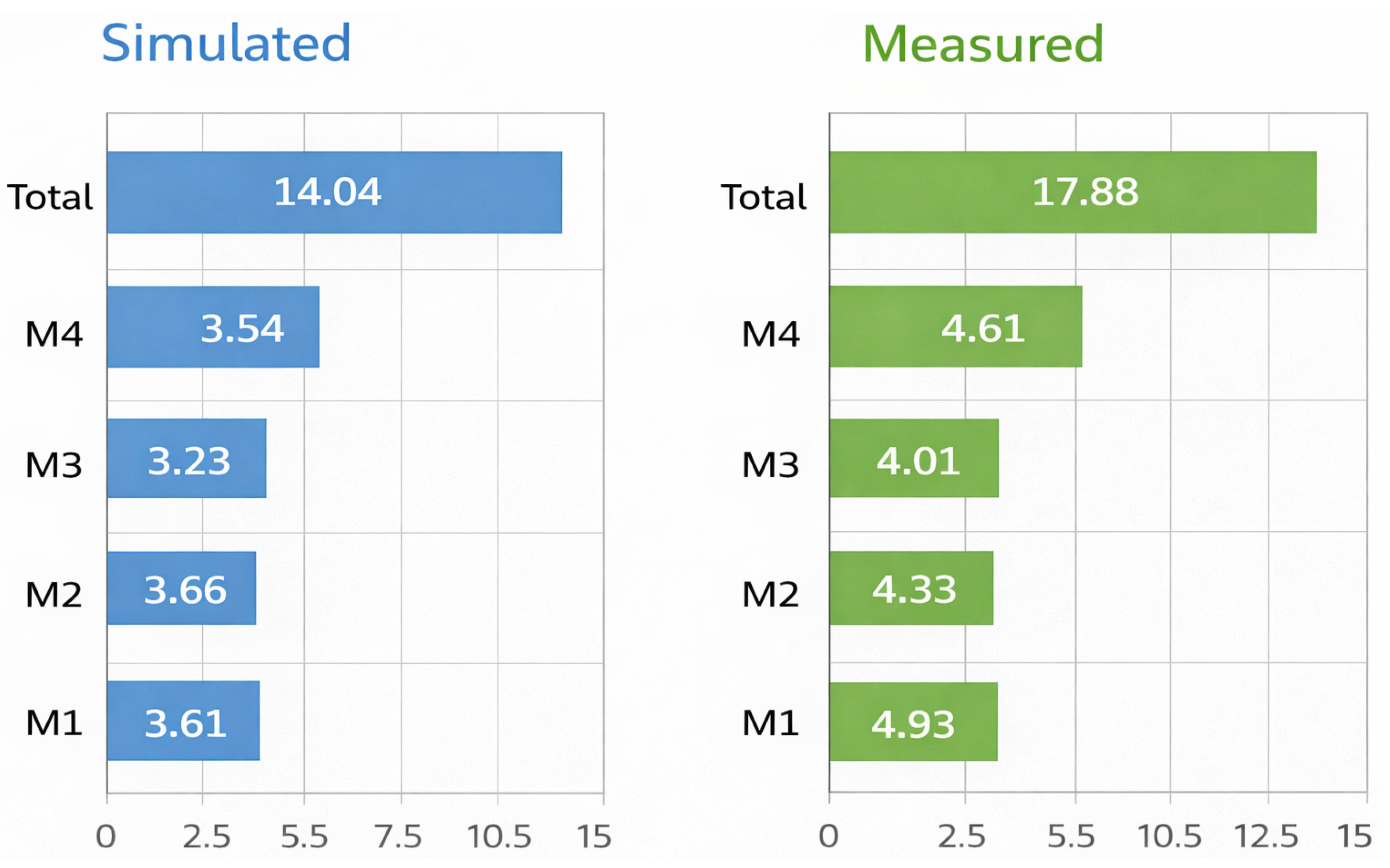
4.3. Comparative Assessment of the 12 V-Based Input-Power Estimate Between the Two Configurations
5. Discussion
5.1. Interpretation of the Measured 12 V-Based Input-Power Estimate on the Square Benchmark
5.2. Simulation-to-Experiment Agreement and Dynamic Model Fidelity
5.3. Implications for Locomotion Architecture Selection in a Modular Robot
- From the measured input-power-estimate perspective: the four-Mecanum configuration yields a lower measured total input-power estimate than the four-omni configuration on the evaluated benchmark (Table 7). For applications where limiting instantaneous electrical input-power estimate is critical (e.g., battery autonomy, power budgeting, or thermal constraints at the driver level), this result favors the four-Mecanum architecture under the tested conditions.
- From the model-based design and predictability perspective: the four-omni configuration provides a closer simulation-to-experiment match at robot level (Table 7), which is valuable for model-based development tasks such as parameter tuning, scenario-based virtual testing, and controller design prior to implementation.
5.4. Limitations and Immediate Directions for Improvement
- Single benchmark trajectory: the selected 1 m square path provides a controlled and reproducible reference case for comparative evaluation, since it combines straight segments and repeated 90° direction changes under identical operating conditions. However, it does not cover the full motion envelope of omnidirectional mobile robots. Additional trajectories, such as diagonal motion, rotation-in-place, curved paths, and combined translation-rotation maneuvers, should be included in future work to assess the robustness and generality of the observed current demand and input-power-estimate trends.
- Input-power estimate computed under nominal voltage assumption: the 12 V-based input-power estimate was computed using current signals and a nominal constant supply voltage (12 V). Measuring the actual voltage at the driver input during motion would capture voltage sag and improve power-estimation accuracy.
- Contact modeling for Mecanum wheels: the simulation-experiment mismatch suggests extending the model to include directional friction, roller resistance, and drivetrain/driver losses, supported by parameter identification on the test surface.
- Absence of a tracking-accuracy metric: adding an objective trajectory-tracking metric, such as external localization or validated odometry, would clarify the relationship between input-power estimate and kinematic performance in the presence of slip. These limitations do not alter the reported results for the considered benchmark, but they define a clear path for extending and consolidating the comparative evaluation in future work.
6. Conclusions and Future Research Directions
- Expanded benchmark set: evaluate additional trajectories and motion primitives (straight-line motion at multiple speeds, diagonal motion, rotation-in-place, and combined translation–rotation) to cover a broader operating envelope beyond the square path.
- Contact and friction parameter identification: identify surface-specific friction/contact parameters and include anisotropic traction effects, which are particularly relevant for Mecanum wheels due to coupled longitudinal–lateral interactions and micro-slip phenomena.
- Enhanced loss modeling: explicitly model drivetrain, roller, and motor driver losses (including PWM-related effects and driver efficiency) to reduce simulation–experiment discrepancies.
- Voltage monitoring for improved input-power estimation: measure the actual voltage at the motor driver input during motion to capture voltage sag and transient effects, improving the accuracy of the computed electrical input-power estimate.
- Trajectory-tracking metric as a companion indicator: complement the input-power-estimate-based analysis with an objective tracking-accuracy metric (e.g., external localization or validated odometry) to correlate current demand and input-power estimate with kinematic performance, particularly under slip conditions.
- Repeatability under varied conditions: repeat experiments across different payloads, floor materials, and speed regimes to quantify robustness and determine each architecture’s sensitivity to operating conditions.
- Model-based control integration: use the validated model as a basis for advanced control and energy-aware strategies (e.g., adaptive speed profiling, predictive control, or adaptive mode selection) and evaluate their impact on current demand, input-power estimate, and tracking performance.
Author Contributions
Funding
Institutional Review Board Statement
Informed Consent Statement
Data Availability Statement
Acknowledgments
Conflicts of Interest
References
- Zhang, Z.; Yu, H.; Wu, C.; Huang, P.; Wu, J. A Comprehensive Study on Mecanum Wheel-Based Mobility and Suspension Solutions for Intelligent Nursing Wheelchairs. Sci. Rep. 2024, 14, 20644. [Google Scholar] [CrossRef] [PubMed]
- Yepez-Figueroa, J.J.; Victores, J.G.; Ona, E.D.; Balaguer, C.; Jardon, A. Design and Development of an Omnidirectional Three-Wheeled Industrial Mobile Robot Platform. Appl. Sci. 2025, 15, 5277. [Google Scholar] [CrossRef]
- Burkacki, M.; Lysy, I.; Suchon, S.; Chrzan, M.; Kowolik, R. Systematic Review of Mecanum and Omni Wheel Technologies for Motor Impairments. Appl. Sci. 2025, 15, 4773. [Google Scholar] [CrossRef]
- Mehenge, R.; Satoskar, N.; Shidhore, A.; Arshath, N.M. Kinematic and Optimal Design of a Three-Wheeled Holonomic Omnidirectional Robot Platform for Mobile Manipulation Tasks. Glob. J. Eng. Technol. Adv. 2023, 17, 045–054. [Google Scholar] [CrossRef]
- Mohamed, S.; Vellaiyan, V.; Kim, K.; Kim, Y.; Shin, B. Development of a Four Omni-Wheeled Mobile Robot Using Telescopic Legs. Machines 2025, 13, 292. [Google Scholar] [CrossRef]
- Hou, L.; Zhou, F.; Kim, K.; Zhang, L. Practical Model for Energy Consumption Analysis of Omnidirectional Mobile Robot. Sensors 2021, 21, 1800. [Google Scholar] [CrossRef]
- Duda, S.; Gembalczyk, G.; Machoczek, T.; Kowalik, Z. Experimental Evaluation of Rolling Resistance in Omnidirectional Wheels Under Quasi-Static Conditions. Sensors 2025, 25, 5026. [Google Scholar] [CrossRef]
- Manzl, P.; Sereinig, M.; Gerstmayr, J. A Mecanum Wheel Model Based on Orthotropic Friction with Experimental Validation. Mech. Mach. Theory 2024, 193, 105548. [Google Scholar] [CrossRef]
- Haji Ali Mohamadi, P.; Khorasani, A.; Verstraten, T.; Vanderborght, B. A Hybrid Parameters Estimation Approach for Power Consumption Modeling of Ground Mobile Robots With Unknown Payload. J. Field Robot. 2025, 42, 1840–1860. [Google Scholar] [CrossRef]
- Constantin, G.; Marosan, I.-A.; Crenganis, M.; Botez, C.; Girjob, C.-E.; Biris, C.-M.; Chicea, A.-L.; Barsan, A. Monitoring the Current Provided by a Hall Sensor Integrated in a Drive Wheel Module of a Mobile Robot. Machines 2023, 11, 385. [Google Scholar] [CrossRef]
- Gupta, A. Energy Efficiency in Robotics Software: A Systematic Literature Review (2020–2024). arXiv 2025, arXiv:2508.12170. [Google Scholar] [CrossRef]
- Gora, K.; Granosik, G.; Cybulski, B. Energy Utilization Prediction Techniques for Heterogeneous Mobile Robots: A Review. Energies 2024, 17, 3256. [Google Scholar] [CrossRef]
- Belyaev, A.; Kushnarev, O. Energy-Based Surface Classification for Mobile Robots in Known and Unexplored Terrains. Robotics 2025, 14, 130. [Google Scholar] [CrossRef]
- Crenganis, M.; Girjob, C.-E.; Rusu, D.M.; Barsan, A. Simulink Based Dynamic Model for Mecanum Drive Autonomous Mobile Platforms Considering Friction Forces. Acta Tech. Napoc. Ser. Appl. Math. Mech. Eng. 2024, 67, 297–308. [Google Scholar]
- Kimura, K.; Ishii, K. Kinetic Analysis of Omnidirectional Mobile Robot with Symmetry Roller’s Arrangement. J. Robot. Netw. Artif. Life 2023, 10, 275–281. [Google Scholar] [CrossRef]
- Xie, L.; Stol, K.; Xu, W. Energy-Optimal Motion Trajectory of an Omni-Directional Mecanum-Wheeled Robot via Polynomial Functions. Robotica 2020, 38, 1400–1414. [Google Scholar] [CrossRef]
- Marosan, I.-A.; Girjob, C.-E.; Crenganis, M.; Biris, C.-M. Trajectory Simulation and Energy Consumption Evaluation for Mobile Robots Equipped with Mecanum Wheels Using MATLAB. Acta Tech. Napoc. Ser. Appl. Math. Mech. Eng. 2025, 68, 673–684. [Google Scholar]
- Sun, Z.; Hu, S.; He, D.; Zhu, W.; Xie, H.; Zheng, J. Trajectory-Tracking Control of Mecanum-Wheeled Omnidirectional Mobile Robots Using Adaptive Integral Terminal Sliding Mode. Comput. Electr. Eng. 2021, 96, 107500. [Google Scholar] [CrossRef]
- Hernandez, J.C.O.; Almeida, D.I.R. Kinematic Control in a Four-Wheeled Mecanum Mobile Robot for Trajectory Tracking. J. Eng. 2024, 2024, e70006. [Google Scholar] [CrossRef]
- Nghiem, G.-K.; Le, T.-L.; Phung, T.C.; Dinh, Q.H. A Study on the Optimal Control Strategy Using Sliding Mode Controller for Mecanum-Wheeled Omnidirectional Mobile Robot. Measurement 2025, 255, 118113. [Google Scholar] [CrossRef]
- Zhao, T.; Qin, P.; Zhong, Y. Trajectory Tracking Control Method for Omnidirectional Mobile Robot Based on Self-Organizing Fuzzy Neural Network and Preview Strategy. Entropy 2023, 25, 248. [Google Scholar] [CrossRef]
- Shahgholian, S.; Akhavan, M.; Kamrani, V.; Ganjefar, S. Design an Omnidirectional Autonomous Mobile Robot Based on Non-Linear Optimal Control to Track a Specified Path. IET Control Theory Appl. 2024, 18, 1200–1209. [Google Scholar] [CrossRef]
- Li, C.; Li, Z. Dynamic Modeling and Disturbance-Observer-Enhanced Control for Mecanum-Wheeled Vehicles Under Load and Noise Disturbance. Mathematics 2025, 13, 789. [Google Scholar] [CrossRef]
- Chen, Y.-H. Nonlinear Adaptive Optimal Control Design and Implementation for Trajectory Tracking of Four-Wheeled Mecanum Mobile Robots. Mathematics 2024, 12, 4013. [Google Scholar] [CrossRef]
- Rojas-Lopez, A.G.; Villarreal-Cervantes, M.G.; Rodriguez-Molina, A.; Paredes-Ballesteros, J.A. Efficient Online Controller Tuning for Omnidirectional Mobile Robots Using a Multivariate-Multitarget Polynomial Prediction Model and Evolutionary Optimization. Biomimetics 2025, 10, 114. [Google Scholar] [CrossRef]
- Li, H.; Ye, C.; Tian, S.; Yu, S. Sliding Mode Control of the MY-3 Omnidirectional Mobile Robot Based on RBF Neural Networks. Machines 2025, 13, 695. [Google Scholar] [CrossRef]
- Luviano-Juarez, A.; Ramirez-Neria, M.; Gonzalez-Sierra, J. Robust Trajectory Tracking for Omnidirectional Mobile Robots with Input Time Delay: An ADRC Approach. Mathematics 2026, 14, 266. [Google Scholar] [CrossRef]
- Trojnacki, M.; Agakpe, G. Model-Based Global Path Planning for Mobile Robots with Different Kinematic Structures Under Path Length and Energy Efficiency Criteria: A Case Study. Electronics 2026, 15, 993. [Google Scholar] [CrossRef]
- Crenganis, M.; Breaz, R.-E.; Racz, S.-G.; Girjob, C.-E.; Biris, C.-M.; Marosan, A.; Barsan, A. Fuzzy Logic-Based Driving Decision for an Omnidirectional Mobile Robot Using a Simulink Dynamic Model. Appl. Sci. 2024, 14, 3058. [Google Scholar] [CrossRef]
- Amarasiri, N.; Barhorst, A.A.; Gottumukkala, R. Investigating Suitable Combinations of Dynamic Models and Control Techniques for Offline Reinforcement Learning Based Navigation: Application of Universal Omni-Wheeled Robots. ASME Lett. Dyn. Syst. Control 2024, 4, 021007. [Google Scholar] [CrossRef]
- Wang, B.; Zhang, L.; Kim, J. Fault Detection and Diagnosis of Three-Wheeled Omnidirectional Mobile Robot Based on Power Consumption Modeling. Mathematics 2024, 12, 1731. [Google Scholar] [CrossRef]
- Nakagawa, Y.; Igo, N.; Hoshino, K. Controlling a Mecanum-Wheeled Robot with Multiple Swivel Axes Controlled by Three Commands. Sensors 2025, 25, 709. [Google Scholar] [CrossRef] [PubMed]
- Racz, S.-G.; Crenganis, M.; Breaz, R.-E.; Marosan, A.; Barsan, A.; Girjob, C.-E.; Biris, C.-M.; Tera, M. Mobile Robots-AHP-Based Actuation Solution Selection and Comparison between Mecanum Wheel Drive and Differential Drive with Regard to Dynamic Loads. Machines 2022, 10, 886. [Google Scholar] [CrossRef]






| Ref. (Title) | Platform/Wheels | Core Method | Energy/Loss Treatment | Main Contribution and Limitation |
|---|---|---|---|---|
| Practical Model for Energy Consumption Analysis of Omnidirectional Mobile Robot (2021) [6] | Omnidirectional robot (general) | Practical/analytical energy model | Robot-level energy estimation | Strong basis for energy metrics; no unified Simscape benchmark comparison across four-omni and 4-Mecanum. |
| Energy-Optimal Motion Trajectory of an Omni-Directional Mecanum-Wheeled Robot via Polynomial Functions (2020) [16] | 4 Mecanum (45°) | Polynomial trajectory optimization | Energy minimization objective | Relevant for energy-optimal planning; Mecanum-only scope. |
| A Mecanum Wheel Model Based on Orthotropic Friction with Experimental Validation (2024) [8] | 4 Mecanum (45°) | Orthotropic friction + experimental validation | Contact-loss sensitivity | High-fidelity wheel–ground interaction; not a unified energy benchmark across architectures. |
| Experimental Evaluation of Rolling Resistance in Omnidirectional Wheels Under Quasi-Static Conditions (2025) [7] | Omni wheels (passive rollers) | Quasi-static experiments | Rolling resistance/loss quantification | Provides loss characterization; not a robot-level dynamic energy comparison on identical path. |
| Simulink Based Dynamic Model for Mecanum Drive Autonomous Mobile Platforms Considering Friction Forces (2024) [14] | 4 Mecanum (45°) | MATLAB/Simulink dynamic model | Friction included; energy derivable | Relevant modeling workflow; single architecture (Mecanum); no controlled four-omni vs. four-Mecanum comparison under identical benchmark conditions. |
| This work (present paper) | Modular robot; 4 omni (90°) vs. 4 Mecanum (45°) | Unified MATLAB/ Simulink–Simscape model + Hall-sensor validation | 12 V-based input-power estimate comparison on a 1 m × 1 m square path | Fair cross-architecture comparison; limited to one benchmark trajectory |
| Parameter | Four-Omni (90° Rollers) | Four-Mecanum (45° Rollers) |
|---|---|---|
| Dimensions | Ground footprint approximated by a circle of 300 mm radius | 493 × 454 × 210 mm (L × W × H) |
| Robot mass | 23 kg | 23 kg |
| Maximum payload | ~10 kg | ~10 kg |
| Maximum speed | 0.5 m/s | 0.5 m/s |
| Maximum acceleration | 1 m/s2 | 1 m/s2 |
| Motor supply voltage | 12 V | 12 V |
| Maximum motor torque | Max. 7.3 Nm | Max. 7.3 Nm |
| Wheel diameter | 100 mm | 100 mm |
| Wheel type | Omni wheel, 90° rollers | Mecanum wheel, 45° rollers |
| Current sensing | ACS712-5A Hall-effect current sensors (Allegro MicroSystems, Worcester, MA, USA) | ACS712-5A Hall-effect current sensors (Allegro MicroSystems, Worcester, MA, USA) |
| Control hardware | Raspberry Pi 4 Model B (Raspberry Pi Ltd., Cambridge, UK), Arduino Mega 2560 Rev3 (Arduino, Monza, Italy) | Raspberry Pi 4 Model B (Raspberry Pi Ltd., Cambridge, UK), Arduino Mega 2560 Rev3 (Arduino, Monza, Italy) |
| Software | ROS integration capability | ROS integration capability |
| Motor | RMSE (A) | MAE (A) | Pearson Correlation Coefficient (-) |
|---|---|---|---|
| M1 | 0.266 | 0.170 | 0.912 |
| M2 | 0.245 | 0.172 | 0.930 |
| M3 | 0.239 | 0.132 | 0.911 |
| M4 | 0.245 | 0.126 | 0.930 |
| Motor | RMSE (A) | MAE (A) | Pearson Correlation Coefficient (-) |
|---|---|---|---|
| M1 | 0.186 | 0.117 | 0.954 |
| M2 | 0.167 | 0.100 | 0.927 |
| M3 | 0.180 | 0.097 | 0.907 |
| M4 | 0.256 | 0.119 | 0.867 |
| Quantity | M1 | M2 | M3 | M4 | Total |
|---|---|---|---|---|---|
| Measured current (A) | 0.58 | 0.50 | 0.48 | 0.60 | 2.16 |
| Simulated current (A) | 0.54 | 0.59 | 0.38 | 0.57 | 2.08 |
| Current error (%) | 5.92 | −18.99 | 20.91 | 4.90 | 3.70 |
| 12 V-based input-power estimate from measurements (W) | 6.92 | 5.95 | 5.74 | 7.14 | 25.75 |
| 12 V-based input-power estimate from simulation (W) | 6.51 | 7.08 | 4.54 | 6.79 | 24.92 |
| Input-power estimate error (%) | 5.92 | −18.99 | 20.91 | 4.90 | 3.70 |
| Quantity | M1 | M2 | M3 | M4 | Total |
|---|---|---|---|---|---|
| Measured current (A) | 0.41 | 0.36 | 0.33 | 0.38 | 1.48 |
| Simulated current (A) | 0.30 | 0.31 | 0.27 | 0.30 | 1.18 |
| Current error (%) | 26.77 | 15.47 | 19.45 | 23.21 | 20.27 |
| 12 V-based input-power estimate from measurements (W) | 4.93 | 4.33 | 4.01 | 4.61 | 17.88 |
| 12 V-based input-power estimate from simulation (W) | 3.61 | 3.66 | 3.23 | 3.54 | 14.04 |
| Input-power estimate error (%) | 26.77 | 15.47 | 19.45 | 23.21 | 21.42 |
| Configuration | Total Measured Input-Power Estimate (W) | Total Simulated Input-Power Estimate (W) | Robot-Level Deviation (%) |
|---|---|---|---|
| Four-omni (90° rollers) | 25.75 | 24.92 | 3.70 |
| Four-Mecanum (45° rollers) | 17.88 | 14.04 | 21.42 |
Disclaimer/Publisher’s Note: The statements, opinions and data contained in all publications are solely those of the individual author(s) and contributor(s) and not of MDPI and/or the editor(s). MDPI and/or the editor(s) disclaim responsibility for any injury to people or property resulting from any ideas, methods, instructions or products referred to in the content. |
© 2026 by the authors. Licensee MDPI, Basel, Switzerland. This article is an open access article distributed under the terms and conditions of the Creative Commons Attribution (CC BY) license.
Share and Cite
Maroșan, I.-A.; Bârsan, A.; Constantin, G.; Racz, S.-G.; Breaz, R.-E.; Gîrjob, C.-E.; Crenganiș, M.; Biriș, C.-M. Comparative Modeling and Experimental Validation of Two Four-Wheel Omnidirectional Locomotion Architectures for a Modular Mobile Robot. Appl. Sci. 2026, 16, 3646. https://doi.org/10.3390/app16083646
Maroșan I-A, Bârsan A, Constantin G, Racz S-G, Breaz R-E, Gîrjob C-E, Crenganiș M, Biriș C-M. Comparative Modeling and Experimental Validation of Two Four-Wheel Omnidirectional Locomotion Architectures for a Modular Mobile Robot. Applied Sciences. 2026; 16(8):3646. https://doi.org/10.3390/app16083646
Chicago/Turabian StyleMaroșan, Iosif-Adrian, Alexandru Bârsan, George Constantin, Sever-Gabriel Racz, Radu-Eugen Breaz, Claudia-Emilia Gîrjob, Mihai Crenganiș, and Cristina-Maria Biriș. 2026. "Comparative Modeling and Experimental Validation of Two Four-Wheel Omnidirectional Locomotion Architectures for a Modular Mobile Robot" Applied Sciences 16, no. 8: 3646. https://doi.org/10.3390/app16083646
APA StyleMaroșan, I.-A., Bârsan, A., Constantin, G., Racz, S.-G., Breaz, R.-E., Gîrjob, C.-E., Crenganiș, M., & Biriș, C.-M. (2026). Comparative Modeling and Experimental Validation of Two Four-Wheel Omnidirectional Locomotion Architectures for a Modular Mobile Robot. Applied Sciences, 16(8), 3646. https://doi.org/10.3390/app16083646