Article

Differential Effects of Desktop and Immersive Virtual Reality on Learning, Cognitive Load and Attitudes of University Students


by
Julio Cabero-Almenara
,
Mª Victoria Fernández-Scagliusi
,
Antonio Palacios-Rodríguez
* and
Rocío Piñero-Virué
Department of Didactics and Educational Organization, Faculty of Educational Sciences, University of Seville, 41013 Seville, Spain
*
Author to whom correspondence should be addressed.
Appl. Sci. 2026, 16(7), 3595; https://doi.org/10.3390/app16073595
Submission received: 16 February 2026 / Revised: 23 March 2026 / Accepted: 26 March 2026 / Published: 7 April 2026
(This article belongs to the Special Issue Advanced Technologies Applied in Digital Media Era)

Abstract

Virtual reality (VR) has emerged as a technology with growing presence in education, driven by its potential to increase motivation, promote learning, and offer immersive experiences that are challenging to replicate in traditional settings. However, the literature shows contradictory results regarding its impact on academic performance, cognitive load, and student attitudes, particularly when comparing immersive and non-immersive (desktop) modalities. Against this backdrop, this study aimed to examine whether interaction with VR-based learning objects improves knowledge acquisition, whether differences exist between immersive and desktop versions, what cognitive load is associated with each modality, and what attitudes students develop toward VR. A total of 136 Education students participated, randomly assigned to either the immersive (n = 70) or non-immersive (n = 66) condition, following a pretest–posttest experimental design. Data were collected using a performance test, the NASA-TLX questionnaire, and a semantic differential scale. Results indicated significant improvements in learning across both modalities with no statistically significant differences between them, a slightly higher—yet low-to-moderate—cognitive load in the immersive condition, and highly positive attitudes in both groups. These findings suggest that both modalities are effective and well accepted, although immersive VR requires somewhat greater cognitive effort. The discussion highlights the need to clarify the factors that moderate these effects and to advance theoretical frameworks for instructional design in VR environments.

1. Introduction

Virtual reality (VR) has emerged as one of the most prominent technologies in contemporary education. Defined by the degree to which users are immersed in a computer-generated environment [1,2], VR encompasses a spectrum from fully immersive head-mounted display (HMD) systems to non-immersive desktop configurations. Its growing presence in educational contexts is evidenced by a substantial body of meta-analyses and systematic reviews [3,4,5,6,7], which consistently document benefits including improved learning outcomes, increased student engagement, positive attitudes toward technology, and enhanced acquisition of practical and procedural skills.
Alongside these benefits, the literature also identifies a set of persistent challenges: insufficient teacher training, high implementation costs, risk of cognitive overload, potential to widen the digital divide, and the absence of consolidated theoretical frameworks for the design of VR-based learning objects [8,9,10]. Addressing these challenges requires adequate institutional support—encompassing the creation of dedicated production units, teacher training initiatives, technological infrastructure investment, and the systematic dissemination of good practices [9,11,12,13].
Critically, when comparing the two most prevalent modalities—immersive VR (using HMDs) and desktop VR (non-immersive)—results remain contradictory and inconclusive across key dimensions, including knowledge acquisition [14,15,16,17,18,19,20,21], usability [22], motivation [19,23], cognitive load [24], and student attitudes [15]. This situation has led several authors, on the basis of systematic and PRISMA-guided reviews, to call for new empirical research capable of building a more robust theoretical understanding of how modality shapes the learning experience [10]. The present study responds to this call by analyzing the differential effects of immersive and desktop VR on university students’ knowledge acquisition, cognitive load, and attitudes. The theoretical framework underpinning these objectives is presented in the following section.

2. Theoretical Framework

2.1. Immersive vs. Desktop VR: Characteristics and Comparative Evidence

VR encompasses different levels of immersion depending on the degree of the user’s integration with the digital environment. Three major modality types are generally distinguished: fully immersive, semi-immersive, and non-immersive or desktop VR. In its fully immersive form, the user is completely embedded in a computer-generated virtual space with no visual reference to the physical world, typically via head-mounted display (HMD) devices that render high-realism scenarios. Semi-immersive VR combines real and virtual environments through high-definition projection systems and physical sensors. Non-immersive VR, by contrast, presents digital content on conventional devices such as computers or tablets, maintaining a clear separation between real and virtual space and relying on standard peripherals for interaction [14,15,16].
In educational research, attention has increasingly focused on the comparison between fully immersive and desktop (non-immersive) VR. Each modality presents distinct advantages: desktop VR offers lower cost, greater accessibility, and reduced technical complexity—factors particularly relevant in developing contexts where the digital divide is a concern [17,18]—while immersive VR provides a stronger sense of presence, higher emotional engagement, and greater motivation [17,24,25,26].
Comparative studies, however, have not established the clear superiority of either modality. Several investigations report equivalent outcomes in knowledge acquisition [19,20,21], usability [22], and motivation [19,23]. Immersive VR has shown advantages in some performance measures [27] and in emotional engagement [28], while desktop VR has been associated with lower cognitive demand [29], better skill acquisition in certain tasks [30], and greater ease of use and accessibility [15]. At the same time, immersive environments have been linked to increased cognitive fatigue, visual discomfort, and feelings of vertigo [17,31], prompting calls for simpler interaction designs [32]. Meta-analytic evidence suggests that both modalities positively impact learning outcomes, with immersive VR particularly effective in medicine and science education, and desktop VR offering a stronger balance of accessibility and interaction quality [33]. Overall, research findings remain contradictory, underscoring the need for further empirical work and stronger theoretical frameworks [10].

2.2. Cognitive Load Theory and Virtual Reality

Cognitive Load Theory (CLT) provides an especially influential framework for understanding learning processes. Within this framework, cognitive load refers to the mental demand that a given task places on a learner’s available working memory resources [34,35]. CLT distinguishes between intrinsic load (determined by the inherent complexity of the content), extraneous load (arising from poor instructional design), and germane load (associated with schema formation and learning). Effective instruction requires keeping the total cognitive demand within the learner’s processing capacity, as “learning is hindered when the working memory capacity in a learning task is exceeded” [36] (p. 106).
Research has examined cognitive load across a variety of instructional media, including video [37], augmented reality [38], slides [39], 360° video [40], and multimedia [41]. Studies specifically focused on VR have yielded a complex picture. Hii and Yang [29] found that desktop VR reduced participants’ perceived cognitive load compared to immersive VR. Alazmi and Alemtairy [42] reported that VR use in general was associated with lower cognitive load relative to traditional instruction. Zhang et al. [6] and Ricci et al. [43] found no significant differences in perceived mental demand between immersive and desktop versions. Ye and Kaplan-Rakowski [44] found that students using immersive VR invested less cognitive effort than those watching a video recording of the same content. Cabero-Almenara et al. [45] and Bautista et al. [38] demonstrated that cognitive load in VR learning objects can be reduced through targeted design elements—including informative hotspots, viewing guides, and intentional spatial organization of content—suggesting that instructional design decisions may moderate the effect of modality on cognitive load.
Taken together, these findings point to an interaction between VR modality, instructional design quality, and cognitive demand that has not yet been fully characterized. The present study contributes to this line of inquiry by directly comparing cognitive load across immersive and desktop conditions using the NASA Task Load Index (NASA-TLX), a validated and widely used multidimensional instrument [46,47,48].

3. Method

3.1. Research Objectives

The objectives of this study were:
  • To examine whether interaction with VR-based learning objects favors knowledge acquisition, and whether differences in learning outcomes exist between students who interact with immersive versus desktop VR.
  • To analyze the cognitive load associated with learning using VR-based educational materials, and to determine whether significant differences exist between immersive and desktop conditions.
  • To examine the attitudes that students develop toward VR following interaction with VR-based learning objects, and to determine whether significant differences in attitudes exist between immersive and desktop conditions.

3.2. Participants

The research sample consisted of 136 second-year students enrolled in an Education Sciences degree program. Of these, 123 identified as female and 13 as male (90.4% and 9.6%, respectively), reflecting the typical gender composition of Education degree programs in Spain. Participants were randomly assigned to one of two conditions: the non-immersive (desktop) condition (n = 66) or the immersive condition (n = 70). Data on age, prior VR experience, and cybersickness susceptibility were not systematically collected; this constitutes a limitation of the study, as discussed in Section 5.1.

3.3. Research Design

The study followed a randomized pretest–posttest two-group design. Participants were randomly assigned to either the immersive VR condition (n = 70) or the desktop (non-immersive) VR condition (n = 66).
Pretest: One week before the intervention, all students completed a 25-item multiple-choice pretest assessing the target content addressed in the VR learning object.
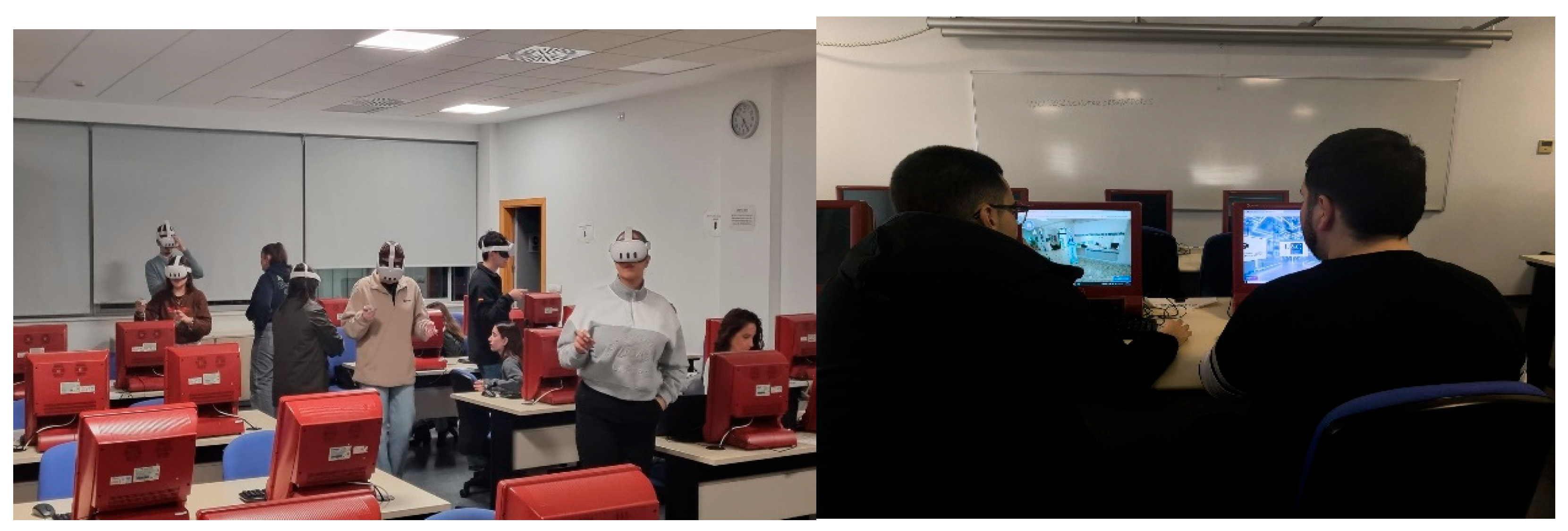
Intervention session. In the intervention week, students participated in a single learning session using the VR learning object according to their assigned condition. The immersive group used Meta Quest 3 head-mounted displays, whereas the desktop group accessed the same learning object using laptops or tablets. The session was conducted under the same classroom conditions and with the same instructions provided by the instructor (Figure 1).
Posttest: Immediately after the learning session, students completed the same performance test (with item order altered) as a posttest. They also completed the NASA-TLX questionnaire and the semantic differential scale to assess cognitive load and attitudes, respectively.

3.4. Instruments

Three instruments were used to collect data: a performance test to measure knowledge acquisition, the NASA-TLX to assess cognitive load, and a semantic differential scale to evaluate attitudes toward the VR learning object.

3.4.1. Performance Test

To assess knowledge acquisition, a 25-item multiple-choice test was developed based on the instructional content presented in the VR learning object on Future Classrooms. Each item included four response options with a single correct answer.
The same instrument was administered during both the pretest and posttest phases. To minimize potential order effects, the sequence of items was altered between administrations.
Participants were instructed to select the best answer for each question without consulting external sources. Each correct response was scored as 1 point, and incorrect or unanswered items were scored as 0. Total scores ranged from 0 to 25, with higher scores indicating greater content mastery.
Although identical items were used in both administrations, the reordering of items and the instructional focus of the intervention were intended to reduce potential recall effects.
The test covered the following conceptual domains:
  • Conceptual definition of Future Classrooms
  • Functional zoning (Explore, Investigate, Interact, Develop, Present)
  • Pedagogical principles
  • Technological tools and laboratory resources
  • Methodological approaches and 21st-century skills
The complete set of items is presented in Table 1.

3.4.2. Cognitive Load: NASA-TLX

Cognitive load was measured using the NASA Task Load Index (NASA-TLX) [46], a widely validated multidimensional instrument frequently applied in immersive and non-immersive VR research [47,48,49,50]. The adapted version used in this study comprised six dimensions: (1) Mental demand: how much mental and perceptual activity was required? (2) Physical demand: how physically demanding was the task? (3) Temporal demand: how rushed or accelerated was the pace? (4) Performance: how successful were you in accomplishing the task? (5) Effort: how much effort did you exert to achieve your performance level? (6) Frustration: what was your level of frustration during the task?
Each dimension was rated on a scale from 1 to 10. The global cognitive load score was computed as the unweighted mean of the six dimensions (Raw NASA-TLX), with higher values indicating greater perceived load.

3.4.3. Attitude Assessment: Semantic Differential Scale

Attitudes toward the VR learning object were assessed using a semantic differential scale [51,52,53,54,55] adapted from prior instruments validated in educational technology research [56,57,58]. The scale comprised 26 bipolar adjective pairs rated on a 7-point scale (1–7), where higher scores indicated more positive attitudes. The global attitude score was computed as the mean of all 24 items, with negatively oriented pairs reversed prior to scoring. The complete list of adjective pairs is presented in Table 2.

3.4.4. Reliability Analysis

The internal consistency of the cognitive load and attitude instruments was evaluated using Cronbach’s α and McDonald’s Ω coefficients. The obtained reliability indices are presented in Table 3.
Both instruments demonstrated high internal consistency, with values exceeding the commonly recommended threshold of 0.70 [59].

4. Results

4.1. Cognitive Load

Table 4 presents the means and standard deviations for each NASA-TLX dimension by condition, along with the global (Raw TLX) score.
Global cognitive load scores indicate a low-to-moderate level of perceived demand in both conditions, with the immersive condition showing slightly higher scores across most dimensions. A notable degree of inter-individual variability is reflected in the standard deviations.
An ANCOVA with pretest score as the covariate revealed a statistically significant difference in global cognitive load between conditions, F(1, 133) = 17.875, p < 0.001, partial η2 = 0.118, indicating that students in the immersive condition experienced higher cognitive load than those in the desktop condition.

4.2. Attitudes Toward VR

Table 5 presents the means and standard deviations for each semantic differential item by condition.
Overall attitude scores were high (M = 5.78 on a 1–7 scale), indicating very positive attitudes toward the VR experience in both groups. The highest-scoring items were: Appropriate, Educational, Positive, Beautiful, Entertaining, Useful, Agreeable, and Effective. Attitudes were slightly more positive in the immersive condition (M = 5.88) than in the desktop condition (M = 5.77), though this difference was not statistically significant (see Section 4.4).
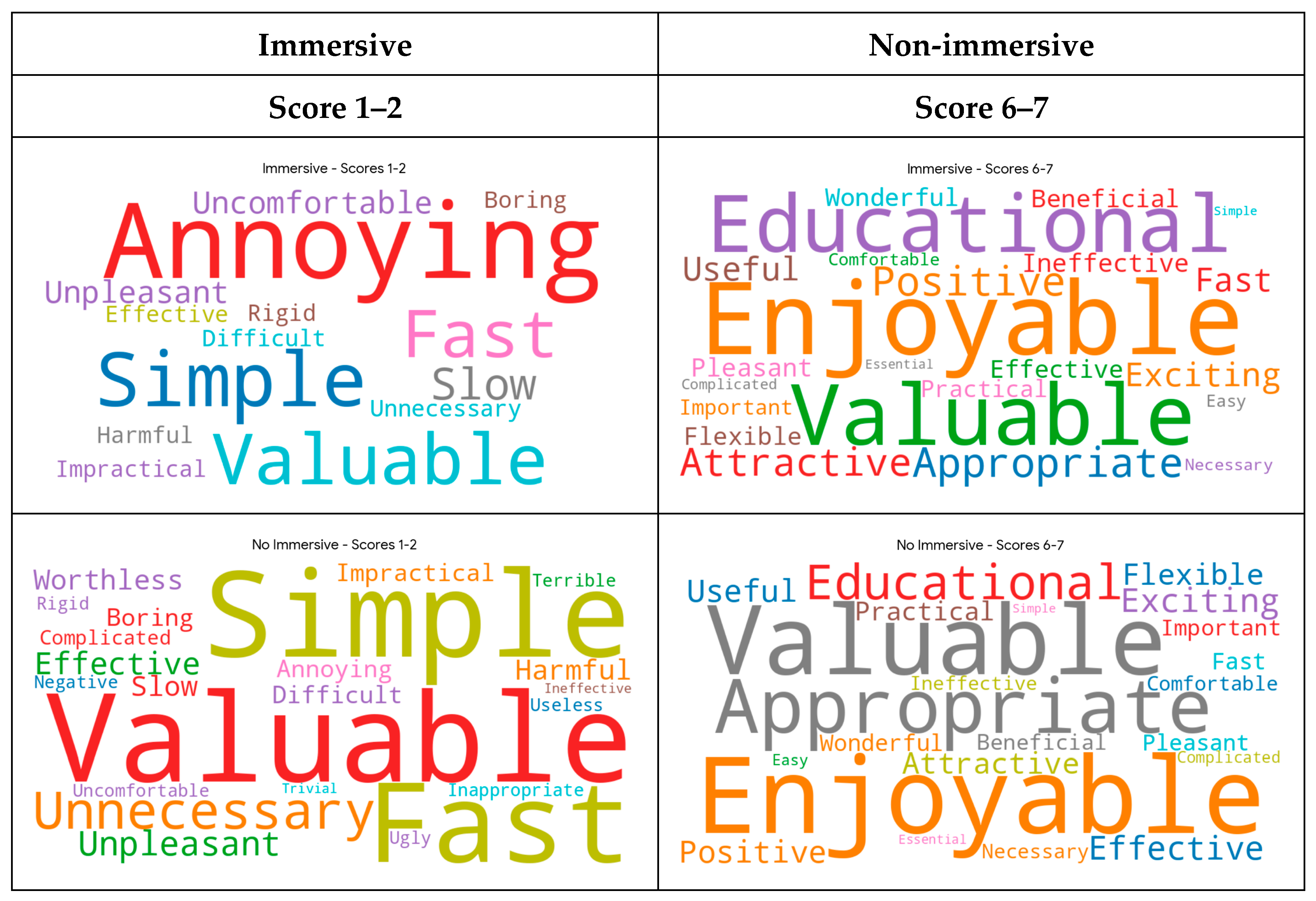
Figure 2 presents word clouds of the adjectives that received the highest (6–7) and lowest (1–2) scores, separately for the immersive and non-immersive conditions. The word clouds were generated using Claude after removing stopwords and applying frequency-based weighting.

4.3. Knowledge Acquisition (Performance)

The following hypotheses were tested:
  • H0: There are no statistically significant differences in academic performance following interaction with the VR learning object (α = 0.05).
  • H1: There are statistically significant differences in academic performance following interaction with the VR learning object (α = 0.05).
An ANCOVA was conducted with posttest score as the dependent variable and pretest score as the covariate. Results are presented in Table 6.
The results allow rejection of H0 with respect to overall learning gains, F(1, 133) = 31.420, p < 0.001, partial η2 = 0.191, confirming that interaction with the VR learning object produced significant knowledge acquisition regardless of modality. However, H0 is not rejected for differences between conditions, F(1, 133) = 2.997, p = 0.086, partial η2 = 0.022, indicating no significant difference in performance between the immersive and desktop modalities.

4.4. Correlations Among Variables

Pearson correlations were computed to examine the relationships between posttest performance, cognitive load, and attitudes, both for the total sample and by condition (Table 7 and Table 8).
Posttest performance was not significantly associated with either cognitive load or attitudes in either condition. However, a consistent negative association was observed between cognitive load and attitudes across all groups: r = −0.375 for the total sample (p < 0.001), r = −0.332 for the desktop group (p = 0.006), and r = −0.439 for the immersive group (p < 0.001). These results reveal that higher perceived cognitive load was associated with less favorable attitudes toward the VR experience. It should be noted, however, that this is a correlational finding and does not establish a causal relationship between the two variables.

4.5. Differences in Attitudes Between Conditions

An independent-samples t-test was conducted to examine whether attitudes differed significantly between the immersive and desktop conditions. Results are presented in Table 9.
The t-test revealed no statistically significant difference in attitudes between conditions, t(134) = −0.077, p = 0.939, Cohen’s d = 0.011 (negligible effect). The 95% confidence interval for the mean difference [−0.326, 0.306] includes zero, confirming that H0 cannot be rejected. Both groups showed equivalently positive attitudes toward the VR experience.

5. Discussion

The results of this study indicate that virtual reality (VR), in both its immersive and desktop modalities, is an effective tool for promoting knowledge acquisition in university students. The absence of significant differences in posttest performance between conditions—F(1, 133) = 2.997, p = 0.086, partial η2 = 0.022—is consistent with a substantial body of research reporting equivalent or inconclusive learning outcomes between HMD-based and desktop VR systems [17,19,20,22,60]. The small effect size confirms that the practical significance of this null result is also negligible, providing further support for the functional equivalence of both modalities in terms of learning outcomes.
At the same time, the immersive modality was associated with a statistically significant, albeit modest, increase in global cognitive load (M = 4.36 vs. M = 4.27 for desktop), consistent with the postulates of Cognitive Load Theory [34,36]. The additional perceptual, motor, and attentional demands introduced by HMD interaction—including spatial navigation, sensorimotor coordination, and peripheral processing—may contribute to a higher extrinsic load in immersive contexts [6,29,43]. Crucially, however, this difference in cognitive load did not translate into performance differences, reinforcing the view that moderate increases in extrinsic load may be tolerated without detriment to learning when the instructional content is well-structured and supported [24,25,26].
A noteworthy aspect of the findings is that both groups reported low-to-moderate global cognitive load scores (Total M = 4.30 on a 1–10 scale), suggesting that the design of the VR learning object—incorporating elements such as viewing guides, informative hotspots, and clear spatial organization—was effective in managing cognitive demand in both modalities. This finding is consistent with research demonstrating that targeted design features can significantly reduce extrinsic load in VR materials [38,45]. It should be emphasized, however, that the specific design elements of the learning object were not systematically manipulated in this study, and their individual contributions to cognitive load management remain inferential. Future research should employ controlled factorial designs to isolate the effects of specific instructional design features.
Regarding attitudes, students reported very positive assessments of the VR experience in both conditions (Total M = 5.78 on a 1–7 scale), with no statistically significant difference between modalities, t(134) = −0.077, p = 0.939, Cohen’s d = 0.011. This result is consistent with reviews and meta-analyses highlighting high levels of acceptance and motivation associated with VR environments, regardless of immersion level [3,4,7,10,15]. Additionally, a consistent negative association was observed between cognitive load and attitudinal scores across all groups (r = −0.375 total; r = −0.332 desktop; r = −0.439 immersive), suggesting that higher perceived mental demand may be linked to less favorable subjective evaluations of the VR experience. This finding underscores the practical importance of minimizing extrinsic cognitive load in VR instructional design. It should be noted, however, that these associations are correlational, and causal interpretations are not warranted.
The high reliability obtained for both measurement instruments—NASA-TLX (α = 0.738, Ω = 0.734) and semantic differential (α = 0.961, Ω = 0.960)—supports the internal consistency of the data and the suitability of both tools for assessing cognitive load and attitudes in educational VR contexts [46,47,51,52,53].
From a practical standpoint, the results suggest that desktop VR constitutes a robust and accessible pedagogical alternative, particularly in resource-constrained contexts, given its lower technical complexity, reduced cost, and comparable learning outcomes. Immersive VR, by contrast, may offer added value in scenarios where presence, emotional engagement, and situational realism are pedagogically central—for example, in procedural skills training or high-fidelity situational simulations [11,17,18]. Instructional design decisions should therefore be guided by pedagogical criteria rather than technological preference alone. Practical recommendations for VR learning object design include: incorporating visual signage and narrative guides; segmenting content to manage cognitive load; calibrating navigation and interaction to students’ prior technological experience; and systematically measuring cognitive load and attitudes as part of educational innovation evaluations.

5.1. Limitations

This study has several limitations that should be considered when interpreting the findings. First, the sample was limited to second-year students in a single degree program, which constrains the generalizability of results to other educational levels and disciplines. Second, all measures of cognitive load and attitudes relied on self-report instruments, which may be subject to response bias and do not capture objective physiological indicators of mental demand. Third, the learning object was specific to a single content area (Future Classrooms), and results may not generalize to VR experiences addressing other types of knowledge or skills. Fourth, the study did not include retention or transfer measures, limiting conclusions about the durability or applicability of learning gains. Fifth, the performance test used identical items across pretest and posttest with only item-order randomization, which may not fully eliminate practice or memory effects; furthermore, item-level psychometric data (difficulty indices, discrimination indices, and KR-20 reliability) were not available for the present report, and future work should include a full item analysis to strengthen the validity evidence for the instrument. Sixth, although ANCOVA was employed to control for pretest differences, a formal verification of its assumptions (homogeneity of regression slopes, residual normality, and homoscedasticity) was not reported here and should be addressed in future replications. Finally, baseline characteristics of participants—including prior VR experience and cybersickness susceptibility—were not systematically measured, limiting the assessment of group comparability.

5.2. Future Research Directions

Three priority lines for future research are proposed. First, there is a need to develop theories and instructional design models specific to VR that can specify which design elements—signage, interactivity, metacognitive guidance, spatial organization—moderate the relationship between immersion, cognitive load, and learning [10]. Second, multimodal cognitive load assessment approaches should be pursued, combining subjective instruments with physiological and behavioral indicators (e.g., eye-tracking, galvanic skin response, EEG) to obtain more robust and valid diagnoses in XR scenarios [47,48]. Third, longitudinal research is needed to examine knowledge retention, skill transfer, cost-effectiveness, and equity of access across different educational contexts, infrastructure levels, and student populations—with particular attention to the digital divide implications of adopting immersive technologies [17,18].

6. Conclusions

This study examined the differential effects of immersive and desktop VR on knowledge acquisition, cognitive load, and attitudes in a sample of 136 university students. The main findings are as follows: (1) interaction with VR-based learning objects produced significant knowledge gains in both conditions, with no statistically significant differences between modalities; (2) the immersive condition was associated with a slightly higher—yet still low-to-moderate—cognitive load than the desktop condition, a difference that did not affect performance outcomes; (3) attitudes toward VR were highly positive in both groups and did not differ significantly by modality; and (4) a consistent negative association was observed between cognitive load and attitudes, though this relationship is correlational in nature.
These results support the educational viability of both immersive and desktop VR for knowledge acquisition in higher education, while highlighting that modality selection should be driven by contextual factors—including available resources, the nature of the learning content, and the pedagogical goals—rather than by an assumption of inherent superiority of one modality over the other. Careful instructional design, particularly in managing cognitive load through structured and guided VR experiences, appears to be a critical mediating factor in both modalities.

Author Contributions

Conceptualization, R.P.-V. and J.C.-A.; methodology, M.V.F.-S.; software, A.P.-R.; validation, J.C.-A., M.V.F.-S. and R.P.-V.; formal analysis, A.P.-R.; investigation, R.P.-V.; resources, J.C.-A.; data curation, M.V.F.-S.; writing—original draft preparation, A.P.-R.; writing—review and editing, J.C.-A.; visualization, R.P.-V.; supervision, M.V.F.-S.; project administration, A.P.-R.; funding acquisition, J.C.-A. All authors have read and agreed to the published version of the manuscript.

Funding

This study has received funding through the State Program to Promote Scientific and Technological Research and its Transfer, within the framework of the State Plan for Scientific, Technical and Innovation Research 2021–2023. Ministry of Science and Innovation. Part number: PID2022-136430OB-I00.

Institutional Review Board Statement

In accordance with our institution’s Policies (https://www.investigacion.us.es/apoyo-al-investigador/comites-de-etica/comite-de-etica-de-investigacion-de-la-universidad-de-sevilla-ceius (accessed on 25 March 2026)), research activities conducted in educational settings for pedagogical purposes that do not involve sensitive or identifiable personal data are exempt from prior review or approval by an ethics committee.

Informed Consent Statement

Informed consent was obtained from all subjects involved in the study.

Data Availability Statement

The data presented in this study are available on request from the corresponding author.

Conflicts of Interest

The authors declare no conflicts of interest.

References

  1. Rauschnabel, P.A.; Felix, R.; Hinsch, C.; Shahab, H.; Alt, F. What is XR? Towards a framework for augmented and virtual reality. Comput. Hum. Behav. 2022, 133, 107289. [Google Scholar] [CrossRef]
  2. Cabero-Almenara, J.; Rodríguez, M.; Llorente, C. Mixed, virtual, and augmented reality technologies for learning. Texto Livre Ling. Tecnol. 2025, 18, e49561. [Google Scholar] [CrossRef]
  3. Marougkas, A.; Troussas, C.; Krouska, A.; Sgouropoulou, C. Virtual Reality in Education: A Review of Learning Theories, Approaches and Methodologies for the Last Decade. Electronics 2023, 12, 2832. [Google Scholar] [CrossRef]
  4. Bi, X.; Hu, Y.; Yang, X.; Zhang, J.; Li, X.; Tao, P.; Chen, M. Virtual reality in decision-making training: A systematic review and meta-analysis. Int. J. Hum. Comput. Interact. 2025, 41, 3400–3412. [Google Scholar] [CrossRef]
  5. Zekeik, H.; Chahbi, M.; Lamarti, M.; Bakkali, I. Augmented reality and virtual reality in education: A systematic narrative review on benefits, challenges, and applications. EURASIA J. Math. Sci. Technol. Educ. 2025, 21, em2699. [Google Scholar] [CrossRef] [PubMed]
  6. Zhang, M.M.; Hashim, H.; Yunus, M.M. Comparing augmented reality and virtual reality assisted vocabulary learning. Front. Virtual Real. 2025, 6, 1522380. [Google Scholar] [CrossRef]
  7. Sun, L.; Song, X. Effectiveness of virtual reality in language learning: A systematic review. Front. Psychol. 2026, 16, 1714481. [Google Scholar] [CrossRef]
  8. Llanos-Ruiz, D.; Abella-García, V.; Ausín-Villaverde, V. Virtual reality in higher education: A systematic review Aligned with the Sustainable Development Goals. Societies 2025, 15, 251. [Google Scholar] [CrossRef]
  9. Samala, A.D.; Rawas, S.; Rahmadika, S.; Criollo-C, S.; Fikri, R.; Sandra, R.P. Virtual reality in education: Global trends, challenges, and impacts. Discov. Educ. 2025, 4, 229. [Google Scholar] [CrossRef]
  10. Stracke, C.M.; Bothe, P.; Adler, S.; Heller, E.S.; Deuchler, J.; Pomino, J.; Wölfel, M. Immersive virtual reality in higher education: A systematic review. Virtual Real. 2025, 29, 64. [Google Scholar] [CrossRef]
  11. Orhak, S.; Çağıltay, K. Unlocking the potential of virtual reality in education: Insights from teachers and recommendations for integration. J. Educ. Technol. Online Learn 2024, 7, 243–253. [Google Scholar] [CrossRef]
  12. Cabrera-Duffaut, A.; Pinto-Llorente, A.M.; Iglesias-Rodríguez, A. Immersive learning platforms: Analyzing virtual reality contribution to competence development. Front. Educ. 2024, 9, 1391560. [Google Scholar] [CrossRef]
  13. He, Q. Virtual reality in vocational education. Int. J. Web Based Learn. Teach. Technol. 2026, 21, 1–14. [Google Scholar] [CrossRef]
  14. Salatino, A.; Zavattaro, C.; Gammeri, R.; Cirillo, E.; Piatti, M.L.; Pyasik, M.; Ricci, R. Virtual reality rehabilitation techniques: A systematic review. Neurosci. Biobehav. Rev. 2023, 152, 105248. [Google Scholar] [CrossRef]
  15. Barroso-Osuna, J.; Martínez-Pérez, S.; Montenegro-Rueda, M.; Buzón García, O. Acceptance of immersive and non-immersive virtual reality in higher education: A comparative study using the UTAUT2 model. Rev. Electrón. Interuniv. Form. Profr. 2025, 29, 33–47. [Google Scholar] [CrossRef]
  16. Cabero-Almenara, J.; Barroso-Osuna, J.; Llorente-Cejudo, C.; Martínez-Pérez, S. Motivational potential of virtual reality learning objects. Rev. Cienc. Soc. 2025, 31, 146–161. [Google Scholar]
  17. Liu, Z.; Zhang, W.; Hu, L. Desktop virtual reality and academic achievement: A meta-analysis. Innov. Educ. Teach. Int. 2025, 62, 795–810. [Google Scholar] [CrossRef]
  18. Cabero-Almenara, J.; Palacios-Rodríguez, A.; Barroso-Osuna, J.; Siles-Rojas, C. Immersive technologies in university education: Faculty profiles and integration barriers. RIED Rev. Iberoam. Educ. Distancia 2026, 29, 161–184. [Google Scholar] [CrossRef]
  19. Farr, A.; Pietschmann, L.; Zürcher, P. Skill retention after desktop and immersive virtual reality training. Exp. Results 2023, 4, e2. [Google Scholar] [CrossRef]
  20. Antonopoulos, P.; Fokides, E.; Koutromanos, G. Understanding learning and learning experience in immersive virtual reality. Technol. Knowl. Learn. 2025, 30, 1771–1800. [Google Scholar] [CrossRef]
  21. Kaplan-Rakowski, R.; Thrasher, T. Immersive VR and vocabulary learning. Br. J. Educ. Technol. 2025, 56, 2647–2670. [Google Scholar] [CrossRef]
  22. Zamli, Z.; Ramli, R.; Sulaiman, H.; Azemin, M.Z.C.; Salleh, W.M.S.W.; Yusof, N.A.; Yusof, A.M. Head-mounted display vs desktop virtual reality anatomy usability study. Asia Pac. Sch. 2025, 10, 80–83. [Google Scholar] [CrossRef]
  23. Stockdale, J.; Best, P.; Birch, M.; Murphy, P.; O’Neill, D. Designing interdisciplinary VR simulations using ARCS model. Int. J. Healthc. Simul. 2023. [Google Scholar]
  24. Lønne, T.; Karlsen, H.; Langvik, E.; Saksvik-Lehouillier, I. Immersion and learning in virtual reality. Heliyon 2023, 9, e17196. [Google Scholar] [CrossRef] [PubMed]
  25. Oh, J.; Kang, J.; Kim, Y. The effectiveness of virtual reality with or without head-mounted displays: Focusing on the role of spatial presence and immersive tendency for responding to particulate matter. Virtual Real. 2025, 29, 80. [Google Scholar] [CrossRef]
  26. Piccardi, L.; Massidda, M.; Travaglini, L.; Pescarin, S.; Giancola, M.; Palmiero, M.; Nori, R. Comparing immersive and non-immersive VR: Effects on spatial learning and aesthetic experience. Brain Sci. 2025, 15, 852. [Google Scholar] [CrossRef] [PubMed]
  27. Iglesias Calonge, P.; Chávez Muñoz, P. La realidad virtual en el aula de música: Un estudio cuasiexperimental. Perspect. Educ. 2022, 61, 192–218. [Google Scholar] [CrossRef]
  28. Makransky, G.; Lilleholt, L. A structural equation modeling investigation of the emotional value of immersive virtual reality in education. Educ. Technol. Res. Dev. 2018, 66, 1141–1164. [Google Scholar] [CrossRef]
  29. Hii, C.-H.; Yang, C.-C. Comparing immersive and non-immersive VR in nursing education. Nurs. Rep. 2025, 5, 149. [Google Scholar] [CrossRef]
  30. Thamrongra, P.; Khundam, C.; Pakdeebun, P.; Mohd, D. Desktop vs. headset virtual reality: User experience comparison. Emerg. Sci. J. 2023, 7, 1063–1082. [Google Scholar] [CrossRef]
  31. Thorp, S.O.; Rimol, L.; Lervik, S.; Evensmoen, H.; Grassini, S. Comparative analysis of spatial ability in immersive and non-immersive virtual reality. Front. Virtual Real. 2024, 5, 1343872. [Google Scholar] [CrossRef]
  32. Sudár, A.; Horváth, I. Design suggestions for digital workflow-oriented desktop VR spaces. Infocommun. J. 2024, 16, 119–127. [Google Scholar] [CrossRef]
  33. Espinoza Bravo, M.G.; Ríos Quiñónez, M.B.; Castro Vargas, K.L.; Velasco Moyano, C.B.; Feijoo Mendieta, D.A. La Influencia De tecnologías Emergentes En La educación Superior: The Influence of Emerging Technologies in Higher Education. LATAM 2024, 5, 894–904. [Google Scholar] [CrossRef]
  34. Paas, F.; Tuovinen, J.E.; Tabbers, H.; van Gerven, P.W.M. Cognitive load measurement as a means to advance cognitive load theory. Educ. Psychol. 2003, 38, 63–71. [Google Scholar] [CrossRef]
  35. Pernett-Cárdenas, M. Cognitive load in hypertext reading. Zona Próxima 2018, 28, 42–56. [Google Scholar] [CrossRef]
  36. de Jong, T. Cognitive load theory, educational research, and instructional design. Instr. Sci. 2010, 38, 105–134. [Google Scholar] [CrossRef]
  37. Barrios, R.; Morales, D.; Domínguez, L.C. Cognitive load and information retention using two video techniques in flipped classrooms. Educ. Med. 2023, 24, 100826. [Google Scholar] [CrossRef]
  38. Bautista, L.E.; Maradei, F.; Pedraza, G. Spatial arrangement of content in augmented reality environments and its effect on cognitive load. Pixel Bit Rev. Medios Educ. 2025, 72, 39–69. [Google Scholar] [CrossRef]
  39. Narayanan, J.; David, P.; Naidu, M.; Pallath, V.; Danaee, M. Emotional design of PowerPoint slides: Effect on self-perceptions of mood, cognitive load and memory retention in three anatomy lectures. Educ. Med. J. 2025, 17, 111–128. [Google Scholar] [CrossRef]
  40. Ki, S.; Park, S.; Ryu, J.; Kim, J.; Kim, I. Social presence and cognitive load in VR videos. Front. Psychol. 2024, 15. [Google Scholar]
  41. Bali, C.; Tasdelen, B.; Bandi, S.; Zsidó, A. Understanding the cognitive cost of multimedia learning: Effects of visual load and language proficiency. Cogn. Res. Princ. Implic. 2026, 11, 2. [Google Scholar] [CrossRef]
  42. Alazmi, H.S.; Alemtairy, G.M. The effects of immersive virtual reality field trips upon student academic achievement, cognitive load, and multimodal presence in a social studies educational context. Educ. Inf. Technol. 2024, 29, 22189–22211. [Google Scholar] [CrossRef]
  43. Ricci, M.; Evangelista, A.; Di Roma, A.; Fiorentino, M. Immersive and desktop virtual reality in virtual fashion stores: A comparison between shopping experiences. Virtual Real. 2023, 27, 2281–2296. [Google Scholar] [CrossRef] [PubMed]
  44. Ye, Y.; Kaplan-Rakowski, R. An exploratory study on practising listening comprehension skills in high-immersion virtual reality. Br. J. Educ. Technol. 2024, 55, 1651–1672. [Google Scholar] [CrossRef]
  45. Cabero-Almenara, J.; Miravete-Gracia, M.; Palacios-Rodríguez, A. Learning in virtual reality: Impact on cognitive load and academic performance. Rev. Educ. Distancia 2025, 25, 82. [Google Scholar] [CrossRef]
  46. Díaz, E.; Rubio, S.; Martín, J.; Luceño, L. Psychometric study of NASA-TLX mental workload index. Rev. Psicol. Trab. Organ. 2010, 26, 191–199. [Google Scholar]
  47. Vidal-Balea, A.; Fraga-Lamas, P.; Fernández-Caramés, T.M. Advancing NASA-TLX workload evaluation in XR scenarios. In Proceedings of the IEEE GEM Conference, Turin, Italy, 5–7 June 2024. [Google Scholar] [CrossRef]
  48. Hou, Y.; Xie, Q.; Zhang, N.; Lv, J. Cognitive load classification in XR environments. Sci. Rep. 2025, 15, 13732. [Google Scholar] [CrossRef]
  49. Morales-Méndez, G.; Del-Cerro-Velázquez, F.; Lozano-Avilés, A.B. Augmented reality in STEM learning: Spatial skill development in electrical engineering education. Pixel Bit Rev. Medios Educ. 2026, 75, 3. [Google Scholar] [CrossRef]
  50. Severitt, B.R.; Sauer, Y.; Neugebauer, A.; Agarwala, R.; Castner, N.; Wahl, S. User interaction methods in virtual environments. Front. Virtual Real. 2025, 6, 1576962. [Google Scholar] [CrossRef]
  51. Herrera-Aliaga, E.; Moreno Gálvez, X.; Orellana-Walden, R.; Madrid Avilés, G.; Ruiz Arriagada, C. Mental workload in educational simulations. Investig. Educ. Med. 2024, 13, 7–16. [Google Scholar] [CrossRef]
  52. Aminian, N.O.; Michael, W.; Ghoreyshi, M. Cognitive workload assessment: A comprehensive review. J. Aircr. Spacecr. Technol. 2025, 9, 12–33. [Google Scholar] [CrossRef]
  53. Palacios-Ibáñez, A.; Castellet-Lathan, S.; Contero, M. Exploring user gaze during product evaluation in virtual reality. Virtual Real. 2024, 28, 153. [Google Scholar] [CrossRef]
  54. Kobayashi, T.; Jadram, N.; Ninomiya, S.; Suzuki, K.; Sugaya, M. Emotional equivalence in VR environments. Sensors 2025, 25, 4097. [Google Scholar] [CrossRef]
  55. Osgood, C.; Suci, G.; Tannenbaum, H. The Measurement of Meaning; University of Illinois Press: Urbana, IL, USA, 1976. [Google Scholar]
  56. Cabero-Almenara, J. Investigaciones Sobre la Informática en el Centro; PPU: Barcelona, Spain, 1993. [Google Scholar]
  57. Cabero-Almenara, J.; Márquez, D. Sierra Sur: Una experiencia universitaria innovadora para el diseño y desarrollo de material multimedia. Bordón 2001, 53, 185–200. [Google Scholar]
  58. Sanchis-Font, R.; Castro-Bleda, M.J.; Turro-Ribalta, C.; Despujol-Zabala, I. Integration of UEQ-S in MOOCs. In Proceedings of the In-Red Conference 2018, Valencia, Spain, 19–20 July 2018. [Google Scholar] [CrossRef]
  59. Hayes, A.F.; Coutts, J.J. Use omega rather than Cronbach’s alpha for estimating reliability. Commun. Methods Meas. 2020, 14, 1–24. [Google Scholar] [CrossRef]
  60. Barrett, R.C.A.; Poe, R.; O’Camb, J.W.; Woodruff, C.; Harrison, S.M.; Dolguikh, K.; Chuong, C.; Klassen, A.D.; Zhang, R.; Joseph, R.B.; et al. Comparing virtual reality, desktop-based 3D, and 2D versions of a category learning experiment. PLoS ONE 2022, 17, e0275119. [Google Scholar] [CrossRef] [PubMed]
Figure 1. Immersive and desktop use.
Applsci 16 03595 g001
Figure 2. Word Clouds.
Applsci 16 03595 g002
Table 1. Performance Test Items (25 Multiple-Choice Questions).
No.QuestionOptions
1What is the simplest system for creating small 3D objects?(a) 3D printer (b) 3D pen (c) 3D design software (d) Video cameras
2How can a future classroom be divided?(a) Rows of desks (b) Six specific zones (Investigate, Explore, Interact, etc.) (c) Open undivided space (d) Individual-only areas
3Which zone is intended to foster curiosity and discovery?(a) Explore (b) Interact (c) Investigate (d) Develop
4What is meant by “Future Classrooms” in Educational Technology?(a) Traditional classrooms (b) Programming-only spaces (c) Innovative learning spaces integrating advanced technology, modern pedagogy and flexibility (d) Technology-free rooms
5What is one of the main functions of technology in future classrooms?(a) Only projecting slides (b) Quick contextual access to information (c) Replacing teachers (d) Automatic grading
6Which zone is intended for creation and design?(a) Explore (b) Interact (c) Investigate (d) Develop
7What type of layout favors future classrooms?(a) Individual desks only (b) Flexible collaborative spaces (c) Fixed frontal seating (d) No interaction
8One main objective of future classrooms is:(a) Teaching only technical skills (b) Preparing students for a digital and global world (c) Maintaining traditional instruction (d) Eliminating interaction
9What type of learning environment is promoted?(a) Rigid and structured (b) Flexible and personalized (c) Disorganized (d) Static
10What methodology is encouraged?(a) Passive learning (b) Project-based active learning (c) Lectures only (d) None
11Which zone facilitates collaboration and communication?(a) Explore (b) Interact (c) Present (d) Investigate
12What determines zone organization?(a) Number of teachers (b) Resources and available space (c) Number of students (d) None
13Which methodologies are highlighted?(a) Memorization-based (b) Teacher-centered (c) Active project-based (d) Repetitive tasks
14Which zone is for sharing results?(a) Explore (b) Interact (c) Present (d) Investigate
15What facilitates technology placement in the lab?(a) Material creation (b) Group organization (c) Eliminating interaction (d) Reducing mobility
16What do interconnected screens allow?(a) Video reception only (b) Projecting group work (c) Remote broadcast only (d) None
17Which 21st-century skill is promoted?(a) Memorization (b) Critical thinking (c) Only manual skills (d) None
18What does a 3D printer allow?(a) Creating physical models from digital designs (b) Printing documents only (c) Remote streaming (d) Image projection
19What elements are in the audiovisual studio?(a) Low-quality camera (b) High-quality camera, lighting and chroma (c) Only chroma (d) None
20What characterizes the physical structure?(a) Rigid furniture (b) Flexible mobile space (c) Paper-based materials (d) Limited technology
21Function of interactive board?(a) Writing tool only (b) Editing and presenting materials (c) Fixed information (d) Recording
22Utility of 3D pen?(a) Replace board writing (b) Manual small 3D objects (c) Advanced graphics only (d) Paper printing
23What is videoconferencing used for?(a) Recording only (b) Connecting and interacting externally (c) Viewing only (d) Booking space
24How can students present ideas?(a) Only glass board (b) Projecting from devices (c) Paper only (d) 3D pen only
25What characterizes future classroom innovation?(a) Rigidity (b) Integration of pedagogy and technology (c) Technology exclusion (d) Traditional instruction
Table 2. Semantic Differential Bipolar Adjective Pairs.
No.Left AdjectiveRight Adjective
1TediousFun
2UnpleasantPleasant
3IneffectiveEffective
4SimpleComplicated
5WorthlessValuable
6DifficultEasy
7ImpracticalPractical
8NegativePositive
9UselessUseful
10HarmfulEducational
11UglyBeautiful
12InappropriateAppropriate
13HorribleWonderful
14TrivialImportant
15DispensableEssential
16DetrimentalBeneficial
17SlowFast
18UncomfortableComfortable
19BoringEntertaining
20RigidFlexible
21UnnecessaryNecessary
22UnpleasantAgreeable
23IneffectiveEffective
24ComplicatedSimple
Table 3. Instrument reliability index.
InstrumentItemsNCronbach’s αMcDonald’s Ω
Cognitive Load (NASA-TLX)61360.7380.734
Semantic Differential241360.9610.960
Table 4. Means and standard deviations obtained in the cognitive load.
DimensionTotal MTotal SDDesktop MImmersive M
Mental demand5.971.8215.836.10
Physical demand3.182.0653.003.34
Temporal demand4.682.0364.484.87
Performance3.151.6683.243.07
Effort5.432.1695.425.44
Frustration3.412.5493.653.19
Global (Raw TLX)4.304.274.36
Table 5. Means and standard deviations obtained in the semantic differential scale.
ItemTotal MTotal SDNon-Immersive MImmersive M
Fun–Tedious5.861.4725.656.06
Pleasant–Unpleasant5.991.3585.856.13
Ineffective–Effective5.491.6735.555.43
Complicated–Simple4.831.4174.764.90
Valuable–Worthless5.711.3005.745.67
Hard–Easy5.401.3735.215.57
Practical–Impractical5.861.2895.925.80
Negative–Positive6.251.0596.216.29
Useful–Useless6.081.0896.126.04
Educational–Pernicious6.341.0426.356.33
Ugly–Pretty6.161.1306.126.20
Appropriate–Inappropriate6.381.0406.396.37
Wonderful–Horrific6.011.1096.055.99
Important–Trivia5.891.1916.005.79
Dispensable–Essential4.711.5314.614.80
Beneficial–Harmful5.991.0856.055.94
Fast–Slow5.271.4115.185.36
Uncomfortable–Comfortable5.661.3515.775.56
Entertaining–Boring6.151.2386.066.23
Rigid–Flexible5.901.2165.975.84
Necessary–Unnecessary5.681.2415.835.53
Pleasant–Unpleasant6.021.2266.026.03
Ineffective–Effective6.011.0996.095.93
Complicated- Simple5.351.3805.245.46
Valuable–Worthless6.021.1056.115.94
Saves time–Time-consuming5.321.4135.325.31
Total Scale5.781.275.775.88
Table 6. ANCOVA performance.
SourceSS (est.)dfMS (est.)FpPartial η2
Pretest (covariate)89.74189.7431.420<0.0010.191
Condition (Immersive vs. Desktop)8.5618.562.9970.0860.022
Error379.931332.856
Total (corrected)478.23135
Note. N = 136; df_error = 133. SS and MS values are derived from F statistics and error MS (MS_error = 2.856). Posttest means: Desktop M = 23.53, SD = 1.37; Immersive M = 22.93, SD = 2.24.
Table 7. Pearson correlations—total sample (N = 136).
Variablesrp
Posttest – Cognitive load−0.0700.420
Posttest – Semantic differential0.0500.564
Cognitive load – Semantic differential−0.375<0.001
Table 8. Pearson correlations by condition.
VariablesDesktop rDesktop pImmersive rImmersive p
Posttest – Cognitive load−0.1850.1380.0040.972
Posttest – Semantic differential−0.0050.9680.1020.401
Cognitive load – Semantic differential−0.3320.006−0.439<0.001
Table 9. Independent-samples t-test: differences in attitudes between conditions.
ConditionMSDntdfpCohen’s d95% CI
Desktop5.781.0366−0.0771340.9390.011[−0.326, 0.306]
Immersive5.790.7770
Disclaimer/Publisher’s Note: The statements, opinions and data contained in all publications are solely those of the individual author(s) and contributor(s) and not of MDPI and/or the editor(s). MDPI and/or the editor(s) disclaim responsibility for any injury to people or property resulting from any ideas, methods, instructions or products referred to in the content.