Article

Evaluating the Energy Efficiency of Intermodal Trains

by
Mariusz Brzeziński
1,*,
Dariusz Pyza
1 and
Joanna Archutowska
2
1
Faculty of Transport, Warsaw University of Technology, Koszykowa 75, 00-662 Warsaw, Poland
2
Collegium of Business Administration, Warsaw School of Economics, Al. Niepodległości 162, 02-554 Warsaw, Poland
*
Author to whom correspondence should be addressed.
Appl. Sci. 2026, 16(7), 3567; https://doi.org/10.3390/app16073567
Submission received: 3 March 2026 / Revised: 1 April 2026 / Accepted: 3 April 2026 / Published: 6 April 2026
(This article belongs to the Special Issue Research Advances in Rail Transport Infrastructure)

Abstract

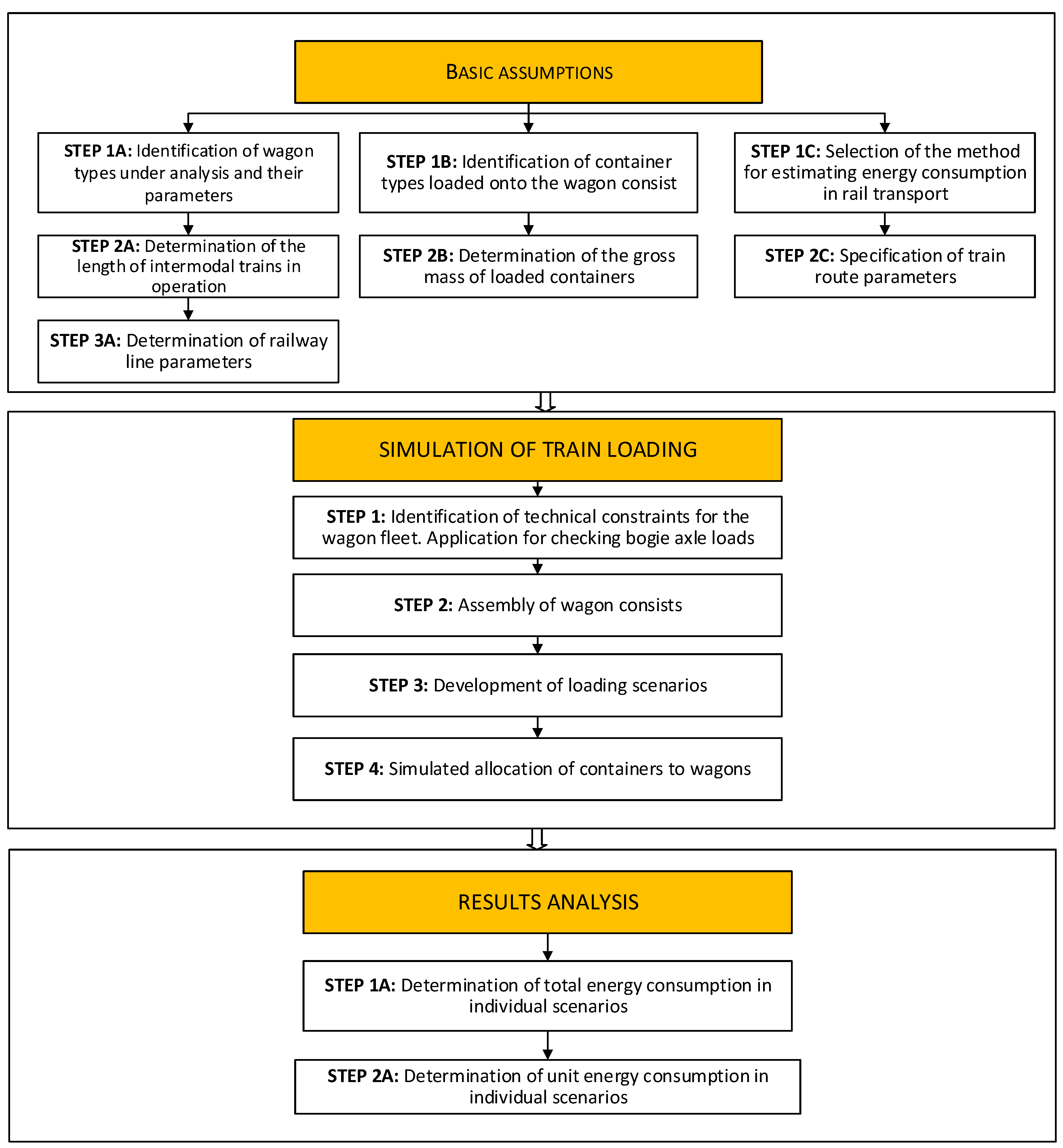
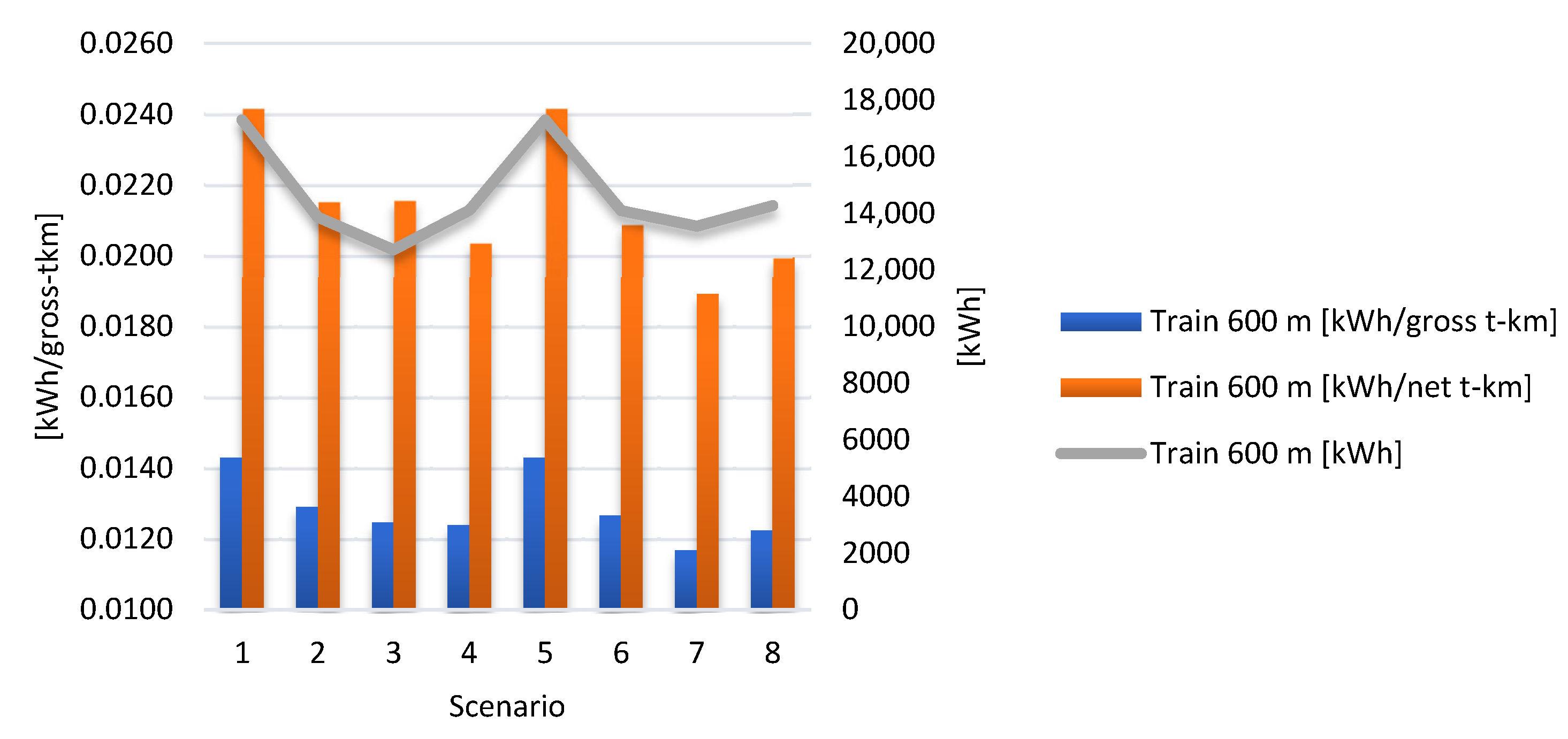
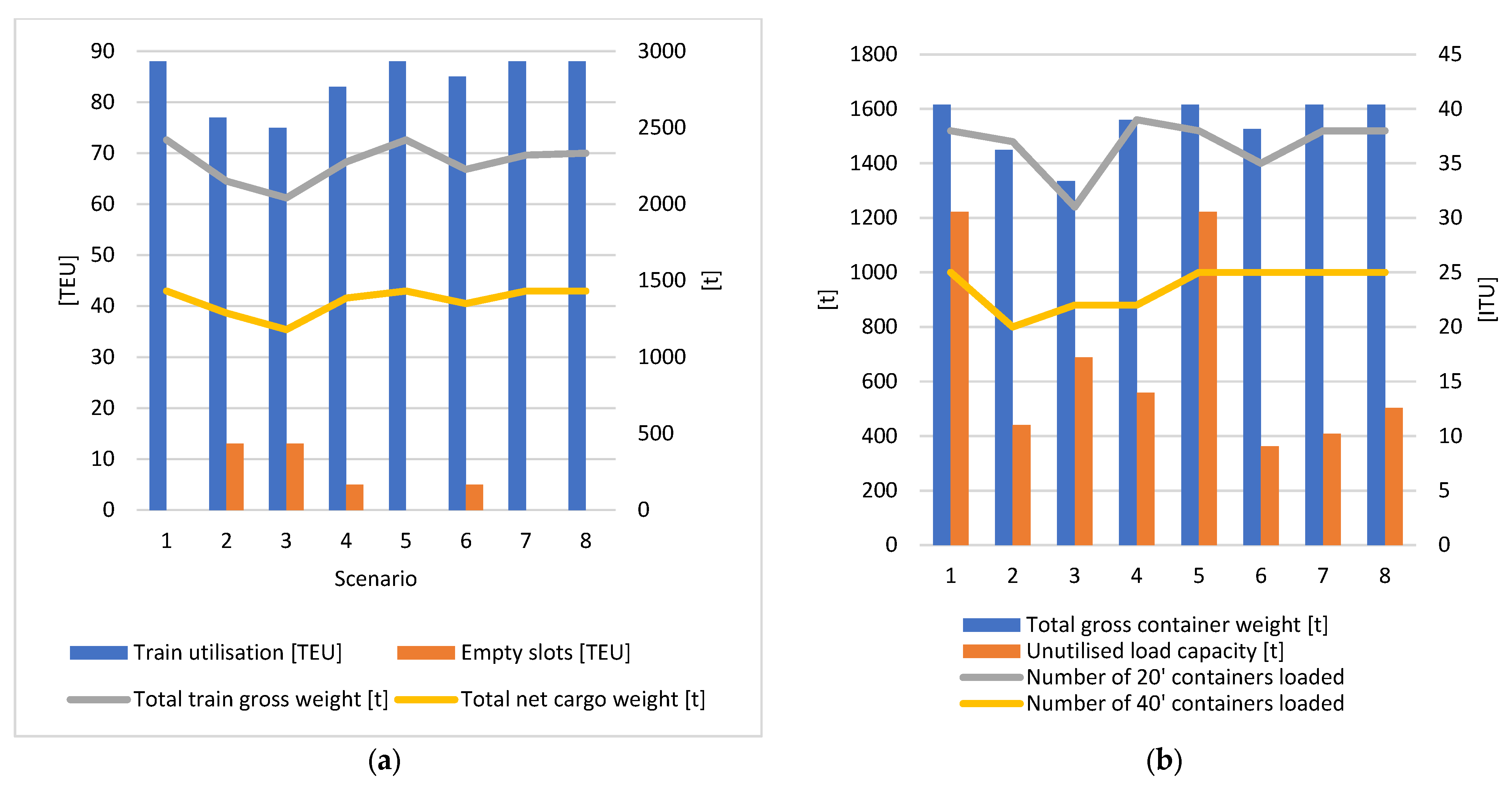
This article examines the impact of intermodal wagon technical specifications and railway infrastructure parameters on electricity consumption in rail freight transport. For this purpose, a three-stage analytical model was developed. The first stage defines the core assumptions, including train length, rolling stock types, container configurations, infrastructure constraints, and the characteristics of the energy consumption model. The second stage identifies the technical constraints of specific wagons, determines representative train compositions, and performs loading simulations. The third stage evaluates energy efficiency across different loading scenarios. The case study shows that specific energy consumption varies significantly with wagon type, train mass, and route characteristics. This findings challenge the use of static energy consumption values commonly applied in the literature. The results indicate that 40-foot wagons incur high energy penalties due to their tare weight and axle count, despite offering high loading capacity. While 60-foot wagons consume less energy, they lead to a high share of empty slots under a 20 t/axle limit. In contrast, 80-foot wagons are the most energy-efficient, particularly at a 22.5 t/axle limit. Mixed consists provide a balance between operational flexibility and competitive performance. Extending train length from 600 m to 730 m increases volume but does not automatically reduce unit energy consumption. These findings highlight the need to align wagon fleet selection with infrastructure capabilities and cargo characteristics. This study therefore provides practical recommendations for planning energy-efficient intermodal operations.
Keywords: railway wagon; intermodal transport; energy consumption; energy efficiency railway wagon; intermodal transport; energy consumption; energy efficiency