Bridging the Semantic Gap in 5G: A Hybrid RAG Framework for Dual-Domain Understanding of O-RAN Standards and srsRAN Implementation

 , , and
Abstract
1. Introduction
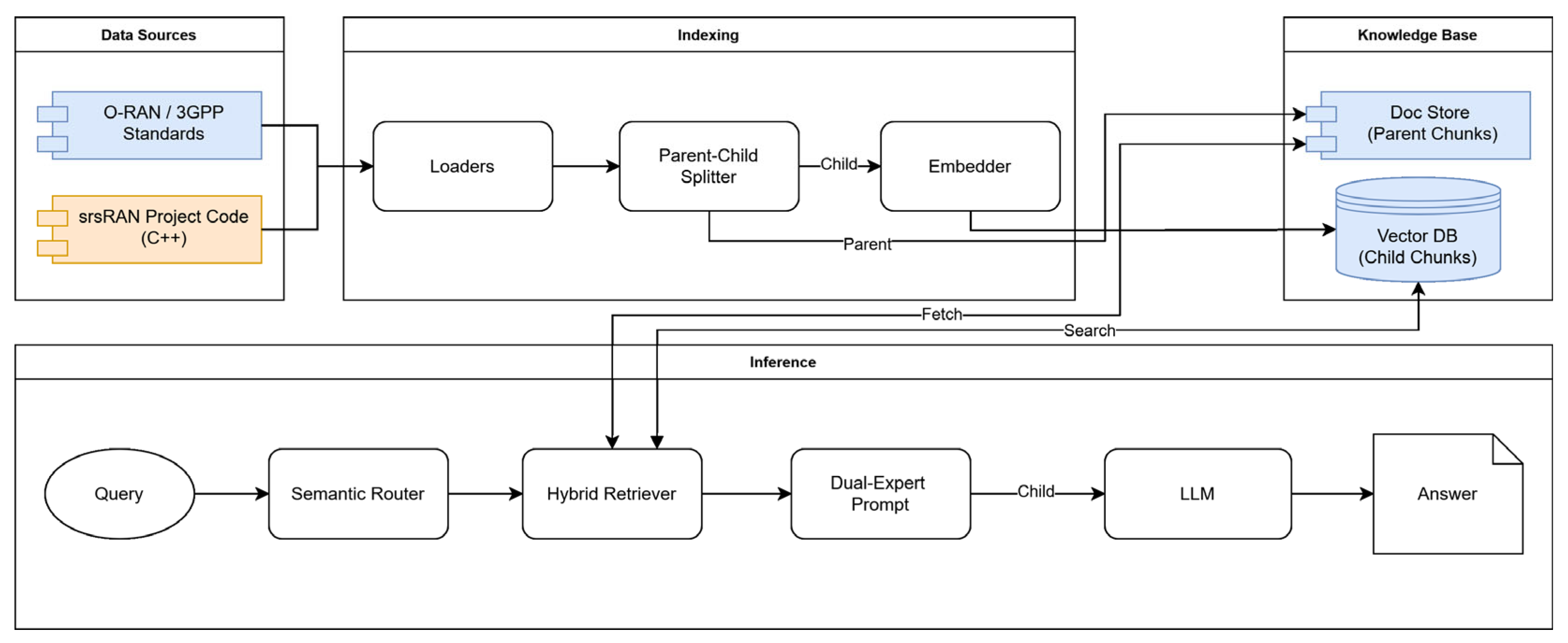
- Cross-Domain RAG Architecture: We propose a novel framework integrating a hierarchical Parent–Child Chunking strategy with dynamic semantic routing. This architecture explicitly bridges the semantic gap by correlating abstract standards with concrete code while filtering out the noise that leads to cross-domain hallucinations.
- Extended Evaluation Methodology: Building upon the ORAN-Bench-13K foundation, we introduce new query categories—specifically Code-Centric and Cross-Domain—to quantitatively assess implementation competence and complex knowledge synthesis.
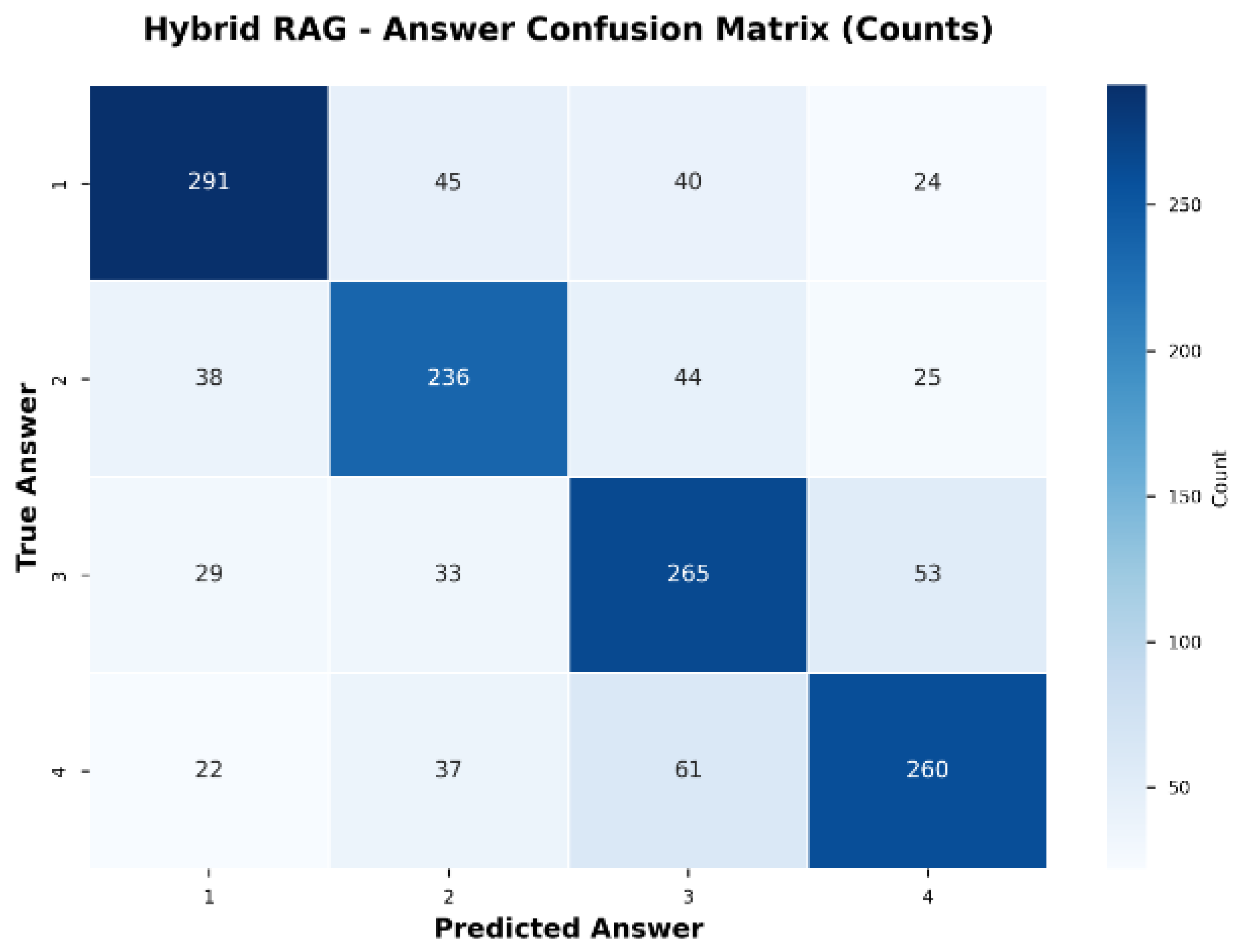
- Empirical Validation of the Routing Strategy: We provide a measurable analysis of context isolation, demonstrating that our probabilistic routing mechanism eliminates semantic interference. This approach surpasses standard RAG baselines by achieving 78.5% accuracy on technical implementation questions and 71.4% on complex cross-domain queries, while simultaneously reducing response latency to 3.47 s.
2. Background and Motivation

| Feature | Rule-Based Era | Statistical ML Era | Generative/Semantic Era |
|---|---|---|---|
| Control Logic | Handcrafted heuristics [4] | DNNs, RL, and Super-vised Learning [4] | LLM-based reasoning engines [1] |
| Adaptability | Static; requires manual updates | Sensitive to data distribution shifts [4] | High; leverages emergent abilities [7] |
| Human Effort | Rule engineering [4] | Model architecture engineering [4] | Prompt/Context engineering [7,8] |
| Interpretability | High (White-box) | Low (Black-box) [1] | High (Natural language explanation) [1] |
| Standardization | Local/Vendor-specific | Partial (O-RAN RIC) | Formal (ETSI GR ENI045) [6] |
3. Materials and Methods
3.1. Advanced Hybrid RAG Framework
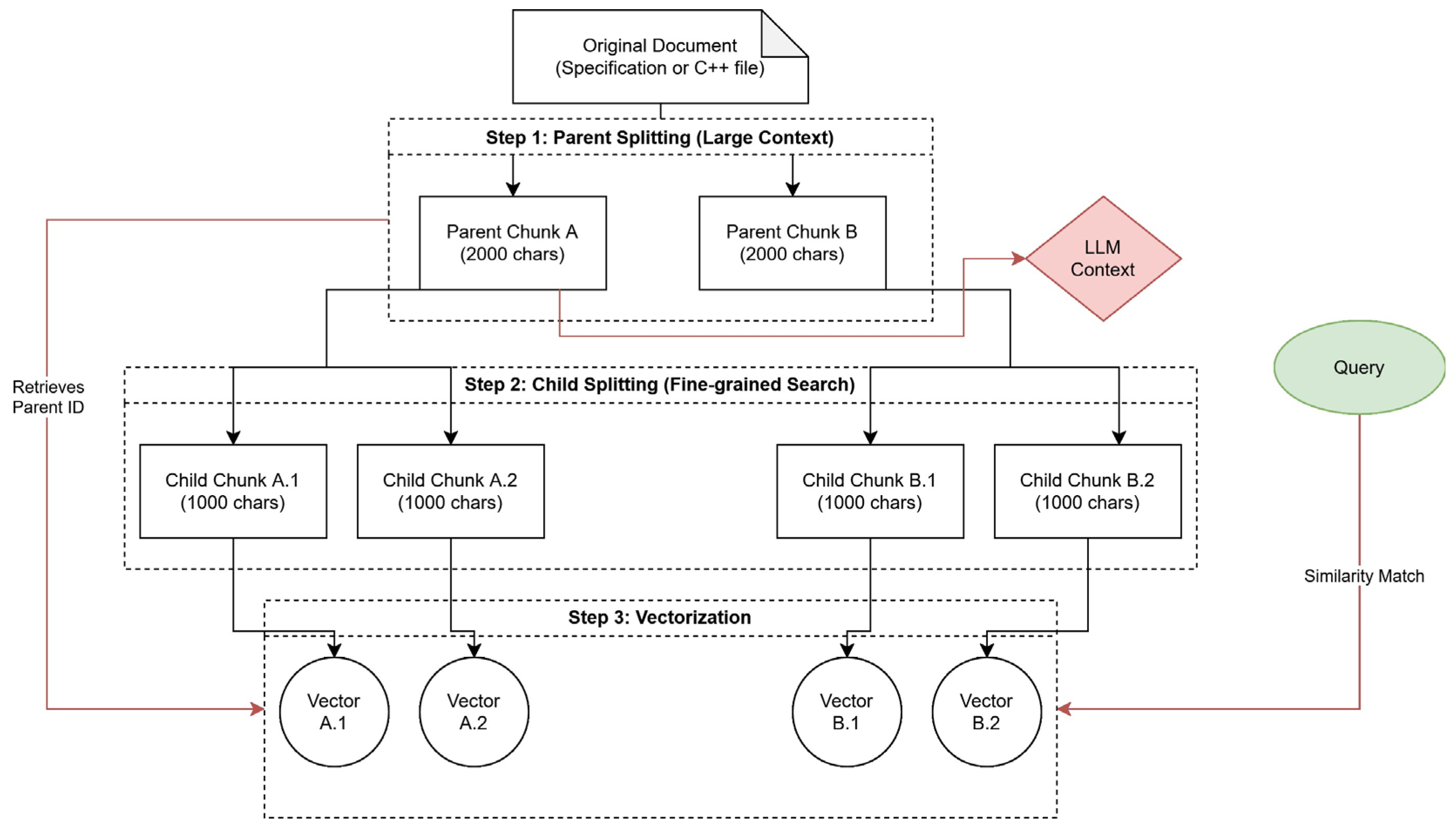
3.2. Data Ingestion and Adaptive Semantic Chunking
3.3. Soft Probabilistic Routing and Generation Parameters
3.4. Experimental Setup and Statistical Validation
4. Results
4.1. Quantitative Performance and Overall Accuracy
4.2. Stratified Analysis by Query Category
4.3. Computational Efficiency and Latency Analysis
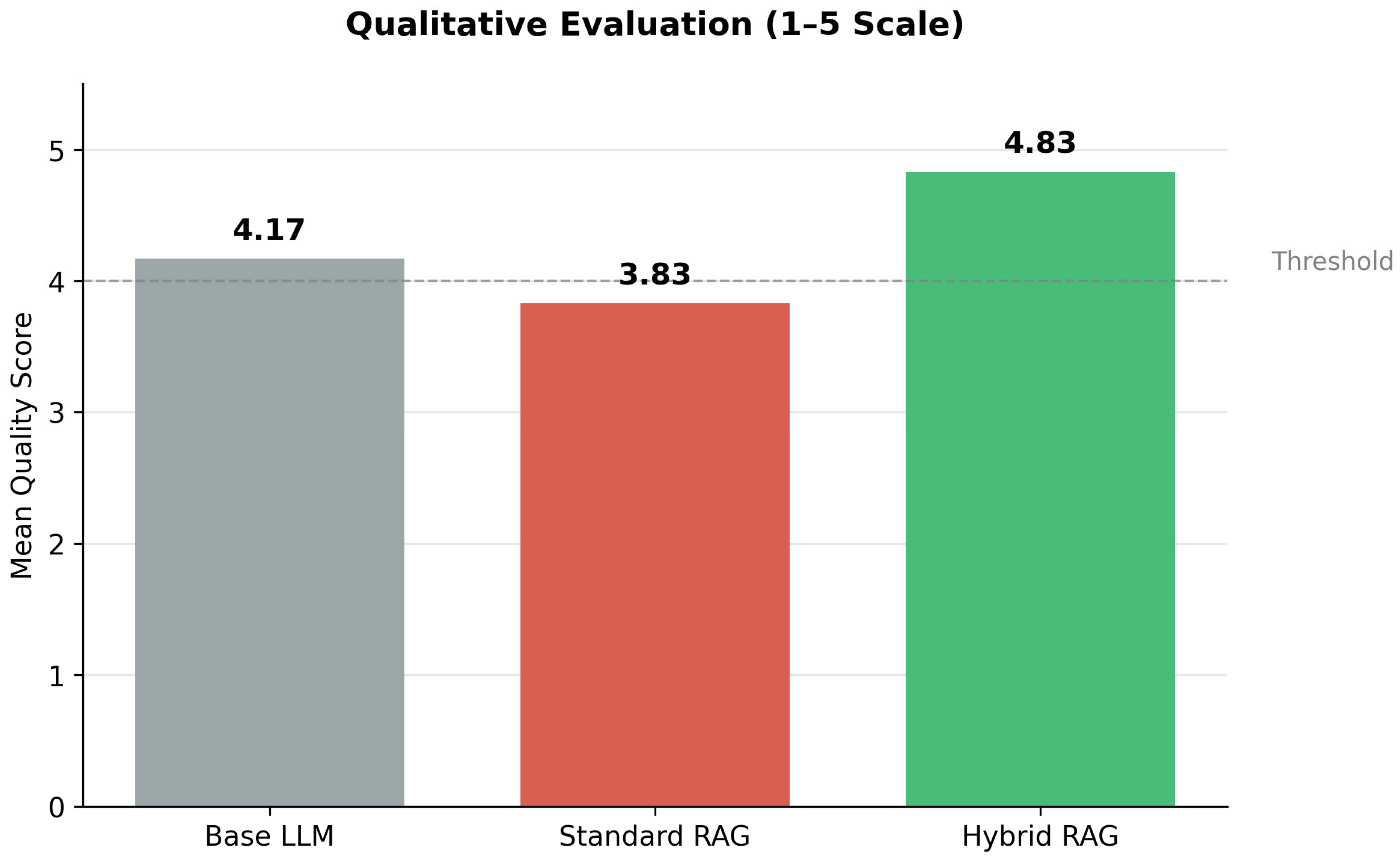
4.4. Qualitative Analysis
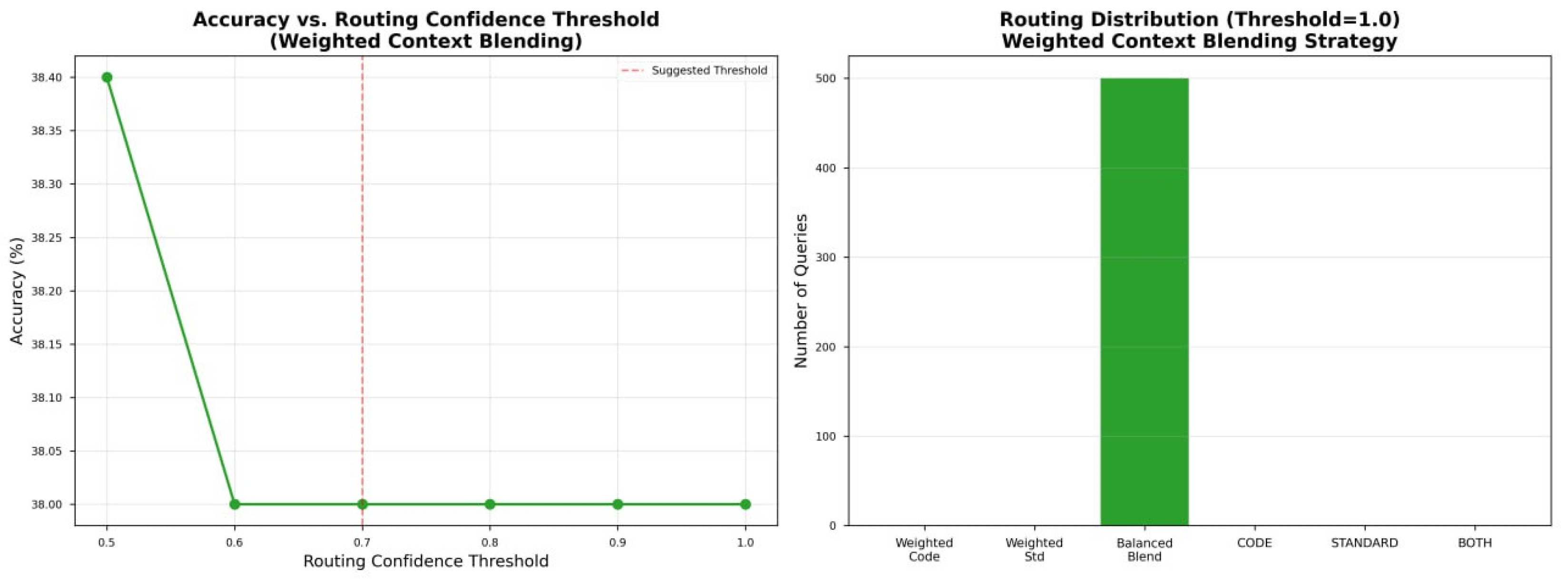
4.5. Weighted Context Blending Strategy
4.6. Error Profiling and Failure Analysis
4.7. Semantic Router Model Comparison
5. Discussion
6. Conclusions
Author Contributions
Funding
Institutional Review Board Statement
Informed Consent Statement
Data Availability Statement
Conflicts of Interest
References
- Majlesara, A.; Majlesi, A.; Mamaghani, A.; Shokrani, A.; Khalaj, B.H. 5G Network Automation Using Local Large Language Models and Retrieval-Augmented Generation. arXiv 2025, arXiv:2511.21084. [Google Scholar] [CrossRef]
- Zhang, R.; Jiang, H.; Wang, W.; Liu, J. Optimization Methods, Challenges, and Opportunities for Edge Inference: A Comprehensive Survey. Electronics 2025, 14, 1345. [Google Scholar] [CrossRef]
- Ramamoorthy, L. Evaluating Generative AI: Challenges, Methods, and Future Directions. Int. J. Multidiscip. Res. 2025, 7(1), 1–7. [Google Scholar] [CrossRef]
- Zhou, H.; Hu, C.; Yuan, Y.; Cui, Y.; Jin, Y.; Chen, C.; Wu, H.; Yuan, D.; Jiang, L.; Wu, D.; et al. Large Language Model (LLM) for Telecommunications: A Comprehensive Survey on Principles, Key Techniques, and Opportunities. arXiv 2024, arXiv:2405.10825. [Google Scholar] [CrossRef]
- Zhao, K.; Yang, Z.; Huang, C.; Chen, X.; Zhang, Z. FedsLLM: Federated Split Learning for Large Language Models Over Communication Networks. In Proceedings of the 2024 International Conference on Ubiquitous Communication (Ucom); IEEE: New York, NY, USA, 2024; pp. 438–443. [Google Scholar] [CrossRef]
- Experiential Networked Intelligence (ENI). Research on Application Scenarios of Network Large Language Models for Operation, Administration, Maintenance, and Performance; Technical Report; GR ENI 045-V4.1.1; ETSI: Sophia Antipolis, France, 2025. [Google Scholar]
- Gajjar, P.; Shah, V.K. ORANSight-2.0: Foundational LLMs for O-RAN. IEEE Trans. Mach. Learn. Commun. Netw. 2025, 3, 903–920. [Google Scholar] [CrossRef]
- Boi, B.; Esposito, C. Prompt Engineering vs. Fine-Tuning for LLM-Based Vulnerability Detection in Solana and Algorand Smart Contracts. arXiv 2025, arXiv:2511.11250. [Google Scholar] [CrossRef]
- Wu, D.; Wang, X.; Qiao, Y.; Wang, Z.; Jiang, J.; Cui, S.; Wang, F. NetLLM: Adapting Large Language Models for Networking. In Proceedings of the ACM SIGCOMM 2024 Conference; Association for Computing Machinery: New York, NY, USA, 2024; pp. 661–678. [Google Scholar] [CrossRef]
- Kan, K.B.; Mun, H.; Cao, G.; Lee, Y. Mobile-LLaMA: Instruction Fine-Tuning Open-Source LLM for Network Analysis in 5G Networks. IEEE Netw. 2024, 38, 76–83. [Google Scholar] [CrossRef]
- Zou, H.; Zhao, Q.; Tian, Y.; Bariah, L.; Bader, F.; Lestable, T.; Debbah, M. TelecomGPT: A Framework to Build Telecom-Specific Large Language Models. arXiv 2024, arXiv:2407.09424. [Google Scholar] [CrossRef]
- Ghosh, R.; Liu, C.H.; Rele, G.; Ravipati, V.; Aouad, H. TelcoAI: Advancing 3GPP Technical Specification Search through Agentic Multi-Modal Retrieval-Augmented Generation. arXiv 2025, arXiv:2601.16984. [Google Scholar] [CrossRef]
- Conger, N.; Scollar, N.; Davaslioglu, K.; Sagduyu, Y.E.; Kompella, S. How to Discover Knowledge for FutureG: Contextual RAG and LLM Prompting for O-RAN. arXiv 2025, arXiv:2601.02382. [Google Scholar]
- Salajeghe, Y.; Kopaee, A.M.; Najjari, S.; Ahmadi, I.; Dehmolaee, M.A.; Khalaj, B.H. Verified Telcorag: A Verified Local-Rag for Telecommunication Uses. In Proceedings of the 2025 European Conference on Networks and Communications (EuCNC) & 6G Summit; IEEE: New York, NY, USA, 2025; p. 102. [Google Scholar] [CrossRef]
- Ye, S.; Ouyang, B.; Zeng, L.; Qian, T.; Chu, X.; Tang, J.; Chen, X. Jupiter: Fast and Resource-Efficient Collaborative Inference of Generative LLMs on Edge Devices. arXiv 2025, arXiv:2504.08242. [Google Scholar] [CrossRef]
- Xia, L.; Yang, M.; Wang, J.; Yan, Z.; Ren, Y.; Yu, G.; Lei, K. Mamba4Net: Distilled Hybrid Mamba Large Language Models For Networking. arXiv 2025, arXiv:2510.17147. [Google Scholar] [CrossRef]
- Dinler, O.B. UAV Cybersecurity with Mamba-KAN-Liquid Hybrid Model: Deep Learning-Based Real-Time Anomaly Detection. Drones 2025, 9, 806. [Google Scholar] [CrossRef]
- Das, B.C.; Amini, M.H.; Wu, Y. Security and Privacy Challenges of Large Language Models: A Survey. arXiv 2024, arXiv:2402.00888. [Google Scholar] [CrossRef]
- Zhani, M.F.; Korbi, Y.; Mkadem, Y. FlexNGIA 2.0: Redesigning the Internet with Agentic AI—Protocols, Services, and Traffic Engineering Designed, Deployed, and Managed by AI. arXiv 2025, arXiv:2509.02124. [Google Scholar]
- Qu, Z.; Wang, W.; Yu, Z.; Sun, B.; Li, Y.; Zhang, X. LLM Enabled Multi-Agent System for 6G Networks: Framework and Method of Dual-Loop Edge-Terminal Collaboration. arXiv 2025, arXiv:2509.04993. [Google Scholar] [CrossRef]
- Sun, W.; Sun, C.; Zhang, Y.; Yin, Z.; Kang, Z. SCNOC-Agentic: A Network Operation and Control Agentic for Satellite Communication Systems. Electronics 2025, 14, 3320. [Google Scholar] [CrossRef]
- Chatzistefanidis, I.; Leone, A.; Yaghoubian, A.; Irazabal, M.; Nassim, S.; Bariah, L.; Debbah, M.; Nikaein, N. MX-AI: Agentic Observability and Control Platform for Open and AI-RAN. arXiv 2025, arXiv:2508.09197. [Google Scholar]
- Guo, Z.; Zou, J.; Xin, P.; Zhao, X.; Hu, T.; Zhuang, S.; Sun, J.; Liu, Y.; Ma, W. Root Cause Analysis of Power Grid 5G Network Faults Based on Large Language Model. In Proceedings of the 2025 IEEE 28th International Conference on Computer Supported Cooperative Work in Design (CSCWD); IEEE: New York, NY, USA, 2025; p. 629. [Google Scholar] [CrossRef]
- Hatami, P.; Majlesara, A.; Majlesi, A.; Khalaj, B. Automated Fault Detection in 5G Core Networks Using Large Language Models. arXiv 2025, arXiv:2512.19697. [Google Scholar] [CrossRef]
- Chen, Z.; Zhang, W.; Huang, Y.; Chen, M.; Geng, Y.; Yu, H.; Bi, Z.; Zhang, Y.; Yao, Z.; Song, W.; et al. Tele-Knowledge Pre-training for Fault Analysis. arXiv 2023, arXiv:2210.11298. [Google Scholar] [CrossRef]
- Huang, X.; Tang, Y.; Li, J.; Zhang, N.; Shen, X. Toward Effective Retrieval Augmented Generative Services in 6G Networks. IEEE Netw. 2024, 38, 459–467. [Google Scholar] [CrossRef]
- Ren, R.; Wu, Y.; Zhang, X.; Ren, J.; Shen, Y.; Wang, S.; Tsang, K.F. Retrieval-Augmented Generation for Mobile Edge Computing via Large Language Model. arXiv 2024, arXiv:2412.20820. [Google Scholar] [CrossRef]
- Lu, W.; Chen, K.; Qiao, R.; Sun, X. HiChunk: Evaluating and Enhancing Retrieval-Augmented Generation with Hierarchical Chunking. arXiv 2025, arXiv:2509.11552. [Google Scholar]
- Ahmad, S.; Nezami, Z.; Hafeez, M.; Zaidi, S.A.R. Benchmarking Vector, Graph and Hybrid Retrieval Augmented Generation (RAG) Pipelines for Open Radio Access Networks (ORAN). arXiv 2025, arXiv:2507.03608. [Google Scholar] [CrossRef]
- Gajjar, P.; Shah, V.K. ORAN-Bench-13K: An Open Source Benchmark for Assessing LLMs in Open Radio Access Networks. arXiv 2024, arXiv:2407.06245. [Google Scholar]


| Model | Architecture | Complexity | Key Metric (Efficiency) | Performance in Task |
|---|---|---|---|---|
| Mamba4Net | Selective SSM | Linear O(N) | 3.96× Throughput [16] | High (Scheduling/ABR) |
| Transformer | Self-Attention | Quadratic O(N2) | Baseline [16] | High (Reasoning) |
| MKL Hybrid | SSM + Liquid | Linear O(N) | 47.3 ms Latency [17] | 95%+ Attack Detection |
| Mobile-LLaMa | Transformer (Fine-tuned) | Quadratic O(N2) | High Accuracy (Packet) | 247/300 Code Gen [10] |
| Category | Base LLM | Hybrid RAG (Ours) | Standard RAG |
|---|---|---|---|
| Code-Centric | 46.8% | 78.5% | 72.8% |
| Cross-Domain | 28.6% | 71.4% | 71.4% |
| Standard-Centric | 20.0% | 40.0% | 60.0% |
| General/Mixed | 42.2% | 66.5% | 67.6% |
| Overall | 45.9% | 76.7% | 72.0% |
| Category | Precision | Recall | F1-Score |
|---|---|---|---|
| Code-Centric | 0.766 | 0.728 | 0.746 |
| Cross-Domain | 0.672 | 0.688 | 0.680 |
| Standard-Centric | 0.646 | 0.697 | 0.671 |
| General/Mixed | 0.718 | 0.684 | 0.701 |
| Macro Average | 0.701 | 0.699 | 0.700 |
| Model | Code | Cross-Domain | Mixed | Standard | Average |
|---|---|---|---|---|---|
| Base LLM | 0.77 | 0.88 | 0.78 | 0.70 | 0.77 |
| Standard RAG | 3.74 | 3.18 | 3.65 | 3.41 | 3.73 |
| Hybrid RAG | 3.74 | 3.63 | 3.28 | 3.21 | 3.47 |
| Routing Model | Architecture | Overall Accuracy | Macro-F1 | Average Latency |
|---|---|---|---|---|
| TF-IDF + SVM | Machine Learning Baseline | 44.08% | 48.46% | 0.27 ms |
| RoBERTaM NLI | Zero-shot Encoder | 39.94% | 36.95% | 250.38 ms |
| BARTM NLI | Zero-shot Encoder | 40.50% | 33.10% | 300.26 ms |
| Llama 3.2 3B (Ours) | Few-shot Causal LLM | 73.28% | 58.27% | 211.69 ms |
Disclaimer/Publisher’s Note: The statements, opinions and data contained in all publications are solely those of the individual author(s) and contributor(s) and not of MDPI and/or the editor(s). MDPI and/or the editor(s) disclaim responsibility for any injury to people or property resulting from any ideas, methods, instructions or products referred to in the content. |
© 2026 by the authors. Licensee MDPI, Basel, Switzerland. This article is an open access article distributed under the terms and conditions of the Creative Commons Attribution (CC BY) license.
Share and Cite
Nurakhov, Y.; Kassymbek, N.; Marlambekov, D.; Mukhanbet, A.; Imankulov, T. Bridging the Semantic Gap in 5G: A Hybrid RAG Framework for Dual-Domain Understanding of O-RAN Standards and srsRAN Implementation. Appl. Sci. 2026, 16, 3275. https://doi.org/10.3390/app16073275
Nurakhov Y, Kassymbek N, Marlambekov D, Mukhanbet A, Imankulov T. Bridging the Semantic Gap in 5G: A Hybrid RAG Framework for Dual-Domain Understanding of O-RAN Standards and srsRAN Implementation. Applied Sciences. 2026; 16(7):3275. https://doi.org/10.3390/app16073275
Chicago/Turabian StyleNurakhov, Yedil, Nurislam Kassymbek, Duman Marlambekov, Aksultan Mukhanbet, and Timur Imankulov. 2026. "Bridging the Semantic Gap in 5G: A Hybrid RAG Framework for Dual-Domain Understanding of O-RAN Standards and srsRAN Implementation" Applied Sciences 16, no. 7: 3275. https://doi.org/10.3390/app16073275
APA StyleNurakhov, Y., Kassymbek, N., Marlambekov, D., Mukhanbet, A., & Imankulov, T. (2026). Bridging the Semantic Gap in 5G: A Hybrid RAG Framework for Dual-Domain Understanding of O-RAN Standards and srsRAN Implementation. Applied Sciences, 16(7), 3275. https://doi.org/10.3390/app16073275