1. Introduction
After a neurological injury such as a spinal cord injury, individuals will often complete physical therapy to recover lost motor function. Physical therapy is an effective method for improving motor ability, focusing on high-volume movement repetition under skilled physical therapist guidance. Upper extremity function is consistently rated as important to an individual’s quality of living [
1]; therefore physical therapy often focuses on restoring reaching ability. However, issues with motivation, retention, and fatigue often lead to a wide range of outcomes and efficacy [
2,
3,
4]. Applied technologies that are highly customizable, along with more intelligent design of their implementation, may be the key to better experiences and outcomes with rehabilitative approaches.
To address efficacy concerns, technologies such as virtual reality (VR) are increasingly incorporated into physical therapy. VR involves a computer-generated three-dimensional immersive and interactive environment that can be displayed on a two dimensional screen or a head mounted display. Interaction with the environment can take place with built-in hardware, such as controllers, buttons, or keys, built-in movement tracking software, such as the hand tracking capabilities of the Meta Quest (Meta, Menlo Park, CA, USA), or input from external technologies, such as the Optitrack motion capture system (Optitrack Motive, NaturalPoint, Inc., Corvallis, OR, USA). These computerized interfaces are proven at improving motivation and engagement in physical therapy [
5,
6] and can be as effective as traditional therapies at functional recovery [
7,
8]. When dosage is matched, VR-based therapies can result in similar gains as traditional therapies but fail to lead to superior performance unless the two are combined, leading to greater dosage [
9,
10]. Research has demonstrated that users can be highly sensitive to computerized devices during upper extremity training [
11,
12,
13,
14], but many VR-based physical therapy paradigms fail to harness virtual reality’s personalizable and programmable capabilities adequately. Most focus on principles of gamification rather than maximizing functional gains through intentionally designed task constraints and customized environments [
15]. It is essential to identify reliable strategies for customizing virtual reality-based physical therapy in ways that maximize functional gains per training repetition, thereby enabling these approaches to consistently outperform traditional therapy.
Virtual reality is particularly well-suited for rehabilitation not only because of its immersive properties, but because it enables precise and systematic implementation of established motor learning principles within a controlled training environment. Specifically, features such as task complexity, structured perturbations, movement variability, and augmented sensory feedback can be deliberately embedded as programmable design elements rather than applied in an ad hoc manner. Grounding VR-based interventions in these principles allows training environments to be more intelligently designed, as task constraints and feedback can be adjusted in a repeatable and scalable way to shape motor behavior, engagement, and adaptation. In this sense, VR should not be viewed solely as a motivational tool, but as an engineered platform through which well-supported motor learning constructs can be concurrently operationalized to enhance performance and learning efficiency during rehabilitation training tasks.
A well-established principle in motor learning is that training under increased task complexity can enhance performance on simpler or related tasks. Prior work has shown that more challenging training conditions are associated with greater neural engagement and improved skill transfer relative to simple, repetitive practice [
16,
17]. From a design perspective, increasing task complexity can be achieved by introducing structured environmental demands that encourage movement variability and exploration, which are particularly beneficial during early stages of motor learning [
18,
19]. Approaches such as error augmentation and perturbation-based training exemplify how controlled task constraints can promote adaptive motor responses by requiring individuals to adjust to environmental challenges during practice [
20,
21,
22]. In programmable environments such as VR, these principles can be operationalized through deliberate manipulation of predictable and unpredictable task features, enabling systematic comparison of proactive adjustments to anticipated changes and reactive responses to unexpected disturbances within a controlled rehabilitation context.
The benefits of perturbation-based training are not limited to force-based disturbances and can also be achieved through visual and task-level manipulations. For instance, training with visual rotations has been shown to improve performance and elicit distinct neural changes related to sensorimotor processing and cognitive control [
23]. Importantly, movement variability can also be induced through intentional task design, even in the absence of explicit physical perturbations. Kantak et al. (2017) demonstrated that training on a more complex tracing task led to improved short- and long-term performance on a simpler reaching task in individuals with chronic stroke, compared to repeated practice of the simple task alone [
24]. In this context, programmable platforms such as VR provide a practical means of embedding controlled perturbations and complexity directly into the training environment, allowing systematic modulation of task demands to promote adaptive motor responses and variability within a structured and repeatable framework.
Movement variability can be quantified using several kinematic and temporal measures, including dimensionless squared jerk (DSJ), standard deviation of movement, and sample entropy [
25,
26,
27]. Sample entropy is a probabilistic metric that captures the complexity and unpredictability of a movement time series, with higher values reflecting greater variability in movement patterns [
28,
29,
30]. The minimization of jerk is commonly discussed as a hallmark for smooth and efficient movement [
31,
32], but can be inconsistent due to variations in movement peaks, duration, and amplitude [
27]. DSJ addresses these limitations by removing the dependency of jerk on such variables, enabling more robust computations of movement variability and smoothness [
27,
33,
34]. In structured training environments, entropy and DSJ provide a useful means of characterizing how individuals adapt their movement strategies in response to task constraints and environmental demands. Within a VR-based paradigm, where task complexity and perturbations can be systematically manipulated, measures of movement smoothness complement performance accuracy by quantifying how designed features influence movement organization and exploratory behavior during training.
In addition to manipulating task complexity and perturbations, virtual reality platforms are well-suited for delivering targeted augmented sensory feedback (ASF) during motor training. Such feedback can provide real-time information about task performance, support engagement, and reinforce sensorimotor processing during practice. Among available modalities, auditory feedback is particularly practical in VR environments due to its seamless integration within standard headset systems. ASF has been shown to enhance motor performance, for example through audio-based feedback during fine motor tasks, and may facilitate learning by engaging additional sensory pathways that reinforce task-relevant corrections [
35,
36,
37,
38]. When treated as a programmable design element, ASF allows VR training paradigms to systematically modulate feedback in conjunction with task constraints to influence performance, engagement, and adaptation [
39].
The incorporation of additional sensory modalities and dynamic task demands in VR environments is also relevant from the perspective of cognitive engagement, as these design features can influence attentional allocation during motor performance. Prior work suggests that both insufficient and excessive cognitive loading can impair task execution, particularly in motor tasks and in populations with neurological injury [
40,
41,
42]. Conversely, an appropriate level of task-related cognitive demand may enhance attentional resources and performance efficiency [
43], consistent with broader principles such as the Yerkes–Dodson relationship between task difficulty and arousal [
44]. In the present context, these concepts serve as a guiding rationale rather than a direct manipulation of cognitive load. Instead, electrodermal activity (EDA), a measure of physiological arousal, is used as a complementary indicator of cognitive engagement and responsiveness to task demands within the VR environment [
45], allowing performance outcomes and engagement-related arousal to be interpreted concurrently in relation to the imposed design features. While prior work has examined motor complexity, perturbation-based training, movement variability, and augmented sensory feedback largely in isolation, fewer studies have systematically integrated these motor learning principles within a programmable virtual reality training paradigm. VR environments uniquely enable precise and repeatable manipulation of task constraints—such as anticipated (proactive) versus unanticipated (reactive) dynamic shifts—alongside controlled presence or absence of augmented sensory feedback, in ways that are difficult to achieve in conventional therapy settings. From a design perspective, this level of controllability allows established motor learning constructs to be operationalized as intentional task features that jointly shape performance, cognitive engagement, and adaptive movement behavior. As an initial step toward more intelligently designed rehabilitation approaches, it is therefore important to examine how proactive and reactive task demands, paired with the presence of augmented sensory feedback, influence behavioral and physiological responses within a controlled VR environment.
In this exploratory, proof-of-concept study, neurotypical participants completed an upper-extremity reaching and tracing task in a virtual reality environment intentionally designed to implement the motor learning principles outlined above through programmable task features. Dynamic movement shifts were introduced as either proactive (anticipated) or reactive (unanticipated) constraints to increase task complexity, induce movement variability, and require continuous adaptation, while the presence of augmented sensory feedback (ASF) was incorporated as a complementary design element to support cognitive engagement and sensorimotor integration. Tracing accuracy served as the primary performance metric, while movement variability was quantified using sample entropy of the error signal and dimensionless squared jerk (DSJ) of user position, and electrodermal activity (EDA) was recorded as a physiological correlate of cognitive engagement. Outcomes were compared across conditions defined by expectation (proactive vs. reactive dynamic shifts) and ASF presence (ASF vs. non-ASF), relative to a baseline condition without dynamic shifts or augmented feedback. As a controlled feasibility step, this neurotypical investigation is intended to establish foundational effects of these integrated VR design elements, with the longer-term goal of informing more targeted and intelligently designed rehabilitation paradigms for individuals with neurological injury.
2. Materials and Methods
2.1. Subjects and Equipment
This research complied with the American Psychological Association Code of Ethics and was approved by the Institutional Review Board at Stevens Institute of Technology. Informed consent was obtained from each participant, and each person was screened to confirm the absence of current issues regarding upper-extremity function on their dominant side. Neurotypical participants (
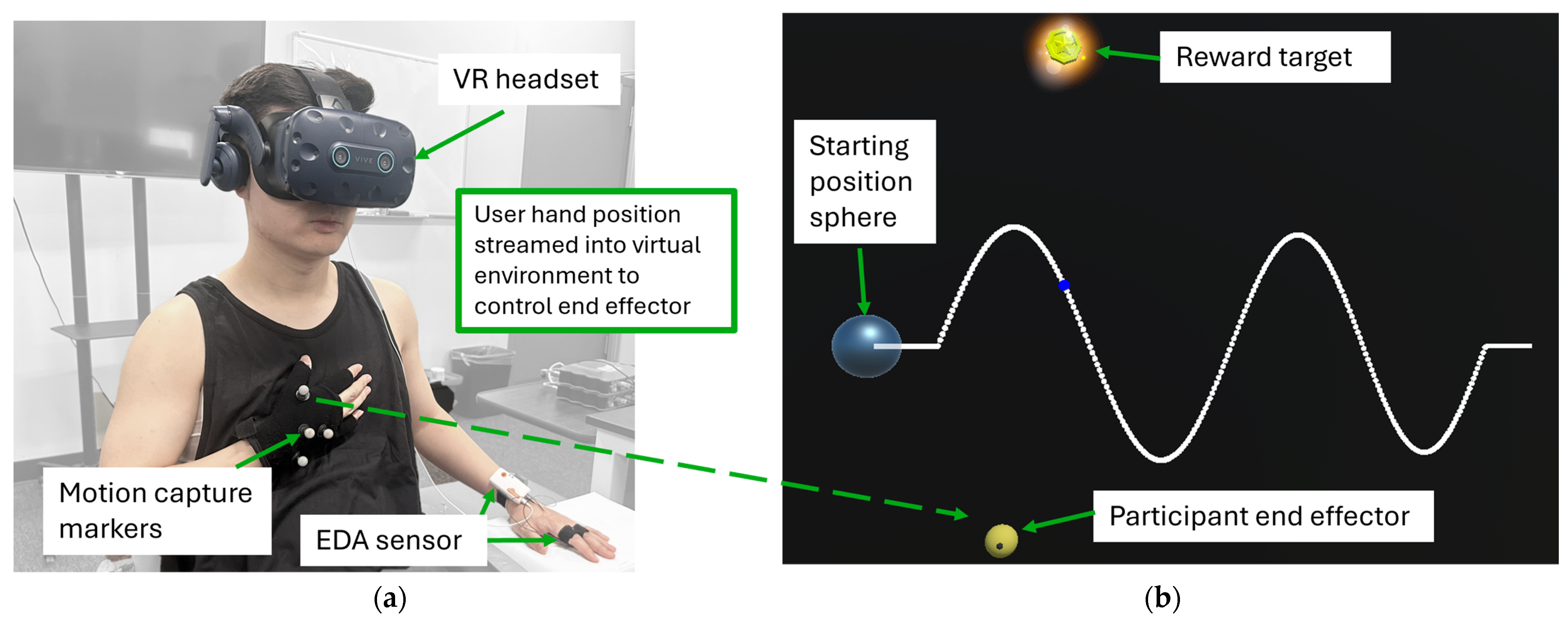
n = 10, 5 male, average age 20 years old, right hand dominant) wore a virtual reality headset (HTC Vive, Vive, New Taipei, Taiwan) and were placed into a custom-built virtual environment with a sampling rate of 90 Hz—the maximum supported sampling rate of the commercial HTC Vive headset. The environment was built with Unity 2021.3.4f1 (Unity, San Francisco, CA, USA) and coded using Visual Studio 2019 (Microsoft, Redmond, Washington, USA). A marker-based motion capture system (Optitrack Motive 2.0.2, NaturalPoint, Inc., Corvallis, OR, USA) with nine cameras (Optitrack Prime17W) was used to track the position and orientation of the participant’s reaching hand (
Figure 1a), which was represented in the virtual environment as a sphere. The participant wore a Shimmer3 GSR+ sensor (Shimmer, Cambridge, MA, USA) on their left hand to collect electrodermal activity at 51 Hz—the maximum supported sampling rate of the commercial Shimmer3 device. Data analysis was conducted in MATLAB R2023a (Mathworks Inc., Natick, MA, USA) and RStudio 2025.05.0 (R Core Team 2025, Vienna, Austria).
2.2. VR Environment
The custom-built VR environment was distance-scaled to map 1:1 to the physical world. Participants were presented with a sinusoidal tracing path 0.5 m wide, consisting of two cycles with an amplitude of 0.1 m. Flat “runways” 0.05 m wide were positioned at either end of the sinusoid, resulting in a total horizontal tracing width of 0.6 m (
Figure 1b). This width was based on the smallest maximum left-to-right reach in the frontal plane via shoulder adduction measured in 10 neurotypical participants (range: 0.6–0.7 m) and was held constant across all participants.
For each participant, maximum forward reach in the sagittal plane was measured and used to scale the sinusoid’s depth to one-half of that participant’s maximum reach. This resulted in a typical tracing depth of approximately 0.3–0.5 m. A starting-position sphere was placed to the left of the first runway at the target depth for each participant. The participant’s end effector (hand) was represented by a yellow sphere.
2.3. Protocol
All participants completed five experimental conditions, each consisting of pre-training trials (10 trials), training trials (20 trials), and post-training trials (10 trials), for a total of 40 trials per condition. Each pre-training and post-training trial took approximately 15 s to complete. Each training trial took approximately 30 s to complete. Each condition took approximately 30 min to complete. Transitioning between blocks of trials took approximately 1.5 min, and transitioning between trials in a single block took approximately 20 s. Completion of all conditions required less than three hours, balancing the need for sufficient continuous data collection across multiple trials with acceptable participant tolerance to prolonged VR exposure. The five conditions were no-shift (NS), proactive (Pro), reactive (Re), proactive + audio (PA), and reactive + audio (RA). Condition order was counterbalanced across participants, with a 5 min washout period between conditions during which participants removed the VR headset. Results from a pilot study indicated no order effects based on a one-way ANOVA.
Participants were instructed not to alter their routine activities prior to participating in this study. This may have included but was not limited to, unaltered sleep patterns, continuing prescribed medication as usual, and maintaining normal consumption of caffeine and food.
Upon the start of the experiment, participants were seated and wore a glove with four asymmetrically placed motion-capture markers and a VR headset. A piece of tape placed at the center of the chest at armpit level served as a calibration reference. Participants positioned their hand at the tape and looked forward while the virtual camera centered on their position. Hand movements controlled an end effector in the virtual environment.
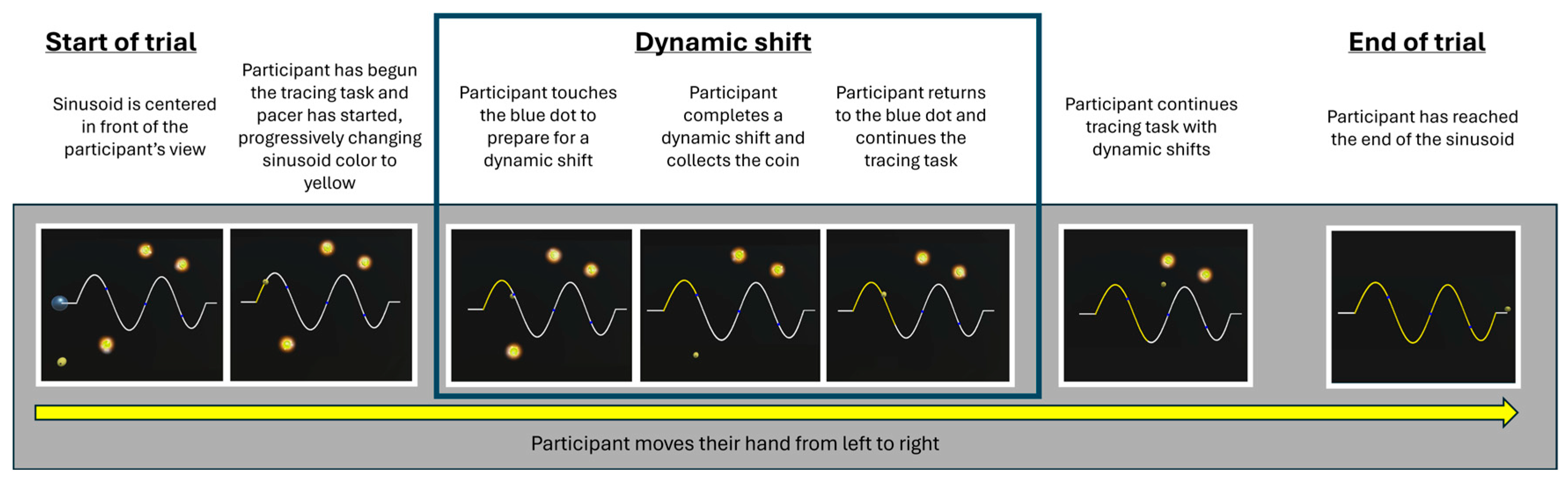
Each trial began when participants reached the starting sphere. Participants then traced a sinusoidal path from left to right, with the trial initiating only after the starting sphere was reached. Participants were instructed that their primary objective was to trace the sinusoid as accurately as possible. Trials were repeated if participants did not attempt to trace the sinusoid (e.g., random movement).
While tracing, the sinusoid gradually changed color from white to yellow to provide a suggested pacing cue (“pacer”) corresponding to a speed of 0.14 m/s. Natural reaching speed varies between individuals; one study reported completion times of 0.3–0.9 s for a single planar 25 cm reach [
46]. The total path length of the sinusoid was 0.97 m with a horizontal width of 0.5 m. The selected pacer speed corresponded to a suggested tracing time of approximately 3.5 s and was intended to encourage a comfortable but relatively rapid tracing speed along the complex path. This pacing approach provided protocol-based speed normalization for subsequent analyses. Participants were instructed to match the rate of color change while maintaining tracing accuracy as their primary objective. Although adherence to the pacer was not enforced, all participants maintained approximately the suggested speed. A trial ended when the end effector reached the end of the second flat runway.
In the pre- and post-training blocks, and in the training block for the no-shift condition, participants traced the sinusoid under only the constraints described above. In the proactive and reactive training blocks, participants additionally collected three reward targets (“coins”) positioned 20 cm above or below the sinusoid (
Figure 2). Each reward target corresponded to a blue dot located on the sinusoid at the same horizontal position. Participants were instructed to trace to the dot, shift vertically to contact the reward target (which disappeared upon contact), and then return to the dot before continuing along the sinusoid. The blue dot served as a suggested launch point for the vertical deviation, although participants were not penalized if they did not precisely touch the dot before and after collecting the reward target. Trials were repeated if participants failed to perform the required dynamic shifts.
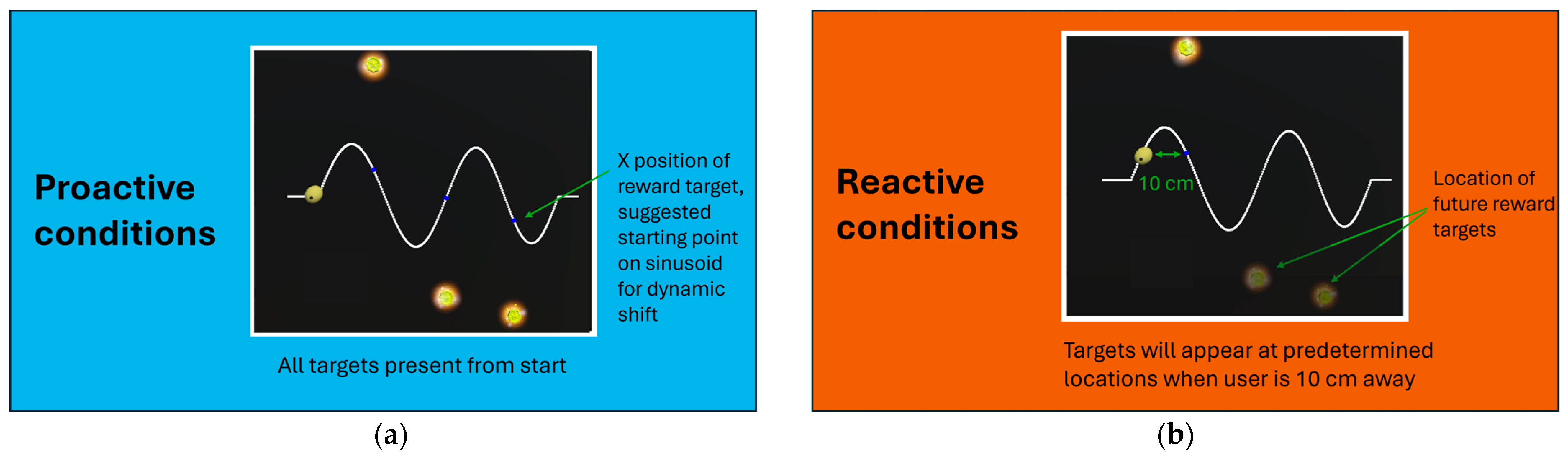
In the proactive conditions, reward targets were visible from the start of each trial (
Figure 3a). In the reactive conditions, reward targets appeared approximately 10 cm ahead of the end effector at predetermined locations (
Figure 3b). Reward target positions were pseudo-randomly selected from nine possible locations along the sinusoid, with a minimum spacing of 6 cm between targets.
2.4. Outcome Measures
Performance was quantified in all trials using error, defined as the distance from the target sinusoid. Movement smoothness was assessed using Sample Entropy and Dimensionless Squared Jerk (DSJ). Sample Entropy was calculated from participant error time series in the training trials and quantifies the unpredictability or complexity of a time series. It is defined as the negative natural logarithm of the conditional probability that two sequences of length m that are similar (within a tolerance r, using Chebyshev distance) remain similar when extended to length m + 1, excluding self-matches. Parameters were set to m = 2 and r = 0.2 × standard deviation of the error (
Table A1) [
47]. DSJ is defined as the normalized integral of squared jerk (third derivative of position) over a movement [
27,
31,
48,
49]. Because the task involved tracing two sinusoidal cycles, each cycle was treated as a separate movement. DSJ was calculated per cycle and then averaged across the two cycles to yield a single smoothness value per trial. Cognitive arousal was measured using electrodermal activity (EDA), computed as the difference between the mean of the highest 0.5% of values and the mean of the lowest 0.5% of values within each trial.
2.5. Data Pre-Processing
Performance change for each metric was quantified as the percentage change from pre- to post-training trials. One-sample
t-tests on tracing-error changes were used to identify participants who showed a significant effect of training in at least one condition (
n = 8); these participants were classified as responders. By testing whether an individual’s mean change differed from zero, this approach avoids bias from sample-derived thresholds [
47,
48].
Responder classification reflects systematic changes in performance across trials in any condition, including baseline no-shift, and preserves natural between-subject variability. Both positive (improved) and negative (worsened) responders were included to maintain the full spectrum of individual performance changes. Outliers for each metric were defined as values beyond 1.5 times the interquartile range (IQR) and excluded from analysis.
2.6. Data Analysis
Performance improvements were analyzed between all five conditions using a one-way ANOVA. Dunnett’s post hoc tests were conducted to compare individual dynamic shift conditions with no shift (control). A two-way ANOVA was conducted on the dynamic shift conditions with factors ASF (present vs. absent) and Expectation (expected vs. unexpected shifts).
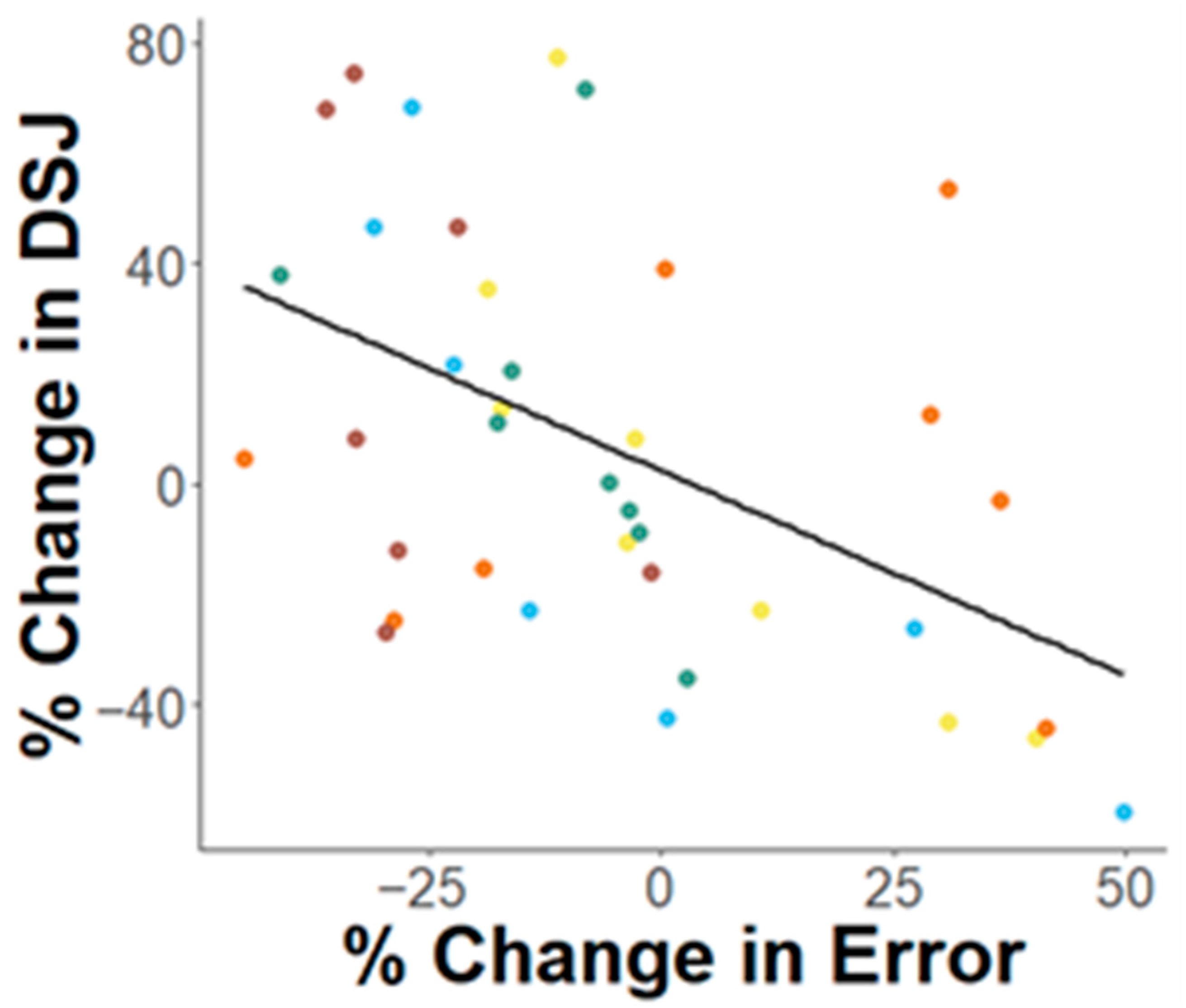
Planned one-sample t-tests were conducted to determine whether percent change differed from zero within each condition. A spearman correlation was conducted between percentage change in Error and percentage change in DSJ after confirming non-normality. p value was adjusted using the Benjamini–Hochberg procedure. Number of velocity peaks in each trial was counted, and a spearman correlation was conducted between velocity peaks and DSJ.
4. Discussion
The present exploratory study evaluated a programmable virtual reality motor training paradigm in which task constraints and augmented auditory feedback were systematically manipulated as explicit design variables. Proactive versus reactive dynamic shifts and the presence versus absence of augmented auditory feedback were intentionally embedded within the VR environment to operationalize motor learning principles related to complexity, perturbation, and sensory augmentation. Interpreting the results through this design-oriented framework is essential, as observed changes in tracing performance, electrodermal activity (EDA), and dimensionless squared jerk (DSJ) reflect the combined influence of engineered task structure and feedback modulation within a controlled virtual training system.
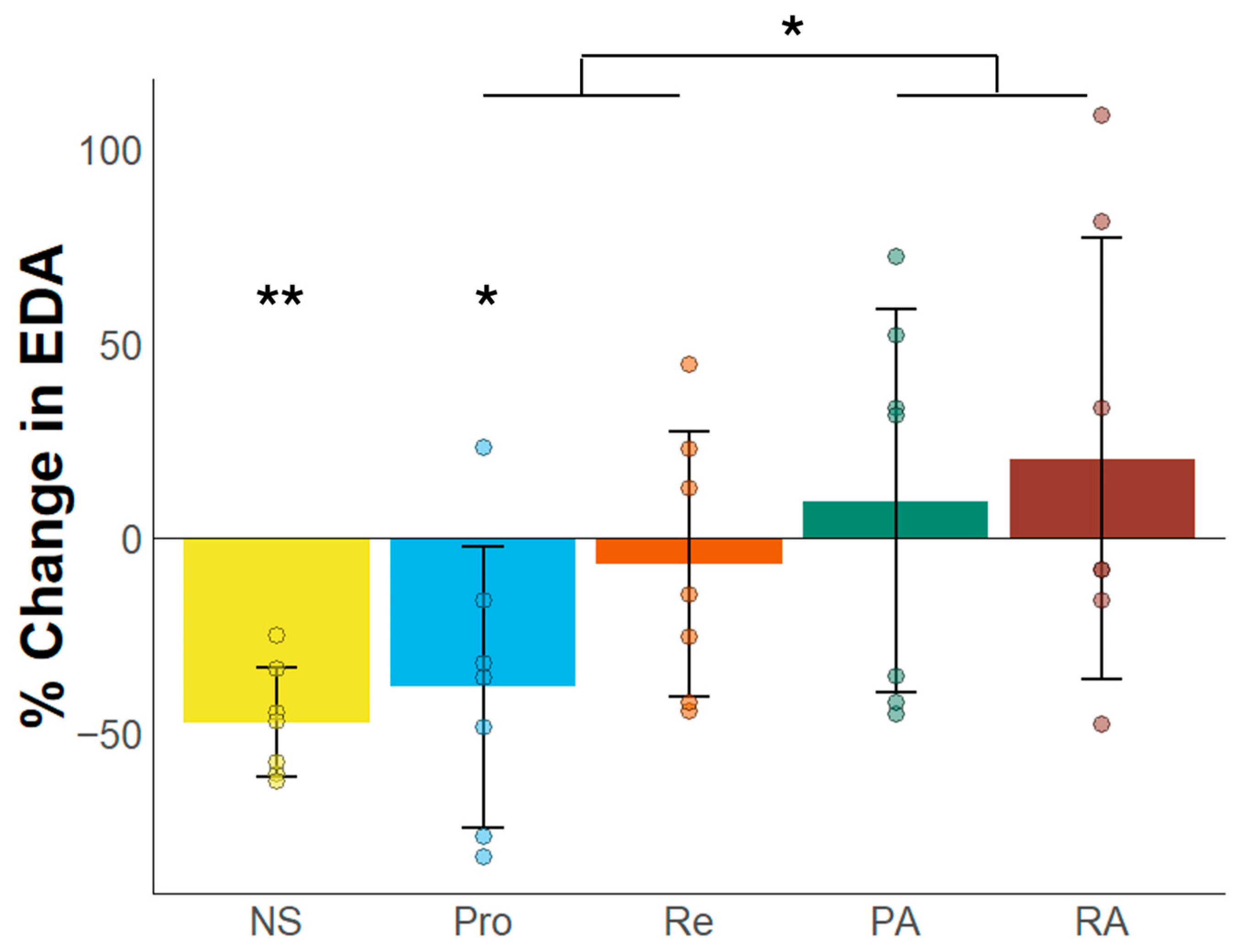
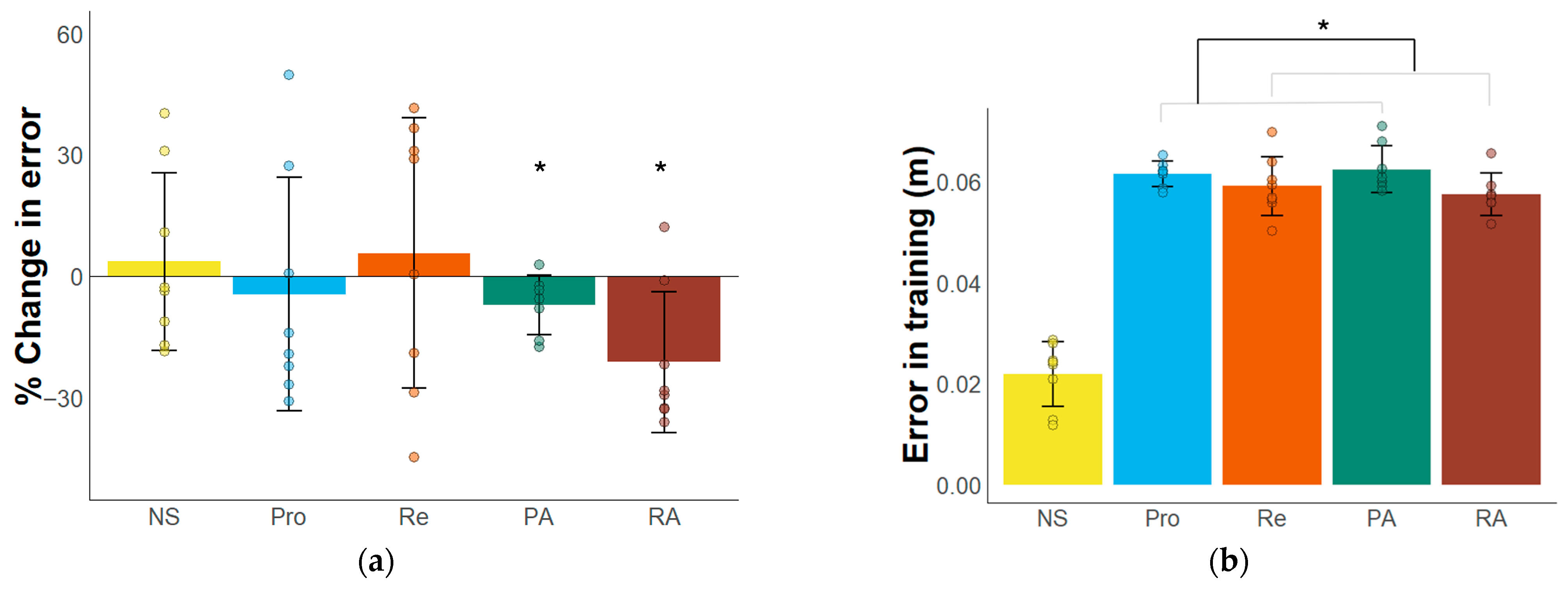
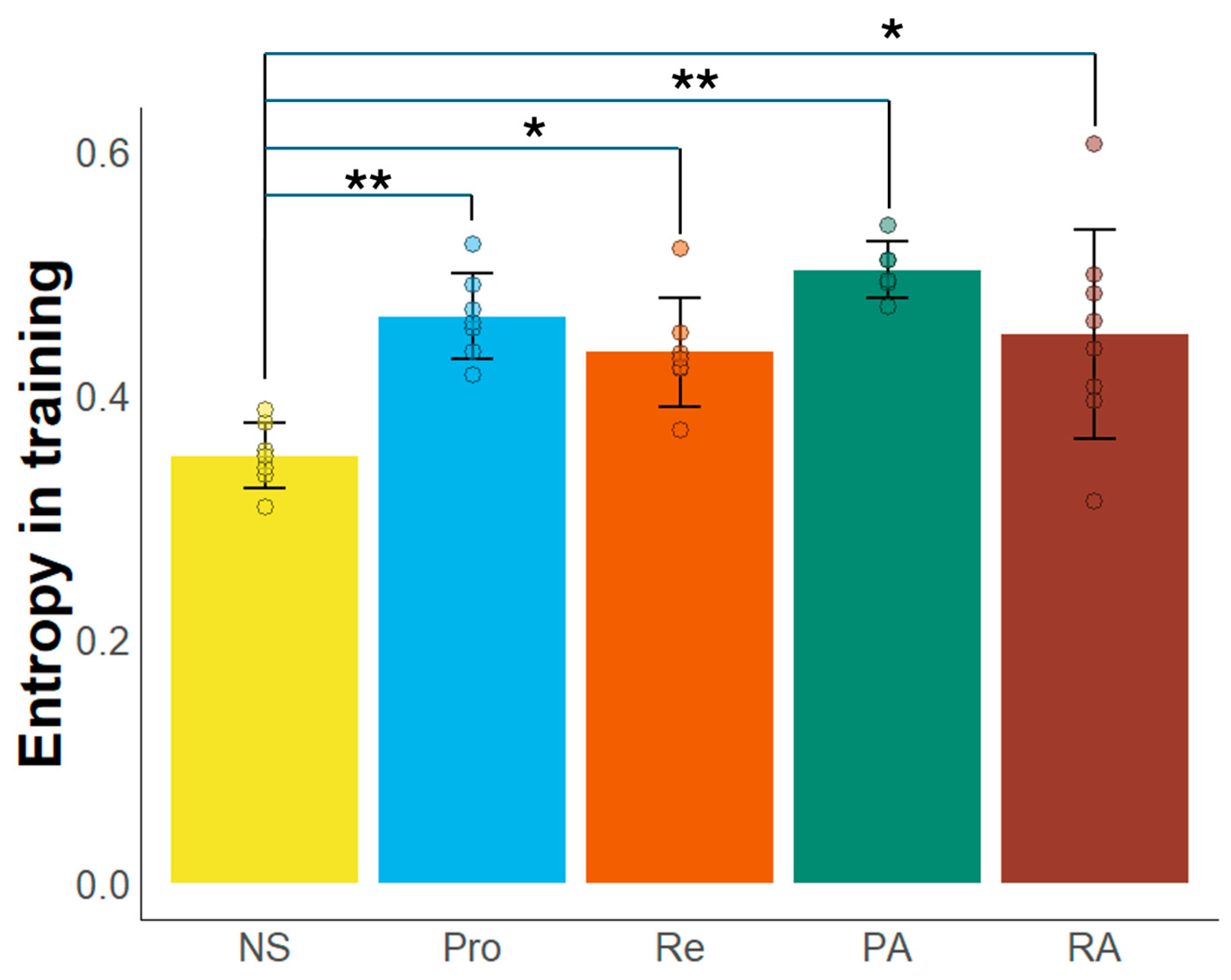
In this exploratory investigation, we examined how augmented auditory feedback and proactive versus reactive dynamic shifts influenced post-training performance and physiological responses within a structured VR task. Tracing error decreased significantly following training in the auditory feedback conditions, whereas no significant improvement was observed in the non-audio or no-shift conditions. During training, there was greater error in the proactive compared to the reactive conditions, and a trend towards the same with movement entropy. This is consistent with increased concurrent task demands when dynamic shifts were anticipated. EDA after training remained higher in the audio conditions relative to the non-audio conditions, indicating differential engagement associated with augmented sensory feedback. Improved performance after training was associated with increased dimensionless squared jerk (DSJ), suggesting a strategy of online sensory-driven corrections led by corrective engagement within the movement.
4.1. Performance and VR Design Implications
The primary objective of this exploratory study was to determine whether intentionally engineered task constraints and augmented auditory feedback within a programmable VR environment would influence post-training motor performance. Significant reductions in tracing error were observed only in the auditory feedback conditions. Neither the non-audio dynamic shift conditions nor the no-shift condition produced significant post-training improvement. These findings reinforce performance as the central outcome of the present work.
The results suggest that, at the group level, increased task complexity alone—operationalized through proactive and reactive dynamic shifts—was insufficient to produce measurable performance gains. Instead, performance improvements emerged when dynamic shifts were paired with augmented auditory feedback. This pattern is consistent with evidence that augmented feedback can enhance motor performance by reinforcing error processing and increasing task salience [
50].
The programmable nature of VR allowed proactive and reactive task constraints to be systematically embedded as design variables. However, only the conditions incorporating auditory augmentation translated this structured complexity into improved post-training accuracy. This suggests that sensory reinforcement may be necessary, within this paradigm, to convert elevated task demands into functional performance gains [
36,
51].
Although proactive conditions showed greater training error and trends toward greater entropy, these increases did not independently result in superior post-training performance. Reactive conditions, particularly when combined with audio, demonstrated both structured adaptation and improved accuracy. Together, these findings indicate that intelligently combining task expectation manipulations with augmented sensory feedback may be more effective than manipulating task demands alone. The reactive conditions, in which dynamic shifts appeared unexpectedly during ongoing tracing, may have promoted more externally driven corrective engagement, which—when paired with auditory reinforcement—translated more effectively into post-training accuracy improvements.
Because this study was conducted in neurotypical participants, conclusions are limited to short-term feasibility. Nonetheless, demonstrating that performance improvements can be elicited through systematically engineered VR design elements provides an important foundational step toward future translational applications in neurologically impaired populations.
4.2. Cognitive Engagement and VR Design Implementation
Electrodermal activity (EDA), a validated physiological correlate of cognitive load and arousal [
45], was used to assess cognitive engagement within the VR training paradigm. Post-training EDA decreased in the no-shift and proactive non-audio conditions, whereas EDA remained higher in the auditory feedback conditions. Within the context of this programmable VR system, these results indicate that augmented auditory feedback functioned as an active design element influencing participant engagement.
The implementation of proactive and reactive dynamic shifts introduced an additional movement objective beyond sinusoid tracing, thereby increasing task complexity and likely elevating cognitive load relative to the no-shift condition. Such conditions approximate aspects of dual-task paradigms, in which attentional resources must be distributed across concurrent goals [
47]. Increased cognitive load has been shown to modulate motor behavior, particularly when task demands compete for limited attentional resources [
40]. However, in the present study, dynamic shifts alone did not prevent post-training reductions in EDA in the non-audio conditions, suggesting that increased structural complexity without concurrent sensory reinforcement may not be sufficient to sustain cognitive engagement.
The tracing task itself is relatively simple. According to the Yerkes–Dodson relationship [
44], optimal performance in simpler tasks may require maintenance of sufficient physiological arousal. Reductions in EDA in the no-shift and proactive non-audio conditions may therefore reflect cognitive under-engagement, which has been associated with reduced attentional resource allocation [
42]. In contrast, the relative maintenance of EDA in the auditory conditions—alongside observed performance improvements—suggests that embedding augmented auditory feedback within the VR environment helped prevent reductions in physiological engagement observed in the non-audio conditions.
Importantly, EDA did not increase beyond baseline levels during training, indicating that the implementation of auditory feedback did not induce excessive cognitive load. This distinction is critical from a design perspective. Excessive load can impair motor performance, particularly in injured populations [
40,
41]. The present findings suggest that VR-based sensory augmentation can be implemented in a manner that stabilizes engagement without overloading participants.
Together, these results reinforce the value of treating engagement as a controllable design parameter within VR motor training. Rather than assuming that immersive environments inherently maintain attention, targeted sensory augmentation may be necessary to regulate engagement during repeated task execution. Although demonstrated here in neurotypical participants, this principle has clear implications for future rehabilitation-oriented VR design.
4.3. Movement Variability
Movement variability was quantified using sample entropy and DSJ, both measures commonly used to characterize the structure and unpredictability of motor output under changing task demands [
23,
28,
29,
47].
During training, entropy was higher in the dynamic shift conditions relative to no-shift, indicating that the programmed task constraints successfully altered movement structure. From a design perspective, this supports the notion that VR-embedded perturbations can systematically modulate movement variability, a construct linked to adaptation and motor control organization [
52].
After training, participants who exhibited larger reductions in tracking error showed increases in DSJ. DSJ is sensitive to the presence of multiple velocity peaks in movement and a correlation analysis found a strong relationship between DJS and velocity peaks after training. In continuous tracking tasks such as sinusoid tracing, improved accuracy may be achieved through more frequent corrective sub-movements due to sensorimotor delays and intermittent control processes [
53,
54]. The sinusoid task requires ongoing sensory-driven corrections rather than execution of a single preplanned trajectory. Within this framework, increased DSJ may reflect a more responsive error-correction strategy rather than degraded movement quality. Departures from smooth minimum-jerk trajectories are expected when movements are strongly influenced by online feedback, as repeated adjustments introduce rapid changes in acceleration. Such corrective adjustments can support accurate tracking performance and suggest a role for structured movement variability following training.
Given the exploratory nature of the study, these findings should be interpreted conservatively. Entropy and DSJ changes reflect altered movement organization but do not independently establish motor learning. Rather, they provide supportive evidence that programmable proactive and reactive constraints influence how movement is structured during VR-based motor training.
4.4. Limitations and Future Work
This study should be interpreted as an exploratory proof-of-concept investigation of programmable VR design elements in a controlled laboratory setting. The sample consisted of neurotypical participants, and the training exposure was limited to single-session conditions. As such, conclusions are restricted to short-term performance modulation rather than sustained motor learning or clinical recovery. Additionally, this study utilized a single virtual reality hardware configuration. As such, the extent to which the proposed framework and findings generalize to other VR devices or tracking setups remains unclear. Though device characteristics such as headset weight may vary across models, the display is not expected to differ substantially, particularly given the relatively simple design of the VR environment used in this study. This study additionally focused on a single task—tracing a sinusoidal trajectory in space—and comparisons across different types of VR tasks were beyond the scope of this work. As such, the extent to which these findings generalize to other VR tasks, including more functional or activities-of-daily-living-based tasks, remains unclear. Other potential task configurations could include bimanual tracing, which would increase cognitive load, or object manipulation, which would require integrating a physical object with the virtual environment; these tasks could be valuable to explore in future studies but would require additional consideration of experimental design. Future work should compare different task types (e.g., abstract vs. functional) to determine how variations in task design influence performance, engagement, and physiological responses.
Although this study did vary cognitive task intensity, with the dynamic shift conditions presenting a more complex and cognitively intensive task, there was no difference in cognitive intensity between the dynamic shift conditions, and this study did not seek to vary physical task intensity. In the present study, we intended to keep training intensity (e.g., movement speed or difficulty progression) consistent for the dynamic shift conditions, to ensure that responses were due to how the cues were being presented (proactive vs. reactive) and the presence or absence of sensory reinforcement (audio ASF vs. no ASF). The primary aim was to examine behavioral (performance and kinematic) and physiological (EDA) responses to differences in task constraints across the dynamic shift condition; the baseline no-shift condition was included only as a fundamental control to determine performance and physiological changes simply based on task repetition. Future work should systematically vary levels of physical and cognitive intensity to better understand their effects on performance, engagement, and physiological arousal. Similarly, this study did not seek to optimize session length, training frequency, or duration of exposure. Future studies should systematically vary these parameters to better understand dose–response relationships and determine effective and tolerable training doses for both neurotypical and clinical populations in pursuit of more personalized therapies.
The repeated-measures design allowed within-subject comparisons across conditions but does not permit independent evaluation of each paradigm as a standalone intervention. Additionally, motor performance was quantified using endpoint trajectory error, which limits insight into joint-level coordination or neuromuscular strategies. Future studies should incorporate more comprehensive kinematic and neurophysiological measures to better characterize movement adaptation and underlying mechanisms.
Although electrodermal activity provided a validated index of cognitive engagement [
45], additional neural measures such as EEG may provide more precise characterization of sensory processing, attentional allocation, and motor planning during VR-based training. Multi-modal assessment will be important for refining how specific VR design elements regulate engagement without inducing excessive cognitive load.
Most importantly, while the ultimate objective is to inform development of personalized rehabilitation paradigms, the present findings represent only an initial step. Demonstrating true therapeutic potency will require multi-session studies in clinical populations, with evaluation of retention, transfer, and functional outcomes. Individuals with neurological injury may respond differently to proactive versus reactive task constraints and augmented sensory feedback, particularly given altered sensitivity to cognitive load [
40,
41].
Nevertheless, the observation that neurotypical participants exhibited significant short-term performance improvements when specific VR design elements were implemented—namely proactive/reactive task constraints paired with augmented auditory feedback—supports the feasibility of this engineered approach. These findings justify further investigation into how programmable VR environments can be systematically optimized and personalized for motor rehabilitation.