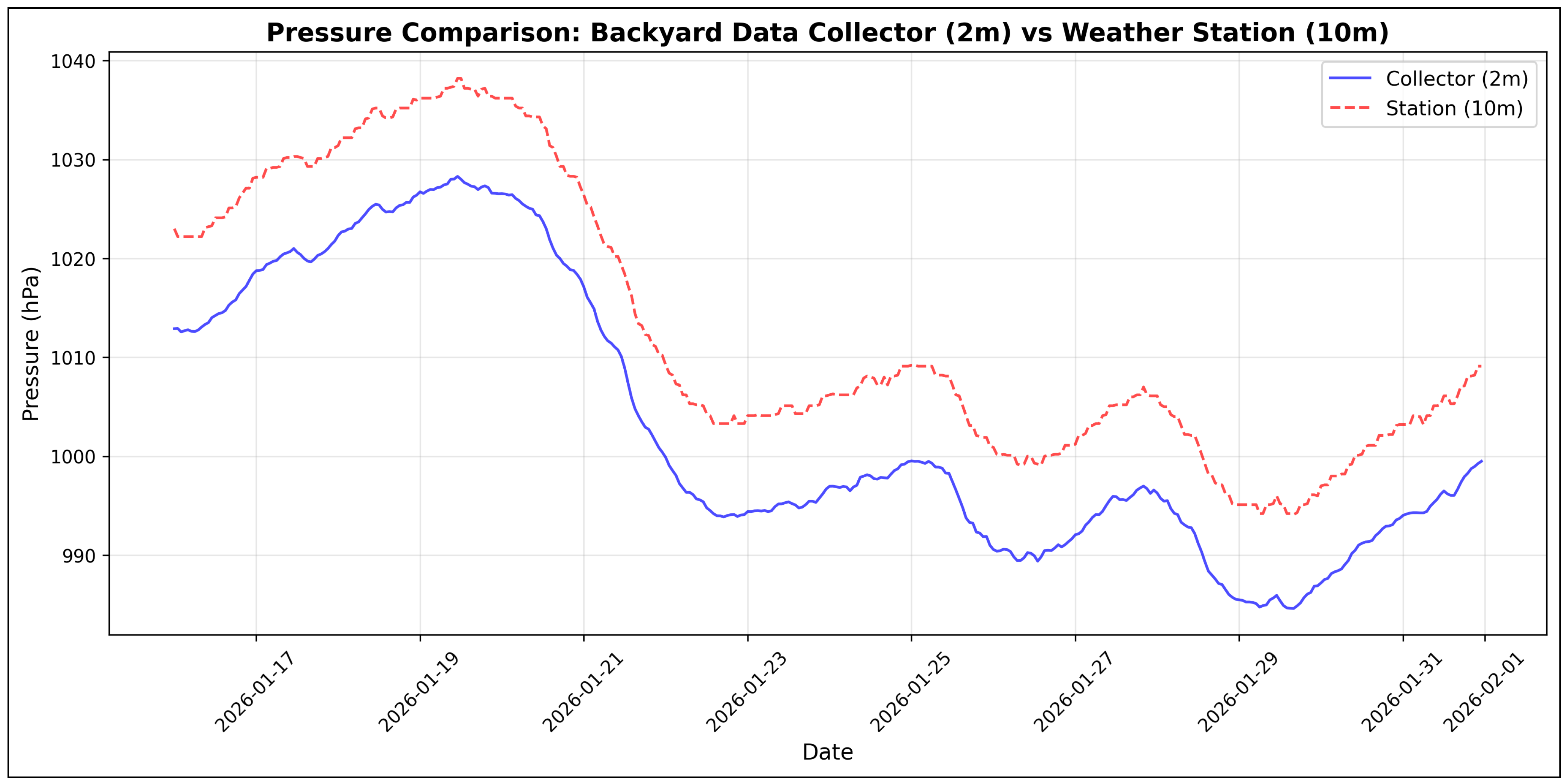
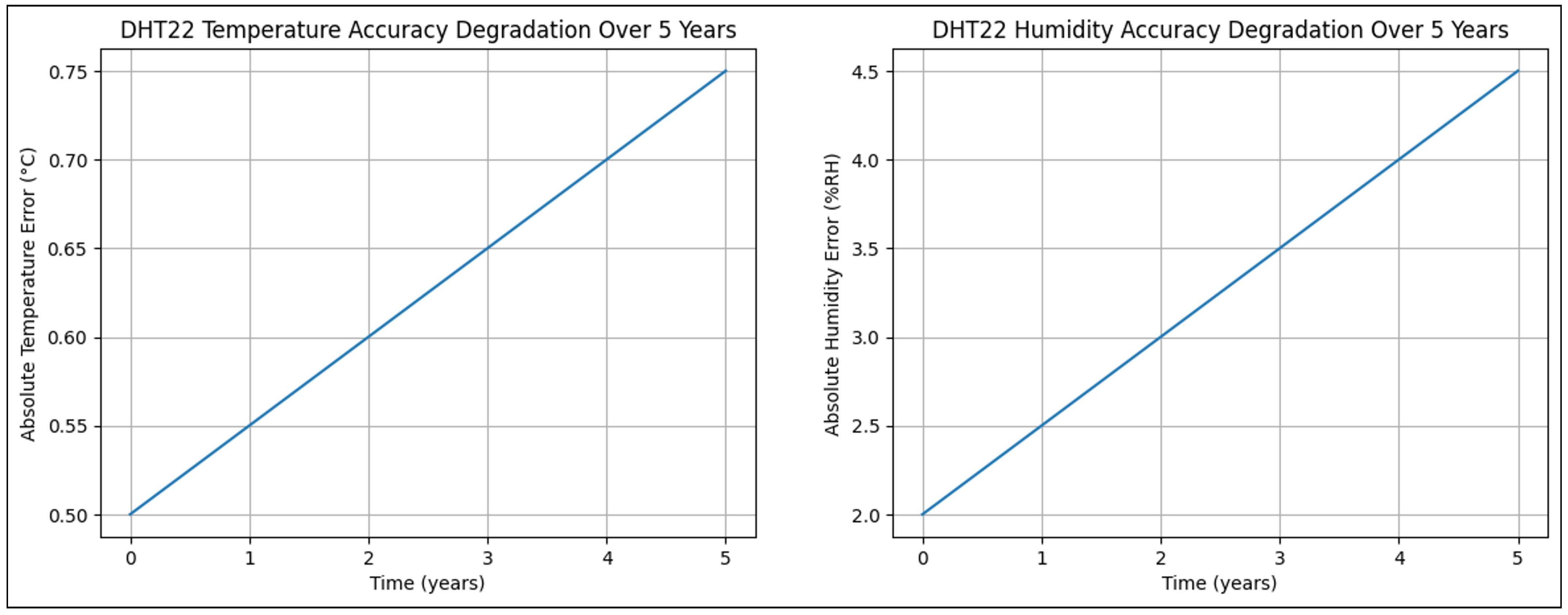
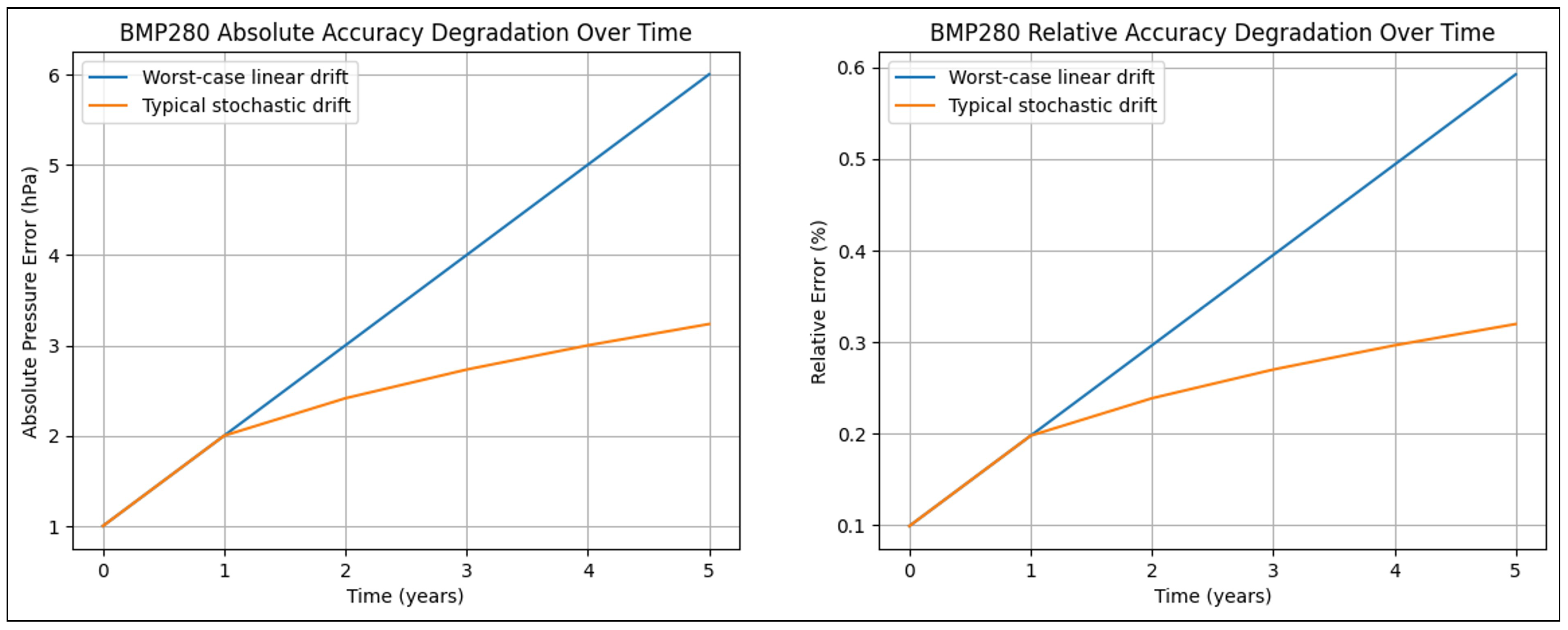
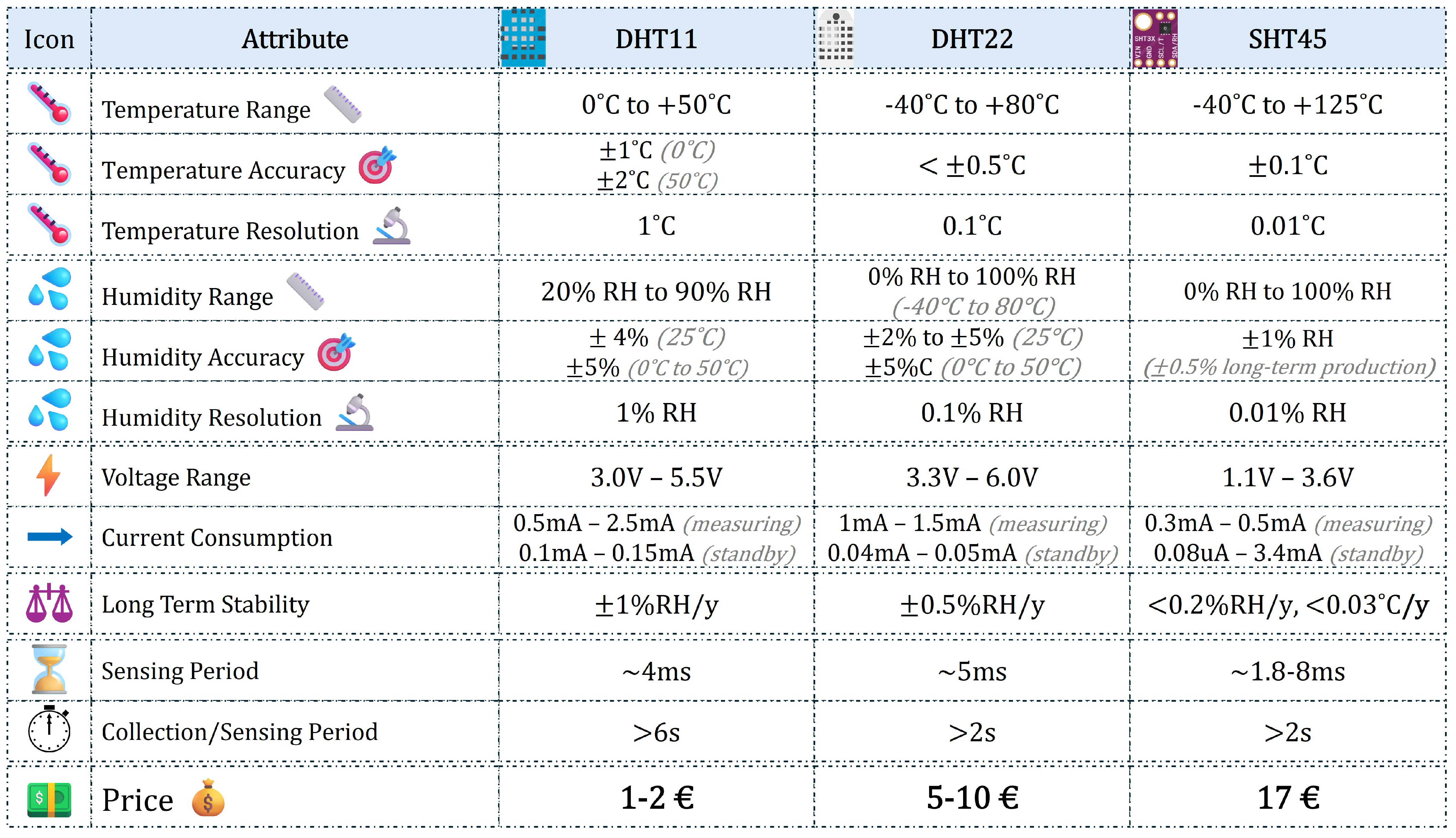
Cost-Effective TinyML-Ready Design and Field Deployment of a Solar-Powered Environmental Monitoring Data Collector Using LTE-M Communication

 , ,
, ,  , , and
Abstract
1. Introduction
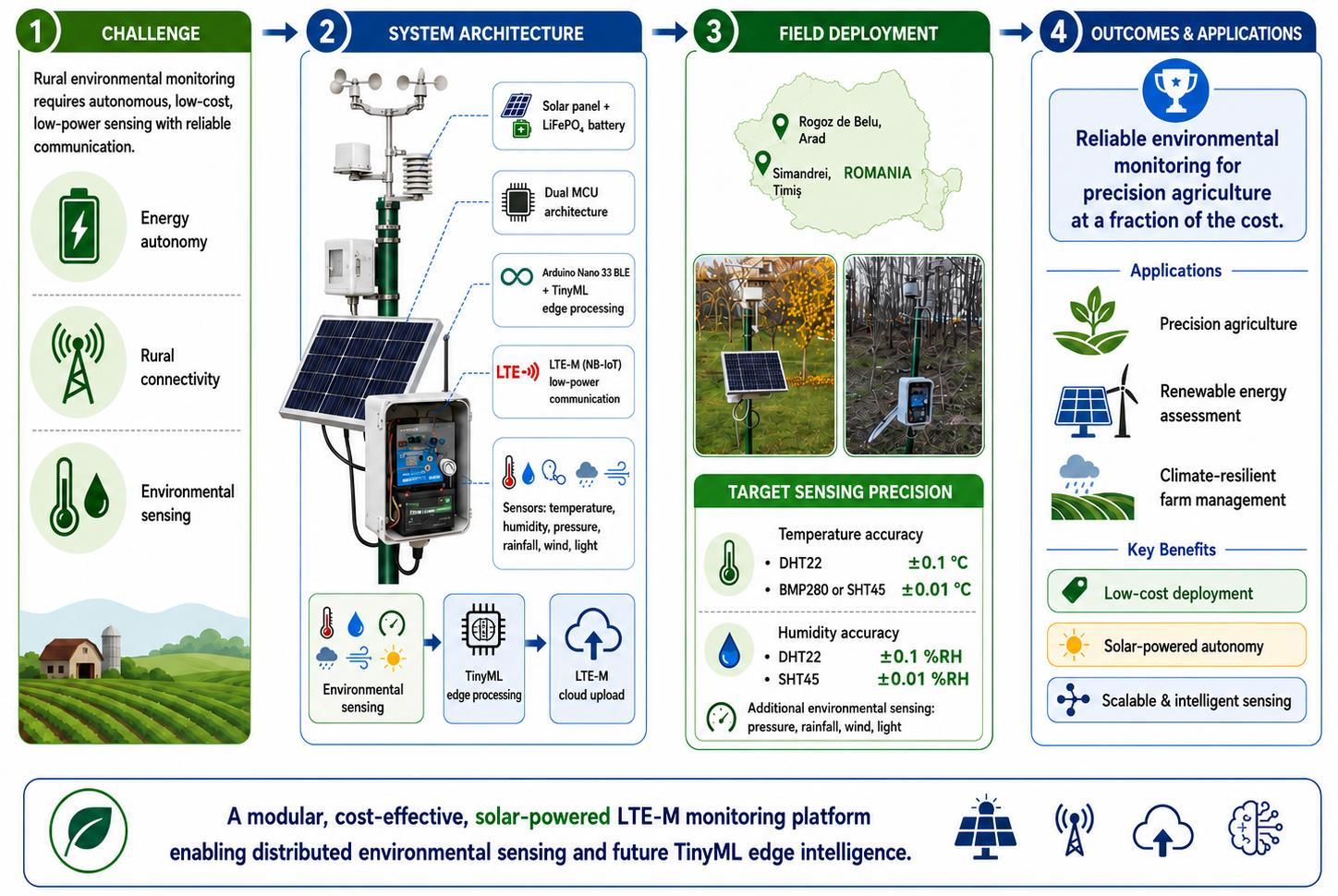
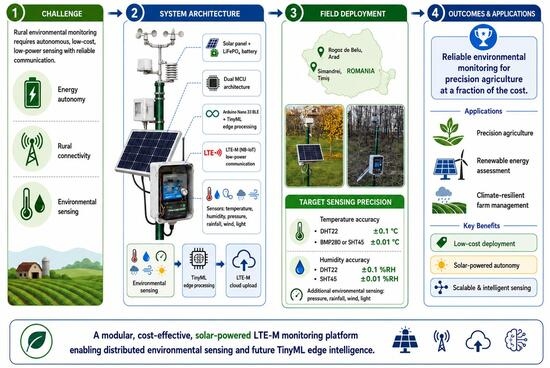
- Proposal and implementation of a dual-microcontroller, solar-powered environmental monitoring architecture integrating LTE-M/NB-IoT communication and TinyML-enabled edge intelligence.
- Development of a low-energy sensing platform enabling long-term autonomous deployment in rural agricultural environments.
- Integration of heterogeneous environmental sensors within a unified real-time sensing and edge-processing framework.
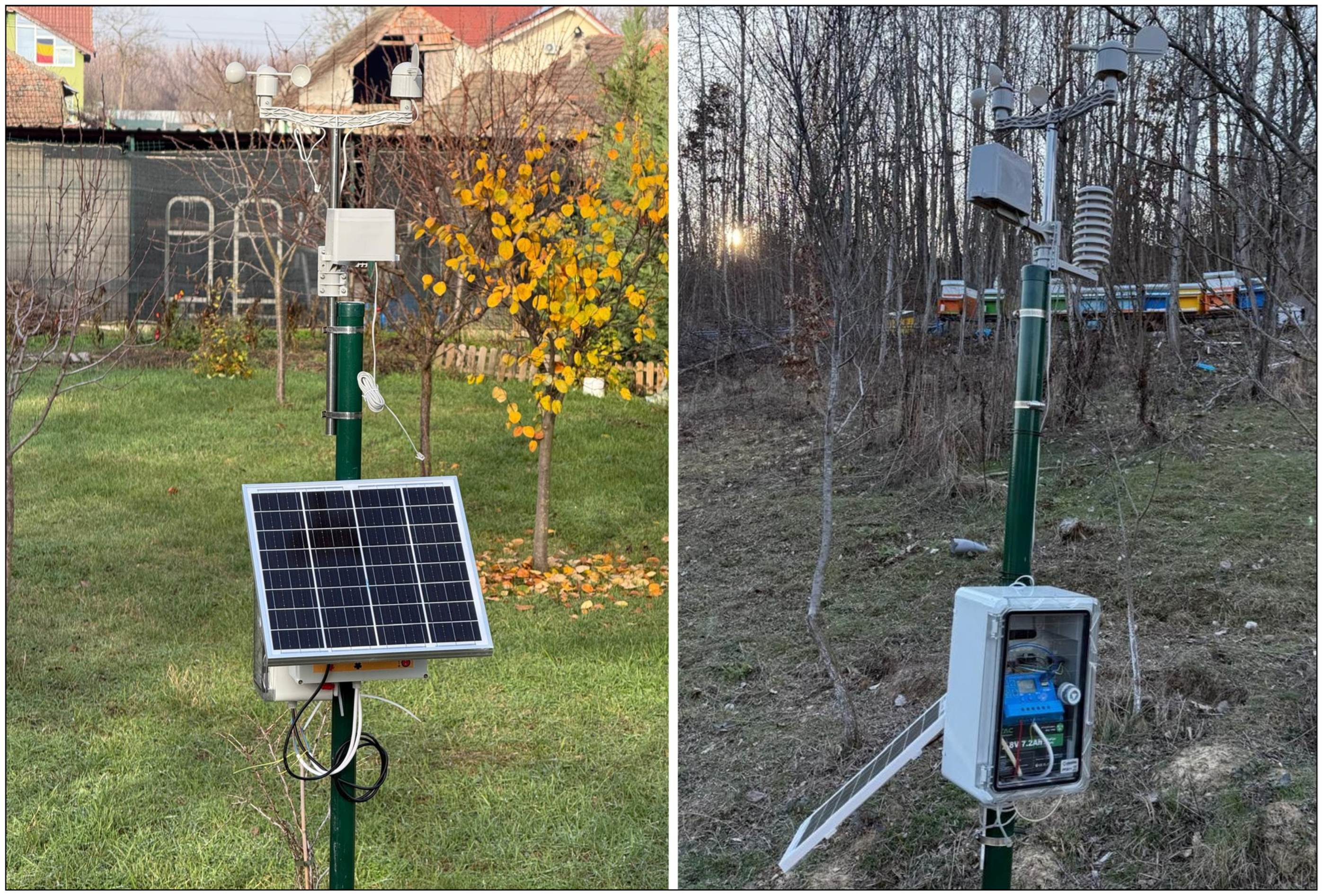
- Experimental field validation in geographically distinct deployment regions with different cellular coverage characteristics.
- Performance evaluation in terms of communication reliability, sensing stability, and energy autonomy.
2. Related Work
2.1. IoT-Based Weather Stations and Environmental Data Collectors
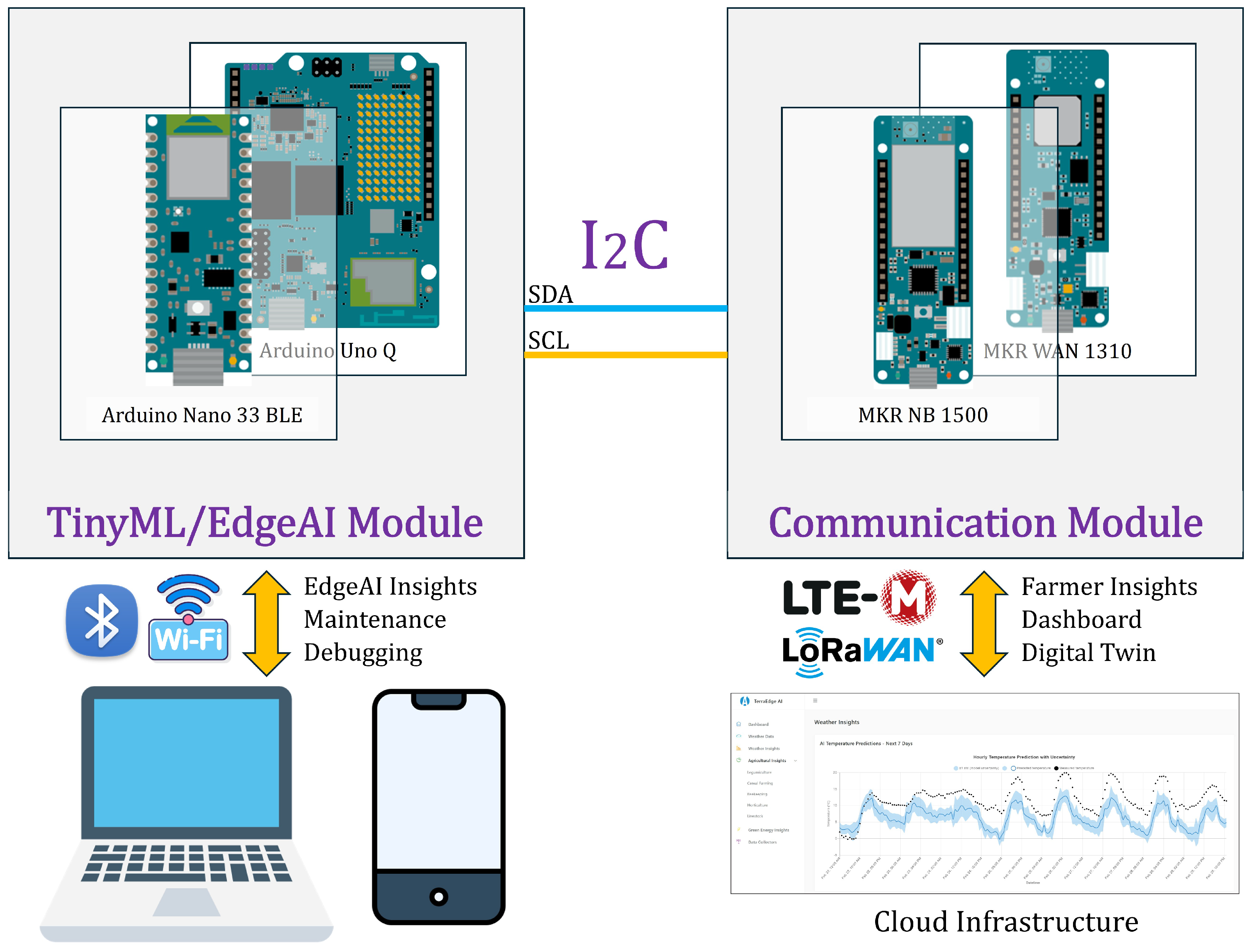
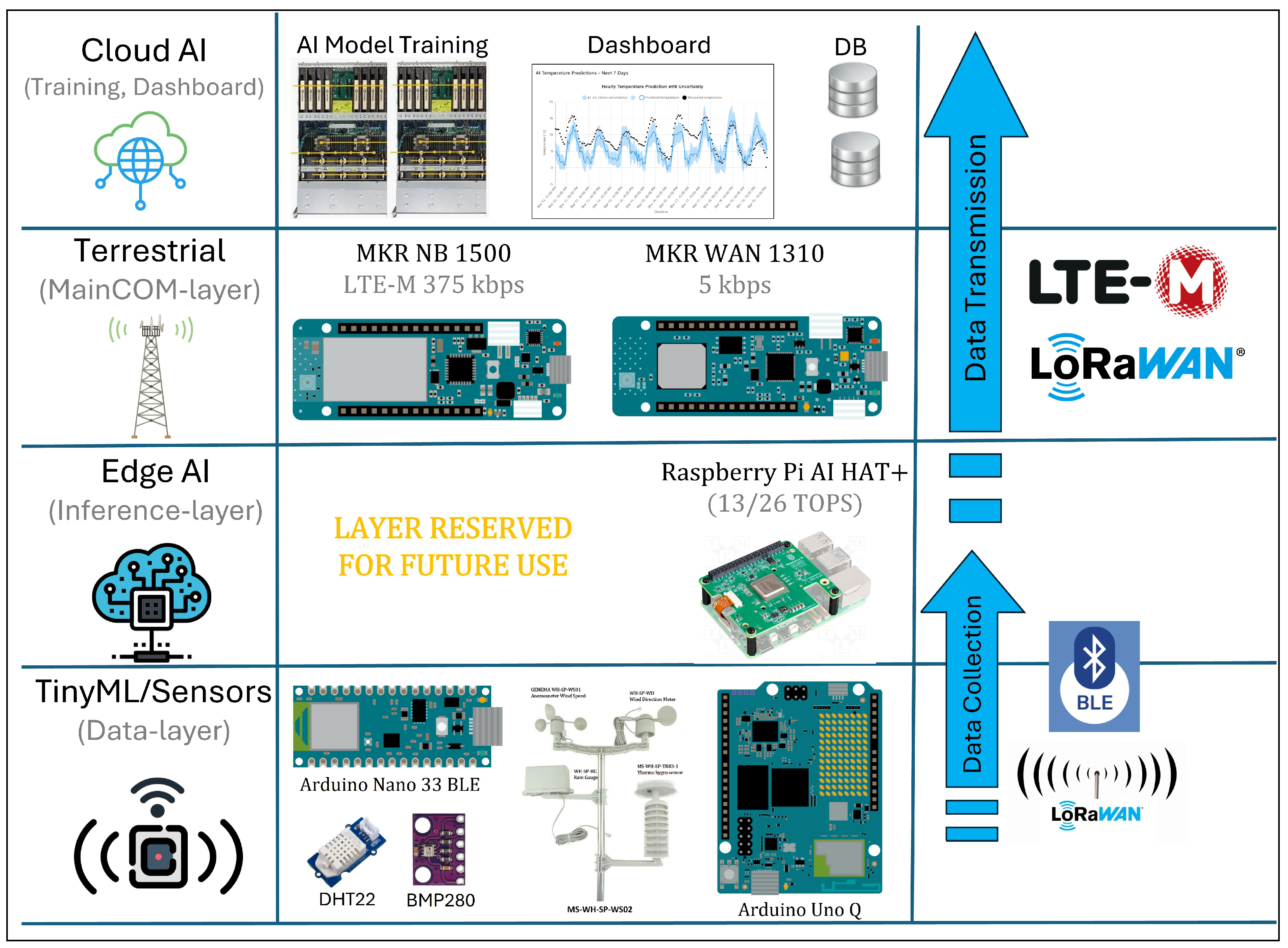
- A dual-microcontroller architecture separating real-time sensing and edge intelligence from communication tasks;
- LTE-M/NB-IoT connectivity validated under real rural deployment conditions;
- Solar-powered autonomous operation;
- TinyML-ready hardware resources for future adaptive communication and sensing strategies.
2.2. NB-IoT Communication for Environmental Monitoring Systems
3. Materials and Methods
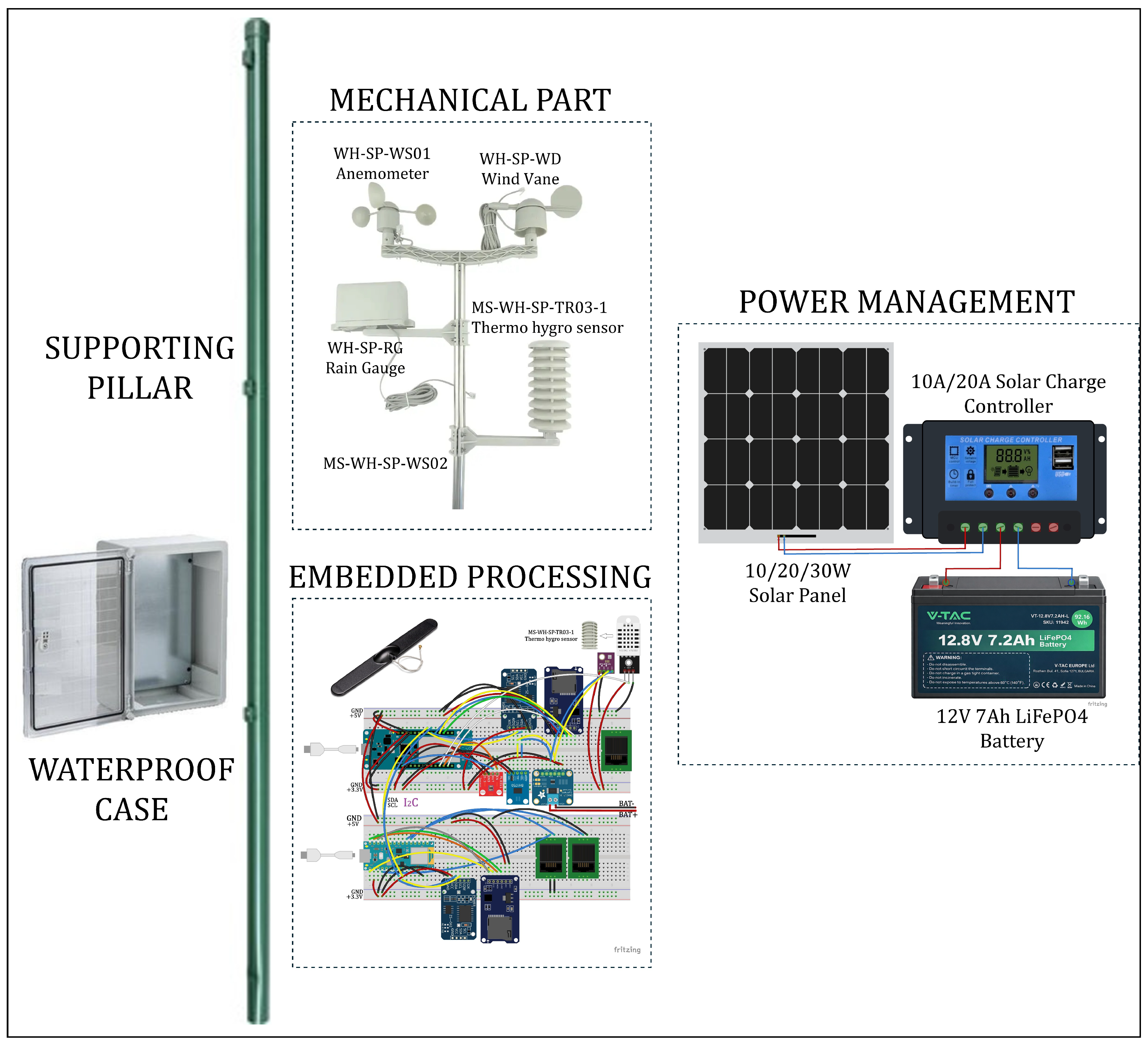
3.1. General Architecture of the Environmental Data Collector
3.1.1. Mechanical Sensing Layer
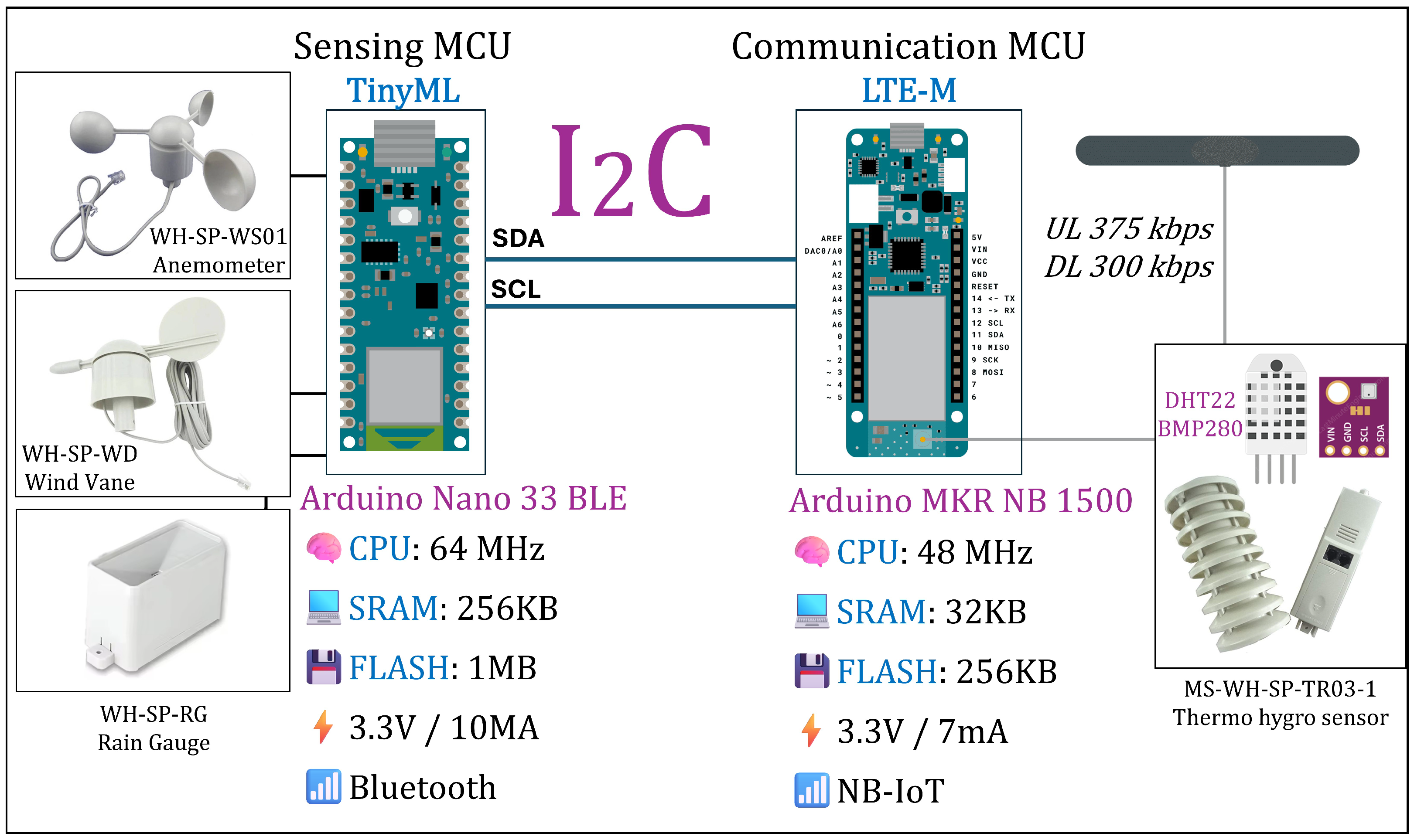
3.1.2. Embedded Processing and Communication Layer
3.1.3. Autonomous Power Management Layer
3.1.4. System Integration and Deployment Considerations
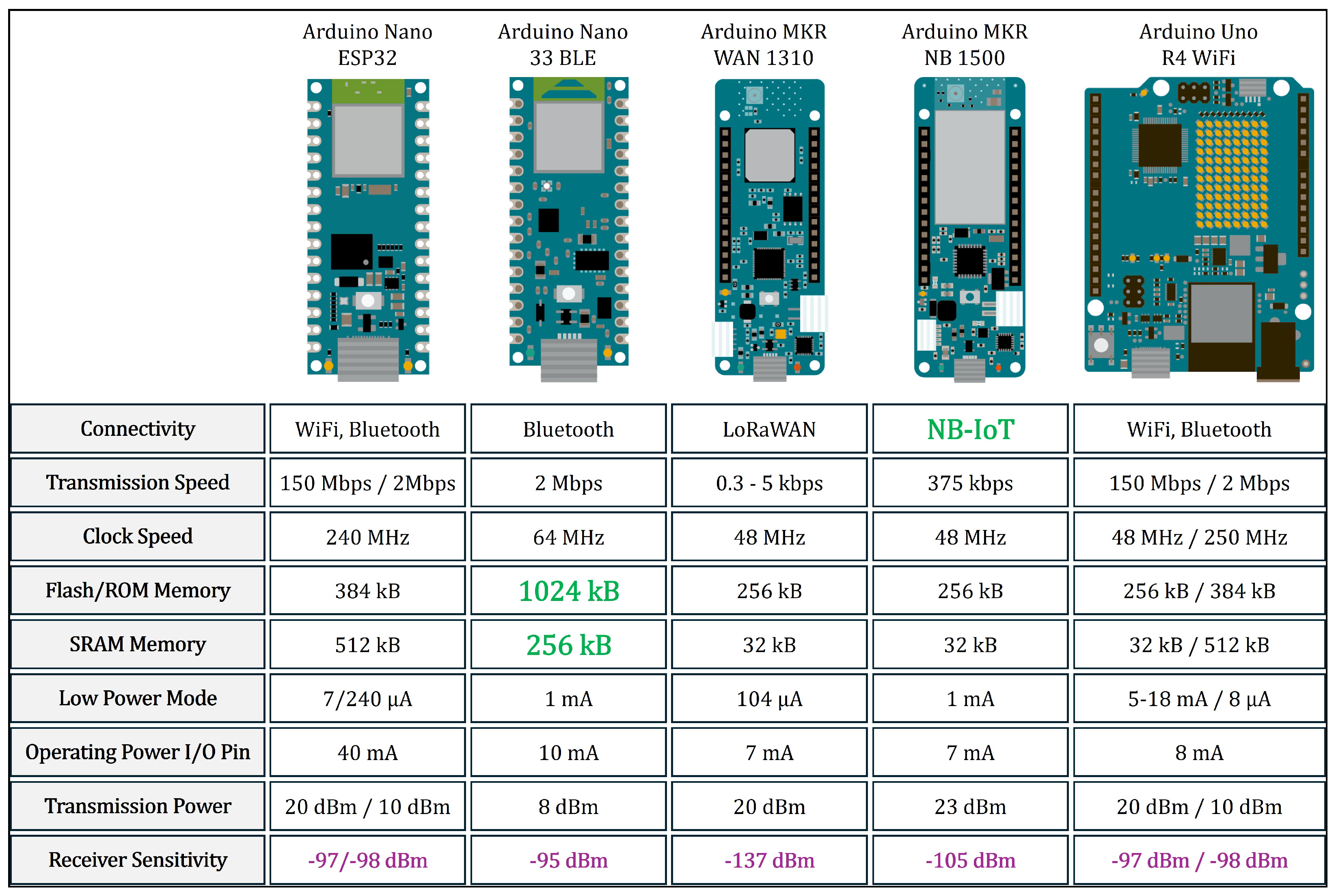
3.2. Dual-Microcontroller Architecture Selection
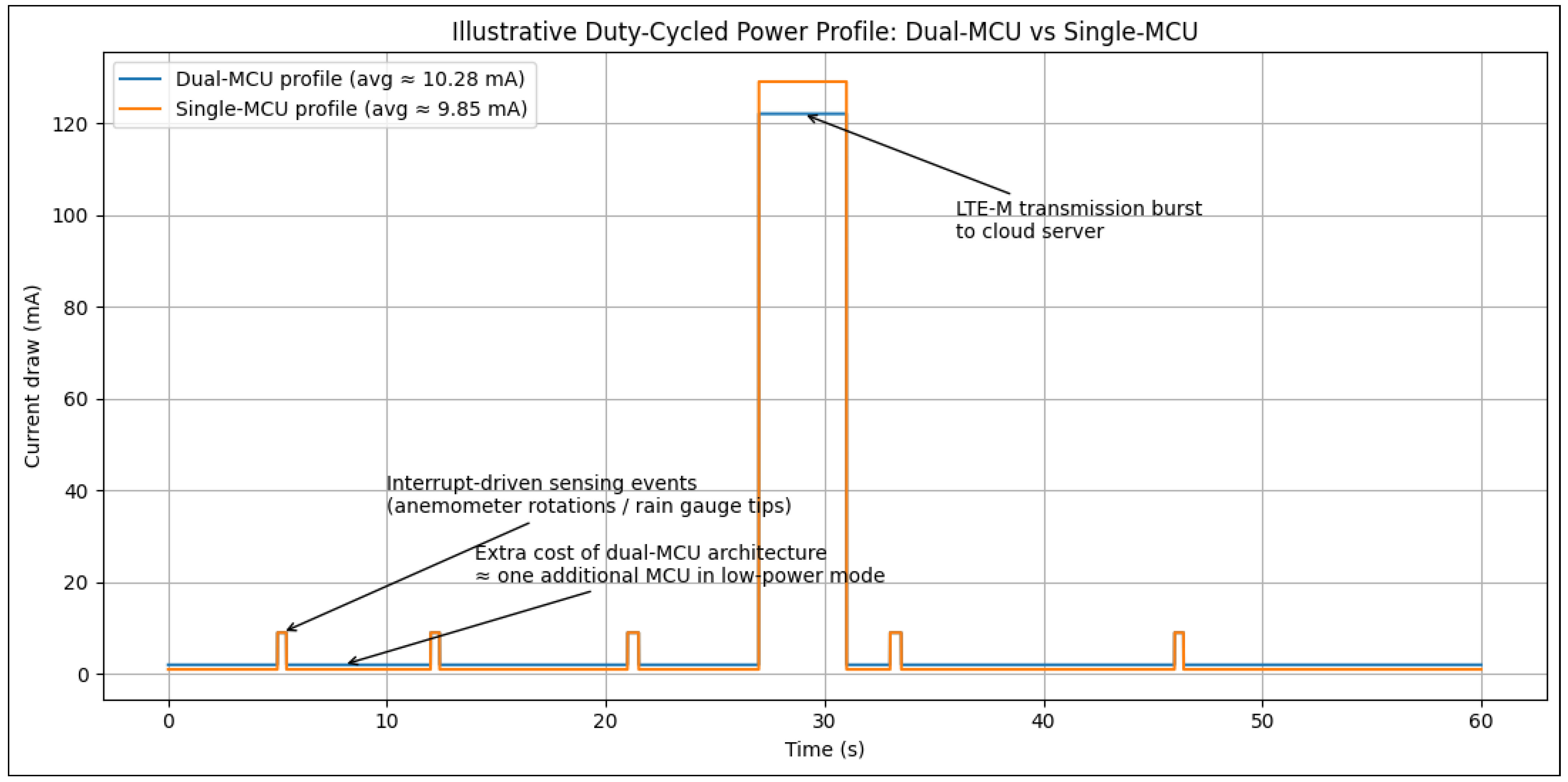
3.3. Power Consumption Considerations of the Dual-Microcontroller Architecture
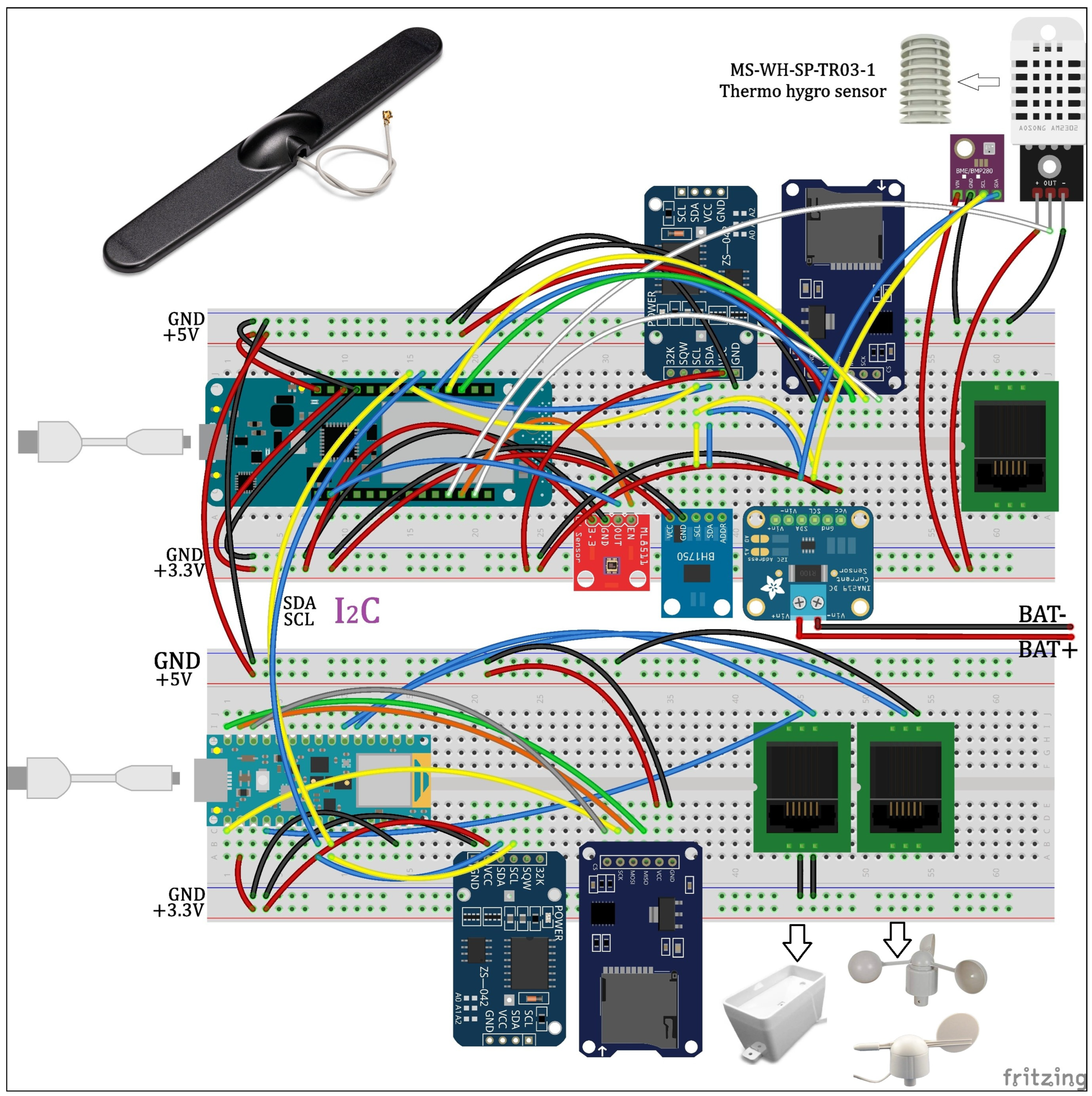
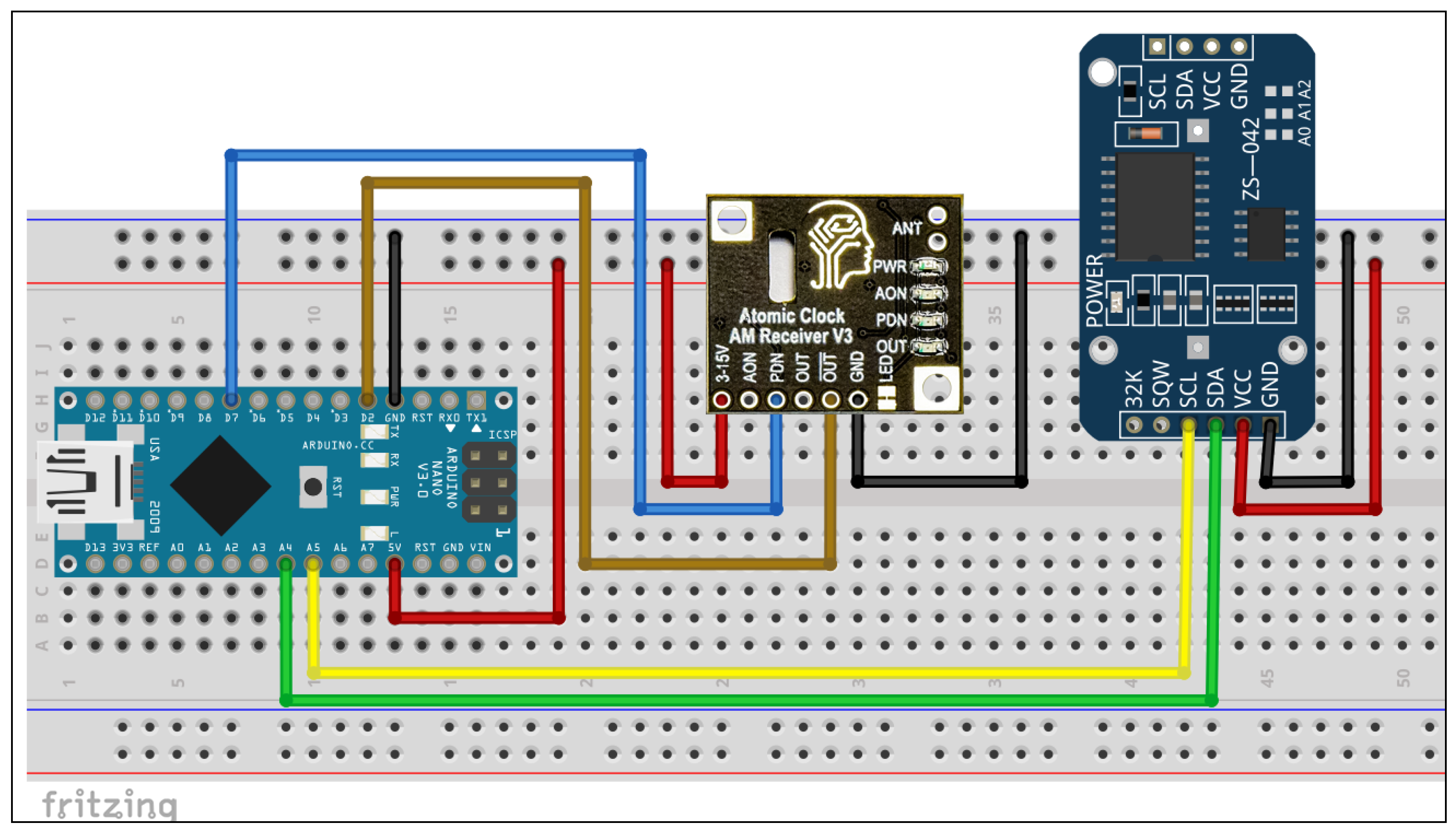
3.4. Sensor Modules Integration and Prototype Wiring Architecture
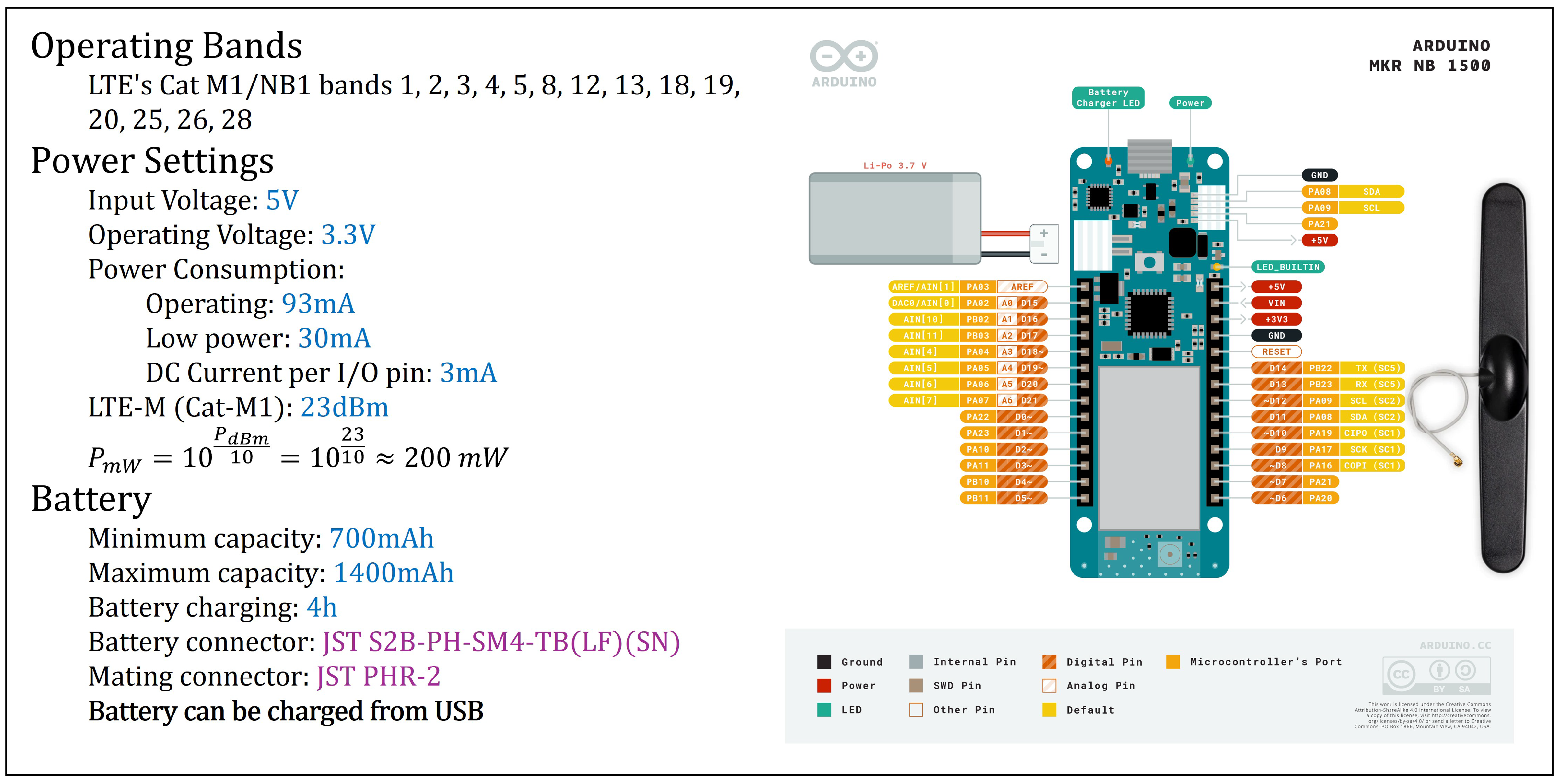
3.4.1. LTE-M/Cat-M1 Communication Using Arduino MKR NB 1500
- 93 mA during active communication;
- 30 mA in low-power idle mode.
- Mitigating voltage dips during high-current cellular transmission;
- Maintaining modem operation during transient supply fluctuations;
- Enabling short-duration communication even if the primary 12 V battery is temporarily unavailable.
- Wakes from low-power state;
- Establishes LTE-M connectivity;
- Uploads environmental data to the remote cloud platform;
- Returns to low-power mode.
- Operation in licensed cellular spectrum;
- Higher receiver sensitivity and improved link budget;
- Native infrastructure support without private gateways;
- Bidirectional communication and QoS control;
- Seamless integration with existing cellular networks.
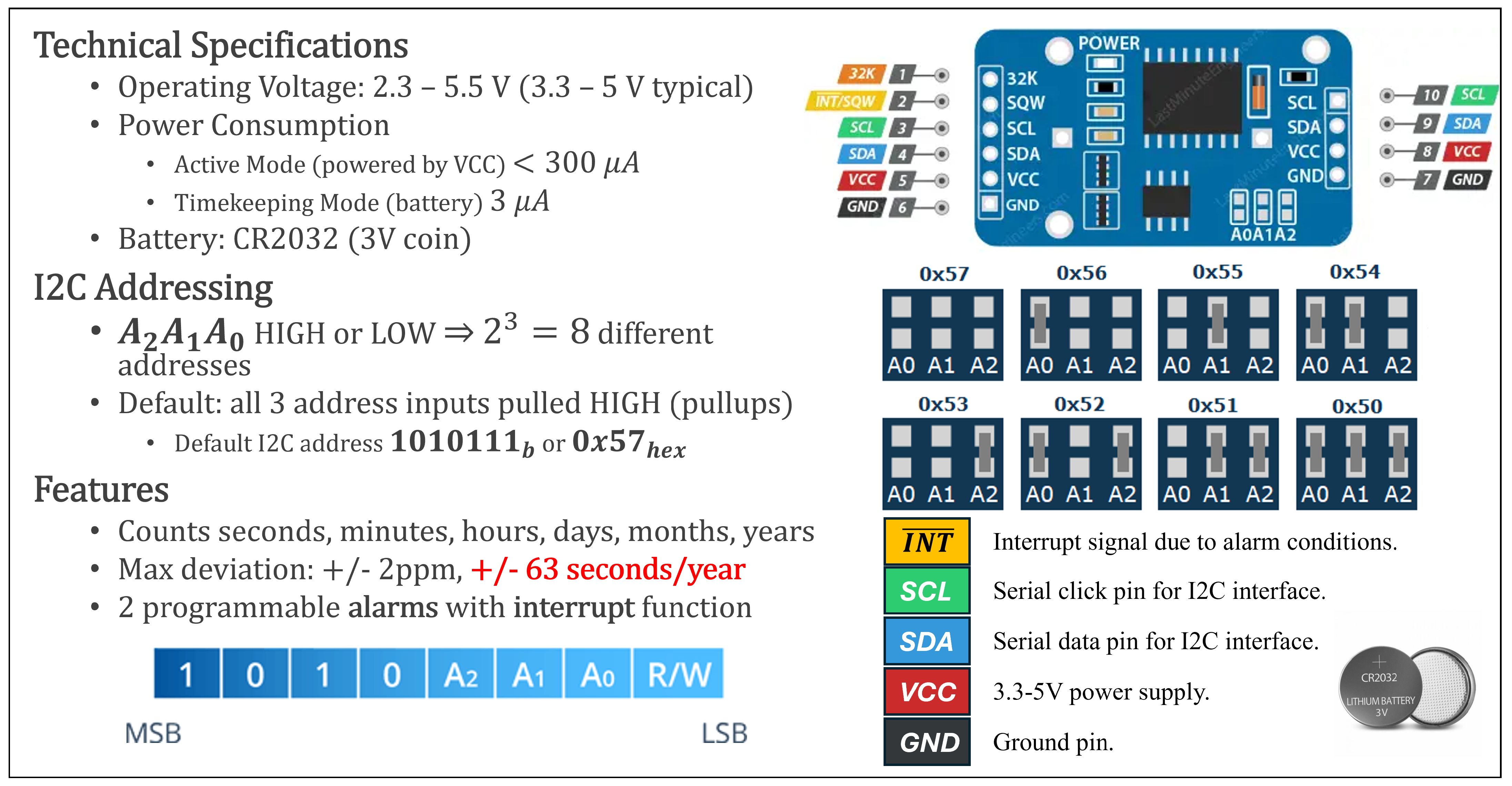
3.4.2. Real-Time Clock Integration and Time-Synchronized Data Acquisition
3.4.3. Atomic Time Synchronization Using DCF77 Radio Clock
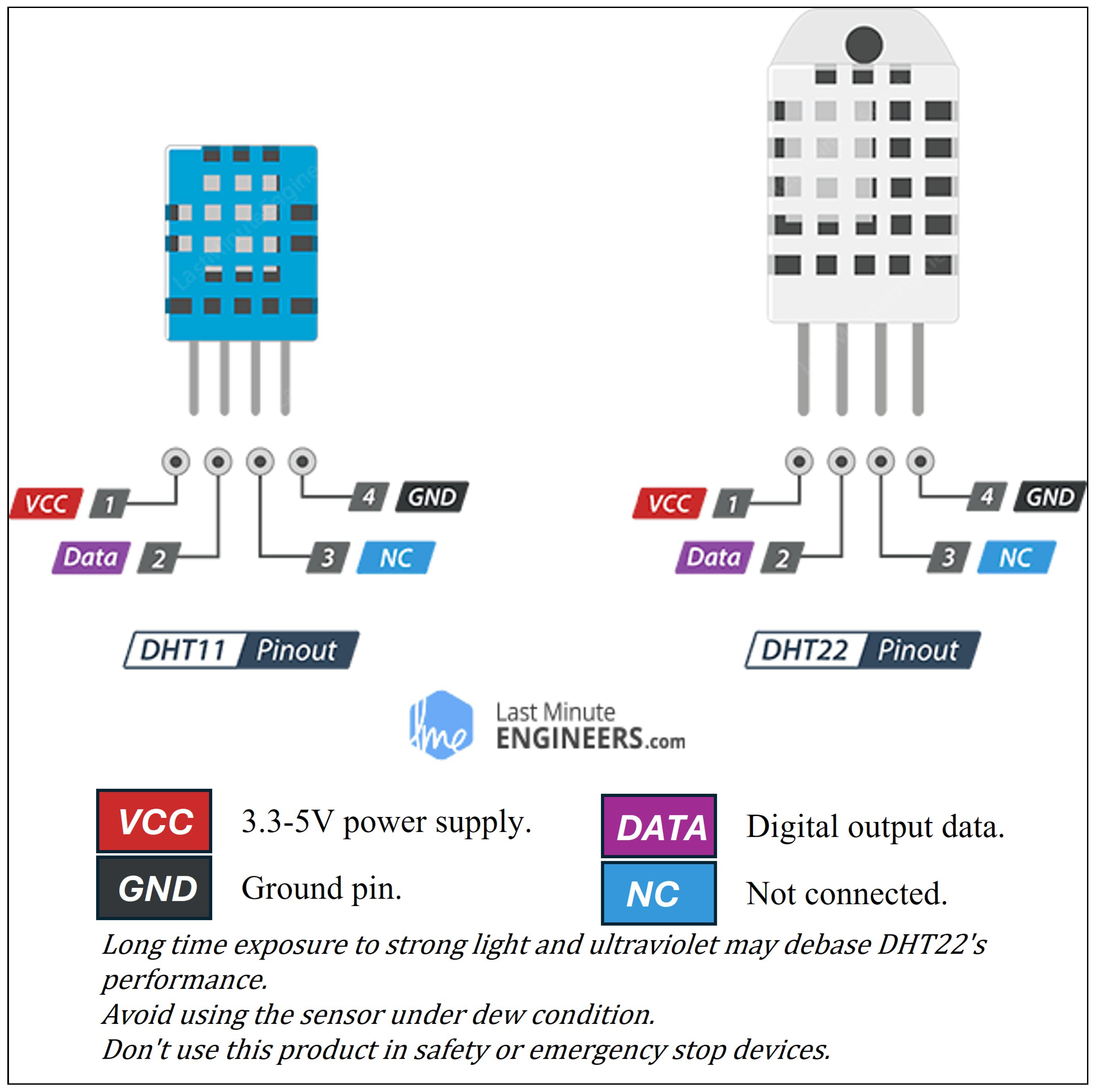
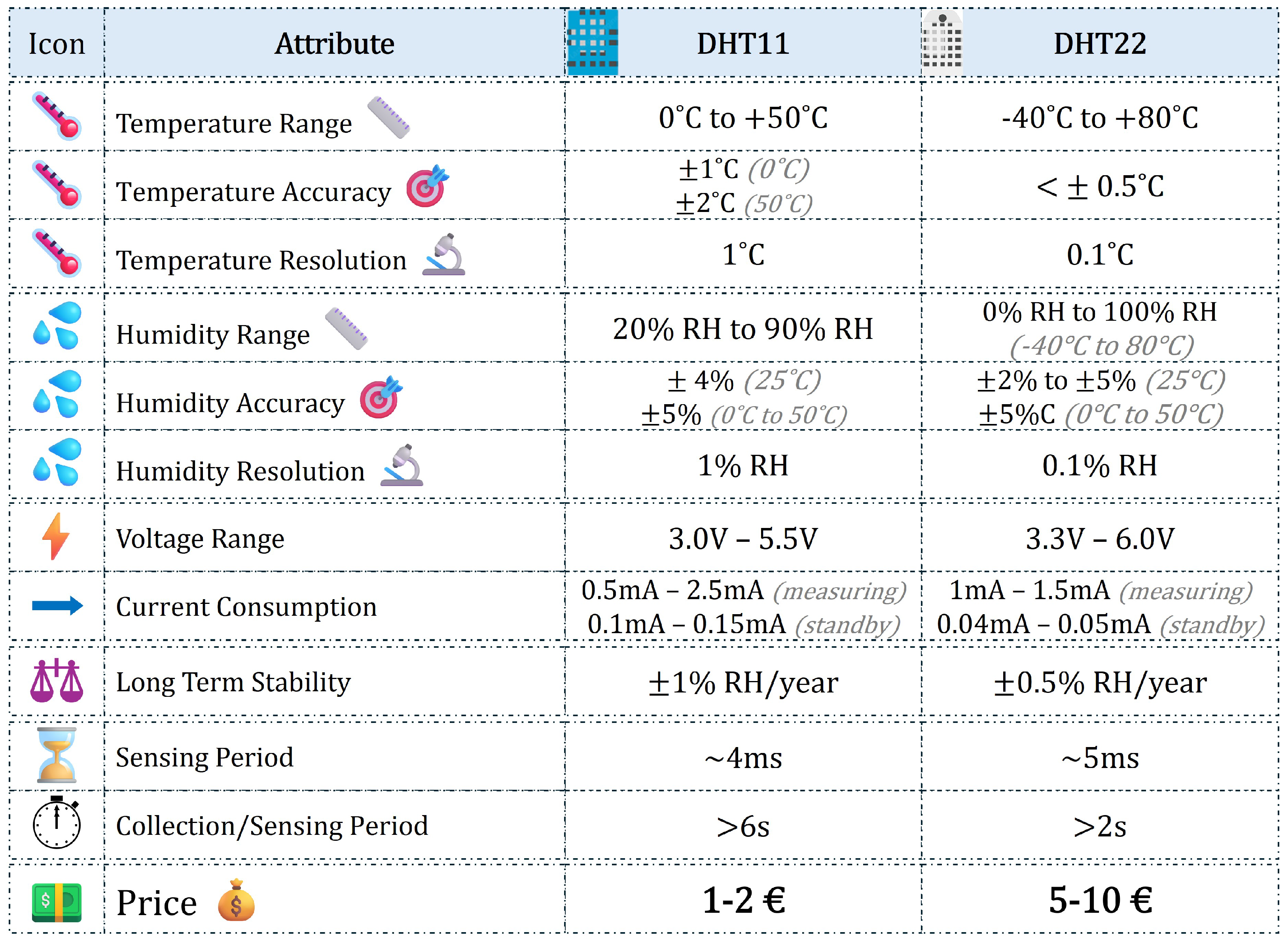
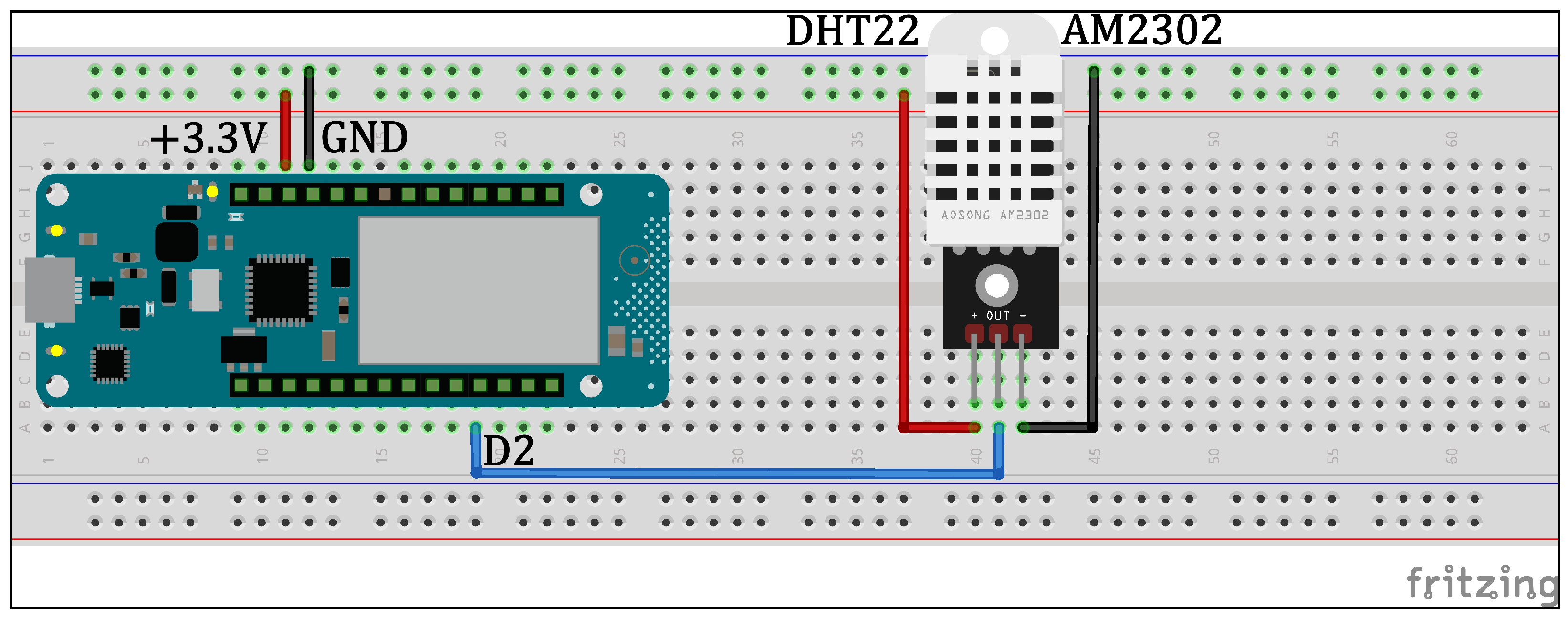
3.4.4. Temperature and Humidity Sensing: DHT22 Selection Rationale
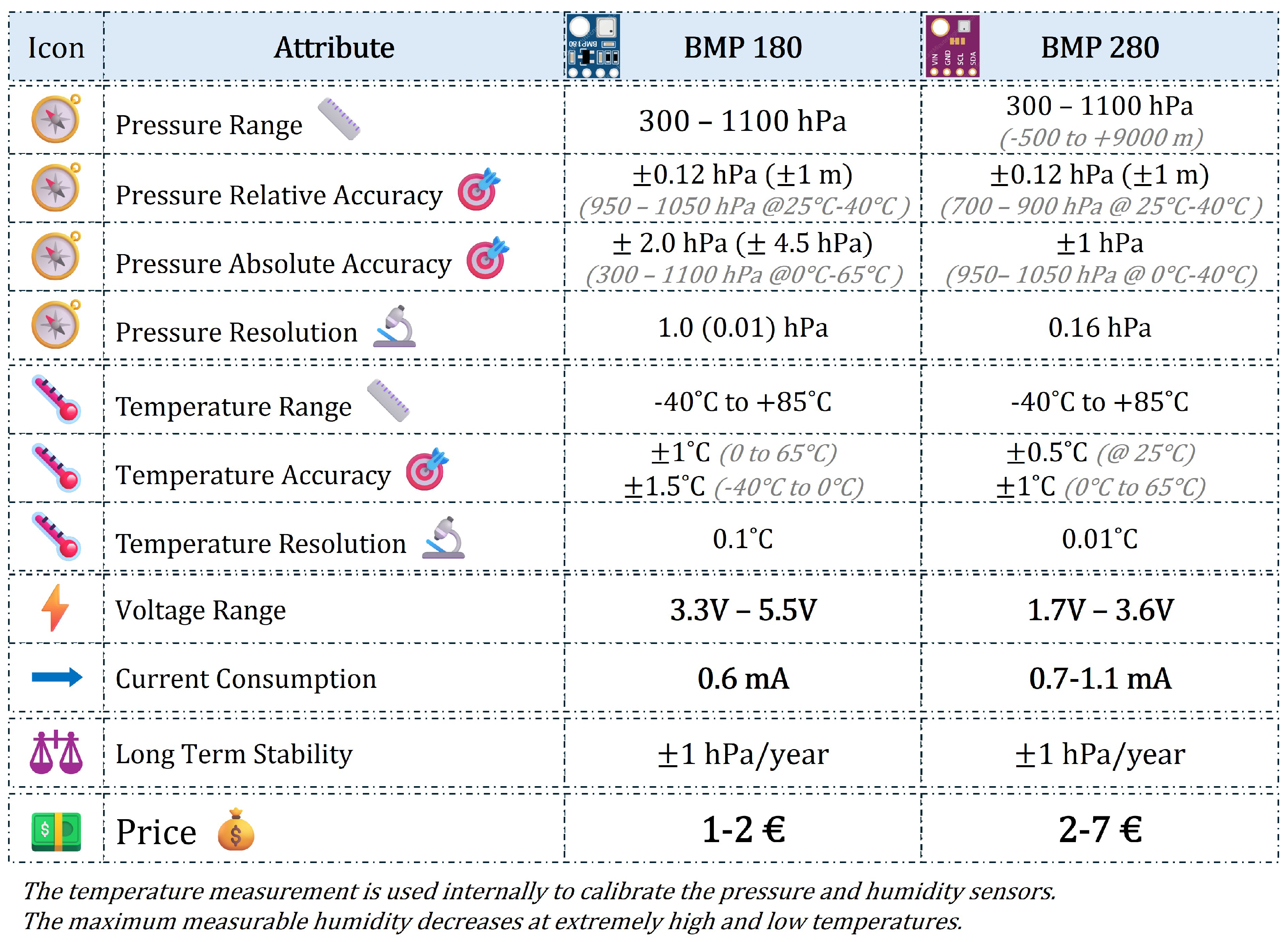
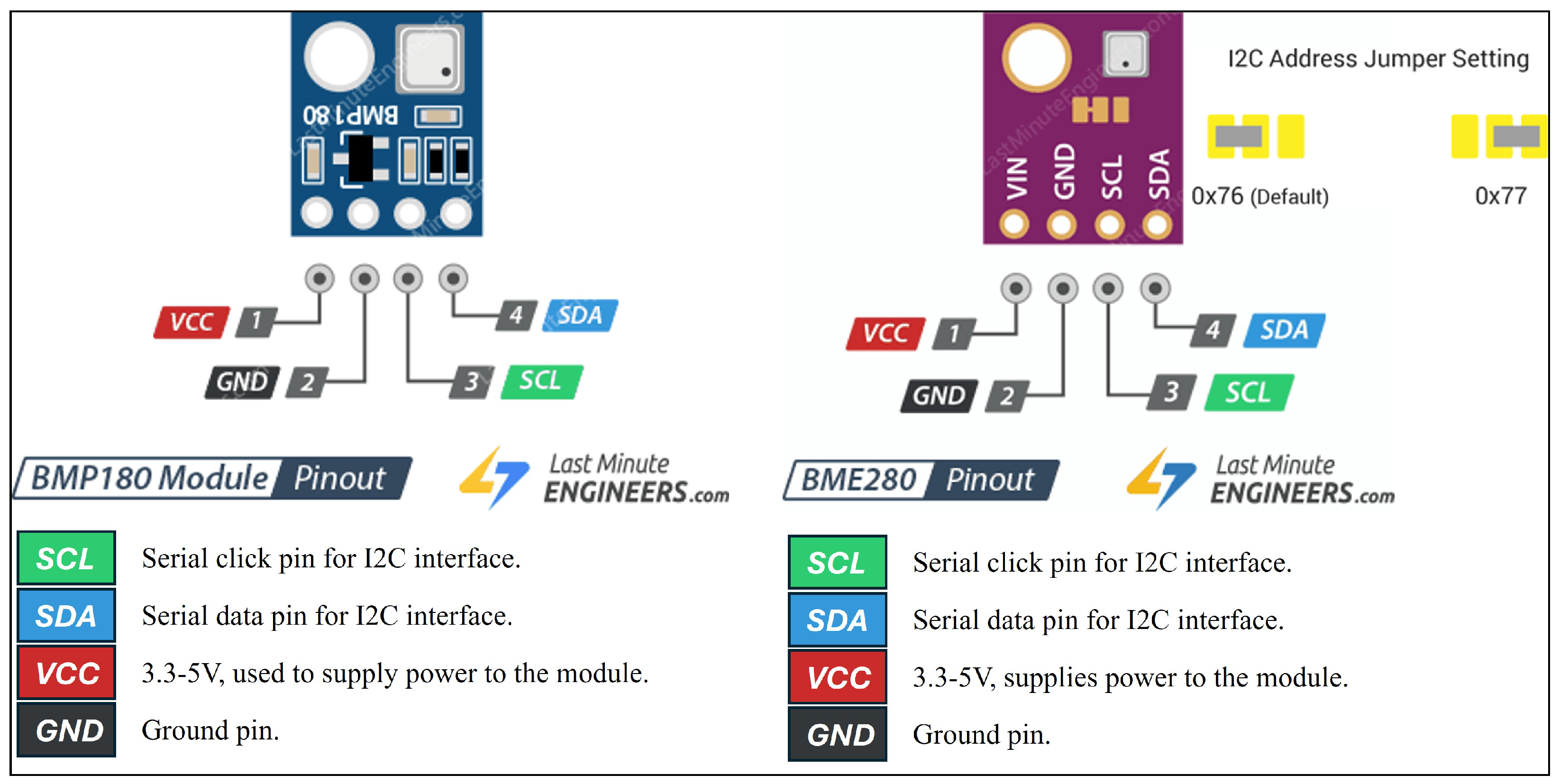
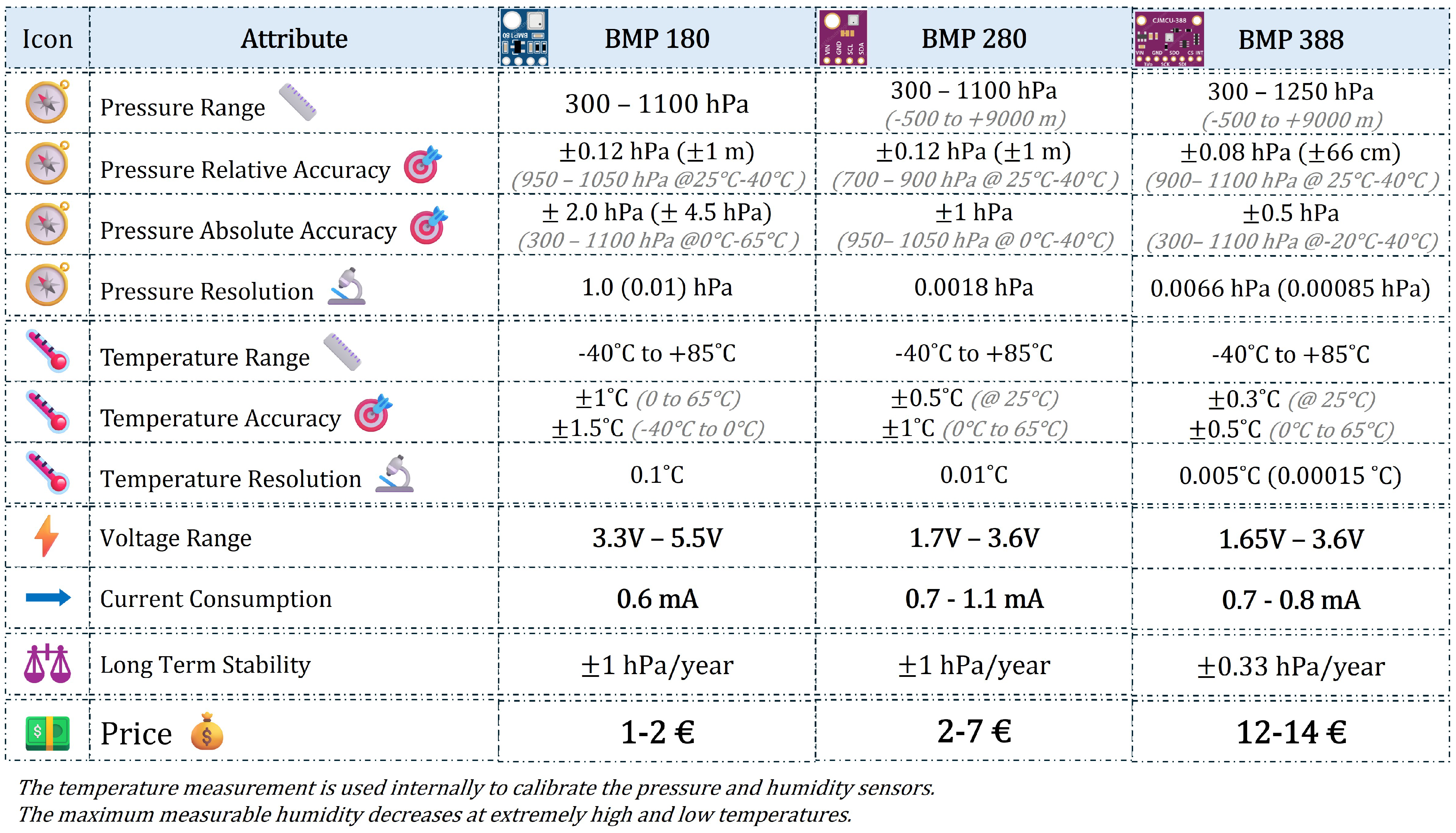
3.4.5. Atmospheric Pressure Sensing: Selection of the BMP280 Module
3.5. Wind Direction and Wind Speed Sensing Methodology
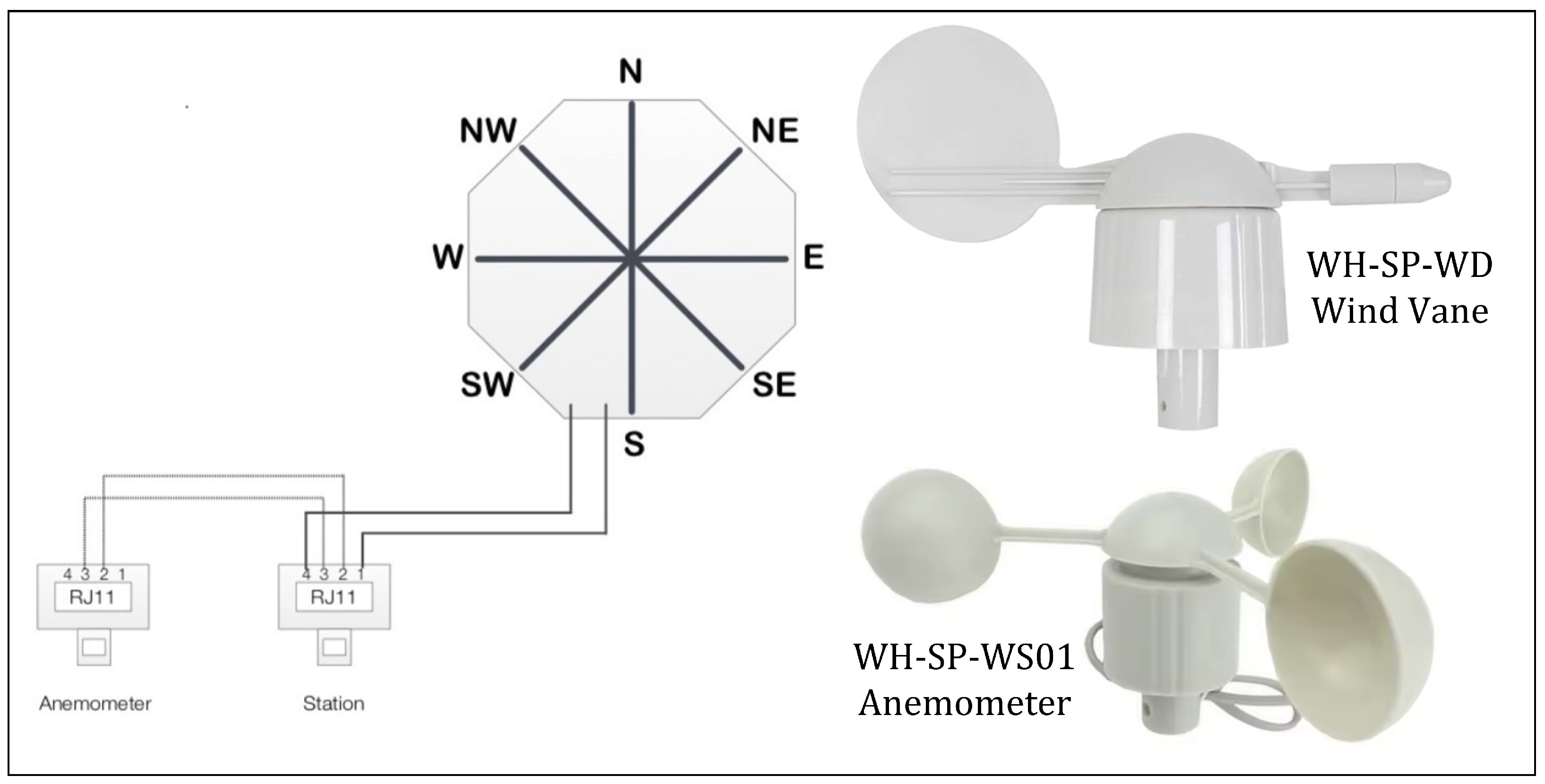
3.5.1. Wind Vane Operation Principle
3.5.2. Anemometer Pulse-Based Measurement
- The analog wind direction signal (resistive voltage divider output);
- The digital pulse signal generated by the anemometer.
3.5.3. Integrated Signal Acquisition Strategy
- Real-time wind direction estimation via ADC conversion and lookup mapping;
- Precise wind speed measurement through edge-triggered pulse counting;
- Minimal power consumption by avoiding continuous polling;
- Scalable integration within the broader TinyML-enabled edge processing framework.
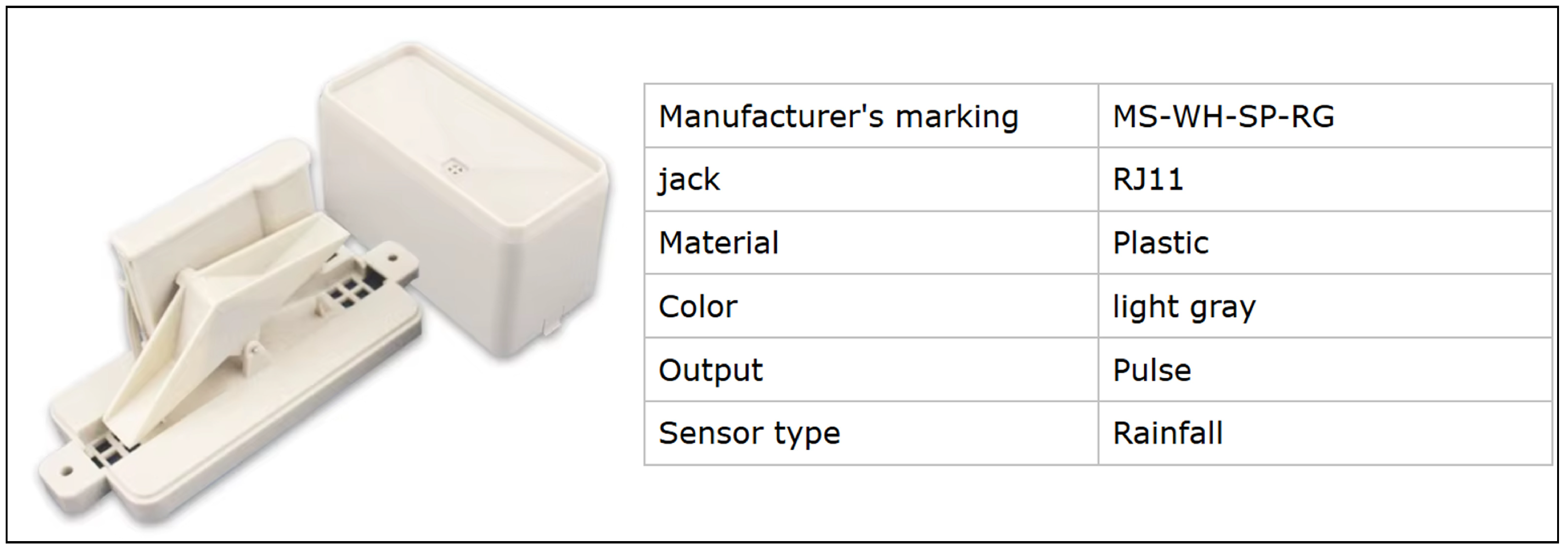
3.6. Rain Gauge Wiring and Measurement Configuration
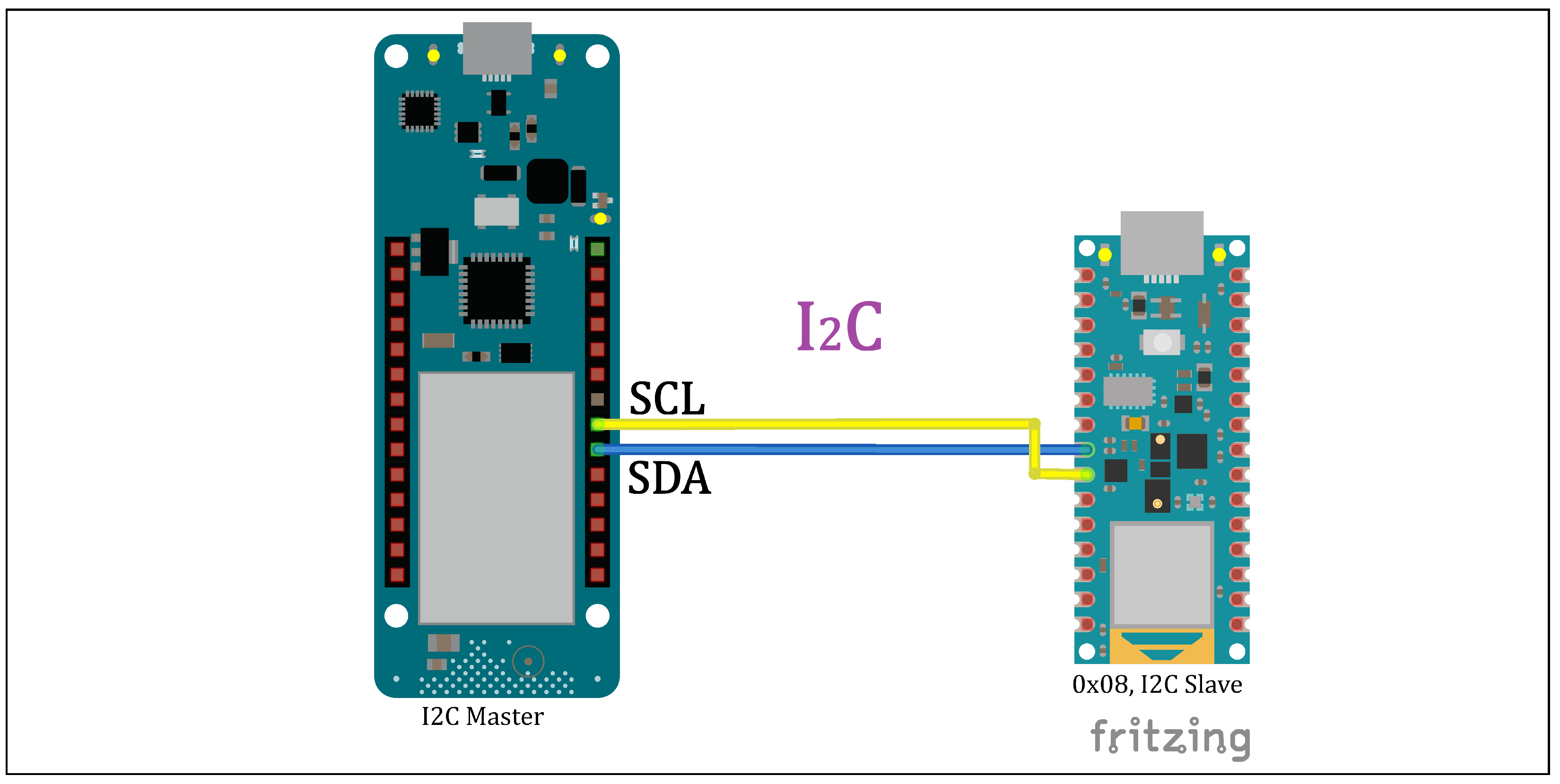
3.7. Inter-Microcontroller Communication via I2C
Rainfall Computation Model
3.8. Communication Security Considerations
3.9. Scalability Considerations for Large-Scale Deployments
3.10. Sensor Calibration and Pressure Reference
3.11. Power Management Module
3.11.1. High-Level Design
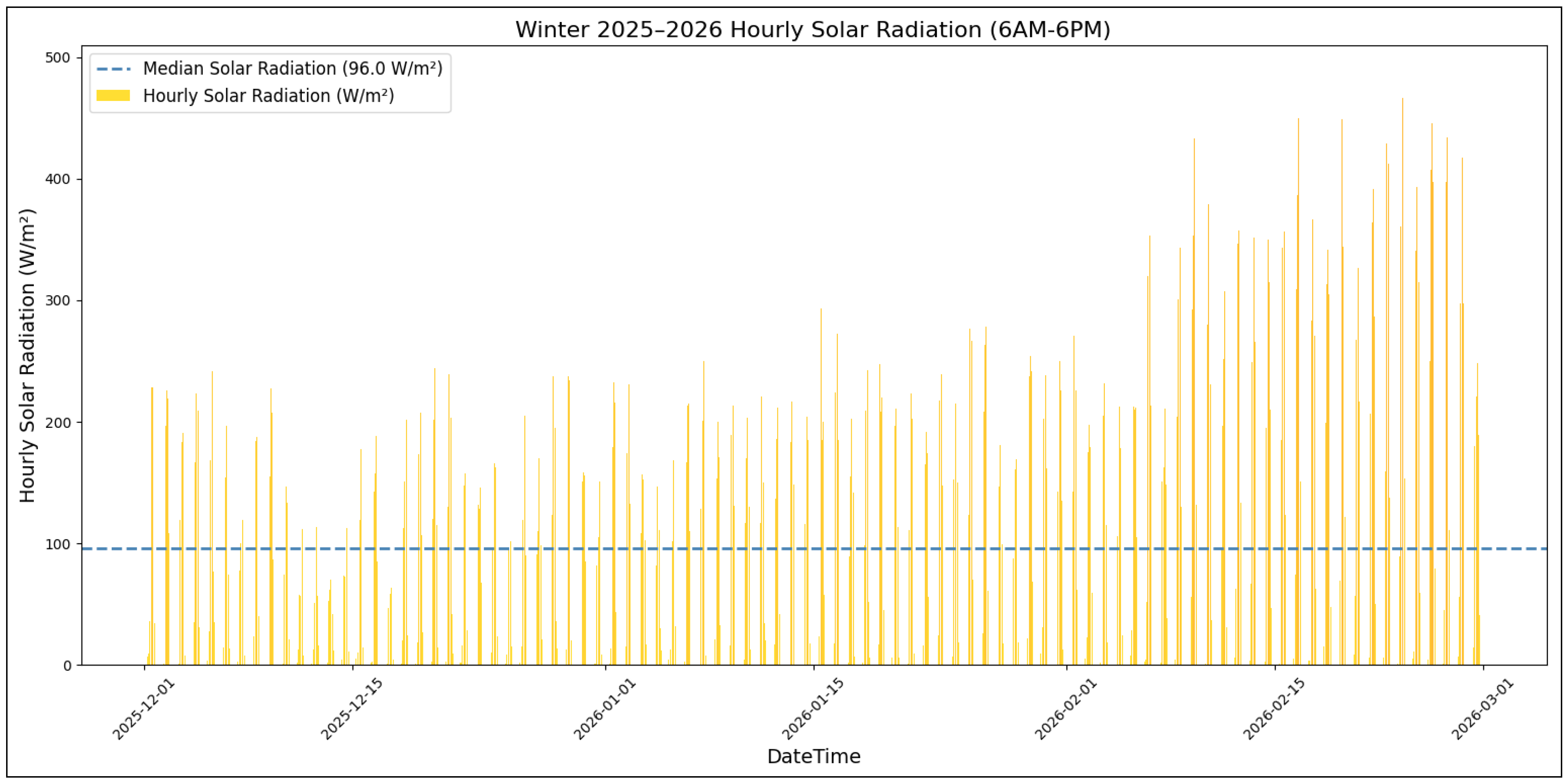
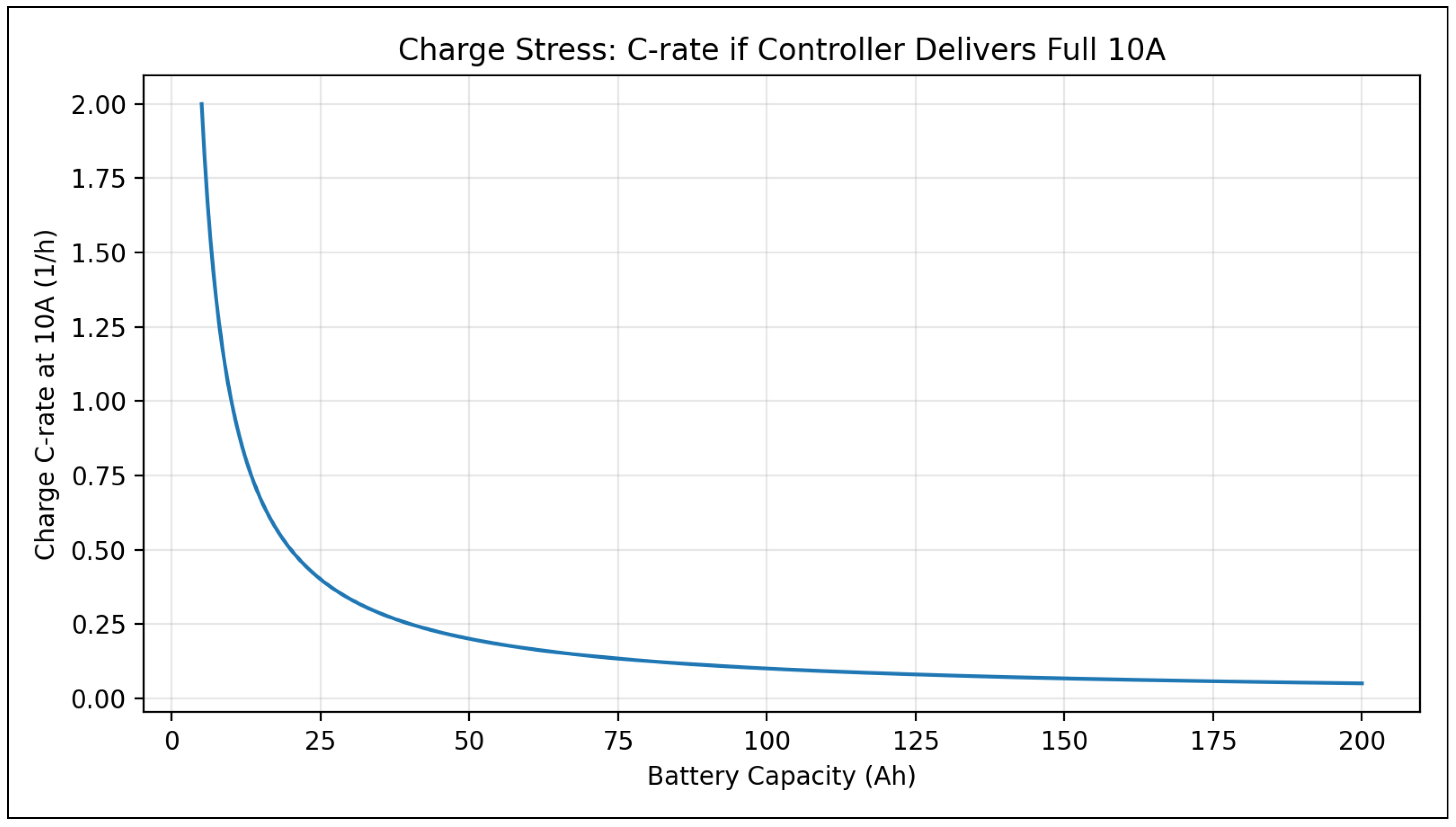
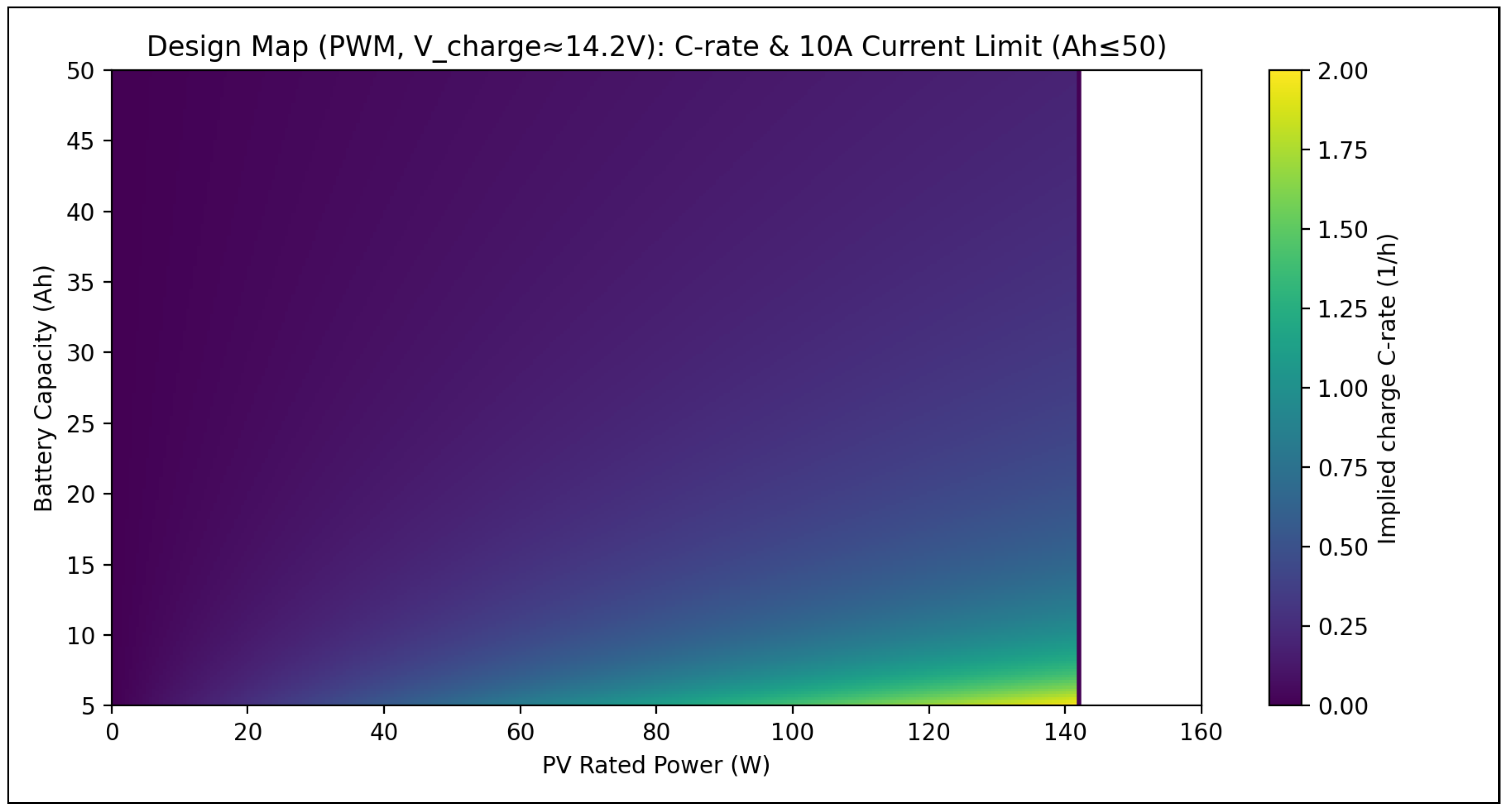
3.11.2. Winter Energy Risk Analysis and Battery Dimensioning
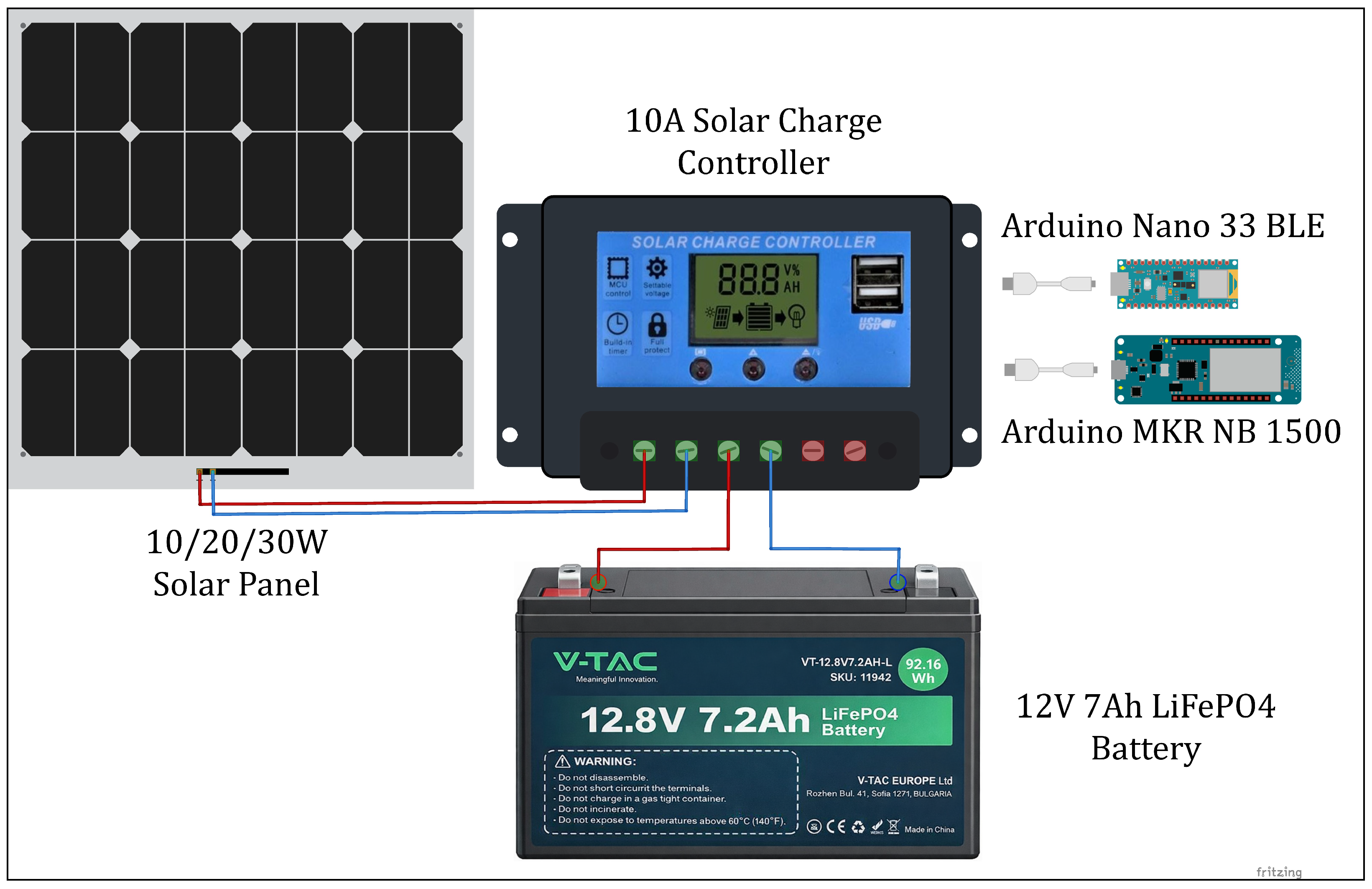
3.11.3. Charge Regulation and Power Distribution
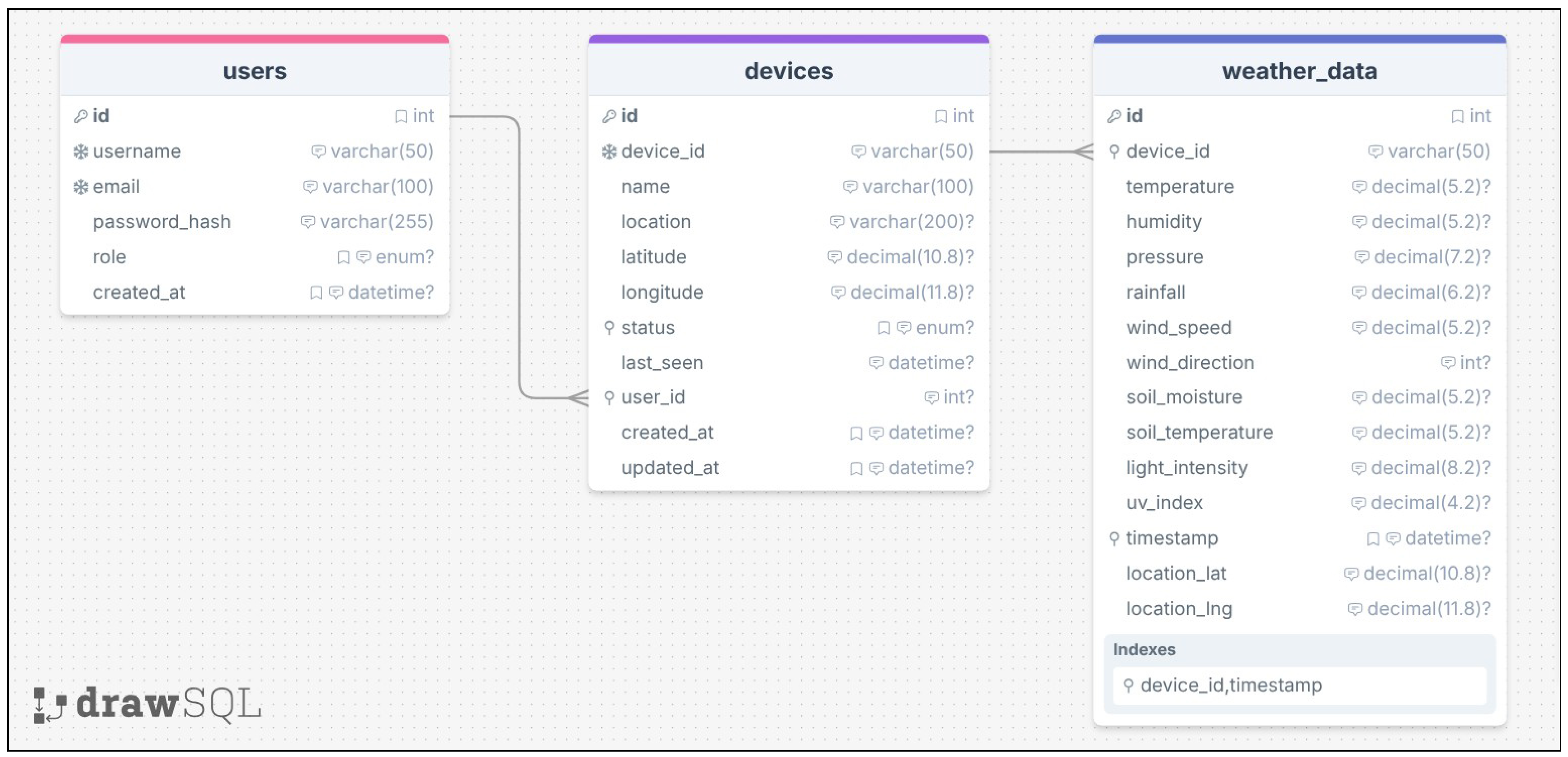
3.12. Cloud Database Architecture and Data Management
- Atmospheric variables: temperature, humidity, pressure;
- Precipitation and wind parameters: rainfall, wind speed, wind direction;
- Soil measurements: soil moisture, soil temperature;
- Solar-related parameters: light intensity, UV index;
- GPS coordinates at measurement time.
- INDEX (device_id, timestamp) for fast retrieval of time-series data per device;
- INDEX (timestamp) for chronological queries.
- Retrieving the latest data point per device;
- Aggregating daily or monthly statistics;
- Exporting winter datasets for machine learning pipelines.
- Strong referential integrity requirements between users, devices, and measurements;
- Structured meteorological schema with consistent measurement types;
- Efficient indexing for time-series queries;
- Compatibility with phpMyAdmin and shared-hosting cloud environments.
4. Results
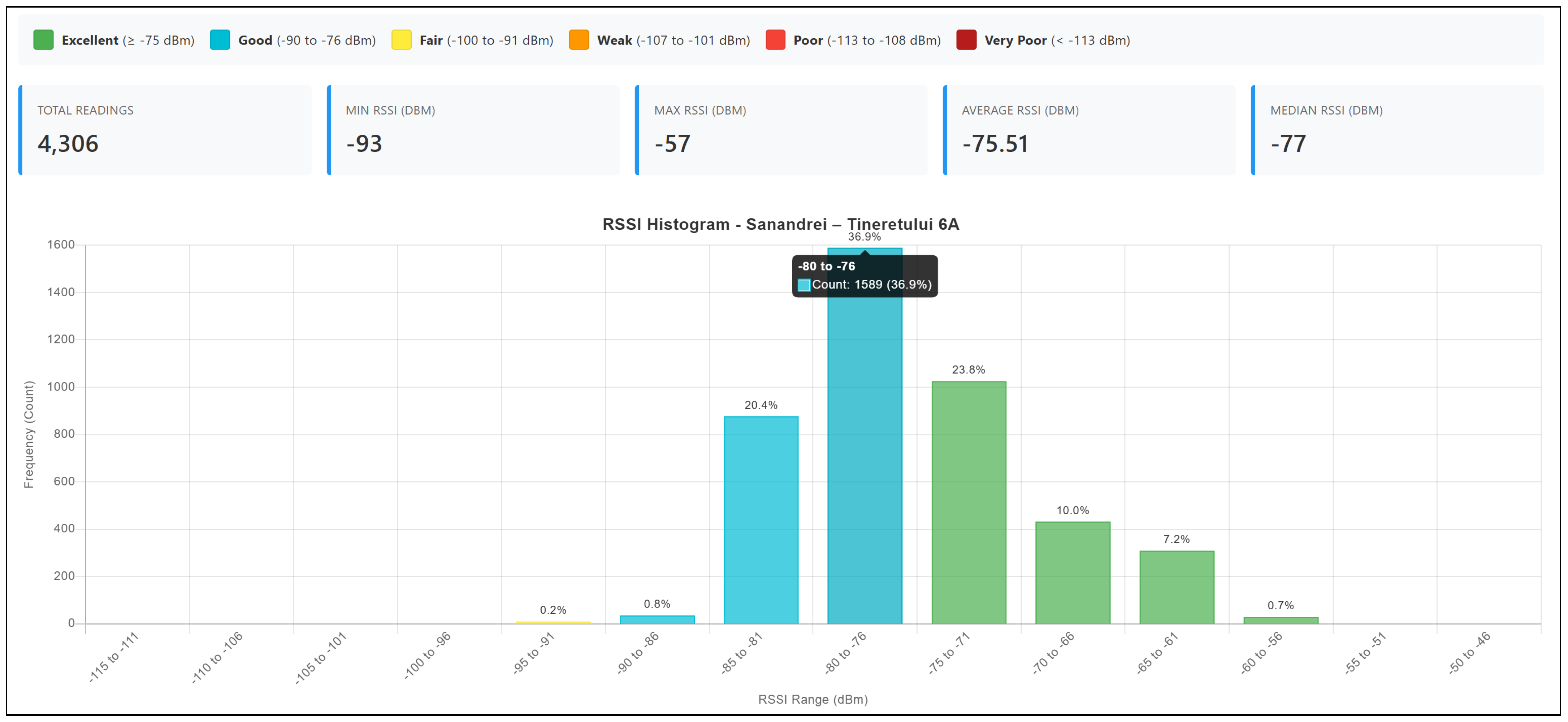
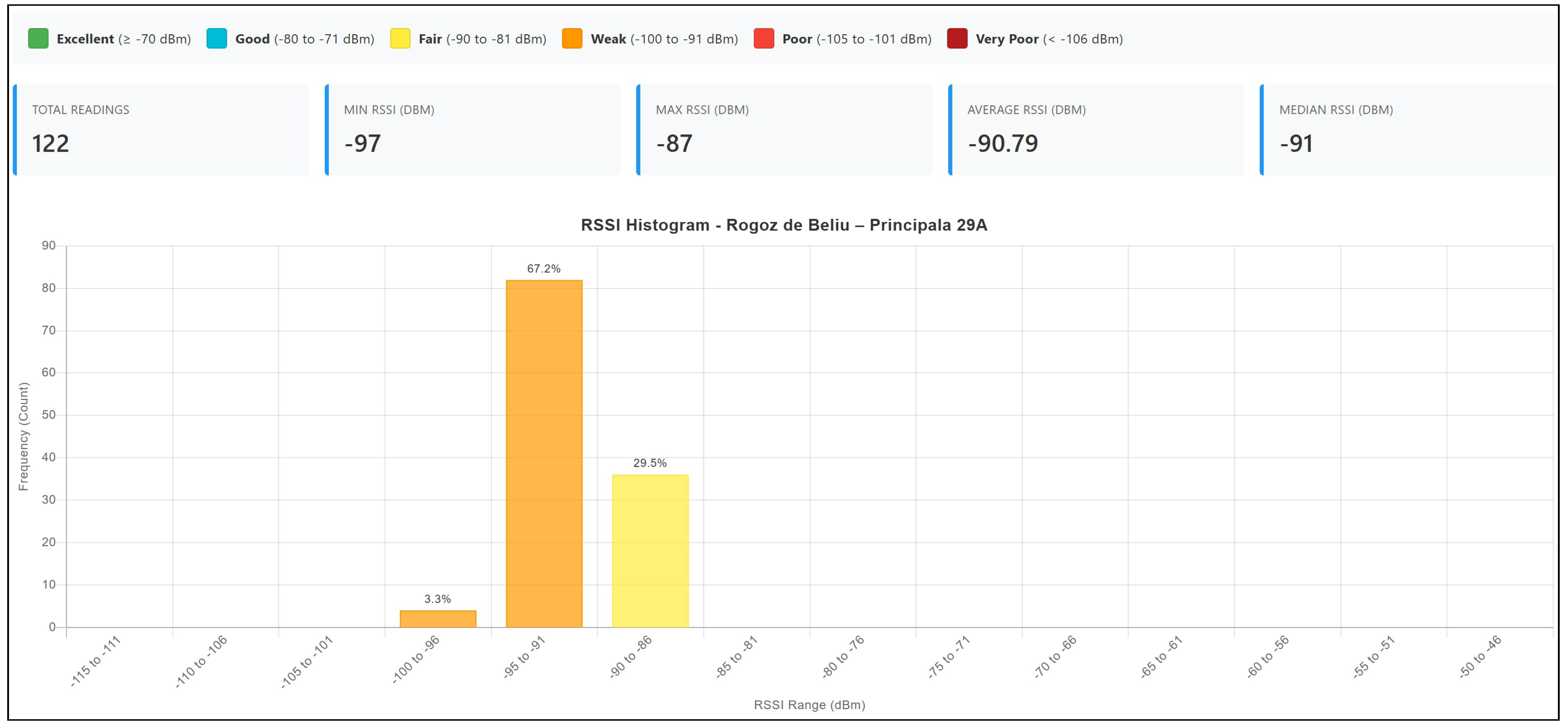
4.1. Lte-M/NB-IoT Signal Strength Evaluation in Field Deployment
4.2. LTE-M Signal Quality in Remote Deployment
4.3. Microclimate Analysis: Comparison with Regional Weather Station Data
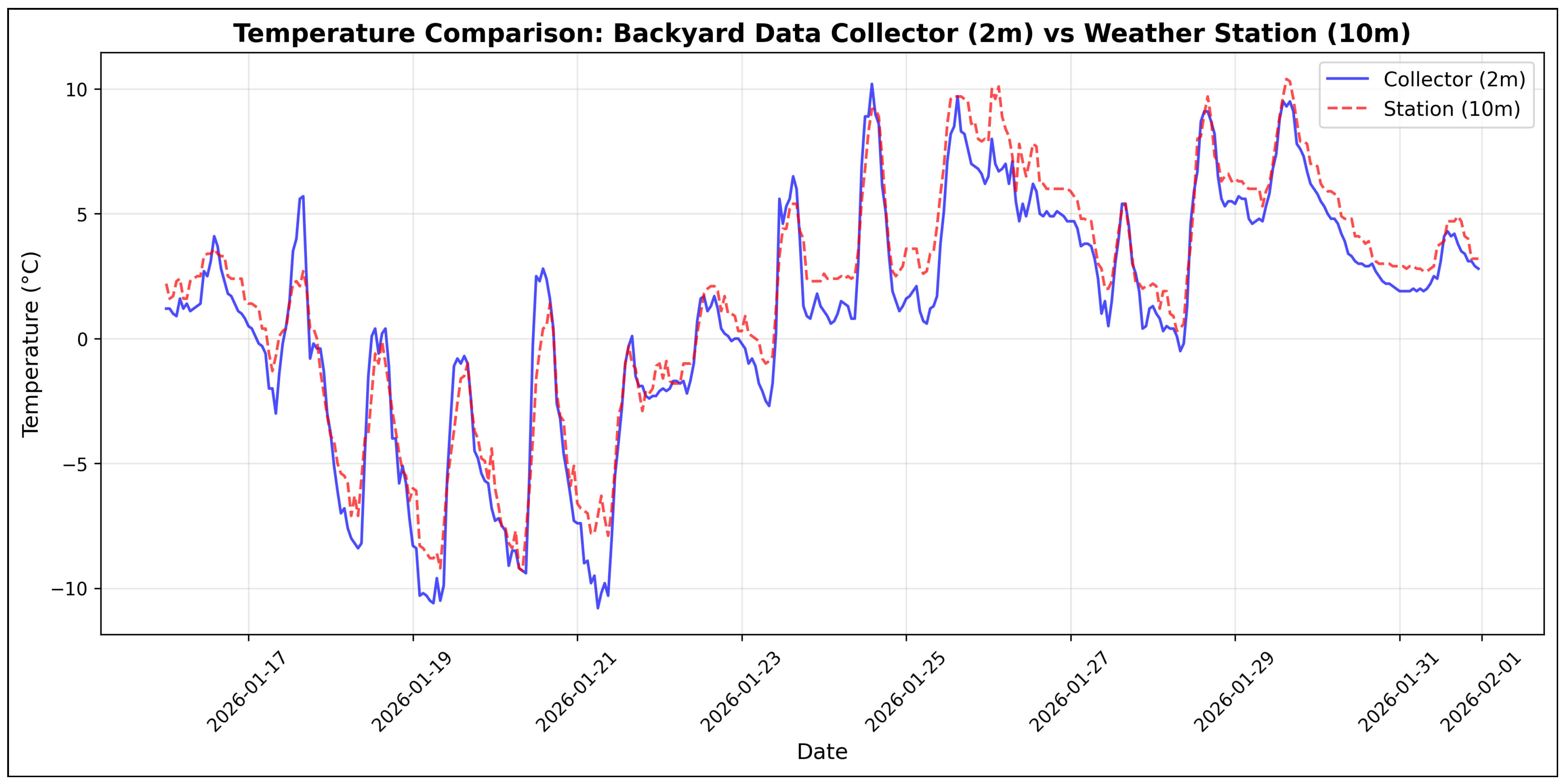
4.3.1. Temperature Comparison
- (1)
- The lower measurement height (2 m vs. 10 m), which places the sensor closer to the ground surface, potentially experiencing stronger radiative cooling effects during night-time and reduced solar heating during daytime;
- (2)
- The sheltered location among buildings and vegetation, which may create localized cooling effects through shading and reduced wind exposure;
- (3)
- The proximity to ground-level heat sources and sinks, including soil thermal properties and vegetation evapotranspiration.
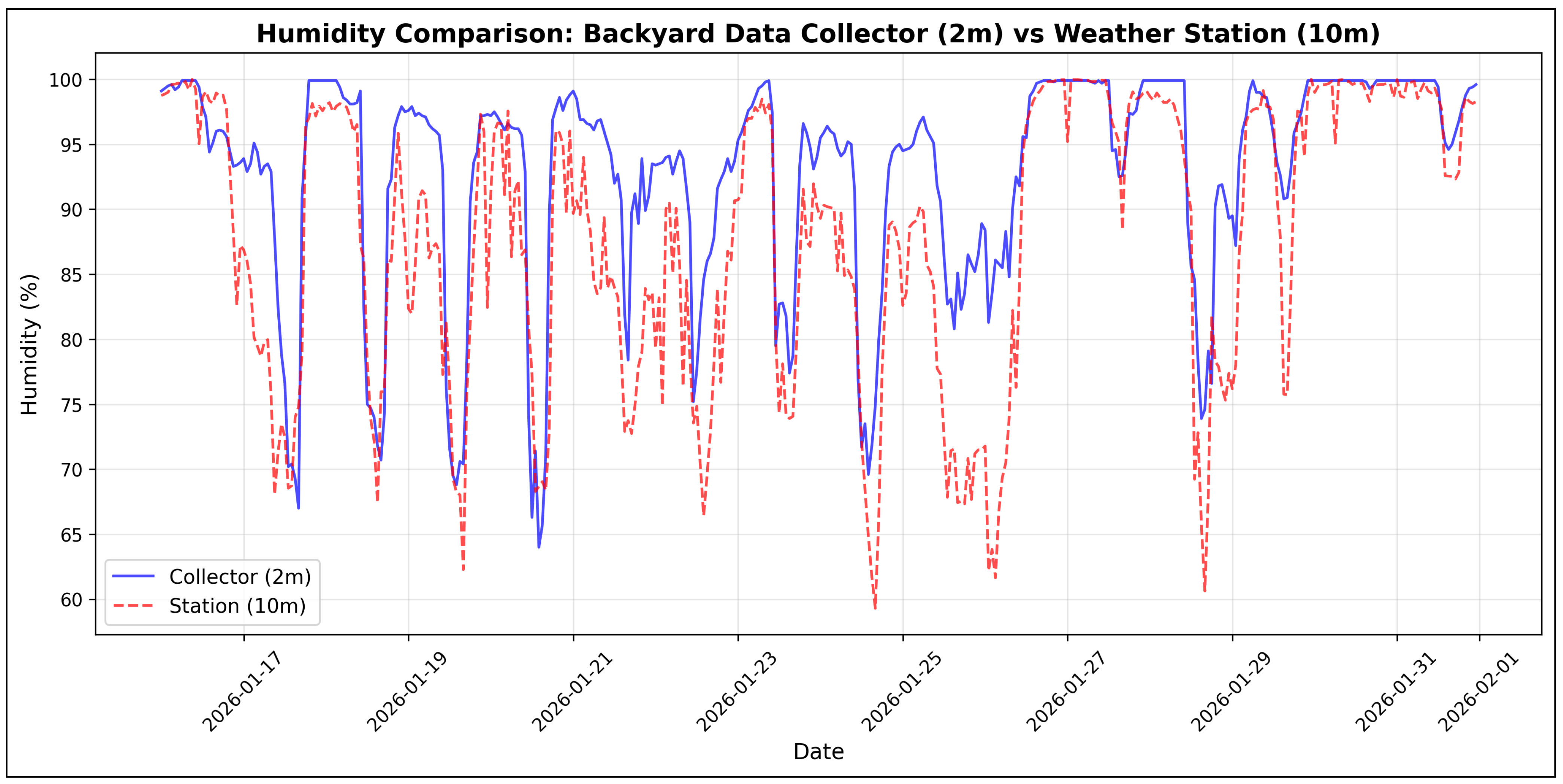
4.3.2. Humidity Comparison
- (1)
- Reduced air circulation due to the sheltered positioning among buildings and vegetation, which may trap moisture near the ground;
- (2)
- Local evapotranspiration patterns from garden vegetation that may create micro-scale humidity gradients;
- (3)
- The influence of surrounding structures, which may affect local air circulation and moisture distribution.
4.3.3. Pressure Comparison
4.4. Cost-Effective Sensor Performance and Validation
5. Limitations
5.1. Limitations of Temperature and Humidity Measurement
5.1.1. Humidity Long-Term Drift
5.1.2. Estimated Temperature Long-Term Drift
5.1.3. Implications for Long-Term Environmental Monitoring
- Gradual offset bias in humidity and temperature records;
- Artificial long-term trend distortion;
- Reduced precision in threshold-based control strategies;
- Decreased robustness of ML models trained on absolute measurements.
5.2. Limitations of Atmospheric Pressure Measurement
- Periodic cross-calibration using regional meteorological reference data.
- Altitude normalization using standardized barometric correction models.
- Drift-aware preprocessing pipelines before ML training.
- Feature engineering strategies that emphasize pressure gradients rather than absolute values.
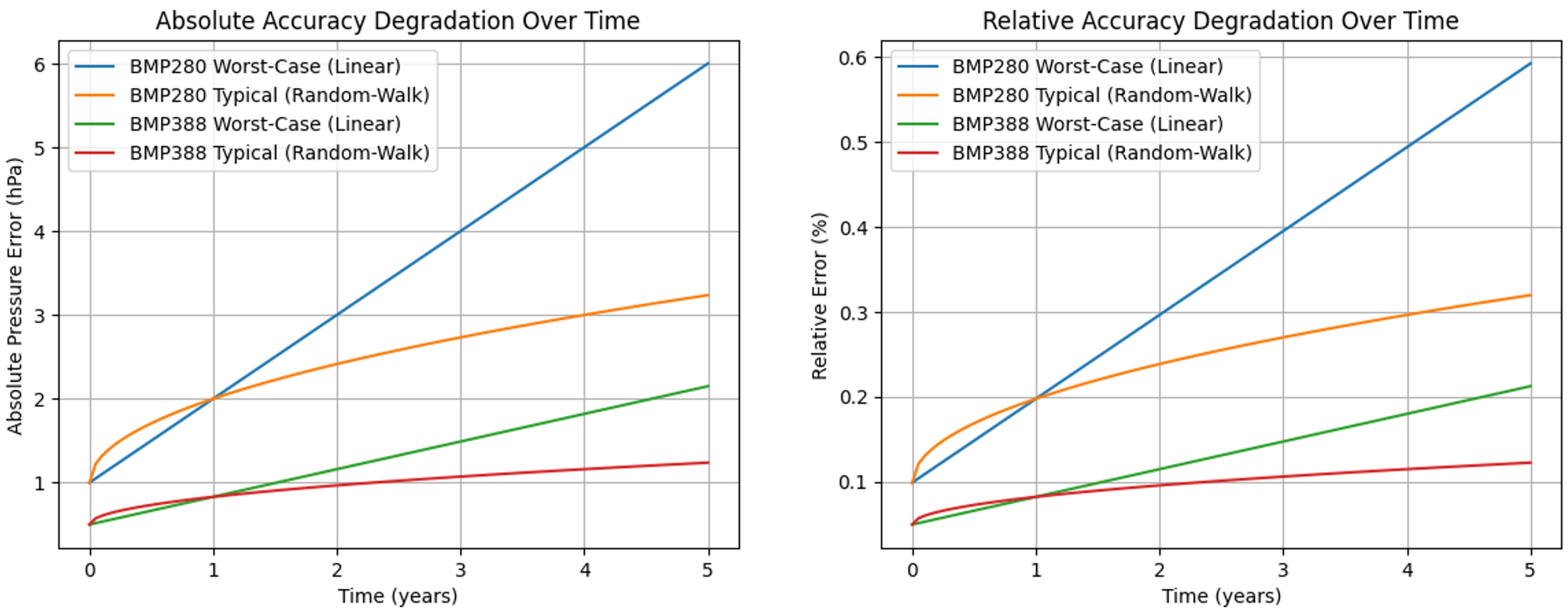
5.2.1. Worst-Case Linear Drift Model
5.2.2. Stochastic Drift Model
6. Discussion
6.1. Sensor Validation and Microclimate Measurement Accuracy
6.2. Lifecycle Cost and Sensor Performance Considerations
7. Conclusions
8. Future Work and Next Steps
8.1. Large-Scale Data Collection and Dataset Expansion
8.2. Adaptive LTE-M Communication via TinyML
- Signal strength indicators (RSSI, RSRP);
- Battery state-of-charge and charging rate;
- Solar energy availability forecasts;
- Environmental event detection (e.g., rainfall, wind spikes);
- Network stability statistics.
- Transmission interval adaptation;
- Modem power state selection;
- Data aggregation strategies;
- Event-triggered communication.
8.3. Migration Toward High-Precision Humidity and Temperature Sensing
- Limited humidity stability over time;
- Slow single-wire communication protocol;
- Relatively high measurement current (1–1.5 mA);
- Moderate resolution (0.1 °C, 0.1% RH).
- Temperature accuracy: °C;
- Humidity accuracy: RH;
- Resolution: 0.01 °C and 0.01% RH;
- Long-term drift: <, <0.03 °C;
- Standby current: 0.08 A;
- Fast I2C digital interface with CRC integrity.
Expected Impact of Migration
- Improve measurement fidelity by reducing systematic temperature error from ±0.5 °C to ±0.1 °C, enhancing evapotranspiration modeling and microclimate monitoring.
- Increase long-term deployment stability by lowering humidity drift (<).
- Reduce power consumption due to ultra-low standby current, improving autonomous solar-battery operation.
- Enable higher sampling rates (millisecond-scale measurement times).
- Improve communication robustness through I2C with CRC validation.
8.4. Migration Toward Higher-Accuracy Barometric Sensors
Author Contributions
Funding
Institutional Review Board Statement
Informed Consent Statement
Data Availability Statement
Acknowledgments
Conflicts of Interest
Abbreviations
| AI | Artificial Intelligence |
| BMS | Battery Management System |
| Cat-M1 | LTE Category M1 (LTE-M) |
| CR2032 | 20 mm diameter, 3.2 mm thickness lithium coin cell battery |
| DCF77 | German longwave atomic time signal (77.5 kHz) |
| GPIO | General Purpose Input/Output |
| I2C | Inter-Integrated Circuit |
| IoT | Internet of Things |
| LiFePO4 | Lithium Iron Phosphate Battery |
| Li-Po | Lithium Polymer Battery |
| LPWAN | Low Power Wide Area Network |
| LTE-M | Long Term Evolution for Machines |
| MCU | Microcontroller Unit |
| NB-IoT | Narrowband Internet of Things |
| PWM | Pulse Width Modulation |
| PV | Photovoltaic |
| QoS | Quality of Service |
| RJ11/RJ12 | Registered Jack 11/12 Connector |
| RSSI | Received Signal Strength Indicator |
| RTC | Real-Time Clock |
| SD | Secure Digital (memory card) |
| SPI | Serial Peripheral Interface |
| SRAM | Static Random-Access Memory |
| TinyML | Tiny Machine Learning |
Appendix A. Winter Solar Radiation Prediction
Appendix A.1. Sanandrei Winter Solar Radiation Dataset and Splitting Strategy
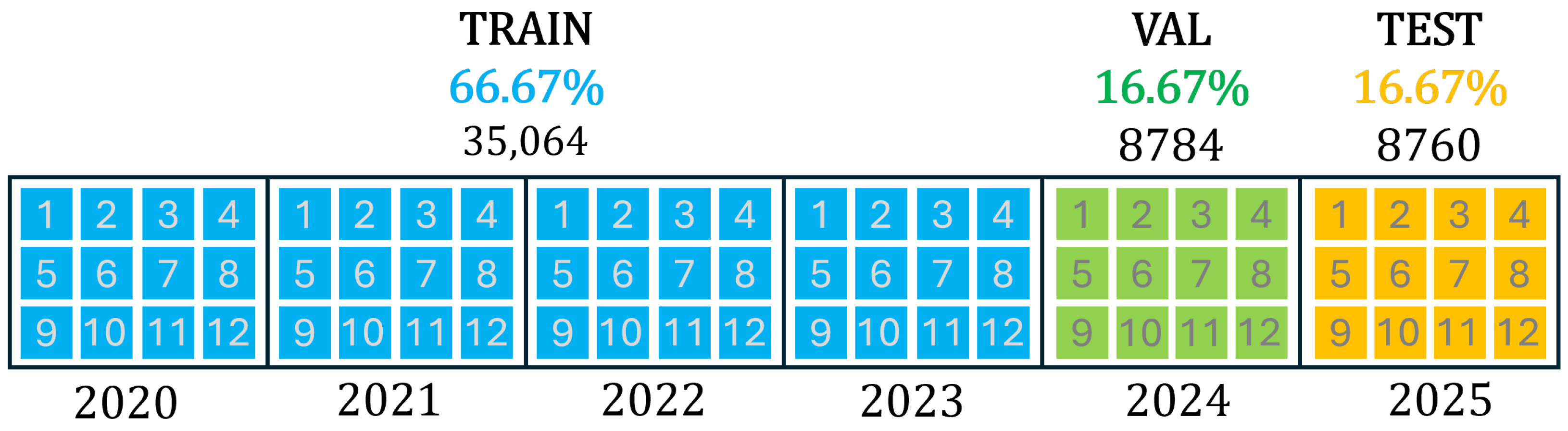
Appendix A.2. Chronological Train/Validation/Test Split

Appendix A.3. Normalization and Sliding-Window Sequence Construction
Appendix A.3.1. Analysis of Random Forest Configurations and Performance
- (1)
- Winter Daytime Model (December–February, 06:00–18:00).
- (2)
- Winter Full-Day Model (December–February, 00:00–23:00).
- (3)
- All-Year Daytime Model (Full Year, 06:00–18:00).
- Larger dataset size;
- Increased seasonal variability;
- Broader solar radiation patterns.

| Metric | Winter Daytime | Winter Full Day | All-Year Daytime |
|---|---|---|---|
| 0.9733 | 0.9781 | 0.9890 | |
| 0.7951 | 0.8261 | 0.9121 | |
| 0.8415 | 0.8420 | 0.9059 |
| Parameter | Winter Daytime | Winter Full Day | All-Year Daytime |
|---|---|---|---|
| n_estimators | 50 | 25 | 100 |
| max_depth | 20 | None | None |
| min_samples_split | 5 | 5 | 5 |
| min_samples_leaf | 1 | 1 | 1 |
| max_features | log2 | sqrt | sqrt |
- Comparative Discussion.
- Expanding the temporal coverage (all-year) substantially improves generalization.
- Including night-time winter data reduces validation error compared to winter daytime-only filtering.
- Hyperparameter differences (e.g., number of trees and tree depth) significantly impact overfitting behavior.
- Shallower ensembles (fewer trees or no depth constraint with fewer estimators) may generalize better under limited seasonal data.
Appendix A.3.2. Comparison of Random Forest Architectures
Appendix B. Cloud Web Application Architecture
Appendix B.1. Overview

Appendix B.2. System Architecture
- Edge layer: solar-powered environmental data collectors transmitting measurements via LTE-M/NB-IoT to the cloud API.
- Backend layer: REST-based PHP services interfacing with a MySQL relational database.
- Frontend layer: responsive dashboard for visualization, analytics, and device management.
Appendix B.3. User and Device Management
- Register and manage devices;
- Assign devices to specific users;
- Monitor connectivity and operational status;
- Review alerts and system notifications.
- Device name and geographic location;
- GPS coordinates;
- Operational status (active, inactive, maintenance);
- Last communication timestamp;
- RSSI statistics and connectivity quality.
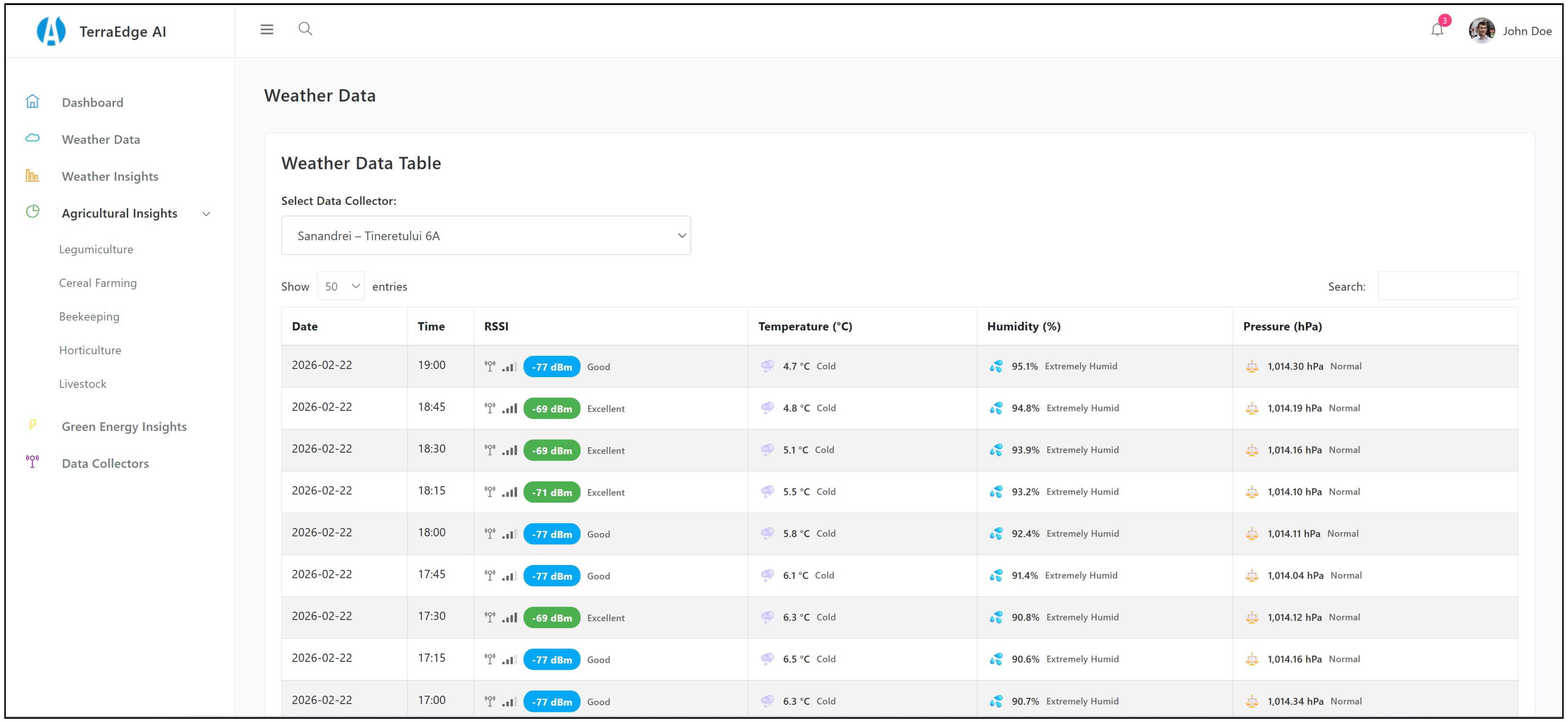
Appendix B.4. Weather Data Visualization
- Filter data by device;
- Sort by timestamp;
- Search specific intervals;
- Inspect temperature, humidity, pressure, rainfall, wind, soil, and radiation parameters.
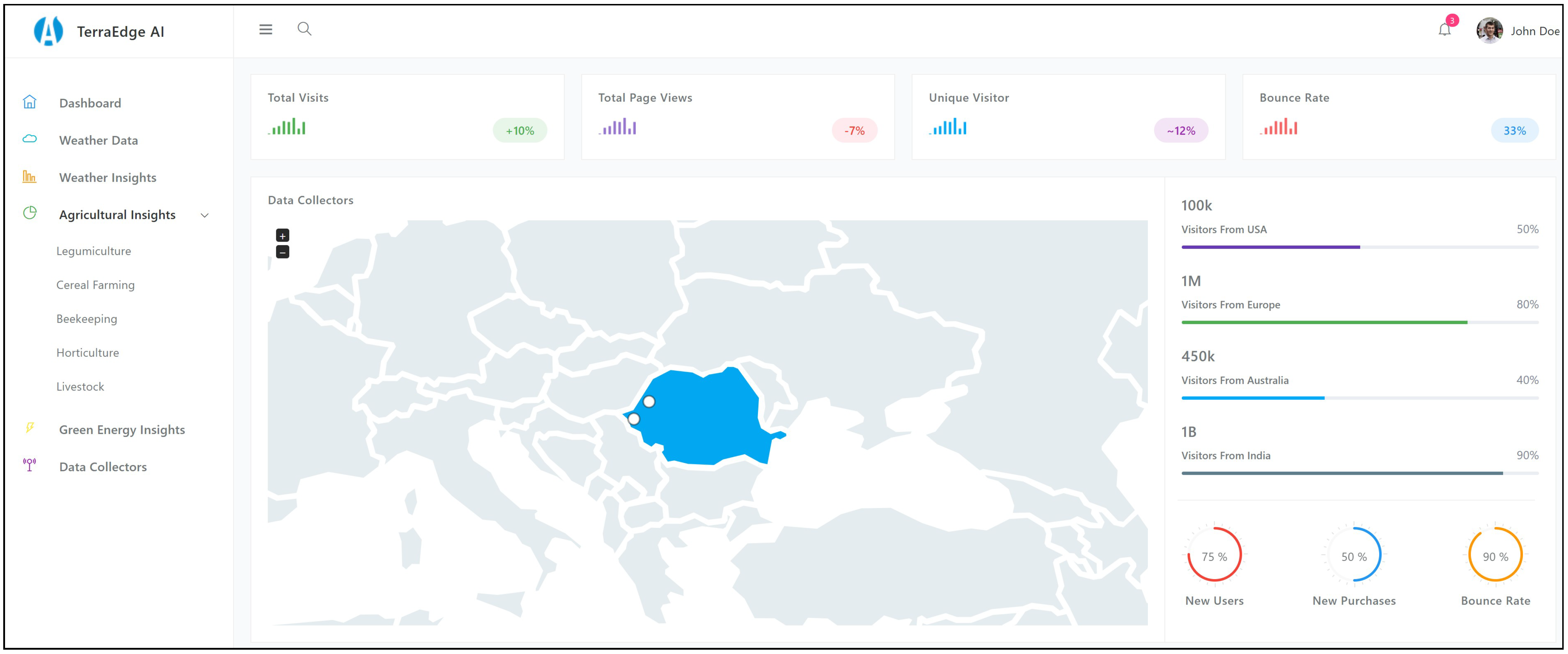
Appendix B.5. Dashboard and System Monitoring
- Total readings and device activity;
- Connectivity statistics (RSSI distribution);
- Geographic visualization of deployed stations; (Sanandrei, Timis county RO; Rogoz de Beliu, Arad county RO);
- Summary indicators and performance metrics.
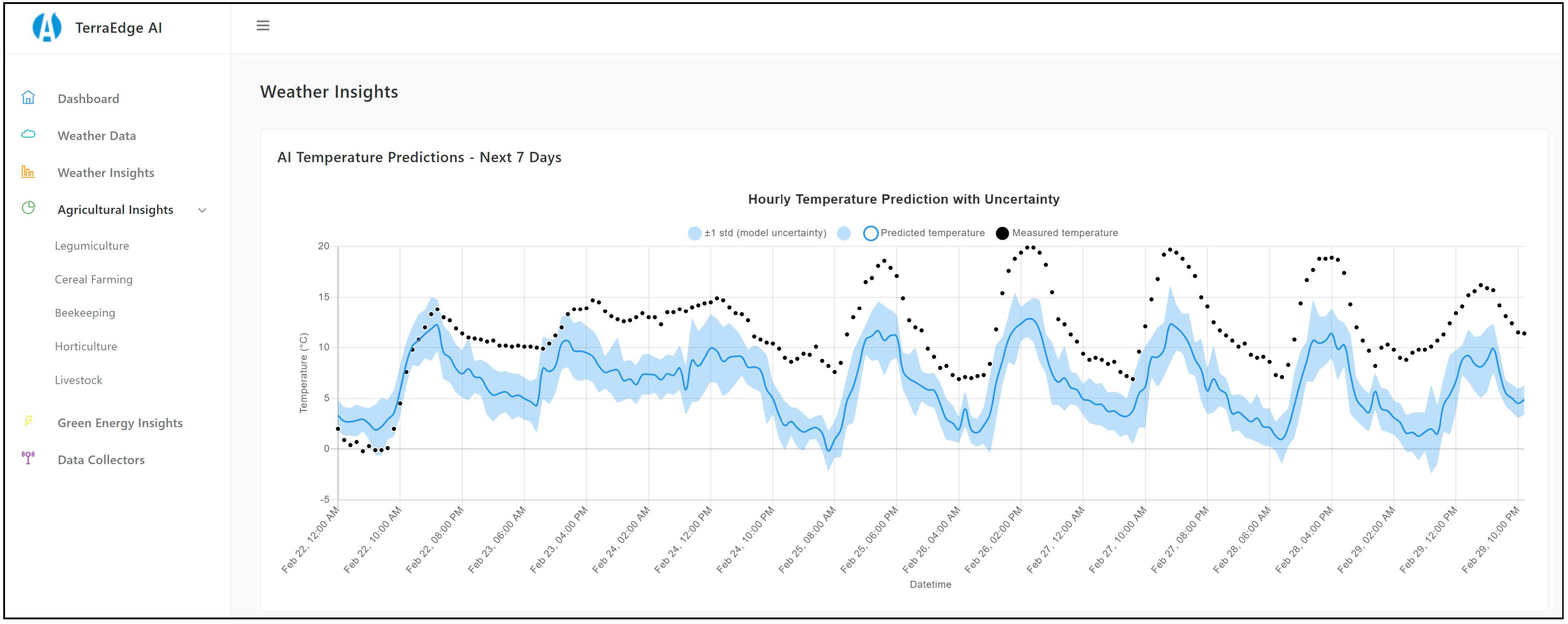
Appendix B.6. AI Integration and Insight Modules
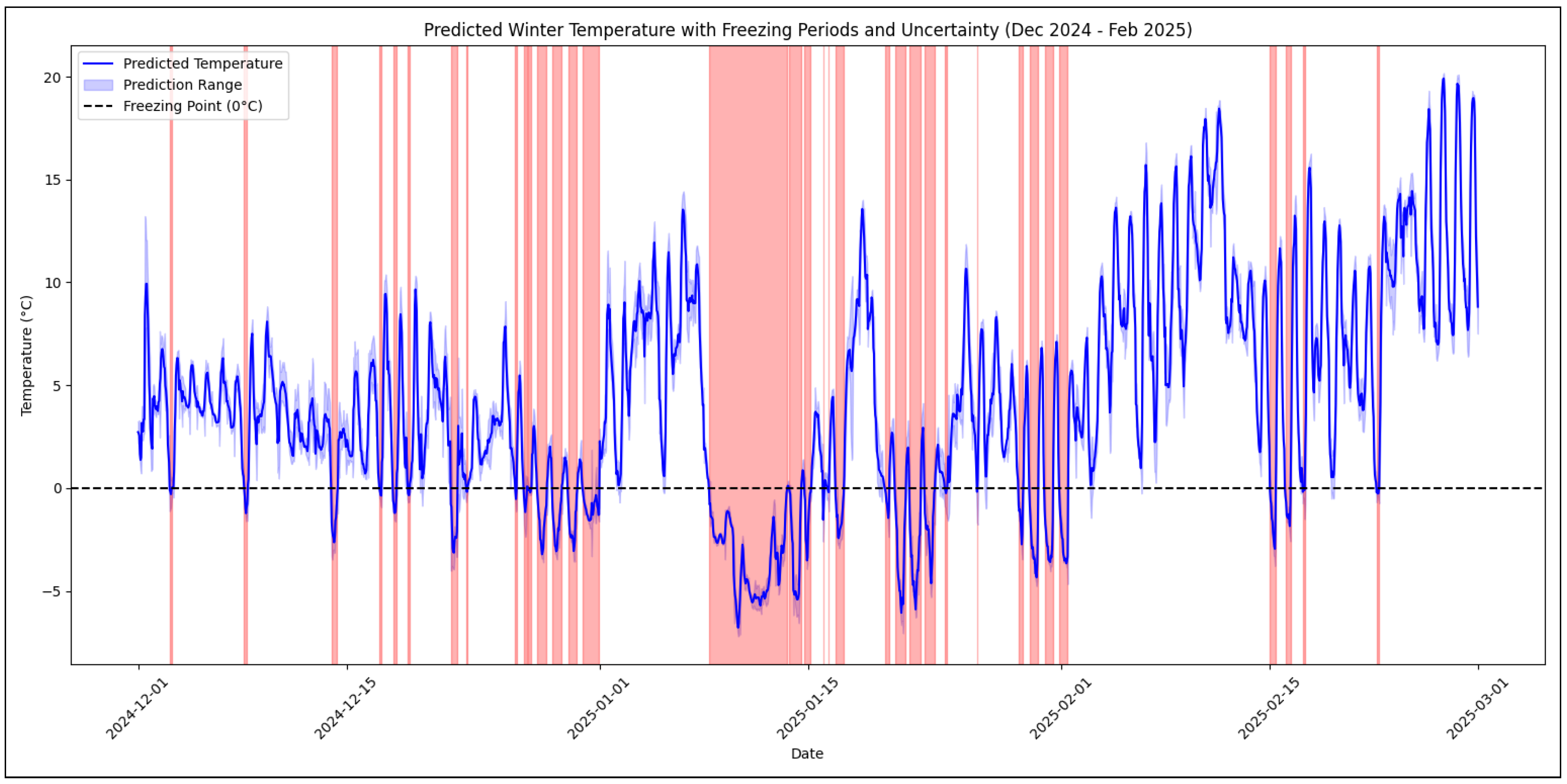
- Weather insights: time-series forecasting (e.g., temperature prediction with uncertainty bands)
- Agricultural insights: soil moisture prediction, irrigation advisory support, crop stress indicators
- Green energy insights: solar radiation prediction, energy yield estimation, hybrid renewable modeling

- Directly in the cloud (high-capacity inference);
- Or partially at the edge (TinyML-based inference on Arduino Nano 33 BLE).
Appendix B.7. Scalability and Multi-Industry Applicability
- Precision agriculture;
- Renewable energy optimization;
- Environmental monitoring;
- Smart farming and IoT ecosystems.
Appendix B.8. Summary
References
- Wolfert, S.; Ge, L.; Verdouw, C.; Bogaardt, M.J. Big Data in Smart Farming—A review. Agric. Syst. 2017, 153, 69–80. [Google Scholar] [CrossRef] [Scilit]
- Kamilaris, A.; Prenafeta-Boldú, F.X. Deep learning in agriculture: A survey. Comput. Electron. Agric. 2018, 147, 70–90. [Google Scholar] [CrossRef] [Scilit]
- Liakos, K.G.; Busato, P.; Moshou, D.; Pearson, S.; Bochtis, D. Machine Learning in Agriculture: A Review. Sensors 2018, 18, 2674. [Google Scholar] [CrossRef] [Scilit] [PubMed]
- Atzori, L.; Iera, A.; Morabito, G. The Internet of Things: A survey. Comput. Netw. 2010, 54, 2787–2805. [Google Scholar] [CrossRef] [Scilit]
- Gubbi, J.; Buyya, R.; Marusic, S.; Palaniswami, M. Internet of Things (IoT): A vision, architectural elements, and future directions. Future Gener. Comput. Syst. 2013, 29, 1645–1660. [Google Scholar] [CrossRef] [Scilit]
- Ratasuk, R.; Mangalvedhe, N.; Zhang, Y.; Robert, M.; Koskinen, J.P. Overview of narrowband IoT in LTE Rel-13. In Proceedings of the 2016 IEEE Conference on Standards for Communications and Networking (CSCN); IEEE: Berlin, Germany, 2016; pp. 1–7. [Google Scholar] [CrossRef] [Scilit]
- Mekki, K.; Bajic, E.; Chaxel, F.; Meyer, F. A comparative study of LPWAN technologies for large-scale IoT deployment. ICT Express 2019, 5, 1–7. [Google Scholar] [CrossRef] [Scilit]
- Banbury, C.R.; Reddi, V.J.; Lam, M.; Fu, W.; Fazel, A.; Holleman, J.; Huang, X.; Hurtado, R.; Kanter, D.; Lokhmotov, A.; et al. Benchmarking TinyML Systems: Challenges and Direction. arXiv 2021, arXiv:2003.04821. [Google Scholar] [CrossRef] [Scilit]
- Warden, P.; Situnayake, D. TinyML: Machine Learning with TensorFlow Lite on Arduino and Ultra-Low-Power Microcontrollers; O’Reilly Media: Sebastopol, CA, USA, 2019. [Google Scholar]
- Nallusamy, R.; Duraiswamy, K. Solar Powered Wireless Sensor Networks for Environmental Monitoring. Inf. Technol. J. 2011, 10, 1–10. [Google Scholar] [CrossRef] [Scilit]
- Helmy, H.A.; El-Rifaie, A.M.; Youssef, A.A.F.; Haggag, A.; Hamad, H.; Eltokhy, M. Improving Solar Energy-Harvesting Wireless Sensor Network (SEH-WSN) with Hybrid Li-Fi/Wi-Fi, Integrating Markov Model, Sleep Scheduling, and Smart Switching Algorithms. Technologies 2025, 13, 437. [Google Scholar] [CrossRef] [Scilit]
- Voyant, C.; Notton, G.; Kalogirou, S.; Nivet, M.L.; Paoli, C.; Motte, F.; Fouilloy, A. Machine learning methods for solar radiation forecasting: A review. Renew. Energy 2017, 105, 569–582. [Google Scholar] [CrossRef] [Scilit]
- Kalaany, C.M.A.; Kimaita, H.N.; Abdelmoneim, A.A.; Khadra, R.; Derardja, B.; Dragonetti, G. The Potential of Low-Cost IoT-Enabled Agrometeorological Stations: A Systematic Review. Sensors 2025, 25, 6020. [Google Scholar] [CrossRef] [Scilit] [PubMed]
- Ganesan, S.; Lean, C.; Chen, L.; Yuan, K.; Ng, P.K.; Basir Khan, M.R. IoT-enabled Smart Weather Stations: Innovations, Challenges, and Future Directions. Malays. J. Sci. Adv. Technol. 2024, 4, 180–190. [Google Scholar] [CrossRef] [Scilit]
- Khan, S.; Mahi, M.; Rasheduzzaman, M. Design and Implementation of a Low-Cost Weather Monitoring System using ESP-NOW. In 2024 13th International Conference on Electrical and Computer Engineering (ICECE); IEEE: Dhaka, Bangladesh, 2024; pp. 437–442. [Google Scholar] [CrossRef] [Scilit]
- Jasso-Reyes, D.A.; Cabrera-Perdomo, C.I.; Reyes-Villagrana, R.A. On the Architecture of a Low-Cost Meteorological Station Based on the Internet of Things (IoT): Preliminary Results. Environ. Earth Sci. Proc. 2025, 34, 14. [Google Scholar] [CrossRef] [Scilit]
- Eyasin, M.S.H.; Sobhani, M.E.; Nasrin, S.; Al Rafi, A.S.; Muzahidul Islam, A. CropSynergy: Harnessing IoT solutions for smart and efficient crop management. Crop Des. 2026, 5, 100127. [Google Scholar] [CrossRef] [Scilit]
- Zhurakovskyi, B.; Pliushch, O.; Saiko, V.; Shutenko, V. Machine Learning-based Environmental Monitoring and Analysis System. In Proceedings of the Cybersecurity Providing in Information and Telecommunication Systems, Kyiv, Ukraine, 28 February 2025. [Google Scholar]
- Zhao, B.; Zheng, D.; Yang, C.; Wang, S.; Mansurova, M.; Jomartova, S.; Kunicina, N.; Zabasta, A.; Beliaev, V.; Caiko, J.; et al. Design and Optimization of an Internet of Things-Based Cloud Platform for Autonomous Agricultural Machinery Using Narrowband Internet of Things and 5G Dual-Channel Communication. Electronics 2025, 14, 1672. [Google Scholar] [CrossRef] [Scilit]
- Lukic, M.; Sobot, S.; Mezei, I.; Vukobratovic, D.; Danilovic, D. In-depth Real-World Evaluation of NB-IoT Module Energy Consumption. In Proceedings of the 2020 IEEE International Conference on Smart Internet of Things (SmartIoT); IEEE: Beijing, China, 2020; pp. 261–265. [Google Scholar] [CrossRef] [Scilit]
- Michelinakis, F.; Al-selwi, A.S.; Capuzzo, M.; Zanella, A.; Mahmood, K.; Elmokashfi, A. Dissecting Energy Consumption of NB-IoT Devices Empirically. arXiv 2020, arXiv:2004.07127. [Google Scholar] [CrossRef] [Scilit]
- Trabelsi, S.; Gontara, S.; Bougharriou, S.; Mtibaa, A. Advancing NB-IoT communication: Performance analysis and novel gap-aware hybrid scheduling for delay-sensitive traffic. Wirel. Netw. 2025, 32, 243–284. [Google Scholar] [CrossRef] [Scilit]
- Masoum, A.; Meratnia, N.; Havinga, P.J. An energy-efficient adaptive sampling scheme for wireless sensor networks. In Proceedings of the 2013 IEEE Eighth International Conference on Intelligent Sensors, Sensor Networks and Information Processing; IEEE: Melbourne, VIC, Australia, 2013; pp. 231–236. [Google Scholar] [CrossRef] [Scilit]











| Parameter | Valid Range | Unit | Rationale |
|---|---|---|---|
| Wind speed | 0–100 | m/s | The upper bound exceeds realistic extreme wind conditions and is used to detect corrupted or misaligned values. |
| Rainfall accumulation | 0–1000 | mm | The threshold prevents overflow effects and rejects implausible accumulated rainfall values. |
| Wind direction | 0–360 | degrees | The limits reflect the physical measurement domain of wind direction sensors. |
| Item | Description | Price |
|---|---|---|
| MCU & COMMUNICATION | ||
| Arduino Nano 33 BLE | EdgeAI-capable light-weight sensor controller | €31.00 |
| MKR NB 1500 | NB-IoT Data transmission module | €80.00 |
| Dipole Pentaband Antenna | MKR NB 1500 Antenna | €6.00 |
| SENSORS | ||
| Weather station | Mechanical part | €50.00 |
| Thermo/hygro sensor | Thermo hygro sensor case | €20.00 |
| DHT22 | Temperature & humidity | €12.00 |
| BMP280 | Barometric pressure sensor | €7.00 |
| POWER MANAGEMENT | ||
| 30W Solar Panel | Breckner Germany, 440 × 425 × 45 mm | €12.00 |
| Solar Charge Controller | 12/24 V, 20A, 2× USB ports | €5.00 |
| 2× LiFePo4 Battery 7Ah | V-TAC SKU-11942 12.8 V 7.2 Ah | €30.00 |
| CASINGS | ||
| Distribution Panel | Starke ST01411 30 × 20 × 13 cm IP65 | €11.00 |
| Battery Case | Starke ST01438 30 × 40 × 17 cm IP65 | €35.00 |
| Sonoff case | UV & light sensors | €5.00 |
| WIRING & CONNECTORS | ||
| Cable RJ12 6P6C | 1× Cable Rj12 6 wires for DHT22 & BMP280 | €3.00 |
| Connector PIC-ICSP | 2× OLIMEX-ICSP, OLIMEX-ICSP-mini and MICROCHIP-RJ11 | €8.00 |
| Total | €315.00 | |
| Parameter | DHT22 | SHT45 | Commercial Probe (RHT2/AT2 Example) |
|---|---|---|---|
| Temperature range | to 80 °C | to C | to C |
| Temperature accuracy | C | C | C |
| Temperature long-term drift | Not specified | <C/year | Not always specified |
| Humidity range | 0– RH | 0– RH | 0– RH |
| Humidity accuracy | – RH | RH | – RH |
| Humidity long-term drift | RH/year | < RH/year | ∼1– first year |
| Response time (typical) | ∼5 s | ∼1.8–8 ms | <10 s (90% RH step) |
| Approximate sensor cost | €5–10 | ∼€17 | Significantly higher |
Disclaimer/Publisher’s Note: The statements, opinions and data contained in all publications are solely those of the individual author(s) and contributor(s) and not of MDPI and/or the editor(s). MDPI and/or the editor(s) disclaim responsibility for any injury to people or property resulting from any ideas, methods, instructions or products referred to in the content. |
© 2026 by the authors. Licensee MDPI, Basel, Switzerland. This article is an open access article distributed under the terms and conditions of the Creative Commons Attribution (CC BY) license.
Share and Cite
Trînc, E.-C.; Niţă, V.; Stolojescu-Crisan, C.; Ancuţi, C.; Mihai, R.M.; Sultănoiu, C.P. Cost-Effective TinyML-Ready Design and Field Deployment of a Solar-Powered Environmental Monitoring Data Collector Using LTE-M Communication. Appl. Sci. 2026, 16, 3237. https://doi.org/10.3390/app16073237
Trînc E-C, Niţă V, Stolojescu-Crisan C, Ancuţi C, Mihai RM, Sultănoiu CP. Cost-Effective TinyML-Ready Design and Field Deployment of a Solar-Powered Environmental Monitoring Data Collector Using LTE-M Communication. Applied Sciences. 2026; 16(7):3237. https://doi.org/10.3390/app16073237
Chicago/Turabian StyleTrînc, Emanuel-Crăciun, Valentin Niţă, Cristina Stolojescu-Crisan, Cosmin Ancuţi, Răzvan Marius Mihai, and Cristian Pațachia Sultănoiu. 2026. "Cost-Effective TinyML-Ready Design and Field Deployment of a Solar-Powered Environmental Monitoring Data Collector Using LTE-M Communication" Applied Sciences 16, no. 7: 3237. https://doi.org/10.3390/app16073237
APA StyleTrînc, E.-C., Niţă, V., Stolojescu-Crisan, C., Ancuţi, C., Mihai, R. M., & Sultănoiu, C. P. (2026). Cost-Effective TinyML-Ready Design and Field Deployment of a Solar-Powered Environmental Monitoring Data Collector Using LTE-M Communication. Applied Sciences, 16(7), 3237. https://doi.org/10.3390/app16073237