Article

Collapse Dynamics of Unequal-Sized Dual Cavitation Bubbles


by
Wenrui Xue
1,
Jihao Xie
1,
Guanghua Wang
1,
Daqing He
1,
Xiaoyu Wang
1,*,
Yuning Zhang
1,
Jinsen Hu
2 and
Xu Qiu
3
1
Key Laboratory of Power Station Energy Transfer Conversion and System (Ministry of Education), School of Energy Power and Mechanical Engineering, North China Electric Power University, Beijing 102206, China
2
School of Mechanical Engineering, Ningxia University, Yinchuan 750021, China
3
China Atomic Energy Publishing & Media Company Limited, Beijing 100048, China
*
Author to whom correspondence should be addressed.
Appl. Sci. 2026, 16(7), 3154; https://doi.org/10.3390/app16073154
Submission received: 21 February 2026 / Revised: 20 March 2026 / Accepted: 23 March 2026 / Published: 25 March 2026

Abstract

In engineering flow systems such as hydraulic machinery and marine propulsion, interactions among cavitation bubbles can significantly influence collapse dynamics. This study investigates the collapse behavior of unequal-sized dual cavitation bubbles in a free field, focusing on jet formation modes, morphological evolution, and the characteristics of the Bjerknes force and Kelvin impulse. Particular emphasis is placed on the effect of the bubble radius ratio on the collapse dynamics. The results indicate that: (1) as the radius ratio decreases, the counter-directed jets formed during the collapse of dual cavitation bubbles gradually disappear; (2) with a decreasing radius ratio, the amplitude of the bubble wall velocity first decreases and then increases; and (3) both the Bjerknes force and the Kelvin impulse decrease as the radius ratio decreases.

1. Introduction

Cavitation bubble generation and collapse are widely encountered in hydraulic machinery [1,2], marine propulsion [3], and ultrasonic cleaning [4]. The high-speed jets produced during the collapse stage are regarded as one of the primary causes of cavitation erosion, material damage, and noise generation [5]. In practical engineering flows, cavitation bubbles with various sizes often appear in the form of clusters. For polydisperse multi-bubble systems, the spatiotemporal distributions of jet direction, jet intensity, and impact loading become considerably more complex, and the associated dynamics exhibit distinct characteristics compared with single-bubble cases [6,7,8,9,10]. Therefore, systematically elucidating bubble-bubble interaction mechanisms is essential for deepening the understanding of complex cavitation phenomena and for providing a theoretical basis for engineering prediction and control.
During cavitation bubble collapse, high-speed liquid jets arise primarily from asymmetries in the surrounding flow environment. The classical work of Benjamin et al. [11] and Mitchell et al. [12] demonstrated that when a bubble collapses in the vicinity of a rigid boundary, geometric and pressure-field asymmetries induce liquid entrainment and lead to the development of a jet directed toward the boundary. Subsequently, various jetting behaviors have been observed under different physical configurations. For instance, Ma et al. [13] and Zhang et al. [14] investigated the flow velocity field associated with cavitation bubble collapse near complex convex boundaries. Li et al. [15] showed that bubbles collapsing beneath a free surface can generate jets oriented away from the interface, and that multiple jet-induced impact patterns may emerge during interactions with submerged particles. Han et al. [16] further demonstrated that, for bubbles collapsing near a water–oil interface, the initial jet is directed toward the water phase, while the ability of the jet to penetrate the interface is governed by the density contrast between the two fluids. From a theoretical standpoint, Blake et al. [17,18,19,20,21] established a Kelvin impulse framework grounded in potential-flow theory, revealing that the direction of bubble migration and jet formation is determined by the sign of the Kelvin impulse, whereas its magnitude governs collapse morphology and jet intensity. Building upon this framework, Supponen et al. [22,23] systematically investigated jet dynamics under various sources of asymmetry, including gravity, nearby boundaries, and external disturbances. By introducing an anisotropy parameter ζ to nondimensionalize the Kelvin impulse, they quantified the relationships among jet strength, penetration capability, and the degree of collapse asymmetry. Their results indicated that, for small ζ, the jet remains relatively weak and confined within the bubble, whereas increasing ζ leads to progressive jet intensification and eventual penetration through the bubble interface. In addition, numerical investigations have also contributed significantly to the understanding of cavitation bubble dynamics. For example, Lauer et al. [24] performed detailed numerical simulations to analyze bubble collapse and jet formation under complex flow conditions.
In an unbounded flow, the interaction between two bubbles introduces additional pressure and velocity fields, resulting in collapse behaviors that differ fundamentally from those of an isolated bubble and giving rise to more intricate collapse dynamics. Numerous studies have examined free-field dual-bubble collapse, including theoretical analyses of interacting bubbles by Fujikawa et al. [25] and Harkin et al. [26], as well as experimental and numerical investigations [27,28,29,30,31,32,33,34,35], demonstrating that the dynamics are jointly influenced by bubble spacing, size ratio, and phase difference. Quinto et al. [27] observed that two simultaneously generated, equal-sized columnar bubbles can undergo alternating repulsive and attractive migration within a single oscillation cycle, accompanied by an extended oscillation period. Based on variations in size ratio and phase difference, Chew et al. [28] and Fong et al. [29] summarized several characteristic jetting modes during collapse, including jetting toward, jetting away, coalescence, and the catapult effect. In particular, the catapult effect can draw the later-born bubble into the toroidal structure of the earlier bubble, leading to pronounced stretching and the formation of an extremely slender, high-speed jet. Under specific conditions, the jet velocity of the later-born bubble may exceed 180 m/s, indicating a strong jet enhancement effect [29]. On this basis, Liang et al. [30] further classified the catapult effect into failed catapult and piercing jet regimes, where the piercing jet is characterized by the generation of a thin jet inside the later-born bubble that perforates the bubble wall and propagates stably in water at velocities of approximately 79 m/s. Feng et al. [31] reported that dual bubbles are more likely to form jetting toward under small phase differences, whereas larger phase differences tend to induce jetting away. He et al. [32] identified two typical modes when bubbles interact at extremely small separation distances: (i) merging followed by splitting after collapse, and (ii) merging during growth, followed by an irregularly elongated shape without splitting. Han et al. [33] indicated that the splitting process is usually closely related to the formation of annular jets and annular high-pressure regions. Beyond jetting behaviors, dual-bubble collapse can also significantly alter shock-wave emission. Luo et al. [34] showed that, for cases with identical phase but different sizes, shock-wave emission is mainly dominated by the larger bubble and appears as a continuous wave train; whereas under different-phase generation conditions, the later-born bubble may emit multiple consecutive shock waves within a short time interval, and superposition effects can occur during outward propagation.
Although existing studies have explored free-field dual-bubble collapse dynamics from the perspectives of spacing and phase difference, systematic investigations on how size disparity affects collapse evolution characteristics and jetting modes for synchronously generated unequal-sized dual-bubble systems remain limited. Therefore, this study focuses on the collapse dynamics of synchronously generated unequal-sized dual cavitation bubbles in a free field. By introducing a dimensionless radius ratio, the effects of size disparity on collapse evolution characteristics and jetting modes are systematically investigated. Combined with experimental observations and theoretical analysis, the Bjerknes force and Kelvin impulse are employed to quantitatively characterize the jetting features of synchronously generated unequal-sized dual cavitation bubbles.

2. Theoretical Model

2.1. Boundary Treatment and Parameter Definitions

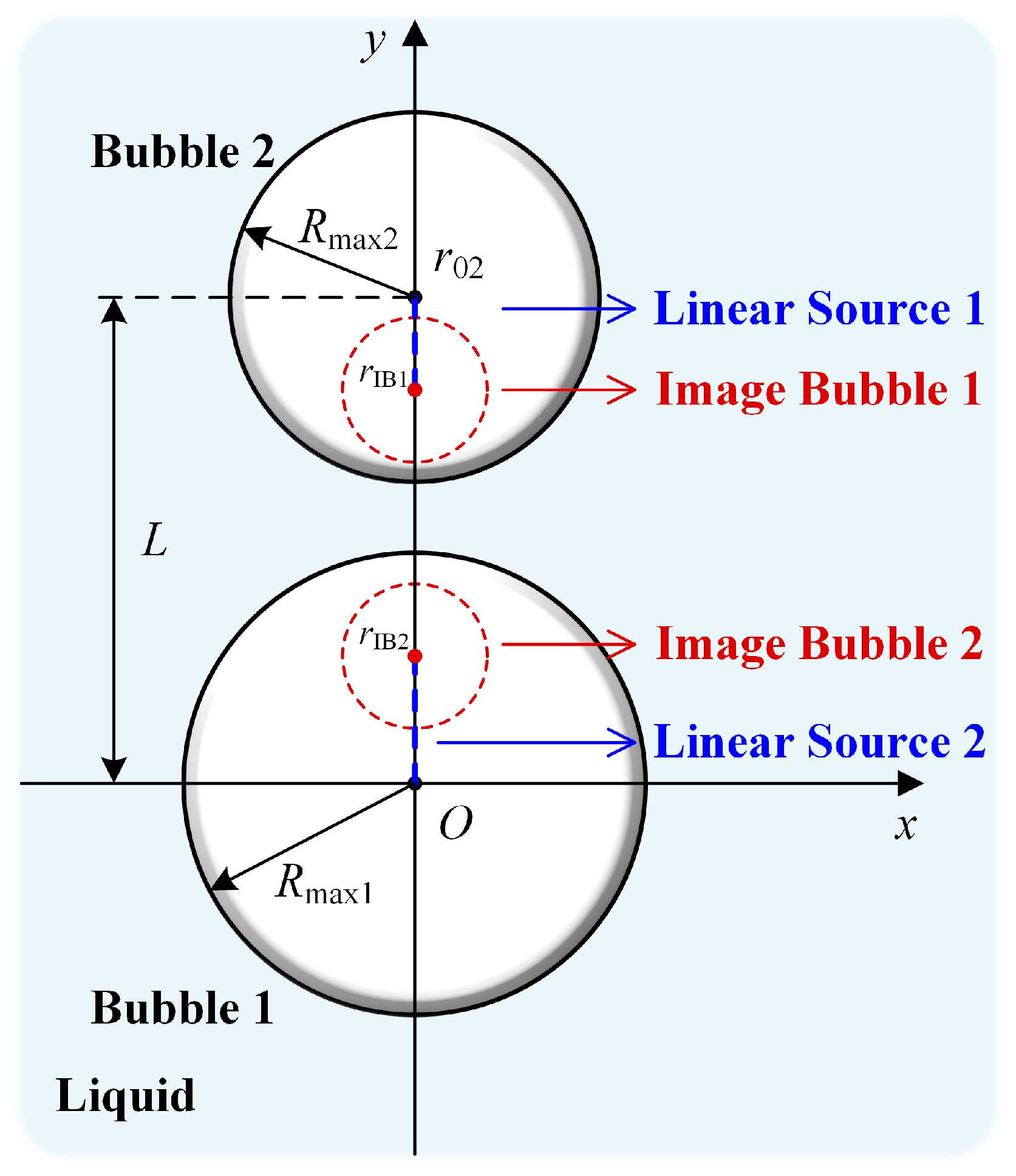
In this study, the liquid phase is modeled as an incompressible, inviscid ideal fluid. Initially, the liquid is quiescent and uniformly distributed throughout the domain. The schematic of the physical model and the corresponding boundary treatment is shown in Figure 1. Bubble 1 and Bubble 2 are generated simultaneously, and their maximum radii during the expansion stage are denoted as Rmax1 and Rmax2, respectively. The dimensionless distance between the centroids of the two bubbles is defined as L. To enforce the boundary conditions at the bubble surfaces, an image system is introduced within each bubble, consisting of corresponding image bubbles (represented by red dashed lines) and linear sources (represented by blue dashed lines) [36]. The spatial locations, strengths, and associated velocity potentials of the real bubbles, image bubbles, and linear sources in the dual-bubble configuration are determined following the formulation proposed by Feng et al. [31].
In the dual-bubble configuration, the additional acceleration potential experienced by each bubble arises from the combined contributions of boundary-induced effects and the oscillatory influence generated by the neighboring bubble. Accordingly, the additional acceleration potentials of Bubble 1 and Bubble 2 can be expressed as follows [31,37]:
φ 1 = φ LS 1 + φ IB 1 + φ B 2 = m LS 1 4 π 0 R 2 2 / L d s r 0 ,   L s + m IB 1 4 π 1 r r IB 1 m B 2 4 π 1 r r 02
φ 2 = φ LS 2 + φ IB 2 + φ B 1 = m LS 2 4 π 0 R 1 2 / L d s r 0 ,   s + m IB 2 4 π 1 r r IB 2 m B 1 4 π 1 r
Here, φ LS 1 + φ IB 1 and φ LS 2 + φ IB 2 denote the velocity potentials induced by the boundary conditions of Bubble 1 and Bubble 2, respectively, whereas φ B 2 and φ B 1 represent the velocity potentials generated by the oscillations of Bubble 2 and Bubble 1, respectively [26]. The instantaneous radii of Bubble 1 and Bubble 2 are denoted by R1 and R2. The strengths of the point sources are defined as m B i = 4 π R i 2 R ˙ i   ,   i = 1 , 2 , where R ˙ i represents the time derivative of the bubble radius.

2.2. Derivation of the Bjerknes Force and Kelvin Impulse

To clarify the scope and advancement of the present model, the following aspects are highlighted.
The present modeling framework extends classical studies of interacting bubbles, such as that of Mitchell, which primarily focused on symmetric or equal-sized bubble configurations [12]. In contrast, the current model incorporates size disparity between bubbles and explicitly accounts for mutual interaction effects through the coupled potential field, enabling the analysis of asymmetric collapse dynamics.
Furthermore, the introduction of the Bjerknes force and Kelvin impulse provides a quantitative framework to characterize jet direction, bubble migration, and collapse asymmetry, which were not systematically addressed in earlier symmetric models.
Based on potential flow theory, the Bjerknes force acting on a bubble in a non-uniform flow field is determined by the spatial gradient of the externally induced velocity potential [37]. According to Lagally’s theorem, the Bjerknes forces acting on Bubble 1 and Bubble 2 can be expressed as:
F 1 = 4 π ρ R 1 2 R ˙ 1 φ LS 1 + φ IB 1 + φ B 2 | r = O
F 2 = 4 π ρ R 2 2 R ˙ 2 φ LS 2 + φ IB 2 + φ B 1 | r = r 02
By integrating the Bjerknes force terms in Equations (3) and (4) over time, the Kelvin impulse expressions for Bubble 1 and Bubble 2 can be obtained as:
I 1 = 4 π ρ 0 t R 1 2 R ˙ 1 φ LS 1 + φ IB 1 + φ B 2 | r = O d t
I 2 = 4 π ρ 0 t R 2 2 R ˙ 2 φ LS 2 + φ IB 2 + φ B 1 | r = r 02 d t
Here, t denotes an arbitrary time within the first oscillation period of Bubble 1.
When the integration time interval covers the entire first oscillation period of Bubble 1, i.e., t = tc1, the global Kelvin impulse can be obtained as [37]:
I ^ 1 = 4 π ρ 0 t c 1 R 1 2 R ˙ 1 φ LS 1 + φ IB 1 + φ B 2 | r = O d t
I ^ 2 = 4 π ρ t 0 t c 1 R 2 2 R ˙ 2 φ LS 2 + φ IB 2 + φ B 1 | r = r 02 d t
In the subsequent analysis, the positive and negative signs of the Bjerknes force and the Kelvin impulse correspond to upward and downward directions, respectively.
To establish a closed Kelvin impulse model for the dual-bubble system, the radial motion equations of the two bubbles accounting for mutual interactions are introduced as [38]:
1 R ˙ 1 c R 1 R ¨ 1 + 3 2 1 R ˙ 1 3 c R ˙ 1 2 = 1 + R ˙ 1 c p ext 1 p 0 ρ + R 1 ρ c d p ext 1 p 0 d t 1 L d d t R 2 2 R ˙ 2
1 R ˙ 2 c R 2 R ¨ 2 + 3 2 1 R ˙ 2 3 c R ˙ 2 2 = 1 + R ˙ 2 c p ext 2 p 0 ρ + R 2 ρ c d p ext 2 p 0 d t 1 L d d t R 1 2 R ˙ 1
The external pressure terms acting on Bubble 1 and Bubble 2 are given by:
p ext 1 = p 0 + 2 σ R 01 R 01 R 1 3 κ 2 σ R 1 4 μ R 1 R ˙ 1
p ext 2 = p 0 + 2 σ R 02 R 02 R 2 3 κ 2 σ R 2 4 μ R 2 R ˙ 2
Here, R01 and R02 are the initial radii of Bubble 1 and Bubble 2, respectively. c = 1478.2 m/s is the speed of sound in the liquid. ρ = 1000 kg/m3 is the liquid density. p0 = 101,325 Pa is the ambient static pressure. σ = 0.0725 N/m is the surface tension coefficient. μ = 0.001 Pa·s is the dynamic viscosity of the liquid. κ = 1.4 is the polytropic exponent.
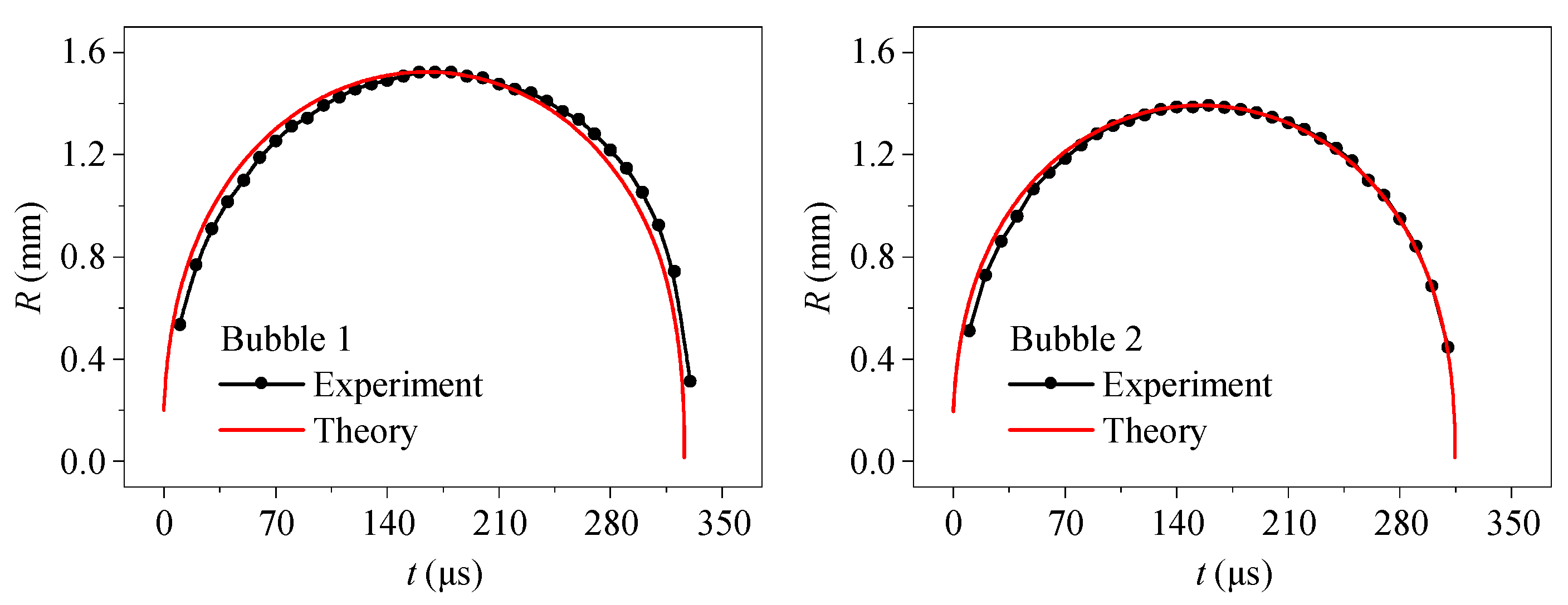
The present formulation is related to classical models for interacting bubbles, such as that proposed by Harkin, which are typically developed under incompressible potential-flow assumptions [26]. In the current study, while the boundary treatment is based on an incompressible potential-flow framework, compressibility effects are incorporated into the radial dynamics through the Rayleigh-Plesset-type equations. This approach enables a more accurate description of bubble oscillation and collapse behavior. The validity of the present formulation is supported by the comparison between theoretical predictions and experimental measurements, as shown in Figure 2, where good agreement is observed.

3. High-Speed Imaging Experimental System for Dual Cavitation Bubbles

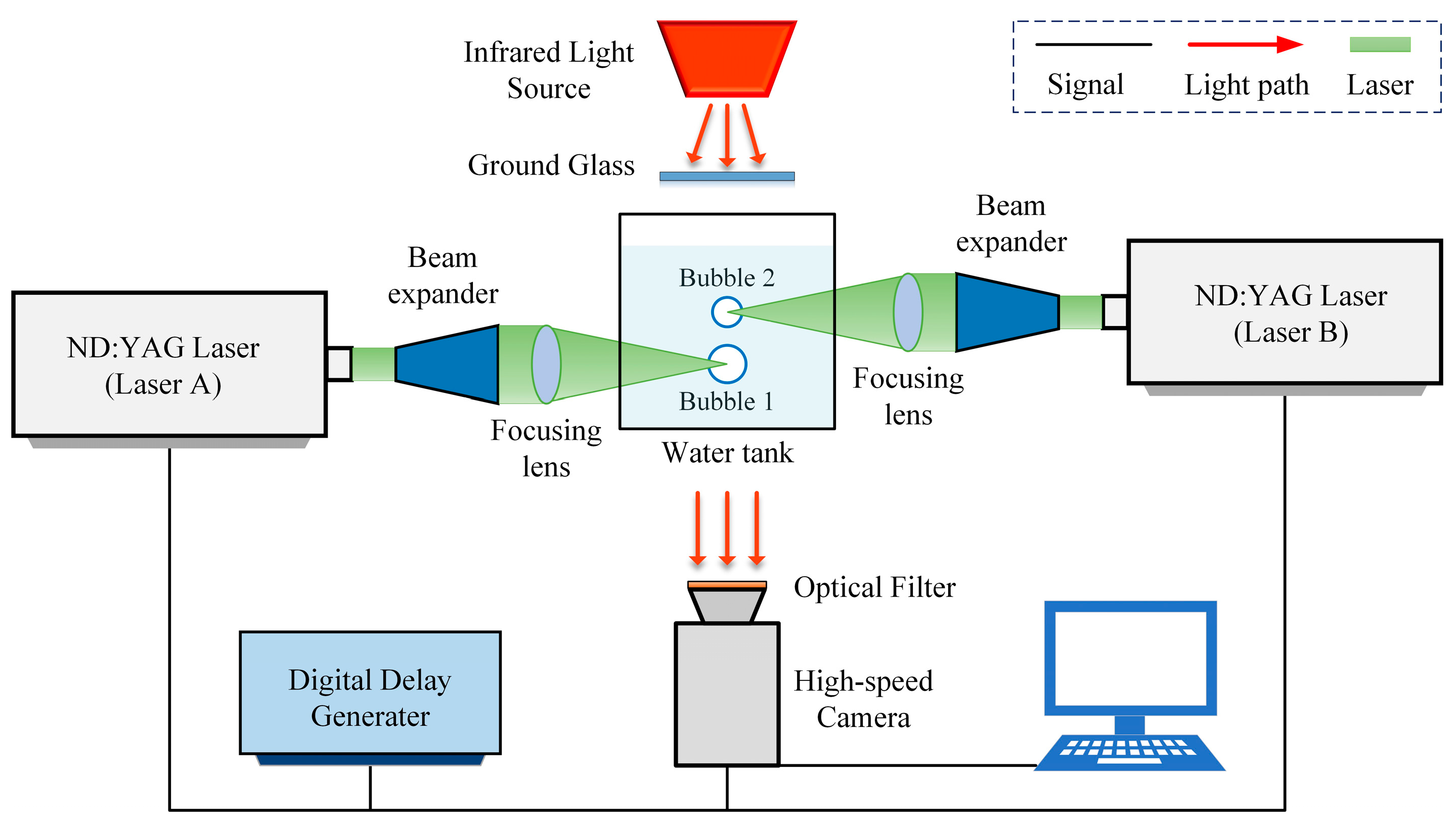
To examine the evolution process and jetting behavior of cavitation bubbles during dual-bubble interactions, a laser-induced cavitation bubble experimental platform incorporating high-speed imaging techniques was constructed, as illustrated in Figure 3. The experimental setup utilizes two mutually independent Nd:YAG lasers. By means of beam expansion and focusing optical assemblies, the laser beams are individually focused into a water tank, enabling the generation of cavitation bubbles with different maximum radii. To ensure stable and uniform imaging conditions throughout the bubble evolution process, an infrared continuous light source combined with ground glass is employed to provide homogeneous background illumination. A high-speed camera is used to capture the complete growth, collapse, and interaction processes of the cavitation bubbles in a continuous manner. An optical bandpass filter is installed in front of the camera lens to suppress scattered laser radiation and protect the camera sensor. A digital delay generator is applied to realize the simultaneous generation of the dual cavitation bubbles, as well as the precise synchronization between laser triggering and high-speed image acquisition. The high-speed images obtained from the experiments are subsequently utilized for quantitative analysis of bubble radius evolution, centroid displacement, jet direction, and other relevant dynamic characteristics.
The specifications and key parameters of the principal components constituting the experimental system are summarized in Table 1.
To facilitate the subsequent comparative analysis and discussion of the experimental results, several key dimensionless parameters are introduced to characterize the dual-bubble interaction process. The dimensionless radii of Bubble 1 and Bubble 2 are defined as R 1 * = R 1 / R max 1 and R 2 * = R 2 / R max 1 . The dimensionless centroid distance between the two bubbles is defined as L * = L / R max 1 . The dimensionless radius ratio of the dual bubbles is defined as γ = R max 2 / R max 1 . Based on the Rayleigh collapse time scale, the dimensionless time is defined as t * = t / 0.915 R max 1 ρ / Δ p , where the characteristic pressure difference ∆p is used to represent the driving strength of bubble oscillation.

4. Typical Collapse Dynamics of Dual Cavitation Bubbles

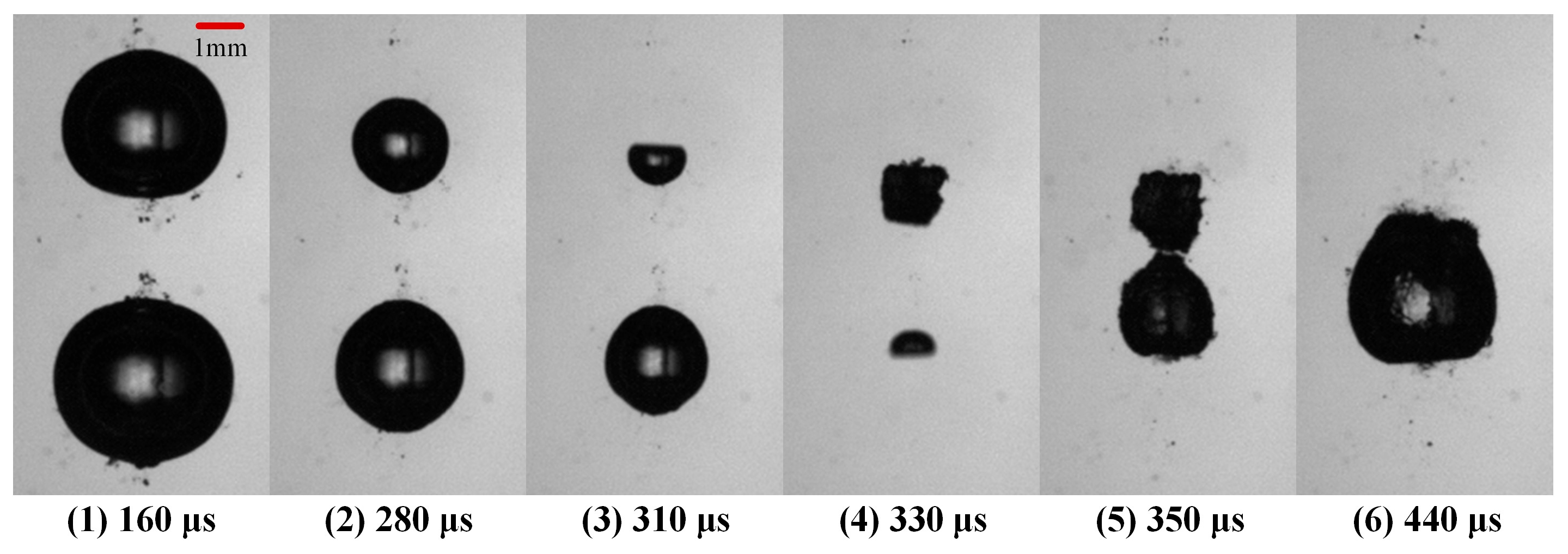
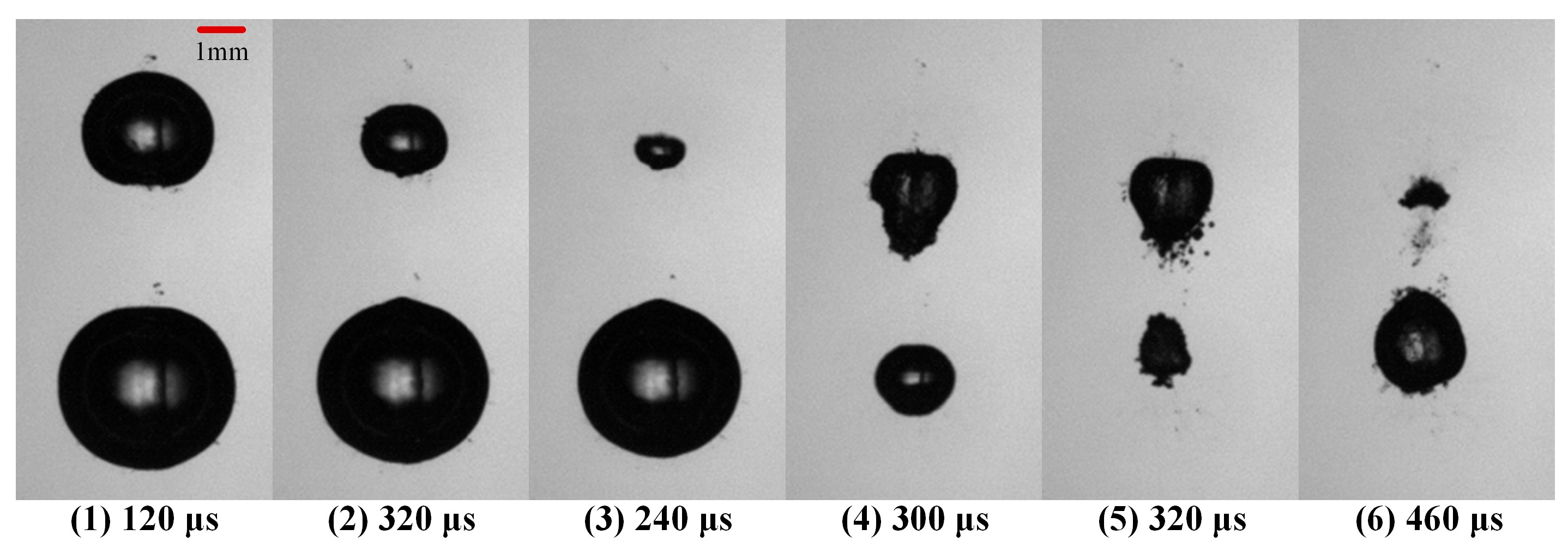
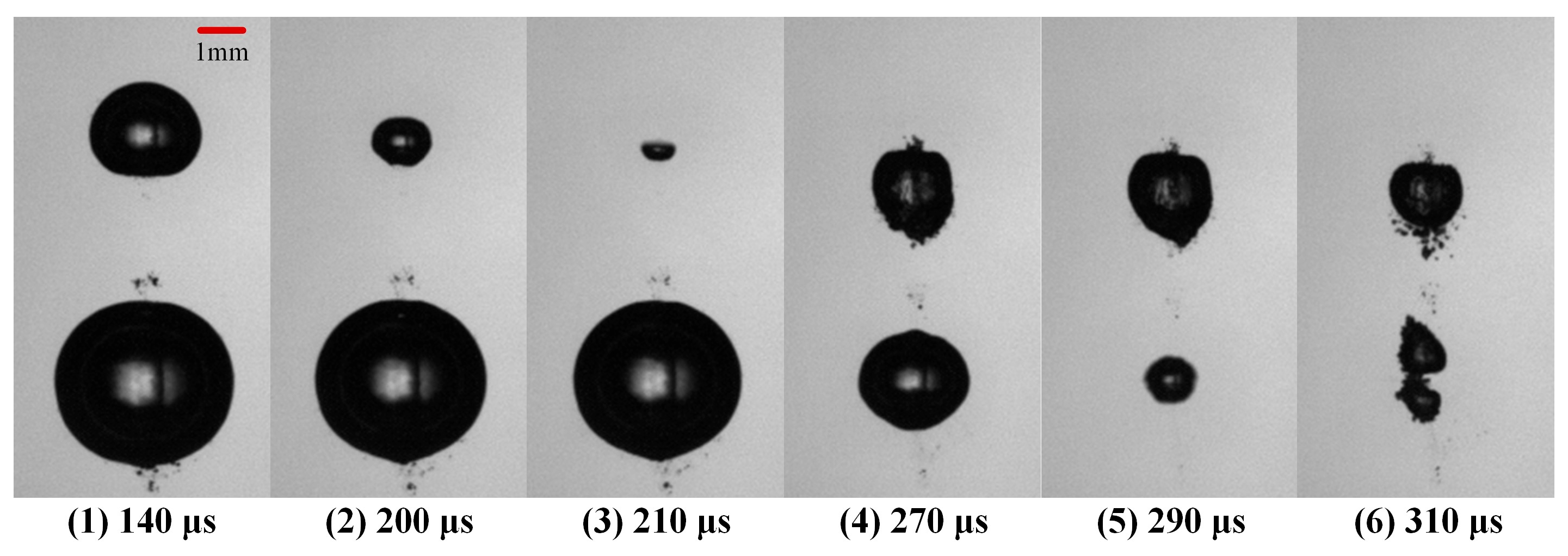
Mitchell demonstrated that symmetric interactions of equal-sized bubbles can induce wall-like flow asymmetry, leading to jet formation toward the interaction region [12]. Numerical simulations by Lauer et al. further showed that the bubble collapse under asymmetric flow conditions can lead to significant variations in jet formation and collapse morphology [24]. In contrast, Figure 4, Figure 5 and Figure 6 present high-speed imaging sequences of the synchronous collapse of unequal-sized dual cavitation bubbles at different radius ratios (γ = 0.94, 0.76 and 0.66), showing that the collapse dynamics deviate significantly from this symmetric behavior. With decreasing γ, the asymmetry of the bubble evolution and the jet characteristics change significantly.
For γ = 0.94 (Figure 4), the two bubbles exhibit relatively symmetric collapse behavior. During the mid-collapse stage, the retraction of the upper wall of Bubble 1 and the lower wall of Bubble 2 proceeds at a relatively low rate, leading to an axially elongated bubble morphology (Figure 4(2)). As the collapse approaches its final stage, the lower wall of Bubble 1 and the upper wall of Bubble 2 accelerate inward, forming pronounced concave structures (Figure 4(3),(4)). Near the collapse-rebound transition, oppositely directed high-speed liquid jets are generated by the dual bubbles (Figure 4(5)). Subsequently, the resulting bubble clouds migrate toward each other and ultimately collide (Figure 4(6)).
For γ = 0.76 (Figure 5), the collapse asymmetry becomes more evident. Bubble 2 undergoes earlier downward concave deformation and produces a high-speed jet at an earlier stage. Bubble 1 subsequently forms an upward-directed jet. Unlike the γ = 0.94 case, no collision between the two bubble clouds is observed.
For γ = 0.66 (Figure 6), the asymmetry is further enhanced. Bubble 1 does not develop a distinct upward jet. Instead, the main cavity breaks up during the late-collapse stage and splits into two separated bubble clouds. This behavior cannot be fully captured by classical theoretical models of interacting bubbles, such as that of Fujikawa, which are primarily based on potential-flow formulations and can reasonably predict the overall collapse dynamics of interacting bubbles [25]. However, such models have limitations in describing the highly nonlinear rebound process and the associated breakup of bubble clouds under strong asymmetry conditions.
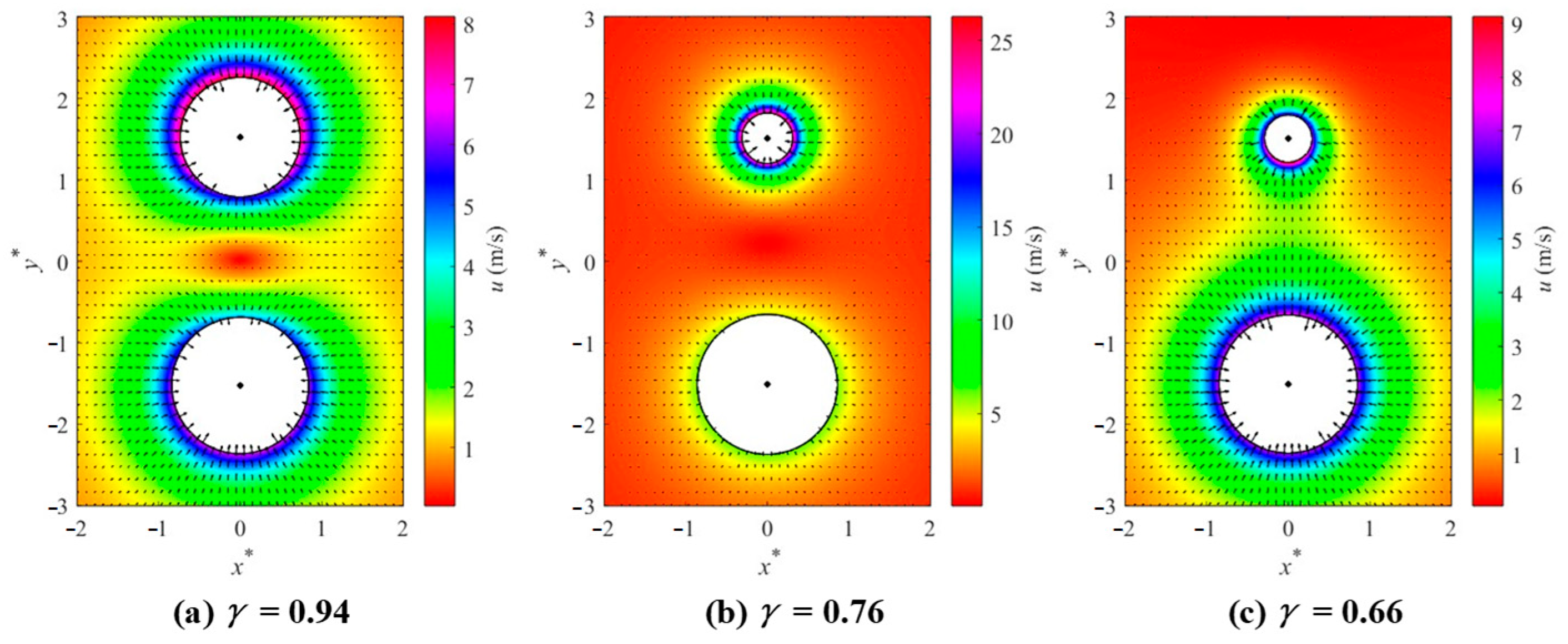
Figure 7 displays the flow velocity distributions around dual cavitation bubbles at different γ values at t * = 0.80. The velocity fields are calculated using the theoretical model implemented in MATLAB 2022. As shown in Figure 7a, the surrounding velocity field exhibits a pronounced vertical asymmetry. For Bubble 1, the flow velocity in the vicinity of the lower bubble wall is markedly higher than that near the upper wall, indicating a stronger inward collapse on the lower side. This asymmetry is mainly caused by the interaction between the two bubbles, which modifies the local pressure gradient in the inter-bubble region [32]. By contrast, for Bubble 2, the velocity magnitude near the lower wall is smaller than that near the upper wall, with a substantial velocity difference developing between the two sides. Additionally, a distinct low-velocity region forms in the gap between the two bubbles due to the mutual interference of the induced velocity fields. As shown in Figure 7b, owing to the smaller size of Bubble 2, its collapse occurs relatively earlier, and at t * = 0.80 it is already close to the late collapse stage. The local fluid velocity near the bubble wall is relatively high, reaching approximately 23 m/s. As shown in Figure 7c, Bubble 2 has already entered the rebound stage at t * = 0.80 due to its smaller size, which leads to the disappearance of the low-velocity region between the two bubbles.

5. Morphological Evolution Characteristics of Dual Cavitation Bubbles

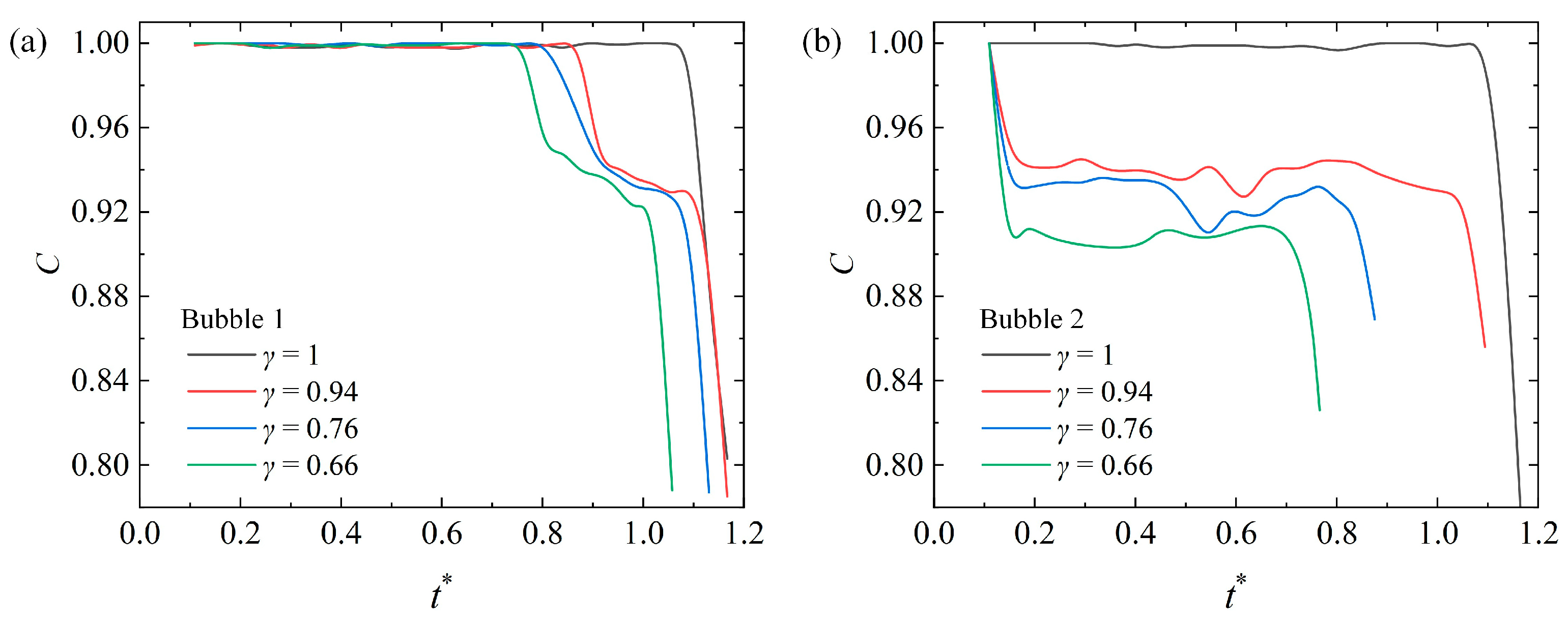
Figure 8 illustrates the temporal evolution of the bubble roundness (C) of dual cavitation bubbles under different γ. C is used to quantify the deviation of the bubble shape from a circular profile and is defined as C = 4 π A / P 2 [39], where A is the bubble area and P is the perimeter of the bubble contour. The bubble contours were extracted from the high-speed images using ImageJ 1.53, and the corresponding roundness values were calculated from the detected bubble boundaries. The uncertainty of the extracted boundary is approximately ±1 pixel, corresponding to an estimated roundness error of about ±0.005. In Figure 8a, C of Bubble 1 remains nearly constant during the growth stage and then decreases rapidly in the middle-to-late collapse stages. As γ decreases, the decline in C becomes more pronounced. Figure 8b shows that C of Bubble 2 decreases rapidly during both the growth stage and the middle-to-late collapse stages, with the reduction becoming more significant as γ decreases. This indicates that Bubble 2 enters the collapse stage earlier, and the induced interaction accelerates the onset of asymmetric collapse of Bubble 1.
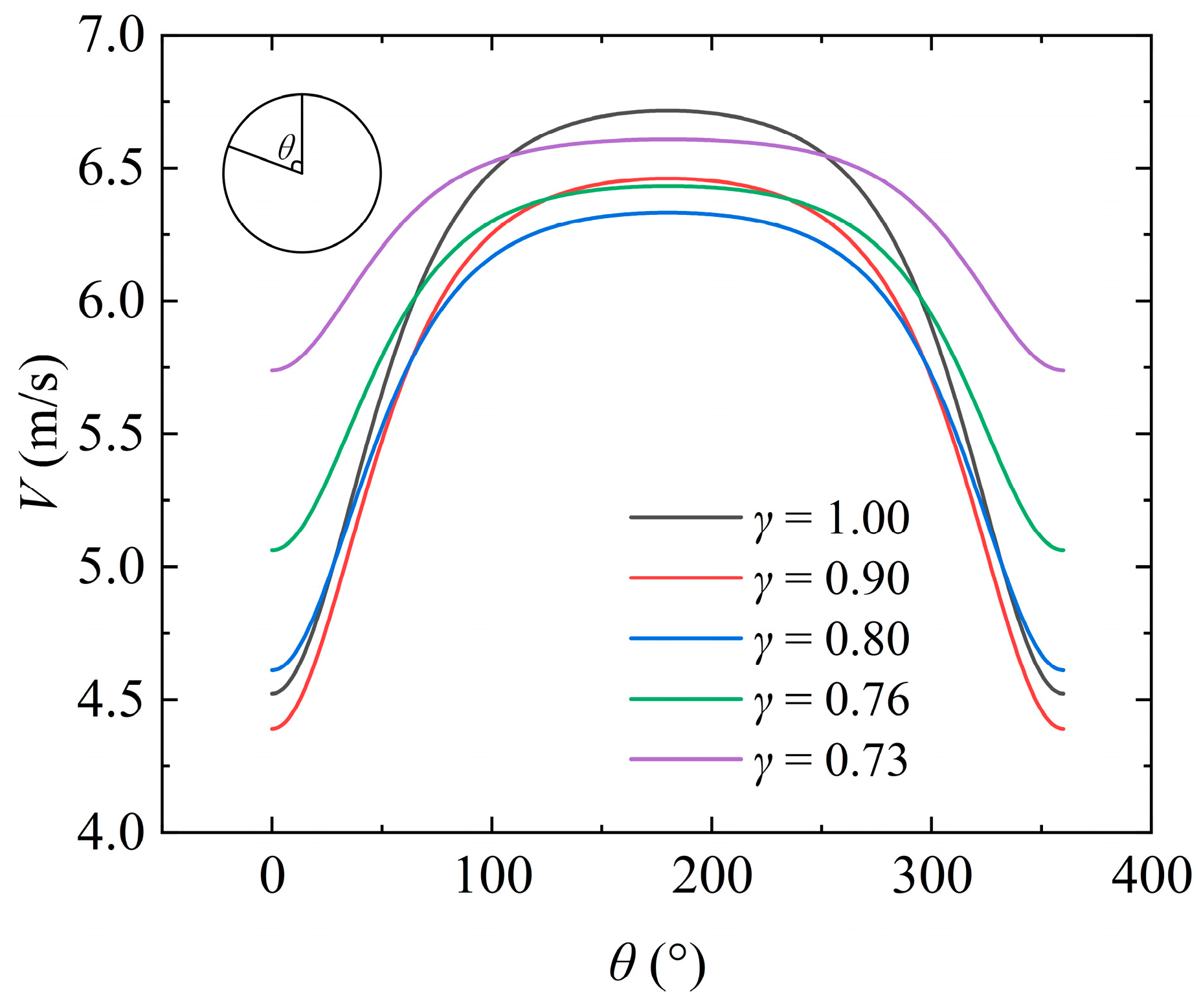
Figure 9 shows the angular distribution of the bubble wall velocity (V) of Bubble 1 for different γ at L* = 2.96. The velocity distributions are calculated using the theoretical model implemented in MATLAB 2022. The results indicate that, for all values of γ, V exhibits a pronounced non-uniform angular distribution. Specifically, within the angular range close to the line connecting the two bubble centroids (0°–45° and 315°–360°), the velocity is relatively low, whereas a nearly uniform high-velocity region is formed in the angular range away from this direction (45°–315°). As γ decreases, the maximum value of V first decreases and then increases, while the overall shape of the velocity-angle curves remains nearly unchanged. This behavior indicates that the interaction between the two bubbles mainly modifies the magnitude of the collapse velocity but does not significantly alter the angular distribution pattern of the velocity field.
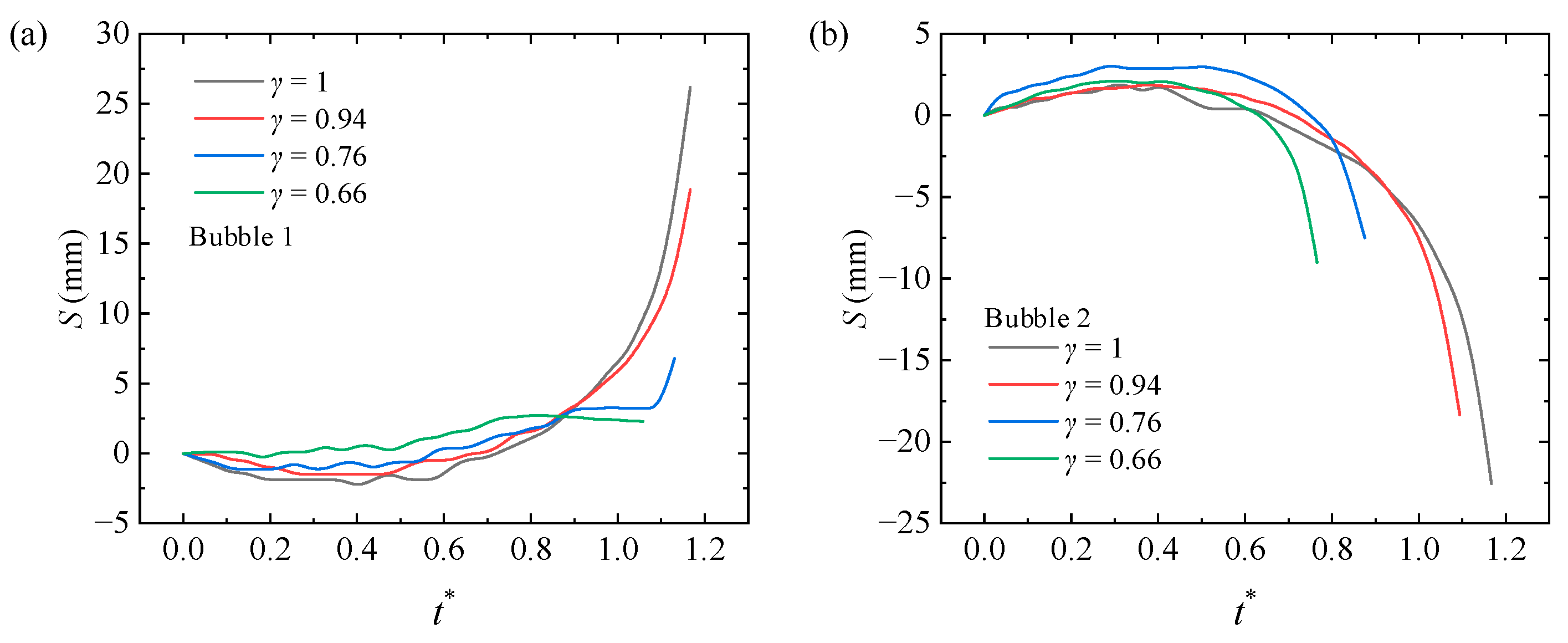
Figure 10 shows the evolution of the centroid displacement (S) of unequal-sized dual cavitation bubbles as a function of t * . The centroid positions were extracted from high-speed images using ImageJ 1.53, and the displacement was calculated based on the tracked bubble centroids. The uncertainty in determining the centroid position is approximately ±1 pixel, corresponding to a displacement error of about ±0.036 mm. During the growth stage, the two bubbles move away from each other, indicating a repulsive interaction between them. In this stage, S decreases with decreasing γ, exhibiting a non-monotonic variation with t * . During the collapse stage, the dual bubbles attract each other, and S decreases with decreasing γ, showing an approximately proportional relationship with t * .
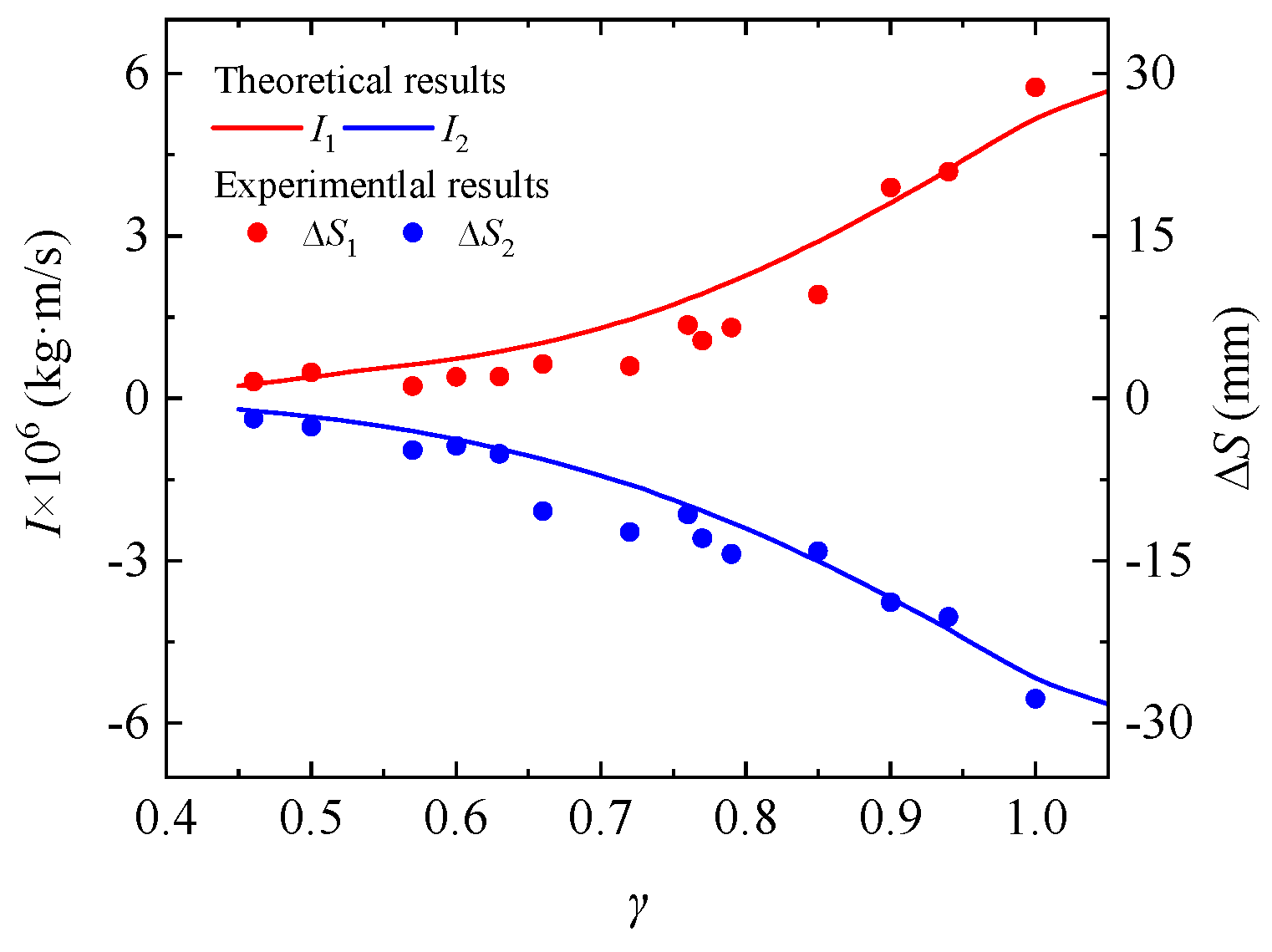
Figure 11 compares the experimental total centroid displacement (ΔS) and the theoretical Kelvin impulse intensity (I) of dual cavitation bubbles as functions of γ. Here, ΔS is defined as the difference between the vertical coordinate of the bubble centroid at the final frame of collapse and that at the instant of maximum bubble radius. The experimental centroid positions were extracted from high-speed images using the same procedure as in Figure 8, with a measurement uncertainty of approximately ±1 pixel (≈ ±0.036 mm). The centroid displacement of the two bubbles increases in magnitude with increasing γ, indicating that the migration of the bubbles becomes progressively stronger as γ. increases. The theoretical Kelvin impulse intensity exhibits a consistent variation trend with the experimental results, suggesting that the Kelvin impulse provides a physical explanation for the experimentally observed centroid migration.

6. Analysis of the Bjerknes Force and Kelvin Impulse

In this section, the Bjerknes force and Kelvin impulse of dual cavitation bubbles are analyzed. The results shown in Figure 11, Figure 12, Figure 13 and Figure 14 are calculated using the theoretical model implemented in MATLAB 2022.
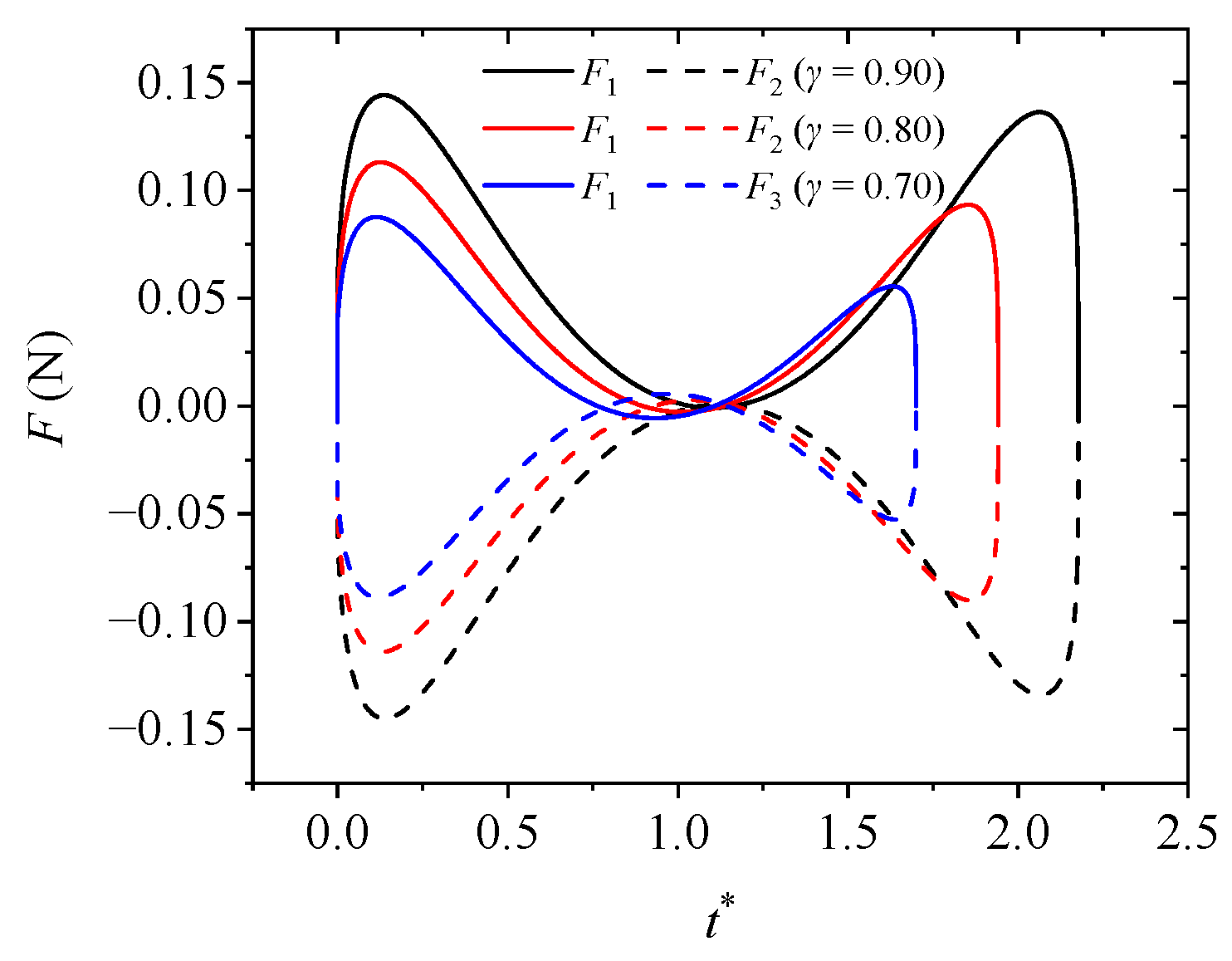
Figure 12 compares the Bjerknes force (F) for dual cavitation bubbles with different radius ratios γ as t * varies. As γ decreases, the growth–collapse cycle shortens, and the peak magnitudes of F in both stages progressively decline. In addition, the force peaks associated with the collapse stage are consistently lower than those during the growth stage, and this disparity becomes more pronounced with decreasing γ. This trend is mainly attributed to the weakened pressure coupling between the two bubbles as γ decreases due to the earlier collapse of the smaller bubble.
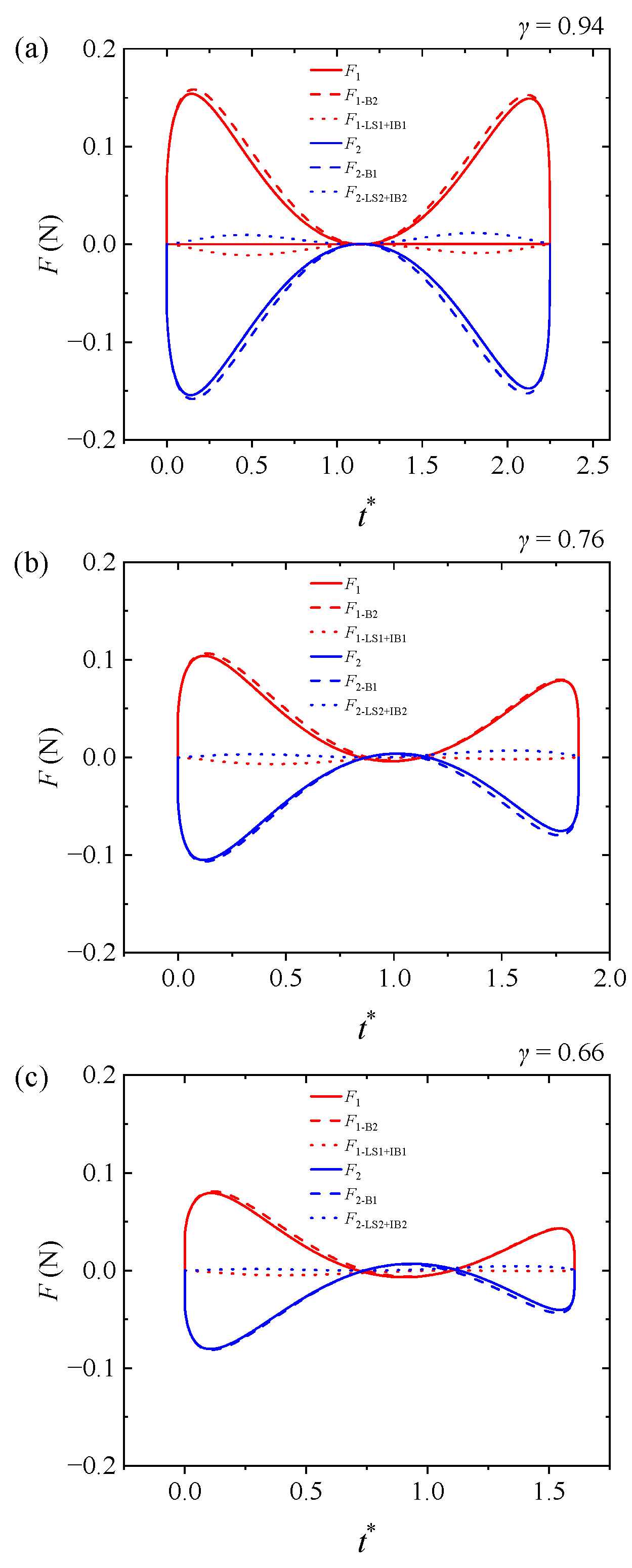
Figure 13 also illustrates the evolution of the Bjerknes force (F) and its individual components with respect to t * for different γ. The force components induced by boundary effects of the bubbles are denoted as F1-LS1+IB1 and F2-LS2+IB2, while the components induced by bubble oscillation effects are represented by F1-B2 and F2-B1. Taking Bubble 1 as an example, as t * increases, the force F1 in subfigures (a–c) exhibits a trend of first increasing and then decreasing, followed by a second increase and decrease, resulting in an overall “M-shaped” temporal evolution. Throughout the entire process, the force component induced by bubble oscillation remains dominant, whereas the component induced by boundary effects remains comparatively weak. This indicates that the Bjerknes force is mainly governed by the pressure interaction generated by bubble oscillations rather than by boundary-induced contributions.
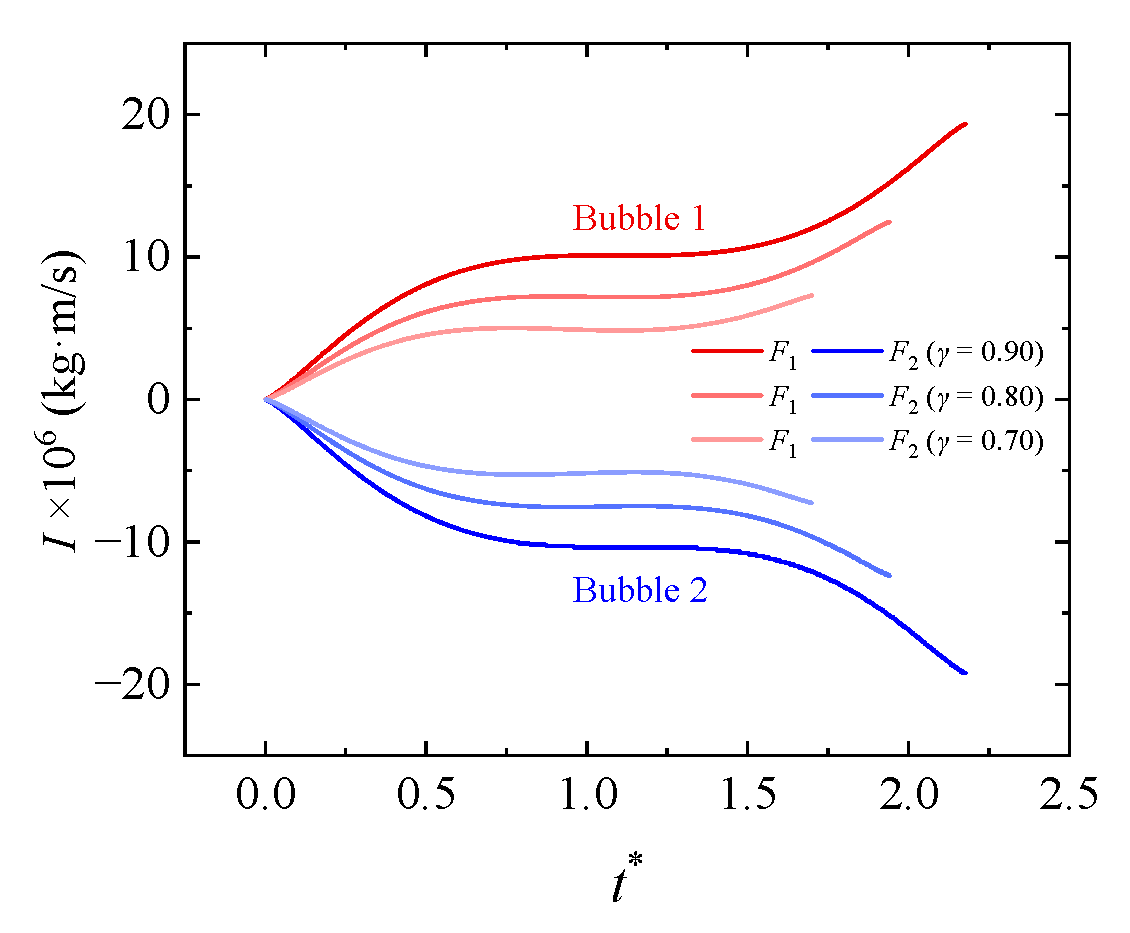
Figure 14 shows the variation in the Kelvin impulse (I) of dual cavitation bubbles with the dimensionless time t * for different radius ratios γ, where the sign of I indicates the direction. As shown in the figure, I is proportional to γ, and the growth rate of I during both the growth stage and the late collapse stage increases with increasing γ. For γ = 0.90, I exhibits a trend of initially increasing with t * , followed by a quasi-steady stage, and then increasing again. For γ = 0.80 and 0.70, I decreases with increasing t * during the middle stage of growth and collapse, and then increases rapidly in the terminal collapse stage. This behavior indicates that the Kelvin impulse is strongly influenced by the asymmetric pressure distribution generated during bubble interaction, and the effect becomes weaker as the radius ratio decreases.
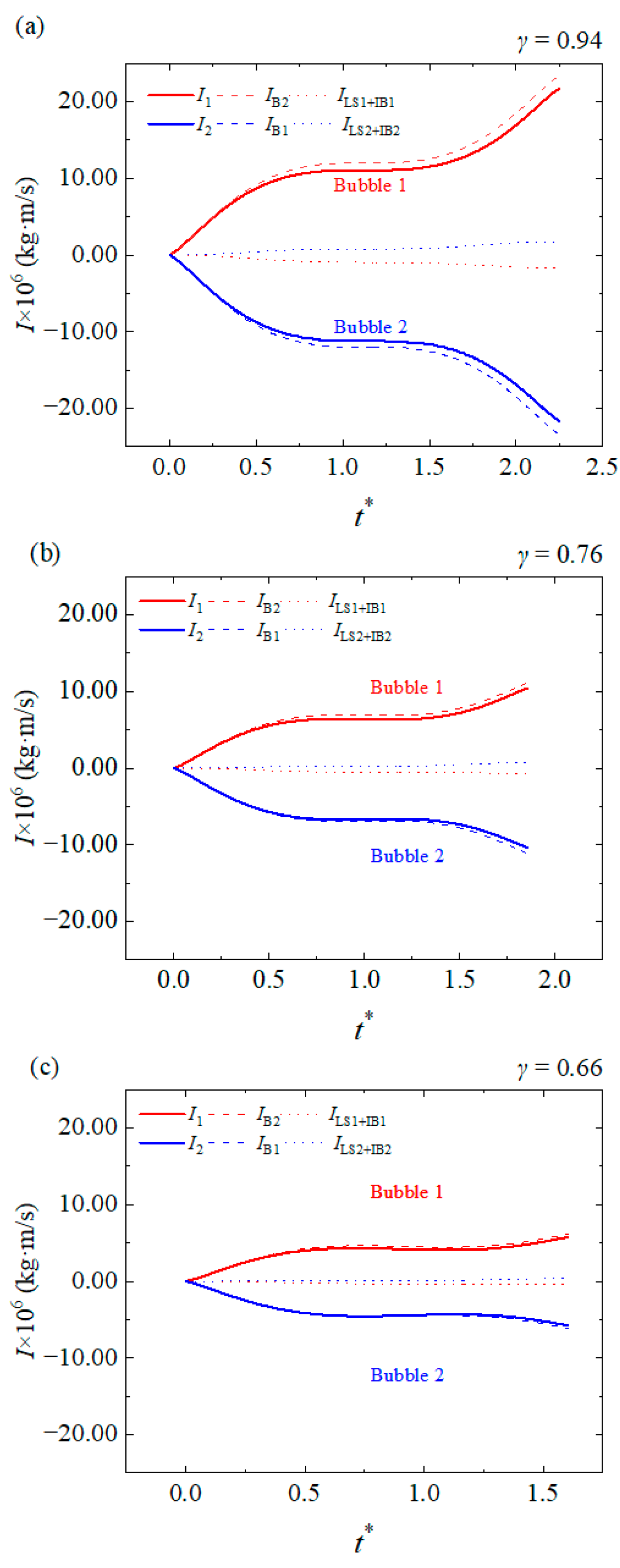
Figure 15 further presents the evolution of the Kelvin impulse (I) and its individual components as functions of t * . Subfigures (a–c) correspond to different values of γ, with L * fixed at 1.99. The impulse components induced by the boundary effects of Bubble 1 (Bubble 2) are denoted as ILS1+IB1 (ILS2+IB2), while those induced by the oscillation effects of Bubble 2 (Bubble 1) are denoted as IB2 (IB1). As shown in the figure, ILS1+IB1 and ILS2+IB2 remain negligible, whereas IB2 and IB1 are significantly larger. Therefore, the Kelvin impulse induced by bubble oscillation effects consistently dominates the overall impulse.

7. Conclusions

Previous studies on interacting cavitation bubbles have primarily focused on symmetric configurations, such as those reported by Mitchell [12], or have relied on theoretical models capable of describing the overall collapse process, such as those developed by Fujikawa [25] and Harkin [26]. However, these approaches are limited in capturing asymmetric collapse behavior, particularly the variations in jet direction and bubble-cloud breakup under strong size disparity. In this study, a combined theoretical–experimental framework was developed to investigate the synchronous collapse of unequal-sized dual cavitation bubbles. By incorporating size disparity and mutual interaction effects, the model enables a detailed analysis of asymmetric bubble evolution. In addition, compressibility effects were introduced into the Rayleigh–Plesset-type equations to improve prediction accuracy, and the model was validated against experimental observations.
Compared with existing studies, the present results extend symmetric interaction models to asymmetric conditions and reveal significant deviations in collapse morphology and jet behavior as the radius ratio decreases. The main conclusions are summarized as follows:
(1)
The jetting behavior of dual cavitation bubbles exhibits a clear transition with increasing radius ratio. As the radius ratio increases, the jet direction of Bubble 1 gradually shifts from being oriented toward Bubble 2 to a non-jetting state.
(2)
The radius ratio has a pronounced influence on the collapse-stage morphological evolution of the dual bubbles. With decreasing radius ratio, the centroid displacement decreases, while the bubble-wall velocity amplitude shows a non-monotonic trend, decreasing initially and then increasing.
(3)
The contributions of the Bjerknes force and Kelvin impulse associated with bubble oscillations consistently dominate the overall dynamics. As the radius ratio decreases, both the Bjerknes force and the Kelvin impulse exhibit a gradual reduction.

Author Contributions

Conceptualization, W.X., X.W. and Y.Z.; methodology, W.X., J.X. and D.H.; software, G.W., J.X. and J.H.; formal analysis, G.W., D.H. and X.Q.; supervision, Y.Z.; writing—original draft, W.X., G.W. and X.Q.; writing—review & editing, X.W., Y.Z., J.X., D.H. and J.H.; project administration, X.W.; funding acquisition, X.W. All authors have read and agreed to the published version of the manuscript.

Funding

This work was financially supported by the National Natural Science Foundation of China (52506046), the Fundamental Research Funds for the Central Universities (2025MS015), the China Postdoctoral Science Foundation under Grant Number 2025M770612, and the Postdoctoral Fellowship Program of CPSF under Grant Number GZC20240466.

Data Availability Statement

The original contributions presented in this study are included in the article. Further inquiries can be directed to the corresponding author.

Conflicts of Interest

Author Xu Qiu is employed by the company China Atomic Energy Publishing & Media Company Limited. The remaining authors declare that the research was conducted in the absence of any commercial or financial relationships that could be construed as a potential conflict of interest.

References

  1. Peng, X.X.; Ji, B.; Cao, Y.; Xu, L.; Zhang, G.; Luo, X.; Long, X. Combined experimental observation and numerical simulation of the cloud cavitation with U-type flow structures on hydrofoils. Int. J. Multiph. Flow 2016, 79, 10–22. [Google Scholar] [CrossRef] [Scilit]
  2. Shi, G.; Wang, S.; Xiao, Y.; Zhang, Y.; Li, Z.; Chen, H. Effect of cavitation on energy conversion characteristics of a multiphase pump. Renew. Energy 2021, 177, 1308–1320. [Google Scholar] [CrossRef] [Scilit]
  3. Chahine, G.L.; Hsiao, C.T.; Raju, R. Scaling of cavitation bubble cloud dynamics on propellers. In Advanced Experimental and Numerical Techniques for Cavitation Erosion Prediction; Springer: Dordrecht, The Netherlands, 2014; pp. 345–372. [Google Scholar]
  4. Nabi, B.G.; Mukhtar, K.; Ansar, S.; Khan, M.S.; Iqbal, M. Application of ultrasound technology for the effective management of waste from fruit and vegetable. Ultrason. Sonochem. 2024, 102, 106744. [Google Scholar] [CrossRef] [Scilit]
  5. Sun, X.; Xia, G.; You, W.; Jia, X.; Manickam, S.; Tao, Y.; Zhao, S.; Yoon, J.Y.; Xuan, X. Effect of the arrangement of cavitation generation unit on the performance of an advanced rotational hydrodynamic cavitation reactor. Ultrason. Sonochem. 2023, 99, 106544. [Google Scholar] [CrossRef] [Scilit]
  6. Taseidifar, M.; Antony, J.; Pashley, R.M. Prevention of cavitation in propellers. Substantia 2020, 4, 109–117. [Google Scholar] [CrossRef] [Scilit]
  7. Yusvika, M.; Prabowo, A.R.; Baek, S.J.; Kim, J.; Park, J. Achievements in observation and prediction of cavitation: Effect and damage on the ship propellers. Procedia Struct. Integr. 2020, 27, 109–116. [Google Scholar] [CrossRef] [Scilit]
  8. Escaler, X.; Egusquiza, E.; Farhat, M.; Avellan, F.; Coussirat, M. Detection of cavitation in hydraulic turbines. Mech. Syst. Signal Process. 2006, 20, 983–1007. [Google Scholar] [CrossRef] [Scilit]
  9. Kumar, P.; Saini, R.P. Study of cavitation in hydro turbines—A review. Renew. Sustain. Energy Rev. 2010, 14, 374–383. [Google Scholar] [CrossRef] [Scilit]
  10. Ayli, E. Cavitation in hydraulic turbines. Int. J. Heat Technol. 2019, 37, 374–383. [Google Scholar] [CrossRef] [Scilit]
  11. Benjamin, T.B.; Ellis, A.T. The collapse of cavitation bubbles and the pressures thereby produced against solid boundaries. Philos. Trans. R. Soc. Lond. Ser. A Math. Phys. Sci. 1966, 260, 221–240. [Google Scholar]
  12. Mitchell, T.M.; Hammitt, F.G. Asymmetric cavitation bubble collapse. J. Fluids Eng. 1973, 95, 29–37. [Google Scholar] [CrossRef] [Scilit]
  13. Ma, S.W.; Shen, J.W.; Ying, J.Z.; Zhang, S.R.; Zhang, Y.N.; Zhang, Y.N. Research on the bubble collapse behaviors near dual cylinders within confined spaces. J. Hydrodyn. 2024, 36, 1021–1032. [Google Scholar] [CrossRef] [Scilit]
  14. Zhang, Y.N.; Ding, Z.L.; Hu, J.R.; Zheng, X.X.; Yu, J.X.; Hu, J.S. Theoretical investigation on the cavitation bubble dynamics near three spherical particles based on Weiss theorem. J. Hydrodyn. 2023, 35, 1119–1130. [Google Scholar] [CrossRef] [Scilit]
  15. Li, S.; Khoo, B.C.; Zhang, A.M.; Wang, S. Bubble–sphere interaction beneath a free surface. Ocean Eng. 2018, 169, 469–483. [Google Scholar]
  16. Han, R.; Zhang, A.M.; Tan, S.; Li, S. Interaction of cavitation bubbles with the interface of two immiscible fluids on multiple time scales. J. Fluid Mech. 2022, 932, A8. [Google Scholar]
  17. Blake, J.R.; Gibson, D.C. Cavitation bubbles near boundaries. Annu. Rev. Fluid Mech. 1987, 19, 99–123. [Google Scholar] [CrossRef]
  18. Blake, J.R.; Taib, B.B.; Doherty, G. Transient cavities near boundaries. Part 1. Rigid boundary. J. Fluid Mech. 1986, 170, 479–497. [Google Scholar] [CrossRef] [Scilit]
  19. Blake, J.R.; Taib, B.B.; Doherty, G. Transient cavities near boundaries. Part 2. Free surface. J. Fluid Mech. 1987, 181, 197–212. [Google Scholar] [CrossRef] [Scilit]
  20. Blake, J.R. The Kelvin impulse: Application to cavitation bubble dynamics. ANZIAM J. 1988, 30, 127–146. [Google Scholar]
  21. Blake, J.R.; Leppinen, D.M.; Wang, Q. Cavitation and bubble dynamics: The Kelvin impulse and its applications. Interface Focus 2015, 5, 20150017. [Google Scholar] [CrossRef] [Scilit]
  22. Supponen, O.; Obreschkow, D.; Tinguely, M.; Kobel, P.; Dorsaz, N.; Farhat, M. Scaling laws for jets of single cavitation bubbles. J. Fluid Mech. 2016, 802, 263–293. [Google Scholar] [CrossRef] [Scilit]
  23. Supponen, O.; Obreschkow, D.; Kobel, P.; Tinguely, M.; Dorsaz, N.; Farhat, M. Shock waves from non-spherical cavitation bubbles. arXiv 2017, arXiv:1708.04049. [Google Scholar] [CrossRef] [Scilit]
  24. Lauer, E.; Hu, X.Y.; Hickel, S.; Adams, N.A. Numerical modelling and investigation of symmetric and asymmetric cavitation bubble dynamics. Comput. Fluids 2012, 69, 1–19. [Google Scholar] [CrossRef] [Scilit]
  25. Fujikawa, S.; Takahira, H. Dynamics of two nonspherical cavitation bubbles in liquids. Fluid Dyn. Res. 1988, 4, 179–194. [Google Scholar] [CrossRef] [Scilit]
  26. Harkin, A.; Giammarese, A.; Barlow, N.S.; Weinstein, S.J. The Rayleigh collapse of two spherical bubbles. arXiv 2021, arXiv:2102.05222. [Google Scholar]
  27. Quinto-Su, P.A.; Ohl, C.D. Interaction between two laser-induced cavitation bubbles in a quasi-two-dimensional geometry. J. Fluid Mech. 2009, 633, 425–435. [Google Scholar] [CrossRef] [Scilit]
  28. Chew, L.W.; Klaseboer, E.; Ohl, S.W.; Khoo, B.C. Interaction of two differently sized oscillating bubbles in a free field. Phys. Rev. E 2011, 84, 066307. [Google Scholar] [CrossRef] [Scilit] [PubMed]
  29. Fong, S.W.; Adhikari, D.; Klaseboer, E.; Khoo, B.C. Interactions of multiple spark-generated bubbles with phase differences. Exp. Fluids 2009, 46, 705–724. [Google Scholar]
  30. Liang, W.; Chen, R.; Zheng, J.; Li, X.; Lu, F. Interaction of two approximately equal-size bubbles produced by sparks in a free field. Phys. Fluids 2021, 33, 067107. [Google Scholar] [CrossRef] [Scilit]
  31. Feng, Z.; Hu, S.; Liang, Q.; Wang, Y.; He, D.; Wang, X.; Zhang, Y. Formation mechanism and evolution properties of double jets induced by cavitation bubble pair. Phys. Fluids 2025, 37, 043304. [Google Scholar] [CrossRef] [Scilit]
  32. He, X.; Peng, H.; Zhang, J.; Yuan, H. Multiple vapor cavitation bubble interactions with a thermal lattice Boltzmann method. Ocean Eng. 2022, 266, 113058. [Google Scholar] [CrossRef] [Scilit]
  33. Han, R.; Zhang, A.; Liu, Y. Numerical investigation on the dynamics of two bubbles. Ocean Eng. 2015, 110, 325–338. [Google Scholar] [CrossRef] [Scilit]
  34. Luo, J.; Niu, Z. Jet and shock wave from collapse of two cavitation bubbles. Sci. Rep. 2019, 9, 1352. [Google Scholar] [CrossRef] [Scilit]
  35. Terasaki, S.; Kiyama, A.; Kang, D.; Tomita, Y.; Sato, K. On the interaction of two cavitation bubbles produced at different times: A jet from the primary bubble. Phys. Fluids 2024, 36, 012115. [Google Scholar] [CrossRef] [Scilit]
  36. Ren, Z.; Han, H.; Zeng, H.; Sun, C.; Tagawa, Y.; Zuo, Z.; Liu, S. Interactions of a collapsing laser-induced cavitation bubble with a hemispherical droplet attached to a rigid boundary. J. Fluid Mech. 2023, 976, A11. [Google Scholar] [CrossRef] [Scilit]
  37. Best, J.P.; Blake, J.R. An estimate of the Kelvin impulse of a transient cavity. J. Fluid Mech. 1994, 261, 75–93. [Google Scholar] [CrossRef] [Scilit]
  38. Mettin, R.; Akhatov, I.; Parlitz, U.; Ohl, C.D.; Lauterborn, W. Bjerknes forces between small cavitation bubbles in a strong acoustic field. Phys. Rev. E 1997, 56, 2924. [Google Scholar] [CrossRef] [Scilit]
  39. Shen, J.; Ying, J.; Liu, W.; Zhang, S.; Zhang, Y.; Zhang, Y. The bubble dynamics near double cylinders within a narrow gap. Symmetry 2024, 16, 841. [Google Scholar] [CrossRef] [Scilit]
Figure 1. Schematic illustration of the physical model and boundary treatment adopted for the dual-bubble system. The dashed black line indicates the center-to-center distance L between the two bubble centroids.
Applsci 16 03154 g001
Figure 2. Temporal evolution of the radii of Bubble 1 and Bubble 2 (γ = 0.94, L* = 2.96).
Applsci 16 03154 g002
Figure 3. Schematic illustration of the laser-induced dual cavitation bubble experimental setup integrated with high-speed imaging.
Applsci 16 03154 g003
Figure 4. High-speed imaging sequence of synchronous collapse of unequal-sized dual cavitation bubbles (γ = 0.94, L* = 2.96).
Applsci 16 03154 g004
Figure 5. High-speed imaging sequence of synchronous collapse of unequal-sized dual cavitation bubbles (γ = 0.76, L* = 2.96).
Applsci 16 03154 g005
Figure 6. High-speed imaging sequence of synchronous collapse of unequal-sized dual cavitation bubbles (γ = 0.66, L* = 2.96).
Applsci 16 03154 g006
Figure 7. Flow velocity distributions of synchronous unequal-sized dual cavitation bubbles ( t * = 0.80, L* = 2.96).
Applsci 16 03154 g007
Figure 8. Evolution of the bubble roundness (C) of dual cavitation bubbles as a function of the dimensionless time ( t * = 0.80, L* = 2.96): (a) Bubble 1; (b) Bubble 2.
Applsci 16 03154 g008
Figure 9. Variation of the bubble 1 wall velocity (V) with the angular position (θ) ( t * = 0.80, L* = 2.96).
Applsci 16 03154 g009
Figure 10. Evolution of the centroid displacement (S) of dual cavitation bubbles as a function of the dimensionless time ( t * ) (L* = 2.96): (a) Bubble 1; (b) Bubble 2.
Applsci 16 03154 g010
Figure 11. Comparison between the experimental total centroid displacement (ΔS) and the theoretical Kelvin impulse intensity (I) of dual cavitation bubbles as functions of the radius ratio γ (t* = 0.80, L* = 2.96).
Applsci 16 03154 g011
Figure 12. Comparison of the Bjerknes force (F) as a function of the dimensionless time ( t * ) for different radius ratios (γ) (L* = 1.99).
Applsci 16 03154 g012
Figure 13. Evolution of the Bjerknes force (F) and its components as a function of the dimensionless time ( t * ) for different radius ratios (γ) (L* =1.99): (a) γ = 0.94; (b) γ = 0.76; (c) γ = 0.66.
Applsci 16 03154 g013
Figure 14. Variation in the Kelvin impulse (I) of dual cavitation bubbles with the dimensionless time ( t * ) for different values of γ (L* = 1.99).
Applsci 16 03154 g014
Figure 15. Evolution of the Kelvin impulse (I) and its components with the dimensionless time ( t * ) for different values of γ (L* = 1.99): (a) γ = 0.94; (b) γ = 0.76; (c) γ = 0.66.
Applsci 16 03154 g015
Table 1. Main components and key parameters of the high-speed imaging system.
Experimental EquipmentModel and ManufacturerKey Parameters
High-speed cameraiXCameras i-SPEED 510, Beijing Juncheng Technology Co., Ltd., Beijing, ChinaFrame rate: 100,000 fps
Nd:YAG LaserPenny-100A-SC, Anshan ZY Laser Technology Co., Ltd., Anshan, ChinaLaser energy: 0–50 mJ
Laser wavelength: 532 nm
Delay generatorStanford Research DG535, Xi’an Antai Test Technology Co., Ltd., Xi’an, ChinaResolution: 5 ps
Beam expanderDaheng Optics GCO-2503, Daheng New Epoch Technology Co., Ltd., Beijing, ChinaExpansion ratio: 5–10×
Focusing lensDaheng Optics GCO-150112, Daheng New Epoch Technology Co., Ltd., Beijing, ChinaFocal length: 50 mm
Light sourceShanghai Jinqiao Jingyi High-Tech Co., Ltd., Shanghai, ChinaMaximum power: 100 W
Wavelength: 850 nm
Optical bandpass filterBP850±30nm, AZURE Photonics Co., Ltd., Fujian, ChinaCenter wavelength: 850 ± 30 nm
Disclaimer/Publisher’s Note: The statements, opinions and data contained in all publications are solely those of the individual author(s) and contributor(s) and not of MDPI and/or the editor(s). MDPI and/or the editor(s) disclaim responsibility for any injury to people or property resulting from any ideas, methods, instructions or products referred to in the content.