1. Introduction
Public transportation systems are widely promoted as a solution to mitigate road congestion, reduce travel times, decrease air pollution, and lower energy consumption, owing to their cost-effectiveness, extensive coverage, large capacity, and minimal environmental impact [
1]. When integrated into comprehensive economic and land-use planning frameworks, these systems can stimulate commercial development, alleviate urban sprawl, and foster community cohesion through transit-oriented development strategies. Modern transportation infrastructure faces multifaceted challenges stemming from rapid urbanization, population growth, and increasing demands for human mobility. The concept of intelligent transportation, which integrates advanced technologies into transportation applications as envisioned by urban planners, aims to optimize transportation networks and enhance service quality [
2]. In the context of Chinese cities, bus systems remain the dominant mode of public transport and serve as essential infrastructure for accessing employment opportunities, educational institutions, retail outlets, healthcare facilities, and social services. However, without regular updates, public transportation services struggle to meet contemporary mobility needs. Empirical evidence indicates that private vehicles and ride-hailing services are increasingly favored over buses due to their greater convenience, comfort, and practicality [
3]. To encourage a shift in transportation modes, reduce reliance on private vehicles, and thereby alleviate air and noise pollution, traffic congestion, accident rates, and inefficient road space utilization, strategic improvements to bus route configurations are essential.
The urgency of optimizing urban bus networks is underscored by recent operational data. In cities like Kunming, despite the expansion of the road network, the public transport modal split has faced pressure from increasing private vehicle ownership, with some districts reporting accessibility disparities where over 15% of the residential population resides beyond the ideal 500 m service radius of any bus stop. Furthermore, inefficient route configurations in certain corridors have resulted in average walking distances exceeding 800 m for transfer passengers, significantly higher than the standard service level. These quantitative disparities highlight the critical need for a more precise, data-driven optimization approach to reconcile the gap between infrastructure supply and actual travel demand.
The operational efficiency of public transportation systems is influenced by several factors, including minimizing travel time, ensuring safety, enhancing route directness, and adhering to vehicle cleanliness standards [
4,
5]. Analytical frameworks indicate that travel time, routing efficiency, and service accessibility can be significantly enhanced through optimized network design. Population grid datasets quantify service coverage density, while Points of Interest (POI) data assess facility accessibility, with route distance being the primary determinant of operational duration. Yuanyuan et al. [
6] proposed an improved ant colony optimization algorithm that optimizes the public transport network in Zhengzhou High-Tech Zone using origin–destination (OD) data. Similarly, ref. [
7] developed a multi-objective approximation model for the simultaneous optimization of bus routes and service frequencies, but their approach mainly focuses on route length, passenger costs, and operator expenses, overlooking the critical interdependence between optimal stop placement and route configuration. However, their methodology did not address other important optimization objectives. To overcome these limitations, we developed a tri-objective optimization framework that simultaneously maximizes population coverage and POI accessibility while minimizing route distance, which was then validated through empirical implementation.
This study focuses on Route 119 within Kunming’s urban transit network, proposing an innovative multi-objective heuristic optimization methodology that integrates multi-source spatial big data for the simultaneous selection of bus stop locations and route planning. Our research approach incorporates road network topology, population grid distributions, and POI datasets to generate candidate stop sets, and then formulates an integer linear programming model with three objective functions: (1) maximization of population coverage, (2) maximization of POI accessibility, and (3) minimization of route distance.
The implementation of an improved heuristic algorithm generated candidate solutions, with non-dominated sorting techniques identifying 19 Pareto-optimal configurations. A comparative analysis demonstrates that the optimized routes lead to significant improvements in population coverage, facility accessibility, and operational efficiency compared to the existing route configuration. The results validate the effectiveness of the proposed methodology in addressing the multi-objective conflicts inherent in urban transit network design, showcasing both theoretical robustness and practical applicability.
2. Related Work
Stop location constitutes a vital component in the design of public transportation networks. Contemporary research typically integrates population grid data, points of interest (POIs), and road network data to address this challenge. Both the placement of candidate stops and the optimization of routes are fundamental aspects of modern urban transport planning, necessitating a careful balance of multiple objectives to improve system efficiency and passenger experience. Traditional single-objective models, constrained by their limited scope, have gradually been replaced by multi-objective optimization, which has become the prevailing approach for enhancing transit systems. Moreover, the widespread availability of big data has empowered various algorithms to deliver innovative solutions for the optimization of bus routes and networks. This paper reviews three categories of relevant studies, supplemented by empirical case studies, and provides a detailed analysis as follows.
2.1. Optimization Methods for Bus Stop Location
Bus stop layout is a core component of public transport network design. Existing studies often integrate population grids, points of interest (POIs), and road network topology to construct location models. For instance, some researchers employ clustering and genetic algorithms to optimize demand-point coverage and construction costs. At the micro level, scholars evaluate pedestrian accessibility around metro stations by constructing indicator systems that encompass safety and comfort.
Recently, stop optimization has evolved towards refinement and dynamism. Ref. [
8] proposed an improved multi-objective method for selecting autonomous taxi stop locations, employing clustering and genetic algorithms to optimize demand-point coverage and construction costs, while enhancing POI data analysis. However, this approach overlooks dynamic passenger flow allocation and user choice behavior. Ref. [
9] examined pedestrian accessibility around metro stations and developed an audit tool-based indicator system encompassing safety and comfort, though their study focused on micro-level factors without incorporating multi-source geographic data. Ref. [
10] utilized multi-objective evolutionary algorithms to optimize stop layouts, significantly reducing travel time and operational costs in empirical tests. Furthermore, ref. [
11] optimized metro feeder stops based on the NSGA-II algorithm to enhance the pedestrian transfer experience for residents. Our research enhances the flexibility of stop location selection by employing a road network grid with candidate points spaced every 100 m. Points located within 200 m of intersections and those on dead-end streets are excluded. This approach ensures that the remaining candidate points cover nearly all feasible bus routes, offering considerable flexibility. By tailoring stop locations to the existing urban network, the method accommodates both current and future transit demands, making it well-suited to dynamic urban environments.
2.2. Algorithm Frameworks for Bus Route Optimization
As bus route optimization is a typical NP-hard problem, heuristic algorithms have become the mainstream tool. Ref. [
12] developed a dynamic control model combining stop-skipping strategies and local path optimization, significantly improving iteration speed through an enhanced GA-SA hybrid algorithm. Additionally, the hybrid Reinforcement Learning and Variable Neighborhood Search algorithm developed by [
13] effectively enhanced the resilience and sustainability of routes in tourist cities.
However, existing literature often treats stop location and route optimization as separate issues. Although some studies optimize network topology using big data or handle flexible routing via gravity models, the coupling between the two remains insufficient. This study aims to develop an integrated pipeline that seamlessly incorporates stop selection with heuristic path searching to address the contradiction between static planning and dynamic demand.
2.3. Multi-Objective Algorithms in Transit Optimization
Multi-objective optimization necessitates balancing competing goals, with non-dominated sorting algorithms (e.g., NSGA-II) serving as key tools. Ref. [
14] integrated a two-stage multi-objective heuristic method based on the Non-dominated Sorting Genetic Algorithm II (NSGA-II) to optimize the total in-vehicle time, waiting time for all passengers, and the overall transfer distance. However, this approach did not incorporate points of interest (POIs) as a factor in the optimization. Ref. [
15] reduced metro energy consumption by 24.4% and improved travel time using NSGA-II, though their approach overlooked demand dynamics. Ref. [
16] optimized rail service routing using cross-entropy methods to minimize waiting times, but did not account for stop location. Ref. [
17] proposed MOEA-OSD to address congestion-prone passenger behavior, though scalability issues persisted. Ref. [
18] focused on population coverage in frequency optimization. Ref. [
19] prioritized public transport lane networks, and [
20] developed MO-AVNS for handling disruption scenarios.
2.4. Accessibility Measurement and Spatial Effects
Multi-source data fusion provides new dimensions for accessibility measurement. Ref. [
21] integrated static land data with dynamic schedules, confirming that increased facility density is a core factor in enhancing accessibility; ref. [
22] achieved dynamic monitoring of transit coverage based on GPS trajectories. Improved accessibility further translates into the capitalization of land value. Ref. [
23] verified the negative elasticity of walking time on rent, while [
24] found a significant positive correlation between stop density and housing prices in the Chinese context. Additionally, ref. [
25] utilized big data to reveal that headway stability is most volatile in suburban and fringe areas during pre-peak periods.
Besides traditional algorithms, recent studies in transit network design heavily focus on accessibility-based and equity-driven route design. For instance, some researchers combine neural networks and reinforcement learning to ensure equal passenger accessibility to points of interest (POIs) [
26], while others develop optimization models to maximize equitable access to social services through smart network modifications [
27]. Recent studies in transit network design also focus on accessibility-based route design [
28], demand-sensitive service planning, and origin–destination (OD)-level performance evaluation. Traditional methods usually focus on route-level metrics. However, evaluating the performance of public transport at the OD-pair level—using extended Data Envelopment Analysis (XDEA) approaches [
29]—gives a much clearer understanding of operational efficiency and actual passenger accessibility. Also, traditional accessibility metrics do not always show the changing spatial imbalances between service facilities and real-time travel demand. Recent studies show that travel demand-driven approaches are very important for finding and fixing these spatial imbalances in urban service facilities, as shown in empirical studies of Harbin [
30]. Incorporating these accessibility, equity, and OD-level evaluations into multi-objective route design ensures that the optimization does not just improve geometric route efficiency but also directly meets the changing and spatially distributed mobility needs of the people.
2.5. Empirical Case Studies
Case studies validate algorithms: ref. [
12] integrated a stop-skipping strategy with local route optimization and proposed a GA-SA hybrid algorithm to reduce both passenger and operational costs. The approach was validated using the case of Route 115 in Ganzhou, Jiangxi Province, demonstrating an 11% improvement in travel speed. In multi-objective optimization studies, refs. [
14,
31] utilized NSGA-II and an alternating objective genetic algorithm, respectively, to optimize the design of airport shuttle bus networks, with the latter achieving a 5–6% improvement in Pareto solutions. Meanwhile, the team led by the authors of [
13] introduced an innovative H-RL-VaNSAS algorithm, which enhanced the resilience index of tourist bus services by 12.24–17.02%. Ref. [
32] proposed a demand-elasticity framework without integrating algorithmic methods. Ref. [
33] introduced a system-level approach based on genetic algorithms to optimize bus transfer times, validating the method using scheduling data from Broward County Transit in Florida, which demonstrated significant reductions in transfer times.
To summarize the related work, bus route optimization involves three core interrelated components: stop location selection, heuristic algorithm-driven route generation, and multi-objective trade-off balancing. Existing stop location studies have integrated multi-source spatial data but often overlook dynamic demand allocation and real-time adaptability. Heuristic algorithms for route optimization have achieved near-optimal solutions for NP-hard problems but frequently decouple stop location from route design or lack multi-objective frameworks. Multi-objective optimization methods represented by non-dominated sorting algorithms have been applied to transit network design, yet many ignore the interdependence between stop placement and route configuration or fail to address demand dynamics. Additionally, most existing studies treat stop location and route optimization as separate tasks, and few have established a tri-objective framework that simultaneously maximizes population coverage, POI accessibility, and minimizes route distance. To fill these gaps, this study integrates population grid data, POI information, and road network topology, develops a constrained heuristic algorithm that unifies stop selection and route generation, and employs non-dominated sorting to identify Pareto-optimal solutions, thereby addressing the multi-objective challenges in urban bus route planning.
3. Study Area and Datasets
This section introduces the geographical context of the empirical analysis and details the data foundation of the study. It first describes the specific conditions of Bus Route 119 in Kunming City, followed by a comprehensive overview of the multi-source spatial datasets utilized for the optimization framework, including road networks, population grids, and points of interest (POIs).
3.1. Study Area
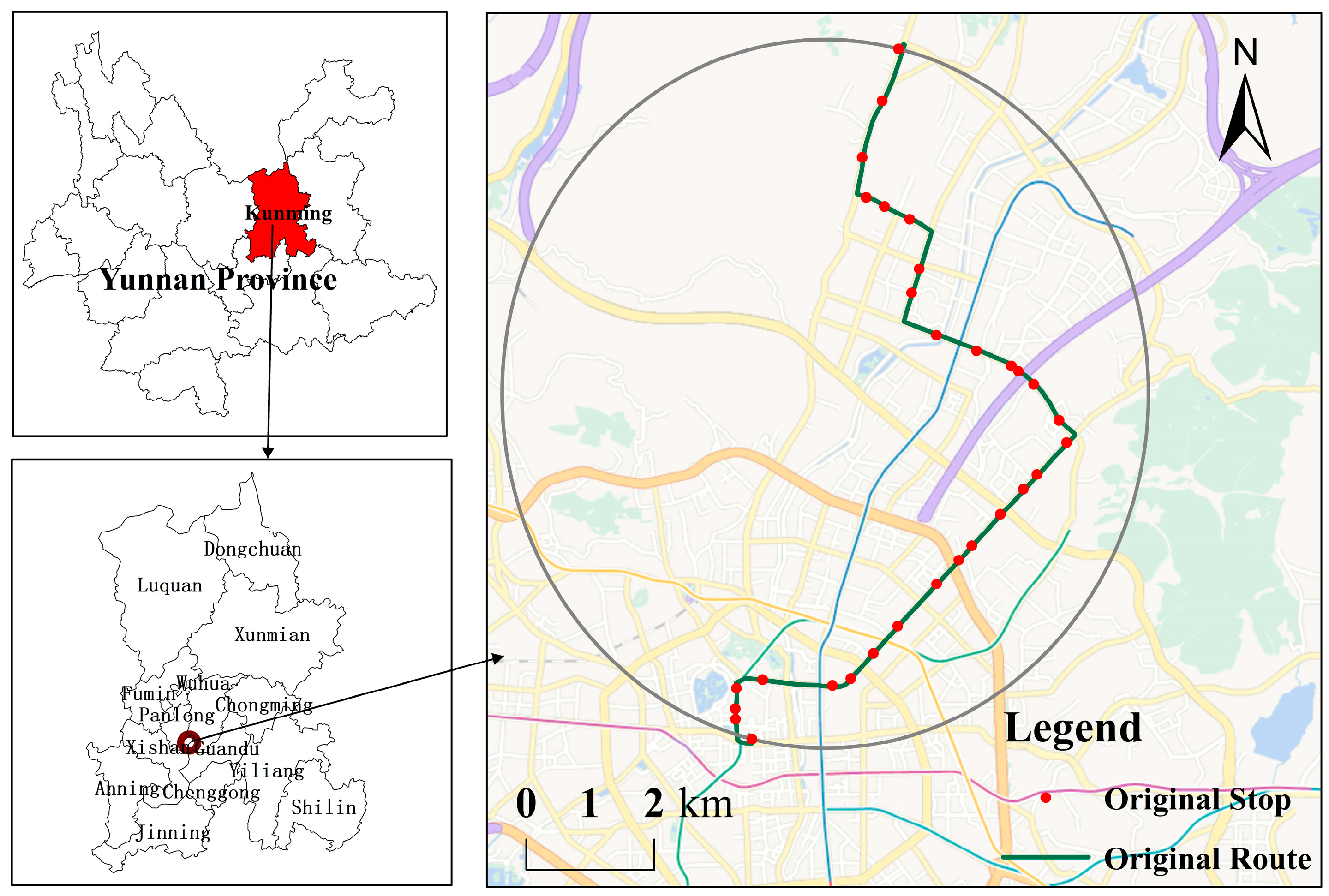
The coverage along Bus Route 119 in Kunming, Yunnan Province, was selected as the study area, focusing on a key north-south corridor that connects the North City Depot with Kunming Railway Station. This route passes through major urban roads, including Beijing Road and Huancheng North Road, and serves as a vital north–south bus corridor in the city’s central urban area.
Bus Route 119 serves residential areas, transportation hubs, and commercial districts. However, due to Kunming’s “single-center, ring-shaped” expansion and the growing scale of newly developed areas, certain communities within the route’s coverage, such as those along the Beijing Road Extension, are left without adequate bus service. Since the route’s establishment, a noticeable imbalance in passenger flow has emerged within its service radius, highlighting the need for route optimization and an improved feeder system. The rapid urban expansion along the Beijing Road Extension has led to newer residential zones being underserved despite being within the nominal service radius of the route. Furthermore, the location of some candidate stops fails to consider nearby public facilities, such as parks, subway stations, and shopping malls. As a result, some passengers must walk long distances after alighting to reach their destinations, causing inconvenience to their daily commutes. Additionally, certain candidate stops are located too close to intersections, making it difficult for drivers to enter and exit the stops. Therefore, the operational efficiency of this route requires improvement, and adjustments to the layout of its stops are necessary. The study area of this paper is shown in
Figure 1.
3.2. Dataset
The data preparation for this study involved road network data, public transit data, population density data, and point-of-interest (POI) data for the study area in Kunming City, Yunnan Province. These datasets were sourced from OpenStreetMap (OSM), Amap (Gaode Map), and the World Pop Global Project, respectively.
The road network data primarily includes road nodes, edges, road classifications, and related attributes, while the public transit data encompasses route lines and stops. The population density data is provided in a gridded format, with population counts for each grid cell (e.g., 100 m × 100 m). The population data from each grid cell serves as the primary basis for determining population coverage at candidate stops.
In this study, all POIs are assigned equal weight to construct a unified facility accessibility evaluation framework. Although facilities with different functions (e.g., commercial, medical, educational) trigger differentiated travel behaviors in reality, the current lack of granular travel intensity survey data for various facility types in Kunming makes it difficult to objectively establish a differentiated weighting system. Consequently, the total POI count is utilized as a comprehensive metric for urban vitality and transit attractiveness. The geographic coordinates and location details enable the evaluation of the rationality of candidate stops and assessments.
Table 1 summarizes the key datasets used in this study, including their sources and attributes.
4. Methodology
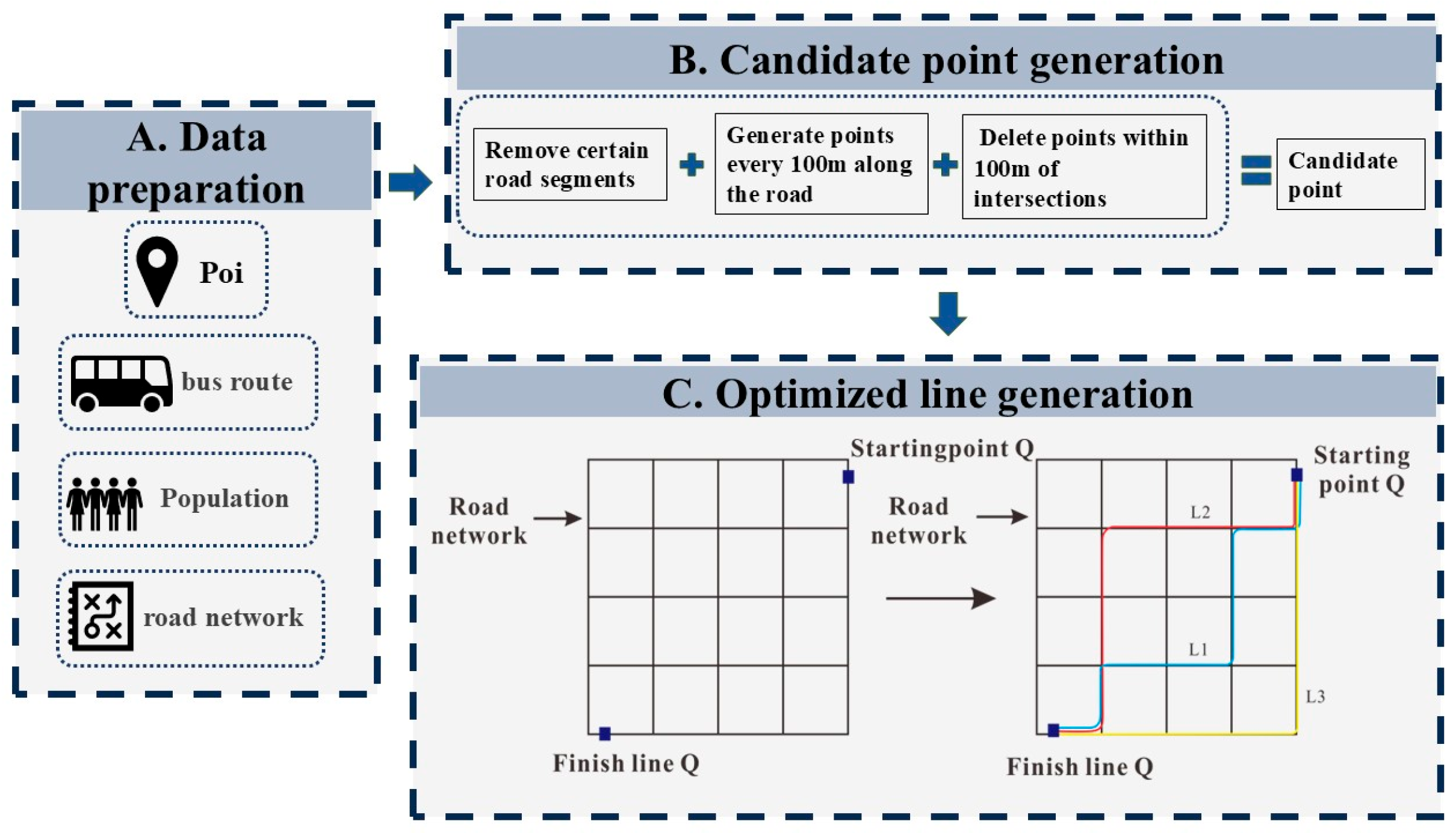
The above is the research framework of this study. Multi-source big data such as population data, road networks, and points of interest (POIs) were acquired. The candidate set of generated routes was then obtained, and the final set of routes was selected based on POI data, population density, and route distance. A mathematical model was developed using integer linear programming to achieve the three objectives. Subsequently, a heuristic algorithm was employed to filter the candidate points and generate the candidate paths. Finally, non-dominated sorting was applied to determine the optimal path based on the three objectives.
This study presents a new approach to optimizing bus stop locations and routes by embedding three key objectives—population coverage, accessibility to points of interest (POIs), and route distance—within a unified multi-objective optimization framework. The main innovation is in how the constraints are structured and how population data and POI metrics are integrated naturally into the optimization process. The specific data sources and descriptions are presented in
Figure 2.
4.1. Candidate Selection
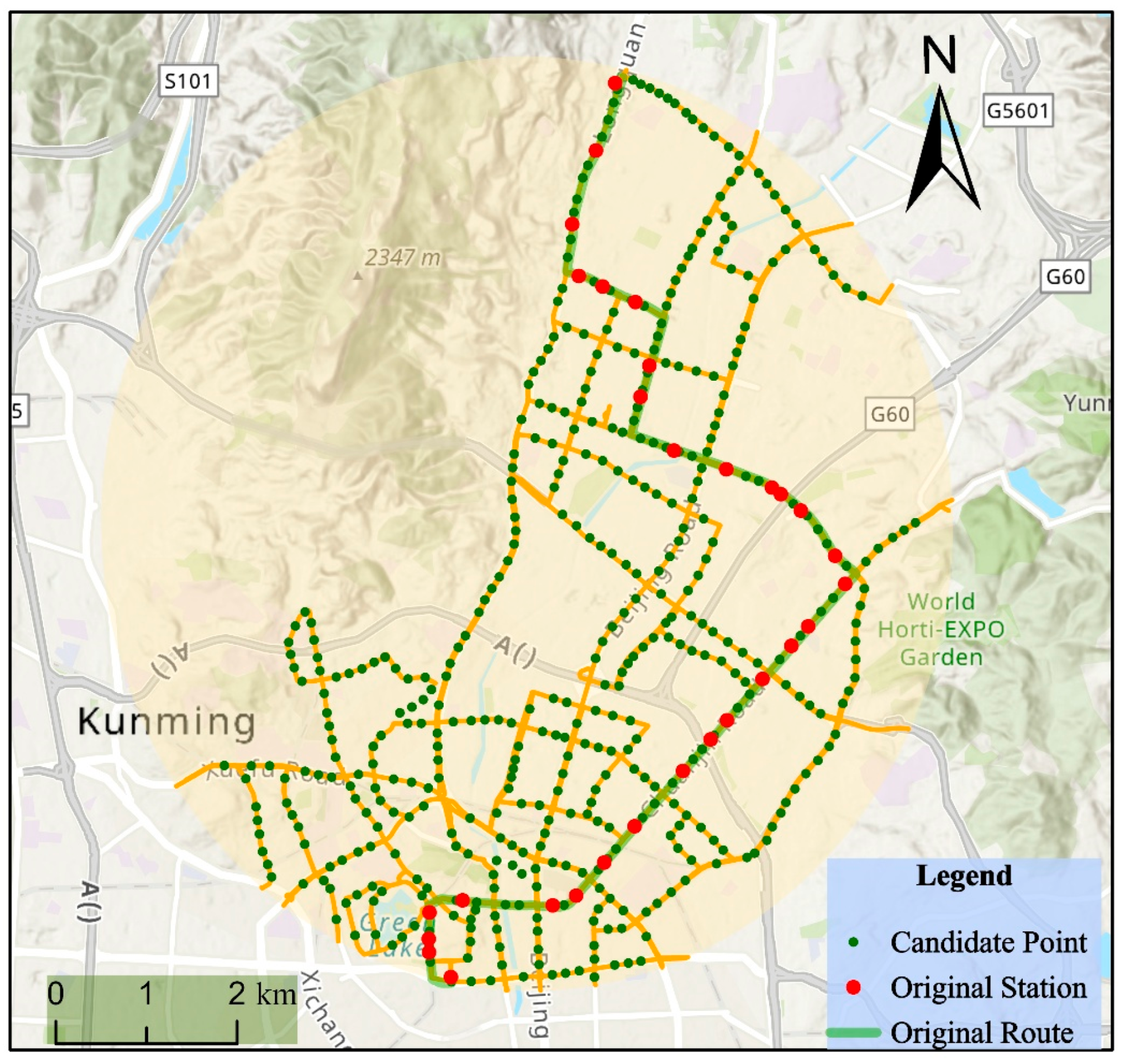
The main bus candidate stops were generated along road lines. To prevent candidate stops from deviating from the optimal route or causing excessive detours between the origin–destination (O-D) pair, we filtered the road networks within the circle, retaining only the urban arterial roads (secondary roads) and removing side roads and walking paths. Candidate stops were systematically deployed at 100 m intervals along the identified roadway corridors to optimize service coverage and operational flexibility. Additionally, to ensure passenger safety when boarding and alighting, intersections and any points within a 200 m radius of intersections were excluded. The resulting distribution of candidate points is shown in the
Figure 3.
4.2. Indicator Aggregation
To select the final stops from the candidate stops and generate optimal routes, a systematic evaluation of the candidate points is required. Research has demonstrated that population density is a critical optimization objective in bus route planning [
34,
35]. Maximizing population coverage ensures that candidate stops serve high-demand areas, thereby enhancing the accessibility of public transport [
32,
36].
The density of points of interest (POIs) serves as a quantifiable proxy for land use intensity and regional development levels [
37]. Consequently, maximizing POI coverage within stop service areas ensures that transit routes pass through the most urbanized and economically vibrant districts. Additionally, in route planning, route distance is also an important metric, as it affects construction costs, operational costs, passenger travel costs, and route efficiency [
19,
38]. The choice of incorporating population density and POI accessibility as key constraints is based on their ability to reflect the demand for public transportation services. This decision ensures that the optimization results not only serve a larger number of residents but also enhance access to important facilities. Additionally, the route length constraint helps to improve operational efficiency by minimizing unnecessary travel distances. These design choices significantly improve the algorithm’s performance, as seen in the improved coverage and reduced route length. The specific methodology involves quantifying the population count and POI count within a 500 m buffer zone of each candidate stop and calculating the total route length after route generation.
Figure 3 illustrates the candidate points, where the orange lines represent the main road network of the study area, and the circular sections denote the research region.
The population data obtained from World Pop is based on 100 m × 100 m raster grids. To calculate the population count within a 500 m radius of candidate stops, a spatial link must be established between the candidate points and the population grids, followed by the aggregation of the total population covered by each stop. The formula is as follows:
: Set of candidate stops in the study area;
: Set of all population grid sets in the study area;
: Total population at candidate location ;
: Population grid cells within a 500 m radius of candidate location .
The formula for calculating the number of stops based on the distance between the population center and bus stop locations is as follows:
: Point of interest (POI) set in the study area;
: Point of interest (POI) count at candidate location ;
: Point of interest (POI) count within a 500 m radius of candidate location .
Although actual road network distance and travel time (accounting for congestion) are undeniably the cornerstones of effective bus route planning, addressing multi-objective heuristic route generation—a typical NP-hard problem—presents severe computational challenges. Calling a dynamic GIS distance matrix or real-time mapping APIs during every iteration of the heuristic search incurs exponential computational overhead, often preventing the algorithm from converging. Therefore, the Euclidean distance in this study is utilized strictly as a ‘proxy cost’ during the heuristic spatial topology search phase, rather than as a micro-level operational metric.
To minimize the geometric deviation caused by Euclidean metrics, this study does not optimize routes in an unconstrained open space. Instead, all candidate stops are strictly anchored to the vector network of actual urban arterial roads, excluding points within a 200 m radius of intersections. Furthermore, a rigorously defined “smoothness constraint” based on vector dot products is introduced in the following algorithm to forcibly prune any “zig-zag” routing anomalies that violate physical road morphologies. Consequently, the final topological routes generated by this model maintain a high degree of macroscopic consistency with the actual road network:
: Euclidean distance between stop and stop (total length of candidate paths);
n: Total number of stops along the route;
: -th stop location;
: Distance between stop and stop .
The first group of formulas calculates the total length of the bus route, which serves as a primary metric for operational efficiency. While minimizing route length generally helps reduce both operational costs and travel time, actual efficiency is inherently influenced by dynamic factors such as signal delays and traffic congestion. Given that this study currently utilizes static spatial big data for macro-level planning, real-time dynamics have not yet been fully integrated. To mitigate this limitation, we have introduced specific geometric constraints—such as excluding candidate points within 200 m of intersections—to indirectly alleviate the impact of signal interference on operations. Future research will further explore the integration of Intelligent Transportation System (ITS) data to formally incorporate congestion risk into the multi-objective optimization framework. The second formula determines the optimal number of stops needed to balance coverage and efficiency. The third formula computes the service area based on population density and points of interest (POIs), helping ensure that routes are designed to meet both demand and operational constraints.
4.3. Generate Bus Routes
In order to select the optimal path from multiple options, heuristic algorithms are required. These paths are generated based on a set of candidate points. During the path generation phase of the study, the creation of a directed graph is a fundamental step. In the generated directed graph, the nodes represent the selected points, and the edges connect the paths between every two selected points. The primary objective of the directed graph creation algorithm is to establish spatial geometric constraints and construct a candidate route-directed graph from the input candidate stops. This graph includes potential candidate stops and their sequencing, serving as the foundation for route generation. The constraints of the heuristic algorithm primarily involve stop spacing, directionality, and the total number of route stops, with the specific constraints outlined as follows:
Moderate Distance Between Consecutive Stops: Adjacent candidate stops should maintain an optimal spacing interval. This study adopts a spacing interval of 300 to 800 m, as recommended by the relevant national standard as a core constraint [
39]. While this standard provides a universal national guideline, this study acknowledges that its specific applicability to Kunming’s walking environment, aging population distribution, and complex road hierarchy requires further refined validation. Experimental analysis indicates that this constraint significantly influences the optimization results: a tighter spacing limit (near 300 m) enhances population coverage but increases route tortuosity and reduces operational speed; conversely, larger spacing (near 800 m) ensures transport efficiency but may increase the walking burden in certain areas, particularly for senior residents. Due to the current lack of granular data on local pedestrian travel characteristics in Kunming, this paper temporarily adheres to the national code as the algorithmic input, which ensures the legal compliance of the preliminary planning scheme while balancing computational convergence. Excessively short spacing increases stop density, which in turn reduces traffic flow speeds and raises accident risks. Conversely, excessively large gaps reduce service coverage, inconvenience residents, and lower ridership. Specifically, the inter-stop distances must satisfy the following conditions:
: The set of nodes to be selected for path generation;
: The selected point m;
: The next point of the selected point m;
: Distance between stop m and stop m + 1.
- 2.
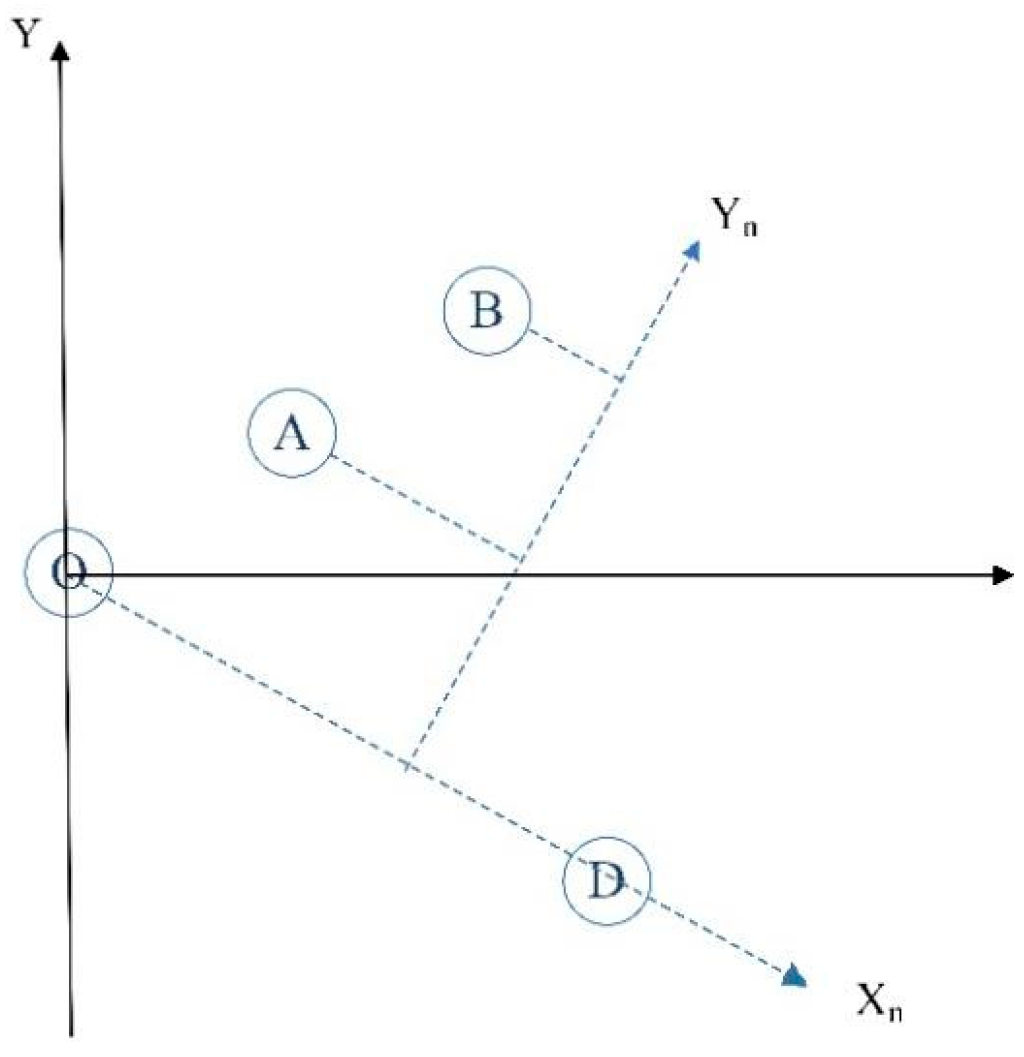
Progression Toward the Destination: To ensure logical and efficient route planning, the bus route must maintain consistent forward progression towards the final destination. To prevent the final path from significantly deviating from the target direction, the route should not include unnecessary detours, sharp turns, or looping segments. To enforce this, the forward direction of the bus route should not deviate excessively. As illustrated in the following diagram, assume a route is planned from O to D. The current stop is O, and the bus route’s forward direction should align with the positive direction of the X
n axis. The next selected stop, A, must satisfy two conditions: (1) it must lie on the same side of the Y
n axis as O, and (2) the straight-line distance from intermediate stop A to stop D must be shorter than the straight-line distance from stop O to stop D. This restriction prevents the bus from making sudden directional changes or backtracking, which would otherwise increase travel time, reduce operational efficiency, and negatively impact passenger experience. Therefore, the schematic diagram is shown below, and the schematic illustration of the algorithm is shown in
Figure 4:
As shown in the schematic diagram, the constrained objective function is
: The length of segment AD, which in this paper refers to the Euclidean distance between station A and station D.
: The length of segment OD, which in this paper refers to the Euclidean distance between station O and station D.
- 3.
Increasing Distance from the Origin: To maintain logical and efficient route progression, the position of each new bus stop must be farther from the starting point (Stop 1) than the previous one along the actual route path. This ensures steady forward movement from the origin, preventing inefficient routing patterns such as circular paths, backtracking, or zigzag segments that would create unnecessary travel distance and time. By enforcing this condition, the route guarantees cumulative progress in one primary direction while still allowing necessary turns within reasonable limits. This principle helps avoid redundant path segments, ensures a better passenger experience by providing clearer trip progression, and aids in preventing unnecessary congestion by minimizing route deviations. Therefore, the distance between stations should satisfy the following conditions, and the schematic illustration of the algorithm is shown in
Figure 5:
: First stop (starting stop) on the bus route;
: Distance between stop m and the first stop (stop O).
- 4.
Decreasing Distance to the Destination: To ensure efficient and passenger-friendly route planning, the location of each new bus stop must be closer to the final destination (D) than the previous stop when measured in straight-line distance. This requirement works in tandem with the forward progression rule (moving away from the origin). This condition ensures steady progress towards the destination while allowing necessary turns and adjustments to serve key locations. The combination of moving away from the origin while progressing towards the destination creates optimal route geometry that meets both operational requirements and passenger needs. Therefore, the distance between stations should satisfy the following conditions, and the schematic illustration of the algorithm is shown in
Figure 6:
: Last stop (destination stop) on the bus route;
: Distance between stop m and the last stop (stop D).
- 5.
Smooth Route with Minimal Detours: The bus route should maintain smooth transitions between stops, avoiding sharp turns or unnecessary detours. This is achieved by selecting each subsequent stop (
) as the nearest feasible location to the current stop (
), while still adhering to directional progression requirements. By minimizing the distance between consecutive stops and prioritizing the closest valid candidate point, the route naturally forms gentler curves. This approach not only improves passenger comfort but also reduces fuel consumption and travel time. The smooth geometry enhances operational efficiency, as drivers can maintain more consistent speeds without frequent braking or acceleration caused by sudden directional changes. Therefore, the route must satisfy the following geometric conditions to maintain optimal smoothness:
: Among all possible (G
m, G
n) pairs, the pair with the minimal distance from G
m to G
n.
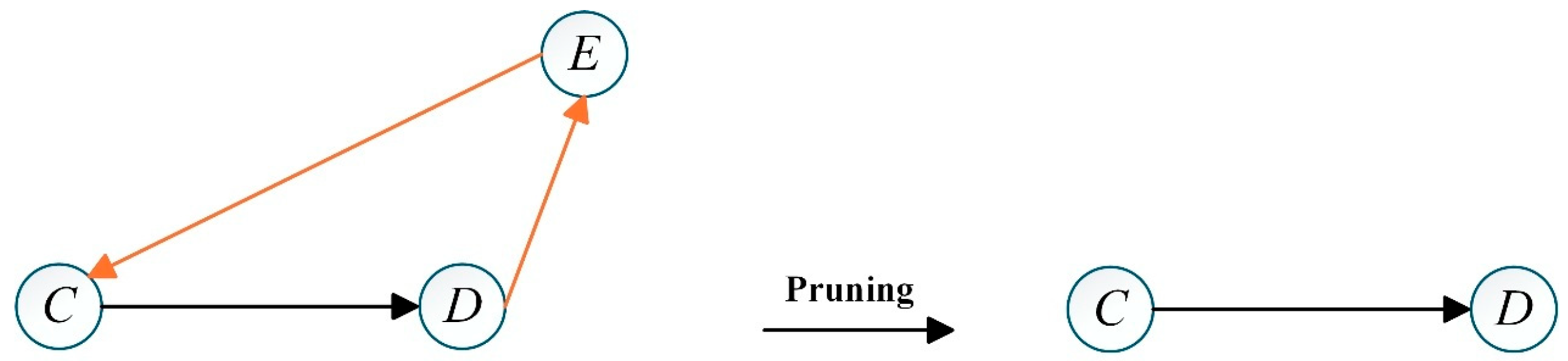
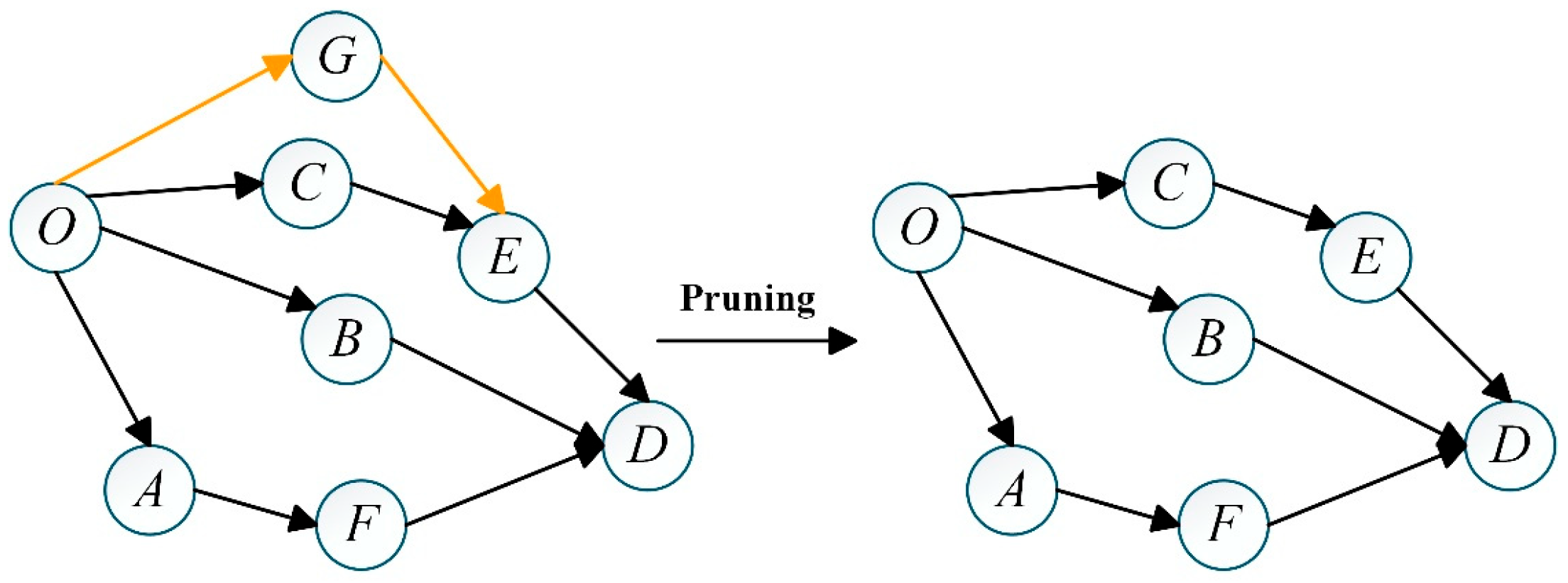
- 6.
As shown in the figure below, the Z-shaped path will be pruned by this constraint. For the path from point O to E, since G is more distant than C, the path segments O-G and G-E are pruned and the schematic illustration of the algorithm is shown in
Figure 7:
By incorporating these constraints and objectives, the generated bus routes will be optimized for efficiency, accessibility, and smoothness, ultimately enhancing the overall performance of the urban bus system.
4.4. Problem Modeling
We developed a multi-objective optimization model using integer linear programming that uniquely integrates population density, POI accessibility, and route distance as key decision-making criteria. By establishing novel constraints on stop placement and route progression, this model directly addresses the multi-dimensional nature of urban transport systems while ensuring operational efficiency and service accessibility.
To address the bus stop location optimization problem identified in the aforementioned research, this study formulates the practical problem as an integer linear programming (ILP) model. The specific mathematical formulations are presented below:
: Total population within the threshold area of the candidate ;
: Total POI count within the threshold area of candidate ;
: Set of candidate points;
: The number of stations that must be selected;
: Decision variable. The binary decision variable associated with selection decisions, where if stop i is selected, and otherwise.
The proposed multi-objective bus stop location and route generation model considers three objective functions, integrating three optimization goals, with the aim of selecting the best combination of stop locations. The objective function maximizes the population coverage within the service area to ensure that the public transportation system serves a larger number of residents. The objective function seeks to maximize the number of public facilities covered, thereby enhancing the comprehensive utility of the stop services. The objective function aims to minimize the distance between stops, thus generating the route with the shortest total distance. A constraint is added to specify the predetermined number of stops. In summary, this model selects the optimal combination of candidate stops to maximize the three objective functions.
In the road network generation phase of the study, a directed graph is first constructed to represent connectivity and potential routes within the urban area. The subsequent step involves generating multiple candidate paths based on three key metrics: points of interest (POI) coverage, population coverage, and route distance. These metrics are critical for assessing the effectiveness and efficiency of the generated bus routes. POI coverage measures the potential travel demand reflected by key locations such as commercial centers, schools, and hospitals; population coverage evaluates the number of residents served by the route; and route distance quantifies the total length of the path, which directly impacts operational costs and travel time.
Non-dominated sorting classifies solutions based on their performance across the three objectives, ensuring that no solution in the resulting Pareto front can be improved in any objective without deteriorating at least one other objective. A solution is considered Pareto-optimal if it is not dominated by any other solution in terms of POI coverage, population coverage, and route distance. This process yields a set of optimal trade-off solutions, known as the Pareto front, where each solution represents a unique equilibrium among the three objectives. By employing this methodology, the optimization process ensures that the final bus routes maximize service quality and efficiency while adhering to the predefined constraints and objectives.
4.5. Algorithm Analysis
The aforementioned multi-objective integer linear programming model belongs to the class of NP-hard problems, and solving large-scale integer linear programming models incurs extremely high computational costs. Therefore, this study designs a heuristic algorithm to efficiently obtain high-quality approximate optimal solutions. The research employs a multi-objective optimization approach to evaluate and select bus routes, utilizing the non-dominated sorting algorithm (NDSA) to extract candidate paths from the Pareto optimal solution set.
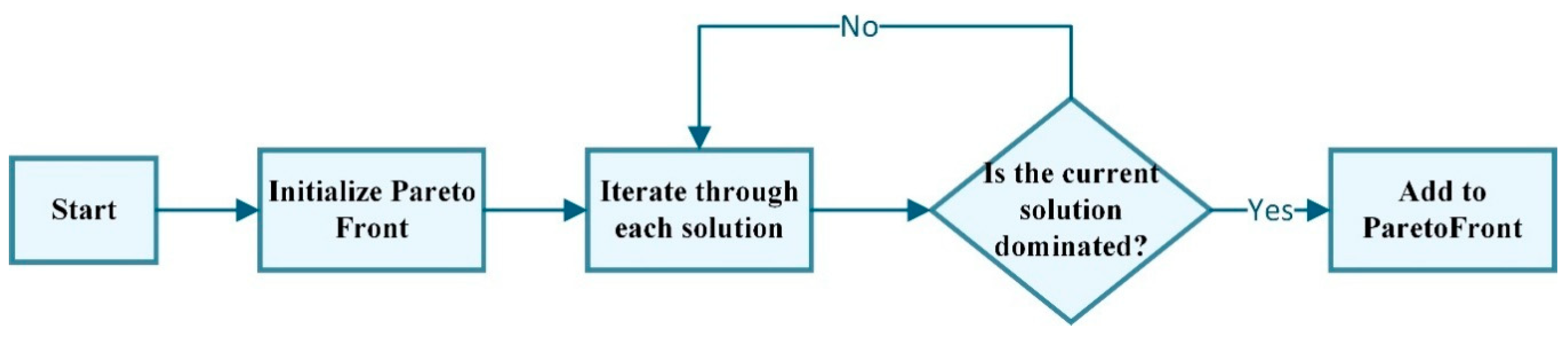
The algorithm first calculates three key metrics for each route: population coverage (Pop), point-of-interest (POI) coverage, and total distance (Dist.). It then filters solutions by determining dominance relationships to identify Pareto front solutions that are not dominated by any other solution across all objectives. The non-dominated sorting algorithm (NDSA) is a fundamental component of multi-objective optimization and is widely used in algorithms such as NSGA-II to classify solutions based on Pareto dominance. In this study, the NDSA is applied to sort candidate solutions into distinct Pareto fronts, where each front consists of solutions that are not dominated by any others with respect to the objectives considered. This process enables the identification and selection of the most efficient solutions from a set of competing alternatives, ensuring that no single objective is overlooked during optimization. The algorithm operates by comparing solutions based on their objective values. A solution that is not dominated by any other is assigned to the first Pareto front. Subsequent fronts are populated with solutions that are increasingly dominated by those in earlier fronts, continuing until all solutions are assigned.
This approach ensures that the final set of solutions reflects a balanced trade-off across all objectives—an essential consideration in problems such as bus route optimization, where multiple competing factors must be addressed simultaneously. Below is a simplified algorithm flowchart and a section of the algorithm code, and the flowchart of the algorithm is shown in
Figure 8.
The pseudocode for the implementation of the heuristic algorithm and the non-dominated sorting algorithm is provided in
Appendix A and
Appendix B, respectively.
5. Results
This section presents the empirical outcomes of the proposed multi-objective optimization framework. It begins by analyzing the spatial distribution and clustering characteristics of the generated candidate stop locations. Subsequently, it evaluates the algorithm’s effectiveness by comparing the generated Pareto-optimal routes against the original route configuration.
5.1. Spatial Distribution Characteristics of Candidate Stop Locations
The generation of candidate points focuses on two primary objectives: points of interest (POIs) and population density. Therefore, data processing and analysis were conducted for both target datasets. Based on the processing of POI data and population raster data, hotspot maps and spatial autocorrelation analysis diagrams were generated. The following presents the processing results and analysis:
5.1.1. Spatial Distribution
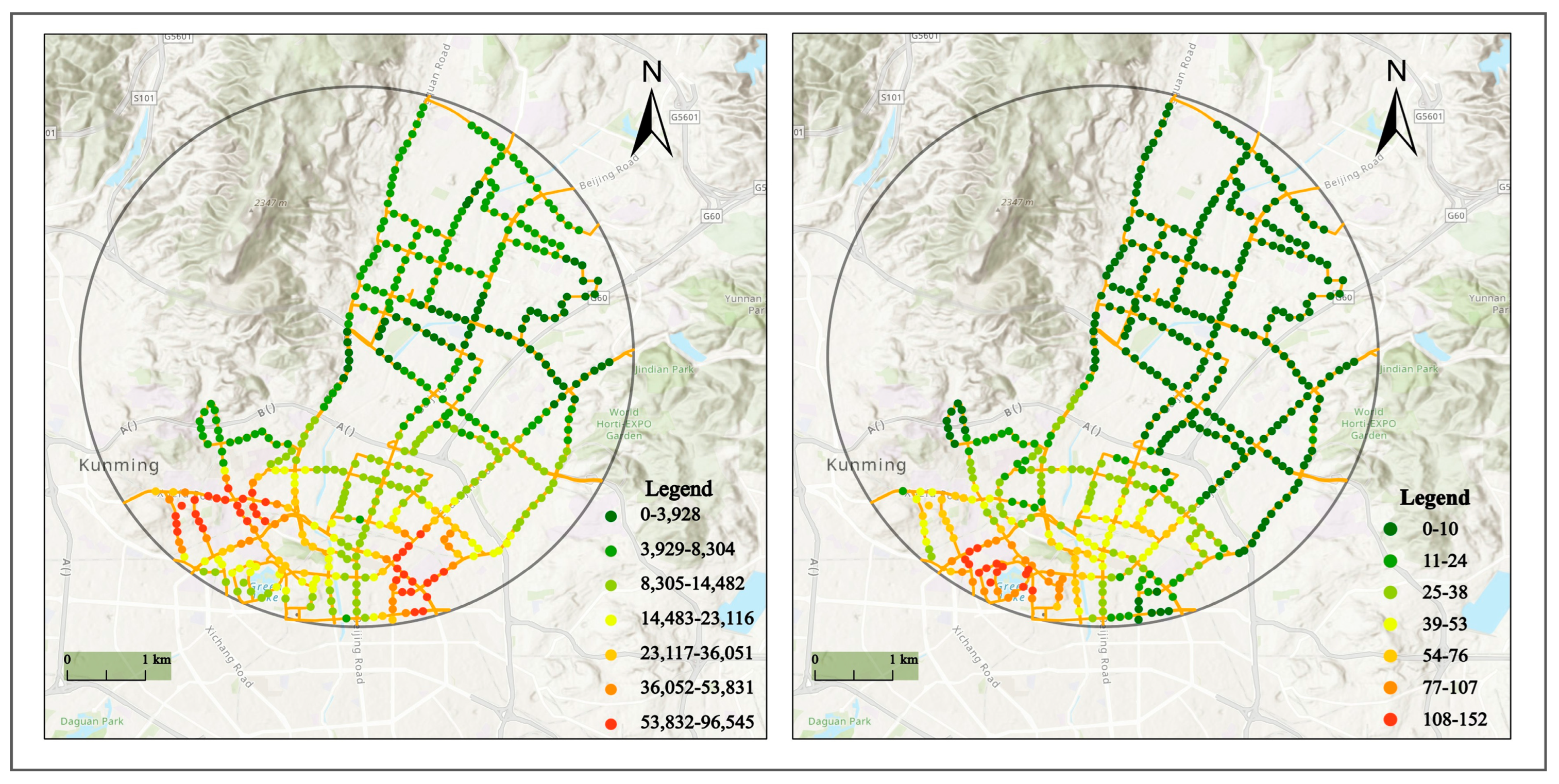
To understand the demand layout, this subsection visualizes the spatial distribution of points of interest (POIs) and population grids within the 500 m buffer zones of the candidate stops. The detailed choropleth maps are presented in
Figure 9 below, the circular area represents the study area, while the orange lines indicate the major urban arterial roads.
The left and right images present choropleth maps depicting the distribution of POI density and population grid data within 500 m buffer zones of candidate points, respectively. The spatial gradient of POI distribution reveals distinct core–periphery characteristics, with pronounced concentration along central urban corridors such as Dongfeng East Road and Renmin West Road. In these areas, the choropleth values for POI density within 500 m buffers reach the highest range (53,832–96,544). A typical example is the intersection of Beijing Road and Dongfeng East Road, which forms a distinct POI aggregation core characterized by dense concentrations of various commercial formats, including shopping malls, Class A office towers, and mixed-use developments that integrate residential, workplace, and leisure functions.
In contrast, the northern study area (e.g., surrounding the Botanical Garden and Golden Temple Park) exhibits significantly lower POI density, with choropleth values falling into the lowest range (448–8304). These zones are characterized by ecological conservation functions and low-density residential development, resulting in limited POI variety and quantity. This core-to-periphery spatial gradient of POI distribution demonstrates the imbalanced urban functional development in Kunming and the directional diffusion pattern of urban vitality.
The population grid data within the study area exhibits strong spatial correlation with POI distribution in urban core zones. The highest population density areas (with choropleth values of 53,832–96,544 within 500 m buffers) overlap with POI aggregation cores (e.g., Dongfeng East Road and Renmin West Road corridors), forming high-density population clusters. In these core areas, high-density residential communities coexist with large commercial centers, generating substantial commuting, shopping, and social trips that constitute the demand base for public transportation systems.
In contrast, the northern peripheral areas demonstrate different spatial relationships between POIs and population grids. These zones are characterized by ecologically dominated POI distributions and low-density residential development patterns in population grids, collectively shaping the ‘basic accessibility demand’ of transportation systems.
5.1.2. Spatial Autocorrelation
Building upon the spatial distribution analysis, it is essential to explore the spatial clustering patterns of the candidate stops.
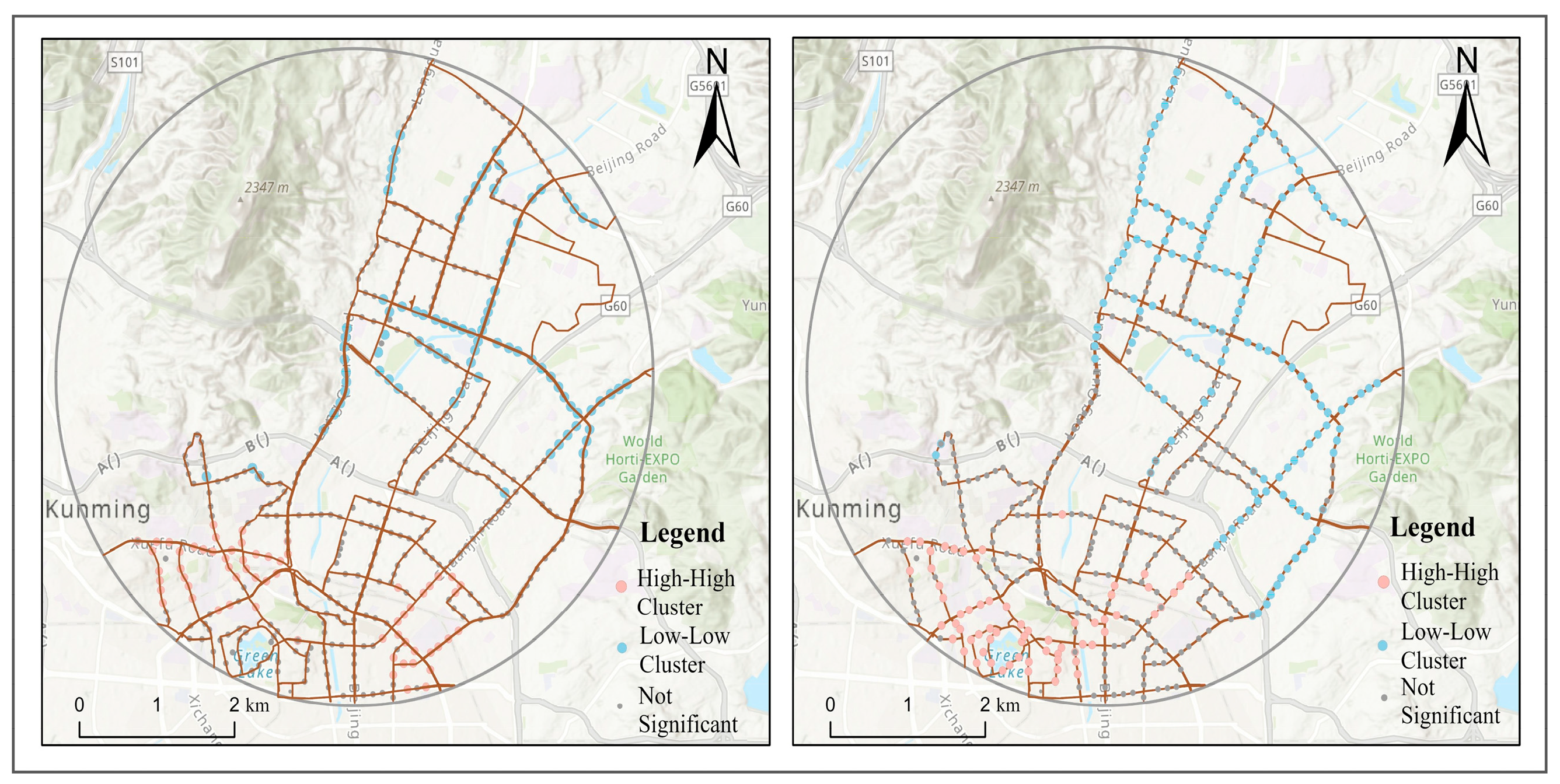
Figure 10 presents the Local Moran’s I analysis maps for both POI and population data, highlighting the high-value and low-value aggregation zones, the circular area represents the study area, while the brown lines indicate the major urban arterial roads.
The left and right figures respectively display Local Moran’s I analysis maps of POI data and population grid data within the study area. In the POI grid LISA analysis, High–High clusters (red indicators) are predominantly concentrated along Dongfeng East Road and Renmin West Road (e.g., the intersection of Beijing Road and Dongfeng East Road). These areas demonstrate both high POI concentration and significant spatial autocorrelation with surrounding areas, representing core urban zones for commercial, office, and entertainment functions (exemplified by areas around Plaza 66 and Shuncheng Shopping Mall, which aggregate numerous POIs, including shopping centers, office buildings, and restaurants). Low–Low clusters (light blue indicators) are primarily distributed in the northern botanical garden sector (e.g., surrounding Golden Temple Park and Kunming Botanical Garden, with geographic coordinates corresponding to urban ecological function zones). These areas exhibit low POI density with homogeneous spatial association characteristics, dominated by ecological conservation and low-density recreational functions.
The population grid LISA analysis reveals distinct spatial association patterns (as shown in the population grid LISA map). High–High clusters exhibit similar spatial concentration patterns to points of interest (POIs), being predominantly located along Dongfeng East Road and Renmin West Road. These areas demonstrate both high population density and significant positive spatial autocorrelation with adjacent zones, representing urban commercial-office and high-density residential mixed-use districts. A typical example is the area surrounding Plaza 66, which integrates office buildings, shopping malls, and residential complexes within a compact urban form. Low-Low clusters (light blue indicators) are distributed in the northern botanical garden sector (e.g., surrounding Golden Temple Park), characterized by low population density and homogeneous spatial association with neighboring areas. These zones are primarily designated for ecological conservation and low-density residential functions.
5.1.3. Distribution Characteristics Summary
Within the urban core corridors (e.g., Dongfeng East Road, Renmin Road, and Beijing Road), a profound spatial synergy and isomorphic characteristic exist between POI distribution and population grids. The intrinsic mechanism behind this high degree of overlap lies in Kunming’s typical “single-center” urban structure, which results in the spatial interlocking of high-intensity commercial development (POIs) and high-density residential zones (population). This positive correlation between variables provides the physical foundation for multi-objective optimization: as the heuristic algorithm guides routes through urban vitality centers, population coverage and POI accessibility tend to exhibit synchronous growth rather than a competitive trade-off.
In contrast, the northern study area demonstrates different spatial relationships between POIs and population distribution. This sector is mainly composed of ecological zones (such as parks and botanical gardens) and low-density residential neighborhoods, where both POIs and population exhibit sparse distribution patterns. Although local residents’ travel demand is less intense compared to the urban core, basic transportation services remain crucial for their mobility needs.
5.2. Algorithm Effectiveness and Comparative Analysis
To rigorously assess the performance of the proposed heuristic and non-dominated sorting algorithms, this subsection conducts a comprehensive evaluation. It first categorizes and visualizes the optimized route outputs through a data-driven approach and then quantitatively validates these improvements by comparing them directly with the original metrics of Kunming’s Bus Route 119.
5.2.1. Data-Driven Analysis of Algorithm Outputs
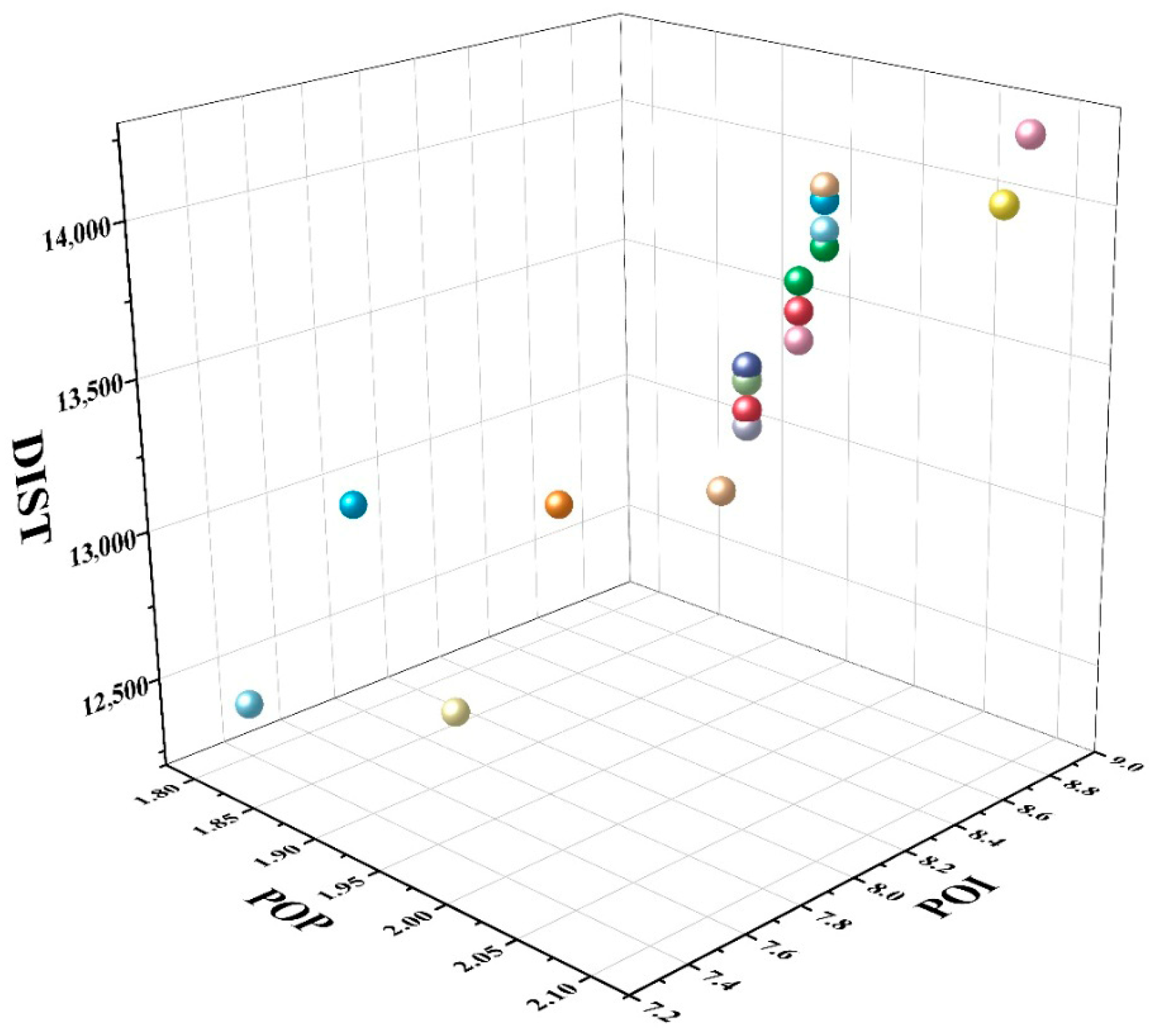
This study selected Bus Route 119 in Kunming City for experimental validation and analysis. Based on the actual conditions of the route, we determined the locations of the origin and terminal candidate stops and established constraint conditions to screen candidate bus stop locations using an improved heuristic algorithm. Through in-depth spatial analysis of these 100 feasible solutions for Kunming’s Bus Route 119, we observed that while all route alternatives maintained fundamental consistency with the north-south arterial corridor orientation, the algorithm produced variations in segment selections within northern urban areas, particularly along Hongyun Road, Xiaokang Avenue, and Hongxing Road. The three-dimensional scatter plot below visualizes the POI coverage, population service, and route distance metrics for these 19 optimal routes.
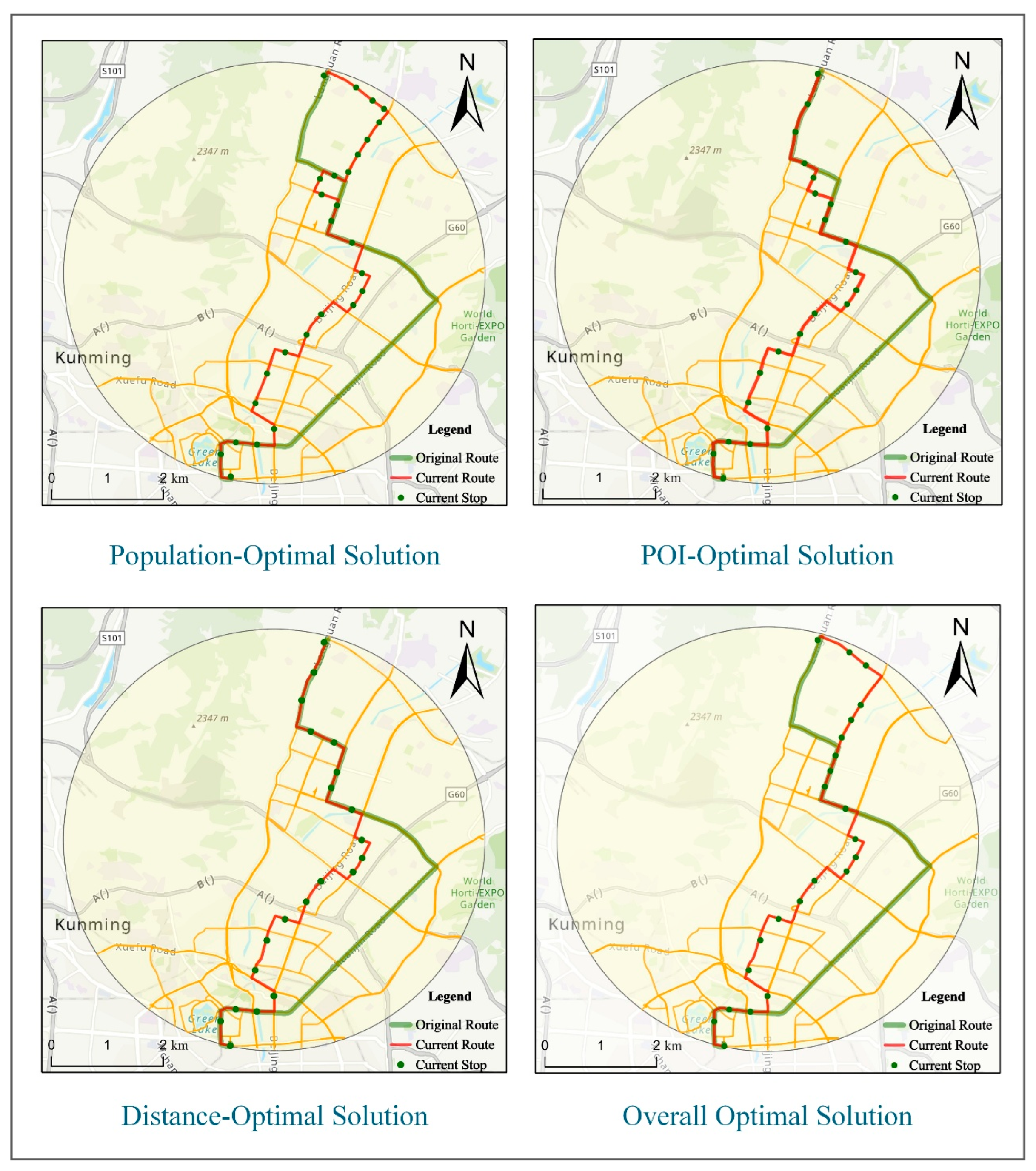
For a systematic summary and analysis, we performed cluster analysis on the experimental results and identified four distinct categories of route alignments based on their cluster centroids. The subsequent visualization of these route alignment patterns is presented in the following four figures.
Visualization of the four routes reveals a complete alignment with the original trajectory of Route 119 along Huashan West Road and Yuantong Street. However, the optimized routes implement directional adjustments at the Beijing Road intersection. The key findings of the analysis are as follows:
The population-optimal route solution results in a longer total distance with moderate curvature, but it significantly enhances population coverage by adding stops at key high-density areas, including the Hong Yun Cigarette Factory and the Tianjiao Beilu residential area, both of which are among Kunming’s most densely populated zones. This routing strategy makes use of the eastern section of Hongxing Road before returning to the northern portion of Xiaokang Avenue, passing by Yunnan Agricultural University. In comparison to other alternatives that divert onto Longquan Road, the northern section of Xiaokang Avenue serves denser residential communities and covers a larger population, while also accommodating student populations effectively. As a result, this configuration stands out as the demographic optimal solution.
The POI-optimal route solution results in a moderate increase in total distance, incorporating a turn onto Hongxing Road before proceeding along Hongyuan Road and then redirecting onto Longquan Road. This route passes through Tianjiao Beilu and covers important facilities along Longquan Road, including Shizhuan Affiliated Primary School and Changchang Mountain Park, one of northern Kunming’s most popular parks. The chosen path not only improves accessibility for student populations using public transportation but also better serves park visitors. Thus, this configuration is established as the facility-optimal solution.
The distance-optimal route incorporates a detour via Hongxing Road before merging onto Longquan Road. Compared to the previous solutions, it has minimal path curvature, reducing total distance while still covering key areas like the Hong Yun Cigarette Factory, Tianjiao Beilu residential area, and Changchang Mountain Park. However, this route sacrifices coverage of the high-density communities along the northern segment of Xiaokang Avenue.
Following a thorough evaluation, we propose an integrated optimal solution that reduces detours while maintaining coverage of high-density residential areas, food streets, and commercial hubs, including services to Yunnan Agricultural University. This configuration sacrifices coverage of residential areas along Hongxing Road and Hongyuan Road in favor of a more compact route, thereby improving operational efficiency, The 3D scatter plot of the results is shown in
Figure 11 below. And the optimized path results diagram (
Figure 12) illustrates the final route configuration in the main urban area of Kunming, The circular area in the figure represents the study area, while the orange lines indicate the major urban arterial roads.
5.2.2. Validation of Algorithm Effectiveness
To further analyze the algorithm’s outcomes, we compared the three objective values of the 19 optimized non-dominated solutions with the original data from Kunming City’s Bus Route 119 and summarized the results in
Table 2 below.
To ensure a fair comparison, this study established a highly equivalent evaluation framework. All optimized solutions were generated under the same geographical constraints as the original route, including identical origin–destination (O-D) locations and the same service area boundaries. While the number of optimized stops may slightly deviate from the original count due to the algorithm’s dynamic trade-off between coverage and efficiency, the overall scale remains within a very small and reasonable range of fluctuation. This equivalence design aims to eliminate external environmental interference, thereby purely assessing the efficacy of the heuristic algorithm in optimizing spatial layout within the same service boundaries. The original route primarily follows Chuanjin Road, while our optimized solutions exhibit a nearly identical alignment along the main corridor between the northern transit hub and southern commercial district, diverging only at the Beijing Road–Chuanjin Road junction. This deviation arises from the optimization logic of the heuristic algorithm, which favors the more direct route along Beijing Road to reduce commute distances, achieving a 10% shorter inter-station linear distance compared to the Chuanjin Road alternative. In contrast, the original layout took a more circuitous route to maintain coverage of secondary residential clusters and educational facilities along Chuanjin Road. The population-optimal solution (Sol#90) demonstrates a 10.53% greater population coverage compared to the original route. The facility-optimal solution (Sol#93) improves POI accessibility by 15.79%. Meanwhile, the distance-optimal solution (Sol#51) reduces the total route length by 18.26%. Tabular data comparisons decisively confirm the effectiveness of the algorithm in addressing these distinct optimization objectives.
A comparative analysis with the original route reveals significant improvements across multiple dimensions. In terms of route alignment, the original configuration along Chuanjin Road–Huancheng North Road–Golden Avenue exhibited circuitous routing issues. In contrast, the optimized solutions implement directional adjustments at the Beijing Road intersection, effectively eliminating redundant path segments and reducing the total route length through algorithmic optimization. Regarding demographic and facility coverage, the optimized routes provide superior service to high-density residential areas (e.g., Jinxing Community and Jinshi Community) while incorporating additional commercial facilities (such as Tongde Kunming Plaza and Xindu Longcheng) and public amenities (including Shizhuan Affiliated Primary School and Changchongshan Ecological Park). These improvements collectively enhance both population coverage and public facility accessibility.
Tabular comparisons indicate that all 19 non-dominated solution sets outperform the original route across three key metrics: population coverage, POI service accessibility, and operational efficiency. These findings suggest that the proposed method achieves better performance than existing approaches in terms of route efficiency and coverage. The numerical values and performance metrics presented in
Table 2 support these conclusions, showing notable improvements in both efficiency and coverage compared to previous approaches. Together, these results provide empirical validation of the algorithm’s effectiveness in multi-objective route optimization.
Analysis reveals that the internal logic of the algorithm’s performance gains stems from its deep integration of road network topological constraints with the spatial clustering of demand. The Pareto solution set identified via non-dominated sorting essentially uncovers service strategies with varying priorities: distance-optimal schemes improve efficiency by eliminating redundant detours, while population/POI-optimal solutions leverage the positive spatial correlation between variables to achieve a stepwise leap in service quality by fine-tuning local routing towards more vibrant street segments.
6. Discussion
This study introduces a novel approach to bus stop location and route optimization by integrating three key objectives—population coverage, points of interest (POI) accessibility, and route distance—into a single multi-objective optimization framework. The key innovation lies in the novel design of the constraints and the way population data and POI metrics are seamlessly incorporated into the optimization process. These innovations provide a robust, dynamic, and flexible optimization method that distinguishes it from existing heuristic multi-objective frameworks.
Unlike traditional heuristic optimization methods, which often treat route and stop location optimization as separate problems, our approach uniquely combines these aspects through a constrained multi-objective optimization model. By integrating constraints such as population density and POI proximity within the optimization framework, we ensure that the resulting bus routes are not only efficient but also highly accessible. This sets our approach apart from common multi-objective techniques like NSGA-II, which may overlook such constraints in their evaluations.
To further demonstrate the scientific novelty of this integrated framework, it is essential to compare our optimization results with specific methodologies cited in the literature. For instance, ref. [
7] developed an approximation model focusing primarily on route length, passenger costs, and operator expenses, but largely overlooked the spatial distribution of urban facilities. In contrast, by directly incorporating POI and population constraints into our heuristic generation phase, the optimized solution for Route 119 achieved an 18.26% reduction in route distance, alongside a 15.79% improvement in POI accessibility and a 10.53% increase in population coverage. Furthermore, while previous methods utilizing ant colony optimization optimize networks based on OD data [
6], our methodology utilizes multi-source spatial big data (100 m × 100 m population grids and specific POIs) to dynamically capture shifts in urban vitality. This allows our algorithm to actively prune suboptimal geometric paths early on, yielding highly actionable and structurally aligned transit routes compared to standard Pareto improvements typically seen in traditional frameworks [
31].
This study shows that the proposed multi-objective framework is effective, but relying on a single-route empirical design (Route 119) is still a major limitation. Route 119 represents a specific urban corridor with a dense, ‘single-center’ spatial structure. In this area, population distribution and POIs are naturally highly correlated. Thus, it is hard to fully separate the algorithm’s own effectiveness from these favorable spatial conditions. If we apply this framework to routes in different urban forms—like highly dispersed suburban transit networks, polycentric cities, or rigid grid layouts—the trade-offs between optimization objectives may change significantly. For example, in low-density suburban areas, maximizing POI accessibility might heavily conflict with minimizing route distance. This might require dynamic adjustments to the spacing constraints or objective weightings.
Another major methodological constraint of this study is the aggregated treatment of points of interest (POIs). Due to current data limitations, all POI categories were assigned equal weights within our optimization framework. We explicitly acknowledge that this assumption significantly weakens the behavioral realism of the model. In reality, different types of facilities—such as commercial centers, educational institutions, and medical hospitals—generate fundamentally distinct trip purposes and exhibit completely different temporal demand patterns. Treating all POIs homogeneously oversimplifies the complex dynamics of urban travel behavior. Future iterations of this framework must move beyond aggregated POI metrics and incorporate category-specific, time-weighted demand models to accurately reflect the true spatial-temporal mobility patterns of urban residents.
A third critical methodological limitation lies in the evaluation of route efficiency, which currently relies almost entirely on spatial distance. While minimizing route distance provides a fundamental baseline for estimating operational costs, this distance-only approach is inherently limited. Actual bus operations are highly susceptible to intersection density, traffic signal delays, and varying urban congestion levels, all of which significantly impact true travel time and operational efficiency. By omitting these dynamic traffic conditions, our current model may underestimate the actual operational costs, particularly for routes traversing dense urban centers with frequent stop-and-go conditions. Therefore, the limitation of this distance-only efficiency evaluation must be critically acknowledged. Future iterations of the optimization model must transcend basic geometric distance by integrating real-world traffic data, such as intersection delay penalties and time-dependent congestion metrics, to provide a truly accurate and comprehensive assessment of transit operational costs.
7. Conclusions
In conclusion, this study proposes an innovative bus network design methodology and demonstrates its effectiveness through the optimization of Kunming’s Route 119. The main contribution is the development of a heuristic algorithm that addresses issues of route length and stop spacing while optimizing population coverage and Points of Interest (POI) accessibility. The results indicate that the proposed approach offers significant improvements over existing solutions in terms of operational efficiency. Although the proposed method has shown significant improvements in optimizing bus stop locations and routes for Route 119 in Kunming, its broader applicability to other cities or bus routes still requires further validation. Future research could include sensitivity analyses and applications of the method to additional routes or urban areas to assess its robustness and generalizability. Compared to existing approaches, the proposed algorithm demonstrates enhanced implementability while maintaining low data requirements and computational complexity. Through the optimization case of Kunming’s Bus Route 119, the multi-objective optimization framework developed in this study has been successfully validated, with the improved heuristic algorithm and non-dominated sorting technology achieving significant theoretical breakthroughs and practical advancements in public transport network optimization. The main conclusions are as follows:
Firstly, the improved heuristic algorithm based on candidate point weighting significantly enhances computational efficiency. By comprehensively considering constraints, including road tortuosity and stop spacing, the initial algorithm generates feasible solutions. The tri-objective constraints (population coverage, POI coverage, and route length) in the non-dominated sorting process ensure that the optimized results do not excessively deviate in any dimension. Through non-dominated sorting of 100 feasible solutions, 19 Pareto-optimal routes were ultimately identified. These solution sets exhibit two notable characteristics: (1) The 100 solutions show a high level of consistency in overall alignment, confirming strong correlations between Kunming’s road network layout and population density/POI distribution, with the network structure being both concise and efficient; (2) The optimal solutions demonstrate objective synergy in specific areas along Route 119, indicating spatial similarity between population density and POI distribution in these regions, with no significant divergence among the three optimization objectives along identical alignments.
The bus stop location selection and route optimization created by this algorithm provide a preliminary solution that can serve as a foundation for route deployment. Future bus network adjustments and developments could consider optimizing stop layouts to enhance service efficiency, adjusting route alignments to reduce redundant paths, strengthening POI coverage to improve service diversity, adopting data-driven decision-making to promote intelligent optimization methods, and establishing dynamic evaluation mechanisms for regular route optimization to adapt to urban development and changes in passenger flow.
Study limitations include the following:
We explicitly acknowledge the limitations regarding the distance metrics and demand variables utilized in this framework. The proposed methodology is fundamentally designed as a macro-level topological network generation tool. Because Euclidean distance was employed as a proxy cost to ensure algorithmic convergence, the current model cannot account for real-time traffic congestion, signal delays, or actual travel time. Before any of the generated Pareto-optimal routes can be deployed for micro-level operations, a secondary evaluation utilizing actual road network travel times is mandatory.
Furthermore, while static POI and population grids serve as functional proxies for estimating potential demand centers, they cannot substitute for actual dynamic origin–destination (O-D) passenger flows, which are the cornerstone of precise route planning. Integrating real-time O-D matrices and actual travel times into the optimization loop to transition from topological design to operational scheduling remains a critical direction for our future research.
While population grids and point-of-interest (POI) data can effectively identify potential demand centers, they cannot fully substitute for dynamic origin–destination (O-D) passenger demand, which serves as the cornerstone of precise route planning. Due to the current limited accessibility of granular dynamic passenger flow matrices (such as smart card or mobile signaling data) in Kunming, this model temporarily employs static spatial big data as proxy variables for demand. This limitation may lead to discrepancies in capturing actual travel patterns. Therefore, if relevant O-D data become available in the future, they will be integrated into the multi-objective optimization framework to enable more dynamically responsive route planning. For future research, optimization strategies could be explored by integrating bus networks with other transportation modes, such as metro and bike-sharing, in multi-modal systems.
Intelligent Transportation System (ITS) data could be incorporated to enable dynamic route adjustments based on real-time traffic conditions and changes in passenger flow.
Population grid data only approximates demand and may not reflect actual transit usage. Due to limited data on commuting, student travel, elderly ratios, and car ownership, these factors were excluded. We aim to incorporate behavioral variables in future research as data availability improves.
Author Contributions
S.L.: Data curation, writing—original draft. H.W.: Data, writing—review and editing. Z.C.: Software. X.Z.: Validation. H.C.: Visualization. B.Z.: Supervision. W.S.: Conceptualization, methodology, software. All authors have read and agreed to the published version of the manuscript.
Funding
This research was funded by the Major Science and Technology Project of Yunnan Province, China, grant number 202502AD080005. It was also supported by the Yunnan Key Laboratory of Intelligent Monitoring and Spatiotemporal Big Data Governance of Natural Resources.
Institutional Review Board Statement
Ethical review and approval were not required for the study on human participants/animals in accordance with the local legislation and institutional requirements. This study focuses on urban bus route planning and does not involve human or animal subjects.
Informed Consent Statement
No informed consent was required as the data used in this study are publicly available and do not contain personal identifiers, and the research does not involve human participants.
Data Availability Statement
The data presented in this study were sourced from OpenStreetMap (OSM), Amap (Gaode Map), and the World Pop Global Project. The benchmark network used is publicly available and has been cited in the manuscript. Additional data used to support the findings of this study are available from the corresponding author upon reasonable request.
Acknowledgments
We would like to express our sincere gratitude to all co-authors for their dedicated contributions to this study. Special thanks go to Weiwei Song for his invaluable academic guidance and profound teachings throughout the research process, which laid a solid foundation for the completion of this manuscript. We appreciate Xiaoqing Zuo for her professional suggestions on manuscript validation, and Hongling Wu for providing high-quality data support from the Yunnan Provincial Basic Geographic Information Center. We also thank Zhiyu Chen for his efforts in software implementation, Siyuan Li for meticulous data curation and draft writing, and Huyue Chen and Bowen Zuo for their work in result visualization. Additionally, we are grateful to the editorial team of Applied Sciences for their technical support, as well as data providers, including OpenStreetMap, Amap, and the World Pop Global Project.
Conflicts of Interest
The authors declare that they have no known competing financial interest or personal relationships that could have appeared to influence the work reported in this paper.
Appendix A. Pseudocode for the Heuristic Algorithm
| Algorithm A1: Pathfinding with DFS and Constraints |
| Input: Excel file with stations, |
| Output: Found paths from ‘O’ to ‘D’ (up to ) |
| 1: function read_stations_from_excel(xlsx_file_path) |
| 2: df ← read Excel file |
| 3: stations ← {row[‘ID’]: (row[‘X’], row[‘Y’]) for each row in df} |
| 4: return stations |
| 5: end function |
| 6: function dist(p1, p2) |
| 7: return sqrt((p1[0] − p2[0])2 + (p1[1] − p2[1])2) |
| 8: end function |
| 9: function can_move(curr_id, next_id, stations, MinDist, MaxDist) |
| 10: d ← dist(stations[curr_id], stations[next_id]) |
| 11: if d < MinDist or d > MaxDist then return false |
| 12: if dist(stations[‘O’], stations[next_id]) ≤ dist(stations[‘O’], stations[curr_id]) then return false |
| 13: if dist(stations[‘D’], stations[next_id]) ≥ dist(stations[‘D’], stations[curr_id]) then return false |
| 14: return true |
| 15: end function |
| 16: function smooth_constraint() |
| 17: if length() < 2 then return true |
| 18: |
| 19: |
| 20: |
| 21: |
| 22: |
| 23: |
| 24: |
| 25: |
| 26: if then return false |
| 27: return true |
| 28: end function |
| 29: function valid_next_station() |
30: if in or not can_move(
) then return false |
| 31: if not smooth_constraint() then return false |
| 32: return true |
| 33: end function |
| 34: function dfs_all_paths() |
| 35: if then |
| 36: add |
| 37: if length() then return true |
| 38: return false |
| 39: end if |
| 40: for each in do |
41: if and valid_next_station
() then |
| 42: append to |
43: if dfs_all_paths(
) then return true |
| 44: pop from |
| 45: end if |
| 46: end for |
| 47: return false |
| 48: end function |
| 49: function write_routes_to_csv() |
| 50: open for writing |
| 51: write header to CSV |
| 52: for each in do |
| 53: write route index and path to CSV |
| 54: end for |
| 55: end function |
| 56: Main Procedure: |
| 57: read_stations_from_excel() |
| 58: |
| 59: |
| 60: dfs_all_paths() |
| 61: write_routes_to_csv() |
| 62: print “Found”, length(), “paths” |
Appendix B. Pseudocode for the Non-Dominated Sorting Algorithm
| Algorithm A2: ParetoPathOptimization |
| Input: Excel file with station data, CSV file with found paths |
| Output: Pareto Front solutions (non-dominated paths) |
| 1: function read_station_info(xlsx_file) |
| 2: df ← read Excel file |
| 3: coord_map, pop_map, poi_map ← {}, {}, {} |
| 4: for each row in df do |
| 5: coord_map[row[‘ID’]] ← (row[‘X’], row[‘Y’]) |
| 6: pop_map[row[‘ID’]] ← row[‘pop’] |
| 7: poi_map[row[‘ID’]] ← row[‘poi’] |
| 8: end for |
| 9: return coord_map, pop_map, poi_map |
| 10: end function |
| 11: function dist(p1, p2) |
| 12: return sqrt((p1[0] − p2[0])2 + (p1[1] − p2[1])2) |
| 13: end function |
| 14: function compute_route_metrics(route_str, coord_map, pop_map, poi_map) |
| 15: stations_in_route ← split(route_str, ‘->’) |
| 16: total_pop ← sum(pop_map[st] for st in stations_in_route) |
| 17: total_poi ← sum(poi_map[st] for st in stations_in_route) |
| 18: total_dist ← 0 |
| 19: for i ← 0 to len(stations_in_route) − 2 do |
| 20: total_dist += dist(coord_map[stations_in_route[i]], coord_map[stations_in_route[i + 1]]) |
| 21: end for |
| 22: return total_pop, total_poi, total_dist |
| 23: end function |
| 24: function dominates(sol_a, sol_b) |
| 25: // Convert maximization goals to minimization by negation |
| 26: |
| 27: |
| 28: |
| 29: |
| 30: return |
| 31: end function |
| 32: function non_dominated_sort() |
| 33: |
| 34: for each in do |
| 35: <-false |
| 36: for each in do |
| 37: if dominates() then |
| 38: |
| 39: break |
| 40: end if |
| 41: end for |
| 42: if not then |
| 43: |
| 44: end if |
| 45: end for |
| 46: return |
| 47: end function |
| 48: function write_routes_to_csv() |
| 49: open for writing |
| 50: write header to CSV |
| 51: for each in do |
| 52: write route index and path to CSV |
| 53: end for |
| 54: end function |
| 55: Main Procedure: |
| 56: |
| 57: <- read CSV file containing found paths |
| 58: |
| 59: for each row in do |
60:
|
61:
|
| 62: end for |
| 63: |
| 64: print “Pareto Front size:”, length() |
| 65: write_routes_to_csv(, ) |
References
- Anable, J. ‘complacent car addicts’ or ‘aspiring environmentalists’? Identifying travel behaviour segments using attitude theory. Transp. Policy 2005, 12, 65–78. [Google Scholar] [CrossRef] [Scilit]
- Kashem, M.A.; Shamsuddoha, M.; Nasir, T. Digitalization in sustainable transportation operations: A systematic review of AI, IoT, and blockchain applications for future mobility. Future Transp. 2025, 5, 157. [Google Scholar] [CrossRef] [Scilit]
- Monahan, T.; Lamb, C.G. Transit’s downward spiral: Assessing the social-justice implications of ride-hailing platforms and COVID-19 for public transportation in the US. Cities 2022, 120, 103438. [Google Scholar] [CrossRef] [Scilit]
- dell’Olio, L.; Ibeas, A.; Cecín, P. Modelling user perception of bus transit quality. Transp. Policy 2010, 17, 388–397. [Google Scholar] [CrossRef] [Scilit]
- Stradling, S.; Carreno, M.; Rye, T.; Noble, A. Passenger perceptions and the ideal urban bus journey experience. Transp. Policy 2007, 14, 283–292. [Google Scholar] [CrossRef] [Scilit]
- Wei, Y.; Jiang, N.; Li, Z.; Zheng, D.; Chen, M.; Zhang, M. An improved ant colony algorithm for urban bus network optimization based on existing bus routes. ISPRS Int. J. Geo-Inf. 2022, 11, 317. [Google Scholar] [CrossRef] [Scilit]
- Ahern, Z.; Paz, A.; Corry, P. Approximate multi-objective optimization for integrated bus route design and service frequency setting. Transp. Res. Part B Methodol. 2022, 155, 1–25. [Google Scholar] [CrossRef] [Scilit]
- He, Y.; Xiao, Y.; Chen, J.; Wang, D. An improved multi-objective method for the selection of driverless taxi site locations. Int. J. Transp. Sci. Technol. 2024, 18, 387–402. [Google Scholar] [CrossRef] [Scilit]
- Gupta, A.; Bivina, G.R.; Parida, M. Prioritising pedestrian’s needs around transit stations through walkability assessment: A walk audit tool approach. Transp. Res. Procedia 2025, 82, 1205–1228. [Google Scholar] [CrossRef] [Scilit]
- Fabbiani, E.; Nesmachnow, S.; Toutouh, J.; Tchernykh, A.; Avetisyan, A.; Radchenko, G. Analysis of mobility patterns for public transportation and bus stops relocation. Program. Comput. Softw. 2018, 44, 508–525. [Google Scholar] [CrossRef] [Scilit]
- Wang, S.; Zuo, Z.; Liu, Y. Study on location of bus stop in subway service area based on residents’ travel accessibility. Sustainability 2023, 15, 4517. [Google Scholar] [CrossRef] [Scilit]
- Zhou, X.; Guo, H.; Li, B.; Zhao, X. Transit dynamic operation optimization using combination of stop-skipping strategy and local route optimization. Appl. Sci. 2024, 14, 7783. [Google Scholar] [CrossRef] [Scilit]
- Sriprateep, K.; Pitakaso, R.; Khonjun, S.; Srichok, T.; Luesak, P.; Gonwirat, S.; Kaewta, C.; Kosacka-Olejnik, M.; Enkvetchakul, P. Multi-objective optimization of resilient, sustainable, and safe urban bus routes for tourism promotion using a hybrid reinforcement learning algorithm. Mathematics 2024, 12, 2283. [Google Scholar] [CrossRef] [Scilit]
- Wei, M.; Yang, C.; Liu, T. An integrated multi-objective optimization for dynamic airport shuttle bus location, route design and departure frequency setting problem. Int. J. Environ. Res. Public Health 2022, 19, 14469. [Google Scholar] [CrossRef] [Scilit] [PubMed]
- Zhang, Z.; Cheng, X.; Xing, Z.; Gui, X. Pareto multi-objective optimization of metro train energy-saving operation using improved NSGA-II algorithms. Chaos Solitons Fractals 2023, 176, 114183. [Google Scholar] [CrossRef] [Scilit]
- Nguyen, H.T.M.; Chow, A.H.F.; Ying, C. Pareto routing and scheduling of dynamic urban rail transit services with multi-objective cross entropy method. Transp. Res. Part E Logist. Transp. Rev. 2021, 156, 102544. [Google Scholar] [CrossRef] [Scilit]
- Liang, M.; Xu, M.; Wang, S. A novel multi-objective evolutionary algorithm for transit network design and frequency-setting problem considering passengers’ choice behaviors under station congestion. Transp. Res. Part B Methodol. 2025, 197, 103238. [Google Scholar] [CrossRef] [Scilit]
- Owais, M.; Osman, M.K. Complete hierarchical multi-objective genetic algorithm for transit network design problem. Expert Syst. Appl. 2018, 114, 143–154. [Google Scholar] [CrossRef] [Scilit]
- Hadas, Y.; Nahum, O.E. Urban bus network of priority lanes: A combined multi-objective, multi-criteria and group decision-making approach. Transp. Policy 2016, 52, 186–196. [Google Scholar] [CrossRef] [Scilit]
- Iliopoulou, C.; Makridis, M.A. Critical multi-link disruption identification for public transport networks: A multi-objective optimization framework. Phys. A 2023, 626, 129100. [Google Scholar] [CrossRef] [Scilit]
- Zuo, Y.; Liu, Z.; Fu, X. Measuring accessibility of bus system based on multi-source traffic data. Geo-Spat. Inf. Sci. 2020, 23, 248–257. [Google Scholar] [CrossRef] [Scilit]
- Pinel, F.; Hou, A.; Calabrese, F.; Nanni, M.; Zegras, C.; Ratti, C. Space and time-dependant bus accessibility: A case study in Rome. In Proceedings of the 2009 12th International IEEE Conference on Intelligent Transportation Systems; IEEE: St. Louis, MO, USA, 2009; pp. 1–6. [Google Scholar] [CrossRef] [Scilit]
- Rodríguez, D.A.; Targa, F. Value of accessibility to bogotá’s bus rapid transit system. Transp. Rev. 2004, 24, 587–610. [Google Scholar] [CrossRef] [Scilit]
- Yang, L.; Zhou, J.; Shyr, O.F.; Huo, D. Does bus accessibility affect property prices? Cities 2019, 84, 56–65. [Google Scholar] [CrossRef] [Scilit]
- Zhang, H.; Cui, H.; Shi, B. A data-driven analysis for operational vehicle performance of public transport network. IEEE Access 2019, 7, 96404–96413. [Google Scholar] [CrossRef] [Scilit]
- Wang, D.; Araldo, A.; Chau, M. Public transport network design for equality of accessibility via message passing neural networks and reinforcement learning. In Proceedings of the 17th International Conference on Agents and Artificial Intelligence; SCITEPRESS—Science and Technology Publications: Porto, Portugal, 2025; pp. 619–630. [Google Scholar] [CrossRef] [Scilit]
- Rumpf, A.; Kaul, H. A public transit network optimization model for equitable access to social services. In Proceedings of the Equity and Access in Algorithms, Mechanisms, and Optimization; ACM: New York, NY, USA, 2021; pp. 1–17. [Google Scholar] [CrossRef] [Scilit]
- Fu, X.; Lam, W.H.K.; Chen, B.Y.; Liu, Z. Maximizing space-time accessibility in multi-modal transit networks: An activity-based approach. Transp. A Transp. Sci. 2022, 18, 192–220. [Google Scholar] [CrossRef] [Scilit]
- Lee, E.H. eXplainable DEA approach for evaluating performance of public transport origin-destination pairs. Res. Transp. Econ. 2024, 108, 101491. [Google Scholar] [CrossRef] [Scilit]
- Yan, Y.; Ci, Y.; Quan, W.; Wang, H. Travel demand-driven identification and optimization of urban service facility spatial imbalances: A case study of Harbin, China. Res. Transp. Bus. Manag. 2026, 64, 101562. [Google Scholar] [CrossRef] [Scilit]
- Vlachopanagiotis, T.; Grizos, K.; Georgiadis, G.; Politis, I. Public transportation network design and frequency setting: Pareto optimality through alternating-objective genetic algorithms. Future Transp. 2021, 1, 248–267. [Google Scholar] [CrossRef] [Scilit]
- Balcombe, R.; Mackett, R.; Paulley, N.; Preston, J.; Shires, J.; Titheridge, H.; Wardman, M.; White, P. The Demand for Public Transport: A Practical Guide; Transportation Research Laboratory: London, UK, 2004. [Google Scholar]
- Cevallos, F.; Zhao, F. Minimizing transfer times in public transit network with genetic algorithm. Transp. Res. Rec. 2006, 1971, 74–79. [Google Scholar] [CrossRef]
- Murray, A.T. A coverage model for improving public transit system accessibility and expanding access. Ann. Oper. Res. 2003, 123, 143–156. [Google Scholar] [CrossRef] [Scilit]
- Zhao, F.; Ubaka, I. Transit network optimization—Minimizing transfers and optimizing route directness. J. Public Transp. 2004, 7, 63–82. [Google Scholar] [CrossRef] [Scilit]
- Chen, J.; Wang, S.; Liu, Z.; Chen, X. Network-level optimization of bus stop placement in urban areas. KSCE J. Civ. Eng. 2018, 22, 1446–1453. [Google Scholar] [CrossRef] [Scilit]
- Tu, Y.; Chen, B.; Lang, W.; Chen, T.; Li, M.; Zhang, T.; Xu, B. Uncovering the nature of urban land use composition using multi-source open big data with ensemble learning. Remote Sens. 2021, 13, 4241. [Google Scholar] [CrossRef] [Scilit]
- Chakroborty, P.; Wivedi, T. Optimal route network design for transit systems using genetic algorithms. Eng. Optim. 2002, 34, 83–100. [Google Scholar] [CrossRef] [Scilit]
- GB 55011-2021; Code for Urban Road Engineering Construction Projects. China Standards Press: Beijing, China, 2021.
| Disclaimer/Publisher’s Note: The statements, opinions and data contained in all publications are solely those of the individual author(s) and contributor(s) and not of MDPI and/or the editor(s). MDPI and/or the editor(s) disclaim responsibility for any injury to people or property resulting from any ideas, methods, instructions or products referred to in the content. |