Factors Influencing the Duration of Orthodontic Traction of Impacted Maxillary Canines: A Systematic Review and Meta-Analysis

 , ,
, ,  , ,
, ,  and
and 
Abstract
1. Introduction
2. Materials and Methods
2.1. Protocol Registration and Research Question
2.2. Eligibility Criteria
2.3. Information Sources and Search
2.4. Selection of Sources of Evidence
2.5. Data Charting Process and Data Items
2.6. Risk-of-Bias Assessment
2.7. Synthesis of Results
3. Results
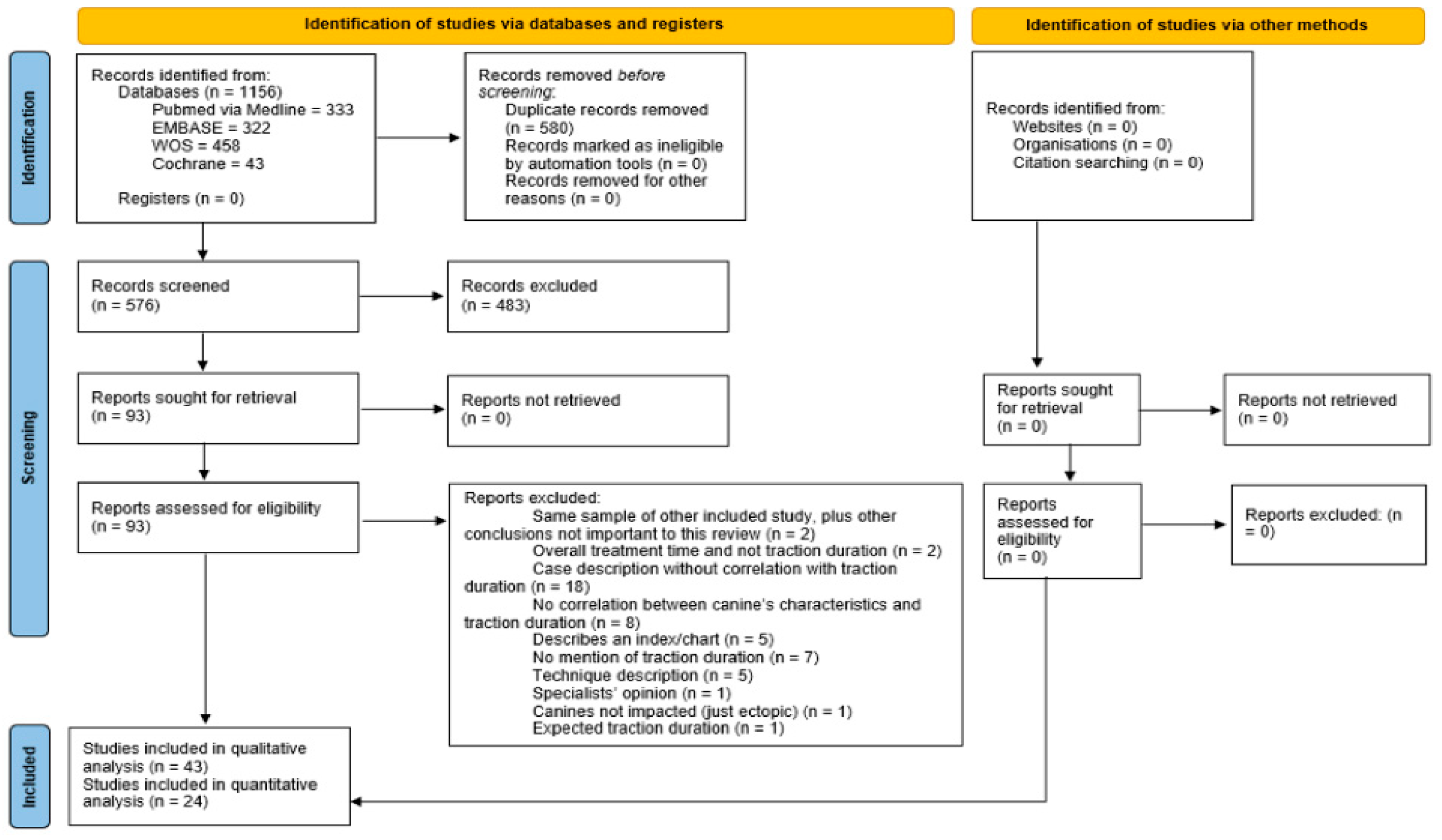
3.1. Selection of Sources of Evidence
3.2. Characteristics and Results of Sources of Evidence
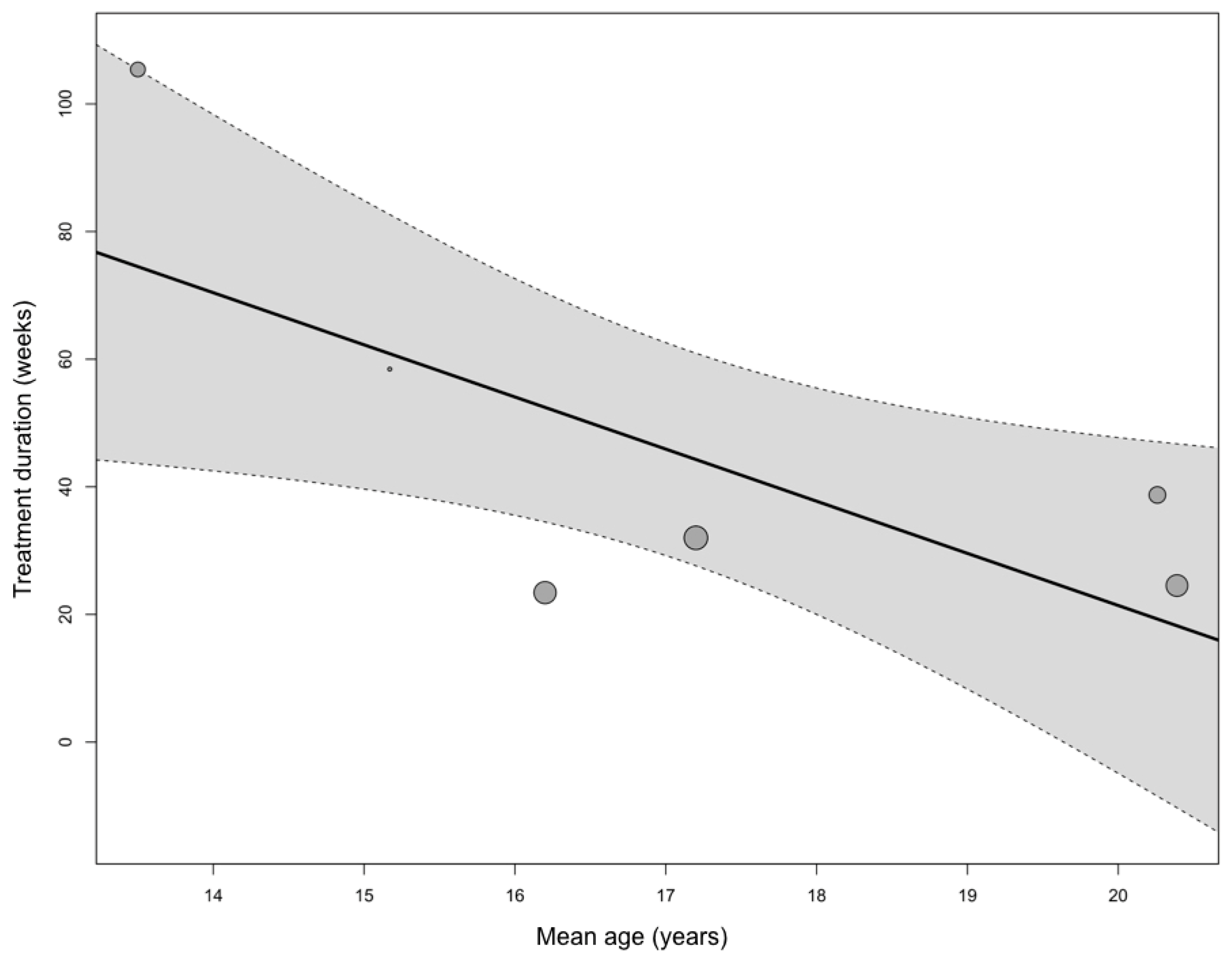
3.3. Synthesis of Results
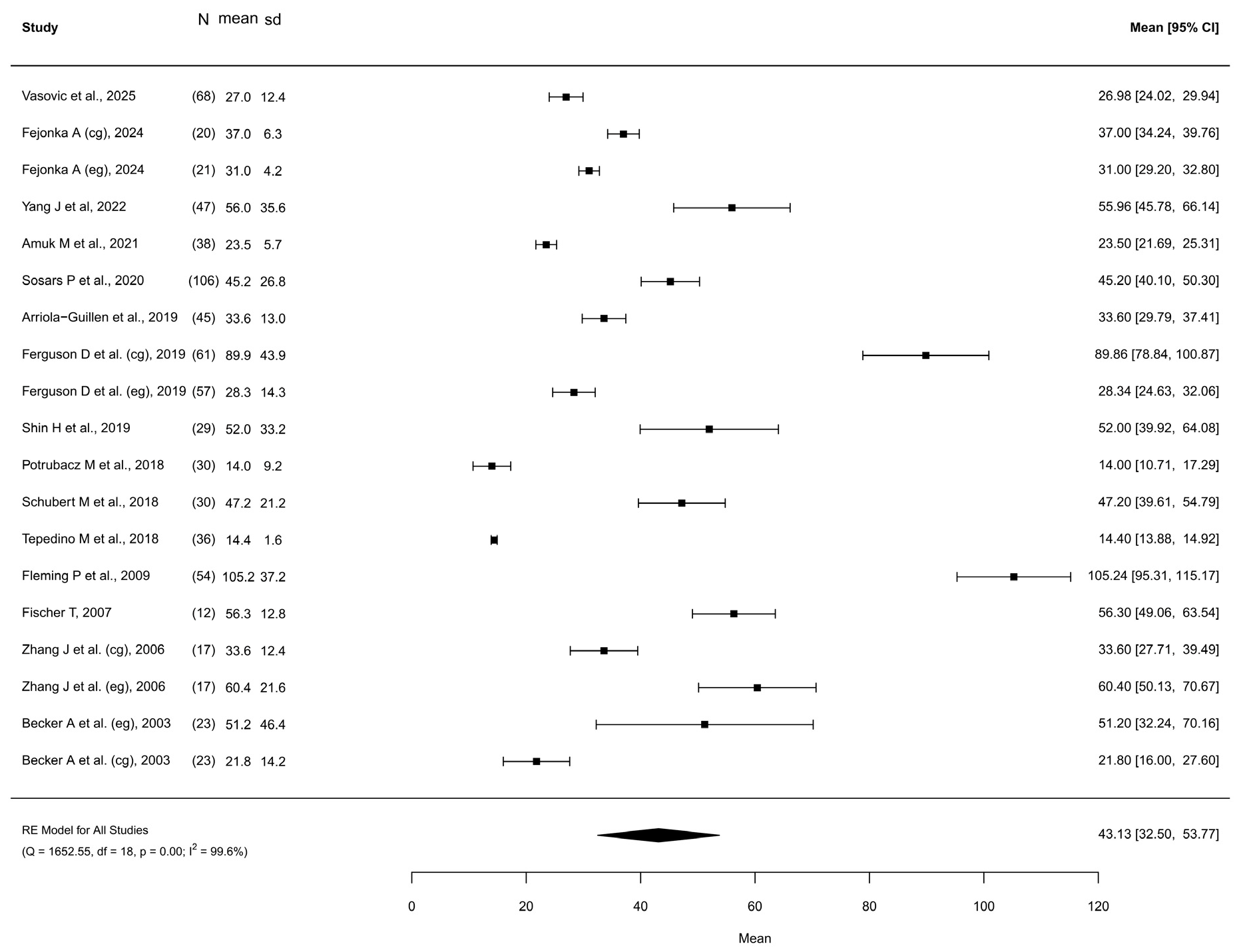
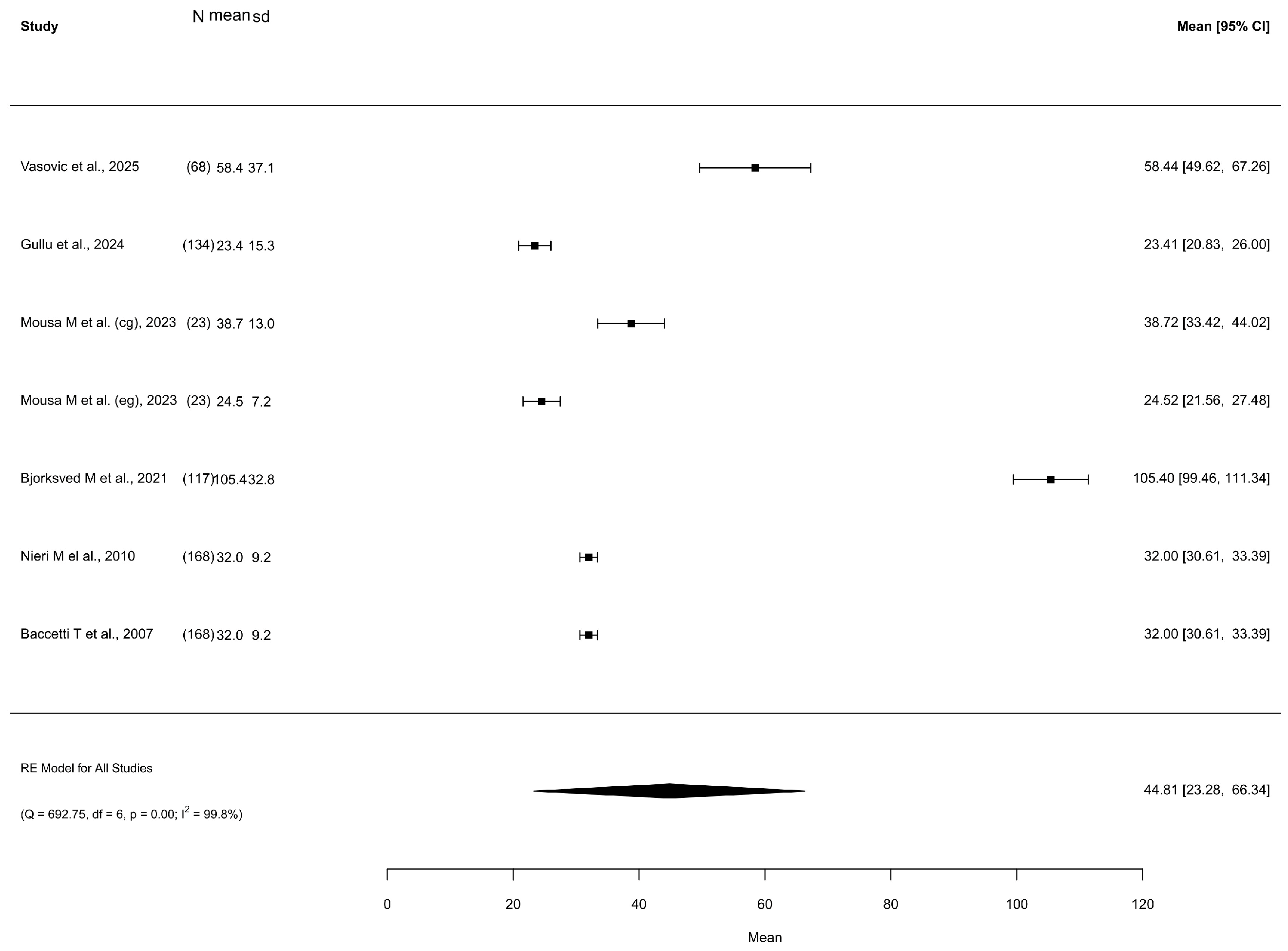
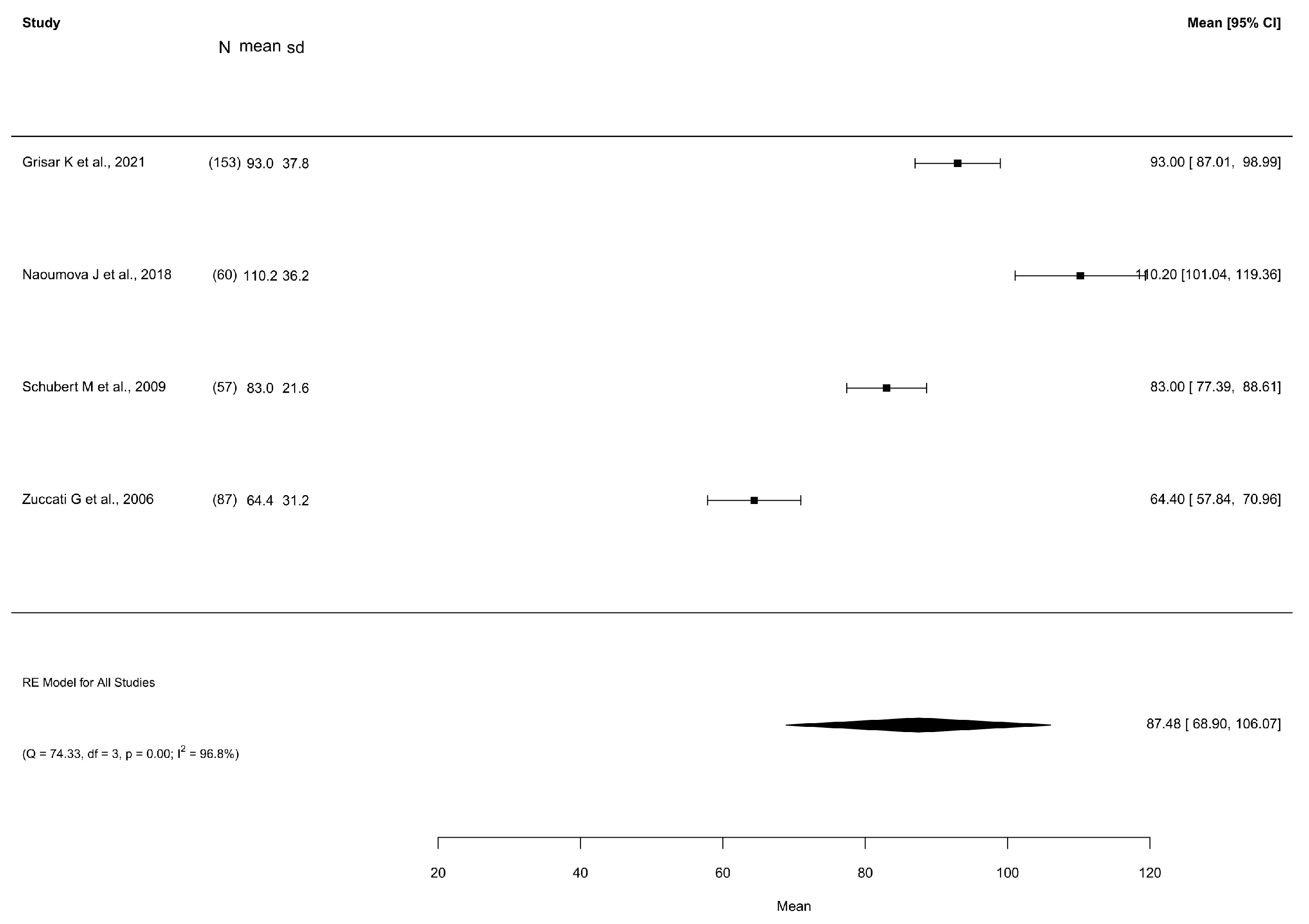
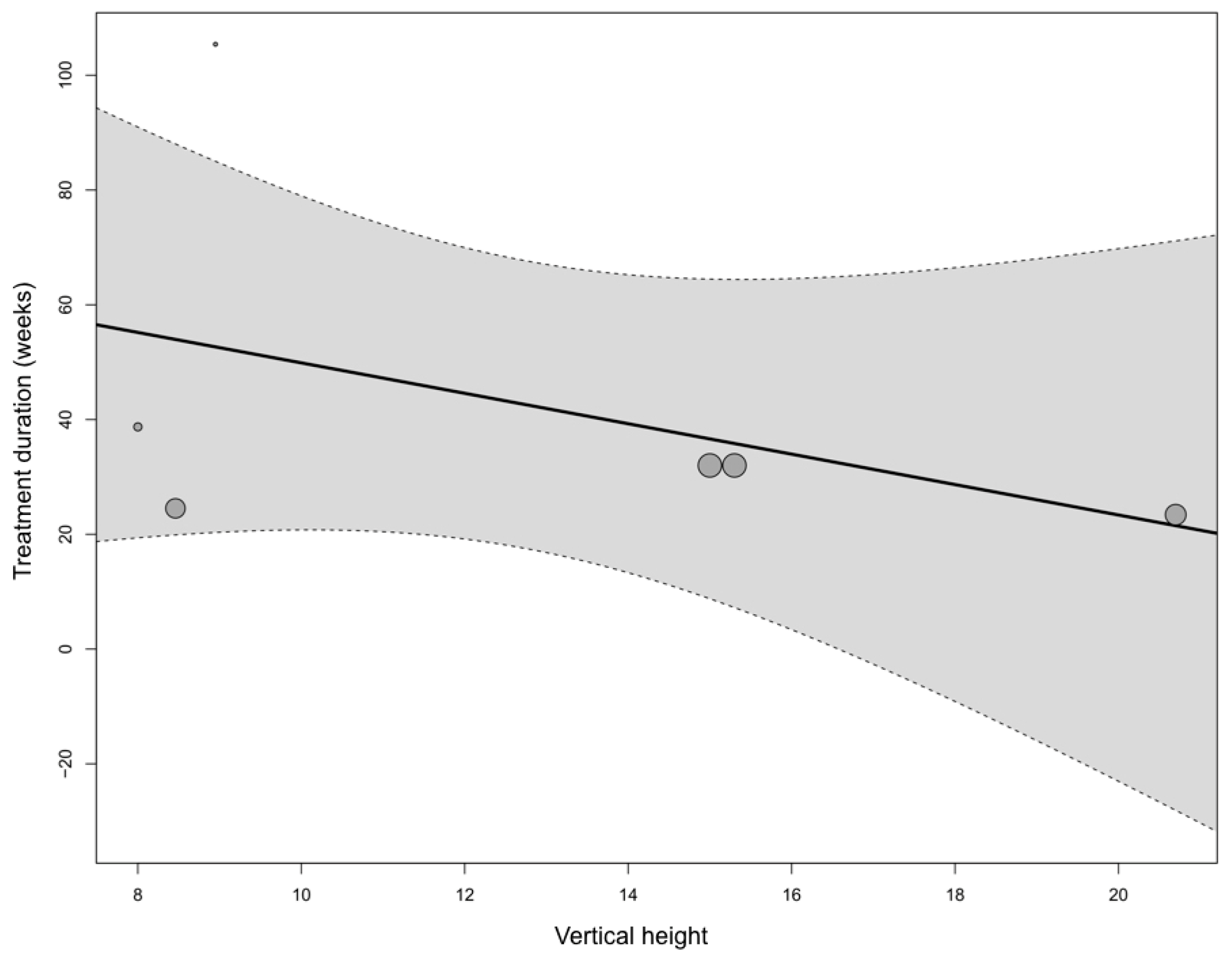
3.4. Quantitative Analysis of Results
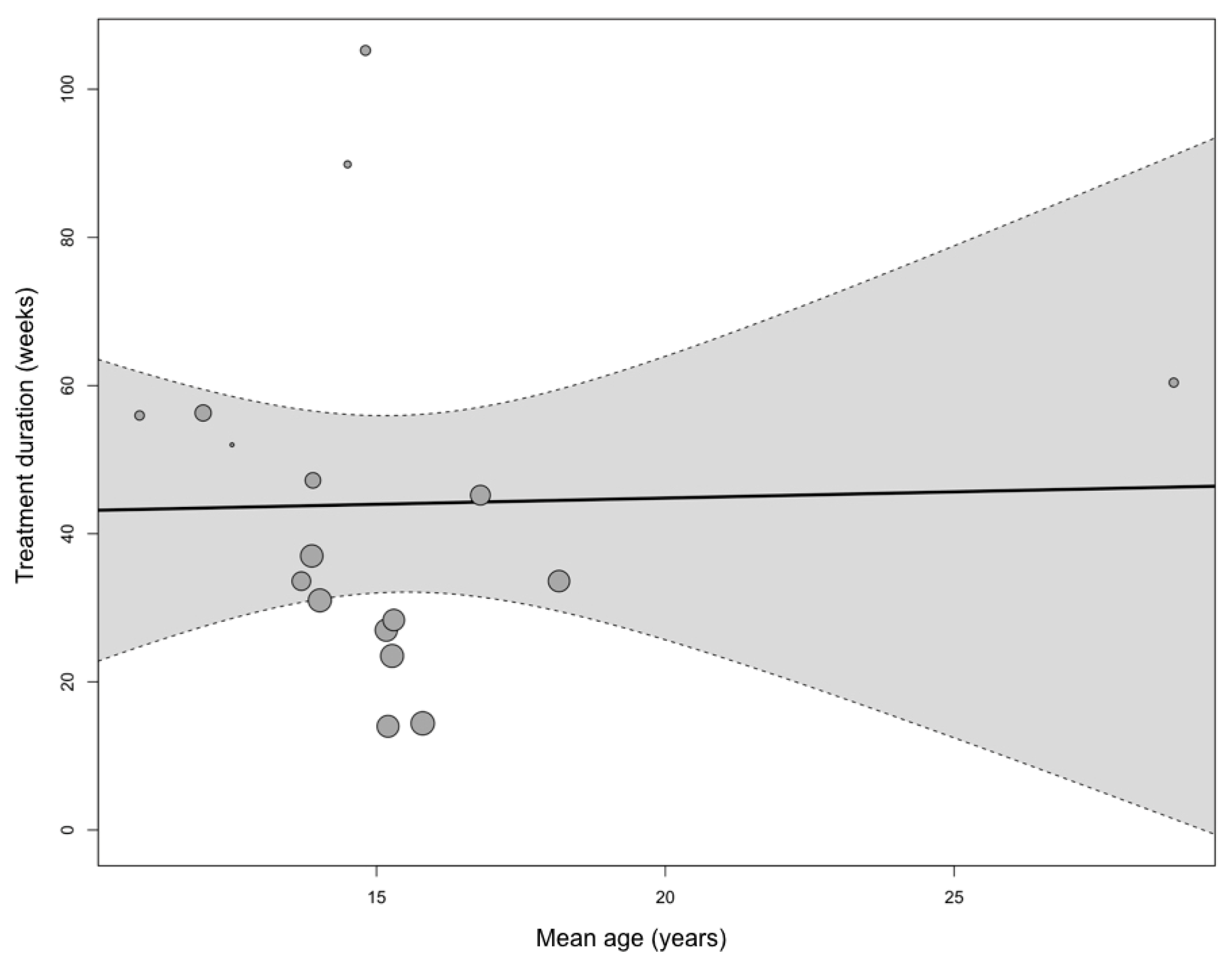
3.4.1. Definition A for Treatment Duration
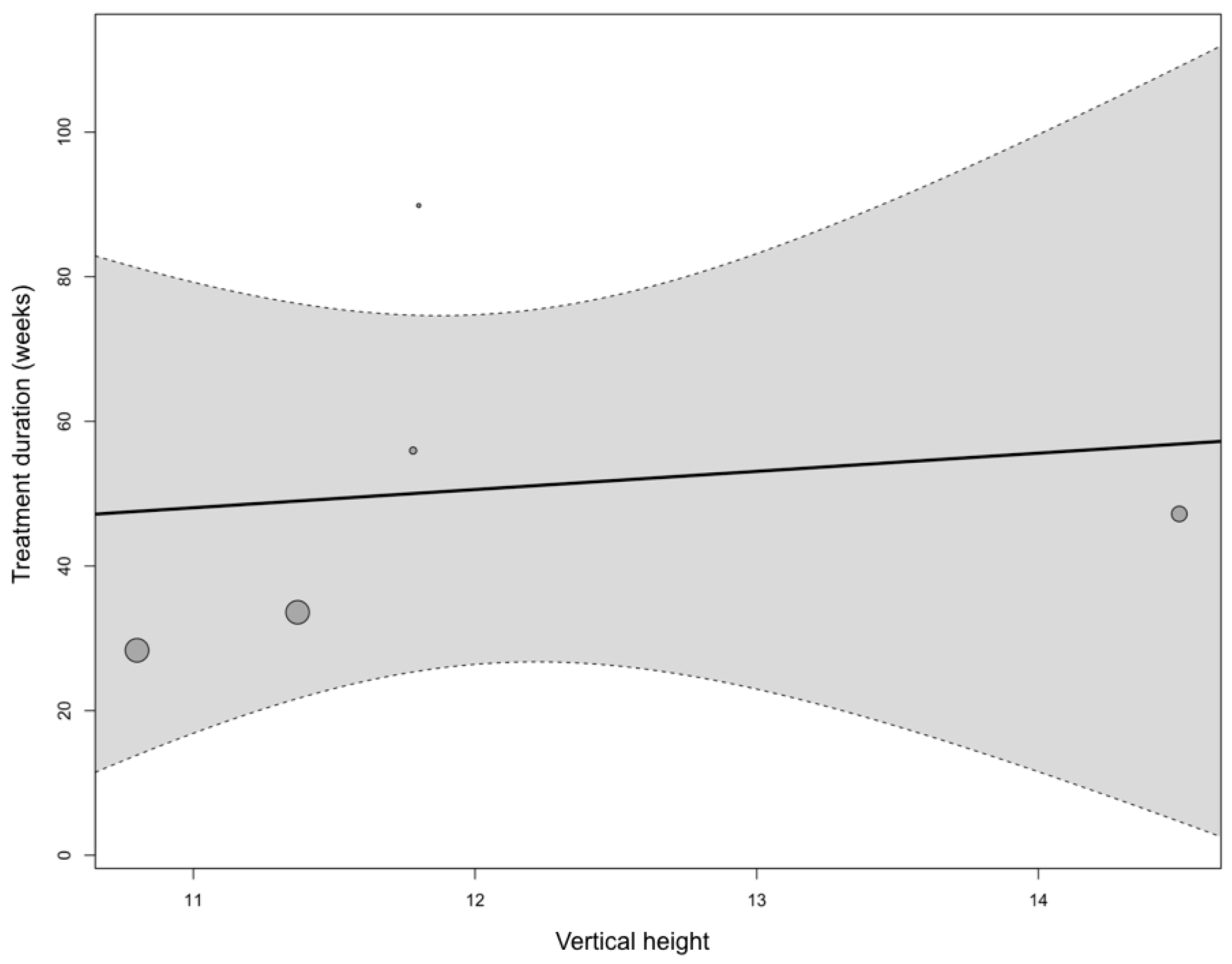
3.4.2. Definition B for Treatment Duration
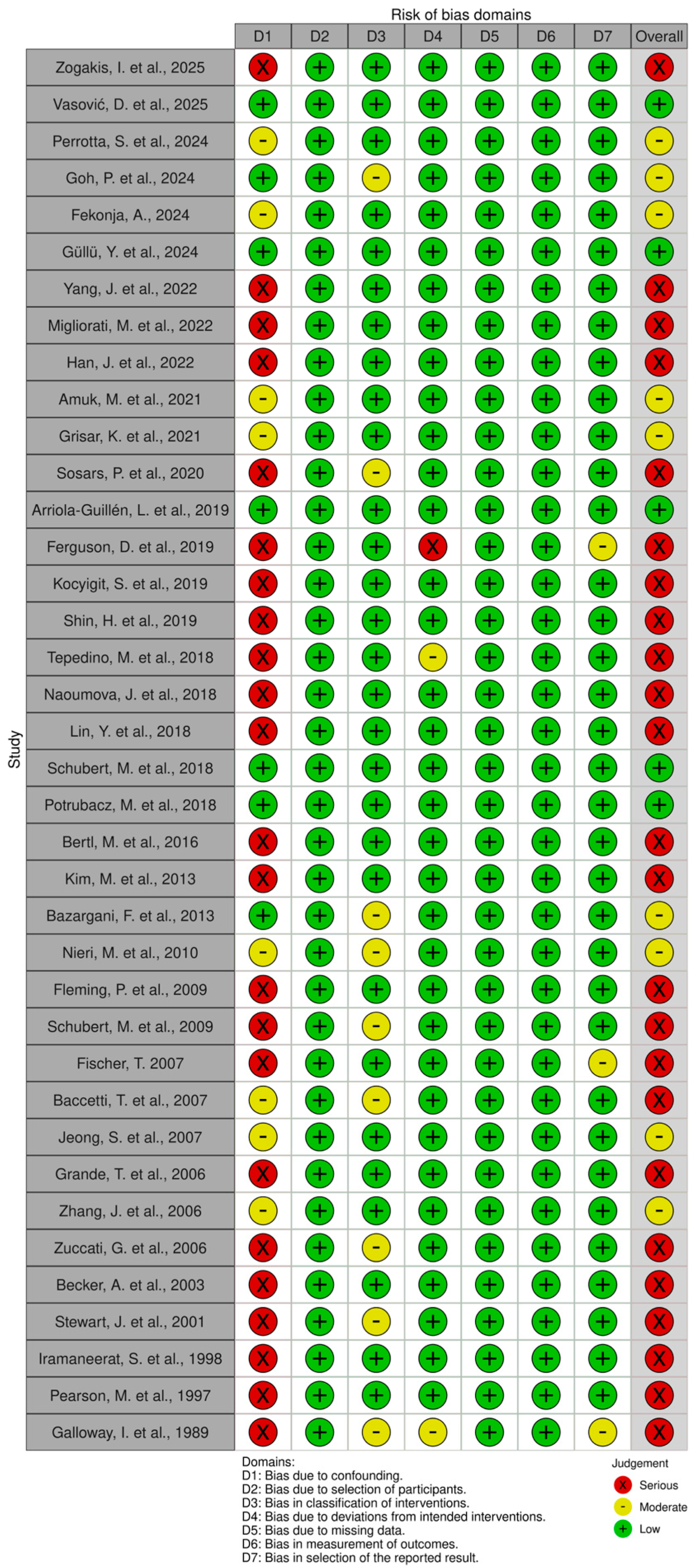
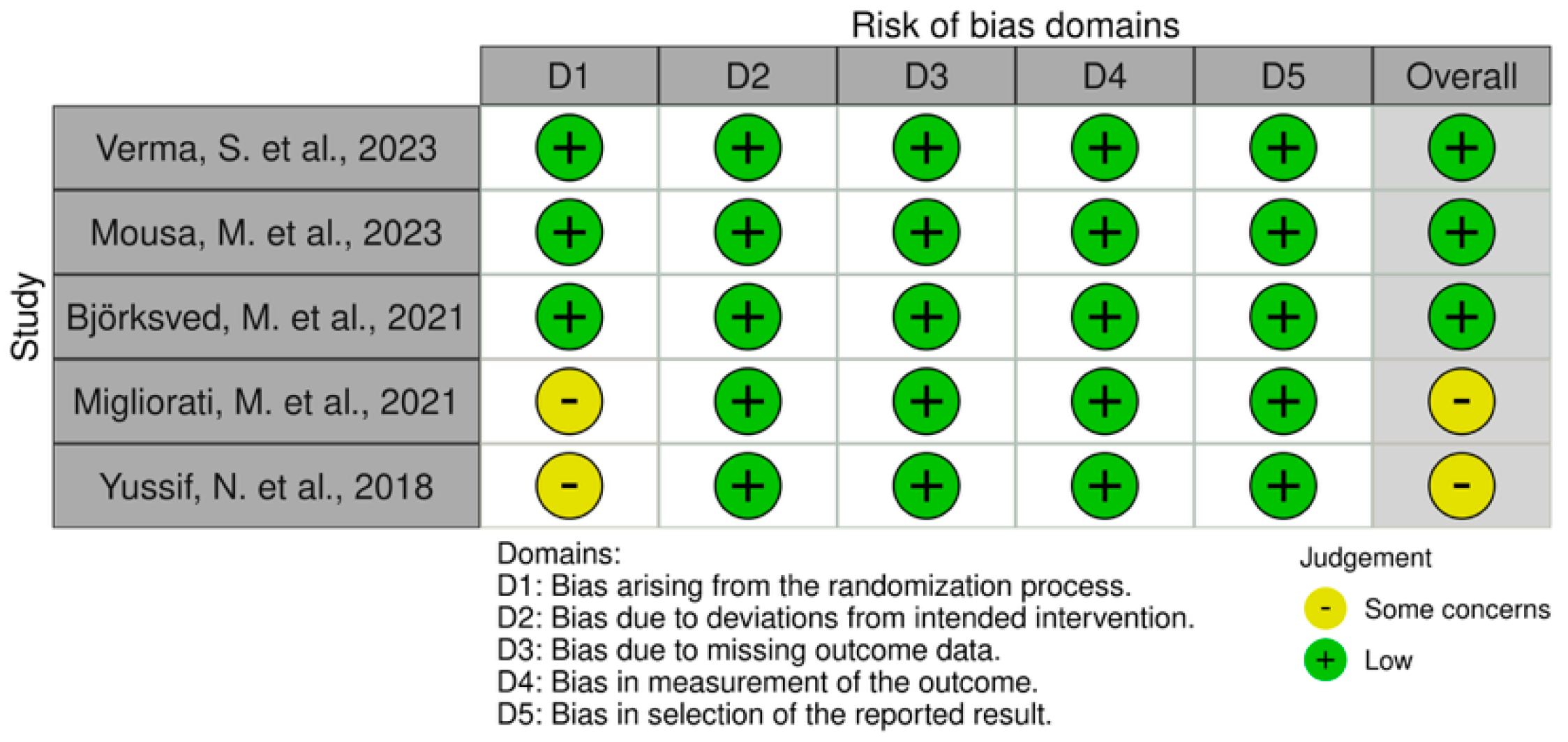
3.5. Risk of Bias
4. Discussion
5. Conclusions
Author Contributions
Funding
Institutional Review Board Statement
Informed Consent Statement
Data Availability Statement
Conflicts of Interest
Abbreviations
| CBCT | Cone-beam computed tomography |
| PEO | Population, exposure and outcome |
| PRISMA | Preferred Reporting Items for Systematic Reviews and Meta-Analyses |
| PROSPERO | International Prospective Register of Systematic Reviews |
| RCT | Randomized Controlled Trial |
| ROB 2 | Revised Cochrane risk-of-bias tool for randomized trials |
| ROBINS-I V2 | Risk of Bias in Non-randomized Studies—of Interventions Version 2 |
Appendix A
Appendix A.1

| Database | Search Key |
|---|---|
| PubMed (Medline) | (“unerupted canine*” OR “impacted canine*” OR “impacted maxill* canine*” OR “ectopic canine*” OR “retained canine*” OR “displaced canine*” OR “canine* impact*” OR “canine* displac*”) AND (“maxilla”[Mesh] OR maxill* OR upper OR “Palate”[Mesh] OR palat*) AND (traction OR “orthodontics”[Mesh] OR orthodont* OR “tooth movement technique”[Mesh] OR “tooth movement technique*” OR “movement technique*, tooth” OR “technique*, tooth movement” OR “Orthodontic Extrusion”[Mesh] OR “forced eruption*” OR “eruption*, forced” OR “forced tooth eruption” OR “tooth extrusion*” OR “extrusion*, tooth” OR exposure) AND (“Duration of Therapy”[Mesh] OR duration OR time OR period OR term OR length) Filter: exclude preprints |
| Embase | (‘unerupted canine*’ OR ‘impacted canine*’ OR ‘impacted maxill* canine*’ OR ‘ectopic canine*’ OR ‘retained canine*’ OR ‘canine*, impact*’ OR ‘displaced canine*’ OR ‘canine*, displac*’) AND (‘maxilla’/exp OR ‘maxill*’ OR ‘upper’ OR ‘palate’/exp OR ‘palat*’) AND (‘traction’ OR ‘orthodontics’/exp OR ‘orthodont*’ OR ‘orthodontic tooth movement’/exp OR ‘tooth movement technique*’ OR ‘movement technique*, tooth’ OR ‘technique*, tooth movement’ OR ‘orthodontic extrusion’/exp OR ‘forced tooth eruption’ OR ‘forced eruption*’ OR ‘eruption*, forced’ OR ‘tooth extrusion*’ OR ‘extrusion*, tooth’ OR ‘exposure’) AND (‘treatment duration’/exp OR ‘duration’ OR ‘time’ OR ‘period’ OR ‘term’ OR ‘length’) AND ([article]/lim OR [article in press]/lim OR [data papers]/lim OR [letter]/lim OR [short survey]/lim OR [clinical trial]/lim) |
| Cochrane | #1 (unerupted NEXT canine*) #2 (impacted NEXT canine*) #3 (impacted NEXT maxill* NEXT canine*) #4 (ectopic NEXT canine*) #5 (retained NEXT canine*) #6 (displaced NEXT canine*) #7 (canine* NEXT impact*) #8 (canine* NEXT displac*) #9 MeSH descriptor: [Maxilla] explode all trees #10 maxill* #11 upper #12 MeSH descriptor: [Palate] explode all trees #13 palat* #14 traction #15 MeSH descriptor: [Orthodontics] explode all trees #16 orthodont* #17 MeSH descriptor: [Tooth Movement Techniques] explode all trees #18 (movement technique* NEXT tooth) #19 (technique* NEXT tooth movement) #20 (tooth movement NEXT technique*) #21 (movement technique* NEXT tooth) #22 MeSH descriptor: [Orthodontic Extrusion] explode all trees #23 (tooth NEXT extrusion*) #24 (forced NEXT eruption*) #25 “forced tooth eruption” #26 (Eruption* NEXT forced) #27 (extrusion* NEXT tooth) #28 exposure #29 MeSH descriptor: [Duration of Therapy] explode all trees #30 duration #31 time #32 period #33 term #34 length #35 #1 OR #2 OR #3 OR #4 OR #5 OR #6 OR #7 OR #8 #36 #9 OR #10 OR #11 OR #12 OR #13 #37 #14 OR #15 OR #16 OR #17 OR #18 #19 OR #20 OR #21 OR #22 OR #23 OR #24 OR #25 OR #26 OR #27 OR #28 #38 #29 OR #30 OR #31 OR #32 OR #33 OR #34 #39 #35 AND #36 AND #37 AND #38 |
| Web of Science | (“unerupted canine*” OR “impacted canine*” OR “impacted maxill* canine*” OR “ectopic canine*” OR “retained canine*” OR “displaced canine*” OR “canine* impact*” OR “canine* displac*”) AND (maxill* OR upper OR palat*) AND (traction OR orthodont* OR “tooth movement technique*” OR “movement technique*, tooth” OR “technique*, tooth movement” OR “forced eruption*” OR “eruption*, forced” OR “forced tooth eruption” OR “tooth extrusion*” OR “extrusion*, tooth” OR exposure) AND (duration OR time OR period OR term OR length) |
Appendix A.2
| Author, Year | Study Design | Position and Location of the Impacted Canine | Orthodontic Treatment: Surgical Exposure and Orthodontic Mechanic | Method for Assessing Impacted Canine Characteristics |
|---|---|---|---|---|
| Zogakis, I. et al., 2025 [16] | Retrospective observational | PIC | Surgical exposure not specified. | NR |
| Vasović, D. et al., 2025 [39] | Retrospective | PIC: 54 | Closed eruption technique and stainless-steel archwire. | OPG |
| BIC: 17 | ||||
| MA: 12 | ||||
| CBCT | ||||
| UIC: 45 (UIC-R: 22; UIC-L: 23) | ||||
| BLIC: 19 | ||||
| Perrotta, S. et al., 2024 [40] | Retrospective | PIC: 87 | “Canine-first technique”. Type of surgical exposure (open, closed, or apically repositioned flap) selected according to individual case characteristics. TADs were used in 78,63% of the cases. | OPG |
| BIC: 39 | ||||
| IC-R: 54.2% | ||||
| IC-L: 41.2% | ||||
| Goh, P. et al., 2024 [5] | Retrospective case–control | PIC: 23 | Open exposure technique and mechanics were individualized. TPAs were generally used for PICs. Fixed orthodontic appliances were placed prior to surgical exposure. | CBCT |
| BIC/MA: 14 | ||||
| UIC: 30 | ||||
| BLIC: 7—only one of each was selected, based on sector, height above the OP and ‘a angle’ | ||||
| IC-R: 15 | ||||
| IC-L: 22 | ||||
| Fekonja, A., 2024 [20] | Retrospective case–control | NR | Open exposure technique | OPG |
| Güllü, Y. et al., 2024 [21] | Retrospective cross-sectional | PIC: 99 | Closed exposure technique and traction were applied with a stainless-steel wire. A chain was connected to the tooth, and when the vertical position was adequate, the IC was aligned with a Kilroy Spring. | OPG |
| BIC: 35 | ||||
| UIC: 108 | ||||
| BLIC: 26 | ||||
| IC-R: 73 | ||||
| IC-L: 61 | ||||
| Verma, S. et al., 2023 [26] | Randomized clinical trial | PIC UIC | Open technique and TPA for anchorage. Traction applied using either K9 Spring or Ballista Spring. | CBCT |
| Mousa, M. et al., 2023 [27] | Randomized controlled clinical trial | PIC: 19 in CG and 20 in EG; | Closed exposure technique. Eyelet and twisted ligature. Corticotomy in the EG. | CBCT |
| MA: 4 in CG and 3 in EG; | ||||
| UIC | ||||
| Yang, J. et al., 2022 [7] | Retrospective Cross-sectional | PIC: 22 | Closed eruption technique. A small attachment with ligature wire was bonded to the IC. | CBCT |
| BIC: 65 | ||||
| UIC: 61 | ||||
| BLIC: 26 | OPG | |||
| IC-R: 45 | ||||
| IC-L: 42 | ||||
| Migliorati, M. et al., 2022 [28] | Prospective controlled clinical trial | PIC | Open technique was used for superficial impaction and closed eruption technique was used for deep impactions. A button and chain were bonded to the IC. Miniscrews and TPA for anchorage and titanium–molybdenum alloy cantilevers in both groups. | CBCT |
| Han, J. et al., 2022 [34] | Retrospective | PIC: 12 | Surgical exposure not specified. Miniscrews, miniplates and multibrackets. | CBCT |
| MA: 28 | ||||
| BIC: 53 | ||||
| OPG | ||||
| UIC: 52 | ||||
| BLIC: 41 | ||||
| Björksved, M. et al., 2021 [25] | Randomized controlled trial | PIC | Closed and open surgical techniques. Elastomeric thread was used for traction. TPA and GG with soldered springs were used in some cases. All patients received fixed orthodontic appliances. | CBCT |
| UIC: 87 | ||||
| BLIC: 30 | ||||
| (the most severe IC was considered for the study in BLIC cases) | ||||
| OPG | ||||
| IC-R: 52 | ||||
| IC-L: 65 | ||||
| Amuk, M. et al., 2021 [41] | Retrospective longitudinal | PIC: 24 | Surgical exposure not specified. Traction performed in all cases with fixed appliances. Gold chain or button bonded during surgery. Modified TPAs were used in some cases. | CBCT |
| BIC: 14 | ||||
| OPG | ||||
| UIC | ||||
| Grisar, K. et al., 2021 [42] | Retrospective | PIC: 87 | Open or closed exposure technique was used, depending on case. Various attachments: gold chains, ligature wires, extrusion plates. Fixed appliances used. | OPG |
| MA: 31 | ||||
| BIC: 35 | ||||
| UIC: 111 | ||||
| BLIC: 42 | ||||
| In patients with BLIC, separate treatment durations were considered. | ||||
| Migliorati, M. et al., 2021 [30] | Prospective Randomized Controlled trial | PIC: 9 | “Canine first” Closed exposure technique. Both groups used beta-titanium cantilevers. | CBCT |
| BIC: 7 | ||||
| Sosars, P. et al., 2020 [43] | Retrospective | PIC | Open exposure technique was used. Pre-adjusted edgewise system was used to align the teeth and create space. | CBCT |
| UIC-L: 33 | ||||
| UIC-R: 35 | OPG | |||
| BLIC: 38 | ||||
| Arriola–Guillén, L. et al., 2019 [9] | Retrospective | PIC: 20 | Closed exposure technique. A single rigid TAD was attached to the first permanent molars using stainless-steel bands. Traction was applied using nickel–titanium closed-coil springs. | OPG |
| BIC: 18 | ||||
| MA: 7 | ||||
| UIC: 15 | Lateral head films | |||
| BLIC: 30 | CBCT | |||
| IC-R: 25 | ||||
| IC-L: 20 | ||||
| Ferguson, D. et al., 2019 [44] | Retrospective cohort | PIC | CG: both closed and open exposure methods were applied. After surgery, a bracket and power chain were attached to the crown. EG: the ostectomy–corticotomy technique and exposure enabled ideal placement of the bracket. | OPG |
| UIC: 85 | ||||
| BLIC: 66 (both ICs were considered for 33 patients) | ||||
| IC-R: 47 CG + 44 EG = 91 | ||||
| IC-L: 32 CG + 28 EG = 60 | ||||
| Kocyigit, S. et al., 2019 [45] | Retrospective | PIC | Closed technique Brackets from the pre-adjusted system. A button, along with an attached chain or wire, was bonded to the crown. Traction using either a ballista spring or elastic chains. | Lateral cephalometric radiographs |
| UIC: 38 | ||||
| BLIC: 12 | ||||
| IC-R: 21 | OPG | |||
| IC-L: 29 | ||||
| Shin, H. et al., 2019 [46] | Retrospective | BIC | Closed exposure technique. Orthodontic bracket bonded for traction. | CBCT |
| UIC: 25 | ||||
| BLIC: 4 | ||||
| OPG | ||||
| IC-R: 14 | ||||
| IC-L:15 | ||||
| Tepedino, M. et al., 2018 [38] | Retrospective | PIC | The appliance consisted of a TPA featuring a distal loop, which was welded to bands on the maxillary first molars. A cantilever was attached to the TPA. | Cephalograms |
| Naoumova, J. et al., 2018 [36] | Retrospective | PIC | Closed and glass-ionomer open exposure techniques. Fixed appliance and/or anchorage methods as extraoral traction, GG, TPA, lingual arch, mTPA. Gold chains were often bonded to exposed teeth. | Intraoral radiographs |
| UIC | OPG | |||
| IC-R: 14 (A) + 18 (B) = 32 | CBCT | |||
| IC-L: 16 (A) +12 (B) = 28 | ||||
| Lin, Y. et al., 2018 [37] | Retrospective | PIC: 17 | NR | OPG |
| BIC: 43 | ||||
| UIC | ||||
| IC-R: 31 | ||||
| IC-L: 29 | ||||
| Schubert, M. et al., 2018 [23] | Retrospective observational cohort | PIC | Closed exposure technique was employed alongside the EWC system, which uses a passive closed-coil spring, following surgical exposure and attachment bonding. | OPG |
| UIC | ||||
| IC-R: 15 | CBCT | |||
| IC-L: 15 | ||||
| Yussif, N. et al., 2018 [32] | Prospective randomized controlled trial | PIC | Closed exposure technique. Orthodontic traction with an active power chain tied on the main sain steel arch wire. In EG, traction was carried out with orthodontic treatment and intraepidermic vitamin C injection. | OPG |
| UIC | ||||
| occlusal radiography | ||||
| CBCT | ||||
| IC-R: 6 | ||||
| IC-L: 6 | ||||
| Potrubacz, M. et al., 2018 [35] | Retrospective cohort | PIC | Opercolectomy technique. An orthodontic button or bracket was bonded to the exposed IC and open traction was initiated. The appliance was anchored using a fixed TPA with a distal loop. | OPG |
| UIC: 14 | ||||
| BLIC: 16 (both ICs were considered for the eight patients) | cephalograms | |||
| intra and extraoral photographs | ||||
| IC-R: 13 | ||||
| IC-L: 17 | ||||
| Bertl, M. et al., 2016 [47] | Retrospective cohort | PIC: 41 | Closed and open exposure techniques. Fixed appliances. | CBCT |
| BIC: 8 | ||||
| MA: 6 | ||||
| UIC: 31 | ||||
| BLIC: 48 (both ICs were considered for the 24 patients) | ||||
| Kim, M. et al., 2013 [48] | Retrospective | UIC: 16 | Surgical exposure not specified. | CBCT |
| BLIC: 2 | ||||
| Bazargani, F. et al., 2013 [24] | Retrospective observational | PIC | 12 patients underwent traction using elastics attached to fixed appliances, while 54 were treated with a TPA featuring a spring arm. | OPG |
| UIC: 51 | ||||
| BLIC: 15 (only 1 considered) | ||||
| IC-R: 39 | ||||
| IC-L: 27 | ||||
| Nieri, M. et al., 2010 [50] | Retrospective | PIC: 118 | Closed exposure technique. Traction was applied via an elastic connected to a round archwire, while anchorage was provided by a rectangular archwire. Tunnel technique used when the crown of the IC was close to the deciduous IC (n = 24). | OPG |
| BIC: 50 | ||||
| UIC: 125 | ||||
| BLIC: 43 (one was chosen per patient) | ||||
| IC-R: 90 | ||||
| ICL: 78 | ||||
| Fleming, P. et al., 2009 [6] | Retrospective | PIC | Closed and open techniques. Use of pre-adjusted edgewise appliances, with elastomeric traction applied using a stainless-steel archwire. | OPG |
| UIC: 36 | ||||
| BLIC: 18 | ||||
| Schubert, M. et al., 2009 [49] | Retrospective | PIC | Closed exposure technique. EWC system, in which an attachment was adhesively fixed to the IC. | OPG |
| UIC: 41 (29 F/12 M) | ||||
| BLIC: 16 (12 F/4 M) (the IC in the worst position was selected) | ||||
| lateral cephalograms | ||||
| IC-R: 23 | ||||
| IC-L: 34 | ||||
| Fischer, T. 2007 [29] | Preliminary | PIC | Open exposure technique (CG) and corticotomy procedure (EG). An orthodontic attachment was placed on the IC, and orthodontic traction was not specified. | Periapical radiographs |
| BLIC: 6 (each patient as their own control) | ||||
| IC-R: 6 | ||||
| IC-L: 6 | ||||
| Baccetti, T. et al., 2007 [31] | Prospective longitudinal | PIC: 118 | Closed surgical exposure. Traction using a chain connected to the bonded attachment and to an elastic element (through a round archwire). A rectangular archwire was employed for stabilization and anchorage. | OPG |
| BIC: 50 | ||||
| UIC: 125 | ||||
| BLIC: 43 (one was chosen per patient) | ||||
| IC-R: 90 | ||||
| IC-L: 78 | ||||
| Jeong, S. et al., 2007 [33] | Retrospective | PIC | Closed exposure technique was used. Orthodontic traction by attaching an elastic rubber band to the ligature. | OPG |
| UIC | ||||
| UIC-R: 18 | ||||
| UIC-L: 18 | ||||
| Grande, T. et al., 2006 [51] | Retrospective | PIC: 52 | Surgical exposure not specified. Multi-band/multi-bracket appliance. | OPG |
| BIC: 7 | ||||
| UIC: 35 (15 M + 20 F) | ||||
| BLIC: 24 (4 M + 8 F) | ||||
| IC-R: 34 | ||||
| IC-L: 25 | ||||
| Zhang, J. et al., 2006 [19] | Retrospective case–control | PIC: 28 | Surgical exposure (closed technique more use on PICs, while open technique was used mainly for BICs). The ligature wire on the traction device ties to the maxillary auxiliary stainless-steel arch wire, secured by a spiral push spring. | CBCT |
| BIC: 14 | ||||
In each group:
| OPG | |||
| Zuccati, G. et al., 2006 [22] | Retrospective observational | UIC: 66 | Open exposure technique was used whenever feasible, while the closed exposure technique was mainly used for deeply ICs. Fixed appliances. | OPG |
| BLIC: 21 (only one was included, the one that took the longest) | ||||
| IC-R: 43 | ||||
| IC-L: 44 | ||||
| Becker, A. et al., 2003 [8] | Retrospective | PIC | Closed eruption technique. Orthodontic traction was not specified. | OPG |
| cephalometric radiographs | ||||
In each group:
| periapical radiograph | |||
| Stewart, J. et al., 2001 [10] | Retrospective observational | PIC | Surgical exposure and orthodontic traction were not specified. | OPG |
| UIC: 29 | ||||
| BLIC: 36 | cephalometric radiographs | |||
| IC-R: 33 | ||||
| IC-L: 32 | ||||
| Iramaneerat, S. et al., 1998 [17] | Retrospective | PIC | Open exposure or close exposure with flap replaced. Bonded attachments with gold chains were used. | Lateral cephalometric radiographs |
| UIC | ||||
| Pearson, M. et al., 1997 [18] | Retrospective | PIC | Centre A: open exposure with spring traction on molar bands joined by a TPA. Centre B: exposure with immediate bracketing, flap replacement, and elastic traction to a fish-tail appliance. | NR |
| 73 UIC | ||||
| 30% BLIC = Approximately, 31 patients | ||||
| Galloway, I. et al., 1989 [15] | Retrospective | PIC | 56 cases with exposure and traction with fixed and removable appliance combination. 30 cases with exposure and traction with fixed appliance. | NR |
References
- Aquino-Valverde, A.J.; Barrientos-Sanchez, D.M.; Atoche-Socola, K.J. Orthodontic Treatment in Impacted Maxillary Canines. A Review of the Literature. Rev. Cient. Odontol. 2021, 9, e085. [Google Scholar] [CrossRef]
- Cruz, R.M. Orthodontic Traction of Impacted Canines: Concepts and Clinical Application. Dent. Press J. Orthod. 2019, 24, 74–87. [Google Scholar] [CrossRef] [PubMed]
- Manne, R.; Gandikota, C.; Juvvadi, S.; Medapati Rama, H.R.; Anche, S. Impacted Canines: Etiology, Diagnosis, and Orthodontic Management. J. Pharm. Bioallied Sci. 2012, 4, S234–S238. [Google Scholar] [CrossRef] [PubMed]
- Bedoya, M.M.; Park, J.H. A Review of the Diagnosis and Management of Impacted Maxillary Canines. J. Am. Dent. Assoc. 2009, 140, 1485–1493. [Google Scholar] [CrossRef] [PubMed]
- Goh, P.K.T.; Pulemotov, A.; Nguyen, H.; Pinto, N.; Olive, R. Treatment Duration by Morphology and Location of Impacted Maxillary Canines: A Cone-Beam Computed Tomography Investigation. Am. J. Orthod. Dentofac. Orthop. 2024, 166, 160–170. [Google Scholar] [CrossRef]
- Fleming, P.S.; Scott, P.; Heidari, N.; DiBiase, A.T. Influence of Radiographic Position of Ectopic Canines on the Duration of Orthodontic Treatment. Angle Orthod. 2009, 79, 442–446. [Google Scholar] [CrossRef]
- Yang, J.-S.; Cha, J.-Y.; Lee, J.-Y.; Choi, S.-H. Radiographical Characteristics and Traction Duration of Impacted Maxillary Canine Requiring Surgical Exposure and Orthodontic Traction: A Cross-Sectional Study. Sci. Rep. 2022, 12, 19183. [Google Scholar] [CrossRef]
- Becker, A.; Chaushu, S. Success Rate and Duration of Orthodontic Treatment for Adult Patients with Palatally Impacted Maxillary Canines. Am. J. Orthod. Dentofac. Orthop. 2003, 124, 509–514. [Google Scholar] [CrossRef]
- Arriola-Guillén, L.E.; Aliaga–Del Castillo, A.; Ruíz-Mora, G.A.; Rodríguez-Cárdenas, Y.A.; Dias–Da Silveira, H.L. Influence of Maxillary Canine Impaction Characteristics and Factors Associated with Orthodontic Treatment on the Duration of Active Orthodontic Traction. Am. J. Orthod. Dentofac. Orthop. 2019, 156, 391–400. [Google Scholar] [CrossRef]
- Stewart, J.A.; Heo, G.; Glover, K.E.; Williamson, P.C.; Lam, E.W.N.; Major, P.W. Factors That Relate to Treatment Duration for Patients with Palatally Impacted Maxillary Canines. Am. J. Orthod. Dentofac. Orthop. 2001, 119, 216–225. [Google Scholar] [CrossRef]
- Page, M.J.; McKenzie, J.E.; Bossuyt, P.M.; Boutron, I.; Hoffmann, T.C.; Mulrow, C.D.; Shamseer, L.; Tetzlaff, J.M.; Akl, E.A.; Brennan, S.E.; et al. The PRISMA 2020 Statement: An Updated Guideline for Reporting Systematic Reviews. BMJ 2021, 372, n71. [Google Scholar] [CrossRef] [PubMed]
- Sterne, J.A.; Hernán, M.A.; Reeves, B.C.; Savović, J.; Berkman, N.D.; Viswanathan, M.; Henry, D.; Altman, D.G.; Ansari, M.T.; Boutron, I.; et al. ROBINS-I: A Tool for Assessing Risk of Bias in Non-Randomised Studies of Interventions. BMJ 2016, 355, i4919. [Google Scholar] [CrossRef] [PubMed]
- Sterne, J.A.C.; Savović, J.; Page, M.J.; Elbers, R.G.; Blencowe, N.S.; Boutron, I.; Cates, C.J.; Cheng, H.-Y.; Corbett, M.S.; Eldridge, S.M.; et al. RoB 2: A Revised Tool for Assessing Risk of Bias in Randomised Trials. BMJ 2019, 366, l4898. [Google Scholar] [CrossRef] [PubMed]
- McGuinness, L.A.; Higgins, J.P.T. Risk-of-bias VISualization (Robvis): An R Package and Shiny Web App for Visualizing Risk-of-bias Assessments. Res. Synth. Methods 2021, 12, 55–61. [Google Scholar] [CrossRef]
- Galloway, I.; Stirrups, D.R. The Effect of Age at Diagnosis on the Complexity and Outcome of Treatment of Palatally Ectopic Canines. Br. J. Orthod. 1989, 16, 259–263. [Google Scholar] [CrossRef]
- Zogakis, I.P.; Anagnostou, C.; Ioannidou, I.; Chaushu, S.; Papadopoulos, M.A. A Comparison of Different Biomechanical Systems for the Orthodontic Treatment of Palatally Impacted Canines. Bioengineering 2025, 12, 267. [Google Scholar] [CrossRef]
- Iramaneerat, S.; Cunningham, S.J.; Horrocks, E.N. The Effect of Two Alternative Methods of Canine Exposure upon Subsequent Duration of Orthodontic Treatment. Int. J. Paediatr. Dent. 1998, 8, 123–129. [Google Scholar] [CrossRef]
- Pearson, M.H.; Robinson, S.N.; Reed, R.; Birnie, D.J.; Zaki, G.A. Management of Palatally Impacted Canines: The Findings of a Collaborative Study. Eur. J. Orthod. 1997, 19, 511–515. [Google Scholar] [CrossRef]
- Zhang, J.; Zhang, W.; Wang, X.; Xu, J.; Huang, Y. Orthodontic Traction of Impacted Maxillary Canine: A Comparison of Different Ages. Shanghai Kou Qiang Yi Xue 2006, 15, 130–132. [Google Scholar]
- Fekonja, A. Comparisons of Two Different Treatment Methods for Impacted Maxillary Canines: A Retrospective Study. J. Clin. Med. 2024, 13, 2374. [Google Scholar] [CrossRef]
- Güllü, Y.Ö.; Çakmak Özlü, F. Prediction of the Success of Orthodontic Treatment of Impacted Maxillary Canines Using Panoramic Radiography Parameters: A Retrospective Cross-Sectional Study. BMC Oral. Health 2024, 24, 1547. [Google Scholar] [CrossRef]
- Zuccati, G.; Ghobadlu, J.; Nieri, M.; Clauser, C. Factors Associated with the Duration of Forced Eruption of Impacted Maxillary Canines: A Retrospective Study. Am. J. Orthod. Dentofac. Orthop. 2006, 130, 349–356. [Google Scholar] [CrossRef] [PubMed]
- Schubert, M.; Proff, P.; Kirschneck, C. Improved Eruption Path Quantification and Treatment Time Prognosis in Alignment of Impacted Maxillary Canines Using CBCT Imaging. Eur. J. Orthod. 2018, 40, 597–607. [Google Scholar] [CrossRef] [PubMed]
- Bazargani, F.; Magnuson, A.; Dolati, A.; Lennartsson, B. Palatally Displaced Maxillary Canines: Factors Influencing Duration and Cost of Treatment. Eur. J. Orthod. 2013, 35, 310–316. [Google Scholar] [CrossRef] [PubMed]
- Björksved, M.; Arnrup, K.; Bazargani, S.M.; Lund, H.; Magnusson, A.; Magnuson, A.; Lindsten, R.; Bazargani, F. Open vs Closed Surgical Exposure of Palatally Displaced Canines: A Comparison of Clinical and Patient-Reported Outcomes—A Multicentre, Randomized Controlled Trial. Eur. J. Orthod. 2021, 43, 487–497. [Google Scholar] [CrossRef]
- Verma, S.; Singh, S.P.; Verma, R.K.; Kumar, V.; Singh, S.; Bhupali, N.R. Success Rate, Treatment Duration, and Pain Perception in the Management of Palatally Impacted Canines Using the K9 and Ballista Spring: A Randomized Clinical Trial. Angle Orthod. 2023, 93, 33–40. [Google Scholar] [CrossRef]
- Mousa, M.R.; Hajeer, M.Y.; Burhan, A.S.; Heshmeh, O.; Alam, M.K. The Effectiveness of Minimally-Invasive Corticotomy-Assisted Orthodontic Treatment of Palatally Impacted Canines Compared to the Traditional Traction Method in Terms of Treatment Duration, Velocity of Traction Movement and the Associated Dentoalveolar Changes: A Randomized Controlled Trial. F1000Research 2023, 12, 699. [Google Scholar] [CrossRef]
- Migliorati, M.; Drago, S.; Bocchino, T.; Michelotti, A.; D’Antò, V. Treatment of Palatally Displaced Canines Using Miniscrews for Direct or Indirect Anchorage: A Three-Dimensional Prospective Cohort Study on Tooth Movement Speed. Appl. Sci. 2022, 12, 10935. [Google Scholar] [CrossRef]
- Fischer, T.J. Orthodontic Treatment Acceleration with Corticotomy-Assisted Exposure of Palatally Impacted Canines. Angle Orthod. 2007, 77, 417–420. [Google Scholar] [CrossRef]
- Migliorati, M.; Cevidanes, L.; Sinfonico, G.; Drago, S.; Dalessandri, D.; Isola, G.; Biavati, A.S. Three Dimensional Movement Analysis of Maxillary Impacted Canine Using TADs: A Pilot Study. Head Face Med. 2021, 17, 1. [Google Scholar] [CrossRef]
- Baccetti, T.; Crescini, A.; Nieri, M.; Rotundo, R.; Pini Prato, G.P. Orthodontic Treatment of Impacted Maxillary Canines: An Appraisal of Prognostic Factors. Prog. Ortho. 2007, 8, 6–15. [Google Scholar]
- Yussif, N.M.; Mohammed, N.; Yussif, A.; Dehis, H.M.; Reda, A.; Rahman, A.; Abdul, M.; Mohammed, W.; Aziz, A.; Yassin, M.M. Efficacy and Safety of Locally Injectable Vitamin C on Accelerating the Orthodontic Movement of Maxillary Canine Impaction (Oral Mesotherapy Technique): Prospective Study. Clin. Cases Miner. Bone Metab. 2018, 15, 280–287. [Google Scholar] [CrossRef]
- Jeong, S.-H.K.S.-S.J.B.-H. Factors that influence treatment duration for patients with palatally impacted maxillary canines. Korean J. Orthod. 2007, 37, 150–158. [Google Scholar]
- Han, J.; Mah, Y. Factors Influencing the Duration of Forced Eruption in Impacted Maxillary Canines. J. Korean Acad. Peditatri. Dent. 2022, 49, 402–413. [Google Scholar] [CrossRef]
- Iancu Potrubacz, M.; Chimenti, C.; Marchione, L.; Tepedino, M. Retrospective Evaluation of Treatment Time and Efficiency of a Predictable Cantilever System for Orthodontic Extrusion of Impacted Maxillary Canines. Am. J. Orthod. Dentofac. Orthop. 2018, 154, 55–64. [Google Scholar] [CrossRef]
- Naoumova, J.; Rahbar, E.; Hansen, K. Glass-Ionomer Open Exposure (GOPEX) versus Closed Exposure of Palatally Impacted Canines: A Retrospective Study of Treatment Outcome and Orthodontists’ Preferences. Eur. J. Orthod. 2018, 40, 617–625. [Google Scholar] [CrossRef]
- Lin, Y.; Ma, G.-L.; Ye, L.-L.; Ye, M.; Liu, W.-D.; Jiang, Y.-H. Application of Panoramic Film in Predicting Orthodontic Treatment Time for Impacted Maxillary Canine. Shanghai Kou Qiang Yi Xue 2018, 27, 302–304. [Google Scholar]
- Tepedino, M.; Iancu-Potrubacz, M.; Grippaudo, C.; Chimenti, C.; Lagana, G. Does Muscular Activity Related to Vertical Facial Divergence Influence the Time Needed for Orthodontic Extrusion of Palatally Impacted Maxillary Canines? A Retrospective Study. J. Clin. Exp. Dent. 2018, 10, e869–e875. [Google Scholar] [CrossRef]
- Vasović, D.; Pajević, T.; Vučić, L.; Glišić, B.; Juloski, J. Factors Influencing Treatment Duration of Impacted Maxillary Canines. Angle Orthod. 2025, 95, 266–273. [Google Scholar] [CrossRef]
- Perrotta, S.; Bocchino, T.; Amato, M.; Michelotti, A.; Simeon, V.; D’Antò, V.; Piombino, P.; Carraturo, E.; Vollaro, S.; Valletta, R. The “Canine First Technique” in Maxillary Impacted Canines: Analysis of the Treatment Duration and Success of Therapy. Front. Oral. Health 2024, 5, 1444018. [Google Scholar] [CrossRef]
- Amuk, M.; Gul Amuk, N.; Ozturk, T. Effects of Root–Cortex Relationship, Root Shape, and Impaction Side on Treatment Duration and Root Resorption of Impacted Canines. Eur. J. Orthod. 2021, 43, 508–515. [Google Scholar] [CrossRef] [PubMed]
- Grisar, K.; Fransen, J.; Smeets, M.; Hoppenreijs, T.; Ghaeminia, H.; Politis, C.; Jacobs, R. Surgically Assisted Orthodontic Alignment of Impacted Maxillary Canines: A Retrospective Analysis of Functional and Esthetic Outcomes and Risk Factors for Failure. Am. J. Orthod. Dentofac. Orthop. 2021, 159, e461–e471. [Google Scholar] [CrossRef] [PubMed]
- Sosars, P.; Jakobsone, G.; Neimane, L.; Mukans, M. Comparative Analysis of Panoramic Radiography and Cone-Beam Computed Tomography in Treatment Planning of Palatally Displaced Canines. Am. J. Orthod. Dentofac. Orthop. 2020, 157, 719–727. [Google Scholar] [CrossRef] [PubMed]
- Ferguson, D.J.; Al Rossais, D.; Wilcko, M.T.; Makki, L.; Stapelberg, R. Forced-Eruption Time for Palatally Impacted Canines Treated with and without Ostectomy-Decortication Technique. Angle Orthod. 2019, 89, 697–704. [Google Scholar] [CrossRef]
- Kocyigit, S.; Oz, A.A.; Bas, B.; Arici, N.; Karahan, S. Are Age and Radiographic Features Effective on Orthodontic Alignment of Palatally Impacted Maxillary Canines? A Retrospective Study. Eur. Oral. Res. 2019, 53, 132–136. [Google Scholar] [CrossRef]
- Shin, H.; Park, M.; Chae, J.-M.; Lee, J.; Lim, H.J.; Kim, B.C. Factors Affecting Forced Eruption Duration of Impacted and Labially Displaced Canines. Am. J. Orthod. Dentofac. Orthop. 2019, 156, 808–817. [Google Scholar] [CrossRef]
- Bertl, M.H.; Foltin, A.; Giannis, K.; Vasak, C.; Bernhart, T.; Strbac, G.D. Influence of Repeat Surgery on Treatment Time in the Interdisciplinary Management of Impacted Maxillary Canines: A Retrospective Cohort Study. J. Cranio-Maxillofac. Surg. 2016, 44, 843–847. [Google Scholar] [CrossRef]
- Kim, M.S.; Kim, H.-W.; Lee, S.-S.; Lee, E.-M.; Choi, B.Y.; Kim, B.C.; Lee, J.I.; Yoon, J.-H.; Lee, J. Factors Associated with Treatment Duration Time of Forced Eruption in Impacted Maxillary Canines Using 3-Dimensional Computed Tomography. J. Korean Dent. Assoc. 2013, 51, 346–354. [Google Scholar] [CrossRef]
- Schubert, M.; Baumert, U. Alignment of Impacted Maxillary Canines: Critical Analysis of Eruption Path and Treatment Time. J. Orofac. Orthop. 2009, 70, 200–212. [Google Scholar] [CrossRef]
- Nieri, M.; Crescini, A.; Rotundo, R.; Baccetti, T.; Cortellini, P.; Pini Prato, G.P. Factors Affecting the Clinical Approach to Impacted Maxillary Canines: A Bayesian Network Analysis. Am. J. Orthod. Dentofac. Orthop. 2010, 137, 755–762. [Google Scholar] [CrossRef]
- Grande, T.; Stolze, A.; Goldbecher, H.; Kahl-Nieke, B. The Displaced Maxillary Canine—A Retrospective Study. J. Orofac. Orthop. 2006, 67, 441–449. [Google Scholar] [CrossRef]
- Wyatt, D.L.; Farman, A.G.; Orbell, G.M.; Silveira, A.M.; Scarfe, W.C. Accuracy of Dimensional and Angular Measurements from Panoramic and Lateral Oblique Radiographs. Dentomaxillofacial Radiol. 1995, 24, 225–231. [Google Scholar] [CrossRef]
- Alqerban, A.; Jacobs, R.; van Keirsbilck, P.-J.; Aly, M.; Swinnen, S.; Fieuws, S.; Willems, G. The Effect of Using CBCT in the Diagnosis of Canine Impaction and Its Impact on the Orthodontic Treatment Outcome. J. Orthod. Sci. 2014, 3, 34. [Google Scholar] [CrossRef]






| Population | patients undergoing orthodontic traction of impacted maxillary canines |
| Exposure | patient-related factors and treatment-related factors |
| Outcome | duration needed to successfully traction the canine |
| Author, Year | Factors Influencing the Duration of Orthodontic Traction: Patient Factors and Treatment Factors | Sample Characterization (Size, Sex and Age) | Position and Location of the Impacted Canine | Results/Conclusions |
|---|---|---|---|---|
| Zogakis, I. et al., 2025 [16] | Treatment factors Type of active unit (ballista spring vs. cantilever) and type of bonded attachment (eyelet vs. bracket). | 29 patients (20 F/9 M) 34 ICs Ballista: n = 22; Cantilever: n = 12; Bracket: n = 10; Eyelet: n = 24 Median age: (all) = 16 y; (ballista) = 16 y; (cantilever) = 17 y; (eyelet) = 16 y; (bracket) = 17 y. | PIC | No significant difference between ballista and cantilever in alignment duration. However, the use of bracket significantly increased TD compared to eyelets.
|
| Fekonja, A., 2024 [20] | Treatment factors Traction using double-wire composed of 0.013 CuNiTi wire connected to the basal 0.019 × 0.025 Niti wire (EG) and traction using a 0.012-inch stainless-steel ligature to the 0.019 × 0.025 Niti wire (CG). | 54 ICs CG: 20 patients (14 F/6 M); 26 ICs; mean age: 13.88 ± 1.58 y EG: 21 patients (14 F/7 M); 28 ICs; mean age: 14.02 ± 1.61 y | NR | TD was significantly shorter with the double-wire technique (EG). Active Traction (Mean ± SD):
|
| Verma, S. et al., 2023 [26] | Treatment factors Traction applied using K9 Spring (Group 1) and Ballista Spring (Group 2). | 30 patients (19 F/11 M) 30 ICs Mean Age: Group 1 = 16.8 ± 2.6 y; Group 2 = 17.1 ± 2.4 y; All = 16.97 ± 2.47 y. | PIC | Although the TD was shorter for Group 1 (296.13 ± 96.45 days) compared to Group 2 (311.93 ± 94.34 days), no statistically significant differences were found between the two groups for TD. |
| UIC | ||||
| Mousa, M. et al., 2023 [27] | Treatment factors Traditional method with eyelet and twisted ligature wire (CG) and same method as the CG combined with corticotomy in the cortical bone (EG). | 46 patients (13 M/33 F) 46 ICs CG: 23 patients; mean age: 20.26 ± 2.17 y EG: 23 patients; mean age: 20.39 ± 2.27 y | PIC: 19 in CG and 20 in EG; | There was a statistically significant difference concerning the mean TD:
|
| MA: 4 in CG and 3 in EG; | ||||
| UIC | ||||
| Migliorati, M. et al., 2022 [28] | Treatment factors Anchorage method: indirect anchorage with mTPA (EG) and direct anchorage with miniscrews (CG). | 27 patients 35 ICs EG: 14 patients (7 M/7 F); 15 IC CG: 13 patients (7 M/6 F); 20 IC Mean age (all patients): 14.4 ± 1.2 y | PIC | There was a slightly faster movement in the CG (median timespan of 85.50 days, while the EG had a median timespan of 130.00 days), but there was no statistically significant difference in total TT. |
| Björksved, M. et al., 2021 [25] | Treatment factors Open and closed surgical techniques. | 117 patients (73 F/44 M) 117 ICs (open technique group: 58; closed technique group: 59) Mean age: (all) = 13.4 ± 1.48 y; Open technique: M = 13.5 ± 1.0 y, F = 13.2 ± 1.5 y; closed technique: M = 14.0 ± 1.4 y, F = 13.3 ± 1.6 y | PIC | Open technique had faster initial eruption (3 months faster). However, the alignment phase (TD) took longer in the open group, balancing out total TT. So, TT was almost identical between the groups. TT between groups was equal, with a mean difference of 0.1 months:
|
| UIC: 87 | ||||
| BLIC: 30 | ||||
| (the most severe IC was considered for the study in BLIC cases) | ||||
| IC-R: 52 | ||||
| IC-L: 65 | ||||
| Migliorati, M. et al., 2021 [30] | Treatment factors Anchorage method: TPA (CG) and TAD (EG). | 16 patients (12 F/10 M) 16 ICs Mean age: 13.4 y | PIC: 9 | No significant differences were found between groups in apex or tip displacement or timespan. No correlations were found between the ICs’ movement and patient age. |
| BIC: 7 | ||||
| Ferguson, D. et al., 2019 [44] | Treatment factors Traction without osteotomy–decortication technique (CG) and traction with ostectomy–corticotomy technique (EG). | 118 patients 151 ICs CG: 61 patients; 79 IC EG: 57 patients; 72 IC Mean age: CG = 14.5 ± 2.8 y; EG = 15.3 ± 2.3 y | PIC | A markedly longer TD was observed in the CG compared to the EG (21 months vs. 6.6 months, respectively). Within the CG, the TD did not vary based on the initial palatal position of the IC. However, in the EG, TD increased significantly when the IC had a larger pretreatment ‘a angle’, was positioned closer to the midline horizontally, and was located further vertically from the OP. |
| UIC: 85 | ||||
| BLIC: 66 (both ICs were considered for 33 patients) | ||||
| IC-R: 47 CG + 44 EG = 91 | ||||
| IC-L: 32 CG + 28 EG = 60 | ||||
| Naoumova, J. et al., 2018 [36] | Treatment factors Glass-ionomer open exposure (GOPEX) and closed exposure. | 60 patients 60 ICs Open exposure (GOPEX): 30 patients (18 F/12 M), 30 ICs Closed technique: 30 patients (20 F/10 M), 30 ICs Mean Age: open exposure = 14.0 ± 1.6 y; closed technique = 13.9 ± 1.6 y | PIC | Although traction of the IC was initiated earlier in the closed exposure cases, the TD was shorter in the open exposure cases. The overall TT did not differ:
|
| UIC | ||||
| IC-R: 14 (A) + 18 (B) = 32 | ||||
| IC-L: 16 (A) +12 (B) = 28 | ||||
| Yussif, N. et al., 2018 [32] | Treatment factors Conventional traction (CG) and traction supported by both orthodontic treatment and intraepidermal vitamin C injections (EG). | 12 patients (9 F/3 M) 12 ICs CG: 6 patients, 6 ICs EG:6 patients, 6 ICs Age:16–34 y | PIC | A significantly higher mean area percentage of tooth movement rate in the EG, with a mean of 2.25 ± 0.274%, compared to 1.08 ± 0.376% in CG. |
| UIC | ||||
| IC-R: 6 | ||||
| IC-L: 6 | ||||
| Bertl, M. et al., 2016 [47] | Treatment factors Closed and open exposure techniques. | 55 patients (20 M/35 F) 79 ICs Mean age: 19.1 ± 7.8 y | PIC: 41 | Out of 55 patients, seven required repeat surgery, with two needing a third procedure. Additional surgeries were significantly more common after the closed exposure technique compared to the open technique. In cases requiring repeat surgery, TT did not significantly exceed that of patients with a single intervention. The duration of stage 1 was significantly longer, stage 2 was significantly shorter, and stages 3 and 4 showed no significant differences. TT was not significantly related to sex, age, location of IC, or the surgical technique, although TT was significantly prolonged for patients with BLIC. |
| BIC: 8 | ||||
| MA: 6 | ||||
| UIC: 31 | ||||
| BLIC: 48 (both ICs were considered for the 24 patients) | ||||
| Fleming, P. et al., 2009 [6] | Treatment factors Open and closed exposure techniques. | 45 patients (36 F/9 M) 54 ICs Mean age: 14.81 ± 2.83 y | PIC | The horizontal position was the only variable significantly correlated with TD. No significant correlation was found between TD and factors such as age, angulation, vertical height, root apex location, or the type of surgical exposure. |
| UIC: 36 | ||||
| BLIC: 18 | ||||
| Fischer, T. 2007 [29] | Treatment factors Open surgical exposure (CG) and open surgical exposure with corticotomy (EG). | 6 patients (4 F/2 M) 12 ICs Age: 11.1–12.9 y | PIC | The TD was shorter for ICs treated with corticotomy assistance compared to their contralateral counterparts exposed using the conventional method. |
| BLIC: 6 (each patient as their own control) | ||||
| IC-R: 6 | ||||
| IC-L: 6 | ||||
| Baccetti, T. et al., 2007 [31] | Patient factors ‘a angle’, vertical height, sector, age, sex, location, position and side of IC. | 168 patients (40 M/128 F) 168 ICs Mean age: 17.2 ± 6.0 y | PIC: 118 | For every 5° increase in the ‘a angle’, approximately one additional week of active traction was required. Similarly, each 1 mm increase in vertical height corresponded to roughly one more week of traction. ICs in sector 1 required approximately six more weeks of traction compared to those in sector 3. Other pretreatment variables, such as sex, age, location, position and side of IC, showed no significant association with TD. |
| BIC: 50 | ||||
| UIC: 125 | ||||
| BLIC: 43 (one was chosen per patient) | ||||
| IC-R: 90 | ||||
| IC-L: 78 | ||||
| Jeong, S. et al., 2007 [33] | Patient factors Initial crowding of maxillary arch, maxillary anterior dental width, mandibular anterior dental width, angulation to the midline, canine angulation to the midline grade, position of the IC root apex horizontally, height of the IC crown vertically, height of the IC crown vertical grade, IC overlap to the adjacent Mx2 root grade, root closure state of IC grade and root curvature of IC from tooth axis. | 36 patients (8 M/28 F) 36 ICs Mean age: 13.7 ± 2.5 y 2 groups, based on the mean TT of 21 months:
| PIC | A significant difference was observed in the extent of IC crown overlap with the root of neighbour Mx2. However, no significant differences were noted in the other parameters. Compared to the long-term treatment group, the short-term group exhibited lower values for angulation to the midline, vertical height of the crown, overlap to the adjacent MX2 root grade and root curvature from tooth axis, but higher values for position of the root apex horizontal and root closure state of de IC. |
| UIC | ||||
| UIC-R: 18 | ||||
| UIC-L: 18 | ||||
| Grande, T. et al., 2006 [51] | Patient factors IC distance and angulation to the OP. IC tip position relative to Mx2 and Mx1 adjacent roots. Frequency of MD root deviations. | 47 patients (28 F/19 M) 59 ICs Mean age: 15.5 ± 4.6 y | PIC: 52 | No correlation was observed between TT and vertical height, the angle of inclination to the OP, position of the crown tip or root deviation. |
| BIC: 7 | ||||
| UIC: 35 (15 M + 20 F) | ||||
| BLIC: 24 (4 M + 8 F) | ||||
| IC-R: 34 | ||||
| IC-L: 25 | ||||
| Zhang, J. et al., 2006 [19] | Patient factors Age: adolescent (CG) and adult (EG). | 34 patients (EG: 6 M/11 F; CG: 8 M/9 F) 42 ICs Mean age: CG = 13.7 y; EG = 28.8 y | PIC: 28 | TD differed significantly between adults and adolescents. Mean TD:
|
| BIC: 14 | ||||
In each group:
| ||||
| Zuccati, G. et al., 2006 [22] | Patient factors Age, ‘a angle’, beta and eta angles, vertical height, MD position, omega angle and d2. | 87 patients 87 ICs Mean age: 16.7 ± 7.6 y | UIC: 66 | The variable “number of visits” had a strong correlation with age, vertical height and the MD position. On the other hand, a weaker inverse correlation was found with the beta angle. |
| BLIC: 21 (only one was included, the one that took the longest) | ||||
| IC-R: 43 | ||||
| IC-L: 44 | ||||
| Becker, A. et al., 2003 [8] | Patient factors Age: younger (CG) and adult (EG). | 38 patients (CG:8 F/12 M; EG: 7 F/12 M) 46 ICs Mean age: CG = 13.7 ± 1.3 y; EG = 28.8 ± 8. 6 y | PIC | There were no significant differences in the overall TT and appointments between the adults and young patients, but adults took over twice as long (12.1 vs. 5.5 months) and needed more visits (15.3 vs. 6.9) to resolve IC. In adults, impaction treatment made up half the total time, compared to one-third in controls. Mean TT:
|
In each group:
| ||||
| Stewart, J. et al., 2001 [10] | Patient factors Sex, location of the IC, vertical height, ‘a angle’, MD position, Angle’s classification of occlusion, the amount of maxillary and mandibular crowding, the overjet, and overbite. | 47 patients (30 F/17 M) 65 ICs Mean age: 14.4 ± 2.2 y | PIC | Age and mandibular crowding significantly predicted TT, explaining 30% of its variance. Younger age correlated with longer treatment. Greater vertical height was linked to increased ‘a angle’, closer proximity to the MSP, and longer TT. The TT average for UIC was 25.8 months, while the BLIC average was 32.3 months. |
| UIC: 29 | ||||
| BLIC: 36 | ||||
| IC-R: 33 | ||||
| IC-L: 32 | ||||
| Iramaneerat, S. et al., 1998 [17] | Patient factors Age, incisor relationship, vertical height; horizontal distance from the IC tip and angular relationship of the IC to the perpendicular line passing through the A point in lateral cephalometric radiograph. Treatment factors Open exposure with a ribbon gauze pack soaked in Whitehead’s varnish sutured in position for 10 ± 14 days and close exposure with flap replaced. | 50 patients (34 F/16 M) 50 ICs Mean age:
| PIC | Both groups showed wide variability in time to debond, 16.5–44.5 months for the open exposure group and 16.0–62.0 months for the flap-replaced group. A similar pattern was observed for TD: 8.3–34.3 months and 7.5–46.8 months, respectively. |
| UIC | ||||
| Pearson, M. et al., 1997 [18] | Treatment factors Surgical and orthodontic traction: open exposure with spring traction on molar bands joined by a TPA (Centre A) and exposure with immediate bracketing, flap replacement, and elastic traction to a fish-tail appliance (Centre B). | 104 patients 134 ICs Centre A: 64 (20 M/32 F) Centre B: 70 (32 M/20 F) Mean age:
| PIC | Centre A extended management by 6 months. Mean TT:
|
| 73 UIC | ||||
| 30% BLIC = Approximately, 31 patients | ||||
| Galloway, I. et al., 1989 [15] | Patient factors Age and location of IC. | 86 patients | PIC | TT was similar for UIC and BLIC with comparable appliance complexity. Age at diagnosis did not significantly affect TT, which was more influenced by ectopic tooth position. |
| Author, Year | Factors Influencing the Duration of Orthodontic Traction: Patient Factors and Treatment Factors | Sample Characterization (Size, Sex, and Age) | Position and Location of the Impacted Canine | Results/Conclusions |
|---|---|---|---|---|
| Vasović, D. et al., 2025 [39] | Patient factors Sex, age, side of impaction, angle classification, vertical position, horizontal position, ’a angle’, vertical height, contact with Mx2, localization of the crown, localization of the apex, bucco-palatal position of the crown tip, inclination, root resorption. | 64 patients (18 M/46 F) 68 ICs Mean age: 15.17 ± 3.69 y | PIC: 54 | Significant associations found between the following:
|
| BIC: 17 | ||||
| MA: 12 | ||||
| UIC: 45 (UIC-R: 22; UIC-L: 23) | ||||
| BLIC: 19 | ||||
| Perrotta, S. et al., 2024 [40] | Patient factors Age, sector, ‘a angle’, location and position. | 103 patients (60 F/43 M) 125 ICs Mean age: 18.2 ± 5.7 y Median age: 16 y | PIC: 87 | No statistically significant difference in TD based on age, sector, or position of the IC. However, a statistically significant association was found between a reduced ‘a angle’ and shorter TD. |
| BIC: 39 | ||||
| IC-R: 54.2% | ||||
| IC-L: 41.2% | ||||
| Goh, P. et al., 2024 [5] | Patient factors Vertical and horizontal displacement, angulation, apical curvature, buccolingual inclination and crown rotation. | 37 patients (21 F/16 M) 37 ICs Mean age: 15.1 ± 1.5 y | PIC: 23 | No significant TT difference based on location, position or impaction side. However, crown rotation significantly affected TT: for every degree of mesiopalatal rotation, TT increased by 0.32 weeks. Increased rotation, apical hook curvature, and severe displacement were associated with prolonged TT. Age and sex, in combination, also influenced TT (older F had shorter TT than younger M). |
| BIC/MA: 14 | ||||
| UIC: 30 | ||||
| BLIC: 7—only 1 of each was selected, based on sector, height above the OP and ‘a angle’ | ||||
| IC-R: 15 | ||||
| IC-L: 22 | ||||
| Güllü, Y. et al., 2024 [21] | Patient factors Age, sector, ‘a angle’, vertical height, vertical height relative to the adjacent Mx2, apex position. | 121 patients (34 M/87 F) 134 ICs Mean age: Overall = 16.2 y; F = 16.2 y; M = 16.21 y | PIC: 99 | For every 1 mm increase in vertical height, the TD increased by 8.4 days. This included the sector as a dummy variable in the model that showed that TD was 73 days longer in sector 4 and 99.5 days longer in sector 5. Additionally, as age increased, TD declined by 0.2 days. |
| BIC: 35 | ||||
| UIC: 108 | ||||
| BLIC: 26 | ||||
| IC-R: 73 | ||||
| IC-L: 61 | ||||
| Yang, J. et al., 2022 [7] | Patient factors Sector, vertical height, ‘a angle’, horizontal height, angle with the OP, impaction location (BIC or PIC). | 74 patients (32 M/42 F) 47 ICs Mean Age: 10.9 ± 2.4 y | PIC: 22 | The correlation between the TD and the measurements in OPGs showed that all measurements were statistically significant, except the angle with the OP. No significant difference in TD between BIC and PIC, across any sector. Vertical height had the strongest correlation with TD. |
| BIC: 65 | ||||
| UIC: 61 | ||||
| BLIC: 26 | ||||
| IC-R: 45 | ||||
| IC-L: 42 | ||||
| Han, J. et al., 2022 [34] | Patient factors Sex, age, type of impaction, mesiodistal location, bucco-palatal location, vertical height, angulation to OP, root developmental stage, root dilaceration. | 73 patients (31 M/42 F) 93 ICs Mean age: 11.66 ± 1.93 y | PIC: 12 | No significant differences in TD by age, sex or position. There was a statistically significant difference in TD regarding location, which BLIC had shorter TD. ICs closer to the Mx2 or Mx3 region had shorter TD. No significant difference was found with root development stage or angulation to OP. |
| MA: 28 | ||||
| BIC: 53 | ||||
| UIC: 52 | ||||
| BLIC: 41 | ||||
| Amuk, M. et al., 2021 [41] | Patient factors Sex, relationship of root and cortex borders of the NC and/or maxillary sinus. MD position. ‘a angle’, vertical height, location (BIC or PIC). Root shape as normal, blunt, or apically bent, CL. | 38 patients (22 F/16 M) 38 ICs Mean age: F = 15.36 ± 1.67 y; M = 15.18 ± 1.22 y | PIC: 24 | PIC took approximately 2 months longer to treat than BIC, although not statistically significant. Apically bent roots significantly increased TD. Greater (positive) root–cortex relationship was associated with prolonged TD. |
| BIC: 14 | ||||
| UIC | ||||
| Grisar, K. et al., 2021 [42] | Patient factors Sector, vertical height, angulation, age, and position. | 132 patients (47 M/106 F) 153 ICs Median age: 14 ± 4.6 y | PIC: 87 | TT increased with age and was significantly longer for PICs. BLICs and greater impaction severity, based on sector, angulation, and vertical height, were also significantly associated with prolonged TT. A significant relationship was found between older age, TT and the need for reintervention. |
| MA: 31 | ||||
| BIC: 35 | ||||
| UIC: 111 | ||||
| BLIC: 42 | ||||
| In patients with BLIC, separate treatment durations were considered. | ||||
| Sosars, P. et al., 2020 [43] | Patient factors Angulation of the long axis of the canine to the OP, ‘a angle’, vertical and horizontal heights, and MD position category of the IC cusp tip. | 88 patients (27 M/61 F) 106 ICs Mean age: 16.8 ± 6.1 y | PIC | Moderate correlations were found between TD and ‘a angle’ on OPG; the position category and ‘a angle’ assessed on the CBCT’s frontal plane. In the multivariate analysis, only the angulation on CBCT (frontal plane) remained statistically significant, explaining 36% of the variation in TD. |
| UIC-L: 33 | ||||
| UIC-R: 35 | ||||
| BLIC: 38 | ||||
| Arriola Guillén, L. et al., 2019 [9] | Patient factors Location, sector, side, position, height, alpha and beta angles, CL, IC root area. Sex, age, malocclusion, premolar extractions, previous incisor root resorption, ANB, APDI, and SNA angles, and ANS-PNS distance. | 30 patients (11 M/19 F) 45 ICs Mean age: 18.16 ± 7.32 y | PIC: 20 | Sex significantly affected TD, with F patients requiring approximately 2.049 months longer than M. Cases involving BLIC showed an average increase of 2.74 months compared to UIC. Additionally, for every 1° increase in the beta angle, TD extended by about 0.055 months. Bicortically ICs added roughly 2.85 months to the TD, and those located in sectors 4 or 5, closer to the MSP, took around 2.35 months longer to treat than those in sectors 1 to 3. |
| BIC: 18 | ||||
| MA: 7 | ||||
| UIC: 15 | ||||
| BLIC: 30 | ||||
| IC-R: 25 | ||||
| IC-L: 20 | ||||
| Ferguson, D. et al., 2019 [44] | Patient factors ‘a angle’, horizontal and vertical positions. | 118 patients 151 ICs CG: 61 patients; 79 IC EG: 57 patients; 72 IC Mean age: CG = 14.5 ± 2.8 y; EG = 15.3 ± 2.3 y | PIC | A markedly longer TD was observed in the CG compared to the EG (21 months vs. 6.6 months, respectively). Within the CG, the TD did not vary based on the initial palatal position of the IC. However, in the EG, TD increased significantly when the IC had a larger pretreatment ‘a angle’, was positioned closer to the midline horizontally, and was located further vertically from the OP. |
| UIC: 85 | ||||
| BLIC: 66 (both ICs were considered for 33 patients) | ||||
| IC-R: 47 CG + 44 EG = 91 | ||||
| IC-L: 32 CG + 28 EG = 60 | ||||
| Kocyigit, S. et al., 2019 [45] | Patient factors Age and sex, classification of occlusion, secondary surgery due to the button breakage, ‘a angle’, the distance from the IC tip to its target point on the OP, the rate of root formation, the MD position of the IC tip in relationship to the adjacent Mx2. | 50 patients (12 M/38 F) 50 ICs Mean age: all = 20.0 ± 6.3 y; adult group = 24.61 ± 6 y; adolescent group: 15.91 ± 1.7 y | PIC | Adult group: 23.88 ± 5.96 months Adolescent group: 25.86 ± 6.75 months No significant correlation was identified between patient age, IC angulation, MD position of the IC tip in relationship to the adjacent Mx2 and the rate of root formation and overall TT. The only radiographic factor found to have a mild association with TT was vertical height. |
| UIC: 38 | ||||
| BLIC: 12 | ||||
| IC-R: 21 | ||||
| IC-L: 29 | ||||
| Shin, H. et al., 2019 [46] | Patient factors Presence, size and volume of dental follicles, bone density, CL, age, ‘a angle’, horizontal height, distance from the IC cusp tip to the XY plane, distance from the IC cusp tip to the XZ plane, angle between the long axis of the IC and the XY plane, angle between the long axis of the IC and the XZ plane, angle between the long axis of the IC and the long axis of the Mx2 of the IC. Interdental distance. | 27 patients (6 M/23 F) 29 ICs Mean age: 12.5 ± 2.9 y | BIC | The only factor significantly associated with TD was the ‘a angle’. No significant associations were found between TD and follicle size and volume, bone density, CL or age. |
| UIC: 25 | ||||
| BLIC: 4 | ||||
| IC-R: 14 | ||||
| IC-L:15 | ||||
| Tepedino, M. et al., 2018 [38] | Patient factors FMA; MP-MxP; MP-OP; MxP-OP. | 26 patients Mean age: 15.8 ± 0.9 y | PIC | No relation was found between facial divergence and extrusion time. |
| Lin, Y. et al., 2018 [37] | Patient factors Age, sector, vertical height, ‘a angle’. | 60 patients (23 M/37 F) 60 ICs Mean age: 12.3 ± 3.2 y | PIC: 17 | Angle, line spacing and location were significantly associated with TD. PICs required longer TD compared to those positioned BICs. The greater the vertical height and angle of the IC, the longer the TD. Conversely, the closer the IC is to the first premolar, the shorter the required TD. |
| BIC: 43 | ||||
| UIC | ||||
| IC-R: 31 | ||||
| IC-L: 29 | ||||
| Schubert, M. et al., 2018 [23] | Patient factors Age, sex, side of impaction, predicted eruption path length (in the three methods: OPG, CBCT (simplified and trigonometric analysis)). | 30 patients (18 F/12 M) 30 ICs Mean age: 13.8 ± 1.7 years | PIC | No significant sex-specific differences were found in the TD or in the overall TT. However, the TD showed a strong and statistically significant correlation with the eruption path length. |
| UIC | ||||
| IC-R: 15 | ||||
| IC-L: 15 | ||||
| Potrubacz, M. et al., 2018 [35] | Patient factors ‘a angle’, height of the IC crown in respect to the CEJ of the Mx2, overlap over the Mx2, position of the IC crown in sectors 1 to 5, age and sex. | 22 patients (12 F/10 M) 30 ICs Mean age: F = 15.0 ± 3.9 y; M = 15.4 ± 4.8 y | PIC | TT was strongly influenced by the patient’s age, with the shortest TT observed in patients aged 11 to 12 years. A statistically significant interaction was found between age and the TD, as well as between sex and both the vertical position of the IC crown and TD. However, the severity of impaction, defined by the position of the IC, did not have a statistically significant effect on TD. |
| UIC: 14 | ||||
| BLIC: 16 (both ICs were considered for the 8 patients) | ||||
| IC-R: 13 | ||||
| IC-L: 17 | ||||
| Bertl, M. et al., 2016 [47] | Patient factors Sex, age, location and position of the IC. | 55 patients (20 M/35 F) 79 ICs Mean age: 19.1 ± 7.8 y | PIC: 41 | Out of 55 patients, seven required repeat surgery, with two needing a third procedure. Additional surgeries were significantly more common after the closed exposure technique compared to the open technique. In cases requiring repeat surgery, TT did not significantly exceed that of patients with a single intervention. The duration of stage 1 was significantly longer, stage 2 was significantly shorter, and stages 3 and 4 showed no significant differences. TT was not significantly related to sex, age, location of IC, or the surgical technique, although TT was significantly prolonged for patients with BLIC. |
| BIC: 8 | ||||
| MA: 6 | ||||
| UIC: 31 | ||||
| BLIC: 48 (both ICs were considered for the 24 patients) | ||||
| Kim, M. et al., 2013 [48] | Patient factors Age, CL, vertical height, angulation of IC related to the OP, ‘a angle’, angulation of IC to coronal plane (plane perpendicular to the MSP, aligned with the Mx1’s incisal edges). | 17 patients (7 M/10 F) 18 ICs Mean age: 13.8 ± 2.43 y | UIC: 16 | A significant positive correlation between age and TT. Similarly, greater vertical height was associated with longer TT. In contrast, longer CL correlated with shorter TT. Additionally, angulation between the ‘a angle’ was positively correlated with TT, whereas an angle between the canine axis and the OP showed a negative correlation. |
| BLIC: 2 | ||||
| Bazargani, F. et al., 2013 [24] | Patient factors Vertical height, ‘a angle’, sector, sex, age, location and side of impaction. | 66 patients (23 M/43 F) 66 ICs Mean age: 14.9 ± 1.7 y | PIC | TT remained significantly longer (by an average of 7.6 months) for ICs located in zones 4 and 5 compared to those in zones 1 and 2. TT increased with greater vertical height, with an average increase of 1.7 months per millimetre without adjustment, and 1.2 months per millimetre after adjustment. Each degree increase in the ‘a angle’ corresponded to an average increase in TT of 0.30 months unadjusted, and 0.19 months adjusted, statistically significant difference. |
| UIC: 51 | ||||
| BLIC: 15 (only 1 considered) | ||||
| IC-R: 39 | ||||
| IC-L: 27 | ||||
| Nieri, M. et al., 2010 [50] | Patient factors Sex, age, location, side, position, vertical height, ‘a angle’ and sector. | 168 patients (40 M/128 F) 168 ICs Mean age: 17.2 ± 6.0 y | PIC: 118 | An increase in the vertical height was associated with a longer TD and, consequently, an extended overall TT. The greater ‘a angle’, the greater vertical height, the higher the prevalence for sectors 1 and 2, the longer TD. Impactions located in sectors 1 and 2 were associated with prolonged TD. BLIC determines a longer TD. |
| BIC: 50 | ||||
| UIC: 125 | ||||
| BLIC: 43 (one was chosen per patient) | ||||
| IC-R: 90 | ||||
| ICL: 78 | ||||
| Fleming, P. et al., 2009 [6] | Patient factors ‘a angle’, vertical height, MD position of IC cusp, position of canine root apex anteroposterior and incisor relationship. | 45 patients (36 F/9 M) 54 ICs Mean age: 14.81 ± 2.83 y | PIC | The horizontal position was the only variable significantly correlated with TD. No significant correlation was found between TD and factors such as age, angulation, vertical height, root apex location, or the type of surgical exposure. |
| UIC: 36 | ||||
| BLIC: 18 | ||||
| Schubert, M. et al., 2009 [49] | Patient factors Age, alpha and beta angles, vertical height, distance to the target point in the OP, MD position. | 57 patients 57 ICs Mean age:
| PIC | The ‘a angle’, the distance from the canine cusp tip to its target on the OP, the TD and overall TT were all significantly correlated with the position of the ICs across zones 1 to 5. ICs in zone 2 showed significantly shorter overall TT and TD compared to those located in zones 3 to 5. The ‘a angle’ and both distance measurements were significant predictors when TD was used as the dependent variable. Mean TD: UIC: 18.0 ± 5.3 months BLIC: 23.5 ± 5.5 months |
| UIC: 41 (29F/12M) | ||||
| BLIC: 16 (12F/4M) (the IC in the worst position was selected) | ||||
| IC-R: 23 | ||||
| IC-L: 34 | ||||
| Baccetti, T. et al., 2007 [31] | Patient factors ‘a angle’, vertical height, sector, age, sex, location, position and side of IC. | 168 patients (40 M/128 F) 168 ICs Mean age: 17.2 ± 6.0 y | PIC: 118 | For every 5° increase in the ‘a angle’, approximately one additional week of active traction was required. Similarly, each 1 mm increase in vertical height corresponded to roughly one more week of traction. ICs in sector 1 required approximately six more weeks of traction compared to those in sector 3. Other pretreatment variables, such as sex, age, location, position and side of IC, showed no significant association with TD. |
| BIC: 50 | ||||
| UIC: 125 | ||||
| BLIC: 43 (one was chosen per patient) | ||||
| IC-R: 90 | ||||
| IC-L: 78 | ||||
| Jeong, S. et al., 2007 [33] | Patient factors Initial crowding of maxillary arch, maxillary anterior dental width, mandibular anterior dental width, angulation to the midline, canine angulation to the midline grade, position of the IC root apex horizontally, height of the IC crown vertically, height of the IC crown vertical grade, IC overlap to the adjacent Mx2 root grade, root closure state of IC grade and root curvature of IC from tooth axis. | 36 patients (8 M/28 F) 36 ICs Mean age: 13.7 ± 2.5 y two groups, based on the mean TT of 21 months:
| PIC | A significant difference was observed in the extent of IC crown overlap with the root of neighbour Mx2. However, no significant differences were noted in the other parameters. Compared to the long-term treatment group, the short-term group exhibited lower values for angulation to the midline, vertical height of the crown, overlap to the adjacent MX2 root grade and root curvature from tooth axis, but higher values for position of the root apex horizontal and root closure state of de IC. |
| UIC | ||||
| UIC-R: 18 | ||||
| UIC-L: 18 | ||||
| Grande, T. et al., 2006 [51] | Patient factors IC distance and angulation to the OP. IC tip position relative to Mx2 and Mx1 adjacent roots. Frequency of MD root deviations. | 47 patients (28 F/19 M) 59 ICs Mean age: 15.5 ± 4.6 y | PIC: 52 | No correlation was observed between TT and vertical height, the angle of inclination to the OP, position of the crown tip or root deviation. |
| BIC: 7 | ||||
| UIC: 35 (15 M + 20 F) | ||||
| BLIC: 24 (4 M + 8 F) | ||||
| IC-R: 34 | ||||
| IC-L: 25 | ||||
| Zhang, J. et al., 2006 [19] | Patient factors Age: adolescent (CG) and adult (EG). | 34 patients (EG: 6 M/11 F; CG: 8 M/9 F) 42 ICs Mean age: CG = 13.7 y; EG = 28.8 y | PIC: 28 | TD differed significantly between adults and adolescents. Mean TD:
|
| BIC: 14 | ||||
In each group:
| ||||
| Zuccati, G. et al., 2006 [22] | Patient factors Age, ‘a angle’, beta and eta angles, vertical height, MD position, omega angle and d2. | 87 patients 87 ICs Mean age: 16.7 ± 7.6 y | UIC: 66 | The variable “number of visits” had a strong correlation with age, vertical height and the MD position. On the other hand, a weaker inverse correlation was found with the beta angle. |
| BLIC: 21 (only 1 was included, the one that took the longest) | ||||
| IC-R: 43 | ||||
| IC-L: 44 | ||||
| Becker, A. et al., 2003 [8] | Patient factors Age: younger (CG) and adult (EG). | 38 patients (CG: 8 F/12 M; EG: 7 F/12 M) 46 ICs Mean age: CG = 13.7 ± 1.3 y; EG = 28.8 ± 8.6 y | PIC | There were no significant differences in the overall TT and appointments between the adults and young patients, but adults took over twice as long (12.1 vs. 5.5 months) and needed more visits (15.3 vs. 6.9) to resolve IC. In adults, impaction treatment made up half the total time, compared to one-third in controls. Mean TT: CG: 5.5 ± 3.4 months; EG: 12.1 ± 10.3 months. |
In each group:
| ||||
| Stewart, J. et al., 2001 [10] | Patient factors Sex, location of the IC, vertical height, ‘a angle’, MD position, Angle’s classification of occlusion, the amount of maxillary and mandibular crowding, the overjet, and overbite. | 47 patients (30 F/17 M) 65 ICs Mean age: 14.4 ± 2.2 y | PIC | Age and mandibular crowding significantly predicted TT, explaining 30% of its variance. Younger age correlated with longer treatment. Greater vertical height was linked to increased ‘a angle’, closer proximity to the MSP, and longer TT. The TT average for UIC was 25.8 months, while the BLIC average was 32.3 months. |
| UIC: 29 | ||||
| BLIC: 36 | ||||
| IC-R: 33 | ||||
| IC-L: 32 | ||||
| Iramaneerat, S. et al., 1998 [17] | Patient factors Age, incisor relationship, vertical height; horizontal distance from the IC tip and angular relationship of the IC to the perpendicular line passing through the A point in lateral cephalometric radiograph. | 50 patients (34 F/16 M) 50 ICs Mean age:
| PIC UIC | Both groups showed wide variability in time to debond, 16.5–44.5 months for the open exposure group and 16.0–62.0 months for the flap-replaced group. A similar pattern was observed for TD: 8.3–34.3 months and 7.5–46.8 months, respectively. |
| Galloway, I. et al., 1989 [15] | Patient factors Age and location of IC. | 86 patients | PIC | TT was similar for UIC and BLIC with comparable appliance complexity. Age at diagnosis did not significantly affect TT, which was more influenced by ectopic tooth position. |
| Factor | Number of Articles | ||
|---|---|---|---|
| Patient-related factor | Patient characteristics | Age | 19 |
| Sex | 7 | ||
| Severity of displacement | Position | 12 | |
| Location | 8 | ||
| Vertical height (distances from the impacted canine cusp tip to the occlusal plane and to the cementoenamel junction of the lateral incisor) | 20 | ||
| Distance to canine’s final position in dental arch | 2 | ||
| Horizontal height (canine cusp tip to midline) | 4 | ||
| Alpha angle (long axis of canine and midline) | 21 | ||
| Beta angle (long axis of canine and lateral incisor) | 3 | ||
| Angle between long axis of canine and occlusal plane | 4 | ||
| Sector/Zone (by Ericson and Kurol) | 14 | ||
| Mesiodistal position | 5 | ||
| Incisor Overlap | 1 | ||
| Treatment-related factor | Surgical exposure | Closed and open techniques | 7 |
| Surgical exposure with corticotomy technique | 3 | ||
| Orthodontic treatment mechanics | Type of spring (Ballista, Kilroy and K9) | 2 | |
| Anchorage system (transpalatal arch and miniscrew) | 3 | ||
| Bonded attachment (eyelet and bracket) | 1 | ||
| Study Type | Number of Studies | Low Risk | Some Concerns | High Risk | Main Observations |
|---|---|---|---|---|---|
| Non-randomized studies | 38 | 5 | 9 | 24 | Confounding was the main reason for high risk; other domains generally presented lower risk |
| Randomized controlled trials | 5 | 3 | 2 | 0 | Some concerns mainly related to the randomization process |
Disclaimer/Publisher’s Note: The statements, opinions and data contained in all publications are solely those of the individual author(s) and contributor(s) and not of MDPI and/or the editor(s). MDPI and/or the editor(s) disclaim responsibility for any injury to people or property resulting from any ideas, methods, instructions or products referred to in the content. |
© 2026 by the authors. Licensee MDPI, Basel, Switzerland. This article is an open access article distributed under the terms and conditions of the Creative Commons Attribution (CC BY) license.
Share and Cite
Travassos, R.; Basto, D.; Marto, C.M.; Nunes, C.; Paula, A.; Caramelo, F.; Francisco, I.; Vale, F. Factors Influencing the Duration of Orthodontic Traction of Impacted Maxillary Canines: A Systematic Review and Meta-Analysis. Appl. Sci. 2026, 16, 2811. https://doi.org/10.3390/app16062811
Travassos R, Basto D, Marto CM, Nunes C, Paula A, Caramelo F, Francisco I, Vale F. Factors Influencing the Duration of Orthodontic Traction of Impacted Maxillary Canines: A Systematic Review and Meta-Analysis. Applied Sciences. 2026; 16(6):2811. https://doi.org/10.3390/app16062811
Chicago/Turabian StyleTravassos, Raquel, Daniela Basto, Carlos Miguel Marto, Catarina Nunes, Anabela Paula, Francisco Caramelo, Inês Francisco, and Francisco Vale. 2026. "Factors Influencing the Duration of Orthodontic Traction of Impacted Maxillary Canines: A Systematic Review and Meta-Analysis" Applied Sciences 16, no. 6: 2811. https://doi.org/10.3390/app16062811
APA StyleTravassos, R., Basto, D., Marto, C. M., Nunes, C., Paula, A., Caramelo, F., Francisco, I., & Vale, F. (2026). Factors Influencing the Duration of Orthodontic Traction of Impacted Maxillary Canines: A Systematic Review and Meta-Analysis. Applied Sciences, 16(6), 2811. https://doi.org/10.3390/app16062811