Article

Trionda: Enhanced Surface Roughness Relative to Previous FIFA World Cup Match Balls
1
Department of Physics, University of Puget Sound, Tacoma, WA 98416, USA
2
Department of Sport and Exercise Science, Seoul Women’s University, Seoul 01797, Republic of Korea
3
Graduate School of Comprehensive Human Sciences, University of Tsukuba, Tsukuba 305-0821, Japan
4
Faculty of Physical Education, International Pacific University, Tsukuba 789-0963, Japan
5
Faculty of Health and Sports Sciences, University of Tsukuba, Tsukuba 305-8574, Japan
*
Author to whom correspondence should be addressed.
Appl. Sci. 2026, 16(6), 2808; https://doi.org/10.3390/app16062808
Submission received: 18 February 2026 / Revised: 6 March 2026 / Accepted: 11 March 2026 / Published: 14 March 2026
(This article belongs to the Special Issue Sport Biomechanics and Sport Medicine)

Featured Application

Wind-tunnel tests and trajectory analyses of Trionda, the 2026 World Cup ball, are compared with previous World Cup balls.

Abstract

Wind-tunnel experiments were conducted on Trionda, the official match ball of the 2026 FIFA World Cup. Aerodynamic force coefficients derived from these measurements were incorporated into numerical trajectory simulations of kicked balls. The resulting aerodynamic characteristics and simulated flight behavior were compared with those of the four previous World Cup match balls: Al Rihla (2022), Telstar 18 (2018), Brazuca (2014), and Jabulani (2010). Relative to its predecessors, Trionda exhibits a drag crisis at lower flow speeds, consistent with an apparently rougher surface. Although its turbulent-regime drag coefficient is more stable than those of earlier designs, its magnitude is modestly larger. Trajectory simulations therefore indicate the potential for small but perceptible reductions in range for long kicks. This study therefore provides the first aerodynamic characterization of the 2026 FIFA World Cup match ball (Trionda) and places its drag-crisis behavior and flight characteristics in direct quantitative comparison with those of recent World Cup balls examined under identical experimental conditions.

1. Introduction

Although Adidas has manufactured World Cup soccer balls since 1970, it was not until the 2006 World Cup in Germany that the match ball departed from the traditional 20-hexagon and 12-pentagon construction. The Teamgeist ball used in that tournament consisted of 14 smooth, thermally bonded panels. Beginning with the eight-panel Jabulani ball introduced at the 2010 World Cup, subsequent World Cup balls incorporated deliberate surface texturing so that reductions in panel number did not produce excessive surface smoothness. The six-panel Brazuca ball used in Brazil for the 2014 World Cup and the six-panel Telstar 18 ball used in Russia for the 2018 World Cup continued this design philosophy. The 20-panel Al Rihla ball used in Qatar had polyurethane skin and “is the first FIFA World Cup ball to be made exclusively with water-based inks and glues” [1]. Despite the increase in panel number compared to its immediate predecessors, Al Rihla required engineered texture because panel sizes were not uniform; eight of the panels were comparatively small, producing a nonuniform seam distribution and localized roughness variations.
This progression in panel topology and surface engineering has culminated in the introduction of the 2026 World Cup match ball, Trionda, unveiled as the Official Match Ball of the FIFA World Cup 26TM [2]. Trionda represents the next stage in the aerodynamic evolution of thermally bonded, textured-panel designs. Although visually distinct from Al Rihla, its aerodynamic performance is governed by how seam geometry, panel topology, and surface micro-texturing promote boundary-layer instability and modify separation behavior. Initial inspection suggests an increase in effective roughness, implying an earlier laminar-to-turbulent transition in the boundary layer. Such a shift would alter the critical Reynolds number and potentially modify both the onset of the drag crisis and the magnitude of the post-critical drag coefficient. Quantifying these effects is a primary objective of the present study.
For bluff spherical bodies such as soccer balls, aerodynamic behavior is dominated by the drag-crisis phenomenon. As the Reynolds number increases, the laminar boundary layer separating from the rear of the ball undergoes a transition to turbulence. Turbulent boundary layers exhibit enhanced near-surface momentum, delaying separation relative to laminar boundary layers. The resulting wake contraction produces a precipitous reduction in the drag coefficient at a characteristic critical speed [3]. The Reynolds number corresponding to this transition defines the critical Reynolds number. If the surface is too smooth, transition is delayed, laminar separation persists to higher Reynolds numbers, and the drag crisis occurs at speeds that may fall within play-relevant speed ranges. Beyond the crisis, the boundary layer remains turbulent, and the drag coefficient increases only modestly with increasing speed as a result of gradual wake broadening. The critical speed of Jabulani occurred within the mid-range of speeds typical of free kicks and corner kicks, representing a design flaw [4].
Surface roughness may be manipulated not only through panel texturing, but also through seam geometry. The width of the seam, the depth of the seam, and the total length of the seam all influence the receptivity of the boundary layer and the amplification of instabilities that trigger the transition. Because the total length of the seam depends on the geometry of the panel, modern panel construction is effectively a topological design problem in which geometric constraints determine the characteristics of the aerodynamic roughness. Because grooves and seams act together as distributed roughness elements, their individual aerodynamic contributions cannot easily be isolated; rather, the effective roughness arises from their combined geometric influence on boundary-layer receptivity and transition. Despite having two fewer panels than Jabulani, Brazuca possessed a total seam length 68% greater than that of Jabulani [4]. This increase enhanced distributed roughness, promoted earlier transition, and shifted its drag-crisis behavior toward lower Reynolds numbers. More recent controlled studies using 3D-printed soccer balls with a systematically varied surface geometry have confirmed that increasing effective roughness reduces the critical Reynolds number and provides quantitative relationships between surface parameters and drag-crisis behavior [5,6].
Wind-tunnel experiments and surface measurements presented here for Trionda are new, although this research group has previously conducted similar investigations on its predecessors [7,8]. The aerodynamic coefficients obtained from the wind-tunnel measurements were then used to generate numerical trajectory simulations in a range of launch speeds relevant to soccer. These simulations provide a controlled framework for isolating how differences in surface topology influence flight behavior.
The global popularity of soccer has generated extensive literature on ball aerodynamics. A review article published more than a decade ago cataloged numerous investigations from the late twentieth and early twenty-first centuries and summarized how aerodynamic forces govern soccer-ball trajectories [9]. An earlier foundational review of sports-ball aerodynamics summarized the governing aerodynamic mechanisms influencing ball flight across several sports [10]. Subsequent experimental studies using wind tunnels and flow visualization have examined how panel topology, seam geometry, and surface texture influence boundary-layer transition and wake development around soccer balls. Foundational wind-tunnel measurements by Asai et al. [11] demonstrated how panel geometry influences drag and lateral force fluctuations, and systematic aerodynamic measurements by Alam et al. [12,13,14] compared several modern match balls and quantified their drag-crisis behavior. Additional experimental measurements of modern soccer balls have been reported in the literature, providing aerodynamic comparisons between different panel designs and surface geometries [15].
Trajectory-based analyses have been developed to connect measured aerodynamic coefficients with observed ball flight, including the modeling studies of Myers and Mitchell [16] and Choppin [17]. Numerical simulations of soccer-ball aerodynamics have been used to investigate the mechanisms responsible for irregular or erratic ball motion [18]. Experimental techniques for determining aerodynamic coefficients of spherical objects have been developed using instrumented measurement systems [19]. Investigations of rotational aerodynamics have further clarified the role of the Magnus effect for spinning soccer balls at high Reynolds numbers [20]. Flow-visualization experiments using particle-image velocimetry have provided additional insight into the wake structure and separation behavior behind modern soccer balls [21]. Complementary numerical investigations have examined the unsteady aerodynamic forces responsible for erratic soccer-ball trajectories using computational fluid dynamics and trajectory simulations [18,22,23].
More recent studies have extended these investigations by examining how panel configuration and distributed surface roughness influence the drag crisis and aerodynamic forces. Wind-tunnel and numerical analyses have explored how panel number, seam geometry, and surface features affect the transition from laminar to turbulent boundary layers on soccer balls [24,25]. Additional computational and visualization studies have investigated the detailed flow structures surrounding sports balls and their influence on aerodynamic performance [26,27]. Numerical simulations and design-oriented analyses have examined aerodynamic considerations for soccer-ball construction and trajectory prediction [28,29]. Wind-tunnel measurements combined with trajectory simulations have been used to compare the aerodynamic performance of modern soccer-ball designs and to evaluate their influence on free-kick and long-pass trajectories [15]. Complementary theoretical treatments have applied boundary-layer theory and dimensional analysis to interpret the aerodynamic forces acting on soccer balls in flight [30]. A broader perspective on the physics of soccer-ball aerodynamics and its relationship to the game itself has been discussed in a recent overview article [31]. In particular, these studies emphasize that seam geometry and distributed surface features act as roughness elements that perturb the developing boundary layer, thereby promoting earlier transition to turbulence and modifying the drag crisis and wake structure.
Beyond sports-ball applications, extensive research on bluff-body aerodynamics has examined how surface roughness alters boundary-layer transition, separation behavior, and wake dynamics. Classic and modern studies of bluff bodies have demonstrated that distributed roughness elements can promote earlier transition and modify aerodynamic force coefficients [3,32,33,34,35,36]. Experimental and numerical investigations have further shown how roughness influences separation bubbles, asymmetric wakes, and aerodynamic loading on bluff bodies under a wide range of flow conditions [37,38,39,40]. Similar phenomena have been observed for bluff bodies in environmental flows, engineering applications, and energy-harvesting systems interacting with turbulent wakes [41,42,43,44,45,46,47,48]. These investigations collectively reinforce the central role of surface roughness and geometric perturbations in governing drag-crisis behavior and wake dynamics across bluff-body flows, and they are closely related to the aerodynamic mechanisms responsible for erratic flight in low-spin sports balls [23].
Previous wind-tunnel investigations of World Cup match balls have systematically examined how panel topology and seam geometry influence aerodynamic coefficients and ball trajectories. Comparative measurements of the Jabulani and Brazuca balls [49] and subsequent analyses of Telstar 18 and Al Rihla [8] showed that variations in seam length, seam depth, and panel arrangement can shift the critical Reynolds number and modify the post-critical drag regime. Additional experimental and computational studies have explored how surface texture and seam geometry influence soccer-ball aerodynamics and trajectory behavior [50,51,52,53,54,55]. The present work extends these earlier investigations by combining high-resolution seam geometry measurements with wind-tunnel aerodynamic characterization to examine how the surface architecture of the 2026 World Cup match ball, Trionda, influences drag-crisis behavior and flight characteristics relative to its predecessors.

2. Experimental Methods

Wind-tunnel experiments and surface measurements are described in the following two subsections.

2.1. Wind-Tunnel Experiments

Wind-tunnel experiments were conducted at the University of Tsukuba in Japan. The facility is capable of producing wind speeds up to 55 m/s; however, tests on soccer balls were performed over the range 7   m / s v 35   m / s ( 16   mph v 78   mph ), with speed increments of approximately 1 m/s. This interval corresponds to ball speeds commonly encountered in soccer. The wind tunnel had a cross-sectional area of 1.5   m × 1.5   m , so a 0.22 m diameter soccer ball blocked only about 1.7% of that area. The distribution of wind speeds was ±0.5% and the turbulence intensity was less than 0.1%.
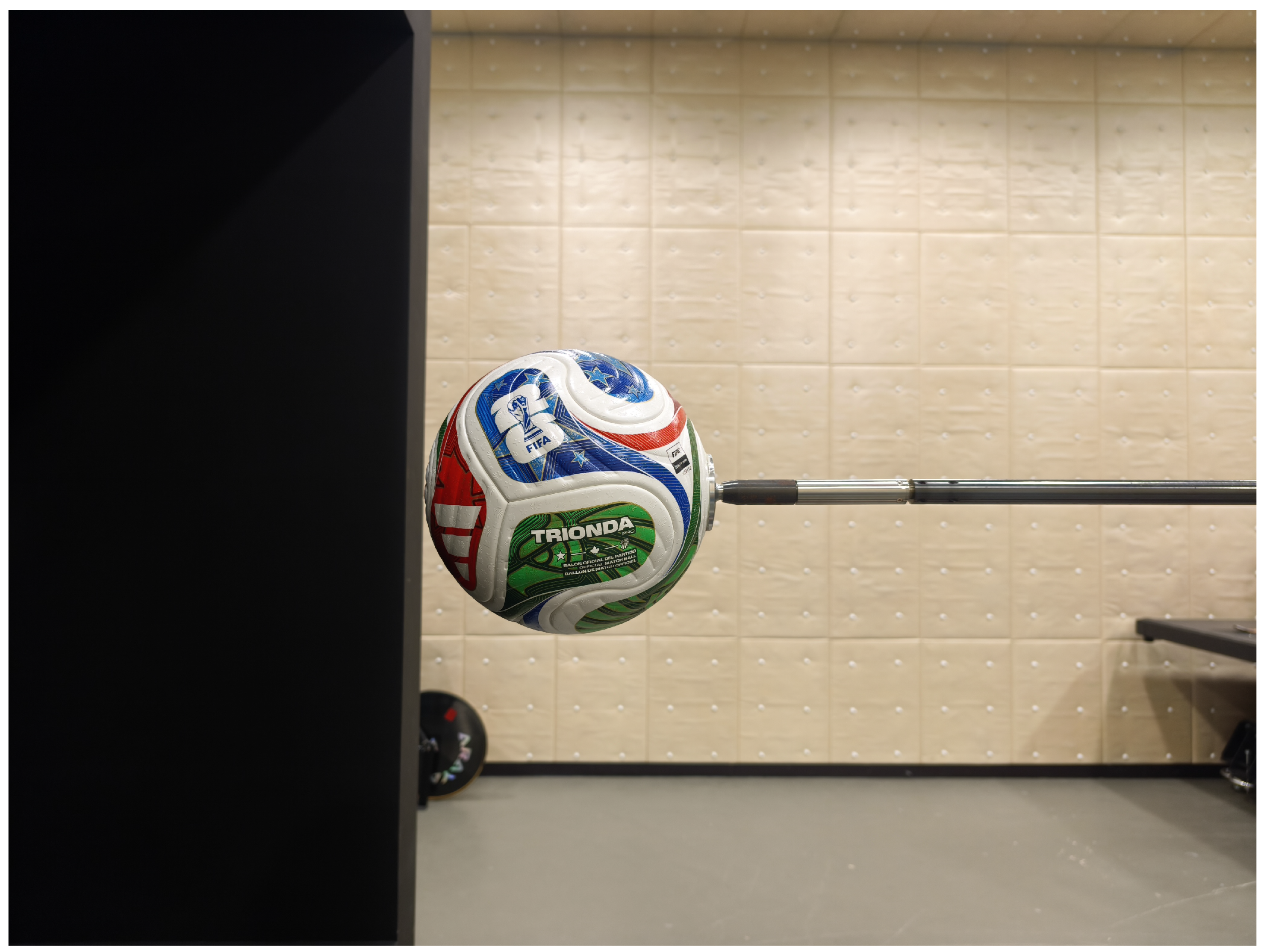
For testing, the soccer balls were mounted on a stainless-steel support rod. Positioning the rod downstream reduces its influence on boundary-layer separation [56]. Although effective for wind-tunnel measurements, this mounting method permanently alters the ball and prevents testing in additional orientations. Given a cost of approximately $170 (US) per ball, only a limited number of orientations could be examined before budget constraints became restrictive. Figure 1 shows the Trionda ball attached to the support rod prior to testing. Figure 2 provides a close-up of the mounting system, which features a bowl-shaped grooved support designed to minimize ball deformation during testing.
The forces on the soccer balls were measured using a six-component sting-type balance (LMC-6522; Nissho Electric Works Co., Ltd., Tokyo, Japan). Force data were recorded at 1000 Hz and for 1 s intervals. The aerodynamic force exerted by the air was decomposed into three orthogonal components. The force acting opposite the wind direction was defined as the drag force of magnitude F D . The associated drag coefficient, C D , was extracted from [57]
F D = 1 2   ρ   A   C D   v 2   ,
where A = 0.038   m 2 is the cross-sectional area of the soccer ball, and ρ = 1.2   kg / m 3 is the mass density of air. The side force, with magnitude F S , acted in the horizontal direction and had an associated side coefficient C S , extracted from [57]
F S = 1 2   ρ   A   C S   v 2   .
The lift force, with magnitude F L , acted in the vertical direction and had a corresponding lift coefficient, C L , obtained from [57]
F L = 1 2   ρ   A   C L   v 2   .
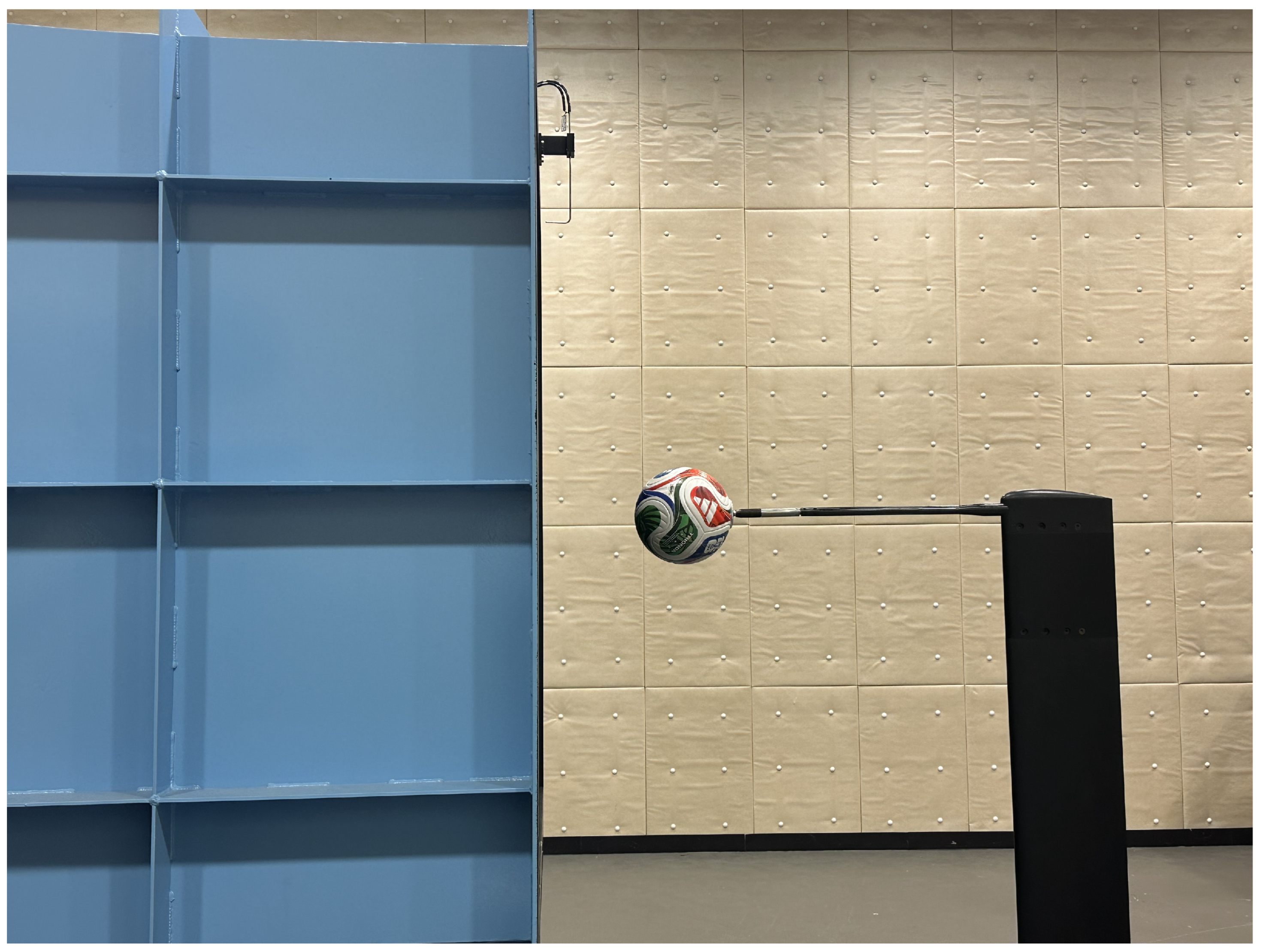
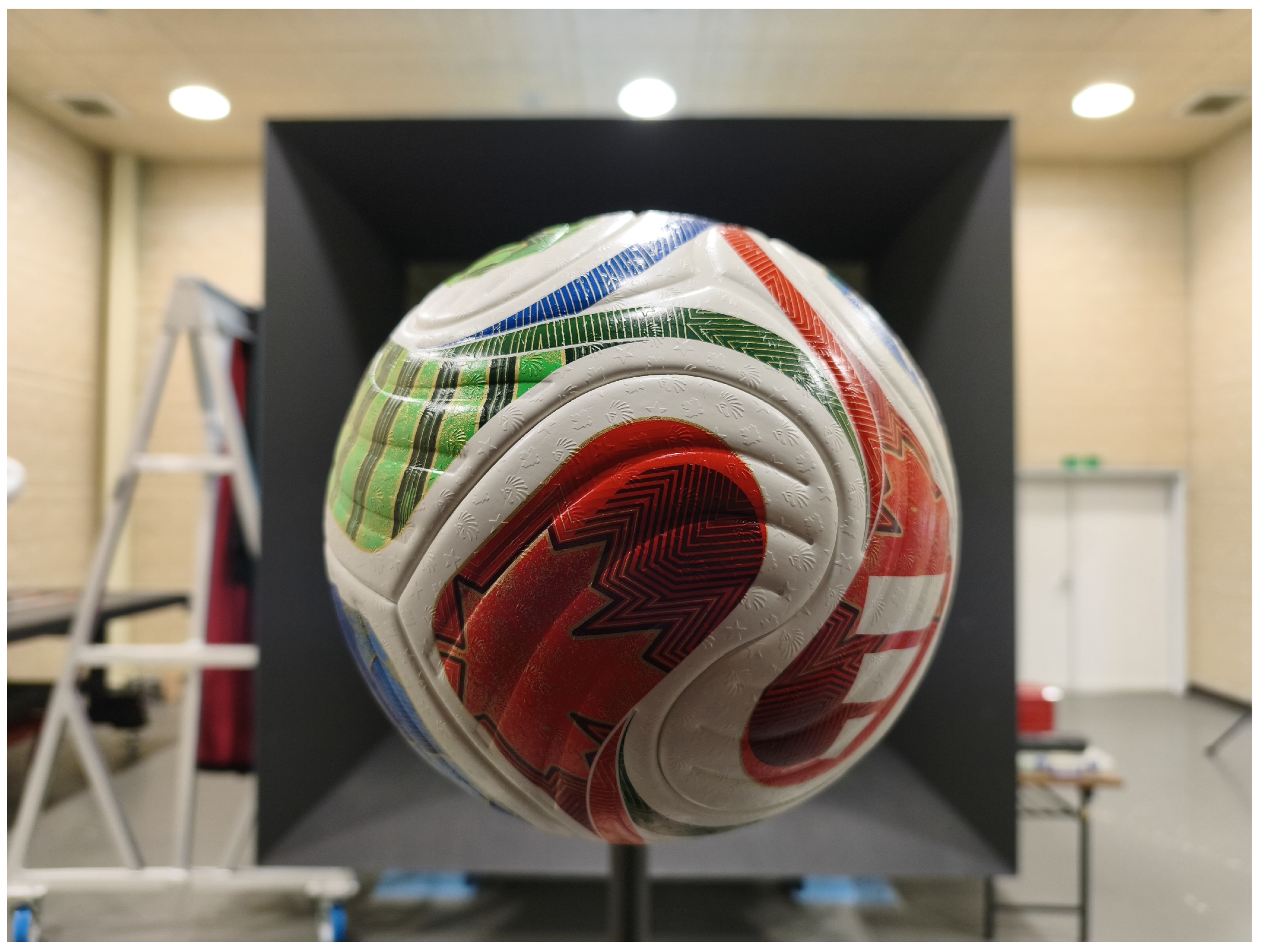
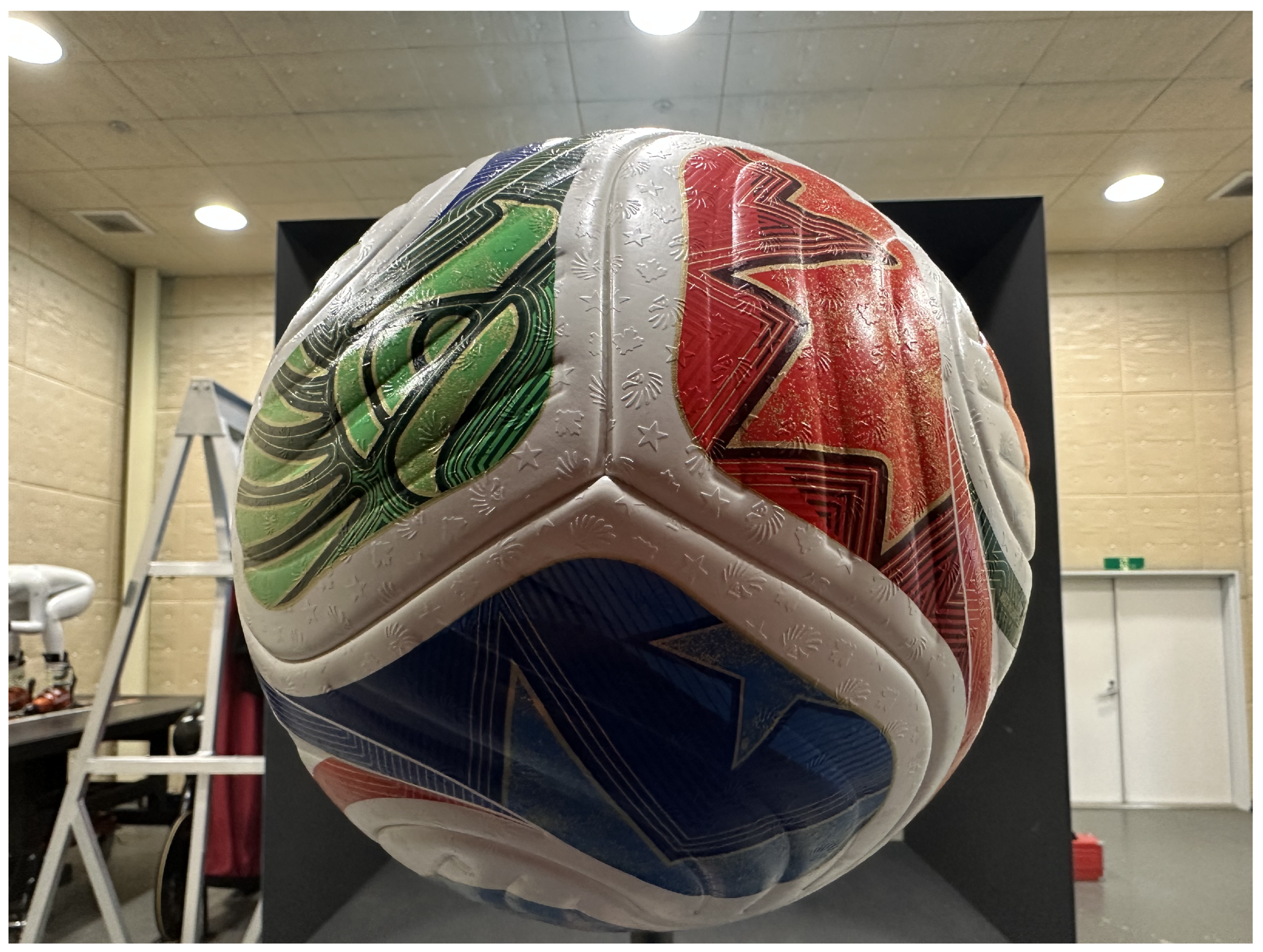
The balls were not spun during the wind-tunnel testing, which implies that an infinite number of orientations is theoretically possible. Two orientations were selected for Trionda, as shown in Figure 3 and Figure 4. These orientations presented distinctly different surface profiles for the incoming flow. All measurements were conducted within the temperature range 2.50 18.9   ° C and within the relative humidity range 36.7 47.0 % . A wind tunnel is an indoor closed-circuit facility. The indoor temperature increases gradually during experiments due to the sustained air movement within a confined laboratory space. For each ball tested, the temperature increase was approximately 1   ° C to 3   ° C .
The Reynolds number is defined as Re = v D / ν [57], where D = 0.22   m is the ball diameter, and ν is the kinematic viscosity of air. Over the experimental temperature range of 2.5 18.9   ° C , ν varied by approximately 10% [57], which produced only modest changes in Reynolds number and did not alter the qualitative conclusions of this study. Reynolds numbers reported in this work were computed using ν = 1.55 × 10 5   m 2 / s , corresponding to 25   ° C , which is representative of typical outdoor match conditions. Given the speed range used in wind-tunnel testing, the corresponding Reynolds-number interval was approximately 10 5 < Re < 5 × 10 5 .
Both C S and C L would be zero if a non-spinning ball in a wind tunnel experienced perfectly symmetric boundary-layer development and separation about the wake centerline. In practice, the World Cup soccer balls examined in this study were not geometrically symmetric, and precise mounting on the support rod could not guarantee symmetry relative to the oncoming flow. Small geometric asymmetries alter the location of the boundary-layer transition and unevenly shift the separation point around the rear stagnation region. This asymmetric separation produces an uneven pressure distribution across the wake, resulting in lateral pressure gradients that generate nonzero side and lift forces, even in the absence of spin. Rotating a ball 90 about an axis passing through the support rod would be expected to alter the relative magnitudes of C S and C L , although exact interchange is not guaranteed due to geometric and mounting asymmetries. Knuckle-ball effects arise from non-spinning to low-spin balls, where unsteady transition and wake switching produce time-dependent lateral forces and have been investigated for soccer balls [58,59], baseballs [60], and knuckleball aerodynamics in baseball pitches driven by unsteady wake dynamics [22,23,61].

2.2. Surface Measurement Techniques

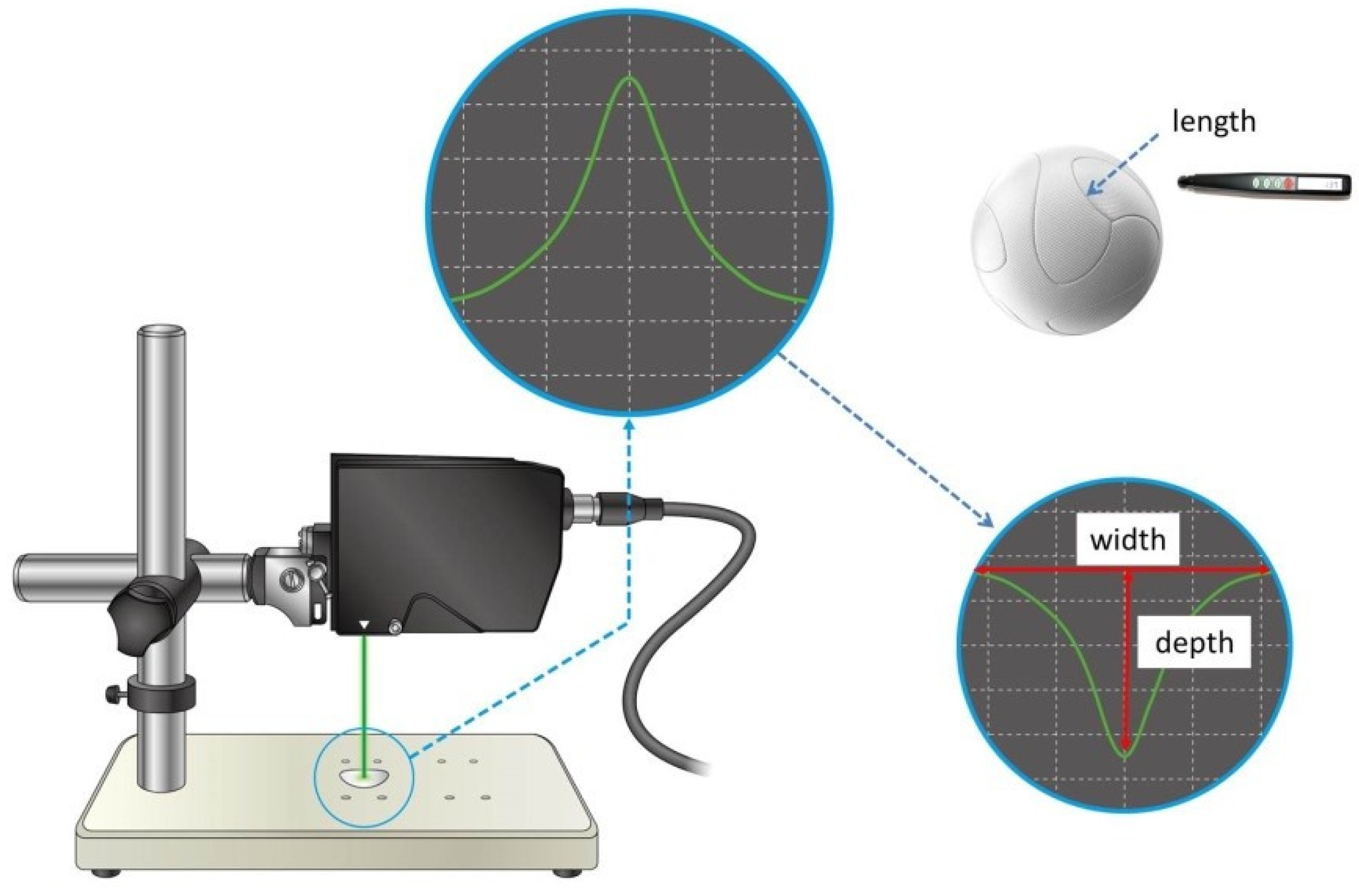
Surface measurements were performed using the established methodology of this research group [62]. The joint length of the panel was measured with a curvimeter (Concurve 10; Koizumi Sokki Mfg Co., Ltd., Tokyo, Japan), whereas the width and height of the seam were measured using a high-speed two-dimensional laser scanner (LJ-V7000, Keyence Corp., Osaka, Japan). The measurement accuracy for seam width and height was improved by first coating the soccer balls with clay and then scanning the resulting clay imprint, producing a clearer geometric profile for analysis. A schematic of the measurement procedure is shown in Figure 5.
Because soccer-ball seams are rounded rather than sharply defined, measuring seam width involves some ambiguity in determining where along the curved profile the seam boundary should be defined. Similarly, for a spherical surface, the identification of a reference line from which the seam height is measured is not uniquely prescribed because the surrounding surface does not provide a well-defined planar baseline.

2.3. Trajectory Analyses

The trajectory of soccer balls in flight may be determined computationally once the aerodynamic coefficients have been measured. Given speed-dependent drag, side, and lift coefficients, the equations of motion may be numerically integrated to obtain the full three-dimensional trajectory of a kicked ball. Such simulations provide quantitative predictions of post-impact motion and enable controlled comparisons between different ball designs under identical initial conditions. These comparisons make it possible to determine whether a newly introduced World Cup soccer ball exhibits flight behavior consistent with that to which players have become accustomed. Trajectory-based approaches have been widely used in sports-ball aerodynamics to infer or validate aerodynamic coefficients from measured flight paths [10].
Alternative approaches have used computational fluid dynamics to directly resolve the flow around a soccer ball and predict the resulting aerodynamic forces and trajectories. Numerical simulations of this type have been applied to investigate unsteady wake behavior and erratic flight characteristics of modern soccer balls [18,22]. Although such approaches provide detailed flow-field information, the present study instead employed experimentally measured aerodynamic coefficients as inputs to the trajectory equations.
The computer simulations assumed that the balls were in orientation A or B as shown in Figure 3 and Figure 4 and that each ball maintained its assigned orientation throughout flight. The initial launch speed, v 0 , was varied throughout the range 15   m / s v 0 35   m / s , ensuring that the aerodynamic coefficients were available across the entire speed range encountered during flight. At each time step, the instantaneous speed determined the corresponding values of C D , C S , and C L used in evaluating the aerodynamic forces.
The general setup for the simulations was as follows. The simulated soccer ball was launched with an initial speed v 0 at an angle 25 relative to the horizontal. A launch angle of 25 was chosen as a representative value typical of long passes and free kicks; although different launch angles would alter the absolute trajectory range, they do not change the comparative aerodynamic trends observed between the balls examined here. Ball masses were measured experimentally and used directly in the equations of motion. During flight, a ball experiences aerodynamic forces and the gravitational force due to Earth. The buoyant force, which is approximately 1.5% of the ball’s weight, was neglected. Including buoyancy altered the computed ranges by less than 1% and did not affect the qualitative conclusions of this study.
The trajectory model was formulated as an initial-value problem for the translational motion of a rigid ball treated as a point mass. The aerodynamic force model was not obtained from a flow-field computation (i.e., no Navier–Stokes or boundary-layer equations were solved); rather, the drag, side, and lift forces were evaluated from the experimentally measured aerodynamic coefficients as functions of speed. The governing equations were therefore ordinary differential equations for r ( t ) with specified initial position and launch velocity, constant gravitational acceleration, and the measured aerodynamic inputs. Additional forces such as added-mass (virtual mass) effects are negligible for a soccer ball in air and were therefore not included in the trajectory model.
Equations (1)–(3) define the three components of the aerodynamic force acting on the ball. Newton’s second law then gives
m   d 2 r ( t ) d t 2 = F D + F S + F L + m   g   ,
where the drag force, F D , acts opposite the instantaneous velocity vector; the side force, F S , is perpendicular to the velocity and parallel to the ground; the lift force, F L , is perpendicular to both F D and F S and lies in the plane formed by the weight and velocity of the ball; and g is the acceleration due to gravity, directed downward with magnitude g = 9.8   m / s 2 .
Full details of how Equation (4) is decomposed into Cartesian components and formulated for numerical integration have been published previously [63]. Coupled second-order differential equations were integrated using a fourth-order Runge–Kutta algorithm [64], which provided more than sufficient accuracy and stability for the speed and time scales considered here. Although simulations were performed using a single launch angle, additional test runs confirmed that the qualitative conclusions reported later were not sensitive to reasonable variations in launch angle.

3. Results

The following three subsections contain results from wind-tunnel experiments, surface measurements, and trajectory analyses.

3.1. Wind-Tunnel Results and Discussion

The two non-spin orientations shown in Figure 3 and Figure 4 produced aerodynamic coefficients that differed only modestly between orientations for each ball. It should be emphasized that the A and B orientations assigned to each ball are internal labels only. The A orientation for Trionda does not correspond geometrically to the A orientation for Al Rihla, Telstar 18, Brazuca, or Jabulani. For each ball, two distinct non-spinning orientations were selected and labeled A and B, but those labels are not intended to represent common seam alignment or panel positioning across different ball designs. The assignments could have been interchanged without altering any of the conclusions drawn from the comparative analyses. The similarity of the A and B results is consistent with the measured aerodynamic behavior not being dominated by a single orientation-specific feature. Although most kicked soccer balls possess appreciable spin, and even so-called knuckleballs exhibit some residual rotation, the non-spinning results presented here provide a controlled baseline for comparing the intrinsic aerodynamic behavior of the five World Cup balls.
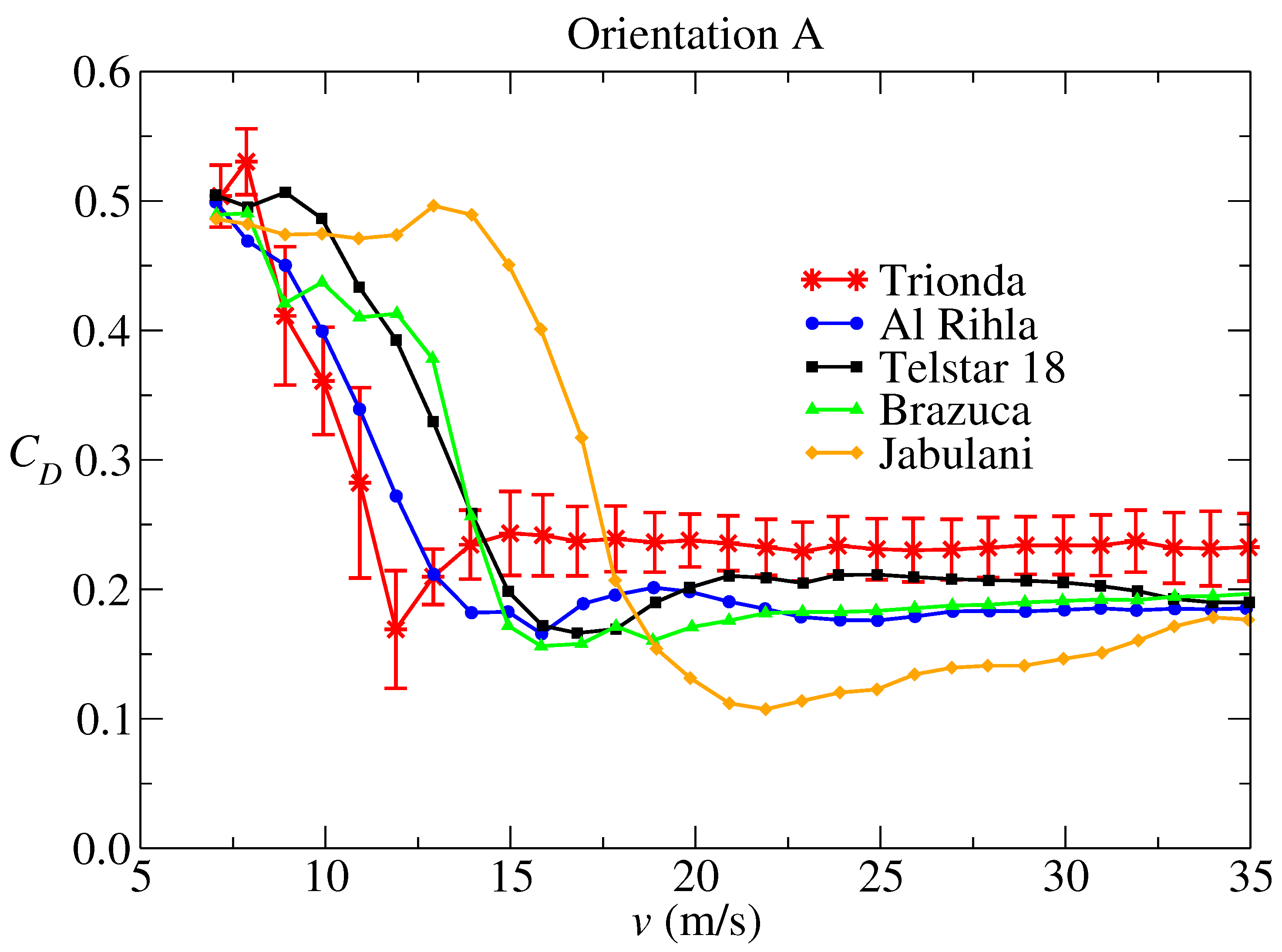
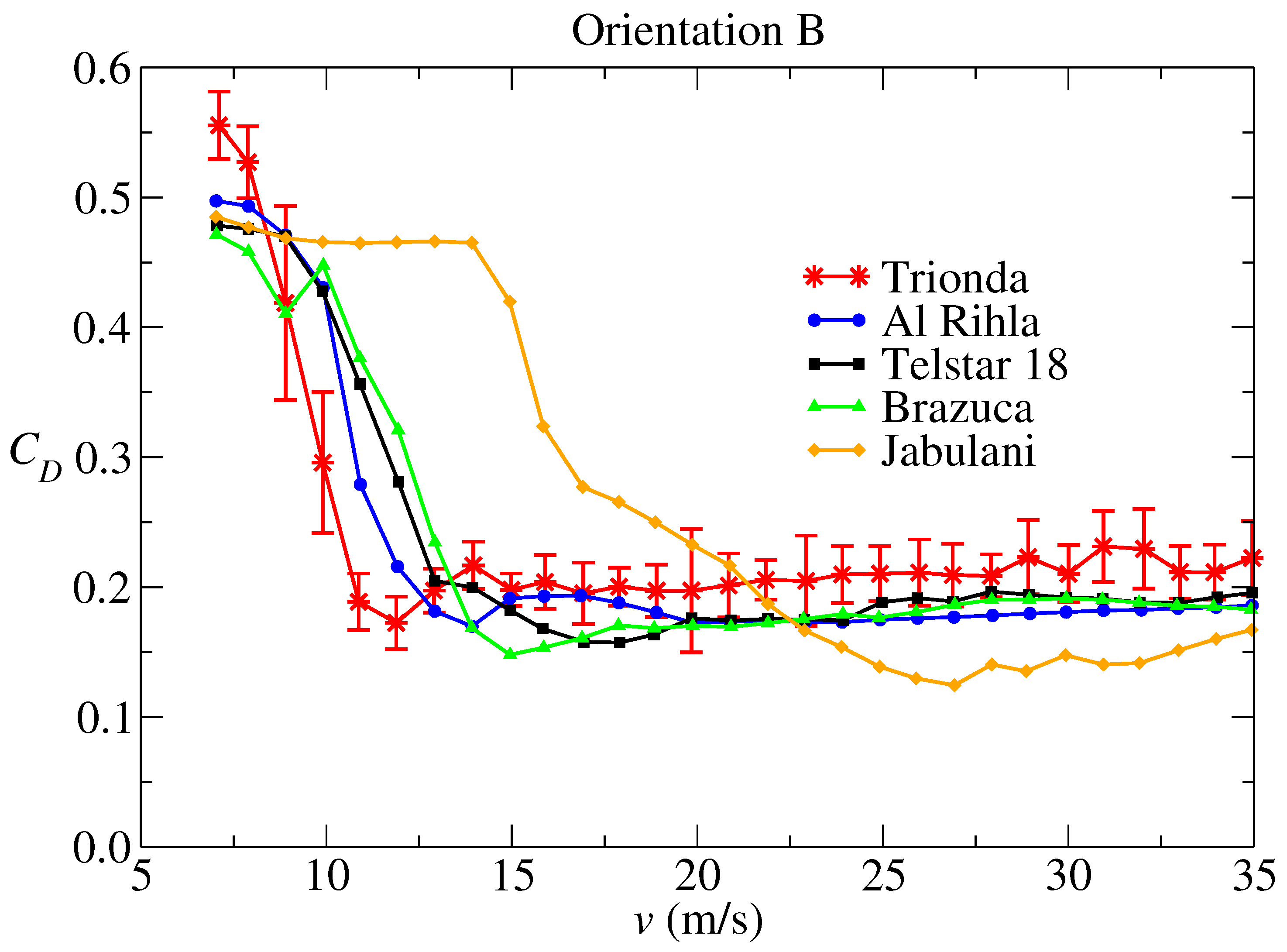
Figure 6 and Figure 7 show the measurements of the wind-tunnel drag coefficient as functions of speed for orientations A and B, respectively. The critical speed, v c , reported in Table 1 was determined directly from the discrete drag-coefficient measurements shown in Figure 6 and Figure 7. Specifically, v c was defined as the experimental wind speed at which the minimum time-averaged drag coefficient occurred in the drag-crisis region. Because measurements were conducted at approximately 1 m/s increments, the reported v c values correspond to the tested wind-speed setting at which the minimum mean C D was observed rather than to a value obtained from a fitted or interpolated curve. No spline or other higher-order curve fitting was applied in determining v c . Each plotted data point represents the mean of force measurements acquired at 1000 Hz over a 1 s interval, and the error bars shown in Figure 6, Figure 7, Figure 8, Figure 9, Figure 10 and Figure 11 indicate ± one standard deviation. The increased scatter observed near the drag crisis therefore reflects the intrinsic unsteadiness of the transition region rather than numerical smoothing or curve-fitting artifacts. For both orientations, Trionda exhibits the smallest critical speed among the five balls, with v c = 11.9 m/s in each orientation (Table 1). The three most recent predecessors (Al Rihla, Telstar 18, and Brazuca) have critical speeds in the 14–18 m/s range, whereas Jabulani remains a clear outlier, with critical speeds of 21.9 m/s and 26.9 m/s in orientations A and B, respectively.
The drag coefficients at the critical speeds of Trionda, Al Rihla, Telstar 18, and Brazuca lie in a relatively narrow range ( C D 0.15 –0.17), whereas Jabulani reaches substantially lower critical values ( C D 0.11 –0.12). The elevated critical speeds for Jabulani are evident in Figure 6 and Figure 7, where its drag crisis occurs within the upper portion of the soccer-relevant speed range. A Jabulani ball kicked at approximately 25 m/s would therefore pass through the crisis region during deceleration, experiencing a rapid increase in drag coefficient and a corresponding increase in drag force relative to the other balls in that speed interval. Only at speeds well above its critical speed does Jabulani exhibit smaller drag coefficients than its successors. Table 1 summarizes the critical speeds, corresponding critical Reynolds numbers, and drag coefficients at crisis for all balls and both orientations.
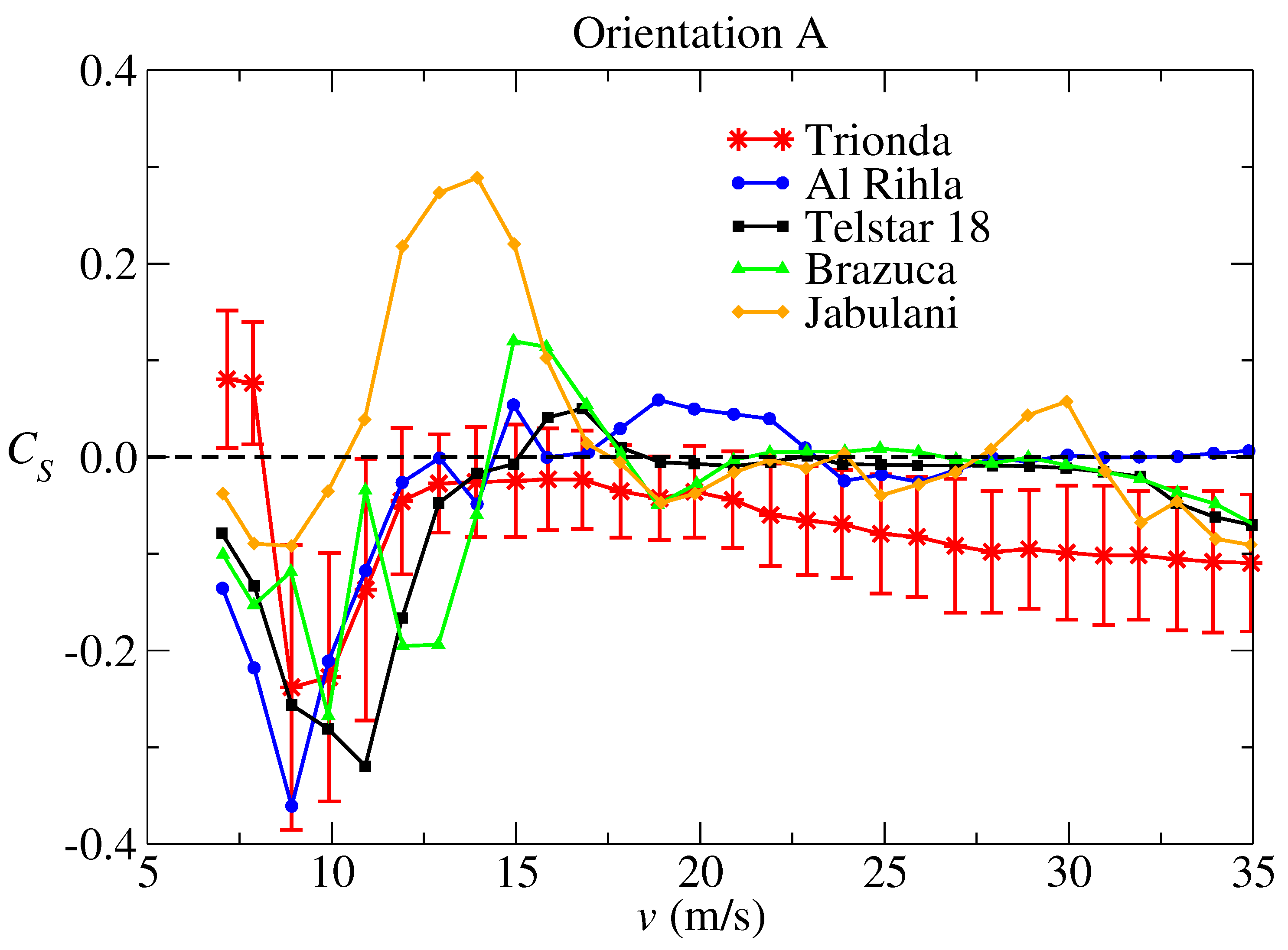
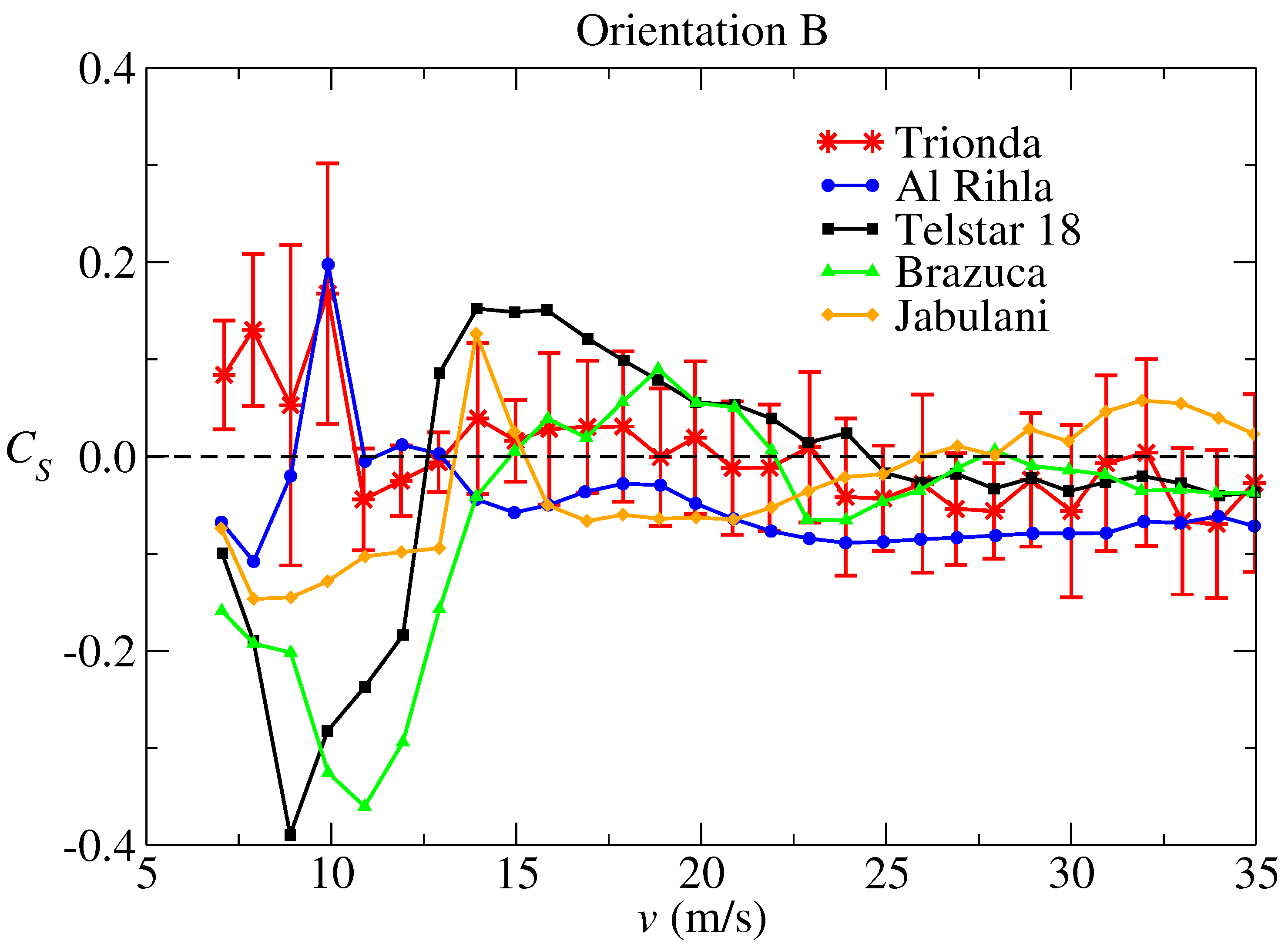
The side coefficients for the five balls in orientations A and B are shown in Figure 8 and Figure 9, respectively. Below the critical speed, C S exhibits increased scatter and larger fluctuations. Above the critical speed, the magnitude and variability of C S generally decrease. Among the balls tested, Al Rihla in orientation A at higher speeds shows the smallest sustained magnitude of C S in this data set.
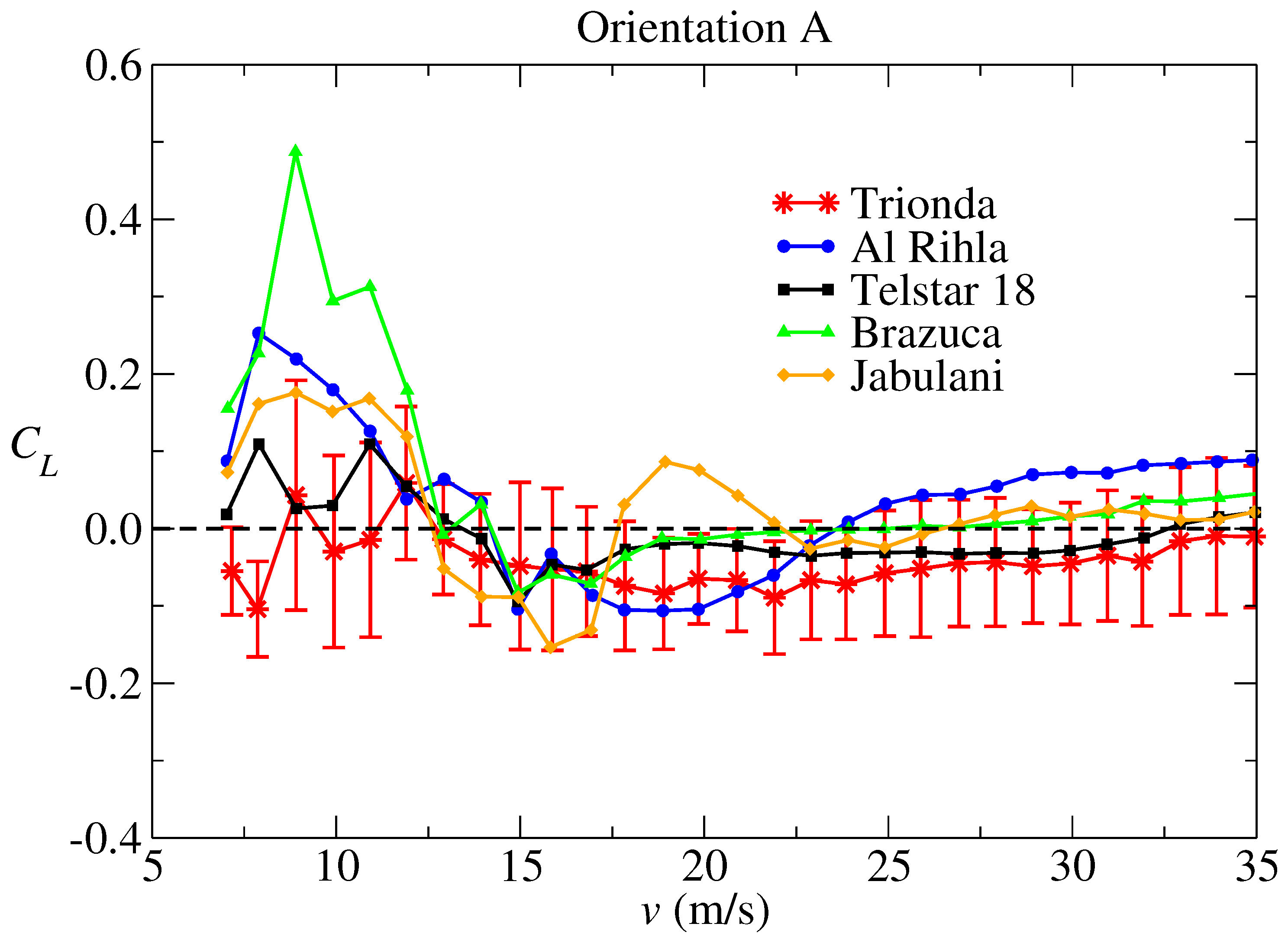
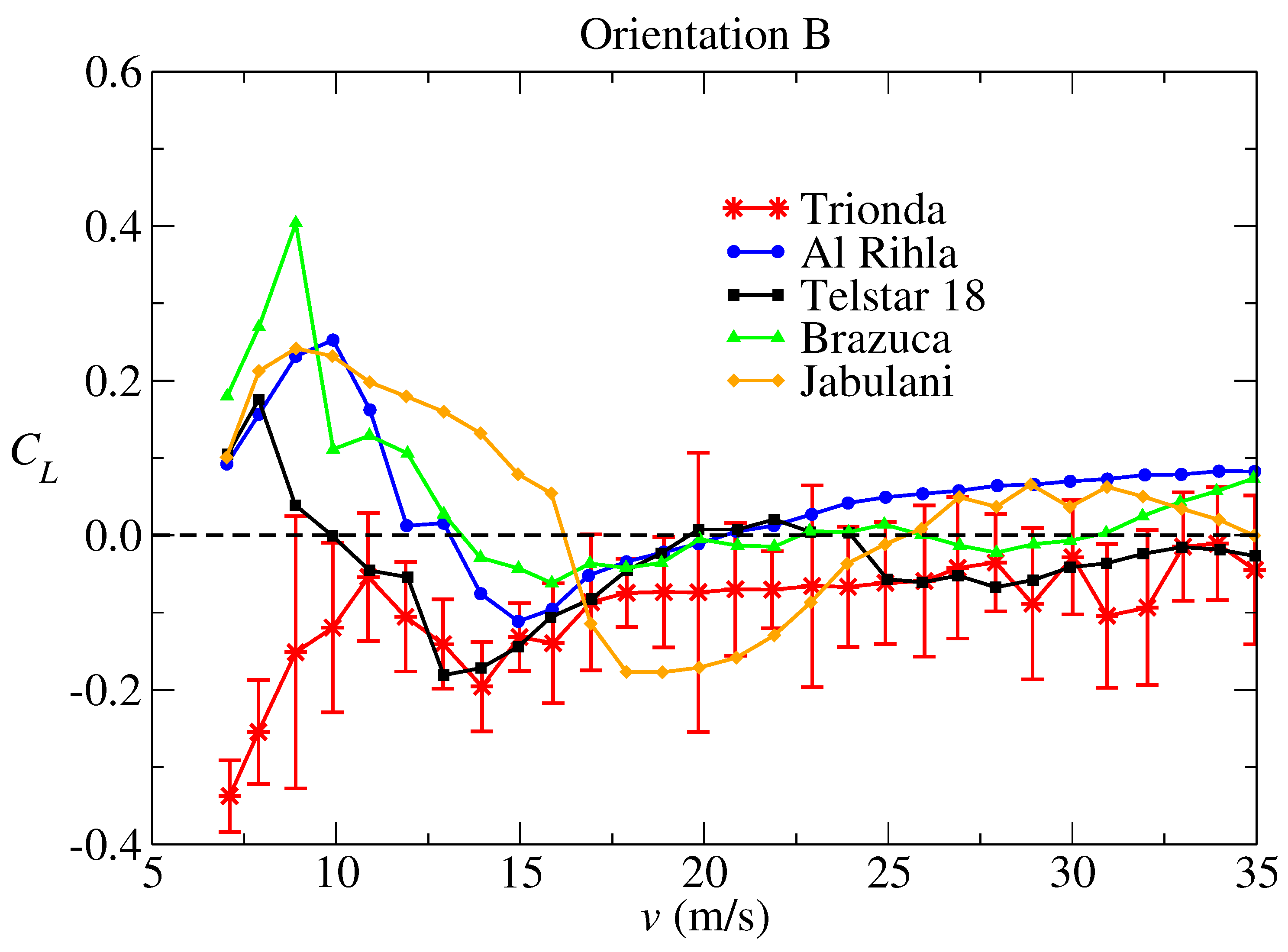
Figure 10 and Figure 11 present the results of the lift coefficient for orientations A and B. The greatest variability in C L occurs near or below the critical speed, whereas above the critical speed the magnitudes are generally smaller and less erratic. At higher speeds, all balls exhibit small but nonzero lift coefficients in both orientations.

3.2. Surface Measurement Results

The results of the surface measurements are given in Table 2. The laser-scanning system provided reliable measurements of seam width and seam depth but was not capable of resolving the smallest surface protrusions and indentations associated with fine panel texturing. Such micro-texturing nevertheless plays an aerodynamic role by modifying the receptivity of the boundary layer to disturbances that promote laminar-to-turbulent transition. Modern World Cup soccer balls are therefore engineered so that reductions in panel number do not produce excessive effective smoothness and unintended shifts in drag-crisis behavior. Maintaining comparable effective roughness across successive tournament balls helps ensure that aerodynamic characteristics remain within the range to which players are accustomed.
In addition to seam geometry, Trionda has three pronounced grooves on each panel surface. For a representative groove, the widest region exhibited a width of 9.04 mm and a depth of 1.29 mm, the intermediate region a width of 6.08 mm and a depth of 0.85 mm, and the narrowest region a width of 3.26 mm and a depth of 0.48 mm. These groove dimensions are comparable in magnitude to the seam depths listed in Table 2, indicating that they likely function as additional roughness elements capable of locally perturbing the developing boundary layer. Because such features are distributed over each panel surface, they contribute to the overall effective roughness beyond what is captured by total seam length alone.
Comparison of Table 1 and Table 2 suggests a consistent qualitative relationship between seam geometry and critical speed. Jabulani, which has the narrowest seams (2.2 mm), the shallowest seams (0.5 mm), and the shortest total seam length (1.98 m), exhibits the largest critical speeds in both orientations. In contrast, balls with larger seam widths and depths generally display lower critical speeds. Increased seam width and depth introduce larger geometric perturbations relative to the thickness of the boundary layer, thereby enhancing disturbance growth and promoting earlier transition to a turbulent boundary layer. The earlier transition shifts the drag crisis to lower Reynolds numbers, consistent with the trends observed in Table 1. This qualitative relationship has previously been reported [52].
The present data set does not allow isolation of seam width, seam depth, or total seam length as a single controlling parameter. For example, Telstar 18 possesses the longest total seam length (4.32 m) but relatively narrow seams (3.3 mm), whereas Al Rihla has shorter total seam length (3.52 m) but wider (5.8 mm) and deeper (1.6 mm) seams. Despite these geometric differences, their critical speeds fall within a similar range. This comparison suggests that effective roughness is determined by the combined amplitude and spatial distribution of surface features rather than by any one geometric metric alone.
Panel texture further complicates direct geometric correlations. Although fine-scale texturing dimensions were not fully resolved by the measurement system, qualitative inspection indicates that Brazuca’s surface texturing exhibits greater protrusion height than that of Telstar 18. Brazuca compensates for its shorter total seam length (3.32 m compared to 4.32 m for Telstar 18) through moderately wider and deeper seams and enhanced panel texture, resulting in comparable critical speeds for the two balls. The collective evidence therefore indicates that drag-crisis location is governed by the integrated effective roughness produced by seams and panel texturing acting together. Trionda’s relatively wide and deep seams, combined with its panel grooves, are consistent with its lower measured critical speed relative to its predecessors.

3.3. No-Spin Simulated Trajectories

To obtain the values of the aerodynamic coefficients between the measured data points in Figure 6, Figure 7, Figure 8, Figure 9, Figure 10 and Figure 11, linear interpolation was used. The piecewise-linear curves shown in Figure 6, Figure 7, Figure 8, Figure 9, Figure 10 and Figure 11 therefore represent the actual speed-dependent coefficients used in the trajectory simulations. Simulated trajectories were computed using the mean measured values of the aerodynamic coefficients. Incorporating the variance in the coefficients does not alter the qualitative ordering of the trajectory results, although it would increase visual clutter in the plots that follow.
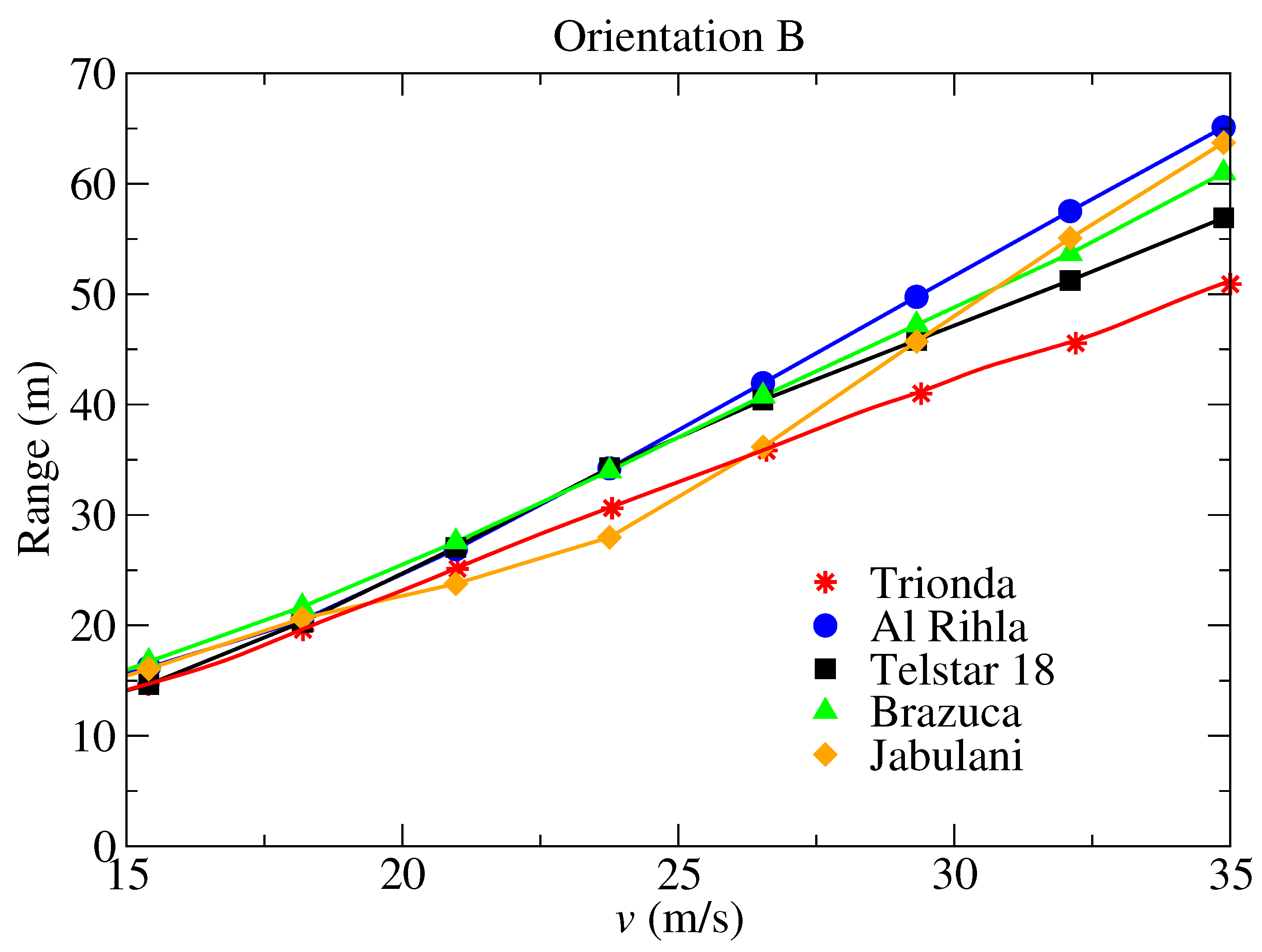
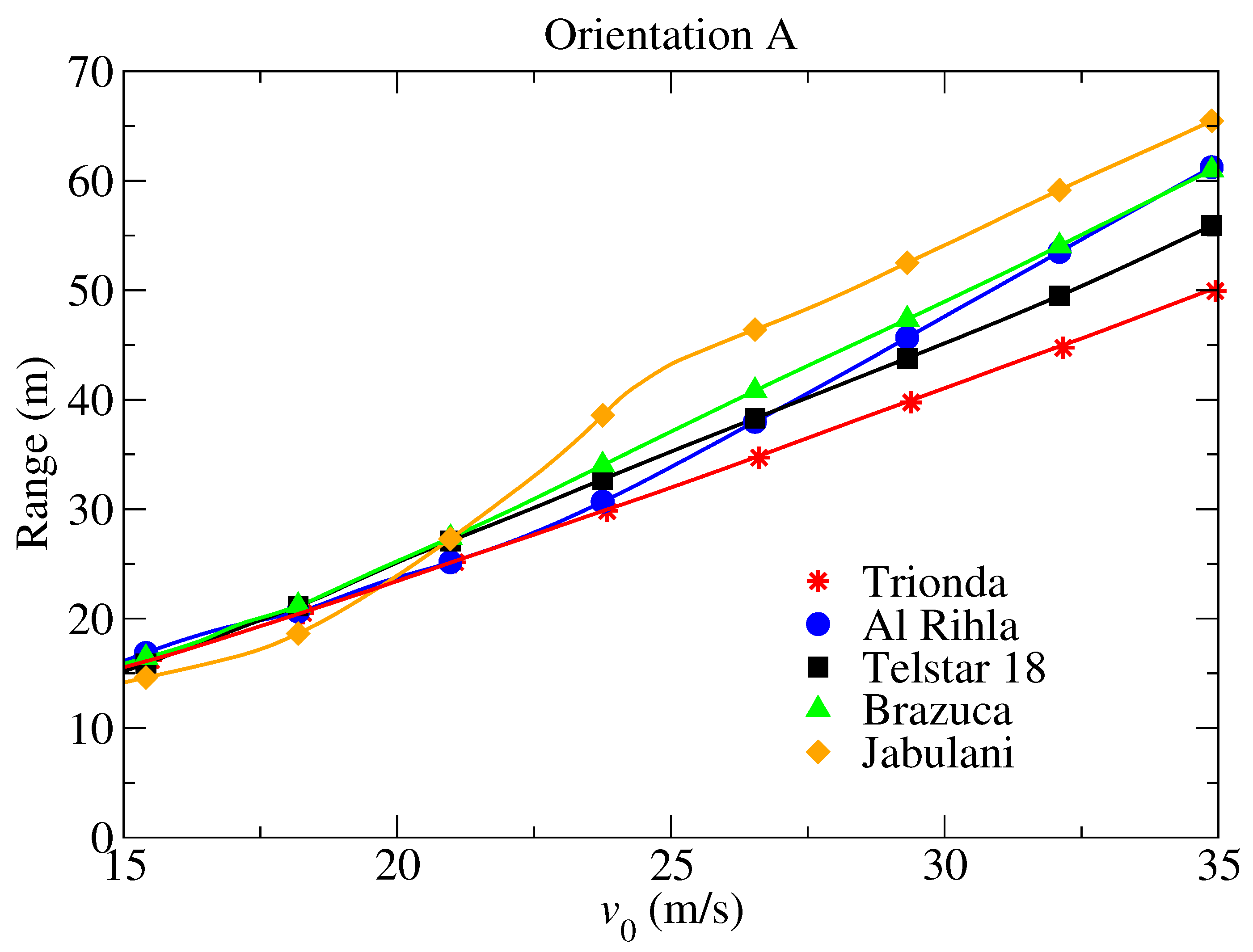
Figure 12 and Figure 13 show the horizontal range as a function of the launch speed for the A and B orientations, respectively. In orientation A (Figure 12), Jabulani produces the largest ranges at high launch speeds, consistent with its comparatively small post-critical drag coefficient in that orientation (see Figure 6). The separation between Jabulani and the other balls increases with launch speed, reflecting the cumulative effect of a reduced drag on longer flight times. Trionda produces consistently shorter ranges than its four predecessors in this orientation, which is consistent with its slightly larger turbulent-regime drag coefficient.
In orientation B (Figure 13), Jabulani does not exhibit the same dominant high-speed range despite its small post-critical drag coefficients. Because its drag crisis in orientation B occurs at a higher speed (Table 1), launches in the intermediate speed range pass through the crisis region during flight, resulting in increased drag relative to the other balls. As a result, Al Rihla produces the longest high-speed ranges in orientation B, with Brazuca and Telstar 18 following closely behind. Trionda again yields shorter ranges than its predecessors for most of the speeds tested.
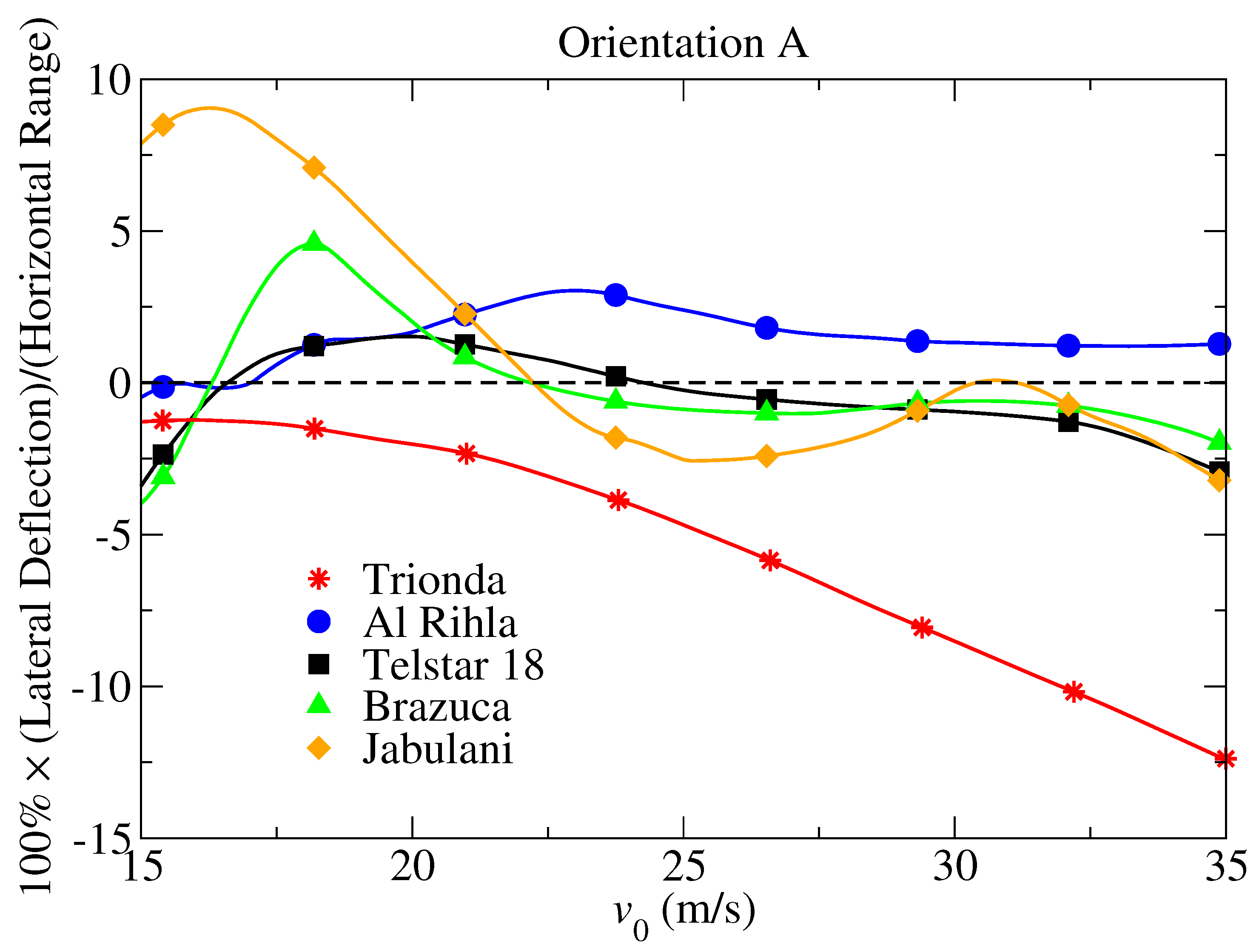
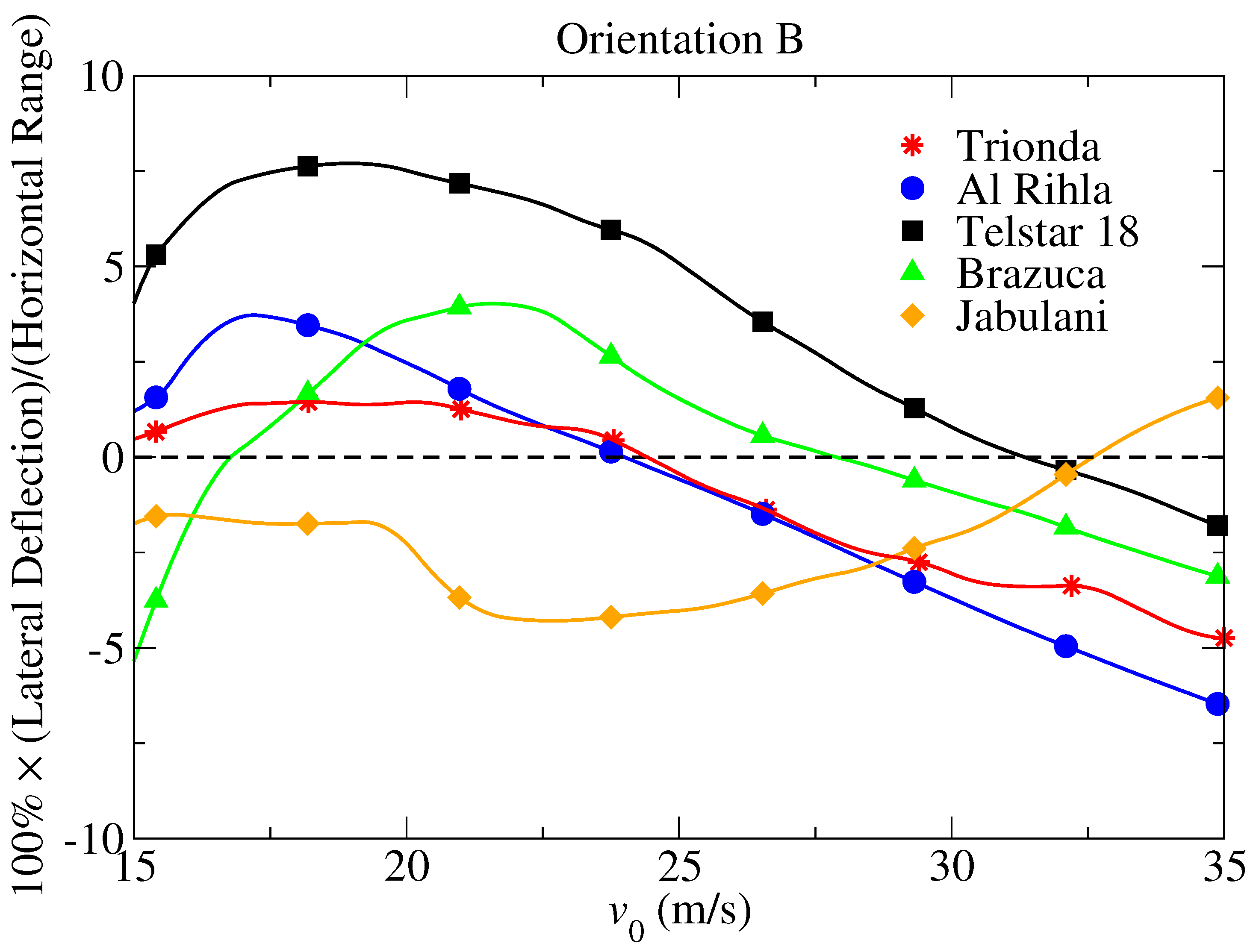
Figure 14 and Figure 15 show the launch-speed-dependent lateral deflection as a percentage of the horizontal range for the A and B orientations, respectively. Because the simulations were performed with zero spin, lateral deflection arises solely from non-zero side coefficients. The percentage sign reflects the chosen orientation, and rotating a ball 180 about the support axis would reverse the sign without altering the trends in absolute value.
In orientation A (Figure 14), Trionda exhibits an increasingly negative lateral deflection with launch speed, reaching approximately 12 % at the highest speed tested. Jabulani displays large positive deflections at lower speeds, approaching + 9 % , before decreasing toward small negative values at higher speeds. Al Rihla maintains small positive deflections over most of the range. Brazuca and Telstar 18 show modest variations that remain closer to zero at moderate-to-high speeds.
In orientation B (Figure 15), Telstar 18 exhibits positive deflections approaching + 7 % at moderate speeds before decreasing to negative values at higher speeds. Al Rihla shows a transition from positive deflection at lower speeds to approximately 7 % at the highest speed tested. Trionda and Brazuca exhibit moderate negative deflections at high speeds, while Jabulani shows a sign reversal near the upper end of the tested interval. These orientation-dependent variations demonstrate that relatively small differences in side coefficient can produce measurable lateral deviations under low-spin conditions.
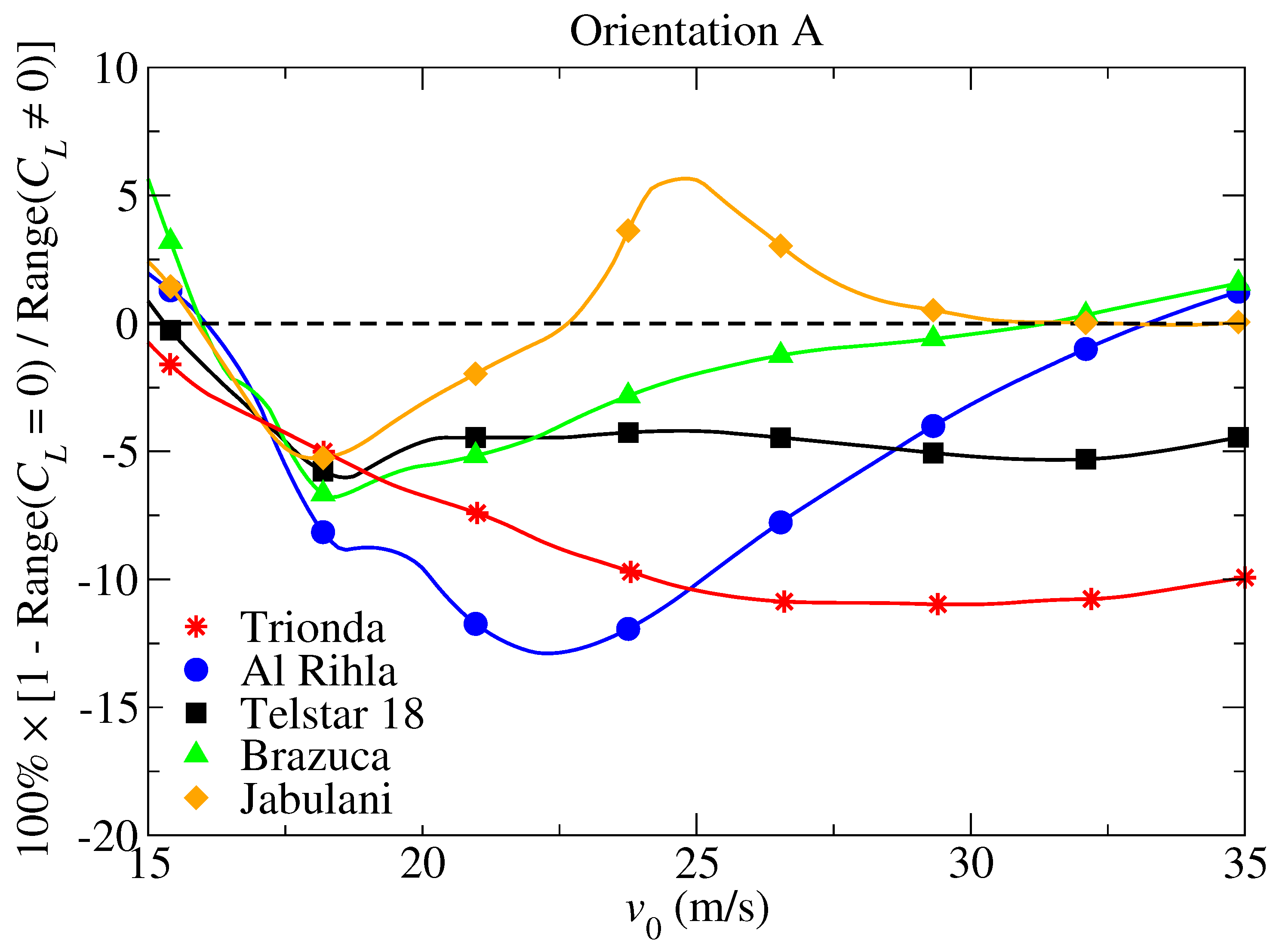
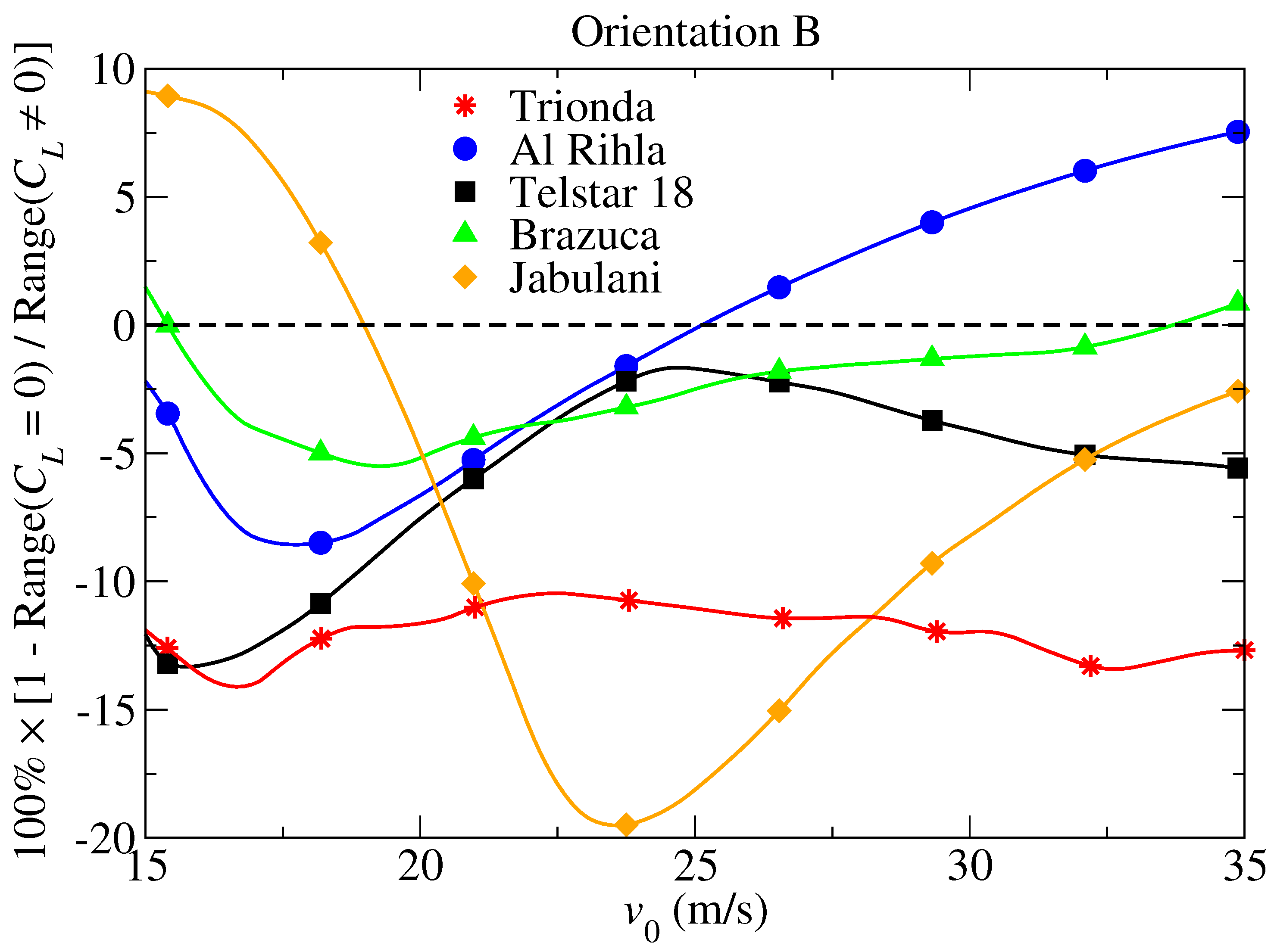
Figure 16 and Figure 17 show the percentage change in the horizontal range when the lift coefficient was set to zero for the A and B orientations, respectively. These plots isolate the contribution of lift to the total range for non-spinning balls.
In orientation A (Figure 16), Al Rihla exhibits signed range differences that approach 13 % at intermediate speeds when the lift is removed, consistent with the behavior of C L in Figure 10. Trionda shows signed range differences of roughly 10 % at moderate-to-high speeds. Brazuca and Telstar 18 show smaller changes that generally remain within about ± 5 % . Jabulani displays a sign change in the range difference, reflecting the speed-dependent sign variation in its lift coefficient.
In orientation B (Figure 17), Jabulani exhibits the highest sensitivity to lift removal, with signed range differences approaching 20 % near 23–24 m/s. Al Rihla shows increasing positive range differences at higher speeds, whereas Trionda maintains signed reductions near 12 % over much of the tested interval. Telstar 18 and Brazuca again display a comparatively modest sensitivity.
It should be emphasized that all trajectory simulations presented here assume zero spin. In match play, most long kicks possess backspin, which generates additional lift through the Magnus effect and increases time aloft. The presence of spin would therefore modify horizontal ranges relative to the non-spinning cases examined here. The present results isolate differences in intrinsic non-rotating aerodynamic behavior. Incorporation of spin could alter the quantitative ordering of ranges, particularly for balls with modest differences in post-critical drag.

4. Conclusions

This study compared the aerodynamic and surface properties of five recent World Cup soccer balls: Jabulani (2010), Brazuca (2014), Telstar 18 (2018), Al Rihla (2022), and Trionda (2026). Wind-tunnel measurements of drag, side and lift coefficients were combined with surface-geometry measurements to examine how seam width, seam depth, total seam length, and panel texture influence boundary-layer transition and drag-crisis behavior.
The measurements confirmed a consistent qualitative relationship between the seam geometry and the critical speed. Balls possessing wider and deeper seams exhibited lower critical speeds, consistent with earlier transition of the boundary layer. Jabulani, which has the narrowest and shallowest seams as well as the shortest total seam length, exhibited the largest critical speeds in both tested orientations. In contrast, Trionda, Al Rihla, Telstar 18, and Brazuca exhibited substantially lower critical speeds, despite differing panel counts and seam distributions. The results demonstrate that no single geometric parameter uniquely governs drag-crisis location. Rather, effective roughness arises from the combined influence of seam dimensions, seam distribution, panel geometry, and surface texture.
Trionda exhibited the smallest measured critical speed among the five balls in both tested orientations. However, its post-critical drag coefficients were slightly larger than those of Brazuca, Telstar 18, and Al Rihla. Although Trionda transitioned earlier, its turbulent-regime drag was modestly larger. This combination suggests that long, high-speed kicks may experience slightly reduced range relative to some of their immediate predecessors in the absence of spin.
Trajectory simulations of non-spinning kicks provide a controlled assessment of how these aerodynamic differences translate into ballistic performance. In orientation A, Jabulani produced the longest ranges at high speeds due to its comparatively small post-critical drag coefficient. In orientation B, Al Rihla produced the longest ranges at high speeds because the Jabulani drag crisis occurred at too large a speed in that orientation. Trionda produced slightly shorter ranges than its predecessors across most of the tested speed range, consistent with its somewhat larger turbulent-regime drag.
Simulated lateral deflections and lift-induced range changes demonstrated that modest orientation-dependent asymmetries in side and lift coefficients could produce measurable deviations for balls with little or no spin. In certain orientations, predicted lateral or lift-induced range changes approached 10–20% at specific launch speeds. These results do not imply that large deflections will routinely occur in match play because most well-struck balls possess rotation. Rather, the simulations isolate the intrinsic non-rotating aerodynamic behavior and illustrate the potential sensitivity of low-spin trajectories to small differences in aerodynamic coefficients.
Several limitations of the present methodology should also be noted. The wind-tunnel measurements were conducted under controlled conditions with a stationary (non-spinning) ball so that the aerodynamic effects of seam geometry and surface texture could be isolated. In realistic play, soccer balls typically experience rotation and variable environmental conditions, both of which can influence aerodynamic forces and trajectory behavior. Consequently, the results presented here should be interpreted as a baseline characterization of the intrinsic non-rotating aerodynamics of the tested balls rather than as a complete representation of match conditions.
It is important to emphasize once again that all trajectory analyses presented here assumed zero spin. In realistic play, backspin generates Magnus lift that increases time aloft and can partially offset drag-induced range reductions. Incorporating controlled spin rates into wind-tunnel testing and trajectory modeling would provide a more complete picture of match-relevant behavior.
Future work should therefore extend the present measurements to spinning balls and should develop improved quantitative techniques for characterizing panel texturing and distributed surface roughness. A more refined description of effective roughness would permit stronger correlations between surface geometry and boundary-layer transition. The present results provide quantitative evidence that careful manipulation of seam geometry and panel design allows successive World Cup balls to maintain broadly comparable aerodynamic behavior.

Author Contributions

Conceptualization, J.E.G., S.H., R.L. and T.A.; methodology, J.E.G., S.H., R.L. and T.A.; formal analysis, J.E.G.; investigation, J.E.G., R.L., S.H. and T.A.; writing—original draft preparation, J.E.G.; writing—review and editing, J.E.G., S.H., R.L. and T.A. All authors have read and agreed to the published version of the manuscript.

Funding

This research received no external funding.

Institutional Review Board Statement

Not applicable.

Informed Consent Statement

Not applicable.

Data Availability Statement

The data supporting the results of this study are available from the corresponding author upon reasonable request.

Acknowledgments

The authors thank the four reviewers who offered invaluable feedback that helped them create a much better research article.

Conflicts of Interest

The authors declare no conflicts of interest.

References

  1. FIFA. Al Rihla by Adidas Revealed as FIFA World Cup Qatar 2022™ Official Match Ball. 2022. Available online: https://www.fifa.com/tournaments/mens/worldcup/qatar2022/media-releases/al-rihla-by-adidas-revealed-as-fifa-world-cup-qatar-2022-tm-official-match (accessed on 16 February 2026).
  2. FIFA. FIFA Celebrates Launch of Official Match Ball of FIFA World Cup 26: TRIONDA. 2025. Available online: https://inside.fifa.com/organisation/media-releases/fifa-celebrates-launch-official-match-ball-world-cup-26-trionda (accessed on 16 February 2026).
  3. Achenbach, E. The effects of surface roughness and tunnel blockage on the flow past spheres. J. Fluid Mech. 1974, 65, 113–125. [Google Scholar] [CrossRef]
  4. Goff, J.E.; Asai, T.; Hong, S. A Comparison of Jabulani and Brazuca No-Spin Aerodynamics. Proc. Inst. Mech. Eng. Part P J. Sports Eng. Technol. 2014, 228, 188–194. [Google Scholar] [CrossRef]
  5. Ward, M.; Passmore, M.A.; Spencer, A.; Hanson, H.; Lucas, T. The effect of surface geometry on the aerodynamic behaviour of a football. Sports Eng. 2023, 26, 33. [Google Scholar] [CrossRef]
  6. Hong, S.; Goff, J.E.; Asai, T. The Aerodynamics of New Design Soccer Balls Using a Three-Dimensional Printer. Appl. Sci. 2024, 14, 3932. [Google Scholar] [CrossRef]
  7. Goff, J.E.; Hong, S.; Asai, T. Aerodynamic and surface comparisons between Telstar 18 and Brazuca. Proc. Inst. Mech. Eng. Part P J. Sports Eng. Technol. 2018, 232, 342–348. [Google Scholar] [CrossRef]
  8. Goff, J.E.; Hong, S.; Asai, T. Aerodynamic comparisons between Al Rihla and recent World Cup soccer balls. Proc. Inst. Mech. Eng. Part P J. Sports Eng. Technol. 2022, 239, 403–411. [Google Scholar] [CrossRef]
  9. Goff, J.E. A review of recent research into aerodynamics of sport projectiles. Sports Eng. 2013, 16, 137–154. [Google Scholar] [CrossRef]
  10. Mehta, R.D. Aerodynamics of Sports Balls. Annu. Rev. Fluid Mech. 1985, 17, 151–189. [Google Scholar] [CrossRef]
  11. Asai, T.; Seo, K.; Kobayashi, O.; Sakashita, R. Fundamental aerodynamics of the soccer ball. Sports Eng. 2007, 10, 101–110. [Google Scholar] [CrossRef]
  12. Alam, F.; Chowdhury, H.; Moria, H.; Fuss, F.K. A comparative study of football aerodynamics. Procedia Eng. 2010, 2, 2443–2448. [Google Scholar] [CrossRef][Green Version]
  13. Alam, F.; Chowdhury, H.; Moria, H.; Fuss, F.K.; Khan, I.; Aldawi, F.; Subic, A. Aerodynamics of contemporary FIFA soccer balls. Procedia Eng. 2011, 13, 188–193. [Google Scholar] [CrossRef][Green Version]
  14. Alam, F.; Chowdhury, H.; Stemmer, M.; Wang, Z.; Yang, J. Effects of surface structure on soccer ball aerodynamics. Procedia Eng. 2012, 34, 146–151. [Google Scholar] [CrossRef][Green Version]
  15. Oggiano, L.; Sætran, L. Aerodynamics of modern soccer balls. Procedia Eng. 2010, 2, 2473–2479. [Google Scholar] [CrossRef][Green Version]
  16. Myers, T.; Mitchell, S. A mathematical analysis of the motion of an in-flight soccer ball. Sports Eng. 2013, 16, 29–41. [Google Scholar] [CrossRef]
  17. Choppin, S. Calculating football drag profiles from simulated trajectories. Sports Eng. 2013, 16, 189–194. [Google Scholar] [CrossRef]
  18. Barber, S.; Chin, S.B.; Carré, M.J. Sports ball aerodynamics: A numerical study of the erratic motion of soccer balls. Comput. Fluids 2009, 38, 1091–1100. [Google Scholar] [CrossRef][Green Version]
  19. Lluna, E.; Santiago-Praderas, V.; Peris-Fajaranés, G.; Defez, B. Measurement of Aerodynamic Coefficients of Spherical Objects Using an Electro-optic Device. IEEE Trans. Instrum. Meas. 2013, 62, 2003–2009. [Google Scholar] [CrossRef]
  20. Kray, T.K.; Franke, J.; Frank, W. Magnus effect on a rotating soccer ball at high Reynolds numbers. J. Wind Eng. Ind. Aerodyn. 2014, 124, 46–53. [Google Scholar] [CrossRef]
  21. Hong, S.; Asai, T.; Seo, K. Visualization of air flow around soccer ball using a particle image velocimetry. Sci. Rep. 2015, 5, 15108. [Google Scholar] [CrossRef]
  22. Higuchi, H.; Kiura, T. Aerodynamics of knuckle ball: Flow-structure interaction problem on a pitched baseball without spin. J. Fluids Struct. 2012, 32, 65–77. [Google Scholar] [CrossRef]
  23. Texier, B.D.; Cohen, C.; Quéré, D.; Clanet, C. Physics of knuckleballs. New J. Phys. 2016, 18, 073027. [Google Scholar] [CrossRef]
  24. Kiratidis, A.L.; Leinweber, D.B. An aerodynamic analysis of recent FIFA World Cup balls. Eur. J. Phys. 2018, 39, 034001. [Google Scholar] [CrossRef]
  25. Sakamoto, Y.; Hiratsuka, M.; Ito, S. Effect of Soccer Ball Panels on Aerodynamic Characteristics and Flow in Drag Crisis. Appl. Sci. 2021, 11, 296. [Google Scholar] [CrossRef]
  26. Jalilian, P.; Kreun, P.; Makhmalbaf, M.; Liou, W. Computational aerodynamics of baseball, soccer ball and volleyball. Am. J. Sport. Sci. Med. 2014, 2, 115–120. [Google Scholar] [CrossRef]
  27. Tamada, C.; Sabbavarapu, S. Flow Visualization of Footballs to Analyze the Factors Affecting their Aerodynamic Performance Using CFD. Int. J. Innov. Sci. Res. Technol. 2020, 5, 460–475. [Google Scholar] [CrossRef]
  28. Hussain, S.; Shah, S.; Khan, M. Aerodynamic Design Considerations for a Soccer Ball. In Proceedings of the International Conference on Aerospace Science and Engineering, Islamabad, Pakistan, 12–14 November 2019; pp. 1–16. [Google Scholar] [CrossRef]
  29. Paudel, S.; Yan, J. High-fidelity simulations of full-flight soccer ball aerodynamics using a monolithic overset approach. Comput. Mech. 2025. [Google Scholar] [CrossRef]
  30. Kapothanillath, A.; Pradeep, S.; Sathishkumar, S.; Balaji, K. The Role of Boundary Layer Theory in Soccer Ball Dynamics. IOP Conf. Ser. Mater. Sci. Eng. 2021, 1132, 012009. [Google Scholar] [CrossRef]
  31. Goff, J.E. Aerodynamics in the beautiful game. Phys. Today 2022. [Google Scholar] [CrossRef]
  32. Bearman, P.W. On Vortex Shedding from a Circular Cylinder in the Critical Reynolds Number Regime. J. Fluid Mech. 1969, 37, 577–585. [Google Scholar] [CrossRef]
  33. Nakamura, Y.; Tomonari, Y. The effects of surface roughness on the flow past circular cylinders at high Reynolds numbers. J. Fluid Mech. 1982, 123, 363–378. [Google Scholar] [CrossRef]
  34. Waigh, D.; Kind, R. Improved Aerodynamic Characterization of Regular Three-Dimensional Roughness. AIAA J. 1998, 36, 1117–1119. [Google Scholar] [CrossRef]
  35. Irwin, P.A. Bluff body aerodynamics in wind engineering. J. Wind. Eng. Ind. Aerodyn. 2008, 96, 701–712. [Google Scholar] [CrossRef]
  36. Tong, M.; Yevick, D. Multicanonical analyses of bluff airfoil drags in subcritical flows. Phys. Fluids 2021, 33, 023604. [Google Scholar] [CrossRef]
  37. Bimbato, A.; Pereira, L.; Hirata, M. Study of Surface Roughness Effect on a Bluff Body—The Formation of Asymmetric Separation Bubbles. Energies 2020, 13, 6094. [Google Scholar] [CrossRef]
  38. Pereira, L.; De Oliveira, M.; De Moraes, P.; Bimbato, A. Numerical experiments of the flow around a bluff body with and without roughness model near a moving wall. J. Braz. Soc. Mech. Sci. Eng. 2020, 42, 129. [Google Scholar] [CrossRef]
  39. De Moraes, P.; De Oliveira, M.; De Andrade, C.; Bimbato, A.; Pereira, L. Effects of surface roughness and wall confinement on bluff body aerodynamics at large-gap regime. J. Braz. Soc. Mech. Sci. Eng. 2021, 43, 397. [Google Scholar] [CrossRef]
  40. De Oliveira, M.; Pereira, L. Effect of Surface Roughness on Aerodynamic Loads of Bluff Body in Vicinity of Smoothed Moving Wall. Appl. Sci. 2024, 14, 2919. [Google Scholar] [CrossRef]
  41. Conan, B.; Anthoine, J.; Planquart, P. Experimental aerodynamic study of a car-type bluff body. Exp. Fluids 2011, 50, 1273–1284. [Google Scholar] [CrossRef]
  42. Haghighi, E.; Or, D. Interactions of bluff-body obstacles with turbulent airflows affecting evaporative fluxes from porous surfaces. J. Hydrol. 2015, 530, 103–116. [Google Scholar] [CrossRef]
  43. Hu, S.; Zhao, D.; Sun, W.; Liu, Y. Investigation on galloping piezoelectric energy harvester considering the surface roughness in low velocity water flow. Energy 2023, 262, 125478. [Google Scholar] [CrossRef]
  44. Fang, X.; Tachie, M.; Dow, K. Turbulent separations beneath semi-submerged bluff bodies with smooth and rough undersurfaces. J. Fluid Mech. 2022, 947, A19. [Google Scholar] [CrossRef]
  45. Li, S.; Li, Z.; Yang, Q.; Jiang, Y.; Wang, Y.; Huang, H. Unsteady forces on elongated bluff bodies. Phys. Fluids 2024, 36, 125180. [Google Scholar] [CrossRef]
  46. Bucha, M.; Khan, N.; Uddin, E.; Riaz, H.; Munir, A.; Farooq, U.; Zhao, M.; Muhammad, R.; Jameel, M.; Nasir, M.; et al. Experimental investigation of surface roughness effects on energy harvesting from a piezoelectric eel behind a cylindrical bluff body. PLoS ONE 2025, 20, e0327916. [Google Scholar] [CrossRef] [PubMed]
  47. Ding, J.; Huang, Z. Aerodynamic heat and drag reduction for hypersonic rarefied flow around a bipyramid-type bluff body. Phys. Fluids 2025, 37, 066132. [Google Scholar] [CrossRef]
  48. Lin, H.; Wang, H.; Zhang, Q.; Zheng, W. Numerical analysis of ski suits surface roughness effects on aerodynamics during the in-run phase of ski jumping. Sci. Rep. 2025, 15, 28543. [Google Scholar] [CrossRef]
  49. Hong, S.; Asai, T. Effect of panel shape of soccer ball on its flight characteristics. Sci. Rep. 2014, 4, 5068. [Google Scholar] [CrossRef]
  50. Hong, S.; Asai, T. Aerodynamic effects of dimples on soccer ball surfaces. Heliyon 2017, 3, e00432. [Google Scholar] [CrossRef]
  51. Hong, S.; Goff, J.E.; Asai, T. Effect of a soccer ball’s surface texture on its aerodynamics and trajectory. Proc. Inst. Mech. Eng. Part P J. Sports Eng. Technol. 2019, 233, 67–74. [Google Scholar] [CrossRef]
  52. Goff, J.E.; Hong, S.; Asai, T. Effect of a soccer ball’s seam geometry on its aerodynamics and trajectory. Proc. Inst. Mech. Eng. Part P J. Sports Eng. Technol. 2019, 234, 19–29. [Google Scholar] [CrossRef]
  53. Goff, J.E.; Hong, S.; Asai, T. Influence of Surface Properties on Soccer Ball Trajectories. Proceedings 2020, 49, 143. [Google Scholar] [CrossRef]
  54. Hong, S.; Asai, T. Effect of surface groove structure on the aerodynamics of soccer balls. Appl. Sci. 2020, 10, 5877. [Google Scholar] [CrossRef]
  55. Hong, S.; Asai, T. Aerodynamic differences between new and used soccer balls. Appl. Sci. 2021, 11, 7204. [Google Scholar] [CrossRef]
  56. Achenbach, E. Experiments on the flow past spheres at very high Reynolds numbers. J. Fluid Mech. 1972, 54, 565–575. [Google Scholar] [CrossRef]
  57. White, F.M. Fluid Mechanics, 7th ed.; McGraw Hill: New York, NY, USA, 2011. [Google Scholar]
  58. Asai, T.; Kamemoto, K. Flow structure of knuckling effects in footballs. J. Fluids Struct. 2011, 27, 727–733. [Google Scholar] [CrossRef][Green Version]
  59. Ito, S.; Kamata, M.; Asai, T.; Seo, K. Factors of unpredictable shots concerning new soccer balls. Procedia Eng. 2012, 34, 152–157. [Google Scholar] [CrossRef][Green Version]
  60. Adair, R.K. The Physics of Baseball, 3rd ed.; Harper Perennial: New York, NY, USA, 2002. [Google Scholar]
  61. Watts, R.G.; Sawyer, E. Aerodynamics of a Knuckleball. Am. J. Phys. 2005, 73, 108–111. [Google Scholar] [CrossRef]
  62. Asai, T.; Hong, S. Aerodynamics of the newly approved football for the English Premier League 2020-2021 season. Sci. Rep. 2021, 11, 9578–9586. [Google Scholar] [CrossRef]
  63. Goff, J.E.; Carré, M.J. Trajectory analysis of a soccer ball. Am. J. Phys. 2009, 77, 1020–1027. [Google Scholar] [CrossRef]
  64. Press, W.H.; Flannery, B.P.; Teukolsky, S.A.; Vetterling, W.T. Numerical Recipes: The Art of Scientific Computing; Cambridge University Press: New York, NY, USA, 1986. [Google Scholar]
Figure 1. Trionda soccer ball mounted on stainless-steel rod in preparation for wind-tunnel experiment.
Applsci 16 02808 g001
Figure 2. Close-up image of mount used with ball and steel rod during wind-tunnel testing.
Applsci 16 02808 g002
Figure 3. Orientation A for Trionda, just prior to testing in the wind tunnel.
Applsci 16 02808 g003
Figure 4. Orientation B for Trionda, just prior to testing in the wind tunnel.
Applsci 16 02808 g004
Figure 5. Schematic of the measuring procedure for determining a soccer ball’s seam width and height.
Applsci 16 02808 g005
Figure 6. Wind-tunnel drag-coefficient results for Trionda in the A orientation. Data points show average values of the measurements; error bars show ± one standard deviation. Straight lines are drawn between data points to aid the eye. Also shown are drag-coefficient data for Trionda’s four predecessors [8]. Error bars for older data are kept off to reduce clutter.
Applsci 16 02808 g006
Figure 7. Wind-tunnel drag-coefficient results for Trionda in the B orientation. Data points show average values of the measurements; error bars show ± one standard deviation. Straight lines are drawn between data points to aid the eye. Also shown are drag-coefficient data for Trionda’s four predecessors [8]. Error bars for older data are kept off to reduce clutter.
Applsci 16 02808 g007
Figure 8. Wind-tunnel side-coefficient results for Trionda in the A orientation. Data points show average values of the measurements; error bars show ± one standard deviation. Straight lines are drawn between data points to aid the eye. Also shown are side-coefficient data for Trionda’s four predecessors [8]. Error bars for older data are kept off to reduce clutter.
Applsci 16 02808 g008
Figure 9. Wind-tunnel side-coefficient results for Trionda in the B orientation. Data points show average values of the measurements; error bars show ± one standard deviation. Straight lines are drawn between data points to aid the eye. Also shown are side-coefficient data for Trionda’s four predecessors [8]. Error bars for older data are kept off to reduce clutter.
Applsci 16 02808 g009
Figure 10. Wind-tunnel lift-coefficient results for Trionda in the A orientation. Data points show average values of the measurements; error bars show ± one standard deviation. Straight lines are drawn between data points to aid the eye. Also shown are lift-coefficient data for Trionda’s four predecessors [8]. Error bars for older data are kept off to reduce clutter.
Applsci 16 02808 g010
Figure 11. Wind-tunnel lift-coefficient results for Trionda in the B orientation. Data points show average values of the measurements; error bars show ± one standard deviation. Straight lines are drawn between data points to aid the eye. Also shown are lift-coefficient data for Trionda’s four predecessors [8]. Error bars for older data are kept off to reduce clutter.
Applsci 16 02808 g011
Figure 12. Trajectory predictions for non-spinning Trionda’s horizontal range as a function of launch speed in the A orientation. The launch angle was θ 0 = 25 . Similar curves for Trionda’s four predecessors are also shown [8]. Symbols are not data; they help distinguish the curves.
Applsci 16 02808 g012
Figure 13. Trajectory predictions for non-spinning Trionda’s horizontal range as a function of launch speed in the B orientation. The launch angle was θ 0 = 25 . Similar curves for Trionda’s four predecessors are also shown [8]. Symbols are not data; they help distinguish the curves.
Applsci 16 02808 g013
Figure 14. Trajectory predictions for lateral deflection as a percentage of horizontal range for non-spinning Trionda in the A orientation. The launch angle was θ 0 = 25 . Similar curves for Trionda’s four predecessors are also shown [8]. Symbols are not data; they help distinguish the curves.
Applsci 16 02808 g014
Figure 15. Trajectory predictions for lateral deflection as a percentage of horizontal range for non-spinning Trionda in the B orientation. The launch angle was θ 0 = 25 . Similar curves for Trionda’s four predecessors are also shown [8]. Symbols are not data; they help distinguish the curves.
Applsci 16 02808 g015
Figure 16. Trajectory predictions for the percent change in horizontal range when the lift coefficient was set to zero for non-spinning Trionda in the A orientation. The launch angle was θ 0 = 25 . Similar curves for Trionda’s four predecessors are also shown [8]. Symbols are not data; they help distinguish the curves.
Applsci 16 02808 g016
Figure 17. Trajectory predictions for the percent change in horizontal range when the lift coefficient was set to zero for non-spinning Trionda in the B orientation. The launch angle was θ 0 = 25 . Similar curves for Trionda’s four predecessors are also shown [8]. Symbols are not data; they help distinguish the curves.
Applsci 16 02808 g017
Table 1. Drag coefficient at critical speed for World Cup soccer balls.
Ball (Orientation) v c Re c × 10 5 C D ( Re c )
Trionda (A)11.9 m/s1.790.169
Trionda (B)11.9 m/s1.790.172
Al Rihla (A)15.8 m/s2.380.166
Al Rihla (B)13.9 m/s2.070.170
Telstar 18 (A)16.8 m/s2.490.166
Telstar 18 (B)17.9 m/s2.690.157
Brazuca (A)15.8 m/s2.370.156
Brazuca (B)15.0 m/s2.230.148
Jabulani (A)21.9 m/s3.300.107
Jabulani (B)26.9 m/s4.000.124
Table 2. Physical properties of World Cup soccer balls.
BallMassPanel NumberTotal Seam LengthSeam WidthSeam Depth
Trionda431 g42.50 m5.1 mm1.3 mm
Al Rihla428 g203.52 m5.8 mm1.6 mm
Telstar 18430 g64.32 m3.3 mm1.1 mm
Brazuca430 g63.32 m4.0 mm1.4 mm
Jabulani438 g81.98 m2.2 mm0.5 mm
Disclaimer/Publisher’s Note: The statements, opinions and data contained in all publications are solely those of the individual author(s) and contributor(s) and not of MDPI and/or the editor(s). MDPI and/or the editor(s) disclaim responsibility for any injury to people or property resulting from any ideas, methods, instructions or products referred to in the content.