Article

Solvent-Based Extraction of Pomegranate Seed Oil from Juice By-Products: Effects of Microwave-Assisted, Soxhlet, and Cold Methods on Quality and Oxidative Stability


1
Department of Chemistry, Institute of Food Sciences, Warsaw University of Life Sciences, 02-787 Warsaw, Poland
2
Department of Food Engineering, Faculty of Food Technology and Biotechnology, University of Zagreb, 10000 Zagreb, Croatia
*
Author to whom correspondence should be addressed.
Appl. Sci. 2026, 16(6), 2703; https://doi.org/10.3390/app16062703
Submission received: 13 February 2026 / Revised: 5 March 2026 / Accepted: 10 March 2026 / Published: 12 March 2026
(This article belongs to the Special Issue Advanced Food Processing Technologies and Approaches: 2nd Edition)

Featured Application

This study provides practical guidance for selecting an extraction method that optimally balances oil yield, oxidative stability, and retention of bioactive minor constituents in pomegranate seed oil (PSO). The findings highlight microwave-assisted extraction (MAE) as an efficient approach for recovering high-quality oil from juice-industry by-products, while preserving phenolic content and antioxidant capacity. These insights can aid process optimization and quality control in PSO production, supporting the development of functional oils with consistent nutritional and bioactive profiles.

Abstract

Pomegranate juice production generates substantial seed residues, which can be valorized through extraction of PSO, rich in conjugated C18:3 isomers and bioactive minor constituents. This study compared three solvent-based extraction methods—MAE, Soxhlet extraction (SE), and cold solvent extraction (CSE)—for PSO recovery from juice-processing by-products. Oils were extracted using n-hexane and evaluated for yield, oxidative stability (using pressure differential scanning calorimetry), chemical quality parameters, fatty acid composition and derived nutritional indices, as well as bioactivity. Extraction method influenced oil performance: MAE combined the highest yield with the most favorable oxidative-stability metrics, SE showed intermediate results, and CSE provided lower yield but slightly better preservation of quality markers. All oils exhibited low hydrolytic degradation and limited oxidation progression, while fatty acid profiles remained largely unchanged, preserving the characteristic PSO pattern. Phenolic content and radical-scavenging capacity were moderately sensitive to extraction approach. Overall, differences in oxidative stability and bioactivity among methods were primarily driven by process conditions and minor-component retention rather than changes in major fatty acids, offering guidance for optimizing PSO recovery from juice-industry by-products.

1. Introduction

The increasing global focus on the utilization of plant-based by-products as sources of functional ingredients is driven by environmental, economic, and health-related benefits, thereby accelerating the development of advanced extraction technologies [1]. Pomegranate (Punica granatum L.) is widely processed into juices, jellies, jams, wines, and used as a flavoring and coloring ingredient in beverages [2], generating substantial processing residues, mainly peels and seeds. Available data indicate that a significant proportion of the fruit mass is lost as by-products during juice production [3], underscoring the need for efficient valorization strategies. These by-product streams are increasingly recognized as valuable sources of bioactive compounds and nutrients, supporting circular-economy approaches aligned with European Union sustainability goals and “zero/less waste” concepts [4]. In this context, pomegranate seeds are particularly promising due to the properties of the oil they contain, and the recovery of pomegranate seed oil (PSO) represents a practical route for converting processing residues into a high-value raw material [2].
PSO is characterized by an atypical fatty acid (FA) composition, with a predominance of unsaturated FAs and conjugated derivatives, particularly punicic acid—an isomer of α-linolenic acid (9-cis,11-trans,13-cis-C18:3) [5]. Punicic acid exhibits pleiotropic health effects, including anticancer and anti-inflammatory activities, beneficial modulation of metabolism via effects on the gut microbiota, attenuation of hepatic steatosis, as well as anti-atherosclerotic and antidiabetic actions, such as the reduction in insulin resistance [6,7,8,9,10]. Moreover, PSO is rich in bioactive minor constituents, primarily polyphenols and tocopherols, which display strong antioxidant, anti-inflammatory, and antimicrobial properties [11]. The phenolic profile of Punica granatum seed oil is dominated by phenolic acids and flavonoids; studies frequently report gallic acid as a major component, together with ellagic, vanillic, p-coumaric and ferulic acids, as well as flavan-3-ols (catechin and epicatechin) and quercetin derivatives [12]. The sterol fraction is typically dominated by β-sitosterol, with notable contributions from Δ5-avenasterol, campesterol, and stigmasterol, reflecting the characteristic phytosterol pattern of plant-derived oils. Regarding tocopherols, PSO is generally characterized by the predominance of γ-tocopherol, alongside α- and δ-tocopherol. Its high tocopherol content is frequently indicated as a key factor contributing to antioxidant capacity and oxidative stability [12,13].
The choice of extraction method influences not only oil yield but also FA composition and oxidative stability. Conventional Soxhlet extraction (SE) is commonly regarded as a reference technique due to its high lipid recovery efficiency; however, it requires long extraction times, continuous solvent reflux, and prolonged exposure to elevated temperatures. These conditions may increase energy demand and operational costs and enhance the risk of oxidative degradation. Furthermore, the large volumes of organic solvents typically used in SE raise concerns regarding environmental impact and solvent recovery at the industrial scale. In contrast, microwave-assisted extraction (MAE) relies on volumetric dielectric heating, enabling rapid and selective heating of the solvent–matrix system and improving solvent penetration and cell wall disruption. As a result, MAE generally allows for significantly shorter processing times, reduced solvent consumption, and lower overall energy use compared with SE. These features may translate into reduced operational costs and improved environmental sustainability in industrial applications. Nevertheless, the intense and localized heating associated with MAE can influence the chemical composition and physicochemical properties of the extracted oil, depending on microwave power, extraction time, and solvent type [14].
In addition to these approaches, cold solvent extraction using n-hexane (CSE) is frequently applied as a simple, low-technology alternative conducted at ambient temperature. This method typically involves maceration or mechanical shaking to promote mass transfer without external heating. By limiting thermal exposure, CSE may better preserve thermolabile minor constituents and reduce heat-induced oxidation compared with SE, while still benefiting from hexane’s high solubility for nonpolar lipids. However, the absence of elevated temperature and continuous solvent renewal can result in slower diffusion kinetics and, depending on the solid-to-solvent ratio and agitation intensity, potentially lower extraction efficiency than SE or MAE [14].
The aim of this study was to comprehensively compare the effects of MAE, SE, and CSE on recovery efficiency and chemical quality of PSO obtained from seeds derived from industrial juice pressing. The evaluation encompassed oxidative stability under accelerated oxidation conditions, hydrolytic and oxidative quality indices, FA composition and FA-derived nutritional indices, phenolic-related parameters, and radical-scavenging capacity. From an application-oriented perspective, the objective was to provide evidence supporting the selection of a solvent-based recovery route for PSO from a juice-industry by-product that offers a favorable balance between extraction yield and preservation of chemical quality and bioactivity-related properties.

2. Materials and Methods

2.1. Materials

PSOs were obtained from raw material (Punica granatum L., var. Hicaz) cultivated in Croatia. Fully ripe fruits of uniform size and quality were selected for juice extraction. After juice extraction, the seeds were sun-dried under ambient conditions (temperature ~25–30 °C, relative humidity ~50–60%, weather-dependent) for approximately 2–3 days and transported to Poland in airtight, sterile, insulated containers to protect them from moisture and light exposure. Prior to extraction, the pomegranate seeds were further dried to a moisture content below 8–10% (w/w) at 40–50 °C until constant weight was achieved. The dried material was subsequently cooled to room temperature and stored under dry, dark conditions (temperature 20–22 °C) until further analysis and oil extraction. All experiments were conducted using the same batch of seeds, no chemical preservatives were applied, and the same pre-treatment procedure was applied for all extraction variants. The total storage time from juice extraction to oil processing did not exceed 3 weeks.
Folin–Ciocalteu reagent, 2,2-diphenyl-1-picrylhydrazyl (DPPH), 2,2′-azinobis-(3-ethylbenzothiazoline-6-sulfonic acid) (ABTS), and p-anisidine were sourced from Sigma-Aldrich (St. Louis, MO, USA). All other reagents and solvents were obtained from Chem-Pur (Piekary Śląskie, Poland).

2.2. Methods

2.2.1. Oil Extraction Methods

Microwave-Assisted Extraction (MAE)
MAE was conducted using an ultrasonic–microwave reactor (MW-ER-01, LAB-KITS, Changsha, China). The operational parameters were selected in accordance with the procedure reported by Çavdar et al. (2017) [15]. Ground pomegranate seeds were combined with n-hexane in a microwave-compatible extraction vessel at a solvent-to-sample ratio of 10:1 (v/w).
The extraction process was performed at a microwave power of 220 W for 5 min. Upon completion of irradiation, the solvent phase containing the extracted oil was separated and treated with anhydrous magnesium sulfate to eliminate residual moisture, followed by filtration. Solvent removal was achieved by rotary evaporation under reduced pressure. The recovered oil was finally flushed with nitrogen to ensure complete elimination of residual hexane.
Soxhlet Extraction (SE)
Conventional solvent extraction was conducted using a Soxhlet system with n-hexane as the extracting medium. Prior to extraction, pomegranate seeds (20 g) were comminuted in an IKA TubeMill (IKA Works GmbH & Co. KG, Staufen, Germany) operating at 25,000 rpm to obtain a uniform particle size. The milled material was enclosed in filter paper, inserted into a cellulose extraction thimble, and positioned within the Soxhlet chamber.
A volume of 200 mL of n-hexane was introduced into the distillation flask, and continuous extraction under reflux conditions was maintained for 6 h. Following completion of the extraction cycle, the hexane extract was treated with anhydrous magnesium sulfate to remove residual moisture and subsequently clarified by filtration. Solvent removal was achieved by rotary evaporation under reduced pressure. Final traces of hexane were eliminated by flushing the recovered oil with nitrogen.
Cold Solvent Method (CSE)
CSE was performed using n-hexane as the extracting medium under ambient conditions. Pomegranate seeds (20 g) were immersed in 200 mL of n-hexane and subjected to continuous mechanical agitation at room temperature for 3 h to promote diffusion of lipids into the solvent phase.
Following extraction, the liquid phase was separated and treated with anhydrous magnesium sulfate to remove residual moisture, then clarified by filtration. Solvent recovery was carried out under reduced pressure at 40 °C using a rotary evaporator. The obtained oil was finally flushed with nitrogen to ensure complete removal of residual hexane.
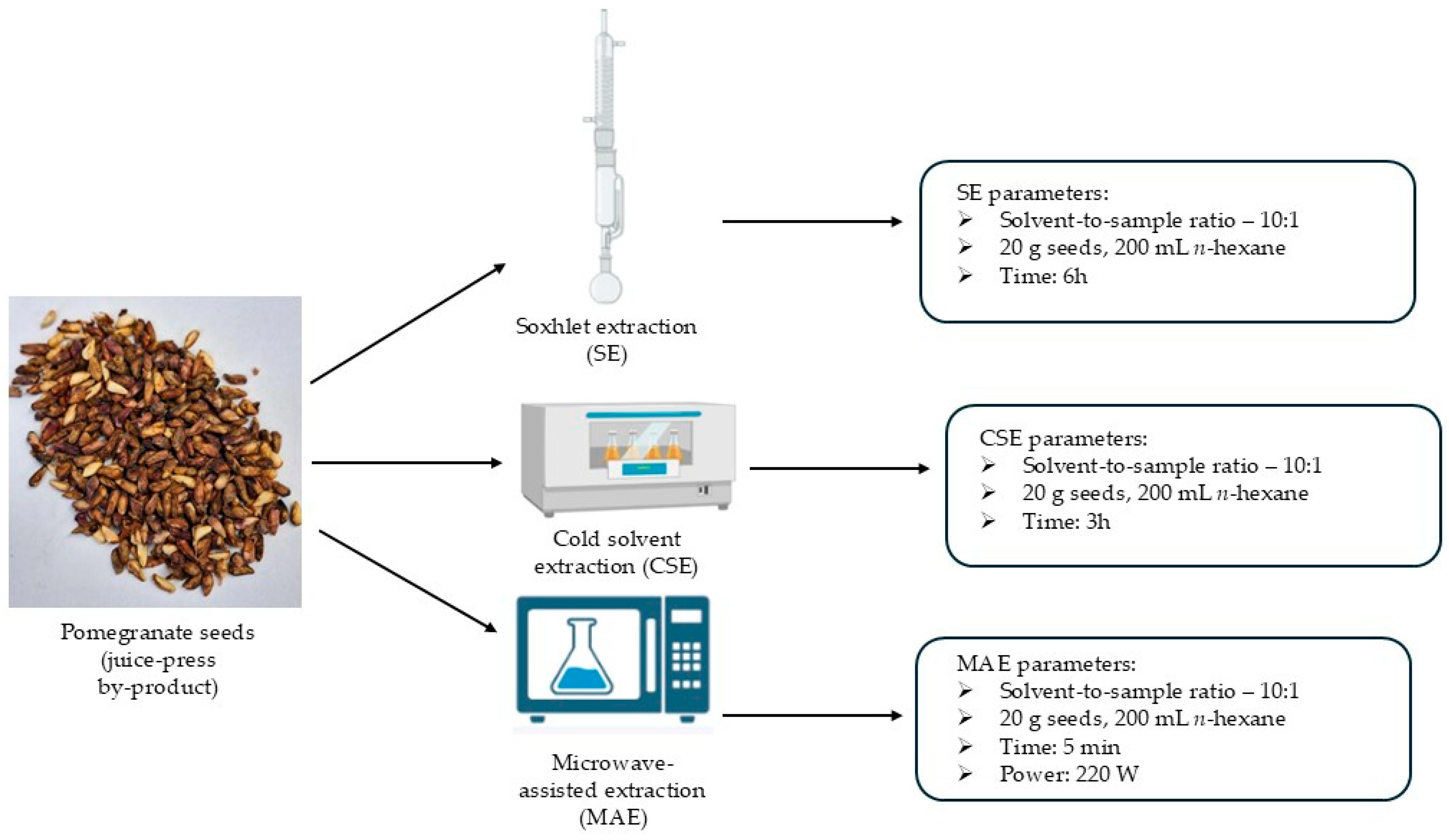
The operating conditions of all extraction procedures are summarized schematically in Figure 1.

2.2.2. Oil Yield Determination

Extraction efficiency was expressed as oil yield and determined gravimetrically based on the mass balance of the process. The yield was calculated from the relationship between the amount of oil recovered after solvent removal and the initial mass of seed material, according to Equation (1):
Y i e l d   ( % ) = m o m s   ×   100
where m o represents the mass of oil obtained after extraction (g) and m s denotes the mass of seeds subjected to extraction (g).

2.2.3. Oxidative Stability Evaluation by PDSC

The resistance of the oils to thermo-oxidative degradation was evaluated using pressure differential scanning calorimetry (PDSC). Analyses were performed with a DSC Q20 calorimeter (TA Instruments, Newcastle, WA, USA) operating under elevated oxygen pressure.
Approximately 3.0–4.0 mg of oil was placed in an open aluminum pan, while an empty pan served as the reference. Samples were subjected to isothermal conditions at 120 °C in an oxygen atmosphere maintained at 1350–1400 kPa.
Under these conditions, oxidation proceeds as an exothermic reaction, enabling kinetic characterization of the process. The oxidation induction time (OIT) was defined as the interval between the beginning of the isothermal stage and the onset of the exothermic deviation from the baseline. The parameter τmax was determined as the time corresponding to the maximum heat flow of the oxidation peak.

2.2.4. Evaluation of Oxidative Quality Indicators

Chemical indicators reflecting hydrolytic and oxidative deterioration were determined using standardized AOCS procedures. The acid value (AV; Cd 3d-63 [16]) was used to assess the level of free FAs formed as a result of lipid hydrolysis. The formation of lipid hydroperoxides, representing primary oxidation products, was quantified through peroxide value (PV; Cd 8-53 [17]). Secondary oxidation compounds, mainly aldehydic derivatives, were evaluated using the p-anisidine value (p-AnV; Cd 18-90 [18]).
To provide an integrated measure of oxidative status, the total oxidation index (TOTOX) was calculated by combining PV and p-AnV values according to Equation (2):
TOTOX   =   2 × P V + p - A n V

2.2.5. Gas Chromatographic Analysis of Fatty Acid Composition

The FA profile of the analyzed oils was determined after prior conversion to fatty acid methyl esters (FAME) following the PN-EN ISO 5509:2001 standard [19]. Chromatographic separation was carried out using a YL6100 gas chromatograph (Young Lin, Seoul, Republic of Korea) coupled with a flame-ionization detector (FID) and fitted with a BPX-70 fused-silica capillary column (60 m × 0.25 mm, film thickness 0.25 μm; SGE Analytical Science, Milton Keynes, UK).
Nitrogen served as the carrier gas under constant flow conditions. The injector and detector were maintained at 225 °C and 250 °C, respectively. The oven temperature was programmed to ensure efficient separation of FAME as follows: initial temperature 70 °C (0.5 min), followed by a temperature increase to 160 °C at 15 °C min−1, then to 200 °C at 1.1 °C min−1 with a 12 min hold, and finally to 225 °C at 30 °C min−1.
FAs were identified by comparison of retention times with reference FAME standards. Quantification was performed using peak area normalization, and results were expressed as relative percentage of total identified FAs.

2.2.6. Calculation of Nutritional and Oxidative Quality Indices

The relative FA composition obtained by GC analysis served as the basis for the calculation of lipid quality descriptors reflecting potential cardiovascular and metabolic effects. All indices were derived from the percentage contribution of individual FAs to the total identified FA pool.
To evaluate the balance between pro- and anti-atherogenic components, the atherogenic index (AI), thrombogenic index (TI), and saturated-to-polyunsaturated FA ratio (S/P) were determined according to the equations proposed by Ulbricht and Southgate [20] (Equations (3)–(5)):
A I = C 12 : 0 + 4 × C 14 : 0 + C 16 : 0 M U F A + P U F A   n - 6 + P U F A   n - 3
T I = C 14 : 0 + C 16 : 0 + C 18 : 0 0.5 × M U F A + 0.5 × P U F A   n - 6 + 3 × P U F A   n - 3 + P U F A   n - 3 P U F A   n - 6
S / P = C 14 : 0 + C 16 : 0 + C 18 : 0 M U F A + P U F A
Complementary indicators describing the hypocholesterolemic potential of the oils included the health-promoting index (HPI) [21] and the hypocholesterolemic/hypercholesterolemic ratio (h/H) [22], calculated as follows:
H P I = U F A C 12 : 0 + ( 4 × C 14 : 0 ) + C 16 : 0
h / H = c i s - C 18 : 1 + P U F A C 12 : 0 + C 14 : 0 + C 16 : 0
where UFA denotes unsaturated FAs, MUFA monounsaturated FAs, and PUFA polyunsaturated FAs.
In addition, the Calculated Oxidizability Index (COX), expressing theoretical susceptibility to oxidative degradation as a function of unsaturation level, was determined using Equation (8) [23]:
C O X = 1 C 18 : 1 % + 10.3 C 18 : 2 % + 21.6 C 18 : 3 % 100

2.2.7. Preparation of Oil Extracts for Bioactivity and Antioxidant Analyzes

To isolate polar bioactive constituents, a liquid–liquid extraction system based on hexane and methanol was applied according to Siol et al. [24]. Each oil sample (0.5 g) was dispersed in a biphasic mixture consisting of equal volumes of hexane and methanol (2.5 mL each). After intensive agitation to promote phase contact, the system was centrifuged at 4000 rpm to accelerate separation of the organic and methanolic layers.
The methanolic fraction, containing the target antioxidant compounds, was carefully recovered. The extraction cycle was performed three consecutive times to ensure efficient recovery of polar constituents. The pooled methanolic extracts were subsequently clarified by filtration through a 0.22 µm PTFE membrane prior to further bioactivity and antioxidant determinations.

2.2.8. Determination of Total Polyphenol Content (TPC)

Total phenolic compounds were quantified using the Folin–Ciocalteu colorimetric assay following the approach of Gao et al. [25]. For analysis, 200 μL of the oil sample was combined with diluted Folin–Ciocalteu reagent and distilled water, followed by the addition of 20% sodium carbonate to initiate the color-forming reaction. The reaction mixture was homogenized and allowed to react under light-protected conditions for 60 min at room temperature.
The absorbance of the resulting blue complex was recorded at 765 nm using a Jenway 6305 UV–Vis spectrophotometer (Cole-Parmer, Vernon Hills, IL, USA), with methanol serving as the reference. Quantitative evaluation was based on a gallic acid calibration curve prepared within the concentration range of 100–1200 mg/L. Results were expressed as milligrams of gallic acid equivalents per gram of oil (mg GAE/g oil).

2.2.9. Evaluation of Antioxidant Capacity Using ABTS●+ Radical Cations

Radical scavenging capacity was evaluated using the ABTS●+ decolorization assay, based on the method of Re et al. [26] with modifications. The radical cation was generated by reacting ABTS (14 mM) with potassium persulfate (4.9 mM) under equimolar conditions. The reaction mixture was stored under refrigerated and light-protected conditions for at least 16 h to ensure complete formation of the chromophoric radical species.
Before measurements, the resulting solution was diluted with distilled water to obtain an initial absorbance of 0.680–0.720 at 734 nm. Antioxidant capacity was quantified against a Trolox calibration curve constructed within the concentration range of 0–1125 μmol/L. The results were calculated and expressed as μmol Trolox equivalents (TE) per 100 g of oil.

2.2.10. Evaluation of Antioxidant Capacity Using DPPH Free Radicals

The ability of the oils to neutralize stable free radicals was assessed using the DPPH assay based on the method of Brand-Williams et al. [27]. A stock solution of 1,1-diphenyl-2-picrylhydrazyl (0.6 mM in methanol) was prepared in advance and kept under refrigerated, light-protected conditions for approximately 16 h to ensure reagent stabilization. Prior to analysis, the working solution was adjusted with methanol to obtain an initial absorbance between 0.680 and 0.720 at 515 nm.
For each determination, 100 µL of the oil sample was combined with 4 mL of the adjusted DPPH solution. After thorough mixing and clarification of the mixture, the reaction proceeded in the absence of light for 30 min at ambient temperature. The reduction in absorbance was recorded spectrophotometrically at 515 nm using methanol as the reference. Quantitative evaluation was carried out by comparison with a Trolox calibration curve prepared under analogous experimental conditions. The antioxidant capacity of the samples was expressed as μmol Trolox equivalents per 100 g of oil.

2.2.11. Statistical Analysis

All measurements were performed in triplicate for each extraction method, and the results are presented as mean ± standard deviation (SD). Statistical analyses were conducted using Statistica software (version 13.3; TIBCO Software Inc., Palo Alto, CA, USA). Differences among extraction methods were assessed by one-way analysis of variance (ANOVA), followed by Tukey’s post hoc test. Statistical significance was set at p ≤ 0.05.
In addition to univariate testing, multivariate analyses were applied to explore relationships among variables and to characterize samples across extraction methods. Pearson correlation analysis was visualized as a heatmap. Principal component analysis (PCA) was performed on z-standardized variables using the correlation matrix to summarize covariation patterns and to visualize sample separation, with the first two principal components used for interpretation.

3. Results and Discussion

3.1. Extraction Yield and Oxidative Stability of Pomegranate Seed Oils

The oil extraction method may affect both technological performance and the oxidative stability of the recovered lipid fraction. Table 1 summarizes the extraction yield, oxidation induction time (OIT), and the time corresponding to the maximum intensity of oxidative changes (τmax) determined by PDSC for the analyzed PSOs.
PSO_MAE exhibited a slightly higher yield than PSO_SE, whereas PSO_CSE resulted in the lowest lipid recovery (Table 1). Notably, PSO_MAE also demonstrated the most favorable oxidative stability profile, reflected by the highest OIT and τmax values. Because COX derived from FA composition, was very similar across all samples (Table 1), the observed differences in OIT and τmax are unlikely to result from variations in FA-derived oxidation susceptibility. Instead, they are more plausibly attributed to process-related factors, including time–temperature history and differences in the content or preservation of minor constituents capable of modulating oxidation kinetics.
The finding that PSO_MAE provided at least comparable—and in this case slightly higher—oil recovery than PSO_SE and PSO_CSE is consistent with previous reports. Optimization studies have shown that MAE can achieve high yields within minutes, whereas SE typically operates on an hour-scale and CSE often produces lower recoveries due to diffusion limitations [15]. Similar trends have been observed in comparative studies benchmarking MAE against other techniques, such as ultrasound-assisted extraction and cold pressing [28,29,30].
With respect to oxidative stability, the literature indicates that the recovery method can significantly influence PDSC-derived parameters (e.g., OIT) in PSO [31,32]. Importantly, such differences are not necessarily driven solely by FA composition but may reflect the cumulative thermal and oxidative exposure during extraction, as well as the retention or degradation of antioxidant-active minor compounds present in the unsaponifiable fraction [24,31,32,33]. The similarity of COX values across samples in the present study further supports the interpretation that the differences in OIT and τmax are more closely related to processing conditions and minor constituents than to intrinsic FA-based oxidizability [24,32].
The higher recovery obtained for PSO_MAE can be explained by the mechanism of dielectric heating in plant matrices. Microwave energy primarily interacts with polar microdomains (including residual moisture), leading to localized heating, pressure build-up, cell swelling, and microfracturing of cell walls. These effects enhance solvent penetration and facilitate lipid desorption from intracellular structures [28]. Although n-hexane exhibits low microwave absorption, extraction efficiency may still be enhanced through indirect heating of the matrix, while the solvent is warmed predominantly via conductive heat transfer [29].
PSO_SE achieves high recovery due to continuous solvent recirculation and maintenance of a strong concentration gradient. However, prolonged exposure to elevated temperatures may promote oxidative changes during extraction and reduce the retention of thermolabile minor constituents, which is consistent with the comparatively lower OIT and τmax observed for PSO_SE (Table 1) [24]. In contrast, PSO_CSE is conducted under mild thermal conditions and is largely diffusion-controlled. Although agitation improves phase contact, the absence of a matrix-disrupting intensification mechanism and the lack of elevated temperature limit mass transfer, explaining the lower yield. At the same time, mild conditions may favor the preservation of heat-sensitive components, potentially contributing to intermediate oxidative stability parameters.

3.2. Quality Parameters of Pomegranate Seed Oils

The chemical quality of edible oils is primarily assessed using hydrolytic and oxidative indicators that reflect the extent of triacylglycerol degradation and lipid oxidation. In this context, acid value (AV), peroxide value (PV), p-anisidine value (p-AnV), and the integrated TOTOX index are widely applied to evaluate both the initial and advanced stages of oil deterioration.
AV quantifies the content of free fatty acids, expressed as mg KOH per gram of oil, and reflects the extent of triacylglycerol hydrolysis. For cold-pressed oils, AV should not exceed 4 mg KOH/g according to Codex Alimentarius [34]. PV measures primary oxidation products (lipid hydroperoxides) and is expressed as milliequivalents of active oxygen per kilogram of fat; recommended limits for cold-pressed oils are ≤10 meq O2/kg [35] or ≤15 meq O2/kg [34]. p-AnV assesses secondary oxidation products, mainly aldehydes formed via hydroperoxide decomposition, and is considered a sensitive indicator of more advanced lipid oxidation. The overall oxidative status can be summarized by the TOTOX index, integrating both primary and secondary oxidation stages.
The hydrolytic and oxidative indices (AV, PV, p-AnV), together with the integrated TOTOX index, indicate that all oils obtained in this study were of good quality at the time of analysis, and that differences among extraction methods were relatively small (Table 2). AVs in all samples remained well below the regulatory limit for cold-pressed oils, indicating limited hydrolytic degradation. The highest AV was observed for PSO_SE and the lowest for PSO_CSE. This pattern is consistent with the higher cumulative time–temperature load during Soxhlet extraction and the milder thermal conditions applied in CSE.
PVs were very low and compliant with quality standards, suggesting limited formation of lipid hydroperoxides during extraction and effective control of oxidation initiation. Differences in PV among samples were marginal (Table 2). In contrast, p-AnV values—although still within a narrow range—showed slightly clearer differentiation: the highest value was recorded for PSO_SE and the lowest for PSO_CSE. Consequently, the TOTOX index followed the same pattern, with the lowest values for PSO_CSE and the highest for PSO_SE. Given the comparable PV levels, differences in TOTOX were driven primarily by variation in secondary oxidation products rather than by hydroperoxide accumulation. Overall, all extraction methods yielded oils of satisfactory oxidative quality; however, the lower-thermal-load process (CSE) showed a moderate advantage over SE with respect to acidity and secondary oxidation markers.
The obtained values fall within the ranges reported for PSO, although the literature indicates substantial variability in AV and PV depending on raw material quality, processing technology, and storage conditions. Studies on commercial PSOs have reported wide ranges of AV and PV already upon opening, as well as a pronounced increase in PV during storage, underscoring the heterogeneity of market products and the importance of production and logistics practices [36].
In the study by Liu et al. [37], which included MAE with n-hexane, markedly lower AVs (~1.24 mg KOH/g) were reported compared with those observed in the present study, whereas PV for MAE remained at a similar order of magnitude (~5.47 meq O2/kg). This comparison suggests that between-study discrepancies primarily concern free fatty acids levels (AV), while PVs tend to remain within comparable ranges. Such differences may reflect variability in raw material characteristics (e.g., cultivar, maturity stage), pretreatment conditions (seed damage, drying, storage), and enzymatic activity affecting lipolysis prior to extraction. Methodological details and post-extraction handling may further influence free fatty acids formation and early oxidative events.
Importantly, Liu et al. [37] also demonstrated that Soxhlet extraction was associated with relatively higher PV compared with selected alternative approaches, whereas shaking extraction yielded lower PV than Soxhlet. This confirms the sensitivity of PV to time–temperature history and process configuration. Regarding secondary oxidation, the literature emphasizes that p-AnV and TOTOX are particularly responsive to cumulative thermal exposure and to changes in the minor-component fraction, including natural antioxidants. For example, studies on thermally processed PSO have highlighted the need to interpret PV, p-AnV, and TOTOX jointly to obtain a comprehensive picture of oxidative status [38]. Furthermore, microwave pretreatment of pomegranate seeds has been shown to modify PV, p-AnV, and TOTOX, with the direction and magnitude of changes depending on cultivar and processing parameters, reflecting alterations in antioxidant and prooxidant balance [33].
Therefore, method-dependent differences in AV, PV, and p-AnV/TOTOX can be rationalized primarily by variations in time–temperature history, oxygen and moisture availability, extraction selectivity, and the retention or degradation of minor constituents (antioxidants and/or prooxidants). Prolonged exposure to elevated temperature promotes hydroperoxide decomposition and downstream reactions; consequently, even at low PV, an increased proportion of secondary oxidation products may be detected, which is more clearly reflected by p-AnV and TOTOX than by PV alone. This interpretation is consistent with observations reported by Kozłowska et al. [39] for almond oil, where extraction technique—particularly temperature and solvent characteristics—exerted a stronger influence on oxidative quality indices than the raw material itself, and higher temperature shifted the oxidation profile toward secondary products (p-AnV/TOTOX).

3.3. Fatty Acid Profile of Pomegranate Seed Oils

The FA composition is a key determinant of the nutritional value, technological functionality, and oxidative behavior of edible oils. Therefore, assessing the FA profile of PSO allows verification of whether different extraction techniques modify its characteristic lipid structure. To evaluate the impact of extraction technique on oil composition, the FA profile of PSO samples obtained by MAE, CSE and SE was determined (Table 3).
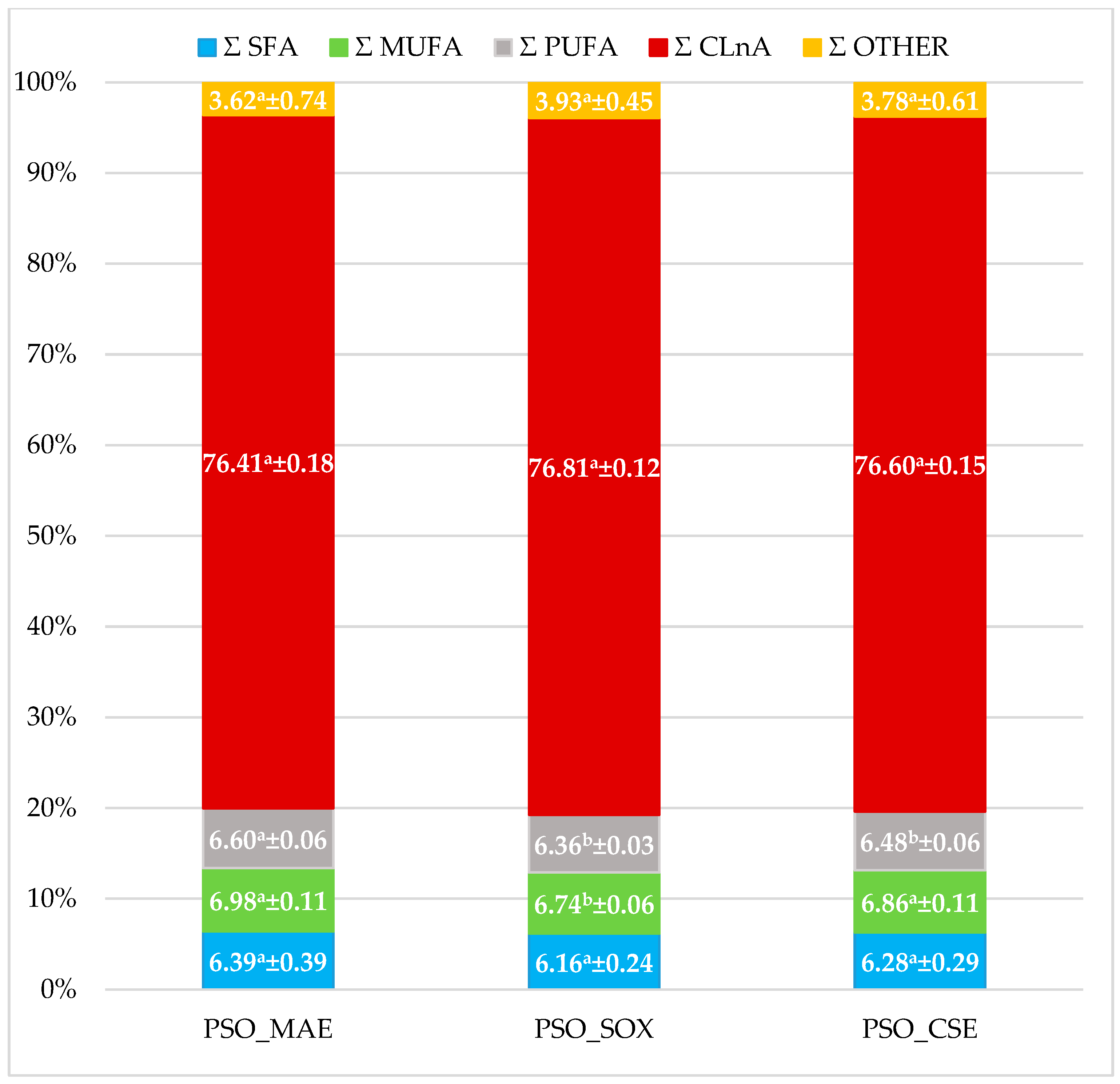
The FA composition of PSO was dominated by conjugated C18:3 isomers (ΣCLnA), accounting for approximately 76–77% of total FAs, irrespective of the extraction method (Table 3; Figure 2). The remaining fraction consisted mainly of non-conjugated unsaturated FAs, primary linoleic acid (C18:2 n-6) and oleic acid (C18:1 n-9), while saturated FAs (C16:0, C18:0 and C20:0) were present at moderate levels. This compositional pattern is consistent with the well-established PSO profile described in the literature, which emphasizes the predominance of conjugated linolenic acids, especially punicic acid, as the characteristic feature of this oil, accompanied by oleic and linoleic acids as major secondary components [15,24,38].
Comparison of extraction methods revealed a highly similar qualitative and quantitative FA profile, with only marginal differences in the relative proportions of individual fractions (Table 3; Figure 2). This observation aligns with the findings of Liu et al. [37], who compared conventional and alternative (“green”) extraction approaches, including MAE, and reported limited variability in FA composition, with preservation of punicic acid as the dominant component. Although some studies suggest that more intensive microwave treatment or pretreatment may induce subtle shifts in selected FA fractions, including slight reductions in punicic acid under stronger exposure conditions [33], the present results indicate that the applied extraction parameters did not induce substantial modification of the overall FA profile.
Importantly, while standard FAME analysis confirms the dominance of ΣCLnA, it does not provide detailed information on the distribution of individual conjugated isomers. Therefore, although no major changes in total CLnA content were observed, definitive assessment of potential alterations in specific isomer patterns would require targeted analytical approaches beyond routine methyl ester profiling [33].
The FA-derived nutritional indices (atherogenicity index, AI; thrombogenicity index, TI; health-promoting index, HPI; hypocholesterolemic/hypercholesterolemic ratio, h/H) further confirm the highly favorable lipid profile of PSO and indicate no practically meaningful influence of extraction method on this assessment (Table 3). These indices are calculated solely from the FA composition and are used here as comparative descriptors of the lipid profile across extraction methods. Notably, AI and TI were originally proposed primarily for animal-derived foods; therefore, in the case of plant oils they should be interpreted cautiously and in a relative (between-sample) manner rather than as a direct estimate of cardiovascular risk. Nevertheless, the application of AI and TI to plant oils is commonly reported in the literature as a useful tool for comparing lipid quality among samples [40,41,42]. In general, lower AI and TI values and higher h/H and HPI values are interpreted as indicative of a more favorable balance between FAs considered pro-atherogenic/pro-thrombogenic and those regarded as protective [43,44].
In the present study, AI and TI were identical across all oils, reflecting the essentially unchanged balance between saturated and unsaturated FAs among extraction methods. HPI and h/H exhibited only minor differences, corresponding to small shifts in the relative contribution of individual unsaturated FAs, while preserving the PSO-typical profile dominated by ΣCLnA. These findings are consistent with our previous study on commercial PSOs, where oxidative quality parameters varied markedly among market samples, whereas FA-derived health indices remained comparatively stable due to the conserved CLnA-rich FA profile [36].
Overall, the small differences observed among extraction methods should be interpreted as secondary effects of minor quantitative shifts within an otherwise stable FA matrix, rather than as alterations in the intrinsic nutritional or health-related lipid characteristics of PSO.

3.4. Bioactive Properties of Pomegranate Seed Oils

Beyond basic chemical quality, the biological potential of PSO is closely linked to its content of minor antioxidant constituents. Therefore, to evaluate the effect of the extraction method on bioactivity-related parameters of PSO, total polyphenol content (TPC) and radical-scavenging capacity were determined using ABTS and DPPH assays, and the results are summarized in Table 4.
The data indicate that the extraction method was associated with measurable differences in parameters related to the bioactive potential of PSO. TPC was highest in PSO_MAE and lowest in PSO_SE, while PSO_CSE showed intermediate values (Table 4). This pattern suggests that MAE either enhanced recovery or improved retention of phenolic compounds compared with SE. The shorter processing time and reduced cumulative thermal exposure in MAE likely limited degradation or transformation of thermolabile phenolics, whereas prolonged heating during SE may have contributed to partial losses of these compounds.
Antioxidant activity determined by ABTS and DPPH assays was relatively similar among all oils; nevertheless, the highest radical-scavenging capacity was consistently observed for PSO_MAE and the lowest for PSO_SE (Table 4). The parallel direction of variation in TPC and ABTS/DPPH values suggests that the phenolic fraction contributed to the measured antioxidant capacity. However, because only total polyphenols were quantified—without characterization of individual phenolic classes or other antioxidant-active constituents (e.g., tocopherols, sterols, or specific phenolic compounds)—this relationship should be interpreted as a consistent association rather than direct mechanistic proof. It should also be considered that radical-scavenging assays reflect overall electron- or hydrogen-donating capacity under defined in vitro conditions and do not necessarily represent oxidative behavior in complex lipid systems.
Overall, the results indicate a moderate advantage of PSO_MAE over PSO_SE in terms of bioactivity-related metrics, while differences among extraction methods remained quantitative rather than qualitative, as all samples exhibited comparable orders of magnitude in TPC and antiradical capacity.
The literature reports wide variability in phenolic-related metrics and antioxidant activity of PSO, largely due to differences in raw material, extraction conditions, and—critically—the basis of expression (e.g., mg/kg vs. mg/g; μmol vs. mmol; gallic acid equivalents vs. tannic acid equivalents). An important contextual factor in the present study is that the oil was obtained from pomegranate seeds representing a by-product after juice pressing. Such material has already undergone technological processing and may be partially depleted of water-soluble phenolics. Consequently, both the concentration and profile of compounds available for co-extraction into the oil phase may differ from those in oils obtained from fresh, untreated seeds. Therefore, direct comparison of absolute values with studies using different raw materials should be made with caution.
In the present study, TPC ranged from 1.53 to 2.08 mg GAE/g oil, placing the results within the low-to-moderate range reported for PSO. For example, Amri et al. [13] reported markedly lower TPC for Soxhlet-extracted PSO (93.42 ± 1.57 mg GAE/kg, i.e., ~0.093 mg GAE/g), highlighting how both processing conditions and reporting format substantially influence numerical comparability. In our previous investigation of commercial PSOs, oxidative quality parameters varied considerably among market samples, whereas phenolic-related metrics and antiradical activity remained within the same order of magnitude, supporting the view that raw material origin and handling strongly influence these endpoints [36].
Higher antiradical values have also been described in the literature; for instance, Rojo-Gutiérrez et al. [45] reported exceptionally high ABTS activity for PSO, although careful verification of units and conversion factors is necessary for meaningful comparison. Similarly, Abbasi et al. [46] reported high TPC values for PSO obtained under supercritical CO2 (SFE-CO2) and Soxhlet conditions, expressed as tannic acid equivalents, and demonstrated that increasing pressure and temperature during SFE-CO2 reduced phenolic extraction efficiency [46]. These findings emphasize that solvent system, extraction intensity, and reporting conventions materially influence reported bioactivity-related parameters.
It should be noted that this study did not include the identification or quantitative determination of individual phenolic compounds and tocopherols in PSO obtained under different extraction methods, which limits the ability to directly associate observed quality differences with specific constituents of the minor fraction. These minor components are known to play a critical role in modulating oxidative stability, antioxidant capacity, and other bioactive properties. Therefore, while TPC provides a general indication of antioxidant potential, the lack of detailed profiling prevents precise attribution of differences in oil quality to specific bioactive molecules.
Taken together, the present results support the conclusion that extraction method modulates the recovery of phenolic compounds and associated radical-scavenging capacity, with MAE showing a modest advantage under the applied conditions, while overall bioactive potential remained within a comparable range across methods.

3.5. Multivariate Analysis of Pomegranate Seed Oils by Principal Component Analysis (PCA)

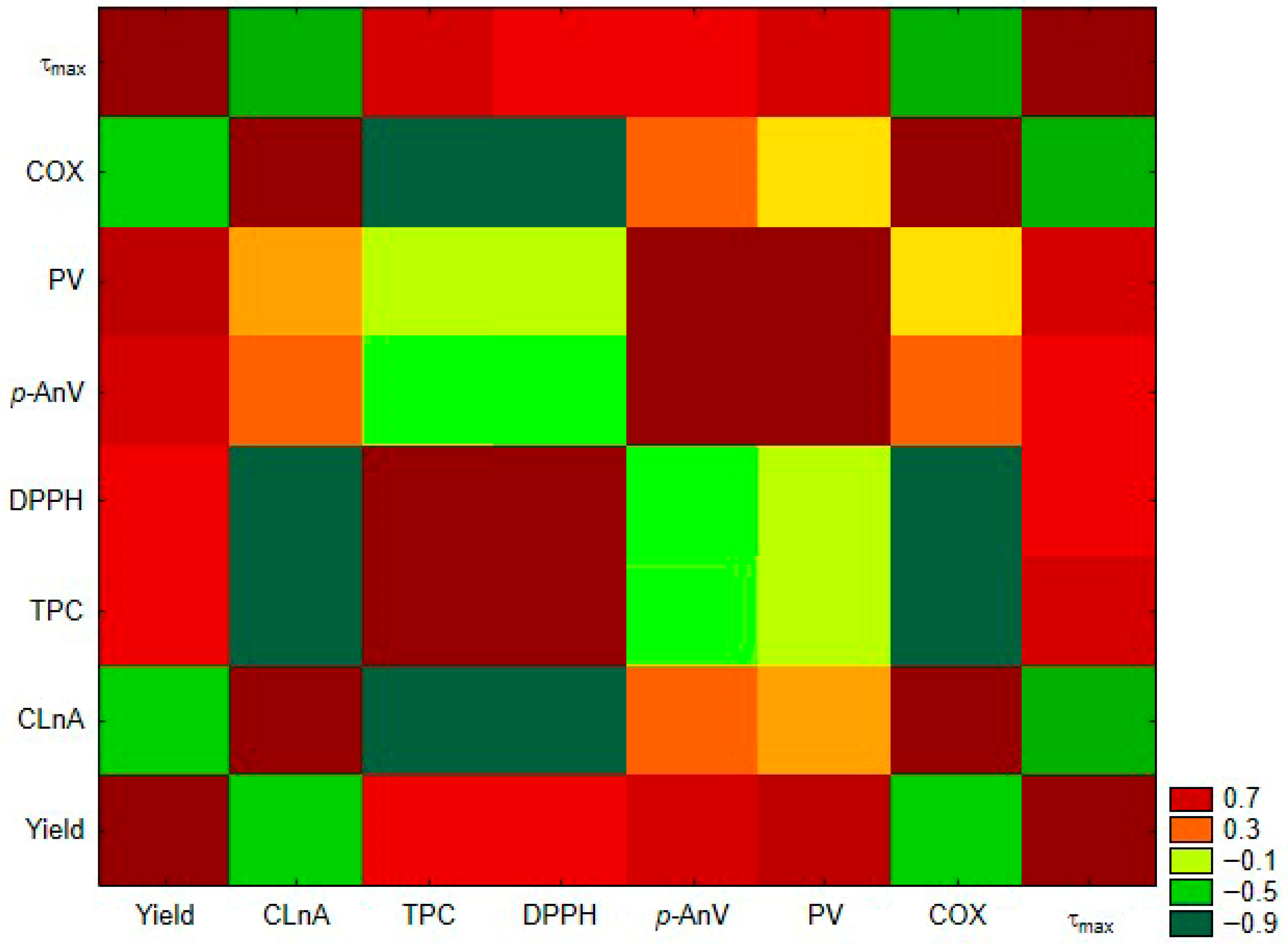
Figure 3 presents a Pearson correlation heatmap, where the color scale (see the legend) indicates both the direction (positive vs. negative) and strength of the correlation coefficient (r) among the analyzed variables. The legend provides the corresponding “r” values for the color scale. The heatmap revealed consistent and mechanistically meaningful relationships among extraction yield, oxidative stability indices, antioxidant parameters, and fatty acid-related variables. Oil yield was negatively correlated with τmax and positively associated with COX, indicating that higher extraction efficiency tended to coincide with lower oxidative stability and greater theoretical susceptibility to oxidation. PV and p-AnV, representing primary and secondary oxidation products, respectively, were positively correlated with each other and with COX. In contrast, τmax showed negative correlations with PV and p-AnV, indicating that prolonged resistance to oxidation was associated with lower levels of both primary and secondary lipid oxidation products (Figure 3).
Antioxidant-related parameters—TPC and DPPH radical scavenging activity were positively correlated, reflecting the contribution of phenolic compounds to radical-scavenging capacity. These variables were inversely associated with PV and p-AnV, supporting their protective role against oxidative deterioration. Conjugated C18:3 isomers, characterized by a high degree of unsaturation, showed positive correlations with PV and p-AnV and a negative correlation with τmax, highlighting the contribution of FA composition to oxidative behavior.
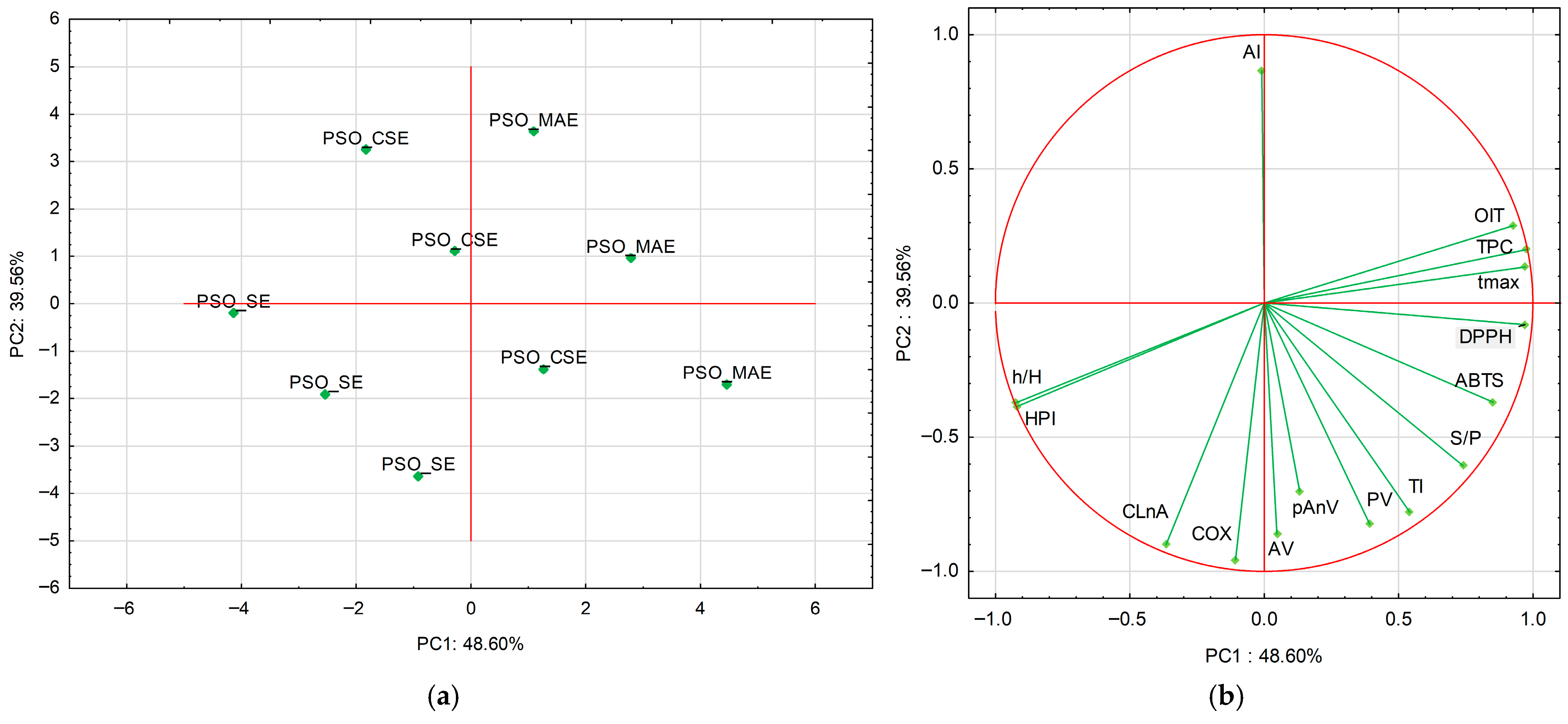
PCA provided an integrated evaluation of these interrelationships (Figure 4). The first two principal components explained 88.16% of the total variance (PC1: 48.60%; PC2: 39.56%), indicating that the two-dimensional model adequately represented the dataset (Figure 4a). The scores plot (Figure 4a) demonstrated clear method-dependent discrimination: PSO_MAE samples were located on the positive side of PC1, PSO_SE samples were shifted toward negative PC1 values, and PSO_CSE samples occupied intermediate positions. Importantly, PCA is an exploratory, descriptive tool; therefore, this separation should be interpreted as associative rather than causal. The tight clustering of replicates within each extraction method confirmed good analytical reproducibility and internal consistency.
The loading plot (Figure 4b) clarified the variables responsible for this separation. PC1 was positively associated with oxidative stability and antioxidant-related parameters (OIT, τmax, TPC, ABTS, DPPH), whereas negative PC1 values were aligned more strongly with CLnA and COX, reflecting increased susceptibility to oxidation driven by FA composition. PC2 was predominantly influenced by conventional oil quality indices (AV, PV, p-AnV), capturing additional variability related to hydrolytic and oxidative deterioration (Figure 4b).
Taken together, the correlation structure (Figure 3) and multivariate discrimination pattern (Figure 4) consistently show method-dependent differences in PSO quality attributes, reflected by coordinated variation in FA composition-related variables, antioxidant parameters, and oxidative stability indices, resulting in a coherent multivariate differentiation of samples.

4. Conclusions

The extraction method significantly influenced the technological performance, oxidative stability, and bioactive properties of PSO, while the FA core remained largely unchanged. Under the conditions applied in this study, MAE offered the most favorable balance, combining high oil yield with superior oxidative-stability metrics (OIT, τmax), whereas CSE gave lower recovery but better preservation of mild-processing quality markers. SE produced intermediate results, consistent with longer exposure to heat.
All oils exhibited good chemical quality, with low hydrolytic degradation (AV) and limited primary (PV) and secondary (p-AnV) oxidation. The FA profile was conserved across methods, dominated by conjugated C18:3 isomers, yielding consistently favorable nutritional indices (AI, TI, HPI, h/H). In contrast, phenolic content and radical-scavenging activity were more responsive to processing, with MAE showing a higher advantage over SE and CSE generally intermediate.
Multivariate analysis was consistent with these trends: higher yield correlated with increased theoretical oxidation susceptibility (COX) and lower τmax, while antioxidant-related variables (TPC, DPPH) inversely associated with primary and secondary oxidation markers. PCA highlighted method-dependent differentiation, which is interpreted as descriptive (associative) rather than causal, reflecting coordinated effects on minor components, oxidative stability, and FA-related traits.
Overall, extraction method appears to influence PSO quality primarily through minor-component retention and processing severity rather than changes in the major fatty-acid matrix. Targeted profiling of minor constituents, including individual phenolic compounds, tocopherols, and conjugated C18:3 isomers, represents a key direction for future studies to better understand how extraction conditions influence the functional properties of PSO.

Author Contributions

Conceptualization, M.S.; methodology, J.B. and M.O.; software, J.B.; validation, M.S.; formal analysis, M.S., M.O., D.M.-J. and J.B.; investigation, M.S.; resources, J.B.; data curation, M.S., D.M.-J., M.O. and J.B.; writing—original draft preparation, M.S., D.M.-J., M.O. and J.B.; writing—review and editing, M.S., D.M.-J. and J.B.; visualization, M.S.; supervision, M.S. and J.B.; project administration, M.S.; funding acquisition, M.S. All authors have read and agreed to the published version of the manuscript.

Funding

This research received no external funding.

Institutional Review Board Statement

Not applicable.

Informed Consent Statement

Not applicable.

Data Availability Statement

The original contributions presented in this study are included in the article. Further inquiries can be directed to the corresponding author.

Acknowledgments

The authors acknowledge the Warsaw University of Life Sciences—SGGW, Poland for financial support from the Internal Scholarship Fund, which enabled the research stay in Croatia and the completion of part of this study.

Conflicts of Interest

The authors declare no conflicts of interest.

References

  1. Talekar, S.; Patti, A.F.; Singh, R.; Vijayraghavan, R.; Arora, A. From Waste to Wealth: High Recovery of Nutraceuticals from Pomegranate Seed Waste Using a Green Extraction Process. Ind. Crops Prod. 2018, 112, 790–802. [Google Scholar] [CrossRef]
  2. Ko, K.; Dadmohammadi, Y.; Abbaspourrad, A. Nutritional and Bioactive Components of Pomegranate Waste Used in Food and Cosmetic Applications: A Review. Foods 2021, 10, 657. [Google Scholar] [CrossRef] [PubMed]
  3. Singh, A.; Kumar, P.; Meghwal, P.R.; Santra, P.; Naorem, A.; Khapte, P.S. Enhancing the Fruit Yield and Quality of Pomegranate in a New Niche Area: Insights into Site Specific Agronomic Practices. Not. Bot. Horti Agrobot. Cluj-Napoca 2024, 52, 13754. [Google Scholar] [CrossRef]
  4. Zero Waste International Alliance. 2018. Available online: https://zwia.org/zero-waste-definition (accessed on 12 December 2025).
  5. Melo, I.L.P.D.; Carvalho, E.B.T.D.; Silva, A.M.D.O.E.; Yoshime, L.T.; Sattler, J.A.G.; Pavan, R.T.; Mancini-Filho, J. Characterization of Constituents, Quality and Stability of Pomegranate Seed Oil (Punica granatum L.). Food Sci. Technol. 2016, 36, 132–139. [Google Scholar] [CrossRef]
  6. Quitmeyer, B.; Emelife, C.; Klausner, H.; Gbayisomore, O.; Phelan, S. Differential Effects of Punicic Acid on Cytotoxicity and Peroxiredoxin Expression in MCF-7 Breast Cancer and MCF-10A Normal Cells. Anticancer Res. 2024, 44, 4751–4759. [Google Scholar] [CrossRef]
  7. Chen, L.; Lei, Y.; Lu, C.; Liu, D.; Ma, W.; Lu, H.; Wang, Y. Punicic Acid Ameliorates Obesity-Related Hyperlipidemia and Fatty Liver in Mice via Regulation of Intestinal Flora and Lipopolysaccharide-Related Signaling Pathways. Food Funct. 2024, 15, 5012–5025. [Google Scholar] [CrossRef]
  8. Aruna, P.; Venkataramanamma, D.; Singh, A.K.; Singh, R.P. Health Benefits of Punicic Acid: A Review. Compr. Rev. Food Sci. Food Saf. 2016, 15, 16–27. [Google Scholar] [CrossRef]
  9. Vroegrijk, I.O.C.M.; van Diepen, J.A.; van den Berg, S.; Westbroek, I.; Keizer, H.; Gambelli, L.; Hontecillas, R.; Bassaganya-Riera, J.; Zondag, G.C.M.; Romijn, J.A.; et al. Pomegranate Seed Oil, a Rich Source of Punicic Acid, Prevents Diet-Induced Obesity and Insulin Resistance in Mice. Food Chem. Toxicol. 2011, 49, 1426–1430. [Google Scholar] [CrossRef]
  10. Khajebishak, Y.; Payahoo, L.; Alivand, M.; Alipour, B. Punicic Acid: A Potential Compound of Pomegranate Seed Oil in Type 2 Diabetes Mellitus Management. J. Cell. Physiol. 2019, 234, 2112–2120. [Google Scholar] [CrossRef]
  11. Seher, S.S.; Ali, N.A.; Seher, S.S.; Ali, N.A. Pomegranate Seeds: The Antioxidant Marvel and Its Therapeutic Journey. In Advances in Medical Diagnosis, Treatment, and Care; Musaddiq, S., Fayyaz, I., Mustafa, K., Eds.; IGI Global: Hershey, PA, USA, 2024; pp. 189–240. [Google Scholar]
  12. Almoraie, M.; Spencer, J.; Wagstaff, C. Fatty Acid Profile, Tocopherol Content, and Phenolic Compounds of Pomegranate (Punica granatum L.) Seed Oils. J. Food Compos. Anal. 2025, 145, 107788. [Google Scholar] [CrossRef]
  13. Amri, Z.; Lazreg-Aref, H.; Mekni, M.; El-Gharbi, S.; Dabbaghi, O.; Mechri, B.; Hammami, M. Oil Characterization and Lipid Class Composition of Pomegranate Seeds. BioMed Res. Int. 2017, 2017, 2037341. [Google Scholar] [CrossRef] [PubMed]
  14. Sahoo, B.M.; Bhattamisra, S.K.; Paidesetty, S.K.; Palei, N.N.; Sharma, S.; Agrawal, A. Microwave-Assisted Extraction: A Green and Sustainable Technology for the Extraction of Bioactive Compounds. Curr. Microw. Chem. 2025, 12, 105–115. [Google Scholar] [CrossRef]
  15. Çavdar, H.K.; Yanık, D.K.; Gök, U.; Göğüş, F. Optimisation of Microwave-Assisted Extraction of Pomegranate (Punica granatum L.) Seed Oil and Evaluation of Its Physicochemical and Bioactive Properties. Food Technol. Biotechnol. 2017, 55, 86–94. [Google Scholar] [CrossRef] [PubMed]
  16. AOCS Official Method Cd 3d-63. Acid Value. In Sampling and Analysis of Commercial Fats and Oils; The American Oils Chemist’s Society: Urbana, IL, USA, 2009.
  17. AOCS Official Method Cd 8-53. Peroxide Value Acetic Acid (Chloroform Method). In Sampling and Analysis of Commercial Fats and Oils; The American Oils Chemist’s Society: Urbana, IL, USA, 2003.
  18. AOCS Official Method Cd 18-90. p-Anisidine Value. In Official Methods and Recommended Practices of the AOCS; American Oil Chemists Society Press: Champaign, IL, USA, 2011.
  19. PN-EN ISO 5509:2001; Vegetable and Animal Oils and Fats. Preparation of Fatty Acid Methyl Esters. Polish Committee for Standardization: Warsaw, Poland, 2001.
  20. Ulbricht, T.L.V.; Southgate, D.A.T. Coronary Heart Disease: Seven Dietary Factors. Lancet 1991, 338, 985–992. [Google Scholar] [CrossRef]
  21. Chen, S.; Bobe, G.; Zimmerman, S.; Hammond, E.G.; Luhman, C.M.; Boylston, T.D.; Freeman, A.E.; Beitz, D.C. Physical and Sensory Properties of Dairy Products from Cows with Various Milk Fatty Acid Compositions. J. Agric. Food Chem. 2004, 52, 3422–3428. [Google Scholar] [CrossRef]
  22. Santos-Silva, J.; Bessa, R.J.B.; Santos-Silva, F. Effect of Genotype, Feeding System and Slaughter Weight on the Quality of Light Lambs: II. Fatty Acid Composition of Meat. Livest. Prod. Sci. 2002, 77, 187–194. [Google Scholar] [CrossRef]
  23. Herchi, W.; Bahashwan, S.; Sebei, K.; Ben Saleh, H.; Kallel, H.; Boukhchina, S. Effects of Germination on Chemical Composition and Antioxidant Activity of Flaxseed (Linum usitatissimum L.) Oil. Grasas Aceites 2015, 66, e057. [Google Scholar] [CrossRef]
  24. Siol, M.; Piasecka, I.; Mańko-Jurkowska, D.; Górska, A.; Bryś, J. Optimization and Impact of Ultrasound-Assisted Extraction on Pomegranate Seed Oil Quality: A Comparative Study of Bioactive Potential and Oxidation Parameters. Molecules 2025, 30, 1837. [Google Scholar] [CrossRef]
  25. Gao, X.; Ohlander, M.; Jeppsson, N.; Björk, L.; Trajkovski, V. Changes in Antioxidant Effects and Their Relationship to Phytonutrients in Fruits of Sea Buckthorn (Hippophae rhamnoides L.) during Maturation. J. Agric. Food Chem. 2000, 48, 1485–1490. [Google Scholar] [CrossRef]
  26. Re, R.; Pellegrini, N.; Proteggente, A.; Pannala, A.; Yang, M.; Rice-Evans, C. Antioxidant Activity Applying an Improved ABTS Radical Cation Decolorization Assay. Free Radic. Biol. Med. 1999, 26, 1231–1237. [Google Scholar] [CrossRef]
  27. Brand-Williams, W.; Cuvelier, M.E.; Berset, C. Use of a Free Radical Method to Evaluate Antioxidant Activity. LWT—Food Sci. Technol. 1995, 28, 25–30. [Google Scholar] [CrossRef]
  28. Rezvankhah, A.; Emam-Djomeh, Z.; Safari, M.; Askari, G.; Salami, M. Microwave-Assisted Extraction of Hempseed Oil: Studying and Comparing Fatty Acid Composition, Antioxidant Activity, Physiochemical and Thermal Properties with Soxhlet Extraction. J. Food Sci. Technol. 2019, 56, 4198–4210. [Google Scholar] [CrossRef]
  29. Letellier, M.; Budzinski, H. Microwave Assisted Extraction of Organic Compounds. Analusis 1999, 27, 259–270. [Google Scholar] [CrossRef]
  30. Gök, A.; Uyar, H.; Demir, Ö. Pomegranate Seed Oil Extraction by Cold Pressing, Microwave and Ultrasound Treatments. Biomass Convers. Biorefinery 2025, 15, 6483–6494. [Google Scholar] [CrossRef]
  31. Bryś, J.; Obranović, M.; Repajić, M.; Kraljić, K.; Škevin, D.; Bryś, A.; Górska, A.; Ostrowska-Ligęza, E.; Wirkowska-Wojdyła, M. Comparison of Different Methods of Extraction for Pomegranate Seeds. Proceedings 2021, 70, 91. [Google Scholar] [CrossRef]
  32. Piasecka, I.; Ostrowska-Ligęza, E.; Wiktor, A.; Górska, A. Ultrasound and Pulsed Electric Field Treatment Effect on the Thermal Properties, Oxidative Stability and Fatty Acid Profile of Oils Extracted from Berry Seeds. J. Therm. Anal. Calorim. 2025, 150, 1311–1325. [Google Scholar] [CrossRef]
  33. Kaseke, T.; Opara, U.L.; Fawole, O.A. Effect of Microwave Pretreatment of Seeds on the Quality and Antioxidant Capacity of Pomegranate Seed Oil. Foods 2020, 9, 1287. [Google Scholar] [CrossRef]
  34. Codex-ALINORM 09/32/17; Codex Alimentarius 2009. Codex Standard for Named Vegetable Oils. Codex Alimentarius Commission: Rome, Italy, 2009.
  35. PN-EN ISO 3960:2017-03; Vegetable and Animal Oils and Fats. Determination of Peroxide Number (Reference Method). Polish Committee for Standardization: Warsaw, Poland, 2017.
  36. Siol, M.; Dudek, A.; Bryś, J.; Mańko-Jurkowska, D.; Gruczyńska-Sękowska, E.; Makouie, S.; Palani, B.K.; Obranović, M.; Koczoń, P. Chromatographic and Thermal Characteristics, and Hydrolytic and Oxidative Stability of Commercial Pomegranate Seed Oil. Foods 2024, 13, 1370. [Google Scholar] [CrossRef]
  37. Liu, N.; Ren, G.; Faiza, M.; Li, D.; Cui, J.; Zhang, K.; Yao, X.; Zhao, M. Comparison of Conventional and Green Extraction Methods on Oil Yield, Physicochemical Properties, and Lipid Compositions of Pomegranate Seed Oil. J. Food Compos. Anal. 2022, 114, 104747. [Google Scholar] [CrossRef]
  38. Tavakoli, J.; Ghorbani, A.; Hematian Sourki, A.; Ghani, A.; Zarei Jelyani, A.; Kowalczewski, P.Ł.; Aliyeva, A.; Mousavi Khaneghah, A. Thermal Processing of Pomegranate Seed Oils Underscores Their Antioxidant Stability and Nutritional Value: Comparison of Pomegranate Seed Oil with Sesame Seed Oil. Food Sci. Nutr. 2024, 12, 2166–2181. [Google Scholar] [CrossRef]
  39. Kozłowska, M.; Mańko-Jurkowska, D.; Zieniuk, B.; Rudzińska, M. Influence of Extraction Techniques on Almond Oil Quality: A Comparative Study of Solvent-Extracted and Commercial Products. Molecules 2025, 30, 3519. [Google Scholar] [CrossRef]
  40. Khalili Tilami, S.; Kouřimská, L. Assessment of the Nutritional Quality of Plant Lipids Using Atherogenicity and Thrombogenicity Indices. Nutrients 2022, 14, 3795. [Google Scholar] [CrossRef]
  41. Belhoussaine, O.; El Kourchi, C.; Harhar, H.; El Moudden, H.; El Yadini, A.; Ullah, R.; Iqbal, Z.; Goh, K.W.; Goh, B.H.; Bouyahya, A.; et al. Phytochemical Characterization and Nutritional Value of Vegetable Oils from Ripe Berries of Schinus terebinthifolia Raddi and Schinus molle L., through Extraction Methods. Food Chem. X 2024, 23, 101580. [Google Scholar] [CrossRef] [PubMed]
  42. Correa, K.L.; de Carvalho-Guimarães, F.B.; Mourão, E.S.; Oliveira Santos, H.C.; da Costa Sanches, S.C.; Lamarão, M.L.N.; Pereira, R.R.; Barbosa, W.L.R.; Ribeiro-Costa, R.M.; Converti, A.; et al. Physicochemical and Nutritional Properties of Vegetable Oils from Brazil Diversity and Their Applications in the Food Industry. Foods 2024, 13, 1565. [Google Scholar] [CrossRef] [PubMed]
  43. Yurchenko, S.; Sats, A.; Tatar, V.; Kaart, T.; Mootse, H.; Jõudu, I. Fatty Acid Profile of Milk from Saanen and Swedish Landrace Goats. Food Chem. 2018, 254, 326–332. [Google Scholar] [CrossRef] [PubMed]
  44. Chen, J.; Liu, H. Nutritional Indices for Assessing Fatty Acids: A Mini-Review. Int. J. Mol. Sci. 2020, 21, 5695. [Google Scholar] [CrossRef]
  45. Rojo-Gutiérrez, E.; Carrasco-Molinar, O.; Tirado-Gallegos, J.M.; Levario-Gómez, A.; Chávez-González, M.L.; Baeza-Jiménez, R.; Buenrostro-Figueroa, J.J. Evaluation of Green Extraction Processes, Lipid Composition and Antioxidant Activity of Pomegranate Seed Oil. J. Food Meas. Charact. 2021, 15, 2098–2107. [Google Scholar] [CrossRef]
  46. Abbasi, H.; Rezaei, K.; Emamdjomeh, Z.; Mousavi, S.M.E. Effect of Various Extraction Conditions on the Phenolic Contents of Pomegranate Seed Oil. Eur. J. Lipid Sci. Technol. 2008, 110, 435–440. [Google Scholar] [CrossRef]
Figure 1. Schematic comparison of Soxhlet extraction (SE), microwave-assisted extraction (MAE), and cold solvent extraction (CSE) used for the isolation of pomegranate seed oil from pomegranate seeds.
Applsci 16 02703 g001
Figure 2. Fatty acid profile [%] of pomegranate seed oils (PSOs) obtained by different extraction methods, where MAE, microwave-assisted extraction; SE, Soxhlet extraction; CSE, cold solvent extraction; SFA, saturated fatty acids; MUFA, monounsaturated fatty acids; PUFA, polyunsaturated (non-conjugated) fatty acids; ΣCLnA, conjugated C18:3 isomers (including punicic acid). Different lowercase letters indicate significant differences (p ≤ 0.05). Data are expressed as mean ± SD.
Applsci 16 02703 g002
Figure 3. Heatmap of Pearson correlation coefficients (R) among selected variables of pomegranate seed oils obtained by different extraction methods. The analyzed variables included oil yield, conjugated C18:3 isomers (CLnA), total polyphenol content (TPC), antioxidant activity determined by the DPPH assay, p-anisidine value (p-AnV), peroxide value (PV), calculated oxidizability value (COX) and oxidation time (τmax). The color intensity represents the direction and strength of the correlations. The color scale (legend) denotes Pearson’s “r”, with negative values indicating inverse relationships and positive values indicating direct relationships; color intensity reflects correlation magnitude.
Applsci 16 02703 g003
Figure 4. Principal component analysis (PCA) of pomegranate seed oils (PSOs) obtained by different extraction methods: microwave-assisted extraction (MAE), Soxhlet extraction (SE), cold solvent extraction (CSE). (a) Scores plot showing the distribution of samples (three replicates per method) along PC1 (48.60%) and PC2 (39.56%). (b) Loading plot for PC1 and PC2 illustrating the contribution of oxidative stability parameters (oxidation induction time, OIT; oxidation time, τmax), oil quality indices (acid value, AV; peroxide value, PV; p-anisidine value, p-AnV; calculated oxidizability value, COX), antioxidant-related parameters (total polyphenol content, TPC; ABTS radical scavenging activity, ABTS; DPPH radical scavenging activity, DPPH), fatty acid-related metrics (conjugated C18:3 isomers, CLnA; saturated-to-polyunsaturated fatty acid ratio, S/P), and nutritional indices (atherogenic index, AI; thrombogenic index, TI; hypocholesterolemic/hypercholesterolemic ratio, h/H; health-promoting index, HPI). The red axes mark the origin of the PC1–PC2 space, while the red circle indicates the correlation circle. Green vectors represent variable loadings.
Applsci 16 02703 g004
Table 1. Extraction yield, oxidation induction time (OIT), and time corresponding to the maximum intensity of oxidative changes (τmax) of pomegranate seed oils (PSOs) obtained by different extraction methods.
Type of SampleYield [%]OIT [min]τmax [min]COX
PSO_MAE12.05 a ± 0.275.31 a ± 0.125.57 a ± 0.2717.25 a ± 0.05
PSO_SE11.49 a ± 0.224.19 c ± 0.094.57 c ± 0.1317.31 a ± 0.03
PSO_CSE11.10 b ± 0.154.55 b ± 0.104.90 b ± 0.1517.28 a ± 0.04
MAE, microwave-assisted extraction; SE, Soxhlet extraction; CSE, cold solvent extraction. Different lowercase letters indicate significant differences (p ≤ 0.05). Data are expressed as mean ± SD.
Table 2. Quality parameters of pomegranate seed oils (PSOs) obtained by different extraction methods.
Type of OilAV
[mg KOH/g]
PV
[meq O2/kg]
p-AnVTOTOX
PSO_MAE3.48 a ± 0.123.16 a ± 0.1814.11 a ± 0.2020.43 a ± 0.19
PSO_SE3.63 a ± 0.143.18 a ± 0.1314.27 a ± 0.2220.63 a ± 0.21
PSO_CSE3.30 b ± 0.102.95 b ± 0.1213.55 b ± 0.1319.25 b ± 0.18
MAE, microwave-assisted extraction; SE, Soxhlet extraction; CSE, cold solvent extraction; AV, acid value; PV, peroxide value; p-AnV, anisidine value. Different lowercase letters indicate significant differences (p ≤ 0.05). Data are expressed as mean ± SD.
Table 3. Fatty acid profile [%] and nutritional indices of pomegranate seed oils (PSOs) obtained by different extraction methods.
PSO_MAEPSO_SEPSO_CSE
C16:03.11 a ± 0.022.99 b ± 0.023.05 a ± 0.02
C18:02.60 a ± 0.362.50 a ± 0.212.55 a ± 0.25
C18:1 n-9c6.08 a ± 0.045.88 b ± 0.045.98 a ± 0.08
C18:2 n-6c6.60 a ± 0.066.36 b ± 0.036.48 a ± 0.06
C20:00.68 a ± 0.010.67 b ± 0.010.68 a ± 0.02
C20:1 n-9c0.90 a ± 0.070.86 a ± 0.020.88 a ± 0.03
C18:3 (9c, 11t, 13c)76.41 a ± 0.1876.81 b ± 0.1276.60 b ± 0.15
other3.62 a ± 0.113.93 b ± 0.093.78 a ± 0.10
S/P0.06 a ± 0.010.06 a ± 0.010.06 a ± 0.01
AI0.30 a ± 0.010.30 a ± 0.010.30 a ± 0.01
TI0.13 a ± 0.010.12 a ± 0.010.12 a ± 0.01
HPI28.94 b ± 0.0730.07 a ± 0.1329.49 b ± 0.09
h/H28.65 b ± 0.0929.78 a ± 0.1429.20 b ± 0.10
MAE, microwave-assisted extraction; SE, Soxhlet extraction; CSE, cold solvent extraction; S/P, saturated-to-polyunsaturated fat ratio; AI, atherogenic index; TI, thrombogenic index; HPI, health-promoting index; h/H, hypocholesterolemic/hypercholesterolemic ratio. Different lowercase letters indicate significant differences (p ≤ 0.05). Data are expressed as mean ± SD.
Table 4. Total polyphenol content (TPC) and antioxidant capacity (ABTS and DPPH) of pomegranate seed oils (PSOs) obtained by different extraction methods.
Type of OilTPC
[mg GAE/g]
ABTS
[µmol TE/g]
DPPH
[µmol TE/g]
PSO_MAE2.08 a ± 0.084.16 a ± 0.0815.04 a ± 0.10
PSO_SE1.53 c ± 0.144.04 a ± 0.1314.73 b ± 0.12
PSO_CSE1.82 b ± 0.114.12 a ± 0.1014.91 ab ± 0.16
MAE, microwave-assisted extraction; SE, Soxhlet extraction; CSE, cold solvent extraction; GAE, gallic acid equivalents; TE, Trolox equivalents. Different lowercase letters indicate significant differences (p ≤ 0.05). Data are expressed as mean ± SD.
Disclaimer/Publisher’s Note: The statements, opinions and data contained in all publications are solely those of the individual author(s) and contributor(s) and not of MDPI and/or the editor(s). MDPI and/or the editor(s) disclaim responsibility for any injury to people or property resulting from any ideas, methods, instructions or products referred to in the content.