1. Introduction
Interdependent factors in coupled project and engineering systems seldom evolve in isolation; instead, they influence one another and may propagate and amplify through directed networks, as evidenced in PPP risk propagation research adopting a network perspective [
1]. To structure such interdependencies, decision-oriented causal mapping tools are frequently used; for example, the Decision-Making Trial and Evaluation Laboratory (DEMATEL) has been integrated with related prioritization schemes to identify critical drivers and solution priorities in production settings [
2]. Propagation-network thinking is also well established in engineering manufacturing, where machining error propagation has been modeled as a complex network to reveal how upstream deviations transmit to downstream outcomes [
3]. In PPP practice, the consequences of accumulated and interacting risks are often manifested through renegotiations and broader partnership frictions, indicating that localized disturbances can escalate into systemic disruptions over time [
4]. Complementarily, propagation-control studies in precision assembly show that managing transmitted deviations is essential for system stability [
5], and optimization under dual uncertainties further illustrates the need for dynamic, decision-oriented responses when cascading operational impacts are plausible [
6]. Building on these insights, this study examines how PPP risk factors transmit and intensify over time in a coupled project environment and develops a causality-informed dynamic transmission framework.
PPP refers to a long-term contractual arrangement in which the government competitively selects a private partner to participate in the financing, construction, operation, and maintenance of public infrastructure or services. Large-scale PPP infrastructure projects face complex and evolving risk environments due to long concession periods, multi-actor governance structures, and sensitivity to policy, market, and operational uncertainties. Accordingly, PPP risks tend to accumulate, interact, and propagate across project stages, making it insufficient to treat risks as isolated items; rather, it becomes necessary to clarify directed influence pathways and the dynamics through which risks intensify across the lifecycle [
1].
A substantial body of PPP research has focused on risk identification, assessment, and allocation. Empirical work has examined risk assessment practices and allocation patterns in PPP projects [
7], while other studies have applied multi-criteria and expert-based approaches to evaluate PPP risks under uncertainty [
8] and to identify critical risk factors in specific PPP sectors such as waste-to-energy projects [
9]. In parallel, DEMATEL-based influence structuring is often combined with multi-criteria decision-making frameworks (e.g., ANP and VIKOR) to support strategy selection when interdependencies cannot be ignored [
10]. These efforts have advanced the understanding of PPP risk structures and prioritization, yet they typically remain stage-specific or essentially static in how risk is represented.
Despite this progress, synthesis studies indicate that mainstream PPP scholarship still emphasizes governance, performance, and risk management themes, with risks frequently modeled as discrete factors rather than as an evolving, interacting system [
11,
12]. Systematic reviews focusing on PPP risks similarly show that prevailing approaches concentrate on identifying, assessing, and allocating risks, whereas time-dependent accumulation, interaction, and propagation mechanisms receive comparatively limited attention [
13,
14]. Even studies examining how risks are managed during PPP formation tend to document managerial responses without explicitly modeling nonlinear transmission and amplification processes [
15]. Meanwhile, the high incidence of PPP renegotiations underscores the long-term and inherently incomplete nature of PPP contracts, implying that risks can be activated and reshaped by sequential shocks and strategic behaviors over time—features that static assessments are ill suited to capture [
16].
To address these gaps, we develop a lifecycle-oriented dynamic framework for risk transmission in PPP infrastructure projects that links an expert-elicited directed influence structure to time-dependent propagation processes and system-level outcomes. The framework quantifies inter-risk directional influences to establish a computable transmission backbone and decomposes risk evolution into intrinsic growth and transmitted increments, thereby enabling the identification of likely upstream initiators with cascade-triggering potential and supporting prevention-oriented lifecycle risk governance. The framework is designed for mechanism-informed risk governance and initiator prioritization rather than statistical identification of causal effect sizes.
2. Literature Review and Research Gap
PPP risk research has expanded into a large, multidisciplinary body of work spanning project management, construction engineering, public administration, and infrastructure finance. Bibliometric and scientometric reviews indicate that, rather than converging on a single paradigm, the field has developed several dominant streams, including risk identification and assessment, risk allocation and sharing, analytical models and techniques, and governance-oriented mitigation responses [
17,
18]. Consistent with these mappings, the literature reflects a mature foundation of largely static risk assessment traditions alongside a growing—though still fragmented—interest in system-oriented perspectives that move beyond factor lists and rankings to explain inter-risk interdependence and lifecycle dynamics [
17,
18].
Within these streams, a substantial body of work advances PPP risk management through structured assessment and allocation frameworks that identify salient risks, elicit expert judgments, and generate prioritized risk lists or allocation recommendations for decision making. In parallel, contract-design research emphasizes that risk allocation is not merely a technical exercise but a governance problem shaped by bounded rationality and long-term uncertainty; accordingly, “optimal” allocation principles may diverge from allocations that are feasible under market capacity, financing constraints, and institutional conditions [
19,
20]. Representative studies operationalize this logic using multi-dimensional risk registers and weighting-based assessment schemes to support risk sharing and response planning under long-term concession arrangements [
21]. This allocative emphasis is increasingly reflected in standardized risk matrices and guidance tools designed to translate empirical experience into bankable contracting conventions for specific sectors and asset classes [
22].
More recently, studies have moved beyond independent-factor views by explicitly modeling risk interactions and “risk paths”—that is, sequences through which risks influence broader success outcomes—and by using latent-variable or pathway-oriented approaches to reveal interaction effects that static rankings may mask [
23]. Complementing these efforts, methods for structuring interdependencies—such as integrating fuzzy network weighting with interpretive structural modeling—have been widely adopted to uncover driving–dependence hierarchies among PPP risks and to map multilayer influence structures in complex project settings [
24]. However, systematic evidence suggests that much of this work still operationalizes interdependence as a largely static influence pattern, with comparatively fewer studies explicitly linking dependency structures to lifecycle evolution, feedback loops, and time-varying exposure under real-world project shocks [
25,
26].
Related advances in project risk science formalize propagation by representing projects as coupled systems (e.g., schedule–risk couplings) and simulating how localized disturbances percolate across layers, creating emergent cross-stage exposure that cannot be inferred from factor-level importance alone [
27]. In addition, simulation-based risk interdependency network models combine causal structuring with stochastic (e.g., Monte Carlo) simulation to evaluate risks not only by marginal impact but also by propagation loss and systemic influence, thereby supporting treatment decisions under dynamic interaction effects [
28]. Complementing these approaches, machine-learning studies increasingly treat risk as an emergent outcome of nonlinear, interdependent interactions within project systems, enabling more proactive, performance-oriented monitoring than conventional expert weighting and static rankings [
29].
While the above studies have strengthened risk prioritization and dependency mapping in PPP settings, a clear gap remains between inter-risk structure and transmission mechanisms. Recent advances in project and infrastructure risk science increasingly model risk as a propagating, cross-stage phenomenon—for example, multilayer network formulations that represent coupled stakeholder–schedule systems and simulate how local disturbances spread across layers [
30], as well as lifecycle-oriented dynamic interdependency networks that embed phase evolution and propagation behavior into risk assessment and treatment [
31]. In parallel, data-driven studies treat risk interactions and cross-stage exposure as first-order drivers of performance, emphasizing nonlinearities and interaction effects that conventional static rankings may fail to detect [
32]. However, these advances have not been translated into the PPP infrastructure domain in a form that is simultaneously causally defensible, lifecycle-consistent, and decision-operational—i.e., capable of separating propagation initiators from downstream manifestations rather than conflating both in static importance rankings. This points to a structural gap in PPP risk scholarship: an absence of an integrated modeling logic that (i) grounds transmission in an interpretable transmission backbone; (ii) represents time-dependent accumulation, amplification, and threshold-like escalation; and (iii) supports governance by identifying upstream trigger risks as intervention levers. The persistence of renegotiation in mature PPP programs further underscores the practical salience of this gap, because long-horizon contracts are necessarily incomplete, and shocks, political timing, and bargaining incentives can endogenously reshape exposures over time—conditions under which transmission, amplification, and threshold effects become governance-critical [
33,
34].
4. Empirical Study and Results
This section demonstrates the proposed causality-informed nonlinear transmission framework through an empirical PPP infrastructure project. We first introduce the case context and data sources and then present the project’s risk profile in terms of thematic dimensions and life-cycle phases. Next, we report the estimated directed influence structure obtained from DEMATEL and interpret its key structural features. Finally, we analyze the dynamic transmission outcomes of the coupled nonlinear model, highlighting threshold-driven escalation patterns and identifying the initiating risks that disproportionately trigger cascading effects.
4.1. Risk Register Development and Data Sources
The study is situated in a representative PPP infrastructure setting characterized by a long concession horizon, multi-actor governance, and stage-dependent risk exposure across preparation, construction, and operation. The contractual arrangement specifies standard responsibilities and performance requirements, providing an appropriate context to examine both causal risk interdependencies and time-dependent propagation mechanisms.
The risk register was constructed by running two parallel evidence streams—(i) a structured review of PPP risk studies and (ii) an extraction of risk manifestations from documented PPP project failure cases—and triangulating them to finalize the 21 risk factors; the complete traceability mapping is provided in
Appendix A Table A1.
Table 1 summarizes the risk register used in the empirical study. Following the identification and labeling rules in
Section 3.1, each risk factor is assigned a thematic dimension (policy and regulation, social environment, economic market, project technology, or organizational management) and a primary lifecycle phase (Preparation, Construction, Operation, or All-stage). This two-axis labeling provides both conceptual interpretability and temporal positioning for the subsequent causal estimation and dynamic transmission analysis.
At the dimension level, the risk register covers five thematic categories: policy and regulation (–), social environment (–), economic market (–), project technology (–), and organizational management (–). Notably, economic-market and technology-related risks account for relatively larger shares of the register, reflecting the sensitivity of long-term PPP performance to revenue/cash-flow uncertainty and to the evolving dynamics of delivery and operation costs.
From a lifecycle perspective, risks are grouped into Preparation, Construction, and Operation, while non-phase-specific risks are coded as All-stage. Preparation risks mainly concern early institutional and technical readiness, construction risks are dominated by schedule and cost issues, and operation risks capture revenue and fiscal-payment uncertainties over the concession horizon. The All-stage indicates persistent exposure, motivating a dynamic (rather than stage-isolated) analysis in the following sections.
4.2. Inter-Rater Reliability Results
Based on the inter-rater agreement assessment described in
Section 3.2.1, Fleiss’ kappa was 0.8221 at the dimension level (20 ordered pairs) and 0.7105 at the factor level (420 ordered pairs) (
Table 2). According to the benchmark of Landis and Koch [
35], these values correspond to almost perfect and substantial agreement, respectively. The results indicate strong chance-corrected consistency among the nine experts, supporting the reliability of the aggregated influence matrices used in the subsequent DEMATEL analysis.
4.3. Estimated Directed Influence Structure Results
Using the total-relation matrix
(Equation (5)), we compute driving power
and dependence
(Equations (6) and (7)) and then derive centrality
and net causality
(Equation (8)). We further compute the importance index
and normalize it into weights
(Equations (9) and (10)), which are subsequently used in the downstream dynamic simulations and aggregation analysis in
Section 4.3.
4.3.1. Dimension-Level Causal Roles and System Prominence
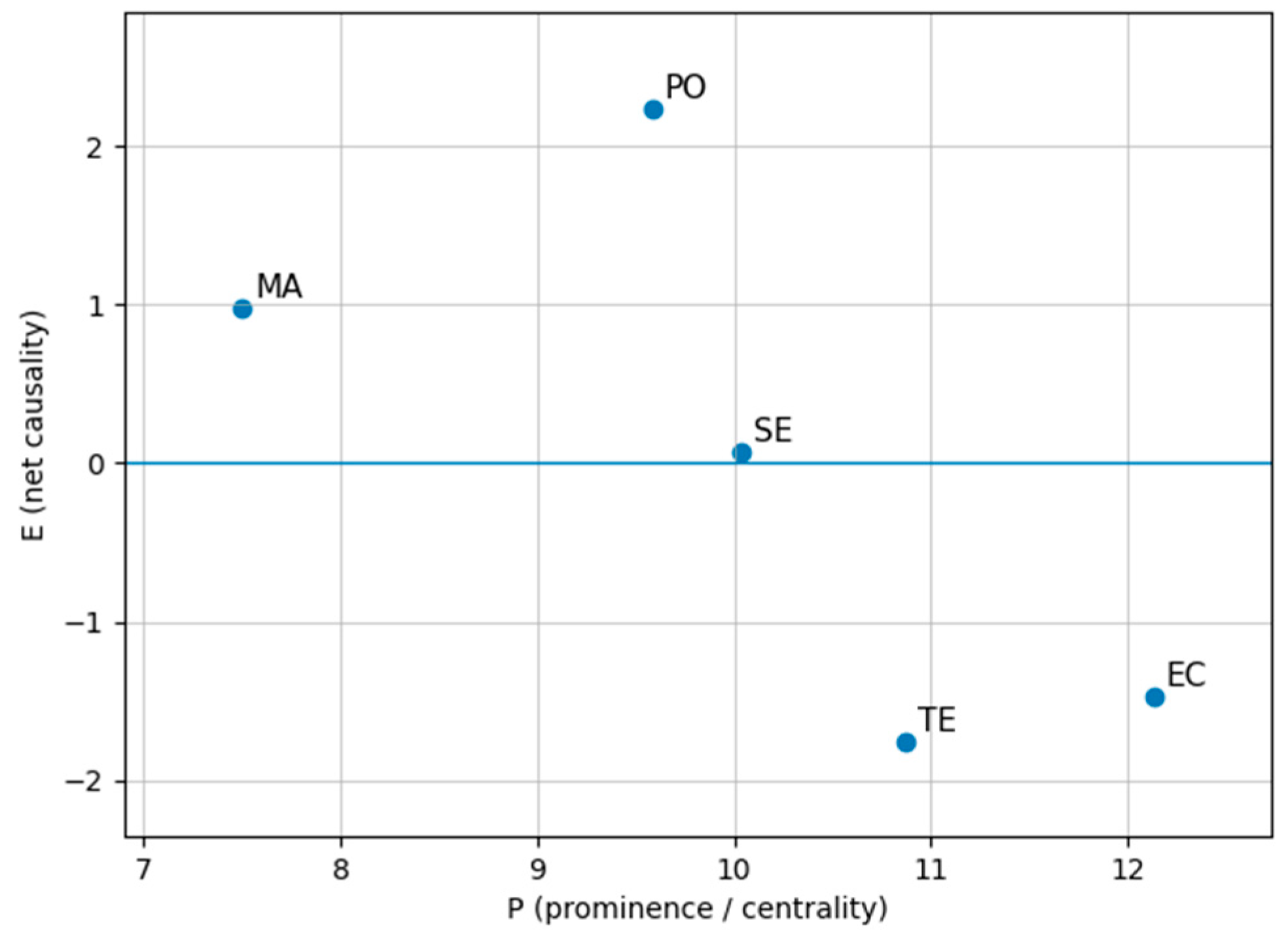
At the dimension level (PO, SO, EC, TE, and MA),
Table 3 summarizes the DEMATEL indices and normalized weights. Overall, EC exhibits the highest prominence and weight, indicating that market-related risks are most centrally embedded in the interaction system. In terms of directional role, PO and MA act predominantly as upstream
drivers, whereas EC and TE are mainly downstream accumulation dimensions.
Figure 2 visualizes these roles using a
cause–effect map: the horizontal axis represents prominence
, and the vertical axis represents net causality
. Dimensions above the zero line (
) are classified as net causes, while those below (
) are net effects. This visualization provides an intuitive structural basis for interpreting the cascade patterns reported in
Section 4.4.
4.3.2. Factor-Level Key Risks for Subsequent Modeling
At the factor level (21 risks;
and
index risk factors; see
Table 1), influence in the estimated interaction structure is typically concentrated: a small subset of risks accounts for a disproportionate share of overall interaction intensity. To keep the main text concise,
Table 4 reports the top-10 risks ranked by the normalized weight
, together with their phase and dimension labels. These items constitute the most influential nodes and are therefore used as primary candidates for subsequent analysis of initiating, amplifying, and outcome-sensitive behaviors.
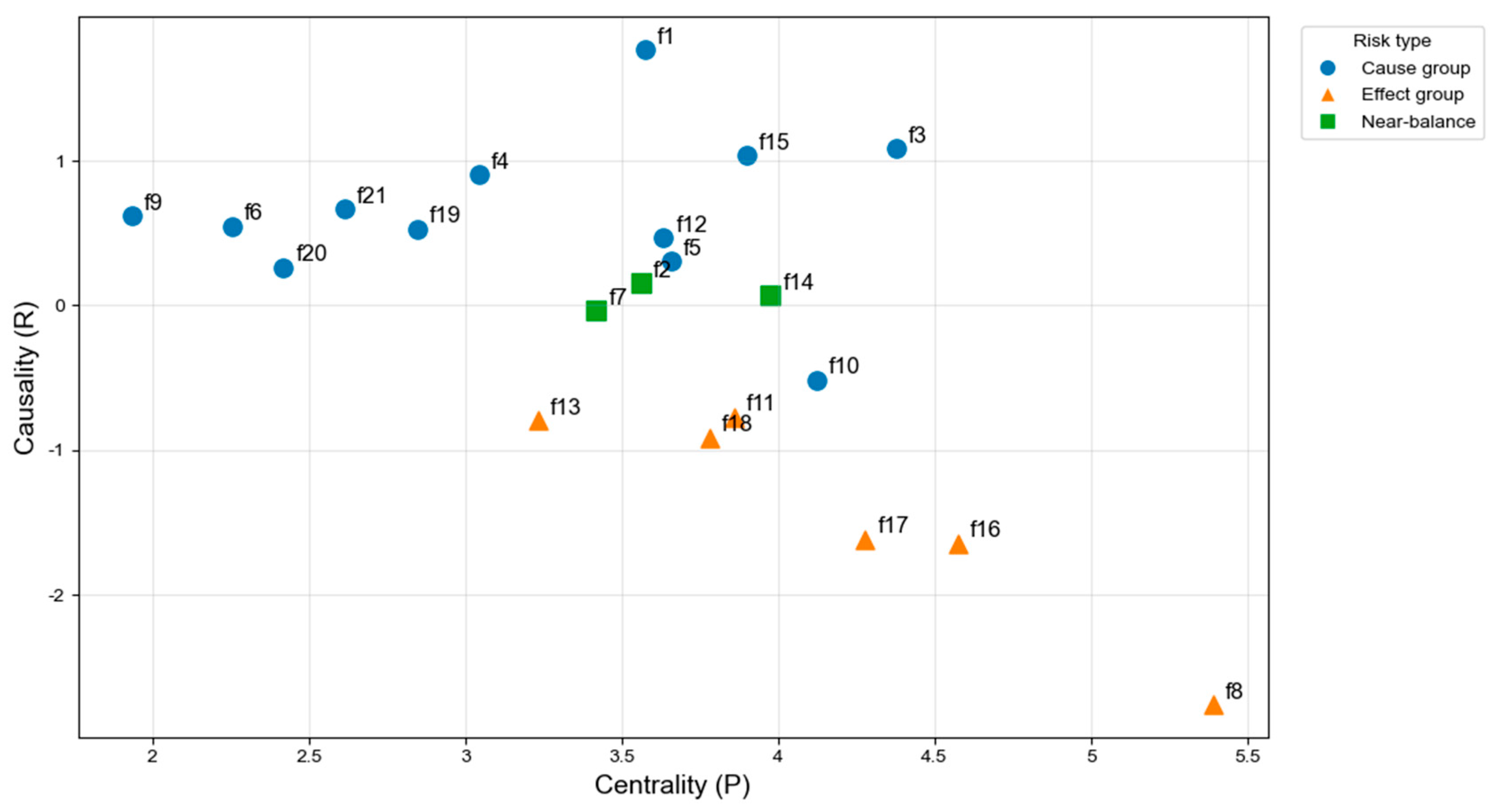
Beyond weight ranking, we further characterized each risk’s directional role using the net causality measure
(upstream driver vs. downstream receiver) reported in
Figure 3. To visualize this role jointly with structural prominence,
Figure 3 plots each risk in the centrality–causality plane, where the horizontal axis represents centrality
, and the vertical axis represents causality
. Risks are categorized into the cause group, effect group, and a near-balance group (close to neutral directionality). This scatter view complements
Table 4 by showing whether highly weighted risks tend to act as upstream initiators (high
), downstream receivers (low
), or near-balance intermediaries, thereby motivating the selection of focal risks and the interpretation of cascade pathways in the subsequent dynamic transmission experiments (
Section 4.4).
4.4. Sensitivity Check of Structural Robustness
To assess robustness, we conducted a Monte Carlo sensitivity check on DEMATEL outputs at both levels (factor: 21 risks; dimension: five dimensions), using ±5%, ±10%, and ±15% perturbations (2000 runs per level).
The results in
Table 5 show that the intensity changes are centered near zero at both levels (factor mean: −0.0160% to 0.0205%; dimension mean: −0.0488% to −0.0206%). Even at ±15% perturbation, the 95% interval remains bounded (factor: [−3.8496%, 3.8795%]; dimension: [−7.3731%, 7.6960%]). Rank consistency is consistently high (Spearman ρ = 0.9947–0.9988 for factors; 0.9911–1.0000 for dimensions), with 100% top-1 retention in all settings. These results indicate that parameter perturbations mainly affect absolute magnitudes, while the core structural conclusions remain stable.
4.5. Dynamic Transmission Results
This section characterizes the dynamic risk transmission regimes implied by the proposed causality-based propagation model. Leveraging the directed influence structure established in
Section 4.2, we track the temporal evolution of risk states and summarize system behavior through the aggregated output
, which captures escalation pace, peak intensity, and saturation dynamics. Decomposing
by risk dimensions (and project stages where relevant) reveals a clear separation between upstream activation and downstream accumulation: early movements are driven by structurally upstream risks, whereas later surges are dominated by compounded impacts transmitted through the causal network. This decomposition provides a compact empirical signature of nonlinear escalation in PPP infrastructure risk systems and directly motivates differentiated governance priorities across time and dimensions.
4.5.1. Transmission Accumulation Rule
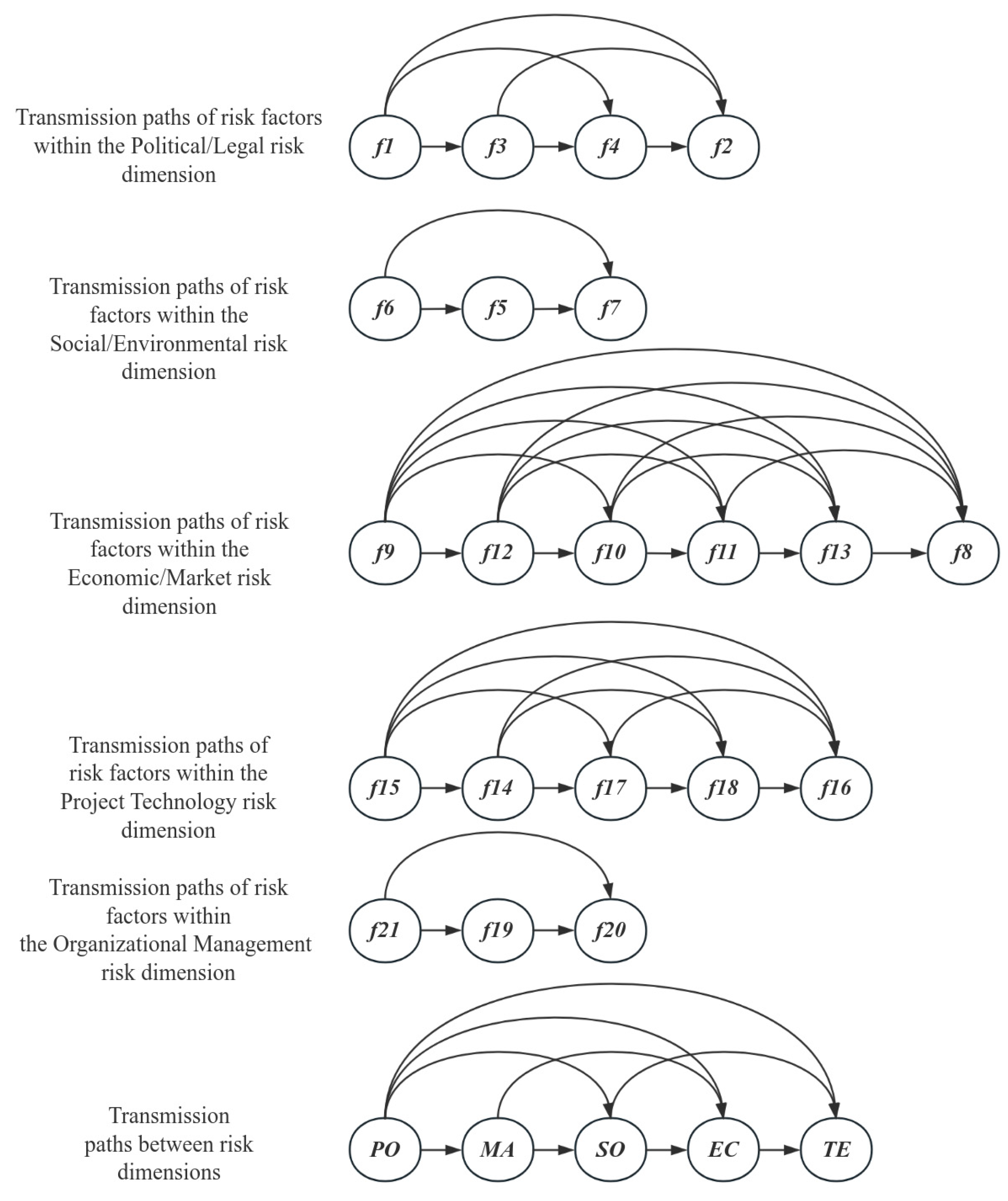
Within each dimension, risks are ordered by decreasing net causality
, as shown in
Figure 4, as follows: PO:
; SO:
; EC:
; TE:
; MA:
>
>
.
This ordering yields the schematic transmission backbone in
Figure 4, which visualizes the dominant directed paths within each dimension and the cross-dimension links. For computation, the PO within-dimension links shown in
Figure 4 are encoded into the corresponding coupling–diffusion effect matrix (
Table 6), where rows denote source risks, and columns denote destination risks; a typical nonzero entry in the coupling–diffusion matrix takes the form
, following the implemented transmission rule in Equation (16). To keep the main text readable and focused, we present the PO block as a concrete illustration; the encodings for the other dimensions are fully analogous and follow the same procedure and are therefore not repeated here.
From
Table 6, column
contains only “–”; hence,
. For
, the nonzero entries are
and
; thus,
=
.
4.5.2. Transmission Curves: Dimension- and Stage-Wise Decomposition
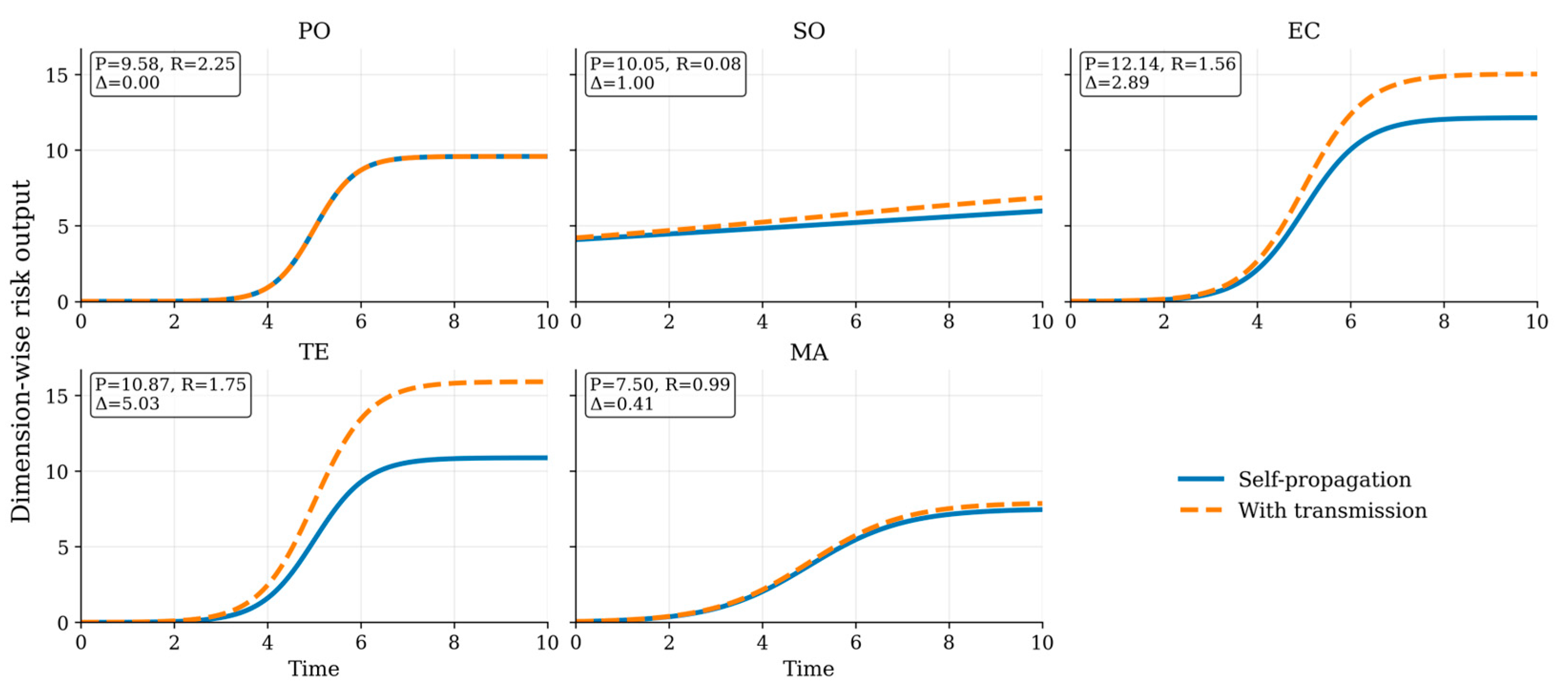
Figure 5 reports the dimension-wise aggregation under self-propagation (baseline) and with the received transmission term
added, based on Equations (18)–(21). The estimated baseline saturation and growth parameters differ substantially across dimensions: EC exhibits the highest saturation of
with
; TE follows with
1 and
; SO shows
but an almost flat growth rate
; PO has
9.58 with the steepest growth among the five (
); and MA yields the lowest saturation of
with
.
Adding the dimension-level received transmission = = produces a clearly heterogeneous uplift: TE shows the largest transmission contribution (), EC the second largest (), SO a moderate uplift (), MA only a small increase (), and PO exhibits no measurable uplift (). Consistent with the trajectories, the transmission-enabled curves remain uniformly above the self-propagation baselines once the trajectories enter the steepening window, and the late-stage separation is largely preserved as an additive increase in the dimension-wise accumulated output.
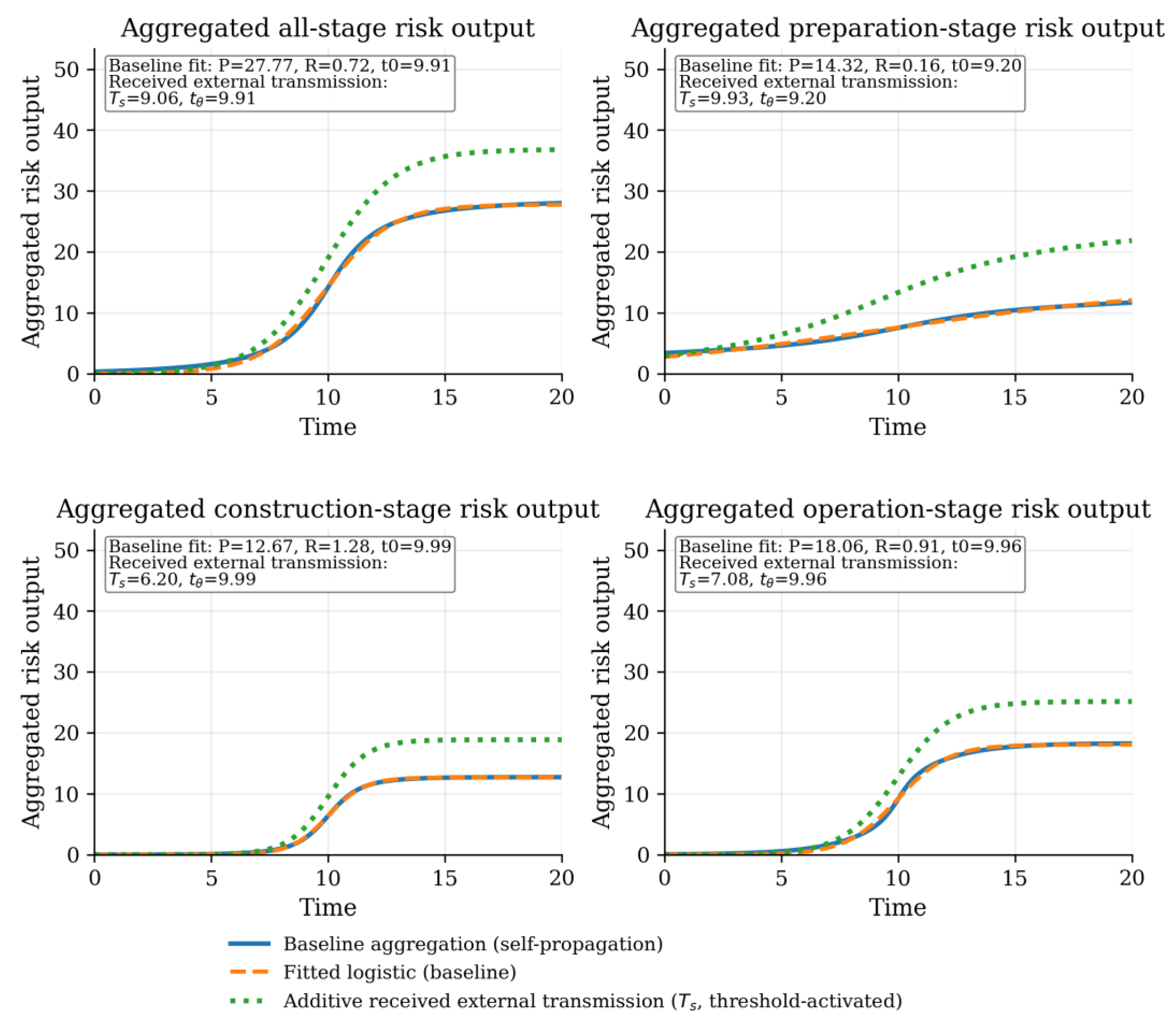
Figure 6 shows a clear and consistent uplift of the stage-wise aggregated trajectories once the transmission component is included (green dotted) relative to the self-propagation baseline (blue/orange). The divergence is negligible in the early period but becomes most visible around the common inflection window (
) across all panels, indicating that transmission effects are most salient when the stage trajectories steepen. The strength of the transmission contribution is stage-dependent: the annotated additive transmission level is largest for preparation-stage risks (
) and All-stage (
), followed by operation-stage risks (
), and is lowest for construction-stage risks (
). Baseline saturation levels also differ markedly by category (All-stage
; preparation
; construction
; operation
), while the fitted inflection times remain tightly clustered (
), suggesting that cross-stage differences are dominated by magnitude (saturation and additive transmission) rather than timing.
4.5.3. Initiators and Transmission Amplifiers (RTII-Based Key Risk Identification)
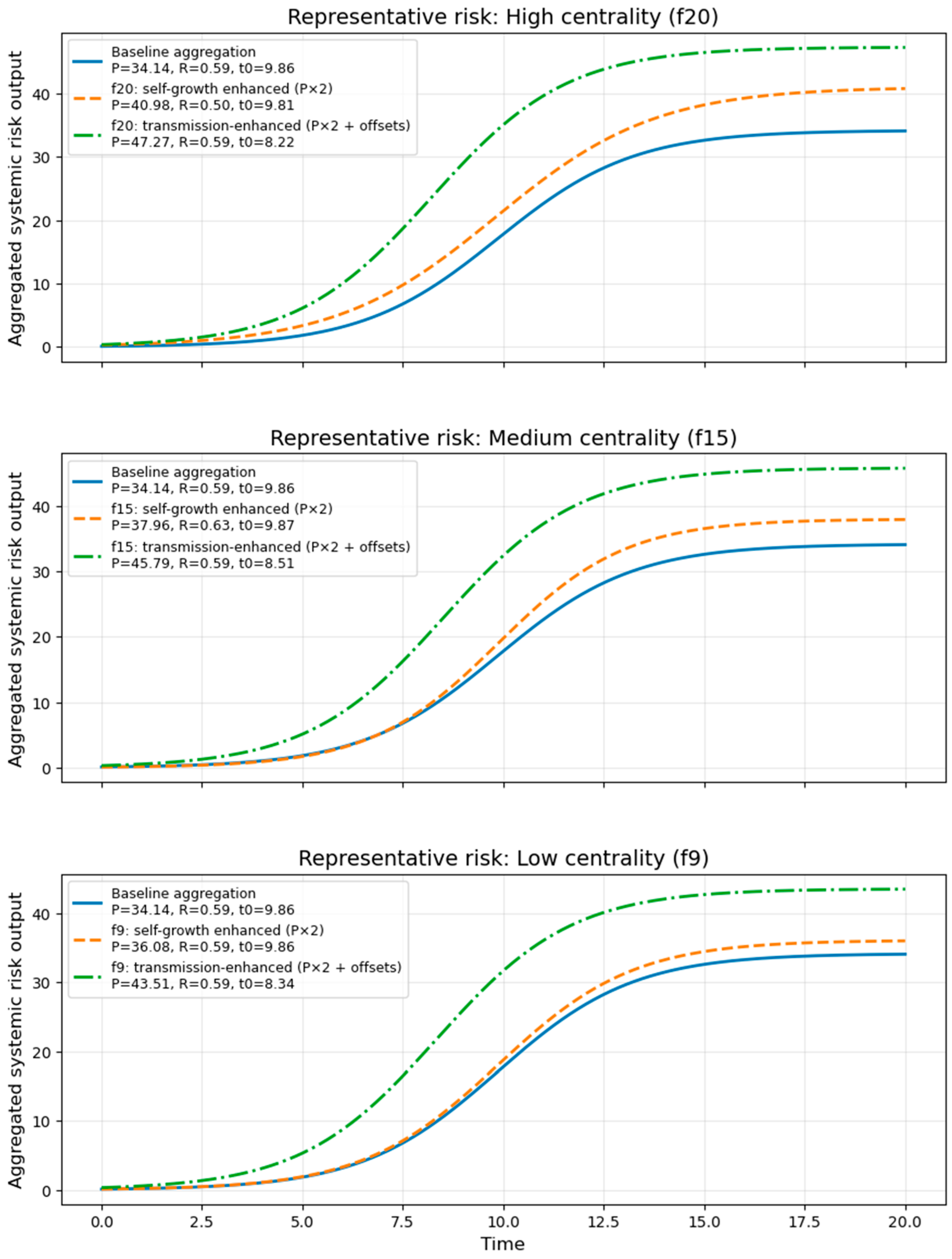
To make the initiator–amplifier separation directly observable, we compared three representative risks with high, medium, and low centrality under baseline/self-growth versus transmission-enhanced settings. As shown in
Figure 7, all three representatives follow logistic-type trajectories, while the transmission-enhanced setting yields a clear upward shift relative to the baseline/self-growth benchmark, producing an immediately visible transmission-induced separation across different network positions. This visible separation motivates a quantitative index to distinguish initiator-type risks from those that become large mainly by accumulating incoming transmission.
To distinguish risks that are simply large in magnitude from those that can structurally ignite cascades, we classified risks into initiators and amplifiers/accumulators based on the transmission decomposition in Equation (17) and the Risk Transmission Initiation Index (RTII) in Equation (25). RTII is initiator-oriented because it normalizes a factor’s internal saturation level by the received external transmission , where is defined as the column sum of incoming transmissions (Equation (20)), and prevents division by zero (Equation (25)). Accordingly, risks with no received transmission (; Equation (20)) are regarded as strict initiators, whereas risks with very limited received transmission ( but small) and high RTII are treated as initiator-like, consistent with upstream positions whose realized levels are less dependent on incoming transmission. In contrast, amplifiers/accumulators are characterized by large transmission-driven increments, manifested as a pronounced separation between self-only and transmission-enabled outcomes (Equation (17)).
Table 7 reports the RTII-based ranking results for identifying system-level initiators. The top-ranked risks include
,
,
, and
(followed by
,
, and
), and the table further provides each item’s phase/category, dimension, and standardized RTII (
; Equation (26)). These results align with the pattern observed in
Figure 7: initiator-type risks exhibit limited dependence on incoming transmission (small
) yet can exert disproportionate influence through outgoing pathways. In contrast, receiver-type risks tend to have higher
(higher received external transmission), reflecting stronger dependence on upstream inputs; consequently, their outcomes change more when transmission effects are included, consistent with their downstream positions in the directed influence structure. We additionally performed a robustness check for RTII calculation variants (scale, offset, and nonlinear transform) under ±5%, ±10%, and ±15% perturbations (2000 runs each). Across variants, ranking consistency remained acceptable to high (Spearman ρ\rhoρ from 0.7513 to 1.0000; top-8 Jaccard from 0.7633 to 1.0000), and top-3 retention was 85.95–100%. These results further support that the key RTII-based initiator characterization is structurally stable under reasonable calculation-method changes.
6. Conclusions
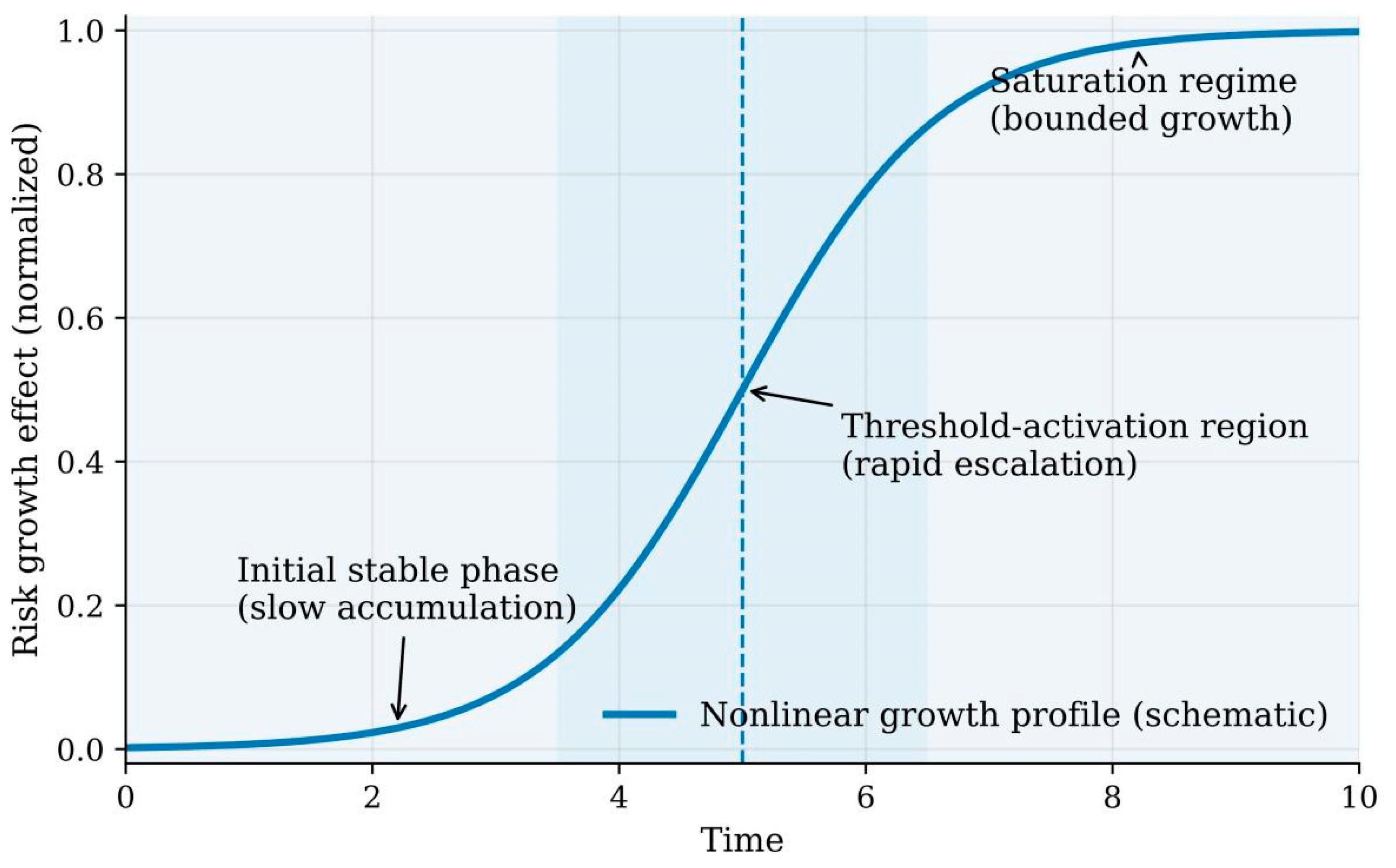
This study develops an application-oriented, dynamic risk transmission framework for Public–Private Partnership projects by integrating (i) DEMATEL-based quantification of directed inter-risk influence strength and polarity and (ii) a logistic-type nonlinear evolution model with an external transfer mechanism to capture cross-dimension escalation. The proposed framework reproduces a typical nonlinear escalation pattern (“slow accumulation–critical acceleration–gradual saturation”) at the system level. When external transfer is incorporated, the model indicates dimension-dependent amplification, with more pronounced transfer-induced escalation in the technical/engineering and economic dimensions and comparatively limited additional escalation in the political/legal dimension. In time, transfer-driven increments are most evident for preparation-stage risks and all-stage risks, suggesting that early-stage conditions can materially influence downstream exposure through cascading effects.
To enable actionable governance and engineering decision support, we further introduce the Risk Transmission Initiation Index to identify upstream initiators with high cascade-triggering potential. The Risk Transmission Initiation Index serves as an operational triage rule for PPP governance by prioritizing upstream risks for mitigation sequencing, calibrating monitoring intensity, and guiding contingency allocation based on cascade-triggering potential in the directed influence network. Based on the observed transmission dynamics, two operational implications follow: (1) early, targeted mitigation on initiators identified by the Risk Transmission Initiation Index to suppress cascade formation and (2) enhanced monitoring and control for dimensions that more readily absorb transferred risks—particularly technical/engineering and economic—implemented before and during the acceleration phase, when marginal risk growth is highest.
A key limitation of the present study is the absence of a full longitudinal single-project case, which constrains project-level external validation of practical utility. A second limitation is that the current logistic parameterization (
,
) is a parsimonious identification choice under limited observations rather than a unique structural specification. Future work will therefore prioritize end-to-end validation on a fully documented Public–Private Partnership project while benchmarking against commonly used risk-prioritization baselines and testing alternative parameterizations with explicit uncertainty modeling. For practice, the framework supports differentiated actions across key stakeholders: policymakers can prioritize early governance safeguards for high-transmission risks; contractors can allocate mitigation resources to upstream initiators and strengthen cross-interface control; and financing institutions can embed transmission-sensitive indicators into due diligence, covenant design, and dynamic risk monitoring [
37].