
Article

An Experimental Investigation of the Effects of Dry–Wet Cycles and pH Values on Gangue Waste-Based Roadway Shotcrete: Mechanical Performance and Microstructural Analysis

1
Sate Key Laboratory for Fine Exploration and Intelligent Development of Coal Resources, School of Mines, China University of Mining and Technology, Xuzhou 221116, China
2
School of Information and Control Engineering, China University of Mining and Technology, Xuzhou 221116, China
*
Author to whom correspondence should be addressed.
Appl. Sci. 2026, 16(5), 2508; https://doi.org/10.3390/app16052508
Submission received: 28 January 2026 / Revised: 27 February 2026 / Accepted: 4 March 2026 / Published: 5 March 2026

Abstract

The mechanical durability of gangue-based roadway shotcrete material (GRSM) in aqueous environments was systematically investigated by evaluating the effects of immersion duration, dry–wet cycles, and pH variations on its uniaxial compressive strength (UCS). The results indicate that prolonged immersion significantly degrades the mechanical performance of GRSM. After 28 days of immersion, the UCS decreased by 8.68 MPa (22%) compared with specimens under standard curing conditions. In contrast, limited dry–wet cycling (up to two cycles) enhanced the UCS to 36.05 MPa by promoting continued hydration and pore refinement, whereas additional cycling led to progressive deterioration. GRSM exhibited pronounced pH sensitivity: acidic environments induced the most severe strength loss, followed by alkaline conditions, whereas neutral to weakly alkaline environments (pH 8–12) resulted in relatively stable mechanical performance. Mercury intrusion porosimetry (MIP) confirmed that pore structure evolution governed strength variation, with acidic exposure and dry–wet cycles producing the greatest increases in porosity. Mechanically activated gangue (MA-gangue) was prepared by ball milling and partially substituted for cement. Although MA-GRSM exhibited lower UCS than conventional GRSM under all conditions, both materials demonstrated similar environmental response patterns. These findings elucidate the coupled physicochemical mechanisms governing the durability of gangue-based shotcrete materials in underground water-bearing environments.

1. Introduction

Gangue discharge poses both economic and ecological challenges in coal production and processing. In 2023, China’s gangue production alone exceeded 800 million tons, with a comprehensive utilization rate of less than 74% [1,2]. The transportation and discharge of gangue have engendered issues such as escalated economic costs in coal mining, the depletion of soil resources, fire hazards, and the contamination of groundwater resources [3,4]. At present, mature technologies and large-scale disposal have been formed for the utilization of gangue in goaf filling, ground foundation construction, subsidence pit backfilling, and land reclamation [5,6]. To improve the comprehensive utilization rate of gangue, promote the construction of green mines, and provide more technical ideas for roadway rock control, some researchers have conducted studies on replacing coarse aggregates with gangue to prepare concrete and shotcrete materials [7,8]. For mines with well-developed underground water systems, mining activities tend to induce cracks in the rock layers above roadways and water-rich roadways beneath aquifers [9,10]. Consequently, water continuously infiltrates into the mining area, exposing shotcrete materials to prolonged and frequent water contact [11,12,13]. Furthermore, the water seepage process is influenced by various water–rock interactions, resulting in the formation of acidic or alkaline mine water—both of which exert a significant influence on the mechanical properties of shotcrete materials [14,15]. The mechanical properties and stability of gangue-based shotcrete materials (GRSMs) differ from those of traditional roadway shotcrete. Therefore, when coal gangue is used as a substitute for the coarse aggregate in shotcrete, it is essential to investigate the effects of the aqueous environment and its acidity/alkalinity on the stability and mechanical strength of such shotcrete materials. This research is critical to facilitating the large-scale application of GRSM in underground roadways and is also conducive to enhancing the surrounding rock stability control effect.
Extensive research has been conducted on tunnel shotcrete materials and gangue-based shotcrete materials, primarily focusing on the potential application of mine solid waste in building materials, the properties of shotcrete materials, and the impact of external environmental factors. The systematic Classification–Potentiality–Quantity and feasibility Application (CPQvA) is used to judge the value-added potential of solid waste materials such as gangue and tailings around the world from the perspective of the circular economy [16,17,18], which also points out the potential of solid waste from coal mines, such as gangue, and metal mine tailings for the manufacture of building materials [19,20]. For instance, studies have been conducted on the preparation of green products such as reinforced concrete and concrete-filled steel tubular members using coal gangue to replace coarse aggregates [21]. The applicability of tailings in shotcrete for foundation support has also been investigated, and results show that its modulus of rupture far exceeds the relevant ASTM standards [22]. In addition, the influence of material mix proportions on the compressive strength of coal gangue-based wet-mix shotcrete was analyzed via a multivariate nonlinear response model. It was found that when the fly ash dosage is approximately 120 kg·m−3, both the grayscale value of the microstructure and the unconfined compressive strength (UCS) of the tailings-based wet-mix shotcrete reach their maximum levels [23]. The utilization of gangue in conjunction with other materials, when mixed with specific materials, has the capacity to exert a substantial influence on the performance of concrete and shotcrete materials. Red mud–coal gangue concrete with 15% red mud and 15% coal gangue powder had lower porosity and compressive strength comparable with cement concrete [24]. Similarly, the amalgamation of gangue and polyvinyl alcohol fiber has been shown to diminish the maximum strain of shotcrete [25], while the incorporation of steel fibers has been observed to enhance the mechanical properties of gangue concrete [26].
The external environment exerts a substantial influence on the mechanical properties and stability of shotcrete material. It has been established that the compressive strength of concrete and the characteristic value of the damage layer decrease with an increase in the number of freeze–thaw cycles. After freeze–thaw cycles, water absorption and the square root of time were nonlinearly related [27]. Gangue-based concrete has been shown to exhibit considerable resistance to sulphate attack, and the addition of chloride ions has been demonstrated to be an effective measure for the mitigation of such attack [28,29]. Dry–wet cycling is also one of the harsh environmental conditions affecting concrete and gangue-based shotcrete. Under dry–wet cycling conditions, the relative humidity inside the concrete changes periodically and progressively, and previous research showed that the addition of 3% shrinkage-reducing admixture can reduce the drying shrinkage of alkali-activated coal gangue–slag mortar by 47.5% [30,31]. This is the main factor determining the migration behavior of chloride ions in unsaturated concrete [32]. Furthermore, repeated dry–wet cycles also contribute to the gradual disappearance of the drying pre-effect [33]. At the microscopic level, an increase in the pore structure of concrete subjected to dry–wet cycles has been identified as a significant factor responsible for the substantial reduction in compressive strength. Under continuous cycling conditions, the formation of micro-cracks induced by thermal stresses is known to persist. This persistence promotes the leaching of calcium ions, resulting in a further increase in porosity [34,35]. In summary, the present study focuses primarily on the feasibility of using coal gangue as a substitute for coarse aggregates in roadway shotcrete. Additionally, it examines the mechanical properties of traditional concrete materials and the impacts of dry–wet cycles, along with other environmental factors, on the performance of traditional shotcrete. However, research on the water resistance and erosion resistance of GRSM remains scarce, particularly regarding the effects of soaking duration, dry–wet cycle count, and soaking solution pH on the mechanical properties of GRSM.
In this study, broken gangue was used to prepare the GRSM instead of coarse aggregates of traditional roadway shotcrete materials; the effects of soaking time, the number of dry–wet cycles, and the pH value of the soaking solution on the compressive properties of GRSM specimens were illustrated, and their water resistance and corrosion resistance were analyzed. The GRSM specimens were also microtested using XRD, SEM, and pressed mercury testing. To further increase the utilization rate of gangue, mechanically activated gangue was employed to replace a certain portion of cement, and mechanically activated gangue-based shotcrete material (MA-GRSM) specimens were prepared. Repetitive tests analogous to those conducted on GRSM specimens were performed on MA-GRSM specimens. The hydrochemical stability of MA-GRSM in water environments was systematically analyzed by integrating mechanical experimental data with microscopic characterization. This study provides a reference for optimizing the performance of roadway support materials and the proportioning design of on-site gangue-based shotcrete materials.

2. Test Design

2.1. Material Composition and Preparation

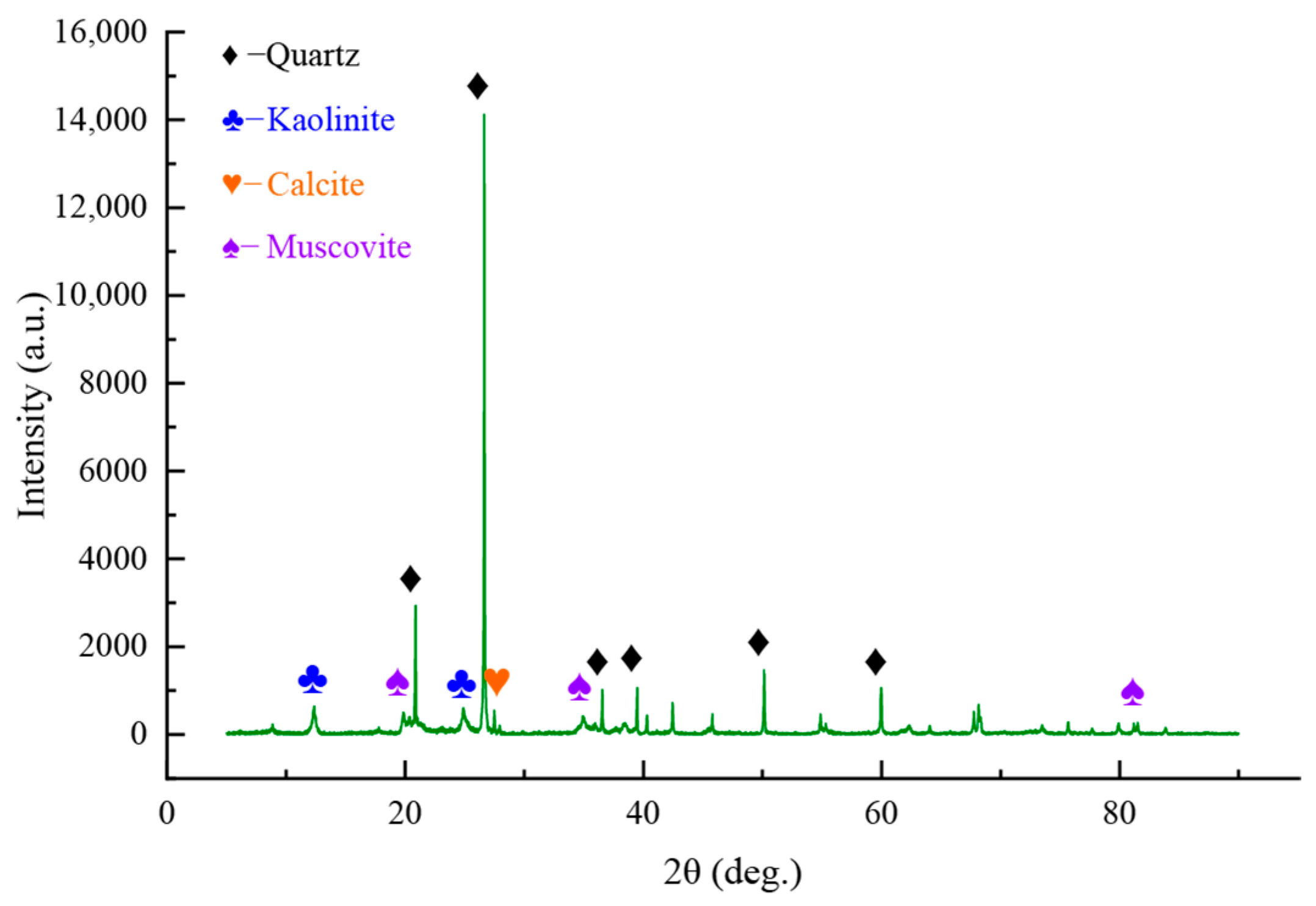
The raw materials of GRSM specimens mainly consisted of coarse aggregates, fine aggregates, cementitious materials, water, and accelerators. Sorted gangue collected from Yangcheng Coal Mine (Wenshang County, Shandong Province, China) was selected as the coarse aggregate for GRSM specimens. It is a typical sandstone, classified as relatively hard gangue, with a natural moisture content of less than 1% and a water absorption rate of 5.15%. In the laboratory, the gangue was crushed using a crusher and sieved with a screening machine, with its particle size controlled below 10 mm. To regulate the particle size distribution of the gangue aggregates (0–1, 1–2.5, 2.5–5.0, 5.0–7.5, and 7.5–10 mm), Talbot’s grading theory with an exponent of n = 0.6 was applied. The compositional characteristics of the gangue were comprehensively characterized using X-ray diffraction (XRD). The analytical results, as presented in Figure 1, demonstrate that the primary mineralogical composition consists of quartz and kaolinite. Quantitative chemical analysis revealed that the major oxide components include SiO2, Al2O3, Fe2O3, and K2O, with the combined content of SiO2 and Al2O3 accounting for approximately 73% of the total composition.
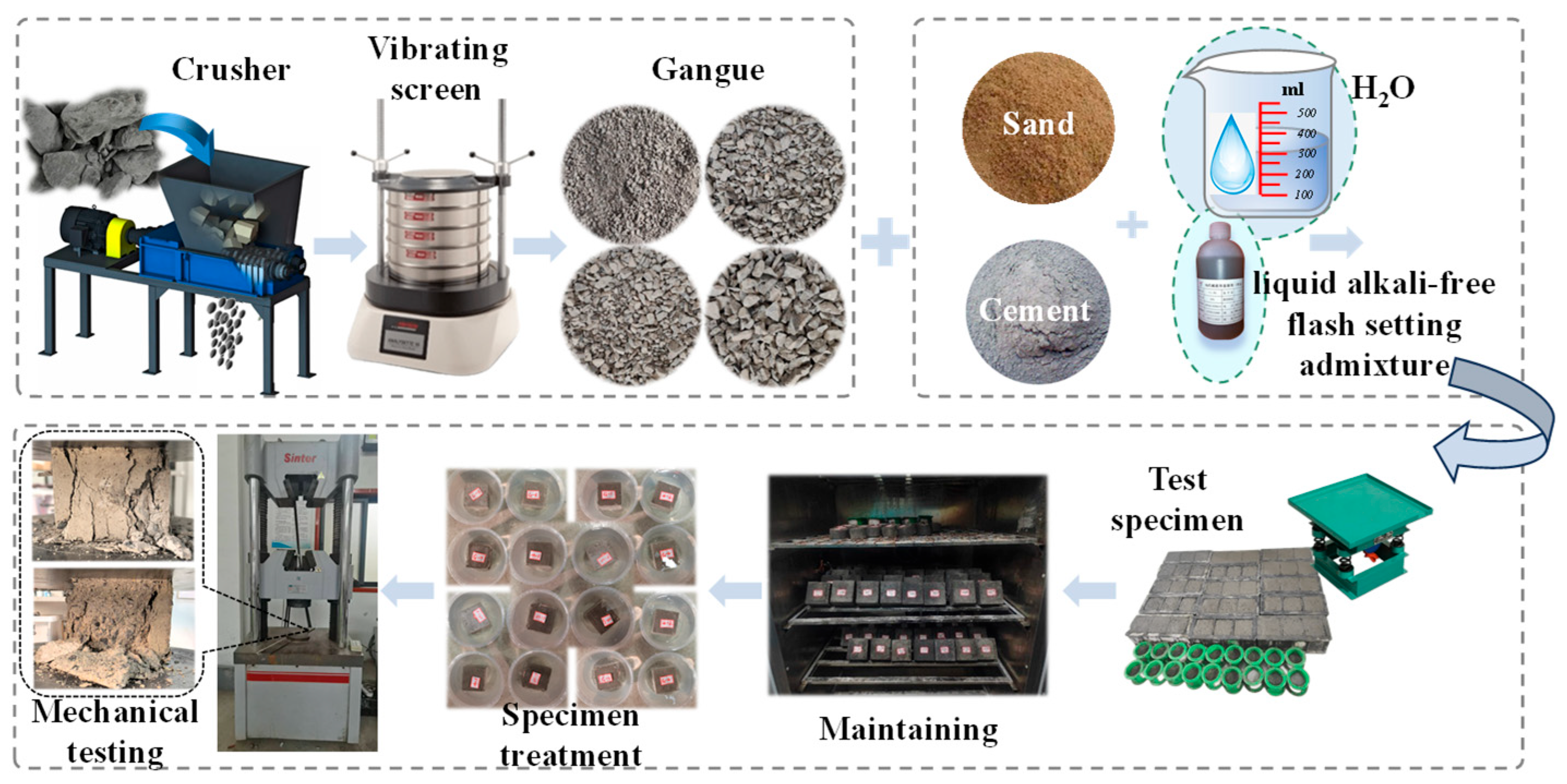
Ordinary river sand with a fineness modulus greater than 2.5 was used as fine aggregate. PO42.5 Portland cement that met the requirements of the preparation standard for shotcrete materials was used as the cementitious material. Its main components include 2CaO·SiO2, 3CaO·SiO2, and 3CaO·Al2O3. Its particle size distribution ranges from several micrometers to over 100 μm, with a specific surface area of 320–380 m2·kg−1 and a median particle size (D50) between 10 and 20 μm. In accordance with the standard Flashing setting admixture for shotcrete (GB/T 35159-2017) [36], a liquid alkali-free flash setting admixture was employed to accelerate the setting of GRSM. Moreover, a certain amount of NaOH standard solution and standardized sulfuric acid titrant were used. Figure 2 shows the main test materials and the preparation process of GRSM specimens.
The preparation of GRSM specimens in this study consisted of three main stages: mix proportion design, specimen fabrication, and curing.
(1)
Mix proportion design.
The cement content, water–cement ratio, and flash setting admixture dosage were selected as the primary experimental variables for the mix design tests. In accordance with the Technical Specification for Application of Sprayed Concrete (JGJ/T 372–2016) [37], the optimal mix proportion was determined based on criteria of superior workability (pumpability) and mechanical performance. Based on the preliminary test results, the optimal mass ratio of GRSM is 1.78:1.78:1:0.64:0.04 for coal gangue, sand, cement, water, and fly ash, respectively. In addition, the liquid alkali-free flash setting admixture was 4% by mass.
(2)
Specimen fabrication and curing.
Pre-weighed coarse and fine aggregates, cement, and water were mixed according to the optimized proportion and stirred for 5 min. Subsequently, a premixed solution of flash setting admixture and water was added to the mixture, followed by an additional 5 min of stirring to ensure homogeneity. The resulting slurry was poured into 70.7 mm × 70.7 mm × 70.7 mm cubic molds in three layers. Each layer was compacted using a vibrating table, and the specimen surface was leveled. The molded specimens were then placed in a curing chamber maintained at 20 ± 2 °C and a relative humidity of 95%. After 1 day and 28 days of curing, the compressive strengths reached 9.5 MPa and 25.8 MPa, respectively, satisfying the requirements for early strength (≥8 MPa) and the target design strength (≥C25).

2.2. Test Schemes and Test Equipment

(1)
Test schemes and test equipment
To test the water resistance and corrosion resistance of the GRSM specimens, soaking tests with different soaking times, different numbers of dry–wet cycles, and different pH values of erosion solutions were designed. All GRSM specimens used were subjected to standard curing for 28 days, and all subsequent tests and treatments were carried out on the basis of these 28-day cured specimens. A total of five soaking durations, five dry–wet cycle gradients, and six soaking environments with different pH values were designed in this study. Three specimens were prepared for each test; for the dry–wet cycle tests, six specimens were tested in each experimental group, and the average value of the compressive properties was taken as the final value. Table 1 shows the specific test schemes.
(2)
Specimen treatment method
The details of schemes S1–S10 are not repeated here for brevity. For the GRSM specimens subjected to different numbers of wet–dry cycles, each cycle consisted of immersion in water for 2 days, followed by removal and gentle wiping to remove surface moisture, and subsequent drying in an oven at 80 °C for 12 h before the next cycle commenced. The water used in the experiments was tap water with an initial pH of approximately 8. Solutions with different pH levels were prepared using a standard NaOH solution and a standardized sulfuric acid titrant, the latter being a 0.1 mol/L H2SO4 solution. During soaking, hydration reactions between the interior of the specimen and the immersion solution can alter the pH of the solution. To minimize significant pH fluctuations during immersion, a volume ratio of immersion solution to specimen of at least 50 was maintained. Within an initial solution pH range of 4–14, the pH change measured by a pH meter was within ±0.5 after each 7-day soaking period. To guarantee experimental accuracy, the immersion solution was replaced once when the soaking duration exceeded 7 days. Following the aforementioned treatments, specimens underwent additional preparation prior to UCS testing. Specimens that had been immersed were wiped to remove surface moisture and allowed to stand at room temperature for 2 h. Specimens subjected to high-temperature drying were cooled to room temperature. The mass of each specimen was then measured, and only those with a mass deviation within 20% relative to specimens subjected to standard curing for 28 days were used in the subsequent UCS tests.
In addition, the pore structure characteristics of the GRSM specimens under different treatment conditions were characterized using mercury intrusion porosimetry (MIP). MIP tests were conducted in accordance with the Chinese National Standard GB/T 21650.1-2008 “Pore size distribution and porosity evaluation of materials by mercury porosimetry and gas adsorption—Part 1: Mercury porosimetry” [38].
(3)
Testing equipment
The experimental setup comprised equipment for specimen preparation and curing, as well as apparatus for mechanical property testing. Specimen preparation and curing were conducted using a jaw crusher, standard square-aperture sieves, a vibrating sieve shaker, 70.7 mm × 70.7 mm × 70.7 mm cube molds, a vibrating table, and an intelligent curing chamber. The specimens requiring immersion, as listed in Table 1, were soaked in well-sealed lidded plastic buckets. These buckets provide reliable sealing, and the specimens were fully submerged in the immersion solution throughout the soaking period. Mechanical testing was performed using a WAW-1000D electro-hydraulic servo universal testing machine (SANS Testing Machine Co., Ltd., Shenzhen, China). The mechanical tests were conducted in strict accordance with the Standard for test methods of concrete physical and mechanical properties (GB/T 50081-2019) [39]. The flatness tolerance of the upper and lower bearing plates of the press was less than 0.04 mm, and their parallelism tolerance was less than 0.05 mm. The mercury intrusion porosimeter used in this study was the AutoPore IV 9510 high-performance automatic porosimeter (Micromeritics, Norcross, GA, USA).

3. Test Results of Water Resistance and Acid–Alkali Resistance of GRSM

3.1. Effects of Soaking Time on Compressive Properties

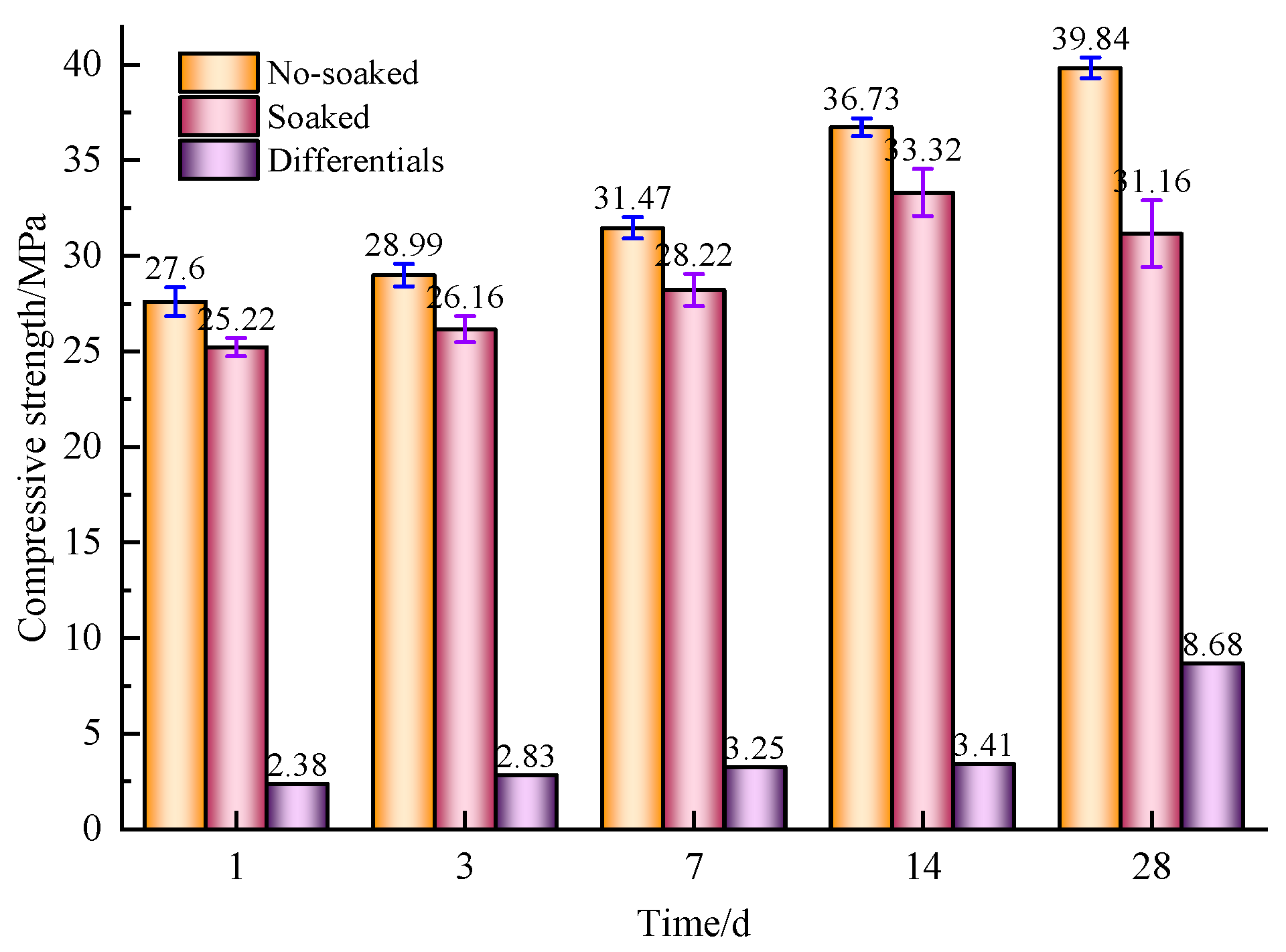
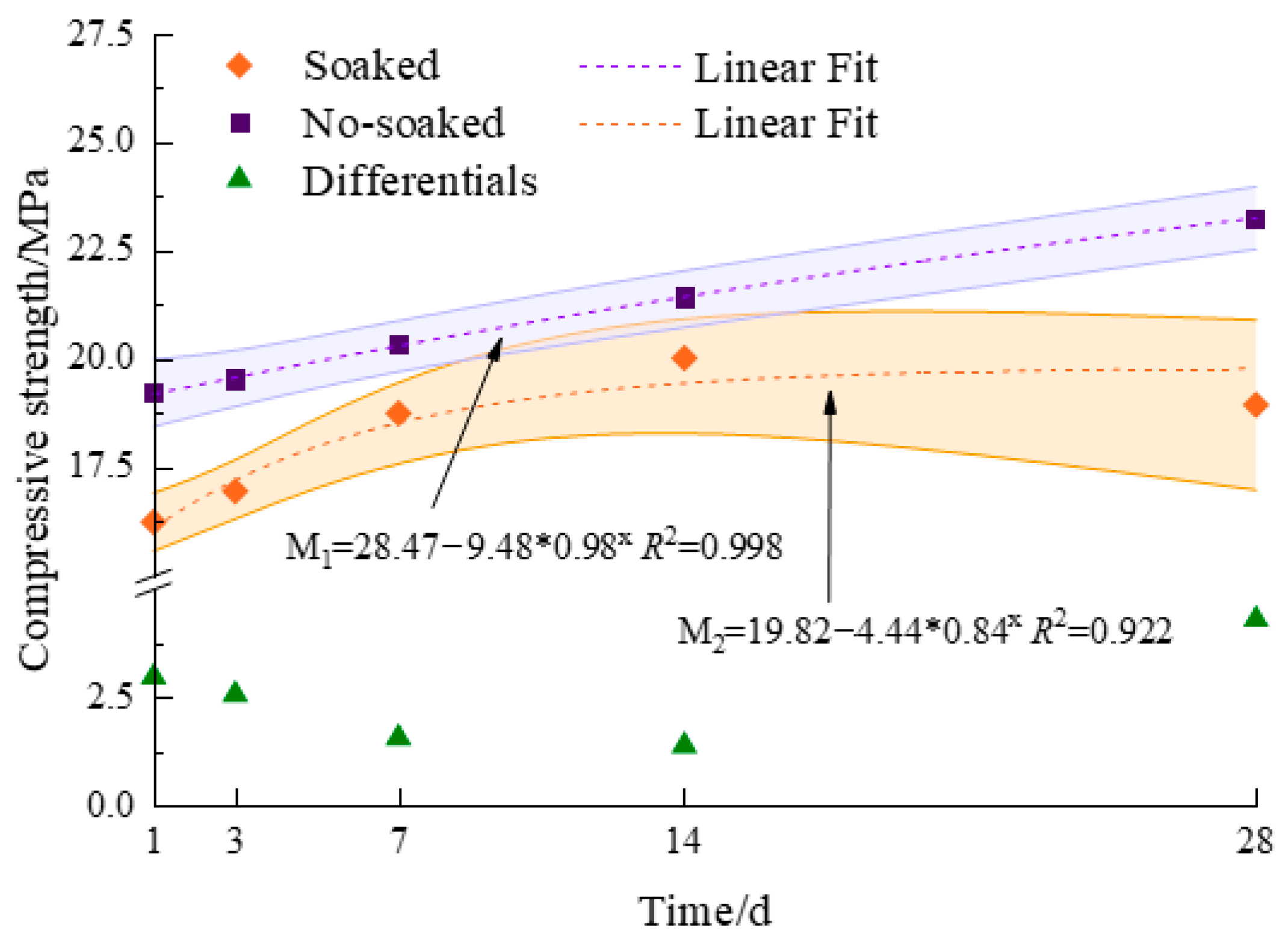
Figure 3 presents the uniaxial compressive strength (UCS) results of GRSM specimens subjected to different immersion durations. The compressive properties varied markedly over the designed soaking periods. Nevertheless, the measured strengths remained higher than the initial 28-day strength of 25.8 MPa, indicating that the GRSM exhibits satisfactory water resistance and potential for field application. Under the experimental conditions, the compressive strength of the immersed specimens exhibited an initial increase followed by a gradual decline with prolonged immersion. The UCS values after 1, 14, and 28 days of immersion were 25.22 MPa, 33.32 MPa, and 31.16 MPa, corresponding to changes of −2.2%, +29.1%, and +20.8%, respectively, relative to the initial strength. With increasing immersion time, the standard deviation of the UCS of water-immersed GRSM specimens shows a gradual upward trend, whereas the UCS scatter of non-immersed specimens decreases progressively. This indicates that curing time can improve the mechanical stability of GRSM, while water immersion has a weakening effect on its mechanical stability.
For specimens cured under standard conditions (i.e., without immersion), compressive strength increased progressively with curing time, although the rate of strength gain gradually decreased. At corresponding ages, the compressive strength of immersed specimens was consistently lower than that of specimens subjected to standard curing. Specifically, compared with standard-cured counterparts, the peak compressive strengths of immersed specimens at 1, 3, 7, 14, and 28 days were reduced by 2.38 MPa, 2.83 MPa, 3.25 MPa, 3.41 MPa, and 8.68 MPa, respectively. A distinct decreasing trend in the UCS of the specimens was observed as the soaking duration increased from 14 to 28 days. The UCS of specimens soaked for 28 days was 2.16 MPa lower than that of specimens soaked for 14 days. As further illustrated in Figure 3, extended immersion also led to greater variability in peak compressive strength, suggesting increased instability in the mechanical response of GRSM under prolonged water exposure.
Existing research has consistently demonstrated that prolonged exposure to water may promote further hydration of unreacted cement particles, leading to additional formation of calcium silicate hydrate (C–S–H) and calcium aluminate hydrates (C–A–H), thereby densifying the microstructure and improving mechanical strength [40]. Moreover, the presence of reactive SiO2 and Al2O3 in coal gangue may contribute to secondary pozzolanic reactions in the presence of calcium hydroxide (CH), forming additional C–S–H gel [41]. In addition, short-term immersion provides sufficient moisture to facilitate ionic diffusion (Ca2+, OH), which may enhance microstructural homogenization. Similar strength enhancement phenomena under water curing have been reported in previous studies [42,43,44].
In cementitious systems, continued availability of moisture enables extended hydration of unreacted clinker phases, which produces additional hydration products and densifies the microstructure. Proper moist or immersion curing thereby promotes strength development by facilitating a higher degree of hydration compared to drier environments, as evidenced by comparative studies showing that concretes subjected to continuous wet curing generally achieve higher compressive strengths than those under other curing regimes.
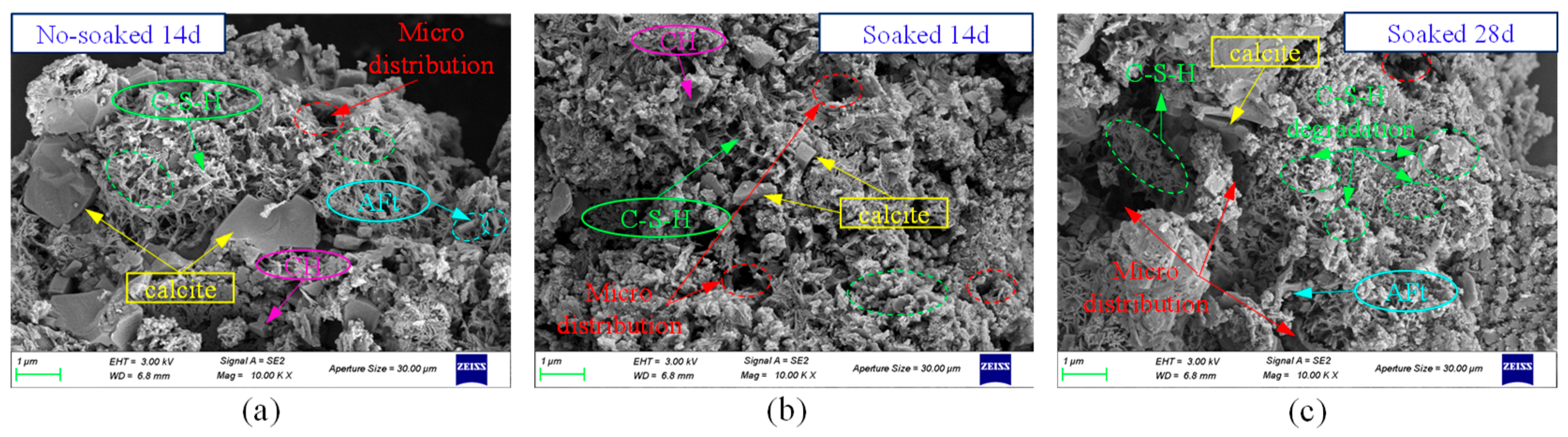
Figure 4 illustrates the microstructures of GRSM specimens subjected to different curing regimes: (a) standard curing for 28 days followed by an additional 14 days of standard curing (28 d + 14 d), (b) standard curing for 28 days followed by 14 days of water immersion (28 d + 14 d soaking), and (c) standard curing for 28 days followed by 28 days of water immersion (28 d + 28 d soaking). The non-soaked specimens exhibit well-developed hydration products. Coupled with their relatively dense microstructure, morphological observations from Figure 4 suggest the presence of C–S–H gel and ettringite, with residual calcium hydroxide (CH) crystals clearly identifiable. Wollastonite capable of sustaining continuous hydration reactions is inferred to be present in the specimens.
In contrast, the soaked specimens exhibit noticeable microstructural alteration. A reduction in CH crystals is observed, which may reasonably be attributed to partial dissolution under prolonged water exposure. The morphology of C–S–H gradually changes from a flocculent network to a more agglomerated and less cohesive structure after extended immersion, suggesting progressive chemical modification of the binding phase under leaching conditions [45].

3.2. Effects of Dry–Wet Cycles on Compressive Properties

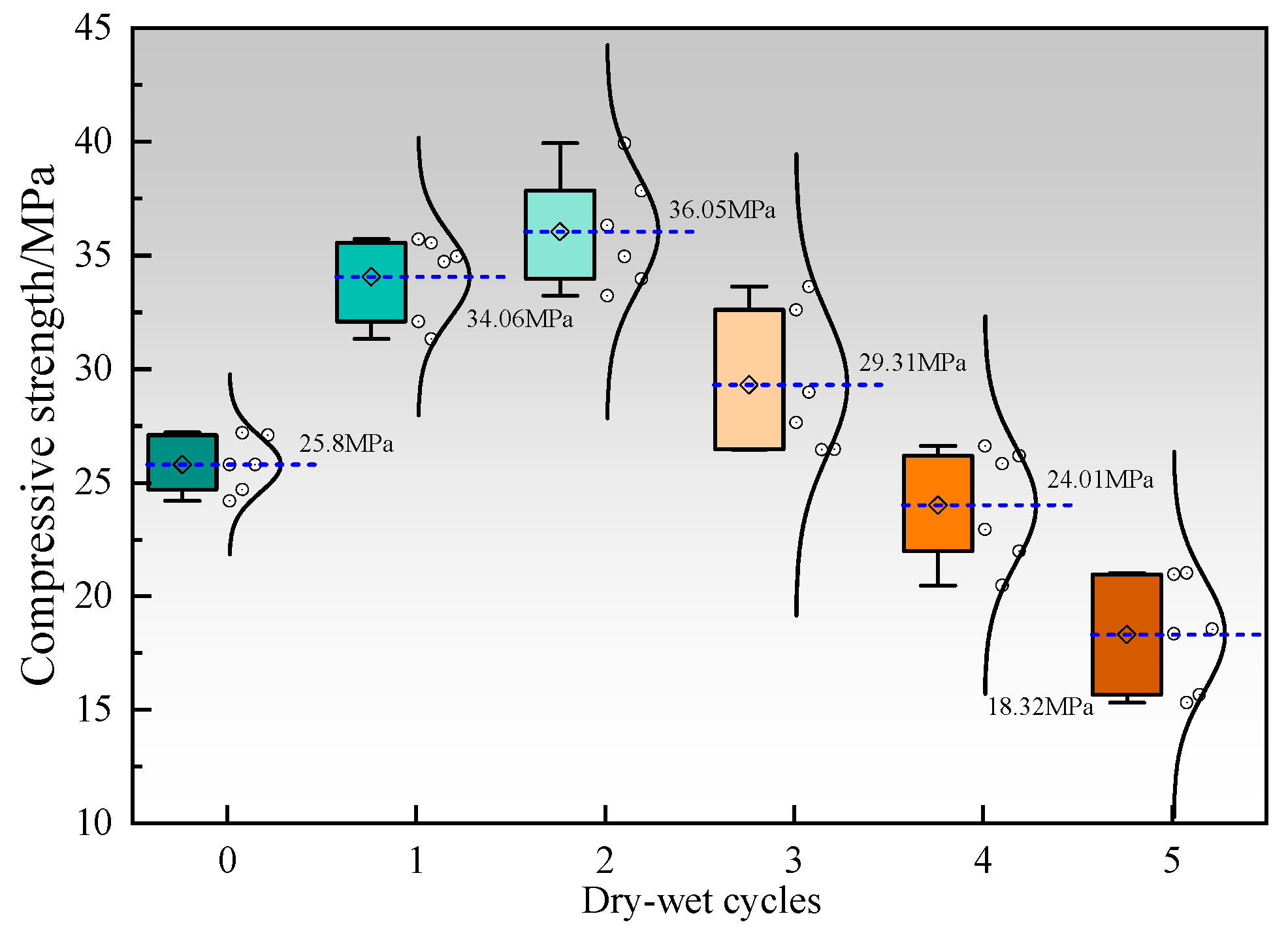
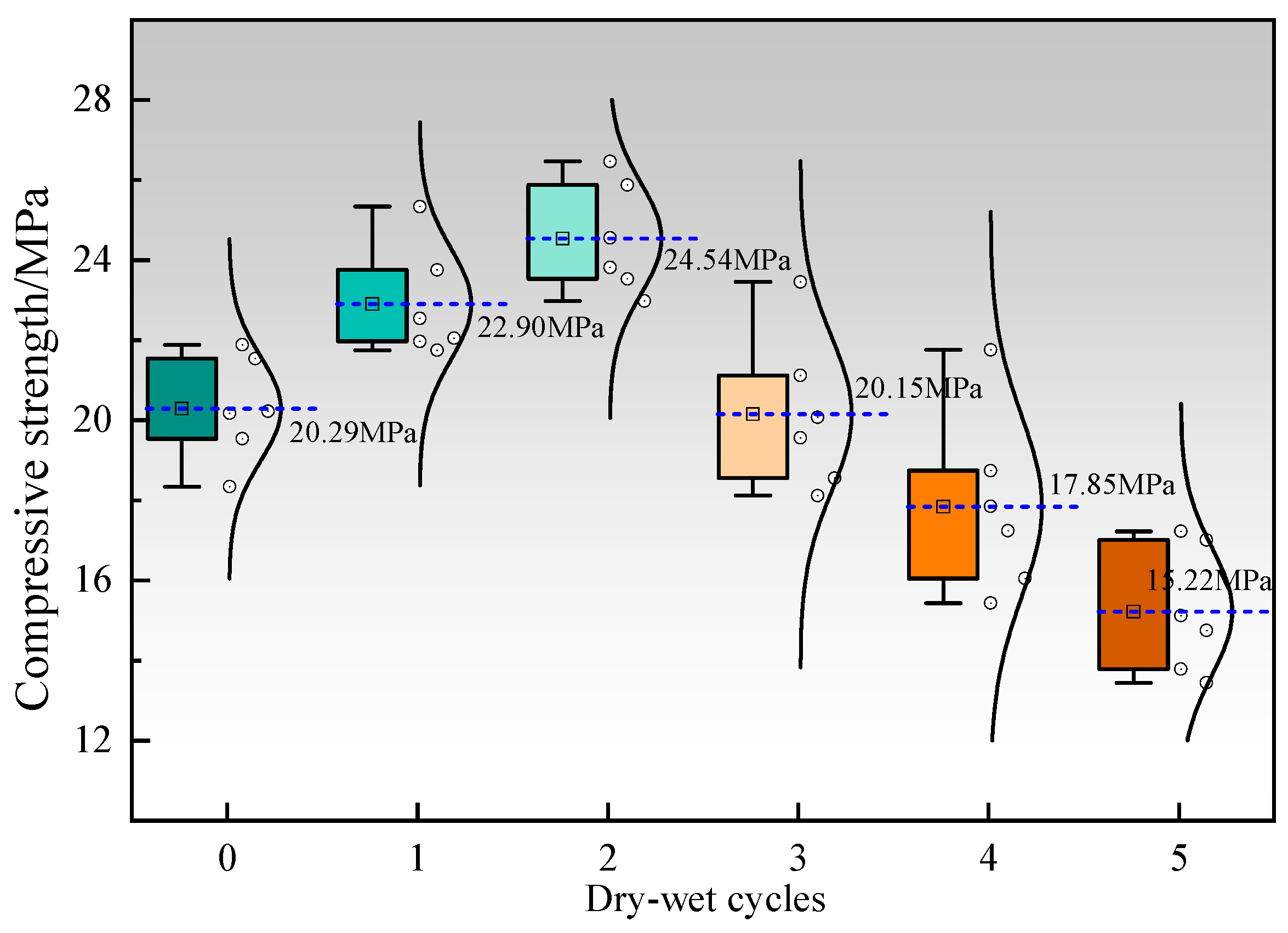
According to the test results, the variation trend of compressive properties of GRSM specimens under different dry–wet cycles is ascertained, as shown in Figure 5.
Figure 5 demonstrates a distinct two-stage evolution of the uniaxial compressive strength of GRSM specimens under dry–wet cycles: an “enhancement stage” (0–2 cycles) and a “deterioration stage” (2–5 cycles).
During the enhancement stage, the compressive strength of GRSM specimens increased from 25.8 MPa to 36.05 MPa, representing a 43.7% improvement. At this stage, the UCS data of GRSM show a low degree of dispersion and a concentrated distribution, indicating that the early stage of wet–dry cycles promotes densification of the internal structure of GRSM. From existing studies, it is known that this short-term strength gain is primarily associated with microstructural refinement induced by early wet–dry cycling. Moisture ingress during the initial cycles promotes continued hydration of previously un-hydrated cement particles and partially reactive gangue components. The formation of additional C–S–H gel contributes to partial pore filling and local densification of the matrix. Unlike later-stage expansive reactions, the early formation of hydration products mainly occurs in relatively open capillary pores, resulting in limited crystallization stress while contributing to microstructural refinement. In addition, water saturation within pores reduces internal stress concentrations by temporarily filling capillary voids and limiting the propagation of pre-existing microcracks. The repeated wetting phase may also induce partial crack closure due to moisture-induced swelling at the microscale. These combined effects improve stress transfer efficiency within the matrix and the interfacial transition zone (ITZ), leading to an apparent enhancement in load-bearing capacity during the initial cycles [46].
However, this strengthening effect is transitional and does not indicate long-term structural stability under continued dry–wet exposure.
During the deterioration stage (two to five cycles), the compressive strength decreased sharply to 18.32 MPa after five cycles, representing a 49.2% reduction from the peak value. The box height in the box plots increases gradually, accompanied by elevated data dispersion. The variability in degradation degree among different specimens subjected to the same number of wet–dry cycles is intensified. After more than two wet–dry cycles, the damage effect on the mechanical strength of GRSM becomes progressively significant, leading to increased inter-specimen variability in performance degradation. Strength degradation is primarily associated with expansive crystallization processes within the hardened matrix. Previous studies have demonstrated that under cyclic wetting–drying exposure, reintroduced water may reactivate residual aluminates and promote the secondary formation of ettringite (AFt) within the confined pore structure. Unlike early-age AFt generated during primary hydration, late-stage ettringite forms within a rigid and spatially restricted matrix [47]. The crystallization pressure generated during its growth induces localized tensile stresses that exceed the tensile strength of the surrounding cementitious matrix, resulting in interfacial debonding and microcrack propagation.
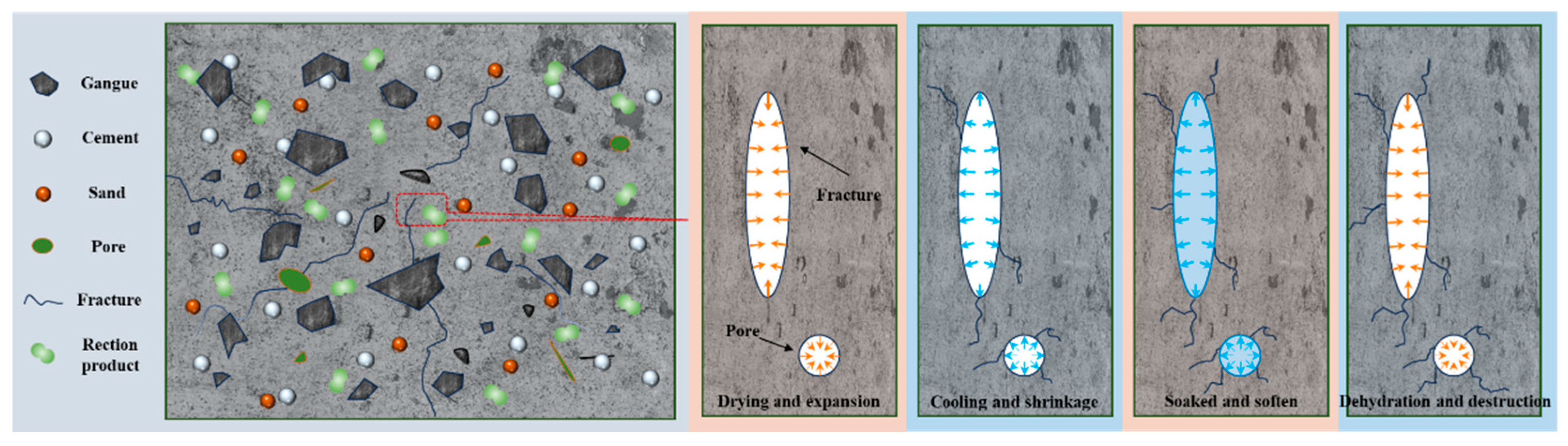
Figure 6 further illustrates the transition from relatively uniform strengthening during the early cycles to heterogeneous damage localization in later stages. As a porous cementitious material, GRSM exhibits progressive microstructural evolution under repeated wetting–drying exposure. During the initial cycles, moisture ingress may promote limited continued hydration of residual un-hydrated particles, contributing to minor pore refinement. However, this effect is generally modest and does not dominate the long-term mechanical behavior. The apparent early-stage strengthening is more plausibly associated with temporary pore saturation and partial microcrack closure under wet conditions. As the number of cycles increases, moisture gradients develop within the matrix during drying phases, inducing differential shrinkage stresses between the pore walls and the bulk matrix. Repeated swelling during wetting and shrinkage during drying generate cyclic tensile–compressive stresses at the microscale, leading to fatigue damage accumulation. These processes progressively enlarge pores and promote the coalescence of microcracks [48,49].
Although reversible dehydration of physically bound water occurs during drying, the primary hydration products remain largely intact under moderate drying temperatures. The long-term deterioration is therefore mainly governed by cyclic shrinkage stresses, microcrack propagation, and increased pore connectivity rather than by significant thermal decomposition of hydration products.

3.3. Effects of pH Values of Soaking Solution on Compressive Properties

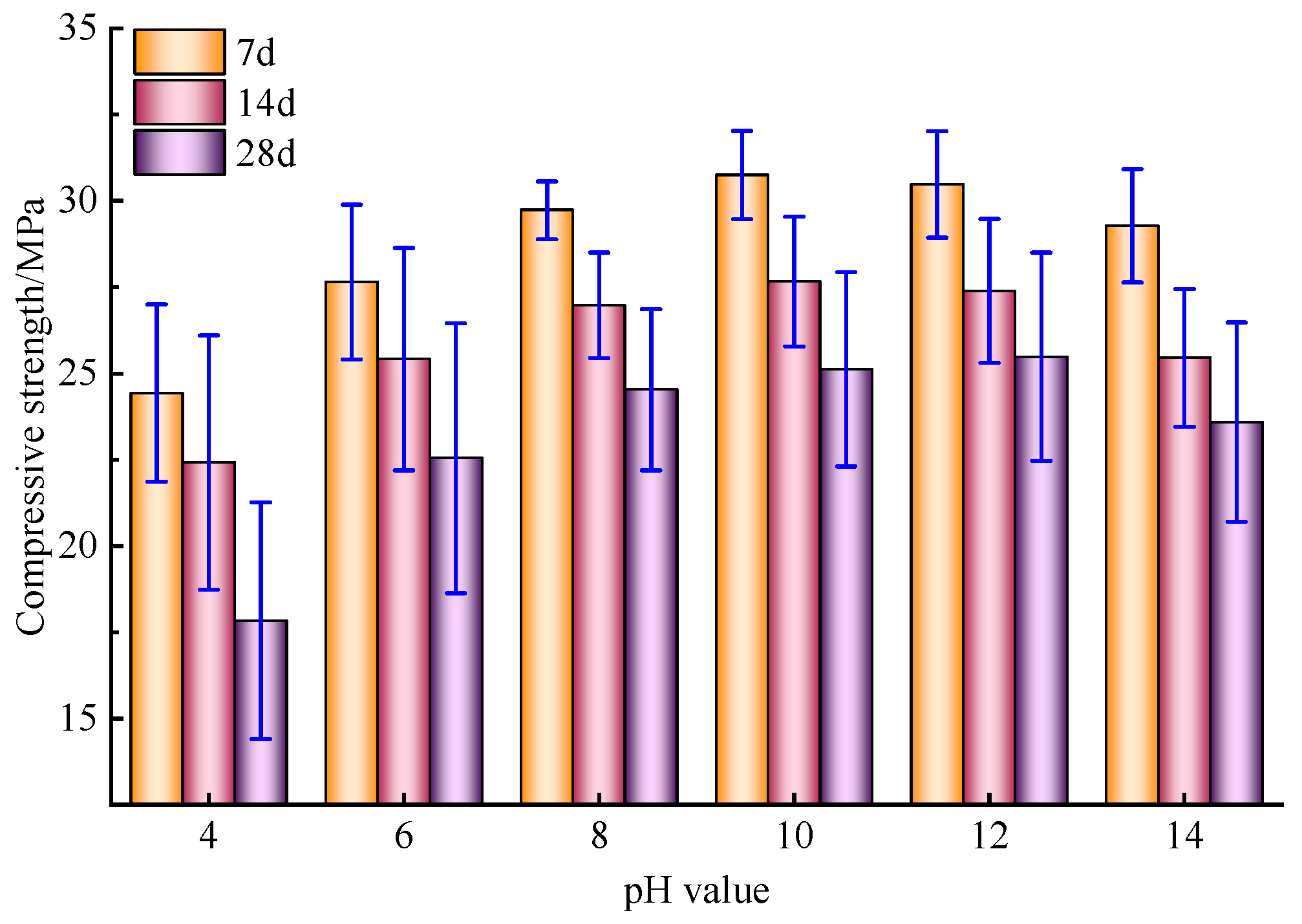
As illustrated in Figure 7, the uniaxial compressive strength (UCS) of GRSM exhibits clear pH dependence and time-dependent evolution. Under all immersion durations (7, 14, and 28 days), the UCS shows a non-monotonic variation with pH, characterized by higher strength values in neutral to weakly alkaline environments and lower strength values under strongly acidic conditions.
For the 7-day immersion, UCS values increase from 24.43 MPa at pH 4 to peak values of 29.73 MPa and 30.75 MPa at pH 8 and 10, respectively, followed by a slight reduction at higher alkalinity. A similar trend is observed at 14 and 28 days, although the absolute strength decreases with increasing immersion time across all pH levels. With prolonged immersion, strength degradation becomes more pronounced, particularly under acidic conditions. At pH 4, the UCS decreases from 24.43 MPa at 7 days to 17.83 MPa at 28 days, representing the most significant reduction among all environments. In contrast, specimens exposed to weakly alkaline solutions (pH 8–10) maintain relatively higher residual strength and exhibit lower data dispersion. Under highly alkaline conditions (pH ≥12), the UCS remains higher than that under acidic exposure but shows a moderate decline compared to the optimal pH range. This indicates that extremely high alkalinity does not further enhance mechanical performance and may introduce additional degradation effects over time.
The observed pH-dependent mechanical behavior can be attributed to the stability of hydration products and the balance between dissolution and microstructural preservation under different chemical environments.
Under acidic conditions (pH 4), the significant strength reduction may be primarily associated with proton-induced decalcification of calcium-bearing hydration products. Hydrogen ions react with calcium hydroxide and progressively destabilize C–S–H phases, leading to matrix softening and increased porosity [50]. The continuous leaching of calcium ions weakens the interfacial bonding within the matrix and promotes microcrack development, resulting in accelerated strength loss with prolonged immersion. In neutral to weakly alkaline environments (pH 8–10), the chemical stability of C–S–H and other hydration products is largely preserved. Under these conditions, aggressive dissolution reactions are limited, allowing the matrix to maintain structural integrity. Consequently, strength retention remains comparatively high and data variability remains low [50]. Under strongly alkaline conditions (pH ≥ 12), excessive hydroxide concentrations may disturb the ionic equilibrium within the pore solution. Long-term exposure may induce localized dissolution–reprecipitation processes or internal stress development associated with chemical imbalance [51,52]. As a result, mechanical performance does not continue to improve and may gradually decline over time.
Overall, the deterioration pattern reflects the sensitivity of cementitious matrices to acidic environments, while weakly alkaline exposure provides relatively stable chemical conditions for hydration products.

3.4. Pore Structure Analysis of GRSM

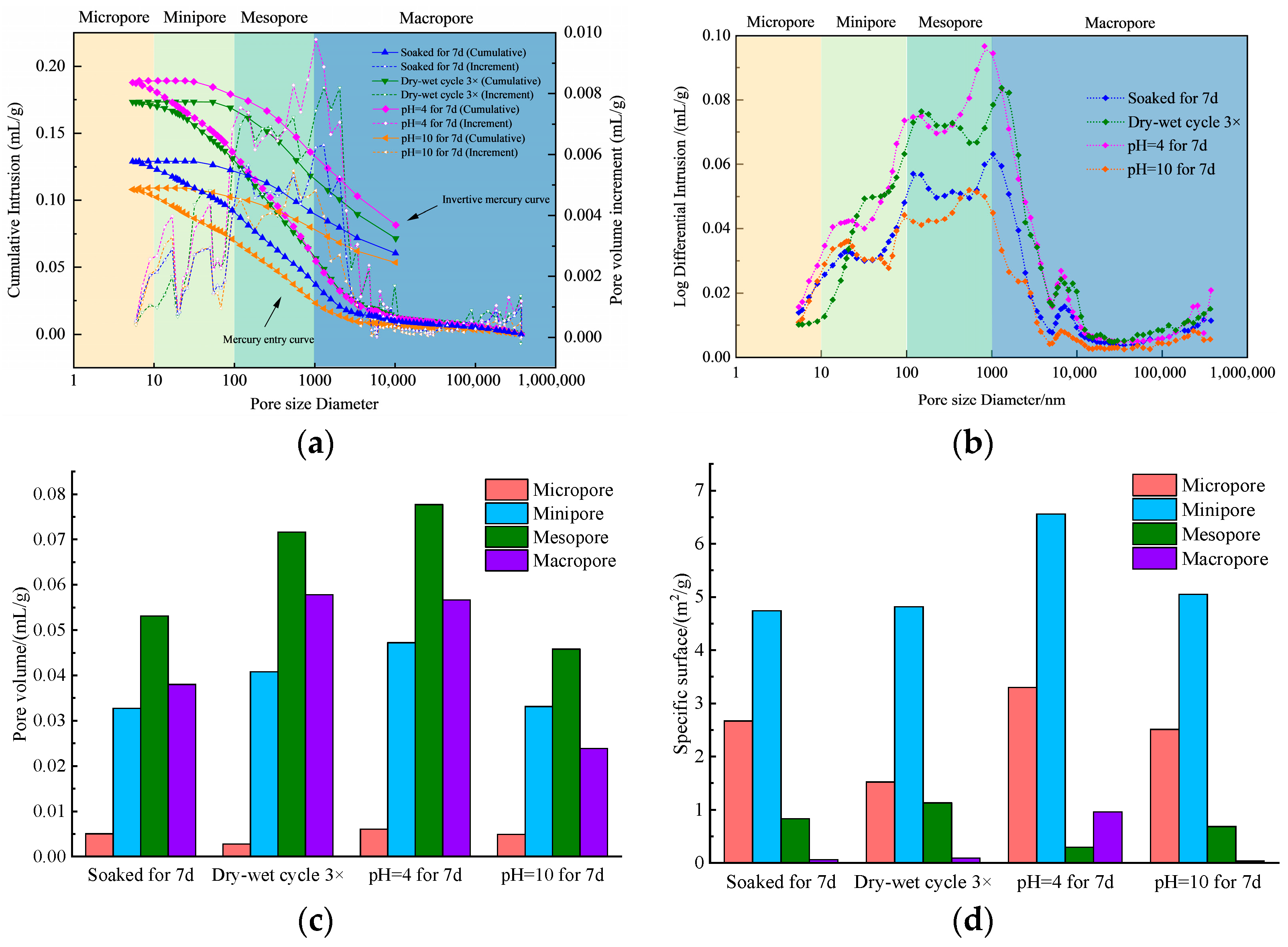
To further investigate the effects of water immersion and other factors on the stability and pore characteristics of GRSM, mercury intrusion porosimetry (MIP) tests were conducted on specimens subjected to four conditions: 7-day soaked, 3 dry–wet cycles, 7-day soaked in a pH = 4 environment, and 7-day soaked in a pH = 10 environment.
MIP tests were conducted in accordance with the Chinese National Standard GB/T 21650.1-2008 “Pore size distribution and porosity evaluation of materials by mercury porosimetry and gas adsorption—Part 1: Mercury porosimetry”. Pore sizes were categorized as follows: micropore (<10 nm), minipore (10–100 nm), mesopore (100–1000 nm), and macropore (>1000 nm). Figure 8a illustrates the relationship between pore volume and pore size distribution for GRSM under different treatment conditions. Combined with the statistical analysis of pore volume and specific surface area presented in Figure 8c,d, the experimental results demonstrate that the treated GRSM specimens exhibited the highest increase in pore volume within mesopore and macropore ranges, followed by micropores, while macropores showed relatively limited development across all four treatment conditions.
The cumulative mercury intrusion curves exhibit three distinct evolutionary stages: slow growth, rapid growth, and stable growth. Pores smaller than 1000 nm dominate the pore structure. Both acidic conditions and dry–wet cycles significantly increase the mercury intrusion rate of GRSM. Figure 8b reveals that the degree of influence on GRSM’s pore size distribution follows the order acidic conditions > dry-wet cycles > alkaline conditions, which is consistent with established understanding. The SEM results indicate that prolonged immersion leads to the development of macropores in GRSM. As demonstrated in Figure 8b, acidic conditions, wet–dry cycles, and alkaline conditions all increase the number of micropores, macropores, and super-macropores. These findings corroborate the SEM observations, confirming the progressive degradation of pore structure under aggressive environmental exposure.
Based on the aforementioned analysis, GRSM represents a typical porous medium comparable to coal and cemented backfill materials, characterized by complex and heterogeneous pore structures that significantly influence its mechanical properties and internal fluid transport. The fractal dimension serves as a quantitative parameter to characterize the irregularity and complexity of pore structures within GRSM. Generally, higher fractal dimensions indicate more intricate pore configurations with rougher surfaces, exhibiting greater microstructural details and broader spatial distributions. Conversely, lower fractal dimensions correspond to relatively simpler pore structures with smoother surfaces, fewer microstructural features, and more confined spatial distributions. Therefore, the fractal dimension provides a quantitative measure for evaluating the complexity and heterogeneity of pore structures. The Menger sponge model was employed to establish fractal characteristic equations for porous media. According to this model, the following relationship exists between the mercury volume variation rate during the intrusion process and the fractal dimension:
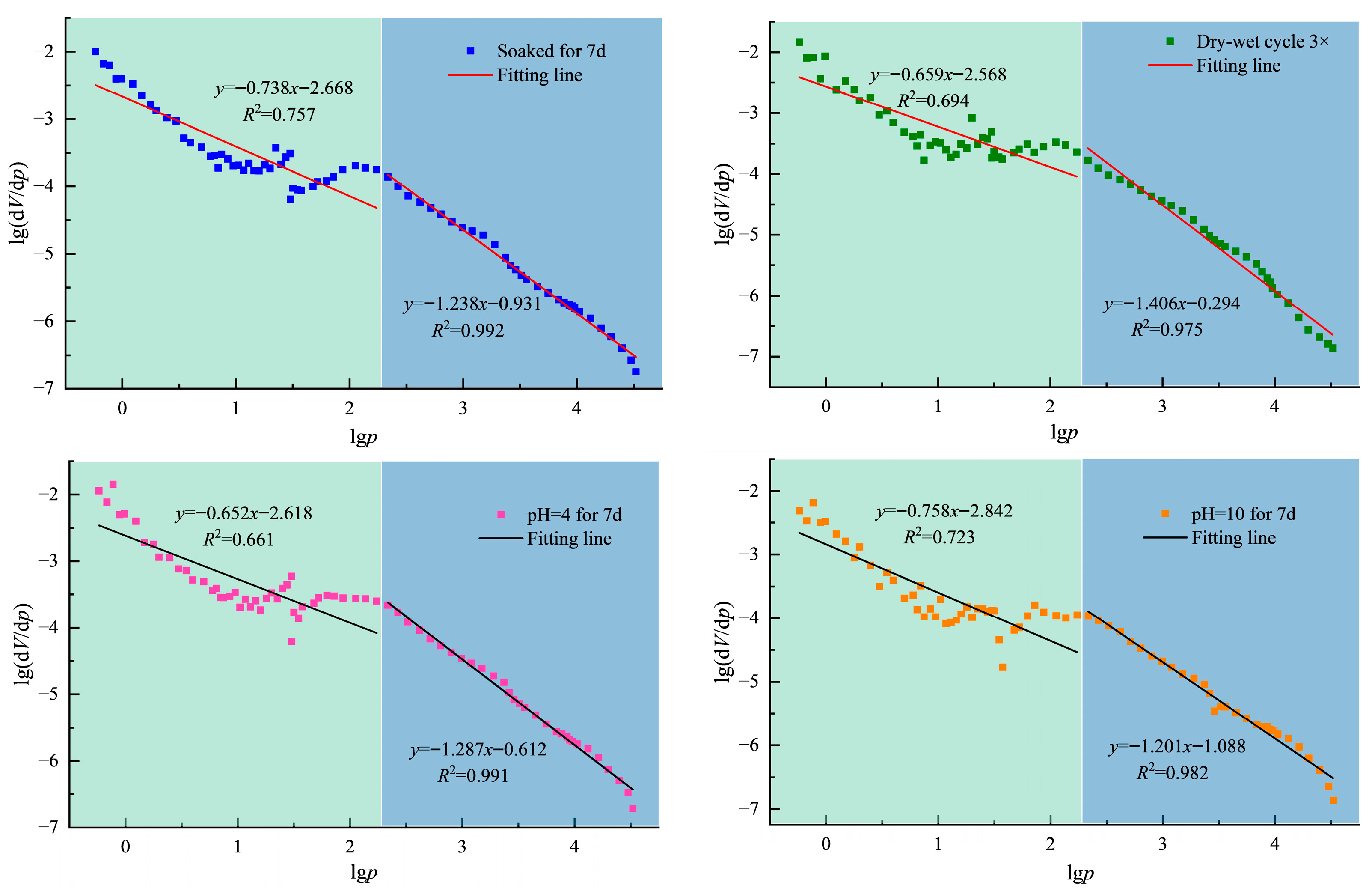
lg d V d p D 4 lg p
K = D 4
where p is pressure; V corresponds to the volume of pressed mercury; D is the fractal dimension of the pore structure, indicating the complexity and self-similarity of the pore structure. K is the fitting straight slope.
Based on Equation (1), scatter plots of lg(dV/dp) versus lgp were generated. The relationship between lg(dV/dp) and lgp was divided into two distinct phases with 1000 nm as the critical threshold, as evidenced by the distribution patterns in the scatter plots. Fractal dimensions of GRSM under four experimental conditions—7-day soaked, 3 dry–wet cycles, 7-day soaked in pH = 4 environment, and 7-day soaked in pH = 10 environment—were determined via the fitted linear slopes from Equation (2) and Figure 9, with detailed results presented in Table 2. The analysis reveals a poor fitting correlation (R2 < 0.80) for pores larger than 1000 nm (macropore), while exceptional linearity (R2 > 0.95) was observed in the sub-macropore range. This distinct contrast confirms superior fractal characteristics in pore structures below the macropore threshold.
Based on the Menger sponge fractal model, the fractal dimension (D) is theoretically constrained to be less than 3. The observed fractal dimensions exceeding 3 for pores larger than 1000 nm (macropore) are physically implausible. For the sub-macropore regime (<1000 nm), the descending order of fractal dimensions under the four experimental conditions is 7-day soaked in pH 10 environment > 7-day soaked > 7-day soaked in pH 4 environment > 3 dry–wet cycles. Although this hierarchy differs partially from the pore volume–pore size relationships, it reveals comparable patterns regarding environmental impacts. Specifically, both cyclic drying–wetting and acidic conditions significantly alter GRSM’s pore structure complexity. These treatments induce larger pore dimensions with sparser spatial distributions, accompanied by reduced specific surface areas and diminished surface effects.

4. Reusing of Gangue for Utilization and Re-Exploration of GRSM

4.1. Preparation of Gangue-Activated Modified and Mechanically Activated GRSM (MA-GRSM)

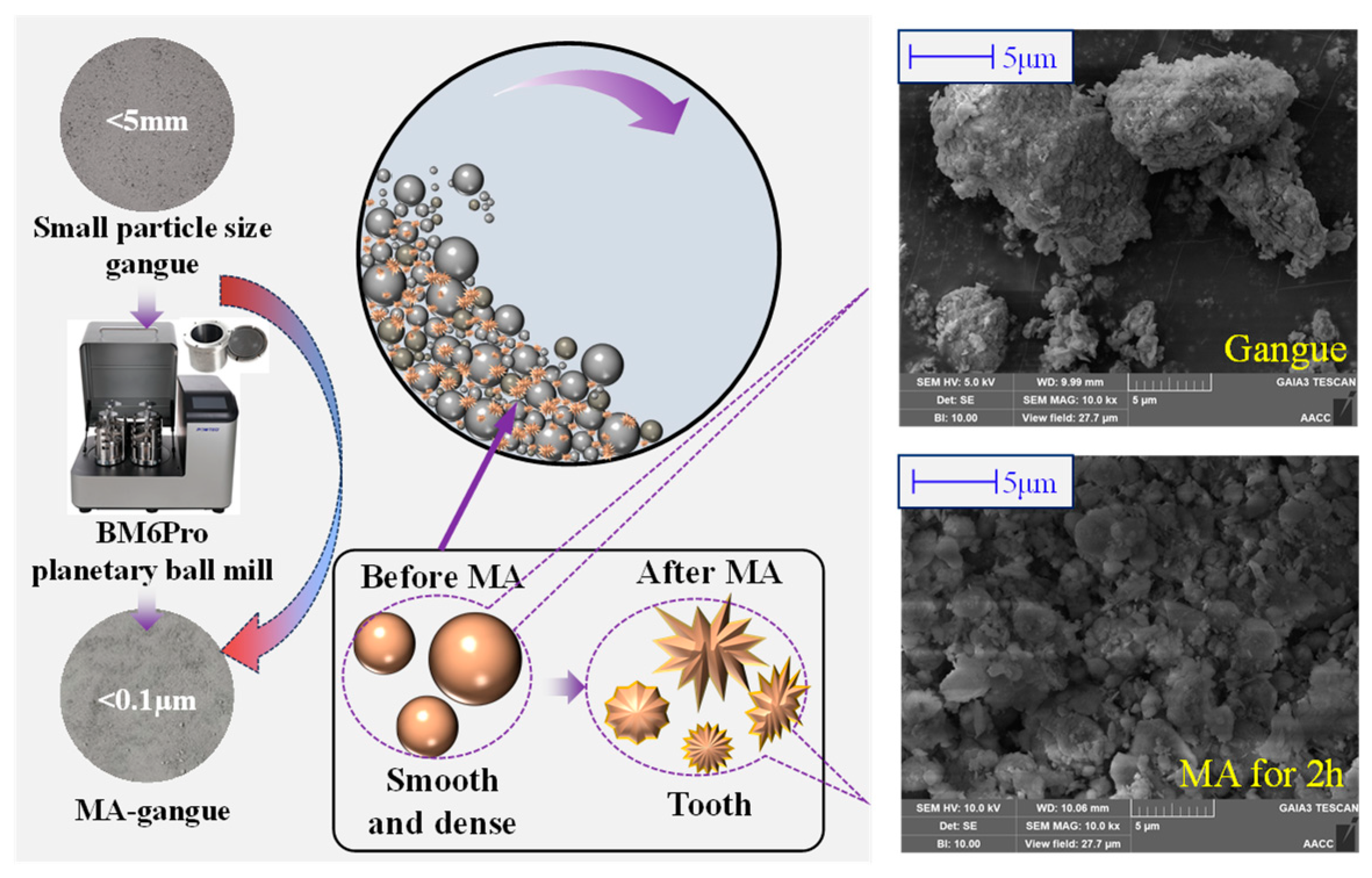
To enhance its utilization efficiency and cementitious activity, the raw gangue was mechanically activated using a BM6Pro planetary ball mill (POWTEQ, Beijing, China) under optimized parameters (ball-to-powder ratio 5:1, 400 rpm). The experimental procedure is shown in Figure 10. This activation process effectively fractured the inert Si-O-Al bonds. The resulting me-chanically activated gangue (MA-gangue) was subsequently incorporated to partially replace cement in formulating MA-GRSM composites. Subsequently, the obtained MA-gangue was used to replace 30% of the cement for the preparation of MA-GRSM. In addition, the mass ratios of coal gangue, sand, cement (cement and MA-gangue), fly ash, and water were kept identical to those of the original GRSM mixture, and the dosage of the liquid alkali-free flash setting admixture was also unchanged.
Figure 10 presents the micromorphological characteristics of unactivated gangue, as well as gangue subjected to mechanical activation (MA) for 2 h. The unactivated gangue particles display sharp edges and predominantly irregular polygonal shapes, with relatively dense and compact surfaces and no apparent pores or microcracks. After mechanical activation, the particle size is significantly reduced, and honeycomb-like porous structures develop on the particle surfaces. This mechanical treatment promotes the partial transformation of crystalline phases, such as quartz and kaolinite, into amorphous aluminosilicate phases, thereby increasing the availability of reactive SiO2 and Al2O3. These structural and compositional changes demonstrate that mechanical activation effectively enhances the reactivity of gangue. Such improvements provide a solid basis for its potential use as a supplementary cementitious material and partial cement replacement in both laboratory investigations and engineering applications.

4.2. Repeatability Experimental and Analysis of MA-GRSM

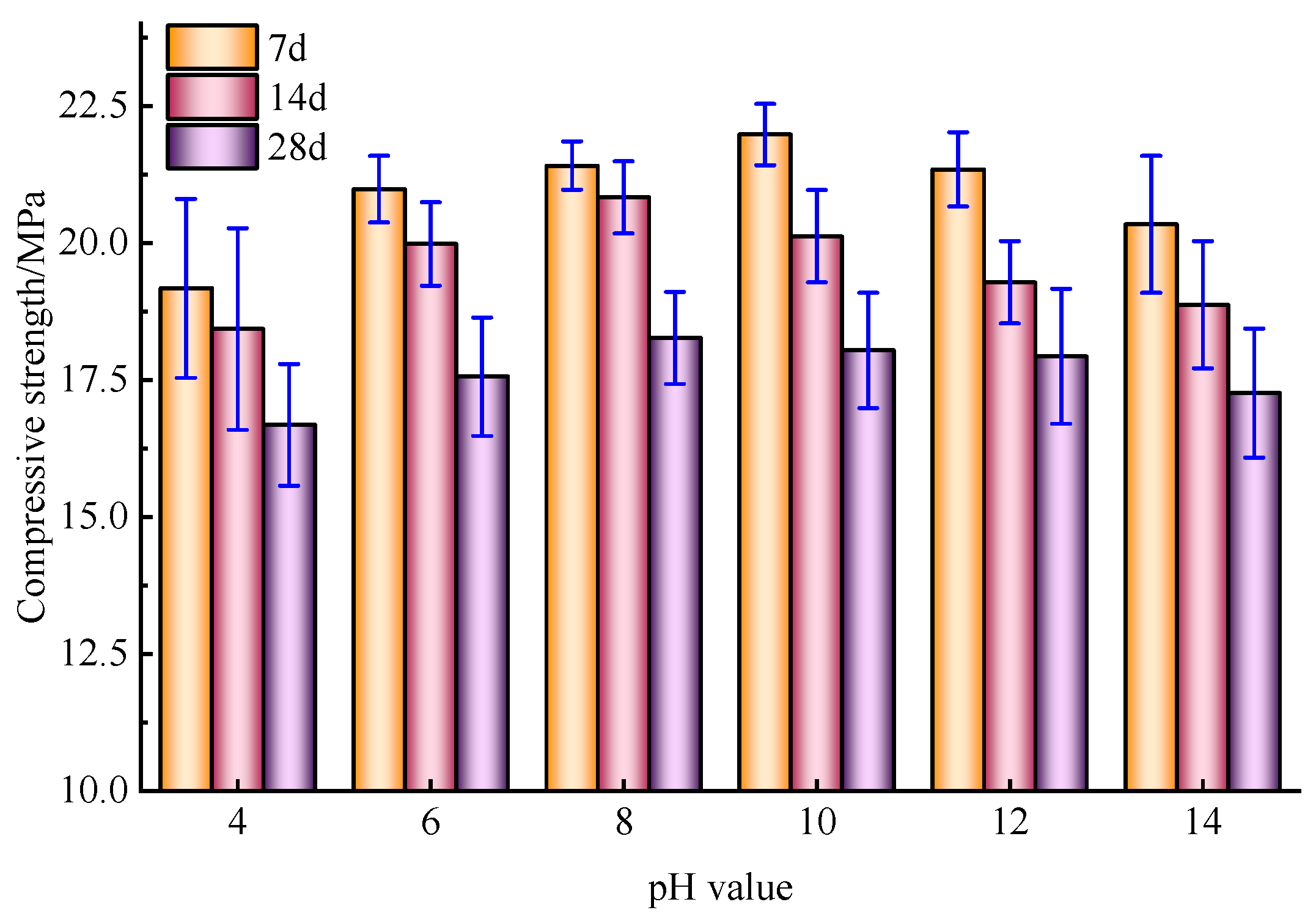
The results of the MA-GRSM experiment are plotted in Figure 11, Figure 12 and Figure 13. The mechanical performance of MA-GRSM was consistently lower than that of conventional GRSM under all tested environmental conditions. Although the partial replacement of cement with mechanically activated gangue inevitably reduced the absolute cement content, the strength reduction cannot be solely attributed to this compositional change.
First, the incorporation of MA-gangue alters the effective water-to-reactive material ratio within the system. Due to the increased specific surface area and higher water demand of mechanically activated particles, a portion of the mixing water is physically adsorbed rather than participating in hydration reactions. This reduces the availability of free water for cement hydration and may delay the formation of a dense C–S–H network during early curing. Second, although mechanical activation enhances the reactivity of amorphous SiO2 and Al2O3 phases, the pozzolanic reaction of activated gangue remains strongly dependent on the availability of Ca2+ and sufficiently alkaline conditions. In blended systems with reduced cement content, the supply of CH generated from cement hydration may be insufficient to fully activate the aluminosilicate phases. As a result, part of the activated gangue may remain partially reacted, contributing less effectively to strength development. This effect becomes more pronounced under aggressive environmental conditions, where dissolution and ionic transport further disturb phase equilibria.

5. Conclusions

This study evaluated the environmental durability of GRSM under immersion, cyclic wet–dry exposure, and variable pH conditions, with supplementary analysis of MA-GRSM systems. The principal conclusions are summarized as follows:
(1)
Water immersion induces time-dependent strength degradation. While short-term exposure may slightly enhance the UCS due to continued hydration and pore refinement, prolonged immersion significantly reduces strength. After 28 days of soaking, the UCS decreased by 22% relative to standard curing, primarily due to microstructural weakening and interfacial deterioration.
(2)
GRSM under repeated dry–wet cycling exposure exhibits two-stage mechanical performance evolution: early strength enhancement (peaking at two cycles) via hydration, pore filling and crack closure, followed by pronounced subsequent deterioration from expansive crystallization within the matrix, microcracking and matrix damage, with significantly increased inter-specimen variability.
(3)
GRSM shows strong pH-dependent durability behavior. Acidic environments produce the most severe strength loss and pore structure coarsening, followed by alkaline conditions. Neutral to weakly alkaline environments (pH 8–12) provide comparatively stable mechanical performance. Pore structure evolution governs the observed strength variation.
(4)
Mechanical activation modifies the strength level but not the degradation trend. MA-GRSM consistently exhibits lower UCS than conventional GRSM under all environmental conditions. However, the patterns of response to immersion time, wet–dry cycles, and pH variations remain similar, indicating that environmental degradation mechanisms are fundamentally consistent between the two systems.

Author Contributions

Y.Z. (Yang Zhao): investigation, writing—original draft, writing—review and editing. M.L.: conceptualization, formal analysis, funding acquisition, supervision. Z.C.: writing—original draft. Y.Z. (Yu Zhou): methodology. Z.L.: writing—review and editing. L.T.: software, data curation, writing—original draft. Z.Y.: investigation, resources, writing—review and editing. All authors have read and agreed to the published version of the manuscript.

Funding

This work was funded by the National Natural Science Foundation of China (52474112) and the 111 Project (B21016).

Institutional Review Board Statement

Not applicable.

Informed Consent Statement

Not applicable.

Data Availability Statement

The raw data supporting the conclusions of this article will be made available by the authors on request.

Acknowledgments

The authors thankfully acknowledge the support and facilities provided by China University of Mining and Technology.

Conflicts of Interest

The authors declare no conflicts of interest.

References

  1. Cui, X.R.; Huo, X.P.; Zhou, B.J.; Hu, Y.Y.; Yang, Y.Q.; Yang, F.L.; Di, Z.C. Spatial distribution characteristics and graded utilization path of coal gangue in China. Environ. Sci. 2025, 46, 2281–2291. [Google Scholar] [CrossRef]
  2. Wang, S.M.; Liu, L.; Zhu, M.B.; Shen, Y.J.; Shi, Q.M.; Sun, Q.; Fang, Z.Y.; Ruan, S.S.; He, W.; Yang, P.; et al. New way for green and low-carbon development of coal industry under the target of “daul-carbon”. J. China Coal Soc. 2024, 49, 152–171. [Google Scholar] [CrossRef]
  3. Liu, B.W.; Tang, Z.H.; Dong, S.G.; Wang, L.X.; Liu, D.W. Vegetation recovery and groundwater pollution control of coal gangue field in a semi-arid area for a field application. Int. Biodeter Biodegr. 2018, 128, 134–140. [Google Scholar] [CrossRef]
  4. Niedbalska, K. Parametric assessment of groundwater vulnerability to pollution within an open pit reclaimed by gangue. Appl. Water Sci. 2022, 12, 261. [Google Scholar] [CrossRef]
  5. Xie, H.P.; Zhang, J.X.; Gao, F.; Li, B.Y.; Li, C.B.; Xie, Y.C.; Zhou, N. Theory and technical conception of carbon negative and efficient backfill mining in coal mines. J. China Coal Soc. 2024, 49, 36–46. [Google Scholar] [CrossRef]
  6. Ziejewska, C.; Bąk, A.; Hodor, K.; Hebda, M. Eco-Friendly Coal Gangue and/or Metakaolin-Based Lightweight Geopolymer with the Addition of Waste Glass. Materials 2023, 16, 6054. [Google Scholar] [CrossRef]
  7. Alwaeli, M. The implementation of scale and steel chips waste as a replacement for raw sand in concrete manufacturing. J. Clean. Prod. 2016, 137, 1038–1044. [Google Scholar] [CrossRef]
  8. Huang, B.F.; Xiao, Y. Compressive impact tests of lightweight concrete with 155-mm-diameter spilt hopkinson pressure bar. Cem. Concr. Comp. 2020, 114, 103816. [Google Scholar] [CrossRef]
  9. Wu, Y.Z.; Guo, G.Y.; Wang, Z.L. The control principle and technology of “one obstruct and three strengthen” of soft rock roadways below weak aquifers. Coal Sci. Technol. 2023, 51, 72–82. [Google Scholar] [CrossRef]
  10. Zuo, J.P.; Liu, H.Y.; Wang, J.; Xu, C.Y.; Zhu, F. Active and passive full-space collaborative control technology and engineering application in deep roadways. Coal Sci. Technol. 2023, 51, 255–267. [Google Scholar] [CrossRef]
  11. Li, M.; Zhang, J.X.; Deng, X.J.; Zhou, N.; Zhang, Q. Method of water protection based on solid backfill mining under water bearing strata and its application. J. China Coal 2017, 42, 127–133. [Google Scholar] [CrossRef]
  12. Ghoreishi-Madiseh, S.A.; Hassani, F.; Mohammadian, A.; Abbasy, F. Numerical modeling of thawing in frozen rocks of underground mines caused by backfilling. Int. J. Rock. Mech. Min. 2011, 48, 1068–1076. [Google Scholar] [CrossRef]
  13. Qin, Z.G.; Wang, Y.; Song, Y.; Dong, Q. The Analysis on Seepage Field of Grouted and Shotcrete Lined Underwater Tunnel. Math. Probl. Eng. 2020, 2020, 7319054. [Google Scholar] [CrossRef]
  14. Skousen, J.G.; Ziemkiewicz, P.F.; McDonald, L.M. Acid mine drainage formation, control and treatment: Approaches and strategies. Extr. Ind. Soc. 2019, 6, 241–249. [Google Scholar] [CrossRef]
  15. Shahabpour, J.; Doorandish, M.; Abbasnejad, A. Mine-drainage water from coal mines of Kerman region, Iran. Environ. Geol. 2005, 47, 915–925. [Google Scholar] [CrossRef]
  16. Acordi, J.; Simão, L.; Faraco, M.N.S.; Borgert, C.H.; Olivo, E.; Montedo, O.R.K.; Raupp-Pereira, F. Waste valorization of coal mining waste from a circular economy perspective: A Brazilian case study based on environmental and physicochemical features. Resour. Policy 2023, 80, 103243. [Google Scholar] [CrossRef]
  17. Smaniotto, S.; Neuner, M.; Cordes, T.; Hofstetter, G. Experimental study of a wet mix shotcrete for primary tunnel linings-Part II: Shrinkage, creep, thermal and hygral behavior of shotcrete. Eng. Fract. Mech. 2022, 267, 108410. [Google Scholar] [CrossRef]
  18. Xiao, M.; Ju, F.; He, Z.Q. Research on shotcrete in mine using non-activated waste coal gangue aggregate. J. Clean. Prod. 2020, 259, 120810. [Google Scholar] [CrossRef]
  19. Chen, P.Y.; Zhang, L.H.; Wang, Y.H.; Fang, Y.; Zhang, F.; Xu, Y. Environmentally friendly utilization of coal gangue as aggregates for shotcrete used in the construction of coal mine tunnel. Case Stud. Constr. Mat. 2021, 15, e00751. [Google Scholar] [CrossRef]
  20. Benarchid, Y.; Taha, Y.; Argane, R.; Benzaazoua, M. Application of Quebec recycling guidelines to assess the use feasibility of waste rocks as construction aggregates. Resour. Policy 2018, 59, 68–76. [Google Scholar] [CrossRef]
  21. Gao, S.; Zhao, G.H.; Guo, L.H.; Zhou, L.Q.; Yuan, K.K. Utilization of coal gangue as coarse aggregates in structural concrete. Constr. Build. Mater. 2021, 268, 121212. [Google Scholar] [CrossRef]
  22. Zou, D.H.; Sahito, W. Suitability of mine tailings for shotcrete as a ground support. Can. J. Civ. Eng. 2004, 31, 632–636. [Google Scholar] [CrossRef]
  23. Hu, Y.F.; Yin, S.H.; Li, K.Q.; Zhang, B.; Han, B. Comprehensive utilization of solid waste resources: Development of wet shotcrete for mines. Int. J. Miner. Metall. Mater. 2023, 30, 1692–1704. [Google Scholar] [CrossRef]
  24. Yuan, Q.S.; Wang, L.L.; Kong, D.W.; Han, Y.R.; Ren, C.D.; Tian, Y.L.; Zhu, G.L. Synergistic action and effect mechanism of coal gangue powder and red mud on the properties of concretes. J. Build. Eng. 2024, 98, 110999. [Google Scholar] [CrossRef]
  25. Li, J.Y.; Chen, L.; Luo, J.W.; Zhu, Y.P.; Fan, X.M.; Hu, G. Study on mechanical properties and microstructure of steel-polypropylene fiber coal gangue concrete. Front. Mater. 2023, 10, 1281372. [Google Scholar] [CrossRef]
  26. Zhao, J.P.; Meng, X.R.; Chen, L.J.; Liu, G.M.; Zhang, Z.X.; Xu, Q.Q. Correlation between the mechanical properties and the fiber breaking morphology of fiber reinforced shotcrete (FRS). Compos. Struct. 2021, 277, 114641. [Google Scholar] [CrossRef]
  27. Guan, X.; Qiu, J.S.; Song, H.T.; Qin, Q.; Zhang, C.H. Stress-strain behaviour and acoustic emission characteristic of gangue concrete under axial compression in frost environment. Constr. Build. Mater. 2019, 220, 476–488. [Google Scholar] [CrossRef]
  28. Yu, L.L.; Xia, J.W.; Gu, J.X.; Zhang, S.; Zhou, Y. Degradation Mechanism of Coal Gangue Concrete Suffering from Sulfate Attack in the Mine Environment. Materials 2023, 16, 1234. [Google Scholar] [CrossRef]
  29. Yang, Y.G.; Zhang, Y.S.; Zhang, W.T.; She, W. Study on sulfate resistance of concrete with initial damage under drying-wetting cycles. J. Sustain. Cem.-Based 2018, 7, 311–322. [Google Scholar] [CrossRef]
  30. Zhang, J.; Gao, Y.; Han, Y.D. Interior Humidity of Concrete under Dry-Wet Cycles. J. Mater. Civ. Eng. 2012, 24, 289–298. [Google Scholar] [CrossRef]
  31. Li, K.F.; Li, C.Q.; Chen, Z.Y. Influential depth of moisture transport in concrete subject to drying-wetting cycles. Cem. Concr. Comp. 2009, 31, 693–698. [Google Scholar] [CrossRef]
  32. Cao, T.N.; Zhang, L.J.; Sun, G.W.; Wang, C.H.; Zhang, Y.; Yan, N.; Xu, A.X. Simulation of chloride ion transport in concrete under wetting-drying cycle. J. Sustain. Cem.-Based 2020, 9, 270–288. [Google Scholar] [CrossRef]
  33. Cagnon, H.; Vidal, T.; Sellier, A.; Bourbon, X.; Camps, G. Drying creep in cyclic humidity conditions. Cem. Concr. Res. 2015, 76, 91–97. [Google Scholar] [CrossRef]
  34. Lee, C.H.; Wang, T.T.; Chen, H.J. Experimental study of shotcrete and concrete strength development in a hot spring environment. Tunn. Undergr. Sp. Tech. 2013, 38, 390–397. [Google Scholar] [CrossRef]
  35. Chen, X.Q.; Zheng, D.J.; Zhao, H.; Wu, X.; Jiang, H.F.; Liu, X.Y. Microstructure and deterioration mechanism of hydraulic concrete under variable temperature dry-wet cycles. Constr. Build. Mater. 2024, 428, 136414. [Google Scholar] [CrossRef]
  36. GB/T 35159-2017; Flashing Setting Admixture for Shotcrete. Standards Press of China: Beijing, China, 2017.
  37. JGJ/T 372-2016; Technical Specification for Application of Sprayed Concrete. China Architecture & Building Press: Beijing, China, 2016.
  38. GB/T 21650.1-2008; Pore Size Distribution and Porosity of Solid Materials by Mercury Porosimetry and Gas Adsorption—Part 1: Mercury Porosimetry. Standards Press of China: Beijing, China, 2008.
  39. GB/T 50081-2019; Standard for Test Methods of Concrete Physical and Mechanical Properties. Standards Press of China: Beijing, China, 2019.
  40. An, M.Z.; Liu, Y.Z.; Zhang, G.; Wang, Y. Properties of Cement-Based Materials with Low Water–Binder Ratios and Evaluation Mechanism under Further Hydration Effect. Appl. Sci. 2023, 13, 9946. [Google Scholar] [CrossRef]
  41. Yangsukkasem, N.; Suebsuk, J.; Kampala, A.; Siriphan, A.; Somna, R.; Jiammeepreecha, W.; Chindaprasirt, P. Durability against cyclic wetting-drying of cement-stabilized loess subgrade for railway in tropical semi-arid regions. Constr. Build. Mater. 2024, 455, 139123. [Google Scholar] [CrossRef]
  42. Maltese, C.; Pistolesi, C.; Bravo, A.; Cella, F.; Cerulli, T.; Salvioni, D. Effects of setting regulators on the efficiency of an inorganic acid based alkali-free accelerator reacting with a Portland cement. Cem. Concr. Res. 2007, 37, 528–536. [Google Scholar] [CrossRef]
  43. Gao, M.; Chen, B.; Lang, L.; Muhammad, R.A. Influence of Silica Fume on Mechanical Properties and Water Resistance of Magnesium-Ammonium Phosphate Cement. J. Mater. Civ. Eng. 2020, 32, 04019368. [Google Scholar] [CrossRef]
  44. Wang, J.H.; Xie, Y.J.; Zhong, X.H.; Li, L.J. Test and simulation of cement hydration degree for shotcrete with alkaline and alkali-free accelerators. Cem. Concr. Comp. 2020, 112, 103684. [Google Scholar] [CrossRef]
  45. Ma, Y.F.; Li, W.W.; Jin, M.; Liu, J.P.; Zhang, J.; Huang, J.L.; Lu, C.; Zeng, H.Y.; Wang, J.W.; Zhao, H.X.; et al. Influences of leaching on the composition, structure and morphology of calcium silicate hydrate (C–S–H) with different Ca/Si ratios. J. Build. Eng. 2022, 58, 105017. [Google Scholar] [CrossRef]
  46. Diamond, S. Reply to the discussion by S. Chatterji of the paper “Mercury porosimetry—An inappropriate method for the measurement of pore size distributions in cement-based materials”. Cem. Concr. Res. 2001, 31, 1659. [Google Scholar] [CrossRef]
  47. Qin, L.; Yang, J.Y.; Ni, K.; Liu, J.; Bao, J.W.; Chen, T.F.; Zhang, G. Improvement effect of carbonation curing on the performance of lightweight calcium carbide slag cement-based materials under the coupled action of sulfate attack and dry-wet cycling. Case Stud. Constr. Mater. 2025, 23, e05423. [Google Scholar] [CrossRef]
  48. Zhou, H.W.; Cao, Y.P.; Xie, S.L.; Liu, Z.L.; Jia, W.H. Evolution of pore-fracture structure and mechanical properties of coal under dry-wet cycle. Int. J. Rock. Mech. Min. 2025, 192, 106146. [Google Scholar] [CrossRef]
  49. Jamshidi, A.; Sedaghatnia, M. The Slake Durability of Argillaceous and Non-argillaceous Rocks: Insights from Effects of the Wetting-Drying and Rock Lumps Abrasion. Rock. Mech. Rock. Eng. 2023, 56, 5115–5131. [Google Scholar] [CrossRef]
  50. Chen, K.Y.; Wu, D.Z.; Xia, L.L.; Cai, Q.M.; Zhang, Z.Y. Geopolymer concrete durability subjected to aggressive environments—A review of influence factors and comparison with ordinary Portland cement. Constr. Build. Mater. 2021, 279, 122496. [Google Scholar] [CrossRef]
  51. Xiao, R.; Leao, A.S.; Torabzadegan, M.; La Plante, E.; Sant, G.N. Using boron as a tracer reveals how surface precipitates inhibit silicate dissolution in hyperalkaline solutions during alkali-silica reaction. J. Am. Ceram. Soc. 2025, 109, e70340. [Google Scholar] [CrossRef]
  52. Yang, M.; Zheng, Y.J.; Li, X.; Yang, X.J.; Rao, F.; Zhong, L.L. Durability of alkali-activated materials with different C-S-H and N-A-S-H gels in acid and alkaline environment. J. Mater. Res. Technol. 2021, 16, 619–630. [Google Scholar] [CrossRef]
Figure 1. XRD pattern of gangue.
Applsci 16 02508 g001
Figure 2. Test materials.
Applsci 16 02508 g002
Figure 3. The effect of soaking time on the compressive properties of GRSM specimens.
Applsci 16 02508 g003
Figure 4. SEM micrographs of GRSM under different soaking time.
Applsci 16 02508 g004
Figure 5. The influence of dry–wet cycles on the mechanical strength of GRSM specimens.
Applsci 16 02508 g005
Figure 6. The effect of dry–wet cycles on the evolution of pore fracture structure in GRSM.
Applsci 16 02508 g006
Figure 7. The influence of the pH value of the solution on the mechanical strength of GRSM specimens.
Applsci 16 02508 g007
Figure 8. MIP results of GRSM. (a) Mercury withdrawal curve shape of GRSM; (b) pore size distribution of GRSM; (c) relationship between pore volume and pore size; (d) relationship between specific surface area and pore size.
Applsci 16 02508 g008
Figure 9. Fitting results of mercury intrusion experimental data for GRSM.
Applsci 16 02508 g009
Figure 10. MA-gangue preparation process.
Applsci 16 02508 g010
Figure 11. Effect of soaking time on compressive properties of MA-GRSM.
Applsci 16 02508 g011
Figure 12. The effect of dry–wet cycles on the compressive properties of the MA-GRSM.
Applsci 16 02508 g012
Figure 13. Effect of pH on compressive properties of MA-GRSM.
Applsci 16 02508 g013
Table 1. Test schemes.
SchemeSpecimen StatusNumber of Dry–Wet CyclespH Value of SolutionTime/d
S1–S5Soaked----1
3
7
14
28
S6–S10Non-soaked----1
3
7
14
28
S11–S16Dry–wet cycle count0
1
2
3
4
5
--Soak for 2 days, dry for 12 h
S17–S35Different pH soaking environments--4
6
8
10
12
14
7
14
28
Table 2. Fractal dimension of pores in mercury injection experiments.
IndexY2D2R22
Soaked for 7 dy = −1.238x − 0.9312.7620.992
Dry–wet cycle 3×y = −1.406x − 0.2942.5940.975
pH = 4 for 7 dy = −1.287x − 0.6122.7130.991
pH = 10 for 7 dy = −1.201x − 1.0882.7990.982
Disclaimer/Publisher’s Note: The statements, opinions and data contained in all publications are solely those of the individual author(s) and contributor(s) and not of MDPI and/or the editor(s). MDPI and/or the editor(s) disclaim responsibility for any injury to people or property resulting from any ideas, methods, instructions or products referred to in the content.