Review

Natural Bioactive Compounds as Feed Additives: Strategies for Sustainable and Functional Livestock Production

1
Consiglio per la Ricerca in Agricoltura e l’Analisi dell’Economia Agraria (CREA), Centro di Ricerca Zootecnia e Acquacoltura, Via Salaria, 31, Monterotondo, 00016 Rome, Italy
2
Department of Comparative Biomedicine and Food Science, University of Padova, Agripolis, Viale dell’ Univesità 16, 35020 Legnaro, Italy
*
Author to whom correspondence should be addressed.
Appl. Sci. 2026, 16(5), 2344; https://doi.org/10.3390/app16052344
Submission received: 28 January 2026 / Revised: 13 February 2026 / Accepted: 26 February 2026 / Published: 28 February 2026

Featured Application

A critical synthesis of recent evidence underscores the need to rationalize the rapidly expanding literature on plant-derived bioactive compounds in livestock production, clarifying their functional scope and the sources of biological variability affecting productivity, health, and sustainability. Despite considerable progress, key uncertainties persist regarding dose–response relationships, bioavailability, metabolic transformation, and tissue distribution under different production conditions. In this context, omics approaches may provide deeper insight into these interactions. Future research should therefore prioritize a more detailed characterization of metabolic pathways and systemic physiological responses to define more precisely the conditions under which these compounds exert consistent and biologically meaningful effects.

Abstract

In recent years, natural bioactive compounds have been increasingly investigated as functional feed additives to enhance livestock production. The present study aims to provide an update on the potential use of these compounds to enhance animal health and the quality of animal products, while critically assessing their principal limitations and future practical applicability. The review is based on peer-reviewed articles published between 2020 and 2025 and retrieved from the Scopus database, ensuring the inclusion of recent and high-impact scientific contributions. Phytogenic feed additives, including polyphenols, terpenoids, and alkaloids, exert beneficial effects on animal health by modulating oxidative stress and inflammatory pathways. Improvements in milk and meat quality are mainly associated with enhanced antioxidant capacity and lipid stability, rather than with the direct transfer of phytochemicals into animal-derived products. In ruminants, selected bioactive compounds may also contribute to methane mitigation through modulation of rumen fermentation and microbial ecology. However, their efficacy remains highly context-dependent and requires precise characterization of composition, dosage, and species-specific application. Future research should therefore prioritize deeper elucidation of metabolic mechanisms, systemic physiological responses, and productive outcomes to better define the conditions under which these compounds exert consistent and biologically meaningful effects.

1. Introduction

Natural bioactive compounds of plant origin have attracted increasing interest as functional feed additives in livestock production. Commonly referred to as phytogenic feed additives (PFAs), these compounds are incorporated into animal diets to modulate physiological functions and metabolic processes. Over the past decade, research in this area has expanded considerably, generating a substantial body of literature spanning animal nutrition, physiology, microbiology, and sustainability research [1,2,3]. This growth has resulted in a highly heterogeneous research landscape, making it increasingly challenging to derive coherent and transferable conclusions across species and production systems.
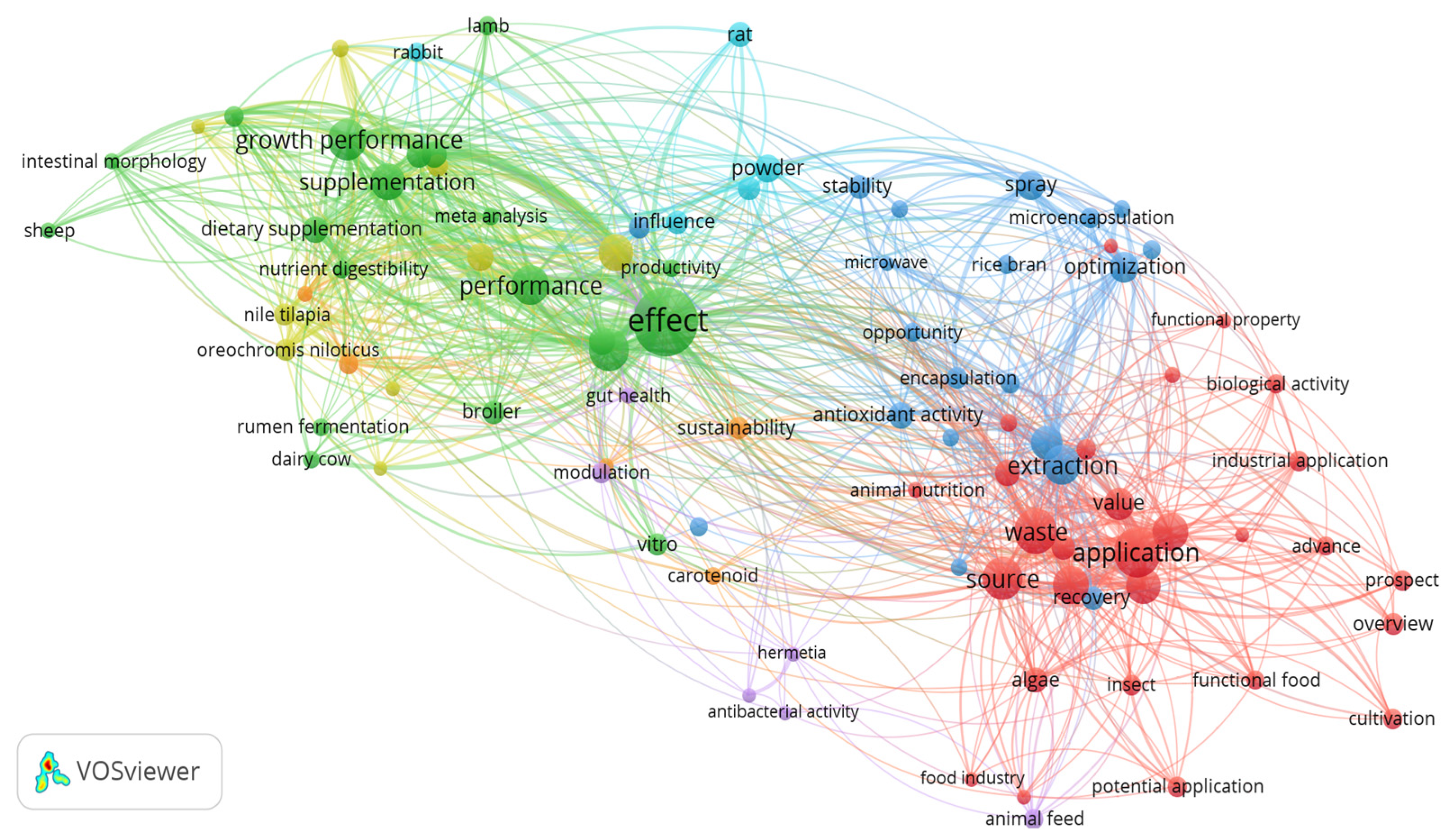
The bibliometric keyword co-occurrence network, generated using bibliometric software VOSviewer, version 1.6.20, supported by the Centre for Science and Technology Studies of Leiden University (The Netherlands) and based on Scopus-indexed publications retrieved using the keyword combination “bioactive compound feed” over the last ten years (Figure 1), highlights three major and interrelated research domains. Productive performance and physiological responses emerge as the most extensive thematic area, corresponding to the green cluster, closely followed by sustainability and resource valorization, represented in red. Finally, the blue cluster encompasses technological and formulation strategies aimed at improving the applicability and consistency of these compounds. The breadth of themes identified reflects the expanding scientific attention to plant-derived bioactive compounds, supported by growing evidence of their antimicrobial, antioxidant, and physiological modulatory effects in livestock systems [4,5,6,7].
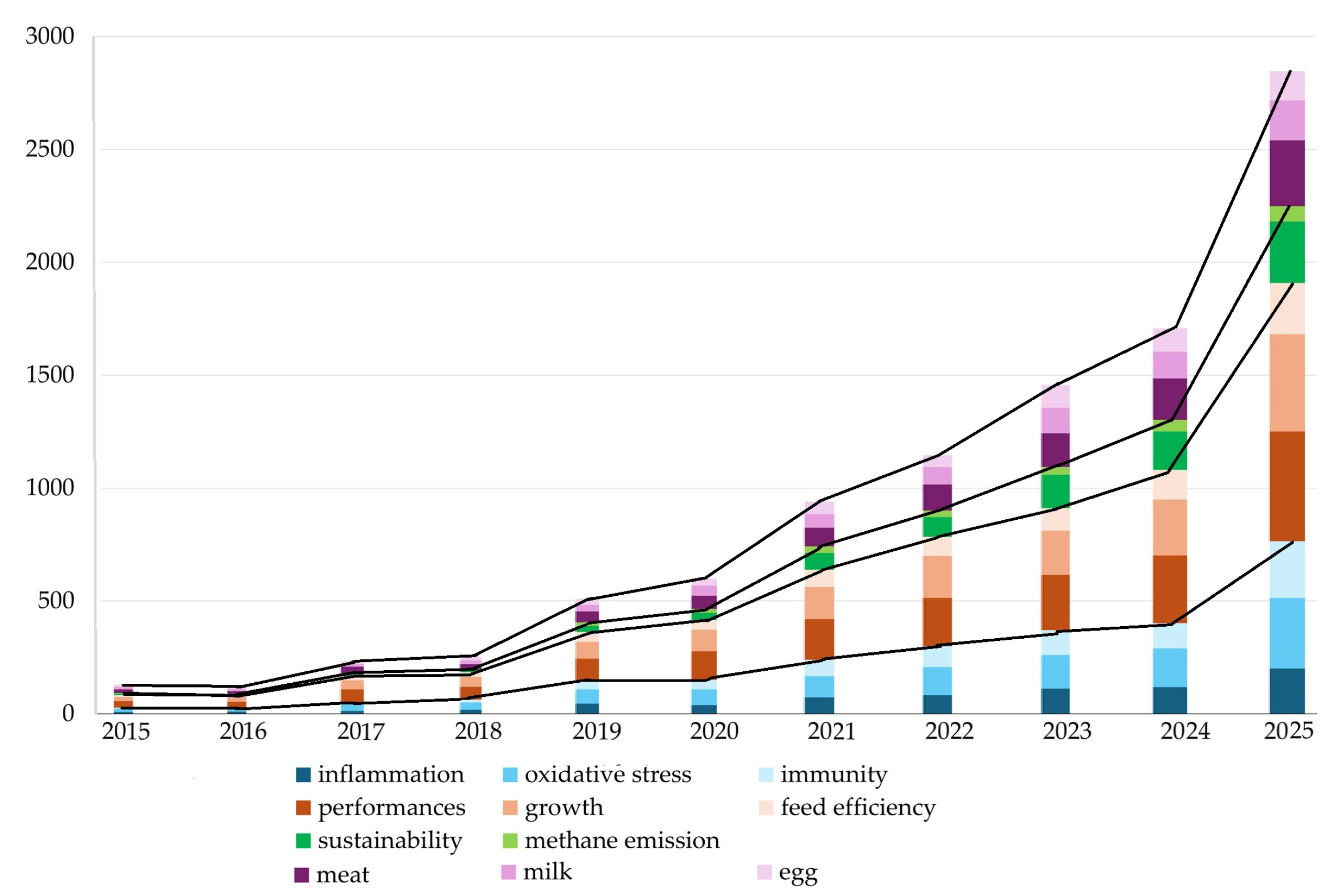
The dataset obtained from the Scopus search was subsequently categorized into major thematic areas (Figure 2). Studies classified under animal health and oxidative stress accounted for 1926 publications, while research focused on productive performance reached 1498 publications. Sustainability-related topics, including methane mitigation, comprised 842 publications. Investigations aimed at improving the nutritional quality of animal-derived foods represented the largest body of literature, with 2270 publications, underscoring the close interconnection between feeding strategies, animal health, and food quality. Numerous studies have reported that selected molecules can be absorbed, metabolically transformed, and, under specific dietary and physiological conditions, subsequently partially transferred into milk and meat [8,9,10,11]. However, the effects and efficacy of these phytogenic compounds remain highly variable and are influenced by multiple factors, including bioactive source, dosage, animal species, production system, and processing strategies such as extraction and preservation [5,12,13].
Accordingly, the evaluation of these compounds must account for the substantial variability of reported outcomes, which depends on both bioactive characteristics and the specific application domain within livestock production systems. The main functional categories and applications of natural bioactive feed additives are summarized in Table 1.
Given the breadth, complexity, and rapid evolution of this field, it is not feasible within a single review to comprehensively address all classes of natural bioactive compounds, their mechanisms of action, or the full range of species-specific responses reported in the literature. The objective of this review is therefore to provide a structured and updated overview of plant-derived bioactive compounds administered through animal diets, focusing on their occurrence in plant materials and by-products and on their reported effects in livestock systems. Attention is given to their influence on animal health and oxidative stress, productive performance, rumen modulation and methane mitigation, as well as their potential transfer and impact on the quality of animal-derived products. The review further offers a critical appraisal of the variability of responses described in the literature and the factors that may affect their practical application.

2. Materials and Methods

The literature search, as outlined in the introduction, was conducted using the Scopus database, selected for its broad coverage of international scientific publications in the field. The initial dataset (from 2015 onward), generated using the keyword combination “bioactive compound feed” and used for the bibliometric illustrations (Figure 1 and Figure 2), was subsequently restricted for the purposes of the present review. The time frame was limited to publications from 2020 onward, and conference papers, non-English publications, and studies focused exclusively on aquaculture species were excluded, resulting in approximately 620 peer-reviewed articles relevant to terrestrial livestock systems. A qualitative screening was then carried out. Articles published up to the first half of 2025 with fewer than three citations were excluded to ensure a minimum level of scientific impact. Titles and abstracts of approximately 320 publications were subsequently examined in detail. Studies addressing marginal or poorly transferable plant sources were excluded, as were non-representative reviews partially overlapping with more comprehensive analyses.
The resulting corpus constitutes the core body of literature critically analyzed in this review, while additional references were included where necessary to provide contextual and background information. The workflow describing the selection process that led to the final corpus of publications is presented graphically in Supplementary Figure S1.

3. Overview of Bioactive Compounds for Livestock Nutrition

Natural plant-derived bioactive compounds discussed in these studies are commonly classified according to their chemical structure and biological source (e.g., plants, fruits, algae). The biological efficacy of PFAs is largely attributed to the presence of plant secondary metabolites (phytochemicals). These compounds are characterized by diverse biosynthetic origins and structural features that influence their biological activity, bioavailability, and stability within feed matrices. From a chemical standpoint, PFAs are generally grouped into three major classes: phenolic compounds, terpenes and terpenoids (including carotenoids), and nitrogen- and sulfur-containing compounds such as alkaloids [5,16,51].

3.1. Chemical Characterization

3.1.1. Phenolic Compounds

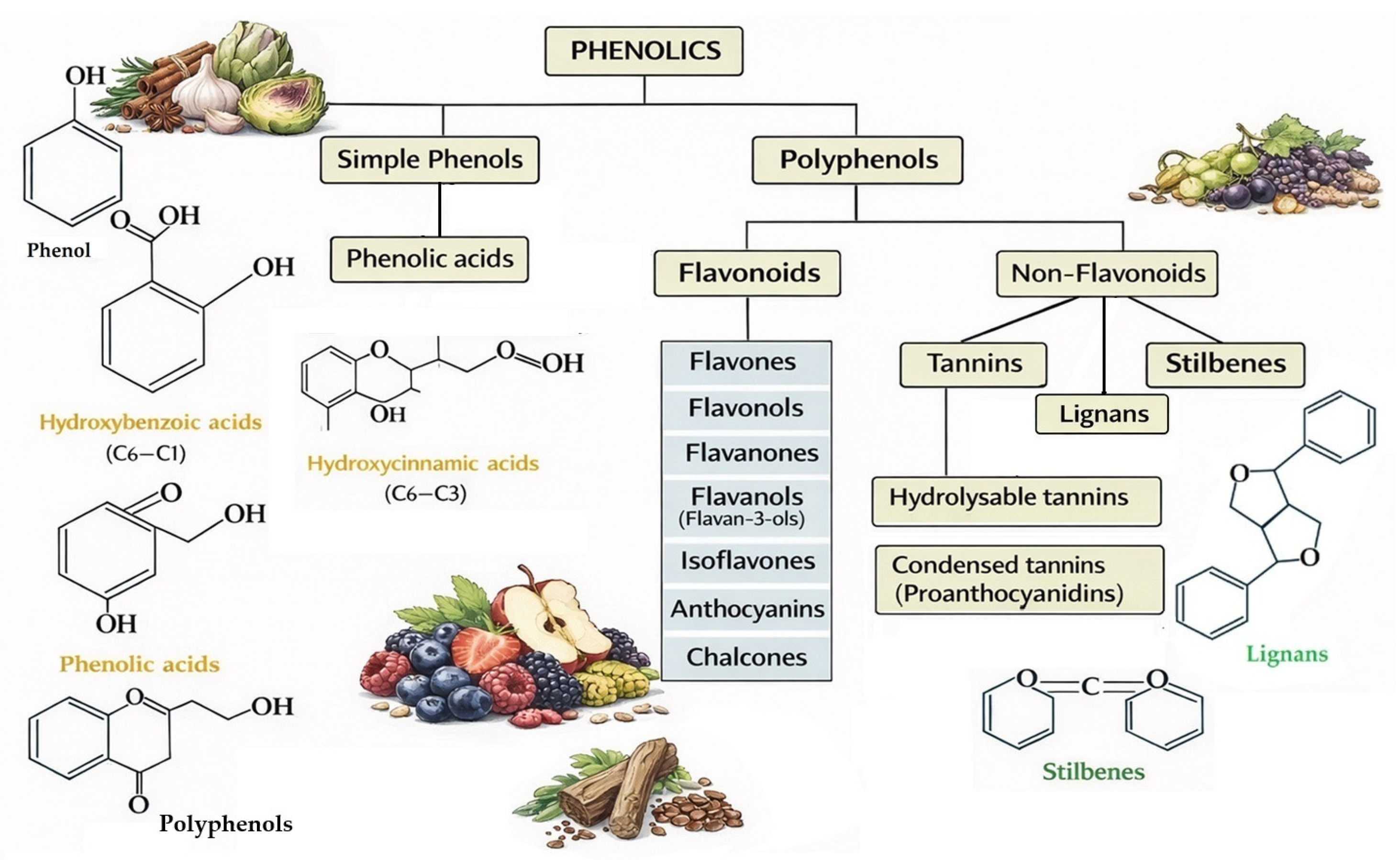
Phenolic compounds are characterized by the presence of one or more hydroxyl groups attached to aromatic rings (Figure 3) and are commonly found in plant tissues such as leaves, seeds, husks, and peels. Structurally, simple phenols contain a single aromatic ring, whereas polyphenols consist of multiple phenolic units and are conventionally classified into flavonoids (e.g., flavonols, flavones, anthocyanidins) and non-flavonoids, including phenolic acids, lignans, stilbenes, and tannins. Flavonoids share a common structural backbone consisting of two aromatic rings linked by a heterocyclic ring, whereas non-flavonoid phenolics display more heterogeneous structures with varying degrees of hydroxylation, methoxylation, glycosylation, and polymerization, which define the chemical identity of each phenolic subclass [26,52].
In plants, phenolic compounds originate predominantly from the shikimate pathway, which links primary carbon metabolism to the biosynthesis of aromatic amino acids [53]. L-phenylalanine serves as the main precursor of the phenylpropanoid pathway, leading to the formation of a wide range of phenolic compounds. The biosynthesis of structurally complex polyphenols, such as flavonoids and stilbenes, often involves integration of phenylpropanoid-derived intermediates with the acetate–malonate (polyketide) pathway [54]. Phenolics may occur in free form or conjugated with low-molecular-weight compounds (e.g., sugars) or bound to macromolecules, which strongly influence their stability, bioaccessibility, and biological activity [55].

3.1.2. Terpenoid Compounds

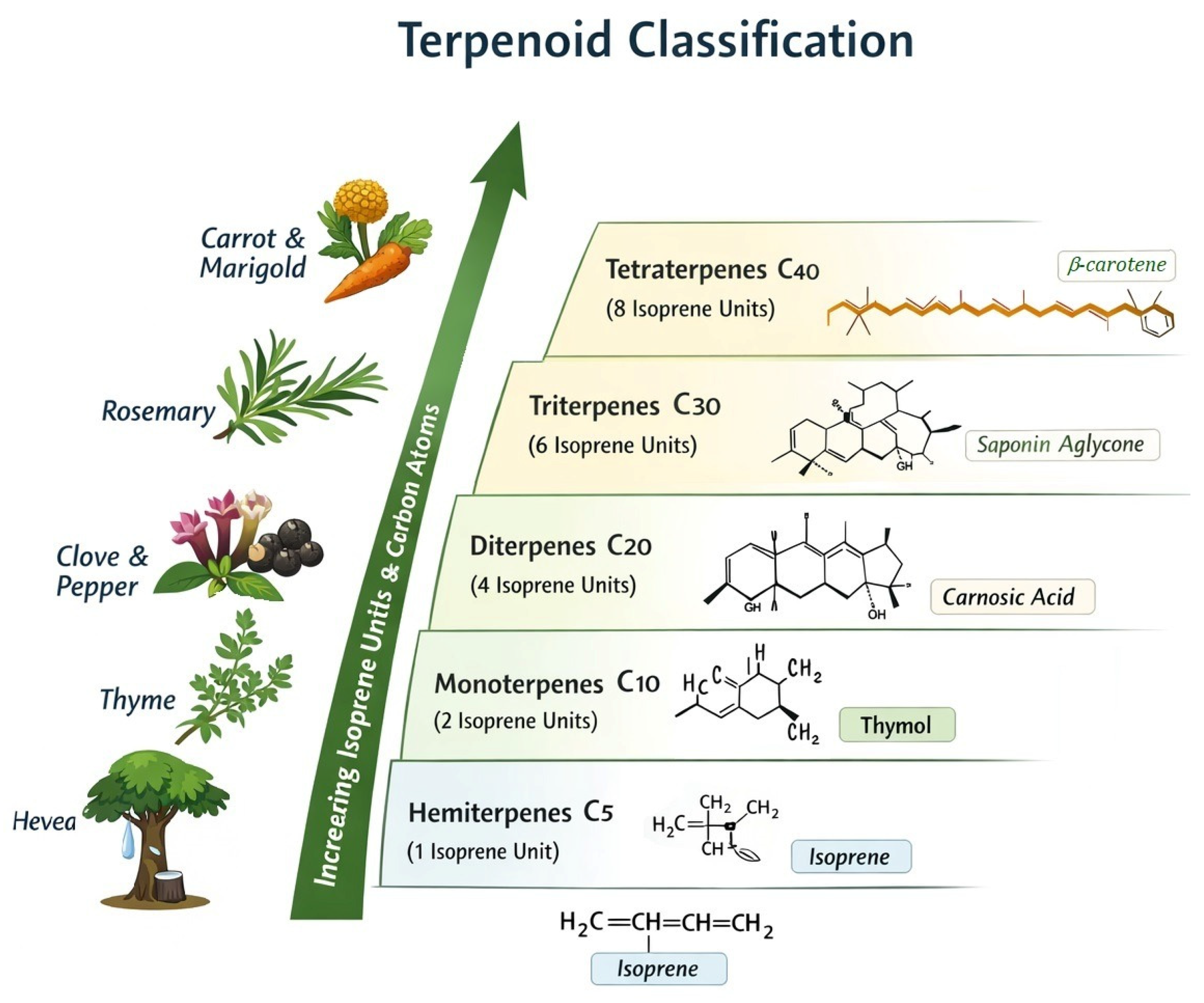
Terpenoids are a large and structurally diverse class of plant secondary metabolites derived from the assembly of isoprene units (C5H8), which constitute the fundamental biosynthetic building blocks of this family (Figure 4). According to the isoprene rule, terpenoids are formed by the head-to-tail or, less frequently, head-to-head condensation of isoprene units [56]. Within this broad family, carotenoids represent a specialized subgroup of terpenoids (tetraterpenes), sharing a common biosynthetic origin but displaying distinct structural and functional features. Their higher molecular weight and extended conjugated double-bond system confer distinct biological properties compared with lower-molecular-weight terpenes.
Carotenoids are lipophilic pigments responsible for red, yellow, and orange coloration and are widely distributed in plants and other photosynthetic organisms. Chemically, carotenoids consist of eight isoprene units forming a C40 carbon skeleton and are classified into carotenes (hydrocarbon carotenoids) and xanthophylls (oxygenated derivatives). α- and β-carotene are important provitamin A compounds, whereas lutein, β-cryptoxanthin, zeaxanthin, violaxanthin, astaxanthin, and canthaxanthin are among the most biologically relevant xanthophylls [57]. In plants, carotenoids are mainly localized in chloroplast membranes and plastoglobuli. In animals, they are transported in association with lipoproteins, reflecting their strong lipophilicity and facilitating distribution to target tissues [57,58].

3.1.3. Nitrogen- and Sulphur-Containing Bioactive Compounds

In plants, nitrogen-containing bioactive compounds, such as alkaloids, and sulfur-containing compounds, including organosulfur compounds, primarily function as chemical defence molecules, contributing to the protection of plant tissues against herbivores, insects, and microbial pathogens. Their characteristic bitter or pungent taste, chemical reactivity, and potential toxicity act as effective deterrents, while their bioactivity underlies both their traditional medicinal use and their growing scientific interest in nutritional and functional applications [59].
Alkaloids constitute a large and chemically diverse group of nitrogen-containing plant secondary metabolites. Structurally, they are characterized by the presence of at least one nitrogen atom, typically incorporated into a heterocyclic ring. Alkaloids encompass a wide range of molecular structures and are traditionally classified according to their heterocyclic nucleus or biosynthetic precursor. This pronounced structural diversity is reflected in their broad spectrum of biological and pharmacological activities, which include antimicrobial, neuroactive, analgesic, and metabolic effects [59,60].
Alkaloids are generally water-soluble under acidic conditions due to protonation of the nitrogen atom, whereas under neutral or basic conditions, they become more lipophilic, facilitating membrane permeability and biological activity [60]. Some representative groups are reported in Table S3. Capsaicin, a pungent alkaloid found in chilli peppers (Capsicum spp.), is a representative example. Organosulfur plant-derived compounds represent another important class of bioactive secondary metabolites, characterized by the presence of one or more sulfur atoms within their chemical structure. Organosulfur compounds are typically synthesized from sulfur-containing amino acid precursors, mainly cysteine and methionine, through specific enzymatic pathways. Based on their chemical structure, this group includes sulfides, thiols, thiosulfinates, and related sulfur-containing metabolites [61]. In Allium species, allicin is among the best-known organosulfur compounds. In Brassicaceae, sulfur metabolism leads to the formation of glucosinolates, secondary metabolites containing both sulfur and nitrogen [62].

3.2. Mechanisms of Action

The classification of phytogenic bioactive compounds based on chemical structure and biosynthetic origin provides a useful framework for understanding their functional role as feed additives. Such a chemically grounded approach is essential for interpreting biological activity and efficacy in animal nutrition.
The biological efficacy of polyphenols and carotenoids within PFAs is largely associated with their antioxidant, anti-inflammatory, and antimicrobial activities. Both classes of compounds contribute to redox homeostasis through complementary mechanisms, including direct scavenging of reactive oxygen species (ROS) and reactive nitrogen species (RNS), quenching of singlet oxygen, chelation of pro-oxidant metal ions, and modulation of endogenous antioxidant systems [17,52,63]. Polyphenols act as efficient radical scavengers by donating electrons or hydrogen atoms, thereby neutralizing free radicals and interrupting lipid peroxidation chain reactions. Their antioxidant capacity is influenced by structural features, such as hydroxylation patterns and conjugation, which determine antioxidant efficiency. In addition, polyphenols can chelate transition metals such as Fe2+, reducing Fenton-type reactions and limiting hydroxyl radical formation, while also functioning as co-antioxidants involved in the regeneration of endogenous antioxidants, including α-tocopherol [64,65]. Beyond direct antioxidant effects, polyphenols modulate intracellular signalling pathways, particularly the nuclear factor erythroid 2-related factor 2 (Nrf2–ARE) pathway, leading to the upregulation of antioxidant and phase II detoxifying enzymes (e.g., superoxide dismutase and glutathione-related enzymes), and the inhibition of oxidant enzymes [17,66]. Through interactions with target proteins, receptors, and transcription factors, phenolic compounds further regulate inflammatory responses and cellular redox balance [67].
Terpenes and terpenoids exert their biological activity primarily through interactions with biological membranes and modulation of redox-sensitive signalling pathways. Their lipophilic nature enables incorporation into lipid bilayers, contributing to membrane destabilization and antimicrobial activity. In parallel, several terpenes attenuate inflammatory signalling by inhibiting NF-κB- and MAPK-dependent pathways and reducing the production of pro-inflammatory mediators, thereby indirectly limiting oxidative stress. Within this broad group, carotenoids represent a specific subclass and share several physicochemical and biological features with other terpenoids. However, their extended conjugated double-bond system confers distinctive antioxidant functions that differentiate them from most mono- and sesquiterpenes. Accordingly, carotenoids exert their antioxidant activity primarily through the physical quenching of singlet oxygen (1O2) via energy dissipation as heat, to a lesser extent, through electron transfer mechanisms [68]. In addition to their antioxidant role, carotenoids such as β-carotene exhibit anti-inflammatory activity by modulating redox-sensitive signalling pathways, suppressing adipokine-mediated inflammatory signalling, and limiting excessive cytokine production, thereby attenuating oxidative stress-driven inflammatory cascades [69].
Nitrogen- and sulfur-containing bioactive compounds, including alkaloids, glucosinolates, and organosulfur compounds, contribute to redox and inflammatory regulation through distinct mechanisms. These compounds may directly scavenge reactive species, modulate cellular thiol status, and influence phase II detoxification enzymes via Nrf2-dependent pathways. Sulfur-containing compounds interact with glutathione metabolism and redox-sensitive proteins, while nitrogen-containing molecules often target signalling enzymes and receptors involved in immune and inflammatory responses [60,61]. Overall, these molecular mechanisms provide the biological basis for the physiological responses observed in livestock systems, including modulation of oxidative stress, immune function, ruminal fermentation dynamics, and the quality of animal-derived products.

4. Sources and Use of Natural Bioactive Feed Additives

Phytogenic feed additives may be administered as whole plants, plant parts, extracts, essential oils, or oleoresins, depending on their origin and processing methods [15]. To simplify the broad range of plant-derived sources from which bioactive compounds can be obtained, plant materials used in livestock diets are here grouped into four categories: (a) herbs and leaves, (b) seeds and fruits (including spices), (c) agro-industrial plant by-products and waste, and (d) algae (microalgae and macroalgae).

4.1. Bioactive Compounds from Herbs and Leaves in Animal Diets

Herbs and leafy plant materials represent some of the most traditional and widely exploited sources of phytogenic compounds in feed, largely attributed to their content of polyphenols and terpenoids [70]. In aromatic plants and forage species, these molecules largely account for antimicrobial, antioxidant, and anti-inflammatory properties, as well as for their capacity to influence feed palatability and digestive processes [71]. Terpenoids occurring in essential oils, such as thymol and carvacrol (oregano and thyme), menthol (peppermint), eugenol (basil), and phenolic diterpenes including carnosic acid and carnosol (rosemary), have been widely studied for their capacity to modulate gut and rumen functionality [56,72,73].
A distinct and particularly relevant subgroup within this category is represented by leaves of trees and shrubs, which are typically rich in complex phenolic compounds. Green tea (Camellia sinensis) leaves constitute a well-documented example, characterized by high concentrations of catechins, particularly epigallocatechin gallate (EGCG), together with tannins and caffeine [74,75]. Both dried tea leaves and standardized extracts have been investigated as nutraceutical feed additives [76]. Similarly, Moringa oleifera leaves, characterized by high levels of β-carotene, vitamins, and flavonoids, have been incorporated into diets of poultry, pigs, and ruminants as multifunctional ingredients, supplying antioxidant phytogenic compounds such as quercetin and chlorogenic acid alongside nutrients [27].
Within herb- and leaf-based feed resources, condensed tannins deserve particular attention. Tannin-rich forage species and browse plants, including sainfoin (Onobrychis viciifolia) and Acacia spp., when included at moderate levels, may reduce excessive ruminal protein degradation and contribute to parasite control in grazing ruminants [77]. However, tannins are intrinsically dose-dependent, and high concentrations may depress voluntary feed intake and impair nutrient digestibility, limiting their practical applicability. Given this context-specific variability, advanced analytical approaches such as metabolomics may help clarify the underlying biochemical pathways and metabolic interactions associated with tannin-rich diets. Integrated feed-based analytical frameworks may further support the evaluation of feed composition in relation to product quality and safety [8].
In practical feeding systems, herb- and leaf-derived bioactive compounds are used in both monogastric and ruminant species, with species-specific objectives. In poultry and pigs, aromatic herbs and their extracts are mainly employed to support digestive efficiency, tissue oxidative stability, and, in some cases, feed palatability [78]. In ruminants, greater emphasis is placed on the modulation of rumen fermentation, protein utilization, and oxidative processes affecting animal products [40]. The effective use of these materials is closely linked to extraction methods, formulation, and stability [12]. Herbs and leaves may be supplied as fresh forage, dried leaf meals, essential oils, or oleoresins, each form differing in bioactive concentration and consistency. Although essential oils are highly potent, they are volatile and prone to degradation during feed processing, particularly during pelleting. Encapsulation strategies, including cyclodextrin inclusion complexes and lipid-based matrices, are increasingly applied to improve stability and enable controlled release in the gastrointestinal tract [79].

4.2. Bioactive Compounds from Different Seeds and Fruits in Animal Diets

Seeds constitute a major class of plant-derived sources of bioactive compounds in animal nutrition, primarily due to their richness in essential oils, phenolics, lignans, alkaloids, carotenoids, and other bioactive constituents [80]. Within this broad category, several seed types share comparable phytogenic profiles and modes of action and can therefore be discussed collectively. Spice seeds, including anise (Pimpinella anisum), fennel (Foeniculum vulgare), cumin, coriander, and fenugreek (Trigonella foenum-graecum), are characterized by high concentrations of volatile essential oils and associated phenylpropanoids or terpenoids. Major constituents include mixtures of saponins and alkaloids, which may contribute to improved feed utilization and metabolic modulation [81,82]. Fenugreek seeds additionally provide steroidal saponins and 4-hydroxyisoleucine.
A further subgroup includes pungent spice-derived materials such as black pepper (Piper nigrum) and Capsicum spp. These compounds act primarily as digestive and metabolic enhancers by improving digestive efficiency and nutrient utilization [83]. Their inclusion requires careful dose control due to sensory intensity and potential irritant effects. Bulbs such as garlic and onion, although botanically distinct from seeds, are often considered within PFAs due to their content of reactive organosulfur compounds (e.g., allicin) and additional phenolics such as quercetin [61].
Oilseeds and legumes represent another important subgroup. Flaxseed is a major source of lignans with antioxidant and endocrine-modulating properties, although the presence of cyanogenic glycosides necessitates thermal or extrusion processing before feed inclusion. Sesame seeds are notable for their content of unique furfuran lignans (sesamin, sesamolin, sesamol), which enhance antioxidant enzyme activity and synergize with vitamin E. Soybean, while primarily valued for its protein content, also contains isoflavones and saponins with estrogenic and antioxidant activity; however, high dietary exposure may require careful management in specific animal categories [84].
Whole fruits are generally of limited relevance in animal feeding systems due to practical limitations related to cost, perishability, and competition with human use. Nevertheless, specific fruits or fruit-derived materials have been investigated as sources of targeted bioactive compounds, particularly when available as non-marketable products or standardized extracts. Highly pigmented fruits, such as goji berries (Lycium barbarum), contain carotenoids, flavonoids, and bioactive polysaccharides, although their high cost restricts large-scale application [50]. In practice, fruit-derived extracts or concentrates (e.g., citrus flavonoids, grape polyphenols) are more frequently incorporated when obtained from agro-food processing streams.

4.3. Bioactive Compounds from Agro-Food Plant By-Products in Animal Diets

Agro-food plant by-products derived from food processing represent an increasingly relevant component of sustainable livestock nutrition. Materials traditionally regarded as waste, including fruit pomaces and peels, oilseed cakes, cereal brans, and vegetable residues, are produced in large volumes and can be efficiently valorized within animal feeding systems [85]. Beyond their nutritional contribution, many of these by-products are rich in phytogenic compounds, particularly polyphenols and dietary fibres, which may exert functional effects on animal health and product quality [25,86]. Grape pomace contains flavonoids, condensed tannins, anthocyanins, and stilbenes such as resveratrol, and its inclusion in ruminant diets has been associated with improved antioxidant status and modulation of ruminal activity [87]. Citrus by-products provide flavanones and pectins [88], whereas pomegranate peels are exceptionally rich in hydrolyzable tannins, notably ellagitannins such as punicalagins [89].
Other relevant by-products derive from olive oil, tea, coffee, and cocoa processing. Olive leaves and olive pomace are of particular interest due to their content of oleuropein and hydroxytyrosol. These compounds have been evaluated mainly in ruminants, where moderate inclusion levels have been linked to enhanced oxidative stability of animal-derived products. However, bitterness and residual oil content may limit intake at high inclusion rates [90].
Oilseed cakes and meals remain fundamental protein sources and also provide secondary metabolites such as phenolic acids, glucosinolates, and gossypol. While these compounds are antinutritional at high concentrations, their levels are generally controlled through breeding and processing [90]. In some cases, secondary metabolites are intentionally exploited, as exemplified by tannin-rich extracts from chestnut or quebracho wood, which are used as natural feed additives to modulate ruminal fermentation and nitrogen utilization [91].
Cereal by-products, including wheat, rice, and maize brans, brewer’s spent grain, and distillers’ dried grains, are characterized by high fibre content and phenolic acids such as ferulic acid. These materials contribute to ruminal fermentative processes in ruminants and may exert prebiotic effects in monogastric species [92]. Overall, while agro-food by-products offer clear economic and environmental advantages, their use requires careful management due to variability in composition, presence of antinutritional factors, and challenges related to preservation, processing, and regulatory compliance [25].

4.4. Bioactive Compounds from Algae for Animal Diets

Algae, including both microalgae and macroalgae, are increasingly investigated as feed additives due to their distinctive bioactive composition, with potential benefits for animal health, product quality, and environmental sustainability [49,93].
Microalgae are predominantly unicellular and encompass diverse taxonomic groups, including green microalgae, diatoms, and cyanobacteria. Species such as Chlorella vulgaris, Schizochytrium, Tetraselmis, and Arthrospira spp. (Spirulina) can be cultivated under controlled conditions using photobioreactors or open ponds, allowing high productivity and standardized biomass composition, typically rich in protein and long-chain omega-3 fatty acids. They also contain carotenoids and phycobiliproteins that contribute to antioxidant and immunomodulatory effects. Dietary inclusion of microalgae has been associated with modulation of oxidative and immune parameters, with additional effects on the fatty acid profile of animal-derived products [93].
Macroalgae have a long history of use as mineral-rich feed supplements [94]. Brown algae (Phaeophyceae), such as Ascophyllum nodosum and Sargassum spp., are characterized by carotenoid pigments, particularly fucoxanthin, and are rich in sulphated polysaccharides such as fucoidan. Red algae (Rhodophyta), including species such as Asparagopsis taxiformis and Palmaria palmata, derive their coloration from phycobiliproteins and are notable for their production of sulphated galactans and, in some cases, halogenated secondary metabolites that have demonstrated inhibitory effects on methanogenic archaea under controlled experimental conditions [95]. Green algae (Chlorophyta), such as Ulva spp., contain chlorophyll pigments and generally exhibit higher levels of protein and structural polysaccharides. More established species, such as Ascophyllum nodosum, are used commercially at low inclusion levels, contributing essential minerals and improving oxidative stability of animal products [94,95,96]. Despite their potential, the use of algae in animal feeds faces challenges related to production costs, scalability, palatability, regulatory approval, and accumulation of minerals or contaminants such as iodine and heavy metals. Excessive iodine intake may result in toxicity or elevated iodine concentrations in milk, underscoring the need for precise dosage control [97].

5. Oxidative Stress and Inflammation Effects on Animal Health

5.1. Oxidative Stress and Inflammation in Livestock

Animal health and welfare in livestock systems depend on the maintenance of metabolic homeostasis, which reflects the balance between oxidative status, inflammatory responses, and immune competence. In intensive farming systems, physiological and environmental stressors predispose animals to oxidative stress and inflammatory activation. These processes are biologically interconnected and directly influence productivity, disease susceptibility, and resilience [14,15,98,99].
Oxidative stress results from an imbalance between reactive oxygen species (ROS) production and antioxidant defences, leading to tissue damage and activation of inflammatory signalling [14,98]. This phenomenon is accentuated in highly productive livestock species, such as dairy cattle, pigs, and broiler chickens, where elevated metabolic rates and increased oxygen consumption raise the probability of electron leakage from the mitochondrial electron transport chain. Hydroxyl radicals (•OH) initiate lipid peroxidation by abstracting hydrogen atoms from membrane polyunsaturated fatty acids, triggering self-propagating radical chain reactions that generate lipid peroxyl radicals and hydroperoxides. This amplification of oxidative damage compromises membrane integrity, impairs mitochondrial function, and disrupts cellular homeostasis [100].
A key link between oxidative stress and inflammation is the activation of redox-sensitive pathways, particularly NF-κB, which promotes transcription of pro-inflammatory mediators. Under basal conditions, NF-κB dimers are retained in the cytoplasm through interaction with inhibitory IκB proteins [101]. In livestock, NF-κB activation is triggered by a wide range of stimuli. In parallel, ROS themselves act as potent activators of NF-κB by modulating redox-sensitive kinases and phosphatases involved in its regulation. Consequently, oxidative stress both results from and sustains inflammatory signalling [99,101,102].
Endogenous antioxidant systems, including enzymatic defences such as superoxide dismutase, catalase, and glutathione peroxidase, limit ROS accumulation under physiological conditions.
Persistent oxidative–inflammatory activation diverts nutrients and energy away from growth, reproduction, and production. The oxidative stress typically results from the convergence of multiple stressors, including high production levels, transition periods, weaning, overcrowding, transport, and heat stress. Critical phases such as the dairy cow transition period and post-weaning in pigs are particularly associated with elevated oxidative and inflammatory burden [14,99,103]. Heat stress further exacerbates oxidative imbalance and inflammatory activation, impairing gut integrity and endocrine regulation [104,105].
Beyond endogenous antioxidant defences, phytogenic feed additives (PFAs) may act as complementary nutritional modulators of redox and inflammatory responses. Rather than functioning primarily as direct radical scavengers, PFAs exert their biological effects through modulation of redox- and inflammation-sensitive signalling pathways, supporting cellular homeostasis under conditions of elevated metabolic or environmental challenge [14,15].

5.2. Phytogenic Compounds as Nutritional Modulators of Oxidative Stress and Inflammation

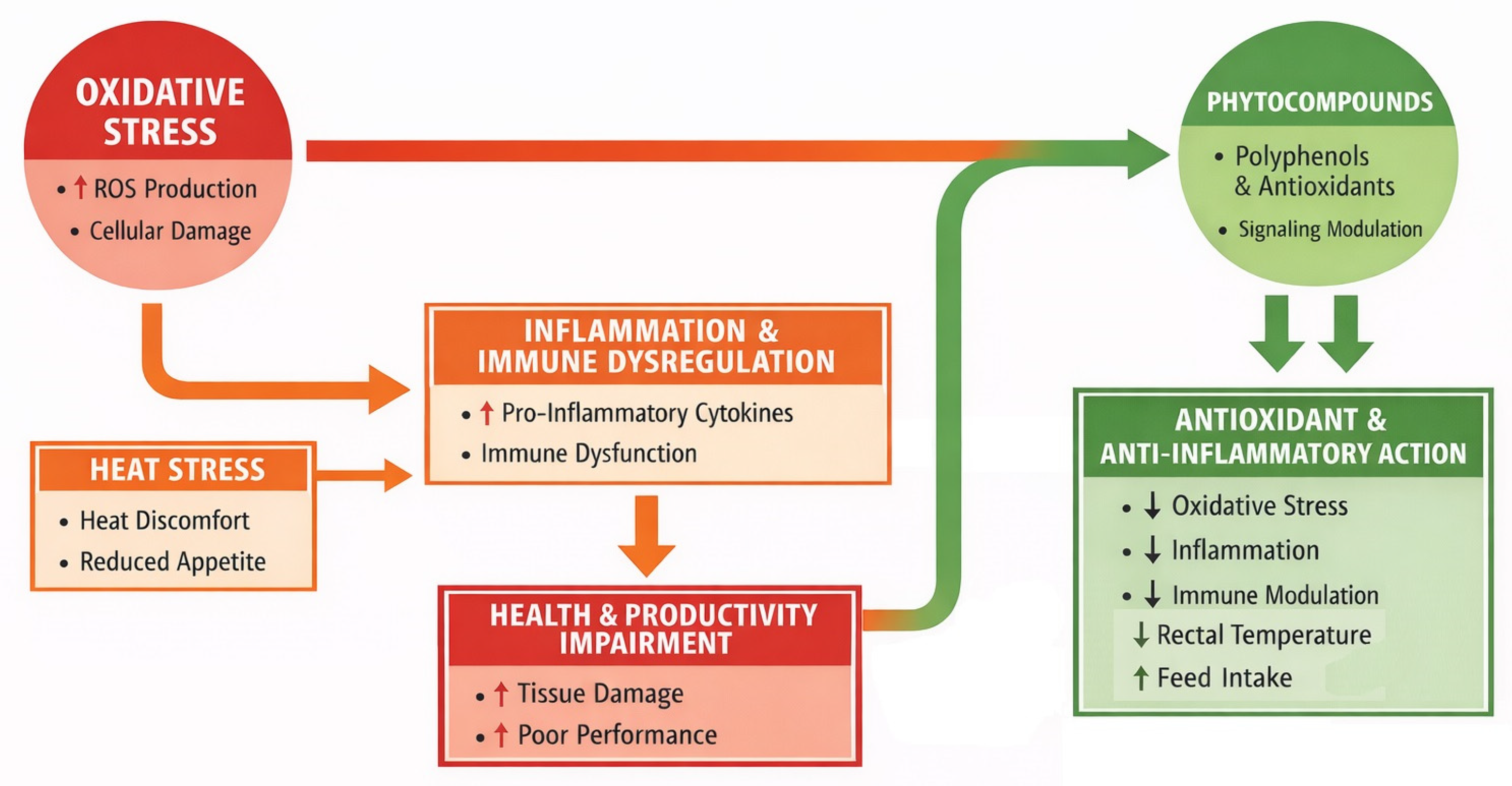
The restriction of antibiotic use in livestock production has accelerated the search for alternative nutritional strategies to sustain animal health and performance [6]. Within this context, phytogenic compounds have emerged as bioactive agents with antimicrobial, antioxidant, and immunomodulatory properties (Figure 5). They should not be regarded as direct substitutes for antibiotics, but as functional dietary components that modulate interconnected biological pathways [1,2,15,47].
Many polyphenols modulate redox and inflammatory pathways, notably via Nrf2 activation and attenuation of NF-κB signalling, thereby supporting antioxidant defences and immune homeostasis [99,102]. These effects are particularly relevant at the intestinal level, where phytogenics support barrier function and local immune regulation [15,22,99]. The biological efficacy of phytogenic compounds in livestock nutrition is highly species dependent: in monogastric species, effects are often more evident during sensitive phases such as weaning or environmental stress [22], whereas in ruminants they are frequently reported during periods of elevated metabolic demand, including the transition period [20,104,105].
In ruminants, the efficacy of phytogenic compounds is strongly influenced by ruminal metabolism, which modifies the chemical structure, bioavailability, and biological activity of many plant-derived molecules. Nevertheless, both native compounds and rumen-derived metabolites have demonstrated measurable effects on oxidative status, inflammatory markers, and metabolic efficiency [14,40].
Polyphenol-rich extracts derived from agro-industrial by-products have been extensively investigated in dairy cows [25,85,86]. Their effects are especially evident during early lactation, when enhanced mitochondrial activity and lipid mobilization predispose cows to oxidative and inflammatory dysregulation. Eder et al. [87] reported that inclusion of 1% grape pomace flour in the diet of dairy cows during the transition period significantly reduced markers of lipid peroxidation and improved antioxidant status, with concomitant attenuation of hepatic inflammatory indicators. Supplementation with a phenolic extract of Olea europaea L. (500 mg/cow/day) during lactation improved inflammatory and oxidative indicators, supporting a modulatory role of olive-derived phenolics under high metabolic demand [16]. Similarly, supplementation with dried quebracho–chestnut tannins at 30 g/head/day in lactating Holstein cows significantly reduced milk urea concentration and somatic cell count, together with a decrease in circulating oxidative stress markers, indicating improved nitrogen utilization efficiency and mammary health [91]. Saponins derived from plants such as Yucca schidigera, Quillaja saponaria, and legumes have also been investigated in ruminant nutrition for their multifunctional properties [106]. Although primarily employed to modulate ruminal fermentation, saponins have also been associated with reduced systemic oxidative stress markers, potentially through improved nitrogen metabolism and decreased hepatic metabolic load [20,107]. Algae-derived compounds have also been evaluated in ruminants. Dietary supplementation with 0.42% calcareous marine algae (Lithothamnion spp.) has been reported to reduce circulating inflammatory markers during the transition period, suggesting a supportive role in immune–metabolic adaptation [108]. In contrast, Spirulina supplementation in ruminants has produced variable outcomes, with inconsistent effects on oxidative and inflammatory parameters compared with more robust responses observed in monogastric species [109]. In small ruminants, phytogenic compounds have been extensively studied in relation to parasitic challenge and chronic intestinal inflammation. Tannin-rich forages and extracts not only reduce gastrointestinal parasite burden but also mitigate oxidative stress associated with prolonged immune activation. Sheep and goats receiving tannin-containing diets consistently show reduced lipid peroxidation indices and enhanced antioxidant enzyme activity, supporting the dual antiparasitic and redox-modulating role [19].
In poultry, oxidative stress and inflammation are closely linked to rapid growth rate, high metabolic demand, and pronounced sensitivity to environmental stressors, particularly heat stress. Numerous studies have demonstrated that dietary supplementation with specific phytogenic compounds exerts measurable antioxidant and anti-inflammatory effects at both systemic and intestinal levels [78,99,110,111,112].
Quercetin is one of the most extensively investigated flavonoids in broiler nutrition. Under stress conditions, dietary quercetin supplementation at inclusion levels of 0.04–0.06% of the diet in Arbor Acres broilers significantly reduced lipid peroxidation markers, including malondialdehyde (MDA), while enhancing antioxidant enzyme activities in hepatic and intestinal tissues. These effects were accompanied by downregulation of NF-κB signalling and reduced expression of TNF-α and IL-6, indicating attenuation of oxidative and inflammatory responses [113,114]. The observed physiological benefits were further associated with improved mitochondrial function and reduced intracellular ROS generation. Additional studies have reported effective quercetin supplementation at 200–500 mg/kg feed, confirming its role in reducing oxidative stress in broilers [21]. Green tea catechins, particularly epigallocatechin gallate (EGCG), have demonstrated efficacy in poultry models of oxidative and thermal stress. Supplementation with EGCG at 300 mg/kg diet preserved mitochondrial membrane potential, activated Nrf2-regulated antioxidant genes, and suppressed NF-κB–dependent inflammatory mediators. These molecular effects translated into improved intestinal morphology and barrier integrity, limiting endotoxin translocation and secondary inflammatory activation [115].
Essential oils and terpenoids such as carvacrol and thymol exert complementary effects by modulating gut microbiota composition and reducing pathogen-associated immune stimulation. In broilers, these compounds indirectly attenuate oxidative stress and inflammation by lowering intestinal endotoxin load and improving epithelial stability, particularly during early life stages and under environmental challenge [21,111,116].
In swine, the post-weaning period is characterized by intestinal barrier disruption, oxidative imbalance, and activation of inflammatory signalling pathways. PFAs have been evaluated as nutritional strategies to counteract these disturbances and preserve intestinal functionality. Dietary supplementation with quercetin in weaned piglets at inclusion levels of 500 and 750 mg/kg feed consistently reduced oxidative damage in intestinal tissues, improved villus architecture, and attenuated TLR4/NF-κB signalling, thereby limiting lipopolysaccharide-induced inflammatory responses [117]. These changes were associated with improved barrier integrity and reduced systemic inflammatory markers. Similar effects have been reported for grape seed proanthocyanidins and grape pomace, which improved antioxidant status in weaned piglets [87].
Resveratrol has been primarily investigated for its effects on mitochondrial function and metabolic resilience in pigs. Under conditions of oxidative or inflammatory challenge, resveratrol activates AMPK and SIRT1 signalling pathways, promotes mitochondrial biogenesis, and improves oxidative phosphorylation efficiency. By reducing mitochondrial ROS generation, resveratrol suppresses NF-κB activation and pro-inflammatory cytokine production, particularly under metabolic or heat stress [118]. Additional phytogenic compounds, including phenolic acids, naringenin, and saponins, have shown stabilizing effects on intestinal redox balance and immune activation during weaning. Although their impact on performance parameters is often limited, they consistently modulate oxidative and inflammatory markers, supporting physiological resilience rather than acting as direct growth-promoting agents [21,22,23,27,116].
Rabbits are highly susceptible to oxidative–inflammatory enteropathies during rapid growth due to the fragility of their intestinal ecosystem. In this species, PFAs contribute to intestinal stabilization and limitation of inflammation-driven oxidative damage. Quercetin supplementation improved antioxidant status and reduced intestinal oxidative injury in growing rabbits [114].
Plant extracts from rosemary, oregano, and sage, rich in phenolic diterpenes such as carnosic acid and rosmarinic acid, as well as bioactive compounds including allicin and lycopene, have been reported to reduce intestinal lipid peroxidation, modulate local immune responses, and improve microbiota stability in growing rabbits [119].
Finally, Lebeloane et al. [17], using an in vitro model, demonstrated the capacity of selected plant extracts to regulate the expression of genes encoding pro-inflammatory mediators and cytokines. Among the six plant extracts tested, Dichrostachys cinerea exhibited particularly strong anti-inflammatory activity, supporting its potential relevance as a phytogenic candidate for further investigation.

5.3. Heat Stress in Livestock and the Modulatory Effects of Phytogenic Compounds

Heat stress represents a major constraint in livestock production, disrupting metabolic and endocrine homeostasis and triggering oxidative and inflammatory responses that impair feed intake, immune competence, and productivity [18,105]. Phytogenic compounds have been investigated as nutritional modulators capable of attenuating heat stress-induced oxidative imbalance and inflammatory activation through redox regulation, endocrine modulation, and thermo-physiological adaptation [18,120].
In dairy cows, polyphenol-rich extracts have been evaluated under heat stress conditions, primarily for their antioxidant and anti-inflammatory properties. Citrus extracts, grape-derived products, and green tea extracts provide flavonoids and phenolic acids that consistently exhibit strong antioxidant potential [105]. Supplementation with citrus extract (4 g/head/day) in heat-stressed Holstein cows reduced somatic cell count without affecting milk yield, suggesting improved mammary redox balance [121]. Capsaicin-based formulations have been widely reviewed by Ahmadi et al. [18]. In several studies, capsaicin supplementation was associated with lower rectal temperature, improved dry matter intake, and increased milk production under heat stress. However, responses are clearly dose- and context-dependent [122]. In beef cattle, the use of PFAs to mitigate heat stress has been less extensively investigated. Nevertheless, significant effects have been reported following supplementation with 10 g/day of dried garlic bulbs containing allicin, which improved growth performance under heat stress, suggesting a potential role for sulfur-containing phytogenic compounds in thermal adaptation [123]
Buffaloes, as dairy animals typically raised in moderate to warm climates, are also particularly exposed to heat stress and related challenges. Li et al. [124] supplemented buffalo diets with mulberry leaf flavonoids (15, 30, 45 g/animal/day), reporting dose-dependent improvements in milk yield and composition, associated with improved antioxidant status and increased secretion of lactogenic and metabolic hormones (growth hormone, prolactin, estradiol), suggesting enhanced mammary activity and endocrine adaptation [124].
In dairy sheep, grape by-products and grape residue flour, sources of quercetin and resveratrol, reduced oxidative stress, lipid peroxidation, and somatic cell count in heat-stressed animals, indicating improved mammary gland health [125]. In heat-stressed ewes, dietary ferulic acid (0.25 g/kg DM) improved insulin sensitivity, highlighting a potential role in metabolic regulation during thermal challenge [126]. In lambs exposed to elevated temperatures, chestnut tannins (5–10 g/kg DM) improved growth and antioxidant enzyme activity and enhanced meat quality. Moreover, herbal blends containing rosemary, clove, cinnamon, and turmeric increased antioxidant capacity, growth performance, and feed efficiency in heat-stressed lambs [18,127]. Nano-formulated curcumin further reduced rectal temperature and enhanced antioxidant and immunoglobulin responses in heat-stressed lambs [128].
In poultry, PFAs have been widely investigated to improve thermotolerance and limit heat stress-induced oxidative and inflammatory damage [120,129]. Essential oils such as thyme, cinnamon, and pomegranate oils improved intestinal stability and reduced inflammatory activation in heat-stressed broilers. [130]. Green tea polyphenols (200–500 mg/kg feed) reduced lipid peroxidation and modulated inflammatory cytokine expression under chronic heat stress [131]. Additional phytogenics, including curcumin (50–100 mg/kg feed) [132], and peppermint [133], have been reported to improve thermotolerance, primarily by lowering oxidative stress markers and modulating cellular stress responses, including heat shock protein expression.
In growing pigs, phytogenic compounds have been tested mainly to counteract heat stress induced reductions in feed intake and metabolic efficiency. Capsaicin powder [134] and resveratrol [135] have been reported to reduce body temperature, improve antioxidant enzyme activity, and attenuate inflammatory markers, contributing to improved metabolic efficiency during heat stress. The use of phytogenic compounds to alleviate heat stress has also been investigated in growing rabbits, with positive outcomes reported in terms of improved physiological and oxidative stress responses [136].

6. Productive Performance: Nutritional Benefits

The gradual reduction in the routine use of antibiotics as growth promoters in intensive livestock reflects a shift in production strategies that enhance animal performance by optimizing biological and physiological balance rather than pharmacological intervention. Since the mid-2000s and particularly following the implementation of Regulation (EC) No. 1831/2003 in the European Union and comparable measures adopted in other major producing countries, efforts to limit the extensive use of antibiotics in livestock have intensified in response to their recognized role in the development of antimicrobial resistance [15,23]. In intensive animal production, productive performance is commonly evaluated using indicators such as average daily gain, feed intake, feed conversion ratio, meat yield, or milk production. Historically, antibiotics improved these parameters by reducing microbial competition for nutrients and dampening subclinical inflammatory responses in the gut [137]. Bioactive compounds act on the physiological determinants of productivity by reducing inflammation and the metabolic costs associated with oxidative stress, thereby improving feed efficiency and growth stability rather than maximizing feed intake or growth rate [23,24]. These effects are primarily mediated through improvements in gastrointestinal functionality [22,25]. Bioactive compounds have consistently been shown to support digestive processes through both direct and indirect mechanisms, including stimulation of digestive secretions, modulation of gastrointestinal motility, protection of the intestinal epithelium, and optimization of enzymatic activity [22,25]. These positive effects of PFAs are due to their antibacterial power against pathogenic bacteria in the rumen and intestine, while simultaneously promoting and stabilizing beneficial microbial populations [24,28]. The enrichment of favourable microbiota enhances competitive exclusion of pathogenic bacteria by limiting nutrient availability and colonization niches of the pathogen [27,28]. A balanced gut microbial ecosystem also improves digestive efficiency through the production of microbial enzymes, such as galactosidases and amylases, which enhance nutrient digestion and absorption. Hence, these combined effects ultimately translate into improved growth performance parameters. [25].
Plant secondary metabolites such as condensed tannins and saponins have been shown to reduce excessive ruminal protein degradation, improve nitrogen use efficiency, and increase the flow of metabolizable protein to the intestine [27]. Studies in dairy cows and growing cattle have demonstrated that moderate inclusion of tannin-containing forages or plant extracts can maintain or slightly improve milk yield and body weight gain while reducing ruminal ammonia concentrations [26,107]. These effects are particularly relevant in high-protein diets, where inefficient nitrogen utilization represents both an economic and environmental constraint. Also, certain compounds (e.g., carvacrol, eugenol, and thymol) and saponins may increase milk fat content due to their effects on rumen microbial populations and on carbohydrate and lipid metabolism. Specifically, these compounds can enhance the production and absorption of acetate, the primary precursor for milk fat synthesis in ruminants [11].
In broiler chickens, dietary supplementation with essential oil blends rich in thymol and carvacrol has been associated with significant reductions in feed conversion ratio (FCR) and improvements in average daily gain, comparable to those obtained with antibiotic growth promoters [21,138]. Furthermore, a recent meta-analysis by Hayat et al. [139] highlights the reduced FCR in broilers fed with PFAs, with improvements linked to enhanced digestive enzyme activity and reduced intestinal pathogen load. Similarly, polyphenol-rich extracts from grape or citrus by-products have been shown to improve nutrient digestibility and growth performance in poultry [140]. In pigs, the post-weaning phase represents a critical window during which digestive inefficiency and intestinal stress frequently compromise performance. Several studies have shown that supplementation with bioactive compounds such as plant polysaccharides, saponins, and essential oils can improve feed efficiency and growth during this phase [29]. Fermented herbal formulations and polyphenol-rich plant extracts have also been shown to enhance digestive enzyme activity and stabilize gut function, resulting in smoother growth trajectories and reduced performance variability in weaned piglets [27,141]. In rabbits, plant-derived bioactive compounds have also been reported to improve reproductive and productive performance [30].
Agro-food plant by-products rich in polyphenols and fibre represent a particularly promising category of bioactive sources due to their availability and cost-effectiveness. In ruminants, grape pomace supplementation has been associated with improved antioxidant status and stable milk or meat production, alongside improved feed efficiency under certain conditions [142]. These by-products have also demonstrated positive effects in poultry [143].
Across species, a recurring observation is that the productive benefits of bioactive compounds are often modest at the level of individual performance indicators but become significant when evaluated over an entire production cycle. Small improvements in nutrient digestibility result in measurable gains in feed efficiency and performance stability. This cumulative nature of the response helps explain why bioactive supplementation frequently reduces performance variability and improves predictability at the herd or flock level, even when short-term growth responses appear limited.

7. Environmental Sustainability: Methane Mitigation

Enteric methane (CH4) emissions from ruminant livestock represent one of the most significant sources of greenhouse gases associated with agricultural production, contributing substantially to global warming potential due to the high radiative forcing of methane relative to carbon dioxide. Despite the recognized environmental burden, ruminant systems remain essential for global food security because they enable the conversion of fibrous biomass into high-quality protein for human consumption [32,39,95]. Consequently, mitigation strategies must reconcile environmental sustainability with animal productivity and economic feasibility [36,37]. Nutritional interventions have emerged as one of the most promising approaches to reduce enteric methane emissions, with particular emphasis on natural bioactive compounds capable of modulating rumen fermentation processes [31,33,35].
Among natural additives, plant secondary metabolites such as tannins, saponins, essential oils, and flavonoids have demonstrated their effects through multiple mechanisms, including direct inhibition of methanogenic archaea, suppression of rumen protozoa, and redirection of fermentation toward pathways favouring propionate production [31,34,35,38]. Condensed tannins have been shown to reduce methane emissions by decreasing hydrogen availability and altering microbial protein turnover, although their efficacy is strongly dependent on molecular structure, dose, and dietary context. However, responses to the phytogenic compounds are often variable, influenced by diet composition, dosage, and adaptation of the rumen microbiota; on the other hand, variability in animal responses and the potential for microbial adaptation remain important constraints for the long-term effectiveness of plant-based additives [31,33,34,38].
Marine-derived natural additives, especially seaweeds and their bioactive components, have demonstrated pronounced methane mitigation effects. Red macroalgae such as Asparagopsis taxiformis contain halogenated compounds, notably bromoform, which directly inhibit methyl-coenzyme M reductase, a key enzyme in the methanogenesis pathway [35,95]. This results in dramatic reductions in enteric methane emissions even at very low inclusion rates [95]. In addition to bromoform, seaweeds provide a diverse array of bioactive compounds, including phlorotannins, peptides, polysaccharides, and lipids, which may contribute to antimethanogenic effects through broader modulation of rumen microbial activity [95]. Despite their high efficacy, several critical challenges constrain large-scale adoption, including issues related to sustainable biomass production, potential environmental impacts associated with bromoform release, animal health concerns, regulatory uncertainty regarding feed safety and residue transfer, as well as the risk of reduced feed intake or impaired nutrient digestibility at higher inclusion levels. In addition, the long-term consequences of rumen microbial adaptation remain insufficiently understood [35,39,42,95].

8. Quality of Animal Products: Functional Enrichment of Milk and Meat

8.1. Influence of Phytogenic Compounds on Milk Quality and Oxidative Stability

In recent years, research on plant-derived feed additives has shifted from generic claims of improved milk quality toward a more mechanistic evaluation. Current evidence focuses on identifying which dietary bioactive compounds or their metabolites are transferred into milk, and whether this transfer leads to measurable improvements in antioxidant capacity and oxidative stability. Studies across ruminant species indicate that phytochemical transfer into milk is strongly compound-dependent: lipophilic molecules (such as α-tocopherol, carotenoids) show greater affinity for the milk fat fraction, whereas most polyphenols undergo extensive ruminal and systemic metabolism, limiting the presence of intact compounds. Consequently, improvements associated with pasture-based feeding systems or diets rich in polyphenol-containing ingredients are more consistently reflected in enhanced oxidative stability and shelf life than in substantial increases in native phytogenic compounds [48].
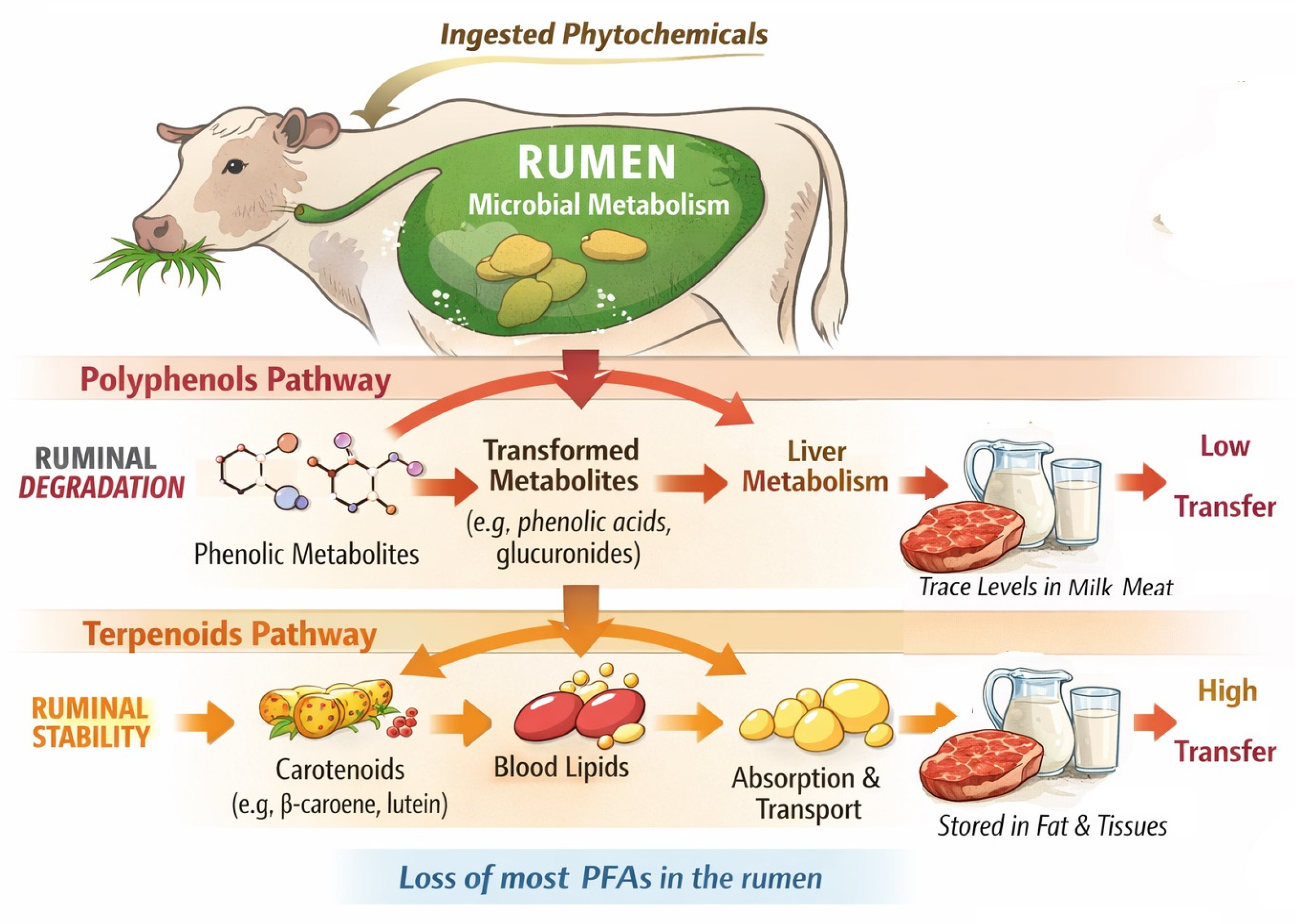
In dairy systems, the presence of dietary phytogenic compounds in milk is regulated by a sequence of biological transformations, including ruminal fermentation, intestinal absorption, hepatic biotransformation, systemic transport, and mammary uptake [40]. This multi-step physiological pathway imposes intrinsic constraints on the transfer of plant-derived compounds into milk. For most polyphenols, the prevailing outcome is not the secretion of intact dietary molecules, but rather the appearance of low-abundance microbial- and host-derived metabolites, including isoflavone-derived equol, lignan-derived enterolignans, urolithins, phenolic acids, and phenyl-γ-valerolactones [45]. These compounds arise primarily from extensive microbial biotransformation in the rumen and post-ruminal compartments, followed by host phase II metabolism [45,144,145]. Following intestinal absorption, these microbial and host-derived phenolic metabolites enter the systemic circulation and can subsequently be transferred to the mammary gland, where they are secreted into milk, mainly in conjugated forms. Consequently, milk consumption enables the transfer of these microbiota-derived and conjugated metabolites to the human body, where they may contribute to biological activity, supporting the concept of milk as a vector of bioactive metabolites rather than a source of intact polyphenols [44,144]. A recent review by Forte et al. [45] further emphasizes that most dietary polyphenols appear in bovine milk predominantly as conjugated metabolites (e.g., glucuronides and sulfates) rather than in their native forms. As reported before, a notable exception concerns lipophilic compounds, which can be efficiently transferred from the diet into milk fat [45,48]. Consequently, milk from grazing animals often contains higher concentrations of natural antioxidants and beneficial fatty acids compared with milk from animals fed mainly preserved forages or concentrate-based diets. As reported by Ahsin et al. [44], milk from cows fed red clover shows a higher presence of equol, a final microbial metabolite of polyphenols, compared with milk from cows grazing grass-based pastures. High-altitude grazing systems, typically characterized by botanically diverse pastures rich in aromatic and medicinal herbs, further contribute to distinctive qualitative modifications in milk and dairy products [146]. These systems reflect the intake of secondary plant metabolites characteristic of mountain environments. In particular, aromatic herbs rich in essential oils (such as rosemary or oregano) may lead to the transfer of flavour-active compounds into milk or induce changes in microbial dynamics during cheesemaking [40]. Beyond polyphenols supplied through green forages and grazing, the use of agro-industrial by-products provides low-cost dietary supplements with positive environmental and product-quality implications. As summarized by Bilial et al. [147], recent evidence indicates that the inclusion of by-products from the olive oil industry, such as olive leaves, olive pomace, and olive cake, in ruminant diets can influence milk quality and dairy products. Feeding trials have shown that cheeses obtained from animals fed olive-derived feeds exhibit improved antioxidant properties, as demonstrated in sheep [148] and in dairy cows [149]. Moreover, grape pomace, the main by-product of the winemaking industry, has likewise emerged as one of the most extensively studied plant-derived feed ingredients in dairy nutrition, owing to its high content of polyphenols, including flavan-3-ols, proanthocyanidins, anthocyanins, and phenolic acids [150]. In dairy systems, the inclusion of grape pomace in cow diets generally does not result in the direct transfer of intact polyphenols into milk. Instead, microbial- and phase II-derived polyphenol metabolites are detected, reflecting extensive ruminal fermentation followed by hepatic biotransformation [44]. Despite this limited direct transfer, several feeding trials have consistently shown an increase in total antioxidant capacity of milk and reduced susceptibility to lipid oxidation when grape pomace or grape polyphenol-rich fractions, such as resveratrol-containing extracts, are included in the diet. Other by-products have also been investigated, including citrus peels, tomato pomace, and standardized plant extracts [3]. These materials provide carotenoids, phenolic compounds, and vitamins that can reinforce systemic antioxidant defences and improve the oxidative stability of milk. Nevertheless, the inclusion of by-products must generally be limited, as excessive levels may introduce compounds that become detrimental beyond certain thresholds, and may reduce diet palatability [3]. It should also be noted that the effects of bioactive compounds on milk are not confined to nutritional aspects alone but may extend to sensory properties. In some cases, phytogenic compounds can impart bitter or otherwise undesirable aromatic notes, such as those associated with certain olive leaf polyphenols or grape pomace constituents [151]. Moreover, as highlighted previously, in ruminants, the action of specific bioactive compounds can modulate rumen metabolism, with downstream effects on milk fatty acid composition, particularly fatty acids of microbial origin [10,152], as well as the volatile profile of milk and dairy products [40].

8.2. Influence of Phytogenic Compounds on Meat Quality and Oxidative Stability

As observed for milk, the deposition of dietary phytogenic compounds into muscle tissue is constrained by a complex metabolic cascade involving gastrointestinal transformation, absorption, hepatic metabolism, systemic circulation, and tissue uptake (Figure 6). For most plant-derived polyphenols, particularly those with hydrophilic structures, this pathway severely limits the accumulation of intact compounds in edible tissues [40].
In monogastric species, extensive intestinal and hepatic phase I–II metabolism results primarily in conjugated metabolites (e.g., glucuronides and sulfates), while in ruminants, ruminal microbial degradation further reduces the likelihood of native polyphenol deposition in muscle [14]. Targeted and untargeted metabolomic studies conducted over the last decade consistently indicate that intact polyphenols are rarely detected in meat at nutritionally relevant concentrations, with reported levels typically in the low ng/g range when present at all [40,153]. Instead, muscle tissue may contain trace amounts of low-molecular-weight phenolic metabolites or conjugated derivatives, reflecting systemic exposure rather than direct dietary transfer. Consequently, claims of “polyphenol-enriched meat” should be interpreted with caution, as the chemical evidence for substantial accumulation of native phytochemicals remains weak. In contrast, lipophilic bioactive compounds show a markedly different behaviour [9]. Fat-soluble antioxidants such as α-tocopherol, carotenoids, and certain terpenoids are efficiently deposited in muscle membranes and intramuscular fat, where they exert biologically meaningful effects on oxidative stability [43,47]. This differential transfer explains why improvements in meat quality associated with phytogenic feeding are more consistently linked to reduced lipid oxidation, improved colour stability, and extended shelf life, rather than to the measurable presence of specific polyphenols in muscle tissue [47].
Phytogenic feed additives have been shown to improve not only growth performance but also carcass characteristics and meat quality in ruminants [11,154]. Oxidative stress in livestock promotes lipid and protein oxidation within muscle tissue, leading to the deterioration of key meat quality attributes, including colour stability, tenderness, water-holding capacity, flavour, and oxidative stability [48]. For this reason, endogenous and dietary antioxidant systems play a central role in protecting muscle cell membranes, particularly polyunsaturated fatty acids, from oxidative damage, thereby preserving meat quality during storage and processing. Indeed, ruminants fed pasture-based diets, grazing systems, or agro-food by-products not only show improved welfare and health status but also produce meat enriched with beneficial compounds such as conjugated linoleic acid (CLA), n-3 polyunsaturated fatty acids (PUFAs), and phytogenic compounds [154]. Although accumulation of intact phytochemicals is generally limited, certain metabolites may be detected in muscle tissue. Although present at relatively low concentrations, they can contribute to the nutritional value of meat.
Concrete evidence of these effects has been reported in different ruminant species, including cattle [11,44], buffalo [155], and small ruminants [46]. In this context, the dietary inclusion of agro-industrial by-products rich in plant bioactive compounds, such as grape pomace and olive-derived by-products, has emerged as an effective strategy to supply phytogenic feed additives. In goat meat, the inclusion of olive mill wastewater in the diet significantly reduced malondialdehyde (MDA) content from 0.25 to 0.15 nmol MDA/µg of meat compared to the control group, indicating improved oxidative stability [156]. Similarly, Bai et al. [157] demonstrated that dietary supplementation with tea polyphenols (2–6 g/kg of basal diet) in weaned lambs significantly increased the activity of antioxidant enzymes such as total superoxide dismutase (T-SOD) and glutathione peroxidase (GSH-Px) in the longissimus dorsi muscle while significantly reducing hydrogen peroxide (H2O2) levels (p < 0.05). However, the effects of phytogenic compounds on meat oxidative stability during storage remain variable. As highlighted in the review by Mapiye et al. [11], inconsistencies among studies regarding antioxidant capacity and shelf-life extension are likely due to multiple interacting factors, including the type, dosage, and bioavailability of phytogenic compounds, as well as animal-related variables, dietary composition, and production system characteristics.
In monogastric species such as poultry and swine, phytogenic compounds, particularly essential oils, have been investigated as natural alternatives to synthetic antioxidants, owing to their capacity to enhance oxidative stability and meat quality using for example cinnamaldehyde (200 mg/kg), carvacrol (200 mg/kg), thymol (100 mg/kg) and other herbal extracts rich in polyphenols [29,116,138]. Moreover, the inclusion of grape by-products, which are naturally rich in polyphenols, has been shown to improve the oxidative stability of meat, as well as its nutritional and sensory quality, thereby contributing to an extension of shelf life in meat and meat products [87]. Muzolf-Panek et al. [158], in a study on phytogenic supplementation in finishing pig diets, reported significant improvements in chemical quality parameters and a reduction in oxidative stress in muscle tissues. In particular, antioxidant enzyme activity was markedly enhanced in both tissues and meat, with superoxide dismutase (SOD) activity increasing from 36.81 to 43.44 U/g and total glutathione (GSH + GSSG) content rising from 239.29 to 325.74 nmol/g in phytogenically supplemented pigs compared with the control group. These findings are consistent with those observed in ruminants and confirm the positive modulatory effect of phytogenic compounds on endogenous antioxidant defence systems. In addition to antioxidant effects, phytogenic feed additives have been associated with improvements in the lipid profile of pig meat. Oanh et al. [159] demonstrated that dietary inclusion of medicinal plant powders, such as Bidens pilosa L., Urena lobata L., and Ramulus cinnamomi, significantly reduced meat cholesterol content. This effect was attributed to the presence of flavonoids, which can form insoluble complexes with cholesterol in the intestinal lumen, thereby inhibiting its absorption and contributing to improved meat nutritional quality. Similarly, in broilers, certain essential oils and aromatic phytogenic compounds have been linked to improved meat quality attributes, likely mediated through enhanced antioxidant capacity by several authors [138,160]. Moreover, a higher antioxidant potential, as assessed by DPPH radical-scavenging activity, has been observed in poultry diets supplemented with polyphenols, showing a positive correlation with increasing levels of polyphenol inclusion. Mavrommatis et al. [161] reported that the dietary incorporation of 2.5% ground grape pomace, 0.2% dried wine lees, and 0.1% grape stem extract significantly increased the total antioxidant capacity and reduced lipid peroxidation in broiler breast muscle, as evidenced by a decrease in TBARS values (from 0.6 to 0.4 mg MDA/kg of meat). In rabbits, similar beneficial effects on growth performance and meat oxidative stability have been reported following dietary inclusion of phytochemical-rich by-products. In a study by Scerra et al. [162], the partial substitution of cereals with 10% grape seed resulted in a significant increase in average daily gain, from 35.6 to 39.7 g/day (p = 0.033), along with a marked reduction in lipid oxidation. Specifically, TBARS values were reduced from 0.8 to 0.3 mg MDA/kg of meat after 4 days of storage, and from 1.4 to 0.4 mg MDA/kg after 8 days of storage in grape seed-supplemented rabbits compared with the control. The inclusion of the macroalga Padina pavonica in the diet of rabbits fed linseed not only improved the nutritional quality of the meat, through an increase in long-chain polyunsaturated fatty acids and an enrichment in trace mineral elements [163], but also enhanced meat shelf life by significantly reducing oxidative deterioration [164]. It is important to acknowledge that responses in meat quality are dose-dependent and context-specific. However, high inclusion levels of certain phytogenics can impair feed intake or modify palatability, particularly in swine with sensitive taste receptors [165].

9. Practical Considerations

Although the biological efficacy of natural bioactive feed additives is increasingly supported by experimental evidence, their successful implementation in commercial animal production systems remains constrained by a range of practical and regulatory considerations. These factors ultimately often determine whether compounds that perform well under controlled experimental conditions can be realistically translated into routine farm applications.
Availability and cost represent primary limiting factors. Many bioactive compounds, particularly specialized botanical extracts, certain macroalgae (e.g., Asparagopsis spp.), and microalgal biomass, are produced in relatively small volumes, depend on complex supply chains, or compete with higher-value markets such as nutraceuticals, cosmetics, and pharmaceuticals [41,49]. Therefore, production to meet the demands of intensive livestock systems remains a substantial challenge. In this context, bioactives derived from agro-food by-products often present may offer advantages in terms of availability and cost, thereby enhancing their practical attractiveness.
However, stability during feed manufacturing and storage constitutes another critical constraint. Many phytogenic compounds are chemically labile and susceptible to degradation when exposed to heat, oxygen, light, moisture, or extreme pH conditions. Feed processing operations, particularly conditioning and pelleting, involve thermal and mechanical stresses that may volatilize essential oils, oxidize sensitive polyphenols, and reduce overall biological activity. As a consequence, efficacy at the point of ingestion may be diminished, leading to inconsistent responses across production systems. To mitigate such losses, formulation technologies including microencapsulation techniques [12,13], lipid or carbohydrate-based matrices, and adsorption onto inert carriers are increasingly employed. While these strategies can enhance stability and promote targeted delivery within the gastrointestinal tract, they also increase formulation complexity and production costs, which must again be carefully balanced against expected benefits.
Standardization and quality control present additional challenges for natural products. In contrast to single-molecule synthetic additives, botanicals and algae-derived ingredients exhibit inherent variability related to species or cultivar, agronomic conditions, seasonality, geographical origin, and processing methods [15,166]. Consequently, the concentration of key marker compounds, such as allicin in garlic, carvacrol and thymol in oregano-based oils, total or specific polyphenols in plant extracts, or halogenated metabolites in certain seaweeds, may vary substantially between batches. Without rigorous standardization, identical inclusion rates may deliver different effective doses, leading to inconsistent animal responses. Best practice therefore requires the identification of appropriate marker compounds, validated analytical methods for routine quality control, defined acceptance ranges, and, where feasible, the use of standardized extracts.
From both technological and biological perspectives, practical inclusion levels are further constrained by palatability, interactions with feed matrices, and safety margins. The strong odours or flavours characteristic of some essential oils and bitter plant extracts may reduce voluntary feed intake when sensory thresholds are exceeded, particularly in sensitive species [165]. This partly explains why many phytogenic additives are administered at relatively low inclusion rates, which may limit their efficacy.
Regulatory frameworks exert a decisive influence on the adoption of natural bioactive feed additives. In most jurisdictions, additives must undergo formal evaluation to demonstrate safety for target animals, consumers, users, and the environment, as well as efficacy for the intended claim. In the European Union, authorisation is governed by Regulation (EC) No 1831/2003, which requires comprehensive dossiers addressing identity, conditions of use, safety, and efficacy, in line with European Food Safety Authority (EFSA) guidance. Complementary regulations, including Regulation (EC) No 178/2002 (General Food Law) and Regulation (EC) No 767/2009 on feed marketing and labelling, further shape how bioactive products can be positioned and marketed. Comparable frameworks operate in other regions, such as the United States and China, albeit through different authorization pathways. Consequently, successful commercial application of bioactive feed additives requires not only biological efficacy but also regulatory compliance, economic feasibility, and technological robustness.

10. Conclusions

Plant-derived bioactive compounds represent an increasingly established nutritional strategy in livestock production systems, supported by consistent evidence of their capacity to modulate oxidative stress, inflammatory responses, and gastrointestinal functionality across species. Their primary contribution lies in enhancing physiological resilience rather than acting as simple growth promoters.
In ruminants, although this field remains incompletely elucidated and partially characterized by contradictory findings, specific compounds have demonstrated the potential to improve feed efficiency and, in some cases, to mitigate enteric methane production. In monogastric species, their benefits are particularly evident during physiologically critical phases, such as weaning and heat stress, where they support intestinal integrity and reduce performance variability. Improvements in milk and meat quality are mainly associated with enhanced antioxidant status and greater lipid stability, rather than with the direct transfer of phytochemicals into edible tissues.
However, their efficacy remains strongly dependent on molecular composition, dosage, processing methods, animal species, and production context. Variability in bioavailability, ruminal biotransformation, and interactions with the microbiota represent a major limitation for standardization. Therefore, although phytogenic additives constitute promising components of sustainable production systems, their practical implementation requires rigorous standardization, precise molecular characterization, and context-specific validation to define the conditions under which consistent and economically meaningful benefits can be achieved.

Supplementary Materials

The following supporting information can be downloaded at: https://www.mdpi.com/article/10.3390/app16052344/s1. Figure S1: Structured workflow illustrating the literature selection process leading to the final corpus of studies critically analyzed in this review; Table S1: Chemical classification of polyphenols relevant for phytogenic feed additives (PFAs); Table S2: Chemical classification of terpenoids relevant for phytogenic feed additives (PFAs); Table S3: Simplified chemical classification of nitrogen- and sulfur-containing phytogenic bioactive compounds.

Author Contributions

Conceptualization, S.F.; methodology, S.F., M.C. (Michela Contò), S.R., M.C. (Marta Castrica); investigation, S.F., M.C. (Michela Contò), S.R., M.C. (Marta Castrica); writing—original draft preparation, S.F., M.C. (Michela Contò), S.R., M.C. (Marta Castrica); writing—review and editing, S.F., S.R., M.C. (Michela Contò), M.C. (Marta Castrica); supervision, S.F., M.C. (Michela Contò), S.R. All authors have read and agreed to the published version of the manuscript.

Funding

This research received no external funding.

Institutional Review Board Statement

“Not applicable” for studies not involving humans or animals.

Informed Consent Statement

Not applicable.

Data Availability Statement

The data presented in this study are included in the review/Supplementary Material. Further inquiries can be directed to the corresponding author on request.

Acknowledgments

During the preparation of this manuscript, the authors used ChatGPT (version GPT-5.2, OpenAI) for the purposes of generating graphical representations and supporting the linguistic revision of the text. The authors have reviewed and edited the output and take full responsibility for the content of this publication.

Conflicts of Interest

The authors declare no conflicts of interest.

Abbreviations

The following abbreviations are used in this manuscript:
PFAsPhytogenic feed additives
ROSReactive oxygen species
RNSReactive nitrogen species
Nrf2Nuclear factor erythroid 2-related factor 2
AREAntioxidant response element
SODSuperoxide dismutase
GSTGlutathione S-transferase
GSHGlutathione
LOLipoxygenase
NOXNADPH oxidase
COXCyclooxygenase
MPOMyeloperoxidase
XOXanthine oxidase
NF-κBNuclear factor kappa-B
MAPKMitogen-activated protein kinase
UVUltraviolet
MDAMalondialdehyde
TBARSThiobarbituric acid-reactive substances
TNF-αTumour necrosis factor alpha
IL-6Interleukin-6
EGCGEpigallocatechin gallate
TLR4Toll-like receptor 4
AMPKAMP-activated protein kinase
SIRT1Sirtuin 1
DMDry matter
FCRFeed conversion ratio
CLAConjugated linoleic acid
PUFAPolyunsaturated fatty acids
PxPeroxidase
GSSGOxidase Glutathione
pHPower of hydrogen
EFSAEuropean Food Safety Authority

References

  1. Singh, A.; Negi, P.S. Biotechnological Application of Health-Promising Bioactive Compounds. In Biotechnological Intervention in Production of Bioactive Compounds. Sustainable Landscape Planning and Natural Resources Management; Devi, J., Ed.; Springer: Cham, Switzerland, 2025. [Google Scholar] [CrossRef]
  2. Mamphogoro, T.P.; Makete, G.; Modika, K.Y.; Kamutando, C.N. Probiotics as Feed Additives for Improved Animal Health and Nutrition: The Current Perspectives. In Probiotics, Prebiotics, and Postbiotics in Human Health and Sustainable Food Systems; IntechOpen: London, UK, 2024. [Google Scholar] [CrossRef]
  3. Correddu, F.; Lunesu, M.F.; Buffa, G.; Atzori, A.S.; Nudda, A.; Battacone, G.; Pulina, G. Can Agro-Industrial By-Products Rich in Polyphenols be Advantageously Used in the Feeding and Nutrition of Dairy Small Ruminants? Animals 2020, 10, 131. [Google Scholar] [CrossRef]
  4. Eseberri, I.; Trepiana, J.; Léniz, A.; Gómez-García, I.; Carr-Ugarte, H.; González, M.; Portillo, M.P. Variability in the Beneficial Effects of Phenolic Compounds: A Review. Nutrients 2022, 14, 1925. [Google Scholar] [CrossRef]
  5. Kour, S.; Sagar, T.; Nipunta; Hussain, S.; Kapoor, N.; Mahajan, R. Role of Biotechnology in Improvement and Regulation of Biosynthesis of Bioactive Compounds. In Biotechnological Intervention in Production of Bioactive Compounds. Sustainable Landscape Planning and Natural Resources Management; Devi, J., Ed.; Springer: Cham, Switzerland, 2025. [Google Scholar] [CrossRef]
  6. Kussmann, M.; Abe Cunha, D.H.; Berciano, S. Bioactive compounds for human and planetary health. Front. Nutr. 2023, 10, 1193848. [Google Scholar] [CrossRef]
  7. Gonçalves, A.C.; Pinto, A.R.; Cima, A.; Olo-Fontinha, E.; Martins, J.C.L.; Garcia, J.; Lemos, A.; Saavedra, M.J.; Pintado, M.M.; Alves, M.J. Plant-Derived Bioactive Compounds: One Health Perspective. Appl. Sci. 2026, 16, 327. [Google Scholar] [CrossRef]
  8. Munekata, P.E.S.; Pateiro, M.; Rocchetti, G.; Domínguez, R.; Rocha, J.M.; Lorenzo, J.M. Application of Metabolomics to Decipher the Role of Bioactive Compounds in Plant and Animal Foods. Curr. Opin. Food Sci. 2022, 46, 100851. [Google Scholar] [CrossRef]
  9. Vlaicu, P.A.; Untea, A.E.; Varzaru, I.; Saracila, M.; Oancea, A.G. Designing Nutrition for Health—Incorporating Dietary By-Products into Poultry Feeds to Create Functional Foods with Insights into Health Benefits, Risks, Bioactive Compounds, Food Component Functionality and Safety Regulations. Foods 2023, 12, 4001. [Google Scholar] [CrossRef]
  10. Malav, O.P.; Wagh, R.V.; Mehta, N.; Koirala, P.; Al-Asmari, F.; Nirmal, N. Trends and prospects of lipophilic bioactive compounds in meat production and preservation. Food Rev. Int. 2024, 41, 1158–1176. [Google Scholar] [CrossRef]
  11. Nhara, R.B.; Musara, C.; Charambira, T.; Mujati, T.; Nhovoro, T.; Hodzi, P.; Ruzengwe, F.M. Role of phytogenic feed additives on animal product quality and acceptance—A review. Trop. Anim. Health Prod. 2025, 57, 226. [Google Scholar] [CrossRef] [PubMed]
  12. Mapiye, C.; Semwogerere, F.; Steyn, L.; Priyashantha, H.; Natalello, A.; Marais, J.; Soladoye, O.P.; Priolo, A.; Ponnampalam, E.N. Impact of dietary phytochemicals on production and quality of ruminant meat and milk: A comprehensive systematic review. Anim. Feed Sci. Technol. 2026, 332, 116609. [Google Scholar] [CrossRef]
  13. Zia, S.; Khan, M.R.; Shabbir, M.A.; Aslam Maan, A.; Khan, M.K.I.; Nadeem, M.; Khalil, A.A.; Din, A.; Aadil, R.M. An Inclusive Overview of Advanced Thermal and Nonthermal Extraction Techniques for Bioactive Compounds in Food and Food-related Matrices. Food Rev. Int. 2022, 38, 1166–1196. [Google Scholar] [CrossRef]
  14. Zaky, A.A.; Witrowa-Rajchert, D.; Nowacka, M. Revolution of Bioactive Compound Extraction: Impacts on Food Safety, Health, and Sustainability. Food Saf. Health 2025, 3, 315–333. [Google Scholar] [CrossRef]
  15. Bešlo, D.; Golubić, N.; Rastija, V.; Agić, D.; Karnaš, M.; Šubarić, D.; Lučić, B. Antioxidant Activity, Metabolism, and Bioavailability of Polyphenols in the Diet of Animals. Antioxidants 2023, 12, 1141. [Google Scholar] [CrossRef]
  16. Wang, J.; Deng, L.; Chen, M.; Che, Y.; Li, L.; Zhu, L.; Chen, G.; Feng, T. Phytogenic feed additives as natural antibiotic alternatives in animal health and production: A review of the literature of the last decade. Anim. Nut. 2024, 17, 244–264. [Google Scholar] [CrossRef]
  17. Di Meo, M.C.; Giacco, A.; Zarrelli, A.; Mandrone, V.M.; D’Angelo, L.; Silvestri, E.; De Girolamo, P.; Varricchio, E. Effects of Olea europaea L. Polyphenols on the Animal Welfare and Milk Quality in Dairy Cows. Animals 2023, 13, 3225. [Google Scholar] [CrossRef]
  18. Lebeloane, M.; Famuyide, I.; Kgosana, K.; Elgorashi, E.; Ndivhuwo, K.; Maharaj, V.; McGaw, L. Anti-inflammatory activity of seven plant species with potential use as livestock feed additives. S. Afr. J. Bot. 2024, 167, 322–332. [Google Scholar] [CrossRef]
  19. Ahmadi, F.; Suleria, H.A.R.; Dunshea, F.R. Role of plant bioactive compounds in improving ruminant resilience to heat stress challenge. Anim. Prod. Sci. 2025, 65, AN23386. [Google Scholar] [CrossRef]
  20. Jaiswal, L.; Ismail, H.; Worku, M. A Review of the Effect of Plant-Derived Bioactive Substances on the Inflammatory Response of Ruminants (Sheep, Cattle, and Goats). Int. J. Vet. Anim. Med. 2020, 3, 130. [Google Scholar] [CrossRef]
  21. Salzano, A.; Di Meo, M.C.; D’Onofrio, N.; Bifulco, G.; Cotticelli, A.; Licitra, F.; Iraci Fuintino, A.; Cascone, G.; Balestrieri, M.L.; Varricchio, E.; et al. Breed and Feeding System Impact the Bioactive Anti-Inflammatory Properties of Bovine Milk. Int. J. Mol. Sci. 2022, 23, 11088. [Google Scholar] [CrossRef]
  22. Obianwuna, U.E.; Chang, X.; Oleforuh-Okoleh, V.U.; Onu, P.N.; Zhang, H.; Qiu, K.; Wu, S. Phytobiotics in poultry: Revolutionizing broiler chicken nutrition with plant-derived gut health enhancers. J. Anim. Sci. Biotechnol. 2024, 15, 169. [Google Scholar] [CrossRef]
  23. Song, Z.; Li, P.; Wu, M.; Guo, S.; Wu, T.; Hou, Y.; Yi, D. Multi-effects of natural plant bioactive components on intestinal health in pigs: Promising feed-antibiotic alternatives? J. Nutr. 2025, S0022-316, 00090-2. [Google Scholar] [CrossRef] [PubMed]
  24. Rossi, B.; Toschi, A.; Piva, A.; Grilli, E. Single components of botanicals and nature-identical compounds as a non-antibiotic strategy to ameliorate health status and improve performance in poultry and pigs. Nutr. Res. Rev. 2020, 33, 218–234. [Google Scholar] [CrossRef] [PubMed]
  25. Manuelian, C.L.; Pitino, R.; Simoni, M.; Mavrommatis, A.; De Marchi, M.; Righi, F.; Tsiplakou, E. Plant Feed Additives as Natural Alternatives to the Use of Synthetic Antioxidant Vitamins on Livestock Mammals’ Performances, Health, and Oxidative Status: A Review of the Literature in the Last 20 Years. Antioxidants 2021, 10, 1461. [Google Scholar] [CrossRef]
  26. Ravanal, M.C.; Contador, C.A.; Wong, W.-T.; Zhang, Q.; Roman-Benn, A.; Ah-Hen, K.S.; Ulloa, P.E.; Lam, H.-M. Prebiotics in animal nutrition: Harnessing agro-industrial waste for improved gut health and performance. Anim. Nutr. 2025, 21, 179–192. [Google Scholar] [CrossRef]
  27. Besharati, M.; Maggiolino, A.; Palangi, V.; Kaya, A.; Jabbar, M.; Eseceli, H.; De Palo, P.; Lorenzo, J.M. Tannin in Ruminant Nutrition: Review. Molecules 2022, 27, 8273. [Google Scholar] [CrossRef]
  28. Ali, M.Y.; Khatun, A. Moringa as a natural feed supplement for livestock: Impact on growth performance, milk and meat production, semen quality and hormonal regulation. J. Anim. Health Prod. 2025, 13, 738–753. [Google Scholar] [CrossRef]
  29. Madesh, M.; Yan, J.; Jinan, G.; Hu, P.; Kim, I.H.; Liu, H.-Y.; Ennab, W.; Jha, R.; Cai, D. Phytogenics in Swine Nutrition and Their Effects on Growth Performance, Nutrient Utilization, Gut Health, and Meat Quality: A Review. Stress Biol. 2025, 5, 11. [Google Scholar] [CrossRef]
  30. Nantapo, C.W.; Marume, U. Strategic technologies to improve phytogenic feed additive efficacy in pigs and poultry. Anim. Nutr. 2025, 23, 286–303. [Google Scholar] [CrossRef]
  31. El-Sabrout, K.; Khalifah, A.; Ciani, F. Current Applications and Trends in Rabbit Nutraceuticals. Agriculture 2023, 13, 1424. [Google Scholar] [CrossRef]
  32. Kazemi, M.; Elghandour, M.M.M.Y.; Salem, A.Z.M. Toward Climate-Smart Ruminant Production: Best Practices and Future Directions. In Handbook of Climate Change Mitigation and Adaptation; Springer: New York, NY, USA, 2025; pp. 1–35. [Google Scholar] [CrossRef]
  33. Króliczewska, B.; Pecka-Kiełb, E.; Bujok, J. Strategies Used to Reduce Methane Emissions from Ruminants: Controversies and Issues. Agriculture 2023, 13, 602. [Google Scholar] [CrossRef]
  34. Lambo, M.T.; Ma, H.; Liu, R.; Dai, B.; Zhang, Y.; Li, Y. Review: Mechanism, effectiveness, and the prospects of medicinal plants and their bioactive compounds in lowering ruminants’ enteric methane emission. Animal 2024, 18, 101134. [Google Scholar] [CrossRef]
  35. Ahmed, M.G.; Elwakeel, E.A.; El-Zarkouny, S.Z.; Al-Sagheer, A.A. Environmental Impact of Phytobiotic Additives on Greenhouse Gas Emission Reduction, Rumen Fermentation Manipulation, and Performance in Ruminants: An Updated Review. Environ. Sci. Pollut. Res. 2024, 31, 37943–37962. [Google Scholar] [CrossRef]
  36. Hristov, A.N. Invited review: Advances in nutrition and feed additives to mitigate enteric methane emissions. J. Dairy Sci. 2024, 107, 4129–4146. [Google Scholar] [CrossRef]
  37. Muzzo, B.I.; Ramsey, R.D.; Villalba, J.J. Changes in Climate and Their Implications for Cattle Nutrition and Management. Climate 2025, 13, 1. [Google Scholar] [CrossRef]
  38. Negash, Y.; Sujanto, R.; Dlamini, N. Reducing greenhouse gas emissions in livestock farms: A resource orchestration theory perspective on total resource management. J. Environ. Manag. 2025, 386, 125790. [Google Scholar] [CrossRef] [PubMed]
  39. Kholif, A.E. A Review of Effect of Saponins on Ruminal Fermentation, Health and Performance of Ruminants. Vet. Sci. 2023, 10, 450. [Google Scholar] [CrossRef] [PubMed]
  40. Kashenye, B.; Zhang, J. Gastrointestinal modification based on probiotic feed additive enviro-alleviators to reduce enteric methane production in ruminant and non-ruminant livestock. Resour. Environ. Sustain. 2025, 22, 100276. [Google Scholar] [CrossRef]
  41. Serra, V.; Salvatori, G.; Pastorelli, G. Dietary Polyphenol Supplementation in Food Producing Animals: Effects on the Quality of Derived Products. Animals 2021, 11, 401. [Google Scholar] [CrossRef]
  42. Costa, M.; Cardoso, C.; Afonso, C.; Bandarra, N.M.; Prates, J.A.M. Current knowledge and future perspectives of the use of seaweeds for livestock production and meat quality: A systematic review. J. Anim. Physiol. Anim. Nutr. 2021, 105, 1075–1102. [Google Scholar] [CrossRef]
  43. Kontodimos, I.; Chatzimanoli, E.; Kasapidou, E.; Basdagianni, Z.; Karatzia, M.-A.; Amanatidis, M.; Margaritis, N. Characterization of Bioactive Compounds and Element Content in Goat Milk and Cheese Products. Biol. Life Sci. Forum 2023, 26, 98. [Google Scholar] [CrossRef]
  44. Miao, Q.; Si, X.; Zhao, Q.; Zhang, H.; Qin, Y.; Tang, C.; Zhang, J. Deposition and enrichment of carotenoids in livestock products: An overview. Food Chem. 2024, 21, 101245. [Google Scholar] [CrossRef]
  45. Ahsin, M.; Matarneh, S.K.; Thornton, K.J.; Kronberg, S.; Amir, M.; Van Vliet, S. Phenolic Compounds and Derivatives in Ruminant Meat and Milk: A Systematic Review. J. Agric. Food Chem. 2025, 73, 29961–29982. [Google Scholar] [CrossRef]
  46. Forte, L.; Parabita, N.; Santoro, M.; Longobardi, F.; Natrella, G.; Quiñones, J.; Ponnampalam, E.N.; Tomasevic, I.; De Palo, P.; Maggiolino, A. From Rumen to Milk: Dietary Polyphenols in Dairy Cows—A Critical Review. Vet. Anim. Sci. 2026, 31, 100569. [Google Scholar] [CrossRef]
  47. Jiang, X.; Wang, B. Advancing meat production and research: Targeting the diet–microbiome–muscle axis in small ruminants. Food Biosci. 2025, 75, 108184. [Google Scholar] [CrossRef]
  48. Ponnampalam, E.N.; Kiani, A.; Santhiravel, S.; Holman, B.W.B.; Lauridsen, C.; Dunshea, F.R. The Importance of Dietary Antioxidants on Oxidative Stress, Meat and Milk Production, and Their Preservative Aspects in Farm Animals: Antioxidant Action, Animal Health, and Product Quality—Invited Review. Animals 2022, 12, 3279. [Google Scholar] [CrossRef] [PubMed]
  49. Orzuna-Orzuna, J.F.; Dorantes-Iturbide, G.; Lara-Bueno, A.; Chay-Canul, A.J.; Miranda-Romero, L.A.; Mendoza-Martínez, G.D. Meta-analysis of flavonoids use into beef and dairy cattle diet: Performance, antioxidant status, ruminal fermentation, meat quality, and milk composition. Front. Vet. Sci. 2023, 10, 1134925. [Google Scholar] [CrossRef]
  50. Prates, J.A.M. Improving Meat Quality, Safety and Sustainability in Monogastric Livestock with Algae Feed Additives. Foods 2025, 14, 1007. [Google Scholar] [CrossRef]
  51. Agradi, S.; Draghi, S.; Cotozzolo, E.; Barbato, O.; Castrica, M.; Quattrone, A.; Sulçe, M.; Vigo, D.; Menchetti, L.; Ceccarini, M.R.; et al. Goji berries supplementation in the diet of rabbits and other livestock animals: A mini-review of the current knowledge. Front. Vet. Sci. 2022, 8, 823589. [Google Scholar] [CrossRef]
  52. Kapadia, P.; Newell, A.S.; Cunningham, J.; Roberts, M.R.; Hardy, J.G. Extraction of High-Value Chemicals from Plants for Technical and Medical Applications. Int. J. Mol. Sci. 2022, 23, 10334. [Google Scholar] [CrossRef]
  53. Vuolo, M.M.; Lima, S.V.; Maróstica Junior, M.R. Phenolic Compounds: Structure, Classification, and Antioxidant Power. In Bioactive Compounds, 1st ed.; Segura Campos, M.R., Ed.; Woodhead Publishing: New Delhi, India, 2019; pp. 33–50. [Google Scholar] [CrossRef]
  54. Shende, V.V.; Bauman, K.D.; Moore, B.S. The shikimate pathway: Gateway to metabolic diversity. Nat. Prod. Rep. 2024, 41, 604–648. [Google Scholar] [CrossRef]
  55. Formato, M.; Cimmino, G.; Brahmi-Chendouh, N.; Piccolella, S.; Pacifico, S. Polyphenols for Livestock Feed: Sustainable Perspectives for Animal Husbandry? Molecules 2022, 27, 7752. [Google Scholar] [CrossRef]
  56. De Rossi, L.; Rocchetti, G.; Lucini, L.; Rebecchi, A. Antimicrobial Potential of Polyphenols: Mechanisms of Action and Microbial Responses—A Narrative Review. Antioxidants 2025, 14, 200. [Google Scholar] [CrossRef]
  57. Câmara, J.S.; Perestrelo, R.; Ferreira, R.; Berenguer, C.V.; Pereira, J.A.M.; Castilho, P.C. Plant-Derived Terpenoids: A Plethora of Bioactive Compounds with Several Health Functions and Industrial Applications—A Comprehensive Overview. Molecules 2024, 29, 3861. [Google Scholar] [CrossRef] [PubMed]
  58. Meléndez-Martínez, A.J.; Mandić, A.I.; Bantis, F.; Böhm, V.; Borge, G.I.A.; Brnčić, M.; O’Brien, N. A comprehensive review on carotenoids in foods and feeds: Status quo, applications, patents, and research needs. Crit. Rev. Food Sci. Nutr. 2022, 62, 1999–2049. [Google Scholar] [CrossRef]
  59. Bufka, J.; Vaňková, L.; Sýkora, J.; Křížková, V. Exploring carotenoids: Metabolism, antioxidants, and impacts on human health. J. Funct. Foods 2024, 118, 106284. [Google Scholar] [CrossRef]
  60. Letchuman, S.; Madhuranga, H.D.T.; Kaushalya, M.B.L.N.; Premarathna, A.D.; Saravanan, M. Alkaloids Unveiled: A Comprehensive Analysis of Novel Therapeutic Properties, Mechanisms, and Plant-Based Innovations. Intell. Pharm. 2025, 3, 268–276. [Google Scholar] [CrossRef]
  61. Pereira, A.G.; Cassani, L.; Garcia-Oliveira, P.; Otero, P.; Mansoor, S.; Echave, J.; Xiao, J.; Simal-Gándara, J.; Prieto, M. Plant Alkaloids: Production, Extraction, and Potential Therapeutic Properties. In Natural Secondary Metabolites: From Nature, Through Science, to Industry; Springer: Berlin/Heidelberg, Germany, 2023; pp. 157–200. [Google Scholar] [CrossRef]
  62. Ruhee, R.T.; Roberts, L.A.; Ma, S.; Suzuki, K. Organosulfur compounds: A review of their anti-inflammatory effects in human health. Front. Nutr. 2020, 7, 64. [Google Scholar] [CrossRef]
  63. Tripathi, M.; Mishra, A. Glucosinolates in animal nutrition: A review. Anim. Feed Sci. Technol. 2007, 132, 1–27. [Google Scholar] [CrossRef]
  64. Mucha, P.; Skoczyńska, A.; Małecka, M.; Hikisz, P.; Budzisz, E. Overview of the Antioxidant and Anti-Inflammatory Activities of Selected Plant Compounds and Their Metal Ions Complexes. Molecules 2021, 26, 4886. [Google Scholar] [CrossRef] [PubMed]
  65. Surai, P.F. polyphenol compound in the chicken/animal diet: From past to future. J. Anim. Physiol. Anim. Nutr. 2014, 98, 19–31. [Google Scholar] [CrossRef] [PubMed]
  66. Platzer, M.; Kiese, S.; Herfellner, T.; Schweiggert-Weisz, U.; Miesbauer, O.; Eisner, P. Common Trends and Differences in Antioxidant Activity Analysis of Phenolic Substances Using Single Electron Transfer Based Assays. Molecules 2021, 26, 1244. [Google Scholar] [CrossRef]
  67. Andrés, C.M.C.; Pérez de la Lastra, J.M.; Juan, C.A.; Plou, F.J.; Pérez-Lebeña, E. Polyphenols as Antioxidant/Pro-Oxidant Compounds and Donors of Reducing Species: Relationship with Human Antioxidant Metabolism. Processes 2023, 11, 2771. [Google Scholar] [CrossRef]
  68. Kostić, K.; Brborić, J.; Delogu, G.; Simić, M.R.; Samardžić, S.; Maksimović, Z.; Dettori, M.A.; Fabbri, D.; Kotur-Stevuljević, J.; Saso, L. Antioxidant Activity of Natural Phenols and Derived Hydroxylated Biphenyls. Molecules 2023, 28, 2646. [Google Scholar] [CrossRef]
  69. Adamczuk, N.; Krauze-Baranowska, M.; Milewska, M.; Kimel, K.; Migas, P. Determination of Carotenoids and Their Antioxidant Activity in Fruits of Selected Species from the Genus Rubus and Their Cultivars and Hybrids from Poland Versus Other Regions of the World. Antioxidants 2025, 14, 1438. [Google Scholar] [CrossRef]
  70. Medina-García, M.; Baeza-Morales, A.; Martínez-Peinado, P.; Pascual-García, S.; Pujalte-Satorre, C.; Martínez-Espinosa, R.M.; Sempere-Ortells, J.M. Carotenoids and Their Interaction with the Immune System. Antioxidants 2025, 14, 1111. [Google Scholar] [CrossRef]
  71. Tava, A.; Biazzi, E.; Ronga, D.; Pecetti, L.; Pinarosa, A. Biologically active compounds from forage plants. Phytochem. Rev. 2022, 21, 471–501. [Google Scholar] [CrossRef]
  72. Cappai, M.G.; Aboling, S. Toxic or harmful components of aromatic plants in animal nutrition. In Feed Additives: Aromatic Plants and Herbs in Animal Nutrition and Health; Florou-Paneri, P., Christaki, E., Giannenas, I., Eds.; Elsevier: Amsterdam, The Netherlands, 2019; pp. 147–158. [Google Scholar] [CrossRef]
  73. Jin, L.; Panitsidis, I.; Vasilopoulos, S.; Dokou, S.; Chantzi, P.; Vasilopoulou, K.; Giannenas, I. Application of Aromatic Plants and Their Extracts in Livestock. In Sustainable Use of Feed Additives in Livestock: Novel Ways for Animal Production; Springer International Publishing: Cham, Switzerland, 2023; pp. 527–560. [Google Scholar] [CrossRef]
  74. Mucha, W.; Witkowska, D. The Applicability of Essential Oils in Different Stages of Production of Animal-Based Foods. Molecules 2021, 26, 3798. [Google Scholar] [CrossRef] [PubMed]
  75. Alagawany, M.; Abd El-Hack, M.E.; Saeed, M.; Naveed, M.; Arain, M.A.; Arif, M.; Tiwari, R.; Khandia, R.; Khurana, S.K.; Karthik, K. Nutritional applications and beneficial health applications of green tea and l-theanine in some animal species: A review. J. Anim. Physiol. Anim. Nutr. 2020, 104, 245–256. [Google Scholar] [CrossRef]
  76. Saeed, M.; Abd El-Hack, M.E.; Alagawany, M.; Naveed, M.; Arain, M.A.; Arif, M.; Soomro, R.N.; Kakar, M.; Manzoor, R.; Tiwari, R.; et al. Phytochemistry, modes of action and beneficial health applications of green tea (Camellia sinensis) in humans and animals. Inter. J. Pharmacol. 2017, 13, 698–708. [Google Scholar] [CrossRef]
  77. Ramdani, D.; Jayanegara, A.; Chaudhry, A.S. Biochemical Properties of Black and Green Teas and Their Insoluble Residues as Natural Dietary Additives to Optimize In Vitro Rumen Degradability and Fermentation but Reduce Methane in Sheep. Animals 2022, 12, 305. [Google Scholar] [CrossRef]
  78. Azuhnwi, B.N.; Thomann, B.; Arrigo, Y.; Boller, B.; Hess, H.D.; Kreuzer, M.; Dohme- Meier, F. Ruminal dry matter and crude protein degradation kinetics of five sainfoin (Onobrychis viciifolia Scop) accessions differing in condensed tannin content and obtained from different harvests. Anim. Feed Sci. Technol. 2012, 177, 135–143. [Google Scholar] [CrossRef]
  79. Kar, I.; Das, S.; Mukherjee, A.; Patra, A.K. Mentha herbs and their bioactive molecules on biological functions, production performance, health, and product quality in poultry and livestock. Trop. Anim. Health Prod. 2025, 57, 311. [Google Scholar] [CrossRef]
  80. Zabot, G.L.; Schaefer Rodrigues, F.; Polano Ody, L.; Vinícius Tres, M.; Herrera, E.; Palacin, H.; Córdova-Ramos, J.S.; Best, I.; Olivera-Montenegro, L. Encapsulation of Bioactive Compounds for Food and Agricultural Applications. Polymers 2022, 14, 4194. [Google Scholar] [CrossRef]
  81. Allaqaband, S.; Dar, A.H.; Patel, U.; Kumar, N.; Alabdallah, N.M.; Kumar, P.; Pandey, V.K.; Kovács, B. Utilization of Fruit Seed-Based Bioactive Compounds for Formulating the Nutraceuticals and Functional Food: A Review. Front. Nutr. 2022, 9, 902554. [Google Scholar] [CrossRef]
  82. Meradi, S.; Messaï, A.; Aouachria, M. The effect of spices Coriandrum sativum L., Trigonella foenum-graecum L., Pimpinella anisum L., and their combinations on growth performance, carcass trait, and hematobiochemical parameters in broiler chicken. Vet. World 2022, 15, 1821. [Google Scholar] [CrossRef]
  83. Zeng, X.; Chen, Y.; Li, W.; Liu, S. Application of Fenugreek in Ruminant Feed: Implications for Methane Emissions and Productivity. PeerJ 2024, 12, e16842. [Google Scholar] [CrossRef]
  84. Lopes, I.M.; Pereira, J.R.; Teixeira, L.G.; Silva, F.F.; de Carvalho, G.G.; Rodrigues, C.S.; Santiago, M.R.; de Araújo, M.L.G.M.; Pires, A.J.V.; Silva, R.D.G.; et al. Capsaicin supplementation on ruminal fermentation, immune responses, intake and digestibility nutrients in grazing bulls. J. Agric. Sci. 2025, 163, 118–127. [Google Scholar] [CrossRef]
  85. Touré, A.; Xueming, X. Flaxseed lignans: Source, biosynthesis, metabolism, antioxidant activity, bio-active components, and health benefits. Compr. Rev. Food Sci. Food Saf. 2010, 9, 261–269. [Google Scholar] [CrossRef]
  86. Georganas, A.; Giamouri, E.; Pappas, A.C.; Papadomichelakis, G.; Galliou, F.; Manios, T.; Tsiplakou, E.; Fegeros, K.; Zervas, G. Bioactive Compounds in Food Waste: A Review on the Transformation of Food Waste to Animal Feed. Foods 2020, 9, 291. [Google Scholar] [CrossRef]
  87. Malenica, D.; Kass, M.; Bhat, R. Sustainable Management and Valorization of Agri-Food Industrial Wastes and By-Products as Animal Feed: For Ruminants, Non-Ruminants and as Poultry Feed. Sustainability 2023, 15, 117. [Google Scholar] [CrossRef]
  88. Eder, K.; Ringseis, R.; Gessner, D.K. Effects of Grape By-Products on Oxidative Stress and Inflammation in Farm Animals: An Overview of Studies Performed in Pigs, Chickens, and Cattle. Animals 2025, 15, 1536. [Google Scholar] [CrossRef]
  89. Russo, C.; Maugeri, A.; Lombardo, G.E.; Musumeci, L.; Barreca, D.; Rapisarda, A.; Cirmi, S.; Navarra, M. The Second Life of Citrus Fruit Waste: A Valuable Source of Bioactive Compounds. Molecules 2021, 26, 5991. [Google Scholar] [CrossRef]
  90. Gosset-Erard, C.; Zhao, M.; Lordel-Madeleine, S.; Ennahar, S. Identification of punicalagin as the bioactive compound behind the antimicrobial activity of pomegranate (Punica granatum L.) peels. Food Chem. 2021, 352, 129396. [Google Scholar] [CrossRef]
  91. Selim, S.; Albqmi, M.; Al-Sanea, M.M.; Alnusaire, T.S.; Almuhayawi, M.S.; AbdElgawad, H.; Al Jaouni, S.K.; Elkelish, A.; Hussein, S.; Warrad, M.; et al. Valorizing the usage of olive leaves, bioactive compounds, biological activities, and food applications: A comprehensive review. Front. Nutr. 2022, 9, 1008349. [Google Scholar] [CrossRef]
  92. Wang, M.; Li, Y.; Ren, S.; Shen, Y.; Chen, P.; Cui, Q.; Cao, Y.; Li, Q.; Xu, H.; Sun, F.; et al. Effects of quebracho–chestnut tannin extract supplementation on production performance, nitrogen partitioning, and rumen fermentation patterns in early-lactating Holstein cows. Anim. Feed Sci. Technol. 2024, 315, 116043. [Google Scholar] [CrossRef]
  93. Fărcaș, A.C.; Socaci, S.A.; Nemeș, S.A.; Pop, O.L.; Coldea, T.E.; Fogarasi, M.; Biriș-Dorhoi, E.S. An Update Regarding the Bioactive Compound of Cereal By-Products: Health Benefits and Potential Applications. Nutrients 2022, 14, 3470. [Google Scholar] [CrossRef]
  94. Saadaoui, I.; Rasheed, R.; Aguilar, A. Microalgal-based feed: Promising alternative feedstocks for livestock and poultry production. J. Animal Sci. Biotechnol. 2021, 12, 76. [Google Scholar] [CrossRef]
  95. Morais, T.; Inácio, A.; Coutinho, T.; Ministro, M.; Cotas, J.; Pereira, L.; Bahcevandziev, K. Seaweed Potential in the Animal Feed: A Review. J. Mar. Sci. Eng. 2020, 8, 559. [Google Scholar] [CrossRef]
  96. Abbott, D.W.; Aasen, I.M.; Beauchemin, K.A.; Grondahl, F.; Gruninger, R.; Hayes, M.; Huws, S.; Kenny, D.A.; Krizsan, S.J.; Kirwan, S.F.; et al. Seaweed and Seaweed Bioactives for Mitigation of Enteric Methane: Challenges and Opportunities. Animals 2020, 10, 2432. [Google Scholar] [CrossRef]
  97. Kraan, S. Seaweed and their products for health of livestock. In Sustainable Globe Resources of Seaweeds; Ranga Rao, A., Ravishankar, G.A., Eds.; Springer: Cham, Switzerland, 2022; Volume 1, pp. 331–356. [Google Scholar] [CrossRef]
  98. Newton, E.E.; Pétursdóttir, Á.H.; Ríkharðsson, G.; Beaumal, C.; Desnica, N.; Giannakopoulou, K.; Juniper, D.; Ray, P.; Stergiadis, S. Effect of Dietary Seaweed Supplementation in Cows on Milk Macrominerals, Trace Elements and Heavy Metal Concentrations. Foods 2021, 10, 1526. [Google Scholar] [CrossRef]
  99. De La Riva, G.A.; Trujillo, L.A.S.; González-Hernández, J.C. Assessment on Oxidative Stress in Animals: From Experimental Models to Animal Production. In Importance of Oxidative Stress and Antioxidant System in Health and Disease; IntechOpen: London, UK, 2022; ISBN 978-1-80356-330-5. [Google Scholar]
  100. Li, Y.; Wang, K.; Li, C. Oxidative Stress in Poultry and the Therapeutic Role of Herbal Medicine in Intestinal Health. Antioxidants 2024, 13, 1375. [Google Scholar] [CrossRef]
  101. Martemucci, G.; Costagliola, C.; Mariano, M.; D’Andrea, L.; Napolitano, P.; D’Alessandro, A.G. Free Radical Properties, Source and Targets, Antioxidant Consumption and Health. Oxygen 2022, 2, 48–78. [Google Scholar] [CrossRef]
  102. Bellezza, I.; Giambanco, I.; Minelli, A.; Donato, R. Nrf2-Keap1 signaling in oxidative and reductive stress. Biochim. Biophys. Acta Mol. Cell Res. 2018, 1865, 721–733. [Google Scholar] [CrossRef]
  103. Saha, S.; Buttari, B.; Panieri, E.; Profumo, E.; Saso, L. An Overview of Nrf2 Signaling Pathway and Its Role in Inflammation. Molecules 2020, 25, 5474. [Google Scholar] [CrossRef]
  104. Piao, M.; Tu, Y.; Zhang, N.; Diao, Q.; Bi, Y. Advances in the Application of Phytogenic Extracts as Antioxidants and Their Potential Mechanisms in Ruminants. Antioxidants 2023, 12, 879. [Google Scholar] [CrossRef]
  105. Guo, Y.; Li, L.; Yan, S.; Shi, B. Plant Extracts to Alleviating Heat Stress in Dairy Cows. Animals 2023, 13, 2831. [Google Scholar] [CrossRef]
  106. Chauhan, S.S.; Rashamol, V.P.; Bagath, M.; Sejian, V.; Dunshea, F.R. Impacts of heat stress on immune responses and oxidative stress in farm animals and nutritional strategies for amelioration. Int. J. Biometeorol. 2021, 65, 1231–1244. [Google Scholar] [CrossRef]
  107. Yanza, Y.R.; Irawan, A.; Jayanegara, A.; Ramadhani, F.; Respati, A.N.; Fitri, A.; Hidayat, C.; Niderkorn, V.; Cieslak, A.; Szumacher-Strabel, M.; et al. Saponin Extracts Utilization as Dietary Additive in Ruminant Nutrition: A Meta-Analysis of In Vivo Studies. Animals 2024, 14, 1231. [Google Scholar] [CrossRef]
  108. Brutti, D.D.; Canozzi, M.E.A.; Sartori, E.D.; Colombatto, D.; Barcellos, J.O.J. Effects of the use of tannins on the ruminal fermentation of cattle: A meta-analysis and meta-regression. Anim. Feed Sci. Technol. 2023, 306, 115806. [Google Scholar] [CrossRef]
  109. Neville, E.W.; Fahey, A.G.; Meade, K.G.; Mulligan, F.J. Effects of calcareous marine algae on milk production, feed intake, energy balance, mineral status, and inflammatory markers in transition dairy cows. J. Dairy Sci. 2022, 105, 6616–6627. [Google Scholar] [CrossRef]
  110. Keller, M.; Manzocchi, E.; Rentsch, D.; Lugarà, R.; Giller, K. Antioxidant and Inflammatory Gene Expression Profiles of Bovine Peripheral Blood Mononuclear Cells in Response to Arthrospira platensis before and after LPS Challenge. Antioxidants 2021, 10, 814. [Google Scholar] [CrossRef]
  111. Seidavi, A.; Tavakoli, M.; Asroosh, F.; Scanes, C.G.; El-Hack, A.; Mohamed, E.; Naiel, M.A.; Taha, A.E.; Aleya, L.; El-Tarabily, K.A.; et al. Antioxidant and antimicrobial activities of phytonutrients as antibiotic substitutes in poultry feed. Environ. Sci. Pollut. Res. 2021, 29, 5006–5031. [Google Scholar] [CrossRef]
  112. Aminullah, N.; Mostamand, A.; Zahir, A.; Mahaq, O.; Azizi, M.N. Phytogenic feed additives as alternatives to antibiotics in poultry production: A review. Vet. World 2025, 18, 141–154. [Google Scholar] [CrossRef]
  113. Yang, J.X.; Maria, T.C.; Zhou, B.; Xiao, F.L.; Wang, M.; Mao, Y.J.; Li, Y. Quercetin improves immune function in Arbor Acre broilers through activation of NF-kappaB signaling pathway. Poult. Sci. 2020, 99, 906–913. [Google Scholar] [CrossRef]
  114. El-Aziz, A.A.; Ghanima, M.A.; Kamal, M.; Aldhalmi, A.K.; Khan, M.M.H.; Abd El-Hack, M.E. Quercetin as a bioactive feed additive: Nutritional, antioxidant, and gut health implications in poultry and rabbits. Vet. Anim. Sci. 2025, 29, 100487. [Google Scholar] [CrossRef]
  115. Song, J.; Lei, X.; Luo, J.; Everaert, N.; Zhao, G.; Wen, J.; Yang, Y. The effect of Epigallocatechin-3-gallate on small intestinal morphology, antioxidant capacity and anti-inflammatory effect in heat-stressed broilers. J. Anim. Physiol. Anim. Nutr. 2019, 103, 1030–1038. [Google Scholar] [CrossRef]
  116. Biswas, S.; Ahn, J.M.; Kim, I.H. Assessing the potential of phytogenic feed additives: A comprehensive review on their effectiveness as a potent dietary enhancement for non-ruminant in swine and poultry. J. Anim. Physiol. Anim. Nutr. 2024, 108, 711–723. [Google Scholar] [CrossRef]
  117. Mao, Y.; Yang, Q.; Liu, J.; Fu, Y.; Zhou, S.; Liu, J.; Ying, L.; Li, Y. Quercetin Increases Growth Performance and Decreases Incidence of Diarrhea and Mechanism of Action in Weaned Piglets. Oxid. Med. Cell. Longev. 2024, 2024, 5632260. [Google Scholar] [CrossRef]
  118. Meng, Q.; Guo, T.; Li, G.; Sun, S.; He, S.; Cheng, B.; Shi, B.; Shan, A. Dietary resveratrol improves antioxidant status of sows and piglets and regulates antioxidant gene expression in placenta by Keap1-Nrf2 pathway and Sirt1. J. Anim. Sci. Biotechnol. 2018, 9, 34. [Google Scholar] [CrossRef]
  119. El-Gogary, M.; El-Said, E.; Mansour, A. Physiological and immunological effects of rosemary essential oil in growing rabbit diets. J. Agric. Sci. 2018, 10, 485–491. [Google Scholar] [CrossRef]
  120. Papatsiros, V.G.; Tsekouras, N.; Papakonstantinou, G.I.; Kamvysi, K.; Eliopoulos, C.; Fotos, L.; Arapoglou, D.; Meletis, E.; Michailidis, G.; Gougoulis, D. The Use of Food Industry By-Products in Pig Diets as a Challenge Option to Reduce the Environmental Footprint. Agriculture 2025, 15, 2390. [Google Scholar] [CrossRef]
  121. Ying, Y.; Niu, M.; Clarke, A.R.; Harvatine, K.J. Short communication: Effect of a citrus extract in lactating dairy cows. J. Dairy Sci. 2017, 100, 5468–5471. [Google Scholar] [CrossRef]
  122. An, Z.; Zhang, X.; Gao, S.; Zhou, D.; Riaz, U.; Abdelrahman, M.; Hua, G.; Yang, L. Effects of Capsicum Oleoresin Supplementation on Lactation Performance, Plasma Metabolites, and Nutrient Digestibility of Heat Stressed Dairy Cow. Animals 2022, 12, 797. [Google Scholar] [CrossRef]
  123. Liu, W.; Gao, H.; He, J.; Yu, A.; Sun, C.; Xie, Y.; Yao, H.; Wang, H.; Duan, Y.; Hu, J.; et al. Effects of dietary Allium mongolicum Regel powder supplementation on the growth performance, meat quality, antioxidant capacity and muscle fibre characteristics of fattening Angus calves under heat stress conditions. Food Chem. 2024, 453, 139539. [Google Scholar] [CrossRef]
  124. Li, M.; Hassan, F.; Tang, Z.; Peng, L.; Liang, X.; Li, L.; Peng, K.; Xie, F.; Yang, C. Mulberry Leaf Flavonoids Improve Milk Production, Antioxidant, and Metabolic Status of Water Buffaloes. Front. Vet. Sci. 2020, 7, 599. [Google Scholar] [CrossRef]
  125. Alba, D.F.; Campigotto, G.; Cazarotto, C.J.; dos Santos, D.S.; Gebert, R.R.; Reis, J.H.; Souza, C.F.; Baldissera, M.D.; Gindri, A.L.; Kempka, A.P.; et al. Use of grape residue flour in lactating dairy sheep in heat stress: Effects on health, milk production and quality. J. Therm. Biol. 2019, 82, 197–205. [Google Scholar] [CrossRef]
  126. Nicolás-López, P.; Macías-Cruz, U.; Avendaño-Reyes, L.; Valadez-García, K.M.; Mellado, M.; Meza-Herrera, C.A.; Díaz-Molina, R.; Castañeda, V.J.; Vicente-Pérez, R.; Luna-Palomera, C. Ferulic acid supplementation for 40 days in hair ewe lambs experiencing seasonal heat stress: Short-term effects on physiological responses, growth, metabolism, and hematological profile. Environ. Sci. Pollut. Res. Int. 2023, 30, 11562–11571. [Google Scholar] [CrossRef] [PubMed]
  127. Hashemzadeh, F.; Rafeie, F.; Hadipour, A.; Rezadoust, M.H. Supplementing a phytogenic-rich herbal mixture to heat-stressed lambs: Growth performance, carcass yield, and muscle and liver antioxidant status. Small Rumin. Res. 2022, 206, 106596. [Google Scholar] [CrossRef]
  128. Bokharaeian, M.; Toghdory, A.; Ghoorchi, T. Effects of dietary curcumin nano-micelles on growth performance, blood metabolites, antioxidant status, immune and physiological responses of fattening lambs under heat-stress conditions. J. Therm. Biol. 2023, 114, 103585. [Google Scholar] [CrossRef] [PubMed]
  129. Abdel-Moneim, E.A.M.; Shehata, A.M.; Khidr, R.E.; Paswan, V.K.; Ibrahim, N.S.; El-Ghoul, A.A.; Aldhumri, S.A.; Gabr, S.A.; Mesalam, N.M.; Elbaz, A.M.; et al. Nutritional manipulation to combat heat stress in poultry—A comprehensive review. J. Therm. Biol. 2021, 98, 98102915. [Google Scholar] [CrossRef] [PubMed]
  130. Wang, D.; Sayed, M.A.M.; Galal, A.E.; Attaai, A.H.; Makled, M.N.; Ali, A.H.H.; Wei, C.; Habib, M.A.; Abdelfattah, M.G.; Abouelezz, K. The antioxidative properties of thyme, cinnamon, and pomegranate oils in heat-stressed broilers. Poultry Sci. 2025, 104, 105228. [Google Scholar] [CrossRef]
  131. Zhao, F.; Wang, X.; Li, Y.; Chen, X.; Geng, Z.; Zhang, C. Effects of Dietary Supplementation with Epigallocatechin Gallate on Meat Quality and Muscle Antioxidant Capacity of Broilers Subjected to Acute Heat Stress. Animals 2021, 11, 3296. [Google Scholar] [CrossRef]
  132. Zhang, D.D.; Xue, M.R.; Liu, Y.T.; Cui, H.J.; Bai, D.P. Effects of curcumin on jejunal morphology and intestinal integrity of broiler under heat stress. J. Therm. Biol. 2025, 133, 104296. [Google Scholar] [CrossRef]
  133. Ma, D.; Zhang, M.; Feng, J. Dietary Peppermint Extract Inhibits Chronic Heat Stress-Induced Activation of Innate Immunity and Inflammatory Response in the Spleen of Broiler Chickens. Animals 2024, 14, 1157. [Google Scholar] [CrossRef]
  134. Cervantes, M.; Sakkas, P.; Soto, M.; Gómez, A.J.; Camacho, R.L.; Arce, N.; Quilichini, N.; Morales, A. A Capsaicin-Based Phytogenic Solution Improves Performance and Thermal Tolerance of Heat-Stressed Growing Pigs. Animals 2024, 14, 973. [Google Scholar] [CrossRef]
  135. Meng, Q.; Li, J.; Wang, C.; Shan, A. Biological function of resveratrol and its application in animal production: A review. J. Anim. Sci. Biotechnol. 2023, 14, 25. [Google Scholar] [CrossRef]
  136. Ratel, E.T.I.; Mekawy, A.; Hassab, H.S.; Abdelnour, S. Enhancing growing rabbit heat stress resilience through dietary supplementation with natural antioxidants. BMC Vet. Res. 2025, 21, 28. [Google Scholar] [CrossRef]
  137. Peng, M.; Salaheen, S.; Biswas, D. Animal Health: Global Antibiotic Issues. In Encyclopedia of Agriculture and Food Systems; Van Alfen, N.K., Ed.; Academic Press: New York, NY, USA, 2014; pp. 346–357. [Google Scholar] [CrossRef]
  138. Malhi, K.K.; Chen, J.; Wang, T.H.; Huang, M.Y.; Xing, K.P.; Xing, K.B.; Song, M.; Kumar, C.; Zou, X.H.; Li, J.L. Dietary supplementation with blended essential oils improves meat quality of broilers through SCFA-mediated gut-muscle axis. Poult. Sci. 2025, 104, 105911. [Google Scholar] [CrossRef]
  139. Hayat, Z.; Marij; Riaz, T. The dietary inclusion of plant extracts improves growth performance, gut microbiota and blood parameters of broilers: A meta-analysis. Ital. J. Anim. Sci. 2025, 24, 1028–1045. [Google Scholar] [CrossRef]
  140. Gessner, D.K.; Ringseis, R.; Eder, K. Potential of plant polyphenols to combat oxidative stress and inflammatory processes in farm animals. J. Anim. Physiol. Anim. Nutr. 2017, 101, 605–628. [Google Scholar] [CrossRef] [PubMed]
  141. Chen, G.; Li, Z.; Liu, S.; Tang, T.; Chen, Q.; Yan, Z.; Peng, J.; Yang, Z.; Zhang, G.; Liu, Y.; et al. Fermented Chinese Herbal Medicine Promoted Growth Performance, Intestinal Health, and Regulated Bacterial Microbiota of Weaned Piglets. Animals 2023, 13, 476. [Google Scholar] [CrossRef] [PubMed]
  142. Guelfi, G.; Mangili, P.; Mercati, F.; Ranucci, D.; Crotti, S.; Tuseef, M.; Veneziani, G.; Ratto, V.F.; Capaccia, C.; Ciancabilla, F.; et al. Sustainable Valorization of Grape Pomace in Sheep Through Systemic Health, Metabolic Safety, Milk and Meat Quality. Int. J. Mol. Sci. 2025, 26, 10578. [Google Scholar] [CrossRef]
  143. Chamorro, S.; Romero, C.; Brenes, A.; Sánchez-Patán, F.; Bartolomé, B.; Viveros, A.; Arija, I. Impact of a sustained consumption of grape extract on digestion, gut microbial metabolism and intestinal barrier in broiler chickens. Food Funct. 2019, 10, 1444–1454. [Google Scholar] [CrossRef]
  144. Agulló, V.; Favari, C.; Pilla, N.; Bresciani, L.; Tomás-Barberán, F.A.; Crozier, A.; Del Rio, D.; Mena, P. Using Targeted Metabolomics to Unravel Phenolic Metabolites of Plant Origin in Animal Milk. Int. J. Mol. Sci. 2024, 25, 4536. [Google Scholar] [CrossRef]
  145. Mena, P.; Bresciani, L.; Brindani, N.; Ludwig, I.A.; Pereira-Caro, G.; Angelino, D.; Llorach, R.; Calani, L.; Brighenti, F.; Clifford, M.N.; et al. Phenyl-γ-valerolactones and phenylvaleric acids, the main colonic metabolites of flavan-3-ols: Synthesis, analysis, bioavailability, and bioactivity. Nat. Prod. Rep. 2019, 36, 714–752. [Google Scholar] [CrossRef] [PubMed]
  146. Cifuni, G.F.; Claps, S.; Signorelli, F.; Di Francia, A.; Di Napoli, M.A. Fatty acid and terpenoid profile: A signature of mountain milk. Int. Dairy J. 2021, 127, 105301. [Google Scholar] [CrossRef]
  147. Bilal, R.M.; Rudayni, H.A.; Ul Hassan, F.; Akhtar, M.U.; Prince, K.; Alawam, A.S.; Allam, A.A.; Farag, M.R.; Khafaga, A.F.; Taha, A.E.; et al. Nutritional application of olive pomace in dairy animals: Chemical composition, implications for milk quality and yield, nutrient digestibility, economics, and limitations. Arch. Anim. Breed. 2025, 68, 731–742. [Google Scholar] [CrossRef]
  148. Contò, M.; Rinaldi, S.; Contò, G.; Sagrafoli, D.; Boselli, C.; Giacinti, G.; Failla, S. Effect of Dietary Olive Leaf Integration on Qualitative Characteristics of Sheep Cheese During Ripening. Dairy 2024, 5, 741–753. [Google Scholar] [CrossRef]
  149. Litrenta, F.; Cincotta, F.; Russo, N.; Cavallo, C.; Caggia, C.; Amato, A.; Lopreiato, V.; Merlino, M.; Verzera, A.; Randazzo, C.L.; et al. Feeding Cows with Olive Cake Enriched in Polyphenols Improves the Sustainability and Enhances the Nutritional and Organoleptic Features of Fresh Caciocavallo Cheese. Foods 2024, 13, 3320. [Google Scholar] [CrossRef] [PubMed]
  150. Lopes, J.d.C.; Madureira, J.; Margaça, F.M.A.; Cabo Verde, S. Grape Pomace: A Review of Its Bioactive Phenolic Compounds, Health Benefits, and Applications. Molecules 2025, 30, 362. [Google Scholar] [CrossRef]
  151. Clarke, H.J.; Griffin, C.; Rai, D.K.; O’Callaghan, T.F.; O’Sullivan, M.G.; Kerry, J.P.; Kilcawley, K.N. Dietary Compounds Influencing the Sensorial, Volatile and Phytochemical Properties of Bovine Milk. Molecules 2020, 25, 26. [Google Scholar] [CrossRef]
  152. Rinaldi, S.; Contò, M.; Claps, S.; Marchitelli, C.; Renzi, G.; Crisà, A.; Failla, S. Milk Fat Depression and Trans-11 to Trans-10 C18:1 Shift in Milk of Two Cattle Farming Systems. Sustainability 2022, 14, 977. [Google Scholar] [CrossRef]
  153. Choi, J.; Wang, L.; Ammeter, E.; Lahaye, L.; Liu, S.; Nyachoti, M.; Yang, C. Evaluation of lipid matrix microencapsulation for intestinal delivery of thymol in weaned pigs. Transl. Anim. Sci. 2019, 4, 411–422. [Google Scholar] [CrossRef]
  154. Krusinski, L.; Maciel, I.C.F.; van Vliet, S.; Ahsin, M.; Lu, G.; Rowntree, J.E.; Fenton, J.I. Measuring the Phytochemical Richness of Meat: Effects of Grass/Grain Finishing Systems and Grapeseed Extract Supplementation on the Fatty Acid and Phytochemical Content of Beef. Foods 2023, 12, 3547. [Google Scholar] [CrossRef]
  155. Contò, M.; Cifuni, G.F.; Iacurto, M.; Failla, S. Effect of Pasture and Intensive Feeding Systems on the Carcass and Meat Quality of Buffalo. Anim. Biosci. 2021, 35, 105. [Google Scholar] [CrossRef]
  156. Cimmino, R.; Barone, C.M.A.; Claps, S.; Varricchio, E.; Rufrano, D.; Caroprese, M.; Albenzio, M.; De Palo, P.; Campanile, G.; Neglia, G. Effects of dietary supplementation with polyphenols on meat quality in Saanen goat kids. BMC Vet Res. 2018, 14, 181. [Google Scholar] [CrossRef]
  157. Bai, Y.; Wang, J.; Ma, J.; Du, C.; Yin, F. Effects of Tea Polyphenols on Post-Weaning Meat Quality and Antioxidant Status in Lambs. Animals 2025, 15, 2414. [Google Scholar] [CrossRef]
  158. Muzolf-Panek, M.; Zaworska-Zakrzewska, A.; Czech, A.; Lisiak, D.; Kasprowicz-Potocka, M. Antioxidative Status and Meat Quality Traits as Affected by Dietary Supplementation of Finishing Pigs with Natural Phenolics. Antioxidants 2024, 13, 1362. [Google Scholar] [CrossRef] [PubMed]
  159. Oanh, N.C.; Huyen, N.T.; Dang, P.K.; Ton, V.D.; Hornick, J. Growth performance, carcass traits, meat quality and composition in pigs fed diets supplemented with medicinal plants (Bindens Pilosa L., Urena lobata L. and Ramulus cinnamomi) powder. J. Anim. Feed Sci. 2021, 30, 350–359. [Google Scholar] [CrossRef]
  160. de Castilho Heiss, V.A.R.; Burbarelli, M.F.C.; Przybulinski, B.B.; Garcia, L.C.; Vieira, J.R.R.F.; Garcia, R.G.; Caldara, F.R.; Santin, E.; Cardoso, C.A.L.; Komiyama, C.M. Polyphenol blend enhances zootechnical performance, improves meat quality, and reduces the severity of wooden breast in broiler chickens. Front Vet. Sci. 2025, 12, 1584897. [Google Scholar] [CrossRef] [PubMed]
  161. Mavrommatis, A.; Giamouri, E.; Myrtsi, E.D.; Evergetis, E.; Filippi, K.; Papapostolou, H.; Koulocheri, S.D.; Zoidis, E.; Pappas, A.C.; Koutinas, A.; et al. Antioxidant Status of Broiler Chickens Fed Diets Supplemented with Vinification By-Products: A Valorization Approach. Antioxidants 2021, 10, 1250. [Google Scholar] [CrossRef]
  162. Scerra, M.; Foti, F.; Caparra, P.; Bognanno, M.; Fortugno, P.; Viglianti, D.; Autolitano, D.; Mangione, G.; Musati, M.; Chies, L. Grape seed supplementation in growing rabbits: Effect on meat quality. Meat Sci. 2025, 226, 109843. [Google Scholar] [CrossRef] [PubMed]
  163. Fehri, N.E.; Contò, M.; Castrica, M.; Quattrone, A.; Renzi, G.; Di Giovanni, S.; Agradi, S.; Vigo, D.; Brecchia, G.; Menchetti, L.; et al. Effects of Diets Containing Extruded Linseed and Padina pavonica Algae on Meat Rabbit: Carcass Performance and Meat Quality. Foods 2025, 14, 274. [Google Scholar] [CrossRef] [PubMed]
  164. Castrica, M.; Contò, M.; Fehri, N.E.; Curone, G.; Balzaretti, C.M.; Andoni, E.; Quattrone, A.; Vigo, D.; Agradi, S.; Menchetti, L.; et al. Quality and Microbial Changes in Omega-3-Enriched Rabbit Meat Packaged with an Active Absorbent Pad in MAP. Foods 2025, 14, 404. [Google Scholar] [CrossRef]
  165. Osakabe, N.; Shimizu, T.; Fujii, Y.; Fushimi, T.; Calabrese, V. Sensory Nutrition and Bitterness and Astringency of Polyphenols. Biomolecules 2024, 14, 234. [Google Scholar] [CrossRef]
  166. Ivanova, S.; Sukhikh, S.; Popov, A.; Shishko, O.; Nikonov, I.; Kapitonova, E.; Krol, O.; Larina, V.; Noskova, S.; Babich, O. Medicinal plants: A source of phytobiotics for the feed additives. J. Agric. Food Res. 2024, 16, 101172. [Google Scholar] [CrossRef]
Figure 1. Bibliometric keyword co-occurrence network of research on bioactive compounds used as feed additives in livestock (Scopus database, last 10 years; VOSviewer). Node size reflects keyword frequency, and colours identify thematic clusters: productivity and physiological performance (green), technological and processing strategies (blue), and sustainability and resource valorization (red).
Applsci 16 02344 g001
Figure 2. Temporal trends (2015–2025) in Scopus-indexed publications retrieved using the keyword “bioactive compound feed”. Publications were subsequently categorized into major research areas based on the keywords displayed within the figure, each represented by distinct colour gradients: animal health (shades of blue), productive performance (shades of brown), sustainability (shades of green), and product quality (shades of purple). Black lines separate the different research areas and highlight their respective temporal trends.
Applsci 16 02344 g002
Figure 3. Major polyphenol groups and some chemical structures, according to the number of rings or the presence of one or more hydroxyl (OH) groups. More details are presented in Table S1.
Applsci 16 02344 g003
Figure 4. Chemical classification of terpenoids relevant for phytogenic feed additives (PFAs). More details are presented in Table S2.
Applsci 16 02344 g004
Figure 5. Graphic overview of heat- and oxidative stress effects and phytogenic compound intervention. In red, the detrimental cascade triggered by heat stress is depicted, progressing from increased reactive oxygen species (ROS) production and cellular damage to inflammation, immune dysregulation, and impaired health and productivity. Red arrows indicate the causal and sequential relationships among these pathological processes. In green, the antioxidant and anti-inflammatory action of phytogenic compounds is illustrated. Green arrows represent their mitigating and modulatory effects in reducing oxidative stress and restoring physiological balance. The red-to-green transition arrow highlights the shift from stress-induced damage to its attenuation through phytogenic intervention.
Applsci 16 02344 g005
Figure 6. Rumen transformation of dietary phytochemicals and differential carry-over into milk and meat. In the upper pathway (polyphenols), red arrows depict ruminal degradation and microbial biotransformation into secondary metabolites (e.g., phenolic acids, glucuronides), followed by hepatic metabolism, resulting in low transfer to milk and meat. In the lower pathway (terpenoids), orange arrows indicate the relative ruminal stability of lipophilic compounds such as carotenoids, their absorption into circulating lipids, and transport to peripheral tissues, favoring deposition in fat and a higher carry-over into animal products. Arrows represent the sequential progression of transformation, absorption, and tissue distribution.
Applsci 16 02344 g006
Table 1. Functional categories and applications of natural bioactive feed additives in livestock.
CategoryTypical EndpointsMain Classes of Bioactive CompoundsTypical Livestock SpeciesReferences
Animal health and welfareImmune-boosting effects, anti-inflammatory, antioxidant, and antibacterial activities, enhancement of gut integrity, reproductive traits, and stress resilience.Polyphenol-rich plant extracts; essential oils; microalgaeDairy cattle; beef cattle; sheep; goats; pigs; poultry; rabbit[14,15,16,17,18,19,20,21,22,23]
Productive performanceImprovement of nutrient utilization, appetite stimulation, digestive performance, enhancement of growth rate, milk yield, and meat production.Phytogenic feed additives; organic acidsBeef cattle; poultry; pigs; dairy cows; small ruminants[15,21,22,23,24,25,26,27,28,29,30]
Sustainability and methane mitigationModulation of ruminal fermentation, partial inhibition of methanogenic archaea and proteolytic bacteria, reduction of enteric methane and manure-related gaseous emissions.Tannins; saponins; essential oils; red and brown macroalgae; microalgaeDairy cattle; beef cattle; sheep; goats[26,31,32,33,34,35,36,37,38,39]
Functional food enrichmentTransfer of bioactive compounds in animal-derived products, enhancement of oxidative stability, and modification of nutritional quality, shelf life, and sensory attributes.Polyphenol-rich feed; carotenoids; plant-derived antioxidants; vitamins, and related phytochemicals.Laying hens; broilers; dairy cows; goats; sheep; pigs; beef cattle[40,41,42,43,44,45,46,47,48,49,50]
Disclaimer/Publisher’s Note: The statements, opinions and data contained in all publications are solely those of the individual author(s) and contributor(s) and not of MDPI and/or the editor(s). MDPI and/or the editor(s) disclaim responsibility for any injury to people or property resulting from any ideas, methods, instructions or products referred to in the content.