1. Introduction
With the increasing emphasis on environmental sustainability, electric mobility has emerged as a primary focus of interest within both academic and industrial sectors [
1]. In particular, the deployment of high-capacity batteries is a critical factor that directly influences the long-range driving performance of electric vehicles. Electric buses and trucks necessitate significantly higher battery capacities than passenger vehicles due to their extended operational ranges [
2,
3]. Therefore, the bus–trailer system equipped with additional batteries on the trailer has been introduced to satisfy these heightened capacity requirements [
4,
5]. However, the vehicle control system should explicitly account for the stability and safety of the trailer at all times due to the potential hazards associated with the onboard batteries.
Autonomous driving technologies have received considerable attention from the perspectives of ensuring driving safety and optimizing traffic flow. Bus–trailer systems present significantly greater risks than passenger vehicles owing to long-distance driving, the inability to perform rapid maneuvers, and the vulnerability to driver fatigue [
6]. Consequently, the application of autonomous driving technology to reduce human intervention is more advantageous for such large-scale vehicle systems. Autonomous bus–trailer systems necessitate two critical control objectives: (1) precise path tracking through the bus’s steering and speed control [
7], and (2) the assurance of trailer stability and safety [
8]. Specifically, the high dependency of the rear trailer’s motion on the towing bus’s maneuvers poses a significant control difficulty.
Path tracking for bus–trailer systems is primarily achieved by minimizing the lateral offset and heading angle error from the desired trajectory through steering control [
9]. Numerous studies have been reported on model-based steering control for path tracking, utilizing vehicle dynamics and kinematics defined in the Serret–Frenet frame. Prominent methodologies include robust control [
10,
11], optimal control [
12], and intelligent control [
13,
14]. In addition, steering inputs for heavy-duty vehicles should be constrained to avoid rollover accidents induced by sharp turns. Meanwhile, active braking control is essential to guarantee the yaw stability and safety of rear trailers due to their inability to steer. The primary objective of brake control design is not simply to suppress the articulation angle to zero, but to enable the trailer to mimic the motion of the leading bus. The desired articulation angle for this purpose can be derived from the kinematic relationship between the bus and the trailer [
15]. Consequently, the path tracking problem for bus–trailer systems should consider both lane keeping performance and yaw stability, which can be formulated as a multi-input multi-output (MIMO) system.
In the literature, control problems for articulated vehicles have been extensively studied, primarily focusing on truck–trailer or car–trailer systems. A significant portion of these studies addresses low-speed backward maneuvers and autonomous parking assistants [
16]. However, the control objective for the autonomous bus–trailer system in this study differs fundamentally from these general cases. Unlike conventional cargo trucks or recreational trailers, the trailer in this study is designed for a Fuel Cell Range Extender Electric Vehicle (FCREEV), carrying high-pressure hydrogen tanks and high-capacity batteries. Therefore, ensuring lateral stability (i.e., sway suppression) during forward driving is far more critical than parking maneuvers, as any instability could lead to hazardous accidents involving the hydrogen system. Furthermore, passenger comfort must be prioritized compared to general cargo transport.
Despite these advancements, there remains a critical gap in the control of autonomous bus–trailer systems. First and foremost, most existing studies have addressed path tracking and trailer stability as decoupled problems. Specifically, some studies focused solely on steering control for path tracking while treating the trailer as a passive follower [
17,
18], whereas others concentrated only on active braking to suppress trailer sway without explicitly considering path tracking performance [
8,
19]. Since the lateral dynamics of the bus and the trailer are highly coupled, dealing with them independently often leads to suboptimal performance or instability during complex maneuvers. There is a lack of a unified MIMO control framework that simultaneously coordinates both steering and braking to achieve precise tracking and stability. Second, most linear controllers are designed based on a fixed operating speed. However, bus–trailer systems operate under varying longitudinal velocities in real-world scenarios. A controller with fixed gains cannot guarantee consistent stability and performance when the vehicle speed changes significantly.
Mathematical modeling of the plant is a fundamental prerequisite for model-based control design, as its accuracy directly impacts the system stability and performance [
20]. However, the occurrence of external uncertainties that cause system instability and performance degradation is inevitable in real-world applications. Thus, there has been growing interest in robust control design that attenuates the influence of external disturbances. Specifically, the
control methodology is a representative example that minimizes the
gain from external disturbances to the system output [
21]. Furthermore, dissipative theory has served as a unified framework that encompasses passivity and
performance, finding applications in numerous engineering domains [
22]. This approach offers the design flexibility to implement existing robust control schemes by simply adjusting the weighting matrices.
Motivated by the aforementioned discussions, this paper proposes an exponential dissipative output-feedback fuzzy control scheme for autonomous bus–trailer systems, explicitly accounting for both input and output constraints. Building upon the author’s previous work in [
23], the primary control objective is to achieve precise path tracking via the bus’s steering input while simultaneously ensuring the yaw stability and safety of the trailer through active braking. The vehicle dynamics are formulated as a linear parameter-varying (LPV) system to capture longitudinal speed variations. Accordingly, the T-S fuzzy approach is utilized to approximate this LPV system as a set of linear subsystems. Then, a fuzzy parallel distributed compensation (PDC) design scheme is formulated to enhance the control performance in the T-S fuzzy method. The proposed control design guarantees exponential dissipativity to attenuate the effect of external disturbances that inevitably arise due to modeling errors. It serves as a unified framework that encompasses existing exponential passivity and
performance by appropriately selecting the weighting matrices and the decay rate. In addition, a fuzzy observer-based output-feedback control scheme is designed to overcome the difficulty in measuring lateral velocity. The proposed controller is derived in terms of linear matrix inequalities (LMIs), and its effectiveness is verified using Simulink/dSPACE co-simulation. The main contributions of this article are listed as follows:
- (1)
A MIMO LPV model is established using Lagrangian mechanics. Unlike conventional fixed-model approaches, this model explicitly accounts for varying longitudinal velocities by treating speed as a premise variable. Based on this adaptive model, the bus steering and trailer braking moment are coordinated to minimize the lateral offset and track the desired articulation angle, respectively.
- (2)
The PDC control scheme introduces a unified framework based on exponential dissipativity. This approach not only encompasses both performance and passivity by adjusting weighting matrices but also rigorously guarantees stability under strict input saturation and output constraints via LMIs.
- (3)
A robust fuzzy observer is designed to estimate the unmeasurable lateral velocity, addressing the issue of measurement noise. The proposed observer design also satisfies exponential dissipativity conditions, ensuring robust estimation performance against external disturbances and parameter uncertainties.
The remainder of this paper is organized as follows:
Section 2 formulates the T-S fuzzy MIMO systems for autonomous bus–trailer systems;
Section 3 offers the existence of the proposed fuzzy PDC control method and a set of LMI conditions for the controller gains;
Section 4 provides the sufficient condition for robust fuzzy filter design;
Section 5 validates the proposed approach through Simulink/dSPACE co-simulations; and finally,
Section 6 concludes the paper and outlines directions for future research.
2. Autonomous Bus–Trailer Systems
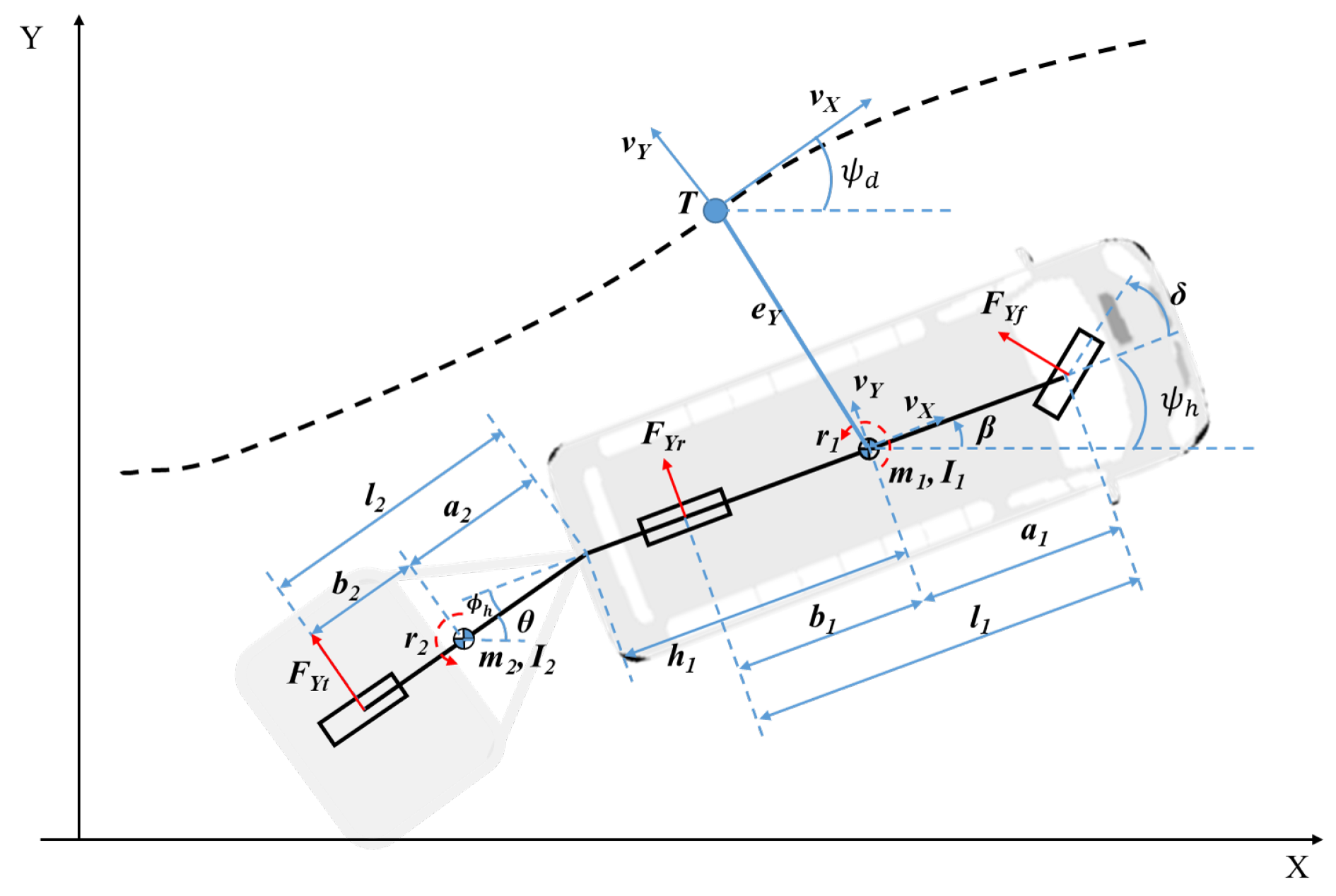
Figure 1 depicts the configuration of the autonomous bus–trailer system, where the black dashed line indicates the reference trajectory that the vehicle needs to track. The vehicle features a front-steering configuration and a symmetric structure about the longitudinal axis. With a small heading angle error, the path tracking kinematics describing the relationship between the desired path and the autonomous vehicle can be expressed as follows [
24]:
Lagrangian mechanics is a powerful tool to represent the motion of complex dynamics [
25]. Then, the lateral and yaw dynamics of bus–trailer systems can be described through Lagrangian formulation as follows [
23,
26]:
where
,
J and
U denote the total kinetic and potential energies, respectively, and
Q is the generalized force. With a small
and
, each term in (
2) can be computed as follows:
Then, the generalized force can be represented as follows:
where
The lateral tire forces in (
4) are the product of cornering stiffness and tire slip angle, which can be described as follows:
As mentioned in the introduction, the trailer’s motion should mimic the leading bus’s maneuvers to ensure the stability of the onboard batteries. Accordingly, the desired articulation angle (
) is derived such that the trailer’s center of gravity tracks the bus’s hinge point. Under the assumption of a small trailer sideslip angle, the desired articulation angle can be calculated as follows:
where the interval value
j is determined as
. A more detailed derivation can be found in our previous work [
23]. The generalized coordinates
can be transformed into the form of
using the following transformation:
Consider the state vector as
. In addition, active braking produces the external yaw moment of the trailer, which is denoted as
. We define the vectors of control input and disturbance as
and
. Based on (
1)–(
7), the autonomous bus–trailer systems can be described as a form of a MIMO state-space model:
where
In (
5), the cornering stiffnesses are assumed to be constant parameters. However, these stiffness values are highly dependent on the vertical loads of each tire, which are unavailable for direct measurement. Despite such unmeasurable vertical loads, the nonlinear tire stiffnesses are bounded within the interval
under normal driving conditions. These characteristics can be formulated as follows:
where
, and
are known parameters for tire uncertainties. Substituting (
9) into (
8) yields the following state-space model:
where
,
, and
.
On the other hand, the state-space model in (
10) can be treated as a linear time-invariant (LTI) system if the longitudinal velocity is constant. However, this paper formulates the system as a linear parameter-varying (LPV) model to explicitly account for varying longitudinal velocity. T-S fuzzy approach is a powerful tool to linearize the LPV model as a set of LTI subsystems. Consider the longitudinal velocity within the predefined range
. As described in [
27], the parameter-varying terms
and
can be represented as follows:
where
It should be noted that the premise variable
lies within the specific range
. Based on the state space model in (
10) with sector nonlinearity [
28], the T-S fuzzy model for autonomous bus–trailer systems can be described as follows:
where
is the fuzzy weighting function, and
.
As mentioned in the introduction, the primary objective of this paper is to minimize lateral offset along the pre-determined trajectory and track the desired articulation angle. Thus, the control output vector
can be defined as follows:
In addition, the proposed control scheme is designed to remain within a prescribed limit for driving safety, which can be defined as a constraint vector:
where
denote the maximum allowable values for output constraints. On the other hand, the lateral velocity in the state vector is inaccessible due to the numerous noises and aperiodic sampling rate. Accordingly, an appropriate filtering design is required to estimate the unmeasurable state variable. The measurement vector can be expressed as follows:
In practice, the use of digital computers for vehicle systems necessitates a discrete-time state-space model for the autonomous bus–trailer system. Based on the zero-order hold (ZOH) method with a sampling period
, the continuous-time T-S fuzzy model in (
12)–(
15) is discretized as follows:
where the matrices
represent the discrete-time counterparts of the continuous-time system matrices
, respectively. As a result, the following section will derive how to design the exponential dissipative fuzzy parallel distributed compensation (PDC) control gains.
3. Robust Fuzzy PDC Controller Design
A fuzzy parallel distributed compensation (PDC) control scheme is a well-established design method that offers high control performance in T-S fuzzy systems. The discrete-time T-S fuzzy PDC controller can be constructed as follows:
where
denote the fuzzy PDC control gains. Then, substituting the control law (
17) into the system (
16) yields the following closed-loop system:
Before presenting the design of the exponential dissipative fuzzy PDC gains, we first provide some preliminary definitions and lemmas.
Definition 1. Under the zero disturbance , the closed-loop system in (18) is said to be mean-square exponentially stable if there are some positive scalars and satisfying the following inequality:where is called the decay rate. Definition 2. Given weighting matrices , let the energy supply rate function be defined as . Under the zero initial condition, the closed-loop system in (18) is said to be exponentially dissipative if the following conditions hold (1) for zero disturbance , the closed-loop system is mean-square exponentially stable, and (2) for all nonzero :where α is the attenuation level, and υ denotes the decay rate. Without loss of generality, the matrix and . Lemma 1. Let X be a symmetric matrix. Given appropriate dimensional matrices Y and Z, and Σ satisfy , thenholds if and only ifwhere κ is a positive scalar. Now we will show that the closed-loop system in (
18) guarantees the exponential dissipativity and how to determine the fuzzy PDC control gains. First, Theorem 1 provides the sufficient condition that the system is said to be exponentially dissipative.
Theorem 1. For given scalars , , , , and ρ, weighting matrices , , and , and fuzzy PDC control gains , if there exists a positive definite matrix P such that satisfies the following LMI conditions:wherethen the closed-loop system in (18) is said to be exponential dissipative under the input and output constraints. Proof. Consider the following Lyapunov functional:
Let the forward difference of the Lyapunov functional be defined as
. Based on the closed-loop system in (
18), we can obtain the following equation:
If the right side of (
24) is less than zero, then we can get
Applying iterative approach to (
25) yields the following inequality:
To derive the mean-square exponential stability in Definition 1, applying the zero disturbance
to (
26) yields the following inequality:
The inequality in (
27) holds for all nonzero initial condition since the weighting matrix
is negative definite. Based on the Lyapunov functional in (
23), we can get
Since the matrix
P is positive definite, (
28) leads to the following inequality:
where
, and
denotes the maximum (minimum) eigenvalue of
. From Definition 1, the inequality in (
29) implies that the closed-loop system in (
18) is said to be mean-square exponentially stable if the right side of (
24) is less than zero. Next, we will show that the closed-loop system ensures the exponential dissipativity. Recall the inequality in (
26). Under the zero initial condition, we can get
Since
for all nonzero
, the inequality in (
30) leads to
Then, the conditions (1) and (2) in Definition 2 hold if the right side of (
26) is less than zero. As a result, the closed-loop system in (
18) is said to be exponentially dissipative.
Now, we will derive the sufficient condition that the right side of (
26) is negative. Let define the augmented vector as
. Then, the equation in (
24) can be rewritten as follows:
Through the Schur complement, the right side of (
32) becomes negative if and only if the following LMI condition holds:
It should be noted that
and
include the uncertain matrices corresponding to the tire stiffnesses. Thus, the inequality in (
33) can be rewritten as follows:
Based on Lemma 1 with a positive scalar
, the inequality in (
34) holds if and only if the following inequality holds:
Through the Schur complement, (35) holds if and only if the LMI conditions in (19) and (20) hold. Finally, we will derive the LMI conditions for ensuring the input and output constraints. As referring to [
23], we define
. Then, consider the input constraint as
The input constraint is guaranteed if the following condition hold:
Based on Schur complement, (37) is equivalent to (21). Similarly, the condition for output constraint can be derived as follows:
Then, the inequality in (38) is equivalent to LMI condition in (22). This proof is completed. □
For given fuzzy PDC control gains, Theorem 1 provides the sufficient conditions that the closed-loop system in (18) guarantees the exponential dissipativity under the hard constraints. However, the conditions in (
19) and (20) are not LMIs to obtain the fuzzy PDC control gains. Thus, the following theorem presents LMI conditions for deriving control gains through appropriate transformation.
Theorem 2. For given scalars , , , , , and ρ, and weighting matrices , , and , if there exists some matrices , , and such that satisfies the following LMI conditions:wherethen the closed-loop system in (18) is said to be exponential dissipative under the input and output constraints. In this case, the fuzzy PDC control gains can be computed as , where and . Proof. Let
and
be defined as
and
, respectively. Then, we will convert the conditions in (19)–(22) to LMIs. For these purpose, the linear transforms can be defined as follows:
Then, pre- and post-multiplying into (19) and (20) yield the LMI conditions (39) and (40), respectively. In addition, the inequality in (21) can be transformed as (41) and (42) through pre- and post-multiplying . Similarly, the LMI condition in (43) can be obtained through condition in (22). □
4. Robust Fuzzy Filter Design
In general, the fuzzy PDC control scheme in (
17) requires full access to state variables to produce the control input signals. However, the lateral velocity (
) in autonomous bus–trailer systems is challenging to measure simultaneously and contains excessive noise. Therefore, this paper proposes exponentially dissipative fuzzy filtering to estimate unmeasurable state variables. Let the estimated state vector be defined as
. Based on the T-S fuzzy model in (
16), the filtering equation can be constructed as follows:
where
are the filtering gains to be designed. Based on the duality theorem, the control law for autonomous bus–trailer systems can be designed as
. The main objective of the proposed filtering is that the estimation error ensures the exponential dissipativity against external disturbance. Consider the error vector as
. Through (
16) and (
45), the error dynamics can be derived as follows:
where
,
,
H is an identity matrix, and
. Based on Definitions 1 and 2, the required definitions will be listed as follows:
Definition 3 ([
29])
. Under the zero disturbance , the error system in (46) is said to be mean-square exponentially stable if there are some positive scalars and satisfying the following inequality hold: where υ is the decay rate. Definition 4. Given weighting matrices , let the energy supply rate function be defined as . Under the zero initial condition, the error system in (46) is said to be exponentially dissipative if the following conditions hold (1) for zero disturbance , the error system is mean-square exponentially stable, and (2) for all nonzero :where is the attenuation level, and υ denotes the decay rate. Without loss of generality, the matrix and . Now, we will show the existence condition that the error dynamics in (
46) is exponentially dissipative, and how to determine the filtering gains
.
Theorem 3. For given scalars , , weighting matrices , and fuzzy observer gains , if there exists a positive definite matrix satisfying the following inequality:then the error system in (46) is said to be exponentially dissipative. Proof. The Lyapunov functional is chosen as follows:
Based on the error system in (
46), we can have
Similar to the proof of Theorem 1, the error system in (
46) is said to be exponentially dissipative if the right side of (
49) is less than zero. Assume that there exist no disturbance
. From the equation in (
49), we can get
where
. Through Definition 3, the error system in (
46) is said to be mean-square exponentially stable. On the other hand, applying iterative method into (
49) under the zero initial condition
yields the following inequality:
Based on Theorem 4, the inequalities in (
50) and (
51) shows that the error dynamics in (
46) guarantees the exponential dissipativity. Then, we derive the sufficient conditions to offer the feasibility of the proposed filter design. Through the Schur complement, the condition in (
47) implies that the right side of (
49) is less than zero. This completes the proof. □
For given fuzzy filter gains, Theorem 3 describes that the error system in (
46) is said to be exponentially dissipative. Similar to Theorem 2, slight modification is required to obtain the proposed fuzzy filter gains. The following theorem provides the LMI condition for fuzzy filter design.
Theorem 4. For given scalars , , and weighting matrices , if there exist a positive definite matrix and appropriate dimensional matrices satisfying the following inequality:then the error system in (46) is said to be exponentially dissipative. In this case, the proposed fuzzy filter gains can be computed as . Proof. Similar to proof of Theorem 2, we define
. Then, the condition in (
47) becomes LMI as (
52). This completes the proof. □
5. Simulation Results
To demonstrate the effectiveness and feasibility of the proposed control and estimation scheme, numerical simulations were conducted using a Simulink/dSPACE environment. To replicate realistic driving conditions, white Gaussian noise was injected into the sensor measurement channels. The noise characteristics were set with zero mean and standard deviations of for the yaw rate (), for the articulation angle (), and for the articulation rate (). These values correspond to noise intensities of approximately 3%, 0.1%, and 2% relative to the maximum magnitudes of the respective sensor inputs observed in the simulation.
5.1. Simulation Setup
The simulation utilized a nonlinear dynamic model of the autonomous bus–trailer system. The vehicle parameters were selected based on the specifications of a heavy-duty electric bus and a cargo trailer, as listed in
Table 1. To account for real-world uncertainties such as road surface variations and tire wear, the tire cornering stiffnesses (
) were assumed to vary within
of their nominal values.
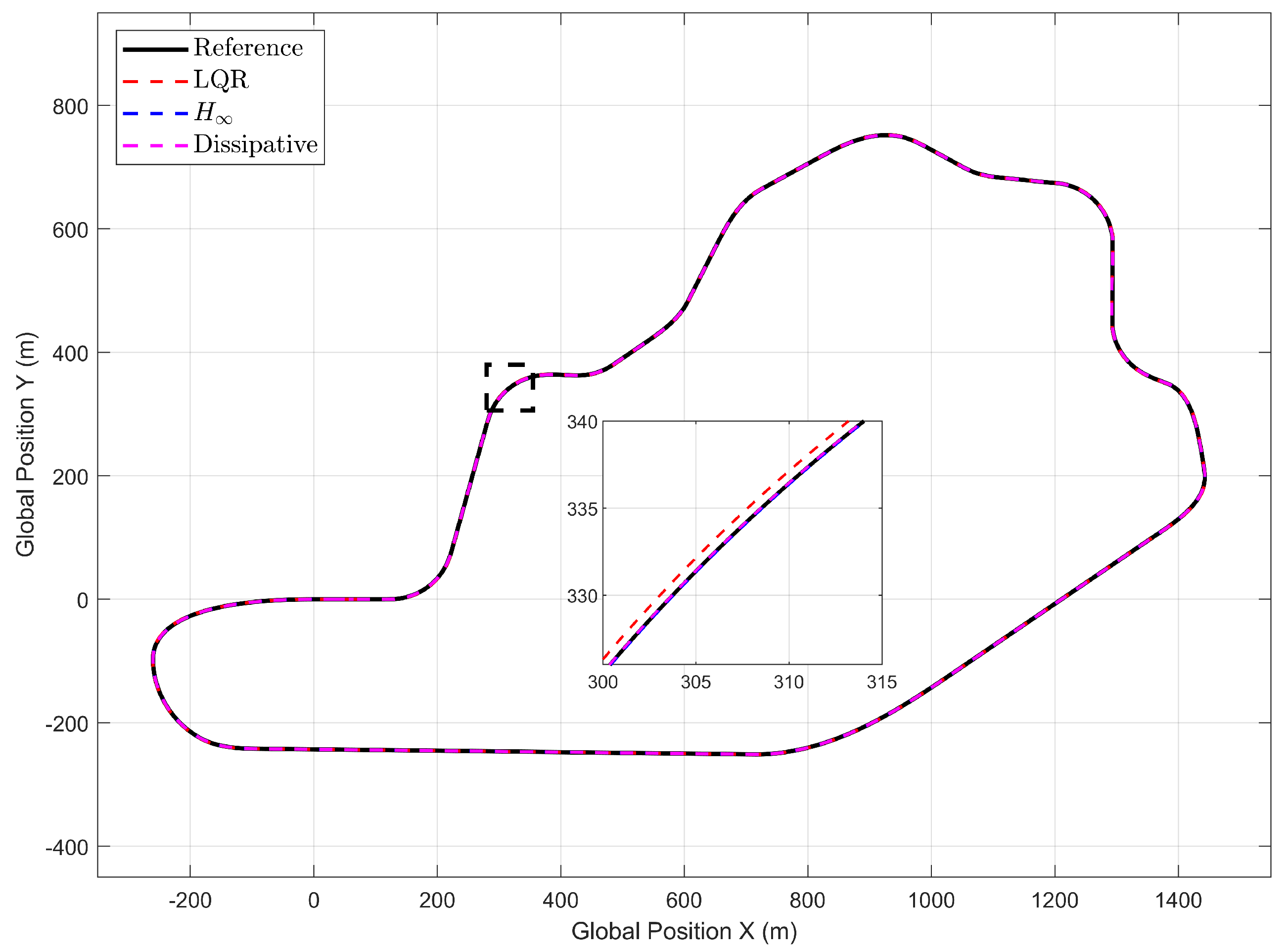
The reference trajectory, shown in
Figure 2, was designed with a combination of straight lanes and sharp curves to rigorously test the lateral dynamic stability of the vehicle under severe maneuvering conditions. It should be noted that, due to the extensive length of the full trajectory, the simulation results presented in the subsequent figures focus on a specific segment that highlights the most critical dynamic behaviors.
5.2. Controller Performance Comparison (Constant Speed)
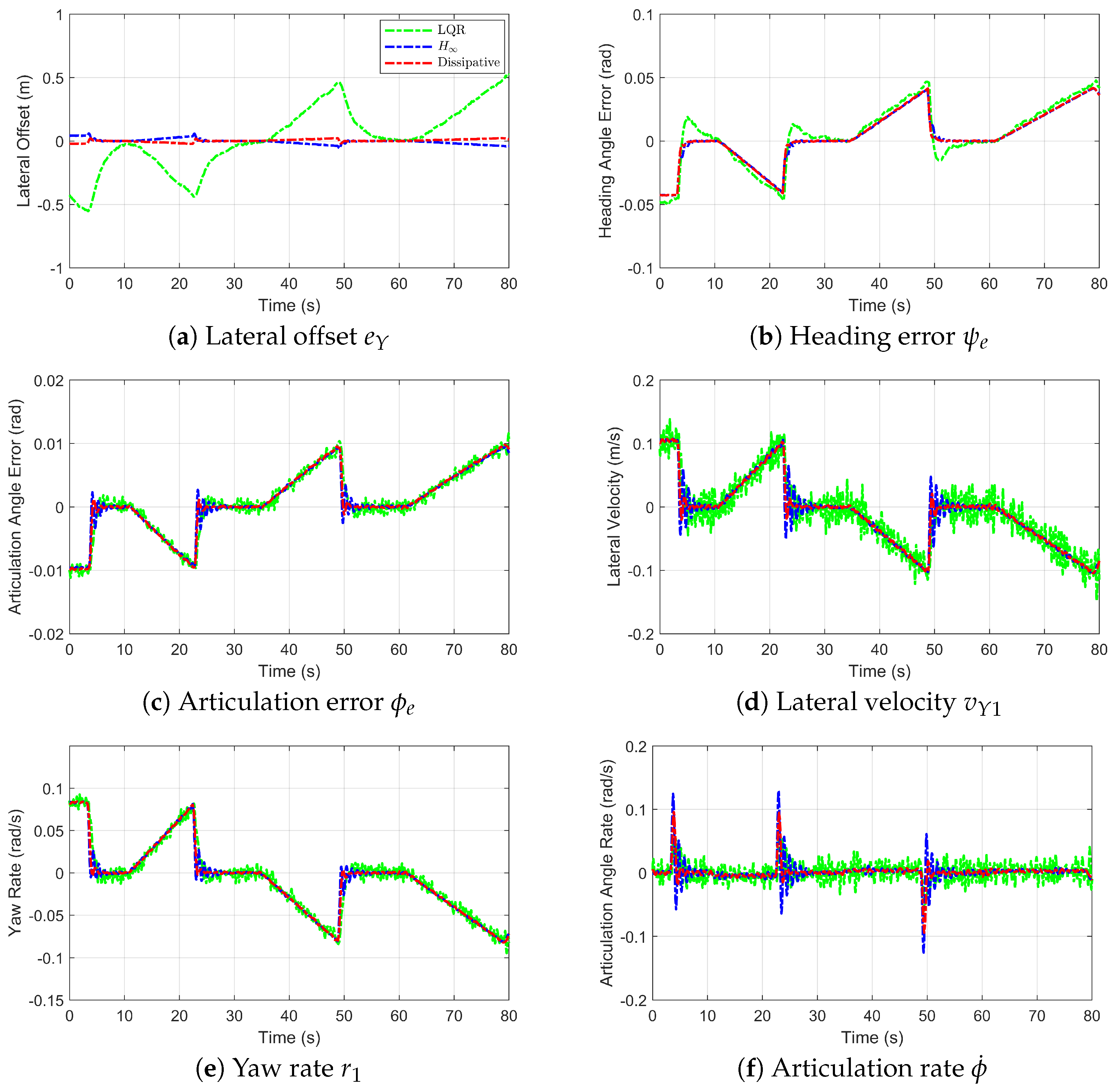
In the first scenario, the performance of the proposed dissipative controller was compared with a standard LQR controller and an
controller under a constant longitudinal velocity of
km/h (
Figure 3). The quantitative performance metrics, including RMS values, maximum absolute errors, and control input energy, are summarized in
Table 2 and
Table 3.
The simulation results reveal distinct performance characteristics among the tested control schemes. The LQR controller exhibited unstable behavior with a significant risk of lane departure (maximum lateral offset of 0.5531 m), primarily because it failed to account for actuator saturation during sharp maneuvers. While the controller demonstrated excellent tracking performance, it suffered from critical energy inefficiency—consuming approximately 9 times more braking energy than the proposed method—due to its overly sensitive reaction to minor disturbances. In contrast, the proposed dissipative control scheme demonstrated significant improvements by strictly enforcing input and output constraints via LMI conditions. It achieved the lowest lateral error and comparable trailer stability while drastically reducing energy consumption and steering jerk, thereby effectively balancing safety, efficiency, and passenger comfort.
5.3. Robustness Verification (Varying Speed)
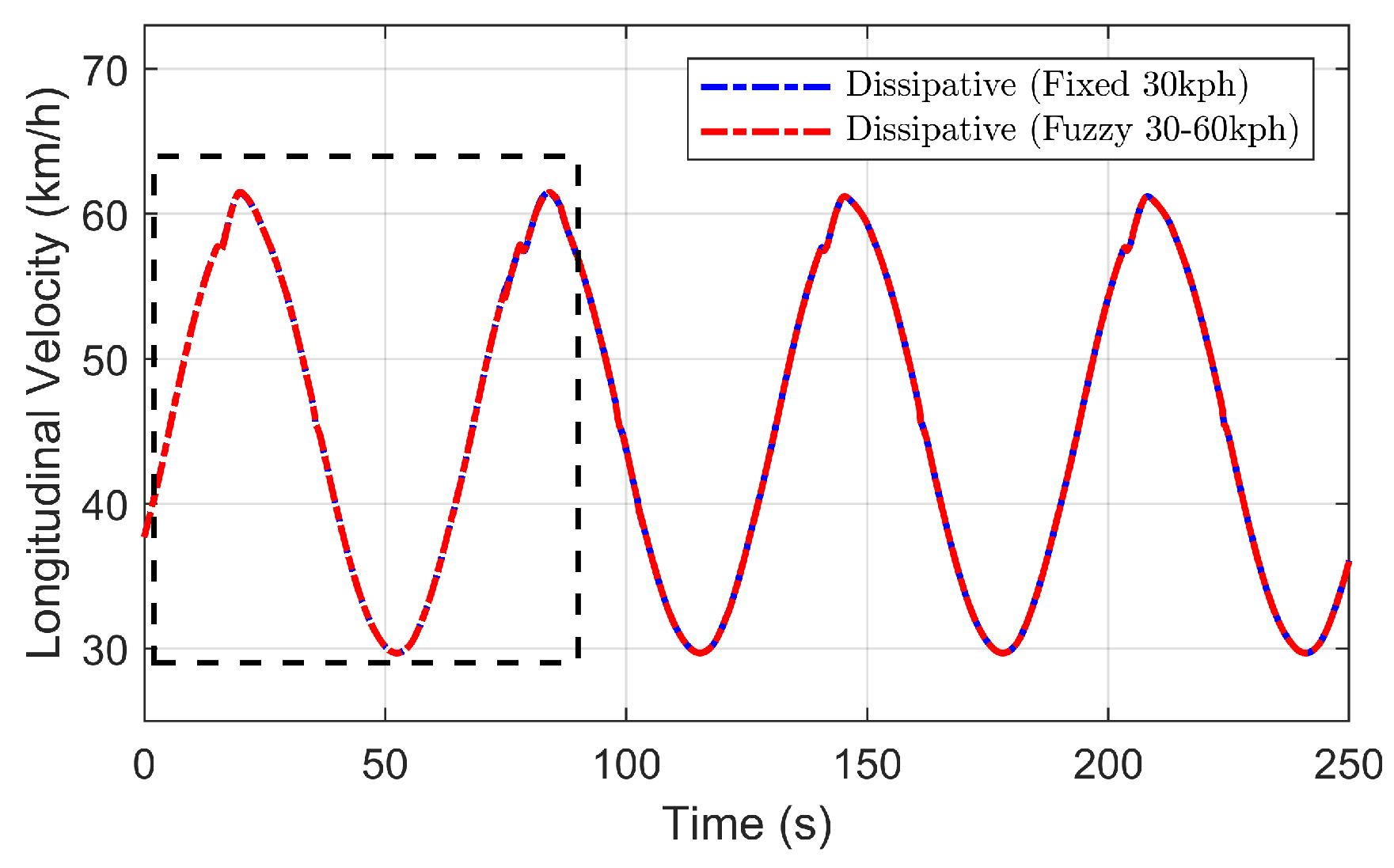
To verify robustness against parameter variations induced by speed changes, a second scenario was conducted where the longitudinal velocity varied sinusoidally between 30 km/h and 60 km/h, as shown in
Figure 4.
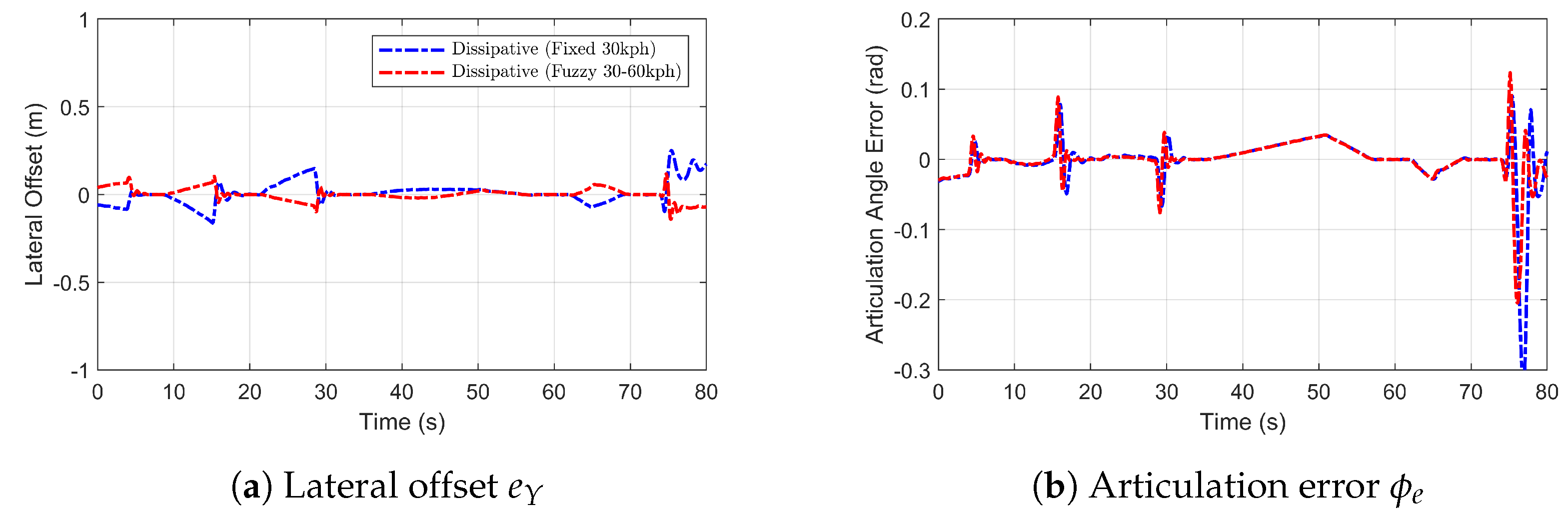
The performance of a fixed-gain dissipative controller (tuned for 30 km/h) was compared with the proposed fuzzy dissipative controller. The quantitative results, summarized in terms of Root Mean Square (RMS) values for six state variables, are presented in
Table 4.
The simulation results clearly demonstrate the limitations of the fixed-gain approach. Since the fixed-gain controller is synthesized based on a Linear Time-Invariant (LTI) model at the nominal speed of 30 km/h, it lacks the adaptability to cope with the significant variations in lateral dynamics that occur as the speed increases. As the velocity reached 60 km/h, the mismatch between the nominal model and the actual high-speed dynamics widened, causing the controller to fail in effectively compensating for the system parameter variations.
Consequently, as indicated in
Table 4, this limitation led to higher RMS values across key tracking metrics. Specifically, the fixed-gain controller exhibited a degraded stability margin, resulting in larger lateral offsets and articulation errors compared to the proposed method.
In contrast, the proposed fuzzy controller demonstrated superior robustness. By utilizing the longitudinal velocity
as a premise variable to interpolate between local linear models, the proposed method significantly reduced the RMS of the lateral offset by approximately 45% (
m) and the articulation error by 27% (
rad). Although the RMS value of the articulation rate (
) slightly increased (0.0844 rad/s), this reflects the controller’s active intervention to suppress instability.
Figure 5 visually confirms these improvements, showing a significant reduction in error peaks compared to the fixed-gain approach.
5.4. Observer Performance Verification
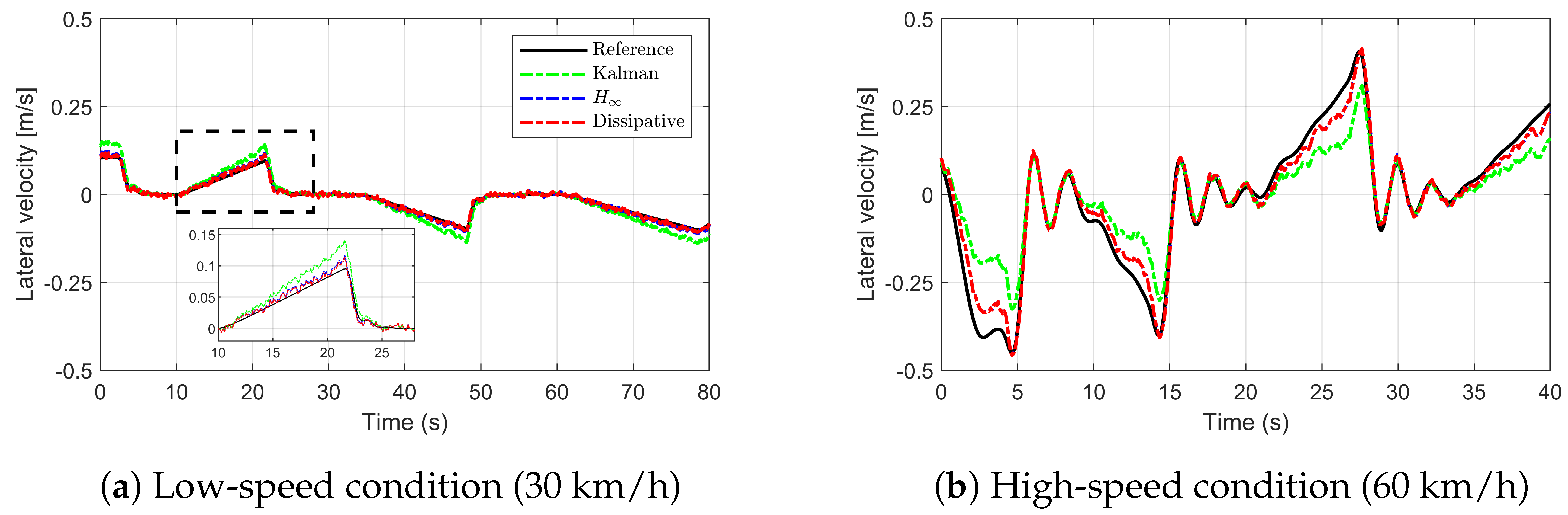
Finally, the performance of the proposed robust fuzzy filter in estimating the unmeasurable lateral velocity (
) was evaluated against a conventional Kalman filter and an
observer. The estimation results under low-speed (30 km/h) and high-speed (60 km/h) conditions are illustrated in
Figure 6.
Table 5 summarizes the quantitative estimation errors, highlighting the robustness of the proposed method compared to existing approaches.
As shown in
Table 5 and
Figure 6, the proposed dissipative observer consistently yielded the lowest estimation errors across all speed ranges. Specifically, under the high-speed condition (60 km/h), the Kalman filter’s performance degraded significantly (Max Error 0.2145 m/s) due to increased tire nonlinearity and model uncertainties, which violate the linear Gaussian assumption. In contrast, the proposed observer maintained a robust estimation performance (Max Error 0.0979 m/s), comparable to or better than the
observer. This robustness is achieved by the
-gain attenuation condition, which treats modeling errors as external disturbances to be rejected, thereby ensuring precise state estimation essential for the overall closed-loop stability.