Review

The Applications and Trends of Artificial Intelligence in Human Movement Assessment

1
Sports Engineering Laboratory, Department of Industrial Engineering, University of Rome “Tor Vergata”, 00133 Rome, Italy
2
Department of Human Science and Promotion of Quality of Life, San Raffaele Open University, 00166 Rome, Italy
3
Department of Systems Medicine, University of Rome “Tor Vergata”, 00133 Rome, Italy
4
Department of Experimental Medicine, University of Rome “Tor Vergata”, 00133 Rome, Italy
5
Human Performance Laboratory, Centre of Space Bio-Medicine, Department of Systems Medicine, University of Rome “Tor Vergata”, 00133 Rome, Italy
*
Authors to whom correspondence should be addressed.
Appl. Sci. 2026, 16(5), 2202; https://doi.org/10.3390/app16052202
Submission received: 20 January 2026 / Revised: 17 February 2026 / Accepted: 21 February 2026 / Published: 25 February 2026

Abstract

Artificial intelligence (AI) is a scientific and engineering discipline that involves designing systems capable of autonomously replicating the cognitive functions typically associated with human intelligence. Current AI uses data to extract patterns, supports decision-making, and enhances analytical reasoning across diverse domains, including sports performance or strategic claims, and assists in clinical applications. In sports, AI enables robotic systems to assist in training, object tracking, performance monitoring, strategy development, and talent identification. In medicine and rehabilitation, AI facilitates robotic surgery, rehabilitation training, and decision-support systems. Machine learning and deep learning techniques, combined with computer vision, enable estimation of human posture and movement in 2D or 3D from video recordings, providing objective, quantitative, and markerless movement analysis. For instance, human pose estimation systems, including open-source and framework tools, have been applied for multi-athlete and individual tracking, performance assessment, and injury prevention. Additionally, AI-powered systems and generative AI for data simulation enhance strategy planning and training efficiency. This review provides a comprehensive overview of AI applications in human movement assessment, highlighting methodological approaches, practical implementations, and emerging technologies. Understanding the capabilities and limitations of these systems helps optimize human movement assessment and support data-driven decisions.

1. Introduction

Artificial intelligence (AI) represents a scientific and engineering discipline dedicated to designing systems capable of autonomously reproducing the cognitive functions typical of human intelligence. AI was first described by John McCarthy in 1956 [1], although its roots can be traced back to Alan Turing’s 1950 work, which proposed the Turing test to distinguish humans from machines, involving posing a question to a human and a machine. Another human member reads the anonymous answers to recognize the responses. This is the Turing idea: Can Machines Think? [2]. A decisive contribution to the initial development of AI came from the war industry, where the need to automate complex processes and optimize the processing of strategic information led to the application of Turing’s principles to codebreaking during World War II [3]. In this historical context, early AI research followed two complementary paradigms. The biological paradigm aimed to imitate aspects of human psychology and physiology, while the computational paradigm emphasized problem-solving through algorithmic and formal logical models [4]. The integration of these paradigms established the theoretical foundations of contemporary AI methodologies, enabling the development of models (algorithms with learned parameters), approaches (applications of one or more models), and systems (pipelines integrating data, models, and processing stages) to address complex, multidisciplinary challenges [5].
Notably, contemporary AI leverages data to extract patterns, support decision-making, and enhance analytical reasoning across diverse domains. In clinical applications, AI systems enable evidence-based decision-making through the algorithmic analysis of datasets [6] and function as cognitive enhancement tools that complement human expertise [7]. Current AI systems apply these methodologies to support applications in various fields. In medicine, rehabilitation, and physical therapy, AI facilitates robotic surgery [8,9,10,11,12], trains motor function in real-time and offline [13,14,15], and supports clinical decision-making [16,17,18]. In sports, AI enables robotic systems to assist in serving balls, provide sports training, substitute humans during training, physically participate in competitions, serve as models of real sports performance, and help organizers of sports events [19,20]. In addition, AI covers game analytics, talent scouting and acquisition, training methodologies, coaching techniques, fan engagement, and business marketing strategies [21,22,23]. Collectively, these technologies have transformed traditional approaches, improving athlete and team performance, supporting data-driven decision-making, and generating strategic insights. Furthermore, AI-powered marketing initiatives facilitate personalized fan interactions and innovative promotional strategies, redefining audience engagement in professional sports [24]. Undoubtedly, a precise understanding of AI capabilities and a clear definition of its methods are essential to optimize its application in sports and other domains, facilitating the appropriate techniques, ensuring accurate data interpretation, and supporting informed, data-driven decisions [25,26].
In summary, this review utilized this evidence to explore the integration of AI. By analyzing these definitions, the paper provided a structured taxonomy of AI methods in sports performance and monitoring, or sports analytics and marketing, and clinical movement examining assessment and assistive clinical tools, assessing their technical assumptions and data requirements, and categorizing them by AI fields and limitations, rather than by complexity. This approach highlights the relevance and advantages of each study, introducing frameworks that categorize AI fields and clarify how these fields interact and integrate into human movement assessment. This facilitates understanding of conceptual links and offers a clear basis for selecting suitable methods in sports and clinical settings.

2. Methods

2.1. Inclusion and Exclusion Criteria

The article’s selection process framework focused on study design, comparison, outcomes, AI’s intervention in sports and healthy physical strategies, performance, medical analysis, and tracking of humans (athletes or patients) or objects. These papers focused on individual or team technical and tactical performance, analyzing matches, training sessions, or laboratory environments.

2.2. Search Strategy and Bibliographic Analysis of AI in Sports

The Scopus, ScienceDirect, and IEEE Xplore online databases were searched using predefined Boolean combinations of search terms: (“artificial intelligence” OR “machine learning” OR “deep learning” OR “pose estimation” OR “computer vision” OR “natural language processing” OR “generative AI”) AND (“sports” OR “sport”), combined with additional terms related to statistical analysis, sports equipment design, rehabilitation, care monitoring, business, and marketing strategies. Searches were applied to the title, abstract, and keyword fields and were limited to English, peer-reviewed, final publications published from 2015 to 2025.
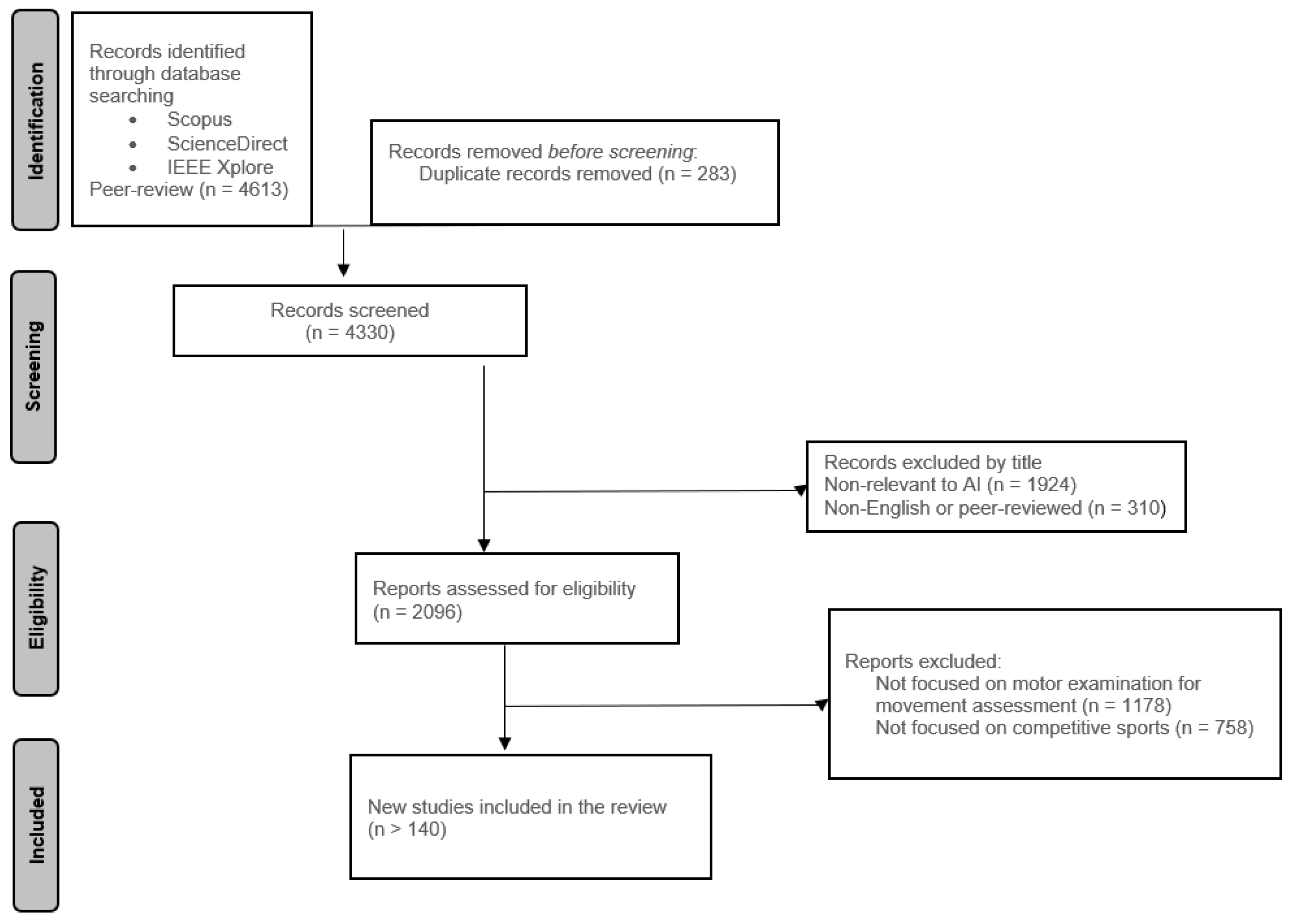
The initial search identified 4613 articles across the fields of computer science, engineering, medicine, and mathematics. During the inclusion process, studies were retained if they focused on competitive sports or motor examination in clinical movement assessment contexts. Articles addressing at least one AI-based motion analysis, technique evaluation, performance monitoring, or strategic assessment. The studies examining physical activities unrelated to competitive sports were excluded. Following the application of these criteria, over 140 studies were retained in the final analysis as shown in the PRISMA diagram (Figure 1).

3. AI Fields’ Applications in Human Movement Assessment

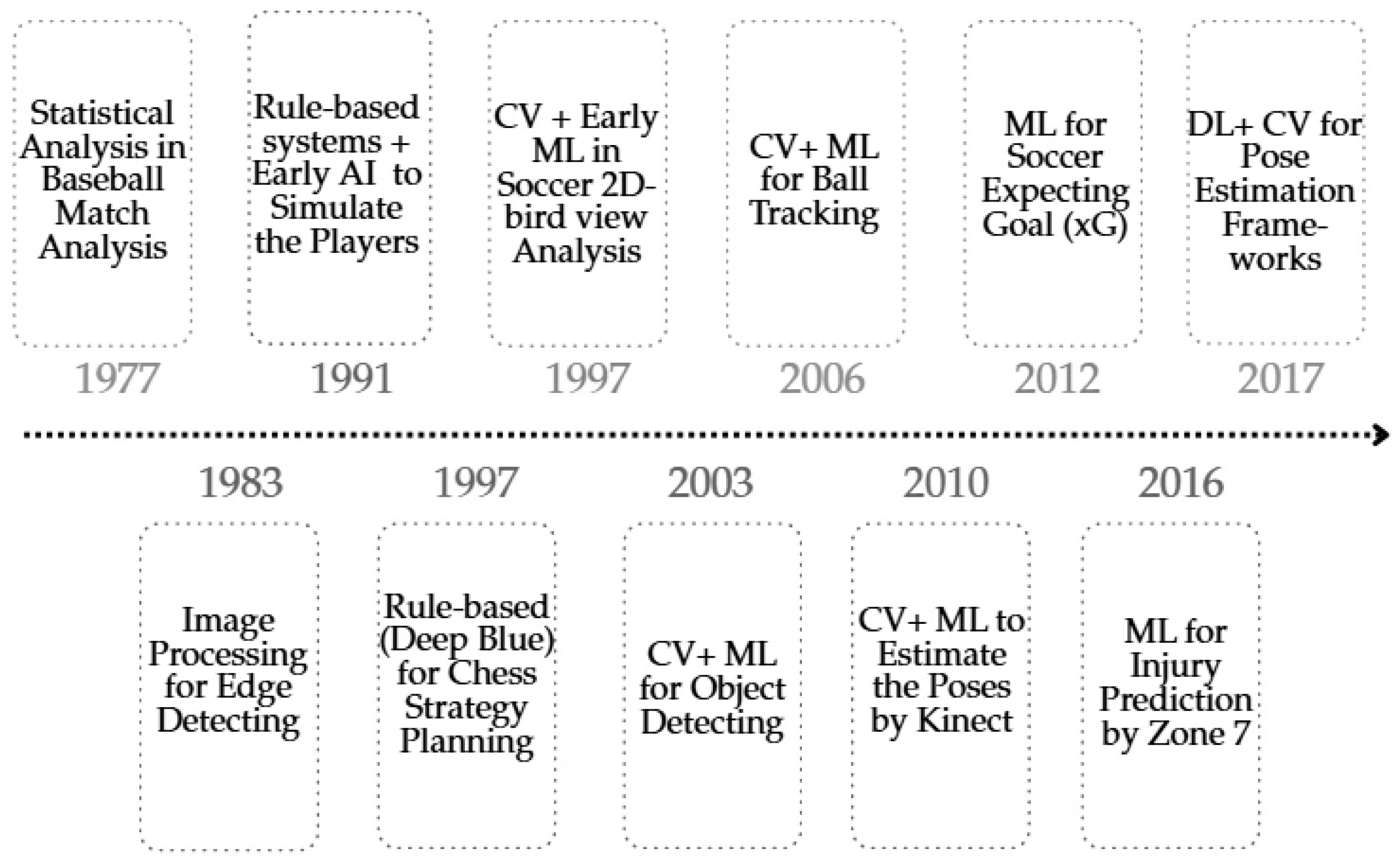
The primary objective of initial smart computational methodologies and models is to develop hardware and software capable of executing match analysis, posture and movement assessment, statistical analysis, and strategy planning, and the timeline of the employed AI disciplines is illustrated in Figure 2 [27,28,29,30,31,32,33,34,35,36,37,38]. A description of AI fields and their current emerging technologies is provided in the subsequent subsections.

3.1. Rule-Based System

Rule-based systems are early expert systems that were programmed based on deterministic if–then rules. Although it has limited flexibility to adapt to new situations, it is helpful in studies with clearly defined rules [39]. Performance analysis is a sub-discipline of sports science that combines biomechanics and notational analysis to analyze and improve performance scaling [40]. These systems were installed in applications or implanted in wearable devices to alert players under specific conditions. For example, a belt attached to an Xsens inertial measurement unit (IMU) on a tennis player’s chest to measure torso rotation during serving is based on a rule-based system. Exceeding the trunk’s angle in the longitudinal axis was presumed to be going too far forward in the serve, and a sound in the app warned the player that their position was not optimal [41]. The most common innovative, rule-based expert systems in sports performance or clinical human assessment include wearable strain gauges and pressure sensors (implemented in gloves or insoles), measurement units, localization systems, and sensor fusions [42].

3.2. Machine Learning

System adaptation with more data inserted increases the machine’s complexity to present an upgraded AI version, known as Machine Learning (ML), which is a popular field in sports monitoring applications. ML is an AI class in which a model learns its parameters from data to perform a specific task, such as classification or prediction, without being explicitly programmed [43]. Caprioli et al. [44] trained a system using over 1400 soundtracks to recognize racket impacts and rebounds during tennis practice. ML-based systems can assist the coaching staff as a trustworthy, cognitive, and environment-free system. Aaron et al. [45] studied the advantages of data-driven modeling in an assistive role in Australian football, addressing some barriers and providing insights to support staff and players in using the rule-based and ML models. In soccer, coaches can utilize ML models to predict opponents’ defensive and attacking conditions or receive suggestions to systematize their approach based on the opponent. For example, the styles of corner kicks in a professional soccer league can help in understanding teams’ behavior in defensive and attacking situations [46].
Within the AI hierarchy, ML represents the core data-driven methodology upon which more advanced approaches, such as DL, are built. Data-driven modeling, computer-based learning, and predictive modeling operate within simulated digital environments called virtual AI, performing tasks and interacting with users, most notably as virtual assistants and agents. ML represents a class of data-driven models that learn parameters from data and can update their predictions as new data becomes available, thereby enabling performance improvement over time [47]. This virtual AI system can discover previously unknown associations, generate hypotheses, and guide researchers and resources toward more constructive directions [48]. In sports, predictive models track players and calculate metrics such as the effectiveness of each pass, the risk-to-potential-reward ratio associated with a pass, and the ‘pressure’ applied by the opposing team before the pass [49]. This information can be beneficial for coaches in selecting the proper tactics and strategies for each match and player, thereby improving overall team performance [50]. Exploiting the capabilities of data-driven modeling in extracting detailed performance metrics, sports analysis has progressively integrated video-based methods to evaluate both technical and tactical aspects [51,52]. This data-driven approach has enabled the optimization of training plans and the quantification of parameters such as players’ speed, acceleration, and performance profiles in successful versus less successful game situations [53]. In this context, video analysis and motion capture systems (MoCap) represent a natural development of AI-based performance monitoring, providing kinematic information to enhance performance and prevent injuries. In particular, sports analysts have extensively used sports video analysis to extract relevant data and perform comparative analyses of individual and team performance [42]. Conventional techniques rely on vision-based tools that use image or video data and manually annotate points of interest [54]. However, although this computer-based learning approach is inexpensive, simple to use in lab and real-world settings, and minimally invasive, it requires manual annotation, which makes the process time-consuming and prone to human error. On the other hand, although MoCaps are considered the gold standard, they are limited by the need for controlled settings and marker placement. In fact, the use of marker-based systems is limited to recording monotonous, non-representative tasks carried out in constrained, small settings, such as laboratories. The requirement to wear markers may also alter a person’s natural movement patterns, and marker placement may vary across tests and testers. Further measurement error can be introduced by soft-tissue artifacts and by the fact that marker placements frequently do not precisely match the true anatomical joint centers they represent [55].
An ML model used in sports statistics is from raw data collected by various devices. GPS-derived external load data serve as input to train ML models that predict players’ exertion under external load to measure training workload [56,57,58]. In a separate study, ML algorithms based on linear regression, linear discrimination analysis, Support Vector Machines (SVM), decision tree, random forest, K-nearest neighbors (k-NN), and Gaussian Naïve Bayes were trained on structured numerical features [59].
In match analysis, modern methods offer validated parameters to the public that can provide more comprehensive feedback (although not entirely sufficient) on the match, such as expected goals (xG), primarily in soccer and ice hockey [60,61,62,63,64]. This data-driven classifier for shot analysis in ball sports is a widely adopted analytical approach. The unsupervised ML algorithms use clustering to identify shot patterns, enabling teams to recognize trends, evaluate shot quality, and make informed strategic decisions [65,66]. Related factors in goal scoring in tournaments were analyzed, and space and distance were found to be significant [67]. Now, intelligent approaches and systems play a key role in the analysis process, including comparing each shot to match several procedures and recognizing similar patterns in xG by collecting detailed data from soccer matches. However, there are different attitudes to calculating xG, depending on each coaching staff’s policy. The procedures collected data from standard parameters, including shot distance and angle, the positioning of the opponent’s defenders and goalkeeper, teammates’ positioning, ball height, the body part used to hit the ball, and shot techniques (for example, head or volley in soccer) [68]. These models utilize algorithms such as logistic regression or neural networks and are trained on this data to predict dynamics [69]. Additionally, xG data aids in analyzing team performance and individual players, creating a talent identification profile for each, and monitoring players under various environmental and psychological conditions during offensive phases [70,71]. Subsequently, the same algorithms used to evaluate expected saves (xS) were employed to assess goalkeepers’ save performance [72]. Table 1 provides a brief overview of the described studies in this subsection.

3.3. Deep Learning

Deep Learning (DL) is an ML subset that uses multi-layer neural networks to extract features from datasets automatically [73]. Unlike traditional ML methods that rely on manually engineered features, DL learns hierarchical feature representations directly from raw data. Supervised convolutional neural network (CNN)- based human pose estimation (HPE) models are trained on large-scale, manually labeled keypoint data. Once developed, the trained models perform inference without human annotation [74,75]. This layered CNN modeling approach enables frame-wise 2D joint localization and kinematic variable extraction by analyzing high-resolution competition footage, breaking down HPE into dimensions, collecting action data, and combining algorithmic analysis with scientific research to evaluate performance. HPE networks, trained on diverse images, and open-source software can expand human data datasets by enabling data collection in different locations with minimal time and resources [76,77,78,79]. Additionally, it is possible to compare athletes’ movements in the same sport to identify gaps and issues relative to those of high-performance athletes [80]. Doing so will enable athletes to quickly provide feedback and understand the training material more intuitively, thereby reducing injuries caused by incorrect activities. In this DL-based layered neural network modeling context, models are trained on datasets annotated with joint key point classes and positions, enabling posture and movement classifications [81]. Most HPE tasks are based on supervised learning, in which image data is manually labeled to train CNNs, and the trained network is then used to process user-input images or videos. In this system, inevitable minor errors arise from inherent noise in the training data [82].
The human body model, a key element for posture representation, can be skeleton-, contour-, or volume-based and can describe kinematic properties, body shape, and joint positioning. However, each method is used by specific solutions in action recognition, image classification, object detection, segmentation, and determining which method is more advantageous requires accounting for each system’s limitations [83,84]. YOLO (You Only Look Once) is a DL–based object detection model that operates in real time, detecting multiple objects in a single pass through the network, offering high speed and accuracy [85]. It divides the input image into a grid and, for each grid cell, predicts bounding boxes, object class probabilities, and confidence scores simultaneously [86]. This object detection tool is used in canoeing as a competitive sport and in tennis to detect and track the paddle or racket, guiding coaches to perform performance analyses based on their trajectories [87,88].
Yang et al. [89] proposed an advanced layered modeling approach in the basketball video analysis. First, group and global motion features are extracted to express semantic events. Then, the basketball game video is divided into three stages, and a strategy for classifying basketball events is suggested that incorporates global group motion patterns and domain knowledge. Yoon et al. [90] presented a new system that uses a CNN to automatically recognize basketball players and their interactions with other players on the floor, such as passes and interceptions, from basketball game video clips under unfavorable lighting conditions with a constantly shifting camera viewpoint. Similarly, Newman et al. [91] used the layered models to automatically determine the locations of American football players on the field. Regarding the illustrated studies, a summary of their approach and DL tool modeling is presented in Table 2.

3.4. Computer Vision

The early image extraction depended on image processing techniques [92]. Image processing manipulates or enhances images at the pixel level by adjusting, filtering, and transforming visual information [93]. In sports, image processing creates binary images, Gaussian-filtered images, and spatial feature maps for kinematic analysis, motion recognition, object recognition, and tracking [94,95]. For example, image processing technology was used to track soccer motions with a single camera to improve efficiency in virtual sports [96]. These methods help technicians extract information relevant to their goals without providing feedback, learning from data, or making informed decisions.
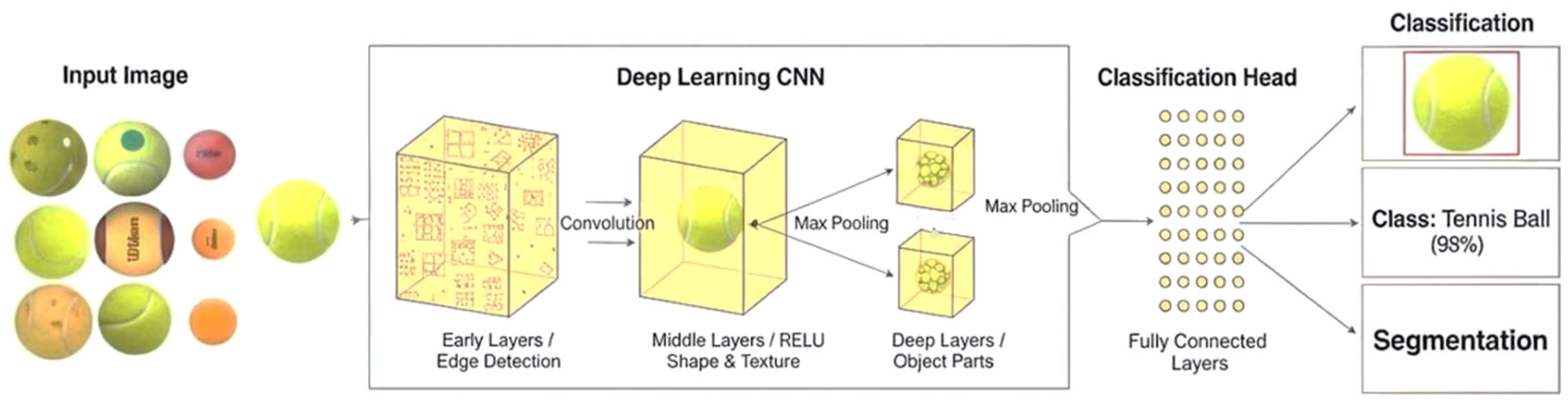
On the other hand, with advances in computational tools beyond traditional image processing, Computer Vision (CV) has emerged as a broader field encompassing these techniques. CV focuses specifically on enabling machines to interpret and understand visual information, often integrating ML and DL models for higher-level inference. CV algorithms perform object detection, tracking, and pose estimation from visual inputs and learning from previous data [97]. Moreover, data-driven learning advances CV using analytics and ML or DL [98]. For instance, contact-free, camera-based multi-athlete detection and tracking are now possible mainly due to ML innovations in CV, especially advances in artificial CNNs used for image or video analysis [99]. Figure 3 shows a diagram of a computer vision AI workflow, which, in this example, involves a visual dataset of racket sport ball detection with different colors and shapes. It learns patterns directly from images through data-driven learning and extracts hierarchical features across multiple image layers. Early layers identify edges, colors, and shapes, while middle layers detect dimples, smoothness, holes, and formation. Deep layers, on the other hand, recognize overall patterns of object types. These features enable CV tasks such as object detection, segmentation, and classification.
HPE is a CV task that uses DL models to determine the positions of various body parts and key landmarks in a 2D or 3D space from camera-acquired visual data [100]. The methodology has evolved from the earliest simple convolutional neural networks to modern, complex CNNs capable of learning and generalizing complex features such as lines, edges, and silhouettes to new data [101]. Additionally, most HPE frameworks are trained to analyze specific parameters, such as musculoskeletal disorders related to human organs, in both real-time and offline settings, providing efficient solutions for applications such as fitness tracking, gesture recognition, and augmented reality. This enables HPE systems to function as CV–based analytical tools [102,103]. Thus, many studies have used ML and CV tools, advanced by data-driven learning, to improve tracking and kinematic analysis in sports science, enabling joint monitoring and developing training programs [104,105]. For example, joint angular measurements are a method several studies rely on to validate these variables via HPEs. The knee flexion and extension angles were measured during Hurling, and the data were compared with those of IMUs attached to the players. The results show that measuring these variables can support monitoring players’ physical behavior and performance [106]. In studies on skiing, ML models were proposed to analyze poses in sports videos and classify them as “sufficient” or “insufficient” to provide feedback to Ski Athletes [107,108]. The system begins with trajectory extraction, in which a human detector identifies all humans at the start of a sports video and assigns a frame to each person throughout tracking, and automates this entire process by detecting key points of the athlete, as well as ski trips and trails. In this case, the athlete will be alerted, and a visual example of a sufficient position will be shown. They defined three types of bad skiing poses: bending the hips, crossing the snowboards, and bending the knees. In ski jumping, the success of a jump depends heavily on the athlete’s posture. Usually, coaches analyze recorded jumps by manually selecting frames, noting pertinent key points, and then computing flight characteristics using these hand-annotated key points.
Moreover, studies have used DL and CV tools to analyze players’ behavioral patterns, biomechanics, and sports analytics, with a focus on skeleton analysis through HPE and body orientation analysis. Pinheiro et al. [109] analyzed soccer penalty kicks and the goalkeeper’s movements between when the penalty taker starts running towards the ball and when they first touch it. They demonstrated that HPE-based body-orientation analysis was reliable and applicable to penalty-kick analysis, thereby improving the prediction of goalkeeper strategy. Some studies have shown that training convolutional neural networks can achieve HPE of soccer players using very low-resolution images. This is a significant achievement because, in soccer matches, camera recordings are often positioned far from the pitch, resulting in a relatively limited visual area that shows each player [110,111]. Additionally, a lightweight DL-based player segmentation algorithm is proposed to recognize and segment basketball players and then extract their spatial properties using DL to realize player HPE [92,93]. Takeichi et al. developed a mobile application that analyzes videos of the lateral side of the running form recorded with a smartphone to identify joint positions and specific metrics, including step length, leg swing angle, trunk angle, arm swing angle, and vertical oscillations. The running form is then evaluated by comparing the joint positions to evaluation standards, and the outcome is sent to the smartphone [112].
Many studies used the integration of CV with ML or DL to evaluate tennis athletes’ posture during each ball shot, using RGB video (videos with pixels in red, green, and blue). For example, some studies used the posture estimation approach to estimate joint position coordinates from the RGB tennis images. Using an unsupervised method, the joint position coordinates in each frame of the shot are categorized in real time, and this information is combined with the shot position to create the feature vector. Using this feature vector, the likelihood of a successful shot is estimated [113,114,115,116,117,118]. It is feasible to extract and compare poses likely to appear in each situation, without assigning proper labels, given the shot’s high likelihood of success and high probability of failure. These results indicated a tendency for posture to appear different due to variation in shot success rates under CV and unsupervised ML, as the latter extracted and compared poses without labeled data [116]. Zhao et al. [119] demonstrated how to conveniently and efficiently combine human running speed detection with HPE, using any kind of smartphones for recording and a single computer for analysis. The speed detection system for running utilizes a straightforward baseline technique to detect HPE before adjusting the treadmill speed to achieve a running speed. For multi-person HPE, there are essentially two distinct approaches: the top-down method, which identifies each person in the image individually before estimating their poses, and the bottom-up approach, which first identifies key points. Then they are assigned to specific individuals [120].
As explained earlier, the primary applications of AI in physical activities and sports include human estimation and tracking in technical analysis, object tracking, team strategy planning, and tactical analysis. More examples in individual tracking developed a brand-new DL-based method using algorithms that take RGB as input, which they called POGARS (pose-only group activity recognition system), yielding inferior results for identifying group activities among volleyball players [121]. Using their posture key point estimates and position tracks, they employed a 1D CNN to learn people’s spatio-temporal dynamics. These types of studies help in understanding the causes of specific injuries and strategies for risk reduction. In several martial arts, including boxing and taekwondo, it is feasible to analyze a player’s patterns, identify their skills, and even predict their next move using motion data. Wu and Koike presented a novel mixed-reality martial arts training system that utilizes a DL-based real-time human pose-forecasting approach from RGB images. Their training approach relies on 3D HPE with a residual neural network and input from an RGB camera that captures the trainer’s motion. The virtual trainer and his anticipated future position are visible to the student wearing a head-mounted display [122]. Elaoud et al. aimed to identify the motion throwing in handball using RGB-D data. The handball players’ performance during throws was compared and evaluated using an RGB-D dataset introduced by the authors. To evaluate handball players’ throwing abilities, they examined the central angles that influence performance. They used dynamic time-warping to compare the throwing actions of the two athletes [123].
One of the biggest challenges in CV-driven sports analytics is estimating human poses in ice hockey. This is due to a variety of issues, including bulky hockey gear, color similarities between the ice and player jerseys, and the presence of other players’ sports equipment, such as hockey sticks. Neher et al. presented a novel architecture, HyperStackNet, that successfully improved hockey players’ HPE by identifying the joint locations of the hockey sticks [124]. A CNN named action recognition hourglass network (ARHN) was created by Fani et al. [125] to analyze player actions in ice hockey videos. To enable action recognition, pose features extracted from hockey frames are incorporated into this network. The system begins with a posture estimator that converts the characteristics into a reference frame, enabling action recognition. Since there is no benchmark dataset for HPE or action identification in hockey, an annotated dataset of hockey photos is created.
Given the disadvantages of marker-based MoCap, Ferryanto and Nakashima [126] developed a markerless optical MoCap that uses only one underwater camera and can be used by athletes and coaches for daily swimming training. The participants’ silhouettes are created by segmenting the swimming images. To determine the rotation angle of each body segment, a model was also made to help in tracking and posture estimation. A dynamic study was conducted on the swimming simulation model, using the rotation angle and center-of-mass velocity as parameters.
De Bock and Verstockt presented a video-processing pipeline for extracting riding behaviors in cyclocross races. HPEs are first extracted from a video frame, and the pose tracker combines them, applying post-processing to the resulting poses. This pipeline was able to recognize and draw attention to unusual riding behavior [127].
Young et al. [128] proposed a method to assess the running gait by the identification of the initial contact of the foot with the ground. Using a 2D video stream, they applied object detection, tracking, and gradient analysis to identify the foot and its contact with the ground via HPE. Needham et al. investigated the feasibility of accurately measuring the center of mass and velocity during sprinting using HPE by comparing this approach with marker-based MoCap, thereby demonstrating the potential of this method [129].
Zhang et al. [130] found that, in the presence of sufficient representative training samples, discriminative techniques outperform generative ones. Therefore, they introduced a new dataset containing challenging actions from Jazz and hip-hop dancing that are not frequently used in the CV community, as well as martial arts actions, such as Tai Chi and Karate. These actions feature more intricate poses than those found in traditionally created repetitive actions, such as walking and jumping. As dance involves complex postures, including self-occlusion and full-body rotation, Kim and Kim [96] developed an HPE task that is unaffected by these elements. To attain similar goals, the AI tracking systems use a back propagation neural network (BPNN) for each body joint to estimate human postures using ridge data and data pruning, and it assesses learner dance time and correctness using a dance teacher application, which will evaluate the dance performance by comparing the learner’s dance features to the teacher’s dance features in an individual or group [131].
Ludwig et al. [132] proposed two techniques for self-supervised learning with a few labeled images to train a network for HPE in a new sports domain, the triple jump. With simultaneous training on labeled and unlabeled images, one method employs a mean-instructor approach. The alternative technique generates pseudo labels, using a subset of them for the initial training phase and labeled images for the final fine-tuning phase.
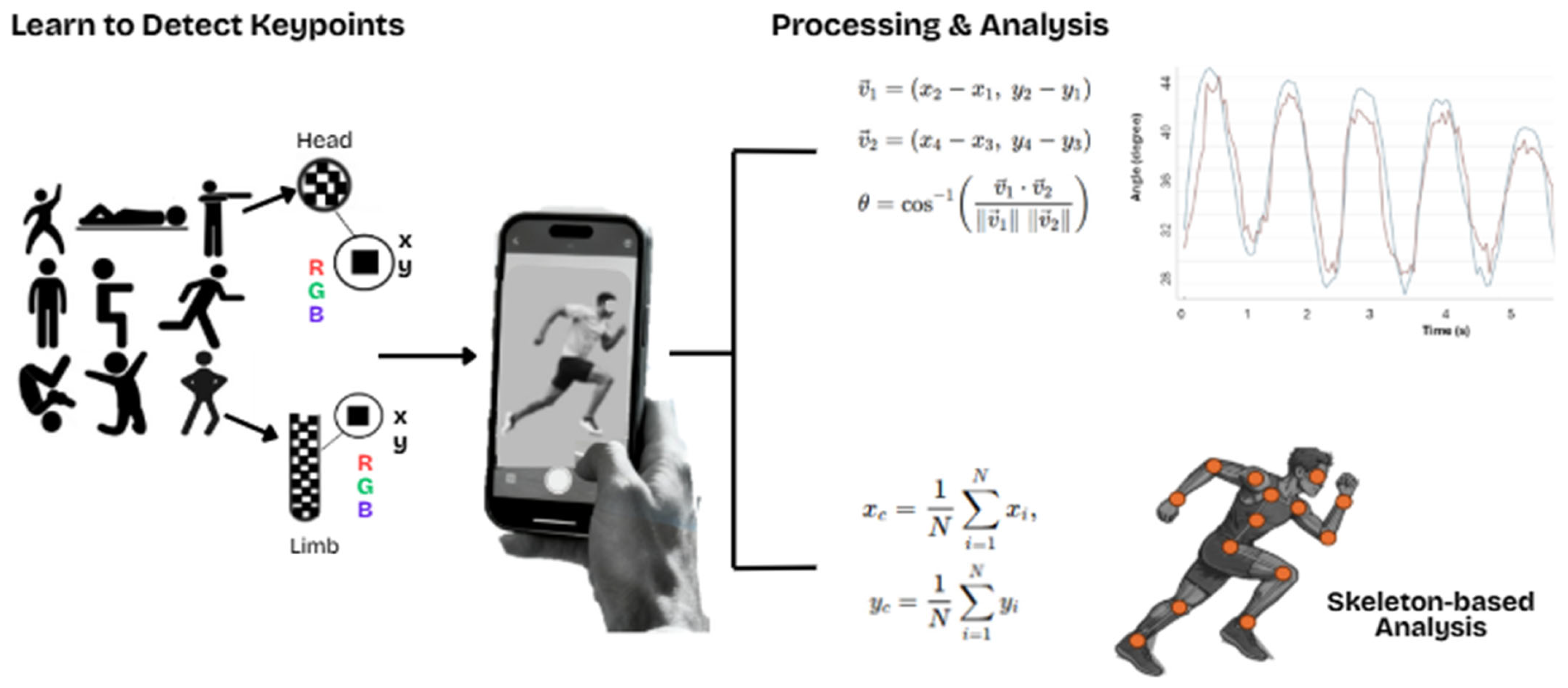
Edriss et al. [133] focused on the hip angle during the pike phase of the barracuda, noting that a smaller angle allows swimmers to push higher for optimal points. Plus, maintaining body alignment with minimal hip deviation relative to the shoulders and stable feet, while keeping the execution leg vertically, helps keep the leg above the water surface. One way that the studies use 2D pixel coordinates and video frames is by employing formulas to compute body-part centroids (Equation (1)) and measure angles between points (Equation (2)).
X c = 1 N i = 1 n X i ,   Y c = 1 N i = 1 n Y i
V 1 = ( x 2 x 1 , y 2 y 1 )   V 2 = ( x 4 x 3 , y 4 y 3 )   θ = c o s 1 ( V 1 . V 2 | V 1 | | V 2 | )
Figure 4 shows the HPE workflow. In order, data-driven learning uses large, annotated datasets to capture human body patterns, after which a pose model is trained with DL to map images to body or organ positions. The inference pipeline uses the trained model to identify key points in new, unseen video frames. The athlete’s video input is then processed through this pipeline, which aids in detecting frames and producing the new HPE output, including estimated skeletons, joint angles, or movement information suitable for specific performance analysis, such as body detection or 2D angular measurements.
To track and investigate pieces of sports equipment, such as balls, monitoring their pathway or trajectory is a technique for recording a player’s power, strength, or accuracy under different conditions. The required variables for performance analysis include ball or batted ball trajectory, speed, spin, rotation, and accuracy in shooting or passing, as well as match strategies in various sports such as handball, tennis, and ping-pong [134,135,136]. In addition, the Hawk-Eye system requires high-speed cameras (the number of cameras varies by sport) to record ball movements using CV and geometric calculations. This technology employs AI object tracking via CV and ML models to make precise determinations [137,138]. CV aids in detecting and tracking the ball, identifying its position in each frame, and creating an accurate 3D configuration. The geometric method determines 3D information and converts it into a 2D plane. Primarily, Hawk-Eye was used to track the ball movement in cricket broadcasts during the 2000s [139,140]. Then, Hawk-Eye technology was introduced in sports officiating, including tennis, snooker, soccer, baseball, badminton, rugby, basketball, ice hockey, and football, as well as pickleball [124], to verify whether the ball had passed specific points or touched the outer boundary line. The sports federations validated Hawk-Eye through testing and certification, including the FIFA Quality Programme for the Hawk-Eye system (Goal-Line Technology product), which ensures the accuracy and reliability [141], the International Tennis Federation certified it in electronic line-calling systems with high precision [124,125], and the International Cricket Council validated the Decision Review System, particularly for leg-before-wicket decisions [142].
Compared to most major racquet sports, Padel matches have unique characteristics that make it challenging for computers to perform crucial tasks, such as player tracking [143]. The game is almost always played in doubles, which raises the possibility of interplayer occlusion. Additionally, the playing field is surrounded by walls, including glass walls that could reflect spectators or players, metal mesh panels over the glass walls that partially obstruct some of the fields, and other structural elements that connect the glass panels [144]. Javadiha et al. [145] compared state-of-the-art position estimation techniques and proved that the top-down HPE technique obtained the best results.
Finally, for examples of AI benefiting strategy plans, it is used in performance analysis as a foundational component of sports strategy planning and business claims and talent identification, statistical analysis to provide the data and insights necessary for teams to develop, implement, and adjust their strategies, which involves collecting, analyzing, and interpreting a range of performance metrics [63,146]. By examining performance metrics, teams can identify emerging talents and assess their potential contributions to team composition and succession planning. It ensures that teams invest in athletes who are likely to succeed and contribute to long-term success. Sports technology and AI aid team performance and individual biomechanical analysis during matches in a faster, more understandable, and easier manner. Table 3 summarizes the core of some CV tasks and classical techniques used for movement analysis without relying on end-to-end deep learning.

3.5. Natural Language Processing

Natural Language Processing (NLP) is an AI field that focuses on the computational analysis of textual data, enabling machines to model, classify, and generate human language meaningfully [147,148]. In the professional sports industry, text data recognition was trained by using supervised learning through NLP. This algorithm was utilized by various professional teams in American leagues, including football, basketball, baseball, and hockey, to investigate and analyze the sports business [149]. NLP models process volumes of unstructured text to extract sentiment trends and thematic patterns, providing teams and organizations with actionable insights for communication strategies and performance perception analysis. NLP models are trained through a lengthy process in sport biomechanics, integrated with biomedical engineering, computer software, and applications in Chinese kinesiology. These studies aimed to examine athletic training organization, sport-injury prevention, and rehabilitation [150]. Additionally, to assess sportive teaching activities, NLP was used to analyze students’ evaluations of teaching to investigate the sentiment polarity and subjectivity in this context [151]. NLP, using DistilBERT (a lightweight machine learning model), analyzes 2022 World Cup soccer tweets by tokenizing the text, converting it into numerical representations, and using contextual token embeddings. The Twitter API collects data, which is processed through Google Cloud tools for scalability. The model classifies sentiment, filters noise, and produces results with a normal distribution and few outliers [152]. These examples illustrate NLP applications for analyzing media coverage, social media, team communications, and fan interactions to gain insights into team dynamics and fan sentiment, as well as, in some cases, biomechanical aspects. Table 4 summarizes the approaches and tasks of studies used to introduce the target in communication enhancement with sport or clinical staff. NLP studies in sports are limited by the scarcity of large, high-quality datasets compared to other industries, as well as the difficulty of training models to understand complex sports jargon and real-time tactical nuances. These technical hurdles are further intensified by high implementation costs, a lack of collaboration between tech and sports experts, and strict privacy concerns surrounding sensitive athlete data [153].

3.6. Generative AI

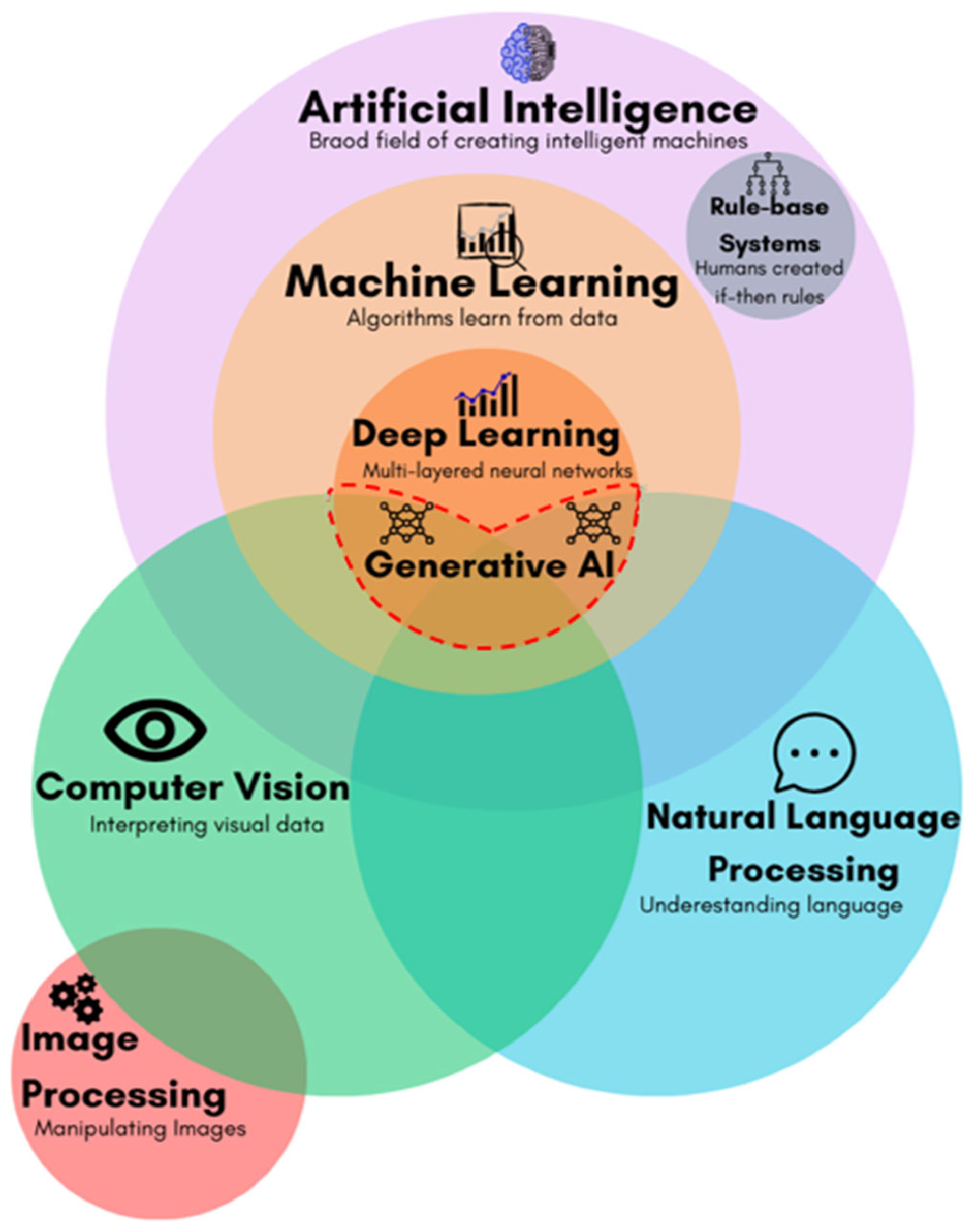
Generative AI refers to a class of models capable of producing new data, and many modern generative models fall into this category [154,155]. In the context of CV, it can generate synthetic training videos, enhance game footage, and simulate player movements to support strategy development. Additionally, NLP applications of generative AI automatically generate match reports, player performance summaries, and real-time commentary [156]. As illustrated in Figure 5, the integration of DL with CV and/or NLP models constitutes the development of Generative AI. For instance, the amalgamation of CV and DL tools previously described exemplifies a form of Generative AI. A representative case of generative AI in sports involves generating synthetic movement data and data-driven motion synthesis of athlete trajectories to support performance analysis and equipment design. In sports science, generative AI models can be used to model and simulate athlete movement patterns, thereby supporting injury risk assessment and enhancing performance. By analyzing movement patterns using video processing and DL, it can generate realistic simulations of techniques for designing footwear products exclusively for players [157]. These simulations and classifications by generative AI are an invaluable tool for coaches, analysts, sports scientists, and engineers who aim to enhance training, improve tactical decision-making, and design innovative products [158,159]. Generative AI is a rapidly growing system of AI applications in sport-related studies [160]. The Venn diagram in Figure 5 shows the relationships of trained models across different AI paradigms and data-driven learning methods [161,162].

4. Challenge and Limitations

Although AI is rapidly expanding into sports science, marketing, and movement assessment, existing limitations constrain the robustness of current models and tools. For example, markerless HPEs primarily serve to access skeletal data, although some studies utilize them for biological assessments. Factors such as rapid and complex movements, occlusions, motion blur, diverse camera viewpoints, lighting conditions, and sport-specific equipment can significantly diminish joint localization accuracy, particularly in dynamic and uncontrolled environments. Although acceptable agreement with gold-standard systems has been reported under controlled laboratory conditions, it remains that, in specific planar movements, the results are closely aligned with those standards [163].
Data quality and representativeness pose additional challenges. Many AI models are trained on datasets lacking diversity regarding motor activity type, athlete characteristics, and contextual factors, leading to dataset bias and limited generalizability [164]. Annotation errors, imbalanced datasets, and dependence on benchmark data further exacerbate these issues [165]. Consequently, models optimized for tasks or recording setups often struggle to adapt across different sports, populations, or camera configurations, especially when external validation is absent. As a result, reported accuracy metrics may overstate real-world performance.
Practical limitations pertaining to computational demands and system complexity also hinder widespread deployment. DL approaches typically necessitate substantial processing power, high-quality video inputs, and specialized hardware, thereby restricting real-time application and accessibility within practical settings. Additionally, the limited interpretability of many AI models complicates their integration into coaching and clinical decision-making processes, as ‘black-box’ predictions are challenging to translate into actionable insights.

5. Conclusions

This literature review aims to outline the potential applicability of AI methods across various fields with differing levels of complexity and to provide a comprehensive overview of the application of video analysis and AI in sports and rehabilitation. AI methods deliver kinematic analysis compared to traditional techniques. ML models can extract patterns and predict performance metrics from sensor data; DL–based HPE enables automated joint tracking from video without markers, CV facilitates offline or real-time, markerless analysis of each frame, and NLP helps integrate unstructured textual and sensor metadata. Generative AI allows realistic simulation of movements to optimize technique or prevent injuries. Currently, HPE systems are relatively new technologies for quantitatively measuring the kinematics of human movement using relatively low-cost, simple cameras or smartphones, leading to a new shift in how human movement is studied and evaluated. This technique has only recently begun to be used in rehabilitation cases; therefore, users must understand the potential and limitations of modern AI. Limitations and challenges arise in interpreting emotional and cognitive states in the development of human–machine relationships, particularly in psychology and emotional understanding. However, we believe that its applications will continue to evolve in the upcoming years and that these technologies will provide robust tools for capturing key features of human movement. As attention to new AI technologies in sports performance or strategic plans, and clinical assistive tools increases, Generative AI may offer additional opportunities in future research, most likely as the next step in this field. Together, these AI approaches make kinematic assessment faster, more accessible, objective, and scalable, enabling data-driven insights that were previously impossible.

Author Contributions

Conceptualization, S.E.; writing—original draft preparation, S.E. and I.C.; writing—review and editing, C.R. and L.C.; visualization, M.T.M.; supervision, G.A. All authors have read and agreed to the published version of the manuscript.

Funding

This research received no external funding.

Data Availability Statement

No new data were created or analyzed in this study.

Conflicts of Interest

The authors declare no conflicts of interest.

References

  1. Shukla Shubhendu, S.; Vijay, J. Applicability of Artificial Intelligence in Different Fields of Life. Int. J. Sci. Eng. Res. 2013, 1, 28–35. [Google Scholar] [CrossRef] [PubMed]
  2. Holmes, J.; Sacchi, L.; Bellazzi, R. Artificial Intelligence in Medicine. Ann. R. Coll. Surg. Engl. 2004, 86, 334–338. [Google Scholar]
  3. Muggleton, S. Alan Turing and the Development of Artificial Intelligence. AI Commun. 2014, 27, 3–10. [Google Scholar] [CrossRef]
  4. Andresen, S.L. John McCarthy: Father of AI. IEEE Intell. Syst. 2002, 17, 84–85. [Google Scholar] [CrossRef]
  5. Raj, A.; Bosch, J.; Olsson, H.H.; Wang, T.J. Modelling Data Pipelines. In Proceedings of the 2020 46th Euromicro Conference on Software Engineering and Advanced Applications (SEAA), Kranj, Slovenia, 26–28 August 2020. [Google Scholar]
  6. Yu, K.-H.; Beam, A.L.; Kohane, I.S. Artificial Intelligence in Healthcare. Nat. Biomed. Eng. 2018, 2, 719–731. [Google Scholar] [CrossRef]
  7. Paschos, N.K. Author Reply: Artificial Intelligence in Sports Medicine. Arthroscopy 2021, 37, 1368–1369. [Google Scholar] [CrossRef]
  8. Ahmed, S.I.; Javed, G.; Mubeen, B.; Bareeqa, S.B.; Rasheed, H.; Rehman, A.; Phulpoto, M.M.; Samar, S.S.; Aziz, K. Robotics in Neurosurgery: A Literature Review. JPMA J. Pak. Med. Assoc. 2018, 68, 258. [Google Scholar]
  9. McDonnell, J.M.; Ahern, D.P.; Doinn, T.Ó.; Gibbons, D.; Rodrigues, K.N.; Birch, N.; Butler, J.S. Surgeon Proficiency in Robot-Assisted Spine Surgery: A Narrative Review. Bone Jt. J. 2020, 102, 568–572. [Google Scholar] [CrossRef]
  10. Pernar, L.I.; Robertson, F.C.; Tavakkoli, A.; Sheu, E.G.; Brooks, D.C.; Smink, D.S. An Appraisal of the Learning Curve in Robotic General Surgery. Surg. Endosc. 2017, 31, 4583–4596. [Google Scholar] [CrossRef]
  11. Sepehripour, A.; Garas, G.; Athanasiou, T.; Casula, R. Robotics in Cardiac Surgery. Ann. R. Coll. Surg. Engl. 2018, 100, 22–33. [Google Scholar] [CrossRef]
  12. Sivaraman, A.; Sanchez-Salas, R.; Prapotnich, D.; Barret, E.; Mombet, A.; Cathala, N.; Rozet, F.; Galiano, M.; Cathelineau, X. Robotics in Urological Surgery: Evolution, Current Status and Future Perspectives. Actas Urológicas Españolas (Engl. Ed.) 2015, 39, 435–441. [Google Scholar] [CrossRef]
  13. Fazekas, G.; Tavaszi, I. The Future Role of Robots in Neuro-Rehabilitation. Expert Rev. Neurother. 2019, 19, 471–473. [Google Scholar] [CrossRef]
  14. Klamroth-Marganska, V. Stroke Rehabilitation: Therapy Robots and Assistive Devices. In Sex-Specific Analysis of Cardiovascular Function; Springer: Cham, Switzerland, 2018; pp. 579–587. [Google Scholar]
  15. Shirota, C.; Van Asseldonk, E.; Matjačić, Z.; Vallery, H.; Barralon, P.; Maggioni, S.; Buurke, J.H.; Veneman, J.F. Robot-Supported Assessment of Balance in Standing and Walking. J. Neuroeng. Rehabil. 2017, 14, 80. [Google Scholar] [CrossRef] [PubMed]
  16. Noorbakhsh-Sabet, N.; Zand, R.; Zhang, Y.; Abedi, V. Artificial Intelligence Transforms the Future of Health Care. Am. J. Med. 2019, 132, 795–801. [Google Scholar] [CrossRef] [PubMed]
  17. Shimizu, H.; Nakayama, K.I. Artificial Intelligence in Oncology. Cancer Sci. 2020, 111, 1452–1460. [Google Scholar] [CrossRef]
  18. Topol, E.J. High-Performance Medicine: The Convergence of Human and Artificial Intelligence. Nat. Med. 2019, 25, 44–56. [Google Scholar] [CrossRef]
  19. Erdmann, W.S. Problems of Sport Biomechanics and Robotics. Int. J. Adv. Robot. Syst. 2013, 10, 123. [Google Scholar] [CrossRef]
  20. Cariati, I.; Bonanni, R.; Cifelli, P.; D’Arcangelo, G.; Padua, E.; Annino, G.; Tancredi, V. Virtual Reality and Sports Performance: A Systematic Review of Randomized Controlled Trials Exploring Balance. Front. Sports Act. Living 2025, 7, 1497161. [Google Scholar] [CrossRef]
  21. Xu, T.; Baghaei, S. Reshaping the Future of Sports with Artificial Intelligence: Challenges and Opportunities in Performance Enhancement, Fan Engagement, and Strategic Decision-Making. Eng. Appl. Artif. Intell. 2025, 142, 109912. [Google Scholar] [CrossRef]
  22. Sharp, O. Harnessing Artificial Intelligence for Enhanced Decision-Making in Sports Project Management. Int. J. Emerg. Trends Comput. Sci. Inf. Technol. 2023, 4, 20–30. [Google Scholar] [CrossRef]
  23. Mittal, S. AI in Talent Scouting and Player Development: Role of AI and Machine Learning in Identifying and Nurturing Talent in Sports Organizations. In AI and Machine Learning Applications in Sports Analytics; IGI Global Scientific Publishing: Palmdale, PA, USA, 2025; pp. 173–196. [Google Scholar]
  24. Chmait, N.; Westerbeek, H. Artificial Intelligence and Machine Learning in Sport Research: An Introduction for Non-Data Scientists. Front. Sports Act. Living 2021, 3, 363. [Google Scholar] [CrossRef] [PubMed]
  25. Bawack, R.E.; Fosso Wamba, S.; Carillo, K.D.A. A Framework for Understanding Artificial Intelligence Research: Insights from Practice. J. Enterp. Inf. Manag. 2021, 34, 645–678. [Google Scholar] [CrossRef]
  26. Bawack, R.E.; Wamba, S.F.; Carillo, K.D.A.; Akter, S. Artificial Intelligence in E-Commerce: A Bibliometric Study and Literature Review. Electron. Mark. 2022, 32, 297–338. [Google Scholar] [CrossRef]
  27. Albright, S.C. A Statistical Analysis of Hitting Streaks in Baseball. J. Am. Stat. Assoc. 1993, 88, 1175–1183. [Google Scholar] [CrossRef]
  28. Tedesco, S.; Scheurer, S.; Brown, K.N.; Hennessy, L.; O’Flynn, B. A Survey on the Use of Artificial Intelligence for Injury Prediction in Sports. In Proceedings of the 2022 IEEE International Workshop on Sport, Technology and Research (STAR), Cavalese, Italy, 6–8 July 2022. [Google Scholar]
  29. Yan, F.; Christmas, W.; Kittler, J. A Tennis Ball Tracking Algorithm for Automatic Annotation of Tennis Match. In Proceedings of the British Machine Vision Conference, Oxford, UK, 5–8 September 2005. [Google Scholar]
  30. Tong, X.-F.; Lu, H.-Q.; Liu, Q.-S. An Effective and Fast Soccer Ball Detection and Tracking Method. In Proceedings of the 17th International Conference on Pattern Recognition, 2004. ICPR 2004, Cambridge, UK, 26 August 2004. [Google Scholar]
  31. Mauthner, T.; Bischof, H. A Robust Multiple Object Tracking for Sport Applications; Graz University of Technology: Graz, Austria, 2007. [Google Scholar]
  32. Qiao, S.; Wang, Y.; Li, J. Real-Time Human Gesture Grading Based on OpenPose. In Proceedings of the 2017 10th International Congress on Image and Signal Processing, BioMedical Engineering and Informatics (CISP-BMEI), Shanghai, China, 14–16 October 2017. [Google Scholar]
  33. Zhang, Z. Microsoft Kinect Sensor and Its Effect. IEEE Multimed. 2012, 19, 4–10. [Google Scholar] [CrossRef]
  34. Brechot, M.; Flepp, R. Dealing with Randomness in Match Outcomes: How to Rethink Performance Evaluation in European Club Football Using Expected Goals. J. Sports Econ. 2020, 21, 335–362. [Google Scholar] [CrossRef]
  35. Canny, J.F. A Variational Approach to Edge Detection. In AAAI’83: Proceedings of the Third AAAI Conference on Artificial Intelligence; AAAI Press: Washington, DC, USA, 1983; Volume 1983, pp. 54–58. [Google Scholar]
  36. DeCoste, D. The Significance of Kasparov versus DEEP BLUE and the Future of Computer Chess. ICGA J. 1998, 21, 33–43. [Google Scholar] [CrossRef]
  37. Valter, D.S.; Adam, C.; Barry, M.; Marco, C. Validation of Prozone®: A New Video-Based Performance Analysis System. Int. J. Perform. Anal. Sport 2006, 6, 108–119. [Google Scholar] [CrossRef]
  38. Scott, R.; Ruggill, J.E. Simulation or Simulacrum? The Promise of Sports Games. Work. Days 2004, 22, 63–69. [Google Scholar]
  39. Qureshi, F.K. The Evolution of AI Algorithms: From Rule-Based Systems to Deep Learning. Front. Artif. Intell. Res. 2024, 1, 250–288. [Google Scholar]
  40. Glazier, P.S. Game, Set and Match? Substantive Issues and Future Directions in Performance Analysis. Sports Med. 2010, 40, 625–634. [Google Scholar] [CrossRef] [PubMed]
  41. Caprioli, L.; Campoli, F.; Edriss, S.; Padua, E.; Najlaoui, A.; Romagnoli, C.; Annino, G.; Bonaiuto, V. Impact Distance Detection in Tennis Forehand by an Inertial System. In 12th International Conference on Sport Sciences Research and Technology Support; SCITEPRESS—Science and Technology Publications: Porto, Portugal, 2024; pp. 277–282. [Google Scholar]
  42. Edriss, S.; Romagnoli, C.; Caprioli, L.; Zanela, A.; Panichi, E.; Campoli, F.; Padua, E.; Annino, G.; Bonaiuto, V. The Role of Emergent Technologies in the Dynamic and Kinematic Assessment of Human Movement in Sport and Clinical Applications. Appl. Sci. 2024, 14, 1012. [Google Scholar] [CrossRef]
  43. Wan, Y.; Wei, Q.; Sun, H.; Wu, H.; Zhou, Y.; Bi, C.; Li, J.; Li, L.; Liu, B.; Wang, D.; et al. Machine Learning Assisted Biomimetic Flexible SERS Sensor from Seashells for Pesticide Classification and Concentration Prediction. Chem. Eng. J. 2025, 507, 160813. [Google Scholar] [CrossRef]
  44. Caprioli, L.; Najlaoui, A.; Campoli, F.; Dhanasekaran, A.; Edriss, S.; Romagnoli, C.; Zanela, A.; Padua, E.; Bonaiuto, V.; Annino, G. Tennis Timing Assessment by a Machine Learning-Based Acoustic Detection System: A Pilot Study. J. Funct. Morphol. Kinesiol. 2025, 10, 47. [Google Scholar] [CrossRef]
  45. Aarons, M.F.; Vickery, W.; Bruce, L.; Young, C.M.; Dwyer, D.B. Barriers to Coach Decision-Making during Australian Football Matches and How It Can Be Supported by Artificial Intelligence. Int. J. Sports Sci. Coach. 2024, 19, 41–52. [Google Scholar] [CrossRef]
  46. Wang, Z.; Veličković, P.; Hennes, D.; Tomašev, N.; Prince, L.; Kaisers, M.; Bachrach, Y.; Elie, R.; Wenliang, L.K.; Piccinini, F.; et al. TacticAI: An AI Assistant for Football Tactics. Nat. Commun. 2024, 15, 1906. [Google Scholar] [CrossRef]
  47. Luck, M.; Aylett, R. Applying Artificial Intelligence to Virtual Reality: Intelligent Virtual Environments. Appl. Artif. Intell. 2010, 14, 3–32. [Google Scholar] [CrossRef]
  48. Nunes Rodrigues, A.C.; Santos Pereira, A.; Sousa Mendes, R.M.; Araújo, A.G.; Santos Couceiro, M.; Figueiredo, A.J. Using Artificial Intelligence for Pattern Recognition in a Sports Context. Sensors 2020, 20, 3040. [Google Scholar] [CrossRef]
  49. Dhar, V. What Is the Role of Artificial Intelligence in Sports? Big Data 2017, 5, 173–174. [Google Scholar] [CrossRef]
  50. Nadikattu, R.R. Implementation of New Ways of Artificial Intelligence in Sports. J. Xidian Univ. 2020, 14, 5983–5997. [Google Scholar] [CrossRef]
  51. Wang, Q. Application of Human Posture Recognition Based on the Convolutional Neural Network in Physical Training Guidance. Comput. Intell. Neurosci. 2022, 2022, 5277157. [Google Scholar] [CrossRef]
  52. Hughes, M.D.; Bartlett, R.M. The Use of Performance Indicators in Performance Analysis. J. Sports Sci. 2002, 20, 739–754. [Google Scholar] [CrossRef] [PubMed]
  53. Barris, S.; Button, C. A Review of Vision-Based Motion Analysis in Sport. Sports Med. 2008, 38, 1025–1043. [Google Scholar] [CrossRef] [PubMed]
  54. Annino, G.; Bonaiuto, V.; Campoli, F.; Caprioli, L.; Edriss, S.; Padua, E.; Panichi, E.; Romagnoli, C.; Romagnoli, N.; Zanela, A. Assessing Sports Performances Using an Artificial Intelligence-Driven System. In 2023 IEEE International Workshop on Sport, Technology and Research (STAR); IEEE: Piscataway, NJ, USA, 2023; pp. 98–103. [Google Scholar]
  55. Needham, L.; Evans, M.; Cosker, D.P.; Wade, L.; McGuigan, P.M.; Bilzon, J.L.; Colyer, S.L. The Accuracy of Several Pose Estimation Methods for 3D Joint Centre Localisation. Sci. Rep. 2021, 11, 20673. [Google Scholar] [CrossRef] [PubMed]
  56. Rossi, A.; Perri, E.; Trecroci, A.; Savino, M.; Alberti, G.; Iaia, F.M. GPS Data Reflect Players’ Internal Load in Soccer. In Proceedings of the 2017 IEEE International Conference on Data Mining Workshops (ICDMW), Orleans, LA, USA, 18–21 November 2017. [Google Scholar]
  57. Manzi, V.; Savoia, C.; Padua, E.; Edriss, S.; Iellamo, F.; Caminiti, G.; Annino, G. Exploring the Interplay between Metabolic Power and Equivalent Distance in Training Games and Official Matches in Soccer: A Machine Learning Approach. Front. Physiol. 2023, 14, 1230912. [Google Scholar] [CrossRef]
  58. Teixeira, J.E.; Afonso, P.; Schneider, A.; Branquinho, L.; Maio, E.; Ferraz, R.; Nascimento, R.; Morgans, R.; Barbosa, T.M.; Monteiro, A.M.; et al. Player Tracking Data and Psychophysiological Features Associated with Mental Fatigue in U15, U17, and U19 Male Football Players: A Machine Learning Approach. Appl. Sci. 2025, 15, 3718. [Google Scholar] [CrossRef]
  59. Gang, P.; Zeng, W.; Gordienko, Y.; Rokovyi, O.; Alienin, O.; Stirenko, S. Prediction of Physical Load Level by Machine Learning Analysis of Heart Activity after Exercises. In Proceedings of the 2019 IEEE Symposium Series on Computational Intelligence (SSCI), Xiamen, China, 6–9 December 2019. [Google Scholar]
  60. Johansson, U.; Wilderoth, E.; Sattari, A. How Analytics Is Changing Ice Hockey. In Proceedings of the Linköping Hockey Analytics Conference, Linköping, Sweden, 6–8 June 2022. [Google Scholar]
  61. Robberechts, P.; Davis, J. How Data Availability Affects the Ability to Learn Good xG Models. In Machine Learning and Data Mining for Sports Analytics: 7th International Workshop, MLSA 2020, Co-Located with ECML/PKDD 2020, Ghent, Belgium, 14–18 September 2020, Proceedings 7; Springer: Cham, Switzerland, 2020; pp. 17–27. [Google Scholar]
  62. Mulazimoglu, O.; Tokul, E.; Can, S.; Eyuboglu, A. Examining the Superiority of Professional Football Teams with the Contribution of Expected Goal (xG) Value. RBFF-Rev. Bras. Futsal Futeb. 2024, 16, 67–75. [Google Scholar]
  63. Kaskenmaa, M. Using Data Analytics in Hockey Player Talent Identification. Master’s Thesis, Oulu University of Applied Sciences, Oulu, Finland, 2023. [Google Scholar]
  64. Shmakov, N. Developing an Analytical Tool to Support the Transfer Decision-Making Process in Ice Hockey. SN Comput. Sci. 2025, 6, 152. [Google Scholar] [CrossRef]
  65. Cefis, M.; Carpita, M. A New xG Model for Football Analytics. J. Oper. Res. Soc. 2025, 76, 1–13. [Google Scholar] [CrossRef]
  66. Pollard, R.; Reep, C. Measuring the Effectiveness of Playing Strategies at Soccer. J. R. Stat. Soc. Ser. D Stat. 1997, 46, 541–550. [Google Scholar] [CrossRef]
  67. Ensum, J.; Pollard, R.; Taylor, S. Applications of Logistic Regression to Shots at Goal at Association Football. In Science and Football V: The Proceedings of the Fifth World Congress on Science and Football; Routledge: Abingdon, UK, 2005; pp. 214–221. [Google Scholar]
  68. Anzer, G.; Bauer, P. A Goal Scoring Probability Model for Shots Based on Synchronized Positional and Event Data in Football (Soccer). Front. Sports Act. Living 2021, 3, 624475. [Google Scholar] [CrossRef] [PubMed]
  69. Jia, Y.-H.; Si, Z.-Z.; Ju, Z.-T.; Feng, H.-Y.; Zhang, J.-H.; Yan, X.; Dai, C.-Q. Convolutional-Recurrent Neural Network for the Prediction of Formation and Switching Dynamics for Multicolor Solitons. Sci. China Phys. Mech. Astron. 2025, 68, 284211. [Google Scholar] [CrossRef]
  70. John, S.; Verma, S.K.; Khanna, G.L. The Effect of Mindfulness Meditation on HPA-Axis in Pre-Competition Stress in Sports Performance of Elite Shooters. Natl. J. Integr. Res. Med. 2011, 2, 15–21. [Google Scholar]
  71. Umami, I.; Gautama, D.H.; Hatta, H.R. Implementing the Expected Goal (xG) Model to Predict Scores in Soccer Matches. Int. J. Inform. Inf. Syst. 2021, 4, 38–54. [Google Scholar] [CrossRef]
  72. Gelade, G. Evaluating the Ability of Goalkeepers in English Premier League Football. J. Quant. Anal. Sports 2014, 10, 279–286. [Google Scholar] [CrossRef]
  73. Bikku, T. Multi-Layered Deep Learning Perceptron Approach for Health Risk Prediction. J. Big Data 2020, 7, 50. [Google Scholar] [CrossRef]
  74. Dubey, S.; Dixit, M. A Comprehensive Survey on Human Pose Estimation Approaches. Multimed. Syst. 2023, 29, 167–195. [Google Scholar] [CrossRef]
  75. Toshpulatov, M.; Lee, W.; Lee, S.; Haghighian Roudsari, A. Human Pose, Hand and Mesh Estimation Using Deep Learning: A Survey. J. Supercomput. 2022, 78, 7616–7654. [Google Scholar] [CrossRef]
  76. Pan, S. A Method of Key Posture Detection and Motion Recognition in Sports Based on Deep Learning. Mob. Inf. Syst. 2022, 2022, 5168898. [Google Scholar] [CrossRef]
  77. Dong, Z.; Wang, X. An Improved Deep Neural Network Method for an Athlete’s Human Motion Posture Recognition. Int. J. Inf. Commun. Technol. 2023, 22, 45–59. [Google Scholar] [CrossRef]
  78. Stenum, J.; Cherry-Allen, K.M.; Pyles, C.O.; Reetzke, R.D.; Vignos, M.F.; Roemmich, R.T. Applications of Pose Estimation in Human Health and Performance across the Lifespan. Sensors 2021, 21, 7315. [Google Scholar] [CrossRef] [PubMed]
  79. Stenum, J.; Rossi, C.; Roemmich, R.T. Two-Dimensional Video-Based Analysis of Human Gait Using Pose Estimation. PLoS Comput. Biol. 2021, 17, e1008935. [Google Scholar] [CrossRef] [PubMed]
  80. Zhang, M.; Li, Y.; Cui, Y. The Use of Deep Learning in Intelligent Athlete Motion Recognition: Integrating Biological Mechanisms. Mol. Cell. Biomech. 2025, 22, 670. [Google Scholar] [CrossRef]
  81. Jafarzadeh, P.; Zelioli, L.; Virjonen, P.; Farahnakian, F.; Nevalainen, P.; Heikkonen, J. Enhancing Hurdles Athletes’ Performance Analysis: A Comparative Study of Cnn-Based Pose Estimation Frameworks. Multimed. Tools Appl. 2025, 84, 34573–34591. [Google Scholar] [CrossRef]
  82. Nakano, N.; Sakura, T.; Ueda, K.; Omura, L.; Kimura, A.; Iino, Y.; Fukashiro, S.; Yoshioka, S. Evaluation of 3D Markerless Motion Capture Accuracy Using OpenPose with Multiple Video Cameras. Front. Sports Act. Living 2020, 2, 50. [Google Scholar] [CrossRef]
  83. Chen, Y.; Tian, Y.; He, M. Monocular Human Pose Estimation: A Survey of Deep Learning-Based Methods. Comput. Vis. Image Underst. 2020, 192, 102897. [Google Scholar] [CrossRef]
  84. Kim, S.; Cho, D. Viewpoint-Aware Action Recognition Using Skeleton-Based Features from Still Images. Electronics 2021, 10, 1118. [Google Scholar] [CrossRef]
  85. Wang, S.; Park, S.; Kim, J.; Kim, J. Safety Helmet Monitoring on Construction Sites Using YOLOv10 and Advanced Transformer Architectures with Surveillance and Body-Worn Cameras. J. Constr. Eng. Manag. 2025, 151, 04025186. [Google Scholar] [CrossRef]
  86. Jiang, P.; Ergu, D.; Liu, F.; Cai, Y.; Ma, B. A Review of Yolo Algorithm Developments. Procedia Comput. Sci. 2022, 199, 1066–1073. [Google Scholar] [CrossRef]
  87. Najlaoui, A.; Campoli, F.; Caprioli, L.; Edriss, S.; Frontuto, C.; Romagnoli, C.; Annino, G.; Bonaiuto, V.; Zanela, A. AI-Driven Paddle Motion Detection. In Proceedings of the 2024 IEEE International Workshop on Sport, Technology and Research (STAR), Lecco, Italy, 8–10 July 2024. [Google Scholar]
  88. Zhang, J.; Han, D.; Han, S.; Li, H.; Lam, W.-K.; Zhang, M. ChatMatch: Exploring the Potential of Hybrid Vision–Language Deep Learning Approach for the Intelligent Analysis and Inference of Racket Sports. Comput. Speech Lang. 2025, 89, 101694. [Google Scholar] [CrossRef]
  89. Yang, T.; Jiang, C.; Li, P. Video Analysis and System Construction of Basketball Game by Lightweight Deep Learning under the Internet of Things. Comput. Intell. Neurosci. 2022, 2022, 6118798. [Google Scholar] [CrossRef] [PubMed]
  90. Yoon, Y.; Hwang, H.; Choi, Y.; Joo, M.; Oh, H.; Park, I.; Lee, K.-H.; Hwang, J.-H. Analyzing Basketball Movements and Pass Relationships Using Realtime Object Tracking Techniques Based on Deep Learning. IEEE Access 2019, 7, 56564–56576. [Google Scholar] [CrossRef]
  91. Newman, J.; Sumsion, A.; Torrie, S.; Lee, D.-J. Automated Pre-Play Analysis of American Football Formations Using Deep Learning. Electronics 2023, 12, 726. [Google Scholar] [CrossRef]
  92. Hallur, S.; Gavade, A. Image Feature Extraction Techniques: A Comprehensive Review. Frankl. Open 2025, 12, 100366. [Google Scholar] [CrossRef]
  93. Zhang, Y.; Hou, X. Application of Video Image Processing in Sports Action Recognition Based on Particle Swarm Optimization Algorithm. Prev. Med. 2023, 173, 107592. [Google Scholar] [CrossRef]
  94. Moon, S.; Lee, J.; Nam, D.; Yoo, W.; Kim, W. A Comparative Study on Preprocessing Methods for Object Tracking in Sports Events. In 2018 20th International Conference on Advanced Communication Technology (ICACT); IEEE: Piscataway, NJ, USA, 2018; pp. 460–462. [Google Scholar]
  95. Li, G.; Zhang, C. Automatic Detection Technology of Sports Athletes Based on Image Recognition Technology. J. Image Video Proc. 2019, 2019, 15. [Google Scholar] [CrossRef]
  96. Kim, J.-S.; Kim, M.-G. A New Single Camera-Based Ball Motion Analysis System for Virtual Sports. In International Conference on Video and Image Processing; ACM: Singapore, 2017; pp. 212–217. [Google Scholar]
  97. Wiley, V.; Lucas, T. Computer Vision and Image Processing: A Paper Review. Int. J. Artif. Intell. Res. 2018, 2, 29–36. [Google Scholar] [CrossRef]
  98. Sarker, I.H. Data Science and Analytics: An Overview from Data-Driven Smart Computing, Decision-Making and Applications Perspective. SN Comput. Sci. 2021, 2, 377. [Google Scholar] [CrossRef]
  99. Wang, S. Domain-Adaptive Faster R-CNN for Non-PPE Identification on Construction Sites from Body-Worn and General Images. Sci. Rep. 2026, 16, 4793. [Google Scholar] [CrossRef]
  100. Edriss, S.; Romagnoli, C.; Caprioli, L.; Bonaiuto, V.; Padua, E.; Annino, G. Commercial Vision Sensors and AI-Based Pose Estimation Frameworks for Markerless Motion Analysis in Sports and Exercises: A Mini Review. Front. Physiol. 2025, 16, 1649330. [Google Scholar] [CrossRef]
  101. Badiola-Bengoa, A.; Mendez-Zorrilla, A. A Systematic Review of the Application of Camera-Based Human Pose Estimation in the Field of Sport and Physical Exercise. Sensors 2021, 21, 5996. [Google Scholar] [CrossRef] [PubMed]
  102. Böhm, J.; Chen, T.; Štícha, K.; Kohout, J.; Mareš, J. Skeleton Detection Using MediaPipe as a Tool for Musculoskeletal Disorders Analysis. In Software Engineering Methods in Systems and Network Systems; Silhavy, R., Silhavy, P., Eds.; Springer International Publishing: Cham, Switzerland, 2024; pp. 35–50. [Google Scholar]
  103. Rai, D.; Kumar, A.; Baghel, A. Pose Detection Using OpenCV and Media Pipe. In Proceedings of the 2024 International Conference on Integrated Circuits, Communication, and Computing Systems (ICIC3S), Una, India, 8–9 June 2024. [Google Scholar]
  104. Brittberg, M. New Frontiers for Cartilage Repair, Joint Preservation and Prevention. J. Cartil. Jt. Preserv. 2022, 2, 100060. [Google Scholar] [CrossRef]
  105. Wang, X.; Wang, Y.; He, L. An Intelligent Data Analysis-Based Medical Management Method for Lower Limb Health of Football Athletes. Math. Biosci. Eng. 2023, 20, 14005–14022. [Google Scholar] [CrossRef] [PubMed]
  106. Leddy, C.; Bolger, R.; Byrne, P.J.; Kinsella, S.; Zambrano, L. Concurrent Validity of the Human Pose Estimation Model “MediaPipe Pose” and the XSENS Inertial Measuring System for Knee Flexion and Extension Analysis During Hurling Sport Motion. In Proceedings of the 2023 IEEE International Workshop on Sport, Technology and Research (STAR), Trento, Italy, 14–16 September 2023. [Google Scholar]
  107. Wang, J.; Qiu, K.; Peng, H.; Fu, J.; Zhu, J. Ai Coach: Deep Human Pose Estimation and Analysis for Personalized Athletic Training Assistance. In Proceedings of the 27th ACM international conference on multimedia, Nice, France, 21–25 October 2019. [Google Scholar]
  108. Ludwig, K.; Kienzle, D.; Lorenz, J.; Lienhart, R. Detecting Arbitrary Keypoints on Limbs and Skis with Sparse Partly Correct Segmentation Masks. In Proceedings of the IEEE/CVF Winter Conference on Applications of Computer Vision, Waikoloa, HI, USA, 2–7 January 2023. [Google Scholar]
  109. Pinheiro, G.d.S.; Jin, X.; Costa, V.T.D.; Lames, M. Body Pose Estimation Integrated with Notational Analysis: A New Approach to Analyze Penalty Kicks Strategy in Elite Football. Front. Sports Act. Living 2022, 4, 818556. [Google Scholar] [CrossRef] [PubMed]
  110. Li, X.; Ullah, R. An Image Classification Algorithm for Football Players’ Activities Using Deep Neural Network. Soft Comput. 2023, 27, 19317–19337. [Google Scholar] [CrossRef]
  111. Sypetkowski, M.; Sarwas, G.; Trzcinski, T. Synthetic Image Translation for Football Players Pose Estimation. J. Univers. Comput. Sci. 2019, 25, 683–700. [Google Scholar]
  112. Takeichi, K.; Ichikawa, M.; Shinayama, R.; Tagawa, T. A Mobile Application for Running Form Analysis Based on Pose Estimation Technique. In 2018 IEEE International Conference on Multimedia & Expo Workshops (ICMEW); IEEE: Piscataway, NJ, USA, 2018; pp. 1–4. [Google Scholar]
  113. Caprioli, L.; Campoli, F.; Edriss, S.; Padua, E.; Panichi, E.; Romagnoli, C.; Annino, G.; Bonaiuto, V. Video Analysis Application to Assess the Reaction Time in an ATP Tennis Tournament. In Proceedings of the 11th International Conference on Sport Sciences Research and Technology Support, Rome, Italy, 16–17 November 2023. [Google Scholar]
  114. Costa, S.; Berchicci, M.; Bianco, V.; Croce, P.; Di Russo, F.; Quinzi, F.; Bertollo, M.; Zappasodi, F. Brain Dynamics of Visual Anticipation during Spatial Occlusion Tasks in Expert Tennis Players. Psychol. Sport Exerc. 2023, 65, 102335. [Google Scholar] [CrossRef]
  115. Hovad, E.; Hougaard-Jensen, T.; Clemmensen, L.K.H. Classification of Tennis Actions Using Deep Learning. arXiv 2024, arXiv:2402.02545. [Google Scholar] [CrossRef]
  116. Kurose, R.; Hayashi, M.; Ishii, T.; Aoki, Y. Player Pose Analysis in Tennis Video Based on Pose Estimation. In 2018 International Workshop on Advanced Image Technology (IWAIT); IEEE: Piscataway, NJ, USA, 2018; pp. 1–4. [Google Scholar]
  117. Shimizu, T.; Hachiuma, R.; Saito, H.; Yoshikawa, T.; Lee, C. Prediction of Future Shot Direction Using Pose and Position of Tennis Player. In Proceedings of the 2nd International Workshop on Multimedia Content Analysis in Sports, Nice, France, 25 October 2019. [Google Scholar]
  118. Skublewska-Paszkowska, M.; Powroznik, P. Temporal Pattern Attention for Multivariate Time Series of Tennis Strokes Classification. Sensors 2023, 23, 2422. [Google Scholar] [CrossRef]
  119. Zhao, Z.; Lan, S.; Zhang, S. Human Pose Estimation Based Speed Detection System for Running on Treadmill. In 2020 International Conference on Culture-Oriented Science & Technology (ICCST); IEEE: Piscataway, NJ, USA, 2020; pp. 524–528. [Google Scholar]
  120. Brumann, C.; Kukuk, M.; Reinsberger, C. Evaluation of Open-Source and Pre-Trained Deep Convolutional Neural Networks Suitable for Player Detection and Motion Analysis in Squash. Sensors 2021, 21, 4550. [Google Scholar] [CrossRef]
  121. Thilakarathne, H.; Nibali, A.; He, Z.; Morgan, S. Pose Is All You Need: The Pose Only Group Activity Recognition System (Pogars). Mach. Vis. Appl. 2022, 33, 95. [Google Scholar] [CrossRef]
  122. Wu, E.; Koike, H. Futurepose-Mixed Reality Martial Arts Training Using Real-Time 3d Human Pose Forecasting with a Rgb Camera. In 2019 IEEE Winter Conference on Applications of Computer Vision (WACV); IEEE: Piscataway, NJ, USA, 2019; pp. 1384–1392. [Google Scholar]
  123. Elaoud, A.; Barhoumi, W.; Zagrouba, E.; Agrebi, B. Skeleton-Based Comparison of Throwing Motion for Handball Players. J. Ambient. Intell. Humaniz. Comput. 2020, 11, 419–431. [Google Scholar] [CrossRef]
  124. Neher, H.; Vats, K.; Wong, A.; Clausi, D.A. Hyperstacknet: A Hyper Stacked Hourglass Deep Convolutional Neural Network Architecture for Joint Player and Stick Pose Estimation in Hockey. In 2018 15th Conference on Computer and Robot Vision (CRV); IEEE: Piscataway, NJ, USA, 2018; pp. 313–320. [Google Scholar]
  125. Fani, M.; Neher, H.; Clausi, D.A.; Wong, A.; Zelek, J. Hockey Action Recognition via Integrated Stacked Hourglass Network. In 2017 IEEE Conference on Computer Vision and Pattern Recognition Workshops (CVPRW); IEEE: Piscataway, NJ, USA, 2017; pp. 29–37. [Google Scholar]
  126. Ferryanto, F.; Nakashima, M. Development of a Markerless Optical Motion Capture System for Daily Use of Training in Swimming. Sports Eng. 2017, 20, 63–72. [Google Scholar] [CrossRef]
  127. De Bock, J.; Verstockt, S. Video-Based Analysis and Reporting of Riding Behavior in Cyclocross Segments. Sensors 2021, 21, 7619. [Google Scholar] [CrossRef] [PubMed]
  128. Young, F.; Mason, R.; Moore, J.; Stuart, S.; Morris, R.; Godfrey, A. A Proposed Computer Vision Model for Running Gait Assessment. In 2022 44th Annual International Conference of the IEEE Engineering in Medicine & Biology Society (EMBC); IEEE: Piscataway, NJ, USA, 2022; pp. 4773–4776. [Google Scholar]
  129. Needham, L.; Evans, M.; Cosker, D.P.; Colyer, S.L. Can Markerless Pose Estimation Algorithms Estimate 3D Mass Centre Positions and Velocities during Linear Sprinting Activities? Sensors 2021, 21, 2889. [Google Scholar] [CrossRef]
  130. Zhang, W.; Liu, Z.; Zhou, L.; Leung, H.; Chan, A.B. Martial Arts, Dancing and Sports Dataset: A Challenging Stereo and Multi-View Dataset for 3D Human Pose Estimation. Image Vis. Comput. 2017, 61, 22–39. [Google Scholar] [CrossRef]
  131. Jiang, Y. Teaching Simulation Based on Artificial Intelligence and Big Data Algorithm in Sports Dance Group Dance. Mob. Inf. Syst. 2022, 2022, 5245014. [Google Scholar] [CrossRef]
  132. Ludwig, K.; Scherer, S.; Einfalt, M.; Lienhart, R. Self-Supervised Learning for Human Pose Estimation in Sports. In Proceedings of the 2021 IEEE International Conference on Multimedia & Expo Workshops (ICMEW), Shenzhen, China, 5–9 July 2021. [Google Scholar]
  133. Edriss, S.; Romagnoli, C.; Maurizi, M.; Caprioli, L.; Bonaiuto, V.; Annino, G. Pose Estimation for Pickleball Players’ Kinematic Analysis through MediaPipe-Based Deep Learning: A Pilot Study. J. Sports Sci. 2025, 43, 1860–1870. [Google Scholar] [CrossRef]
  134. Liu, Q.; Ding, H. Application of Table Tennis Ball Trajectory and Rotation-Oriented Prediction Algorithm Using Artificial Intelligence. Front. Neurorobot. 2022, 16, 820028. [Google Scholar] [CrossRef]
  135. Liu, W.; Liu, Z.; Huang, Z. Artificial Intelligence Technology to Record the Number of Times the Ball Passes the Net in Tennis Matches. Wirel. Commun. Mob. Comput. 2022, 2022, 7522725. [Google Scholar] [CrossRef]
  136. van den Tillaar, R.; Bhandurge, S.; Stewart, T. Can Machine Learning with IMUs Be Used to Detect Different Throws and Estimate Ball Velocity in Team Handball? Sensors 2021, 21, 2288. [Google Scholar] [CrossRef] [PubMed]
  137. Cant, O.; Kovalchik, S.; Cross, R.; Reid, M. Validation of Ball Spin Estimates in Tennis from Multi-Camera Tracking Data. J. Sports Sci. 2020, 38, 296–303. [Google Scholar] [CrossRef] [PubMed]
  138. Singh Bal, B.; Dureja, G. Hawk Eye: A Logical Innovative Technology Use in Sports for Effective Decision Making. Sport Sci. Rev. 2012, 21, 107–119. [Google Scholar] [CrossRef]
  139. Uzor, T.N.; Ikwuka, D.C.; Ujuagu, N.A. Hawkeye Technological Innovation: Challenges and Intervention Strategies in Sports. J. Mod. Educ. Res. 2023, 2, 3. [Google Scholar] [CrossRef]
  140. Durlind, G.; Martinez-Hernandez, U.; Assaf, T. Exploratory Proof-of-Concept: Predicting the Outcome of Tennis Serves Using Motion Capture and Deep Learning. Mach. Learn. Knowl. Extr. 2025, 7, 118. [Google Scholar] [CrossRef]
  141. Foulkes, G.; Anderton, J.; Morgan, S. Goal Line Technology: The Final Frontier. In The Sports Monograph: Critical Perspectives on Socio-Cultural Sport, Coaching and Physical Education; SSTO Publications: Preston, UK, 2014; pp. 111–120. [Google Scholar]
  142. Ramachandran, P. Perceptual-Cognitive Expertise in Cricket Umpires During Leg Before Wicket Decision Making. Ph.D. Thesis, Liverpool John Moores University, Liverpool, UK, 2021. [Google Scholar]
  143. Miralles, R.; Martínez-Gallego, R.; Guzmán, J.; Ramón-Llin, J. Movement Patterns and Player Load: Insights from Professional Padel. Biol. Sport 2025, 42, 163–169. [Google Scholar] [CrossRef]
  144. Calvanese, M. Ball Tracking for Padel Videos. Master’s Thesis, Universitat Politècnica de Catalunya, Barcelona, Spain, 2023. [Google Scholar]
  145. Javadiha, M.; Andujar, C.; Lacasa, E.; Ric, A.; Susin, A. Estimating Player Positions from Padel High-Angle Videos: Accuracy Comparison of Recent Computer Vision Methods. Sensors 2021, 21, 3368. [Google Scholar] [CrossRef]
  146. Wright, C.; Atkins, S.; Jones, B. An Analysis of Elite Coaches’ Engagement with Performance Analysis Services (Match, Notational Analysis and Technique Analysis). Int. J. Perform. Anal. Sport 2012, 12, 436–451. [Google Scholar] [CrossRef]
  147. Chowdhary, K.R. Natural Language Processing. In Fundamentals of Artificial Intelligence; Chowdhary, K.R., Ed.; Springer: New Delhi, India, 2020; pp. 603–649. [Google Scholar]
  148. Ho, T.-K.; Shih, W.-Y.; Kao, W.-Y.; Hsu, C.-H.; Wu, C.-Y. Analysis of the Development Trend of Sports Research in China and Taiwan Using Natural Language Processing. Appl. Sci. 2022, 12, 9006. [Google Scholar] [CrossRef]
  149. Wanless, L.; Seifried, C.; Bouchet, A.; Valeant, A.; Naraine, M.L. The Diffusion of Natural Language Processing in Professional Sport. Sport Manag. Rev. 2022, 25, 522–545. [Google Scholar] [CrossRef]
  150. Zhang, G.; Fan, Y. Application of Natural Language Processing to the Development of Sports Biomechanics in China: A Literature Review of Journal Abstracts in Chinese Between 1980 and 2022. Kinesiol. Rev. 2024, 13, 448–462. [Google Scholar] [CrossRef]
  151. Li, M.; Han, L.; Ma, S. Measuring Sports Teaching Activities in Higher Education through Natural Language Processing. In Second International Conference on Statistics, Applied Mathematics, and Computing Science (CSAMCS 2022); SPIE: Nanjing, China, 2023; Volume 12597, pp. 425–432. [Google Scholar]
  152. Baca, L.; Ardiles, N.; Cruz, J.; Mamani, W.; Capcha, J. Deep Learning Model Based on a Transformers Network for Sentiment Analysis Using NLP in Sports Worldwide. In Advances in Computing and Data Sciences; Singh, M., Tyagi, V., Gupta, P.K., Flusser, J., Ören, T., Eds.; Springer Nature: Cham, Switzerland, 2023; pp. 328–339. [Google Scholar]
  153. Puce, L.; Żmijewski, P.; Cotellessa, F.; Schenone, C.; Ceylan, H.I.; Bragazzi, N.L.; Trompetto, C. The Role of Artificial Intelligence in Sports Training: Opportunities, Challenges and Future Applications for Competitive Swimming. Biol. Sport 2025, 43, 355–367. [Google Scholar] [CrossRef]
  154. Bandi, A.; Adapa, P.V.S.R.; Kuchi, Y.E.V.P.K. The Power of Generative AI: A Review of Requirements, Models, Input–Output Formats, Evaluation Metrics, and Challenges. Future Internet 2023, 15, 260. [Google Scholar] [CrossRef]
  155. Puce, L.; Bragazzi, N.; Curra, A.; Trompetto, C. Harnessing Generative Artificial Intelligence for Exercise and Training Prescription: Applications and Implications in Sports and Physical Activity—A Systematic Literature Review. Appl. Sci. 2025, 15, 3497. [Google Scholar] [CrossRef]
  156. Sham, R.; Abdhul, A.; Reddy, S. Innovative Product Design with Generative AI. In Minds Unveiled; Productivity Press: New York, NY, USA, 2024; Available online: https://www.taylorfrancis.com/chapters/edit/10.4324/9781032711089-11/innovative-product-design-generative-ai-riya-sham-adil-abdhul-shashank-reddy (accessed on 19 January 2026).
  157. Nesheim, O.S.; Eikevåg, S.W.; Steinert, M.; Elverum, C.W. In-Field 3D Printing of Form-Fitted Generatively Designed Components—A Case Study on Paralympic Sit-Ski Equipment. Front. Mech. Eng. 2024, 10, 1336843. [Google Scholar] [CrossRef]
  158. Salloum, S.A.; AlHamad, A.Q.M.; Masa’deh, R.; Elnekiti, A.; Shaalan, K. Predicting Player Performance in Sports: A Simulation System and Machine Learning Approach. In Generative AI in Creative Industries; Al-Marzouqi, A., Salloum, S., Shaalan, K., Gaber, T., Masa’deh, R., Eds.; Springer Nature: Cham, Switzerland, 2025; pp. 413–432. [Google Scholar]
  159. Fazackerley, L.A.; Perrin, D.; Minett, G.M. Harnessing Generative AI in Exercise and Sports Science Education: Enhancing Real-World Learning and Overcoming Traditional Barriers in Data Analysis. Adv. Physiol. Educ. 2025, 49, 496–502. [Google Scholar] [CrossRef] [PubMed]
  160. Elkhamisy, Y.K. Applications of Artificial Intelligence in Sport Medicine: A Review. Transl. Health Sci. 2025, 1, 52–62. [Google Scholar] [CrossRef]
  161. Sajja, R.; Sermet, Y.; Cwiertny, D.; Demir, I. Integrating AI and Learning Analytics for Data-Driven Pedagogical Decisions and Personalized Interventions in Education. Technol. Knowl. Learn. 2025. [Google Scholar] [CrossRef]
  162. Olabiyi, W.; Akinleye, D.; Joel, E. The Evolution of AI: From Rule-Based Systemsto Data-Driven Intelligence. ResearchGate. 2025. Available online: https://www.researchgate.net/publication/388035967_The_Evolution_of_AI_From_Rule-Based_Systems_to_Data-Driven_Intelligence (accessed on 19 January 2026).
  163. Edriss, S.; Romagnoli, C.; Rotondo, R.; De Pandis, M.F.; Padua, E.; Bonaiuto, V.; Annino, G.; Smith, L. A 2D Hand Pose Estimation System Accuracy for Finger Tapping Test Monitoring: A Pilot Study. Appl. Sci. 2026, 16, 229. [Google Scholar] [CrossRef]
  164. Waśkiewicz, Z.; Słomka, K.J.; Grzywacz, T.; Juras, G. Ethical Bias in AI-Driven Injury Prediction in Sport: A Narrative Review of Athlete Health Data, Autonomy and Governance. AI 2025, 6, 283. [Google Scholar] [CrossRef]
  165. Zhou, D.; Keogh, J.W.L.; Ma, Y.; Tong, R.K.Y.; Khan, A.R.; Jennings, N.R. Artificial Intelligence in Sport: A Narrative Review of Applications, Challenges and Future Trends. J. Sports Sci. 2025, 1–16. [Google Scholar] [CrossRef]
Figure 1. PRISMA flow diagram for screening systematic reviews, which included searches of databases, titles, and other sources.
Applsci 16 02202 g001
Figure 2. Timeline of the early target applications in sports analysis and movement assessment across years and AI disciplines.
Applsci 16 02202 g002
Figure 3. The computer vision AI workflow diagram illustrates how visual datasets facilitate data-driven learning, enabling deep learning’s convolutional neural networks to be trained across early, middle, and deep layers, thereby learning patterns and features essential for key computer vision tasks such as object recognition, segmentation, and classification.
Applsci 16 02202 g003
Figure 4. Workflow of human pose detection, showing that data-driven learning is used to train a pose model by detecting the regions of interest, which then operates through an inference pipeline to analyze each video frame and generate the pose estimation.
Applsci 16 02202 g004
Figure 5. Relation between AI paradigms and data-driven learning approaches.
Applsci 16 02202 g005
Table 1. Summarizes the primary approaches, algorithms, learning tasks, and data sources discussed in this section.
Application DomainML ModelsLearning TaskData Sources
Tracking and MonitoringRandom Forest, SVM, k-NNClassification, RegressionGPS, IMUs, optical tracking outputs
Strategic ModelingLogistic Regression, Shallow Neural NetworksClassification (binary or multiclass)Event data, positional coordinates
Workload EstimationLinear and Nonlinear Regression, Decision TreesRegressionGPS, heart rate, accelerometers
Physiological State PredictionLinear Regression, Naïve BayesClassificationECG, HR, recovery metrics
Table 2. Deep Learning Models for Movement Assessment from High-Dimensional and Raw Data.
Application DomainDL ArchitecturesLearning TaskInput Data
Human Pose EstimationCNNs, Hourglass Networks, FrameworkKeypoint detectionRGB video, multi-camera
Object TrackingYOLO, CNN-based detectorsObject detectionSports video
Action Recognition2D/3D CNNsSequence classificationVideo clips
Performance ComparisonFeature embedding networksSimilarity learningCompetition footage
Table 3. Computer Vision Tools for Movement Analysis without End-to-End Learning.
Vision TaskTechniques UsedProcessing ObjectiveVisual Input
Motion ExtractionOptical flow, background subtractionFeature extractionVideo frames
Multi-Item TrackingKalman filters with classical detectorsObject trackingBroadcast video
Object SegmentationThresholding, Canny edge detectionSegmentationCamera video
Pose-Based Kinematic AnalysisCV + Pretrained HPE modelsBiomechanical analysisRGB/depth video
Table 4. Natural Language Processing Applications for communication enhancement.
Application DomainNLP ModelsLearning TaskTextual Data Sources
Sentiment AnalysisBERT, DistilBERTText classificationSocial media, reports
Biomechanics Knowledge MiningTopic modeling, embeddingsInformation extractionScientific literature
Coaching and Teaching EvaluationSentiment analysis modelsSubjectivity detectionStudent or athlete feedback
Communication AnalysisNamed-entity recognitionEvent extractionTeam communication logs
Disclaimer/Publisher’s Note: The statements, opinions and data contained in all publications are solely those of the individual author(s) and contributor(s) and not of MDPI and/or the editor(s). MDPI and/or the editor(s) disclaim responsibility for any injury to people or property resulting from any ideas, methods, instructions or products referred to in the content.