Article

The Application of Ground-Penetrating Radar Inversion in the Determination of Soil Moisture Content in Reclaimed Coal Mine Areas


1
State Key Laboratory for Fine Exploration and Intelligent Development of Coal Resources, China University of Mining and Technology (Beijing), Beijing 100083, China
2
Key Laboratory of Mine Ecological Effects and Systematic Restoration, Ministry of Natural Resources, Beijing 100081, China
3
College of Geoscience and Surveying Engineering, China University of Mining and Technology (Beijing), Beijing 100083, China
4
Beijing Urban Construction Exploration & Surveying Design Research Institute Co., Ltd., Beijing 100101, China
*
Authors to whom correspondence should be addressed.
These authors contributed equally to this work.
Appl. Sci. 2026, 16(1), 350; https://doi.org/10.3390/app16010350 (registering DOI)
Submission received: 5 December 2025 / Revised: 26 December 2025 / Accepted: 26 December 2025 / Published: 29 December 2025
(This article belongs to the Special Issue Hydrogeology and Regional Groundwater Flow)

Abstract

After the completion of open-pit coal mining, land reclamation is implemented to restore the disturbed eco–hydrological system, for which accurate soil moisture characterization is essential. We evaluated the feasibility and performance of an Auto-Regressive Moving Average (ARMA)-based ground-penetrating radar (GPR) inversion scheme for estimating soil moisture in a reclaimed mine area. GPR data were acquired over a reconstructed three-layer soil profile in a reclaimed open-pit coal mine, and soil moisture content was independently determined using the oven-drying method on core samples. An ARMA model was used to describe the relationship between the GPR reflections and soil electromagnetic properties and to invert the vertical distribution of soil moisture. The ARMA-derived GPR estimates reproduced the measured moisture profile well within the depth interval of 1.4–3.0 m and revealed the clear vertical zonation of soil moisture associated with the engineered layering. Correlation coefficients between the ARMA-inverted GPR estimates and oven-drying measurements ranged from 0.64–0.78 for 0–1.4 m, 0.84–0.93 for 1.4–2.2 m, and 0.98–0.99 for 2.2–3.0 m, indicating that inversion accuracy improves systematically with depth. These results demonstrate that ARMA-based GPR inversion provides a reliable and non-destructive approach for quantifying soil moisture in reclaimed mine soils and offers practical support for monitoring and assessing the effectiveness of reclamation in open-pit coal mining areas.

1. Introduction

Coal resource mining will cause land subsidence, causing damage to the mining area ecosystem. Specifically, in open-pit mining, the backfilling of stripped coal gangue often results in uneven ground settlement and surface cracks due to the poor compaction and complex mechanical properties of the reclaimed soil [1,2,3]. Currently, land reclamation is regarded as one of the effective approaches to mitigate surface subsidence in mining areas and to restore the functions of the original ecosystem. Monitoring soil moisture content in reclaimed land plays a crucial role in evaluating reclamation effectiveness [4], because it directly affects plant establishment, crop productivity, and the restoration of ecosystem functions on degraded lands such as mining waste dumps and spoil heaps [5]. Therefore, accurate measurement of soil moisture content is of paramount importance in evaluating reclamation effectiveness [6,7]. Traditional methods for measuring soil moisture content include the oven-drying method, time domain reflectometry, neutron probe, and various remote sensing techniques, all of which have demonstrated favorable performance in practical applications. However, these methods have corresponding limitations, including the disruption of original soil structure during sampling, non-uniform distribution of sampling points, and difficulty in achieving large-scale long-term monitoring. Although remote sensing methods enable long-term, large-scale monitoring, their relatively low resolution limits their ability to accurately measure soil moisture content [8,9,10].
Ground-penetrating radar (GPR) is a widely used, non-invasive, and high-resolution geophysical technique capable of imaging near-surface structures through the transmission and reception of high-frequency electromagnetic waves [11]. By analyzing the characteristics of the reflected wavefield, information related to subsurface material properties (such as dielectric permittivity) can be obtained [12,13]. Because the soil dielectric permittivity is closely related to soil moisture content, GPR provides a rapid, non-destructive, and continuous approach for estimating soil moisture, thereby overcoming the limitations of traditional measurement methods [14]. Owing to these advantages, GPR is regarded as one of the most effective methods for measuring near-surface soil moisture [15,16]. An increasing number of studies have demonstrated the applicability of GPR for measuring soil moisture. Full-waveform inversion has been employed for moisture retrieval and has demonstrated high accuracy [17]. Pongrac et al. employed cross-hole ground-penetrating radar to monitor temporal variations in soil moisture and incorporated deep learning techniques to enhance interpretation accuracy [18]. Zou et al. integrated ground-penetrating radar measurements with electrical resistivity tomography to achieve joint monitoring of soil moisture [19]. Cheng et al. employed a UAV-mounted GPR system to measure soil moisture at different flight altitudes, and the obtained results were consistent with those from time domain reflectometry (TDR) measurements [20]. Liu et al. successfully employed ground-penetrating radar to monitor soil moisture in plant root zones, further validating the applicability of this technique for soil moisture measurement [21]. The above studies fully confirmed the feasibility of ground-penetrating radar in measuring soil moisture content under different conditions.
Compared with previous studies, our work differs in several aspects. Xia et al. improved interpretation accuracy through physical noise modeling; however, the assumed noise distribution deviates substantially from the noise characteristics observed in real-world scenarios [22]. Wu et al. combined full waveform inversion with the finite-difference time-domain to systematically evaluate the impact of trenches on soil moisture measurements at different frequencies, but without considering the impact of multiple strata [17]. Qiao et al. applied the Harris Hawks optimization method to GPR-FWI to achieve accurate soil moisture content and soil thickness measurements, but they did not consider the impact of heterogeneous soil [23]. Cheng et al. proposed a multi-attribute modeling analysis method for soil moisture monitoring, but it is difficult to achieve long-term and large-area real-time monitoring [6]. Li et al. successfully retrieved soil moisture content from single-channel ground-penetrating radar data based on deep learning, but the application environment is limited [24]. In contrast, our GPR-ARMA inversion method achieves noise separation without artificial noise distribution assumptions. The detection cost is low, and it is suitable for long-term soil moisture content monitoring in large-area reclamation mining areas. The experimental site is based on actual conditions and covers the impact of layered strata and non-uniform strata on the inversion of soil moisture content. These advantages make our solution suitable for soil moisture detection under various field conditions.
Although ground-penetrating radar has made great progress in measuring soil moisture content, there are still few applications for inverting soil moisture content in reclamation areas based on autoregressive moving average (ARMA) models. Therefore, this study tested the application effect of ARMA-GPR in inverting soil moisture content in the open-pit coal mine reclamation area. We verified the applicability of this method by comparing the soil moisture content obtained from the inversion with measurements from the standard drying method. This provides a solid methodological foundation for the rapid and non-destructive measurement of soil moisture content in reclamation areas and provides key technical support for evaluating the reclamation effect of open-pit coal mines.

2. Materials and Methods

2.1. Experimental Site Overview

The experimental site was located in an open-pit coal mine in China. The soil structure of the reclamation area is shown in Figure 1. During the collection of GPR data, there was no vegetation on the surface of the reclaimed area. The soil structure of the reclamation area consisted of three different types of soil, namely loess, yellow sand soil, and red clay. In order to simulate the normal stratigraphic structure, the loess layer was used as the topsoil layer, the yellow sand soil was used as the aquifer, and the red clay was used as the water-proof layer. The reclamation area was divided into two experimental areas (Area A and B) with different soil structures. Area A (165 m × 61.5 m) was a mixed area of three soil types to simulate non-uniform strata. Area B (165 m × 143.5 m) had a 0.8 m compacted red clay layer as the base, a 0.8 m compacted yellow sand layer in the middle, and a 1.4 m surface compacted loess layer to simulate a uniformly layered stratum.

2.2. ARMA Method Power Spectrum Principle

Ground-penetrating radar (GPR) emits electromagnetic waves underground; electromagnetic waves will be reflected when passing through different interfaces, which is specifically reflected in changes in the wave speed and the amplitude of the radar signal [25]. Currently, ground-penetrating radar-based soil moisture content inversion mainly relies on empirical or semi-empirical formulas between the soil dielectric constant and soil moisture content. The effective dielectric constant can be extracted from the collected data through a formula and then substituted into the calibration model to calculate the soil moisture content. However, the above method is generally suitable for uniformly layered formations and is susceptible to environmental noise. In contrast, the autoregressive moving average (ARMA) model can utilize the temporal autocorrelation structure of the GPR waveform to suppress random noise, thereby enhancing the stability of the data [26]. Critically, ARMA-based inversion extracts moisture-sensitive parameters directly from observed waveform dynamics rather than relying exclusively on petrophysical mixing models, conferring greater adaptability in heterogeneous reclaimed soil environments, where conventional dielectric–moisture relationships may be poorly constrained.
In the context of radar signal analysis, a stationary process is characterized by time-invariant statistical properties. For an autoregressive moving average ARMA(p, q) model, a time series {x(t)} is considered weakly stationary if it satisfies three conditions: a constant mean E[x(t)] = μ, a finite and constant variance Var[x(t)] = σ2, and an autocovariance function that depended solely on time lag rather than absolute time. When a discrete-time GPR signal {x(t)} conforms to the ARMA(p, q) difference equation and satisfies stationarity conditions, its power spectral density can be expressed as shown in Equation (1) [27]:
P x ( ω ) = B ( z ) 2 A ( z ) 2 σ 2
where z = e−j, A ( z ) = 1 + a 1 z 1 + + a p z p , B ( z ) = 1 + b 1 z 1 + + b p z p , e(t) is gaussian white noise, and σ is variance.
Prior to power spectrum estimation, the ARMA(p, q) model requires determination of three parameter sets: autoregressive (AR) order p, moving average (MA) order q, AR coefficients {ai}, MA coefficients {bi}, and white noise variance σ2. However, direct estimation of these parameters can be computationally intensive, particularly for high-order models or limited data records. In order to simplify the calculation, we use the Cadzow method for spectrum analysis to reduce the effective parameters by decomposing the signal. The ARMA spectral density was decomposed into orthogonal components to achieve more convenient parameter estimation and to improve calculation efficiency. The decomposed ARMA spectral density can was expressed as follows (2):
P x z = B z B z 1 A z A z 1 σ 2 = N z A z + N z 1 A z 1
where, the relationship between A(z) and B(z) is A z N z 1 + A z 1 N z = B z B z 1 , N z = i = 0 p n i z i , and ni represents the decomposed multinomial coefficients.
We performed GPR-ARMA inversion on the GR ground-penetrating radar data analysis platform independently developed by the Beijing University of Mining and Technology. In this study, we used a 400 MHz ground-penetrating radar system with a maximum detection depth of 4 m and a resolution of 5–10 cm, which is sufficient to meet our detection needs for soil moisture content. The sampling frequency was 3200 MHz, the number of sampling points was 512, and the number of sampling channels was 27,783. Regarding the ARMA model order, 16 was selected. The lower order in the inversion process is not enough to capture the complex spectral envelope and changes in soil moisture content. When the order increases, Cadzow is used to decompose the spectral density into orthogonal components, which can effectively suppress the noise and instability of the high-order model.

2.3. Feasibility Analysis

This experiment used the sliding time window method to cut the time window corresponding to the detection depth range. This approach allows the model to adaptively track the variations in soil electromagnetic properties with depth. The radar reflected energy was converted within the same depth range into the average power spectral density within the corresponding time window. The sliding window method calculation formula operator is as follows (3) [28]:
G m = m × t = 0 T m Q t m = 1,2 , 3
where Q(t) is the spectrum average within the time window, Tm is the rolling time window (ns), and m is the number of time windows.
The power spectrum energy is centered on frequency and distributed in an envelope form. Water in the underground medium will cause the attenuation of electromagnetic wave energy, and the soil moisture content will affect the energy distribution in different frequency ranges. We calculated the power spectral density within the time window corresponding to each depth and calculated the percentage of total spectral energy occupied by low-frequency and high-frequency components. The relationship between moisture content and corresponding depth was obtained as follows:
θ v = k β 0 c 0 p f F d f × 100 %
where θv represents the volumetric water content, c0 represents dividing point of the high- and low-frequency envelope, f represents the frequency value (MHz), p(f) represents the power spectral density at frequency f, and F represents the sum of power spectrum energies. kβ represents correction parameter, which is used to adjust the fitting degree of the model to the moisture content.
We define the low-frequency spectral energy ratio EL as the fractional contribution of low-frequency components to the total ARMA power spectral density, expressed as follows:
E L = 0 c 0 p f F   d f
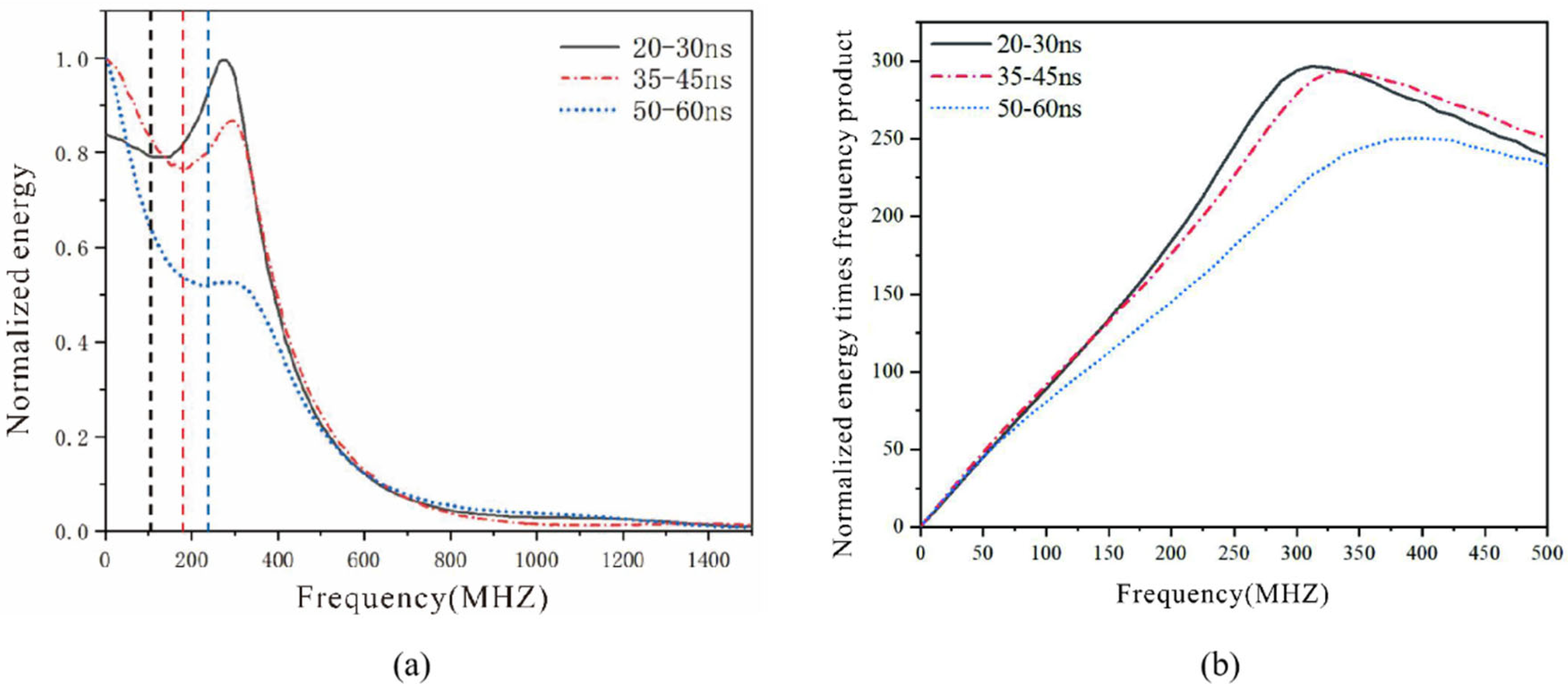
Within the ARMA power spectrum of a given GPR trace, dielectric relaxation losses in pore water cause preferential attenuation of high-frequency electromagnetic energy, resulting in a relative increase in the low-frequency spectral energy fraction [29]. Consequently, depth intervals with elevated moisture content exhibit larger EL values compared to drier intervals, reflecting the moisture-dependent spectral redistribution. Furthermore, increasing volumetric water content enhances cumulative low-frequency spectral power through both direct attenuation mechanisms and moisture-induced velocity dispersion effects. To validate the applicability of this spectral-domain moisture estimation approach for the study site, we analyzed the time window variation of EL along representative GPR trace 1409, comparing spectral characteristics across independently measured moisture zones.
Trace 1409 corresponds to the seventh measurement station along survey line L1 in Study Area B, oriented south to north. Gravimetric sampling at this location yielded volumetric water content values of 7.17%, 10.18%, and 14.49% for the upper, middle, and lower soil layers, respectively. We took the average of 20 nearby radar single-channel signals, including channel 1409. ARMA power spectra were then calculated for depth-windowed segments corresponding to each sampled layer (Figure 2a). For visualization clarity, the spectral amplitudes were normalized and restricted to the effective antenna bandwidth (0–450 MHz) of the 400 MHz GPR system. Figure 2b presents the frequency-scaled spectra, where the ordinate represents the product of frequency and normalized spectral amplitude to emphasize high-frequency attenuation characteristics across the three moisture zones.
It can be seen from Figure 2a that the three curves all have higher energy in the low-frequency band (<100 MHz). As the frequency increases, the normalized energy shows an overall attenuation trend and gradually levels off after 800 M. When the time window is 20–30 ns, the curve has the highest energy after the entire 150 MHz, and an energy peak appears between 200–400 MHz. The energy is slightly lower when the time window is 35–45 ns, and the normalized energy weakens significantly when the time window is 50–60 ns, indicating that as the time window moves behind, the high-frequency energy part gradually attenuates, and the increase in the proportion of low-frequency energy indicates that the moisture content in this time window gradually increases. The three energy trend curves in Figure 2b generally show an increasing trend as the frequency increases. When the frequency increases to the 300–400 MHz range, it reaches the peak and then begins to fall back. The order of energy curves under different time windows is consistent with Figure 2a (20–30 ns is the highest, 50–60 ns is the lowest), and the difference further proves that high-frequency components contribute more to shallow time windows. The high and low trends of the three curves are consistent with those of the moisture content, which also shows that an increase in soil moisture enhances the absorption of high-frequency signal components, resulting in an increase in the proportion of low-frequency components.
Figure 2 shows that the trend of low-frequency normalized energy attenuation, as the time window moves backward, does indeed reflect the electromagnetic energy absorption effect caused by the increase in medium moisture content. Therefore, it is feasible to use low-frequency energy changes across different time windows to verify the effectiveness of the ARMA power spectrum model for soil moisture inversion in the study area. In the actual ground-penetrating radar detection process, the increase in low-frequency energy can effectively reflect the changing trend of soil moisture content, thus providing a theoretically different and effective basis for subsequent soil moisture inversion compared with the amplitude envelope average method.

2.4. Principle of Drying Method

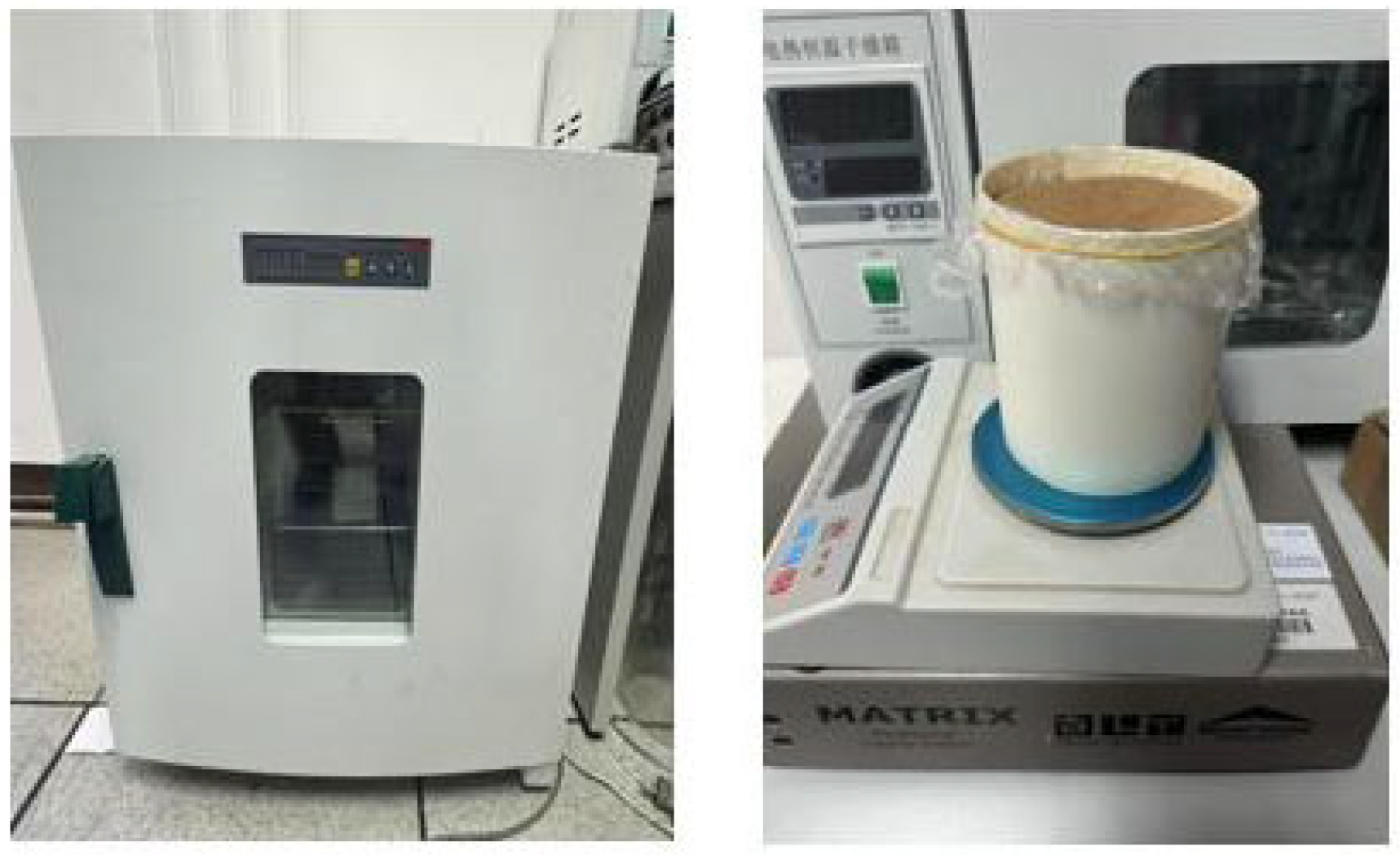
The drying method is the traditional method for measuring soil moisture content. Our experimental scheme of this study is as follows: the authors collected on-site samples, measured the actual moisture content by using the drying method, and compared it with the results inverted by the subsequent ARMA method. The specific experimental procedure was as follows: on-site sampling was conducted using a portable drilling rig, combined with the use of multiple sections of steel and plastic pipes for soil sample collection. At the marked line locations, the steel pipe was first placed at the top of the marked point, followed by vertical drilling with the drilling rig to extract soil column samples. Each sample was removed in sections and placed in a plastic bag, marked with a marker pen. The soil samples were then placed in a laboratory oven, where the drying method was employed to remove moisture from the samples, calculating the actual moisture content of the samples. The oven and soil samples are shown in Figure 3.

3. Results

3.1. ARMA Method to Invert Moisture Content

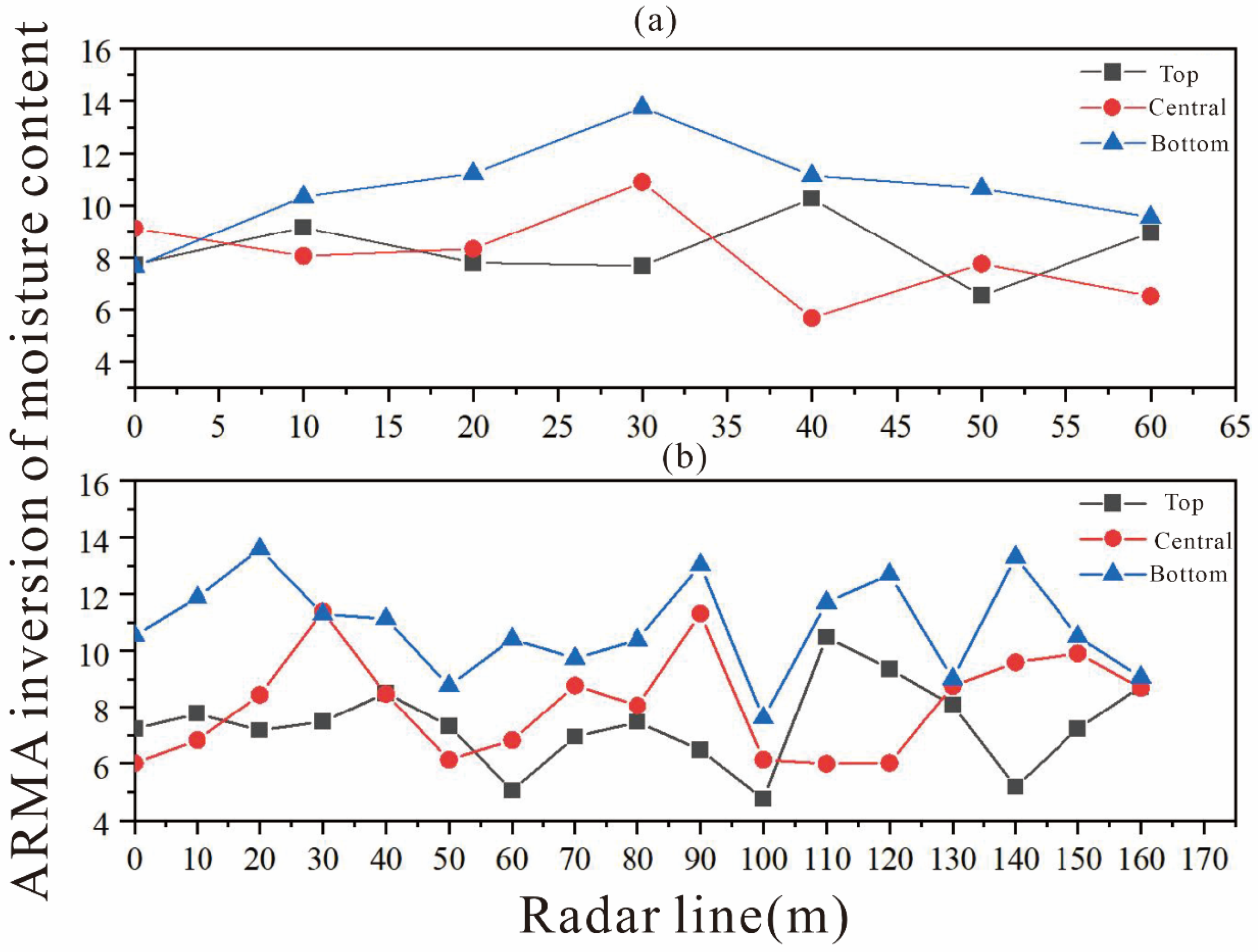
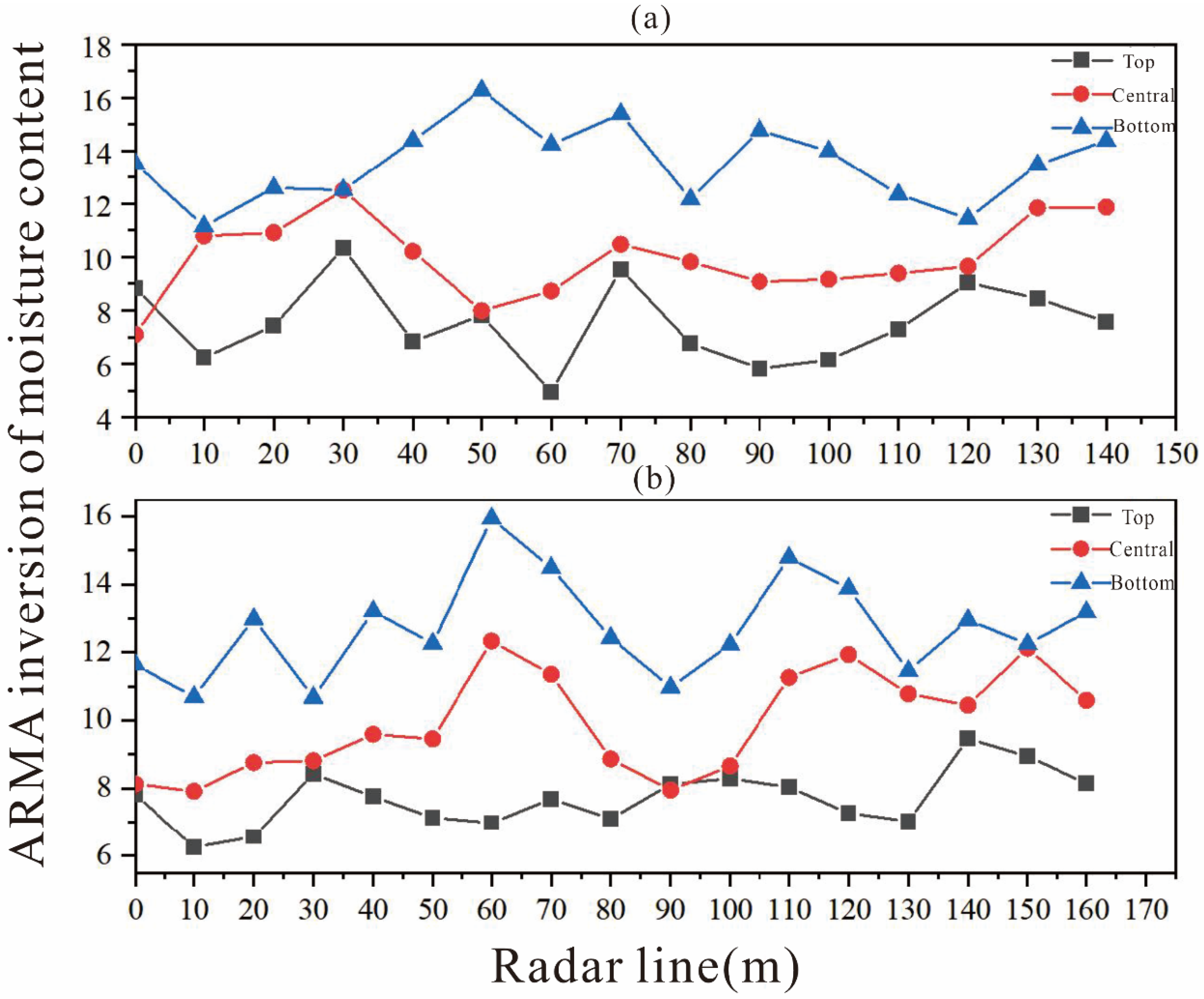
In this comparative experimental study, two measurement lines were set up in areas A and B in the NS and EW directions, respectively. The average of the data was calculated from two measurement lines in each direction. By establishing the relationship between the average radar amplitude envelope and the relative permittivity, the relative permittivity at three different depths from top to bottom in area A and area B was calculated. Subsequently, the moisture content of areas A and B within the same depth were determined. Given that the soil structure in Area B was divided into three layers vertically, the soil in Area B was divided into three parts: the upper part (0–1.4 m), the middle part (1.4–2.2 m), and the lower part (2.2–3 m). Ground-penetrating radar moisture content inversion was conducted at three different depths in each study area, and the trend maps of moisture content inversion using the ARMA method under different detection directions are shown in Figure 4 and Figure 5.
As can be seen from Figure 4, the moisture content of the bottom soil (2.2–3 m) was, on the whole, higher than that of the upper layer (0–1.4 m) and the middle layer (1.4–2.2 m). However, the three curves exhibit an intersection phenomenon, reflecting the variation of the dielectric constant of the mixed soil. The change in moisture content in the NS direction is less than that in the EW direction. In Figure 5, the upper soil layer has the lowest overall moisture content, the middle layer has a moderate moisture content, and the bottom layer has the highest moisture content. The change in the upper layer in the NS detection direction is less than that in the EW detection direction. The soil moisture content retrieved in both Area A and Area B increases with increasing detection depth. The change in moisture content within different depth ranges in Area B is more significant than that in Area A, demonstrating a good stratification characteristic, which is consistent with the three-layer structure division of the surface soil, aquifer, and water-retaining layer in Area B.

3.2. Comparison of Moisture Content Measured Using the Drying Method and ARMA Inversion

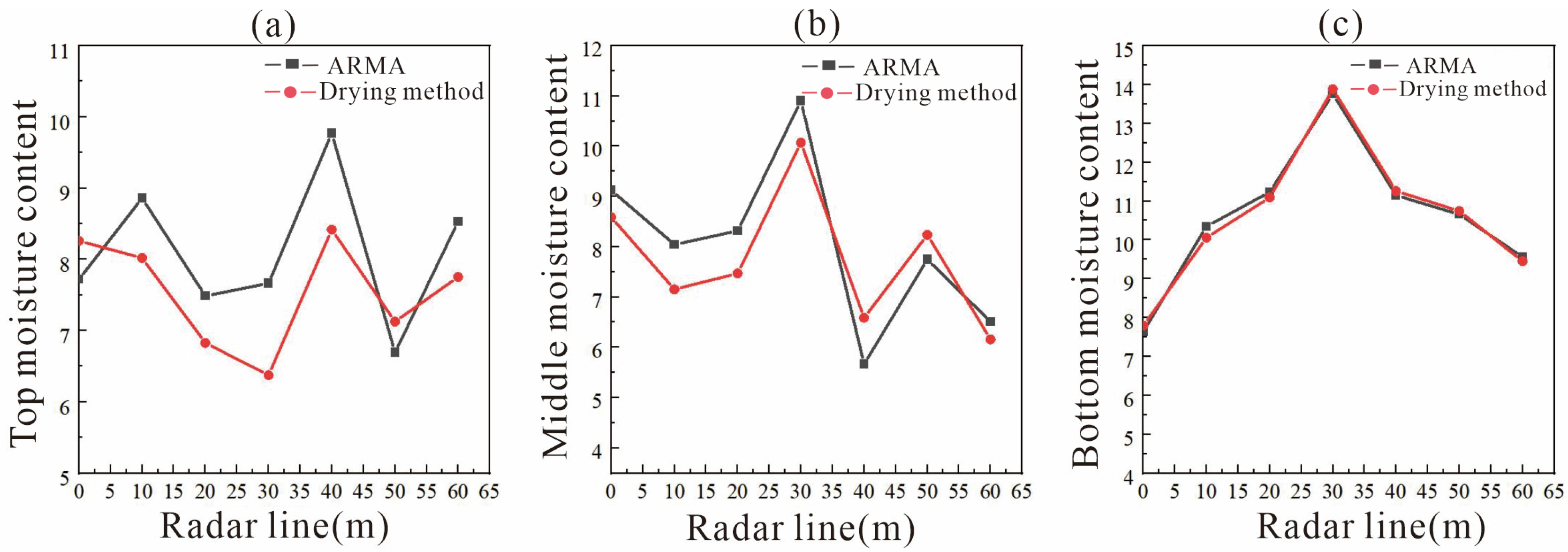
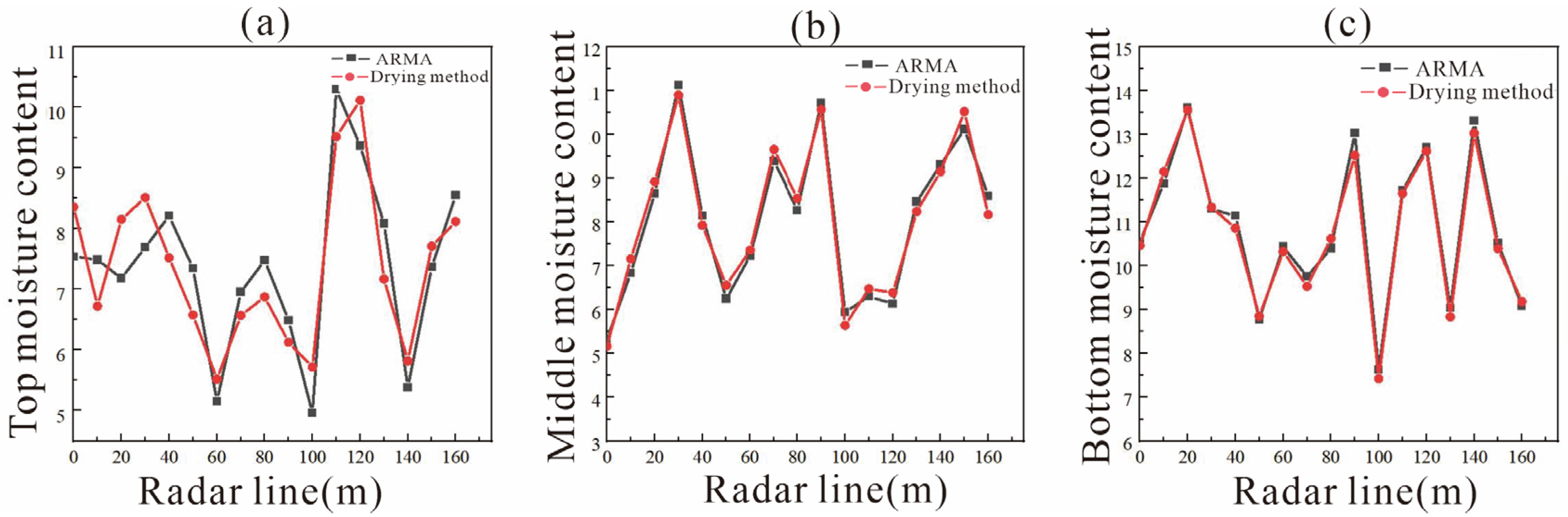
A comparative and analytical study of the differences and distribution characteristics between the moisture content obtained from the drying method at the sampling points and the moisture content inverted by the ARMA method can effectively evaluate the accuracy of the moisture content inversion using the ARMA method. The comparison results between the drying method and the ARMA method in Area A obtained through this method are shown in Figure 6 and Figure 7.
By comparing the moisture content at different depths in two directions of Area A in Figure 6 and Figure 7, it can be seen that the changing trends of moisture content inverted by the ARMA method and the moisture content measured by the drying method in the NS detection direction are generally similar; however, the moisture content measured by the ARMA method in the upper and middle parts is higher than that measured using the drying method. Due to the different compaction degrees of the mixed soil in Area A, the soil density in the reclamation area increases from top to bottom. The presence of air-filled voids in low-density soils distorts the permittivity response, causing bias in the inversion results. The correlation between the two methods is improved in the EW detection direction, which shows that the ARMA method has anisotropic advantages in inverting water content. However, the results measured using the upper drying method are higher than the results obtained using ARMA method inversion. The difference between the moisture contents in the upper part shows that the inversion results of the ARMA method are quite different from the measured values in the upper soil. As the depth increases, the value inverted by the ARMA method gradually approaches the measured value of the drying method. Especially in the deepest bottom soil layer, the ARMA method shows a high degree of consistency with the drying method.
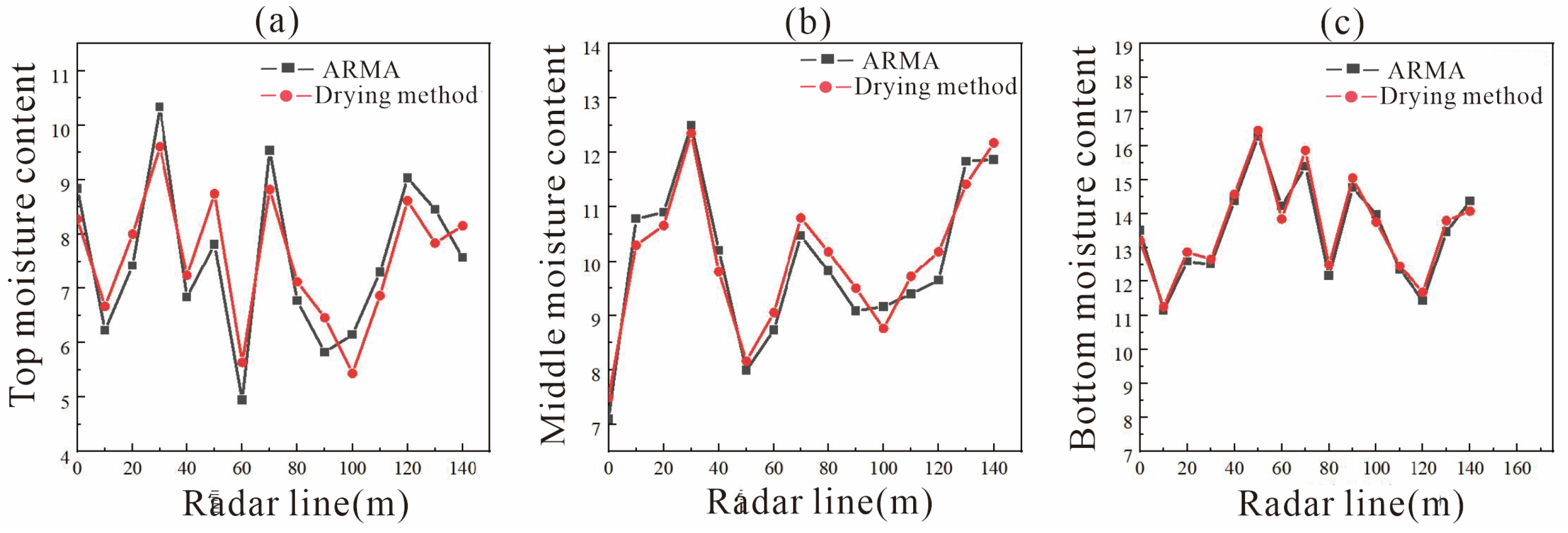
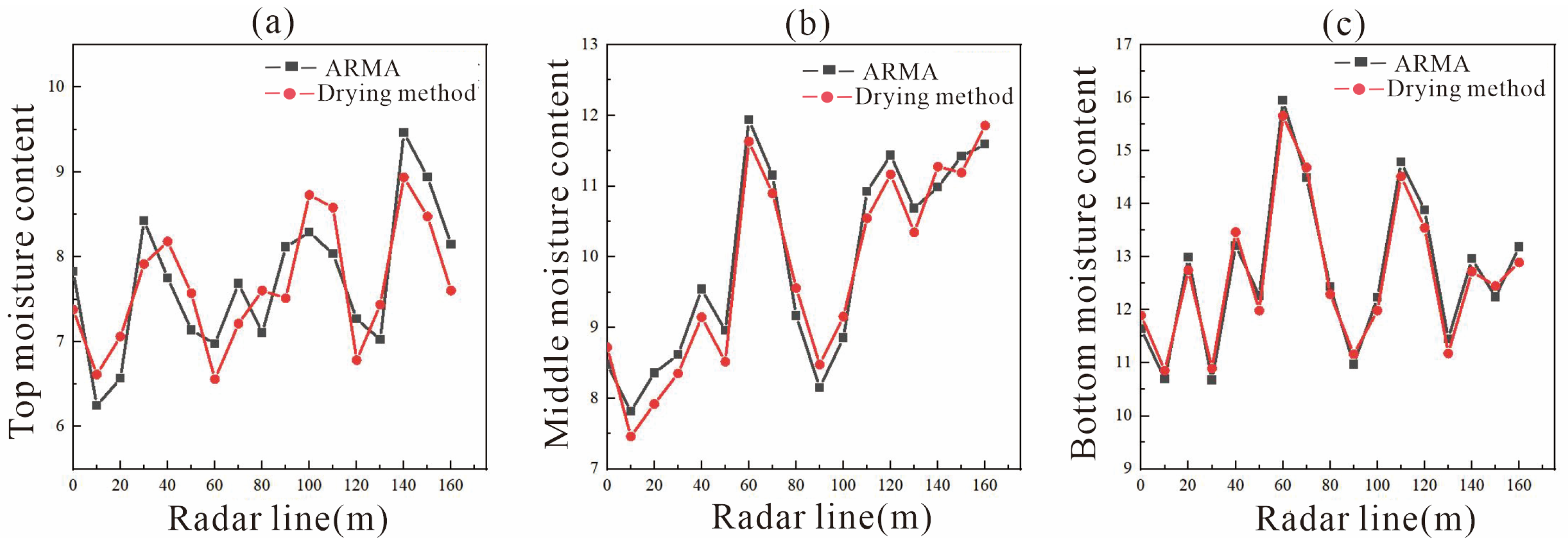
Keeping the measurement method unchanged, the above method can be used to compare the actual values measured using the drying method in Area B with the values inverted by the ARMA method, as shown in Figure 8 and Figure 9.
By comparing the moisture content comparison diagrams of Area B in different measurement directions in Figure 8 and Figure 9, it can be found that the changing trends of the moisture content obtained by the two methods are highly similar in different directions and locations. In the NS and EW detection directions, the correlation of the moisture content obtained using ARMA method inversion and the drying method in the upper area is significantly improved compared to Area A. The moisture content curves obtained using the two methods in the central region not only have similar changing trends, but also have similar amplitudes. The moisture content change curves of the two methods in the bottom area maintain a high degree of consistency, but in the NS detection direction, the moisture content value obtained using the ARMA method is slightly lower than that obtained using the drying method.
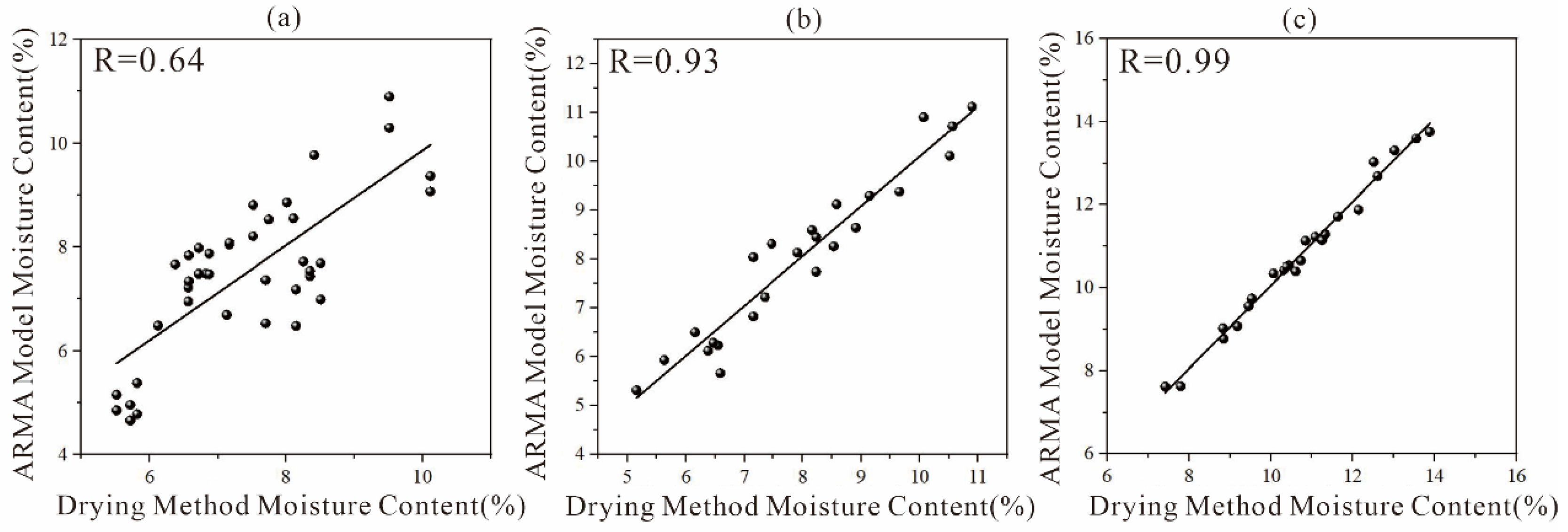
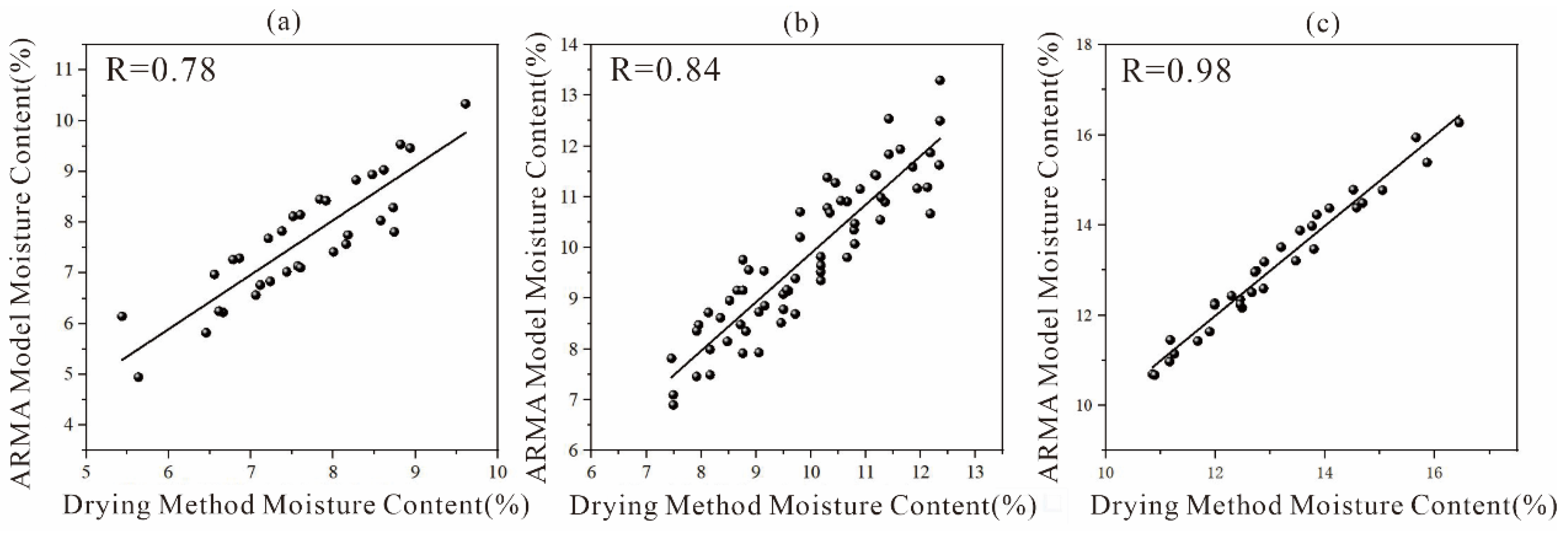
In order to more intuitively understand the fitting situation of the moisture content inverted by AMRA and the drying method, we fitted and compared the measured values of the drying method and the ARMA inversion values. R is the fitting correlation coefficient. The fitting results are shown in Figure 10 and Figure 11.
As can be seen from Figure 10, the fitting correlation coefficients of the moisture content obtained using ARMA inversion and the drying method in Area A are 0.64 in the upper part, 0.93 in the middle part, and 0.99 in the bottom part. As can be seen from Figure 11, the fitting correlation coefficients of moisture content obtained using ARMA inversion and the drying method in Area B are 0.78 in the upper part, 0.84 in the middle part, and 0.98 in the bottom part. Both regions A and B have a high degree of dispersion in the upper part, indicating that the ARMA inversion results have certain errors in the upper region. However, as the depth increases, the correlation between the value inverted by the ARMA method and the value obtained using the drying method is significantly enhanced. This shows that the accuracy of ARMA inversion is effectively improved with increasing depth.
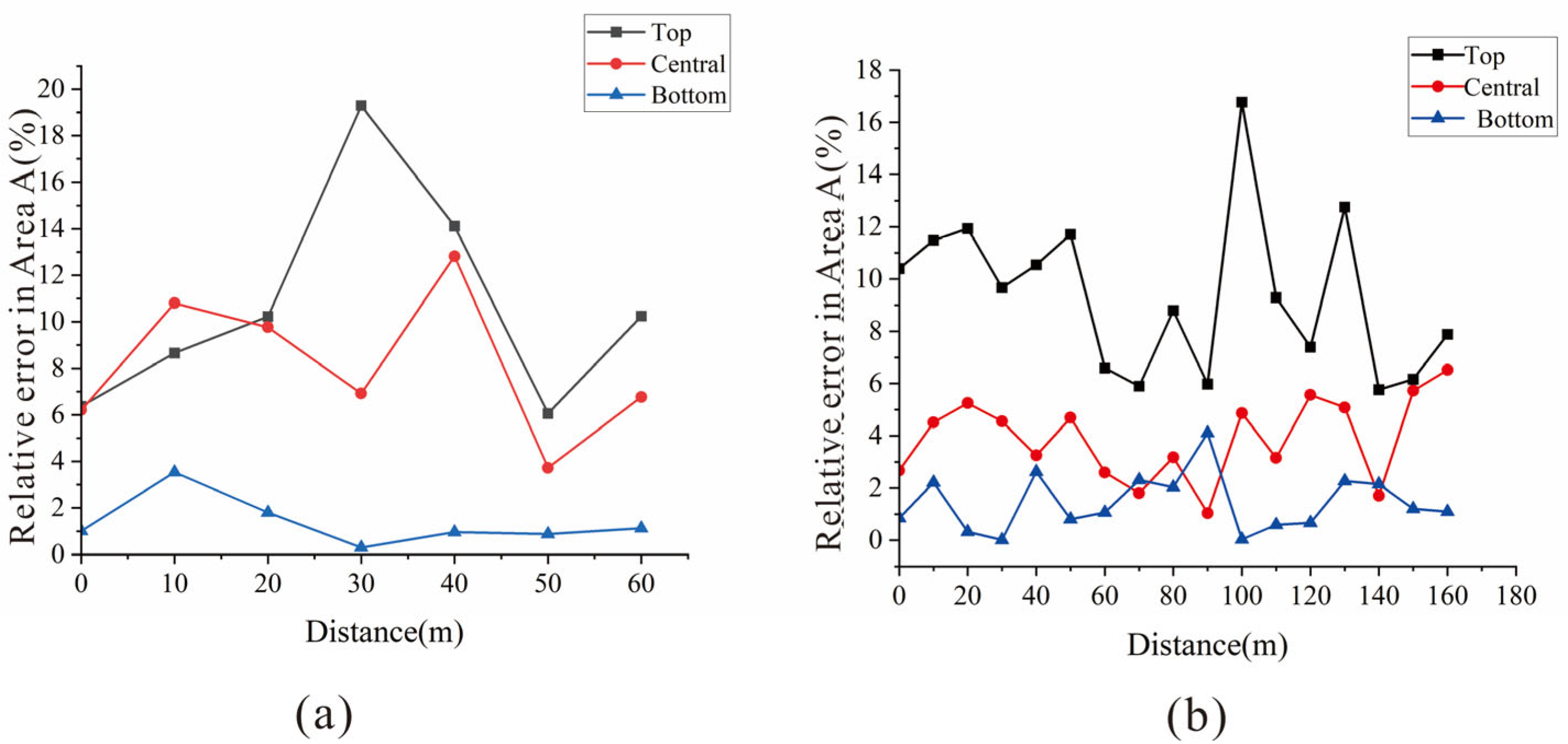
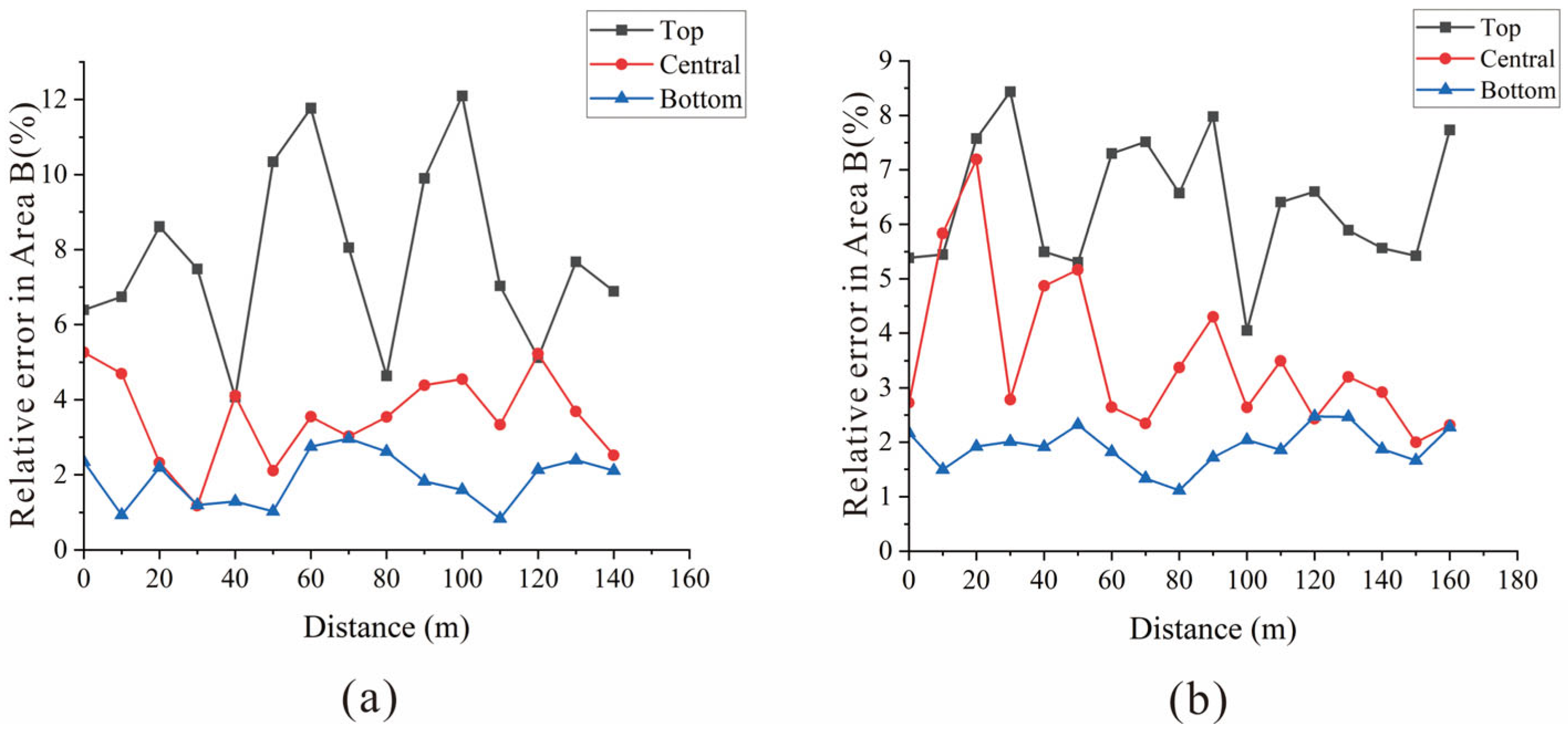
In order to quantify the inversion accuracy, we calculated the relative error between the ARMA inversion value and the measured value, as shown in Figure 12 and Figure 13:
As can be seen in Figure 12, the relative error ranges of the upper and middle layers change significantly in both the NS and EW directions, reflecting obvious signal scattering in the shallow part of the mixed soil. In contrast, the bottom layer maintains a relatively low and stable error range. Compared with Area A, the overall fluctuation amplitude of the relative error in Area B (Figure 13) is significantly reduced, especially in the middle and bottom layers. This shows that the layered soil structure is more conducive to electromagnetic wave propagation and has higher inversion accuracy.

4. Discussion

This study uses the ARMA inversion method and the drying method to conduct experiments in reclaimed soil in coal mining areas. The moisture content obtained by ARMA inversion was compared with the moisture content obtained using the traditional drying method. The comparison results systematically demonstrate that the ARMA inversion method is feasible for monitoring soil moisture content in mining area reclamation and can reliably obtain soil moisture content at multiple depth levels.
In both study Areas A and B, soil moisture content showed an overall increasing trend with depth (Figure 4 and Figure 5). The intersection characteristics of the three curves in Area A reflect the heterogeneity of the spatial distribution of dielectric constants in the mixed soil. The bottom (2.2–3.0 m) of Area B generally has the highest moisture content, whereas the upper (0–1.4 m) and middle (1.4–2.2 m) have relatively low moisture content, showing consistency with the three-layer structure of the reclaimed soil.
Under different detection directions in Area A (Figure 6 and Figure 7), the overall trend of the moisture content inverted by the ARMA method is consistent with the values measured using the drying method, but there are systematic differences related to depth: the inverted results of the ARMA method in the upper and middle layers are slightly higher than the measured values, whereas at the bottom, the two almost completely overlap. This phenomenon shows that the ARMA model responds more accurately to high water content in deep layers, whereas in areas where shallow layers are dry and signal attenuation is obvious, the model slightly overestimates moisture content. This is consistent with the significant physical properties of the GPR signal being affected by the air–soil interface at shallow depths. At the same time, in the EW direction, the correlation between ARMA inversion and the drying method is better than that in the NS direction, indicating that the ARMA model shows better anisotropic adaptability in the directional structure. The discreteness of the ARMA method and the drying method in the upper area of Area B still exists, but it is significantly improved compared with Area A (Figure 8 and Figure 9). This reflects that the surface layer in the three-layer structure is relatively uniform and the pore continuity is good, which reduces random fluctuations in the high-frequency components. In the middle aquifer, the curves of the two methods not only have the same trend, but also have similar amplitudes, indicating that the ARMA model can analyze the relationship between the dielectric constant and the moisture content at different depths. The bottom water-retaining layer (2.2–3.0 m) shows almost perfect agreement, indicating that in deep environments, ARMA inversion can achieve accuracy close to that of the laboratory drying method.
The fitting correlation coefficients of the upper, middle, and bottom parts of study Area A were 0.64, 0.93, and 0.99 respectively; the fitting correlation coefficients of study Area B were 0.78, 0.84, and 0.98, respectively. The overall correlation in both regions shows a pattern of increasing correlation with depth. This shows that the dielectric constant changes stably in the high moisture content region, making the linear relationship of the ARMA model fitting stronger. This is because the spectral energy distribution of deep media is more stable, and the ARMA inversion model can effectively capture the relationship between the dielectric constant and moisture content. In contrast, the low correlation coefficient in the shallow layers results from spectral instability and near-field interference. High-frequency energy decays rapidly in shallow layers, making the ARMA model less sensitive to high-frequency dielectric fluctuations. At the same time, the shallow time window is short and spectrum resolution is insufficient, resulting in a reduced correlation between the inverted value characteristics and the measured value. Generally speaking, the ARMA model is more applicable in medium and deep environments with strong signal stability.
To sum up, the values retrieved by the ground-penetrating radar ARMA method not only reflect vertical layer changes but also exhibit a certain degree of anisotropy. Mixed soils are common in land reclamation from former open-pit coal mines. In recent years, land reclamation has tended to be carried out in a hierarchical structure. The layered structure of Area B makes the inversion accuracy better than the mixed medium of Area A. This also confirms that our method is suitable for moisture content detection in land reclamation areas of modern open-pit coal mines.

5. Conclusions

(1)
This study found that an increase in soil moisture content leads to a significant increase in the relative proportion of the final low-frequency energy component of the ground-penetrating radar signal, which is obvious in the range of 0–225 MHz. This provides an effective theoretical basis for the inversion of soil moisture content in reclamation based on spectrum energy changes.
(2)
This study found that in the soil reconstruction area, whether it is the zoning characteristics of the inverted moisture content of layered strata or the curve intersection characteristics of the inverted moisture content of non-uniform strata, the ARMA method can effectively capture the dynamic relationship between the dielectric constant and moisture content of the reclaimed soil in the mining area.
(3)
The correlation range between the ARMA inversion value of mixed soil and the measured value using the drying method was 0.64–0.99. The correlation range was 0.78–0.98 in the three-layer soil structure. This indicates that as medium depth and structural uniformity increase, the accuracy of ARMA inversion for water content improves significantly.

Author Contributions

Conceptualization, Y.H. and S.P.; methodology, K.L. and L.F.; software, L.F.; validation, Z.T. and L.M.; writing—original draft preparation, L.F. and J.L.; writing—review and editing and visualization, K.L.; supervision, S.P. All authors have read and agreed to the published version of the manuscript.

Funding

This research was funded by the 2025 Xinjiang Uygur Autonomous Region Major Science and Technology Project (No. 2025A01004-1) and the Key Laboratory of Mine Ecological Effects and Systematic Restoration, the Ministry of Natural Resources (No. MEER-2025-02).

Institutional Review Board Statement

Not applicable.

Informed Consent Statement

Not applicable.

Data Availability Statement

The original contributions presented in this study are included in the article. Further inquiries can be directed to the corresponding authors.

Acknowledgments

Thanks to each author for their efforts.

Conflicts of Interest

Author Lulu Fang was employed by the company Beijing Urban Construction Exploration & Surveying Design Research Institute Co., Ltd. The remaining authors declare that the research was conducted in the absence of any commercial or financial relationships that could be construed as a potential conflict of interest.

References

  1. Wang, X.; Peng, S.; He, Y. Research on the upward transport of vadose water based on isotope technology: A case study of mining subsidence area in shendong mining area. Earth Sci. Inform. 2025, 18, 455. [Google Scholar] [CrossRef]
  2. Guan, Y.; Wang, J.; Zhou, W.; Bai, Z.; Cao, Y. Delimiting supervision zones to inform the revision of land reclamation management modes in coal mining areas: A perspective from the succession characteristics of rehabilitated vegetation. Land Use Policy 2023, 131, 106729. [Google Scholar] [CrossRef]
  3. Luo, G.; Cao, Y.; Xu, H.; Yang, G.; Wang, S.; Huang, Y.; Bai, Z. Research on typical soil physical properties in a mining area: Feasibility of three-dimensional ground penetrating radar detection. Environ. Earth Sci. 2021, 80, 92. [Google Scholar] [CrossRef]
  4. Wu, C.; Bi, Y.; Peng, S.; Zhu, W. Isotope tracers reveal plant-soil water dynamics in shendong mining area: Dryland hydrological and ecosystem recovery. Rhizosphere 2025, 36, 101176. [Google Scholar] [CrossRef]
  5. Wu, C.; Bi, Y.; Zhu, W.; Bai, Z.; Zhao, P. Stratified soil profiles and arbuscular mycorrhizal fungi reshape plant water use strategy and enhance root development in arid mine waste dump restoration. Rhizosphere 2025, 35, 101145. [Google Scholar] [CrossRef]
  6. Cheng, Q.; Zhang, S.; Chen, X.; Cui, H.; Xu, Y.; Xia, S.; Xia, K.; Zhou, T.; Zhou, X. Inversion of reclaimed soil water content based on a combination of multi-attributes of ground penetrating radar signals. J. Appl. Geophys. 2023, 213, 105019. [Google Scholar] [CrossRef]
  7. Ye, T.; Wang, J.; Wang, J.; Feng, Y. Non-destructive detection of soil volumetric water content in reclaimed soils in an opencast coal mine using hyperbolic reflection in GPR images. Catena 2025, 252, 108845. [Google Scholar] [CrossRef]
  8. Cui, F.; Bao, J.; Cao, Z.; Li, L.; Zheng, Q. Soil hydraulic parameters estimation using ground penetrating radar data via ensemble smoother with multiple data assimilation. J. Hydrol. 2020, 583, 124552. [Google Scholar] [CrossRef]
  9. Li, K.; Liao, Z.; Ji, G.; Liu, T.; Yu, X.; Jiao, R. Estimation of the Soil Moisture Content in a Desert Steppe on the Mongolian Plateau Based on Ground-Penetrating Radar. Sustainability 2024, 16, 8558. [Google Scholar] [CrossRef]
  10. Robinson, D.A.; Jones, S.B.; Wraith, J.M.; Or, D.; Friedman, S.P. A Review of Advances in Dielectric and Electrical Conductivity Measurement in Soils Using Time Domain Reflectometry. Vadose Zone J. 2003, 2, 444–475. [Google Scholar] [CrossRef]
  11. Dahunsi, J.; Pathirana, S.; Cheema, M.; Krishnapillai, M.; Galagedara, L. Estimating soil hydraulic conductivity from time-lapse ground-penetrating radar data in podzolic soils using the green-ampt model. J. Hydrol. 2025, 657, 133059. [Google Scholar] [CrossRef]
  12. Shen, H.; Li, X.; Duan, R.; Zhao, Y.; Zhao, J.; Che, H.; Liu, G.; Xue, Z.; Yan, C.; Liu, J.; et al. Quality evaluation of ground improvement by deep cement mixing piles via ground-penetrating radar. Nat. Commun. 2023, 14, 3448. [Google Scholar] [CrossRef]
  13. Tong, Z.; Gao, J.; Yuan, D. Advances of deep learning applications in ground-penetrating radar: A survey. Constr. Build. Mater. 2020, 258, 120371. [Google Scholar] [CrossRef]
  14. Mahmoudzadeh Ardekani, M.R. Off- and on-ground GPR techniques for field-scale soil moisture mapping. Geoderma 2013, 200–201, 55–66. [Google Scholar] [CrossRef]
  15. Cui, X.; Liu, X.; Cao, X.; Fan, B.; Zhang, Z.; Chen, J.; Chen, X.; Lin, H.; Guo, L. Pairing dual-frequency GPR in summer and winter enhances the detection and mapping of coarse roots in the semi-arid shrubland in China. Eur. J. Soil Sci. 2020, 71, 236–251. [Google Scholar] [CrossRef]
  16. Zhang, P.; Wang, J.; Jiang, L.; Zhou, T.; Yan, X.; Yuan, L.; Chen, W. Influence Analysis and Stepwise Regression of Coal Mechanical Parameters on Uniaxial Compressive Strength Based on Orthogonal Testing Method. Energies 2020, 13, 3640. [Google Scholar] [CrossRef]
  17. Wu, K.; Desesquelles, H.; Cockenpot, R.; Guyard, L.; Cuisiniez, V.; Lambot, S. Ground-Penetrating Radar Full-Wave Inversion for Soil Moisture Mapping in Trench-Hill Potato Fields for Precise Irrigation. Remote Sens. 2022, 14, 6046. [Google Scholar] [CrossRef]
  18. Pongrac, B.; Gleich, D. Remote monitoring system based on cross-hole GPR and deep learning. In Proceedings of the 2023 17th International Conference on Telecommunications (ConTEL), Graz, Austria, 11–13 July 2023; pp. 1–5. [Google Scholar] [CrossRef]
  19. Zou, C.; Zhang, S.; Jiang, X.; Chen, F. Monitoring and characterization of water infiltration in soil unsaturated zone through an integrated geophysical approach. CATENA 2023, 230, 107243. [Google Scholar] [CrossRef]
  20. Cheng, Q.; Su, Q.; Binley, A.; Liu, J.; Zhang, Z.; Chen, X. Estimation of Surface Soil Moisture by a Multi-Elevation UAV-Based Ground Penetrating Radar. Water Resour. Res. 2023, 59, e2022WR032621. [Google Scholar] [CrossRef]
  21. Liu, X.; Chen, J.; Butnor, J.R.; Qin, G.; Cui, X.; Fan, B.; Lin, H.; Guo, L. Noninvasive 2D and 3D Mapping of Root Zone Soil Moisture Through the Detection of Coarse Roots With Ground-Penetrating Radar. Water Resour. Res. 2020, 56, e2019WR026930. [Google Scholar] [CrossRef]
  22. Xia, Z.; Xue, S.; Peng, Z.; Liu, F.; Xie, L. A full waveform inversion with noise models in GPR detection. J. Appl. Geophys. 2025, 243, 105970. [Google Scholar] [CrossRef]
  23. Qiao, H.; Zhang, M.; Bano, M. Harris hawks optimization for soil water content estimation in ground-penetrating radar waveform inversion. Remote Sens. 2025, 17, 1436. [Google Scholar] [CrossRef]
  24. Li, Z.; Zeng, Z.; Xiong, H.; Lu, Q.; An, B.; Yan, J.; Li, R.; Xia, L.; Wang, H.; Liu, K. Study on Rapid Inversion of Soil Water Content from Ground-Penetrating Radar Data Based on Deep Learning. Remote Sens. 2023, 15, 1906. [Google Scholar] [CrossRef]
  25. Liu, C.; Du, Y.; Yue, G.; Li, Y.; Wu, D.; Li, F. Advances in automatic identification of road subsurface distress using ground penetrating radar: State of the art and future trends. Autom. Constr. 2024, 158, 105185. [Google Scholar] [CrossRef]
  26. Cui, F.; Wang, R.; Chen, B.; Zeng, L.; Chen, Y. Application research of autoregressive and moving average power spectrum in mine ground-penetrating radar structure detection data analysis. Geophys. Prospect. 2023, 71, 1743–1755. [Google Scholar] [CrossRef]
  27. Cui, F.; Wu, Z.-Y.; Wang, L.; Wu, Y.-B. Application of the ground penetrating radar ARMA power spectrum estimation method to detect moisture content and compactness values in sandy loam. J. Appl. Geophys. 2015, 120, 26–35. [Google Scholar] [CrossRef]
  28. Cui, F.; Chen, B.; Wu, Z.; Nie, J.; Li, S.; Geng, X.; Li, S. Soil moisture estimation based on GPR power spectrum and envelope amplitude in sand loam. Trans. CSAE 2018, 34, 121–127. (In Chinese) [Google Scholar] [CrossRef]
  29. Loewer, M.; Igel, J.; Wagner, N. Spectral decomposition of soil electrical and dielectric losses and prediction of In situ GPR performance. IEEE J. Sel. Top. Appl. Earth Obs. Remote Sens. 2016, 9, 212–220. [Google Scholar] [CrossRef]
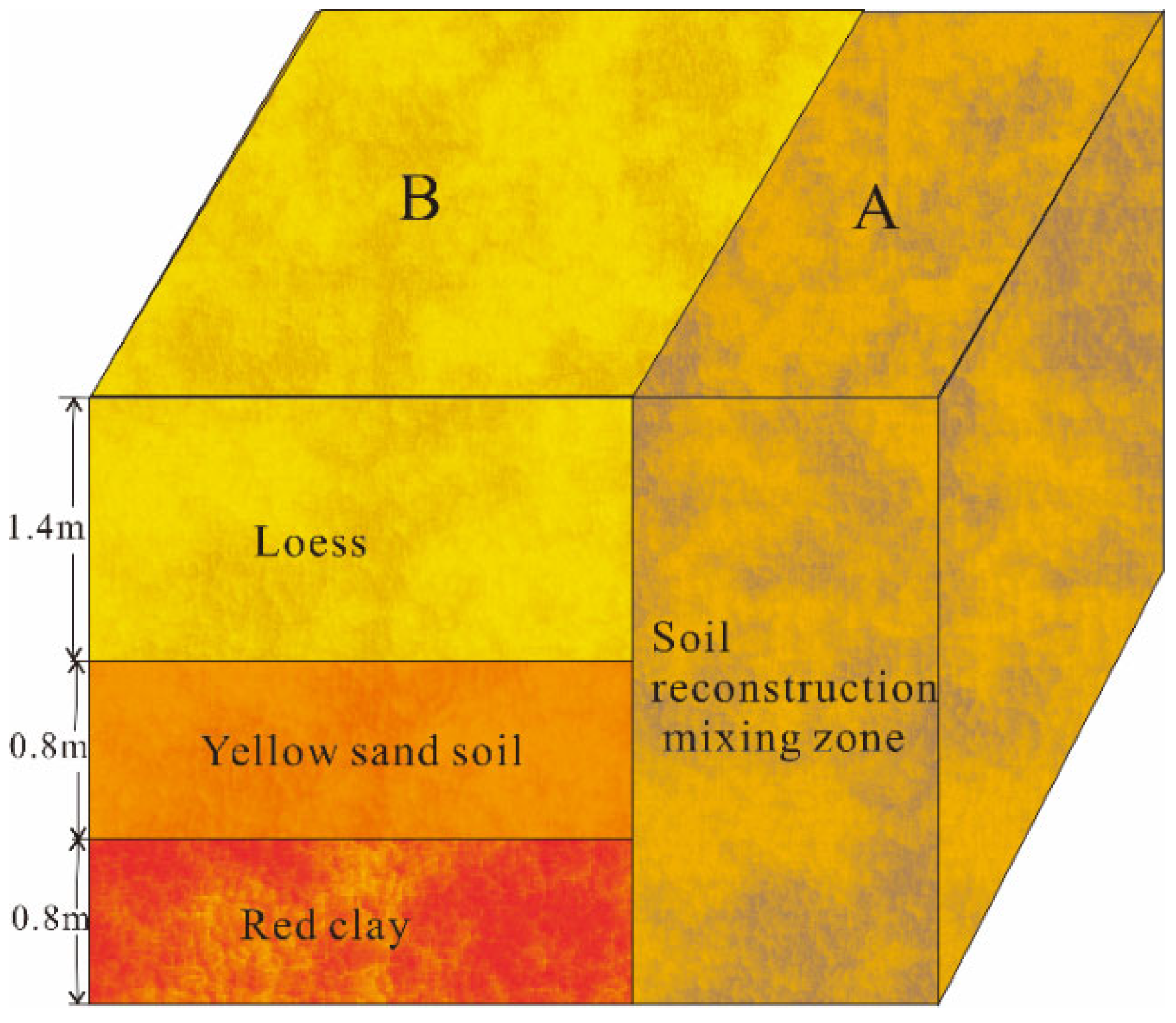
Figure 1. Schematic diagram of soil structure in the study area.
Applsci 16 00350 g001
Figure 2. ARMA accuracy analysis: (a) ARMA energy density comparison chart in different time windows, (b) energy trend comparison chart in different time windows.
Applsci 16 00350 g002
Figure 3. Drying box and a soil sample.
Applsci 16 00350 g003
Figure 4. The moisture content trend in ARMA inversion in Area A: (a) NS direction and (b) EW direction.
Applsci 16 00350 g004
Figure 5. The moisture content trend of ARMA inversion in Area B: (a) NS direction and (b) EW direction.
Applsci 16 00350 g005
Figure 6. Comparison between ARMA in the NS direction of Area A and moisture content using the drying method: (a) top section, (b) middle section, and (c) bottom section.
Applsci 16 00350 g006
Figure 7. Comparison between ARMA in the EW direction of Area A and moisture content using the drying method: (a) top section, (b) middle section, and (c) bottom section.
Applsci 16 00350 g007
Figure 8. Comparison between ARMA in the NS direction of Area B and moisture content using the drying method: (a) top section, (b) middle section, and (c) bottom section.
Applsci 16 00350 g008
Figure 9. Comparison between ARMA in the EW direction of Area B and moisture content using the drying method: (a) top section, (b) middle section, and (c) bottom section.
Applsci 16 00350 g009
Figure 10. Fitting of the ARMA model and the moisture content obtained using the drying method in Area A: (a) top section, (b) middle section, and (c) bottom section.
Applsci 16 00350 g010
Figure 11. Fitting of the ARMA model and the moisture content obtained using the drying method in Area B: (a) top section, (b) middle section, and (c) bottom section.
Applsci 16 00350 g011
Figure 12. Relative error in Area A: (a) NS direction and (b) EW direction.
Applsci 16 00350 g012
Figure 13. Relative error in Area B: (a) NS direction and (b) EW direction.
Applsci 16 00350 g013
Disclaimer/Publisher’s Note: The statements, opinions and data contained in all publications are solely those of the individual author(s) and contributor(s) and not of MDPI and/or the editor(s). MDPI and/or the editor(s) disclaim responsibility for any injury to people or property resulting from any ideas, methods, instructions or products referred to in the content.