Article

Effect of Snow on Automotive LiDAR Perception Under Controlled Climatic Chamber Conditions

1
Faculty of Engineering and Applied Science, Ontario Tech University, Oshawa, ON L1G 0C5, Canada
2
ACE Climatic Aerodynamic Wind Tunnel, Ontario Tech University, Oshawa, ON L1G 0C5, Canada
3
Department of Civil and Environmental and Earth Science, Engineering College, University of Notre Dame, Notre Dame, IN 46556, USA
*
Author to whom correspondence should be addressed.
Appl. Sci. 2026, 16(4), 2089; https://doi.org/10.3390/app16042089
Submission received: 8 January 2026 / Revised: 7 February 2026 / Accepted: 17 February 2026 / Published: 20 February 2026
(This article belongs to the Section Environmental Sciences)

Abstract

With the increasing deployment of autonomous and semi-autonomous road vehicles, Advanced Driver Assistance Systems (ADASs) rely heavily on multi-modal sensing technologies to ensure safe and reliable operation. Among these sensors, Light Detection and Ranging (LiDAR) provides high-resolution three-dimensional environmental perception but is particularly vulnerable to adverse weather conditions such as snowfall. Snowfall can degrade LiDAR performance through signal attenuation, backscattering, false detections, and sensor surface contamination, ultimately reducing visibility and detection reliability. In this study, an experimental investigation was conducted in a climatic chamber to systematically assess LiDAR performance degradation under controlled snowfall conditions. Key parameters influencing sensor behavior, including chamber air temperature, precipitation intensity, and sensor orientation, were isolated and examined. Chamber temperature was varied to generate snow characteristics representative of dry and wet snow, while precipitation intensity was controlled by adjusting snow gun flow rates. Sensor orientation was modified to evaluate its effect on perceived precipitation and snow accumulation. The experimental results confirm the initial hypothesis that snowfall intensity, snow physical properties, and sensor orientation exert a significant influence on LiDAR performance degradation. Increasing precipitation intensity significantly accelerates both 3D target detection loss and 2D visibility reduction, with polynomial regression revealing a non-linear degradation response. Inclined sensor orientations exhibited more rapid performance deterioration compared to a horizontal configuration. These findings provide valuable insights into LiDAR vulnerability in snowy environments and support the development of mitigation strategies to improve ADAS and autonomous vehicle operation in cold climates.

1. Introduction

The advancement of intelligent functionalities in road vehicles has accelerated in recent years, with significant emphasis placed on achieving full autonomy [1]. Modern Advanced Driver Assistance Systems (ADASs) rely on a suite of sensors such as cameras, Light Detection and Ranging (LiDAR), Radio Detection and Ranging (RADAR), and Sound Navigation and Ranging (SONAR) to perceive the surrounding environment and enable automated functions such as adaptive cruise control, lane-keeping, hands-free steering, and emergency braking [2]. A key challenge for these systems is sensor reliability under adverse weather conditions, where precipitation, particularly snow, can severely impair performance. Snow is especially disruptive due to its highly variable particle size, shape, and density, which enhance optical scattering, backscattering, and surface accretion mechanisms that collectively degrade signal quality in optical sensing systems. Optical sensors, particularly cameras and LiDAR, are highly vulnerable in snowy environments due to their reliance on short-wavelength signals in the nanometer range, which makes them especially sensitive to scattering, attenuation, and interference effects [3].
LiDAR has long been established in geodetic and surveying applications, where research has focused on accuracy, statistical adjustment, and uncertainty analysis using methods such as calibration, error budgeting, and least-squares techniques. Numerous studies have validated airborne and terrestrial LiDAR data against traditional surveying instruments and demonstrated how system design and processing approaches influence measurement reliability [4,5,6,7]. However, automotive-grade LiDAR differs significantly from geodetic systems in terms of design, wavelength, scanning strategy, and real-time operational requirements. As a result, findings from geodetic LiDAR studies cannot be directly applied to automotive LiDAR, particularly under adverse weather conditions, necessitating dedicated experimental investigation in this context. Automotive LiDAR systems are primarily based on either time-of-flight (ToF) or frequency-modulated continuous-wave (FMCW) principles. ToF LiDAR measures distance by calculating the travel time of emitted laser pulses and offers high spatial resolution and long detection range but is more susceptible to ambient light interference and precipitation-induced backscattering. In contrast, FMCW LiDAR determines range through frequency modulation while simultaneously measuring target velocity via the Doppler effect, providing improved immunity to interference and enhanced robustness in challenging environmental conditions [8,9]. Despite its growing importance, limited research has examined how LiDAR performance deteriorates under snowfall conditions.
Snowfall presents one of the most persistent challenges for LiDAR-based perception in autonomous and unmanned vehicles. For LiDAR, snow generates false returns, attenuates laser signals, and occludes real surfaces, leading to cluttered point clouds, reduced sensing range, and errors in detection and localization [10,11]. LiDAR-derived features can reliably distinguish between light, moderate, and heavy snowfall conditions, with high classification accuracy across different platforms. The study highlights that snowfall-induced backscatter and increased noise density are consistent indicators of snowfall severity [12]. As demonstrated in the study by Sun et al. [13], snowfall significantly reduces effective detection range and introduces dense clusters of false returns, particularly at short ranges. Performance degradation is found to be strongly dependent on snowfall intensity and particle concentration, with heavy snow causing severe perception loss. These limitations are particularly concerning safety-critical contexts such as ADASs and AVs, where reliable sensing is essential for navigation and decision-making. Compared to camera systems, LiDAR remains a relatively less mature sensing technology for automotive applications, with many of its key elements, ranging from internal hardware to signal processing algorithms and external environmental shielding, still undergoing active development.
Under both natural and controlled snowfall conditions, LiDAR sensors experience multiple forms of performance degradation. Snowflakes introduce non-surface returns and elevated noise levels in the vicinity of the sensor, increasing false detections while simultaneously masking true targets, particularly those that are small or located at greater distances [14,15,16]. These effects are even more pronounced in high-resolution 3D LiDARs, where snow-generated clutter can closely resemble legitimate environmental structures, making it difficult to reliably differentiate noise from actual features [12,14,17]. Prior studies have consistently reported that snowfall leads to spurious backscatter, unstable intensity measurements, and a reduced effective sensing range, with detection performance for small- and medium-sized objects declining markedly as snow intensity increases [12,13,15,16]. Controlled experiments using automotive-grade LiDAR systems have further demonstrated substantial perception failures, including degraded range estimation and critical object misdetections [12,18]. LiDAR performance degradation during snowfall remains insufficiently characterized within the context of automotive applications, raising significant safety concerns for autonomous driving under such conditions. Therefore, it is essential to conduct a set of experiments across a range of snowfall intensities and environmental conditions to systematically evaluate LiDAR degradation mechanisms.
Although outdoor experiments provide realistic evaluation conditions, they are limited by uncontrollable environmental variability, making repeatability difficult. As a result, field investigations often require extended durations, sometimes spanning years to capture sufficient data over a representative range of weather scenarios [19,20,21,22]. In contrast, indoor testing in climatic wind tunnels provides a highly controlled and repeatable experimental environment. Such facilities enable precise manipulation of critical variables, including airflow speed, turbulence intensity, thermal gradients, and precipitation type or rate, allowing researchers to systematically isolate and analyze their individual and combined effects [23,24,25,26,27,28]. This not only accelerates the testing process but also ensures reproducibility, reducing the influence of external uncertainties that complicate outdoor studies.
A significant factor underlying the existing research gap is the insufficient understanding of how different snow types, governed by temperature, humidity, and ambient environmental conditions, interact with and influence LiDAR signal response. Dry snow, typically formed at lower temperatures, consists of low-density, weakly cohesive particles that tend to remain airborne, increasing volumetric backscattering. In contrast, wet snow, which forms near the melting point, contains liquid water and exhibits higher density and adhesion, leading to enhanced surface accretion on the sensor window and rapid signal attenuation [29]. Because snow morphology evolves continuously with environmental parameters, its interaction with optical sensors also changes in a transient manner; however, these effects remain largely unquantified for automotive LiDAR applications. To address this gap, the present study conducts a series of snow experiments inside a climatic chamber, where environmental conditions are controlled. The experiments are designed to examine how variations in snowflake density, shape, and size, as well as ambient temperature and humidity, impact LiDAR performance. By systematically testing different temperatures, snow intensities, and sensor inclinations, this study seeks to elucidate the mechanisms governing LiDAR degradation in snow. The resulting analyses provide foundational datasets for predictive performance modeling and identify key operational and environmental criteria necessary for maintaining reliable LiDAR perception during snowfall.

2. Methodology and Experimental Setup

2.1. Snow Precipitation and Accumulation

A conventional method for determining precipitation intensity involves using a gauge to measure changes in accumulated mass or volume over a defined time interval. Alternatively, optical disdrometers provide a means to quantify precipitation characteristics through high-resolution particle measurements. For instance, Frasson et al. [30] estimated rainfall rate in outdoor environments by computing the total volume of intercepted droplets. Following this approach, the total precipitation volume in the experimental samples was determined as:
    V D = j = 1 t i = 1 k N i , j 4 π 3 D b i , j 2 3
where N is the count number of each size bin of mean diameter   D b . As the equation shows, it is common practice in disdrometer data processing to approximate the droplets’ volume by considering them as spheres. The parameters k and t represent the total number of particle size bins and the duration of each experimental run, respectively, and their values depend on the specific disdrometer model used, as well as the measurement period of each run. The assumption of spherical particles in precipitation measurements is inherently inaccurate, as snow morphology varies significantly under different environmental conditions. Therefore, it is necessary to complement disdrometer-based measurements with standard gauge observations to validate and correct the recorded precipitation values. In the present study, particle-level information, specifically particle size and fall velocity, was required; therefore, a Laser Precipitation Monitor (LPM), as shown in Figure 1, was employed alongside conventional gauge measurements to characterize the precipitation with greater detail.
The fundamental icing equation serves as a basis for modeling snow accumulation on surfaces and is defined in the ISO 12494 standard [31] as follows:
d M d t = α 1 α 2 α 3 w U A
where d M d t (kg/s) is the mass rate of snow accumulation; w (kg/m3) is the mass concentration of snow particles in air; A (m2) is the cross-sectional area of the object perpendicular to the direction of snowflake impact velocity vector; and U (m/s) is the impact velocity of the snowflake with respect to the object.
The impact velocity of snowflakes U   is the vector sum of the terminal velocity of them, v s (m/s), and wind speed, v w (m/s), which can be obtained as follows:
V = v s 2 + v w 2
α 1 is the collision efficiency of snowflakes, which represents the fraction of snowflake particles that physically impact the object relative to the number that would have done so in the absence of flow diversion around the object. α 2 is the sticking efficiency of snowflakes, which quantifies the fraction of particles that stick to the surface after collision, compared to the total number of particles that collided with it. Snow sticking efficiency mainly depends on its density and liquid water content (LWC). Higher LWC increases adhesion, while dry, low-density snow sticks less [32].
Wet snow develops when partial melting occurs during descent, typically near freezing or slightly positive temperatures. In contrast, dry snow remains powdery with minimal LWC when ambient conditions are well below 0 °C, rendering it more susceptible to wind transport [33]. Additional factors such as diurnal temperature fluctuations, ground heat flux, and solar radiation further modulate snow wetness. Investigations into wet-snow formation indicate that the threshold temperatures are not universal, with reported values varying among studies [32,34]. Generally, adhesive interactions between snow and surfaces are observed over a temperature range of approximately −2 °C to +5 °C [35]. α 3 is the accretion efficiency of snowflakes, which indicates the proportion of particles that remain accumulated on the surface after sticking, relative to those that initially adhered. It is widely recognized that α 3 is controlled by the thermodynamic and heat-transfer characteristics of the snowflakes, the surrounding air, and the surface on which the snow deposits. The coefficients ( α 1 , α 2 , α 3 ) vary between 0 and 1 and strongly depend on the properties of a single snowflake. To simplify the formulation of the snow accumulation equation, the product of the three efficiency coefficients ( α 1 , α 2 , α 3 ) is combined into a single parameter, hereafter referred to as the effective efficiency (αeff). This parameter represents, in a consolidated manner, the fraction of the incoming snow flux that ultimately contributes to net accumulation on the surface. In other words, α e f f can be interpreted as the ratio of the actual rate of accumulated snow to the total rate of incident snow particles.
  α effective = α 1 α 2 α 3

2.2. LiDAR Performance Evaluation

Initial assessments showed that LiDAR point returns decrease significantly in snowy conditions compared to clear conditions. To quantify this degradation, two complementary approaches were employed: a 3D point-counting method and a 2D image-based processing method [36].
For each run, control frames were taken under dry conditions to represent the highest achievable detection quality for that specific test. LiDAR performance in different test scenarios was then evaluated against these control frames. The 3D method is used as a direct quantification approach, applying raw signal filtering and statistical analysis within a defined region of interest (ROI). Visibility in 3D was determined using Equation (5), while the average reflectivity was calculated from all detected points.
LiDAR   3 D   Visibility = N u m b e r   o f   p o i n t s   d e t e c t e d s n o w N u m b e r   o f   p o i n t s   d e t e c t e d d r y × 100 %
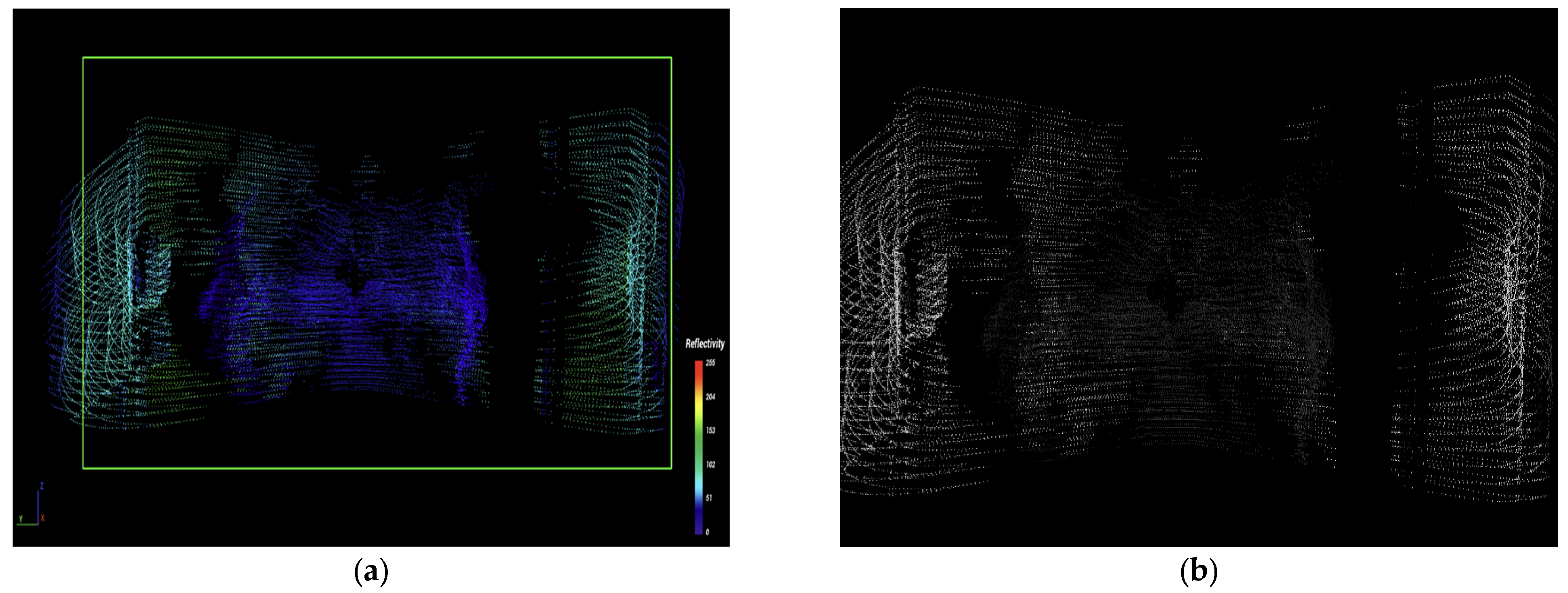
To quantify the effective area of LiDAR detections associated with true targets under snowy conditions, a 2D-image-based processing approach was applied to snapshots of the LiDAR point cloud within a predefined area of interest (AOI). First, the 3D point cloud was projected onto the sensor viewing plane and rendered as a raster image, where pixel intensity represents the return strength (reflectivity or point density). The AOI was defined consistently across all frames to isolate the target and exclude irrelevant surroundings. Each snapshot was then converted to grayscale, collapsing color-coded reflectivity information into a single intensity channel, as shown in Figure 2. This transformation facilitates robust image processing by reducing sensitivity to visualization parameters while preserving relative contrast between high-reflectivity target returns and low-intensity background or noise induced by snow particles.
After converting images to grayscale, an intensity threshold was applied to separate true target returns from snow and background noise. Strong, coherent target reflections were kept while weak, scattered snow returns were removed, producing a binary image of the detected target area. The number of foreground pixels was converted to physical area using the image resolution, and this process was repeated over time to track how the detected area changed as snowfall increased.
Unlike the 3D approach, the 2D method uses a binary image processing technique, with visibility defined by Equation (6). Point cloud videos were analyzed frame by frame and indirectly quantified based on their planar projection. Compared to the 3D method, which only counts points, this approach requires less computational effort and provides greater real-world relevance and physical interpretability.
LiDAR   2 D   Visibility = A r e a s n o w A r e a d r y × 100 %

2.3. Experimental Setup

In this study, the influence of snowfall on LiDAR performance is examined through three key aspects: the nature of snow, the precipitation intensity, and the inclination of the sensor surface. The first aspect, snow nature, addresses particle characteristics such as size distribution, morphology, and density, which directly affect light scattering and attenuation. Snow is commonly categorized as either wet or dry according to its liquid water content, which is primarily governed by the prevailing temperature profile [32]. Wet snow develops when partial melting occurs during descent, typically under near-freezing temperatures, whereas dry snow remains powdery with minimal LWC when ambient conditions are well below 0 °C, rendering it more susceptible to wind transport [33]. The second aspect, precipitation intensity, considers the rate and concentration of snowfall, which alters point cloud density, visibility, and overall signal quality. The third aspect, sensor surface inclination, evaluates how the angular positioning of the LiDAR relative to snowfall impacts signal returns, accumulation on the sensor window, and effective field of view.
Together, these three aspects form the framework of the investigation, providing a comprehensive understanding of how environmental and geometric factors govern LiDAR performance under snowy conditions. The experimental aspects corresponding to these investigations are summarized in Table 1.
The experiments were conducted in the ACE Large Climatic Chamber (LCC), located at Ontario Tech University, Oshawa, Canada. This is a state-of-the-art experimental facility designed to reproduce a wide spectrum of extreme weather conditions, ranging from high-temperature environments to severe winter scenarios. The chamber is 20.8 m long, 6 m wide, and 5.55 m high. It provides regulation of temperature, humidity, and precipitation, thereby enabling systematic investigations of vehicle, structural, and product performance under controlled environmental stressors.
A unique capability of the facility is its ability to replicate harsh winter climates, including snow and ice events, with temperatures as low as −40 °C. This feature allows for realistic evaluations of snow accumulation, visibility reduction, and operational reliability in cold-weather conditions. Consequently, the chamber plays a critical role in validating the safety, durability, and efficiency of technologies intended for deployment in winter environments.
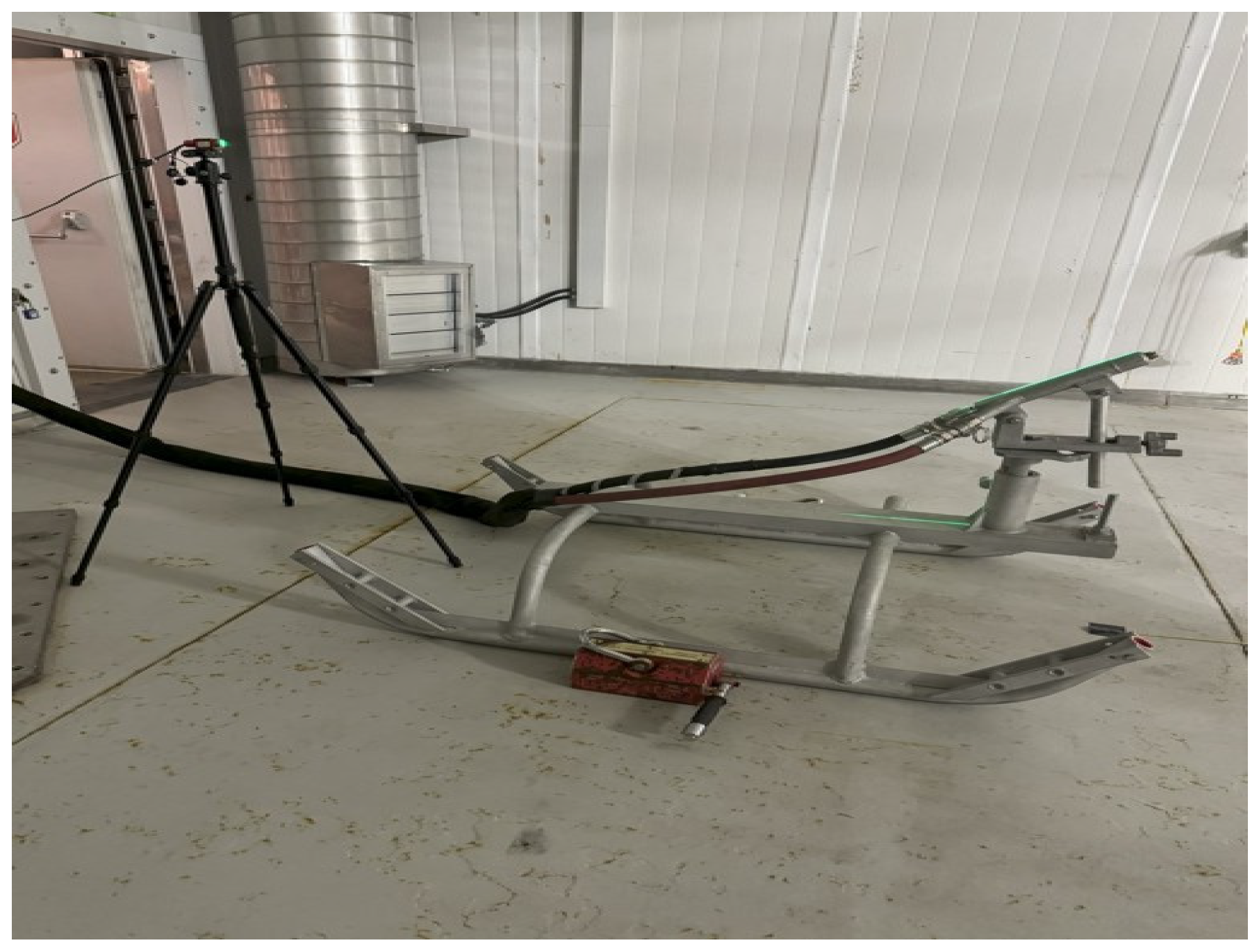
In the climatic chamber, artificial snow production was achieved using a snow gun (Figure 3). The snow gun functions by internally mixing two separate pressurized streams of air and water within its body, which are subsequently ejected through a discharge orifice. Compressed air, typically at pressures on the order of 100 psi, interacts with water supplied at comparable pressures, producing a high-velocity jet. The sudden decompression of the air–water mixture generates rapid cooling of the plume, which induces the breakup of the liquid stream into a distribution of water droplets with varying diameters.
Nucleation initiates when the smallest droplets experience sufficient cooling to freeze, thereby forming ice nuclei. These nuclei act as seeds for the subsequent crystallization of larger supercooled droplets, ultimately leading to the formation of ice crystals and artificial snowfall. The mechanism tries to replicate the natural snow formation process but in a controlled laboratory setting, enabling reproducible experimental conditions. Within the climatic chamber, these operational features ensure stable and consistent snow generation, thereby allowing for systematic studies on snow accumulation, visibility reduction, and sensor performance under controlled winter scenarios.
A Livox HAP LiDAR was employed as the primary optical sensor. This automotive-grade LiDAR, designed specifically for intelligent driving assistance systems, features a maximum detection range of 150 m in a clear environment, a point emission rate of 452,000 points/sec, and an equivalent point cloud density of 144 lines [37]. The selected sensor operates at a wavelength of 905 nm, which is among the most widely used wavelengths in production-grade automotive LiDAR systems. Since wavelength plays a critical role in optical penetration, scattering, absorption, and atmospheric attenuation, LiDAR performance in adverse weather is strongly dependent on this parameter. Consequently, because the sensor employed in this work operates at a wavelength representative of a large class of commercial automotive LiDARs, the observed trends and mechanisms of performance degradation are expected to be broadly relevant to other 905 nm-based systems. Complementing the LiDAR, a GoPro Hero 13 action camera was utilized to provide visual reference data. Both sensors were installed inside a cubic bucket, one face of which was fitted with a transparent plexiglass plate oriented toward the snow field. The plexiglass surface was chosen to replicate the optical properties of a vehicle windshield, as its adhesion and surface roughness characteristics are comparable, thereby enabling a realistic representation of snow adhesion and accumulation effects.
In the test configuration, the bucket was positioned directly in the snowfall, allowing snow particles to impinge upon and interact with the plexiglass surface in front of the sensor. This setup enabled progressive snow accumulation on the surface over time, thereby replicating realistic surface contamination conditions encountered in adverse weather. The configuration was designed to assess the resulting impact of snow deposition on LiDAR signal attenuation, backscattering, and overall performance degradation under continuous snowfall exposure.
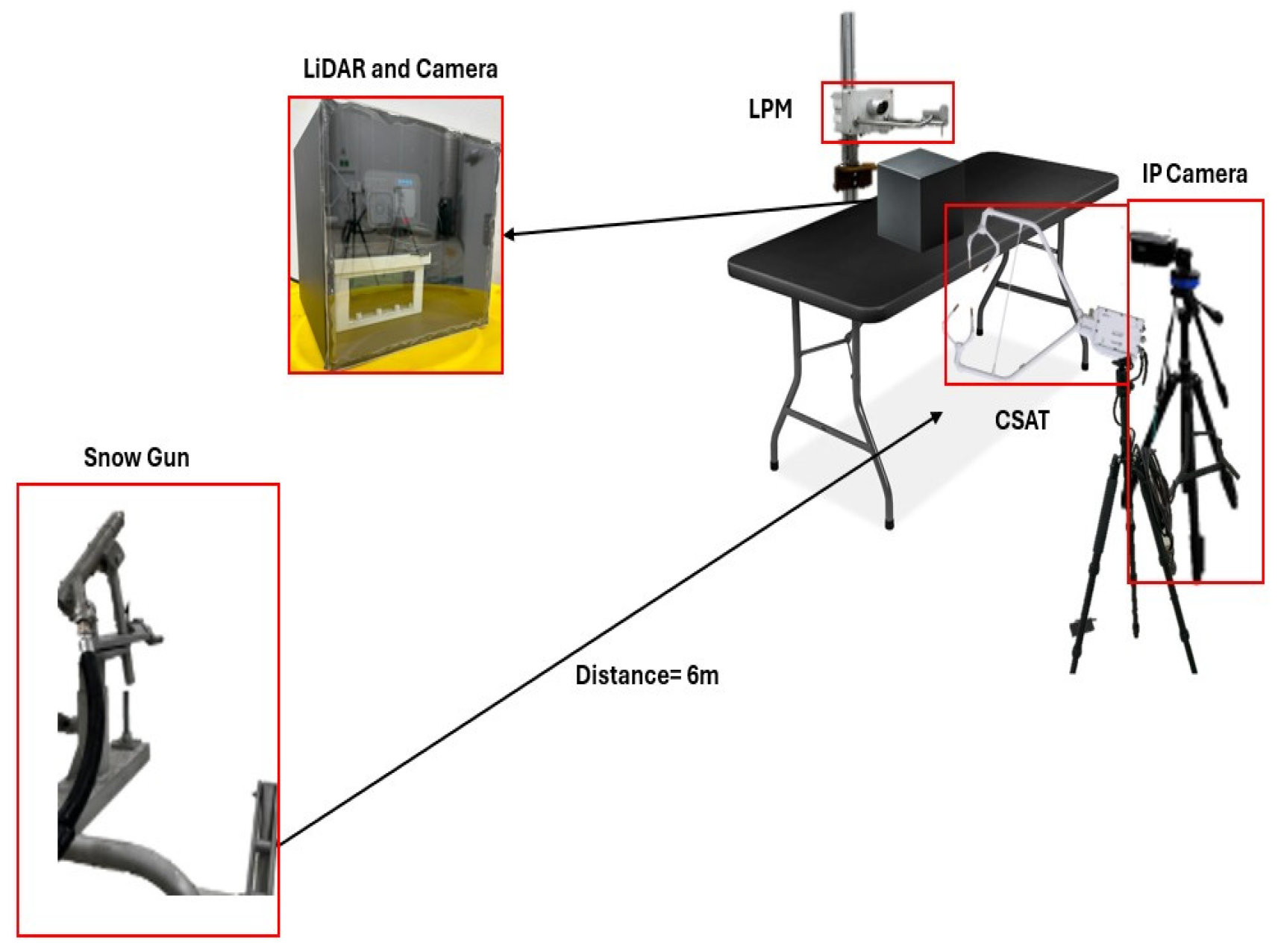
As shown in Figure 4, the sensor bucket was positioned on a table located 6 m downstream of the snow gun. This distance was deliberately selected based on a preliminary evaluation of the projectile trajectories of the snow particles. With the snow gun fixed at a 48° launch angle relative to the ground, the 6 m position corresponded to the zone of natural particle deposition, where snowflakes were expected to reach the ground. Distances closer or farther from the snow gun were avoided, as they would not accurately capture realistic precipitation fluxes. The snow gun launch angle was selected based on practical operational constraints. At larger angles, injected particles strike the chamber ceiling, leading to unwanted accretion, whereas at smaller angles, the particles reach the ground too quickly, limiting the time available for proper snowflake formation.
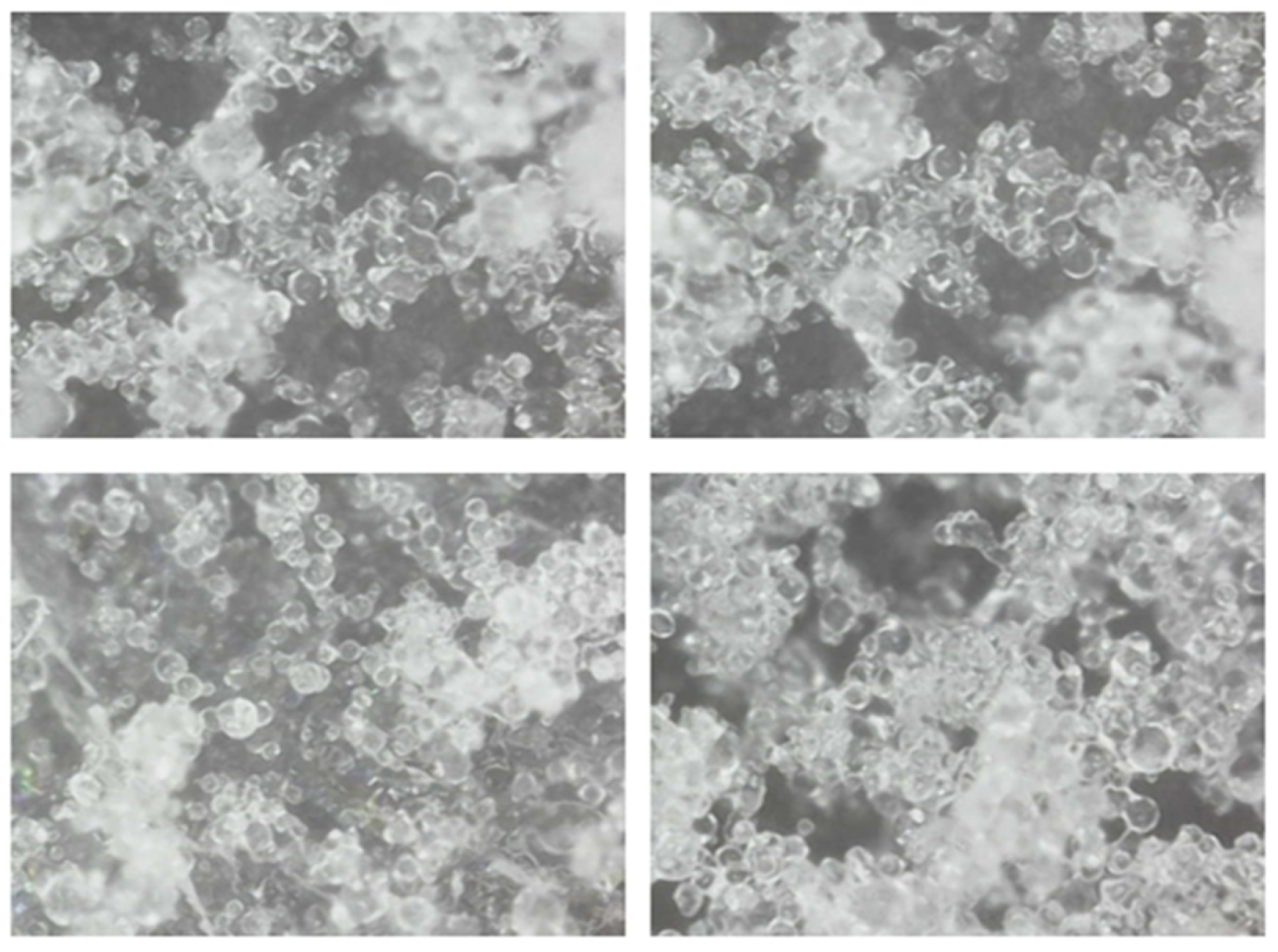
A CSAT3H heated three-dimensional ultrasonic anemometer (Campbell Scientific) was installed in proximity to the sensor bucket. This instrument measured wind velocity components (u, v, w) to assess the influence of turbulence on particle trajectories near the experimental setup. An internet protocol (IP) camera was also deployed to record the accumulation of snow on the plexiglass surface. These video recordings provide a complementary dataset for estimating accumulation rates and validating quantitative measurements from the LiDAR and LPM. In addition, a microscope equipped with a high-resolution camera was deployed inside the climatic chamber to observe and document the morphology of snow particles at a magnification of 500x.

3. Experimental Constraints and Sources of Uncertainty

Experimental errors were carefully minimized throughout the study by accounting for limitations in instrumentation, procedures, and data analysis. Strategies to address potential error sources and strengthen result reliability are outlined.

3.1. Instrumentation

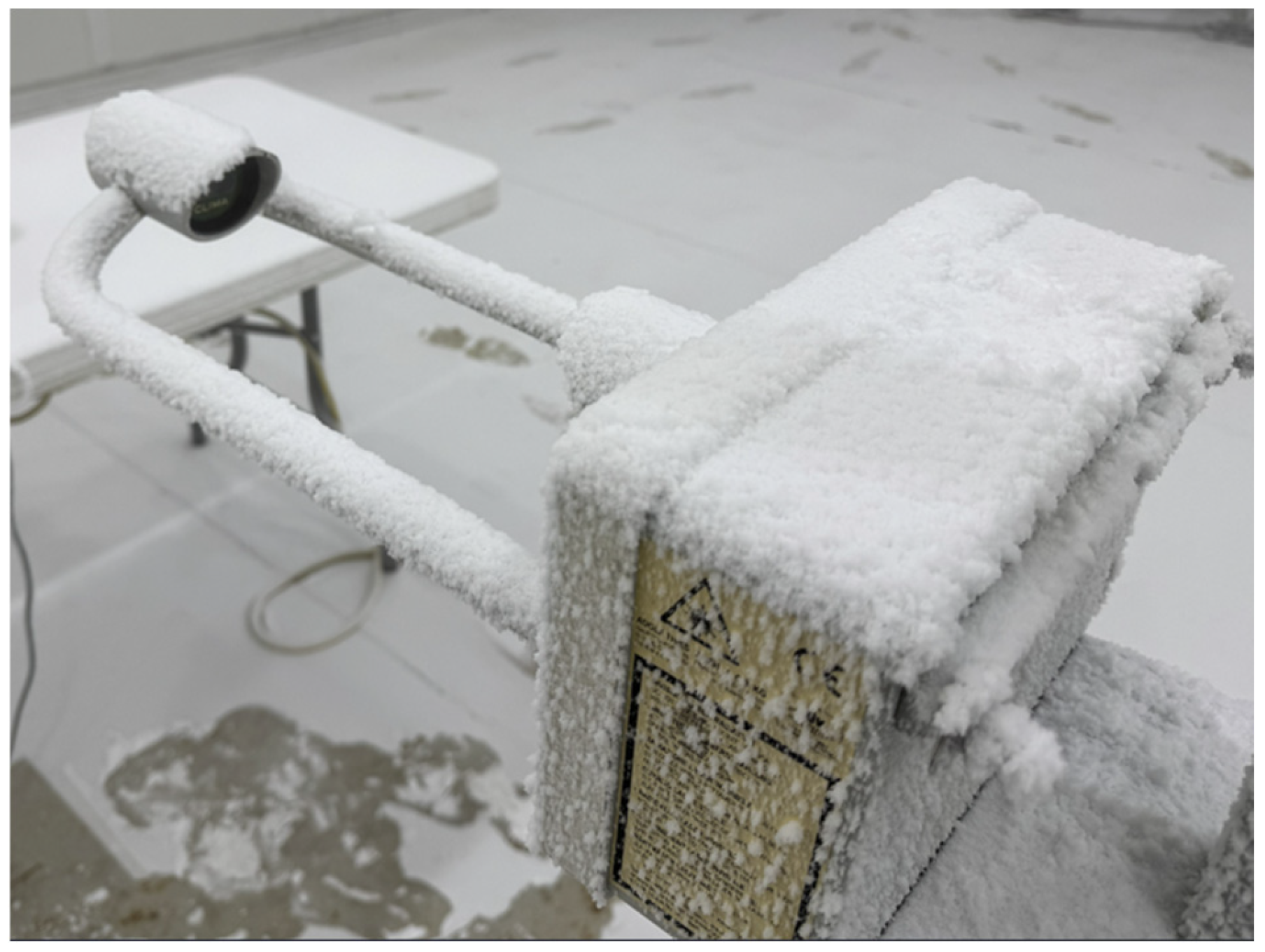
This section evaluates the reliability of data collected with a laser precipitation monitor (LPM), an advanced optical disdrometer used for snow measurements. Although LPM records particle size and velocity to estimate precipitation by assuming spherical snowflakes, microscopic imaging revealed this assumption to be inaccurate. Figure 5 presents a microscopic image of artificially generated snow produced in the climatic chamber. The microstructural examination reveals that the snowflakes predominantly form spherical particles, which tend to cluster and bond together, resulting in aggregates resembling graupel-like structures.
Because of this aggregation behavior, relying solely on conventional point-based or volumetric particle counts may lead to inaccuracies in estimating the actual precipitation flux. Therefore, it becomes essential to incorporate an additional quantitative metric, such as mass flux or weighing-scale measurements, in order to provide a more robust and accurate assessment of the snow precipitation rate. To address this, snow depth measurements were averaged and combined with density values, used to refine precipitation rate estimates. To account for snow layer compactness and its effect on precipitation intensity, a weighing scale was employed to record the mass flux of incoming snow every second. This bucket-and-scale setup provided a conventional catch-type measurement of precipitation.
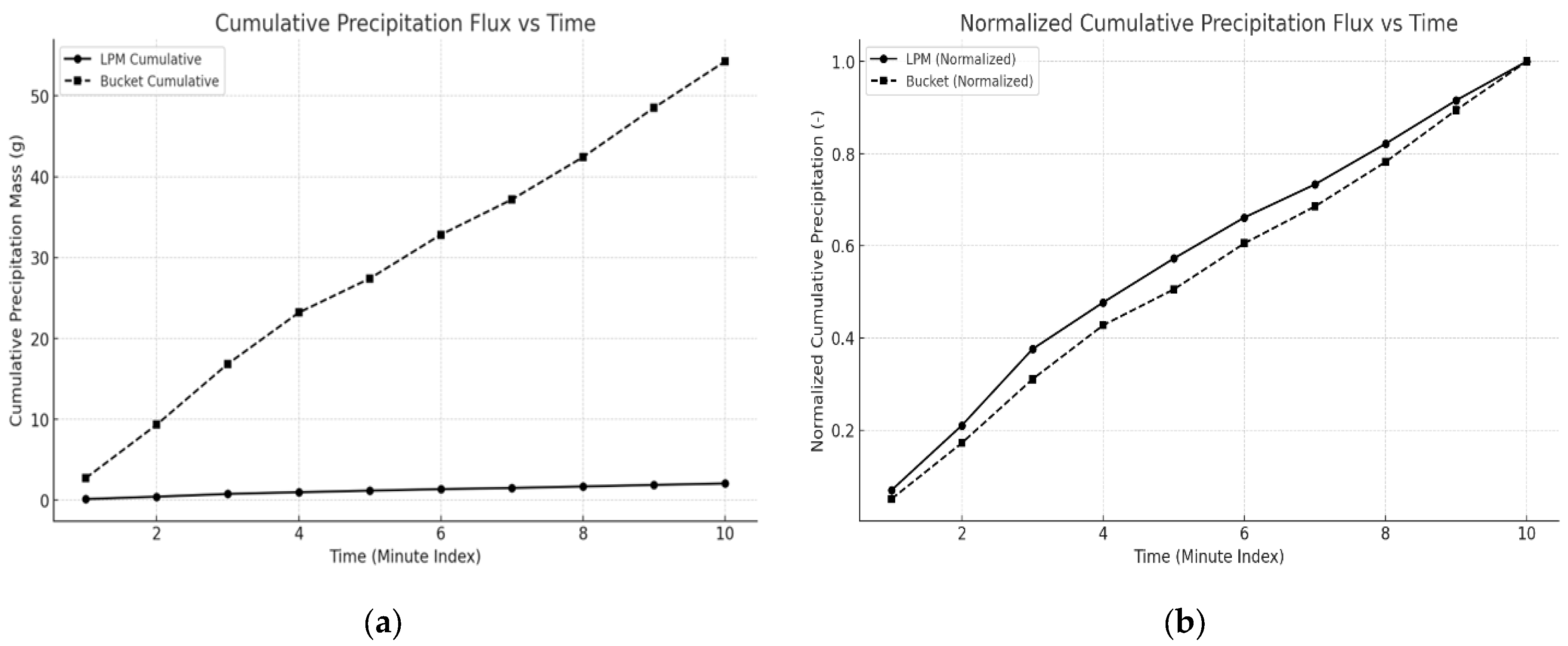
In Figure 6, the results of two different methods for precipitation measurements are shown, and the error was calculated. A significant discrepancy is observed between the precipitation values obtained from the two measurement methods, primarily due to the spherical particle assumption employed in deriving precipitation from the laser precipitation monitor. However, as shown in Figure 6b, the measurements from both sensors were normalized by dividing each time series by their respective maximum value, thereby scaling the data to a common range between 0 and 1. This normalization removes differences in absolute magnitude arising from sensor-specific measurement principles and enables a direct comparison of the temporal evolution of the signals. Following normalization, the two datasets exhibit a consistent and similar temporal trend, with an average deviation of 17.43%, indicating a reasonable level of agreement in their dynamic response despite differences in absolute precipitation estimates. This level of agreement is considered reasonable for a comparison between an optical disdrometer and a gravimetric gauge [38].
Based on these results, gravimetric gauge measurements were considered more reliable for quantifying absolute precipitation amounts, whereas the optical disdrometer was better suited for providing detailed information on particle size distribution, particle concentration, and other microphysical characteristics of the precipitation, rather than for direct estimation of precipitation magnitude.

3.2. Experimental Process

In climatic chamber experiments, maintaining a constant ambient temperature is essential to ensure well-controlled and repeatable test conditions. The chamber is equipped with a heat-exchanger system designed to regulate and stabilize the internal air temperature. However, during snow-generation experiments, pressurized water droplets injected by the snow gun undergo phase change due to the low ambient temperature, leading to the formation of snow particles. This phase change is accompanied by the release of latent heat, which increases the chamber air temperature and imposes an additional thermal load on the heat-exchanger system. In several tests, the heat exchanger was unable to fully compensate for this heat release, resulting in temperature fluctuations during the experiments.
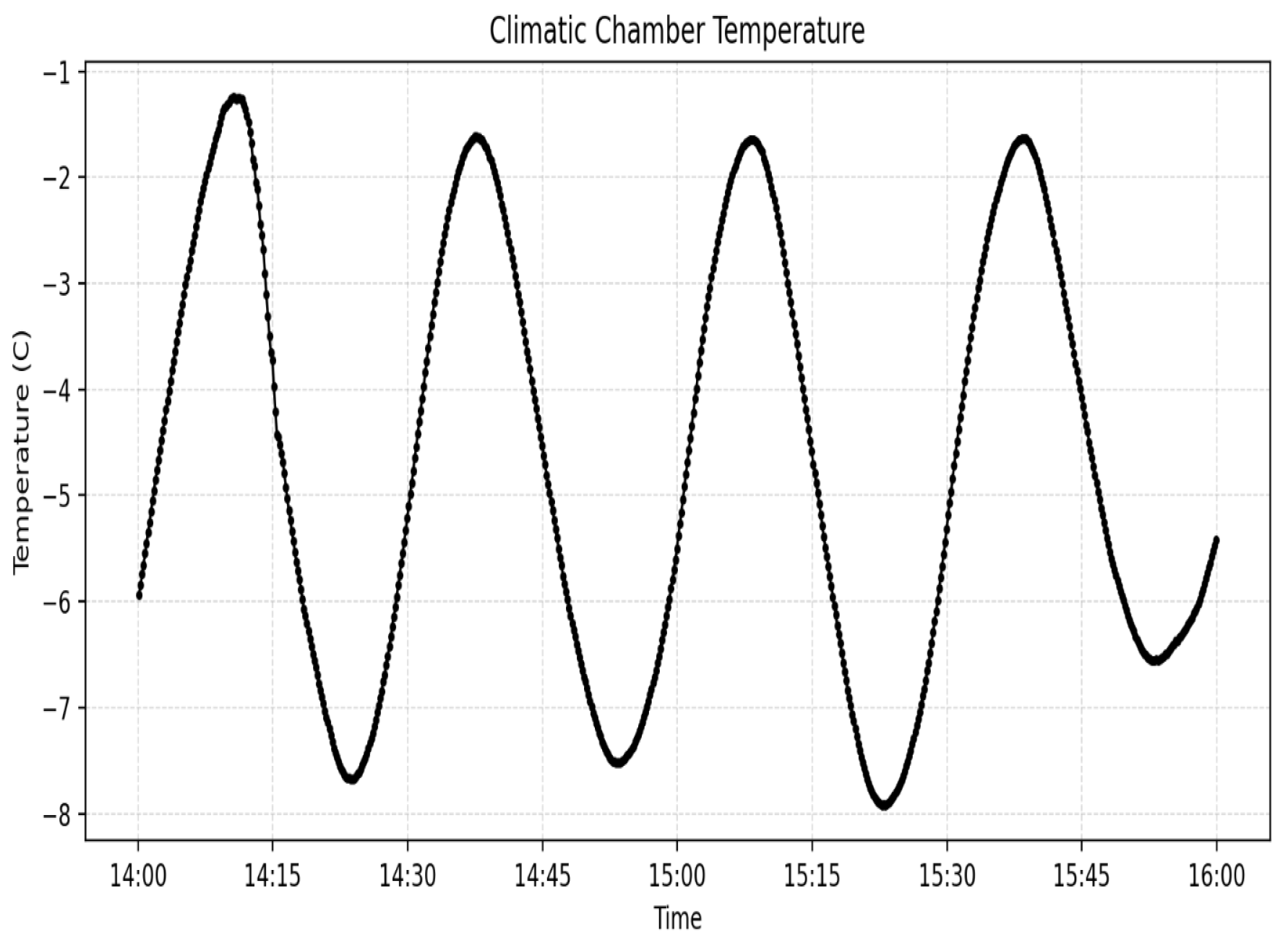
Consequently, the chamber temperature did not remain constant throughout these tests, introducing uncertainty in temperature-dependent results. For example, as shown in Figure 7, during experiments intended to be conducted at a nominal temperature of −5 °C, the measured chamber temperature varied between −8 °C and −2 °C, indicating that the thermal control system was unable to maintain the target temperature. Therefore, results obtained during these periods should be interpreted with caution, as they do not strictly correspond to the intended constant-temperature condition. Although temperature fluctuations occurred during individual tests, the mean temperature over each experimental period remained close to the intended setpoint. To ensure a fair and consistent comparison between test cases, the average temperature over the measurement duration was calculated and verified to be comparable across conditions.
Nevertheless, despite these fluctuations, the experiments conducted at nominal setpoints of −5 °C and −15 °C are retained in this study to represent wet and dry snow conditions, respectively. The observed temperature ranges remain sufficiently distinct to produce systematically different snow properties, with higher temperatures favoring denser, more cohesive, and wetter snow, and lower temperatures promoting drier, less cohesive particles.
Therefore, while the absolute temperature was not perfectly controlled, the relative thermal regimes associated with wet and dry snow formation were preserved. Throughout this paper, the terms “wet snow” and “dry snow” are used to refer to experiments conducted at nominal chamber temperatures of −5 °C and −15 °C, respectively, with the understanding that the reported results reflect temperature ranges rather than idealized constant-temperature conditions.
Experimental procedures were standardized across different test cases, with primary error sources identified as sensor placement, data recording timing, and sensitivity to test duration. These factors are further addressed below.
Since snowflakes’ characteristics vary with height, mainly due to vertical gradients in wind speed [39], the LPM was maintained at a constant elevation in all experiments. The timing of data acquisition was also a critical factor during climatic chamber tests, as the snow gun required a period to reach a stable production rate of snow particles. Accordingly, the test duration for each run was set to 10 min, based on the time required for the snow gun to reach a steady state.

3.3. Data Analysis

In studies examining the impact of snow precipitation on LiDAR sensor accuracy, a common experimental constraint is the use of a protective transparent layer, plexiglass (PMMA), to prevent direct coverage of the sensor by precipitation. While this approach is necessary to ensure continuous sensor operation, it introduces inherent limitations that must be carefully considered. Specifically, the presence of the layer degrades sensor performance due to additional optical effects, including light scattering and refraction at the air–plexiglass interface, governed by the material’s refractive index [40,41].
The introduction of a protective layer further degrades these performance metrics. Sarwar et al. [42] reported measurable propagation losses in LiDAR signal intensity when PMMA films were placed in front of the sensor, attributable to transmission losses and increased scattering. Ghost points refer to spurious detections in LiDAR point-cloud data that do not correspond to physical objects observed in ground-truth video recordings, causing the sensor to erroneously infer the presence of nonexistent targets. The occurrence of such artifacts degrades range-estimation accuracy by corrupting the measured return signals and can lead to false target detections, potentially triggering unnecessary warnings in vehicle perception systems. In snowy conditions, ghost points in LiDAR data can be identified using a combination of spatial, temporal, and signal-based filtering methods. Spatial consistency checks compare detected points against known static geometry or expected object shapes, flagging isolated or physically implausible returns. Temporal coherence analysis tracks points across consecutive frames, where ghost points typically exhibit short lifetimes and erratic motion compared to real targets. Signal-level metrics such as low intensity, abnormal signal noise ratio, or inconsistent return strength relative to range are also effective indicators. Additionally, cross-sensor validation using synchronized camera data helps distinguish true objects from spurious LiDAR returns caused by snow particles, multipath reflections, or protective surface effects.
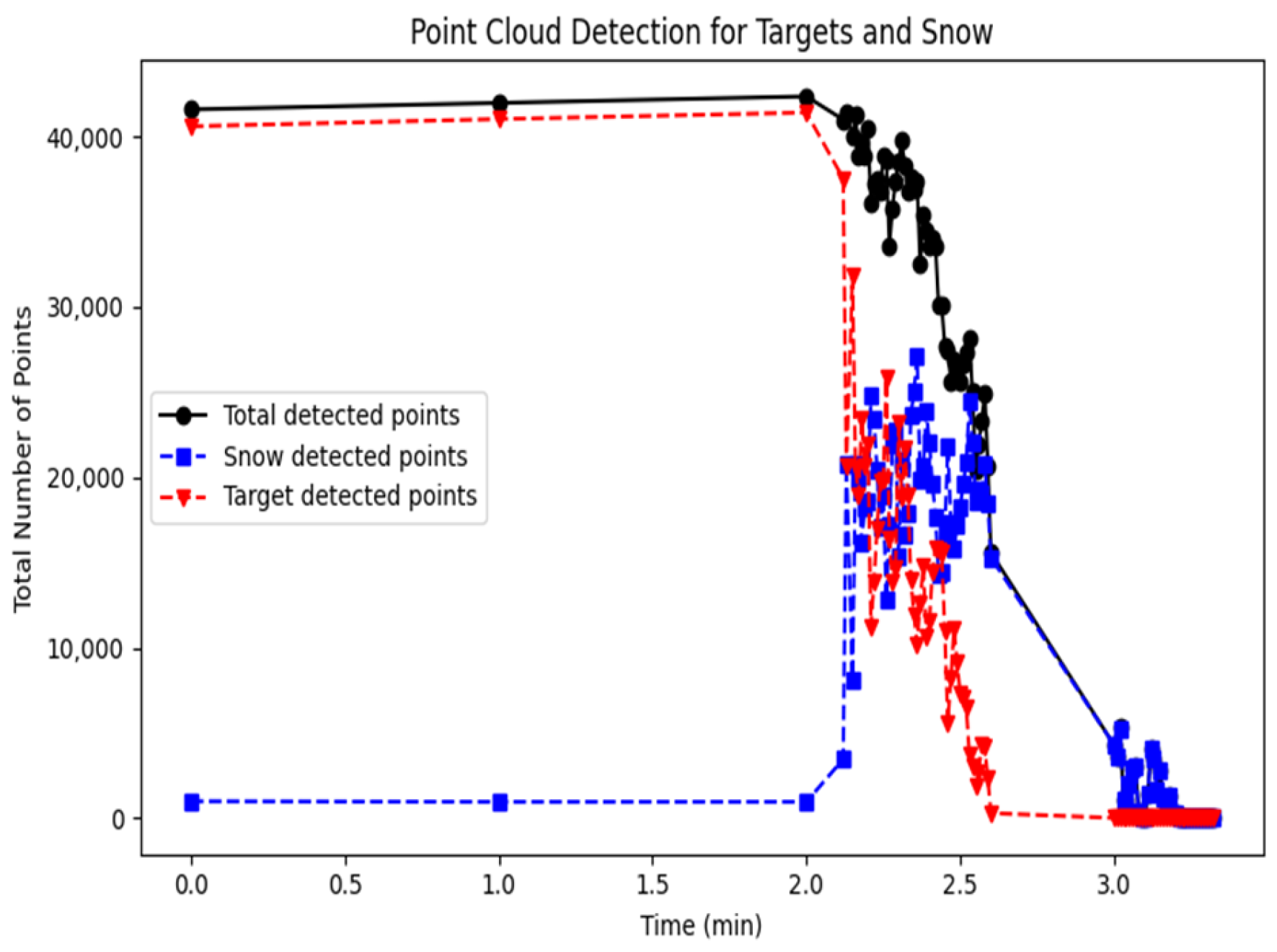
To accurately quantify the degradation in sensor performance under snowy conditions, it is first necessary to distinguish snow-induced returns from genuine object detections. Snow particles are characterized by inherently low reflectivity, typically below 5%, which provides a basis for their identification and separation from true targets. Leveraging this property, a data-processing routine was developed to classify and track the temporal evolution of total detected points, snow-related returns, and non-snow particles throughout the recorded measurement period, as illustrated in Figure 8. In this graph, the detected target points correspond to points associated with objects within the region of interest.
As shown in Figure 8, an initial transient period is observed during the first few minutes, corresponding to the time required for the snow gun to generate and stabilize snow particle production. Following this phase, the total number of detected points decreases progressively, which can be attributed to the accumulation of snow on the sensor surface that increasingly obstructs the sensor’s field of view. As snow accretion intensifies, the sensor eventually becomes fully occluded. During this process, as the sensor surface becomes progressively covered by snow, the total number of detected points decreases, which is reflected in the reduced number of detected target points. However, detections associated with snow particles remain significant. These snow-related detections should be excluded from the sensor visibility performance assessment, as the primary objective is to evaluate the sensor’s ability to detect and resolve target points.
In addition, a secondary filtering criterion based on range constraints was applied to isolate physically implausible detections. Given the known distance between the LiDAR sensor and the reference wall, any points detected beyond this boundary were classified as ghost points, as they fell outside the experimental domain. Together, these reflectivity- and range-based assumptions were integrated into a classification model to analyze and filter LiDAR-detected particles, enabling a more reliable assessment of sensor accuracy in the presence of snow.

4. Results and Discussion

4.1. Nature of Snow Effect on LiDAR Performance

Within a climatic chamber, control of environmental parameters, especially temperature, enables the generation of artificial snow with tailored physical properties that are representative of both dry and wet snow conditions, providing a controlled framework for reproducible and comparative sensor performance evaluation. To generate different snow types, experiments were conducted at two nominal climatic chamber setpoints of −5 °C and −15 °C. Although the chamber was not able to maintain the target temperatures continuously throughout all tests, a comparison of the measured snow densities with reported ranges for natural dry and wet snow (Table 2) indicates that the resulting snow conditions are representative of two distinct snow types.
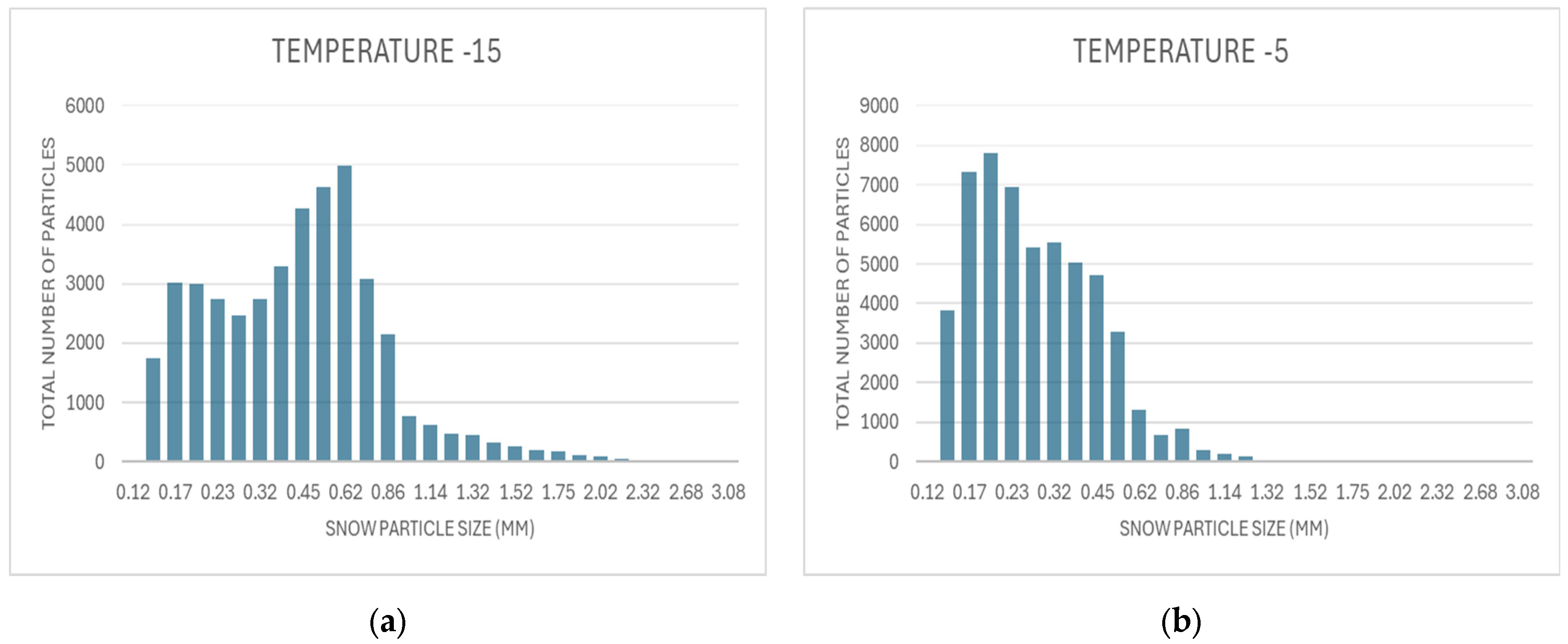
In addition to variations in snow density, temperature plays a critical role in shaping the particle size distribution of artificial snow, as illustrated in Figure 9. At −15 °C, the distribution is broader and characterized by an extended tail toward larger particle sizes, indicative of predominantly dry, weakly cohesive snow particles with limited aggregation under colder conditions. In contrast, experiments conducted at −5 °C exhibit a distribution shifted toward smaller particle sizes with increased particle counts at lower diameters, consistent with warmer conditions that favor partial melting, higher liquid water content, and enhanced particle fragmentation or breakup during formation and descent.
Distinct accumulation behaviors were observed for different types of snow, particularly under dry and wet snow conditions. In the presence of wet snow, the elevated liquid water content enhances particle adhesion upon impact, increasing the likelihood that incoming snow particles remain attached to the sensor surface rather than rebounding or being re-entrained into the flow. This enhanced sticking efficiency results in a higher fraction of the incident snow flux contributing to net surface accumulation. Consequently, the effective efficiency parameter α e f f shows higher values under wet snow conditions, ranging from approximately 0.88 to 0.96.
In contrast, dry snow, typically characterized by lower density and reduced cohesion, exhibits weaker particle–surface adhesion and a greater tendency for particles to rebound or remain suspended in the airflow. These mechanisms limit the effective accumulation rate, yielding lower values of α e f f , generally in the range of 0.7 to 0.82. The observed disparity in α e f f between dry and wet snow highlights the dominant role of snow microphysical properties in governing accumulation efficiency and underscores the importance of explicitly accounting for snow type when assessing sensor surface contamination and performance degradation in autonomous sensing applications.
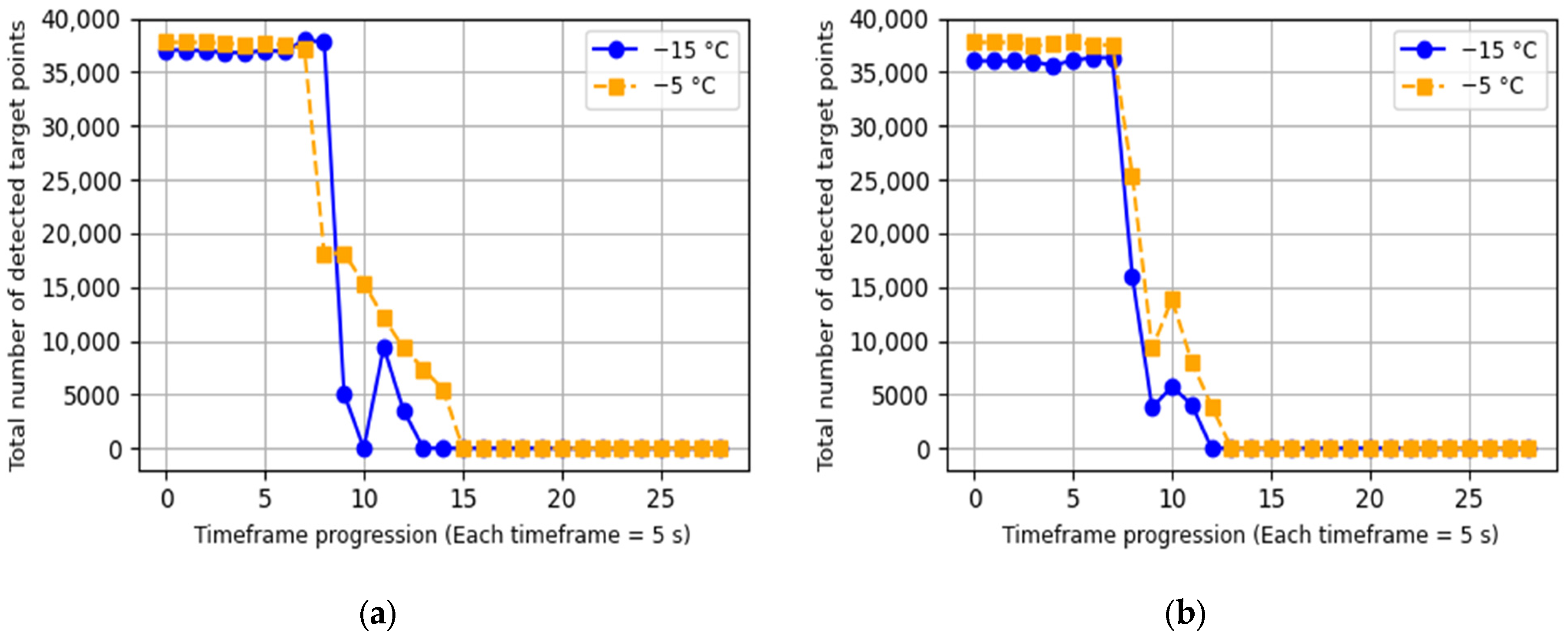
Based on initial observations, once the snow gun begins producing snow and injecting water droplets into the chamber, snow particles immediately appear in the LiDAR point cloud, leading to a progressive reduction in the sensor’s ability to detect target objects. This degradation intensifies over time as snow accumulates on the sensor surface, ultimately resulting in complete obstruction and loss of visibility. In this study, the time interval from the initial detection of snow particles to full sensor blockage is investigated, with emphasis on assessing the influence of different snow conditions on LiDAR performance degradation during this period. One approach used to quantify LiDAR performance degradation involves comparing the number of target points detected during snowfall events. To this end, a fixed control area was defined as a region of interest (ROI), and the total number of detected target points was evaluated over time intervals for both dry and wet snow conditions, as presented in Figure 10.
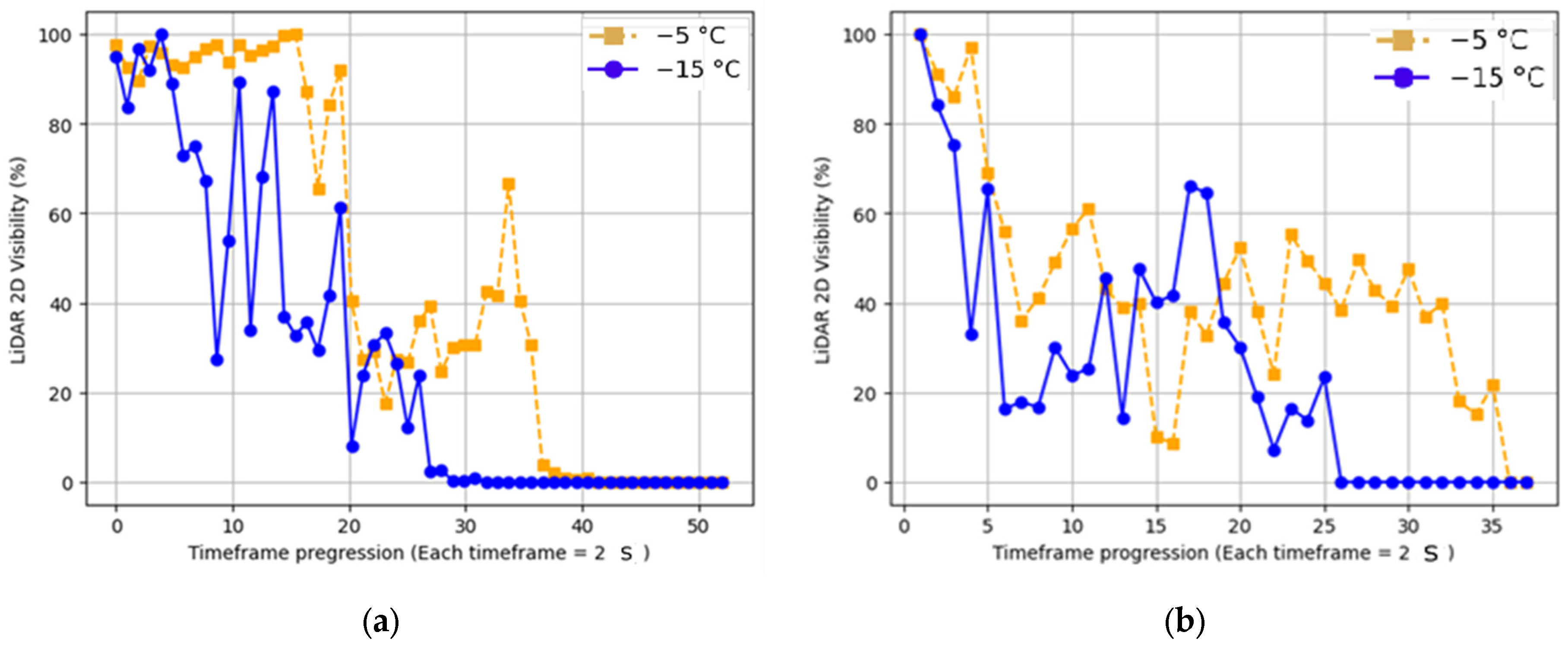
Under an identical flow rate and sensor orientation, the results demonstrate a clear temperature-dependent trend in LiDAR performance degradation. At −15 °C, corresponding to predominantly dry snow conditions, the number of detected target points decreases more rapidly than at −5 °C, where wetter and denser snow is produced. Dry snow, characterized by lower bulk density and larger, less cohesive particles, more effectively obscures the LiDAR line of sight, leading to faster attenuation of the return signal and earlier loss of target detection. In contrast, wet snow exhibits a more gradual reduction in detected points, indicating a slower obstruction process. A consistent trend is observed using the 2D-visibility-based performance metric, which quantifies the visible target area. As shown in Figure 11, dry snow results in a more rapid decline in the target visibility area and reaches zero visibility earlier than wet snow for both sensor orientations.
In the 2D-visibility-based evaluation, the analysis focuses on the transient period between the onset of snow formation in the climatic chamber and the complete obstruction of the LiDAR sensor due to surface accretion. Pronounced fluctuations in LiDAR visibility are observed across all test cases, primarily due to the non-uniform and intermittent nature of snow generation by the snow gun, as well as the low background airflow within the chamber, which allows clusters of snow particles to circulate and intermittently obstruct the sensor field of view. Despite these fluctuations, a consistent temperature-dependent trend is evident. For all runs, visibility degradation occurs more rapidly under dry snow conditions (−15 °C) compared to wet snow (−5 °C). Dry snow leads to faster attenuation of the visible target area and reaches zero visibility earlier, indicating more efficient optical obstruction and surface coverage. This behavior further confirms that snow microphysical properties, controlled by temperature, play a critical role in accelerating LiDAR performance degradation.

4.2. Snow Precipitation Intensity Effect on LiDAR Performance

Another key parameter influencing LiDAR visibility degradation is precipitation intensity. Numerous experimental and modeling studies have shown that precipitation, including rain and snow, adversely affects LiDAR performance by increasing atmospheric attenuation, backscattering, and false detections, ultimately reducing target visibility and ranging accuracy [45,46]. Several works have investigated LiDAR performance under discrete precipitation intensities or rain-rate conditions, demonstrating a clear deterioration in detection probability and point-cloud quality with increasing precipitation severity [47,48,49]. However, despite these efforts, a comprehensive and generalizable quantitative relationship linking precipitation intensity to the rate of LiDAR visibility reduction remains insufficiently explored. This limitation arises from the strong dependence of observed degradation on sensor wavelength and design, signal processing strategies, target properties, particle size distributions, and competing mechanisms such as atmospheric extinction versus sensor surface wetting and contamination
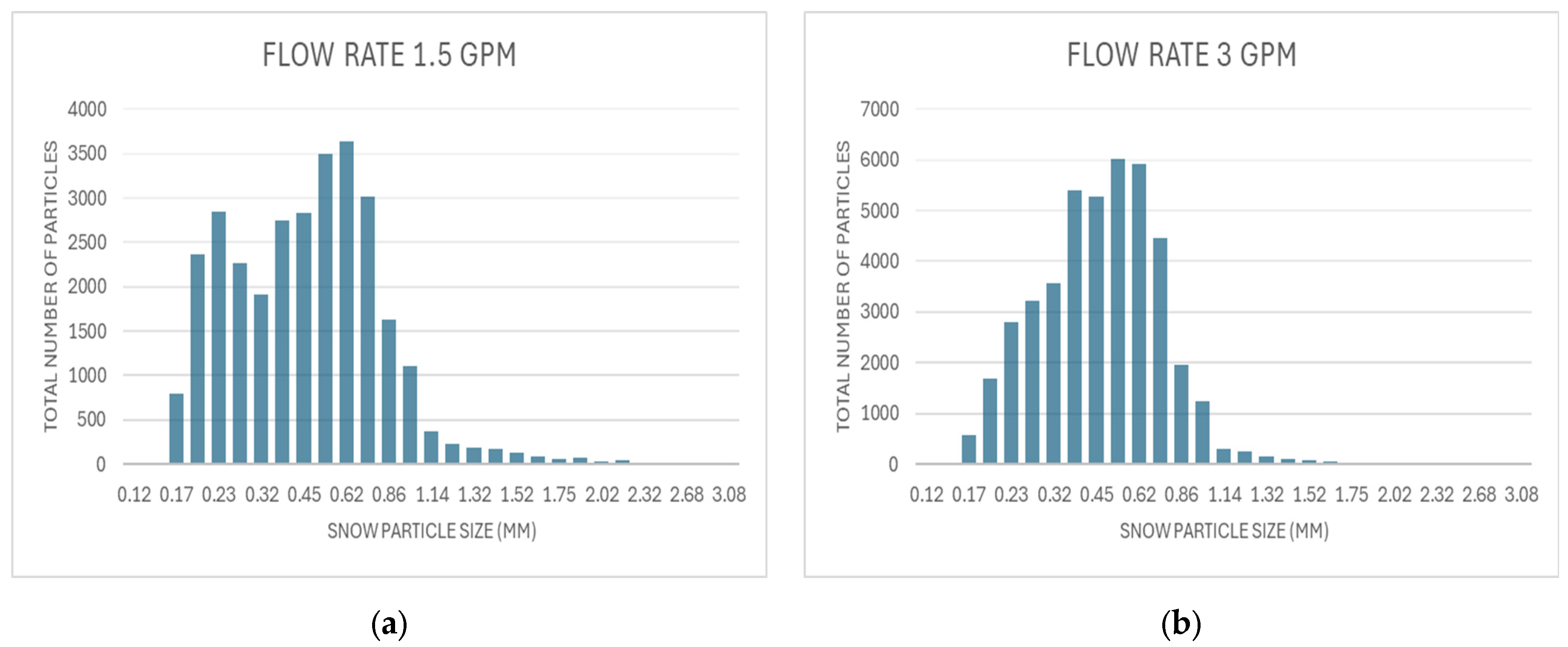
To evaluate whether controlled climatic chamber experiments can capture the effect of precipitation intensity on LiDAR sensor performance degradation, and to establish a baseline for future investigations aimed at quantifying the relationship between precipitation intensity and sensor performance, the precipitation flow rate was systematically increased from 1.5 GPM to 3 GPM. Increasing the snow gun flow rate from 1.5 to 3 GPM results in an approximately twofold increase in the amount of snow collected by the precipitation gauge. In contrast, as shown in Figure 12, the corresponding increase in the number of particles measured by the laser precipitation monitor does not scale linearly with flow rate. In most cases, the observed increase in detected particles is less than a factor of two, indicating a non-linear response of the optical measurement to precipitation intensity.
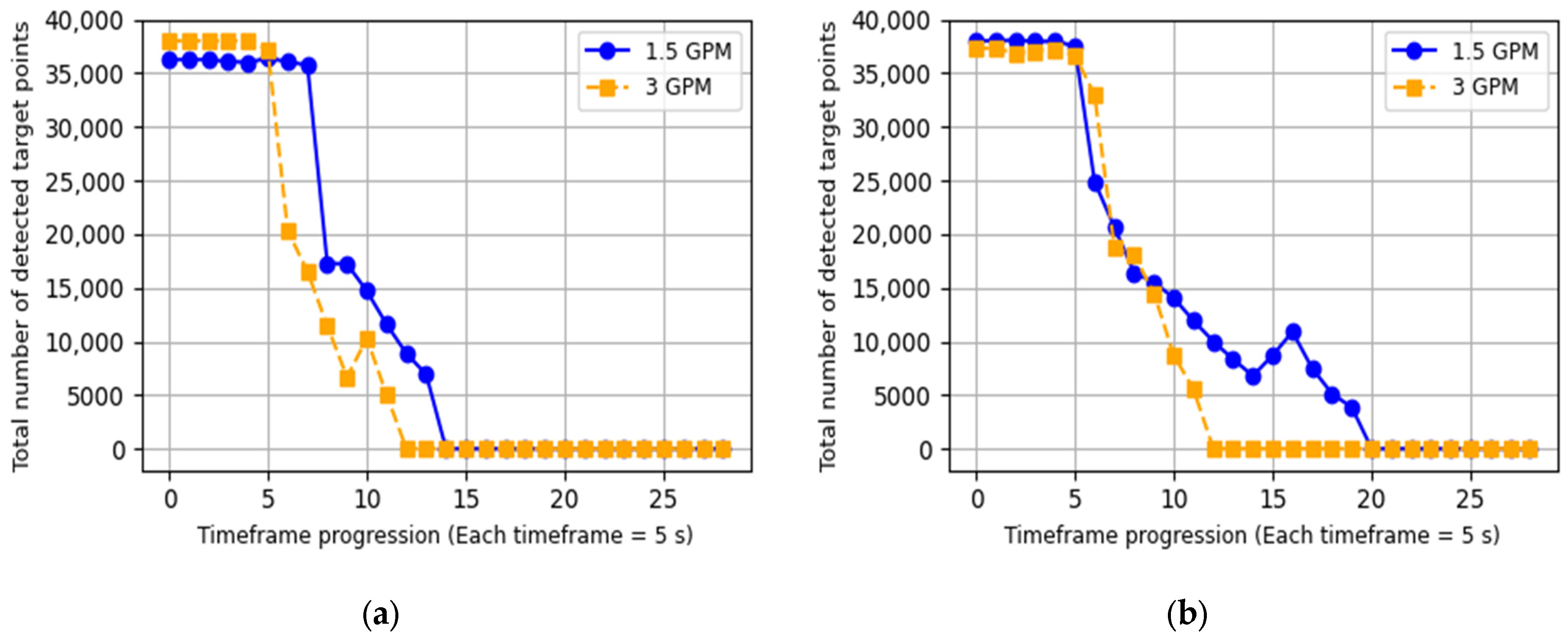
As illustrated in Figure 13, increasing precipitation intensity results in a higher concentration of snow particles within the climatic chamber, which in turn leads to a rapid degradation of LiDAR sensor visibility.
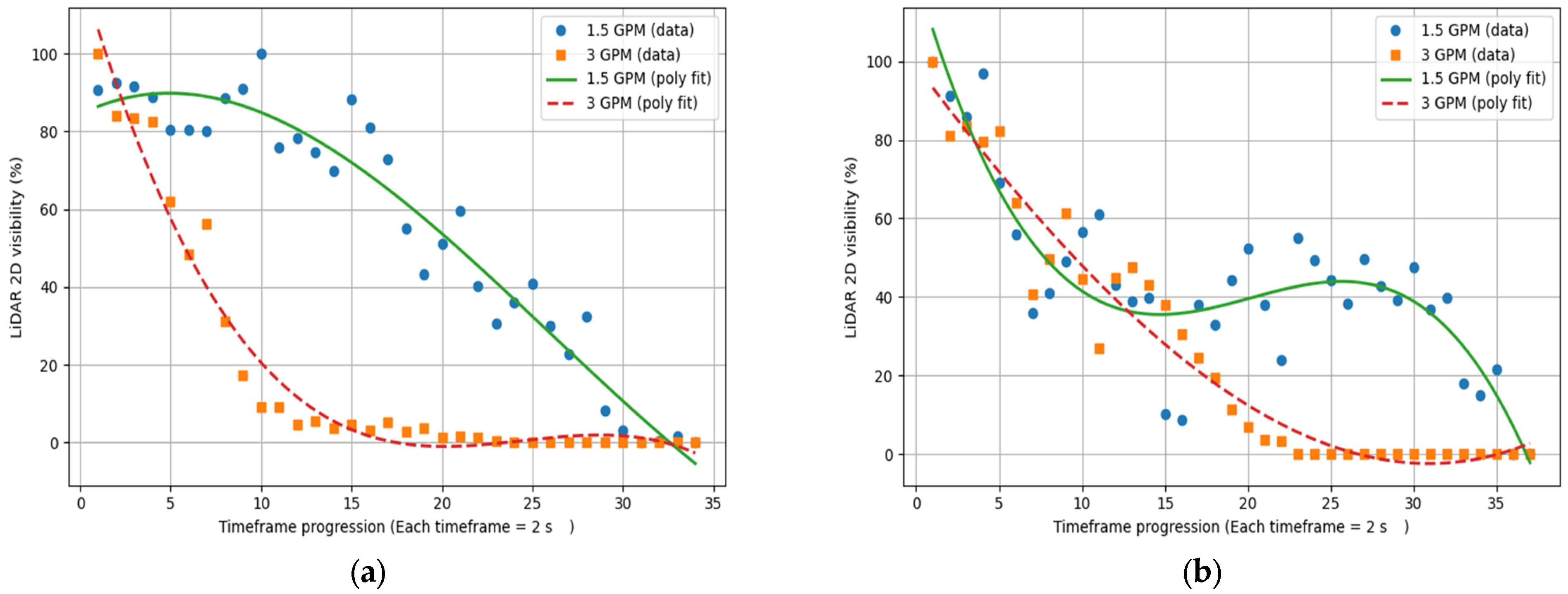
A consistent trend is observed in the LiDAR 2D visibility analysis presented in Figure 14, where higher precipitation intensity is associated with a more abrupt decline in sensor performance over time. Polynomial fitting of the visibility time series further quantifies this behavior, revealing a substantially steeper degradation rate under elevated precipitation conditions.
Specifically, the average rate of LiDAR 2D visibility reduction at a flow rate of 3 GPM is approximately 38% greater than that observed at 1.5 GPM, indicating a stronger and more rapid performance deterioration as precipitation intensity increases. Notably, although the precipitation intensity was increased by a factor of two, the resulting reduction in visibility does not scale linearly and is less than a twofold decrease. This non-linear response suggests that additional mechanisms, such as particle–sensor interactions, signal backscattering, and surface accumulation, may modulate the sensor degradation process. Consequently, further investigations employing a wider range of snow gun flow rates and controlled precipitation intensities are required to systematically quantify the relationship between precipitation intensity and LiDAR sensor performance degradation.

4.3. Sensor Orientation Effect on LiDAR Performance

Another important parameter influencing LiDAR sensor performance is sensor orientation. Both sensor orientation and speed, particularly when the sensor is installed on a moving vehicle, can significantly affect the perceived precipitation intensity by altering the relative impact angle and interaction between hydrometeors and the sensor surface. In the present study, the LiDAR sensor was operated in a static configuration, and the airflow inside the climatic chamber was maintained at a negligible velocity. Under these controlled conditions, sensor orientation was therefore isolated as the primary parameter governing variations in perceived precipitation.
Snow particles generated by the snow gun follow a projectile trajectory before impinging on the sensor, resulting in an inherently oblique impact angle. Consequently, the orientation of the sensor relative to the snow gun directly influences the effective particle flux, impact dynamics, and subsequent snow accumulation on the sensor surface. Experimental observations indicate that, for identical exposure durations and precipitation intensities, the amount of snow accumulation varies with sensor orientation.
To systematically investigate this effect, three sensor orientations, 0°, 28°, and 40°, were examined. These angles were selected to approximate realistic windshield inclination angles commonly observed in passenger vehicles, with typical sedan and sport utility vehicle (SUV) windshield angles of approximately 32° and 45°, respectively, to mimic a parked or slow-moving vehicle with respect to projected snow. Due to constraints of the experimental mounting system, orientations of 28° and 40° were chosen as the closest achievable representations of these configurations. The results of this investigation provide insight into whether windshield-like mounting locations are suitable for LiDAR sensor installation and how sensor orientation may mitigate or deteriorate precipitation-induced performance degradation.
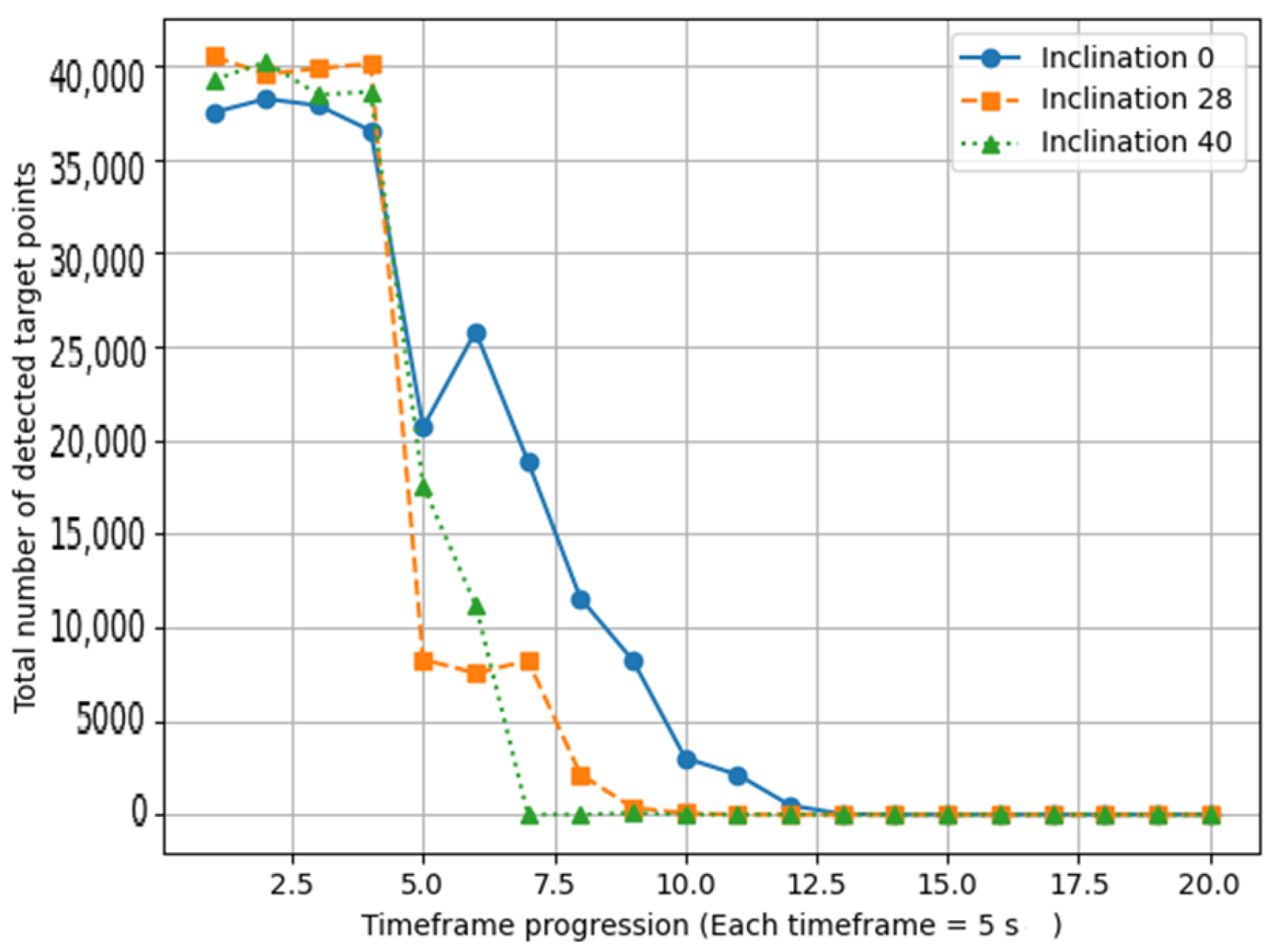
The results presented in Figure 15 demonstrate a clear dependence of LiDAR performance degradation on sensor inclination under identical precipitation conditions. For all three orientations (0°, 28°, and 40°), the number of detected target points remains relatively stable during the initial exposure period, indicating comparable baseline sensor performance prior to significant snow accumulation. However, once precipitation-induced degradation begins, the rate and severity of performance loss differ markedly with sensor inclination.
The sensor oriented at 0° inclination exhibits the most gradual decline in detected target points, maintaining partial target visibility over a longer duration compared to the inclined configurations. In contrast, the 28° inclination shows a more abrupt reduction in detected points, suggesting enhanced snow accumulation and surface contamination due to a more direct interception of the incoming snow particle flux. The most severe and rapid degradation is observed at 40° inclination, where the number of detected target points drops sharply to near-zero within a shorter timeframe. This behavior indicates that steeper sensor orientations promote higher effective particle impact rates and accumulation efficiency, accelerating visibility loss.
These observations are consistent with the projectile nature of the injected snow particles and the resulting variation in effective impact angle and projected surface area with sensor orientation. As the inclination angle increases, the component of particle momentum normal to the sensor surface becomes larger, leading to increased deposition and faster blockage of the sensing aperture. Consequently, sensor orientation should be considered a critical design and integration parameter when selecting mounting locations for LiDAR systems intended for operation in cold and snowy environments.

5. Conclusions

With the increasing deployment of autonomous and semi-autonomous road vehicles, reliance on Advanced Driver Assistance Systems (ADASs) equipped with multi-modal sensing technologies has grown substantially. Among these sensing modalities, Light Detection and Ranging (LiDAR) plays a critical role by providing high-resolution three-dimensional representations of the surrounding environment through point-cloud data. Despite its advantages, LiDAR performance is highly susceptible to adverse weather conditions, particularly snowfall, which can introduce signal attenuation, backscattering, false detections, and sensor surface contamination, ultimately leading to visibility loss and performance degradation.
In this study, an experimental investigation was conducted in a climatic chamber to systematically evaluate the impact of snowfall on LiDAR sensor performance under controlled and repeatable conditions. The experimental framework enabled isolation of key influencing parameters, including chamber temperature, precipitation intensity, and sensor orientation. Chamber temperature was used to modify snow properties such as density, cohesiveness, and particle morphology, thereby representing dry and wet snow conditions. Precipitation intensity was controlled through variation in the snow gun flow rate, while sensor orientation was adjusted to assess its influence on perceived precipitation and snow accumulation on the sensor surface.
The experimental results demonstrate that LiDAR performance degradation under snowfall is governed by the combined effects of precipitation intensity, snow characteristics, and sensor orientation. Increasing precipitation intensity leads to a higher concentration of snow particles within the sensing volume, resulting in a more rapid deterioration of both 3D target detection capability and 2D LiDAR visibility. Polynomial regression analysis of the visibility time series indicates that a twofold increase in snow gun flow rate accelerates the average visibility decay rate by approximately 38%, highlighting a strong but non-linear relationship between precipitation intensity and sensor performance degradation. In addition, variations in chamber temperature produced distinct snow properties representative of dry and wet snow conditions, which influenced particle–sensor interactions and modulated the observed degradation behavior. Sensor orientation was identified as a critical factor affecting perceived precipitation and snow accumulation, with inclined configurations exhibiting faster and more severe performance loss than a horizontal (0°) orientation under identical snowfall conditions.
Based on these findings, several signal-enhancement and mitigation strategies can be identified to reduce precipitation-induced sensor performance degradation. The results provide critical insights for ADASs and autonomous vehicle operation, particularly regarding sensor visibility and reliable obstacle detection. The findings demonstrate that indoor testing frameworks are capable of reproducing a wide range of snowfall conditions and, through controlled manipulation of key environmental parameters, enable systematic investigation of sensor performance degradation. This controlled approach facilitates the identification of predictive relationships between snowfall precipitation characteristics and sensor degradation mechanisms. Future studies will extend this work by conducting systematic experiments across a wider range of precipitation intensities, chamber temperatures, and sensor orientations to quantitatively characterize LiDAR performance degradation and establish robust relationships between these parameters and sensor performance under snowfall conditions. Future work should also investigate the impact of snowfall on LiDAR ranging accuracy, as distance estimation is a complementary and equally critical aspect of sensor perception that directly affects detection reliability.

Author Contributions

Conceptualization, M.S.M.G., W.Y.P. and H.H.; methodology, M.S.M.G. and W.Y.P.; software, M.S.M.G., M.E. and D.M.; validation, M.S.M.G.; formal analysis, M.S.M.G.; investigation, M.S.M.G.; resources, H.H.; data curation, M.S.M.G., M.E. and D.M.; writing—original draft preparation, M.S.M.G.; writing—review and editing, W.Y.P., I.G., M.A.-C. and H.H.; visualization, M.S.M.G.; supervision, H.H.; project administration, H.H.; funding acquisition, H.H. All authors have read and agreed to the published version of the manuscript.

Funding

This research received no external funding.

Data Availability Statement

The original contributions presented in the study are included in the article; further inquiries can be directed to the corresponding author.

Acknowledgments

The author gratefully acknowledges the support of the Canada Research Chair Tier 1 Program in Adaptive Aerodynamics and the Canada Foundation for Innovation.

Conflicts of Interest

The authors declare no conflicts of interest.

Abbreviations

The following abbreviations are used in this manuscript:
ADASsAdvanced Driver Assistance Systems
LiDARLight Detection and Ranging
RADARRadio Detection and Ranging
SONARSound Navigation and Ranging
TOFTime-of-Flight
FMCWFrequency-Modulated Continuous-Wave
LPMLaser Precipitation Monitor
LWCLiquid Water Content
ROIRegion of Interest
AOIArea of Interest
GPMGallon Per Minute
LCCLarge Climatic Chamber
IPInternet Protocol
SUVSport Utility Vehicle

References

  1. Yurtsever, E.; Lambert, J.; Carballo, A.; Takeda, K. A survey of autonomous driving: Common practices and emerging technologies. IEEE Access 2020, 8, 58443–58469. [Google Scholar] [CrossRef]
  2. Antony, M.M.; Whenish, R. Advanced driver assistance systems (ADAS). In Automotive Embedded Systems: Key Technologies, Innovations, and Applications; Springer: Berlin/Heidelberg, Germany, 2021; pp. 165–181. [Google Scholar]
  3. Kogut, P. Lidar Vs. Radar: Differences & Uses to Pick the Right One. 2024. Available online: https://eos.com/blog/lidar-vs-radar/ (accessed on 1 December 2025).
  4. Carter, W.E.; Shrestha, R.L.; Slatton, K.C. Geodetic laser scanning. Phys. Today 2007, 60, 41–47. [Google Scholar] [CrossRef]
  5. Elaksher, A.; Ali, T.; Alharthy, A. A quantitative assessment of LiDAR data accuracy. Remote Sens. 2023, 15, 442. [Google Scholar] [CrossRef]
  6. Buckley, S.J.; Howell, J.A.; Enge, H.D.; Kurz, T.H. Terrestrial laser scanning in geology: Data acquisition, processing and accuracy considerations. J. Geol. Soc. 2008, 165, 625–638. [Google Scholar] [CrossRef]
  7. Mao, Q.; Zhang, L.; Li, Q.; Hu, Q.; Yu, J.; Feng, S.; Ochieng, W.; Gong, H. A least squares collocation method for accuracy improvement of mobile LiDAR systems. Remote Sens. 2015, 7, 7402–7424. [Google Scholar] [CrossRef]
  8. Wu, Z.; Song, Y.; Liu, J.; Chen, Y.; Sha, H.; Shi, M.; Zhang, H.; Qin, L.; Liang, L.; Jia, P.; et al. Advancements in Key Parameters of Frequency-Modulated Continuous-Wave Light Detection and Ranging: A Research Review. Appl. Sci. 2024, 14, 7810. [Google Scholar] [CrossRef]
  9. Li, L.; Pao, W.Y.; Agelin-Chaab, M.; Komar, J.; Lang, H. Investigating Automotive Sensor Perception in Rain: A Case Study on TOF and FMCW LiDAR. In Proceedings of the CSME-CFDSC-CSR 2025 International Congress, Montreal, QC, Canada, 25–28 May 2025. [Google Scholar]
  10. Dreissig, M.; Scheuble, D.; Piewak, F.; Boedecker, J. Survey on lidar perception in adverse weather conditions. In Proceedings of the 2023 IEEE Intelligent Vehicles Symposium (IV), Anchorage, AK, USA, 4–7 June 2023; IEEE: New York, NY, USA, 2023; pp. 1–8. [Google Scholar]
  11. Abu-Shaqra, A.D.; Abu-Alrub, N.J.; Rawashdeh, N.A. Object detection in degraded lidar signals by synthetic snowfall noise for autonomous driving. In Proceedings of the Autonomous Systems: Sensors, Processing and Security for Ground, Air, Sea and Space Vehicles and Infrastructure 2022, Orlando, FL, USA, 3 April–13 June 2022; SPIE: Bellingham, WA, USA, 2022; pp. 175–182. [Google Scholar]
  12. Park, J.; Jo, S.; Seo, H.-T.; Park, J. LiDAR-based snowfall level classification for safe autonomous driving in terrestrial, maritime, and aerial environments. Sensors 2024, 24, 5587. [Google Scholar] [CrossRef]
  13. Sun, C.; Sun, P.; Wang, J.; Guo, Y.; Zhao, X. Understanding lidar performance for autonomous vehicles under snowfall conditions. IEEE Trans. Intell. Transp. Syst. 2024, 25, 16462–16472. [Google Scholar] [CrossRef]
  14. Dreissig, M.; Scheuble, D.; Piewak, F.; Boedecker, J. Survey on LiDAR Perception in Adverse Weather Conditions. arXiv 2023, arXiv:230406312. [Google Scholar] [CrossRef]
  15. Kurup, M.; Bos, J. DSOR: A scalable statistical filter for removing falling snow from LiDAR point clouds in severe winter weather. arXiv 2021, arXiv:2109.07078. Available online: https://arxiv.org/abs/2109.07078 (accessed on 7 January 2026). [CrossRef]
  16. Wang, W.; You, X.; Chen, L.; Tian, J.; Tang, F.; Zhang, L. A scalable and accurate de-snowing algorithm for LiDAR point clouds in winter. Remote Sens. 2022, 14, 1468. [Google Scholar] [CrossRef]
  17. Piroli, A.; Dallabetta, V.; Kopp, J.; Walessa, M.; Meissner, D.; Dietmayer, K. Label-efficient semantic segmentation of LiDAR point clouds in adverse weather conditions. IEEE Robot. Autom. Lett. 2024, 9, 5575–5582. [Google Scholar] [CrossRef]
  18. Pao, W.; Li, L.; Agelin-Chaab, M.; Komar, J. “Drive-thru climate tunnel: A proposed method to study ADAS performance in adverse weather”. In WCX SAE World Congress Experience; SAE Technical Paper; SAE Technical: Warrendale, PA, USA, 2023. [Google Scholar]
  19. Woo, J.; Lee, S. Test-Bed Design for Evaluation of Intelligent Transportation Systems and Intelligent Vehicle Systems. In Proceedings of the IEEE 13th International Conference on Advanced Communication Technology (ICACT2011), Gangwon, Republic of Korea, 13–16 February 2011; pp. 1511–1514. [Google Scholar]
  20. Motors, G. Canadian Technical Centre McLaughlin Advanced Technology Track, Media Backgrounder. 2021. Available online: https://www.gm.ca/en/home/company/canada/ctc-mclaughlin-advanced-technology-track.html (accessed on 1 December 2025).
  21. Gultepe, I.; Agelin-Chaab, M.; Komar, J.; Elfstrom, G.; Boudala, F.; Zhou, B. A meteorological supersite for aviation and cold weather applications. Pure Appl. Geophys. 2019, 176, 1977–2015. [Google Scholar] [CrossRef]
  22. Carvalho, M.; Moradi, S.; Hosseinnouri, F.; Keshavan, K.; Villeneuve, E.; Gultepe, I.; Komar, J.; Agelin-Chaab, M.; Hangan, H. Towards a model of snow accretion for autonomous vehicles. Atmosphere 2024, 15, 548. [Google Scholar] [CrossRef]
  23. Colomb, M.; Duthon, P.; Bernardin, F. A Controlled Environment for Testing Sensors Under Adverse Weather Conditions: The Cerema R&D Fog and Rain Platform. In Proceedings of the VISION Congress Organised by the SIA (French Society of Automotive Engineers), Paris, France, 13–14 October 2016. [Google Scholar]
  24. CARISSMA. CARISSMA—Center of Automotive Research on Integrated Safety Systems and Measurement Area. Technische Hochschule Ingolstadt. [Online]. Available online: https://www.thi.de/en/research/carissma/ (accessed on 7 January 2026).
  25. Test World Indoor Winter Test Tracks | Test World | Millbrook. Millbrook Proving Ground. [Online]. Available online: https://www.millbrook.co.uk/services/proving-grounds/winterdriving/indoor-winter-testing/ (accessed on 7 January 2026).
  26. National Research Institute of Earth Science and Disaster Resilience. Snow and Ice Disaster Prevention Experiment Building. 2021. [Online]. Available online: https://www.bosai.go.jp/study/snow.html (accessed on 7 January 2026).
  27. Tech, V. Virginia Smart Roads Highway Section. 2021. [Online]. Available online: https://www.vtti.vt.edu/facilities/highway-section.html (accessed on 7 January 2026).
  28. KICT. An Opening Ceremony of the Center for Road Weather Proving Ground, Yeoncheon. 2021. [Online]. Available online: https://www.kict.re.kr/board.es?mid=a20601000000&bid=newsnotice&act=view&list_no=13372 (accessed on 7 January 2026).
  29. Revuelto, J.; Alonso-González, E.; Deschamps-Berger, C.; Gutmann, E.D.; López-Moreno, J.I. Recent Advances in Snow Monitoring from Local to Global Scales. Curr. Clim. Change Rep. 2025, 11, 10. [Google Scholar] [CrossRef]
  30. Frasson, R.P.D.M.; Da Cunha, L.K.; Krajewski, W.F. Assessment of the Thies optical disdrometer performance. Atmos. Res. 2011, 101, 237–255. [Google Scholar] [CrossRef]
  31. ISO 12494; Atmospheric Icing of Structures. International Organization for Standardization (ISO): Geneva, Switzerland, 2001.
  32. Makkonen, L. Estimation of Wet Snow Accretion on Structures. Cold Reg. Sci. Technol. 1989, 17, 83–88. [Google Scholar] [CrossRef]
  33. Mohammadian, B.; Sarayloo, M.; Heil, J.; Hong, H.; Patil, S.; Robertson, M.; Tran, T.; Krishnan, V.; Sojoudi, H. Active prevention of snow accumulation on cameras of autonomous vehicles. SN Appl. Sci. 2021, 3, 154. [Google Scholar] [CrossRef]
  34. Dalle, B.; Admirat, P. Wet Snow Accretion on Overhead Lines with French Report of Experience. Cold Reg. Sci. Technol. 2011, 65, 43–51. [Google Scholar] [CrossRef]
  35. Mohammadian, B.; Saravloo, M.; Abdealad, A.; Raiyan, A.; Nims, D.K.; Sojoudi, H. Experimental and Theoretical Studies of Wet Snow Accumulation on Inclined Cylindrical Surfaces. Model. Simul. Eng. 2020, 2020, 9594685. [Google Scholar] [CrossRef]
  36. Pao, W.Y.; Howorth, J.; Li, L.; Agelin-Chaab, M.; Roy, L.; Knutzen, J.; Baltazar-Y-Jimenez, A.; Muenker, K. Investigation of automotive LiDAR vision in rain from material and optical perspectives. Sensors 2024, 24, 2997. [Google Scholar] [CrossRef] [PubMed]
  37. Livox’s First Automotive-Grade Lidar for Serial Production. Available online: https://www.livoxtech.com/hap (accessed on 7 January 2026).
  38. Johannsen, L.L.; Zambon, N.; Strauss, P.; Dostal, T.; Neumann, M.; Zumr, D.; Cochrane, T.A.; Blöschl, G.; Klik, A. Comparison of three types of laser optical disdrometers under natural rainfall conditions. Hydrol. Sci. J. 2020, 65, 524–535. [Google Scholar] [CrossRef] [PubMed]
  39. Stull, R. 18 Atmospheric Boundary Layer; The University of British Columbia: Vancouver, BC, Canada, 2022. [Google Scholar]
  40. Bohren, C.F.; Huffman, D.R. Absorption and Scattering of Light by Small Particles; Wiley: New York, NY, USA, 1997. [Google Scholar]
  41. Ishimaru, A. Wave Propagation and Scattering in Random Media; IEEE Press: New York, NY, USA, 1997. [Google Scholar]
  42. Sarwar, N.; Rafique, M.S.; Irshad, M.; Rafique, M.; Hayat, A.; Majeed, S. Laser Propagation Through Poly-Methyl-METHACRYLATE (PMMA) Thin Films Prepared By Pulsed Laser Deposition. Int. J. Eng. Res. Technol. (IJERT) 2013, 2, IJERTV2IS100613. [Google Scholar]
  43. Physical Properties of Snow. [Online]. Available online: https://www.snow.institute/physical-properties-of-snow/?lang=en&utm_source=chatgpt.com (accessed on 7 January 2026).
  44. Muskett, R.R. Remote Sensing, Model-Derived and Ground Measurements of Snow Water Equivalent and Snow Density in Alaska. Int. J. Geosci. 2012, 3, 1127–1136. [Google Scholar] [CrossRef]
  45. Kurup, A.M.; Bos, J.P. Winter adverse driving dataset for autonomy in inclement winter weather. Opt. Eng. 2023, 62, 031207. [Google Scholar] [CrossRef]
  46. Haider, A.; Pigniczki, M.; Koyama, S.; Köhler, M.H.; Haas, L.; Fink, M.; Schardt, M.; Nagase, K.; Zeh, T.; Eryildirim, A.; et al. A Methodology to Model the Rain and Fog Effect on the Performance of Automotive LiDAR Sensors. Sensors 2023, 23, 6891. [Google Scholar] [CrossRef]
  47. Choe, J.; Cho, H.; Chung, Y. Performance Verification of Autonomous Driving LiDAR Sensors Under Rainfall Conditions in Darkroom. Sensors 2023, 24, 14. [Google Scholar] [CrossRef]
  48. Goodin, C.; Carruth, D.; Doude, M.; Hudson, C. Predicting the Influence of Rain on LIDAR in ADAS. Electronics 2019, 8, 89. [Google Scholar] [CrossRef]
  49. Kim, J.; Park, B.; Kim, J. Empirical Analysis of Autonomous Vehicle’s LiDAR Detection Performance Degradation for Actual Road Driving in Rain and Fog. Sensors 2023, 23, 2972. [Google Scholar] [CrossRef]
Figure 1. Laser Precipitation Monitor (LPM).
Applsci 16 02089 g001
Figure 2. LiDAR snapshot within the region of interest: (a) Reflectivity-based visualization with AOI indicated; (b) Corresponding grayscale image used for threshold-based segmentation of target points.
Applsci 16 02089 g002
Figure 3. The available air/water snow gun at the ACE Climatic Wind Tunnel.
Applsci 16 02089 g003
Figure 4. Experiment setup at the ACE climatic chamber.
Applsci 16 02089 g004
Figure 5. Artificial snow aggregates micro-morphological observation.
Applsci 16 02089 g005
Figure 6. Comparison of cumulative precipitation measured by the optical disdrometer and the gravimetric gauge: (a) Cumulative precipitation; (b) Normalized cumulative precipitation.
Applsci 16 02089 g006
Figure 7. Temperature variation in the climatic chamber for experimental runs conducted at a target temperature of −5 °C.
Applsci 16 02089 g007
Figure 8. Comparison between the total number of points detected for targets and snow particles.
Applsci 16 02089 g008
Figure 9. Particle size distributions of artificial snow generated under two different climatic chamber temperatures: (a) Temperature −15 °C; (b) Temperature −5 °C.
Applsci 16 02089 g009
Figure 10. Comparison of LiDAR target detection degradation for two temperatures (−5 °C and −15 °C): (a) FR = 1.5 GPM, ϴ = 0°, (b) FR = 1.5 GPM, ϴ = 28°.
Applsci 16 02089 g010
Figure 11. Comparison of LiDAR 2D visibility degradation for two temperatures (−5 °C and −15 °C): (a) FR = 1.5 GPM, ϴ = 0°, (b) FR = 1.5 GPM, ϴ = 28°.
Applsci 16 02089 g011
Figure 12. Particle size distributions of artificial snow generated under two different snow gun flow rates: (a) FR = 1.5 GPM, (b) FR = 3 GPM.
Applsci 16 02089 g012
Figure 13. Comparison of LiDAR target detection degradation for two flow rates (1.5 GPM and 3 GPM): (a) T = −15 °C, ϴ = 0°, (b) T = −15 °C, ϴ = 28°.
Applsci 16 02089 g013
Figure 14. Comparison of LiDAR 2D visibility degradation for two flow rates (1.5 GPM and 3 GPM): (a) T = −15 °C, ϴ = 0°, (b) T = −15 °C, ϴ = 28°.
Applsci 16 02089 g014
Figure 15. Comparison of LiDAR target detection degradation for three different orientations (ϴ = 0°, ϴ = 28°, ϴ = 40°): T = −15 °C, FR = 1.5 GPM.
Applsci 16 02089 g015
Table 1. Experimental aspects for investigating LiDAR performance under different aspects.
AspectVariableValues
Nature of SnowClimatic Chamber TemperatureDry snow: −15 °C
Wet snow: −5 °C
Precipitation IntensitySnow Gun Flow RateLight Snow: 1.5 GPM 1
Heavy Snow: 3 GPM
Sensor Surface InclinationAngular Positioning0°, 28°, 40°
1 GPM = Gallon per Minute.
Table 2. Artificial snow densities obtained under different chamber temperatures (T) and flow rates (FR) compared with those of natural snow [43,44].
Snow TypeNatural Snow Density (kg.m−3)
[39,40]
Artificial Snow Density (kg.m−3)
Present Study
Very light dry snow30–50-*
Common dry fresh snow50–100T (−15), FR (1.5): 82
Damp/wet fresh snow100–200T (−15), FR (3): 135
Settled/compacted snow200–300T (−5), FR (1.5): 242.5
Heavy wet/packed snow300–400T (−5), FR (3): 328
Slush/near ice400–830-
* None of the chamber conditions produced snow with densities within the range characteristic of this snow type.
Disclaimer/Publisher’s Note: The statements, opinions and data contained in all publications are solely those of the individual author(s) and contributor(s) and not of MDPI and/or the editor(s). MDPI and/or the editor(s) disclaim responsibility for any injury to people or property resulting from any ideas, methods, instructions or products referred to in the content.