Article

Optimization of Mobile Overpass Support Placement Considering the Nonlinear Properties of the Soil Foundation

Department of Transport Engineering and Logistics Systems, Abylkas Saginov Karaganda Technical University, 56 Nursultan Nazarbayev Avenue, Karaganda 100027, Kazakhstan
*
Authors to whom correspondence should be addressed.
Appl. Sci. 2026, 16(4), 2075; https://doi.org/10.3390/app16042075
Submission received: 9 January 2026 / Revised: 28 January 2026 / Accepted: 29 January 2026 / Published: 20 February 2026
(This article belongs to the Special Issue Advances in Bridge Design and Structural Performance: 2nd Edition)

Abstract

This study addresses the problem of traffic congestion in large cities caused by long-term repairs of underground utility networks. An innovative mobile overpass is considered, which combines the functions of a vehicle and a temporary bridge, allowing passenger cars up to 3.5 t to pass directly over repair trenches without detours. The research focuses on optimizing the placement of overpass supports relative to the trench edge to reduce soil deformation and prevent trench wall instability. A numerical methodology is developed in ANSYS Workbench that integrates finite element analysis of the soil-support system with parametric optimization using the nonlinear Drucker–Prager elastoplastic model. The soil parameters are obtained from oedometer compression tests (KPr-1M) and direct shear tests (PSG-2M) on clayey soils and then used to calibrate the numerical model. The optimization results show that the optimal distance from the trench wall to the overpass support is L min   =   2.78 m, which is 13.5% greater than the initial design value. This modification reduces the maximum horizontal displacement of the trench wall by more than a factor of two and ensures compliance with the displacement criteria. Comparison between experimental and numerical compression curves yields an average deviation of 37.55%, with errors below 5% at higher stress levels, confirming that the Drucker–Prager model is suitable for engineering optimization of mobile overpass support placement on similar soils. The proposed methodology can be applied to the design and verification of temporary bridge systems operating above utility trenches in urban environments.

1. Introduction

Modern megacities face the challenge of traffic congestion caused by increasing vehicle density, road accidents, infrastructure repairs [1], infrastructure deterioration, limited capacity, adverse weather conditions, and mass events [2]. This poses a threat to the sustainability of the transport system, resulting in significant social, environmental, and economic consequences [3]. Traffic jams increase travel time, raise stress levels, and reduce quality of life [4], and also cause economic losses averaging 1.5% of GDP across the EU [5], the USA [6], Japan [7], and ASEAN countries [8]. Modern solutions include intelligent transportation systems (ITS), big data analytics, and infrastructure optimization [9]. In addition to the general causes of congestion, a major contributing factor is roadwork related to the repair and modernization of underground utility networks, including those for heating, water, cable, and sewage [10]. In Kazakhstan, the seven-month heating season depends on combined heat and power plants (CHPs), whose thermal pipelines are laid beneath city roads. Excavation of repair trenches disrupts traffic flows, overloading streets and reducing throughput—especially where utility networks are suboptimally located [11,12]. Similar issues are reported in other countries, such as Bangalore (India), where utility replacement narrows roads and creates chronic gridlock [13].
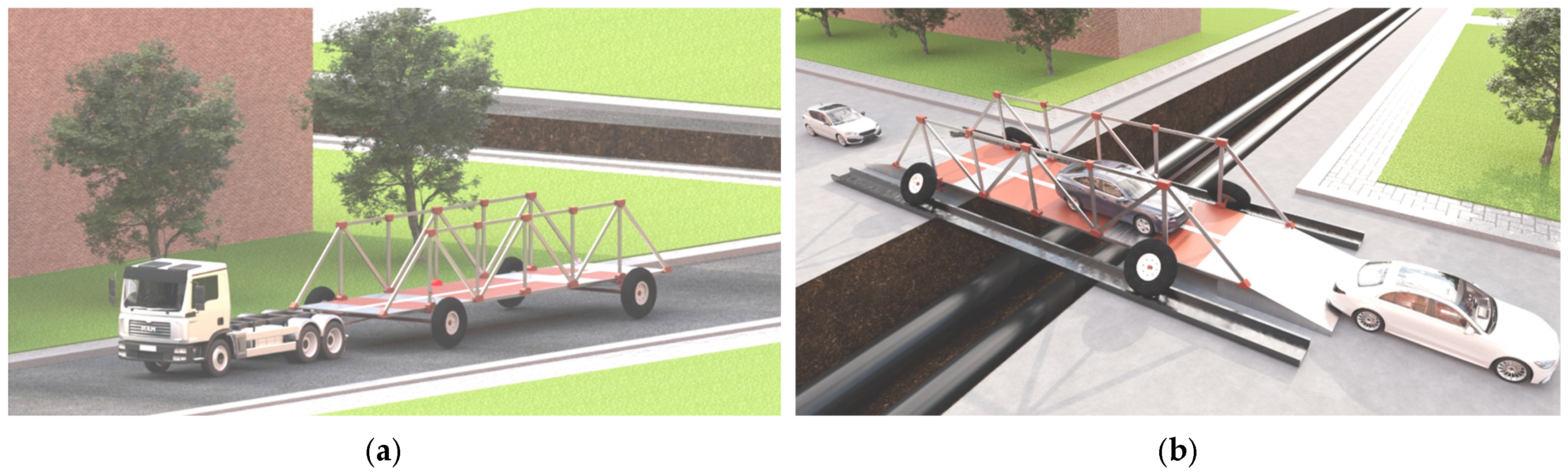
One promising solution is the use of mobile overpasses [14,15]. A mobile overpass is a temporary bridge structure that combines the functions of a vehicle and a bridge. The structure is transported to the work site, deployed over a trench using concrete supports, and enables passenger vehicles to pass directly over excavations without detours; after repairs, it is folded back into transport mode.
A global review shows that such structures are almost absent in civil urban transport construction. Similar designs exist primarily in military engineering, such as tank bridge-layers and tracked folding bridges [16], as well as modular Bailey bridges and their derivatives, including Mabey and Acrow bridges [17,18]. Deployable bridge systems, such as the portable ERE Logistics beam bridge, can be hydraulically installed without heavy machinery [19]. Lederman et al. developed a roll-up arch bridge mounted on an armored vehicle for rapid deployment in military or rescue operations [20]. The mobile ASTRA bridge system, operated by the Swiss Federal Roads Office (FEDRO), allows highway repairs without traffic closure [21].
Analysis of existing analogues reveals that the proposed mobile overpass, which combines the functions of a bridge and a vehicle, offers unmatched mobility and rapid deployment—superior to prefabricated bridges that require heavy equipment or costly tank bridge-layers. Made of carbon steel S-245 (analogous to S245) with a reliability factor of 0.95 [22,23], it operates within a temperature range of −45 °C to +55 °C and has a service life exceeding 15 years with regular maintenance. Designed in LIRA-SAPR [24] in accordance with Kazakh and Eurocode standards [25], the structure is optimized for urban conditions.
Implementing mobile overpasses in real-world conditions requires studying their behavior under different operational modes. A key research objective is to analyze the interaction between overpass supports and the soil foundation in bridge mode [26,27], which is necessary to prevent trench wall collapse and ensure safe operation. This interaction must be modeled to optimize support placement, accounting for soil properties, stress–strain state, structural geometry, boundary conditions, and traffic loads. The underlying hypothesis is that such optimization is achievable.
To the authors’ knowledge, no studies have addressed the optimization of mobile overpass support placement near utility trenches using experimentally calibrated nonlinear soil models and parametric finite-element optimization.
The novelty of this work lies in integrating experimentally calibrated Drucker–Prager soil parameters with a parametric FEM optimization framework in ANSYS to determine the optimal placement of mobile overpass supports near utility trenches—an approach not reported in previous studies. Therefore, this study develops a methodology for optimizing support placement to prevent trench wall instability and ensure reliable mobile overpass operation.
The developed optimization methodology accounts for the nonlinear behavior of the soil foundation [28,29] based on the Drucker–Prager model [30,31], is founded on parametric optimization techniques [32,33], and employs finite element numerical modeling using the ANSYS Academic Research, 2025 (R2) package. The methodology is further validated through experimental verification, which ensures the reliability and structural stability during operation.
The proposed methodology represents a systematic integration of experimentally calibrated soil parameters, parametric finite element optimization, and a practical engineering operating scenario of the mobile overpass. The suggested approach provides a well-founded assessment of the interaction within the “structure–soil” system and enables optimal support placement under varying geotechnical operating conditions.

2. Materials and Methods

2.1. Modeling the Interaction Between Overpass Supports and the Soil Foundation and Formulation of the Optimal Placement Problem

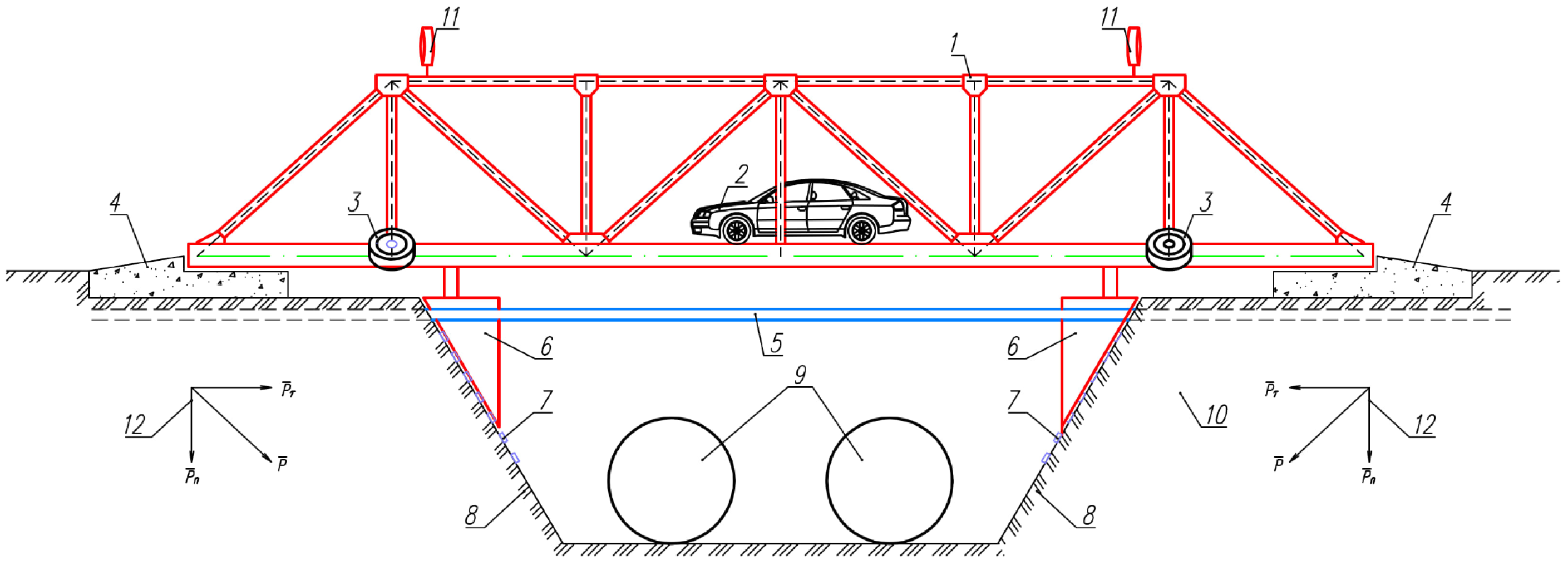
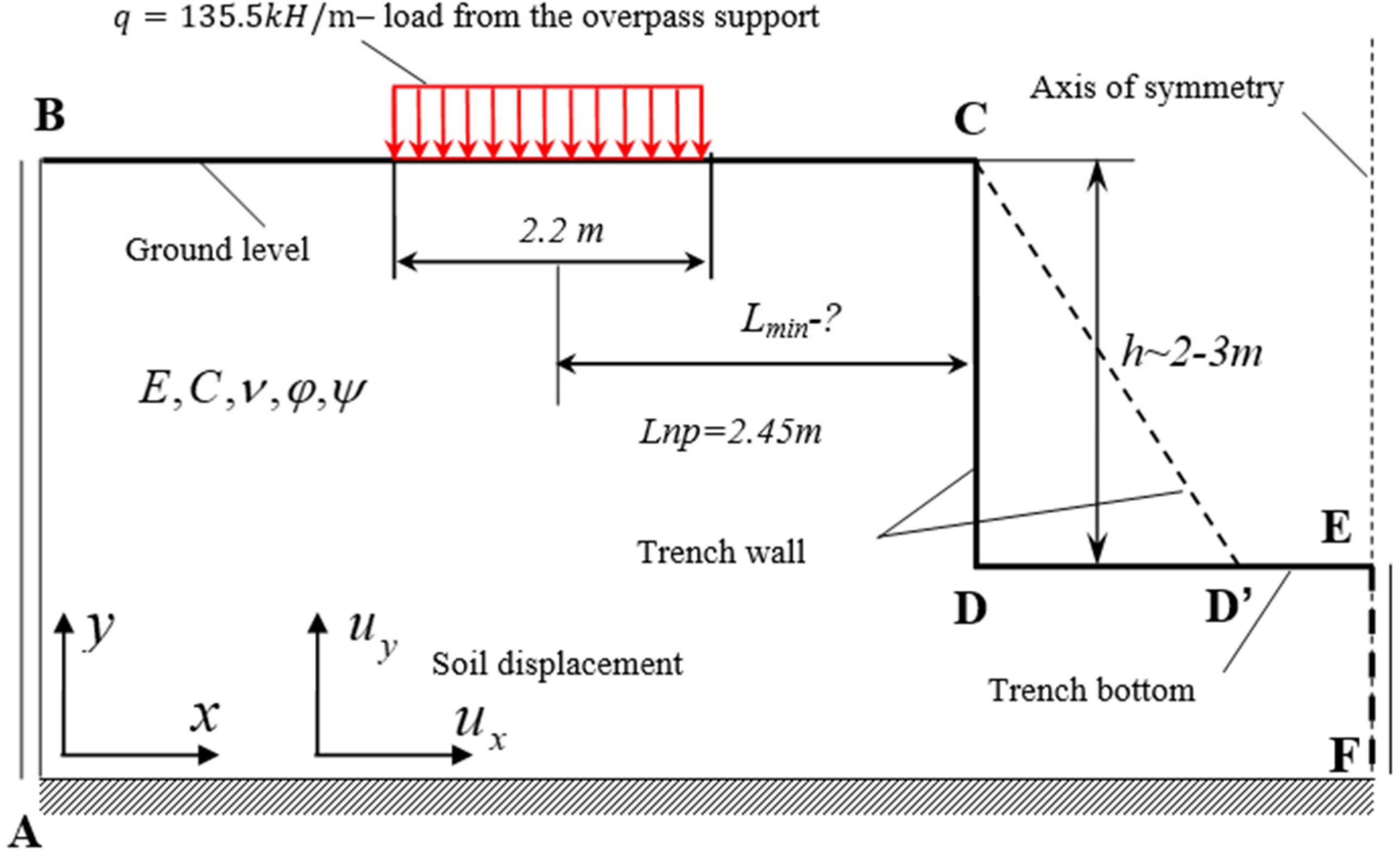
In the operational position, the overpass rests on two reinforced concrete supports located on both sides of the trench, forming the “overpass support–soil foundation” system. The supports act as entry ramps to the overpass (Figure 1, transmitting vertical loads from the structure’s weight and vehicle traffic (Figure 2, positions 4 and 12). These loads cause soil compression (Figure 2, position 10) and horizontal deformations of the trench wall, which may lead to wall collapse (Figure 2, position 8) or soil displacement. A reduced distance between the supports and the trench edge amplifies these effects, whereas increasing this distance increases the structural span, thereby raising the weight and overall construction costs [34,35].
The design (initial) distance between the supports and the trench wall edge is Lₚ = 2.45 m.
The condition of the soil mass is defined by its deformation and physico-mechanical parameters: deformation modulus E, cohesion C, Poisson’s ratio ν, internal friction angle φ, and dilatancy angle ψ. The parameter ranges are relatively broad, since the overpass may operate on different types of soils, excluding structurally unstable (collapsible) soils that change their structure under relatively small external loads [36].
The distributed vertical load transmitted to the soil from the overpass support (reinforced-concrete ramp) is determined by the following expression:
q = P a + R p / l a = 135.5 k N / m ,
where Pₐ = 33 kN is the load from the reinforced-concrete ramp; Rₚ = 265 kN is the load from the overpass structure, including the weight of the structure and the total load from moving vehicles; lₐ = 2.2 m is the ramp length.
The horizontal load caused by vehicle braking or traction forces can be neglected, as it is insignificant given the low travel speed on the overpass (not exceeding 15 km/h).
The stiffness condition of the trench wall—considered as the displacement-limiting condition for uₓᵢ of the vertical wall CD for different cases of overpass support placement—can be defined as [37,38]:
m a x u x i C D u x ,
where max( u x i )|CD is the maximum horizontal soil displacement at the trench wall CD; [uₓ] is the allowable horizontal displacement of the trench wall boundary CD, which can be defined as u x = h /   ( 500 ÷ 1000 ) , where h is the height of the trench wall. Expression (2) specifies that the maximum horizontal soil displacements along the trench wall CD must not exceed the established limit values.
This condition serves as the basis for optimizing support placement. Accordingly, the optimization problem is defined as follows: to determine the optimal minimum distance Lₘᵢₙ from the trench wall CD to the overpass support that ensures the minimal horizontal displacements uₓᵢ of the trench wall CD among all possible configurations (2), taking into account the support load (1) acting on the soil, its physico-mechanical properties, the geometry of the computational domain, boundary conditions, and the stress–strain state (SSS) of the soil mass.
Thus, the optimization criterion is the minimum distance Lₘᵢₙ of the support from the trench wall edge at which the stiffness condition (2) is satisfied, sufficient to prevent its collapse.
Conditionally, the objective function for optimizing the placement of supports can be represented as a multidimensional function P, depending on several parameters mentioned above:
P = P q , L n p , E , C , ϕ , ψ , G e o m e t r y o f t h e D o m a i n , S t r e s s S t r a i n S t a t e S S S o f t h e M a s s .
The stiffness condition of the wall (2) and the boundary conditions of the computational domain—EF, BA, and AF (Figure 3)—act as constraints of the objective function (3 Solving this objective function determines the optimum location of the support Lₘᵢₙ, corresponding to the minimum of the function Lₘᵢₙ minP.
Depending on the given parameters and constraints, a single optimal value of the parameter Lₘᵢₙ is obtained. When any parameter of function (3) changes, the optimal point Lₘᵢₙ also shifts.
The accuracy of soil behavior prediction depends primarily on the deformation model used. Among known nonlinear criteria are the Coulomb–Mohr, Lade–Duncan, Matsuoka–Nakai, Drucker–Prager, Duncan–Chang, Schwer–Murray, and von Mises models, describing the SSS and failure behavior under plastic deformation [39,40,41,42]. The Coulomb–Mohr model, while widely used, does not account for nonlinear volumetric compression behavior, and its angular yield surface complicates numerical 3D analysis, often leading to predictions that are close to linear elastic behavior.
The Drucker–Prager model eliminates these drawbacks by employing a smoothed conical yield surface defined by C and φ, thereby improving numerical stability and providing a more accurate description of nonlinear SSS.

2.2. Parametric Optimization Using ANSYS Workbench

An analytical solution to the optimization problem for the objective function (3) is complicated due to its high complexity; however, numerical methods of parametric optimization implemented in ANSYS Workbench (WB) [43,44] provide an effective way to solve it through virtual experimentation and automated analysis [45,46]. This approach enables variation in key model parameters (such as dimensions or material properties) and the evaluation of their impact on target characteristics—such as strength or, in the present case, deformation [47].
In WB, the process begins by creating parametric geometry in DesignModeler or by importing a CAD model, during which the variables to be optimized are defined. The subsequent steps include generating a design of experiments, constructing response surfaces, and performing a numerical search for the optimum using built-in optimization algorithms [48,49]. The Drucker–Prager (DP) model is integrated into WB to describe the soil’s nonlinear behavior, enabling determination of the soil’s stress–strain state (SSS) under loads transmitted from the overpass supports using the finite element method (FEM). Based on the obtained SSS, WB’s parametric optimization tools solve the optimal support placement problem, yielding more accurate positioning results.
Thus, the optimization procedure searches for the value of Lₘᵢₙ that minimizes horizontal trench wall displacements while satisfying the constraints on soil properties, geometry, and boundary conditions [50] In brief, the workflow consists of: (i) defining geometry, material models, boundary conditions, and loads; (ii) selecting design and response parameters; (iii) planning and running the virtual experiment; (iv) constructing response surfaces; and (v) performing optimization and verifying the obtained solution [51].
At the first stage, the stress–strain state (SSS) analysis was performed using the physico-mechanical characteristics of clay loam soils, which are predominant in the Karaganda region of Kazakhstan (Table 1).
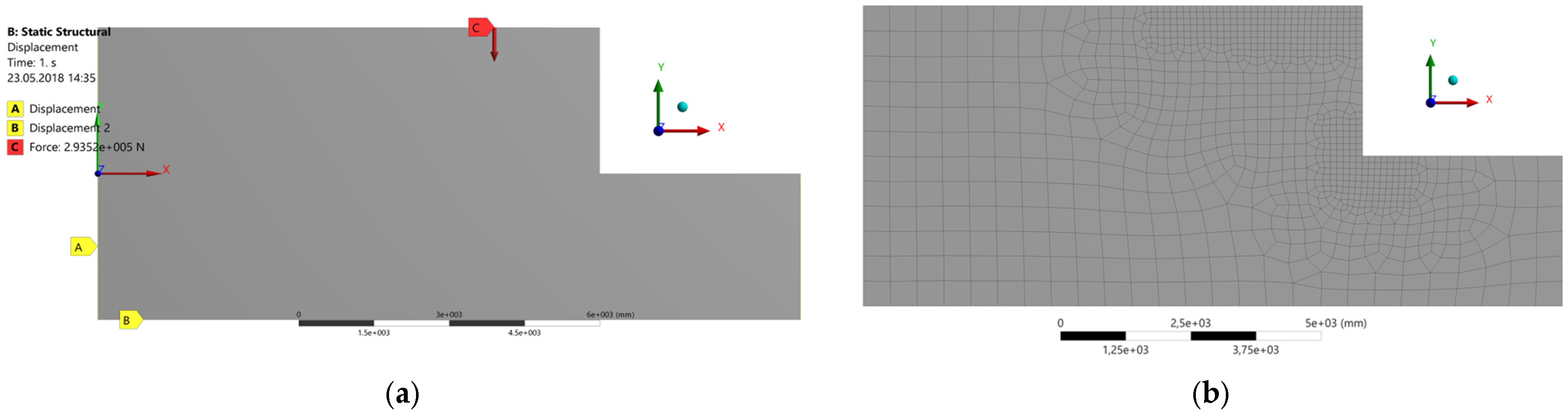
According to Figure 4, the design (computational) scheme of the soil and its finite-element approximation in ANSYS Workbench are shown in the figure.
For the approximation of the computational scheme of the soil foundation (Figure 4), a two-dimensional eight-node quadrilateral finite element PLANE82 [52] was used. The element is defined by eight nodes, each having two degrees of freedom: displacements along the global x and y coordinate axes. This element is suitable for nonlinear elastoplastic problems, accounting for stiffness variation, large displacements, large strains, and orthotropy in 2D modeling.
The total number of finite elements was selected automatically based on an optimal mesh generation criterion. Mesh refinement was applied in the contact zone between the support and the soil mass, as well as near the trench wall, in order to improve the accuracy of stress and displacement determination. The model consists of 975 elements, 1023 nodes, and 2046 degrees of freedom. Loading applied to the computational model was defined according to expression (1). The geometry and boundary conditions were specified in accordance with Figure 3 and are described in Section 2.1.

2.3. Justification of the Objective and Tasks of the Experiment

The studies on optimizing the placement of overpass supports were based on a virtual numerical experiment in ANSYS Workbench (WB) using the Drucker–Prager model. The calculation methodology developed using this approach applies to various soil types but requires experimental verification of its reliability. Therefore, an experimental validation of the “overpass support–soil foundation” system was conducted to confirm the applicability of the adopted soil model.
The purpose of this experimental study is to verify the nonlinear Drucker–Prager soil deformation model implemented in ANSYS by comparing it with experimental data, thereby justifying its use in the engineering methodology for calculating and designing mobile overpasses.
The research tasks include:
  • Describing the experimental setup and equipment;
  • Preparing for testing;
  • Conducting tests and processing results;
  • Performing mathematical modeling in ANSYS;
  • Carrying out a comparative analysis of field tests and numerical modeling results in ANSYS.
All experimental works were carried out using certified instruments (stabilometers): KPr-1M for compression testing [53] and PSG-2M for direct shear testing [54], both manufactured by Pribor (Uglich, Russia). The tests were performed in accordance with GOST 12248-2010, “Soils—laboratory methods for determining strength and deformability characteristics” [55]. Statistical data processing was performed in compliance with GOST 20522-2012 “Soils. Statistical processing methods for test results” [56].
The experiment consisted of two parts—physical and mathematical modeling—each including three stages:
Stage 1: Using the compression method on the KPr-1M device, soil deformations and settlements, along with parameters such as the modulus of deformation (E) and Poisson’s ratio (ν), were determined.
Stage 2: Using the single-plane shear method on the PSG-2M device, strength parameters—cohesion (C) and internal friction angle (φ)—were recorded.
Tasks 1–3 were performed separately for each test type.
Stage 3: Soil compression was simulated in ANSYS using the Drucker–Prager model with the experimentally obtained parameters (E, ν, C, φ). A comparative analysis of settlement and deformation curves was then performed between the experimental and simulated results.

2.3.1. Experimental Studies of Soil Compression

Experimental investigations to determine soil deformations were carried out using the KPr-1M compression apparatus, provided by the certified laboratory of Karaganda GIIZiK LLP (Karaganda, Kazakhstan).
For testing, soil samples were taken either undisturbed from monoliths (for natural soils) or reconstituted in the laboratory (for fill or artificial soils Each specimen had a cylindrical shape with a diameter of 70–100 mm and a height equal to 1.5–2 times the diameter, in accordance with the standard. For this experiment, a clay soil sample with an undisturbed structure and natural moisture content was used.
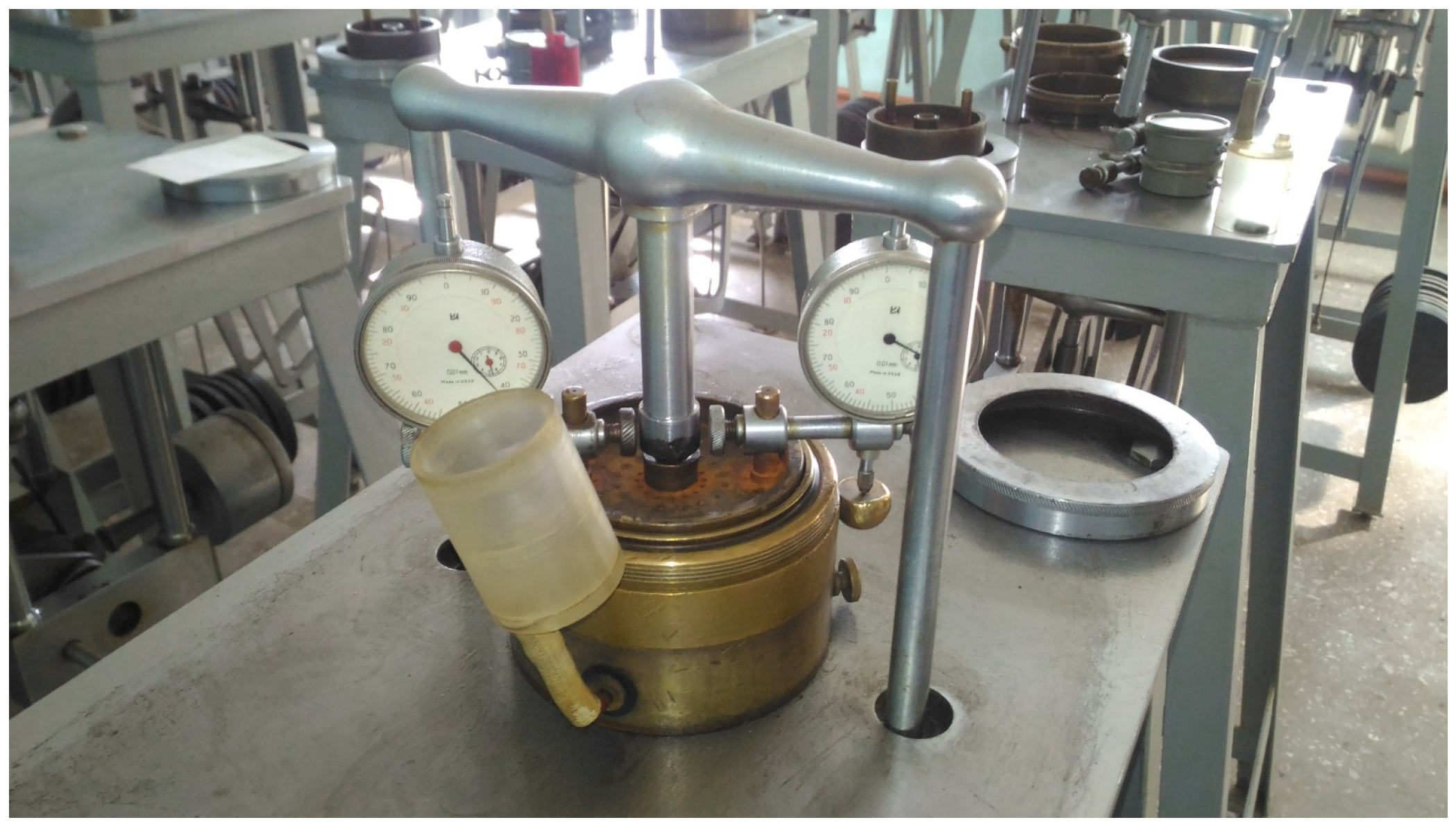
The sample parameters are presented in Table 2 and Table 3 and illustrated in Figure 5.
The load was gradually applied to the specimen (in stages).
The magnitude of each stage depended on the soil type and the test’s purpose, typically ranging from 0.05 to 0.5 MPa.
Deformations were measured with high accuracy (typically up to 0.01 mm) using dial indicators and electronic sensors installed on the apparatus.
For each loading stage, the following parameters were calculated [55,56]:
-
Absolute stabilized vertical deformation of the soil specimen (Δh, mm)—the arithmetic mean of the instrument readings after subtracting the correction for the deformation of the compression apparatus;
-
Relative vertical deformation of the soil specimen.
ε i = h i / h ,
where h—the height of the tested specimen;
-
The soil porosity coefficient e i is calculated using the formula:
e i = e 0 ε i 1 + e 0 ,
where e 0 is the initial porosity coefficient in the absence of load.
Based on the calculated values, a graph of ε   =   f   ( p ) or Δ h   =   f   ( p ) was plotted, known as the compression curve. A smooth average curve was drawn through the plotted points. The compressibility coefficient m 0 , MPa−1, at each loading stage from p i to p i + 1 as calculated with an accuracy of 0.001 MPa−1 according to the formula:
m 0 = e i e i + 1 p i + 1 p i ,
where e i and e i + 1 are the void ratios corresponding to the pressures p i and p i + 1 .
The oedometer modulus of deformation Eoed and the deformation modulus obtained from compression tests Ek within the given pressure interval Δ p were calculated with an accuracy of 0.1 MPa according to formulas [55,56]:
E o e d = Δ p / Δ ε , E k = E o e d β ,
where Δε is the change in relative strain corresponding to Δp.
β is a coefficient accounting for the absence of lateral soil expansion in the compression device; in the absence of experimental data, it is allowed to take β = 0.4.

2.3.2. Experimental Study of the Direct Shear Test of Soil

Experimental investigations of soil strength characteristics were carried out using the PSG-2M direct shear apparatus, provided by the certified laboratory Karaganda GIIz & K LLP (Karaganda, Kazakhstan). The PSG-2M device is designed to determine soil shear strength parameters such as the internal friction angle φ and cohesion C in accordance with GOST 12248-2010 [55].
Soil specimens were placed in the ring mold and shaped as cylinders with a diameter of at least 70 mm and a height equal to one-third to one-half of the diameter. The maximum particle size (inclusions, aggregates) in the sample did not exceed one-fifth of its height.
Undisturbed natural clay soil specimens were prepared in a cylindrical form with the following geometric parameters: height h = 29 mm, diameter d = 71.4 mm, cross-sectional area S = 4000 mm2, and volume V = 116,055.1 mm3.
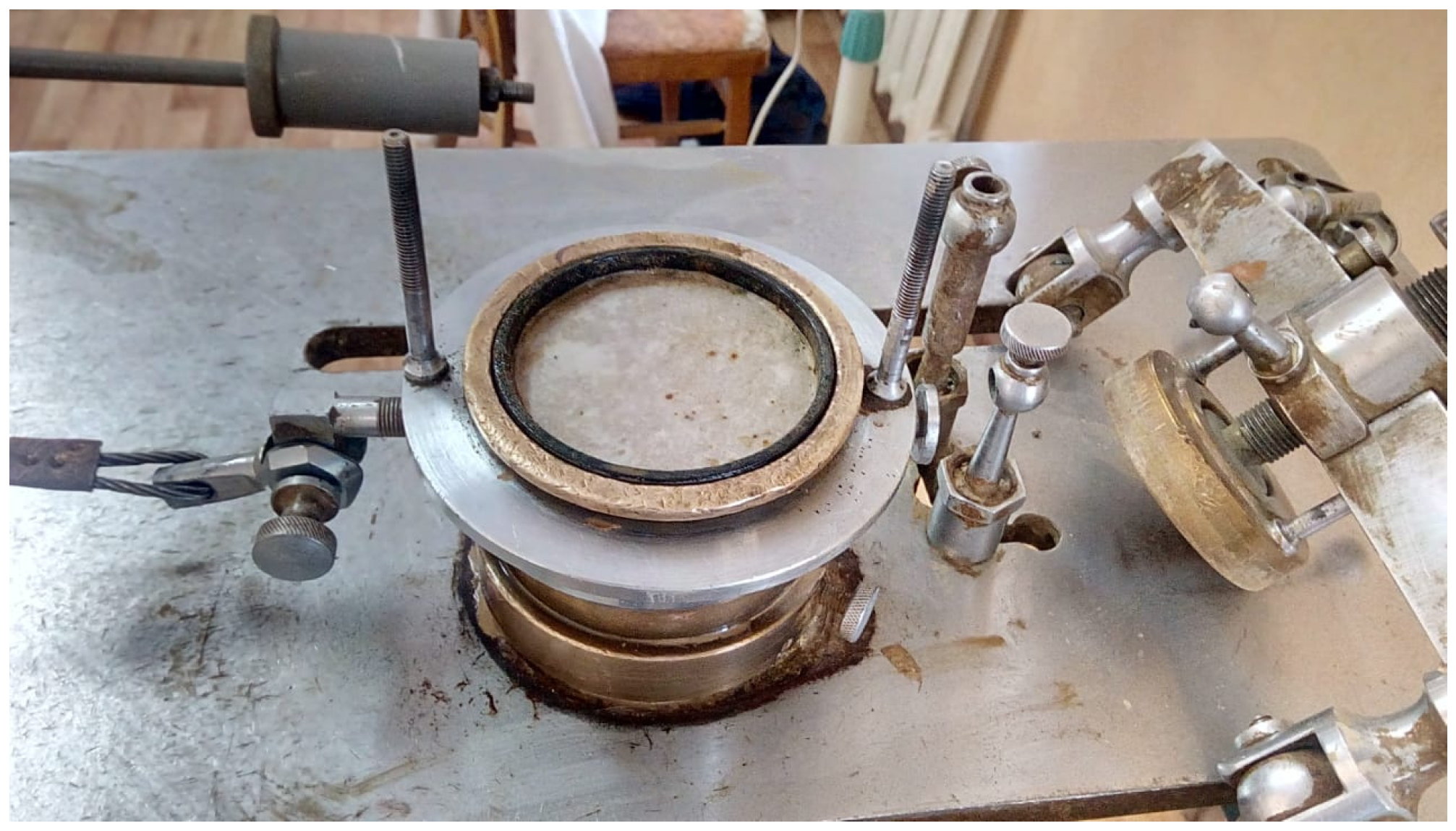
The soil’s physical characteristics, including the liquidity index, served as the basis for selecting the normal pressure steps in accordance with the recommendations of GOST 12248-2010 [55]. The tested clay specimen is shown in Figure 6.
The tests were conducted sequentially at three vertical (normal) stress levels, σ n : 0.1 MPa, 0.3 MPa, and 0.5 MPa, which were selected for clay soils with I L     0.5 based on the tabulated data of the standard GOST 12248-2010 [55].
For each stress level, the specimen was placed in the shear box, where a vertical load was applied in a single stage through a system of weights and levers, ensuring a uniform pressure distribution over the sample surface. Immediately after applying σ n , the horizontal shear mechanism was activated. The shearing load was applied statically in discrete steps, each not exceeding 10% of the current load value, with intervals of 10–15 s between steps.
The total shearing time was limited to 2 min, from the start of loading, to minimize the influence of consolidation processes.
During the test, key parameters were continuously recorded—horizontal displacement (l) (mm), shear stress τ   (MPa), and elapsed time—which made it possible to track deformation dynamics in real-time.
The test was considered complete when one of two criteria was met: either a sudden failure (sliding of one half of the specimen relative to the other) or the attainment of 10% relative deformation, whichever occurred first.
The ultimate shear strength was defined as the maximum τ recorded during the test.
Based on the measured values of horizontal shear and normal loads, the shear and normal stresses τ and σ n (MPa) were calculated according to the formulas provided in [55]:
τ = 10 Q A , σ = 10 P A ,
where Q and P are the horizontal shear and normal forces acting on the shear plane, respectively, kN; A—sample area, cm2.
Determination of τ should be performed for at least three different values of P.
Based on the measured shear deformation values l corresponding to different stress levels, a dependence graph l = f(τ) was constructed.
The ultimate shear strength of the soil was taken as the maximum value of τ obtained from the shear diagram at the segment lₖ, where the relative deformation does not exceed 10%.
From the obtained data, the dependence τ = f(σ) [55] was plotted.
The internal friction angle φ and cohesion C are determined as the parameters of the linear relationship between τ and σ.
τ = σ t g ϕ + c ,
where τ and σ are determined according to expressions (8).
The internal friction angle φ and cohesion C were calculated using expressions (10), obtained by processing the experimental data points of the τ = f(σ) relationship with the least squares method, or determined graphically by drawing the best-fit straight line through the experimental points [55,56].
t g ϕ = n τ i σ i τ i σ i n σ i 2 σ i 2 , C = τ i σ i 2 σ i τ i σ i n σ i 2 σ i 2 ,
where τₙ are the experimental values of shear resistance determined at different normal stresses σₙ, and n is the number of tests.

2.3.3. Simulation of Soil Compression in ANSYS

Numerical modeling of clay soil compression in ANSYS WorkBench was carried out using the Drucker–Prager elastoplastic model, based on experimentally determined parameters: deformation modulus E, Poisson’s ratio ν, internal friction angle φ, cohesion C, and dilatancy angle ψ.
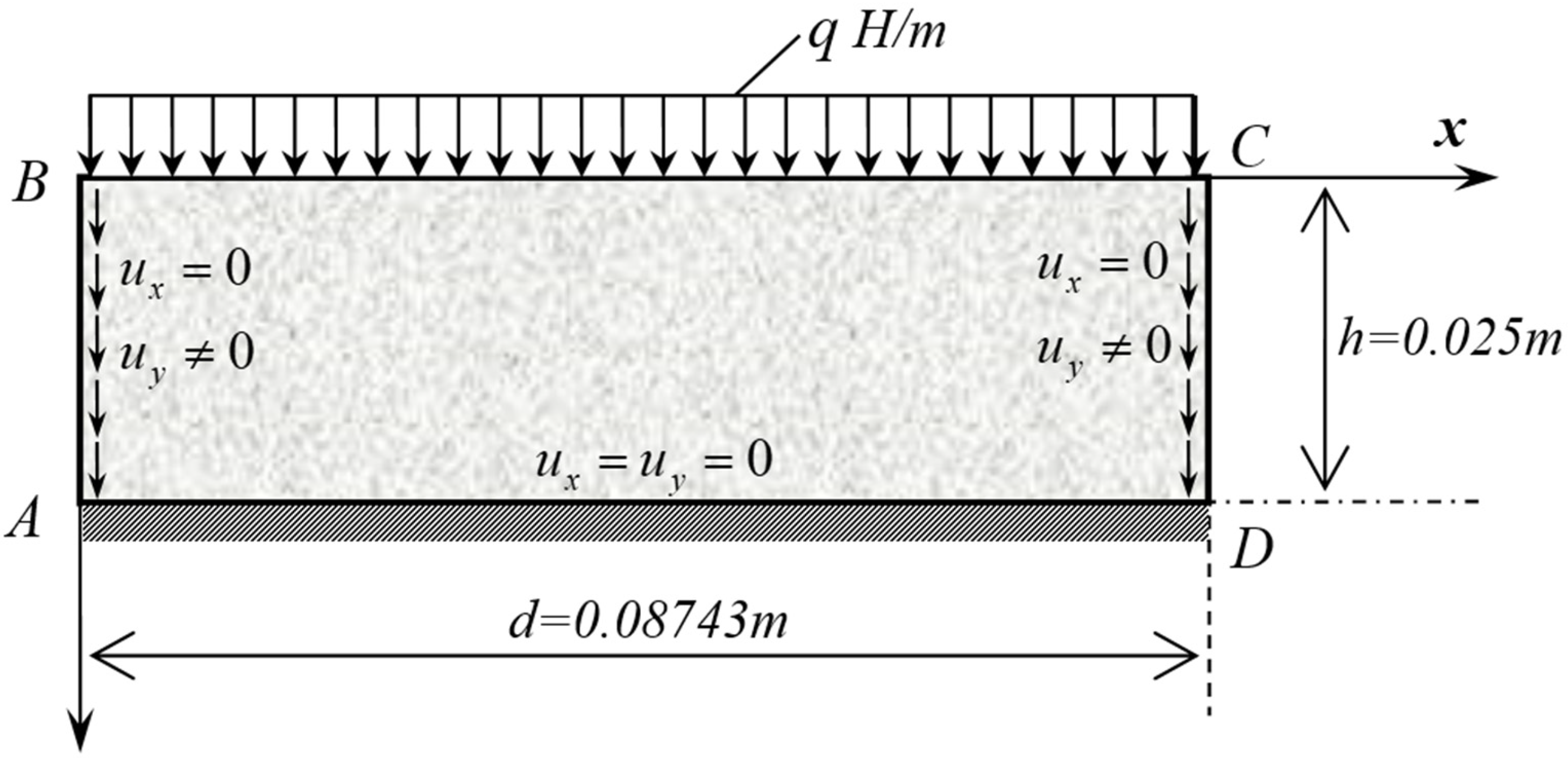
The soil compresses without lateral expansion in the tested cylindrical mold, resulting in no radial deformations. Therefore, the computational scheme was implemented under plane strain conditions, reproducing the tests conducted with the KPr-1M apparatus, with the following specimen geometry: height h = 25 mm, diameter d = 87.43 mm, and loading stages P ranging from 0.05 to 0.5 MPa. These loads were converted into the equivalent linear load q = P·d, N/m (corresponding to the midsection of the specimen along its diameter d, side BC) for all loading stages.
The computational model of the soil specimen simulating compression in ANSYS is shown in Figure 7.
The soil model was defined as the Drucker–Prager elastoplastic model. To apply this model, it was necessary to specify the soil parameters obtained experimentally (see Section 3.3): internal friction angle φ = 7.13°, cohesion C = 0.11 MPa, deformation modulus E, Poisson’s ratio ν, and dilatancy angle ψ.
According to GOST 12248-2010 [55], in the absence of experimental data, Poisson’s ratio ν for clay soils was taken depending on the liquidity index Iₗ: 0,2–0,3 for Iₗ < 0,5.
The liquidity index Iₗ was determined from the expression based on the parameters of the tested soil as given in Table 2 [55,56]:
I L = W W p / W L W P = 0.21 ,
where Iₚ = W L W p is the plasticity index, equal to the difference between the liquid limit W L and the plastic limit W p .
As seen from the calculations, I L < 0; therefore, ν (Poisson’s ratio) was set to 0.3 as the upper limit, since the tested soil was non-moistened and had a lower density.
The deformation modulus E used in the numerical model was obtained from the oedometer modulus Eₒₑd, derived from compression test data and adjusted for the selected Poisson’s ratio:
E = E o e d ν = 40 0.3 = 12   M P a .
For clay soils, the dilatancy angle ψ was assumed to be ψ = 2.5° in the calculations. An eight-node rectangular finite element (PLANE82) was selected to ensure higher computational accuracy [57].
The simulation was performed by applying load steps corresponding to the equivalent linear load q, as specified in Table 8.

3. Results

3.1. Parametric Optimization Solution

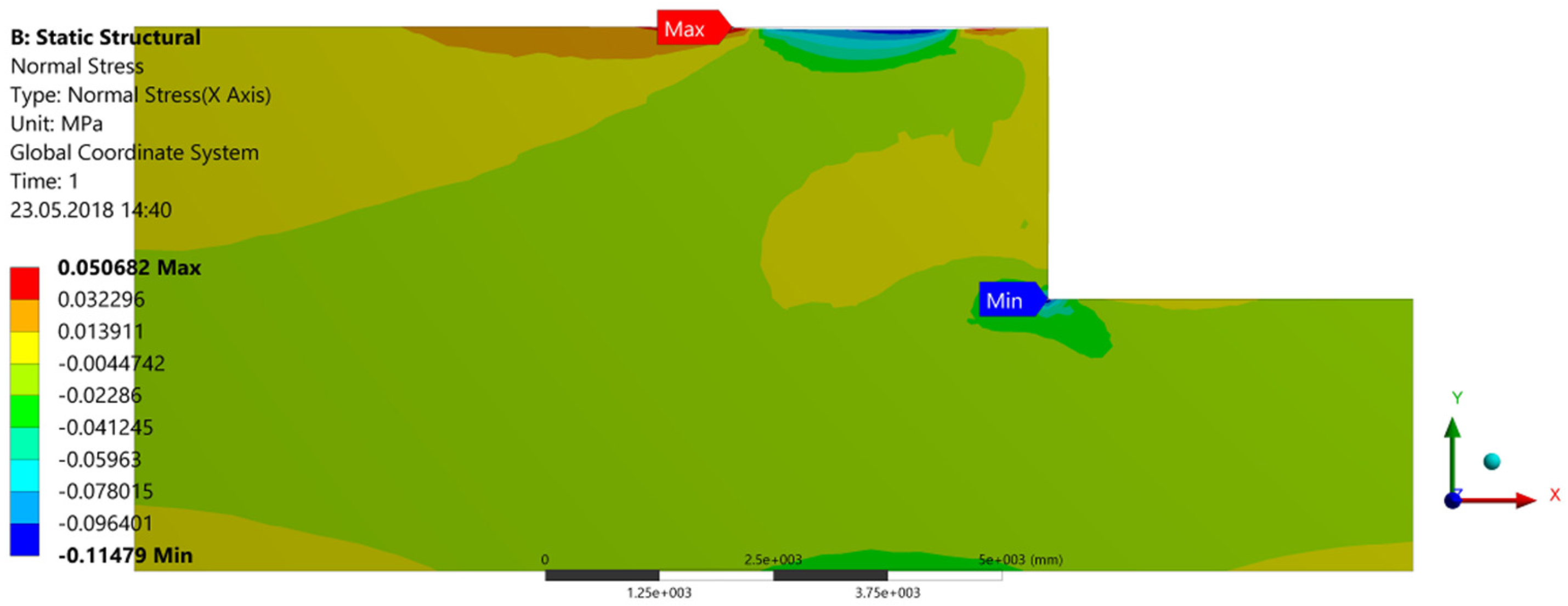
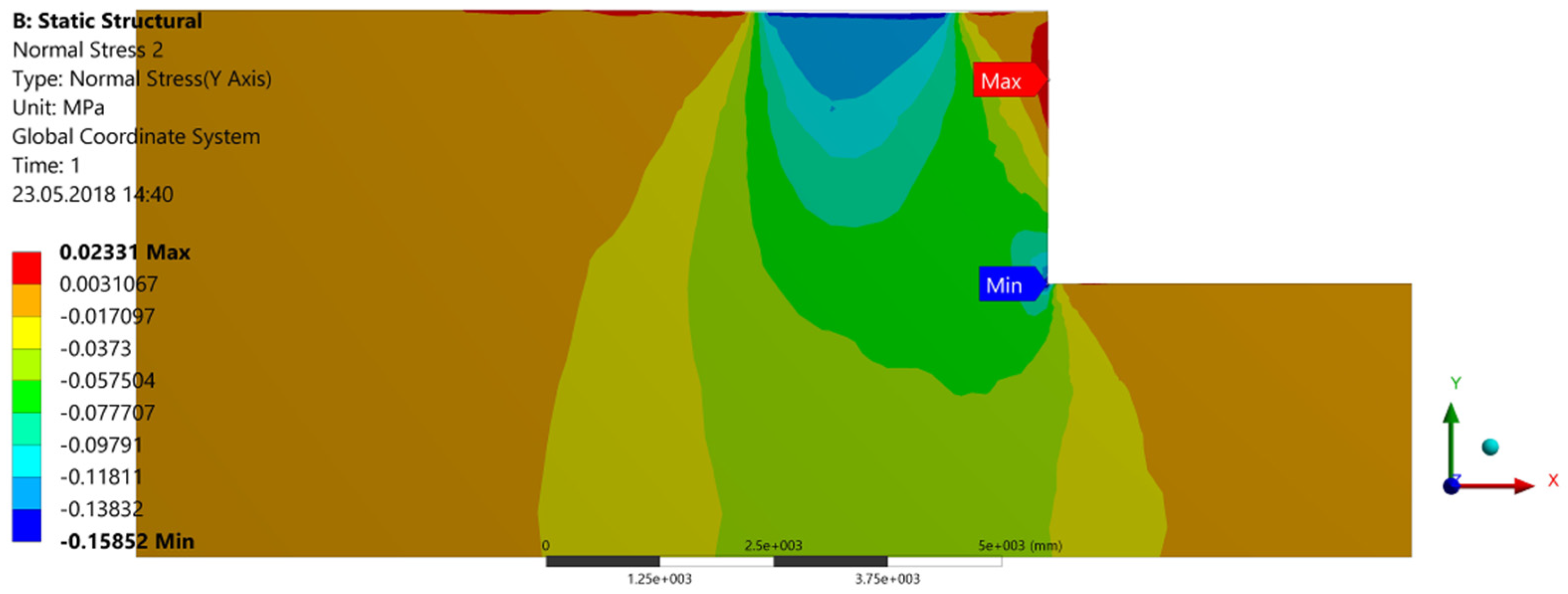
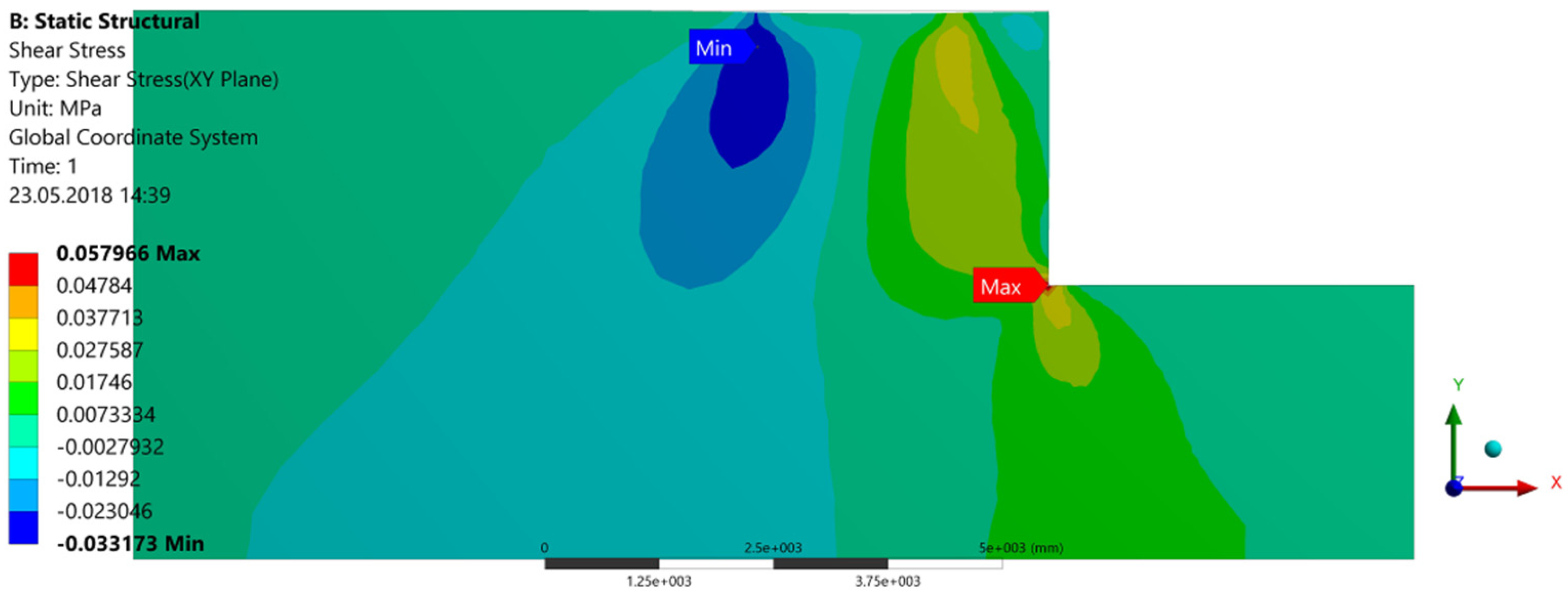
According to the parametric optimization algorithm implemented in ANSYS WorkBench, the first stage involved calculating the stress–strain state (SSS) of the soil mass under the effect of the bridge support (Figure 3). The results include stress and displacement fields, as well as zones of equivalent plastic deformation within the soil foundation. The subsequent optimization was performed in ANSYS DesignXplorer using the screening method to identify key influencing parameters, a central composite design (CCD) of experiments, the construction of response surfaces, and the formation of an optimization model aimed at minimizing the distance between the bridge support and the trench edge, subject to constraints on horizontal displacements, as defined by expressions (2) and (3). Figure 8, Figure 9 and Figure 10 present the isofields of normal and shear stresses (σx, σy, τxy) along the corresponding axes.
Analysis of Figure 9 and Figure 10 shows that the principal maximum stresses by absolute value are concentrated directly beneath the bridge support, which is especially characteristic for vertical compressive stresses σy.
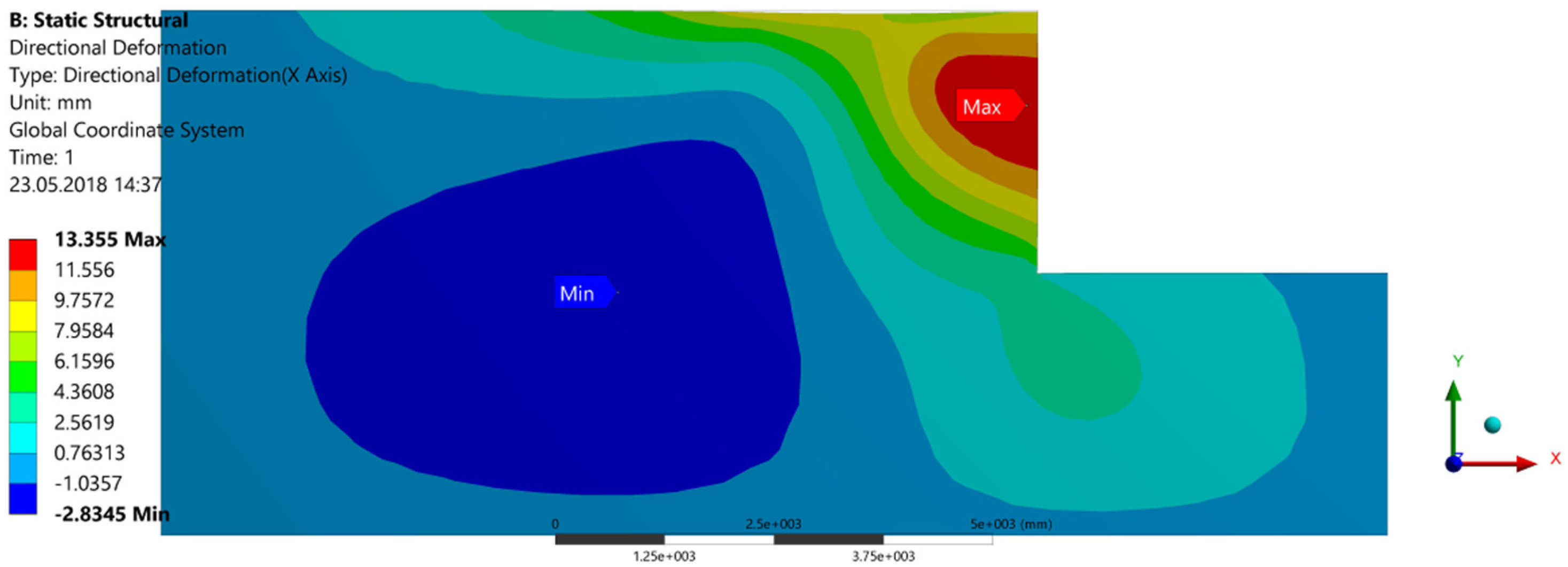
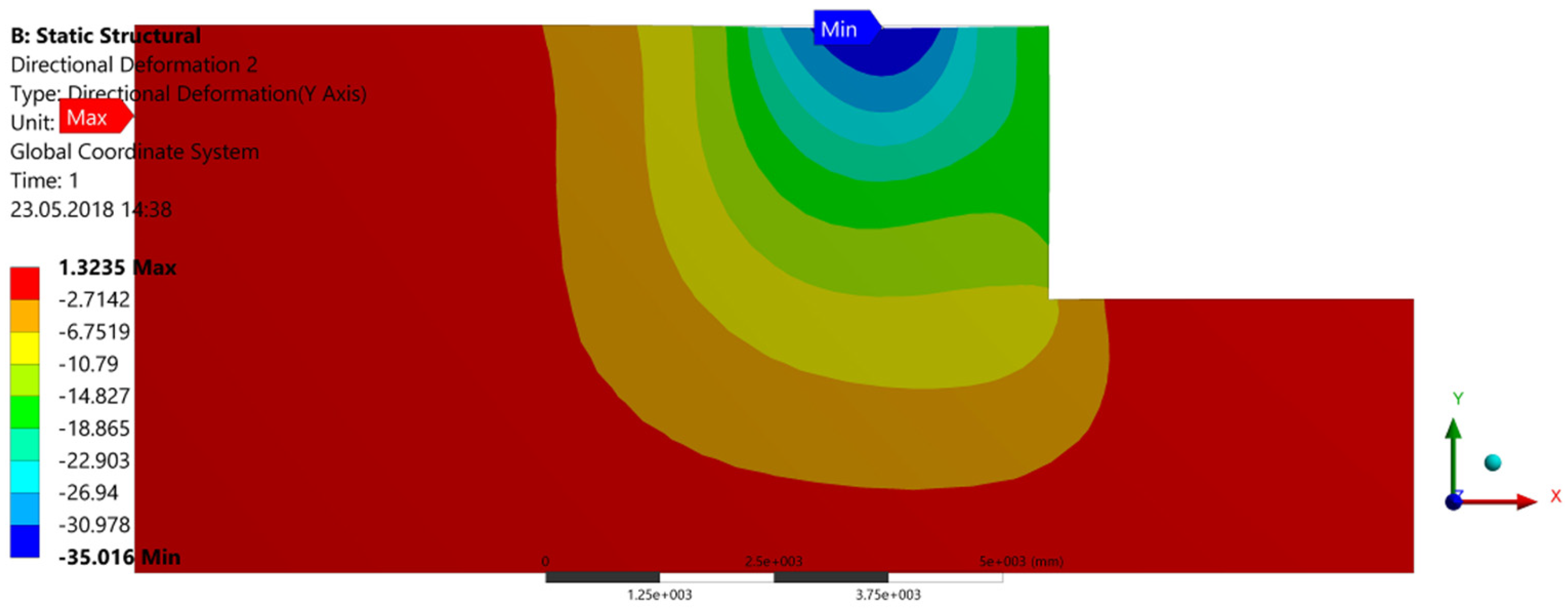
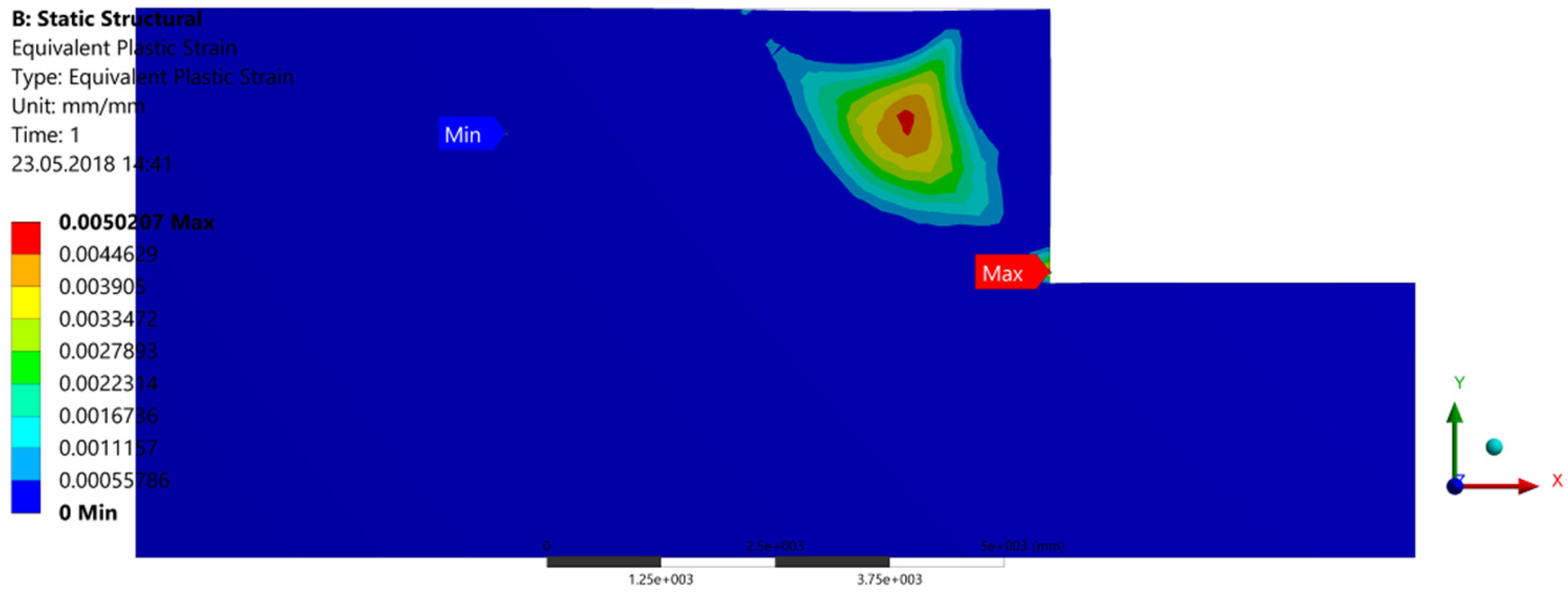
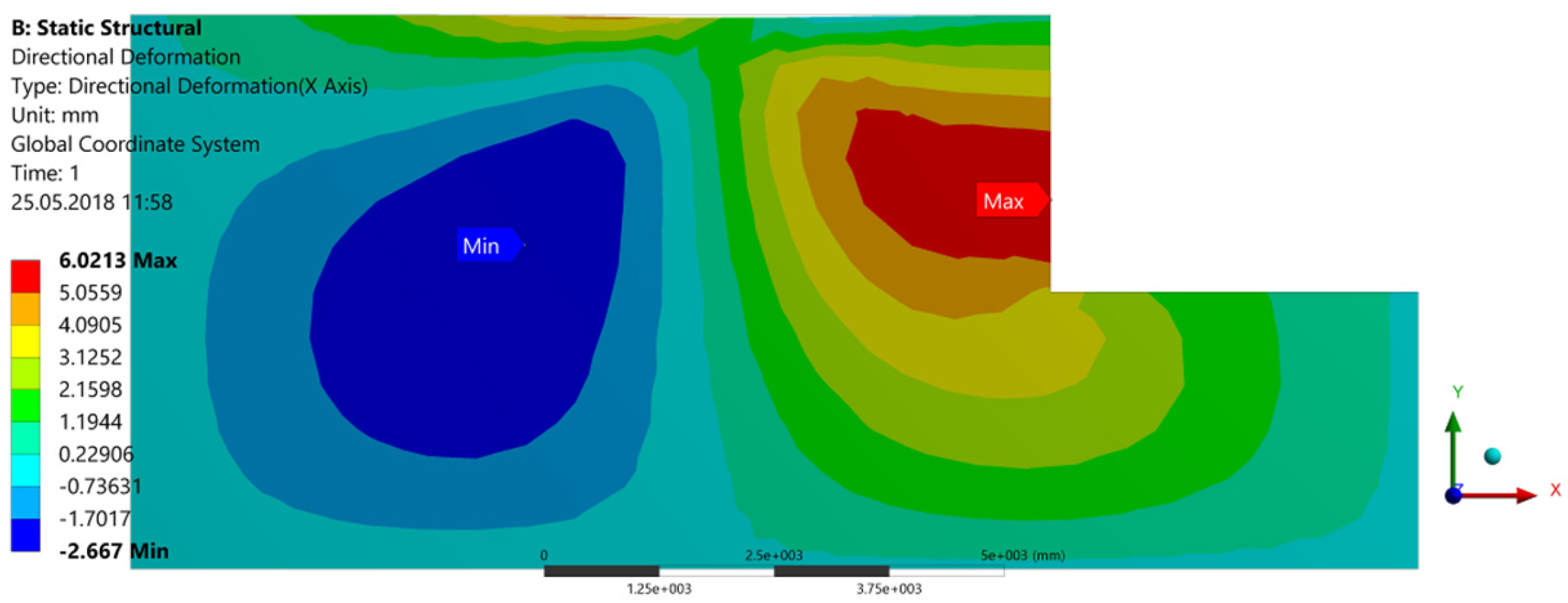
Figure 11, Figure 12 and Figure 13 illustrate the isofields of displacements (ux, uy) and the distribution zones of equivalent plastic strains ( ε e d p ) in the soil mass under the influence of the bridge support.
The analysis of Figure 11 demonstrates that the largest horizontal displacements of soil particles occur along the vertical trench wall, which may later cause its collapse during bridge operation. The most significant vertical displacements are observed in the area directly beneath the bridge support and gradually decrease with depth and distance from this zone.
The plastic deformation zones of the soil, as expected, are located at shallow depths beneath the bridge support (Figure 13).
After calculating the stress–strain state (SSS) of the soil mass, the second stage of the parametric optimization algorithm was performed, which involved determining the optimization parameters and planning the virtual experiment. This stage was conducted using ANSYS DesignXplorer (DX), a specialized module integrated into ANSYS WorkBench for performing multi-parameter optimization and parametric studies. As the optimization method, the built-in Screening Optimization Method [57,58] was used. This is one of the simplest methods, based on sampling and sorting, that supports multiple parameters, constraints, and input data types. The input optimization parameter, serving as the optimization criterion, was the minimum distance of the bridge support from the trench edge (Lmin In DX). This parameter was designated as P1 in the experiment scheme tab “Outline of Schematic D2: Design of Experiments.” Considering the change in the support position, the variable parameter was labeled P1-x. The default initial distance between the support and the trench edge was set to 1.0 m, with an upper boundary of 3.4 m. The output parameters acting as constraints included the maximum allowable horizontal displacement of the trench wall (P2), determined according to boundary condition (2), as well as the calculated stress–strain state (SSS) of the soil model. A central composite design (CCD) [59,60,61] was selected for two factors: P1 (Lmin), the minimum distance of the bridge support from the trench edge, and P2 (max( u x i )|CD), the maximum deformation of the trench wall CD (see expression (2). The system automatically generated five design points (Table 4), which were used for calculations after determining the soil mass’s stress–strain state at each iteration of the optimization process.
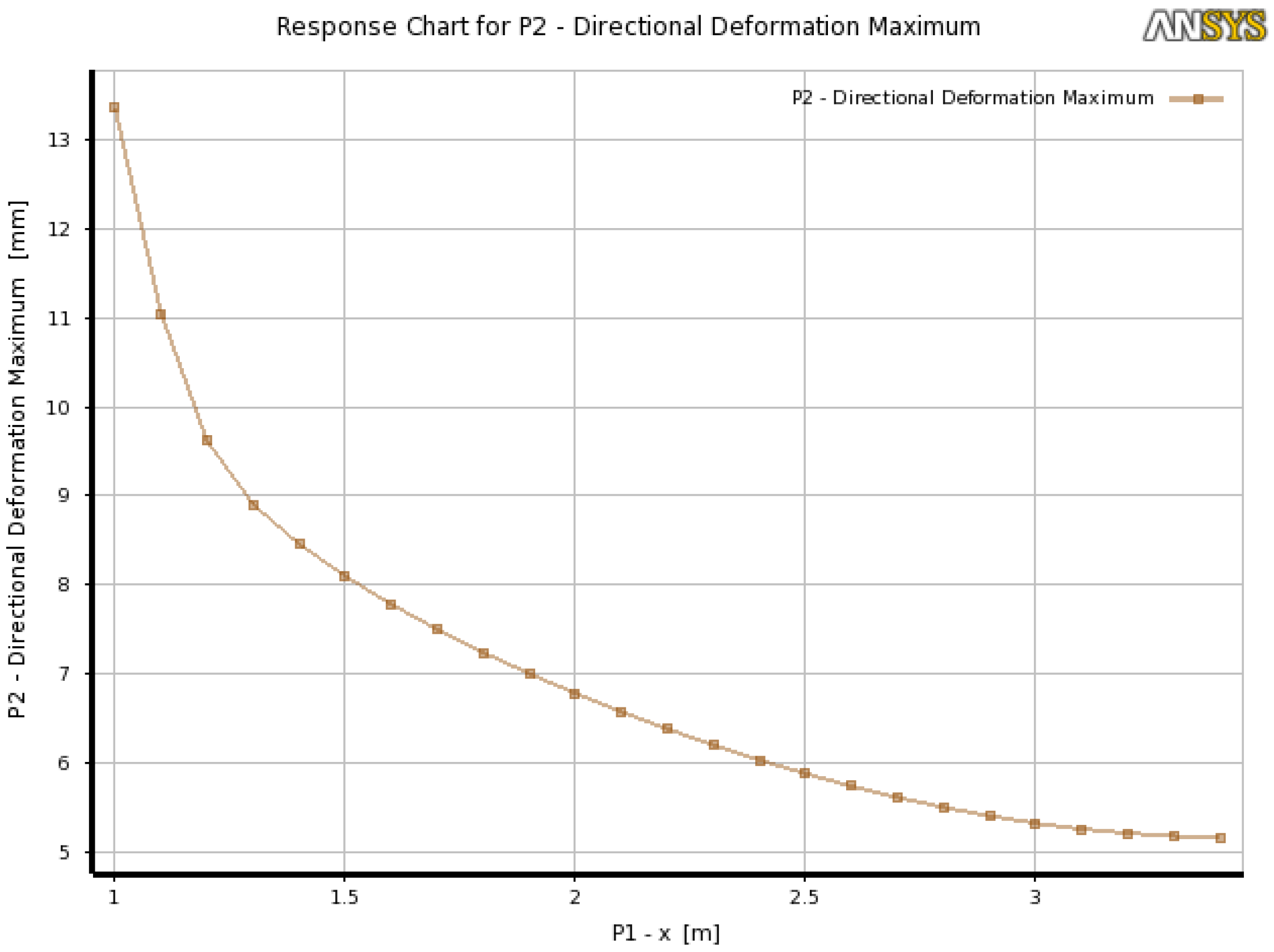
Next, the third stage of the parametric optimization algorithm was carried out, which involved constructing the response line (Figure 4). In this case, for the two-factor design, the response surface represented a function of one variable, P2 = f(P1) The response surface approximates the output parameter values across the entire analyzed parameter space, eliminating the need for complete calculations at every point. In ANSYS DesignXplorer (DX), several types of response surfaces (or lines) are available, including second-order polynomials [62], Kriging [63], nonparametric regression [64], neural networks, and sparse grid models [65]. The quality of the approximation was evaluated using the coefficient of determination (R2), root-mean-square error (RMSE), and relative errors [66,67,68]. The corresponding results are presented in Table 5.
The metrics in Table 5 indicate an almost perfect approximation (R2 = 1, very low errors of the order 10−5–10−7). Therefore, a second-order polynomial response line, P2 = f(P1), was adopted for further optimization. Based on these results, a response curve was constructed (Figure 14), illustrating the dependence of the horizontal displacement parameter of the trench wall (CD) on the position of the bridge support relative to the trench edge (CD) (Figure 3), considering the stress–strain state (SSS) of the soil mass modeled using the Drucker–Prager approach.
The response curve is monotonically decreasing and nonlinear, and is approximated by a second-order polynomial with high accuracy, as confirmed by the metrics in Table 5. The coefficient of determination R2 = 1 indicates perfect agreement between the model and the data, while the minimal errors ensure high prediction reliability. The decrease in P2 from approximately 13 mm (at the minimum support position P1 = 1 m from the edge) to about 5.1 mm (at the maximum P1 = 3.4 m) reflects clear physical logic: increasing the distance between the bridge support and the trench edge enhances the trench wall’s stability, reducing its horizontal displacement.
Next, the fourth stage of the parametric optimization algorithm was performed—the creation of the optimization model. This involved defining the optimization objective, constraints, and parameter admissible ranges (Table 6).
The problem defined the conditions for minimizing the horizontal displacement of the trench wall CD (Figure 3) within the range of 5.82–6.18 mm (Table 6), determined according to condition (2) based on the preliminary calculation of the stress–strain state (SSS) of the soil mass (Figure 11).
According to condition (2), [ u x ] = [ h / ( 500 ÷ 1000 ) ] , where h is the height of the trench wall. In the present study, the maximum value of the trench depth was adopted as h = 3  m = 3000  mm (Figure 3). Therefore,   [ u x ] = 3000 / 500 = 6 mm. By selecting an admissible maximum deviation from this value of ±3%, the resulting range is (5.82–6.18 mm).
At the fifth stage of the parametric optimization algorithm, the optimization model was launched using the screening method. As a result of the computation, three optimal variants (candidate points) of the support position were obtained (Table 7).
The final solution selected is Candidate Point 1, as it satisfies the displacement constraint while preserving the baseline value of distance P1, without increasing the span and the associated structural and economic costs. The remaining options provide only a minor reduction in displacements but require an increased support installation distance, which reduces their practical feasibility.
Based on the optimal position of the bridge support (Candidate Point 1), isofields of horizontal displacements of the soil mass were constructed, calculated with consideration of the stress–strain state (SSS) (Figure 15), as well as correlation dependencies between the support installation distance L and the maximum horizontal displacement of the trench wall CD (Figure 16).
By analyzing the soil displacement fields obtained for both the initial (design) support position (Figure 10) and the optimized configuration (Figure 14), it can be concluded that in both cases, the maximum displacements are concentrated in the zone of the vertical trench wall CD, which remains the most vulnerable area subject to potential collapse. However, after the optimization, the displacements of the trench wall CD, as well as those throughout most of the soil mass, decreased by more than half. This reduction significantly lowers the deformation intensity in the soil mass, thereby reducing the likelihood of trench wall failure during bridge operation.
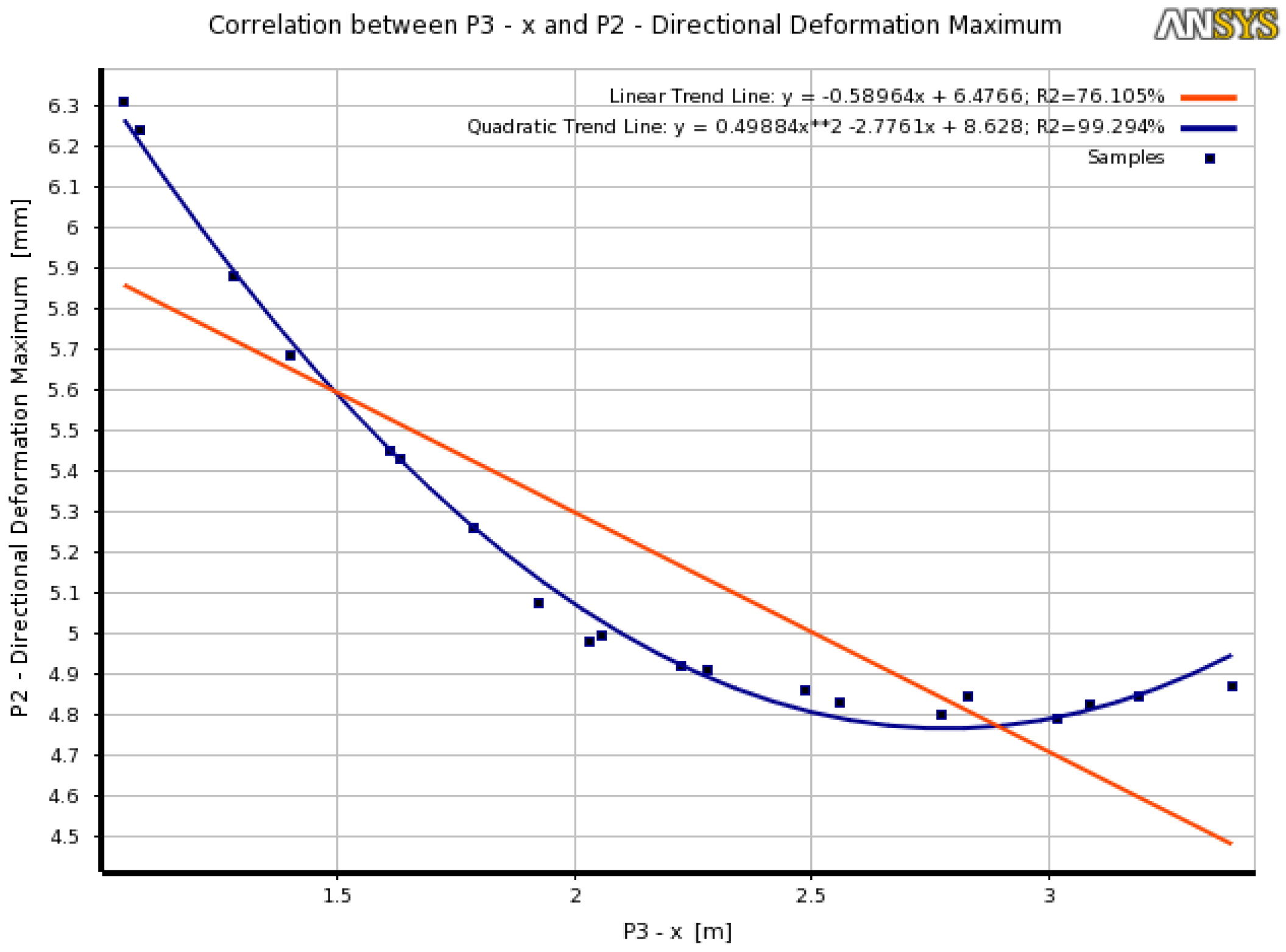
Figure 15 presents the final results of the virtual optimization experiment—Samples (displayed as blue squares)—along with the quadratic (Quadratic Trend Line) and linear (Linear Trend Line) correlation curves. The determination coefficients (R2) are shown as percentages, indicating the degree of agreement between the experimental Samples’ output values and the corresponding correlation curves.
Each Sample value represents the maximum horizontal displacement of the vertical trench wall CD (max( u x i )|CD), depending on the distance L from the bridge support to the trench edge CD, obtained from the stress–strain state (SSS) analysis of the soil using the nonlinear Drucker–Prager model. As shown by this relationship, it is possible to determine the minimum trench wall deformation and the corresponding optimal support position Lmin.
The obtained correlation distributions of the Sample values define the law of variation of the maximum displacements of the vertical trench wall CD (max( u x i )|CD) as a function of the bridge support placement L. The quadratic correlation dependence of the maximum displacements of the trench wall CD on the distance L from the support position is expressed as follows (Figure 16):
u x i , m a x = 0.49884 L i 2 2,7761 L i + 8.628 .
Linear correlation dependence (Figure 16):
u x i , m a x 0.58964 L i + 6.4766 .
The determination coefficients for the quadratic and linear correlations are 99.3% and 76.12%, respectively. These values indicate a strong agreement between the output parameters of the virtual experiment and the fitted curve equations. The quadratic correlation demonstrates the highest accuracy of fit.
From Equation (13), the optimal minimum distance Lmin of the bridge support from the trench wall CD was determined, corresponding to the minimum value of the maximum horizontal displacement of the trench wall CD:
L m i n = 2.78 m , m i n m a x u x i = 4.77 m m .
The design (initial) distance from the trench wall CD to the support was taken as Lₙₚ = 2.45 m. The difference between the design solution and the ANSYS DX optimization is 0.33 m, which is 13.5%. This distance Lmin is a technological (constructability) factor and must be accounted for in the work execution plan. The calculation procedure for determining the optimal support location developed in this section is used in the overall engineering methodology for the mobile overpass when analyzing the “bridge support—soil foundation” system.

3.2. Results of Soil Compression Testing (Results from Section 2.3.1)

In the experimental study of soil compression using the KPr-1M oedometer, key deformation characteristics of undisturbed clay soil with natural moisture content were obtained. The tests were conducted in a stepwise manner, with applied pressures ranging from 0 to 0.5 MPa, allowing the determination of absolute and relative deformations, void ratios, compressibility coefficients, and deformation moduli.
The collected data were processed in accordance with GOST 12248-2010 [55] and presented in both tabular and graphical form for comparison with the results of numerical modeling. Table 8 summarizes the parameters of the tested soil specimen at each loading step (0.1–0.5 MPa).
From Table 8, using the iterative expressions (4)–(7), the following values were obtained for the final loading step of 0.5 MPa: compressibility coefficient m0 = 0.047 MPa−1; compressive deformation modulus Eₖ = 16 MPa; oedometer deformation modulus Eₒₑd = 40 MPa.
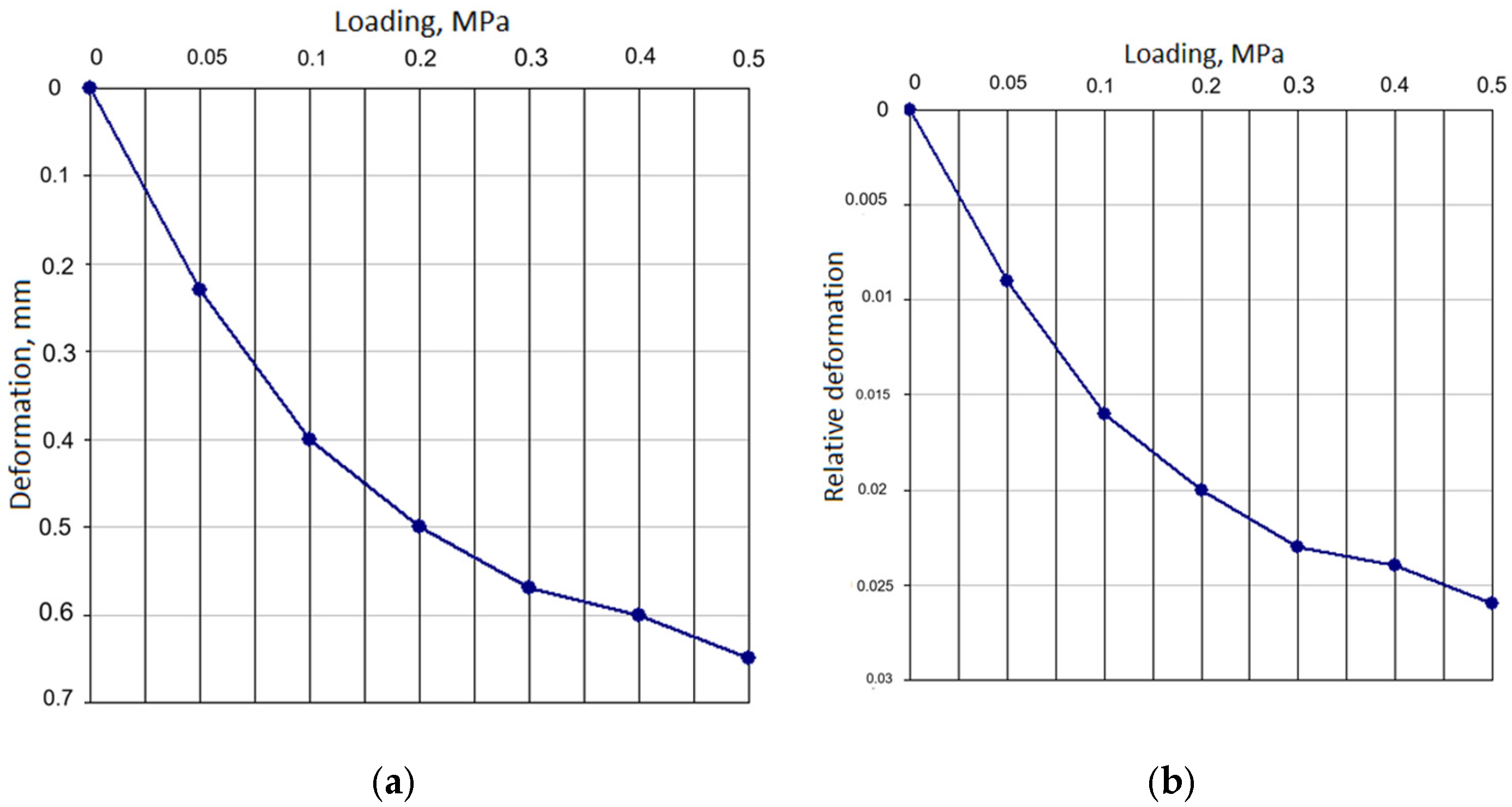
Based on the values from Table 8, Figure 17 presents the experimental deformation curves for a single soil specimen. Since the specimen cannot fully return to its original state, a single representative point is taken.
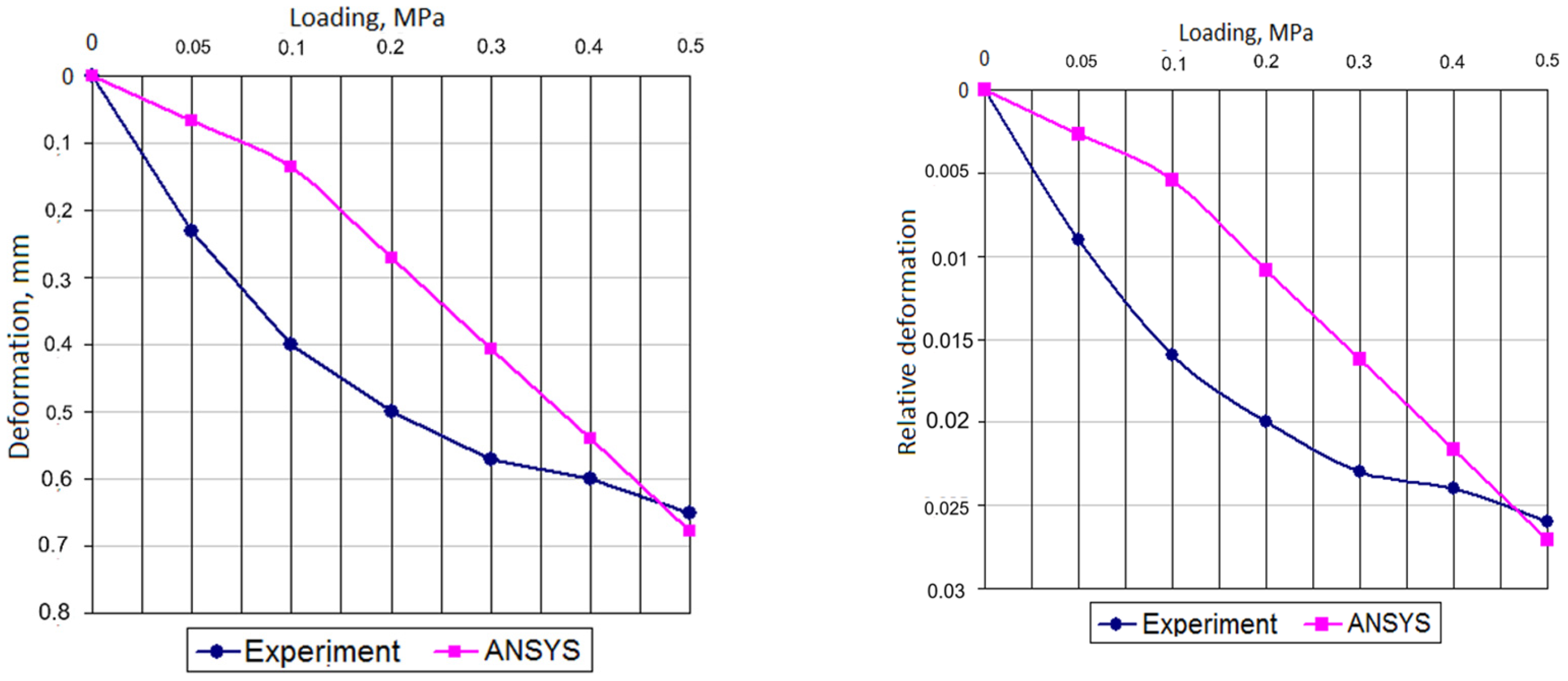
The dependence of absolute deformation on load, Δh(P), shows a nonlinear increase in deformation with increasing load (Figure 17a). At low pressures (up to 0.1 MPa), deformation increases rapidly, indicating a high initial compressibility. Thereafter, the growth rate slows, reflecting soil densification and increased stiffness under load. The overall curve is concave downward, typical of plastic clays.
The dependence of relative deformation on load, ε(P), follows a similar pattern: the curve rises nonlinearly from 0 to 0.026 (Figure 17b). The steeper initial segment is followed by gradual flattening, indicating a reduction in deformation rate at higher loads. This behavior confirms the transition from elastic to plastic deformation, during which the soil densifies and resists further compression.
The obtained parameters (Eₒₑd = 40 MPa, Eₖ = 16 MPa, m0 = 0.047 MPa−1, ν = 0.3, see Section 2.3.3) demonstrate pronounced nonlinear compressive behavior of the soil and justify their use in the ANSYS mathematical modeling and in the verification of the Drucker–Prager model, ensuring engineering calculation accuracy for the “bridge support–soil foundation” system.

3.3. Results of the Direct Shear Test of Soil (Results from Section 2.3.2)

Experimental studies of soil shear strength were conducted using the PSG-2M apparatus in the unconsolidated quick shear mode, allowing for the determination of key strength parameters of the clay soil, namely the internal friction angle (φ) and cohesion (C The tests were performed at three levels of everyday stress—0.1, 0.3, and 0.5 MPa—with continuous recording of shear deformation and shear stress over time.
The obtained data were processed using the least squares method in accordance with GOST 12248-2010 [55] and used to determine the shear strength parameters required for numerical modeling.
The results of the direct shear tests are presented in Table 9, Table 10 and Table 11.
In the last rows of Table 9, Table 10 and Table 11, the obtained values of shear stress τ correspond to the failure stage of the tested specimens—that is, the maximum shear load (ultimate shear strength. These results are summarized in Table 12.
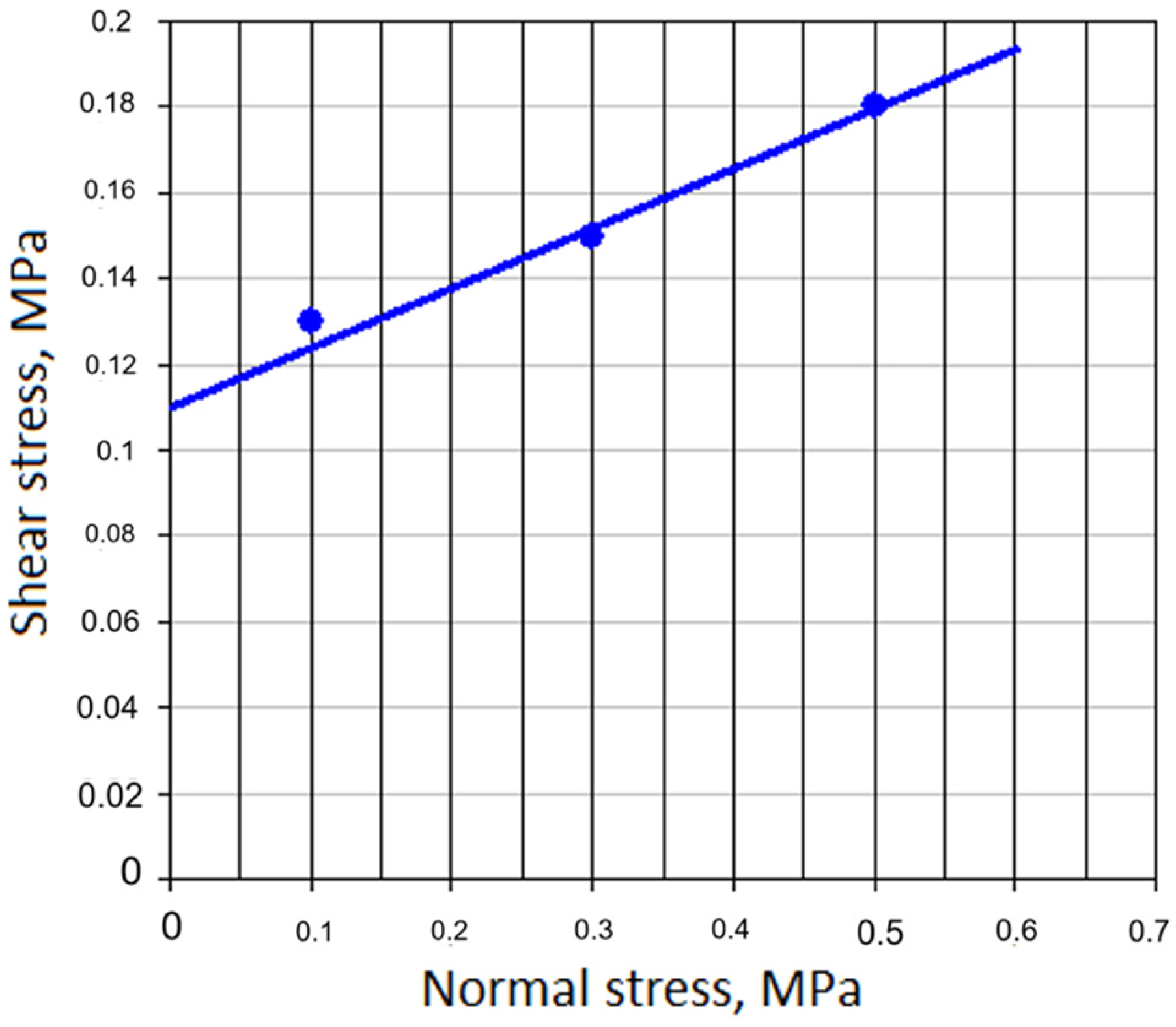
Based on Table 8, the dependence τ = f(σ) was obtained and is shown in Figure 17.
According to expression (10) and the data from Table 12, the tangent of the internal friction angle was determined as tgφ = 0.125 and cohesion C = 0.11 MPa, from which φ = 7.13°. Thus, the required strength parameters of the tested specimen—internal friction angle and cohesion—were established.
The obtained strength parameters (φ = 7.13° and C = 0.11 MPa) were derived from the ultimate shear strengths at normal stresses σ = 0.1, 0.3, and 0.5 MPa using the least squares method. The τ(σ) plot in Figure 18 exhibits a linear relationship, confirming the applicability of the Mohr–Coulomb model for this soil. The obtained values (φ and C) serve as input parameters for verifying the Drucker–Prager elastoplastic model in ANSYS, enabling more accurate modeling of the soil foundation behavior under shear loads and substantiating their use in engineering calculations for the “bridge support–soil foundation” system.
The consistency of the experimental results with regulatory standards confirms their suitability for numerical modeling and optimization of the mobile overpass design.

3.4. Results of Soil Compression Modeling in ANSYS (Results from Section 2.3.3)

The modeling results, which include vertical deformations (displacements) uy and relative deformations εy along the loading boundary, were compared with the experimental data to assess the accuracy of the numerical model and its applicability for engineering analysis of the “bridge support–soil foundation” system.
According to numerical simulation results, similar to the experimental studies (Section 3.2), the vertical displacements uy and the relative deformations εy were obtained along the BC boundary (Figure 7). Along this line, the uy deformations reach their maximum absolute values. In contrast, along the other sections parallel to BC, the uy values decrease in magnitude.
The BC boundary was selected for validation, as deformation measurements along this line correspond directly to the experimental observations. The vertical relative deformation εy remains nearly constant throughout the specimen height, confirming a uniform stress distribution along the compression axis.
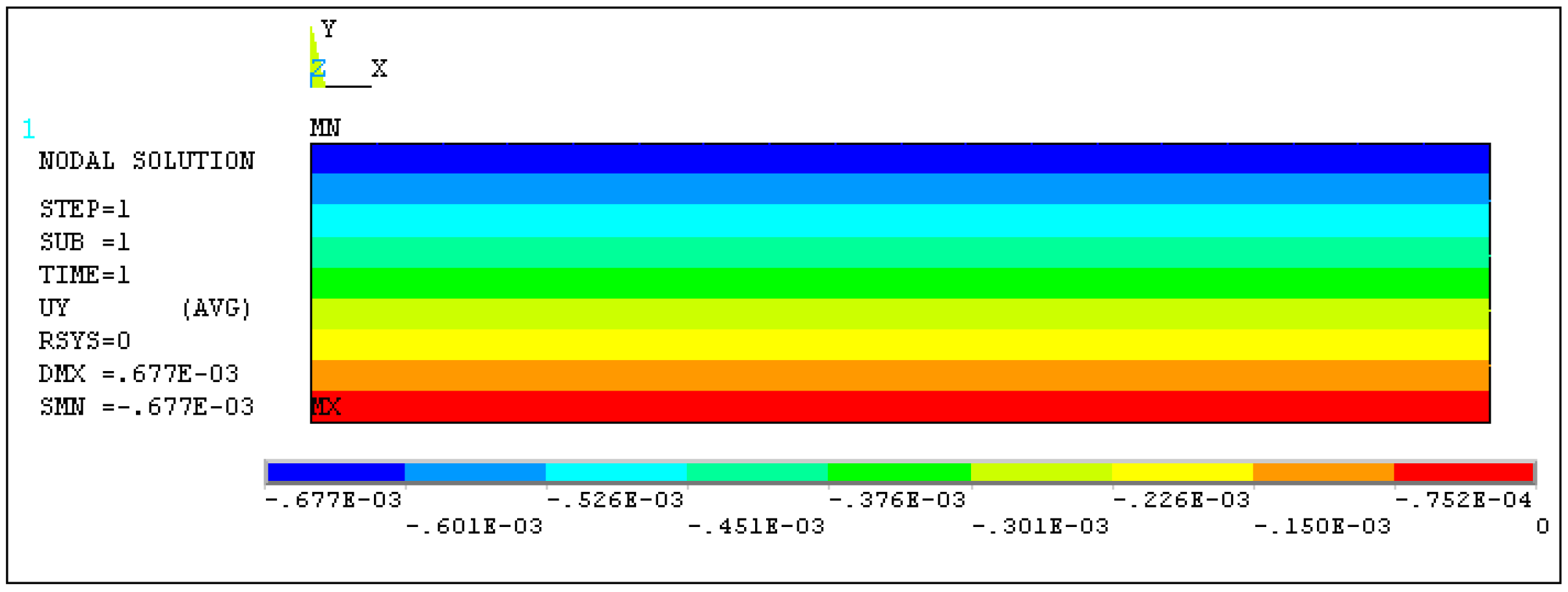
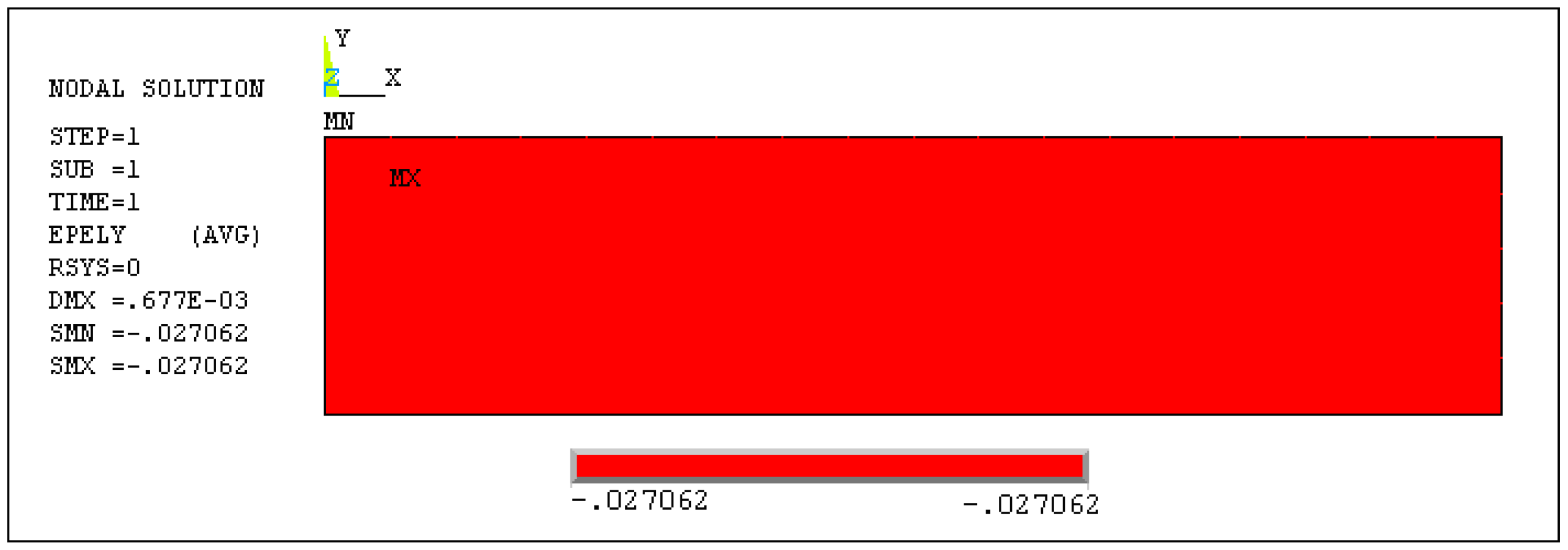
Figure 19 and Figure 20 illustrate, respectively, the distribution of vertical displacements (in meters) and relative deformations at the final loading stage, corresponding to a load of q = 43.715 N/m. These results confirm the reliability of the Drucker–Prager soil model used in ANSYS for reproducing the experimental compression behavior of the clay soil.

3.5. Analysis of the Consistency Between Numerical Modeling in ANSYS and Experimental Test Results

A comparative analysis was carried out to evaluate the vertical deformations (uy) and relative deformations (εy) obtained in the numerical simulation against the corresponding experimental results from compression tests. The comparison covered a load range of 0.05 to 0.5 MPa, allowing assessment of the numerical model’s accuracy and validation of its applicability to the developed methodology for optimal bridge support placement using parametric optimization in ANSYS WorkBench (Section 2.2 and Section 3.1).
The analysis of deviations across loading stages provides quantitative evidence of model accuracy and convergence between numerical and experimental results.
The comparative results with the experimental soil compression data (Section 3.2) are presented in Table 9 [68,69], while the graphical comparison is shown in Figure 20.
Analysis of Table 13 shows that at the initial loading stage, the deviation between experimental and numerical values reaches approximately 70%. As the load increases, this deviation decreases significantly, and at the final stages, it is just over 4%. At a load of 0.48 MPa, the experimental and numerical curves coincide, indicating complete agreement of the results (Figure 21).
The significant deviation at the early stages is explained by the fact that the elastoplastic Drucker–Prager model behaves as an ideal elastic material under low loads. In contrast, the actual soil does not exhibit perfect elasticity. This is further confirmed by the deformation distribution patterns observed at the initial loading stages (Figure 21).
As the load increases, plastic potentials begin to act within the elastoplastic model, reflecting the nonlinear deformation behavior and leading to a closer convergence between calculated and experimental values. Such behavior is typical for any nonlinear soil deformability model based on an elastoplastic approach [70].
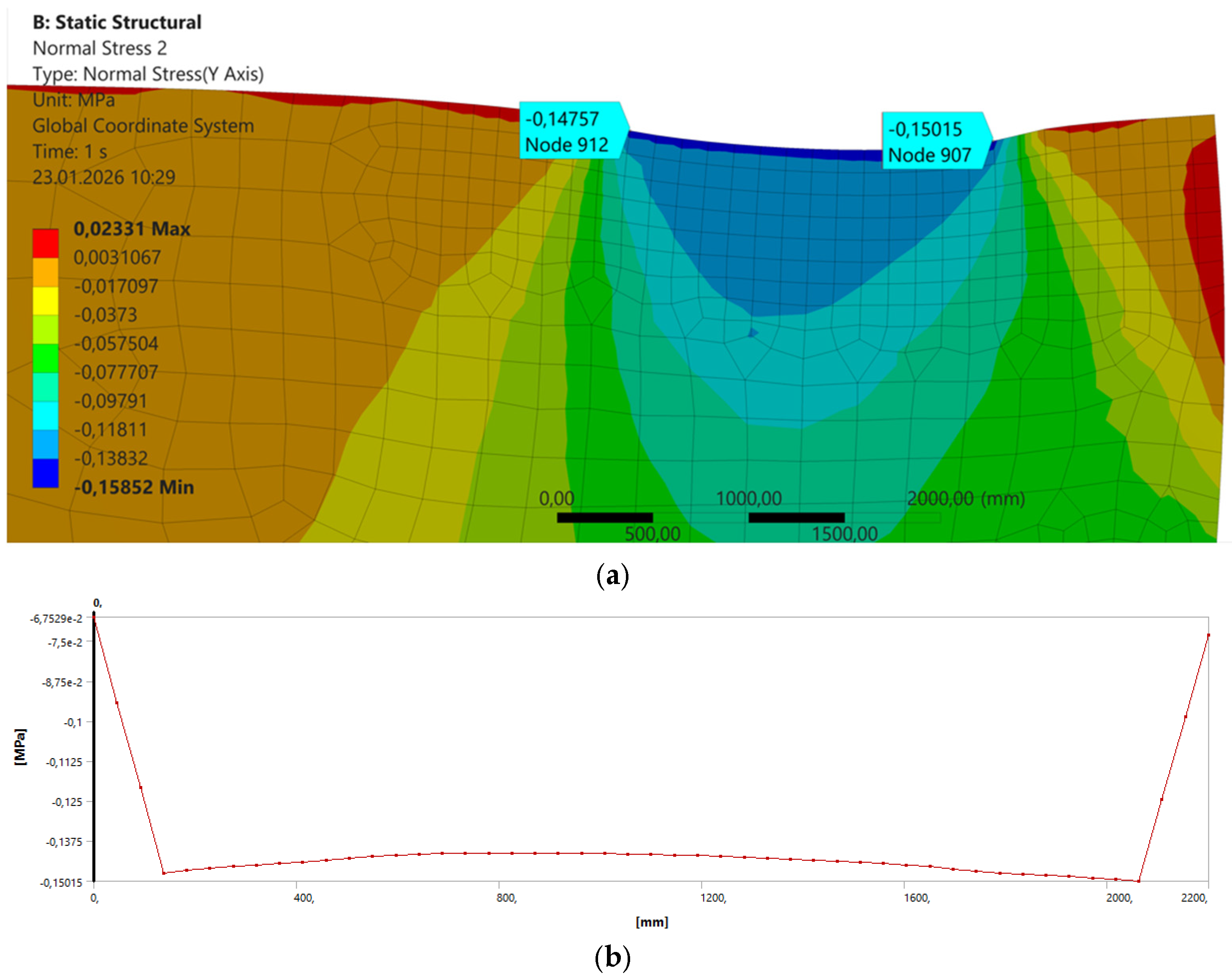
The maximum absolute values of vertical stresses in the critical soil zone beneath the support are σy = 0.15 MPa (node 907, Figure 22). The average contact pressure is σavr = 0.138 MPa. The obtained stress level beneath the support does not fall within the low-stress region (≈0.05 MPa), where the maximum model error is observed, and corresponds to the range in which the discrepancy between experimental and numerical results does not exceed approximately 46% to 4% (Table 13, Figure 22).
In addition, the finite element analysis results indicate that the maximum compressive stresses are localized directly beneath the support and are also outside the low-stress zone. That is, the operational stress level beneath the support does not correspond to the lowest loading stages. Local (peak) stresses beneath the edges of the support may exceed the average value (as evidenced by the stress contour plots beneath the support); therefore, the actual soil behavior partially occurs in the region of higher stresses. Consequently, the optimization results were obtained within the range of acceptable accuracy of numerical modeling.
The actual behavior of the structure under maximum external loading, as well as the stresses induced in the soil, generally correspond to the high-stress zone, in which the calculation error is considered acceptable (on the order of 46% to 4%). If this condition is not satisfied, it is necessary to introduce a safety correction factor k (≥1) into the optimization results to ensure additional reliability of the calculation. In this case, the minimum optimal support location is determined by the expression: L m i n   =   k · L m i n .

4. Discussion

In engineering practice, discrepancies between experimental and analytical results derived from classical linear-elastic soil mechanics can exceed 100%. To improve accuracy, advanced analysis methods and correction coefficients are introduced, resulting in better agreement with experimental data and sufficient precision for evaluating soil deformability. Deviations of 50–70% between analytical and experimental results are considered acceptable in soil mechanics, especially when safety coefficients for stability and strength are factored in [71].
In the present study, the average deviation between experimental data and ANSYS numerical modeling results was 37.55% (Table 9), which is significantly lower than that obtained with classical linear-theory methods. This level of accuracy is within the safety margins defined by Eurocode and other standards [72,73,74]. Hence, the nonlinear Drucker–Prager elastoplastic model shows good agreement with experimental results, consistent with other studies investigating similar models.
The developed calculation methodology is universal and intended for application not only to clay soils, but also to other soil types and a wide range of ground conditions. For each specific site of operation, the physical and mechanical properties of the soil are determined through core sampling followed by laboratory testing and subsequent calibration of the parameters. The experimentally obtained parameters (C, φ, E, ν, ψ) are then used as input data for numerical optimization for the given soil.
Thus, the optimal placement of supports is determined individually for each site, which ensures the correctness and reliability of the mobile overpass application under various geotechnical conditions.
Discrepancies between the experimental and numerical compression curves, especially in the low-stress range, are caused by several factors. First, the Drucker–Prager model has limitations in reproducing the nonlinear stiffness and structural sensitivity of clayey soils at small stress levels. Second, the boundary conditions and loading paths in laboratory tests differ from those adopted in the numerical model, which affects the initial portion of the deformation curve. Third, uncertainties in experimentally determined parameters are associated with sample heterogeneity, moisture variability, and parameter identification procedures.
Previous studies [75,76] report similar levels of agreement for elastoplastic soil models, with deviations up to 70% at low stress levels and improved accuracy at higher loads, emphasizing the importance of experimental calibration.
More advanced constitutive models, such as Hardening Soil and Hardening Soil Small [77,78], may further improve accuracy, particularly at low strain levels, but at the cost of increased model complexity and computational effort.
Recent studies employing advanced optimization and data-driven approaches [79,80,81] demonstrate improved accuracy; however, their implementation requires extensive experimental datasets and increased computational resources.
Despite its limitations at low stress levels, the Drucker–Prager model provides a reasonable balance between accuracy and computational efficiency for engineering applications involving soil–structure interaction.
Future work may refine the model through broader experimental validation and advanced calibration techniques.
In conclusion, the experimental verification of the Drucker–Prager elastoplastic model for the “bridge support–soil foundation” system confirms its scientific validity and engineering applicability. The model enables optimization of bridge support placement by considering key physical and mechanical soil properties, including deformability, strength, and stability. The achieved agreement with experimental data provides a reliable foundation for implementing this computational methodology in mobile bridge design.
The results obtained in this study are consistent with the findings of previous works in which the parameters of Drucker–Prager-type models are identified through numerical reproduction of laboratory tests followed by validation against experimental stress–strain curves [82,83]. Similar to [84], the parameter identification in the present work is effectively formulated as an optimization problem. Moreover, the sensitivity of approximation accuracy to the calibration procedure and parameter set, as reported in inverse analyses [85], confirms the necessity of explicit control over the sources of input parameters and their experimental justification.
The use of parametric optimization and response surface techniques is in line with modern approaches to inverse analysis and multi-criteria optimization of geotechnical systems [86]. While the consideration of parameter uncertainty and solution robustness, as discussed within Bayesian and surrogate-based frameworks [87,88,89,90], is only partially addressed in the present study, this limitation is mitigated by the fact that the operational stress levels lie outside the range of maximum model error, and the optimal solution exhibits low sensitivity to parameter variations. The application of screening and surrogate-based approaches is consistent with current trends aimed at reducing computational costs in finite element optimization [88].
The results also correlate with conclusions emphasizing the usefulness of monitoring data and parameter updating techniques to improve the reliability of predictive assessments [89], which is regarded as a promising direction for further development of the proposed methodologyx. Additional opportunities for extension are supported by studies on parameter inversion based on numerical data and machine learning methods [91], which may be employed for automated adaptation of the soil model during the operation of a mobile overpass under varying site conditions.

5. Conclusions

A scientifically grounded methodology has been developed to optimize mobile bridge support placement, preventing trench wall collapse and ensuring safe bridge operation, using parametric optimization in ANSYS Workbench. The study accounts for the nonlinear behavior of the soil foundation using the Drucker–Prager elastoplastic model, which provided a more accurate representation of the stress–strain state (SSS) of the soil, including its physical and mechanical parameters—deformation modulus, Poisson’s ratio, internal friction angle, cohesion, and dilatancy angle. The optimization procedure aimed at minimizing horizontal displacements of trench walls, which constitute the primary failure criterion.
Numerical modeling of the interaction between the supports and the soil foundation was performed, accounting for both vertical and horizontal loads from the bridge structure and moving vehicles. It was established that supports located too close to trench walls significantly increase deformations, while excessive spacing enlarges the span and raises structural costs. The optimization determined an optimal minimum distance (Lmin = 2.78 m), which is 13.5% greater than the original design value (Lnp = 2.45 m). This adjustment reduced horizontal wall displacements by more than half, significantly decreasing the risk of wall failure and improving overall operational safety.
Correlation analysis revealed a pronounced quadratic relationship between the maximum trench wall displacements and the support distance, with a determination coefficient (R2) of 99.3%. The screening optimization method in ANSYS DesignXplorer enabled selecting the optimal support configuration from numerous alternatives. These results provide a scientific and engineering basis for designing mobile bridge systems, offering an effective and reliable framework for optimizing their construction and ensuring safe operation. The proposed methodology can be adapted to different soil conditions, ensuring both structural reliability and versatility.
Experimental studies were conducted to verify the Drucker–Prager model and justify its use in the ANSYS WorkBench calculation methodology for optimal support placement. The tests included compression tests (KPr-1M apparatus) and direct shear tests (PSG-2M apparatus), as specified in GOST 12248-2010. The results obtained defined the deformation parameters (deformation modulus and Poisson’s ratio) and the strength parameters (cohesion and internal friction angle) of the clay soil.
A comparative analysis of the experimental and simulated data showed an average deviation of 37.55%, with a maximum of 70% at low loads and a minimum of 4% at higher loads. This confirms the high accuracy and applicability of the Drucker–Prager model for engineering calculations, surpassing classical linear models, which can yield discrepancies of up to 100%.
The obtained results have several limitations that should be considered when interpreting the conclusions. Experimental calibration and numerical verification were performed for clayey soils, which limits the direct transferability of the obtained parameters to other engineering–geological conditions. In addition, the Drucker–Prager model employed is characterized by increased uncertainty at low stress levels, while the numerical analyses are based on assumptions of material homogeneity, idealized boundary conditions, and a plane strain state, which may differ from real field conditions.
Therefore, prior to practical application of the methodology, it is necessary to conduct site-specific engineering–geological investigations, laboratory testing, and calibration of soil parameters for the particular location, followed by project-oriented optimization. Future research perspectives include extending the methodology to various soil types, applying more advanced constitutive models that account for small-strain behavior, and implementing sensitivity analysis and uncertainty quantification methods for determining the optimal distance Lmin.

Author Contributions

Conceptualization, A.G. and A.K. (Adil Kadyrov); Methodology, A.G. and A.K. (Aliya Kukesheva); Software, K.S.; Validation, A.Z. and A.K. (Aliya Kukesheva); Formal analysis, A.K. (Adil Kadyrov), S.A. and A.Z.; Investigation, S.A., K.S., A.G. and A.K. (Akbope Karsakova); Data curation, A.K. (Aliya Kukesheva); Writing—original draft preparation, A.Z.; Writing—review and editing, A.G., A.K. (Adil Kadyrov), A.K. (Aliya Kukesheva), A.Z., K.S., S.A. and A.K. (Akbope Karsakova); Visualization, A.K. (Aliya Kukesheva); Supervision, A.G.; Project administration, A.Z. All authors have read and agreed to the published version of the manuscript.

Funding

This research has been/was/is funded by the Science Committee of the Ministry of Science and Higher Education of the Republic of Kazakhstan (Grant No. AP23487832).

Data Availability Statement

The original contributions presented in this study are included in the article. For further inquiries, please contact the corresponding authors.

Conflicts of Interest

The authors declare no conflicts of interest.

References

  1. Saberi, M.; Hamedmoghadam, H.; Ashfaq, M.; Hosseini, S.A.; Gu, Z.; Shafiei, S.; González, M.C. A simple contagion process describes the spreading of traffic jams in urban networks. Nat. Commun. 2020, 11, 1616. [Google Scholar] [CrossRef]
  2. Harris, N.; Shealy, T.; Klotz, L. Choice architecture as a way to encourage a whole systems design perspective for more sustainable infrastructure. Sustainability 2017, 9, 54. [Google Scholar] [CrossRef]
  3. Falcocchio, J.C.; Levinson, H.S. The costs and other consequences of traffic congestion. In Springer Tracts on Transportation and Traffic; Springer: Cham, Switzerland, 2015; Volume 7, pp. 159–182. [Google Scholar] [CrossRef]
  4. Serok, N.; Havlin, S.; Blumenfeld-Lieberthal, E. Identification, cost evaluation, and prioritization of urban traffic congestions and their origin. Sci. Rep. 2022, 12, 13026. [Google Scholar] [CrossRef] [PubMed]
  5. European Commission. Reports on Urban Mobility and Congestion 2019–2023. Available online: https://transport.ec.europa.eu/transport-themes_en (accessed on 7 April 2025).
  6. Texas A&M Transportation Institute. Urban Mobility Report; Texas A&M Transportation Institute: Austin, TX, USA, 2019; Available online: https://mobility.tamu.edu/umr/ (accessed on 9 April 2025).
  7. Japan Institute for Labour Policy and Training. Reports on Urban Congestion and Economic Impacts 2010–2015. Available online: https://www.mlit.go.jp (accessed on 9 April 2025).
  8. Victoria, A.N.; Dela Cruz, O.G.; Muhi, M.M.; Bianes, J.R.A. A review on the analysis of evaluating traffic congestion. Lect. Notes Civ. Eng. 2024, 466, 1049–1058. [Google Scholar] [CrossRef]
  9. Bellam, K.; Nagappan, K.; Sankaran, N.; Chowdhury, S.; Perakovic, D. Urban Mobility and Challenges of Intelligent Transportation Systems; IGI Global: Hershey, PA, USA, 2025; pp. 1–694. [Google Scholar] [CrossRef]
  10. Hojjati, A.; Jefferson, I.; Metje, N.; Rogers, C.D. Sustainability assessment for urban underground utility infrastructure projects. Proc. Inst. Civ. Eng.—Eng. Sustain. 2017, 171, 68–80. [Google Scholar] [CrossRef]
  11. Agilbayeva, M.; Kalinin, A. The development of the district heat supply system of the city of Karaganda. E3S Web Conf. 2019, 135, 01031. [Google Scholar] [CrossRef]
  12. Silvestri, F.; Polimeni, A.; Belcore, O.M. Impact mitigation of tunnels maintenance works on highway performance. Procedia Struct. Integr. 2024, 62, 998–1005. [Google Scholar] [CrossRef]
  13. Verma, A.; Anbazhagan, P.; Mayakuntla, S.K.; Bhat, F.A. Assessing the impact of underground utility works on road traffic and users: A study from an Indian city. In International Conference on Transportation Infrastructure Projects: Conception to Execution; Springer Nature: Singapore, 2022; pp. 243–259. [Google Scholar] [CrossRef]
  14. Kadyrov, A.S.; Ganyukov, A.A.; Amanbayev, S.S.; Bogdanova, A.A. Development of mobile communal overpasses applied during repairing of urban communal networks. Mater. Mech. Eng. Technol. 2023, 3, 11–14. [Google Scholar] [CrossRef]
  15. Ganyukov, A.A.; Sinelnikov, K.A.; Kabikenov, S.Z.; Karsakova, A.Z. Research and calculation of the deformed state of the roadway mobile overpass. Mater. Mech. Eng. Technol. 2024, 3, 88–95. [Google Scholar] [CrossRef]
  16. ERE Systems Inc. Corporate Profile and Technical Capabilities; ERE Systems Inc.: Tokyo, Japan, 2021; Available online: https://erelogistics.com/wp-content/uploads/2021/11/ERE-Systems-Brochure-Final-2.pdf (accessed on 2 April 2025).
  17. Prokop, J.; Odrobiňák, J.; Farbák, M.; Novotný, V. Load-carrying capacity of Bailey bridge in civil applications. Appl. Sci. 2022, 12, 3788. [Google Scholar] [CrossRef]
  18. Russell, B.R.; Thrall, A.P. Portable and rapidly deployable bridges: Historical perspective and recent technology developments. J. Bridge Eng. 2013, 18, 1074–1085. [Google Scholar] [CrossRef]
  19. ERE Logistics. Flat Rack Portable Bridges; ERE Logistics: Okotoks, AB, Canada, 2025; Available online: https://erelogistics.com/ (accessed on 2 April 2025).
  20. Lederman, G.; You, Z.; Glišić, B. A novel deployable tied arch bridge. Eng. Struct. 2014, 70, 1–10. [Google Scholar] [CrossRef]
  21. Federal Highway Administration. ASTRA Bridge; Federal Highway Administration: Washington, DC, USA, 2025; Available online: https://www.astra.admin.ch/astra/de/home/themen/nationalstrassen/baustellen/wissenswertes/astra-bridge.html (accessed on 5 March 2025).
  22. Kang, W.H.; Hicks, S.J.; Uy, B.; Fussell, A. Design resistance evaluation for steel and steel–concrete composite members. J. Constr. Steel Res. 2018, 147, 523–548. [Google Scholar] [CrossRef]
  23. Puklický, L. Time-dependent reliability analysis of stainless steel members and bridges. AIP Conf. Proc. 2023, 2928, 020013. [Google Scholar] [CrossRef]
  24. Tatarchenko, G.O.; Chernih, O.A.; Sokolenko, V.M.; Tatarchenko, Z.S. Modern information technologies in system architecture—Urban planning—Building constructions. In International Conference Building Innovations; Springer International Publishing: Cham, Switzerland, 2019; pp. 483–490. [Google Scholar] [CrossRef]
  25. Baláž, I.J.; Koleková, Y.P. New generation of Eurocodes. In Production Management and Engineering Sciences: Proceedings of the International Conference on Engineering Science and Production Management (ESPM 2015); CRC Press: Boca Raton, FL, USA, 2016; pp. 345–350. [Google Scholar] [CrossRef]
  26. Farouk, H.; Farouk, M. Effect of soil model on contact stress under strip footing. In New Frontiers in Geotechnical Engineering; ASCE: Reston, VA, USA, 2014; pp. 67–77. [Google Scholar] [CrossRef]
  27. Ahmari, A.M.; Abdollahipour, A.; Kargar, A. Wellbore stability analysis using ground reaction curve and Mohr–Coulomb failure criterion. J. Anal. Numer. Methods Min. Eng. 2025, 15, 69–76. [Google Scholar] [CrossRef]
  28. Fu, Y.; He, S.; Zhang, S.; Yang, Y. Parameter analysis on hardening soil model of soft soil for foundation pits based on shear rates in Shenzhen Bay, China. Adv. Mater. Sci. Eng. 2020, 2020, 7810918. [Google Scholar] [CrossRef]
  29. Alsirawan, R.; Koch, E. Finite element modeling of rigid inclusion-supported embankment. Pollack Period. 2022, 17, 197–208. [Google Scholar] [CrossRef]
  30. Zhang, T.; Zhou, X.P.; Qian, Q.H. Drucker–Prager plasticity model in the framework of OSB–PD theory with shear deformation. Eng. Comput. 2023, 39, 1395–1414. [Google Scholar] [CrossRef]
  31. Liu, K.; Chen, S.L. Finite element implementation of strain-hardening Drucker–Prager plasticity model with application to tunnel excavation. Undergr. Space 2017, 2, 168–174. [Google Scholar] [CrossRef]
  32. Weaver-Rosen, J.M.; Malak, R.J. An algorithm for multi-objective efficient parametric optimization. J. Mech. Des. 2023, 145, 031709. [Google Scholar] [CrossRef]
  33. Galvan, E.; Malak, R.J.; Hartl, D.J.; Baur, J.W. Performance assessment of a multi-objective parametric optimization algorithm with application to a multi-physical engineering system. Struct. Multidiscip. Optim. 2018, 58, 489–509. [Google Scholar] [CrossRef]
  34. Chouw, N. Dynamics of bridge structures. In Innovative Bridge Design Handbook; Butterworth-Heinemann: Oxford, UK, 2022; pp. 141–168. [Google Scholar] [CrossRef]
  35. Nowak, A.; Pipinato, A.; Stawska, S. Loads on bridges. In Innovative Bridge Design Handbook; Butterworth-Heinemann: Oxford, UK, 2022; pp. 21–45. [Google Scholar] [CrossRef]
  36. Khitrov, E.G.; Andronov, A.V.; Martynov, B.G.; Spiridonov, S.V. Interrelations of various soil types mechanical properties. J. Phys. Conf. Ser. 2019, 1177, 012032. [Google Scholar] [CrossRef]
  37. Cheng, K.; Xu, R.-Q.; Lin, C.-G.; Liang, R.-Z.; Shan, H.-F.; Gan, X.-L. Simplified method for predicting surrounding soil’s horizontal displacement caused by arbitrary deflection of retaining wall. J. Zhejiang Univ. (Eng. Sci.) 2020, 54, 1012–1020. [Google Scholar] [CrossRef]
  38. Wang, J.H.; Xu, Z.H.; Wang, W.D. Wall and ground movements due to deep excavations in Shanghai soft soils. J. Geotech. Geoenvironmental Eng. 2010, 136, 985–994. [Google Scholar] [CrossRef]
  39. Lee, J.; Jin, H.; An, J.; Baek, Y.; Yoon, H. A study on the suitability of the Mohr–Coulomb model for numerical analysis of ground excavation. J. Eng. Geol. 2020, 30, 1–15. [Google Scholar] [CrossRef]
  40. Liu, L.-Y.; Zhao, T.-B.; Wang, Q.-Y. Drucker–Prager models and its application in ANSYS and FLAC3D. J. Northeast. Univ. 2015, 36, 71–75. Available online: https://clk.li/iUAU (accessed on 12 July 2025).
  41. Xu, X.; Dai, Z.H.; Chen, L.J.; Xu, X.T. Nonlinear elastic–perfectly plastic model of soil and its numerical implementation and application. Soil. Mech. Found. Eng. 2022, 59, 215–223. [Google Scholar] [CrossRef]
  42. Liu, J.; Li, R.; Sun, P.; Wang, Z.; Luo, J.; Li, Z. Duncan–Chang nonlinear constitutive model based on joint strength theory of structural loess. Chin. J. Geotech. Eng. 2018, 40, 124–128. [Google Scholar] [CrossRef]
  43. Weaver-Rosen, J.M.; Malak, R.J. Efficient parametric optimization for expensive single-objective problems. J. Mech. Des. 2021, 143, 031401. [Google Scholar] [CrossRef]
  44. Tsai, Y.-K.; Malak, R.J. Surrogate-Assisted Constraint-Handling Technique for Parametric Multi-Objective Optimization. Struct. Multidiscip. Optim. 2024, 67, 38. [Google Scholar] [CrossRef]
  45. Quliyev, S. Automated and automatic systems of management of a programs package for making optimal decisions. In International Conference on Information Technologies and Their Applications; Springer Nature: Cham, Switzerland, 2024; pp. 287–299. [Google Scholar] [CrossRef]
  46. Belorit, M.; Hrček, S.; Bisták, M. Description of the methodology of the automated optimization process. In Current Methods of Construction Design: Proceedings of the ICMD 2018; Springer International Publishing: Cham, Switzerland, 2019; pp. 13–20. [Google Scholar] [CrossRef]
  47. Fedorik, F.; Kala, J.; Haapala, A.; Malaska, M. Use of design optimization techniques in solving typical structural engineering related design optimization problems. Struct. Eng. Mech. 2015, 55, 1121–1137. [Google Scholar] [CrossRef]
  48. Corriou, J.P. Numerical methods of optimization. In Numerical Methods and Optimization: Theory and Practice for Engineers; Springer International Publishing: Cham, Switzerland, 2021; pp. 505–574. [Google Scholar] [CrossRef]
  49. Fajfar, I.; Puhan, J.; Bűrmen, Á. Evolving a Nelder–Mead algorithm for optimization with genetic programming. Evol. Comput. 2017, 25, 351–373. [Google Scholar] [CrossRef]
  50. Ravichandran, K.; Masoudi, N.; Fadel, G.M.; Wiecek, M.M. Parametric optimization for structural design problems. In International Design Engineering Technical Conferences and Computers and Information in Engineering Conference; ASME: New York, NY, USA, 2019; Paper No. V02BT03A022. [Google Scholar] [CrossRef]
  51. Khiste, S.G.; Kulkarni, P.; Katekar, S.D. Probabilistic design of composite leaf spring by using finite element method. IOP Conf. Ser. Mater. Sci. Eng. 2020, 814, 012019. [Google Scholar] [CrossRef]
  52. Li, G. A four-node plane parametric element based on quadrilateral area coordinate and its application to coupled solid–deformation/fluid–flow simulation for porous geomaterials. Int. J. Numer. Anal. Methods Geomech. 2015, 39, 251–276. [Google Scholar] [CrossRef]
  53. LLC Pribor. Compression Device KPr-1M; LLC Pribor: Moscow, Russia, 2017; Available online: https://clk.li/qhCa (accessed on 10 July 2025).
  54. LLC Pribor. Soil Shear Tester PSG-3M; LLC Pribor: Moscow, Russia, 2017; Available online: https://clk.li/Escl (accessed on 10 July 2025).
  55. GOST 12248-2010; Soils. Laboratory Methods for Determining the Strength and Strain Characteristics. Federal Agency for Technical Regulation and Metrology: Moscow, Russia, 2011. Available online: https://clk.li/CTNc (accessed on 12 July 2025).
  56. GOST 20522-2012; Soils. Methods of Statistical Treatment of Test Results. Federal Agency for Technical Regulation and Metrology: Moscow, Russia, 2013. Available online: https://clk.li/DiDD (accessed on 12 July 2025).
  57. Huang, Y.Q.; Yang, Y.F.; Wang, J.Z.; Liu, X.C.; Chen, H.B. Unsymmetric extensions of Wilson’s incompatible four-node quadrilateral and eight-node hexahedral elements. Int. J. Numer. Methods Eng. 2022, 123, 101–127. [Google Scholar] [CrossRef]
  58. Akhmatnurov, D.; Zamaliyev, N.; Mussin, R.; Demin, V.; Tolovkhan, B.; Ganyukov, N.; Skrzypkowski, K.; Korzeniowski, W.; Stasica, J.; Rak, Z. Geomechanical Modeling of the Northern Katpar Deposit (Kazakhstan): Assessing the Impact of Rock Mass Disturbance on Stability Safety Factor. Mining 2025, 5, 73. [Google Scholar] [CrossRef]
  59. Nichayarach, I.; Warisnoicharoen, W. A comparison of model fitting using different runs in Box–Behnken design for alginate film formulation. Thai J. Pharm. Sci. 2020, 44, 174–178. [Google Scholar] [CrossRef]
  60. Lu, L.; Anderson-Cook, C.M.; Ahmed, T. Non-uniform space filling (NUSF) designs. J. Qual. Technol. 2021, 53, 309–330. [Google Scholar] [CrossRef]
  61. Mee, R.; Eberhard, A. Response surface split-plot designs: A literature review. Qual. Reliab. Eng. Int. 2019, 35, 1645–1662. [Google Scholar] [CrossRef]
  62. Kleijnen, J.P. Regression and Kriging metamodels with their experimental designs in simulation: A review. Eur. J. Oper. Res. 2017, 256, 1–16. [Google Scholar] [CrossRef]
  63. Lucay, F.A.; Sales-Cruz, M.; Gálvez, E.D.; Cisternas, L.A. Modeling of the complex behavior through an improved response surface methodology. Miner. Process. Extr. Metall. Rev. 2021, 42, 285–311. [Google Scholar] [CrossRef]
  64. Ghattas, B.; Manzon, D. Machine learning alternatives to response surface models. Mathematics 2023, 11, 3406. [Google Scholar] [CrossRef]
  65. Cheng, C.L.; Garg, G. Coefficient of determination for multiple measurement error models. J. Multivar. Anal. 2015, 126, 137–152. [Google Scholar] [CrossRef]
  66. Żądło, T. On asymmetry of prediction errors in small area estimation. Stat. Transit.—New Ser. 2017, 18, 413–432. [Google Scholar] [CrossRef]
  67. Hodson, T.O. Root mean square error (RMSE) or mean absolute error (MAE): When to use them or not. Geosci. Model. Dev. 2022, 15, 5481–5487. [Google Scholar] [CrossRef]
  68. Ganyukov, A. Research of operation of mobile overpass constructions. Proc. Univ. 2022, 1, 195–200. [Google Scholar] [CrossRef]
  69. Wen, Y.; Yang, G.; Tang, L.; Zhong, Z.; Yao, J. Verification of non-coaxial constitutive model based on generalized potential theory. J. Cent. South Univ. (Sci. Technol.) 2017, 48, 1817–1823. [Google Scholar] [CrossRef]
  70. Lei, Y.; Liu, H.; Lu, Z. Comparisons of two approaches for geotechnical model calibration with scarce data. Adv. Civ. Eng. 2021, 2021, 4245051. [Google Scholar] [CrossRef]
  71. Tseshkovskaya, Y.; Tsoy, N.; Tseshkovskiy, V.; Ibrayev, M.; Zamaliyev, N.; Akhmatnurov, D.; Mussin, R.; Ganyukov, N.; Zakharov, A.; Skrzypkowski, K.; et al. Research Progress of Environmental Studies of a Mining Facility for Land Restoration (Using the Example of a Mining Enterprise in the Karaganda Region). Resources 2025, 14, 144. [Google Scholar] [CrossRef]
  72. Song, E.X.; Kong, Y.F.; Yang, J. Discussion of safety factor definitions and computation methods for geotechnical structures. Eng. Mech. 2016, 33, 1–10. [Google Scholar]
  73. Low, B.K. Reliability-Based Design in Soil and Rock Engineering: Enhancing Partial Factor Design Approaches; CRC Press: Boca Raton, FL, USA, 2021; pp. 1–399. [Google Scholar] [CrossRef]
  74. Muizemněk, A.Y.; Boldyrev, G.G.; Aref’ev, D.V. Identification of soil model parameters. Eng. Geol. 2010, 5, 36–41. Available online: https://clk.li/Mfgt (accessed on 12 July 2025).
  75. Boldyrev, G.G.; Idrisov, I.K.; Valeev, D.N. Determination of parameters for soil models. Soil. Mech. Found. Eng. 2006, 43, 101–108. [Google Scholar] [CrossRef]
  76. Boldyrev, G.G.; Muyzemnels, A.J. The modeling of deformation process in soils with use of ANSYS and LS-DYNA programs. In Proceedings of the International Conference on Case Histories in Geotechnical Engineering; Missouri University of Science and Technology: Rolla, MO, USA, 2008; Paper No. 37; Available online: https://scholarsmine.mst.edu/cgi/viewcontent.cgi?article=3326&context=icchge (accessed on 12 July 2025).
  77. Chen, Y.; Luo, M.M.; Xia, N.W.; He, P. Statistical analysis of existing test results of HSS model parameters for soft soils. Chin. J. Geotech. Eng. 2021, 43, 197–201. [Google Scholar] [CrossRef]
  78. Wu, J.T.; Tung, C.Y.; Adams, M.T.; Nicks, J.E. Analysis of stress–deformation behavior of soil–geosynthetic composites in plane strain condition. Transp. Infrastruct. Geotechnol. 2018, 5, 210–230. [Google Scholar] [CrossRef]
  79. Zhao, X.; Schorr, J.; Peña Olarte, A.A.; Cudmani, R. A step towards quantifying the uncertainty of the soil mechanical response through the use of genetic algorithms. In Proceedings of the International Conference of the International Association for Computer Methods and Advances in Geomechanics; Springer: Cham, Switzerland, 2022; pp. 263–271. [Google Scholar] [CrossRef]
  80. Thapa, I.; Ghani, S. Applying optimized machine learning models for predicting unconfined compressive strength in fine-grained soil. Transp. Infrastruct. Geotechnol. 2024, 11, 2235–2269. [Google Scholar] [CrossRef]
  81. Zhu, J.; Xu, R. Secondary development of modified Duncan–Chang model considering disturbance. Chin. J. Geotech. Eng. 2015, 37, 84–88. [Google Scholar] [CrossRef]
  82. Hasanpouri Notash, N.; Dabiri, R.; Hajialilue Bonab, M.; Khodadadi, L.; Behrouz Sarand, F. A Finite Element Modeling of Drained Triaxial Test on Loose Sand Using Different Constitutive Models. AUT J. Civ. Eng. 2022, 6, 339–358. [Google Scholar] [CrossRef]
  83. Okimura, Y.; Imamura, R.; Shimo, K.; Hanai, T.; Kato, Y.; Hashimoto, K.; Faiz, M.K.; Okane, T.; Miyashita, T.; Yoshida, M. Experimental Construction and Validation of Revised Drucker–Prager Model Using Finite Element Method for Moisture Condensation Zone in Bentonite-Bonded Silica Sand. J. Mater. Eng. Perform. 2024, 33, 9145–9162. [Google Scholar] [CrossRef]
  84. Davarpanah, S.; Allili, M.; Mousavi Ajarostaghi, S.S. Numerical Optimization of Drucker–Prager–Cap Model Parameters in Powder Compaction Employing Particle Swarm Algorithms. Fluids 2024, 9, 262. [Google Scholar] [CrossRef]
  85. Buljak, V.; Baivier-Romero, S.; Kallel, A. Calibration of Drucker–Prager Cap Constitutive Model for Ceramic Powder Compaction through Inverse Analysis. Materials 2021, 14, 4044. [Google Scholar] [CrossRef] [PubMed]
  86. Zhao, C.; Chen, L.; Ni, P.; Xia, W.; Wang, B. A Modified Back Analysis Method for Deep Excavation with Multi-Objective Optimization Procedure. J. Rock Mech. Geotech. Eng. 2024, 16, 1373–1387. [Google Scholar] [CrossRef]
  87. Zhang, T.; Abdallah, A.; Cuisinier, O.; Masrouri, F. Polynomial Chaos Kriging-Assisted Reliability-Based Design Optimization for a Deep Mixing Wall. Comput. Geotech. 2025, 179, 107044. [Google Scholar] [CrossRef]
  88. Ding, J.; Zhou, J.; Cai, W. An Efficient Variable Selection-Based Kriging Model Method for the Reliability Analysis of Slopes with Spatially Variable Soils. Reliab. Eng. Syst. Saf. 2023, 235, 109234. [Google Scholar] [CrossRef]
  89. Chen, R.; Zhou, X.; Yu, M.; Wu, J.; Tao, Y.; Xue, F.; Zhang, Y. Bayesian Updating for Ground Surface Settlements of Shield Tunneling. Front. Earth Sci. 2023, 11, 1321883. [Google Scholar] [CrossRef]
  90. Zhang, W.; El Naggar, M.H.; Ni, P.; Zhao, M.; Du, X. Bayesian Updating of Geotechnical Parameters with Polynomial Chaos Kriging Model and Gibbs Sampling. Comput. Geotech. 2025, 180, 107087. [Google Scholar] [CrossRef]
  91. Liu, D.; Shen, X.; Pan, D. Soil Parameter Inversion Considering the Influence of Temperature Effects. Appl. Sci. 2025, 15, 12511. [Google Scholar] [CrossRef]
Figure 1. Sketch 3D Model of the Mobile Overpass: (a) Transport Position (Trailer Coupled to the Tractor), (b) Operational Position (Bridge Mode).
Applsci 16 02075 g001
Figure 2. Diagram of the Overpass with Auxiliary Equipment; 1—load-bearing structure of the overpass; 2—moving vehicle; 3—driving wheels of the overpass chassis; 4—reinforced concrete supports of the overpass; 5—guiding runners; 6—movable soil stops; 7—soil deformation sensors; 8—trench wall; 9—utility networks; 10—soil foundation; 11—light and sound signal display; 12—vertical and horizontal load on the soil foundation.
Applsci 16 02075 g002
Figure 3. Computational Scheme of the Soil Foundation.: BC—ground level with the support positioned on it; CD—vertical trench wall; DE—trench bottom; EF—axis of symmetry of the domain and a sliding boundary condition; AB—sliding boundary of the computational domain; AF—fixed (rigid) boundary. The stress–strain state (SSS) of the modeled domain corresponds to plane strain conditions.
Applsci 16 02075 g003
Figure 4. Soil computational model in ANSYS Workbench: (a) Design (computational) scheme, (b) Finite element approximation.
Applsci 16 02075 g004
Figure 5. Soil Sample under Compression in the KPr-1M Apparatus.
Applsci 16 02075 g005
Figure 6. Tested soil specimen under shear.
Applsci 16 02075 g006
Figure 7. Computational model of the soil specimen in ANSYS. Boundary conditions: sides AB and CD—sliding; side AD—fixed (rigid constraint).
Applsci 16 02075 g007
Figure 8. Isofield of normal stresses σx, MPa.
Applsci 16 02075 g008
Figure 9. Isofield of normal stresses σy, MPa.
Applsci 16 02075 g009
Figure 10. Isofield of shear stresses τxy, MPa.
Applsci 16 02075 g010
Figure 11. Isofield of horizontal displacements ux, mm.
Applsci 16 02075 g011
Figure 12. Isofield of vertical displacements uy, mm.
Applsci 16 02075 g012
Figure 13. Zone of equivalent plastic deformations ε e d p .
Applsci 16 02075 g013
Figure 14. Response curve of horizontal displacement of the trench wall CD depending on the bridge support position.
Applsci 16 02075 g014
Figure 15. Candidate isofields of horizontal displacements ux, mm.
Applsci 16 02075 g015
Figure 16. Dependence of the maximum horizontal displacement of the trench wall CD on the support position L.
Applsci 16 02075 g016
Figure 17. Experimental deformation curves of the soil (a) deformation, (b) relative deformation.
Applsci 16 02075 g017
Figure 18. Experimental dependence of stresses τ = f(σ).
Applsci 16 02075 g018
Figure 19. Vertical displacements uy [m].
Applsci 16 02075 g019
Figure 20. Relative deformations εy.
Applsci 16 02075 g020
Figure 21. Comparison between experimental results and ANSYS modeling.
Applsci 16 02075 g021
Figure 22. Distribution of vertical stresses in the soil beneath the support: (a) contour plot of vertical stresses σᵧ obtained from finite element analysis; (b) diagram of vertical stress distribution σᵧ along the contact zone between the support and the soil mass.
Applsci 16 02075 g022
Table 1. Physico-Mechanical Characteristics of the Soil.
NameAccepted Values
Elastic modulus, E23.544 MPa
Poisson’s Ratio, ν0.35
Cohesion, C20.601 kPa
Internal Friction Angle, φ18 °
Dilatancy angle, ψ 2.5 °
Table 2. Data on the Tested Soil Sample.
Soil TypeSoil ConditionSample Height, mmSample Diameter, mmSample Cross-Sectional Area, mm2Sample Volume, mm3
ClayAt Natural Moisture Contenth = 25d = 87.43S = 6000V = 15,000
Table 3. Physical Characteristics of the Soil.
ParameterValue
Moisture, W,%31.00
Soil Density, ρ , g/cm31.92
Dry Soil Density, ρ d d, g/cm31.47
Soil Particle Density, ρ s g/cm32.77
Porosity, n, dimensionless units0.47
Void Ratio, E0.89
Degree of Saturation, Sr, dimensionless units0.96
Liquid Limit, WL, %77.00
Plastic Limit, WP, %39.00
Plasticity Index, Ip, %38.00
Coefficient Accounting for the Absence of Lateral Soil Expansion, β0.4
Table 4. Outline A2: Design points of the central composite design plan.
Name of PointP1-x (m)P2—Directional Deformation Maximum (mm)
12.26.3794
2113.355
33.45.1637
41.67.7809
52.85.4981
Table 5. Accuracy assessment of the distribution of design points on the response surface.
Accuracy AssessmentP2—Directional Deformation Maximum
Coefficient of Determination R2 (Best Value = 1)
   Learning Points1
   Cross-Validation on Learning Points1
Root Mean Square Error (Best Value = 0)
   Learning Points2.6207 × 10−7
   Cross-Validation on Learning Points8.5555 × 10−7
Relative Maximum Absolute Error (Best Value = 0%)
   Learning Points0
   Cross-Validation on Learning Points3.8653 × 10−5
Relative Average Absolute Error (Best Value = 0%)
   Learning Points0
   Cross-Validation on Learning Points2.3295 × 10−5
Table 6. Conditions of the studied optimization parameter.
NameParameterObjectiveConstraintLower BoundUpper Bound
Minimize P1P1-xMinimizeNo Constraint
Minimize P2;
5.82 mm ≤ P2 ≤ 6.18 mm
P2—Directional Deformation MaximumMinimizeLower Bound ≤ Values ≤ Upper Bound5.826.18
Table 7. Obtained optimal variants (candidate points).
NameP1-x (m)P2—Directional Deformation Maximum (mm)
Parameter ValueVariation from ReferenceParameter ValueVariation from Reference
Candidate Point 12.41960.00%60.00%
Candidate Point 22.5184.07%5.8506−2.49%
Candidate Point 32.61648.13%5.7146−4.76%
Table 8. Results of compression tests.
Load, MPaDeformation, mmStrain, mmCompressive Deformation Modulus Ek, MPaVoid RatioCompressibility Coefficient, MPa−1Oedometer Modulus Eoed, MPa
00000.8900
0.0500.230.0092.2220.8730.3405.556
0.1000.400.0162.9410.8600.2577.353
0.2000.500.02010.0000.8530.07625.000
0.3000.570.02314.2860.8470.05335.714
0.4000.600.02428.5710.8450.02671.429
0.5000.650.02622.2220.8410.03455.556
Table 9. Results of the test at σ = 0.1 MPa.
Vertical Stress σ = 0.1 MPa
Time from the Beginning of the Test, sShear Deformation l, mmShear Stress τ, MPa
122.000
122.00.140.005
141.60.260.01
202.10.290.015
211.60.320.02
273.50.340.025
290.20.370.03
354.80.40.035
374.10.440.04
438.10.470.045
483.40.550.05
618.30.680.055
656.40.780.06
726.80.860.065
788.50.950.07
863.51.030.075
919.21.080.08
995.81.180.085
1055.41.280.09
1163.61.40.095
1200.51.550.1
1294.51.780.105
1335.51.970.11
1459.72.10.115
1511.22.480.12
1615.57.10.125
Table 10. Results of the test at σ = 0.3 MPa.
Vertical Stress σ = 0.3 MPa
Time from the Beginning of the Test, sShear Deformation l, mmShear Stress τ, MPa
122.000
122.00.050.015
141.60.160.03
202.10.250.045
211.60.340.06
273.50.430.075
290.20.540.09
354.80.670.105
374.10.840.12
438.01.080.135
483.47.10.15
Table 11. Results of the test at σ = 0.5 MPa.
Vertical Stress σ = 0.5 MPa
Time from the Beginning of the Test, sShear Deformation l, mmShear Stress τ, MPa
122.000
122.00.540.025
141.60.690.05
202.10.80.075
211.60.950.1
273.51.280.125
290.21.760.15
354.87.10.175
Table 12. Determined ultimate shear strengths.
Test NumberVertical Stress, MPaShear Strength, MPa
1 σ 1 = 0.1 τ 1 = 0.13
2 σ 2 = 0.3 τ 2 = 0.15
3 σ 3 = 0.5 τ 3 = 0.18
Table 13. Comparison of ANSYS modeling results with experimental test data.
Loading q, N/mDisplacements, mmRelative Deformations
Compression Test of the SpecimenANSYS, Drucker–Prager ModelDeviation, %Compression Test of the SpecimenANSYS, Drucker–Prager ModelDeviation, %
4371.50.230.067770.60.0090.00270669.9
8743.00.400.13566.20.0160.00541266.2
17,4860.500.27145.80.0200.01082545.9
26,2290.570.40628.80.0230.01623729.4
34,9720.600.5419.80.0240.0216499.8
43,7150.650.6774.20.0260.0270624.1
Disclaimer/Publisher’s Note: The statements, opinions and data contained in all publications are solely those of the individual author(s) and contributor(s) and not of MDPI and/or the editor(s). MDPI and/or the editor(s) disclaim responsibility for any injury to people or property resulting from any ideas, methods, instructions or products referred to in the content.