Machine Learning-Enabled 5G and 6G Networks: Methods, Challenges, and Opportunities


Abstract
1. Introduction
Motivation and Contributions
- We analyze the complexity of the systems and examine key technologies for advancing 5G and 6G networks.
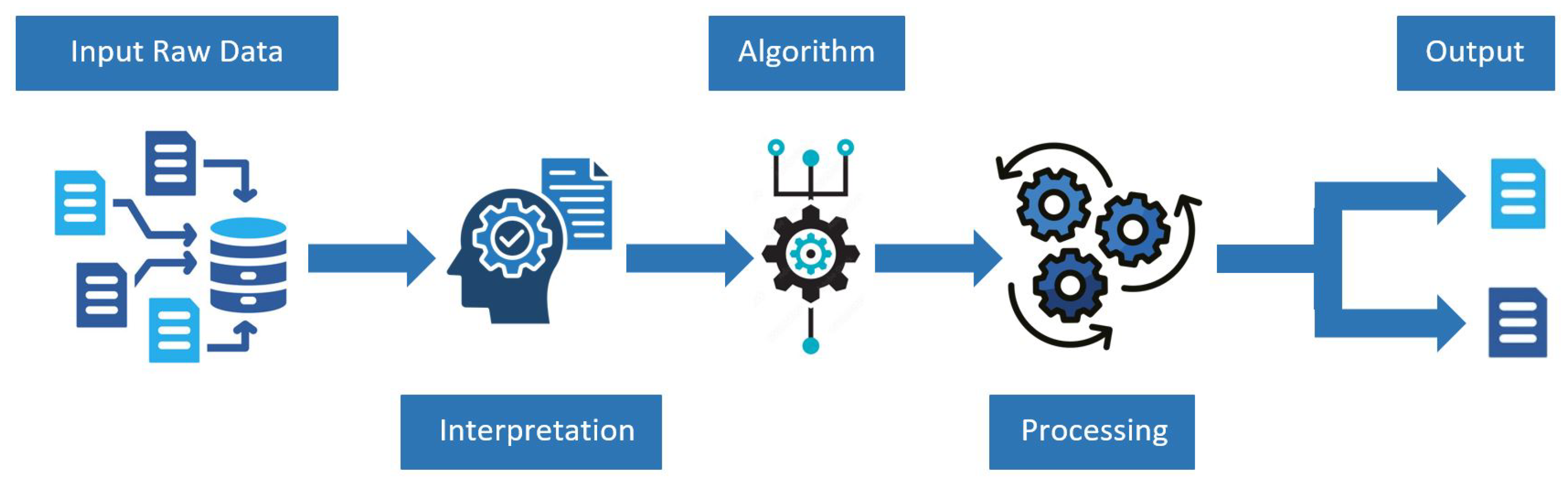
- We provide a comprehensive overview of ML techniques.
- We offer a foundational overview of current machine learning solutions applied to tackle challenges within the context of 5G and 6G networks.
- We perform a comprehensive analysis of the applicability of supervised learning, unsupervised learning, and RL techniques in advancing 5G and 6G wireless networks.
2. Background of 5G and 6G Wireless Networks
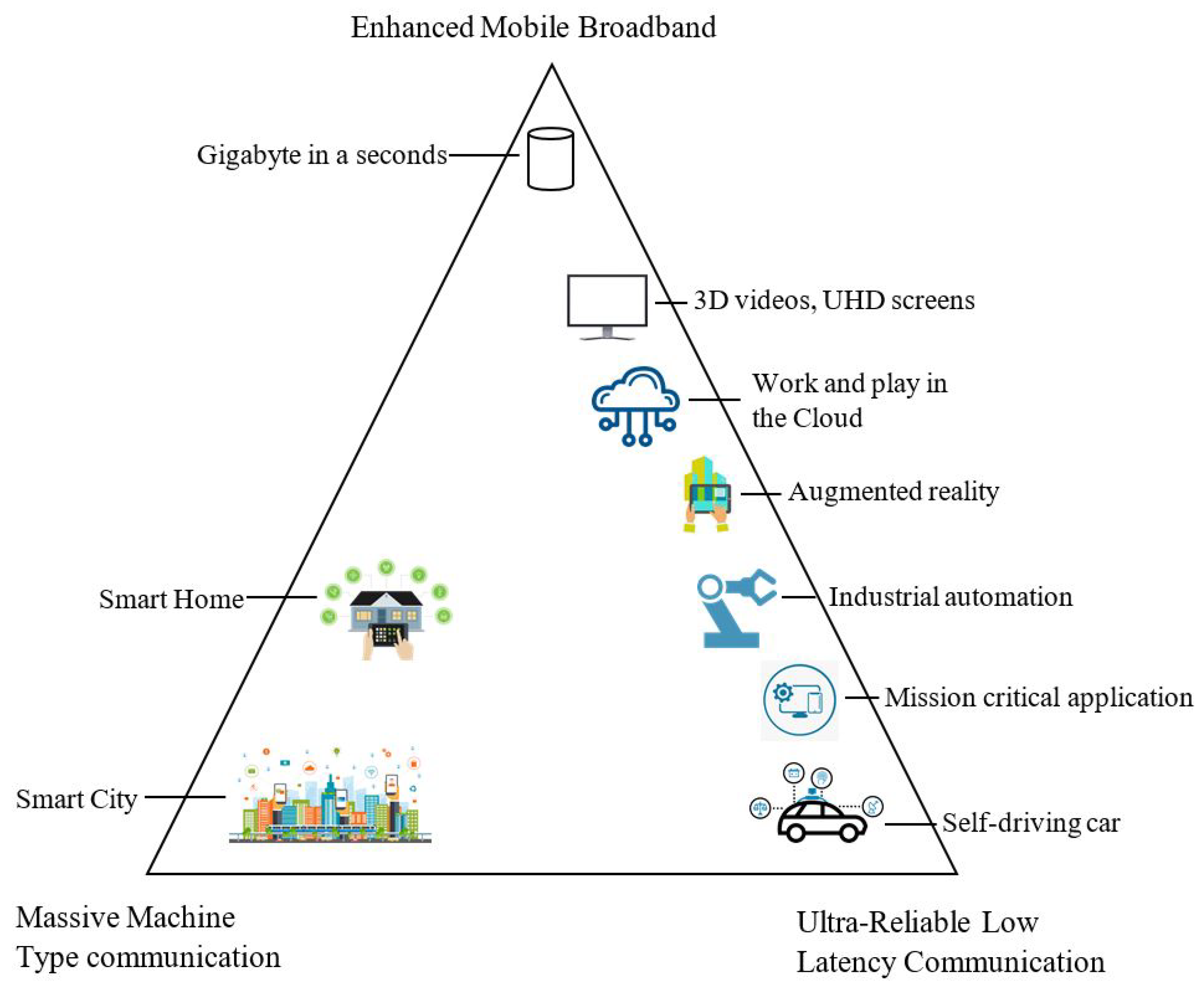
2.1. Enhanced Mobile Broadband (eMBB)
2.2. Massive Machine-Type Communications (mMTC)
2.3. Ultra-Reliable and Low-Latency Communications (URLLC)
2.4. Massive Multi-Input Multi-Output (Massive MIMO)
2.5. Orthogonal Frequency-Division Multiplexing (OFDM)
2.6. Beamforming
2.7. Machine-to-Machine (M2M) Communication
2.8. Device-to-Device (D2D) Communication
2.9. Cloud Computing
2.10. Edge Computing
2.11. Wireless Network Virtualization
2.12. Full Duplex Wireless Communication
2.13. Network Slicing
2.14. Millimeter-Wave
2.15. Terahertz (THz) Communications
2.16. Reconfigurable Intelligent Surfaces (RIS)
3. Machine Learning Techniques
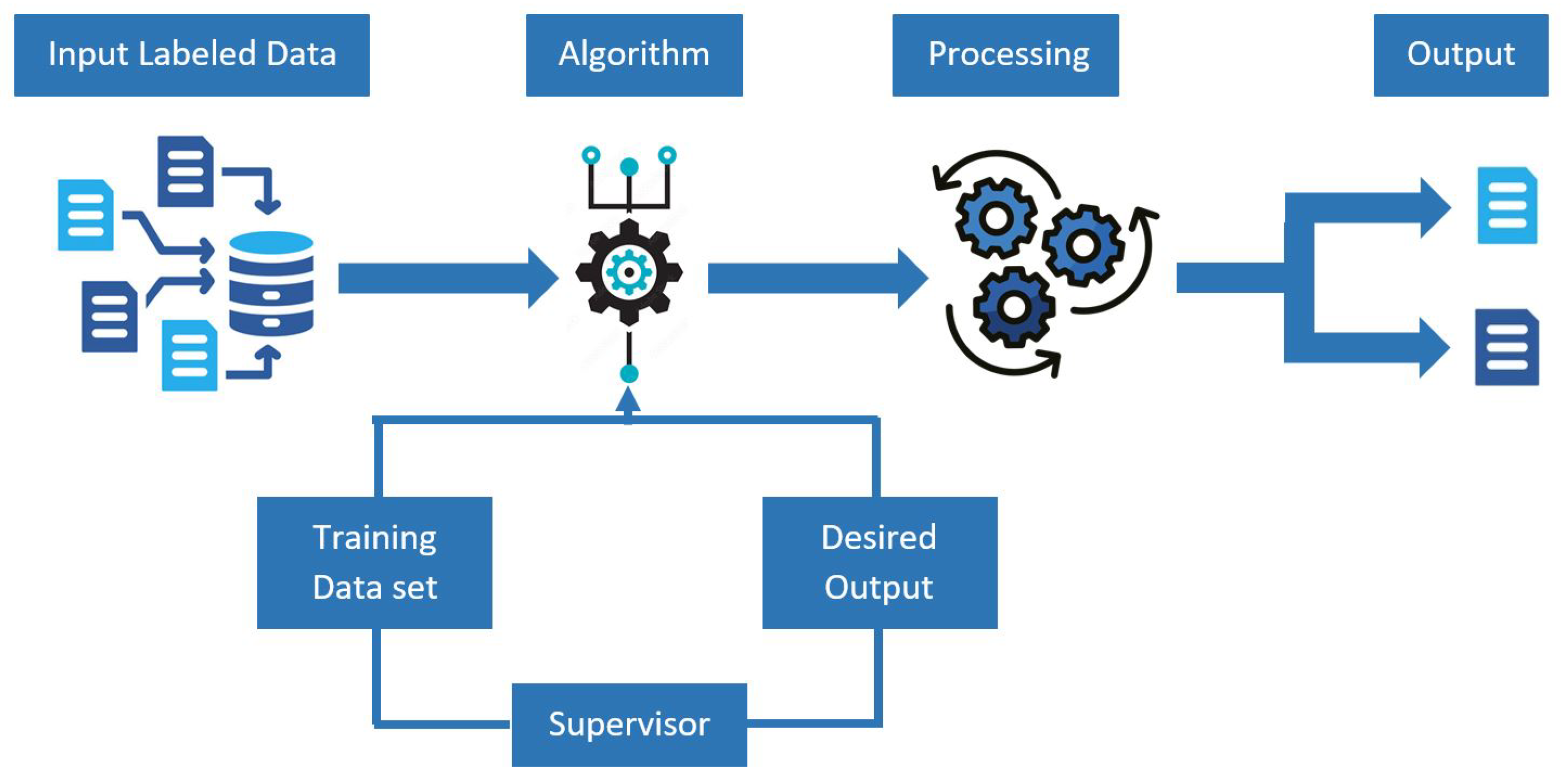
3.1. Supervised Learning
- Artificial neural networks (ANNs): ANNs draw inspiration from the natural world and aim to replicate the intricate workings of biological neural networks (NNs). Through extensive training on intricate datasets, ANNs gain the ability to grasp the network architecture of wireless communication systems and make predictions about user behavior. ANNs prove invaluable in addressing a diverse array of challenges, including resource allocation, spectrum utilization, and cell association [63]. The emergence of deep neural networks (DNNs) has further amplified the capabilities and effectiveness of ANNs [73].
- Support vector machine (SVM): In supervised machine learning, SVM is used for both regression tasks and classification tasks. Its main objective is to identify the optimal hyperplane in a high-dimensional setting, effectively distinguishing data points belonging to different classes [74]. SVM plays a vital role in wireless networks by aiding in tasks such as signal classification and detecting interference. SVM competently categorizes signals, identifies and minimizes interference, improves channel allocation, and anticipates service quality by evaluating data trends. This improves network performance and efficiency [75].
- Naive Bayes: The probabilistic machine learning algorithm Naive Bayes calculates the likelihood of an event based on past knowledge of the circumstances surrounding it. Despite its apparent simplicity, Naive Bayes is a powerful and frequently employed algorithm for classification tasks, especially in fields like natural language processing and spam filtering. A significant number of independent continuous or categorical features can be effectively managed using Naive Bayes classifiers [76,77].
- Convolutional neural networks (CNNs): A CNN is a form of ANN designed specifically to process and evaluate complex problems such as images or videos. Neurons in these models are capable of self-optimization and unsupervised learning. The convolutional layer, the pooling layer, and the fully connected layer comprise the entire CNN architecture [78].
- Recurrent neural network (RNN): RNNs, unlike standard feedforward neural networks, feature directed cycle connections that allow them to maintain a memory of prior inputs within their internal state. As a result, RNNs can be specifically constructed to handle data sequences [79]. RNNs are frequently used to handle ordinal or temporal issues in a variety of disciplines, including language translation, natural language processing, photo captioning, and speech recognition. Long short-term memory (LSTM) network applications include assessing, categorizing, and predicting results from time series data [80].
- K-Nearest Neighbor (KNN): KNN is a flexible supervised ML method that may be used for both classification and regression issues. Predicting a data point’s class or value by taking into account the majority class or average value of its KNN in the feature space is the fundamental idea behind KNN. To classify a data point, the algorithm finds the k training cases whose feature values are nearest to the input data point. Then, choose from among these neighbors the class that shows up most frequently. Through the process of averaging the goal values of the KNN, regression forecasts the continuous output for the new data point [81,82]. The algorithm boasts numerous advantages, including its insensitivity to outliers, ease of implementation, and suitability for multi-class classifications. One notable disadvantage of this technique is that it becomes highly time-consuming, especially for large-input datasets [83].
- Decision tree: The decision tree iteratively separates the data into subsets based on the input feature values and is used for both classification and regression applications. At each node in the tree, a decision is made using a specific attribute, resulting in branches that represent alternate outcomes or more decision points. Homogeneous subsets are finally formed by making decisions at each node and building a tree that correctly predicts the target variable. The key advantages of this strategy are its ease of deployment and high classification accuracy [84].
- Random Forest: The Random Forest technique amalgamates predictions from numerous decision trees to enhance overall accuracy and resilience. Every tree within the forest is constructed separately using randomly selected input variables, and the ultimate forecast is established by combining the outcomes of these trees. Whereas the average of the individual tree forecasts is computed for regression tasks, the mode of individual tree predictions is taken into account for classification tasks [85,86]. To discover the ideal split, the algorithm evaluates only a subset of features, emphasizing the necessity of maintaining a low correlation between trees to avoid the dominance of a small number of relevant traits [87].
3.2. Unsupervised Learning
- K-means: K-means is one of the most commonly used clustering algorithms in unsupervised ML. Its purpose is to divide a dataset into distinct and non-overlapping groups or clusters. The algorithm operates iteratively by assigning data points to clusters based on their similarity and subsequently updating the cluster centroids through the calculation of the mean of the points within each cluster. Indeed, in K-Means, the “K” denotes the predetermined number of clusters that the algorithm aims to identify within the dataset. The process involves initializing centroids and assigning data points to clusters iteratively until convergence, where the goal is to reduce the total squared distance between each data point and the centroid of its assigned cluster [103,104].
- Autoencoders: Autoencoders serve as a neural network architecture employed in unsupervised learning and dimensionality reduction. Their fundamental objective is to acquire an efficient representation or encoding of the input data. The architecture comprises an encoder network responsible for compressing the input into a lower-dimensional representation, referred to as the encoding or bottleneck layer. The primary objective of the autoencoder is to reduce the reconstruction error, hence encouraging the model to effectively capture the most important properties of the input data [105,106].
- Self-Organizing Map (SOM): SOM, also referred to as a Kohonen map, is an unsupervised learning technique used for high-dimensional visualization of data and clustering. SOM is a form of ANN that organizes input data into a grid of neurons or nodes, maintaining the topological relationships of the input space. In this grid, each node represents a weight vector, and throughout training, the SOM adjusts these weight vectors based on the input data, ensuring that similar input patterns are mapped to nearby nodes. This process facilitates the creation of a meaningful and organized representation of the input data on the SOM grid [107,108].
3.3. Reinforcement Learning

| ML Method | Strengths | Weaknesses | Real-World Limitations |
|---|---|---|---|
| K-Means [103,104] | Simple and fast | Assumes spherical clusters | Not suitable for irregular-shaped clusters in network data. |
| Efficient for large datasets | Sensitive to initial centroids and outliers | Performs poorly with noisy or unclean data in networks. | |
| Easy to interpret | Limited in complex, non-linear network. | ||
| Hierarchical Clustering [116] | Dendrogram helps visualize data structure | Computationally expensive | Not scalable for large, real-time network data. |
| No need to specify number of clusters | Not scalable to large datasets | Not efficient for high-dimensional network traffic. | |
| DBSCAN [109,116] | Can find arbitrarily shaped clusters | Difficult to choose parameters | Sensitive to parameter selection in dynamic network data. |
| Robust to outliers | Struggles with varying densities | Performance can drop in dense, diverse network. | |
| PCA [111,117] | Reduces dimensionality | Linear method | May miss non-linear relationships in complex network data. |
| Removes noise and redundancy | May lose interpretability of features | Can simplify critical data, losing important insights. | |
| Autoencoders [105,106] | Effective for complex feature extraction | Requires tuning | Needs large datasets. |
| Suitable for anomaly detection | Hard to interpret | Lack of interpretability makes troubleshooting difficult. | |
| Needs large amount of data | High computational cost, limiting use on edge devices. | ||
| t-SNE [112,118] | Great for visualizing high-dimensional data | Not scalable | Inefficient for large datasets in real-time applications. |
| Not suitable for clustering | Primarily used for visualization, not clustering tasks. | ||
| GMM [110,112] | Provides soft clustering (probabilistic) | Sensitive to initialization | Assumes Gaussian distribution, limiting its use with non-Gaussian network data. |
| Can model complex distributions | Assumes data is generated from Gaussian | Not suitable for all network data distributions. | |
| SOM [107,108] | Intuitive visualization | Limited scalability | Inefficient for large-scale, real-time network data. |
| Captures topological relationships | Hard to tune map size and learning rate | Requires extensive tuning, impractical for large datasets. | |
| Isolation Forest [109,112] | Efficient anomaly detection | Less interpretable | Best for anomaly detection, not for clustering large datasets. |
| Handles high-dimensional data | Not suitable for clustering | Limited use for tasks requiring data grouping in networks. |
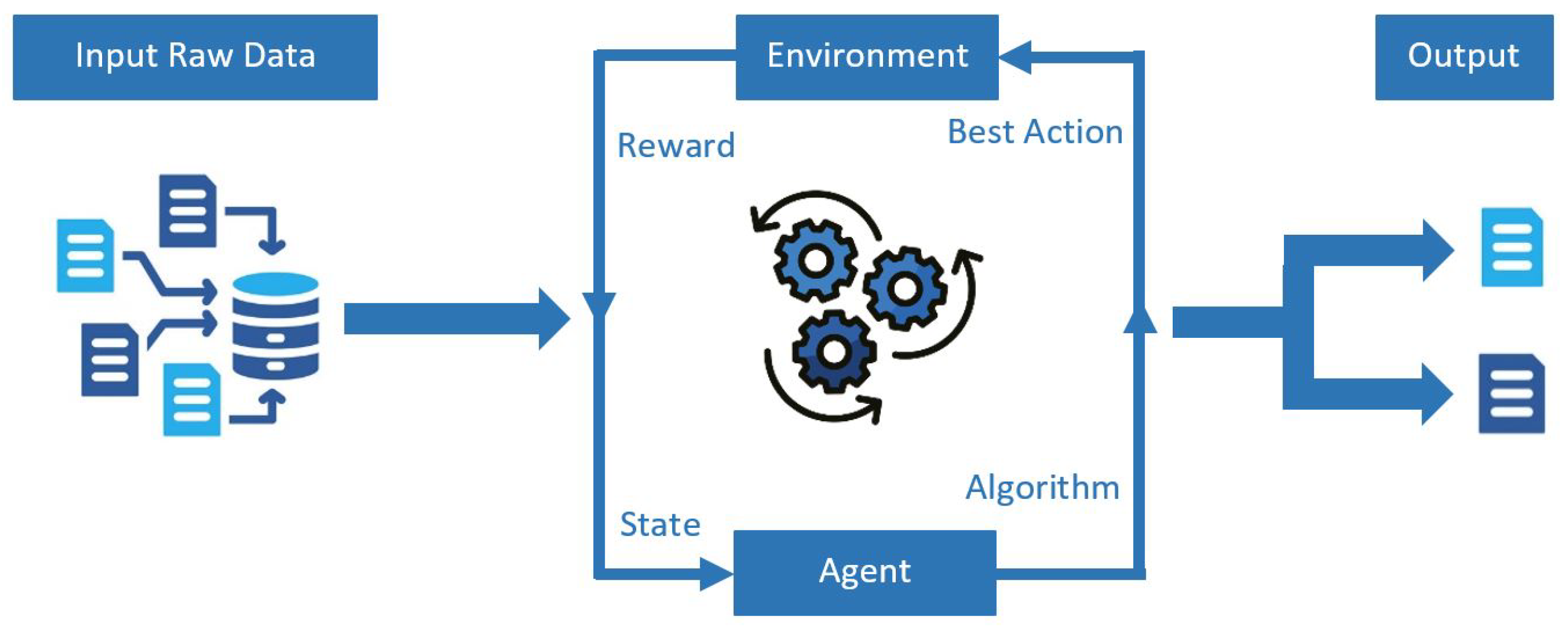
- Q-learning: Q-learning is a model-free RL algorithm applied in situations where an agent engages with an environment to acquire an optimal policy. Functioning within discrete state and action spaces, Q-learning systematically updates its action-value function, Q(s,a), by considering observed rewards and transitions. The algorithm utilizes a straightforward update rule, involving a learning rate, immediate rewards, and a discount factor for future rewards [119,120].
- Double Q-learning: Double Q-learning serves as an extension of the conventional Q-learning algorithm, designed to counteract overestimation bias in the estimation of action values. In traditional Q-learning, a single set of Q-values is employed for both action selection and evaluation, potentially resulting in optimistic overestimation, especially during the initial learning phases. Double Q-learning resolves the issue by maintaining two sets of Q-values, employing one set for action selection and the other for action evaluation. This algorithm contributes to the enhancement of Q-value estimate accuracy and promotes learning stability, particularly in environments characterized by extensive and intricate state–action spaces [121,122].
- State–Action–Reward–State–Action (SARSA): SARSA is a model-free reinforcement learning technique used for environments featuring discrete state and action spaces. Employing an on-policy approach, SARSA systematically updates its state–action values through iterations that take into account the current state, the action taken, the immediate reward, the next state, and the subsequent action chosen by the policy [123,124].
- Deep Reinforcement Learning (DRL): DRL represents a subset of ML that integrates RL methods with DNN. This amalgamation empowers agents to learn and make decisions in environments characterized by intricate and high-dimensional state spaces. By utilizing deep learning (DL) techniques, these agents can automatically identify and represent hierarchical features from unprocessed sensory inputs, such as photos or sensor data, doing away with the necessity for manual feature engineering [125,126].
- Policy Gradient: The policy gradient method, a form of RL approach, directly enhances the policy—the decision-making strategy of an agent. To achieve this improvement, the policy parameters must be changed to maximize the projected cumulative reward. Unlike value-based methods, policy gradient techniques include calculating and updating the gradient of the predicted reward in relation to the policy parameters. The policy is guided toward acts that result in larger rewards through this iterative optimization process [127,128].
- Actor–Critic: Value-based and policy-based techniques are used in Actor–Critic, an RL architecture. The actor, who chooses acts in accordance with the present policy, and the critic, who evaluates the selected actions and provides input to improve the policy, are the two main components of this system. The actor’s objective is to acquire a policy dictating actions in various states, and the critic estimates the value function, serving as a gauge for the anticipated cumulative reward. The actor utilizes this feedback to enhance its policy, and the critic is updated to better approximate the true value function [129,130].
4. Machine Learning Techniques for 5G and 6G Wireless Networks
4.1. Supervised Learning Methods
4.1.1. Resource Allocation
4.1.2. Channel Allocation
4.1.3. Interference Management
4.1.4. Beamforming
4.1.5. Security
4.2. Unsupervised Learning Methods
4.2.1. Resource Allocation
4.2.2. Channel Allocation
4.2.3. Interference Management
4.2.4. Beamforming
4.2.5. Security
4.3. Reinforcement Learning Methods
4.3.1. Resource Allocation
4.3.2. Channel Allocation
4.3.3. Interference Management
4.3.4. Beamforming
4.3.5. Security
4.4. Synthesis and Comparative Analysis
5. Machine Learning Challenges for 5G and 6G Wireless Networks
5.1. Complexity
5.2. Resource Allocation
5.3. Reliability
5.4. Real-Time Processing and Latency
5.5. Scalability and Deployment
5.6. Data Availability and Quality
5.7. Intelligent Reflecting Surface
5.8. Security
5.9. Privacy
5.10. Non-Stationarity
5.11. Data Scarcity
5.12. Overhead
5.13. Critical Analysis
6. Future Research Directions
6.1. Efficient and Lightweight ML Model Design
6.2. Data-Efficient and Privacy-Aware Learning
6.3. Real-Time and Low-Latency Learning Frameworks
6.4. Scalability and Network Adaptability
6.5. Security and Robustness of ML-Driven Networks
7. Conclusions
Author Contributions
Funding
Data Availability Statement
Acknowledgments
Conflicts of Interest
Abbreviations
| 5G | Fifth-Generation |
| 6G | Sixth-Generation |
| IoT | Internet of Things |
| ML | Machine Learning |
| RL | Reinforcement Learning |
| DL | Deep Learning |
| eMBB | enhanced Mobile Broadband |
| mMTC | massive Machine-Type Communications |
| URLLC | Ultra-reliable and low-latency communication |
| MIMO | Multi-input multi-output |
| RAN | Radio Access Network |
| SINR | Signal-to-noise ratio |
| OFDM | Orthogonal frequency-division multiplexing |
| M2M | Machine-to-Machine |
| D2D | Device-to-device |
| NFV | Network function virtualization |
| SDN | Software-defined networking |
| FD | Full-duplex |
| mmWave | Millimeter-wave |
| ANN | Artificial neural network |
| NN | Neural network |
| DNN | Deep neural network |
| SVM | Support vector machine |
| DBSCAN | Density-Based Spatial Clustering of Applications with Noise |
| PCA | Principal Component Analysis |
| t-SNE | t-distributed Stochastic Neighbor Embedding |
| GMM | Gaussian Mixture Model |
| CNN | Convolutional neural network |
| PPO | Proximal Policy Optimization |
| RNN | Recurrent neural network |
| LSTM | Long short-term-memory |
| KNN | K-Nearest Neighbor |
| SOM | Self-Organizing Map |
| SARSA | State–Action–Reward–State–Action |
| DRL | Deep Reinforcement Learning |
| CSI | Channel state information |
| MISO | Multiple-Input Single-Output |
| BS | Base station |
| CRAN | Cloud radio access networks |
| L2O | Learning-to-optimize |
| SDS | Software-defined-security |
| QoS | Quality of Service |
| THz | Terahertz |
| RIS | Reconfigurable Intelligent Surfaces |
| UAV | Unmanned aerial vehicles |
References
- Siriwardhana, Y.; Porambage, P.; Liyanage, M.; Ylianttila, M. A survey on mobile augmented reality with 5G mobile edge computing: Architectures, applications, and technical aspects. IEEE Commun. Surv. Tutor. 2021, 23, 1160–1192. [Google Scholar] [CrossRef]
- Erunkulu, O.O.; Zungeru, A.M.; Lebekwe, C.K.; Mosalaosi, M.; Chuma, J.M. 5G mobile communication applications: A survey and comparison of use cases. IEEE Access 2021, 9, 97251–97295. [Google Scholar] [CrossRef]
- Arjoune, Y.; Faruque, S. Artificial intelligence for 5G wireless systems: Opportunities, challenges, and future research direction. In Proceedings of the 2020 10th Annual Computing and Communication Workshop and Conference (CCWC), Las Vegas, NV, USA, 6–8 January 2020; pp. 1023–1028. [Google Scholar] [CrossRef]
- Xu, Y.; Gui, G.; Gacanin, H.; Adachi, F. A survey on resource allocation for 5G heterogeneous networks: Current research, future trends, and challenges. IEEE Commun. Surveys Tuts. 2021, 23, 668–695. [Google Scholar] [CrossRef]
- Mushtaq, M.U.; Hong, J.; Owais, M.; Danso, S.A. Enhancing security and energy efficiency in wireless sensor network routing with IoT challenges: A thorough review. LC Int. J. STEM 2023, 4, 1–24. [Google Scholar] [CrossRef]
- Muhammad, O.; Jiang, H.; Muhammad, B.; Umer, M.M.; Ahtsam, N.M.; Dasno, S. A comprehensive review of D2D communication in 5G and B5G networks. LC Int. J. STEM 2023, 4, 25–46. [Google Scholar] [CrossRef]
- Polese, M.; Bonati, L.; D’oro, S.; Basagni, S.; Melodia, T. Understanding O-RAN: Architecture, interfaces, algorithms, security, and research challenges. IEEE Commun. Surv. Tutor. 2023, 25, 1376–1411. [Google Scholar] [CrossRef]
- Sanjalawe, Y.; Fraihat, S.; Abualhaj, M.; Makhadmeh, S.; Alzubi, E. A review of 6G and AI convergence: Enhancing communication networks with artificial intelligence. IEEE Open J. Commun. Soc. 2025, 6, 2308–2355. [Google Scholar] [CrossRef]
- Singh, R.; Mehbodniya, A.; Webber, J.L.; Dadheech, P.; Pavithra, G.; Alzaidi, M.S.; Akwafo, R. Analysis of network slicing for management of 5G networks using machine learning techniques. Wireless Commun. Mobile Comput. 2022, 2022, 9169568. [Google Scholar] [CrossRef]
- Morocho-Cayamcela, M.E.; Lee, H.; Lim, W. Machine learning for 5G/B5G mobile and wireless communications: Potential, limitations, and future directions. IEEE Access 2019, 7, 137184–137206. [Google Scholar] [CrossRef]
- Zhang, C.; Patras, P.; Haddadi, H. Deep learning in mobile and wireless networking: A survey. IEEE Commun. Surveys Tuts. 2019, 21, 2224–2287. [Google Scholar] [CrossRef]
- Umer, M.M.; Venter, H.; Muhammad, O.; Shafique, T.; Awwad, F.A.; Ismail, E.A.A. Cognitive strategies for UAV trajectory optimization: Ensuring safety and energy efficiency in real-world scenarios. Ain Shams Eng. J. 2025, 16, 103301. [Google Scholar] [CrossRef]
- Umer, M.M.; Jiang, H.; Muhammad, O.; Awwad, F.A.; Ismail, E.A.A. Energy-efficient and resilient secure routing in energy harvesting wireless sensor networks with transceiver noises: EcoSecNet design and analysis. J. Sens. 2024, 2024, 3570302. [Google Scholar] [CrossRef]
- Villarrubia, G.; Paz, J.F.D.; Chamoso, P.; la Prieta, F.D. Artificial neural networks used in optimization problems. Neurocomputing 2018, 272, 10–16. [Google Scholar] [CrossRef]
- Mushtaq, M.M.; Venter, H.; Singh, A.; Owais, M. Advances in energy harvesting for sustainable wireless sensor networks: Challenges and opportunities. Hardware 2025, 3, 1. [Google Scholar] [CrossRef]
- Niknam, S.; Dhillon, H.S.; Reed, J.H. Federated learning for wireless communications: Motivation, opportunities, and challenges. IEEE Commun. Mag. 2020, 58, 46–51. [Google Scholar] [CrossRef]
- You, X.; Zhang, C.; Tan, X.; Jin, S.; Wu, H. AI for 5G: Research directions and paradigms. Sci. China Inf. Sci. 2019, 62, 21301. [Google Scholar] [CrossRef]
- Pokhrel, S.R.; Ding, J.; Park, J.; Park, O.-S.; Choi, J. Towards enabling critical mMTC: A review of URLLC within mMTC. IEEE Access 2020, 8, 131796–131813. [Google Scholar] [CrossRef]
- Muhammad, O.; Jiang, H.; Bilal, M.; Umer, M.M. Optimizing power allocation for URLLC-D2D in 5G networks with Rician fading channel. PeerJ Comput. Sci. 2025, 11, e2712. [Google Scholar] [CrossRef] [PubMed]
- Amjad, Z.; Nsiah, K.A.; Hilt, B.; Lauffenburger, J.-P.; Sikora, A. Latency reduction for narrowband URLLC networks: A performance evaluation. Wirel. Netw. 2021, 27, 2577–2593. [Google Scholar] [CrossRef]
- Navarro-Ortiz, J.; Romero-Diaz, P.; Sendra, S.; Ameigeiras, P.; Ramos-Munoz, J.J.; Lopez-Soler, J.M. A survey on 5G usage scenarios and traffic models. IEEE Commun. Surv. Tutor. 2020, 22, 905–929. [Google Scholar] [CrossRef]
- Umoh, V.; Ekpe, U.; Davidson, I.; Akpan, J. Mobile broadband adoption, performance measurements and methodology: A review. Electronics 2023, 12, 1630. [Google Scholar] [CrossRef]
- Bilal, M.; Zeng, R.; Muhammad, O.; Adil, M.; Shoukat, S. A cyber-resilient and explainable intrusion detection system for Internet of Things networks. Clust. Comput. 2025, 28, 308. [Google Scholar] [CrossRef]
- Wang, F.; Ma, G. Introduction on Massive Machine-Type Communications (mMTC). In Massive Machine Type Communications: Multiple Access Schemes; Springer: Berlin/Heidelberg, Germany, 2019; pp. 1–3. [Google Scholar] [CrossRef]
- Kovalchukov, R.; Moltchanov, D.; Pirskanen, J.; Säe, J.; Numminen, J.; Koucheryavy, Y.; Valkama, M. DECT-2020 new radio: The next step toward 5G massive machine-type communications. IEEE Commun. Mag. 2022, 60, 58–64. [Google Scholar] [CrossRef]
- Muhammad, O.; Jiang, H.; Umer, M.M.; Muhammad, B.; Ahtsam, N.M. Optimizing power allocation for D2D communication with URLLC under Rician fading channel: A learning-to-optimize approach. Intell. Autom. Soft Comput. 2023, 37, 3193–3212. [Google Scholar] [CrossRef]
- Khan, B.S.; Jangsher, S.; Ahmed, A.; Al-Dweik, A. URLLC and eMBB in 5G industrial IoT: A survey. IEEE Open J. Commun. Soc. 2022, 3, 1134–1163. [Google Scholar] [CrossRef]
- Ali, R.; Zikria, Y.B.; Bashir, A.K.; Garg, S.; Kim, H.S. URLLC for 5G and beyond: Requirements, enabling incumbent technologies and network intelligence. IEEE Access 2021, 9, 67064–67095. [Google Scholar] [CrossRef]
- Dilli, R. Performance of multi-user massive MIMO in 5G NR networks at 28 GHz band. Telecommun. Radio Eng. 2021, 80, 61–74. [Google Scholar] [CrossRef]
- Anbarasu, M.; Nithiyanantham, J. Performance analysis of highly efficient two-port MIMO antenna for 5G wearable applications. IETE J. Res. 2023, 69, 3594–3603. [Google Scholar] [CrossRef]
- Biradar, A.; Murthy, N.S.; Awasthi, P.; Srivastava, A.K.; Akram, P.S.; Lakshminarayana, M.; Abidin, S.; Vadi, V.R.; Sisay, A. Massive MIMO wireless solutions in backhaul for the 5G networks. Wirel. Commun. Mob. Comput. 2022, 2022, 3813610. [Google Scholar] [CrossRef]
- Yao, M.; Sohul, M.; Marojevic, V.; Reed, J.H. Artificial intelligence defined 5G radio access networks. IEEE Commun. Mag. 2019, 57, 14–20. [Google Scholar] [CrossRef]
- Devrari, A.; Kumar, A.; Kuchhal, P. Global aspects and overview of 5G multimedia communication. Multimedia Tools Appl. 2023, 83, 26439–26484. [Google Scholar] [CrossRef]
- Hammed, Z.S.; Ameen, S.Y.; Zeebaree, S.R.M. Massive MIMO-OFDM performance enhancement on 5G. In Proceedings of the 2021 International Conference on Software, Telecommunications and Computer Networks (SoftCOM), Split, Croatia, 23–25 September 2021; pp. 1–6. [Google Scholar] [CrossRef]
- Mhedhbi, M.; Boukour, F.E. Analysis and evaluation of pattern division multiple access scheme jointed with 5G waveforms. IEEE Access 2019, 7, 21826–21833. [Google Scholar] [CrossRef]
- Umer, M.M.; Jiang, H.; Zhang, Q.; Liu, M.; Muhammad, O. Time-slot based architecture for power beam-assisted relay techniques in CR-WSNs with transceiver hardware inadequacies. Bull. Pol. Acad. Sci. Tech. Sci. 2023, 71, 1–11. [Google Scholar] [CrossRef]
- Rao, L.; Pant, M.; Malviya, L.; Parmar, A.; Charhate, S.V. 5G beamforming techniques for the coverage of intended directions in modern wireless communication: In-depth review. Int. J. Microw. Wireless Technol. 2021, 13, 1039–1062. [Google Scholar] [CrossRef]
- Saraereh, O.A.; Ali, A. Beamforming performance analysis of millimeter-wave 5G wireless networks. Comput. Mater. Contin. 2022, 70, 5383–5397. [Google Scholar] [CrossRef]
- Sharma, A.; Jha, R.K. A comprehensive survey on security issues in 5G wireless communication network using beamforming approach. Wirel. Pers. Commun. 2021, 119, 3447–3501. [Google Scholar] [CrossRef]
- Jiang, C.; Zhang, H.; Ren, Y.; Han, Z.; Chen, K.-C.; Hanzo, L. Machine learning paradigms for next-generation wireless networks. IEEE Wirel. Commun. 2016, 24, 98–105. [Google Scholar] [CrossRef]
- Salem, M.A.; El-Kader, S.M.A.; Youssef, M.I.; Tarrad, I.F. M2m in 5g communication networks: Characteristics, applications, taxonomy, technologies, and future challenges. In Fundamental and Supportive Technologies for 5G Mobile Networks; IGI Global: Hershey, PA, USA, 2020; pp. 309–321. [Google Scholar] [CrossRef]
- Fourati, H.; Maaloul, R.; Chaari, L. A survey of 5G network systems: Challenges and machine learning approaches. Int. J. Mach. Learn. Cybern. 2021, 12, 385–431. [Google Scholar] [CrossRef]
- Hussein, H.H.; Elsayed, H.A.; El-kader, S.M.A. Intensive benchmarking of D2D communication over 5G cellular networks: Prototype, integrated features, challenges, and main applications. Wireless Netw. 2020, 26, 3183–3202. [Google Scholar] [CrossRef]
- Laguidi, A.; Hachad, T.; Hachad, L. Mobile network connectivity analysis for device to device communication in 5G network. Int. J. Electr. Comput. Eng. 2023, 13, 680–687. [Google Scholar] [CrossRef]
- Jayakumar, S. A review on resource allocation techniques in D2D communication for 5G and B5G technology. Peer-to-Peer Netw. Appl. 2021, 14, 243–269. [Google Scholar] [CrossRef]
- Ullah, A.; Aznaoui, H.; Sahin, C.B.; Sadie, M.; Dinler, Ö.B.; Laassar, I. Cloud computing and 5G challenges and open issues. Int. J. Adv. Appl. Sci. 2022, 11, 187–193. [Google Scholar] [CrossRef]
- Hassan, N.; Yau, K.-L.A.; Wu, C. Edge computing in 5G: A review. IEEE Access 2019, 7, 127276–127289. [Google Scholar] [CrossRef]
- Pham, Q.V.; Fang, F.; Ha, V.N.; Piran, M.J.; Le, M.; Le, L.B.; Hwang, W.J.; Ding, Z. A survey of multi-access edge computing in 5G and beyond: Fundamentals, technology integration, and state-of-the-art. IEEE Access 2020, 8, 116974–117017. [Google Scholar] [CrossRef]
- Narayanan, A.; De Sena, A.S.; Gutierrez-Rojas, D.; Melgarejo, D.C.; Hussain, H.M.; Ullah, M.; Bayhan, S.; Nardelli, P.H. Key advances in pervasive edge computing for industrial internet of things in 5g and beyond. IEEE Access 2020, 8, 206734–206754. [Google Scholar] [CrossRef]
- Feng, Z.; Qiu, C.; Feng, Z.; Wei, Z.; Li, W.; Zhang, P. An effective approach to 5G: Wireless network virtualization. IEEE Commun. Mag. 2015, 53, 53–59. [Google Scholar] [CrossRef]
- Ramakrishnan, J.; Shabbir, M.S.; Kassim, N.M.; Nguyen, P.T.; Mavaluru, D. A comprehensive and systematic review of the network virtualization techniques in the IoT. Int. J. Commun. Syst. 2020, 33, e4331. [Google Scholar] [CrossRef]
- Basu, D.; Datta, R.; Ghosh, U. Softwarized network function virtualization for 5G: Challenges and opportunities. In Internet of Things and Secure Smart Environments: Successes and Pitfalls; CRC: Boca Raton, FL, USA, 2020; p. 147. [Google Scholar] [CrossRef]
- Vaezpour, E. Deep learning-driven multi-objective dynamic switch migration in software defined networking (SDN)/network function virtualization (NFV)-based 5G networks. Eng. Appl. Artif. Intell. 2023, 125, 106714. [Google Scholar] [CrossRef]
- Midya, P.; Acharya, T. Wireless network virtualization in cellular IoT networks for smart city application. In Proceedings of the 2025 National Conference on Communications (NCC), New Delhi, India, 6–9 March 2025; pp. 1–6. [Google Scholar] [CrossRef]
- Syed-Yusof, S.K.; Numan, P.E.; Yusof, K.M.; Din, J.B.; Marsono, M.N.; Onumanyi, A.J. Software-defined networking (SDN) and 5G network: The role of controller placement for scalable control plane. In Proceedings of the 2020 IEEE International RF and Microwave Conference (RFM), Kuala Lumpur, Malaysia, 14–16 December 2020; pp. 1–6. [Google Scholar] [CrossRef]
- Ghaffar, A.A.A.; Mahmoud, A.; Sheltami, T.; Abu-Amara, M. A survey on software-defined networking-based 5G mobile core architectures. Arab. J. Sci. Eng. 2023, 48, 2313–2330. [Google Scholar] [CrossRef]
- Barakabitze, A.A.; Ahmad, A.; Mijumbi, R.; Hines, A. 5G network slicing using SDN and NFV: A survey of taxonomy, architectures and future challenges. Comput. Netw. 2020, 167, 106984. [Google Scholar] [CrossRef]
- Rajput, M.; Malathi, P. A review of in band full duplex communication in 5G cellular network. In Proceedings of the 2021 12th International Conference on Computing Communication and Networking Technologies (ICCCNT), Kharagpur, India, 6–8 July 2021; pp. 1–7. [Google Scholar] [CrossRef]
- Gazestani, A.H.; Ghorashi, S.A.; Mousavinasab, B.; Shikh-Bahaei, M. A survey on implementation and applications of full duplex wireless communications. Phys. Commun. 2019, 34, 121–134. [Google Scholar] [CrossRef]
- Smida, B.; Sabharwal, A.; Fodor, G.; Alexandropoulos, G.C.; Suraweera, H.A.; Chae, C.-B. Full-duplex wireless for 6G: Progress brings new opportunities and challenges. IEEE J. Sel. Areas Commun. 2023, 41, 2729–2750. [Google Scholar] [CrossRef]
- Nadeem, L.; Azam, M.A.; Amin, Y.; Al-Ghamdi, M.A.; Chai, K.K.; Khan, M.F.N.; Khan, M.A. Integration of D2D, network slicing, and MEC in 5G cellular networks: Survey and challenges. IEEE Access 2021, 9, 37590–37612. [Google Scholar] [CrossRef]
- Zhang, S. An overview of network slicing for 5G. IEEE Wirel. Commun. 2019, 26, 111–117. [Google Scholar] [CrossRef]
- Dahrouj, H.; Alghamdi, R.; Alwazani, H.; Bahanshal, S.; Ahmad, A.A.; Faisal, A.; Shalabi, R.; Alhadrami, R.; Subasi, A.; Al-Nory, M.T.; et al. An overview of machine learning-based techniques for solving optimization problems in communications and signal processing. IEEE Access 2021, 9, 74908–74938. [Google Scholar] [CrossRef]
- Khan, S.K.; Naseem, U.; Siraj, H.; Razzak, I.; Imran, M. The role of unmanned aerial vehicles and mmWave in 5G: Recent advances and challenges. Trans. Emerg. Telecommun. Technol. 2021, 32, e4241. [Google Scholar] [CrossRef]
- Al-Shammari, B.K.J.; Hburi, I.; Idan, H.R.; Khazaal, H.F. An overview of mmWave communications for 5G. In Proceedings of the 2021 International Conference on Communication & Information Technology (ICICT), Basrah, Iraq, 5–6 June 2021; pp. 133–139. [Google Scholar] [CrossRef]
- Othman, W.M.; Ateya, A.A.; Nasr, M.E.; Muthanna, A.; ElAffendi, M.; Koucheryavy, A.; Hamdi, A.A. Key enabling technologies for 6G: The role of UAVs, terahertz communication, and intelligent reconfigurable surfaces in shaping the future of wireless networks. J. Sens. Actuator Netw. 2025, 14, 30. [Google Scholar] [CrossRef]
- Zhang, S.; Huang, W.; Liu, Y. A systematic survey on physical layer security oriented to reconfigurable intelligent surface empowered 6G. Comput. Secur. 2025, 148, 104100. [Google Scholar] [CrossRef]
- Janiesch, C.; Zschech, P.; Heinrich, K. Machine learning and deep learning. Electron. Mark. 2021, 31, 685–695. [Google Scholar] [CrossRef]
- Samanta, R.K.; Sadhukhan, B.; Samaddar, H.; Sarkar, S.; Koner, C.; Ghosh, M. Scope of machine learning applications for addressing the challenges in next-generation wireless networks. CAAI Trans. Intell. Technol. 2022, 7, 395–418. [Google Scholar] [CrossRef]
- Kaur, J.; Khan, M.A.; Iftikhar, M.; Imran, M.; Haq, Q.E.U. Machine learning techniques for 5G and beyond. IEEE Access 2021, 9, 23472–23488. [Google Scholar] [CrossRef]
- Jagannath, J.; Polosky, N.; Jagannath, A.; Restuccia, F.; Melodia, T. Machine learning for wireless communications in the Internet of Things: A comprehensive survey. Ad Hoc Netw. 2019, 93, 101913. [Google Scholar] [CrossRef]
- Sen, P.C.; Hajra, M.; Ghosh, M. Supervised classification algorithms in machine learning: A survey and review. In Emerging Technology in Modelling and Graphics: Proceedings of IEM Graph 2018; Springer: Singapore, 2020; pp. 99–111. [Google Scholar] [CrossRef]
- Shubyn, B.; Lutsiv, N.; Syrotynskyi, O.; Kolodii, R. Deep learning based adaptive handover optimization for ultra-dense 5G mobile networks. In Proceedings of the 2020 IEEE 15th International Conference on Advanced Trends in Radioelectronics, Telecommunications and Computer Engineering (TCSET), Lviv-Slavske, Ukraine, 25–29 February 2020; pp. 869–872. [Google Scholar] [CrossRef]
- Pisner, D.A.; Schnyer, D.M. Support vector machine. In Machine Learning; Elsevier: Amsterdam, The Netherlands, 2020; pp. 101–121. [Google Scholar] [CrossRef]
- Yang, H.; Xie, X.; Kadoch, M. Machine learning techniques and a case study for intelligent wireless networks. IEEE Netw. 2020, 34, 208–215. [Google Scholar] [CrossRef]
- Wang, W.; Duan, Y.; Cao, L.; Jiang, Z. Application of improved Naive Bayes classification algorithm in 5G signaling analysis. J. Supercomput. 2023, 79, 6941–6964. [Google Scholar] [CrossRef]
- Vijayalakshmi, A.; Abdulsamath, G.; Saravanan, N. 5G network slicing algorithm development using bagging based-Gaussian naive Bayes. In Proceedings of the 2023 Second International Conference on Electrical, Electronics, Information and Communication Technologies (ICEEICT), Trichirappalli, India, 5–7 April 2023; pp. 1–5. [Google Scholar] [CrossRef]
- Sirohi, D.; Kumar, N.; Rana, P.S. Convolutional neural networks for 5G-enabled intelligent transportation system: A systematic review. Comput. Commun. 2020, 153, 459–498. [Google Scholar] [CrossRef]
- Yu, Y.; Si, X.; Hu, C.; Zhang, J. A review of recurrent neural networks: LSTM cells and network architectures. Neural Comput. 2019, 31, 1235–1270. [Google Scholar] [CrossRef]
- Staudemeyer, R.C.; Morris, E.R. Understanding LSTM? A tutorial into long short-term memory recurrent neural networks. arXiv 2019, arXiv:1909.09586. [Google Scholar] [CrossRef]
- Gupta, R.K.; Pannu, P.; Misra, R. Towards ultra-latency using deep learning in 5G network slicing applying approximate k-nearest neighbor graph construction. Wirel. Pers. Commun. 2021, 1–19. [Google Scholar] [CrossRef]
- Preciado-Velasco, J.E.; Gonzalez-Franco, J.D.; Anias-Calderon, C.E.; Nieto-Hipolito, J.I.; Rivera-Rodriguez, R. 5G/B5G service classification using supervised learning. Appl. Sci. 2021, 11, 4942. [Google Scholar] [CrossRef]
- Rekkas, V.P.; Sotiroudis, S.; Sarigiannidis, P.; Wan, S.; Karagiannidis, G.K.; Goudos, S.K. Machine learning in beyond 5G/6G networks—state-of-the-art and future trends. Electronics 2021, 10, 2786. [Google Scholar] [CrossRef]
- Charbuty, B.; Abdulazeez, A. Classification based on decision tree algorithm for machine learning. J. Appl. Sci. Technol. Trends 2021, 2, 20–28. [Google Scholar] [CrossRef]
- Schonlau, M.; Zou, R.Y. The random forest algorithm for statistical learning. Stata J. 2020, 20, 3–29. [Google Scholar] [CrossRef]
- Caiyu, S.; Jinri, W.; Jie, D.; Yuan, L. Mining potential 5G mobile users based on logistic regression and random forest. In Proceedings of the 2022 IEEE 5th International Conference on Information Systems and Computer Aided Education (ICISCAE), Dalian, China, 23–25 September 2022; pp. 351–356. [Google Scholar] [CrossRef]
- Zhou, I.; Makhdoom, I.; Shariati, N.; Raza, M.A.; Keshavarz, R.; Lipman, J.; Abolhasan, M.; Jamalipour, A. Internet of things 2.0: Concepts, applications, and future directions. IEEE Access 2021, 9, 70961–71012. [Google Scholar] [CrossRef]
- Hassan, D.O.; Hassan, B.A. A comprehensive systematic review of machine learning in the retail industry: Classifications, limitations, opportunities, and challenges. Neural Comput. Appl. 2025, 37, 2035–2070. [Google Scholar] [CrossRef]
- Zhao, Z.; Alzubaidi, L.; Zhang, J.; Duan, Y.; Gu, Y. A comparison review of transfer learning and self-supervised learning: Definitions, applications, advantages and limitations. Expert Syst. Appl. 2024, 242, 122807. [Google Scholar] [CrossRef]
- Khaldi, M.I.; Erraissi, A.; Hain, M.; Banane, M. Multicriteria evaluation of supervised classification algorithms: Strengths, limitations and practical recommendations. In International Conference on Intelligent Systems and Digital Applications; Springer: Cham, Switzerland, 2025; pp. 277–286. [Google Scholar] [CrossRef]
- Ahmed, S.F.; Alam, M.S.B.; Hassan, M.; Rozbu, M.R.; Ishtiak, T.; Rafa, N.; Mofijur, M.; Ali, A.B.M.S.; Gandomi, A.H. Deep learning modelling techniques: Current progress, applications, advantages, and challenges. Artif. Intell. Rev. 2023, 56, 13521–13617. [Google Scholar] [CrossRef]
- Malekzadeh, M. Performance prediction and enhancement of 5G networks based on linear regression machine learning. EURASIP J. Wirel. Commun. Netw. 2023, 2023, 74. [Google Scholar] [CrossRef]
- Varotto, M.; Heinrichs, F.; Schürg, T.; Tomasin, S.; Valentin, S. Detecting 5G narrowband jammers with CNN, k-nearest neighbors, and support vector machines. In Proceedings of the 2024 IEEE International Workshop on Information Forensics and Security (WIFS), Rome, Italy, 2–5 December 2024; pp. 1–6. [Google Scholar] [CrossRef]
- James, G.; Witten, D.; Hastie, T.; Tibshirani, R.; Taylor, J. Unsupervised learning. In An Introduction to Statistical Learning: With Applications in Python; Springer: Berlin/Heidelberg, Germany, 2023; pp. 503–556. [Google Scholar] [CrossRef]
- Ige, A.O.; Noor, M.H.M. A survey on unsupervised learning for wearable sensor-based activity recognition. Appl. Soft Comput. 2022, 127, 109363. [Google Scholar] [CrossRef]
- Lefoane, M.; Ghafir, I.; Kabir, S.; Awan, I.-U. Unsupervised learning for feature selection: A proposed solution for botnet detection in 5G networks. IEEE Trans. Ind. Inform. 2022, 19, 921–929. [Google Scholar] [CrossRef]
- Ezugwu, A.E.; Ikotun, A.M.; Oyelade, O.O.; Abualigah, L.; Agushaka, J.O.; Eke, C.I.; Akinyelu, A.A. A comprehensive survey of clustering algorithms: State-of-the-art machine learning applications, taxonomy, challenges, and future research prospects. Eng. Appl. Artif. Intell. 2022, 110, 104743. [Google Scholar] [CrossRef]
- Khan, M.U.; Azizi, M.; García-Armada, A.; Escudero-Garzás, J.J. Unsupervised clustering for 5G network planning assisted by real data. IEEE Access 2022, 10, 39269–39281. [Google Scholar] [CrossRef]
- Jia, W.; Sun, M.; Lian, J.; Hou, S. Feature dimensionality reduction: A review. Complex Intell. Syst. 2022, 8, 2663–2693. [Google Scholar] [CrossRef]
- Pena, J.M.; Lozano, J.A.; Larranaga, P.; Inza, I. Dimensionality reduction in unsupervised learning of conditional Gaussian networks. IEEE Trans. Pattern Anal. Mach. Intell. 2001, 23, 590–603. [Google Scholar] [CrossRef]
- Ebenezer, E.; Djouani, K.; Kurien, A.M. Integrating artificial intelligence internet of things and 5G for next-generation smartgrid: A survey of trends challenges and prospect. IEEE Access 2022, 10, 4794–4831. [Google Scholar] [CrossRef]
- Zhang, S.; Zhu, D. Towards artificial intelligence enabled 6G: State of the art, challenges, and opportunities. Comput. Netw. 2020, 183, 107556. [Google Scholar] [CrossRef]
- Ikotun, A.M.; Ezugwu, A.E.; Abualigah, L.; Abuhaija, B.; Heming, J. K-means clustering algorithms: A comprehensive review, variants analysis, and advances in the era of big data. Inf. Sci. 2023, 622, 178–210. [Google Scholar] [CrossRef]
- Natarajan, J.; Rebekka, B. An energy efficient dynamic small cell on/off switching with enhanced k-means clustering algorithm for 5G HetNets. Int. J. Commun. Netw. Distrib. Syst. 2023, 29, 209–237. [Google Scholar] [CrossRef]
- DBank; Koenigstein, N.; Giryes, R. Autoencoders. In Machine Learning for Data Science Handbook: Data Mining and Knowledge Discovery Handbook; Springer: Berlin/Heidelberg, Germany, 2023; pp. 353–374. [Google Scholar] [CrossRef]
- Başaran, O.T.; Başaran, M.; Turan, D.; Bayrak, H.G.; Sandal, Y.S. Deep autoencoder design for RF anomaly detection in 5G O-RAN near-RT RIC via xApps. In Proceedings of the 2023 IEEE International Conference on Communications Workshops (ICC Workshops), Rome, Italy, 28 May–1 June 2023; pp. 549–555. [Google Scholar] [CrossRef]
- Papidas, A.G.; Polyzos, G.C. Self-organizing networks for 5G and beyond: A view from the top. Future Internet 2022, 14, 95. [Google Scholar] [CrossRef]
- Fourati, H.; Maaloul, R.; Chaari, L.; Jmaiel, M. Comprehensive survey on self-organizing cellular network approaches applied to 5G networks. Comput. Netw. 2021, 199, 108435. [Google Scholar] [CrossRef]
- Prince-Tritto, P.; Ponce, H. Exploring the challenges and limitations of unsupervised machine learning approaches in legal concepts discovery. In Mexican International Conference on Artificial Intelligence; Springer: Cham, Switzerland, 2023; pp. 52–67. [Google Scholar] [CrossRef]
- Singh, S.; Hooda, S. A study of challenges and limitations to applying machine learning to highly unstructured data. In Proceedings of the 2023 7th International Conference On Computing, Communication, Control And Automation (ICCUBEA), Pune, India, 18–19 August 2023; pp. 1–6. [Google Scholar] [CrossRef]
- Priyadarshi, R.; Ranjan, R.; Vishwakarma, A.K.; Yang, T.; Rathore, R.S. Exploring the frontiers of unsupervised learning techniques for diagnosis of cardiovascular disorder: A systematic review. IEEE Access 2024, 12, 139253–139272. [Google Scholar] [CrossRef]
- Tyagi, K.; Rane, C.; Sriram, R.; Manry, M. Unsupervised learning. In Artificial Intelligence and Machine Learning for Edge Computing; Academic Press: Cambridge, MA, USA, 2022; pp. 33–52. [Google Scholar] [CrossRef]
- Ladosz, P.; Weng, L.; Kim, M.; Oh, H. Exploration in deep reinforcement learning: A survey. Inf. Fusion 2022, 85, 1–22. [Google Scholar] [CrossRef]
- Li, S.E. Deep reinforcement learning. In Reinforcement Learning for Sequential Decision and Optimal Control; Springer: Berlin/Heidelberg, Germany, 2023; pp. 365–402. [Google Scholar] [CrossRef]
- Mollel, M.S.; Abubakar, A.I.; Ozturk, M.; Kaijage, S.F.; Kisangiri, M.; Hussain, S.; Imran, M.A.; Abbasi, Q.H. A survey of machine learning applications to handover management in 5G and beyond. IEEE Access 2021, 9, 45770–45802. [Google Scholar] [CrossRef]
- Nawej, C.M.; Owolawi, P.A.; Walingo, T.M. Advanced clustering for mobile network optimization: A systematic literature review. Sensors 2025, 25, 7370. [Google Scholar] [CrossRef] [PubMed]
- Lykakis, E.; Vardiambasis, I.O.; Kokkinos, E. Data traffic prediction for 5G and beyond: Emerging trends, challenges, and future directions: A scoping review. Electronics 2025, 14, 4611. [Google Scholar] [CrossRef]
- Helal, S.; Sarieddeen, H.; Dahrouj, H.; Al-Naffouri, T.Y.; Alouini, M.-S. Signal processing and machine learning techniques for terahertz sensing: An overview. IEEE Signal Process. Mag. 2022, 39, 42–62. [Google Scholar] [CrossRef]
- Zhao, F.; Wang, Q.; Wang, L. An inverse reinforcement learning framework with the Q-learning mechanism for the metaheuristic algorithm. Knowl.-Based Syst. 2023, 265, 110368. [Google Scholar] [CrossRef]
- Iqbal, M.U.; Ansari, E.A.; Akhtar, S.; Khan, A.N. Improving the QoS in 5G HetNets through cooperative Q-learning. IEEE Access 2022, 10, 19654–19676. [Google Scholar] [CrossRef]
- Shokrnezhad, M.; Taleb, T.; Dazzi, P. Double deep q-learning-based path selection and service placement for latency-sensitive beyond 5G applications. IEEE Trans. Mobile Comput. 2023, 23, 5097–5110. [Google Scholar] [CrossRef]
- Tan, K.; Bremner, D.; Kernec, J.L.; Sambo, Y.; Zhang, L.; Imran, M.A. Intelligent handover algorithm for vehicle-to-network communications with double-deep Q-learning. IEEE Trans. Veh. Technol. 2022, 71, 7848–7862. [Google Scholar] [CrossRef]
- Malta, S.; Pinto, P.; Fernández-Veiga, M. Using reinforcement learning to reduce energy consumption of ultra-dense networks with 5G use cases requirements. IEEE Access 2023, 11, 5417–5428. [Google Scholar] [CrossRef]
- Ahsan, W.; Yi, W.; Liu, Y.; Nallanathan, A. Reliable reinforcement learning based NOMA schemes for URLLC. In Proceedings of the 2021 IEEE Global Communications Conference (GLOBECOM), Madrid, Spain, 7–11 December 2021; pp. 1–6. [Google Scholar] [CrossRef]
- Suh, K.; Kim, S.; Ahn, Y.; Kim, S.; Ju, H.; Shim, B. Deep reinforcement learning-based network slicing for beyond 5G. IEEE Access 2022, 10, 7384–7395. [Google Scholar] [CrossRef]
- Liang, R.; Lyu, H.; Fan, J. A deep reinforcement learning-based power control scheme for the 5G wireless systems. China Commun. 2023, 20, 109–119. [Google Scholar] [CrossRef]
- Ribeiro, D.A.; Melgarejo, D.C.; Saadi, M.; Rosa, R.L.; Rodríguez, D.Z. A novel deep deterministic policy gradient model applied to intelligent transportation system security problems in 5G and 6G network scenarios. Phys. Commun. 2023, 56, 101938. [Google Scholar] [CrossRef]
- He, J. 5G communication resource allocation strategy for mobile edge computing based on deep deterministic policy gradient. J. Eng. 2023, 2023, e12250. [Google Scholar] [CrossRef]
- Kwon, H. Learning-based power delay profile estimation for 5G NR via advantage actor-critic (A2C). In Proceedings of the 2022 IEEE 95th Vehicular Technology Conference: (VTC2022-Spring), Helsinki, Finland, 19–22 June 2022; pp. 1–6. [Google Scholar] [CrossRef]
- Javadpour, A.; Jafari, F.; Taleb, T.; Benzaïd, C. Enhancing 5G network slicing: Slice isolation via actor-critic reinforcement learning with optimal graph features. In Proceedings of the GLOBECOM 2023—2023 IEEE Global Communications Conference, Kuala Lumpur, Malaysia, 4–8 December 2023. [Google Scholar] [CrossRef]
- Terven, J. Deep reinforcement learning: A chronological overview and methods. AI 2025, 6, 46. [Google Scholar] [CrossRef]
- Su, T.; Wu, T.; Zhao, J.; Scaglione, A.; Xie, L. A review of safe reinforcement learning methods for modern power systems. Proc. IEEE 2025, 113, 213–255. [Google Scholar] [CrossRef]
- Calvo-Fullana, M.; Paternain, S.; Chamon, L.F.O.; Ribeiro, A. State augmented constrained reinforcement learning: Overcoming the limitations of learning with rewards. IEEE Trans. Autom. Control 2023, 69, 4275–4290. [Google Scholar] [CrossRef]
- Gu, S.; Yang, L.; Duan, Y.; Chen, G.; Walter, F.; Wang, J.; Knoll, A. A review of safe reinforcement learning: Methods, theories and applications. IEEE Trans. Pattern Anal. Mach. Intell. 2024, 46, 11216–11235. [Google Scholar] [CrossRef]
- Valcarce, A.; Kela, P.; Mandelli, S.; Viswanathan, H. The role of AI in 6G MAC. In Proceedings of the 2024 Joint European Conference on Networks and Communications & 6G Summit (EuCNC/6G Summit), Antwerp, Belgium, 3–6 June 2024; pp. 723–728. [Google Scholar] [CrossRef]
- Jang, J.; Park, J.H.; Yang, H.J. Supervised-learning-based resource allocation in wireless networks. In Proceedings of the 2020 International Conference on Information and Communication Technology Convergence (ICTC), Jeju, Republic of Korea, 21–23 October 2020; pp. 1022–1024. [Google Scholar] [CrossRef]
- Chen, T.; Zhang, X.; You, M.; Zheng, G.; Lambotharan, S. A GNN-based supervised learning framework for resource allocation in wireless IoT networks. IEEE Internet Things J. 2021, 9, 1712–1724. [Google Scholar] [CrossRef]
- Zhang, X.; Zhang, Z.; Yang, L. Joint user association and power allocation in heterogeneous ultra dense network via semi-supervised representation learning. arXiv 2021, arXiv:2103.15367. [Google Scholar] [CrossRef]
- Jayaraman, R.; Manickam, B.; Annamalai, S.; Kumar, M.; Mishra, A.; Shrestha, R. Effective resource allocation technique to improve QoS in 5G wireless network. Electronics 2023, 12, 451. [Google Scholar] [CrossRef]
- Koc, A.; Wang, M.; Le-Ngoc, T. Deep learning based multi-user power allocation and hybrid precoding in massive MIMO systems. In Proceedings of the ICC 2022—IEEE International Conference on Communications, Seoul, Republic of Korea, 16–20 May 2022; pp. 5487–5492. [Google Scholar] [CrossRef]
- Sliwa, B.; Adam, R.; Wietfeld, C. Client-based intelligence for resource efficient vehicular big data transfer in future 6G networks. IEEE Trans. Veh. Technol. 2021, 70, 5332–5346. [Google Scholar] [CrossRef]
- Kwon, H.J.; Lee, J.H.; Choi, W. Machine learning-based beamforming in K-user MISO interference channels. IEEE Access 2021, 9, 28066–28075. [Google Scholar] [CrossRef]
- Beyazıt, E.A.; Özbek, B.; Ruyet, D.L. Deep learning based adaptive bit allocation for heterogeneous interference channels. Phys. Commun. 2021, 47, 101364. [Google Scholar] [CrossRef]
- He, X.; Mao, Y.; Liu, Y.; Ping, P.; Hong, Y.; Hu, H. Channel assignment and power allocation for throughput improvement with PPO in B5G heterogeneous edge networks. Digit. Commun. Netw. 2023, 10, 109–116. [Google Scholar] [CrossRef]
- Dahal, M.; Vaezi, M. Deep reinforcement learning for interference management in millimeter-wave networks. In Proceedings of the 2022 56th Asilomar Conference on Signals, Systems, and Computers, Pacific Grove, CA, USA, 31 October–2 November 2022; pp. 1064–1069. [Google Scholar] [CrossRef]
- Eskandari, M.; Kapoor, S.; Briggs, K.; Shojaeifard, A.; Zhu, H.; Mourad, A. Smart interference management xApp using deep reinforcement learning. arXiv 2022, arXiv:2204.09707. [Google Scholar] [CrossRef]
- Abuzainab, N.; Alrabeiah, M.; Alkhateeb, A.; Sagduyu, Y.E. Deep learning for THz drones with flying intelligent surfaces: Beam and handoff prediction. In Proceedings of the 2021 IEEE International Conference on Communications Workshops (ICC Workshops), Montreal, QC, Canada, 14–23 June 2021; pp. 1–6. [Google Scholar] [CrossRef]
- Gao, F.; Lin, B.; Bian, C.; Zhou, T.; Qian, J.; Wang, H. FusionNet: Enhanced beam prediction for mmWave communications using sub-6 GHz channel and a few pilots. IEEE Trans. Commun. 2021, 69, 8488–8500. [Google Scholar] [CrossRef]
- Sim, M.S.; Lim, Y.-G.; Park, S.H.; Dai, L.; Chae, C.-B. Deep learning-based mmWave beam selection for 5G NR/6G with sub-6 GHz channel information: Algorithms and prototype validation. IEEE Access 2020, 8, 51634–51646. [Google Scholar] [CrossRef]
- Keserwani, H.; Rastogi, H.; Kurniullah, A.Z.; Janardan, S.K.; Raman, R.; Rathod, V.M.; Gupta, A. Security enhancement by identifying attacks using machine learning for 5G network. Int. J. Commun. Netw. Inf. Secur. 2022, 14, 124–141. [Google Scholar] [CrossRef]
- Mahbooba, B.; Timilsina, M.; Sahal, R.; Serrano, M. Explainable artificial intelligence (XAI) to enhance trust management in intrusion detection systems using decision tree model. Complexity 2021, 2021, 6634811. [Google Scholar] [CrossRef]
- Sun, M.; Jin, Y.; Wang, S.; Mei, E. Joint deep reinforcement learning and unsupervised learning for channel selection and power control in D2D networks. Entropy 2022, 24, 1722. [Google Scholar] [CrossRef]
- Wang, X.; Cheng, N.; Fu, L.; Quan, W.; Sun, R.; Hui, Y.; Luan, T.; Shen, X.S. Scalable resource management for dynamic MEC: An unsupervised link-output graph neural network approach. In Proceedings of the 2023 IEEE 34th Annual International Symposium on Personal, Indoor and Mobile Radio Communications (PIMRC), Toronto, ON, Canada, 5–8 September 2023; pp. 1–6. [Google Scholar] [CrossRef]
- Sharma, N.; Kumar, K. Energy efficient clustering and resource allocation strategy for ultra-dense networks: A machine learning framework. IEEE Trans. Netw. Service Manag. 2022, 20, 1884–1897. [Google Scholar] [CrossRef]
- Ergen, T.; Kozat, S.S. Unsupervised anomaly detection with LSTM neural networks. IEEE Trans. Neural Netw. Learn. Syst. 2019, 31, 3127–3141. [Google Scholar] [CrossRef]
- Wang, Z.; Eisen, M.; Ribeiro, A. Unsupervised learning for asynchronous resource allocation in ad-hoc wireless networks. In Proceedings of the ICASSP 2021—2021 IEEE International Conference on Acoustics, Speech and Signal Processing (ICASSP), Toronto, ON, Canada, 6–11 June 2021; pp. 8143–8147. [Google Scholar] [CrossRef]
- Labana, M.; Hamouda, W. Unsupervised deep learning approach for near optimal power allocation in CRAN. IEEE Trans. Veh. Technol. 2021, 70, 7059–7070. [Google Scholar] [CrossRef]
- Nikbakht, R.; Jonsson, A.; Lozano, A. Unsupervised learning for cellular power control. IEEE Commun. Lett. 2020, 25, 682–686. [Google Scholar] [CrossRef]
- Balevi, E.; Doshi, A.; Andrews, J.G. Massive MIMO channel estimation with an untrained deep neural network. IEEE Trans. Wireless Commun. 2020, 19, 2079–2090. [Google Scholar] [CrossRef]
- Jung, K.; Wang, H. Pilotless channel estimation scheme using clustering-based unsupervised learning. In Proceedings of the 2018 15th International Symposium on Wireless Communication Systems (ISWCS), Lisbon, Portugal, 28–31 August 2018; pp. 1–5. [Google Scholar] [CrossRef]
- Zhang, L.; She, C.; Ying, K.; Li, Y.; Vucetic, B. Unsupervised learning for ultra-reliable and low-latency communications with practical channel estimation. IEEE Trans. Wireless Commun. 2023, 23, 3633–3647. [Google Scholar] [CrossRef]
- Le Ha, A.; Van Chien, T.; Nguyen, T.H.; Choi, W.; Nguyen, V.D. Deep learning-aided 5G channel estimation. In Proceedings of the 2021 15th International Conference on Ubiquitous Information Management and Communication (IMCOM), Seoul, Republic of Korea, 4–6 January 2021; pp. 1–7. [Google Scholar] [CrossRef]
- Wang, Z.; Zhou, Y.; Shi, Y.; Zhuang, W. Interference management for over-the-air federated learning in multi-cell wireless networks. IEEE J. Sel. Areas Commun. 2022, 40, 2361–2377. [Google Scholar] [CrossRef]
- Liu, X.; Zhang, H.; Long, K.; Nallanathan, A.; Leung, V.C.M. Distributed unsupervised learning for interference management in integrated sensing and communication systems. IEEE Trans. Wirel. Commun. 2023, 22, 9301–9312. [Google Scholar] [CrossRef]
- Oyedare, T.; Shah, V.K.; Jakubisin, D.J.; Reed, J.H. Interference suppression using deep learning: Current approaches and open challenges. IEEE Access 2022, 10, 66238–66266. [Google Scholar] [CrossRef]
- Ahmad, I.; Hussain, S.; Mahmood, S.N.; Mostafa, H.; Alkhayyat, A.; Marey, M.; Abbas, A.H.; Rashed, Z.A. Co-channel interference management for heterogeneous networks using deep learning approach. Information 2023, 14, 139. [Google Scholar] [CrossRef]
- Lavdas, S.; Gkonis, P.K.; Zinonos, Z.; Trakadas, P.; Sarakis, L.; Papadopoulos, K. A machine learning adaptive beamforming framework for 5G millimeter wave massive MIMO multicellular networks. IEEE Access 2022, 10, 91597–91609. [Google Scholar] [CrossRef]
- Ahmed, I.; Shahid, M.K.; Khammari, H.; Masud, M. Machine learning based beam selection with low complexity hybrid beamforming design for 5G massive MIMO systems. IEEE Trans. Green Commun. Netw. 2021, 5, 2160–2173. [Google Scholar] [CrossRef]
- Yu, Y.; Long, J.; Cai, Z. Network intrusion detection through stacking dilated convolutional autoencoders. Secur. Commun. Netw. 2017, 2017, 4184196. [Google Scholar] [CrossRef]
- Sattiraju, R.; Weinand, A.; Schotten, H.D. AI-assisted PHY technologies for 6G and beyond wireless networks. arXiv 2019, arXiv:1908.09523. [Google Scholar] [CrossRef]
- Lam, J.; Abbas, R. Machine learning based anomaly detection for 5G networks. arXiv 2020, arXiv:2003.03474. [Google Scholar] [CrossRef]
- Chen, Y.; Zhang, Y.; Maharjan, S.; Alam, M.; Wu, T. Deep learning for secure mobile edge computing in cyber-physical transportation systems. IEEE Netw. 2019, 33, 36–41. [Google Scholar] [CrossRef]
- Liu, Y.; Peng, J.; Kang, J.; Iliyasu, A.M.; Niyato, D.; El-Latif, A.A.A. A secure federated learning framework for 5G networks. IEEE Wireless Commun. 2020, 27, 24–31. [Google Scholar] [CrossRef]
- Yu, W.; He, H.; Yu, X.; Song, S.; Zhang, J.; Murch, R.; Letaief, K.B. Bayes-optimal unsupervised learning for channel estimation in near-field holographic MIMO. IEEE J. Sel. Top. Signal Process. 2024, 18, 714–729. [Google Scholar] [CrossRef]
- Gao, J.; Zhong, C.; Chen, X.; Lin, H.; Zhang, Z. Unsupervised learning for passive beamforming. IEEE Commun. Lett. 2020, 24, 1052–1056. [Google Scholar] [CrossRef]
- Zhou, H.; Erol-Kantarci, M.; Poor, H.V. Learning from peers: Deep transfer reinforcement learning for joint radio and cache resource allocation in 5G RAN slicing. IEEE Trans. Cogn. Commun. Netw. 2022, 8, 1925–1941. [Google Scholar] [CrossRef]
- Seid, A.M.; Erbad, A.; Abishu, H.N.; Albaseer, A.; Abdallah, M.; Guizani, M. Blockchain-empowered resource allocation in multi-UAV-enabled 5G-RAN: A multi-agent deep reinforcement learning approach. IEEE Trans. Cogn. Commun. Netw. 2023, 9, 991–1011. [Google Scholar] [CrossRef]
- Yun, J.; Goh, Y.; Yoo, W.; Chung, J.-M. 5G multi-RAT URLLC and eMBB dynamic task offloading with MEC resource allocation using distributed deep reinforcement learning. IEEE Internet Things J. 2022, 9, 20733–20749. [Google Scholar] [CrossRef]
- Shah, H.A.; Zhao, L.; Kim, I.-M. Joint network control and resource allocation for space-terrestrial integrated network through hierarchal deep actor-critic reinforcement learning. IEEE Trans. Veh. Technol. 2021, 70, 4943–4954. [Google Scholar] [CrossRef]
- Feng, K.; Wang, Q.; Li, X.; Wen, C.-K. Deep reinforcement learning based intelligent reflecting surface optimization for MISO communication systems. IEEE Wirel. Commun. Lett. 2020, 9, 745–749. [Google Scholar] [CrossRef]
- Yang, Z.; Liu, Y.; Chen, Y. Distributed reinforcement learning for NOMA-enabled mobile edge computing. In Proceedings of the 2020 IEEE International Conference on Communications Workshops (ICC Workshops), Dublin, Ireland, 7–11 June 2020; pp. 1–6. [Google Scholar] [CrossRef]
- Kaihong, C.; Xiaowei, M.; Linsheng, M.; Wei, H. Multi-agent reinforcement learning based joint uplink–downlink subcarrier assignment and power allocation for D2D underlay networks. Wirel. Netw. 2023, 29, 891–907. [Google Scholar] [CrossRef]
- Sharma, H.; Kumar, N.; Tekchandani, R.K. SecBoost: Secrecy-aware deep reinforcement learning based energy-efficient scheme for 5G HetNets. IEEE Trans. Mobile Comput. 2023, 23, 1401–1415. [Google Scholar] [CrossRef]
- Zafaruddin, S.M.; Bistritz, I.; Leshem, A.; Niyato, D. Multiagent autonomous learning for distributed channel allocation in wireless networks. In Proceedings of the 2019 IEEE 20th International Workshop on Signal Processing Advances in Wireless Communications (SPAWC), Cannes, France, 2–5 July 2019; pp. 1–5. [Google Scholar] [CrossRef]
- He, G.; Cui, S.; Dai, Y.; Jiang, T. Learning task-oriented channel allocation for multi-agent communication. IEEE Trans. Veh. Technol. 2022, 71, 12016–12029. [Google Scholar] [CrossRef]
- Catak, F.O.; Cali, U.; Kuzlu, M.; Sarp, S. Uncertainty aware deep learning model for secure and trustworthy channel estimation in 5G networks. In Proceedings of the 2023 12th Mediterranean Conference on Embedded Computing (MECO), Budva, Montenegro, 6–10 June 2023; pp. 1–4. [Google Scholar] [CrossRef]
- Kim, K.; Munir, Y.T.M.S.; Saad, W.; Hong, C.S. Deep reinforcement learning for channel estimation in RIS-aided wireless networks. IEEE Commun. Lett. 2023, 27, 2053–2057. [Google Scholar] [CrossRef]
- Mismar, F.B.; Evans, B.L.; Alkhateeb, A. Deep reinforcement learning for 5G networks: Joint beamforming, power control, and interference coordination. IEEE Trans. Commun. 2019, 68, 1581–1592. [Google Scholar] [CrossRef]
- Challita, U.; Saad, W.; Bettstetter, C. Cellular-connected UAVs over 5G: Deep reinforcement learning for interference management. arXiv 2018, arXiv:1801.05500. [Google Scholar] [CrossRef]
- Park, K.; Kim, H.; Kwon, D.; Kim, H.; Kang, H.; Shin, M.-H.; Kim, J.; Hur, W. The reinforcement learning based interference whitening scheme for 5G. In Proceedings of the 2021 IEEE 93rd Vehicular Technology Conference (VTC2021-Spring), Helsinki, Finland, 25–28 April 2021; pp. 1–5. [Google Scholar] [CrossRef]
- Abdallah, A.; Celik, A.; Mansour, M.M.; Eltawil, A.M. Deep reinforcement learning based beamforming codebook design for RIS-aided mmWave systems. In Proceedings of the 2023 IEEE 20th Consumer Communications & Networking Conference (CCNC), Las Vegas, NV, USA, 8–11 January 2023; pp. 1020–1026. [Google Scholar] [CrossRef]
- Chu, M.; Liu, A.; Lau, V.K.N.; Jiang, C.; Yang, T. Deep reinforcement learning based end-to-end multiuser channel prediction and beamforming. IEEE Trans. Wireless Commun. 2022, 21, 10271–10285. [Google Scholar] [CrossRef]
- Eappen, G.; Cosmas, J.; Nilavalan, R.; Thomas, J. Deep learning integrated reinforcement learning for adaptive beamforming in B5G networks. IET Commun. 2022, 16, 2454–2466. [Google Scholar] [CrossRef]
- Moudoud, H.; Cherkaoui, S. Empowering security and trust in 5G and beyond: A deep reinforcement learning approach. IEEE Open J. Commun. Soc. 2023, 4, 2410–2420. [Google Scholar] [CrossRef]
- Wang, X.; Xu, Y.; Chen, J.; Li, C.; Liu, X.; Liu, D.; Xu, Y. Mean field reinforcement learning based anti-jamming communications for ultra-dense internet of things in 6G. In Proceedings of the 2020 International Conference on Wireless Communications and Signal Processing (WCSP), Nanjing, China, 21–23 October 2020; pp. 195–200. [Google Scholar] [CrossRef]
- Yang, H.; Xiong, Z.; Zhao, J.; Niyato, D.; Xiao, L.; Wu, Q. Deep reinforcement learning-based intelligent reflecting surface for secure wireless communications. IEEE Trans. Wireless Commun. 2020, 20, 375–388. [Google Scholar] [CrossRef]
- Stylianopoulos, K.; Merluzzi, M.; Lorenzo, P.D.; Alexandropoulos, G.C. Lyapunov-driven deep reinforcement learning for edge inference empowered by reconfigurable intelligent surfaces. In Proceedings of the ICASSP 2023—2023 IEEE International Conference on Acoustics, Speech and Signal Processing (ICASSP), Rhodes Island, Greece, 4–10 June 2023; pp. 1–5. [Google Scholar] [CrossRef]
- Liu, M.; Wang, R.; Xing, Z.; Soto, I. Deep reinforcement learning based dynamic power and beamforming design for time-varying wireless downlink interference channel. In Proceedings of the 2022 IEEE Wireless Communications and Networking Conference (WCNC), Austin, TX, USA, 10–13 April 2022; pp. 471–476. [Google Scholar] [CrossRef]
- Seguin, M.; Omer, A.; Koosha, M.; Malandra, F.; Mastronarde, N. Deep reinforcement learning for downlink scheduling in 5G and beyond networks: A review. In Proceedings of the 2023 IEEE 34th Annual International Symposium on Personal, Indoor and Mobile Radio Communications (PIMRC), Toronto, ON, Canada, 5–8 September 2023; pp. 1–6. [Google Scholar] [CrossRef]
- Tang, F.; Mao, B.; Kawamoto, Y.; Kato, N. Survey on machine learning for intelligent end-to-end communication toward 6G: From network access, routing to traffic control and streaming adaption. IEEE Commun. Surv. Tutor. 2021, 23, 1578–1598. [Google Scholar] [CrossRef]
- Rihan, M.; Zappone, A.; Buzzi, S.; Fodor, G.; Debbah, M. Passive vs. active reconfigurable intelligent surfaces for integrated sensing and communication: Challenges and opportunities. IEEE Netw. 2023, 38, 218–226. [Google Scholar] [CrossRef]
- Hasan, M.K.; Habib, A.A.; Islam, S.; Safie, N.; Ghazal, T.M.; Khan, M.A.; Alzahrani, A.I.; Alalwan, N.; Kadry, S.; Masood, A. Federated learning enables 6G communication technology: Requirements, applications, and integrated with intelligence framework. Alex. Eng. J. 2024, 91, 658–668. [Google Scholar] [CrossRef]


| ML Method | Strengths | Weaknesses | Real-World Limitations |
|---|---|---|---|
| Linear Regression [89,92] | Simple and fast | Poor performance with non-linear data | Limited applicability in dynamic, non-linear network environments. |
| Easy to interpret | Sensitive to outliers | Issues with scalability in high-dimensional network data. | |
| Performs well for linearly separable data | |||
| Logistic Regression [86,90] | Effective for binary classification | Assumes linear relationship | Has difficulty handling complex network dynamics. |
| Outputs probability estimates | Limited to linearly separable classes | Faces challenges with data sparsity in large-scale networks. | |
| Decision Tree [84,88] | Easy to understand and visualize | Prone to overfitting | Overfitting due to noisy, complex network data. |
| Handles non-linear relationships | Unstable with small data changes | Requires frequent retraining in dynamic networks. | |
| Random Forest [85,87] | Reduces overfitting | Less interpretable | High computational cost, making it impractical for real-time networks. |
| Handles high-dimensional data | Computationally intensive | Performance can degrade in large-scale networks. | |
| Robust to noise | |||
| KNN [81,93] | Simple to implement | Slow for large datasets | Inefficient for large-scale network data. |
| No training phase required | Sensitive to irrelevant features and noise | Computationally expensive during inference. | |
| Good for multi-class problems | Struggles with real-time applications with large data. | ||
| SVM [74,74] | Effective in high-dimensional spaces | Not suitable for large datasets | Faces scalability challenges in real-time network deployments. |
| Works well with clear margin separation | Hard to tune kernel parameters | Parameter tuning is challenging in dynamic networks. | |
| Naive Bayes [76,77] | Fast and scalable | Assumes feature independence | Has difficulty with correlated features in real-world data. |
| Works well with high-dimensional data | Poor performance with correlated data | Assumes unrealistic feature independence in networks. | |
| ANN [63,91] | Can model complex patterns | Requires large data | Demands large datasets. |
| Scalable for large datasets | Computationally expensive | High cost limits use in edge computing or low-resource environments. | |
| Less interpretable | Interpretability issues in mission-critical applications. |
| RL Method | Strengths | Weaknesses | Real-World Limitations |
|---|---|---|---|
| Q-Learning [119,120] | Simple to implement | Not suitable for large or continuous-state spaces | Slow convergence in dynamic networks. |
| Model-free | Convergence can be slow | Not ideal for real-time, large-scale networks. | |
| Good for discrete action spaces | Limited in complex, evolving environments. | ||
| SARSA [123,124] | On-policy learning | Slower learning | Slow adaptation to network changes. |
| Safer exploration | Sensitive to policy changes | Less efficient in unstable networks. | |
| DQN [121,122] | Handles high-dimensional state spaces | Requires large memory | High memory demand limits use in resource-constrained devices. |
| Effective in complex environments | Sensitive to hyperparameters | Requires significant computational resources. | |
| Requires significant computational power | Not suitable for real-time deployment. | ||
| Policy Gradient [127,128] | Suitable for continuous-action spaces | High variance in updates | High variance can lead to instability. |
| Can learn stochastic policies | Requires careful tuning of learning rate | Sensitive to tuning parameters in real-time applications. | |
| Actor-Critic [129,130] | Combines value-based and policy-based methods | Complex implementation | High computational cost and complexity. |
| Lower variance than pure policy gradients | Stability issues during training | Can be unstable in dynamic environments. | |
| PPO [131,135] | Stable and efficient | May be sample inefficient | Inefficient in real-time, large-scale networks. |
| Easy to implement and tune | Computationally intensive | High computational cost for real-time deployment. | |
| Widely used in practice | Requires significant resources for adaptation. | ||
| Monte Carlo [132,134] | Simple to implement | High variance in returns | Inefficient for long-term network planning. |
| No need for environment model | Inefficient for long episodes | Better suited for episodic tasks, not continuous networks. | |
| Suitable for episodic tasks | Not ideal for dynamic network environments. | ||
| Temporal Difference [131,133] | Learns online | May converge slowly | Slow convergence in rapidly changing networks. |
| More efficient than Monte Carlo | Requires balanced exploration–exploitation | Challenging to balance in fluctuating network states. | |
| Model-Based RL [133,134] | Sample efficient | Requires accurate environment model | Needs precise models, which may not be available. |
| Can simulate future states | High modeling complexity | High complexity makes real-time deployment challenging. | |
| Useful for planning | Requires significant computational resources. |
| Reference | ML Technique | Objective | Description |
|---|---|---|---|
| [137] | Graph Neural Network | Resource Allocation | Optimize efficiency and system sum rate |
| [139] | Random Forest Algorithm | Resource Allocation | Optimize throughput and energy efficiency |
| [140] | Deep Learning | Power Allocation | Optimize power allocation in massive MIMO systems |
| [144] | Deep Learning | Power and Channel Allocation | Improve power and channel allocation in heterogeneous networks |
| [145] | Deep Learning | Interference Management | Enhance overall network performance and sum rate |
| [147] | Recurrent Neural Network | Beam Selection | Optimize beam prediction accuracy |
| [149] | Deep Neural Network | Beam Selection | Enable efficient beam selection |
| [150] | Decision Tree | Security | Optimize trust management mechanisms |
| Reference | ML Technique | Objective | Description |
|---|---|---|---|
| [152] | Unsupervised Deep Learning (objective-based DNN) | Resource Allocation | Maximize the system sum rate |
| [153] | Unsupervised Graph Neural Networks | Resource Management | Optimize resource allocation efficiency |
| [154] | Unsupervised Dynamic Clustering | Resource Management | Improve energy efficiency |
| [156] | Unsupervised Agg-GNN | Resource Allocation | Joint optimization of power and resource allocation |
| [157] | Unsupervised Deep Learning | Power Allocation | Optimize power allocation in cloud radio access networks (CRAN) |
| [160] | K-means Clustering | Channel Allocation | Channel estimation and grouping |
| [161] | Unsupervised Deep Learning | Channel Estimation | Optimize resource allocation for accurate channel estimation |
| [174] | Unsupervised Score Based Learning | Channel Estimation | Improve wireless channel estimation |
| [164] | Unsupervised Deep Learning | Interference Management | Enhance interference mitigation performance |
| [175] | Unsupervised Deep Learning | Beamforming | Improve energy and spectrum efficiency |
| [170] | Gaussian Mixture Model | Security | Enhance overall network security |
| [155] | Unsupervised LSTM | Anomaly Detection | Optimize anomaly detection |
| Reference | ML Technique | Objective | Description |
|---|---|---|---|
| [176] | Deep Transfer Reinforcement Learning | Resource Allocation | Optimize resource allocation under URLLC and eMBB requirements |
| [185] | Multi-Agent Reinforcement Learning | Channel Allocation | Improve communication efficiency and system performance |
| [125] | Deep Reinforcement Learning | Resource Allocation | Learn resource allocation policies that maximize throughput |
| [178] | Deep Reinforcement Learning | Resource Allocation | Improve energy and spectrum efficiency |
| [179] | Deep Reinforcement Learning | Resource Allocation | Enhance overall network performance |
| [182] | Multi-Agent Deep Reinforcement Learning | Power Allocation | Optimize power allocation with reduced computational complexity |
| [183] | Multi-Agent Reinforcement Learning | Channel Estimation and Energy Efficiency | Joint optimization of beamforming, channel allocation, and power control |
| [187] | Deep Reinforcement Learning with Autoencoder | Channel Estimation | Accurate channel estimation in reconfigurable intelligent surfaces (RIS) |
| [188] | Deep Reinforcement Learning | Interference Management | Joint optimization of power control, beamforming, and interference mitigation |
| [197] | Lyapunov-Driven Deep Reinforcement Learning | Interference Management | Enable low-latency, energy-efficient, and accurate inference for RIS-aided networks |
| [198] | Deep Reinforcement Learning | Beamforming | Joint optimization of power control and beamforming |
| [193] | Deep Learning–Integrated Reinforcement Learning | Beamforming | Optimize beam direction selection |
| [194] | Deep Reinforcement Learning | Security | Enhance security in IoT-enabled 5G and 6G networks |
| [195] | Multi-Agent Reinforcement Learning | Security | Improves network resilience against security threats |
| Optimization Problem | Recommended ML Method | Discussion |
|---|---|---|
| Link adaptation [26,140] | Supervised learning (DNN, tree-based) | Labels can be obtained from measurements/simulators; fast inference; learns nonlinear physical layer mappings better than hand-crafted rules |
| Channel estimation/CSI denoising [159,162] | CNNs/Transformers (supervised or self-supervised) | High-dimensional structured inputs; deep feature extraction handles noise/non-idealities better than linear estimators |
| Beam selection/beam management [149,168] | Supervised and sequence models (RNN/Transformer) | Decisions depend on context (mobility/blockage); supervised gives stable baseline; bandits adapt online with limited exploration |
| Scheduling [199] | Imitation learning/supervised from solvers; constrained RL when needed | Hard real-time constraints; supervised is stable and low-latency; RL helps when long-horizon objectives dominate |
| Power control/interference coordination [126,152,188] | GNNs and supervised; multi-agent RL for coordination | Interference is relational (graph-structured); GNN generalizes across topologies; multi-agent RL captures coupled multi-cell decisions |
| Load balancing/cell association [63,138] | Learning-to-optimize (supervised); RL (long-horizon) | Trades immediate throughput vs. long-term congestion; RL models delayed effects; L2O approximates solver outputs efficiently |
| Handover/mobility management [73,115] | RL/contextual bandits and sequence modeling | Sequential decision with delayed reward; bandits are lightweight; sequence models capture mobility patterns |
| Traffic prediction/demand forecasting [117,192] | LSTM, Transformers; hybrid statistical and ML | Strong temporal patterns; Transformers capture long dependencies; hybrids improve stability and robustness |
| Network slicing/admission control [125,130] | RL; supervised learning-to-optimize | Explicit service level agreement. constraints; constrained RL optimizes long-term utility under QoS; L2O enables fast allocation decisions |
| Fault detection/anomaly detection [155,171] | Unsupervised/self-supervised (autoencoders, contrastive); tree-based | Labels are scarce; anomaly discovery benefits from representation learning; tree models work well on tabular key performance indicators and are interpretable |
| Security (intrusion/attack detection) [150,194] | Supervised and self-supervised pretraining; graph-based | Attacks are rare/imbalanced; self-supervision improves features; graphs capture flow/host relationships |
| Edge offloading/computation placement [48,181] | RL/combinatorial bandits; supervised approximations | Stochastic and context dependent (channel, queue, energy); RL/bandits handle uncertainty; supervised models enable low latency |
| RIS/IRS [67,187,191] | Supervised and RL fine-tuning; model-based and learning | Huge action space; supervised reduces search; RL fine-tunes under real conditions; learning helps with imperfect CSI |
| Challenge | Critical Analysis | Discussion |
|---|---|---|
| Computational Complexity [4,63,173,200] | Deep learning models require substantial computational power, which is impractical for resource constrained wireless devices. Efficient models are needed to balance accuracy with real-time processing. | Optimization techniques like model pruning and quantization are crucial for minimizing the computational load and maintaining accuracy in resource-constrained environments. |
| Data Availability and Quality [8,11] | ML models depend on high-quality labeled data, which is difficult to obtain due to privacy concerns and data heterogeneity. More data-efficient methods are required for better performance. | Techniques like synthetic data generation and transfer learning could help mitigate data scarcity and improve model generalization. |
| Scalability [10,63,88] | As networks scale, ML models must adapt to dynamic conditions. Federated learning offers potential but faces challenges in data heterogeneity and model aggregation. | Future research should focus on scalable federated learning and decentralized model updates to address the growing scale of 5G and 6G networks. |
| Security [17,113] | ML models are vulnerable to adversarial attacks, posing risks to network integrity. Developing robust defenses and privacy-preserving solutions is critical. | Adversarial training and robust defense mechanisms are necessary to secure ML systems, especially in mission-critical applications like autonomous driving. |
| Real-Time Processing and Latency [112,121,161] | Real-time applications, such as autonomous driving, demand low-latency decisions. Edge computing helps, but balancing latency with accuracy is still a challenge. | Edge-based processing and low-latency inference models are essential to meet the stringent requirements of real-time applications. |
| Non-Stationarity [21,131] | Changing network conditions can degrade model performance. Adaptive models are needed to handle non-stationary environments effectively. | The development of self-adjusting models capable of learning in dynamic, real-time environments is needed to improve the robustness of ML systems in 5G and 6G networks. |
| Overhead and Efficiency [91,202] | ML models introduce computational and communication overhead, especially in RIS-assisted networks. Reducing latency and energy consumption is essential for real-time applications. | Efficient energy consumption strategies and reduced overhead models are necessary to optimize the performance of ML applications in resource-constrained environments. |
Disclaimer/Publisher’s Note: The statements, opinions and data contained in all publications are solely those of the individual author(s) and contributor(s) and not of MDPI and/or the editor(s). MDPI and/or the editor(s) disclaim responsibility for any injury to people or property resulting from any ideas, methods, instructions or products referred to in the content. |
© 2026 by the authors. Licensee MDPI, Basel, Switzerland. This article is an open access article distributed under the terms and conditions of the Creative Commons Attribution (CC BY) license.
Share and Cite
Owais, M.; Shongwe, T. Machine Learning-Enabled 5G and 6G Networks: Methods, Challenges, and Opportunities. Appl. Sci. 2026, 16, 2071. https://doi.org/10.3390/app16042071
Owais M, Shongwe T. Machine Learning-Enabled 5G and 6G Networks: Methods, Challenges, and Opportunities. Applied Sciences. 2026; 16(4):2071. https://doi.org/10.3390/app16042071
Chicago/Turabian StyleOwais, Muhammad, and Thokozani Shongwe. 2026. "Machine Learning-Enabled 5G and 6G Networks: Methods, Challenges, and Opportunities" Applied Sciences 16, no. 4: 2071. https://doi.org/10.3390/app16042071
APA StyleOwais, M., & Shongwe, T. (2026). Machine Learning-Enabled 5G and 6G Networks: Methods, Challenges, and Opportunities. Applied Sciences, 16(4), 2071. https://doi.org/10.3390/app16042071