1. Introduction
Patrimoni grigi [
1] (grey heritage) refers to abandoned, neglected or obsolete buildings that remain outside traditional heritage classifications and are often left in a state of advanced deterioration. These buildings present major documentation challenges because they are damaged, fragmented or partially inaccessible, making conventional survey techniques difficult to apply. In many cases, architectural drawings are incomplete or missing, and direct measurement or laser scanning is not possible due to safety risks or physical constraints. According to UNESCO, cultural heritage includes not only existing and protected buildings, but also sites, structures, memories and architectural traces that contribute to collective identity, even when the material fabric has been partially lost or has disappeared entirely [
2]. This broader definition is particularly relevant for the present study, since the buildings intervened by Matta-Clark no longer exist today; their documentation depends entirely on fragmentary visual records [
3]. As a result, researchers working with degraded or lost buildings require alternative methods capable of producing reliable geometric information from limited or incomplete data.
In parallel, digital technologies have increasingly shaped the study and management of heritage buildings. Among them, Heritage Building Information Modelling (HBIM) has emerged as a powerful tool for organising and analysing architectural information in historical or complex buildings [
4]. However, HBIM relies on a minimum level of structured geometric data, which is rarely available in degraded or undocumented buildings. This has created a growing need for pre-documentation workflows, where spatial relationships, primary volumes and structural alignments are reconstructed or interpreted before a full digital model can be produced [
5,
6].
Research on the documentation and analysis of degraded or inaccessible heritage has traditionally relied on direct survey techniques, such as manual measurement, photogrammetry or laser scanning, often combined with historical drawings and archival sources. In recent years, HBIM methodologies have expanded these approaches by structuring heterogeneous data into parametric digital environments, enabling the integration of geometry, historical information and conservation-related attributes [
4,
6]. However, these workflows typically presuppose the availability of reliable metric data, which is often lacking in cases of severe deterioration, partial loss or restricted access.
In the field of digital documentation of built heritage, HBIM has become a consolidated framework for integrating geometric survey, material characterization, and conservation-oriented information. Recent reviews have systematized a wide range of HBIM applications across different heritage typologies, highlighting its use for diagnosis, management, and conservation planning [
4]. More focused contributions have further demonstrated the capacity of HBIM environments to explicitly represent material decay, structural damage, and degradation processes, thereby acknowledging deterioration and ruin as documentable conditions within the model [
5,
7].
In parallel, research on geometric reconstruction methodologies has addressed the challenge of incomplete or damaged heritage through strategies based on modular repetition, symmetry inference, and the integration of heterogeneous data sources, including archival documentation and remote survey techniques [
8,
9,
10]. These approaches have proven effective in reconstructing missing or inaccessible parts of architectural heritage and in supporting conservation-oriented digital representations. Taken together, this body of work indicates the existence of a mature set of tools and methods for documenting and reconstructing built heritage within HBIM-oriented workflows. However, most of these methodologies have been developed for relatively well-preserved or extensively documented buildings, while severely degraded, fragmentary, or under-documented assets remain marginal within mainstream HBIM practices [
4,
5,
7].
From a more critical perspective, several authors have emphasized that the modelling of buildings in a state of ruin constitutes a genuine process of knowledge production, in which geometric hypotheses, source selection, and uncertainty management involve interpretative decisions that shape the understanding of historical and cultural values [
11]. These positions resonate with broader theoretical and artistic reflections on fragmentation, cutting, and void, such as those derived from analyses of Gordon Matta-Clark’s spatial operations, which frame absence, perforation, and incompleteness as active agents in the production of meaning, moving beyond their consideration as residual conditions [
3]. Within this context, the notion of “grey heritage” has emerged to describe abandoned, degraded, or obsolete built environments that challenge conventional documentation and conservation paradigms and call for methodologies capable of simultaneously addressing geometric fragmentation, documentary uncertainty, and critical interpretation [
12,
13].
It should be noted that research on grey heritage constitutes an emerging field within architectural and heritage studies. Unlike consolidated heritage categories, grey heritage lacks established documentation protocols, shared methodological standards or widely accepted analytical frameworks. As a result, methodological approaches developed for accessible, well-preserved or formally protected buildings cannot be directly transferred to these contexts.
In this sense, the present study should be understood as a pioneering methodological contribution within an underdeveloped research domain. The article explores an alternative line of inquiry specifically adapted to conditions of abandonment, inaccessibility, partial loss and documentary scarcity. This methodological shift is essential for addressing forms of built heritage that cannot be documented through conventional means and that remain largely unexplored within current HBIM-oriented research.
Against this state of the art, the methodology proposed in this paper is positioned as a response to this unresolved gap. Instead of advancing a purely technical reconstruction strategy, it articulates a workflow that connects geometric reasoning, critical interpretation, and HBIM-oriented modelling in order to enable the reconstruction and operational integration of degraded architectural heritage. In doing so, the proposed approach seeks to contribute to ongoing discussions on grey heritage by providing a structured pathway for translating fragmentary and uncertain architectural remains into informed 3D models suitable for HBIM-based analysis and future conservation strategies [
4,
5,
8,
9,
10,
11].
This article proposes a geometric method designed to support such early-stage documentation. The method is tested through four interventions by Gordon Matta-Clark, an artist-architect who worked by cutting and opening abandoned buildings, revealing their internal spatial and structural logic. His interventions, ranging from curved voids and conical cuts to planar openings and multi-level perforations, offer a valuable opportunity to explore how geometry can be reconstructed in buildings that resemble the conditions of grey heritage. These case studies represent different types of complexity and allow the method to be evaluated under diverse spatial scenarios [
3,
14]. By doing so, the study contributes to the consolidation of grey heritage as a distinct field of inquiry within architectural documentation, while opening new methodological pathways for the analysis of buildings that cannot be approached through conventional survey-based practices.
The proposed workflow uses analytical drawings, orthographic projections, axonometric diagrams and simplified digital models to identify volumes, voids, intersections and basic structural relationships, such as the alignment of floors, the position of load-bearing elements and their interaction with the inserted voids. By analysing these geometric features across the four case studies, the method demonstrates how fragmentary visual sources can be transformed into structured information suitable for HBIM pre-documentation. Rather than aiming for detailed or parametric models, the focus is on producing a coherent geometric foundation that can guide later digital modelling or conservation efforts.
The article is structured as follows:
Section 2 presents the conceptual background on grey heritage, documentation challenges, HBIM and Matta-Clark’s architectural cuts, and includes a brief discussion of grey heritage as an emerging field, together with the socio-political dimension of Matta-Clark’s interventions.
Section 3 describes the methodology, including case study selection, source material and the geometric workflow.
Section 4 analyses the four interventions and evaluates the performance of the method in each scenario.
Section 5 discusses the broader implications of the results for heritage documentation, and
Section 6 summarises the conclusions.
2. Background
2.1. Grey Heritage: Definitions and Challenges
Grey heritage refers to buildings and urban fragments that fall outside formal heritage classifications and have been left in states of abandonment, partial ruin or prolonged neglect. These sites often emerge in contexts marked by economic decline, post-industrial transformation or shifts in land-use priorities, resulting in areas where architectural remains persist without institutional recognition or maintenance. Unlike officially protected heritage, which benefits from conservation frameworks and documentation protocols, grey heritage occupies a marginal position in the urban landscape [
12,
15]. Its value lies not in monumental qualities but in its capacity to reveal everyday histories, social transitions and material traces often overlooked in heritage discourses [
16].
The concept has gained relevance in recent years, particularly in the context of urban studies and critical heritage research [
15,
17]. Scholars argue that grey heritage forms a significant, and often overlooked, component of contemporary cities, especially in areas affected by deindustrialisation, demographic decline or speculative development [
18,
19]. These buildings embody a temporal ambiguity: they are neither fully alive nor fully erased. This in-between condition gives them a hybrid identity, where material decay, partial occupation and informal adaptation coexist. As a result, understanding grey heritage requires methods capable of addressing discontinuity, loss and spatial fragmentation [
12].
From a methodological point of view, the documentation of grey heritage presents specific challenges. Many buildings in this category suffer from missing structural components, collapsed floors, unstable roofs or areas that are simply inaccessible due to safety concerns [
12]. Traditional survey methods based on physical measurement cannot be applied in such contexts, and even advanced technologies such as laser scanning or photogrammetry can fail when surfaces are severely deformed, hidden by debris or entirely absent [
8]. Furthermore, grey heritage often lacks reliable archival material: original drawings may be incomplete or lost, and available photographs rarely provide sufficient information to recreate accurate spatial configurations [
20].
Because of these limitations, grey heritage requires alternative forms of reconstruction and interpretation, combining indirect sources, analytical reasoning and simplified modelling to understand the remaining geometry. In this sense, geometric analysis becomes particularly relevant, as it allows researchers to infer spatial relationships, structural alignments and volumetric patterns from partial evidence [
8]. This reconstructive approach is not only useful for academic study but also essential for any future conservation, reuse or digital modelling effort [
9]. Grey heritage demands flexible, interpretative and resource-efficient documentation strategies, precisely the type of approach developed in this study.
2.2. Documentation Problems in Degraded Buildings
Documenting degraded or abandoned buildings is a complex task due to the advanced state of deterioration that often characterises these structures. In many cases, large parts of the building are unstable, inaccessible or have collapsed entirely, making it impossible to carry out direct measurement or conventional survey techniques [
11]. Floors may have partially fallen, staircases may be missing, and roofs may have deteriorated to the point of being unsafe, preventing researchers or practitioners from entering the interior spaces. This lack of physical accessibility is one of the most significant barriers to producing accurate documentation of such sites [
13].
Even when access is possible, the geometry of degraded structures is frequently irregular and inconsistent. Walls may be bowed or deformed due to structural settlement, surfaces may be eroded or obscured by debris, and openings may no longer correspond to their original dimensions. These distortions prevent the straightforward application of measurement-based documentation and complicate the interpretation of existing architectural elements. In addition, many degraded buildings have undergone informal modifications, vandalism or partial demolition over time, creating layers of spatial alteration that are difficult to distinguish without a careful analytical process [
7,
11,
13].
Advanced technologies such as laser scanning and photogrammetry, while widely used in heritage documentation, also encounter severe limitations under these conditions. Laser scanning requires a clear line of sight and stable surfaces to produce reliable point clouds; however, collapsed roofs, obstructed interiors or missing walls can lead to significant gaps or noise in the data. Photogrammetry faces similar issues: uneven lighting, repetitive textures, reflective materials or inaccessible viewpoints can reduce the accuracy of the reconstruction. In cases where parts of the building have already disappeared, no digital survey, regardless of its precision, can recover the lost geometry [
8,
11].
Beyond physical obstacles, degraded buildings typically lack complete and trustworthy historical records. Plans, sections and elevations may have been lost, altered during previous renovations, or never produced with sufficient precision in the first place. Photographs, when available, often capture only certain angles or moments in time, providing limited insight into the full spatial configuration [
11,
20]. Archival inconsistencies further complicate the task of reconstructing the original geometry or understanding how the building evolved through stages of decay and intervention.
For these reasons, documenting degraded structures requires interpretative and reconstructive methods that operate even when data is fragmentary. Analytical drawing, geometric reasoning and simplified digital modelling can help fill the gaps left by inaccessible spaces or missing information. Instead of relying solely on direct measurement, these approaches infer spatial relationships and identify patterns in the remaining fabric. In contexts where other technologies fail or where physical access is impossible, geometric interpretation becomes not only a viable option but an essential strategy for understanding the building’s structure and preparing it for further analysis or digital integration [
8,
11].
Under these circumstances, analytical drawings and simplified volumetric models serve not to replicate precise measurements, often impossible to obtain, but to infer the underlying spatial logic of the building from the limited visual material that survives. This interpretative reconstruction is fundamental in contexts where direct volumetric data cannot be captured [
8,
11].
2.3. Heritage-BIM (HBIM): Concepts and Needs
HBIM is an adaptation of traditional BIM methodologies specifically designed for historical, existing or degraded buildings. While standard BIM workflows rely on precise, parametric components and well-documented architectural information, HBIM must accommodate the irregularities, deformations and uncertainties that are typical of heritage buildings. This makes HBIM fundamentally different from BIM for new construction: instead of starting with complete and consistent data, it often begins with fragmentary, ambiguous or distorted information, which must be interpreted and structured before it can be modelled [
4,
6].
While HBIM provides a digital framework for structuring and analysing architectural information, it still depends on the availability of geometric input. In cases where direct survey methods, such as laser scanning or photogrammetry, are unfeasible due to collapse, inaccessibility or material loss, this geometric input must be reconstructed through alternative pre-documentation workflows, such as the one proposed in this study [
6,
11].
The purpose of HBIM is to create a digital environment capable of storing, organising and analysing complex architectural information, including geometry, materials, decay patterns, structural behaviour and historical transformations [
6,
7]. To achieve this, an HBIM model must be supported by a reliable geometric base. However, in many cases of degraded buildings, such as abandoned industrial structures, partially collapsed houses or undocumented urban remnants, this geometric base does not exist, or cannot be produced directly through measurement or scanning. As a result, the early stages of HBIM require interpretative reconstruction, where missing or unclear elements must be inferred from partial evidence [
21].
Because heritage buildings rarely present orthogonal or regular geometries, the preparation of accurate digital models is significantly more challenging. Variations in wall thickness, deformation caused by settlement, non-standard openings and irregular floor levels complicate the direct application of typical BIM components [
4,
21]. For this reason, several authors emphasise the importance of early-stage interpretative workflows within HBIM, in which incomplete or fragmentary information is analysed, organised and simplified into geometric categories that can support later modelling decisions. These workflows do not aim to produce a finished BIM model, but to establish a structured geometric framework, as well as volumes, voids, boundaries, intersections, planes and spatial hierarchies that enable subsequent HBIM development [
6,
21,
22].
In this context, geometric analysis becomes an essential tool for HBIM preparation. Analytical drawings, simplified models and volumetric reconstructions allow the researcher to identify the fundamental spatial logic of the building before adding further layers of detail. Such an approach is particularly important when dealing with degraded or inaccessible sites, where direct documentation is impossible and existing records are incomplete. By focusing on spatial relationships rather than precision-based measurement, geometric analysis provides a robust foundation that can support later modelling stages without assuming ideal or regular conditions [
11,
21].
Ultimately, HBIM requires a balance between accuracy and interpretation. It must remain faithful to the physical reality of the structure while also compensating for missing information through reasoned assumptions [
23]. The geometric method proposed in this study aligns directly with these needs: it offers a clear and systematic way to infer and structure the spatial information required for the initial phases of an HBIM workflow. By producing coherent geometric data from incomplete sources, the method fills a critical gap between degraded physical heritage and its digital reconstruction.
2.4. Matta-Clark and the Architectural Cut
Gordon Matta-Clark’s work occupies a unique position at the intersection of art, architecture and urban critique. His interventions, often referred to as
anarchitectural cuts, consisted of opening, removing or dissecting parts of abandoned or soon-to-be-demolished buildings, exposing their internal spatial and structural logic. Although originally conceived as conceptual and political gestures, these cuts produced highly revealing sectional views that transformed degraded buildings into three-dimensional diagrams. As such, Matta-Clark’s work has become increasingly relevant for scholars interested in spatial analysis, documentation methods and the interpretation of architectural remains [
3,
14].
In this study, Matta-Clark’s projects operate as documentary scenarios that expose spatial structures and discontinuities, providing a controlled framework to test the geometric method without requiring physical access to the original buildings.
The buildings chosen by Matta-Clark were typically located in areas undergoing economic decline, speculative demolition or urban neglect. They frequently presented characteristics associated with grey heritage: partial collapse, structural instability, missing elements, and long periods of abandonment. Through his interventions, Matta-Clark effectively “peeled back” layers of material, making visible relationships that would otherwise remain hidden, such as misaligned walls, irregular circulation paths, hidden partitions or accumulated alterations. His cuts did not create new forms but revealed the spatial truth of buildings that were already fragmented or incoherent due to years of deterioration [
3,
14].
One of the most significant aspects of Matta-Clark’s work is its analytical potential. The voids generated by his cuts function as improvised sectional diagrams that clarify the internal organisation of the building. In
Conical Intersect, the shape of the cone exposes the alignment between floors and party walls; in
Circus: The Caribbean Orange, spherical and conical perforations reveal relationships between vertical and horizontal planes; in
Office Baroque, curved voids expose multi-level intersections; and in
Day’s End, large planar openings reveal the structural rhythm of a metal warehouse. In all these cases, the cut becomes a tool for understanding spatial logic rather than simply an artistic action [
3,
14].
This analytical quality makes Matta-Clark’s interventions particularly valuable for developing documentation methods for degraded buildings. His cuts act as controlled disruptions that simulate the kinds of spatial discontinuities often found in abandoned structures, such as collapsed floors, missing walls or accidental openings caused by decay [
14]. By studying these artificial voids, researchers can test how geometric reconstruction methods deal with irregular, incomplete or non-orthogonal conditions, challenges that are extremely common in grey heritage contexts [
3,
11].
Furthermore, Matta-Clark’s interventions operate as a form of pre-documentation: the act of cutting reveals the underlying geometry and stratigraphy of the building before its final disappearance. This resonates strongly with the principles of HBIM, where the initial stages of modelling require the identification of primary volumes, planes, voids and relationships. The cuts effectively provide a “raw survey” of the building’s internal structure, although they were created through artistic means, producing material that is unexpectedly compatible with early geometric analysis and digital workflows [
3,
11].
For these reasons, Matta-Clark’s work offers an exceptional framework for exploring how geometric interpretation can support the documentation of degraded heritage. His interventions provide a rich set of spatial situations that closely mirror the real challenges encountered in documenting abandoned or partially lost buildings [
3,
14]. In this study, they serve not only as artistic references but as analytical laboratories, enabling the development and testing of a geometric workflow for the pre-documentation of grey heritage and its potential integration into HBIM. These aspects also position Matta-Clark’s interventions within recent debates on grey heritage as an urban condition situated at the margins of protection.
2.5. Grey Heritage and the Social Dimension of Matta-Clark’s Cuts
Grey heritage has increasingly been discussed not only as a category of abandoned or obsolete buildings, but as an urban condition shaped by uneven processes of protection, recognition, and care. Recent initiatives explicitly frame grey heritage as architecture, landscape, and urban fabric “at the margins of protection,” emphasizing that its defining feature is often not typology (industrial, residential, infrastructural) but rather a shared position of partial visibility and institutional neglect. In this perspective, grey heritage is less a fixed class of objects than a field of problematic situations: buildings and fragments that are difficult to protect, difficult to survey, and difficult to stabilize within existing regulatory and conservation frameworks.
The present research aligns with recent discussions that have framed grey heritage as a distinct and still underdeveloped domain of architectural and urban research, as articulated in recent international forums and academic initiatives [
1,
17].
This shift has methodological consequences. When the heritage status of a building is uncertain or contested, documentation is no longer a neutral technical operation: it becomes a form of recognition and a preliminary act of care. The production of drawings, models, and interpretative reconstructions contributes to making such assets legible to broader audiences and to institutional actors who might otherwise ignore them. In other words, the “grey” condition is not only material (decay, loss, inaccessibility), but also cultural and political, linked to the absence of stable narratives and to the inadequacy of conventional tools for describing values that are not monumental, not canonical, or not easily classifiable.
Within this conceptual framework, Gordon Matta-Clark’s interventions can be read as early and radical operations on precisely those urban fabrics that today would be described as grey heritage: abandoned, soon-to-be-demolished, or socially marginalized buildings caught in cycles of neglect, redevelopment, and erasure [
24,
25]. The socio-political character of his work, often situated in contexts of urban decline, speculative transformation, and contested public space, makes it particularly relevant for contemporary debates on marginal heritage. Matta-Clark’s cuts were not merely formal gestures: they functioned as public statements about ownership, dispossession, and the visibility of decay within modern cities.
From a heritage perspective, the crucial point is that Matta-Clark’s projects foreground what grey heritage research now considers central: the coexistence of documentary scarcity, physical instability, and interpretative uncertainty. The buildings he intervened in were typically under-documented and often lacked reliable architectural drawings, while their condition made conventional survey difficult or meaningless in the long term. The interventions themselves accelerated a process of exposure and disappearance, producing a paradoxical situation in which the most informative “sectional views” of the building were created precisely at a moment of imminent loss. This aligns with current definitions of grey heritage as a field that demands strategies capable of operating under conditions of fragmentary evidence and unstable material continuity [
4,
5].
In this sense, Matta-Clark’s work also highlights a broader methodological argument: for grey heritage, the value of documentation often lies not in achieving an exhaustive, metrically verified reconstruction, but in establishing a transparent interpretative pathway that can organize partial information into coherent spatial hypotheses. This does not imply arbitrariness. On the contrary, interpretative reconstruction can be rigorous when it is grounded in explicit inference criteria, cross-verification across heterogeneous sources, and internal geometric consistency. Such rigor is particularly relevant for assets where direct measurement is impossible, where the object has disappeared, or where the available documentation is dispersed across non-technical records.
Consequently, the present study positions Matta-Clark’s cuts as a pilot scenario not because they provide an ideal “test building,” but because they condense, in an extreme and legible form, the epistemic challenges that define grey heritage: incomplete documentation, contested value, spatial fragmentation, and the need to transform visual traces into structured knowledge. The geometric workflow proposed in this paper should therefore be understood as an HBIM-oriented pre-documentation approach that contributes to grey heritage research by making explicit how fragmentary visual resources can be translated into a coherent geometric framework. This framework supports subsequent digital modelling and analysis while remaining compatible with the critical and social dimensions that underpin the very notion of grey heritage as heritage “at the margins of protection”.
From a methodological standpoint, the relevance of this contribution lies in the fact that grey heritage has only very recently been articulated as a distinct field of research. In its current conceptualisation, the term “grey heritage” was formally introduced and discussed within an international academic context in Milan in July 2025, marking the emergence of a new and still underdeveloped research niche within architectural and heritage studies. As a result, dedicated documentation methodologies remain largely undeveloped [
1].
In this context, the present study does not seek to refine an established protocol, but to propose an initial methodological framework tailored to the specific epistemic conditions of grey heritage. By formalising a geometric and interpretative workflow adapted to abandonment, inaccessibility and documentary scarcity, the article contributes to opening a new line of methodological inquiry within architectural and HBIM-oriented research focused on degraded, inaccessible and marginal heritage contexts.
3. Methodology
3.1. Case Study Selection
The selection of the four case studies was guided by explicit inclusion and exclusion criteria designed to test the proposed workflow under conditions representative of grey heritage. Inclusion criteria comprised: (i) the absence of reliable architectural drawings or metric surveys; (ii) the current inaccessibility, partial loss or complete disappearance of the buildings; (iii) the availability of heterogeneous visual documentation, such as photographs, film stills or archival material; and (iv) the presence of clearly identifiable geometric interventions (cuts, voids or openings) suitable for orthographic and axonometric analysis.
Conversely, cases for which complete survey data or detailed architectural documentation were available were excluded, as such conditions fall outside the scope of the proposed pre-documentation approach.
The selection of case studies was a fundamental step in shaping the methodological framework of this research. Because the proposed workflow aims to document degraded buildings through geometric interpretation, it was essential to identify examples that represent a wide range of spatial conditions, degrees of deterioration and geometric complexity. For this reason, four interventions by Gordon Matta-Clark were chosen:
Conical Intersect (1975),
Day’s End (1975),
Office Baroque (1977) and
Circus: The Caribbean Orange (1978). These projects are among the most spatially diverse within Matta-Clark’s work, and they offer an exceptional opportunity to explore how different types of voids and cuts can reveal architectural information in buildings that resemble the conditions of grey heritage [
24,
25,
26].
A first criterion in selecting these cases was the state of the buildings at the time of the intervention. All four were abandoned, partially ruined or awaiting demolition, which makes them comparable to the challenges encountered in documenting degraded heritage today [
10,
11]. Their deteriorated condition meant that conventional documentation—architectural drawings, surveys or detailed photographic records—was either incomplete or entirely absent. In this sense, each case mirrors the problem faced by researchers working with grey heritage: the need to reconstruct geometry and spatial logic from fragmentary or unreliable sources.
A second criterion was the diversity of geometric operations performed by Matta-Clark. Each intervention introduces a distinct family of spatial transformations, allowing the method to be tested against different analytical challenges.
Circus: The Caribbean Orange involves spherical, cylindrical and conical voids that intersect multiple floors, generating highly irregular patterns.
Conical Intersect centres on a single, mathematically defined truncated cone that cuts diagonally through two adjoining buildings, offering a scenario dominated by precise geometric relationships.
Day’s End works with planar subtractions, large openings cut into the façade, roof and floor of an industrial warehouse, exposing its steel structure and rhythm. Finally,
Office Baroque introduces layered and multi-level curved cuts that intersect floors at different heights, resulting in complex volumetric relationships. This range of geometries ensures that the proposed workflow is tested under varied and demanding conditions [
24,
25,
26,
27,
28,
29,
30].
A third selection criterion was the availability and nature of the source material. Although the documentation of these works is fragmentary, there is sufficient visual evidence (photographs, film stills, exhibition catalogues and archival descriptions) to support a systematic reconstruction. The incomplete character of these sources reflects the real difficulties associated with degraded heritage, where researchers often rely on heterogeneous or partial datasets. Working with limited documentation also reinforces the interpretative dimension of the methodology, which is a core feature of pre-documentation workflows for HBIM environments [
24,
25,
26,
27,
28,
29,
30].
Lastly, these case studies were selected because they offer a unique balance between geometric legibility and real-world irregularity. Matta-Clark’s cuts impose clear geometric forms (cones, arcs, circles, planes) onto buildings that are structurally inconsistent, deformed by age, or altered by previous repairs [
24,
25,
26,
27,
28,
29,
30]. This combination makes them ideal testbeds for assessing whether simplified geometric analysis can extract meaningful spatial information from degraded conditions. It also allows the method to be evaluated not only on its ability to represent idealised geometries but also on its capacity to interpret irregularities, discontinuities and distortions within the existing fabric.
3.2. Source Material
The reconstruction of Matta-Clark’s interventions relied entirely on the type of documentation that is typically available when studying degraded or abandoned buildings. Because none of the four case study structures were formally surveyed before demolition, and because their architectural drawings were either incomplete or inaccessible, the analysis was based on a heterogeneous combination of historical photographs, film stills, exhibition documentation, journalistic material, and archival descriptions [
24,
25,
26,
27,
28,
29,
30]. This mixture of sources reflects the real constraints faced in grey heritage research, where the available information is often fragmentary, inconsistent and dispersed across non-architectural records.
Photographic material constituted the primary basis for geometric interpretation. For each case study, photographs were collected from museum archives, exhibition catalogues, artist publications and independent documentary sources [
24,
25,
26,
27,
28,
29,
30]. These images provided critical information regarding the position, scale and orientation of the cuts, as well as the visible geometry of the existing buildings. Because most photographs were taken from oblique or constrained viewpoints, the reconstruction relied on perspective analysis techniques such as vanishing-line alignment, proportional relationships between repeated architectural elements, and the relative positioning of openings, floors and structural components to extract spatial clues.
In cases where no metric survey or architectural drawings were available, geometric inference was carried out through the comparison of multiple photographic viewpoints. This process focused on identifying consistent spatial relationships across different images rather than on extracting precise measurements. Recurring elements such as floor slabs, window alignments, column spacing or façade planes were used as reference markers to support proportional and relational inference. By cross-verifying these elements across images taken from different angles, ambiguities present in individual photographs could be reduced and a coherent geometric hypothesis of the building’s spatial organisation could be established, while explicitly acknowledging the interpretative nature and limitations of the reconstruction.
Film stills, particularly from the videos Matta-Clark recorded during
Conical Intersect and
Day’s End, offered dynamic perspectives that complemented the still photographs. Sequential frames allowed the identification of relationships between different interior spaces, as the camera movement revealed layers of depth and alignment not visible in single images. Film material also helped clarify the trajectory of cuts through multiple floors, providing information that could be extracted through frame-by-frame comparison [
24,
25,
26,
27,
28,
29,
30,
31].
Archival texts, such as artist statements, interviews, curatorial essays and demolition reports, served as secondary sources. Although not spatially descriptive in a technical sense, these documents often contain clues about the intended geometry of the cuts, the material condition of the buildings, or the sequence of operations carried out during the interventions. References to structural instability or to specific floors or façade elements contributed to clarifying ambiguous photographic information [
24,
25,
26,
27,
28,
29,
30].
Because no reliable architectural drawings existed for these buildings, the reconstruction process required synthesising photographic and textual evidence through interpretative modelling. Instead of attempting to recreate full architectural accuracy, the modelling focused on the aspects most relevant for geometric analysis: overall massing, floor levels, wall alignments, structural grids and the geometry of the voids. This approach mirrors procedures used in the pre-documentation stages of HBIM, where simplified but systematically organised information is essential for guiding later stages of modelling [
21].
Because no metric survey was available, the digital models were developed through interpretative reconstruction. Geometric proportions, alignments and volumetric relationships were inferred through proportional comparison and perspective-based reasoning across multiple images. The aim was not to obtain exact dimensions but to establish a consistent geometric framework suitable for analytical purposes.
Digital models were developed in SketchUp due to its flexibility, simplicity and suitability for representing conceptual geometry. The modelling process was based on polygonal representation, in which spatial configurations are described through planar faces rather than continuous mathematical surfaces. This choice reflects the interpretative and non-parametric nature of the reconstruction, which prioritises the analysis of spatial relationships, alignments and volumetric organisation over the generation of metrically exact or formally continuous models.
SketchUp allows rapid testing of alternative geometric hypotheses, making it possible to adjust volumes, axes and surfaces as new information emerges from the photographic and archival analysis. Importantly, the digital environment also permitted the creation of axonometric views, sectional cuts and exploded diagrams, which were critical tools for analysing the three-dimensional organisation of the interventions [
32].
3.3. Geometric Analysis Workflow
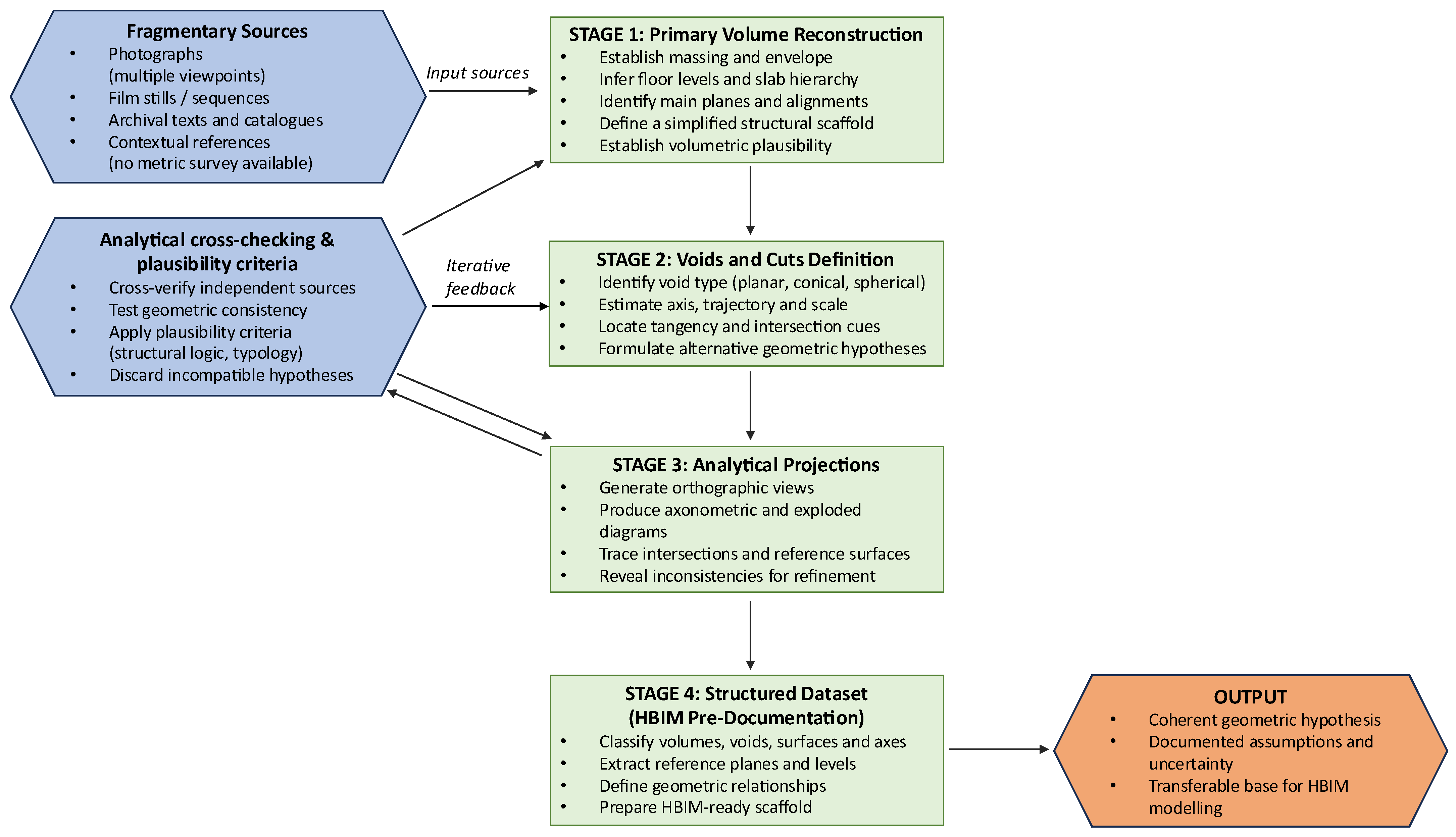
The geometric analysis workflow developed in this study is designed to reconstruct spatial information from fragmentary visual sources and to organise it into a coherent structure suitable for pre-documentation in heritage contexts. The workflow consists of four interconnected stages that reflect a progressive deepening of geometric interpretation, from initial volume reconstruction to the classification of spatial relationships. Although presented sequentially, these stages are iterative in practice: new information extracted during modelling often requires revisiting earlier steps, refining assumptions and adjusting geometric hypotheses. As summarised in
Figure 1, the workflow is conceived as an explicitly iterative and hypothesis-driven process, in which geometric assumptions are continuously tested, cross-checked and revised through analytical representations and plausibility criteria.
In this study, the term interpretative reconstruction refers to a methodological process aimed at organising and analysing incomplete spatial information rather than reproducing a metrically exact architectural state. Because the case study buildings were either inaccessible, severely degraded or no longer existed at the time of analysis, no direct surveys or metric measurements could be performed. The reconstruction process, therefore, relied on geometric reasoning, perspective-based inference and the cross-verification of multiple visual sources to establish coherent spatial relationships and volumetric configurations as well as on the explicit formulation and rejection of alternative geometric hypotheses when inconsistencies emerged.
The validity of this interpretative reconstruction does not stem from dimensional accuracy, but from internal geometric consistency and correspondence across independent sources. Alignments, proportions and spatial relationships were tested iteratively against photographic and filmic material, allowing implausible configurations to be discarded. In this sense, the resulting models should be understood as informed geometric hypotheses that reflect the most coherent interpretation of the available evidence, explicitly acknowledging uncertainty and the limits imposed by fragmentary documentation.
3.3.1. Stage 1: Reconstruction of the Primary Building Volume
The workflow begins by defining the approximate massing of the building prior to Matta-Clark’s intervention. Using perspective alignment, volumetric inference and comparison between multiple photographs, floor levels and major partitions are identified and recreated in simplified form. The aim at this stage is not architectural accuracy but establishing a stable geometric framework upon which subsequent analysis can build. This includes approximating wall planes, slab positions, façade thicknesses and the general organisation of the structure. Such simplification is consistent with early HBIM procedures, in which an initial geometric scaffold is required before integrating more detailed or interpretative features [
21]. However, the workflow proposed here differs in that it operates in the absence of direct survey data, relying instead on analytical reconstruction from visual and archival sources to establish this initial geometric framework.
In practical terms, Stage 1 is carried out through the identification of recurring spatial cues across the available visual material. These include consistent horizontal alignments corresponding to floor slabs, vertical planes defining façades or party walls, and repeated proportions visible across multiple photographs. Perspective alignment techniques are used to infer relative positions of structural planes, while comparisons between independent viewpoints allow implausible configurations to be detected and discarded. Simplified volumetric models are progressively adjusted until a coherent massing is obtained that is compatible with all available visual evidence. Configurations that generate contradictions, such as misaligned floor levels or volumetric overlaps that would imply structurally or spatially impossible configurations, are systematically rejected.
3.3.2. Stage 2: Identification and Definition of Cuts, Voids and Surfaces
Once the primary structure is established, the specific voids introduced by Matta-Clark are analysed. This stage focuses on interpreting the geometry of the cuts, whether spherical, conical, cylindrical or planar, and determining their position, orientation and scale. The method uses geometric markers such as tangent points, shadow directions, repeated openings and visual alignments to infer the properties of the voids. In cases such as
Circus and
Office Baroque [
24,
25,
26,
27,
28,
29,
30], where surfaces deviate from ideal geometric forms, this step involves a balance between analytic geometry and interpretative approximation. The purpose is to capture the essential behaviour of the voids as they interact with the building fabric.
In practical terms, Stage 2 is carried out through the progressive formulation and testing of geometric hypotheses regarding the voids introduced by the intervention. Starting from the reconstructed primary volume, the analysis focuses on identifying recurring geometric cues visible across multiple images, such as circular or elliptical boundaries, tangency points with slabs or walls, shadow curvature, and repeated alignments across floors. These cues allow the researcher to infer the probable geometric family of each void (planar, cylindrical, conical or spherical) and to propose an initial hypothesis regarding its axis, orientation and scale.
Once an initial hypothesis is defined, simplified geometric primitives are introduced into the digital model and tested against the available visual material. This testing involves verifying whether the projected intersections of the void with floors, walls and façades correspond consistently across different viewpoints and levels. When discrepancies emerge, alternative hypotheses are formulated and evaluated. Configurations that generate contradictions, such as misaligned intersections, inconsistent curvature across levels or implausible volumetric overlaps, are systematically discarded when they would imply structurally or spatially impossible configurations.
This iterative process ensures that the definition of voids is not driven by formal resemblance alone, but by their capacity to produce coherent and reproducible spatial relationships within the reconstructed building envelope. The resulting void geometry should therefore be understood as an informed geometric hypothesis, grounded in cross-checked visual evidence and internal consistency rather than in direct metric verification.
3.3.3. Stage 3: Axonometric, Orthographic and Sectional Analysis
At this stage, axonometric representations are intentionally produced prior to orthographic projections. Axonometric views are used as exploratory analytical tools to clarify the three-dimensional trajectory of voids across multiple levels, to identify which floors, walls and structural elements are intersected, and to detect spatial inconsistencies that may require revisiting previous stages of the workflow.
Orthographic projections and sectional drawings are subsequently generated once the spatial logic of the intervention has been clarified through axonometric analysis. In this sense, axonometrics do not replace orthographic drawings, but operate as a preliminary step that supports their correct interpretation by establishing the spatial relationships that orthographic views then describe in detail.
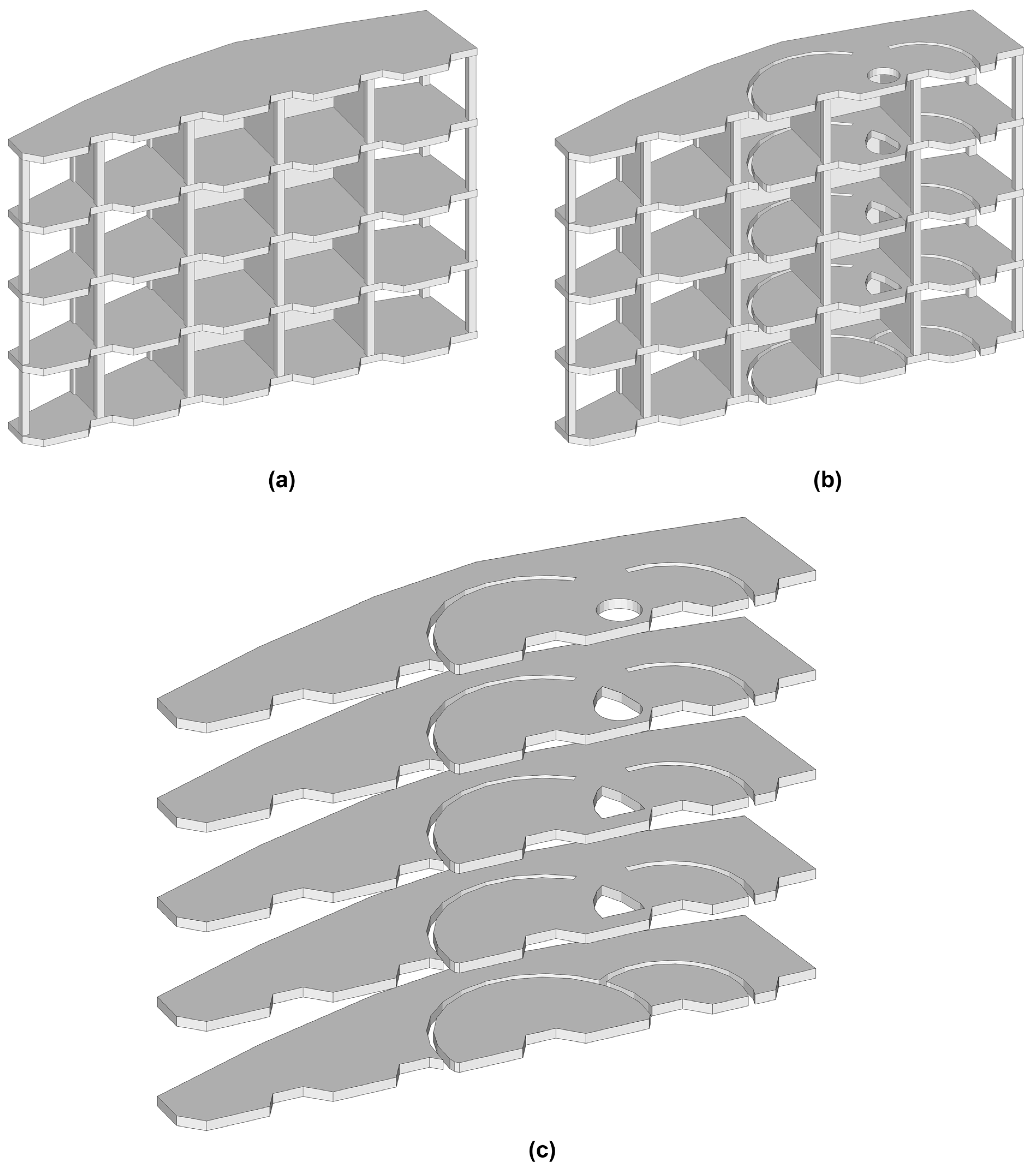
After modelling the cuts, the workflow proceeds to generate a series of projections that clarify internal spatial relationships. Axonometric views reveal how voids traverse the building across multiple levels, while orthographic drawings expose the profiles of intersections with walls, floors and façades. Sectional cuts, both vertical and horizontal, are used to identify relationships between curved surfaces and structural elements, such as beams, columns or slab edges. Exploded axonometric diagrams are especially effective in multi-level cases like
Office Baroque [
24,
27,
31], where separating floor plates makes it possible to analyse the sequence of openings. These representational tools transform complex three-dimensional geometry into readable two-dimensional information, enabling a systematic classification of spatial features.
3.3.4. Stage 4: Organisation and Classification of Geometric Information
The final stage involves categorising the reconstructed geometry into a set of components that can support early-stage HBIM. These components include:
Primary volumes (main massing and floor hierarchy);
Secondary volumes (cuts, voids, openings);
Reference surfaces (curved or planar geometries defining void boundaries);
Intersection lines (edges where voids meet slabs, walls or façade planes);
Directional axes (vectors defining the trajectory of conical or cylindrical cuts);
Structural relationships (points of contact, alignment or disruption).
This classification transforms interpretative modelling into a structured dataset, making the results useful for digital heritage workflows. The purpose is not to produce a detailed or parametric BIM model, but to provide the foundational geometric knowledge necessary for one. In contexts of degraded heritage, where documentation is incomplete, access is restricted and geometry is irregular, this structured approach offers a practical and efficient strategy for preparing future digital models.
3.3.5. General Remarks on the Workflow
The strength of the proposed workflow lies in its flexibility and in the explicit distinction it establishes between operational stages and contextual or analytical parameters. As illustrated in
Figure 1, the methodology is structured around four sequential stages (Stages 1–4), which constitute the core phases of the geometric reconstruction process and have been explicitly developed, tested and documented within the scope of this research.
These stages are arranged vertically to reflect their logical progression, from the reconstruction of the primary building volume to the generation of a structured geometric dataset suitable for HBIM pre-documentation. The transition from Stage 3 to Stage 4 is represented through a direct connection, emphasising the continuity between analytical projections and the consolidation of geometric information into an organised dataset.
In contrast, other elements represented in the workflow, namely Fragmentary Sources and Analytical cross-checking and plausibility criteria, do not constitute stages of the method. They function as transversal parameters that condition and inform the workflow without defining a sequential phase. These parameters represent external inputs and internal validation mechanisms that influence multiple stages of the process, but are not themselves operative steps developed as phases of the methodology.
Across all stages of the workflow, geometric reconstruction is supported by a explicit and reproducible visual-analytical criteria derived from the systematic reading of photographic and filmic material. This process does not rely on isolated images, but on the comparative analysis of multiple viewpoints in order to identify recurring spatial relationships and to test the plausibility of geometric hypotheses.
The visual analysis focuses on a limited set of observable cues, including: (i) the recurrence of floor slab alignments across different images; (ii) the continuity or interruption of vertical planes corresponding to façades, party walls or structural frames; (iii) the geometry of void boundaries as revealed by light conditions, shadows and edge curvature; and (iv) the relative positioning of openings, structural elements and circulation traces. These cues are evaluated through cross-checking across images taken from different positions and moments.
Analytical drawings and axonometric reconstructions function as tools for testing these visual observations rather than as final representations. When a proposed geometric configuration fails to reproduce consistent spatial relationships across multiple visual sources, it is revised or discarded. In this sense, drawings operate as instruments for verifying geometric coherence and identifying inconsistencies or implausible spatial outcomes.
By explicitly distinguishing between methodological stages and influencing parameters, the workflow clarifies how fragmentary visual evidence is translated into structured geometric knowledge, while acknowledging uncertainty as an inherent component of interpretative reconstruction.
3.4. Integration with HBIM Pre-Documentation
The geometric workflow developed in this study is explicitly designed to support the early stages of HBIM, particularly in contexts where conventional survey data is incomplete or inaccessible. Whereas standard BIM procedures rely on accurate measurements and predefined parametric components, HBIM for degraded buildings requires a preliminary interpretative phase in which spatial information is reconstructed, clarified and structured before a full model can be produced [
4]. The method presented here directly contributes to this preparatory stage by transforming fragmentary visual evidence into a coherent geometric dataset.
The first contribution of the workflow to HBIM pre-documentation is the definition of primary volumes and spatial hierarchies. By reconstructing the basic massing of the building and identifying key structural planes, the method establishes a geometric scaffolding that can serve as the backbone of a future digital model. This includes the identification of floor levels, wall alignments, façade planes and the overall volumetric organisation of the structure. Even when these elements cannot be measured directly, their inferred geometry provides essential reference points for later modelling stages.
A second contribution lies in the clarification of secondary volumes, such as voids, cuts and partially missing elements. In degraded buildings, voids are particularly informative from a geometric point of view because they reveal the spatial relationships between floors, walls and structural alignments that are otherwise concealed by finishes or enclosure. By intersecting multiple building elements, voids make visible changes in floor level, wall thickness and alignment, which can be analysed through simplified geometric representations. While such irregularities may be directly observable in photographic records, their geometric reconstruction allows them to be isolated, compared across levels and integrated into a coherent spatial framework. The workflow makes these voids explicit by modelling them as simplified surfaces or solids that can be translated into reference geometry within an HBIM environment. Once incorporated into a digital modelling platform, these elements help define intersections, boundary conditions and geometric irregularities relevant for interpreting the building’s existing condition.
A third contribution of the method is the extraction of intersection lines and geometric relationships, which form the basis of parametric constraints in HBIM. Because the workflow identifies where voids intersect floors, walls and structural elements, it creates a network of reference edges that can guide the generation of parametric objects. These intersection lines support the definition of grids, levels, alignments and axes, elements that are essential for maintaining coherence in a BIM model, especially when working with irregular geometries typical of heritage buildings.
The workflow also contributes to HBIM by providing reference surfaces and directional vectors derived from geometric analysis. Curved surfaces, conical trajectories and planar openings can be interpreted as guiding geometries that support subsequent modelling decisions. For instance, the axis of a conical void in
Conical Intersect [
24,
26,
27,
31] establishes a clear directional reference that can be compared with the alignment of floor plates and structural grids, helping to identify deviations or misalignments within the building geometry. Similarly, the curved openings in
Office Baroque [
24,
27,
31] intersect floor slabs at varying positions and orientations, allowing differences between levels to be compared and suggesting areas affected by deformation or successive alterations. In this sense, such geometric markers operate as analytical layers within the HBIM process, supporting interpretative reasoning without implying definitive structural assessment.
This method aligns with current HBIM approaches that emphasise interpretation over measurement in the early phases of documentation [
21]. In cases where parts of the building no longer exist, geometric reasoning becomes an indispensable tool for reconstructing missing information. The workflow formalises this reasoning process, ensuring that interpretative decisions are made transparently, systematically and in a way that can be integrated into later digital workflows. This is particularly valuable for buildings where documentation gaps would otherwise prevent the creation of a coherent digital model.
Finally, the workflow enhances the practical feasibility of HBIM for degraded heritage by relying on accessible and flexible tools. Because the method does not require precise surveying or advanced modelling software, it can be applied rapidly during preliminary analysis, allowing researchers to test hypotheses, compare alternative geometric configurations and adjust interpretations as new evidence emerges. The resulting geometric dataset (volumes, voids, intersections, surfaces and axes) constitutes a structured foundation that can be exported, reinterpreted or rebuilt in any BIM platform.
4. Case Studies
4.1. Conical Intersect
Conical Intersect (1975) is one of Matta-Clark’s most precise and mathematically defined interventions, making it particularly suitable for demonstrating the analytical potential of the geometric workflow developed in this study. The project was executed in two adjoining 17th-century buildings in the Les Halles district of Paris, shortly before their demolition. Matta-Clark carved a large conical void that pierced both structures, creating a continuous, tapering opening that extended across multiple floors and the street-facing façade. Unlike other interventions, where the geometry is partly improvised or responds irregularly to structural conditions,
Conical Intersect is characterised by a highly intentional form: a truncated cone whose axis passes diagonally through the buildings [
3,
14,
24,
25,
26,
27,
28,
31].
The reconstruction process began by establishing the approximate massing of the two attached structures, based on archival photographs and surviving documentation of the demolition site [
26,
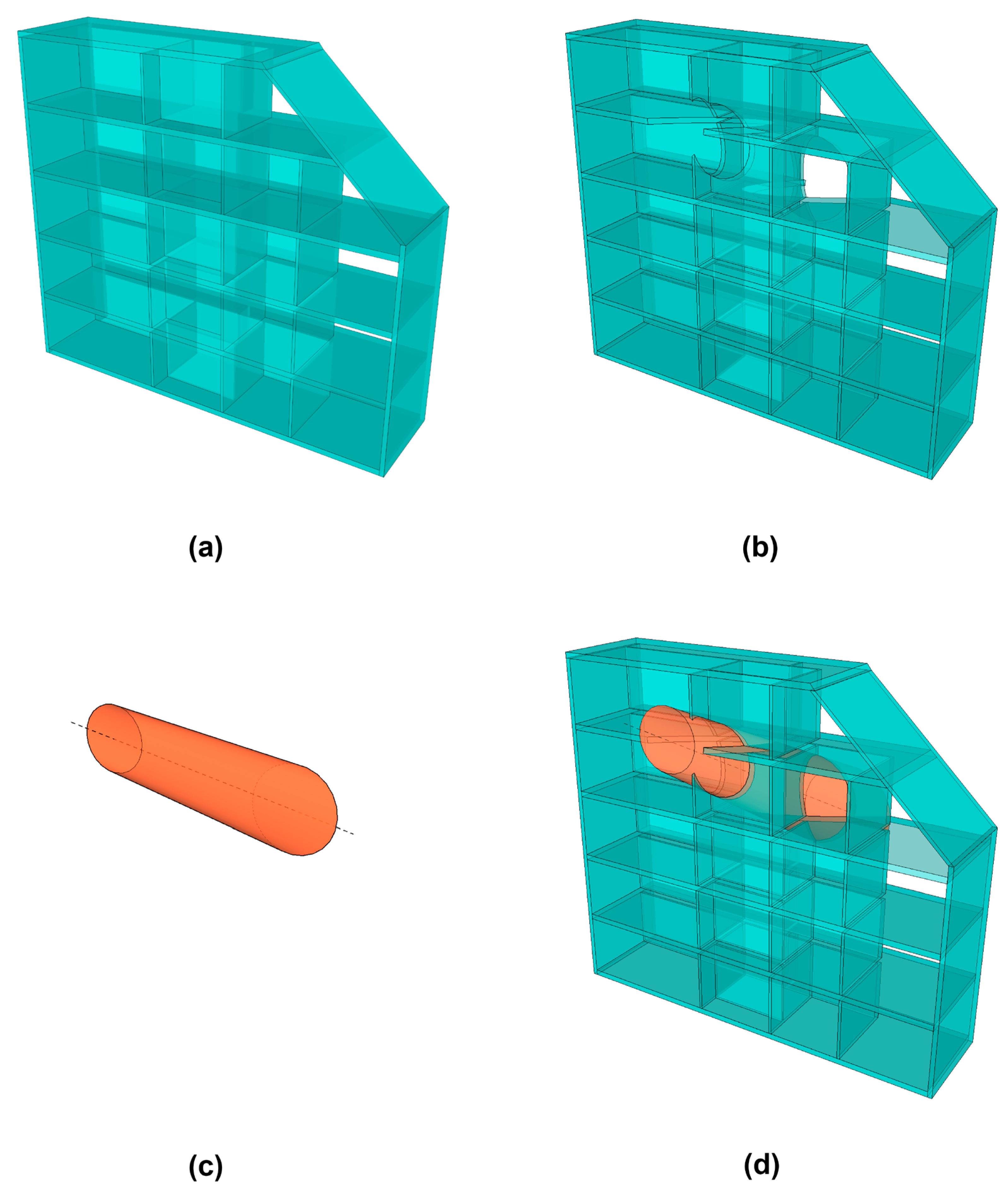
31]. Although complete drawings were not available, the main volumes, floor planes and façade alignments could be derived through perspective matching techniques, allowing a coherent three-dimensional base model to be created. Once the primary geometry of the buildings was identified, the analysis focused on defining the conical void, including its diameter, taper angle, axis orientation and intersection with floors, walls and the façade. This step-by-step geometric interpretation is illustrated in the axonometric reconstruction sequence presented in
Figure 2, which makes explicit the inferential steps through which fragmentary visual evidence is progressively translated into analytical geometry.
A key challenge in reconstructing Conical Intersect is determining the exact orientation of the cone in relation to the two adjoining buildings. Matta-Clark deliberately positioned the cone so that it intersected the façade at a dramatic angle, producing a large circular opening that visually framed the street beyond.
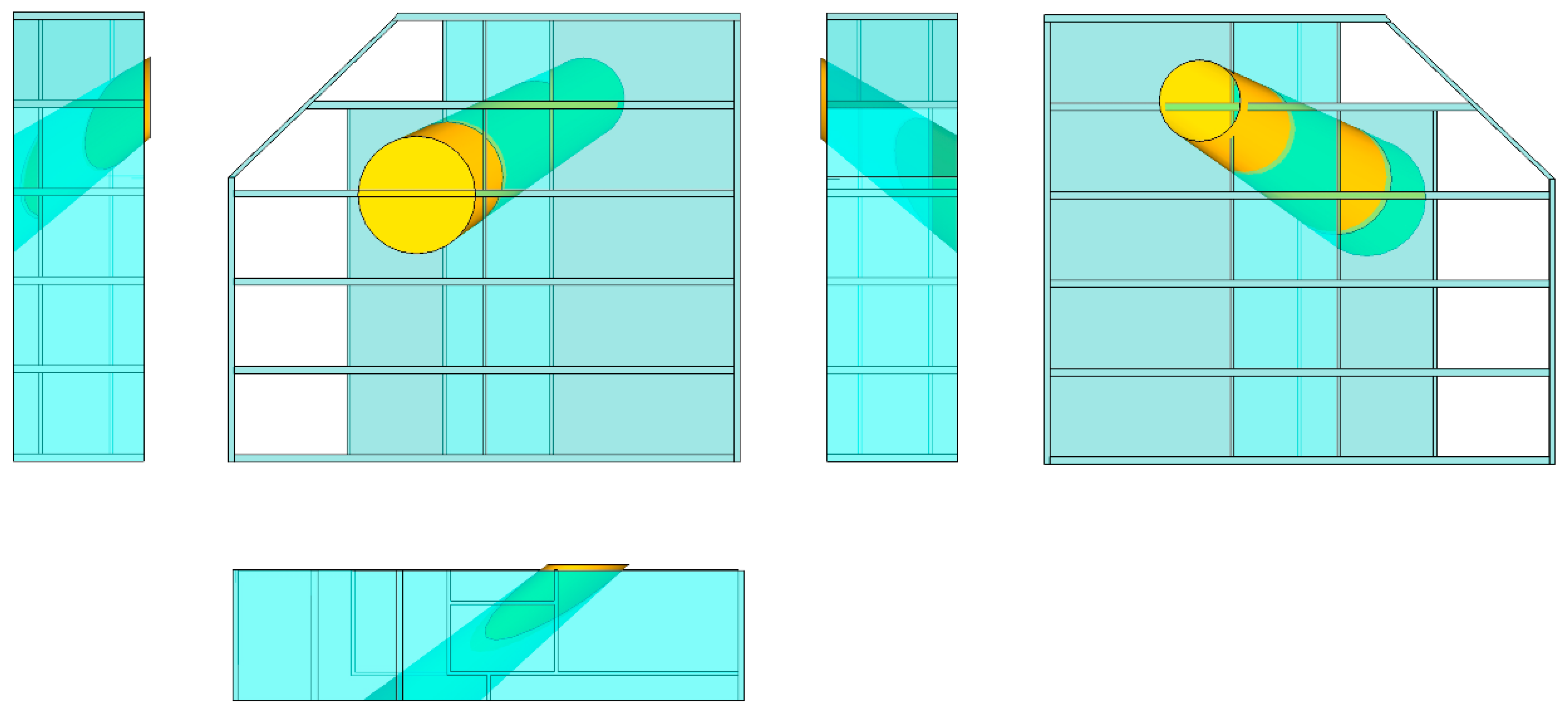
As the cone progresses through the building volume, it intersects floors and partitions at different heights, generating a sequence of circular and elliptical sections. When represented through multiple orthographic views, these intersections make it possible to visualize how a single geometric operation produces varying spatial conditions across levels, helping to infer the internal organization of the structure layer by layer.
To capture this behaviour, the method employs a set of orthographic projections and complementary axonometric diagrams that trace the cone’s axis and document how its geometry intersects the existing fabric across multiple levels, as shown in
Figure 3 [
3,
14,
24,
25,
26,
27,
28,
30,
31].
From a documentation perspective,
Conical Intersect illustrates how geometric reconstruction can clarify complex spatial relationships that are difficult to interpret solely from photographs. The cone operates as a systematic “sectional instrument,” by establishing a consistent geometric reference across multiple levels, allowing relative misalignments between floors, variations in spatial alignments and changes in section to be compared. Even though parts of the structures were already damaged or missing before the intervention, the geometric logic of the cone supports the interpretation of these spatial inconsistencies within a coherent three-dimensional framework. This interpretative capacity is particularly relevant for grey heritage research, where incomplete or distorted conditions are common [
3,
14,
24,
25,
26,
27,
28,
31].
The organised geometric dataset derived from
Conical Intersect demonstrates clear potential for the integration of HBIM pre-documentation workflows. The cone can be represented as a parametric solid; its intersections with floors generate curves that may serve as reference edges; and its axis can assist in defining spatial grids or levels within a BIM environment. In this sense,
Conical Intersect exemplifies how mathematically defined voids can support the identification of key architectural relationships in degraded or partially lost structures [
3,
14,
24,
25,
26,
27,
28,
31].
4.2. Day’s End
Day’s End (1975) represents a different kind of intervention within Matta-Clark’s work, one in which geometry is defined not by curved or volumetric cuts but by the subtraction of large planar sections. Executed inside an abandoned industrial shed on Pier 52 along the Hudson River in New York, the project involved removing portions of the façade, roof and floor to create expansive openings that framed views of the sky and water. Unlike other interventions, which operate through precise geometric volumes such as cones or spheres,
Day’s End transforms the building through broad, linear gestures that reveal its structural rhythm and expose the underlying steel framework [
24,
25,
27,
28,
30,
31].
The reconstruction of
Day’s End begins with defining the main envelope of the warehouse: a long, rectangular volume supported by a system of regularly spaced steel columns and trusses. Historical photographs show that the structure had already suffered significant deterioration before Matta-Clark’s intervention, with corroded metal surfaces, broken cladding and areas of partial collapse [
25,
28,
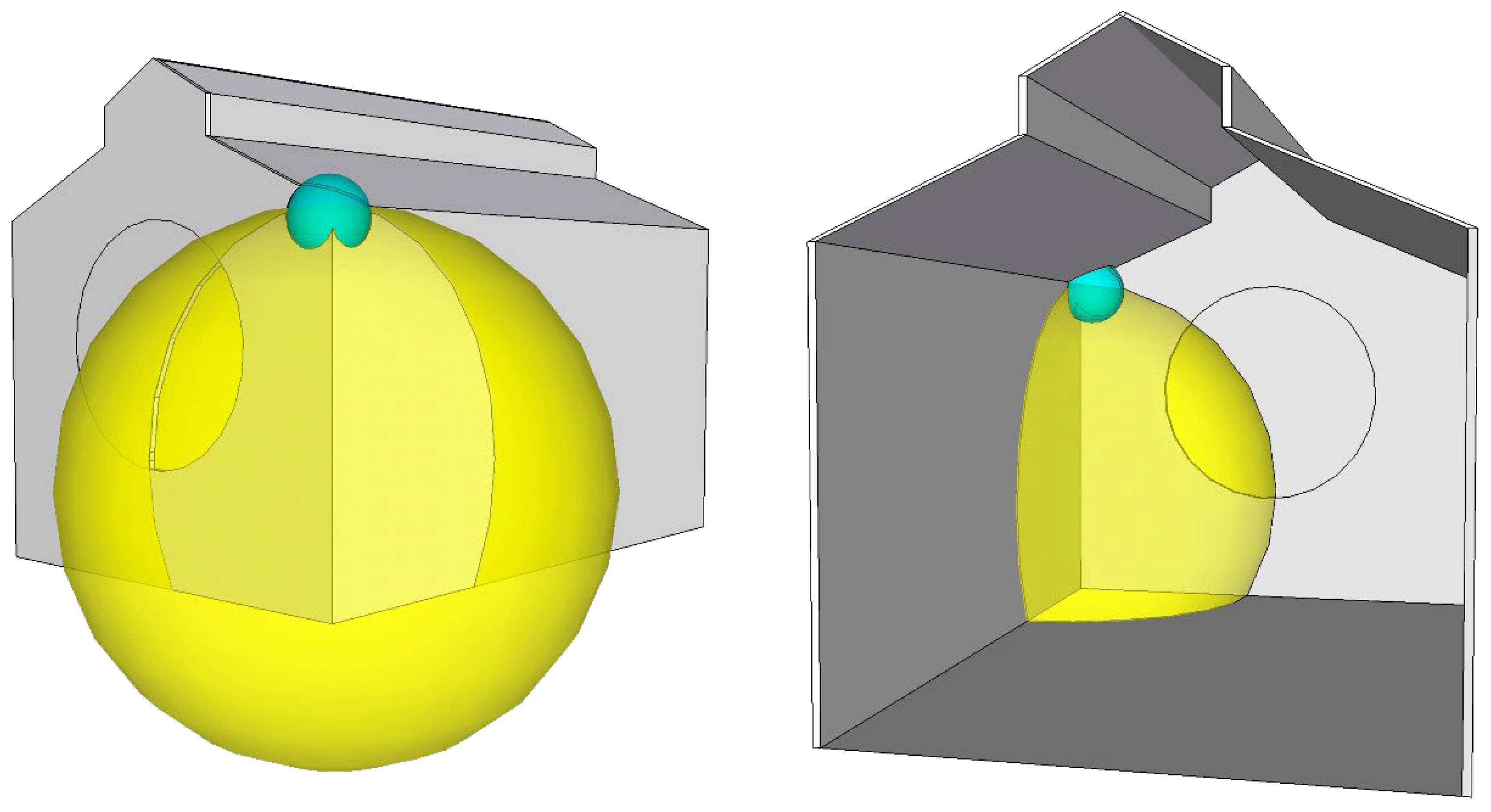
31]. This context resembles the conditions typical of grey heritage, where industrial buildings frequently exhibit advanced decay and minimal documentation. Using these sources, the primary geometry of the pier building was recreated as a simplified structural envelope, capturing the repetitive spatial logic of the steel frame without reproducing its exact structural detailing, while the spatial extent of the spherical cut was modelled to reflect its interaction with the envelope, as illustrated in
Figure 4.
The next step involved identifying the planar cuts executed by Matta-Clark. These include large vertical openings carved into the façade, which allow light to enter the dark interior, and horizontal cuts in the roof and floor that create dramatic voids connecting interior and exterior spaces. Unlike the spherical or conical cuts in other interventions, the openings in Day’s End are predominantly planar and irregular in outline, and their geometry appears closely conditioned by the existing structural layout and the spatial configuration of the industrial hall, as observed in
Figure 4 [
24,
25,
27,
28,
30,
31]. To analyse these relationships, a series of orthographic projections were generated to document how each cut aligns with the structural bays and primary spatial axes of the building. These projections are not presented as final drawings, but as analytical tools used to verify alignments between the planar cuts and the underlying structural grid.
One of the relevant aspects of
Day’s End for geometric analysis is the way planar cuts establish clear spatial relationships between the building envelope and the internal organisation of the structure. These analytical principles are not specific to this intervention, but are applicable to a wide range of degraded industrial buildings characterised by repetitive structures and partial enclosure. The removal of façade panels allows the identification of repetitive bays, primary axes and boundary conditions associated with the steel framework, as suggested by the axonometric reconstruction shown in
Figure 4 [
24,
31]. These relationships can be organised through axonometric representations that emphasise relative alignments and spatial repetition, without pursuing detailed structural resolution.
From an HBIM perspective, Day’s End provides an example of how planar subtraction can support early-stage geometric interpretation. Rather than reconstructing missing or damaged components directly, the analysis helps structure the available geometric information into reference planes, level relationships and grids that can inform later modelling stages. For industrial structures with incomplete documentation, this type of planar analysis can serve as a preliminary step within HBIM pre-documentation workflows.
4.3. Office Baroque
Office Baroque (1977) is one of Matta-Clark’s most intricate spatial interventions and offers a particularly rich context for examining how geometric analysis can support the documentation of complex, multi-level voids in degraded buildings. Executed inside an abandoned office block in Antwerp, the project consisted of a series of circular, elliptical and curved cuts that penetrated through several floors, creating an interconnected network of voids that exposed the internal organisation of the structure. Unlike projects such as
Conical Intersect, where the geometry is defined by a single mathematically controlled form,
Office Baroque operates through the accumulation and superposition of multiple curved openings. These cuts intersect floor plates at different heights and orientations, generating irregular spatial conditions that resemble the complexity often encountered in decaying urban buildings [
24,
25,
27,
31].
The reconstruction process began by modelling the general mass and structural framework of the office building, using available photographs and limited archival information. Although documentation of the building prior to the intervention was scarce, the main dimensions, slab positions and column layout could be inferred from repeated visual patterns and from the alignment of openings across floors. This initial model provided a simplified but coherent geometric base upon which the intervention could be analysed. Once this primary structure was established, the focus shifted to identifying the curved voids created by Matta-Clark’s cuts. Because these openings often deviate slightly from idealized geometric forms, their reconstruction required a combination of geometric approximation and interpretative reasoning to determine their curvature, orientation and depth.
One of the defining features of
Office Baroque is the way in which the curved voids interact differently with each floor plate. Rather than piercing the building in a single continuous gesture, the cuts create a sequence of overlapping openings that reveal partial sections of the floors above and below. To analyse these relationships, the reconstruction employs exploded axonometric representations that separate the floor slabs and isolate the curves generated at each level, as illustrated in
Figure 5. This approach makes it possible to compare the geometry of the voids across different floor levels and to identify recurring yet non-identical configurations generated by the intervention. In
Office Baroque, curved openings produce near-circular profiles on one slab and elongated or offset profiles on adjacent levels, depending on their angle of intersection with the floor plates. These variations highlight how a single geometric operation can generate differentiated spatial outcomes when applied to a non-uniform structural context. Such geometric variability is characteristic of degraded or modified buildings, where accumulated alterations and irregular floor alignments affect the resulting spatial configuration. Similar conditions are frequently encountered in abandoned or repeatedly altered buildings, in which successive transformations disrupt geometric regularity and complicate conventional documentation [
24,
25,
27,
31].
The geometric models presented for Office Baroque should be understood as simplified analytical representations developed for pre-documentation purposes. At this level of analysis, the objective is not to reproduce a fully resolved or structurally detailed architectural state, but to clarify spatial relationships, void trajectories and geometric interactions within the building volume.
As is common in early-stage HBIM workflows, structural solutions, construction details and load-bearing strategies are not explicitly modelled at this level of analysis, as they would require documentation that is not available for the case study. These aspects are typically addressed in later phases of HBIM development, when additional sources or survey data can be incorporated.
From a methodological perspective, the models function as a geometric and spatial framework that supports the organisation of spatial relationships and can inform more detailed interpretations in later stages of HBIM development.
In addition to revealing geometric patterns,
Office Baroque provides insight into the internal structural logic of the building. The curved cuts intersect slab edges, columns and beam alignments, creating sectional conditions that clarify the spatial relationships between these elements across multiple levels. Beyond the mere exposure of structural components that may already be visible, the cuts generate continuous geometric traces that make vertical alignments, offsets and intersections legible even where portions of the fabric are missing or incomplete [
24,
25,
27,
31].
By analysing the relationship between the reconstructed void geometry and the existing structural frame, it becomes possible to identify alignments, discontinuities and constraints that contribute to an understanding of the building’s internal organisation despite its deteriorated condition. This type of interpretative reconstruction is particularly relevant for grey heritage contexts, where structural fragments often remain as the primary source of spatial information.
From an HBIM pre-documentation perspective,
Office Baroque provides a useful case for examining how geometric analysis can help organise irregular spatial information prior to formal BIM modelling. The reconstructed curves may be translated into reference surfaces, while their intersections with floor plates allow level relationships and spatial anchors to be identified and described. This process does not aim to supply complete building information, but instead supports the structuring of fragmented visual evidence into a coherent geometric framework that may inform subsequent HBIM development. In this context, the case highlights the potential role of geometrically driven interpretation not as a prerequisite condition, but as a methodological lens for analysing degraded architectural environments characterised by fragmentation and incomplete records [
24,
25,
27,
31].
4.4. Circus: The Caribbean Orange
Circus: The Caribbean Orange (1978) is one of Matta-Clark’s most spatially complex interventions and offers a suitable case for testing the geometric workflow proposed in this study. The project was carried out inside a large, abandoned house in Chicago, where a series of spherical void-generating geometries intersect floors and walls, producing cylindrical and conical openings. Instead of functioning as isolated operations, these openings form a system of interconnected volumes that reconfigure the internal spatial continuity of the building. This interconnected behaviour is representative of many degraded residential buildings in which successive modifications and partial collapses disrupt original spatial hierarchies. The resulting configuration exposes alignments, irregularities and traces of previous alterations embedded within the existing fabric [
24,
25,
27,
28].
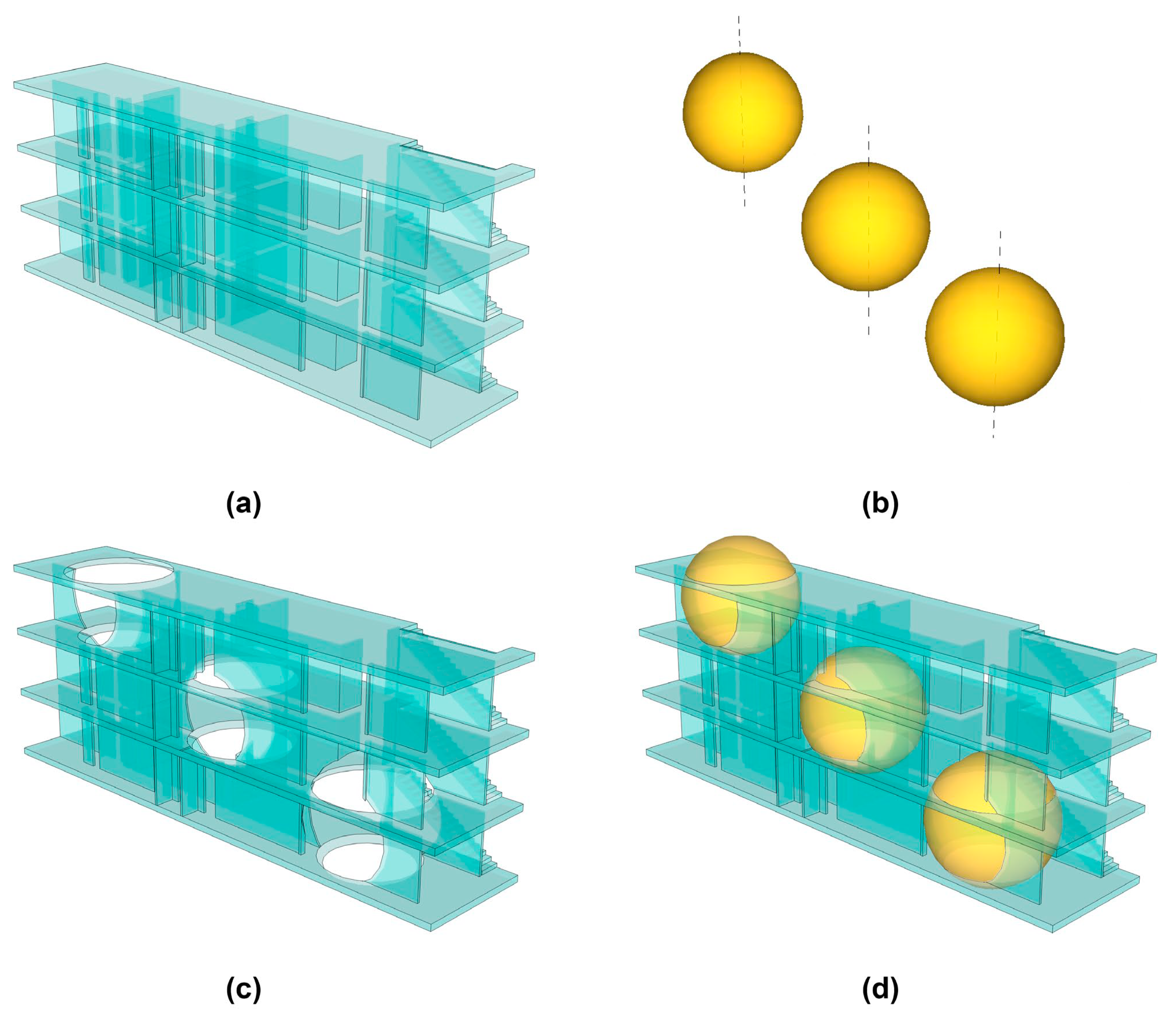
The reconstruction process began with modelling the approximate massing of the building based on available photographs and archival sources. Although original drawings of the house were incomplete, basic proportions and the overall structural layout could be inferred through perspective matching and comparison between multiple viewpoints. Once the primary volume was established, the analysis focused on identifying the position, orientation, and scale of the spherical and conical voids introduced during the intervention. This required examining the curvature of the cuts, the direction of their axes and the manner in which they intersect slabs, partitions and load-bearing walls, as illustrated in
Figure 6.
One of the main analytical challenges presented by
Circus lies in the irregular interaction between the voids and each floor level [
24,
25,
27,
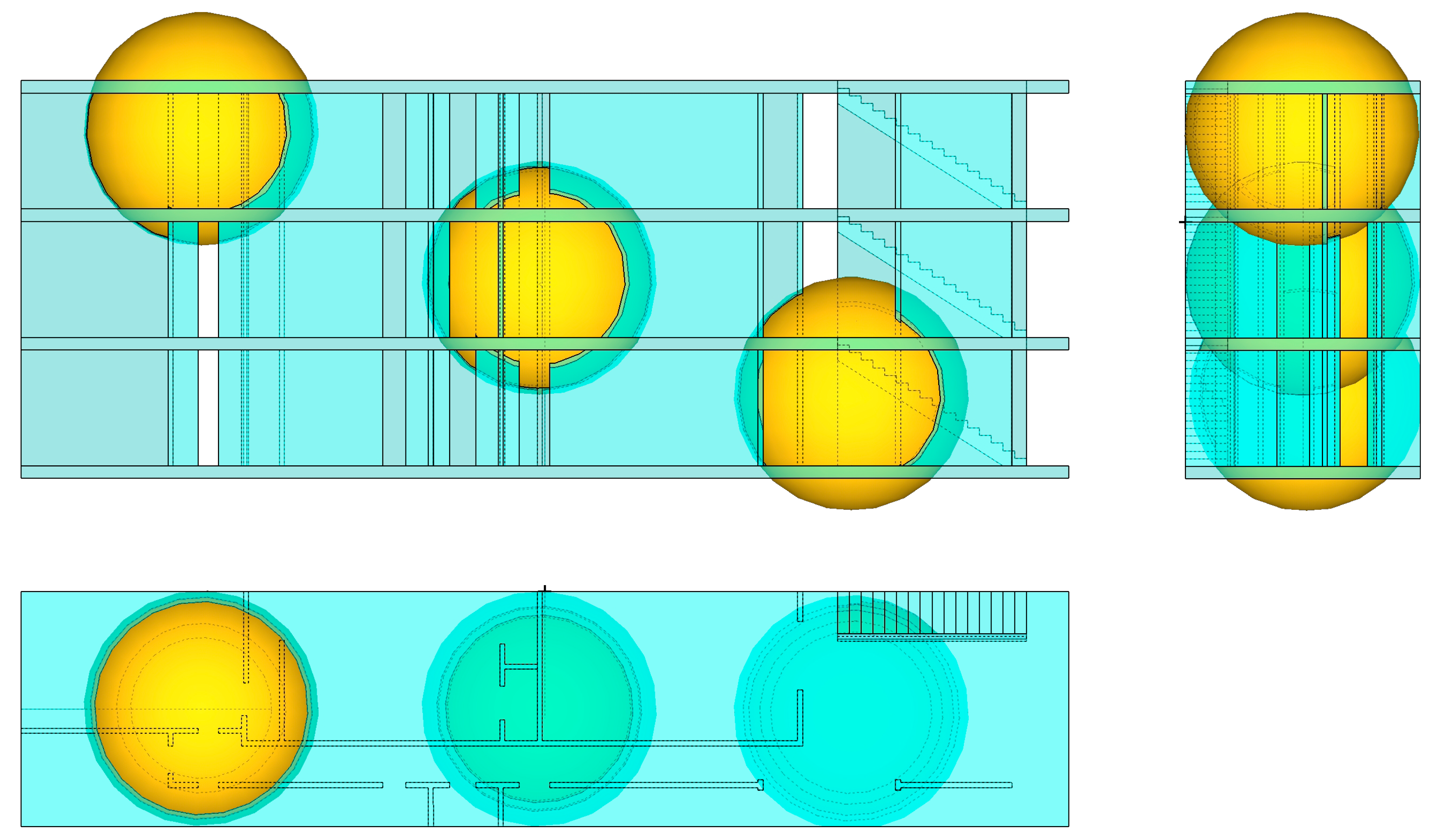
28]. Instead of following a uniform vertical alignment, the cuts adapt to variations in floor thickness, slab position and internal partitions, resulting in slight shifts as they traverse the building. To document this behaviour, the reconstruction employed axonometric and exploded views that isolate individual floor plates and clarify how each void intersects successive levels. These orthographic representations complement the axonometric reconstruction by clarifying the spatial relationships between curved surfaces and horizontal planes at specific levels. The sections and plan views support the interpretation of how the cuts intersect slabs and walls, particularly in areas where the three-dimensional configuration may be less legible in perspective views alone, as illustrated in
Figure 7.
From a documentation perspective,
Circus illustrates how void-based analysis can assist in interpreting complex and fragmented spatial conditions in degraded buildings. The curved voids generate intersecting surfaces that make variations in wall geometry and spatial alignment more legible through geometric reconstruction, even when direct observation is limited. This approach supports the organisation of fragmentary spatial evidence and helps situate partial or altered elements within a coherent geometric framework, which is particularly relevant in grey heritage contexts [
24,
25,
27,
28].
The organised geometric dataset derived from Circus also exemplifies how this method can support HBIM pre-documentation. By translating the intervention into a structured set of volumes, intersections and directional axes, it becomes possible to outline key spatial elements that may later be converted into BIM components. For instance, spherical voids can be represented as parametric surfaces, their intersections with floors can define reference lines, and the vertical progression of the cuts can inform level definitions or structural grids within an HBIM environment. Although the reconstruction remains interpretative rather than survey-based, it provides a consistent geometric foundation aligned with early-stage digital modelling requirements.
5. Discussion
Building on the state of the art discussed in the Introduction, the results obtained from the four case studies show that geometric analysis can serve as an effective and adaptable strategy for documenting degraded or inaccessible buildings. Across all interventions, the reconstruction of volumes, voids and intersections allowed the main spatial relationships of the structures to be clarified, even when the available information was fragmentary or distorted. This confirms that analytical geometry is a powerful tool for addressing many of the challenges commonly associated with grey heritage, where direct measurement and digital surveying are often not possible.
As summarised in
Table 1, the four case studies address different geometric conditions and documentation constraints, allowing the workflow to be evaluated across a range of spatial scenarios.
A key contribution of the method lies in its capacity to support the analysis of spatial relationships that are not always immediately legible in photographic or fragmentary archival documentation. Across the four case studies, geometric reconstruction enabled the comparison of how voids, cuts and openings intersect floors, walls and structural systems under different conditions. Rather than revealing hidden features directly, the method provides a structured framework for organizing and interpreting incomplete spatial information derived from degraded or inaccessible buildings. Together, these insights suggest that the workflow can accommodate a wide range of spatial and geometrical conditions, from controlled mathematical forms to irregular and multi-directional voids.
Another important aspect is the compatibility of the geometric workflow with the needs of HBIM pre-documentation. In this sense, the workflow operates as an intermediate methodological layer between fragmentary visual documentation and full HBIM development, as anticipated in the conceptual framework of the study. The method does not aim to replace full BIM modelling but to generate the structured geometric data that a future HBIM model would require, such as primary volumes, reference planes, axes, curved surfaces and intersections. The diversity of geometries across the four case studies confirms that the workflow can adapt to different building types and levels of deterioration. Rather than relying on the presence of explicit or artist-generated geometries, the method operates through the identification and organisation of existing spatial discontinuities, making it applicable to early stages of documentation in heritage contexts where conventional survey methods cannot be applied.
Although the workflow is illustrated through interventions by Gordon Matta-Clark, its applicability is not limited to this specific context. The method is designed for situations in which buildings are inaccessible, severely degraded or partially lost, and where conventional survey techniques cannot be applied. Typical scenarios include abandoned industrial structures, buildings awaiting demolition, post-disaster environments, or heritage sites documented primarily through historical photographs and archival material.
More specifically, suitable grey heritage cases for the application of this workflow are characterised by a combination of spatial discontinuity, partial loss, physical inaccessibility and the absence of reliable metric documentation. Priority may be given to buildings of recognised cultural, social or historical relevance whose physical condition prevents conventional survey, but for which fragmentary visual or archival records are available. In this sense, the method is particularly appropriate for cases where the urgency of documentation contrasts with the impossibility of direct measurement, and where geometric interpretation represents the only viable means of reconstructing spatial information.
In such contexts, geometric analysis provides a means of organising fragmentary visual information into a coherent spatial framework that can support early-stage documentation and subsequent digital modelling. The workflow is particularly suited to cases characterised by clear geometric transformations, discontinuities or voids, while its applicability decreases in situations where no visual documentation is available or where continuous metric accuracy is required.
This contribution directly addresses the gap identified in current HBIM-oriented methodologies, which tend to presuppose the availability of reliable metric data and overlook the early interpretative stages required for severely degraded or inaccessible heritage. While previous studies have addressed either advanced digital surveying or isolated cases of interpretative reconstruction, the proposed approach bridges these domains by structuring geometric reasoning, projection-based analysis and simplified modelling into a coherent and transferable methodology. This methodological contribution also represents an opportunity for heritage documentation practices facing increasing numbers of inaccessible, degraded or ephemeral buildings. By operating at an early interpretative stage, prior to full HBIM development, the method provides a practical means of transforming fragmentary visual evidence into organised spatial information. In this sense, the contribution of the study lies in offering a reproducible framework that complements existing HBIM and survey-based approaches by addressing a critical gap at the pre-documentation phase.
Beyond the specific scenarios discussed above, the workflow demonstrates potential for broader application. The analytical processes employed (simplified modelling, projection-based interpretation and geometric classification) are not dependent on artistic interventions but can be applied to buildings characterised by spatial fragmentation, partial loss or irregular transformations, and by incomplete or limited documentation. This applicability is independent of the building’s level of formal heritage recognition or protection, provided that cultural, social or historical relevance can be identified and that conventional survey data are unavailable. The approach is especially suited to the initial stages of digital documentation, where clarity, interpretative flexibility and geometric consistency are more important than detailed parametric modelling.
Existing approaches to documenting inaccessible or degraded buildings often rely on advanced survey methods such as laser scanning, photogrammetry or dense image modelling [
4,
6]. While these techniques provide high levels of precision when conditions allow, they require physical access, stable surfaces and sufficient visibility, requirements that many grey heritage buildings do not meet. In contrast, the method proposed in this study operates in contexts where such data cannot be obtained, offering an interpretative workflow that prioritises spatial reasoning over measurement accuracy. Rather than competing with conventional survey techniques, it complements them by addressing an earlier and more uncertain phase of documentation. Therefore, the study offers not merely a descriptive analysis of Matta-Clark’s work, but an operational framework applicable to a wide variety of undocumented heritage conditions characterised by spatial fragmentation and incomplete geometric information.
The proposed workflow also presents several limitations that should be explicitly acknowledged. Because the reconstruction is based on fragmentary visual sources, the resulting geometry cannot be interpreted as metrically accurate and relies on proportional inference rather than measurable data. The workflow is therefore more suited to early-stage analysis, conceptual clarification and HBIM pre-documentation than to the production of detailed parametric models. A further limitation concerns the dependency on the quality and diversity of the available visual material, as ambiguous or inconsistent imagery may require multiple hypothetical reconstructions and leave certain spatial configurations unresolved. In this context, the validity of the results is not assessed in metric terms, but through qualitative criteria such as internal geometric coherence, consistency across multiple visual sources, and the reproducibility of the workflow when applied to different cases.
Nevertheless, these limitations are inherent to the study of degraded or lost buildings and do not undermine the method’s value as a structured interpretative tool for organising incomplete geometric information.
6. Limitations and Future Research
6.1. Limitations of the Study
The methodological framework proposed in this study is subject to a set of constraints that are inherent to the documentation and analysis of degraded, inaccessible or no-longer-existing buildings. These limitations do not undermine the validity of the workflow, but they define the epistemological and operational context in which the method operates.
A first limitation concerns the exclusive reliance on fragmentary visual and archival sources. Because the case study buildings were either inaccessible, severely deteriorated or demolished at the time of analysis, no direct surveys, metric measurements or laser-scanning data could be obtained. In addition, at the time when Gordon Matta-Clark carried out the interventions, advanced digital survey techniques such as laser scanning or dense image-based modelling were not yet available. As a result, no systematic metric documentation of the buildings was produced during the interventions themselves.
The geometric reconstruction is therefore necessarily interpretative, and based on proportional inference, perspective analysis and cross-verification of heterogeneous visual material. This condition, however, is not specific to the selected case studies but is representative of a broad range of grey heritage contexts, where conventional survey techniques are structurally unfeasible.
A second limitation relates to copyright and reproduction constraints associated with Gordon Matta-Clark’s work. Due to intellectual property restrictions, original photographs and film material could not be reproduced in full within the article. The analysis, therefore, relies on analytical drawings, reconstructed diagrams and references to publicly accessible archival repositories. While these restrictions limit the amount of primary visual material that can be directly included in the present scientific article, they do not affect the methodological validity of the workflow, which is designed to operate independently of the specific images reproduced in the publication.
A third limitation concerns the impossibility of a posteriori empirical verification of the reconstructed geometry. Given the temporal distance from the interventions and the disappearance of the original buildings, it is not possible to validate the reconstructed configurations through physical inspection or direct measurement. Consequently, the results should not be interpreted as metrically exact reconstructions, but as coherent geometric hypotheses grounded in internal consistency, cross-checked sources and plausibility criteria. This limitation is intrinsic to any attempt to document lost or inaccessible heritage and reinforces the need for transparent, hypothesis-driven and explicitly interpretative workflows such as the one proposed.
Taken together, the limitations outlined above are not accidental shortcomings of the proposed methodology, but conditions that are inherent to the investigation of grey heritage contexts. They reflect the material instability, documentary scarcity and inaccessibility that characterise this category of built heritage. Importantly, these constraints do not constitute critical or structural limitations of the proposed workflow, nor do they undermine the scientific validity of the study.
The methodology has been explicitly designed to operate within this defined field of action, where incomplete data, interpretative reasoning and hypothesis testing are unavoidable. As in all research processes, the explicit identification of such constraints serves to clarify the perimeter of applicability of the method, without calling its internal coherence or analytical robustness into question. Within this perimeter, the workflow remains consistent, reproducible and scientifically sound.
Consequently, the identified limitations do not invalidate the research outcomes. They establish a clear epistemological and operational framework that delineates the scope of the investigation and provides a transparent basis upon which future studies may expand, refine or complement the proposed approach.
6.2. Future Research Directions
The limitations identified in the present study do not represent a failure of the proposed methodology, but a deliberate delimitation of its field of application. By explicitly defining these conditions, the study establishes a clear starting point from which future research may extend the workflow, either by incorporating additional data sources, expanding its scope or adapting it to different grey heritage scenarios.
Future research may extend and refine the proposed workflow in several complementary directions. A first line of development involves applying the methodology to real-world grey heritage cases that are still extant but partially inaccessible, such as abandoned industrial buildings, post-industrial infrastructures or structures awaiting demolition. In such contexts, the workflow could be combined with partial surveys, limited photogrammetric datasets or selective access, allowing comparative analysis between interpretative reconstruction and available metric data.
A second research direction concerns the integration of the proposed geometric workflow with emerging digital technologies. Future studies could explore how interpretative geometric reconstruction may be complemented by incomplete or low-resolution scan data, image-based modelling or AI-assisted feature recognition, particularly in situations where data coverage is uneven or fragmented. Rather than replacing geometric reasoning, these technologies may operate as additional layers of evidence within the hypothesis-testing and cross-checking stages of the workflow.
A third line of future research involves the formalisation of uncertainty and validation protocols within HBIM pre-documentation. Comparative reconstructions produced by different researchers, alternative geometric hypotheses and explicit uncertainty mapping could be incorporated into the workflow to further enhance transparency and reproducibility. Such developments would strengthen the methodological robustness of interpretative reconstruction approaches and contribute to broader discussions on knowledge production in the digital documentation of degraded or marginal heritage.
Together, these future directions position the proposed workflow not as a closed or case-specific solution, but as an adaptable methodological framework capable of evolving alongside advances in digital documentation, modelling technologies and critical heritage research.
7. Conclusions
This study presents a geometric method for analysing and interpreting buildings that are inaccessible, degraded or no longer exist, addressing a critical gap in the documentation of grey heritage. By applying the proposed workflow to four interventions by Gordon Matta-Clark, the research shows that spatial relationships, volumetric configurations and internal alignments can be explored even when only fragmentary visual and archival evidence is available.
Rather than aiming to produce metrically precise reconstructions, the approach focuses on establishing a coherent and reliable geometric foundation suitable for early-stage documentation and HBIM pre-documentation. Its contribution lies in formalising an interpretative, hypothesis-driven workflow capable of operating in contexts where conventional survey technologies cannot be applied due to physical, temporal or documentary constraints.
The application of the method to Matta-Clark’s interventions should be understood as a proof of concept, illustrating how geometric reasoning and analytical representations can support the interpretation of complex and fragmented architectural conditions. The diversity of geometrical configurations examined, ranging from mathematically defined voids to irregular multi-level openings, suggests that the workflow may be adaptable to a range of degraded or marginal scenarios characterised by partial loss, inaccessibility and uncertainty.
In this sense, the study contributes not by proposing definitive reconstructions, but by articulating a structured methodological framework for translating fragmentary spatial evidence into organised geometric knowledge. By explicitly embracing interpretation, uncertainty and hypothesis testing as integral components of the documentation process, the proposed workflow offers a robust and transferable foundation for future HBIM-oriented research on grey heritage.





 ,
,