Article

The Effect of Essential Oils on Rumen Microbiota: Analysis of the Correlation Between Antibacterial Activity and Fermentation Modulation In Vitro

by
Aleksandra Tabiś
1,
Natalia Pachura-Hanusek
2,
Kamila Lewandowska
2,
Dominika Jankowska-Wachowska
2,†,
Antoni Szumny
3,
Jacek Bania
1 and
Robert Kupczyński
2,*
1
Department of Food Hygiene and Consumer Health Protection, Faculty of Veterinary Medicine, University of Environmental and Life Sciences, Norwida St. 31, 50-375 Wrocław, Poland
2
Department of Environment Hygiene and Animal Welfare, The Faculty of Biology and Animal Science, Wrocław University of Environmental and Life Sciences, Chełmońskiego St. 38c, 50-375 Wrocław, Poland
3
Department of Biocatalysis and Food Chemistry, Faculty of Biotechnology and Food Science, Wrocław University of Environmental and Life Sciences, Norwida St. 25, 50-375 Wrocław, Poland
*
Author to whom correspondence should be addressed.
Current address: Psia Dolina, Marusarzówny St. 8, 58-100 Świdnica, Poland.
Appl. Sci. 2026, 16(4), 2047; https://doi.org/10.3390/app16042047
Submission received: 31 December 2025 / Revised: 27 January 2026 / Accepted: 3 February 2026 / Published: 19 February 2026

Abstract

This study aimed to quantitatively determine the composition of 25 essential oils (EOs) using gas chromatography–mass spectrometry (GC-MS) to assess their minimum inhibitory concentrations (MICs) against selected rumen microorganisms and to confirm their effects in in vitro tests on volatile fatty acid (VFA) formation. GC-MS analysis identified over 80 compounds across the tested oils. The MICs were determined for Butyrivibrio fibrisolvens, Prevotella albensis, Lactobacillus delbrueckii ssp. lactis, and Streptococcus bovis, revealing diverse sensitivities. The rumen bacteria’s sensitivity to essential oils varied by strain, with some microorganisms inhibited at low concentrations while others required higher doses, highlighting the potential for targeted modulation of the rumen microbiota. Amyris balsamifera and Zingiber officinale demonstrated strong inhibitory effects at low concentrations and simultaneously enhanced VFA production. In contrast, Lavandula officinalis showed inhibitory effects on VFAs. Amyris balsamifera and L. officinalis also exhibited methane reduction. These findings demonstrate that selected essential oils can modulate rumen microbiota and fermentation by either inhibiting or stimulating specific bacterial groups, highlighting their potential as natural modulators to improve rumen function and animal health.

1. Introduction

In recent years, there has been growing interest in natural bioactive compounds, including essential oils (EOs), as a promising alternative to antibiotic growth promoters and synthetic feed additives [1,2,3,4,5]. Essential oils are complex mixtures of volatile secondary metabolites of plant origin, characterized by antibacterial, antioxidant, and anti-inflammatory properties [6,7,8]. The largest chemical group of essential oils is terpenes (monoterpenes and sesquiterpenes), often accompanied by phenols, alcohols, aldehydes, ketones, esters, and other oxygenated hydrocarbon derivatives [9,10,11,12]. At present, there are relatively few studies simultaneously evaluating the chemical composition of numerous essential oils obtained from different plant materials.
The activity of EOs against Gram-positive and Gram-negative bacteria has been widely described, but the effects of individual oils on the rumen microbiota remain poorly understood [11,13,14]. Importantly, essential oils may have a bidirectional effect, inhibiting the growth of some microorganisms while stimulating others, which suggests their potential as selective modulators of rumen fermentation rather than merely broad-spectrum antimicrobial agents [4,15,16,17]. Furthermore, as shown by a recent review, there is a lack of research on the appropriate doses and mechanisms through which essential oils affect methane emissions in ruminants [18]. It is crucial to understand the relationship between the dose of these metabolites, the rumen microbiome, and methanogenesis to maximize the effectiveness of supplementation [15].
The rumen microbiota plays a key role in digestive processes and the overall health of ruminants, determining feed fermentation efficiency, nutrient availability, and methane emissions [4,5,15]. Therefore, maintaining a stable and functionally diverse community of microorganisms in the rumen is essential for ensuring optimal animal productivity and sustainable animal production. On the other hand, disturbances in the microbiological balance of the rumen, caused by changes in nutrition, environmental factors, or infections, can lead to impaired fermentation processes and reduced animal performance. It has been shown that supplementation with an appropriate dose of essential oil alters the composition of the rumen microbiota and affects digestive enzymes as well as short-chain fatty acid profiles [19]. In one of the most recent studies, essential oils from Rosmarinus officinalis and Zingiber officinale were shown to influence metabolic parameters in dairy cows, including the fatty acid profile of milk [20]. In many studies, essential oil doses were determined based on the literature. However, to achieve such goals, it is crucial to develop more standardized methods for essential oil extraction and, above all, to establish a safe dosage for supplementation in animal diets [21].
Current research increasingly focuses on the possibility of precisely shaping the composition of rumen microbiota in order to increase fermentation efficiency and reduce energy losses in the form of methane [22]. Despite numerous studies describing the qualitative impact of essential oils on fermentation processes in the rumen, the quantitative relationships between their chemical composition, antibacterial activity, and ability to modulate the microbiota in vitro remain unclear. Essential oils, which are complex mixtures of monoterpenes and phenols, have been shown to modulate rumen microbial activity while affecting volatile fatty acid (VFA) ratios and methane production [4,5,13,23,24]. However, despite promising results, there are some discrepancies between in vitro and in vivo studies, and the standardization of methods (for determining the MICs of volatile substances) remains a methodological challenge [8]. Properly selected EO mixtures can have synergistic effects in reducing CH4 emissions without significantly inhibiting fermentation [4]. Although recent studies indicate that 3-nitrooxypropanol (3-NOP) is an effective inhibitor of methane emissions in cows, the findings are somewhat controversial [25]. Natural compounds appear to be an attractive alternative to antibiotic growth promoters and coccidiostats such as monensin or 3-NOP because they have the ability to modulate rumen microbiota and inhibit methanogens, which translates into reduced methane emissions in in vitro models and some in vivo studies [2,26,27,28]. EO blends have also been reported to lower methane and ammonia formation in vitro and, in some cases, in vivo—supporting their potential as scalable “natural” methane-mitigation tools [29]. Despite numerous studies on the qualitative effects of essential oils on rumen fermentation, there remains a lack of systematic and quantitative data linking their chemical composition, strain-specific antibacterial activity (MIC), and effects on rumen fermentation parameters under standardized in vitro conditions. Therefore, the present study addresses this knowledge gap by integrating GC–MS analysis, MIC determination, and in vitro fermentation assays to provide a rational basis for the targeted use of essential oils in sustainable ruminant nutrition.
This study aimed to quantitatively determine the composition of 25 essential oils using gas chromatography coupled with mass spectrometry (GC-MS), to determine the minimum inhibitory concentrations (MICs) for selected microorganisms in the rumen of cows, and to confirm these effects on the formation of VFA profiles in in vitro tests. We hypothesize that selected essential oils have the potential to modulate the rumen ecosystem, which may be crucial in fermentation processes. This research is important for the development of sustainable feeding practices and reducing the environmental impact of ruminant farming by reducing methane emissions.

2. Materials and Methods

2.1. Chromatographic Analysis of Essential Oils

The essential oils used in this study were purchased from a reputable commercial supplier (Herbiness Sp. z o.o., Chomiec, Poland, and Avicenna Oil, Wrocław, Poland). The oils were selected from a group of the most widely available oils at relatively low prices and based on preliminary literature data concerning their actual biological activity. For analysis, samples were prepared by adding 20 µL of essential oil to 980 µL of dichloromethane (GC-MS grade, Sigma-Aldrich, Darmstadt, Germany), after which the solutions were transferred into chromatographic vials. Their chemical composition was analyzed using a gas chromatograph coupled with a mass spectrometer (GC-MS; Shimadzu GC-MS QP 2020, Shimadzu, Kyoto, Japan) and GC-MS Bruker Scion 8900 (Bruker Daltonics, Billerica, MA, USA). The volatile compounds were separated using a Zebron ZB-5 MSi capillary column (30 m × 0.25 mm × 0.25 µm; Phenomenex, Torrance, CA, USA).
The GC-MS operating conditions were set as follows: a mass spectrometer scan range of 50–350 m/z at a rate of 0.3 scans·s−1, with helium as the carrier gas at a flow of 1.08 mL·min−1 and a split ratio of 1:49. The oven temperature program started at 70 °C and increased to 200 °C at 5 °C·min−1, and then increased to 280 °C at 20 °C·min−1, followed by an isothermal hold for 3 min, resulting in a total run time of 34.0 min. A 1 µL aliquot of each sample was injected at 260 °C.
The identification of volatile compounds was based on the combined evaluation of several criteria applied during data analysis. Mass spectra obtained for each peak were compared with reference spectra from the NIST 23 (National Institute of Standards and Technology) and FFNSC (Flavors and Fragrances of Natural and Synthetic Compounds) libraries. For this comparison, we used the AMDIS (v. 2.73) and GCMS solution (v. 4.20; Shimadzu, Kyoto, Japan). In parallel, linear retention indices (LRIs) were calculated using a retention index calculator, with the values verified against those reported in the NIST 23 and FFNSC databases. The relevant spreadsheet is attached as Supplementary Table S1. Additionally, the retention times were compared with those of authentic reference standards to support compound identification. To facilitate a clear comparison of differences among essential oil chemotypes, four representative oils—Lavandula officinalis, Amyris balsamifera, Z. officinale, and Citrus sinensis—are presented in the main body of the manuscript in Section 3.1, as these oils were subsequently evaluated in vitro in rumen fluid.

2.2. Cultures of Rumen Microorganisms

The effects of EOs on the growth of ruminal bacterial strains were measured by inoculating a single colony from a solid medium into liquid Schaedler’s broth. The bacterial strains used in this study are listed in Table 1. After 48 h of incubation under anaerobic conditions at 39 °C, the starter cultures were added to serial twofold dilutions of essential oils, ensuring that the final optical density corresponded to 0.5 on the McFarland scale, in accordance with CLSI guidelines [30]. The essential oils were prepared in DMSO (1:1) and added aseptically after autoclaving the medium to achieve final concentrations ranging from 25 to 6400 ppm. The 96-well plates were incubated for 24 h at 39 °C for Lactobacillus delbrucki lactis and Streptococcus bovis and for 48 h at 39 °C for Precotella albensis and Butyrivibrio fibrolesnsis, anaerobically, in a GasPak EZ anaerobe pouch system (BD). Bacterial growth was assessed by measuring the optical density at 650 nm [Spark, Tecan, Männedorf, Switzerland]. All the bacterial procedures were performed in a glove box (Coy Anaerobic Chamber) under anaerobic conditions (oxygen concentration below 0.5%). Using this approach, the MIC (minimum inhibitory concentration) and IC50 (half maximal inhibitory concentration) values were determined. The inhibition percentage of each oil concentration was calculated in relation to the growth control. The MIC was considered the lowest concentration that inhibited 90% of the bacterial growth, while the IC50 represents the EO concentration at which the optical density was half that measured in the absence of EO.

2.3. Animals and Rumen Fluid Collection

Rumen fluid was obtained via cannulas from non-lactating Polish Holstein–Friesian cows with a body weight of approximately 600 ± 30 kg. The animals received daily grass silage, hay, rapeseed meal, and a mineral–vitamin premix. Fresh water was available to the cows at all times. The cow cannulation was approved by the Local Ethics Committee on Animal Experiments (Protocol No. 053/2019). Rumen contents were collected through the fistulas of rumen-cannulated cows, with approximately 3 L obtained 3 h after the morning feeding. The fluid was immediately transferred to insulated thermoses maintained at an internal temperature of 39 °C. Before use, the rumen fluid was filtered through a triple layer of cheesecloth.

2.4. In Vitro Fermentation and Experimental Design

Fermentation trials were conducted using an Ankom RF gas production system (ANKOM Technology, Macedon, NY, USA). Each sample was homogenized and combined with a pre-warmed 39 °C buffer solution in a 1:4 ratio (75 mL of rumen fluid to 300 mL of buffer), after which the mixtures were placed into preheated 500 mL glass fermentation bottles. Each jar was loaded with Ankom bags containing 1 g of feed, and additional bags enriched with the selected essential oils were included in the experimental jars. The inoculum was flushed with carbon dioxide and transferred to a shaking water bath set at 39 °C. All incubation steps were conducted under strictly controlled anaerobic conditions at 39 °C to maintain consistent microbial activity.
The EOs used in the incubation trials were selected based on the results obtained in the preceding in vitro experiments on rumen microbial cultures described in Section 2.2. The fermentation assays included a control group (without essential oils) and treatments supplemented with selected EOs at defined volumes. The following essential oils were tested—ginger (Z. officinale), amyris (A. balsamifera), orange (C. sinensis), and lavender (L. officinalis)—in volumes of 10 and 20 μL. These oils were selected based on their different compositions and MIC values. Two control groups were created: CON (incubation of contents with buffer) and MON (positive control with the addition of 10 mg of monensin per bottle). Monenzine (purity > 98%) was purchased from Sigma-Aldrich (St. Louis, MO, USA). The dose of monensin for the positive control group was determined based on the literature [31]. The appropriate volume of each essential oil was added to the designated Ankom bags before incubation.

2.5. Sample Collection and Ammonia Analysis

The fluid collected after 4 h and 24 h of incubation was divided into 10 mL Falcon tubes (15 mL) and stabilized by adding 0.5 mL of concentrated sulfuric acid (H2SO4), which prevented the secondary fermentation and degradation of volatile acids. For the analysis, 1 mL of the acidified sample was centrifuged at 14,500× g for 4 min to remove particulate matter, and the resulting supernatant was diluted (1:9) with deionized water to fit the linear range of the photometer. The analysis was performed using a portable colorimeter (Hanna Instruments, Smithfield, RI, USA, model HI-97733) and dedicated reagents according to the manufacturer’s protocol based on the Nessler method ASTM D1426-92 [32]. The ammonia concentration was automatically calculated by the device using its built-in calibration curve.

2.6. Volatile Fatty Acid Analysis

For VFA analysis, 1 mL of each sample from incubation trials was taken and transferred to Eppendorf tubes (2 mL). Then, an internal standard—heptanoic acid (C7) in an amount corresponding to 0.5 mg per sample—was added. A 0.8 mL volume of diethyl ether was added to each sample, after which the contents were mixed vigorously on a vortex mixer for 30 s and centrifuged for 4 min at 14,000 rpm in a tabletop centrifuge. After centrifugation, the organic phase was separated and purified by filtration on a layer of celite. The remaining aqueous phase was re-extracted with 0.8 mL of diethyl ether. After re-mixing (30 s, vortex) and centrifugation (4 min, 14,000 rpm), the extract was filtered in the same way. The combined ether extracts were transferred to chromatography vials and analyzed by gas chromatography coupled with mass spectrometry (GC-MS).
Volatile fatty acids were analyzed using the same GC-MS system as described for the essential oil analyses (Shimadzu GCMS QP 2020, Shimadzu, Kyoto, Japan). Separation was carried out on a Zebron ZB-FAME capillary column (60 m × 0.25 mm × 0.20 μm; Phenomenex, Torrance, CA, USA). The oven temperature program started at 80 °C with a 1 min hold, followed by an increase at 7 °C·min−1 to a final temperature of 200 °C with a 2 min hold. The mass spectrometer scan range was 42–300 m/z, the rate was 1 scans·s−1, and helium was the carrier gas at a flow of 1.80 mL·min−1. The injector temperature was set at 260 °C, and the split ratio was 50. Individual VFAs were quantified using calibration curves prepared from authentic reference standards.

2.7. Statistical Analysis

Statistical analysis was conducted using the R environment (version 2025.09.2+418, RStudio, Boston, MA, USA, 2025) and the packages dplyr, tidyr, car, DescTools, rstatix, openxlsx, and ggplot2. Prior to the main analysis of variance (ANOVA), key assumptions were verified using the residuals from the full factorial model. The normality of residuals was tested using the Shapiro–Wilk test. The homogeneity of the variances across all the treatment–time interaction groups was checked using Levene’s test (centered at the mean). For each in vitro fermentation parameter, a two-way analysis of variance (two-way ANOVA) was performed using the type III sum of squares method. A conditional post hoc analysis was subsequently applied to each time point based on the outcome of the Levene’s test: Dunnett’s test or Student’s t-tests with Welch’s correction. Statistical significance was declared at p < 0.05. When applicable, significance levels are reported as p < 0.05 (a), p < 0.01 (b), and p < 0.001 (c).

3. Results

3.1. Chromatographic Analysis of Essential Oils

In the present study, 25 essential oils representing diverse botanical origins and distinct phytochemical profiles were subjected to GC–MS chromatographic analysis. In total, nearly 150 individual volatile compounds were identified across the analyzed samples, encompassing a broad range of chemical classes, including monoterpene hydrocarbons, oxygenated monoterpenoids, sesquiterpenes, esters, aromatic aldehydes, and phenylpropanoids. The resulting chromatographic profiles exhibited substantial heterogeneity: some essential oils were characterized by only a few dominant constituents, whereas others displayed high compositional complexity, comprising several dozen compounds present at varying relative abundances. Comprehensive analytical data, including retention index values, peak identification, and the relative percentage contribution of individual components, are provided in Supplementary Table S1.
The essential oil of L. officinalis was characterized by a profile clearly dominated by linalyl acetate (39.11%) and linalool (36.60%), which together accounted for more than 75% of the total volatile fraction. In addition, smaller amounts of terpinen-4-ol (4.83%), lavandulyl acetate (3.81%), and β-cis-ocimene (3.81%) were detected. This composition is indicative of a classical lavender chemotype, in which the predominance of monoterpene esters and alcohols determines both the aromatic properties and the biological activity of the oil.
In contrast, the essential oil of A. balsamifera exhibited a markedly different chemical profile, with a pronounced dominance of oxygenated sesquiterpenes. The major constituents were valerianol (38.43%), 7-epi-α-eudesmol (14.52%), epi-γ-eudesmol (11.06%), and elemol (10.89%). In addition, moderate levels of γ-eudesmol (5.84%) and β-sesquiphellandrene (4.98%) were identified. The prevalence of oxygenated sesquiterpenes clearly distinguishes A. balsamifera oil from monoterpene-rich samples and reflects its comparatively heavier terpenoid profile.
The essential oil of Z. officinale also displayed a complex aromatic composition, dominated primarily by sesquiterpenes, including α-zingiberene (36.67%), β-sesquiphellandrene (13.79%), α-curcumene (9.77%), and β-bisabolene (7.85%). Among monoterpenes, camphene represented the most abundant component (7.31%). Aldehydic compounds such as geranial (2.73%) and neral (2.27%) were also present, further underscoring the phytochemical complexity of this oil.
Finally, the essential oil of C. sinensis, listed as the last entry in Table 2, was distinguished from the remaining samples by an exceptionally high limonene content (95.41%), which overwhelmingly dominated its chromatographic profile.

3.2. Effects of Essential Oils on Cultures of Rumen Microorganisms

In order to apply the optimal concentration of plant-derived EOs, the inhibition of the growth of Butyrovibrio fibrosolvens, Prevotella albensis, Lactobacillus delbrueckii ssp. Lactis and Streptoccoccus bovis was observed and is presented in Table 3. The analysis included 25 distinct essential oils tested at 14 concentrations, ranging from 25 to 4000 parts per million (ppm). The use of higher concentrations would not be commercially or applicationally justified. An inhibitory effect for B. fibrosolvens was observed, with an MIC of 200 ppm for A. balsamifera, Acorus calamus, Humulus lupulus, and Cymbopogon citratus. For this strain, the weakest inhibitory effect was found for Helichrysum italicum, Cannabis indica, Z. officinale, Litsea cubeba, and Canabis sativa (3200, 4000, 3200, 3200, and 3200 ppm, respectively). Similarly to the fibrolytic B. fibrisolvens, the amylolytic P. albensis showed high sensitivity to A. balsamifera (200 ppm), H. lupulus (100 ppm), and C. citratus (100 ppm), as well as to citrus essential oils such as Citrus reticulata (200 ppm), Citrus limon (200 ppm), and Melissa officinalis (200 ppm). This strain showed the weakest sensitivity (3200 ppm) for A. calamus, H. italicum, C. indica, Mentha piperita, and L. cubeba. Interestingly, the same MIC values were observed for all strains when treated with L. officinalis and A. balsamifera. The least sensitive strain proved to be S. bovis. As many as 11 of the tested EOs (Matricaria chamomilla, A. calamus, H. italicum, R. officinalis, M. piperita, L. cubeba, H. lupulus, Z. officinale, and C. sinensis) showed inhibitory concentrations of 3200 ppm or higher. S. bovis was most sensitive to C. citratus (200 ppm). For Lactobacillus delbrueckii ssp. lactis, the highest inhibitory concentrations were recorded for essential oils from M.chamomilla, H. italicum, M. piperita, and L. cubeba (3200 ppm), while the lowest inhibitory concentrations were observed for A. balsamifera and C. limon (200 ppm).
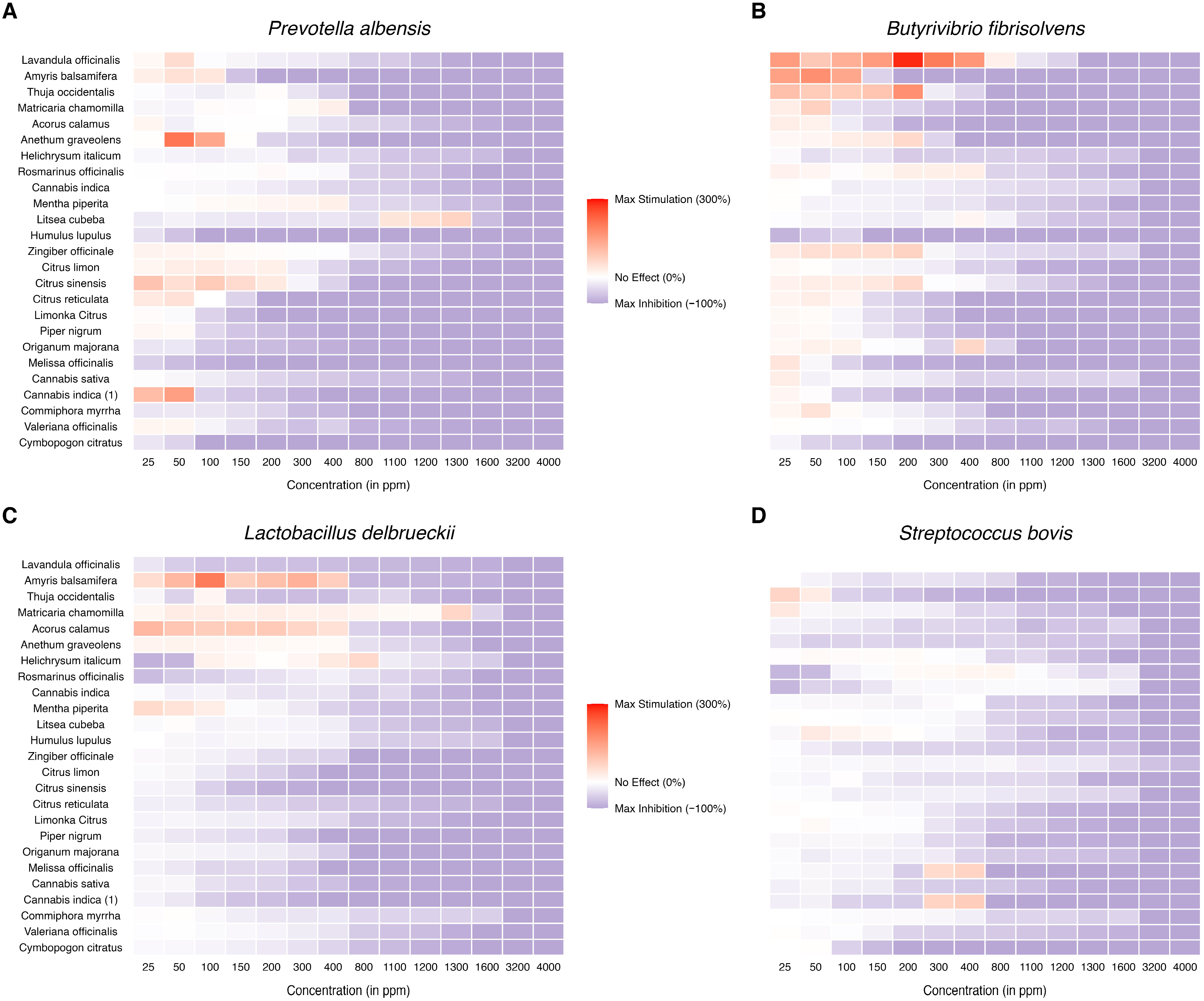
An increase in the optical density of the tested strains was observed under anaerobic conditions compared to the control without essential oils. The heatmap (Figure 1) illustrates the percentage change in the growth of four bacterial strains relative to the untreated control. Prevotella albensis exhibited moderate sensitivity to the essential oils tested. Strong inhibitory activity at concentrations of 800 ppm (Figure 1A, dark blue) was observed for oils such as Commiphora myrrha and Origanum majorana. A similar sensitivity pattern was observed for Butyrivibrio fibrisolvens. Among the examined bacteria, Lactobacillus delbrueckii proved to be the most resistant to inhibition by essential oils. In contrast, Streptococcus bovis displayed the highest overall sensitivity. Nearly all the tested oils had minimum inhibitory concentrations (MICs) of 800 ppm or above (Table 3, Figure 1D, dark blue). Several oils, particularly those belonging to the Cannabis and Citrus groups, exhibited strong inhibitory effects at much lower concentrations, beginning at approximately 150–200 ppm. Based on the culture results obtained for individual strains, four essential oils were selected for in vivo testing in the artificial rumen. Selection was based on their potential to promote the growth of fibrolytic and amylolytic bacteria, or their lack of effect on these groups, and their commercially applicable concentrations.
Table 4 presents the effects of the additives on the rumen pH and NH3-N, NH3/NH4+, and VFA concentrations. A statistically significant decrease in pH was observed after 4 h for monensin (p < 0.03) and for the application of 50 ppm of A. balsamifera essential oil (EO) after 4 h (p < 0.001), persisting up to 24 h. A 25 ppm concentration of C. sinensis reduced the pH up to 4 h post-application (p < 0.03). A significant decrease in NH3-N was observed after 4 h for 50 ppm of A. balsamifera EO (p < 0.03), which returned to a level close to the control after 24 h. Conversely, after 24 h, the amount of ammoniacal nitrogen increased for the L. officinalis essential oil used (at both concentrations) (p < 0.01). Similar dependencies were observed for all the analyzed protein metabolism parameters in the fermentation chamber. A decrease was observed for 50 ppm of A. balsamifera (NH3 p < 0.04; NH4+ p < 0.01) and an increase for both concentrations of L. officinalis (25 ppmL: NH3 p < 0.01; NH4+ p < 0.01; 20 μL: NH3 p < 0.01; NH4+ p < 0.01). A statistically significant decrease in methane production compared to the control was observed at both tested concentrations for ginger essential oil and A. balsamifera essential oil (p < 0.01).
The total VFA increased after the application of all essential oils, although these changes were not statistically significant. The EOs from Z. officinale and A. balsamifera induced an increase in total VFAs as early as 4 h post-administration, and this effect persisted up to 24 h (p < 0.01). The rise in total VFAs resulted from increased acetate and propionate concentrations, as a significant elevation of both fatty acids is observed after applying A. balsamifera and Z. officinale at both tested concentrations (p < 0.01). No significant changes in butyrate levels are noted. In contrast, lavender essential oil led to a decrease in acetate and propionate 24 h after administration, accompanied by a reduction in total VFAs at the same time point.

4. Discussion

A detailed chemical characterization was conducted to determine the qualitative and quantitative composition of the volatile fractions, which may underlie the observed biological effects. The potential of EOs as microbiome regulators results from their broad spectrum of action on various types of microorganisms, not only pathogens but also the microflora of the digestive tract [24]. The antimicrobial activity of essential oils is strongly dependent on their chemical composition. Owing to the complexity of these mixtures, it is not possible to unambiguously attribute the observed biological effects to individual constituents; instead, synergistic interactions among multiple compounds are suggested, as well as the simultaneous modulation of ruminal bacterial cell membranes by several components acting in concert [33]. The present study indicates that selected essential oils have the potential to modulate rumen microbial populations rather than acting solely as broad-spectrum inhibitors. The determination of MIC and IC50 values allowed the identification of concentration ranges that may influence microbial activity without severely disrupting the rumen ecosystem. Some essential oils may transiently stimulate microbial growth or metabolic activity (Figure 1). However, given that microbial growth was assessed using optical density rather than viable cell counts, this effect should be interpreted with caution and may reflect increased metabolic activity rather than enhanced bacterial survival. This selective mode of action has also been reported by other authors, who demonstrated that essential oils preferentially affect hyper-ammonia-producing bacteria and methanogenic archaea while sparing fibrolytic populations critical for fiber degradation [4,13].
Nevertheless, our team’s observations indicate that certain essential oils, such as ginger and A. balsamifera, have the potential to modulate in vitro fermentation processes. Some studies emphasize that it is necessary to evaluate more essential oils in order to determine their optimal dosage [20]. Our own research corresponds with these postulates. In vitro reports indicate that the activity of EOs arises primarily from the presence of terpenes (e.g., limonene, menthol, 1,8-cineole), phenolic terpenoids (thymol, carvacrol), aldehydes (citral), and sesquiterpenes (β-caryophyllene, humulene) [1,10,13,24]. These compounds may inhibit the growth of proteolytic and deaminating bacteria, modulate cellulolytic bacterial populations, and consequently alter volatile fatty acid (VFA) production while reducing methanogenesis [4,15,17,22,24]. Recent studies confirm that essential oils such as rosemary, peppermint, ginger, lemon, calamus, and lemon balm exhibit strong activity against both Gram-positive and Gram-negative bacteria, whereas hop and hemp oils additionally reduce the abundance of certain methanogenic archaea, thereby decreasing methane emissions under in vitro conditions [34,35]. Earlier studies conducted by our group on the application of C. sativa and C. indica indicated that these oils exerted a greater effect on Lactobacillus spp. and Butyrivibrio spp. than monensin did. Moreover, the application of cannabis-derived EOs resulted in increased total VFA concentrations, particularly of acetate and propionate, after 6 h of incubation [36].
In a study by Joch et al., a series of EOs with comparable compositions (eugenol, carvacrol, citral, limonene, 1,4-cineole, p-cymene, linalool, bornyl acetate, α-pinene, and β-pinene) were evaluated in vitro. Among these compounds, only limonene, 1,4-cineole, bornyl acetate, and α-pinene did not inhibit VFA production, while only bornyl acetate reduced methane formation [37]. It should be noted, however, that a very high dose was applied (1000 μL × L−1 of incubated rumen fluid).
The observed effects of essential oils in this study support the concept that their activity in the rumen is primarily dose-dependent and selective rather than broadly antimicrobial. Similar dose-dependent and selective effects of essential oils on rumen microorganisms have been widely reported, whereas higher doses may suppress overall fermentation activity [4,22,24]. The determination of MIC and IC50 values enabled the identification of concentration ranges that may modulate microbial activity without causing extensive disruption of the rumen ecosystem. Such an approach is consistent with in vitro screening strategies recommended for essential oils, which emphasize the importance of defining sub-inhibitory concentrations to avoid detrimental effects on rumen fermentation and microbial efficiency [4,8]. In lavender oil, the dominance of two compounds (linalyl acetate and linalool) was associated with a reduction in total VFA production in vitro, accompanied by lower acetate and propionate concentrations. The greatest increase in total VFA was observed following the application of A. balsamifera, at both lower and higher doses, with a marked increase in acetate and propionate. A similar, albeit slightly weaker, effect was observed for Z. officinale. Consistent with previous reports, p-coumaric and ferulic acids have also been shown to effectively modulate ruminal fermentation by influencing nitrogen metabolism and the relative proportions of individual VFAs [38,39].
Some essential oils may adversely affect the stability of the rumen microbiota, leading to disturbances in fermentation processes, reduced VFA production, and, consequently, decreased milk yield [13]. In addition, the intense or organoleptically unacceptable sensory characteristics of certain EOs may limit feed intake, resulting in reduced energy and nutrient consumption and, ultimately, lower milk production [40]. It has been demonstrated that citronella, clove, and anise oils reduce methane production but simultaneously exert negative effects on ruminal microbial fermentation. Similar observations were made in the present study with respect to lavender oil [41].
Reducing enteric methane emissions in ruminants requires the strategic application of validated interventions, among which dietary management has received the greatest attention. The effectiveness of additives such as garlic, tannins, saponins, and essential oils largely depends on their matrix, dosage, ruminant species, and overall diet composition [28,42,43]. Recent research increasingly focuses on the targeted manipulation of the rumen microbiota to enhance fermentation efficiency and reduce energy losses in the form of methane. Castañeda-Correa et al. demonstrated that thymol and carvacrol, applied individually or in combination, can significantly modulate rumen microbial diversity, affecting fermentation kinetics and VFA profiles [33]. More recent microbiome studies based on metagenomic and metabolomic approaches further support the multidirectional effects of these compounds [44,45].
An important finding of the present study was the consistent reduction in CH4 production following in vitro incubation with all four essential oils, particularly at the higher dose. The magnitude of methane reduction was dose-dependent. Citrus sinensis oil at higher doses effectively reduced methane emissions despite not exerting a beneficial effect on individual VFA production. In contrast, A. balsamifera and L. officinalis were effective in reducing methane production, regardless of the dose. Notably, A. balsamifera limited undesirable fermentative processes (methanogenesis) while simultaneously optimizing beneficial energy-related processes by increasing VFA production. Our results suggest synergistic interactions among the major constituents of A. balsamifera (valerianol, 7-epi-α-eudesmol, epi-γ-eudesmol, and elemol). Similar relationships have been reported in studies demonstrating synergistic anti-methanogenic mechanisms following the in vitro application of garlic derivatives and rumen buffers, resulting in substantial CH4 reductions and improved VFA profiles [2]. In this context, in vivo evidence indicates that essential oils such as ginger and rosemary can be incorporated into dairy cow diets without compromising productivity while still modulating ruminal fermentation patterns associated with methane mitigation [20]. These findings highlight the high efficacy of natural compounds, including EO blends, in hydrogen sequestration within the rumen. Although the methane-mitigating feed additive Bovaer® (3-nitrooxypropanol; 3-NOP) is well supported mechanistically and can deliver substantial reductions in enteric CH4 under controlled conditions [25], its real-world rollout has recently faced acceptance and implementation headwinds. In some markets, consumer backlash and online misinformation have created reputational pressure, while farm-level concerns and policy/operational uncertainty have contributed to cases where parts of the sector have paused trials or stepped back from routine use. Against this background, the search for natural, diet-compatible alternatives or complements is scientifically justified—especially compounds that can be integrated into existing feeding strategies while maintaining animal performance and product quality. One promising direction involves phytogenic preparations, including essential oils (EOs), which can act as rumen microbiome modulators [33,34,37,40].
Previous studies also indicate that phenolic compounds may inhibit methanogenesis by modifying hydrogen utilization by rumen microorganisms and promoting propionate formation at the expense of acetate [39,43]. Increased propionate production relative to acetate may be associated with higher CO2 production in the rumen [46]. Numerous studies have reported effective methane mitigation following the application of natural compounds [42]. For example, cashew nut shell extract resulted in lower methane production compared with a monensin-treated control group [47]. In the present study, monensin exhibited the greatest overall efficacy. Finally, it should be noted that discrepancies between in vitro and in vivo studies may also arise from differences in retention time, which is typically longer in vitro than the residence time of the same feed or supplement in the rumen of a cow [48].
The application of essential oils aligns with the global trend toward natural and sustainable strategies to improve the efficiency of animal production. The observed relationships between the chemical composition of essential oils and their antimicrobial activity suggest that these substances may serve as promising natural modulators of ruminal fermentation. Future studies will help determine the feasibility of dietary supplementation with the EOs investigated here in the dairy sector, which should ultimately confer benefits first to the animals and subsequently to consumers.

5. Conclusions

Rumen bacteria’s sensitivity to essential oils varies by strain, with some, such as B. fibrosolvens and P. albensis, inhibited at low concentrations, while others, including S. bovis and L. delbrueckii ssp. lactis, require higher doses after application of a particular EO. These observations highlight the potential for targeted modulation of the rumen microbiota. Certain essential oils, including A. balsamifera and Z. officinale, exhibited strong inhibitory effects at low concentrations (25 ppm) while simultaneously enhancing VFA production under in vitro conditions. Application of A. balsamifera and Z. officinale resulted in significant increases in acetate and propionate, whereas L. officinalis inhibited these VFAs. Amyris balsamifera and L. officinalis essential oils showed the highest potential for methane reduction. These findings suggest that appropriately selected essential oils can modulate both the composition and activity of the rumen microbiota, influencing key metabolic parameters and fermentation processes. The data obtained may contribute to the rationalization of the use of essential oils in ruminant nutrition, while improving animal health and fermentation efficiency. The results obtained in this study will enable the future composition of mixtures that modulate fermentation processes in the rumen with concentrations of active substances in formulations that have been pre-selected on the basis of the MIC values determined. In addition, the MIC values we have determined for Butyrivibrio fibrosolvens will enable the selection of EO mixtures that will have a potentially beneficial effect not only on milk yield but also on the functional characteristics of cow’s milk.

Supplementary Materials

The following supporting information can be downloaded at: https://www.mdpi.com/article/10.3390/app16042047/s1, Table S1: GC–MS chemical composition of the analyzed essential oils, expressed as relative peak area (%).

Author Contributions

Methodology, R.K., A.S., A.T. and N.P.-H.; validation, A.S., R.K. and N.P.-H.; formal analysis, A.S., R.K., K.L., N.P.-H. and A.T.; investigation, R.K., A.S., K.L., A.T., N.P.-H. and J.B.; data curation, N.P.-H., A.S., R.K., K.L. and A.T.; writing—original draft preparation, R.K., A.S., N.P.-H., D.J.-W. and A.T.; visualization, A.T., N.P.-H., K.L., D.J.-W. and R.K.; supervision, R.K.; project administration, R.K. All authors have read and agreed to the published version of the manuscript.

Funding

This work was financed in the framework of the grant number 2020/39/B/NZ9/02741 attributed by the National Science Centre, Poland.

Institutional Review Board Statement

The experimental procedures were conducted according to the European Union Directive 2010/63/EU on 22 September 2010. Animal care and all experimental procedures were approved by the Local Ethics Committee on Animal Experiments (Protocol No. 053/2019, dated 4 April 2019; approval concerned the surgical implantation of cannulas in cows). For the in vitro studies, the rumen contents used had been collected during experiments whose procedures were approved by the Local Ethics Committee on Animal Experiments (Protocol No. 058/2024, dated 4 December 2024).

Informed Consent Statement

Not applicable.

Data Availability Statement

The raw data supporting the conclusions of this article will be made available by the authors on request.

Conflicts of Interest

The authors declare no conflicts of interest.

Abbreviations

The following abbreviations are used in this manuscript:
EOsEssential oils
GC-MSGas chromatography–mass spectrometry
MICMinimum inhibitory concentration
VFAVolatile fatty acid
3-NOP3-nitrooxypropanol
NISTNational Institute of Standards and Technology
FFNSCFlavors and Fragrances of Natural and Synthetic Compounds
CFUColony Forming Unit

References

  1. Stevanović, Z.D.; Bošnjak-Neumüller, J.; Pajić-Lijaković, I.; Raj, J.; Vasiljević, M. Essential Oils as Feed Additives—Future Perspectives. Molecules 2018, 23, 1717. [Google Scholar] [CrossRef]
  2. Hodge, I.; Quille, P.; Ayyachamy, M.; O’Connell, S. In Vitro Comparison of Naturally Bioactive Plant Extracts, Essential Oils, and Marine Algae Targeting Different Modes of Action for Mitigation of Enteric Methane Emissions in Ruminants. Front. Anim. Sci. 2025, 6, 1546486. [Google Scholar] [CrossRef]
  3. Movahedi, F.; Nirmal, N.; Wang, P.; Jin, H.; Grøndahl, L.; Li, L. Recent Advances in Essential Oils and Their Nanoformulations for Poultry Feed. J. Anim. Sci. Biotechnol. 2024, 15, 110. [Google Scholar] [CrossRef]
  4. Nasir, M.; Rodríguez-Prado, M.; Simoni, M.; Martín-Orúe, S.M.; Pérez, J.F.; Calsamiglia, S. Optimizing Essential Oil Mixtures: Synergistic Effects on Cattle Rumen Fermentation and Methane Emission. Animals 2025, 15, 2105. [Google Scholar] [CrossRef] [PubMed]
  5. Singh, A.K.; Ojha, L.; Kumari, P.; Choubey, M.; Chaudhary, S.K. Phytochemicals as Natural Feed Additives for Ruminants. In Feed Additives and Supplements for Ruminants; Springer: Berlin/Heidelberg, Germany, 2024; pp. 167–196. [Google Scholar]
  6. Miguel, M.G. Antioxidant and Anti-Inflammatory Activities of Essential Oils: A Short Review. Molecules 2010, 15, 9252–9287. [Google Scholar] [CrossRef]
  7. Hyldgaard, M.; Mygind, T.; Meyer, R.L. Essential Oils in Food Preservation: Mode of Action, Synergies, and Interactions with Food Matrix Components. Front. Microbiol. 2012, 3, 12. [Google Scholar] [CrossRef]
  8. Hulankova, R. Methods for Determination of Antimicrobial Activity of Essential Oils In Vitro—A Review. Plants 2024, 13, 2784. [Google Scholar] [CrossRef]
  9. El-Kased, R.F.; El-Kersh, D.M. GC–MS Profiling of Naturally Extracted Essential Oils: Antimicrobial and Beverage Preservative Actions. Life 2022, 12, 1587. [Google Scholar] [CrossRef] [PubMed]
  10. Dong, Y.; Wei, Z.; Yang, R.; Zhang, Y.; Sun, M.; Bai, H.; Mo, M.; Yao, C.; Li, H.; Shi, L. Chemical Compositions of Essential Oil Extracted from Eight Thyme Species and Potential Biological Functions. Plants 2023, 12, 4164. [Google Scholar] [CrossRef]
  11. Aviwe, K.; Phozisa, D.; Egbichi, I.; Tchatchouang, C.-D.K.; Manganyi, M. Inhibitory Effect of 14 Essential Oils against Resistant Pathogenic Bacteria and Fungi and Chemical Compositions of Selected Essential Oils. J. Appl. Pharm. Sci. 2024, 14, 237–244. [Google Scholar] [CrossRef]
  12. Qi, S.; Hou, C.; Tian, H.; Zhan, P.; Qiu, B. Characterization of Volatile Organic Compounds in Wild Thyme (Thymus serpyllum L.) from Central and Northern China Based on Comprehensive GC× GC-TOFMS and Chemometrics. Food Chem. X 2025, 28, 102590. [Google Scholar] [CrossRef]
  13. Calsamiglia, S.; Busquet, M.; Cardozo, P.W.; Castillejos, L.; Ferret, A. Invited Review: Essential Oils as Modifiers of Rumen Microbial Fermentation. J. Dairy Sci. 2007, 90, 2580–2595. [Google Scholar] [CrossRef]
  14. Salem, A.A.; Abdalla, M.S.; Ramadan, S.S.; Mohamed, E.T.; Hussien, E.T. Comprehensive Molecular, Antimicrobial, Phytochemical Analysis and In Silico Evaluation of Essential Oils from Certain In Vitro Cultivated Medicinal and Aromatic Plants. S. Afr. J. Bot. 2026, 188, 243–254. [Google Scholar] [CrossRef]
  15. Ku-Vera, J.C.; Jiménez-Ocampo, R.; Valencia-Salazar, S.S.; Montoya-Flores, M.D.; Molina-Botero, I.C.; Arango, J.; Gómez-Bravo, C.A.; Aguilar-Pérez, C.F.; Solorio-Sánchez, F.J. Role of Secondary Plant Metabolites on Enteric Methane Mitigation in Ruminants. Front. Vet. Sci. 2020, 7, 584. [Google Scholar]
  16. Zhou, R.; Wu, J.; Lang, X.; Liu, L.; Casper, D.P.; Wang, C.; Zhang, L.; Wei, S. Effects of Oregano Essential Oil on In Vitro Ruminal Fermentation, Methane Production, and Ruminal Microbial Community. J. Dairy Sci. 2020, 103, 2303–2314. [Google Scholar] [CrossRef]
  17. Hassan, F.; Arshad, M.A.; Ebeid, H.M.; Rehman, M.S.; Khan, M.S.; Shahid, S.; Yang, C. Phytogenic Additives Can Modulate Rumen Microbiome to Mediate Fermentation Kinetics and Methanogenesis through Exploiting Diet–Microbe Interaction. Front. Vet. Sci. 2020, 7, 575801. [Google Scholar] [CrossRef] [PubMed]
  18. Sokol, M.; Gulayev, I.; Chirkina, M.; Klimenko, M.; Kamaeva, O.; Yabbarov, N.; Mollaeva, M.; Nikolskaya, E. Fully Green Particles Loaded with Essential Oils as Phytobiotics: A Review on Preparation and Application in Animal Feed. Antibiotics 2025, 14, 803. [Google Scholar] [CrossRef]
  19. Zhang, F.; Li, B.; Ban, Z.; Liang, H.; Li, L.; Zhao, W.; Yan, X. Evaluation of Origanum Oil, Hydrolysable Tannins and Tea Saponin in Mitigating Ruminant Methane: In Vitro and In Vivo Methods. J. Anim. Physiol. Anim. Nutr. 2021, 105, 630–638. [Google Scholar] [CrossRef]
  20. Elazab, M.A.; Zahran, S.M.; Elkomy, A.E.; Ahmed, M.H.; Kholif, A.E.; Vargas-Bello-Pérez, E.; Sallam, S. Performance of Holstein Dairy Cows Fed a Diet Supplemented with Rosemary and Ginger Essential Oils: Milk Production, Milk Fatty Acid, and Ruminal Fermentation. Ann. Anim. Sci. 2025, 25, 611–622. [Google Scholar] [CrossRef]
  21. Caroprese, M.; Ciliberti, M.G.; Marino, R.; Santillo, A.; Sevi, A.; Albenzio, M. Essential Oil Supplementation in Small Ruminants: A Review on Their Possible Role in Rumen Fermentation, Microbiota, and Animal Production. Dairy 2023, 4, 497–508. [Google Scholar] [CrossRef]
  22. Benetel, G.; Silva, T.d.S.; Fagundes, G.M.; Welter, K.C.; Melo, F.A.; Lobo, A.A.G.; Muir, J.P.; Bueno, I.C.S. Essential Oils as In Vitro Ruminal Fermentation Manipulators to Mitigate Methane Emission by Beef Cattle Grazing Tropical Grasses. Molecules 2022, 27, 2227. [Google Scholar] [CrossRef]
  23. Abdillah, A.E.; Sarah, D.; Ardian, A.A.; Al Anas, M.; Aprianto, M.A.; Hanim, C.; Kurniawati, A.; Muhlisin; Yusiati, L.M. Effect of Nutmeg Essential Oil (Myristica fragrans Houtt.) on Methane Production, Rumen Fermentation, and Nutrient Digestibility In Vitro. Sci. Rep. 2024, 14, 3554. [Google Scholar] [CrossRef]
  24. Patra, A.K.; Yu, Z. Effects of Essential Oils on Methane Production and Fermentation by, and Abundance and Diversity of, Rumen Microbial Populations. Appl. Environ. Microbiol. 2012, 78, 4271–4280. [Google Scholar] [CrossRef]
  25. Saro, C.; Martin, C.; Cantalapiedra-Hijar, G.; Bouchon, M.; Chantelauze, C.; Morgavi, D.P. Use of 3-Nitrooxypropanol in Early Lactation Dairy Cows Fed a High Forage Total Mixed Ration: Effect on Enteric Methane Emissions, Performance, and Milk Carbon Isotopic Signature. J. Dairy Sci. 2025, 109, 360–371. [Google Scholar] [CrossRef]
  26. Starsmore, K.; Lopez-Villalobos, N.; Shalloo, L.; Egan, M.; Burke, J.; Lahart, B. Animal Factors That Affect Enteric Methane Production Measured Using the GreenFeed Monitoring System in Grazing Dairy Cows. J. Dairy Sci. 2024, 107, 2930–2940. [Google Scholar] [CrossRef] [PubMed]
  27. Guerreiro, P.; Costa, D.F.A.; Limede, A.C.; Congio, G.F.S.; Meschiatti, M.A.P.; Bernardes, P.A.; Santos, F.A.P. Effects of Monensin, Calcareous Algae, and Essential Oils on Performance, Carcass Traits, and Methane Emissions Across Different Breeds of Feedlot-Finished Beef Cattle. Ruminants 2025, 5, 2. [Google Scholar] [CrossRef]
  28. Malyugina, S.; Holik, S.; Horky, P. Mitigation Strategies for Methane Emissions in Ruminant Livestock: A Comprehensive Review of Current Approaches and Future Perspectives. Front. Anim. Sci. 2025, 6, 1610376. [Google Scholar] [CrossRef]
  29. Patra, A.K.; Yu, Z. Essential Oils Affect Populations of Some Rumen Bacteria In Vitro as Revealed by Microarray (RumenBactArray) Analysis. Front. Microbiol. 2015, 6, 297. [Google Scholar] [CrossRef]
  30. Clinical and Laboratory Standards Institute. Methods for Antimicrobial Susceptibility Testing of Anaerobic Bacteria; Approved Standard; CLSI Document M11-A8; Clinical and Laboratory Standards Institute: Wayne, PA, USA, 2012. [Google Scholar]
  31. Capelari, M.; Powers, W. The Effect of Nitrate and Monensin on In Vitro Ruminal Fermentation. J. Anim. Sci. 2017, 95, 5112–5123. [Google Scholar] [CrossRef]
  32. ASTM D1426-92; Standard Test Methods for Ammonia Nitrogen in Water. ASTM International: West Conshohocken, PA, USA, 1992.
  33. Castañeda-Correa, A.; Corral-Luna, A.; Hume, M.E.; Anderson, R.C.; Ruiz-Barrera, O.; Castillo-Castillo, Y.; Rodriguez-Almeida, F.; Salinas-Chavira, J.; Arzola-Alvarez, C. Effects of Thymol and Carvacrol, Alone or in Combination, on Fermentation and Microbial Diversity During In Vitro Culture of Bovine Rumen Microbes. J. Environ. Sci. Health Part B 2019, 54, 170–175. [Google Scholar]
  34. Delgadillo-Ruiz, L.; Bañuelos-Valenzuela, R.; Gallegos-Flores, P.; Echavarría-Cháirez, F.; Meza-López, C.; Gaytán-Saldaña, N. Modification of Ruminal Fermentation In Vitro for Methane Mitigation by Adding Essential Oils from Plants and Terpenoid Compounds. Abanico Veterinário 2021, 11, e107. [Google Scholar]
  35. Prabuseenivasan, S.; Jayakumar, M.; Ignacimuthu, S. In Vitro Antibacterial Activity of Some Plant Essential Oils. BMC Complement. Altern. Med. 2006, 6, 39. [Google Scholar] [CrossRef] [PubMed]
  36. Tabiś, A.; Szumny, A.; Bania, J.; Pacyga, K.; Lewandowska, K.; Kupczyński, R. Comparison of the Effects of Essential Oils from Cannabis Sativa and Cannabis Indica on Selected Bacteria, Rumen Fermentation, and Methane Production—In Vitro Study. Int. J. Mol. Sci. 2024, 25, 5861. [Google Scholar] [CrossRef]
  37. Joch, M.; Cermak, L.; Hakl, J.; Hucko, B.; Duskova, D.; Marounek, M. In Vitro Screening of Essential Oil Active Compounds for Manipulation of Rumen Fermentation and Methane Mitigation. Asian-Australas. J. Anim. Sci. 2015, 29, 952. [Google Scholar] [CrossRef]
  38. Tánori-Lozano, A.; López-Baca, M.Á.; Muhlia-Almazán, A.; Montalvo-Corral, M.; Pinelli-Saavedra, A.; Islava-Lagarda, T.Y.; Dávila-Ramírez, J.L.; Valenzuela-Melendres, M.; González-Rios, H. Ferulic Acid and Clinoptilolite Affect In Vitro Rumen Fermentation Characteristics and Bacterial Abundance. Fermentation 2024, 10, 549. [Google Scholar] [CrossRef]
  39. El-Zaiat, H.M.; Masood, H.A.; Al Hinai, S.S.; Al Maamari, R.H.; Al Riyami, S.S.; Al-Kharousi, K.; Al-Salami, A.H.; Al-Habsi, N. Assessment of Different Phytogenic-Based Additives on In Vitro Rumen Fermentation Profile and Methane Emissions. Front. Vet. Sci. 2025, 12, 1591700. [Google Scholar] [CrossRef]
  40. Cobellis, G.; Trabalza-Marinucci, M.; Marcotullio, M.C.; Yu, Z. Evaluation of Different Essential Oils in Modulating Methane and Ammonia Production, Rumen Fermentation, and Rumen Bacteria In Vitro. Anim. Feed Sci. Technol. 2016, 215, 25–36. [Google Scholar] [CrossRef]
  41. Günal, M.; Pinski, B.; AbuGhazaleh, A.A. Evaluating the Effects of Essential Oils on Methane Production and Fermentation Under In Vitro Conditions. Ital. J. Anim. Sci. 2017, 16, 500–506. [Google Scholar] [CrossRef]
  42. Brice, R.M.; Dele, P.A.; Ike, K.A.; Shaw, Y.A.; Olagunju, L.K.; Orimaye, O.E.; Subedi, K.; Anele, U.Y. Effects of Essential Oil Blends on In Vitro Apparent and Truly Degradable Dry Matter, Efficiency of Microbial Production, Total Short-Chain Fatty Acids and Greenhouse Gas Emissions of Two Dairy Cow Diets. Animals 2022, 12, 2185. [Google Scholar] [CrossRef]
  43. Wang, K.; Xiong, B.; Zhao, X. Could Propionate Formation Be Used to Reduce Enteric Methane Emission in Ruminants? Sci. Total Environ. 2023, 855, 158867. [Google Scholar] [PubMed]
  44. Winders, T.M.; Neville, B.W.; Swanson, K.C. Effects of Hempseed Cake on Ruminal Fermentation Parameters, Nutrient Digestibility, Nutrient Flow, and Nitrogen Balance in Finishing Steers. J. Anim. Sci. 2023, 101, skac291. [Google Scholar] [CrossRef] [PubMed]
  45. Altman, A.W.; Kent-Dennis, C.; Klotz, J.L.; McLeod, K.R.; Vanzant, E.S.; Harmon, D.L. Utilizing Industrial Hemp (Cannabis Sativa L.) by-Products in Livestock Rations. Anim. Feed Sci. Technol. 2024, 307, 115850. [Google Scholar] [CrossRef]
  46. Haisan, J.; Sun, Y.; Guan, L.L.; Beauchemin, K.A.; Iwaasa, A.; Duval, S.; Barreda, D.R.; Oba, M. The Effects of Feeding 3-Nitrooxypropanol on Methane Emissions and Productivity of Holstein Cows in Mid Lactation. J. Dairy Sci. 2014, 97, 3110–3119. [Google Scholar] [CrossRef]
  47. Sarmikasoglou, E.; Sumadong, P.; Roesch, L.F.W.; Halima, S.; Arriola, K.; Yuting, Z.; Jeong, K.C.C.; Vyas, D.; Hikita, C.; Watanabe, T. Effects of Cashew Nut Shell Extract and Monensin on In Vitro Ruminal Fermentation, Methane Production, and Ruminal Bacterial Community. J. Dairy Sci. 2024, 107, 840–856. [Google Scholar] [CrossRef] [PubMed]
  48. Christodoulou, C.; Kliem, K.E.; Auffret, M.D.; Humphries, D.J.; Newbold, J.R.; Davison, N.; Crompton, L.; Dhanoa, M.S.; Smith, L.G.; Stergiadis, S. In Vitro Rumen Degradation, Fermentation, and Methane Production of Four Agro-Industrial Protein-Rich Co-Products, Compared with Soyabean Meal. Anim. Feed Sci. Technol. 2025, 319, 116151. [Google Scholar] [CrossRef]
Figure 1. Growth modulation profiles of four bacterial species exposed to various concentrations of 25 essential oils. The heatmaps represent the percentage change in bacterial growth relative to the control group (0%): (A) Prevotella albensis, (B) Butyrivibrio fibrisolvens, (C) Lactobacillus delbrueckii, and (D) Streptococcus bovis. The color scale ranges from dark blue, indicating maximal growth inhibition (–100%), through white (no effect), to bright red, indicating maximal growth stimulation (+300%). Essential oils are listed on the vertical axes, while concentrations (25–4000 ppm) are displayed on the horizontal axes. All data points represent the mean values from three independent replicates (n = 3).
Applsci 16 02047 g001
Table 1. Bacterial strains used in the study.
StrainSource
Butyrivibrio fibrisolvens 35459TCCUG
Prevotella albensis 51935TCCUG
Streptococcus bovis 2092PCM
Lactobacillus delbrueckii lactis 2611PCM
CCUG—Culture Collection University of Gothenburg; PCM—Polish Collection of Microorganisms.
Table 2. Chemical composition of selected essential oils determined by GC–MS, expressed as relative peak area (%).
No.Peak NameRI Exp. 1RI Lit. 2Lavandula officinalisAmyris balsamiferaZingiber officinaleCitrus sinensis
Area (%) 3
1α-Pinene9329371.47--0.87
2Camphene958952--7.31-
3Sabinene971974---0.51
4β-Myrcene9909911.43-0.552.14
5Octanal10061003---0.23
63-Carene10121011---0.24
7Limonene10341030---95.41
8β-Phellandrene10351031--4.78-
9Eucalyptol10361032--3.15-
10β-cis-Ocimene103810383.81---
11trans-β-Ocimene104910491.49---
12Linalool1103109936.60--0.35
13Lavandulol116611701.09---
14Borneol117811722.42-0.84-
15Terpinen-4-ol118311774.83---
16α-Terpineol11991198--0.48-
17Decanal12091206---0.25
18Neral12401240--2.27-
19Linalyl acetate1255125739.11---
20Geranial12691270--2.73-
21Lavandulol acetate128812903.81---
22Neryl acetate135813641.62---
23Copaene13761375--0.48-
24Geranyl acetate13811382--0.46-
25β-Elemene13971390--0.76-
26(E)-β-Farnesene145514572.33-0.49-
27α-Neocallitropsene14691480-1.17 -
28α-Curcumene14821480-1.29.77-
29γ-Curcumene14881482-1.03 -
30Valencene14901491--0.46-
31cis-β-Guaiene14931498-0.34 -
32α-Zingiberene15011499-3.5736.67-
33α-Selinene15021501--1.24-
34α-Farnesene15041508--3.08-
35β-Bisabolene15101509-0.557.85-
36β-Dihydroagarofuran15121510-1.5--
37γ-Cadinene15191520--2.41-
38β-Sesquiphellandrene15301523-4.9813.79-
39Selina-4(15),7(11)-diene15411540-0.39--
40Selina-3,7(11)-diene15431546-2.09--
41α-Elemol15581547-10.89--
42Germacrene B15591557--0.43-
43Rosifoliol16141609-0.53--
445-epi-7-epi-α-Eudesmol16171610-0.83--
45epi-γ-Eudesmol16231624-11.06--
46Eremoligenol16241627-1.08--
47γ-Eudesmol16431632-5.84--
48Valerianol16551657-38.43--
497-epi-α-Eudesmol16701666-14.52--
1 Experimentally calculated linear retention index. 2 Literature-derived retention index according to the NIST 23 Mass Spectral Library. 3 Calculated by peak area normalization.
Table 3. Inhibition effects of EOs on rumen microorganisms. MIC: the lowest concentration that inhibited 90% of the bacterial growth. IC50 is the concentration of essential oils that led to a 50% decrease in cell density at 24 h of incubation. The results shown are means of three culture tubes at each concentration.
Strain
Essential OilButyrovibrio fibrosolvensPrevotella albensisLactobacillus delbrueckii ssp. LsactisStreptoccoccus bovis
MIC (ppm)IC50 (ppm)MIC (ppm)IC50 (ppm)MIC (ppm)IC50 (ppm)MIC
(ppm)
IC50 (ppm)
Lavandula officinalis1600120016008001600501600800
Amyris balsamifera20015020050200501600100
Thuja occidentalis80040080040016008001600400
Matricaria chamomilla400200800600320024003200200
Acorus calamus200150320080016008003200800
Anethum graveolens400300800200160012001600800
Helichrysum italicum320040032003003200240032002400
Rosmarinus officinalis160080016008001600100320050
Cannabis indica40001300320080016008001600800
Mentha piperita16008003200120032006003200800
Litsea cubeba3200110032001200320080032001600
Humulus lupulus200100100no32008003200400
Zingiber officinale320016001600100080040064001600
Citrus limon16004001600400400200nono
Citrus sinensis16008001600400160020032001600
Citrus reticulata4002002001504002001600800
Limonka Citrus8002002001002001001600800
Piper nigrum160020080020016002001600400
Origanum majorana160080016001008004001600800
Melissa officinalis40010020025400200800400
Cannabis sativa3200400160020016002001600800
Cannabis indica (1)400100400100400100800400
Commiphora myrrha1600200160040040010032001600
Valeriana officinalis16004001600400160020032001600
Cymbopogon citratus20050100501600400200100
MIC (minimum inhibitory concentration); IC50 (half maximal inhibitory concentration).
Table 4. Effects of Zingiber officinale, Amyris balsamifera, Citrus sinensis, and Lavandula officinalis essential oils on in vitro fermentation characteristics.
TimeTreatmentsSEMp-Value
CONMONZingiber officinaleAmyris balsamiferaCitrus sinensisLavandula officinalis
10 mg25 ppm50 ppm25 ppm50 ppm 20 μL25 ppm 10 μL50 ppm 20 μL25 ppm 10 μL50 ppm 20 μL
pH
4 h6.846.68 **6.816.736.856.67 **6.71 *6.766.886.960.150.08
24 h6.576.596.606.666.666.71 **6.576.586.596.580.190.12
NH3-N, mg × L−1
4 h166.6159.6147.6145.3175.0120.0 *157.0163.0129.3157.35.820.42
24 h147.6142.0142.6165.3180.3153.0184.6147.0206.6 **222.3 ***14.520.37
NH3, mg × L −1
4 h202.6208.0175.6174.6198.0150.6 **190.6198.3159.0192.314.230.21
24 h179.6171.0164.0206.0205.6186.0219.3181.3261.0 **271.3 ***7.430.37
NH4+, mg × L −1
4 h214.3213.3184.3180.6217.6149.3 *201.6210164.6205.611.20.24
24 h190188.0174.0210.6225.3193.3236.0188.6270.3 **286.0 ***8.460.33
Total VFA, mg × mL −1
4 h1.141.161.49 ***1.41 ***1.53 *1.36 ***1.161.211.141.290.090.08
24 h1.301.461.60 ***1.59 ***1.66 ***1.67 ***1.121.161.01 ***0.99 ***0.140.12
Individual VFA, mg × mL −1
Acetate
4 h0.520.530.79 ***0.73 ***0.82 ***0.68 ***0.520.550.550.630.110.12
24 h0.590.660.85 ***0.87 ***0.89 ***0.91 ***0.470.500.43 **0.41 ***0.190.18
Propionate
4 h0.350.360.42 ***0.41 ***0.430.40 ***0.360.370.330.370.090.08
24 h0.420.490.46 ***0.43 ***0.47 ***0.46 ***0.350.360.32 ***0.32 ***0.130.06
Butyrate
4 h0.270.270.280.270.280.260.280.290.260.290.200.13
24 h0.290.310.290.290.300.300.300.300.260.260.340.18
Acetate to propionate ratio
4 h1.431.471.84 ***1.78 ***1.73 ***1.80 ***1.441.491.361.480.150.07
24 h1.501.34 ***1.84 ***1.78 ***1.95 ***1.88 ***1.34 **1.381.34 **1.28 ***0.240.11
Methane, mL × L −1
4 h3.682.402.632.602.502.293.053.082.252.900.230.56
24 h18.0812.50 ***17.6015.6 ***15.17 ***13.66 ***17.2613.2 ***14.22 ***13.60 ***0.340.89
Values represent means; differences between treatment groups and control group (p < 0.05 *, p < 0.01 **, p < 0.001 ***).
Disclaimer/Publisher’s Note: The statements, opinions and data contained in all publications are solely those of the individual author(s) and contributor(s) and not of MDPI and/or the editor(s). MDPI and/or the editor(s) disclaim responsibility for any injury to people or property resulting from any ideas, methods, instructions or products referred to in the content.