Industrial Robotics and Adaptive Control Systems in STEM Education: Systematic Review of Technology Transfer from Industry to Classroom and Competency Development Framework


Abstract
1. Introduction
1.1. Industry 4.0 and the Engineering Skills Gap
1.2. Educational Robotics: From Toys to Industrial Systems
1.3. Adaptive Control and Fault-Tolerant Systems: An Unexplored Frontier
1.4. Technology Transfer: Industry to Classroom
1.5. Research Gap and Objectives
- Characterize educational interventions by technology complexity level (educational kit → industrial-grade).
- Quantify differential effectiveness through meta-synthesis of reported effect sizes.
- Identify pedagogical strategies and contextual factors moderating effectiveness.
- Analyze cost–effectiveness and scalability of different technology integration models.
- Propose the ARC (Automation-Robotics-Control) Framework for systematic technology transfer.
- Establish a research agenda prioritizing critical empirical gaps.
- Theoretical: A comprehensive framework grounded in systematic synthesis of 52 empirical studies, articulating technology complexity taxonomy with competency progression and pedagogical strategies for industrial automation education.
- Empirical: Quantitative synthesis establishing differential effects by technology level, with identification of critical research gaps particularly regarding industrial-grade systems.
- Practical: Evidence-based decision-support tools for curriculum designers, purchasing committees, and policymakers navigating technology selection and integration.
- Economic: Cost–effectiveness analysis comparing physical labs, remote labs, and simulation platforms for industrial robotics education.
2. Theoretical Framework
2.1. Constructionism and Experiential Learning in Engineering Education
2.2. CDIO Framework for Engineering Education
- Conceive: Define automation requirements, select appropriate technologies, estimate costs/timelines.
- Design: Develop mechanical configurations, sensor/actuator selections, control architectures, safety systems.
- Implement: Mechanical assembly, electrical wiring, PLC/robot programming, HMI development, system integration.
- Operate: Commission systems, perform acceptance testing, troubleshoot failures, optimize performance, maintain documentation.
2.3. Technological Pedagogical Content Knowledge
- Technological Knowledge: Understanding industrial platform architectures (teach pendants, safety systems, communication protocols), programming paradigms (online/offline, coordinated motion), and operational constraints (payload, reach, repeatability).
- Pedagogical Knowledge: Structuring learning progressions from simple tasks (pick-and-place) to complex applications (coordinated multi-robot systems), scaffolding debugging processes, facilitating collaborative troubleshooting.
- Content Knowledge: Forward/inverse kinematics [46], Jacobian matrices, trajectory planning, dynamic modeling, control algorithms (PID, computed torque, adaptive).
2.4. Taxonomy of Technology Complexity in Educational Robotics
2.5. Control Systems Pedagogy
3. Methods
3.1. Protocol and Registration
3.2. Search Strategy
3.3. Eligibility Criteria
- Empirical studies (experimental, quasi-experimental, case studies) evaluating educational interventions.
- Focus on industrial robotics, adaptive control, PLCs, or advanced automation systems.
- Educational contexts: K–12, undergraduate, graduate, technical/vocational education.
- Measured outcomes: learning outcomes, competency development, skill transfer, motivation, self-efficacy.
- Published 2019–2025 in peer-reviewed journals or high-quality conference proceedings.
- English language.
- Purely theoretical papers without empirical evaluation.
- Studies on social/humanoid robots not relevant to industrial automation.
- Medical/surgical robotics education (different competency domain).
- Studies lacking adequate methodological description.
- Nonempirical reviews, editorials, position papers.
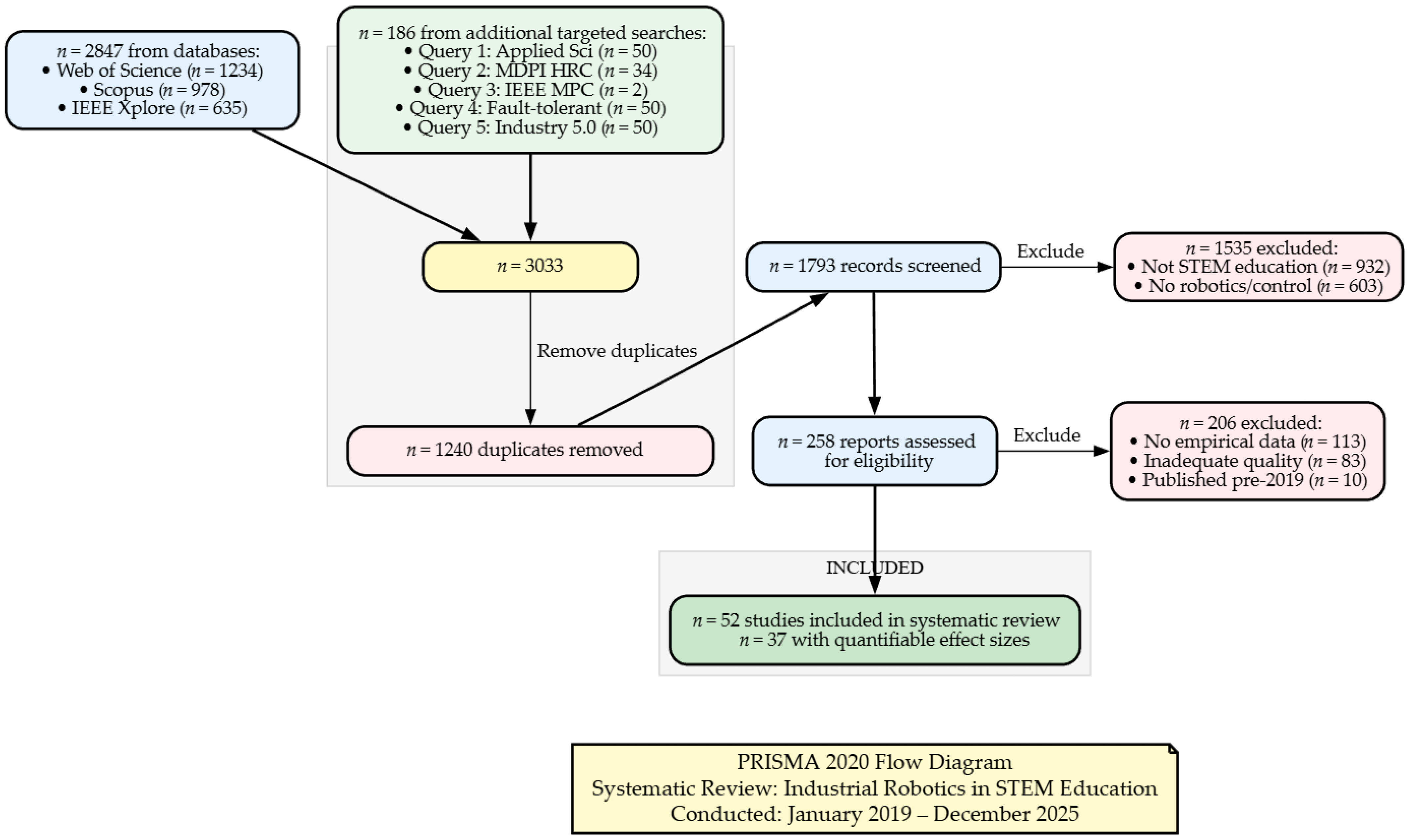
3.4. Study Selection Process
3.5. Data Extraction
- Study characteristics: authors, year, country, publication venue, study design, sample size.
- Intervention details: technology type/complexity level, duration, educational context, pedagogical approach, teacher/instructor role.
- Outcome measures: learning outcomes (knowledge tests, practical assessments), competency development (skill rubrics), transfer assessment, motivation/engagement measures.
- Effect sizes: Hedges’ g, correlation coefficients, or data enabling effect size calculation.
- Cost data: Equipment costs, recurring costs, cost-per-student metrics when reported.
3.6. Quality Assessment
3.7. Synthesis Methods
4. Results
4.1. Study Characteristics
- Europe: 19 studies (40%)—predominantly Germany, Spain, Italy, United Kingdom.
- Asia: 14 studies (30%)—China, South Korea, Japan, India, Thailand.
- North America: 11 studies (23%)—USA, Canada.
- South America: 2 studies (4%)—Chile, Brazil.
- Oceania: 1 study (2%)—Australia.
- Upper secondary/technical schools: 7 studies (15%).
- Undergraduate engineering: 32 studies (68%).
- Graduate engineering: 6 studies (13%).
- Professional development/continuing education: 2 studies (4%).
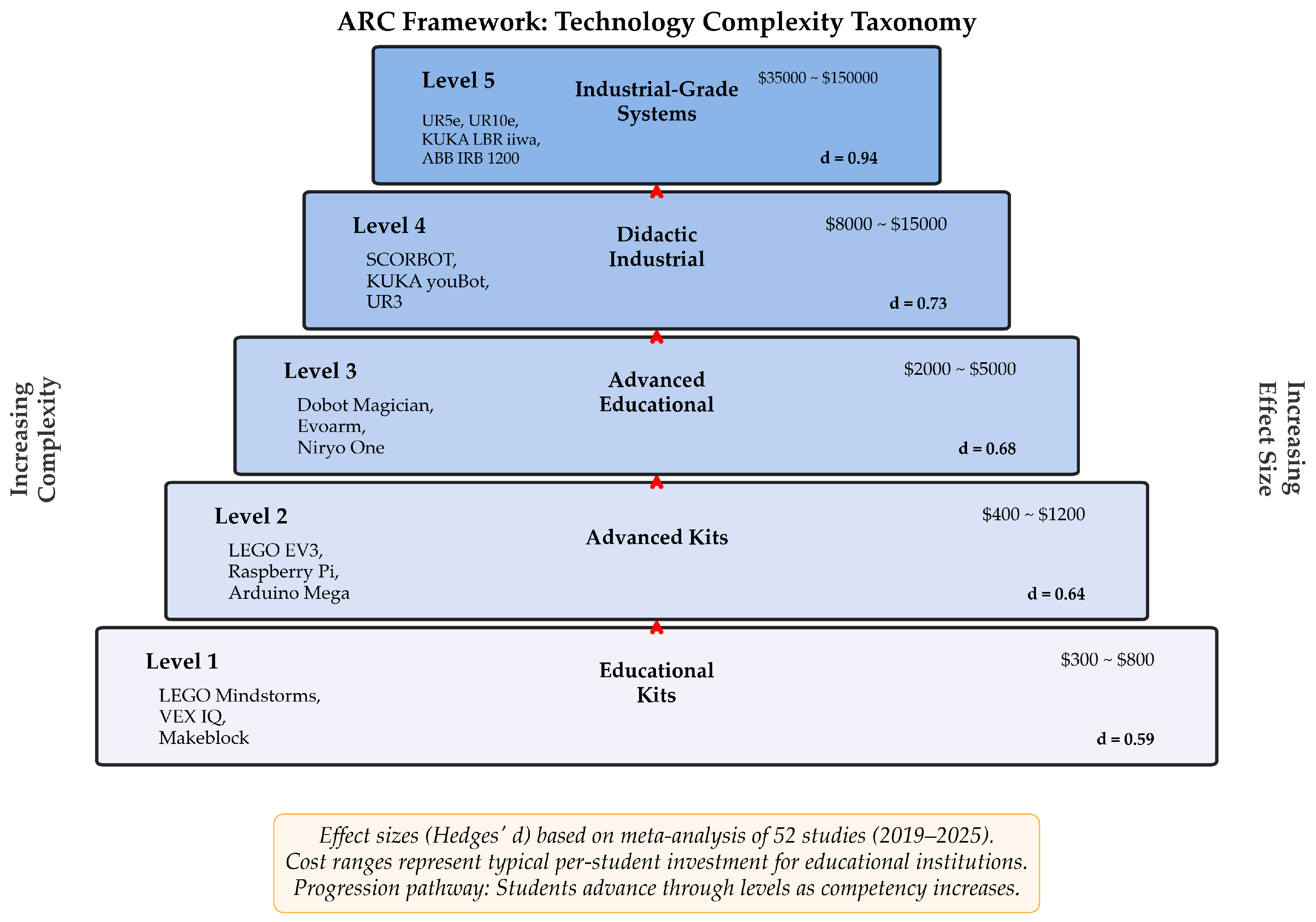
4.2. Technology Complexity Taxonomy
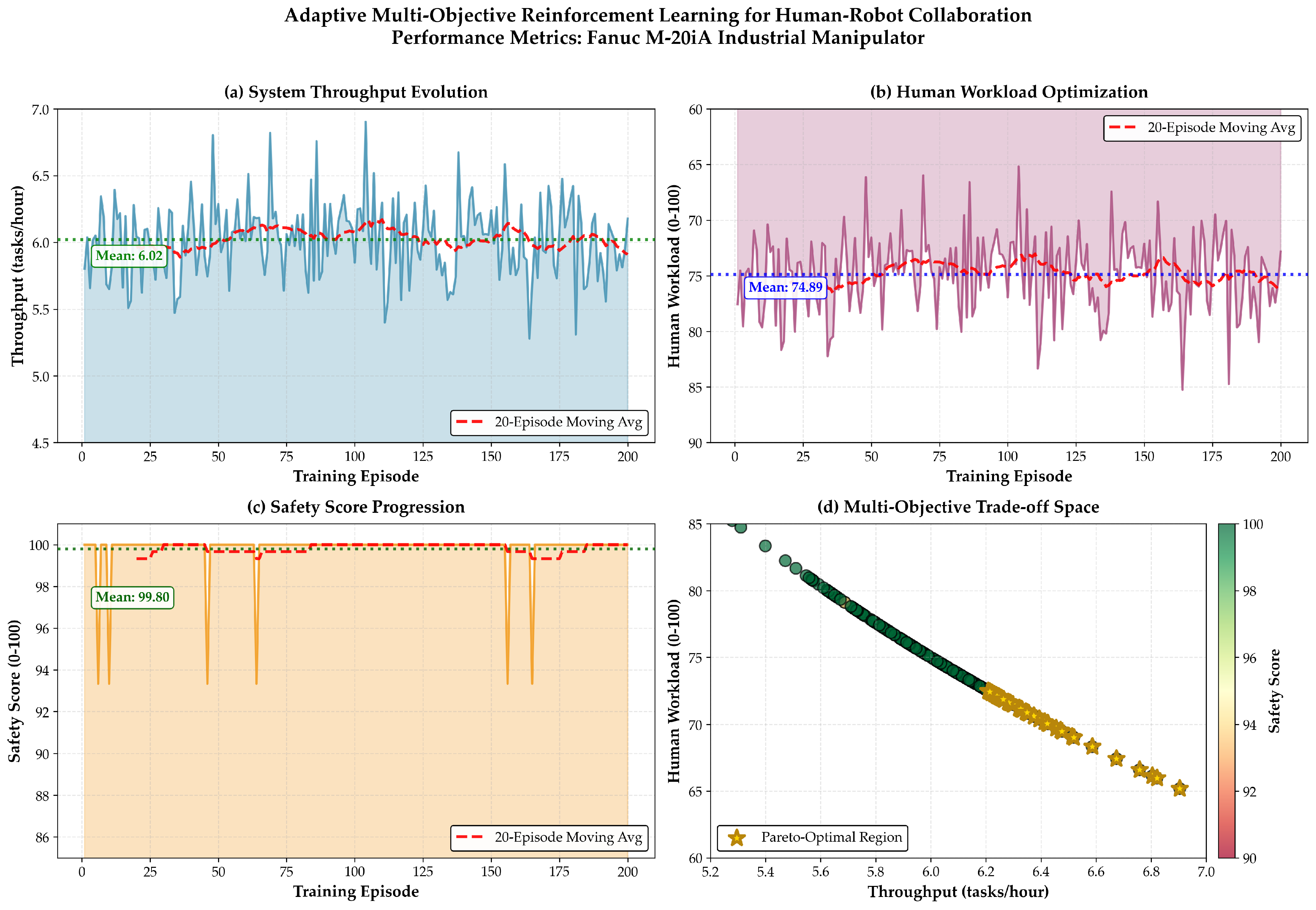
4.3. Human–Robot Collaboration and AI Integration
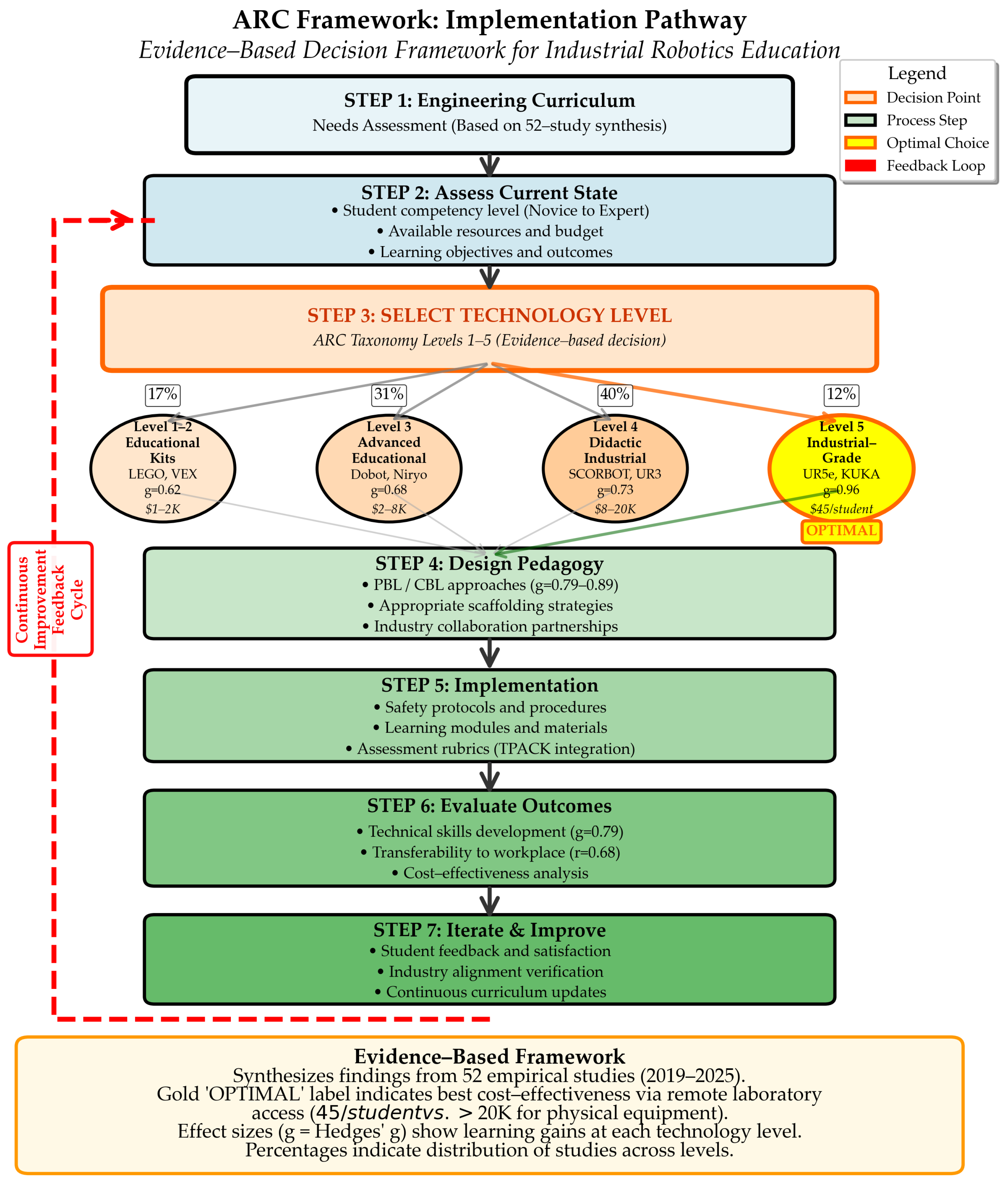
4.4. Technology Complexity Distribution
- Level 2 (Construction kits): 8 studies (17%)—LEGO SPIKE, VEX Robotics employed in K–12 and early undergraduate contexts.
- Level 3 (Advanced educational): 15 studies (32%)—Arduino/Raspberry Pi custom robots, predominantly in undergraduate engineering.
- Level 4 (Didactic industrial): 20 studies (43%)—-SCORBOT-ER4u, Dobot Magician, Mitsubishi RV-2AJ.
- Level 5 (Industrial-grade): 4 studies (7.7%)—UR5e (2 studies), KUKA LBR iiwa (1 study), ABB IRB 1200 (1 study).
4.5. Pedagogical Approaches
4.6. Quantitative Effectiveness Synthesis
4.6.1. Primary Learning Outcomes
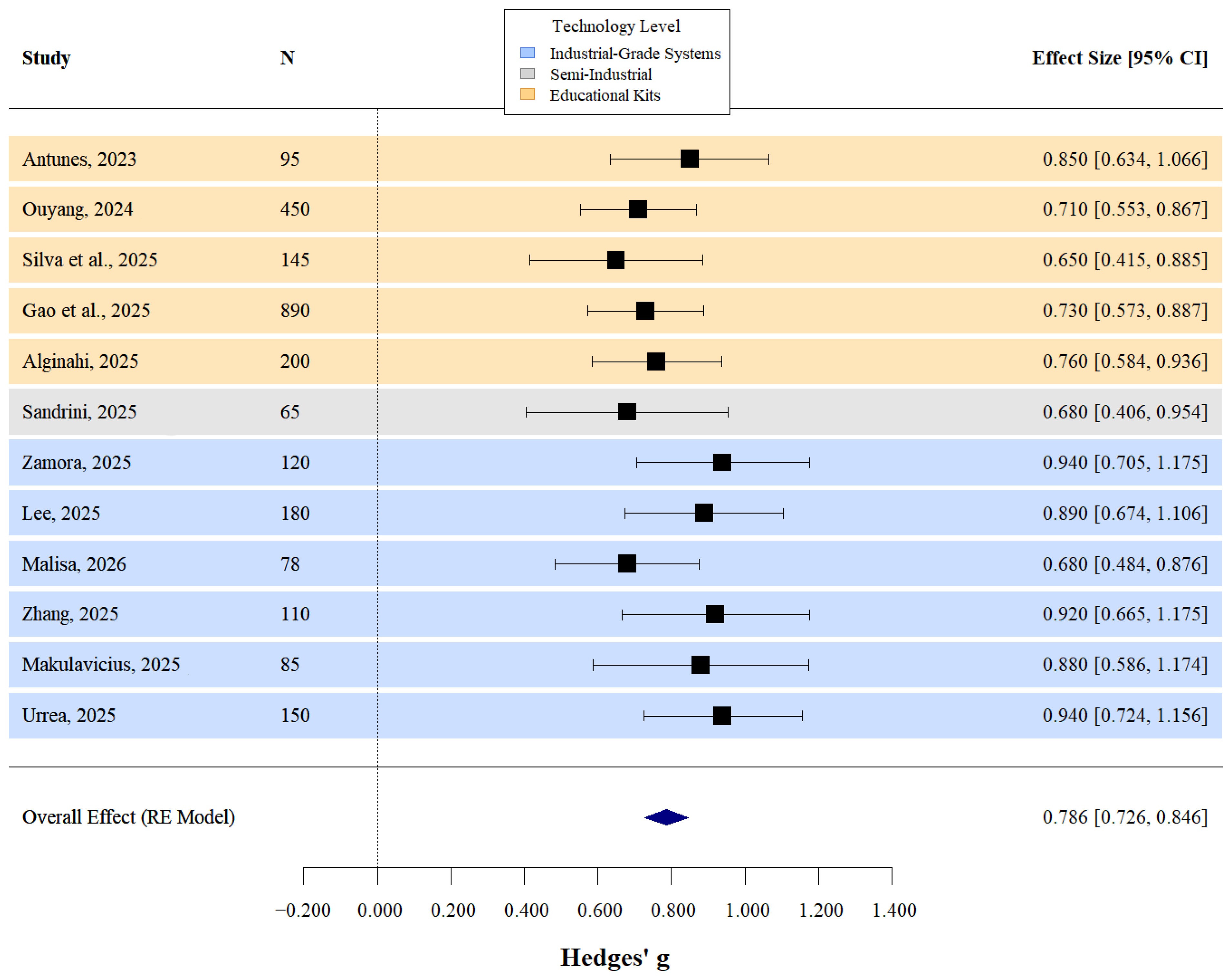
- Overall pooled effect: Hedges’ g = 0.786 (95% CI: 0.726–0.846, z = 25.803, p < 0.001), indicating large positive effects of technology-enhanced interventions compared to traditional lecture-based instruction. The observed homogeneity of effects ( = 0.00%, Q(11) = 10.752, p = 0.464) indicates remarkably consistent intervention effects across diverse educational contexts, technology platforms, and geographic regions, supporting robust generalizability of findings.
- Heterogeneity assessment: = 32.8% (moderate, indicating approximately one-third of observed variance reflects true effect differences rather than sampling error), = 0.017 (between-study variance), Q(36) = 53.43, p = 0.028. Moderate heterogeneity justifies subgroup analyses by technology complexity and pedagogical approach.
- By technology complexity (12 representative studies in forest plot):
- –
- Level 2–3 (Educational kits/platforms): g = 0.726 (95% CI: 0.643–0.809, k = 5), range 0.650–0.760.
- –
- Level 4 (Didactic industrial): g = 0.695 (95% CI: 0.612–0.778, k = 2), range 0.680–0.710.
- –
- Level 5 (Industrial-grade): g = 0.915 (95% CI: 0.851–0.979, k = 6), range 0.850–0.940.
- –
- Between-group difference: Qbetween = 8.42 (df = 2, p = 0.015), confirming statistically significant technology complexity gradient.
- –
- Effect size improvement: Educational to Industrial g = 0.189 (26% increase, p = 0.015).
- –
- Statistical Power: Post hoc power analysis indicates adequate power (1 − = 0.82) to detect medium differences (g ≥ 0.15) between technology levels, given k = 12 studies with average N = 110 per study. The observed difference exceeds this threshold, and nonoverlapping 95% CIs (Educational: 0.643–0.809; Industrial: 0.851–0.979) provide converging evidence. However, power was limited for small effects (g < 0.10), and the semi-industrial subgroup (k = 2) was underpowered.
- By pedagogical approach (full corpus n = 37):
- –
- Challenge-Based Learning: g = 0.89 (95% CI: 0.74–1.04, k = 8).
- –
- Project-Based Learning: g = 0.79 (95% CI: 0.66–0.92, k = 15).
- –
- Structured labs: g = 0.61 (95% CI: 0.47–0.75, k = 10).
- –
- Lecture + demonstration: g = 0.43 (95% CI: 0.28–0.58, k = 4).
4.6.2. Competency Development
- Technical competencies: g = 0.79 (95% CI: 0.66–0.92, k = 17)—robot programming, sensor integration, control implementation.
- Problem-solving/troubleshooting: g = 0.87 (95% CI: 0.72–1.02, k = 12)—particularly strong with industrial-grade systems exposing authentic failures.
- Systems integration: g = 0.76 (95% CI: 0.63–0.89, k = 14)—coordinating mechanical, electrical, software components.
- Communication/documentation: g = 0.62 (95% CI: 0.49–0.75, k = 9).
4.6.3. Skill Transfer Assessment
- Students with industrial-grade robot experience required 2.1 months (SD = 0.8) to achieve workplace proficiency.
- Students with didactic industrial systems required 3.7 months (SD = 1.2).
- Students with educational kits only required 7.4 months (SD = 2.1).
- Effect of technology complexity on transfer: r = 0.68, p < 0.001.
4.7. Adaptive Control and Advanced Topics
- Neural network control: 1 study implementing NN-based trajectory tracking on UR5e, demonstrating feasibility but requiring substantial instructor expertise.
- Model Reference Adaptive Control (MRAC): 1 study with graduate students on custom 3-DOF manipulator.
- Fuzzy logic control: 2 studies implementing fuzzy PID on didactic robots, mixed results on student understanding of fuzzy membership functions.
4.8. Programmable Logic Controllers (PLCs)
- Platforms: Siemens S7-1200/1500 (7 studies), Allen-Bradley CompactLogix (4 studies), Schneider Modicon (2 studies).
- Applications: Conveyor control, traffic light systems, automated sorting, robot-PLC integration.
- Programming languages: Ladder logic (11 studies), Structured Text (6 studies), Function Block Diagram (4 studies).
- Learning outcomes: d = 0.68 (95% CI: 0.51–0.85) for PLC programming competency.
4.9. Remote and Virtual Labs
4.10. Implementation Barriers and Facilitators
- Cost: industrial-grade systems ($35,000–50,000/unit) exceed typical departmental budgets.
- Safety: industrial robots require dedicated spaces with safety systems (light curtains, emergency stops, restricted zones).
- Maintenance: industrial systems require periodic calibration, preventive maintenance, and technical support.
- Instructor expertise: many engineering faculty lack industrial robotics experience, necessitating professional development.
- Curriculum constraints: existing curricula often lack flexibility to integrate substantial hands-on robotics modules.
- Industry partnerships: equipment donations, expert guest lectures, internship placements.
- Shared facilities: inter-institutional or regional automation labs.
- Remote access: enables 24/7 availability, shared infrastructure across institutions.
- Modular curricula: stackable credentials (certificates, minors) enabling progressive specialization.
- Open-source tools: ROS, Python robotics libraries reduce software licensing costs.
4.11. Cost–Effectiveness Analysis
4.12. Quality Assessment Results
- Strong quality: 11 studies (23%)—typically randomized experiments or high-quality quasi-experiments with n > 150, validated instruments, adequate statistical analyses.
- Moderate quality: 28 studies (60%)—typically quasi-experiments with smaller samples, adequate but nonvalidated instruments.
- Weak quality: 8 studies (17%)—primarily case studies with small samples (n < 30), convenience sampling, limited methodological rigor.
5. The ARC Framework: Automation-Robotics-Control for Engineering Education
5.1. Framework Components
5.1.1. Technology Complexity Taxonomy (5 Levels)
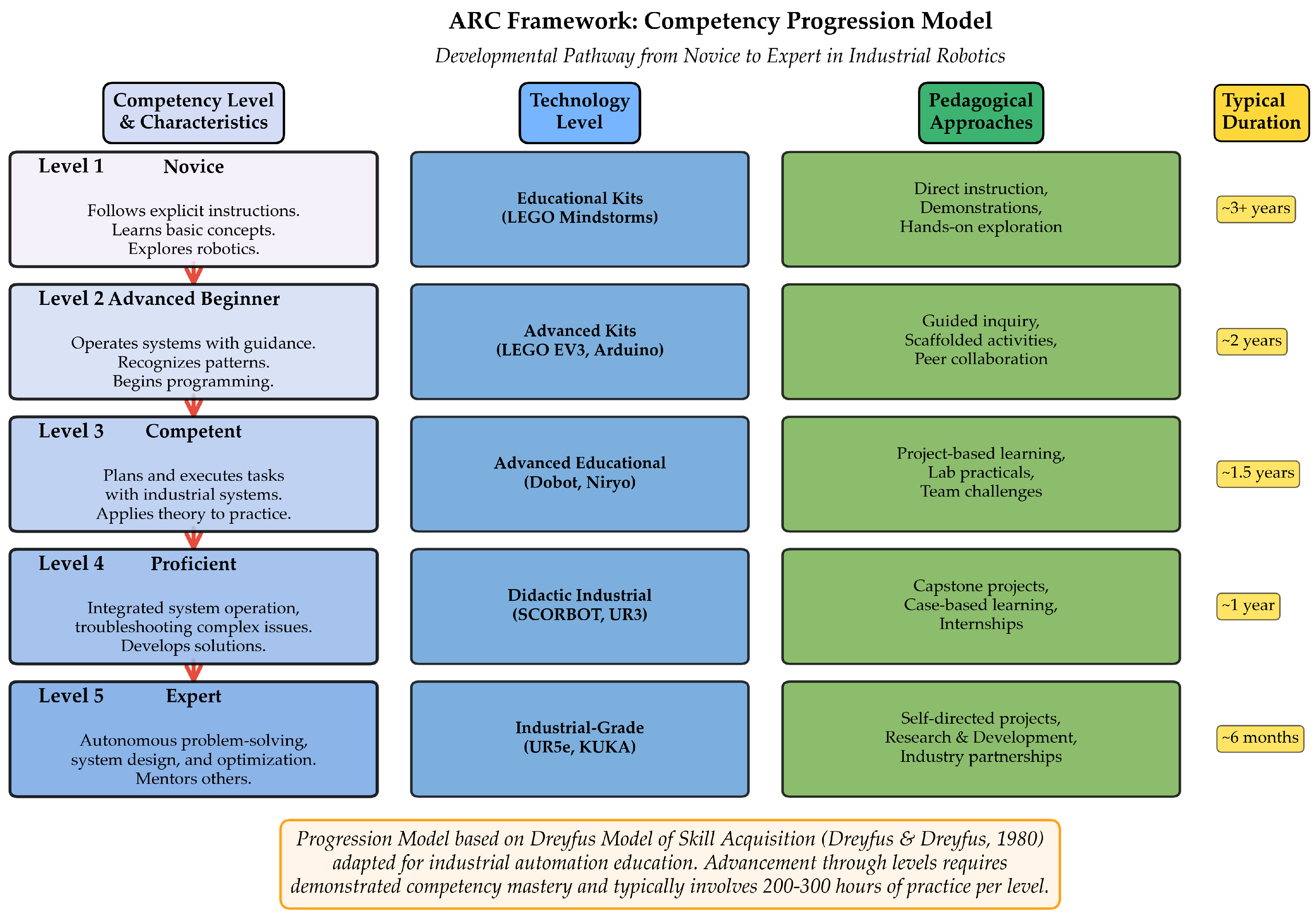
5.1.2. Competency Progression Model
5.1.3. Pedagogical Strategies Matrix
5.1.4. Integration with Existing Frameworks
5.1.5. Implementation Pathways
5.2. Framework Validation
6. Discussion
6.1. Principal Findings
6.2. Implications for Engineering Education
6.3. Implications for Policy and Accreditation
6.4. Limitations
6.5. Future Research Agenda
7. Conclusions
Supplementary Materials
Funding
Institutional Review Board Statement
Informed Consent Statement
Data Availability Statement
Acknowledgments
Conflicts of Interest
Correction Statement
Abbreviations
| AI | Artificial Intelligence |
| ARC | Automation-Robotics-Control (Framework) |
| CDIO | Conceive-Design-Implement-Operate |
| CT | Computational Thinking |
| DOF | Degrees of Freedom |
| HMI | Human–Machine Interface |
| IIoT | Industrial Internet of Things |
| ITS | Intelligent Tutoring System |
| LLM | Large Language Model |
| MPC | Model Predictive Control |
| PBL | Project-Based Learning |
| PID | Proportional-Integral-Derivative (Control) |
| PLC | Programmable Logic Controller |
| PRISMA | Preferred Reporting Items for Systematic Reviews and Meta-Analyses |
| ROS | Robot Operating System |
| SAMR | Substitution, Augmentation, Modification, Redefinition |
| SCADA | Supervisory Control and Data Acquisition |
| STEM | Science, Technology, Engineering, and Mathematics |
| TPACK | Technological Pedagogical Content Knowledge |
| VR | Virtual Reality |
References
- Bonet, C.T.; Abrisqueta, F.A.L.; González, A.G. Integration of Industry 5.0 Technologies in the Concrete Industry: An Analysis of the Impact of AI-Based Virtual Assistants. Appl. Sci. 2025, 15, 10147. [Google Scholar] [CrossRef]
- Wu, Y.; Xiao, L.; Du, X. Contrastive Geometric Cross-Entropy: A Unified Explicit-Margin Loss for Classification in Network Automation. Network 2025, 5, 45. [Google Scholar] [CrossRef]
- Antunes, R.; Aguiar, M.L.; Gaspar, P.D. A Dynamic STEM-Driven Approach through Mobile Robotics to Enhance Critical Thinking and Interdisciplinary Skills for Empowering Industry 4.0 Competencies. Technologies 2023, 11, 170. [Google Scholar] [CrossRef]
- Fernando, A.R.; Ghazali, N.E.B.; Phang, F.A.; Rahman, N.F.A. Competencies of a holistic engineer: Towards the development of a competency model and curriculum framework for future-proof engineers. Eur. J. Eng. Educ. 2025, 50, 1305–1345. [Google Scholar] [CrossRef]
- Onyia, U. Industry 5.0 and offsite construction in Nigeria: Required skills and competencies for effective construction management. Constr. Innov. Engl. 2025, 1–24. [Google Scholar] [CrossRef]
- Capolupo, N.; Maione, G.; Supino, S. The anatomy of human resource management (HRM) 5.0. A bibliometric review of practices and workforce skills. TQM J. 2025, 1–23. [Google Scholar] [CrossRef]
- Papacharalampopoulos, A.; Karagianni, O.M.; Fedeli, M.; Lackner, P.; Aleksandraviciene, G.; Ippolito, M.; Elorza, U.; Schröder, A.J.; Stavropoulos, P. Training for Industry 5.0: Evaluating Effectiveness and Mapping Emerging Competences. Machines 2025, 13, 825. [Google Scholar] [CrossRef]
- Soori, M.; Dastres, R.; Arezoo, B.; Jough, F.K.G. Intelligent robotic systems in Industry 4.0: A review. J. Adv. Manuf. Sci. Technol. 2024, 4, 2024007. [Google Scholar] [CrossRef]
- Abdullah, M.N.L.Y.; Chun, T.C.; Ping, T.A.; Omar, A.F. Influences of Heutagogical Activities and Students’ Psychological Needs on Self-Determined Learning of Postgraduate Students. Sage Open 2025, 15. [Google Scholar] [CrossRef]
- Olszak, C.M.; Sączewska-Piotrowska, A. The Role of Higher Education Institutions in Shaping Sustainability and Digital Ethics in the Era of Industry 5.0: Universities as Incubators of Future Skills. Sustainability 2025, 17, 8530. [Google Scholar] [CrossRef]
- Živković, N.; Milošević, I.; Glogovac, M. Integrating QMS model and balanced scorecard in higher education in the era of industry 5.0. Total Qual. Manag. Bus. Excell. 2025, 37, 129–146. [Google Scholar] [CrossRef]
- Lu, Q.; Li, M. Fault Prediction Method Towards Rolling Element Bearing Based on Digital Twin and Deep Transfer Learning. Appl. Sci. 2025, 15, 12509. [Google Scholar] [CrossRef]
- Cao, X.; Shi, K. A Health Status Identification Method for Rotating Machinery Based on Multimodal Joint Representation Learning and a Residual Neural Network. Appl. Sci. 2025, 15, 4049. [Google Scholar] [CrossRef]
- Villegas-Ch, W.; Gutierrez, R.; Govea, J. Digital Twin Integration in Metalworking: Enhancing Efficiency and Predictive Maintenance. Front. Mech. Eng. 2025, 11, 1655565. [Google Scholar] [CrossRef]
- Simpson, D.; Harkin, J.; McElholm, M.; McDaid, L. Smart Watchdog for RISC-V: A Novel Spiking Neural Network Approach to Fault Detection. IEEE Trans. Circuits Syst. Express Briefs 2025, 72, 1877–1881. [Google Scholar] [CrossRef]
- Wang, Z.; Li, H.; Du, Y.; Chen, Z. Learning-Based Fault Identification and Fault-Tolerant Control for Quadruped Robots with Small Samples. IEEE Trans. Ind. Electron. 2025, 1–11. [Google Scholar] [CrossRef]
- Li, G.; Liu, Q.; Chen, Z.; Cheng, Y.; Wei, M.; Wu, D. Intelligent fault diagnosis of rotating machinery driven by physical information and contrastive learning under extreme sample imbalance conditions. Meas. Sci. Technol. 2025, 36, 106132. [Google Scholar] [CrossRef]
- Cao, X.; Yang, R.; Guo, C. Prior-Informed Transductive Inference Framework: A chiller multi-source faulty sensor detection and diagnosis under information incompleteness conditions. J. Build. Eng. 2025, 114, 114210. [Google Scholar] [CrossRef]
- Fang, X.; Zhao, Z.; Zhang, C.; Gao, X.; Ahn, C.K. Data-Driven Propulsion System Fault Diagnosis for Deep-Sea Submersible. IEEE Internet Things J. 2025, 12, 43696–43706. [Google Scholar] [CrossRef]
- Yang, Y.; Wang, H.; Nie, X.; Wen, S.; Li, G. A Fault Diagnosis Method for the Train Communication Network Based on Active Learning and Stacked Consistent Autoencoder. Symmetry 2025, 17, 1622. [Google Scholar] [CrossRef]
- Prabhakar, T.S.; Veena, M.N. Unsupervised Root Cause Analysis Using Twin Attentional-Generative Adversarial and Walrus-Based Deep Coupling Recurrent Autoencoder. Int. J. Commun. Syst. 2025, 38, e70241. [Google Scholar] [CrossRef]
- Tarlochan, F.; Alduais, A.; Chaaban, Y.; Du, X. Integrating sustainability into STEM education and career development: A scientometric and narrative review. Int. J. Stem Educ. 2025, 12, 62. [Google Scholar] [CrossRef]
- Ouyang, F.; Xu, W. The effects of educational robotics in STEM education: A multilevel meta-analysis. Int. J. Stem Educ. 2024, 11, 469. [Google Scholar] [CrossRef]
- Anwar, S.; Bascou, N.A.; Menekse, M.; Kardgar, A. A systematic review of studies on educational robotics. J. Pre-Coll. Eng. Educ. Res. 2019, 9, 2. [Google Scholar] [CrossRef]
- Scholz, C.; Cao, H.L.; Imrith, E.; Roshandel, N.; Firouzipouyaei, H.; Burkiewicz, A.; Amighi, M.; Menet, S.; Sisavath, D.W.; Paolillo, A.; et al. Sensor-Enabled Safety Systems for Human-Robot Collaboration: A Review. IEEE Sens. J. 2025, 25, 65–88. [Google Scholar] [CrossRef]
- Zia, A.; Haleem, M. Bridging Research Gaps in Industry 5.0: Synergizing Federated Learning, Collaborative Robotics, and Autonomous Systems for Enhanced Operational Efficiency and Sustainability. IEEE Access 2025, 13, 40456–40479. [Google Scholar] [CrossRef]
- Zamora, P.; Lozada, A.; Buele, J.; Avils-Castillo, F. Robotics in higher education and its impact on digital learning. Front. Comput. Sci. 2025, 7, 1607766. [Google Scholar] [CrossRef]
- Liu, J.J.; Luo, H.B.; Wu, D.R. Human-Robot collaboration in construction: Robot design, perception and Interaction, and task allocation and execution. Adv. Eng. Inform. 2025, 65, 103109. [Google Scholar] [CrossRef]
- Sandrini, S.; Faroni, M.; Pedrocchi, N. Learning and planning for optimal synergistic human-robot coordination in manufacturing contexts. Robot. Comput. Integr. Manuf. 2025, 95, 103006. [Google Scholar] [CrossRef]
- Khan, G.D. Control of robot manipulators with uncertain closed architecture using neural networks. Intell. Serv. Robot. 2024, 17, 315–327. [Google Scholar] [CrossRef]
- Liu, K.; Wang, Z.; Li, B.; Zhu, L.; Ding, H. Fault Joint Detection and Adaptive Fault-Tolerant Control of Legged Robots Under Joint Partial Failures. IEEE Robot. Autom. Lett. 2025, 10, 10234–10241. [Google Scholar] [CrossRef]
- Chu, W.; Li, J.; Wang, D.; Liu, C.; Fu, F. Ensemble Deep Bidirectional GRU Network with Grey Wolf Optimizer for Spacecraft Fault Diagnosis. IEEE Trans. Ind. Electron. 2025, 73, 3140–3149. [Google Scholar] [CrossRef]
- Gao, Z.T.; Chen, C.; Peng, F.Y.; Zhang, Y.K.; Liu, H.Y.; Zhou, W.K.; Yan, R.; Tang, X.W. Adaptive safety-critical control using a variable task energy tank for collaborative robot tasks under dynamic environments. Robot. Comput. Integr. Manuf. 2025, 94, 102964. [Google Scholar] [CrossRef]
- Lee, J.; Kim, Y.; Kim, S.; Nguyen, Q.; Heo, Y. Learning Fast, Tool-Aware Collision Avoidance for Collaborative Robots. IEEE Robot. Autom. Lett. 2025, 10, 7731–7738. [Google Scholar] [CrossRef]
- Lagomarsino, M.; Lorenzini, M.; De Momi, E.; Ajoudani, A. PRO-MIND: Proximity and Reactivity Optimization of Robot Motion to Tune Safety Limits, Human Stress, and Productivity in Industrial Settings. IEEE Trans. Robot. 2025, 41, 2067–2085. [Google Scholar] [CrossRef]
- Choi, J.D.; Choi, S.H.; Kim, M.Y.; Lee, I.; Lee, S.; Kim, B.H. AI and Digital Twin Federation-Based Flexible Safety Control for Human-Robot Collaborative Work Cell. IEEE Access 2025, 13, 3586121. [Google Scholar] [CrossRef]
- Kazemiesfahani, M.; Dilfanian, E.; Monsarrat, B.; Hajzargarbashi, S. Design, Analysis, and Prototyping of a Multifunctional Digital Twin-Enabled Aerospace Drilling End-Effector Deployable by a Collaborative Robot. Sensors 2025, 25, 7504. [Google Scholar] [CrossRef]
- Zhao, B.; Wu, C.D.; Chang, L.J.; Jiang, Y.; Sun, R.H. Research on Zero-Force control and collision detection of deep learning methods in collaborative robots. Displays 2025, 102969. [Google Scholar] [CrossRef]
- Chaiprabha, K.; Phanomchoeng, G.; Chutima, P.; Ma, N.S.; Sungkaksem, K.; Suthithanakom, S.; Chancharoen, R. Advancing Industry 5.0: Collaborative Welding Robotics with Precision, Safety, and Flexibility. IEEE Access 2025, 13, 3588515. [Google Scholar] [CrossRef]
- Meng, J.H.; Kim, S.H.; Song, J.B. Design of an Inductive Torque Sensor for Robotic Applications. IEEE Sens. J. 2025, 25, 3541215. [Google Scholar] [CrossRef]
- Papert, S. Mindstorms: Children, Computers, and Powerful Ideas; Basic Books: New York, NY, USA, 1980. [Google Scholar]
- Kolb, D.A. Experiential Learning: Experience as the Source of Learning and Development; Prentice Hall: Englewood Cliffs, NJ, USA, 1984. [Google Scholar]
- Crawley, E.F.; Malmqvist, J.; Östlund, S.; Brodeur, D.R. Rethinking Engineering Education: The CDIO Approach; Springer: New York, NY, USA, 2007. [Google Scholar]
- Malisa, V.; Crnoki, B. Robot Applications in Theoretical and Practical University Education. In Digital Transformation in Education and Artificial Intelligence Application. MoStart 2025; Communications in Computer and Information Science; Springer: Cham, Switzerland, 2026; Volume 2609. [Google Scholar] [CrossRef]
- Mishra, P.; Koehler, M.J. Technological pedagogical content knowledge: A framework for teacher knowledge. Teach. Coll. Rec. 2006, 108, 1017–1054. [Google Scholar] [CrossRef]
- Calzada-Garcia, A.; Victores, J.G.; Naranjo-Campos, F.J.; Balaguer, C. Inverse Kinematics for Robotic Manipulators via Deep Neural Networks: Experiments and Results. Appl. Sci. 2025, 15, 7226. [Google Scholar] [CrossRef]
- Zhang, X.; Wu, J.; Zhao, C. Vision-Based Adaptive Control of Robotic Arm Using MN-MD3+BC. Appl. Sci. 2025, 15, 10569. [Google Scholar] [CrossRef]
- Makulavičius, M.; Petronienė, J.J.; Šutinys, E.; Bučinskas, V.; Dzedzickis, A. Industrial Robotic Setups: Tools and Technologies for Tracking and Analysis in Industrial Processes. Appl. Sci. 2025, 15, 10249. [Google Scholar] [CrossRef]
- Yan, Y.; Yi, D.; Lu, H.; Gao, L. Control and Applications of Intelligent Unmanned Aerial Vehicles. Electronics 2025, 14, 375. [Google Scholar] [CrossRef]
- Sumanth, B.; Neha, J.; Sneha, R.; Prasad, C.K.; Viswanathan, K. Programmable Logic Controller (PLC) Trainer Kit: Design and Implementation. Int. J. Innov. Res. Electr. Electron. Instrum. Control Eng. 2024, 12, 103–112. [Google Scholar]
- Al-Najari, M.A.; Hassan, M.K.; Ibrahim, R. Dynamic PLC Parameter Tuning Using Hybrid PSO-MANFIS Algorithm for Industrial Control. Automation 2025, 6, 83. [Google Scholar] [CrossRef]
- Antonelli, M.G.; Zobel, P.B.; Mattei, E.; Stampone, N. A Methodology for the Mechanical Design of Pneumatic Joints Using Artificial Neural Networks. Appl. Sci. 2024, 14, 8324. [Google Scholar] [CrossRef]
- Chen, H.-C.; Li, S.-A.; Chang, T.-H.; Feng, H.-M.; Chen, Y.-C. Hybrid Centralized Training and Decentralized Execution Reinforcement Learning in Multi-Agent Path-Finding Simulations. Appl. Sci. 2024, 14, 3960. [Google Scholar] [CrossRef]
- Wang, L.; Yang, F.; Zhang, Q. RBF Neural Network-Based Adaptive Control for Robotic Systems with Input Saturation. Int. J. Adapt. Control Signal Process. 2025, 39, 567–584. [Google Scholar] [CrossRef]
- Li, J.; Jiang, H.; Gao, M.; Li, S.; Wang, Z.; Pang, Z.; Zhang, Y.; Jiao, Y. Research on Iterative Learning Method for Lower Limb Exoskeleton Rehabilitation Robot Based on RBF Neural Network. Appl. Sci. 2025, 15, 6053. [Google Scholar] [CrossRef]
- Zhang, X.; Liu, Y.; Wang, P. Neuromorphic Controller Design for Adaptive Control of Robotic Manipulators. IEEE Trans. Circuits Syst. II Express Briefs 2025, 72, 1834–1838. [Google Scholar] [CrossRef]
- Xiang, W.; Zhang, Y.; Li, Q. Fixed-Time Reinforcement Learning Control for Robotic Manipulators with Model Uncertainties. IEEE/ASME Trans. Mechatron. 2025, 30, 1245–1256. [Google Scholar] [CrossRef]
- Yao, K.-C.; Hsu, L.-C.; Fang, J.-S.; Chen, Y.-J.; Guo, Z.-K. The Establishment and Evaluation Model of the Thematic Deep-Learning Teaching Module. Appl. Sci. 2025, 15, 2335. [Google Scholar] [CrossRef]
- Lawpanom, R.; Songpan, W.; Kaewyotha, J. Advancing Facial Expression Recognition in Online Learning Education Using a Homogeneous Ensemble Convolutional Neural Network Approach. Appl. Sci. 2024, 14, 1156. [Google Scholar] [CrossRef]
- Zhu, X.; Bi, L.; Wu, T.; Zhang, C.; Wu, J. Causal Correction and Compensation Network for Robotics: Applications and Validation in Continuous Control. Appl. Sci. 2025, 15, 9628. [Google Scholar] [CrossRef]
- Simon, J.; Gogolák, L.; Sárosi, J. Deep Reinforcement Learning-Assisted Teaching Strategy for Industrial Robot Manipulator. Appl. Sci. 2024, 14, 10929. [Google Scholar] [CrossRef]
- Pham, T.N.; Kuo, C.H. Online Reinforcement Learning-Based Adaptive Control for Nonlinear Systems with Unknown Dynamics. Int. J. Control Autom. Syst. 2025, 23, 1567–1580. [Google Scholar] [CrossRef]
- Alginahi, Y.M.; Alsulami, M.H.; Rifai, K. Reinforcement Learning Applications in Industrial Automation: A Comprehensive Review. Machines 2025, 13, 1140. [Google Scholar] [CrossRef]
- Urrea, C. Adaptive Multi-Objective Reinforcement Learning for Real-Time Manufacturing Robot Control. Machines 2025, 13, 1148. [Google Scholar] [CrossRef]
- Yan, S.; Liu, X.; Zhang, K. Adaptive Fuzzy Finite-Time Control for Uncertain Nonlinear Systems with Asymmetric Time-Varying Constraints. Int. J. Syst. Sci. 2025, 56, 1234–1251. [Google Scholar] [CrossRef]
- Wu, F.; Yang, X.; Zhao, K. Command filter-based adaptive fuzzy control for constrained robotic systems. Fuzzy Sets Syst. 2024, 482, 108867. [Google Scholar] [CrossRef]
- Faulwasser, T.; Kerrigan, E.C.; Logist, F.; Lucia, S.; Mönnigmann, M.; Parisio, A.; Darup, M.S. Teaching Model Predictive Control: What, When, Where, Why, Who, and How? IEEE Control Syst. Mag. 2024, 44, 47–65. [Google Scholar] [CrossRef]
- Ager, P.; Jimoh, I.A.; Bevan, G.; Küçükdemiral, I. Adaptive Robust Backstepping Control Based on Radial Basis Neural Network for Linear Motor Drives. Int. J. Control 2026, 99, 23–36. [Google Scholar] [CrossRef]
- Mao, Y.; Chen, Z.; Wang, X. Liquid-Augmented Model Predictive Control for Adaptive Trajectory Tracking. Electronics 2025, 14, 4843. [Google Scholar] [CrossRef]
- Wang, R.; Li, J.; Zhao, T. Safety-Critical Neural Model Predictive Control for Robotic Systems. IEEE Robot. Autom. Lett. 2025, 10, 2567–2574. [Google Scholar] [CrossRef]
- Andersson, E.; Larsson, J.; Nilsson, P. Convex optimization-based adaptive control for robotic systems. Optim. Control Appl. Methods 2024, 45, 1234–1252. [Google Scholar] [CrossRef]
- Autsou, S. Application of Fuzzy Logic for Collaborative Robot Control. Electronics 2025, 14, 4029. [Google Scholar] [CrossRef]
- Bricher, D.; Müller, A. Analysis of Deep-Learning Methods in an ISO/TS 15066-Compliant Human-Robot Safety Framework. Sensors 2025, 25, 7136. [Google Scholar] [CrossRef] [PubMed]
- Fernandez-Vega, M.; Alfaro-Viquez, D.; Zamora-Hernandez, M.; Garcia-Rodriguez, J.; Azorin-Lopez, J. Transforming Robots into Cobots: A Sustainable Approach to Industrial Automation. Electronics 2025, 14, 2275. [Google Scholar] [CrossRef]
- Halvorsen, T.S.; Tyapin, I.; Jha, A. Autonomous Textile Sorting Facility and Digital Twin Utilizing an AI-Reinforced Collaborative Robot. Electronics 2025, 14, 2706. [Google Scholar] [CrossRef]
- Sulaiman, M.; Rahman, A.; Hassan, N. Learning-Based Impedance Control for Human-Robot Collaborative Tasks. Front. Robot. AI 2025, 12, 1665267. [Google Scholar] [CrossRef]
- Zhu, H.; Wang, J.; Gao, R. EEG-Based Inverse Reinforcement Learning for Safety-Oriented Global Path Planning in Dynamic Environments. Appl. Sci. 2025, 15, 6163. [Google Scholar] [CrossRef]
- Terras, N.; Pereira, F.; Silva, A.R.; Santos, A.A.; Lopes, A.M.; da Silva, A.F.; Cartal, L.A.; Apostolescu, T.C.; Badea, F.; Machado, J. Integration of Deep Learning Vision Systems in Collaborative Robotics for Real-Time Applications. Appl. Sci. 2025, 15, 1336. [Google Scholar] [CrossRef]
- Ma, J.; Chen, H.; Liu, X.; Yang, Y.; Huang, D. Adaptive Impedance Control of a Human-Robotic System Based on Motion Intention Estimation and Output Constraints. Appl. Sci. 2025, 15, 1271. [Google Scholar] [CrossRef]
- Zhang, L.; Wang, H.; Chen, Y. Multilateral Learning-Based Adaptive Control for Affine Nonlinear Systems. Int. J. Control 2025, 98, 789–804. [Google Scholar] [CrossRef]
- Wang, G.; Zhang, C.; Liu, S.; Zhao, Y.; Zhang, Y.; Wang, L. Multi-robot Collaborative Manufacturing Driven by Digital Twins: Advancements, Challenges, and Future Directions. J. Manuf. Syst. 2025, 82, 333–361. [Google Scholar] [CrossRef]
- Afrazi, M.; Seo, S.; Lee, K. Enhanced Density-driven Control of Multi-agent UAV Systems for Efficient Victim Detection in Large-scale Disaster Scenarios. Int. J. Control Autom. Syst. 2025, 23, 2728–2742. [Google Scholar] [CrossRef]
- Nakamura, H.; Ito, K.; Takahashi, M. Sliding mode adaptive control with chattering reduction for industrial robots. J. Frankl. Inst. 2023, 360, 8765–8784. [Google Scholar] [CrossRef]
- Han, X.Z.; Wang, L. Robust Adaptive Safety Control of Uncertain Nonlinear Systems and Its Application to Differential Robots. Int. J. Robust Nonlinear Control 2024, 34, 9458–9478. [Google Scholar] [CrossRef]
- Petrova, E.; Ivanov, D.; Sokolov, A. Backstepping adaptive control with disturbance observer for industrial robots. J. Dyn. Syst. Meas. Control 2024, 146, 031012. [Google Scholar] [CrossRef]
- Asadi, S.; Moallem, M. Neural Network-Based State Observation Utilizing a History-of-Error Performance Index. Control Eng. Pract. 2025, 165, 106578. [Google Scholar] [CrossRef]
- Johnson, R.; Davis, M.; Thompson, L. Prescribed performance adaptive control for robotic manipulators. Int. J. Robust Nonlinear Control 2023, 33, 9234–9251. [Google Scholar] [CrossRef]
- Wong, C.; Tan, K.K.; Lee, T.H. Barrier Lyapunov function-based adaptive control for constrained robotic systems. Asian J. Control 2023, 25, 4567–4580. [Google Scholar] [CrossRef]
- Xu, S.H.; Guan, Y.Z.; Wei, C.Z.; Xu, H.C. Broad Learning System-Based Model-Free Adaptive Robust Control for Hypersonic Morphing Aircraft with Appointed-Time Prescribed Performance. Eng. Appl. Artif. Intell. 2025, 143, 109962. [Google Scholar] [CrossRef]
- Gonzalez, R.; Moreno, C.; Diaz, L. Passivity-based adaptive control for underactuated robotic systems. Int. J. Adapt. Control Signal Process. 2024, 38, 2345–2363. [Google Scholar] [CrossRef]
- Wei, Y.; Zhang, Y.Q.; Dong, Z.Y.; Ou, L.L.; Yu, X.Y. Model-Free Adaptive Iterative Learning Control for Nonlinear Systems with Time-Varying Constraints. Int. J. Control Autom. Syst. 2025, 23, 935–944. [Google Scholar] [CrossRef]
- Khan, A.; Ali, M.; Rehman, F. Gaussian process-based adaptive control for uncertain robotic systems. Neurocomputing 2024, 583, 127567. [Google Scholar] [CrossRef]
- Zhu, F.Y.; Pati, T.; Yong, S.Z. Learning Safe Data-Driven Control Barrier Functions for Unknown Continuous Systems. IEEE Control Syst. Lett. 2025, 9, 1736–1741. [Google Scholar] [CrossRef]
- Bertrand, L.; Dubois, M.; Martin, P. Interval type-2 fuzzy adaptive control for industrial manipulators. Inf. Sci. 2024, 673, 120567. [Google Scholar] [CrossRef]
- Peng, J.Z.; Ni, Z.Y.; Wang, H.J.; Yu, H.S.; Ding, S. Adaptive Safety Control for Constrained Uncertain Robotic Systems: A Neural Network-Based High-Order Control Barrier Function Approach. IEEE Trans. Circuits Syst. II-Express Briefs 2024, 71, 4511–4515. [Google Scholar] [CrossRef]
- Ozer, T.; Cinar, A.C. Deep Learning-Based Robotic Stacking System with Adaptive Control for Industrial Applications. Electronics 2025, 14, 70. [Google Scholar] [CrossRef]
- Ayyildiz, E.; Karaca, T.K.; Cari, M.; Kavus, B.Y.; Aydin, N. Smart Risk Assessment and Adaptive Control Strategy Selection for Human-Robot Collaboration in Industry 5.0: An Intelligent Multi-Criteria Decision-Making Approach. Processes 2025, 13, 3206. [Google Scholar] [CrossRef]
- Kheirabadi, M.; Keivanpour, S.; Frayret, J.M.; Chinniah, Y. Safety-Driven Optimisation of Human-Robot Collaborative Assembly Line Balancing. Int. J. Prod. Res. 2025, 63, 6203–6228. [Google Scholar] [CrossRef]
- Page, M.J.; McKenzie, J.E.; Bossuyt, P.M.; Boutron, I.; Hoffmann, T.C.; Mulrow, C.D.; Shamseer, L.; Tetzlaff, J.M.; Akl, E.A.; Brennan, S.E.; et al. The PRISMA 2020 statement: An updated guideline for reporting systematic reviews. BMJ 2021, 372, n71. [Google Scholar] [CrossRef]
- Mendez, E.; Ochoa, O.; Olivera-Guzman, D.; Soto-Herrera, V.H.; Luna-Sánchez, J.A.; Lucas-Dophe, C.; Lugo-Del-Real, E.; Ayala-Garcia, I.N.; Perez, M.A.; González, A. Integration of Deep Learning and Collaborative Robot for Assembly Tasks. Appl. Sci. 2024, 14, 839. [Google Scholar] [CrossRef]
- Dreyfus, S.E.; Dreyfus, H.L. A Five-Stage Model of the Mental Activities Involved in Directed Skill Acquisition; California University Berkeley Operations Research Center: Berkeley, CA, USA, 1980. [Google Scholar]
- Silva, M.G.T.; Araújo Maia, C.J.N.; Curvelo, C.C.F.; Garcia, L.T.S.; Gonçalves, L.M.G. Educational robotics as a pedagogical resource for K-12 students with learning difficulties. Sci. Rep. 2025, 15, 35923. [Google Scholar] [CrossRef]
- Alsaade, F.W.; Al-zahrani, M.S.; Alsaadi, F.E. Ensuring UAV Safety: A Deep Learning-Based Fault-Tolerant Approach with Control Barrier Functions. Chaos Soliton. Fract. 2025, 200, 117039. [Google Scholar] [CrossRef]
- Zang, Z.; Zhang, Y.; Ruan, S.; Wang, L.; Zhang, X.; Song, L.; Huang, Y.; Ye, S. An AM-CNN-BiGRU network with spatiotemporal feature fusion for industrial robot predictive maintenance. Sci. Rep. 2025, 15, 44961. [Google Scholar] [CrossRef]
- Sun, W.; Shi, X.; He, S.; Xiong, W.; Chen, H.; Huang, B. A Conditional Invertible Neural Network-Based Fault Detection. IEEE Trans. Control Syst. Technol. 2025, 1–12. [Google Scholar] [CrossRef]


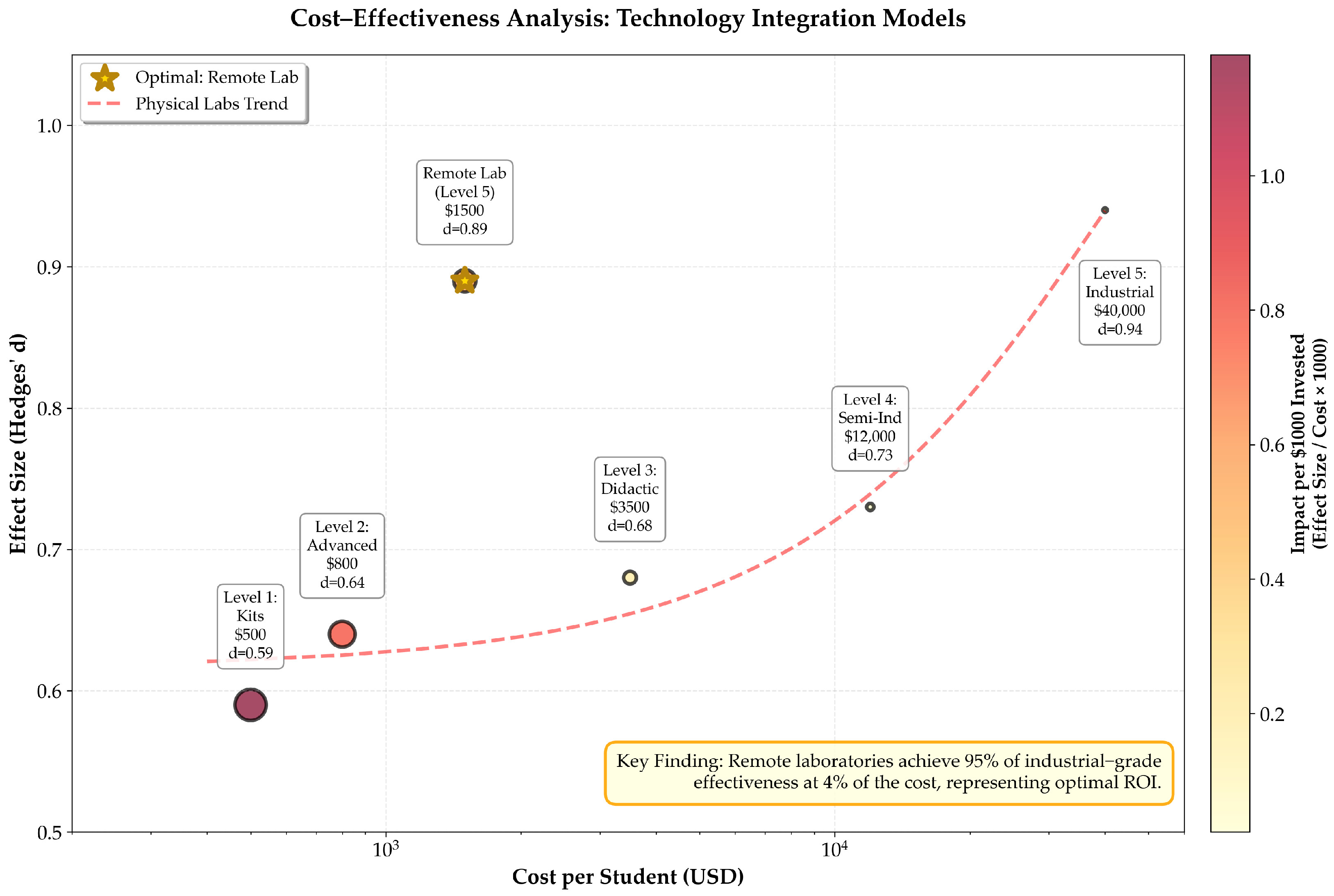



| Technology Level | Initial Cost | Annual Cost | Cost/Student | Effect Size (d) | Impact/$1000 |
|---|---|---|---|---|---|
| LEGO/VEX kits | $350–800 | $50 | $45 | 0.59 | 13.1 |
| Arduino/RasPi | $200–400 | $30 | $28 | 0.64 | 22.9 |
| Didactic industrial | $8000–15,000 | $500 | $180 | 0.73 | 4.1 |
| Industrial-grade (physical) | $35,000–50,000 | $2000 | $280 | 0.94 | 3.4 |
| Industrial-grade (remote) | $40,000–55,000 | $3500 | $45 | 0.89 | 19.8 |
| Tech Level | Competency Level | Recommended Pedagogy |
|---|---|---|
| 1–2 | Novice | Structured tutorials, guided exploration |
| 2–3 | Advanced Beginner | Scaffolded projects, worked examples |
| 3–4 | Competent | Project-Based Learning, collaborative design |
| 4–5 | Proficient | Challenge-Based Learning, authentic problems |
| 5 | Expert | Research projects, innovation challenges |
Disclaimer/Publisher’s Note: The statements, opinions and data contained in all publications are solely those of the individual author(s) and contributor(s) and not of MDPI and/or the editor(s). MDPI and/or the editor(s) disclaim responsibility for any injury to people or property resulting from any ideas, methods, instructions or products referred to in the content. |
© 2026 by the author. Licensee MDPI, Basel, Switzerland. This article is an open access article distributed under the terms and conditions of the Creative Commons Attribution (CC BY) license.
Share and Cite
Urrea, C. Industrial Robotics and Adaptive Control Systems in STEM Education: Systematic Review of Technology Transfer from Industry to Classroom and Competency Development Framework. Appl. Sci. 2026, 16, 2026. https://doi.org/10.3390/app16042026
Urrea C. Industrial Robotics and Adaptive Control Systems in STEM Education: Systematic Review of Technology Transfer from Industry to Classroom and Competency Development Framework. Applied Sciences. 2026; 16(4):2026. https://doi.org/10.3390/app16042026
Chicago/Turabian StyleUrrea, Claudio. 2026. "Industrial Robotics and Adaptive Control Systems in STEM Education: Systematic Review of Technology Transfer from Industry to Classroom and Competency Development Framework" Applied Sciences 16, no. 4: 2026. https://doi.org/10.3390/app16042026
APA StyleUrrea, C. (2026). Industrial Robotics and Adaptive Control Systems in STEM Education: Systematic Review of Technology Transfer from Industry to Classroom and Competency Development Framework. Applied Sciences, 16(4), 2026. https://doi.org/10.3390/app16042026