A Systematic Review of Fall Detection and Prediction Technologies for Older Adults: An Analysis of Sensor Modalities and Computational Models




Abstract
1. Introduction
2. Methodology: A PRISMA-Based Approach
2.1. Search Strategy
2.2. Inclusion and Exclusion Criteria
2.3. Study Selection
2.4. Meta-Analysis Statement
3. Thematic Synthesis
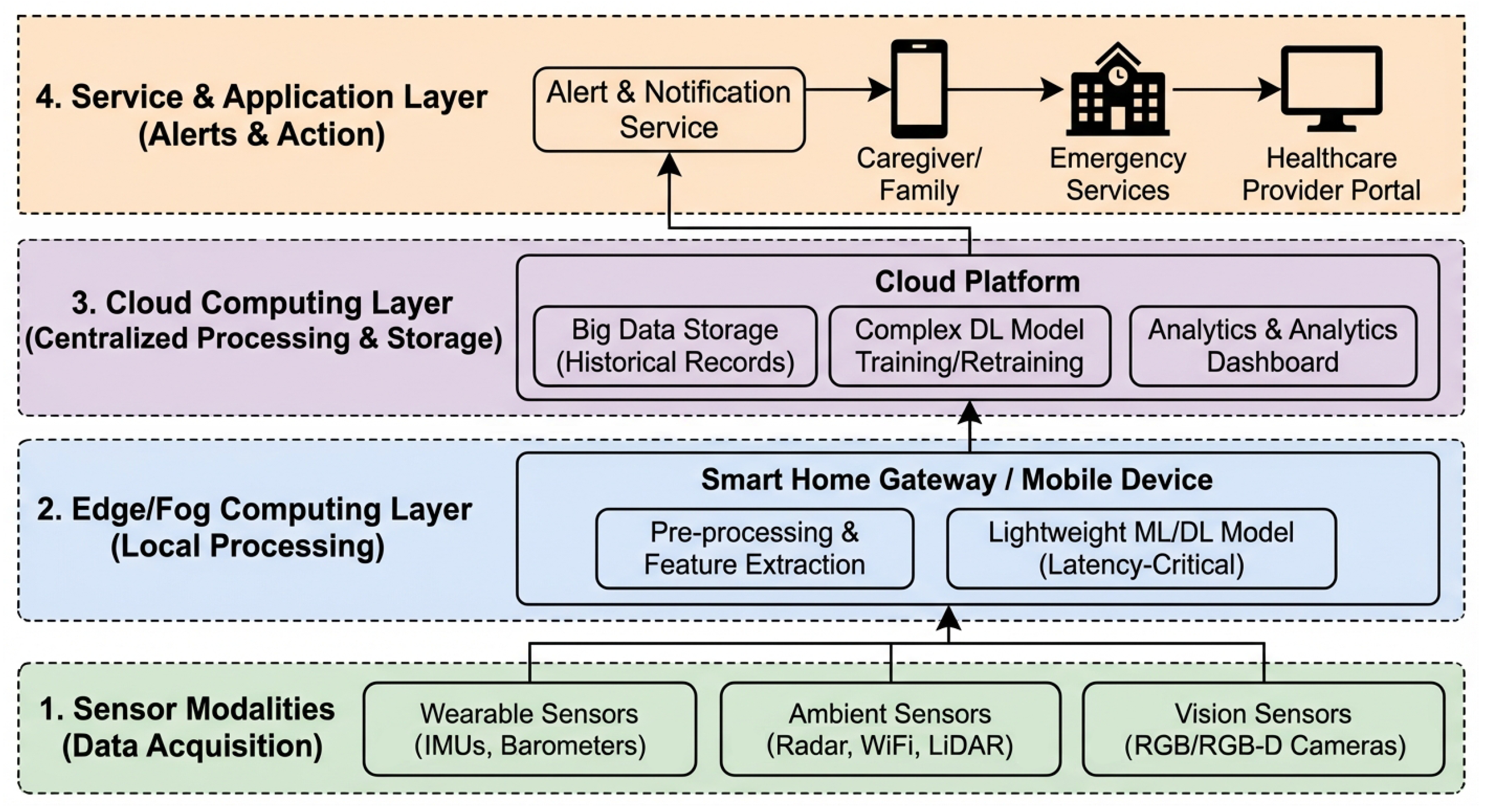
3.1. Sensor Technologies: A Tripartite Classification
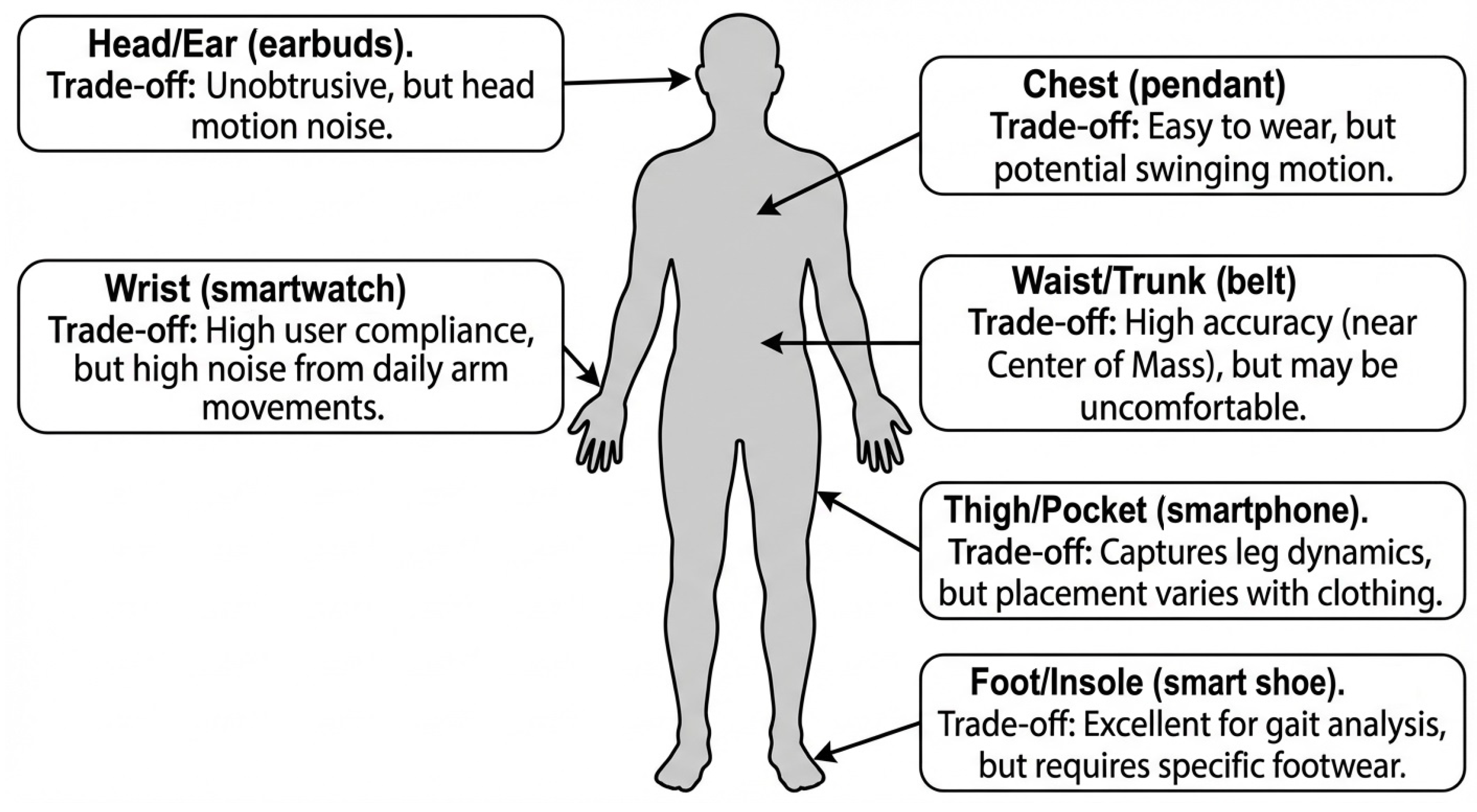
3.1.1. Wearable Sensor-Based Systems
3.1.2. Ambient Sensor-Based Systems
3.1.3. Hybrid Systems
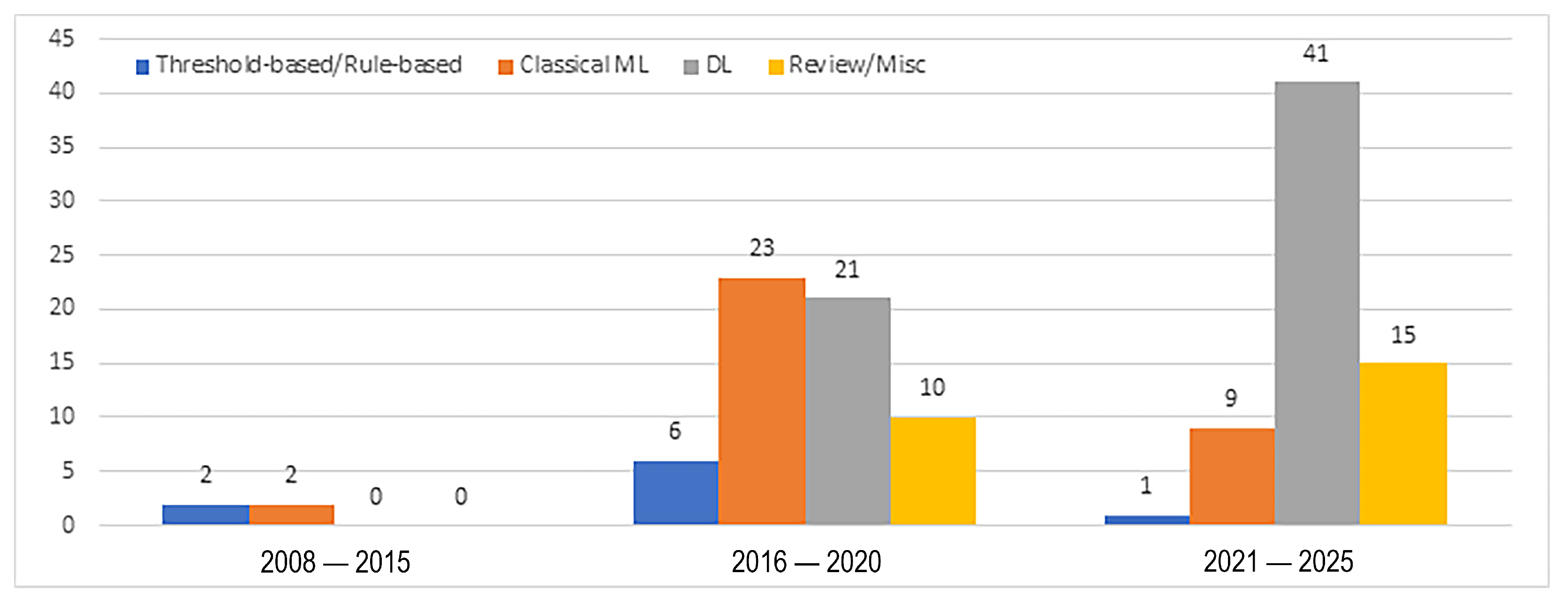
3.2. Computational Models: From Thresholds to Deep Learning
3.2.1. Threshold-Based and Rule-Based Algorithms
3.2.2. Classical Machine Learning
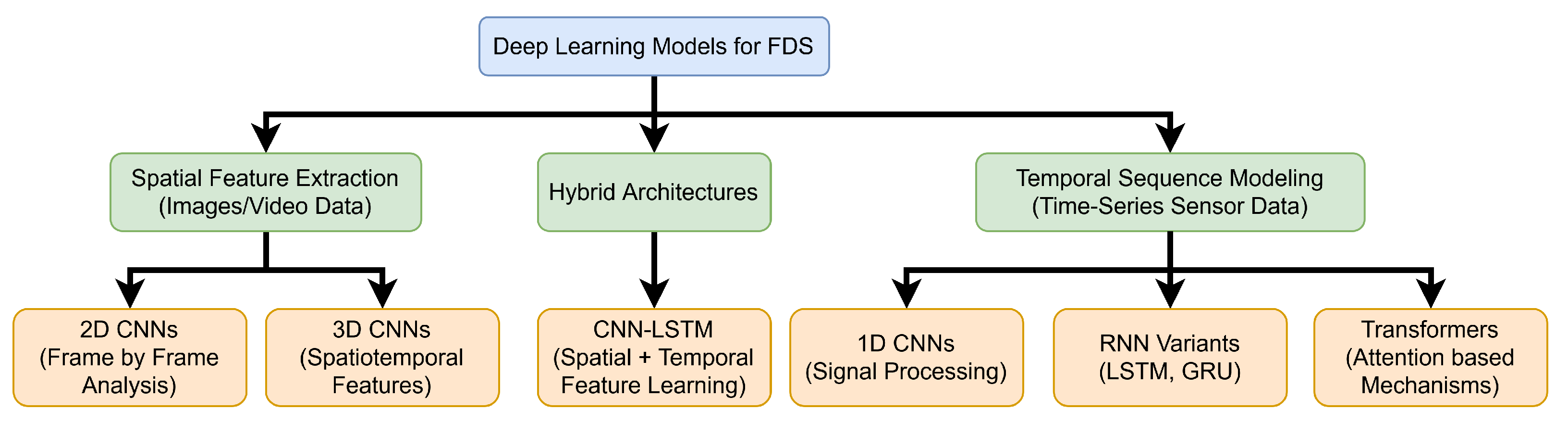
3.2.3. Deep Learning Architectures
3.3. System Validation and Performance Metrics
- Accuracy: The proportion of total classifications that are correct.
- Sensitivity: The ability of the system to correctly identify true falls (true positives/(true positives + false negatives)). High sensitivity is important to ensure that actual falls are not missed.
- Specificity: The ability of the system to correctly identify non-fall events (true negatives/(true negatives + false positives)). High specificity is essential for minimizing false alarms, which can lead to user frustration and alarm fatigue for caregivers.
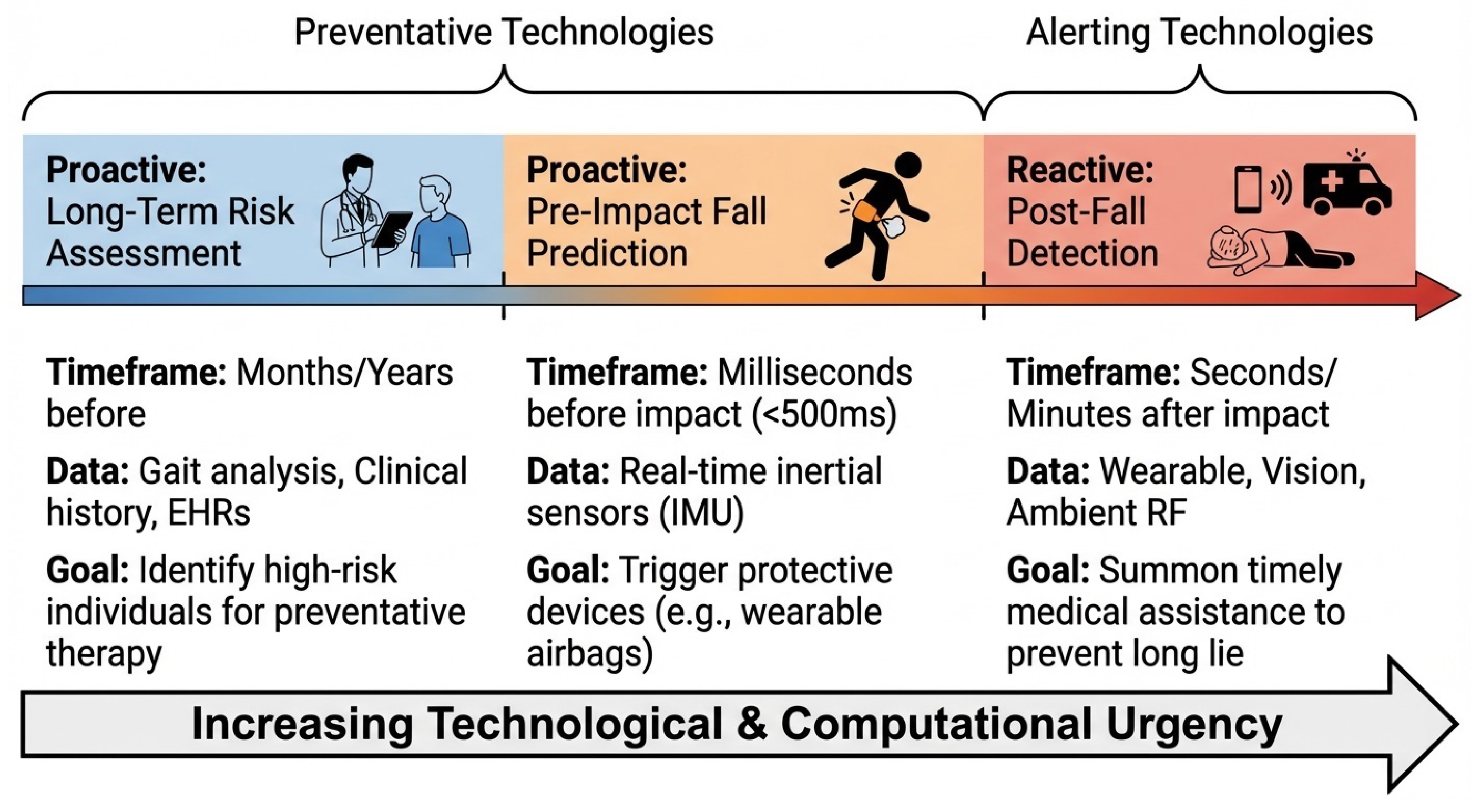
3.4. From Detection to Prediction: Assessing and Anticipating Falls
3.4.1. Fall Risk Assessment
3.4.2. Pre-Impact Fall Prediction
4. Discussion and Analysis

| Sensor Modality | Reported Accuracy Range (%) | Key Algorithms | Representative Studies |
|---|---|---|---|
| Wearable (IMU/Accelerometer) | 90.3–99.9 | ML (SVM, Random Forest), DL (CNN, LSTM, Transformers) | [6,22,99] |
| Vision-based (RGB/RGB-D) | 79.6–99.98 | DL (CNN, Transformers, YOLO), ML (SVM) | [79,113,114] |
| Ambient (Radar/RF) | 90 (Recall)–99.77 | DL (CNN, LSTM), Signal Processing | [52,53,55] |
| Ambient (Other) | 93 (Accuracy)–99 | ML (KNN, FSM), Pattern Recognition | [5,62,65] |
| Hybrid/Multi-modal | 100 (in lab) | DL (RNN, CNN), Sensor Fusion | [69,70,72] |
5. Conclusions and Future Directions
Author Contributions
Funding
Data Availability Statement
Conflicts of Interest
Abbreviations
| FDS | Fall Detection System |
| CNN(s) | Convolutional Neural Network(s) |
| RNN(s) | Recurrent Neural Network(s) |
| IMU(s) | Inertial Measurement Unit(s) |
| WHO | World Health Organization |
| ML | Machine Learning |
| DL | Deep Learning |
| ADL(s) | Activities of Daily Living |
| PRISMA | Preferred Reporting Items for Systematic Reviews and Meta-Analyses |
| CCA | Canonical Correlation Analysis |
| LSTM | Long Short-Term Memory |
| DBN | Deep Belief Network |
| HVRAE | Hybrid Variational RNN Autoencoder |
| YOLO | You Only Look Once |
| RGB(D) | Red Green Blue (Depth) |
| RF | Radio Frequency |
| CW | Continuous Wave |
| FMCW | Frequency-Modulated Continuous Wave |
| LiDAR | Light Detection and Ranging |
| Radar | Radio Detection and Ranging |
| UWB | Ultra Wideband |
| PIR | Pyroelectric Infrared |
| RFID | Radio Frequency Identification |
| FSM | Finite State Machine |
| SVM | Support Vector Machine |
| KNN | Kth Nearest Neighbor |
| GRU(s) | Gated Recurrent Unit(s) |
| DBN | Deep Belief Networks |
| FAR | False Alarm Rate |
Appendix A
| Ref. | Technology or Modality | Algorithm Type | Validation Setting | Key Findings or Reported Accuracy |
|---|---|---|---|---|
| [53] | Ambient (FMCW Radar) | CNN, Canonical Correlation Analysis (CCA) | Lab/Dataset | Radar micro-Doppler features with CNNs achieve 99.77% test accuracy. |
| [93] | Wearable (Trunk Accelerometer) | DL (CNN, LSTM, ConvLSTM) | Real-world (Daily Life) | DL, particularly with multi-task learning, effectively assesses fall risk (AUC = 0.75). |
| [14] | Vision-based | Transformer, CNN | Public Datasets | PCNN–Transformer model accurately recognizes human actions and falls. |
| [45] | Vision-based (Surveillance Cameras) | ML (SVM, Decision Tree, Random Forest, KNN) | Lab/Dataset | Spatiotemporal method using human skeleton key points achieves 98.5% accuracy. |
| [49] | Vision-based (Review) | DL (Review) | N/A (Review) | Review of DL-based vision techniques for fall detection. |
| [115] | IoT, Wearable (Accelerometer, Gyroscope) | TriNet (LSTM, optimized CNN, RNN), Blockchain | Lab (Simulation) | IoT-blockchain Trinet system outperforms existing models in accuracy and security. |
| [65] | Ambient (Smart Flooring with RFID) | ML (KNN, Random Forest, XGBoost) | Lab (Simulation) | IoT-enabled smart flooring with KNN achieves 99% accuracy in fall identification. |
| [58] | Ambient (Radar) | Signal Processing (Time-frequency analysis) | Lab (Real Fall Data) | Radar signal processing is effective for elderly fall detection in assisted living. |
| [51] | Ambient (CW Radar) | Signal Processing (Short Time Fourier Transform) | Lab (Motion Capture Comparison) | Non-contact radar method using effective acceleration effectively detects falls. |
| [4] | Wearable (Accelerometer) | ML (SVM) | Real-world (Daily Living) | SVM-based system detected 8 of 10 real-world falls with a low false positive rate. |
| [27] | Wearable (Accelerometer, Gyroscope, Magnetometer) | Data Fusion | Lab (Simulation) | Waist-worn inertial unit with data fusion achieves excellent accuracy, sensitivity, and specificity. |
| [92] | Wearable (Accelerometer) | DL (CNN, LSTM, GRU variants) | Lab/Dataset | CNN DENSE model provides best pre-impact detection accuracy (94.70%) with a lead time of 176.91 ms. |
| [116] | Vision-based (RGB videos) | DL | Lab/Public Dataset | Deep-learning approach for automatic fall detection achieves a mean recall of 0.916. |
| [23] | Wearable (Review) | ML (Review) | N/A (Review) | Review finds accelerometers effective for fall detection but calls for more research. |
| [81] | Wearable (Accelerometer) | DL (CNN) | Public Datasets | CNNs can effectively detect falls but performance is dependent on the training dataset. |
| [73] | IoT, Wearable (Accelerometer, Gyroscope) | Threshold-based Algorithm | Lab (Simulation) | Algorithm using accelerometer and gyroscope data improves accuracy and reduces false positives. |
| [75] | Wearable | ML (QSVM, EBT) | Public Datasets | QSVM and EBT algorithms achieve up to 100% fall detection accuracy. |
| [22] | Wearable (IMU, barometer) | DL (DNN) | Lab (Simulation) | IMU–barometer design with DNN outperforms traditional ML for slow fall detection (90.33% accuracy). |
| [97] | Vision-based | DL (Improved YOLOv5s) | Public Dataset (URFD) | Improved YOLOv5s algorithm achieves 97.2% average accuracy for fall detection. |
| [98] | Wearable (Review) | Data Processing (Review) | N/A (Review) | Review on wearable sensor-based fall risk assessment for older adults. |
| [24] | Wearable (IMU) | DL (Modified DAG-CNN) | Lab (Simulation) | Modified DAG-CNN algorithm accurately predicts near-falls with over 98% accuracy. |
| [40] | Vision-based (Camera) | Image Processing | Lab/Prototype | Fall detection system developed using open-source hardware and image tracking. |
| [61] | Ambient (Review) | Signal/Image Processing (Review) | N/A (Review) | Review on contactless fall detection using Radar and RGB-D sensors. |
| [63] | Ambient (Smart Tiles with Force Sensors, Accelerometers) | Sensor Fusion | Real-world (Living Lab) | Fusion of force sensors and accelerometers under smart tiles improves fall detection accuracy. |
| [117] | Wearable (BLE) | CNN | Public Dataset | BLE-based fall detection system for nursing homes shows excellent accuracy. |
| [113] | Vision-based | DL | Public Datasets | Dataset-independent DL model detects falls with 79.6% accuracy. |
| [60] | Ambient (WiFi signals) | RNN | Lab/Smart Home Env. | WiFi-based, device-free FDS uses RNN to classify human motions and detect falls. |
| [25] | Wearable (IMU) | Transformer, Threshold-based Algorithm | Lab/Dataset | Edge computing system with Transformer architecture achieves 95.29% accuracy. |
| [70] | Hybrid (RGB images, accelerometers) | DL (CNN) | Lab/Dataset | Multimodal CNN effectively detects falls using combined vision and wearable sensor data. |
| [85] | Wearable (Accelerometer) | DL (LSTM) | Lab/Dataset | LSTM model combined with data augmentation effectively detects elderly falls. |
| [21] | Vision-based (Review) | DL (Review) | N/A (Review) | Systematic review of DL for vision-based HAR and fall detection. |
| [118] | Wireless Sensor Network | Artificial Neural Network (ANN) | Lab/Controlled Env. | FDS improves fall detection (100% LOS accuracy) and localization accuracy. |
| [72] | Hybrid (ToF camera, accelerometer, microphone) | Multi-sensor Fusion | Lab/Dataset | Hardware–software framework for reliable fall detection using a multi-sensor approach. |
| [119] | IoT, Wearable (Accelerometer, Gyroscope) | Sensor Fusion | Lab/Prototype | Wearable IoT device with advanced sensors improves precision of fall detection. |
| [84] | Vision-based | DL (Mixture of Experts CNN3D) | Public Dataset (UP-Fall) | MoE with CNN3D models achieves 99.67% weighted average F1 score. |
| [52] | Ambient (CW Doppler Radar) | ML | Lab/Prototype | Radar system detects falls (90% recall) and monitors vital signs (respiration, heartbeat). |
| [37] | Vision-based | ML (MEWMA-based SVM) | Public Datasets (URFD, FDD) | MEWMA-based SVM effectively detects and classifies falls from human silhouette shape. |
| [120] | Smartphone (Accelerometer) | DL | Public Dataset (MobiAct) | Smartphone framework detects falls from streaming data and sends alerts. |
| [64] | Ambient (PIR sensors) | ML (Random Forest, AdaBoost) | Lab (Simulation) | Low-cost motion-based technique using PIR sensors achieves 99% accuracy with Random Forest and AdaBoost. |
| [106] | Wearable (Accelerometers, Insoles) | Neural Network, Naïve Bayesian, SVM | Clinical/ Prospective Study | Neural network with dual-task gait data from multiple sensors best predicts fall risk. |
| [13] | Vision/Sensor-based (Review) | DL (Review) | N/A (Review) | Review concludes 3D CNN and LSTM with CNN perform best for fall detection. |
| [18] | Wearable | DL (CNN-LSTM Ensemble) | Public Datasets (SisFall, KFall) | Pre-impact FDS detects a fall within 0.5s of initiation with 99.24% sensitivity. |
| [38] | Smartphone (Accelerometer) | Deep Belief Network (DBN) | Public Datasets (TFall, MobiFall) | Smartphone-based framework using DBN achieves 97.56% sensitivity and 97.03% specificity. |
| [54] | Ambient (mmWave Radar) | Hybrid Variational RNN Autoencoder (HVRAE) | Lab/ Apartment Testbed | mmFall system using mmWave radar and HVRAE achieves a 98% detection rate. |
| [89] | Vision-based (Surveillance Cameras) | Transformer Network | Dataset/ Synthetic | Transformer network with synthetic data improves fall detection, outperforming LSTM networks. |
| [108] | Wearable (Accelerometer, Gyroscope) | DL (CNN, LSTM) | Public Datasets (SisFall, UMAFall) | Class ensemble framework achieves better accuracy in classifying non-fall, pre-fall, and fall. |
| [50] | Vision-based | DL (CGNS-YOLO) | Public Datasets (Multicam, Le2i) | Lightweight CGNS-YOLO approach improves fall detection accuracy and reduces model size. |
| [99] | Wearable (Accelerometer) | ML (SVM, k-NN, Random Forest, ANN) | Public Dataset (SisFall) | Optimal window size for fall detection is 3 s, SVM and Random Forest achieve >99% accuracy. |
| [96] | Wearable (Shimmer devices) | Compressive Sensing | Lab (Simulation) | System using compressive sensing achieves up to 99.8% accuracy in detecting falls and ADLs. |
| [121] | Wearable | Compressive Sensing | Lab/Prototype | Proposes a hardware framework for fall detection integrating compressed sensing. |
| [28] | Wearable (Wrist Accelerometer) | Threshold-based, ML | Public Datasets (Simulated) | On-wrist accelerometer can improve fall detection, with rule-based systems being promising. |
| [42] | Vision-based (RGB-D Cameras) | DL (Multi-stream CNN) | Public Datasets | Weighted multi-stream CNN exploits RGB, depth, and motion data for accurate detection. |
| [55] | Ambient (mmWave Radar) | DL (LSTM) | Lab (Simulation) | Technique using 1D point clouds and doppler velocity with LSTM achieves 99.50% accuracy. |
| [122] | Digital Tech (Review) | N/A | N/A (Review) | Review on emerging digital technologies for fall detection in aged care. |
| [123] | Technologies (Review) | N/A | N/A (Review) | Scoping review finds current fall detection technologies have low Technology Readiness Levels. |
| [69] | Wearable (IMU-L sensor), Vision (RGB Camera) | DL (RNN, CNN) | Lab/Prototype | Double-check method using IMU-L and RGB camera achieves 100% fall detection accuracy. |
| [79] | Vision-based (Video Surveillance) | DL (CNN) | Lab/Dataset | CNN applied to video frames achieves 99.98% average accuracy for fall detection. |
| [107] | Clinical Assessment/ Questionnaire-based | Logistic Regression, Nomogram | Database/ Longitudinal Study (CHARLS) | Validated fall risk prediction model for Chinese older individuals based on CHARLS database. |
| [33] | Wearable | DL (FD-DNN: CNN-LSTM) | Lab/Dataset | Energy-efficient sensor with FD-DNN achieves 99.17% fall detection accuracy. |
| [44] | Vision-based | Neural Network (Multilayer Perceptron) | Public Dataset (URFD) | Visual-based approach analyzing motion and shape achieves 99.60% detection rate. |
| [87] | Wearable (Accelerometer) | RNN | Public Dataset (SisFall) | RNN models can be implemented in low-power microcontrollers for real-time fall detection. |
| [57] | Ambient (UWB Radar) | DL (ConvLSTM) | Lab/Testbed | UWB radar with ConvLSTM achieves good sensitivity for room-level fall detection. |
| [103] | Clinical Assessments/ Interviews | Decision Tree | Community Cohort Study | Simplified decision-tree algorithm outperforms logistic regression in predicting falls. |
| [94] | Device-based Assessment | N/A | Real-world (Residential Care) | Oldfry device effectively detects frailty and fall risk in older adults. |
| [101] | Smartphone (Inertial Sensors) | DL (FCNN), Transfer Learning | Public Dataset | FCNNs with transfer learning effectively classify fall risk (AUC 93.3%). |
| [36] | Multimodal Dataset | N/A | Public Dataset Creation | Presents the UP-Fall Detection Dataset, a multimodal resource for comparing FDS. |
| [32] | Vision-based (Home Camera) | ML (Kalman filtering, Optical Flow) | Lab/Video Dataset | Low-cost vision-based detector for smart homes achieves a detection ratio >96%. |
| [95] | Clinical Assessment/Electronic Walkway Systems | ML | Real-world (Senior Care Facilities) | Geriatric assessments, GAITRite data, and fall history predict 6-month fall risk (AUC 0.80). |
| [109] | Wearable | DL (Ensemble CNN-RNN) | Public Dataset (SisFall) | Ensemble deep neural network effectively predicts and detects falls (98% accuracy for Fall). |
| [26] | Wearable (IMU sensors) | Kinematic Model | Public Dataset | Mathematical model predicts falls using human body kinematics from three IMU sensors. |
| [20] | AI-IoT (Review) | AI, IoT (Review) | N/A (Review) | Review concludes AI-IoT technology provides the best solution for real-time monitoring. |
| [8] | IoT, Mobile | ML (Boosted Decision Trees) | Lab (Simulation) | Scalable architecture for monitoring older adults, using Boosted Decision Trees for classification. |
| [1] | Literature Review | N/A | N/A (Review) | Review stressing the need for low-cost, early fall detection mechanisms. |
| [76] | Wearable (Accelerometer) | ML | Public Datasets | Proposes fall detection system using cross-disciplinary time series features. |
| [111] | IoT, Wearable | N/A | Lab/Prototype | Device-type invariant FDS achieves 99.7% accuracy, 96.3% sensitivity. |
| [124] | Sensor-based (Review) | N/A | N/A (Review) | Review of sensor-based systems, noting single-sensor accuracy and multi-sensor efficiency. |
| [48] | Vision-based | DL (CNN) | Public Datasets | Vision-based method using CNNs on optical flow images achieves state-of-the-art results. |
| [15] | Vision-based (Videos) | Transformer | Lab/Video Dataset | Transformer-based model effectively recognizes falls in videos. |
| [104] | Clinical Tests (Review) | N/A | N/A (Review) | Systematic review finds clinical tests alone (FRT, SLST, POMA) have low accuracy for fall prediction. |
| [88] | Wearable | DL (CNN-LSTM with attention) | Lab/Prototype | AI-based wearable device effectively detects and prevents falls in elderly. |
| [125] | Vision-based | DL (Transfer Learning) | Lab/Dataset | Fall detection methodology using deep neural networks achieves 98.15% test accuracy. |
| [31] | Wearable (IMU, Barometer) | Data Fusion Algorithm | Lab (Simulation) | Waist-mounted device using four sensors reaches 100% sensitivity. |
| [67] | Ambient (LiDAR) | FSM | Lab/Prototype | Low-cost LIDAR system uses FSM for privacy-preserving, interpretable fall detection. |
| [9] | FDS (Review) | N/A | N/A (Review) | Systematic review on FDS, emphasizing potential of new technologies like DL and IoT. |
| [29] | Wearable (Wrist: Accelerometer, Gyroscope, Magnetometer) | ML | Lab (Simulation) | Wrist-worn device with movement decomposition and ML achieves 99.0% accuracy. |
| [68] | Data Fusion (Review) | N/A | N/A (Review) | Survey on data fusion approaches for fall detection. |
| [19] | FDS (Review) | N/A | N/A (Review) | Systematic review on fall detection and prevention technologies. |
| [100] | Wearable (Review) | N/A | N/A (Review) | Survey identifies key gait parameters from inertial sensors for frailty and fall risk detection. |
| [16] | Wearable (Thigh Accelerometer) | ML (NLSVM) | Lab/Public Dataset (MobiFall) | Patient-specific system predicts and detects falls with >97% sensitivity and >99% specificity. |
| [59] | Ambient (Radar) | ML (NLSVM) | Lab/Testbed | Radar-based method with time-frequency analysis and CNN achieves 98.37% precision. |
| [6] | Wearable | ML | Public Dataset | Low-cost ML-based algorithm for wearables achieves >99.9% accuracy. |
| [46] | Vision-based | DL (TD-CNN-LSTM, 1D-CNN) | Lab/Dataset | Pose estimation-based solution achieves high accuracy (98% with 1D-CNN) for fall detection. |
| [90] | Vision-based | DL (YOLOv8, Time-Space Transformers) | Public Datasets | Hybrid approach using YOLOv8 and Transformers achieves high mAP on benchmark datasets. |
| [2] | Wearable | N/A | Lab/Prototype | Wearable device communicates with a cell phone to alert contacts after a fall. |
| [112] | Fog-based AAL | DL | Lab (Simulation) | Fog-based DL system provides timely and accurate fall detection (98.75% accuracy). |
| [126] | Ambient (Force-Plate) | DL (One-One-One DNN) | Public Dataset | One-One-One DNN model predicts fall-risk from force-plate data with 99.9% accuracy. |
| [77] | Smartphone (Accelerometer) | ML (Multiple Kernel Learning SVM) | Lab/Prototype | FallDroid system on smartphones detects falls with better accuracy (>97% at waist). |
| [41] | Vision-based (8-camera system) | ML | Lab/Prototype | House-wide FDS using ML can detect falls at 60 m and beyond. |
| [10] | Sensor Tech (Review) | N/A | N/A (Review) | Wide-ranging review of sensor technologies for fall detection systems. |
| [127] | Vision-based | DL (CABMNet) | Lab/Dataset | Adaptive two-stage DL network (CABMNet) optimizes spatial and temporal analysis. |
| [43] | Vision-based (Microsoft Kinect) | ML (Ensemble of Decision Trees) | Real-world (Home deployment) | Two-stage fall detection system using Kinect significantly improves performance in real homes. |
| [35] | Dataset | N/A | Lab/Dataset Creation (SisFall) | Presents the SisFall dataset of falls and ADLs from wearable sensors. |
| [7] | Wearable (Accelerometer) | Non-linear Classification, Kalman filter | Public Dataset (SisFall)/Lab | Fall detection methodology tested on SisFall dataset achieves 99.4% accuracy. |
| [105] | Sensor Tech (Review) | N/A | N/A (Review) | Review on novel sensing technology for fall risk assessment. |
| [78] | FDS (Review) | DL (Review) | N/A (Review) | Comprehensive review on DL based fall detection. |
| [110] | Wearable | Fractal Dynamics, Linear Discriminant Analysis | Lab/Hardware Validation | Wearable FDS using fractal dynamics achieves 99.38% fall detection accuracy. |
| [5] | Ambient (Low-resolution Thermal Sensors) | RNN (Bi-LSTM) | Lab/Test Subjects | Bi-LSTM approach with thermal sensors achieves 93% accuracy while preserving privacy. |
| [82] | Wearable | DL (CNN) | Lab/Hardware | Ultra-low-power wearable sensor uses CNN and FPGA for fall detection. |
| [114] | Vision-based | DL (Modified NASNet), Transfer Learning | Lab/Dataset | Modified NASNet model with LBP features and transfer learning achieves 99% accuracy. |
| [12] | FDS (Review) | ML (Review) | N/A (Review) | Systematic review of latest research trends in fall detection using ML. |
| [80] | IoT, Vision-based | DL (ODCNN) | Public Datasets | IoT-enabled model using an optimal DCNN achieves >99% accuracy on two datasets. |
| [66] | Ambient (LiDAR) | N/A | Lab/Prototype | LiDAR technology effectively detects falls while maintaining user privacy. |
| [39] | Vision-based | ML (MLP, Random Forest) | Public Datasets | Dual-Channel Feature Integration approach achieves >96% accuracy on two datasets. |
| [11] | Sensor Fusion (Review) | N/A | N/A (Review) | Literature survey on elderly fall detection using sensor fusion. |
| [56] | Ambient (mmWave Radar) | ML (LightGBM) | Lab/Prototype | Fusion of radar imaging and trajectory features predicts fall risk with 93.36% accuracy. |
| [128] | Literature Review | N/A | N/A (Review) | Review of fall detection technologies, noting challenges and trends. |
| [86] | Smartphone (Mobile Sensors) | DL (GRU) | Lab/Dataset | GRU architecture outperforms other models for fall detection. |
| [74] | IoT, Big Data | ML (Decision Trees) | Lab/Prototype | IoT system with decision trees-based Big Data model effectively detects falls. |
| [3] | IoT, Wearable (Accelerometer) | Ensemble ML | Lab/Prototype | IoT E-Fall system achieves over 94% accuracy, precision, sensitivity, and specificity. |
| [102] | Electronic Health Records (EHR) | ML | Database (EHR) | EHR-based fall risk predictive tool accurately identifies elders at higher risk of falls. |
| [34] | Wearable | DL (Denoising LSTM-based CVAE) | Lab/Dataset | Unsupervised CVAE model detects falls and is suitable for integration into wearable devices. |
| [30] | Wearable (Wrist Sensor) | DL (ANN) | Lab/Prototype | Artificial Neural Network-based method accurately detects falls from wrist sensors. |
| [17] | Wearable (Inertial Sensors) | DL (Hybrid ConvLSTM) | Public Dataset | Hybrid ConvLSTM model accurately predicts pre-impact falls in older people. |
| [91] | FDS | Federated Learning, Extreme Learning Machine (Fed-ELM) | Lab (Simulation) | Fed-ELM algorithm improves accuracy for both young and elderly individuals (>96% accuracy). |
| [83] | Wearable | DL (TinyCNN) | Lab/Prototype | TinyCNN with two-stage feature extraction offers real-time performance for fall detection. |
| [129] | Vision-based (Skeleton) | DL (TCN, Transformer Encoder) | Lab/Prototype | Real-time skeleton-based algorithm (TCNTE) achieves high accuracy for fall detection. |
| [130] | Vision-based | DL (YOLO, Pose Estimation) | Lab/Testbed | DL model detects and classifies elderly abnormal behaviors including falls. |
| [71] | Hybrid (Video, Audio) | Masked Mamba, Cross-Attention | Public Datasets | Fall-Mamba model fuses video and audio data, achieving 99.63% accuracy. |
| [47] | Vision-based | DL (OpenPose) | Lab/Public Dataset | DL algorithm based on bone key points achieves 99.4% accuracy. |
| [62] | Ambient (Floor Vibration, Sound) | Pattern Recognition | Lab (Simulation) | System using floor vibrations and sound detects falls with 97.5% sensitivity. |
References
- Mushtaq, R.; Rafique, S.; Iqbal, M.W.; Ruk, S.A. Fall detection in elderly people. Bull. Bus. Econ. (BBE) 2024, 13, 228–236. [Google Scholar] [CrossRef]
- Santiago, J.; Cotto, E.; Jaimes, L.G.; Vergara-Laurens, I. Fall detection system for the elderly. In Proceedings of the 2017 IEEE 7th Annual Computing and Communication Workshop and Conference (CCWC); IEEE: Piscataway, NJ, USA, 2017; pp. 1–4. [Google Scholar]
- Yacchirema, D.; de Puga, J.S.; Palau, C.; Esteve, M. Fall detection system for elderly people using IoT and ensemble machine learning algorithm. Pers. Ubiquitous Comput. 2019, 23, 801–817. [Google Scholar] [CrossRef]
- Aziz, O.; Klenk, J.; Schwickert, L.; Chiari, L.; Becker, C.; Park, E.J.; Mori, G.; Robinovitch, S.N. Validation of accuracy of SVM-based fall detection system using real-world fall and non-fall datasets. PLoS ONE 2017, 12, e0180318. [Google Scholar] [CrossRef]
- Taramasco, C.; Rodenas, T.; Martinez, F.; Fuentes, P.; Munoz, R.; Olivares, R.; De Albuquerque, V.H.C.; Demongeot, J. A novel monitoring system for fall detection in older people. IEEE Access 2018, 6, 43563–43574. [Google Scholar] [CrossRef]
- Saleh, M.; Jeannès, R.L.B. Elderly fall detection using wearable sensors: A low cost highly accurate algorithm. IEEE Sens. J. 2019, 19, 3156–3164. [Google Scholar] [CrossRef]
- Sucerquia, A.; López, J.D.; Vargas-Bonilla, J.F. Real-life/real-time elderly fall detection with a triaxial accelerometer. Sensors 2018, 18, 1101. [Google Scholar] [CrossRef] [PubMed]
- Mrozek, D.; Koczur, A.; Małysiak-Mrozek, B. Fall detection in older adults with mobile IoT devices and machine learning in the cloud and on the edge. Inf. Sci. 2020, 537, 132–147. [Google Scholar] [CrossRef]
- Purwar, A.; Chawla, I. A systematic review on fall detection systems for elderly healthcare. Multimed. Tools Appl. 2024, 83, 43277–43302. [Google Scholar] [CrossRef]
- Singh, A.; Rehman, S.U.; Yongchareon, S.; Chong, P.H.J. Sensor technologies for fall detection systems: A review. IEEE Sens. J. 2020, 20, 6889–6919. [Google Scholar] [CrossRef]
- Wang, X.; Ellul, J.; Azzopardi, G. Elderly fall detection systems: A literature survey. Front. Robot. AI 2020, 7, 71. [Google Scholar] [CrossRef]
- Usmani, S.; Saboor, A.; Haris, M.; Khan, M.A.; Park, H. Latest research trends in fall detection and prevention using machine learning: A systematic review. Sensors 2021, 21, 5134. [Google Scholar] [CrossRef]
- Islam, M.M.; Tayan, O.; Islam, M.R.; Islam, M.S.; Nooruddin, S.; Kabir, M.N.; Islam, M.R. Deep learning based systems developed for fall detection: A review. IEEE Access 2020, 8, 166117–166137. [Google Scholar] [CrossRef]
- Al-qaness, M.A.; Dahou, A.; Abd Elaziz, M.; Helmi, A.M. Human activity recognition and fall detection using convolutional neural network and transformer-based architecture. Biomed. Signal Process. Control 2024, 95, 106412. [Google Scholar] [CrossRef]
- Núñez-Marcos, A.; Arganda-Carreras, I. Transformer-based fall detection in videos. Eng. Appl. Artif. Intell. 2024, 132, 107937. [Google Scholar] [CrossRef]
- Saadeh, W.; Butt, S.A.; Altaf, M.A.B. A patient-specific single sensor IoT-based wearable fall prediction and detection system. IEEE Trans. Neural Syst. Rehabil. Eng. 2019, 27, 995–1003. [Google Scholar] [CrossRef]
- Yu, X.; Qiu, H.; Xiong, S. A novel hybrid deep neural network to predict pre-impact fall for older people based on wearable inertial sensors. Front. Bioeng. Biotechnol. 2020, 8, 63. [Google Scholar] [CrossRef]
- Jain, R.; Semwal, V.B. A novel feature extraction method for preimpact fall detection system using deep learning and wearable sensors. IEEE Sens. J. 2022, 22, 22943–22951. [Google Scholar] [CrossRef]
- Ren, L.; Peng, Y. Research of fall detection and fall prevention technologies: A systematic review. IEEE Access 2019, 7, 77702–77722. [Google Scholar] [CrossRef]
- Mohan, D.; Al-Hamid, D.Z.; Chong, P.H.J.; Sudheera, K.L.K.; Gutierrez, J.; Chan, H.C.; Li, H. Artificial intelligence and iot in elderly fall prevention: A review. IEEE Sens. J. 2024, 24, 4181–4198. [Google Scholar] [CrossRef]
- Gaya-Morey, F.X.; Manresa-Yee, C.; Buades-Rubio, J.M. Deep learning for computer vision based activity recognition and fall detection of the elderly: A systematic review. arXiv 2024, arXiv:2401.11790. [Google Scholar] [CrossRef]
- Chen, X.; Jiang, S.; Lo, B. Subject-independent slow fall detection with wearable sensors via deep learning. In Proceedings of the 2020 IEEE SENSORS; IEEE: Piscataway, NJ, USA, 2020; pp. 1–4. [Google Scholar]
- Bet, P.; Castro, P.C.; Ponti, M.A. Fall detection and fall risk assessment in older person using wearable sensors: A systematic review. Int. J. Med. Inform. 2019, 130, 103946. [Google Scholar] [CrossRef]
- Choi, A.; Kim, T.H.; Yuhai, O.; Jeong, S.; Kim, K.; Kim, H.; Mun, J.H. Deep learning-based near-fall detection algorithm for fall risk monitoring system using a single inertial measurement unit. IEEE Trans. Neural Syst. Rehabil. Eng. 2022, 30, 2385–2394. [Google Scholar] [CrossRef]
- Fernandez-Bermejo, J.; Martinez-del Rincon, J.; Dorado, J.; Toro, X.D.; Santofimia, M.J.; Lopez, J.C. Edge computing transformers for fall detection in older adults. Int. J. Neural Syst. 2024, 34, 2450026. [Google Scholar] [CrossRef]
- Mohammed, S.H.; Fan, Y.; Lv, G.; Liu, S. A Mathematical model for fall detection predication in elderly people. IEEE Sens. J. 2023, 24, 32981–32990. [Google Scholar] [CrossRef]
- Pierleoni, P.; Belli, A.; Palma, L.; Pellegrini, M.; Pernini, L.; Valenti, S. A high reliability wearable device for elderly fall detection. IEEE Sens. J. 2015, 15, 4544–4553. [Google Scholar] [CrossRef]
- Khojasteh, S.B.; Villar, J.R.; Chira, C.; González, V.M.; De la Cal, E. Improving fall detection using an on-wrist wearable accelerometer. Sensors 2018, 18, 1350. [Google Scholar] [CrossRef] [PubMed]
- De Quadros, T.; Lazzaretti, A.E.; Schneider, F.K. A movement decomposition and machine learning-based fall detection system using wrist wearable device. IEEE Sens. J. 2018, 18, 5082–5089. [Google Scholar] [CrossRef]
- Yoo, S.; Oh, D. An artificial neural network–based fall detection. Int. J. Eng. Bus. Manag. 2018, 10, 1847979018787905. [Google Scholar] [CrossRef]
- Pierleoni, P.; Belli, A.; Maurizi, L.; Palma, L.; Pernini, L.; Paniccia, M.; Valenti, S. A wearable fall detector for elderly people based on AHRS and barometric sensor. IEEE Sens. J. 2016, 16, 6733–6744. [Google Scholar] [CrossRef]
- De Miguel, K.; Brunete, A.; Hernando, M.; Gambao, E. Home camera-based fall detection system for the elderly. Sensors 2017, 17, 2864. [Google Scholar] [CrossRef]
- Liu, L.; Hou, Y.; He, J.; Lungu, J.; Dong, R. An energy-efficient fall detection method based on FD-DNN for elderly people. Sensors 2020, 20, 4192. [Google Scholar] [CrossRef]
- Yi, M.K.; Han, K.; Hwang, S.O. Fall detection of the elderly using denoising LSTM-based convolutional variant autoencoder. IEEE Sens. J. 2024, 24, 18556–18567. [Google Scholar] [CrossRef]
- Sucerquia, A.; López, J.D.; Vargas-Bonilla, J.F. SisFall: A fall and movement dataset. Sensors 2017, 17, 198. [Google Scholar] [CrossRef]
- Martínez-Villaseñor, L.; Ponce, H.; Brieva, J.; Moya-Albor, E.; Núñez-Martínez, J.; Peñafort-Asturiano, C. UP-fall detection dataset: A multimodal approach. Sensors 2019, 19, 1988. [Google Scholar] [CrossRef] [PubMed]
- Harrou, F.; Zerrouki, N.; Sun, Y.; Houacine, A. Vision-based fall detection system for improving safety of elderly people. IEEE Instrum. Meas. Mag. 2017, 20, 49–55. [Google Scholar] [CrossRef]
- Jahanjoo, A.; Naderan, M.; Rashti, M.J. Detection and multi-class classification of falling in elderly people by deep belief network algorithms. J. Ambient Intell. Humaniz. Comput. 2020, 11, 4145–4165. [Google Scholar] [CrossRef]
- Wang, B.H.; Yu, J.; Wang, K.; Bao, X.Y.; Mao, K.M. Fall detection based on dual-channel feature integration. IEEE Access 2020, 8, 103443–103453. [Google Scholar] [CrossRef]
- Choi, S.; Youm, S. A study on a fall detection monitoring system for falling elderly using open source hardware. Multimed. Tools Appl. 2019, 78, 28423–28434. [Google Scholar] [CrossRef]
- Shu, F.; Shu, J. An eight-camera fall detection system using human fall pattern recognition via machine learning by a low-cost android box. Sci. Rep. 2021, 11, 2471. [Google Scholar] [CrossRef]
- Khraief, C.; Benzarti, F.; Amiri, H. Elderly fall detection based on multi-stream deep convolutional networks. Multimed. Tools Appl. 2020, 79, 19537–19560. [Google Scholar] [CrossRef]
- Stone, E.E.; Skubic, M. Fall detection in homes of older adults using the Microsoft Kinect. IEEE J. Biomed. Health Inform. 2014, 19, 290–301. [Google Scholar] [CrossRef] [PubMed]
- Lotfi, A.; Albawendi, S.; Powell, H.; Appiah, K.; Langensiepen, C. Supporting independent living for older adults; employing a visual based fall detection through analysing the motion and shape of the human body. IEEE Access 2018, 6, 70272–70282. [Google Scholar] [CrossRef]
- Alaoui, A.Y.; El Fkihi, S.; Thami, R.O.H. Fall detection for elderly people using the variation of key points of human skeleton. IEEE Access 2019, 7, 154786–154795. [Google Scholar] [CrossRef]
- Salimi, M.; Machado, J.J.; Tavares, J.M.R. Using deep neural networks for human fall detection based on pose estimation. Sensors 2022, 22, 4544. [Google Scholar] [CrossRef]
- Zhu, N.; Zhao, G.; Zhang, X.; Jin, Z. Falling motion detection algorithm based on deep learning. IET Image Process. 2022, 16, 2845–2853. [Google Scholar] [CrossRef]
- Núñez-Marcos, A.; Azkune, G.; Arganda-Carreras, I. Vision-based fall detection with convolutional neural networks. Wirel. Commun. Mob. Comput. 2017, 2017, 9474806. [Google Scholar] [CrossRef]
- Alam, E.; Sufian, A.; Dutta, P.; Leo, M. Vision-based human fall detection systems using deep learning: A review. Comput. Biol. Med. 2022, 146, 105626. [Google Scholar] [CrossRef]
- Kan, X.; Zhu, S.; Zhang, Y.; Qian, C. A lightweight human fall detection network. Sensors 2023, 23, 9069. [Google Scholar] [CrossRef]
- Arnaoutoglou, D.G.; Dedemadis, D.; Kyriakou, A.A.; Katsimentes, S.; Grekidis, A.; Menychtas, D.; Aggelousis, N.; Sirakoulis, G.C.; Kyriacou, G.A. Acceleration-Based Low-Cost CW Radar System for real-time elderly fall detection. IEEE J. Electromagn. RF Microwaves Med. Biol. 2024, 8, 102–112. [Google Scholar] [CrossRef]
- Hanifi, K.; Karsligil, M.E. Elderly fall detection with vital signs monitoring using CW Doppler radar. IEEE Sens. J. 2021, 21, 16969–16978. [Google Scholar] [CrossRef]
- Abdu, F.J.; Zhang, Y.; Deng, Z. Activity classification based on feature fusion of FMCW radar human motion micro-Doppler signatures. IEEE Sens. J. 2022, 22, 8648–8662. [Google Scholar] [CrossRef]
- Jin, F.; Sengupta, A.; Cao, S. mmfall: Fall detection using 4-d mmwave radar and a hybrid variational rnn autoencoder. IEEE Trans. Autom. Sci. Eng. 2020, 19, 1245–1257. [Google Scholar] [CrossRef]
- Kittiyanpunya, C.; Chomdee, P.; Boonpoonga, A.; Torrungrueng, D. Millimeter-wave radar-based elderly fall detection fed by one-dimensional point cloud and Doppler. IEEE Access 2023, 11, 76269–76283. [Google Scholar] [CrossRef]
- Wang, W.; Gong, Y.; Zhang, H.; Yuan, X.; Zhang, Y. Quantitative assessment of fall risk in the elderly through fusion of millimeter-wave radar imaging and trajectory features. IEEE Access 2024, 12, 13370–13385. [Google Scholar] [CrossRef]
- Ma, L.; Liu, M.; Wang, N.; Wang, L.; Yang, Y.; Wang, H. Room-level fall detection based on ultra-wideband (UWB) monostatic radar and convolutional long short-term memory (LSTM). Sensors 2020, 20, 1105. [Google Scholar] [CrossRef]
- Amin, M.G.; Zhang, Y.D.; Ahmad, F.; Ho, K.D. Radar signal processing for elderly fall detection: The future for in-home monitoring. IEEE Signal Process. Mag. 2016, 33, 71–80. [Google Scholar] [CrossRef]
- Sadreazami, H.; Bolic, M.; Rajan, S. Contactless fall detection using time-frequency analysis and convolutional neural networks. IEEE Trans. Ind. Inform. 2021, 17, 6842–6851. [Google Scholar] [CrossRef]
- Ding, J.; Wang, Y. A WiFi-based smart home fall detection system using recurrent neural network. IEEE Trans. Consum. Electron. 2020, 66, 308–317. [Google Scholar] [CrossRef]
- Cippitelli, E.; Fioranelli, F.; Gambi, E.; Spinsante, S. Radar and RGB-depth sensors for fall detection: A review. IEEE Sens. J. 2017, 17, 3585–3604. [Google Scholar] [CrossRef]
- Zigel, Y.; Litvak, D.; Gannot, I. A method for automatic fall detection of elderly people using floor vibrations and sound—Proof of concept on human mimicking doll falls. IEEE Trans. Biomed. Eng. 2009, 56, 2858–2867. [Google Scholar] [CrossRef] [PubMed]
- Daher, M.; Diab, A.; El Najjar, M.E.B.; Khalil, M.A.; Charpillet, F. Elder tracking and fall detection system using smart tiles. IEEE Sens. J. 2016, 17, 469–479. [Google Scholar] [CrossRef]
- Hassan, C.A.U.; Karim, F.K.; Abbas, A.; Iqbal, J.; Elmannai, H.; Hussain, S.; Ullah, S.S.; Khan, M.S. A cost-effective fall-detection framework for the elderly using sensor-based technologies. Sustainability 2023, 15, 3982. [Google Scholar] [CrossRef]
- Alharbi, H.A.; Alharbi, K.K.; Hassan, C.A.U. Enhancing elderly fall detection through IoT-enabled smart flooring and AI for independent living sustainability. Sustainability 2023, 15, 15695. [Google Scholar] [CrossRef]
- Viswa, A.; Pravardhana, V.D.; Thangavel, S.K.; Jeyakumar, G. Fall Detection for Elderly People using LiDAR Sensor. In Proceedings of the 2024 3rd International Conference on Artificial Intelligence For Internet of Things (AIIoT); IEEE: Piscataway, NJ, USA, 2024; pp. 1–6. [Google Scholar]
- Piñeiro, M.; Araya, D.; Ruete, D.; Taramasco, C. Low-cost LIDAR-based monitoring system for fall detection. IEEE Access 2024, 12, 72051–72061. [Google Scholar] [CrossRef]
- Rassekh, E.; Snidaro, L. Survey on data fusion approaches for fall-detection. Inf. Fusion 2025, 114, 102696. [Google Scholar] [CrossRef]
- Lee, D.W.; Jun, K.; Naheem, K.; Kim, M.S. Deep neural network–based double-check method for fall detection using IMU-L sensor and RGB camera data. IEEE Access 2021, 9, 48064–48079. [Google Scholar] [CrossRef]
- Galvão, Y.M.; Ferreira, J.; Albuquerque, V.A.; Barros, P.; Fernandes, B.J. A multimodal approach using deep learning for fall detection. Expert Syst. Appl. 2021, 168, 114226. [Google Scholar] [CrossRef]
- Zhang, X.; Xu, Q.; Feng, F.; Lu, X.; Xu, L. Fall-mamba: A multimodal fusion and masked mamba-based approach for fall detection. IEEE Internet Things J. 2025, 12, 10493–10505. [Google Scholar] [CrossRef]
- Grassi, M.; Lombardi, A.; Rescio, G.; Malcovati, P.; Malfatti, M.; Gonzo, L.; Leone, A.; Diraco, G.; Distante, C.; Siciliano, P.; et al. A hardware-software framework for high-reliability people fall detection. In Proceedings of the SENSORS; IEEE: Piscataway, NJ, USA, 2008; pp. 1328–1331. [Google Scholar]
- Chandra, I.; Sivakumar, N.; Gokulnath, C.B.; Parthasarathy, P. IoT based fall detection and ambient assisted system for the elderly. Clust. Comput. 2019, 22, 2517–2525. [Google Scholar] [CrossRef]
- Yacchirema, D.; De Puga, J.S.; Palau, C.; Esteve, M. Fall detection system for elderly people using IoT and big data. Procedia Comput. Sci. 2018, 130, 603–610. [Google Scholar] [CrossRef]
- Chelli, A.; Pätzold, M. A machine learning approach for fall detection and daily living activity recognition. IEEE Access 2019, 7, 38670–38687. [Google Scholar] [CrossRef]
- Al Nahian, M.J.; Ghosh, T.; Al Banna, M.H.; Aseeri, M.A.; Uddin, M.N.; Ahmed, M.R.; Mahmud, M.; Kaiser, M.S. Towards an accelerometer-based elderly fall detection system using cross-disciplinary time series features. IEEE Access 2021, 9, 39413–39431. [Google Scholar] [CrossRef]
- Shahzad, A.; Kim, K. FallDroid: An automated smart-phone-based fall detection system using multiple kernel learning. IEEE Trans. Ind. Inform. 2018, 15, 35–44. [Google Scholar] [CrossRef]
- Suryanarayana, S.V.; Lakshmi, H.; Swamy, P.T.C.; Mahesh, D.B. A Comprehensive Review on Deep Learning Based Fall Detection in Elderly People. In Proceedings of the 2025 International Conference on Machine Learning and Autonomous Systems (ICMLAS); IEEE: Piscataway, NJ, USA, 2025; pp. 396–402. [Google Scholar]
- Li, X.; Pang, T.; Liu, W.; Wang, T. Fall detection for elderly person care using convolutional neural networks. In Proceedings of the 2017 10th International Congress on Image and Signal Processing, Biomedical Engineering and Informatics (CISP-BMEI); IEEE: Piscataway, NJ, USA, 2017; pp. 1–6. [Google Scholar]
- Vaiyapuri, T.; Lydia, E.L.; Sikkandar, M.Y.; Díaz, V.G.; Pustokhina, I.V.; Pustokhin, D.A. Internet of things and deep learning enabled elderly fall detection model for smart homecare. IEEE Access 2021, 9, 113879–113888. [Google Scholar] [CrossRef]
- Casilari, E.; Lora-Rivera, R.; Garcia-Lagos, F. A study on the application of convolutional neural networks to fall detection evaluated with multiple public datasets. Sensors 2020, 20, 1466. [Google Scholar] [CrossRef]
- Tian, J.; Mercier, P.; Paolini, C. Ultra low-power, wearable, accelerated shallow-learning fall detection for elderly at-risk persons. Smart Health 2024, 33, 100498. [Google Scholar] [CrossRef] [PubMed]
- Yu, X.; Park, S.; Kim, D.; Kim, E.; Kim, J.; Kim, W.; An, Y.; Xiong, S. A practical wearable fall detection system based on tiny convolutional neural networks. Biomed. Signal Process. Control 2023, 86, 105325. [Google Scholar] [CrossRef]
- Ha, T.V.; Nguyen, H.M.; Thanh, S.H.; Nguyen, B.T. Fall detection using mixtures of convolutional neural networks. Multimed. Tools Appl. 2024, 83, 18091–18118. [Google Scholar] [CrossRef]
- García, E.; Villar, M.; Fáñez, M.; Villar, J.R.; de la Cal, E.; Cho, S.B. Towards effective detection of elderly falls with CNN-LSTM neural networks. Neurocomputing 2022, 500, 231–240. [Google Scholar] [CrossRef]
- Wu, X.; Zheng, Y.; Chu, C.H.; Cheng, L.; Kim, J. Applying deep learning technology for automatic fall detection using mobile sensors. Biomed. Signal Process. Control 2022, 72, 103355. [Google Scholar] [CrossRef]
- Luna-Perejón, F.; Domínguez-Morales, M.J.; Civit-Balcells, A. Wearable fall detector using recurrent neural networks. Sensors 2019, 19, 4885. [Google Scholar] [CrossRef]
- Paramasivam, A.; Jenath, M.; Sivakumaran, T.S.; Vijayalakshmi, S. Development of artificial intelligence edge computing based wearable device for fall detection and prevention of elderly people. Heliyon 2024, 10, e28688. [Google Scholar] [CrossRef]
- Juraev, S.; Ghimire, A.; Alikhanov, J.; Kakani, V.; Kim, H. Exploring human pose estimation and the usage of synthetic data for elderly fall detection in real-world surveillance. IEEE Access 2022, 10, 94249–94261. [Google Scholar] [CrossRef]
- Sanjalawe, Y.; Fraihat, S.; Abualhaj, M.; Al-E’Mari, S.R.; Alzubi, E. Hybrid deep learning for human fall detection: A synergistic approach using YOLOv8 and time-space transformers. IEEE Access 2025, 13, 41336–41366. [Google Scholar] [CrossRef]
- Yu, Z.; Liu, J.; Yang, M.; Cheng, Y.; Hu, J.; Li, X. An elderly fall detection method based on federated learning and extreme learning machine (fed-elm). IEEE Access 2022, 10, 130816–130824. [Google Scholar] [CrossRef]
- Benoit, A.; Escriba, C.; Gauchard, D.; Esteve, A.; Rossi, C. Analyzing and Comparing Deep Learning Models on an ARM 32 Bits Microcontroller for Pre-Impact Fall Detection. IEEE Sens. J. 2024, 24, 11829–11842. [Google Scholar] [CrossRef]
- Nait Aicha, A.; Englebienne, G.; Van Schooten, K.S.; Pijnappels, M.; Kröse, B. Deep learning to predict falls in older adults based on daily-life trunk accelerometry. Sensors 2018, 18, 1654. [Google Scholar] [CrossRef] [PubMed]
- Martí-Marco, E.; Vera-Remartínez, E.J.; Esteve-Clavero, A.; Carmona-Fortuño, I.; Flores-Saldaña, M.; Vila-Pascual, J.; Barba-Muñoz, M.; Molés-Julio, M.P. Detection of Falls and Frailty in Older Adults with Oldfry: Associated Risk Factors. Sensors 2025, 25, 2964. [Google Scholar] [CrossRef]
- Mishra, A.K.; Skubic, M.; Despins, L.A.; Popescu, M.; Keller, J.; Rantz, M.; Abbott, C.; Enayati, M.; Shalini, S.; Miller, S. Explainable fall risk prediction in older adults using gait and geriatric assessments. Front. Digit. Health 2022, 4, 869812. [Google Scholar] [CrossRef] [PubMed]
- Kerdjidj, O.; Ramzan, N.; Ghanem, K.; Amira, A.; Chouireb, F. Fall detection and human activity classification using wearable sensors and compressed sensing. J. Ambient Intell. Humaniz. Comput. 2020, 11, 349–361. [Google Scholar] [CrossRef]
- Chen, T.; Ding, Z.; Li, B. Elderly fall detection based on improved YOLOv5s network. IEEE Access 2022, 10, 91273–91282. [Google Scholar] [CrossRef]
- Chen, M.; Wang, H.; Yu, L.; Yeung, E.H.K.; Luo, J.; Tsui, K.L.; Zhao, Y. A systematic review of wearable sensor-based technologies for fall risk assessment in older adults. Sensors 2022, 22, 6752. [Google Scholar] [CrossRef] [PubMed]
- Kausar, F.; Mesbah, M.; Iqbal, W.; Ahmad, A.; Sayyed, I. Fall detection in the elderly using different machine learning algorithms with optimal window size. Mob. Netw. Appl. 2024, 29, 413–423. [Google Scholar] [CrossRef]
- Ruiz-Ruiz, L.; Jimenez, A.R.; Garcia-Villamil, G.; Seco, F. Detecting fall risk and frailty in elders with inertial motion sensors: A survey of significant gait parameters. Sensors 2021, 21, 6918. [Google Scholar] [CrossRef]
- Martinez, M.; De Leon, P.L. Falls risk classification of older adults using deep neural networks and transfer learning. IEEE J. Biomed. Health Inform. 2019, 24, 144–150. [Google Scholar] [CrossRef] [PubMed]
- Ye, C.; Li, J.; Hao, S.; Liu, M.; Jin, H.; Zheng, L.; Xia, M.; Jin, B.; Zhu, C.; Alfreds, S.T.; et al. Identification of elders at higher risk for fall with statewide electronic health records and a machine learning algorithm. Int. J. Med. Inform. 2020, 137, 104105. [Google Scholar] [CrossRef]
- Makino, K.; Lee, S.; Bae, S.; Chiba, I.; Harada, K.; Katayama, O.; Tomida, K.; Morikawa, M.; Shimada, H. Simplified decision-tree algorithm to predict falls for community-dwelling older adults. J. Clin. Med. 2021, 10, 5184. [Google Scholar] [CrossRef]
- Omaña, H.; Bezaire, K.; Brady, K.; Davies, J.; Louwagie, N.; Power, S.; Santin, S.; Hunter, S.W. Functional reach test, single-leg stance test, and tinetti performance-oriented mobility assessment for the prediction of falls in older adults: A systematic review. Phys. Ther. 2021, 101, pzab173. [Google Scholar] [CrossRef]
- Sun, R.; Sosnoff, J.J. Novel sensing technology in fall risk assessment in older adults: A systematic review. BMC Geriatr. 2018, 18, 14. [Google Scholar] [CrossRef]
- Howcroft, J.; Kofman, J.; Lemaire, E.D. Prospective fall-risk prediction models for older adults based on wearable sensors. IEEE Trans. Neural Syst. Rehabil. Eng. 2017, 25, 1812–1820. [Google Scholar] [CrossRef]
- Liang, X.Z.; Chai, J.L.; Li, G.Z.; Li, W.; Zhang, B.C.; Zhou, Z.Q.; Li, G. A fall risk prediction model based on the CHARLS database for older individuals in China. BMC Geriatr. 2025, 25, 170. [Google Scholar] [CrossRef]
- Kabir, M.M.; Shin, J.; Mridha, M.F. Secure your steps: A class-based ensemble framework for real-time fall detection using deep neural networks. IEEE Access 2023, 11, 64097–64113. [Google Scholar] [CrossRef]
- Mohammad, Z.; Anwary, A.R.; Mridha, M.F.; Shovon, M.S.H.; Vassallo, M. An enhanced ensemble deep neural network approach for elderly fall detection system based on wearable sensors. Sensors 2023, 23, 4774. [Google Scholar] [CrossRef]
- Tahir, A.; Morison, G.; Skelton, D.A.; Gibson, R.M. Hardware/software co-design of fractal features based fall detection system. Sensors 2020, 20, 2322. [Google Scholar] [CrossRef]
- Nooruddin, S.; Islam, M.M.; Sharna, F.A. An IoT based device-type invariant fall detection system. Internet Things 2020, 9, 100130. [Google Scholar] [CrossRef]
- Sarabia-Jácome, D.; Usach, R.; Palau, C.E.; Esteve, M. Highly-efficient fog-based deep learning AAL fall detection system. Internet Things 2020, 11, 100185. [Google Scholar] [CrossRef]
- Delgado-Escano, R.; Castro, F.M.; Cozar, J.R.; Marin-Jimenez, M.J.; Guil, N.; Casilari, E. A cross-dataset deep learning-based classifier for people fall detection and identification. Comput. Methods Programs Biomed. 2020, 184, 105265. [Google Scholar] [CrossRef]
- Umer, M.; Alarfaj, A.A.; Alabdulqader, E.A.; Alsubai, S.; Cascone, L.; Narducci, F. Enhancing fall prediction in the elderly people using LBP features and transfer learning model. Image Vis. Comput. 2024, 145, 104992. [Google Scholar] [CrossRef]
- Alfayez, F.; Bhatia Khan, S. IoT-blockchain empowered Trinet: Optimized fall detection system for elderly safety. Front. Bioeng. Biotechnol. 2023, 11, 1257676. [Google Scholar] [CrossRef]
- Berardini, D.; Moccia, S.; Migliorelli, L.; Pacifici, I.; Di Massimo, P.; Paolanti, M.; Frontoni, E.; Rivera, A.R. Fall detection for elderly-people monitoring using learned features and recurrent neural networks. Exp. Results 2020, 1, e7. [Google Scholar] [CrossRef]
- De Raeve, N.; Shahid, A.; De Schepper, M.; De Poorter, E.; Moerman, I.; Verhaevert, J.; Van Torre, P.; Rogier, H. Bluetooth-Low-Energy-Based Fall Detection and Warning System for Elderly People in Nursing Homes. J. Sens. 2022, 2022, 9930681. [Google Scholar] [CrossRef]
- Gharghan, S.K.; Mohammed, S.L.; Al-Naji, A.; Abu-AlShaeer, M.J.; Jawad, H.M.; Jawad, A.M.; Chahl, J. Accurate fall detection and localization for elderly people based on neural network and energy-efficient wireless sensor network. Energies 2018, 11, 2866. [Google Scholar] [CrossRef]
- Gupta, S.N.; Hussain, A.; Kumar, A.; Pramanik, I. IoT based Smart Fall Detection Device for Elderly People. In Proceedings of the 2024 International Conference on Electrical Electronics and Computing Technologies (ICEECT); IEEE: Piscataway, NJ, USA, 2024; Volume 1, pp. 1–5. [Google Scholar]
- Hassan, M.M.; Gumaei, A.; Aloi, G.; Fortino, G.; Zhou, M. A smartphone-enabled fall detection framework for elderly people in connected home healthcare. IEEE Netw. 2019, 33, 58–63. [Google Scholar] [CrossRef]
- Kerdjidj, O.; Boutellaa, E.; Amira, A.; Ghanem, K.; Chouireb, F. A hardware framework for fall detection using inertial sensors and compressed sensing. Microprocess. Microsyst. 2022, 91, 104514. [Google Scholar] [CrossRef]
- Mudiyanselage, S.P.K.; Yao, C.T.; Maithreepala, S.D.; Lee, B.O. Emerging Digital Technologies Used for Fall Detection in Older Adults in Aged Care: A Scoping Review. J. Am. Med Dir. Assoc. 2025, 26, 105330. [Google Scholar] [CrossRef]
- Lapierre, N.; Neubauer, N.; Miguel-Cruz, A.; Rincon, A.R.; Liu, L.; Rousseau, J. The state of knowledge on technologies and their use for fall detection: A scoping review. Int. J. Med. Inform. 2018, 111, 58–71. [Google Scholar] [CrossRef]
- Nooruddin, S.; Islam, M.M.; Sharna, F.A.; Alhetari, H.; Kabir, M.N. Sensor-based fall detection systems: A review. J. Ambient Intell. Humaniz. Comput. 2022, 13, 2735–2751. [Google Scholar] [CrossRef]
- Patel, A.N.; Murugan, R.; Maddikunta, P.K.R.; Yenduri, G.; Jhaveri, R.H.; Zhu, Y.; Gadekallu, T.R. AI-powered trustable and explainable fall detection system using transfer learning. Image Vis. Comput. 2024, 149, 105164. [Google Scholar] [CrossRef]
- Savadkoohi, M.; Oladunni, T.; Thompson, L.A. Deep neural networks for human’s fall-risk prediction using force-plate time series signal. Expert Syst. Appl. 2021, 182, 115220. [Google Scholar] [CrossRef]
- Soni, V.; Yadav, H.; Bijrothiya, S.; Semwal, V.B. CABMNet: An adaptive two-stage deep learning network for optimized spatial and temporal analysis in fall detection. Biomed. Signal Process. Control 2024, 96, 106506. [Google Scholar] [CrossRef]
- Wang, Z.; Ramamoorthy, V.; Gal, U.; Guez, A. Possible life saver: A review on human fall detection technology. Robotics 2020, 9, 55. [Google Scholar] [CrossRef]
- Yu, X.; Wang, C.; Wu, W.; Xiong, S. A real-time skeleton-based fall detection algorithm based on temporal convolutional networks and transformer encoder. Pervasive Mob. Comput. 2025, 107, 102016. [Google Scholar] [CrossRef]
- Zhang, Y.; Liang, W.; Yuan, X.; Zhang, S.; Yang, G.; Zeng, Z. Deep learning-based abnormal behavior detection for elderly healthcare using consumer network cameras. IEEE Trans. Consum. Electron. 2023, 70, 2414–2422. [Google Scholar] [CrossRef]


| Dataset Name | Reference | Modality | Subjects | Key Characteristics |
|---|---|---|---|---|
| KFall | [18] | Wearable | Young Adults | Used specifically for pre-impact fall detection research; includes extensive motion data. |
| SisFall | [35] | Wearable (Accel/Gyro) | 38 (15 Elderly) | Contains 15 fall types and 19 ADLs. Includes a significant number of elderly participants performing ADLs. |
| UP-Fall | [36] | Multimodal (Wearable + Vision + Ambient) | 17 (Young) | A comprehensive multimodal dataset (850 GB) allowing for fair comparison between vision, wearable, and hybrid approaches. |
| URFD | [37] | Vision (RGB-D) | 30 (Young) | Uses Kinect cameras; contains depth and accelerometer data. Widely used for vision-based benchmarking. |
| MobiFall | [38] | Wearable (Smartphone) | 24 (Young) | Focuses on smartphone-based detection (accelerometer/orientation) with realistic simulated falls. |
| Le2i | [39] | Vision (Video) | Various | Challenges include varied lighting, occlusion, and textured backgrounds to simulate real-world difficulties. |
| Approach | Representative Algorithms | Feature Extraction | Strengths | Limitations |
|---|---|---|---|---|
| Threshold-Based | Fixed Thresholds, Finite State Machines (FSM) | Manual (Peak acceleration, angles) |
|
|
| Classical Machine Learning (ML) | SVM, Decision Trees, KNN, Random Forest | Manual (Hand-crafted features) |
|
|
| Deep Learning (DL) | CNN, LSTM, GRU, Transformers | Automatic (Learned from raw data) |
|
|
Disclaimer/Publisher’s Note: The statements, opinions and data contained in all publications are solely those of the individual author(s) and contributor(s) and not of MDPI and/or the editor(s). MDPI and/or the editor(s) disclaim responsibility for any injury to people or property resulting from any ideas, methods, instructions or products referred to in the content. |
© 2026 by the authors. Licensee MDPI, Basel, Switzerland. This article is an open access article distributed under the terms and conditions of the Creative Commons Attribution (CC BY) license.
Share and Cite
Ishaq, M.; Guastella, D.C.; Sutera, G.; Muscato, G. A Systematic Review of Fall Detection and Prediction Technologies for Older Adults: An Analysis of Sensor Modalities and Computational Models. Appl. Sci. 2026, 16, 1929. https://doi.org/10.3390/app16041929
Ishaq M, Guastella DC, Sutera G, Muscato G. A Systematic Review of Fall Detection and Prediction Technologies for Older Adults: An Analysis of Sensor Modalities and Computational Models. Applied Sciences. 2026; 16(4):1929. https://doi.org/10.3390/app16041929
Chicago/Turabian StyleIshaq, Muhammad, Dario Calogero Guastella, Giuseppe Sutera, and Giovanni Muscato. 2026. "A Systematic Review of Fall Detection and Prediction Technologies for Older Adults: An Analysis of Sensor Modalities and Computational Models" Applied Sciences 16, no. 4: 1929. https://doi.org/10.3390/app16041929
APA StyleIshaq, M., Guastella, D. C., Sutera, G., & Muscato, G. (2026). A Systematic Review of Fall Detection and Prediction Technologies for Older Adults: An Analysis of Sensor Modalities and Computational Models. Applied Sciences, 16(4), 1929. https://doi.org/10.3390/app16041929