Review

Toxic and Psychoactive Fungi in Forensic Toxicology: Analytical Challenges and Postmortem Interpretation

1
Department of Forensic Medicine, Medical University of Lublin, Jaczewskiego 8b, 20-090 Lublin, Poland
2
Faculty of Medicine, Medical University of Gdańsk, M. Skłodowskiej-Curie 3a, 80-210 Gdańsk, Poland
3
Section of Legal Medicine, Interdisciplinary Department of Medicine (DIM), University of Bari “Aldo Moro”, 70124 Bari, Italy
4
Department of Correct, Clinical and Imaging Anatomy, Medical University of Lublin, Jaczewskiego 4, 20-090 Lublin, Poland
*
Author to whom correspondence should be addressed.
Appl. Sci. 2026, 16(4), 1872; https://doi.org/10.3390/app16041872
Submission received: 24 January 2026 / Revised: 7 February 2026 / Accepted: 10 February 2026 / Published: 13 February 2026

Abstract

Mushroom-related intoxications pose a distinctive challenge for forensic medicine because early manifestations are non-specific, latency may be prolonged, and co-exposures can obscure the mechanism of death. This narrative review summarizes key toxic and psychoactive fungi and their principal compounds, spanning organ-toxic syndromes (amatoxins, orellanine) and functional neuropsychiatric intoxications—acute, predominantly functional effects causing impairment rather than organ failure (psilocybin/psilocin, ibotenic acid/muscimol). We propose an integrated diagnostic workflow combining exposure history, biochemical markers of organ injury, mycological assessment, and confirmatory toxicology. Particular emphasis is placed on postmortem interpretation: toxin instability and biotransformation, conjugation, matrix effects, postmortem redistribution (central vs. femoral blood), and postmortem fungal colonization that may alter analyte profiles or generate misleading metabolites. Because robust lethality thresholds are unavailable for most mushroom toxins, conclusions should rely on a multi-source synthesis of scene information, autopsy/histopathology, and time-dependent matrix selection (urine, gastric contents/vomitus, bile, and selected tissues; kidney for late orellanine confirmation). We review current screening and confirmatory methods—ELISA; LC-MS/MS, LC-HRMS/MS, GC-MS—and highlight pre-analytical requirements (rapid sampling, cold storage) to reduce false negatives. Finally, we discuss emerging directions such as point-of-care tests, portable mass spectrometry, and DNA barcoding for species identification.

1. Introduction

Naturally occurring bioactive compounds in fungi represent a clinically important yet diagnostically challenging problem at the interface of clinical toxicology and forensic medicine. Fungal biodiversity is substantial, and more than 100,000 species have been described, translating into a broad spectrum of metabolites with toxic and/or psychoactive potential [1]. In forensic casework, particular relevance is attributed to fungi capable of inducing severe organ injury (e.g., hepatotoxic amatoxins and nephrotoxic orellanine) as well as species associated with neuropsychiatric manifestations (e.g., psilocybin/psilocin, muscimol, and ibotenic acid) [2]. In the literature, intoxications involving amatoxins are most frequently discussed in the context of toxic mushrooms, whereas exposures to psilocybin predominate among reports on psychoactive fungi [1]. These events constitute a public health concern: they may result in severe poisoning and, in a subset of cases, death. Accordingly, forensic medicine plays a pivotal role in case classification, differential determination of the cause of death, and evaluation of the mechanism of death following exposure to fungal toxins [1].
Published classification frameworks for mushroom poisoning help structure clinical presentations and support initial risk assessment. The classical typology proposed categorizes intoxications by the predominantly affected organ system (including gastrointestinal, hepatotoxic, and nephrotoxic syndromes), whereas the later approach emphasized major symptom-based syndromes (including cytotoxic injury, central nervous system involvement, gastrointestinal manifestations, rhabdomyolysis, and metabolic disturbances) [1,3,4]. In real-world forensic diagnostics, “toxidromes” are precisely defined patterns of poisoning symptoms, used clinically for the rapid identification of the type of toxic exposure [5]. Nevertheless, they may be insufficient due to symptom overlap, variability in latency periods, and the influence of confounders such as co-ingested substances, comorbidities, and ongoing pharmacotherapy [3,6].
An integrated approach is therefore essential, combining clinical information with toxicological findings and autopsy as well as histopathological assessment [4,7]. A meticulous postmortem examination and histopathology can elucidate target-organ involvement, the dynamics of organ failure, andunder selected circumstancessupport reconstruction of the course of intoxication [8,9]. At the same time, postmortem toxicology faces inherent constraints, including the selection of appropriate diagnostic matrices, interpretation of concentrations in relation to time since exposure and postmortem processes, and compound stability and biotransformation [4,7]. For instance, psilocybin is rapidly converted to psilocin, which may occur in urine as conjugated species (e.g., glucuronides), substantially affecting detectability and interpretability [10]. Additional challenges arise from toxin-dependent latency and narrow detection windows in certain poisonings; consequently, clinical presentation may be delayed, and analyte levels in biological material may fall below limits of quantification [3]. Clinical manifestations are often non-specific and frequently begin with gastrointestinal symptoms, with subsequent progression to overt organ damage over time [3,6]. These realities necessitate analytical strategies that combine screening assays,such as ELISA (enzyme-linked immunosorbent assay)with confirmatory and quantitative platforms, including LC-MS (liquid chromatographymass spectrometry) [11].
From an epidemiological perspective, reported cases of mushroom poisoning show seasonality, peaking in late summer and autumn. The affected age range is broad, and a substantial proportion of incidents occur in rural settings, underscoring the importance of preventive and educational measures [1,6]. The high toxicity, psychoactive properties, and relative accessibility of toxic and hallucinogenic mushrooms contribute to a diverse spectrum of exposure scenarios, encompassing accidental ingestion due to misidentification, recreational use, and intentional self-harm [8,9].
Regarding legal aspects, in the United States, psilocybin has remained a Schedule I substance under federal law since 1971. Poison center data from 2013 to 2022 reported 6933 exposures, most frequently in individuals aged 18–44 years, with eight deaths (~0.1% of reports) [12,13]. Despite this federal classification, selected jurisdictions (e.g., Denver, Colorado) have introduced decriminalization policies and/or frameworks for supervised therapeutic access. In these settings, psilocybin may be permitted under regulated conditions, particularly in psychiatric contexts (e.g., for severe or treatment-resistant depression) [12].
Limited, tightly regulated medical access to psilocybin has been implemented in selected European settings (e.g., Switzerland, Germany, and the Czech Republic), typically within research, compassionate-use, or other supervised frameworks and under specialist psychiatric oversight (as of 2025). In most other EU countries, non-medical use remains prohibited or highly restricted, which hampers surveillance and makes reliable epidemiological estimates difficult; consequently, available statistics on overdoses/intoxications are often fragmentary. Moreover, under such regulatory constraints, optimal dosing, dosing frequency, and standardized treatment protocols remain under systematic investigation. As a result, acute intoxications after high-dose exposure may still occur, and these cases remain relevant to forensic medicine, contributing to the clinical and medico-legal caseload [14,15].
The aim of this review is to synthesize contemporary evidence on intoxications caused by compounds found in toxic and psychoactive fungi, with particular emphasis on their characterization, diagnostic strategies, postmortem detection, interpretative pitfalls, and future directions in analytical methodologies and postmortem interpretation.
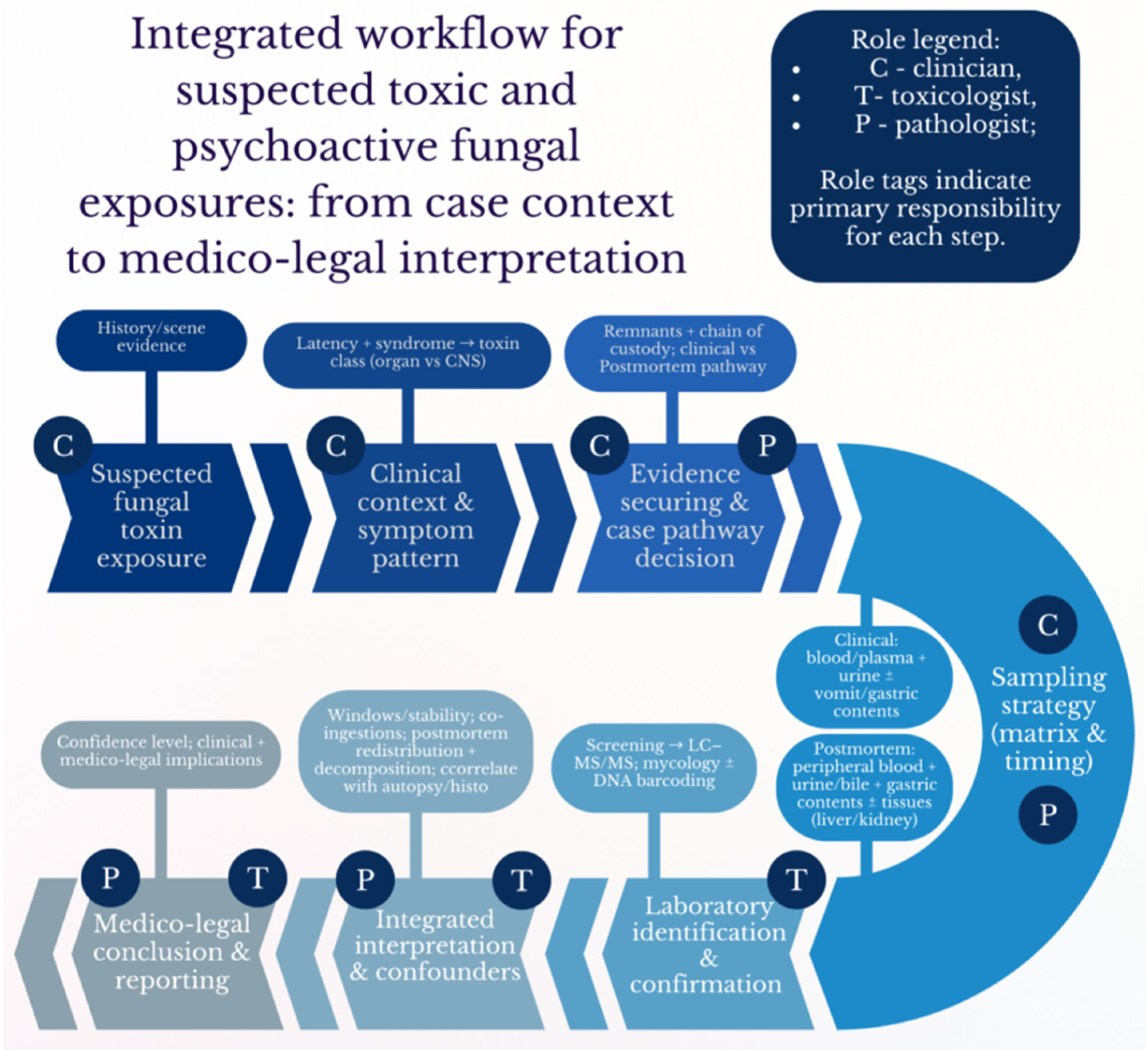
To support a structured evaluation in suspected cases, we propose a pragmatic workflow outlining key diagnostic and interpretative steps in Figure 1.

2. Search Strategy and Evidence Selection

This manuscript is an expert narrative review intended to provide a practice-oriented synthesis for forensic toxicology and medico-legal interpretation. We performed a structured literature search in PubMed/MEDLINE and an external web search up to January 2026. Search terms combined concepts related to toxic/psychoactive fungal intoxications and forensic analytics, including: mushroom poisoning, toxic fungi, psychoactive fungi, amatoxin/α-amanitin, orellanine, gyromitrin, ibotenic acid, muscimol, psilocybin/psilocin, together with forensic, postmortem, interpretation, stability, and key methods such as liquid chromatography–tandem mass spectrometry (LC-MS/MS), liquid chromatography–high-resolution tandem mass spectrometry (LC-HRMS/MS), gas chromatography–mass spectrometry (GC-MS), and enzyme-linked immunosorbent assay (ELISA).
Inclusion criteria: sources were prioritized if they (i) directly informed forensic/medico-legal interpretation (postmortem redistribution, matrix selection, detection windows, stability/degradation, interpretative pitfalls), (ii) provided analytical validation/confirmatory methodology relevant to casework (e.g., LC-MS/MS, LC-HRMS/MS, GC-MS, immunoassays), (iii) were case reports/series with sufficient clinical–toxicological–pathological detail to support interpretative reasoning, and/or (iv) represented seminal or highly cited papers, guideline-like reviews, or consensus-type resources shaping contemporary practice.
Exclusion criteria: studies were deprioritized or excluded when they (i) did not add forensic interpretative value (purely ecological/mycological without toxicology, or purely clinical without analytical/postmortem implications), (ii) were duplicative (overlapping datasets without new insight), (iii) provided anecdotal claims without methodological detail or confirmatory evidence, or (iv) focused on experimental/toxicology models with limited translational relevance to forensic casework.

3. Toxic Fungi

Section 3 discusses issues related to toxic mushroom species. Selected genera of higher fungi exhibiting toxic properties include Amanita, Cortinarius, Galerina, Gyromitra, Lepiota, and Tricholoma. Mushrooms commonly regarded as psychoactive may also exert toxic effects when the concentrations of bioactive compounds produced reach sufficiently high systemic levels. These species are discussed in detail in Section 4. It is also important to note that poisoning may occur following the consumption of edible mushrooms due to prolonged storage without prior cooking, contamination by pests, ingestion of certain species in combination with alcohol, or accumulation of heavy metals [1,16]. From a forensic toxicology perspective, mushroom poisonings constitute a significant clinical and medico-legal problem, as toxic species are frequently misidentified as edible fungi and intoxication often presents with delayed onset and nonspecific clinical symptoms, complicating both antemortem diagnosis and postmortem interpretation.

3.1. Selected Toxic Fungus Species Review

3.1.1. Amanita spp.

One of the most widespread species of the genus Amanita is Amanita phalloides, which produces three major classes of toxins: virotoxins, phallotoxins, and amatoxins [17]. Virotoxins and phallotoxins are either not absorbed or are only poorly absorbed from the gastrointestinal tract. Another toxic representative of this genus is Amanita muscaria, which contains muscarine and ibotenic acid; the latter undergoes decarboxylation to muscimol. Ibotenic acid is also present in Amanita pantherina [1].
Recently identified species such as A. proxima, A. smithiana, A. pseudoporphyria, and A. punctata have demonstrated nephrotoxic effects associated with the presence of allenic norleucine. Many species of the genus Amanita are considered edible; however, due to pronounced phenotypic similarities, toxic species are frequently misidentified as edible mushrooms. In forensic practice, such misidentification may result in misleading antemortem histories and delayed toxicological suspicion. A. proxima has been confused with A. ovoidea, while A. smithiana has been mistaken for Tricholoma magnivelare, an edible species [2].

3.1.2. Cortinarius spp.

The first documented cases of poisoning were reported in Poland in 1957; among 102 individuals who consumed Cortinarius spp., 11 fatalities were recorded. Species discussed in this section contain orellanine, a nephrotoxic compound. In particular, Cortinarius orellanus and Cortinarius rubellus are regarded as among the most toxic mushrooms worldwide. Other species producing orellanine include C. henrici, C. rainierensis, and C. brunneofulvus. These mushrooms have been misidentified as edible species such as Cantharellus tubaeformis, Cantharellus cibarius, as well as hallucinogenic mushrooms of the genus Psilocybe. Such misidentification, combined with delayed onset of nephrotoxicity, represents a major challenge in forensic investigations of unexplained renal failure and death [2,18].

3.1.3. Gyromitra spp.

The primary toxin produced by mushrooms of the genus Gyromitra is gyromitrin, which was definitively identified in 1968 by List and Luft. Species of this genus are commonly mistaken for true morels, leading to their designation as “false morels.” The main species responsible for human poisonings is Gyromitra esculenta, which contains the highest concentrations of gyromitrin. Other species, such as G. gigas and G. fastigiata contain gyromitrin in unknown quantities; however, human poisonings associated with these species have not been clearly documented [1,19]. Another toxic species is Gyromitra infula, found in Asia, especially in China, where it is prevalent during summer and autumn. It is frequently confused with edible species of the genus Helvella [20]. Gyromitrin poisoning results in a characteristic clinical syndrome involving primarily the gastrointestinal tract, as well as hepatic and renal injury and, at high exposure levels, central nervous system involvement. Coagulopathy has also been reported [19,21].

3.1.4. Galerina spp.

The genus Galerina comprises approximately 300 species, of which eight have been identified as toxic. These species produce α-amanitin. The primary species responsible for poisonings are G. autumnalis and G. marginata.
During growth, the caps elongate and change shape from conical to bell-shaped. These mushrooms are distributed worldwide. Galerina marginata, the most toxic representative of the genus, is frequently misidentified as the hallucinogenic species Psilocybe cyanescens [22,23,24]. Importantly, the concentration of amatoxins in G. marginata has been shown to vary depending on environmental factors such as temperature, humidity, microclimatic conditions, nitrogen availability, soil pH, elevated carbon dioxide levels, and differences in soil structure and surrounding vegetation [24,25].

3.1.5. Lepiota spp.

Lepiota represents another genus containing amatoxins and is reported to include a greater number of toxic species than Amanita. Toxic species include Lepiota brunneoincarnata, L. brunneolilacea, L. helveola, L. castanea, and L. subincarnata [22,26].
These species are frequently misidentified as edible species such as Leucoagaricus, Macrolepiota procera, and Tricholoma terreum [22]. Most species contain primarily amatoxins, but phallotoxins are also present. Six toxin variants have been identified within this genus. In L. brunneoincarnata, β-AMA, α-AMA, amanine, and amaninamide have been detected. In L. venenata, amanine II (a structural analog of amanine), α-AMA, and an unidentified compound have been identified [27,28].
Ingestion of approximately 170 g of L. josserandii resulted in acute pancreatitis in a 43-year-old female patient with chronic hepatitis B, preceding the onset of fulminant hepatic failure. On day six of hospitalization, the patient developed encephalopathy, asterixis, ascites, and abdominal pain, ultimately requiring orthotopic liver transplantation [29].

3.1.6. Tricholoma spp.

The primary toxic species within this genus is Tricholoma equestre, also known as the yellow knight. Approximately 15 years ago, cases of rhabdomyolysis following consumption were reported in France [30].
Twelve patients developed limb weakness within 48–72 h after ingestion. After 3–4 days, muscle stiffness, vomiting, facial erythema, and dark urine were observed. Severe vomiting occurred in eight hospitalized patients, and fever was not reported [31]. Consequently, France and several other European countries classified the mushroom as toxic. In 2018, a study demonstrated that consumption of 300 g of T. equestre did not reproduce these adverse effects, and the toxin responsible for rhabdomyolysis has not been identified. The authors concluded that ingestion does not pose a risk to healthy individuals; however, ethical constraints precluded studies in patients with underlying disease [2,30].

3.2. Review of Toxins Contained in Fungus Species Described Previously

The following part of Section 3 discusses toxic substances associated with the mushroom species described above.

3.2.1. Amatoxins

Amatoxins are cyclic octapeptides that are thermostable, water-soluble, resistant to enzymatic and acidic degradation, and unaffected by drying. Their toxic effect is mediated through inhibition of RNA polymerases (α-amanitin inhibits RNA polymerase II, whereas β-amanitin inhibits RNA polymerase III). The amatoxin group includes α-, β-, γ-, and ε-amanitin, amanullinic acid, amaninamide, amanin, amanullin, and proamanullin. Among these compounds, α-amanitin is considered the primary determinant of clinical toxicity [16,23].
α-Amanitin is efficiently absorbed in the intestine and reaches the liver via portal circulation. Hepatocellular uptake is mediated by organic anion transporting polypeptide OATP1B3 and sodium taurocholate cotransporting polypeptide (NTCP). Following entry into hepatocytes, α-amanitin binds to the Rpb1 subunit- the largest subunit of RNA polymerase II- thereby inhibiting protein synthesis. Degenerative processes predominantly affect rapidly dividing cells. Current evidence suggests that α-amanitin induces reactive oxygen species (ROS) production and tumor necrosis factor (TNF) expression, leading to activation of programmed cell death pathways involving caspase-3 and the p53 signaling axis [16,23]. This cascade ultimately results in acute liver failure (ALF) accompanied by centrilobular and periportal necrosis. Most amatoxins are excreted unchanged via the kidneys, while less than 10% undergo biliary excretion, resulting in enterohepatic recirculation and prolonged systemic exposure, typically lasting up to five days. Renal injury occurs primarily through acute tubular necrosis, which may progress to hepatorenal syndrome and further exacerbate hepatic decompensation [17,18,27].
Due to enterohepatic circulation, amatoxin concentrations in blood and urine may become undetectable within hours or days after ingestion, whereas bile may contain substantial concentrations of these compounds. Consequently, bile has been identified as a valuable diagnostic matrix for the detection of amatoxins in the organism. In a 2024 study, the application of UHPLC-MS/MS and UHPLC-ToF-MS techniques was proposed. The authors demonstrated the usefulness of these methods for detecting amatoxins in bile at concentrations in the ng/mL range, even when biological matrices such as blood and urine no longer contained detectable amounts of the toxin. These findings suggest that postmortem bile analysis may be useful in the identification of amatoxin poisoning [4].
Reported LD50 (median lethal dose) values range from approximately 0.05 to 0.1 mg/kg body weight, depending on the source [3,23,32,33]. The amatoxin-induced toxidrome is discussed in greater detail in subsequent sections of this paper.

3.2.2. Phallotoxins

Phallotoxins comprise seven bicyclic heptapeptides: phalloidin, phalloine, prophalloine, phallisine, phallicine, phallacidin, and phallisacin. These compounds are thermostable and resistant to degradation by digestive enzymes [1,23]. They are either not absorbed or only minimally absorbed from the gastrointestinal tract [1].
One representative phallotoxin, phalloidin, has been shown to induce hemorrhagic hepatocellular necrosis in in vitro intoxication models [34]. Phalloidin binds to filamentous actin (F-actin), stabilizing actin filaments and irreversibly preventing depolymerization into globular G-actin [33,34]. As this process also occurs within bile canaliculi, it leads to structural encasement and narrowing of these channels, resulting in bile stasis and ultimately cholestasis [33].
Reported LD50 values for phallotoxins in mice and rats range from 1.5 to 4.5 mg/kg [33].

3.2.3. Orellanine

Orellanine (3,3′,4,4′-tetrahydroxy-2,2′-bipyridine-1,1′-dioxide) is structurally similar to the herbicides paraquat and diquat, as well as the neurotoxin MPTP [35]. The precise mechanism of action of orellanine has not been fully elucidated. A study conducted in 1991 demonstrated that orellanine inhibits cytoplasmic and mitochondrial proteins in renal cells [1,36].
In 2023, a comprehensive investigation using Human Primary Renal Tubular Proximal Epithelial Cells (RPTECs) described multiple pathways involved in orellanine-induced toxicity [37]. Data indicated that orellanine toxicity is multi-pathway and converges on proximal tubular injury (e.g., apoptosis, impaired xenobiotic handling/transport, oxidative–metabolic stress, and remodeling responses) [32].
Clinical manifestations of orellanine poisoning develop gradually over several days to up to two weeks following ingestion and primarily reflect renal injury. Symptoms include myalgia, headache, thirst, and oliguria. During the latent phase, mild gastrointestinal disturbances have also been reported. Orellanine has been detected in renal biopsy specimens up to six months after mushroom ingestion [18].
Due to its rapid accumulation in renal tissue, orellanine becomes undetectable in urine, blood, and dialysis fluid at the time of symptom onset; its detectability persists for a maximum of approximately two weeks after ingestion and may disappear from urine as early as two days post-exposure. This significantly complicates the determination of the cause of poisoning, both in ante-mortem diagnostics and post-mortem toxicological analysis [13].
From a forensic perspective, the relevance of the described molecular pathways lies not in their isolated mechanistic characterization but in their contribution to the distinctive pattern of delayed, organ-specific nephrotoxicity, which limits direct toxicant detection and necessitates indirect post-mortem interpretation based on morphological and biochemical evidence of renal injury.
In a study conducted in 2012 by Herrmann et al., the lethal dose was estimated at 29–227 g of fresh mushrooms for an individual weighing 70 kg. A dose of approximately 3 mg of orellanine, corresponding to 0.04 mg/kg body weight, was associated with irreversible renal failure requiring lifelong dialysis [13,38]

3.2.4. Gyromitrin

Gyromitrin (acetaldehyde N-methyl-N-formylhydrazone) is a volatile compound that is sensitive to heat and acidic conditions. Following ingestion, gyromitrin is hydrolyzed in the stomach through the loss of the acetaldehyde group to form N-methyl-N-formylhydrazine (MFH). This compound is also generated during thermal processing of gyromitrin-containing mushrooms. Subsequently, MFH undergoes deformylation, resulting in the formation of monomethylhydrazine (MMH). This transformation occurs both in the stomach and in the liver, where it is facilitated by cytochrome P450 enzymes. MMH disrupts metabolic processes involving pyridoxine derivatives. Importantly, this active metabolite directly binds to pyridoxal kinase, the enzyme responsible for the phosphorylation of pyridoxine to pyridoxal 5-phosphate. This interaction plays a key role in the development of neurological manifestations associated with gyromitrin poisoning. The primary clinical manifestations of gyromitrin ingestion originate from the gastrointestinal tract and include abdominal pain, nausea, vomiting, and diarrhea. Renal injury has also been reported and is thought to result from dehydration as well as the direct nephrotoxic effects of MMH. As previously noted, deficiency of pyridoxal 5-phosphate has significant neurological consequences. This compound serves as an essential cofactor for glutamate decarboxylase, the enzyme responsible for the conversion of glutamate to γ-aminobutyric acid (GABA). Impairment of this pathway increases the risk of delayed seizure onset and leads to enhanced neuronal excitability. Active metabolites of gyromitrin may also induce acute liver failure. This effect is attributed to MMH-mediated interference with cytochrome P450 enzymes, amino oxidases, and glutathione-dependent pathways, as well as increased production of reactive oxygen species. These processes promote the formation of unstable diazonium compounds, ultimately resulting in hepatocellular necrosis [19,21].
Overall, the toxic exposures discussed above are dominated by organ-specific injury and frequent interpretative pitfalls driven by delayed presentation and limited detectability of the parent toxins. In contrast, psychoactive mushroom cases are typically shaped by rapid onset, short detection windows, and co-exposures-an issue addressed in the following section.

4. Psychoactive Fungi

Section 4 focuses on psychoactive mushrooms that primarily produce neuropsychiatric effects and may contribute to legal and medical events like impaired decision-making, risky behavior, accidents, and trauma. In contrast to the organ-toxic fungi described in Section 3, here the key forensic problem lies more in interpreting brief central nervous system effects that vary widely with dose, individual susceptibility, and co-exposures to other substances.

4.1. Major Psychoactive Mushroom Genera and Their Principal Neuroactive Compounds

Psychoactive fungi, often referred to as “magic mushrooms”, are mushrooms that contain neuroactive compounds, most notably psilocybin and its active metabolite psilocin [39]. In 1998, Guzmán et al. proposed a classification based on chemical substances of neurotropic fungi into four major groups. Group 1 comprises species producing psilocybin, psilocin, and related indole derivatives, mainly within the genera Psilocybe, Gymnopilus, Panaeolus, Hypholoma, Pluteus, Inocybe, Conocybe, Panaeolina, Gerronema, Agrocybe, as well as Galerina and Mycena. Group 2 includes Amanita muscaria, A. pantherina, and A. regalis, characterized by ibotenic acid (and its decarboxylation product muscimol). Group 3 covers ergot fungi such as Claviceps purpurea and related species producing ergot alkaloids. Group 4 contains taxa reported as “sacred” or psychoactive but lacking reliable chemical characterization [40,41]. In the more recent clinical classification proposed by White et al. (2019) [42], psilocybin-related intoxications fall under neurotoxic poisonings as Group 2A (hallucinogenic mushrooms), while Amanita (ibotenic acid/muscimol) intoxications are categorized as Group 2C (CNStoxicity mushrooms), broadly mirroring Guzmán’s chemical grouping but reframing it in syndromic/clinical terms.
From a forensic medicine perspective, the greatest practical relevance is typically attributed to psilocybin/psilocin hallucinogenic fungi and to isoxazole-containing Amanita species (ibotenic acid/muscimol), as these constitute the principal neurotoxic mushroom groups encountered in contemporary clinical classifications and are increasingly represented in poison center and forensic toxicology casework. Therefore, this subsection focuses on these taxa [13,43,44].

4.2. Pharmacodynamics and Pharmacokinetics Relevant to Forensic Interpretation (PK/PD)

4.2.1. Psilocybin–Psilocin Pharmacology

Psilocybin is a tryptamine alkaloid that differs from N,N-dimethyltryptamine (DMT) by the presence of an additional phosphoryloxy group at the 4-position of the indole ring [45]. Following oral administration, psilocybin primarily acts as a prodrug and undergoes rapid dephosphorylation to psilocin, which is the main pharmacologically active compound [10]. For this reason, human pharmacokinetics are most often discussed in terms of psilocin. Psilocin appears in plasma approximately 20–30 min after ingestion and reaches Tmax about 1.8–4.0 h after an oral dose; its terminal half-life is approximately 1.2–4.7 h [46,47,48,49]. Data on bioavailability are limited, but available estimates suggest values around 50–55%, and only a small fraction is excreted in urine as unchanged psilocin (~1.5–3.4%).
Pharmacodynamically, psilocin behaves as an agonist or partial agonist at serotonin receptors, most notably 5-HT2A, but also at 5-HT2C and 5-HT1A [10]. Structurally, psilocin (4-hydroxy-N,N-dimethyltryptamine) is closely related to serotonin, yet differs from serotonin (5-hydroxytryptamine) in the position of the hydroxyl group (4- vs. 5-position) and in N,N-dimethylation of the amine side chain [50]. The characteristic psychedelic effects are thought to arise primarily from activation of cortical 5-HT2A receptors, which are enriched in the prefrontal cortex [51]. Finally, psilocin has also been reported to directly bind tropomyosin receptor kinase B (TrkB)-a receptor for brain-derived neurotrophic factor (BDNF) and act as a potent positive allosteric modulator, potentially facilitating endogenous BDNF–TrkB signaling [52].
From a forensic point of view, the relatively short elimination half-life and rapid biotransformation of psilocin imply a limited interpretive window in blood, whereas later time points may be better reflected by metabolite patterns rather than unconjugated psilocin alone.

4.2.2. Ibotenic Acid-Muscimol Pharmacology

Ibotenic acid is a non-proteinogenic α-amino acid [53] that, following oral ingestion, is decarboxylated to muscimol [49]. Their main natural source is mushrooms of the genus Amanita (most notably Amanita muscaria and Amanita pantherina), and they underpin the so-called pantherina–muscaria intoxication syndrome [44,54,55,56,57]. Mechanistically, ibotenic acid acts as an excitatory glutamate analogue (with activity at glutamatergic receptors, including N-methyl-D-aspartate (NMDA) pathways), whereas muscimol is a potent agonist at gamma-aminobutyric acid type A (GABA-A) receptors, producing predominantly inhibitory central nervous system effects [55,57]. The first symptoms typically occur 30 min to 2 h after oral intake, with a peak within about 5 h [58]. However, at present, the literature does not provide robust quantitative pharmacokinetic parameters such as volume of distribution (Vd) or elimination half-life for these compounds in humans [57,59]. Muscimol is excreted unchanged in urine [58]; therefore, from a forensic toxicology perspective, urine is a particularly useful matrix, as a substantial fraction of ibotenic acid or muscimol may be recovered relatively intact, especially when mushroom material is unavailable or the exposure history is unreliable.

4.3. Clinical Toxidrome and Medico-Legal Risk Profile

4.3.1. Clinical Toxidrome: Psilocybin/Psilocin vs. Amanita-Type

Clinical toxidrome after ingestion of psychoactive mushrooms can be broadly divided into two neurotoxic syndromes (toxin-related presentations that can involve any level of the nervous system from the brain and spinal cord to peripheral nerves—depending on the toxin). The first is psilocybin-related, which is classic psychedelic intoxication. The second is Amanita “pantherina-type” intoxication, dominated by ibotenic acid and muscimol, the latter often representing a delirium/neurologic CNS syndrome rather than a purely serotonergic psychedelic state [42,60]. While certain nonspecific symptoms may occur (e.g., nausea, dizziness, perceptual disturbance), the overall phenomenology, neurologic signs, and level-of-consciousness pattern usually allow a clinically meaningful distinction.
In controlled human studies, psilocybin produces dose-dependent changes in mood, perception, altered time sense, visual-perceptual distortions, emotional lability, and transient changes in thought content [61]. Normally, physiological effects are mild or moderate and dose-dependent, including increases in heart rate and blood pressure, sometimes with tremor, sweating, dizziness, and gastrointestinal discomfort [62]. Meanwhile, therapeutic-trial datasets commonly report acute adverse effects like headache, nausea, anxiety, dizziness, and elevated blood pressure, which generally resolve within 48 h in supervised settings [63]. More comprehensive safety pharmacology work similarly describes mostly transient sympathomimetic activation (e.g., tachycardia), with serious adverse reactions uncommon under controlled conditions [64]. However, without supervised settings, psychologically challenging experiences (commonly called “bad trips”) characterized by intense fear, paranoia-like interpretations, or panic can occur and may be followed by unsafe behavior. Survey and poison center data indicate that real-world presentations can include agitation, confusion, and risky actions, even if life-threatening toxicity is uncommon in most cases [13,64].
Amanita-type toxidrome, so the “Pantherina” poisoning, is classically described as a syndrome of central nervous system dysfunction. It is linked to Amanita muscaria and Amanita pantherina, driven by a mixture of excitatory (ibotenic acid) and inhibitory (muscimol) neuroactive constituents [55]. Onset is typically rapid (30 min to a few hours), and the clinical picture is usually dominated by confusion, delirium-like states, dizziness, somnolence, ataxia, dysarthria, and fluctuating levels of consciousness, sometimes alternating between agitation and sedation [3,65]. Case series and reviews show that gastrointestinal symptoms are not always prominent but may occur (nausea or vomiting) and shouldn’t exclude the diagnosis [44]. Comparative clinical data suggest meaningful differences by species: A. muscaria cases may present more often with confusion and agitation, while A. pantherina exposures have been associated with a higher frequency of coma in severe cases [54]. Published case reports and poison center analyses describe changing obtundation, ataxia, hyperkinetic behavior, and occasionally more severe neurologic outcomes, typically with eventual recovery under supportive care [44,56].
The characteristic clinical features of psilocybin/psilocin versus Amanita-type (ibotenic acid/muscimol) intoxication are summarized and compared in Table 1.

4.3.2. Medico-Legal Risk Profile

After outlining two characteristic toxidromes (Table 1), it could be confirmed that the medico-legal relevance of psychoactive fungi is driven primarily by functional impairment rather than progressive organ failure. For psilocybin/psilocin, the key risks come from disturbed perception, impaired judgment, and affective instability, which can lead to unsafe decisions, panic-driven flight behavior, disorientation in traffic or public spaces, and accidents/trauma even when physiological toxicity is limited [13,61,62,63,64,66]. For Amanita-type intoxication, medico-legal risk more often relates to altered consciousness and neurologic dysfunction, especially ataxia and fluctuating agitation/somnolence, which leads to falls, inability to walk safely, and impaired driving. Moreover, in severe cases, aspiration risk occurs when vomiting co-occurs with depressed consciousness [3,44,54,55,56,65].

4.3.3. Differential Diagnosis and Documentation Essentials

Because these presentations can imitate other intoxications and acute medical states, a concise differential diagnosis is essential. Conditions/substances most likely to overlap include stimulants (agitation, paranoia, sympathomimetic signs), anticholinergic toxicity (delirium, hyperthermia, mydriasis), dissociatives (e.g., ketamine/phencyclidine-like states), alcohol/sedatives (ataxia, depressed consciousness, particularly relevant for Amanita-type), acute mania/psychosis, and non-toxicologic mimics such as head injury, hypoglycemia, and central nervous system infection/encephalopathy [67,68,69,70].

4.4. Modifying Factors and Co-Exposures (Polydrug Use)

The clinical and forensic symptoms of psychoactive fungi poisoning can vary greatly. The neuropsychiatric effects of Psilocin and Amanita toxins are influenced by individual predisposition and exposure to other psychoactive substances. Consuming alcohol, benzodiazepines, opioids, cannabis, or stimulants at the same time can make cognitive impairment worse, change affective responses, and affect levels of consciousness. Moreover, it can increase the risk of accidents, violence, or aspiration. Furthermore, they can significantly modify both the intensity and qualitative profile of poisoning through additive or synergistic pharmacodynamic interactions in the serotonergic, GABAergic, glutamatergic, and dopaminergic systems [71,72,73]. Combination use of central nervous system depressants may increase sedation, ataxia, and the risk of respiratory failure in Amanita poisoning. At the same time, stimulants or serotonergic agents may increase hyperactivity, anxiety, or psychosis- like reactions during psilocybin exposure [74,75]. From a forensic perspective, such impairment often reflects the combined effects of multiple substances rather than a single substance from the fungi [76].

4.5. Forensic Interpretation: What the Expert Is Actually Asked to Conclude

In forensic practice, experts are rarely required to determine whether psychoactive fungi were lethal. Usually, their main task is to determine whether the known pharmacological effects of these fungi could have influenced the observed mental state, behavior, or impairment of a person at a given moment. This involves analyzing toxicological results, pharmacokinetic data, clinical toxicological observations, and evidence to assess cognitive and motor function, risk awareness, and the credibility of statements. Because these compounds have a short half-life and exposure often involves multiple substances, conclusions must consider all contributing factors and clearly explain interindividual variability and uncertainty [1,50,77,78,79].
In the case of psychoactive fungi, forensic analysis focuses on functional impairment rather than direct organ toxicity. The task of experts is to determine whether a transient psychedelic state induced by serotonin (via psilocybin/psilocin) or a delirium-like state (by ibotenic acid/muscimol) could explain the confusion, panic, impulsive behavior, ataxia, or impaired consciousness at the time of the incident, including how such effects may have been modified by alcohol or other drugs. In this context, the goal is not to determine the cause of death, but to assess psychomotor and cognitive performance, decision-making ability, and the credibility of subjective accounts within a reasonable time frame from a pharmacological standpoint [80,81,82].

4.6. Causation Versus Contribution in Forensic Conclusions: Indirect Deaths After Psychoactive Mushroom Use

Deaths related to the consumption of psychoactive mushrooms are rare, but should be considered in forensic medicine practice. In most cases, they are not the result of direct toxic “lethality”, but of the indirect involvement of the substance through impairment of cognitive function, perception and behavioural control, which increases the risk of fatal events. The most important indirect mechanisms include disorders of perception and cognition (e.g., misjudgement of distance and risk) [83,84], emotional disturbances (euphoria/dysphoria, anxiety and panic attacks) leading to inappropriate responses to the environment (e.g., running into traffic) [9,83], and psychomotor disturbances (ataxia, slowness, unsteady gait) that predispose to falls, injuries and traffic accidents [9,83].
In the context of indirect causality, drownings and deaths due to environmental exposure (especially hypothermia) resulting from disorientation and wandering should also be taken into account [83,85]. Additionally, in cases with severe vomiting and reduced consciousness, aspiration of stomach contents may be a significant, although difficult to quantify, mechanism [65,85]. Less frequently, severe gastrointestinal symptoms (persistent vomiting/diarrhoea) can lead to dehydration and electrolyte disturbances, which in susceptible individuals can worsen the prognosis and contribute to death [86,87]. In practice, it is necessary to consider the concomitant use of alcohol and other psychoactive substances (discussed in Section 4.4), which may increase impairment and the risk of injury or drowning. Table 2 summarizes typical indirect fatal scenarios and key confounders relevant to forensic attribution (Table 2).

5. Analytical Approaches

The diagnosis in patients with suspected mushroom toxin poisoning is generally established based on clinical manifestations and a structured exposure history. This primarily reflects the limited availability of confirmatory analytical methods and access to reference laboratories. An additional limitation is the relative rarity of such intoxications and, consequently, more limited staff experience with these cases in routine clinical practice. The assessment typically considers the circumstances of exposure, latency, and the characteristic symptom complex (toxidrome), as well as organ-specific test results (including hepatic function), and, whenever possible, also incorporates mycological identification and/or toxin determination in biological material [3,93]. A separate challenge is posed by psychoactive mushrooms and their constituents. They represent a substantial diagnostic difficulty with respect to both analyte stability and identification in collected specimens. Certain analytes, such as psilocybin, undergo rapid conversion to psilocin; moreover, in urine, psilocin may be present predominantly as conjugated species (e.g., glucuronides), which influences the analytical strategy [94]. This illustrates the heterogeneous nature of intoxications caused by mushroom-derived substances: although detection is possible, it is technically demanding due to narrow detection windows—thereby increasing the risk of false-negative results under non-optimal sampling and sample preparation conditions—and due to limited analyte stability, which does not always permit reliable identification. Therefore, rigorous pre-analytical conditions and the continued development of methods that extend the detection window and improve the reliability of confirmatory testing are of key importance [4,94].

5.1. From Macroscopic Identification to Instrumental Toxicology

At present, the simplest diagnostic approach, although one with limited sensitivity and specificity, is macroscopic identification of consumed mushrooms or unconsumed remnants present in vomitus or feces. The assessment may include gill characteristics, pores, stipe morphology, and cap color. However, this approach is inherently unreliable and typically requires mycological and/or analytical confirmation [3]. For a more precise evaluation, depending on the time since ingestion and toxicokinetics, measurement of toxin concentrations is required in matrices such as urine, plasma, vomitus, gastric contents, bile, or, in more severe poisonings, liver or kidney tissue [4]. This necessitates the use of a broader range of biochemical methods, including chromatographic and non-chromatographic techniques. The former includes thin-layer chromatography (TLC), high-performance thin-layer chromatography (HPTLC), liquid chromatography-tandem mass spectrometry (LC-MS/MS), gas chromatography-mass spectrometry (GC-MS), and liquid chromatography-high-resolution tandem mass spectrometry (LC-HRMS/MS). The latter includes enzyme-linked immunosorbent assay (ELISA) [95].

5.1.1. TLC and HPTLC

TLC and HPTLC were among the earliest and simplest methods formerly used to analyze toxins in mushroom extracts; however, they have now been largely displaced by LC-MS/MS, primarily due to their limited effectiveness in verifying toxins in biological specimens, reflecting lower sensitivity and the presence of matrix interferences. Historically, they played a role in screening and in resource-limited settings, but not as confirmatory methods [95,96].

5.1.2. LC-MS/MS

LC–MS/MS is currently the most widely used method and the most valuable approach for quantitative assessment of analyte concentrations. Compared with TLC and HPTLC, it offers higher selectivity, sensitivity, and confirmatory capability [95]. It is used to detect mushroom toxins in urine, plasma, serum, and gastric contents [97].
In a study by Abbott et al., LC-MS/MS was applied to determine α-, β-, and γ-amanitin in urine, which constitutes a key matrix for diagnosing exposure to these toxins. Urine samples were cleaned using, among other steps, solid-phase extraction (SPE), thereby increasing method sensitivity and specificity. Chromatographic separation was performed under hydrophilic interaction liquid chromatography (HILIC) conditions, and detection was carried out using a triple-quadrupole instrument in multiple reaction monitoring (MRM) mode, monitoring both quantitative and confirmatory transitions [7,95]. The limit of detection (LOD) for these toxins was reported as approximately 0.169 ng/mL for γ-amanitin, 0.458 ng/mL for α-amanitin, and 0.93 ng/mL for β-amanitin, with a quantification range up to approximately 200 ng/mL. The authors also noted potential limitations related to matrix effects, which may lead to analyte enhancement or suppression and impaired ionization due to salts and other metabolites present in the matrix (urine); therefore, sample preparation optimization and chromatographic adjustments are required. The most effective preventive approach is the use of an isotopically labeled internal standard. In this context, the authors evaluated internal standards and demonstrated that 15N10-α-amanitin is an appropriate internal standard for the quantitative determination of α-amanitin, whereas β- and γ-amanitin were measured most robustly using external calibration because the applied internal standards did not fully compensate for variable matrix effects for these analytes [7].
Complementarily, Lu et al. described an LC-MS/MS method for the simultaneous determination of 12 mushroom toxins (ibotenic acid, muscimol, muscarine, β-amanitin, α-amanitin, deoxoviridin, γ-amanitin, phallisacin, illudin S, phallacidin, phalloidin, and illudin M) in mushrooms and selected biological fluids, achieving a high coefficient of determination (R2 > 0.994) across the range 0.05–200 µg/L. When applied to wild mushroom samples, the method yielded positive detection for 11 toxins (excluding illudin M) in the range 0.61–2143 mg/kg [97]. Moreover, LC-MS/MS has found broad application in monitoring compounds present in psychoactive mushrooms, enabling measurement of psilocybin, psilocin, baeocystin, norbaeocystin, and aeruginascin [98].

5.1.3. GC-MS

GC-MS is particularly useful for volatile and thermally stable compounds, as well as for analytes that can be rendered compatible through derivatization. This method is used primarily in the context of Gyromitra spp. poisoning. The classical GC-MS approach to determining gyromitrin/monomethylhydrazine (MMH) is based on acid hydrolysis yielding MMH, followed by MMH derivatization (e.g., using pentafluorobenzoyl chloride) and subsequent GC-MS analysis [99].
In parallel, Fan et al. proposed a newer strategy based on isotope-coded derivatization combined with ultra-performance liquid chromatography-tandem mass spectrometry (UPLC-MS/MS), enabling quantitative determination of gyromitrin in urine and plasma. The method was validated (LOD 1 µg/L in urine and plasma; recoveries 88–111%; inter-day precision < 13%), indicating good sensitivity, adequate performance of the sample preparation steps, and reproducible measurements across analytical runs. A limitation of derivatization-based approaches is the additional sample preparation step (a potential source of variability), and for GC-MS, an additional requirement is analyte volatility and thermal stability, which complicates method standardization for certain mushroom toxins [100]. Clinically, GC-MS is much less commonly used for psilocin detection following derivatization; however, this process may increase the risk of pre-analytical errors [101].

5.1.4. LC-HRMS/MS

In cases of intoxication with a toxin of uncertain origin, LC-HRMS/MS can be particularly helpful. It is especially effective for identifying α- and β-amanitin, muscimol, ibotenic acid, muscarine, psilocin, and bufotenin [102]. In a study by Vollmer et al. [103], urine samples were analyzed using UPLC-HRMS/MS with heated electrospray ionization (HESI) in negative-ion mode, achieving chromatographic separation of amatoxins and acquiring full-scan data with simultaneous MS/MS collection (ddMS2). This approach provides efficient separation and high specificity based on retention time and accurate mass, thereby reducing the risk of false-positive or false-negative results due to matrix interferences from other compounds of similar mass present in mushrooms. Accordingly, it may serve as an effective confirmatory method following immunoassays [103].
In another study by Flament et al. [104], 10 patients with suspected muscarine poisoning were evaluated. Urine, whole-blood, and plasma samples were collected and analyzed using LC-HRMS/MS with an internal standard (D9-muscarine). The validated range was 0.1–100 µg/L for plasma and 1–100 µg/L for urine. Measured muscarine concentrations ranged from 0.12 to 0.14 µg/L in whole blood, from <limit of quantification (LOQ) to 43 µg/L in plasma, and from <LOQ to 1537 µg/L in urine. These results demonstrated the utility of the method even at low toxin concentrations in biological fluids, enabling confirmation of 10 clinical poisoning cases, and showed that LC-HRMS/MS performs effectively in matrices such as urine, whole blood, and plasma [104].

5.1.5. ELISA

One of the most commonly used non-chromatographic methods in the diagnosis of amatoxin poisoning is ELISA, performed, among others, in urine and serum/plasma [105]. In the study by Dluholucký et al. [105], among 698 suspected cases of amanitin poisoning, 141 were confirmed, and 557 were excluded based on the clinical picture and ELISA testing. The authors showed that urinary amanitin concentrations (ATOu) correlated with poisoning severity within the 6–47 h window after ingestion, with no false-negative results observed in that interval, whereas serum measurements did not have significant diagnostic value. According to the kit manufacturer, analytical sensitivity is 0.22 ng/mL and functional sensitivity is 1.5 ng/mL, with detectability in urine up to approximately 6–60 h after ingestion; however, negative results should not be interpreted as definitive exclusion of intoxication, and confirmatory testing using chromatography coupled with mass spectrometry is recommended in doubtful cases [105].
Additionally, ELISA can serve as a useful tool for monitoring psilocin (Psi) and psilocybin (Pyb). In the study by Morita et al., ELISA performance was evaluated in a dried, powdered mushroom sample. Anti-Psi and anti-Pyb antibodies were developed and conjugated to carrier proteins. The ELISAs enabled quantification in the range 0.2–20 µg/test for Pyb and 0.04–2 µg/test for Psi (LOD 0.14 and 0.029 µg/test, respectively). These results indicated utility for the identification of certain hallucinogenic mushrooms. ELISA is a rapid screening method; however, its specificity may be limited. A key limitation is susceptibility to cross-reactivity, whereby antibodies bind to other structurally related compounds; in the context of the above-mentioned study, this included six related tryptamines (including bufotenin). Without effective discrimination among such compounds, ELISA results may be confounded and require confirmation using more specific methods. Furthermore, discrepancies may arise due to differences between assay kits (calibration, validation) as well as matrix type and matrix effects (plasma/serum), and interpretation therefore requires a clinically informed approach [106].

5.2. Analyte-Driven Matrix Selection and Detection Windows

The selection of an analytical method and an appropriate matrix (i.e., a biological fluid or tissue sample) depends on the distribution, metabolism, and elimination of the toxin, as well as on the time elapsed since exposure. In addition, a relationship can be identified between a given mushroom-derived compound and its most informative diagnostic matrix based on similar criteria [1]. This is because certain toxins persist better in specific biological fluids or tissues, which may be crucial for reliable diagnosis; in other matrices, concentrations may be too low to detect or may remain detectable only for a short period [96].
The following matrices are discussed below: urine (early detection), plasma/whole blood (a broader window for selected toxins), gastric contents, bile (confirmatory testing), and kidney tissue (a late window, particularly relevant to orellanine exposure). Individual mushroom-derived substances and their clinically relevant matrices are summarized in Table 3.

5.2.1. Urine Samples

The most extensively described and commonly used tests are those for amatoxins in urine in cases of poisoning due to the death cap and the “destroying angel”, enabling rapid initiation of treatment and reduced mortality. Toxicokinetic studies indicate that amatoxins may be detectable in urine as early as 30 min after ingestion, with concentrations 100–150 times higher than in blood, while after approximately 36 h, they are often undetectable in many cases. Therefore, urine constitutes an excellent matrix for patients presenting early after exposure [4,6,9]. Urine is also valuable for Psi detection; however, adequate chromatographic resolution is required because of challenging discrimination from its isomer, bufotenin. In addition, attention should be paid to the degradation of Psi under light exposure, necessitating prompt cooling and minimization of delays during sample processing [107].
Wood et al. demonstrated the rationale for using β-glucuronidase, as Psi may be present in urine in conjugated form, and for achieving complete chromatographic separation. The authors indicated that, across multiple matrices, both the LOD and identification quality criteria were met [101]. Furthermore, the study by Flament et al. [108] supported the feasibility of orellanine verification in urine samples. In blinded samples fortified for calibration curve construction, the LOD for orellanine was 0.1 µg/L, extraction recovery 74–80%, accuracy 93.6–110%, and inter-day precision < 16%. These results indicate good accuracy and a limited matrix effect; however, low orellanine stability remains a concern, and procedures should minimize delays. The method was successfully applied to 10 patients with suspected orellanine poisoning. It should be noted that the urinary detection window may be time-limited; therefore, in late clinical presentations, diagnostics may reasonably be directed toward other matrices depending on the toxin [108].
Urine laboratory testing also largely focuses on assessing organ dysfunction, including hepatic injury, and other complications caused by toxic mushroom poisoning [3]. In a study by Escoda et al. involving 32 patients with symptoms of hepatotoxic mushroom poisoning, urinary amatoxin concentrations > 55 ng/mL were associated with hepatotoxicity, and ≥70 ng/mL with acute hepatitis. Moreover, early diagnostics within 72 h of ingestion of toxin-containing mushrooms reduced the risk of hepatotoxicity in 92% of patients [109].

5.2.2. Plasma and Whole Blood Samples

For plasma, the previously discussed study by Flament et al. [108] reported results comparable to those obtained in urine for orellanine. In confirmatory diagnostics, plasma (and urine) should therefore be preferred, secured as rapidly as possible, and manipulations such as freeze–thaw cycles should be minimized, as false-negative results can occur readily at very low concentrations [108]. By contrast, the study by Xu et al. [110] demonstrated the feasibility of detecting α-amanitin and β-amanitin in plasma. The LOD for both compounds was 0.02 ng/mL, with a linear range of 0.05–20 ng/mL and a correlation coefficient (r) > 0.99, indicating high reliability of signal-to-concentration conversion within this interval. The authors confirmed analytical performance using plasma collected from 18 patients across five amanitin poisoning episodes and demonstrated that toxin detection is possible even after 40 h, providing a broader detection opportunity relative to time of exposure [110].
In recent years, increasing efforts have also focused on measuring Psi in plasma; however, this is complicated by the uncertain affinity of Psi for erythrocytes. Consequently, researchers have developed methods based on whole blood, which enables direct Psi detection without deliberate plasma separation by centrifugation [107]. In the study by Gomonit et al. [107], the lower limit of quantification (LLOQ) was established at 0.78 ng/mL. A very high model fit was obtained (R2 > 0.995), and no significant interference from endogenous or exogenous compounds was observed. SPE recovery was ≥89%, and matrix effects in whole blood were minor. Collectively, these data support the potential utility of whole-blood Psi monitoring and the prospective clinical relevance of this approach [107].

5.2.3. Gastric Contents and Gastric Aspirate

Identification of mushroom-derived compounds that entered the human body may be performed in gastric juice or vomitus. This is supported by studies using artificial gastric juice and, for example, mass spectrometry coupled with a direct electrospray probe (DEP/MS) [111,112]. In the study by Su et al. [112], mushroom toxins were prepared in pure methanol and, via fortification, added to human vomitus; results were analyzed using DEP/MS. The achieved LODs in samples were 0.001–0.5 and 0.01–1 ng/µL, respectively. Moreover, the method does not require time-consuming sample preparation, and toxin identification is achieved within less than one minute from initiation, suggesting that such approaches may be important for rapid detection of life-threatening poisonings [112].
In the study by Lu et al. [97], simulated gastric fluid was included in validation as a model matrix corresponding to gastric lavage. This supported the use of such a matrix for detecting 12 toxins (including amanitins, muscarine, muscimol, ibotenic acid, phallotoxins, and illudins), with sensitivity expressed as a method limit of quantification (MLOQ) of 0.2–2.0 µg/L at R2 > 0.994 and recovery in simulated gastric fluid (SGF) of approximately 73–110.3%. These results suggest practical feasibility for toxin monitoring in this matrix; however, they do not reflect a typical clinical approach using lavage material from real patients. Such studies are necessary to substantiate the clinical relevance of the procedure [97].

5.2.4. Bile Samples

Measurement of mushroom toxin concentrations in bile is also possible. However, it is technically challenging due to the high salt content, which interferes with ionization and chromatography. In a study by Leite et al. [4], α- and β-amanitin were measured in bile aspirated from the gallbladder, with detection performed using ultra-high-performance liquid chromatography coupled with mass spectrometry (UHPLC-MS). The method used bile from post-cholecystectomy patients and dog bile as blinded control samples to assess the amount of interfering substances, as well as bile from four patients sampled 48 h or more after toxin ingestion. All samples were homogenized for analysis within a single matrix. The LOD was 2.71–3.46 µg/kg and 8.36–9.03 µg/kg for α-amanitin, and 0.32–1.69 µg/kg and 0.55–5.62 µg/kg for β-amanitin. The findings indicate a significant role of enterohepatic circulation in amatoxin disposition and prolonged persistence in bile despite a multi-day interval between poisoning and sampling. Consequently, bile may be useful for later analysis of amatoxin poisoning or when blood concentrations are undetectable. A practical advantage is that bile can be obtained relatively easily by gallbladder aspiration under ultrasound guidance [4].

5.2.5. Kidney

The kidney is not a typical matrix used for toxin detection, and given the invasive nature of the procedures involved in severe intoxications, renal biopsy is considered only in selected clinical situations when the result may affect management or diagnosis [113]. The literature most commonly reports orellanine accumulation, which may be easier to detect in kidney tissue than in urine samples. Low-dose orellanine can be detected in renal tissue even up to 60 days after ingestion, indicating prolonged persistence in this organ [99]. Orellanine is rapidly taken up by renal cells, and its plasma levels decline quickly. Toxicokinetic data from the rat study by Najar et al. [114] support the concept that kidney tissue biopsy may have the greatest confirmatory value after earlier exposure, when the toxin has already been largely cleared from circulation. In those experiments, LC-MS/MS was used as a more specific method, alongside β-scintillation counting (a radiolabel-based approach in experimental studies), which does not distinguish orellanine from metabolites and may create a misleading impression of toxin persistence in blood [114]. As a result, analyses based on monitoring mushroom toxins in kidney tissue are primarily relevant to orellanine as an adjunct to verification using other matrices; however, they require broader investigation due to limited data and findings not consistently reported in quantitative terms. Moreover, confirmation in clinical patient cohorts is needed, as this could yield more standardized and clinically meaningful results [99,114].

5.3. Summary

The diagnosis of mushroom toxin poisoning remains largely clinical; however, the increasing availability of instrumental techniques enables more frequent confirmation of exposure and improved risk stratification. Accordingly, the selection of an analytical method and biological matrix should be guided by toxicokinetics and the time elapsed since exposure, as the detection window for many toxins is short and varies substantially across specimen types. In practice, this means that urine is often the most informative matrix in the early phase, whereas in later clinical presentations, alternative matrices (e.g., plasma/whole blood, bile, or, under selected circumstances, tissues) may provide greater diagnostic value. Pre-analytical conditions are a critical determinant of overall test performance, particularly for chemically labile analytes (e.g., tryptamine derivatives), for which delays in sample stabilization and light exposure may lead to false-negative results. Immunoassays (e.g., ELISA) may accelerate initial verification; however, interpretation is limited by cross-reactivity, inter-kit variability, and matrix-related effects, and clinically meaningful results therefore require confirmation using methods with higher specificity. Consequently, chromatographic techniques coupled with mass spectrometry (LC-MS/MS, LC-HRMS/MS) constitute the reference standard for confirmation, enabling high selectivity and quantitative determination even in complex matrices. Ultra-rapid screening approaches, such as direct electrospray probe mass spectrometry (DEP/MS), are also promising because they may reduce turnaround time in matrices such as vomitus, although further validation in clinical material is required. Overall, the most effective diagnostic algorithm integrates appropriate sample collection and stabilization, time-dependent matrix selection, and instrumental confirmation, thereby increasing the reliability of diagnosis.

6. Postmortem Detection and Sample Stability

6.1. Fungi’s Specifics

Fungi present after death are transformed through various mechanisms, which are influenced by both the exposure of the deceased prior to death and the colonization processes after death. Saprotrophic fungal communities naturally develop in decomposing corpses, influenced by time and environmental conditions. This can affect the forensic interpretation of actual exposure to toxic substances versus colonization or contamination after death. Molecular sequencing studies of decomposing bodies show a succession of fungal taxa that correlate with stages of decomposition, indicating potential usefulness in estimating time since death but requiring caution in interpreting the presence of fungi as evidence of pre-mortem consumption alone [115].
Fungal species isolated from postmortem materials often reflect a mixture of environmental colonizers such as Aspergillus, Penicillium, Candida, and Mucor, especially in advanced stages of decomposition, highlighting the necessity of distinguishing between fungal decomposition flora and toxic fungi [116,117].
Fungi colonising corpses can not only be used to estimate the time of death (PMI), but can also affect the stability of biological samples. They can alter the composition of body fluids, drug metabolism, and the presence of toxins after death, which is important for the interpretation of toxicological results [118]. The absence of substances detected post mortem does not exclude exposure during life, as many fungal toxins are unstable compounds susceptible to chemical and biological degradation and changes in post-mortem distribution, thereby leading to false negative analytical results [119].
The identification of fungal and toxin residues after death depends largely on the sampling site, time of death, and chemical properties of individual toxins.

6.2. Fungi’s Location

6.2.1. Gastric Contents

Vomit and gastric lavage are important sources of fungal remains or parts after ingestion, serving for morphological identification of the fungal species, which is fundamental to establishing the cause of poisoning [120].
Macroscopic and microscopic identification of residues in gastrointestinal tract materials, in the stomach, and in vomit is essential in the early period after ingestion, before toxins are absorbed or neutralized [3]. A negative result of stomach content analysis cannot be regarded as evidence of the absence of poisoning, particularly in cases with a prolonged latency period [119].

6.2.2. Blood

Blood represents a pivotal role as a biological matrix both for the detection of post-mortem fungal colonization and for the analysis of active mushroom toxins during acute poisoning. Fungi can multiply post-mortem in the blood, leading to the metabolism of drugs and the production of specific fungal metabolites. The presence of these fungi-specific metabolites can be a valuable marker of fungal colonization in post-mortem samples. Fungal colonization and metabolism in blood can be detected up to approximately 120 h after sample collection or decomposition, which corresponds to the approximate detection window in post-mortem studies of 88–120 h. The production of fungi-specific metabolites, which are absent from human metabolism, indicates post-mortem fungal metabolism [121].
The site of blood collection is critical for the interpretation of post-mortem results. Blood collected from central vessels, including major veins or the heart, is more susceptible to post-mortem redistribution of toxins from parenchymal organs, the liver, lungs or gastrointestinal tract. Therefore, high concentrations of fungal toxins in central blood may not accurately represent antemortem concentrations. Peripheral blood from the femoral vein is considered the most reliable in post-mortem toxicology due to its lower susceptibility to post-mortem redistribution (PMR) and is recommended for quantitative interpretation. Given that fungal toxins are frequently present at low concentration thresholds, inappropriate selection of the sampling vessel can significantly compromise interpretative accuracy [119].
In contrast, chemical detection of active mushroom toxins, including amatoxins and phallotoxins in blood, is limited to the early phase of poisoning. These toxins are typically detectable up to 30–36 h after ingestion [122]. A negative result of a blood toxin analysis does not necessarily exclude prior exposure to toxins [8].

6.2.3. Urine

Urine is a useful material for detecting fungal toxins, including alpha amanitin, beta amanitin, phallacidin, and phallisacin long after ingestion, in the late phase of poisoning. After reaching peak concentrations in urine, toxin levels gradually decrease over time, reflecting their elimination from the body [123]. Urine is less susceptible to post-mortem redistribution of PMR than blood, but its post-mortem availability is variable [119]. The utility of urine as a matrix is significant in the late phase of poisoning, 6–36 h after ingestion, when toxins have been absorbed and partially excreted. Amanitin toxins are detected in urine using immunological or chromatographic methods only in some laboratories and are not routinely performed in all clinical settings [3].
In the case of muscarine detection, urine is a useful matrix for confirming early-stage poisoning. Cholinergic symptoms resulting from the action of this toxin appear 40 min after mushroom consumption, and during this time, its presence in urine can be verified using LC-MS/MS techniques. Urine analysis assists in the early diagnosis of suspected muscarine poisoning, especially when morphological identification of the mushroom is difficult or impossible [124].

6.2.4. Liver

The liver is the main metabolic organ, may contain higher concentrations of toxins than blood, and has a major impact on post-mortem redistribution of PMR, causing high concentrations in central blood to originate secondarily from the liver rather than reflecting ante-mortem concentrations. The liver, as a source of secondary increase in post-mortem concentrations, is crucial in the interpretation of central blood results, but as a matrix, it is not routinely used owing to the characteristics described above and the lack of standardized reference ranges [119].
Amatoxin poisoning is the most common cause of severe mushroom poisoning and leads to liver damage. 12–48 h after ingestion, the hepatic stage of poisoning occurs, with damage to hepatocytes and elevated liver enzymes. Toxins accumulate in hepatocytes, leading to cytolytic liver damage and clinical symptoms of hepatotoxicity in the late phase of poisoning. Diagnosis of the hepatic phase of poisoning is based on laboratory tests of organ function rather than direct detection of the toxin in tissue [3].
Special laboratories facilitate the concentration of amatoxin in blood serum, but this test is unreliable and often gives a negative result after the onset of symptoms. For this reason, it is more common to determine functional liver indicators that reflect organ damage [125].
Acute amatoxin poisoning causes pathological changes in the organ, manifesting as centrilobular necrosis, intrahepatic cholestasis, and steatosis in post-mortem pathological examination [123].

6.2.5. Kidney

The kidneys are the main site of orellanine presence in the body post mortem. Orellanine is a natural bipyridyl toxin found in mushrooms of the genus Cortinarius, primarily Cortinarius orellanus and C. rubellus, which are responsible for severe poisoning in humans. Post-mortem and clinical identification of orellanine in the kidneys, which are the primary tissue material for identification and determination in clinical and forensic diagnostics, is crucial in the diagnosis of Cortinarius mushroom poisoning. Orellanine exhibits strong and persistent binding to kidney tissue and is not eliminated by dialysis, which promotes its local accumulation after poisoning. The toxin can persist in kidney tissue for a long period, up to 6 months after mushroom consumption. Its limited ability to be eliminated from the body increases its value as a marker in post-mortem diagnostics. Consequently, despite significant analytical and biological difficulties associated with its extraction, the kidneys are the most representative tissue material for confirming orellanine poisoning post mortem [113].

6.3. Forensic Interpretation and Lack of Postmortem Reference Values

The main interpretative limitation in postmortem toxicology of fungal compounds is the lack of approved concentration reference values. For most fungal toxins, including amatoxins, orellanins, and psilocybin, no reference ranges have been established to define toxic, lethal, or behaviorally disruptive levels in postmortem matrices. The available data come mainly from case reports and small analytical series, often lacking standard sampling sites and documented postmortem periods. Therefore, the measured concentrations cannot be interpreted definitively, and the presence or absence of a toxin should not be directly linked to a cause of death or mortality [68,122,126,127].
From a medical-legal point of view, this requires an evidence-based approach. Toxicological findings should be interpreted in the context of autopsy findings, histopathology, evidence, and known pharmacodynamic effects. Even low or trace postmortem concentrations may be of forensic significance, especially when neuropsychiatric disorders, delirium, or disturbances of consciousness may have contributed to accidents or dangerous behavior rather than direct toxicity [122,128].

6.4. Sample Storage and Interpretation, Stability, and Postmortem Interpretive Variables

Postmortem redistribution (PMR) is a key source of uncertainty. Although systematic studies of PMR for fungal toxins remain limited, their physicochemical properties, such as tissue affinity and large volume of distribution, suggest that central blood concentrations may overestimate ante-mortem levels. Therefore, peripheral blood is preferred for quantitative interpretation when possible [18,122].
Time since death (PMI) further affects detectability. Progressive decomposition, microbial metabolism, and enzymatic or oxidative degradation can significantly reduce the concentration of parent compounds. Unstable analytes, such as psilocin, are particularly susceptible to postmortem degradation, increasing the risk of false-negative results in delayed testing [125,127].
Pre-analytical factors are equally important. Delays between sample collection and analysis, improper storage temperature, and repeated freeze–thaw cycles accelerate analyte loss. Experimental stability studies indicate that indole derivatives require storage at ≤−20 °C to maintain analytical integrity [125,129]. An additional factor in degradation is exposure to light, as psilocin and related compounds undergo photodegradation if samples are not protected from light during handling and transport [125].

6.5. Limitations

A major limitation in the forensic toxicology of poisonous higher fungi is the lack of validated analytical methods for detecting and quantifying mycotoxins and their metabolites in biological matrices. Poisoning cases are rarely confirmed by toxicological analysis, in part due to the diversity of fungal species and the chemical heterogeneity of their toxins. Additionally, there is a limited understanding of the distribution, metabolism, and post-mortem stability of these compounds across tissues, which complicates both documentation and interpretation of fatal and non-fatal poisoning events. These factors collectively hinder reliable post-mortem detection and sample stability assessment in forensic cases [1,123].
Limitations in measurement precision, including analytical sensitivity, matrix interference, and postmortem metabolic changes, can cause both false positive results due to environmental contamination and false negative results due to degradation. Therefore, an evidence-based approach remains essential, highlighting the importance of multidisciplinary collaboration between forensic toxicologists, pathologists, and mycologists [122,130,131,132].

7. Case Reports

Case reports constitute an important source of evidence for both toxic and hallucinogenic mushroom exposures. They provide detailed clinical, toxicological, and, when available, postmortem information that is directly relevant to forensic practice. Reports from different geographic regions may also help outline epidemiological patterns, including geographic distribution, seasonality, and the populations most frequently affected by mushroom-related intoxications. In this review, case reports were examined with attention to potential regional, seasonal, and demographic differences.
In the recent literature, amatoxin poisonings remain prominently represented, and some reports have suggested an increase in case numbers in certain settings. This has been discussed in relation to exposure circumstances in which individuals seek wild mushrooms for psychoactive or recreational purposes, where limited experience in species recognition may contribute to misidentification and accidental ingestion of highly toxic species. Similar mechanisms may also apply to amateur collectors of edible wild mushrooms who are unable to reliably distinguish safe from poisonous species. Based on the analyzed case material, Amanita phalloides poisonings occur predominantly in late summer and autumn, with the highest number of cases reported in September and October [133,134]. Distributions by sex and by place of residence (urban vs. rural) were variable across reports and should be interpreted in the context of the underlying cohorts.
To gather practical information on human exposure to fungal toxins, data from various clinical studies and postmortem cases were analyzed, including samples collected both during patients’ lifetimes and after death. The analysis focused on the quantification of α-amanitin, amatoxins, orellanine, and psilocin in matrices such as urine, serum, postmortem blood, bile, and internal organs.
The aim of this analysis was to compile the available quantitative data in a tabular format to facilitate practical toxicological interpretation of toxin concentrations across different matrices and to illustrate the distribution of these substances in the human body following ingestion of toxic and psychoactive mushrooms. Results were presented in Table 4.
The presented data illustrate the limited but valuable knowledge regarding fungal toxin concentrations in humans. The lack of well-defined lethal thresholds, combined with considerable variability in concentrations between matrices and among patients, indicates that any interpretation must be based on the clinical context, the time elapsed since ingestion, and the type of sample analyzed [1,135,136].

7.1. Toxic Fungi

A representative case involved a 63-year-old woman who presented approximately 8 h after ingestion of a mushroom suspected to be A. phalloides, reporting nausea, vomiting, somnolence, and severe abdominal pain. Physical examination revealed signs of hypovolemia, including dry mucous membranes and delayed capillary refill. Abdominal palpation demonstrated right upper quadrant tenderness without guarding or distension. Laboratory investigations indicated severe hepatic injury with markedly elevated alanine aminotransferase (ALT; 5582 U/L) and aspartate aminotransferase (AST; 5695 U/L), alkaline phosphatase 167 U/L, gamma-glutamyltransferase (GGT) 140 U/L, and total bilirubin 62 μmol/L. Urea and creatinine were elevated (15.7 mmol/L and 122 μmol/L, respectively), consistent with acute kidney injury. Progressive coagulation abnormalities were noted, including prolonged prothrombin time (38.9 s), an international normalized ratio (INR) of 3.9, and prolonged activated partial thromboplastin time (aPTT; 55.4 s). Urgent triphasic computed tomography (CT) demonstrated diffuse hepatic steatosis. Alternative causes of acute liver injury, including viral infections and autoimmune liver disease, were excluded. On the basis of the clinical presentation and dietary history, toxic mushroom poisoning was diagnosed. The patient received supportive treatment including N-acetylcysteine (NAC), vitamin K, and benzylpenicillin. Clinical status improved over several days, laboratory values normalized, and the patient was discharged in stable condition [137].
Two additional hospitalized male patients with suspected toxic mushroom ingestion developed prominent gastrointestinal symptoms. Laboratory testing showed hepatic injury and coagulopathy broadly similar to the case above, along with markedly elevated blood ammonia. Both patients received NAC, silibinin, and intensive intravenous fluid resuscitation. Despite therapy, one patient developed seizures, hemodynamic shock, lactic acidosis, and severe coagulopathy. Brain magnetic resonance imaging (MRI) demonstrated cerebral edema. Continuous renal replacement therapy (CRRT) and intravenous sodium bicarbonate were initiated due to acute renal failure and severe metabolic derangement. Despite intensive management, the patient died [138].
Collectively, these cases illustrate that A. phalloides poisoning can lead to severe multisystem injury, primarily affecting the liver and kidneys and frequently accompanied by profound coagulation disturbances. Early symptoms are often non-specific; however, progression to organ failure and metabolic derangements may result in hepatic encephalopathy, shock, and death. Clinically, any suspected exposure to hepatotoxic mushrooms should be managed as a medical emergency requiring prompt hospital assessment. Close monitoring of hepatic and renal function, coagulation parameters, and blood ammonia is important for early recognition of neurological and metabolic complications. Early initiation of supportive care and toxin-directed management may improve outcomes; nevertheless, severe cases may still be associated with substantial mortality. Data summarized by the National Poisons Information Service (NPIS) indicate that the interval between ingestion and symptom onset is an important prognostic variable, and a shorter latency (e.g., <8 h) has been associated with poorer outcomes in some reports [137]. Other factors that have been reported in association with worse prognosis include female sex, age below 10 years, short symptom latency, and features of hepatic and renal failure. Among patients who survive acute Amanita-associated liver injury, chronic liver disease has been reported in a broad proportion (20–79%) [133]. In addition, delayed presentation, approximately 24 h after symptom onset, has been linked to reduced survival in several case series.
Postmortem examinations described in the analyzed reports, including autopsies of three decedents after toxic mushroom ingestion reported by Vaibhav et al. [139] and a single female decedent described by Mehta et al. [8], demonstrate a macro- and microscopic pattern consistent with severe hepatotoxic mushroom poisoning. External examination may reveal generalized jaundice, petechiae, and soft-tissue edema, sometimes accompanied by gastrointestinal bleeding. Autopsy findings may include cerebral congestion and edema; hemorrhagic changes in the gastric and intestinal mucosa; and a congested liver with reduced mass. Kidneys, lungs, heart, spleen, and pancreas may also show marked congestion, and visceral thrombosis has been reported in some cases. Histopathology typically demonstrates extensive centrilobular hepatic necrosis, acute tubular necrosis of the kidneys, pulmonary edema with intra-alveolar hemorrhage, and features consistent with disseminated intravascular coagulation (DIC). Importantly, toxicological analysis of blood and viscera may be negative, underscoring the limited sensitivity of routine chemical testing in certain contexts and the value of clinico-pathological correlation when establishing cause of death [8,139].
Toxic mushroom ingestion has also been reported in association with cardiovascular complications. In a systematic review including 39 studies, 106 cases of mushroom poisoning-associated cardiac events were identified. Cardiac manifestations occurred up to 8 days after exposure and included elevations in cardiac biomarkers, ST-segment changes on electrocardiography (ECG), hypotension requiring vasopressor support, and reduced left ventricular ejection fraction (LVEF). Cardiorespiratory arrest was reported in 16 patients, and 18 deaths were documented. The most frequently implicated genera included Amanita (including A. proxima and A. phalloides), Russula, and Trogia. The highest number of published cases originated from Turkey, China, and Thailand, which may reflect species distribution, exposure patterns, and/or reporting practices [92].

7.2. Psychoactive Fungi

Psilocybin-containing hallucinogenic mushrooms are increasingly used recreationally and, in selected controlled contexts, explored for therapeutic applications due to their psychoactive effects [140]. In the case series by Satora et al. [141], four individuals were admitted for observation following ingestion of hallucinogenic mushrooms. Three experienced visual hallucinations; the fourth developed both visual and auditory hallucinations, followed by exogenous psychosis after ingesting Psilocybe semilanceata. Symptoms resolved spontaneously after approximately 6 h, and no organ injury was observed [141].
In another case, a 28-year-old man presented with recurrent episodes of altered mental status, vomiting, profuse sweating, and mydriasis, which also resolved spontaneously. Laboratory and imaging investigations, including urine testing by GC-MS, were negative or unremarkable. Disclosure of hallucinogenic mushroom use supported a diagnosis consistent with Psilocybe intoxication [142].
Across the available reports, medical management of psilocybin-related intoxication is most often limited to observation, symptomatic treatment, and ensuring patient safety. Hospitalization tends to be short, and severe somatic complications are uncommon in the described cases. Case reports also suggest that extensive imaging or laboratory testing may add limited diagnostic value if not guided by a focused toxicological assessment.
In summary, available case reports suggest that psilocybin intoxication most often follows a mild, self-limited course, while still posing diagnostic and interpretative challenges. Reported cases appear to involve male patients more frequently. Limited long-term outcome data and analytical constraints underscore the need for further epidemiological research and continued development of detection methods, particularly in forensic contexts.

8. Future Perspectives

Despite numerous advances in the detection of toxic fungi in forensic medicine, there remains a broad scope for further research. Future developments in the forensic toxicology of toxic and psychoactive fungi are expected to be driven by the integration of rapid on-site screening methods with high-resolution metabolomic profiling. Such approaches could significantly speed up and simplify the work of medical specialists, while also improving the chances of recovery in intoxicated patients [143,144]. Point-of-care tools, including lateral flow strip tests and immunoassays, already demonstrate strong potential for the detection of lethal mushroom toxins directly in urine or blood, enabling early decision-making at the scene of exposure or death [144,145]. These methods are increasingly supported by portable and ambient mass spectrometry systems, which allow near-real-time toxin detection with minimal sample preparation and extend analytical capabilities beyond centralized laboratories [112,146]. Moreover, it is likely that artificial intelligence (AI) will play a huge role in the detection of the quantity and composition of toxic mushrooms. It would provide a more thorough analysis and could give ideas for a possible further treatment. However, before introducing AI into forensic medicine, it needs to be properly trained. Appropriate adjustment of AI to multiple toxin origins and species poses a great challenge for today’s medicine, and will likely be overcome in the next decades. What is more, there are some legal and privacy issues that need to be discussed before the AI introduction [147,148]. In cases where morphological analysis is impossible, DNA-barcoding will play a substitute role. This technique relies on short, standardized DNA fragments that act as “barcodes” for recognizing known species and assessing biodiversity. The barcoding strategy typically focuses on a single specific region of a marker gene that varies between species but is stable within the same species, e.g., the ITS or LSU region in fungi [149,150,151]. Nevertheless, well-maintained collaboration among forensic laboratories, toxicologists, mycologists, and data scientists will be mostly crucial to standardize methodologies, share reference data, and translate these emerging technologies into routine forensic practice [152].

9. Conclusions

This review synthesizes current evidence on intoxications caused by toxic and psychoactive fungi, highlighting how compound class, clinical latency, and specimen selection jointly determine diagnostic yield and the reliability of postmortem interpretation. A structured, stepwise approach is essential because delayed presentation, nonspecific early symptoms, and frequent co-exposures can obscure both clinical and forensic reconstruction. Modern targeted methods—particularly LC-MS/MS and LC-HRMS/MS—provide sensitive and specific confirmation across multiple matrices, while immunoassays and complementary techniques remain useful when applied with awareness of their limitations. Accurate interpretation requires explicit consideration of postmortem redistribution PMR, analyte stability, and matrix-dependent detectability, especially for toxins with narrow detection windows or variable degradation.
Integrating clinical history, scene findings, macroscopic/autopsy observations, and analytical results reduces the risk of false attribution and strengthens causal inference. The proposed workflow emphasizes early sampling, thoughtful matrix prioritization, and predefined interpretative checkpoints to minimize avoidable pitfalls. Standardized reporting of pre-analytical conditions, storage parameters, and analytical performance characteristics would substantially improve comparability across studies and enhance medico-legal robustness. Future progress will likely come from broader access to high-resolution screening, harmonized reference materials and spectral libraries, and closer collaboration between clinicians, toxicologists, and forensic pathologists. Overall, rigorous analytical confirmation combined with transparent interpretative reasoning is pivotal for reliable diagnosis and defensible postmortem conclusions in suspected fungal intoxications.

Author Contributions

Conceptualization, A.F. and J.B.; Writing—original draft preparation, M.B., J.K., W.P., K.R., J.Ł., W.K. and I.K.; visualization, M.B., J.K. and W.K.; Writing—review and editing, A.F., G.T., T.C., B.S. and J.B.; supervision, A.F. and J.B. All authors have read and agreed to the published version of the manuscript.

Funding

This research received no external funding.

Institutional Review Board Statement

Not applicable.

Informed Consent Statement

Not applicable.

Data Availability Statement

No new data were created or analyzed in this study.

Conflicts of Interest

The authors declare no conflicts of interest.

Abbreviations

The following abbreviations are used in this manuscript:
4-HIAA4-hydroxyindole-3-acetic acid
5-HT1A5-hydroxytryptamine receptor 1A (serotonin receptor 1A)
5-HT2A5-hydroxytryptamine receptor 2A (serotonin receptor 2A)
5-HT2C5-hydroxytryptamine receptor 2C (serotonin receptor 2C)
aPTTActivated Partial Thromboplastin Time
AIArtificial Intelligence
AKIAcute Kidney Injury
ALFAcute Liver Failure
ALTAlanine Aminotransferase
ASTAspartate Aminotransferase
ATOuAmatoxins In Urine
α-AMAα-amanitin
β-AMAβ-amanitin
BDNFBrain-derived neurotrophic factor
CNSCentral nervous system
CRRTContinuous renal replacement therapy
DEP/MSDirect exposure probe–mass spectrometry
DICdisseminated intravascular coagulation
DMTN,N-dimethyltryptamine
ECGElectrocardiogram
ECMExtracellular matrix
EGFR/mTOREpidermal growth factor receptor/mechanistic target of rapamycin
ELISAEnzyme-linked immunosorbent assay
GABAGamma-aminobutyric acid
GC-MSGas chromatography-mass spectrometry
GGTGamma-glutamyl transferase
HESIHeated electrospray ionization
HILICHydrophilic interaction liquid chromatography
HPTLCHigh-performance thin-layer chromatography
IDIdentification
INRInternational normalized ratio
LC-HRMS/MSLiquid chromatography-high-resolution tandem mass spectrometry
LC-MSLiquid chromatography-mass spectrometry
LC-MS/MSLiquid chromatography-tandem mass spectrometry
LLOQLower limit of quantification
LODLimit of detection
LOQLimit of quantification
MFHN-methyl-N-formylhydrazine
MLOQMethod limit of quantification
MMHMonomethylhydrazine
MPTP1-methyl-4-phenyl-1,2,3,6-tetrahydropyridine
MRMMultiple reaction monitoring
MRIMagnetic resonance imaging
NACN-acetylcysteine
NMDAN-methyl-D-aspartate (receptor)
NPISNational Poisons Information Service
NTCPSodium taurocholate cotransporting polypeptide
PK/PDPharmacokinetics/pharmacodynamics
PMIPostmortem interval
PMRPostmortem redistribution
PsiPsilocin
PybPsilocybin
ROSReactive oxygen species
RPTECsRenal proximal tubular epithelial cells
SGFSimulated gastric fluid
SPESolid-phase extraction
TGF-βTransforming growth factor beta
TLCThin-layer chromatography
TNFTumor necrosis factor
TrkBTropomyosin receptor kinase B
UHPLC-MSUltra-high-performance liquid chromatography-mass spectrometry
UPLC-MS/MSUltra-performance liquid chromatography-tandem mass spectrometry
VdVolume of distribution

References

  1. Flament, E.; Guitton, J.; Gaulier, J.M.; Gaillard, Y. Human Poisoning from Poisonous Higher Fungi: Focus on Analytical Toxicology and Case Reports in Forensic Toxicology. Pharmaceuticals 2020, 13, 454. [Google Scholar] [CrossRef] [PubMed]
  2. Diaz, J.H. Nephrotoxic Mushroom Poisoning: Global Epidemiology, Clinical Manifestations, and Management. Wilderness Environ. Med. 2021, 32, 537–544. [Google Scholar] [CrossRef] [PubMed]
  3. Wennig, R.; Eyer, F.; Schaper, A.; Zilker, T.; Andresen-Streichert, H. Mushroom Poisoning. Dtsch. Ärzteblatt Int. 2020, 117, 701–708. [Google Scholar] [CrossRef] [PubMed]
  4. Leite, M.; Freitas, A.; Mitchell, T.; Barbosa, J.; Ramos, F. Amanitin determination in bile samples by UHPLC-MS: LR-MS and HR-MS analytical performance. J. Pharm. Biomed. Anal. 2024, 247, 116253. [Google Scholar] [CrossRef]
  5. Dutta, S.; Buciuc, A.G.; Barry, P.; Padilla, V. A Narrative Review on Toxidromes in the Psychiatric Population: Implications for Overdose Prevention. J. Clin. Med. 2025, 14, 6160. [Google Scholar] [CrossRef]
  6. Dogan, M.; Simseker, O.F.; Karayel, F.; Uzun, I. Clinicopathological features of fatal mushroom poisoning: A 10-year retrospective autopsy-based study. Forensic Sci. Med. Pathol. 2025. [Google Scholar] [CrossRef] [PubMed]
  7. Abbott, N.L.; Hill, K.L.; Garrett, A.; Carter, M.D.; Hamelin, E.I.; Johnson, R.C. Detection of α-, β-, and γ-amanitin in urine by LC-MS/MS using 15N10-α-amanitin as the internal standard. Toxicon 2018, 152, 71–77. [Google Scholar] [CrossRef]
  8. Mehta, N.; Girdhar, P.; Bansal, Y.S.; Sharma, N.; Kumar, S.; Gupta, S. Clinicopathological Aspects of Death due to Wild Mushroom Poisoning: An Autopsy Report. Int. J. Appl. Basic Med. Res. 2022, 12, 64–66. [Google Scholar] [CrossRef]
  9. Darke, S.; Duflou, J.; Peacock, A.; Farrell, M.; Hall, W.; Lappin, J. A retrospective study of the characteristics and toxicology of cases of lysergic acid diethylamide (LSD)- and psilocybin-related death in Australia. Addiction 2024, 119, 1564–1571. [Google Scholar] [CrossRef]
  10. Thomann, J.; Kolaczynska, K.E.; Stoeckmann, O.V.; Rudin, D.; Vizeli, P.; Hoener, M.C.; Pryce, C.R.; Vollenweider, F.X.; Liechti, M.E.; Duthaler, U. In vitro and in vivo metabolism of psilocybin’s active metabolite psilocin. Front. Pharmacol. 2024, 15, 1391689. [Google Scholar] [CrossRef]
  11. Kahl, K.W.; Seither, J.Z.; Reidy, L.J. LC-MS-MS vs ELISA: Validation of a Comprehensive Urine Toxicology Screen by LC-MS-MS and a Comparison of 100 Forensic Specimens. J. Anal. Toxicol. 2019, 43, 734–745. [Google Scholar] [CrossRef] [PubMed]
  12. Schonholz, S.M.; Appel, J.M.; Bursztajn, H.J.; Nair, M.; MacIntyre, M.R. Legal and Ethics Concerns of Psilocybin as Medicine. J. Am. Acad. Psychiatry Law 2024, 52, 477–485. [Google Scholar] [PubMed]
  13. Montoy, J.C.C.; Wang, R.C.; Coker, A.R.; Smollin, C.G.; Anderson, B.T. US Poison Center Encounters for Psilocybin-Related Exposures: 2013–2022. JACEP Open 2025, 6, 100231. [Google Scholar] [CrossRef] [PubMed]
  14. Madero, S.; Soto-Angona, O.; Ona, G.; Sanchez-Moreno, J.; Vieta, E. Current perspectives on psychedelic treatments in Europe. Lancet Reg. Health-Eur. 2026, 61, 101537. [Google Scholar] [CrossRef]
  15. EUDA (European Union Drugs Agency). Frequently Asked Questions (FAQ): Therapeutic Use of Psychedelic Substances. Available online: https://www.euda.europa.eu/publications/frequently-asked-questions-faq/faq-therapeutic-use-psychedelic-substances_en (accessed on 10 January 2026).
  16. Sahu, K.; Deo, S.S.; Jadhav, S.K.; Chandrawanshi, N.K. A comprehensive review on poisonous mushrooms: The revolutionary potential of mycotoxins in medicine and beyond. Toxicon 2025, 266, 108538. [Google Scholar] [CrossRef]
  17. Visser, M.; Hof, W.F.J.; Broek, A.M.; van Hoek, A.; de Jong, J.J.; Touw, D.J.; Dekkers, B.G.J. Unexpected Amanita phalloides-Induced Hematotoxicity-Results from a Retrospective Study. Toxins 2024, 16, 67. [Google Scholar] [CrossRef]
  18. Dinis-Oliveira, R.J.; Soares, M.; Rocha-Pereira, C.; Carvalho, F. Human and experimental toxicology of orellanine. Hum. Exp. Toxicol. 2016, 35, 1016–1029. [Google Scholar] [CrossRef]
  19. Horowitz, K.M.; Kong, E.L.; Regina, A.C.; Horowitz, B.Z. Gyromitra Mushroom Toxicity. In StatPearls; StatPearls Publishing: Treasure Island, FL, USA, 2025. Available online: http://www.ncbi.nlm.nih.gov/books/NBK470580/ (accessed on 19 January 2026).
  20. Xie, X.; Li, B.; Fan, Y.; Duan, R.; Gao, C.; Zheng, Y.; Tian, E. Identification of Gyromitra infula: A Rapid and Visual Method Based on Loop-Mediated Isothermal Amplification. Front. Microbiol. 2022, 13, 842178. [Google Scholar] [CrossRef]
  21. Vohra, V.; Dirks, A.; Bonito, G.; James, T.; Carroll, D.K. A 19-year longitudinal assessment of gyromitrin-containing (Gyromitra spp.) mushroom poisonings in Michigan. Toxicon 2024, 247, 107825. [Google Scholar] [CrossRef]
  22. Diaz, J.H. Amatoxin-Containing Mushroom Poisonings: Species, Toxidromes, Treatments, and Outcomes. Wilderness Environ. Med. 2018, 29, 111–118. [Google Scholar] [CrossRef]
  23. Caré, W.; Bruneau, C.; Rapior, S.; Langrand, J.; Le Roux, G.; Vodovar, D. Syndrome phalloïdien: Mise au point. La Rev. Méd. Interne 2024, 45, 423–430. [Google Scholar] [CrossRef] [PubMed]
  24. Akata, I.; Yilmaz, I.; Kaya, E.; Coskun, N.C.; Donmez, M. Toxin components and toxicological importance of Galerina marginata from Turkey. Toxicon 2020, 187, 29–34. [Google Scholar] [CrossRef] [PubMed]
  25. Enjalbert, F.; Cassanas, G.; Rapior, S.; Renault, C.; Chaumont, J.P. Amatoxins in wood-rotting Galerina marginata. Mycologia 2004, 96, 720–729. [Google Scholar] [CrossRef] [PubMed]
  26. Yilmaz, I.; Akata, I.; Horoz, E.; Kaya, E. Lepiota castanea mushroom growing in Türkiye does not contain phallotoxins and amatoxins. Toxicon 2024, 243, 107736. [Google Scholar] [CrossRef]
  27. Long, P.; Fan, F.; Xu, B.; He, Z.; Su, Y.; Zhang, P.; Xie, J.; Chen, Z. Determination of Amatoxins in Lepiota brunneoincarnata and Lepiota venenata by High-Performance Liquid Chromatography Coupled with Mass Spectrometry. Mycobiology 2020, 48, 204–209. [Google Scholar] [CrossRef]
  28. Lüli, Y.; Cai, Q.; Chen, Z.H.; Sun, H.; Zhu, X.T.; Li, X.; Yang, Z.L.; Luo, H. Genome of lethal Lepiota venenata and insights into the evolution of toxin-biosynthetic genes. BMC Genom. 2019, 20, 198. [Google Scholar] [CrossRef]
  29. Mottram, A.R.; Lazio, M.P.; Bryant, S.M. Lepiota subincarnata J.E. Lange Induced Fulminant Hepatic Failure Presenting with Pancreatitis. J. Med. Toxicol. 2010, 6, 155–157. [Google Scholar] [CrossRef]
  30. Klimaszyk, P.; Rzymski, P. The Yellow Knight Fights Back: Toxicological, Epidemiological, and Survey Studies Defend Edibility of Tricholoma equestre. Toxins 2018, 10, 468. [Google Scholar] [CrossRef]
  31. Bedry, R.; Baudrimont, I.; Deffieux, G.; Creppy, E.E.; Pomies, J.P.; Ragnaud, J.M.; Dupon, M.; Neau, D.; Gabinski, C.; De Witte, S.; et al. Wild-mushroom intoxication as a cause of rhabdomyolysis. N. Engl. J. Med. 2001, 345, 798–802. [Google Scholar] [CrossRef]
  32. Santi, L.; Maggioli, C.; Mastroroberto, M.; Tufoni, M.; Napoli, L.; Caraceni, P. Acute Liver Failure Caused by Amanita phalloides Poisoning. Int. J. Hepatol. 2012, 2012, 487480. [Google Scholar] [CrossRef]
  33. Lim, C.H.; Song, I.S.; Lee, J.; Lee, M.S.; Cho, Y.Y.; Lee, J.Y.; Kang, H.C.; Lee, H.S. Toxicokinetics and tissue distribution of phalloidin in mice. Food Chem. Toxicol. Int. J. Publ. Br. Ind. Biol. Res. Assoc. 2023, 179, 113994. [Google Scholar] [CrossRef] [PubMed]
  34. Lv, S.; Gong, Y.; Guo, H.; Zheng, C.; Ye, J.; Zou, L.; Zhu, K.; Li, H.; Li, L.; Dong, Y. Multi-omics decoding of Phalloidin hepatotoxicity: Network toxicology-guided identification of FoxO/PLD/cAMP signaling targets. Chem.-Biol. Interact. 2026, 423, 111843. [Google Scholar] [CrossRef] [PubMed]
  35. Shao, D.; Tang, S.; Healy, R.A.; Imerman, P.M.; Schrunk, D.E.; Rumbeiha, W.K. A novel orellanine containing mushroom Cortinarius armillatus. Toxicon 2016, 114, 65–74. [Google Scholar] [CrossRef]
  36. Richard, J.M.; Ekue Creppy, E.; Benoit-Guyod, J.L.; Dirheimer, G. Orellanine inhibits protein synthesis in Madin-Darby canine kidney cells, in rat liver mitochondria, and in vitro: Indication for its activation prior to in vitro inhibition. Toxicology 1991, 67, 53–62. [Google Scholar] [CrossRef]
  37. Nusair, S.D.; Abandah, B.; Al-Share, Q.Y.; Abu-Qatouseh, L.; Ahmad, M.I.A. Toxicity induced by orellanine from the mushroom Cortinarius orellanus in primary renal tubular proximal epithelial cells (RPTEC): Novel mechanisms of action. Toxicon 2023, 235, 107312. [Google Scholar] [CrossRef]
  38. Herrmann, A.; Hedman, H.; Rosén, J.; Jansson, D.; Haraldsson, B.; Hellenäs, K.E. Analysis of the Mushroom Nephrotoxin Orellanine and Its Glucosides. J. Nat. Prod. 2012, 75, 1690–1696. [Google Scholar] [CrossRef] [PubMed]
  39. EUDA (European Union Drugs Agency). Hallucinogenic Mushrooms Drug Profile. Available online: https://www.euda.europa.eu/publications/drug-profiles/hallucinogenic-mushrooms_en (accessed on 10 January 2026).
  40. Guzmán, G. A Worldwide Geographical Distribution of the Neurotropic Fungi, an Analysis and Discussion. Available online: https://www.researchgate.net/publication/237398624_A_Worldwide_geographical_distribution_of_the_Neurotropic_Fungi_an_analysis_and_discussion (accessed on 10 January 2026).
  41. Matsushima, Y.; Eguchi, F.; Kikukawa, T.; Matsuda, T. Historical overview of psychoactive mushrooms. Inflamm. Regen. 2009, 29, 47–58. [Google Scholar] [CrossRef]
  42. White, J.; Weinstein, S.A.; De Haro, L.; Bédry, R.; Schaper, A.; Rumack, B.H.; Zilker, T. Mushroom poisoning: A proposed new clinical classification. Toxicon Off. J. Int. Soc. Toxinology 2019, 157, 53–65. [Google Scholar] [CrossRef]
  43. Forrester, M.B. Hallucinogenic mushroom misuse reported to Texas poison centers. J. Addict. Dis. 2020, 38, 482–488. [Google Scholar] [CrossRef]
  44. Moss, M.J.; Hendrickson, R.G. Toxicity of muscimol and ibotenic acid containing mushrooms reported to a regional poison control center from 2002–2016. Clin. Toxicol. 2019, 57, 99–103. [Google Scholar] [CrossRef]
  45. National Center for Biotechnology Information. Psilocybin. Available online: https://pubchem.ncbi.nlm.nih.gov/compound/Psilocybin (accessed on 10 January 2026).
  46. Dodd, S.; Norman, T.R.; Eyre, H.A.; Stahl, S.M.; Phillips, A.; Carvalho, A.F.; Berk, M. Psilocybin in neuropsychiatry: A review of its pharmacology, safety, and efficacy. CNS Spectr. 2023, 28, 416–426. [Google Scholar] [CrossRef]
  47. Otto, M.E.; van der Heijden, K.V.; Schoones, J.W.; van Esdonk, M.J.; Borghans, L.G.J.M.; Jacobs, G.E.; van Hasselt, J.G.C. Clinical Pharmacokinetics of Psilocin After Psilocybin Administration: A Systematic Review and Post-Hoc Analysis. Clin. Pharmacokinet. 2025, 64, 53–66. [Google Scholar] [CrossRef]
  48. Thaoboonruang, N.; Lohitnavy, O.; Ya, K.; Lohitnavy, M. Development of a PBPK model of psilocybin/psilocin from Psilocybe cubensis (magic mushroom) in mice, rats, and humans. Sci. Rep. 2025, 15, 13721. [Google Scholar] [CrossRef] [PubMed]
  49. Meshkat, S.; Al-Shamali, H.; Perivolaris, A.; Tullu, T.; Zeifman, R.J.; Zhang, Y.; Burback, L.; Winkler, O.; Greenshaw, A.; Husain, M.I.; et al. Pharmacokinetics of Psilocybin: A Systematic Review. Pharmaceutics 2025, 17, 411. [Google Scholar] [CrossRef] [PubMed]
  50. Dinis-Oliveira, R.J. Metabolism of psilocybin and psilocin: Clinical and forensic toxicological relevance. Drug Metab. Rev. 2017, 49, 84–91. [Google Scholar] [CrossRef] [PubMed]
  51. Schmitz, G.P.; Chiu, Y.T.; Foglesong, M.L.; Magee, S.N.; MacKinnon, M.; König, G.M.; Kostenis, E.; Hsu, L.M.; Shih, Y.I.; Roth, B.L.; et al. Psychedelic compounds directly excite 5-HT2A layer V medial prefrontal cortex neurons through 5-HT2A Gq activation. Transl. Psychiatry 2025, 15, 381. [Google Scholar] [CrossRef]
  52. Moliner, R.; Girych, M.; Brunello, C.A.; Kovaleva, V.; Biojone, C.; Enkavi, G.; Antenucci, L.; Kot, E.F.; Goncharuk, S.A.; Kaurinkoski, K.; et al. Psychedelics promote plasticity by directly binding to BDNF receptor TrkB. Nat. Neurosci. 2023, 26, 1032–1041. [Google Scholar] [CrossRef]
  53. National Center for Biotechnology Information. Ibotenic Acid. Available online: https://www.ncbi.nlm.nih.gov/mesh?Cmd=DetailsSearch&Term=%22Ibotenic+Acid%22%5BMeSH+Terms%5D (accessed on 10 January 2026).
  54. Vendramin, A.; Brvar, M. Amanita muscaria and Amanita pantherina poisoning: Two syndromes. Toxicon 2014, 90, 269–272. [Google Scholar] [CrossRef]
  55. Michelot, D.; Melendez-Howell, L.M. Amanita muscaria: Chemistry, biology, toxicology, and ethnomycology. Mycol. Res. 2003, 107, 131–146. [Google Scholar] [CrossRef]
  56. Satora, L.; Pach, D.; Ciszowski, K.; Winnik, L. Panther cap Amanita pantherina poisoning case report and review. Toxicon 2006, 47, 605–607. [Google Scholar] [CrossRef]
  57. U.S. Food and Drug Administration. Regulatory Status and Review of Available Information Pertaining to Amanita muscaria: Lack of General Recognition of Safety for Its Use in Foods. Available online: https://www.fda.gov/media/184512/download (accessed on 10 January 2026).
  58. Peredy, T.; Bruce, R.D. Mushrooms, Ibotenic Acid. In Encyclopedia of Toxicology; Elsevier: Amsterdam, The Netherlands, 2014; pp. 412–413. [Google Scholar] [CrossRef]
  59. Rivera-Illanes, D.; Recabarren-Gajardo, G. Classics in Chemical Neuroscience: Muscimol. ACS Chem. Neurosci. 2024, 15, 3257–3269. [Google Scholar] [CrossRef] [PubMed]
  60. Vonberg, F.W.; Blain, P.G. Neurotoxicology: A clinical systems-based review. Pract. Neurol. 2024, 24, 357–368. [Google Scholar] [CrossRef]
  61. Studerus, E.; Kometer, M.; Hasler, F.; Vollenweider, F.X. Acute, subacute and long-term subjective effects of psilocybin in healthy humans: A pooled analysis of experimental studies. J. Psychopharmacol. 2011, 25, 1434–1452. [Google Scholar] [CrossRef] [PubMed]
  62. Hasler, F.; Grimberg, U.; Benz, M.A.; Huber, T.; Vollenweider, F.X. Acute psychological and physiological effects of psilocybin in healthy humans: A double-blind, placebo-controlled dose-effect study. Psychopharmacology 2004, 172, 145–156. [Google Scholar] [CrossRef] [PubMed]
  63. Yerubandi, A.; Thomas, J.E.; Bhuiya, N.M.M.A.; Harrington, C.; Villa Zapata, L.; Caballero, J. Acute Adverse Effects of Therapeutic Doses of Psilocybin: A Systematic Review and Meta-Analysis. JAMA Netw. Open 2024, 7, e245960. [Google Scholar] [CrossRef]
  64. Carbonaro, T.M.; Bradstreet, M.P.; Barrett, F.S.; MacLean, K.A.; Jesse, R.; Johnson, M.W.; Griffiths, R.R. Survey study of challenging experiences after ingesting psilocybin mushrooms: Acute and enduring positive and negative consequences. J. Psychopharmacol. 2016, 30, 1268–1278. [Google Scholar] [CrossRef]
  65. Rampolli, F.I.; Kamler, P.; Carnevale Carlino, C.; Bedussi, F. The Deceptive Mushroom: Accidental Amanita muscaria Poisoning. Eur. J. Case Rep. Intern. Med. 2021, 8, 25. [Google Scholar] [CrossRef]
  66. Straumann, I.; Holze, F.; Becker, A.M.; Ley, L.; Halter, N.; Liechti, M.E. Safety pharmacology of acute psilocybin administration in healthy participants. Neurosci. Appl. 2024, 3, 104060. [Google Scholar] [CrossRef]
  67. Diaz, J.H. Syndromic diagnosis and management of confirmed mushroom poisonings. Crit. Care Med. 2005, 33, 427–436. [Google Scholar] [CrossRef]
  68. Tuğcan, M.O.; Akpınar, A.A. Mushroom poisoning: An updated review. Turk. J. Emerg. Med. 2025, 25, 10–16. [Google Scholar] [CrossRef]
  69. Stoeva-Grigorova, S.; Yarabanova, I.; Radeva-Ilieva, M.; Ivanova, D.; Zlateva, S.; Marinov, P. Acute Amanita muscaria Toxicity: A Literature Review and Two Case Reports in Elderly Spouses Following Home Preparation. Toxins 2025, 17, 570. [Google Scholar] [CrossRef] [PubMed]
  70. Rolston-Cregler, L. Hallucinogenic Mushroom Toxicity Differential Diagnoses. Available online: https://emedicine.medscape.com/article/817848-differential?form=fpf (accessed on 14 August 2025).
  71. Nichols, D.E. Psychedelics. Pharmacol. Rev. 2016, 68, 264–355. [Google Scholar] [CrossRef] [PubMed]
  72. Johnson, M.W.; Griffiths, R.R. Potential Therapeutic Effects of Psilocybin. Neurotherapeutics 2017, 14, 734–740. [Google Scholar] [CrossRef] [PubMed]
  73. Tylš, F.; Páleníček, T.; Horáček, J. Psilocybin—Summary of knowledge and new perspectives. Eur. Neuropsychopharmacol. 2014, 24, 342–356. [Google Scholar] [CrossRef]
  74. Passie, T.; Seifert, J.; Schneider, U.; Emrich, H.M. The pharmacology of psilocybin. Addict. Biol. 2002, 7, 357–364. [Google Scholar] [CrossRef]
  75. Halman, A.; Kong, G.; Sarris, J.; Perkins, D. Drug–drug interactions involving classic psychedelics: A systematic review. J. Psychopharmacol. 2024, 38, 3–18. [Google Scholar] [CrossRef]
  76. Drummer, O.H. Postmortem toxicology of drugs of abuse. Forensic Sci. Int. 2004, 142, 101–113. [Google Scholar] [CrossRef]
  77. Stebelska, K. Fungal Hallucinogens Psilocin, Ibotenic Acid, and Muscimol: Analytical Methods and Biologic Activities. Ther. Drug Monit. 2013, 35, 420–442. [Google Scholar] [CrossRef]
  78. Poliwoda, A.; Zielińska, K.; Wieczorek, P.P. Direct Analysis of Psilocin and Muscimol in Urine Samples Using Single Drop Microextraction Technique In-Line with Capillary Electrophoresis. Molecules 2020, 25, 1566. [Google Scholar] [CrossRef]
  79. Honyiglo, E.; Franchi, A.; Cartiser, N.; Bottinelli, C.; Advenier, A.S.; Bévalot, F.; Fanton, L. Unpredictable Behavior Under the Influence of “Magic Mushrooms”: A Case Report and Review of the Literature. J. Forensic Sci. 2019, 64, 1266–1270. [Google Scholar] [CrossRef]
  80. Tagliazucchi, E.; Carhart-Harris, R.; Leech, R.; Nutt, D.; Chialvo, D.R. Enhanced repertoire of brain dynamical states during the psychedelic experience. arXiv 2014, arXiv:1405.6466. [Google Scholar] [CrossRef] [PubMed]
  81. Argo, A.; Zerbo, S.; Buscemi, R.; Trignano, C.; Bertol, E.; Albano, G.D.; Vaiano, F. A Forensic Diagnostic Algorithm for Drug-Related Deaths: A Case Series. Toxics 2022, 10, 152. [Google Scholar] [CrossRef] [PubMed]
  82. Almeida-González, M.; Boada, L.D.; Burillo-Putze, G.; Henríquez-Hernández, L.A.; Luzardo, O.P.; Quintana-Montesdeoca, M.P.; Zumbado, M. Ethanol and Medical Psychotropics Co-Consumption in European Countries: Results from a Three-Year Retrospective Study of Forensic Samples in Spain. Toxics 2022, 11, 45. [Google Scholar] [CrossRef] [PubMed]
  83. Kopra, E.I.; Penttinen, J.; Rucker, J.J.; Copeland, C.S. Psychedelic-related deaths in England, Wales and Northern Ireland (1997–2022). Prog. Neuro-Psychopharmacol. Biol. Psychiatry 2025, 136, 111177. [Google Scholar] [CrossRef]
  84. Peden, N.R.; Macaulay, K.E.C.; Bissett, A.F.; Crooks, J.; Pelosi, A.J. Clinical toxicology of ‘magic mushroom’ ingestion. Postgrad. Med. J. 1981, 57, 543–545. [Google Scholar] [CrossRef]
  85. Giorgetti, A.; Busardò, F.P.; Tittarelli, R.; Auwärter, V.; Giorgetti, R. Post-Mortem Toxicology: A Systematic Review of Death Cases Involving Synthetic Cannabinoid Receptor Agonists. Front. Psychiatry 2020, 11, 464. [Google Scholar] [CrossRef]
  86. Mărginean, C.O.; Meliţ, L.E.; Mărginean, M.O. Mushroom intoxication, a fatal condition in Romanian children: Two case reports. Medicine 2019, 98, e17574. [Google Scholar] [CrossRef]
  87. Byard, R.W. Death by food. Forensic Sci. Med. Pathol. 2018, 14, 395–401. [Google Scholar] [CrossRef]
  88. Menéndez-Quintanal, L.M.; Matey, J.M.; del Fresno González, V.; Bravo Serrano, B.; Hernández-Díaz, F.J.; Zapata, F.; Montalvo, G.; García-Ruiz, C. The State of the Art in Post-Mortem Redistribution and Stability of New Psychoactive Substances in Fatal Cases: A Review of the Literature. Psychoactives 2024, 3, 525–610. [Google Scholar] [CrossRef]
  89. Meisel, E.M.; Morgan, B.; Schwartz, M.; Kazzi, Z.; Cetin, H.; Sahin, A. Two Cases of Severe Amanita muscaria Poisoning Including a Fatality. Wilderness Environ. Med. 2022, 33, 412–416. [Google Scholar] [CrossRef]
  90. Blanton, A.M.; Parikh, P.; Zhou, S.; Mohamed, M.; Ufret-Vincenty, R.L.; Mancini, R. Self-inflicted transorbital intracranial foreign body following ingestion of hallucinogenic psilocybin mushrooms. Am. J. Ophthalmol. Case Rep. 2025, 39, 102359. [Google Scholar] [CrossRef] [PubMed]
  91. Bae, S.; Vaysblat, M.; Bae, E.; Dejanovic, I.; Pierce, M. Cardiac Arrest Associated with Psilocybin Use and Hereditary Hemochromatosis. Cureus 2023, 15, e38669. [Google Scholar] [CrossRef] [PubMed]
  92. Balice, G.; Boksebeld, M.; Barrier, Q.; Boccalini, S.; Kassai-Koupai, B.; Paret, N.; Grenet, G. Mushroom Poisoning-Related Cardiac Toxicity: A Case Report and Systematic Review. Toxins 2024, 16, 265. [Google Scholar] [CrossRef] [PubMed]
  93. Eren, S.H.; Demirel, Y.; Ugurlu, S.; Korkmaz, I.; Aktas, C.; Güven, F.M.K. Mushroom poisoning: Retrospective analysis of 294 cases. Clinics 2010, 65, 491–496. [Google Scholar] [CrossRef]
  94. Martin, R.; Schürenkamp, J.; Pfeiffer, H.; Lehr, M.; Köhler, H. Synthesis, hydrolysis and stability of psilocin glucuronide. Forensic Sci. Int. 2014, 237, 1–6. [Google Scholar] [CrossRef]
  95. Barbosa, I.; Domingues, C.; Ramos, F.; Barbosa, R.M. Analytical methods for amatoxins: A comprehensive review. J. Pharm. Biomed. Anal. 2023, 232, 115421. [Google Scholar] [CrossRef]
  96. Vetter, J. Amanitins: The Most Poisonous Molecules of the Fungal World. Molecules 2023, 28, 5932. [Google Scholar] [CrossRef]
  97. Lu, J.; Zhang, J.; Li, H.; Sun, C. Simultaneous Determination of Multi-Class Mushroom Toxins in Mushroom and Biological Liquid Samples Using LC-MS/MS. Separations 2024, 11, 183. [Google Scholar] [CrossRef]
  98. Plazas, E.; Faraone, N. Indole Alkaloids from Psychoactive Mushrooms: Chemical and Pharmacological Potential as Psychotherapeutic Agents. Biomedicines 2023, 11, 461. [Google Scholar] [CrossRef]
  99. Gouvinhas, I.; Silva, J.; Alves, M.J.; Garcia, J. The most dreadful mushroom toxins: A review of their toxicological mechanisms, chemical structural characteristics, and treatment. EXCLI J. 2024, 23, 833–859. [Google Scholar] [CrossRef]
  100. Fan, T.; He, X.; E, H.; Zhang, Y.; Li, X.; Li, X.; Yang, X.; Zhou, C.; Zhao, Z.; Zhao, X. Detection of gyromitrin-induced mushroom poisoning by an isotope-coded derivatization strategy combined with UPLC-MS/MS and its application. Microchem. J. 2024, 199, 110084. [Google Scholar] [CrossRef]
  101. Wood, M.E.; Brown, G.J.; Karschner, E.L.; Seither, J.Z.; Brown, J.T.; Knittel, J.L.; Walterscheid, J.P. Screening and confirmation of psilocin, mitragynine, phencyclidine, ketamine and ketamine metabolites by liquid chromatography-tandem mass spectrometry. J. Anal. Toxicol. 2024, 48, 111–118. [Google Scholar] [CrossRef] [PubMed]
  102. Bambauer, T.P.; Wagmann, L.; Weber, A.A.; Meyer, M.R. Further development of a liquid chromatography–high-resolution mass spectrometry/mass spectrometry-based strategy for analyzing eight biomarkers in human urine indicating toxic mushroom or Ricinus communis ingestions. Drug Test. Anal. 2021, 13, 1603–1613. [Google Scholar] [CrossRef] [PubMed]
  103. Vollmer, A.C.; Fecher-Trost, C.; Bever, C.S.; Tam, C.C.; Wagmann, L.; Meyer, M.R. Rapid analysis of amatoxins in human urine by means of affinity column chromatography and liquid chromatography-high-resolution tandem mass spectrometry. Sci. Rep. 2024, 14, 21397. [Google Scholar] [CrossRef]
  104. Flament, E.; Gaulier, J.M.; Paret, N.; Jarrier, N.; Bruneau, C.; Creusat, G.; Guitton, J.; Gaillard, Y. Application to several suspected poisoning cases of a validated analytical method for the determination of muscarine in human biological matrices using liquid chromatography with high-resolution mass spectrometry detection. Drug Test. Anal. 2024, 16, 331–338. [Google Scholar] [CrossRef]
  105. Dluholucký, S.; Snitková, M.; Knapková, M.; Cibirová, M.; Mydlová, Z. Results of diagnostics and treatment of amanita phalloides poisoning in Slovakia (2004–2020). Toxicon 2022, 219, 106927. [Google Scholar] [CrossRef]
  106. Morita, I.; Oyama, H.; Kiguchi, Y.; Oguri, A.; Fujimoto, N.; Takeuchi, A.; Tanaka, R.; Ogata, J.; Kikura-Hanajiri, R.; Kobayashi, N. Immunochemical monitoring of psilocybin and psilocin to identify hallucinogenic mushrooms. J. Pharm. Biomed. Anal. 2020, 190, 113485. [Google Scholar] [CrossRef]
  107. Gomonit, M.M.; Skillman, B.; Swortwood, M.J. Quantification of psilocin in human whole blood using liquid chromatography–tandem mass spectrometry (LC–MS/MS). J. Forensic Sci. 2024, 69, 678–687. [Google Scholar] [CrossRef]
  108. Flament, E.; Guitton, J.; Gicquel, T.; Paret, N.; Jarrier, N.; Creusat, G.; Tournoud, C.; Labadie, M.; Gaulier, J.M.; Gaillard, Y. Determination of Orellanine in Human Biological Matrices Using Liquid Chromatography with High-Resolution Mass Spectrometry Detection: A Validated Method Applied to Suspected Poisoning Cases. J. Anal. Toxicol. 2023, 47, 26–32. [Google Scholar] [CrossRef]
  109. Escoda, O.; Reverter, E.; To-Figueras, J.; Casals, G.; Fernández, J.; Nogué, S. Potential value of urinary amatoxin quantification in patients with hepatotoxic mushroom poisoning. Liver Int. 2019, 39, 1128–1135. [Google Scholar] [CrossRef]
  110. Xu, X.-M.; Meng, Z.; Zhang, J.-S.; Chen, Q.; Han, J.-L. Analytical method development for α-amanitin and β-amanitin in plasma at ultra-trace level by online solid phase extraction-high performance liquid chromatography-triple quadrupole mass spectrometry and its application in poisoning events. J. Pharm. Biomed. Anal. 2020, 190, 113523. [Google Scholar] [CrossRef] [PubMed]
  111. Zhao, Z.; Fan, T.; E, H.; Zhang, Y.-M.; Li, X.; Yang, X.; Tian, E.; Chen, A.; Kong, W.-J.; Zhou, C. A simple derivatization method for simultaneous determination of four amino group-containing mushroom toxins in mushroom and urine by UPLC-MS/MS. Food Control 2022, 137, 108720. [Google Scholar] [CrossRef]
  112. Su, H.; Jiang, Z.H.; Hsu, Y.W.; Wang, Y.C.; Chen, Y.Y.; Wu, D.C.; Shiea, J.; Lee, C.W. Rapid identification of mushroom toxins by direct electrospray probe mass spectrometry for emergency care. Anal. Chim. Acta 2024, 1296, 342343. [Google Scholar] [CrossRef] [PubMed]
  113. Anantharam, P.; Shao, D.; Imerman, P.M.; Burrough, E.; Schrunk, D.; Sedkhuu, T.; Tang, S.; Rumbeiha, W. Improved Tissue-Based Analytical Test Methods for Orellanine, a Biomarker of Cortinarius Mushroom Intoxication. Toxins 2016, 8, 158. [Google Scholar] [CrossRef]
  114. Najar, D.; Haraldsson, B.; Thorsell, A.; Sihlbom, C.; Nyström, J.; Ebefors, K. Pharmacokinetic Properties of the Nephrotoxin Orellanine in Rats. Toxins 2018, 10, 333. [Google Scholar] [CrossRef]
  115. Fu, X.; Guo, J.; Finkelbergs, D.; Jiang, Y.; Shi, Y.; Wang, Y.; Zhang, K. Fungal succession during mammalian cadaver decomposition and potential forensic implications. Sci. Rep. 2019, 9, 12907. [Google Scholar] [CrossRef]
  116. Martínez-Ramírez, J.A.; Strien, J.; Sanft, J.; Mall, G.; Walther, G.; Peters, F.T. Studies on drug metabolism by fungi colonizing decomposing human cadavers. Part I: DNA sequence-based identification of fungi isolated from postmortem material. Anal. Bioanal. Chem. 2013, 405, 8443–8450. [Google Scholar] [CrossRef]
  117. Sidrim, J.J.; Moreira Filho, R.E.; Cordeiro, R.A.; Rocha, M.F.; Caetano, E.P.; Monteiro, A.J.; Brilhante, R.S. Fungal microbiota dynamics as a postmortem investigation tool: Focus on Aspergillus, Penicillium and Candida species. J. Appl. Microbiol. 2010, 108, 1751–1756. [Google Scholar] [CrossRef]
  118. Karanth, D.V.; Isukapatla, A.R. Fact-finding with fungi: A scoping review on recent advancements in the role of fungi as evidence in forensic science. Int. J. Leg. Med. 2026, 140, 505–517. [Google Scholar] [CrossRef]
  119. Flanagan, R.J.; Connally, G. Interpretation of Analytical Toxicology Results in Life and at Postmortem. Toxicol. Rev. 2005, 24, 51–62. [Google Scholar] [CrossRef]
  120. Yuan, Y.; Zhang, Y.; Zhou, J.; Lang, N.; Jiang, S.; Li, H.; He, Q.; Zhang, Y.; Cheng, B.; Zhong, J.; et al. Detection and Identification in Reported Mushroom Poisoning Incidents—China, 2012–2023. China CDC Wkly. 2024, 6, 1360–1364. [Google Scholar] [CrossRef] [PubMed]
  121. Martínez-Ramírez, J.A.; Strien, J.; Walther, G.; Peters, F.T. Search for fungi-specific metabolites of four model drugs in postmortem blood as potential indicators of postmortem fungal metabolism. Forensic Sci. Int. 2016, 262, 173–178. [Google Scholar] [CrossRef]
  122. Stephenson, L.; Van Den Heuvel, C.; Scott, T.; Byard, R.W. Difficulties associated with the interpretation of postmortem toxicology. J. Anal. Toxicol. 2024, 48, 405–412. [Google Scholar] [CrossRef] [PubMed]
  123. Chen, C.-G.; Xu, P.; Li, J.-P.; Bi, X.-L.; Yao, Q.-M.; Yu, C.-M.; Tang, Y.; Sun, C.-Y.; Wu, Z.-J.; Zhong, J.-J.; et al. Comprehensive Clinical Profile of Amanita exitialis Poisoning: Integrating Toxin Detection and Autopsy Pathology. Toxins 2025, 17, 576. [Google Scholar] [CrossRef] [PubMed]
  124. Chan, T.Y.C.; Ng, S.W.; Chan, C.K.; Lee, H.H.C.; Mak, T.W.L. Cholinergic Mushroom Poisoning with a Detection of Muscarine Toxin in Urine. J. Med. Cases 2023, 14, 222–226. [Google Scholar] [CrossRef]
  125. Horowitz, B.Z.; Moss, M.J. Amatoxin Mushroom Toxicity. In StatPearls; StatPearls Publishing: Treasure Island, FL, USA, 2025. Available online: http://www.ncbi.nlm.nih.gov/books/NBK431052/ (accessed on 19 January 2026).
  126. Garcia, J.; Costa, V.M.; Carvalho, A.; Baptista, P.; de Pinho, P.G.; de Lourdes Bastos, M.; Carvalho, F. Amanita phalloides poisoning: Mechanisms of toxicity and treatment. Food Chem. Toxicol. Int. J. Publ. Br. Ind. Biol. Res. Assoc. 2015, 86, 41–55. [Google Scholar] [CrossRef]
  127. Yin, X.; Yang, A.A.; Gao, J.M. Mushroom Toxins: Chemistry and Toxicology. J. Agric. Food Chem. 2019, 67, 5053–5071. [Google Scholar] [CrossRef]
  128. Jo, W.S.; Hossain, M.A.; Park, S.C. Toxicological Profiles of Poisonous, Edible, and Medicinal Mushrooms. Mycobiology 2014, 42, 215–220. [Google Scholar] [CrossRef]
  129. Govorushko, S.; Rezaee, R.; Dumanov, J.; Tsatsakis, A. Poisoning associated with the use of mushrooms: A review of the global pattern and main characteristics. Food Chem. Toxicol. 2019, 128, 267–279. [Google Scholar] [CrossRef]
  130. Ferner, R.E. Post-mortem clinical pharmacology. Br. J. Clin. Pharmacol. 2008, 66, 430–443. [Google Scholar] [CrossRef]
  131. Truver, M.T.; Chronister, C.W.; Davis, G.G.; Gray, T.R.; Hartman, R.L.; Kahl, J.H.; Karschner, E.L.; Kerrigan, S.; Kronstrand, R.; Krotulski, A.J.; et al. Application of professional best practices in postmortem forensic toxicology. J. Anal. Toxicol. 2025, 49, 529–541. [Google Scholar] [CrossRef] [PubMed]
  132. Skopp, G. Postmortem toxicology. Forensic Sci. Med. Pathol. 2010, 6, 314–325. [Google Scholar] [CrossRef]
  133. Ribeiro, E.; Silva, S.; Batista, M.; Santos, M.L.; Gonçalves, A. Amanita-Induced Hepatitis. Cureus 2024, 16, e72325. [Google Scholar] [CrossRef] [PubMed]
  134. Maung, A.C.; Hennessey, M.; Kadiyala, R. Accidental colourful mushroom poisoning—Delirium, delusions and dreams. Clin. Med. 2023, 23, 417–419. [Google Scholar] [CrossRef] [PubMed]
  135. Sticht, G.; Käferstein, H. Detection of psilocin in body fluids. Forensic Sci. Int. 2000, 113, 403–407. [Google Scholar] [CrossRef]
  136. Asselborng, G.; Wennig, R.; Yeglesm, M. Tragic Flying Attempt Under the Influence of “Magic Mushrooms”. Probl. Forensic Sci. 2000, 42, 41–46. [Google Scholar]
  137. Roy, S.; Saleem, H. Mushroom Poisoning and Acute Liver Injury: A Case-Based Review. Cureus 2024, 16, e75706. [Google Scholar] [CrossRef]
  138. Iskander, P.; Marzouk, D.; Iskander, A.; Oza, F. Malicious Mushrooms. Gastro Hep Adv. 2023, 2, 544–546. [Google Scholar] [CrossRef]
  139. Vaibhav, V.; Meshram, R.; S, Y.; Jha, N.; Khorwal, G. Mushroom Poisoning: A Case Series with a Literature Review of Cases in Asia Region. Cureus 2023, 15, e39550. [Google Scholar] [CrossRef]
  140. Oo, A.P.; Tseu, S.; Ponnusamy, A. Acute Kidney Failure and Myocarditis Triggered by Magic Mushroom Toxicity in a Patient with Prior Cocaine Exposure. Cureus 2025, 17, e96718. [Google Scholar] [CrossRef]
  141. Satora, L.; Goszcz, H.; Ciszowski, K. Poisonings resulting from the ingestion of magic mushrooms in Kraków. Prz. Lek. 2005, 62, 394–396. [Google Scholar]
  142. McClintock, R.L.; Watts, D.J.; Melanson, S. Unrecognized magic mushroom abuse in a 28-year-old man. Am. J. Emerg. Med. 2008, 26, 972.e3–972.e4. [Google Scholar] [CrossRef]
  143. Fukumitsu, T.; Hagio, M.; Kumasaka, K. Development of a Rapid Analytical Method for Simultaneous Determination of Diverse Plant and Mushroom Toxins. J. Food Hyg. Soc. Jpn. 2024, 65, 172–177. [Google Scholar] [CrossRef]
  144. Bever, C.S.; Swanson, K.D.; Hamelin, E.I.; Filigenzi, M.; Poppenga, R.H.; Kaae, J.; Cheng, L.W.; Stanker, L.H. Rapid, Sensitive, and Accurate Point-of-Care Detection of Lethal Amatoxins in Urine. Toxins 2020, 12, 123. [Google Scholar] [CrossRef]
  145. Musile, G.; Grazioli, C.; Fornasaro, S.; Dossi, N.; De Palo, E.F.; Tagliaro, F.; Bortolotti, F. Application of Paper-Based Microfluidic Analytical Devices (µPAD) in Forensic and Clinical Toxicology: A Review. Biosensors 2023, 13, 743. [Google Scholar] [CrossRef]
  146. Wang, J.; Pursell, M.E.; DeVor, A.; Awoyemi, O.; Valentine, S.J.; Li, P. Portable mass spectrometry system: Instrumentation, applications, and path to ‘omics analysis. Proteomics 2022, 22, 2200112. [Google Scholar] [CrossRef]
  147. Wankhade, T.D.; Ingale, S.W.; Mohite, P.M.; Bankar, N.J. Artificial Intelligence in Forensic Medicine and Toxicology: The Future of Forensic Medicine. Cureus 2022, 14, e28376. [Google Scholar] [CrossRef]
  148. Liebal, U.W.; Phan, A.N.T.; Sudhakar, M.; Raman, K.; Blank, L.M. Machine Learning Applications for Mass Spectrometry-Based Metabolomics. Metabolites 2020, 10, 243. [Google Scholar] [CrossRef]
  149. Abdi, G.; Singh, S.; Selvakumar, S.; Ramesh, M. DNA barcoding and its applications. In Advances in Genomics; Singh, V., Ed.; Springer: Singapore, 2024; pp. 91–117. [Google Scholar] [CrossRef]
  150. Rani, V.; Chauhan, C.; Sengar, R.S. DNA barcoding markers: A comprehensive review and taxonomic classification across species. Comput. Biol. Chem. 2026, 122, 108872. [Google Scholar] [CrossRef]
  151. Mahadevakumar, S.; Ajithkumar, K.; Savitha, A.S.; Sridhar, K.R. DNA Barcoding for Identification of Fungal Pathogens. In Molecular Approaches for the Detection of Fungal Phytopathogens, 1st ed.; CRC Press: Boca Raton, FL, USA, 2025; pp. 114–127. [Google Scholar] [CrossRef]
  152. Gonmori, K.; Fujita, H.; Yokoyama, K.; Watanabe, K.; Suzuki, O. Mushroom toxins: A forensic toxicological review. Forensic Toxicol. 2011, 29, 85–94. [Google Scholar] [CrossRef]
Figure 1. Integrated workflow for suspected toxic and psychoactive fungal exposures: from case context to medico-legal interpretation. CNS—central nervous system; LC-MS/MS—liquid chromatography-tandem mass spectrometry.
Applsci 16 01872 g001
Table 1. Comparison of the clinical toxidrome and medico-legal risk profile associated with psilocybin/psilocin-containing mushrooms versus Amanita-type intoxication driven by ibotenic acid and muscimol.
Feature/Symptom DomainPsilocybin-Containing MushroomsAmanita-Type Mushrooms
Predominant clinical profileClassic serotonergic psychedelic syndrome: perceptual + affective + cognitive changesDelirium/neurologic CNS syndrome: altered consciousness + ataxia + fluctuating agitation/somnolence
OnsetTypically, within tens of minutes after ingestionOften ~30 min to a few hours after ingestion
Peak/duration (general)Peak effects usually last several hours, followed by gradual resolutionSymptoms may wax and wane over hours; course often self-limited but variable
Perceptual phenomenaProminent perceptual distortions: visual hallucinations, synesthesia, altered time/space perceptionPerceptual changes may occur but often within a delirium-like context (confusion/disorientation)
Affect/psychiatric symptomsEuphoria or dysphoria; anxiety/panic (“bad trip”), emotional lability; occasionally paranoid interpretationsConfusion, disorientation, delirium; agitation or somnolence; less “pure” psychedelic phenomenology
Cognition & behaviorImpaired judgment, attentional disruption, disorganized thinking, impulsivity, and risk-takingFluctuating awareness, inappropriate behavior; “intoxicated/drunken” appearance; occasionally agitation/aggression
Neurologic signsUsually, no focal neurologic deficits; mainly psychomotor/attention impairmentCommon: ataxia, dysarthria, impaired coordination, somnolence; severe cases may show marked depressed consciousness
Autonomic effectsTachycardia, increased blood pressure, sweating, tremor, mydriasisMay occur but often less consistently “sympathomimetic” than psilocybin-type
Gastrointestinal symptomsNausea/vomiting, abdominal discomfort, diarrhea (often reported in real-world cases)Nausea/vomiting may occur but is not consistently dominant
Key medico-legal riskImpaired perception and judgment → accidents/trauma, unsafe decisions; reduced reliability of narrativeAltered consciousness and ataxia → falls/trauma, inability to function safely; aspiration/environmental exposure risks
Table 2. Typical indirect fatal scenarios reported after psychoactive mushroom use, summarizing impairment-mediated pathways, key autopsy clues, and common confounders relevant to forensic attribution.
Indirect Death ScenarioImpairment-Mediated MechanismKey Autopsy Findings/Forensic CluesCommon Confounders
Trauma/accidental injury (falls from height, traffic accidents, traumatic brain injury) [9,83]Altered perception and risk appraisal, panic/anxiety, agitation, impulsivity → unsafe decisions (e.g., stepping into traffic); impaired coordination [83,84]Injury pattern consistent with fall/road-traffic mechanism; scene–injury correlation; often no “direct toxic lethality” markers—attribution relies on reconstruction and impairment evidence [83]Alcohol and other psychoactive substances (polysubstance use) amplify impairment; trauma itself may dominate cause-of-death wording and obscure contributory intoxication [9,83]
Drowning (accidental) [83]Disorientation, altered perception, risk-taking; impaired coordination; in some toxidromes, sedation/reduced protective reflexes [83,84]Typical drowning findings + strong weight of circumstantial evidence; careful integration of scene, autopsy, and toxicology [83]Alcohol/benzodiazepines/opioids increase sedation and drowning risk; frequent co-ingestion in “psychedelic-related” fatalities [9,83]
Environmental exposure/hypothermia [83]Confusion, wandering, reduced judgment; possible somnolence/stupor in more severe poisonings; inability to seek help [83]Classic hypothermia markers can be variable; the strongest evidence often comes from environmental context + timeline + scene reconstruction [85]Polysubstance sedation; exhaustion; comorbidities; postmortem redistribution and limited interpretability of “threshold concentrations” [88]
Aspiration of gastric contents [65,85]Vomiting with impaired consciousness/protective reflexes → aspiration; more plausible with sedative/deliriant toxidromes (e.g., muscimol/ibotenic acid-type) [65,89]Gastric material in airways; aspiration pneumonitis/acute respiratory compromise; assess whether aspiration was antemortem (vital reaction) [65]Alcohol/benzodiazepines/opioids; neurologic disease with dysphagia; body position; pitfall: attributing aspiration solely to mushrooms when co-ingestion is present [9]
Self-harm/behaviourally mediated fatality [83,90]Acute psychological crisis, panic, severe dysphoria, behavioural disorganisation; rarely psychotic episode in predisposed individuals [83,90]Injuries consistent with a self-inflicted mechanism; heavy reliance on chronology, witness statements, and prior mental health history [83,90]Pre-existing psychiatric illness; co-use of substances; uncertainty of dose/time; pitfall: conflating “trigger” (contribution) with independent suicidal intent [9,83]
Decompensation of underlying disease (e.g., arrhythmia/cardiac event)-uncommon but relevant in differential diagnosis [9,91]Physiological stress, agitation, dehydration; possible catecholaminergic trigger in susceptible individuals (cardiac disease/channelopathies) [9,91]Autopsy focused on natural disease; exclude competing causes [92]Stimulants and other co-ingestants; comorbidities; pitfall: over-attribution to mushrooms without strong toxicology/contextual support [88]
Table 3. Fungal toxins: clinically meaningful biological matrices and practical considerations.
Fungi Substance [Example Fungi]Clinically Meaningful Biological MatricesPractical Notes
Amatoxins (α-/β-amanitin) [Amanita phalloides; Amanita virosa/”destroying angel”]urine, blood/plasma, bile, gastric contents/vomitusUrine is most commonly used and typically offers the best early diagnostic yield. Blood/plasma is often used as an adjunct/confirmation matrix. Bile may be informative later and/or when conventional matrices are negative. Gastric contents/vomitus are useful when available shortly after ingestion.
Orellanine [Cortinarius spp.]urine, blood/plasma, kidney tissueUrine/blood is more informative in earlier phases. Kidney tissue may serve as “late confirmation” owing to renal accumulation and prolonged persistence.
Psilocybin/psilocin [Psilocybe spp.]urine, whole blood/plasmaUrine is the most frequently used matrix, yet interpretation is constrained by rapid biotransformation. Whole blood/plasma can be considered as complementary matrices in short detection windows and low-concentration scenarios.
Muscarine [Inocybe spp., Clitocybe spp.]urine, blood/plasmaUrine is most commonly sampled and may provide higher analytical sensitivity than plasma. Blood/plasma may be useful for confirmation in atypical cases and/or for clinicotoxicological correlation.
Gyromitrin [Gyromitra spp.]urine, plasma/bloodBoth matrices may be informative depending on sampling time and method. A practical limitation is the methodological complexity reported in some workflows (e.g., additional derivatization steps).
Table 4. Reported concentrations of psilocin, α-amanitin/amatoxins, and orellanine in clinical and postmortem cases across biological matrices.
ToxinPublicationSample CharacteristicsMatrixConcentration
Psilocin[135]ClinicalUrineFree 0.23 mg/L
Total 1.76 mg/L
Psilocin[135]ClinicalSerumFree 0.018 mg/L
Total 0.052 mg/L
A-amanitin[1] (First participant)Clinical (death on day 4)Urine37.3 μg/L
A-amanitin[1] (Second participant)ClinicalSerum18.5 ng/mL
Amatoxins[1]Mixed (cohort study)Urine1.6 < X < 118 μg/L
Amatoxins[1]Clinical (cohort study)Urine15.3–125 µg/L
Orellanine[1] (Third participant)Clinical (biopsy)Kidney biopsy≈35 mg/L
Orellanine[1] (Fourth participant)Clinical (day 10)Plasma6.12 mg/L
Orellanine[1] (Fourth participant)Clinical (day 13)Kidney biopsy280 mg/L
Orellanine[1] (Fourth participant)Clinical (day 180)Kidney biopsy3000 mg/L
Psilocin[136]Post-mortem “day one”Heart bloodFree 0.03 mg/L
Total 0.09 mg/L
Psilocin[136]Autopsy 3 days postmortemHeart bloodFree 0.06 mg/L
Total 0.17 mg/L
Psilocin[136]Autopsy 3 days postmortemVenous blood
(femoral)
Free 0.21 mg/L
Total 4.60 mg/L
Psilocin[136]Autopsy 3 days postmortemUrinefree 0.03 mg/L
total 1.95 mg/L
Psilocin[136]Autopsy 3 days postmortemBilefree 1.40 mg/L
total 6.65 mg/L
Psilocin[136]Autopsy 3 days postmortemLiverfree 0.65 mg/kg
total 0.95 mg/kg
Psilocin[136]Autopsy 3 days postmortemKidneyfree 0.55 mg/kg
total 0.60 mg/kg
Psilocin[136]Autopsy 3 days postmortemLungfree 0.15 mg/kg
total 0.10 mg/kg
Disclaimer/Publisher’s Note: The statements, opinions and data contained in all publications are solely those of the individual author(s) and contributor(s) and not of MDPI and/or the editor(s). MDPI and/or the editor(s) disclaim responsibility for any injury to people or property resulting from any ideas, methods, instructions or products referred to in the content.