1. Introduction
Blasting remains a fundamental element of surface mining and quarrying, providing an efficient and economically viable method for fragmenting competent rock masses. Despite its technical indispensability, each blast generates a series of physical effects that propagate beyond the immediate blast zone. Ground vibrations, dust emissions, and noise represent the most consequential of these impacts, and their magnitude is governed by the interaction between explosive energy, bench geometry, geological conditions, and operational parameters. Effective control of these effects is therefore essential for ensuring operational safety, maintaining regulatory compliance, and upholding social acceptance of quarrying activities [
1,
2,
3].
Ground vibration, represented in this study by Peak Particle Velocity (PPV), is considered the most sensitive blast-induced parameter due to its influence on slope stability, the integrity of nearby structures, and the overall perception of blasting operations [
4]. Their attenuation pattern follows established empirical relationships that underpin modern scaled-distance laws used in blast design [
1,
5]. Beyond regulatory considerations, the monitoring of vibration propagation is critical for mitigating micro-fracturing within the rock mass, which may contribute to progressive destabilization of quarry benches over time [
6,
7].
Noise represents an additional dimension of blast-induced disturbance and is commonly evaluated using A-weighted continuous equivalent sound levels defined in international standards [
8]. Exceedances of recommended thresholds may reduce living comfort in surrounding communities and amplify public concern regarding blasting operations [
9]. Dust emissions—particularly particulate matter PM
10 regulated under European air quality legislation—often occur as short-term peaks that require systematic monitoring due to their potential environmental and occupational impacts [
10,
11,
12].
Evaluating blasting safety solely on isolated parameters can be problematic, as each indicator is expressed in different physical units and reflects a distinct dimension of operational risk. For this reason, composite indicators and multicriteria evaluation frameworks have increasingly been adopted to integrate heterogeneous datasets into unified and interpretable analytical structures [
13,
14,
15].
Despite advances in monitoring technologies, the current literature lacks a simple, operationally practical metric capable of integrating key safety and environmental parameters into a single framework tailored to quarry blasting. To address this gap, the present study introduces the Blasting Safety Index (BSI), a composite indicator designed to quantify the overall safety performance of blasting activities within a pilot, operationally constrained field context. The BSI combines ground vibration, noise, airborne dust concentration, and slope stability—each normalized and weighted to reflect its relative contribution to cumulative risk.
The objective of this study is therefore to develop and apply the Blasting Safety Index (BSI) as a quantitative assessment tool for evaluating the safety and environmental performance of blasting operations in an active pyroxenic andesite quarry. The results demonstrate internal coherence between empirical field measurements and regulatory requirements within the scope of a demonstrative field application, offering a transparent and scientifically grounded framework that supports safer and more sustainable quarry management.
2. Materials and Methods
The methodological framework applied in this study integrates field measurements, analytical modeling, and environmental evaluation to assess the safety and sustainability of blasting operations in an open-pit quarry [
16]. The framework is implemented under real operational conditions and is intended as a demonstrative, field-based application of the proposed assessment methodology rather than a statistically generalized experimental study. The approach was designed to ensure scientific precision while maintaining practical relevance for operational decision-making. Particular attention was given to the interaction between geological conditions, technological parameters, and environmental impacts, as these relationships fundamentally determine the propagation of seismic waves, air overpressure, and dust emissions during blasting events [
17].
By combining quantitative measurements with established risk assessment principles, the study provides a comprehensive understanding of how physical and environmental factors influence the stability and safety of quarry operations within the constraints of routine industrial blasting practice [
18]. The selected methodology reflects both contemporary engineering standards and the growing demand for sustainable mining practices. This integrative approach serves as a foundation for evaluating real-world blasting performance and its implications for occupational safety and environmental protection in an applied, site-specific context [
16,
17,
18].
2.1. Study Area and Technological Context
The analyzed open-pit quarry represents a typical Central European extraction site of pyroxenic andesite, characterized by a medium-to-high rock mass strength and a heterogeneous fracture network. These geological features are relevant primarily for understanding the propagation and attenuation of blast-induced ground vibrations, commonly quantified through PPV, as discontinuities and joint orientations influence seismic wave amplification and localized energy concentration. The quarry comprises a multi-bench system with steep walls and partially weathered zones, which require systematic monitoring during blasting to prevent instability and excessive vibration transmission.
The extraction process follows a conventional operational sequence of drilling, charging, blasting, loading, and haulage. Blasting activities generate several physical and environmental effects—ground vibration expressed as PPV, air overpressure, noise, dust dispersion, and bench deformation—which form the core parameters evaluated within the Blasting Safety Index (BSI). The quarry layout, bench geometry, and the location of monitoring points were selected to ensure reproducible measurement conditions under representative operational blasting configurations, rather than under controlled experimental repetition.
The dominant lithology, pyroxenic andesite, occurs as compact grey to dark-grey volcanic rock with well-developed joint sets. Although mineralogical composition (plagioclase–pyroxene) and local weathering variations exist, these properties influence blasting primarily through their effect on vibration attenuation rather than through broader geological complexity. Overburden horizons of colluvial and slope-loam materials (typically 1–2 m thick) occur locally and were considered only in relation to near-surface vibration damping and slope-stability assessment.
To preserve methodological transparency, only the essential geological and morphological elements relevant to vibration modelling and environmental effects are included in this section. Detailed lithological photographs and supplementary geological descriptions are provided in the
Supplementary Material (Figures S1–S3), while
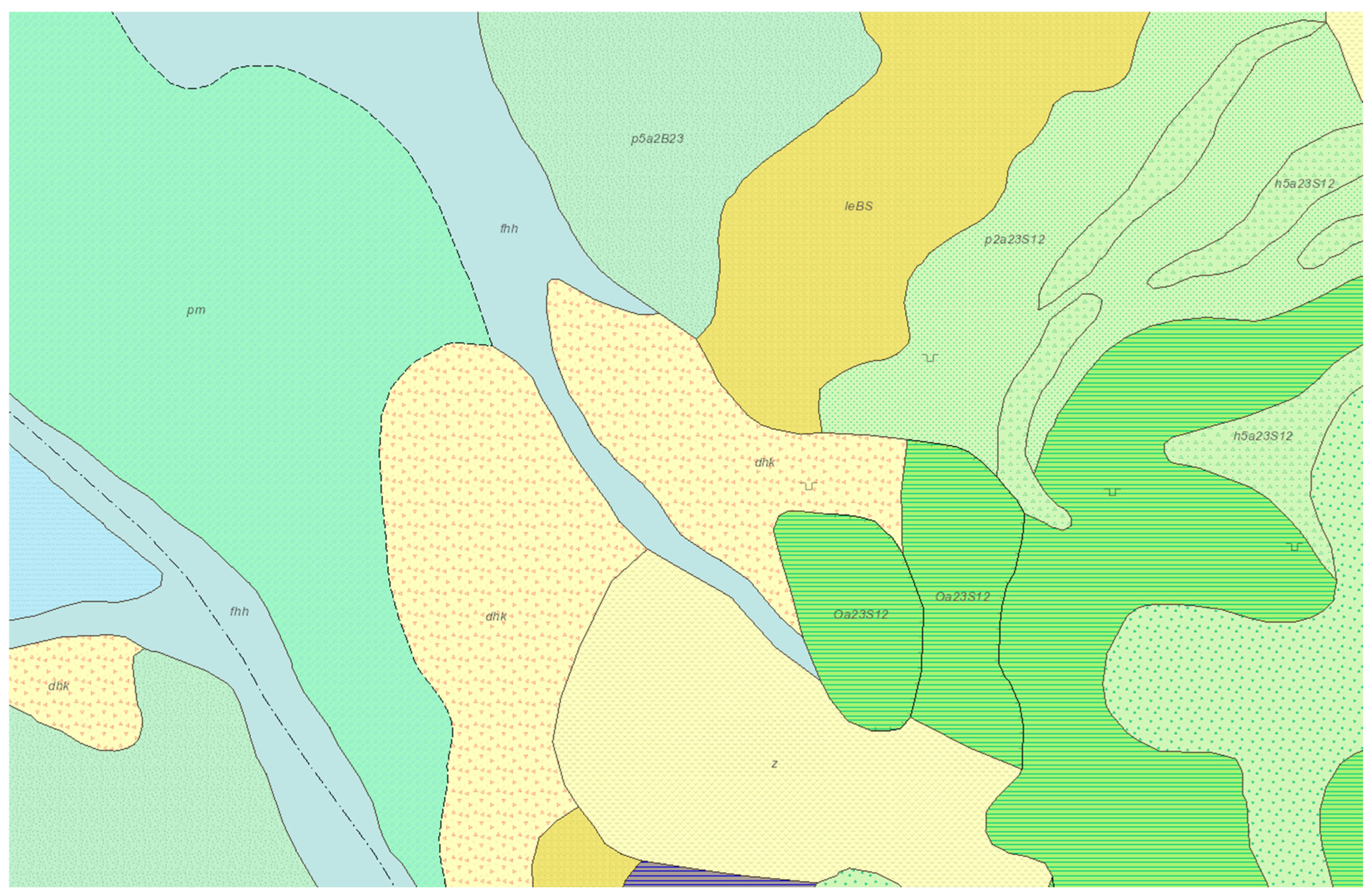
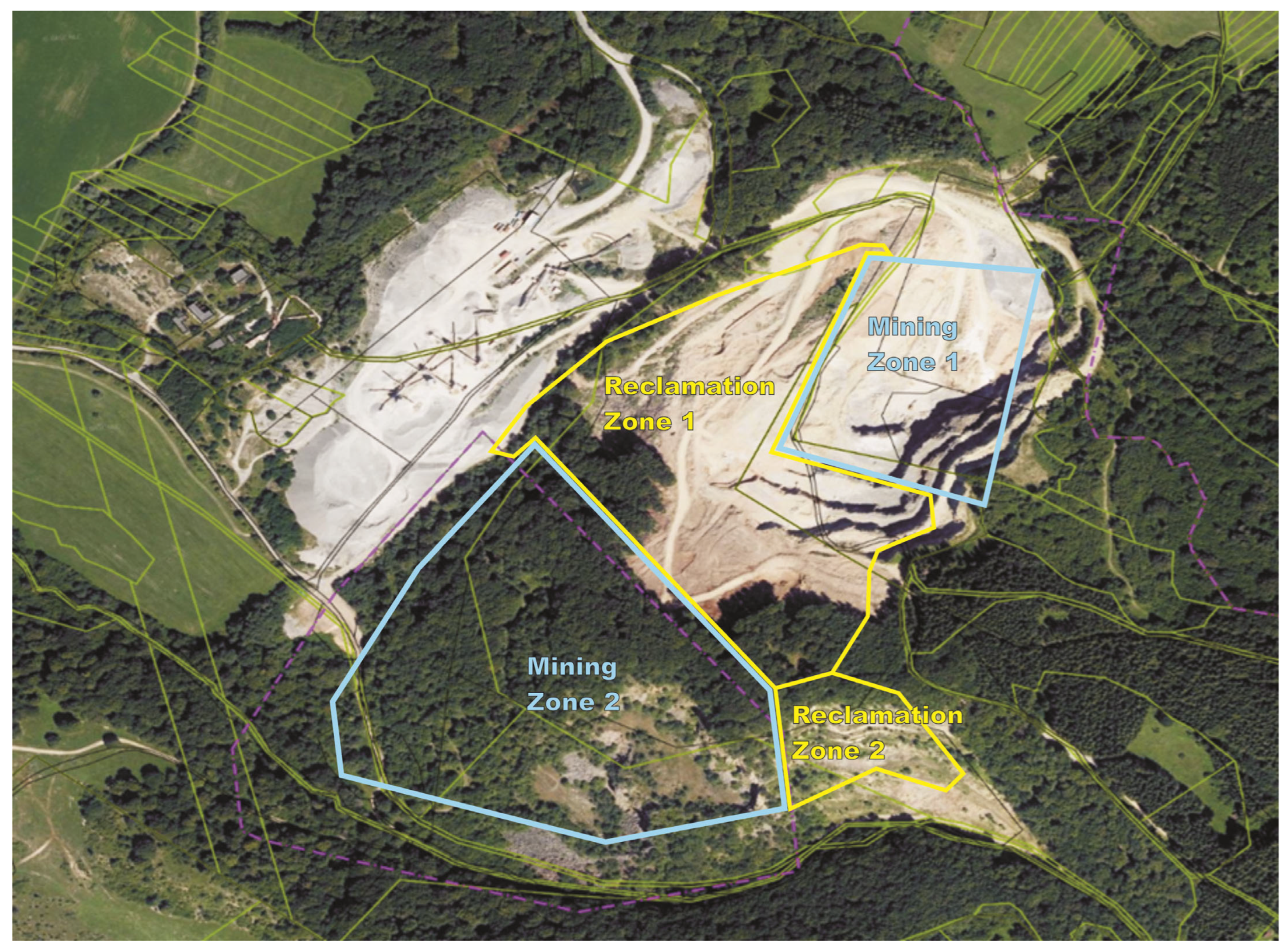
Figure 1 and
Figure 2 in the main text present a simplified geological–morphological map and an orthoimage of the quarry area, which are necessary for interpreting the spatial arrangement of monitoring locations.
This concise technical overview ensures that the geological context directly supports the analytical framework of the study as a site-specific, field-based application, without introducing excessive descriptive detail unrelated to the computation of the BSI.
2.2. Methodological Framework for Risk Evaluation
The methodological framework applied in this study integrates empirical field measurements, regulatory compliance analysis, and a structured multicriteria decision-making approach to evaluate the safety and environmental performance of blasting operations in an open-pit quarry. The framework is applied as a field-based, operational assessment methodology intended to support cumulative risk evaluation under real quarry conditions. The framework consists of four sequential analytical steps:
- (1)
Identification of critical physical and environmental risk factors;
- (2)
Field data acquisition;
- (3)
Normalization and weighting of indicators;
- (4)
Computation of the composite Blasting Safety Index (BSI).
This structure ensures methodological transparency and consistency with international blasting safety standards while providing a quantitative basis for evaluating cumulative operational risk within an applied, site-specific context.
2.2.1. Identification of Risk Factors
Based on regulatory thresholds, operational experience, and relevant literature, four key indicators were selected for inclusion in the BSI for the purposes of a field-based, operational risk assessment:
Ground vibration expressed as PPV—mechanical impact on structures and slope stability;
Noise level (LAeq)—acoustic disturbance and worker exposure;
Airborne dust (PM10)—short-term environmental and occupational impact; and
Slope stability (SF)—geotechnical safety of quarry benches.
These indicators represent the most sensitive and consistently measurable parameters in routine blasting operations and are aligned with EU safety regulations (Directive 2008/50/EC [
21]; EN 1997-1) [
22]. Only indicators for which complete, standardized field data were available—and which directly influence blasting-related safety—were included in the BSI. This ensured methodological consistency and prevented the incorporation of parameters not supported by empirical evidence within the scope of the present field application.
2.2.2. Data Acquisition and Analytical Equations
Field measurements were conducted using standardized monitoring equipment compliant with ISO 4866 (vibration monitoring) [
23], IEC 61672 (noise measurements) [
24], and EU air quality requirements for particulate monitoring (PM
10). PPV was recorded using a triaxial seismograph (Instantel Minimate Pro or equivalent industrial monitoring system, Instantel Inc., Ottawa, ON, Canada) positioned at distances of 50, 100, 200, and 300 m from the blast center. Noise and dust concentrations were measured using a Class 1 precision sound level meter (Norsonic NOR-118, Norsonic AS, Tranby, Norway) and a portable laser particle analyzer (DustTrak DRX 8533 or equivalent device, TSI Inc., Shoreview, MN, USA), respectively. The measurement configuration reflects routine operational monitoring conditions rather than controlled experimental repetition.
PPV values were evaluated using the empirical attenuation relationship as an illustrative, site-specific engineering representation of vibration decay:
where
A represents the Peak Particle Velocity (PPV, mm·s
−1),
Q is the explosive charge per delay (kg), R the distance from the blast center (m), and k and n are site-specific empirical constants. The empirical constants (k = 215; n = 1.58) were obtained through a log–log linear regression of the available field measurements, producing a site-specific attenuation curve intended to support internal consistency checks rather than statistical generalization, and consistent with established vibration prediction models in hard volcanic rock, where lithological properties significantly influence vibration attenuation behaviour [
25].
The dispersion of dust emissions in the near-field zone was estimated using an adapted mass-balance formulation:
where
C is the dust concentration (mg·m
−3),
M the emitted particle mass (g),
f a dispersion factor,
v the wind velocity (m·s
−1), and
t the particle sedimentation time (s).
Slope stability was assessed using limit-equilibrium analysis, with the resulting factor of safety (SF) representing the geotechnical response of quarry benches to blasting-induced stresses under the analyzed operational blasting conditions.
2.2.3. Normalization of Indicators
To allow aggregation of parameters measured in heterogeneous units, each indicator was normalized to a dimensionless score within the interval 0–1 for the purpose of comparative evaluation within the Blasting Safety Index (BSI). For indicators where a higher measured value corresponds to a higher level of risk (e.g., PPV, noise, dust concentration), the following normalization was applied:
where
is the measured value and
is the regulatory limit or reference threshold.
For indicators where a higher measured value corresponds to lower risk (e.g., slope stability factor, SF), the inverse formulation was used:
This dual-normalization approach ensures a consistent direction of risk across all indicators—meaning that higher normalized scores always represent a higher relative risk—while preventing values from exceeding 1. The normalization is applied as an operational scaling procedure rather than a statistical transformation, following established practices in composite-index construction used in environmental and safety assessments, and aligns with internationally recognized methodological frameworks for composite indicator design, which emphasize the importance of indicator normalization, comparability, and interpretability across heterogeneous datasets [
26], where indicators operating close to their regulatory thresholds yield scores approaching 1, signalling elevated relative risk even when formal compliance is achieved.
The key physical, environmental, and geotechnical indicators used in this study, together with their regulatory limits and risk direction, are summarized in
Table 1.
2.2.4. Weighting of Indicators Using the Analytical Hierarchy Process (AHP)
To ensure an objective and transparent weighting of the indicators included in the BSI, the Analytical Hierarchy Process (AHP) was employed as a structured decision-support method within a field-based application of the proposed framework. AHP is a widely validated multicriteria decision-making method used in engineering and environmental assessments due to its reproducibility and its ability to structure expert judgement systematically. The selection of AHP is consistent with its extensive application in engineering safety, environmental risk assessment, and mining decision-support frameworks, where it has proven effective for handling expert judgement in complex multi-parameter systems [
29,
30].
Pairwise comparisons were constructed for the four indicators based on their relative importance for blasting safety under the analyzed operational conditions. PPV was assigned the highest significance because of its direct mechanical impact on structures and slope stability. Noise and slope stability were evaluated as moderately influential parameters, while dust concentration (PM10) was considered to have the lowest short-term criticality.
A simplified pairwise comparison matrix was developed in accordance with Saaty’s 1–9 scale. The internal logic of expert judgements was verified using the Consistency Ratio (CR), which remained below the recommended threshold of 0.10, confirming the mathematical coherence of the comparison process and the robustness of the resulting weight vector.
The normalized AHP-derived weights were:
PPV—0.30;
Noise—0.25;
Slope stability—0.25;
Dust (PM10)—0.20.
These weights reflect the relative contribution of each indicator to overall blasting-related risk within the scope of the present case study and are consistent with expert-based assessments reported in comparable blasting and environmental safety studies. Their use in the BSI calculation provides a reproducible and analytically defensible weighting scheme, strengthening the methodological credibility of the index.
2.2.5. Analytical Equations
The composite Blasting Safety Index (BSI) was calculated as a weighted sum of the normalized indicator scores:
where
denotes the AHP-derived weight of indicator
, and
represents its corresponding normalized score. In this study,
indicators were evaluated: PPV, noise level, dust concentration (PM
10), and slope stability (SF). The BSI value ranges from 0 to 1, with higher values indicating a higher cumulative level of blasting-related risk.
To ensure meaningful operational interpretation, the final BSI values were grouped into three risk classes:
These thresholds are not arbitrary; they follow the widely adopted logic used in composite environmental and safety indices, where normalized scores within the 0–1 interval are divided into tolerable, cautionary, and critical zones. Values below 0.30 correspond to conditions in which all monitored parameters remain well below their regulatory limits. The interval 0.31–0.60 represents a transitional “warning zone,” indicating that at least one indicator approaches its allowable threshold. Values above 0.60 denote an operationally sensitive regime consistent with the precautionary principle in safety engineering, meaning that cumulative loading becomes elevated even when individual parameters may still formally comply with regulatory standards. This classification enhances interpretability, supports preventive decision-making, and facilitates communication with regulators and operators.
The applied mathematical structure is consistent with established linear additive models commonly used in composite risk and environmental quality indices, ensuring transparency, reproducibility, and a clear decomposition of the contribution of individual indicators. This approach is aligned with established practice in composite indicator construction, where normalization, weighting, and additive aggregation are applied to derive interpretable scores and thresholds [
26,
29,
30]. In line with established risk assessment practice, composite score classifications into low/moderate/high bands have been adopted widely in environmental and occupational safety indices to enhance interpretability, decision support, and communication with stakeholders [
31]. To further support interpretability, the conceptual rationale behind the adopted risk thresholds is presented in
Table 2.
This classification concept follows the categorization logic commonly used in composite environmental quality and occupational risk indices, where structured banding enhances interpretability and supports management decision-making.
Although the thresholds were defined according to recognized classification logic, preliminary stability considerations indicated that reasonable variations in threshold positioning do not substantially alter the relative risk interpretation. This suggests that the index behaves in a stable and predictable manner under realistic analytical conditions, without materially affecting the overall risk interpretation.
Future research with larger datasets and multi-site applications may allow the statistical refinement of threshold positions; however, the present classification already provides a clear and operationally meaningful framework for practical risk interpretation.
2.2.6. Conceptual Extension for Future Digital Integration
This section is provided for conceptual completeness and does not form part of the empirical validation of the BSI presented in this study. Although the present study focuses on field-based measurements, the structure of the BSI is fully compatible with modern digital tools increasingly applied in mining engineering. Potential future developments include:
GIS-based spatial modelling, enabling interpolation of PPV, noise, and dust across the quarry geometry and supporting high-resolution spatial risk mapping;
Terrestrial laser scanning (TLS) or 3D photogrammetry, providing precise geometric data for assessing bench geometry, slope discontinuities, and their influence on blast-induced vibration propagation;
Machine learning models (e.g., SVR, ANN, and RVR) for predictive estimation of PPV, dust concentration, or other blast-related parameters, enhancing anticipatory control over blasting impacts;
Digital blast-design optimization, integrating delay timing, burden–spacing configurations, and real-time monitoring systems into predictive control frameworks.
These conceptual extensions do not modify the empirical results of the present study but outline a pathway for transforming the BSI into a fully digital, adaptive decision-support tool aligned with future trends in sustainable and data-driven mining management. This integration positions the BSI within the emerging paradigm of Smart Mining, enabling automated feedback loops between monitoring systems and blast-design software.
Furthermore, the modular structure of the BSI allows direct embedding into modern digital mine-planning platforms, enabling real-time evaluation of blasting scenarios and contributing to the development of intelligent, automated blasting systems within the broader framework of smart mining technologies.
It should be noted that GIS mapping, TLS measurements and 3D photogrammetry were not implemented in the present case study; their mention refers solely to the conceptual compatibility of the BSI framework with such tools in future applications.
2.3. Data Acquisition and Processing
Data for the assessment of blasting safety were obtained from standardized field measurements carried out during routine quarry operations and were intended to support a site-specific, operational evaluation rather than controlled experimental validation. Four monitoring points were positioned at distances of 50, 100, 200, and 300 m from the blast center to capture the spatial attenuation of PPV, noise, and airborne dust under representative operational conditions.
PPV was measured using the triaxial seismograph described above, compliant with ISO 4866 [
23]. Each monitoring station recorded PPV during the detonation of a representative charge of 40 kg per delay, which corresponds to the standard operational setup of the quarry. Maintaining a constant charge weight ensured that observed PPV variations were attributable primarily to distance-related attenuation, thereby increasing the reliability of subsequent analytical modelling within the defined operational configuration.
Noise levels were recorded as A-weighted equivalent continuous sound pressure levels (LAeq) using the Class 1 precision sound level meter described above, compliant with IEC 61672-1 [
24]. Loggers were positioned at reference locations corresponding to nearby working zones to capture the principal acoustic peak associated with the blast event. Air overpressure was monitored simultaneously to verify compliance with operational safety requirements.
Airborne dust concentrations (PM10) were measured using the portable optical particle analyzer described above, operating at a 1-min sampling interval. Measurements were corrected for meteorological parameters—including wind speed, temperature, and humidity—to ensure comparability across the sampling period.
Slope stability was evaluated using limit-equilibrium analysis based on pre- and post-blast geotechnical inspections of quarry benches. The resulting factor of safety (SF) reflected local lithological conditions, rock-mass structure, and bench geometry under blasting-induced loads, enabling its incorporation into the BSI as a mechanical risk parameter within the assessed field conditions.
All collected data were processed using the normalization procedures and AHP-based weighting system described in
Section 2.2. Each indicator was converted into a dimensionless score, aggregated through the derived weights, and synthesized into the Blasting Safety Index (BSI). This procedure ensured consistent interpretation of heterogeneous datasets and enabled a quantitative evaluation of cumulative blasting risk within the scope of real quarry operations.
2.4. Visualization and Analytical Tools
Visualization tools were employed to support the analytical interpretation of field measurements and to ensure transparency of the methodological workflow. These tools were applied as interpretative and illustrative aids rather than as independent analytical or validation instruments. Their primary purpose was not to provide exhaustive geological documentation but to clarify the spatial configuration of monitoring points and to illustrate the logical sequence of analytical procedures relevant to the computation of the Blasting Safety Index (BSI).
A simplified three-dimensional structural model of the quarry was developed to represent bench orientation, slope geometry, and the spatial distribution of monitoring locations. This model facilitated the interpretation of vibration attenuation trends by linking PPV values to spatial factors such as distance, elevation differences, and local discontinuity patterns. It also enabled the integration of noise and dust measurements into a unified spatial reference frame, thereby improving the interpretability of the multi-parameter dataset within the analyzed operational context.
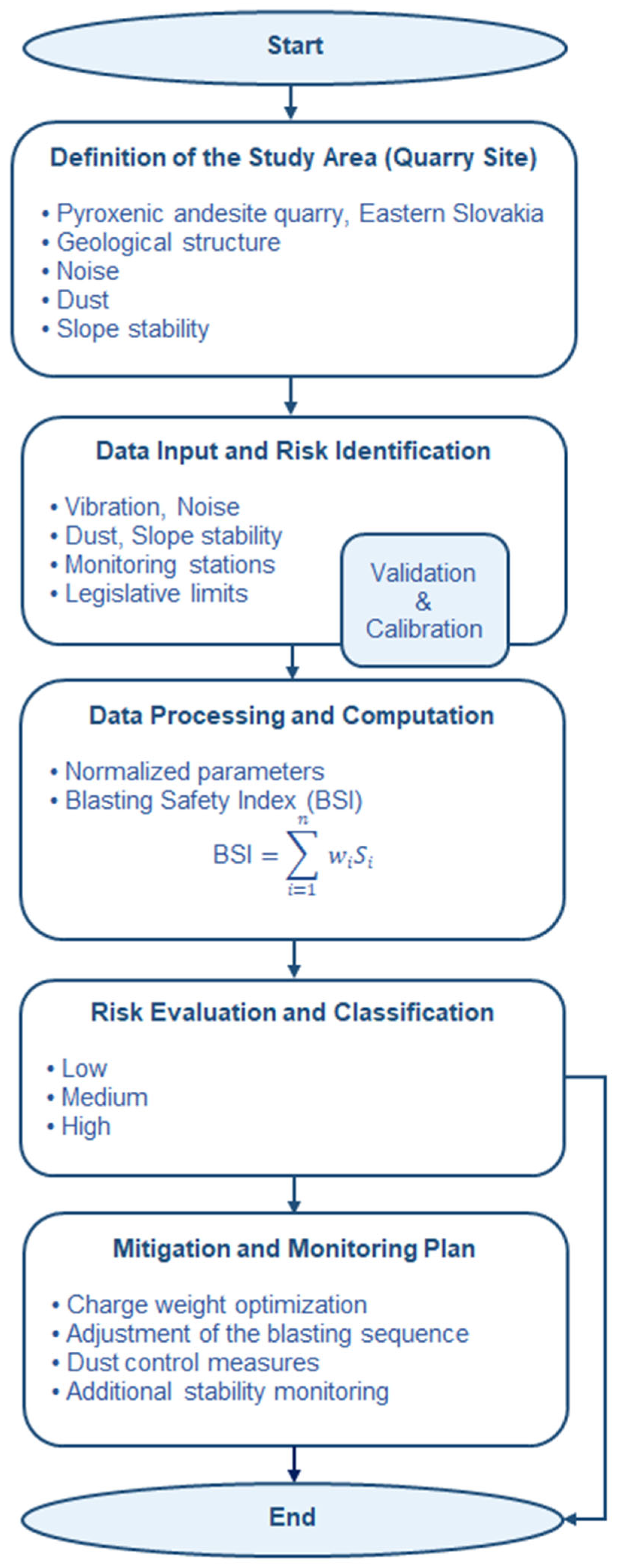
To illustrate the analytical workflow, a conceptual flow diagram was prepared summarizing the sequence from data acquisition to normalization, weighting, and final BSI computation. This visualization enhances procedural clarity and strengthens the reproducibility of the methodological steps (
Figure 3).
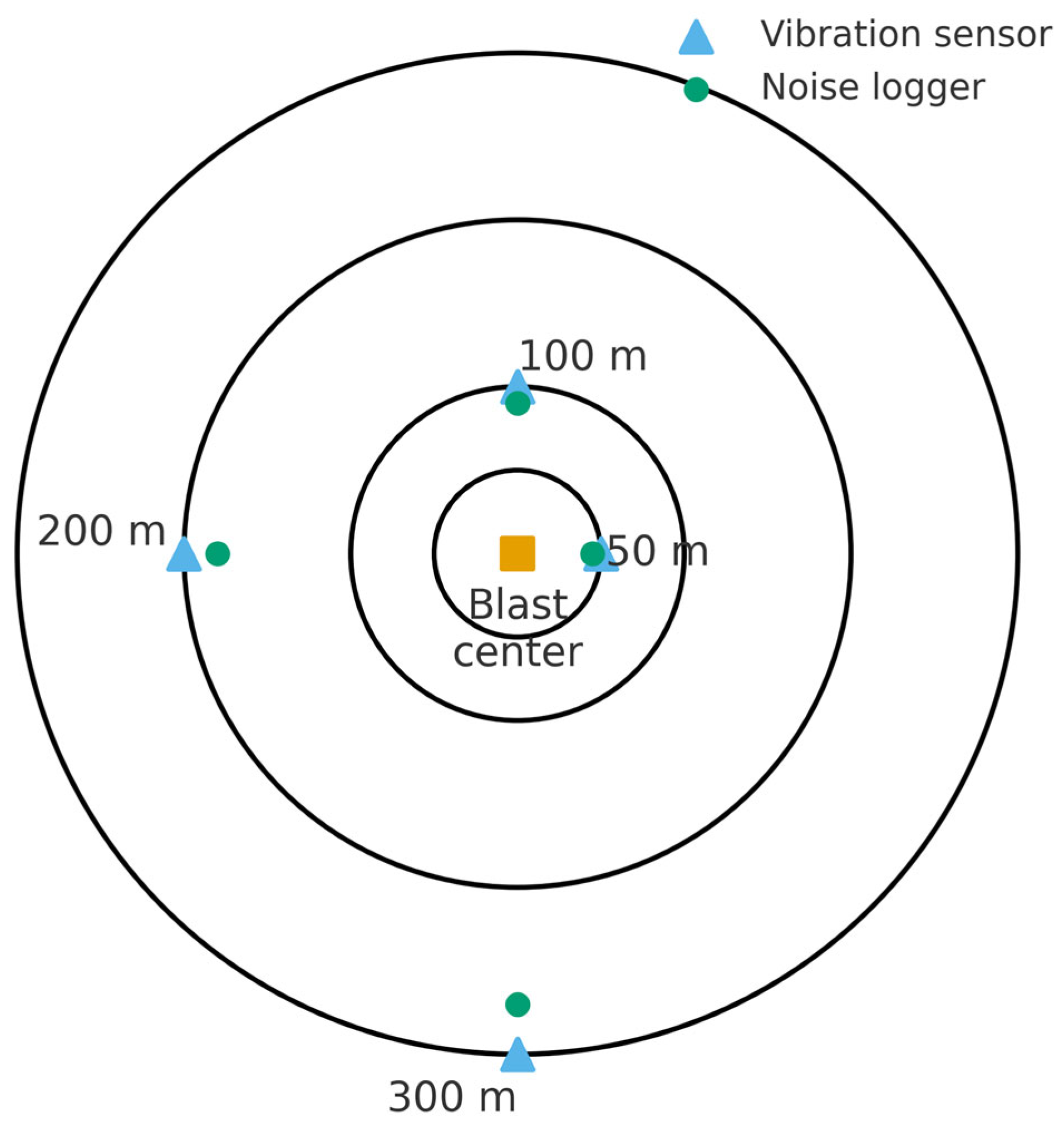
The spatial layout of the monitoring network was visualized to verify measurement distances, geometric consistency, and potential amplification effects caused by geological or morphological features. Four concentric monitoring zones were established at radii of 50, 100, 200, and 300 m from the blast center, each equipped with vibration sensors and noise loggers (
Figure 4). These visual elements provide structural support to the analytical components of the study while maintaining a concise presentation in the main text. Additional supporting figures are provided in the
Supplementary Material to preserve methodological transparency without extending the scope of empirical validation.
2.5. Added Value and Safety Integration of the Methodology
The proposed methodological framework provides a scientifically robust and operationally applicable approach for evaluating the safety performance of blasting operations in quarry environments within the scope of field-based application. Its principal added value lies in the integration of heterogeneous physical, environmental, and geotechnical parameters into a unified analytical structure represented by the Blasting Safety Index (BSI). By combining PPV, noise, dust concentration, and slope stability within a normalized and AHP-weighted system, the BSI delivers a transparent and quantitatively consistent assessment of cumulative blasting risk under real operational conditions.
A key strength of the methodology is its reliance on parameters routinely monitored in surface mining operations, ensuring immediate applicability without the need for additional instrumentation or complex modelling procedures. The incorporation of AHP-based weighting enhances methodological rigor by providing an objective justification for the relative importance of individual indicators—an aspect often insufficiently addressed in comparable composite indices used in mining and environmental assessments when applied in practice.
Beyond diagnostic capability, the framework strengthens preventive safety management by linking measured field data to clearly defined risk categories. This structure supports operational decision-making, including the optimization of charge weight, adjustment of delay timing, and refinement of bench configurations to mitigate excessive vibration levels or adverse environmental impacts within the analyzed quarry context. As such, the methodology contributes to safer, more efficient, and environmentally responsible blasting practice.
Although the present analysis is based on empirical field data, the modular structure of the BSI enables seamless integration with emerging digital mining technologies. Future developments may include GIS-based spatial modelling, high-resolution geometric data obtained from terrestrial laser scanning, or predictive algorithms estimating PPV and dust dispersion. These developments are conceptual in nature and are not required for the applicability of the present framework. These extensions provide a pathway for evolving the BSI into an adaptive decision-support tool aligned with broader advancements in sustainable and data-driven mining engineering.
Overall, the proposed framework combines practical usability, analytical transparency, and forward compatibility with digital technologies, making it a valuable instrument for both operational control and long-term safety planning in quarry blasting operations at the site-specific level.
3. Case Study: Application of the Methodology in a Pyroxenic Andesite Quarry
3.1. Objective and Context of the Case Study
The developed methodology was applied in an operating pyroxenic andesite quarry as a demonstrative case study to validate its analytical capacity and practical applicability under real operational conditions. The primary objective of the case study was to determine how variations in blasting parameters—such as explosive charge and delay interval—affect PPV, noise levels, and overall environmental safety within the scope of routine quarry blasting practice. The site was selected for its representative geological composition and consistent blasting activity, providing stable and operationally verifiable conditions for testing the Blasting Safety Index (BSI).
The quarry forms part of a Central European volcanic complex characterized by well-defined bench geometry, stable hydrogeological conditions, and systematic monitoring. These conditions made it an appropriate setting for the applied verification of safety- oriented analytical procedures, rather than for controlled experimental comparison.
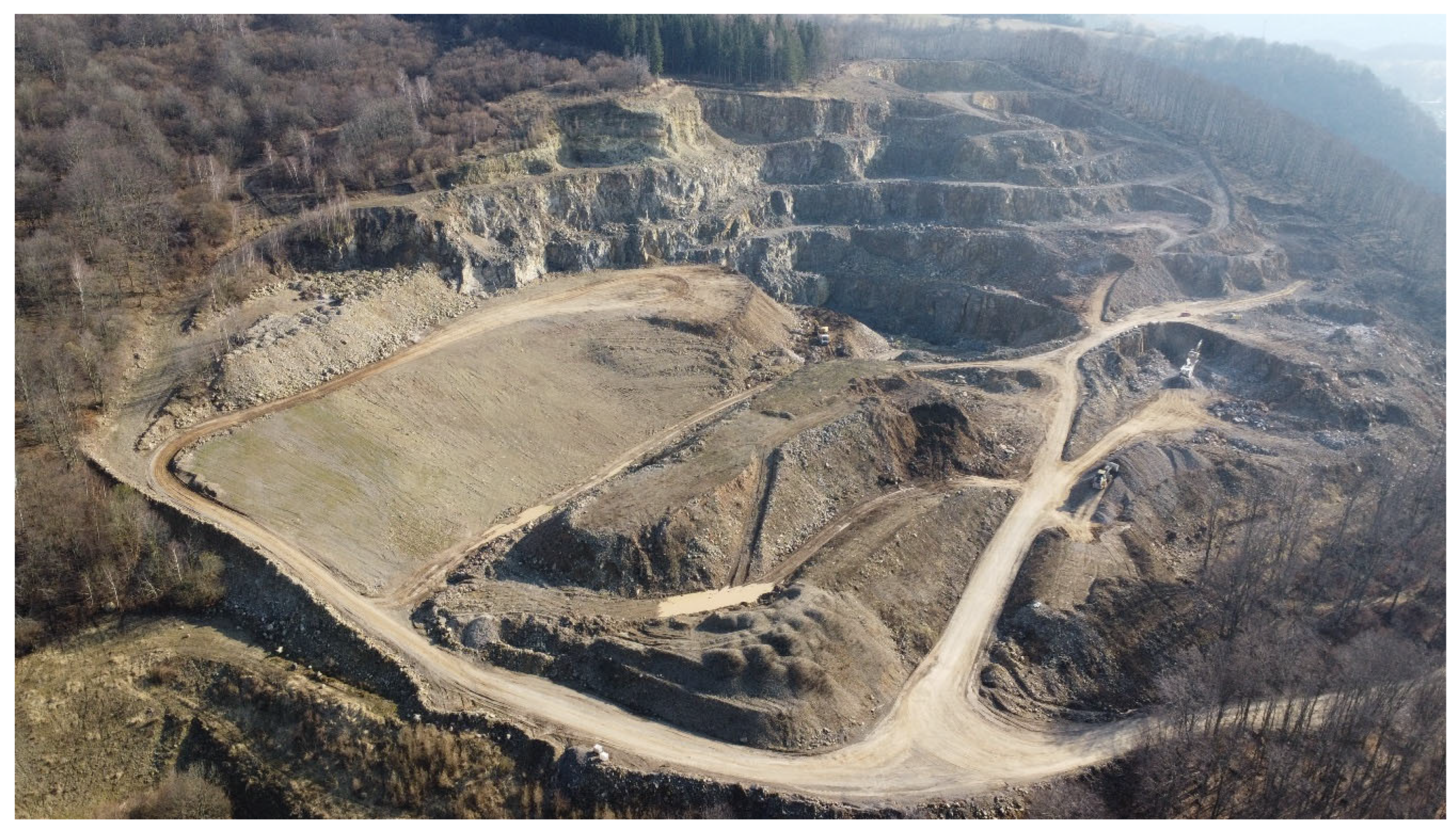
To provide a clear spatial context of the operational environment and to illustrate the overall morphology and bench system of the quarry, an aerial overview of the extraction area is presented in
Figure 5.
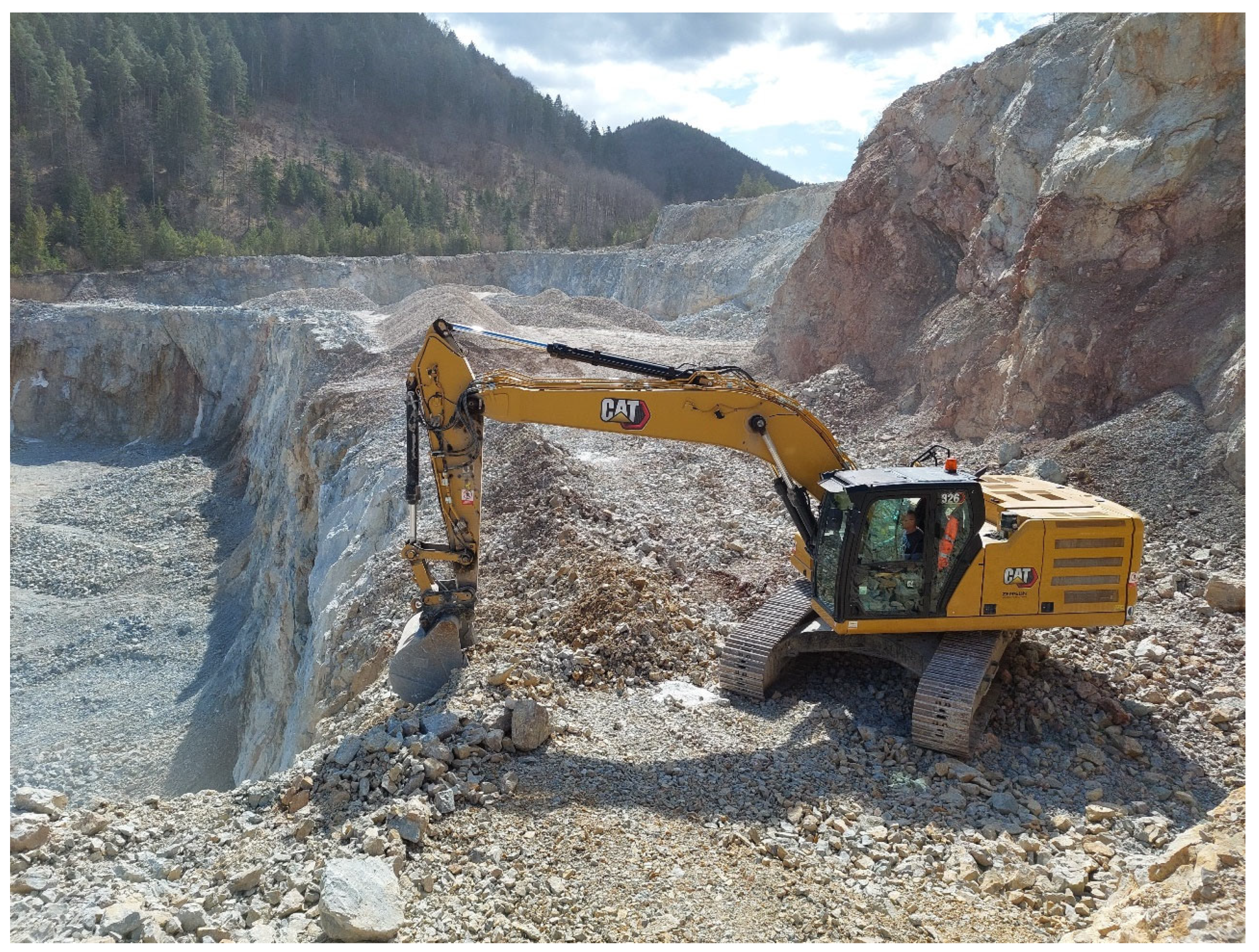
To provide a clear visual context of the monitored working area,
Figure 6 presents the operating section of the pyroxenic andesite quarry in the zone of blast preparation and execution.
3.2. Measurement Conditions and Recorded Parameters
Field measurements were conducted under standard quarrying conditions during routine blasting operations. Explosive charges used at the site typically range from 25 to 75 kg per delay. For the analyzed reference blast, a charge weight of 40 kg per delay was applied, representing the most common and operationally stable configuration employed at the quarry. This charge weight was therefore consistently adopted for all subsequent analyses and for the computation of the Blasting Safety Index (BSI).
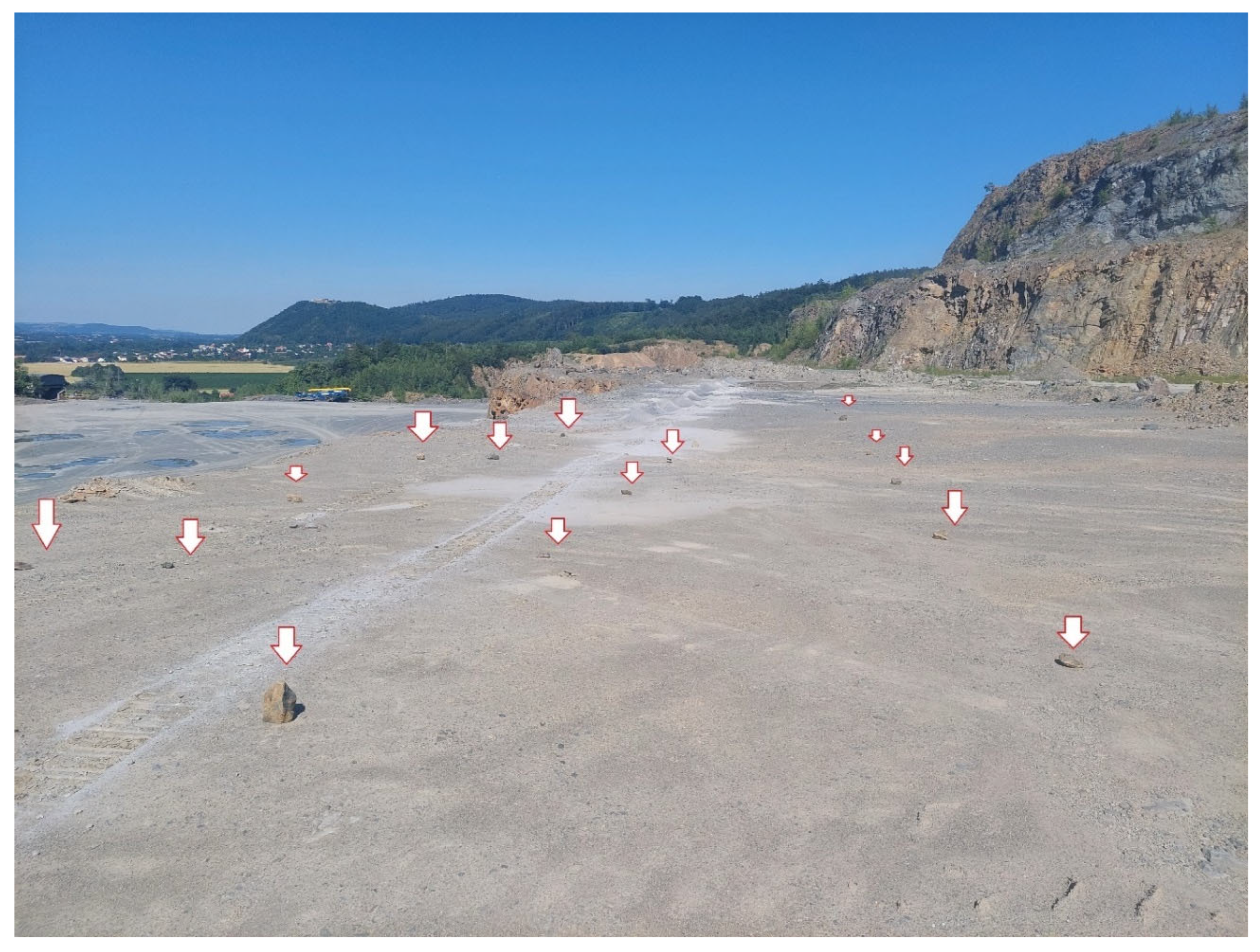
Monitoring stations were positioned at distances of 50, 100, 200, and 300 m from the blast center to capture the spatial attenuation of blast-induced effects. This configuration reflects standard operational monitoring practice and enables a site-specific evaluation of vibration, acoustic, and environmental responses under real quarry conditions. The surface layout of drilled blast holes prior to detonation is documented in
Figure 7.
Vibration amplitudes were recorded as Peak Particle Velocity (PPV) using calibrated triaxial seismographs. Measured PPV values ranged from 5.8 mm·s
−1 at 50 m to 1.2 mm·s
−1 at 300 m, reflecting a decrease in vibration intensity with increasing distance from the blast source. The observed attenuation behaviour was represented using an empirical, site-specific engineering relationship of the standard scaled-distance form:
where A denotes vibration amplitude expressed as PPV (mm·s
−1), Q is the explosive charge per delay (kg), and R is the distance from the blast center (m). This relationship is used in the present study as an illustrative representation of vibration decay under the given geological and operational conditions, supporting internal consistency of the measured data rather than statistical generalization.
Noise levels were recorded as A-weighted equivalent continuous sound pressure levels (LAeq). Measured values reached 83 dB(A) at a distance of 100 m and remained within the limits specified by Slovak Government Regulation No. 115/2006 [
28]. Airborne dust concentrations (PM
10) varied between 0.041 and 0.046 mg·m
−3 and remained within the applicable air quality thresholds.
Slope stability was evaluated through post-blast geotechnical inspections and limit-equilibrium analysis. The resulting factor of safety (SF) was 1.6, and bench conditions remained stable under the analyzed blasting scenario, with no observable instability features identified during post-blast inspections.
Overall, the monitored parameters remained within or close to established regulatory limits, indicating formally compliant yet operationally sensitive conditions. This combination of measured vibration, noise, dust, and slope stability parameters provides an appropriate empirical basis for illustrating the application and functionality of the Blasting Safety Index (BSI) under real quarry operating conditions.
3.3. Calculation of the Blasting Safety Index (BSI)
The normalized parameters for PPV, noise, dust concentration, and slope stability were processed using the AHP-derived weighting system described in
Section 2.2. Based on this aggregation, the resulting composite value of the Blasting Safety Index was calculated as BSI = 0.91, corresponding to a high-risk category according to the adopted classification scheme.
Although all measured parameters formally complied with their respective regulatory thresholds, several indicators operated close to their allowable limits. As a result, the cumulative risk level increased, illustrating that regulatory compliance alone may not fully capture the combined safety implications of blasting activities under real operational conditions.
Within the applied weighting structure, PPV contributed the largest share to the overall BSI value (30%), followed by noise (25%), slope stability (25%), and dust emissions (20%). This distribution reflects the relative importance assigned to mechanical and geotechnical effects within the applied assessment framework, while still accounting for short-term environmental impacts. Accordingly, the normalized input parameters and the resulting BSI value are summarized in
Table 3.
The obtained BSI value indicates that the combined effect of physical, environmental, and geotechnical parameters places the analyzed blasting operation within a safety-sensitive regime, despite the absence of individual limit exceedances. This outcome illustrates the integrative capability of the BSI framework, as it allows cumulative risk tendencies to be identified that may remain less apparent when individual indicators are evaluated in isolation.
From an operational perspective, the results suggest that increased attention may be directed toward vibration control and geotechnical monitoring when similar blasting configurations are applied. Within the scope of this demonstrative case study, the BSI may be interpreted as an indicative integrative metric for identifying operating conditions that could warrant increased precaution, even under formally compliant operating regimes.
3.4. Safety Evaluation and Preventive Implications
The application of the Blasting Safety Index (BSI) in the present case study illustrates its use as an integrative diagnostic framework for evaluating cumulative safety and environmental conditions associated with routine quarry blasting operations. By synthesizing vibration levels, acoustic exposure, airborne dust concentration, and slope stability within a unified analytical structure, the methodology enables identification of operational conditions that may not be fully captured when individual parameters are assessed solely against regulatory compliance criteria.
Although all monitored indicators remained within their respective regulatory thresholds, the calculated value of BSI = 0.91 placed the analyzed blasting operation within the high-risk category according to the adopted classification scheme. This result indicates that several parameters—most notably vibration amplitude, noise level, and dust concentration—operated in close proximity to their allowable limits. Their combined effect produced a cumulative risk state that may remain less apparent under conventional limit-based evaluation approaches. In this context, the BSI demonstrates sensitivity to near-threshold operating conditions that occur simultaneously across multiple safety-relevant dimensions.
From a preventive perspective, the high-risk classification suggests that increased attention may be directed toward optimization measures in zones proximal to the blast center, particularly within distances of approximately 100 m. Within the scope of this demonstrative case study, such measures may include adjustments to charge weight per delay, refinement of drilling geometry and spacing, and continued geotechnical monitoring aimed at maintaining slope stability. By linking operational blasting parameters with their corresponding mechanical and environmental responses, the framework also supports trend-oriented interpretation over repeated blasting events rather than reliance on isolated measurements.
Overall, the findings indicate that the proposed methodology may contribute to strengthening preventive safety management by providing a structured basis for interpreting cumulative risk conditions and supporting targeted mitigation strategies. Its combined consideration of occupational safety and environmental performance is consistent with the principles of sustainable mining and relevant EU safety directives. When applied within routine monitoring practice, the BSI may function as a decision-support indicator that complements existing regulatory criteria while encouraging incremental improvement in blasting-related environmental and geotechnical performance.
Beyond its diagnostic role within the analyzed quarry, the BSI represents a transferable and digitally compatible assessment framework that may be implemented as a modular safety layer within modern mine-planning and blast-design environments. In this sense, the methodology provides a conceptual bridge between traditional blasting practice and emerging Smart Mining approaches while remaining firmly grounded in field-based operational assessment.
4. Results
The results obtained from the application of the proposed methodology at the analyzed quarry site provide quantitative observational data on the environmental and safety performance of the blasting operations. All measurements were conducted under comparable geological and operational conditions, with pyroxenic andesite representing the dominant lithological unit. The dataset includes vibration, noise, dust, and geotechnical parameters, which collectively served as input variables for calculating the Blasting Safety Index (BSI).
4.1. PPV Measurements
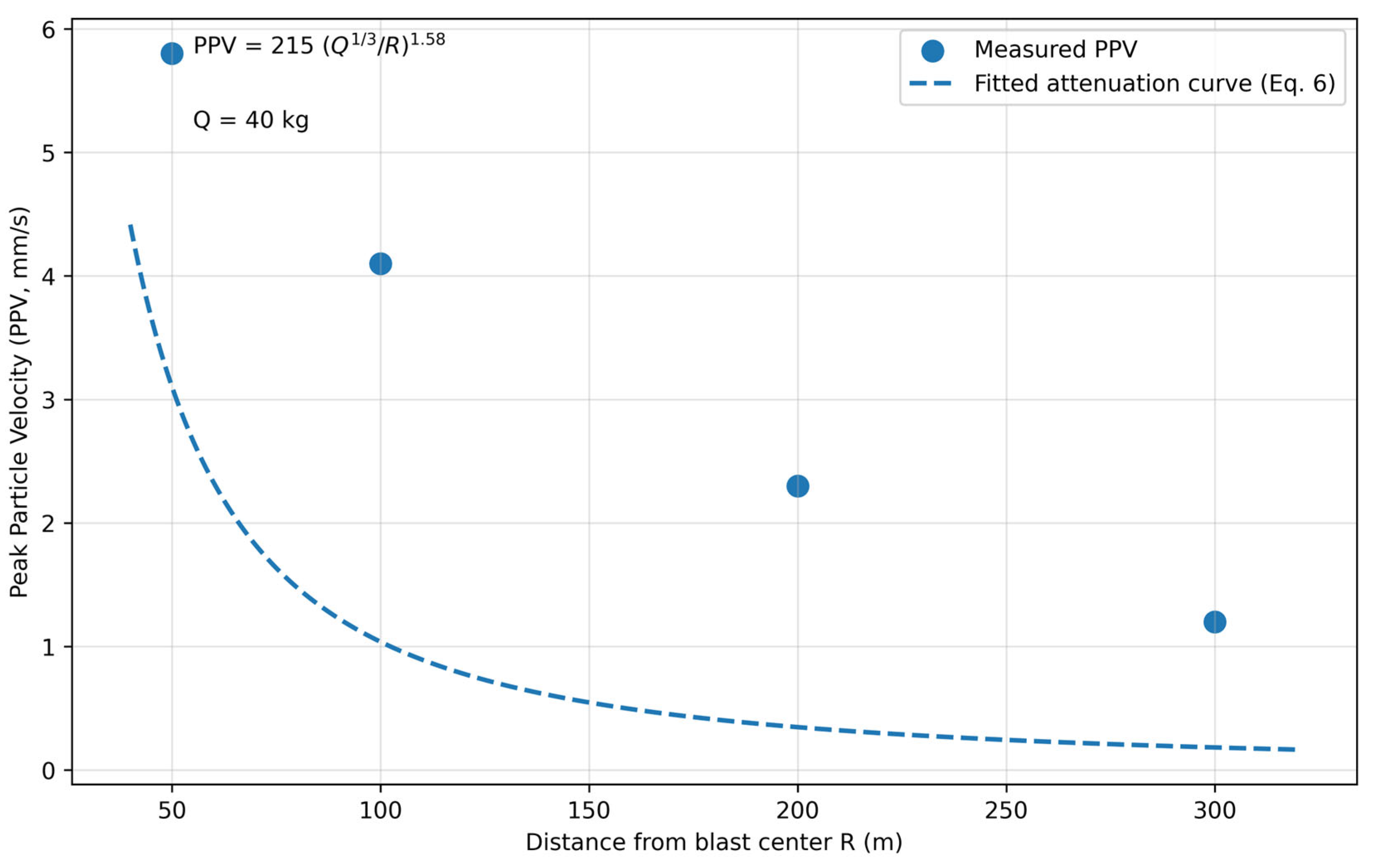
PPV was recorded at four monitoring points located at distances of 50, 100, 200, and 300 m from the blast center. The measured PPV values ranged from 5.8 mm·s−1 at 50 m to 1.2 mm·s−1 at 300 m, reflecting a clear decrease in vibration amplitude with increasing distance.
All measurements were carried out using a constant explosive charge of 40 kg per delay, ensuring that the observed variation in PPV was associated with distance-related attenuation rather than differences in explosive energy. The detailed measurement results are presented in
Table 4.
The recorded PPV values were subsequently compared with a site-specific attenuation relationship derived for the quarry (Equation (6)) to illustrate the expected attenuation trend in relation to the measured values under the given geological and operational conditions. The measured data and the corresponding attenuation curve are presented in
Figure 8.
The plotted relationship shows a monotonic decrease in PPV with distance, consistent with standard blasting engineering expectations. The attenuation curve is used solely as a descriptive representation of the general vibration-decay tendency and is not intended to imply statistical validation, predictive accuracy, or model generalization.
4.2. Noise Measurements
Noise levels were measured using a Class 1 precision sound level meter positioned 100 m from the blast center. The recorded values were expressed as A-weighted equivalent continuous sound pressure levels, LAeq (dB(A)), representing the human auditory response to noise. In addition, air overpressure was measured in linear decibels, Lp (dB(L)), corresponding to instantaneous pressure fluctuations generated by the blast-induced shock wave.
The maximum A-weighted equivalent noise level recorded during detonation was 83 dB(A). The measured air overpressure values remained below 120 dB(L). Both parameters were within the permissible exposure limits for surface blasting operations as defined by Slovak Government Regulation No. 115/2006 [
28].
4.3. Dust Concentrations (PM10)
Concentrations of particulate matter (PM10) were measured using a mobile laser particle analyzer positioned at a fixed monitoring point near the blast site. Measurements were conducted before, during, and after detonation in order to capture short-term variations in airborne dust levels associated with the blasting event.
The recorded PM10 concentrations ranged from 0.041 to 0.046 mg·m−3, with the highest values observed immediately after detonation. All measured concentrations remained below the occupational exposure threshold of 0.05 mg·m−3 specified in Slovak Decree No. 355/2006 Coll.
Following the blasting event, PM10 concentrations decreased toward pre-blast levels within the monitoring period, indicating a transient response of airborne dust to the detonation under the recorded operational and meteorological conditions.
4.4. Slope Stability
The stability of the quarry benches was evaluated through a combination of field geotechnical inspections and analytical assessment of the factor of safety (SF). Field surveys were conducted immediately before and after the blasting event to document any observable changes in slope conditions, including crack development, displacement, or localized rockfall.
The calculated factor of safety was SF = 1.6, exceeding the minimum stability criterion of 1.3 applied in the assessment. Post-blast inspections did not identify any visible deformation, new fractures, or instability features on the quarry bench under the analyzed blasting conditions.
The recorded geotechnical observations and the calculated safety factor indicate that bench geometry and slope conditions remained unchanged during the monitoring period associated with the blasting event.
4.5. Summary of Measured Environmental and Geotechnical Parameters
The results of field monitoring are summarized in
Table 5, providing an integrated overview of the physical, environmental, and geotechnical parameters recorded during the analyzed blast event.
The summarized dataset includes measured values of the ground vibration (PPV), noise level, airborne dust concentration (PM10), and slope stability factor (SF) obtained under consistent geological and operational conditions. These parameters constitute the quantitative input used for the calculation of the Blasting Safety Index (BSI).
4.6. Blasting Safety Index (BSI)
To provide an integrated representation of the cumulative mechanical, environmental, and geotechnical effects of blasting, the Blasting Safety Index (BSI) was calculated using the normalized indicator scores and the AHP-derived weighting structure described in
Section 2.2. For the analyzed blast event, the resulting value was BSI = 0.91, which corresponds to the high-risk category according to the adopted classification scheme.
The computed BSI value reflects the aggregated contribution of all evaluated indicators under the recorded operational conditions. Although each individual parameter complied with its respective regulatory limit, the combined effect of their normalized scores resulted in an elevated cumulative index value.
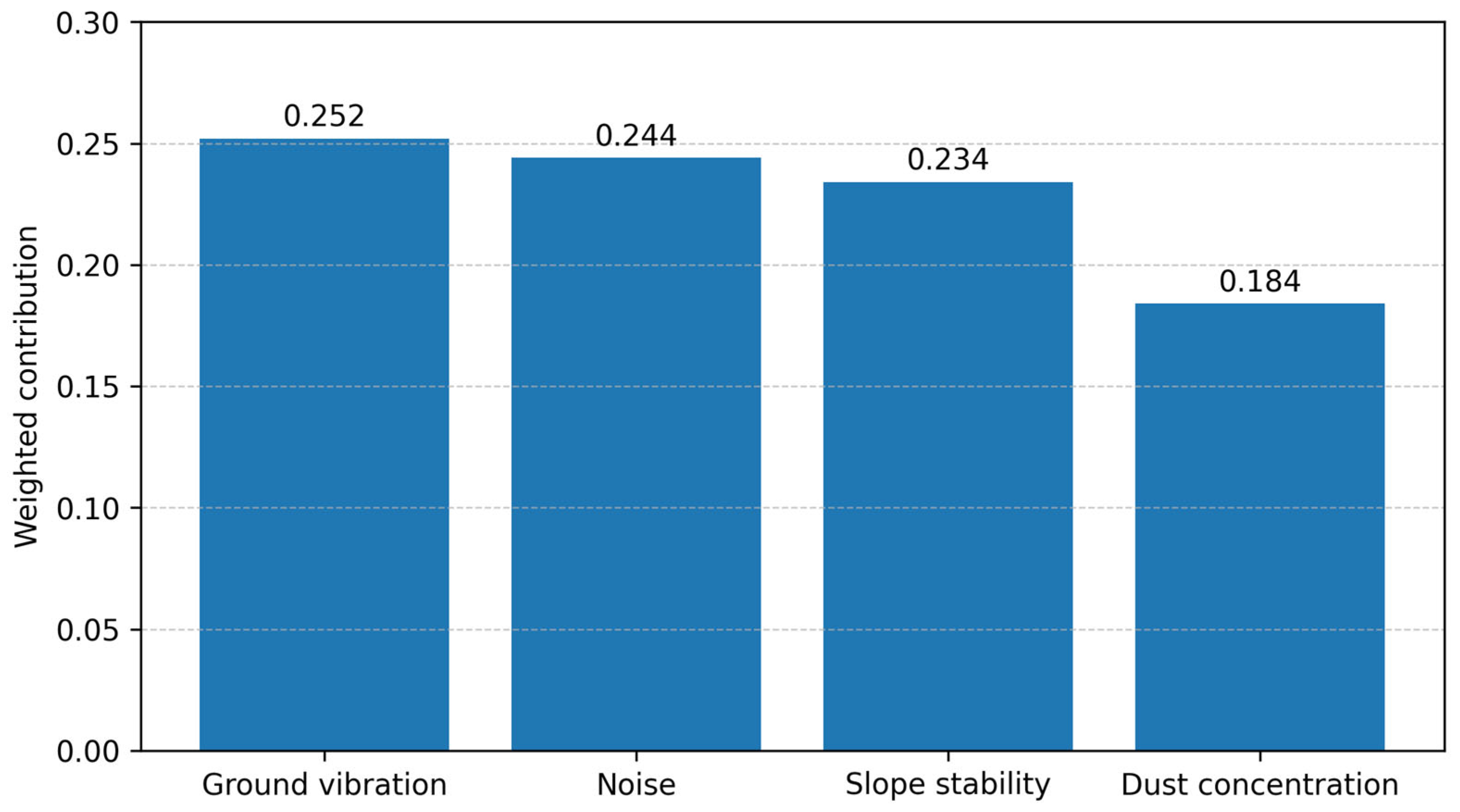
The relative contributions of individual parameters to the final BSI were as follows: PPV (30%), noise level (25%), slope stability (25%), and dust concentration (20%). The weighted contributions derived from the normalized scores were 0.252 for PPV, 0.244 for noise, 0.234 for slope stability, and 0.184 for dust concentration. These proportional contributions are illustrated in
Figure 9.
4.7. Summary of the Results Section
This section summarizes the key measurement outcomes obtained during the analyzed blasting event. Peak Particle Velocity (PPV) values decreased from 5.8 mm·s−1 at 50 m to 1.2 mm·s−1 at 300 m, reflecting attenuation of vibration amplitude with increasing distance from the blast center. Noise levels reached 83 dB(A) at a distance of 100 m, while air overpressure remained within the recorded operational range. Airborne dust concentrations (PM10) varied between 0.041 and 0.046 mg·m−3 during the monitoring period. The calculated slope stability factor was SF = 1.6, indicating stable bench conditions under the analyzed blasting scenario.
Based on the normalized indicators and the applied weighting structure, the calculated Blasting Safety Index for the analyzed blast event was BSI = 0.91, corresponding to the high-risk category according to the adopted classification scheme. The composite index reflects the combined contribution of vibration, noise, dust concentration, and slope stability parameters as presented in the preceding subsections.
5. Discussion
5.1. Operational Interpretation of the Blasting Safety Index (BSI)
The proposed Blasting Safety Index (BSI) offers a unified analytical framework for integrating mechanical, environmental, and geotechnical parameters into a single cumulative representation of blasting-related conditions under real quarry operations. In the analyzed case study, the calculated value (BSI = 0.91) placed the operation within the high-risk category according to the adopted classification scheme. This result illustrates that formal regulatory compliance of individual indicators does not necessarily preclude the presence of elevated cumulative operational risk.
Although all monitored parameters remained within their respective regulatory thresholds, the aggregated index reflects that several indicators operated close to their allowable limits. From an operational perspective, this finding suggests that near-threshold conditions may coexist across multiple parameters without triggering exceedances when indicators are evaluated independently. The BSI framework is therefore useful for highlighting such cumulative loading effects, particularly in routine blasting scenarios conducted under stable but constrained operational margins.
Within the calculated index structure, ground vibration expressed as PPV contributed the largest proportion (30%), followed by noise level and slope stability (each 25%), and airborne dust concentration (20%). This distribution reflects the weighting scheme applied in the present study and the relative proximity of individual indicators to their reference limits. The dominance of PPV within the composite index is consistent with its recognized role as a primary mechanical driver of blast-induced effects, while noise and slope stability provide complementary information on occupational exposure and geotechnical response.
The use of a constant explosive charge of 40 kg per delay across all monitoring points was adopted to ensure analytical consistency within the case study. This approach reduced the influence of charge variability and allowed the observed PPV variations to be interpreted primarily as a function of distance-related attenuation under the given geological and operational conditions. The resulting scaled-distance relationship was used in this study as an engineering-based representation of vibration decay rather than as a statistically generalized predictive model.
The observed prominence of PPV within the composite index aligns with findings reported in previous studies, which identify vibration propagation as a key factor influencing blasting-related safety and environmental response. Numerical and data-driven investigations—including finite-element modelling [
32], hybrid gene expression programming with probabilistic simulation [
33], and relevance vector regression approaches [
34]—have similarly emphasized the sensitivity of operational safety assessments to vibration-related parameters. In this context, the present case study supports the view that vibration control remains a central consideration in blasting management, while illustrating how the BSI framework can integrate vibration with additional near-threshold indicators into a coherent cumulative assessment.
5.2. Comparison with Existing Blasting Safety Assessment Methods
Traditional approaches to blasting safety assessment in quarrying and surface mining environments are predominantly based on the evaluation of individual parameters, most commonly blast-induced ground vibration expressed through Peak Particle Velocity (PPV). Classical prediction frameworks rely on empirical relationships such as the scaled-distance law and formulations derived from the United States Bureau of Mines (USBM) and Ambraseys–Hendron models. These approaches estimate PPV as a function of explosive charge per delay and distance from the blast source and are widely applied to support compliance with regulatory vibration limits; however, their predictive capability remains strongly site-dependent, as it is closely tied to local geological and operational conditions [
35]. Similar single-parameter, threshold-based methodologies are also employed for the assessment of noise and air overpressure effects.
In recent years, methodological development has increasingly shifted toward advanced statistical and machine-learning techniques for PPV prediction. Numerous studies have explored regression-based formulations, boosted regression trees, support vector methods, and hybrid ensemble approaches to enhance predictive accuracy relative to classical empirical equations [
35,
36,
37]. While these data-driven models offer enhanced capability for representing complex and nonlinear vibration behaviour, they remain primarily focused on a single indicator—PPV—and therefore address only one dimension of blasting-related safety.
As a result, many existing assessment strategies evaluate blasting performance on a parameter-by-parameter basis. Under such approaches, operational scenarios may arise in which all monitored variables individually satisfy their respective regulatory thresholds, while the combined system response approaches a critical operational state. The Blasting Safety Index (BSI) was developed to complement these existing methods by providing an integrated representation of cumulative blasting-related conditions.
By combining PPV, noise level, airborne dust concentration, and slope stability within a normalized and weighted composite framework, the BSI enables a multi-dimensional evaluation of blasting safety that extends beyond isolated parameter compliance. Rather than replacing established prediction models or regulatory criteria, the BSI is intended to function as an integrative layer that synthesizes heterogeneous monitoring data into a single operationally interpretable metric. This approach supports a more holistic understanding of blasting conditions in real quarry environments, where multiple near-threshold effects may occur simultaneously.
To further contextualize the contribution of the proposed Blasting Safety Index within the broader methodological landscape,
Table 6 presents a structured comparison between the BSI framework and commonly applied blasting safety assessment approaches, highlighting their respective analytical focus, primary strengths, limitations, and areas of complementarity.
5.3. Practical and Environmental Implications
From an operational perspective, the BSI framework offers an integrative structure that can support decision-making in quarry blasting by consolidating multiple mechanical and environmental indicators into a single, interpretable metric. This integrative perspective allows engineers to identify emerging safety pressures and supports consistent communication among operators, regulatory bodies, and environmental authorities. Within environmental impact assessments (EIA), the BSI may serve as a complementary diagnostic tool that not only reflects regulatory compliance but also highlights conditions approaching threshold values—scenarios in which isolated indicators may not fully capture cumulative risk.
The methodology emphasizes the role of continuous monitoring of vibration, noise, dust concentration, and slope stability, recognizing that these parameters collectively shape the overall safety envelope of blasting operations. Regular evaluation of these indicators can inform targeted adjustments to charge distribution, delay sequencing, and drilling geometry, which are commonly applied measures for reducing PPV amplitudes and mitigating environmental impacts. Empirical studies consistently indicate that distance from the blast face remains one of the most influential factors governing PPV, underscoring the relevance of maintaining systematic monitoring in sensitive or structurally complex areas [
38].
Recent advances in three-dimensional (3D) image analysis and digital fragmentation assessment further illustrate how modern monitoring technologies can complement the BSI framework by providing detailed geometric information on blasting outcomes. High-resolution post-blast imaging enables improved assessment of burden distribution, spacing efficiency, and explosive-energy utilization [
39], thereby linking safety-related indicators with blast geometry and performance characteristics. The incorporation of such digital datasets supports a transition toward more data-informed management of blasting operations, in which risk mitigation and operational efficiency are addressed in parallel.
In this context, the BSI can be interpreted not only as a retrospective assessment indicator but also as a conceptually forward-compatible component of modern mine-planning systems. By integrating routinely measured parameters within a normalized and weighted structure, the index provides a basis for future adaptive control approaches, where real-time sensor inputs and predictive models may be used to adjust blast design dynamically. This conceptual positioning is consistent with contemporary trends in sustainable and smart mining, which emphasize continuous monitoring, incremental optimization, and environmentally responsible operational practice.
5.4. Methodological Robustness, Transferability, and Generalization Potential of the BSI Framework
Although the methodology was demonstrated on a single pyroxenic andesite quarry, the structure of the BSI framework is conceptually designed to be location-independent and potentially applicable across surface-mining environments. The index does not depend on site-specific calibration parameters unique to the case study; instead, it integrates commonly monitored indicators—PPV, noise, dust concentration, and slope stability—processed through standardized normalization and AHP-based weighting procedures. Such composite-indicator structures and MCDA approaches have been reported as adaptable across heterogeneous environmental and engineering contexts [
13,
14], suggesting stability of the analytical workflow even under variable geological, morphological, or operational conditions.
The robustness of the methodology is rooted in its modular and parameter-driven formulation. Each component of the BSI can be adjusted to different rock-mass conditions, bench geometries, or blasting technologies without altering the core structure of the index. Because the BSI employs dimensionless normalized scores, all indicators remain comparable in relative terms regardless of local regulatory thresholds or measurement units. This characteristic facilitates scalability across quarries with diverse lithological or environmental characteristics.
The AHP-derived weighting system provides additional flexibility, as expert judgements may be revised for different regions, mining methods, or regulatory settings while preserving the underlying computational logic of the BSI. This approach is consistent with MCDA-based safety and sustainability assessments reported in the mining engineering literature [
13,
14] and aligns with current efforts toward transparent and reproducible risk-assessment frameworks.
Moreover, the BSI framework is conceptually compatible with emerging digital technologies. GIS-based spatial modelling can support the transformation of normalized indicator scores into spatially distributed risk representations, enabling enhanced situational awareness rather than real-time decision-making. TLS-derived geometric datasets and 3D photogrammetry may enhance the precision of geotechnical inputs, particularly for slope-stability evaluation [
40,
41]. In parallel, machine-learning methods—including FEM-supported vibration modelling [
32], gene expression programming combined with Monte Carlo simulation [
33], and relevance vector regression optimized using metaheuristic algorithms [
34]—represent potential extensions for future studies, allowing the BSI to be explored within predictive or adaptive assessment contexts. These digital synergies indicate the potential of the BSI as a future-oriented analytical framework rather than a fully implemented predictive system.
Collectively, these characteristics indicate that the BSI should be interpreted not as a site-specific diagnostic outcome but as a transferable and scalable methodological framework whose broader applicability requires further validation through multi-site and long-term datasets.
5.5. Limitations and Future Development
Although the proposed BSI methodology shows practical applicability within the scope of the present case study, several limitations must be acknowledged to ensure a transparent evaluation of its analytical boundaries and future development potential. The present study was conducted within a single pyroxenic andesite quarry, which provides a controlled but inherently limited operational context. Previous research has shown that blast-induced vibration patterns can vary substantially across different lithological, structural, and morphological conditions [
33], indicating that the vibration–distance relationships and environmental responses observed here may not be directly transferable to other mining settings.
Previous research also indicates that blast-induced effects may exhibit nonlinear, threshold-dependent, and cumulative characteristics, particularly in relation to vibration response, structural damage development, and progressive weakening of rock masses [
42,
43,
44]. These aspects were only partially represented in the present predominantly linear and field-oriented framework and cannot be comprehensively addressed without broader datasets. Accordingly, further multi-site validation and advanced modelling approaches will be required in future research.
Expanded multi-site validation is therefore necessary to strengthen the generalizability and transferability of the attenuation relationships and to examine the stability of the BSI weighting structure under diverse geological and operational conditions.
Future research may be structured around three complementary directions:
- (1)
Multi-site application, capturing a broader spectrum of geological and operational environments;
- (2)
Spatial integration, including GIS-based visualization and spatial risk mapping to enhance interpretability under variable field conditions;
- (3)
Digital enhancement, leveraging terrestrial laser scanning, high-resolution photogrammetry, and three-dimensional surface reconstruction to improve the spatial accuracy and temporal resolution of input datasets [
40,
41].
In the longer term, coupling the BSI framework with advanced monitoring technologies and data-analytic approaches could enable the development of an adaptive, progressively refined decision-support framework capable of responding to changes in blast performance and environmental response. With continued methodological refinement and empirical validation, the BSI may evolve from a diagnostic composite index into a more standardized component of sustainable blasting management and a supporting element of future smart-mining systems.
5.5.1. Site-Specific Context and Scope of Validation
Although the AHP-based weighting system provided a transparent and mathematically consistent basis for indicator prioritization, the derived weights reflect expert judgement formulated within the specific operational, geological, and regulatory context of the present quarry environment. At the current stage of development, the framework does not incorporate a formal sensitivity analysis that would explicitly account for potential variability in regulatory requirements, technological standards, and blasting practices across different mining regions.
This aspect is therefore recognized as a methodological limitation of the present study. At the same time, the modular design of the BSI allows straightforward recalibration of indicator weights, enabling their contextual adaptation in future applications. As a result, the index can be structurally adapted to alternative geological settings and operational conditions without modification of its core computational logic.
Future work will focus on structured sensitivity testing of the weighting system to evaluate the stability and robustness of BSI outcomes under alternative regulatory frameworks, technological configurations, and expert-judgement scenarios. Such analyses will be essential for supporting broader transferability and for refining the methodological reliability of the proposed framework.
5.5.2. Weighting System and Sensitivity of the AHP Structure
The current version of the BSI adopts a linear weighted aggregation structure, deliberately selected to ensure analytical transparency, interpretability, methodological clarity, and direct usability in operational decision-making. Linear additive formulations are widely employed in established environmental and risk-related composite indices, as they allow clear decomposition of individual indicator contributions and facilitate effective communication of results to practitioners, safety managers, and regulatory authorities.
At the same time, it is acknowledged that a strictly linear aggregation structure does not explicitly capture potential nonlinear interactions between indicators, such as cumulative vibration effects, threshold-dependent structural responses, or synergistic interactions between mechanical and environmental stressors. In its present form, the BSI should therefore be understood as a scientifically grounded, methodologically coherent, and operationally practical baseline framework, rather than a fully exhaustive representation of all possible interaction mechanisms.
Future methodological development will focus on exploring alternative aggregation strategies, including hybrid or nonlinear formulations and probabilistic approaches, with the aim of better representing complex interaction phenomena in high-risk blasting environments. Such extensions may further enhance the analytical sensitivity of the framework while preserving its core advantages in terms of transparency and practical applicability.
5.5.3. Risk Thresholds and Their Empirical Basis
The current BSI risk-class thresholds are conceptually grounded rather than statistically calibrated, as extensive multi-site datasets are not yet available for robust empirical optimization. The adopted threshold intervals were defined to ensure clear operational interpretability, while simultaneously reflecting risk perception and precautionary safety logic commonly applied in real blasting practice.
These thresholds should therefore be viewed as informed operational guidance values, rather than universally fixed or statistically final limits. Their role in the present study is to support transparent classification of cumulative risk states and to facilitate preventive interpretation under routine operating conditions.
The long-term stability, statistical robustness, and broader applicability of the proposed thresholds will require verification through multi-quarry validation, longitudinal monitoring across multiple blasting campaigns, and structured expert consensus development. Such future efforts will allow progressive refinement of threshold positioning and may ultimately support the establishment of standardized reference classes for composite blasting-risk assessment.
5.5.4. Practical Decision-Making Value and Before–After Verification
The present study primarily focused on the development and field-based demonstration of the BSI as a diagnostic and evaluative framework, rather than on a longitudinal assessment of the operational effects resulting from BSI-informed decision-making over time. Consequently, this study does not yet include explicit “before–after” comparative evidence demonstrating improvements in blasting performance, environmental protection, or geotechnical stability attributable to systematic parameter adjustments guided by the BSI.
This limitation is openly acknowledged, while emphasizing that it reflects the current stage of methodological development rather than a deficiency of the proposed framework. Future research will therefore prioritize the implementation of the BSI as an active, decision-supporting tool embedded directly in operational blasting practice, followed by systematic evaluation of its influence on risk reduction efficiency, regulatory compliance, and operational safety margins.
Such longitudinal validation, ideally conducted across multiple blasting campaigns and diverse quarry environments, will enable quantitative demonstration of the practical guidance value of the index and support its progressive evolution toward a fully validated and industrially applicable safety standard.
6. Conclusions
This study introduced the Blasting Safety Index (BSI), a composite analytical framework designed to integrate key mechanical, environmental, and geotechnical indicators into a single, interpretable measure of blasting-related risk. By normalizing and aggregating PPV, noise, dust concentration, and slope stability, the BSI provides a coherent representation of cumulative operational conditions rather than isolated parameter compliance. Application to field data from an active pyroxenic andesite quarry yielded a BSI value of 0.91, corresponding to a high-risk classification. This finding demonstrates that formal compliance of individual parameters with regulatory thresholds may still conceal elevated cumulative risk, underscoring the need for integrated and continuous safety evaluation.
The proposed framework contributes to blasting engineering by offering a quantitative and transparent decision-support tool suitable for operational benchmarking, regulatory assessment, and environmental evaluation. Rather than replacing established single-parameter criteria, the BSI complements existing approaches by providing a cumulative safety perspective. The incorporation of empirical vibration-attenuation modelling strengthens its interpretive capacity and enables more informed optimization of blast design. As a structured and data-driven methodology, the BSI supports clearer communication among engineers, regulators, and environmental authorities, particularly in situations where near-threshold conditions prevail.
Several avenues for further development remain. Broader multi-site validation across diverse geological and operational contexts is required to reinforce the transferability of the index and to statistically refine its weighting structure and risk thresholds. The integration of spatially explicit analytical tools—particularly GIS-based visualization—may enhance real-time interpretation and operational oversight. Likewise, emerging digital surveying technologies, including terrestrial laser scanning and high-resolution 3D reconstruction, offer substantial potential to improve input-data accuracy, capture cumulative blast effects, and support more precise control of blast geometry.
With continued refinement and integration into modern digital monitoring ecosystems, the BSI framework can evolve into a standardized component of sustainable, risk-aware, and data-driven blasting management. Its methodological structure aligns with contemporary trends in smart mining and provides a robust foundation for future adaptive control systems that enhance both safety and environmental performance in surface mining operations.