Optimization of Wall Dimensions in Earthquake-Resistant Masonry Structure Design Using the Taguchi Method

Abstract
1. Introduction
- *
- Problem definition,
- *
- Determination of the response variable and performance target,
- *
- Selection of control and noise factors and their respective levels,
- *
- Selection of the appropriate orthogonal array based on degrees of freedom,
- *
- Conducting experiments following the OA structure,
- *
- Calculating S/N ratios for each experimental condition,
- *
- Analysis of main effects to determine optimal factor levels, and
- *
2. Materials and Methods
2.1. Materials
2.2. Methods
3. Taguchi Method
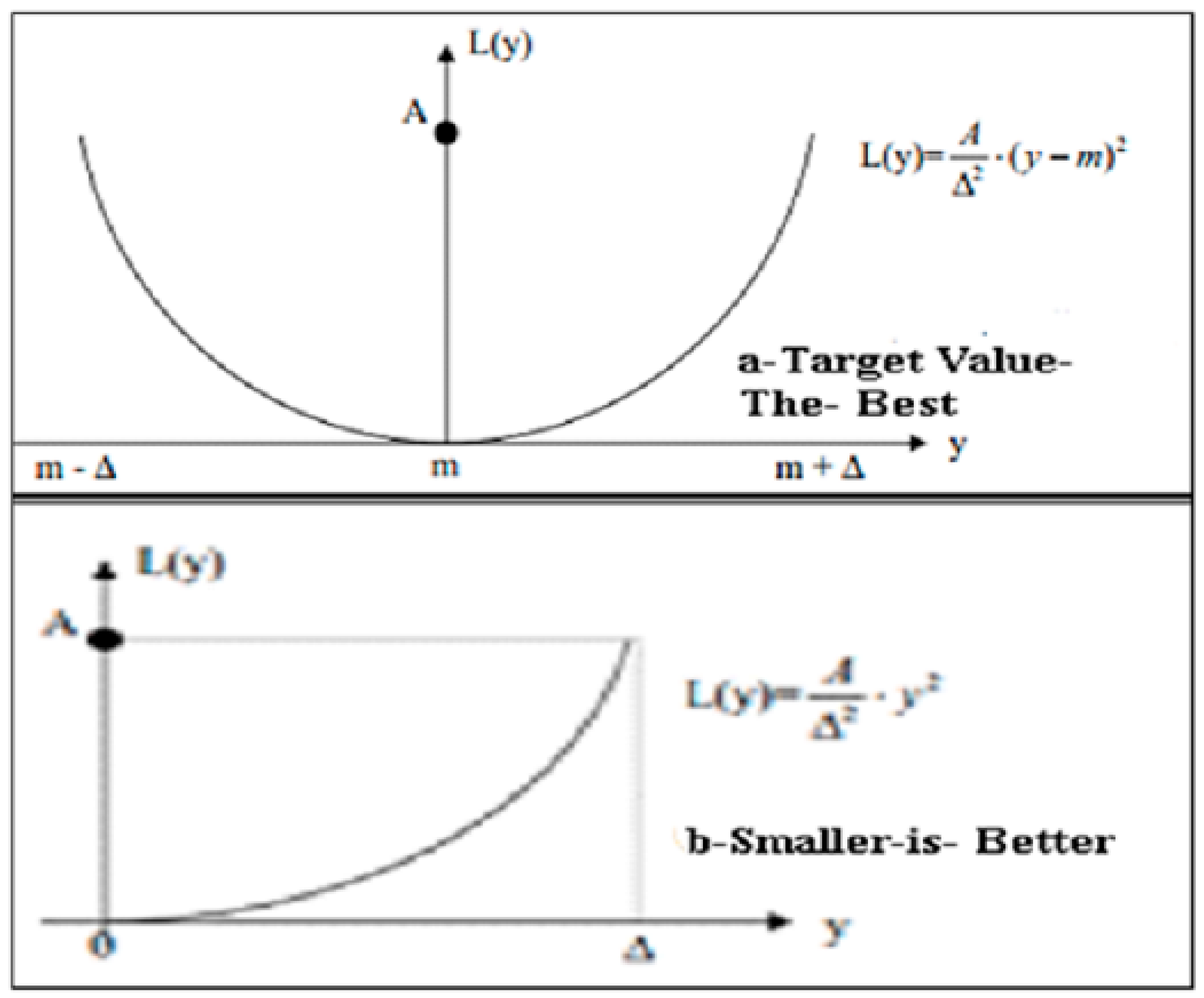
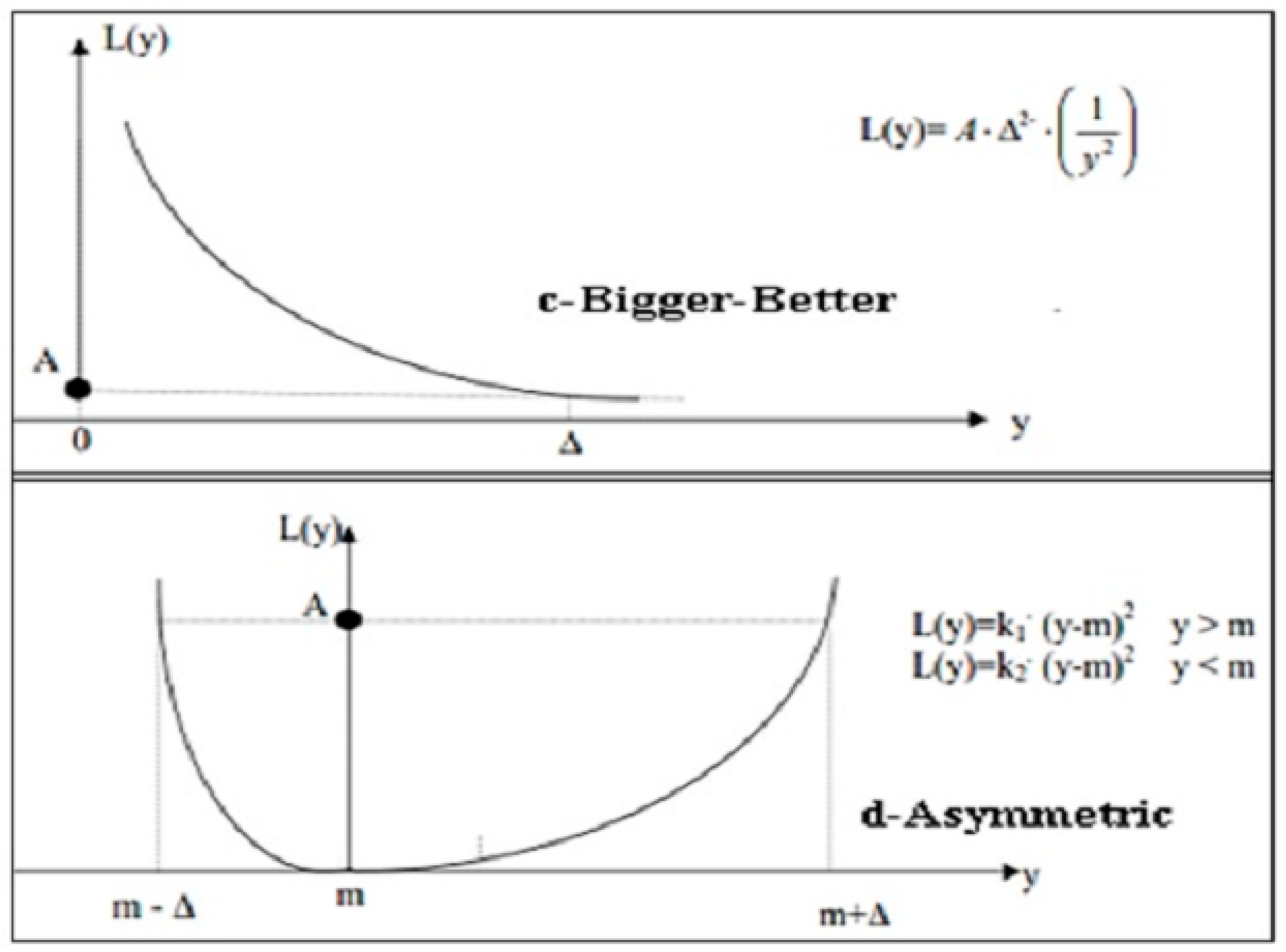
- Larger is better: In this tolerance study, there is no upper limit to the quality variable and therefore no target value. As the measurement increases, the efficiency will also increase.
- Smaller is better: This type of tolerance is the tolerances where the target value is zero, such as the percentage of scrap in the production process. As the tolerance decreases, the efficiency of the system will increase.
- Target value is best: This is the type of tolerance where deviations can occur in both directions.
Noise Factors and Signal-to-Noise Ratio (S/N)


4. Determination of Earthquake Resistance of Buildings
5. Determination of the Optimum Masonry Building Model Using the Taguchi Method
6. Results and Recommendations
- It was observed that the weakest wall model in terms of seismic resistance was the one with a thickness of 16 cm and a height of 260 cm, and a minimum seismic load of 118,940 kN. The highest seismic load occurred at wall heights of 32 cm and 340 cm with a thickness of 205,070 kN. When the wall thickness was doubled and the wall height was increased by approximately 1.3 times, the seismic resistance of the wall models increased by approximately 72.4%.
- When the wall thickness was fixed at 16 cm, it was observed that the 340 cm high wall model had a resistance of 138.101 kN, showing an increase of approximately 16.1%.
- When the wall thickness was 32 cm, the seismic resistance of the 260 cm high wall model was 166.747 kN, while the resistance of the 340 cm high wall increased by approximately 23% to 205.070 kN.
- In terms of sheer force, the shear force was 38.262 kN in the 16 cm thick and 260 cm high wall model, while this value increased by 2.43% to 39.193 kN in the 16 cm thick and 340 cm high wall model.
- : Wall characteristic shear strength obtained using the average vertical stresses on the wall,
- Initial shear strength values of wall materials (brick, concrete, aerated concrete, etc.) [41].
- Vertical compressive stress calculated under the combined effect of vertical loads multiplied by load coefficients and seismic loads.
- : Standardized average compressive strength of the masonry unit (equivalent to a 100 mm × 100 mm sample free from dimensional effects).
- : Wall Stiffness
- : Free height of the wall, length from the top of the slab to the bottom of the slab (or beam, if any)
- : Elasticity modulus of the wall,
- I: Moment of inertia of the solid wall segment, Gwall: Shear modulus of the wall
- A: Horizontal cross-sectional area of the solid wall segment
- and values were taken as : 750fk and : 0.4 according to [40].
- fk: Characteristic compressive strength of masonry wall [40]. stiffness expression, when the wall thickness increases, the moment of inertia and cross-sectional area of the wall in plan increase. In this case, the stiffness of the wall also increases.
Author Contributions
Funding
Data Availability Statement
Conflicts of Interest
References
- Akgül, M.; Doğan, O. Analysis of the Seismic Risks of Typical Masonry Buildings in Altındağ/Ankara According to the 2018 Turkish Building Seismic Code. Eng. Sci. 2020, 15, 1–14. [Google Scholar]
- TBDY 2018. Principles for the Design of Buildings Subject to Earthquake Effects, Türkiye. 2018, p. 251. Available online: https://www.mevzuat.gov.tr/mevzuat?MevzuatNo=24468&MevzuatTur=7&MevzuatTertip=5 (accessed on 22 December 2025).
- TÜİK. Building Statistics; Turkish Statistical Institute: Ankara, Türkiye, 2023.
- Bayülke, N. Seismic Behavior and Safety of Masonry Structures. In Proceedings of the 1st Türkiye Earthquake Engineering and Seismology Conference, Ankara, Türkiye, 11–14 October 2011; pp. 23–36. [Google Scholar]
- Döndüren, M.S. The Effect of Wall and Plaster Mortar with Enhanced Binding Properties on the Mechanical Behavior of Brick Walls Subjected to Out-of-Plane loading. Doctoral Dissertation, Fen Bilimleri Enstitüsü, Selçuk Üniversitesi, Konya, Türkiye, 2008. [Google Scholar]
- TS 699; Natural Building Stones—Methods of Inspection and Laboratory Testing. Turkish Standards Institute: Ankara, Türkiye, 2009.
- Yetkin, M. Effect of Mortar and Masonry Type on Mechanical Parameters of Masonry Walls and Numerical Evaluation. Ph.D. Thesis, Institute of Science, Fırat University, Elazığ, Türkiye, 2022. [Google Scholar]
- TS EN 771-1; Masonry Units—Properties—Part 1: Clay Masonry Units. (Bricks). TSE: Ankara, Türkiye, 2005.
- Nasıri, E.; Liu, Y. Development of a detailed 3D FE model for analysis of the in-plane behaviour of masonry infilled concrete frames. Eng. Struct. 2017, 143, 603–616. [Google Scholar] [CrossRef]
- Sayın, E.; Yön, B.; Calayır, Y.; Karaton, M. Failures of masonry and adobe buildings during the June 23, 2011 Maden-(Elazığ) earthquake in Turkey. Eng. Fail. Anal. 2013, 34, 779–791. [Google Scholar] [CrossRef]
- Sayın, E. Nonlinear Static and Dynamic Analysis of Masonry Structures; Graduate School of Natural and Applied Sciences, Fırat University: Elazığ, Türkiye, 2009; pp. 1–126. [Google Scholar]
- Sayın, E. Comparison of linear and non-linear earthquake response of masonry walls. Comput. Concr. 2015, 16, 17–35. [Google Scholar] [CrossRef]
- Ural, A. Investigation of Linear and Nonlinear Behavior of Masonry Structures. Ph.D. Thesis, Institute of Science, Karadeniz Technical University, Trabzon, Türkiye, 2009. [Google Scholar]
- Kayırga, O.M. Analytical and Experimental Determination of the Seismic Behavior of Masonry Structures. Master’s Thesis, Department of Civil Engineering, Institute of Science, Erciyes University, Kayseri, Türkiye, 2017. [Google Scholar]
- Çöğürcü, M.T. Strengthening of Masonry Structures by Horizontal Joint Reinforcement Method. Ph.D. Thesis, Institute of Science, Selçuk University, Konya, Türkiye, 2007. [Google Scholar]
- Uzun, M. Evaluation of the Seismic Performance of Masonry Structures and a Strengthening Example. Master’s Thesis, Selcuk University, Konya, Türkiye, 2017. [Google Scholar]
- Özsaraç, S. Experimental Investigation of Strengthening Load-Bearing Brick Walls in Masonry Structures with GFRP. Master’s Thesis, ITU Institute of Science, Istanbul Technical University, İstanbul, Türkiye, 2008. [Google Scholar]
- Bayülke, N. Repair and Strengthening of Structures Damaged by Earthquakes, Chamber of Civil Engineers; Izmir Branch: Izmir, Türkiye, 1999. [Google Scholar]
- Kalkan, N. Strengthening of Out-of-Plane Reversibly Loaded Masonry Structures with Reinforced Shotcrete. Ph.D. Thesis, Gazi University, Ankara, Türkiye, 2008. [Google Scholar]
- Ediz, İ. Experimental Investigation of Strengthening Load-Bearing Walls in Masonry Structures with Wire Mesh Reinforcement and Self-Compacting Concrete. Master’s Thesis, Institute of Science, Istanbul Technical University, Istanbul, Türkiye, 2006. [Google Scholar]
- Türer, A.; Şimşek, Ç.; Gölalmış, M.; Özden, B.; Dilsiz, A.; ve Özen, Ö. Reinforcement with Used Car Tires: Antakya Pilot Application and Decorative Solutions. In Proceedings of the YDGA 2005 Workshop on Increasing the Seismic Safety of Masonry Structures (METU), Ankara, Türkiye, 17 February 2005; pp. 1–8. [Google Scholar]
- Bayır, S.İ.; Özgan, E. The Effect of Wall Opening Ratios in Masonry Structures on the Seismic Behavior of the Building. In Architecture, Planning and Design: Theory and Practice; Section 4; Duvar Publications: İzmir, Türkiye, 2024; pp. 61–72. ISBN 978-625-5530-84-4. Available online: https://www.duvaryayinlari.com/Webkontrol/IcerikYonetimi/Dosyalar/teori-ve-uygulamada-mimarlik-planlama-ve-tasarim_icerik_g4340_wI1WFviV.pdf (accessed on 22 December 2025).
- Phadke, M.S. Quality Engineering Using Robust Design; Prentice Hall PTR: Hoboken, NJ, USA, 1995. [Google Scholar]
- Ross, P.J. Taguchi Techniques for Quality Engineering; McGraw-Hill: New York, NY, USA, 1996. [Google Scholar]
- Roy, R.K. Design of Experiments Using the Taguchi Approach; Wiley: Hoboken, NJ, USA, 2001. [Google Scholar]
- Taguchi, G.; Clausing, D. Robust Quality. Harv. Bus. Rev. 1990, 68, 65–75. [Google Scholar]
- SPSS Statistics Version 22; IBM: Armonk, NY, USA, 2020.
- Montgomery, D.C. Design and Analysis of Experiments; Wiley: Hoboken, NJ, USA, 2012. [Google Scholar]
- Dash, S.K.; Hussain, M. Lime stabilization of soils: Reappraisal. J. Mater. Civ. Eng. 2012, 24, 707–714. [Google Scholar] [CrossRef]
- Yenginar, Y.; Olgun, M. Optimizing installation parameters of DM columns in clay using Taguchi method. Bull. Eng. Geol. Environ. 2023, 82, 145. [Google Scholar] [CrossRef]
- Mortazavi Bak, H.; Noorbakhsh, M.; Halabian, A.M.; Rowshanzamir, M.; Hashemolhosseini, H. Application of the Taguchi method to enhance bearing capacity in geotechnical engineering: Case studies. Int. J. Geomech. 2021, 21, 04021167. [Google Scholar] [CrossRef]
- Susanti, E.I.; Munawir, A.A.; Zaika, Y.; Dewi, S.M. Application of the Taguchi Experimental Design Method for Parameter Optimization of the Residual Slope Model. In Proceedings of the 1st International Conference on Sustainable Construction and Environment (SCE) 2022: Challenges on Sustainable Construction and its Impacts to the Environment, Malang, Indonesia, 3–4 October 2022; AIP Publishing LLC: Melville, NY, USA, 2024; Volume 3043, p. 040007. [Google Scholar]
- Davim, P.J. Design of Optimisation of Cutting Parameters for Turning Metal Matrix Composites Based on the Orthogonal Arrays. J. Mater. Process. Technol. 2003, 132, 340–344. [Google Scholar] [CrossRef]
- Taguchi, G.; Konishi, S. Orthogonal Arrays and Linear Graphs; American Supplier Institute: Miami, FL, USA, 1987. [Google Scholar]
- Chen, H.J.; Lin, H.C.; Tang, C.W. Application of the Taguchi Method for Optimizing the Process Parameters of Producing Controlled Low-Strength Materials by Using Dimension Stone Sludge and Lightweight Aggregates. Sustainability 2021, 13, 5576. [Google Scholar] [CrossRef]
- Martínez-García, R.; de Rojas, M.I.S.; Morán de Pozo, J.M.; Fraile-Fernández, F.J.; Juan-Valdés, A. Evaluation of Mechanical Characteristics of Cement Mortar with Fine Recycled Concrete Aggregates (FRCA). Sustainability 2021, 13, 414. [Google Scholar] [CrossRef]
- Chen, H.J.; Chang, S.N.; Tang, C.W. Application of the Taguchi Method for Optimizing the Process Parameters of Producing Lightweight Aggregates by Incorporating Tile Grinding Sludge with Reservoir Sediments. Materials 2017, 10, 1294. [Google Scholar] [CrossRef]
- Hung, C.C.; Wang, C.C.; Wang, H.Y. Establishment of the Controlled Low-Strength Desulfurization Slag Prediction Model for Compressive Strength and Surface Resistivity. Appl. Sci. 2020, 10, 5674. [Google Scholar] [CrossRef]
- Sabarish, K.V.; Pratheeba, P. An experimental analysis on structural beam with Taguchi orthogonal array. Mater. Today Proc. 2020, 22, 874–878. [Google Scholar] [CrossRef]
- Parvathidevi, A.; Kumar, C.N.S. Application of Taguchi approach in the investigation of thermal insulation aggregate influence. Mater. Today Proc. 2024, 115, 31–35. [Google Scholar] [CrossRef]
- Sta4cad V141 STA4; C.A.D. Structural Analysis for Computer Aided Design. STA4 CAD: İstanbul, Türkiye, 2025.
- TBDY 2018; Princibles for the Design of Buildings Under Earthquake Effects. Ministry of Environment, Urbanization and Climate Change: Ankara, Türkiye, 2018.
- TS500; Betonarme Yapıların Tasarım ve Yapım Kuralları. Türk Standartları Enstitüsü: Ankara, Türkiye, 2000.
- Kasap, Ş. F-4 Uçaklarında Yakıt Tüketimini Etkileyen Faktörlerin 2k Deneyleri Ve Taguchi Yöntemiyle Belirlenmesi. Master’s Thesis, Anadolu Üniversitesi Fen Bilimleri Enstitüsü İstatistik Anabilim Dalı, Eskişehir, Türkiye, 2006. [Google Scholar]
- Roy, R.K. A Primer on the Taguchi Method; Van Nostrand Reinhold: New York, NY, USA, 1990. [Google Scholar]
- Şirvancı, M. Kalite İçin Deney Tasarımı-Taguchi Yaklaşımı; Literatür Yayınları: İstanbul, Türkiye, 1997. [Google Scholar]
- Keleş, Ö.; Taptık, Y. Kalite Savaşı; Kalder Yayınları: İstanbul, Türkiye, 1998. [Google Scholar]
- Pignatiolle, J.J.; Burman, J.S. Discussion on Off-Line Quality Control, Parameter Desing, the Taguchi Method by R.N. Kacker. J. Qual. Technol. 1985, 17, 198–206. [Google Scholar]
- Koç, S. Optimization of Factors Affecting the Performance of Critical Units Using Experimental Design Method. Master’s Thesis, Çukurova University, F.B.E., Adana, Türkiye, 2003. [Google Scholar]
- Abraham, B.; ve Mackay, J. Variation Reduction and Designed Experiments. Int. Stat. Rev. 1993, 61, 121–129. [Google Scholar] [CrossRef]
- Wang, R.; Wang, W.; Zhang, Y.; Wen, Q.; Wu, X.; Lu, Y.; Wang, D.; Qiu, F. Enhancement Analysis of Damaged Masonry Structures Strengthened with Ultra-High-Performance Concrete. Buildings 2025, 15, 2082. [Google Scholar] [CrossRef]
- GB50702-2011[S]; Code for Design of Strengthening Masonry Structures. China Architecture & Building Press: Beijing, China, 2011.
- Orlowsky, J.; Beßling, M.; Kryzhanovskyi, V. Prospects for the Use of Textile-Reinforced Concrete in Buildings and Structures Maintenance. Buildings 2023, 13, 189. [Google Scholar] [CrossRef]
- Karaca, Z.; Turkeli, E.; Pergel, S. Seismic assessment of historical masonry structures: The case of Amasya Tashan. Comput. Concr. 2017, 20, 409–418. [Google Scholar]
- Cvetković, R.; Blagojević, P.; Brzev, S. Seismic Design of a Typical Mid-Rise Residential Building in Serbia Using Confined Masonry and Reinforced Concrete Frame Systems. Buildings 2024, 14, 368. [Google Scholar] [CrossRef]
- Krtinić, N.; Marinković, M.; Gams, M. Finite Element Method Analysis of Seismic Response of Confined Masonry Walls with Openings Built Using Polyurethane Glue. Buildings 2025, 15, 424. [Google Scholar] [CrossRef]
- Yaman, Z.; Cumhur, A.; Ağcakoca, E.; Özyurt, M.Z.; Maraşlı, M.; Sadid, M.S.; Akrami, A.; Rasuly, A. Experimental Study and FEM Analysis on the Strengthening of Masonry Brick Walls Using Expanded Steel Plates and Shotcrete with and Without Glass Fiber Reinforcement. Buildings 2025, 15, 2781. [Google Scholar] [CrossRef]
- Kap, T. Investigation of the Effect of Wall Thickness and Wall Height on Building Behaviour During an Earthquake. Buildings 2026, 16, 127. [Google Scholar] [CrossRef]



| Earthquake Load (kN) | |||||
|---|---|---|---|---|---|
| Wall Height (cm) | Wall 16 cm | Wall 20 cm | Wall 24 cm | Wall 28 cm | Wall 32 cm |
| 260 cm | 1166.42 | 1285.67 | 1396.69 | 1515.94 | 1635.19 |
| 280 cm | 1215.36 | 1342.85 | 1470.24 | 1597.63 | 1725.12 |
| 300 cm | 1256.25 | 1400.02 | 1543.79 | 1679.32 | 1823.09 |
| 320 cm | 1305.29 | 1457.19 | 1609.10 | 1761.01 | 1913.01 |
| 340 cm | 1354.32 | 1514.37 | 1682.65 | 1842.80 | 2011.08 |
| The shear forces (kN) | |||||
| 260 cm | 203.48 | 239.59 | 284.78 | 330.02 | 375.23 |
| 280 cm | 199.36 | 239.83 | 285.17 | 330.46 | 375.71 |
| 300 cm | 199.74 | 246.70 | 293.60 | 340.34 | 387.22 |
| 320 cm | 200.87 | 242.95 | 289.04 | 335.05 | 381.03 |
| 340 cm | 203.44 | 245.41 | 291.83 | 338.05 | 384.36 |
| Taguchi Array | L25 (52) |
| Factors: | 2 |
| Runs: | 25 |
| Columns of L25 (56) array: 1 2 | |
| Term | Coefficient | Standard Error of Coefficient | T Value | p Value |
|---|---|---|---|---|
| Estimated Model Coefficients for S/N ratios | ||||
| Constant | 90.378 | 0.009179 | 9846.257 | 0.000 |
| A 16 | −0.1081 | 0.018358 | −5.891 | 0.000 |
| A 20 | −0.1130 | 0.018358 | −6.154 | 0.000 |
| A 24 | 0.1299 | 0.018358 | 7.074 | 0.000 |
| A 28 | −0.0034 | 0.018358 | −0.186 | 0.855 |
| B 260 | −2.9667 | 0.018358 | −161.603 | 0.000 |
| B 280 | −1.3005 | 0.018358 | −70.843 | 0.000 |
| B 300 | 0.2009 | 0.018358 | 10.941 | 0.000 |
| B 320 | 1.4771 | 0.018358 | 80.460 | 0.000 |
| Model Summary | ||||
| S | R2 | Adjusted R2 | ||
| 0.0459 | 99.97% | 99.95% | ||
| Estimated Model Coefficients for S/N ratios of Earthquake Loads for Means | ||||
| Constant | 71,025.5 | 218.6 | 324.852 | 0.000 |
| A 16 | −4985.3 | 437.3 | −11.401 | 0.000 |
| A 20 | −2617.0 | 437.3 | −5.985 | 0.000 |
| A 24 | 306.2 | 437.3 | 0.700 | 0.494 |
| A 28 | 2328.5 | 437.3 | 5.325 | 0.000 |
| B 260 | −15294.1 | 437.3 | −34.976 | 0.000 |
| B 280 | −7783.1 | 437.3 | −17.799 | 0.000 |
| B 300 | −34.1 | 437.3 | −0.078 | 0.939 |
| B 320 | 7654.7 | 437.3 | 17.505 | 0.000 |
| Model Summary | ||||
| S | R2 | Adjusted R2 | ||
| 1093.1985 | 99.42% | 99.13% | ||
| Estimated Model Coefficients for S/N ratios of Shear Forces | ||||
| Constant | 89.1909 | 0.01360 | 6559.759 | 0.000 |
| A 16 | −0.0801 | 0.02719 | −2.946 | 0.009 |
| A 20 | −0.1070 | 0.02719 | −3.935 | 0.001 |
| A 24 | 0.0995 | 0.02719 | 3.659 | 0.002 |
| A 28 | 0.0004 | 0.02719 | 0.015 | 0.988 |
| B 260 | −2.9415 | 0.02719 | −108.171 | 0.000 |
| B 280 | −1.3137 | 0.02719 | −48.310 | 0.000 |
| B 300 | 0.1923 | 0.02719 | 7.073 | 0.000 |
| B 320 | 1.4732 | 0.02719 | 54.173 | 0.000 |
| Model Summary | ||||
| S | R2 | Adjusted R2 | ||
| 0.0680 | 99.92% | 99.89% | ||
| Analysis of Variance for SN Ratios | ||||||
|---|---|---|---|---|---|---|
| Source | DF | Seq SS | Adj SS | Adj MS | F Value | p Value |
| A | 4 | 0.2515 | 0.2515 | 0.0629 | 29.85 | 0.000 |
| B | 4 | 97.0955 | 97.0955 | 24.2739 | 11,524.33 | 0.000 |
| Residual Error | 16 | 0.0337 | 0.0337 | 0.0021 | ||
| Total | 24 | 97.3807 | ||||
| Analysis of Variance for Means | ||||||
| A | 4 | 309477325 | 309477325 | 77369331 | 64.74 | 0.000 |
| B | 4 | 2959961654 | 2959961654 | 739990414 | 619.20 | 0.000 |
| Residual Error | 16 | 19121326 | 19121326 | 1195083 | ||
| Total | 24 | 3288560306 | ||||
| Analysis of Variance for SN ratios for Shear Force | ||||||
| A | 4 | 0.279 | 0.2794 | 0.0699 | 74.48 | 0.000 |
| B | 4 | 99.894 | 99.8938 | 24.9734 | 26,626.26 | 0.000 |
| Residual Error | 16 | 0.015 | 0.0150 | 0.0009 | ||
| Total | 24 | 100.188 | ||||
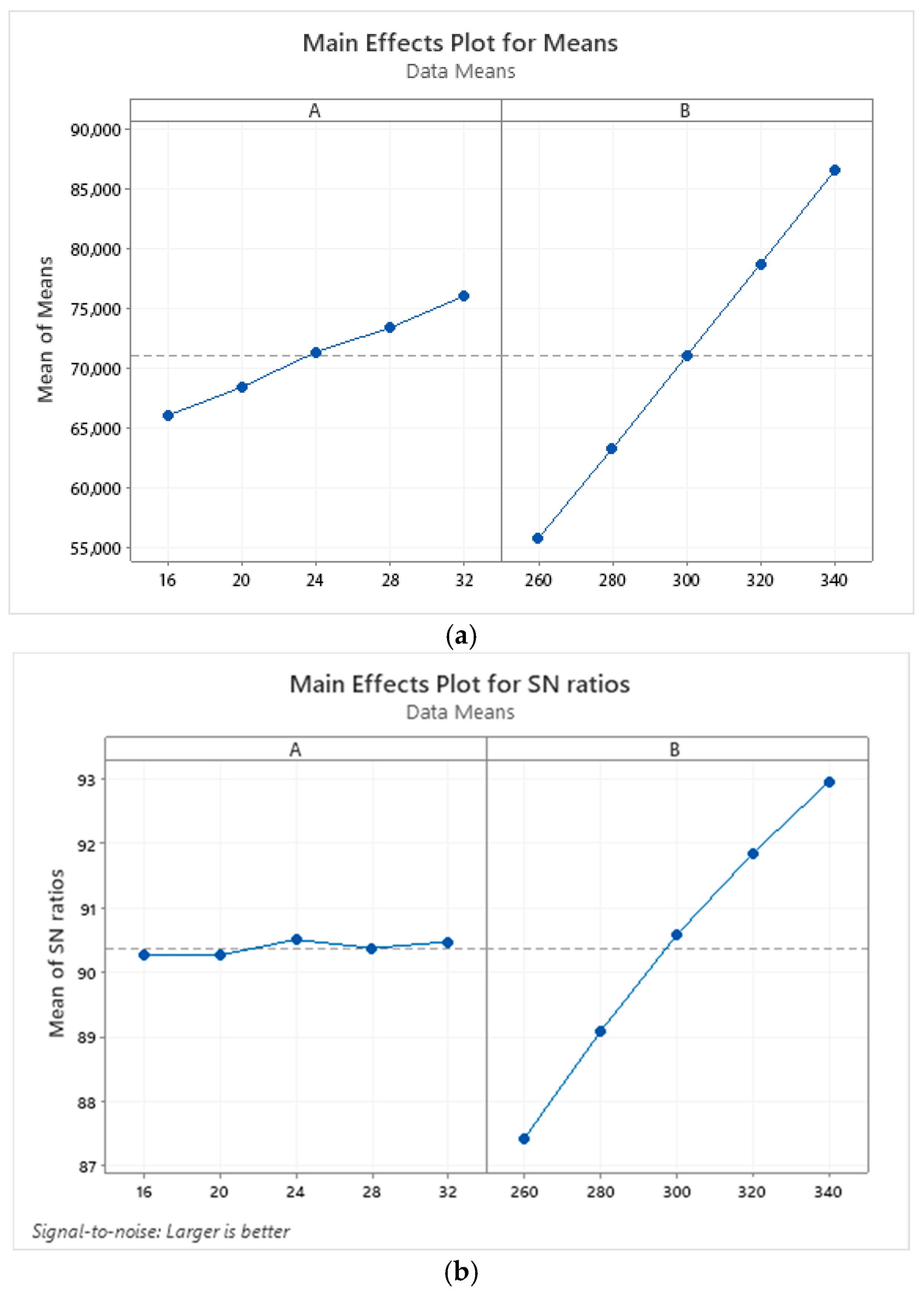
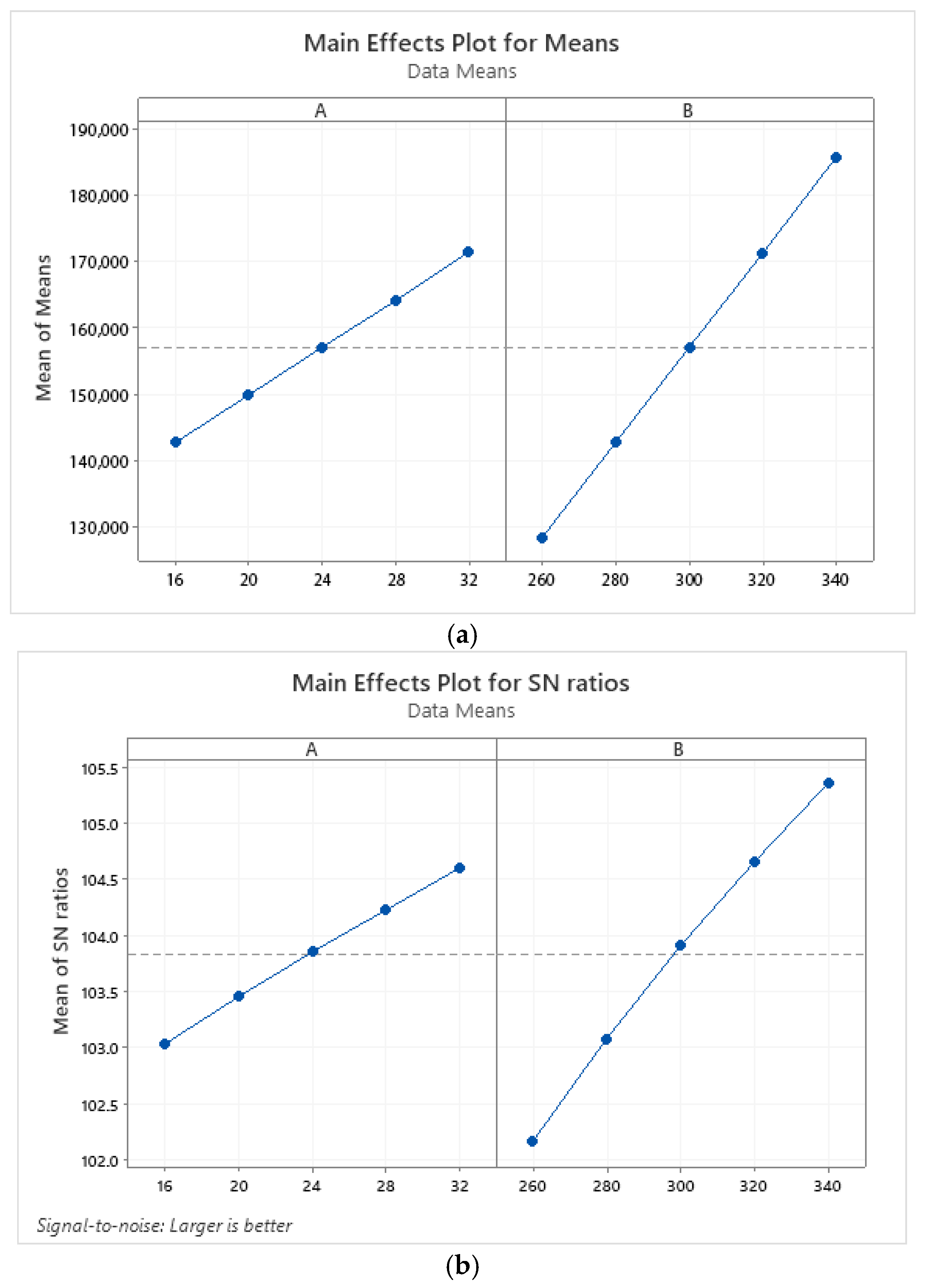
| Response Table for Signal to Noise Ratios for Prediction Model of the Shear Force Target: Larger Is Better | Response Table for Signal to Noise Ratios for Earthquake Loads Target: Larger Is Better | |||
|---|---|---|---|---|
| Level | A | B | A | B |
| 1 | 90.27 | 87.41 | 103.0 | 102.2 |
| 2 | 90.27 | 89.08 | 103.5 | 103.1 |
| 3 | 90.51 * (24 cm) | 90.58 | 103.8 | 103.9 |
| 4 | 90.37 | 91.86 | 104.2 | 104.7 |
| 5 | 90.47 | 92.97 * (340 cm) | 104.6 * (32 cm) | 105.4 * (340 cm) |
| Delta | 0.24 | 5.56 | 1.6 | 3.2 |
| Rank | 2 | 1 | 2 | 1 |
Disclaimer/Publisher’s Note: The statements, opinions and data contained in all publications are solely those of the individual author(s) and contributor(s) and not of MDPI and/or the editor(s). MDPI and/or the editor(s) disclaim responsibility for any injury to people or property resulting from any ideas, methods, instructions or products referred to in the content. |
© 2026 by the authors. Licensee MDPI, Basel, Switzerland. This article is an open access article distributed under the terms and conditions of the Creative Commons Attribution (CC BY) license.
Share and Cite
Kap, T.; Özgan, E. Optimization of Wall Dimensions in Earthquake-Resistant Masonry Structure Design Using the Taguchi Method. Appl. Sci. 2026, 16, 1841. https://doi.org/10.3390/app16041841
Kap T, Özgan E. Optimization of Wall Dimensions in Earthquake-Resistant Masonry Structure Design Using the Taguchi Method. Applied Sciences. 2026; 16(4):1841. https://doi.org/10.3390/app16041841
Chicago/Turabian StyleKap, Tuncay, and Ercan Özgan. 2026. "Optimization of Wall Dimensions in Earthquake-Resistant Masonry Structure Design Using the Taguchi Method" Applied Sciences 16, no. 4: 1841. https://doi.org/10.3390/app16041841
APA StyleKap, T., & Özgan, E. (2026). Optimization of Wall Dimensions in Earthquake-Resistant Masonry Structure Design Using the Taguchi Method. Applied Sciences, 16(4), 1841. https://doi.org/10.3390/app16041841