1. Introduction
Taiwan, located in the western Pacific typhoon corridor, is particularly vulnerable to short-duration intense rainfall, typhoons, and seasonal floods [
1,
2]. In densely populated metropolitan regions such as Taichung City, river channels often run directly through residential and commercial zones. As a result, even small increases in surface flow velocity or localized overbank flooding can quickly lead to socio-economic losses [
3,
4]. These conditions highlight the urgent need for reliable, real-time river monitoring technologies that support early warning, flood mitigation, and water resource management [
5,
6,
7].
Traditional river monitoring—such as mechanical flow meters, pressure sensors, and radar velocimeters—provide accurate point-based observations but require costly instrumentation, well-trained personnel, and maintenance [
8,
9,
10]. Their limited spatial resolution and vulnerability to high-discharge conditions further restrict their applicability during extreme events [
11,
12]. Non-contact optical approaches offer a safer and more flexible alternative. Among them, large-scale particle image velocimetry (LSPIV) [
13] has emerged as an effective method for measuring river surface velocity by tracking the displacement of natural or artificial tracers across consecutive video frames [
14,
15,
16]. LSPIV is cost-efficient and easy to deploy; however, its accuracy remains sensitive to illumination variability, bank shadows, reflections, and low-velocity zones near river boundaries or obstacles [
17,
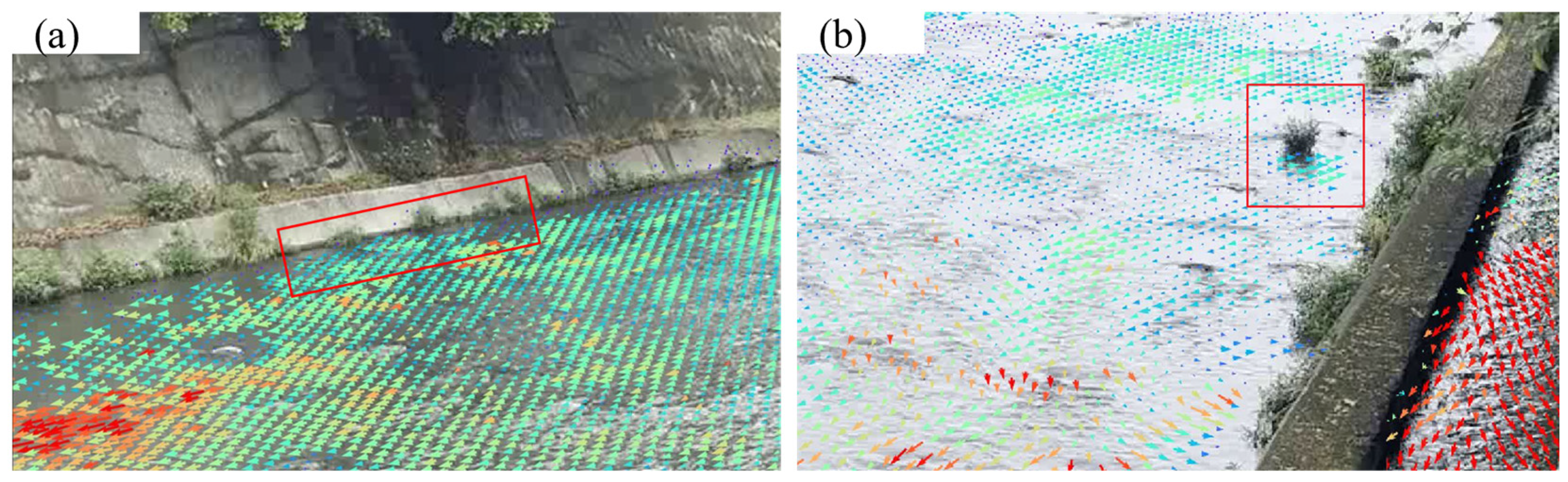
18]. In the preliminary method testing in this study, low velocity grids were found frequently near the riverbank or around obstacles in the river (
Figure 1).
Prior experiments involving smartphone-based LSPIV exhibited a 15% error relative to ADCP (acoustic Doppler current profiler) benchmarks due to imaging constraints [
19]. Notably, this error could be mitigated to 10% when specific environmental or configuration parameters were optimized [
20]. Recent advances in deep learning and mobile imaging technologies present new opportunities for improving the reliability of optical flow measurements [
21,
22,
23]. In particular, semantic segmentation models can accurately distinguish water surface regions from surrounding land, structures, and vegetation [
24,
25], enabling more robust preprocessing and reducing common low velocity grids in LSPIV caused by pixel confusion between water and non-water surface, or turbulence near riverbanks. By integrating deep learning-based water surface extraction with LSPIV, it becomes possible to enhance the stability of flow vector estimation and to extend the applicability of optical velocimetry to complex urban river environments.
This study aims to develop and evaluate an integrated framework that combines water surface segmentation with LSPIV surface velocity estimation using consumer-grade smartphone cameras. Field experiments were conducted at natural and engineered river channels in Taichung City to assess segmentation accuracy, evaluate optimal interrogation-area configurations, and compare LSPIV-derived velocities with measurements from float experiments and radar velocimetry. The proposed workflow seeks to provide a practical pathway toward an automated, low-cost, and scalable river monitoring system suitable for smart city applications and real-time flood mitigation strategies.
2. Experimental Sites and Methods
2.1. Experimental Sites
The study sites (
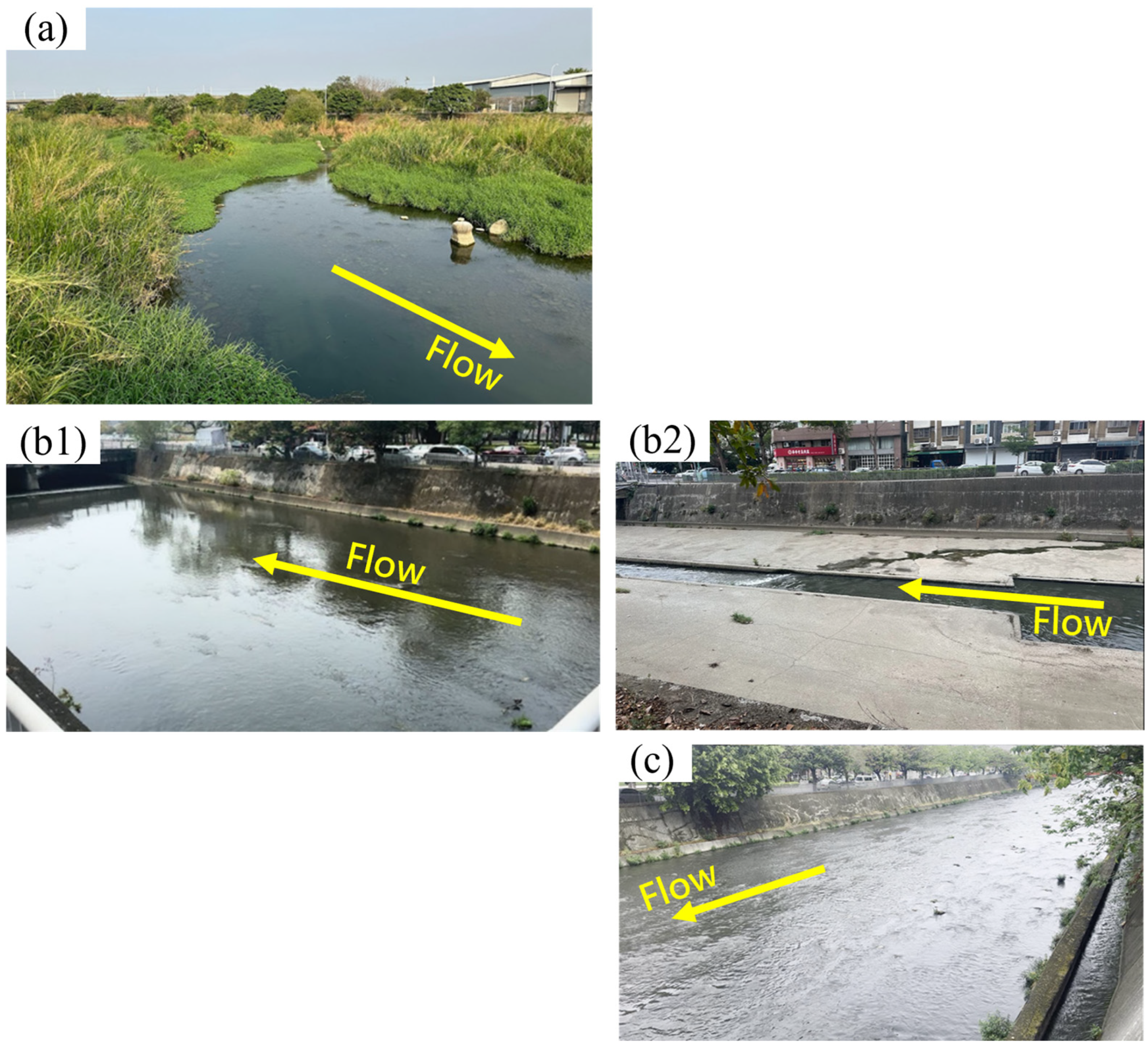
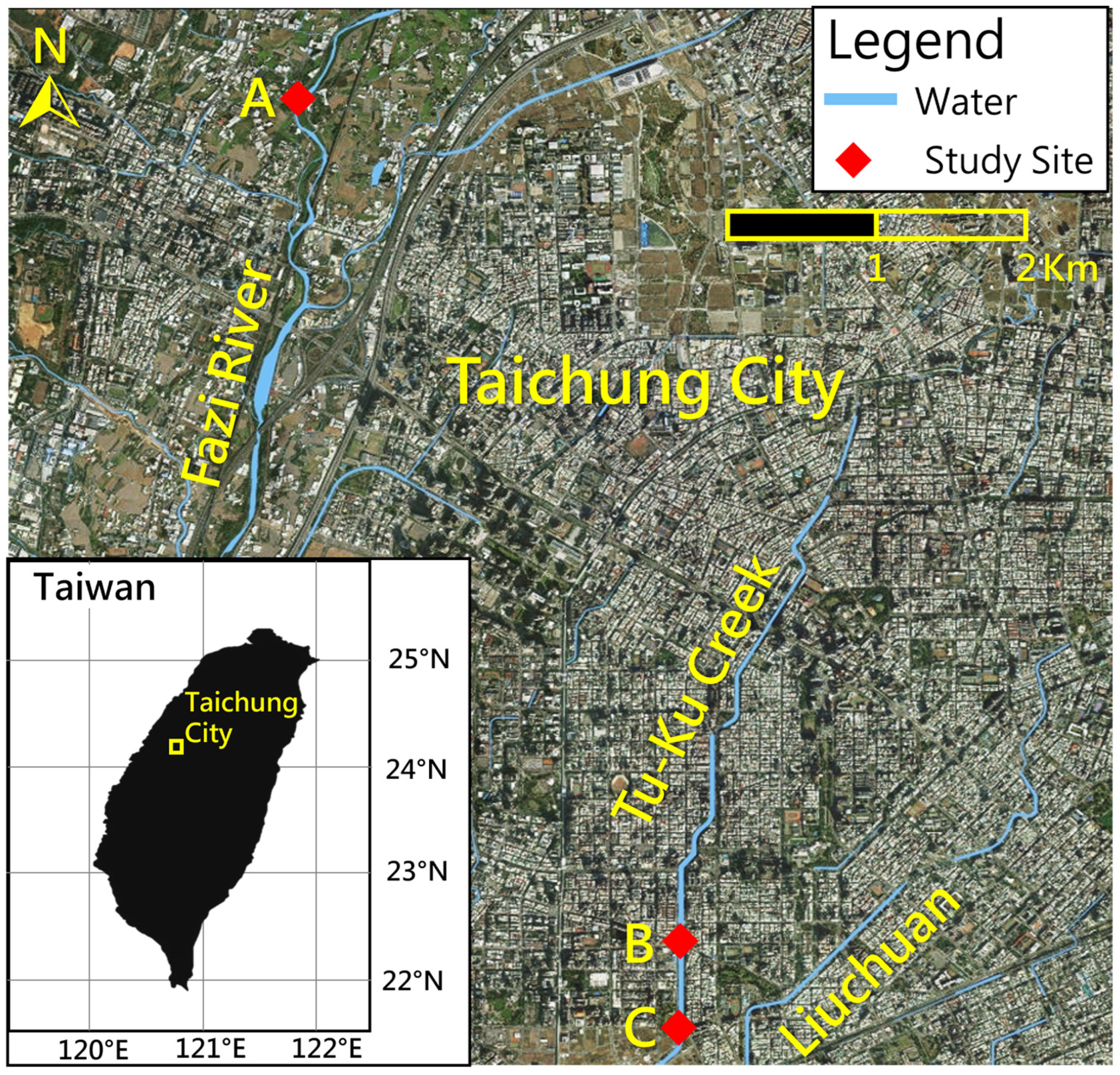
Figure 2) were selected within Taichung City—one of Taiwan’s major metropolitan areas situated within a basin in central Taiwan. The average annual precipitation in Taichung City typically exceeds 1700 mm. The wet season is primarily concentrated between May and August, with rainfall peaks attributed to short-duration heavy rainfall events, the Meiyu front, and typhoons. In this region, river channels are located very close to residential zones, meaning that any overbank flooding can quickly lead to significant damage. Two types of river channels were included in this study: natural levee channels and engineered levee channels. The Fazi River (Xitun Road section) (
Figure 3a, site A in
Figure 2) represents a natural levee channel characterized by shallow flow depths, dispersed surface flow, and lower velocities compared with the engineered levee channel in wet seasons. The Fazi River is characterized by a typical channel width of approximately 30 m at site A. The recorded mean annual discharge of the Fazi River is approximately 117 cms and the annual peak velocity can reach 4.8 m/s [
26]. The river environment consists primarily of natural features such as stones, sandbars, and riparian vegetation. The Tuku Creek reaches (Xintianxin Bridge and Mayuan First Bridge) (
Figure 3(b1,b2,c), site B and C in
Figure 2) are engineered levee channels with deeper flow depths, concentrated discharge, and higher surface velocities comparing with the natural levee channel in wet seasons. The Tuku Creek features a channel width of approximately 30 m. Due to the absence of dedicated gauging stations on Tuku Creek, hydrological parameters were estimated using Liuchuan as a proxy. This approach is justified by their shared drainage system in central Taichung City, as well as their connection by transverse channels and their highly analogous channel morphologies, including similar river widths and levee designs. Consequently, the 10-year return period peak velocity of 4.86 m/s at Liuchuan is applied as a representative value for the Tuku Creek [
27]. Surrounding landscapes of engineered levee channels comprise a mixture of artificial structures—including concrete retaining walls, levees, and bridges—alongside natural elements such as vegetation along the banks.
Both sites of the Fazi River (Xitun Road section) (site A in
Figure 2) and the Tuku Creek at Xintianxin Bridge (site B in
Figure 2) were tested for image segmentation experiments of water surface detection. For the LSPIV-based surface velocity measurements, the engineered levee channel of the Tuku Creek at Xintianxin Bridge (site B in
Figure 2) was first selected as the testing site because of higher surface velocity, while the Tuku Creek at Mayuan First Bridge (site C in
Figure 2), which is an engineered levee channel, was designated as the validation site.
2.2. Water Surface Image Segmentation
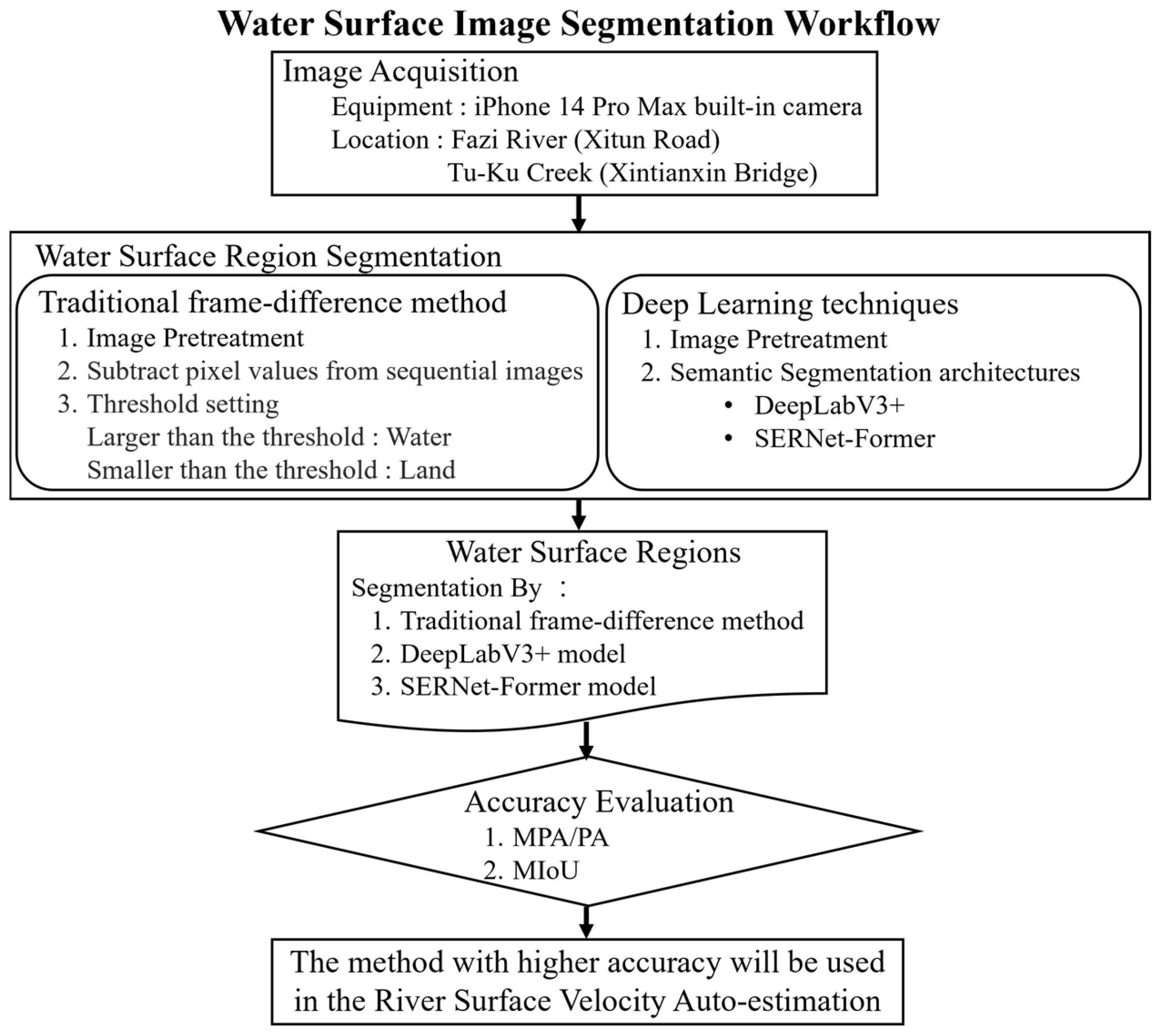
The workflow of the water surface image segmentation was summarized in
Figure 4, and details are described in
Section 2.2.2.
2.2.1. Parameters of the Applied Camera
To facilitate future scalability and potential integration into mobile applications, this study employed a commercially available consumer device—iPhone 14 Pro Max—as the imaging sensor for field data acquisition. Video recordings were made using the smartphone’s built-in camera under automatic optical settings, with a resolution of 1920 × 1080 pixels at 30 frames per second (fps). The recordings were made under fair to partly cloudy weather conditions to ensure consistent illumination and surface visibility.
In addition to video capture feature, the iPhone 14 Pro Max’s integrated Inertial Measurement Unit (IMU) was utilized to log data at the time of recording, including geographic coordinates (latitude and longitude), elevation, and the camera’s orientation parameters—pitch, roll, and heading. These IMU-derived parameters were subsequently incorporated into the image rectification and geometric correction procedures, providing essential spatial reference data for accurate flow field analysis.
2.2.2. Image Pretreatment
In this study, the traditional frame difference method and deep learning methods were tested for water surface image segmentation. Different image pretreatment procedures were applied depending on the method used for water surface segmentation in order to capture image features well.
Images used in this study were obtained from field-recorded video sequences. Each recording site produced a 10 s video segment captured at 30 frames per second (fps), yielding a total of 300 original frames for both site A (the Fazi River (Xitun Road section)) and site B (the Tuku Creek at Xintianxin Bridge) in
Figure 2.
For the traditional frame difference method, the process was accomplished in python with OpenCV library imported, and the primary concept is descripted as follows. The procedure begins by generating consecutive frames from the input video. Each frame is then converted into binary representations. The frame differencing is performed by subtracting each binary frame from its subsequent frame on a pixel-by-pixel basis. This subtraction produces difference images that highlights temporal variations between adjacent frames. In order to improve feature consistency and suppress irrelevant artifacts, these difference images are subjected to image optimization process, including blurring techniques and noise-reduction methods. Subsequently, the edge detection algorithm is applied to difference images to extract water surface boundaries. A threshold is then established according to the intensity of edge variations. Pixels exhibiting variation values exceeding this threshold are classified as water surface regions, whereas those with lower variation intensities are categorized as land or non-water areas.
The image preprocessing workflow for the deep learning-based approach was conducted using JupyterLab 3.5.3 within the Anaconda3 environment and implemented in Python 3. The recorded video sequences were first converted into still image frames for subsequent processing.
To enhance image diversity and model generalization, data augmentation techniques were applied to the original images, including random horizontal flipping (probability = 0.5), random vertical flipping (probability = 0.5), random rotation within ±10°, and random brightness and contrast adjustments within ±20%. After augmentation, a total of 1200 images were obtained for site A and site B in
Figure 2.
All images were then subjected to histogram equalization and Gaussian filtering to improve contrast and suppress noise. Subsequently, manual annotation of water surface regions was performed using the ImageJ 1.54d software. Each annotated image was visually verified to ensure labeling accuracy. After annotation, all images were rescaled to a resolution of 500 × 500 pixels and randomly divided into training, validation, and testing sets in a proportion of 70%, 20%, and 10%, respectively, to maintain dataset heterogeneity and reduce overfitting.
In this study, two methods—the traditional frame difference method and deep learning-based semantic segmentation—were employed for water surface segmentation. The deep learning segmentation utilized two architectures: DeepLabV3+ [
28] and SERNet-Former [
29], whose backbone networks and key training parameters are summarized in
Table 1.
Because deep learning model training requires high computational resources, semantic segmentation experiments were conducted on Google Compute Engine (GCE) cloud instances equipped with an NVIDIA A100 GPU (40 GB GPU memory) and 83.5 GB of system RAM, providing sufficient performance for large-scale image segmentation tasks.
2.2.3. Evaluation
To evaluate the accuracy of water surface segmentation, a dataset consisting of 30 randomly selected images each from site A and site B in
Figure 2. The evaluation employed two quantitative metrics: mean pixel accuracy (MPA/PA) and mean intersection over union (MIoU). The results of the traditional frame difference method, DeepLabV3+, and SERNet-Former models were compared against the manually annotated masks, which served as the ground truth.
MPA (mean pixel accuracy)
In the case of a single-class segmentation task (water vs. non-water), the metrics can be simplified.
where TP, TN, FP, and FN represent the number of true positives, true negatives, false positives, and false negatives, respectively.
MIoU (mean intersection over union)—a standard metric in semantic segmentation—quantifies the overlap between the predicted region and the ground truth region and is defined as the ratio between their intersection and union:
When only one target class is considered, the mean IoU (MIoU) reduces to the IoU of that single class, providing a direct measure of segmentation accuracy.
2.3. River Surface Velocity Measurement
For river surface velocity estimation, LSPIV, the float method, and the radar velocimeter were applied in this study. This study will use the results from the radar velocimeter as the ground truth value to evaluate the results of LSPIV.
2.3.1. LSPIV
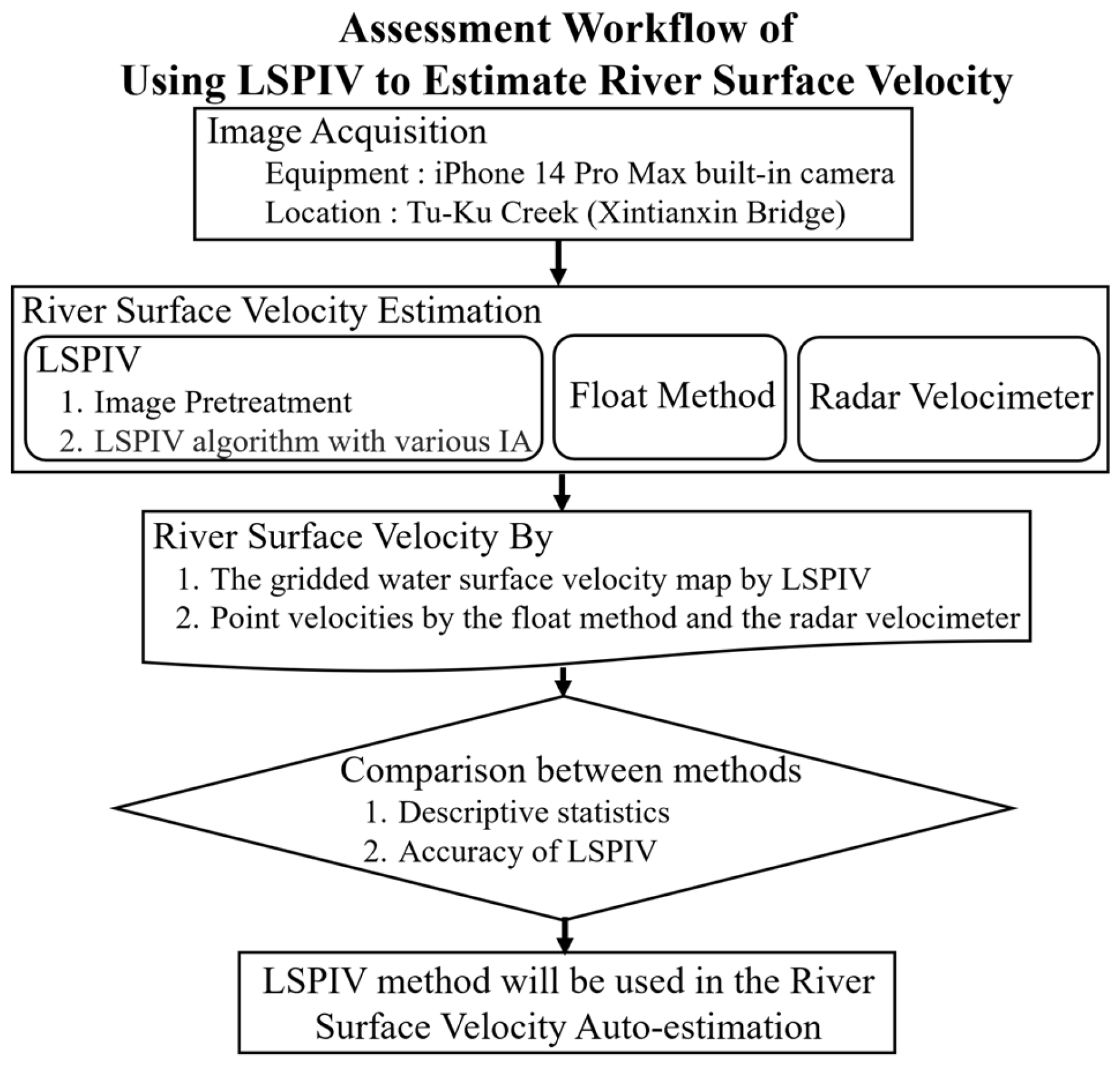
The assessment workflow of using LSPIV to estimate river surface velocity was summarized in
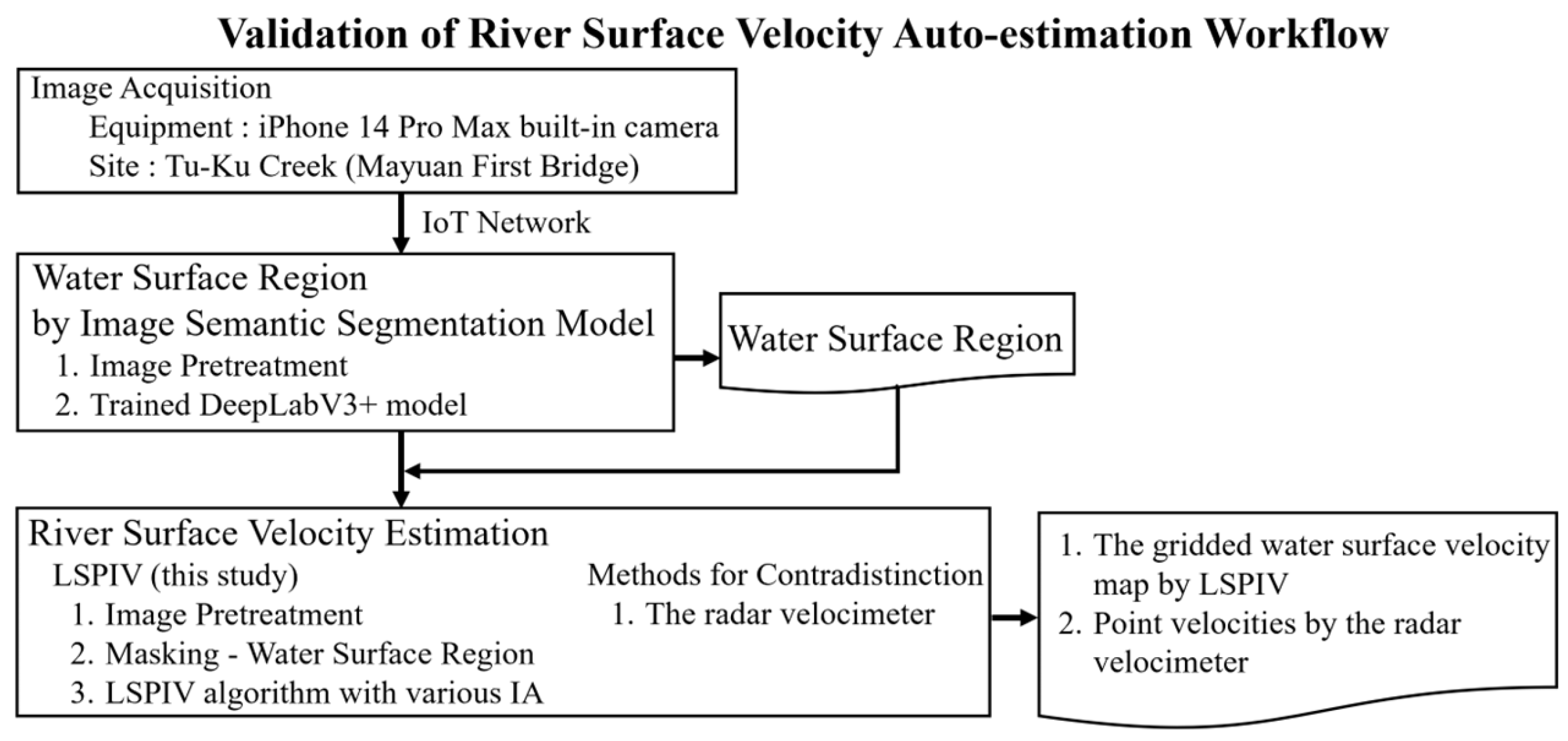
Figure 5. The validation of river surface velocity auto-estimation workflow was summarized in
Figure 6.
Image Pretreatment
For each recording site, a 5 s video segment was captured at 30 frames per second (fps), resulting in a total of 150 original frames from site B in
Figure 2. The slight camera vibration and residual frame jitter were mitigated using the Lucas–Kanade optical flow method [
30], which was employed to perform feature point tracking and image stabilization. This technique effectively reduced motion artifacts and ensured temporal consistency across the frame sequence.
Because varying outdoor illumination could negatively affect subsequent image analysis, a min–max normalization procedure
was applied for illumination correction. This step enhanced image contrast and improved the visibility of surface feature points.
All stabilized images were then georeferenced, coordinate transformed, and orthorectified [
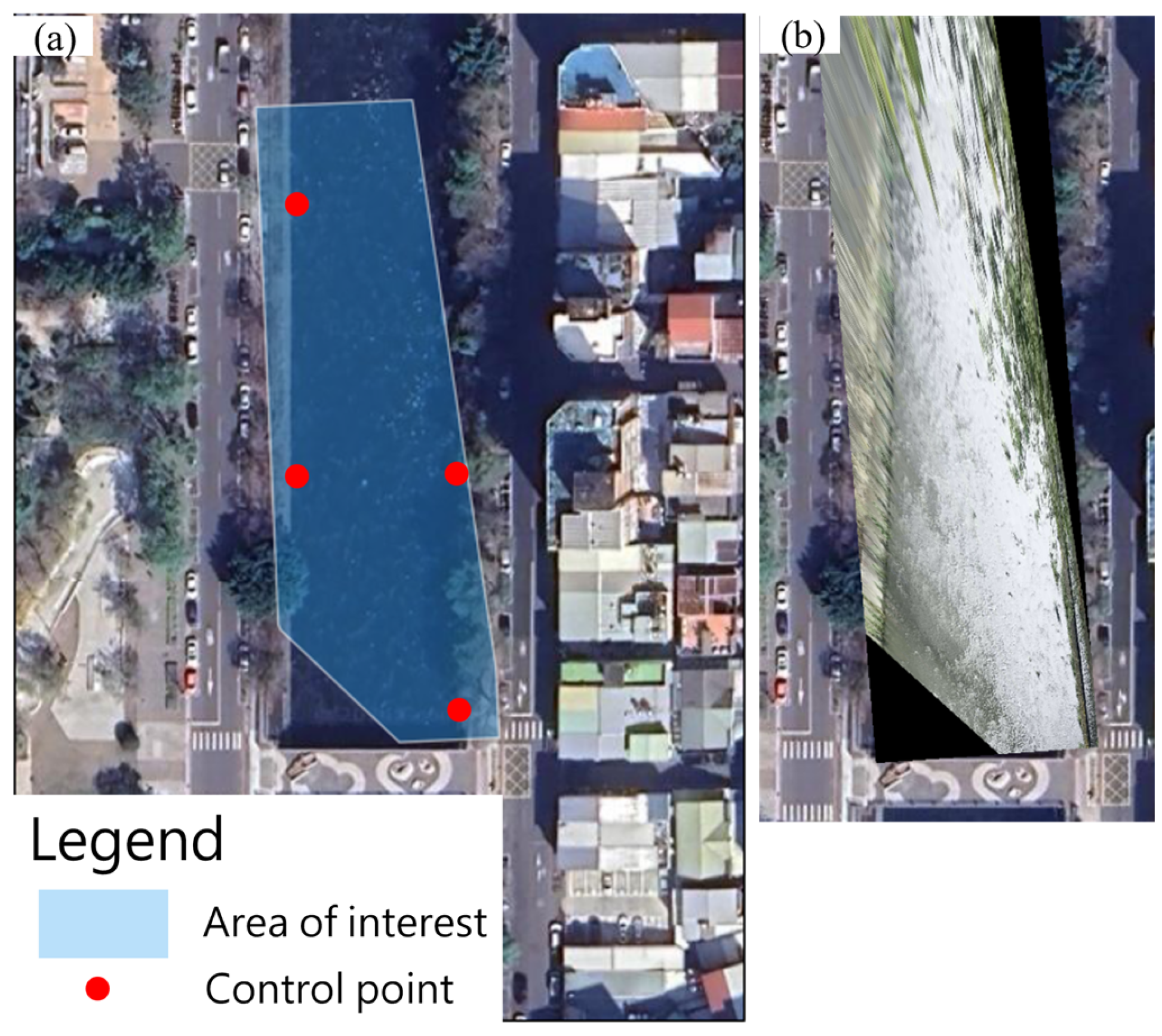
31] using four ground control points (GCPs) (
Figure 7) combined with the latitude and longitude coordinates from the smartphone’s built-in Inertial Measurement Unit (IMU) data and Google Maps. The camera’s pitch, roll, and heading angles, along with GPS-derived latitude and longitude, were used to establish accurate spatial positioning. Subsequently, the RANSAC (random sample consensus) algorithm [
32] was applied to refine the image alignment and remove outlier matches, resulting in geometrically corrected orthophotos suitable for flow field analysis.
Gridding Field of Surface Velocity
The preprocessed image sequences were analyzed using traditional large-scale particle image velocimetry (LSPIV) [
15,
33]. Each image was divided into square grids defined by the interrogation area (IA) size with 50% overlap range and 0.02 m in resolution for one pixel, which also determined the searching area (SA) for feature matching between consecutive frames.
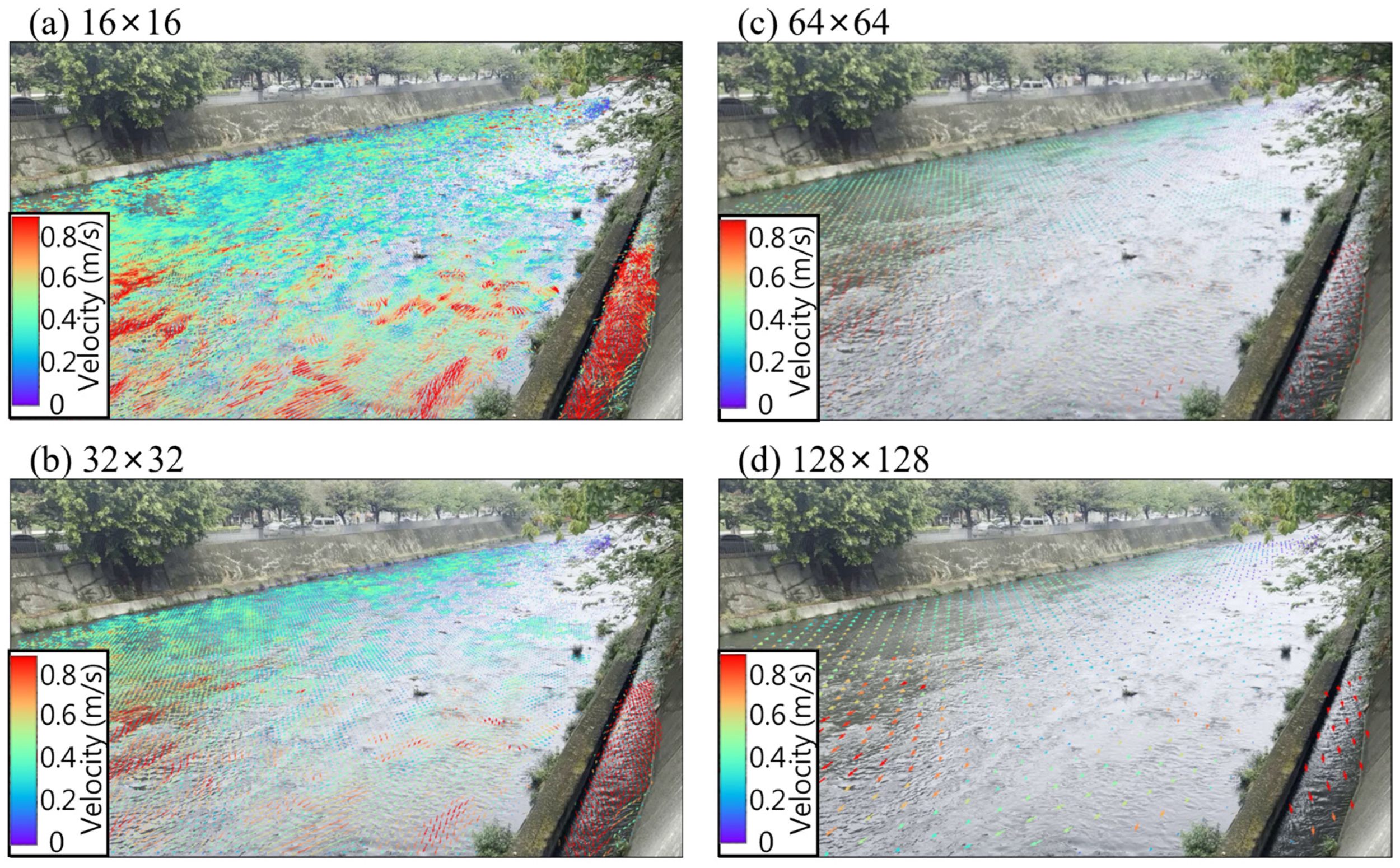
Within each IA–SA pair, the algorithm computed the cross-correlation of pixel intensity patterns to identify the most probable displacement of surface features, thereby estimating the surface velocity vector for each grid cell. The resulting vectors were then assembled to construct the two-dimensional surface velocity field of the river. For visualization, color maps were generated in which different colors represented varying flow velocities across the water surface. To investigate the efficiency of grid resolution on velocity estimation accuracy, four IA (the same with SA) configurations—16 × 16, 32 × 32, 64 × 64, and 128 × 128 pixels—were tested and compared. This analysis aimed to evaluate the influence of the IA size on local velocity estimation and to determine the optimal interrogation and searching area configuration that balances computational efficiency and flow field accuracy.
2.3.2. Float Method
A 3 m-long measuring tape (
Figure 8) was placed in the same selected river section at site B (
Figure 2 and
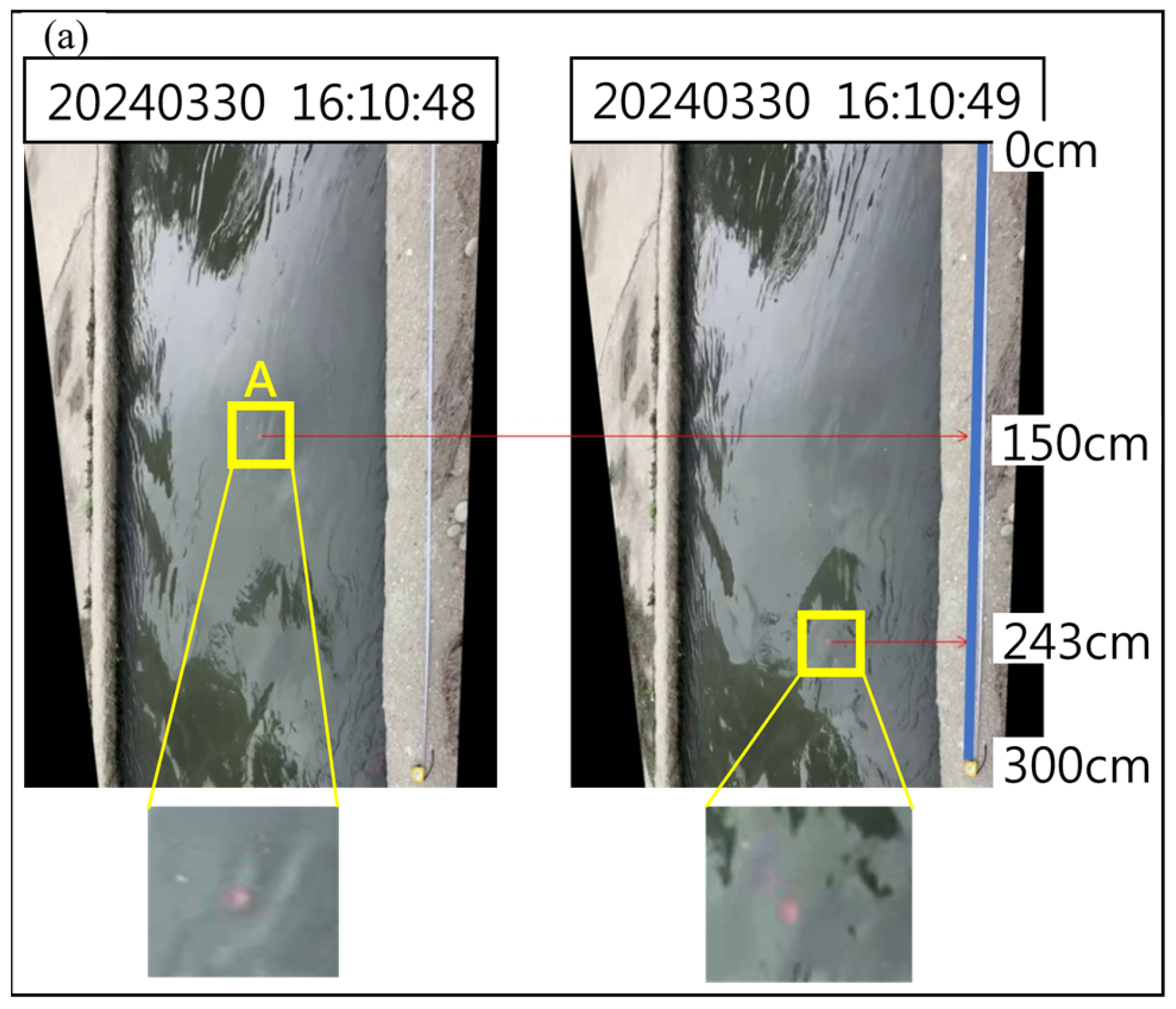
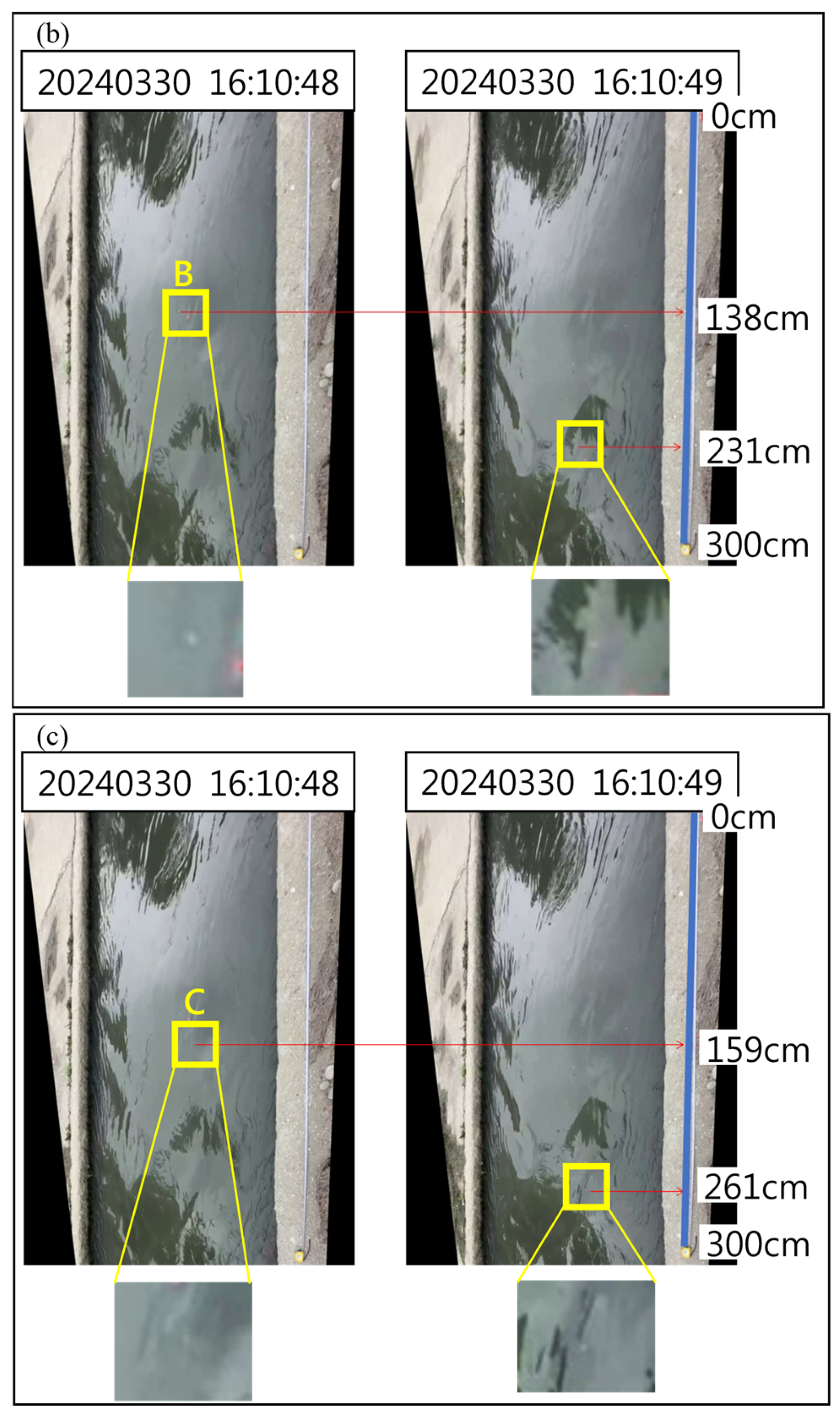
Figure 3(b2)) to facilitate the subsequent calculation of the float’s movement distance. One second of the image was taken and converted to thirty frames for the float method. Each frame of image was preprocessed as described in the Image Pretreatment section before the calculation of surface velocity. The movement distances of three small substances, A, B, and C (
Figure 8a–c), in the image were compared to calculate the surface velocity.
2.3.3. The Radar Velocimeter
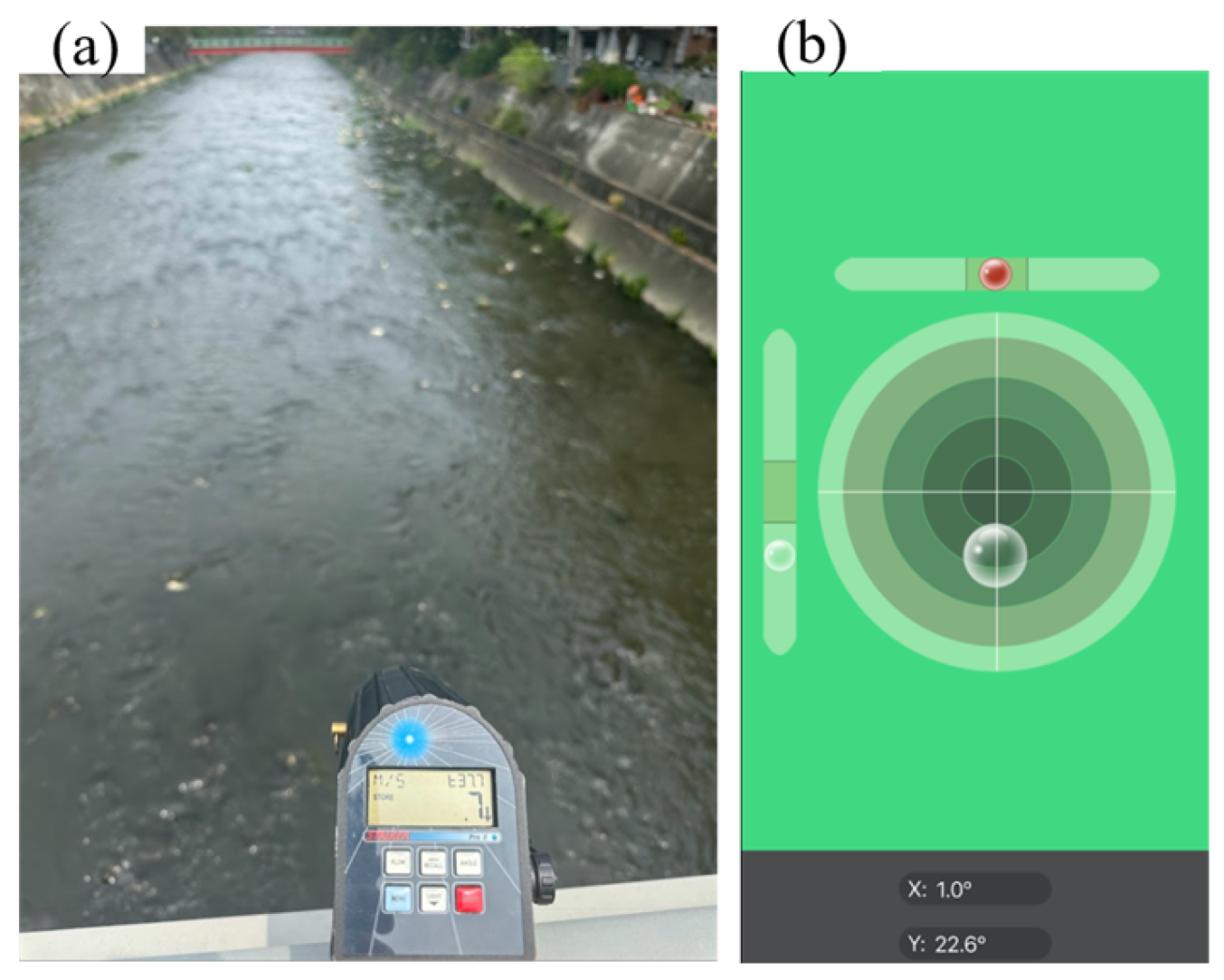
This study used a portable radar velocimeter, model Stalker Pro II SVR (
Figure 9), with a measuring range of 0.2–18.0 m/s and an accuracy of ±0.1 m/s. It is a small Doppler radar velocimeter that uses the emitted microwaves in 34.7 GHz (Ka-Band) ±50 MHz and the Doppler effect to calculate the speed of an object.
The velocimeter was mounted on a tripod, with the radar emission angle at a 30 degree angle to the river surface. Calibration was achieved through the adjustment of internal settings (
Figure 9b). The radar detection range coincided with positions in the float method in the test experiment, and three points were measured in the experiment for validation. Because the radar velocimeter has the officially approved measuring range and accuracy, it is a widely accepted tool for flow velocity measurement [
16,
34]. Furthermore, there was no rainfall in the area on the image acquisition day. The results from the radar velocimeter were used as ground truth values to evaluate the result of LSPIV in this study.
3. Results
3.1. The Applicability of Water Surface Segmentation Methods
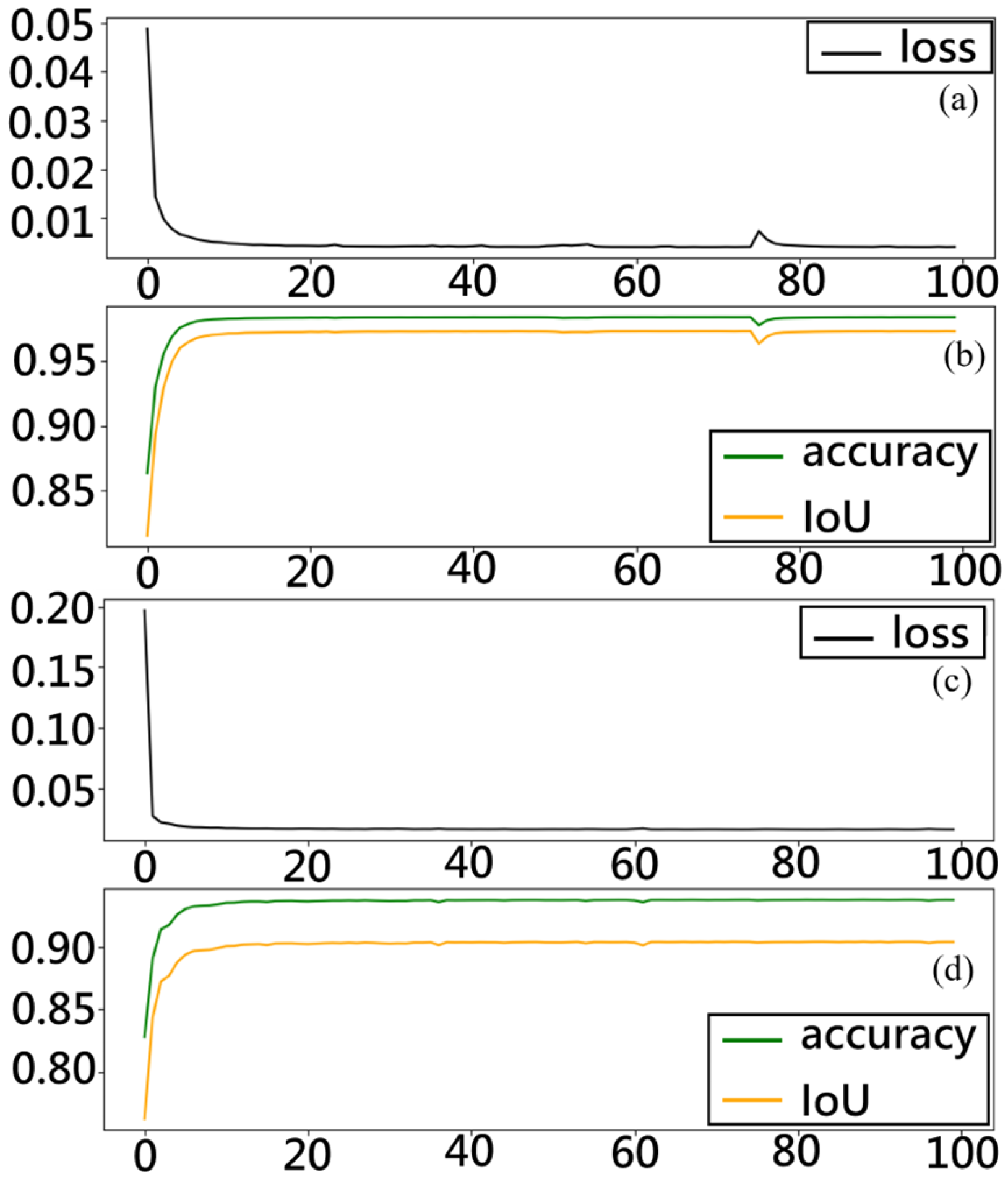
The segmentation results obtained through these three methods were compared to evaluate their relative performance. First, two deep learning models were trained using the same image samples to ensure a consistent comparison. The training performance of DeepLabV3+ (
Figure 10a,b) and SERNet-Former (
Figure 10c,d) was assessed based on their loss function convergence, accuracy, and intersection over union (IoU) metrics. The results show that DeepLabV3+ exhibited faster convergence during training and achieved higher overall accuracy and IoU compared with SERNet-Former. These findings indicate that the DeepLabV3+ architecture demonstrates better learning efficiency and is more suitable for water surface segmentation tasks in this study.
Segmentation performance of the frame difference method, DeepLabV3+, and SERNet-Former models was evaluated using the mean pixel accuracy (MPA/PA) and mean intersection over union (MIoU) metrics (as summarized in
Table 2). As shown in
Table 2, the DeepLabV3+ model outperformed the other two methods at both sites across all evaluation indicators. This superior performance demonstrates that DeepLabV3+ is more capable of capturing the complex spatial characteristics of the water–land boundary and of generating finer and more continuous water surface delineations. Accordingly, DeepLabV3+ was selected as the water surface segmentation model for the automated surface velocity measurement framework developed in this study.
3.2. The Applicability of LSPIV
River surface velocity measurements were first conducted as the test at site B (
Figure 2). Three methods: the float method, the radar velocimeter, and LSPIV, were used to estimate river surface velocity. Because both the float and radar methods provide point-based measurements, whereas LSPIV yields a spatially distributed velocity field across the entire river surface in the image, the grid cells corresponding to measurement points of the float method and the radar velocimeter on the river surface were extracted from the LSPIV velocity map for comparison. The results are summarized in
Table 3. As shown in
Table 3, the maximum, minimum, and mean surface velocities measured by the three methods exhibited differences smaller than the radar velocimeter’s measurement uncertainty (0.1 m s
−1), indicating the consistency among all methods.
Further analysis of the mean absolute percentage error (MAPE) was conducted to evaluate discrepancies of results between three methods. The LSPIV-derived results yielded a MAPE of 4.66%, while radar velocimeter measurements were used as the ground truth, corresponding to an absolute difference of 0.04 m s−1. Similarly, the LSPIV results produced a MAPE of 4.1% while the results of the float method were used as the reference, and the absolute difference was 0.04 m s−1. Both error values fall within the radar velocimeter’s uncertainty range (±0.1 m s−1), demonstrating that LSPIV provides accurate and reliable estimates of surface velocities and can therefore be considered a valid and effective technique for surface flow measurements.
3.3. Validation of River Surface Velocity Measurements
Following the preliminary surface velocity measurements, a validation experiment was conducted at site C (
Figure 2) to verify the feasibility and accuracy of LSPIV in study sites.
In this validation experiment, results obtained through radar velocimeter measurements were used as the ground truth value, and measurements obtained through LSPIV at the same site were used for comparison and validation.
The average of surface velocity obtained through the radar velocimeter during the observation period was 0.76 m s
−1, as summarized in
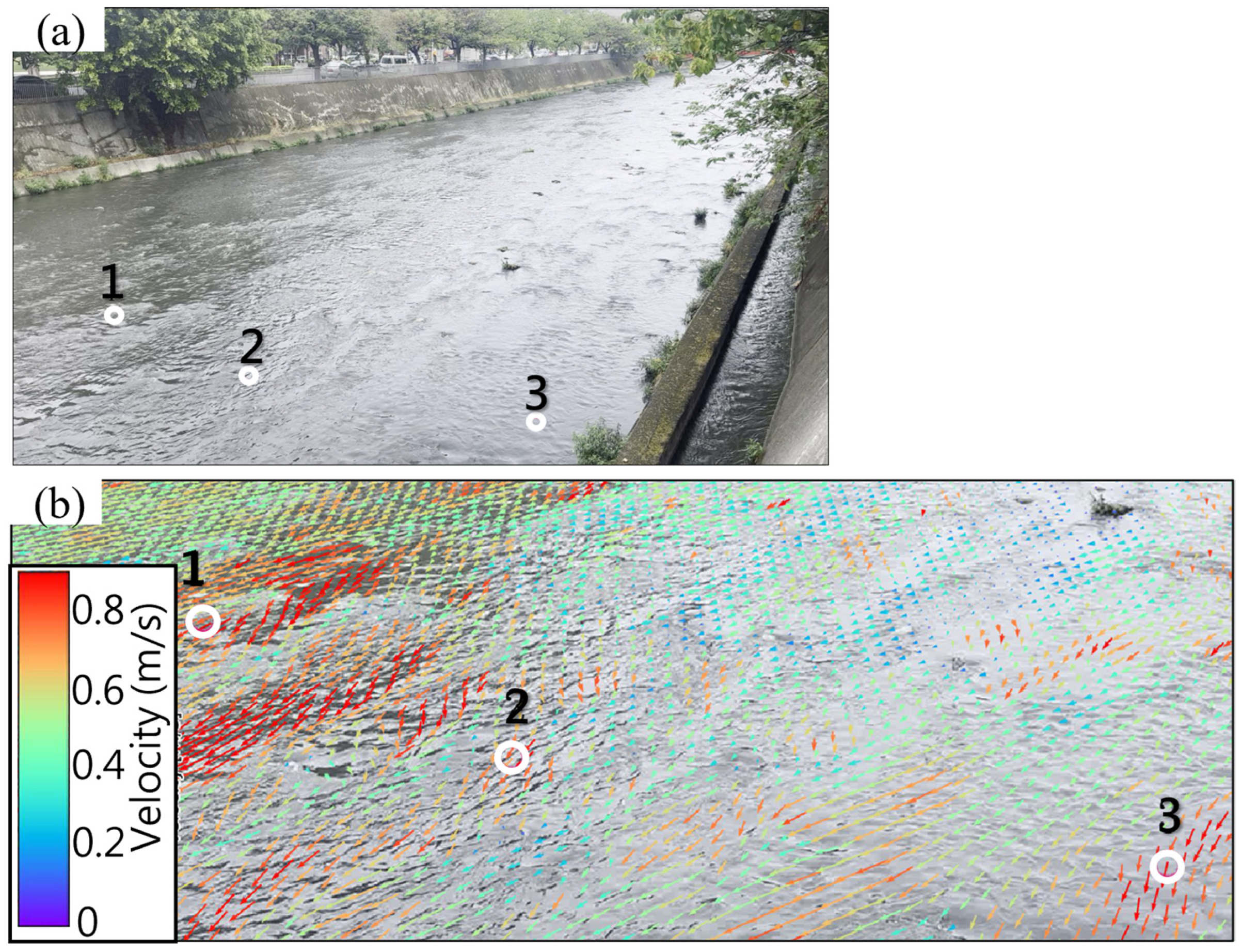
Table 4. For LSPIV analysis, the grid size in 32 × 32 pixels was selected as the interrogation area (IA), and the searching area (SA) was set to be identical to the IA. The water surface within each grid cell was analyzed to compute velocity vectors, and the resulting surface velocity field was visualized using a color-coded map, where different colors represented distinct flow velocities (as shown in
Figure 11b). For radar velocimeter validation, three measurement points were selected within the same channel section corresponding to the LSPIV observation area (as illustrated in
Figure 11a,b).
The comparison between the radar velocimeter and LSPIV results at corresponding positions presents consistency in
Figure 11 and
Table 4. These findings confirm that LSPIV provides stable and accurate surface velocity estimates, supporting its reliability and practical applicability for non-contact flow measurement in river environments.
4. Discussion
4.1. Applicability of Deep Learning Models for Water Surface Segmentation
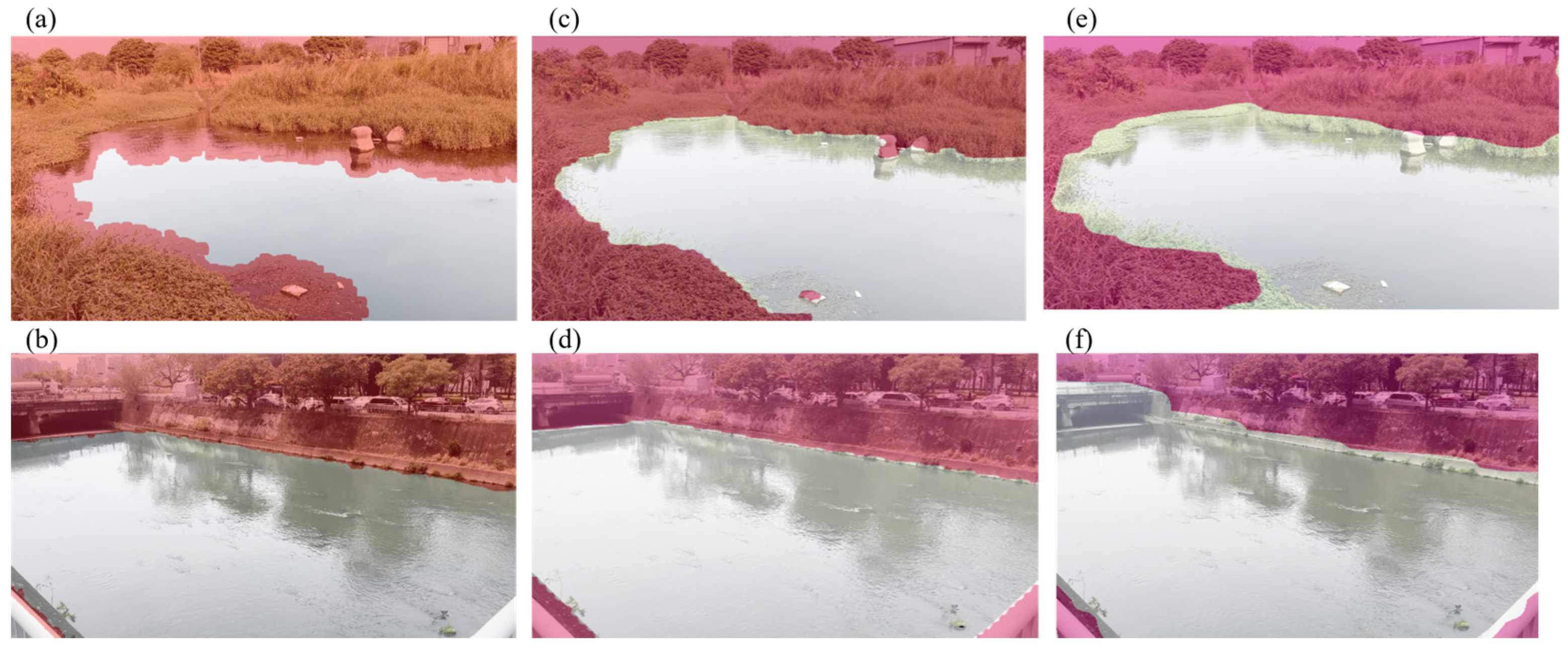
The comparative evaluation of three segmentation approaches demonstrates that DeepLabV3+ consistently outperformed both the traditional frame difference method and the SERNet-Former model across all metrics and sites. As shown in
Figure 10 and
Table 2, DeepLabV3+ achieved the highest PA and MIoU, indicating superior pixelwise classification accuracy and stronger spatial coherence in delineating water–land boundaries. Furthermore, the model generated contours that more closely matched the manually annotated masks, reinforcing its suitability for hydrological imagery.
The model’s robustness was particularly evident at the natural levee channel (site A in
Figure 2 and
Figure 3a), where complex textures, irregular reflections, and vegetation commonly interfere with traditional segmentation. The frame difference method misclassified reflective water surfaces as land (
Figure 12a), while DeepLabV3+ successfully learned the reflectance and surface pattern characteristics, enabling effective adaptation to rapidly changing flow conditions (
Figure 12c).
Although SERNet-Former has shown competitive performance on large, diverse datasets such as PASCAL-Context [
29], its advantages did not transfer to this single-class, domain-specific task. Its self-attention architecture [
35], designed to aggregate semantically related regions in multi-class environments, appears less effective for binary segmentation of hydrological surfaces. The additional computational complexity associated with self-attention may introduce unnecessary noise and reduce segmentation precision. In contrast, the simpler, yet well-optimized encoder–decoder design of DeepLabV3+ [
28], with its atrous spatial pyramid pooling and multi-scale receptive field, proved more effective and stable for water surface delineation [
21]. Furthermore, DeepLabV3+ has been successfully implemented in various remote water body identification tasks, such as satellite imagery analysis [
21,
36]. Recent studies have also demonstrated its superior performance in detecting urban waterlogging and inundation [
37]. Moreover, optimization methods have been developed to maintain high segmentation accuracy under adverse weather conditions, including rain, fog, and snow, which typically degrade image quality [
38].
Given these findings, DeepLabV3+ was selected as the preferred method for the subsequent LSPIV-based flow velocity estimation pipeline.
4.2. Optimization of the LSPIV Workflow
Two strategies were investigated to enhance the accuracy and operational efficiency of the LSPIV-based surface velocity estimation. The first approach examined the effect of varying the interrogation area (IA) size on both the accuracy and computational efficiency of velocity estimation. The second optimization strategy integrated the DeepLabV3+ model, trained in the previous stage for water surface segmentation, as a masking step prior to LSPIV processing. The resulting velocity vector fields were analyzed to assess the effect of masking on flow direction and velocities, enabling a more accurate interpretation of the river surface flow field.
4.2.1. Influence of Interrogation Area Size
Table 5 summarizes the preliminary statistical results of the LSPIV-derived surface velocity fields obtained using different IA sizes. The overall mean surface velocities estimated from the four IA configurations were comparable, but the spatial variability of the gridded velocities varied, with RAD (relative mean deviation) exceeding 50% in all cases. This phenomenon may be due to the slower upstream flow rate or due to grids being too far away from the camera for it to capture flow features well due to the resolution. The analysis of four IA configurations shows that IA size substantially affects both spatial detail and computational cost. Smaller IA windows provide finer spatial resolution but suffer from insufficient texture information [
39,
40], yielding unstable velocity vectors and increased noise. In contrast, large IA windows smooth out localized flow variations and reduce computation time but risk oversimplifying the velocity field.
This trend is visually evident in
Figure 13a–d. Grids displaying higher velocities (red regions) in
Figure 13a,b appear as medium or low velocities (blue–green regions) in
Figure 13c,d while larger IA sizes are used. For example, at position 3 in
Figure 11 and
Table 4 with the IA = 32 × 32 configuration produced a high-velocity vector (red) consistent with the radar velocimeter measurements. However, whereas in
Figure 13c,d, using larger IA sizes, this same region no longer exhibited a high-velocity signal.
These findings indicate that the IA = 32 × 32 configuration provided the best balance: it achieved the lowest standard deviation, maintained physically realistic velocity gradients, and reduced the computation time by 44% relative to IA = 16 × 16 while preserving flow field fidelity. This confirms that IA selection is critical for retaining hydraulic detail while ensuring computational feasibility for future real-time applications.
4.2.2. Effect of Water Surface Masking for LSPIV
Water surface segmentation obtained through the DeepLabV3+ model was incorporated as a mask into the LSPIV workflow to ensure that velocity estimation was performed only within water surface pixels. The optimized IA = 32 × 32 configuration was used to quantify surface flow velocity, direction, and spatial distribution of the velocity field.
In this validation case, 17,332 grids remained valid after masking (
Table 6). The dominant flow directions—south, southeast, and southwest—accounted for 78% of valid grids and exhibited the highest mean and maximum velocities, consistent with the expected downstream flow pattern. Transverse directions (east and west), representing 13% of grids, displayed lower mean velocities. Grids classified as counterflow were predominantly located near the water–land interface or around in-stream obstacles or vegetation. Such areas commonly feature turbulence, secondary circulation, and shear-induced velocity fluctuations, and therefore exhibit reduced or reversed surface velocities [
14,
18,
41,
42].
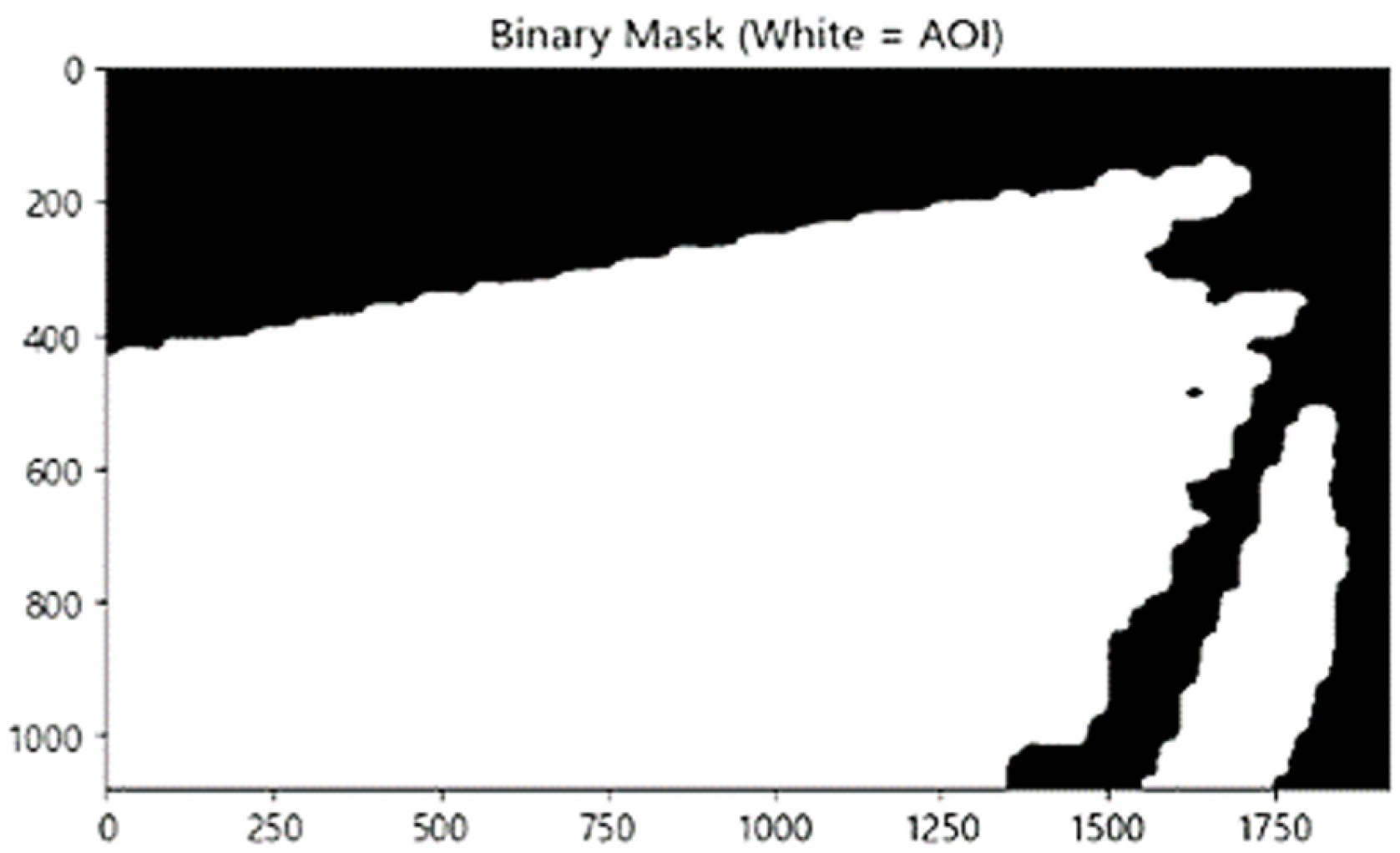
Masked-out pixels and related grids (
Figure 14;
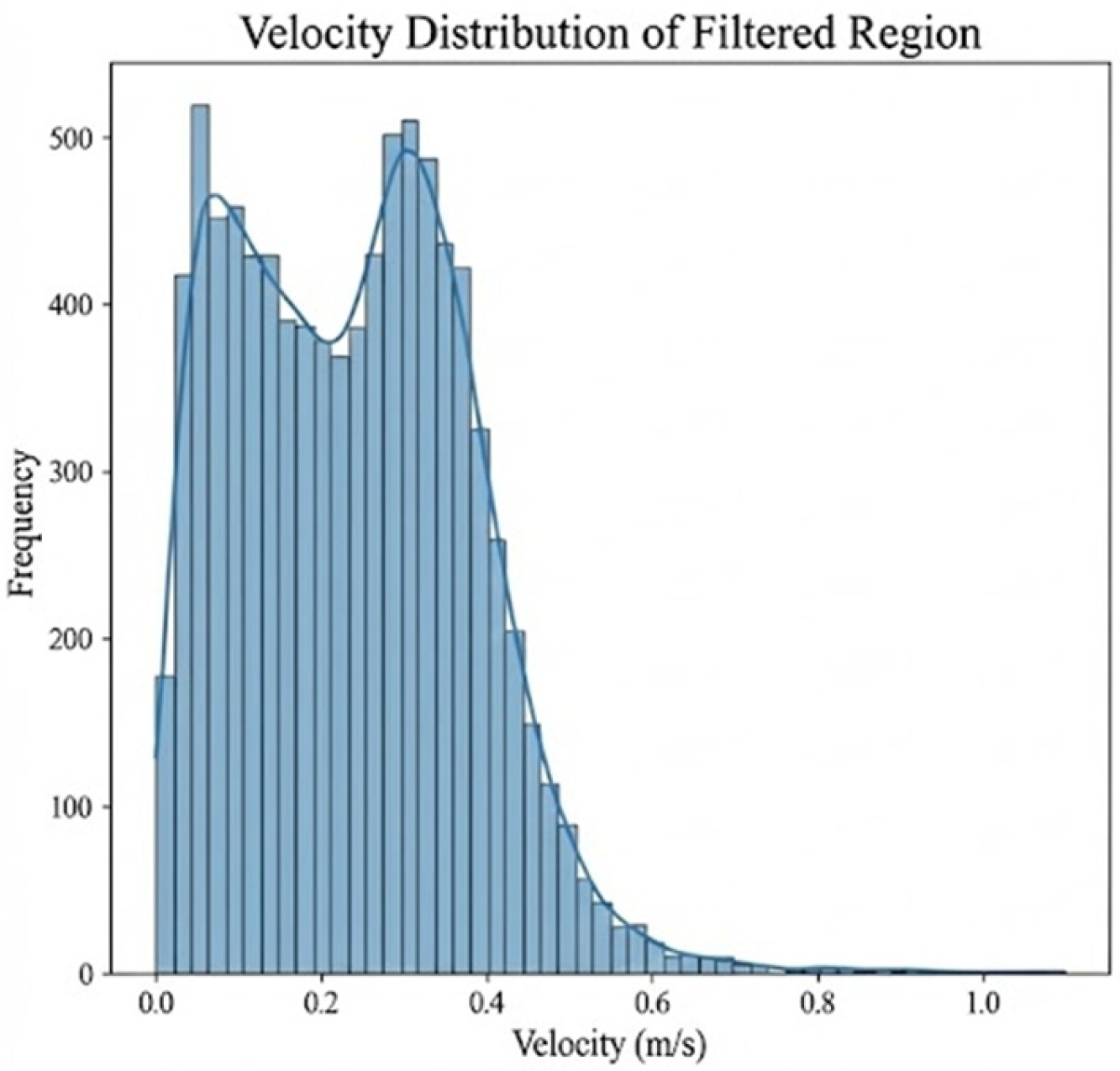
Table 7) were primarily concentrated along banks, shadowed regions, and obstacle-affected zones. Approximately 46% of these grids displayed non-dominant flow directions and low mean velocities. The analysis of velocity distribution reveals bimodal character (
Figure 15): one low-velocity peak at approximately 0.06 m/s and the other moderate-velocity peak at ~0.3 m/s. While the low-velocity peak is primarily attributed to near-bank pixel interference or boundary shear friction, and the moderate-velocity peak is primarily attributed to disturbances from obstacles or vegetation [
43], quantifying the relative influence of each factor remains a significant challenge. Traditional experimental methodologies—specifically comparing controlled laboratory settings with complex outdoor environments—are insufficient to accurately simulate, control, and disentangle variables inherent in natural river systems for the surface velocity, even the discharge estimation [
43,
44].
These results indicate that deep learning-based masking helps remove regions that naturally contribute to underestimation in the LSPIV due to the pixel confusion between water and non-water surface. The river surface velocity field after masking exhibited a 7% increase in mean velocity compared with the unmasked results (
Table 8), while the 2–6% accuracy range was observed in the validation experiments (
Table 4), which was consistent with the typical uncertainty reported for well-calibrated LSPIV applications (≈3.5%) [
14,
45]. This indicates that the inclusion of non-water pixels decreased the mean values, highlighting how unmasked calculations are prone to a downward bias caused by non-water elements.
Nevertheless, 22% of the valid post-masking grids still exhibited non-dominant flow directions. Long-term monitoring is needed to determine whether these reverse-flow grids represent (1) persistent hydraulic features or (2) transient artifacts due to imaging conditions or camera angle. Once sufficient temporal evidence is obtained, such grids (or pixels) can be incorporated into adaptive masking or weighting schemes for further performance improvement. Further refinements are essential for the broader generalization of this study toward real-time operations. These include: (1) the incorporation of multi-contextual imagery to evaluate the generalizability of the DeepLabV3+ architecture; (2) the establishment of multi-site ground truth data to substantiate the method’s accuracy; and (3) the allocation of substantial computing power for model training and real-time identification. Beyond ongoing data collection, we aim to alleviate these constraints by securing additional external resources and enhancing algorithmic efficiency, thereby paving the way for a more robust and scalable monitoring system.
5. Conclusions
This study developed and evaluated an integrated workflow that combines deep learning-based water surface segmentation with large-scale particle image velocimetry (LSPIV) to improve non-contact river surface velocity estimation using consumer-grade mobile imaging. Field experiments were conducted in Taichung City, Taiwan, to assess segmentation performance at natural levee and engineered levee river channels, optimize LSPIV parameters, and validate surface-velocity measurements against radar velocimetry at engineered river channels.
Three water surface segmentation approaches—the traditional frame difference method, DeepLabV3+ model, and SERNet-Former model—were compared using MPA/PA and MIoU metrics. DeepLabV3+ consistently yielded the highest accuracy at both study sites, demonstrating strong capability in identifying complex water–land boundaries, particularly in areas with reflections, vegetation, and irregular textures. Accordingly, DeepLabV3+ was selected to generate water surface masks for LSPIV processing.
The optimization of the LSPIV workflow showed that the interrogation area (IA) size plays a crucial role in balancing spatial detail, noise levels, and computational efficiency. Among the IA sizes tested, IA = 32 × 32 pixels provided the best trade-off, yielding the lowest variability in computed velocities while reducing runtime by approximately 44% compared with the smallest IA in this study.
Integrating the DeepLabV3+-derived water mask into LSPIV improved flow field reliability by removing pixels of non-water surface near riverbanks and obstacles—areas prone to lowering the estimation in conventional LSPIV. The implementation of water surface masking resulted in a 7% increase in the calculated mean surface velocity. Validation against radar velocimeter benchmarks yielded a MAPE of ≤6%, falling within the typical uncertainty range for well-calibrated LSPIV applications. These results confirm the accuracy and robustness of the proposed integrated framework.
Overall, the findings demonstrate that combining deep learning segmentation with LSPIV enhances both the stability and accuracy of optical surface velocity measurements. The use of a smartphone-based imaging system further highlights the method’s practicality, low cost, and scalability. This integrated framework provides a promising foundation for future real-time hydrological monitoring, urban flood risk management, and smart-city water resource applications.
Author Contributions
Conceptualization, Y.-M.F. and F.-J.C.; data curation, F.-J.C.; formal analysis, Y.-M.F. and F.-J.C.; investigation, F.-J.C.; methodology, Y.-M.F. and F.-J.C.; project administration, Y.-M.F.; software, F.-J.C.; supervision, T.-Y.C.; validation, F.-J.C.; visualization, Y.-M.F. and F.-J.C.; writing—original draft, Y.-M.F. and F.-J.C.; writing—review and editing, Y.-M.F. and T.-Y.C. All authors have read and agreed to the published version of the manuscript.
Funding
This research received no external funding.
Data Availability Statement
The datasets generated and analyzed during this study are available from the corresponding author on reasonable request.
Conflicts of Interest
The authors declare no conflicts of interest. The funders had no role in the design of the study; in the collection, analyses, or interpretation of data; in the writing of the manuscript; or in the decision to publish the results.
References
- Tsai, F.; Hwang, J.H.; Chen, L.C.; Lin, T.H. Post-disaster assessment of landslides in southern Taiwan after 2009 Typhoon Morakot using remote sensing and spatial analysis. Nat. Hazards Earth Syst. Sci. 2010, 10, 2179–2190. [Google Scholar] [CrossRef]
- Fang, Y.M.; Chou, T.Y.; Hoang, T.V.; Bui, Q.T.; Nguyen, B.D.; Nguyen, Q.H. New Landslide Disaster Monitoring System: Case Study of Pingding Village. Appl. Sci. 2020, 10, 6718. [Google Scholar] [CrossRef]
- Chen, Y.R.; Yeh, C.H.; Yu, B. Integrated application of the analytic hierarchy process and the geographic information system for flood risk assessment and flood plain management in Taiwan. Nat. Hazards 2011, 59, 1261–1276. [Google Scholar] [CrossRef]
- Hsu, T.W.; Shih, D.S.; Li, C.Y.; Lan, Y.J.; Lin, Y.C. A Study on Coastal Flooding and Risk Assessment under Climate Change in the Mid-Western Coast of Taiwan. Water 2017, 9, 390. [Google Scholar] [CrossRef]
- Shih, D.S.; Shih, S.S.; Hsu, S.M.; Lin, S.Y.; Lin, Y.; Hung, C.T.; Wang, K. A framework for the sustainable risk assessment of in-river hydraulic structures: A case study of Taiwan’s Daan River. J. Hydrol. 2023, 617, 129028. [Google Scholar] [CrossRef]
- Hsu, C.C.; Lin, Y.P. Incorporating long-term numerical weather forecasts to quantify dynamic vulnerability of irrigation supply system: A case study of Shihmen Reservoir in Taiwan. Agric. Water Manag. 2024, 306, 109178. [Google Scholar] [CrossRef]
- Yang, S.H.; Hsieh, S.L.; Wang, X.J.; Chang, D.L.; Wei, S.T.; Song, D.R.; Pan, J.H.; Yeh, K.C. Adaptive Pluvial Flood Disaster Management in Taiwan: Infrastructure and IoT Technologies. Water 2025, 17, 2269. [Google Scholar] [CrossRef]
- Hannah, D.M.; Demuth, S.; van Lanen, H.A.J.; Looser, U.; Prudhomme, C.; Rees, G.; Stahl, K.; Tallaksen, L.M. Large-scale river flow archives: Importance, current status and future needs. Hydrol. Process. 2011, 25, 1191–1200. [Google Scholar] [CrossRef]
- Huang, K.; Chen, H.; Xiang, T.; Lin, Y.; Liu, B.; Wang, J.; Liu, D.; Xu, C.Y. A photogrammetry-based variational optimization method for river surface velocity measurement. J. Hydrol. 2022, 605, 127240. [Google Scholar] [CrossRef]
- Lin, Y.C.; Ho, H.C.; Lee, T.A.; Chen, H.Y. Application of Image Technique to Obtain Surface Velocity and Bed Elevation in Open-Channel Flow. Water 2022, 14, 1895. [Google Scholar] [CrossRef]
- He, C.Y.; Xu, Q.; Ju, N.P. Research on Key Technologies of Debris Flow Real-time Monitoring and Early Warning System. J. Comput. 2021, 32, 1–13. [Google Scholar]
- Ran, Q.; Li, W.; Liao, Q.; Tang, H.; Wang, M. Application of an automated LSPIV system in a mountainous stream for continuous flood flow measurements. Hydrol. Process. 2016, 30, 3014–3029. [Google Scholar] [CrossRef]
- Fujita, I.; Muste, M.; Kruger, A. Large-scale particle image velocimetry for flow analysis in hydraulic engineering applications. J. Hydraul. Res. 1998, 36, 397–414. [Google Scholar] [CrossRef]
- Muste, M.; Fujita, I.; Hauet, A. Large-scale particle image velocimetry for measurements in riverine environments. Water Resour. Res. 2008, 44, W00D19. [Google Scholar] [CrossRef]
- Tauro, F. Particle tracers and image analysis for surface flow observations. WIREs Water 2016, 3, 25–39. [Google Scholar] [CrossRef]
- Huang, W.C.; Young, C.C.; Liu, W.C. Application of an automated discharge imaging system and LSPIV during typhoon events in Taiwan. Water 2018, 10, 280. [Google Scholar] [CrossRef]
- Kim, Y. Uncertainty Analysis for Non-Intrusive Measurement of River Discharge Using Image Velocimetry. Ph.D. Thesis, University of Iowa, Iowa City, IA, USA, 2006. [Google Scholar]
- Tauro, F.; Piscopia, R.; Grimaldi, S. Streamflow observations from cameras: Large-scale particle image velocimetry or particle tracking velocimetry? Water Resour. Res. 2017, 53, 10374–10394. [Google Scholar] [CrossRef]
- Yang, T.; Liu, Z.; Chen, Y.; Yu, Y. Real-Time, Inexpensive, and Portable Measurement of Water Surface Velocity through Smartphone. Water 2020, 12, 3358. [Google Scholar] [CrossRef]
- Lüthi, B.; Philippe TPeña-Haro, S. Mobile Device App for Small Open-Channel Flow Measurement. In Proceedings of the 7th International Congress on Environmental Modelling and Software, San Diego, CA, USA, 15–19 June 2014. [Google Scholar]
- Sun, D.; Gao, G.; Huang, L.; Liu, Y.; Liu, D. Extraction of water bodies from high-resolution remote sensing imagery based on a deep semantic segmentation network. Sci. Rep. 2024, 14, 14604. [Google Scholar] [CrossRef]
- Liu, R.; He, D.; Li, N.; Pu, X.; Jin, J.; Wang, J. Estimation of River Velocity and Discharge Based on Video Images and Deep Learning. Appl. Sci. 2025, 15, 4865. [Google Scholar] [CrossRef]
- Tlhomole, J.B.; Hughes, G.O.; Zhang, M.; Piggott, M.D. From PIV to LSPIV: Harnessing deep learning for environmental flow velocimetry. J. Hydrol. 2025, 649, 132446. [Google Scholar] [CrossRef]
- Chien, F.J.; Fang, Y.M.; Chou, T.Y. The Study on Image-based water level recognition by using Deep Learning. Int. J. Latest Eng. Res. Appl. 2023, 8, 14–17. [Google Scholar]
- Wang, Y.; Li, W.; Zhou, Z.; Wu, N. Coastline Identification with ASSA-Resnet Based Segmentation for Marine Navigation. Appl. Sci. 2025, 15, 9113. [Google Scholar] [CrossRef]
- Li, R.X. Integrating SLAM and BIM for Hydraulic Numerical Simulation—Fazixi Waterfront Corridor Reach as Example (in Mandarin). Ph.D. Thesis, Feng Chia University, Taichung, Taiwan, 2022. [Google Scholar]
- Water Resources Bureau of Taichung City Government. Overall Plan Work Plan for Liuchuan Phase II Water Environment Improvement Project; Water Resources Agency, MOEA: Taipei, Taiwan, 2017. (In Mandarin)
- Chen, L.C.; Zhu, Y.; Papandreou, G.; Schroff, F.; Adam, H. Encoder-Decoder with Atrous Separable Convolution for Semantic Image Segmentation. arXiv 2018, arXiv:1802.02611. [Google Scholar] [CrossRef]
- Erişen, S. SERNet-Former: Semantic enhancement residual network with transformer for semantic segmentation. arXiv 2024, arXiv:2401.15741. [Google Scholar]
- Lucas, B.D.; Kanade, T. An iterative image registration technique with an application to stereo vision. In Proceedings of the IJCAI’81: 7th International Joint Conference on Artificial Intelligence, Vancouver, BC, Canada, 24–28 August 1981. [Google Scholar]
- Camera Configurations. Available online: https://localdevices.github.io/pyorc/user-guide/camera_config/index.html (accessed on 17 December 2025).
- Fischler, M.A.; Bolles, R.C. Random Sample Consensus: A Paradigm for Model Fitting with Applications to Image Analysis and Automated Cartography. Commun. ACM 1981, 24, 381–395. [Google Scholar] [CrossRef]
- Welcome to pyOpenRiverCam’s Documentation! Available online: https://localdevices.github.io/pyorc/ (accessed on 17 December 2025).
- Tamari, S.; García, F.; Arciniega-Ambrocio, J.I.; Porter, A. Testing a handheld radar to measure water velocity at the surface of channels. Houille Blanche 2014, 100, 30–36. [Google Scholar] [CrossRef]
- Guo, M.H.; Liu, Z.N.; Mu, T.J.; Hu, S.M. Beyond self-attention: External attention using two linear layers for visual tasks. IEEE Trans. Pattern Anal. Mach. Intell. 2023, 45, 5436–5447. [Google Scholar] [CrossRef]
- Li, Z.; Wang, R.; Zhang, W.; Hu, F.; Meng, L. Multiscale Features Supported DeepLabV3+ Optimization Scheme for Accurate Water Semantic Segmentation. IEEE Access 2019, 7, 155787–155804. [Google Scholar]
- Zhao, J.; Wang, X.; Zhang, C.; Hu, J.; Wan, J.; Cheng, L.; Shi, S.; Zhu, X. Urban Waterlogging Monitoring and Recognition in Low-Light Scenarios Using Surveillance Videos and Deep Learning. Water 2025, 17, 707. [Google Scholar] [CrossRef]
- Kerim, A.; Chamone, F.; Ramos, W.; Marcolino, L.S.; Nascimento, E.R.; Jiang, R. Semantic Segmentation under Adverse Conditions: A Weather and Nighttime-aware Synthetic Data-based Approach. arXiv 2022, arXiv:2210.05626v1. [Google Scholar]
- Muste, M.; Hauet, A.; Fujita, I.; Legout, C.; Ho, H.C. Capabilities of Large-scale Particle Image Velocimetry to characterize shallow free-surface flows. Adv. Water Resour. 2014, 70, 160–171. [Google Scholar] [CrossRef]
- Fakhri, A.; Ettema, R.; Aliyari, F.; Nowroozpour, A. Large-Scale Particle Image Velocimetry for Estimating Vena-Contracta Width for Flow in Contracted Open Channels. Water 2021, 13, 31. [Google Scholar] [CrossRef]
- Fujita, I.; Muste, M. Development of space-time image velocimetry (STIV): A non-intrusive and efficient flood monitoring technique. Int. J. River Basin Manag. 2007, 5, 105–116. [Google Scholar] [CrossRef]
- Tsubaki, R.; Zhu, R. Optical Ortho-Rectification for Image-Based Stream Surface Flow Observations Using a Ground Camera. Front. Water 2021, 3, 700946. [Google Scholar] [CrossRef]
- Gunawan, B.; Sun, X.; Sterling, M.; Shiono, K.; Tsubaki, R.; Rameshwaran, P.; Knight, D.W.; Chandler, J.H.; Tang, X.; Fujita, I. The application of LS-PIV to a small irregular river for in bank and overbank flows. Flow Meas. Instrum. 2012, 24, 1–12. [Google Scholar] [CrossRef]
- Hauet, A.; Creutin, J.-D.; Belleudy, P. Sensitivity study of large-scale particle image velocimetry measurement of river discharge using numerical simulation. J. Hydrol. 2008, 349, 178–190. [Google Scholar] [CrossRef]
- Le Boursicaud, R.; Pénard, L.; Hauet, A.; Thollet, F.; Le Coz, J. Gauging extreme floods on YouTube: Application of LSPIV to home movies for the post-event determination of stream discharges. Hydrol. Process. 2016, 30, 90–105. [Google Scholar] [CrossRef]
Figure 1.
Low velocity grids (blue-color in the figure) with reverse flow direction near (a) riverbank and (b) obstacles.
Figure 1.
Low velocity grids (blue-color in the figure) with reverse flow direction near (a) riverbank and (b) obstacles.
Figure 2.
Satellite imagery of central Taichung City, Taiwan, featuring a superimposed water body sketch to illustrate the geospatial distribution of the experimental sites. (Source: Taichung City Government GIS Service.
https://gismap.taichung.gov.tw/address/ (accessed on 5 February 2026)).
Figure 2.
Satellite imagery of central Taichung City, Taiwan, featuring a superimposed water body sketch to illustrate the geospatial distribution of the experimental sites. (Source: Taichung City Government GIS Service.
https://gismap.taichung.gov.tw/address/ (accessed on 5 February 2026)).
Figure 3.
(a) Site A (natural levee channel): Fazi River (Xitun Road). (b1) Site B (engineered levee channel): Tu-Ku Creek (Xintianxin Bridge) in wet season. The length of the levee in the image is approximately 25 m. (b2) Site B (engineered levee channel): Tu-Ku Creek (Xintianxin Bridge) in dry season. (c) Site C (engineered levee channel): Tu-Ku Creek (Mayuan First Bridge). The length of the levee in the image is approximately 40 m.
Figure 3.
(a) Site A (natural levee channel): Fazi River (Xitun Road). (b1) Site B (engineered levee channel): Tu-Ku Creek (Xintianxin Bridge) in wet season. The length of the levee in the image is approximately 25 m. (b2) Site B (engineered levee channel): Tu-Ku Creek (Xintianxin Bridge) in dry season. (c) Site C (engineered levee channel): Tu-Ku Creek (Mayuan First Bridge). The length of the levee in the image is approximately 40 m.
Figure 4.
Workflow of water surface image segmentation.
Figure 4.
Workflow of water surface image segmentation.
Figure 5.
Workflow assessment of using LSPIV to estimate river surface velocity.
Figure 5.
Workflow assessment of using LSPIV to estimate river surface velocity.
Figure 6.
Validation of river surface velocity auto-estimation workflow.
Figure 6.
Validation of river surface velocity auto-estimation workflow.
Figure 7.
(a) Four ground control points and the area of interest overlayed on the google map image. (b) The orthorectified image was overlayed on the Google Maps image.
Figure 7.
(a) Four ground control points and the area of interest overlayed on the google map image. (b) The orthorectified image was overlayed on the Google Maps image.
Figure 8.
The measurement of float method was taken at site B with three small substances. (a) The small substance A; (b) the small substance B; (c) the small substance C.
Figure 8.
The measurement of float method was taken at site B with three small substances. (a) The small substance A; (b) the small substance B; (c) the small substance C.
Figure 9.
(a) The portable radar velocimeter: model Stalker Pro II SVR (Applied Concepts, Inc., Plano, TX, USA); (b) The angle of the radar velocimeter was recorded by the spirit level software, and the result of the surface velocity was calibrated according to this angle.
Figure 9.
(a) The portable radar velocimeter: model Stalker Pro II SVR (Applied Concepts, Inc., Plano, TX, USA); (b) The angle of the radar velocimeter was recorded by the spirit level software, and the result of the surface velocity was calibrated according to this angle.
Figure 10.
The training performance of deep learning models. (a) The loss function of DeepLabV3+; (b) the accuracy and IoU of DeepLabV3+; (c) the loss function of SERNet-Former; (d) the accuracy and IoU of SERNet-Former.
Figure 10.
The training performance of deep learning models. (a) The loss function of DeepLabV3+; (b) the accuracy and IoU of DeepLabV3+; (c) the loss function of SERNet-Former; (d) the accuracy and IoU of SERNet-Former.
Figure 11.
The water surface. (a) Measurement positions (white circles) for the portable radar velocimeter; (b) measurement positions (white circles) for the portable radar velocimeter overlayed on the field of LSPIV velocity (focus on three positions of the portable radar velocimeter).
Figure 11.
The water surface. (a) Measurement positions (white circles) for the portable radar velocimeter; (b) measurement positions (white circles) for the portable radar velocimeter overlayed on the field of LSPIV velocity (focus on three positions of the portable radar velocimeter).
Figure 12.
Results of water surface segmentation. (a) At site A using frame difference method; (b) at site B using frame difference method; (c) at site A using DeepLabV3+ model; (d) at site B using DeepLabV3+ model; (e) at site A using SERNet-Former model; (f) at site B using SERNet-Former model.
Figure 12.
Results of water surface segmentation. (a) At site A using frame difference method; (b) at site B using frame difference method; (c) at site A using DeepLabV3+ model; (d) at site B using DeepLabV3+ model; (e) at site A using SERNet-Former model; (f) at site B using SERNet-Former model.
Figure 13.
The masked results of LSPIV method with various IA configurations: (a) IA = 16 × 16 pixels; (b) IA = 32 × 32 pixels; (c) IA = 64 × 64 pixels; (d) IA = 128 × 128 pixels.
Figure 13.
The masked results of LSPIV method with various IA configurations: (a) IA = 16 × 16 pixels; (b) IA = 32 × 32 pixels; (c) IA = 64 × 64 pixels; (d) IA = 128 × 128 pixels.
Figure 14.
The mask (black area) illustrated by DeepLabV3+ model according to images at site C. (AOI: automated optical inspection).
Figure 14.
The mask (black area) illustrated by DeepLabV3+ model according to images at site C. (AOI: automated optical inspection).
Figure 15.
The velocity distribution of the masked-out-pixel-related grids.
Figure 15.
The velocity distribution of the masked-out-pixel-related grids.
Table 1.
Architectures and parameters of deep learning models.
Table 1.
Architectures and parameters of deep learning models.
| Feature Extraction Model | DeepLabV3+ | SERNet-Former |
|---|
| Backbone network | ResNet101 | Combining the Squeeze-and-Excitation (SE) module and Transformer architecture |
| Batch size | 2 |
| Learning rate | 0.0001 |
| Optimizer | Adam |
| Epochs | 100 |
Table 2.
MPA/PA and MIoU of three image segmentation methods.
Table 2.
MPA/PA and MIoU of three image segmentation methods.
| Site | Site B in Figure 2 | Site A in Figure 2 |
|---|
| MPA/PA | MIoU | MPA/PA | MIoU |
| Frame difference method | 0.9426 | 0.9212 | 0.8725 | 0.8385 |
| DeepLabV3+ | 0.9901 | 0.9620 | 0.9708 | 0.9420 |
| SERNet-Former | 0.9218 | 0.8931 | 0.9208 | 0.8921 |
Table 3.
Results of three surface velocity measurements as tests at site B.
Table 3.
Results of three surface velocity measurements as tests at site B.
| Maximum Velocity (m/s) | Minimum Velocity (m/s) | Average Velocity (m/s) |
|---|
| Float method | 1.02 | 0.93 | 0.96 |
| LSPIV method | 0.98 | 0.86 | 0.92 |
| Radar velocimeter | 1.00 | 0.80 | 0.88 |
Table 4.
Results of validation experiment at site C performed using radar velocimeter and LSPIV method.
Table 4.
Results of validation experiment at site C performed using radar velocimeter and LSPIV method.
| Position in Figure 11 | Radar Velocimeter (m/s) | LSPIV Method (m/s) | MAPE (%) | Difference (m/s) |
|---|
| 1 | 0.7 | 0.72 | 2.86 | 0.02 |
| 2 | 0.76 | 0.78 | 2.63 | 0.02 |
| 3 | 0.83 | 0.88 | 6.02 | 0.05 |
Table 5.
The statistical results of the LSPIV-derived surface velocities by different IA sizes.
Table 5.
The statistical results of the LSPIV-derived surface velocities by different IA sizes.
| Size of IA | Standard Deviation (SD) | Relative Mean Deviation (RAD) (%) | Average Velocity (m/s) | Algorithm Runtime (s) |
|---|
| 16 × 16 | 0.24 | 52.9 | 0.31 | 538 |
| 32 × 32 | 0.22 | 58.61 | 0.30 | 303 |
| 64 × 64 | 0.24 | 61.07 | 0.30 | 203 |
| 128 × 128 | 0.26 | 61.88 | 0.32 | 151 |
Table 6.
The statistical analysis of the remaining valid grids while masking.
Table 6.
The statistical analysis of the remaining valid grids while masking.
| Direction | Number of Grid | Proportion in Total Grids (%) | Average Velocity (m/s) | Standard Deviation (SD) | Minimum Velocity (m/s) | Maximum Velocity (m/s) |
|---|
| North | 357 | 2% | 0.08 | 0.07 | 0.005 | 0.52 |
| South | 5839 | 34% | 0.47 | 0.26 | 0.003 | 1.56 |
| East | 1771 | 10% | 0.17 | 0.11 | 0.003 | 0.66 |
| Northeast | 613 | 4% | 0.12 | 0.09 | 0.003 | 0.58 |
| Southeast | 6691 | 39% | 0.27 | 0.15 | 0.002 | 1.13 |
| West | 598 | 3% | 0.13 | 0.10 | 0.002 | 0.58 |
| Northwest | 426 | 2% | 0.09 | 0.08 | 0.002 | 0.41 |
| Southwest | 1037 | 6% | 0.17 | 0.14 | 0.002 | 0.76 |
Table 7.
The statistical analysis of masked-out grids.
Table 7.
The statistical analysis of masked-out grids.
| Direction | Number of Grid | Proportion in Total Grids (%) | Average Velocity (m/s) | Standard Deviation (SD) | Minimum Velocity (m/s) | Maximum Velocity (m/s) |
|---|
| North | 253 | 2.8% | 0.10 | 0.08 | 0.003 | 0.55 |
| South | 673 | 7.5% | 0.22 | 0.19 | 0.002 | 1.1 |
| East | 2695 | 30.1% | 0.25 | 0.12 | 0.002 | 0.66 |
| Northeast | 740 | 8.3% | 0.15 | 0.11 | 0.002 | 0.80 |
| Southeast | 3768 | 42.1% | 0.29 | 0.13 | 0.002 | 0.91 |
| West | 251 | 2.8% | 0.09 | 0.08 | 0.002 | 0.70 |
| Northwest | 213 | 2.4% | 0.09 | 0.06 | 0.003 | 0.37 |
| Southwest | 360 | 4.0% | 0.12 | 0.09 | 0.001 | 0.74 |
Table 8.
The statistical results of the LSPIV-derived surface velocities with and without mask.
Table 8.
The statistical results of the LSPIV-derived surface velocities with and without mask.
| Total Grid Number | Standard Deviation (SD) | Relative Mean Deviation (RAD) (%) | Average Velocity (m/s) |
|---|
| Valid while Masking | 17,332 | 0.22 | 58.61 | 0.30 |
| No Mask | 26,285 | 0.20 | 55.66 | 0.28 |
| Disclaimer/Publisher’s Note: The statements, opinions and data contained in all publications are solely those of the individual author(s) and contributor(s) and not of MDPI and/or the editor(s). MDPI and/or the editor(s) disclaim responsibility for any injury to people or property resulting from any ideas, methods, instructions or products referred to in the content. |