Article

Effect of Drive Side Pressure Angle and Addendum on Mesh Stiffness of the Gears with Low and High Contact Ratios

Department of Mechanical Engineering, Kahramanmaras Sutcu Imam University, Kahramanmaras 46040, Turkey
*
Author to whom correspondence should be addressed.
Appl. Sci. 2026, 16(6), 2755; https://doi.org/10.3390/app16062755
Submission received: 20 February 2026 / Revised: 6 March 2026 / Accepted: 11 March 2026 / Published: 13 March 2026
(This article belongs to the Special Issue Applied Numerical Analysis and Computing in Mechanical Engineering)

Abstract

Gears are one of the most important machine elements widely used to transmit motion and power in various machines. The gear tooth stiffness has a significant impact on the load distribution, vibration characteristics, and overall efficiency of gear systems. Therefore, accurate analysis of tooth stiffness is crucial for optimizing gear performance and ensuring reliable operation. In this study, the effects of geometric parameters on single tooth stiffness (STS) and time-varying mesh stiffness (TVMS) of involute spur gears are investigated numerically. The gear design parameters, such as drive side pressure angle (DSPA) (20°, 25°, 30°), addendum (1–1.5 × module), and dedendum (1.25–1.7 × module), are varied. Gear configurations with both low contact ratio (LCR) and high contact ratio (HCR) are evaluated. Parametric models are first developed using MATLAB, and then 3D CAD models are created in CATIA for static structural analysis in ANSYS Workbench. The results indicate that increasing the pressure angle enhances stiffness in the tooth root region, whereas the effect is less significant near the tooth tip. Increasing the addendum length generally reduces stiffness. In some cases, a rise in contact ratio results in up to a 25% increase in mesh stiffness. These findings demonstrate that single tooth and mesh stiffness can be optimized through precise control of gear geometry. Ultimately, the study provides valuable insights for improving gear performance and durability through informed design choices.

1. Introduction

Gears are machine elements used to transfer power and motion in mechanical systems. Due to the ability of gears to transmit higher powers than other power transmission systems, gears are preferred as one of the most widely used transmission elements in industry. With advancing technological developments, factors such as the need to operate at high speeds cause an increase in the loads acting on the gears. For this reason, it is necessary to increase the load capacity of the gears to carry high loads. Increases in carrying capacities, desired reductions in dimensions, increased operating life, high contact ratios, requirements to minimize vibrations and noise, and changes in production costs have led to the need to use gears with different properties and therefore low contact ratio (LCR) and high contact ratio (HCR) gears with non-standard involute profiles have started to be used. Kapalevich developed a basic geometric design method specific to asymmetric gears [1]. In the study, it was stated that asymmetric tooth geometry allows weight reduction and increased load-carrying capacity in some types of gears. It was also found that the vibration level was significantly reduced in tests of asymmetric gears with high pressure angles. Karpat et al. used dynamic analysis to compare traditional symmetric spur gears with asymmetric spur gears [2]. They aimed to optimize the asymmetric tooth design in order to minimize the dynamic loads. In the study, a dynamic model was developed and used to calculate the dynamic loads of the gears. As a result, it was observed that for asymmetric teeth, the dynamic factor increases with increasing pressure angle on the drive side. Chen and Shao proposed a general analytical model for mesh stiffness in their study, which also included the effect of gear tooth errors [3]. This model elucidates the relationship between gear tooth errors and total mesh stiffness, load sharing among different tooth pairs in mesh, and loaded static transmission errors (LSTE). Karpat et al. defined the single tooth stiffness (STS) and mesh stiffness of different types of spur gears with asymmetric teeth [4]. Based on the finite element analysis (FEA) results, new empirical relationships for STS were developed using multiple regression methods. The study found that as the pressure angle increased for asymmetric gears, both the STS and, consequently, the mesh stiffness increased. This was attributed to the increase in tooth thickness at any given radius of the gear. Thomas et al. compared the dynamic behavior of normal contact ratio (NCR), symmetric, and asymmetric spur gears of a given contact ratio [5]. The results of the study were used to analytically identify the preferred selection of the drive and coast side pressure angle to decrease the STE and dynamic factor (DF) in the selected gears. In the study, computational research was also conducted to evaluate the effect of extended tooth contact (ETC) on TVMS and DF. Zhu et al. [6] developed an advanced TVMS model for super-high-contact-ratio (SHCR) helical gears using fractal contact theory and an improved slicing method. Their study reveals that SHCR designs significantly minimize stiffness fluctuations and are less sensitive to surface roughness compared to conventional gears. These findings highlight the role of SHCR configurations in enhancing the operational smoothness and load capacity of modern high-performance transmissions.
In the literature, numerous gear studies have been conducted involving both symmetric and asymmetric gear profiles. These studies explore a wide range of design parameters and employ various analysis methods, based on the specific requirements of different application fields and operating conditions. These studies are presented in the study, including gears with asymmetric and symmetric tooth profiles, analytical, experimental, and numerical studies examining the fault detection of gears, and studies examining the fatigue strength of gears. Marafona et al. provide implementation guidelines for different types of models used to determine the mesh stiffness of parallel-axis cylindrical gears [7]. These models include analytical, finite element, hybrid, and approximated analytical models. The guidelines are presented along with relevant literature, thereby providing a wide range of detailed information. Cooley et al. compared two different approaches for calculating spur gear mesh stiffness in their study, namely, the average slope method, widely used in the literature, and the local slope method [8]. They demonstrated that each calculation approach has its unique application, with average slope mesh stiffness being broadly suitable for static analyses and the local slope being more appropriate for dynamic analyses. Flek et al. presented two analytical models with different approaches for calculating the mesh stiffness of gears [9]. The study compared the graphical representation of mesh stiffness obtained from the analytical models with stiffness values determined by FEA. As a result of this comparison, the suitability and usability of the stiffness modeling methods employed were determined, and the limitations of the analytical method were highlighted. Ma et al. calculated the influence of gear tooth profile modifications on gear mesh stiffness [10]. To establish TVMS, an improved analytical method was developed, which is appropriate for gear pairs with tip relief. Based on this improved analytical model, TVMS under different torques, lengths, and amounts of profile modification is compared with results obtained from an analytical finite element approach and the finite element (FE) method. Kalay et al. investigated how symmetric and asymmetric gear profiles affect the impact load on involute spur gears [11]. For this purpose, a special test rig and an experimental approach were proposed to examine the effect of the asymmetric profile on impact strength. It was observed that when an asymmetric profile with a 30° driving side pressure angle was used compared to a 20° design, peak force values increased by approximately 15.3%. In terms of peak force energy, this increase could reach up to 25.8%. Furthermore, the use of the test rig and experimental method was found to be suitable.
During transmission, gears are continuously subjected to high levels of stress. Accurately understanding these stresses is essential to ensure safe, efficient performance and to extend the service life of gear systems. Bending strength determines the tooth’s resistance to stresses that occur at the tooth root. Extreme stress can lead to tooth fracture or serious damage, such as pitting on the surface. For this reason, stress analyses play an important role in gear design. Li investigated the effect of addendum on tooth contact strength, bending strength and key performance parameters [12]. Using a combination of the tooth surface contact model, mathematical programming method (MPM) and three-dimensional (3D) finite element method, loaded tooth contact analysis, deformation, and stress calculations of spur gears for different addenda were performed. As a result, it was observed that an increase in the addendum can increase the number of teeth in contact, and this increase can generally reduce the tooth contact stresses but does not necessarily reduce the tooth root bending stresses. Mallesh et al. investigated the stresses at the tooth root of an asymmetric gear created with design software [13]. The study examined the effect of the pressure angle on critical section thickness, tooth stresses, and bending stresses. As a result, a decrease in bending stress and an increase in load-carrying capacity were observed with an increasing pressure angle. Dogan investigated the dynamic responses and bending strengths of HCR spur gears at different operating speeds [14]. In this work, the TVMS of the gears were calculated numerically. Structural analyses were then conducted utilizing the obtained mesh stiffness and dynamic force values, allowing for a comparison of the bending strength performance between HCR and LCR gears. According to the analysis results, it was observed that HCR gears were subjected to 40% lower dynamic forces compared to LCR gears, had twice the load-carrying capacity, and caused less operating vibration, noise, and dynamic transmission error. Zheng et al. [15] proposed an advanced analytical model for high contact ratio (HCR) spur gears that accounts for multiple structure coupling effects. By characterizing complex inter-tooth interactions, this study enhances the accuracy of time-varying mesh stiffness (TVMS) predictions in high-power density transmissions. Their findings provide a critical theoretical foundation for the high-precision dynamic modeling of HCR systems. Mu et al. [16] introduced a collaborative optimization strategy for super-high-contact-ratio (SHCR) spiral bevel gears using an ease-off-based approach. Their research demonstrates that integrating surface topology with performance metrics significantly reduces vibration and enhances reliability, highlighting the importance of SHCR designs for stable power transmission in high-performance systems.
The backup ratio and rim size of gears are other critical geometric parameters that directly affect the strength of the gear. Therefore, optimizing these parameters is of great importance in gear design, taking into account the expected loads and operating conditions. Pandya and Parey proposed a method for calculating the mesh stiffness of an HCR gear pair based on the predicted crack path for different backup ratios and pressure angles [17]. The study distinctly observed significant reductions in mesh stiffness at higher pressure angle values and lower backup ratios. Pedersen and Jørgensen present a method to obtain the stiffness of gear teeth as a function of the contact point position [18]. The elastic energy approach was used along with finite element analysis in determining the stiffness values. Consequently, it was analyzed that while stiffness decreased with increasing rim thickness, an increase in the length of contact increased the stiffness value. Dogan et al. numerically investigated the effects of gear rim thickness and drive side pressure angle (DSPA) on root stress and crack propagation life for symmetric and asymmetric gears [19]. The objective is to reduce the possibility of failure by increasing the strength and life of gears. In the study, the FEM was used to determine root stresses and crack propagation. The results show that rim thickness and DSPA significantly affect root stresses. Specifically, it was found that using the maximum DSPA and optimal rim thickness could reduce maximum stress values by 66% and increase fatigue crack propagation life by approximately 15 times. These findings emphasize the importance of rim thickness and DSPA in gear design.
As with almost every machine component, gears are also subjected to repetitive loads. Additionally, changes in the working environment, sudden increases in power, unexpected loads on the teeth, and wear on the teeth over time can cause various faults and damage to gears. One of the most important of these damages is gear cracks, which form on gears and progress over time, leading to fractures. Early detection of gear damage is essential to prevent severe failures. If damage cannot be detected at an early stage, the health of the gearbox will deteriorate and cause much more serious stoppages and losses. One of the areas of work related to gear fault detection and monitoring is numerical studies. Numerical studies are generally based on the examination of dynamic system models and the effects of model parameters. Wang and Shao developed a six-degree-of-freedom (DOF) dynamic model for gears with different crack levels [20]. The tooth rigidities of gears with different damage levels were calculated analytically and used in the model. Root square mean (RMS) and kurtosis indicators were calculated for the vibration quantities obtained from the model. As the amount of error increased, these indicators also increased. Chen et al. developed a method for calculating the mesh stiffness of gears with randomly occurring non-uniform cracks using the potential energy method [21]. The obtained mesh stiffness values were used in a 6-DOF model to investigate the effect of different types of errors on dynamic behavior. As a result, the change in three different error indicators was examined according to the percentage of error. It was observed that all three error indicators reached high values as the amount of error increased. Dogan and Karpat introduced a numerical fault detection model based on dynamic transmission error [22]. A numerical finite element model was developed to calculate the STS at different crack levels. In the subsequent stage of the study, the TVMS was calculated for symmetric and asymmetric gear pairs with varying crack levels, using the obtained STS values. A 4-DOF dynamic model was developed to analyze how gear cracks along the tooth thickness impact the dynamic transmission error of the gear system, and to identify gear crack faults across different gear profiles. As a result, it was determined that an increase in crack level reduced the mesh stiffness. In another study, Kalay et al. investigated the vibration and dynamic transmission error (DTE) responses of spur gears with standard and asymmetric tooth profiles when subjected to tooth root crack damage, also evaluating the effect of different backup ratios [23]. Realistic crack propagation paths were obtained numerically, and the STS and TVMS of healthy and cracked gears were calculated using FEA. A 6-DOF dynamic model was developed to detect gear faults, and vibration/DTE signals were analyzed. Six statistical indicators were employed to quantify crack levels, and it was investigated whether the tooth profile provided an advantage in fault detection. Kumar et al. [24] integrated a 12-DOF analytical model with high-fidelity MBD simulations to investigate HCR gear dynamics. Their study demonstrates that HCR designs offer smoother operational characteristics and superior load-carrying capacity compared to LCR gears. This research highlights the critical role of advanced numerical modeling in predicting time-varying stiffness and gear interactions. Namboothiri and Marimuthu [25] demonstrated that asymmetric high contact ratio (AHCR) gears, designed via a direct strategy, exhibit superior fracture resistance and fatigue life. Their analysis of stress intensity factors confirmed that integrating tooth asymmetry with high contact ratios significantly enhances structural integrity, providing a clear justification for non-standard gear geometries in high-performance systems.
This study examines the varying meshing behavior of gears with special profiles belonging to standard and non-standard gears with asymmetric and symmetric involute profiles at different pressure angles, addendum, and contact ratio values. The literature reviewed in this study provides the foundational sources that serve as guidelines for the methods followed in the study. Based on the reviewed studies, symmetric and asymmetric involute gear profiles were designed using the developed program, and the corresponding gear geometries were generated in 3D CAD software for further analysis. The effects of loads acting on critical points on the profiles of gears created with different parameters, the effects of these loads on the meshing behavior of the gears, and the stiffness of the gears were determined using values obtained from FEA, and the effects of varying scenarios on the results were examined. In this study, only numerical methods were employed to calculate the single tooth stiffness and mesh stiffness of high contact ratio gears. Since the finite element model used in the analyses had already been validated with experimental results in previous studies [26,27], no experimental work was conducted within the scope of this study.

2. Materials and Methods

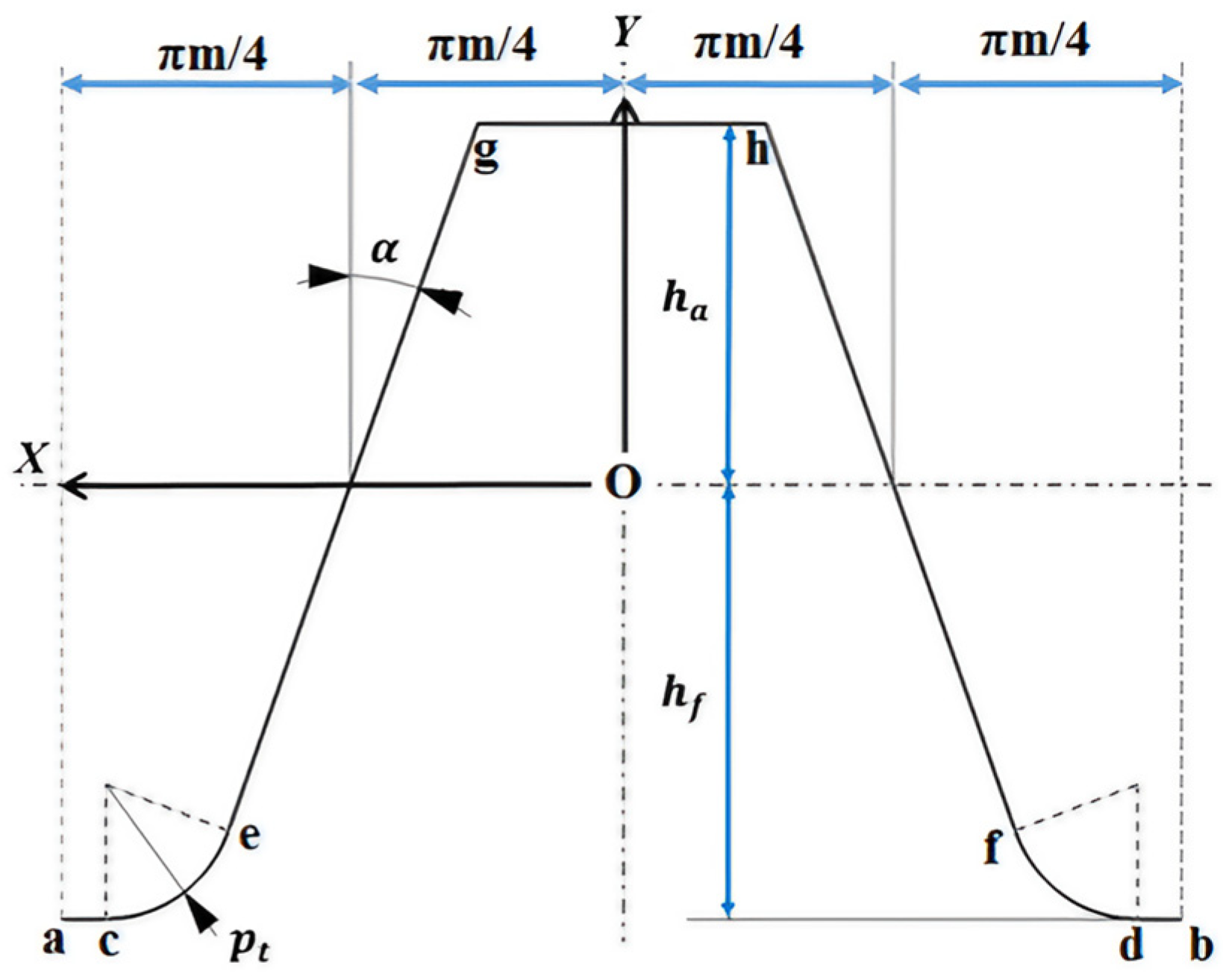
When designing gear mechanisms, the involute profile is generally preferred as the gear profile due to the requirements such as the regular operation of the gears with each other, uninterrupted load transfer, ease of production, etc. The geometry of involute spur gears consists of certain parts for the smooth operation of the teeth and power transmission. In involute geometry, these parts are the tooth head and tooth root regions, the involute profile and trochoid profile regions. The involute profile, which forms the side surfaces of the gears, includes the involute curve, trochoid profile, and tooth root region. In this paper, three-dimensional geometries of the gear geometries, which were designed and analyzed with different parameters, were modeled, and three-dimensional geometries were created with reference to the rack and pinion cutting tool. The profile of the rack and pinion cutting tool taken as a reference in the design of the geometries is shown in Figure 1 [28].
The geometry of the reference cutting tool shown in Figure 1 consists of two linear regions that form the gear’s involute profile and the radius of the cutting tool in the head area. The linear regions are inclined by the pressure angle “α” with the vertical axis. The radius region at the tip of the cutting tool forms the trochoid region at the base of the gear. The dimensions denoted by “ h a ” and “ h f ” in Figure 1 are the addendum and dedendum, respectively.
The (ce) and (df) regions of the cutting tool are the root region of the gear. By selecting these dimensions at different values in the reference cutting tool gear geometries, different geometries can be designed.
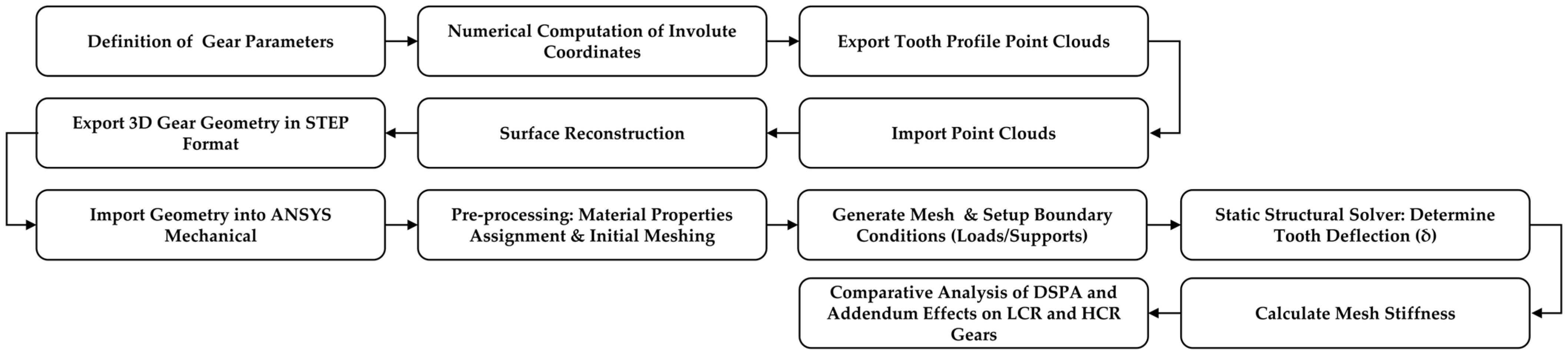
In this study, low contact ratio (LCR) and high contact ratio (HCR) involute profile spur gears are designed with different parameters, and the effects of the drive side pressure angle and addendum on the tooth profiles on the mesh stiffness of the gears in different situations are investigated. The points of LCR and HCR spur gear geometries on a single tooth profile were precisely generated using a custom-developed script in MATLAB® R2021b (MathWorks Inc., Natick, MA, USA). To ensure geometric accuracy, these point clouds were imported into CATIA® V5-R21 (Dassault Systèmes, Vélizy-Villacoublay, France) using the Generative Shape Design (GSD) workbench. Within this module, the coordinate data were transformed into smooth splines to create the 3D solid models. The resulting geometries were then exported in STEP format and integrated into ANSYS® Workbench 2023 R2 (ANSYS Inc., Canonsburg, PA, USA) for finite element analysis, and gear geometries with different design parameters were statically analyzed under loads applied to the critical points of the tooth profiles. The analyses were carried out for five different cases where the drive side pressure angle, addendum, and dedendum were varied. The total deformations of the gears were determined under loads applied at five different critical points on the tooth profile of the gears with LCR and six different critical points on the tooth profile of the gears with HCR, and the single tooth stiffnesses of the gears were calculated using the values obtained. The stiffness curves derived from single tooth stiffness values were input into the program for mesh stiffness calculations. The mesh stiffness of the gears was then computed, and the corresponding graphs were generated. The comprehensive methodological workflow of the study, illustrating the sequential integration of mathematical modeling, 3D construction, and numerical analysis, is presented in Figure 2.
The properties and design parameters of the gears analyzed in the study are given in Table 1.
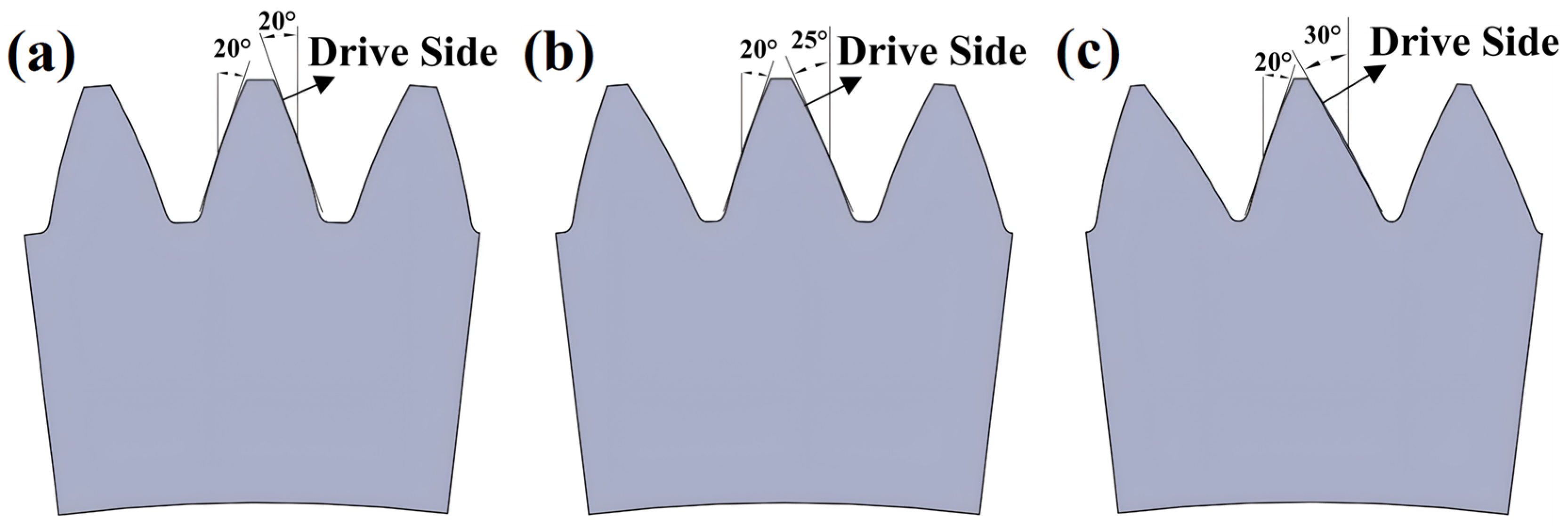
The module value “m” of the gears to be designed was preferred as 2 mm, and the number of teeth was 80. For the five different cases examined, the addendum ( h a ) was selected between 1 × m and 1.5 × m, and the dedendum ( h f ) was selected between 1.25 × m and 1.7 × m. The points on the single tooth profile of the gear to be formed were determined by keeping the coast side pressure angle ( α c ) constant at 20° and selecting the drive side pressure angles ( α d ) as 20°, 25° and 30° for each tooth (Figure 3).

2.1. Single Tooth Stiffness

When gear systems are in operation, elastic deformations occur on the teeth in the direction of the force due to the forces acting on the teeth caused by the contact of the teeth with each other. Single tooth stiffness is defined as the resistance to deformation of a single tooth of a gear under load and is also expressed as the amount of force required for unit deformation, similar to spring stiffness. Single tooth stiffness is calculated as the ratio of the total force acting on the point of the tooth exposed to load to the total deformation. The total force applied to the relevant point of the tooth is denoted by “ F ”, and the total deformation of the tooth is denoted by “ δ ”. Single tooth stiffness is calculated by the expression given in Equation (1).
k p i ,   g i = F δ p i , g i
In Equation (1), single tooth stiffness is expressed by “ k ”. The subscripts “ p ” and “ g ” refer to the pinion and gear, respectively. “ i ” refers to the number of the tooth pair in contact. For example, in a case where the first tooth pair is in contact with each other, the tooth stiffnesses in the corresponding region of the pinion and gear can be written as in Equation (2).
k p 1 ,   g 1 = F δ p 1 , g 1
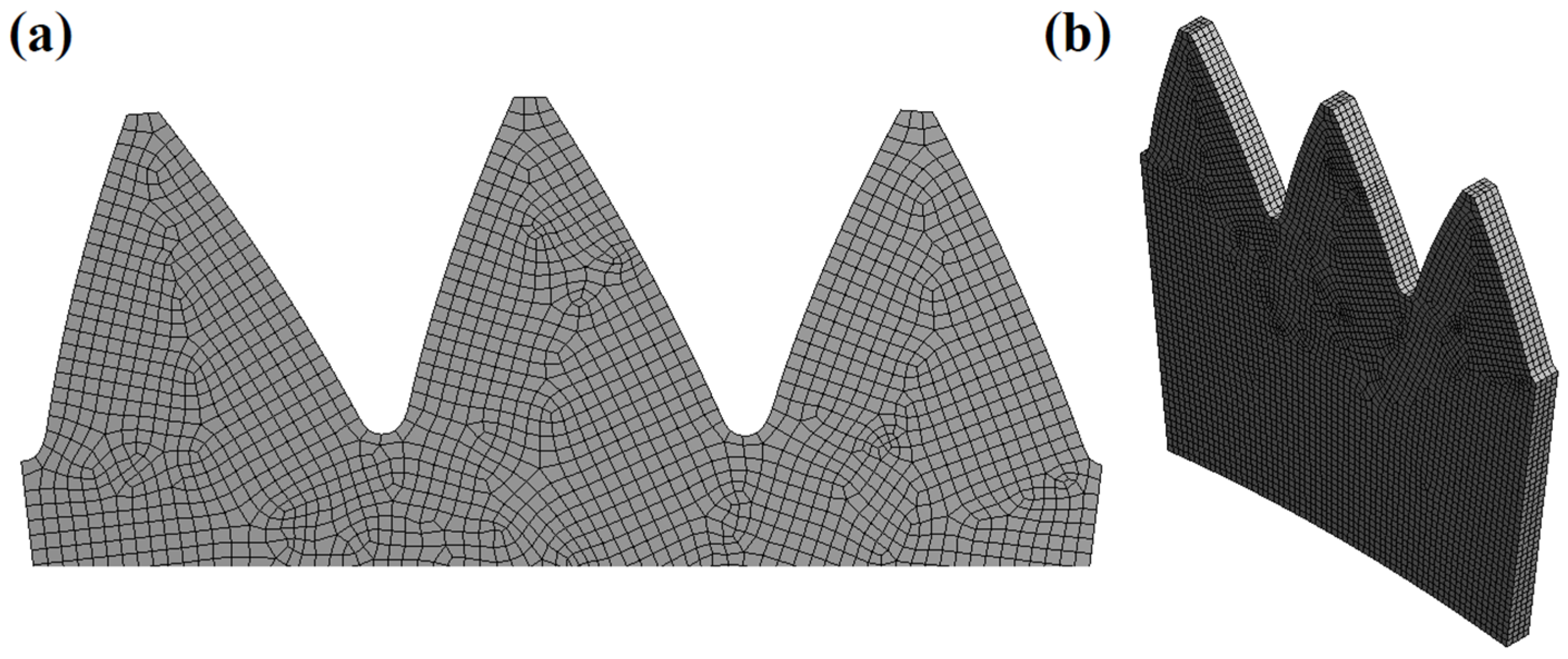
In this study, the points of LCR and HCR spur gears on a single tooth profile were determined with the program prepared in MATLAB® software, and 3D CAD geometries were designed. The gears with three-dimensional geometries were transferred to ANSYS® Workbench for finite element analysis, and the gear geometries with different design parameters were statically analyzed under the loads applied to the critical points on the tooth profiles. In the study, static structural analysis was used in the analysis, and a hexahedral mesh structure was preferred. The finite element mesh has approximately 16,500 elements and 80,000 nodes. The mesh was created with an element size of 0.25 mm. To ensure the accuracy and reproducibility of the numerical analyses, a comprehensive mesh independence study was conducted for the finite element model utilized in this research. The proposed modeling approach and solution methodology have been successfully implemented in our previous studies across various parametric designs, where the influence of mesh density on the results was rigorously examined and validated through consistent data [19]. A gear model with a mesh structure is shown in Figure 4.
The total deformations of the gears were determined under loads applied at five different critical points on the tooth profile of the gears with LCR and six different critical points on the tooth profile of the gears with HCR, and the single tooth stiffness of the gears was calculated using the obtained values.
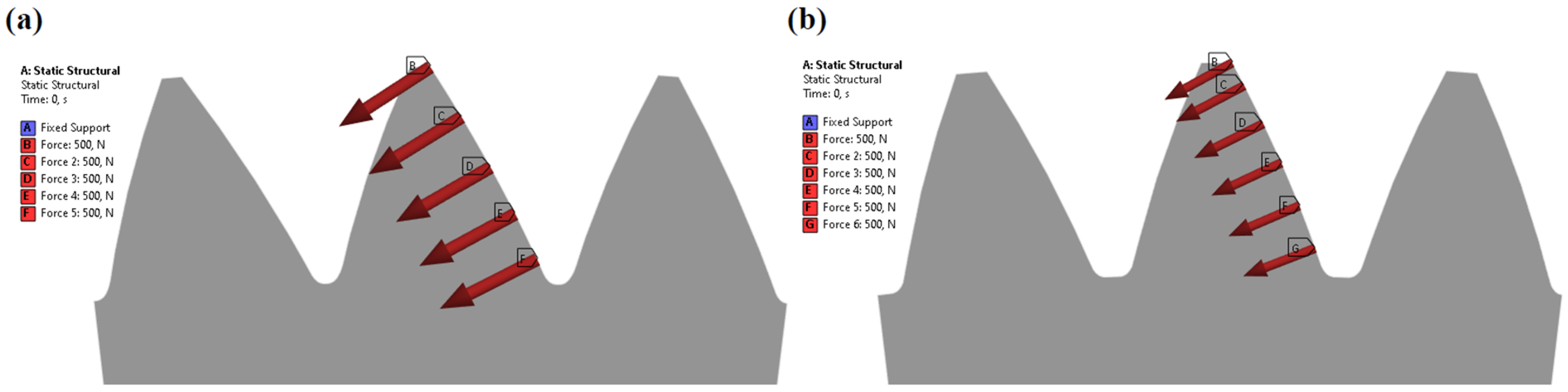
As the analysis type, the static-step analysis type, which is an integrated form of static conditions, was determined [29]. In this way, total deformation values ( δ ) were obtained from five different points for LCR gears and six different points for HCR gears on the gear geometry with a single analysis. Critical points were selected on the contacting surfaces for each gear. The boundary conditions are shown in Figure 5.
For the determination of single tooth stiffness and mesh stiffness, a static load of 500 N was applied at critical points on the tooth surface to obtain total deformation values. The static load of 500 N was determined so that it would generate a stress below the yield strength at the tooth root. In this way, the elastic deformation values occurring on the tooth can be determined accurately. The fixed support was applied to the side surfaces and the center hole to simulate a rigid mounting on a shaft, thereby preventing unwanted degrees of freedom during the static-step analysis. After the determination of the boundary conditions, analyses were performed for gears with different parameters, and the results were obtained. With the obtained values, stiffness curves are generated and compared for different cases and shown in the results section.

2.2. Mesh Stiffness

Mesh stiffness is expressed as the total stiffness of the teeth against deformations in the face of the forces applied in the areas where the tooth pairs contact each other. Changes in the contact points of the gear pairs during mesh affect the mesh stiffness. Gears are subjected to time-varying forces, especially when operating under dynamic loads, and this causes vibration and noise. The mesh state differs for LCR and HCR spur gears in terms of the pairs of gears in contact with each other in the mesh. In spur gears with LCR, the moment transmission through the mesh takes place between one and two teeth pairs, respectively.
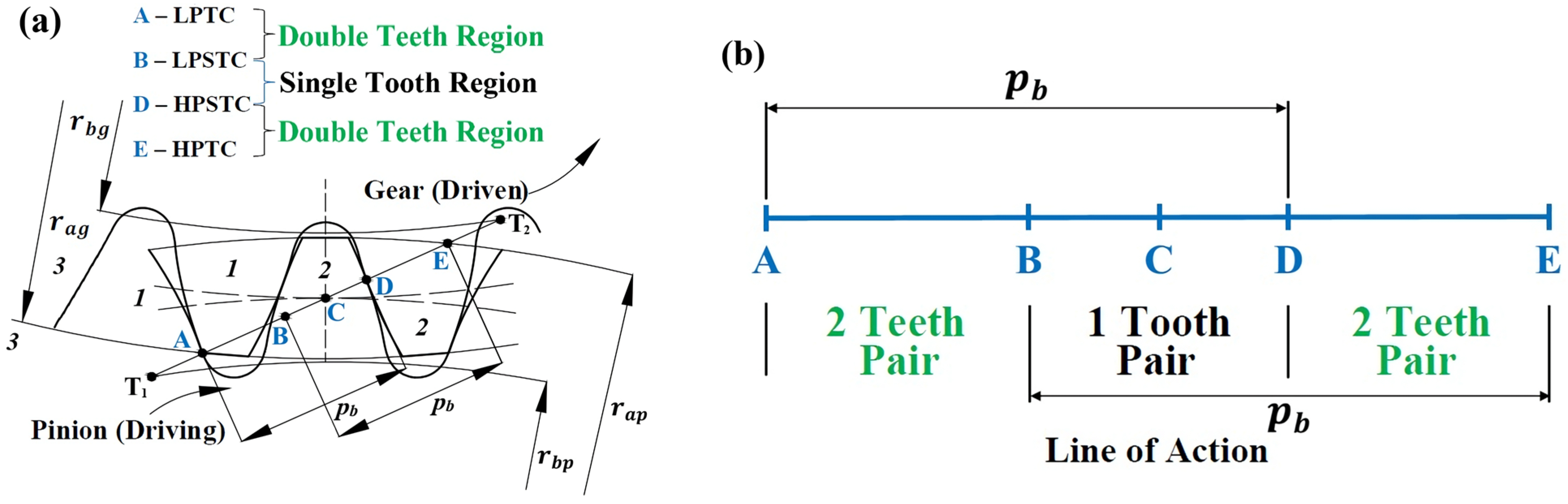
The respective transition contact points that occur along the contact profiles of the LCRgears are shown in Figure 6a [30]. In spur gears with an involute profile, the mesh between the gears takes place along a line, and this line is called the line of action (Figure 6). The mesh of an involute profile spur gear pair with an LCR is shown in Figure 6a.
The meshing process starts at the tooth tip of the driven gear and at a point slightly above the base circle of the driving gear. This first point, where the tooth pair comes into contact, is referred to as point “A”. Point A, where the mesh starts, is also called (LPTC) “Lowest Point of Tooth Contact”. The equations that give the radius of point A are calculated using trigonometric relationships [31]. The radius of point A is calculated using Equation (3), where r b p and r b g represent the base circle radii of the pinion and gear, respectively; r a g is the addendum circle radius of the gear; r 0 p is the pitch circle radius of the pinion, and r 0 g is the pitch circle radius of the gear.
r A p = r b p 2 + r 0 p + r 0 g sin α r a g 2 r b g 2 0.5 2 0.5
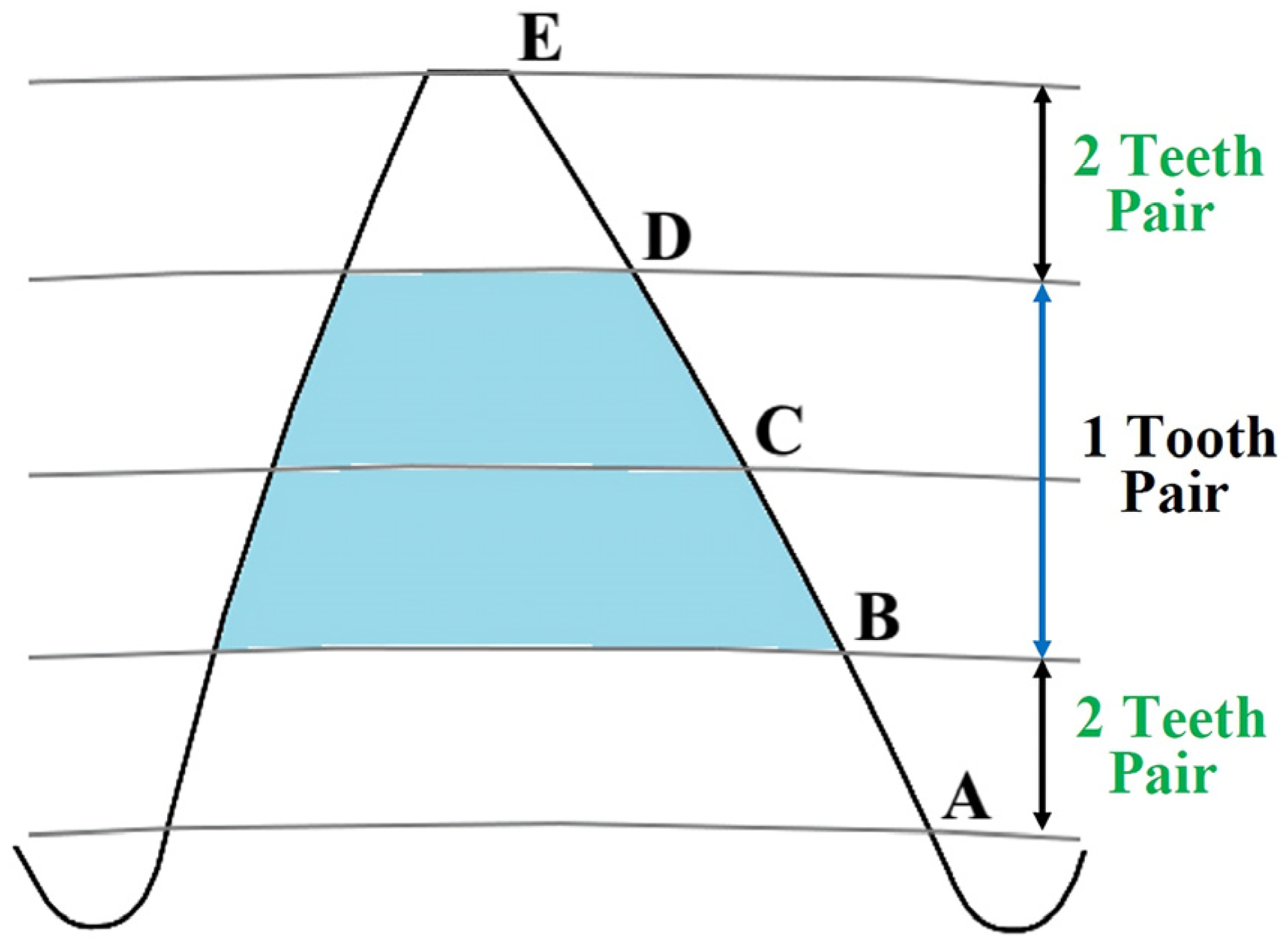
The single and double tooth contact regions on an asymmetric spur gear profile with LCR are shown in Figure 7.
From point A to point B, the mesh is carried out by two pairs of teeth. When the contact reaches point B, the front pair of teeth is released from the mesh, and the transmission is carried out by a single pair of teeth. This first point B is specially called (LPSTC) “Lowest Point of Single Tooth Contact”. The radius of point B on the pinion is calculated by Equation (4).
r B p = r b p 2 + r a p 2 r b p 2   0.5 π m cos α 2 0.5
The mesh takes place through a single pair of teeth from point B, passing through the pitch point “C” on the pitch circles of the gears, to point D. Point D (HPSTC) is called “Highest Point of Single Tooth Contact”. The radii of points C and D are given in Equations (5) and (6), where z p denotes the number of teeth of the pinion.
r C p = m   z p 2
r D p = r b p 2 + r b p + r b g tan α r a g 2 r b g 2 0.5 + π m cos α ) 2 0.5
Point D, which is the highest point where a single tooth pair contact occurs, is an important point in load transmission. The highest stress values at the root of the tooth are observed at this point of contact. When the contact is at point D, the next pair of teeth enters the mesh at point A, and from this point on, moment transmission continues to take place through two pairs of teeth until point E. The mesh ends at point E on the addendum circle of the pinion. This point is specially called (HPTC) “Highest Point of Tooth Contact” and its radius length is calculated for standard gears using Equation (7).
r E p = m   z + 2 m 2
The lengths of the regions between the points on the line of action where the meshing occurs are given in Equations (8)–(12). The length A E between points A and E, where the meshing takes place, is called the length of action and is expressed in Equation (8), where a d represents the center distance between the gear axes.
A E = r a p 2 r b p 2 + r a g 2 r b g 2 a d sin α
The pitch of the gear is defined as;
p b = A D = B E = π   m cos α
A B = A E π   m cos α
A C = C E = A E / 2
The ratio of the length of action to the base pitch is called the contact ratio. The contact ratio for LCR gears is expressed in Equation (12).
ε α = A E π   m cos α
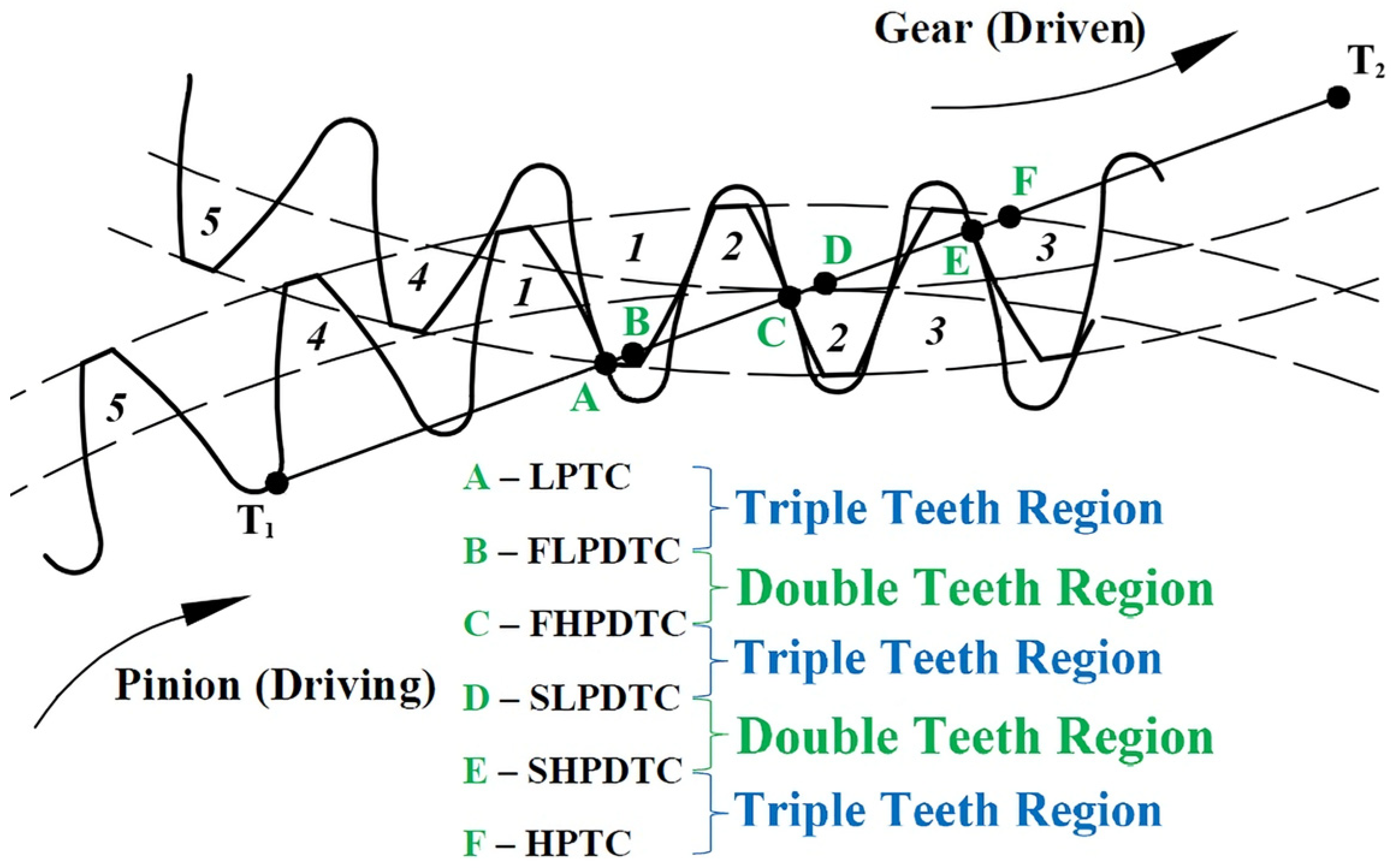
In HCR involute spur gears, the transmission occurs on the line of action, similar to LCR. Figure 8 shows the meshing condition of a high contact ratio spur gear.
The meshing condition shown in Figure 8 starts at point A, which coincides with the addendum circle of the driven gear. At the beginning of meshing, three pairs of teeth are in contact. Point A is specifically referred to as the “Lowest Point of Tooth Contact” (LPTC). The radius of point A is given by Equation (13).
r A p = r a p 2 r b p 2 A F 2 + r b p 2
The transmission is carried out by three pairs of teeth from point A to point B. Point B is specifically referred to as the “First Lowest Point of Double Tooth Contact” (FLPDTC). When the meshing reaches point B, the leading pair of teeth disengages, and the transmission occurs through two pairs of teeth up to point C. The radius of point B is calculated by Equation (14).
r B p = r a p 2 r b p 2 2 p b 2 + r b p 2
Point C is specifically referred to as the “First Highest Point of Double Tooth Contact” (FHPDTC). The radius of point C is expressed in Equation (15).
r C p = r a p 2 r b p 2 ε a 1 p b 2 + r b p 2
The expression defined as “ ε a ” in Equation (15) is the contact ratio, and the contact ratio is expressed by Equation (16).
ε a = r a p 2 r b p 2 + r a g 2 r b g 2 a d sin α p b
The length of action for an HCR gear is calculated by Equation (17).
A F = r a p 2 r b p 2 + r a g 2 r b g 2 a d sin α
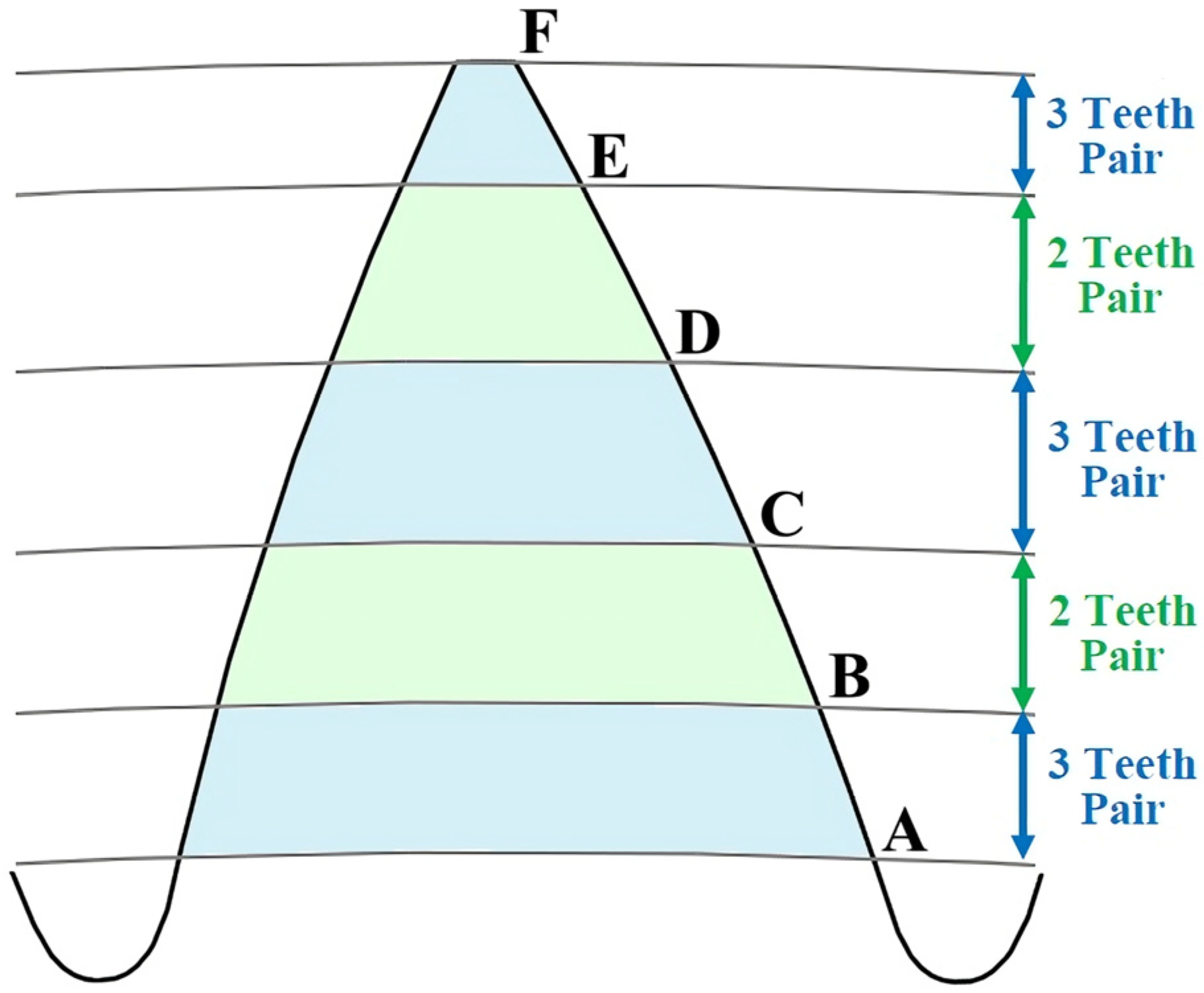
The regions where two pairs of teeth and three pairs of teeth are in contact during the meshing between point A and point F are shown in Figure 9.
The meshing occurs through three pairs of teeth from point C to point D. Point D is specifically referred to as the “Second Lowest Point of Double Tooth Contact” (SLPDTC). The radius of point D is given in Equation (18).
r D p = r a p 2 r b p 2 p b 2 + r b p 2
After point D, the meshing progresses towards points E and F, respectively. The meshing occurs through two pairs of teeth in the D E region and through three pairs of teeth again in the E F region. Point E is specifically referred to as the “Second Highest Point of Double Tooth Contact” (SHPDTC), and its radius is calculated by Equation (19).
r E p = r a p 2 r b p 2 ε a 2 p b 2 + r b p 2
The meshing continues until the first pair of teeth reaches point F, which coincides with the addendum circle of the pinion. Point F is specifically referred to as the “Highest Point of Tooth Contact” (HPTC). The radius of point F, where the meshing ends, is equal to the addendum circle radius of the pinion and is expressed in Equation (20).
r F p = r a p
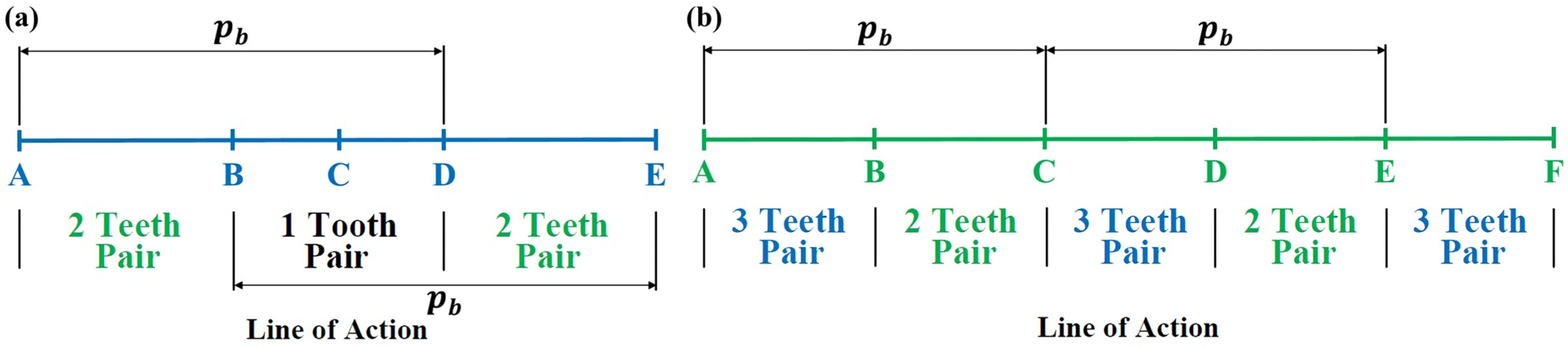
Figure 10 shows the regions of single, double, and triple tooth pair contact along the line of action in LCR and HCR gears.
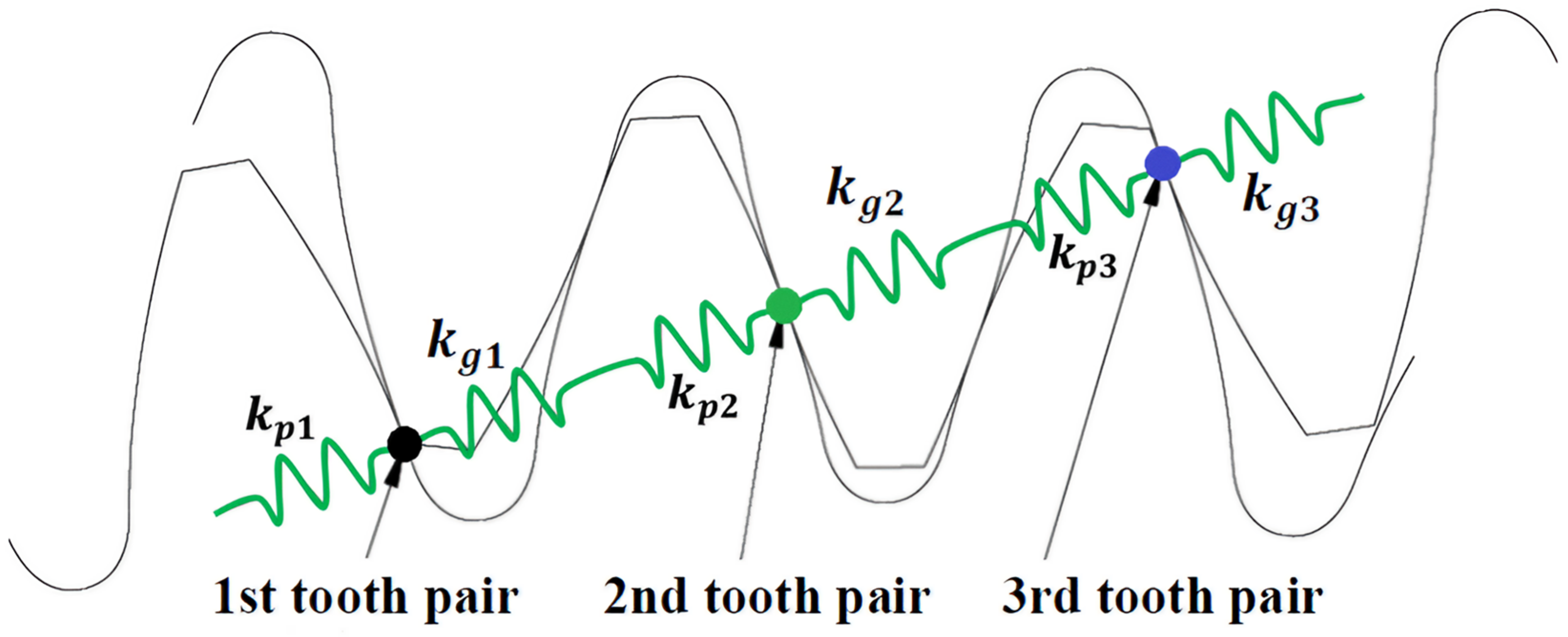
Time-varying mesh stiffness (TVMS) is calculated for each tooth pair in contact during meshing, and the total stiffness is obtained. When calculating the mesh stiffness, assuming that the teeth deform like a spring under the influence of the loads acting on the gears, it can be stated that the teeth in contact with each other behave like springs connected in series. Figure 11 shows an example of the spring behavior approach for the meshing condition of an HCR gear with multiple tooth pairs in meshing. This situation is a general approach in the calculation of mesh stiffness.
The equivalent mesh stiffness for a pair of teeth in contact is calculated by Equation (21).
K i = k p i k g i k p i + k g i
In Equation (21), the mesh stiffness is denoted by “ K ”. The subscripts “ p ” and “ g ” represent the pinion and the gear, respectively, and “ i ” represents the number of the tooth pair in contact.
When the following tooth pair engages in the meshing condition, the tooth pairs that start to transmit the load together can be considered to behave like parallel-connected springs. Since the number of tooth pairs in contact during meshing continuously changes, it is necessary to know which region of the line of action the meshing is in and the number of tooth pairs in contact when calculating the TVMS.
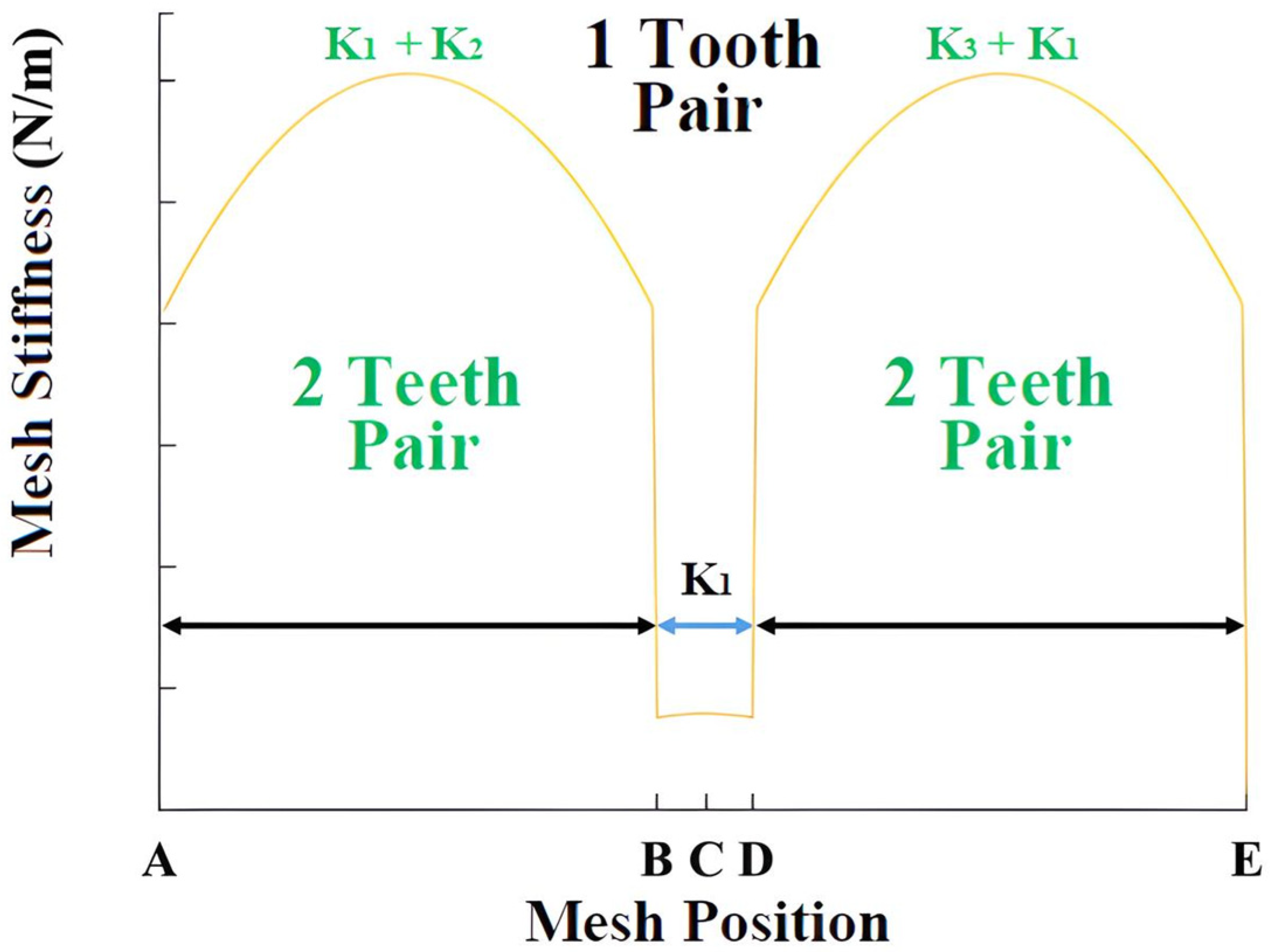
In LCR gears, one and two teeth pairs engage during meshing. Figure 12 shows the number of tooth pairs that come into contact during the meshing of an LCR gear, the regions where the teeth are in contact on the line of action, and the TVMS graph.
In LCR spur gears, the total time-varying mesh stiffness is expressed as in Equation (22).
K m e s h = i = 1,2 K i       A B   region i = 1 K i       B D   region i = 3,1 K i       D E   region
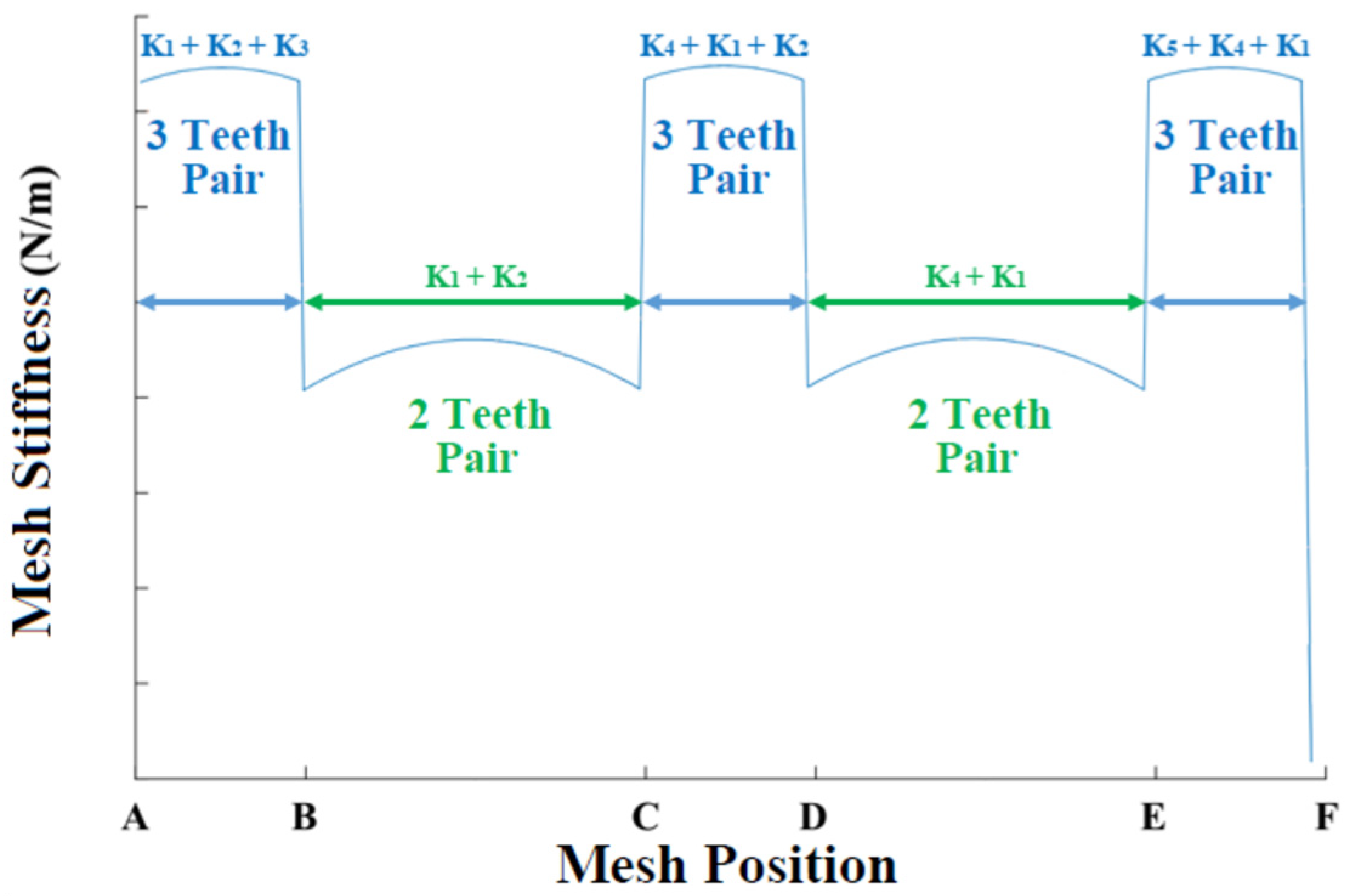
In HCR gears, two and three teeth pairs engage during meshing. Figure 13 shows the number of tooth pairs that come into contact during meshing of an HCR gear, the regions where the teeth are in contact on the line of action, and the TVMS graph.
As seen in Figure 13, in an HCR spur gear, when the meshing is in the A B , C D , and E F regions, the transmission occurs through three teeth pair, while in the B C and D E regions, the load is transmitted through two teeth pair.
The total time-varying mesh stiffness in HCR spur gears is expressed as in Equation (23).
K m e s h = i = 1,2 , 3 K i   A B   region i = 1,2 K i   B C   region i = 4,1 , 2 K i     C D   region i = 4,1 K i   D E   region i = 5,4 , 1 K i   E F   region
When calculating the mesh stiffness, the deformation values created by the force applied to the critical points on the tooth are determined by finite element analysis, and the single tooth stiffness values at the critical points are obtained. After the single tooth stiffness curves are created, the mesh stiffness values are numerically calculated using the developed program.

3. Results

In this study, the effects of the drive side pressure angle and addendum on the mesh stiffness of spur gears, designed with various parameters, are investigated under different conditions. These gears have both low and high contact ratios and symmetric and asymmetric involute profiles. Finite element analyses of the three-dimensional geometries of the generated gears are performed under the influence of forces applied to the critical points on their drive side surfaces, and the single tooth stiffness and the time-varying mesh stiffness of the gears during meshing are numerically calculated.
In the determination of single tooth stiffness and mesh stiffness, a static load of 500 N was applied from five different critical points for LCR gears and from six different critical points on the tooth surface for HCR gears to obtain the total deformation values. The analyzed results are presented under the headings of single tooth stiffness results and mesh stiffness results.

3.1. Single Tooth Stiffness Results

The analyses were conducted for five different cases where the drive side pressure angle ( α d ), addendum ( h a ), and dedendum ( h f ) were varied. The total deformations of the gears were determined under the influence of loads applied to critical points of gears, and the single tooth stiffness values of the gears were calculated using the obtained values. The analyses were performed based on the deformations obtained by applying loads to specific critical points on the tooth profile (A—closest to the tooth root, E or F—closest to the tooth tip). Stiffness curves were generated with the obtained values, and the results were compared and presented for different cases.

3.1.1. Effects of Drive Side Pressure Angle on Single Tooth Stiffness

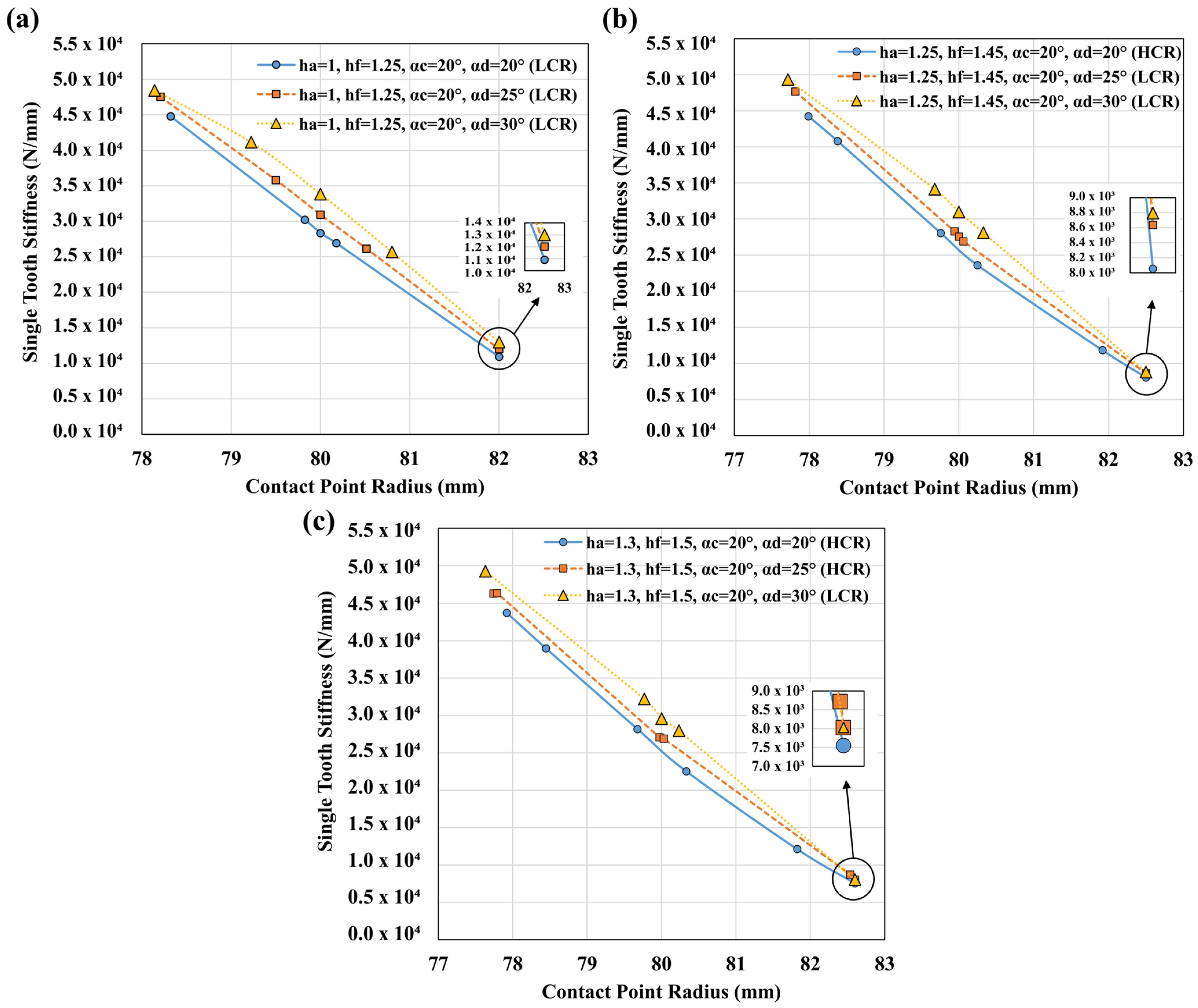
The single tooth stiffness values for the gears are shown in Figure 14 and Figure 15. For Case I ( h a = 1 × m, LCR Gears), as the drive side pressure angle ( α d ) increases from 20° to 25° and 30°, single tooth stiffness increased at points A, B, and C near the tooth root (Figure 14a). This is due to the increased tooth thickness in these regions with the increasing pressure angle. However, a complex change in stiffness was observed at points D and E near the tooth tip; stiffness at point D initially decreased and then decreased further, while it increased at point E.
As seen in Figure 14b, for the gears in Case II ( h a   = 1.25 × m; α d = 20° HCR, 25° and 30° LCR), high stiffness values were observed at points A and B near the tooth root at a 20° pressure angle (HCR gear). When the pressure angle increased to 25° and 30° (LCR gears), the stiffness at point A continued to increase. Since the position of point B differs between LCR and HCR gears, the stiffness values cannot be directly compared; however, in LCR gears, the stiffness at point B increased when the pressure angle increased from 25° to 30°. The stiffness in the tooth tip region (points E and F) generally decreased with the increasing pressure angle.
In the analysis of the gears in Case III ( h a = 1.3 × m; α d = 20° and 25° HCR, 30° LCR), it was observed that in HCR gears, the stiffness at points A and B increased as the pressure angle increased from 20° to 25° (Figure 14c). Complex changes in stiffness occurred at intermediate points such as C and D, and the stiffness at point F (tooth tip) increased slightly. When the drive side pressure angle of 25° (HCR) is compared with 30° (LCR), the stiffness at point A is further increased in the 30° LCR gear. Changes were observed at other points due to the structural differences between LCR and HCR gears.
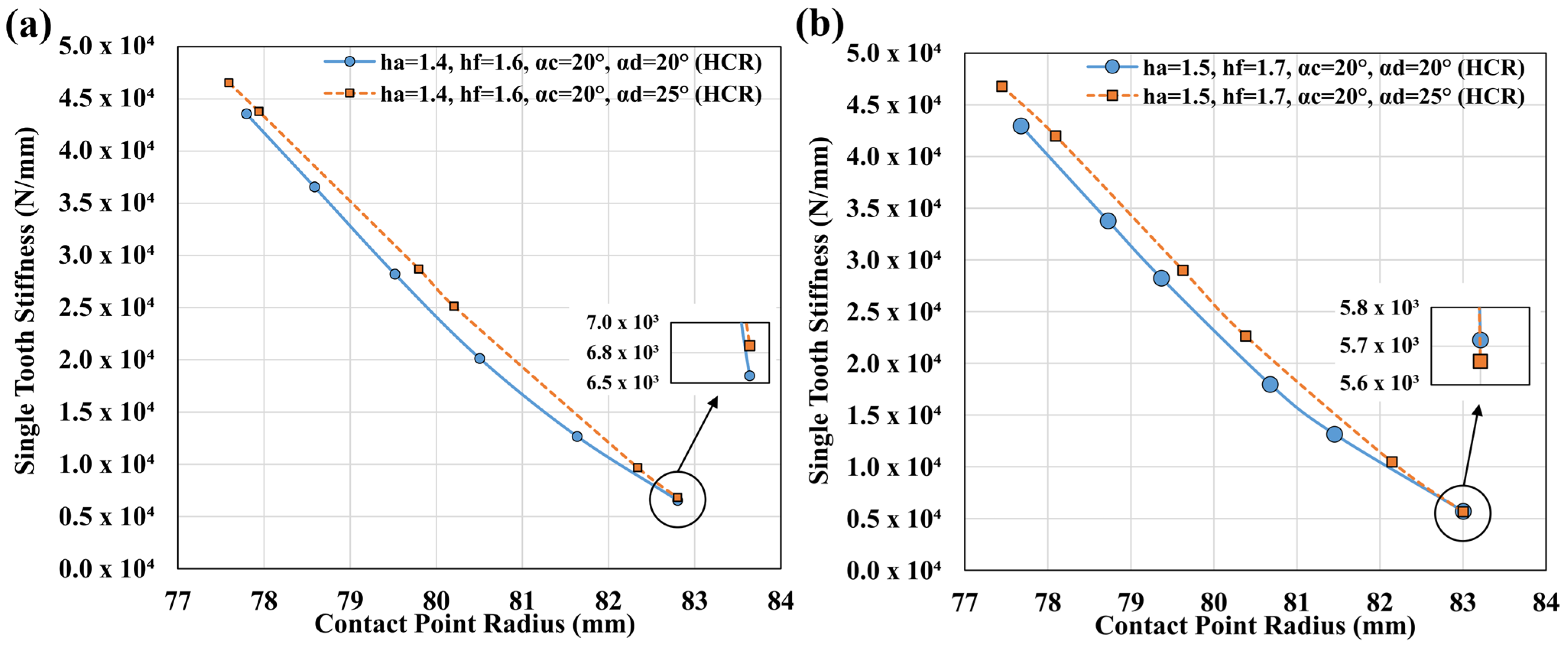
As seen in Figure 15a, for the gears in Case IV ( h a = 1.4 × m; α d = 20° and 25° HCR), when the drive side pressure angle increases from 20° to 25°, the single tooth stiffness values at points A, B, C, D, and F (tooth tip) have increased. However, at point E (near the tooth tip), a decrease in stiffness has been observed due to the change in the tooth profile.
Finally, when the effects of the drive side pressure angle were examined for the gears in Case V ( h a = 1.5 × m; α d = 20° and 25° HCR), it was found that as the pressure angle increased from 20° to 25°, the single tooth stiffness increased at points A, B, C, and D near the tooth root. However, as the points approached the tooth tip (points E and F), a decrease in stiffness values was observed (Figure 15b).

3.1.2. Effects of Addendum and Dedendum on Single Tooth Stiffness

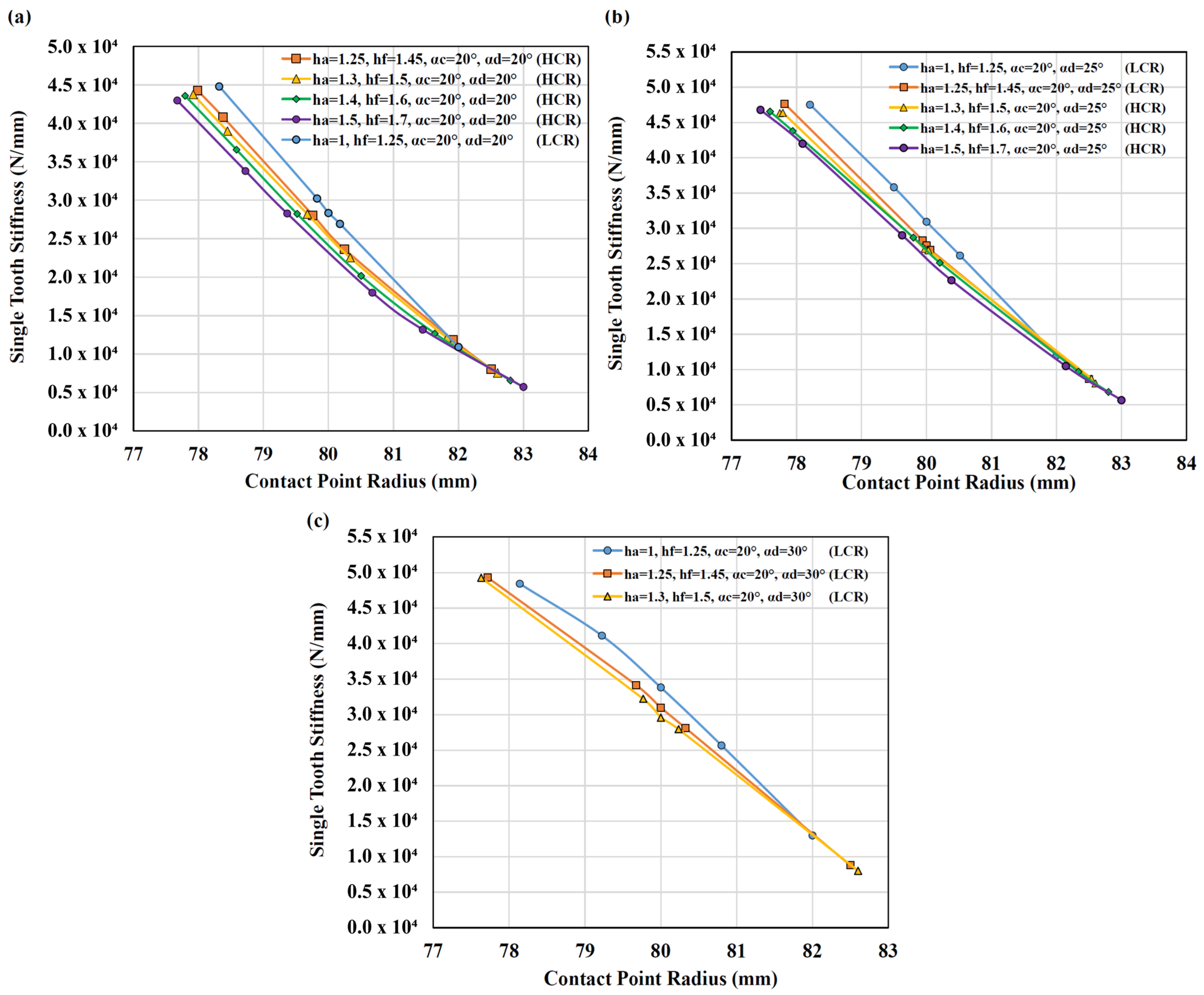
When cases with a constant pressure angle and varying addendum and dedendum values were examined, at a 20° drive side pressure angle, a generally small decrease in single tooth stiffness was observed at point A, closest to the tooth root, as the addendum increased. In other regions of the tooth (e.g., point D or point F in HCR gears), increasing the addendum generally resulted in stiffness reductions (Figure 16).
In the case where the drive side pressure angle was 25°, a slight increase in stiffness was observed at point A, closest to the tooth root, as the addendum increased. However, at points B and E (LCR) or F (HCR) near the tooth tip, increasing the addendum generally led to decreases in stiffness values.
Finally, at a 30° drive side pressure angle (for LCR gears), increasing the addendum generally caused a decrease in the single tooth stiffness at most critical points in the examined LCR gears, especially in the regions near the tooth tip (Figure 16c).

3.2. Mesh Stiffness Results

In the final part of the study, the stiffness curves generated from the single tooth stiffness values were input into the program developed for calculating mesh stiffness, and the mesh stiffness values of the gears were calculated, and their graphs were plotted. The obtained mesh stiffness results were compared for different cases and are summarized below.

3.2.1. Effects of Drive Side Pressure Angle on Mesh Stiffness

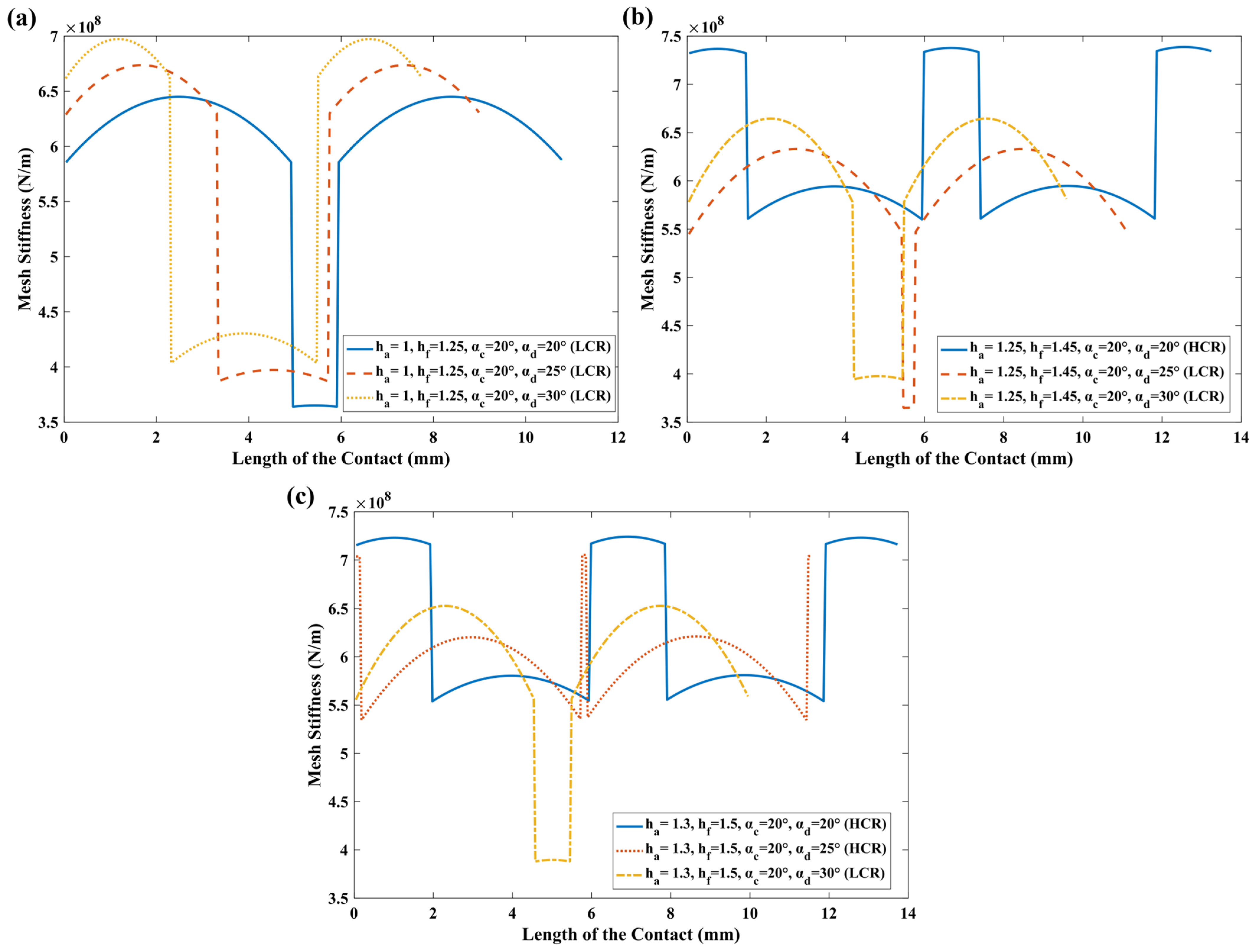
Figure 17 shows the mesh stiffness graph for gears designed with different parameters. Considering Case I (Addendum h a = 1 × m, LCR Gears), a significant increase in the mesh stiffness of the LCR gears is observed as the drive side pressure angle is increased from 20° to 25° and 30° (Figure 17a). This increase is calculated to be approximately 14% during the transition from 20° to 30°. The primary reason for the increase is the greater tooth thickness (especially at the tooth root) with the increasing pressure angle, which elevates the single tooth stiffness and consequently the mesh stiffness. However, with the increase in pressure angle, the single tooth contact regions of the LCR gears have widened, and their contact ratios have decreased (e.g., from 1.8257 at 20° to 1.42 at 30°).
For the gears in Case II ( h a = 1.25 × m, one HCR and two LCR Gears), the mesh stiffness is highest when the drive side pressure angle is 20° (HCR gear). A significant drop in mesh stiffness occurs when the pressure angle is increased to 25° (LCR gear). This is explained by the HCR gear maintaining a greater number of teeth in contact during meshing, thus distributing the load more effectively. When the LCR gears are compared among themselves (from 25° to 30°), an increase in mesh stiffness (approximately 8%) is observed with the increase in pressure angle (Figure 17b).
In Case III ( h a = 1.3 × m, two HCR and one LCR Gears), when the pressure angle increased from 20° to 25° in the HCR gears, the mesh stiffness in the three teeth pair contact region decreased, while the stiffness in the two teeth pair contact region increased (Figure 17c). This is due to the different effects of the pressure angle increase on the profile of the critical regions of the tooth. The contact ratio also decreased during this transition. When the pressure angle increased from 25° (HCR) to 30° (LCR), a decrease in mesh stiffness was again observed, as the gear transitioned to the LCR type and the contact ratio decreased. Overall, a decrease of approximately 23% in mesh stiffness was detected when transitioning from the 20° (HCR) condition to the 30° (LCR) condition.
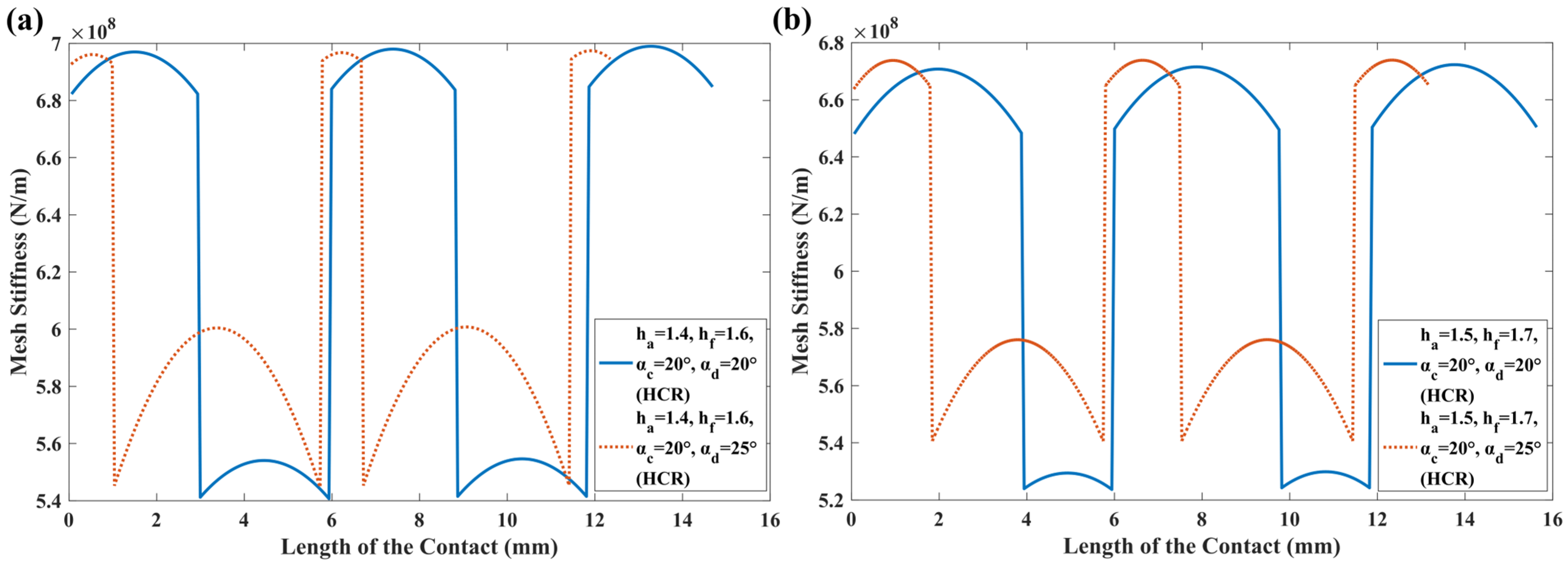
The mesh stiffness values of the last two gears are shown in Figure 18. In Case IV ( h a = 1.4 × m, HCR Gears), when the pressure angle increased from 20° to 25°, the mesh stiffness of the HCR gears increased in both the three teeth pair contact region by approximately 2% and the two teeth pair contact region by approximately 8% (Figure 18a).
Finally, in Case V ( h a = 1.5 × m, HCR Gears), similar to Case IV, when the pressure angle increased from 20° to 25°, the mesh stiffness of the HCR gears increased in the three teeth pair contact region by approximately 3% and the two teeth pair contact region by approximately 9% (Figure 18b).

3.2.2. Effects of Addendum and Dedendum on Mesh Stiffness

The mesh stiffness values of the analyzed gears were also examined for five different cases where the drive side pressure angle was constant and the addendum varied.
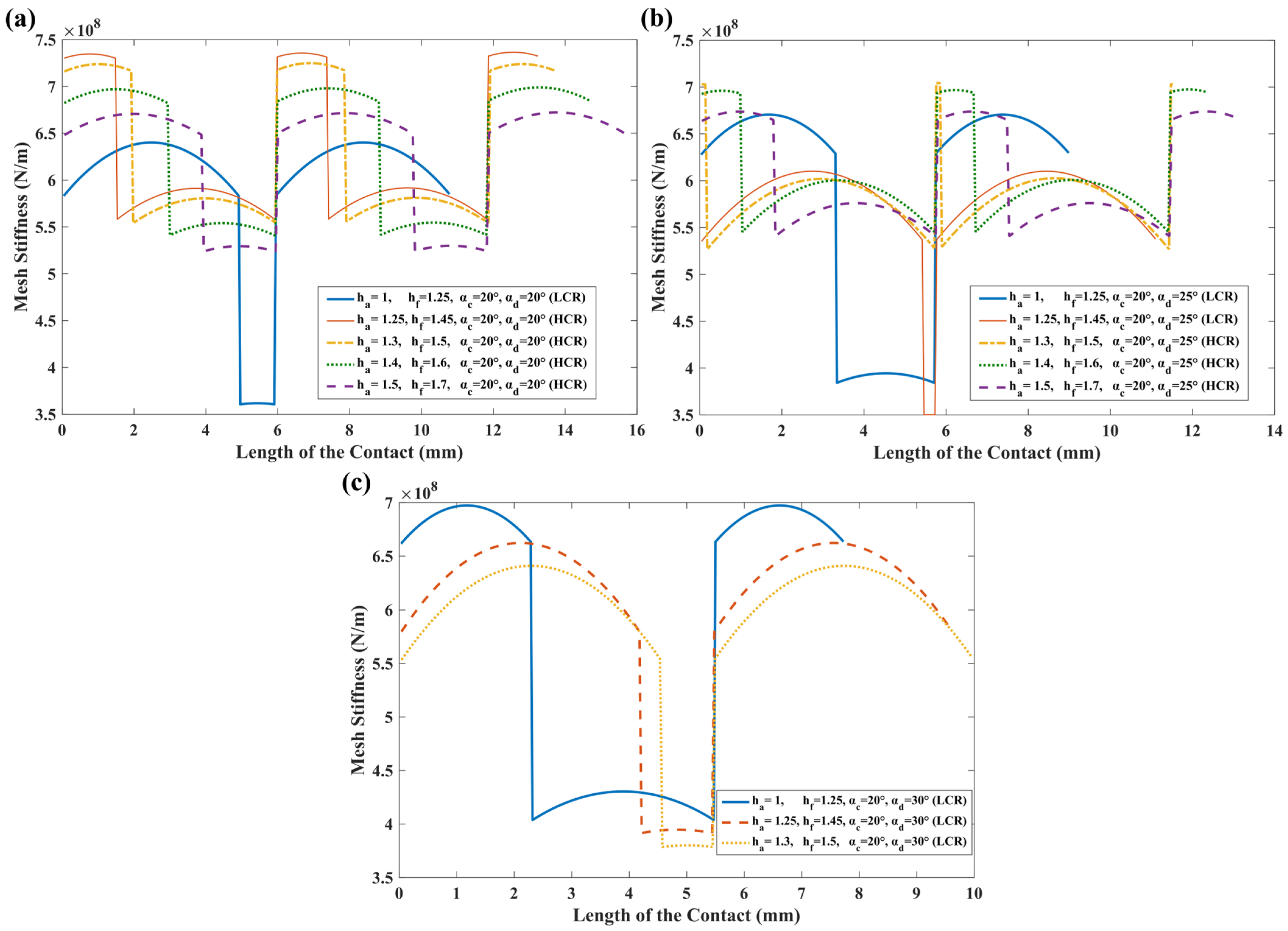
For gears with a drive side pressure angle of α d = 20°, when the addendum increased from 1 × m (LCR) to 1.25 × m (HCR), a significant increase of approximately 25% in mesh stiffness was observed (Figure 19a). This is related to the gear transitioning to the HCR type and the increase in the contact ratio. However, when the HCR gears were compared among themselves (i.e., as the addendum increased from 1.25 × m to 1.5 × m), a decrease of approximately 10% in mesh stiffness values was seen. Considering all cases (from 1 × m LCR to 1.5 × m HCR), a net increase of approximately 5% in mesh stiffness was calculated with the increase in addendum at this pressure angle. The graph for gears with a constant pressure angle is shown in Figure 19.
In the second case, where the drive side pressure angle was α d = 25°, an increase in the addendum in LCR gears (from h a = 1 × m to h a = 1.25 × m) resulted in a 9% decrease in the highest mesh stiffness values. However, this increased the contact ratio (Figure 19b). In HCR gears (from h a = 1.3 × m to h a = 1.5 × m), an increase in addendum led to an approximately 5% decrease in the highest mesh stiffness values. Overall, when considering all addenda, a very slight change (around 1% increase) was observed in the highest mesh stiffness value (for two-teeth contact in LCR and three-teeth contact in HCR).
Finally, for the third case, the drive side pressure angle α d = 30° (LCR Gears) was examined (Figure 19c). Due to design limitations, only LCR gears were analyzed at this pressure angle. When the addendum increased from 1 × m to 1.3 × m, a decrease of approximately 8% in mesh stiffness was observed. The reason for this decrease is that the increase in tooth height reduces the thickness of the region, especially at the tooth tip, lowering the single tooth stiffness in that area, which in turn affects the total stiffness in the two teeth contact region. In contrast, the increase in addendum increased the contact ratios of the LCR gears by reducing the single tooth contact regions and increasing the double teeth contact regions.

4. Conclusions

In this study, LCR and HCR involute spur gears were designed with different parameters, and the effects of the drive side pressure angle and addendum on the mesh stiffness of the gears were investigated under various conditions. The points on the single tooth profile of LCR and HCR spur gear geometries were determined, and the gear geometries were designed three-dimensionally. The three-dimensionally modeled gears were statically analyzed using finite element analysis under loads applied to the critical points of the tooth profiles. The single tooth stiffness and mesh stiffness of the gears were calculated under the influence of loads applied to five critical points on the tooth profile of LCR gears and six critical points on the tooth profile of HCR gears.
As a result, when the single tooth stiffness results were evaluated, it was observed that increasing the pressure angle generally led to an increase in single tooth stiffness by increasing the critical section thickness in the tooth root region. However, the opposite effect could be seen in the tooth tip region. The effect of the addendum on single tooth stiffness is complex. Increases or decreases in stiffness were observed depending on the examined pressure angle and the point on the tooth profile (tooth root, tooth tip, etc.).
Considering mesh stiffness, it was determined that increasing the drive side pressure angle generally increased the mesh stiffness within the same contact type (LCR or HCR within itself). However, the increase in pressure angle decreases the contact ratio. The transformation of an LCR gear into an HCR gear by increasing the addendum significantly increased the contact ratio and generally the mesh stiffness. However, further increasing the addendum in already HCR gears or in LCR gears does not always lead to an increase in mesh stiffness; on the contrary, it can cause a decrease in some cases. For example, changes in the tooth profiles at the tooth tip are one of the reasons for this.
The results indicate that the observed reduction in stiffness towards the tooth tip, particularly evidenced at points D and E, can be physically attributed to the structural mechanics of the involute profile. When the addendum height is increased to achieve HCR conditions, the gear tooth acts as a longer cantilever beam, which inherently increases its structural compliance. Furthermore, due to the involute geometry, the tooth thickness progressively decreases from the base to the tip. Consequently, at the highest point of contact, the tooth experiences the maximum bending moment acting upon its thinnest cross-section. While increasing the DSPA provides a thicker base and enhances the root stiffness, it cannot fully compensate for the geometric thinning and increased moment arm at the extreme tip, leading to the reported drop in single tooth stiffness.
The following general conclusions were obtained in the study from a design perspective: the results indicate that gears with a high contact ratio (HCR) are more suitable for applications requiring smoother load transmission, reduced vibration, and higher average mesh stiffness. In contrast, low contact ratio (LCR) gears may be preferred in applications where higher local tooth stiffness and simpler geometry are desired. Increasing the drive side pressure angle improves tooth root stiffness but simultaneously reduces the contact ratio; therefore, designers should balance stiffness improvement with the potential loss in load sharing capability. Similarly, increasing the addendum can enhance the contact ratio and transition LCR gears into HCR configurations, although excessive increases may reduce stiffness near the tooth tip. Consequently, the optimal selection of pressure angle and addendum should be determined by considering the trade-off between stiffness, contact ratio, and the intended operating conditions of the gear system.
Future studies are planned to investigate the effects of different gear materials, to perform dynamic analyses of gear systems using the obtained stiffness values, to examine vibration and noise characteristics in detail, to conduct analyses on the wear behavior and fatigue life of gears, to validate the numerical models and obtained results with experimental studies, and especially to perform more comprehensive optimization studies using different parameter combinations for asymmetric tooth profiles.

Author Contributions

Conceptualization, O.D.; methodology, O.D.; software, O.C.; validation, O.D., O.C. and N.B.S.; formal analysis, N.B.S.; investigation, N.B.S.; resources, N.B.S.; data curation, O.C.; writing—original draft preparation, N.B.S.; writing—review and editing, O.D., O.C. and N.B.S.; visualization, N.B.S.; supervision, O.D. All authors have read and agreed to the published version of the manuscript.

Funding

This research received no external funding.

Institutional Review Board Statement

Not applicable.

Informed Consent Statement

Not applicable.

Data Availability Statement

The authors confirm that the data supporting the findings of this study are available within the article.

Conflicts of Interest

The authors declare no conflicts of interest.

Abbreviations

The following abbreviations are used in this manuscript:
STSSingle tooth stiffness
TVMSTime-varying mesh stiffness
DSPADrive side pressure angle
LCRLow contact ratio
HCRHigh contact ratio
FEAFinite element analysis
3DThree dimensional
LPTCLowest point of tooth contact
LPSTCLowest point of single tooth contact
HPSTCHighest point of single tooth contact
HPTCHighest point of tooth contact
FLPDTCFirst lowest point of double tooth contact
FHPDTCFirst highest point of double tooth contact
SLPDTCSecond lowest point of double tooth contact
SHPDTCSecond highest point of double tooth contact

References

  1. Kapelevich, A. Geometry and design of involute spur gears with asymmetric teeth. Mech. Mach. Theory 2000, 35, 117–130. [Google Scholar] [CrossRef]
  2. Karpat, F.; Ekwaro-Osire, S.; Cavdar, K.; Babalik, F.C. Dynamic analysis of involute spur gears with asymmetric teeth. Int. J. Mech. Sci. 2008, 50, 1598–1610. [Google Scholar] [CrossRef]
  3. Chen, Z.; Shao, Y. Mesh stiffness calculation of a spur gear pair with tooth profile modification and tooth root crack. Mech. Mach. Theory 2013, 62, 63–74. [Google Scholar] [CrossRef]
  4. Karpat, F.; Dogan, O.; Yuce, C.; Ekwaro-Osire, S. An improved numerical method for the mesh stiffness calculation of spur gears with asymmetric teeth on dynamic load analysis. Adv. Mech. Eng. 2017, 9, 1687814017721856. [Google Scholar] [CrossRef]
  5. Thomas, B.; Sankaranarayanasamy, K.; Ramachandra, S.; Kumar, S.P.S. Selection of pressure angle-based on dynamic effects in asymmetric spur gear with fixed normal contact ratio. Def. Sci. J. 2019, 69, 303–310. [Google Scholar] [CrossRef]
  6. Zhu, G.; Huang, K.; Xiong, Y.; Li, A.; Peng, J.; Ding, W. An improved model for time-varying mesh stiffness of super-high-contact-ratio helical gear pair considering contact disparities on differently sliced fractal surfaces. Commun. Nonlinear Sci. Numer. Simul. 2025, 146, 108806. [Google Scholar] [CrossRef]
  7. Marafona, J.D.M.; Marques, P.M.T.; Martins, R.C.; Seabra, J.H.O. Mesh stiffness models for cylindrical gears: A detailed review. Mech. Mach. Theory 2021, 166, 104472. [Google Scholar] [CrossRef]
  8. Cooley, C.G.; Liu, C.; Dai, X.; Parker, R. Gear tooth mesh stiffness: A comparison of calculation approaches. Mech. Mach. Theory 2016, 105, 540–553. [Google Scholar] [CrossRef]
  9. Flek, J.; Dub, M.; Kolář, J.; Lopot, F.; Petr, K. Determination of Mesh Stiffness of Gear—Analytical Approach vs. FEM Analysis. Appl. Sci. 2021, 11, 4960. [Google Scholar] [CrossRef]
  10. Ma, H.; Zeng, J.; Feng, R.; Pang, X.; Wen, B. An improved analytical method for mesh stiffness calculation of spur gears with tip relief. Mech. Mach. Theory 2016, 98, 64–80. [Google Scholar] [CrossRef]
  11. Kalay, O.C.; Dogan, O.; Yılmaz, T.G.; Yuce, C.; Karpat, F. A comparative experimental study on the impact strength of standard and asymmetric involute spur gears. Measurement 2021, 172, 108950. [Google Scholar] [CrossRef]
  12. Li, S. Effect of addendum on contact strength, bending strength and basic performance parameters of a pair of spur gears. Mech. Mach. Theory 2008, 43, 1557–1584. [Google Scholar] [CrossRef]
  13. Mallesh, G.; Avinash, P.; Kumar, M.; Sacchin, G.; Khan, Z. Finite Element Modeling and Bending Stress Analysis of Non Standard Spur Gear. Int. J. Res. Eng. Technol. 2015, 4, 231–237. [Google Scholar] [CrossRef]
  14. Dogan, O. Performance Evaluation of Low- and High-Contact Ratio Spur Gears: Dynamic Response and Bending Strength. J. Vib. Eng. Technol. 2022, 10, 1337–1347. [Google Scholar] [CrossRef]
  15. Zheng, X.; Hu, Y.; Li, G.; Luo, J.; Parker, R.G. An analytical mesh stiffness model of high-contact-ratio spur gears covering multiple structure coupling effects. Mech. Mach. Theory 2025, 218, 106286. [Google Scholar] [CrossRef]
  16. Mu, Y.M.; Hou, X.Y.; Yang, S.W.; He, X.M. An innovative collaborative design of shape and performance for super-high-contact-ratio spiral bevel gear. Int. J. Precis. Eng. Manuf. 2023, 24, 813–823. [Google Scholar] [CrossRef]
  17. Pandya, Y.; Parey, A. Crack behavior in a high contact ratio spur gear tooth and its effect on mesh stiffness. Eng. Fail. Anal. 2013, 34, 69–78. [Google Scholar] [CrossRef]
  18. Pedersen, N.L.; Jørgensen, M.F. On gear tooth stiffness evaluation. Comput. Struct. 2014, 135, 109–117. [Google Scholar] [CrossRef]
  19. Dogan, O.; Yuce, C.; Karpat, F. Effects of rim thickness and drive side pressure angle on gear tooth root stress and fatigue crack propagation life. Eng. Fail. Anal. 2021, 122, 105260. [Google Scholar] [CrossRef]
  20. Wang, L.; Shao, Y. Fault mode analysis and detection for gear tooth crack during its propagating process based on dynamic simulation method. Eng. Fail. Anal. 2017, 71, 166–178. [Google Scholar] [CrossRef]
  21. Chen, Z.; Zhai, W.; Shao, Y.; Wang, K.; Sun, G. Analytical model for mesh stiffness calculation of spur gear pair with non-uniformly distributed tooth root crack. Eng. Fail. Anal. 2016, 66, 502–514. [Google Scholar] [CrossRef]
  22. Dogan, O.; Karpat, F. Crack detection for spur gears with asymmetric teeth based on the dynamic transmission error. Mech. Mach. Theory 2019, 133, 417–431. [Google Scholar] [CrossRef]
  23. Kalay, O.C.; Dogan, O.; Yuce, C.; Karpat, F. Effects of tooth root cracks on vibration and dynamic transmission error responses of asymmetric gears: A comparative study. Mech. Based Des. Struct. Mach. 2023, 52, 2569–2604. [Google Scholar] [CrossRef]
  24. Kumar, R.; Mandal, S.; Bhardwaj, P.; Mishra, C.; Mahato, S. Defect diagnosis of high contact ratio spur gear system with increasing level of fault. Eng. Fail. Anal. 2025, 169, 109097. [Google Scholar] [CrossRef]
  25. Namboothiri, N.V.; Marimuthu, P. Fracture characteristics of asymmetric high contact ratio spur gear based on strain energy release rate. Eng. Fail. Anal. 2022, 134, 106038. [Google Scholar] [CrossRef]
  26. Karpat, F.; Yuce, C.; Dogan, O. Experimental measurement and numerical validation of single tooth stiffness for involute spur gears. Measurement 2020, 150, 107043. [Google Scholar] [CrossRef]
  27. Yuce, C.; Dogan, O.; Karpat, F. Effects of asymmetric tooth profile on single-tooth stiffness of polymer gears. Mater. Test. 2022, 64, 513–523. [Google Scholar] [CrossRef]
  28. Yilmaz, T.G.; Dogan, O.; Karpat, F. Stress Analysis of Thin Rimmed Spur Gear with Asymmetric Trochoid. In Proceedings of the World Congress on Mechanical, Chemical and Material Engineering, Rome, Italy, 8–10 June 2017. [Google Scholar] [CrossRef]
  29. Dogan, O.; Yılmaz, T.G.; Karpat, F. Stress analysis of involute spur gears with different parameters by finite element and graphical method. J. Fac. Eng. Archit. Gazi Univ. 2018, 33, 1493–1504. [Google Scholar] [CrossRef]
  30. Thirumurugan, R.; Muthuveerappan, G. Critical Loading Points for Maximum Fillet and Contact Stresses in Normal and High Contact Ratio Spur Gears Based on Load Sharing Ratio. Mech. Based Des. Struct. Mach. 2011, 39, 118–141. [Google Scholar] [CrossRef]
  31. Colbourne, J.R. The Geometry of Involute Gears; Springer: New York, NY, USA, 1987. [Google Scholar] [CrossRef]
Figure 1. Basic dimensions of the reference rack cutting tool.
Applsci 16 02755 g001
Figure 2. Systematic workflow of the research methodology.
Applsci 16 02755 g002
Figure 3. Gear models created with three different pressure angles: (a) α c = 20°, α d = 20°; (b) α c = 20°, α d = 25°; (c) α c = 20°, α d = 30°.
Applsci 16 02755 g003
Figure 4. Finite element mesh structure of an asymmetric tooth: (a) front view; (b) isometric view.
Applsci 16 02755 g004
Figure 5. Boundary conditions: (a) LCR gear; (b) HCR gear.
Applsci 16 02755 g005
Figure 6. Meshing in spur gears with LCR: (a) Meshing process; (b) line of action.
Applsci 16 02755 g006
Figure 7. Single and double tooth contact regions on the tooth profile.
Applsci 16 02755 g007
Figure 8. Meshing of an HCR spur gear.
Applsci 16 02755 g008
Figure 9. Two and three teeth pair contact regions on the tooth profile.
Applsci 16 02755 g009
Figure 10. Single, double, and triple tooth contact regions in gears: (a) LCR; (b) HCR.
Applsci 16 02755 g010
Figure 11. The spring approach of meshing gear pairs in HCR gear.
Applsci 16 02755 g011
Figure 12. Contact regions and time-varying mesh stiffness in LCR gear.
Applsci 16 02755 g012
Figure 13. Contact regions and time-varying mesh stiffness in HCR gear.
Applsci 16 02755 g013
Figure 14. Effect of drive side pressure angle on single tooth stiffness: (a) h a = 1 × m; (b) h a = 1.25 × m; (c) h a = 1.3 × m.
Applsci 16 02755 g014
Figure 15. Effect of drive side pressure angle on single tooth stiffness for cases IV and V: (a) h a = 1.4 × m; (b) h a = 1.5 × m.
Applsci 16 02755 g015
Figure 16. Effect of addendum on single tooth stiffness: (a) α d = 20°; (b) α d = 25°; (c) α d = 30°.
Applsci 16 02755 g016
Figure 17. Effect of drive side pressure angle on mesh stiffness: (a) h a = 1 × m; (b) h a = 1.25 × m; (c) h a = 1.3 × m.
Applsci 16 02755 g017
Figure 18. Effect of drive side pressure angle on mesh stiffness for case IV and case V: (a) h a = 1.4 × m; (b) h a = 1.5 × m.
Applsci 16 02755 g018
Figure 19. Effect of addendum on mesh stiffness: (a) α d = 20°; (b) α d = 25°; (c) α d = 30°.
Applsci 16 02755 g019
Table 1. Design parameters of gears.
Gear ParametersCase ICase IICase IIICase IVCase V
Tooth number (z)8080808080
Module (m), mm22222
Addendum ( h a )1 × m1.25 × m1.3 × m1.4 × m1.5 × m
Dedendum ( h f )1.25 × m1.45 × m1.5 × m1.6 × m1.7 × m
Rack cutter tip radius ( ρ f ) (mm)0.1 × m0.1 × m0.1 × m0.1 × m0.1 × m
Coast side pressure angle ( α c ) (°)20°20°20°20°20°
Drive side pressure angle ( α d ) (°)20°, 25°, 30°20°, 25°, 30°20°, 25°, 30°20°, 25°20°, 25°
Contact ratio ( ε α )1.8257 (LCR) 1.5780 (LCR)
1.4200
(LCR)
2.2432 (HCR) 1.9500
(LCR) 1.7610 (LCR)
2.3252 (HCR) 2.0234 (HCR) 1.8286 (LCR)2.4878 (HCR) 2.1695 (HCR) 2.6485 (HCR) 2.3144 (HCR)
Face width (mm)25.425.425.425.425.4
MaterialStructural SteelStructural SteelStructural SteelStructural SteelStructural Steel
Young’s Modulus, E (GPa)200200200200200
Poisson’s Ratio, ν 0.30.30.30.30.3
Yield Strength, σ y , (MPa)250250250250250
Backup ratio22222
Disclaimer/Publisher’s Note: The statements, opinions and data contained in all publications are solely those of the individual author(s) and contributor(s) and not of MDPI and/or the editor(s). MDPI and/or the editor(s) disclaim responsibility for any injury to people or property resulting from any ideas, methods, instructions or products referred to in the content.