1. Introduction
Reasoning is a core component of human intelligence and a longstanding challenge in artificial intelligence. Recent advances in large language models (LLMs) have demonstrated surprising capabilities for reasoning in natural language contexts, especially as model scale increases. For instance, state-of-the-art LLMs like GPT-4 have been noted as “advanced” at many reasoning tasks and they exhibit emergent reasoning behaviors when provided with Chain-of-Thought prompts. Despite such progress, it remains unclear to what extent these models truly understand and reason versus reciting learned patterns. In fact, studies have shown that LLMs can fail on logical puzzles or planning problems that are trivial for humans, raising concerns that they may be “stochastic parrots”, producing fluent answers without genuine reasoning [
1]. A key open question is whether LLMs are actually performing logical reasoning or merely memorizing solutions seen during training. As a result, there is growing consensus that more rigorous and unbiased evaluation of LLMs’ reasoning ability is needed [
2]. To accurately assess reasoning, new benchmarks must ensure models cannot rely on memorized answers and must truly employ reasoning skills to solve novel problems [
3].
In this context, formal knowledge representation frameworks play a critical role in defining what constitutes correct reasoning. In the fields of the Semantic Web and knowledge representation, Description Logics (DLs) constitute a family of formal logics based on concepts and relations and form the theoretical foundation of ontologies [
4]. In particular, the Web Ontology Language (OWL) standard (
https://www.w3.org/TR/owl-ref/) (accessed on 17 January 2026) is grounded in DL principles and provides a formal basis for knowledge sharing in semantic web environments. The second version of OWL, namely OWL-2 (
https://www.w3.org/TR/owl2-overview/) (accessed on 17 January 2026), significantly increases the expressivity of the language compared to its predecessor and is based on the highly expressive Description Logic SROIQ [
5,
6]. This increased expressivity enables the modeling of complex ontological constructs—such as role hierarchies, qualified cardinality restrictions, and advanced property characteristics—and supports automated reasoning tasks including consistency checking, classification, and hierarchy inference through dedicated DL-based reasoning engines.
A variety of automated reasoning systems have been developed to perform logical inference over DL-based ontologies. Widely adopted reasoners such as Pellet and HermiT support key reasoning services for OWL DL ontologies, including constraint satisfaction, classification and query answering [
7,
8]. These tools enable the derivation of implicit knowledge from explicitly stated axioms for a domain and play a critical role in semantic applications to deduce meaningful results from the domain knowledge. Over time, extensive efforts have been devoted to evaluating the performance and scalability of such DL reasoners. Notably, the OWL Reasoner Evaluation (ORE) 2015 competition provided a comprehensive comparative assessment of state-of-the-art OWL reasoners across a variety of reasoning tasks and datasets, highlighting their strengths and limitations under different conditions [
9].
To facilitate systematic evaluation, several benchmark datasets have been proposed for knowledge-based systems. Among the earliest and most influential is the Lehigh University Benchmark (LUBM), which employs a synthetic university-domain ontology and a fixed set of queries to measure the performance of knowledge-base systems over OWL [
10]. Preliminary work extended LUBM into the University Ontology Benchmark (UOBM), incorporating a broader range of OWL language constructs to better reflect realistic reasoning scenarios [
11]. More recently, OWL2Bench was introduced as a customizable benchmark designed specifically to evaluate OWL 2 reasoners under diverse and configurable settings [
12]. In addition to synthetic benchmarks, large-scale collections of real-world ontologies have also been compiled to support empirical analysis. For example, the Manchester OWL Corpus provides a curated collection of OWL DL ontologies drawn from multiple domains sufficient to evaluate on realistic and heterogeneous knowledge bases [
13].
These ontologies were build on logical language families and in our case, DL, which form the logical foundation of the Web Ontology Language (OWL), have historically maintained a balance between expressive power and computational decidability. However, limitations encountered during current research have shifted towards addressing the distinctive nature of real-world data, such as widespread inconsistencies, deficiencies and the need for explainable results in high-risk areas like clinical decision support and manufacturing process planning [
14]. Even though OWL-2 describes new versions of DL families to eliminate these risks in real-world data to capture the true semantic level with OWL Profiles (
https://www.w3.org/TR/2012/REC-owl2-profiles-20121211/) (accessed on 17 January 2026), the representation of real-world entities to logical constructs could stil lead to missing satisfiability problems over the models. The literature review for this study is characterized by strong investigations into the development of neuro-symbolic architectures, the formalization of non-monotonic semantics for complex terminologies and the complexity of minimal model reasoning [
14,
15].
DL such as
, which allow referencing qualitative and quantitative values through concrete domains
D, have been subjected to refined complexity analyses [
16]. The research has shown that deciding the consistency of an ontology
is ExpTime-complete when the concrete domain
D is
-admissible and the constraint satisfaction problem is decidable in exponential time. This finding is critical for the integration of spatial and temporal reasoning into standard DL frameworks, as it provides a predictable complexity limit for developers of automated reasoning systems.
In parallel with these studies, the
logic family, known for its use in large-scale biomedical ontologies such as SNOMED CT, has been extended to handle different levels of abstraction [
17]. The inclusion of abstraction and refinement operators allows researchers to reason at different levels of detail. For example, an aircraft can be viewed as a single entity at one level, and as a collection of parts at a more finely detailed level. While the inclusion of these operators in highly expressive logics like
often results in 2ExpTime-full complexity, recent work has defined polynomial-time parts within the
family using set-based ensemble semantics. The answer to a counting query is an integer or infinity. Its spectrum is the set of answers over all models of a knowledge base [
18]. The authors determined that the spectra for the
ontologies have simple shapes, typically closed subsets of natural numbers under summation. They proved that an efficient representation computation for these spectra is
-complete [
18].
Unlike traditional open-world semantics, minimal model reasoning assumes that a truth should be considered false if it is not validated by the knowledge base. This principle is central to non-monotonic formalisms such as Answer Set Programming (ASP) and circumscription [
19]. Concept satisfiability in minimal models is undecidable, even for a lightweight logic like
[
20]. To regain decidability, researchers have proposed strong and weak acyclic conditions on TBoxes that reduce the combined complexity to NExpTime-complete or
-complete, respectively [
21]. This situation means that the desire for more “intuitive” closed-world reasoning in modern DL research often leads to a significant jump in computational cost. By proving that standard reasoning problems are ExpTime-complete, they demonstrated that non-monotonic stable model semantics are computationally no more expensive than classical descriptive semantics [
22].
Research conducted by [
22] has been instrumental in defining a stable model semantics for default negation and DL terminologies that naturally support both assumptions. In Quantified Equilibrium Logic (QEL), the need for Scolemization has been have eliminated which is a significant bottleneck in previous attempts to unify rules and ontologies [
14]. Their work on
terminologies has proven that standard reasoning tasks such as concept satisfactoriness and subsumption remain ExpTime-complete under stable model semantics. This result makes a significant contribution to the literature. It shows that the benefits of non-monotonic reasoning can be achieved for
without exceeding the worst-case complexity of classical descriptive semantics.
Defeasible reasoning, which involves reasoning with statements that are “generally” true but allow for exceptions, has made significant progress with the inclusion of System W and Lexical Closure (LC) in the
logic. The primary motivation of this work is to address the choking problem found in Rational Closure (RC), previously the standard approach for refutable reasoning in definition logics. Unlike RC, which relies on a single order-based arrangement of interpretations, System W performs non-monotonic reasoning by comparing interpretations based on the sets of refutable axioms violated in each order. It prioritizes more specific information. This improvement allows System W to yield decidedly more informative and intuitively justified conclusions while retaining the desirable inferential properties of RC. Furthermore, the resulting inferential relation satisfies the System P assumptions, including Careful Monotonicity and Left Logical Equivalence, and provides a faithful generalization of their propositional counterparts [
23].
The findings in the study [
24] provided a central overview of techniques for explaining both why something is logically inferred (positive) and why it is not (negative). Explaining positive conclusions typically involves justifications, proofs, and Craig interpolation [
25]. Justifications find the subset—the minimal set of axioms—that supports the conclusion. Proofs establish a sequence of inference steps that a human user can follow. Craig interpolation uses interpolants to bridge the gap between the terminology of the axioms and the terminology of the conclusion. For negative conclusions, abductive reasoning identifies what information is missing in the knowledge base for the inference to be valid [
24]. This is important for debugging missing ontologies and communicating the behavior of reasoning systems to non-expert users.
Contrastive explanations for ABox reasoning answer the question of why one individual possesses a property while another does not [
26]. By focusing on the relevant commonalities and differences between individuals, contrastive explanations draw attention to specific factors that lead to different classification outcomes [
24].
The integration of sub-symbolic methods with symbolic reasoning has emerged as a dominant strategy for achieving scalability and robustness. Traditional symbolic reasoning tools are extremely susceptible to noise so that a single logical contradiction can render the entire knowledge base irrelevant for reasoning [
14]. Embedding-Based Reasoner (EBR) approximates symbolic reasoning using knowledge graph embeddings and is designed to handle large-scale, incomplete and inconsistent knowledge bases. Experimental results have shown that EBR-based studies perform better than traditional symbolic approaches on datasets with missing assertions which opens a way for better reasoners with low number of training samples and properties [
27].
As a result of evolving technologies and research, the role of large language models (LLMs) in this ecosystem is also changing. Rather than treating LLMs as independent systems prone to logical errors, recent work has explored their use in generating Chain-of-Thought statements that are verified by external symbolic solvers. The Logic-RAG framework uses Description Logics as a fundamental mechanism to ensure that generated outputs remain consistent with a verified knowledge graph [
28].
Most existing reasoning benchmarks for LLMs focus on natural language logic puzzles, mathematical word problems or commonsense reasoning. However, beyond coverage and task diversity, an additional and more fundamental limitation emerges when these benchmarks are considered in the context of formal logical reasoning. Large language models (LLMs) are designed to mimic deterministic outcomes, whereas logical reasoning requires a higher level of certainty compared to statistical guessing. Thus, many real-world knowledge-driven applications require reasoning with formal logic representations. This need has motivated extensive benchmarking efforts within the Semantic Web community, beginning with the Lehigh University Benchmark (LUBM) (
https://swat.cse.lehigh.edu/projects/lubm/) (accessed on 17 January 2026), which provides a scalable ontology and a set of ABox queries for evaluating reasoning capability and scalability. Subsequent benchmarks such as UOBM (
https://www.cs.ox.ac.uk/isg/tools/UOBMGenerator/) (accessed on 17 January 2026), OntoBench [
29], and the OWL Reasoner Evaluation (ORE) framework [
9] extended this line of work by covering additional OWL constructs, real-world ontologies and broader reasoning scenarios. DL-ReasonSuite is fundamentally different from existing OWL reasoner benchmarks such as OWL2Bench in both its evaluation objective and task design. Traditional OWL benchmarks are primarily concerned with assessing the performance, scalability, and completeness of symbolic reasoners operating over large ontologies with success measured in terms of runtime, memory usage and throughput [
30]. In contrast, DL-ReasonSuite is explicitly designed to evaluate large language models as reasoning agents, focusing on correctness, semantic faithfulness and entailment preservation under strict Description Logic semantics. Rather than measuring how efficiently a reasoner processes an ontology, the benchmark asks whether an LLM can correctly perform core DL reasoning tasks, translate between natural language and formal OWL representations without semantic loss and reliably interact with external symbolic reasoners when internal reasoning is insufficient. This shift in evaluation target constitutes the central novelty of DL-ReasonSuite.
Evaluation of TBox and ABox reasoning task with a controlled vocabularity complexity is supported by more recent benchmarks such as OWL2Bench. Nevertheless, these benchmarks primarily target symbolic reasoners and emphasize efficiency metrics such as runtime and memory usage. On the contrary, LLMs require totally different approach as they operate under context-length constraints and produce probabilistic outputs. This difference makes it hard for the LLM benchmarks to reach a quantitative evaluation of reasoning complexity of DL tasks. Our work comes to close this gap by repurposes the spirit of these benchmarks by focusing on accuracy and correctness of reasoning rather than throughput and by designing tasks that can be evaluated within a single LLM prompt.
While benchmarks such as LUBM, UOBM, and ORE have played a central role in evaluating Description Logic reasoners, their evaluation objectives differ fundamentally from those of DL-ReasonSuite. LUBM provides 14 fixed test queries over a synthetic university ontology, while UOBM extends LUBM by increasing OWL expressivity with its commonly used workload consisting of 15 standard queries. ORE, in turn, focuses on comparative evaluation of reasoners rather than tasks, featuring 14 competing reasoners across 6 tracks covering consistency, classification and realization under OWL 2 DL and EL profiles. Although, ORE reaches a close call for DL tasks its evaluation does not correlate with the LLM consistency and reasoning. In contrast, DL-ReasonSuite is explicitly constructed as an LLM-oriented benchmark. It is targeting the reasoning behavior of language models rather than the efficiency of symbolic engines. DL-ReasonSuite comprises 4740 tasks organized into seven task types across 3 reasoning tracks that includes not only core DL inference but also entailment-aware querying and natural language-to-formal representation translation. Moreover, DL-ReasonSuite does not disgard other benchmarks and adapts structural patterns from LUBM. These adaptive patterns are re-instantiated using a large and diverse set of ontology symbols and task templates to ensure compatibility with single-prompt LLM evaluation and to assess full reasoning pipelines rather than isolated query answering.
As these developments unfold, the role of large language models (LLMs) within this ecosystem is rapidly evolving. Large-scale pretrained models have demonstrated emergent reasoning capabilities, particularly under few-shot learning settings, suggesting that certain forms of reasoning may arise implicitly from scale [
31]. Subsequent work showed that explicitly prompting models to generate intermediate reasoning steps—known as Chain-of-Thought prompting—substantially improves performance on complex multi-step reasoning tasks [
32].
Beyond purely internal reasoning, recent approaches have emphasized the integration of reasoning and acting. The ReAct framework enables language models to interleave logical deliberation with tool use and external information access, thereby extending their effective reasoning horizon beyond the context window [
33]. In parallel, the release of open and efficient foundation models such as the LLaMA family has significantly lowered the barrier for controlled experimentation and benchmarking of reasoning-oriented LLMs [
34]. Despite these developments for LLM reasoning, it has become increasingly clear that standalone LLMs struggle with strictly formal and rule-governed reasoning tasks. These tasks require deliberate execution of particular logical constraints in a specific domain. To address this limitation, neuro-symbolic approaches that combine the flexibility of neural language models with the precision of symbolic reasoning systems is emerged for better logical reasoning. Logic-LM introduces a framework in which again an LLM translates natural language problems into formal logical representations those are subsequently verified by external symbolic solvers. This transformation enables faithful logical reasoning [
35]. Similar to Logic-LM, the LINC approach employs LLMs as translators between natural language and first-order logic. Translators were leveraging automated theorem provers to validate entailments and enforce formal correctness over a controlled vocabulary [
36]. These approaches prove that when appropriately constrained and augmented with logical structures, LLMs can effectively function as neuro-symbolic reasoners and combining neural generalization with symbolic rigor [
30].
Not just LLM-oriented approaches are present in tranformation of natural language contructs to logical representation. In parallel with ontology-focused benchmarks, the natural language processing community has proposed datasets aimed at evaluating logical reasoning in textual settings. The LogiQA benchmark assesses logical reasoning in machine reading comprehension by requiring models to derive conclusions from structured premises with the help of logical reasoning [
37]. ProofWriter further extends this line of work by evaluating a model’s ability to generate logical implications, constructed proofs and abductive explanations from natural language inputs [
38]. While these benchmarks provide valuable insights into linguistic and informal reasoning, they do not directly evaluate reasoning over a complex formal logic language axioms such as Description Logic axioms or OWL ontologies.
Parallel to ontology-focused benchmarks, the NLP community has proposed datasets such as LogiQA [
37], ReClor [
39], LogicBench [
40] and DivLogicEval [
41] to assess logical reasoning in natural language. These works are valuable but they are predominantly test informal reasoning and often conflate logical inference with language understanding or world knowledge and do not share a connection to other reasoning tasks already evaluated with the LLMs.
However, beyond coverage and task diversity, a more fundamental limitation arises when existing benchmarks are evaluated from the perspective of formal Description Logic reasoning. The defined logical language aims to establish a deterministic reasoning framework grounded in Description Logic under a closed-world assumption. For such a framework to be meaningfully integrated with knowledge graph and context graph structures, large language models must operate not merely as text generators, but as systems capable of performing inference at both the TBox and ABox levels, effectively approximating the behavior of a DL reasoner. Existing reasoning benchmarks do not impose this requirement as they are not designed to support strict and formally defined logical language families with explicit semantic constraints. However, as the integration of knowledge graphs and context graphs becomes increasingly prevalent, systems operating in these settings will inevitably be required to support such formal reasoning capabilities. In this context, our proposed benchmark makes this requirement explicit and visible and serving as a precursor to this transition. The resulting evaluation aims to promote more controlled and verifiable reasoning behavior, particularly by reducing hallucinations in smaller models and enforcing consistency in decision-making processes.
In this context, DL-ReasonSuite is proposed as a comprehensive benchmark for evaluating LLMs on formal Description Logic reasoning tasks. Inspired by established OWL reasoner benchmarks but adapted to the constraints and characteristics of language models, DL-ReasonSuite emphasizes accuracy across a diverse set of reasoning tasks, including core DL inference, ontology querying, and natural language translation. By evaluating both standalone and tool-augmented LLMs, the benchmark aims to provide a detailed and systematic picture of the current strengths and limitations of LLMs in formal logical reasoning.
The contributions of this work are threefold. First, we present the design of DL-ReasonSuite, detailing the methodology for constructing a balanced and comprehensive set of Description Logic reasoning tasks with automated scoring based on symbolic tools. Second, we provide an extensive evaluation of state-of-the-art reasoning-oriented LLMs on the benchmark, analyzing their performance across different task categories and evaluation settings. Third, we discuss the implications of the results, highlighting which aspects of formal DL reasoning are within reach of current LLMs and which remain challenging. By introducing DL-ReasonSuite, this work aims to support the development of language models that can more reliably reason over structured knowledge and contribute to the broader integration of neural and symbolic approaches.
4. Discussion
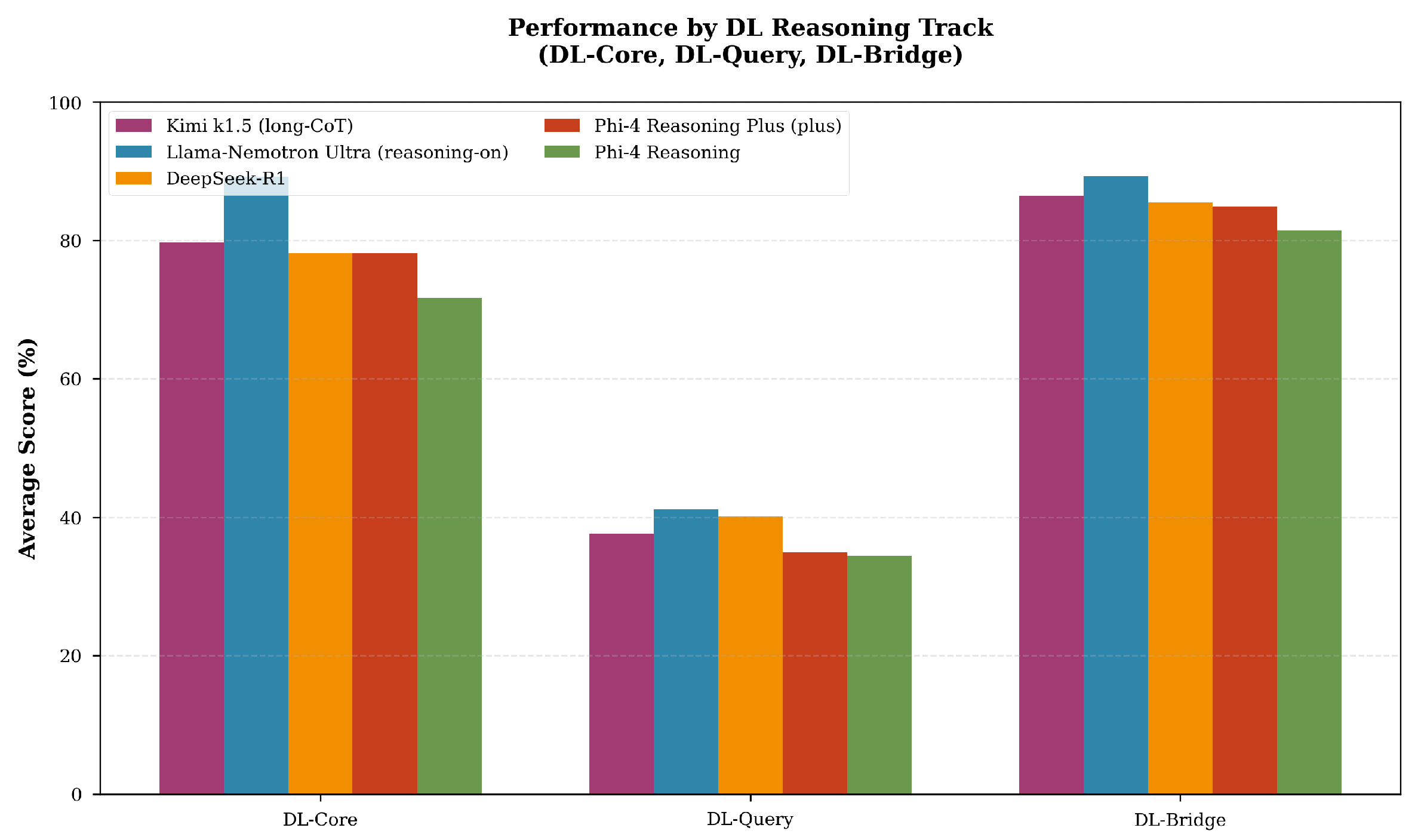
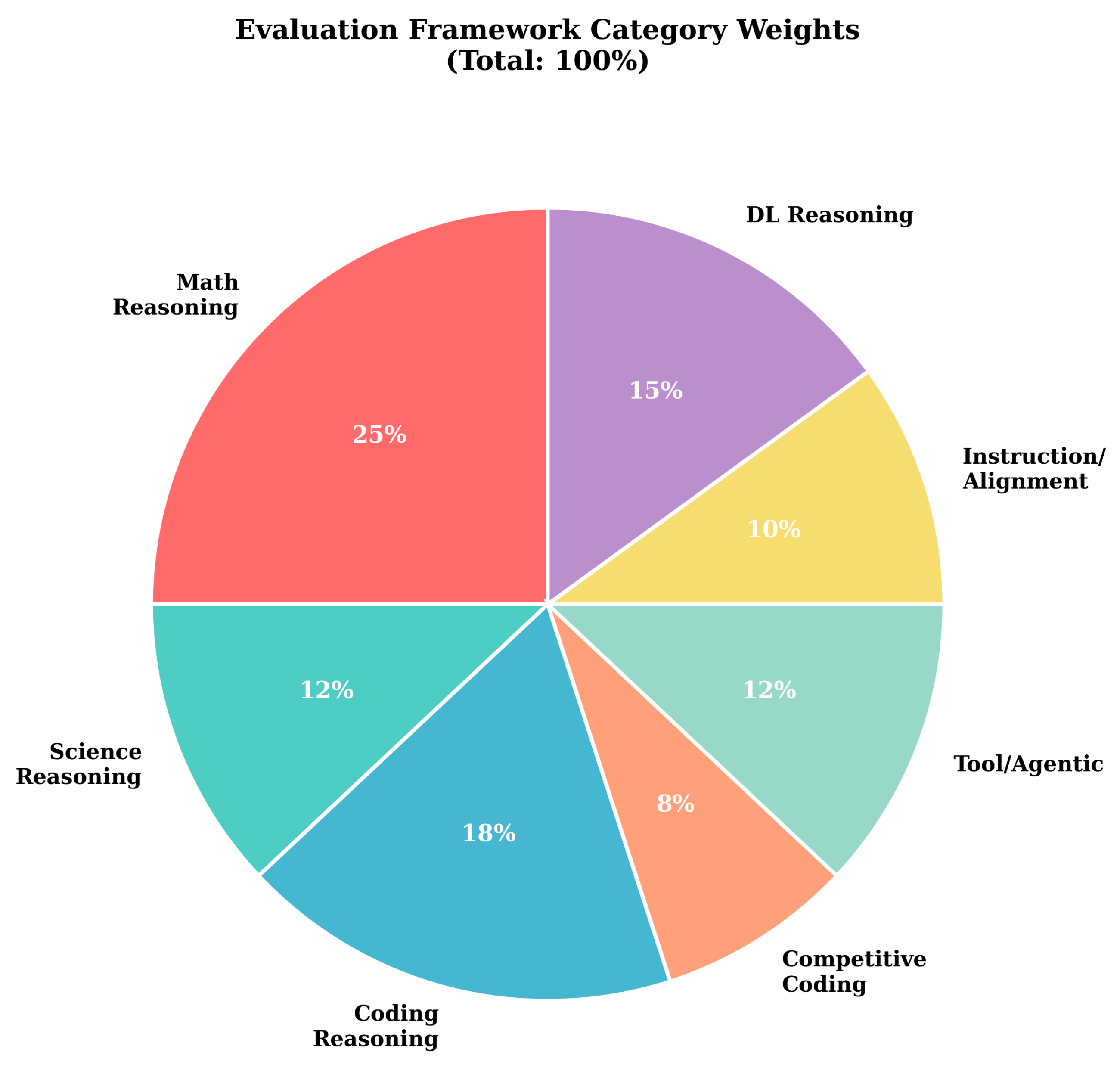
The experimental results from DL-ReasonSuite offer a comprehensive analysis of the formal and DL reasoning capabilities of LLMs and also to reveal their associated limitations.
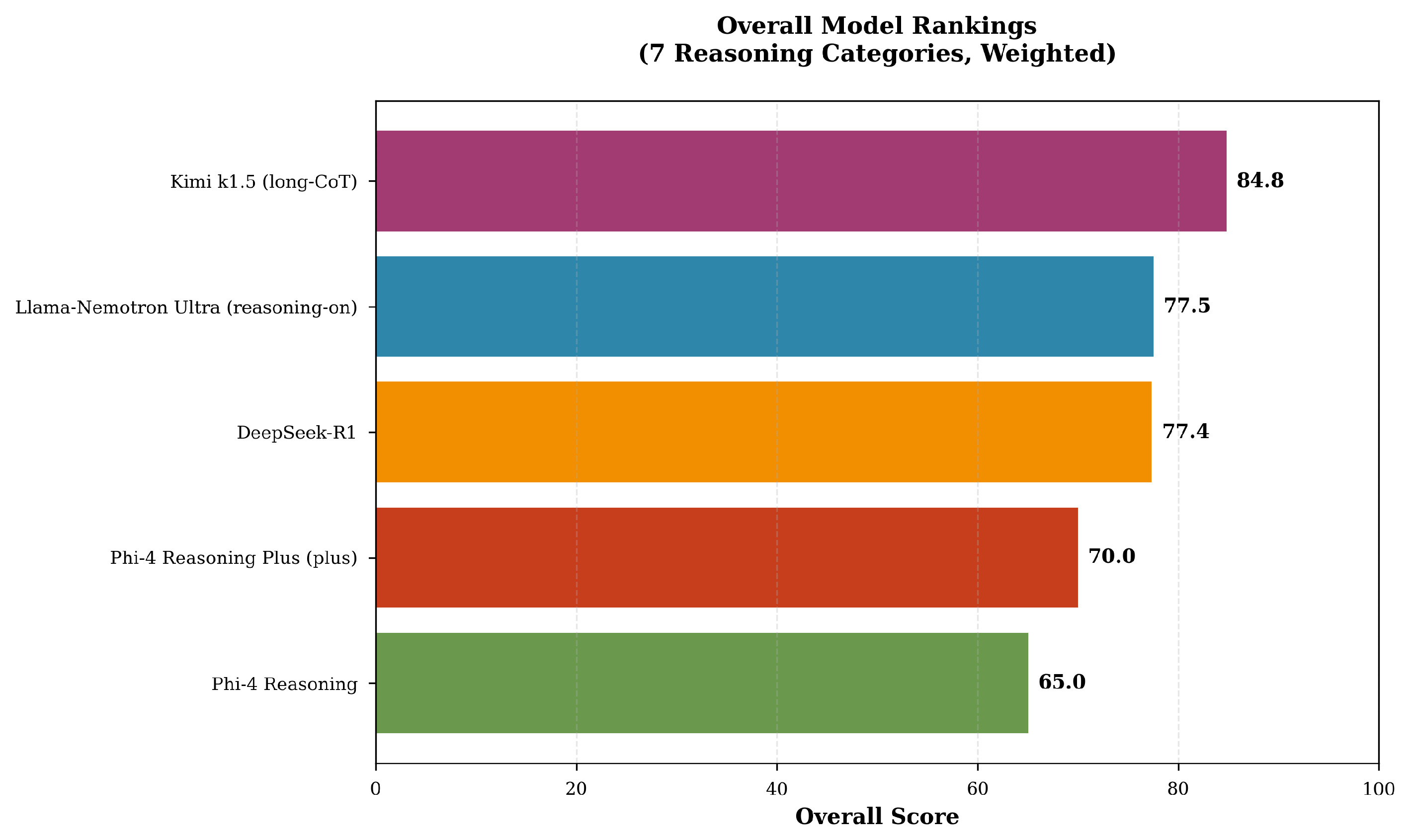
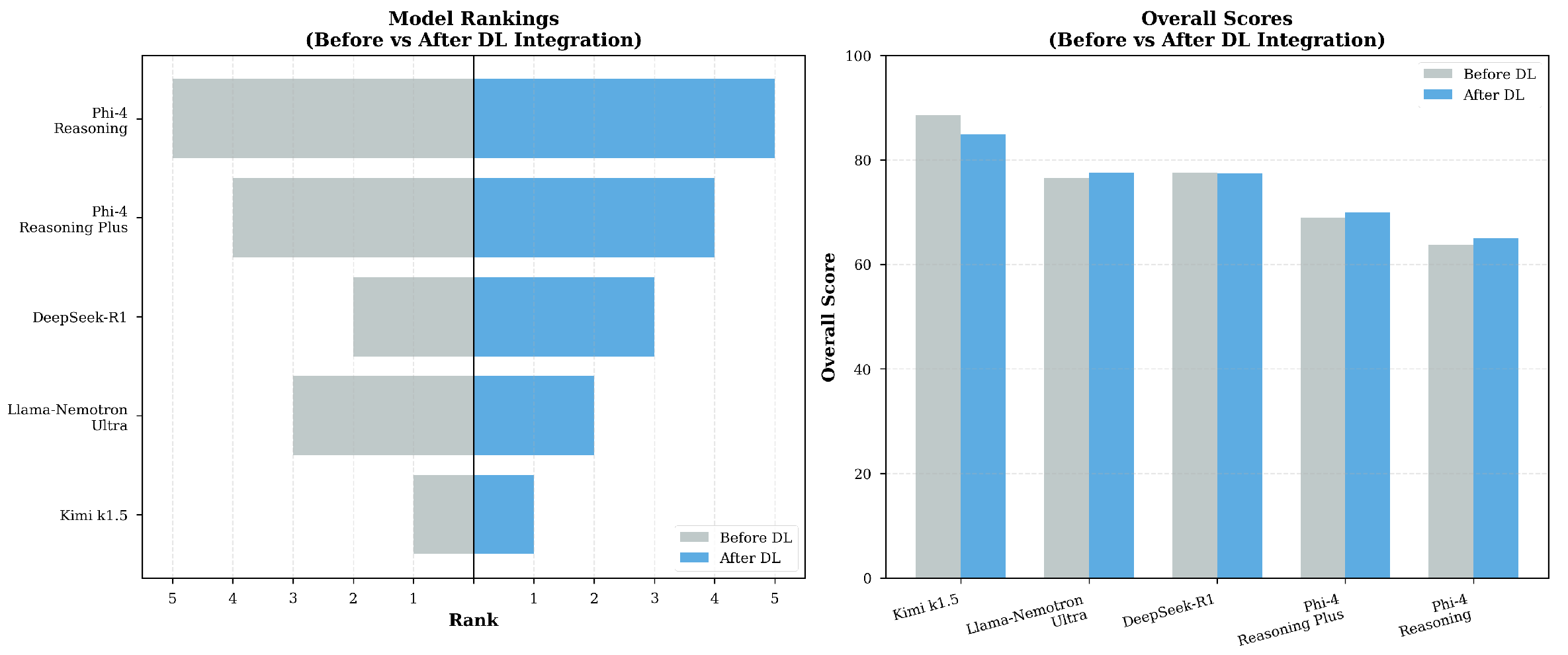
Figure 7 shows how model rankings change when DL reasoning performance is incorporated. These results underscore the impact of formal reasoning evaluation with state-of-the-art LLM models.
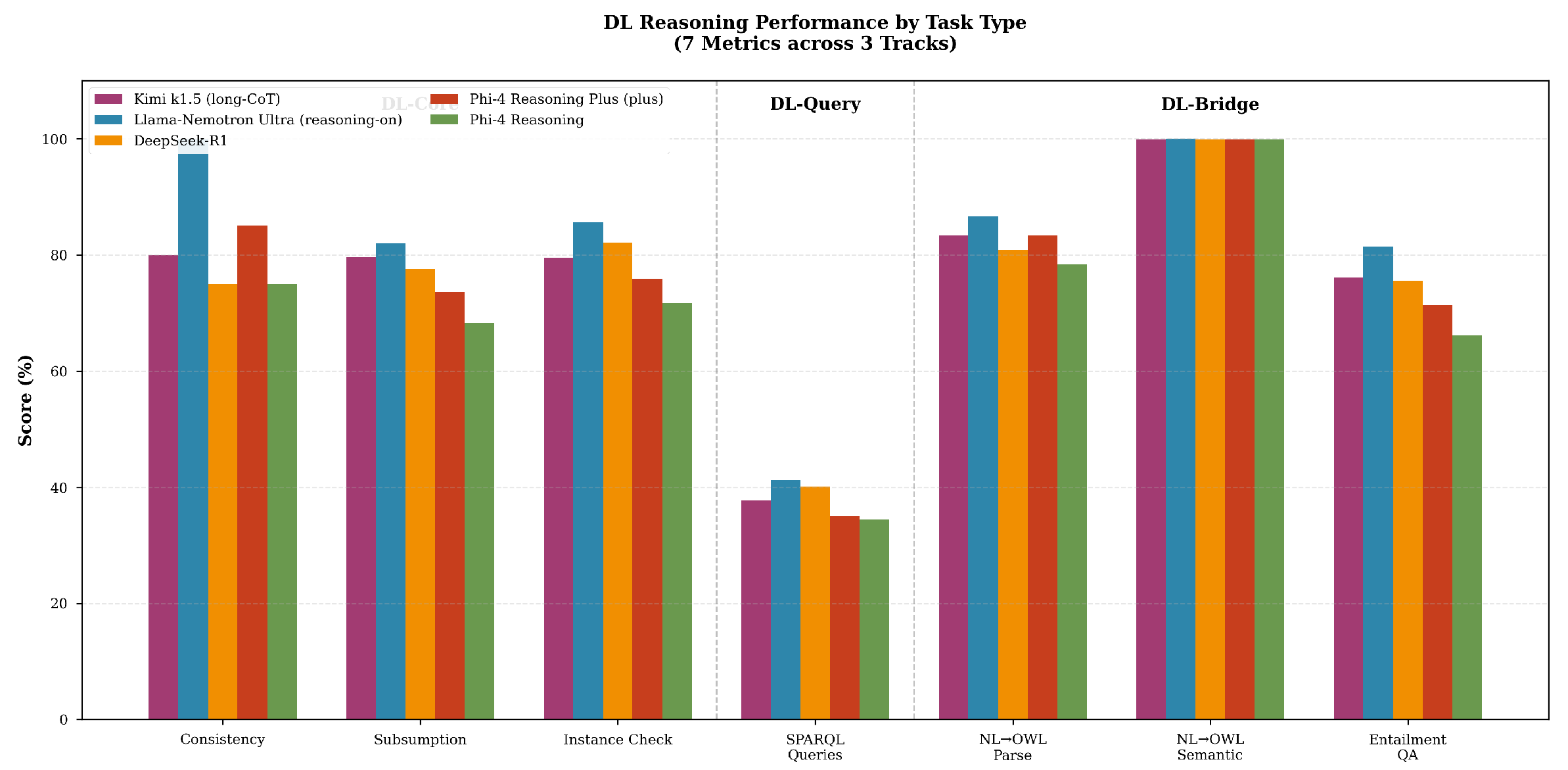
The evaluation results indicate that current reasoning-based LLMs achieve satisfactory success in handling straightforward and moderately complex logical structures. However, they still face substantial challenges in scenarios that demand formal accuracy and guaranteed inference which is essential regarding the nature of the domain. Results show that LLMs can learn core DL inference patterns such as subclass relations, discreteness constraints, and basic consistency checks to a certain degree of accuracy. This is noteworthy, because these logical structures are not explicitly and systematically represented in natural language. This capability of the LLM models can largely be explained by their ability to learn to mimic targeted fine-tuning processes, logical instructions or thought chain-like reasoning patterns. In this context, it can be said that LLMs can approximately simulate the behavior of a symbolic reasoner under limited conditions for easy tasks.
Findings from ontology consistency checks demonstrate that robust models such as Phi plus can identify implicit contradictions of the nature of the semantics by evaluating multiple axioms together for correct reasoning path. This capability is notable due to the fact that logical consistency is not an explicit goal in standard large language model training practices.
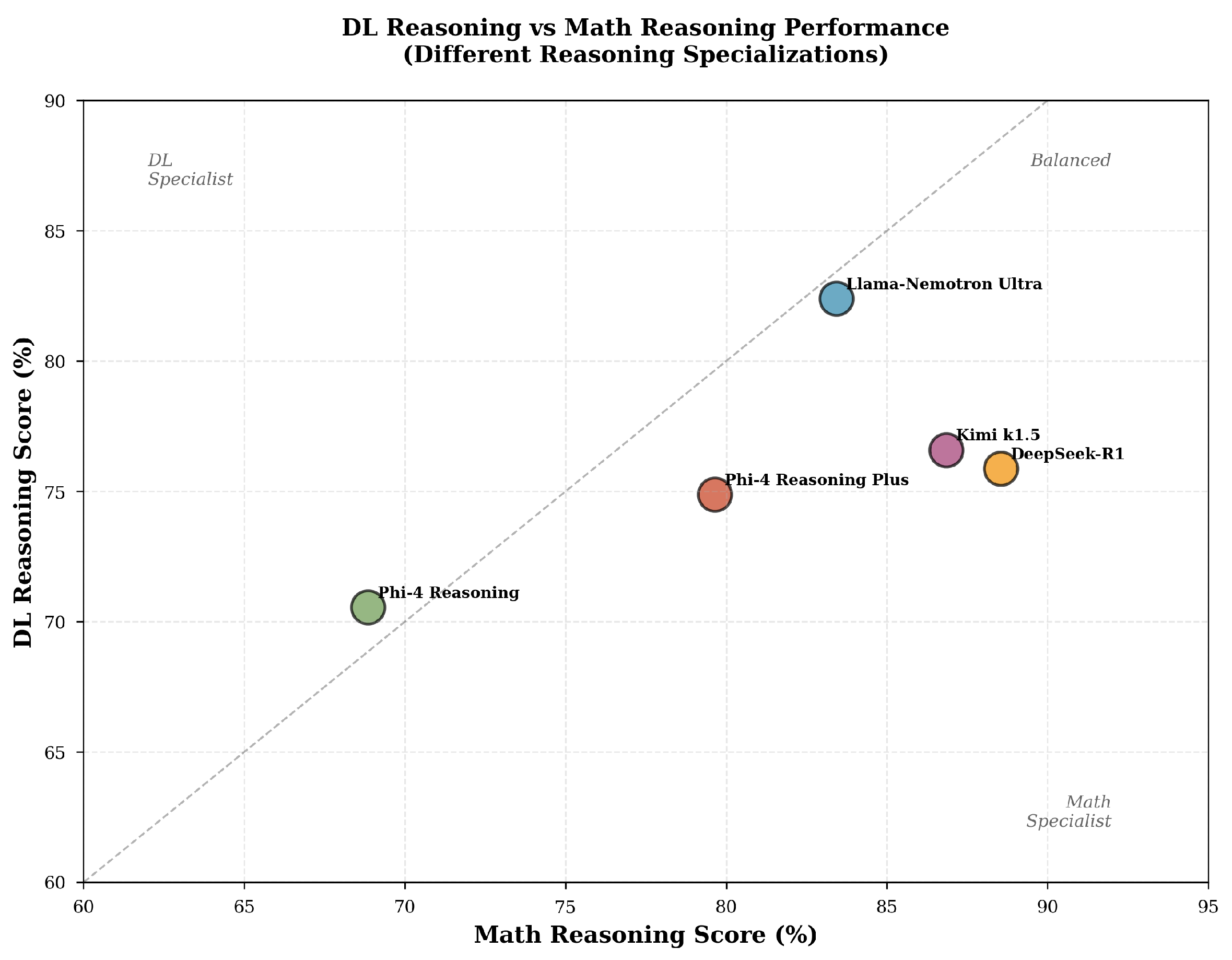
Figure 8 contrasts DL reasoning performance with math reasoning, illustrating that strong mathematical ability does not necessarily translate into formal ontology reasoning competence. Furthermore, the high accuracy rates observed in translation tasks from natural language to OWL statements reveal that LLMs have noticeable potential as helpful tools in ontology engineering processes. The generation of correct axioms for specific requirements are resulted with success or it is represented with minor syntactic corrections. This result shows how the leap between natural language to logical structures can be overcome with the help of the reasoning capabilities of LLMs.
However on the other side, upon analysis of the results, it can be acknowledged that LLM-based approaches suffer from contradictions due to their structural weaknesses. The most fundamental limitation is the inability to guarantee accuracy and consistency even for a simple logical representation. While determinism is crucial in logic-based models and the entailment remains as the core of the reasoning process, the model in a logical family is complete and sound as it responses with error-free results for all kind of queries. In their nature, LLMs are inherently probabilistic and prone to error. Experiments have shown that even the most robust models exhibit significant error rates on basic tasks. Thus, these errors systematically intensify as inference chains lengthen or interactive constraints increase during reasoning.
The structure of the training process of LLMs can also have effects despite working memory and the logical depth of the models. LLMs lack the systematic search, backtracking with full deterministic calculation and proof-generating mechanisms found in symbolic reasoning engines. Instead, their reasoning relies heavily on superficial regularities learned during training and the current context of the given input/query. This difference results in logically flawed outputs and even if the models frequently produce linguistically fluent answers, the query deviates from familiar patterns or requires multi-step precise inference. These minor errors pose significant risks in domains and applications requiring formal information processing and explainability.
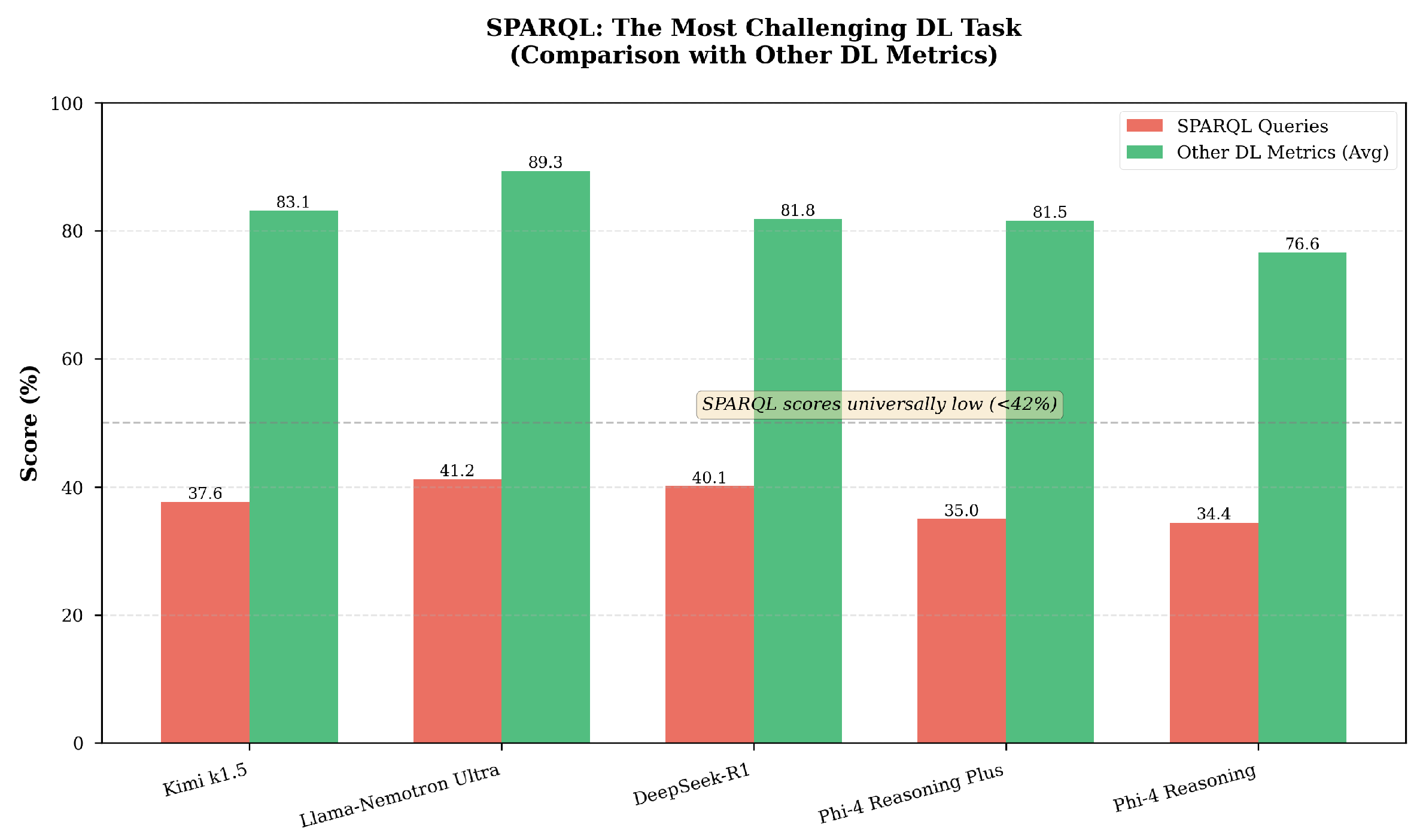
Interpretations and parsing of the formal query languages also presents a significant challenge in evaluation. In languages requiring strict syntax and procedural adherence, such as SPARQL, model performance consistently falls short compared to natural language-based tasks due to misunderstandings or missing logical structures defined. Models often attempt to process these queries by internally converting them into pseudo-natural language representations, creating an additional layer of abstraction which is not enough to represent a full logic language family which must be handled as a satisfaction problem over a domain knowledge model. Thus, the benchmark is constructed to promote success in accuracy for particular cases those requiring multi-step joins and inference on complex cases. These results conclude the need for hybrid architectures in which the query interpretation and execution roles of LLMs are separated but synergized in structure.
This synergy in construction of next-generation LLM-based systems is critical. LLMs will be reinforced with an external and deterministic reasoner to construct a complete model for every task regarding real-world problems. The fact that the integration is designed to require the model to decide under what circumstances to engage the tool underscores the importance of meta-reasoning capability. Next structure of neuro-symbolic architectures will be described where the LLM handles the unstructured and linguistic components, while the formal and computational overhead is delegated to symbolic modules.
Our evaluation focuses on task construction and metric reporting rather than an exhaustive analysis of prompt sensitivity. We acknowledge that structured reasoning benchmarks for LLMs can be sensitive to evaluation protocol choices, particularly prompt phrasing, few-shot demonstration selection, decoding stochasticity, and output parsing heuristics. These factors can materially affect performance, especially for tasks involving structured outputs such as OWL axioms and SPARQL query results. Consequently, while we report strong aggregate performance for several models, the reported results should be interpreted as conditional on the specific prompting and parsing setup adopted in this study. Future work will explore systematic robustness analyses across alternative prompting strategies and decoding configurations.
5. Conclusions
In this work, we introduced DL-ReasonSuite, a comprehensive benchmark for evaluating the formal reasoning capabilities of large language models in the context of Description Logic. We have set up 4740 tasks covering ontology consistency checking, taxonomic inference, instance classification, SPARQL query answering with entailment, natural language ↔ OWL translation and tool-assisted reasoning. These diverse tests have been configured to advance the robust logical reasoning of LLMs. This benchmark is carefully designed to represent diverse and challenging Description Logic reasoning and meant to score automatic reasoning tools for objective scoring. Thereby, we have established a rigorous evaluation framework grounded in the different levels of semantics of OWL/DL.
A benchmark was applied to five state-of-the-art reasoning-focused models to uncover the capabilities of these LLMs on the most difficult reasoning achieved in knowledge-based systems with Description Logic. In this application, we have first observed that LLMs have made notable strides in logical reasoning. The best reasoning models successfully handled the majority of DL tasks such as subclass relation extraction, ontology consistency check and even some complex query inferences. A second observation revealed that these models have clear limitations on complex logical inferences and tend to cluster errors around tasks requiring multi-step or high-precision reasoning such as intricate SPARQL queries or translations involving nested logical reasoning. Out of all five models, none of the candidates achieved near-perfect accuracy from different categories. These results highlight the gap between neural reasoning and the gold standard of symbolic reasoners in the literature. Moreover, as the third observation, augmenting LLMs with symbolic tools proves highly effective. The top performing model, the Phi-4 Reasoning Plus, was symbiotically merged with an OWL reasoner plugin to solve the hardest problems and this collaboration resulted with boost to the accuracy above its peers. The findings of this study reveal that next-generation large language models with an initial support of reliable logical reasoning requires explicit integration with symbolic mechanisms. Approaches such as Logic-LM demonstrate that coupling LLMs with symbolic solvers will lead to more faithful and verifiable logical inferences with better explainability. This inference particularly demands strict adherence to formal semantics over the domain of the knowledge base of models [
35]. More broadly, the results of the use cases characterize LLMs as neuro-symbolic reasoners and suggests that future progress in formal reasoning will depend on principled hybrid/synergized architectures rather than purely neural or purely symbolic solutions [
30]. This collaboration result underscores the promise of neuro-symbolic hybrid approaches in which LLMs and formal algorithms cooperate to achieve better results than either alone.
Through the tests of the state-of-the-art LLMs in the literature for reasoning tasks, there are strengths and weaknesses observed through experimentation. First, large LLMs can generalize many DL reasoning patterns in house but they can also exhibit brittle behavior such as overlooking constraints or defaulting to most plausible/generally correct answers. However, the logical cases such as edge reasoning tasks regarding negation or restriction resolved with incorrect answers especially when edge cases was experimented for implicit reasoning capacity. We emphasized that formal benchmarks like DL-ReasonSuite play a crucial role in stress-testing LLMs’ logical coherence and rigor in future capabilities of LLMs especially to represent human-like behavior for these kinds of extreme reasoning tasks. These kinds of tasks complement existing evaluations by focusing on exacting criteria of correctness that leave little room for error which also limits the capabilities of LLMs over its innate problems such as hallucinations. Especially more general or small LLMs were confused with the complexity of DL even for small representations which jeopardy the tool-use of these models’ decisions regarding real-life situations. The results of the benchmark reveals that incorporating structured reasoning training or developing better ways for models to internally simulate logic is crucial to develop more advanced LLM models. On the contrary, the users of these models tend to leave the practices of their domains to these LLMs and need more caution when deploying LLMs in knowledge-sensitive domains. These uses need to be carefully verified with semantically adapted verification mechanisms to ensure reliability on critical tasks.
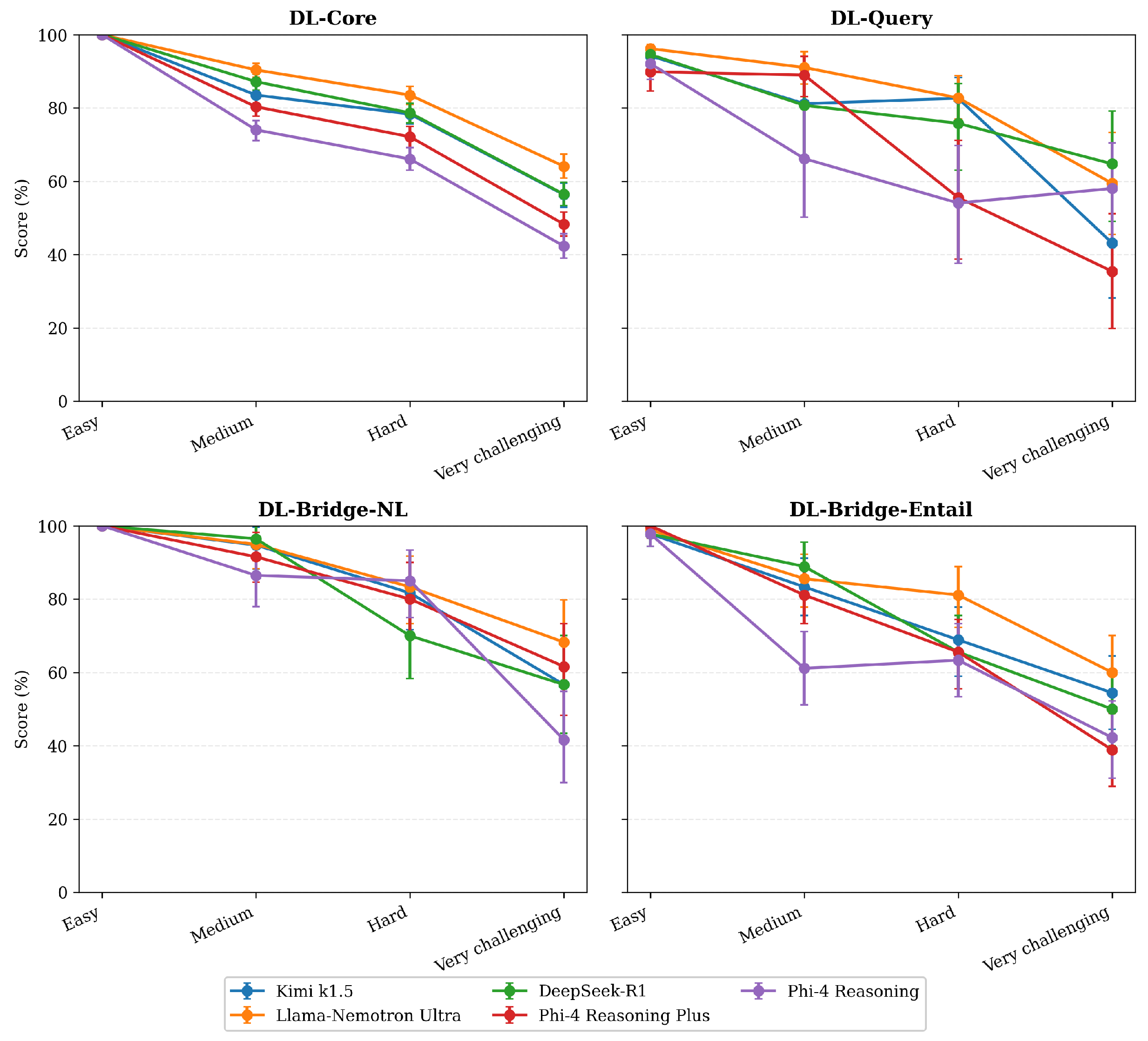
In addition to overall accuracy results, the difficulty-stratified analysis provides a clearer picture of where current LLM-based reasoners begin to fail under increasing logical complexity for DL tasks. When tasks are grouped by empirically observed hardness, all evaluated models exhibit near-ceiling performance on easy instances but suffer sharp and systematic degradation on harder items with accuracy drops exceeding 40 percentage points in the most challenging tier. This behavior is consistent across all reasoning tracks and is particularly pronounced in DL-Bridge tasks where language-to-axiom translation and entailment-sensitive reasoning impose stricter semantic and structural demands. These results suggest that current performance limitations are not driven by isolated task artifacts but rather reflect a fundamental robustness boundary in handling deeply compositional and constraint-heavy reasoning problems.
Through the results of the state-of-the-art reasoning models, we believe this benchmark will spur further research into making LLMs more logically grounded. The infrastructure of the LLMs will be evolved to a more semantically advanced model architecture and their training regimes will be enriched with logical training regimes with tight integration with the existing reasoning systems. As AI models continue to evolve into more semantic reasoning models, we envision that excellence on formal reasoning benchmarks will become an integral part of the criteria for truly advanced AI. This will continue with the experimentation of logical reasoning levels and through semantic reasoning, AI that can fluidly move between natural language and formal knowledge through maintaining the precision and consistency of a symbolic reasoner while retaining the flexibility and understanding of an LLM. DL-ReasonSuite contributes towards that vision by providing a yardstick to measure progress. As future work, we would like to extend the benchmark, improve model performance and deepen the analysis of reasoning in large language models. This road will pave the way to autonomous agents which were the main goal of the Semantic Web at the first place. These agents could now benefit from a range of applications from intelligent knowledge management systems which were creating robust and sound decisions and data with semantics. In addition to LLMs and symbolic models, this new collaboration is already ready to integrate with the existing semantic web knowledge base such as linked data and semantic web services and complex decision-support systems where the synergy of human-like language skills and uncompromising logical correctness is highly prized.