Evaluation of Miniscrew Stability in Posterior Teeth Intrusion—A Three-Dimensional Finite Element Analysis


Abstract
1. Introduction
2. Materials and Methods
2.1. Study Design
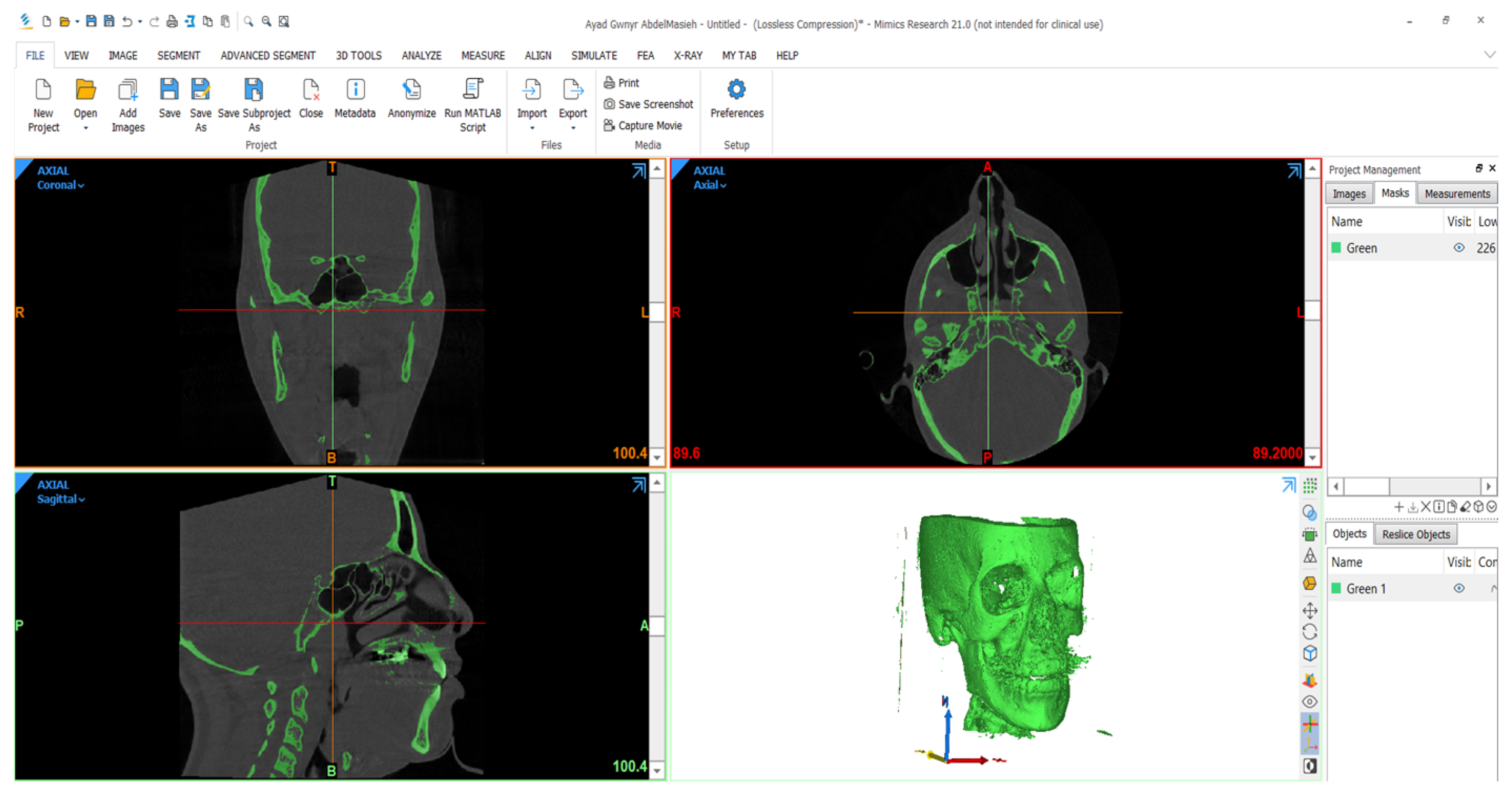
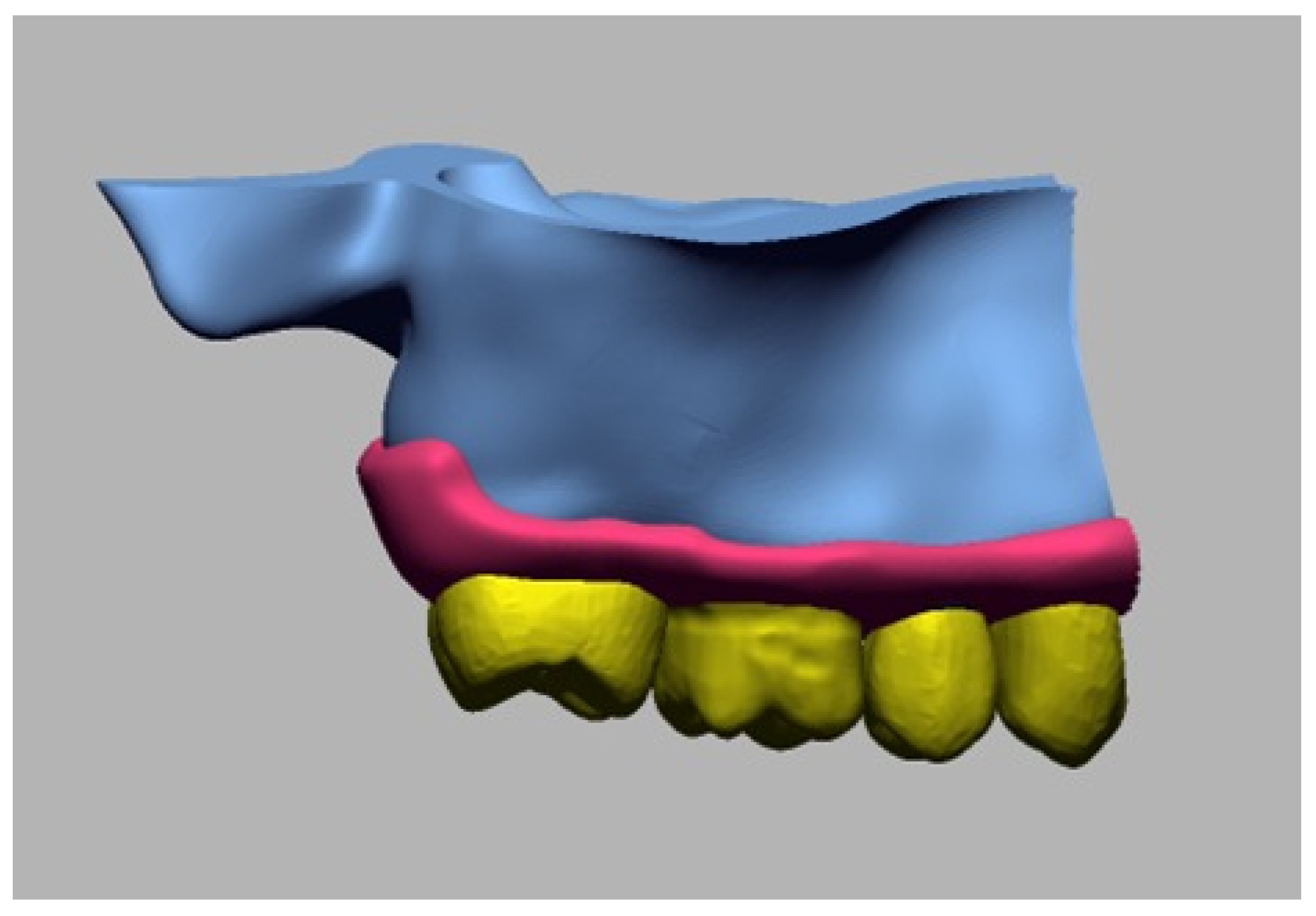
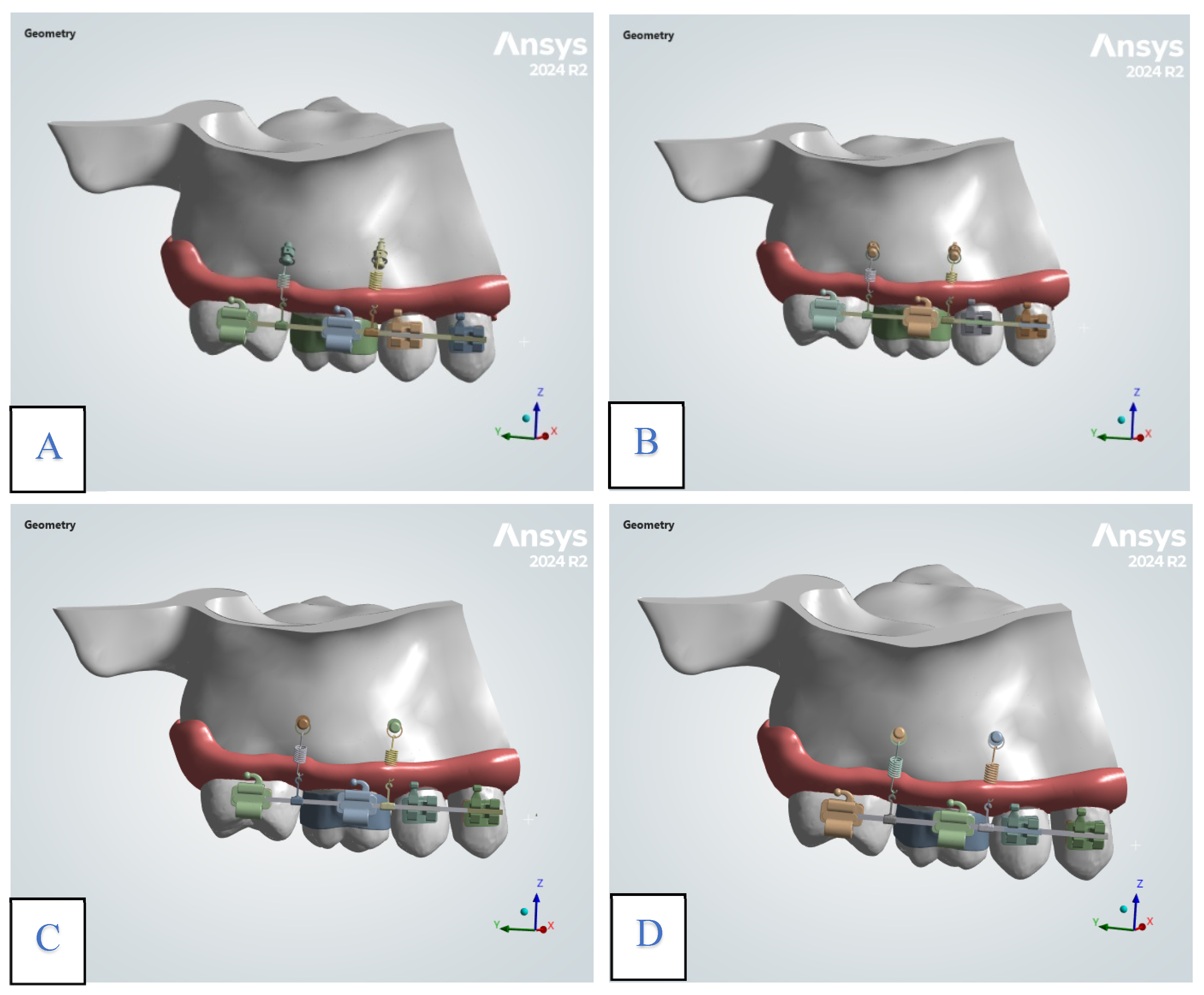
2.2. Three-Dimensional Model Development
2.3. Finite Element Analysis Setup
2.4. Data Analysis
2.5. Model Validation
3. Results
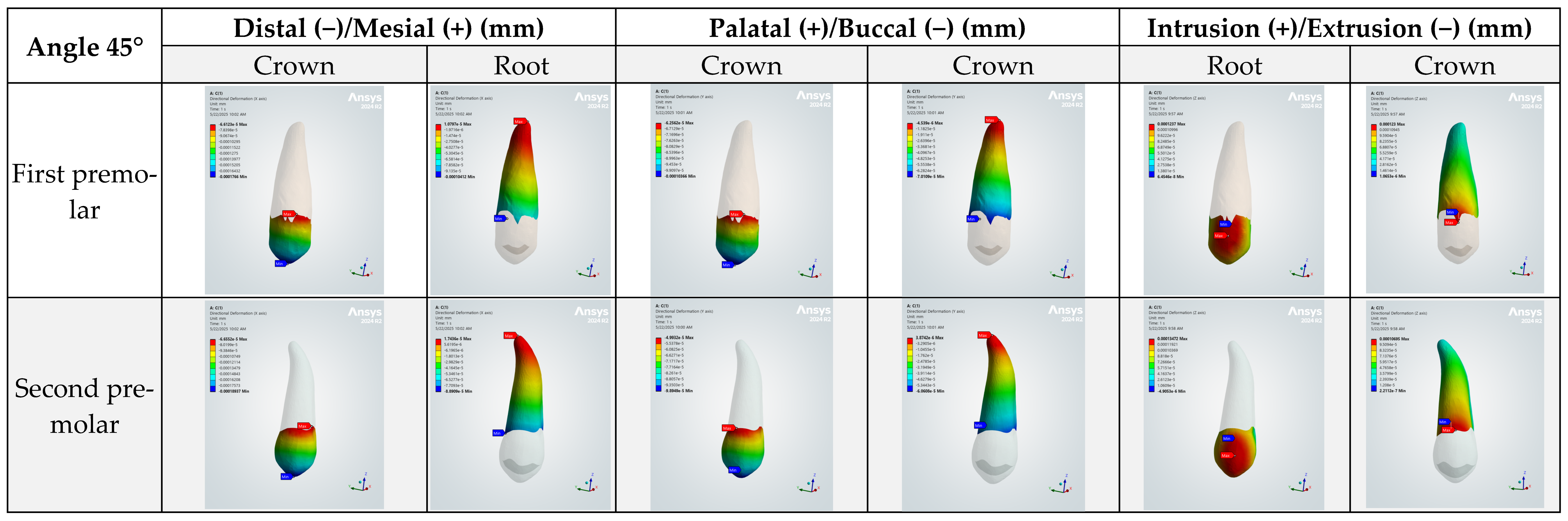
3.1. Posterior Teeth Displacement
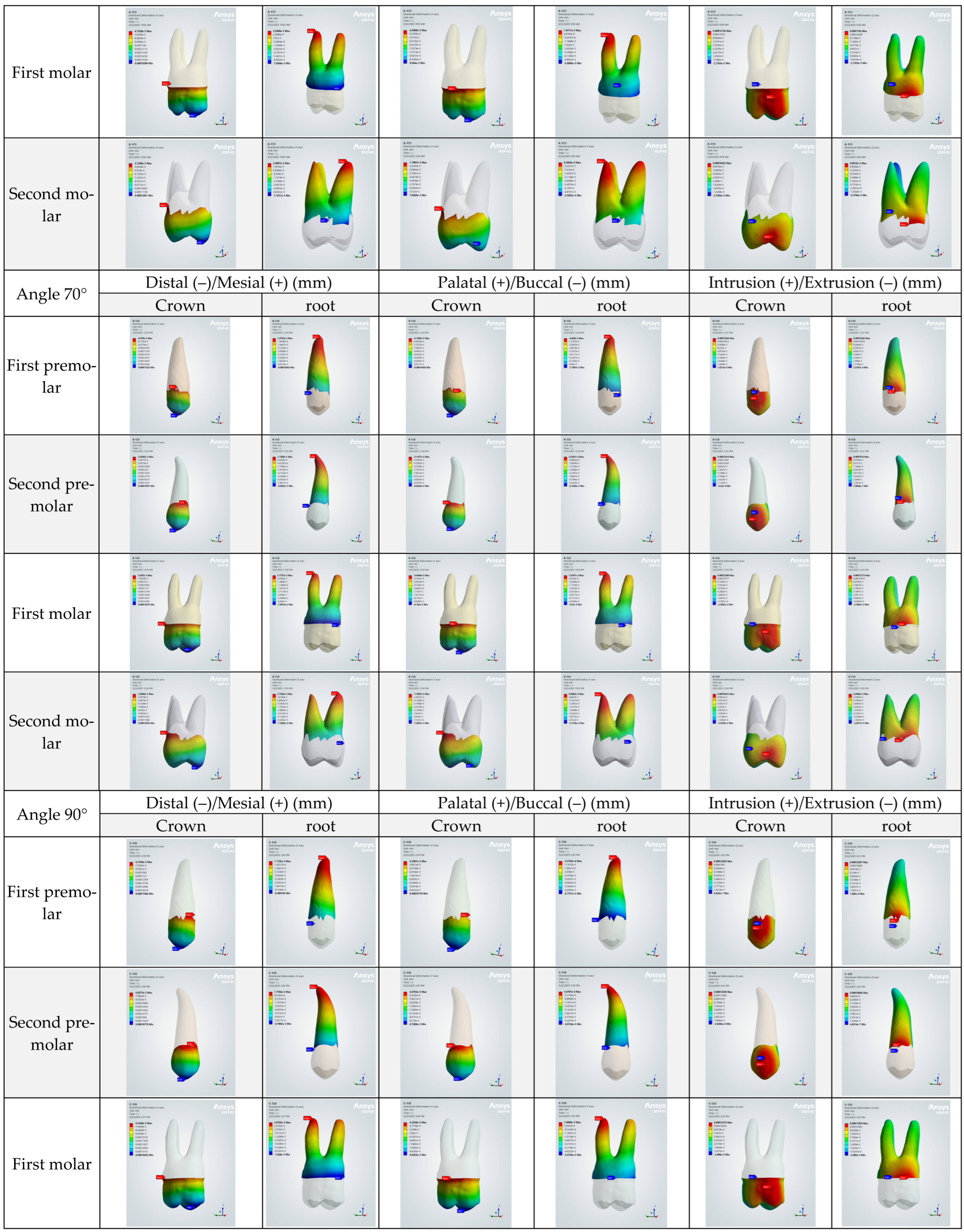
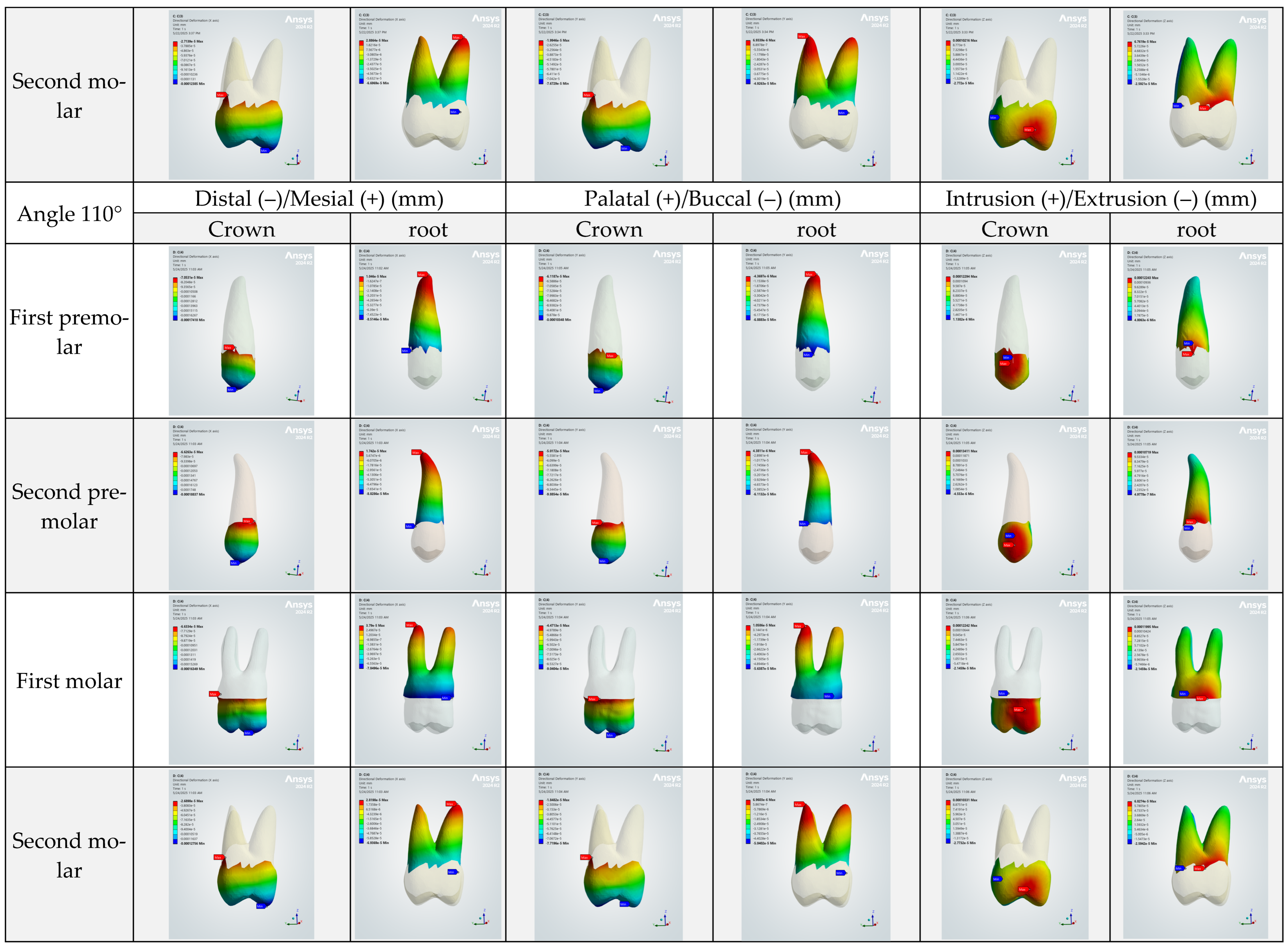
- Crown Displacement: Maximum distal tipping occurred at the first premolar (−0.0000705 mm at 110°).
- Root Displacement: Maximum mesial movement occurred at the first molar (+0.0000387 mm at 90°).
- Intrusion: Intrusion values ranged from +0.000104 mm to +0.000135 mm, with the second premolar showing the greatest intrusion and the second molar the least.
3.2. Posterior Periodontal Ligament (PDL) Analysis
3.3. Bone Analysis
3.3.1. Cortical Bone Stress Analysis Under Orthodontic Loading
3.3.2. Cancellous Bone Stress Analysis
3.4. Miniscrew Stress Analysis
4. Discussion
5. Conclusions
- Posterior PEEK miniscrews demonstrated mechanical stability under all evaluated insertion angulations during intrusion mechanics. Variations in insertion angle influenced stress distribution within the periodontal ligament and surrounding alveolar bone; however, the general pattern of posterior intrusion with associated tipping tendencies remained consistent across models.
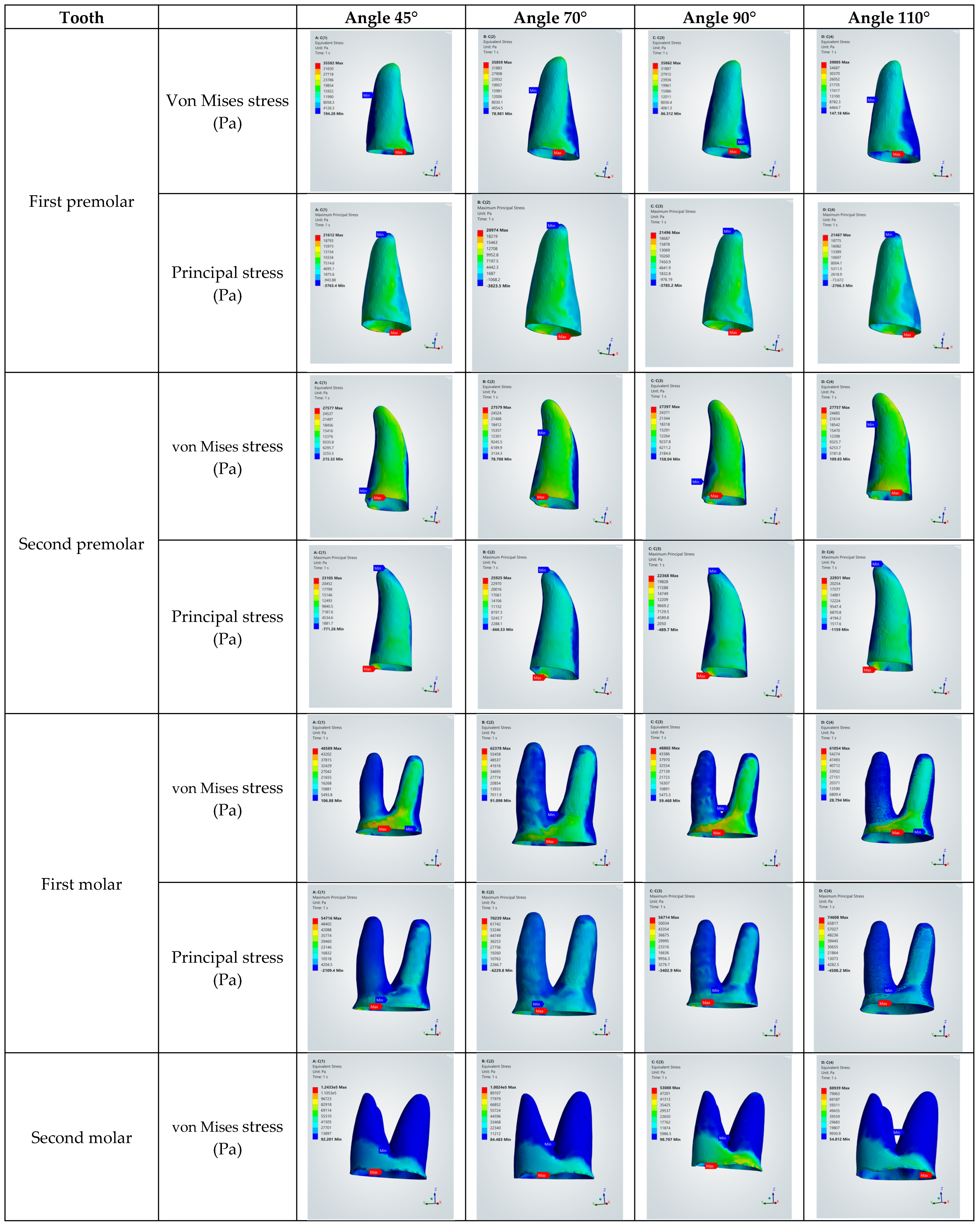
- Among the tested configurations, the 70° angulation exhibited a comparatively balanced biomechanical response in terms of stress distribution and miniscrew behavior. Nevertheless, increased angulations were associated with higher localized stress concentrations, particularly in the first molar region.
Author Contributions
Funding
Institutional Review Board Statement
Informed Consent Statement
Data Availability Statement
Acknowledgments
Conflicts of Interest
Abbreviations
| PEEK | Polyetheretherketone |
| FEA | Finite Element Analysis |
| CBCT | Cone beam computed tomography |
| PDL | Periodontal Ligament |
| TPA | Transpalatal arch |
| FE | Finite Element |
| DICOM | Digital Imaging and Communications in Medicine |
| CAD | computer-aided design |
References
- Page, M.J.; McKenzie, J.E.; Bossuyt, P.M.; Boutron, I.; Hoffmann, T.C.; Mulrow, C.D.; Shamseer, L.; Tetzlaff, J.M.; Akl, E.A.; Brennan, S.E.; et al. The PRISMA 2020 statement: An updated guideline for reporting systematic reviews. BMJ 2021, 372, 71. [Google Scholar] [CrossRef]
- Sterne, J.A.C.; Savović, J.; Page, M.J.; Elbers, R.G.; Blencowe, N.S.; Boutron, I.; Cates, C.J.; Cheng, H.Y.; Corbett, M.S.; Eldridge, S.M.; et al. RoB 2: A revised tool for assessing risk of bias in randomised trials. BMJ 2019, 366, l4898. [Google Scholar] [CrossRef]
- Brozek, J.L.; Canelo-Aybar, C.; Akl, E.A.; Bowen, J.M.; Bucher, J.; Chiu, W.A.; Cronin, M.; Djulbegovic, B.; Falavigna, M.; Guyatt, G.H.; et al. GRADE Guidelines 30: The GRADE approach to assessing the certainty of modeled evidence—An overview in the context of health decision-making. J. Clin. Epidemiol. 2021, 129, 138–150. [Google Scholar] [CrossRef]
- Sherwood, K.H.; Burch, J.G.; Thompson, W.J. Closing anterior open bites by intruding molars with titanium miniplate anchorage. Am. J. Orthod. Dentofac. Orthop. 2002, 122, 593–600. [Google Scholar] [CrossRef]
- Abellán, R.; Gómez, C.; Palma, J.C. Effects of photobiomodulation on the upper first molar intrusion movement using mini-screws anchorage: A randomized controlled trial. Photobiomodul. Photomed. Laser Surg. 2021, 39, 518–527. [Google Scholar] [CrossRef]
- Hart, T.R.; Cousley, R.R.J.; Fishman, L.S.; Tallents, R.H. Dentoskeletal changes following mini-implant molar intrusion in anterior open bite patients. Angle Orthod. 2015, 85, 941–948. [Google Scholar] [CrossRef] [PubMed]
- Moon, C.-H.; Wee, J.-U.; Lee, H.-S. Intrusion of overerupted molars by corticotomy and orthodontic skeletal anchorage. Angle Orthod. 2007, 77, 1119–1125. [Google Scholar] [CrossRef] [PubMed]
- Naqeed, M.A.; Ponnada, S.R.; Ganugapanta, V.R. Three-dimensional finite element analysis for stress distribution during intrusion and retraction using orthodontic mini-implants. Int. J. Dent. Med. 2021, 7, 1–9. [Google Scholar] [CrossRef]
- Cope, J.B. Temporary anchorage devices in orthodontics: A paradigm shift. In Seminars in Orthodontics; Elsevier: Amsterdam, The Netherlands, 2005; pp. 3–9. [Google Scholar] [CrossRef]
- Paik, C.-H.; McCOMB, R.; Hong, C. Differential molar intrusion with skeletal anchorage in open-bite treatment. J. Clin. Orthod. 2016, 50, 276. [Google Scholar] [PubMed Central]
- Kassem, H.E.; Marzouk, E.S. Prediction of changes due to mandibular autorotation following miniplate-anchored intrusion of maxillary posterior teeth in open bite cases. Prog. Orthod. 2018, 19, 13. [Google Scholar] [CrossRef]
- Olteanu, N.D.; Romanec, C.; Cernei, E.R.; Karvelas, N.; Nastri, L.; Zetu, I.N. Scoping Review—The Effectiveness of Clear Aligners in the Management of Anterior Open Bite in Adult Patients. Medicina 2025, 61, 1113. [Google Scholar] [CrossRef]
- Paccini, J.V.C.; Cotrim-Ferreira, F.A.; Ferreira, F.V.; de Freitas, K.M.S.; Cançado, R.H.; Valarelli, F.P. Efficiency of two protocols for maxillary molar intrusion with mini-implants. Dent. Press J. Orthod. 2016, 21, 56–66. [Google Scholar] [CrossRef]
- Chang, P.E.; Kim, J.-Y.; Jung, H.-D.; Park, J.J.; Choi, Y.J. Posttreatment stability of an anterior open-bite by molar intrusion compared with 2-jaw surgery—A retrospective study. Clin. Oral Investig. 2022, 26, 6607–6616. [Google Scholar] [CrossRef] [PubMed]
- González-Valls, G.; Roca-Millan, E.; Céspedes-Sánchez, J.M.; González-Navarro, B.; Torrejon-Moya, A.; López-López, J. Narrow diameter dental implants as an alternative treatment for atrophic alveolar ridges. Systematic review and meta-analysis. Materials 2021, 14, 3234. [Google Scholar] [CrossRef]
- Shanmadhy, S.; Srinivasan, D.; Kannan, R. Intrusion Using Mini Impants: Review of Literature. Vasc. Endovasc. Rev. 2025, 8, 34–40. [Google Scholar]
- Lin, J.C.Y.; Liou, E.J.W.; Yeh, C.-L. Intrusion of overerupted maxillary molars with miniscrew anchorage. J. Clin. Orthod. 2006, 40, 378. [Google Scholar] [PubMed]
- Singh, S.; Mogra, S.; Shetty, V.S.; Shetty, S.; Philip, P. Three-dimensional finite element analysis of strength, stability, and stress distribution in orthodontic anchorage: A conical, self-drilling miniscrew implant system. Am. J. Orthod. Dentofac. Orthop. 2012, 141, 327–336. [Google Scholar] [CrossRef] [PubMed]
- Sivamurthy, G.; Sundari, S. Stress distribution patterns at mini-implant site during retraction and intrusion—A three-dimensional finite element study. Prog. Orthod. 2016, 17, 4. [Google Scholar] [CrossRef] [PubMed]
- Kuroda, S.; Tanaka, E. Risks and complications of miniscrew anchorage in clinical orthodontics. Jpn. Dent. Sci. Rev. 2014, 50, 79–85. [Google Scholar] [CrossRef]
- Papageorgiou, S.N.; Zogakis, I.P.; Papadopoulos, M.A. Failure rates and associated risk factors of orthodontic miniscrew implants: A meta-analysis. Am. J. Orthod. Dentofac. Orthop. 2012, 142, 577–595. [Google Scholar] [CrossRef]
- Sakamaki, T.; Watanabe, K.; Iwasa, A.; Deguchi, T.; Horiuchi, S.; Tanaka, E. Thread shape, cortical bone thickness, and magnitude and distribution of stress caused by the loading of orthodontic miniscrews: Finite element analysis. Sci. Rep. 2022, 12, 12367. [Google Scholar] [CrossRef] [PubMed]
- Chang, H.-P.; Tseng, Y.-C. Miniscrew implant applications in contemporary orthodontics. Kaohsiung J. Med. Sci. 2014, 30, 111–115. [Google Scholar] [CrossRef]
- Motoyoshi, M.; Yoshida, T.; Ono, A.; Shimizu, N. Effect of cortical bone thickness and implant placement torque on stability of orthodontic mini-implants. Int. J. Oral Maxillofac. Implant. 2007, 22, 779. [Google Scholar] [PubMed]
- Florvaag, B.; Kneuertz, P.; Lazar, F.; Koebke, J.; Zöller, J.E.; Braumann, B.; Mischkowski, R.A. Biomechanical properties of orthodontic miniscrews. An in-vitro study. J. Orofac. Orthop. 2010, 71, 53–67. [Google Scholar] [CrossRef]
- Del Rosso, C.; Poli, P.P.; Ghizzoni, M.; Caprioglio, A. Clinical Management of Orthodontic Miniscrew Complications: A Scoping Review. Dent. J. 2025, 13, 582. [Google Scholar] [CrossRef]
- Renouard, F.; Nisand, D. Impact of implant length and diameter on survival rates. Clin. Oral Implant. Res. 2006, 17, 35–51. [Google Scholar] [CrossRef]
- Goutam, M.; Giriyapura, C.; Mishra, S.K.; Gupta, S. Titanium allergy: A literature review. Indian J. Dermatol. 2014, 59, 630. [Google Scholar] [CrossRef] [PubMed]
- Park, J.-Y.; Bae, S.-Y.; Lee, J.-J.; Kim, J.-H.; Kim, H.-Y.; Kim, W.-C. Evaluation of the marginal and internal gaps of three different dental prostheses: Comparison of the silicone replica technique and three-dimensional superimposition analysis. J. Adv. Prosthodont. 2017, 9, 159–169. [Google Scholar] [CrossRef]
- Friedrich, R.E.; Todorovic, M.; Kruell, A. Simulation of Scattering Effects of Irradiation on Surroundings Using the Example of Titanium Dental Implants: A Monte Carlo Approach. Anticancer. Res. 2010, 30, 1727–1730. [Google Scholar] [PubMed]
- Mishra, S.; Chowdhary, R. PEEK materials as an alternative to titanium in dental implants: A systematic review. Clin. Implant Dent. Relat. Res. 2019, 21, 208–222. [Google Scholar] [CrossRef]
- Ardani, I.G.A.W.; Nugraha, A.P.; Suryani, M.N.; Pamungkas, R.H.P.; Vitamamy, D.G.; Susanto, R.A.; Sarno, A.F.R.; Kharisma, V.D.; Nugraha, A.P.; Noor, T.N.E.B.T.A. Molecular docking of polyether ether ketone and nano-hydroxyapatite as biomaterial candidates for orthodontic mini-implant fabrication. J. Pharm. Pharmacogn. Res. 2022, 10, 676–686. [Google Scholar] [CrossRef]
- Thresher, R.W.; Saito, G.E. The stress analysis of human teeth. J. Biomech. 1973, 6, 443–449. [Google Scholar] [CrossRef] [PubMed]
- Shetty, P.; Hegde, A.; Rai, K. Finite element method–an effective research tool for dentistry. J. Clin. Pediatr. Dent. 2010, 34, 281–285. [Google Scholar] [CrossRef]
- Kawamura, J.; Park, J.H.; Kojima, Y.; Kook, Y.; Kyung, H.; Chae, J. Biomechanical analysis for total mesialization of the mandibular dentition: A finite element study. Orthod. Craniofac. Res. 2019, 22, 329–336. [Google Scholar] [CrossRef]
- Korun, D.; Topçuoğlu, T. Different Maxillary Molar Intrusion Mechanics Supported by Mini-Screws: A Finite Element Method. Cyprus J. Med. Sci. 2025, 10, 351–356. [Google Scholar] [CrossRef]
- Holmes, P.B. Horizontal Buccal Cortical Bone Thickness for Miniscrew Placement Strategies. Master’s Thesis, Medical University of South Carolina, Charleston, SC, USA, 2013. [Google Scholar]
- Mapar, A.; Taheri-Nassaj, N.; Shen, J.; Komari, O.; Sheets, C.G.; Earthman, J.C. Finite element study of periodontal ligament properties for a maxillary central incisor and a mandibular second molar under percussion conditions. J. Med. Biol. Eng. 2022, 42, 681–691. [Google Scholar] [CrossRef]
- Mazhari, M.; Khanehmasjedi, M.; Mazhary, M.; Atashkar, N.; Rakhshan, V. Dynamics, Efficacies, and Adverse Effects of Maxillary Full-Arch Intrusion Using Temporary Anchorage Devices (Miniscrews): A Finite Element Analysis. BioMed Res. Int. 2022, 1, 6706392. [Google Scholar] [CrossRef]
- Vadvadgi, V.; Padmawar, S.S.; Belludi, A. Study of stress distribution in maxillary anterior region during true intrusion of maxillary incisors using finite element methodology. Int. J. Exp. Dent. Sci. 2014, 1, 89–92. [Google Scholar] [CrossRef]
- Agustine, C.; Soegiharto, B.M. Stress Distribution of Anterior Tooth Apex and Their Surrounding Alveolar Bone during Maxillary Anterior Intrusion on Segmented and Continuous Wires (3D Finite Element Analysis). J. Int. Dent. Med. Res. 2018, 11, 596. [Google Scholar]
- Ghorab, H.; Ramadan, A.A.F.; Nadim, M.A.; Sharaf, T. Finite element study to evaluate the stress around mini-implant during canine retraction using continuous and interrupted orthodontic forces. Open Access Maced. J. Med. Sci. 2023, 11, 36–43. [Google Scholar] [CrossRef]
- Hu, X.; Zhao, Y.; Yang, C. Evaluation of root position during orthodontic treatment via multiple intraoral scans with automated registration technology. Am. J. Orthod. Dentofac. Orthop. 2023, 164, 285–292. [Google Scholar] [CrossRef] [PubMed]
- Liu, T.-C.; Chang, C.-H.; Wong, T.-Y.; Liu, J.-K. Finite element analysis of miniscrew implants used for orthodontic anchorage. Am. J. Orthod. Dentofac. Orthop. 2012, 141, 468–476. [Google Scholar] [CrossRef]
- Şavkan, İ.; Marşan, G.; Tağrikuu, B. Three-dimensional finite element analysis of the effects of different force vectors on tooth movement in miniscrew-assisted en masse retraction. Eur. Oral Res. 2025, 59, 179–185. [Google Scholar] [CrossRef] [PubMed]
- Sarika, K.; Kumaran, N.K.; Seralathan, S.; Sathishkumar, R.K.; Preethi, S.K. A three-dimensional finite element analysis of the stress distribution around the bone mini-implant interface based on the mini-implant angle of insertion, diameter, and length. J. Pharm. Bioallied Sci. 2023, 15, S535–S539. [Google Scholar] [CrossRef] [PubMed]
- Hirai, Y.; Watanabe, K.; Deguchi, T.; Ueda, K.; Hamada, K.; Tanaka, E. Influence of insertion depth on stress distribution in orthodontic miniscrew and the surrounding bone by finite element analysis. Dent. Mater. J. 2021, 40, 1270–1276. [Google Scholar] [CrossRef]
- Zrinski, M.T.; Pavlic, A.; Katic, V.; Spalj, S. Effect of personality traits on the association between clinically assessed malocclusion and the psychosocial impact of dental aesthetics. Orthod. Craniofac. Res. 2023, 26, 62–71. [Google Scholar] [CrossRef]
- Singh, J.R.; Kambalyal, P.; Jain, M.; Khandelwal, P. Revolution in Orthodontics: Finite element analysis. J. Int. Soc. Prev. Community Dent. 2016, 2, 110–114. [Google Scholar] [CrossRef]
- Bock, N.C.; Killat, S.; Ruf, S. Efficiency and outcome quality of Herbst-Multibracket appliance therapy in Class II: 2 patients. Eur. J. Orthod. 2022, 44, 117–124. [Google Scholar] [CrossRef]
- Guo, R.; Lam, X.Y.; Zhang, L.; Li, W.; Lin, Y. Biomechanical analysis of miniscrew-assisted molar distalization with clear aligners: A three-dimensional finite element study. Eur. J. Orthod. 2024, 46, cjad077. [Google Scholar] [CrossRef]
- Akbulut, Y.; Ozdemir, S. Optimizing Miniscrew Stability: A Finite Element Study of Titanium Screw Insertion Angles. Biomimetics 2025, 10, 650. [Google Scholar] [CrossRef]
- Ardani, I.G.A.W.; Hariati, I.V.D.; Nugraha, A.P.; Narmada, I.B.; Syaifudin, A.; Perkasa, I.B.A.; Gunung, G.P.; Deshmukh, S.; Hassan, R. Comparison of biomechanical performance of titanium and polyaryletheretherketone miniscrews at different insertion angles: A finite element analysis. J. Orthod. Sci. 2024, 13, 13. [Google Scholar] [CrossRef] [PubMed]
- KARA, G.G. Investigation of Different Miniscrew Head Designs by Finite Element Analysis. Turk. J. Orthod. 2024, 37, 98–103. [Google Scholar] [CrossRef] [PubMed]
- Wang, D.; Akbari, A.; Jiang, F.; Liu, Y.; Chen, J. The effects of different types of periodontal ligament material models on stresses computed using finite element models. Am. J. Orthod. Dentofac. Orthop. 2022, 162, e328–e336. [Google Scholar] [CrossRef] [PubMed]



| Material | Modulus of Elasticity (GPa) | Poisson’s Ratio |
|---|---|---|
| Compact Bone | 13.7 | 0.30 |
| Cancellous Bone | 0.142 | 0.3 |
| PEEK Miniscrews | 3.6 | 0.36 |
| 0.019 × 0.025″ Stainless steel wire | 193.0 | 0.29 |
| TPA | 210.0 | 0.30 |
| PDL | 0.07 | 0.45 |
| Gingiva (Soft Tissue) | 0.0001 | 0.4 |
| Preadjusted bracket (MBT slot 0.022″) | 197.0 | 0.29 |
| NiTi closed coli spring | 48 | 0.3 |
| Model | Nodes | Elements |
|---|---|---|
| Loading Condition | ||
| Case 1: Implant at 45° (Posterior) | 1,325,870 | 787,287 |
| Case 2: Implant at 70° (Posterior) | 2,274,888 | 1,448,492 |
| Case 3: Implant at 90° (Posterior) | 2,216,531 | 1,391,108 |
| Case 4: Implant at 110° (Posterior) | 1,532,466 | 910,973 |
| Distal (−)/Mesial (+) (mm) | Palatal (+)/Buccal (−) (mm) | Intrusion (+)/Extrusion (−) (mm) | ||||
|---|---|---|---|---|---|---|
| Crown | Root | Crown | Crown | Root | Crown | |
| Angle 45° | ||||||
| First premolar | −0.000066123 | 0.000010797 | −0.000062562 | −0.000004539 | 0.0001237 | 0.000123 |
| Second premolar | −0.000066552 | 0.000017436 | −0.000049932 | 0.0000038742 | 0.00013472 | 0.00010695 |
| First molar | −0.000067528 | 0.000035668 | −0.000045068 | 0.000010171 | 0.00012136 | 0.0001182 |
| Second molar | −0.000027298 | 0.000026897 | −0.000017907 | 0.0000063656 | 0.00010422 | 0.000080915 |
| First premolar | −0.00006979 | 0.000010776 | −0.000061505 | −0.000004629 | 0.00012258 | 0.00012204 |
| Second premolar | −0.000065935 | 0.000017298 | −0.000051477 | 0.0000042301 | 0.00013418 | 0.0001074 |
| First molar | −0.00006855 | 0.000037757 | −0.000046446 | 0.000010747 | 0.00012399 | 0.00012173 |
| Second molar | −0.000026884 | 0.000027356 | −0.000017807 | 0.0000068802 | 0.00010412 | 0.000068484 |
| Angle 90° | ||||||
| First premolar | −0.000063106 | 0.000011135 | −0.000052881 | −0.0000043743 | 0.00012265 | 0.00012207 |
| Second premolar | −0.000066373 | 0.000017764 | −0.000048754 | 0.0000044701 | 0.00013338 | 0.00010666 |
| First molar | −0.000063448 | 0.000038703 | −0.000042539 | 0.000010909 | 0.00012219 | 0.00011954 |
| Second molar | −0.000027139 | 0.000028864 | −0.000019946 | 0.0000069339 | 0.00010216 | 0.000067619 |
| Angle 110° | ||||||
| First premolar | −0.000070531 | 0.00001046 | −0.000061187 | −0.0000043697 | 0.00012294 | 0.00012243 |
| Second premolar | −0.000066263 | 0.00001742 | −0.000050172 | 0.0000043811 | 0.00013411 | 0.00010719 |
| First molar | −0.000066334 | 0.0000379 | −0.000044713 | 0.000010586 | 0.00012242 | 0.00011995 |
| Second molar | −0.000026898 | 0.000028198 | −0.000018482 | 0.0000069603 | 0.00010331 | 0.000068274 |
| Teeth | Stress Analysis | Angle 45° | Angle 70° | Angle 90° | Angle 110° |
|---|---|---|---|---|---|
| First premolar | Von Mises stress | 35,582 | 35,859 | 35,862 | 39,005 |
| Principal stress “Tensile” | 21,612 | 20,974 | 21,496 | 21,467 | |
| Principal stress “Compressive” | 3763.4 | 3823.5 | 3785.2 | 2766.3 | |
| Second premolar | Von Mises stress | 27,577 | 27,579 | 27,397 | 27,757 |
| Principal stress “Tensile” | 23,105 | 25,925 | 22,368 | 22,931 | |
| Principal stress “Compressive” | 771.26 | 666.53 | 489.7 | 1159 | |
| First molar | Von Mises stress | 48,589 | 62,378 | 48,802 | 61,054 |
| Principal stress “Tensile” | 54,716 | 70,239 | 56,714 | 74,608 | |
| Principal stress “Compressive” | 2109.4 | 6229.8 | 3402.9 | 4508.2 | |
| Second molar | Von Mises stress | 124,330 | 100,240 | 53,088 | 88,939 |
| Principal stress “Tensile” | 31,155 | 24,299 | 35,890 | 31,201 | |
| Principal stress “Compressive” | 5905 | 4210.7 | 4930 | 3520.7 |
| Angle 45° | Angle 70° | Angle 90° | Angle 110° | |
|---|---|---|---|---|
| First premolar | 8226.4 | 8077.9 | 8285.4 | 8423.1 |
| Second premolar | 9050.9 | 8999.7 | 8786.9 | 8868.7 |
| First molar | 27,458 | 35,850 | 31,059 | 34,591 |
| Second molar | 9629.5 | 8050.2 | 14,275 | 12,080 |
| Tooth | Angle 45° | Angle 70° | Angle 90° | Angle 110° | |
|---|---|---|---|---|---|
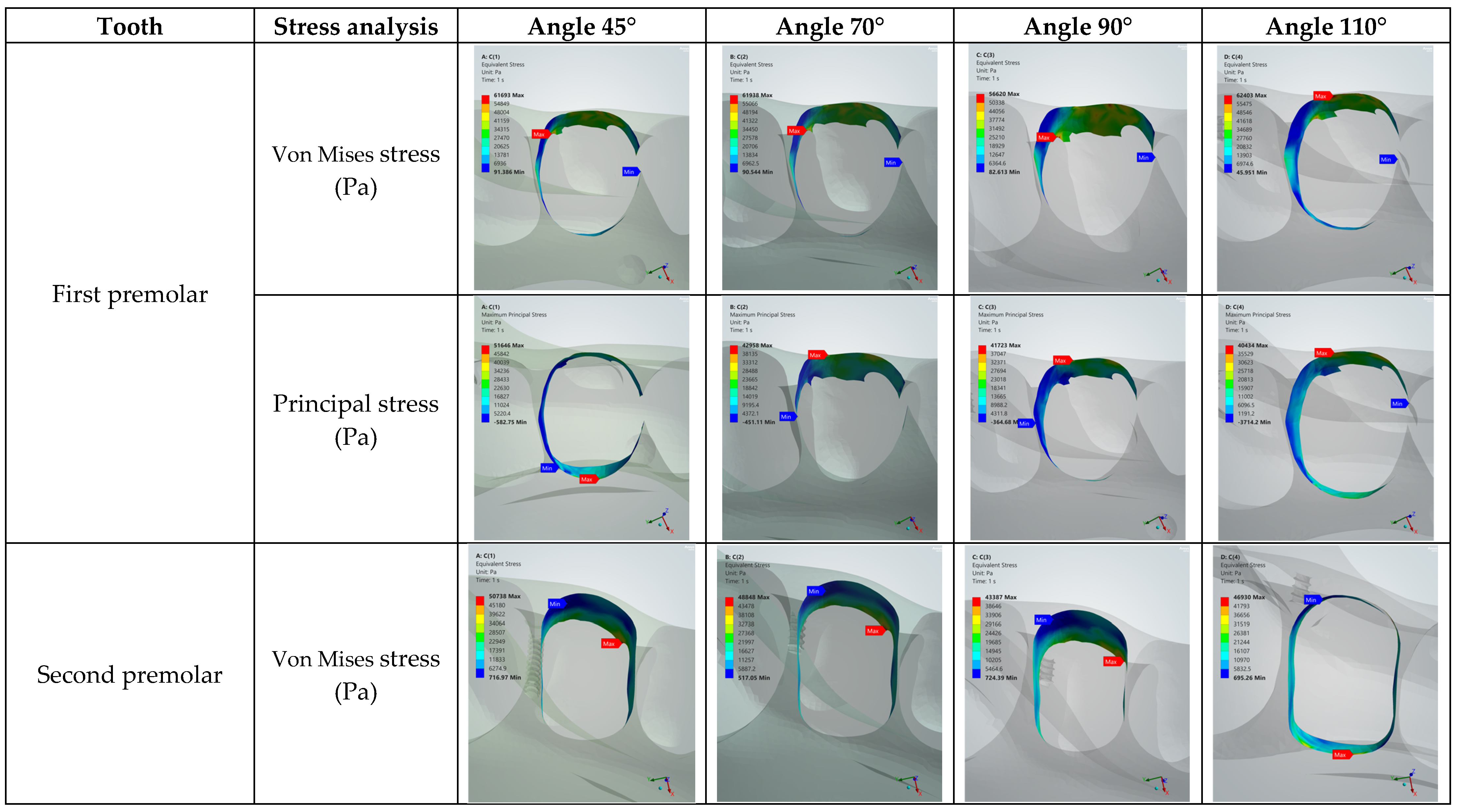
| First premolar | Von Mises stress | 61,693 | 61,938 | 56620 | 62,403 |
| Principal stress “Tensile” | 51,646 | 42,958 | 41,723 | 40,434 | |
| Principal stress “Compressive” | 582.75 | 451.11 | 364.68 | 3714.2 | |
| Second premolar | Von Mises stress | 50,738 | 48,848 | 43,387 | 46,930 |
| Principal stress “Tensile” | 24,328 | 26,381 | 23,660 | 50,189 | |
| Principal stress “Compressive” | 641.44 | 531.64 | 203.22 | 487.35 | |
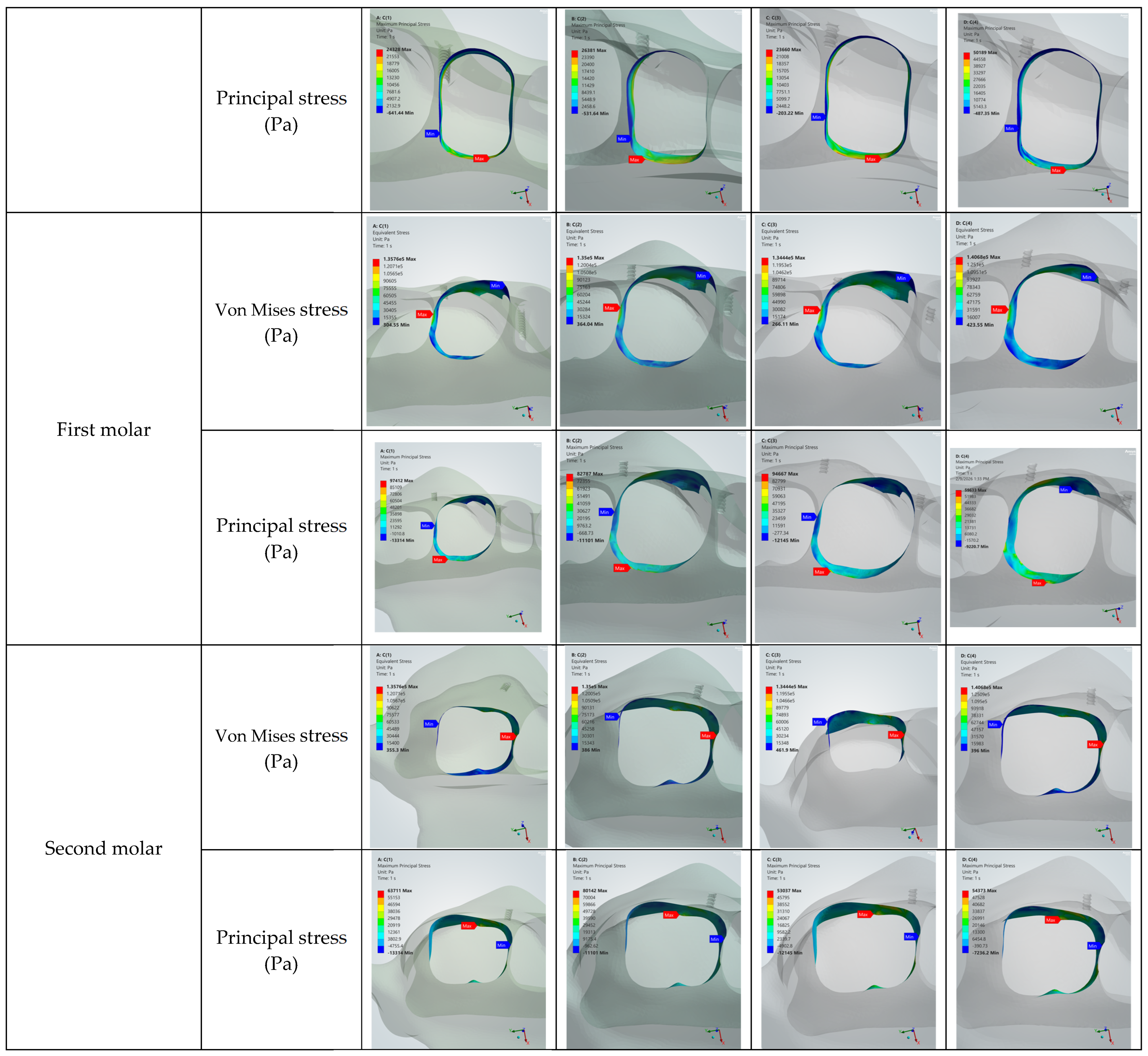
| First molar | Von Mises stress | 135,760 | 135,000 | 134,440 | 140,680 |
| Principal stress “Tensile” | 97,412 | 82,787 | 94,667 | 59,633 | |
| Principal stress “Compressive” | 13,314 | 11,101 | 12,190 | 9220.7 | |
| Second molar | Von Mises stress | 135,760 | 135,000 | 134,440 | 140,680 |
| Principal stress “Tensile” | 63,711 | 80,142 | 53,037 | 54,373 | |
| Principal stress “Compressive” | 13,314 | 11,101 | 12,190 | 7236.2 |
| Tooth | Stress Analysis | Angle 45° | Angle 70° | Angle 90° | Angle 110° |
|---|---|---|---|---|---|
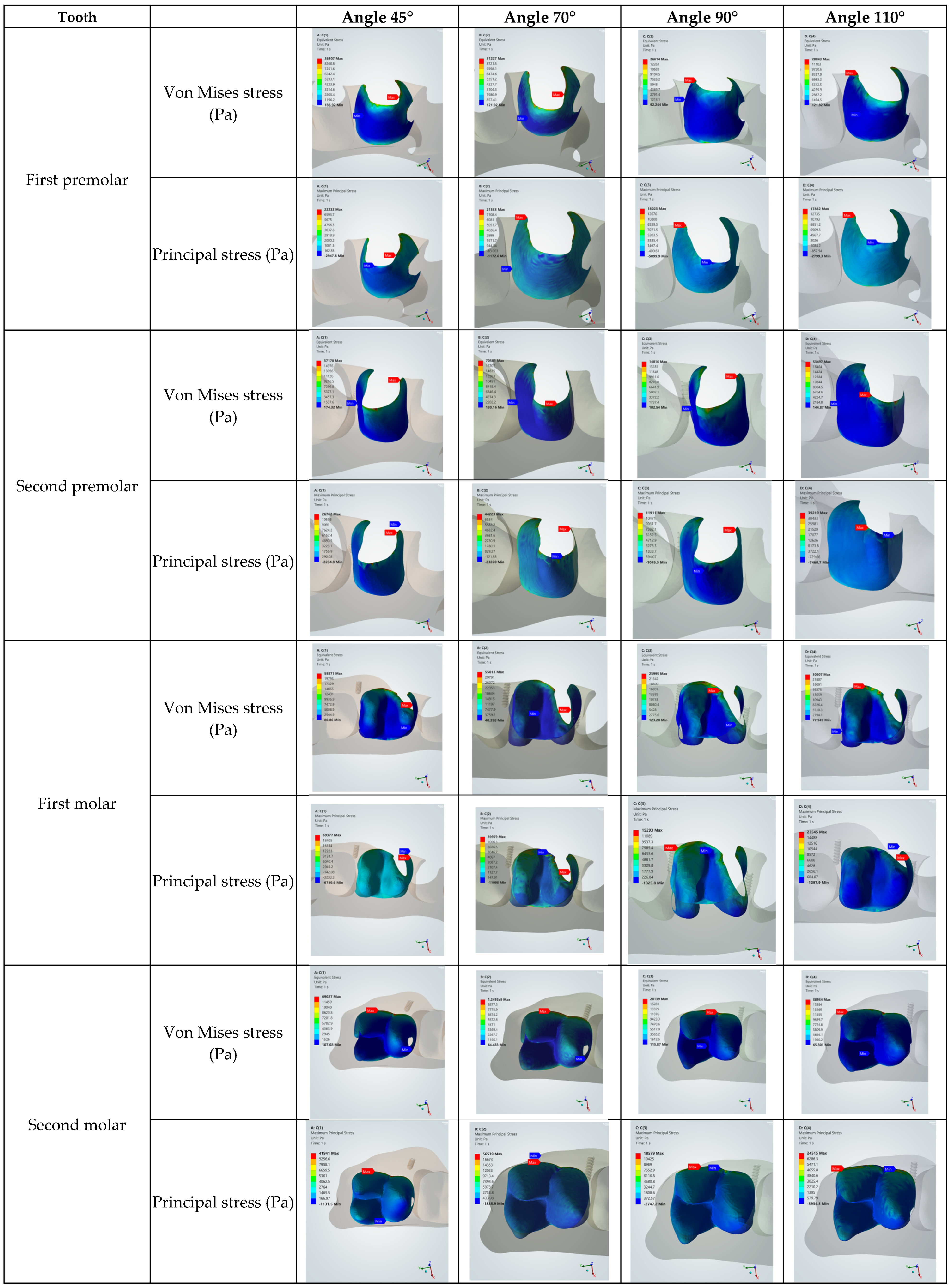
| First premolar | Von Mises stress | 36,307 | 31,227 | 26,614 | 28,843 |
| Principal stress “Tensile” | 22,232 | 21,533 | 18,023 | 17,832 | |
| Principal stress “Compressive” | 2947.6 | 1172.6 | 5899.9 | 2799.3 | |
| Second premolar | Von Mises stress | 37,178 | 70,581 | 14,816 | 53,497 |
| Principal stress “Tensile” | 26,762 | 44,223 | 11,911 | 39,219 | |
| Principal stress “Compressive” | 2234.8 | 23,220 | 1090.5 | 7460.7 | |
| First molar | Von Mises stress | 58,871 | 55,013 | 23,995 | 30,607 |
| Principal stress “Tensile” | 69,377 | 39,979 | 15,293 | 23,545 | |
| Principal stress “Compressive” | 9749.6 | 11,095 | 1325.8 | 1287.9 | |
| Second molar | Von Mises stress | 69,027 | 124,920 | 28,139 | 38,934 |
| Principal stress “Tensile” | 41,941 | 56,539 | 18,579 | 24,515 | |
| Principal stress “Compressive” | 1131.5 | 1885.9 | 2747.2 | 3934.3 |
| Biomechanical Performance | Angle 45° | Angle 70° | Angle 90° | Angle 110° | |
|---|---|---|---|---|---|
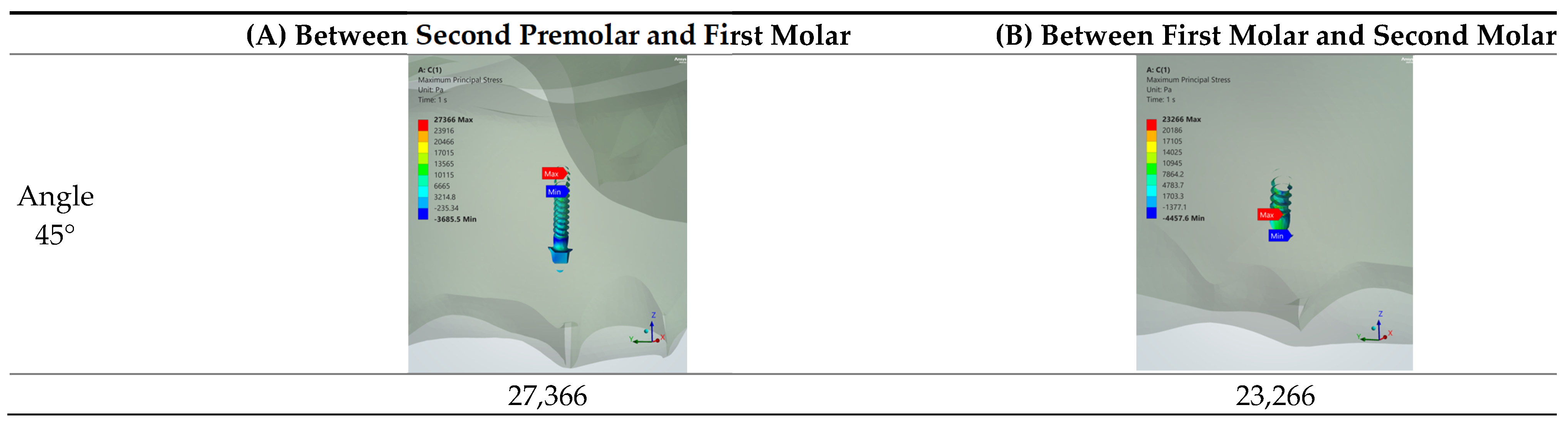
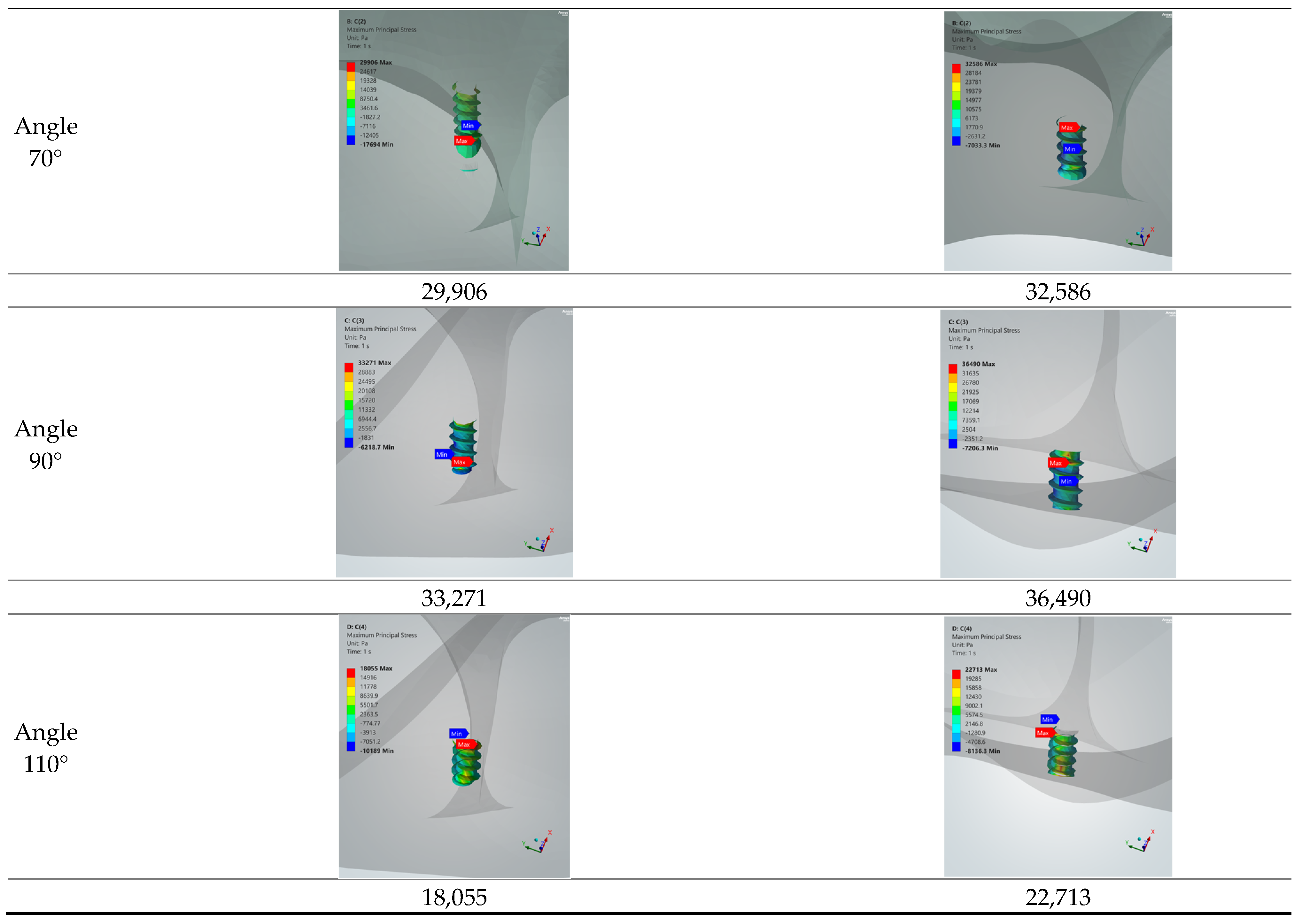
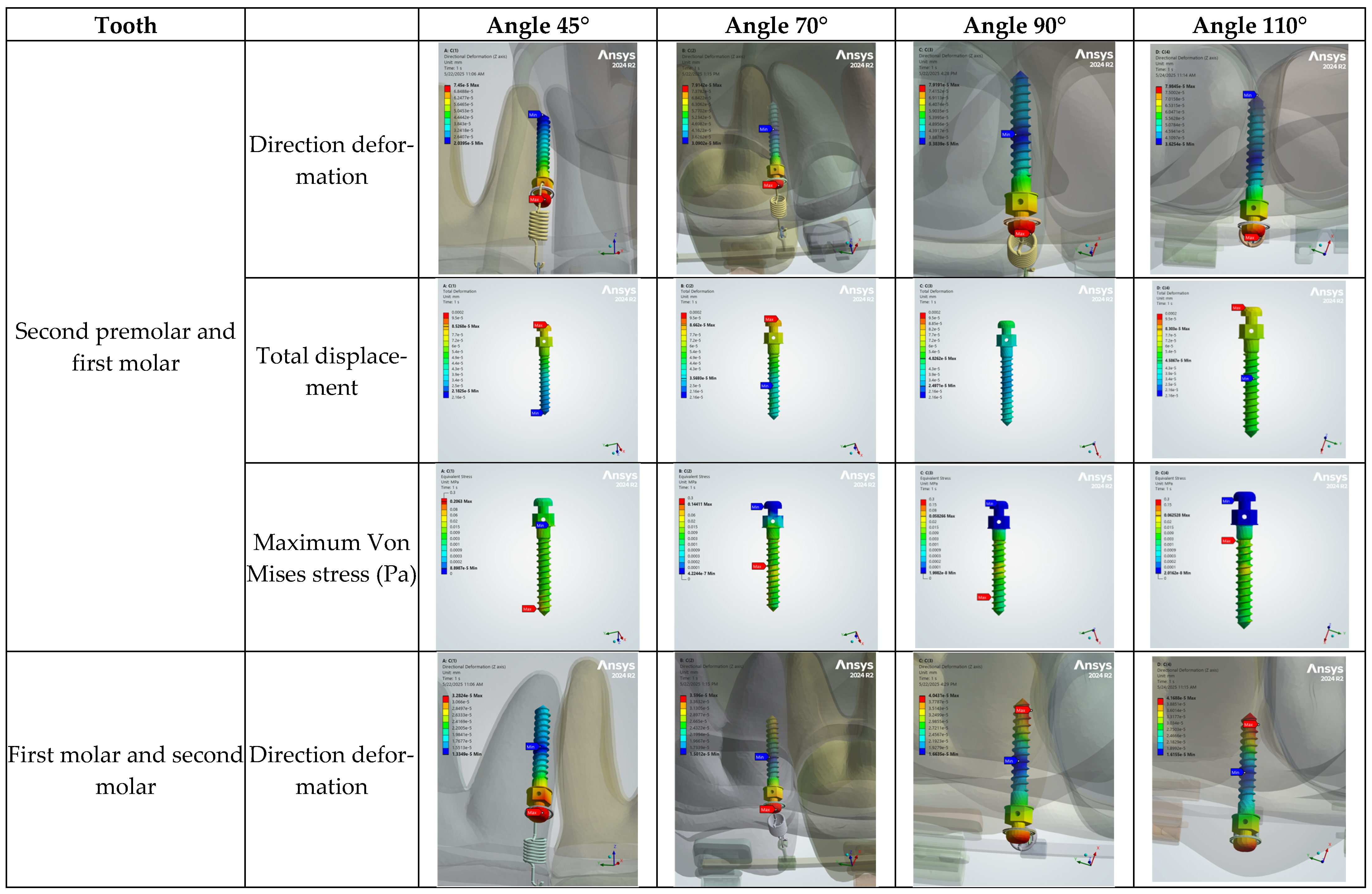
| Direction deformation (mm) | Between second premolar and first molar | 0.0000745 | 0.000079142 | 0.000079191 | 0.000079845 |
| Between first molar and second molar | 0.000032824 | 0.00003596 | 0.000040431 | 0.000041688 | |
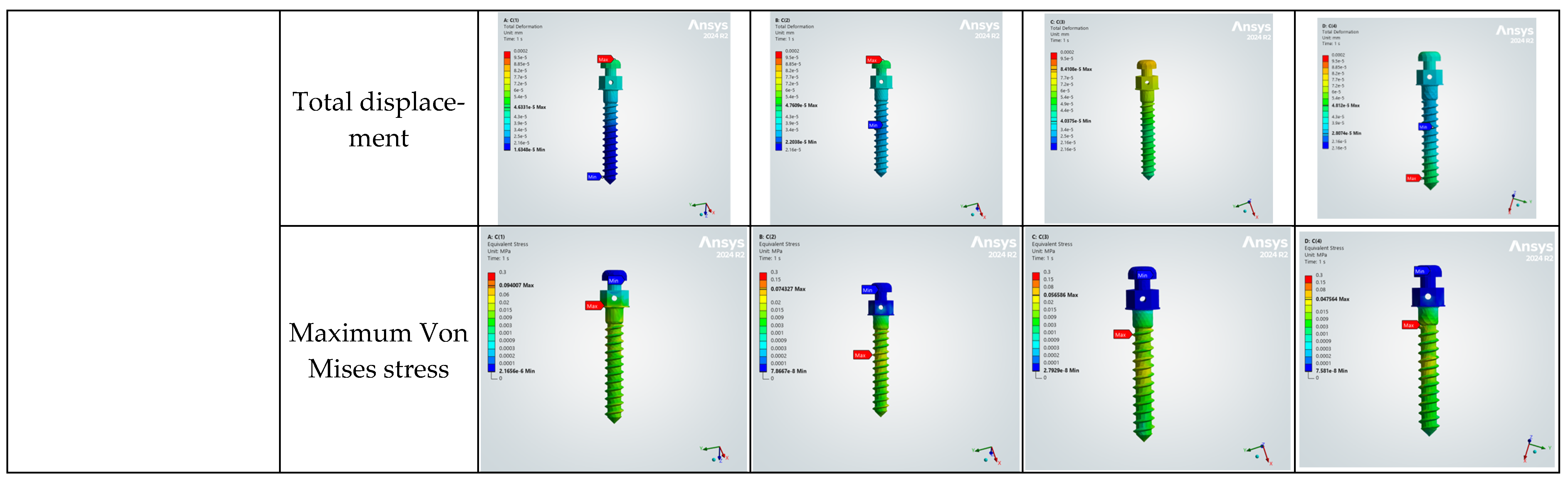
| Total displacement (mm) | Between second premolar and first molar | 0.000085268 | 0.00008662 | 0.000084108 | 0.00008303 |
| Between first molar and second molar | 0.000046331 | 0.000047609 | 0.000048262 | 0.00004812 | |
| Maximum Von Mises Stress (Pa) | Between second premolar and first molar | 206,300 | 144,110 | 58,266 | 62,528 |
| Between first molar and second molar | 94,007 | 74,327 | 56,586 | 47,564 |
Disclaimer/Publisher’s Note: The statements, opinions and data contained in all publications are solely those of the individual author(s) and contributor(s) and not of MDPI and/or the editor(s). MDPI and/or the editor(s) disclaim responsibility for any injury to people or property resulting from any ideas, methods, instructions or products referred to in the content. |
© 2026 by the authors. Licensee MDPI, Basel, Switzerland. This article is an open access article distributed under the terms and conditions of the Creative Commons Attribution (CC BY) license.
Share and Cite
Khalil, K.O.B.; Taner, R.L.; Dinçer, K.M.; Özdiler, O. Evaluation of Miniscrew Stability in Posterior Teeth Intrusion—A Three-Dimensional Finite Element Analysis. Appl. Sci. 2026, 16, 1783. https://doi.org/10.3390/app16041783
Khalil KOB, Taner RL, Dinçer KM, Özdiler O. Evaluation of Miniscrew Stability in Posterior Teeth Intrusion—A Three-Dimensional Finite Element Analysis. Applied Sciences. 2026; 16(4):1783. https://doi.org/10.3390/app16041783
Chicago/Turabian StyleKhalil, Khaled Omran Ben, R. Lale Taner, K. Müfide Dinçer, and Orhan Özdiler. 2026. "Evaluation of Miniscrew Stability in Posterior Teeth Intrusion—A Three-Dimensional Finite Element Analysis" Applied Sciences 16, no. 4: 1783. https://doi.org/10.3390/app16041783
APA StyleKhalil, K. O. B., Taner, R. L., Dinçer, K. M., & Özdiler, O. (2026). Evaluation of Miniscrew Stability in Posterior Teeth Intrusion—A Three-Dimensional Finite Element Analysis. Applied Sciences, 16(4), 1783. https://doi.org/10.3390/app16041783