Article

Revealing Mode I Failure Mechanisms in Adhesively Bonded Joints: An Integrated Study with the eXtended Finite Element Method and Its Coupled Approaches


1
Assembly and Commissioning Technology Research Centre, Xi’an Institute of Optics and Precision Mechanics of Chinese Academy of Sciences, Xi’an 710119, China
2
College of Optoelectronics, University of Chinese Academy of Sciences, Beijing 101400, China
3
College of Optoelectronic Engineering, Xidian University, Xi’an 710126, China
*
Authors to whom correspondence should be addressed.
Appl. Sci. 2026, 16(4), 1789; https://doi.org/10.3390/app16041789
Submission received: 24 January 2026 / Revised: 7 February 2026 / Accepted: 7 February 2026 / Published: 11 February 2026

Featured Application

By systematically comparing XFEM, XFEM-CZM, and XFEM-VCCT, this work elucidates their respective fracture mechanisms and offers practical guidance for method selection in engineering design.

Abstract

As the core load-transfer medium in bonded structures, the adhesive layer critically governs overall reliability, with Mode I fracture representing its dominant failure mechanism under tensile loading. This study systematically compares the eXtended Finite Element Method (XFEM) and its two coupled variants—the XFEM-Cohesive Zone Model (CZM) and XFEM-Virtual Crack Closure Technique (VCCT)—in simulating Mode I fractures of adhesive joints. Key comparisons include predictions of stress distribution, load-transfer evolution, and crack propagation paths, all validated through Double Cantilever Beam (DCB) simulations and experiments. Results show that standard XFEM accurately predicts initial stiffness (error < 8%) but overestimates peak load by 10.7%. XFEM-CZM maintains errors below 8% for both stiffness and peak load, while XFEM-VCCT achieves exceptional peak-load accuracy (error < 1%) but overestimates stiffness. In crack evolution, standard XFEM yields an idealized propagation path, whereas the coupled methods reveal a distinct three-stage process. Stress/strain fields in standard XFEM remain stable during propagation, while the coupled approaches exhibit interfacial irregularities before crack arrival, followed by tip concentration and band-like transfer during stable growth. Each method offers distinct advantages, underscoring that selection should align with specific research objectives and modeling requirements.

1. Introduction

The inherent advantages of adhesive bonding, such as its light weight, broad material adaptability, and ease of use, make it preferable to alternative connecting techniques [1]. Adhesive structures have been widely applied in the automotive industry, spacecraft, and semiconductor manufacturing, especially in the field of optical devices, and have received extensive attention from researchers in recent years [2]. Fracture failure in such structures exhibits three primary modes: Mode I (opening), Mode II (shearing), and Mode III (tearing) [3]. Among these, Mode I failure has attracted significant attention due to its substantial theoretical and practical significance in the fracture analysis of adhesive joints. This failure mode typically initiates under tensile loading, with cracks propagating perpendicular to the loading direction. Understanding its mechanisms enables accurate prediction of fracture behavior across diverse loading conditions. Moreover, clarifying the physical evolution of Mode I failure supports the modeling of coupled fracture behavior. Studying Mode I failure reveals the tensile debonding features of adhesive joints and aids in establishing robust structural failure criteria, making high-fidelity analysis of Mode I crack initiation and growth a key research and engineering challenge. While methods such as eXtended Finite Element Method (XFEM), Cohesive Zone Model (CZM), and Virtual Crack Closure Technique (VCCT) are commonly used, most studies apply only one method to specific cases, lacking a unified framework for systematically comparing their physical assumptions, numerical implementations, and results. This comparison is vital for model selection based on material, geometry, and application needs. Here, Double Cantilever Beam (DCB) tests are employed to examine Mode I failure mechanisms and compare different models systematically.
The fracture and debonding processes in adhesive joints are fundamentally governed by the evolution of interfacial tractions and contact conditions, which align with core concerns in the contact mechanics of coupled structures. In particular, the interaction between an open shell and a deformable filler—a configuration frequently encountered in damping devices, sealed assemblies, and layered composites—shares similar physical challenges in terms of interfacial stress transfer, progressive separation, and stability. Recent analytical and numerical studies on such systems include, e.g., Velychkovych et al. [4], who investigated a frictional damper composed of a slotted cylindrical shell and a deformable filler for sucker-rod string suspension. In their analytical model, the slotted shell was equivalently treated as a Winkler foundation coupled with a dry-friction law, enabling the derivation of an exponential decay law for interfacial stresses and the quantification of parameters such as the number of slots. This provides a valuable reference for analyzing interfacial stress transfer. Furthermore, their [5] finite element model, incorporating contact constraints and Coulomb’s friction law, accurately captured the transition of the interface from “stick” to “slip” and eventually to local “separation.” The study revealed that under external loading, the contact pressure between the filler and the inner wall of the shell exhibits a non-uniform distribution. The bending deformation of the shell near the slots leads to a reduction in interfacial stress, while areas away from the slots develop stress concentrations. This clearly demonstrates how the geometry of an open shell governs the load-transfer path along the interface.
Belytschko and Black [6] introduced the XFEM to model crack growth using discontinuous enrichment functions, thereby eliminating the need for extensive mesh remeshing. The method now sees broad application in joint failure studies. Campilho et al. [7] demonstrated the capability of XFEM to predict adhesive fracture in DCB tests. In their Abaqus implementation, damage initiation was governed by the maximum nominal stress (MAXS) criterion, while propagation followed a power-law fracture criterion based on energy release rates. Their simulations showed a close correlation with experimental load–displacement curves. Santos et al. [8] used XFEM to model adhesive joints with hollow glass microspheres (0–10 vol%) in epoxy, simulating their effect on steel single-lap joints and comparing this with experiments. Results showed that the microspheres changed failure from interfacial to cohesive, but reduced strength and ductility; the method reliably predicted failure mode, strength, and substrate plastic deformation. Faria et al. [9] validated the strength prediction capability of XFEM in T-peel joints, establishing the Quadratic Nominal Stress (QUADS) and Maximum Nominal Stress (MAXS) initiation criteria as optimal for damage initiation studies. Pinheiro et al. [10] employed the XFEM to analyze tensile strength in scarf joints, likewise identifying the QUADS and MAXS damage initiation criteria as demonstrating superior predictive performance. Jie et al. [11] employed the XFEM and the Strain Energy Density (SED) method to investigate the influence of Carbon Fiber Reinforced Polymer (CFRP) modulus and thickness on the fatigue life of welded joints with varying initial crack depths. Their results demonstrated that XFEM provides superior accuracy in predicting both fatigue life and crack propagation paths. Araújo et al. [12] conducted a parametric numerical study on scarf joints using the XFEM module in Abaqus, which exploits the method’s ability to model crack growth without predefined paths. They examined joints with various adhesives and scarf angles, revealing that a reduced scarf angle significantly increases the joint’s maximum load capacity. This finding provides critical insights for the design of complex adhesive-bonded structures.
In recent years, coupled XFEM-CZM and XFEM-VCCT methodologies have gained significant attention. XFEM effectively captures fracture and crack propagation phenomena by introducing additional degrees of freedom (DOFs) for cracks and discontinuities. Concurrently, the CZM originally proposed by Dugdale [13] and Barenblatt [14] simulates material fracture, crack growth, and contact problems through cohesive traction-based modeling of interface behavior. Integrating XFEM with CZM enables precise characterization of crack propagation within materials by combining discontinuous enrichment with cohesive zone physics. Zhu et al. [15] employed the XFEM-CZM coupling approach to investigate interfacial cracking in steel bridge deck–asphalt pavement systems. Through DCB experimental modeling and finite element analysis, they validated the feasibility and accuracy of the method against multiple established techniques. Vigueras et al. [16] applied the coupled XFEM-CZM approach to simulate failure in composite materials. The integrated model accurately captures both intralaminar and interlaminar failure modes while demonstrating superior convergence behavior and enhanced scalability. Bouhala et al. [17] employed an XFEM-CZM coupling approach integrated with optimization algorithms to minimize discrepancies between experimental and simulation results, enabling accurate determination of Mode I critical strain energy release rate and material strength parameters for unidirectional carbon/epoxy composites. Blali et al. [18] investigated damage in composite patch repairs for aircraft structures using XFEM-CZM coupling. Their study revealed that the integrated modeling approach provides an effective framework for analyzing repair failure mechanisms, identifying four critical parameters—debonding resistance, plate bending deflection, and others—as reliable indicators of interfacial debonding. Mubashar et al. [19] conducted numerical simulations of aluminum–epoxy single-lap joints using coupled XFEM-CZM methodology. Results demonstrate that XFEM accurately predicts crack paths within adhesive filet regions, while CZM integration enables the effective prediction of crack initiation and propagation. Although limitations exist, this approach efficiently predicts joint failure without requiring predefined crack paths.
Rybicki and Kanninen [20] proposed VCCT for stress intensity factor calculation via modified crack closure integrals. Integrating VCCT with XFEM permits direct crack-front propagation simulation and growth prediction through stress intensity factor evaluation. Teimouri et al. [21] utilized XFEM-VCCT coupling to model cyclic delamination in fiber-reinforced composites. Abaqus-based 2D/3D DCB simulations under high-cycle fatigue revealed the coupled method’s superior accuracy, faster computation in 3D solids, and time-increment insensitivity—outperforming standalone VCCT with its significant time-step dependence. Chen et al. [22] employed the XFEM-VCCT methodology to simulate fatigue crack propagation and predict fatigue life in stiffened ship panel structures. Numerical results demonstrated physically consistent crack growth paths, validating the approach’s applicability for complex industrial structures. Heidari et al. [23] integrated XFEM with VCCT to simulate delamination growth in 2D and 3D DCB models. Damage initiation was determined using the maximum nominal stress criterion, while damage evolution followed the B-K law hypothesis. A mesh sensitivity analysis established optimal element size and through-thickness element density. Simulated load–displacement curves exhibited close agreement with experimental data.
In summary, most existing studies have validated or applied individual methods in isolation. Given that XFEM, CZM, and VCCT are founded on distinct physical assumptions and numerical implementation schemes, their application to the same Mode I fracture problem in adhesive joints can lead to notable discrepancies in predictions of crack propagation paths, load–displacement responses, and even ultimate failure loads. However, a quantitative assessment of these discrepancies and an in-depth analysis of their underlying causes remain largely absent. More importantly, systematic investigation and comparison of the stress/strain redistribution mechanisms within the adhesive layer and the evolution of load-transfer paths during failure are still lacking. Therefore, the main contributions of this study include: (1) comparing and evaluating the stress and strain distributions as well as load-transfer characteristics within the adhesive layer during loading using the three methods; and (2) quantitatively assessing differences in crack propagation paths and their influence on failure mode evaluation. Through rigorous comparative analysis, the applicability and relative advantages of each method in characterizing Mode I fracture mechanisms are determined.

2. Materials and Methods

2.1. Material

This study employs Double Cantilever Beam (DCB) testing to simulate the Mode I fracture behavior of adhesive joints. The DCB specimens comprise 7075 aluminum alloy (Baoshan Iron & Steel, Shanghai, PRC) substrates bonded with EC-2216 B/A (3M, Saint Paul, MN, USA), a two-part epoxy adhesive. This adhesive was selected because its failure mechanism involves a complex interplay of elastic, plastic, and damage processes. Such complexity makes the comparative evaluation of the three failure-modeling methods particularly meaningful. The experimentally measured mechanical properties of the adhesive and material properties of the 7075 aluminum alloy are summarized in Table 1.
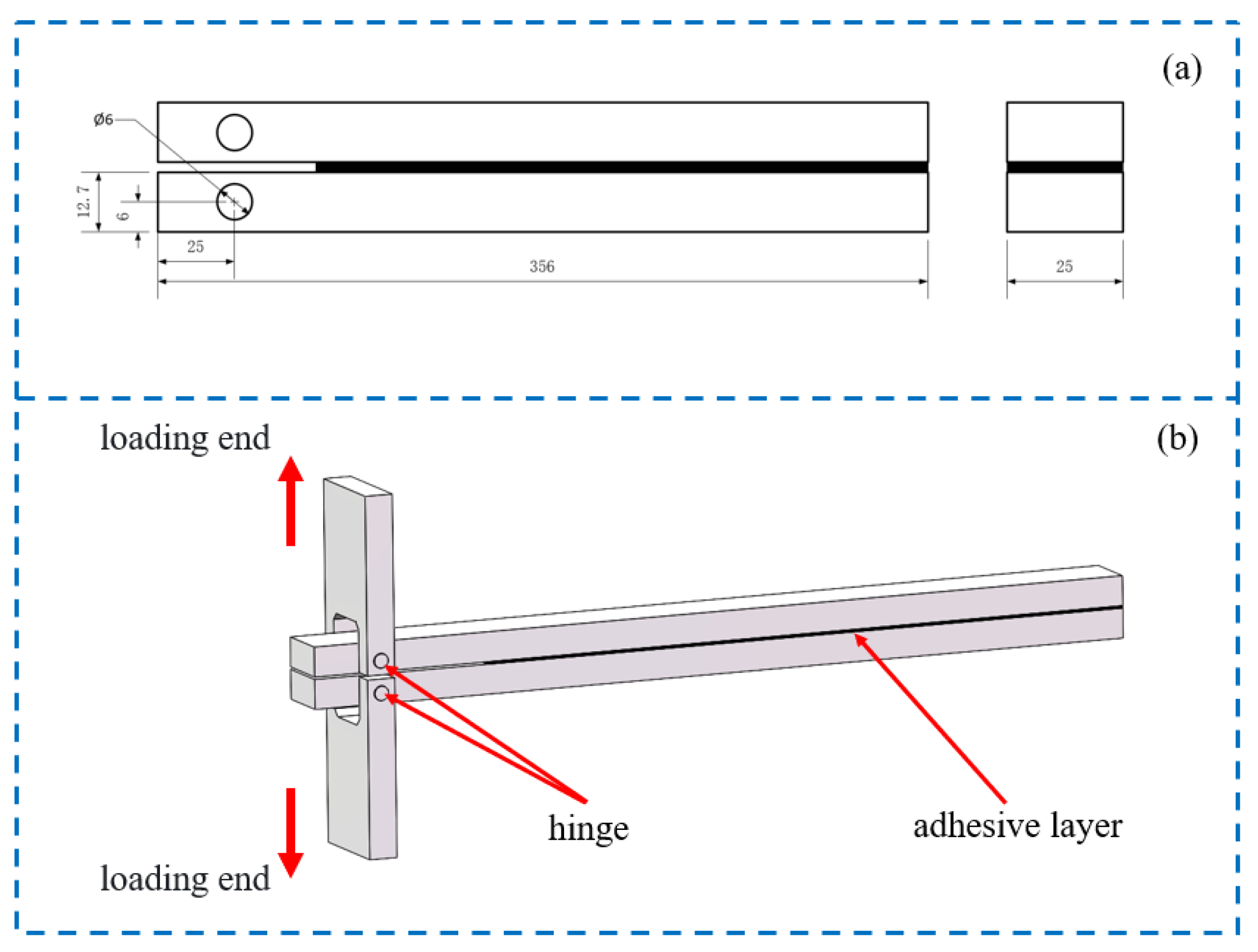
DCB specimens were fabricated per ASTM D3433 standards [24], with geometries and dimensions illustrated in Figure 1a. The adhesive EC-2216 B/A is a two-part system comprising components A and B. Prior to testing, parts A and B were mixed at a ratio of 5:7. The resulting mixture was subjected to ultrasonic stirring in a water bath to ensure homogeneity. The mixture was then defoamed using a planetary centrifugal mixer (BHLAB BHJ-3) to remove air bubbles. Process parameters (800 rpm revolution, 560 rpm rotation, 3 min) were optimized to avoid extended processing that could induce phase separation between components A and B. After confirming that the adhesive had achieved a uniform consistency, it was evenly applied to the bonding area of the DCB substrates. The specimens were subsequently cured at room temperature for 7 days.
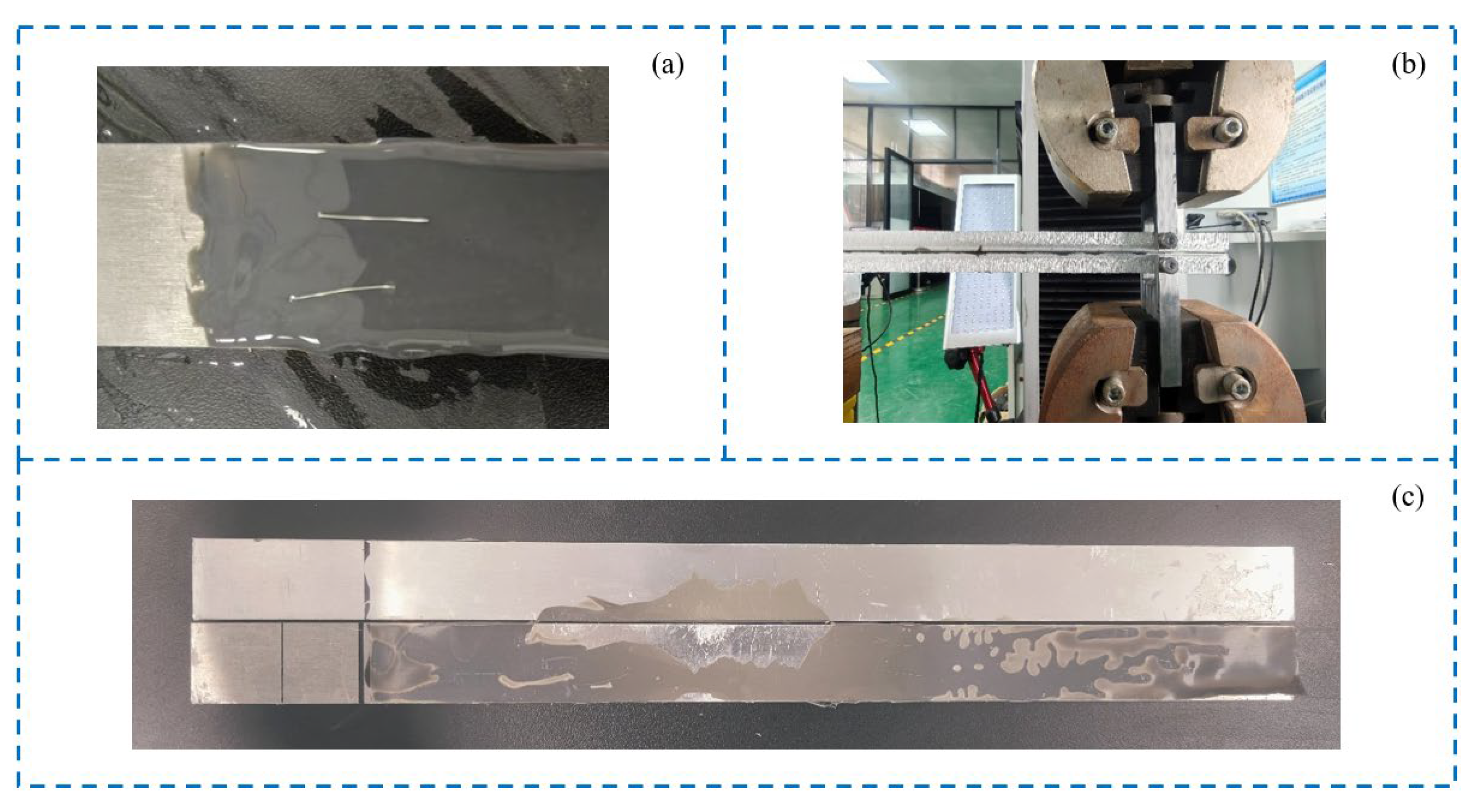
The DCB specimen’s geometry is shown in Figure 1a. Load was applied via holes linked to a clevis-pin assembly for uniform transfer (Figure 1b). A 0.2 mm diameter wire shim was used to set the adhesive thickness accurately, ensuring consistent bonding geometry per the test standard (Figure 2a). Testing was performed on an Instron 5967 universal testing machine. Before formal testing, specimens underwent preloading to eliminate initial contact gaps and system compliance effects. Since preloading primarily removes non-elastic deformations and stabilizes the test system, data from this phase were excluded from load–displacement curves. Only formal loading phase data were retained for analysis. A constant displacement rate of 2.0 mm/min maintained testing stability and data accuracy. Figure 2b illustrates the experimental setup. All tests were conducted under constant environmental conditions to minimize external influences.

2.2. Simulation Methods

2.2.1. eXtended Finite Element Method (XFEM)

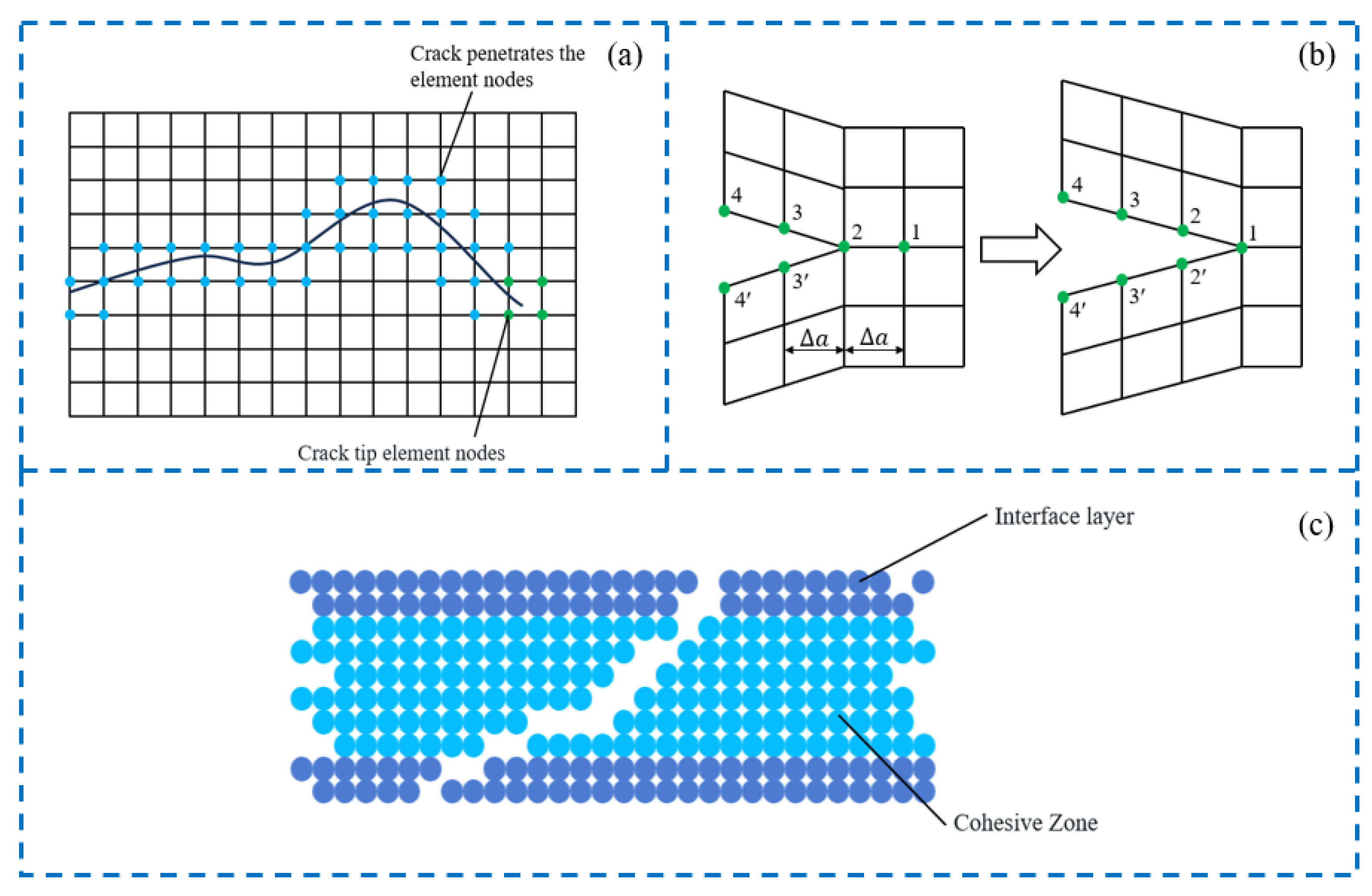
The XFEM efficiently addresses engineering problems involving irregular boundaries, cracks, and complex discontinuities. Unlike conventional FEA, XFEM simulates crack propagation and contact interface behavior without requiring mesh remeshing [25]. Its core methodology enriches standard finite element shape functions through enrichment functions, decoupling the displacement field into two components: (1) a continuous component describing bulk material displacement, and (2) an enriched component capturing displacement discontinuities induced by cracks [26]. This approach enables precise modeling of crack growth, contact evolution, and material nonlinearity within fixed mesh frameworks. For arbitrary crack locations (Figure 3a), discontinuous fields across cracked elements are modeled using Heaviside step functions [27], while crack-tip singularities are resolved through asymptotic enrichment functions. The XFEM displacement approximation is expressed as
U h ( x ) = I N N I ( x ) μ I + I J N I ( x ) H ( x ) a I + I K N I ( x ) α 4 F α ( x ) b I α
where NI(x) denotes the standard finite element shape functions, μ I represents the nodal degrees of freedom (DOFs) for the continuous displacement field, and H(x) is the Heaviside step function modeling strong displacement discontinuities across crack surfaces, defined as follows:
H x = 1 i f x x n 0 1 o t h e r w i s e
a I signifies the additional DOFs for Heaviside-enriched nodes associated with cracked elements. b I α denotes the additional DOFs for crack-tip-enriched nodes. F α ( x ) are the crack-tip asymptotic enrichment functions capturing stress singularities:
F α ( x ) = r sin θ 2 , r cos θ 2 , r sin θ sin θ 2 , r sin θ 2 cos θ 2

2.2.2. Cohesive Zone Model (CZM)

The CZM numerically simulates material interface behavior and crack growth, which are commonly used to evaluate adhesive joint failure [28]. It assumes that cohesive tractions develop near interfaces or crack tips, allowing the material to bear tensile or shear stresses up to a critical value, at which point crack propagation occurs. CZM effectively models crack growth in fracture mechanics, with common types being polynomial [29], exponential [30], trapezoidal [31], and bilinear [32]. Given the brittle adhesive studied here, the bilinear CZM offers superior computational efficiency and convergence over trapezoidal and exponential CZMs [33]. Therefore, based on computational cost, material properties, and parameter accessibility, this work adopts the bilinear CZM within the XFEM-CZM coupled model.
The XFEM-CZM coupled model employs the CZM to simulate interface behavior between adherends and the adhesive layer within bonded joints, while utilizing the XFEM to characterize cohesive zones within the adhesive layer. This approach effectively captures mixed-mode failure mechanisms. Detailed implementation procedures are illustrated in Figure 3c.

2.2.3. Virtual Crack Closure Technique (VCCT)

The Virtual Crack Closure Technique (VCCT) determines energy release rates through virtual crack closure simulation [34], based on the principle that crack propagation energy release equals crack-closure work [20]. This linear elastic fracture mechanics method computes fracture-mode-specific strain energy release rates using crack-tip nodal forces (F) and displacement (v) behind the crack, scaled by geometric dimensions. Mode I failure appears in Figure 3b, with its energy release rate expressed as
G 1 F y 1 Δ v 3 , 3 2 B Δ a
where Fy1 denotes the nodal force at the crack tip, v3,4 represents the y-direction displacement component behind the crack tip, B is the thickness of the DCB specimen, and Δ a signifies the crack length increment.
VCCT significantly enhances computational efficiency in crack growth modeling, relying solely on the output of nodal forces and displacements. This approach significantly reduces computational burden and facilitates seamless integration with finite element software. However, VCCT typically relies on predefined crack path assumptions, which may compromise accuracy when handling complex or unexpected crack trajectory deviations [34]. In contrast, XFEM provides enhanced flexibility to model intricate crack paths naturally. By automatically introducing enrichment functions at crack initiation and propagation sites, XFEM accurately captures diverse fracture morphologies. Similarly to the XFEM-CZM framework, the coupled XFEM-VCCT approach employs VCCT to simulate interfacial regions while utilizing XFEM to characterize cohesive zones within the adhesive layer.

2.3. Finite Element Modeling

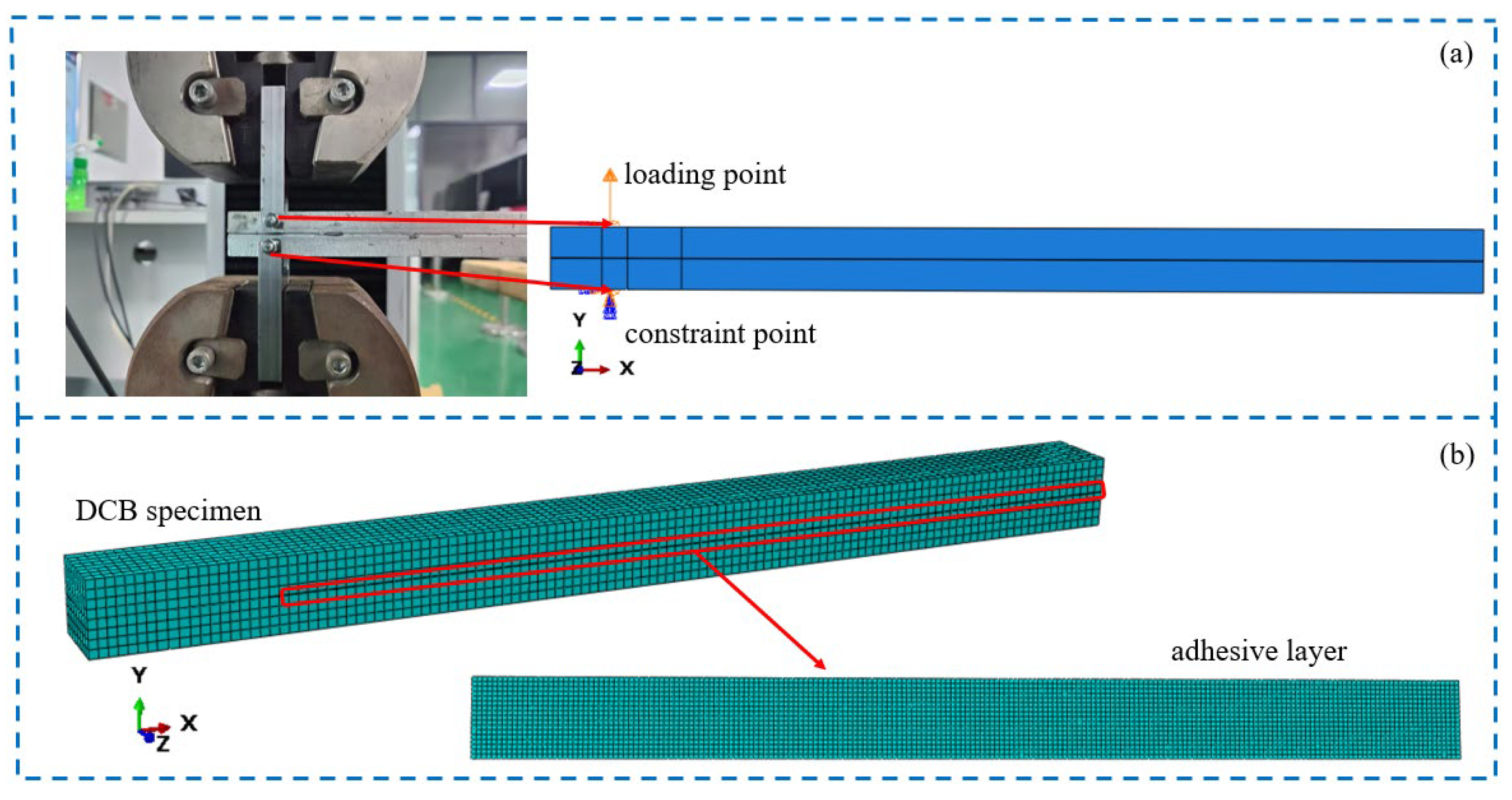
FEA was performed using the commercial solver Abaqus (2021). The DCB specimen was modeled in Abaqus to simulate Mode I fracture behavior of the adhesive joint. A displacement-controlled loading at 2.0 mm/min was applied to the upper loading point, retaining only its rotational degree of freedom about the Z-axis. The lower loading point was fully constrained while permitting rotation about the Z-axis, ensuring experimental boundary condition fidelity (Figure 4a).
The mesh configuration is illustrated in Figure 4b. The adhesive layer thickness was set to 0.2 mm. Within the XFEM framework, the adhesive layer was discretized using reduced-integration 8-node linear hexahedral elements(C3D8R) to simulate internal crack propagation [35]. In the XFEM-CZM coupled method, the adhesive–substrate interface was defined using cohesive behavior [36]. Conversely, in the XFEM-VCCT coupled method, the interface employed a VCCT-based contact definition [37]. Across all methods, the adhesive region constitutes an enriched element domain enabling arbitrary crack propagation paths.
To enhance solution convergence, suppress numerical oscillations, and improve computational stability, the adhesive viscosity coefficient was set to 1.0 × 10⁻⁴. Typically, viscosity values between 10−3 and 10−5 negligibly influence simulation results [38]. The bilinear CZM is fully defined by stiffness, ultimate strength, and critical fracture energy release rate [39]. Here, the ultimate strength and critical fracture energy release rate of the adhesive were obtained through mechanical tests, as listed in Table 1. The stiffness at the substrate–adhesive interface must satisfy two requirements: it must be sufficiently high to avoid introducing artificial compliance and premature interface separation, yet moderate enough to prevent spurious traction oscillations [40]. Therefore, a systematic analysis was conducted by varying the initial stiffness K0 over a range of 103 to 106 N/mm3. Convergence was assessed based on numerical stability during the solution process, while sensitivity was evaluated according to the variation in predicted peak load and fracture energy. Based on this analysis, an optimal initial stiffness of 105 N/mm3 was determined.
Crack initiation occurs when stresses or strains within the failure locus satisfy specified initiation criteria. Common damage initiation criteria are: maximum principal stress (MAXPS), maximum principal strain (MAXPE), MAXS, maximum nominal strain (MAXE), QUADS, and quadratic nominal strain (QUADE) [41]. The MAXS criterion was employed for the cohesive interface layer [42] and the MAXPS criterion for internal adhesive damage initiation [8]. These criteria are defined as follows.
The MAXS criterion defines damage initiation as occurring when the ratio of any nominal stress component to its corresponding critical value equals unity.
max t n t n 0 , t s t s 0 , t t t t 0 = 1
where t n 0 , t s 0 , and t t 0 denote the peak nominal stresses in the normal, first shear, and second shear directions, respectively.
The MAXPS criterion postulates crack initiation at f = 1, followed by material transition into the progressive degradation phase governed by the traction–separation response.
f = t max t max 0
where tmax denotes the current maximum principal stress and t max 0 represents the critical allowable principal stress for the material.

3. Results and Discussion

3.1. Numerical Verification

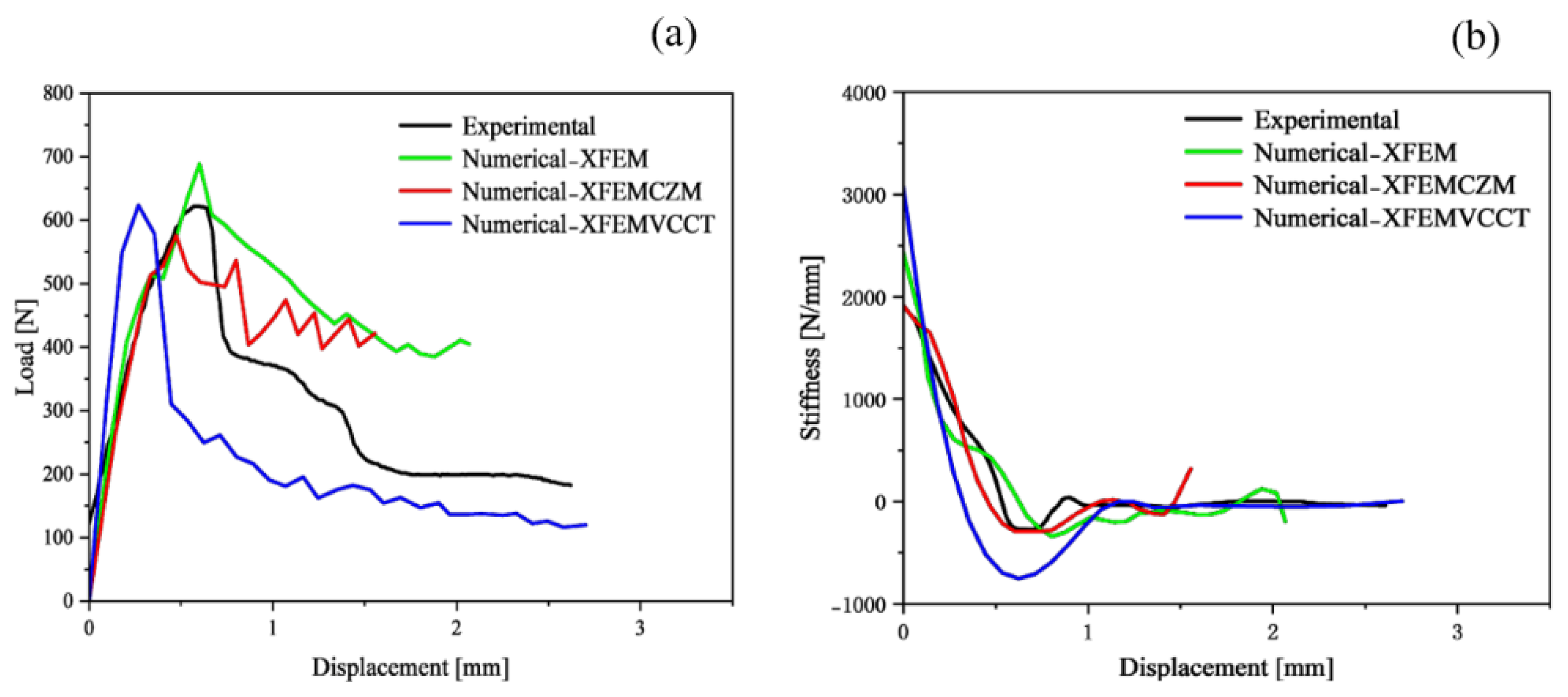
To validate the numerical methodologies employed, Double Cantilever Beam (DCB) tests were conducted. Figure 2c illustrates the failure morphology, revealing mixed-mode failure dominated by interfacial fracture. A comparative analysis of experimental and simulated load–displacement curves (Figure 5a) exhibits initial linear elastic behavior. In studies of Mode I adhesive fracture, the peak load is regarded as the primary criterion because it directly determines the ultimate static strength of the joint and is central to safety assessment [43]. Upon reaching the peak load, cracks within the adhesive layer initiate stable propagation. Concurrent with gradual load reduction, the load–displacement response exhibits distinct fluctuations during crack propagation.
The standard eXtended Finite Element Method (XFEM) model demonstrates a comparable initial slope to the experimental curves (error < 8%) but predicts a notably higher peak load (10.7% overestimation). In contrast, XFEM-Cohesive Zone Model (CZM) coupling achieves exceptional initial slope agreement (error < 8%) and peak load accuracy (7.1% error), but introduces pronounced oscillations during unloading, attributed to instabilities in the cohesive law. The XFEM-Virtual Crack Closure Technique (VCCT) coupling demonstrates moderately elevated initial stiffness while delivering superior peak load precision (error < 1%). It should be noted that the relative merits of a method depend heavily on the specific objectives of the research or engineering design. In this work, which focuses primarily on the prediction of adhesive strength, priority is given to peak load. However, if the emphasis shifts to metrics such as the post-peak response trend, the XFEM-VCCT method shows closer agreement with the experimental curve based on the load–displacement comparison in Figure 5a. Furthermore, in applications where initial stiffness is critically important, the standard XFEM or XFEM-CZM may be more suitable. Therefore, no universally superior method exists; selection should be based on a trade-off according to the dominant performance metric—that is, the objective function defined by the actual problem.
To objectively and quantitatively delineate the stages of crack development, this study employs global structural stiffness as the criterion. Stiffness, calculated from the load–displacement responses in Figure 5a and moderately smoothed, is plotted in Figure 5b. The evolution clearly shows three stages: an initial near-linear drop (Stage I: diffuse adhesive damage); a transition near 0.6–0.8 mm displacement where the reduction rate slows, indicating interface-crack initiation (Stage II); and a subsequent quasi-stable phase with minimal change (<5% rate except for XFEM-CZM oscillations), corresponding to stable crack growth (Stage III).
All models generally capture the experimental load–displacement trends. However, standard XFEM proves inadequate for simulating DCB delamination propagation, particularly in peak load prediction (quantitative deviations shown in Table 2). Both the XFEM-CZM and XFEM-VCCT coupling methods provide more physically realistic delamination modeling. The computational times for the three methods are summarized in Table 3. All simulations were performed on a laptop equipped with an AMD Ryzen 7 4800U CPU. As shown in the table, the standard XFEM required the shortest computation time. Both coupled models demanded significantly greater computational effort, with the XFEM-VCCT model exhibiting the longest duration of 109 min.

3.2. Analysis of XFEM Predictive Results

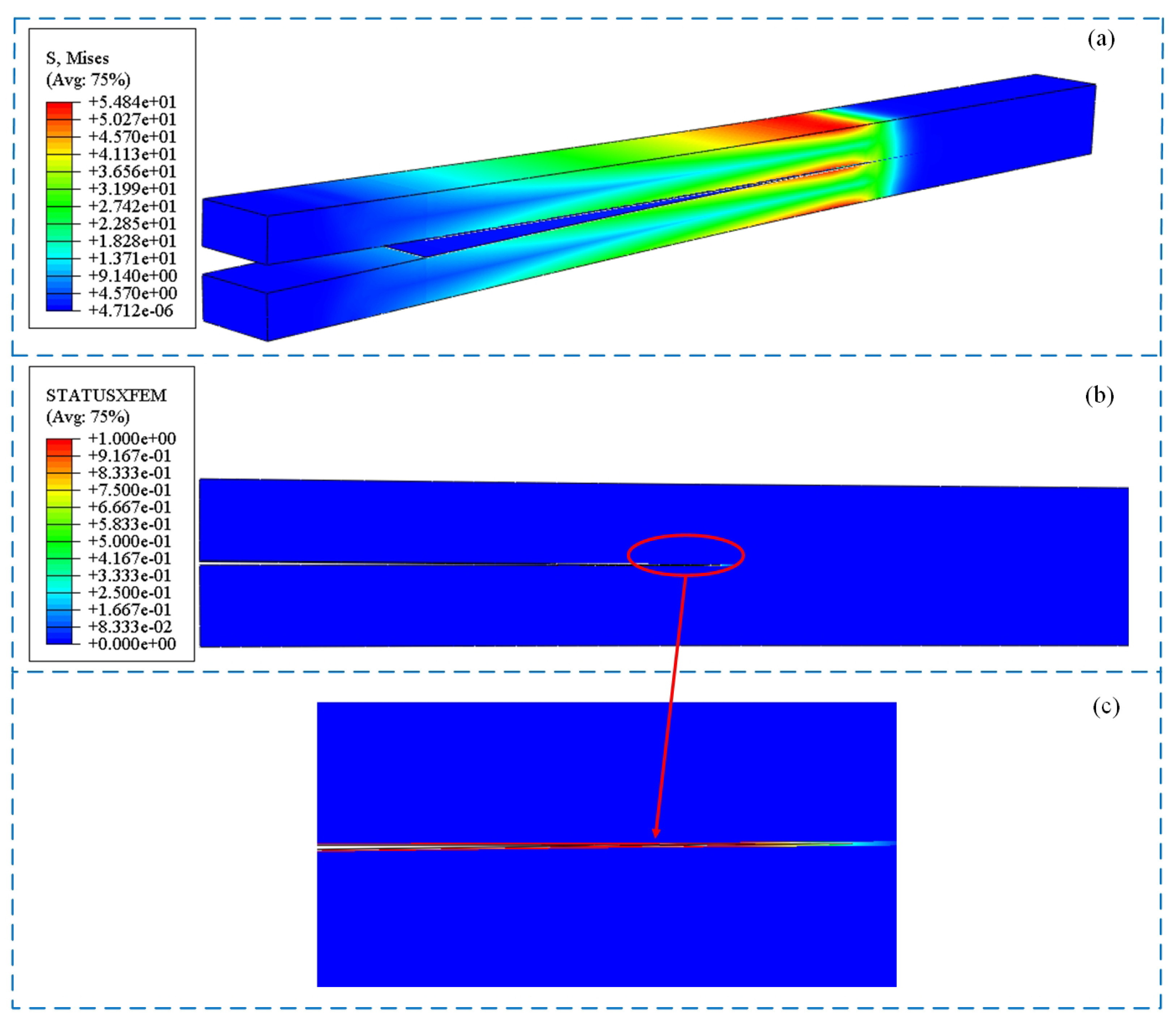
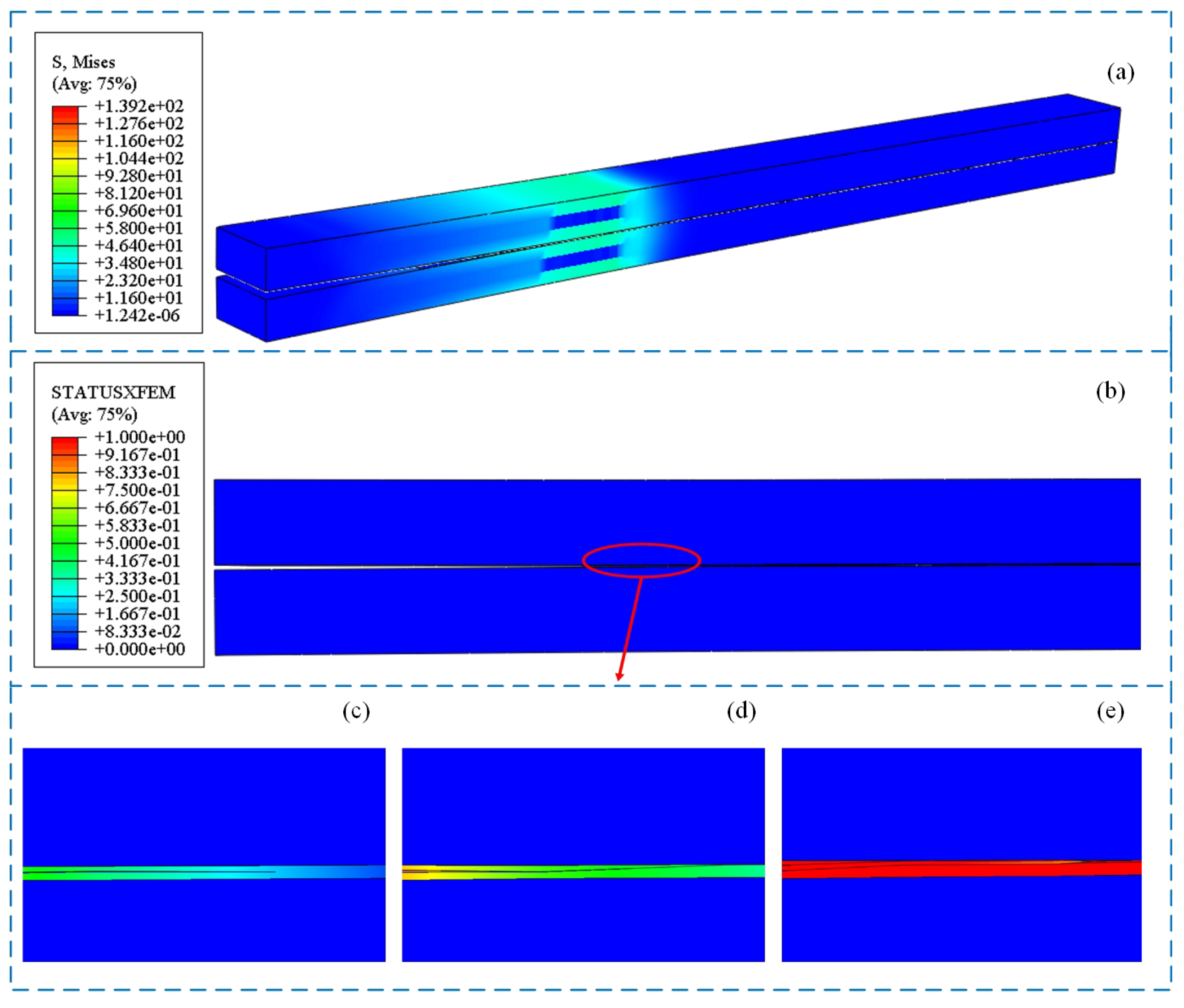
Figure 6a shows the von Mises stress contour plot obtained from the XFEM analysis of the DCB specimen. During Mode I failure within the adhesive layer, the crack tip region exhibits significant stress concentration. The high stress at the tip propagates into the surrounding material, resulting in a pronounced stress gradient. Figure 6b,c depicts crack propagation within the DCB specimen at a specific time point, simulated using XFEM. Figure 6b displays STATUSXFEM contours during DCB adhesive cracking, with Figure 6c showing concurrent crack-tip magnification (approximately 5× magnification relative to Figure 6b). The scalar field STATUSXFEM quantifies the damage state within XFEM elements, with the color legend ranging from blue (status = 0.0, undamaged material) to red (status = 1.0, fully open crack and complete element failure). The simulation of adhesive Mode I fracture reveals a predominantly straight crack front propagating stably along the width direction without significant branching or deviation, as explicitly captured in Figure 6c. Failure occurs cohesively within the adhesive layer, representing an idealized scenario. In practical structures, adhesive failure modes often include both interfacial debonding and cohesive failure. Consequently, the XFEM approach inherently lacks the capability to separately analyze interfacial defects and cohesive defects within the adhesive.
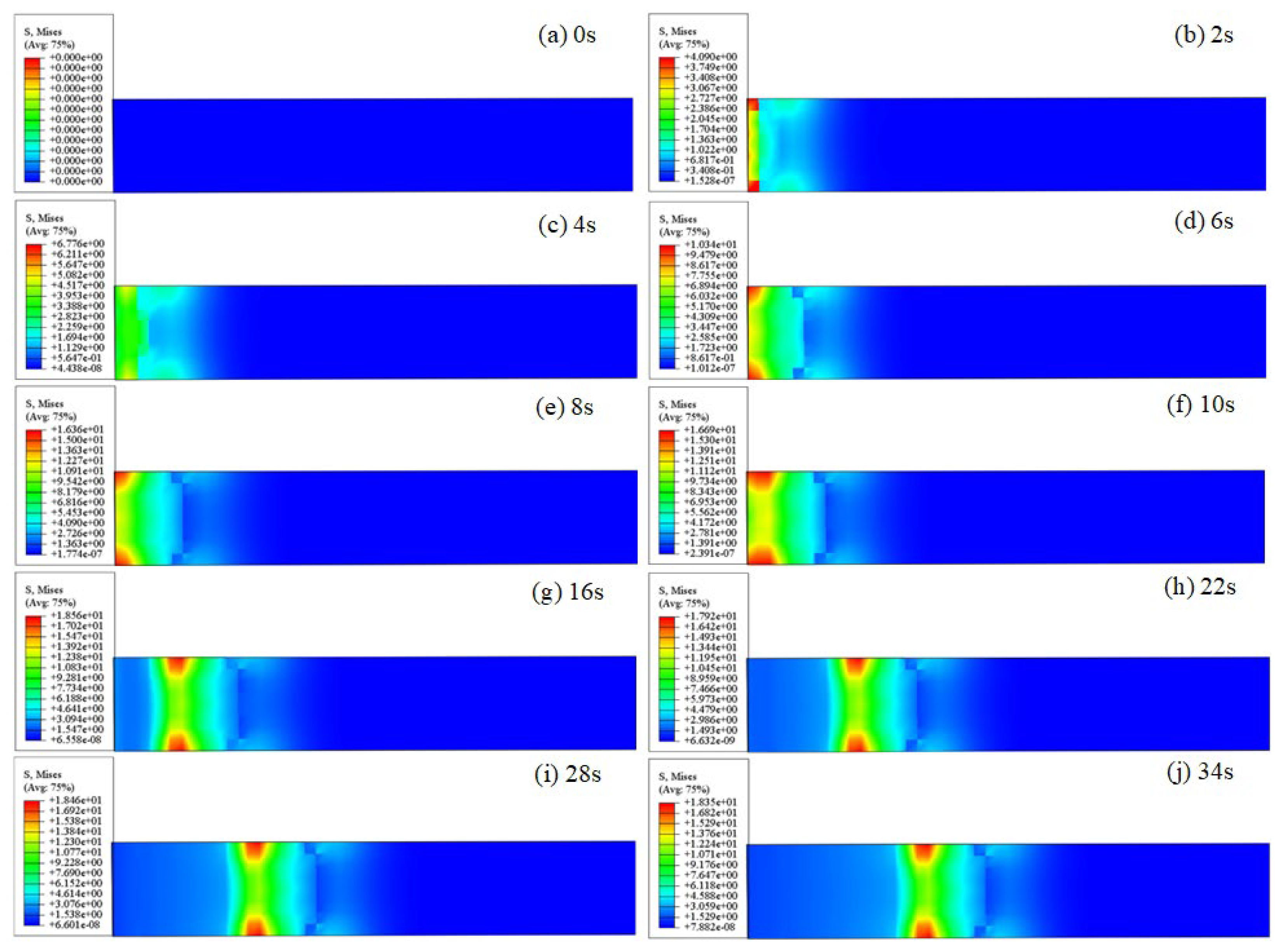
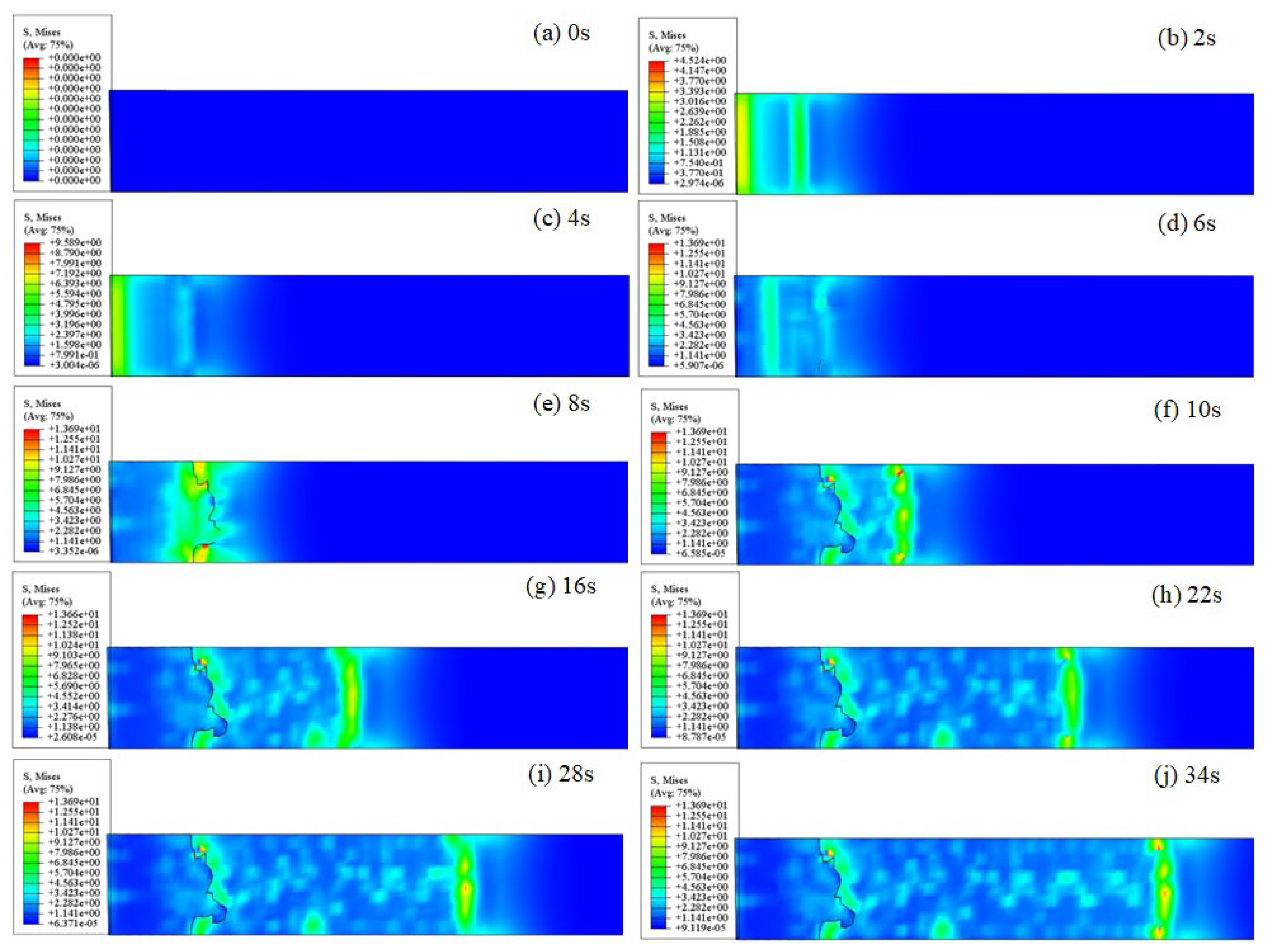
Stress distribution serves as a direct indicator of damage evolution within the adhesive layer, where high-stress regions constitute preferential failure initiation sites. Cracks consistently nucleate and propagate at peak von Mises stress locations, inducing maximal material degradation at these critical zones [44]. Figure 7 captures the stress evolution and transfer within the adhesive layer of a DCB specimen during 0–34 s tensile loading, with Figure 7a–j arranged chronologically. In the initial loading phase (Figure 7b), stress primarily concentrates at both loading ends (4.09 MPa) with minimal inward propagation into the adhesive layer. Under progressive loading, edge stresses at the loading ends intensify while the peak stress migrates internally, reaching 6.78 MPa (Figure 7c). Concurrently, incipient stresses develop near the loading ends posterior to the concentrated stress zone, persisting through subsequent stages (Figure 7d–j). In Figure 7d,e, high-stress zones reemerge at the loading ends with expanded spatial coverage, while the stress peak surges by 6 MPa between these stages, suggesting potential nucleation of crack tips or fracture fronts at these locations. Figure 7f–j demonstrate stable inward advancement of the high-stress zone in the adhesive with slowly increasing peak stress (from 16.69 MPa to 18.35 MPa). Stabilized stress transfer marks steady-state fracture initiation. Consequently, XFEM analysis of Mode I failure in the adhesive layer reveals that crack propagation rapidly stabilizes along the internal adhesive path, avoiding extension to the adhesive–substrate interface. During loading, stress concentrations predominantly develop symmetrically near the crack tip or loading points. Furthermore, the crack propagates along the adhesive mid-plane, accompanied by symmetrically distributed high-stress regions within the adhesive layer on both sides.
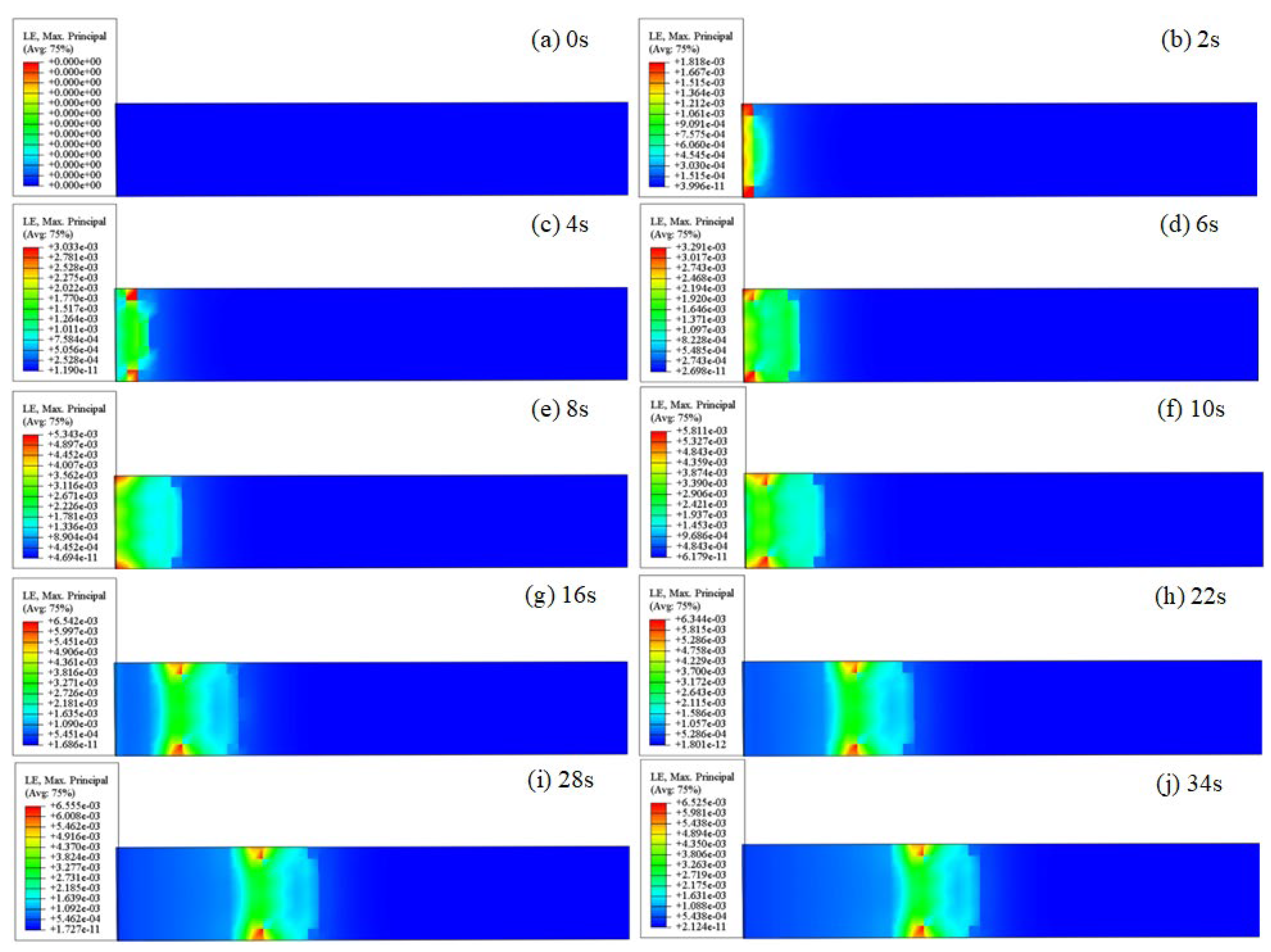
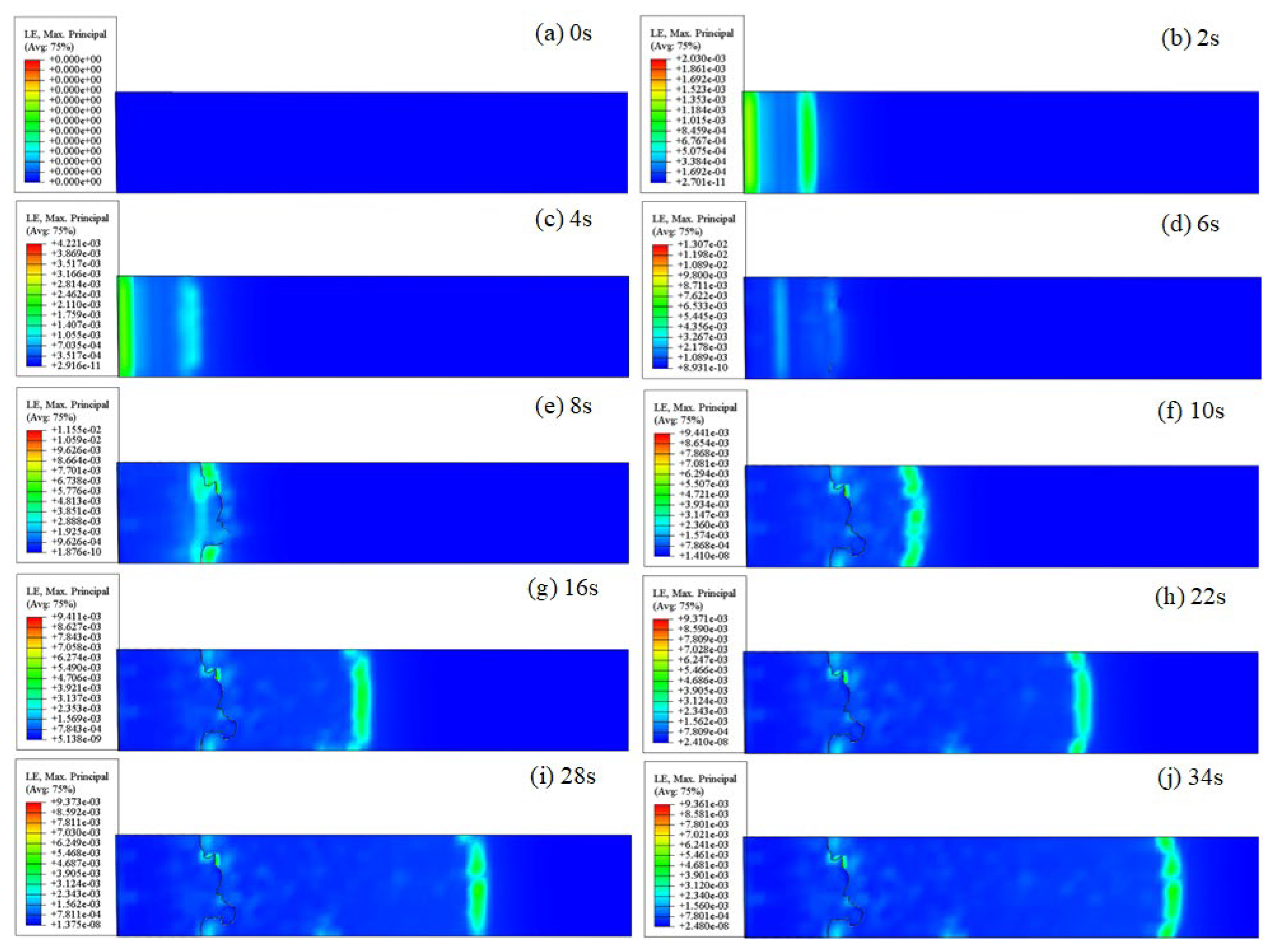
The maximum principal strain characterizes the peak tensile deformation under loading [45]. During adhesive crack propagation, severe material distortion at the crack tip induces significant strain amplification. Compared to stress fields, strain fields directly quantify localized tensile deformation and serve as sensitive indicators of damage progression. Figure 8a–j illustrate the evolution of maximum principal strain (Logarithmic Strain Max. Principal) in the DCB specimen’s adhesive layer during 0–34 s loading. Strain concentrations emerge symmetrically at both loading ends from Figure 8b, corresponding to minor tensile deformation with a peak strain of 1.82 × 10⁻³. Compared to the stress distribution in Figure 7b, stress and strain concentrations coincide at this stage, though strain fields more directly characterize cumulative tensile deformation in the adhesive. From Figure 8c,d, strain zones stabilize near the loading front (3.03 × 10⁻³ to 3.21 × 10⁻³). By Figure 8e, these zones propagate rightward, with the strain peak surging by 2 × 10⁻³ between Figure 8d,e. This significant increase confirms the critical accumulation of localized deformation for crack sprouting and marks the beginning of stable expansion. Subsequently, through Figure 8j, peak strain stabilizes at adhesive edge points, advancing steadily rightward with stabilized transfer and slow magnitude growth (from 5.34 × 10⁻³ to 6.53 × 10⁻³). This confirms the establishment of steady-state crack propagation. The strain distribution maps reveal that localized principal strain at the adhesive crack tip rapidly intensifies during crack propagation, forming distinct high-strain zones that advance along the fracture path. Fluctuations in peak principal strain reflect load accumulation and release at the crack tip. Notably, each high-strain zone is followed by a longitudinal demarcation line beyond which strain becomes negligible. Unlike the gradual stress decay surrounding high-stress regions in Figure 7, this abrupt strain discontinuity precisely delineates the propagating crack tip position.

3.3. Analysis of XFEM-CZM Predictive Results

Figure 9a presents the von Mises stress distribution in the DCB specimen analyzed via XFEM-CZM coupling. A pronounced stress gradient emerges within a specific mid-region, with peak stresses concentrated within the adhesive layer. Figure 9b–e depicts the XFEM-CZM simulation of Mode I crack propagation in adhesive joints. Figure 9b displays the global specimen state, while Figure 9c–e provide enlarged views (approximately 12× magnification relative to Figure 9b) corresponding to progressively increasing load levels. Analysis of Figure 9c reveals minor undulations along pre-existing cracks within the adhesive layer during initial loading, accompanied by a progressive ramp-up of STATUSXFEM values along crack peripheries. By Figure 9d, the crack tip extends upward toward the adhesive–substrate interface at shallow angles, subsequently propagating along the interface to form a through-thickness fracture plane as shown in Figure 9e, culminating in complete local failure.
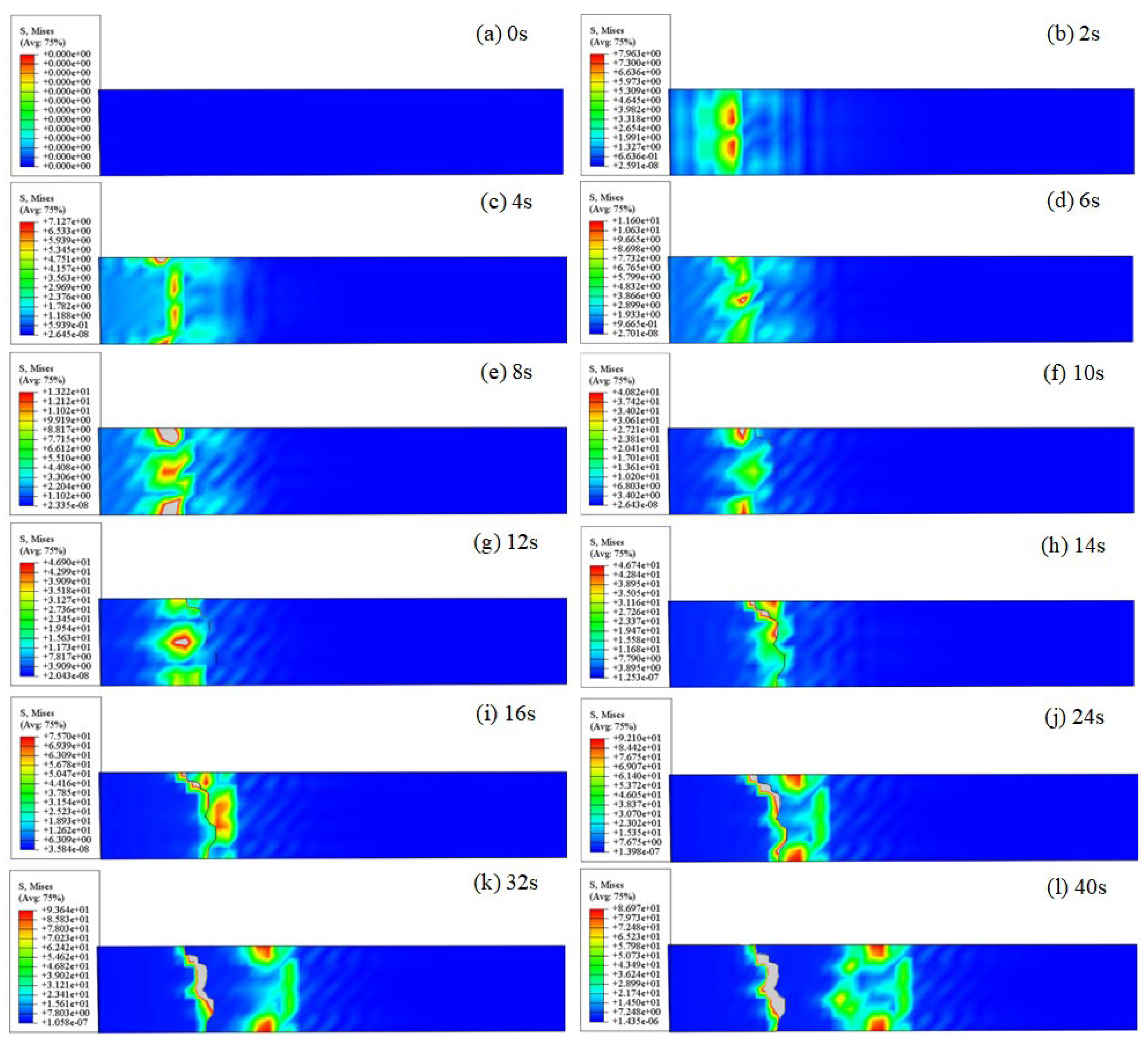
Figure 10a–l illustrates the stress evolution and transfer in the adhesive layer of a DCB specimen during 0–40 s tensile loading via XFEM-CZM coupling. During initial loading, high-stress concentration emerges at two discrete mid-front zones within the adhesive layer, subsequently propagating toward the adhesive periphery (Figure 10b,c). By Figure 10d, stress re-concentrates centrally with peak values reaching 11.60 MPa. Internal cracks begin propagating in the adhesive layer at this phase. Subsequent stress migration toward both ends (Figure 10e) precedes interfacial crack initiation at the upper edge (Figure 10f), triggering a stress surge to 40.82 MPa. The crack progressively propagates downward along this trajectory until complete interfacial penetration is achieved. A localized high-stress concentration band forms at the crack tip, reaching a peak magnitude of 46.74 MPa, as documented in Figure 10h. Post interface fracture, stress bands migrate rearward with stabilized distributions (Figure 10i–l), and peak stress increase stabilizes (from 75.70 MPa to 86.97 MPa), indicating steady crack propagation. This study, therefore, concludes that stress concentration alternates between central and adhesive-periphery regions prior to crack propagation to the interface. Interfacial fracture induces abrupt stress amplification, forming a circumferential high-stress band along the crack periphery that rapidly stabilizes. Multiple discrete stress points continually exist around the high-stress zone.
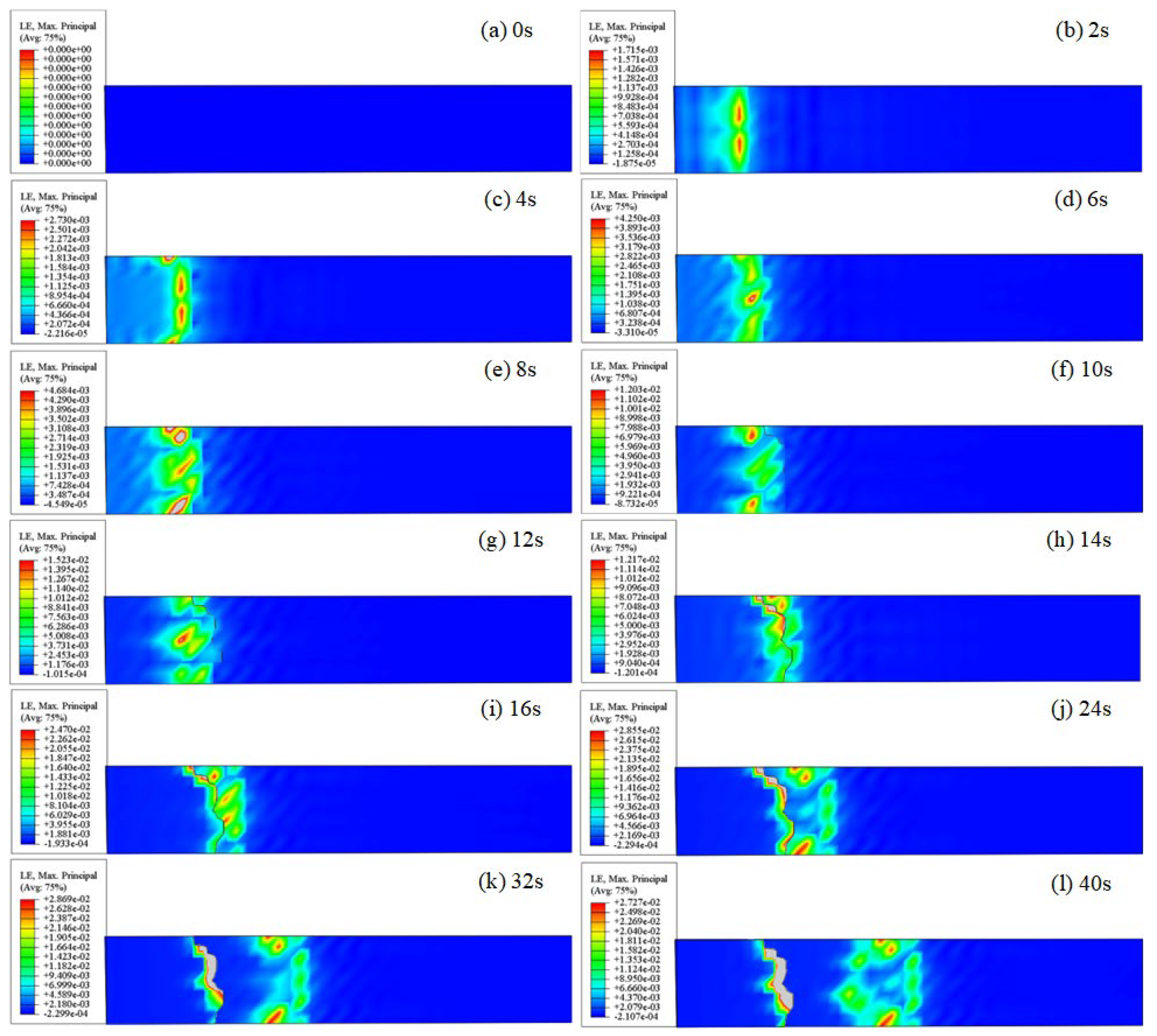
Figure 11 delineates the evolution of maximum principal strain fields within the adhesive layer of a DCB specimen during 0–40 s loading until stabilization via XFEM-VCCT coupling. Initial strain effects emerge in Figure 11b as minor deformations localized near loading ends at the front region (Strain: 1.72 × 10⁻³). Subsequent propagation extends strain toward both adhesive edges (Figure 11c), indicating localized force transmission. By Figure 11d, intensified strain concentration peaks centrally at 4.25 × 10⁻³, signifying accelerated strain transfer. Figure 11e exhibits high-strain zones forming at the mid-layer and extremities, expanding longitudinally across the adhesive. As cracks propagate to the adhesive–substrate interface (Figure 11f–h), pronounced strain concentrations develop around crack tips; the strain value is 1.22 × 10⁻². Progressive stabilization follows (Figure 11i–l), with strain fields homogenizing at 2.73 × 10⁻² by Figure 11l despite persistent tip concentrations. Crucially, the XFEM-CZM simulation reveals a spatial correspondence between high-strain zones and high-stress zones. Compared to the stress distribution, the high-strain zones manifest as multiple discrete zones. High-strain regions remain persistently localized at crack tips and along fracture surfaces.

3.4. Analysis of XFEM-VCCT Predictive Result

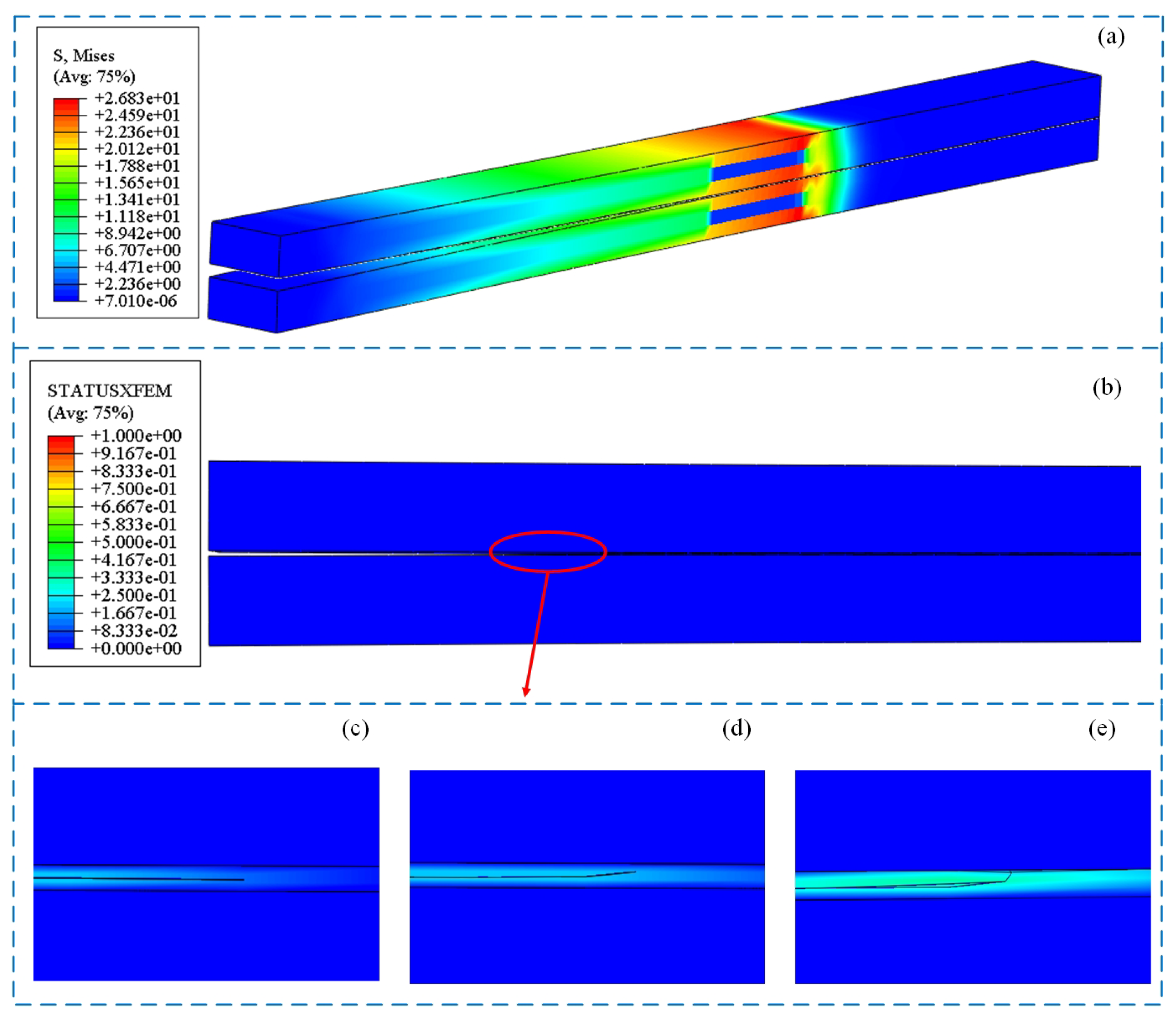
Figure 12a presents the von Mises stress distribution in the DCB specimen analyzed via XFEM-VCCT coupling. Stress magnitudes attenuate progressively from the crack front toward the distal region, with the contour gradient visualizing spatial variations: red zones (peak = 26.83 MPa) indicate crack-tip stress concentrations, while blue areas (minimum = 7.01 × 10 6 MPa) represent low-stress regions at the far end. Figure 12b–e presents the XFEM-VCCT simulation of Mode I adhesive fracture. Figure 12b displays the global specimen state, while Figure 12c–e provide enlarged views (approximately 12× magnification relative to Figure 12b) corresponding to progressively increasing load levels. In Figure 12c, light-blue stress concentration zones emerge at the crack tip (indicating elevated STATUSXFEM values), with the fracture front maintaining its straight configuration. By Figure 12d, the fracture front develops slight curvature, progressing to Figure 12e, where the crack propagates from the adhesive interior toward the adhesive–substrate interface. Upon reaching the interface, accumulated interfacial damage triggers delamination failure, culminating in specimen debonding along the interface.
Figure 13 presents the evolution and transfer of adhesive stresses within a DCB specimen under tension, simulated using the XFEM-VCCT coupled method, during the period from stress initiation to stabilization (0 s to 34 s). During initial loading (Figure 13b,c), a high-stress concentration zone emerged near the front of the adhesive layer, followed shortly by a low-stress band appearing slightly to its right. At this stage, crack initiation occurs within the adhesive layer. Figure 13d shows fine cracks forming at the central adhesive interface, with the stress surging to 13.69 MPa. Further interfacial crack propagation occurs in Figure 13e, forming a localized high-stress band at the crack tip. Thereafter, the peak stress remains constant at 13.69 MPa. By Figure 13f, the crack has fully propagated along the adhesive–substrate interface, accompanied by a rightward shift in the high-stress region and stress release at the surface crack tip. Subsequently, from Figure 13g–j, crack propagation stabilizes and advances steadily rightward in a band-shaped manner. However, the location of the stress peak alternates between the center and the edge of this high-stress band, exhibiting a periodic characteristic. This suggests that the adhesive energy dissipation mechanism achieves dynamic equilibrium through dynamic stress redistribution. A complete specimen fracture eventually occurs. Therefore, the XFEM-VCCT analysis of Mode I fracture reveals that the pre-existing crack within the adhesive layer progressively extends to the adhesive–substrate interface, subsequently propagates along it, and rapidly stabilizes. Similarly to XFEM-CZM, contour plots throughout the process consistently reveald dispersed stress concentration points surrounding the primary high-stress regions within the adhesive layer.
Figure 14a–j depict the maximum principal strain fields within the adhesive layer of a DCB specimen, simulated using the coupled XFEM-VCCT approach during 0–34 s loading until strain stabilization. During initial loading (Figure 14b), dual narrow light-green bands (Strain: 2.03 × 10⁻³) emerge at the fracture front and its right vicinity, corresponding to pre-existing crack zones in the adhesive layer where overall strain remains low. By Figure 14c, internal crack propagation generates high-strain regions within the adhesive. The strain value is 4.22 × 10⁻³. Subsequent progression to the adhesive–substrate interface in Figure 14d initiates slight openings at new crack tips, re-establishing strain concentration at the advancing front. At this stage, the strain magnitude increases substantially to 1.31 × 10⁻². As the crack propagates further, a significant amount of localized strain energy is released, leading to the formation of a damage process zone. Concurrently, the material directly beneath the crack tip undergoes tensile deformation, accompanied by a decrease in the peak strain to 1.15 × 10⁻², as illustrated in Figure 14e. When the crack fully reaches the adhesive–substrate interface, the high-strain band begins to shift rightward, accompanied by a progressive decrease in the peak strain to 9.44 × 10⁻³, as depicted in Figure 14f. Subsequent loading (Figure 14g–j) demonstrates micro-arc-shaped rearward migration of high-strain zones, strain value stabilized at 9.37 × 10⁻³. These observations confirm that high-strain regions remain persistently localized at the crack tip and along fracture surfaces. Throughout the loading progression, when cracks extend to the adhesive–substrate interface and enter steady-state propagation, strain transfer rapidly reaches stabilization.
The results demonstrate that Mode I failure is idealized in standard XFEM simulations, characterized by linear cohesive progression within the adhesive. Conversely, coupled methodologies reveal a triphasic fracture evolution characterized by initial discontinuous propagation confined within the adhesive bulk, followed by progressive crack-path deviation toward the adhesive–substrate interface under increasing load, where crack-tip stress fields couple with interfacial damage mechanisms. Ultimately, upon reaching the interface, accumulated damage transitions the fracture mode from cohesive branching to continuous interface-dominant propagation. Regarding stress distribution and transfer, stress concentration remains stable near two points at the adhesive edges in the standard XFEM. For both coupled methods, upon the crack propagating to the adhesive–substrate interface, high-stress concentrations surround the crack tip. During stable propagation, bands of high stress concentration form and propagate rearward. The band in XFEM-CZM simulations exhibits non-uniformity with multiple concentration points, while the band in XFEM-VCCT simulations is more uniform. However, both methods result in numerous dispersed low-stress regions within the adhesive outside these bands. Regarding strain transfer and distribution, the analysis shows stable strain localization near two points at the adhesive edges in the standard XFEM. For the coupled methods, strain concentration zones are localized near the crack tip and propagate through the adhesive with crack growth. The strain bands formed closely follow the crack path, serving as effective indicators of propagation direction. Overall, strain field analysis underscores the unique response of strain variables to adhesive damage.

4. Conclusions

This study demonstrates, through integrated experiment and simulation, the intrinsic differences between eXtended Finite Element Method (XFEM), XFEM-Cohesive Zone Model (CZM), and XFEM-Virtual Crack Closure Technique (VCCT) in analyzing Mode I fracture. It highlights that method performance is not absolute but depends critically on how well its physical basis matches the actual failure mode. Therefore, the choice of methodology must strategically balance computational intent, material response, and design priorities.
In terms of specific performance, XFEM-VCCT accurately predicts peak loads but exhibits deviations in initial stiffness prediction, high mesh sensitivity, and longer computation times (Table 3). This method also fails to simulate crack inward deflection phenomena. XFEM-CZM most accurately captures peak load and coupled failure, but requires higher computational costs, including parameter tuning, and exhibits mesh sensitivity. Convergence is only achieved when ≤3 elements are present within a 0.2 mm adhesive thickness range. Standard XFEM achieves robust equilibrium, simulating crack propagation without preset path conditions while demonstrating good convergence. However, it fails to precisely resolve the competitive relationship between peel force and cohesive force.
In summary, this study provides a clear decision-making basis for method selection in adhesive joint fracture analysis. XFEM-VCCT or standard XFEM are preferred when computational efficiency and stability are prioritized for trend analysis of quasi-brittle fracture. For accurate strength prediction and detailed failure mechanism insight, XFEM-CZM is recommended, despite its higher demands on mesh and parameter tuning. Standard XFEM is uniquely practical for screening potential crack paths within the adhesive. While these conclusions focus on Mode I quasi-static joints, future research may extend this framework to mixed-mode, dynamic, or multi-material scenarios to further verify and refine the selection rationale.

Author Contributions

Conceptualization, X.Z. (Xule Zhang), X.Z. (Xiangke Zheng) and X.C.; Software, X.Z. (Xule Zhang); Validation, X.Z. (Xule Zhang), X.Z. (Xiangke Zheng) and X.C.; Formal analysis, X.Z. (Xule Zhang) and N.H.; Investigation, N.H.; Resources, X.Z. (Xiangke Zheng) and Z.L.; Data curation, N.H.; Writing—original draft, X.Z. (Xule Zhang); Writing—review & editing, X.Z. (Xule Zhang), X.Z. (Xiangke Zheng), X.C. and Z.L.; Visualization, X.Z. (Xule Zhang) and Z.L.; Supervision, X.Z. (Xiangke Zheng) and Z.L.; Project administration, Z.L.; Funding acquisition, X.Z. (Xiangke Zheng) and Z.L. All authors have read and agreed to the published version of the manuscript.

Funding

This research was funded by [Chinese Academy of Sciences] grant number [No. E25552Z] And The APC was funded by [Chinese Academy of Sciences].

Data Availability Statement

The original contributions presented in this study are included in the article. Further inquiries can be directed to the corresponding author(s).

Acknowledgments

The authors were gratefully supported by the key project of Chinese Academy of Sciences (No. E25552Z1).

Conflicts of Interest

The authors declare no conflict of interest.

Abbreviations

The following abbreviations are used in this manuscript:
XFEMeXtended Finite Element Method
CZMCohesive Zone Model
VCCTVirtual Crack Closure Technique
DCBDouble Cantilever Beam

References

  1. Corte-Real, L.M.R.M.; Jalali, S.; Borges, C.S.P.; Marques, E.A.S.; Carbas, R.J.C.; Da Silva, L.F.M. Development and Characterisation of Joints with Novel Densified and Wood/Cork Composite Substrates. Materials 2022, 15, 7163. [Google Scholar] [CrossRef] [PubMed]
  2. Kupski, J.; De Freitas, S.T. Design of adhesively bonded lap joints with laminated CFRP adherends: Review, challenges and new opportunities for aerospace structures. Comput. Struct. 2021, 268, 113923. [Google Scholar] [CrossRef]
  3. Borges, C.S.P.; Nunes, P.D.P.; Akhavan, A.; Marques, E.A.S.; Carbas, R.J.C.; Alfonso, L.; Silva, L.F.M. Influence of mode mixity and loading rate on the fracture behaviour of crash resistant adhesives. Theor. Appl. Fract. Mech. 2020, 107, 102508. [Google Scholar] [CrossRef]
  4. Velychkovych, A.S.; Shatskyi, I.P.; Shopa, V.M.; Bedzir, O.O. Slotted-shell friction damper for sucker-rod string suspension: Analytical model and parametric study. Arch. Mater. Sci. Eng. 2025, 134, 5. [Google Scholar] [CrossRef]
  5. Velychkovych, A.; Mykhailiuk, V.; Andrusyak, A. Numerical Model for Studying the Properties of a New Fric-tion Damper Developed Based on the Shell with a Helical Cut. Appl. Mech. 2025, 6, 1. [Google Scholar] [CrossRef]
  6. Belytschko, T.; Black, T. Elastic crack growth in finite elements with minimal remeshing. Int. J. Numer. Meth. Eng. 1999, 45, 601–620. [Google Scholar] [CrossRef]
  7. Campilho, R.D.S.G.; Banea, M.D.; Chaves, F.J.P.; da Silva, L.F.M. eXtended Finite Element Method for fracture characterization of adhesive joints in pure mode I. Comput. Mater. Sci. 2011, 50, 1543–1549. [Google Scholar] [CrossRef]
  8. Santos, J.P.J.R.; Correia, D.S.; Marques, E.A.S.; Carbas, R.J.C.; Gilbert, F.; Da Silva, L.F.M. Extended Finite Element Method (XFEM) Model for the Damage Mechanisms Present in Joints Bonded Using Adhesives Doped with Inorganic Fillers. Materials 2023, 16, 7499. [Google Scholar] [CrossRef]
  9. Faria, R.V.F.; Campilho, R.D.S.G.; Gonçalves, P.J.A.; Rocha, R.J.B.; Sánchez-Arce, I.J.; Silva, F.J.G. Numerical analysis by XFEM of hybrid T-peel joints. Procedia Struct. Integr. 2021, 33, 673–684. [Google Scholar] [CrossRef]
  10. Pinheiro, G.J.C.; Araújo, I.R.S.; Campilho, R.D.S.G.; Valente, J.P.A.; Queirós, M.J.R.; Madani, K. Study of different initiation and propagation criteria in the XFEM modelling of scarf adhesive joints. Procedia Struct. Integr. 2024, 61, 71–78. [Google Scholar] [CrossRef]
  11. Jie, Z.; Wang, W.; Chen, C.; Wang, K. Local approaches and XFEM used to estimate life of CFRP repaired cracked welded joints under fatigue loading. Comput. Struct. 2021, 260, 113251. [Google Scholar] [CrossRef]
  12. Araújo, I.R.S.; Pinheiro, G.J.C.; Rocha, R.J.B.; Campilho, R.D.S.G.; Ramalho, L.D.C. eXtended Finite Element Method applied to the tensile strength evaluation of scarf adhesive joints. Procedia Struct. Integr. 2024, 54, 406–413. [Google Scholar] [CrossRef]
  13. Dugdale, D.S. Yielding of steel sheets containing slits. J. Mech. Phys. Solids 1960, 8, 100–104. [Google Scholar] [CrossRef]
  14. Barenblatt, G.I. The Mathematical Theory of Equilibrium Cracks in Brittle Fracture. Adv. Appl. Mech. 1962, 7, 55–129. [Google Scholar] [CrossRef]
  15. Zhu, C.; Li, W.; Wang, H. Analysis of Interlayer Crack Propagation and Strength Prediction of Steel Bridge Deck Asphalt Pavement Based on Extended Finite Element Method and Cohesive Zone Model (XFEM–CZM) Coupling. Coatings 2023, 13, 1973. [Google Scholar] [CrossRef]
  16. Vigueras, G.; Sket, F.; Samaniego, C.; Wu, L.; Noels, L.; Tjahjanto, D.; Casoni, E.; Houzeaux, G.; Makradi, A.; Molina-Aldareguia, J.M.; et al. An XFEM/CZM implementation for massively parallel simulations of composites fracture. Comput. Struct. 2015, 125, 542–557. [Google Scholar] [CrossRef]
  17. Bouhala, L.; Makradi, A.; Belouettar, S.; Younes, A.; Natarajan, S. An XFEM/CZM based inverse method for identification of composite failure parameters. Comput. Struct. 2015, 153, 91–97. [Google Scholar] [CrossRef]
  18. Bellali, M.A.; Serier, B.; Mokhtari, M.; Campilho, R.D.S.G.; Lebon, F.; Fekirini, H. XFEM and CZM modeling to predict the repair damage by composite patch of aircraft structures: Debonding parameters. Compos. Struct. 2021, 266, 113805. [Google Scholar] [CrossRef]
  19. Mubashar, A.; Ashcroft, I.A.; Crocombe, A.D. Modelling Damage and Failure in Adhesive Joints Using A Combined XFEM-Cohesive Element Methodology. J. Adhes. 2014, 90, 682–697. [Google Scholar] [CrossRef]
  20. Rybicki, E.F.; Kanninen, M.F. A finite element calculation of stress intensity factors by a modified crack closure integral. Eng. Fract. Mech. 1977, 9, 931–938. [Google Scholar] [CrossRef]
  21. Teimouri, F.; Heidari-Rarani, M.; Aboutalebi, F.H. An XFEM-VCCT coupled approach for modeling mode I fatigue delamination in composite laminates under high cycle loading. Eng. Fract. Mech. 2021, 249, 107760. [Google Scholar] [CrossRef]
  22. Chen, Z.; Dai, Y.; Liu, Y. Structural fatigue crack propagation simulation and life prediction based on improved XFEM-VCCT. Eng. Fract. Mech. 2024, 310, 110519. [Google Scholar] [CrossRef]
  23. Heidari-Rarani, M.; Sayedain, M. Finite element modeling strategies for 2D and 3D delamination propagation in composite DCB specimens using VCCT, CZM and XFEM approaches. Theor. Appl. Fract. Mech. 2019, 103, 102246. [Google Scholar] [CrossRef]
  24. ASTM D3433; Standard Test Method for Fracture Strength in Cleavage of Adhesives in Bonded Metal Joints. American Society for Testing and Materials: West Conshohocken, PA, USA, 1999.
  25. Cervera, M.; Barbat, G.B.; Chiumenti, M.; Wu, J.-Y. A Comparative Review of XFEM, Mixed FEM and Phase-Field Models for Quasi-brittle Cracking. Arch. Comput. Method Eng. 2022, 29, 1009–1083. [Google Scholar] [CrossRef]
  26. Bybordiani, M.; Latifaghili, A.; Soares, D.; Godinho, L.; Dias-da-Costa, D. An XFEM multilayered heaviside enrichment for fracture propagation with reduced enhanced degrees of freedom. Int. J. Numer. Meth. Eng. 2021, 122, 3425–3447. [Google Scholar] [CrossRef]
  27. Latifaghili, A.; Bybordiani, M.; Erkmen, R.E.; Dias-da-Costa, D. An extended finite element method with polygonal enrichment shape functions for crack propagation and stiff interface problems. Int. J. Numer. Meth. Eng. 2022, 123, 1432–1455. [Google Scholar] [CrossRef]
  28. Saikia, P.J.; Muthu, N. Estimation of CZM Parameters for Investigating the Interface Fracture of Adhesively Bonded Joints Under Mode I, Mode II, and Mixed-Mode (I/II) Loading. Fatigue Fract. Eng. Mater. Struct. 2024, 47, 4636–4649. [Google Scholar] [CrossRef]
  29. Needleman, A. A Continuum Model for Void Nucleation by Inclusion Debonding. J. Appl. Mech. 1987, 54, 525–531. [Google Scholar] [CrossRef]
  30. Needleman, A. An analysis of tensile decohesion along an interface. J. Mech. Phys. Solids 1990, 38, 289–324. [Google Scholar] [CrossRef]
  31. Yang, Q.D.; Thouless, M.D. Mixed-mode fracture analyses of plastically-deforming adhesive joints. Int. J. Fract. 2001, 110, 175–187. [Google Scholar] [CrossRef]
  32. Wittmann, F.H.; Rokugo, K.; Brühwiler, E.; Mihashi, H.; Simonin, P. Fracture energy and strain softening of concrete as determined by means of compact tension specimens. Mater. Struct. 1988, 21, 21–32. [Google Scholar] [CrossRef]
  33. Akhavan-Safar, A.; Marques, E.A.S.; Carbas, R.J.C.; Da Silva, L.F.M. Cohesive Zone Modelling for Fatigue Life Analysis of Adhesive Joints; Springer International Publishing: Cham, Switzerland, 2022. [Google Scholar]
  34. Krueger, R. The Virtual Crack Closure Technique: History, Approach and Applications. Appl. Mech. Rev. 2004, 57, 109–143. [Google Scholar] [CrossRef]
  35. Belay, A.; Wondimu, T. Seismic performance evaluation of steel and GFRP reinforced concrete shear walls at high temperature. J. Eng. Appl. Sci. 2023, 70, 4. [Google Scholar] [CrossRef]
  36. Sabuncuoglu, B.; Lomov, S. Micro-scale numerical study of fiber/matrix debonding in steel fiber composites. J. Eng. Fiber Fabr. 2020, 15, 1558925020910726. [Google Scholar] [CrossRef]
  37. Van Dooren, K.; Waleson, J.; Chapman, M.; Bisagni, C. Buckling and failure assessment of curved butt-joint stiffened thermoplastic composite panels with roller boundary conditions. Compos. Sci. Technol. 2024, 254, 110667. [Google Scholar] [CrossRef]
  38. Chen, F.; Wang, X. Simulating delamination in composite laminates involving large scale fiber bridging based on the mixed-mode three-linear cohesive zone model. Theor. Appl. Fract. Mech. 2022, 117, 103164. [Google Scholar] [CrossRef]
  39. Tserpes, K.I.; Barroso, A.; Carraro, P.A.; Beber, V.; Floros, I.S.; Gamon, W.; Kozłowski, M.; Santandrea, F.; Shahverdi, M.; Skejic, D.; et al. A review on failure theories and simulation models for adhesive joints. J. Adhes. 2021, 98, 1855–1915. [Google Scholar] [CrossRef]
  40. Turon, A.; Davila, C.G.; Camanho, P.P.; Costa, J. An Engineering Solution for solving Mesh Size Effects in the Simulation of Delamination with Cohesive Zone Models. Eng. Fract. Mech. 2007, 74, 1665–1682. [Google Scholar] [CrossRef]
  41. Abay, A. Finite Element Analysis of CFRP Strengthened Bundle RC Column Subjected to Repeated Impact Load. Adv. Civ. Eng. 2022, 2022, 6985506. [Google Scholar] [CrossRef]
  42. Wang, D.; Hu, H.; Li, S.; Tian, H.; Fan, W.; Li, X.; Chen, X.; Taylor, A.C.; Shao, J. Sensing-triggered stiffness-tunable smart adhesives. Sci. Adv. 2023, 9, eadf4051. [Google Scholar] [CrossRef]
  43. Qiao, Y.; Zhang, Z.-X.; Zhang, S. An Experimental Study of the Relation between Mode I Fracture Toughness, KIc, and Critical Energy Release Rate, GIc. Materials 2023, 16, 1056. [Google Scholar] [CrossRef]
  44. Han, J.; Li, S.; Yu, H.; Li, J.; Zhang, A.-M. On Nonlocal Cohesive Continuum Mechanics and Cohesive Peridynamic Modeling (CPDM) of Inelastic Fracture. J. Mech. Phys. Solids 2022, 164, 104894. [Google Scholar] [CrossRef]
  45. Oh, J.Y.; Son, D.; Katsumata, T.; Lee, Y.; Kim, Y.; Lopez, J.; Wu, H.-C.; Kang, J.; Park, J.; Gu, X.; et al. Stretchable self-healable semiconducting polymer film for active-matrix strain-sensing array. Sci. Adv. 2019, 5, eaav3097. [Google Scholar] [CrossRef]
Figure 1. Modeling of the DCB Specimen (a) dimensions of the DCB specimen and (b) assembly configuration of the DCB specimen.
Applsci 16 01789 g001
Figure 2. The process of Mode I failure experiment (a) adhesive layer thickness control using pre-embedded wires; (b) mode I fracture test configuration and (c) failure morphology of DCB specimen.
Applsci 16 01789 g002
Figure 3. Schematic diagram of the analytical model: (a) representative characterization of crack propagation in XFEM; (b) schematic diagram of mode I failure; and (c) XFEM-CZM coupling schematic.
Applsci 16 01789 g003
Figure 4. DCB specimen finite element model construction: (a) boundary constraints of DCB specimen and (b) meshing characteristics.
Applsci 16 01789 g004
Figure 5. Comparison between numerical simulation and experimental data (a) Load–displacement curves of DCB with different methods; (b) stiffness–displacement curves of DCB with different methods.
Applsci 16 01789 g005
Figure 6. Crack propagation in DCB specimen based on XFEM (a) Von Mises stress distribution in DCB specimen for XFEM analysis; (b) initial damage analysis of the DCB specimen using XFEM and (c) lateral crack propagation in the adhesive layer at 6 s.
Applsci 16 01789 g006
Figure 7. Stress evolution and transfer in adhesive layer during tensile loading (XFEM) (aj) t = 0–34 s.
Applsci 16 01789 g007
Figure 8. Strain evolution and transfer in adhesive layer during crack propagation (XFEM) (aj) t = 0–34 s.
Applsci 16 01789 g008
Figure 9. Crack propagation in DCB specimen based on XFEM-CZM (a) Von Mises stress distribution in DCB specimen for XFEM-CZM analysis; (b) initial damage analysis of the DCB specimen using XFEM-CZM; (c) lateral crack propagation in the adhesive layer at 6 s; (d) lateral crack propagation in the adhesive layer at 12 s and (e) lateral crack propagation in the adhesive layer at 16 s.
Applsci 16 01789 g009
Figure 10. Stress evolution and transfer in adhesive layer during tensile loading (XFEM-CZM) (al) t = 0–40 s.
Applsci 16 01789 g010
Figure 11. Strain evolution and transfer in adhesive layer during crack propagation (XFEM-CZM) (al) t = 0–40 s.
Applsci 16 01789 g011
Figure 12. Crack propagation in DCB specimen based on XFEM-VCCT: (a) Von Mises stress distribution in DCB specimen for XFEM-VCCT analysis; (b) initial damage analysis of the DCB specimen using XFEM-VCCT; (c) lateral crack propagation in the adhesive layer at 4 s; (d) lateral crack propagation in the adhesive layer at 6 s and (e) lateral crack propagation in the adhesive layer at 8 s.
Applsci 16 01789 g012
Figure 13. Stress evolution and transfer in adhesive layer during crack propagation (XFEM-VCCT) (aj) t = 0–34 s.
Applsci 16 01789 g013
Figure 14. Strain evolution and transfer in adhesive layer during crack propagation (XFEM-VCCT) (aj) t = 0–34 s.
Applsci 16 01789 g014
Table 1. Key material properties of the specimen.
MaterialDensity (g/cm3)Young’s Modulus (MPa)Poisson RatioTensile Strength
(MPa)
Shear Strength
(MPa)
EC-2216 B/A1.3184890.4018.264.38
7075 aluminum alloy 2.81700000.33510306
Table 2. Quantitative comparison of peak loads by methodology.
MethodExperimentXFEMXFEM-CZMXFEM-VCCT
Peak Loads(N)622689578623
Table 3. Computational cost comparison for the DCB simulation.
MethodXFEMXFEM-CZMXFEM-VCCT
Solver Time (min)5382109
Disclaimer/Publisher’s Note: The statements, opinions and data contained in all publications are solely those of the individual author(s) and contributor(s) and not of MDPI and/or the editor(s). MDPI and/or the editor(s) disclaim responsibility for any injury to people or property resulting from any ideas, methods, instructions or products referred to in the content.