1. Introduction
Laser-scanning projection and optical three-dimensional marking are crucial for the digital manufacturing of large, complex components. These technologies directly project CAD-based data—such as contours, hole locations, and assembly datums—onto the workpiece surface [
1,
2]. This offers on-site visual guidance for key processes, including composite layup, drilling/riveting, and assembly alignment, thereby enhancing operational efficiency and positioning accuracy while supporting process digitalization and traceability [
3,
4]. In such systems, a high-speed two-axis galvanometric scanner steers the laser beam for spatial scanning. The accuracy of the mapping from galvanometer deflection commands to three-dimensional projected coordinates fundamentally limits the marking precision achievable, making stable, repeatable calibration a central research focus [
5].
Current calibration approaches in laser projection systems typically fall into two categories: physical-model-based methods and vision-assisted methods. Physical-model methods construct a projection model based on scanner geometry and rigid-body transformations, often reinforced by external geometric measurements. For instance, Hou et al. (2021) incorporated laser ranging as a strong geometric constraint to improve extrinsic estimation and error control [
6]. Although such methods offer clear constraints and a well-defined solution procedure, the additional measurement chain tends to increase system integration complexity and on-site operational cost. To reduce this dependency, vision-assisted techniques have been developed. Yeung et al., for example, proposed an in situ scheme that employs a coaxial camera and a dimension-known reference fixture; laser spot positions captured during scanning are used to infer system parameters, effectively integrating calibration within the device itself.
Compared to physical-model methods that rely on external measurements, vision-assisted calibration strategies use camera observations to replace or reduce dependence on costly measurement links, while jointly solving for geometric parameters within the projection model. For instance, Tu et al. (2018) introduced a staged estimation approach to mitigate parameter coupling and enhance convergence stability [
7]. Subsequently, Lao et al. (2023) strengthened three-dimensional constraints by incorporating binocular vision in a compact setup, further lowering the reliance on specialized external equipment [
3]. Recent efforts have also explored task-specific vision pipelines and lightweight monocular self-calibration frameworks, aiming to improve practical applicability and deployment flexibility in industrial settings [
8].
Despite recent progress, key limitations continue to hinder the rapid on-site deployment and reusability of existing calibration methods. Many current approaches depend on extensive data acquisition—such as dense sampling, grid-based lookup tables, or repeated measurements [
9,
10]—to achieve stable mapping and effective error compensation. This requirement substantially increases field workload and time costs [
11]. When only limited data are available, insufficient constraints and measurement noise are exacerbated, leading to reduced accuracy and repeatability in extrinsic estimation and mapping models. Moreover, the optimization process often becomes unstable or highly sensitive to initial guesses under such conditions [
12]. To compensate for the lack of constraints in small-sample scenarios, some methods introduce more complex procedures—including staged solving or additional target setups—which further compromise operational simplicity and general usability. Consequently, there remains a need for a calibration framework that can deliver high accuracy and stable repeatability with small sample sizes, without relying on expensive external measurement equipment or large-scale data collection, while maintaining simplicity for on-site implementation.
To address this need, we propose a compact calibration method for an RGB-D camera and a laser projection system, designed to achieve stable and repeatable estimation of galvanometer extrinsic parameters with minimal data acquisition. The method integrates planar coordinates obtained from the color camera with depth measurements from the depth sensor, establishing a unified geometric mapping among the camera, workpiece, and galvanometer coordinate systems. Using only six calibration points with known three-dimensional coordinates (x, y, z) and their corresponding galvanometer commands (H, V), we formulate the extrinsic estimation as a nonlinear optimization problem constrained by the projection model. A hybrid solving strategy is adopted, in which the Whale Optimization Algorithm (WOA) provides a robust global initialization, followed by Levenberg–Marquardt (LM) refinement for precise nonlinear least-squares convergence, thereby reliably solving for the rotation matrix R and translation vector t. In contrast to methods that rely on extensive training datasets, the proposed approach significantly reduces the effort required for target setup and data collection under small-sample conditions, while enhancing convergence stability and repeatability.
In contrast to conventional commercial galvanometer laser projection systems, which often depend on expensive external metrology devices, dense sampling grids, or pre-calibrated lookup tables to achieve high accuracy, the method proposed herein offers a compact and cost-effective alternative suitable for rapid on-site deployment. By replacing dedicated laser rangefinders or coordinate measuring machines with a consumer RGB-D camera, the system acquires both color and depth information in a single capture, simplifying hardware integration and reducing reliance on complex measurement chains. Moreover, a hybrid Whale Optimization Algorithm (WOA) and Levenberg–Marquardt (LM) strategy is introduced to solve the extrinsic parameters robustly with only six calibration points—significantly lowering the data-collection burden while maintaining sub-millimeter accuracy. This represents a clear advance over our prior work, which employed a laser-ranging module and particle-swarm optimization; the current approach not only streamlines the sensor setup but also improves convergence stability under small-sample conditions through WOA’s global search capability. Although designed for scenarios where the region of interest lies within the common field-of-view of the camera and projector (typical of fixture-based assembly guidance), the framework can be extended in future work to multi-view configurations for larger or more geometrically complex workpieces.
2. System Overview and Calibration Principle
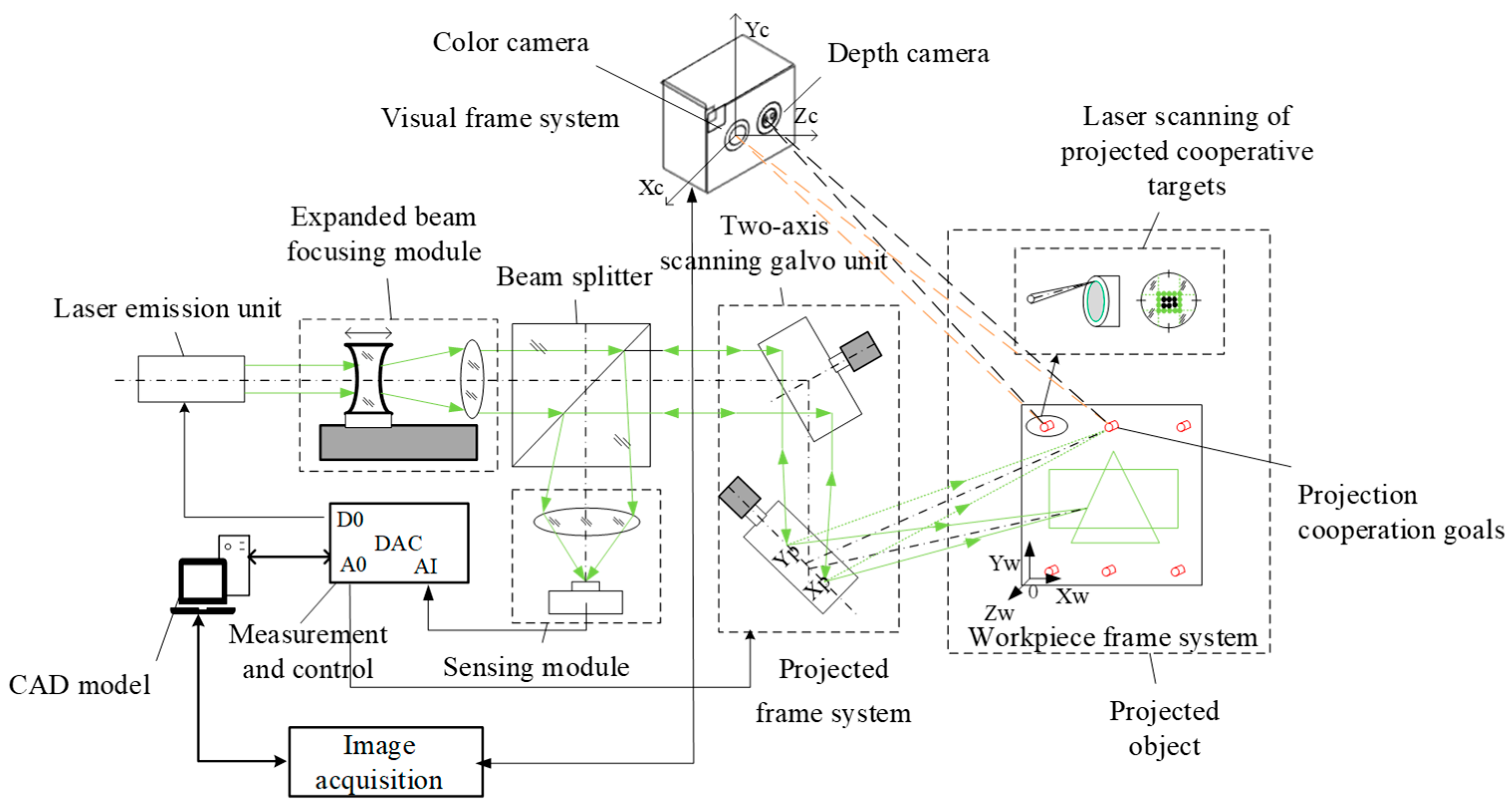
This study presents an integrated calibration system that combines color imaging, depth sensing, and two-axis galvanometer laser projection. The objective is to establish an accurate mapping between galvanometer control signals and three-dimensional workpiece coordinates using a practical sensor configuration, while enabling stable estimation and repeatable verification of the projection extrinsic parameters. As illustrated in
Figure 1, the system comprises a laser emission and beam-expansion/focusing unit, a beam-splitter and sensing module, a two-axis galvanometric scanning unit, an image acquisition unit, and a measurement and control unit. The controller outputs horizontal and vertical drive signals (
H,
V) to the galvanometer, steering the laser beam for two-dimensional scanning and projecting calibration targets onto the workpiece or a reference plate. A color camera captures high-resolution images for precise target-center localization, while a depth camera provides registered depth measurements (
Z) at the corresponding pixels. By fusing two-dimensional pixel observations with synchronized depth data [
13], the system reconstructs the target centers from image coordinates to three-dimensional coordinates (
X,
Y,
Z), forming the foundation for subsequent extrinsic parameter estimation and projection error evaluation.
The system operates within three coordinate frames: the vision (camera) frame, the projection (galvanometer) frame, and the workpiece frame. The core calibration objective is to estimate the extrinsic parameters—specifically the rotation matrix
R and translation vector
t—of the projection frame relative to the workpiece frame. Using these estimated parameters (
R,
t), the system computes the inverse mapping from any 3D point to the required galvanometer drive signals and evaluates the resulting projection errors, thereby enabling in situ marking applications such as assembly guidance. To mitigate solution instability arising from parameter coupling in the galvanometer model and on-site measurement noise, a hybrid optimization scheme is employed. This strategy combines global search with local refinement to enhance the stability and repeatability of the estimated extrinsic parameters [
14].
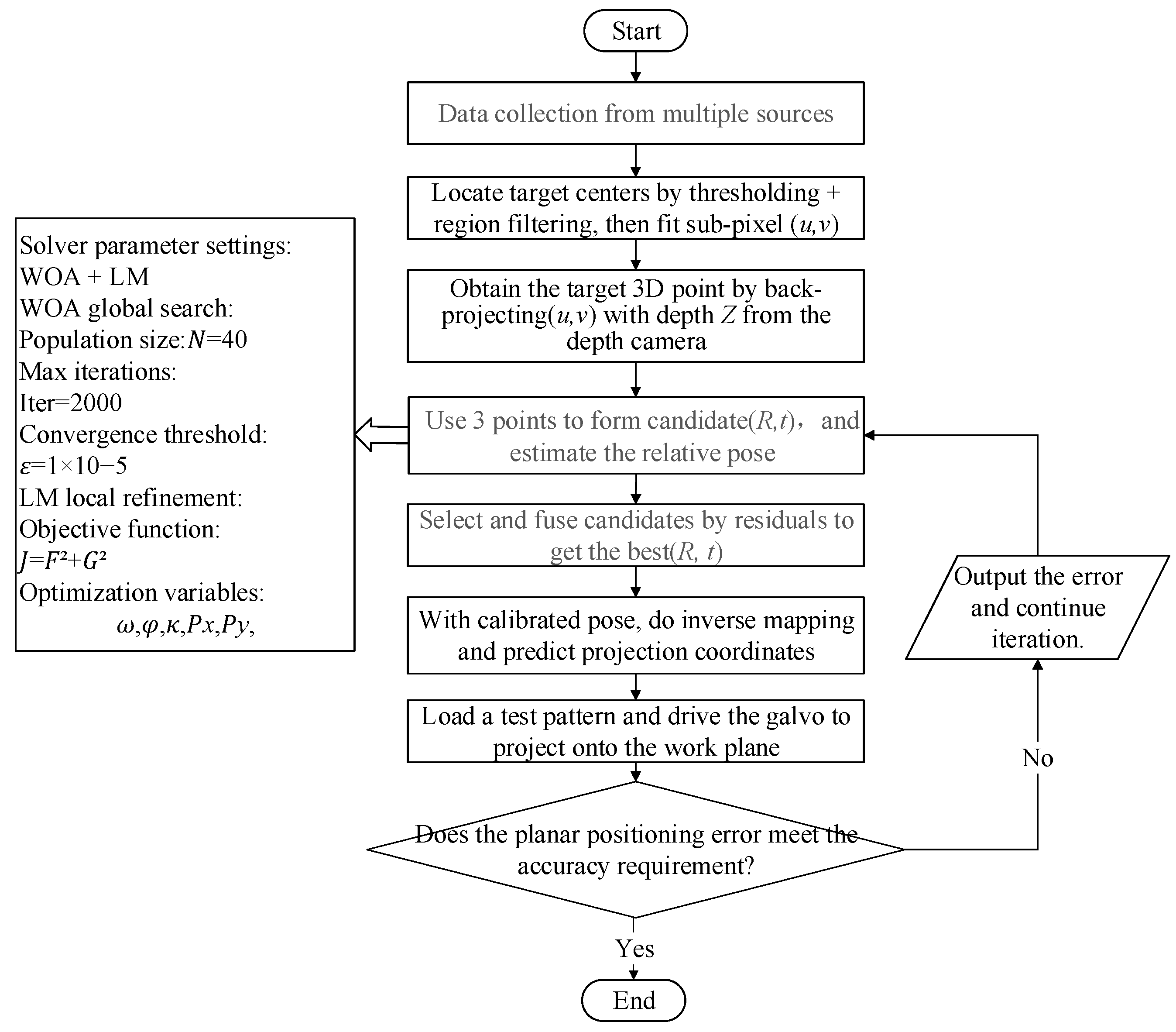
To improve the reliability and repeatability of extrinsic parameter estimation under small-sample conditions, we design a closed-loop calibration pipeline comprising four sequential stages: Data Acquisition, 3D Reconstruction, Extrinsic Solving, and Projection Validation. The complete workflow is illustrated in
Figure 2, and the key steps are summarized as follows:
- (1)
Data Acquisition and Correspondence Establishment
- ■
Project a laser spot onto a planar calibration target using a given galvanometer command pair (H, V).
- ■
For each command pair, an RGB image and a corresponding depth map of the target are captured synchronously, establishing the initial correspondence between the command input and the sensor observation.
- (2)
Spot Center Localization and 3D Reconstruction
- ■
Image Processing: The laser spot region in the RGB image is extracted using thresholding and connected-component filtering.
- ■
Sub-pixel Localization: A quadratic surface is fitted within a local neighborhood around the spot. The extremum of this fitted surface is calculated to determine the sub-pixel coordinates (uc, vc) of the spot center.
- ■
Depth Association and Filtering: The corresponding depth value Z at (uc, vc) is retrieved from the aligned depth map. Median filtering within a small neighborhood is applied to suppress depth noise.
- ■
3D Back-Projection: Using the camera intrinsics, the triplet (
uc,
vc,
Z) is back-projected to obtain the 3D point
Pc in the camera coordinate frame [
15]. This point is then transformed into the workpiece coordinate frame via the pre-calibrated camera-to-workpiece transformation (
Rcw,
tcw), yielding
Pw. This completes the establishment of the core correspondence: (
H,
V) ↔
Pw.
- (3)
Extrinsic Parameter Solving via Hybrid Optimization
- ■
Problem Formulation: Using three correspondence pairs as a minimal solving unit, a nonlinear optimization problem is formulated to estimate the rigid transformation (
R,
t) between the projector (galvanometer) frame and the workpiece frame [
16]. The optimization variables are the rotation angles (
ω,
φ,
κ) and the translation vector (
Px,
Py,
Pz). The objective is to minimize the geometric residuals defined by the projection model, i.e.,
J =
F2 +
G2.
- ■
Hybrid WOA-LM Strategy:
- ▪
Global Search (WOA): The Whale Optimization Algorithm performs a broad exploration of the parameter space. This stage generates multiple promising candidate initial solutions, reducing sensitivity to initialization.
- ▪
Local Refinement (LM): Each candidate solution is refined using the Levenberg–Marquardt algorithm for precise, fast local convergence via nonlinear least-squares minimization.
- ■
Solution Selection: All candidate solutions (Ri, ti) are evaluated on the full set of calibration points. The solution with the smallest and most consistent residual is selected as the final extrinsic parameters (R, t).
- (4)
Closed-loop Projection Validation
- ■
Inverse Mapping and Projection: The calibrated extrinsic parameters (R, t) are used to compute the required galvanometer commands (H, V) for a set of independent 3D test points (e.g., forming rectangle or triangle contours) defined in the workpiece frame. The system then projects the corresponding pattern.
- ■
Error Evaluation: The projected pattern is captured. The procedure from Stage 2 (spot localization to 3D reconstruction in workpiece coordinates) is repeated to obtain the measured positions of the projected spots. The in-plane Euclidean distance between these measured positions and the nominal target positions is calculated as the projection error.
- ■
Verification Loop: If the evaluated error meets the predefined accuracy requirement (e.g., sub-millimeter), the calibration is validated, and the process ends. Otherwise, the procedure revisits earlier stages for adjustment or recalibration.
This structured pipeline forms a rigorous “Acquisition-Reconstruction-Solving-Validation” closed loop, ensuring reliable and verifiable estimation of the projection extrinsics. The incorporation of the parameterized WOA-LM hybrid strategy significantly improves the robustness and convergence efficiency of the solver in the presence of measurement noise and limited sample size.
During the calibration procedure, a laser spot is projected onto the reference board for each given pair of galvanometer control signals (
H,
V), while synchronized color images and depth data are acquired. The color image provides high-accuracy two-dimensional localization of the target point. First, thresholding and connected-component filtering are applied to isolate the spot region, providing an integer-pixel coarse location (
u0,
v0). To achieve sub-pixel precision, a quadratic surface is fitted to the intensity values within a local area
W ×
W neighborhood (where
W is an odd integer) centered at (
u0,
v0). The extremum of this fitted surface is taken as the refined spot center, yielding sub-pixel coordinates (
uc,
vc) [
17]. The corresponding closed-form solution can be expressed as follows:
where (
x0,
y0) denotes the local coordinates corresponding to the coarse center (
u0,
v0), (
xcenter,
ycenter) is the refined sub-pixel offset relative to (
x0,
y0), and
a1 to
a5 are the coefficients obtained from least-squares fitting of the quadratic intensity surface within the local window.
After color–depth alignment, the depth value
Z corresponding to the pixel coordinates (
uc,
vc) is retrieved from the depth map. To suppress depth noise, the median depth within a small neighborhood around this pixel is computed and adopted. Subsequently, using the camera intrinsic parameters, the coordinates (
uc,
vc,
Z) are back-projected into the camera coordinate system to obtain the corresponding three-dimensional point
Pc (
x,
y,
z) [
18].
where
fx,
fy are the focal lengths in pixel units,
cx,
cy are the principal point coordinates, and
Pc is expressed in the camera frame.
represents homogeneous pixel coordinates. Since
Z is provided in millimeters, the reconstructed 3D point
Pc is also expressed in millimeters.
To establish a unified reference for subsequent calibration and error evaluation, the three-dimensional points in the camera coordinate system are transformed into the workpiece coordinate system. Using the camera extrinsic parameters relative to the workpiece frame (
Rcw,
tcw), each point
Pc is mapped to the workpiece frame as
Pw according to the following relation [
19]:
where
Pc and
Pw denote 3D points in the camera and workpiece frames (unit: mm), (
Rcw, tcw) is the rigid transform from the camera frame to the workpiece frame.
Once the three-dimensional points in the workpiece coordinate system are obtained, the geometric mapping between the workpiece frame and the projector (galvanometer/projection) frame must be established. This mapping is constructed by treating the rigid-body extrinsic parameters—the rotation matrix
R and translation vector
t relating the two frames—as unknowns. These parameters are then used to transform a workpiece point
Pw into the projector coordinate frame as follows:
Here, Pp (s, q, w)⊤ denotes the point coordinates in the projector frame.
Based on the measurement model described above, the estimation of the extrinsic parameters
R and
t is formulated as an optimization problem. For a calibration point with known projector-frame coordinates (
s,
q,
w) and corresponding galvanometer deflection angles (
H,
V), together with the fixed structural parameter
e, two scalar residual functions
F and
G are derived from the geometric projection constraints [
20]. In an ideal, noise-free case, the conditions
F = 0 and
G = 0 would be satisfied exactly. Accordingly, the residual vector for the
i-th calibration point is defined as follows:
Here,
θ denotes the extrinsic parameters (
R,
t). Each calibration point provides two independent scalar constraints (
F,
G) through the projection model, while the six degrees of freedom in (
R,
t) imply that, in an ideal noise-free and geometrically non-degenerate case, a minimum of three points is required for a unique solution. To mitigate the effects of measurement noise, geometric degeneracy, and local minima in practice, we employ six well-distributed calibration points. These points are used to generate multiple distinct three-point combinations, each yielding a candidate estimate for (
R,
t). A residual-based consistency criterion is then applied to select the most reliable candidates, thereby improving initialization robustness and providing stable starting points for subsequent Levenberg–Marquardt (LM) refinement. The overall extrinsic estimation is consequently cast as a nonlinear least-squares minimization problem [
21]. In this work, the residual vector is constructed as
by stacking the two residuals from all
N points, and the objective is
.
By minimizing the objective function
J(
θ), the aggregated residuals
F and
G across all calibration points are reduced, thereby enforcing geometric consistency between the workpiece frame and the projector frame. Since
J(
θ) is nonlinear and potentially multimodal, local optimization methods are often sensitive to the choice of initial values. To enhance global stability, we first employ the Whale Optimization Algorithm (WOA) to perform a global search in the parameter space [
22]. In this step, the residual cost defined in Equation (5) serves as the fitness function, yielding a robust initial estimate
θ0. Within the WOA framework, candidate solutions (whales) update their positions through behaviors such as encircling prey and spiral movement, which can be summarized by the following update rules:
where ⊙ denotes the Hadamard (element-wise) product, |·| denotes the element-wise absolute value, and
θ represents the current best solution vector.
A and
C are coefficient vectors defined in the WOA formulation.
After the Whale Optimization Algorithm (WOA) provides a robust initial estimate
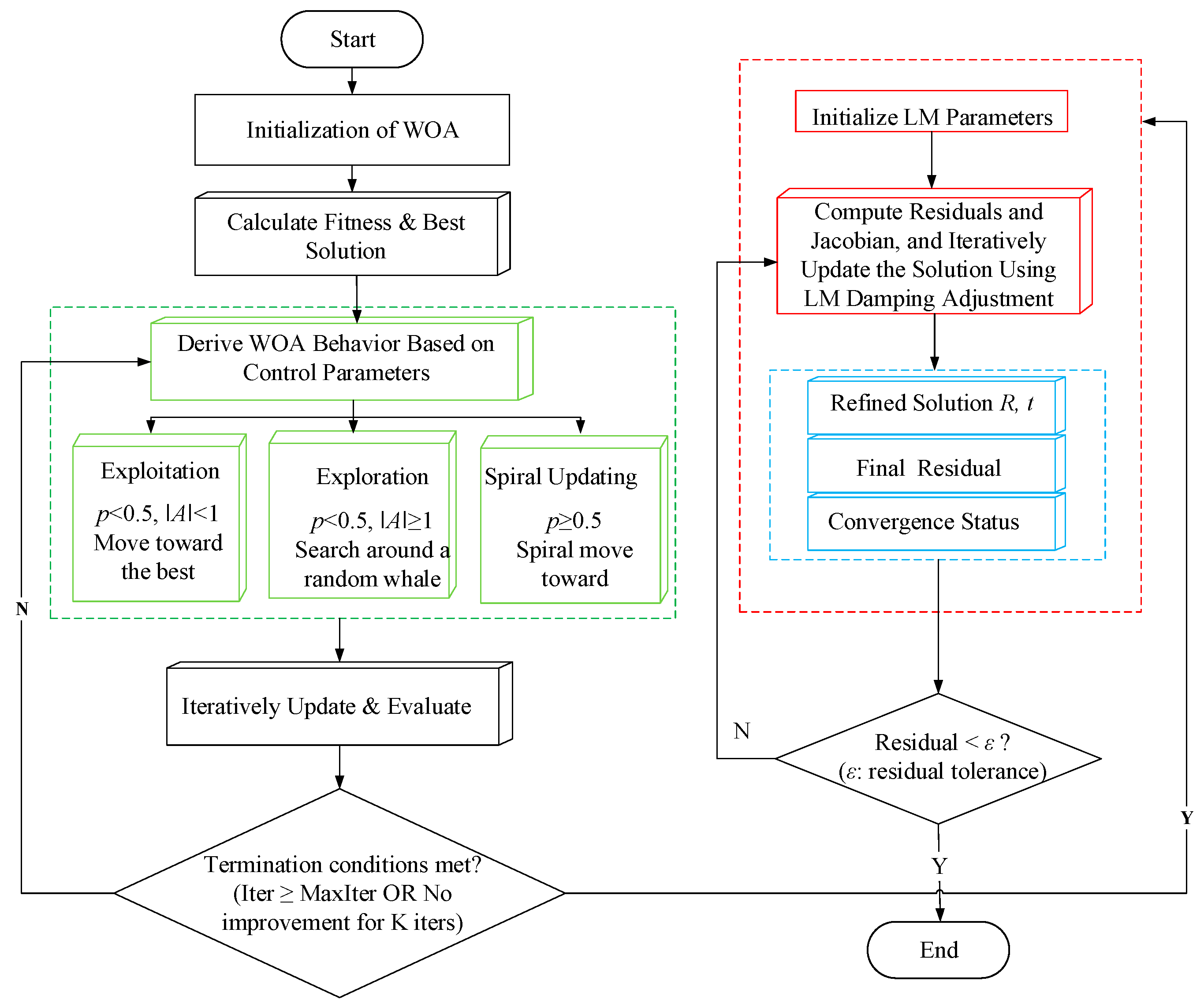
θ0. The Levenberg–Marquardt (LM) method is employed for local refinement. This step enhances the accuracy of the solution and accelerates the final convergence. The complete WOA-LM hybrid optimization procedure for solving the extrinsic parameters is illustrated in
Figure 3. In the LM stage, the residual functions are linearized via a first-order Taylor expansion around the current parameter estimate
θ, expressed as [
23]:
Here,
J =
∂r/
∂θ is the Jacobian matrix, and Δ
θ is the parameter increment.
λ is the damping factor, and
I is the identity matrix with the same dimension as
JTJ. The LM iterative update equation is given by:
In the LM refinement stage, a residual-threshold check is embedded within an iterative control loop. If the residual exceeds the preset tolerance ε, the damping factor is adaptively adjusted, and the iteration continues. When necessary, a new candidate initial value is selected to restart the refinement process, repeating until the residual falls below ε or a predefined stopping condition is satisfied. The final output is the optimal extrinsic parameters (R, t) that satisfy the tolerance ε while minimizing the overall residual, thereby ensuring geometric consistency between the camera and projector coordinate systems.
The experimental design is structured to validate the proposed calibration method under clear and controlled conditions. The use of only the two galvanometer deflection commands (H, V) is appropriate because the calibration objective is to estimate the 6-DOF rigid transformation between the projector and workpiece frames, which is fully defined by this mapping. A dynamic focusing module, while necessary for operation on complex 3D surfaces, is not required for this core extrinsic calibration when using a planar target.
A flat, high-precision reference board was chosen to provide a stable and unambiguous geometric baseline for accuracy evaluation, representing a common industrial use case. The calibration model itself is general: the estimated rigid transformation applies in principle to any workpiece pose within the sensor’s field of view. Performance under extreme orientations or on highly curved surfaces involves additional practical considerations (e.g., spot distortion, depth measurement limits) that constitute valuable future work but do not affect the validity of the calibration methodology established here.
3. Experimental Results and Validation
To assess the system performance and data acquisition reliability in practical settings, we constructed an experimental platform integrating a depth camera and a galvanometer-based laser projection module, and performed three validation experiments. An Azure Kinect DK sensor was employed to simultaneously capture color images and depth data, delivering both 2D pixel coordinates and corresponding depth measurements for 3D reconstruction and subsequent error analysis. A checkerboard target was used for camera calibration [
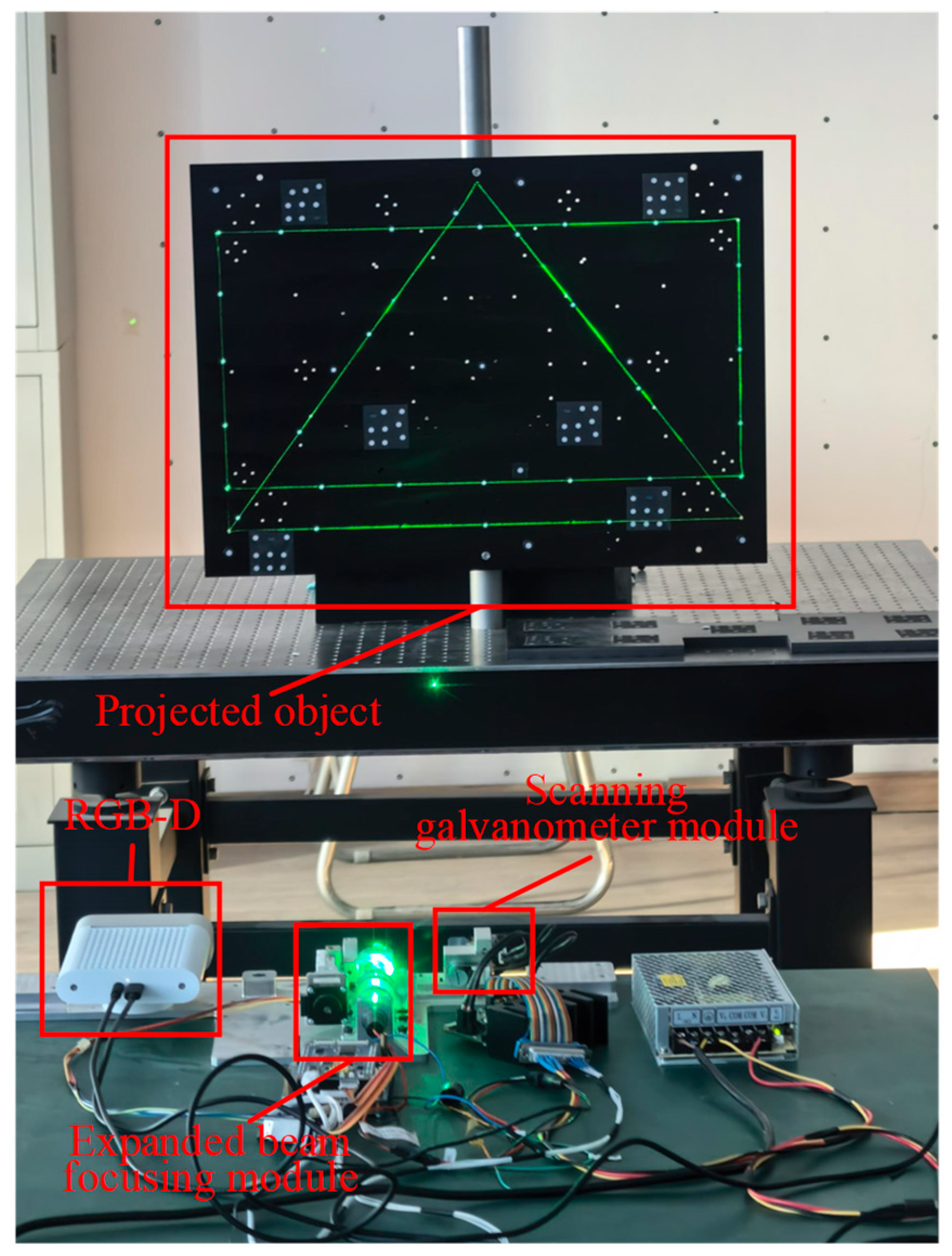
24], color–depth alignment, and lens distortion compensation. A custom-made, high-reflectivity metal reference board was fabricated as a stable projection surface to ensure reliable laser spot detection and center localization, with a machining tolerance maintained within 0.005 mm. Experimental measurements of the board’s surface under laboratory conditions confirmed that its form error remained within 0.02 mm, which was the effective accuracy used as the ground truth in our calibration. To maintain this accuracy during experiments, the board was rigidly mounted in a temperature-controlled laboratory environment to minimize the effects of thermal expansion and gravitational sag. This ensured that the board’s geometric error was not a dominant source of uncertainty in the subsequent measurement pipeline. As illustrated in
Figure 4, the working distance between the laser projection system and the reference board is approximately 1560 mm.
3.1. Experimental Setup and Implementation Details
To ensure the reproducibility of the presented results, this subsection details the key hardware specifications, software environment, and algorithm parameters used throughout the calibration and validation experiments.
- (1)
Hardware Configuration:
- ■
RGB-D Sensor: Azure Kinect DK. Color resolution: 1920 × 1080 pixels; Depth mode: NFOV unbinned, providing depth measurements within 0.5–3.5 m.
- ■
Galvanometer Laser Projector: Custom system with a 532 nm green diode laser. The scanning field angle is ±30°.
- ■
Controller: A National Instruments PCIe-6343 card was used to generate the analog control signals (H, V) for the galvanometers.
- ■
Computing Hardware Platform: All timing comparisons and optimization computations (including WOA and LM) were performed on a desktop computer equipped with an Intel Core i7-12700K CPU (3.6 GHz) and 32 GB of RAM, running the Windows 11 operating system.
- (2)
Software and Algorithmic Parameters:
- ■
Processing Framework: The calibration pipeline was implemented in Python 3.8. Key libraries included OpenCV (4.8.0) for image processing, NumPy/SciPy for numerical computations and nonlinear least-squares optimization (used for the LM refinement), and the Azure Kinect SDK for sensor control.
- ■
Spot Localization: The sub-pixel fitting window size W was set to 7 pixels. The depth denoising filter used a 5 × 5 pixel neighborhood median filter.
- ■
Optimization (WOA): Population size N = 40, maximum iterations = 2000, convergence threshold ϵ = 1 × 10⁻⁵.
- ■
Optimization (LM): The initial damping factor λ was set to 0.01, with an update factor of 10. The refinement stopped when the parameter change was below 1 × 10⁻⁶, or when the residual change was below 1 × 10⁻⁸.
- ■
Calibration Data: A set of six (H, V) command pairs was used for calibration, with their corresponding 3D points reconstructed as described in the previous subsection.
- (3)
Data Acquisition Protocol:
For each calibration or test point, the galvanometer was driven to the target (H, V) position and held stable. A trigger signal synchronized the capture of one RGB image and one depth map from the Azure Kinect. This procedure was repeated for all points in the set.
3.2. Point-Wise 3D Measurement Accuracy Validation
This experiment evaluates the 3D measurement accuracy of the Azure Kinect DK under the proposed setup and processing pipeline [
25,
26], thereby establishing a reliable data foundation for subsequent calibration and projection tasks. Thirteen points on the reference board are selected as an independent test set, with their nominal 3D coordinates, denoted as
, derived from the board’s certified machining parameters. For each point, a synchronized color image and depth frame are captured. The sub-pixel spot center (
uk,
vk) is extracted from the color image [
27,
28], and the corresponding depth value
Zk is retrieved from the aligned depth map. Using the camera intrinsic parameters, the coordinates (
uk,
vk,
Zk) are back-projected to obtain the 3D point in the camera frame, which is then transformed into the workpiece frame via the known extrinsic parameters, yielding the measured 3D coordinate
. The 3D Euclidean distance between each measured point and its nominal counterpart serves as the error metric [
29], defined as:
The above procedure is repeated for all 13 test points, yielding a set of 13 Euclidean errors. The error distribution is then analyzed by calculating the mean and maximum values to evaluate the overall 3D measurement precision of the system.
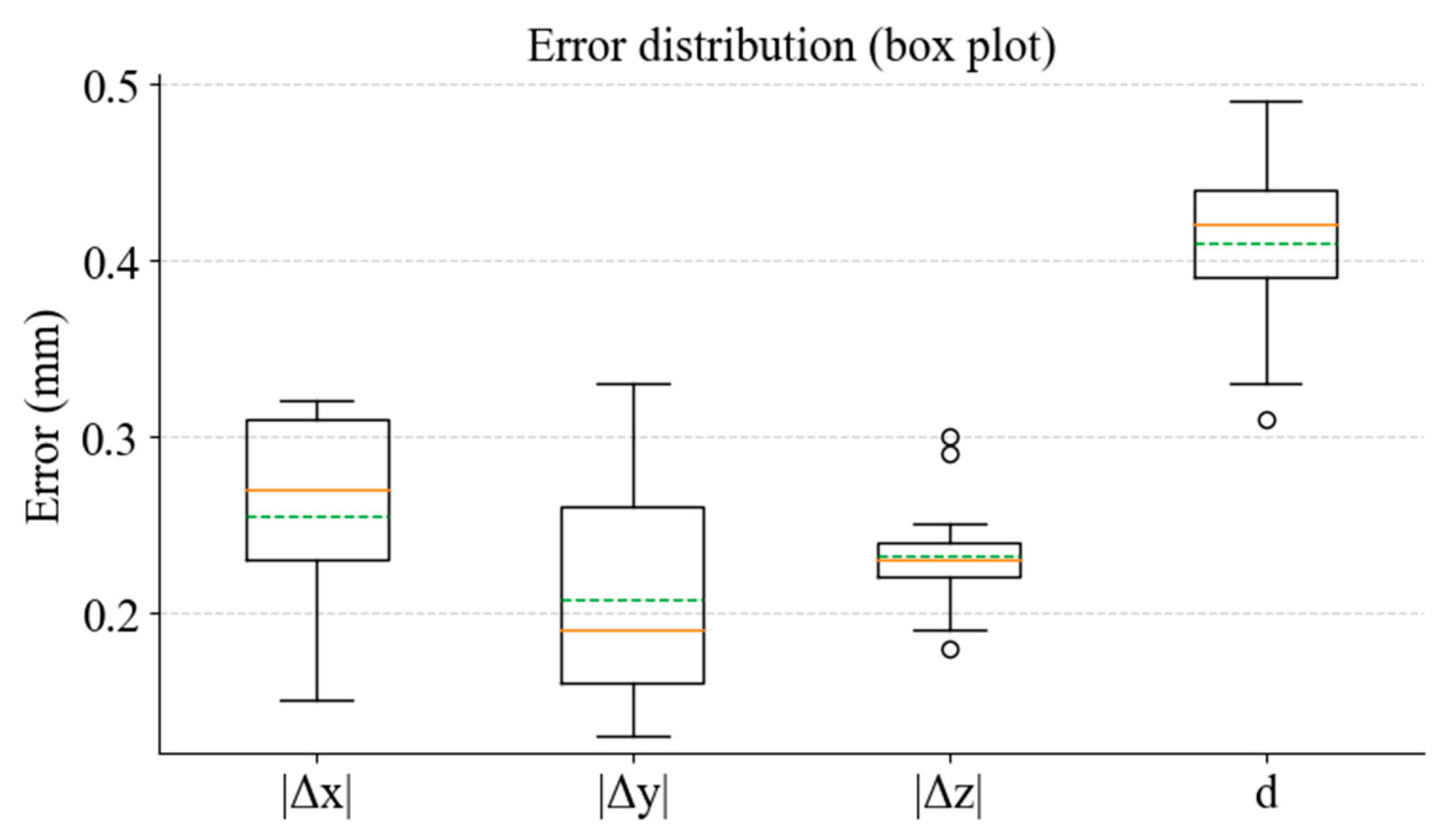
As shown in
Figure 5, we statistically analyze the three-dimensional error components (Δ
x, Δ
y, Δ
z) in the workpiece frame, along with the corresponding 3D Euclidean distance errors for the 13 test points. For the component errors, |Δ
z| displays the smallest interquartile range, indicating that depth-direction errors are more tightly clustered and consistent for most measurement points. Nevertheless, several prominent outliers are still present, suggesting that sporadic error peaks can occur at certain locations, likely due to depth-sensing noise or residual misalignment in the color–depth registration. In contrast,|Δ
x| and |Δ
y| exhibit broader dispersion, with |Δ
y| showing the largest whisker range, which reflects appreciable in-plane variability across different target positions.
For the overall three-dimensional Euclidean error d, both the median and mean values are approximately 0.4 mm, with a compact interquartile range and only a few minor outliers at the lower end. These results indicate that, under the present working distance and imaging conditions, the 3D measurement error remains generally stable and exhibits no obvious systematic drift. Consequently, the acquired 3D data provide a reliable foundation for subsequent extrinsic parameter estimation and projection-accuracy evaluation.
3.3. Extrinsic Accuracy and Solver Comparison
To further validate the accuracy and repeatability of the estimated extrinsic parameters (
R,
t), an angle-domain consistency check is conducted following the methodology outlined in
Section 3.1. This experiment confirms that by introducing a distance constraint variable, the minimal solving unit under planar geometric conditions is reduced from the six points typically required by the conventional Levenberg–Marquardt (LM) method to a three-point solvable case. Moreover, the proposed WOA-LM hybrid strategy enhances solving efficiency without compromising accuracy. A validation set of 19 points is constructed by combining calibration points with independent verification points. For each point, the nominal 3D coordinate in the workpiece frame and the corresponding measured galvanometer signals (
Hi,
Vi) are known. Using the same projection model and coordinate-transformation chain, two extrinsic-solving strategies are applied to obtain the respective parameter estimates:
- (1)
Conventional LM-based approach: The standard Levenberg–Marquardt (LM) method estimates (R, t) via nonlinear least-squares optimization using a set of six calibration points, resulting in the estimate (RLM, tLM).
- (2)
Proposed WOA-LM hybrid approach with distance augmentation: The method incorporates distance measurements to augment geometric constraints, enabling a minimal solving unit of only three points. All possible three-point combinations (20 groups) derived from the six calibration points are enumerated. Each combination is processed via the WOA-LM solver to generate a candidate solution (Rk, tk). Every candidate is then evaluated on the full set of six points by computing the total residual cost Jk. The optimal solution (R0, t0) is selected as the candidate that minimizes Jk.
For a fair comparison, the measured galvanometer signals (
Hi,
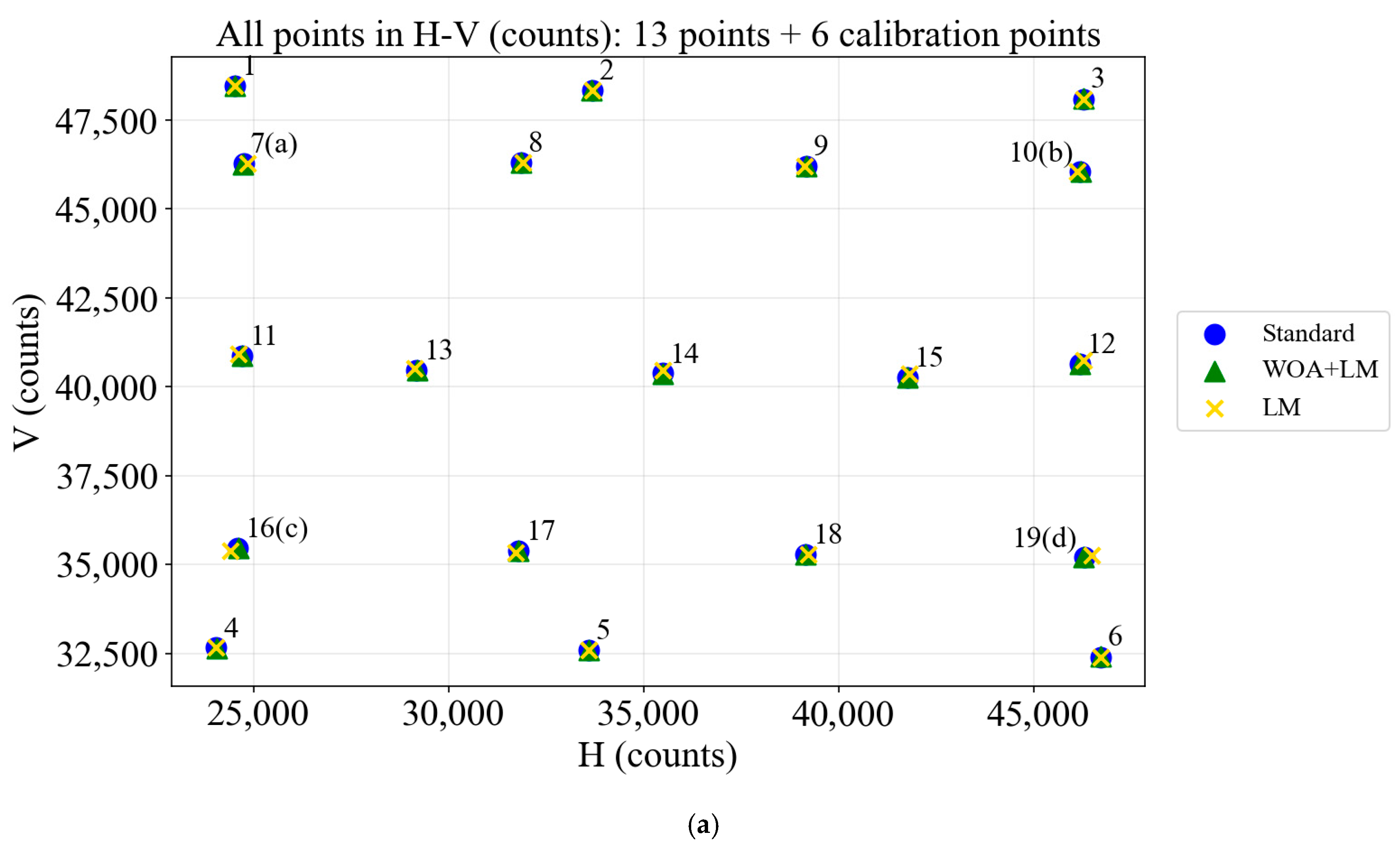
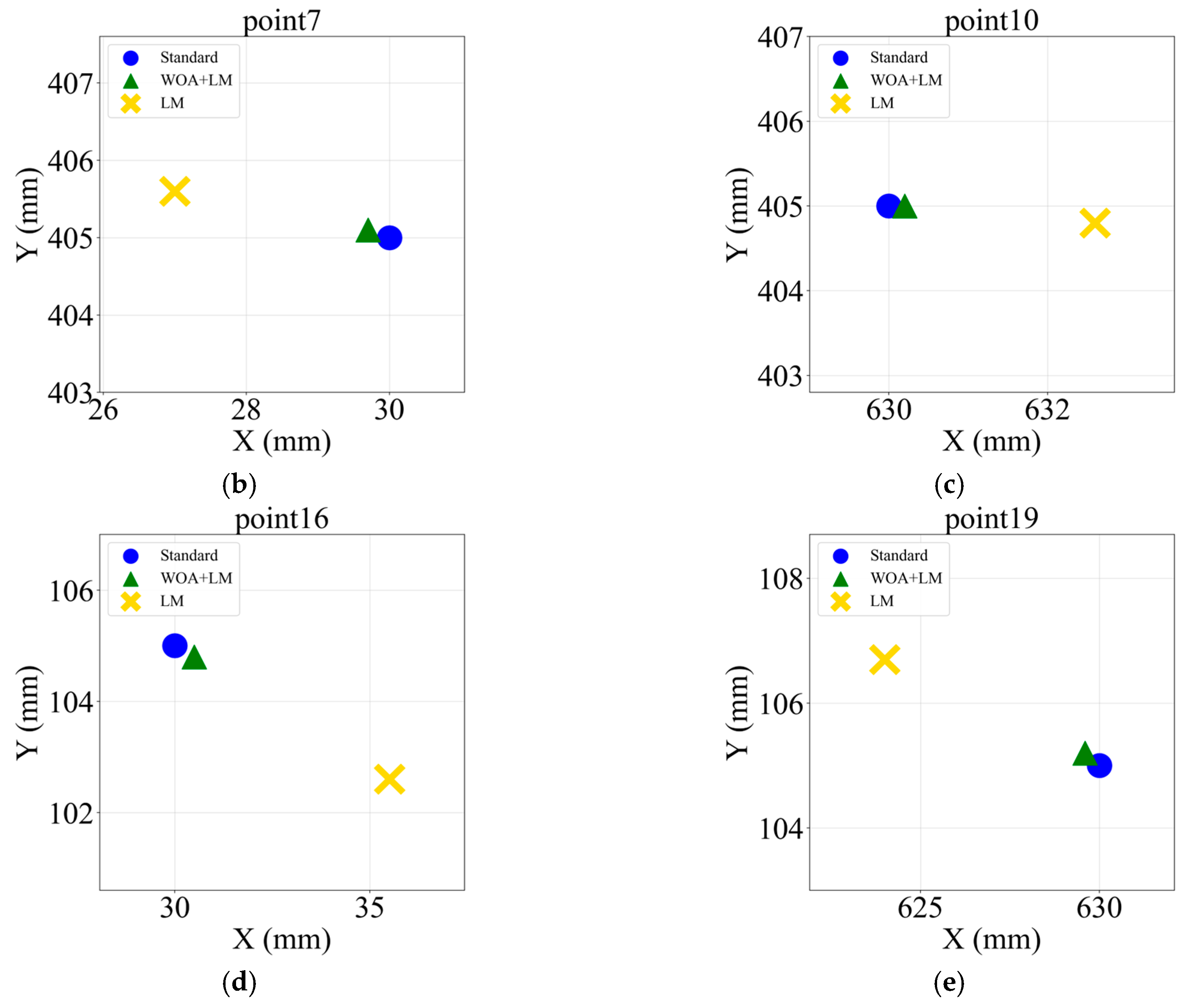
Vi) of the 19 validation points are first converted into corresponding deflection angles using the established signal-to-angle calibration model. The angular differences between predicted and reference deflection angles are then adopted as the evaluation metric. As shown in
Figure 6, the predictions of the proposed WOA-LM hybrid method align closely with the reference values across the entire horizontal and vertical deflection ranges. In contrast, the conventional LM approach exhibits noticeable deviations in certain regions.
Since this study focuses on proposing and validating a WOA + LM hybrid framework for small-sample calibration, the experiments primarily compare the conventional LM method with the proposed hybrid approach. WOA was selected for its balanced performance between exploration capability and convergence speed in high-dimensional, nonlinear optimization problems. While other global optimizers (e.g., PSO, GA) are also applicable to such tasks, a systematic comparison among different global algorithms is beyond the main scope of this paper. Future work will conduct a comprehensive comparative study among PSO, GA, WOA, and other optimizers on a unified experimental platform to further evaluate their performance in calibration tasks.
Figure 6b–e presents detailed views around four representative locations to highlight the positional discrepancies more clearly. The corresponding point-wise angular errors are summarized in
Table 1 and
Table 2. Overall, the WOA-LM method achieves consistently smaller and less dispersed errors in both horizontal and vertical deflection predictions across all test points. Its stable performance on the independent validation set further confirms the superior accuracy and repeatability of the extrinsic parameters (
R,
t) estimated by the proposed hybrid approach.
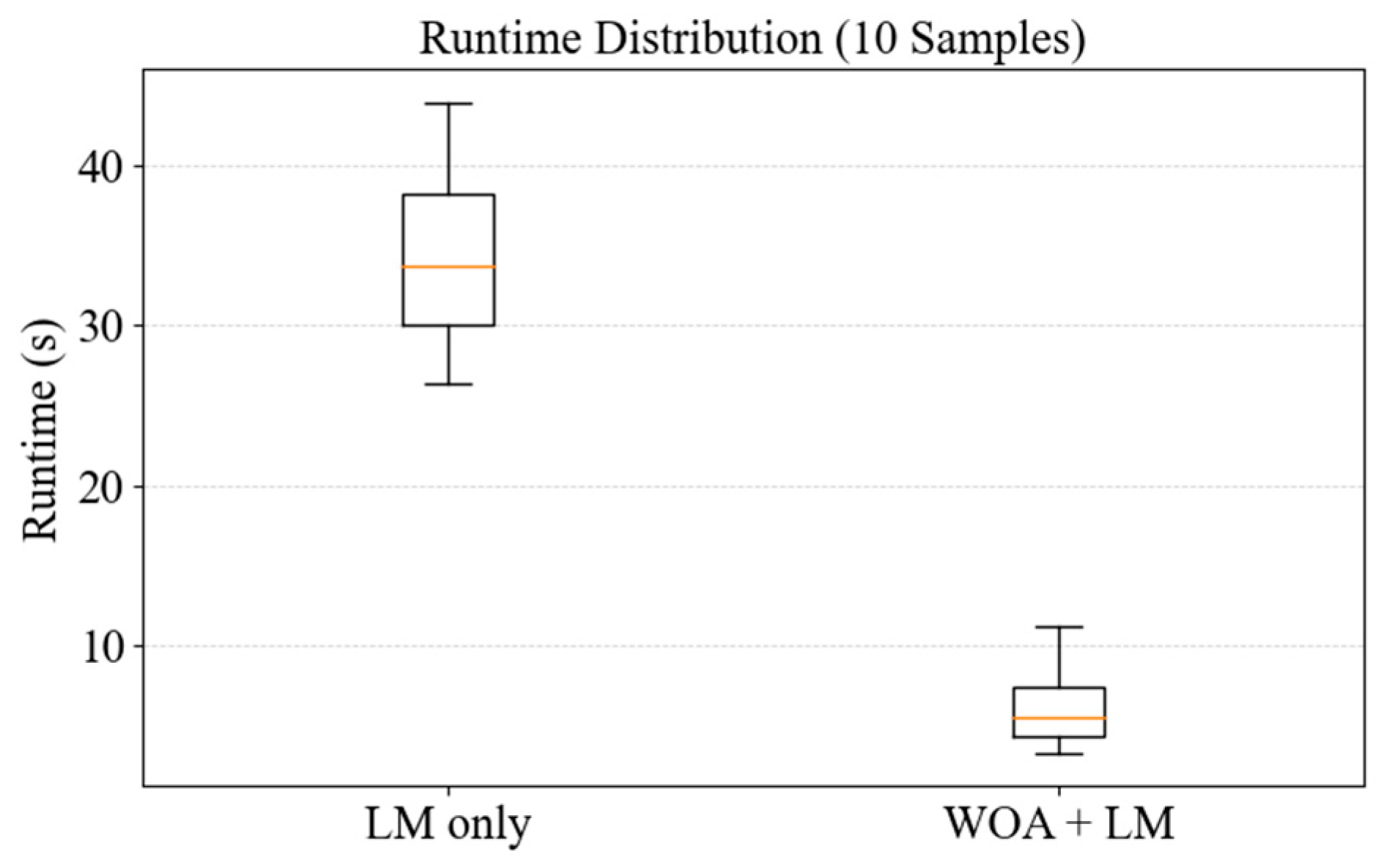
Beyond accuracy and consistency, the computational efficiency of the two solving strategies is also evaluated.
Figure 7 summarizes the timing results from ten independent runs under identical hardware and software configurations. On average, the conventional LM method requires 34.33 s per run, while the proposed WOA-LM hybrid approach completes in only 6.08 s, demonstrating a substantial reduction in computation time.
Over multiple repeated runs, the proposed WOA-LM hybrid approach demonstrates both lower average runtime and more stable computation time, underscoring the efficiency and robustness of the “global search followed by local refinement” strategy. Although the inclusion of WOA introduces an additional global initialization step, it significantly improves the quality of the initial guess, thereby reducing ineffective iterations and the need for random restarts. As a result, the overall optimization process becomes more predictable and computationally efficient, without compromising estimation accuracy. In summary, the angle-domain validation on 19 points together with the runtime comparisons confirm that the proposed method achieves stable convergence and high-accuracy extrinsic estimation even with limited samples, offering superior prediction consistency and enhanced engineering applicability compared to the conventional LM-only approach.
The superior accuracy of the hybrid WOA-LM approach over the standalone LM method can be attributed to its enhanced ability to escape local minima. The LM algorithm, being a gradient-based local optimizer, is highly sensitive to the initial guess of parameters (R, t). When initialized poorly in the complex, non-convex error landscape of the projection model, LM can converge to a sub-optimal local minimum, resulting in larger final errors. In contrast, the WOA first performs a global exploration of the parameter space, identifying a region near the global optimum. This robust initial estimate provided by WOA ensures that the subsequent LM refinement starts from a favorable point, guiding it towards a more accurate and globally consistent solution.
3.4. Continuous-Contour Projection Accuracy Validation
To validate the estimated extrinsic parameters and the corresponding inverse projection model for continuous-trajectory marking, rectangular and triangular contours are projected onto the workpiece. Each contour shape is discretized in the workpiece frame to generate an ordered sequence of 3D target points. For every point, the required galvanometer commands (Hk, Vk) are computed via the inverse mapping and executed sequentially, thereby drawing closed contours on the metal reference board. Dense sampling along the contour boundaries is employed to prevent visible breaks in the projected path and to accurately capture the overall projection performance.
To mitigate the adverse effects of specular reflections and uneven intensity distribution inherent to the high-reflectance metal reference board, a dedicated image processing pipeline was implemented for robust laser spot extraction. The pipeline consists of four stages: (1) Acquisition Parameter Tuning: The exposure time of the color camera was optimized to prevent over-saturation of the laser spot while preserving sufficient contrast against the bright metal background. The laser output power was concurrently adjusted to maintain a consistent and detectable spot size. (2) Pre-processing: A Gaussian filter was applied to raw images to suppress high-frequency noise and reflection speckle. Contrast-limited adaptive histogram equalization (CLAHE) was then used locally to enhance the spot region’s visibility without amplifying background noise globally. (3) Spot Segmentation: An adaptive thresholding method, based on the local mean intensity within a sliding window, dynamically calculates the binarization threshold for each image region. This effectively separated the laser spot from varying reflective backgrounds. Morphological opening was subsequently applied to remove small, reflection-induced noise pixels. (4) Center Localization: The centroid of the largest contiguous blob was calculated as an initial estimate. A quadratic surface was then fitted to the intensity values within a predefined neighborhood of this initial estimate to achieve sub-pixel precision. This fitting process is inherently robust to minor, symmetric intensity variations caused by diffuse reflections. This multi-stage pipeline ensured consistent and accurate laser spot detection across the entire metal surface, forming a reliable basis for the subsequent contour error evaluation.
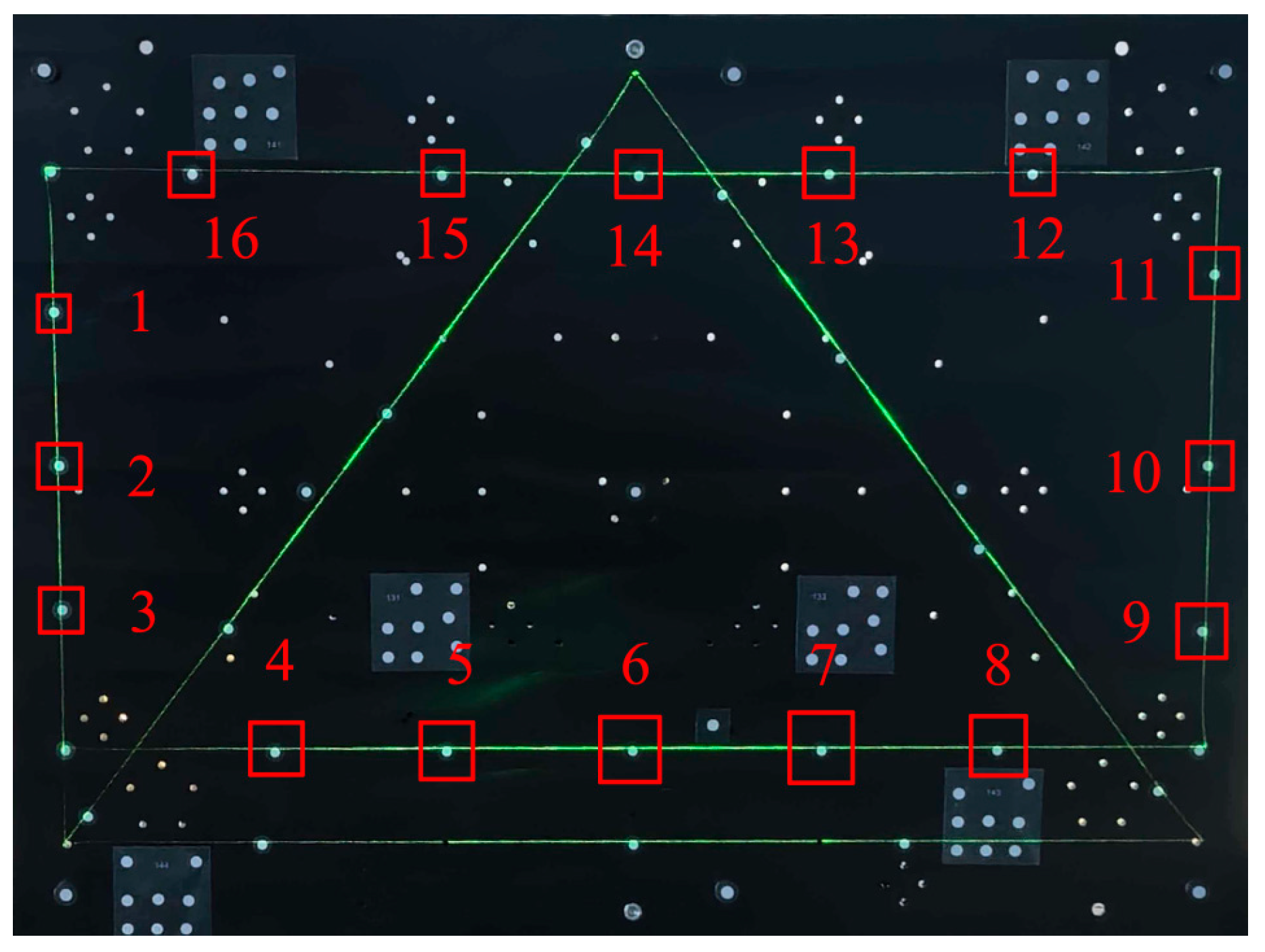
For quantitative evaluation, sixteen white circular markers (5 mm in diameter) are arranged near a precision-machined groove on the reference board. The groove centerline is aligned to pass through the centers of the markers, establishing a stable local coordinate reference. As shown in
Figure 8, the projected contours and the marker layout are displayed together, enabling visual assessment of contour closure, edge straightness, and corner continuity.
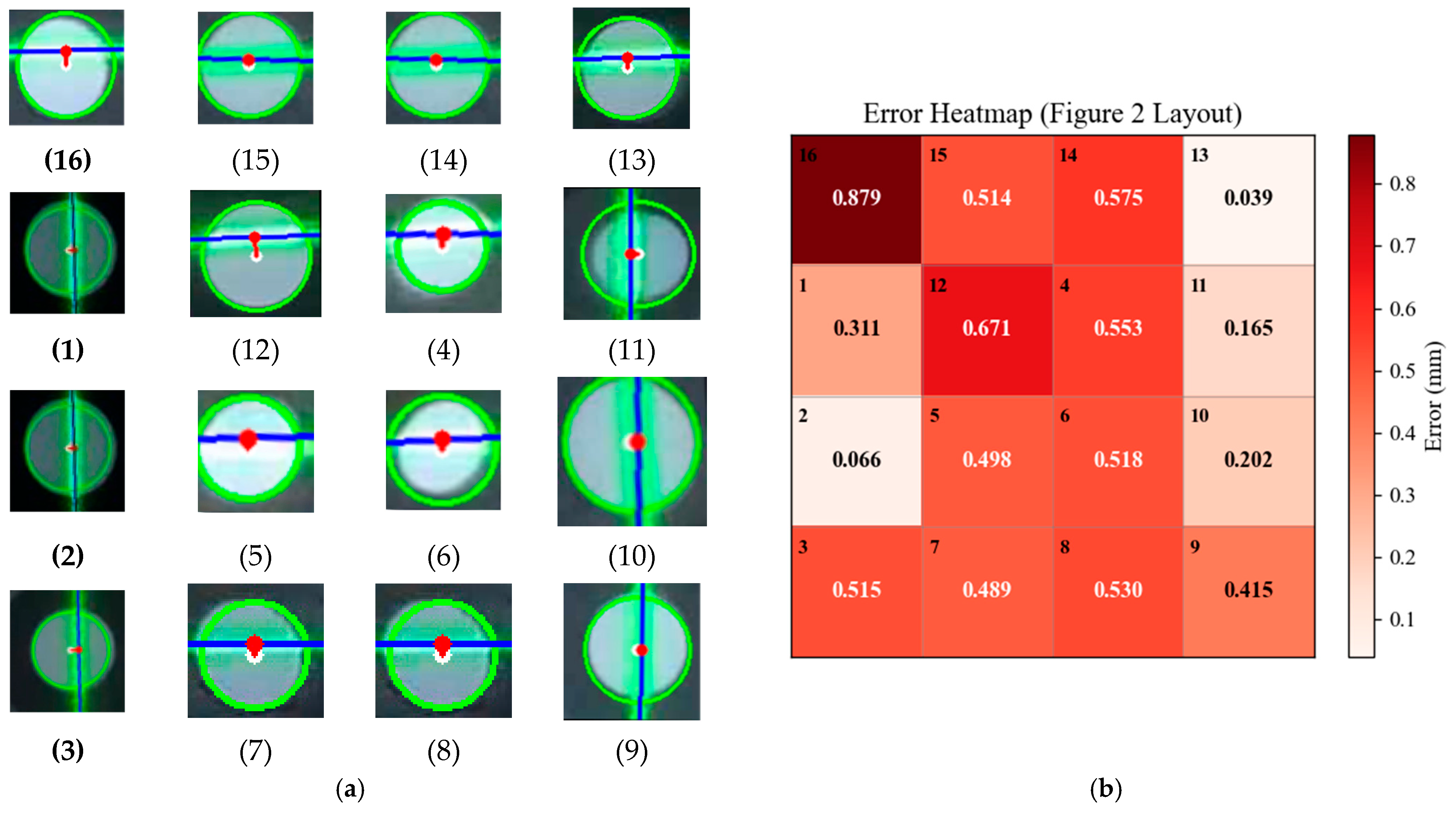
To evaluate local projection accuracy, the centers of the 16 white circular markers and the corresponding projected laser trajectory are extracted from the captured images. The shortest distance between each marker center and the laser path is computed as the local projection error. The distribution of these 16 errors is summarized in the heatmap shown in
Figure 9b. As illustrated in
Figure 9a,b, the projected contour closely follows the reference groove centerline, with errors varying smoothly and no conspicuous outliers. The mean projection error is 0.434 mm (standard deviation: 0.225 mm). The maximum and minimum errors are 0.879 mm and 0.039 mm, respectively, with all values remaining below the 1 mm threshold. These results demonstrate consistent sub-millimeter performance in practical contour projection [
30], confirming that the calibrated inverse mapping from workpiece coordinates to galvanometer control signals reliably supports both precise point-to-point projection and continuous trajectory marking.
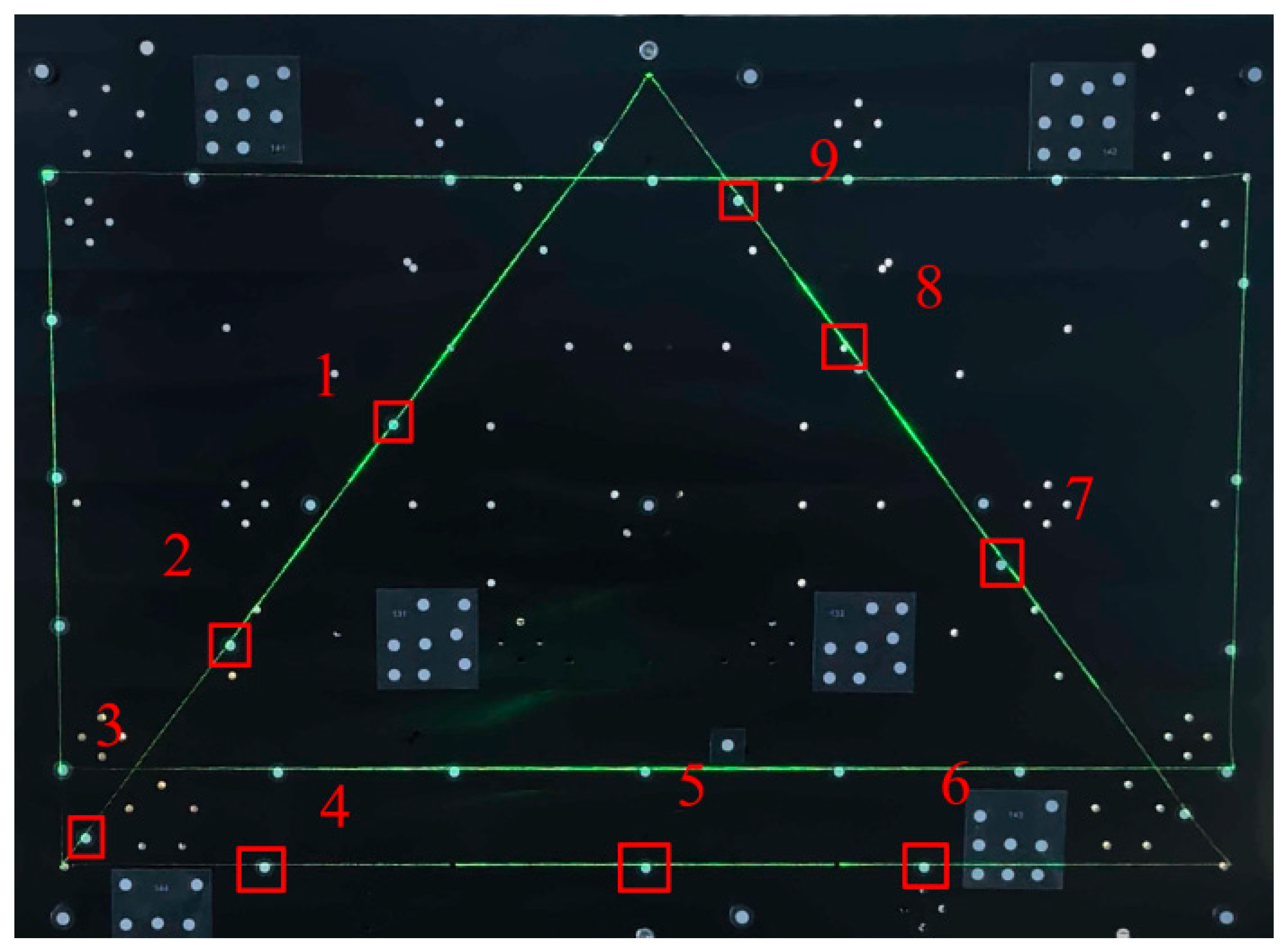
To evaluate the distance-based assessment method on a different trajectory, the projected triangular contour is analyzed using nine white circular markers arranged as shown in
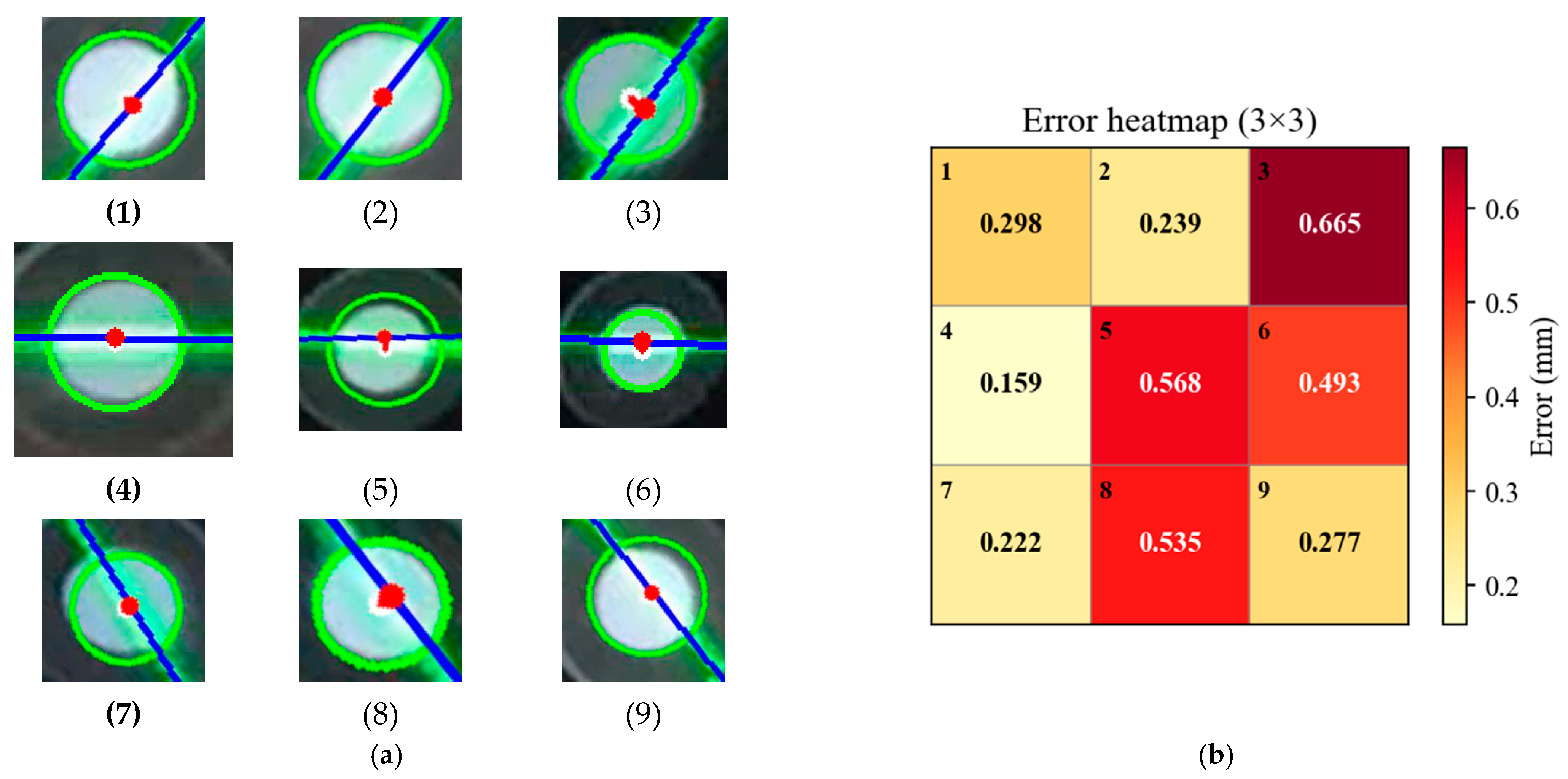
Figure 10. The extracted circle centers and laser trajectory are displayed in
Figure 11a. Note that in
Figure 10, the projected laser intensity appears weaker at the edges of the plate. This effect is likely due to defocusing as the distance from the scanner increases, suggesting that the system may need to employ the z-focusing unit for uniform projection across the entire plate. Following the same image-processing procedure described for
Figure 9, the centers of the markers and the laser trajectory are extracted. The shortest distance from each marker center to the projected contour is then computed and used as the local projection error.
Figure 11b visualizes the corresponding errors for the nine markers. The projected laser trajectory closely follows the reference centerline, with errors varying smoothly and exhibiting no abrupt local deviations. These results demonstrate that the proposed inverse mapping performs effectively not only for rectangular paths but also for triangular contours with sharp corners, thereby validating its capability to support practical in situ marking of diverse geometric shapes.