Article

Exploratory LA-ICP-MS Imaging of Foliar-Applied Gold Nanoparticles and Nutrients in Lentil Leaves

1
Institute of Laboratory Research on Geomaterials, Faculty of Natural Sciences, Comenius University in Bratislava, Mlynská Dolina, Ilkovičova 6, 842 15 Bratislava, Slovakia
2
Laboratory of Bioclimatology, Department of Ecology and Environmental Protection, Poznan University of Life Sciences, Piątkowska 94, 60-649 Poznan, Poland
3
The Department of Chemistry of the Faculty of Science, Masaryk University, Kotlářská 267/2, 611 37 Brno, Czech Republic
4
The Polymer Institute of the Slovak Academy of Sciences, Dúbravská Cesta 9, 845 41 Bratislava, Slovakia
5
Centre for Nanodiagnostics of Materials, Slovak University of Technology, Vazovova 5, 812 43 Bratislava, Slovakia
*
Author to whom correspondence should be addressed.
Appl. Sci. 2026, 16(2), 974; https://doi.org/10.3390/app16020974 (registering DOI)
Submission received: 19 December 2025 / Revised: 14 January 2026 / Accepted: 16 January 2026 / Published: 18 January 2026
(This article belongs to the Special Issue Applications of Nanoparticles in the Environmental Sciences)

Abstract

Gold nanoparticles (Au-NP) are frequently used as model nanomaterials to study nanoparticle behavior in plants due to their analytical detectability and negligible natural background in plant tissues. However, the feasibility of visualizing the spatial distribution of foliar-applied Au-NP at low exposure levels using laser ablation inductively coupled plasma mass spectrometry (LA-ICP-MS) remains insufficiently explored. In this study, commercially sourced Au-NP were applied to lentil leaves (Lens culinaris var. Beluga) at a low concentration of 0.5 mg·L−1 using a controlled leaf submersion approach. Leaves were sampled at 1 h, 24 h, and 96 h post-exposure and analyzed by LA-ICP-MS imaging to assess time-dependent changes in gold-associated spatial signals, and to compare elemental distribution patterns with non-exposed controls. Untreated control leaves showed no detectable gold at any sampling time point, confirming negligible native Au background. In treated leaves, LA-ICP-MS imaging revealed an initially localized Au hotspot at 1 h, followed by progressive Au redistribution toward the leaf margins and petiole region by 24 h and 96 h. Gold signals persisted over the full 96 h period, indicating stable association of Au-NP with leaf tissue. Comparative elemental mapping of Ca, Mg, K, P, Fe, Zn, and Cu showed no persistent differences in spatial distribution patterns between treated and control leaves as detectable by LA-ICP-MS. This study demonstrates the feasibility of LA-ICP-MS imaging for visualizing the deposition and temporal spatial redistribution of low-dose foliar-applied nanoparticles in intact leaves. The results provide a methodological reference for future hypothesis-driven studies that apply nanoparticles under more controlled conditions, include increased replication, and combine multiple analytical techniques.

1. Introduction

Gold nanoparticles (Au-NP) are chemically stable, insoluble nanomaterials that are widely used as model nanoparticles for studying nanoparticle behavior in soils and plants. Their popularity in experimental systems stems from their easy detection and quantification using analytical techniques such as atomic absorption spectrometry (AAS), inductively coupled plasma optical emission spectrometry (ICP-OES), and inductively coupled plasma mass spectrometry (ICP-MS).
Because Au-NP have a very low dissolution constant and exhibit well-defined optical and mass properties, they are frequently used as tracers to investigate nanoparticle transport, uptake pathways, and accumulation within plant tissues. Beyond their use as model particles, Au-NP have been explored as carriers for delivering nucleic acids (RNA and DNA) into plant tissues, facilitating transient expression (i.e., enabling a temporary and short-term activation of genetic material within a living cell) or, in some cases, enabling genetic modification when combined with appropriate gene-editing or integration strategies [1,2,3,4].
So far, research on the biological effects of Au-NP has largely focused on higher organisms, including animals, with mice [5,6] being the most commonly used animal model; mammalian cell lines [7,8]; and whole-plant systems [9,10,11], with particular emphasis on toxicity, uptake, and physiological responses at the organism or tissue level. Within plant studies, increasing attention has been directed toward understanding how Au-NP interact with fundamental physiological processes, providing a basis for evaluating both their tracer potential and biological effects. Several studies have shown that Au-NP can interact with the photosynthetic apparatus; depending on concentration and particle characteristics, they may influence chloroplast morphology and photosynthetic performance [1,3,12,13,14]. Foliar application of Au-NP has also been reported to affect plant physiology [1] and the distribution of essential elements required for proper leaf function [15].
Despite the growing number of research papers addressing nanoparticle uptake and physiological effects in plants, the initial spatial fate of nanoparticles following foliar exposure to nanoparticles, including Au-NP, remains insufficiently characterized, particularly at low, non-phytotoxic concentrations and at the level of whole-leaf spatial heterogeneity. Most existing studies investigating plant–nanoparticle interactions rely on bulk elemental analysis of harvested and homogenized tissues [10,14] or on indirect physiological indicators, such as biomass or chlorophyll content [16]. Although this approach inherently averages elemental concentrations, it provides limited insight into how nanoparticles are distributed across leaf tissues shortly after deposition or how they move during subsequent redistribution.
Laser ablation inductively coupled plasma mass spectrometry (LA-ICP-MS) offers a unique opportunity to visualize the spatial two-dimensional distribution of elements in biological tissues at the micrometer-scale resolution [17]. While LA-ICP-MS has been applied to map endogenous nutrient distributions in plant leaves [18,19], its potential as a tool for tracking the spatial behavior of foliar-applied engineered nanoparticles at environmentally low concentrations remains largely unexplored.
Rather than focusing on detailed transport mechanisms or uptake pathways, the present study was designed as an exploratory feasibility assessment addressing a more fundamental methodological question: can LA-ICP-MS imaging reliably detect and spatially resolve the deposition and subsequent redistribution of low-dose foliar-applied Au-NP in intact leaves over time, without inducing major perturbations of elemental distributions? Accordingly, this study does not aim to establish a quantitative transport model or to distinguish specific uptake routes (e.g., cuticular versus stomatal pathways). Instead, it seeks to generate time-resolved spatial observations that (i) demonstrate detectability at low nanoparticle concentrations, (ii) visualize large-scale redistribution patterns within leaves, and (iii) assess whether such exposure measurably alters the spatial distribution of essential macro- and micronutrients. To address this, Au-NP were applied at a low concentration to lentil leaves (Lens culinaris var. Beluga) under controlled laboratory conditions. In addition to Au quantification, the spatial distribution of several essential elements whose patterns could potentially be influenced by the presence of Au-NP or Au itself, was also examined. Elemental distributions across leaf tissues were measured using LA-ICP-MS. By explicitly adopting an exploratory approach, the present work provides a methodological foundation for future hypothesis-driven studies employing larger sample sizes, controlled application methods, and complementary depth-resolved or physiological measurements.

2. Materials and Methods

2.1. Lentil Cultivation

Lentils were grown in a cultivation box in pots filled with soil. The cultivation box was equipped with broad-spectrum lighting simulating natural sunlight, with enhanced intensity in wavelengths essential for photosynthesis. Each pot contained 2 kg of soil (calcic chernozem) collected from the area of Senec (Slovakia). The soil was previously characterized in detail by Šebesta et al. [20], including its granulometric composition (sand, silt, and clay); pH in H2O and KCl; CaCO3 content; humic and fulvic acid fractions; total concentrations of Al, Mn, Fe, and Zn; oxalate-extractable phases of these elements; as well as cation exchange capacity. Lentil seeds (9 per pot) were sown directly into the soil. Germination occurred within 5 days, and after 2 weeks the seedlings were thinned to three uniformly developed plants per pot. The application of Au-NP was carried out as described below. Au-NP were purchased from Nanografi (SKU: NG04EO0304 ML1000, Ankara, Turkey) as a stock dispersion with a concentration of 200 mg∙L−1. The Au-NP dispersion contained no additional chemical reagents.

2.2. Foliar Application of Gold Nanoparticles by Leaf Submersion

Three weeks (21 days) after sowing, Au-NP were applied to the leaves of two plants by dipping their leaves at the third node into a 40 mL 0.5 mg·L−1 Au-NP suspension for 10 min. The leaf-dipping approach was chosen deliberately to prioritize reproducible exposure and spatial detectability over precise dose quantification, consistent with the exploratory and method-development focus of this study. One plant without nanoparticle application served as a control. A total of five lentil leaves were collected for LA-ICP-MS analysis. For the control group (plants without Au-NP treatment), two leaflets were harvested: one at 1 h and one at 96 h (4 days) after the time point corresponding to foliar application in the treated plants. A control leaf for the 24 h time point was not measured because LA-ICP-MS acquisition is highly time-consuming and cost-intensive (each leaflet requires several hours of instrument time, billed at a high hourly rate), and the 1 h and 4-day controls already showed negligible and unchanged background Au levels. From the Au-NP-treated plants, three leaflets were collected at 1 h, 24 h, and 4 days after foliar application. All leaflets were harvested from the third node from the root; the central leaflet (the third leaflet counted from the tip of the compound leaf) was collected.
LA-ICP-MS was selected because it enables detailed determination of the spatial distribution of Au, Ca, Cu, Fe, K, Mg, P, and Zn. Two-dimensional elemental distribution maps (2D maps) of the adaxial leaf surfaces were generated. LA-ICP-MS was performed under the following conditions: laser energy 70%, spot size 65 µm, scan speed 130 µm/s, repetition rate 20 Hz, and a total integration time of 0.5 s.

2.3. Morphological and Physicochemical Characterization of Gold Nanoparticles

2.3.1. STEM/SEM Imaging of Gold Nanoparticles

Images were acquired on a Scios 2 DualBeam FIB-SEM system by Thermo Scientific (Brno, Czech Republic) in STEM 3+ mode (transmission imaging using the electron beam in a SEM platform). The STEM images are presented for qualitative assessment of nanoparticle morphology and size distribution; no image enhancement beyond standard contrast adjustment was applied.

2.3.2. Characterization of Gold Nanoparticles by ζ-Potential

The zeta potential of the Au-NP suspension, which reflects the nanoparticle surface charge and is a key parameter for assessing colloidal stability, was measured using a Zetasizer Nano-ZS (Malvern Instruments, Malvern, UK) equipped with a helium–neon laser (λ = 633 nm) and a thermo-electric temperature controller. Measurements were performed at 25 °C in a zeta cell at a nanoparticle concentration of 0.5 mg·mL−1 and a scattering angle of 173°. Electrophoretic mobilities were converted to zeta potential values using the Smoluchowski model. Each analysis consisted of 12 zeta runs.

3. Results

3.1. Distribution of Gold Nanoparticles in Lentil Leaves Following Foliar Application by Leaf Submersion

LA-ICP-MS mapping revealed distinct differences between control leaves and those treated by dipping into the Au-NP suspension (Figure 1). Both control samples (1 h and 4 days) displayed a uniformly low background signal, confirming the absence of detectable native gold. In treated leaves, a localized region of high Au intensity was present 1 h after application, reflecting the initial deposition of nanoparticles on the leaf surface. After 24 h, the Au signal redistributed, forming a continuous band of elevated intensity along the leaf margins and in the basal region near the petiole. This marginal enrichment persisted for 4 days, with Au remaining clearly detectable in these zones. Across all treated samples, gold was retained on or within the leaf tissue throughout the 4-day exposure period.

3.2. Comparative LA-ICP-MS Mapping of Macro- and Micronutrients in Lentil Leaves

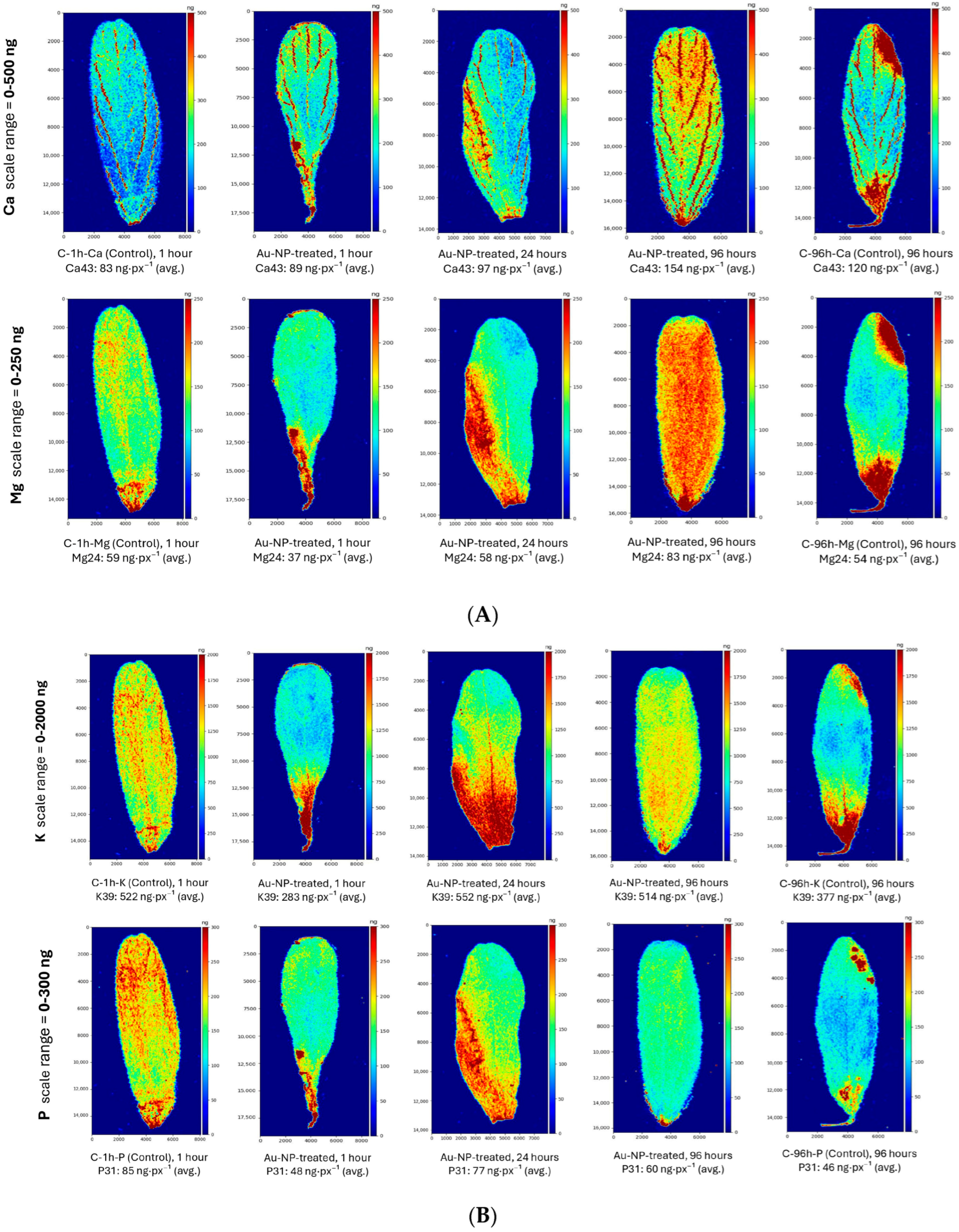
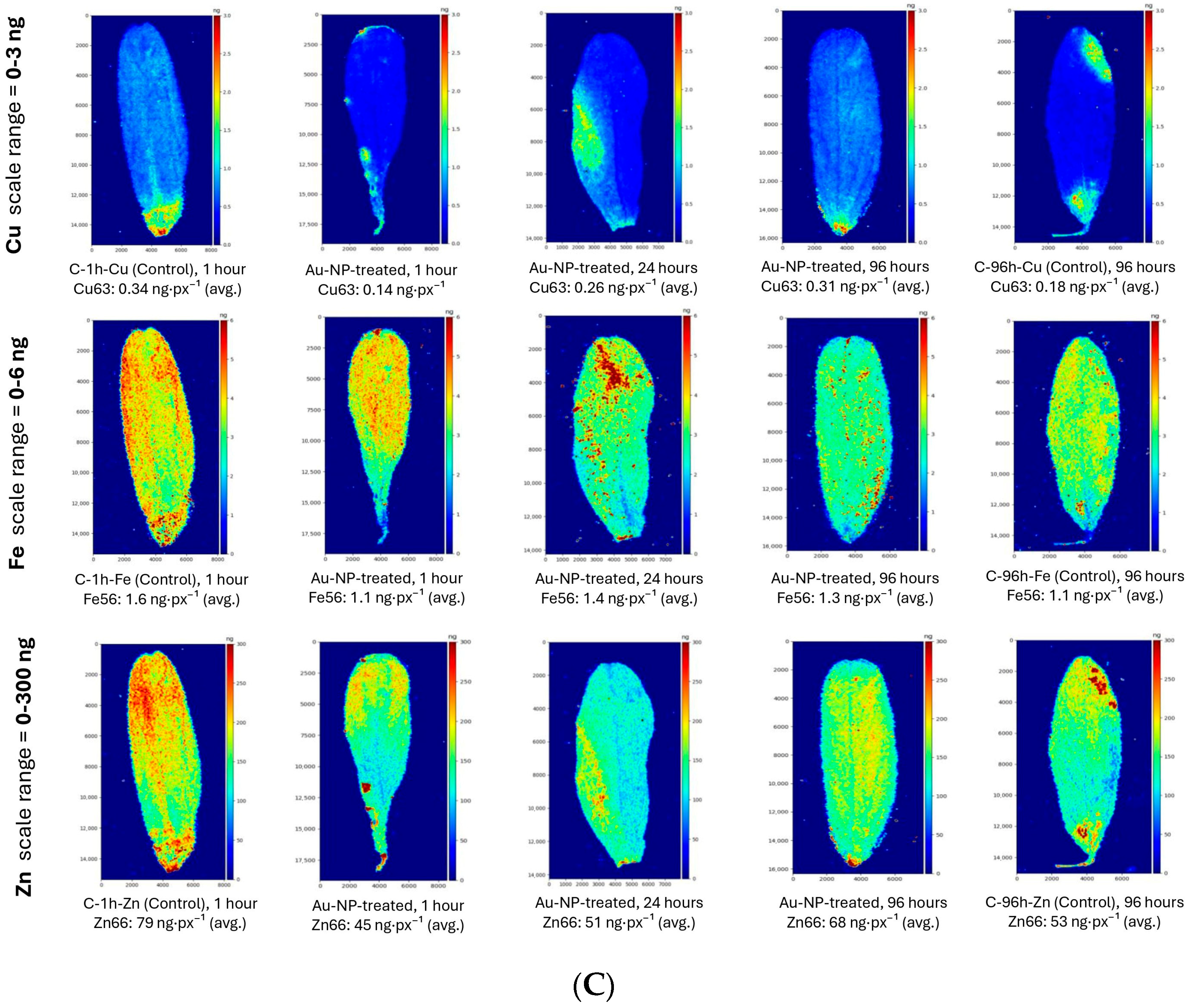
At the applied concentration of 0.5 mg·L−1, Au-NP did not induce detectable changes in the spatial distribution of the essential elements (Ca, Mg, K, P, Cu, Fe, and Zn) in lentil leaves, as evidenced by the 2D elemental distribution maps obtained by LA-ICP-MS (Figure 2A–C). Overall, the spatial patterns of all mapped elements were highly comparable between Au-NP-treated leaves and untreated controls, indicating that Au-NP exposure did not measurably alter the natural nutrient distribution within leaf tissue.
The relatively immobile elements, Ca and Mg, exhibited similar distributions characterized by higher intensities (red/yellow color) occurring along leaf margins and, in some cases, at the leaf tips, in both control and treated leaves. Lower intensities were observed in the central lamina (blue/green). This pattern is characteristic for elements that are primarily transported via xylem (the water-conducting tissue) and accumulate where water evaporates (at the leaf margins), as they are largely immobile once deposited in the leaf.
In contrast, the mobile nutrients K and P showed more uniform distributions compared to Ca and Mg, with enhanced signals along major veins (vascular bundles) and near the petiole, reflecting their high phloem mobility and continuous redistribution to metabolically active tissues. As highly mobile nutrients involved in osmotic regulation (K) and energy transfer (P), both elements can be continuously remobilized and transported to younger growth areas. Consequently, neither K nor P displayed the pronounced marginal accumulation characteristic of the immobile xylem-transported elements Ca and Mg.
The distribution of micronutrients (Cu, Fe, and Zn) is typically heterogeneous (often showing localized hotspots) and is frequently associated with vascular structures, consistent with their low abundance and localized transport and accumulation within physiologically active zones.
In most elemental maps (Ca, K, Mg, Fe, and P), both major and minor veins were clearly resolved as regions of elevated signal intensity, demonstrating that LA-ICP-MS provides sufficient spatial resolution to visualize vascular nutrient delivery pathways across the leaf lamina. The scale ranges associated with each element reflect their natural abundance in leaf tissue. Essential elements (Ca, K, Mg, and P) are fundamental macronutrients and are present at very high natural concentrations (tens to thousands of ng); that is why they require a wide scale range to capture their natural distribution. Trace elements (Cu, Fe, and Zn) are micronutrients that are also essential but are naturally present in much smaller amounts than the macronutrients; hence, they are mapped using narrower ranges. In contrast, Au, a non-native element, was detected only at trace levels (<1 ng), confirming its role as an externally applied nanoparticle tracer rather than a constituent of endogenous nutrient pools.

3.3. Morphological and Physicochemical Characterization of Gold Nanoparticles

3.3.1. STEM Structural and Morphological Analysis of Gold Nanoparticles

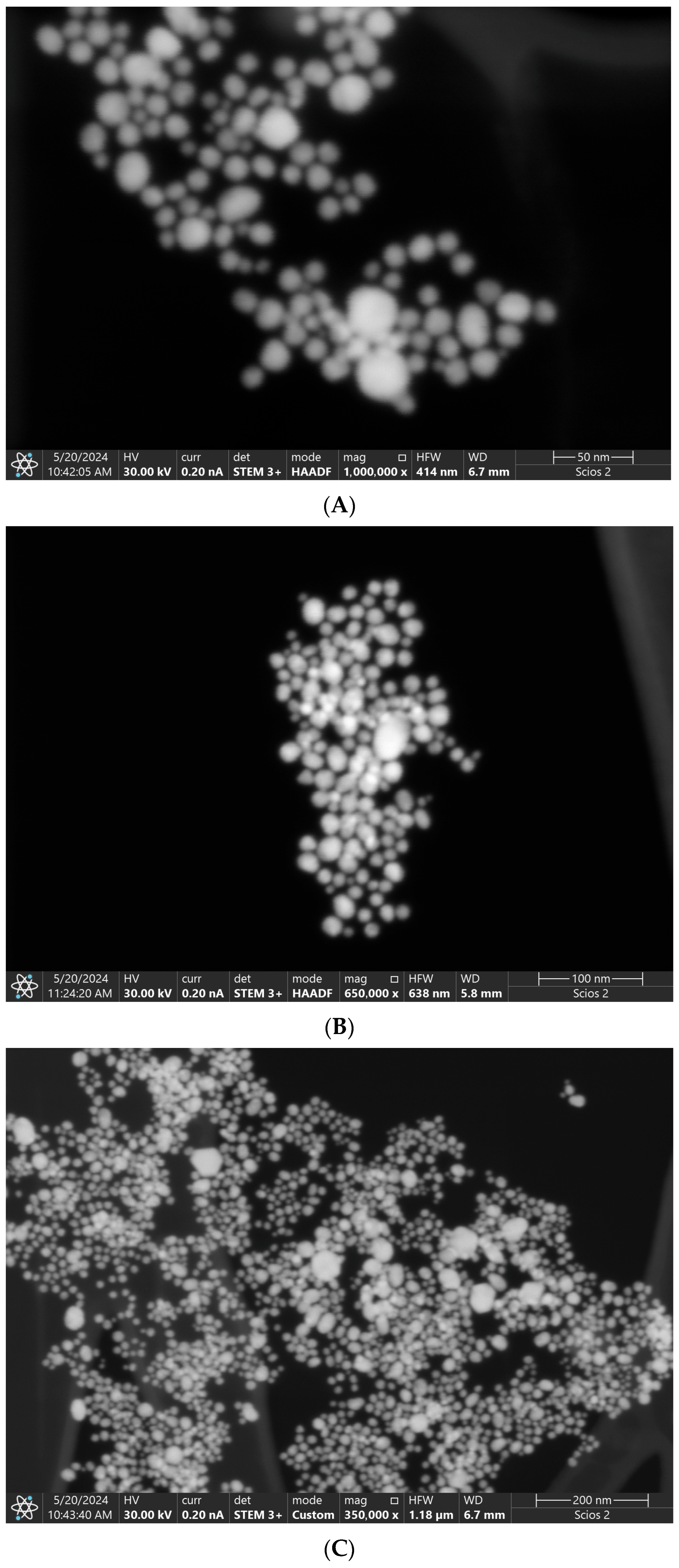
STEM 3+ imaging was carried out using a retractable STEM detector integrated into the SEM platform, in which a focused electron probe was scanned across the sample in scanning transmission mode (accelerating voltage: 30 kV). This STEM mode, especially when using a High-Angle Annular Dark-Field (HAADF) detector (as is typical for STEM 3+ mode on Thermo Scientific instruments), produces a characteristic contrast that is strongly influenced by atomic number (Z) and differs from conventional TEM bright-field imaging. Gold nanoparticles (Au, Z = 79) appear as very bright, white, or glowing spots against a dark background. This high contrast is typical of high-Z-number materials (such as gold), confirming their detection. The background (a grid/support or thin uniform support film typical of TEM grids imaged in STEM mode) appears as a dark, homogeneous area with low contrast, indicating a low-Z-number material. This smooth, featureless appearance is typical for a carbon-based TEM support film.
The intense, bright white contrast of the particles against the dark background confirms their high elemental density, typical of Z-contrast imaging, and indicates high material purity (no obvious contaminants or debris visible). In fact, across all images (Figure 3A–C), particle boundaries remain sharp, with no signs of significant particle deformation, fusion, or sintering (i.e., when adjacent particles fuse together into a single larger mass, losing their individual boundaries). The micrographs show no beam damage, drift, charging artifacts, non-metallic debris, or irregular particles, indicating a clean, high-purity sample and stable imaging conditions.
The nanoparticles display a predominantly spherical to near-spherical morphology across all observed size ranges (Figure 3A–C), typical for chemically synthesized colloidal gold. Particle edges are sharp and well-resolved, indicating crystalline or polycrystalline metallic Au and stable, high-resolution imaging conditions. Individual particles are clearly defined, with visible separation even when closely positioned. Larger aggregates are present as well, but individual particle boundaries remain distinguishable within them due to the strong Z-contrast provided by the HAADF detector.
STEM 3+ imaging consistently showed a polydisperse population of Au-NP ranging from ~5 to 60 nm. This size range is evident across the individual micrographs. At the highest magnification (1,000,000×, 50 nm scale bar; Figure 3A), most nanoparticles fell within a diameter range of approximately 5–20 nm, with distinct small (5–10 nm), medium (~15–25 nm), and occasional larger (>30 nm) particles. At 650,000× magnification and 100 nm scale bar (Figure 3B), the largest particles are approaching ~50 nm, while the smallest were ~5–8 nm. At 350,000× magnification and 200 nm scale bar (Figure 3C), Au-NP range from very small (<10 nm) to larger particles (approx. 40–60 nm in diameter).

3.3.2. Colloidal Stability Assessment of Gold Nanoparticles via ζ-Potential Analysis

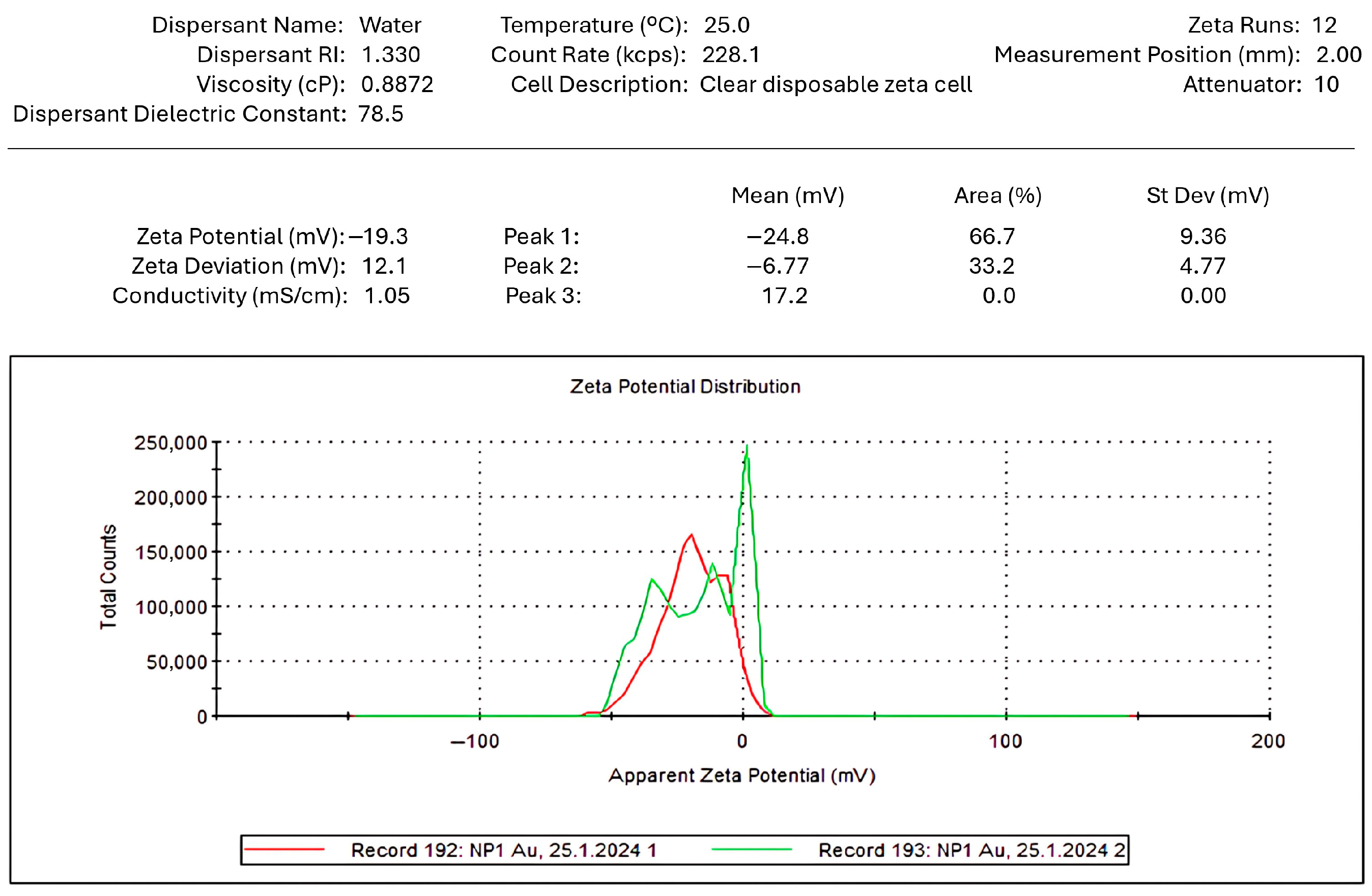
The zeta potential analysis of the Au-NP colloid revealed an overall mean value of −19.3 mV with a zeta deviation of 12.1 mV, indicating moderate colloidal stability (Figure 4). The distribution was bimodal, comprising two negatively charged populations: (i) a major fraction centered at −24.8 mV (66.7%), representing the primary and reasonably stable nanoparticles, and (ii) a secondary fraction centered at −6.8 mV (33.2%), likely reflecting particles with reduced surface charge associated with partial aggregation, which is consistent with the presence of loose aggregates observed in STEM images.
Two consecutive measurements (Record 192, red; Record 193, green) confirmed that the nanoparticles were predominantly negatively charged, although slight differences in the shape and relative contributions of the populations were observed. The first measurement (red) showed a slightly more negative and broader distribution, while the second (green) was shifted toward less negative values with a noisier signal, including a minor artificial positive spike. Such variability is common in electrophoretic light scattering and usually reflects minor differences in sample handling or transient optical noise rather than true changes in nanoparticle charge. A fraction of the smaller nanoparticles appears to form larger aggregates, as also indicated by STEM imaging. This aggregation likely accounts for the bimodal zeta potential distribution, with the aggregated nanoparticles exhibiting a lower negative surface charge (−6.8 mV), while the non-aggregated particles remain largely monodisperse and display higher negative zeta potentials (−24.8 mV), reflecting greater colloidal stability.

4. Discussion

4.1. Distribution of Gold Nanoparticles in Leaves After Submersion into Au-NP Suspension

In this experiment, leaves were sampled at 1 h, 1 day, and 4 days after foliar application of Au-NP to document time-dependent changes in the spatial distribution of Au-associated signals following exposure. The 1 h time point was chosen to represent the initial adsorption and onset of penetration through the leaf surface, before substantial translocation could occur. The 1-day time point was intended to reflect short-term internalization and the beginning of intra-leaf transport, whereas the 4-day time point allowed assessment of short- to medium-term changes in Au distribution without implying specific uptake, internalization, or transformation processes. Given the limited number of analyzed leaves and the exploratory design, the observations presented here should be interpreted as indicative spatial patterns rather than representative of general foliar nanoparticle behavior.
Ballikaya et al. [21], who investigated the uptake and transport of differently charged Au-NP in two tree species, European beech and Scots pine, by comparing leaf-to-root and root-to-leaf exposure pathways, confirmed that foliar exposure enables Au-NP entry through all three key foliar portals (cuticle, stomata, and trichomes) and can be more efficient for leaf-level delivery than root exposure. In terms of leaf dipping, this approach has been widely employed as an experimental exposure method in nanoparticle studies focused on pest control. Examples include evaluations of the insecticidal activity of Ag-NP on tobacco leaves [22] and castor leaves [23], or investigations into the molluscicidal and biochemical effects of ZnO and F-doped ZnO-NP against the glass clover snail M. cartusiana [24]. In line with these findings and commonly adopted experimental approaches, the leaf-dipping method was chosen for the present study because it ensures uniform and controlled exposure of the entire leaf surface to the Au-NP suspension, closely mimicking foliar spray applications used in agricultural practice. Unlike root exposure or injection approaches, dipping enables nanoparticles to interact with natural entry routes such as the cuticle, stomata, and trichomes [21,25] without causing mechanical damage or bypassing physiological barriers. In addition, this approach minimizes variability between replicates by ensuring equivalent contact time and nanoparticle concentration for each leaf, facilitating a direct comparison with other foliar uptake studies.
The applied Au-NP concentration (0.5 mg·L−1) was selected because it represents a low, physiologically relevant exposure level that balances ecological realism with analytical detectability. It was sufficient to elevate Au levels in leaf tissues above background values for robust LA-ICP-MS imaging, while remaining well below concentrations reported to induce phytotoxicity or stress responses that could complicate interpretation of uptake and redistribution patterns. Comparable plant studies have frequently employed higher Au-NP concentrations; for example, foliar and root exposures of parsley and mint commonly ranged from 1 to 100 mg·L−1, with measurable physiological effects already observed at 1 mg·L−1 [14]. Similarly, biogenic Au-NP applied to crop seeds at 1–4 mg·L−1 induced dose-dependent effects on germination and early growth, with adverse responses emerging at 4 mg·L−1 [12]. In contrast, modeled predicted environmental concentrations of gold nanoparticles are substantially lower, on the order of 0.14 μg·L−1 (=0.00014 mg·L−1) in surface waters and approximately 5.99 μg·kg−1 (≈0.006 mg·kg−1) in soils [26].
Consistent with plant nanotoxicology reviews, metallic nanoparticle exposures at the lower end of the mg·L−1 range are commonly regarded as low-dose [27,28,29,30,31,32], while moderate to relatively high doses typically fall in the tens of mg·L−1; nonetheless, some studies classify even ~50–100 mg·L−1 concentrations as “low” depending on the nanomaterial. For instance, whereas Cu, Zn, Mn, and Fe oxide nanoparticles at < 50 mg·L−1 have been categorized as low doses [33], the threshold for Au-NP is more variable; they are typically regarded as ‘low’ in the single-digit mg·L−1 range, though some studies extend this classification up to 100 mg·L−1 [34], depending on the experimental context. Concentrations in the hundreds to thousands of mg·L−1 are generally considered high [35,36,37,38]. Dose categorization ultimately depends on the nanoparticle type, surface chemistry, plant species, and exposure route. Thus, the selected concentration was intended to remain at a very low, physiologically relevant level while enabling sensitive spatial mapping of Au by LA-ICP-MS rather than inducing pronounced toxic effects.
Regarding gold presence in leaf tissues, the LA-ICP-MS maps clearly demonstrate that untreated lentil leaves contained no measurable gold at either sampling time. Both control images (1 h and 4 days) appear uniformly dark blue across the entire leaf surface, indicating that the gold signal is essentially absent or remains below the detection limit; occasional isolated low-intensity pixels that are visible most likely reflect instrumental background rather than any true Au signal. The absence of detectable native Au in control leaves confirms the suitability of Au-NP as tracers for monitoring foliar deposition and subsequent redistribution (e.g., for transport studies).
In contrast, leaves sampled 1 h after dipping showed a distinct, compact high-intensity hotspot located centrally within the scanned leaf area. This localized enrichment corresponds to the point where the Au-NP suspension adhered to the leaf surface immediately after immersion and withdrawal, reflecting the initial deposition pattern. The sharply defined nature of this hotspot suggests localized nanoparticle accumulation rather than diffuse surface contamination, providing a clear starting point for tracking nanoparticle movement. Such deposition behavior is consistent with evaporation-driven droplet drying phenomena on leaf surfaces, often described as a “coffee-ring” effect, in which suspended particles are transported toward a pinned contact line and deposited in a compact spot or ring-like structure as the liquid evaporates [39,40,41].
At later time points, the initially localized signal decreased in intensity and Au-associated signals became distributed across a broader area of the leaf. After 24 h, elevated signal intensities were observed along the leaf margins and near the basal region adjacent to the petiole, while the central lamina exhibited comparatively lower values. By 4 days, this spatial pattern remained evident, with peripheral and petiole-proximal regions representing the dominant areas of Au signal enrichment. In the present exploratory context, these observations are described as time-dependent spatial redistribution patterns rather than evidence of specific transport mechanisms.
The persistence of detectable Au signals over the 4-day period indicates that the gold-associated material remained associated with the leaf tissue throughout the duration of the experiment. However, the present data do not distinguish between surface-bound and internalized nanoparticles, nor do they resolve the relative contributions of physical redistribution, internal movement, or retention processes. Taken together, these observations demonstrate that LA-ICP-MS imaging is capable of capturing spatial and temporal changes in Au-NP-associated signals following foliar exposure, providing a descriptive basis for future, hypothesis-driven studies of nanoparticle behavior on and within plant leaves.

4.2. Comparative LA-ICP-MS Mapping of Macro- and Micronutrients in Lentil Leaves

Comparative LA-ICP-MS mapping revealed time-dependent changes in the average contents of macro- and micronutrients in Au-NP-treated lentil leaves relative to controls. Across all elements examined, the 1 h time point was characterized by a general decrease in average signal intensities, most pronounced for the mobile nutrients K and P, as well as for the micronutrients Cu and Zn. This early response is most plausibly associated with physical and physiological responses to leaf wetting and handling, such as transient leaching from the leaf surface, short-term stomatal closure, or rapid adjustments in leaf water status, rather than to Au-NP-induced toxicity. Short-term changes resulting from wetting or dipping treatments or drought and subsequent rewatering have been reported previously and are commonly interpreted as reversible, non-specific responses to handling or hydration changes rather than nanoparticle-specific effects [42,43].
By 24 h, average elemental intensities for all nutrients had returned to values comparable to those of the controls, suggesting physiological re-equilibration and preservation of nutrient homeostasis.
At 96 h, most elements, including the relatively immobile Ca and Mg as well as the mobile nutrients K and P, exhibited equal or moderately higher average intensities in Au-NP-treated leaves compared to controls. For Ca and Mg, which accumulate in transpiration-driven sinks and are largely immobile once deposited, this delayed increase suggests subtle changes in xylem-driven transport or leaf water flux rather than direct interference with nutrient metabolism. Micronutrients commonly associated with oxidative stress responses (Fe, Zn, and Cu) followed a similar pattern, with no evidence of sustained depletion or abnormal accumulation observed. This outcome contrasts with the findings of Tiwari et al. [44], who reported changes in the normal homeostasis of essential elements such as Fe, Mn, and Zn following exposure to ionic gold, highlighting the distinct physiological responses elicited by nanoparticulate versus ionic metal forms. A similar conclusion was reached by Feichtmeier et al. [15], who reported that adverse effects on plant growth following exposure to citrate-stabilized gold nanoparticles were not derived from nutrient deficiency, further supporting that AuNP-induced responses are not necessarily linked to disrupted elemental homeostasis.
In the elemental maps of Ca, Cu, K, Mg, P, and partly Zn, localized signal features corresponding to the regions where leaves were held with tweezers are visible, indicating minor handling-related artifacts. Such effects are consistent with previous reports emphasizing that sample handling and preparation represent the most critical steps in mass spectrometry imaging (MSI), as only appropriate preparation can preserve the original distribution and abundance of analytes while ensuring sufficient spatial resolution and signal quality [45]. These challenges are particularly pronounced for plant tissues, for which MSI sample preparation is generally more demanding than for mammalian systems [45] due to structural heterogeneity and high water content. Although both of the following studies were conducted on non-plant systems, Hare et al. [46] demonstrated pronounced leaching of K and Mg and partial losses of Fe, Cu, and Zn during tissue processing, while Bonta et al. [47] reported that fixation and embedding procedures strongly affect certain elements, particularly Na and K, whereas others (e.g., Mn and Ni) are less influenced. Together, these findings underscore that sampling and preparation steps can alter elemental distributions across biological matrices, supporting our interpretation that the observed features reflect minor handling-related artifacts rather than biologically induced changes. While these localized mechanically induced features do not affect the observed temporal trends in average elemental content in the present study, future analyses could further improve data comparability by using plastic tweezers, adopting a more consistent gripping strategy, or minimizing direct leaf handling through the use of leaf holders.
Overall, the absence of persistent negative deviations and the tendency toward normalization or slight enrichment over time suggest that foliar exposure to Au-NP at the applied concentration did not impair nutrient uptake, redistribution, or elemental homeostasis in lentil leaves. This observation is consistent with previous studies reporting no or low adverse effects of Au-NP at exposure levels below reported phytotoxic thresholds [32,48,49]. In contrast, phytotoxic responses have been reported at substantially higher concentrations, as evidenced by the significant reduction in chlorophyll a content observed in wheat following foliar application of Au-NP at 20 and 30 mg·L−1 [50].

4.3. Morphology and Surface Properties of Gold Nanoparticles

4.3.1. Interpretation of STEM Images

The pronounced polydispersity observed across all STEM images suggests that the nanoparticle batch contains a continuous size distribution rather than a monodisperse population. The particles are predominantly observed as individual entities or loose aggregates on the TEM grids, with the latter most likely arising from partial aggregation during sample drying rather than reflecting the dispersion state in the bulk suspension. Based on the used scale bars (50, 100, and 200 nm) and visual estimation, the nanoparticles fall within the expected size range (~5 nm to 50+ nm) typically reported for colloidal Au-NP employed in plant uptake experiments [9,51,52]. The clear Z-contrast and high-resolution imaging further verify the stability of the nanoparticles before their application to lentil leaves.
The presence of numerous small secondary particles surrounding larger primary particles may indicate (i) simultaneous nucleation and growth during synthesis, (ii) incomplete post-synthetic separation, or (iii) aggregation occurring during drying of the colloid on the TEM grid, which is the most plausible explanation in this case, given that the nanoparticles were commercially sourced rather than synthesized in-house. Such drying-induced clustering is common, as capillary forces pull particles together as the liquid evaporates during grid preparation, and does not necessarily reflect aggregation behavior in suspension; it is frequently observed in nanoparticle imaging [53].
The absence of sintering, deformation, or fused boundaries indicates that the particles maintained their structural integrity during both synthesis and imaging. Overall, the STEM results demonstrate that the sample consists of well-crystallized, high-purity metallic Au-NP spanning a broad size continuum, with the observed clustering patterns attributable primarily to grid-drying effects rather than intrinsic instability of the colloid.

4.3.2. Interpretation of ζ-Potential Results in the Context of Gold Nanoparticle Stability

The zeta potential analysis of the Au-NP suspension revealed two genuine negatively charged nanoparticle populations, centered at −24.8 mV and −6.77 mV, together accounting for 100% of the distribution. This indicates a moderately stable but heterogeneous suspension, consistent with particles exhibiting different degrees of surface charge or partial aggregation. A third peak at +17.2 mV was detected in one of the measurement replicates; however, its reported area was 0.0%, confirming that it does not correspond to a real nanoparticle fraction. The apparent height of this peak reflects momentary photon-count fluctuations rather than particle abundance, a known feature of Malvern Zetasizer output, and is most plausibly attributed to instrumental noise or transient scattering events.
A comparison of the two replicates (red and green traces) shows that both measurements yielded predominantly negative zeta potentials, but with slight differences in the shape and position of the main peaks. The first measurement (red) displayed a slightly more negative and somewhat broader distribution, whereas the second (green) exhibited a shift toward less negative values and a noisier signal, including the artificial positive spike. Such run-to-run variability is common in electrophoretic light scattering and can arise from minor differences in sample handling, cell filling, or transient optical noise rather than true changes in nanoparticle charge. Importantly, both replicates consistently showed negatively charged Au-NP with mean values near −19 mV, supporting the overall conclusion that the suspension remained moderately stable and suitable for use in subsequent foliar application experiments.

5. Conclusions

STEM 3+ analysis confirmed that the commercially sourced Au-NP were predominantly present as individual particles or loose agglomerates with clean, well-defined edges, indicating good crystallinity and suitability for high-resolution imaging. The selected Au-NP concentration (0.5 mg·L−1) lies at the lower end of concentrations typically used in plant nanoparticle studies, while remaining several orders of magnitude above predicted environmental levels. This choice provided a realistic yet analytically tractable exposure scenario, enabling robust LA-ICP-MS detection without inducing phytotoxic effects.
LA-ICP-MS mapping demonstrated the absence of detectable gold in untreated lentil leaves at all sampling times, confirming negligible native Au background and validating Au-NP as effective tracers. In treated leaves, Au initially formed a localized deposition hotspot that progressively redistributed toward leaf margins and the petiole region over time. The persistence of Au signals over 4 days indicates that deposited nanoparticles remain associated with leaf tissue and are not rapidly lost under the applied conditions. While the present study does not resolve specific uptake pathways or internalization mechanisms, the observed evolution from a localized hotspot to peripheral and basal enrichment demonstrates that LA-ICP-MS is capable of capturing time-dependent changes in nanoparticle-associated elemental signals at the whole-leaf or whole-leaflet scale.
Across all measured essential and trace elements, foliar exposure to Au-NP resulted in no persistent deviations detected. Although transient decreases in elemental signals were observed at 1 h, likely attributable to the dipping procedure and short-term physiological adjustment, all elements returned to control levels by 24 h. By 96 h, the average concentrations of Ca, Mg, K, P, Fe, Zn, and Cu were comparable to or slightly higher than those of the controls, suggesting physiological re-equilibration rather than stress-induced impairment.
Overall, this study demonstrates the feasibility of using LA-ICP-MS imaging as an exploratory tool for visualizing the deposition and temporal redistribution of low-dose foliar-applied nanoparticles in intact leaves. Rather than establishing mechanistic transport models, the present work provides a methodological baseline and spatial reference framework for future studies. Future investigations building on this exploratory framework could adopt more controlled foliar application strategies to enable hypothesis-driven analysis of nanoparticle uptake and transport processes. Such approaches may include calibrated spraying or microdroplet deposition to better constrain applied liquid volumes, gravimetric determination of the retained solution to estimate the nanoparticle dose per unit leaf area, and systematic comparisons of adaxial and abaxial leaf surfaces to assess the influence of surface-specific anatomical features such as stomata, trichomes, and cuticular properties. Coupling these controlled application methods with increased biological replication and complementary depth-resolved or physiological measurements would allow quantitative assessment of nanoparticle internalization, transport pathways, and dose–response relationships. In this context, the present study provides a transparent methodological reference that can inform the design of future, fully replicated experiments aimed at resolving the mechanisms governing foliar nanoparticle behavior in plants.

Author Contributions

Conceptualization, L.N.; methodology, M.Š., S.A., M.B., T.V., J.K. and M.M.; validation, M.Š., L.N. and J.K.; formal analysis, M.Š., S.A., M.B., T.V., J.K. and M.M.; investigation, M.Š., L.N., S.A., M.B., T.V., J.K., M.M. and I.H.; resources, M.Š., S.A., M.B., T.V., J.K. and M.M.; data curation, L.N. and M.Š.; writing—original draft preparation, L.N.; writing—review and editing, L.N.; visualization, L.N.; supervision, M.Š.; project administration, L.N. and M.Š.; funding acquisition, M.Š. and I.H. All authors have read and agreed to the published version of the manuscript.

Funding

This work was supported by the Scientific Grant Agency of the Ministry of Education, Research, Development and Youth of the Slovak Republic and the Slovak Academy of Sciences under contract No. VEGA 1/0331/23 (10%) and contract No. VEGA 1/0135/22 (5%). This work was funded by the EU NextGenerationEU through the Recovery and Resilience Plan for Slovakia under the project No. 09I03-03-V04-00120: ‘Quantifying Inorganic Nanoparticle Mass Transfer in Leaves using Laser Ablation ICP-MS’ (85%).

Institutional Review Board Statement

Not applicable.

Informed Consent Statement

Not applicable.

Data Availability Statement

The original contributions presented in this study are included in the article. Further inquiries can be directed to the corresponding author.

Conflicts of Interest

The authors declare no conflicts of interest.

References

  1. Arora, S.; Sharma, P.; Kumar, S.; Nayan, R.; Khanna, P.K.; Zaidi, M.G.H. Gold-nanoparticle induced enhancement in growth and seed yield of Brassica juncea. Plant Growth Regul. 2012, 66, 303–310. [Google Scholar] [CrossRef]
  2. Cunningham, F.J.; Goh, N.S.; Demirer, G.S.; Matos, J.L.; Landry, M.P. Nanoparticle-mediated delivery towards advancing plant genetic engineering. Trends Biotechnol. 2018, 36, 882–897. [Google Scholar] [CrossRef] [PubMed]
  3. Zhang, H.; Goh, N.S.; Wang, J.W.; Pinals, R.L.; González-Grandío, E.; Demirer, G.S.; Butrus, S.; Fakra, S.C.; del Rio Flores, A.; Zhai, R.; et al. Nanoparticle cellular internalization is not required for RNA delivery to mature plant leaves. Nat. Nanotechnol. 2022, 17, 197–205. [Google Scholar] [CrossRef]
  4. Liu, S.; Zheng, Y.; Pan, L.; Wang, W.; Li, Y.; Liu, Z.; Zhang, X. Nanodelivery of nucleic acids for plant genetic engineering. Discov. Nano 2025, 20, 31. [Google Scholar] [CrossRef]
  5. Yang, Y.; Fan, S.; Chen, Q.; Lu, Y.; Zhu, Y.; Chen, X.; Xia, L.; Huang, Q.; Zheng, J.; Liu, X. Acute exposure to gold nanoparticles aggravates lipopolysaccharide-induced liver injury by amplifying apoptosis via ROS-mediated macrophage-hepatocyte crosstalk. J. Nanobiotechnol. 2022, 20, 37. [Google Scholar] [CrossRef]
  6. Akkam, N.; Aljabali, A.A.A.; Akkam, Y.; Alrob, O.; Al Trad, B.; Alzoubi, H.; Tambuwala, M.M.; Al-Batayneh, K.M. Investigating the fate and toxicity of green synthesized gold nanoparticles in albino mice. Drug Dev. Ind. Pharm. 2023, 49, 508–520. [Google Scholar] [CrossRef] [PubMed]
  7. Chueh, P.J.; Liang, R.Y.; Lee, Y.H.; Zeng, Z.M.; Chuang, S.M. Differential cytotoxic effects of gold nanoparticles in different mammalian cell lines. J. Hazard. Mater. 2014, 264, 303–312. [Google Scholar] [CrossRef] [PubMed]
  8. Nandhini, J.T.; Ezhilarasan, D.; Rajeshkumar, S. An ecofriendly synthesized gold nanoparticles induces cytotoxicity via apoptosis in HepG2 cells. Environ. Toxicol. 2021, 36, 24–32. [Google Scholar] [CrossRef]
  9. Avellan, A.; Yun, J.; Zhang, Y.; Spielman-Sun, E.; Unrine, J.M.; Thieme, J.; Li, J.; Lombi, E.; Bland, G.; Lowry, G.V. Nanoparticle size and coating chemistry control foliar uptake pathways, translocation, and leaf-to-rhizosphere transport in wheat. ACS Nano 2019, 13, 5291–5305. [Google Scholar] [CrossRef]
  10. Malejko, J.; Godlewska-Żyłkiewicz, B.; Vaněk, T.; Landa, P.; Nath, J.; Dror, I.; Berkowitz, B. Uptake, translocation, weathering and speciation of gold nanoparticles in potato, radish, carrot and lettuce crops. J. Hazard. Mater. 2021, 418, 126219. [Google Scholar] [CrossRef]
  11. Peshkova, A.; Zinicovscaia, I.; Cepoi, L.; Rudi, L.; Chiriac, T.; Yushin, N.; Anh, T.T.; Manh Dung, H.; Corcimaru, S. Effects of gold nanoparticles on Mentha spicata L., soil microbiota, and human health risks: Impact of exposure routes. Nanomaterials 2024, 14, 955. [Google Scholar] [CrossRef]
  12. Botteon, C.E.A.; Pereira, A.D.E.S.; de Castro, L.P.; Justino, I.A.; Fraceto, L.F.; Bastos, J.K.; Marcato, P.D. Toxicity assessment of biogenic gold nanoparticles on crop seeds and zebrafish embryos: Implications for agricultural and aquatic ecosystems. ACS Omega 2025, 10, 1032–1046. [Google Scholar] [CrossRef]
  13. Ha, N.; Seo, E.; Kim, S.; Lee, S.J. Adsorption of nanoparticles suspended in a drop on a leaf surface of Perilla frutescens and their infiltration through stomatal pathway. Sci. Rep. 2021, 11, 11556. [Google Scholar] [CrossRef]
  14. Peshkova, A.; Zinicovscaia, I.; Rudi, L.; Chiriac, T.; Yushin, N.; Cepoi, L. Effects of foliar application of copper and gold nanoparticles on Petroselinum crispum (Mill.). Nanomaterials 2025, 15, 280. [Google Scholar] [CrossRef]
  15. Feichtmeier, N.S.; Walther, P.; Leopold, K. Uptake, effects, and regeneration of barley plants exposed to gold nanoparticles. Environ. Sci. Pollut. Res. 2015, 22, 8549–8558. [Google Scholar] [CrossRef]
  16. Wang, X.; Yang, X.; Chen, S.; Li, Q.; Wang, W.; Hou, C.; Gao, X.; Wang, L.; Wang, S. Zinc oxide nanoparticles affect biomass accumulation and photosynthesis in Arabidopsis. Front. Plant Sci. 2016, 6, 1243. [Google Scholar] [CrossRef] [PubMed]
  17. Becker, P.; Nauser, T.; Wiggenhauser, M.; Aeschlimann, B.; Frossard, E.; Günther, D. In vitro fossilization for high spatial resolution quantification of elements in plant-tissue using LA-ICP-TOFMS. Anal. Chem. 2024, 96, 4952–4959. [Google Scholar] [CrossRef]
  18. Wu, B.; Zoriy, M.; Chen, Y.; Becker, J.S. Imaging of nutrient elements in the leaves of Elsholtzia splendens by laser ablation inductively coupled plasma mass spectrometry (LA-ICP-MS). Talanta 2009, 78, 132–137. [Google Scholar] [CrossRef] [PubMed]
  19. Kötschau, A.; Büchel, G.; Einax, J.W.; Fischer, C.; von Tümpling, W.; Merten, D. Mapping of macro and micro elements in the leaves of sunflower (Helianthus annuus) by Laser Ablation-ICP-MS. Microchem. J. 2013, 110, 783–789. [Google Scholar] [CrossRef]
  20. Šebesta, M.; Nemček, L.; Urík, M.; Kolenčík, M.; Bujdoš, M.; Vávra, I.; Dobročka, E.; Matúš, P. Partitioning and stability of ionic, nano- and microsized zinc in natural soil suspensions. Sci. Total Environ. 2020, 700, 134445. [Google Scholar] [CrossRef]
  21. Ballikaya, P.; Brunner, I.; Cocozza, C.; Grolimund, D.; Kaegi, R.; Murazzi, M.E.; Schaub, M.; Schönbeck, L.C.; Sinnet, B.; Cherubini, P. First evidence of nanoparticle uptake through leaves and roots in beech (Fagus sylvatica L.) and pine (Pinus sylvestris L.). Tree Physiol. 2023, 43, 262–276. [Google Scholar] [CrossRef]
  22. Khan, A.; Sikandar, S.; Tasleem, S.; Abdullah, S.; Khan, A.U.; Arsad, N.U.A.; Bhatti, Z. Evaluation of insecticidal potential of silver nanoparticles synthesized by using river red gum (Eucalyptus camaldulensis) leaf extract. Insights J. Health Rehabil. 2025, 3, 112–117. [Google Scholar] [CrossRef]
  23. Soni, N.; Dhiman, R.C. Green silver nanoparticles against Helicoverpa armigera and its effects on biochemical, morphological and histological aspects. J. Entomol. Zool. Stud. 2022, 10, 284–292. [Google Scholar] [CrossRef]
  24. Helmy, E.T.; Ali, M.A.; Ayyad, M.A.; Mohamedbakr, H.G.; Varma, R.S.; Pan, J.H. Molluscicidal and biochemical effects of green-synthesized F-doped ZnO nanoparticles against land snail Monacha cartusiana under laboratory and field conditions. Environ. Pollut. 2022, 308, 119691. [Google Scholar] [CrossRef]
  25. Avellan, A.; Yun, J.; Morais, B.P.; Clement, E.T.; Rodrigues, S.M.; Lowry, G.V. Critical review: Role of inorganic nanoparticle properties on their foliar uptake and in planta translocation. Environ. Sci. Technol. 2021, 55, 13417–13431. [Google Scholar] [CrossRef] [PubMed]
  26. Tiede, K.; Hassellöv, M.; Breitbarth, E.; Chaudhry, Q.; Boxall, A.B.A. Considerations for environmental fate and ecotoxicity testing to support environmental risk assessments for engineered nanoparticles. J. Chromatogr. A 2009, 1216, 503–509. [Google Scholar] [CrossRef]
  27. Qian, H.; Peng, X.; Han, X.; Ren, J.; Sun, L.; Fu, Z. Comparison of the toxicity of silver nanoparticles and silver ions on the growth of terrestrial plant model Arabidopsis thaliana. J. Environ. Sci. 2013, 25, 1947–1956. [Google Scholar] [CrossRef]
  28. Kumar, V.; Guleria, P.; Kumar, V.; Yadav, S.K. Gold nanoparticle exposure induces growth and yield enhancement in Arabidopsis thaliana. Sci. Total Environ. 2013, 461–462, 462–468. [Google Scholar] [CrossRef]
  29. Gunjan, B.; Zaidi, M.G.H.; Sandeep, A. Impact of gold nanoparticles on physiological and biochemical characteristics of Brassica juncea. J. Plant Biochem. Physiol. 2014, 2, 3. [Google Scholar] [CrossRef]
  30. Raskar, S.V.; Laware, S.L. Effect of zinc oxide nanoparticles on cytology and seed germination in onion. Int. J. Curr. Microbiol. Appl. Sci. 2014, 3, 467–473. [Google Scholar]
  31. Karimi, N.; Behbahani, M.; Dini, G.; Razmjou, A. Enhancing the secondary metabolite and anticancer activity of Echinacea purpurea callus extracts by treatment with biosynthesized ZnO nanoparticles. Adv. Nat. Sci. Nanosci. Nanotechnol. 2018, 9, 045009. [Google Scholar] [CrossRef]
  32. Venzhik, Y.; Deryabin, A.; Zhukova, K. Au-based nanoparticles enhance low temperature tolerance in wheat by regulating some physiological parameters and gene expression. Plants 2024, 13, 1261. [Google Scholar] [CrossRef]
  33. Liu, R.; Zhang, H.; Lal, R. Effects of stabilized nanoparticles of copper, zinc, manganese, and iron oxides in low concentrations on lettuce (Lactuca sativa) seed germination: Nanotoxicants or nanonutrients? Water Air Soil Pollut. 2016, 227, 42. [Google Scholar] [CrossRef]
  34. Venzhik, Y.; Deryabin, A.; Popov, V.; Dykman, L.; Moshkov, I. Gold nanoparticles as adaptogens increazing the freezing tolerance of wheat seedlings. Environ. Sci. Pollut. Res. 2022, 29, 55235–55249. [Google Scholar] [CrossRef] [PubMed]
  35. Yang, L.; Watts, D.J. Particle surface characteristics may play an important role in phytotoxicity of alumina nanoparticles. Toxicol. Lett. 2005, 158, 122–132. [Google Scholar] [CrossRef] [PubMed]
  36. Lin, D.; Xing, B. Root uptake and phytotoxicity of ZnO nanoparticles. Environ. Sci. Technol. 2008, 42, 5580–5585. [Google Scholar] [CrossRef]
  37. Rico, C.M.; Majumdar, S.; Duarte-Gardea, M.; Peralta-Videa, J.R.; Gardea-Torresdey, J.L. Interaction of nanoparticles with edible plants and their possible implications in the food chain. J. Agric. Food Chem. 2011, 59, 3485–3498. [Google Scholar] [CrossRef]
  38. El-Temsah, Y.S.; Joner, E.J. Impact of Fe and Ag nanoparticles on seed germination and differences in bioavailability during exposure in aqueous suspension and soil. Environ. Toxicol. 2012, 27, 42–49. [Google Scholar] [CrossRef] [PubMed]
  39. Yang, M.; Chen, D.; Hu, J.; Zheng, X.; Lin, Z.J.; Zhu, H. The application of coffee-ring effect in analytical chemistry. TrAC Trends Anal. Chem. 2022, 157, 116752. [Google Scholar] [CrossRef]
  40. Zargartalebi, H.; Hejazi, S.H.; Sanati-Nezhad, A. Self-assembly of highly ordered micro- and nanoparticle deposits. Nat. Commun. 2022, 13, 3085. [Google Scholar] [CrossRef]
  41. Hariharan, S.; Fariduddin, M.; Vaidya, S.S.; Thampi, S.P.; Basavaraj, M.G. Tuning evaporation driven deposition in sessile drops via electrostatic hetero-aggregation. Soft Matter 2025, 21, 5242–5254. [Google Scholar] [CrossRef] [PubMed]
  42. Xu, Z.; Zhou, G.; Shimizu, H. Plant responses to drought and rewatering. Plant Signal. Behav. 2010, 5, 649–654. [Google Scholar] [CrossRef]
  43. Yokoyama, G.; Yasutake, D.; Minami, K.; Kimura, K.; Marui, A.; Wu, Y.; Feng, J.; Wang, W.; Mori, M.; Kitano, M. Evaluation of the physiological significance of leaf wetting by dew as a supplemental water resource in semi-arid crop production. Agric. Water Manag. 2021, 255, 106964. [Google Scholar] [CrossRef]
  44. Tiwari, M.; Krishnamurthy, S.; Shukla, D.; Kiiskila, J.; Jain, A.; Datta, R.; Sharma, N.; Sahi, S.V. Comparative transcriptome and proteome analysis to reveal the biosynthesis of gold nanoparticles in Arabidopsis. Sci. Rep. 2016, 6, 21733. [Google Scholar] [CrossRef]
  45. Dong, Y.; Li, B.; Malitsky, S.; Rogachev, I.; Aharoni, A.; Kaftan, F.; Svatoš, A.; Franceschi, P. Sample preparation for mass spectrometry imaging of plant tissues: A review. Front. Plant Sci. 2016, 7, 60. [Google Scholar] [CrossRef]
  46. Hare, D.J.; Billings, J.L.; Bray, L.; Volitakis, I.; Vais, A.; Ryan, T.M.; Cherny, R.A.; Bush, A.I.; Masters, C.L.; Adlard, P.A.; et al. The effect of paraformaldehyde fixation and sucrose cryoprotection on metal concentration in murine neurological tissue. J. Anal. At. Spectrom. 2014, 29, 565–570. [Google Scholar] [CrossRef]
  47. Bonta, M.; Török, S.; Hegedűs, B.; Döme, B.; Limbeck, A. A comparison of sample preparation strategies for biological tissues and subsequent trace element analysis using LA-ICP-MS. Anal. Bioanal. Chem. 2017, 409, 1805–1814. [Google Scholar] [CrossRef] [PubMed]
  48. Barrena, R.; Casals, E.; Colón, J.; Font, X.; Sánchez, A.; Puntes, V. Evaluation of the ecotoxicity of model nanoparticles. Chemosphere 2009, 75, 850–857. [Google Scholar] [CrossRef]
  49. Ferrari, E.; Barbero, F.; Busquets-Fité, M.; Franz-Wachtel, M.; Köhler, H.R.; Puntes, V.; Kemmerling, B. Growth-promoting gold nanoparticles decrease stress responses in arabidopsis seedlings. Nanomaterials 2021, 11, 3161. [Google Scholar] [CrossRef]
  50. Manaf, A.; Wang, X.; Tariq, F.; Jhanzab, H.M.; Bibi, Y.; Sher, A.; Razzaq, A.; Fiaz, S.; Tanveer, S.K.; Qayyum, A. Antioxidant enzyme activities correlated with growth parameters of wheat sprayed with silver and gold nanoparticle suspensions. Agronomy 2021, 11, 1494. [Google Scholar] [CrossRef]
  51. Judy, J.D.; Unrine, J.M.; Rao, W.; Wirick, S.; Bertsch, P.M. Bioavailability of gold nanomaterials to plants: Importance of particle size and surface coating. Environ. Sci. Technol. 2012, 46, 8467–8474. [Google Scholar] [CrossRef] [PubMed]
  52. Luo, X.; Cao, J. Discovery of nano-sized gold particles in natural plant tissues. Environ. Chem. Lett. 2018, 16, 1441–1448. [Google Scholar] [CrossRef]
  53. Michen, B.; Geers, C.; Vanhecke, D.; Endes, C.; Rothen-Rutishauser, B.; Balog, S.; Fink, A. Avoiding drying-artifacts in transmission electron microscopy: Characterizing the size and colloidal state of nanoparticles. Sci. Rep. 2015, 5, 9793. [Google Scholar] [CrossRef] [PubMed]
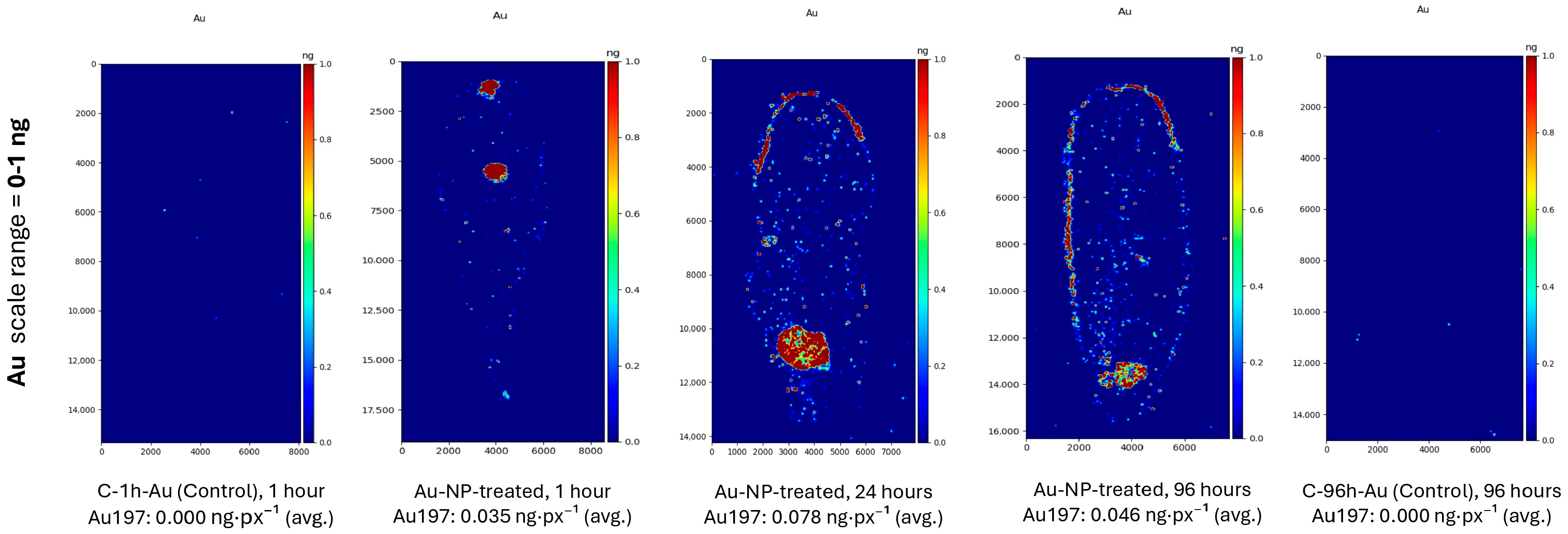
Figure 1. Two-dimensional maps showing the distribution of gold in lentil leaves treated with gold nanoparticles and in untreated control leaves. The notation “Au 0–1 ng” represents the concentration scale that defines the color range in each elemental distribution map, where blue corresponds to 0 ng and red corresponds to the upper limit of 1 ng. Dark blue areas indicate concentrations at or near zero (or below the detection limit), whereas red/yellow regions correspond to values near the upper scale limit. In these measurements, the Au197 signal ranges from 0.000 to 0.078 ng·px−1 (average).
Applsci 16 00974 g001
Figure 2. Two-dimensional LA-ICP-MS maps showing the spatial distribution of (A) immobile elements calcium (Ca) and magnesium (Mg), (B) mobile elements potassium (K) and phosphorus (P), and (C) micronutrients copper (Cu), iron (Fe), and zinc (Zn) on the surface of lentil leaves treated with gold nanoparticles and on untreated control leaves. In each map, the color gradient reflects the concentration scale: blue represents the lowest values (0 ng or below the detection limit), while red and yellow indicate concentrations approaching the upper limit specific to each element. The concentration ranges were: (A) 0–500 ng for Ca and 0–250 ng for Mg; (B) 0–2000 ng for K and 0–300 ng for P; and (C) 0–3 ng for Cu, 0–6 ng for Fe, and 0–300 ng for Zn.
Applsci 16 00974 g002aApplsci 16 00974 g002b
Figure 3. Scanning Transmission Electron Microscopy (STEM 3+) micrographs showing the morphology and size distribution of gold nanoparticles. Images were acquired in High-Angle Annular Dark-Field (HAADF) mode at magnifications of (A) 1,000,000×, (B) 650,000×, and (C) 350,000×. In HAADF imaging, high-atomic-number materials such as gold scatter electrons more efficiently, making Au-NP distinctly bright against the dark background. (A) Ultra-high-resolution scan (HAADF, HFW: 414 nm, scale bar: 50 nm) shows a dense population of brightly contrasting gold nanoparticles with well-defined edges that enable unambiguous identification of individual particles. (B) High-resolution scan (HAADF, HFW: 638 nm, scale bar: 100 nm) reveals a smaller cluster of gold nanoparticles with clearly visible size variations. Z-contrast enhances the brightness of larger and heavier particles, while smaller ones appear dimmer, allowing reliable assessment of particle size differences; the image confirms a polydisperse size distribution with the largest particles approaching ~50 nm and the smallest likely ~5–8 nm. (C) High-resolution scan (custom mode, HFW: 1.18 µm, scale bar: 200 nm) shows a dense, polydisperse population of gold nanoparticles ranging from <10 nm to approximately 40–60 nm in diameter. Numerous small particles are clustered around larger ones, forming compact agglomerates rather than a uniform layer. Particle boundaries remain clearly defined, with no evidence of sintering. The distribution highlights pronounced size polydispersity, with a continuous range of particle sizes rather than a monodisperse population.
Applsci 16 00974 g003
Figure 4. Distribution of zeta potential values for gold nanoparticles suspended in water.
Applsci 16 00974 g004
Disclaimer/Publisher’s Note: The statements, opinions and data contained in all publications are solely those of the individual author(s) and contributor(s) and not of MDPI and/or the editor(s). MDPI and/or the editor(s) disclaim responsibility for any injury to people or property resulting from any ideas, methods, instructions or products referred to in the content.