1. Introduction
Preserving the vitality of a tooth with deep caries has multiple benefits as it preserves natural defense mechanisms of the tooth and enables continued dentinogenesis in immature teeth, thus contributing to better long-term prognosis [
1,
2]. The positions of professional associations regarding the treatment of deep caries and the preservation of pulp vitality are not unanimous. The American association of endodontists emphasizes the importance of complete removal of demineralized infected dentin to improve the chances of pulpal repair, rather than avoiding pulp exposure [
3]. On the other hand, the European Society of Endodontology (ESE) advocates selective caries removal and considers the complete removal of caries overtreatment with the risk of pulpal exposure [
4,
5,
6,
7]. Therefore, stepwise technique and one-stage selective caries removal have been recommended in teeth with deep carious lesions showing no symptoms of reversible pulpitis [
6,
7]. It was reported that selective caries removal in a single visit resulted in a significantly higher pulp survival rate (80%) than the stepwise technique (56%) over a 5-year period [
7].
Selective caries removal implies leaving caries on the pulpal surface of the cavity: soft caries is left in the stepwise approach, and firm caries in the single-stage approach. The periphery of the cavity must be cleaned to hard dentin to ensure good bonding and sealing of the restoration in both selective caries removal techniques [
4]. Hydraulic calcium silicate biomaterial (or alternatively glass ionomer cement) should be placed on soft or firm dentin, followed by immediate placement of a permanent restoration in the one-stage approach [
2,
4]. The success of selective caries removal very much depends on the adequate management of bacterial contamination during the procedure, and for this reason, the ESE recommends the procedure be performed using isolation with a dental dam and cavity disinfection with sodium hypochlorite (NaOCl) [
2,
4]. Additionally, the coronal seal is a critical factor for the success of one-stage selective caries removal because it ensures a good seal, caries arrest, stimulation of pulpal defense mechanisms, and preservation of the pulp’s vitality [
2,
4,
5,
7]. Besides disinfecting with NaOCl, the elimination of cariogenic bacteria can be achieved using antimicrobial agents for lining the remaining carious dentin, such as silver diamine fluoride (SDF) [
8]. Furthermore, efficient sealing with restorative materials isolates residual microorganisms and promotes their elimination through nutrient deprivation, ultimately leading to caries arrest [
7,
8].
Siver diamine fluoride (SDF) has been used as a desensitizing agent and for arresting and preventing caries since the 1960s [
9]. SDF is an alkaline, transparent, odorless solution containing high concentrations of silver and fluoride ions [
8,
9]. The side effect of SDF is staining that is reduced by the application of KI [
10,
11]. Riva Star contains a silver capsule with 38% SDF (44,800 ppm of fluorides) and a green capsule with a saturated potassium iodide (KI) solution. The clinical effects of the SDF/KI application on dentin include (I) desensitizing (Ag
+ ions form precipitates with proteins and AgI salts that occlude dentinal tubules); (II) preserving dentinal collagen through inhibition of matrix metalloproteinases; (III) antibacterial action (silver ions break through the bacterial wall and disrupt bacterial respiration and replication); and (IV) remineralization (fluoride ions are incorporated into partially demineralized hydroxyapatite crystals). Because of its antimicrobial effect and remineralizing properties, SDF has been recommended as a caries arrest agent after selective caries removal [
9]. Furthermore, lining sound (hard) dentin with SDF prior to restoration may help prevent the development of recurrent caries; in this approach, the entire cavity is treated with SDF/KI [
12,
13]. Therefore, SDF/KI Riva Star may be indicated as a cavity liner in one-stage selective caries removal or as a disinfecting and caries-protective liner in non-selective caries removal prior to placement of the restoration, in which case the application of KI is particularly important as it reduces marginal discoloration [
9]. However, any agent applied to dentin and enamel prior to restorative procedures may interfere with bonding. Although bonding of restorative materials to dentin and enamel has improved significantly with advances in adhesive dentistry over the past several decades, bonding protocols remain highly technique-sensitive [
14]. Several studies have shown that SDF and SDF/KI applications followed with rinsing with water had no effect on the bond strength of dental adhesives and composites on sound dentin [
10,
15,
16]. However, others reported a reduction in bond strength on dentin pretreated with SDF or SDF/KI and subsequent water rinsing [
11,
17].
The purpose of this study was to determine the effect of SDF/KI application on sound dentin on the bonding efficacy of commonly used adhesives for restorative procedures: the classic two-step self-etch adhesive Clearfil SE Bond 2 and the universal adhesive G-Premio Bond used in self-etch mode. Null hypotheses were as follows: (1) there would be no differences in bond strength between the two adhesives; (2) bond strength would not be affected by SDF/KI pretreatment; (3) bond strength would not significantly change over a six month period in any group.
2. Materials and Methods
This study was carried out on 120 fully formed, intact third molars that were extracted for valid reasons. Following extraction, soft tissue residues were removed, and the teeth were stored at room temperature in a 1% chloramine solution (KEFO, Sisak, Croatia). All teeth were used within three months of extraction. To prepare a flat dentin surface, each tooth was sectioned at the mid-crown using a low-speed saw (IsoMet, Buehler; Lake Bluff, IL, USA) with a diamond blade at 300 rpm under continuous water cooling. This produced two dentin slabs per tooth, referred to as the “occlusal” and “radicular” parts. If these slabs had sufficient surface area to accommodate multiple composite samples, they were further divided. On average, each tooth yielded 2.15 dentin slabs. Before sectioning, teeth were labeled as maxillary or mandibular.
The dentin samples were then embedded in acrylate resin (Technovit 4004, Kulzer, Hanau, Germany) using an Ultradent mold (Ultradent Products, South Jordan, UT, USA). To create a flat surface for adhesion, the dentin was polished with waterproof silicon carbide paper (grit 4000) and then sequentially with silicone-based polishing pastes of 1.0 µm, 0.3 µm, and 0.05 µm (Buehler, Dusseldorf, Germany) using a polishing machine (Minitech 250, Presi, France). After polishing, the samples were rinsed with distilled water and immediately prepared for adhesive application. The materials used included two adhesive systems and a bulk-fill flowable composite, employing a two-step silver fluoride system (
Table 1). G-Premio Bond (GC) is a universal, single-bottle, light-cured adhesive that forms a thin hybrid layer with well-penetrated resin tags and shows consistent resistance to nanoleakage due to its MDP monomer. It is compatible with self-etch, total-etch, and selective-etch techniques [
18]. Clearfil SE Bond 2 (Kuraray) is a two-step self-etch adhesive that creates a uniform hybrid layer with a well-defined dentin interface, a strong hydroxyapatite interaction via 10-MDP, and well-developed resin tags with lateral branches in dentinal tubules [
19].
A total of 240 dentine samples were prepared and randomly assigned to 12 experimental groups. Two methods of the adhesive system and the composite material were used, with or without SDF/KI Riva Star, and bond strength was evaluated at three different time points. Each group contained 20 samples, with care taken to include only one slab from each tooth per group. The minimum sample size required for ANOVA was determined using G*Power software version 3.1.9.7. Considering a medium effect size (Cohen’s f = 0.25), a significance level of 0.05, statistical power of 0.90, and 12 groups, at least 240 samples (20 per group) were needed, which aligns with the sample allocation used in this study.
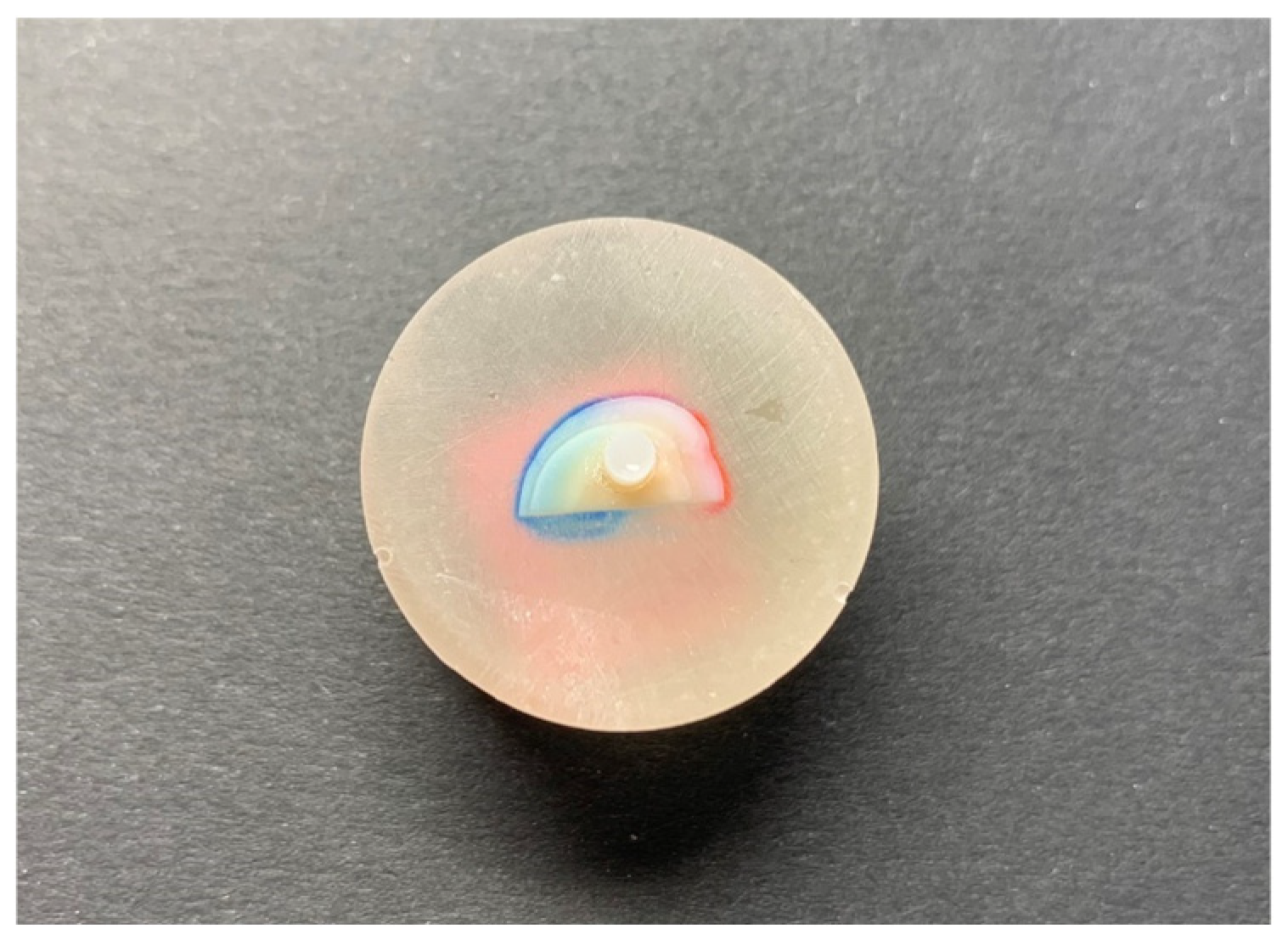
After randomly assigning dentine samples to their respective experimental groups, the dentine surfaces were gradually air-dried using an oil-free air syringe until no visible moisture remained, ensuring a “moist–dry” state without desiccation. To standardize the bonding area, a polymer adhesive tape with a thickness of 0.2 mm and a pre-punched 2.4 mm diameter circular hole was applied to the surface. The adhesive systems (G-Premio BOND, GC Corp, and Clearfil SE Bond, Kuraray Noritake) were applied and light-cured strictly according to the manufacturers’ instructions. Immediately after curing the adhesive resin, a specialized plastic mold (Ultradent Products, South Jordan, UT, USA) was precisely positioned over the demarcated area. The composite resin was then packed into the mold to create cylinders with an internal diameter of 2.38 mm and a height of 2.0 mm. Each sample was light-cured according to the standard protocol (20 s of irradiation at 1200 mW/cm
2 in a wavelength range of 380–515 nm) using a LED-c (
Figure 1).
- 2.
Experimental Groups (Riva Star Aqua Pretreatment)
For the experimental groups, the silver diamine fluoride (SDF) desensitizer, Riva Star Aqua (SDI, Bayswater, Victoria, Australia), was applied to the dentine surfaces using a medium microbrush and left undisturbed for 60 s. In the second step, the potassium iodide (KI) solution was applied with a fresh microbrush and agitated until the initial creamy white precipitate became completely clear. The treated surfaces were then rinsed with an air–water spray for 10 s and gently air-dried. Following this pretreatment, the adhesive systems and composite cylinders (2.38 mm diameter, 2.0 mm height) were applied and light-cured for 20 s, using the same parameters as the control groups. This procedure produced six experimental groups: G-Premio Bond + Riva Star and Clearfil SE + Riva Star, each evaluated at intervals of 1, 3, and 6 months.
All the samples (control and experimental) were stored in distilled water in an incubator (INEL, Zagreb, Croatia) at 37 °C for one, three, and six months. The distilled water in which the samples were immersed was changed monthly.
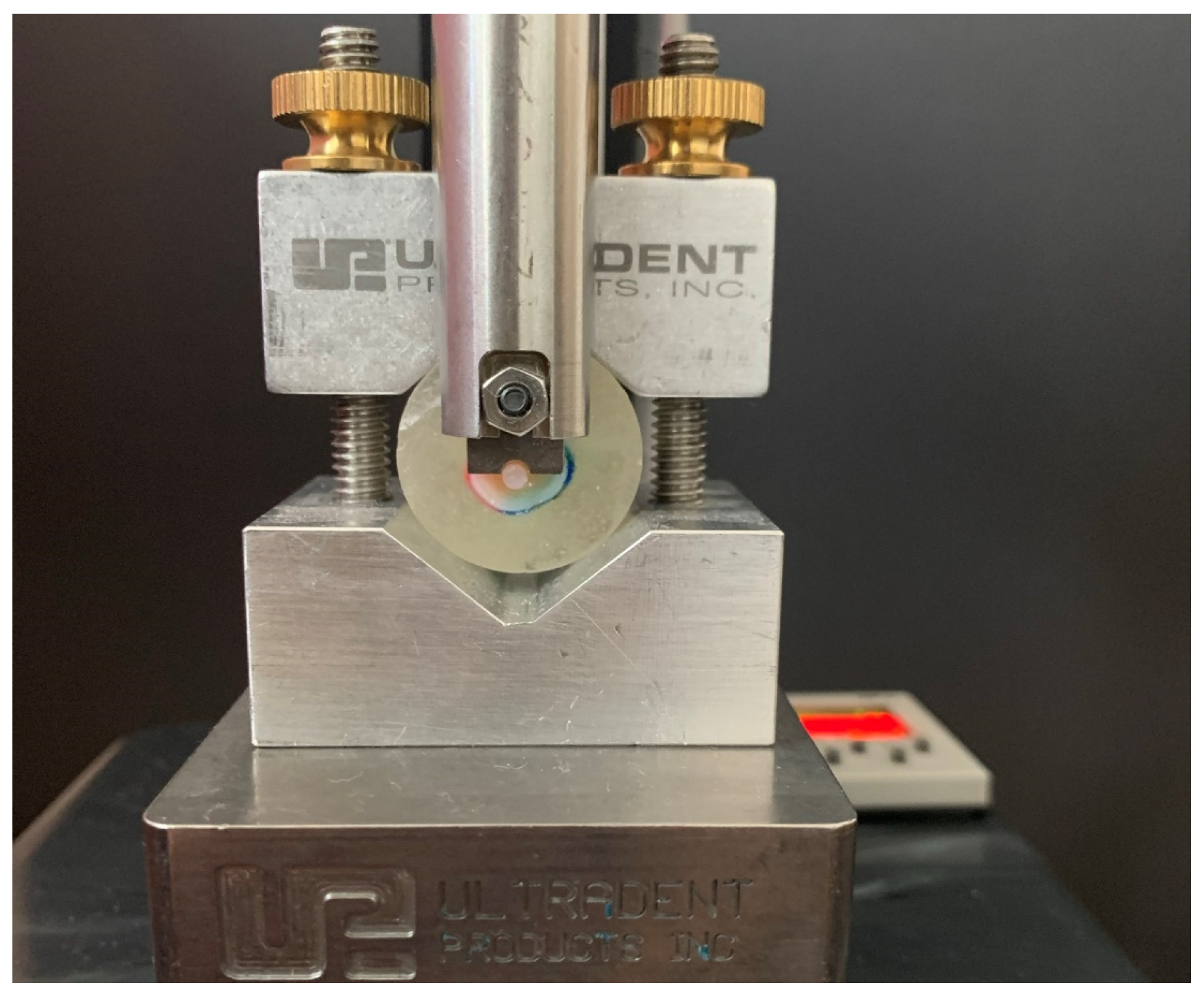
Bond strength testing was carried out using an UltraTester (Ultradent Products, SAS Institute Inc., Cary, NC, USA) fitted with a jig designed to contact a greater surface area of the specimen than that used in conventional shear bond tests. The holding apparatus covered half of the specimen and was aligned at the junction between the dentine substrate and the composite material (
Figure 2). A load was applied at a constant crosshead speed of 1 mm/min until adhesive failure occurred, resulting in separation of the composite cylinders from the dentine surface. All measurements were performed in compliance with ISO 29022:2013 standards [
20]. Shear bond strength (σ) was calculated using the equation σ = F/A, where σ (MPa) represents shear bond strength, F (N) is the maximum load at failure, and A (mm
2) is the bonded surface area.
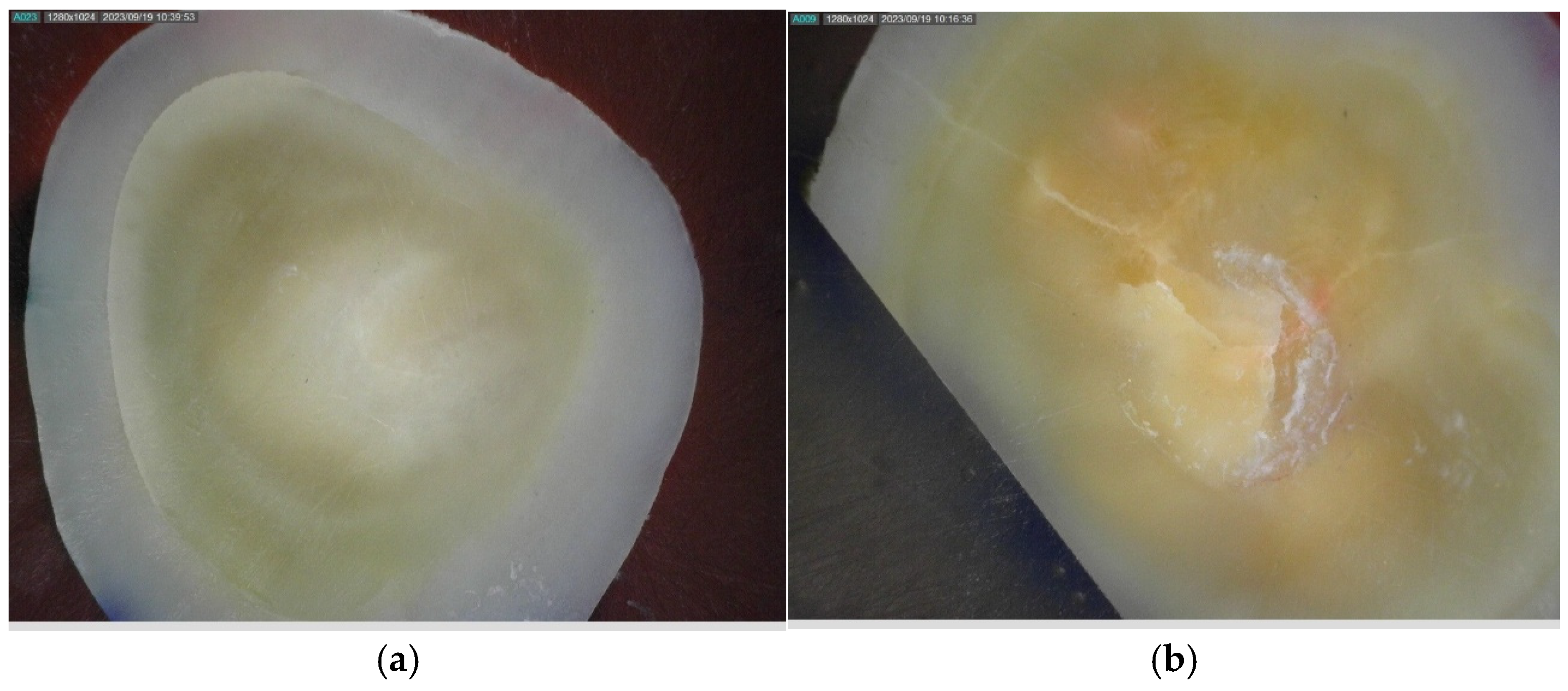
The fractured specimens (
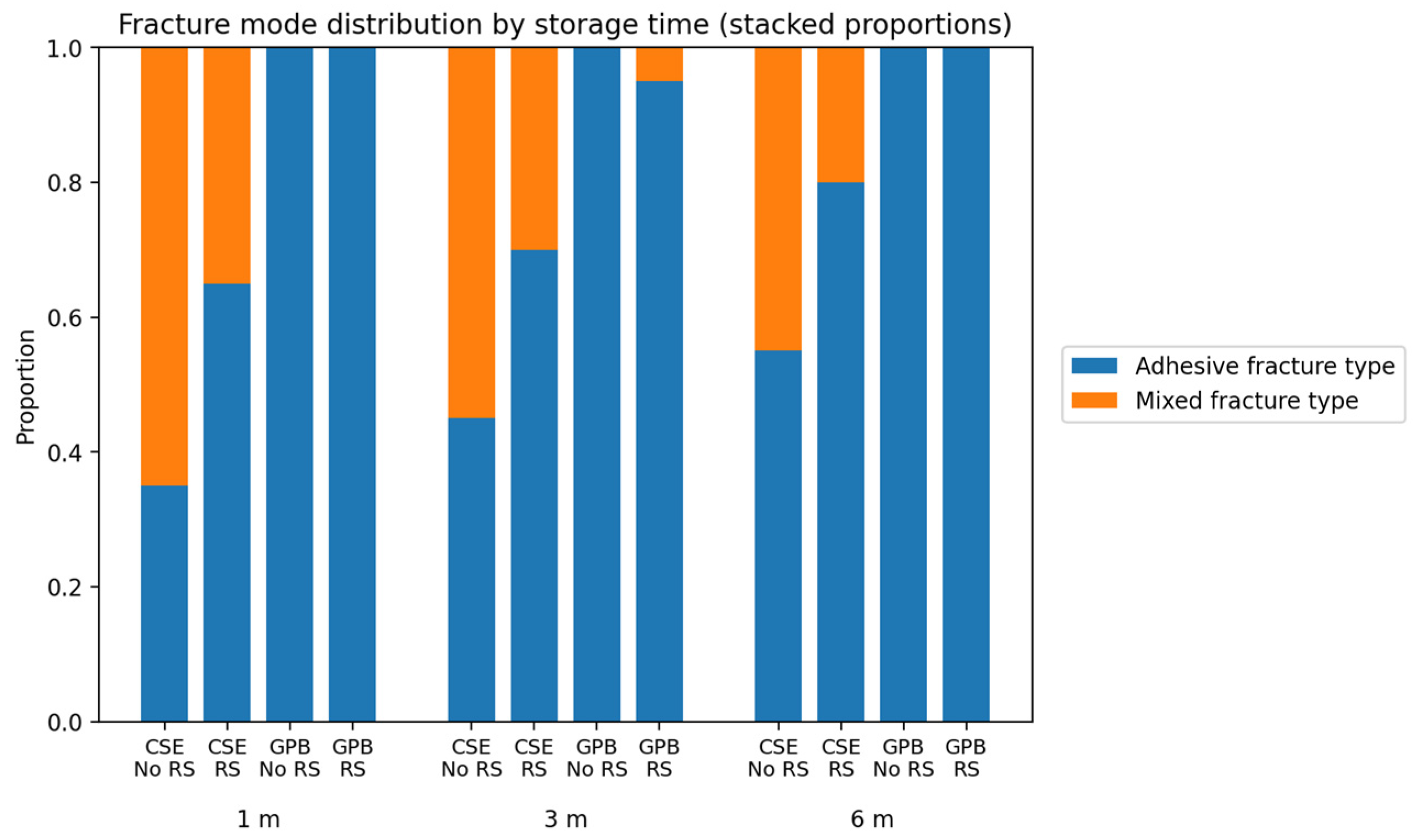
Figure 3) were examined using optical magnifying loupes at 3.6× magnification (Carl Zeiss Meditec AG, Oberkochen, Germany) to determine the type of fracture, i.e., the mode of failure. If the fracture line passed between the tooth structure and the composite cylinder, the failure mode was classified as adhesive. The fracture was considered mixed when the fracture line ran partially along the adhesive interface and extended into one of the substrates. In cases of mixed failure, fractures occurring in dentine or in the composite were distinguished, depending on which substrate was involved in the fracture line. If more than 75% of the bonded surface involved either dentine or composite, the failure mode was classified as cohesive. In our study, the fracture paths were consistently localized at the interface or transitioned between the interface and the bulk material, resulting exclusively in adhesive or mixed-mode failures. As the incidence of cohesive failure was zero (0%) for all specimens, it was omitted from the statistical analysis to avoid redundancy and to focus the discussion on the observed competition between adhesive and mixed-mode behaviors.
Bond strength (MPa) was analyzed using a three-way factorial model (Adhesive × Pretreatment × Time). Model residuals deviated from normality (Shapiro–Wilk p = 5.67 × 10⁻⁷) and variances were heterogeneous across groups (Levene p = 3.46 × 10⁻¹⁴). Therefore, heteroscedasticity-consistent (HC3) robust standard errors were used for inference (Wald F tests). The significance level was set at α = 0.05. Fracture mode (adhesive vs. mixed) was analyzed using contingency tables with χ2 tests (and Fisher’s exact test when expected counts were small). The authors hereby disclose that generative artificial intelligence (GenAI) has been used in statistical analysis.
4. Discussion
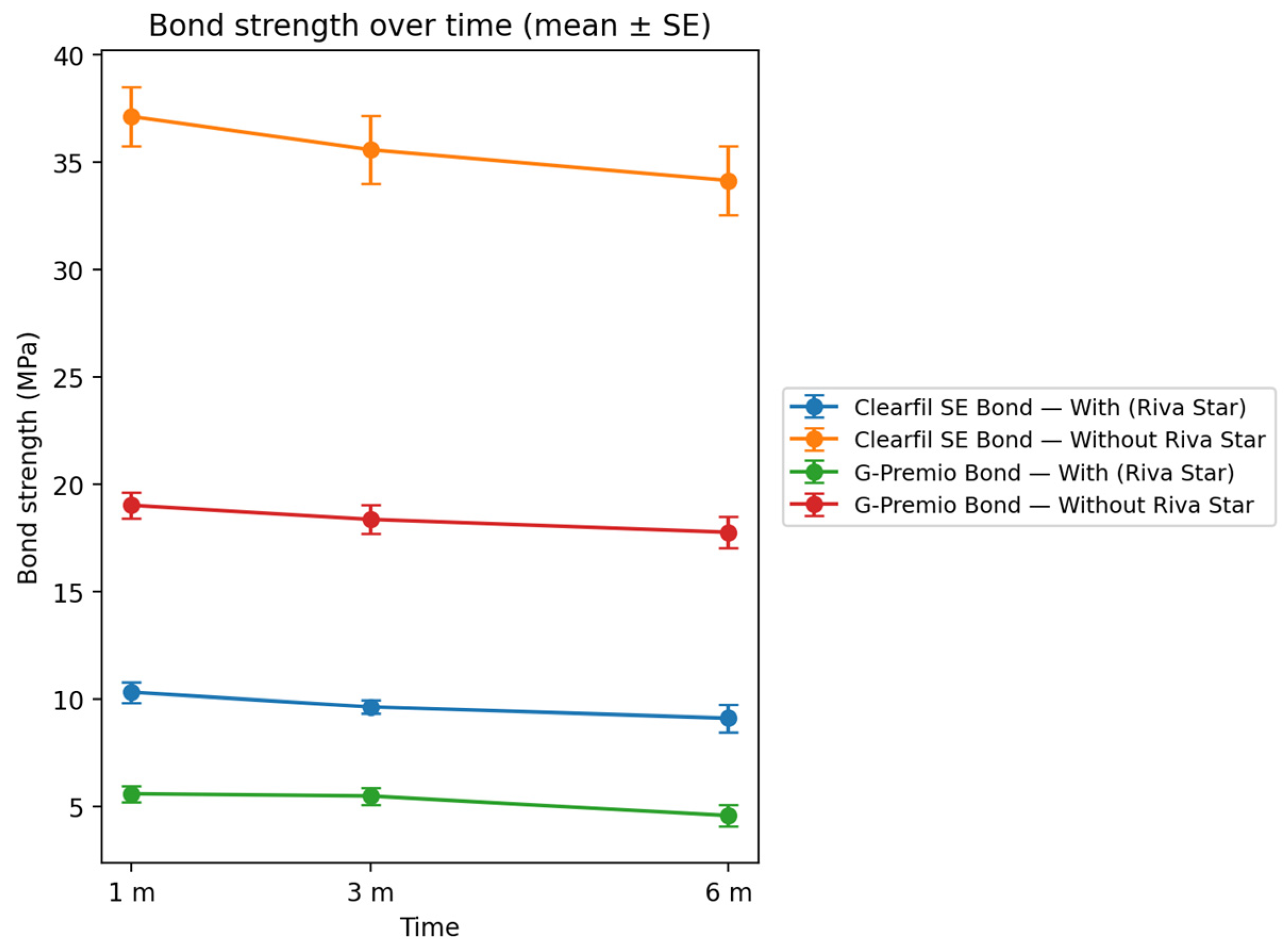
The present study demonstrated that pretreatment of dentin with the Riva Star product, a combination of silver diamine fluoride (SDF) and potassium iodide (KI), significantly reduced the bond strength of both the universal adhesive G-Premio Bond and the conventional self-etch adhesive Clearfil SE Bond on sound dentin. These findings suggest that the use of SDF/KI for cavity disinfection immediately before composite resin restoration—for example, during one-stage selective caries removal—may negatively affect bond strength and the quality of the restoration. Clearfil SE Bond, a two-step self-etch adhesive, performed better than the universal adhesive G-Premio Bond in both control groups and experimental groups treated with SDF/KI at all time points. Storage time did not significantly affect bond strength. The first two hypotheses were rejected, whereas the third hypothesis was accepted.
Clearfil SE Bond 2 and G-Premio Bond represent different generations of dental adhesives. Comparisons between adhesive systems are commonly performed to evaluate differences in bond strength and durability. According to the available literature, no studies have evaluated the bond strength of G-Premio Bond to dentin pretreated with SDF and KI, whereas only a limited number of studies have investigated Clearfil SE Bond 2 on dentin pretreated with SDF [
17,
21]. The differences in bond strength observed between the two adhesives in the present study may be attributed to differences in the number of application steps, pH, solvents, and monomer composition. Clearfil SE Bond 2 is a classic two-step self-etch adhesive consisting of a primer and a bonding resin applied sequentially. Its primer mildly etches dentin (pH ≈ 2) while preserving hydroxyapatite, allowing for stable chemical bonding through the formation of MDP–calcium salts. Due to its long-standing clinical use, durability, and predictable performance, Clearfil SE Bond is often considered the “gold standard” among self-etch adhesives [
22,
23]. In contrast, G-Premio Bond is a single-step, eighth-generation universal adhesive that can be applied in self-etch, total-etch, or selective enamel-etch modes. G-Premio Bond does not contain HEMA (hydroxyethyl methacrylate), which may reduce water uptake and improve long-term bond stability. In the present study, bond strength did not decrease significantly over the six-month storage period for either adhesive; however, the effects of HEMA-related water sorption and hydrolytic degradation in Clearfil SE Bond 2 may become evident over longer aging periods. Furthermore, the lower pH of G-Premio Bond (≈1.5), indicating a more aggressive self-etching potential than that of Clearfil SE Bond 2, along with its acidic monomer blend (MDP, 4-MET, and MDTP), would be expected to produce stronger initial demineralization and resin infiltration. Nevertheless, Clearfil SE Bond demonstrated superior bonding performance. The mild etching profile of Clearfil SE Bond generally results in a more controlled interaction with mineralized tissues, while its water-based primer allows for effective self-etching with reduced technique sensitivity under dry conditions, such as those encountered in in vitro dentin specimens. In contrast, the acetone-based solvent of G-Premio Bond may offer advantages for wet bonding under clinical conditions; however, this advantage may be diminished if SDF/KI treatment occludes dentinal tubules. G-Premio Bond also contains fine silicon dioxide particles, which normally contribute to tubule sealing, but when dentinal tubules are already occluded by silver iodide precipitates, these particles may further hinder resin infiltration into dentin.
The superior performance of Clearfil SE Bond in control samples is consistent with previous studies which found that the initial bond strength of several universal adhesives, including G-Premio Bond, on sound dentin was significantly lower compared to two-step self-etch adhesives, which exhibit predictable bond strengths and fatigue durability under standard bonding conditions without pretreatment. One-step systems are generally more technique-sensitive [
22,
24]. The lower bond strength of one-step self-etch adhesives has been attributed to the protonation of tertiary amines by acidic monomers, which reduces polymerization efficiency and long-term durability [
25]. However, although G-Premio Bond contains multiple acidic monomers and has a lower pH, the publicly available technical documentation does not clearly list tertiary amines. Given that some universal adhesives use alternative initiators, co-initiator systems, or proprietary activators instead of classic tertiary amines, it is not guaranteed that G-Premio Bond contains a tertiary amine in the traditional sense. The MDP content in Clearfil SE Bond and G-Premio Bond may also affect bond strength and durability. MDP (10-methacryloyloxydecyl dihydrogen phosphate) etches and partially demineralizes dentin, forming stable calcium–MDP salt layers with residual hydroxyapatite. Its hydrophobic tail contributes to adhesive stability and water resistance [
14]. Approximate MDP content in Clearfil SE Bond is <10 wt%, whereas the exact MDP content in G-Premio Bond is not disclosed but is likely slightly lower than in Clearfil SE Bond because G-Premio Bond also contains 4-MET and MDTP, which provide additional adhesion to multiple substrates but weaker chemical bonding than MDP. The higher effective MDP content in Clearfil SE Bond may be responsible for stronger chemical bonding to calcium and better long-term durability.
After SDF treatment, silver precipitates, mineral deposition, and an alkaline surface pH (~10–11) are observed [
26]. Silver species on the dentin surface could physically block access of MDP to the underlying hydroxyapatite, limiting effective infiltration and chemical bonding to Ca
2+. Additionally, Ag
+ ions on the dentin surface may interfere with the functional monomer content in Clearfil SE Bond and G-Premio Bond. Although most dental research focuses on functional monomer binding to Ca
2+ in hydroxyapatite, similar interactions are theoretically possible with other metal cations. The phosphate groups in MDP and MDTP, as well as the carboxylate groups in 4-MET, can deprotonate and become negatively charged. The oxygen atoms in these groups may act as ligands, forming ionic and coordination interactions with Ag
+ [
27]; however, carboxylates bind weaker than phosphates [
28]. The relatively lower wt% of phosphates in G-Premio Bond may explain its lower bond strength compared to Clearfil SE Bond after SDF pretreatment. The assumption that the interaction of functional monomers with the components of SDF/KI may be the reason for the reduced bond strength is supported by the results of a recent study in which the authors performed ultrastructural and mineral analyses and found silver deposits in the hybrid layer and subjacent dentin when SDF/KI was applied, even after 30 s of rinsing (in our study we rinsed the dentin for 10 s according to the manufacturer’s instructions) [
29]. Furthermore, the alkaline environment created by SDF pretreatment could affect the interaction of acidic functional monomers with dentin, as MDP requires partial demineralization to interact with calcium. A high surface pH reduces demineralization and may therefore diminish chemical bonding [
26].
Previous studies evaluating the bond strength of adhesives to SDF- or SDF/KI-treated dentin have reported highly variable results, making it difficult to draw firm conclusions regarding the effect of SDF or SDF/KI on bond strength [
10,
15,
17,
30,
31]. Our results, which demonstrate a decrease in bond strength, are consistent with those of Lutgen et al. [
17], who reported a reduction in bond strength on sound dentin after SDF application followed by a 15 s rinse when using self-etch adhesion. They tested several protocols, including one without rinsing, which resulted in the majority of samples failing prior to bond strength testing with both etch-and-rinse and self-etch adhesives. However, the rinsing step is described as mandatory when Riva Star is used as a cavity disinfecting agent before restoration [
32]. Similar findings were reported by Koizumi et al. [
11] and Van Duker et al. [
31], who investigated the effects of SDF and potassium iodide (KI) on dentin bond strength. They found that SDF/KI application generally reduced bond strengths in both self-adhesive and etch-and-rinse systems, although etch-and-rinse adhesives were less affected [
33]. For this reason, we chose to use a universal adhesive in self-etch mode to avoid giving it an advantage over Clearfil SE Bond. Lutgen et al. [
17] reported that a 15 s rinse removed excess SDF from the dentin surface, which was not visible under SEM, although the presence of SDF was confirmed by sample staining. Fluoride and silver ions have been shown to penetrate partially demineralized dentin of permanent teeth up to 450 μm [
34]. This deep penetration is particularly important in one-stage selective caries removal, as the therapeutic effects of SDF/KI—including disinfection, caries arrest, and potential remineralization—can still be expected after rinsing off precipitated species, while bond strength, although reduced, remains achievable [
11,
17]. In contrast, several previous studies reported that SDF application had no statistically significant effect on the bond strength of resin composites to sound dentin. However, in these studies, the rinsing step lasted 30 s, and the dentin surface was treated with an etch-and-rinse bonding system after SDF application and rinsing [
15,
16]. Several other studies also reported that pretreatment with SDF/KI did not significantly affect bond strength [
10,
35]. In self-etch approaches, the adhesive was applied after SDF/KI and the precipitates were rinsed, whereas in etch-and-rinse approaches, etching was performed before SDF application [
10,
34], as recommended by the manufacturer, rather than afterwards, as in Wu et al. and Quock et al. [
15,
16]. The inconsistent results regarding the effect of SDF or SDF/KI pretreatment on dentin bond strength can likely be attributed to the lack of standardized specimen preparation and variations in SDF/SDF-KI application protocols, particularly regarding the rinsing step and the timing of etching in etch-and-rinse systems [
36]. In one-stage selective caries removal with subsequent composite restoration, etching with 37% phosphoric acid should be performed before SDF/KI application when using an etch-and-rinse adhesive (or a universal adhesive in etch-and-rinse mode). The manufacturer recommends rinsing AgI precipitates with water for 10 s, as in the present study [
32]. There is no generally accepted application protocol for SDF/KI as an anti-caries agent. Riva Star (Aqua) is marketed in Europe primarily as a desensitizing agent for the relief of dentinal hypersensitivity [
37]. It is therefore not surprising that SDF + KI is not included in the ESE vital pulp treatment protocols [
4]. However, official product information from manufacturers describes it as a desensitizer, cavity cleanser, and anti-caries agent [
32,
37]. Several guidelines from dental professional organizations exist for the use of SDF/KI as an anti-caries agent (European Academy of Paediatric Dentistry, British Society of Paediatric Dentistry, American Dental Association). This indicates that the effectiveness of SDF in caries arrest has been recognized; however, further research is needed for the product to be officially labeled as an anti-caries agent in the EU, with unified guideline support from professional bodies.
Failure modes in G-Premio Bond were adhesive in both groups (only 1t sample out of 120 exhibited mixed fracture). Clearfil SE Bond exhibited mixed fractures, which were more frequent in control samples and less frequent in Riva Star-treated samples. The superior bond strength of Clearfil SE Bond resulted in an increased number of samples exhibiting mixed failures. This suggests that bonding with Clearfil SE Bond may be clinically sufficient even in SDF/KI-treated samples, as adhesion exceeded the cohesive forces within the composite in a substantial proportion of specimens. No samples exhibited cohesive failures that would indicate microcracks introduced during dentin disk preparation [
38,
39].
Based on the results of the present study, SDF/KI application could be suggested only on the pulpal floor to avoid compromising adhesion on the lateral cavity walls. In addition, the present findings imply that the use of SDF/KI to arrest secondary caries at restoration margins would significantly reduce bond strength and may therefore compromise effective caries arrest on the pulpal floor. However, several limitations need to be considered. These include the use of a study model with flat, sound dentin surfaces, which does not reflect real clinical conditions and does not account for deep-cavity geometry. In addition, caries-affected dentin on the pulpal floor was not simulated. Future studies should therefore investigate the effect of SDF/KI on partially demineralized dentin and perform qualitative microstructural and chemical analyses of the interface between partially demineralized dentin treated with SDF/KI and hydraulic calcium silicate or glass ionomer materials, as these materials are recommended in deep caries management protocols [
2,
4].




 ,
,