Article

Numerical Simulation and Influencing Factor Analysis of Magnetic-Field Antennas and Electric-Field Antennas for Near-Bit Wireless Short-Range Transmission


1
Key Laboratory of Deep Petroleum Intelligent Exploration and Development, Institute of Geology and Geophysics, Chinese Academy of Sciences, Beijing 100029, China
2
Innovation Academy for Earth Science, Chinese Academy of Sciences, Beijing 100029, China
3
College of Earth and Planetary Sciences, University of Chinese Academy of Sciences, Beijing 100049, China
4
Department of Earth Science and Engineering, Imperial College London, London SW7 2BP, UK
*
Author to whom correspondence should be addressed.
Appl. Sci. 2026, 16(3), 1519; https://doi.org/10.3390/app16031519
Submission received: 9 January 2026 / Revised: 30 January 2026 / Accepted: 30 January 2026 / Published: 3 February 2026

Abstract

Wireless short-range transmission is essential for precise wellbore trajectory control and real-time formation evaluation. Its signal propagation characteristics are influenced by multiple factors, including antenna type, drill collar, mud, and formation resistivity. Most prior studies are based on Magnetic-field Antennas (MFA) and primarily focus on the effects of formation resistivity variations, whereas the investigations on the influence of drill collars and mud resistivity are limited. In this study, a three-dimensional finite-element electromagnetic model of the “antenna–drill collar–mud–formation” system was developed to investigate wireless short-range transmission. The model was used to characterize and compare the electromagnetic field distributions of MFA and Electric-field Antennas (EFA) under in situ conditions. On this basis, a set of parametric sensitivity analyses on transmission performance was performed to quantify the effects of key factors, including drill-collar conductivity and mud resistivity. The results reveal fundamentally different electromagnetic field distributions for the two antenna types: (1) MFA is dominated by localized circumferential magnetic flux loops, whereas EFA transmits signals through axially extended eddy-current channels. (2) The drill collar exerts opposite effects on the two antennas, suppressing signal levels for MFA while significantly enhancing transmission for EFA, resulting in signal amplitudes that are 10 3 10 5 times higher. (3) In addition, mud resistivity has little influence on MFA, whereas increasing mud resistivity leads to the pronounced attenuation of EFA signals. These findings provide a quantitative basis for antenna selection and performance optimization in wireless short-range transmission systems under different Logging-While-Drilling (LWD) conditions.

1. Introduction

As global oil and gas exploration reaches maturity, high-yield conventional reservoirs are increasingly depleted, and exploration and development efforts are shifting to unconventional and thinly interbed reservoirs with complex structures and strong heterogeneity [1,2]. Such reservoirs have more demanding requirements for real-time and precision wellbore trajectory control. Ensuring that the drilled wellbore remains within the intended reservoir intervals, thereby maximizing effective drainage area and recovery factor, has become an engineering requirement in improving single-well productivity and overall field development efficiency [3]. Conventional Measurement While Drilling (MWD) and LWD systems typically place measuring sensors 50–100 feet (≈15–30 m) behind the drill bit [4,5]. This inherent spatial lag affects the detection of formation boundaries in thinly bedded reservoirs, lowering the timeliness of wellbore trajectory adjustments and compromising the accuracy of real-time formation evaluation.
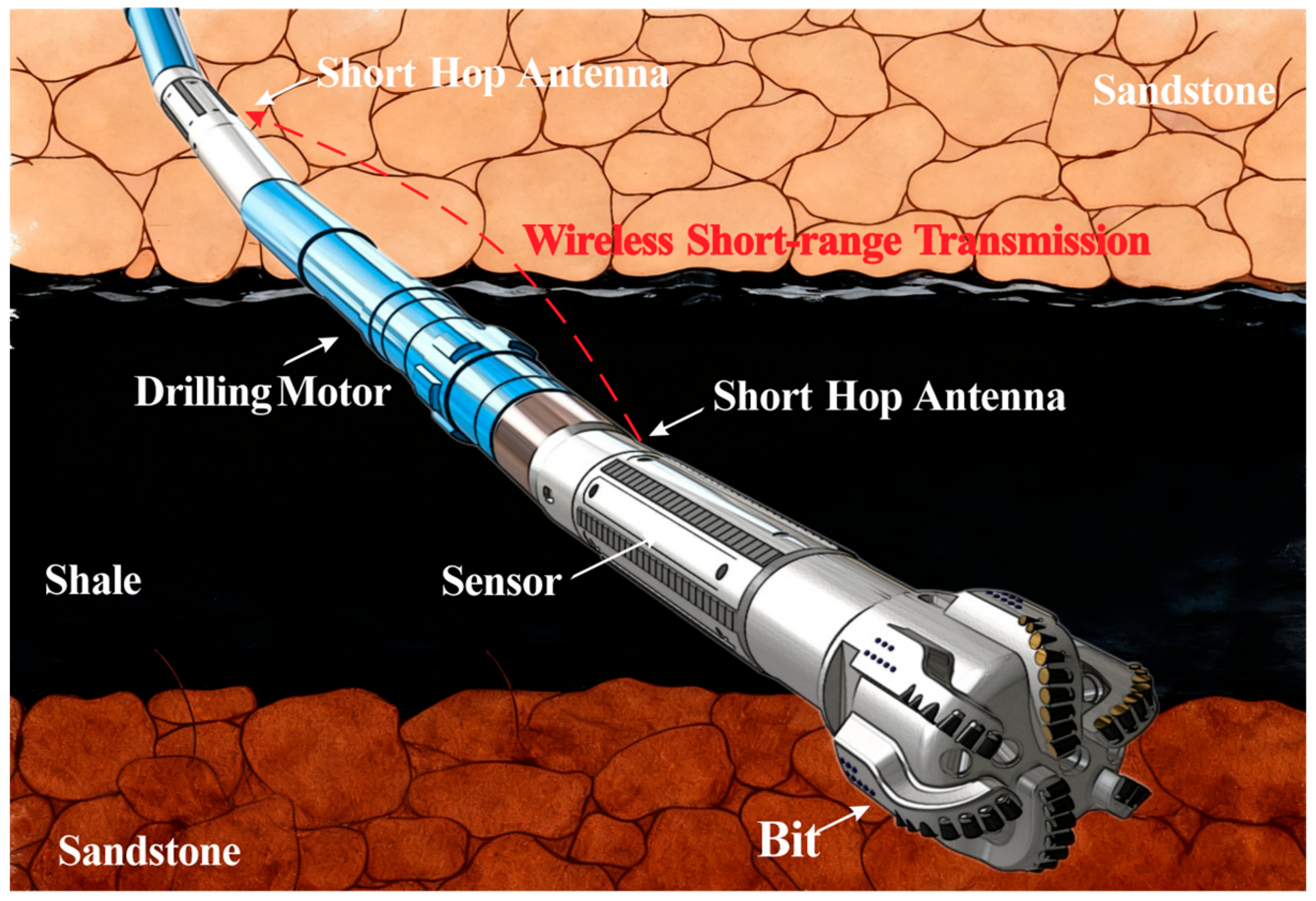
To overcome the spatial lag inherent in typical MWD/LWD tools, near-bit geosteering instruments have been developed, such as Schlumberger’s iPZIG tool [6,7], Halliburton’s GABI tool [8], and Baker Hughes’ OnTrak tool [9]. MWD/LWD tools place sensors for natural gamma ray and inclination parameters within 0.5 m of the drill bit [10,11,12,13], thereby enabling earlier and more reliable identification of formation boundaries within thinly interbedded reservoirs in geosteering (Figure 1). The research on near-bit measurement systems has shown how important downhole vibration tracking is for checking how well drilling is going, how safe it is to use, and how well the tools are working. Landar et al. [14] suggested an embedded smart controller for real-time evaluation of drill-string bottom-part vibrations and shock loads. They showed that high-frequency vibration data collected near the bit can help optimize drilling parameters and prevent failure, but only if downhole data transmission and acquisition are reliable. In addition, field trials have shown that vibration “exposure”—e.g., the percentage of time that LRMS/ARMS/Slip indicators remain above threshold levels and the recurrence of stick–slip events—correlates with bit wear and localized ROP decline, underscoring the need for near-bit channels capable of supporting such monitoring metrics in real drilling conditions [15]. Nevertheless, the space near the drill bit is extremely limited and subjected to intense vibration and impact. Under such downhole conditions, wireless short-range transmission between near-bit sensors and the MWD system is commonly achieved through three approaches: mud-pulse telemetry, acoustic telemetry, and electromagnetic transmission. Traditional mud-pulse telemetry is constrained by multiple sources of channel noise and the size limitations of pulse generators, making reliable operation difficult under such conditions [16,17]. Acoustic telemetry is also restricted by the complex acoustic properties of drill collars and severe signal attenuation [18,19]. Consequently, electromagnetic wireless short-range transmission [20,21] has emerged as a key technology for real-time data transmission from near-bit measurement systems. Owing to their high propagation speed (on the order of the speed of light), strong resistance to interference, and compact system structure, electromagnetic waves represent an ideal approach for achieving high-speed and stable near-bit data transmission.
In recent years, extensive studies have been conducted by researchers worldwide on electromagnetic Wireless short-range transmission, focusing on antenna design, electromagnetic coupling mechanisms, and signal attenuation characteristics [22,23,24,25,26]. Existing near-bit electromagnetic short-range transmission antennas can generally be classified into two categories: magnetic-dipole-type antennas (MFA) and electric-dipole-type antennas (insulated-sub antennas or EFA). MFA typically employs multi-turn induction coils wound along the tool axis, operating on principles analogous to those of induction logging instruments. They exhibit stable electromagnetic responses and benefit from a well-established engineering foundation [27,28,29]. Insulated short-collar antennas realize electric-field excitation by introducing an insulation gap in the drill collar, which enables relatively high transmission efficiency. However, their performance degrades significantly in highly conductive mud environments, and the introduction of insulation sections weakens the mechanical integrity of the drill collar. Moreover, the insulation materials are prone to erosion and damage under severe downhole vibration and impact conditions, which limits their long-term reliability in practical applications.
For EFA, Li and Lin [30] developed an equivalent magnetic-dipole theoretical model of a helical loop antenna in cased wells based on the finite-element method. They systematically analyzed the effects of operating frequency, drilling-fluid resistivity, and the electromagnetic parameters of the drill collar and casing on electromagnetic wave attenuation characteristics, and validated the model through field experiments, thereby providing a theoretical basis for evaluating short-range electromagnetic transmission channels in cased wells. Li et al. [31] established a high-fidelity low-frequency near-field electromagnetic transmission numerical model based on the Numerical Mode-Matching (NMM) method. By equivalently representing the asymmetric feeding structure of the drill collar as a magnetic current loop source, they systematically investigated the excitation, coupling, and propagation characteristics of electromagnetic signals along a metallic drill collar in lossy formations, and quantitatively revealed the controlling effects of feeding asymmetry, formation conductivity, operating frequency, and casing structure on transmission efficiency and received signal amplitude. Liu et al. [32], through finite-element modeling combined with experimental validation, conducted a systematic investigation of the signal response characteristics of MFA and EFA in logging-while-drilling inductive electromagnetic short-range transmission. Their study focused on the influence of formation and borehole environmental parameters on transmission performance, providing quantitative guidance for the design of related downhole instruments.
The prior studies predominantly focus on MFA, with particular emphasis on the effects of formation resistivity variations, whereas the roles of drill-collar conductivity and drilling-fluid resistivity in transmission performance have received comparatively limited attention. Under wireless short-range transmission conditions, the electromagnetic field distributions, induced current pathways, and environmental sensitivities associated with different antenna types have rarely been examined within a unified modeling framework. As a result, the response differences between MFA and EFA, especially in the presence of drill collars and varying mud electrical properties, have not yet been quantitatively clarified. These gaps limit a rigorous comparison of antenna performance and reduce the reliability of antenna selection for practical near-bit transmission applications.
This study investigates wireless short-range transmission from the perspective of realistic downhole operating conditions. A fully coupled three-dimensional electromagnetic model incorporating the antenna, drill collar, drilling fluid, and formation is developed using COMSOL Multiphysics version 6.3 and applied consistently to both MFA and EFA. Based on this model, numerical simulations are conducted to characterize the electromagnetic field distributions of the two antenna types and to quantify the influence of key parameters, including drill-collar conductivity and mud resistivity, on signal transmission behavior. By comparatively evaluating antenna responses under representative transmission scenarios, this work clarifies the distinct response characteristics and practical applicability of the two antenna types in wireless short-range transmission systems, providing quantitative support for antenna selection and performance assessment in near-bit across-motor applications.

2. Theoretical of Wireless Short-Range Transmission

2.1. Electromagnetic Induction Principles of Antennas

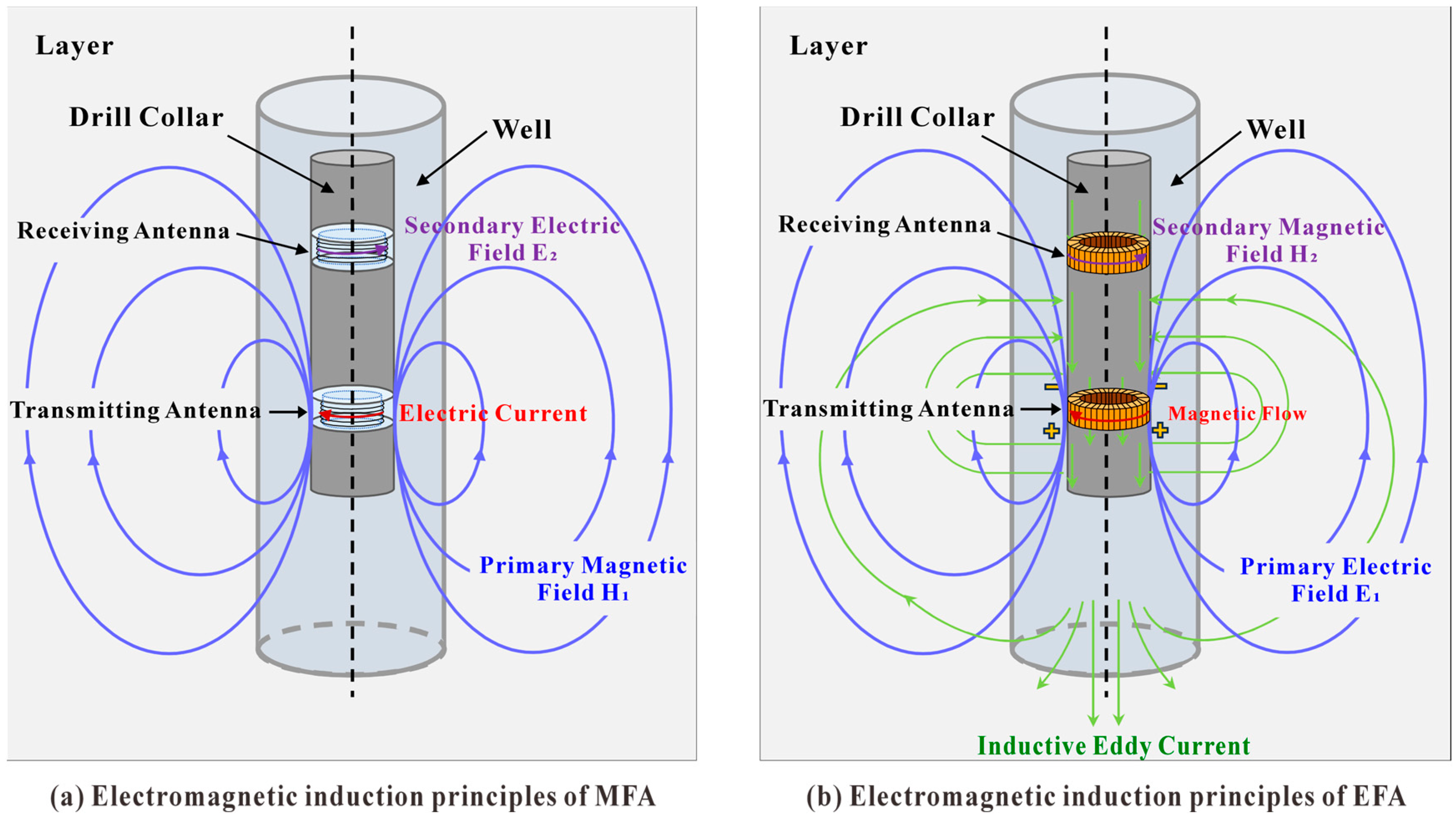
The essence of downhole electromagnetic wave transmission across the drilling motor lies in the excitation, propagation, and coupling of time-varying electromagnetic fields within multiphase conductive media, including the antenna, drill collar, drilling fluid, and surrounding formation. According to Maxwell’s equations, a time-varying magnetic field induces a rotational electric field (Faraday’s law of electromagnetic induction), while a time-varying electric field together with conduction currents generates a rotational magnetic field (Ampère–Maxwell law). The mutual excitation and coupling of these time-varying electric and magnetic fields constitute the fundamental mechanism governing electromagnetic wave propagation in conductive media. Based on the antenna configuration and the intrinsic nature of its interaction with the electromagnetic field, near-bit electromagnetic short-hop transmission antennas can be broadly classified into two categories: MFA and EFA. These two antenna types differ fundamentally in their excitation mechanisms, field distribution characteristics, and signal coupling behaviors. Their corresponding physical models and electromagnetic response characteristics are illustrated in Figure 2.
The MFA consists of multiple turns of conductors wound axially along the drill collar, as illustrated in Figure 2a. When an alternating current is applied to the windings, a time-varying primary electric field (indicated in red) is generated in the vicinity of the antenna, which in turn excites a time-varying primary magnetic field in space (indicated in blue). The primary magnetic field further induces a secondary electric field within the surrounding formation (indicated in purple). The receiving antenna is located at a certain distance from the transmitter and acquires the response signal by sensing both the induced primary and secondary electric fields. By integrating the electric-field components over the cross-section of the receiving antenna, the total electric flux linked with the receiving coil can be obtained, from which the amplitude of the induced voltage is subsequently calculated.
The EFA consists of multiple turns of conductor tightly wound around a toroidal magnetic core, as shown in Figure 2b. The transmitting antenna is embedded in a machined groove of the drill collar. When an alternating current is applied to the EFA, an alternating vortex magnetic field (referred to as the primary magnetic field, marked in red) is generated within the toroidal core in accordance with Maxwell’s equations. The time-varying magnetic field subsequently induces an alternating electric field in the surrounding space (referred to as the primary electric field, marked in blue). Because the drill collar, drilling mud, and formation are all conductive media, induced eddy currents are generated within these media (marked in green), with their magnitude being proportional to the electrical conductivity of the surrounding environment. The primary alternating electric field, together with the induced eddy currents, generates an alternating vortex magnetic field at the receiving EFA (referred to as the secondary alternating magnetic field, marked in purple). Signal transmission by the EFA is achieved through the formation of a conductive channel loop composed of the “drill collar–mud–formation” system, in which eddy currents serve as the primary mechanism for signal propagation.

2.2. Antenna Excitation Source Equivalencing

To quantitatively analyze the radiation characteristics of the antennas and the laws governing signal propagation, this study is based on Maxwell’s equations and employs an equivalent modeling approach for the antenna excitation sources. Taking the EFA as an example, it is typically excited by an alternating current source, and the resulting electromagnetic fields can be approximated as time-harmonic fields, with field quantities varying in time according to e j ω t . Under this convention, / t j ω , leading to the frequency-domain forms × E = j ω μ H and × H = J 0 + j ω D , which are used consistently in the following derivations. Under this assumption, the time derivatives of the instantaneous field vectors can be equivalently represented as complex multiplicative forms in the frequency domain. Accordingly, Maxwell’s equations can be transformed into their frequency-domain equations, which are used to elucidate the propagation of electromagnetic waves and the associated energy-coupling mechanisms within formation media.
D = ρ 0
B = 0
× E = j ω μ H
× H = j 0 + j ω D
where E is the electric field intensity, B is the magnetic flux density, H is the magnetic field intensity, D is the electric displacement field, j 0 is the conduction current density, ω is the angular frequency, µ is the magnetic permeability, and ρ 0 represents the charge distribution in space.
Taking the curl of both sides of Equation (3) and combining it with Equation (4), the governing equation for the electric field can be derived:
× 1 μ × E ω 2 ε E = j ω J
Equation (5) is the vector Helmholtz equation in the frequency domain, which describes the propagation characteristics of electromagnetic waves excited by the current source in the complex medium environment. From Equation (5), it can be seen that for the analysis of low-frequency electromagnetic field problems, only the current density ( I M ) and the transmission potential ( V ) in the loop need to be obtained.
In practical computations, because the physical dimensions of the coil are much smaller than both the electromagnetic wavelength and the transmitter–receiver spacing, transmitting antennas are often approximated as oscillating dipole sources in three-dimensional numerical simulations. However, under complex downhole conditions with short transmitter–receiver separations typical of while-drilling operations, such simplifications may introduce non-negligible errors or even lead to incorrect conclusions. Therefore, the excitation source must be modeled explicitly as a coil source. Given that the wire diameter of the coil is extremely small, typically on the order of millimeters, direct geometric modeling in finite-element simulations is difficult. As a result, a single-turn coil is commonly equivalently represented by a line current source, a surface current source, or a volumetric current source.
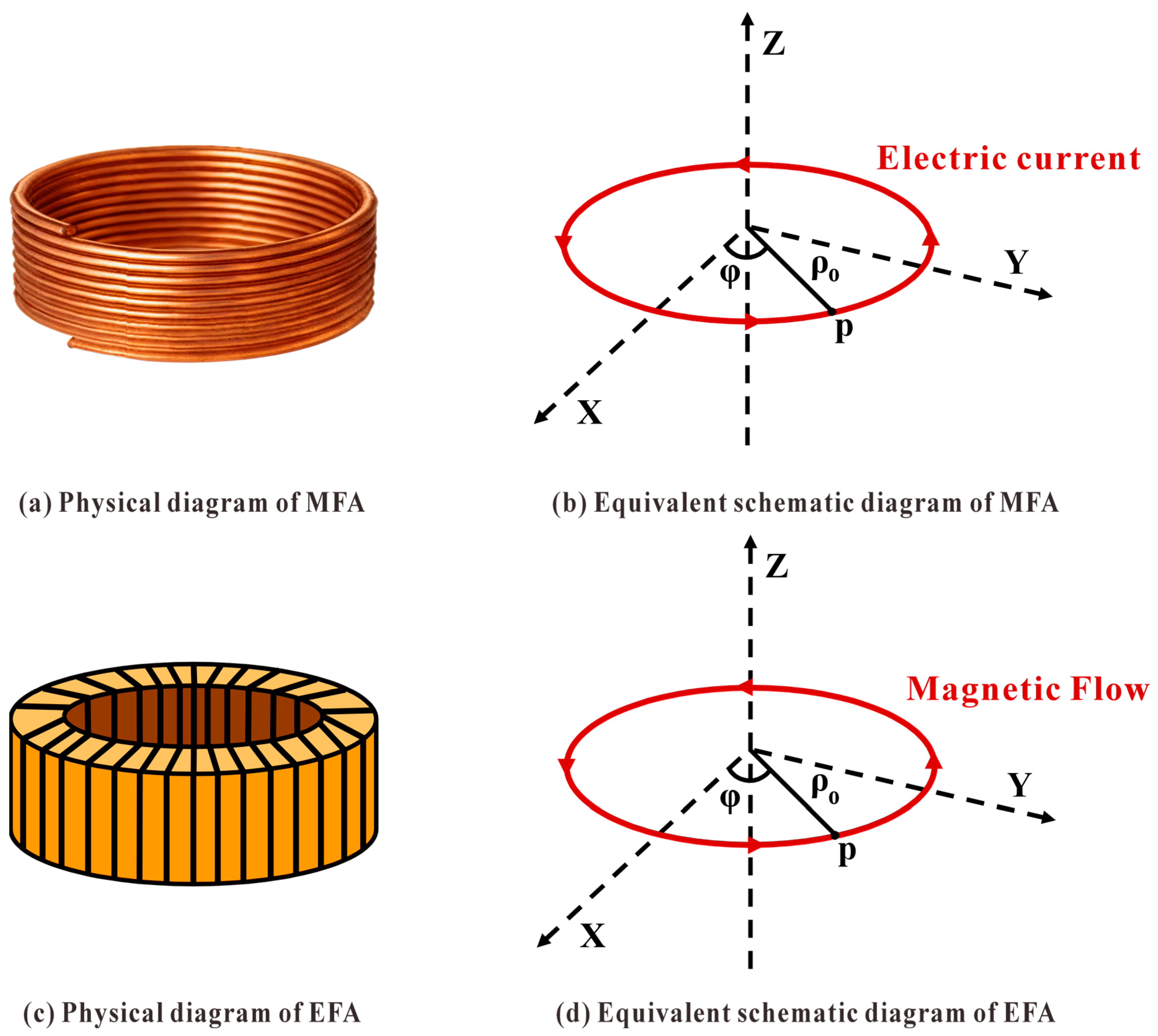
In this paper, the magnetic-field transmitting antenna is equivalent to a line current source, as shown in Figure 3a,b. The structure is simple; the source is easy to add and is easy to divide. Only enough nodes need to be set on the coil.
I = I e φ
where I is the magnitude of the current, and e φ is the direction of the φ component of the cylindrical coordinate.
Based on the duality principle of the electromagnetic field, the radiation characteristics of EFA and MFA are equivalent in form under the condition of low-frequency near field. In order to avoid the boundary singularity and numerical instability caused by the direct use of electric dipole excitation, the excitation source of EFA is equivalent to the magnetic current source model. This treatment can not only ensure the consistency of electromagnetic field distribution form and physical mechanism, but also significantly improve the convergence and accuracy of finite element calculation.
As shown in Figure 3c,d, according to Ampere’s law, the magnetic field ( H i n φ ) generated by the current source ( I i n ) inside the spiral coil satisfies the following conditions [33]:
2 π ρ H i n φ = N I i n   ρ R 0 < r s 0   ρ R 0 > r s
where N is the number of turns, R 0   is the mean radius (centerline radius) of the toroidal winding/core cross-section (i.e., the radial position of the cross-section center in the ρ z plane), and 2 r s is the radial thickness of the toroidal cross-section. According to Faraday’s law of electromagnetic induction, the relationship between the magnetic field and the electric field at any point within the EFA can be expressed as:
× E i n = φ ^ j ω μ H i n φ
Within the EFA, the magnetic field magnitude is identical along the azimuthal ( φ ) direction. Therefore, the magnetic flux generated by the magnetic field at any point on the ρ z plane can be equivalently represented by a point magnetic current source oriented in the φ direction. In the ρ z cross-section, the toroidal winding occupies a narrow region defined by z z < h / 2 and ρ R 0 < r s . To obtain a numerically stable and analytically transparent excitation model, we first describe the excitation as a distributed equivalent magnetic current density over this finite cross-section. Then, by collapsing the finite cross-section into a localized filament at ρ z in the ρ z plane, the distribution can be written in a compact δ -type form (Equation (9)), where δ ( ρ ρ ) δ ( z z ) indicates localization in the cross-section while the azimuthal direction remains continuous. The total equivalent magnetic current I M is finally obtained by integrating the localized distribution over the actual cross-sectional region (Equations (10) and (11)).
I m = × E i n = φ ^ j ω μ N I i n 2 π ρ δ z z δ ρ ρ
where
z z < h 2 , ρ R 0 < r s
The total equivalent magnetic current of the coil, I m ,   can be obtained by integrating over the coil cross-section:
I M = I m d ρ d z
Substituting Equation (9) into Equation (10) yields:
I M = j ω μ h N I i n 2 π ln R 0 + r s R 0 r s

2.3. Antenna Receiving Signal Calculation

In this work, the received induced voltage is adopted as a physics-based indicator of transmission strength, providing a fundamental assessment of channel feasibility at the electromagnetic-field level.
When the area of the receiving coil of the MFA remains constant with time, the electromotive force induced on the receiving coil can be expressed according to Faraday’s law of electromagnetic induction as:
V = N R d ϕ m d t = N R s B d t d s = N R l E d l
where N R is the number of turns of the receiving coil, ϕ m is the magnetic flux passing through the coil, B is the magnetic induction intensity, and E is the electric field intensity. It can be seen from Equation (12) that the induced electromotive force can be obtained by integrating the magnetic field in the coil envelope area, or by integrating the electric field on the coil path. In practice, the MFA is usually a spiral structure, and it is more complicated to directly integrate the entire spiral coil. In order to facilitate the calculation, the equivalent processing is usually adopted, that is, the single-turn circular coil is integrated first, and then multiplied by the number of turns of the coil. The expression is:
V = N R l E d l = 2 π a R N R E φ
According to Faraday’s law of electromagnetic induction, the induced electromotive force in the receiving EFA can be obtained by integrating the magnetic field passing through its cross-section:
V = j ω μ 0 N R S R H R d s
where μ 0 is the vacuum permeability, N R is the number of turns of the receiving coil, and H R is the magnetic field strength.
Since the cross-sectional area of the receiving electric-field is relatively small, it can be approximately considered that the magnetic field passing through the cross-section is uniformly distributed in space. Therefore, Equation (14) can be expressed by the magnetic field strength at the center of the coil, to obtain the approximate equation of the induced electromotive force:
V j ω μ 0 H R φ N R S R
where H R φ represents the toroidal magnetic field component at the center of the receiving coil. The effective cross-sectional area of the electric-field can be expressed as:
S R = b a h
In the equation, a and b are the inner and outer radius of the electric-field, and h is the height of the coil. By substituting Equation (16) into Equation (15), the amplitude of the received signal strength of the received electric-field under the magnetic flow excitation source can be obtained.

3. Numerical Model and Verification

3.1. Geometric Model

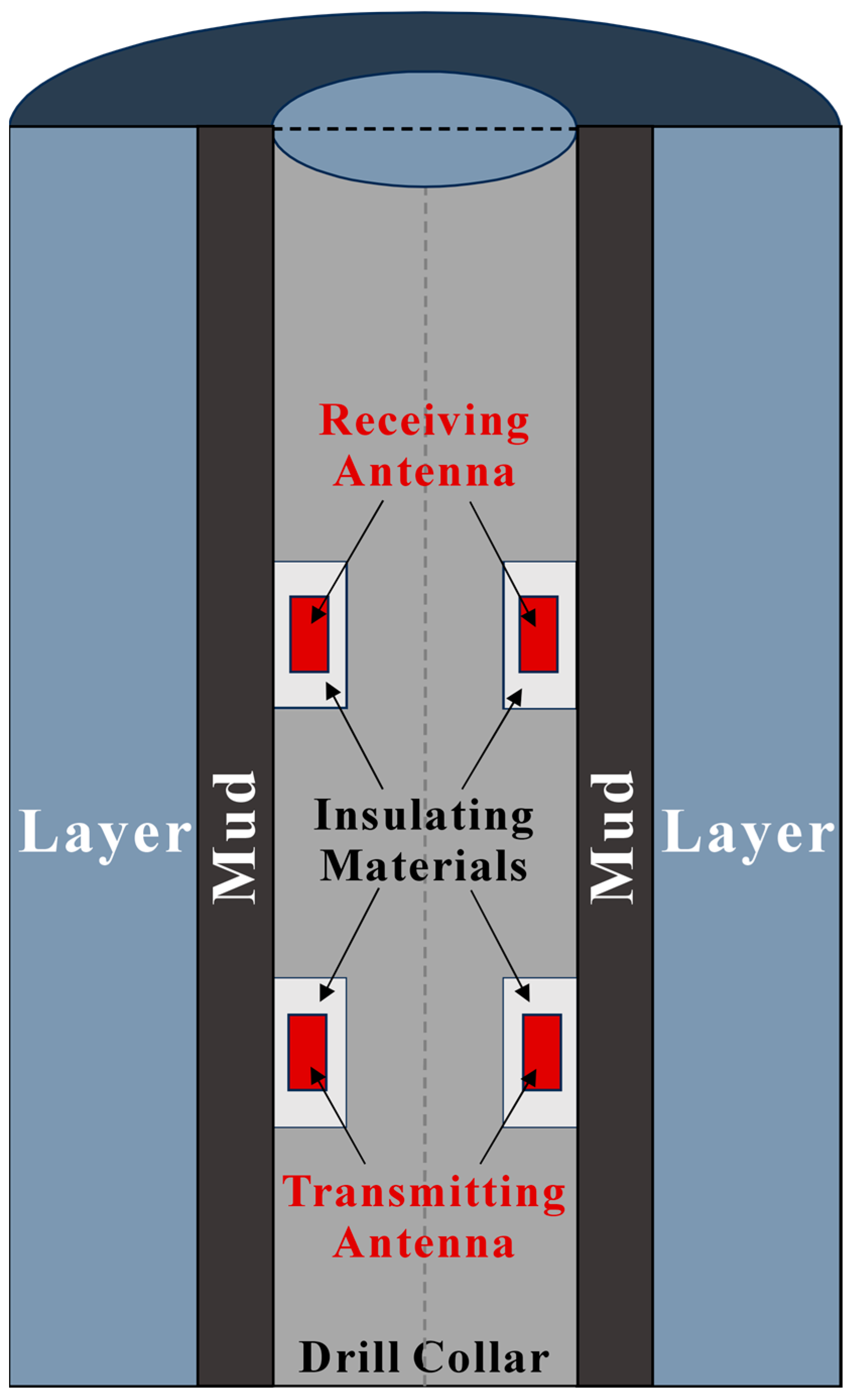
To systematically investigate the electromagnetic response characteristics of the two antenna types in the downhole environment, a fully coupled simulation model consisting of the transmitting antenna, receiving antenna, drill collar, drilling fluid, and formation was established, as shown in Figure 4. This model is designed to examine the effects of the drill collar, mud resistivity, and formation resistivity on signal transmission between the antennas. Since the research focuses on investigating the fundamental patterns of electromagnetic field distribution for different antenna types under near-drill conditions, we consider rock anisotropy and the segmented structure of the drill collar to be secondary influencing factors and will not discuss them here. To emphasize the electromagnetic characteristics of the system and reduce model complexity, all materials are assumed to be isotropic homogeneous media, disregarding local geometric details such as threads and joints; the drill shank is treated as a cylindrical structure with uniform outer and inner diameters throughout.

3.2. Model Parameters

When constructing a finite-element model in a lossy medium, the relationship between the computational domain size and the electromagnetic properties of the medium must be carefully considered. Electromagnetic wave propagation in conductive media is jointly governed by resistivity and frequency, and its attenuation behavior is controlled by the skin depth, which is expressed as
δ = 2 ω μ σ = 1 π f μ σ
where ω denotes the angular frequency, μ is the magnetic permeability of the formation, and σ represents the formation conductivity. Under low-frequency excitation or in high-resistivity formations, the electromagnetic penetration depth increases significantly. To ensure that the field intensity decays to an approximately zero value at the model boundaries, the computational domain must fully encompass the main radiation region of the electromagnetic field. In practice, the model size is typically set to three times the skin depth corresponding to the lowest operating frequency, such that boundary effects on the field solution can be neglected. The required model dimensions for different frequencies and formation conductivities are summarized in Table 1.
As shown in Table 1, the kilometer-scale computational domain required is far larger than the characteristic geometric dimensions of the model (e.g., the diameters of the drill collar, borehole, and antennas are only on the order of several centimeters). After finite-element discretization, this large domain leads to a rapid increase in matrix size, which not only complicates mesh generation but also significantly reduces computational efficiency. To balance computational accuracy and efficiency, this study introduces Absorbing Boundary Conditions (ABC) at the outer boundaries of the computational domain, replacing ideal infinite boundaries. By imposing impedance matching constraints along the propagation direction normal, electromagnetic waves achieve reflectionless absorption at the boundaries. This approach effectively reduces interference from artificial boundaries on numerical solutions while enhancing simulation efficiency. Based on the commonly used parameters for two types of antennas in the industry, simulation parameters are defined as shown in Table 2.
This study fixes key antenna design and system configuration parameters—including operating frequency, antenna spacing, magnetic core permeability, coil turns, and excitation current—to independently investigate the influence of drill collars and mud resistivity on transmission behavior. Under identical operating conditions, it clearly compares and evaluates the intrinsic response characteristics of magnetic field antennas versus electric field antennas.

3.3. Model Meshing

Scientific mesh partitioning methods are crucial for ensuring reliable computational results while enhancing computational efficiency [34,35]. Based on general principles of mesh partitioning, this study employs a partitioned progressive mesh partitioning strategy for the established underground electromagnetic wave cross-motor wireless transmission model, with the specific steps outlined below:
First, begin with the finest subdivision of the smallest and most geometrically complex voxels in the model—the transmitting and receiving antennas. The mesh accuracy in this region significantly impacts the stability of the field distribution results. Establish a high mesh density in the antenna areas while reasonably controlling the maximum and minimum dimensions of the mesh cells.
Second, mesh generation was performed for the drill collar region. To ensure continuity and smoothness of the electromagnetic field distribution along the drill collar surface, representative generatrix lines were selected on the outer cylindrical surface, along which circumferential and axial mesh densities were prescribed. Subsequently, volumetric meshing was applied to the entire drill collar domain. By constraining the minimum and maximum element sizes, a balance between geometric fidelity and computational efficiency was achieved, enabling accurate simulation of electromagnetic responses on and within the drill collar.
Finally, the stratum section was adaptively meshed using free tetrahedral elements. Given the extensive stratigraphic extent and the gradual attenuation of field strength with distance, the mesh density was progressively scaled according to the principle of “from inner to outer, from dense to sparse” to avoid computational resource wastage from overly dense global meshing. The initial mesh size was referenced from the element scale in the drill collar region, with element sizes gradually relaxed toward the stratigraphic periphery. This approach achieved a smooth transition in mesh density while enhancing overall convergence.
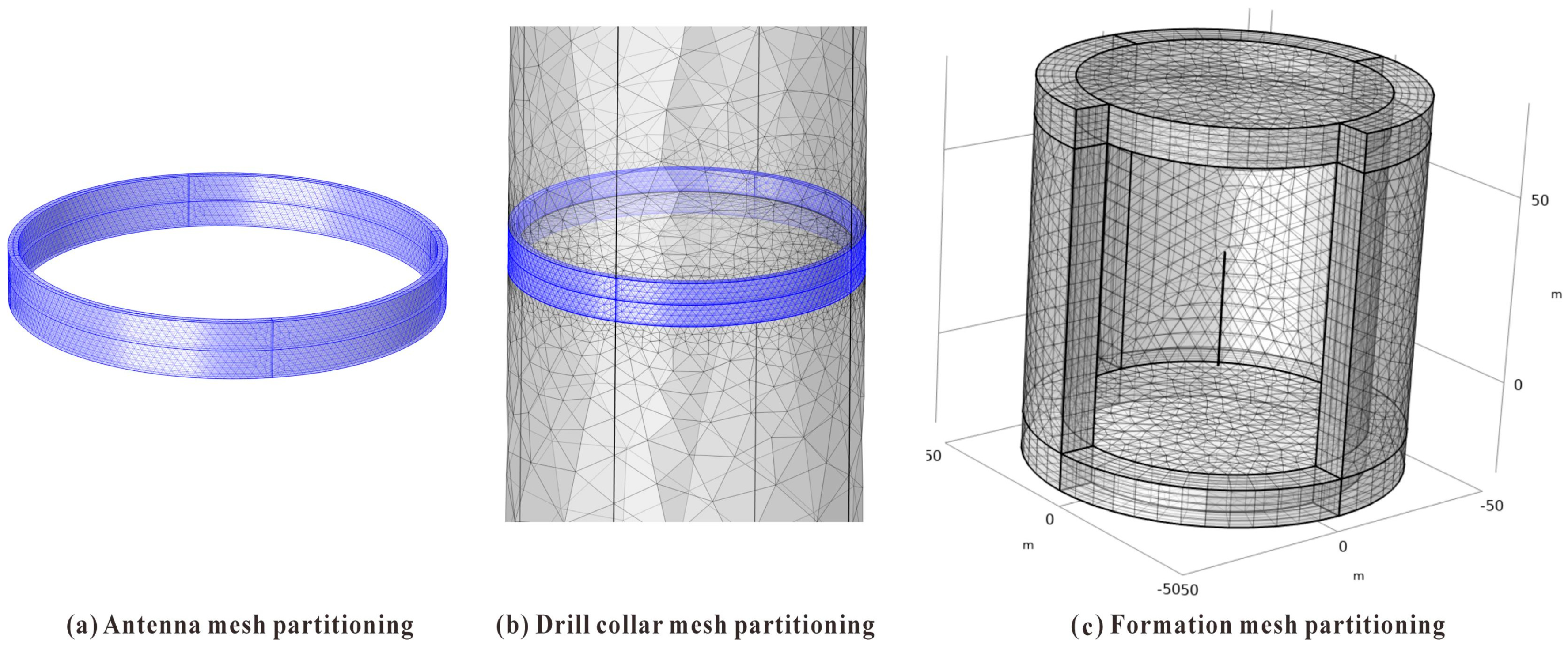
Following the above procedures, a multilevel mesh system was established for the transmitting antenna, receiving antenna, drill collar, and formation domains, achieving an effective compromise between local accuracy and overall computational efficiency. The final mesh configuration is shown in Figure 5, where localized refinement around the antennas and drill collar is effectively combined with coarse discretization in the outer formation, providing a high-quality spatial discretization for subsequent finite-element electromagnetic simulations.

3.4. Numerical Solution Accuracy Verification

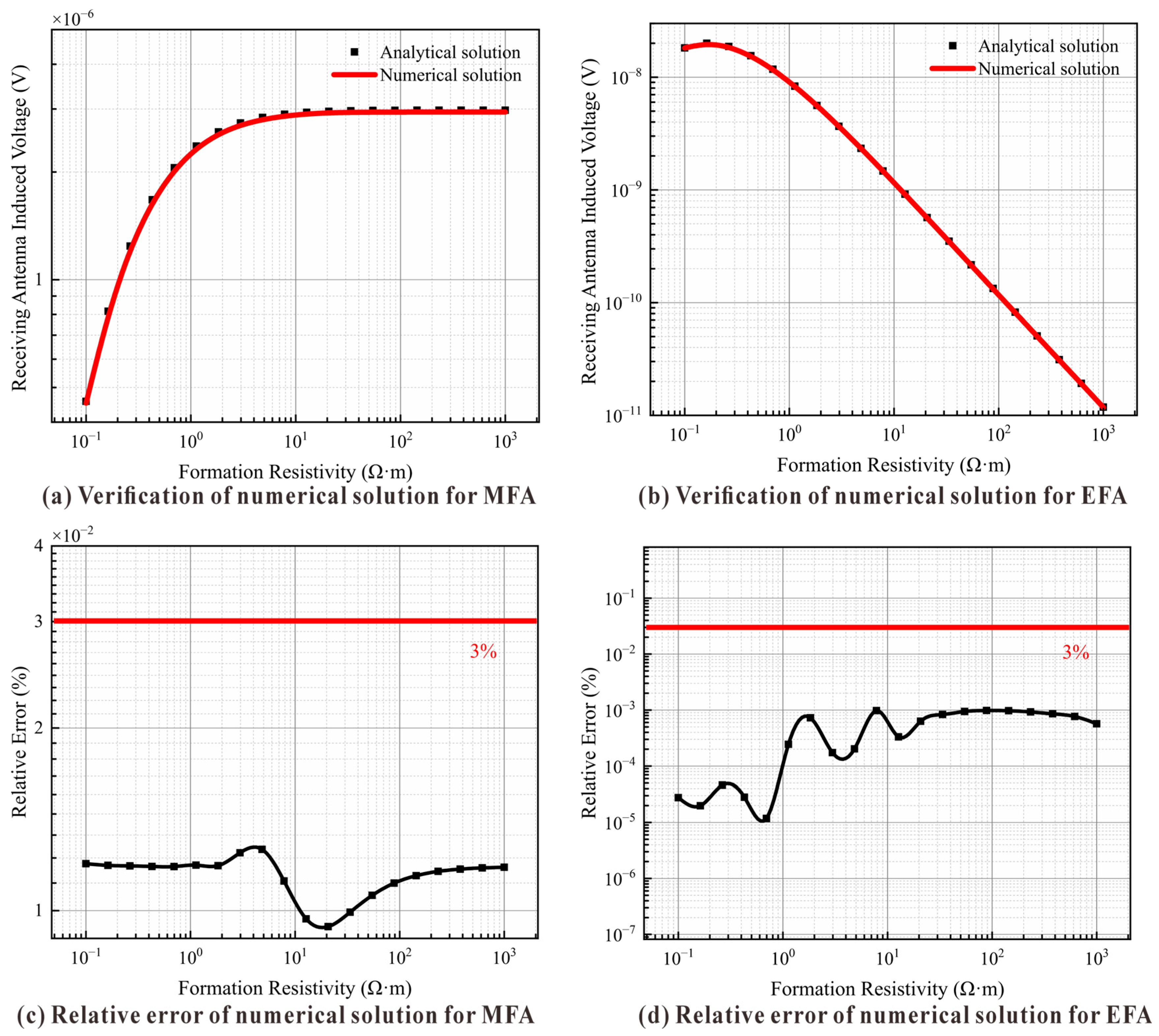
To validate the accuracy of the numerical calculation results, this study compared the finite element simulation results of two different antenna structures with the analytical solution under uniform stratum conditions. Only when the relative error between the numerical solution and the analytical solution was less than 3% could further analysis be conducted on the influence of different physical parameters on the received signal.
The analytical solution is derived based on the assumption of a homogeneous isotropic medium. Under this condition, the electromagnetic field satisfies the Helmholtz equation. By solving the magnetic potential equation in the frequency domain and incorporating the relationship between the electric field, magnetic field, and magnetic potential, an analytical expression for the electromagnetic response at the receiving antenna can be obtained, providing a reliable theoretical benchmark for electromagnetic field calculations. The numerical solution is based on a three-dimensional model constructed using the finite element method. During the verification phase, all medium parameters except the antenna conductivity are uniformly set to match the stratum’s conductivity, ensuring computational consistency with the assumptions of the analytical solution.
Figure 6a,b present the comparison results of the received voltage amplitude versus subsurface resistivity for MFA and EFA under identical conditions (frequency of 1500 Hz, transmitter-receiver separation of 15 m). Figure 6c,d further illustrate the relative error between numerical and analytical solutions for both antenna types under varying resistivity conditions, with both errors being less than 3%. It can be observed that the analytical and numerical solutions exhibit high consistency in both trend and magnitude, validating the reliability of the finite element modeling method and simulation results.

4. Numerical Results and Influencing-Factor Analysis

4.1. Numerical Simulation of MFA

4.1.1. Electromagnetic Field Distribution Characteristics of MFA

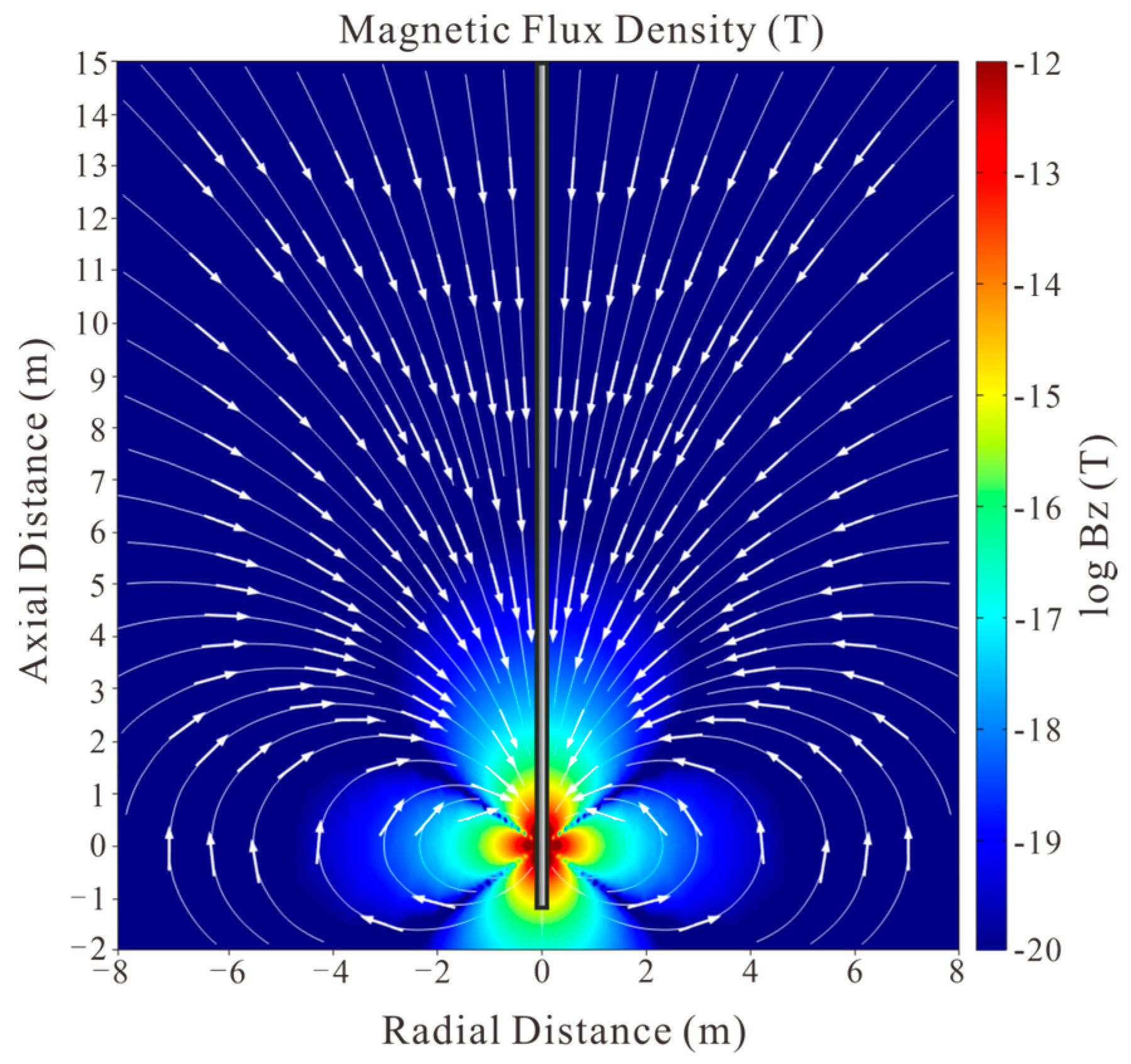
Figure 7 illustrates the spatial distribution of the axial magnetic flux density. B z generated by the magnetic-field antenna (MFA) under wireless short-range transmission conditions. The magnetic field exhibits a highly localized near-field pattern centered on the antenna position. The magnitude of B z reaches its maximum in the immediate vicinity of the source and decreases rapidly with increasing radial and axial distance. The magnetic flux lines form closed loops around the antenna axis and maintain a high degree of axial symmetry throughout the observation domain.
Although slight bending of the flux lines is observed near the drill collar surface, the overall field topology remains smooth and continuous, without pronounced distortion or asymmetry. This indicates that, under the considered conditions, the magnetic field generated by the MFA is spatially confined to the near-source region, with the drill collar primarily influencing the local field geometry rather than inducing large-scale redistribution.

4.1.2. Drill Collar Effect of MFA

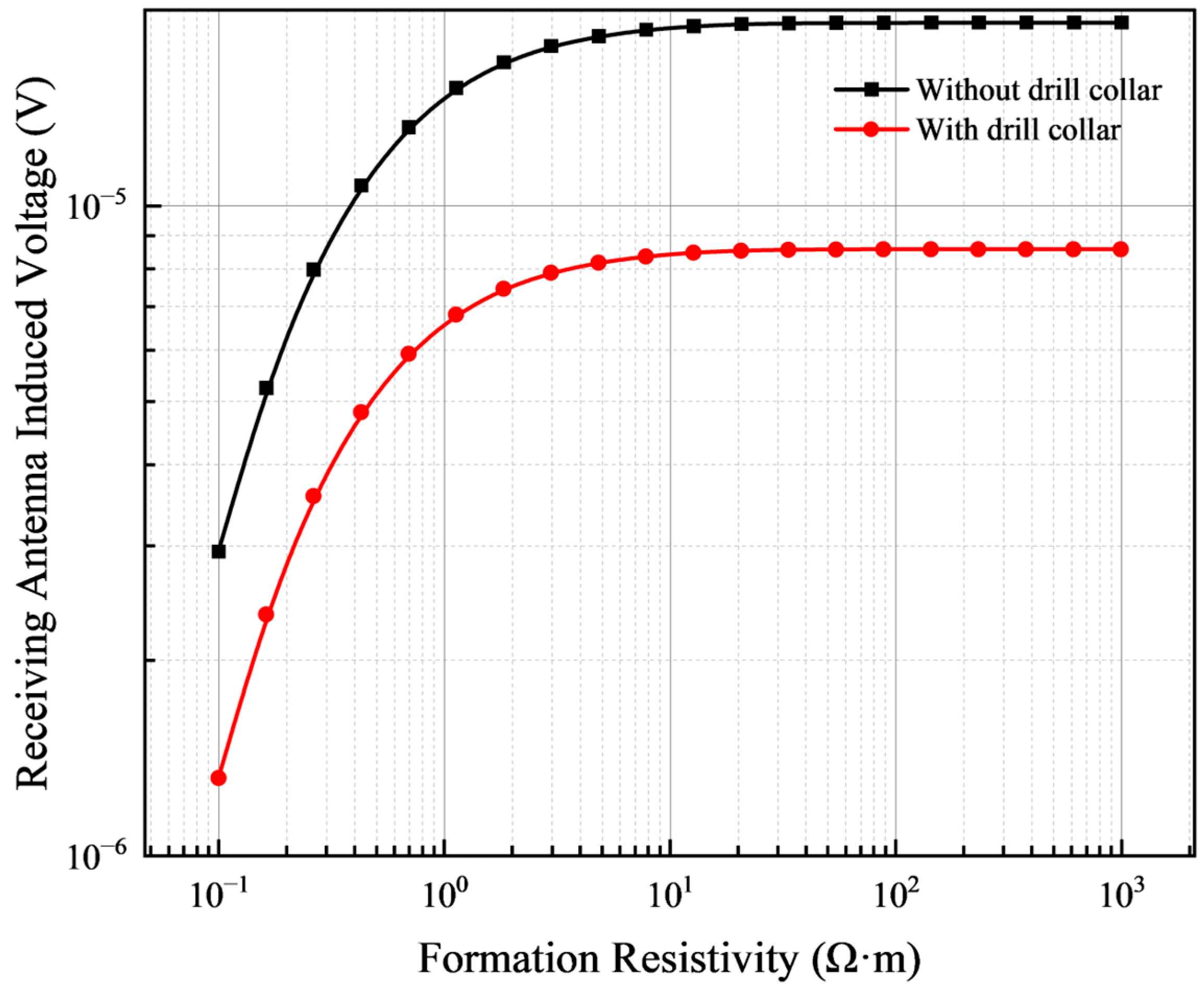
Figure 8 compares the received induced voltage of the MFA as a function of formation resistivity for cases with and without the drill collar at 1500 Hz and a 15 m transmitter–receiver spacing. Across the entire resistivity interval, the drill-collar case remains consistently below the collar-free case, demonstrating a persistent attenuation associated with the presence of the collar. Both curves exhibit the same macroscopic trend with formation resistivity: the induced voltage increases rapidly from low-resistivity formations and then transitions into a gradually varying regime that approaches an approximately stable level at higher resistivity. The introduction of the drill collar therefore manifests primarily as a systematic reduction in the received-voltage level rather than a change in the resistivity-dependent trend. In addition, the separation between the two curves is maintained throughout the investigated range, indicating that the attenuation effect is robust and does not vanish at either the low- or high-resistivity end. Overall, the MFA response retains its monotonic increase and saturation-type behavior with formation resistivity, while the drill collar imposes a uniform downward shift in amplitude under otherwise identical conditions.

4.1.3. Mud Resistivity Response of MFA

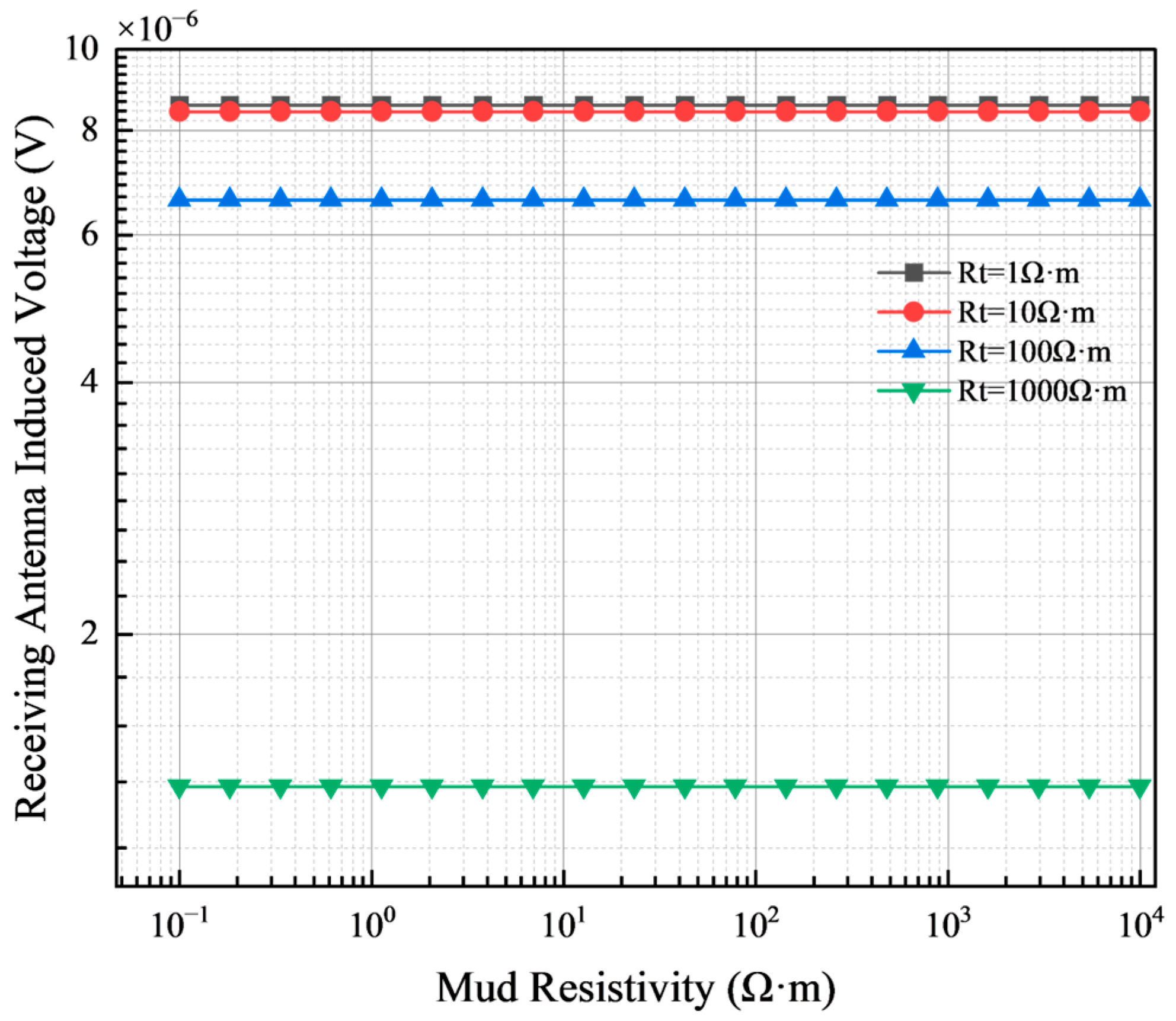
Figure 9 shows the received induced-voltage amplitude of the MFA as a function of mud resistivity R m under four formation-resistivity backgrounds ( R t = 1 , 10 , 100 , and 1000 Ω·m). Over the investigated R m range, the MFA response varies only weakly with mud resistivity: the curves remain nearly flat and exhibit no distinct monotonic increase/decrease over the full sweep. For each R t , the voltage fluctuations associated with changing R m are small, and no abrupt transition or threshold-like behavior is observed. By comparison, the separation among the curves corresponding to different R t is much more pronounced than the intra-curve variation caused by R m , indicating that formation resistivity controls the dominant amplitude level, whereas mud resistivity introduces only minor modulation under the present operating settings.

4.2. Numerical Simulation of EFA

4.2.1. Electromagnetic Field Distribution Characteristics of EFA

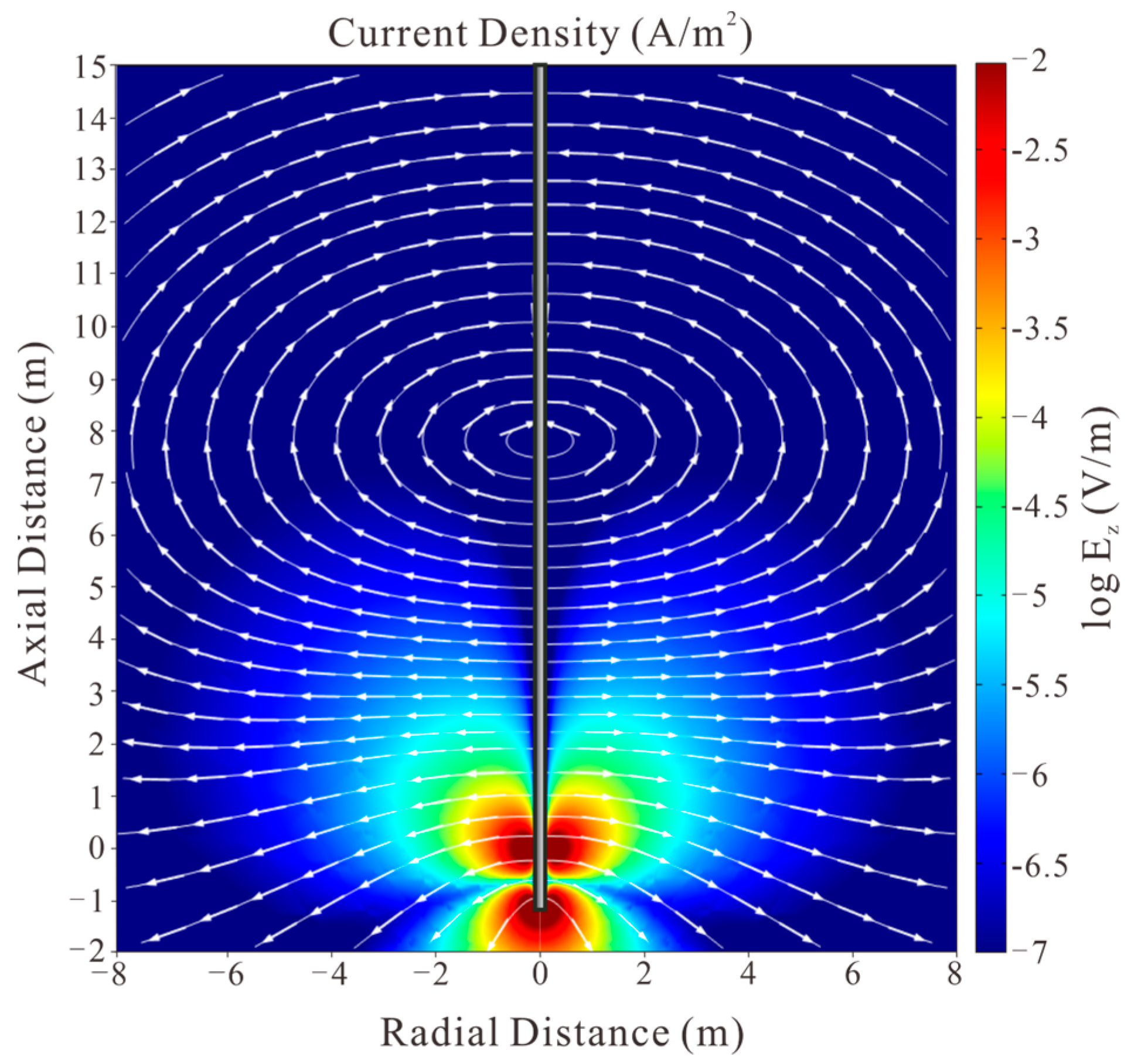
Figure 10 presents the spatial distributions of the axial electric field component E Z and the induced conduction current density J associated with the electric-field antenna (EFA). In contrast to the MFA, the electromagnetic response of the EFA is characterized by the development of extended current pathways along conductive structures. The induced electric field and current density reach their maximum near the transmitting antenna and remain significant over a longer axial distance. The current streamlines indicate that induced currents propagate not only radially into the surrounding formation through the drilling fluid, but also axially along the drill collar toward the drill bit. This results in continuous current channels aligned with the tool axis. The spatial extent and continuity of these current pathways demonstrate that the electromagnetic response of the EFA is not confined to the immediate vicinity of the antenna, but instead spans a larger region controlled by the conductive environment.

4.2.2. Drill Collar Effect of EFA

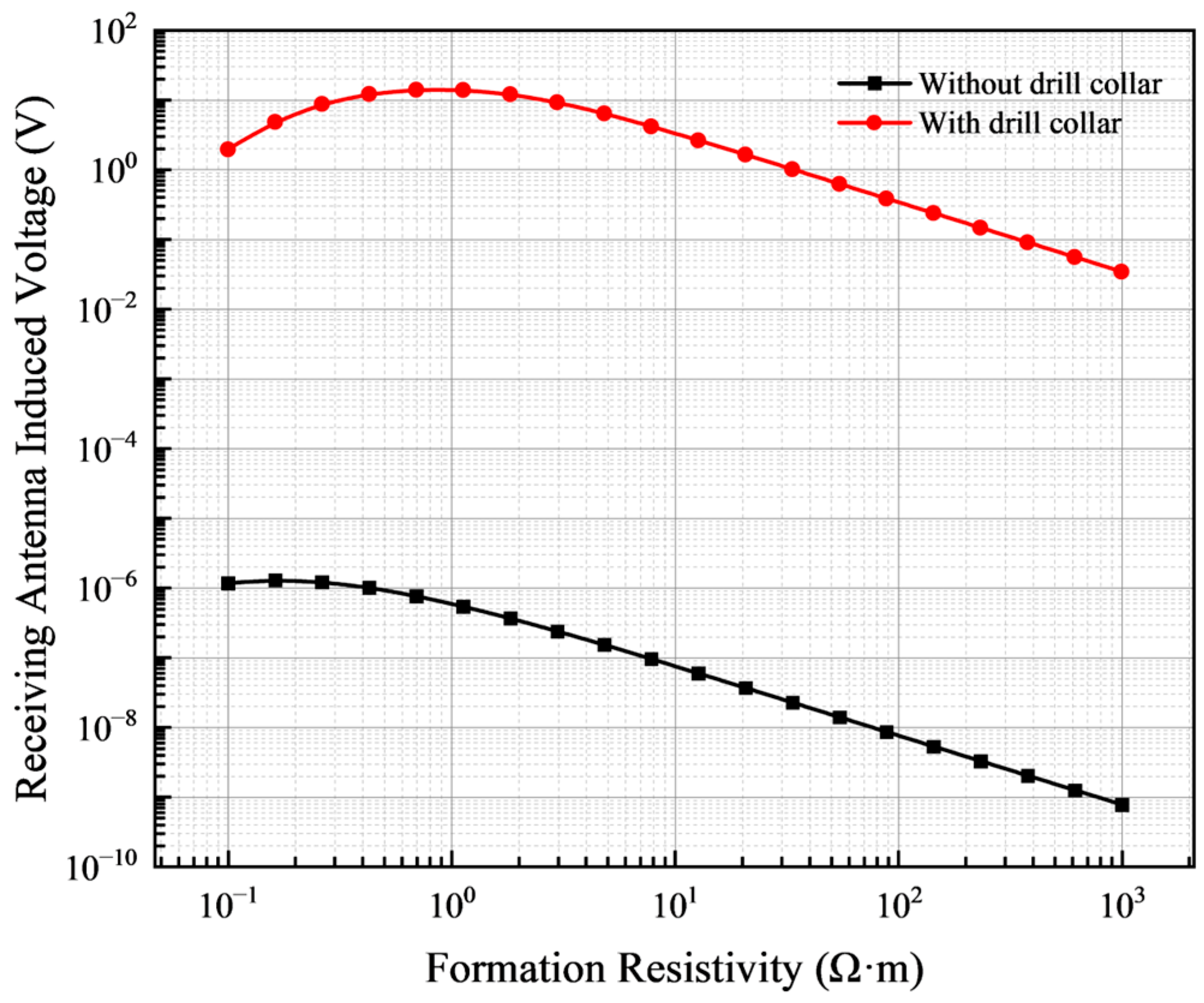
Figure 11 presents the corresponding comparison for the EFA under the same operating conditions (1500 Hz, 15 m), showing received induced voltage versus formation resistivity with and without the drill collar. In clear contrast to the MFA results, the drill-collar case yields a substantially higher received voltage than the collar-free case over the full resistivity range, indicating that the drill collar produces a stable enhancement of the EFA signal level. Despite this pronounced offset, the two curves follow a similar resistivity-dependent variation, suggesting that formation resistivity continues to modulate the EFA response in both configurations. The presence of the drill collar is reflected mainly by an upward shift in the voltage level that persists throughout the investigated interval, rather than by a change in curve shape or a reversal of the resistivity trend. Notably, within the collar-free configuration, the received voltage decreases progressively as formation resistivity increases, whereas the drill-collar configuration maintains a much higher signal level across the same resistivity sweep; consequently, the collar-induced enhancement remains evident even when the formation resistivity becomes high. These results demonstrate that, under identical geometry and excitation settings, adding the drill collar consistently elevates the EFA received voltage and dominates the absolute signal level across the formation-resistivity range considered.

4.2.3. Mud Resistivity Response of EFA

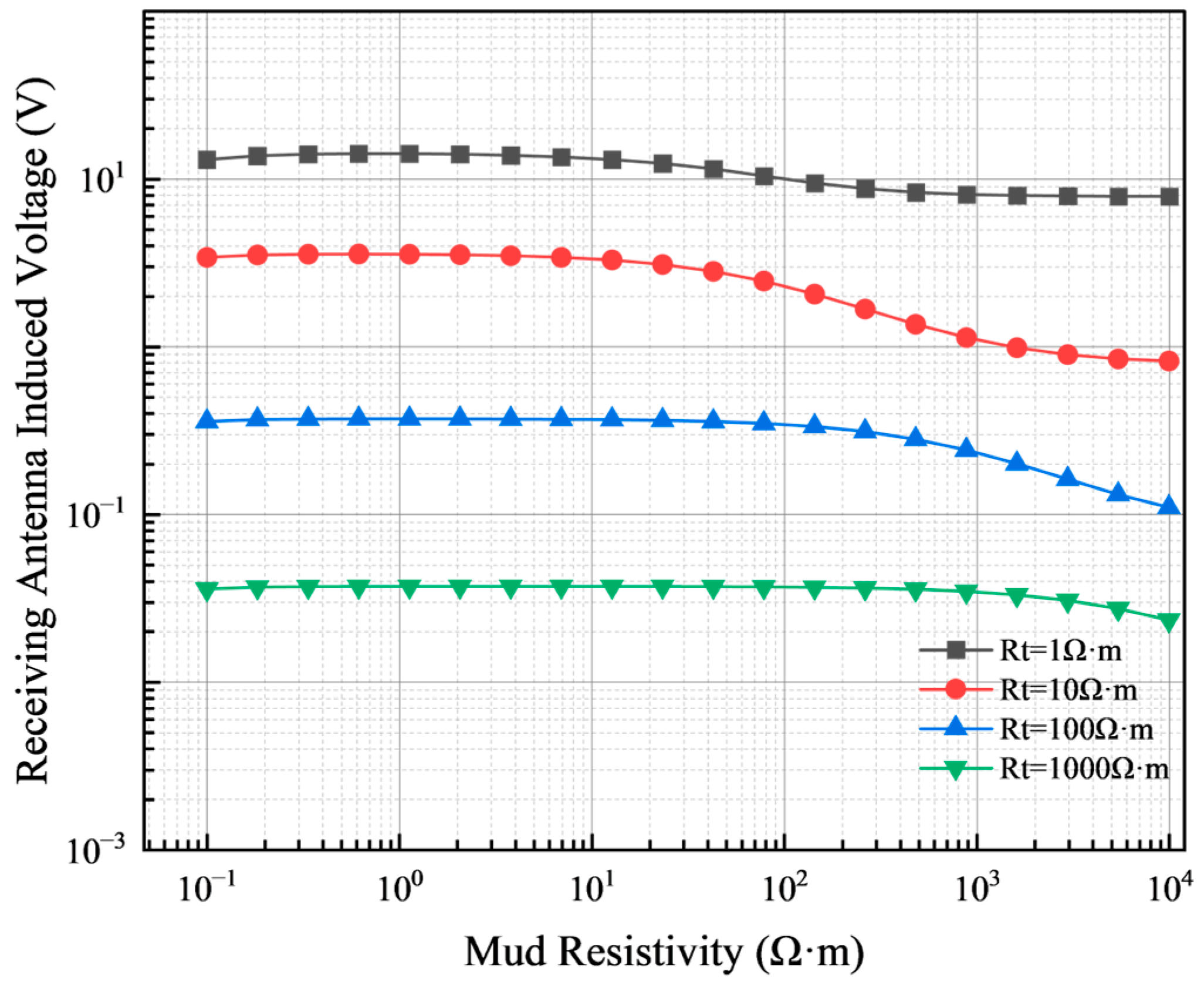
Figure 12 presents the EFA received induced voltage versus mud resistivity under the same set of formation-resistivity conditions. Unlike the MFA, the EFA exhibits a clear and systematic dependence on R m . The received voltage is highest in low-resistivity mud and decreases as mud resistivity increases. The decreasing trend persists across all formation-resistivity cases, and the reduction becomes more pronounced toward the high- R m (oil-based mud) end of the range, where the received voltages drop markedly for all R t . Despite differences in absolute levels between formation-resistivity cases, the overall trend with R m is consistent, indicating that mud resistivity acts as a strong controlling variable for the EFA response over the investigated conditions.

5. Discussion

5.1. Differences in Electromagnetic Field Distribution Between MFA and EFA

The above results reveal that MFA and EFA exhibit fundamentally different electromagnetic field structures under wireless short-range transmission conditions. These differences are not merely quantitative, but originate from distinct excitation mechanisms and dominant energy-transfer pathways.
The MFA produces a magnetic-field-dominated response characterized by localized, closed magnetic flux loops concentrated near the antenna. Energy transfer is primarily confined to the near-field region, making the resulting field distribution inherently compact and sensitive to conductive shielding effects. In contrast, the EFA establishes its response through conduction-dominated mechanisms, forming large-scale induced current loops that extend along the drill collar and into the surrounding formation. This enables energy transport over longer axial distances and results in stronger spatial continuity.
From a structural perspective, the MFA corresponds to a circumferentially induced magnetic-flux system, whereas the EFA corresponds to an axially guided conduction-current system. These two modes represent approximately orthogonal electromagnetic coupling topologies. This intrinsic difference explains the contrasting sensitivities of the two antenna types to drill collar conductivity and mud resistivity, and constitutes the physical basis for their markedly different transmission performance in near-bit across-motor applications.

5.2. Differential Influence of Drill Collar Effect on MFA and EFA

Numerical simulation results demonstrate that the metal drill collar exhibits fundamentally different interaction mechanisms with MFA and EFA.
For the MFA, the transmitting coil primarily establishes an induction-dominated near field. When a highly conductive drill collar surrounds the source region, the time-varying magnetic field drives strong circumferential eddy currents in the collar. These induced currents generate an opposing magnetic field (Lenz’s law) and introduce ohmic dissipation, which reduces the effective magnetic-field penetration into the surrounding media and weakens the mutual coupling between the transmitter and receiver. This mechanism explains the uniform amplitude suppression observed for MFA while preserving the overall trend with formation resistivity.
For the EFA, signal transfer is governed by conduction-assisted coupling. The drill collar serves as a low-resistance axial conductor that supports the formation of a larger-scale closed current loop involving the collar, mud, and formation. Incorporating the drill collar therefore reduces the effective loop resistance and increases the conduction current available for coupling, resulting in a pronounced increase in received voltage. In this case, the collar is not a shielding element but an essential part of the effective transmission path.
Overall, the metallic drill collar acts as an eddy-current shielding and loss channel for the MFA, but serves as a high-conductivity transport/return path for the EFA. Under identical operating conditions, this contrast leads to a systematic separation in received voltage levels, with the EFA delivering amplitudes on the order of 10 3 10 5 times those of the MFA in this study.

5.3. The Differential Effect of Mud Resistivity on MFA and EFA

The contrasting trends in Figure 9 and Figure 12 arise from the different coupling topologies of the two antenna types. For the MFA, signal formation is dominated by inductive coupling in which the received voltage is governed mainly by the magnetic-field variation linked to the transmitter–receiver geometry and the surrounding conductive structures; within this framework, changing mud resistivity modifies only a limited local portion of the current/field distribution in the borehole, so the net effect on the induced-voltage magnitude remains weak. In contrast, the EFA relies on a conduction-assisted coupling path in which the drill collar, mud, and formation jointly constitute the effective return path for induced currents; mud resistivity therefore directly sets the loop impedance and the degree of current closure. Low- R m mud facilitates stronger loop currents and higher received voltages, whereas high- R m mud increases the effective impedance and disrupts current continuity, leading to substantial attenuation. From an engineering standpoint, this implies that MFA-based short-range transmission is comparatively tolerant to mud-property variability, making it preferable when drilling-fluid resistivity is uncertain or difficult to control. EFA-based transmission is advantageous in water-based or otherwise medium-to-low resistivity mud systems where conductive closure is maintained, but its performance can degrade sharply in high-resistivity oil-based mud, requiring case-specific evaluation and, where possible, mitigation at the system level (e.g., configuration choices that preserve conductive coupling).

6. Conclusions

In this study, wireless short-range transmission under near-bit conditions was investigated using a three-dimensional finite-element electromagnetic model incorporating the antenna, drill collar, drilling fluid, and formation. The electromagnetic field distributions of MFA and EFA were compared, and the influences of drill-collar conductivity and mud resistivity on transmission performance were quantitatively evaluated. The results indicate the following:
MFA and EFA exhibit markedly different and approximately “orthogonal” spatial distributions in terms of their dominant field components and energy transmission paths. MFA primarily achieves energy coupling through localized circumferential magnetic-flux loops, showing typical near-field inductive behavior with electromagnetic energy highly concentrated in the vicinity of the source. In contrast, EFA relies on induced current channels extending along the drill collar axis for signal transmission, resulting in electromagnetic fields with stronger axial directivity and greater continuity over longer distances.
For MFA, the drill collar mainly acts as an electromagnetic shielding and energy-dissipating medium, suppressing long-range magnetic-field propagation. For EFA, the drill collar functions as a highly conductive transmission path participating directly in the signal-coupling process, leading to a pronounced relay-type signal enhancement. Under identical operating conditions, the received signal amplitude of EFA can be 10 3 ~ 10 5 times greater than that of MFA due to the substantial contribution of the drill collar to the current loop.
The received signal of MFA shows weak sensitivity to variations in drilling-fluid resistivity, indicating strong environmental robustness. In contrast, EFA strongly depend on the conductive loop system; they exhibit significant performance advantages in medium- to low-resistivity (water-based) drilling fluids, while experiencing severe signal attenuation in high-resistivity (oil-based) drilling fluids.
This study is currently based on numerical simulation, and has not yet carried out laboratory physical tests and field drilling verification. Therefore, the conclusion mainly reflects the qualitative law and relative comparison trend of the electromagnetic response of the two types of antennas under the cross-screw working conditions. The engineering verifiability in the complex real downhole environment needs to be further strengthened. To improve the credibility of the results, this paper reduces the influence of discrete error and boundary reflection on the calculation results through the comparison of “numerical solution–analytical solution” (relative error controlled within 3%) and the measures such as partition progressive grid encryption and absorption boundary conditions to ensure the convergence and repeatability of the simulation results. In the future, we will supplement the physical test data of the laboratory platform and the field drilling verification data, and gradually build a complete verification closed loop of “theoretical derivation–numerical simulation–physical test–field verification” to enhance the engineering applicability of the model and the generalizability of the conclusions.

Author Contributions

3D Model Construction, W.C. and D.C.; funding acquisition, F.T.; project administration, J.L., A.Z. and W.Z.; engineering parameters, F.T.; writing—original draft, W.C.; writing—review and editing, F.T. and Q.D. All authors have read and agreed to the published version of the manuscript.

Funding

This research was funded by the Chinese National Key Research and Development Program, grant no. 2023YFB3905005 and the Youth Innovation Promotion Association Foundation of the Chinese Academy of Sciences (2021063). The APC was funded by the Institute of Geology and Geophysics, Chinese Academy of Sciences.

Institutional Review Board Statement

Not applicable.

Informed Consent Statement

Not applicable.

Data Availability Statement

The datasets generated during and/or analyzed during the current study are available from the corresponding author upon reasonable request.

Conflicts of Interest

No conflicts of interest exist in the submission of this manuscript, and the manuscript is approved by all authors for publication.

Abbreviations

The abbreviations used in this article are summarized in the table below:
MFAMagnetic-field Antennas
EFAElectric-field Antennas
MWDMeasurement While Drilling
LWDLogging While Drilling
BHABottom Hole Assembly
NMMNumerical Mode-Matching
ABCAbsorbing Boundary Conditions

References

  1. Lin, W. A Review on Shale Reservoirs as an Unconventional Play—The History, Technology Revolution, Importance to Oil and Gas Industry, and the Development Future. Acta Geol. Sin.-Engl. Ed. 2016, 90, 1887–1902. [Google Scholar] [CrossRef]
  2. Abdulhadi, D.; Ali, J.A.; Hama, S.M. Advanced Techniques for Improving the Production of Natural Resources from Unconventional Reservoirs: A State-of-the-Art Review. Energy Fuels 2025, 39, 10853–10876. [Google Scholar] [CrossRef]
  3. Tian, F.; Di, Q.; Zheng, W.; Ge, X.; Zhang, W.; Zhang, J.; Yang, C. A Formation Intelligent Evaluation Solution for Geosteering. Chin. J. Geophys. 2023, 66, 3975–3989. [Google Scholar]
  4. Chen, D.C.-K.; Comeaux, B.; Gillespie, G.; Irvine, G.; Wiecek, B. Real-Time Downhole Torsional Vibration Monitor for Improving Tool Performance and Bit Design. In Proceedings of the IADC/SPE Drilling Conference, Miami, FL, USA, 21–23 February 2006; SPE: Richardson, TX, USA, 2006. [Google Scholar]
  5. Klyuchnikov, N.; Zaytsev, A.; Gruzdev, A.; Ovchinnikov, G.; Antipova, K.; Ismailova, L.; Muravleva, E.; Burnaev, E.; Semenikhin, A.; Cherepanov, A.; et al. Data-Driven Model for the Identification of the Rock Type at a Drilling Bit. J. Pet. Sci. Eng. 2019, 178, 506–516. [Google Scholar] [CrossRef]
  6. Wheeler, A.J.; Billings, T.; Rennie, A.; Lee, R.; Little, R.; Huiszoon, C.; Boonen, P. The Introduction of An At-Bit Natural Gamma Ray Imaging Tool Reduces Risk Associated With Real-Time Geosteering Decisions In Coalbed Methane Horizontal Wells. In Proceedings of the SPWLA 53rd Annual Logging Symposium, Cartagena, Colombia, 16–20 June 2012. [Google Scholar]
  7. Flook, R.; Alexander, W.; List, D.; Sencenbaugh, B.; Enoch, B.; Wheeler, A.J.; Starkey, A.; Rennie, A. At-Bit Inclination, Gamma, and Imaging System Tracks Productive Zone in Complex Geology. J. Pet. Technol. 2013, 65, 30–32. [Google Scholar] [CrossRef]
  8. Pitcher, J.; Schafer, D.; Botterell, P. A New Azimuthal Gamma at Bit Imaging Tool for Geosteering Thin Reservoirs. In Proceedings of the SPE/IADC Drilling Conference and Exhibition, Amsterdam, The Netherlands, 17–19 March 2009; SPE: Richardson, TX, USA, 2009. [Google Scholar]
  9. Helgesen, T.B.; Fulda, C.; Meyer, W.H.; Thorsen, A.K.; Iversen, M. Reservoir Navigation with an Extra Deep Resistivity LWD Service. In Proceedings of the SPWLA 46th Annual Logging Symposium, New Orleans, LA, USA, 26–29 June 2005. [Google Scholar]
  10. Skillingstad, T. At-Bit Inclination Measurements Improves Directional Drilling Efficiency and Control. In Proceedings of the IADC/SPE Drilling Conference, New Orleans, LA, USA, 23–25 February 2000; SPE: Richardson, TX, USA, 2000. [Google Scholar]
  11. Zhang, C.H.; Meng, G.Y.; Liu, G.H.; Sheng, L.M.; Huang, Y.F. Introduction of Near-Bit Geosteering Drilling Technology and Instrument Application in Thin Oil Exploration. Adv. Mat. Res. 2011, 228–229, 889–893. [Google Scholar] [CrossRef]
  12. Gao, W.; Sheng, L.; Dou, X.; Zhang, L.; Su, Y.; Wang, J.; Deng, L.; Li, L. CGDS Near-Bit Geosteering Drilling System and Its Application in China. In Proceedings of the SPE/IATMI Asia Pacific Oil & Gas Conference and Exhibition, Nusa Dua, Bali, Indonesia, 20–22 October 2015; SPE: Richardson, TX, USA, 2015. [Google Scholar]
  13. Jones, S.; Sugiura, J. A Step Change in Real-Time Near-Bit Measurements from an Instrumented Downhole Drilling Motor Improves Directional Drilling Accuracy and Geo Steering Capability. In Proceedings of the SPE Annual Technical Conference and Exhibition, Virtual, 26–29 October 2020; SPE: Richardson, TX, USA, 2020. [Google Scholar]
  14. Landar, S.; Velychkovych, A.; Ropyak, L.; Andrusyak, A. A Method for Applying the Use of a Smart 4 Controller for the Assessment of Drill String Bottom-Part Vibrations and Shock Loads. Vibration 2024, 7, 802–828. [Google Scholar] [CrossRef]
  15. Landar, S.; Velychkovych, A.; Vytvytskyi, V.; Ropyak, L. Threshold Vibration Metrics of Drilling Tools as Indicators of Bit Wear and Rate of Penetration Decline: Field Trials and Data Interpretation. Min. Miner. Depos. 2025, 19, 147–157. [Google Scholar] [CrossRef]
  16. Malekizadeh, A.; Afarideh, H.; Sahraeian, M.; Esmaeili Sani, V.; Mohamadian, M. A Precise Method to Improve the Mechanical Properties of the Mud Pulse Telemetry in Order to Manufacture a Positive Mud Pulse Telemetry System. Arab. J. Sci. Eng. 2021, 46, 7047–7056. [Google Scholar] [CrossRef]
  17. Mwachaka, S.M.; Wu, A.; Fu, Q. A Review of Mud Pulse Telemetry Signal Impairments Modeling and Suppression Methods. J. Pet. Explor. Prod. Technol. 2019, 9, 779–792. [Google Scholar] [CrossRef]
  18. Gutierrez-Estevez, M.A.; Krueger, U.; Krueger, K.A.; Manolakis, K.; Jungnickel, V.; Jaksch, K.; Krueger, K.; Mikulla, S.; Giese, R.; Sohmer, M.; et al. Acoustic Broadband Communications over Deep Drill Strings Using Adaptive OFDM. In Proceedings of the 2013 IEEE Wireless Communications and Networking Conference (WCNC), Shanghai, China, 7–10 April 2013; IEEE: New York, NY, USA, 2013; pp. 4089–4094. [Google Scholar]
  19. Djikpesse, H.; Armstrong, P.; Rufino, R.; Hawthorn, A. Reducing Uncertainty With Seismic Measurements While Drilling. IEEE Trans. Instrum. Meas. 2010, 59, 4–14. [Google Scholar] [CrossRef]
  20. Meyer, W.H.; Wu, J.-Q.; Macune, D.T.; Harvey, P.R. Near-Bit Propagation Resistivity for Reservoir Navigation. In Proceedings of the SPE Annual Technical Conference and Exhibition, New Orleans, LA, USA, 25–28 September 1994; SPE: Richardson, TX, USA, 1994. [Google Scholar]
  21. Chu, Z.; Li, Q.; Fang, X.; Chen, L.; Wang, Y.; Zhang, J.; Yan, W. Numerical Simulation of Bluetooth Signal Short-Hop for the Measurement While Drilling near-Bit. Sci. Rep. 2025, 15, 20015. [Google Scholar] [CrossRef] [PubMed]
  22. Guoyun, G.; Yongpin, C.; Xiangyang, S.; Zaiping, N. A Temperature-Drift-Free Design for near-Bit Azimuthal Resistivity Tool. In Proceedings of the 2019 14th IEEE International Conference on Electronic Measurement & Instruments (ICEMI), Changsha, China, 1–3 November 2019; IEEE: New York, NY, USA, 2019; pp. 719–724. [Google Scholar]
  23. Gibson, W.C. The Method of Moments in Electromagnetics; CRC Press: Boca Raton, FL, USA, 2021; ISBN 9780429355509. [Google Scholar]
  24. Kaufman, A.; Itskovich, G. Basic Principles of Induction Logging: Electromagnetic Methods in Borehole Geophysics; Elsevier: Amsterdam, The Netherlands, 2017; ISBN 9780128025833. [Google Scholar]
  25. Liu, C.R. Theory of Electromagnetic Well Logging; Elsevier: Amsterdam, The Netherlands, 2017; ISBN 9780128040089. [Google Scholar]
  26. Zeng, S.; Li, D.; Wilton, D.R.; Chen, J. Efficient Simulation of Electromagnetic Telemetry Using Thin Wire Kernel and Layered Media Green’s Function. In Proceedings of the 2017 IEEE International Symposium on Antennas and Propagation & USNC/URSI National Radio Science Meeting, San Diego, CA, USA, 9–14 July 2017; IEEE: New York, NY, USA, 2017; pp. 1359–1360. [Google Scholar]
  27. Wu, J.; Zhu, Y.; Liu, L. Parameter Optimization Design of Near-Bit Electromagnetic Wave Antenna System. In Proceedings of the 2022 4th International Conference on Intelligent Control, Measurement and Signal Processing (ICMSP), Hangzhou, China, 8–10 July 2022; IEEE: New York, NY, USA, 2022; pp. 469–472. [Google Scholar]
  28. Saputera, D.H.; Jakobsen, M.; van Dongen, K.W.A.; Jahani, N.; Eikrem, K.S.; Alyaev, S. 3-D Induction Log Modelling with Integral Equation Method and Domain Decomposition Pre-Conditioning. Geophys. J. Int. 2023, 236, 834–848. [Google Scholar] [CrossRef]
  29. Jiang, T.; Ma, K.; Li, H.; Chen, Q.; Han, X.; Pang, D.; Wang, Q. Research on Wireless Transmission Performance of Near-Drill Magnetic Field. In Proceedings of the 2020 IEEE 1st China International Youth Conference on Electrical Engineering (CIYCEE), Wuhan, China, 1–4 November 2020; IEEE: New York, NY, USA, 2020; pp. 1–5. [Google Scholar]
  30. Li, Z.; Lin, J. Theoretical Transmission Model of Helical Loop Antenna in Cased Wells and Channel Characteristics Analysis. Appl. Sci. 2024, 14, 6060. [Google Scholar] [CrossRef]
  31. Li, W.; Nie, Z.; Sun, X.; Chen, Y. Numerical Modeling for Excitation and Coupling Transmission of Near Field Around the Metal Drilling Pipe in Lossy Formation. IEEE Trans. Geosci. Remote Sens. 2014, 52, 3862–3871. [Google Scholar] [CrossRef]
  32. Liu, R.; Zhang, W.; Chen, W.; Liang, P.; Liu, W.; Li, X. Analysis and Experimental Research on the Factors Affecting Downhole Inductive Electromagnetic Wave Wireless Short-Hop Transmission. IEEE Trans. Geosci. Remote Sens. 2024, 62, 5915011. [Google Scholar] [CrossRef]
  33. Lovell, J.R. Finite Element Methods in Resistivity Logging. Ph.D. Thesis, Technische Universiteit Delft, Delft, The Netherlands, 1993. [Google Scholar]
  34. Deng, L.; Yin, J.; He, Q.; Cao, X.; Zhang, C.; Cui, J.; Li, B. An Efficient Three-Dimensional Mesh Quality Optimization Method Based on Gradient-Enhanced Probabilistic Model. Comput. Phys. Commun. 2025, 312, 109602. [Google Scholar] [CrossRef]
  35. Dorica, M.; Giannacopoulos, D.D. Toward Optimal Mesh Quality Improvements for Adaptive Finite Element Electromagnetics with Tetrahedra. IEEE Trans. Magn. 2004, 40, 989–992. [Google Scholar] [CrossRef]
Figure 1. Schematic diagram of electromagnetic wave for wireless short-range transmission. The Bottom Hole Assembly (BHA) consists of the drill bit, a transmitting short sub, a downhole motor, a receiving short sub, and the MWD tool located uphole. Sensors integrated in the transmitting short sub acquire near-bit geological and engineering data, which are encoded and transmitted wirelessly by the transmitting antenna across the motor section. The signal is received by the antenna in the receiving short sub, decoded, and then relayed to the uphole MWD system, enabling real-time wireless data transfer from the near-bit region.
Applsci 16 01519 g001
Figure 2. Schematic illustration of the electromagnetic induction principles of MFA and EFA. (a) MFA, in which the excitation is dominated by an alternating magnetic field, while the received voltage is induced by the associated electric field integrated along the receiving coil; (b) EFA, in which the excitation is dominated by an electric field and conduction currents, while the received voltage is determined from the magnetic field generated by the induced currents.
Applsci 16 01519 g002
Figure 3. Physical configurations and equivalent source representations of MFA and EFA. (a) Physical structure of the MFA, consisting of an axially wound multi-turn induction coil. (b) Equivalent schematic representation of the MFA, modeled as a circular electric current loop. (c) Physical structure of the EFA, realized by a multi-turn winding on a toroidal magnetic core. (d) Equivalent schematic representation of the EFA, modeled as an equivalent magnetic current loop.
Applsci 16 01519 g003
Figure 4. Uniform Isotropic Formation Model. The transmitting antenna and receiving antenna are mounted on the drill collar and separated by an insulating section to form an electrically isolated gap. The insulating materials interrupt the axial electrical continuity of the drill collar, enabling the excitation and reception of electromagnetic signals. The surrounding mud layer and formation provide the conductive medium for electromagnetic coupling, allowing wireless signal transmission between the transmitting and receiving antennas across the motor section.
Applsci 16 01519 g004
Figure 5. Model mesh partitioning. (a) refined mesh applied to the transmitting and receiving antennas to accurately capture localized electromagnetic field variations; (b) structured mesh refinement in the drill collar region to ensure smooth and continuous field representation along the conductive metallic boundary; (c) adaptively coarsened tetrahedral mesh in the formation domain, with mesh density gradually decreasing outward to balance computational accuracy and efficiency.
Applsci 16 01519 g005
Figure 6. Accuracy verification of finite-element numerical solutions against analytical solutions in a homogeneous formation. (a) The voltage of the magnetic-field antenna (MFA) as a function of formation resistivity, showing that the numerical solution reproduces the monotonic increase and saturation behavior predicted by the analytical solution. (b) The voltage of the electric-field antenna (EFA) as a function of formation resistivity, where the numerical results accurately capture the monotonic attenuation trend with increasing resistivity. (c) The relative error of the MFA numerical solution with respect to the analytical solution, remaining within 3% over the entire resistivity range and exhibiting weak dependence on formation resistivity. (d) The relative error of the EFA numerical solution with respect to the analytical solution, also confined below 3%, with slightly larger fluctuations at intermediate resistivities but no systematic bias.
Applsci 16 01519 g006
Figure 7. Spatial distribution of the electromagnetic field generated by the MFA. The horizontal axis represents the radial distance, and the vertical axis denotes the axial distance. The streamlines indicate the distribution and direction of magnetic flux density, while the color map represents the magnitude of the magnetic induction intensity. The field distribution is shown within a radial range of −8 to 8 m and an axial range of −2 to 15 m, illustrating the characteristic near-field behavior of the magnetic-field antenna, with magnetic energy strongly concentrated around the source region.
Applsci 16 01519 g007
Figure 8. Effect of drill collar on MFA response characteristics. The horizontal axis represents the formation resistivity, and the vertical axis denotes the induced voltage at the receiving antenna.
Applsci 16 01519 g008
Figure 9. Effect of mud resistivity on the response characteristics of MFA. The horizontal axis represents the mud resistivity, while the vertical axis denotes the induced voltage at the receiving antenna. The curves correspond to formation resistivities of 1, 10, 100, and 1000 Ω·m, respectively.
Applsci 16 01519 g009
Figure 10. Spatial distribution of the electromagnetic field generated by the EFA. The horizontal axis represents the radial distance, and the vertical axis denotes the axial distance. The streamlines illustrate the direction and topology of the induced conduction current, while the color map indicates the magnitude of the current density. The distribution is shown within a radial range of −8 to 8 m and an axial range of −2 to 15 m. The results reveal the formation of extended axial current channels along the conductive structure, with strong current concentration near the source region and a continuous current pathway developing along the drill-collar axis, highlighting the characteristic conduction-dominated transmission mechanism of the electric-field antenna.
Applsci 16 01519 g010
Figure 11. Effect of drill collar on EFA response characteristics. The horizontal axis represents the formation resistivity, and the vertical axis denotes the induced voltage at the receiving antenna.
Applsci 16 01519 g011
Figure 12. Effect of mud resistivity on the response characteristics of EFA. The horizontal axis represents the mud resistivity, while the vertical axis denotes the induced voltage at the receiving antenna. The curves correspond to formation resistivities of 1, 10, 100, and 1000 Ω·m, respectively.
Applsci 16 01519 g012
Table 1. Required model dimensions for different frequencies and formation conductivities.
Frequency/HzFormation Conductivity/(S/m)δ (m)3 × δ (m)
100150.3150.9
1500112.938.9
10,0001515
1000.0011591.54774.5
15000.001410.91232.8
10,0000.001159.2477.6
Table 2. Parameters of magnetic field and EFA models.
Parameter TypeModel Structure NameParameters of the MFA ModelParameters of the EFA Model
Geometric parametersFormation height (m)160160
Formation radius (m)8080
Boundary ConditionABCABC
Drill collar radius (m)0.0857250.085725
Length of drill collar behind the transmitting antenna (m)3030
Antenna zero length (m)11
Source distance (m)1515
Electrical parametersDrill collar conductivity (S/m) 5 × 10 5 5 × 10 5
Transmitting antenna conductivity (S/m) 5 × 10 4 5 × 10 4
Receiving antenna conductivity (S/m) 5 × 10 4 5 × 10 4
Relative permeability of transmitting antenna (H/m)20,00020,000
Relative permeability of receiving antenna (H/m)20,00020,000
Relative permeability of vacuum (H/m) 4 π × 10 7 4 π × 10 7
System parametersFrequency (Hz)15001500
Current (A)11
Number of turns of the transmitting antenna100100
Number of turns of the receiving antenna100100
Disclaimer/Publisher’s Note: The statements, opinions and data contained in all publications are solely those of the individual author(s) and contributor(s) and not of MDPI and/or the editor(s). MDPI and/or the editor(s) disclaim responsibility for any injury to people or property resulting from any ideas, methods, instructions or products referred to in the content.